Questions as text
Q1 · The melting points of the first four Group I metals are shown in Table 8.1 0653/43 May/June 2017
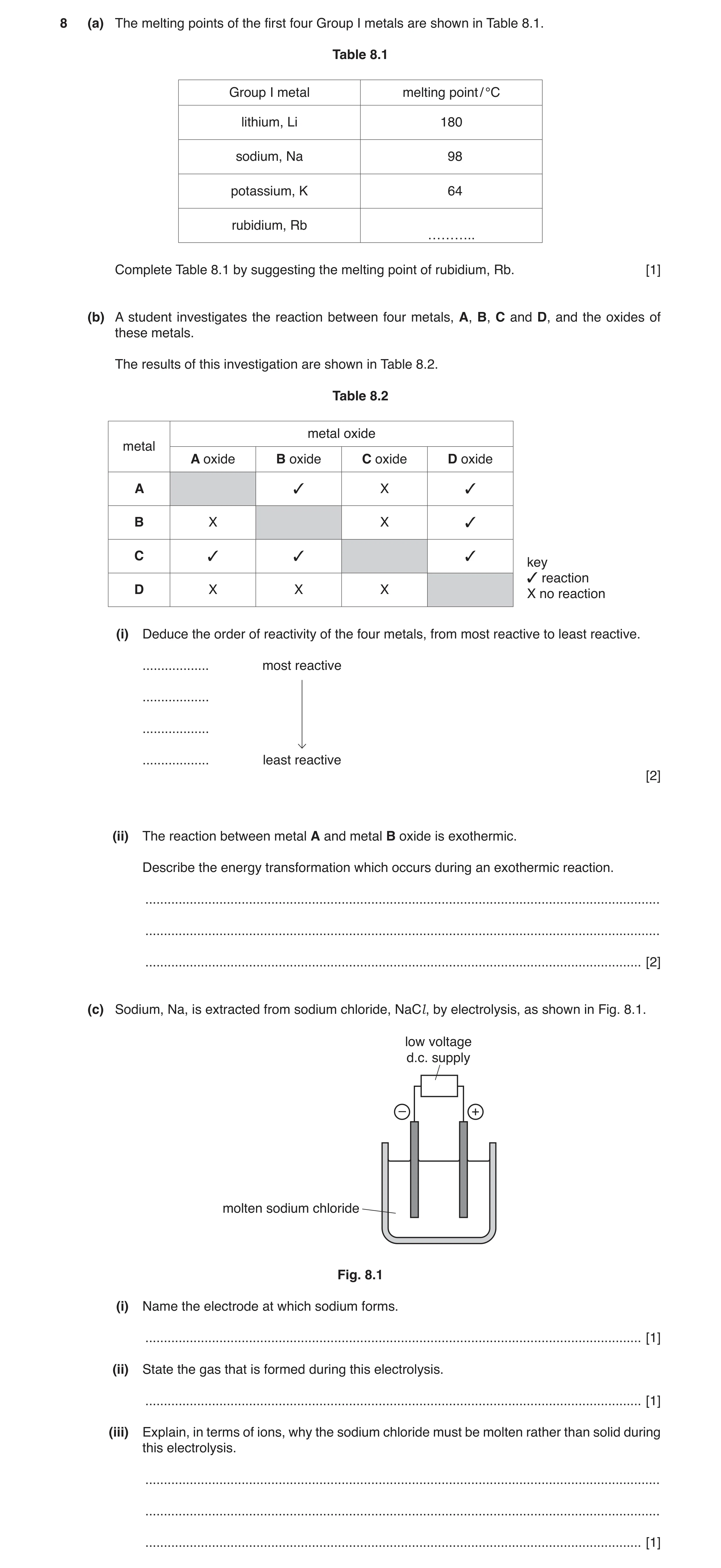
8 (a) The melting points of the first four Group I metals are shown in Table 8.1. Table 8.1 Group I metal melting point / °C lithium, Li 180 sodium, Na 98 potassium, K 64 rubidium, Rb ……….. Complete Table 8.1 by suggesting the melting point of rubidium, Rb. [1] (b) A student investigates the reaction between four metals, A, B, C and D, and the oxides of these metals. The results of this investigation are shown in Table 8.2. Table 8.2 metal oxide metal A oxide B oxide C oxide D oxide A ✓ X ✓ B X X ✓ C ✓ ✓ ✓ key ✓ reaction D X X X X no reaction (i) Deduce the order of reactivity of the four metals, from most reactive to least reactive. … most reactive … … … least reactive [2] (ii) The reaction between metal A and metal B oxide is exothermic. Describe the energy transformation which occurs during an exothermic reaction. … … … [2] (c) Sodium, Na, is extracted from sodium chloride, NaCl, by electrolysis, as shown in Fig. 8.1. low voltage d.c. supply – + molten sodium chloride Fig. 8.1 (i) Name the electrode at which sodium forms. … [1] (ii) State the gas that is formed during this electrolysis. … [1] (iii) Explain, in terms of ions, why the sodium chloride must be molten rather than solid during this electrolysis. … … … [1]
8 marks
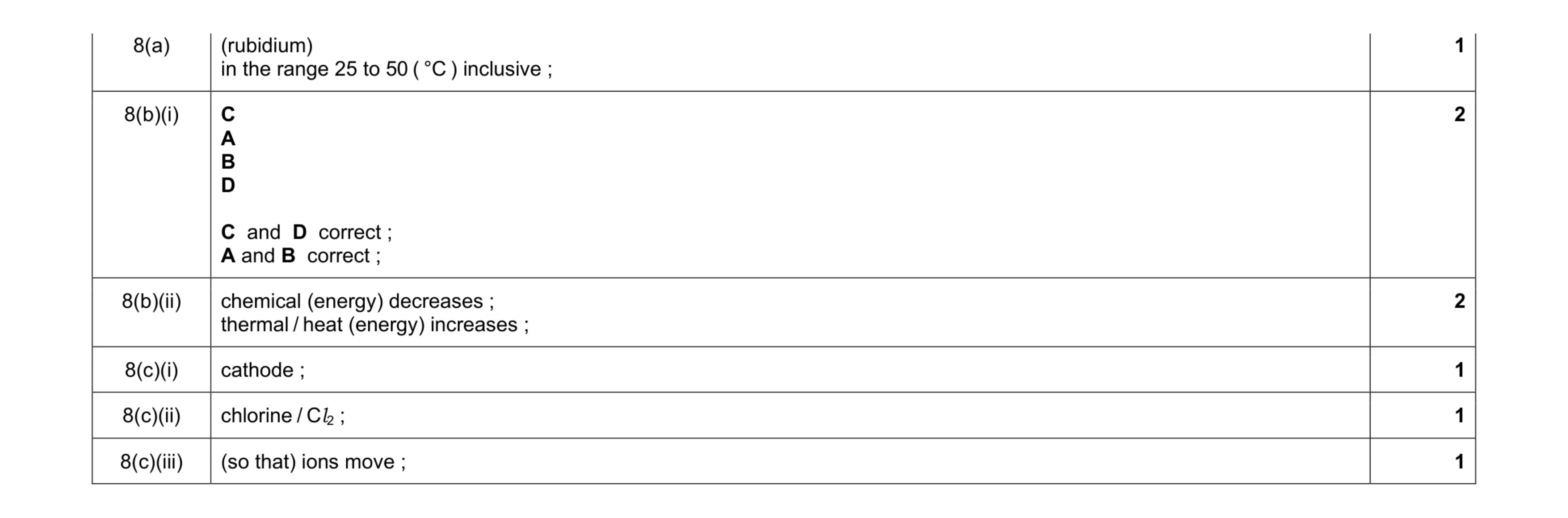
Mark scheme: 8(a) (rubidium) in the range 25 to 50 ( °C ) inclusive ; 1 8(b)(i) C A B D C and D correct ; A and B correct ; 2 8(b)(ii) chemical (energy) decreases ; thermal / heat (energy) increases ; 2 8(c)(i) cathode ; 1 8(c)(ii) chlorine / Cl2 ; 1 8(c)(iii) (so that) ions move ; 1
This question in 0653/43 May/June 2017
Q2 · Fractional distillation of petroleum produces fractions containing different compounds 0653/43 Oct/Nov 2017
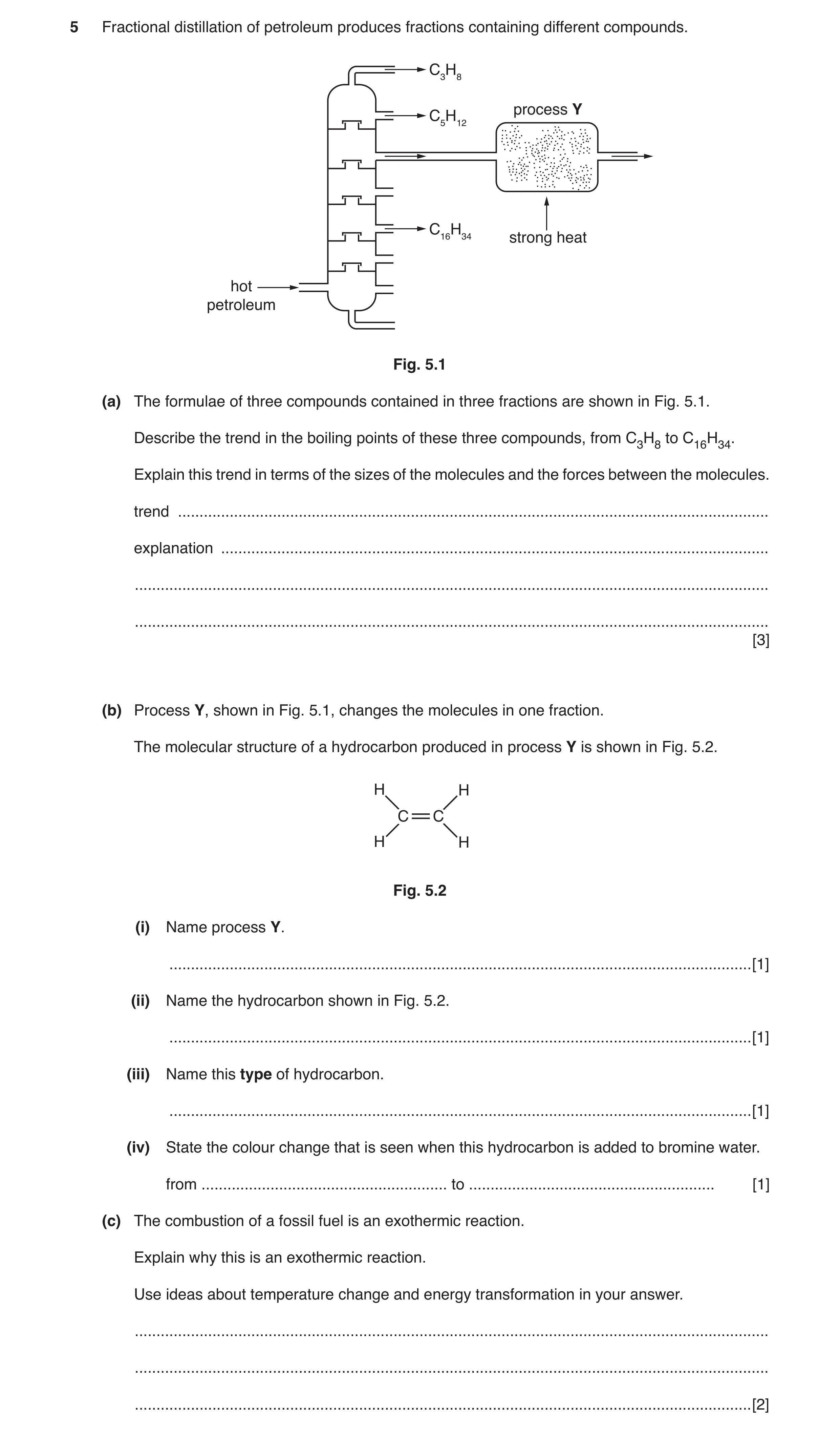
5 Fractional distillation of petroleum produces fractions containing different compounds. C3H8 process Y C5H12 C16H34 strong heat hot petroleum Fig. 5.1 (a) The formulae of three compounds contained in three fractions are shown in Fig. 5.1. Describe the trend in the boiling points of these three compounds, from C3H8 to C16H34. Explain this trend in terms of the sizes of the molecules and the forces between the molecules. trend … explanation … … … [3] (b) Process Y, shown in Fig. 5.1, changes the molecules in one fraction. The molecular structure of a hydrocarbon produced in process Y is shown in Fig. 5.2. H H C C H H Fig. 5.2 (i) Name process Y. … [1] (ii) Name the hydrocarbon shown in Fig. 5.2. … [1] (iii) Name this type of hydrocarbon. … [1] (iv) State the colour change that is seen when this hydrocarbon is added to bromine water. from … to … [1] (c) The combustion of a fossil fuel is an exothermic reaction. Explain why this is an exothermic reaction. Use ideas about temperature change and energy transformation in your answer. … … … [2]
9 marks
Mark scheme: 5(a) (trend) increase (in boiling point) ; (explanation) bigger molecules ; greater intermolecular forces ; 3 5(b)(i) cracking ; 1 5(b)(ii) ethene ; allow ethylene 1 5(b)(iii) alkene / unsaturated ; 1 5(b)(iv) (from) orange / brown (to) colourless / decolourises ; 1 5(c) chemical (energy) to thermal / heat (energy) ; and one from temperature increases ; thermal energy (heat) released ; max 2
This question in 0653/43 Oct/Nov 2017
Q3 · Ethene is manufactured by cracking larger hydrocarbon molecules 0653/41 May/June 2018
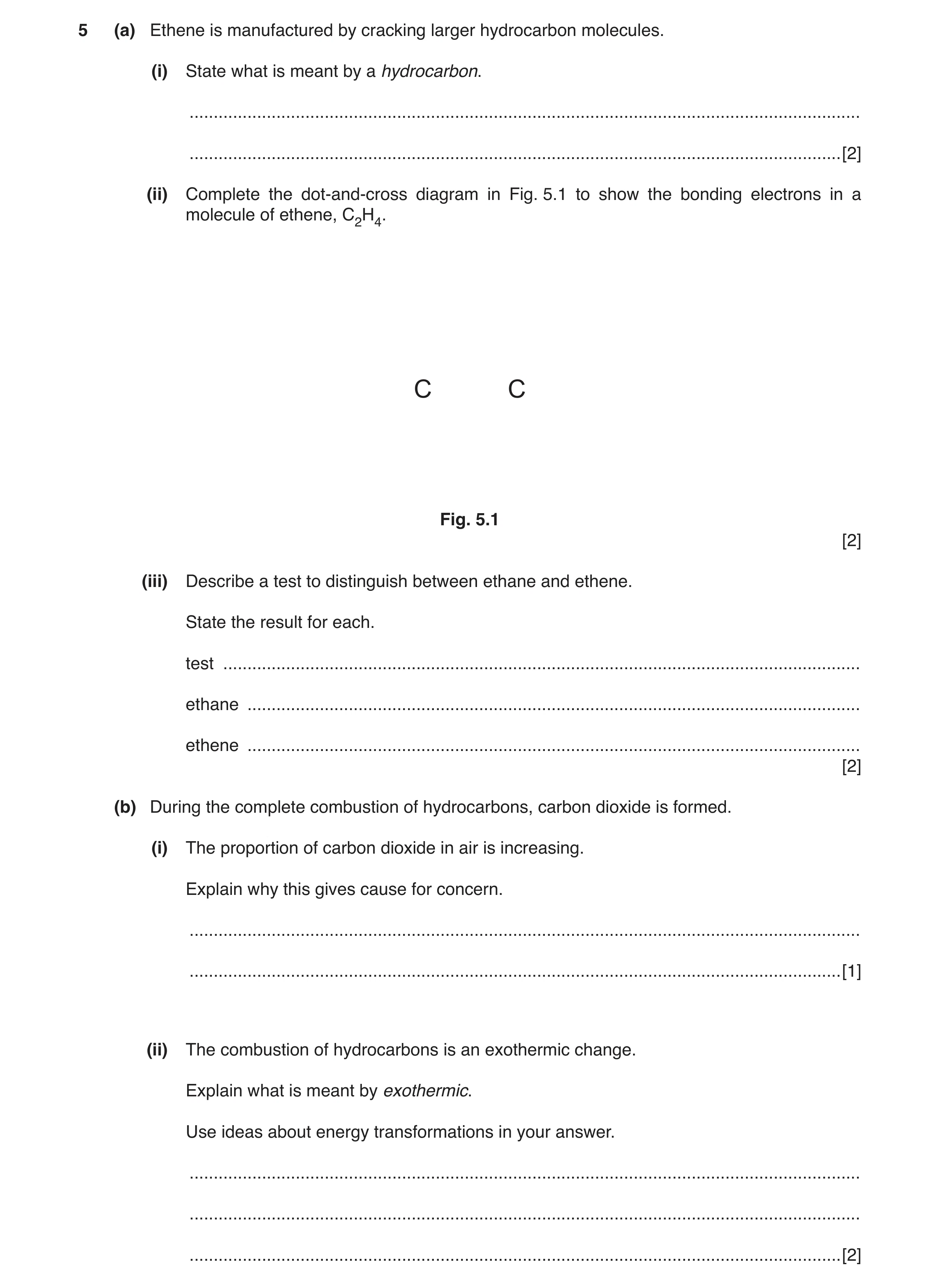
5 (a) Ethene is manufactured by cracking larger hydrocarbon molecules. (i) State what is meant by a hydrocarbon. … … [2] (ii) Complete the dot-and-cross diagram in Fig. 5.1 to show the bonding electrons in a molecule of ethene, C2H4. C C Fig. 5.1 [2] (iii) Describe a test to distinguish between ethane and ethene. State the result for each. test … ethane … ethene … [2] (b) During the complete combustion of hydrocarbons, carbon dioxide is formed. (i) The proportion of carbon dioxide in air is increasing. Explain why this gives cause for concern. … … [1] (ii) The combustion of hydrocarbons is an exothermic change. Explain what is meant by exothermic. Use ideas about energy transformations in your answer. … … … [2]
9 marks
Mark scheme: 5(a)(i) (compound / substance ) containing hydrogen and carbon (atoms) ; (carbon and hydrogen ) only ; 2 5(a)(ii) (circles not essential) four electrons shown between carbon atoms ; four H atoms drawn with single pair of electrons between each and a C atom ; 2 5(a)(iii) (test) (addition of) bromine ; (ethane) no change owtte and (ethene) decolourises ; 2 5(b)(i) global warming / any valid effect of global warming ; 1 5(b)(ii) thermal /heat energy released (by chemical reaction) / (chemical reaction causes) temperature increase ; chemical energy converted (to thermal / heat energy) ; 2
This question in 0653/41 May/June 2018
Q4 · Elements are arranged in the Periodic Table in atomic number order 0653/42 May/June 2018
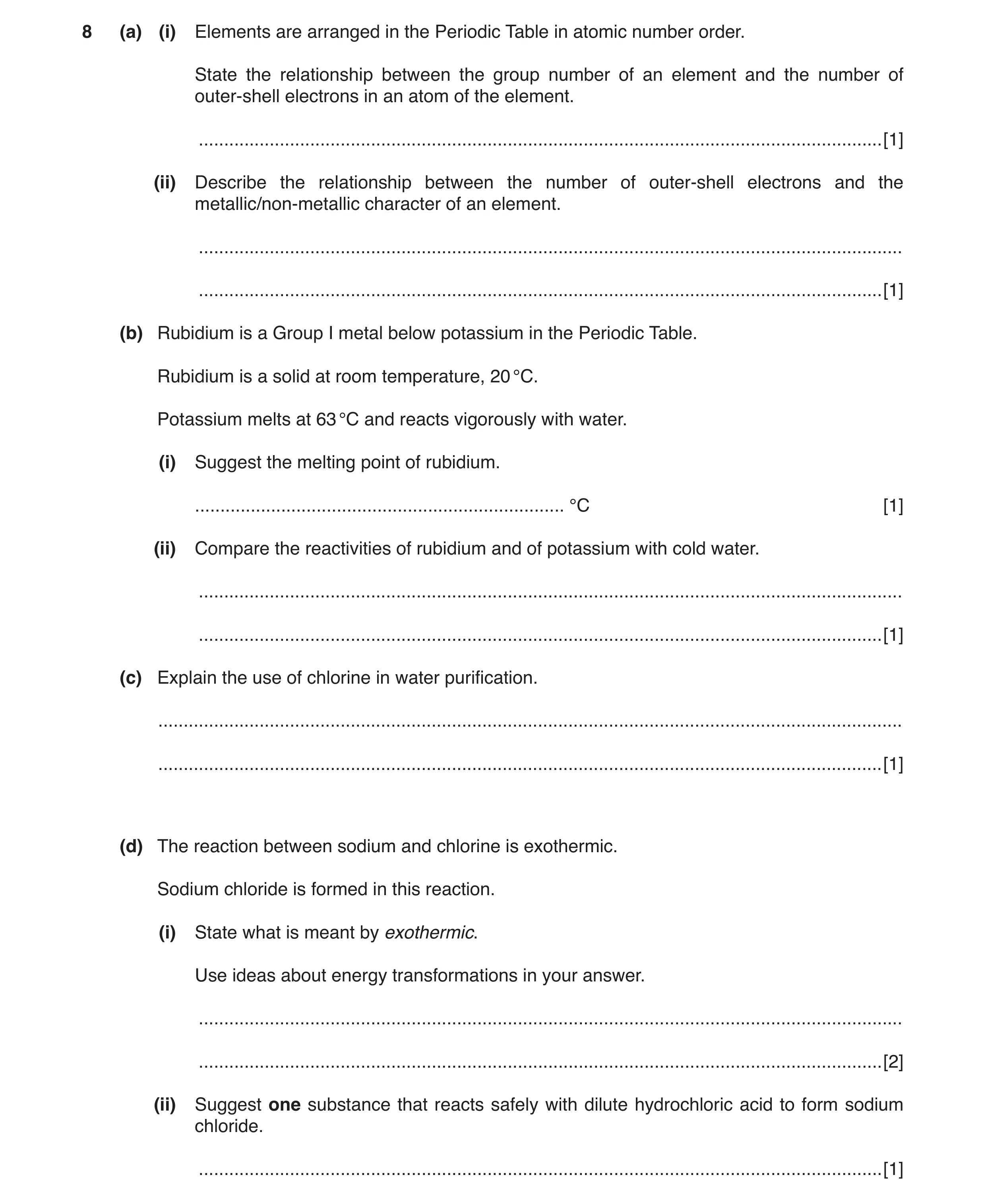
8 (a) (i) Elements are arranged in the Periodic Table in atomic number order. State the relationship between the group number of an element and the number of outer-shell electrons in an atom of the element. … [1] (ii) Describe the relationship between the number of outer-shell electrons and the metallic/non-metallic character of an element. … … [1] (b) Rubidium is a Group I metal below potassium in the Periodic Table. Rubidium is a solid at room temperature, 20 °C. Potassium melts at 63 °C and reacts vigorously with water. (i) Suggest the melting point of rubidium. … °C [1] (ii) Compare the reactivities of rubidium and of potassium with cold water. … … [1] (c) Explain the use of chlorine in water purification. … … [1] (d) The reaction between sodium and chlorine is exothermic. Sodium chloride is formed in this reaction. (i) State what is meant by exothermic. Use ideas about energy transformations in your answer. … … [2] (ii) Suggest one substance that reacts safely with dilute hydrochloric acid to form sodium chloride. … [1]
8 marks
Mark scheme: 8(a)(i) the idea that the number of outer electrons is the same as the group number ; 1 8(a)(ii) more (outer-shell) electrons more non-metallic ; metallic elements have fewer (outer-shell) electrons ; 1 8(b)(i) temperature in range 21–62 (°C) ; 1 8(b)(ii) rubidium is more reactive ; 1 8(c) kill / destroy bacteria / microbes / microorganisms ; 1 8(d)(i) thermal / heat energy released (by chemical reaction) / (chemical reaction causes) temperature increase ; chemical energy converted (to thermal / heat energy) ; 2 8(d)(ii) sodium hydroxide / NaOH / sodium carbonate / Na2CO3 / sodium hydrogen carbonate / sodium bicarbonate / NaHCO3 ; 1
This question in 0653/42 May/June 2018
Q5 · A simple example of cracking is the cracking of ethane to produce ethene and hydrogen 0653/43 May/June 2019
2 (a) A simple example of cracking is the cracking of ethane to produce ethene and hydrogen. C2H6 → C2H4 + H2 The energy level diagram for this reaction is shown in Fig. 2.1. energy C2H4 + H2 C2H6 reaction progress Fig. 2.1 (i) On Fig. 2.1 draw a double headed arrow ( ) to show the activation energy for this reaction. [1] (ii) Use the energy level diagram to explain why the reaction is endothermic. … … [1] (iii) State one condition required for the process of cracking. … [1] (b) Ethane and ethene are not in the same homologous series. Explain what is meant by the term homologous series. … … … [2] (c) Draw a dot-and-cross diagram to show the bonding in a molecule of ethane, C2H6. [3] (d) When fuels are burned, carbon dioxide is released into the atmosphere. State one possible negative effect of an increase in the concentration of carbon dioxide in the atmosphere. … … [1] (e) Complete the balanced symbol equation for the complete combustion of ethene, C2H4 , in oxygen. … C2H4 + … → … CO2 + [2] [Total: 11]
11 marks
Mark scheme: 2(a)(i) arrow from reactant energy level to the top of the curve ; 1 2(a)(ii) reactants have less chemical energy than products ; 1 2(a)(iii) high temperature / high pressure / catalyst ; 1 2(b) family of compounds with a general formula ; similar chemical properties ; 2 Question Answer Marks 2(c) six hydrogen atoms, three attached to each carbon ; one bonding pair between carbon atoms ; single bonding pairs between each carbon and hydrogen ; 3 2(d) global warming / enhanced greenhouse effect / climate change / named consequence of climate change ; 1 2(e) C2H4 + 3O2 � 2CO2 + 2H2O all formulae correct ; balanced (dependent on correct formulae) ; 2
This question in 0653/43 May/June 2019
Q6 · Data about Group I metals 0653/41 Oct/Nov 2019
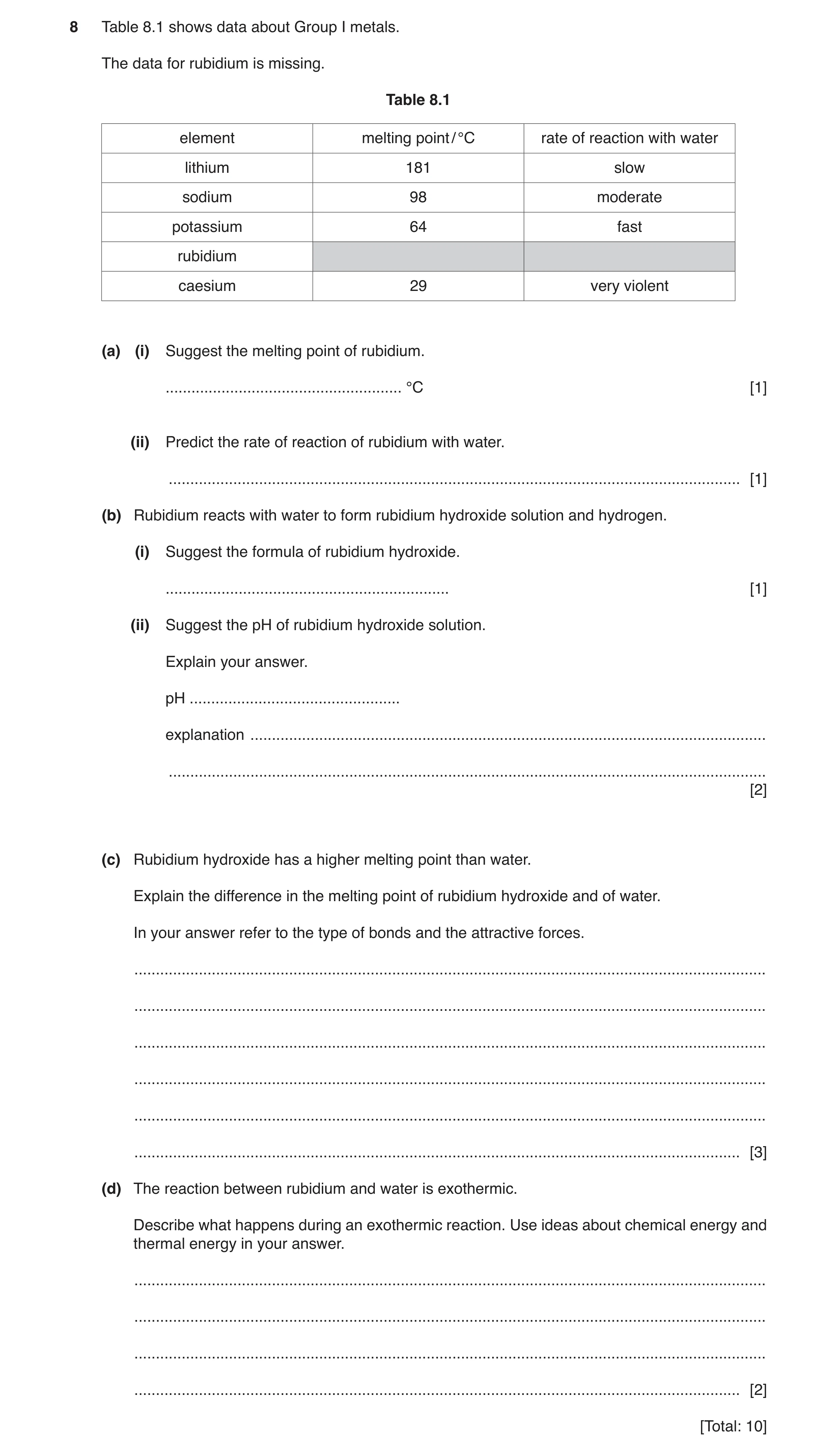
8 Table 8.1 shows data about Group I metals. The data for rubidium is missing. Table 8.1 element melting point / °C rate of reaction with water lithium 181 slow sodium 98 moderate potassium 64 fast rubidium caesium 29 very violent (a) (i) Suggest the melting point of rubidium. … °C [1] (ii) Predict the rate of reaction of rubidium with water. … [1] (b) Rubidium reacts with water to form rubidium hydroxide solution and hydrogen. (i) Suggest the formula of rubidium hydroxide. … [1] (ii) Suggest the pH of rubidium hydroxide solution. Explain your answer. pH … explanation … … [2] (c) Rubidium hydroxide has a higher melting point than water. Explain the difference in the melting point of rubidium hydroxide and of water. In your answer refer to the type of bonds and the attractive forces. … … … … … … [3] (d) The reaction between rubidium and water is exothermic. Describe what happens during an exothermic reaction. Use ideas about chemical energy and thermal energy in your answer. … … … … [2] [Total: 10]
10 marks
Mark scheme: 8(a)(i) 30 to 55 °C inclusive ; 1 8(a)(ii) violent / very fast ; 1 8(b)(i) RbOH ; 1 8(b)(ii) in range 8–14 ; the solution is an alkali ; 2 8(c) RbOH is ionic water is covalent ; attractive forces between ions are strong or attractive forces between molecules are weak ; more thermal energy (heat) needed to separate ions less thermal energy (heat) needed to separate molecules ; 3 8(d) temperature increases / thermal energy released ; chemical energy is changed into thermal energy ; 2
This question in 0653/41 Oct/Nov 2019
Q7 · The formula of methanol is CH3OH 0653/42 Feb/March 2020
2 (a) The formula of methanol is CH3OH. Complete the structure of a molecule of methanol. Include all atoms and all bonds. C O [1] (b) (i) Explain why methanol is not an alkane. … … [1] (ii) Explain why a molecule of methanol contains only covalent bonds. … … [1] (c) Methanol can be used as a fuel. It burns in oxygen and releases energy. (i) Complete the equation for the complete combustion of methanol. 2CH3OH + … … + … [2] (ii) The combustion of methanol is an exothermic reaction. Describe what is meant by exothermic. Use ideas about energy, bond breaking and bond forming in your answer. … … … [2] (d) Methane is a greenhouse gas. State one effect of increased levels of greenhouse gases in the atmosphere. … … [1] [Total: 8]
8 marks
Mark scheme: 2(a) ; 2(b)(i) contains oxygen / is not carbon and hydrogen only ; 1 2(b)(ii) all bonds are between non-metal atoms ; 1 2(c)(i) (2CH3OH +) 3O2 → 2CO2 + 4H2O all formulae correct ; (correct formulae) balanced ; 2 Question Answer Marks 2(c)(ii) idea that energy is taken in to break bonds / that energy is released when bonds form ; (exothermic means) energy released is greater (than taken in) / (during an exothermic reaction) temperature increases / chemical energy converted to thermal ; 2 2(d) global warming / climate change / consequence of climate change, e.g. extreme weather events / rising sea level ; 1
This question in 0653/42 Feb/March 2020
Q8 · The formula of methanol is CH3OH 0653/41 May/June 2020
2 The formula of methanol is CH3OH. (a) Explain why methanol is not a hydrocarbon. … … [1] (b) (i) Complete the dot-and-cross diagram for a molecule of methanol. C O [2] (ii) Explain why a molecule of methanol contains only covalent bonds. … … [1] (c) Methanol is used as a fuel because it burns in oxygen. Complete the equation for the complete combustion of methanol. 2CH3OH + … … + … [2] (d) Fig. 2.1 shows the energy level diagram for the complete combustion of methanol. X energy progress of reaction Fig. 2.1 (i) On Fig. 2.1, write the words reactants and products in suitable places. [1] (ii) State what the energy value X on Fig. 2.1 represents. … [1] (e) During the combustion of methanol, the amount of carbon dioxide in the atmosphere increases. Suggest one effect of this increase. … … [1] [Total: 9]
9 marks
Mark scheme: 2(a) contains oxygen / is not just carbon and hydrogen ; 1 2(b)(i) correct electrons around carbon atom ; correct electrons around oxygen atom ; 2 2(b)(ii) all atoms are non-metallic elements ; 1 Question Answer Marks 2(c) (2CH3OH) + 3O2 → 2CO2 + 4H2O correct formulae ; correctly balanced ; 2 2(d)(i) reactants on left and products on right ; 1 2(d)(ii) activation energy ; 1 2(e) (carbon dioxide is a greenhouse gas) so enhanced greenhouse effect / global warming / climate change / example of an effect of climate change ; 1
This question in 0653/41 May/June 2020
Q9 · The equation for the reaction between magnesium carbonate and dilute hydrochloric acid is… 0653/42 May/June 2020
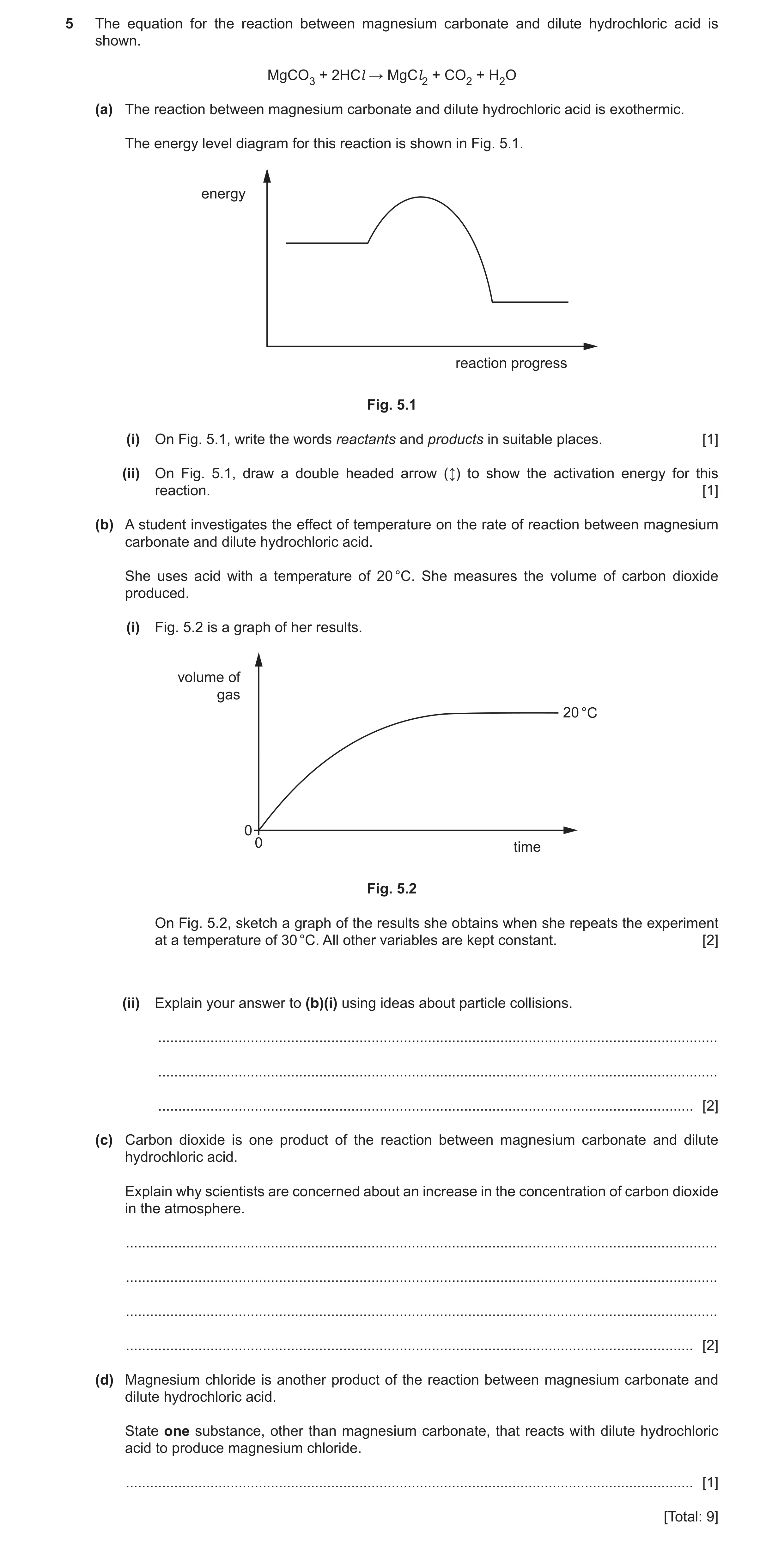
5 The equation for the reaction between magnesium carbonate and dilute hydrochloric acid is shown. MgCO3 + 2HCl → MgCl2 + CO2 + H2O (a) The reaction between magnesium carbonate and dilute hydrochloric acid is exothermic. The energy level diagram for this reaction is shown in Fig. 5.1. energy reaction progress Fig. 5.1 (i) On Fig. 5.1, write the words reactants and products in suitable places. [1] (ii) On Fig. 5.1, draw a double headed arrow (↕) to show the activation energy for this reaction. [1] (b) A student investigates the effect of temperature on the rate of reaction between magnesium carbonate and dilute hydrochloric acid. She uses acid with a temperature of 20 °C. She measures the volume of carbon dioxide produced. (i) Fig. 5.2 is a graph of her results. volume of gas 20 °C 0 0 time Fig. 5.2 On Fig. 5.2, sketch a graph of the results she obtains when she repeats the experiment at a temperature of 30 °C. All other variables are kept constant. [2] (ii) Explain your answer to (b)(i) using ideas about particle collisions. … … … [2] (c) Carbon dioxide is one product of the reaction between magnesium carbonate and dilute hydrochloric acid. Explain why scientists are concerned about an increase in the concentration of carbon dioxide in the atmosphere. … … … … [2] (d) Magnesium chloride is another product of the reaction between magnesium carbonate and dilute hydrochloric acid. State one substance, other than magnesium carbonate, that reacts with dilute hydrochloric acid to produce magnesium chloride. … [1] [Total: 9]
9 marks
Mark scheme: 5(a)(i) reactants on left and products on right ; 1 5(a)(ii) activation energy correctly identified ; 1 5(b)(i) steeper ; finish at same volume ; 2 5(b)(ii) particles move faster / have more kinetic energy / move more ; particles collide more frequently / more energetically ; 2 5(c) carbon dioxide is a greenhouse gas ; (which contributes to) enhanced greenhouse effect / global warming / climate change ; 2 5(d) magnesium / magnesium oxide / magnesium hydroxide ; 1
This question in 0653/42 May/June 2020
Q10 · Sodium reacts with water to form aqueous sodium hydroxide, NaOH, and hydrogen gas 0653/41 Oct/Nov 2020
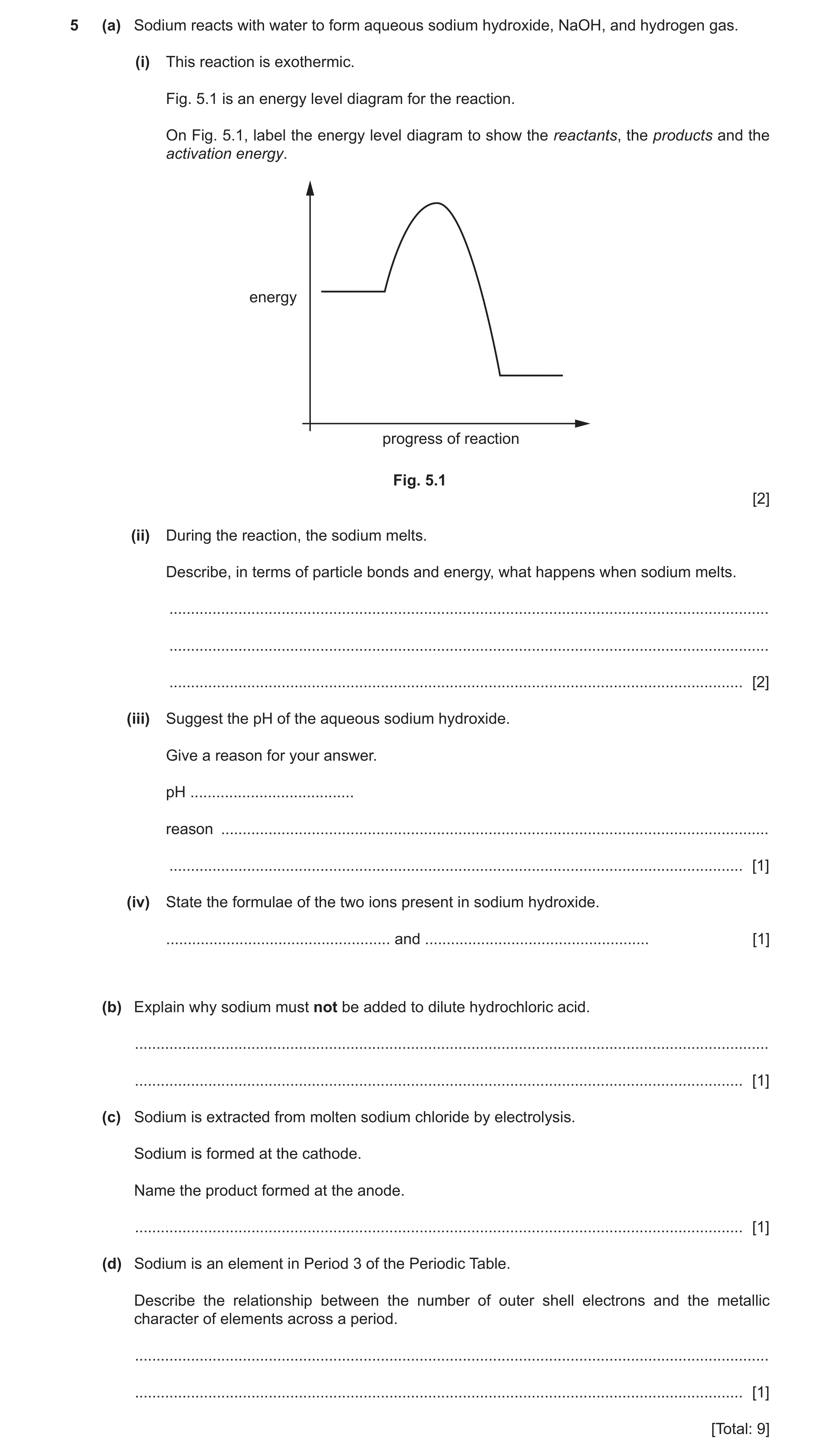
5 (a) Sodium reacts with water to form aqueous sodium hydroxide, NaOH, and hydrogen gas. (i) This reaction is exothermic. Fig. 5.1 is an energy level diagram for the reaction. On Fig. 5.1, label the energy level diagram to show the reactants, the products and the activation energy. energy progress of reaction Fig. 5.1 [2] (ii) During the reaction, the sodium melts. Describe, in terms of particle bonds and energy, what happens when sodium melts. … … … [2] (iii) Suggest the pH of the aqueous sodium hydroxide. Give a reason for your answer. pH … reason … … [1] (iv) State the formulae of the two ions present in sodium hydroxide. … and … [1] (b) Explain why sodium must not be added to dilute hydrochloric acid. … … [1] (c) Sodium is extracted from molten sodium chloride by electrolysis. Sodium is formed at the cathode. Name the product formed at the anode. … [1] (d) Sodium is an element in Period 3 of the Periodic Table. Describe the relationship between the number of outer shell electrons and the metallic character of elements across a period. … … [1] [Total: 9]
9 marks
Mark scheme: 5(a)(i) reactants and products labelled ; activation energy labelled ; 2 5(a)(ii) (sodium) particles gain (sufficient) energy ; to (overcome the attractive forces and) break the bonds between particles ; 2 5(a)(iii) 8–14 AND sodium hydroxide is a base ; 1 5(a)(iv) Na+ AND OH– ; 1 Question Answer Marks 5(b) too reactive / very reactive / explosive ; 1 5(c) chlorine ; 1 5(d) as number of (outer shell) electrons increases the element becomes more non-metallic / ora ; 1
This question in 0653/41 Oct/Nov 2020
Q11 · Cracking breaks down large saturated hydrocarbon molecules into smaller hydrocarbon… 0653/42 Oct/Nov 2020
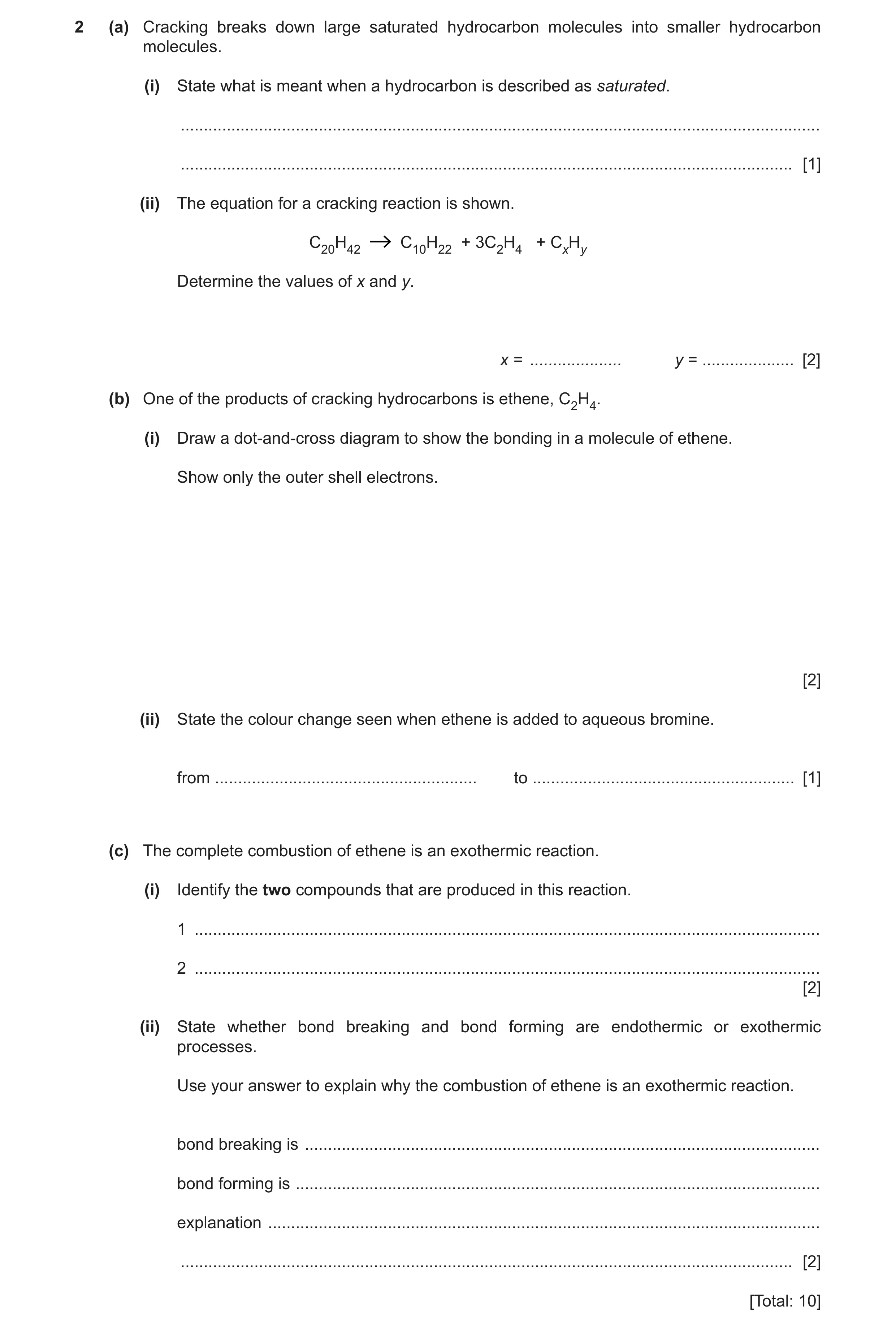
2 (a) Cracking breaks down large saturated hydrocarbon molecules into smaller hydrocarbon molecules. (i) State what is meant when a hydrocarbon is described as saturated. … … [1] (ii) The equation for a cracking reaction is shown. C20H42 C10H22 + 3C2H4 + CxHy Determine the values of x and y. x = … y = … [2] (b) One of the products of cracking hydrocarbons is ethene, C2H4. (i) Draw a dot-and-cross diagram to show the bonding in a molecule of ethene. Show only the outer shell electrons. [2] (ii) State the colour change seen when ethene is added to aqueous bromine. from … to … [1] (c) The complete combustion of ethene is an exothermic reaction. (i) Identify the two compounds that are produced in this reaction. 1 … 2 … [2] (ii) State whether bond breaking and bond forming are endothermic or exothermic processes. Use your answer to explain why the combustion of ethene is an exothermic reaction. bond breaking is … bond forming is … explanation … … [2] [Total: 10]
10 marks
Mark scheme: 2(a)(i) (compound containing only carbon and hydrogen and) only single (covalent) bonds (between carbon atoms) ; 1 2(a)(ii) x = 4 ; y = 8 ; 2 2(b)(i) double bond between carbon atoms; all else correct including chemical symbols ; 2 2(b)(ii) orange to colourless ; 1 2(c)(i) carbon dioxide / CO2 ; water / H2O ; 2 2(c)(ii) (bond breaking is) endothermic AND (bond forming is) exothermic ; more energy released during bond formation than energy required for bond breaking ; 2
This question in 0653/42 Oct/Nov 2020
Q12 · Sodium is an element in Group I of the Periodic Table 0653/42 Feb/March 2021
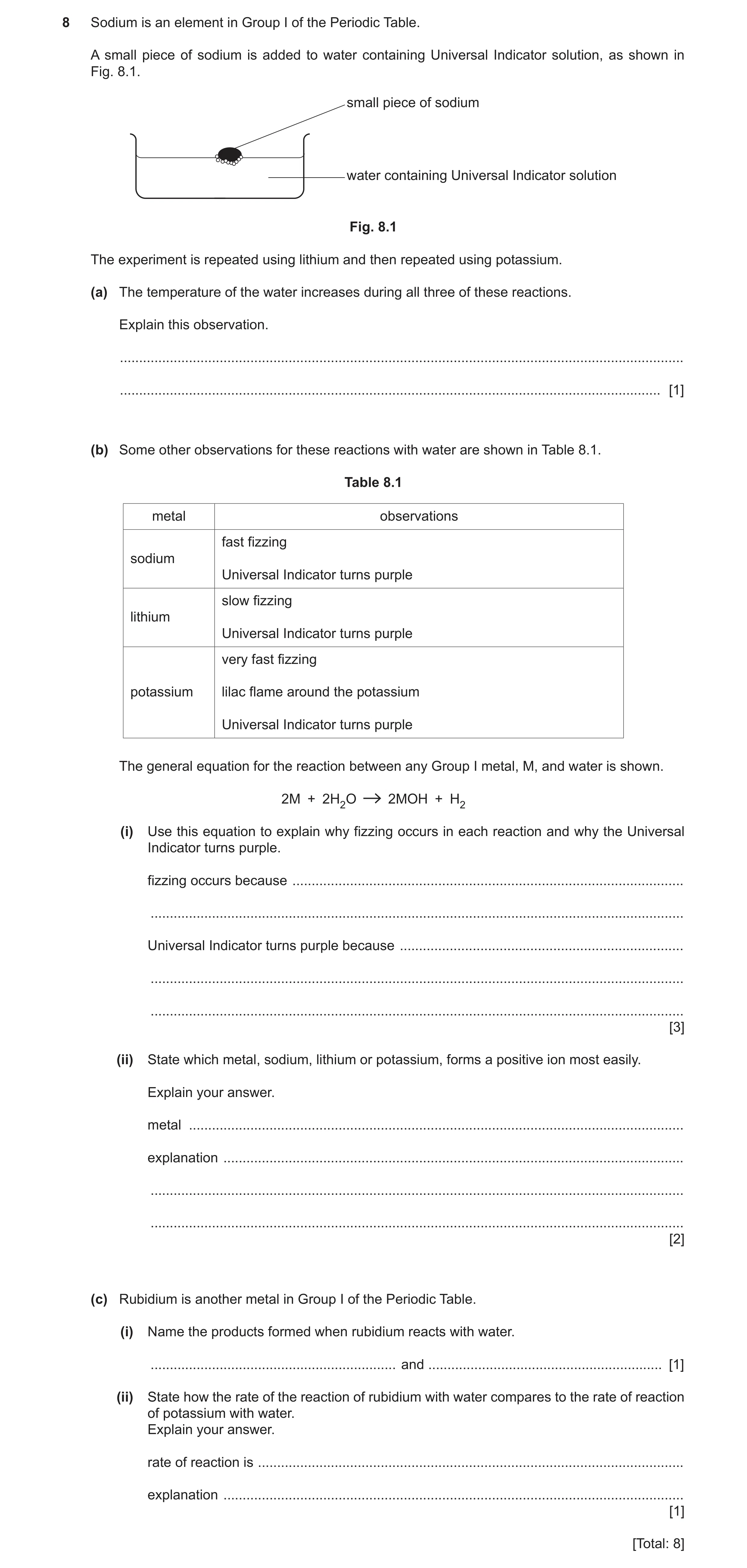
8 Sodium is an element in Group I of the Periodic Table. A small piece of sodium is added to water containing Universal Indicator solution, as shown in Fig. 8.1. small piece of sodium water containing Universal Indicator solution Fig. 8.1 The experiment is repeated using lithium and then repeated using potassium. (a) The temperature of the water increases during all three of these reactions. Explain this observation. … … [1] (b) Some other observations for these reactions with water are shown in Table 8.1. Table 8.1 metal observations fast fizzing sodium Universal Indicator turns purple slow fizzing lithium Universal Indicator turns purple very fast fizzing potassium lilac flame around the potassium Universal Indicator turns purple The general equation for the reaction between any Group I metal, M, and water is shown. 2M + 2H2O 2MOH + H2 (i) Use this equation to explain why fizzing occurs in each reaction and why the Universal Indicator turns purple. fizzing occurs because … … Universal Indicator turns purple because … … … [3] (ii) State which metal, sodium, lithium or potassium, forms a positive ion most easily. Explain your answer. metal … explanation … … … [2] (c) Rubidium is another metal in Group I of the Periodic Table. (i) Name the products formed when rubidium reacts with water. … and … [1] (ii) State how the rate of the reaction of rubidium with water compares to the rate of reaction of potassium with water. Explain your answer. rate of reaction is … explanation … [1] [Total: 8]
8 marks
Mark scheme: 8(a) (thermal) energy / heat, is given out / reaction is exothermic ; 1 8(b)(i) (fizzing occurs because) hydrogen / a gas, is made ; (Universal Indicator turns purple because) an alkali is made / pH > 7 / a basic solution is made ; (metal) hydroxide is made / named metal hydroxide ; 3 8(b)(ii) potassium ; and any one from: quotes comparative observations from the table to show potassium reacts the most vigorously with water ; potassium is the most reactive metal (of the three) / is lower down Group 1 ; 2 8(c)(i) rubidium hydroxide and hydrogen ; 1 8(c)(ii) (rate of reaction is) faster AND (explanation) because rubidium is more reactive / because rubidium is lower down the group ; 1
This question in 0653/42 Feb/March 2021
Q13 · Some gas ovens use methane as a fuel, other gas ovens use propane 0653/41 May/June 2021
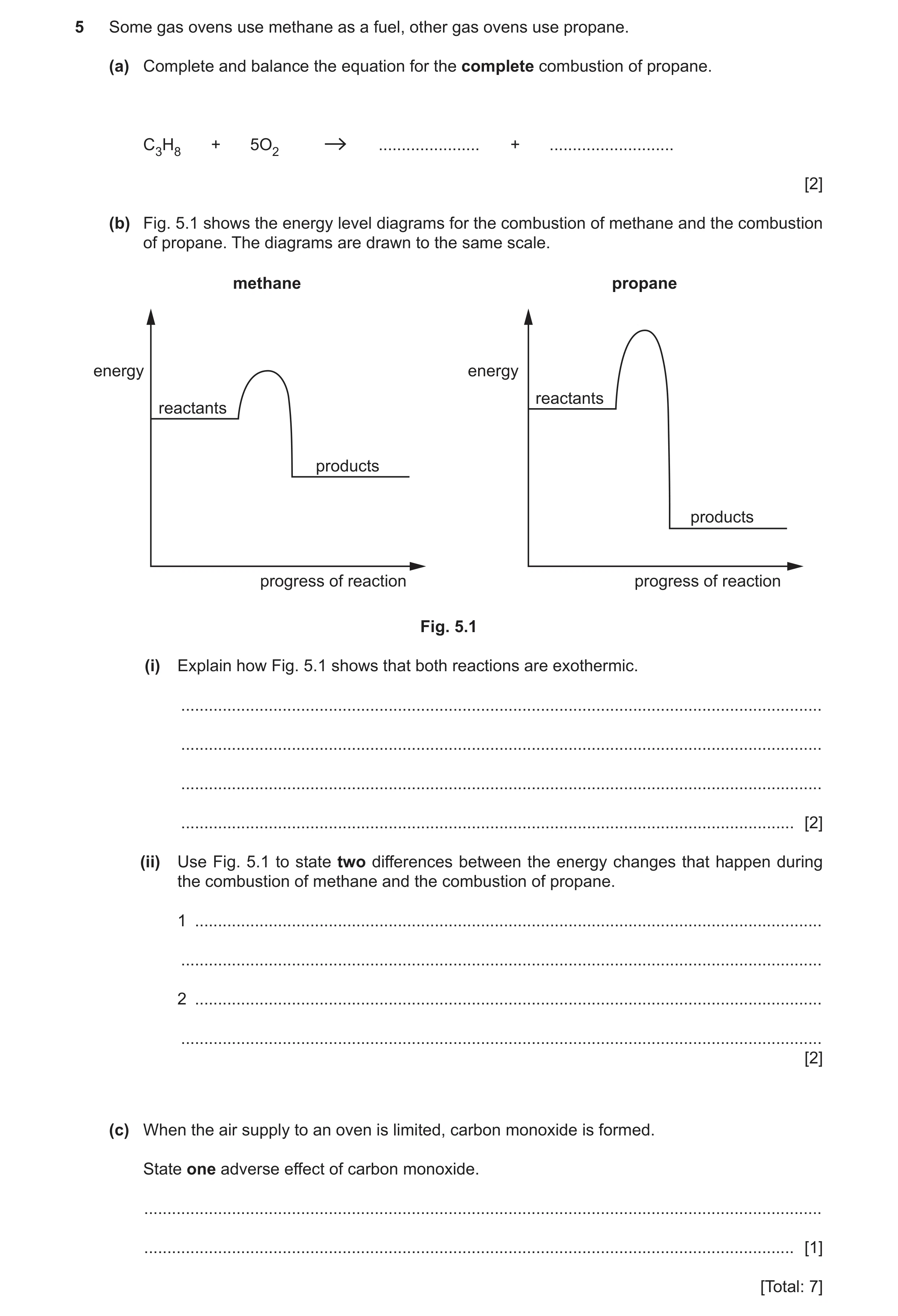
5 Some gas ovens use methane as a fuel, other gas ovens use propane. (a) Complete and balance the equation for the complete combustion of propane. C3H8 + 5O2 … + … [2] (b) Fig. 5.1 shows the energy level diagrams for the combustion of methane and the combustion of propane. The diagrams are drawn to the same scale. methane propane energy energy reactants reactants products products progress of reaction progress of reaction Fig. 5.1 (i) Explain how Fig. 5.1 shows that both reactions are exothermic. … … … … [2] (ii) Use Fig. 5.1 to state two differences between the energy changes that happen during the combustion of methane and the combustion of propane. 1 … … 2 … … [2] (c) When the air supply to an oven is limited, carbon monoxide is formed. State one adverse effect of carbon monoxide. … … [1] [Total: 7]
7 marks
Mark scheme: 5(a) CO2 AND H2O given as products ; balanced equation 3CO2 + 4H2O ; 2 5(b)(i) (in both reactions) energy is given out ; energy change is negative / energy of the products is lower than energy of the reactants OWTTE ; 2 5(b)(ii) propane has a higher activation energy ; propane gives out more energy / gives a more exothermic reaction ; 2 5(c) toxic / poisonous ; 1
This question in 0653/41 May/June 2021
Q14 · The energy level diagrams for four different compounds dissolving in water 0653/43 Oct/Nov 2021
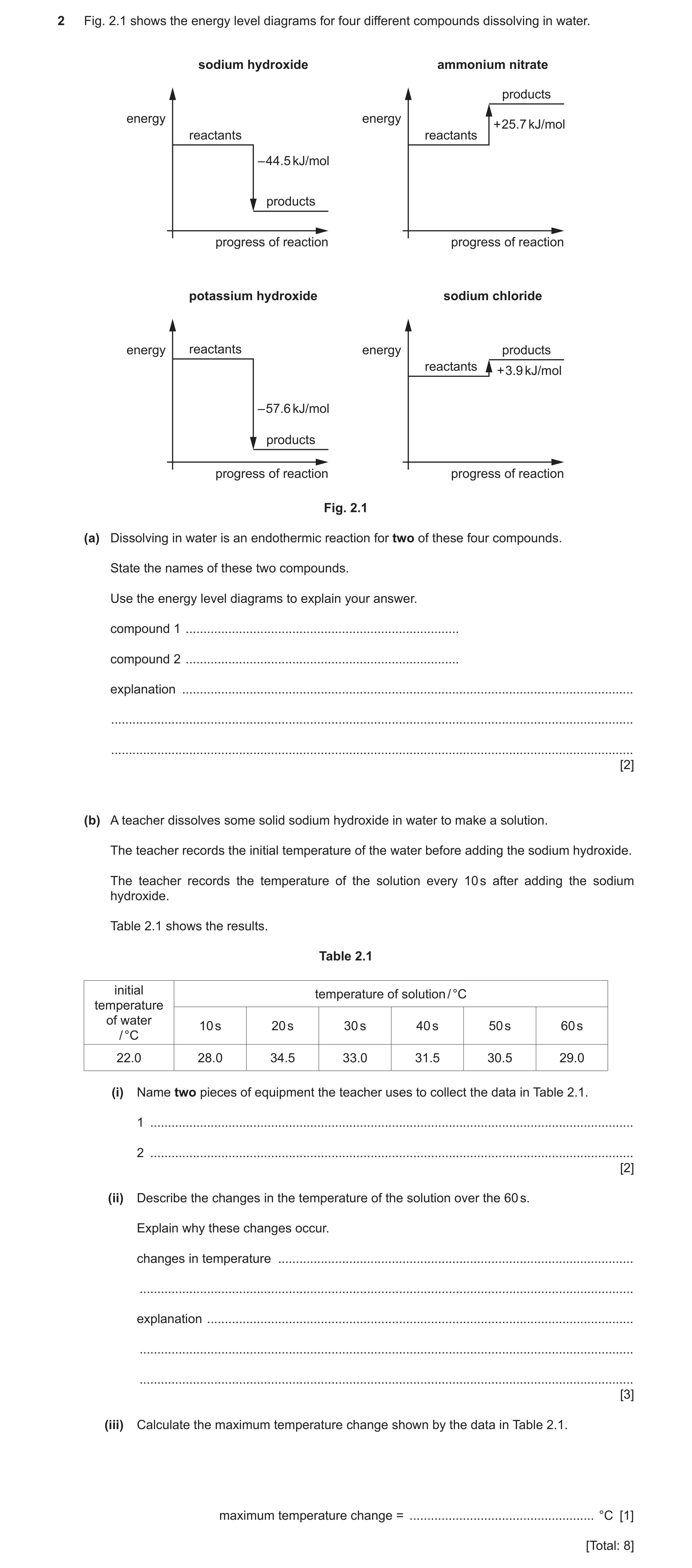
2 Fig. 2.1 shows the energy level diagrams for four different compounds dissolving in water. sodium hydroxide ammonium nitrate products energy energy + 25.7 kJ/mol reactants reactants – 44.5 kJ/mol products progress of reaction progress of reaction potassium hydroxide sodium chloride energy reactants energy products reactants + 3.9 kJ/mol – 57.6 kJ/mol products progress of reaction progress of reaction Fig. 2.1 (a) Dissolving in water is an endothermic reaction for two of these four compounds. State the names of these two compounds. Use the energy level diagrams to explain your answer. compound 1 … compound 2 … explanation … … … [2] (b) A teacher dissolves some solid sodium hydroxide in water to make a solution. The teacher records the initial temperature of the water before adding the sodium hydroxide. The teacher records the temperature of the solution every 10 s after adding the sodium hydroxide. Table 2.1 shows the results. Table 2.1 initial temperature of solution / °C temperature of water 10 s 20 s 30 s 40 s 50 s 60 s / °C 22.0 28.0 34.5 33.0 31.5 30.5 29.0 (i) Name two pieces of equipment the teacher uses to collect the data in Table 2.1. 1 … 2 … [2] (ii) Describe the changes in the temperature of the solution over the 60 s. Explain why these changes occur. changes in temperature … … explanation … … … [3] (iii) Calculate the maximum temperature change shown by the data in Table 2.1. maximum temperature change = … °C [1] [Total: 8]
8 marks
Mark scheme: 2(a) ammonium nitrate AND sodium chloride ; an upwards arrow shows, energy change is positive / energy has been taken in / energy of the products is greater than the energy of the reactants ; 2 2(b)(i) thermometer / temperature probe ; stop-watch; 2 2(b)(ii) increases then decreases ; (increases because) energy given out / exothermic reaction ; (decreases because) reaction is finished (and so it cools) ; 3 2(b)(iii) (34.5 – 22.0 =) 12.5 (oC) ; 1
This question in 0653/43 Oct/Nov 2021
Q15 · Energy level diagrams for two reactions are shown in Fig 0653/42 May/June 2022
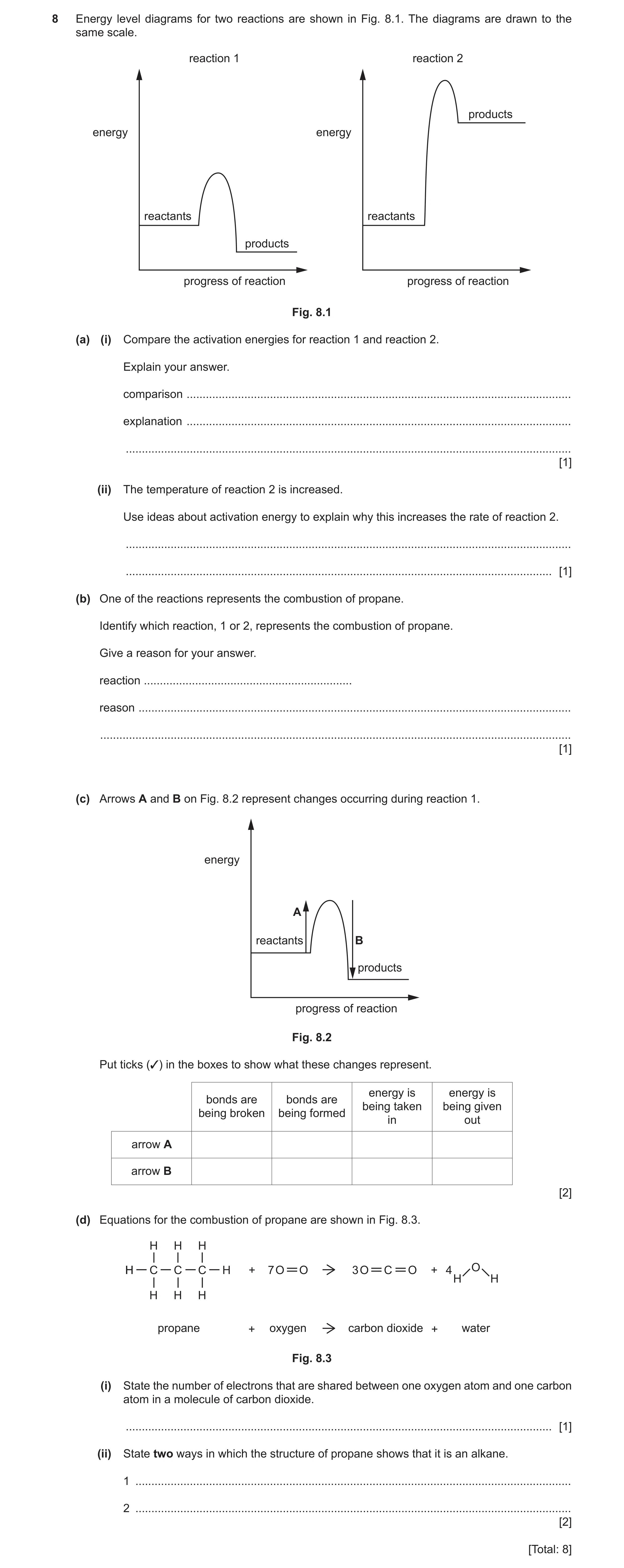
8 Energy level diagrams for two reactions are shown in Fig. 8.1. The diagrams are drawn to the same scale. reaction 1 reaction 2 products energy energy reactants reactants products progress of reaction progress of reaction Fig. 8.1 (a) (i) Compare the activation energies for reaction 1 and reaction 2. Explain your answer. comparison … explanation … … [1] (ii) The temperature of reaction 2 is increased. Use ideas about activation energy to explain why this increases the rate of reaction 2. … … [1] (b) One of the reactions represents the combustion of propane. Identify which reaction, 1 or 2, represents the combustion of propane. Give a reason for your answer. reaction … reason … … [1] (c) Arrows A and B on Fig. 8.2 represent changes occurring during reaction 1. energy A reactants B products progress of reaction Fig. 8.2 Put ticks (✓) in the boxes to show what these changes represent. energy is energy is bonds are bonds are being taken being given being broken being formed in out arrow A arrow B [2] (d) Equations for the combustion of propane are shown in Fig. 8.3. H H H H C C C H + 7 O O 3 O C O + 4 O H H H H H propane + oxygen carbon dioxide + water Fig. 8.3 (i) State the number of electrons that are shared between one oxygen atom and one carbon atom in a molecule of carbon dioxide. … [1] (ii) State two ways in which the structure of propane shows that it is an alkane. 1 … 2 … [2] [Total: 8]
8 marks
Mark scheme: 8(a)(i) (activation energy of ) reaction 2 is higher because the difference in energy of reactants and energy of the peak is greater / ORA ; 1 8(a)(ii) more collisions have the activation energy / frequency of successful collisions increases ; 1 8(b) reaction 1 AND because it is exothermic / energy is given out ; 1 8(c) bonds are being broken bonds are being formed energy is being taken in energy is being given out arrow A ; arrow B ; 2 8(d)(i) 4 ; 1 8(d)(ii) Any two from: contains (only) carbon and hydrogen ; all single bonds / saturated ; has the same general formula ; 2
This question in 0653/42 May/June 2022
Q16 · Calcium carbonate reacts with dilute hydrochloric acid to produce a gas 0653/43 May/June 2022
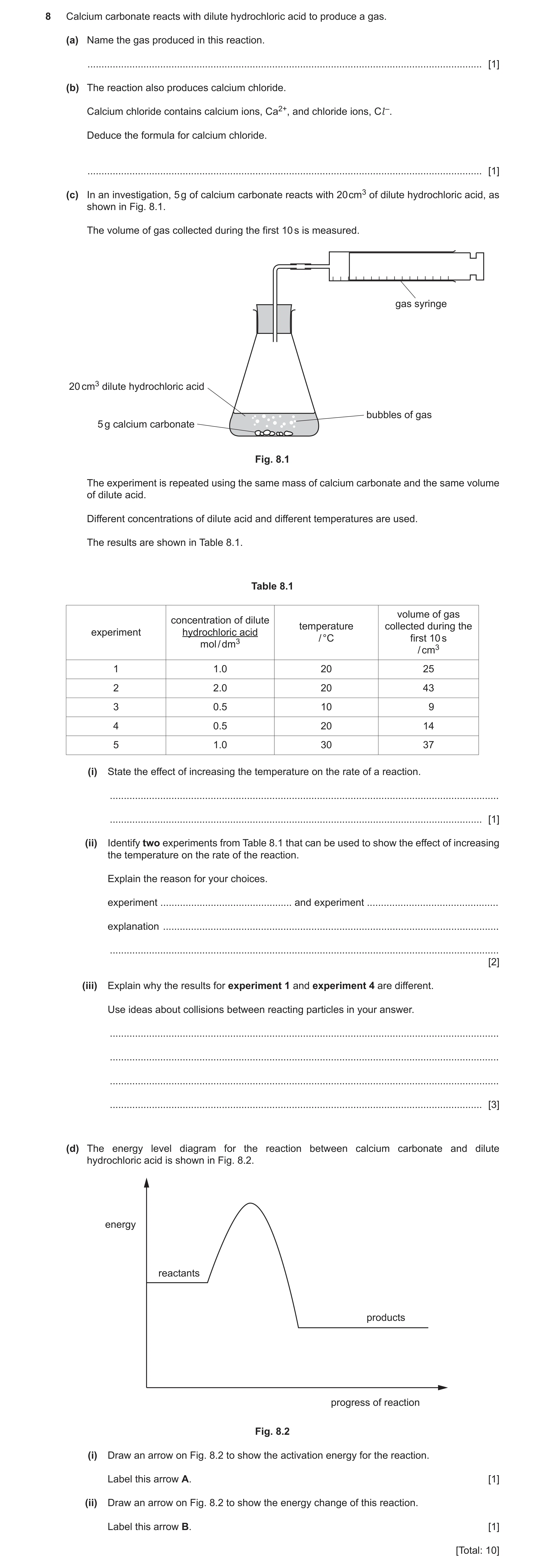
8 Calcium carbonate reacts with dilute hydrochloric acid to produce a gas. (a) Name the gas produced in this reaction. … [1] (b) The reaction also produces calcium chloride. Calcium chloride contains calcium ions, Ca2+, and chloride ions, Cl –. Deduce the formula for calcium chloride. … [1] (c) In an investigation, 5 g of calcium carbonate reacts with 20 cm3 of dilute hydrochloric acid, as shown in Fig. 8.1. The volume of gas collected during the first 10 s is measured. gas syringe 20 cm3 dilute hydrochloric acid bubbles of gas 5 g calcium carbonate Fig. 8.1 The experiment is repeated using the same mass of calcium carbonate and the same volume of dilute acid. Different concentrations of dilute acid and different temperatures are used. The results are shown in Table 8.1. Table 8.1 volume of gas concentration of dilute temperature collected during the experiment hydrochloric acid / °C first 10 s mol / dm3 / cm3 1 1.0 20 25 2 2.0 20 43 3 0.5 10 9 4 0.5 20 14 5 1.0 30 37 (i) State the effect of increasing the temperature on the rate of a reaction. … … [1] (ii) Identify two experiments from Table 8.1 that can be used to show the effect of increasing the temperature on the rate of the reaction. Explain the reason for your choices. experiment … and experiment … explanation … … [2] (iii) Explain why the results for experiment 1 and experiment 4 are different. Use ideas about collisions between reacting particles in your answer. … … … … [3] (d) The energy level diagram for the reaction between calcium carbonate and dilute hydrochloric acid is shown in Fig. 8.2. energy reactants products progress of reaction Fig. 8.2 (i) Draw an arrow on Fig. 8.2 to show the activation energy for the reaction. Label this arrow A. [1] (ii) Draw an arrow on Fig. 8.2 to show the energy change of this reaction. Label this arrow B. [1] [Total: 10]
10 marks
Mark scheme: 8(a) carbon dioxide ; 1 8(b) CaCl2 ; 1 8(c)(i) increases rate / higher rate / faster ; 1 8(c)(ii) 3 and 4 OR 1 and 5 ; need to keep concentration same / 3 and 4 both have concentration of 0.5 / 1 and 5 both have concentration of 1.0 ; 2 Question Answer Marks 8(c)(iii) 4 has a lower concentration than 1 / lower concentration has a lower rate ORA ; particles are further apart in 4 / fewer particles per unit volume ORA ; collisions less frequent in 4 / fewer successful collisions in 4 ORA ; 3 8(d)(i) arrow A starts and ends in the correct place ; e.g. 1 8(d)(ii) arrow B starts and ends in the correct place ; 1
This question in 0653/43 May/June 2022
Q17 · The energy level diagram for the combustion of hydrogen is shown in Fig 0653/41 Oct/Nov 2022
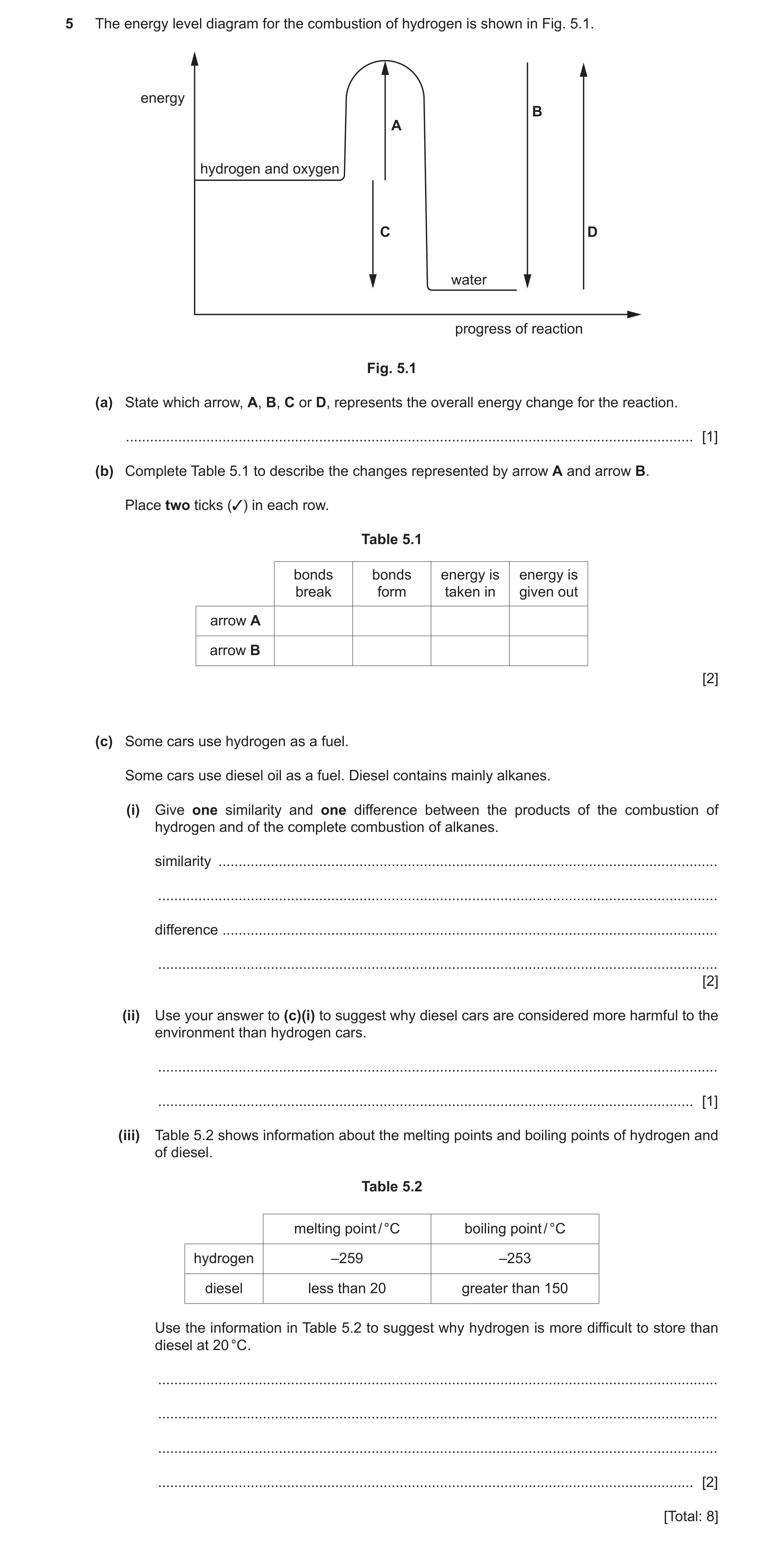
5 The energy level diagram for the combustion of hydrogen is shown in Fig. 5.1. energy B A hydrogen and oxygen C D water progress of reaction Fig. 5.1 (a) State which arrow, A, B, C or D, represents the overall energy change for the reaction. … [1] (b) Complete Table 5.1 to describe the changes represented by arrow A and arrow B. Place two ticks (3) in each row. Table 5.1 bonds bonds energy is energy is break form taken in given out arrow A arrow B [2] (c) Some cars use hydrogen as a fuel. Some cars use diesel oil as a fuel. Diesel contains mainly alkanes. (i) Give one similarity and one difference between the products of the combustion of hydrogen and of the complete combustion of alkanes. similarity … … difference … … [2] (ii) Use your answer to (c)(i) to suggest why diesel cars are considered more harmful to the environment than hydrogen cars. … … [1] (iii) Table 5.2 shows information about the melting points and boiling points of hydrogen and of diesel. Table 5.2 melting point / °C boiling point / °C hydrogen –259 –253 diesel less than 20 greater than 150 Use the information in Table 5.2 to suggest why hydrogen is more difficult to store than diesel at 20 °C. … … … … [2] [Total: 8]
8 marks
Mark scheme: 5(a) C ; 1 5(b) 2 bonds bonds energy is energy is break form taken in given out arrow A ✓ ✓ arrow B ✓ ✓ two or three correct ; all four correct ; 5(c)(i) similarity both produce, water / water vapour ; 2 difference alkanes / hydrocarbons / diesel, also produce carbon dioxide ; 5(c)(ii) (carbon dioxide emissions cause) 1 an enhanced greenhouse effect / contribute to climate change ; 5(c)(iii) hydrogen is a gas AND diesel is a liquid ; 2 hydrogen, takes up more space / needs to be stored under pressure ;
This question in 0653/41 Oct/Nov 2022
Q18 · Iron is extracted from hematite in the blast furnace 0653/43 Oct/Nov 2022
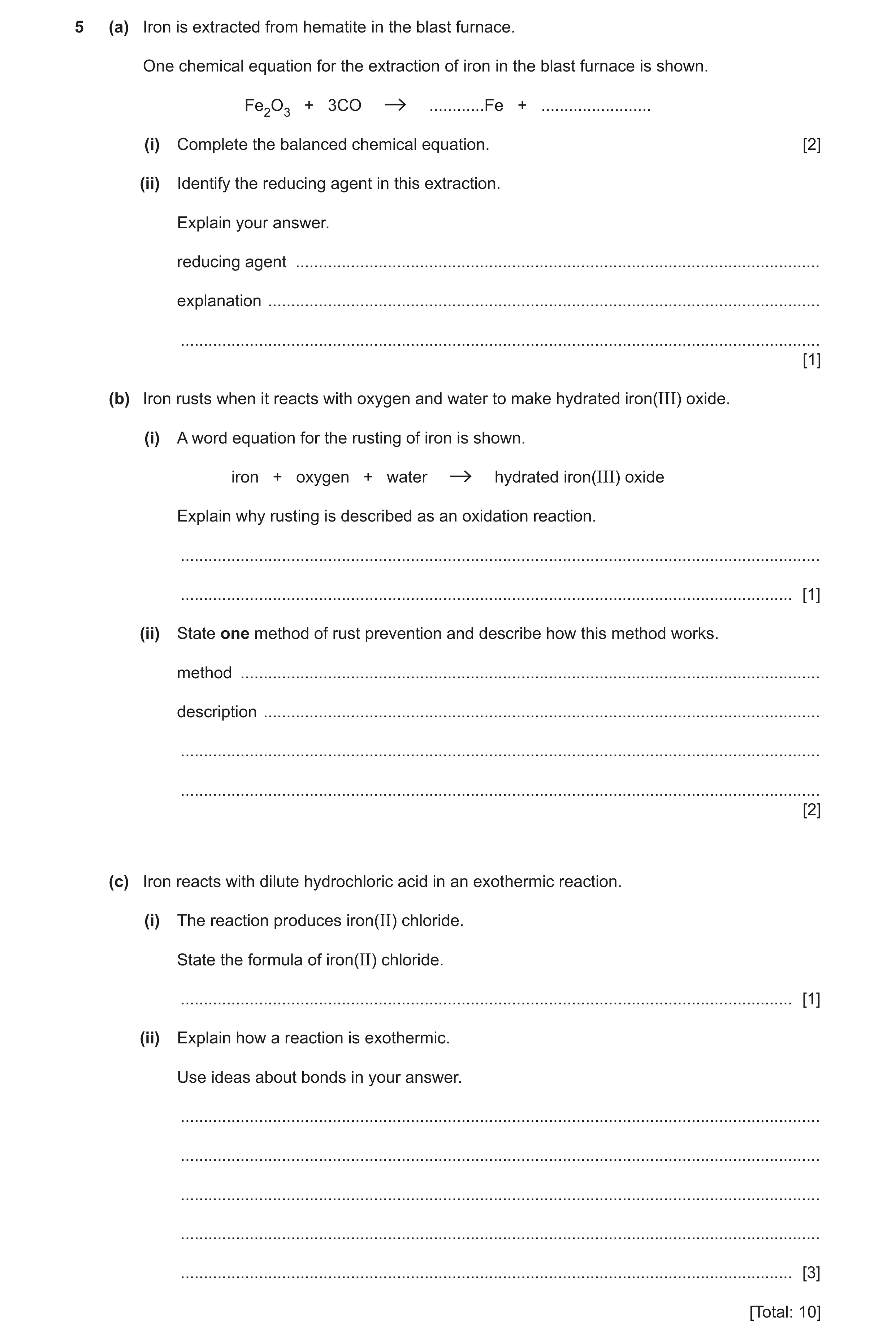
5 (a) Iron is extracted from hematite in the blast furnace. One chemical equation for the extraction of iron in the blast furnace is shown. Fe2O3 + 3CO … Fe + … (i) Complete the balanced chemical equation. [2] (ii) Identify the reducing agent in this extraction. Explain your answer. reducing agent … explanation … … [1] (b) Iron rusts when it reacts with oxygen and water to make hydrated iron(III) oxide. (i) A word equation for the rusting of iron is shown. iron + oxygen + water hydrated iron(III) oxide Explain why rusting is described as an oxidation reaction. … … [1] (ii) State one method of rust prevention and describe how this method works. method … description … … … [2] (c) Iron reacts with dilute hydrochloric acid in an exothermic reaction. (i) The reaction produces iron(II) chloride. State the formula of iron(II) chloride. … [1] (ii) Explain how a reaction is exothermic. Use ideas about bonds in your answer. … … … … … [3] [Total: 10]
10 marks
Mark scheme: 5(a)(i) Fe2O3 + 3CO → 2Fe + 3CO2 2 carbon dioxide shown ; equation balanced with 2 AND 3 ; 5(a)(ii) reducing agent carbon monoxide AND 1 explanation because it takes oxygen from iron (oxide) ; 5(b)(i) idea that, oxidation is gain of oxygen ; 1 5(b)(ii) method suitable method stated, e.g. painting / coating ; 2 description corresponding description given, e.g. (stops oxidation) by providing a barrier against, water / oxygen ; 5(c)(i) FeCl 2 ; 1 5(c)(ii) bond breaking, absorbs / takes in, energy ; 3 bond forming releases energy ; exothermic means, net release of energy / temperature rises ;
This question in 0653/43 Oct/Nov 2022
Q19 · Solid magnesium sulfate, MgSO4, dissolves to form aqueous magnesium sulfate 0653/42 Feb/March 2023
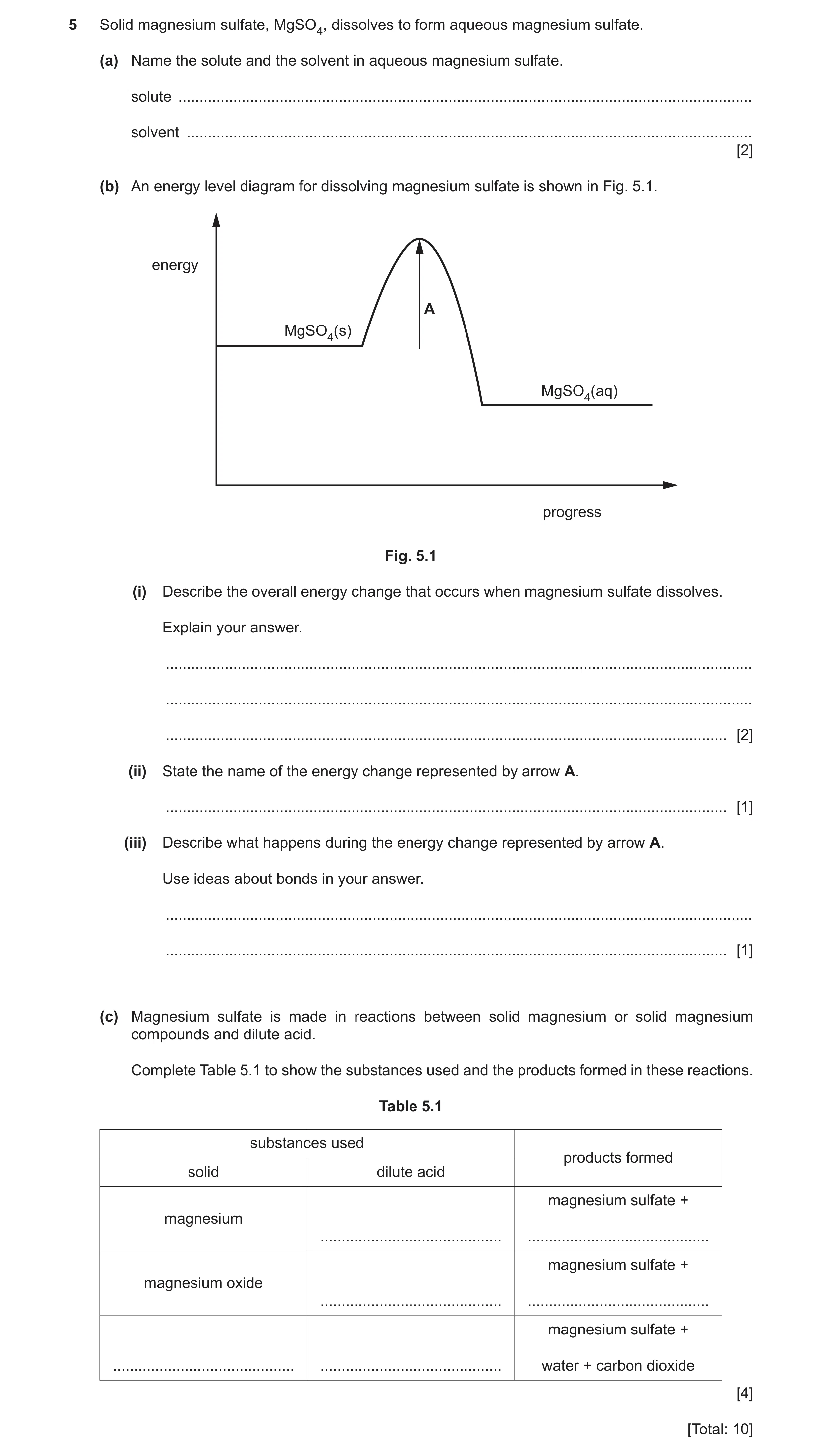
5 Solid magnesium sulfate, MgSO4, dissolves to form aqueous magnesium sulfate. (a) Name the solute and the solvent in aqueous magnesium sulfate. solute … solvent … [2] (b) An energy level diagram for dissolving magnesium sulfate is shown in Fig. 5.1. energy A MgSO4(s) MgSO4(aq) progress Fig. 5.1 (i) Describe the overall energy change that occurs when magnesium sulfate dissolves. Explain your answer. … … … [2] (ii) State the name of the energy change represented by arrow A. … [1] (iii) Describe what happens during the energy change represented by arrow A. Use ideas about bonds in your answer. … … [1] (c) Magnesium sulfate is made in reactions between solid magnesium or solid magnesium compounds and dilute acid. Complete Table 5.1 to show the substances used and the products formed in these reactions. Table 5.1 substances used products formed solid dilute acid magnesium sulfate + magnesium … … magnesium sulfate + magnesium oxide … … magnesium sulfate + … … water + carbon dioxide [4] [Total: 10]
10 marks
Mark scheme: 5(a) solute: (solid) magnesium sulfate ; 2 solvent: water ; 5(b)(i) exothermic / energy is given out ; 2 products are lower than reactants / products have less energy than reactants ; 5(b)(ii) activation energy ; 1 5(b)(iii) bonds are being broken ; 1 5(c) sulfuric acid in all three rows ; 4 hydrogen ; water ; magnesium carbonate ;
This question in 0653/42 Feb/March 2023
Q20 · Solid ammonium nitrate, NH4NO3, dissolves to form aqueous ammonium nitrate 0653/43 May/June 2023
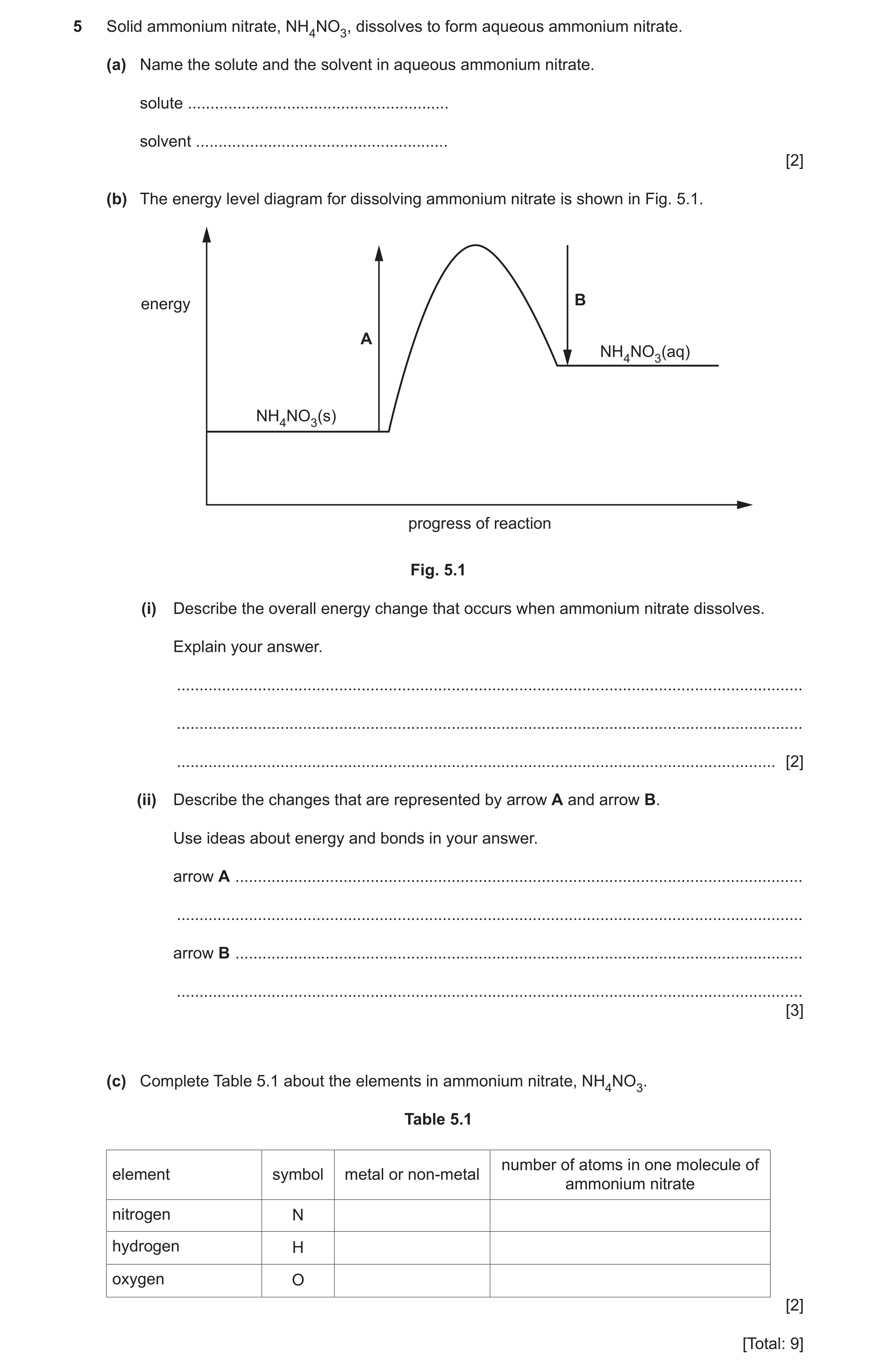
5 Solid ammonium nitrate, NH4NO3, dissolves to form aqueous ammonium nitrate. (a) Name the solute and the solvent in aqueous ammonium nitrate. solute … solvent … [2] (b) The energy level diagram for dissolving ammonium nitrate is shown in Fig. 5.1. energy B A NH4NO3(aq) NH4NO3(s) progress of reaction Fig. 5.1 (i) Describe the overall energy change that occurs when ammonium nitrate dissolves. Explain your answer. … … … [2] (ii) Describe the changes that are represented by arrow A and arrow B. Use ideas about energy and bonds in your answer. arrow A … … arrow B … … [3] (c) Complete Table 5.1 about the elements in ammonium nitrate, NH4NO3. Table 5.1 number of atoms in one molecule of element symbol metal or non-metal ammonium nitrate nitrogen N hydrogen H oxygen O [2] [Total: 9]
9 marks
Mark scheme: 5(a) (solute) ammonium nitrate ; (solvent) water ; 2 5(b)(i) endothermic / energy taken in ; the idea expressed that the energy of products is greater than reactants / products at higher energy level ; 2 5(b)(ii) A bonds are breaking ; B bonds are forming ; A energy is taken in / B energy is given out ; 3 5(c) all non-metals ; atoms in one molecule: 2,4,3 ; 2
This question in 0653/43 May/June 2023
Q21 · Nitrogen and oxygen react together in a car engine to make nitrogen monoxide, NO 0653/41 May/June 2024
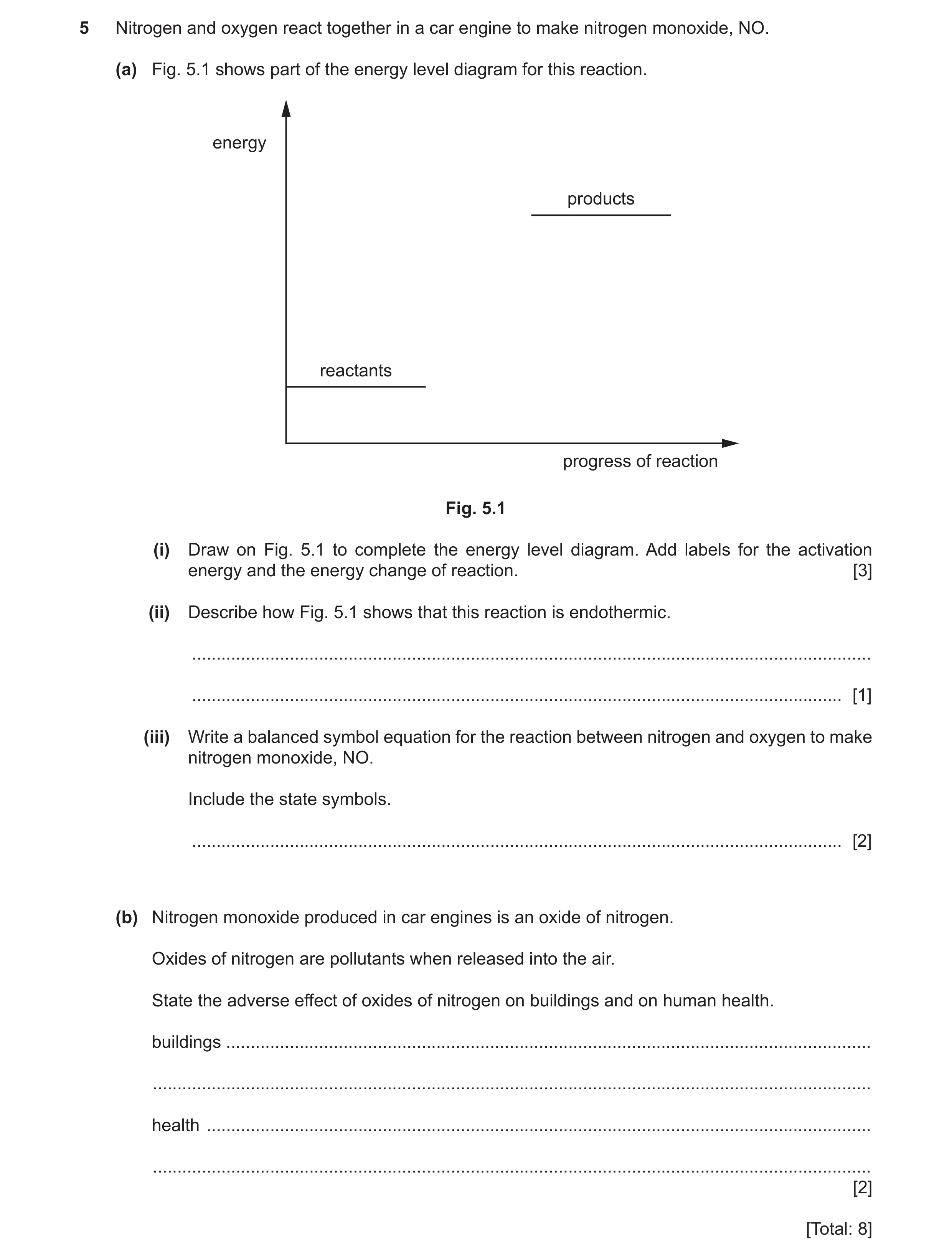
5 Nitrogen and oxygen react together in a car engine to make nitrogen monoxide, NO. (a) Fig. 5.1 shows part of the energy level diagram for this reaction. energy products reactants progress of reaction Fig. 5.1 (i) Draw on Fig. 5.1 to complete the energy level diagram. Add labels for the activation energy and the energy change of reaction. [3] (ii) Describe how Fig. 5.1 shows that this reaction is endothermic. … … [1] (iii) Write a balanced symbol equation for the reaction between nitrogen and oxygen to make nitrogen monoxide, NO. Include the state symbols. … [2] (b) Nitrogen monoxide produced in car engines is an oxide of nitrogen. Oxides of nitrogen are pollutants when released into the air. State the adverse effect of oxides of nitrogen on buildings and on human health. buildings … … health … … [2] [Total: 8]
8 marks
Mark scheme: 5(a)(i) activation energy shown as a maximum between reactants and products ; activation energy labelled correctly ; energy change of reaction labelled with upwards arrow ; 5(a)(ii) products are at a higher energy level than reactants / products have more energy than reactants / ORA ; 1 5(a)(iii) N2 (g) + O2 (g) → 2NO (g) ; ; correctly balanced equation = (1) state symbols (g) (g) (g) = (1) 2 Question Answer Marks 5(b) buildings: the idea of (chemical) reaction with, metal / building materials ; health: adverse effect on, heart / lungs / breathing ; 2
This question in 0653/41 May/June 2024
Q22 · Nitrogen and oxygen react together at high temperatures in car engines to form oxides of… 0653/42 May/June 2024
5 Nitrogen and oxygen react together at high temperatures in car engines to form oxides of nitrogen. (a) Nitrogen monoxide, NO, is one of the oxides of nitrogen. Fig. 5.1 shows the energy level diagram for the reaction of nitrogen and oxygen to form nitrogen monoxide. energy nitrogen monoxide activation energy change energy of reaction nitrogen and oxygen progress of reaction Fig. 5.1 Explain the energy changes shown in Fig. 5.1. Use ideas about bond breaking and bond forming in your answer. … … … … [2] (b) Nitrogen monoxide, NO, reacts with oxygen to form nitrogen dioxide, NO2. (i) Write a balanced symbol equation for the reaction between nitrogen monoxide and oxygen. Include the state symbols. … [2] (ii) The reaction between nitrogen monoxide and oxygen is exothermic. Draw a labelled energy level diagram for this reaction. Include labels for the activation energy and the energy change of reaction. energy progress of reaction [2] [Total: 6]
6 marks
Mark scheme: 5(a) (overall) energy change is endothermic or more energy taken in than given out ; and either bond breaking is endothermic / energy is taken in to break bonds or bonds forming is exothermic / energy is given out when bonds form ; 5(b)(i) 2NO(g) + O2(g) → 2NO2(g) ; ; correctly balanced equation = (1) state symbols (g) (g) (g) = (1) 2 5(b)(ii) reactants higher than products and maximum shown ; activation energy and up-arrow and energy change of reaction and down-arrow ; 2
This question in 0653/42 May/June 2024
Q23 · Oxides of nitrogen are pollutant gases formed in car engines 0653/43 May/June 2024
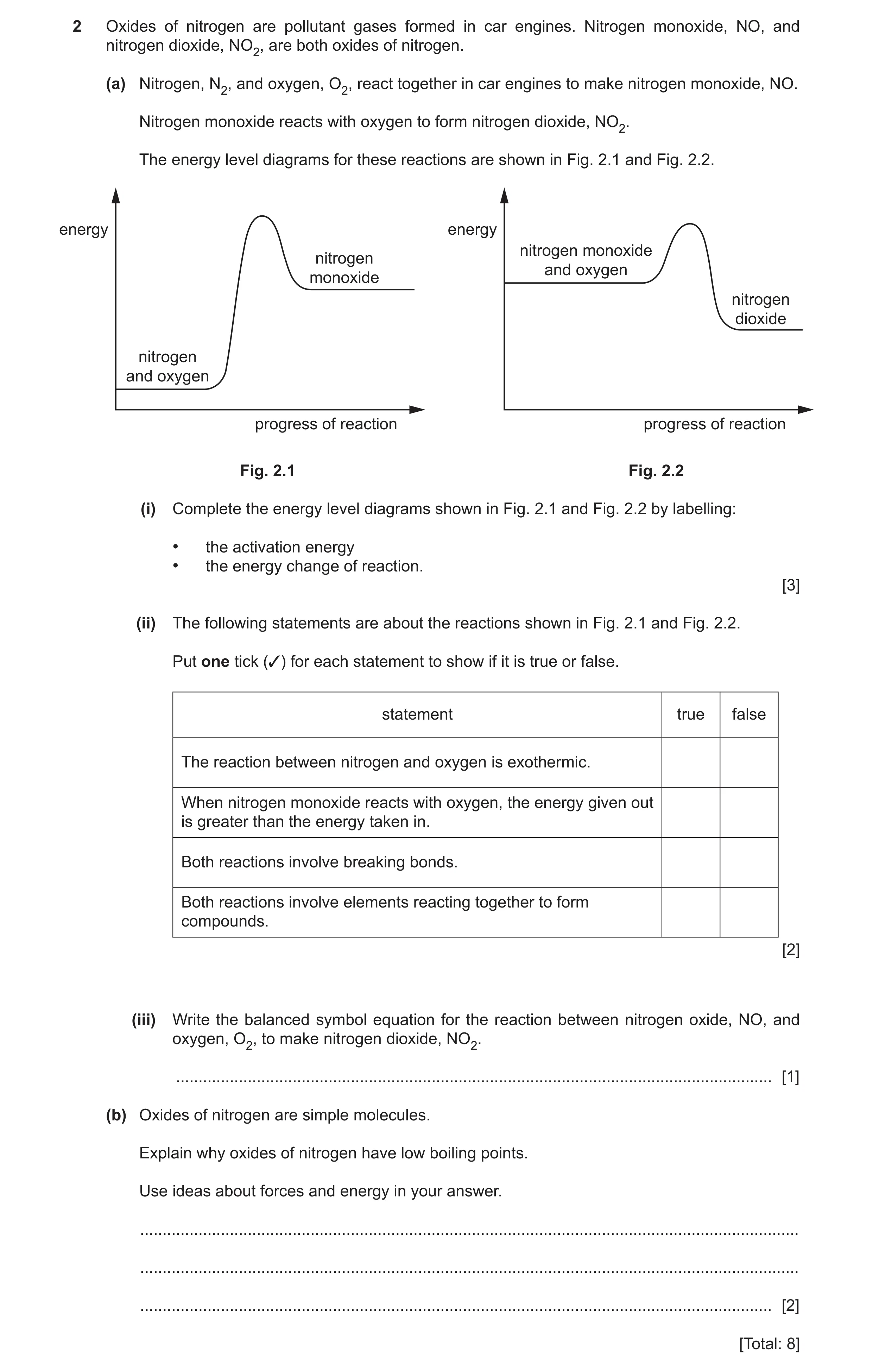
2 Oxides of nitrogen are pollutant gases formed in car engines. Nitrogen monoxide, NO, and nitrogen dioxide, NO2, are both oxides of nitrogen. (a) Nitrogen, N2, and oxygen, O2, react together in car engines to make nitrogen monoxide, NO. Nitrogen monoxide reacts with oxygen to form nitrogen dioxide, NO2. The energy level diagrams for these reactions are shown in Fig. 2.1 and Fig. 2.2. energy energy nitrogen monoxide nitrogen and oxygen monoxide nitrogen dioxide nitrogen and oxygen progress of reaction progress of reaction Fig. 2.1 Fig. 2.2 (i) Complete the energy level diagrams shown in Fig. 2.1 and Fig. 2.2 by labelling: • the activation energy • the energy change of reaction. [3] (ii) The following statements are about the reactions shown in Fig. 2.1 and Fig. 2.2. Put one tick (✓) for each statement to show if it is true or false. statement true false The reaction between nitrogen and oxygen is exothermic. When nitrogen monoxide reacts with oxygen, the energy given out is greater than the energy taken in. Both reactions involve breaking bonds. Both reactions involve elements reacting together to form compounds. [2] (iii) Write the balanced symbol equation for the reaction between nitrogen oxide, NO, and oxygen, O2, to make nitrogen dioxide, NO2. … [1] (b) Oxides of nitrogen are simple molecules. Explain why oxides of nitrogen have low boiling points. Use ideas about forces and energy in your answer. … … … [2] [Total: 8]
8 marks
Mark scheme: 2(a)(i) activation energy correctly labelled on both diagrams ; energy change of reaction shown by upward arrow for first diagram ; energy change of reaction shown by downward arrow for second diagram ; 3 Question Answer Marks 2(a)(ii) true false ;; All correct = 2 marks 2 to 3 correct = 1 mark 2 2(a)(iii) 2NO + O2 → 2NO2 ; 1 2(b) weak forces between molecules / weak intermolecular forces ; need low amounts of energy to change from liquid to gas / low amount of energy to, separate molecules / overcome / break the force ; 2
This question in 0653/43 May/June 2024
Q24 · The reaction between aluminium and iron(III) oxide is used to join iron railway lines… 0653/42 Feb/March 2025
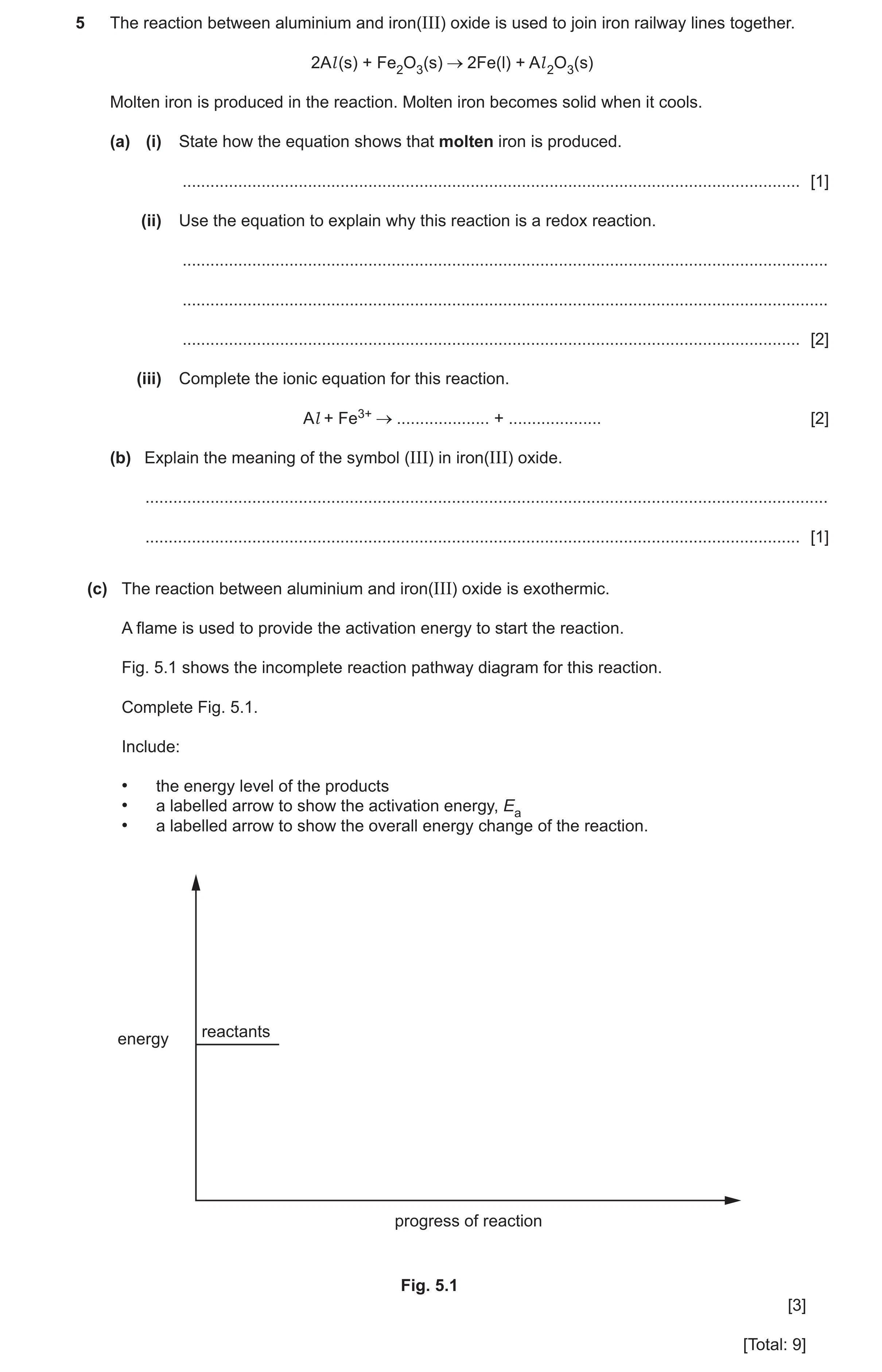
5 The reaction between aluminium and iron(III) oxide is used to join iron railway lines together. 2Al (s) + Fe2O3(s) 2Fe(l) + Al 2O3(s) Molten iron is produced in the reaction. Molten iron becomes solid when it cools. (a) (i) State how the equation shows that molten iron is produced. … [1] (ii) Use the equation to explain why this reaction is a redox reaction. … … … [2] (iii) Complete the ionic equation for this reaction. Al + Fe3+ … + … [2] (b) Explain the meaning of the symbol (III) in iron(III) oxide. … … [1] (c) The reaction between aluminium and iron(III) oxide is exothermic. A flame is used to provide the activation energy to start the reaction. Fig. 5.1 shows the incomplete reaction pathway diagram for this reaction. Complete Fig. 5.1. Include: • the energy level of the products • a labelled arrow to show the activation energy, Ea • a labelled arrow to show the overall energy change of the reaction. reactants energy progress of reaction Fig. 5.1 [3] [Total: 9]
9 marks
Mark scheme: 5(a)(i) (l) shows it is a liquid / the state symbol shows it is a liquid ; 1 5(a)(ii) oxidation and reduction happen (simultaneously) / iron is reduced and aluminium is oxidised ; 2 iron (oxide) loses oxygen and aluminium gains oxygen ; 5(a)(iii) Fe ; 2 Al 3+ ; 5(b) shows oxidation number / state (of iron) (which is +3) ; 1 5(c) shape of diagram: hump with products lower than reactants ; 3 activation energy labelled ; energy change of reaction correctly labelled ;
This question in 0653/42 Feb/March 2025
Q25 · Copper metal reacts with oxygen to form copper oxide, CuO 0653/41 Oct/Nov 2025
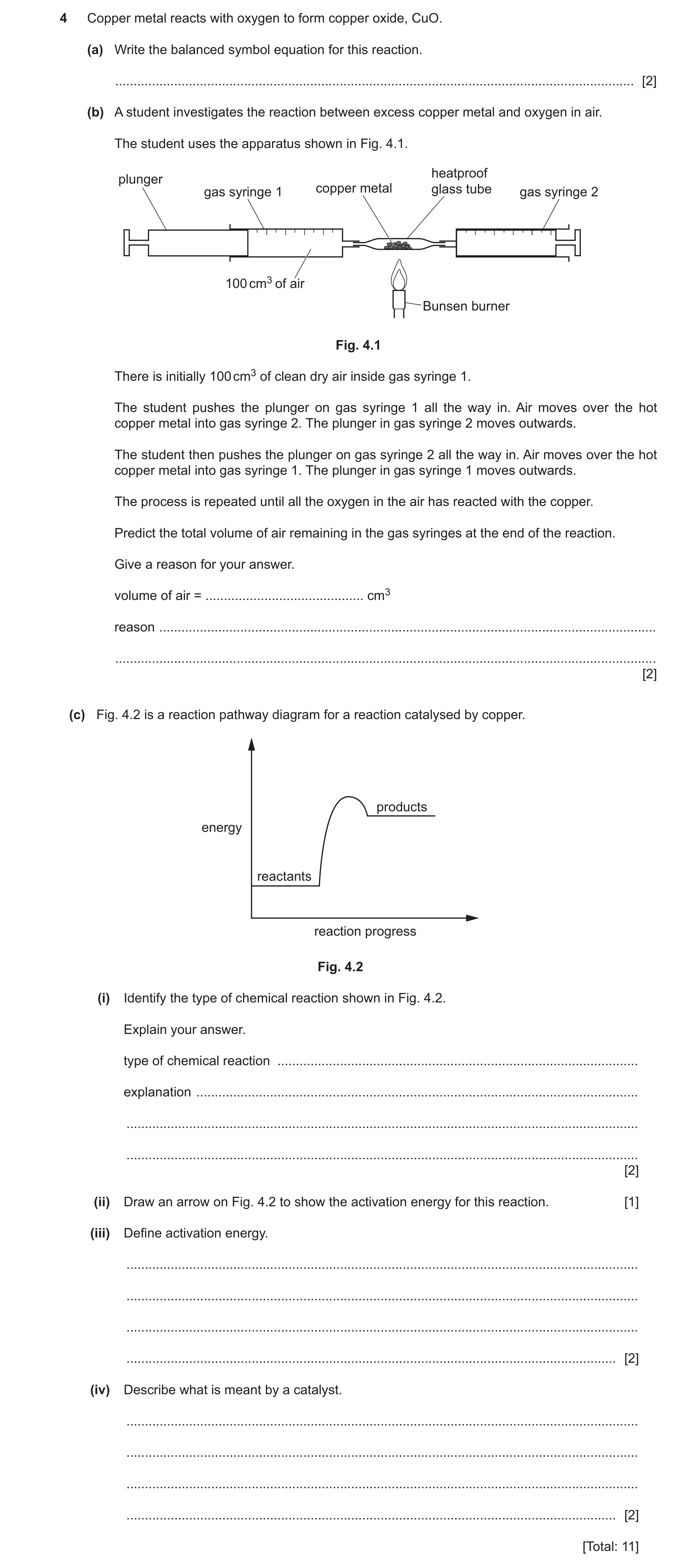
4 Copper metal reacts with oxygen to form copper oxide, CuO. (a) Write the balanced symbol equation for this reaction. … [2] (b) A student investigates the reaction between excess copper metal and oxygen in air. The student uses the apparatus shown in Fig. 4.1. heatproof plunger gas syringe 1 copper metal glass tube gas syringe 2 100 cm3 of air Bunsen burner Fig. 4.1 There is initially 100 cm3 of clean dry air inside gas syringe 1. The student pushes the plunger on gas syringe 1 all the way in. Air moves over the hot copper metal into gas syringe 2. The plunger in gas syringe 2 moves outwards. The student then pushes the plunger on gas syringe 2 all the way in. Air moves over the hot copper metal into gas syringe 1. The plunger in gas syringe 1 moves outwards. The process is repeated until all the oxygen in the air has reacted with the copper. Predict the total volume of air remaining in the gas syringes at the end of the reaction. Give a reason for your answer. volume of air = … cm3 reason … … [2] (c) Fig. 4.2 is a reaction pathway diagram for a reaction catalysed by copper. products energy reactants reaction progress Fig. 4.2 (i) Identify the type of chemical reaction shown in Fig. 4.2. Explain your answer. type of chemical reaction … explanation … … … [2] (ii) Draw an arrow on Fig. 4.2 to show the activation energy for this reaction. [1] (iii) Define activation energy. … … … … [2] (iv) Describe what is meant by a catalyst. … … … … [2] [Total: 11]
11 marks
Mark scheme: 4(a) 2Cu + O2 → 2CuO 2 correct formulae ; correct balancing ; 4(b) 79 (cm3) ; 2 oxygen is 21% of air ; 4(c)(i) M1 endothermic ; 2 M2 EITHER products have higher energy than reactants / (thermal) energy is taken in OR Energy required for bond breaking greater than energy released when bonds form; 4(c)(ii) any label showing activation energy from level of reactants to top of peak ; 1 4(c)(iii) M1 energy needed for a reaction ; 2 but M2 minimum energy needed to for a reaction ; ; 4(c)(iv) increases rate of reaction ; 2 is unchanged at the end of the reaction / idea that catalyst is not used up ;
This question in 0653/41 Oct/Nov 2025
Q26 · A student investigates the reaction between aqueous sodium hydroxide, NaOH, and dilute… 0653/42 Oct/Nov 2025
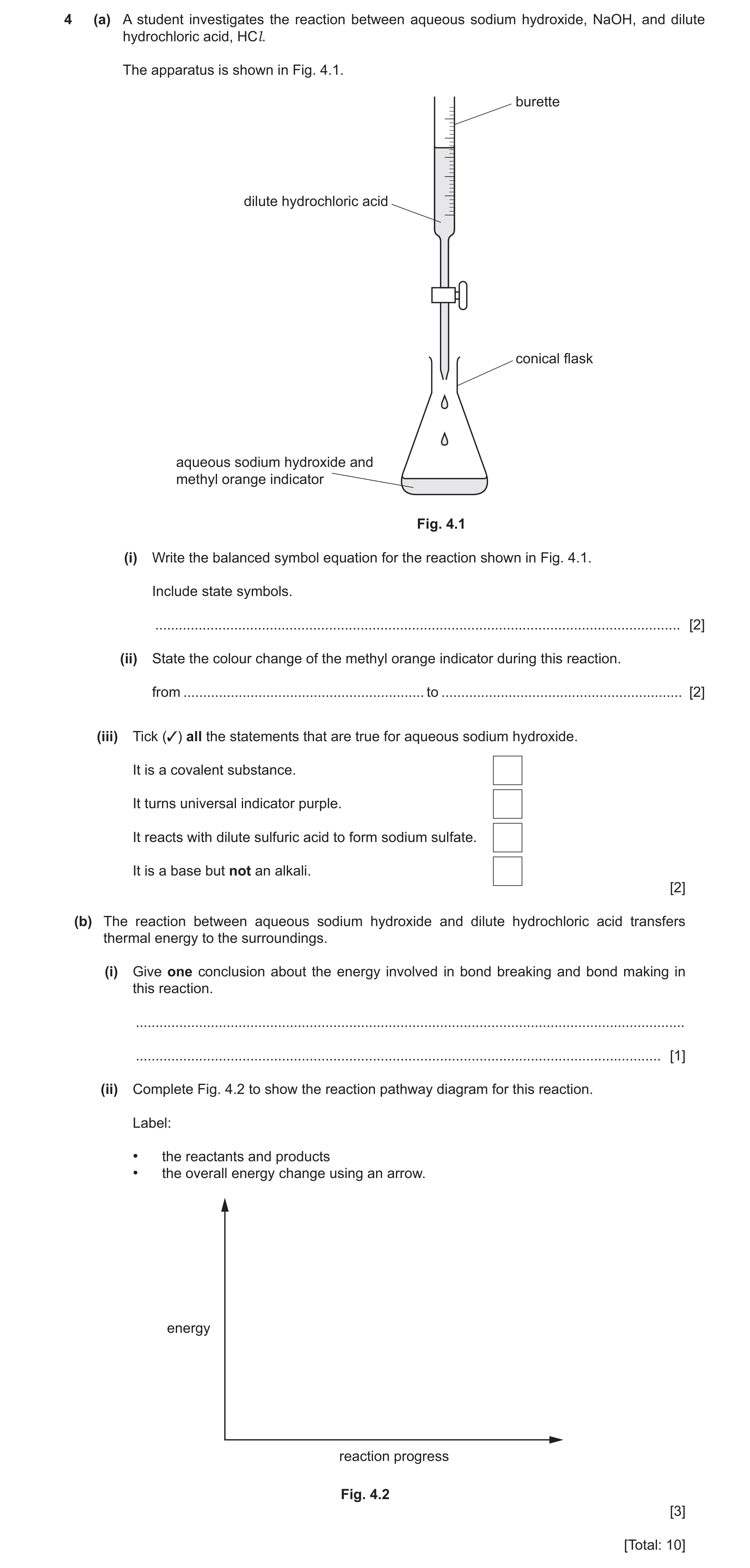
4 (a) A student investigates the reaction between aqueous sodium hydroxide, NaOH, and dilute hydrochloric acid, HCl. The apparatus is shown in Fig. 4.1. burette dilute hydrochloric acid conical flask aqueous sodium hydroxide and methyl orange indicator Fig. 4.1 (i) Write the balanced symbol equation for the reaction shown in Fig. 4.1. Include state symbols. … [2] (ii) State the colour change of the methyl orange indicator during this reaction. from … to … [2] (iii) Tick (✓) all the statements that are true for aqueous sodium hydroxide. It is a covalent substance. It turns universal indicator purple. It reacts with dilute sulfuric acid to form sodium sulfate. It is a base but not an alkali. [2] (b) The reaction between aqueous sodium hydroxide and dilute hydrochloric acid transfers thermal energy to the surroundings. (i) Give one conclusion about the energy involved in bond breaking and bond making in this reaction. … … [1] (ii) Complete Fig. 4.2 to show the reaction pathway diagram for this reaction. Label: • the reactants and products • the overall energy change using an arrow. energy reaction progress Fig. 4.2 [3] [Total: 10]
10 marks
Mark scheme: 4(a)(i) NaOH (aq) + HCl (aq) → NaCl (aq) + H2O(l) 2 fully correct equation ; correct state symbols ; 4(a)(ii) yellow ; 2 orange ; 4(a)(iii) ticks for: 2 turns universal indicator purple ; reacts with dilute sulfuric acid ; 4(b)(i) energy (released by) bond making is greater than needed/absorbed for bond breaking OR energy involved in bond making 1 is greater than energy involved in bond breaking ; 4(b)(ii) labelling: reactants or NaOH + HCl and products or NaCl + H2O ; 3 pathway shows activation energy peaking and products at a lower energy level than the reactants ; overall energy change shown as difference between reactants and products and downward arrow ;
This question in 0653/42 Oct/Nov 2025
 4 / 36
 5 / 36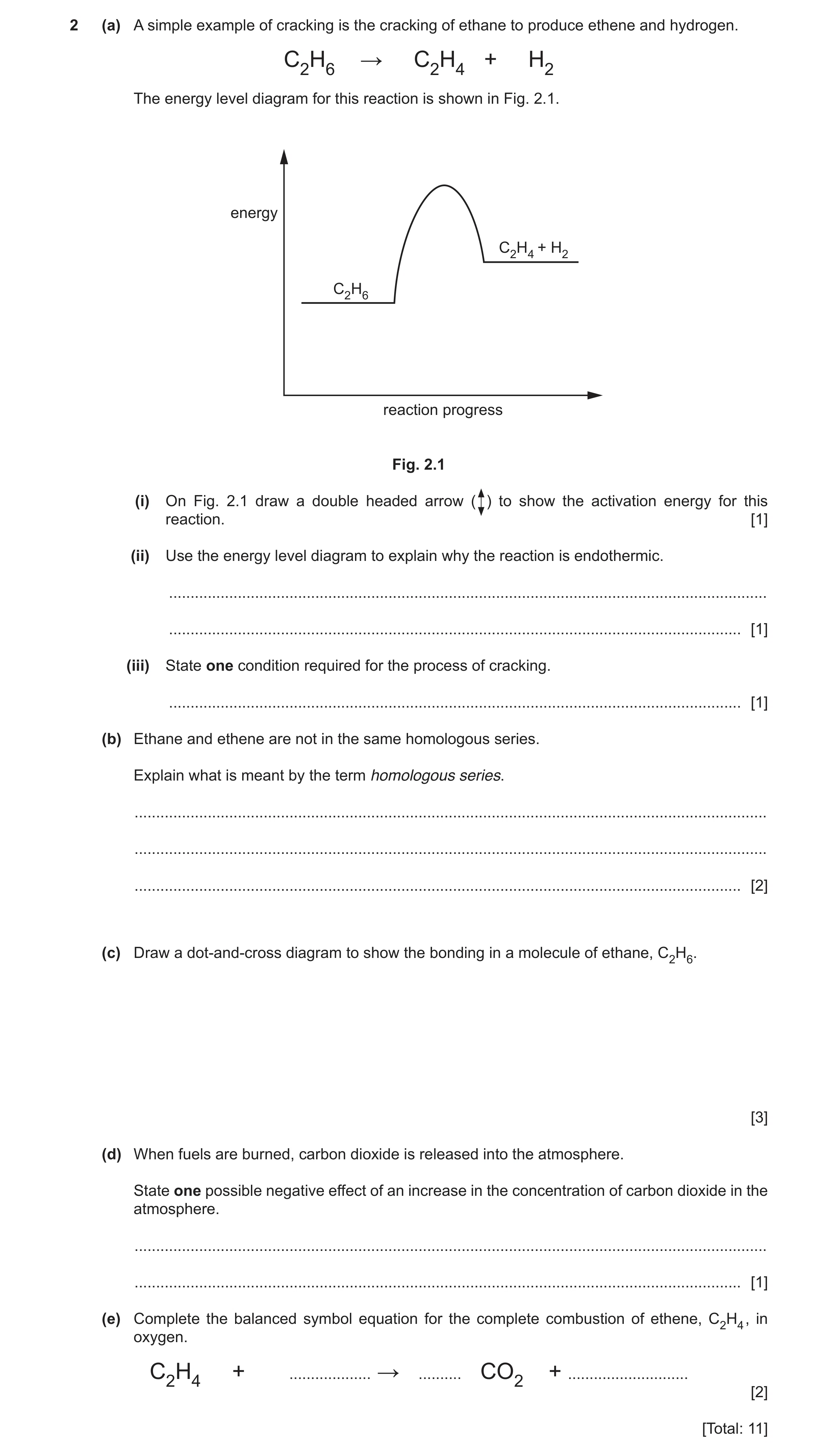
![Question 7: (a) The formula of methanol is CH3OH. Complete the structure of a molecule of methanol. Include all atoms and all bonds. C O [1] (b) (i) Ex…](https://img.pastlit.com/crops/ce89baf8-7d64-4617-851e-c29da4d5ba90/q2.webp) 9 / 36
9 / 36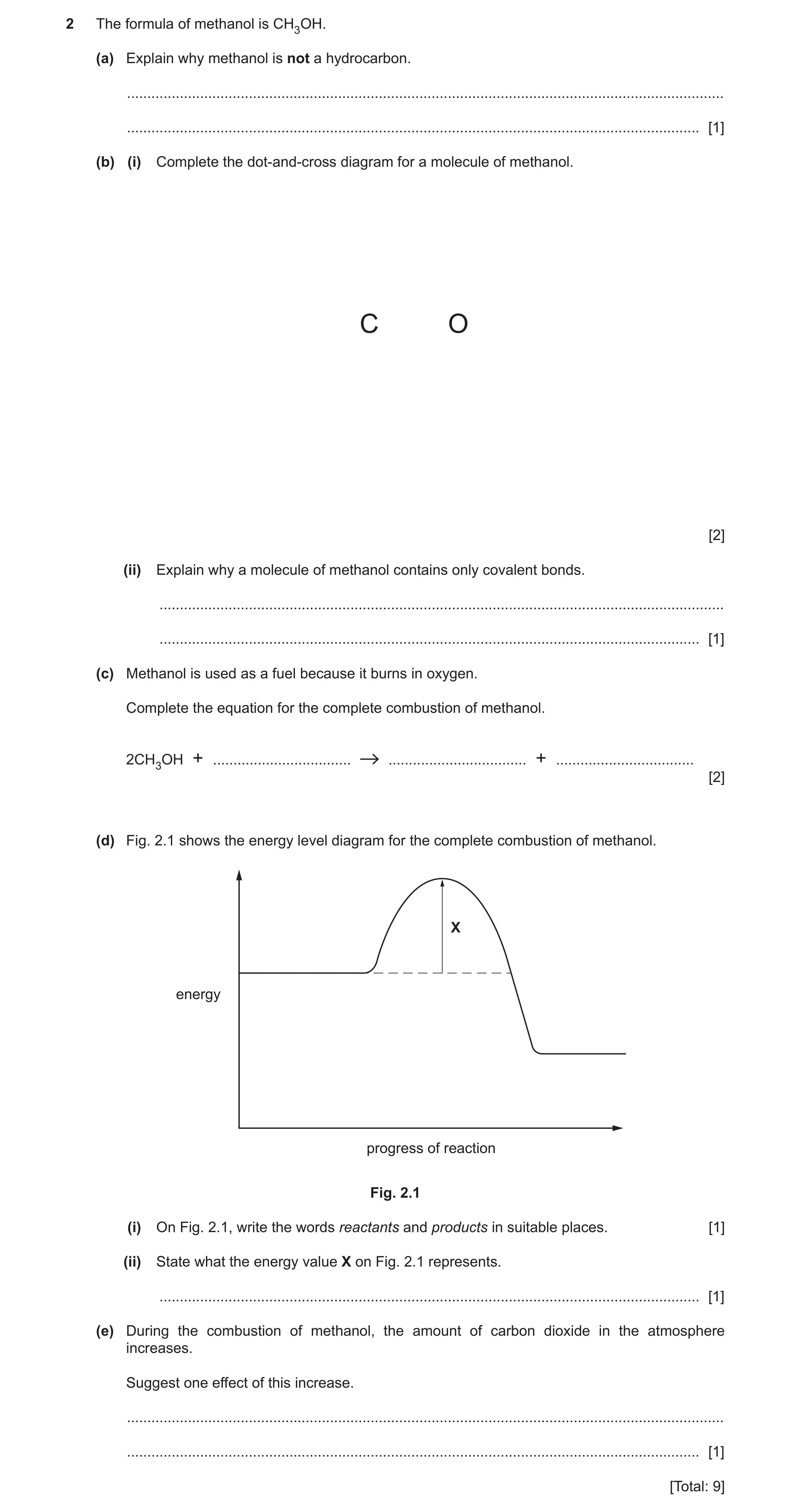
 29 / 36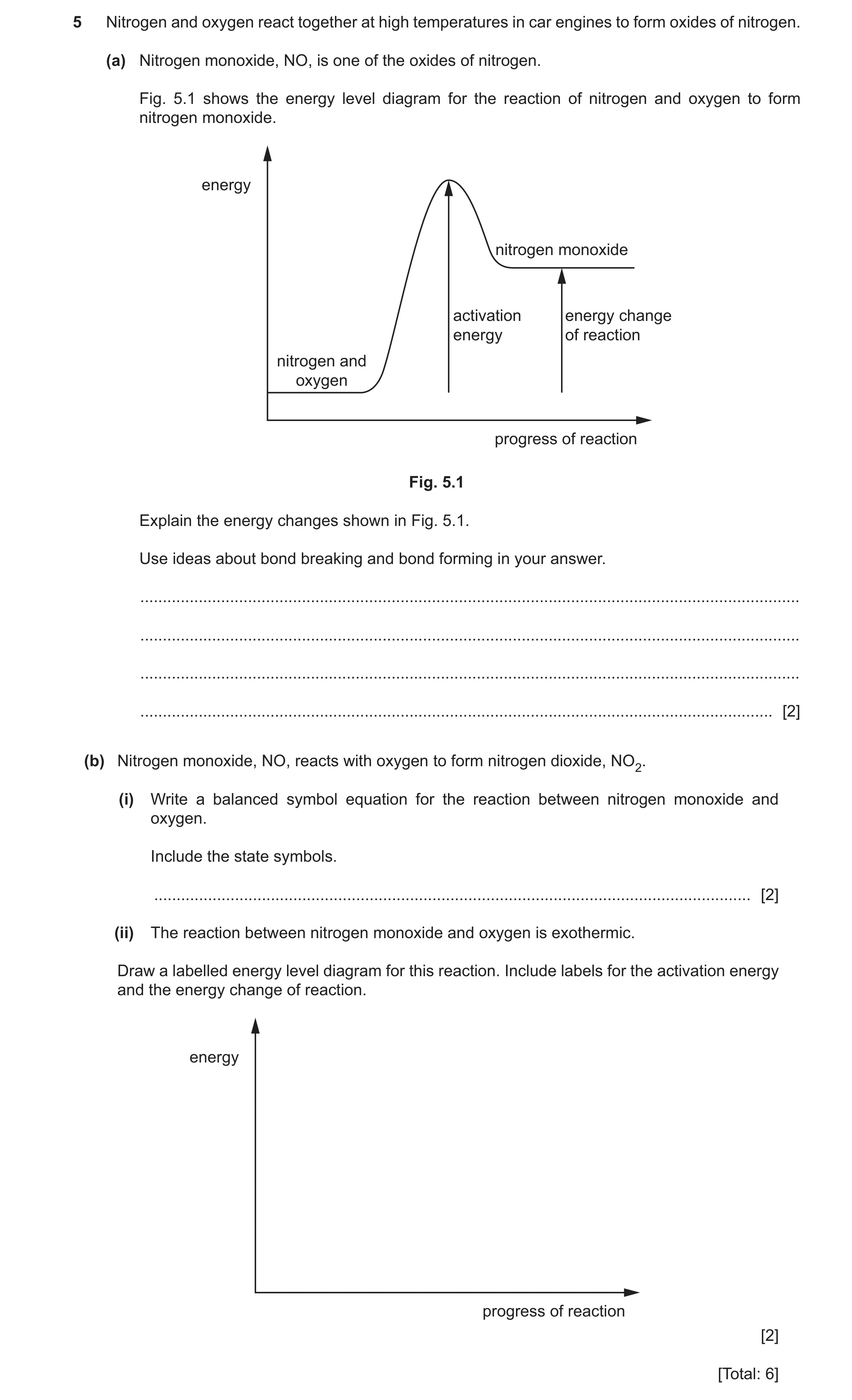
 8
8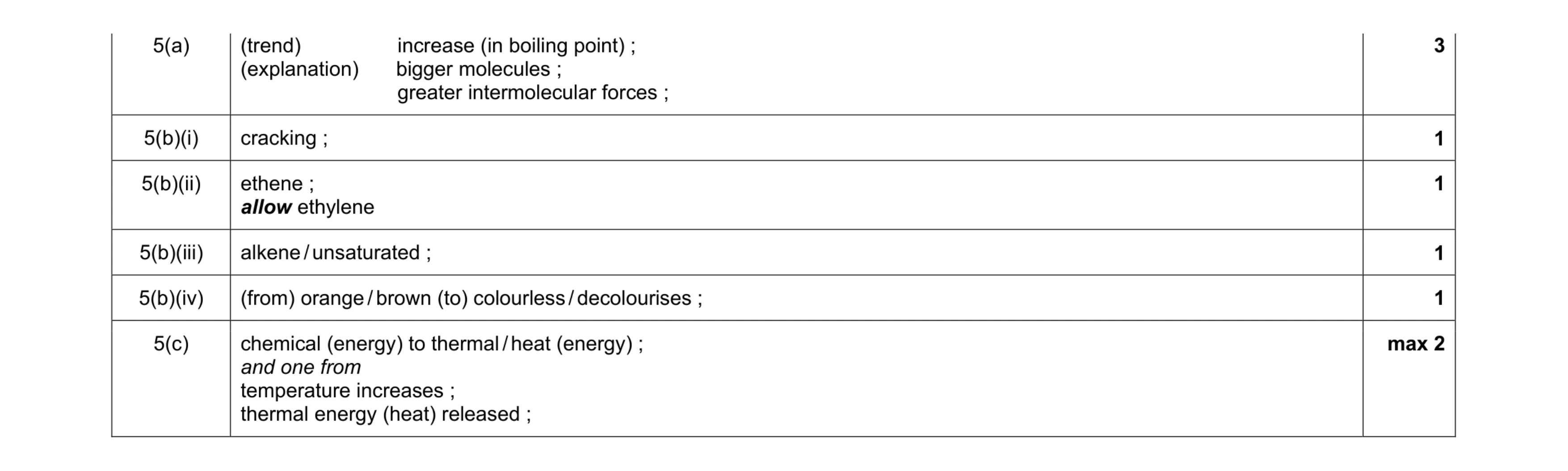 9
9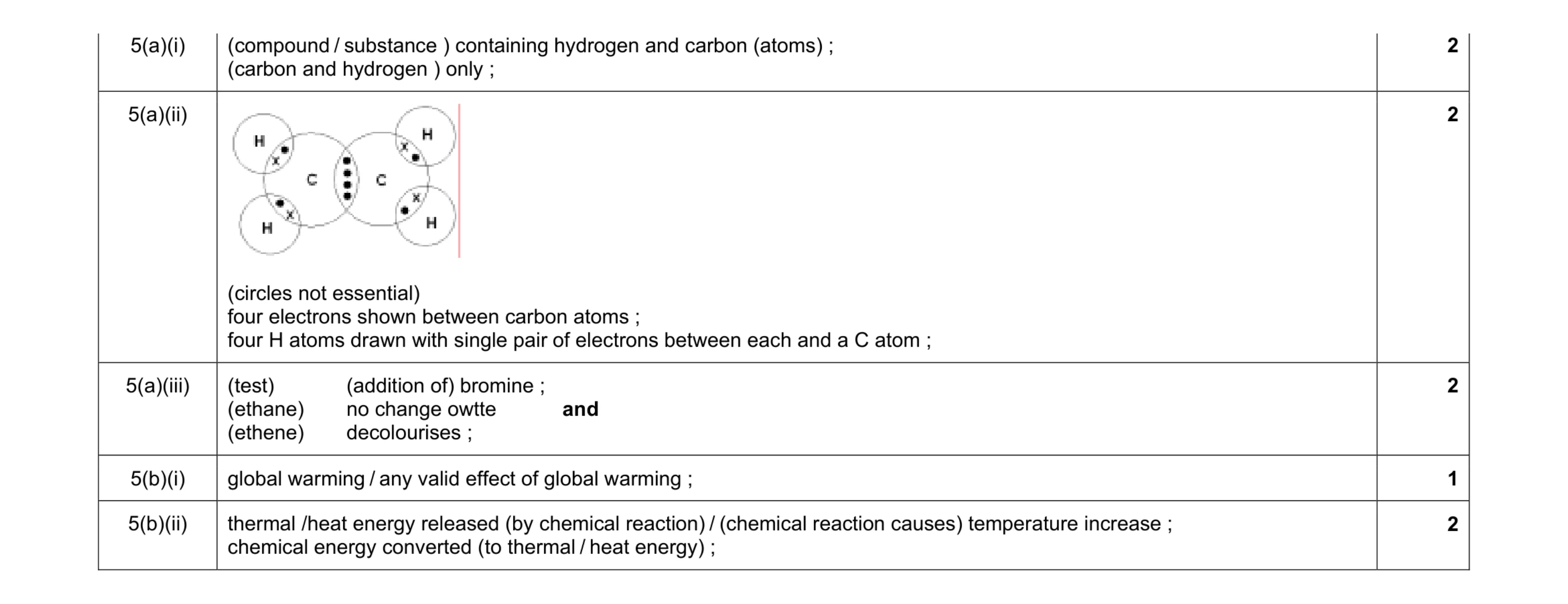 9
9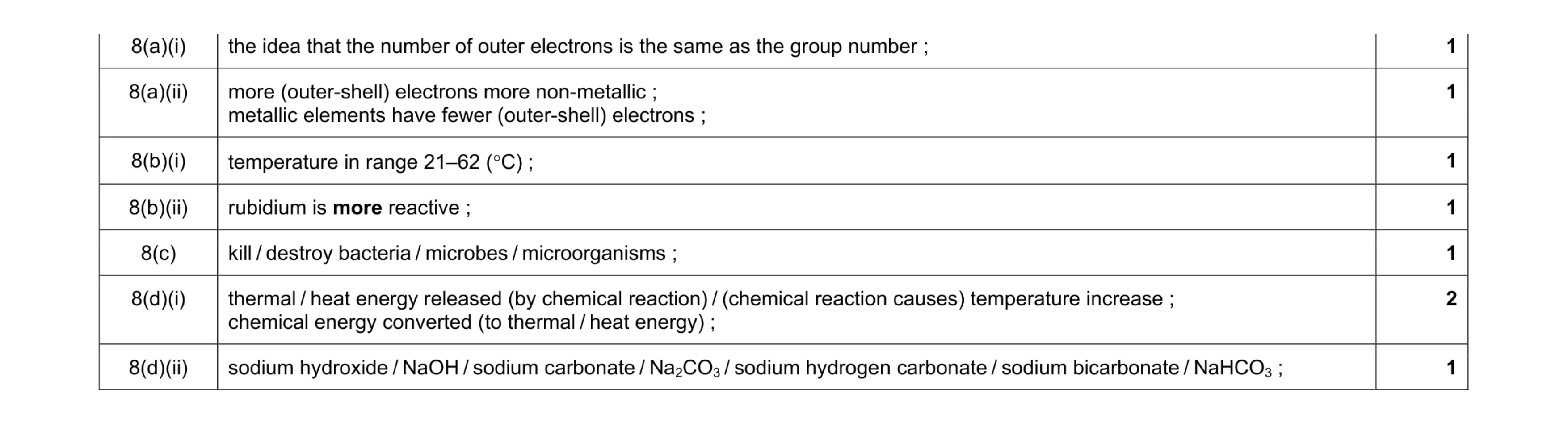 8
8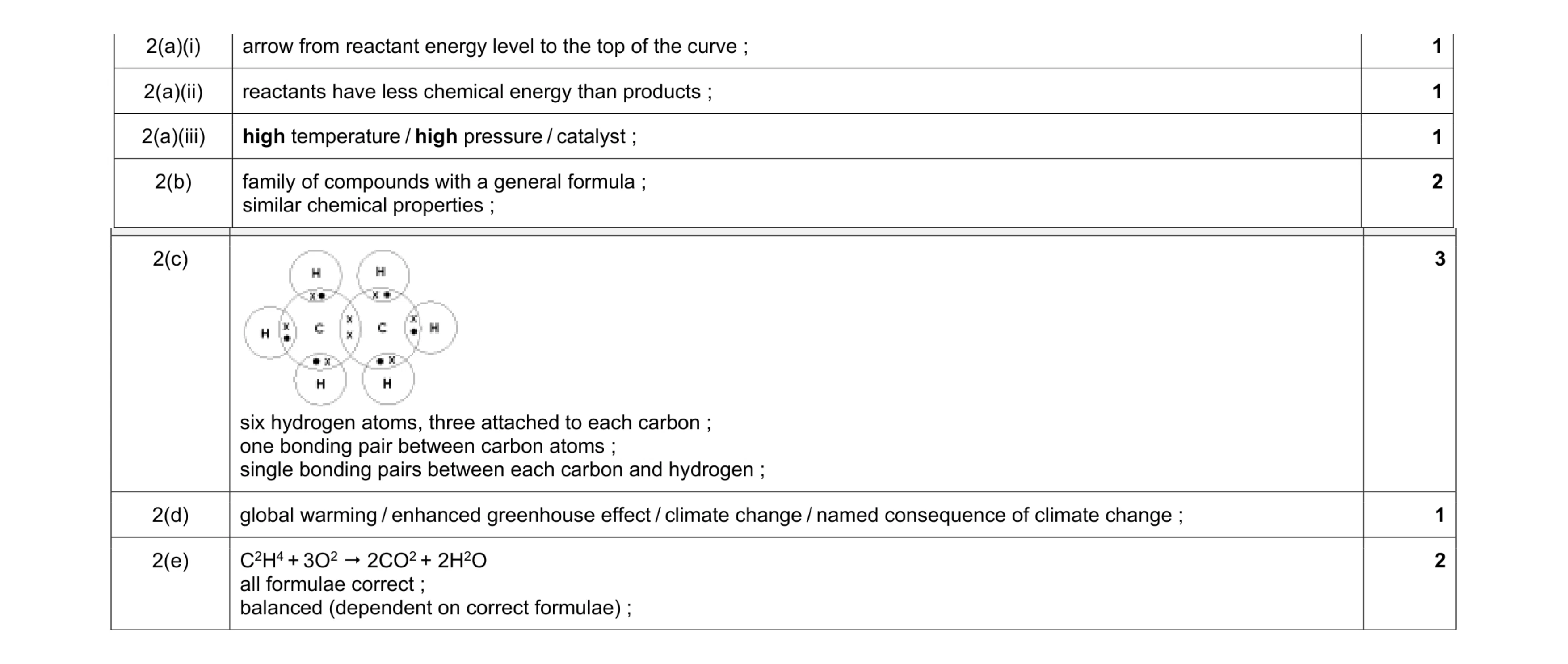 11
11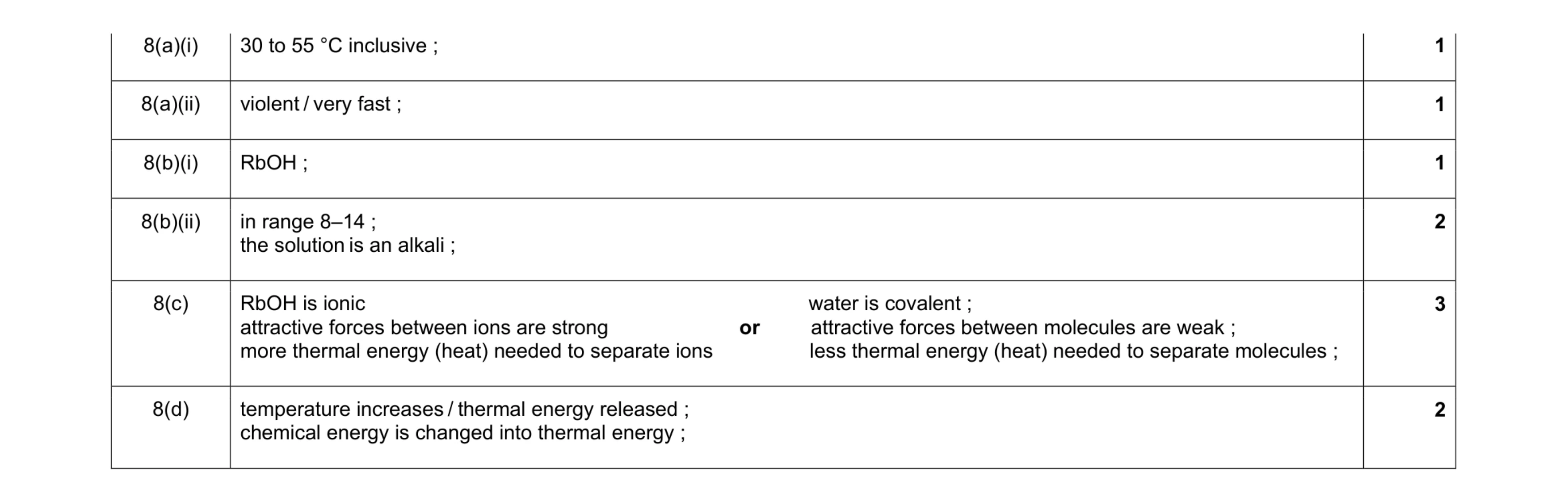 10
10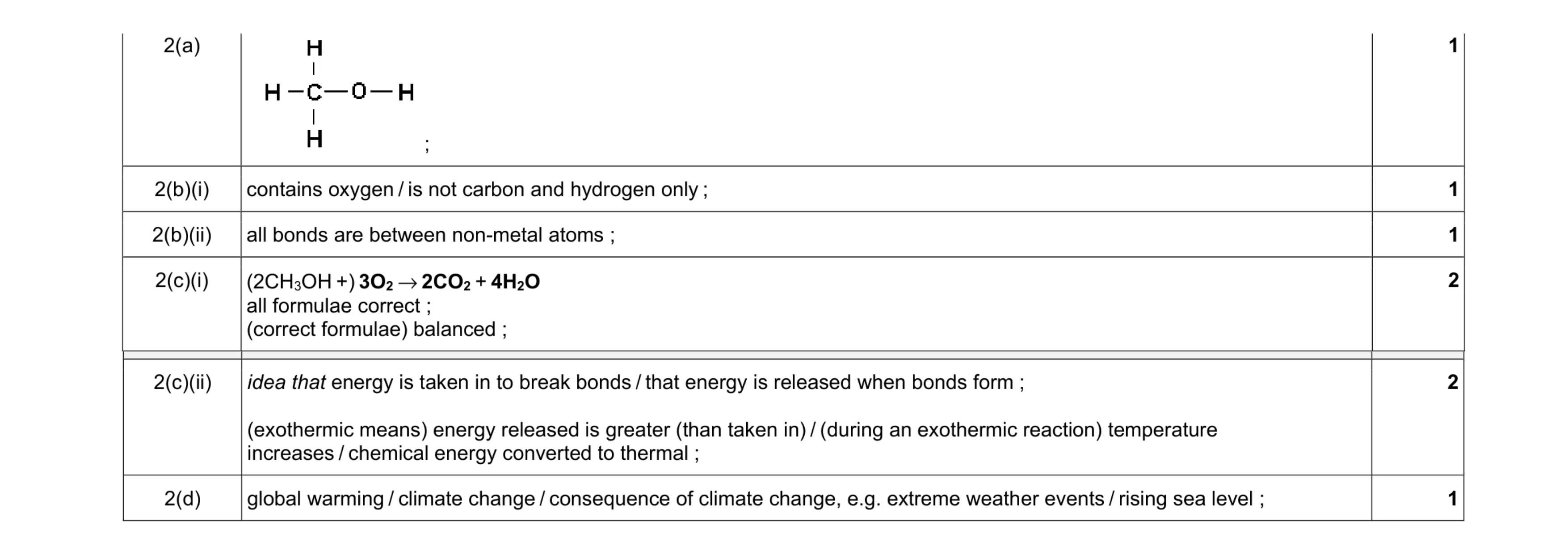 8
8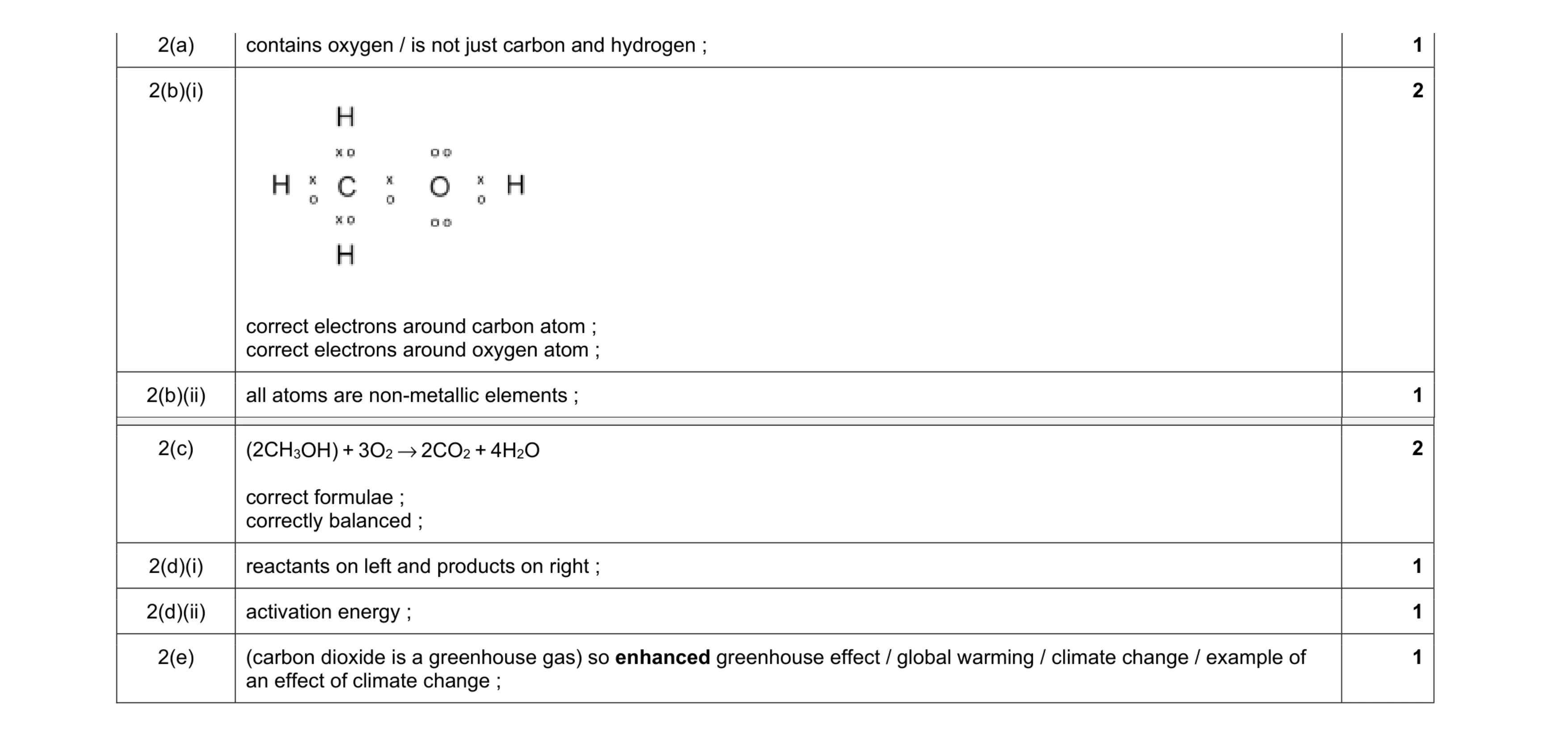 9
9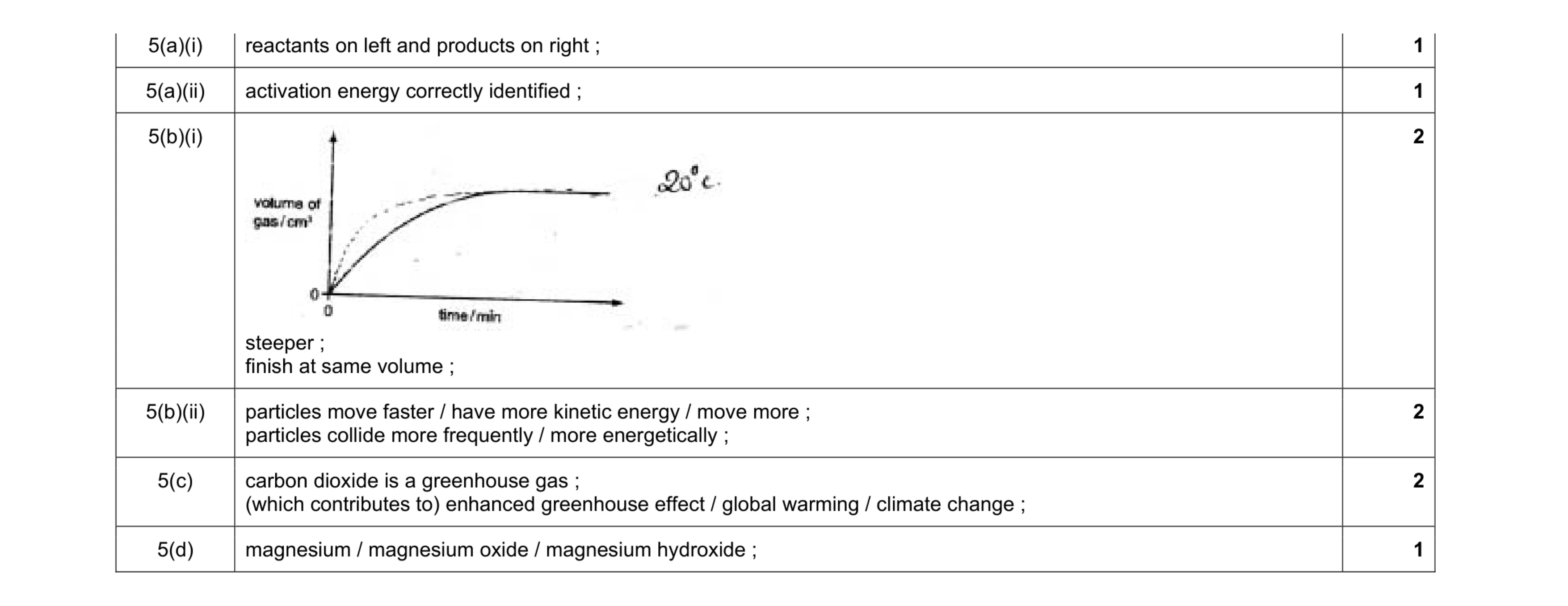 9
9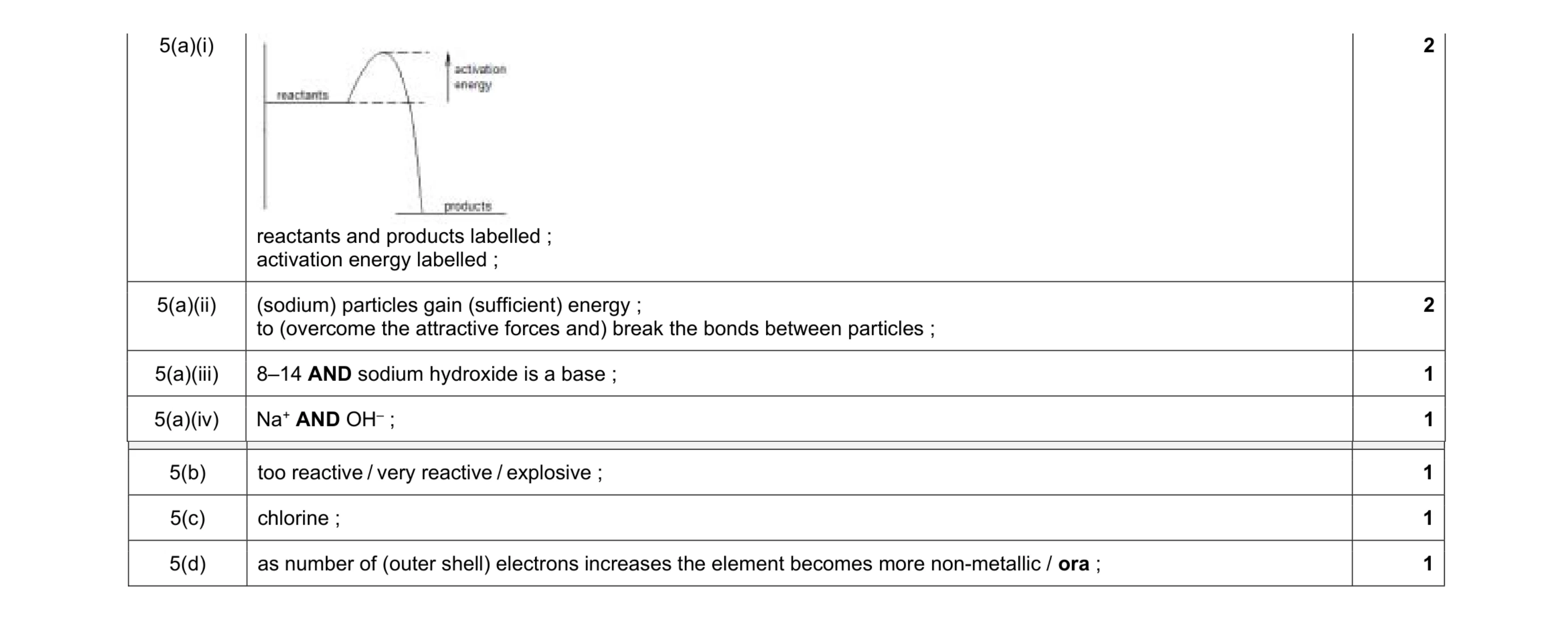 9
9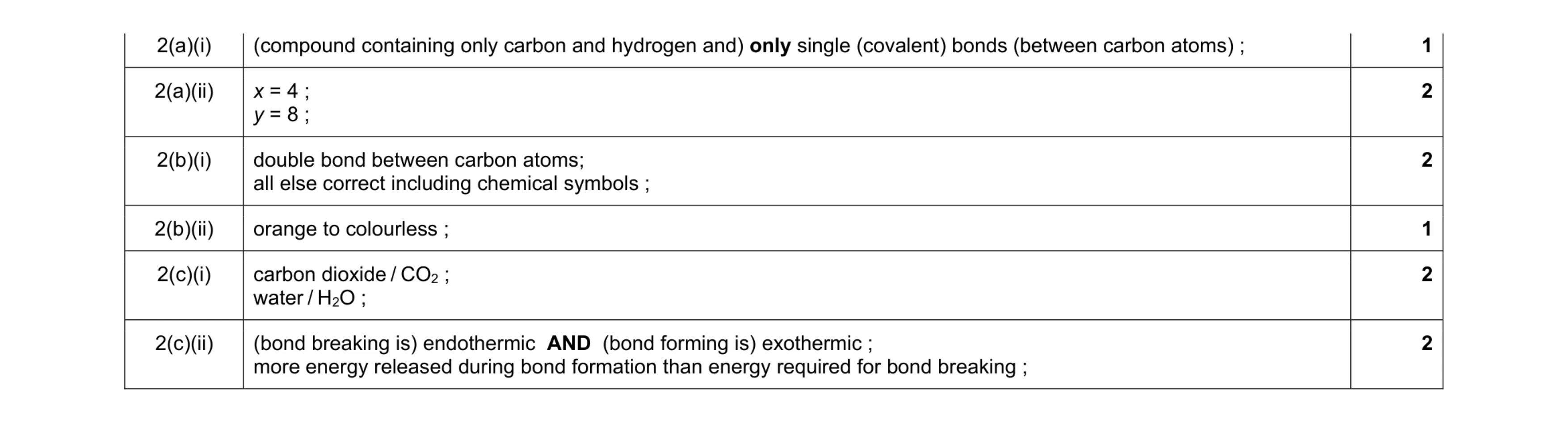 10
10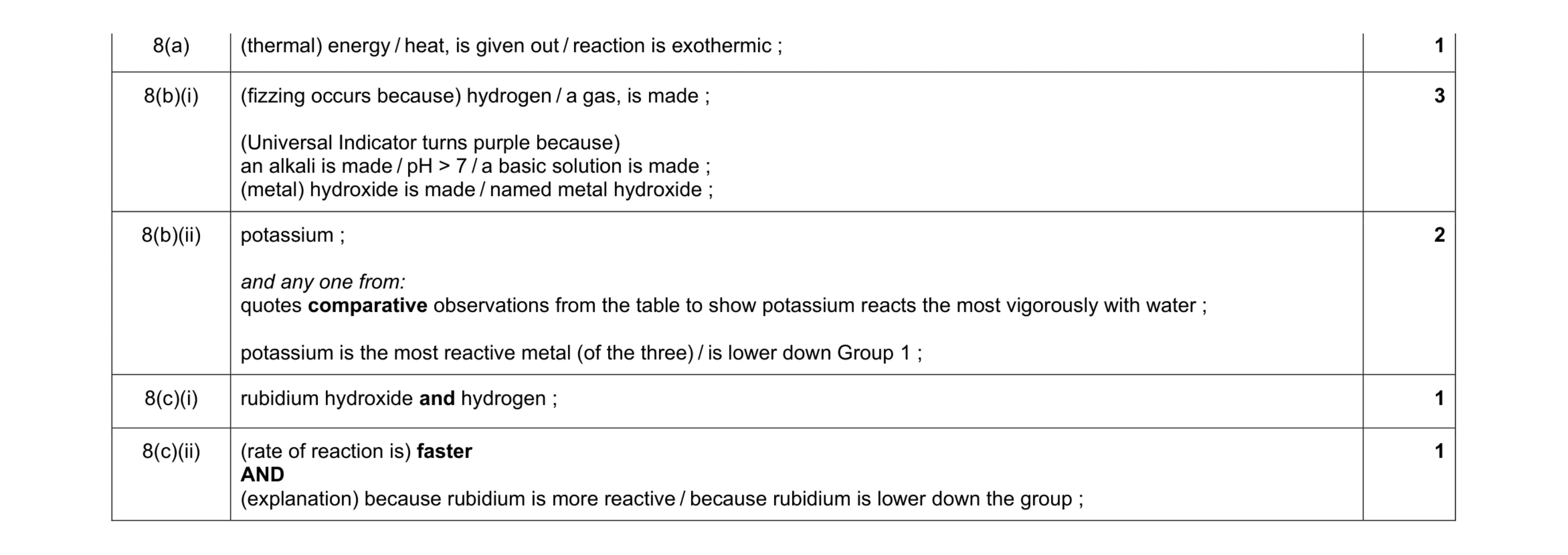 8
8 7
7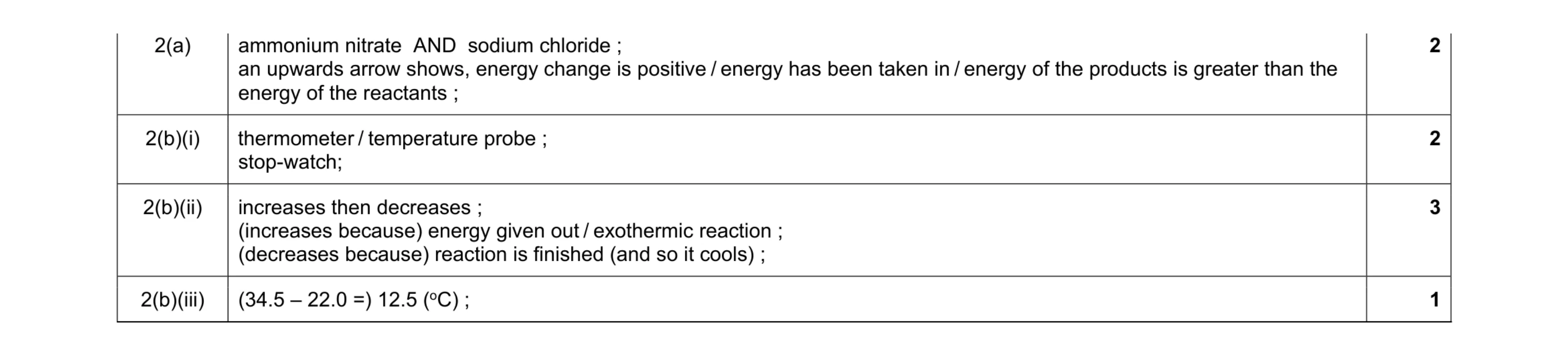 8
8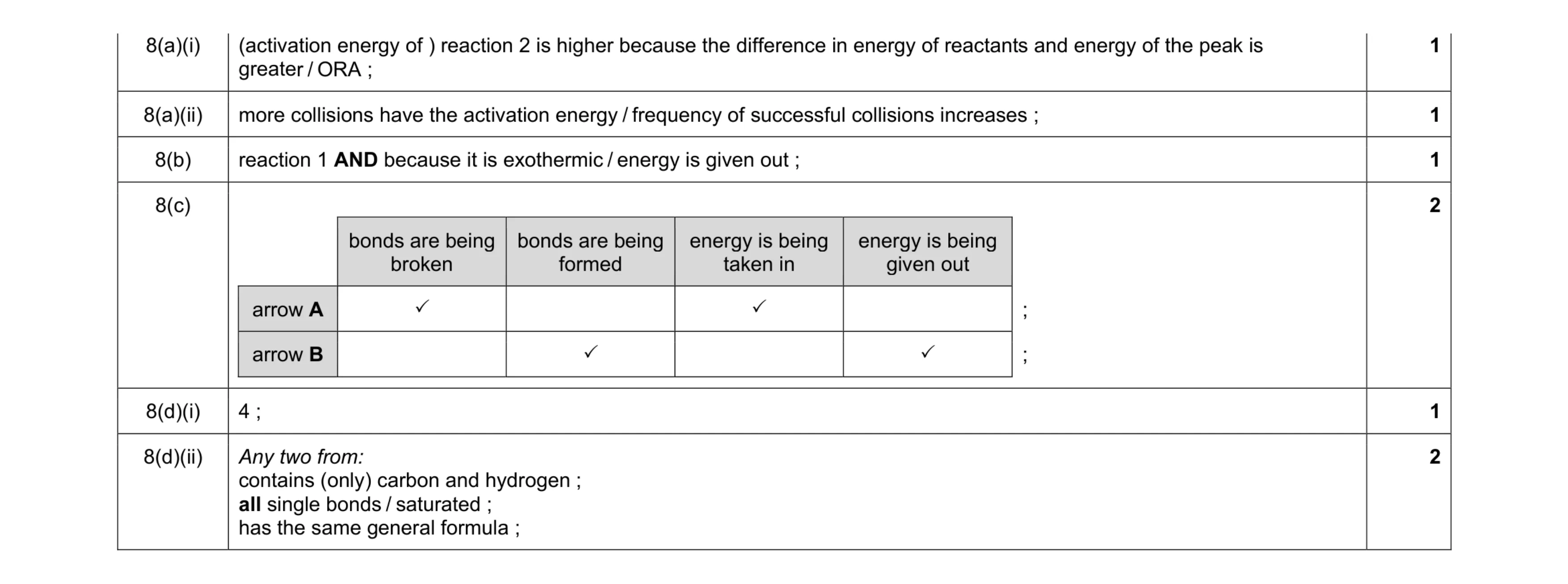 8
8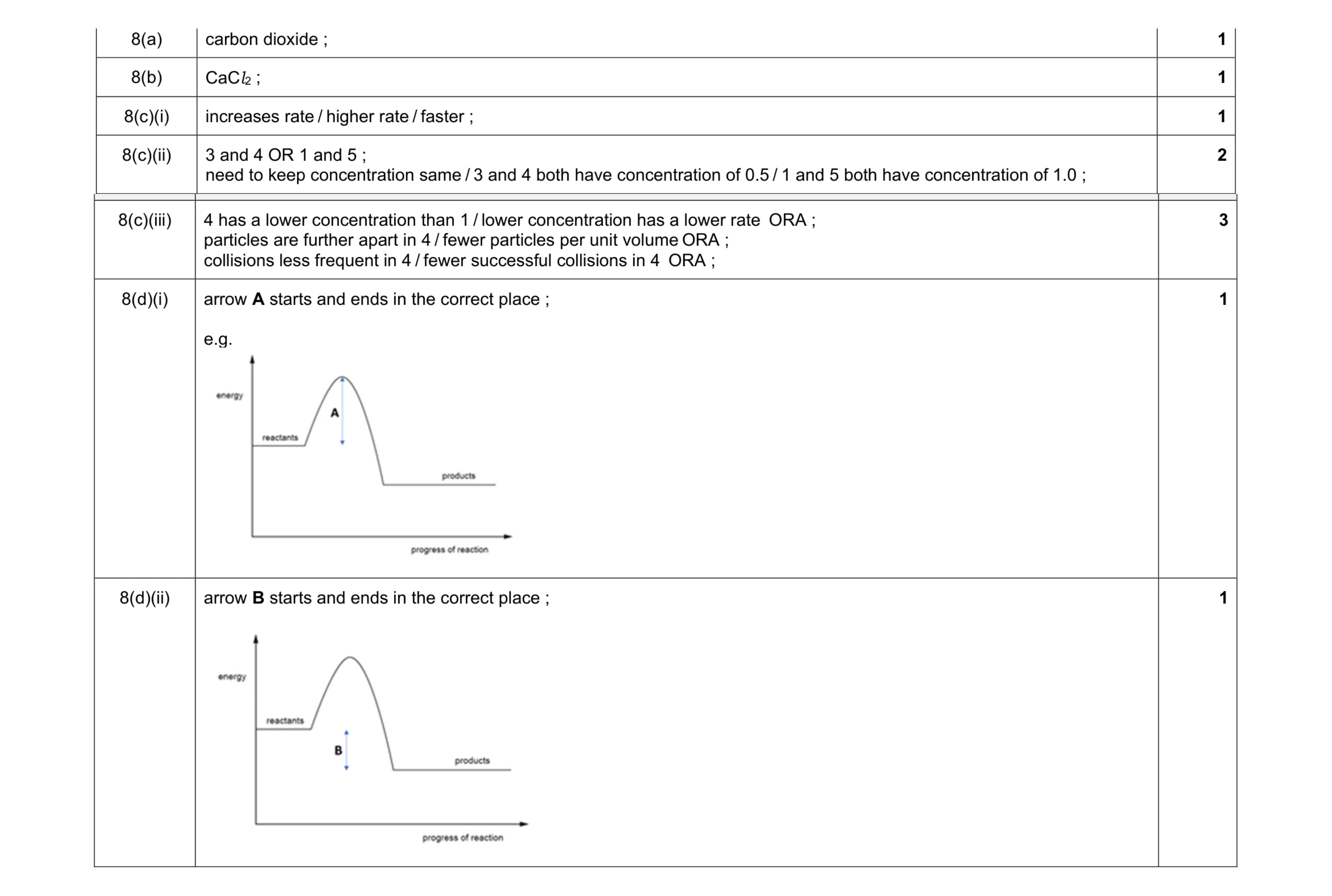 10
10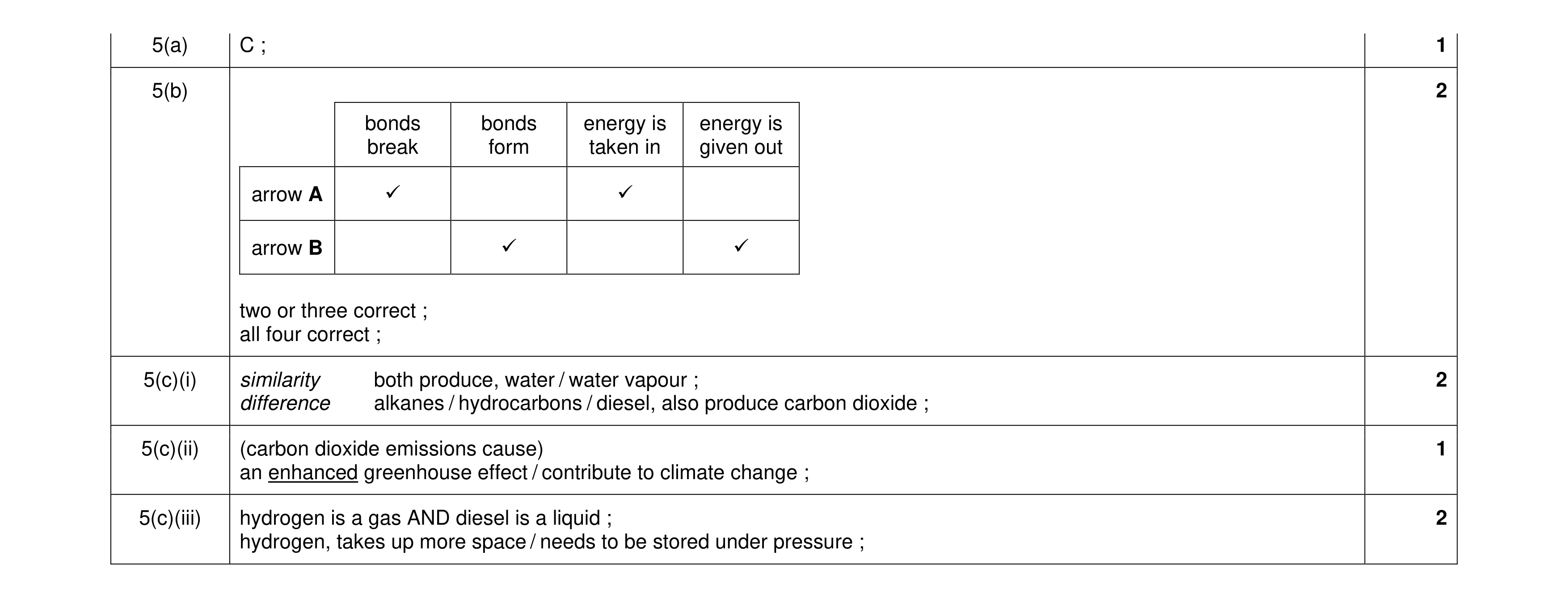 8
8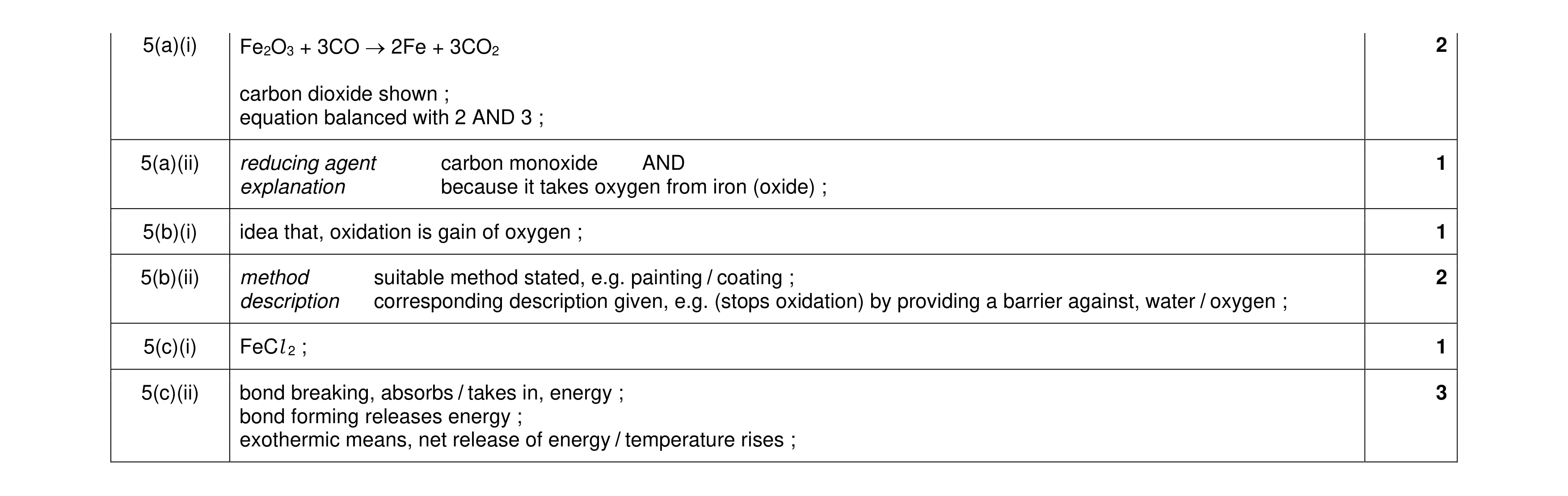 10
10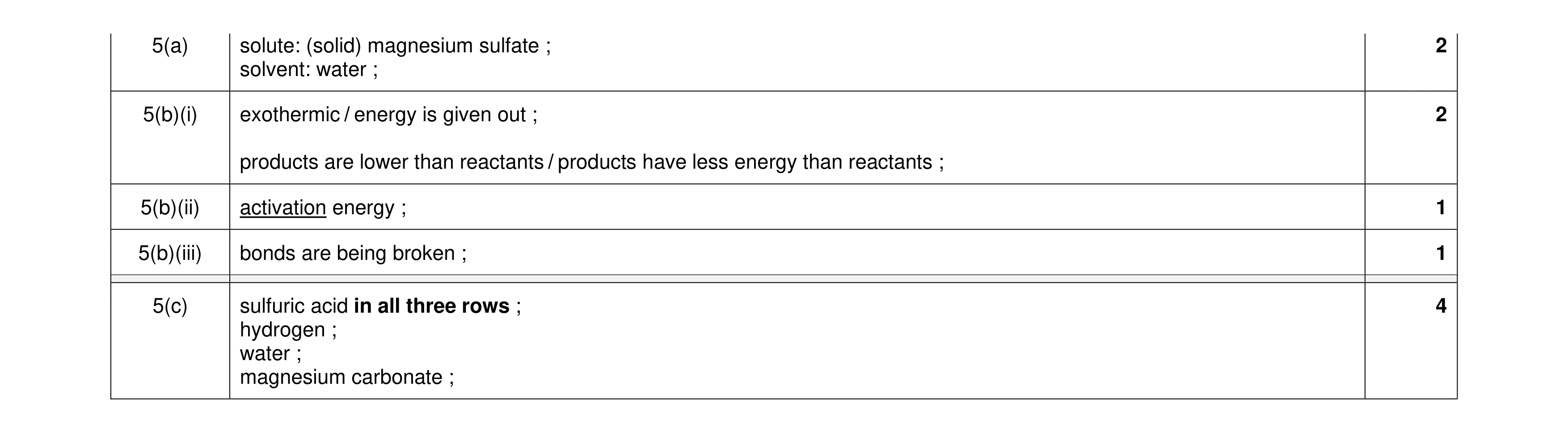 10
10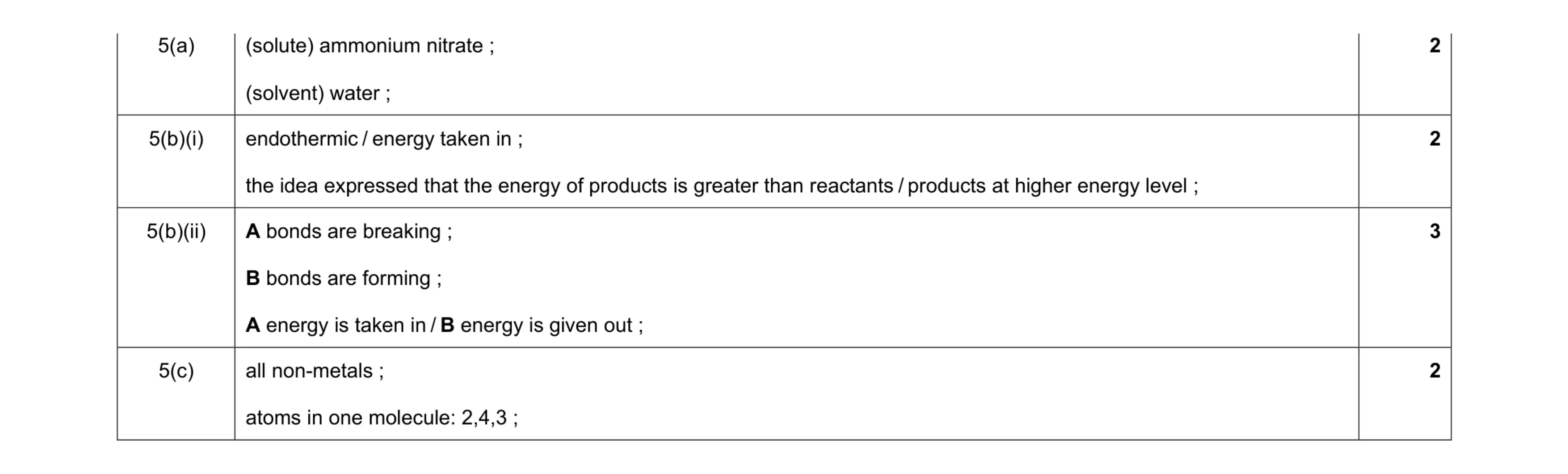 9
9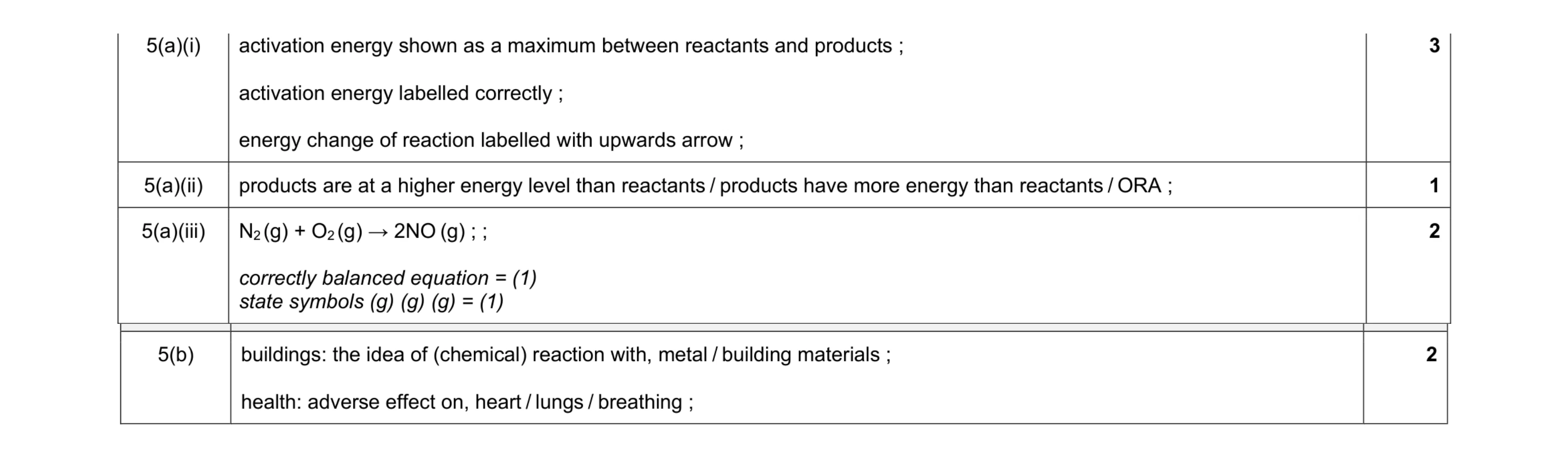 8
8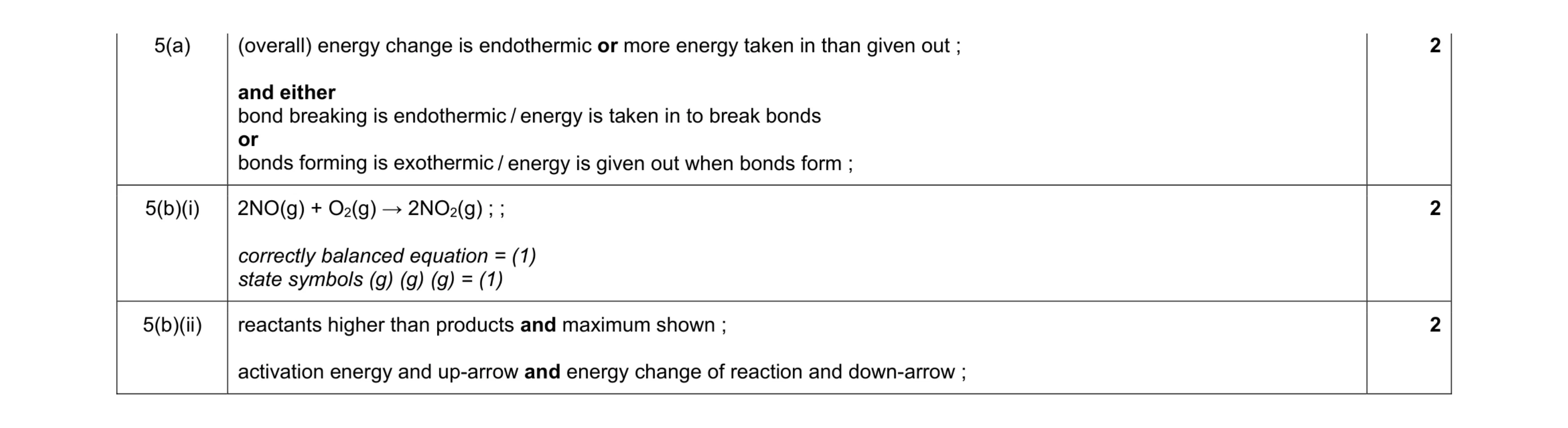 6
6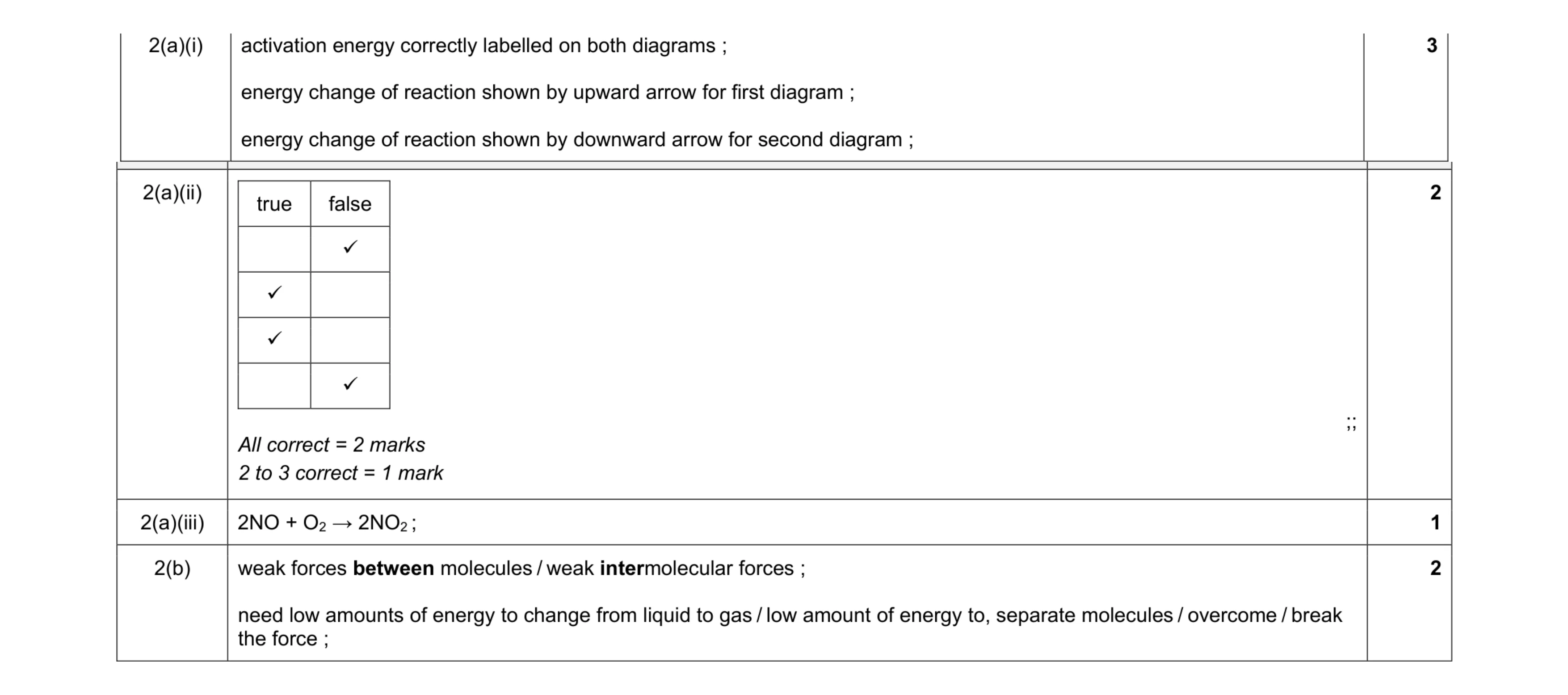 8
8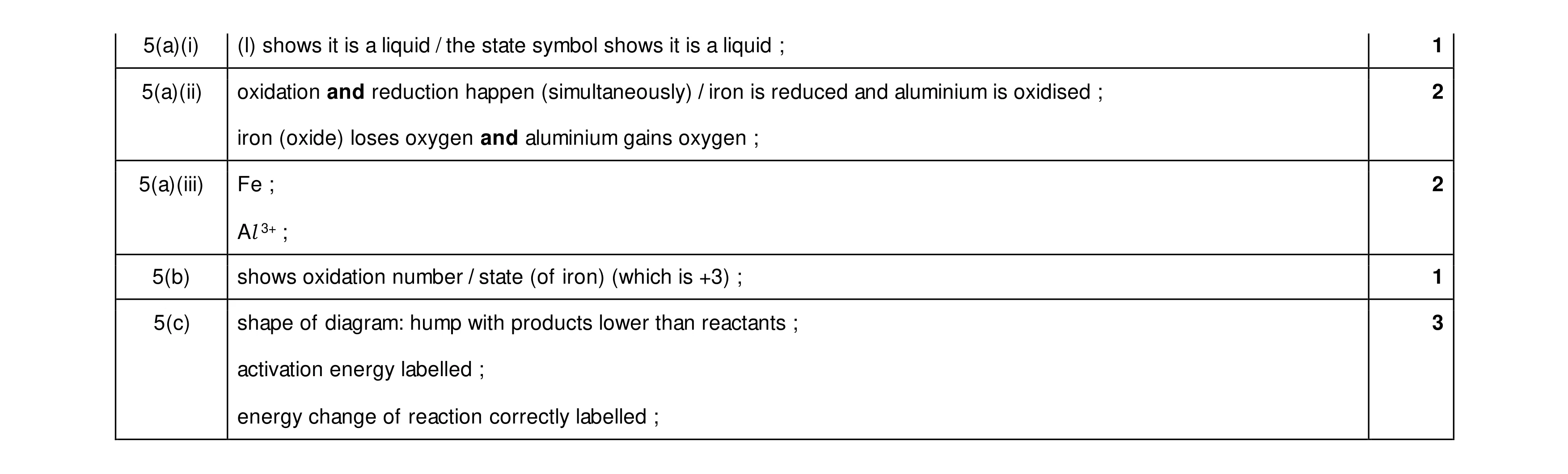 9
9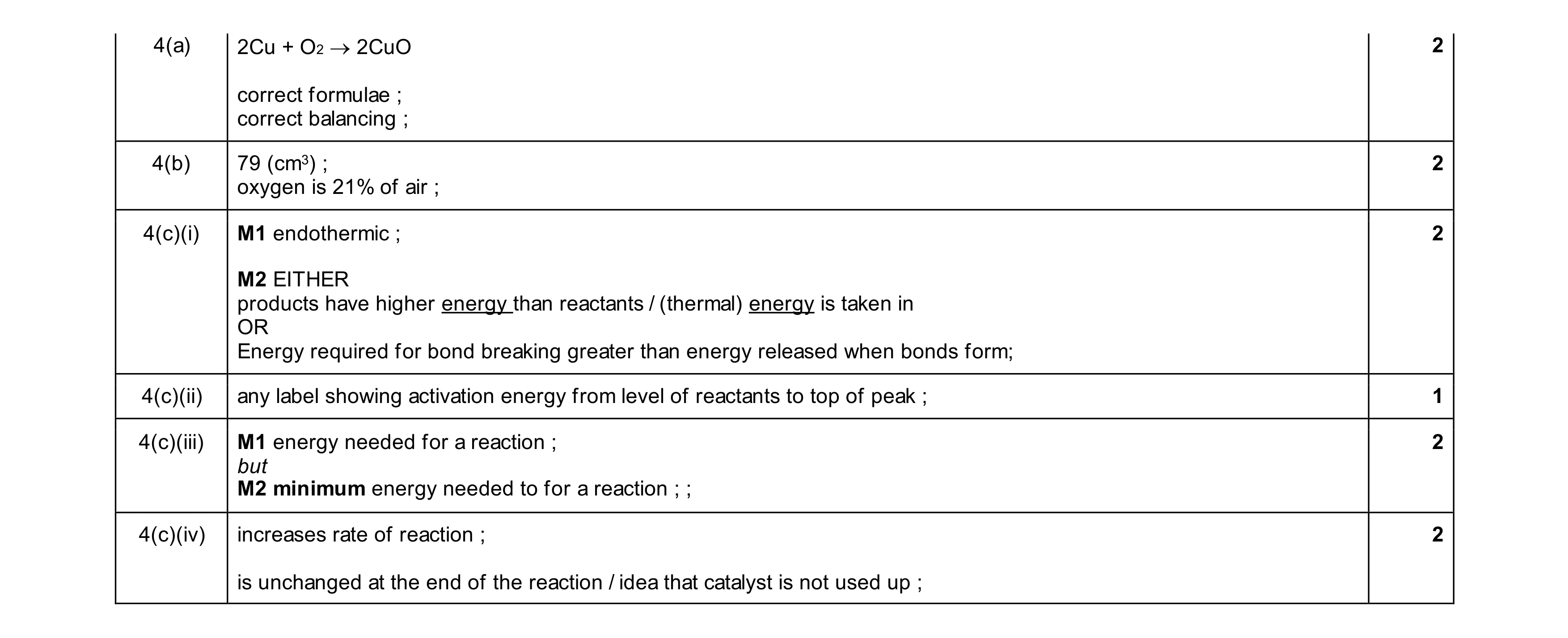 11
11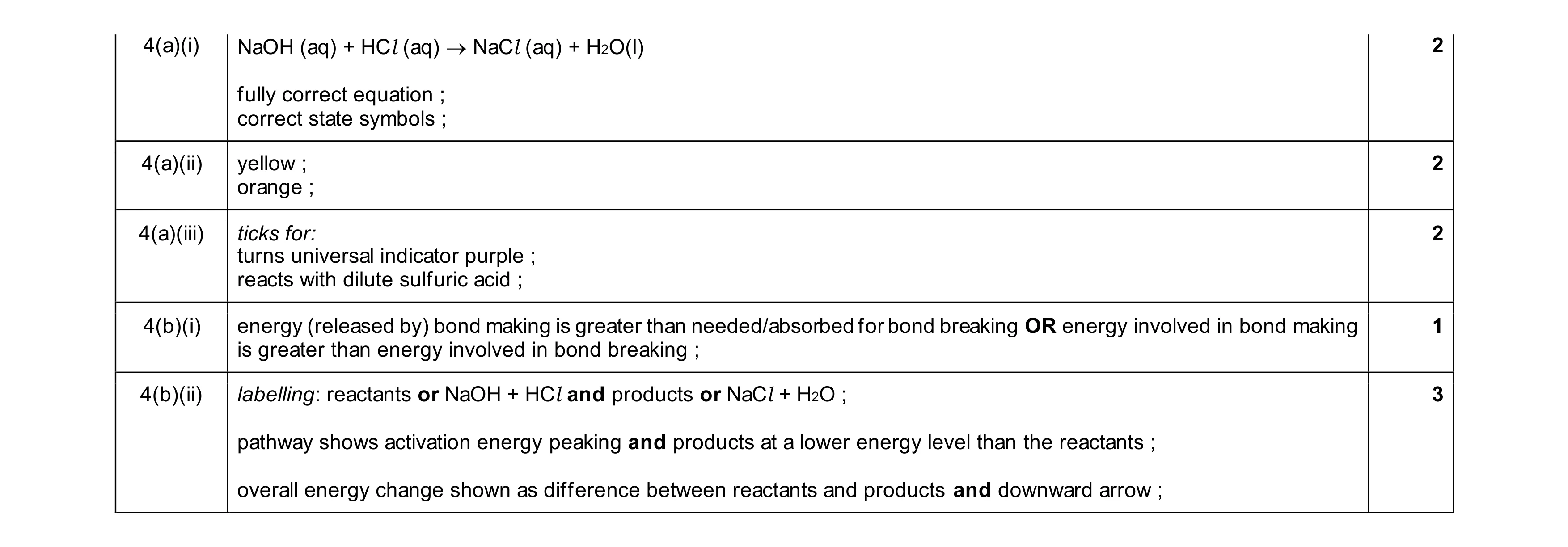 10
10