Questions as text
Q1 · Period 3 of the Periodic Table contains the elements from sodium to argon 0653/32 May/June 2018
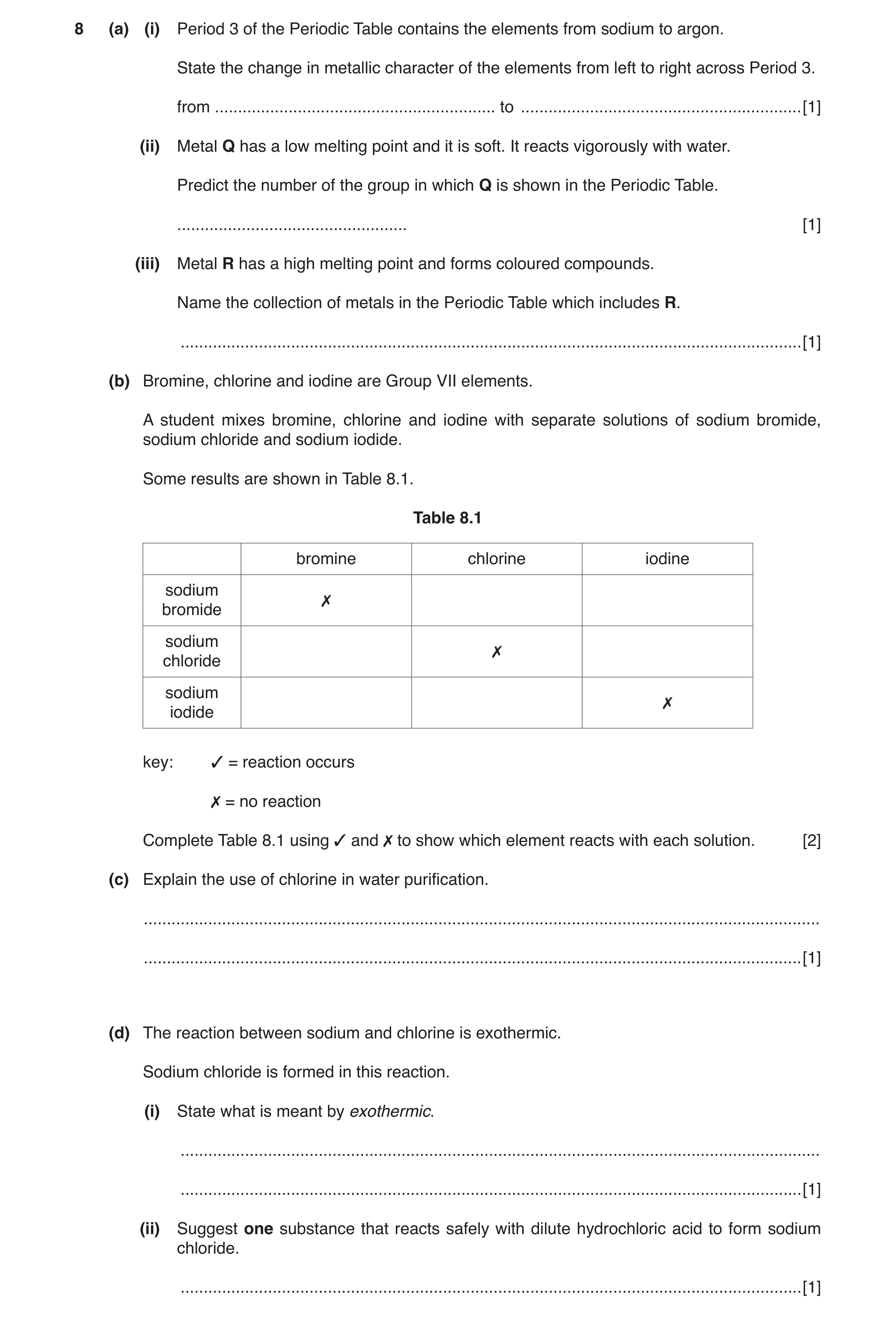
8 (a) (i) Period 3 of the Periodic Table contains the elements from sodium to argon. State the change in metallic character of the elements from left to right across Period 3. from … to … [1] (ii) Metal Q has a low melting point and it is soft. It reacts vigorously with water. Predict the number of the group in which Q is shown in the Periodic Table. … [1] (iii) Metal R has a high melting point and forms coloured compounds. Name the collection of metals in the Periodic Table which includes R. … [1] (b) Bromine, chlorine and iodine are Group VII elements. A student mixes bromine, chlorine and iodine with separate solutions of sodium bromide, sodium chloride and sodium iodide. Some results are shown in Table 8.1. Table 8.1 bromine chlorine iodine sodium ✗ bromide sodium ✗ chloride sodium ✗ iodide key: ✓ = reaction occurs ✗ = no reaction Complete Table 8.1 using ✓ and ✗ to show which element reacts with each solution. [2] (c) Explain the use of chlorine in water purification. … … [1] (d) The reaction between sodium and chlorine is exothermic. Sodium chloride is formed in this reaction. (i) State what is meant by exothermic. … … [1] (ii) Suggest one substance that reacts safely with dilute hydrochloric acid to form sodium chloride. … [1]
8 marks
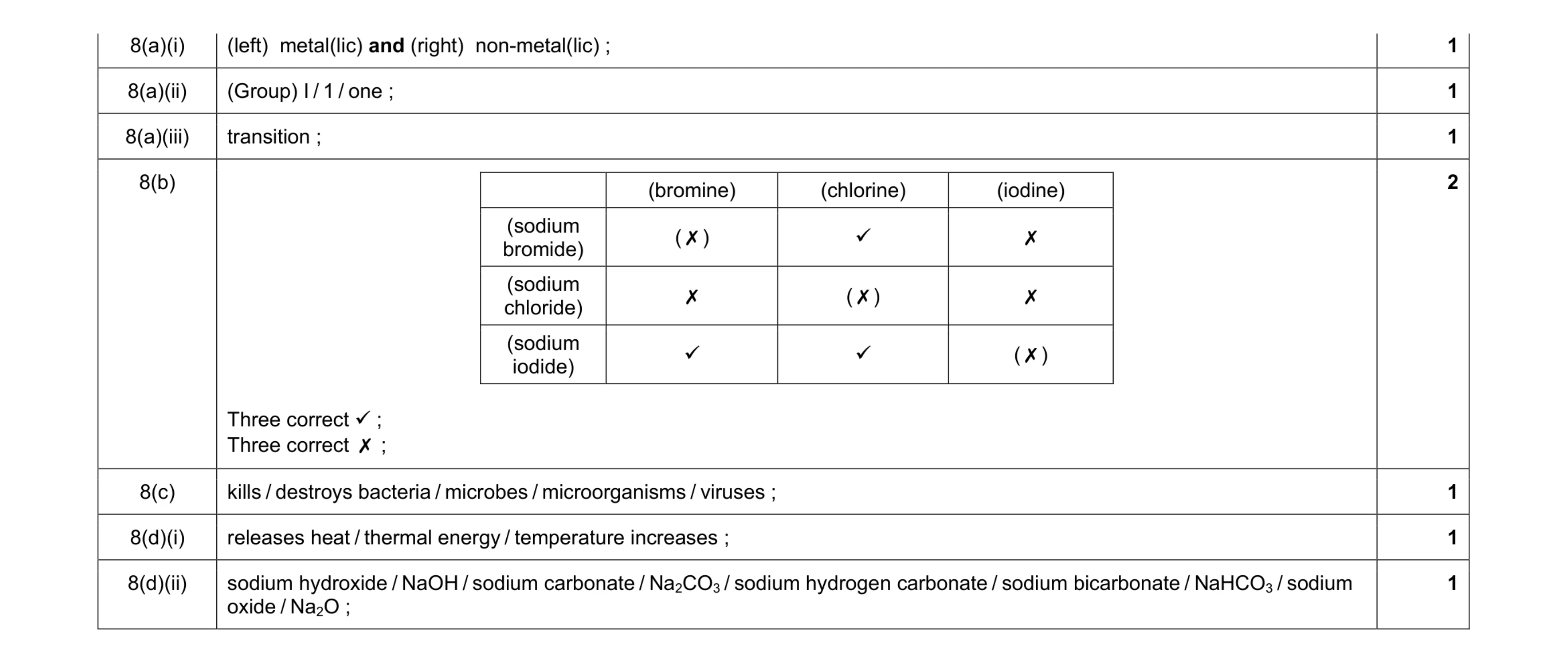
Mark scheme: 8(a)(i) (left) metal(lic) and (right) non-metal(lic) ; 1 8(a)(ii) (Group) I / 1 / one ; 1 8(a)(iii) transition ; 1 8(b) (bromine) (chlorine) (iodine) (sodium bromide) (✗) 9 ✗ (sodium chloride) ✗ (✗) ✗ (sodium iodide) 9 9 (✗) Three correct 9 ; Three correct ✗ ; 2 8(c) kills / destroys bacteria / microbes / microorganisms / viruses ; 1 8(d)(i) releases heat / thermal energy / temperature increases ; 1 8(d)(ii) sodium hydroxide / NaOH / sodium carbonate / Na2CO3 / sodium hydrogen carbonate / sodium bicarbonate / NaHCO3 / sodium oxide / Na2O ; 1
This question in 0653/32 May/June 2018
Q2 · Period 3 of the Periodic Table contains the elements from sodium to argon 0653/33 May/June 2018
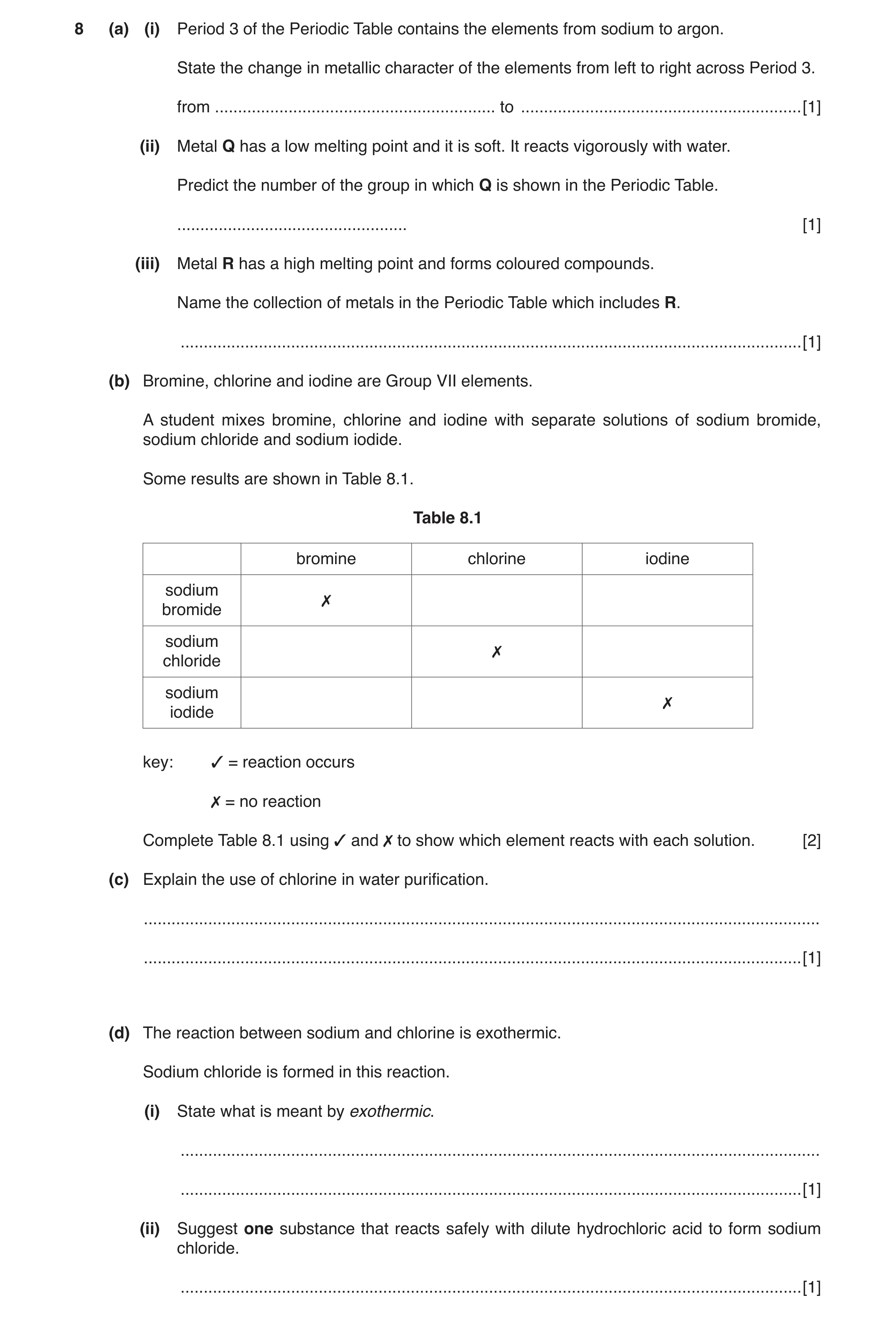
8 (a) (i) Period 3 of the Periodic Table contains the elements from sodium to argon. State the change in metallic character of the elements from left to right across Period 3. from … to … [1] (ii) Metal Q has a low melting point and it is soft. It reacts vigorously with water. Predict the number of the group in which Q is shown in the Periodic Table. … [1] (iii) Metal R has a high melting point and forms coloured compounds. Name the collection of metals in the Periodic Table which includes R. … [1] (b) Bromine, chlorine and iodine are Group VII elements. A student mixes bromine, chlorine and iodine with separate solutions of sodium bromide, sodium chloride and sodium iodide. Some results are shown in Table 8.1. Table 8.1 bromine chlorine iodine sodium ✗ bromide sodium ✗ chloride sodium ✗ iodide key: ✓ = reaction occurs ✗ = no reaction Complete Table 8.1 using ✓ and ✗ to show which element reacts with each solution. [2] (c) Explain the use of chlorine in water purification. … … [1] (d) The reaction between sodium and chlorine is exothermic. Sodium chloride is formed in this reaction. (i) State what is meant by exothermic. … … [1] (ii) Suggest one substance that reacts safely with dilute hydrochloric acid to form sodium chloride. … [1]
8 marks
Mark scheme: 8(a)(i) (left) metal(lic) and (right) non-metal(lic) ; 1 8(a)(ii) (Group) I / 1 / one ; 1 8(a)(iii) transition ; 1 8(b) (bromine) (chlorine) (iodine) (sodium bromide) (✗) 9 ✗ (sodium chloride) ✗ (✗) ✗ (sodium iodide) 9 9 (✗) Three correct 9 ; Three correct ✗ ; 2 8(c) kills / destroys bacteria / microbes / microorganisms / viruses ; 1 8(d)(i) releases heat / thermal energy / temperature increases ; 1 8(d)(ii) sodium hydroxide / NaOH / sodium carbonate / Na2CO3 / sodium hydrogen carbonate / sodium bicarbonate / NaHCO3 / sodium oxide / Na2O ; 1
This question in 0653/33 May/June 2018
Q3 · Chlorine, bromine, and iodine are Group VII elements 0653/33 May/June 2019
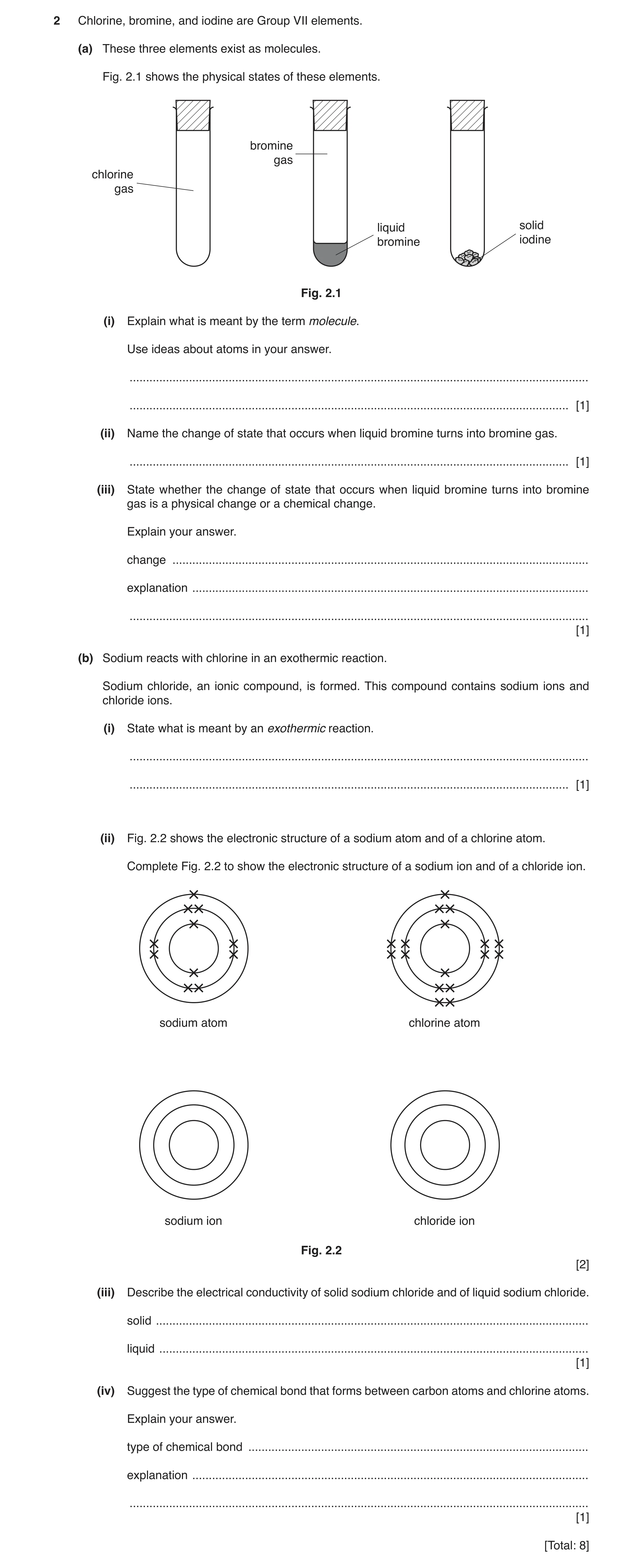
2 Chlorine, bromine, and iodine are Group VII elements. (a) These three elements exist as molecules. Fig. 2.1 shows the physical states of these elements. bromine gas chlorine gas liquid solid bromine iodine Fig. 2.1 (i) Explain what is meant by the term molecule. Use ideas about atoms in your answer. … … [1] (ii) Name the change of state that occurs when liquid bromine turns into bromine gas. … [1] (iii) State whether the change of state that occurs when liquid bromine turns into bromine gas is a physical change or a chemical change. Explain your answer. change … explanation … … [1] (b) Sodium reacts with chlorine in an exothermic reaction. Sodium chloride, an ionic compound, is formed. This compound contains sodium ions and chloride ions. (i) State what is meant by an exothermic reaction. … … [1] (ii) Fig. 2.2 shows the electronic structure of a sodium atom and of a chlorine atom. Complete Fig. 2.2 to show the electronic structure of a sodium ion and of a chloride ion. sodium atom chlorine atom sodium ion chloride ion Fig. 2.2 [2] (iii) Describe the electrical conductivity of solid sodium chloride and of liquid sodium chloride. solid … liquid … [1] (iv) Suggest the type of chemical bond that forms between carbon atoms and chlorine atoms. Explain your answer. type of chemical bond … explanation … … [1] [Total: 8]
8 marks
Mark scheme: 2(a)(i) (contains) atoms (chemically) joined / bonded / combined (together) ; 1 2(a)(ii) boiling / evaporation ; 1 2(a)(iii) (change) physical AND (explanation) no new substance(s) made ; 1 2(b)(i) releases (heat / thermal) energy ; 1 2(b)(ii) (sodium ion) drawn 2, 8 electrons (outer shell blank) ; (chloride ion) drawn 2, 8, 8 electrons ; 2 Question Answer Marks 2(b)(iii) (solid) zero / poor / non-conductor AND (liquid) good / conducts ; 1 2(b)(iv) (type) covalent AND (explanation) carbon and chlorine / both are non-metals ; 1
This question in 0653/33 May/June 2019
Q4 · Methane, CH4, is an alkane 0653/32 Oct/Nov 2020
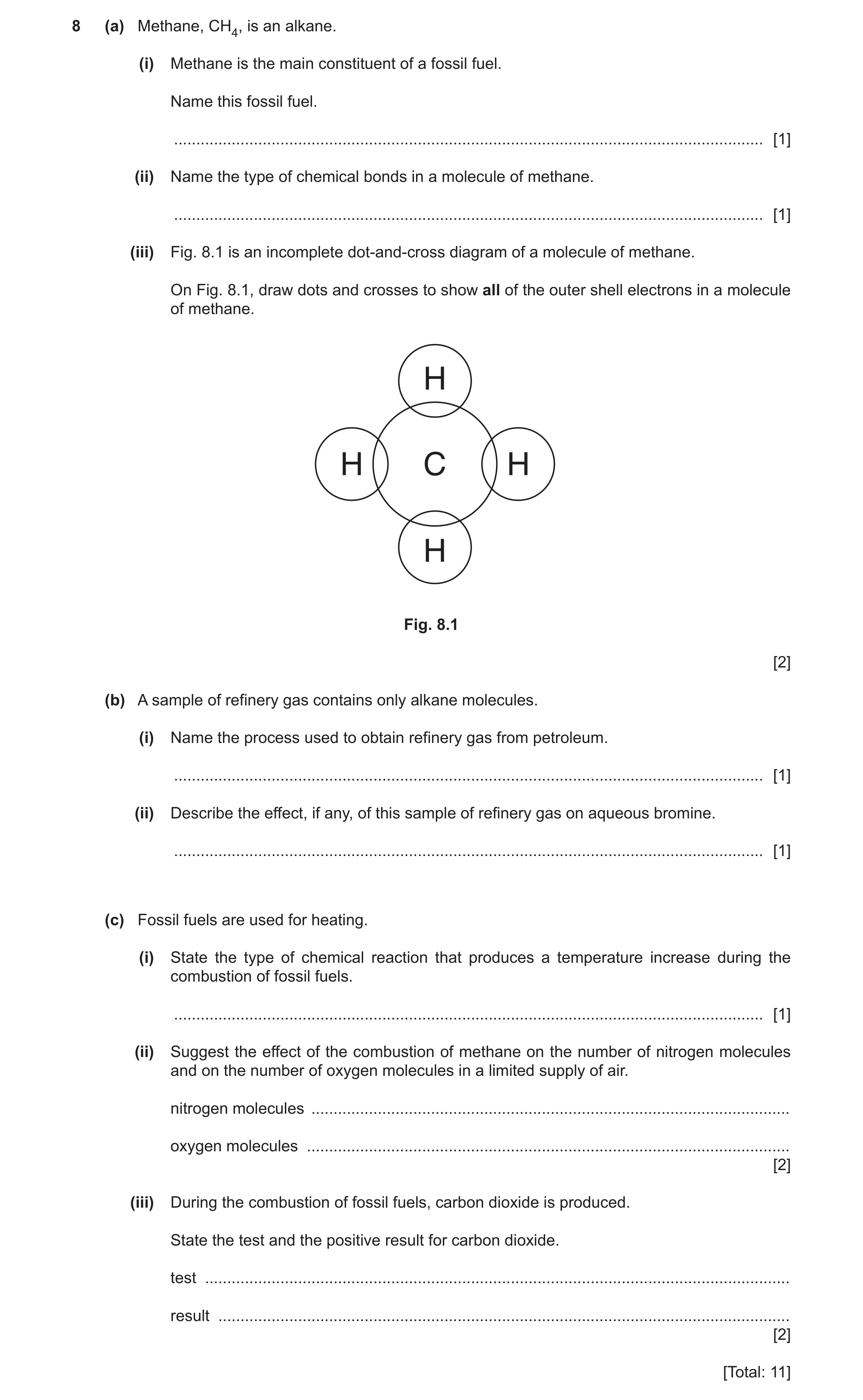
8 (a) Methane, CH4, is an alkane. (i) Methane is the main constituent of a fossil fuel. Name this fossil fuel. … [1] (ii) Name the type of chemical bonds in a molecule of methane. … [1] (iii) Fig. 8.1 is an incomplete dot-and-cross diagram of a molecule of methane. On Fig. 8.1, draw dots and crosses to show all of the outer shell electrons in a molecule of methane. H H C H H Fig. 8.1 [2] (b) A sample of refinery gas contains only alkane molecules. (i) Name the process used to obtain refinery gas from petroleum. … [1] (ii) Describe the effect, if any, of this sample of refinery gas on aqueous bromine. … [1] (c) Fossil fuels are used for heating. (i) State the type of chemical reaction that produces a temperature increase during the combustion of fossil fuels. … [1] (ii) Suggest the effect of the combustion of methane on the number of nitrogen molecules and on the number of oxygen molecules in a limited supply of air. nitrogen molecules … oxygen molecules … [2] (iii) During the combustion of fossil fuels, carbon dioxide is produced. State the test and the positive result for carbon dioxide. test … result … [2] [Total: 11]
11 marks
Mark scheme: 8(a)(i) natural gas ; 1 8(a)(ii) covalent ; 1 8(a)(iii) one bond shown correctly ; four bonds shown correctly ; 2 8(b)(i) fractional distillation ; 1 8(b)(ii) none / no effect / (stays) orange-brown ; 1 8(c)(i) exothermic ; 1 8(c)(ii) (nitrogen) no change / no effect / none ; (oxygen) decreases ; 2 8(c)(iii) (test) limewater ; (result) turns milky ; 2
This question in 0653/32 Oct/Nov 2020
Q5 · A student investigates the rate of reaction between a piece of magnesium and excess… 0653/33 Oct/Nov 2020
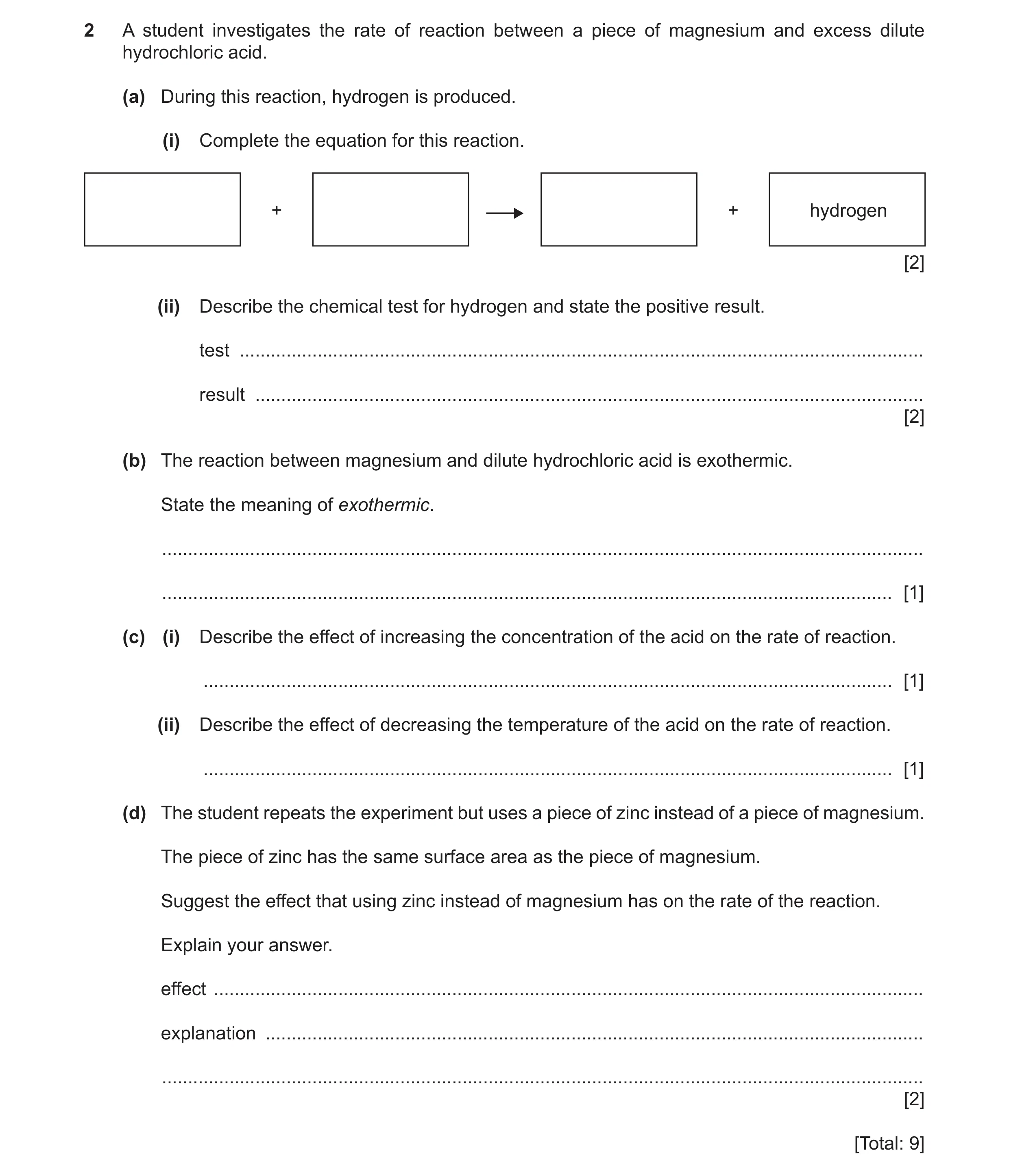
2 A student investigates the rate of reaction between a piece of magnesium and excess dilute hydrochloric acid. (a) During this reaction, hydrogen is produced. (i) Complete the equation for this reaction. + + hydrogen [2] (ii) Describe the chemical test for hydrogen and state the positive result. test … result … [2] (b) The reaction between magnesium and dilute hydrochloric acid is exothermic. State the meaning of exothermic. … … [1] (c) (i) Describe the effect of increasing the concentration of the acid on the rate of reaction. … [1] (ii) Describe the effect of decreasing the temperature of the acid on the rate of reaction. … [1] (d) The student repeats the experiment but uses a piece of zinc instead of a piece of magnesium. The piece of zinc has the same surface area as the piece of magnesium. Suggest the effect that using zinc instead of magnesium has on the rate of the reaction. Explain your answer. effect … explanation … … [2] [Total: 9]
9 marks
Mark scheme: 2(a)(i) magnesium + hydrochloric acid → magnesium chloride + (hydrogen) reactants ; magnesium chloride ; 2(a)(ii) (test) lighted splint ; (result) burns with a squeaky ‘pop’ ; 2 2(b) (thermal) energy / heat, is, released / given out ; 1 2(c)(i) rate increases ; 1 2(c)(ii) rate decreases ; 1 2(d) (effect) rate, decreases / reduces ; (explanation) zinc is less reactive (than magnesium) ; 2
This question in 0653/33 Oct/Nov 2020
Q6 · An atom of lead is represented by the symbol shown 0653/32 Feb/March 2021
8 (a) An atom of lead is represented by the symbol shown. 207 Pb 82 (i) Deduce the number of electrons and number of neutrons in this atom. electrons … neutrons … [2] (ii) The proton number (atomic number) of lead is 82. Define the term proton number. … … [1] (iii) State the charges of protons, neutrons and electrons. protons … neutrons … electrons … [1] (b) Lead is extracted from molten lead(II) bromide using the apparatus shown in Fig. 8.1. low voltage d.c. supply – + molten lead(II) bromide Fig. 8.1 (i) Name the process shown in Fig. 8.1. … [1] (ii) State the name of the electrode at which lead forms. … [1] (c) Lead is extracted from lead(II) oxide, PbO, by heating with carbon. Carbon dioxide is also made in this endothermic reaction. (i) Describe what is meant by an endothermic reaction. … … [1] (ii) Complete the word equation for this reaction. + lead + [1] (iii) Circle the word to show whether lead(II) oxide is oxidised or reduced in this reaction. Explain your answer. oxidised reduced explanation … … (d) A teacher has a different compound of lead. When this compound of lead reacts with dilute hydrochloric acid, carbon dioxide is formed. Suggest the name of this compound of lead. … [1] [Total: 10]
10 marks
Mark scheme: 8(a)(i) (electrons) 82 ; (neutrons) 125 ; 2 8(a)(ii) the number of protons in the nucleus of an atom ; 1 8(a)(iii) (protons) +1 (neutrons) no charge (electrons) -1 ; all three needed for one mark 1 Question Answer Marks 8(b)(i) electrolysis ; 1 8(b)(ii) cathode ; 1 8(c)(i) takes in, heat / energy ; 1 8(c)(ii) ; 1 8(c)(iii) reduced (circled) AND (explanation) loses oxygen ; 1 8(d) lead carbonate / PbCO3 ; 1
This question in 0653/32 Feb/March 2021
Q7 · The order of reactivity for some metals is shown in Fig 0653/31 Oct/Nov 2021
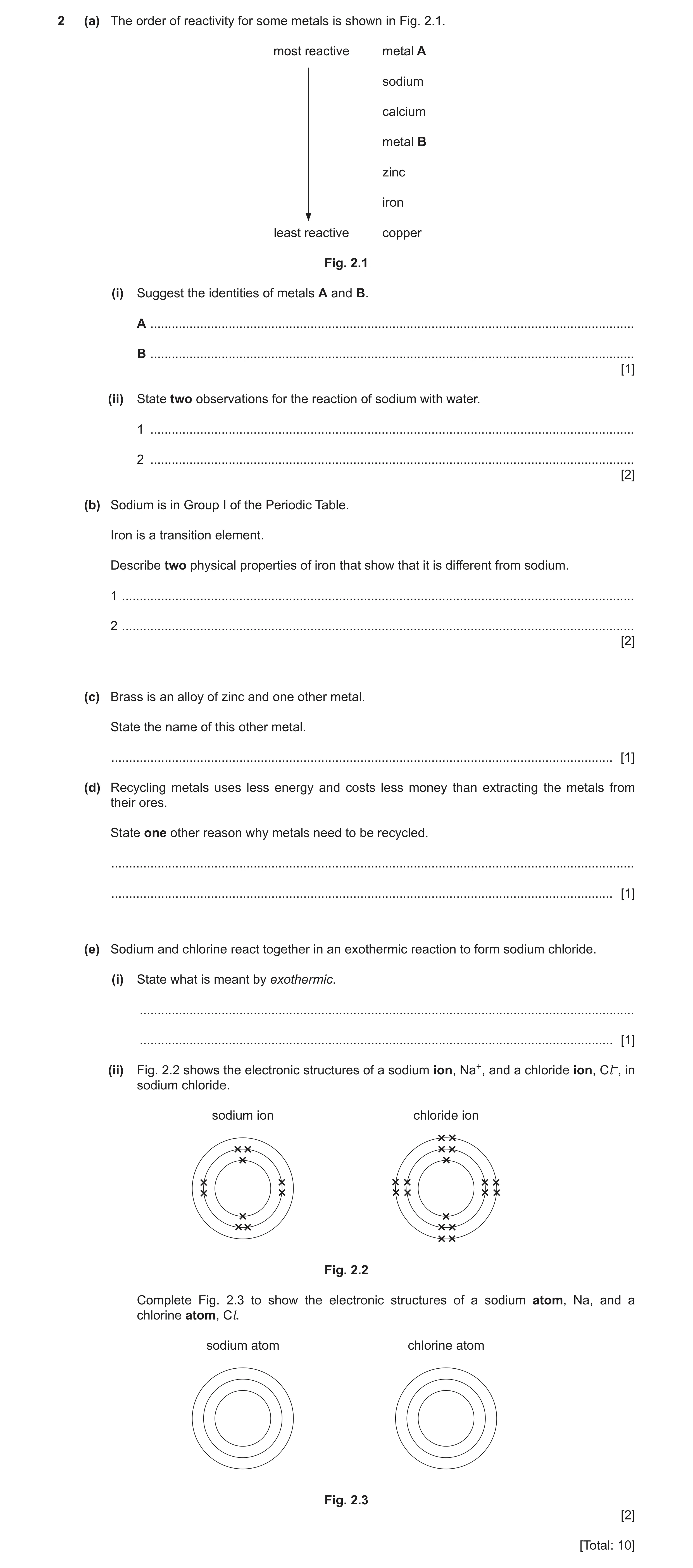
2 (a) The order of reactivity for some metals is shown in Fig. 2.1. most reactive metal A sodium calcium metal B zinc iron least reactive copper Fig. 2.1 (i) Suggest the identities of metals A and B. A … B … [1] (ii) State two observations for the reaction of sodium with water. 1 … 2 … [2] (b) Sodium is in Group I of the Periodic Table. Iron is a transition element. Describe two physical properties of iron that show that it is different from sodium. 1 … 2 … [2] (c) Brass is an alloy of zinc and one other metal. State the name of this other metal. … [1] (d) Recycling metals uses less energy and costs less money than extracting the metals from their ores. State one other reason why metals need to be recycled. … … [1] (e) Sodium and chlorine react together in an exothermic reaction to form sodium chloride. (i) State what is meant by exothermic. … … [1] (ii) Fig. 2.2 shows the electronic structures of a sodium ion, Na+, and a chloride ion, Cl–, in sodium chloride. sodium ion chloride ion ×× ×× ×× × × ×× ×× ×××× ×× ×× × × ×× ×× × × Fig. 2.2 Complete Fig. 2.3 to show the electronic structures of a sodium atom, Na, and a chlorine atom, Cl. sodium atom chlorine atom Fig. 2.3 [2] [Total: 10]
10 marks
Mark scheme: 2(a)(i) A potassium AND B magnesium / aluminium ; 1 2(a)(ii) any two from: fizzes / bubbles ; gets smaller ; floats ; moves ; 2 2(b) any two from: (iron has) high(er) density / ORA ; (iron has) high(er) melting point / ORA ; (iron is) magnetic / ORA ; 2 2(c) copper ; 1 2(d) metals are finite (resources) / will run out ; 1 2(e)(i) (thermal) energy is released ; 1 2(e)(ii) (sodium atom) 2, 8, 1 ; (chlorine atom) 2, 8, 7 ; 2
This question in 0653/31 Oct/Nov 2021
Q8 · Fossil fuels release heat energy during combustion 0653/31 May/June 2022
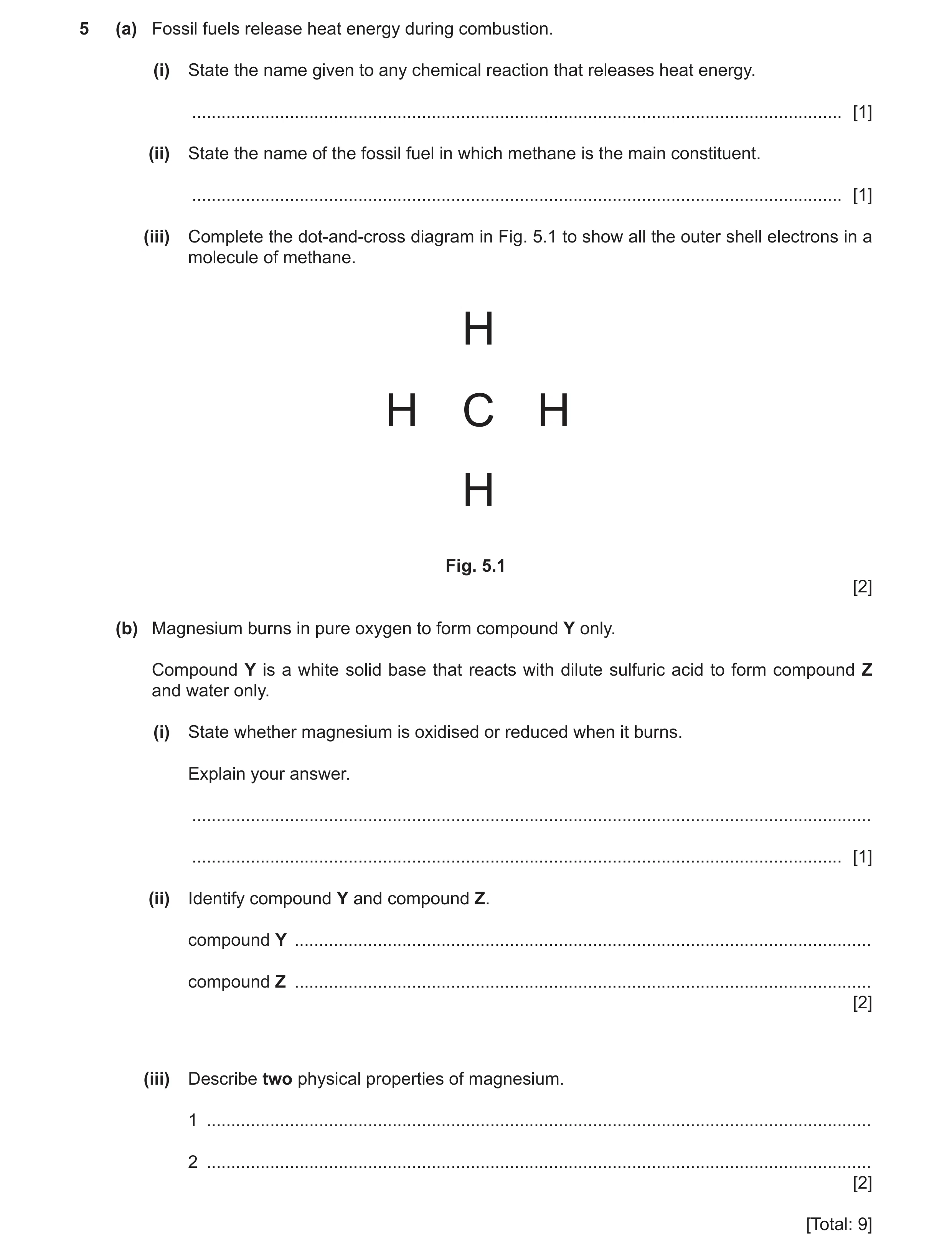
5 (a) Fossil fuels release heat energy during combustion. (i) State the name given to any chemical reaction that releases heat energy. … [1] (ii) State the name of the fossil fuel in which methane is the main constituent. … [1] (iii) Complete the dot-and-cross diagram in Fig. 5.1 to show all the outer shell electrons in a molecule of methane. H H C H H Fig. 5.1 [2] (b) Magnesium burns in pure oxygen to form compound Y only. Compound Y is a white solid base that reacts with dilute sulfuric acid to form compound Z and water only. (i) State whether magnesium is oxidised or reduced when it burns. Explain your answer. … … [1] (ii) Identify compound Y and compound Z. compound Y … compound Z … [2] (iii) Describe two physical properties of magnesium. 1 … 2 … [2] [Total: 9]
9 marks
Mark scheme: 5(a)(i) exothermic ; 1 5(a)(ii) natural gas ; 1 5(a)(iii) ;; one bonding pair correct ; four bonding pairs shown around the C atom ; 2 5(b)(i) oxidised AND gains oxygen ; 1 5(b)(ii) (compound Y) magnesium oxide / MgO ; (compound Z) magnesium sulfate / MgSO4 ; 2 5(b)(iii) any two from: high melting point ; high boiling point ; malleable ; (good) heat conductor ; (good) electrical conductor ; 2
This question in 0653/31 May/June 2022
Q9 · Zinc is extracted from zinc oxide by heating with carbon 0653/32 May/June 2022
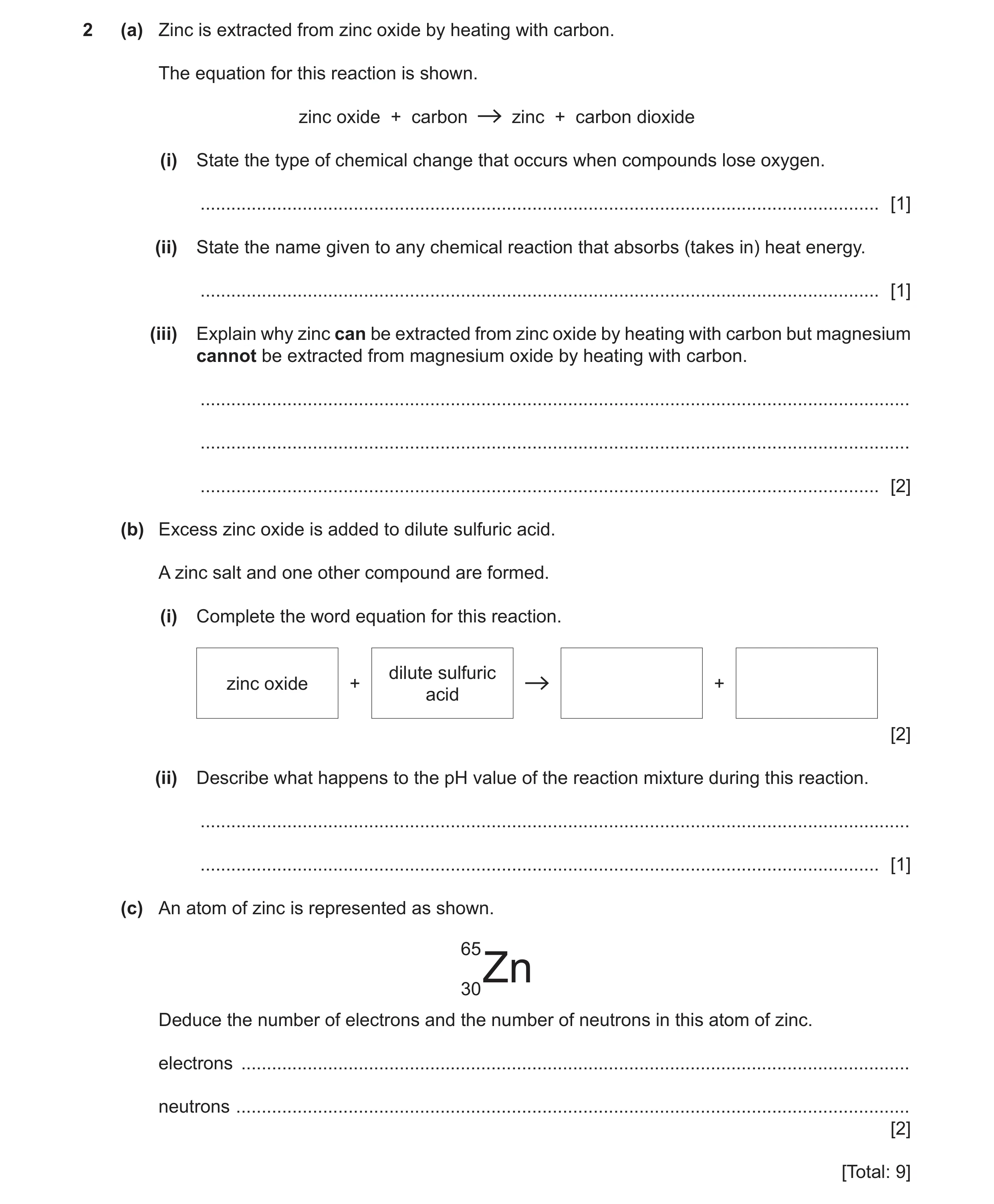
2 (a) Zinc is extracted from zinc oxide by heating with carbon. The equation for this reaction is shown. zinc oxide + carbon zinc + carbon dioxide (i) State the type of chemical change that occurs when compounds lose oxygen. … [1] (ii) State the name given to any chemical reaction that absorbs (takes in) heat energy. … [1] (iii) Explain why zinc can be extracted from zinc oxide by heating with carbon but magnesium cannot be extracted from magnesium oxide by heating with carbon. … … … [2] (b) Excess zinc oxide is added to dilute sulfuric acid. A zinc salt and one other compound are formed. (i) Complete the word equation for this reaction. dilute sulfuric zinc oxide + + acid [2] (ii) Describe what happens to the pH value of the reaction mixture during this reaction. … … [1] (c) An atom of zinc is represented as shown. 6530Zn Deduce the number of electrons and the number of neutrons in this atom of zinc. electrons … neutrons … [2] [Total: 9]
9 marks
Mark scheme: 2(a)(i) reduction ; 1 2(a)(ii) endothermic ; 1 2(a)(iii) zinc / Zn is less reactive than carbon / C ; ORA magnesium / Mg is more reactive than carbon / C ; ORA 2 2(b)(i) zinc oxide + dilute sulfuric acid zinc sulfate ; + water ; 2 2(b)(ii) (pH) increases ; 1 Question Answer Marks 2(c) (electrons) 30 ; (neutrons) 35 ; 2
This question in 0653/32 May/June 2022
Q10 · Lithium is an element in Group I of the Periodic Table 0653/32 Feb/March 2024
2 Lithium is an element in Group I of the Periodic Table. (a) An atom of lithium is represented as shown. 73Li Complete Table 2.1 to show the number of protons, electrons and neutrons in one atom of 73Li. Table 2.1 number of protons number of electrons number of neutrons [2] (b) Describe what happens when an atom of lithium becomes an ion of lithium. … … [1] (c) Lithium reacts slowly with oxygen at room temperature to form lithium oxide. This reaction is exothermic. (i) Balance the symbol equation for this reaction. [1] ……. Li + .…... O2 ……. Li2O (ii) Circle the word that describes the reaction between lithium and oxygen. decomposition distillation neutralisation oxidation [1] (iii) Describe one observation that shows the reaction is exothermic. … … [1] (d) There is an alloy that contains lithium and aluminium only. Tick (3) one box to show which statement describes this alloy. It contains one type of atom only. It is a mixture. It has the chemical properties of aluminium only. It has the physical properties of lithium only. [1] (e) Aluminium is used to make cooking pans. Suggest why lithium is not used to make cooking pans. … … [1] (f) Recycling aluminium is cheaper than producing it from its ore. Suggest one other reason why aluminium is recycled. … … [1] [Total: 9]
9 marks
Mark scheme: 2(a) 2 number of protons number of electrons number of neutrons 3 3 4 ;; 3 correct = [2] 1–2 correct = [1] 2(b) loss of one electron (from its outer shell) ; 1 2(c)(i) 4Li + O2 → 2Li2O ; 1 2(c)(ii) oxidation circled ; 1 2(c)(iii) idea that heat is transferred from reactants / temperature (of reaction mixture) increases ; 1 2(d) second box ticked (It is a mixture.) ; 1 2(e) too reactive / melting point too low / too soft ; 1 2(f) (aluminium is a) finite resource / will run out / non-renewable ; 1
This question in 0653/32 Feb/March 2024
Q11 · Ethene is an example of an alkene 0653/32 Feb/March 2024
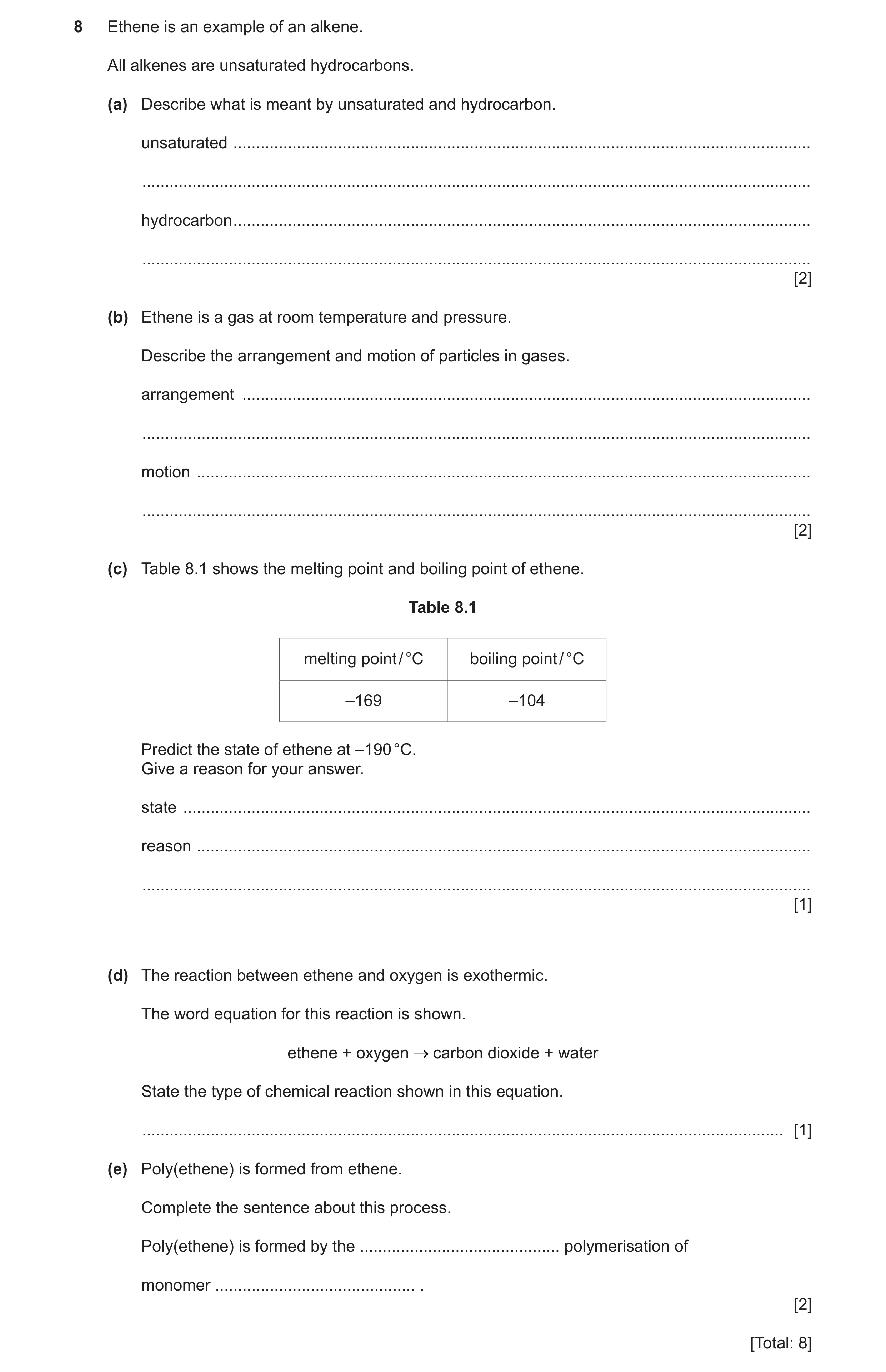
8 Ethene is an example of an alkene. All alkenes are unsaturated hydrocarbons. (a) Describe what is meant by unsaturated and hydrocarbon. unsaturated … … hydrocarbon … … [2] (b) Ethene is a gas at room temperature and pressure. Describe the arrangement and motion of particles in gases. arrangement … … motion … … [2] (c) Table 8.1 shows the melting point and boiling point of ethene. Table 8.1 melting point / °C boiling point / °C –169 –104 Predict the state of ethene at –190 °C. Give a reason for your answer. state … reason … … [1] (d) The reaction between ethene and oxygen is exothermic. The word equation for this reaction is shown. ethene + oxygen carbon dioxide + water State the type of chemical reaction shown in this equation. … [1] (e) Poly(ethene) is formed from ethene. Complete the sentence about this process. Poly(ethene) is formed by the … polymerisation of monomer … . [2] [Total: 8]
8 marks
Mark scheme: 8(a) unsaturated: 2 contains a double (C=C) covalent bond ; hydrocarbon: contains carbon AND hydrogen only ; 8(b) arrangement: 2 far apart / not touching / random ; motion: move quickly ; 8(c) solid AND 1 −190 °C is less than melting point / melting point is higher than −190 °C ; 8(d) combustion ; 1 8(e) addition ; 2 units / molecules ;
This question in 0653/32 Feb/March 2024
Q12 · The elements chlorine, bromine and iodine are diatomic covalent molecules 0653/31 May/June 2024
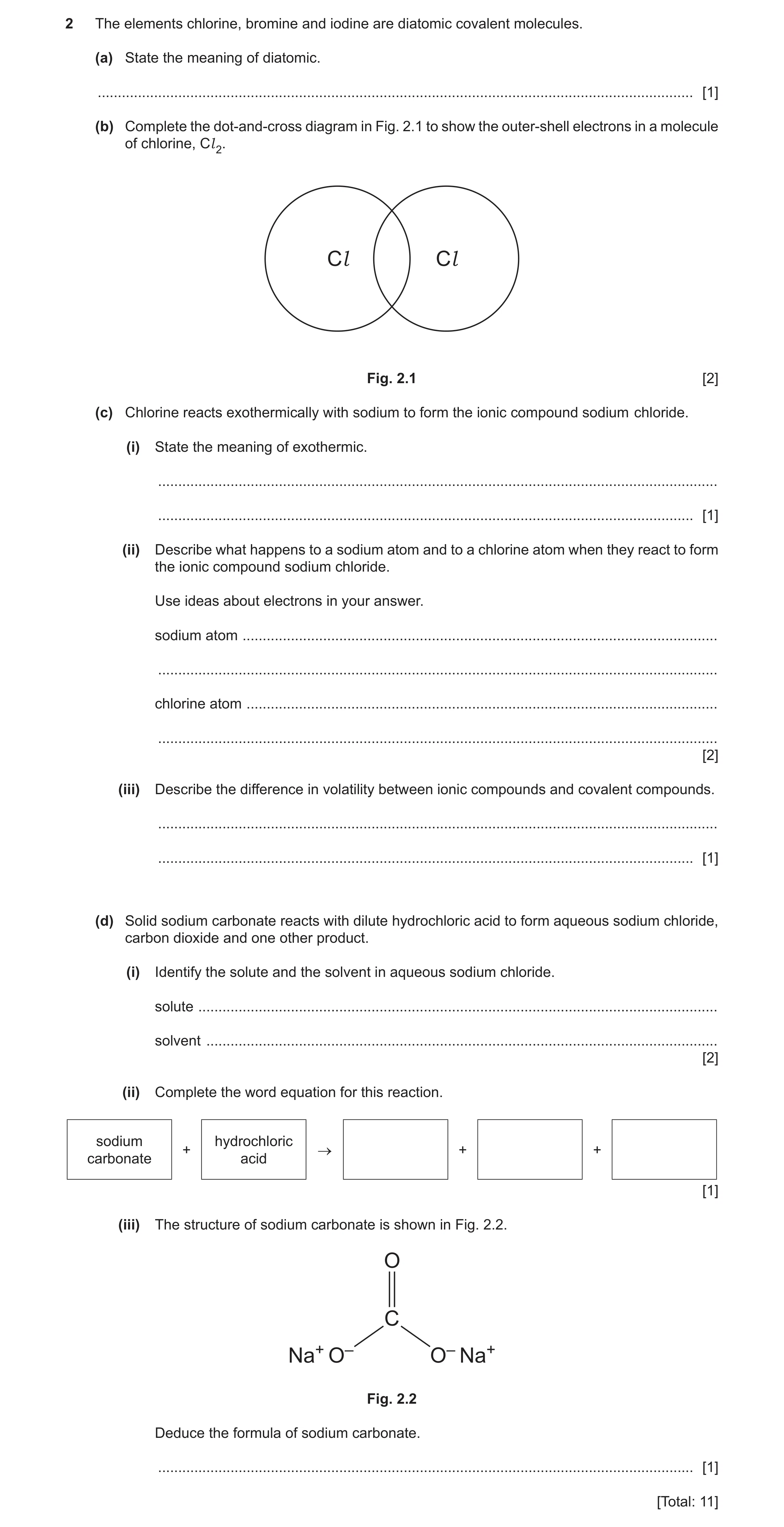
2 The elements chlorine, bromine and iodine are diatomic covalent molecules. (a) State the meaning of diatomic. … [1] (b) Complete the dot-and-cross diagram in Fig. 2.1 to show the outer-shell electrons in a molecule of chlorine, Cl2. Cl Cl Fig. 2.1 [2] (c) Chlorine reacts exothermically with sodium to form the ionic compound sodium chloride. (i) State the meaning of exothermic. … … [1] (ii) Describe what happens to a sodium atom and to a chlorine atom when they react to form the ionic compound sodium chloride. Use ideas about electrons in your answer. sodium atom … … chlorine atom … … [2] (iii) Describe the difference in volatility between ionic compounds and covalent compounds. … … [1] (d) Solid sodium carbonate reacts with dilute hydrochloric acid to form aqueous sodium chloride, carbon dioxide and one other product. (i) Identify the solute and the solvent in aqueous sodium chloride. solute … solvent … [2] (ii) Complete the word equation for this reaction. sodium hydrochloric + + +carbonate acid [1] (iii) The structure of sodium carbonate is shown in Fig. 2.2. O C Na+ O– O– Na+ Fig. 2.2 Deduce the formula of sodium carbonate. … [1] [Total: 11]
11 marks
Mark scheme: 2(a) (molecule containing) two atoms (chemically combined) ; 1 Question Answer Marks 2(b) one shared pair of electrons ; three lone pairs / six non-bonding electrons on each atom and all else correct ; 2 2(c)(i) (reaction that) gives out thermal energy ; 1 2(c)(ii) (sodium atom) loses one electron ; (chlorine atom) gains one electron ; 2 2(c)(iii) covalent are more (volatile) ; 1 2(d)(i) (solute) sodium chloride / NaCl ; (solvent) water / H2O ; 2 2(d)(ii) ; 1 2(d)(iii) Na2CO3 ; 1
This question in 0653/31 May/June 2024
Q13 · The structures of compounds P and Q are shown in Fig 0653/32 May/June 2024
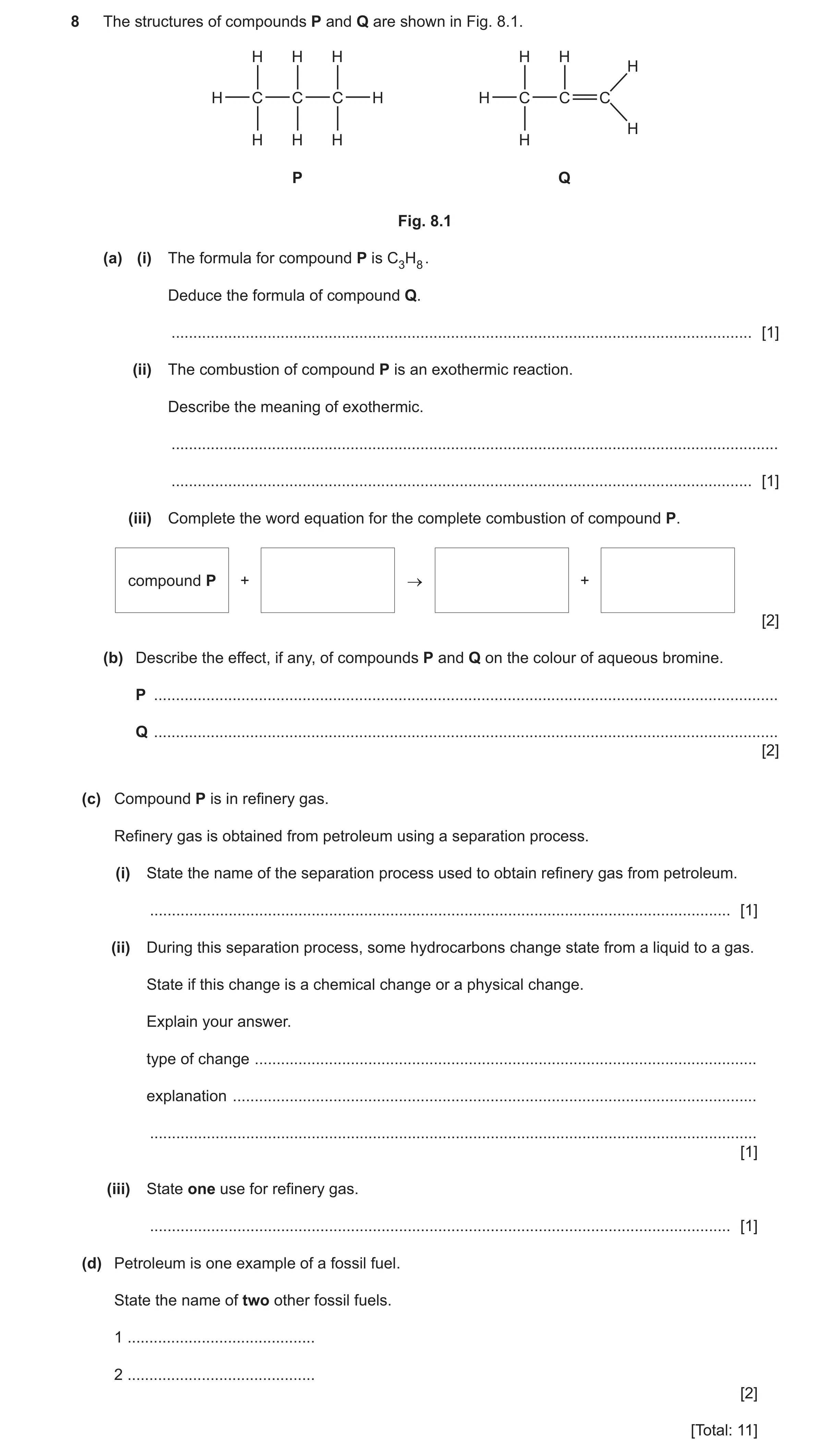
8 The structures of compounds P and Q are shown in Fig. 8.1. H H H H H H H C C C H H C C C H H H H H P Q Fig. 8.1 (a) (i) The formula for compound P is C3H8 . Deduce the formula of compound Q. … [1] (ii) The combustion of compound P is an exothermic reaction. Describe the meaning of exothermic. … … [1] (iii) Complete the word equation for the complete combustion of compound P. compound P + + [2] (b) Describe the effect, if any, of compounds P and Q on the colour of aqueous bromine. P … Q … [2] (c) Compound P is in refinery gas. Refinery gas is obtained from petroleum using a separation process. (i) State the name of the separation process used to obtain refinery gas from petroleum. … [1] (ii) During this separation process, some hydrocarbons change state from a liquid to a gas. State if this change is a chemical change or a physical change. Explain your answer. type of change … explanation … … [1] (iii) State one use for refinery gas. … [1] (d) Petroleum is one example of a fossil fuel. State the name of two other fossil fuels. 1 … 2 … [2] [Total: 11]
11 marks
Mark scheme: 8(a)(i) C3H6 ; 1 8(a)(ii) (reaction that) gives out thermal energy ; 1 8(a)(iii) ;; ;; ;; oxygen correct = (1) products correct (either order) = (1) 2 8(b) (P) stays orange / orange-brown ; (Q) decolourises / (turns) colourless ; 2 8(c)(i) fractional distillation ; 1 8(c)(ii) (type of change) physical AND (explanation) no new substance is made / can be reversed ; 1 8(c)(iii) heating / cooking ; 1 8(d) natural gas ; coal ; 2
This question in 0653/32 May/June 2024
Q14 · The products and observations at the electrodes in the electrolysis of three electrolytes 0653/32 Feb/March 2025
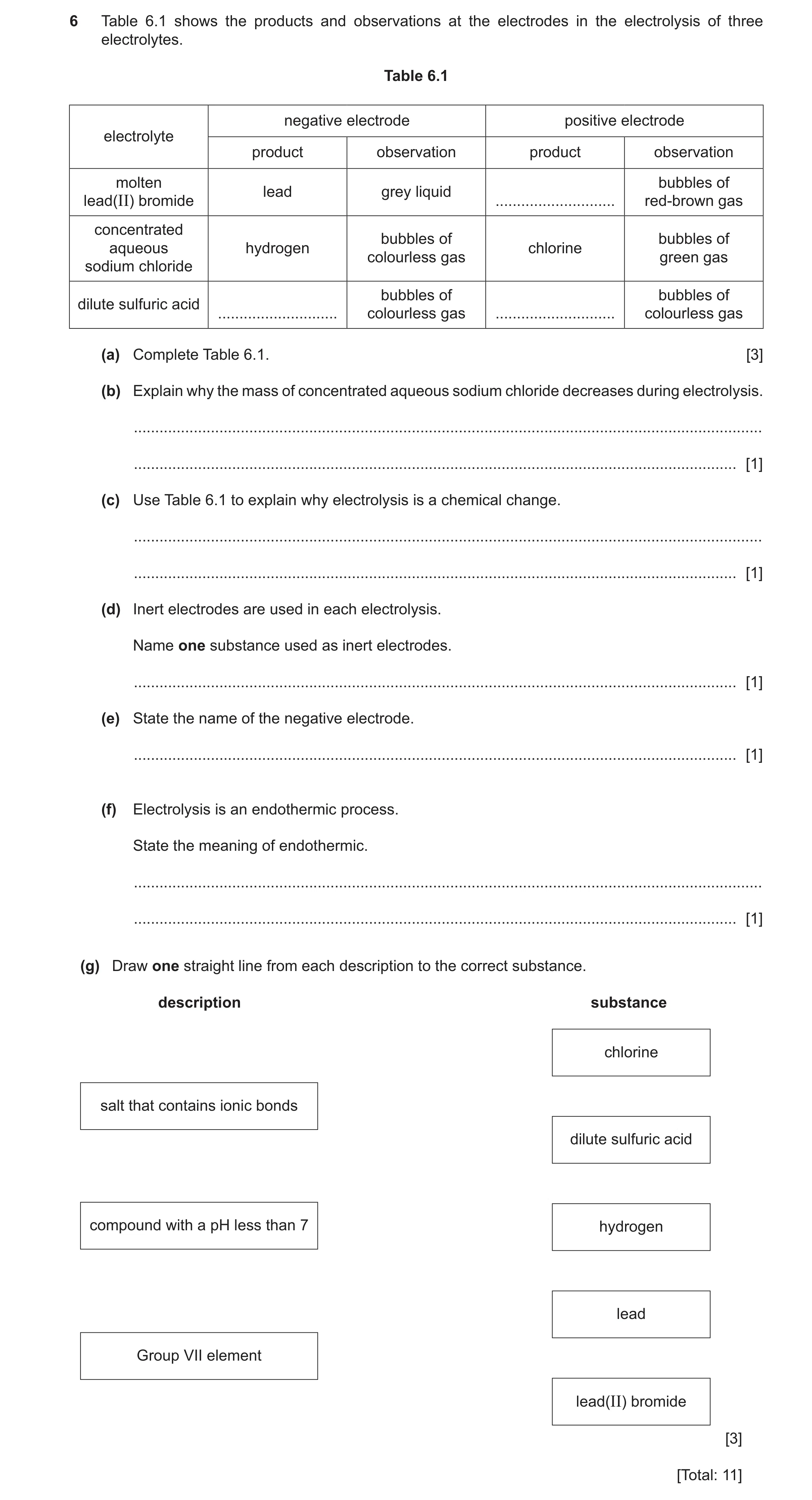
6 Table 6.1 shows the products and observations at the electrodes in the electrolysis of three electrolytes. Table 6.1 negative electrode positive electrode electrolyte product observation product observation molten bubbles of lead grey liquid lead(II) bromide … red-brown gas concentrated bubbles of bubbles of aqueous hydrogen chlorine colourless gas green gas sodium chloride bubbles of bubbles of dilute sulfuric acid … colourless gas … colourless gas (a) Complete Table 6.1. [3] (b) Explain why the mass of concentrated aqueous sodium chloride decreases during electrolysis. … … [1] (c) Use Table 6.1 to explain why electrolysis is a chemical change. … … [1] (d) Inert electrodes are used in each electrolysis. Name one substance used as inert electrodes. … [1] (e) State the name of the negative electrode. … [1] (f) Electrolysis is an endothermic process. State the meaning of endothermic. … … [1] (g) Draw one straight line from each description to the correct substance. description substance chlorine salt that contains ionic bonds dilute sulfuric acid compound with a pH less than 7 hydrogen lead Group VII element lead(II) bromide [3] [Total: 11]
11 marks
Mark scheme: 6(a) bromine ; 3 hydrogen ; oxygen ; 6(b) products are gases (which are released) ; 1 6(c) new substances are formed / change cannot be directly reversed / cannot easily be reversed ; 1 6(d) platinum / carbon / graphite ; 1 6(e) cathode ; 1 6(f) a process that takes in (thermal) energy (from the surroundings) / a change where the temperature of the surroundings 1 decreases ; 6(g) 3 description substance chlorine salt that contains ionic dilute sulfuric bonds acid compound with a pH less hydrogen than 7 Group VII element lead lead(II) bromide ; ; ; each correct line = 1 mark
This question in 0653/32 Feb/March 2025
Q15 · Potassium and magnesium are metals 0653/31 May/June 2025
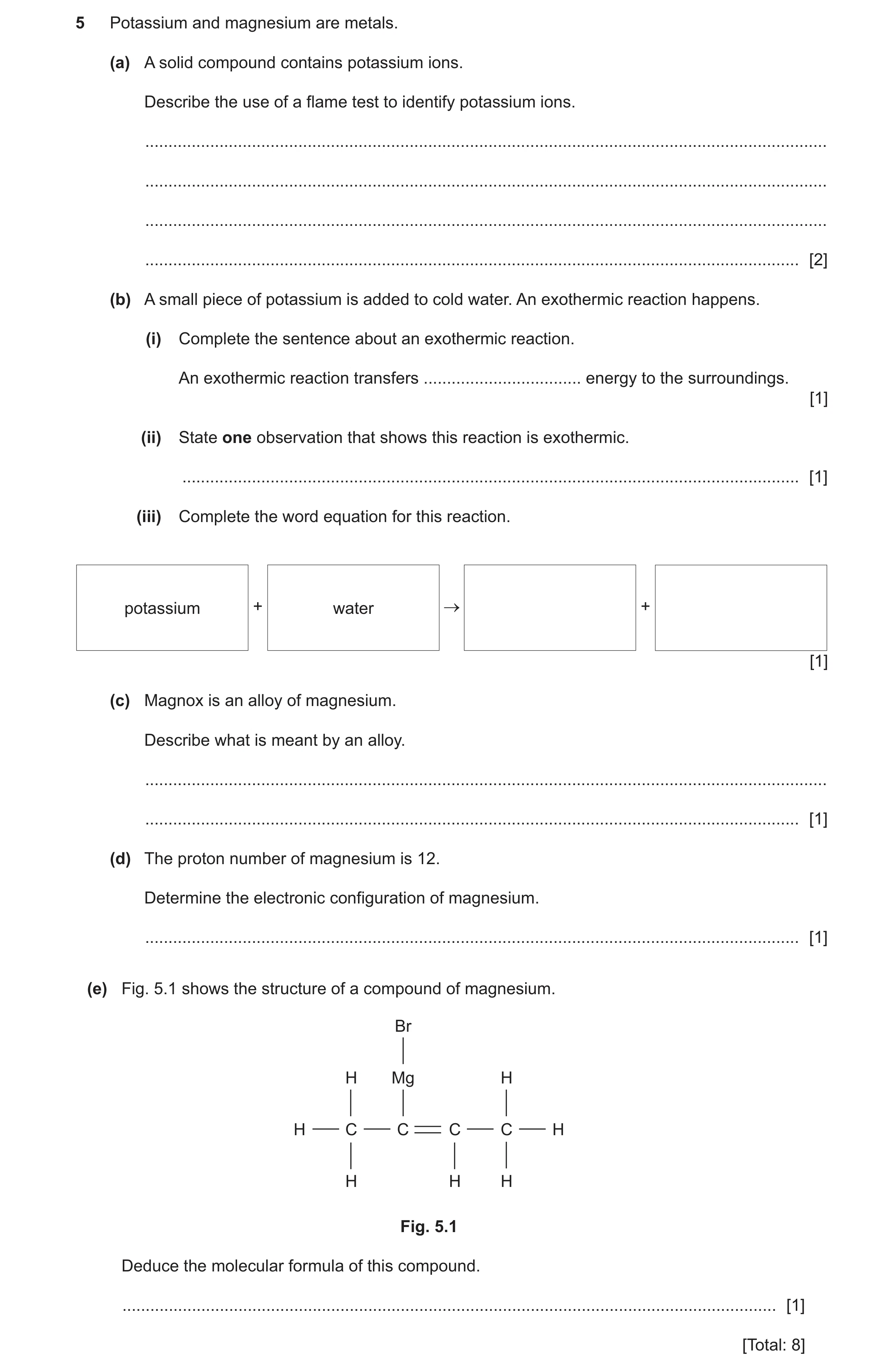
5 Potassium and magnesium are metals. (a) A solid compound contains potassium ions. Describe the use of a flame test to identify potassium ions. … … … … [2] (b) A small piece of potassium is added to cold water. An exothermic reaction happens. (i) Complete the sentence about an exothermic reaction. An exothermic reaction transfers … energy to the surroundings. [1] (ii) State one observation that shows this reaction is exothermic. … [1] (iii) Complete the word equation for this reaction. potassium + water + [1] (c) Magnox is an alloy of magnesium. Describe what is meant by an alloy. … … [1] (d) The proton number of magnesium is 12. Determine the electronic configuration of magnesium. … [1] (e) Fig. 5.1 shows the structure of a compound of magnesium. Br H Mg H H C C C C H H H H Fig. 5.1 Deduce the molecular formula of this compound. … [1] [Total: 8]
8 marks
Mark scheme: 5(a) any two from: 2 dip (nichrome) wire or splint in potassium compound ; at (edge of) a blue Bunsen flame ; lilac flame observed ; 5(b)(i) thermal ; 1 5(b)(ii) a flame (is observed) ; 1 5(b)(iii) potassium hydroxide and hydrogen ; 1 5(c) mixture of a metal and other element(s) ; 1 5(d) 2,8,2 ; 1 5(e) C4H7MgBr ; 1
This question in 0653/31 May/June 2025
Q16 · Scientists are investigating the use of iron as a fuel in cars 0653/33 May/June 2025
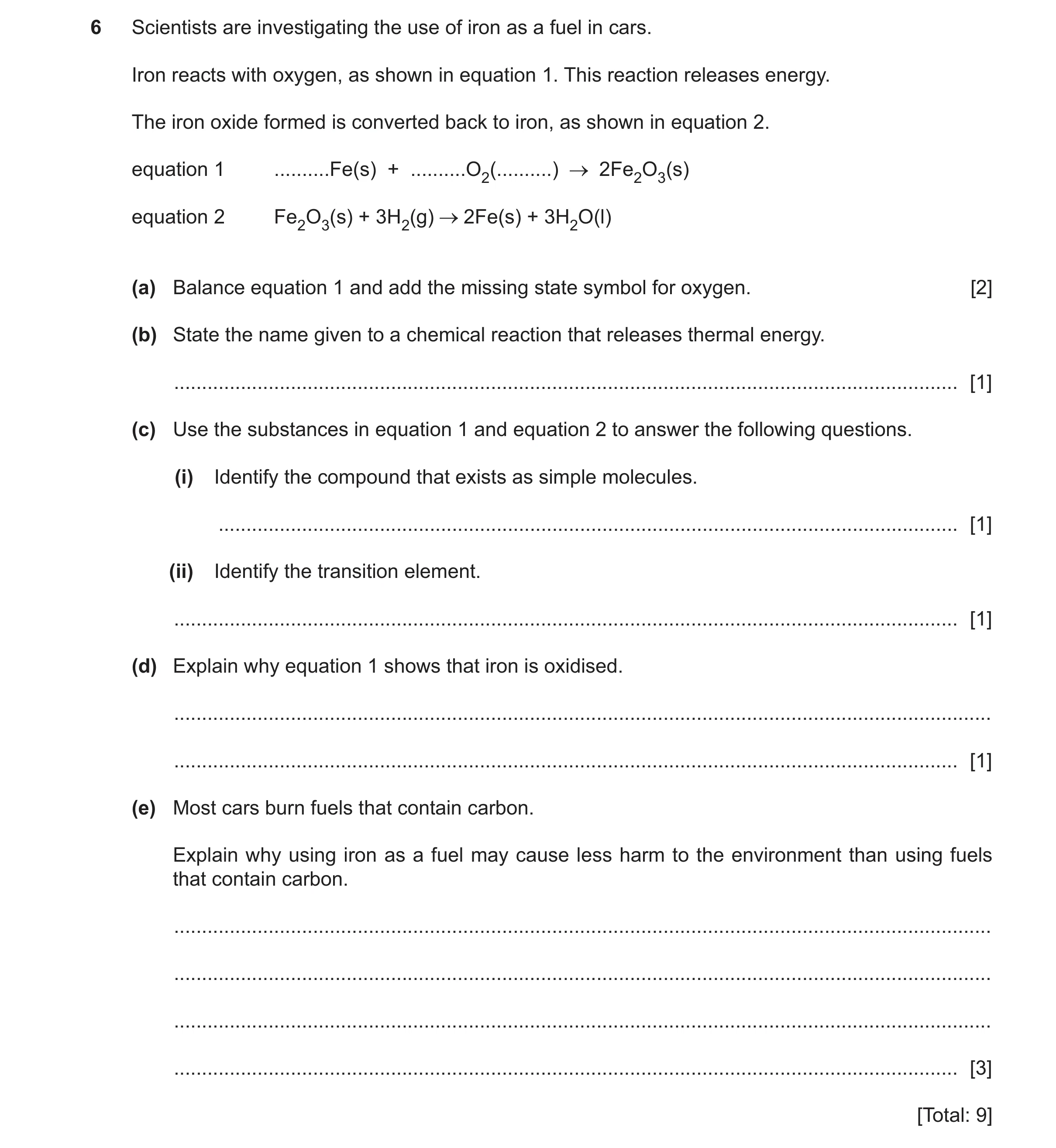
6 Scientists are investigating the use of iron as a fuel in cars. Iron reacts with oxygen, as shown in equation 1. This reaction releases energy. The iron oxide formed is converted back to iron, as shown in equation 2. equation 1 … Fe(s) + … O2( … ) 2Fe2O3(s) equation 2 Fe2O3(s) + 3H2(g) 2Fe(s) + 3H2O(l) (a) Balance equation 1 and add the missing state symbol for oxygen. [2] (b) State the name given to a chemical reaction that releases thermal energy. … [1] (c) Use the substances in equation 1 and equation 2 to answer the following questions. (i) Identify the compound that exists as simple molecules. … [1] (ii) Identify the transition element. … [1] (d) Explain why equation 1 shows that iron is oxidised. … … [1] (e) Most cars burn fuels that contain carbon. Explain why using iron as a fuel may cause less harm to the environment than using fuels that contain carbon. … … … … [3] [Total: 9]
9 marks
Mark scheme: 6(a) 4Fe + 3O2 ; 2 (g) ; 6(b) exothermic ; 1 6(c)(i) water / H2O ; 1 6(c)(ii) iron / Fe ; 1 6(d) (Fe / iron) gains oxygen ; 1 6(e) any three from: 3 iron does not produce carbon dioxide / carbon fuels produce carbon dioxide ; iron does not produce carbon monoxide / carbon fuels produce carbon monoxide ; carbon dioxide causes climate change ; carbon monoxide is toxic ; using iron as a fuel only produces water as a waste product ;
This question in 0653/33 May/June 2025
 6 / 21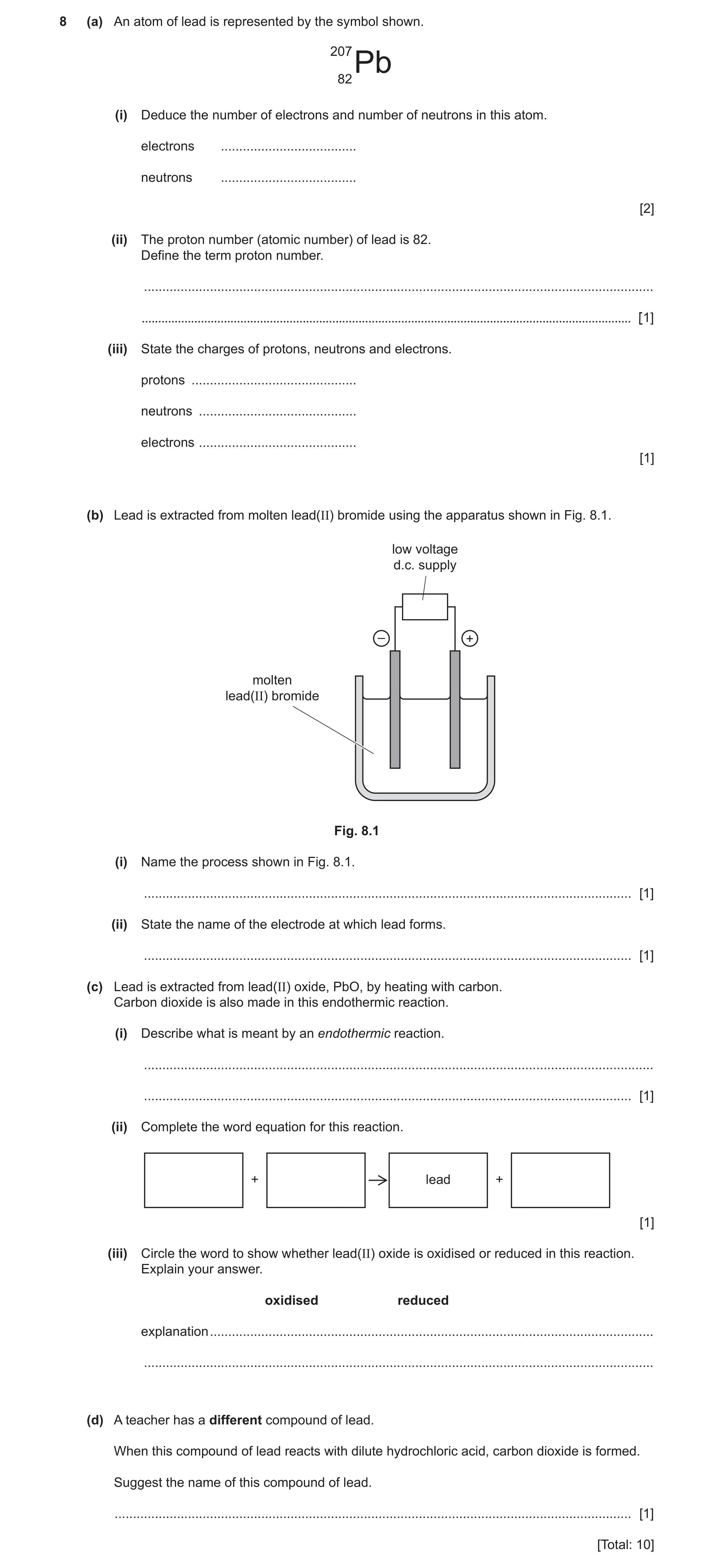
 11 / 21
 12 / 21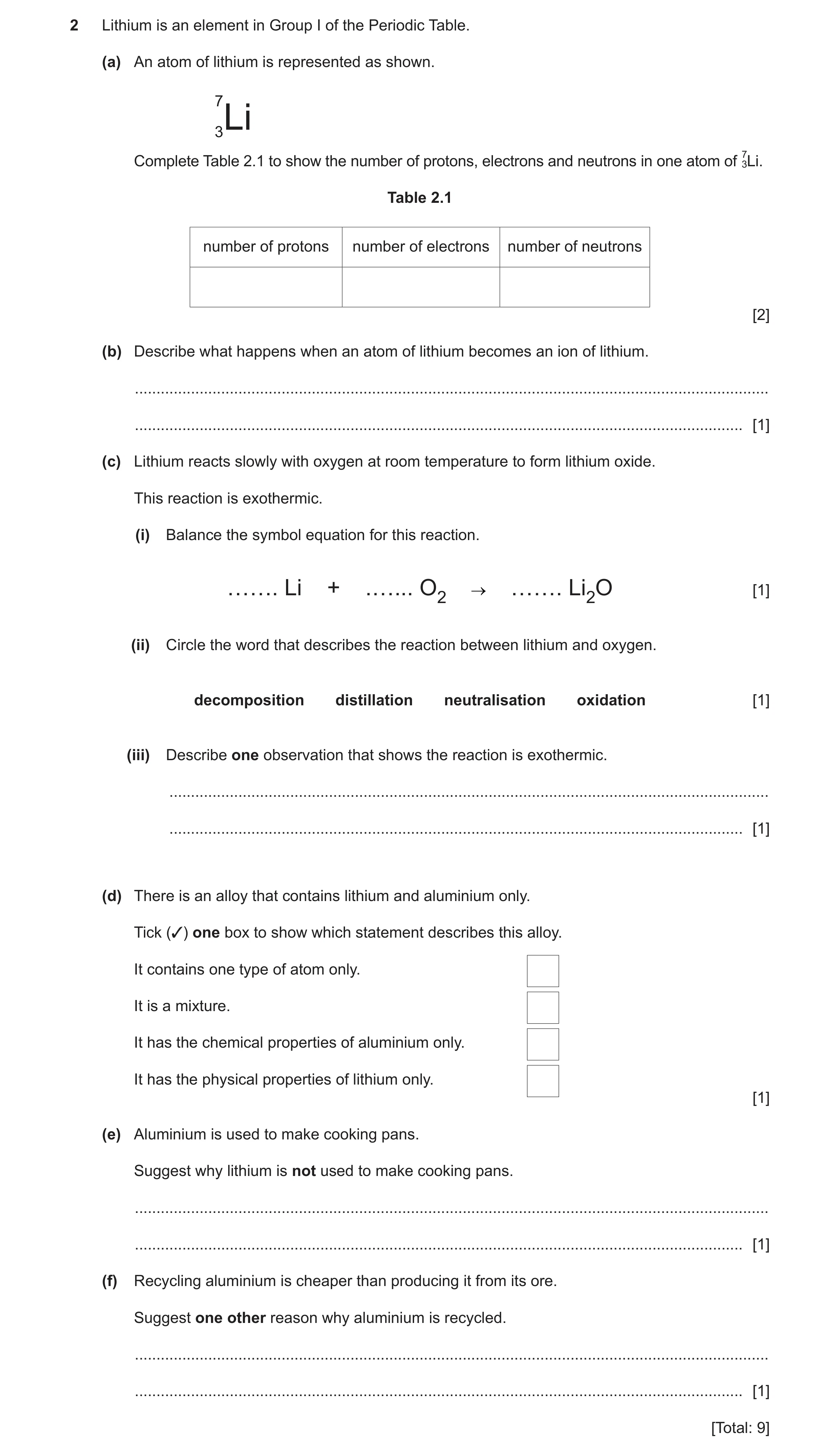
 21 / 21
 8
8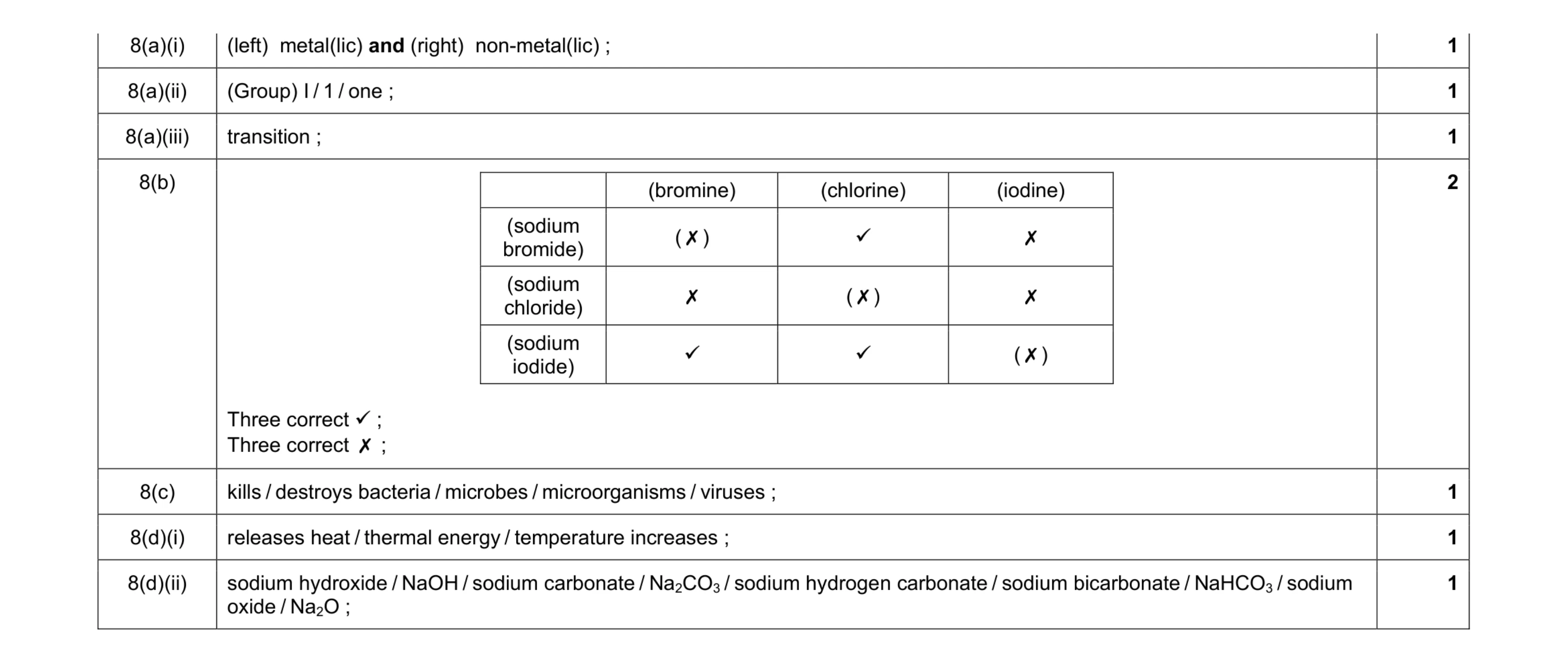 8
8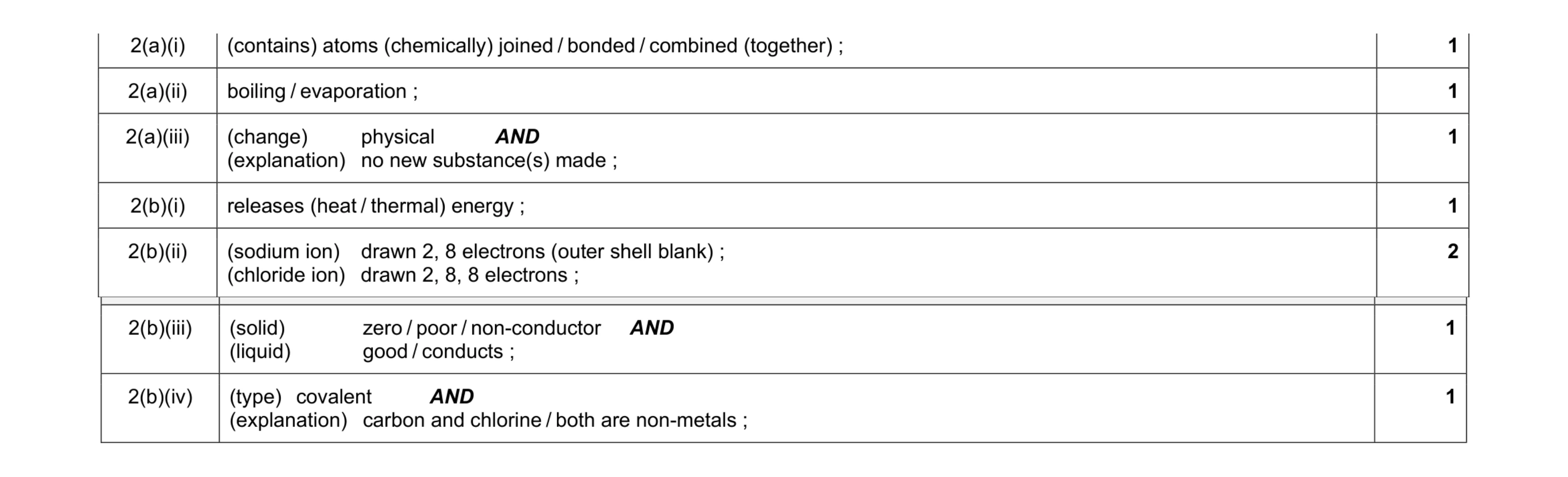 8
8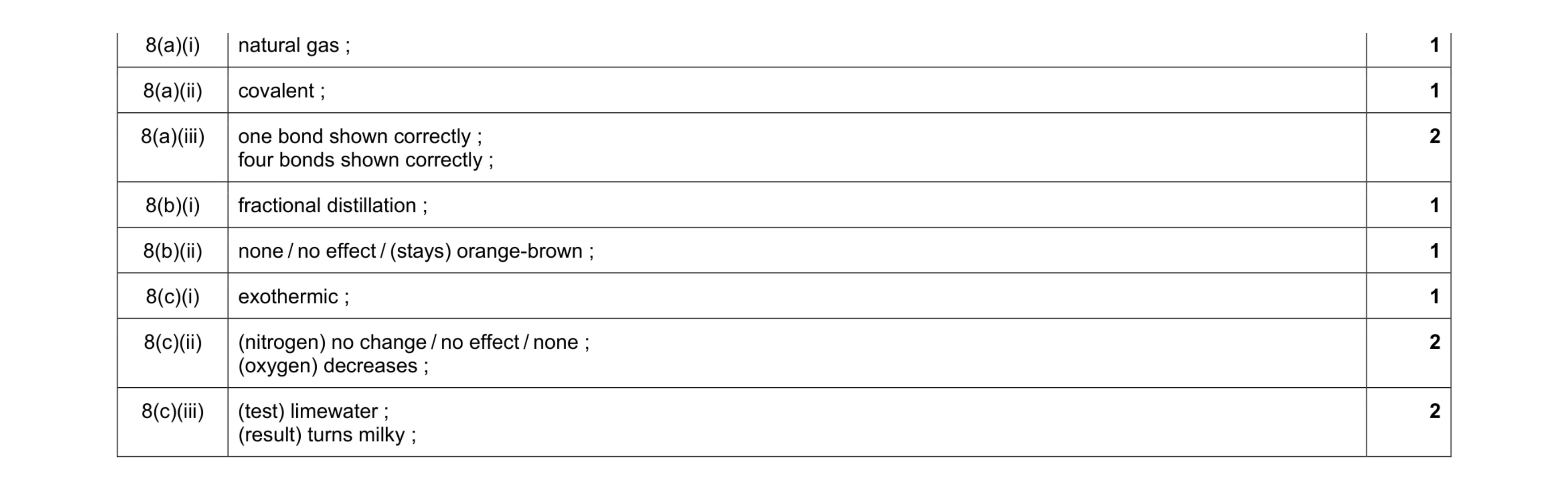 11
11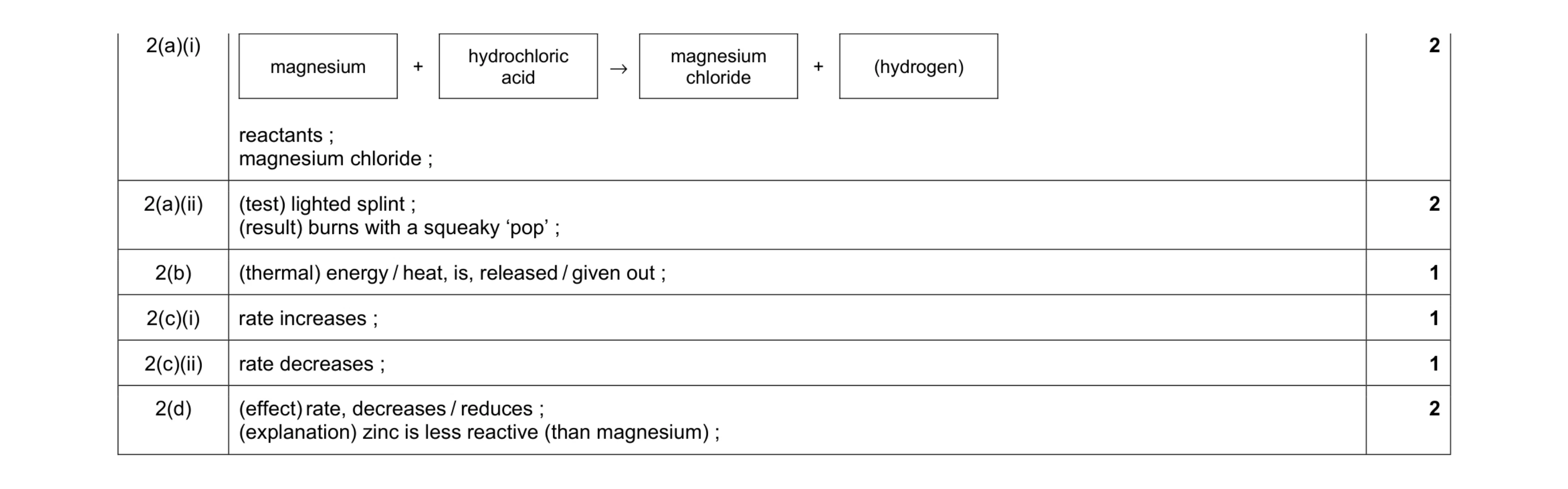 9
9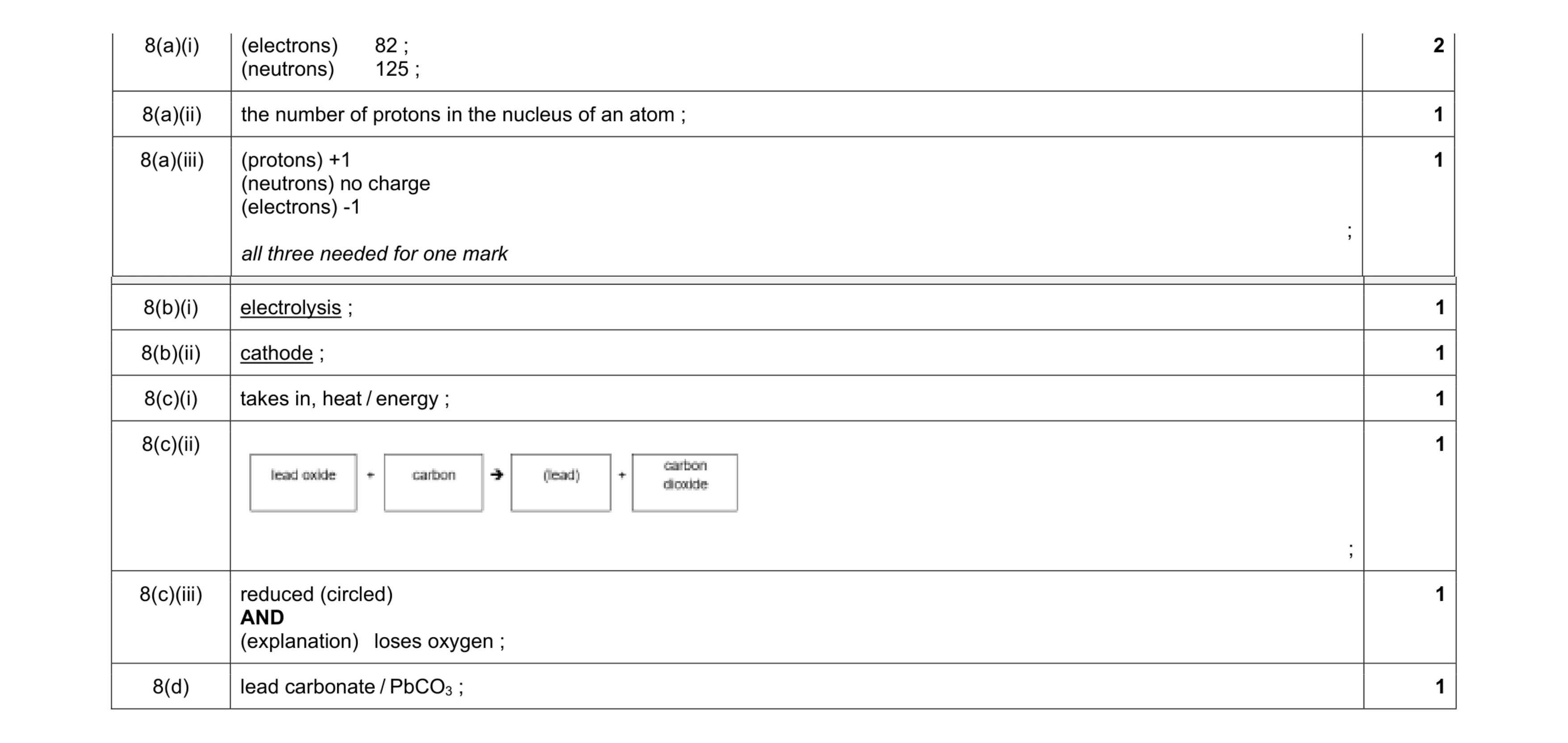 10
10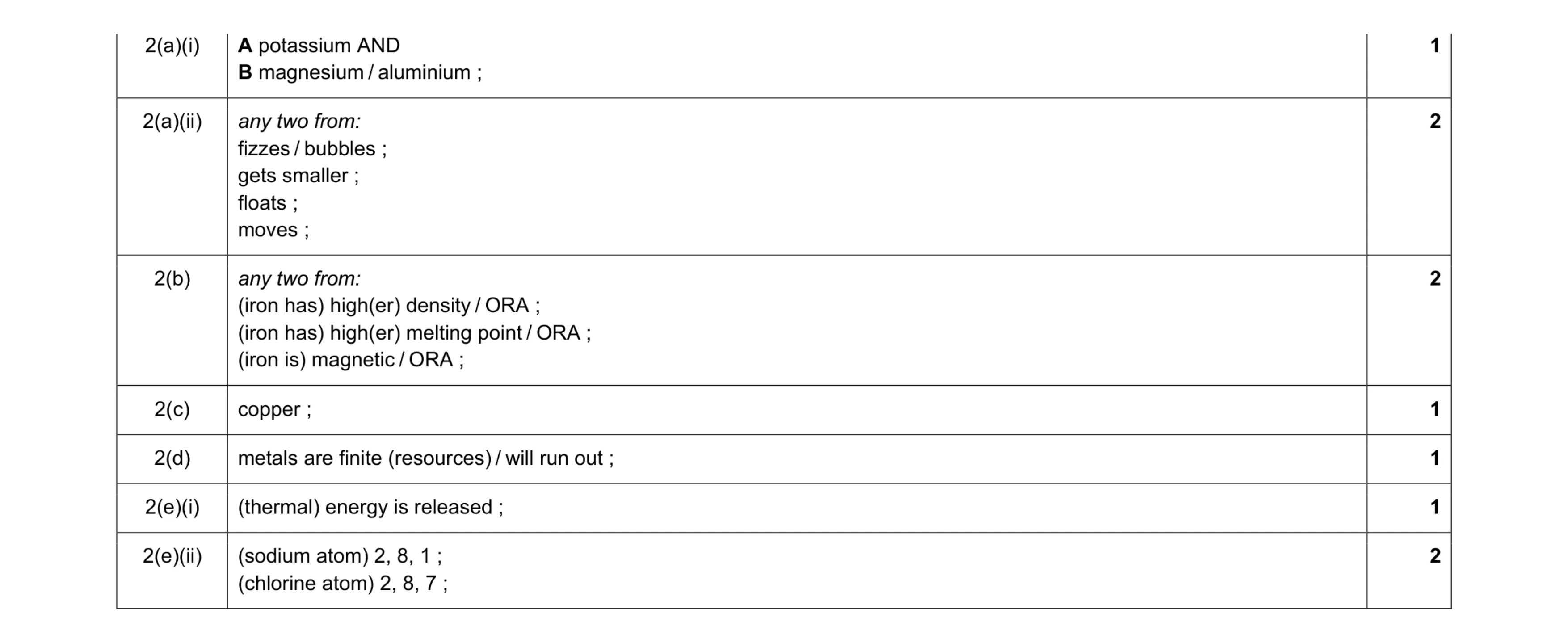 10
10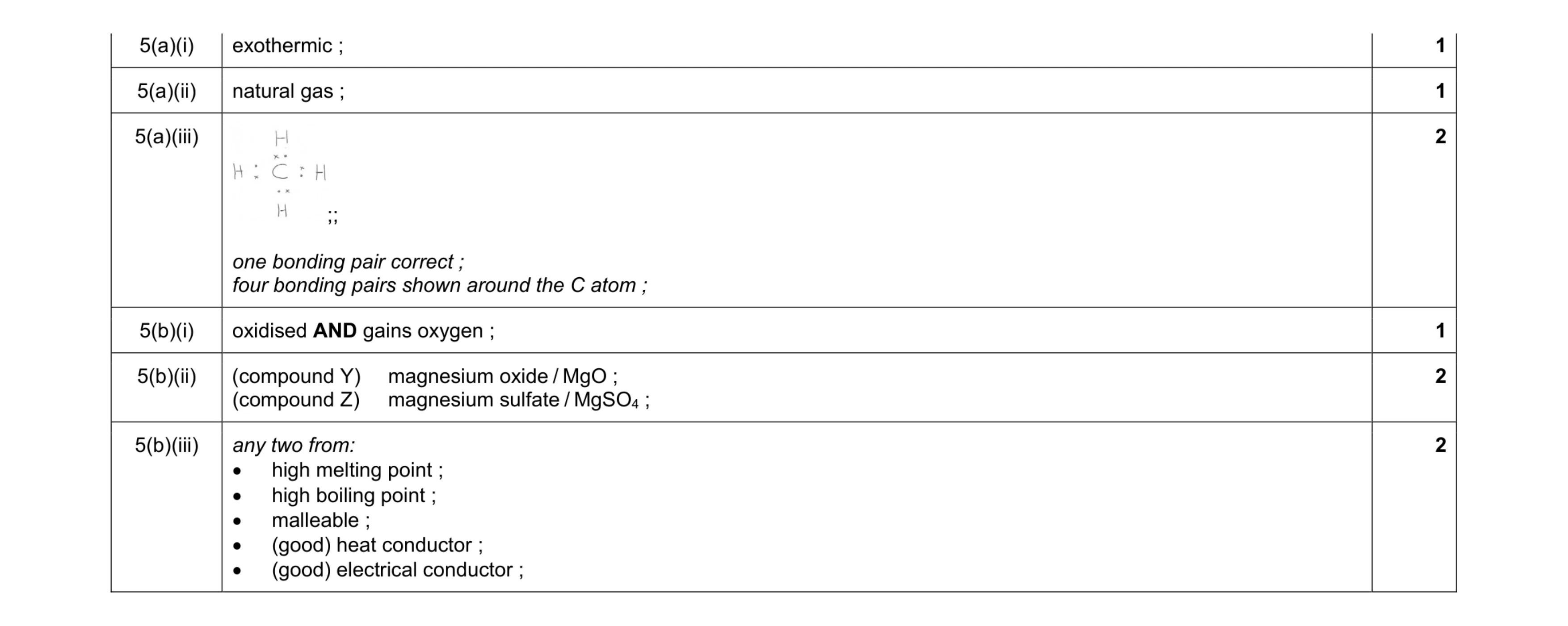 9
9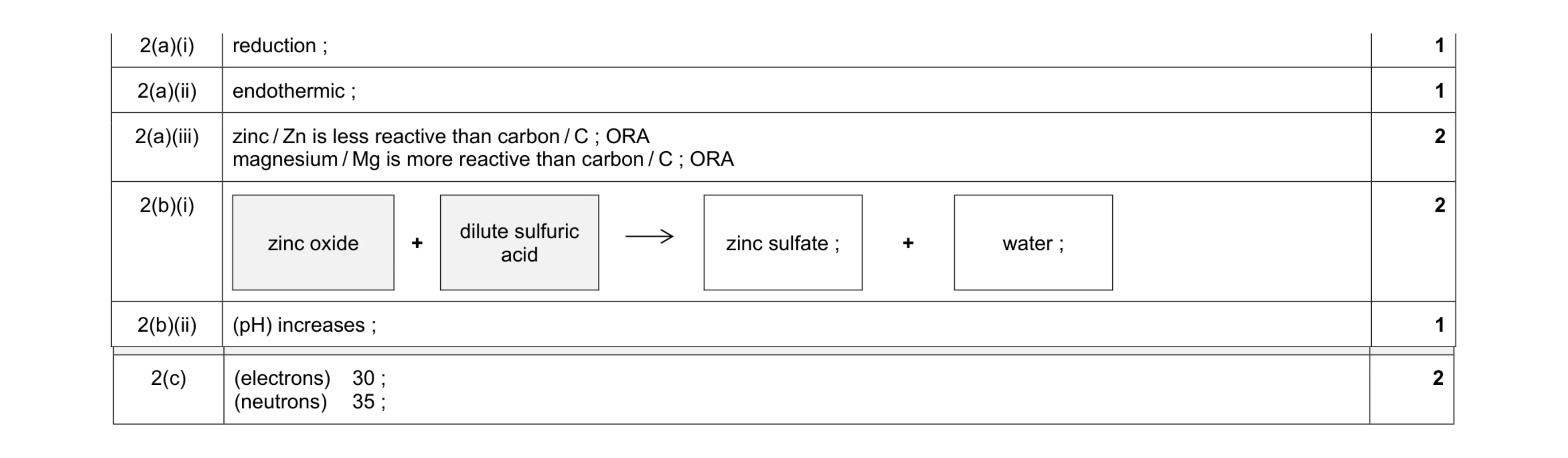 9
9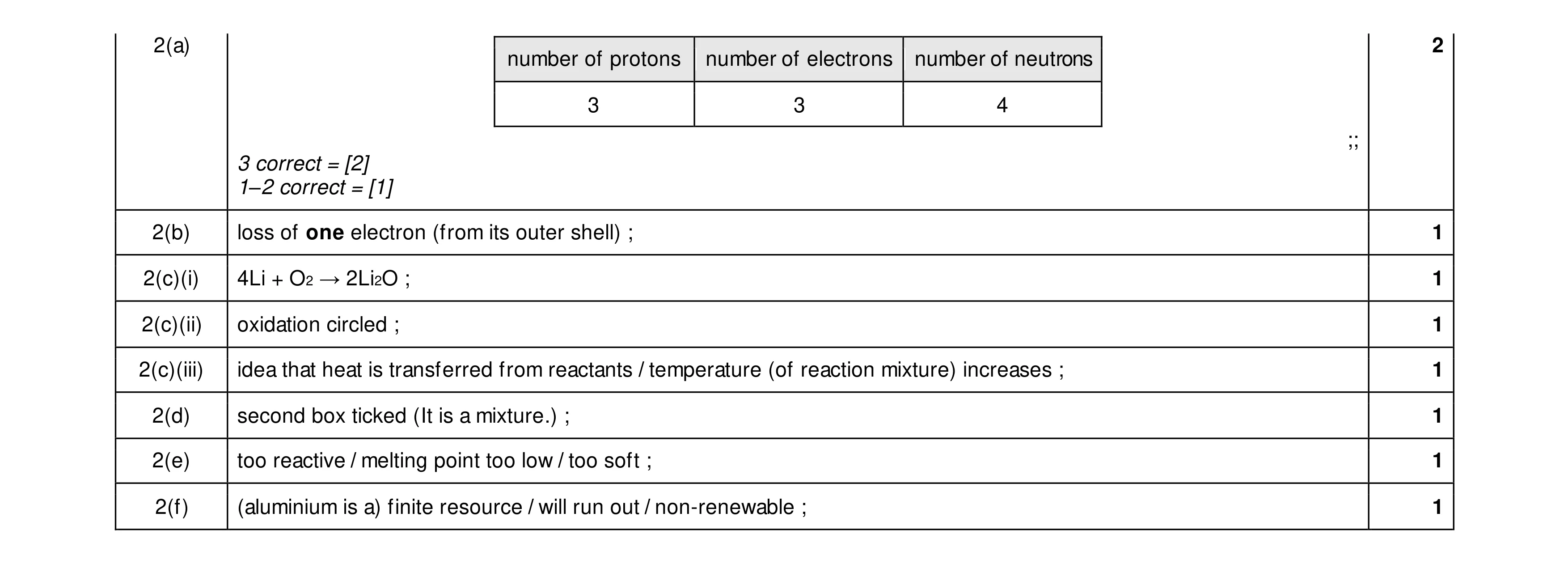 9
9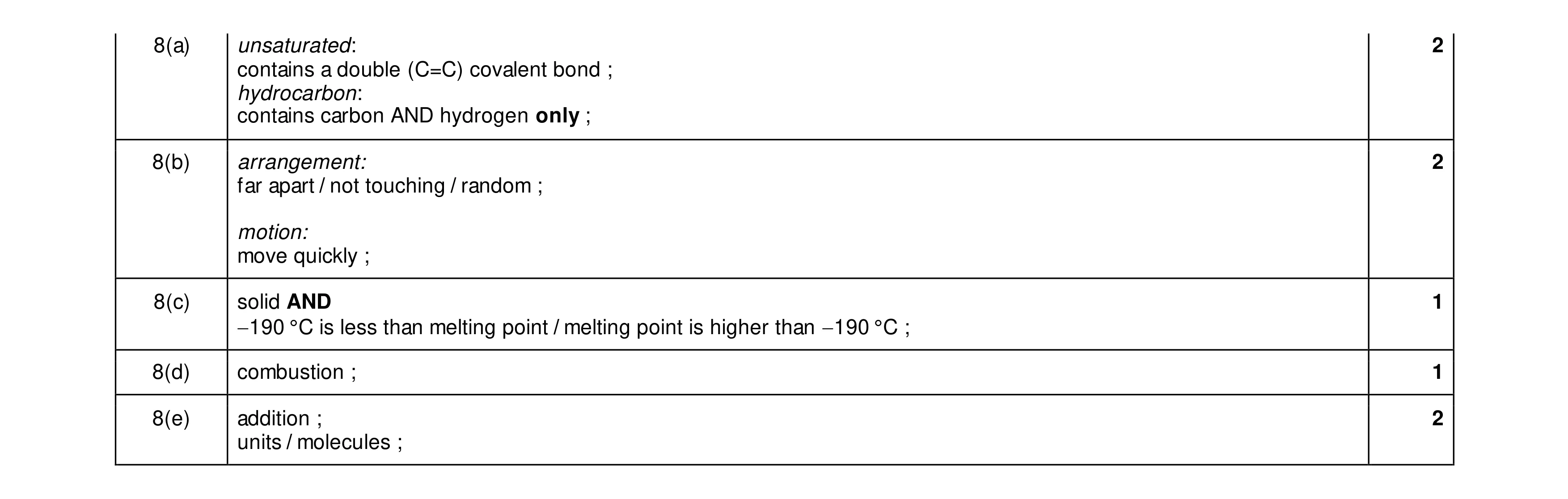 8
8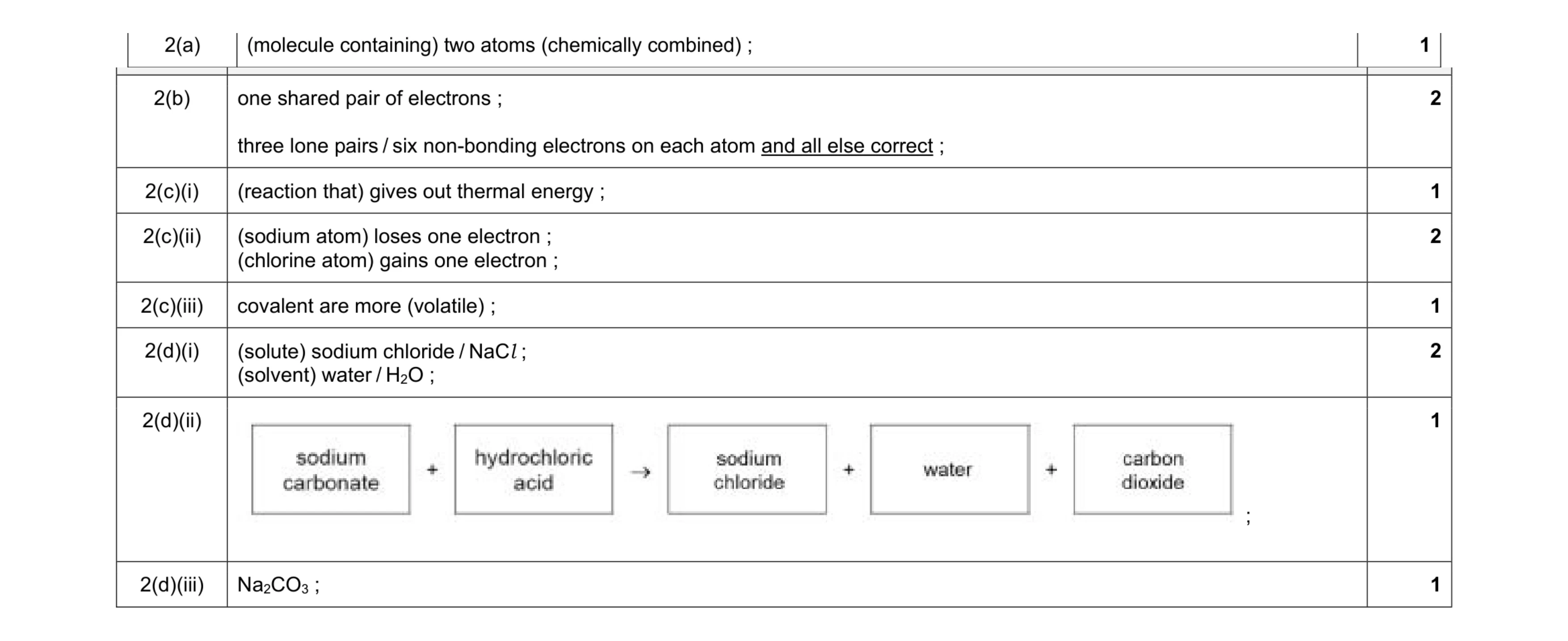 11
11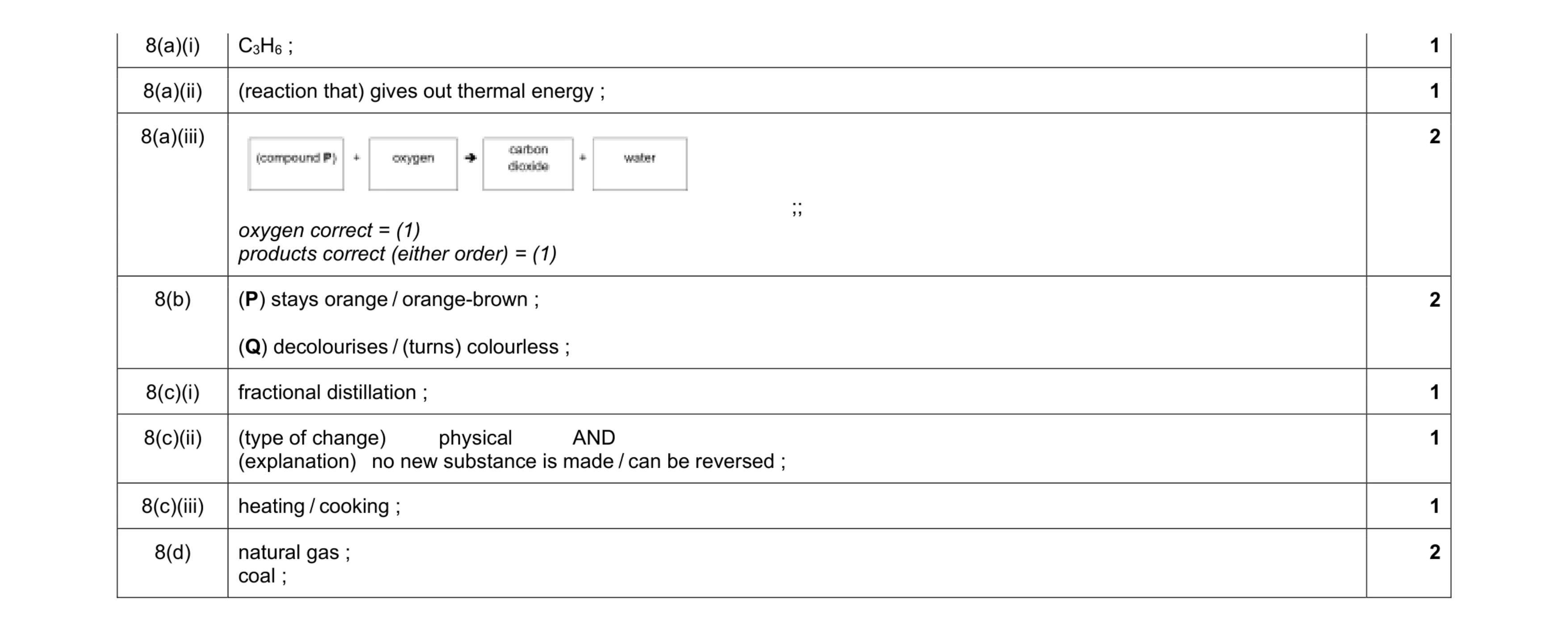 11
11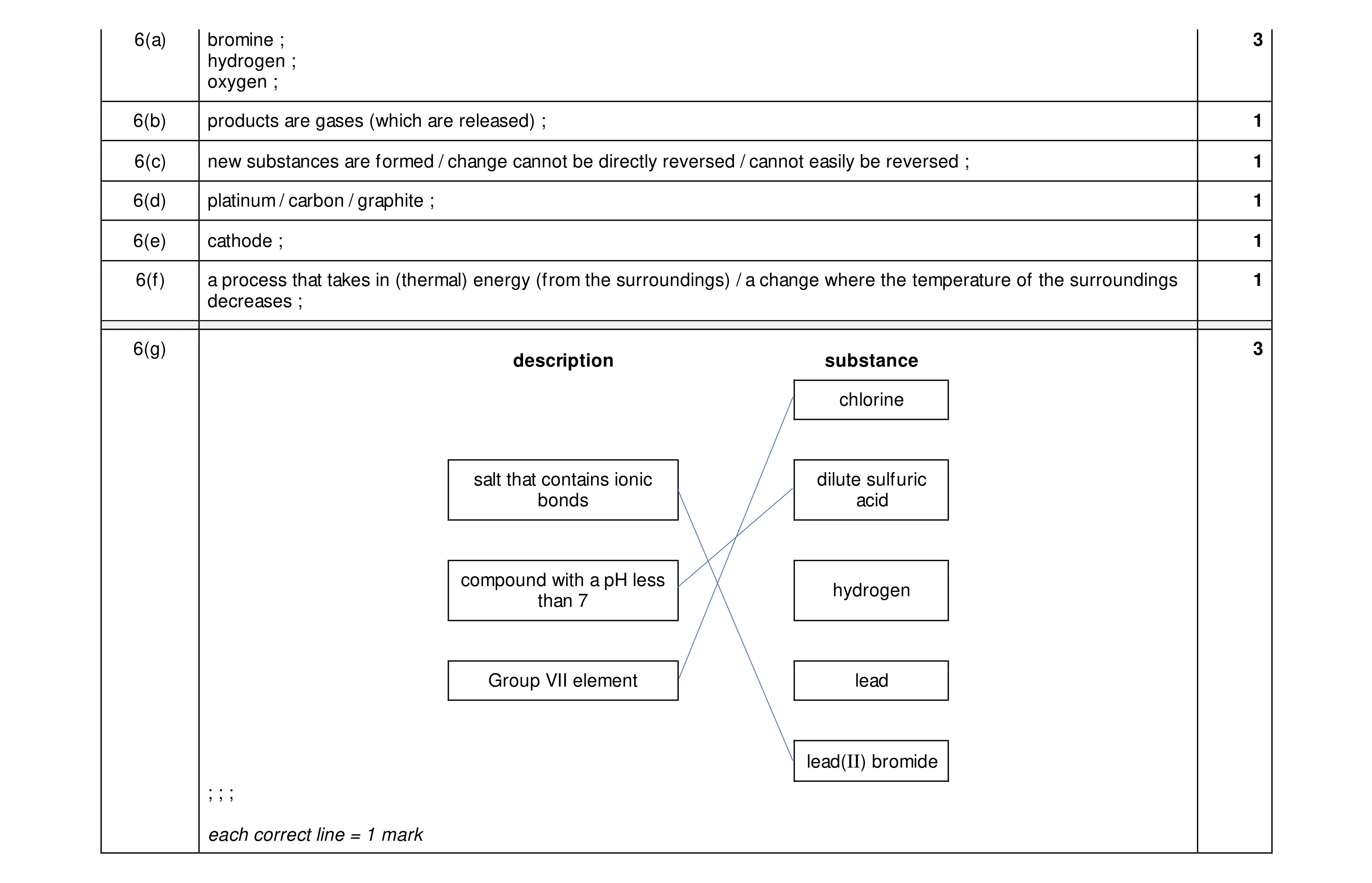 11
11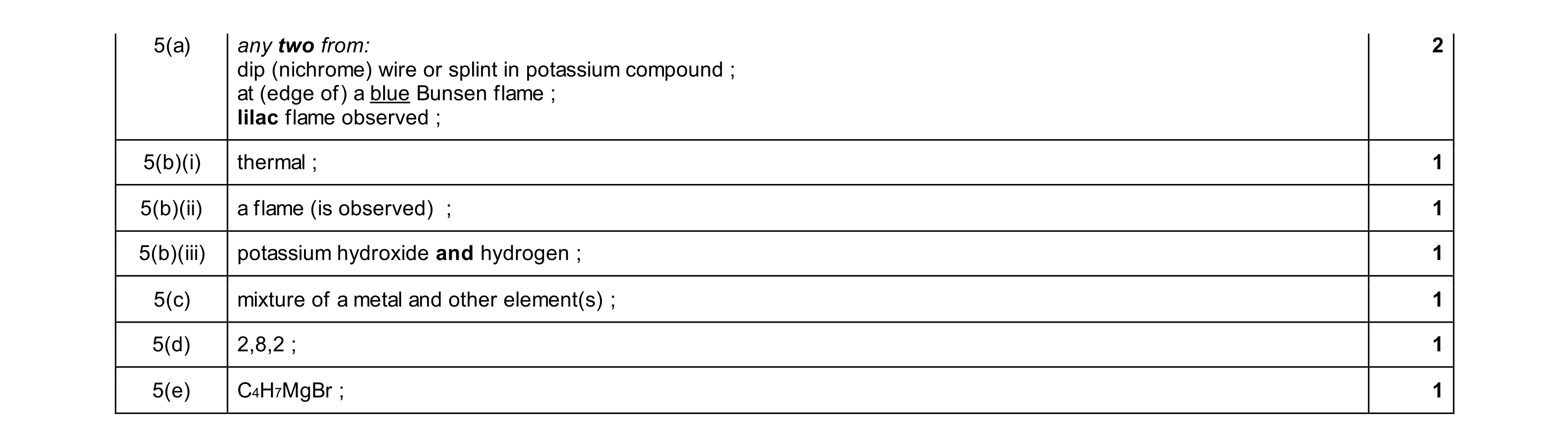 8
8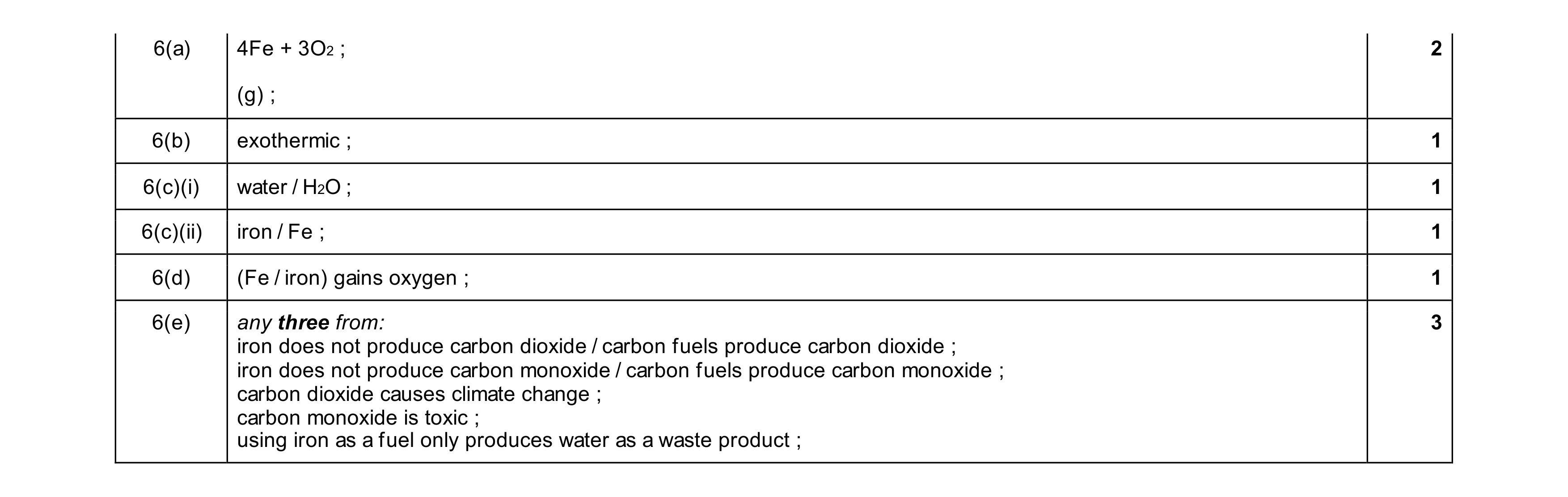 9
9