Questions as text
Q1 · In which change is chemical energy transformed into heat (thermal energy)? 0653/22 Feb/March 2017
18 In which change is chemical energy transformed into heat (thermal energy)? A combustion of refinery gas B cracking of alkanes into alkenes C distillation of seawater D electrolysis of molten lead(II) bromide
1 marks
Answer: A
This question in 0653/22 Feb/March 2017
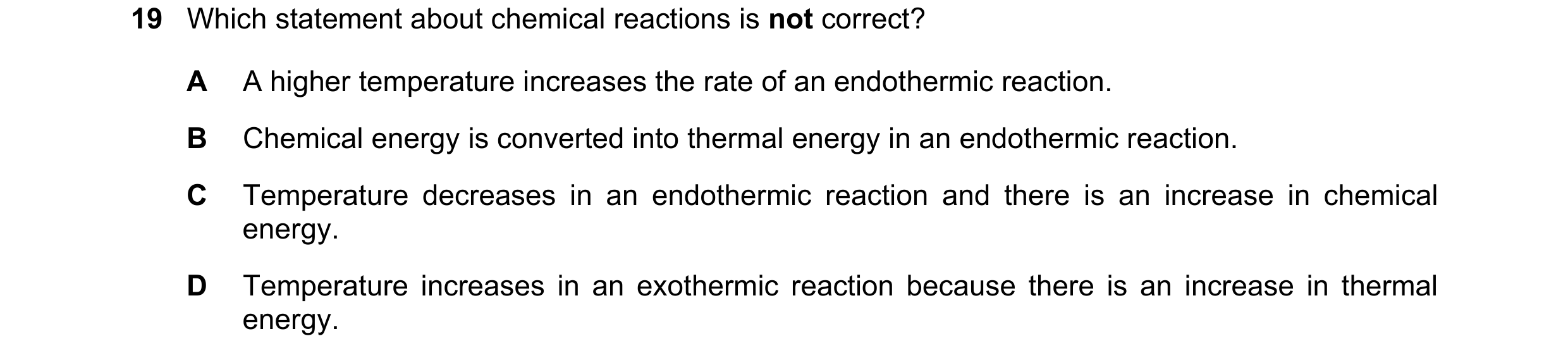
Q2 · Which statement about chemical reactions is not correct? 0653/21 May/June 2017
19 Which statement about chemical reactions is not correct? A A higher temperature increases the rate of an endothermic reaction. B Chemical energy is converted into thermal energy in an endothermic reaction. C Temperature decreases in an endothermic reaction and there is an increase in chemical energy. D Temperature increases in an exothermic reaction because there is an increase in thermal energy.
1 marks
Answer: B
This question in 0653/21 May/June 2017
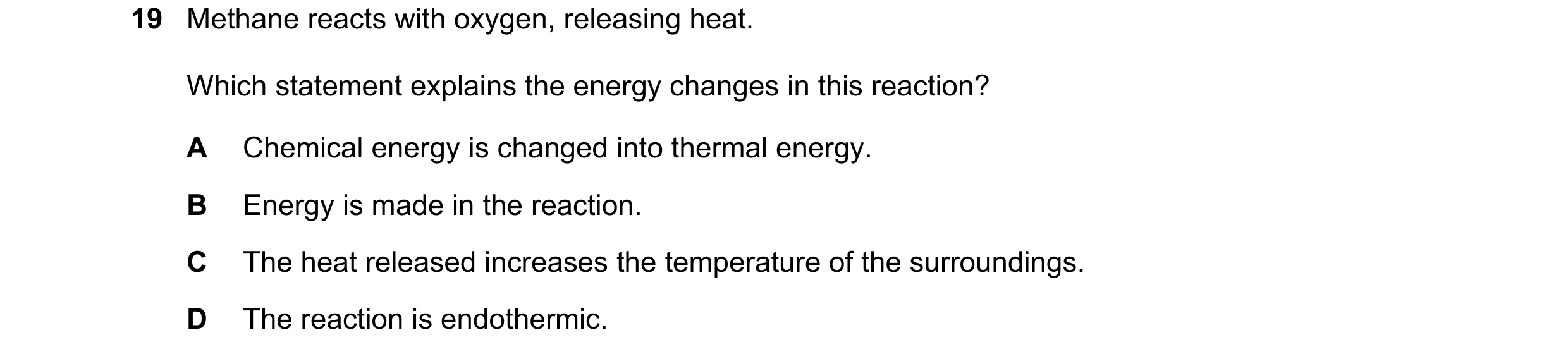
Q3 · Methane reacts with oxygen, releasing heat 0653/22 May/June 2017
19 Methane reacts with oxygen, releasing heat. Which statement explains the energy changes in this reaction? A Chemical energy is changed into thermal energy. B Energy is made in the reaction. C The heat released increases the temperature of the surroundings. D The reaction is endothermic.
1 marks
Answer: A
This question in 0653/22 May/June 2017
Q4 · Which statement describes an exothermic reaction? 0653/23 May/June 2017
19 Which statement describes an exothermic reaction? A It gives out thermal energy. B It needs energy to start it. C It neither gives out nor takes in energy. D It takes in energy.
1 marks
Answer: A
This question in 0653/23 May/June 2017
Q5 · The diagram shows gas X burning and heating a liquid 0653/21 Oct/Nov 2017
20 The diagram shows gas X burning and heating a liquid.
Which row is correct?
gas X
0 Oo WwW >
gas X
hydrogen
hydrogen
oxygen
oxygen
the burning of gas X
is exothermic
x < x
liquid
flame
1 marks
Answer: A
This question in 0653/21 Oct/Nov 2017
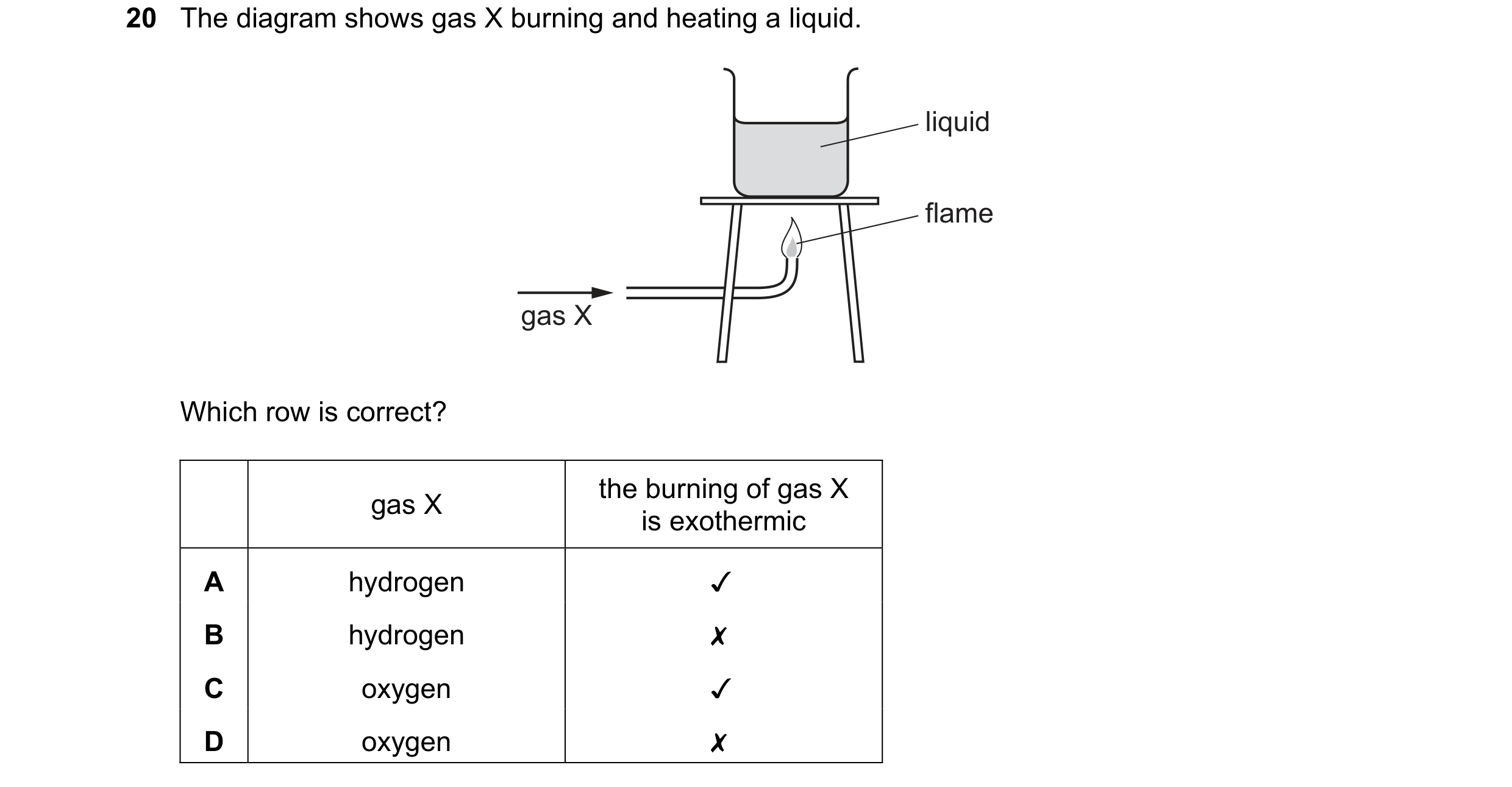
Q6 · The diagram shows gas X burning and heating a liquid 0653/22 Oct/Nov 2017
20 The diagram shows gas X burning and heating a liquid.
Which row is correct?
gas X
the burning of gas X
gas X is exothermic
A hydrogen v
B hydrogen x
Cc oxygen v
D oxygen x
liquid
flame
1 marks
Answer: A
This question in 0653/22 Oct/Nov 2017
Q7 · Which change must take place in an endothermic reaction? 0653/21 May/June 2018
20 Which change must take place in an endothermic reaction? A Bubbles of gas are released. B The mass decreases. C The temperature decreases. D The temperature increases.
1 marks
Answer: C
This question in 0653/21 May/June 2018
Q8 · Which change must take place in an endothermic reaction? 0653/22 May/June 2018
20 Which change must take place in an endothermic reaction? A Bubbles of gas are released. B The mass decreases. C The temperature decreases. D The temperature increases.
1 marks
Answer: C
This question in 0653/22 May/June 2018
Q9 · The equation for the combustion of ethane is shown 0653/22 May/June 2018
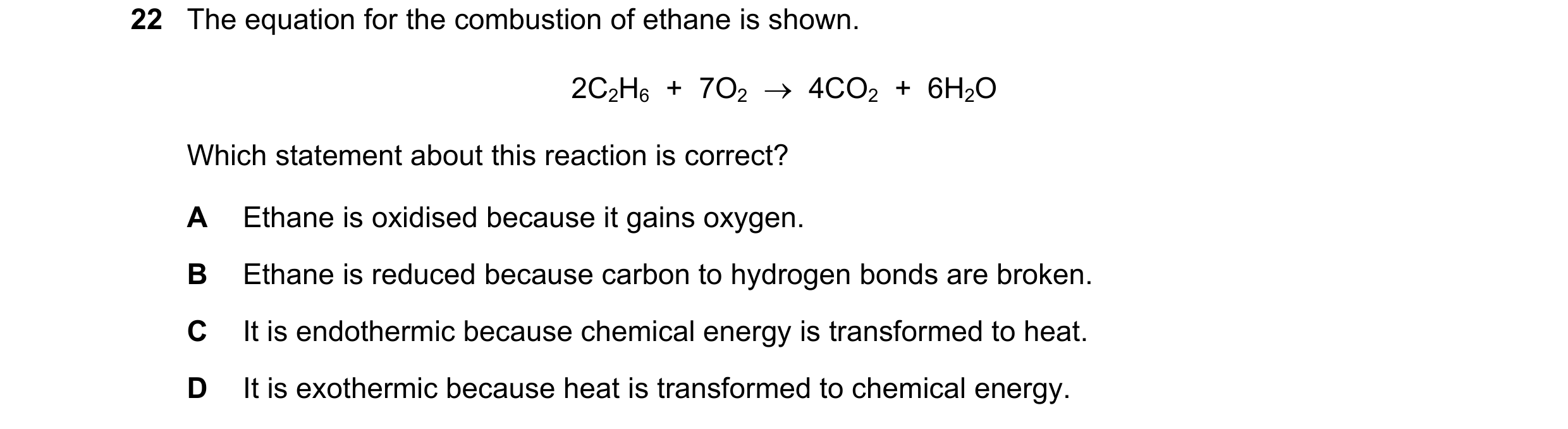
22 The equation for the combustion of ethane is shown. 2C2H6 + 7O2 → 4CO2 + 6H2O Which statement about this reaction is correct? A Ethane is oxidised because it gains oxygen. B Ethane is reduced because carbon to hydrogen bonds are broken. C It is endothermic because chemical energy is transformed to heat. D It is exothermic because heat is transformed to chemical energy.
1 marks
Answer: A
This question in 0653/22 May/June 2018
Q10 · Which change must take place in an endothermic reaction? 0653/23 May/June 2018
20 Which change must take place in an endothermic reaction? A Bubbles of gas are released. B The mass decreases. C The temperature decreases. D The temperature increases.
1 marks
Answer: C
This question in 0653/23 May/June 2018
Q11 · When concentrated sulfuric acid is added to water, the temperature of the mixture… 0653/21 Oct/Nov 2018
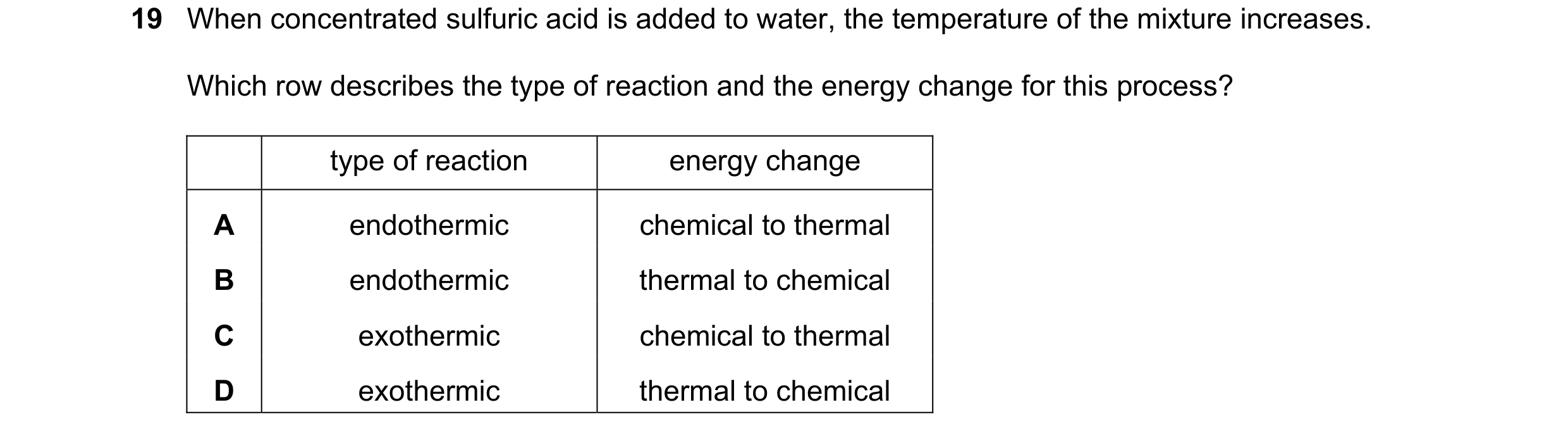
19 When concentrated sulfuric acid is added to water, the temperature of the mixture increases. Which row describes the type of reaction and the energy change for this process? type of reaction energy change A endothermic chemical to thermal B endothermic thermal to chemical C exothermic chemical to thermal D exothermic thermal to chemical
1 marks
Answer: C
This question in 0653/21 Oct/Nov 2018
Q12 · Which statement describes an endothermic reaction? 0653/22 Oct/Nov 2018
19 Which statement describes an endothermic reaction? A Chemical energy is transformed into thermal energy and the temperature falls. B Chemical energy is transformed into thermal energy and the temperature rises. C Thermal energy is transformed into chemical energy and the temperature falls. D Thermal energy is transformed into chemical energy and the temperature rises.
1 marks
Answer: C
This question in 0653/22 Oct/Nov 2018
Q13 · The temperature of some water is recorded 0653/23 Oct/Nov 2018
19 The temperature of some water is recorded. Sodium chloride is dissolved in the water and the temperature of the solution is recorded. temperature of water = 20 °C temperature of solution = 18 °C Which statement about the process is correct? A It is endothermic because chemical energy is changed into heat energy. B It is endothermic because heat energy is changed into chemical energy. C It is exothermic because chemical energy is changed into heat energy. D It is exothermic because heat energy is changed into chemical energy.
1 marks
Answer: B
This question in 0653/23 Oct/Nov 2018
Q14 · Gasoline is a hydrocarbon fuel obtained from petroleum 0653/23 Oct/Nov 2018
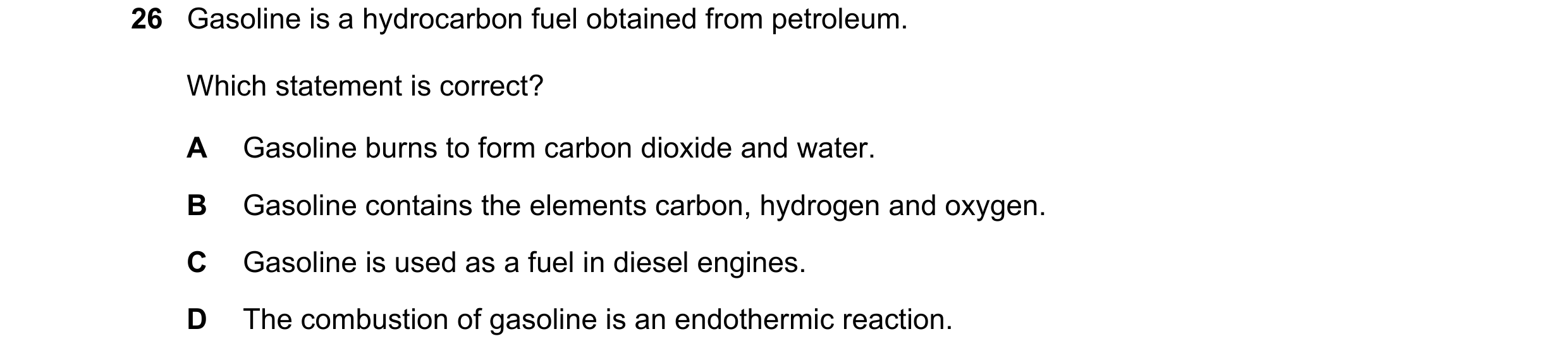
26 Gasoline is a hydrocarbon fuel obtained from petroleum. Which statement is correct? A Gasoline burns to form carbon dioxide and water. B Gasoline contains the elements carbon, hydrogen and oxygen. C Gasoline is used as a fuel in diesel engines. D The combustion of gasoline is an endothermic reaction.
1 marks
Answer: A
This question in 0653/23 Oct/Nov 2018
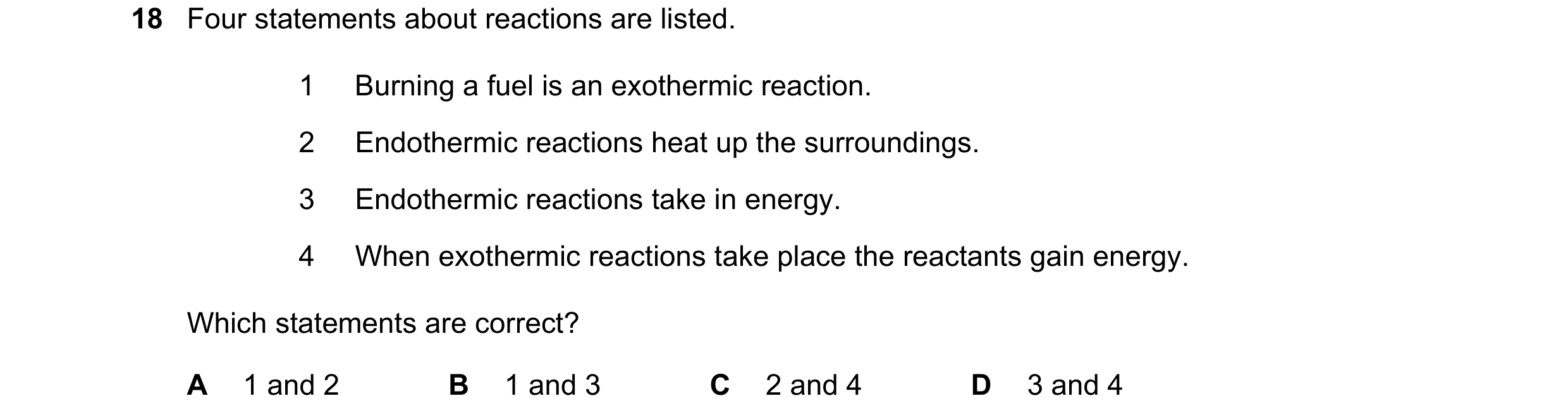
Q15 · Four statements about reactions are listed 0653/22 Feb/March 2019
18 Four statements about reactions are listed. 1 Burning a fuel is an exothermic reaction. 2 Endothermic reactions heat up the surroundings. 3 Endothermic reactions take in energy. 4 When exothermic reactions take place the reactants gain energy. Which statements are correct? A 1 and 2 B 1 and 3 C 2 and 4 D 3 and 4
1 marks
Answer: B
This question in 0653/22 Feb/March 2019
Q16 · The energy level diagram for the reaction between P and Q to produce R and S is shown 0653/21 Oct/Nov 2019
19 The energy level diagram for the reaction between P and Q to produce R and S is shown. 40 R + S 30 energy P + Q 20 kJ / mol 10 0 progress of reaction Which statement about this reaction is correct? A Energy is required to form new bonds. B The activation energy is 10 kJ / mol. C The energy required to break bonds is greater than the energy given out when bonds form. D The reaction is exothermic because the energy of the products is greater than the energy of the reactants.
1 marks
Answer: C
This question in 0653/21 Oct/Nov 2019
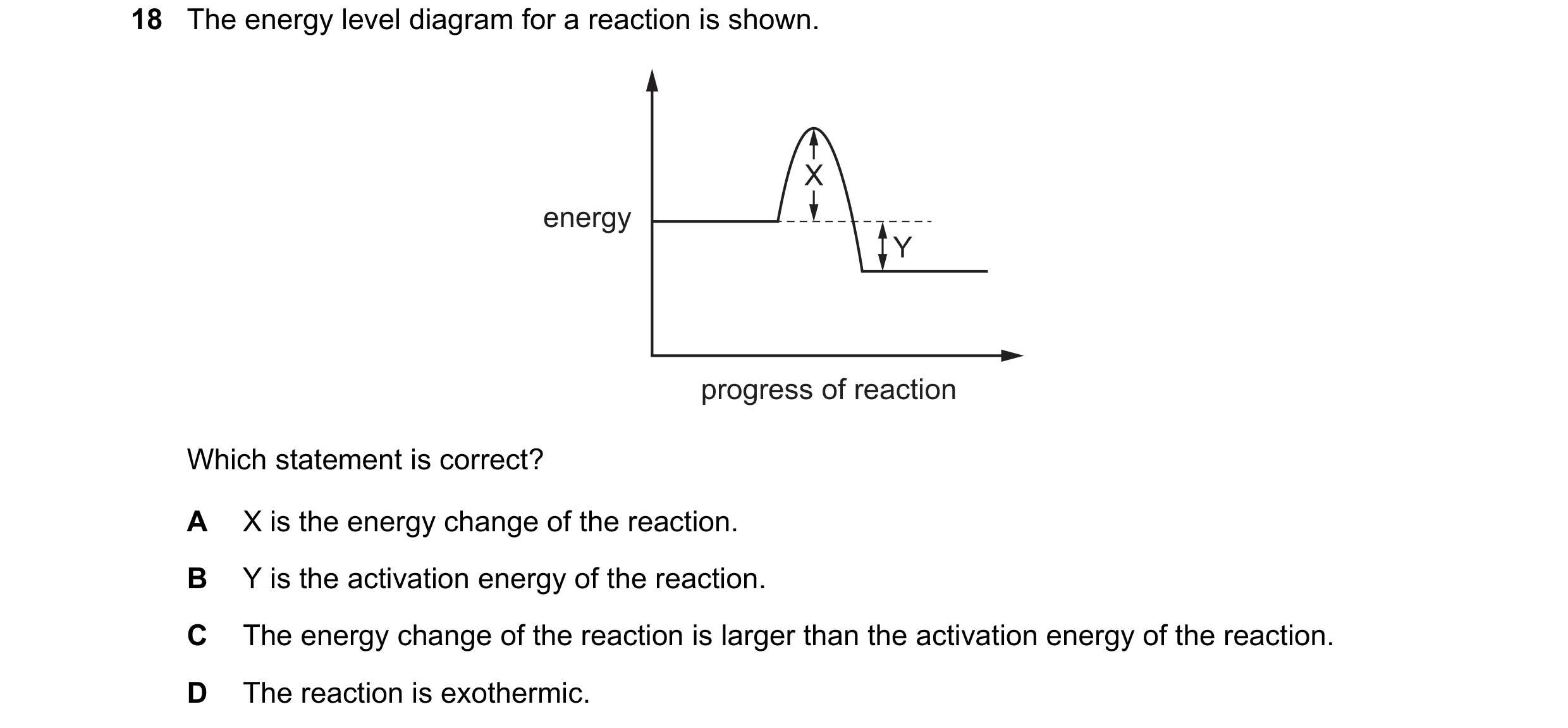
Q17 · The energy level diagram for a reaction is shown 0653/22 Oct/Nov 2019
18 The energy level diagram for a reaction is shown. X energy Y progress of reaction Which statement is correct? A X is the energy change of the reaction. B Y is the activation energy of the reaction. C The energy change of the reaction is larger than the activation energy of the reaction. D The reaction is exothermic.
1 marks
Answer: D
This question in 0653/22 Oct/Nov 2019
Q18 · An energy level diagram for a reaction is shown 0653/23 Oct/Nov 2019
18 An energy level diagram for a reaction is shown. reactants energy products progress of reaction Which row describes the energy transfer and the type of energy change for this reaction? energy transfer energy change A energy is absorbed by reactants endothermic B energy is absorbed by reactants exothermic C energy is released to surroundings endothermic D energy is released to surroundings exothermic
1 marks
Answer: D
This question in 0653/23 Oct/Nov 2019
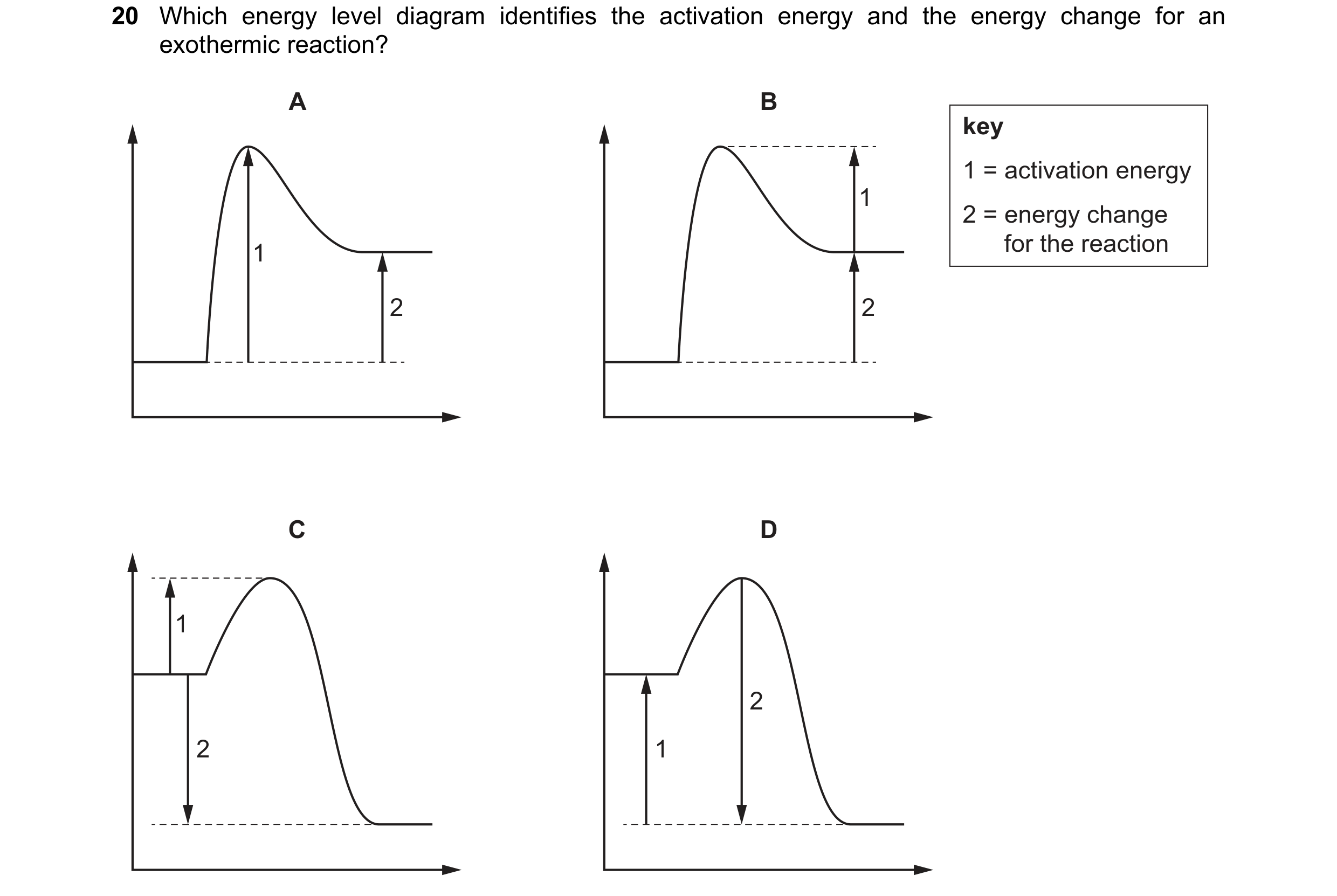
Q19 · Which energy level diagram identifies the activation energy and the energy change for an… 0653/22 Feb/March 2020
20 Which energy level diagram identifies the activation energy and the energy change for an exothermic reaction? A B key 1 = activation energy 1 2 = energy change 1 for the reaction 2 2 C D 1 2 2 1
1 marks
Answer: C
This question in 0653/22 Feb/March 2020
Q20 · Solid sodium carbonate is added to vinegar in a beaker and stirred 0653/21 May/June 2020
19 Solid sodium carbonate is added to vinegar in a beaker and stirred. sodium carbonate beaker vinegar watch glass water The water in the watch glass freezes. Which statement about the reaction explains why the water freezes? A It is a redox reaction. B It is an endothermic reaction. C It is catalysed by sodium carbonate. D It is thermal decomposition.
1 marks
Answer: B
This question in 0653/21 May/June 2020
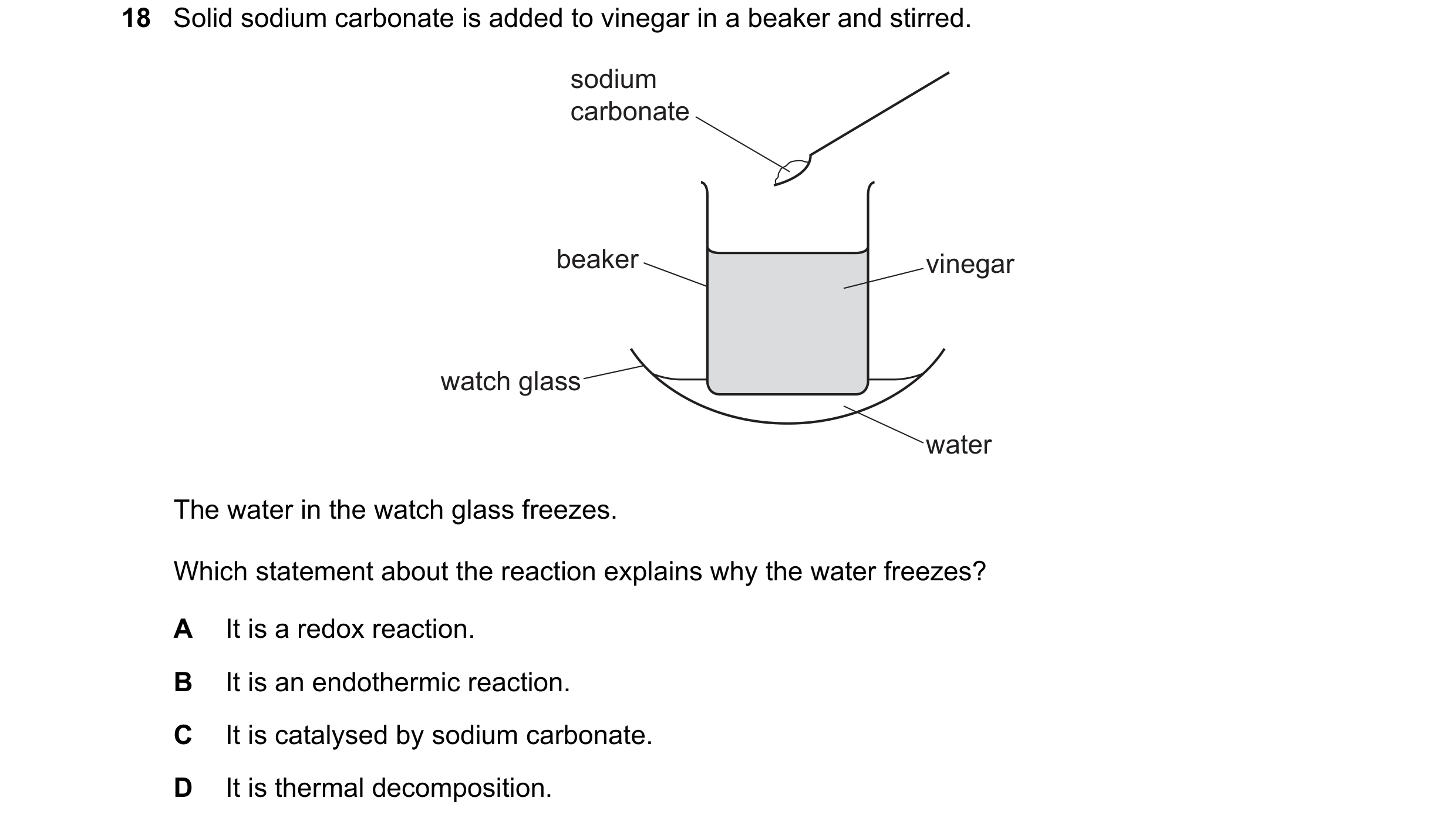
Q21 · Solid sodium carbonate is added to vinegar in a beaker and stirred 0653/22 May/June 2020
18 Solid sodium carbonate is added to vinegar in a beaker and stirred. sodium carbonate beaker vinegar watch glass water The water in the watch glass freezes. Which statement about the reaction explains why the water freezes? A It is a redox reaction. B It is an endothermic reaction. C It is catalysed by sodium carbonate. D It is thermal decomposition.
1 marks
Answer: B
This question in 0653/22 May/June 2020
Q22 · The energy level diagram for an endothermic reaction is shown 0653/21 Oct/Nov 2020
19 The energy level diagram for an endothermic reaction is shown. energy progress of reaction Which statement about this reaction is correct? A The activation energy is the energy required to break bonds. B The energy required to break bonds is less than the energy released on making new bonds. C The activation energy is less than the energy change for the reaction. D The final products have less energy than the reactants.
1 marks
Answer: A
This question in 0653/21 Oct/Nov 2020
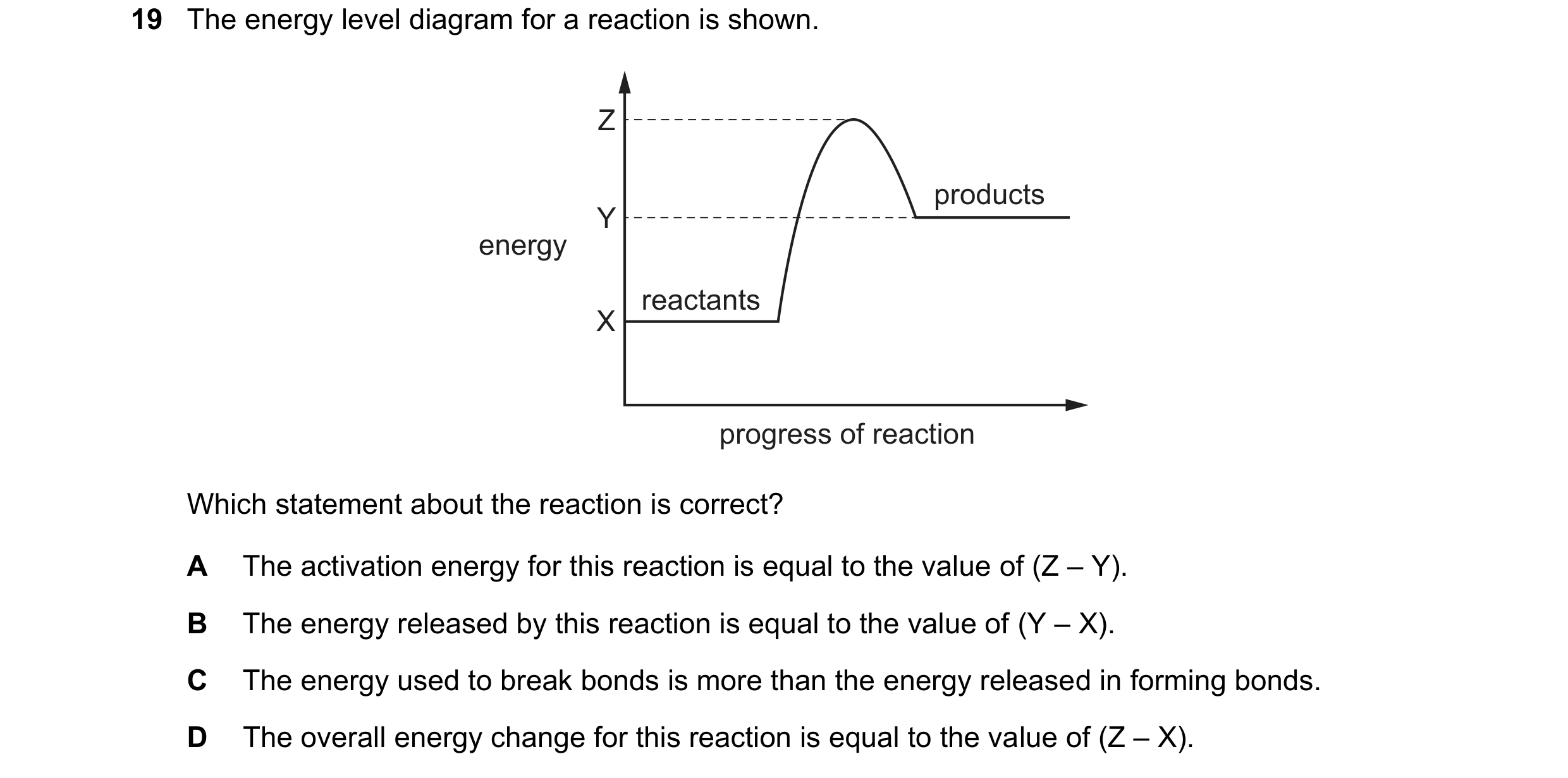
Q23 · The energy level diagram for a reaction is shown 0653/22 Oct/Nov 2020
19 The energy level diagram for a reaction is shown. Z products Y energy reactants X progress of reaction Which statement about the reaction is correct? A The activation energy for this reaction is equal to the value of (Z – Y). B The energy released by this reaction is equal to the value of (Y – X). C The energy used to break bonds is more than the energy released in forming bonds. D The overall energy change for this reaction is equal to the value of (Z – X).
1 marks
Answer: C
This question in 0653/22 Oct/Nov 2020
Q24 · The equation and the energy level diagram for the reaction between hydrogen and chlorine… 0653/23 Oct/Nov 2020
19 The equation and the energy level diagram for the reaction between hydrogen and chlorine are shown. H2(g) + Cl 2(g) 2HCl (g) H2(g) + Cl 2(g) energy X 2HCl (g) progress of reaction Which statement about this reaction is correct? A The reaction is endothermic. B The products have less energy than the reactants. C X is the activation energy. D More bonds are being broken than are being formed.
1 marks
Answer: B
This question in 0653/23 Oct/Nov 2020
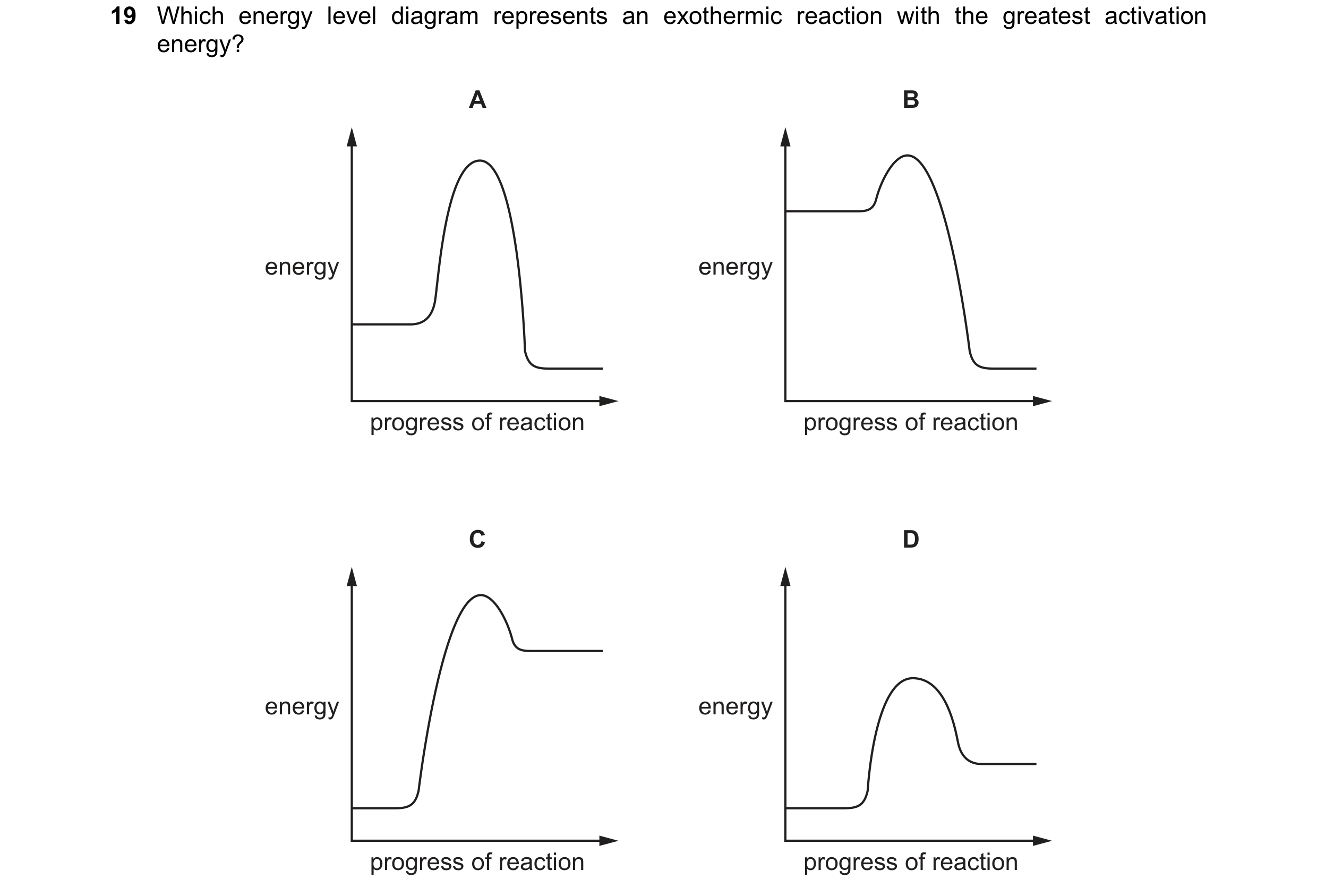
Q25 · Which energy level diagram represents an exothermic reaction with the greatest activation… 0653/22 Feb/March 2021
19 Which energy level diagram represents an exothermic reaction with the greatest activation energy? A B energy energy progress of reaction progress of reaction C D energy energy progress of reaction progress of reaction
1 marks
Answer: A
This question in 0653/22 Feb/March 2021
Q26 · An energy diagram for a reaction is shown 0653/21 May/June 2021
19 An energy diagram for a reaction is shown. energy progress of reaction Which statement about the reaction is not correct? A Activation energy is needed to start the reaction. B The overall energy change is endothermic. C The surroundings increase in temperature during the reaction. D The reaction could be a combustion reaction.
1 marks
Answer: B
This question in 0653/21 May/June 2021
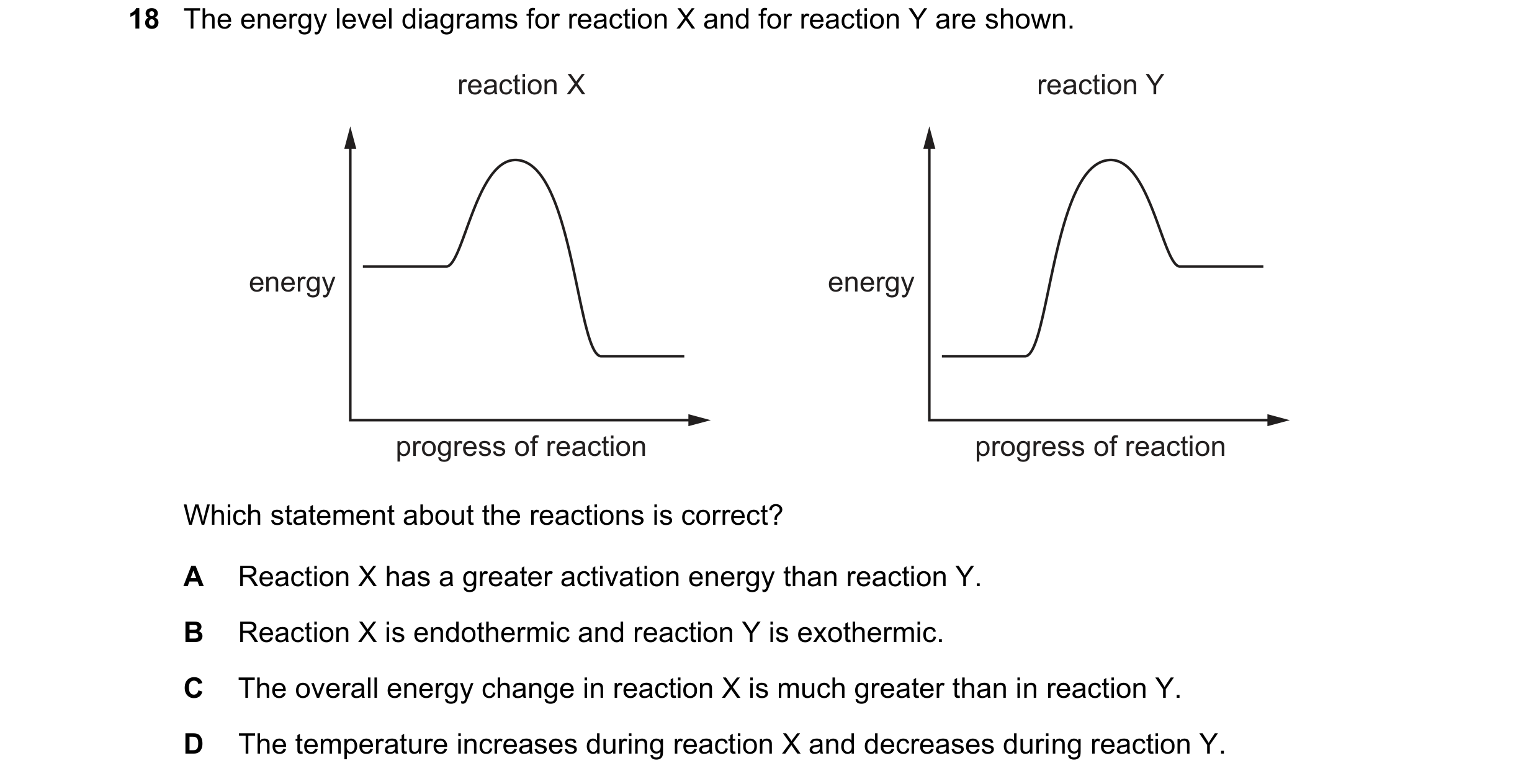
Q27 · The energy level diagrams for reaction X and for reaction Y are shown 0653/22 May/June 2021
18 The energy level diagrams for reaction X and for reaction Y are shown. reaction X reaction Y energy energy progress of reaction progress of reaction Which statement about the reactions is correct? A Reaction X has a greater activation energy than reaction Y. B Reaction X is endothermic and reaction Y is exothermic. C The overall energy change in reaction X is much greater than in reaction Y. D The temperature increases during reaction X and decreases during reaction Y.
1 marks
Answer: D
This question in 0653/22 May/June 2021
Q28 · When water boils it changes from a liquid to a gas 0653/23 May/June 2021
18 When water boils it changes from a liquid to a gas. Which statement about this process is correct? A It is endothermic because it requires energy to break covalent bonds. B It is endothermic because energy is needed to break attractive forces between molecules. C It is exothermic because it requires energy to break attractive forces between atoms. D It is exothermic because energy is given out when bonds form.
1 marks
Answer: B
This question in 0653/23 May/June 2021
Q29 · Which statement describes the change when water becomes ice at 0 C? 0653/21 Oct/Nov 2021
14 Which statement describes the change when water becomes ice at 0 C? A The particles collide with each other more frequently. B The particles have more kinetic energy. C The process is endothermic. D The process is exothermic.
1 marks
Answer: D
This question in 0653/21 Oct/Nov 2021
Q30 · Which statements about bond breaking and bond forming are correct? 0653/22 Oct/Nov 2021
16 Which statements about bond breaking and bond forming are correct? 1 Bond breaking is endothermic. 2 Bond breaking is exothermic. 3 Bond forming is endothermic. 4 Bond forming is exothermic. A 1 and 3 B 1 and 4 C 2 and 3 D 2 and 4
1 marks
Answer: B
This question in 0653/22 Oct/Nov 2021
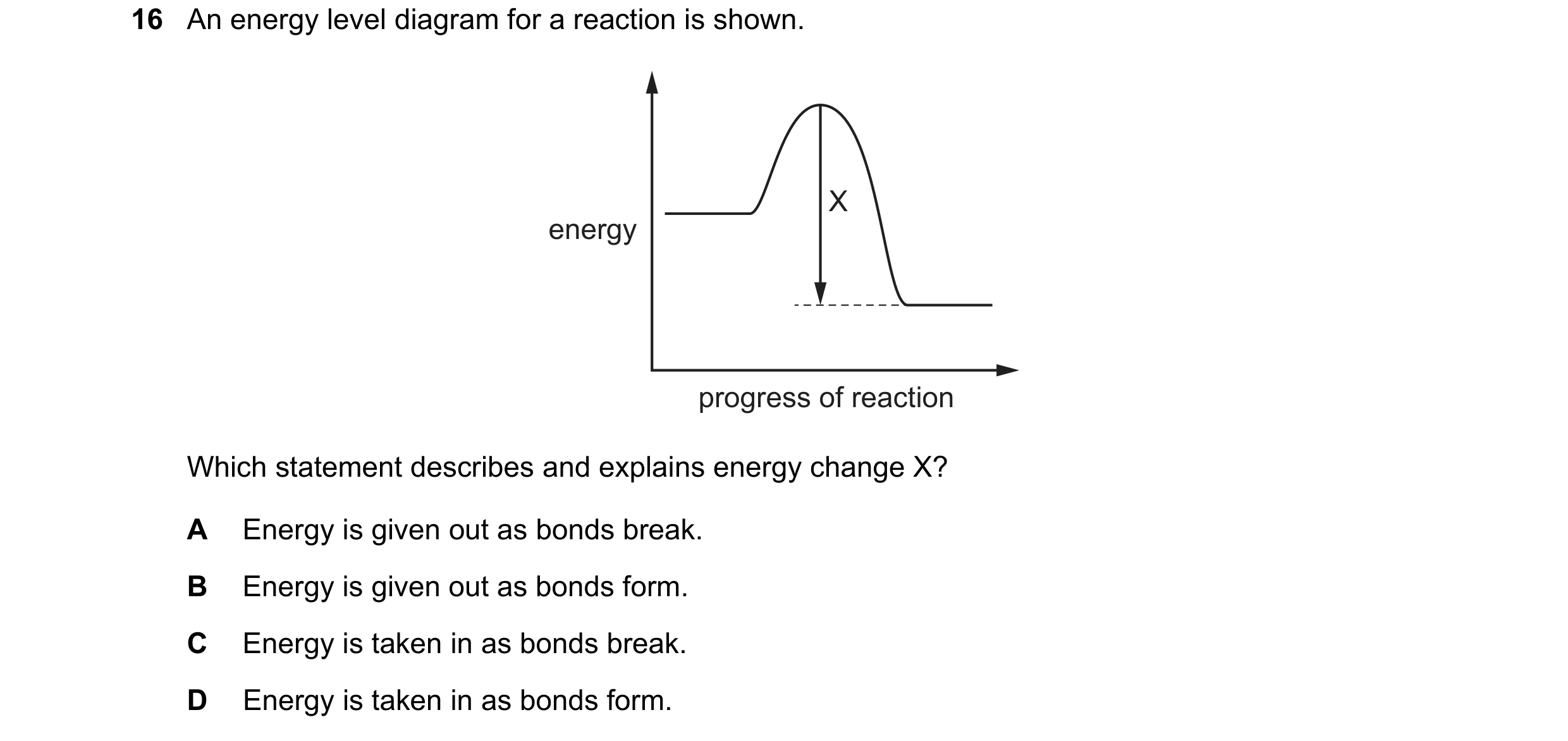
Q31 · An energy level diagram for a reaction is shown 0653/23 Oct/Nov 2021
16 An energy level diagram for a reaction is shown. X energy progress of reaction Which statement describes and explains energy change X? A Energy is given out as bonds break. B Energy is given out as bonds form. C Energy is taken in as bonds break. D Energy is taken in as bonds form.
1 marks
Answer: B
This question in 0653/23 Oct/Nov 2021
Q32 · Steam condenses to form liquid water 0653/22 Feb/March 2022
19 Steam condenses to form liquid water. Which row shows the type of reaction and the energy level diagram for this change? type of reaction energy level diagram liquid water energy A endothermic steam progress of reaction steam energy B endothermic liquid water progress of reaction steam energy C exothermic liquid water progress of reaction liquid water energy D exothermic steam progress of reaction
1 marks
Answer: C
This question in 0653/22 Feb/March 2022
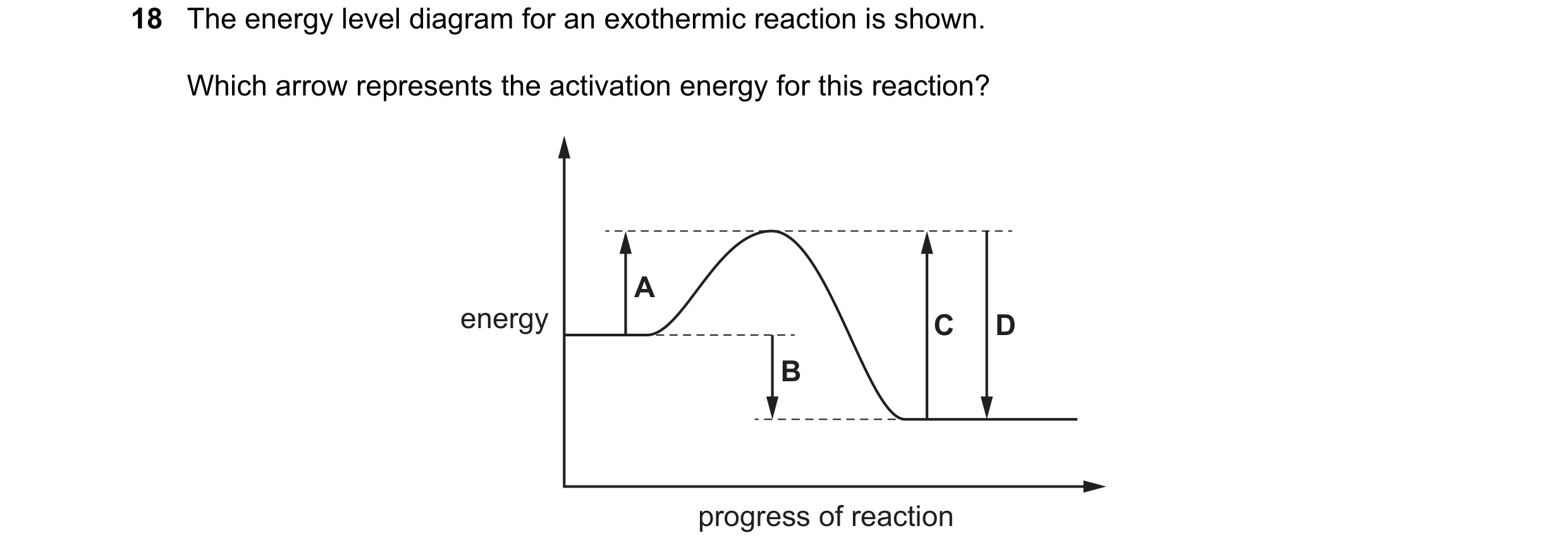
Q33 · The energy level diagram for an exothermic reaction is shown 0653/22 Feb/March 2023
18 The energy level diagram for an exothermic reaction is shown. Which arrow represents the activation energy for this reaction? A energy C D B progress of reaction
1 marks
Answer: A
This question in 0653/22 Feb/March 2023
Q34 · Which process is endothermic? 0653/21 May/June 2023
19 Which process is endothermic? A the reaction of petrol with air in a car engine B Cl –Cl → Cl + Cl C the reaction of potassium with water D C + O2 → CO2
1 marks
Answer: B
This question in 0653/21 May/June 2023
Q35 · The energy level diagram for dissolving solid ammonium nitrate in water is shown 0653/22 May/June 2023
19 The energy level diagram for dissolving solid ammonium nitrate in water is shown. products energy reactants progress of reaction Which statement about this process is correct? A Activation energy is given out causing an overall increase in temperature. B Energy is taken in to form new bonds at the start of the reaction. C During the reaction, the temperature of the water decreases because the reaction takes in energy. D The products have a higher energy than the reactants because the reaction is exothermic.
1 marks
Answer: C
This question in 0653/22 May/June 2023
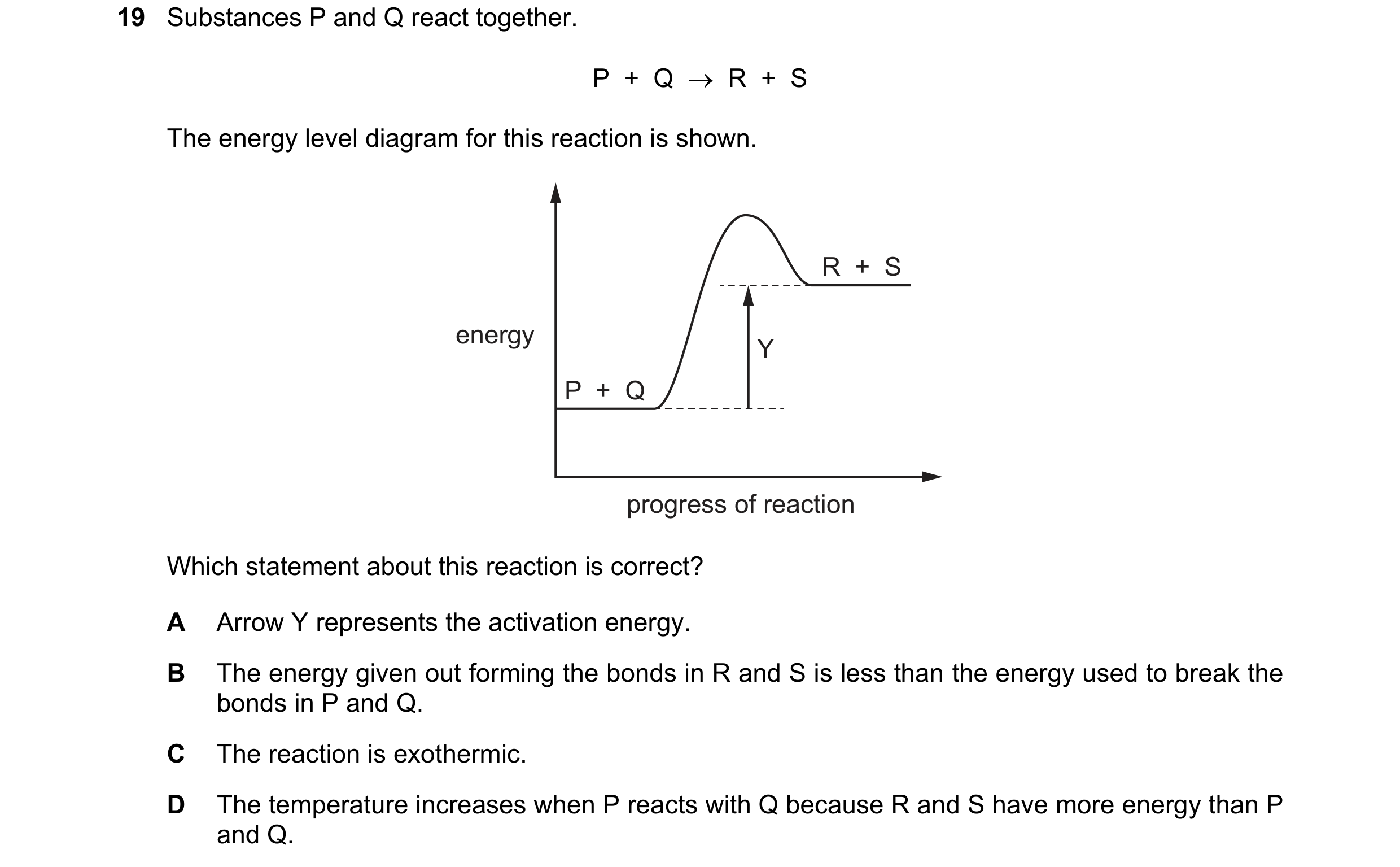
Q36 · Substances P and Q react together 0653/23 May/June 2023
19 Substances P and Q react together. P + Q R + S The energy level diagram for this reaction is shown. R + S energy Y P + Q progress of reaction Which statement about this reaction is correct? A Arrow Y represents the activation energy. B The energy given out forming the bonds in R and S is less than the energy used to break the bonds in P and Q. C The reaction is exothermic. D The temperature increases when P reacts with Q because R and S have more energy than P and Q.
1 marks
Answer: B
This question in 0653/23 May/June 2023
Q37 · Dilute hydrochloric acid and calcium carbonate react together to produce a gas 0653/21 Oct/Nov 2023
19 Dilute hydrochloric acid and calcium carbonate react together to produce a gas. The rate of reaction changes if the concentration of the hydrochloric acid or the temperature is changed. Which row about a change and how it affects the activation energy and the frequency of collisions between reacting particles is correct? change activation energy frequency of collisions A increased concentration decreases increases B increased concentration no effect no effect C increased temperature decreases no effect D increased temperature no effect increases
1 marks
Answer: D
This question in 0653/21 Oct/Nov 2023
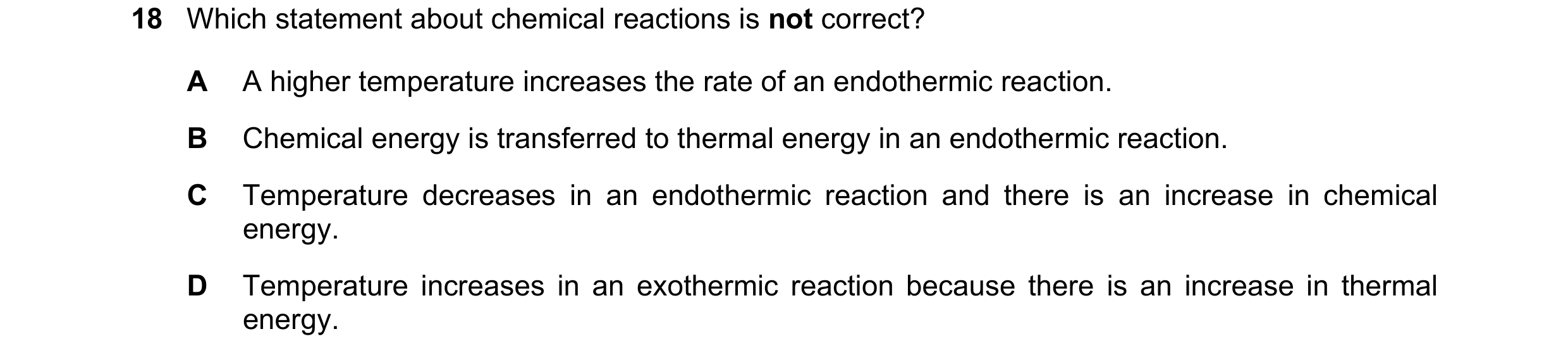
Q38 · Which statement about chemical reactions is not correct? 0653/22 Oct/Nov 2023
18 Which statement about chemical reactions is not correct? A A higher temperature increases the rate of an endothermic reaction. B Chemical energy is transferred to thermal energy in an endothermic reaction. C Temperature decreases in an endothermic reaction and there is an increase in chemical energy. D Temperature increases in an exothermic reaction because there is an increase in thermal energy.
1 marks
Answer: B
This question in 0653/22 Oct/Nov 2023
Q39 · Which energy level diagram identifies the activation energy and the energy change for an… 0653/23 Oct/Nov 2023
18 Which energy level diagram identifies the activation energy and the energy change for an exothermic reaction? key 1 = activation energy 2 = energy change for the reaction A B 1 1 energy energy 2 2 progress of reaction progress of reaction C D 1 energy energy 2 2 1 progress of reaction progress of reaction
1 marks
Answer: C
This question in 0653/23 Oct/Nov 2023
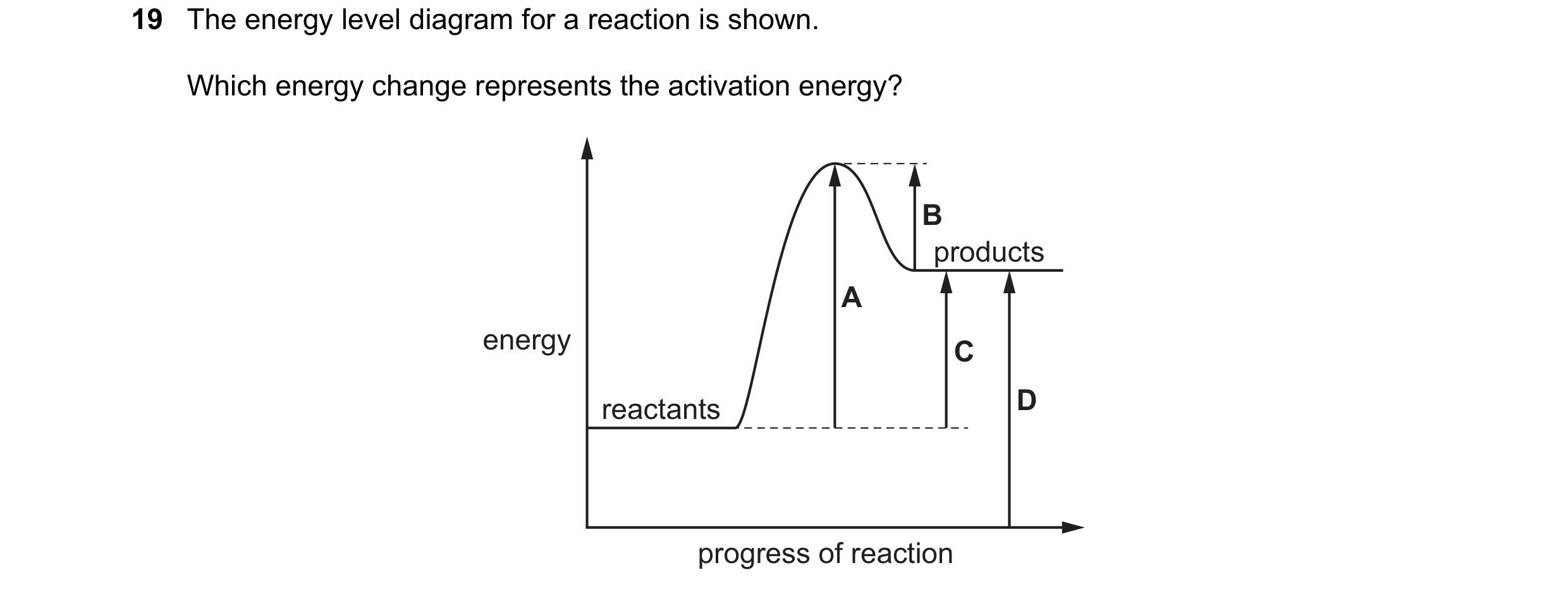
Q40 · The energy level diagram for a reaction is shown 0653/22 Feb/March 2024
19 The energy level diagram for a reaction is shown. Which energy change represents the activation energy? B products A energy C D reactants progress of reaction
1 marks
Answer: A
This question in 0653/22 Feb/March 2024
Q41 · 50 g of a liquid alkane at 20 C is left in an open, insulated beaker for 30 minutes 0653/21 May/June 2024
14 50 g of a liquid alkane at 20 C is left in an open, insulated beaker for 30 minutes. After this time, the mass of the liquid is 42 g and its temperature is 18 C. Which statement is correct? A Some of the liquid evaporates in an exothermic process. B The evaporation is an endothermic process because covalent bonds in the alkane molecules are broken. C The temperature decreases because energy is used to overcome attractive forces between the liquid molecules. D There are fewer molecules in the remaining liquid so they move further apart.
1 marks
Answer: C
This question in 0653/21 May/June 2024
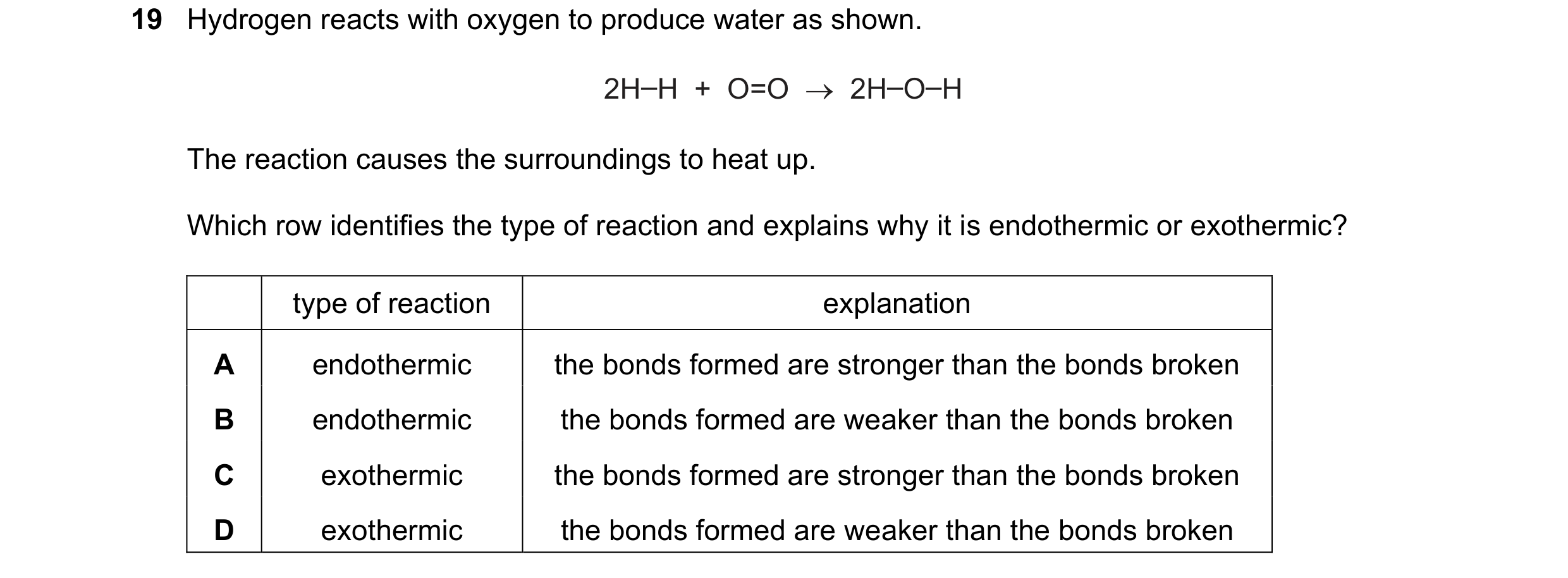
Q42 · Hydrogen reacts with oxygen to produce water as shown 0653/21 May/June 2024
19 Hydrogen reacts with oxygen to produce water as shown.
2H-H + O=O — 2H-O-H
The reaction causes the surroundings to heat up.
Which row identifies the type of reaction and explains why it is endothermic or exothermic?
type of reaction explanation
A endothermic the bonds formed are stronger than the bonds broken
B endothermic the bonds formed are weaker than the bonds broken
Cc exothermic the bonds formed are stronger than the bonds broken
D exothermic the bonds formed are weaker than the bonds broken
1 marks
Answer: C
This question in 0653/21 May/June 2024
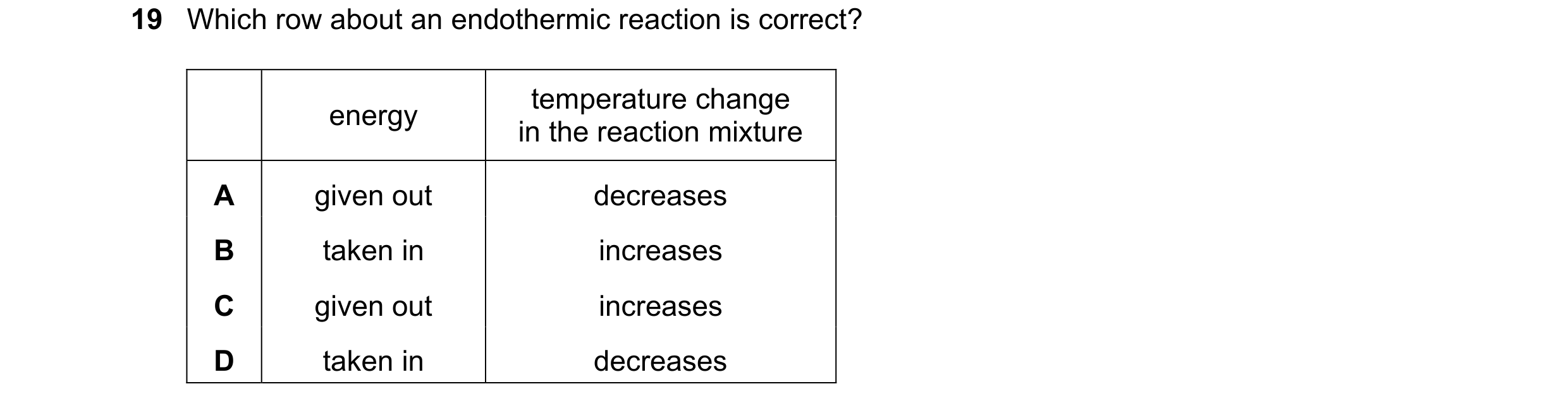
Q43 · Which row about an endothermic reaction is correct? 0653/22 May/June 2024
19 Which row about an endothermic reaction is correct? temperature change energy in the reaction mixture A given out decreases B taken in increases C given out increases D taken in decreases
1 marks
Answer: D
This question in 0653/22 May/June 2024
Q44 · The energy level diagram for an endothermic reaction is shown 0653/23 May/June 2024
20 The energy level diagram for an endothermic reaction is shown. energy progress of reaction Which statement about this reaction is correct? A The activation energy is the minimum energy to react. B The energy required to break bonds is less than the energy released on making new bonds. C The activation energy is less than the energy change for the reaction. D The final products have less energy than the reactants.
1 marks
Answer: A
This question in 0653/23 May/June 2024
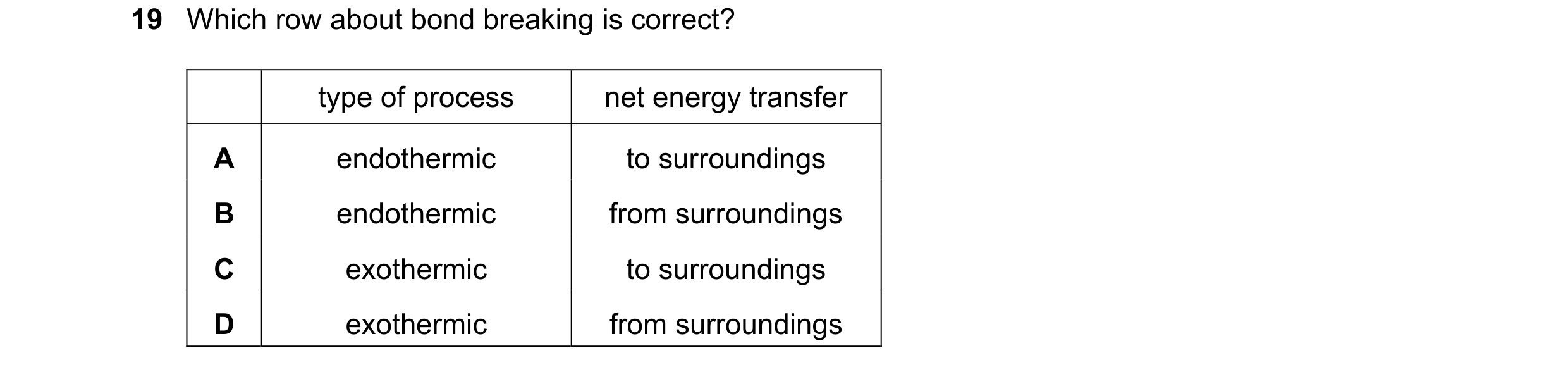
Q45 · Which row about bond breaking is correct? 0653/21 Oct/Nov 2024
19 Which row about bond breaking is correct? type of process net energy transfer A endothermic to surroundings B endothermic from surroundings C exothermic to surroundings D exothermic from surroundings
1 marks
Answer: B
This question in 0653/21 Oct/Nov 2024
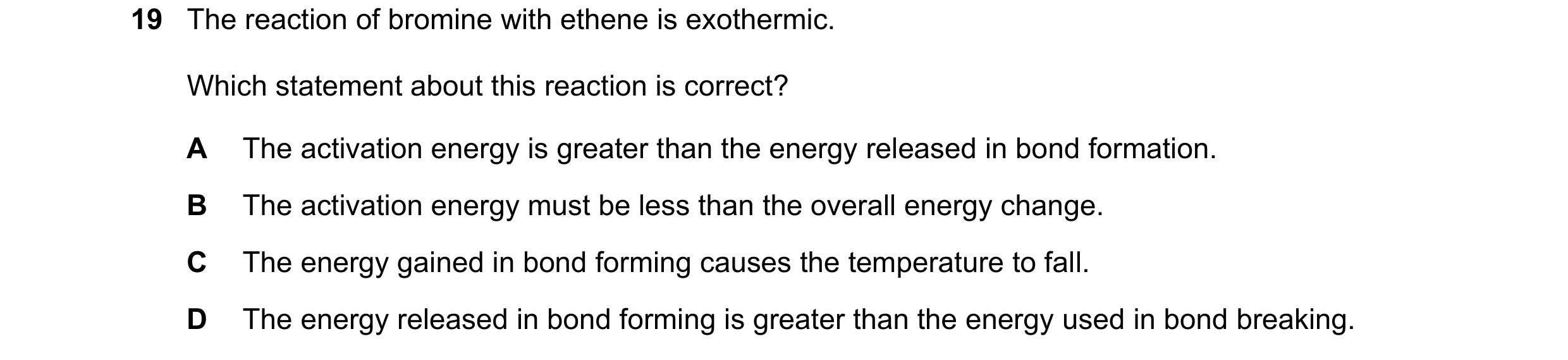
Q46 · The reaction of bromine with ethene is exothermic 0653/23 Oct/Nov 2024
19 The reaction of bromine with ethene is exothermic. Which statement about this reaction is correct? A The activation energy is greater than the energy released in bond formation. B The activation energy must be less than the overall energy change. C The energy gained in bond forming causes the temperature to fall. D The energy released in bond forming is greater than the energy used in bond breaking.
1 marks
Answer: D
This question in 0653/23 Oct/Nov 2024
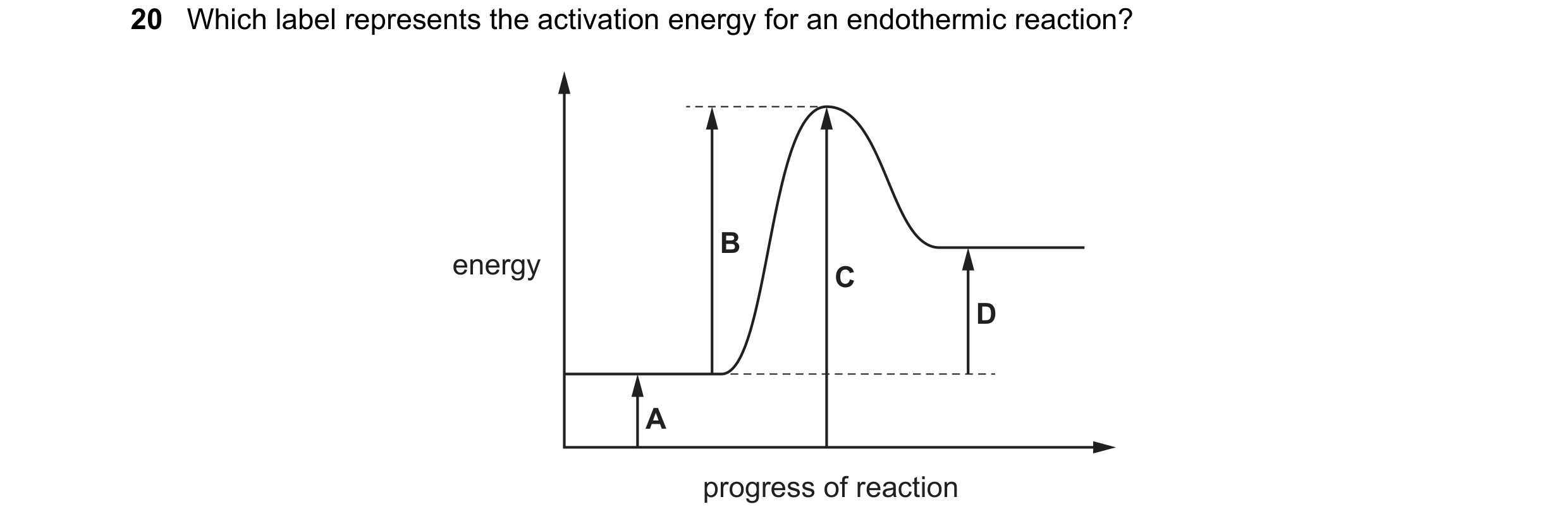
Q47 · Which label represents the activation energy for an endothermic reaction? 0653/22 Feb/March 2025
20 Which label represents the activation energy for an endothermic reaction? B energy C D A progress of reaction
1 marks
Answer: B
This question in 0653/22 Feb/March 2025
Q48 · The reaction pathway diagrams for reaction X and for reaction Y are shown 0653/21 May/June 2025
20 The reaction pathway diagrams for reaction X and for reaction Y are shown. reaction X reaction Y energy energy progress of reaction progress of reaction Which statement about the reactions is correct? A Reaction X has a greater activation energy than reaction Y. B Reaction X is endothermic and reaction Y is exothermic. C The overall energy change in reaction X is much greater than in reaction Y. D The temperature increases during reaction X and decreases during reaction Y.
1 marks
Answer: D
This question in 0653/21 May/June 2025
Q49 · Which statement explains why a reaction is exothermic? 0653/22 May/June 2025
17 Which statement explains why a reaction is exothermic? A More thermal energy is absorbed by breaking bonds than is released by making bonds. B More thermal energy is absorbed by making bonds than is released by breaking bonds. C More thermal energy is released by breaking bonds than is absorbed by making bonds. D More thermal energy is released by making bonds than is absorbed by breaking bonds.
1 marks
Answer: D
This question in 0653/22 May/June 2025
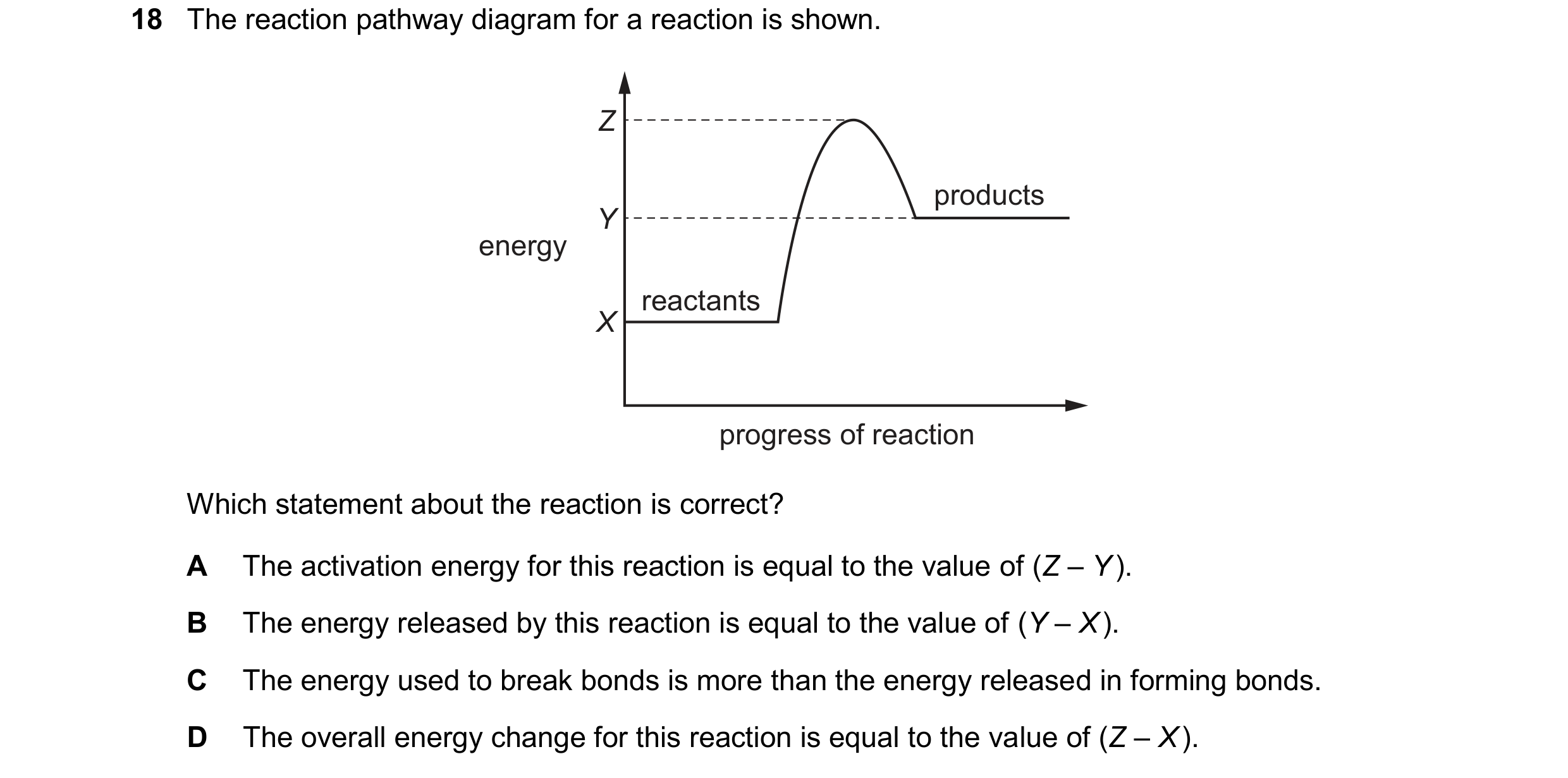
Q50 · The reaction pathway diagram for a reaction is shown 0653/23 May/June 2025
18 The reaction pathway diagram for a reaction is shown. Z products Y energy reactants X progress of reaction Which statement about the reaction is correct? A The activation energy for this reaction is equal to the value of (Z – Y ). B The energy released by this reaction is equal to the value of (Y – X ). C The energy used to break bonds is more than the energy released in forming bonds. D The overall energy change for this reaction is equal to the value of (Z – X ).
1 marks
Answer: C
This question in 0653/23 May/June 2025
Q51 · A reaction pathway diagram for a reaction is shown 0653/21 Oct/Nov 2025
15 A reaction pathway diagram for a reaction is shown. X energy progress of reaction Which statement describes and explains energy change X? A Thermal energy is given out as bonds break. B Thermal energy is given out as bonds form. C Thermal energy is taken in as bonds break. D Thermal energy is taken in as bonds form.
1 marks
Answer: B
This question in 0653/21 Oct/Nov 2025
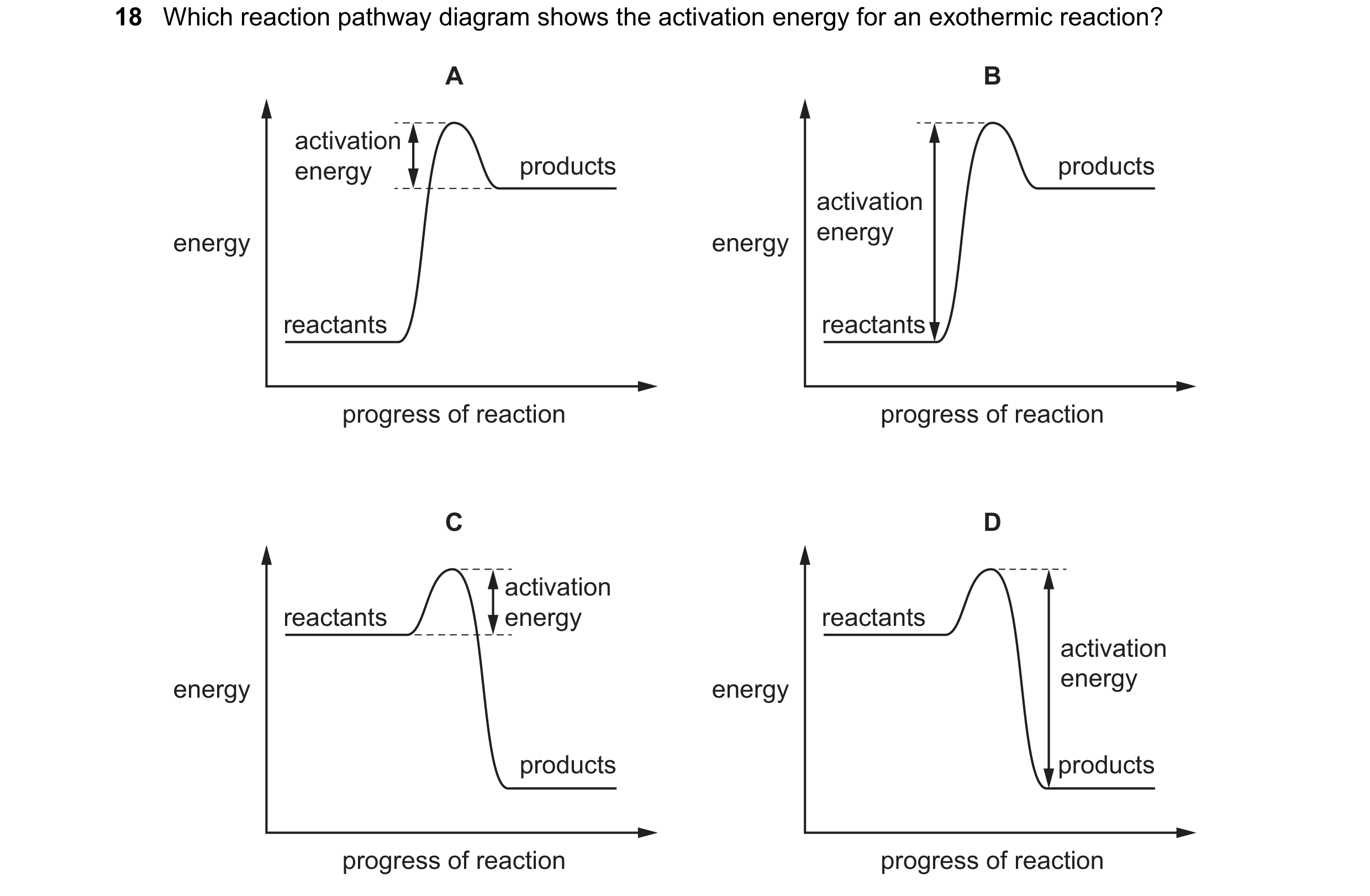
Q52 · Which reaction pathway diagram shows the activation energy for an exothermic reaction? 0653/22 Oct/Nov 2025
18 Which reaction pathway diagram shows the activation energy for an exothermic reaction? A B activation energy products products activation energy energy energy reactants reactants progress of reaction progress of reaction C D activation reactants energy reactants activation energy energy energy products products progress of reaction progress of reaction
1 marks
Answer: C
This question in 0653/22 Oct/Nov 2025
Q53 · The equation for the complete combustion of ethane is shown 0653/23 Oct/Nov 2025
18 The equation for the complete combustion of ethane is shown. 2C2H6 + 7O2 4CO2 + 6H2O Which statement about this reaction is correct? A Ethane is oxidised because it gains oxygen. B Ethane is reduced because carbon–hydrogen bonds are broken. C It is endothermic because thermal energy is transferred to the surroundings. D It is exothermic because thermal energy is taken in from the surroundings.
1 marks
Answer: A
This question in 0653/23 Oct/Nov 2025
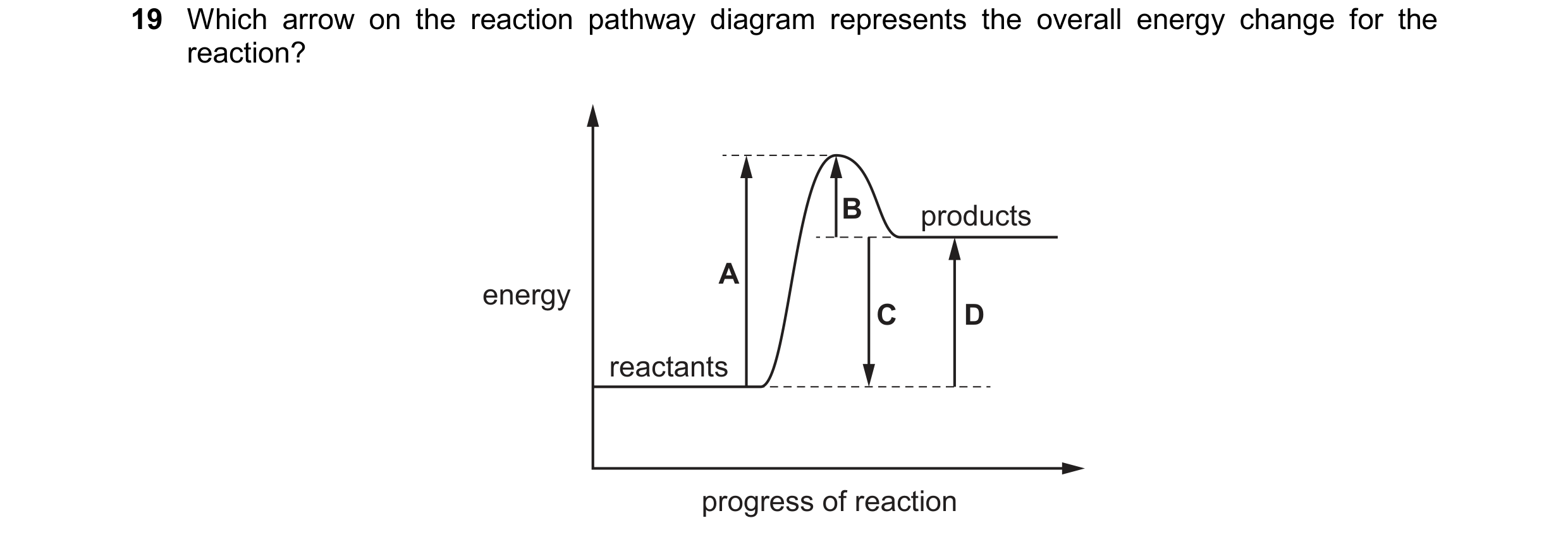
Q54 · Which arrow on the reaction pathway diagram represents the overall energy change for the… 0653/23 Oct/Nov 2025
19 Which arrow on the reaction pathway diagram represents the overall energy change for the reaction? B products A energy C D reactants progress of reaction
1 marks
Answer: D
This question in 0653/23 Oct/Nov 2025

 1 / 20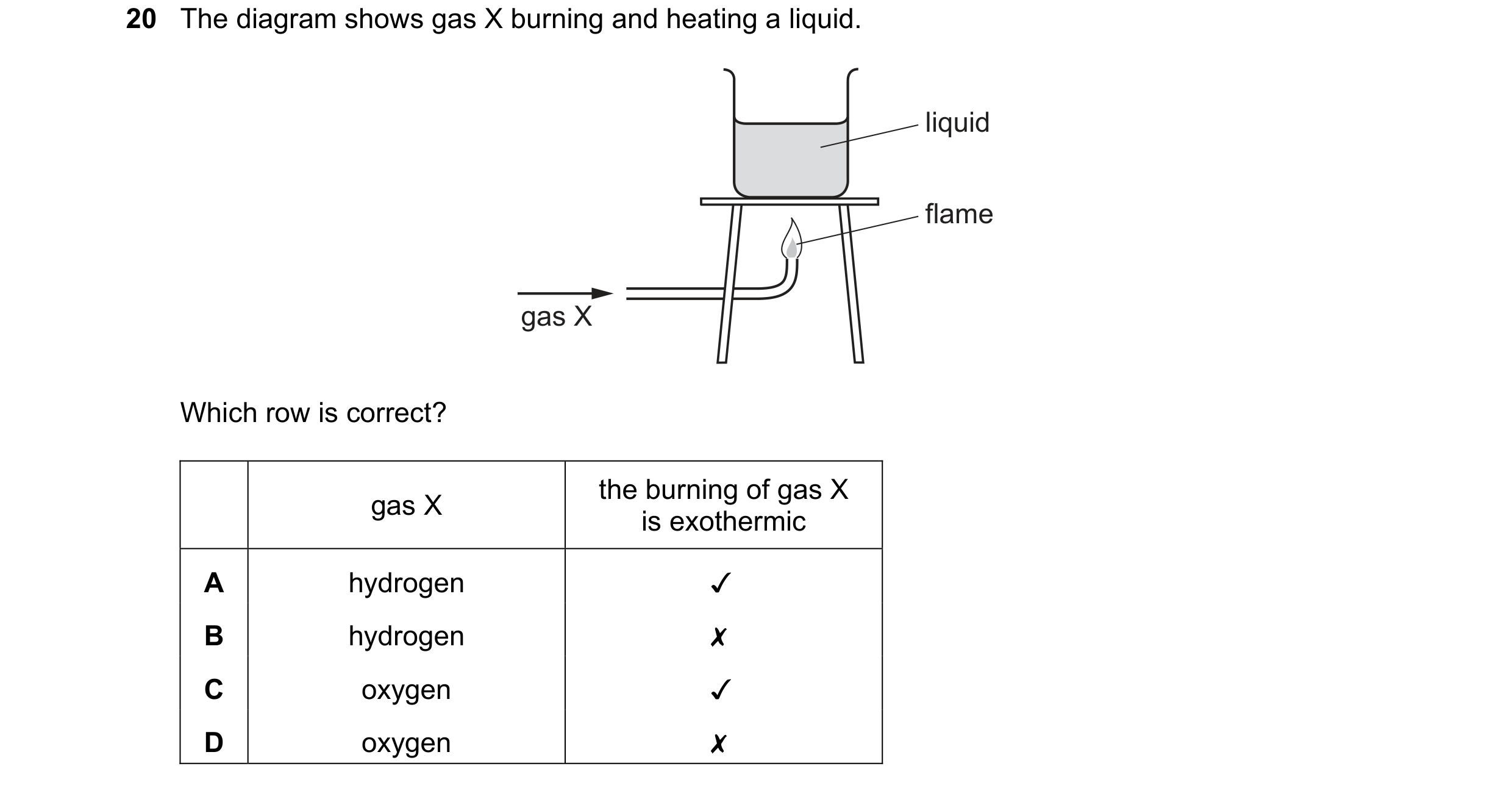
 2 / 20

 3 / 20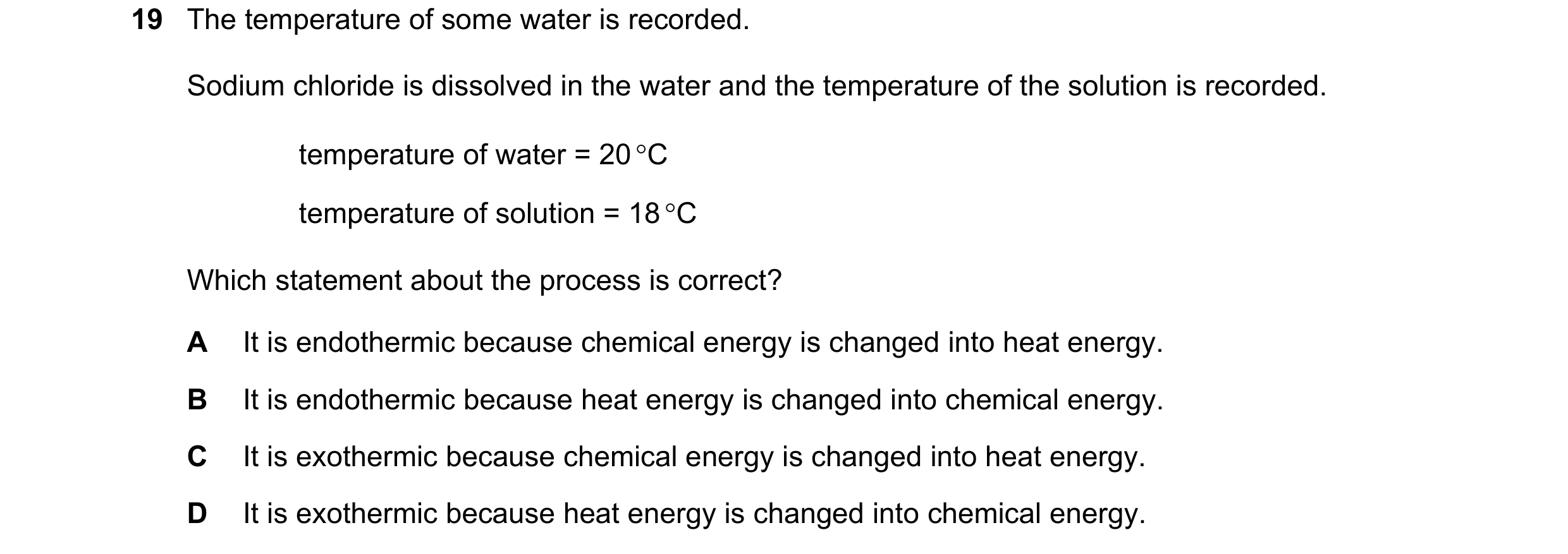
 4 / 20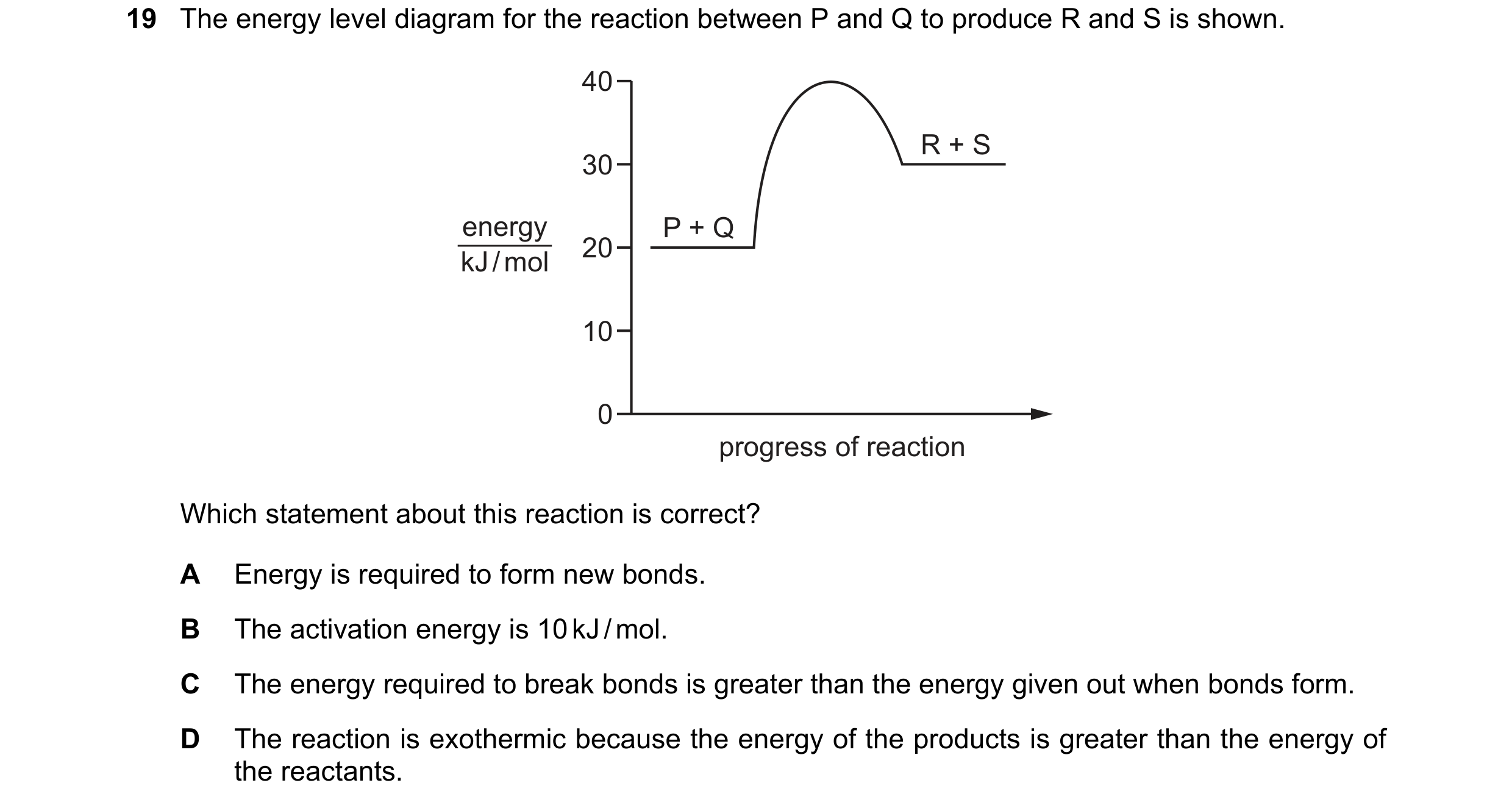
 5 / 20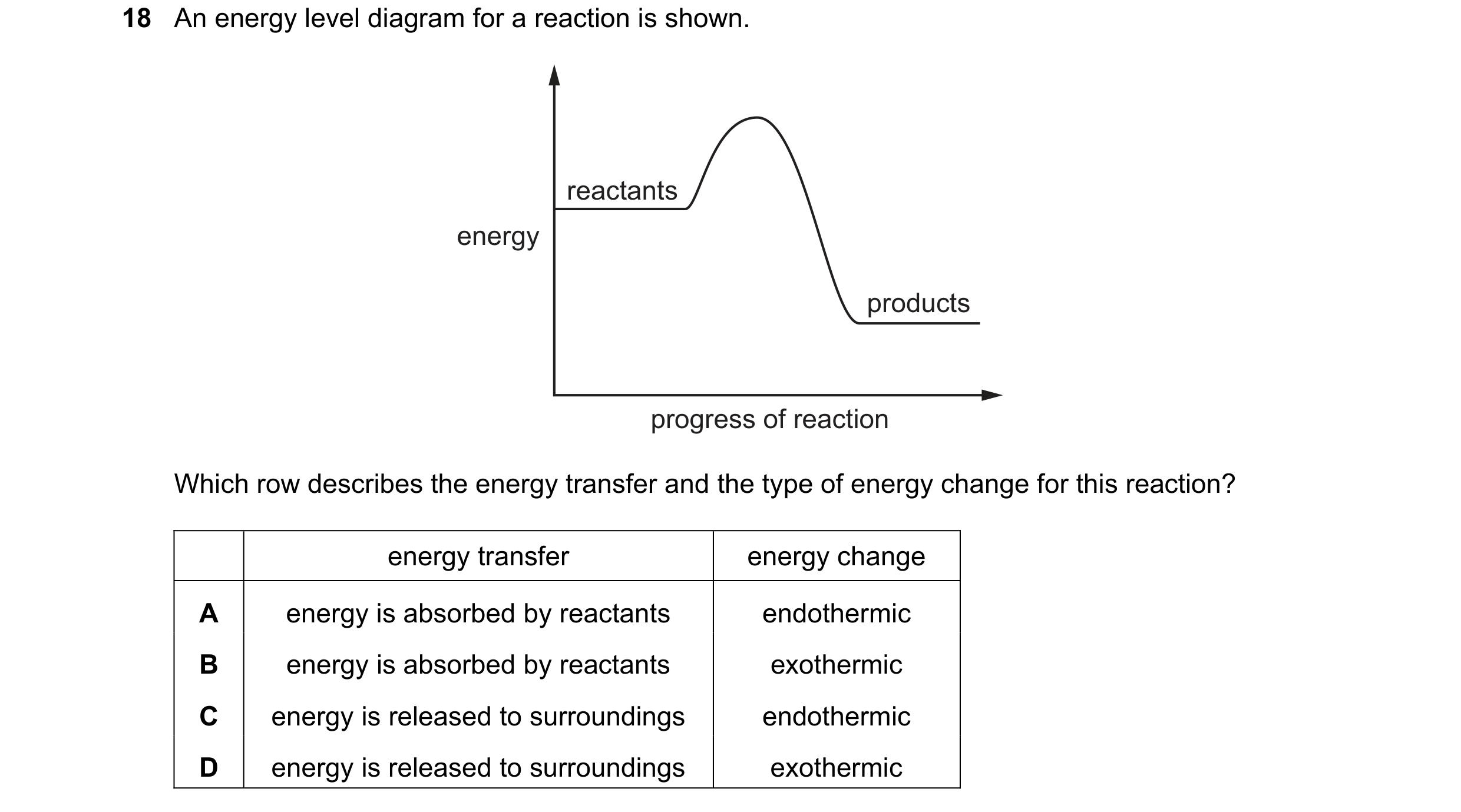
 6 / 20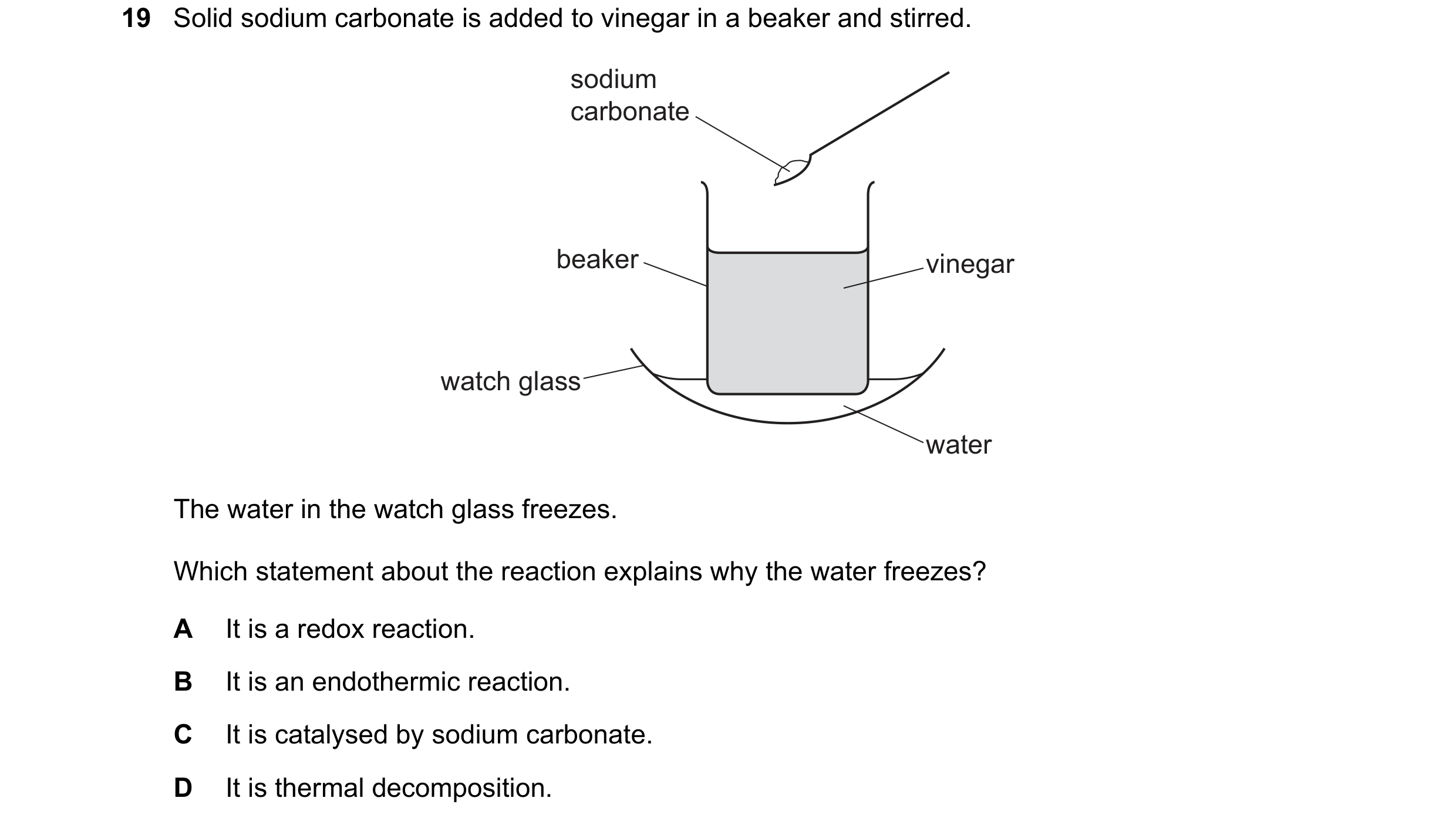
 7 / 20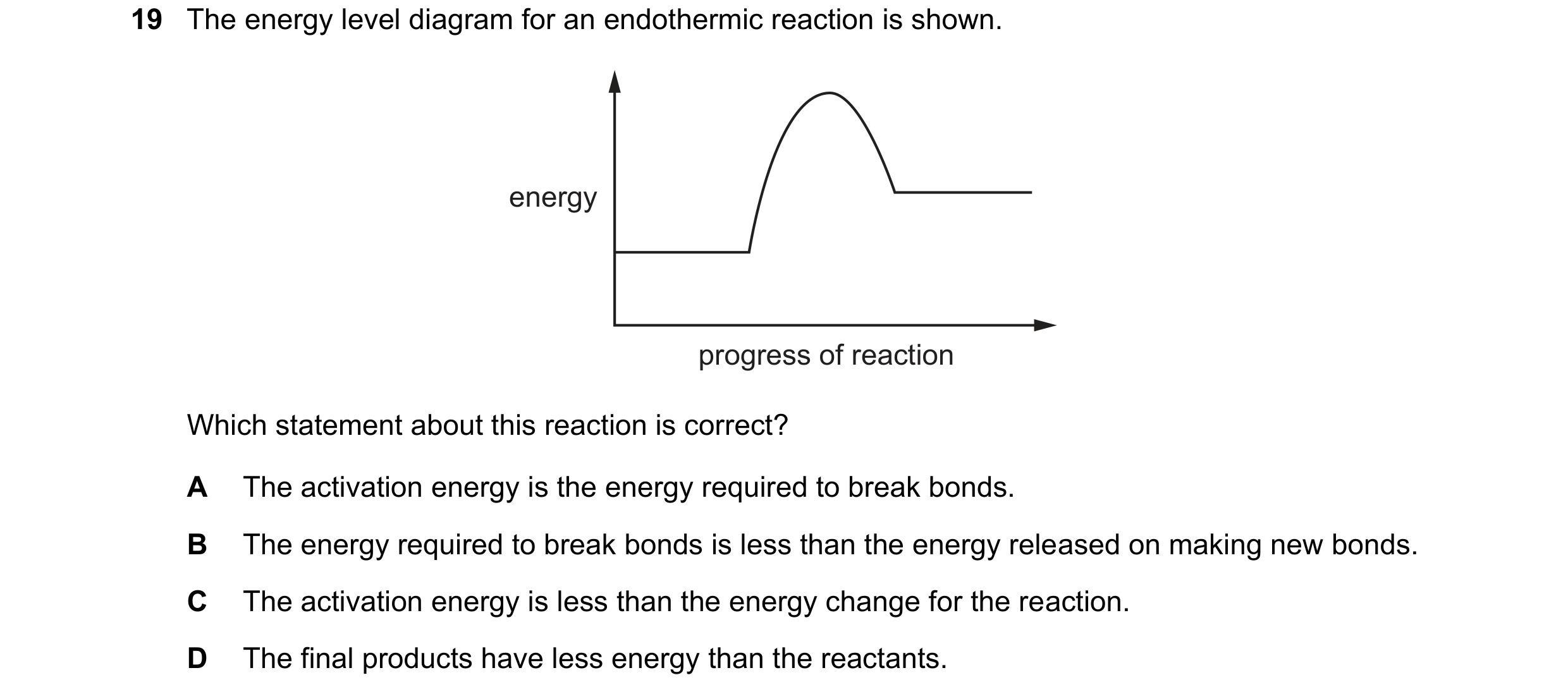
 8 / 20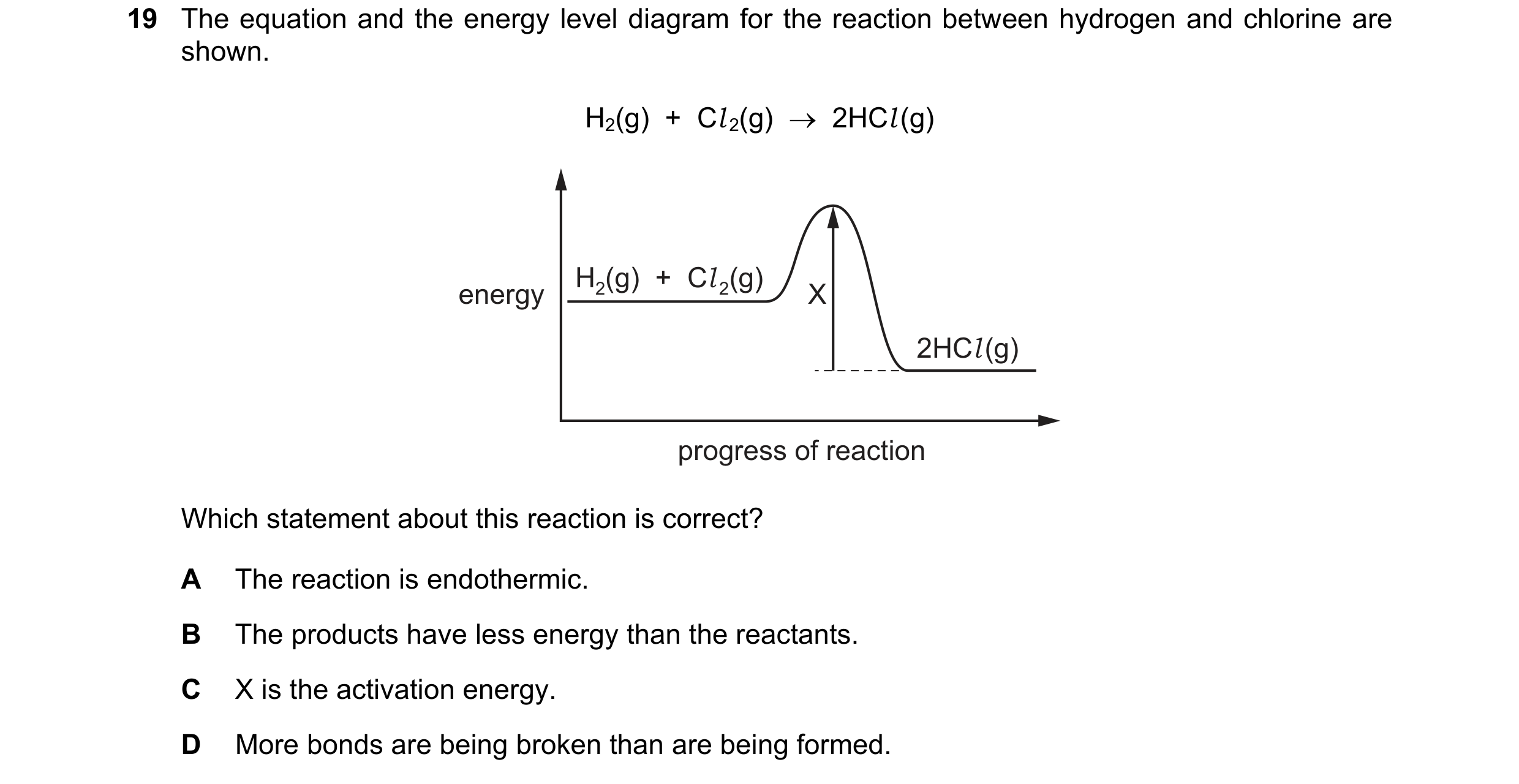
 9 / 20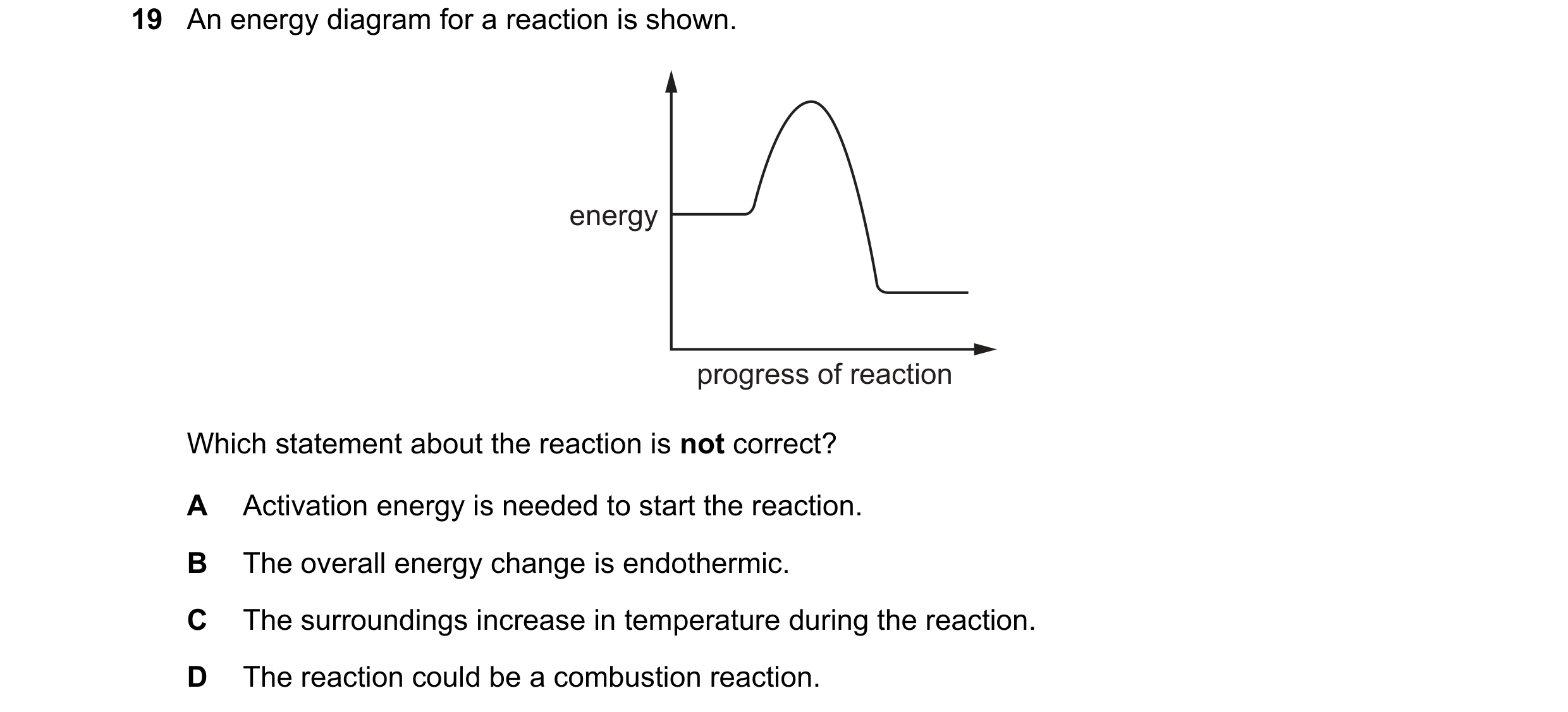
 10 / 20
 11 / 20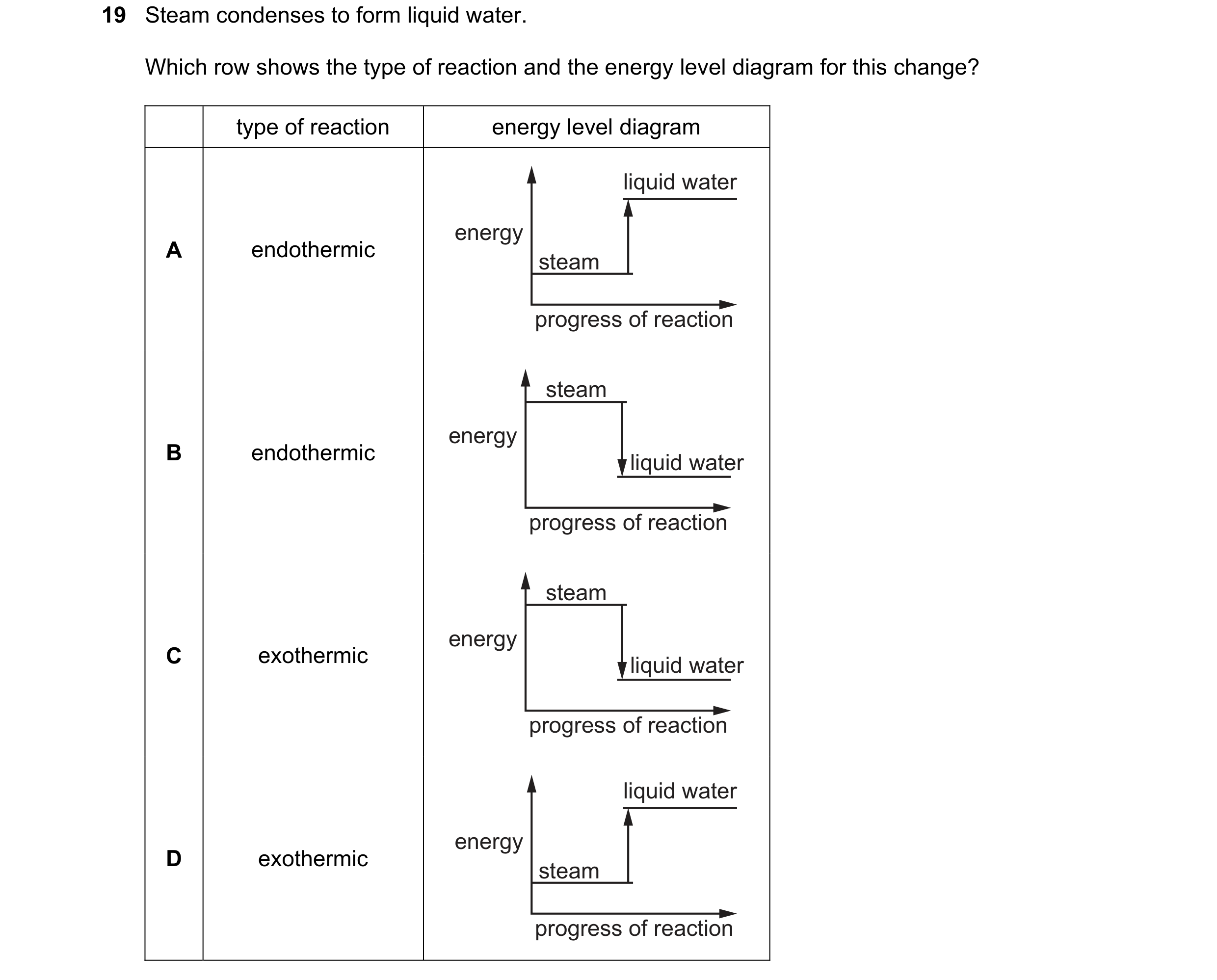
 12 / 20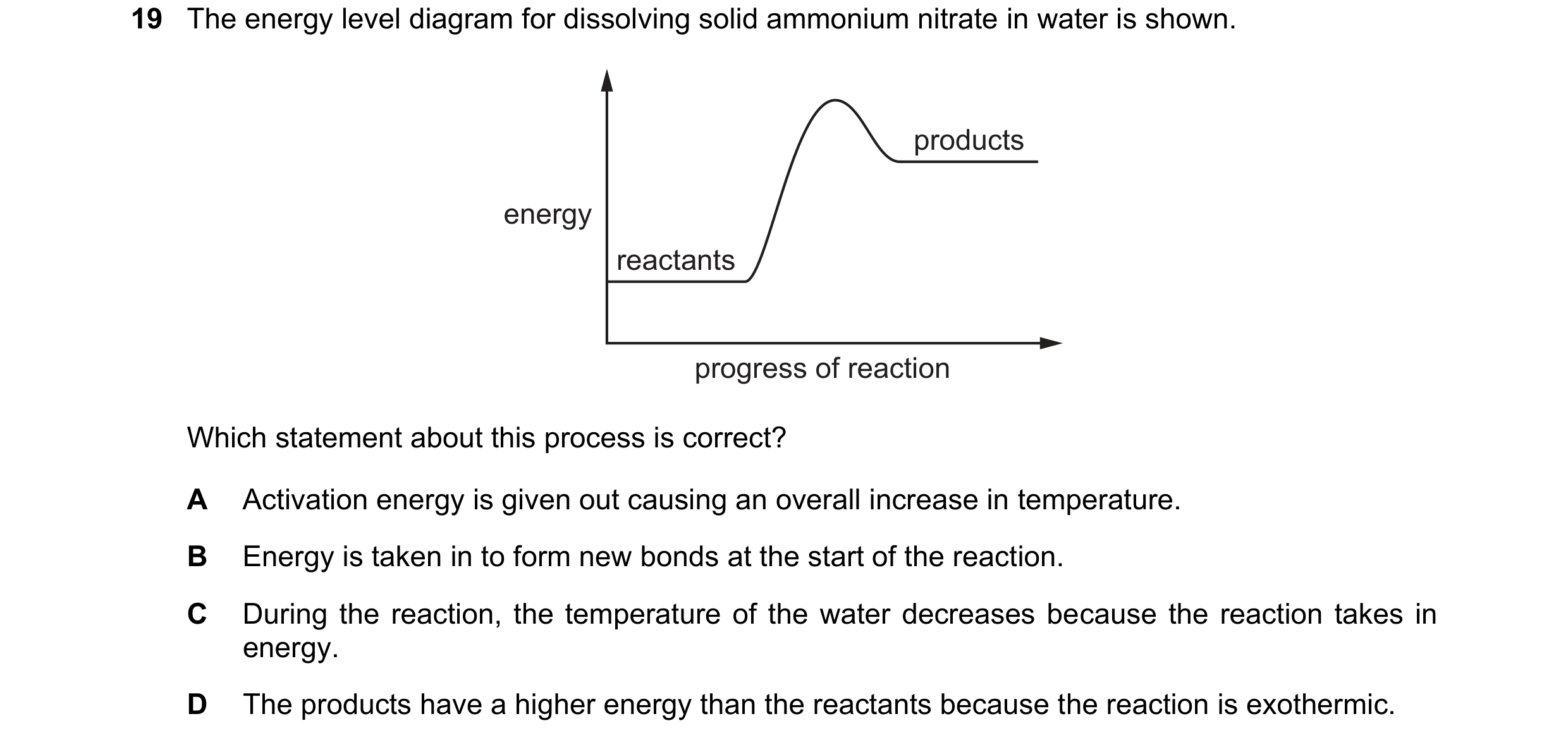
 13 / 20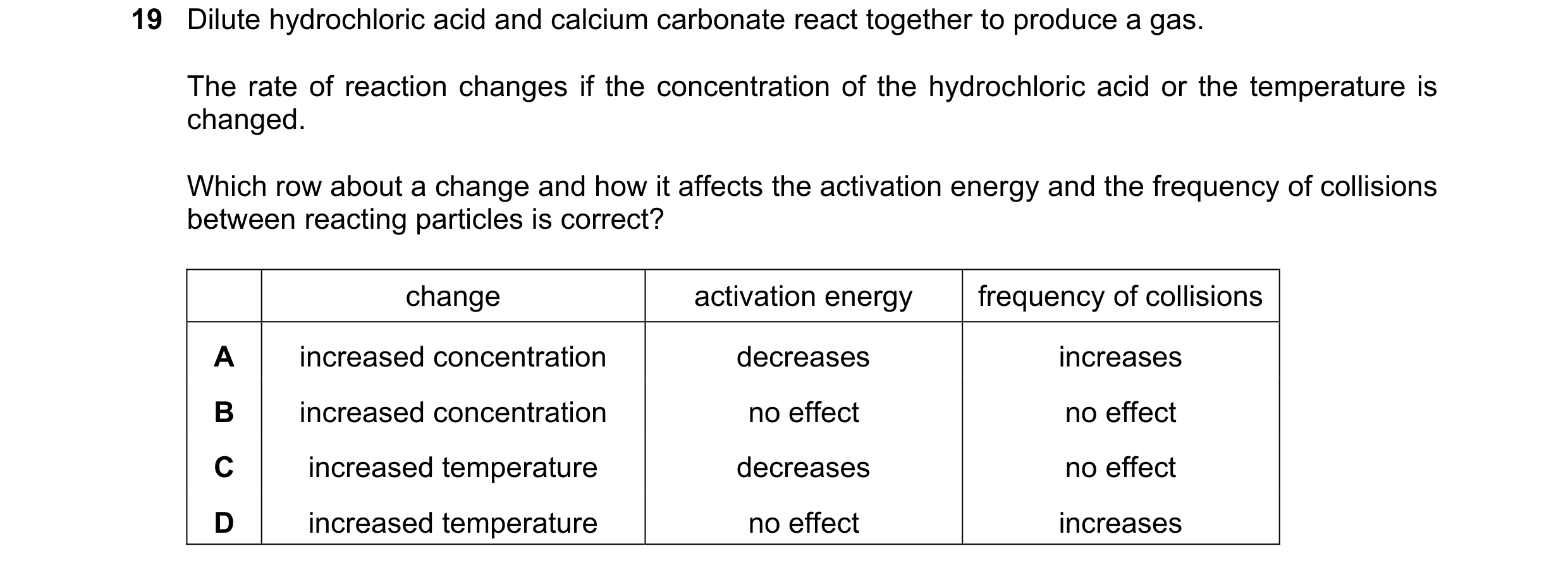
 14 / 20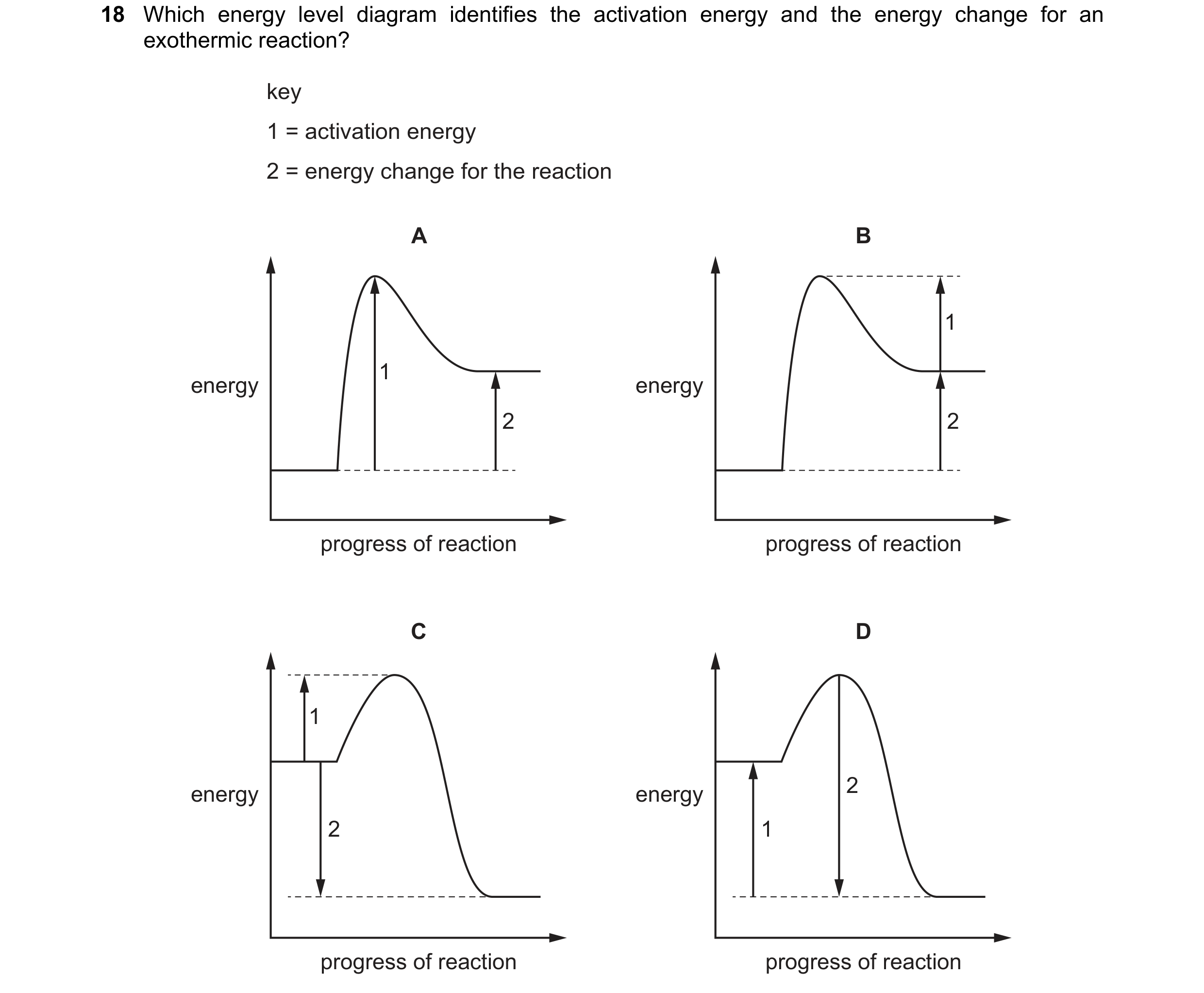
 15 / 20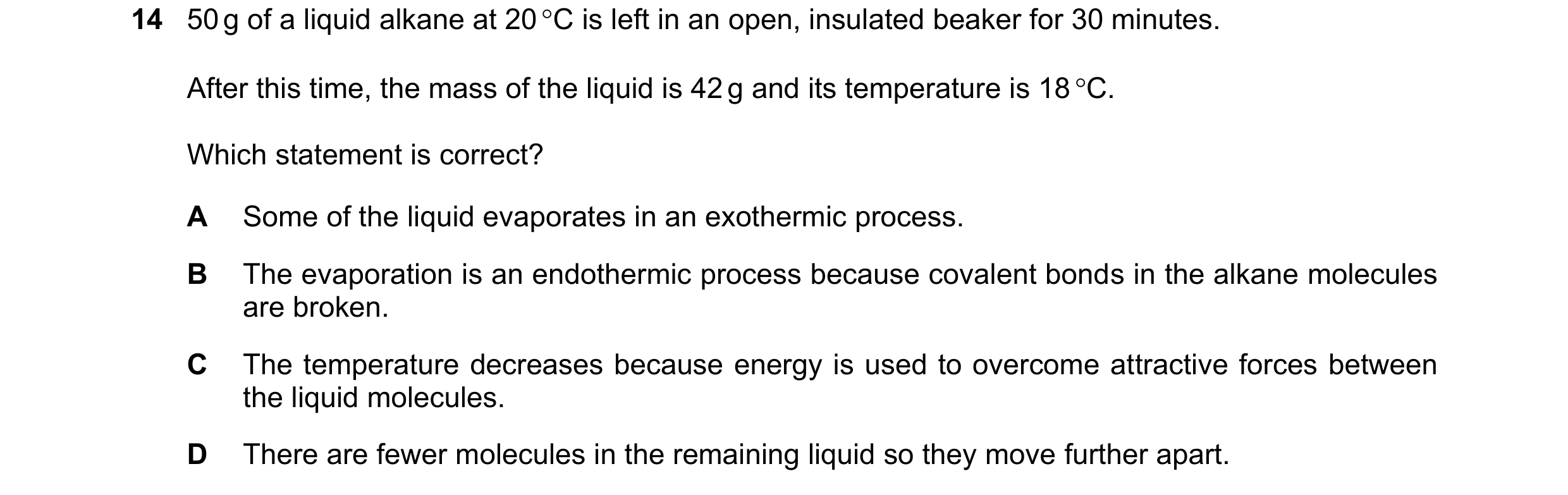
 16 / 20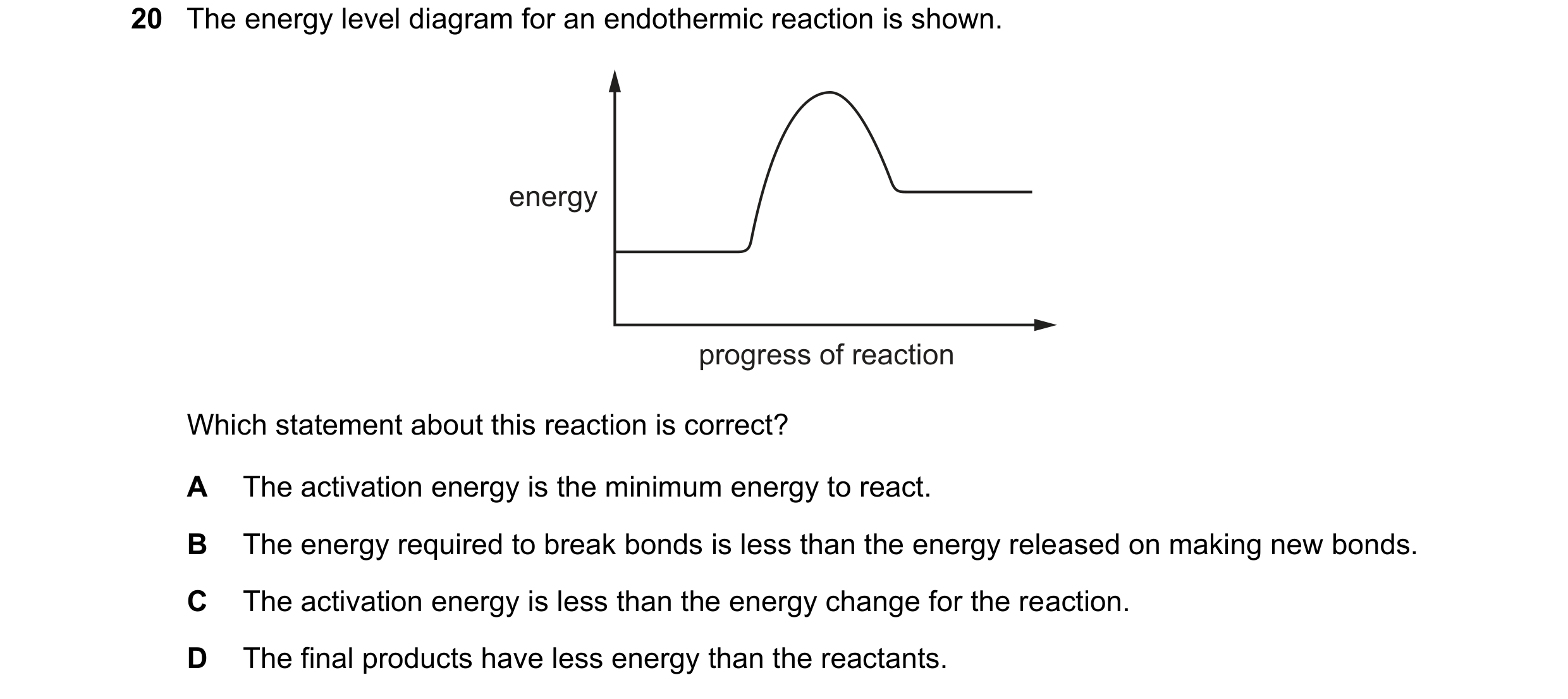
 17 / 20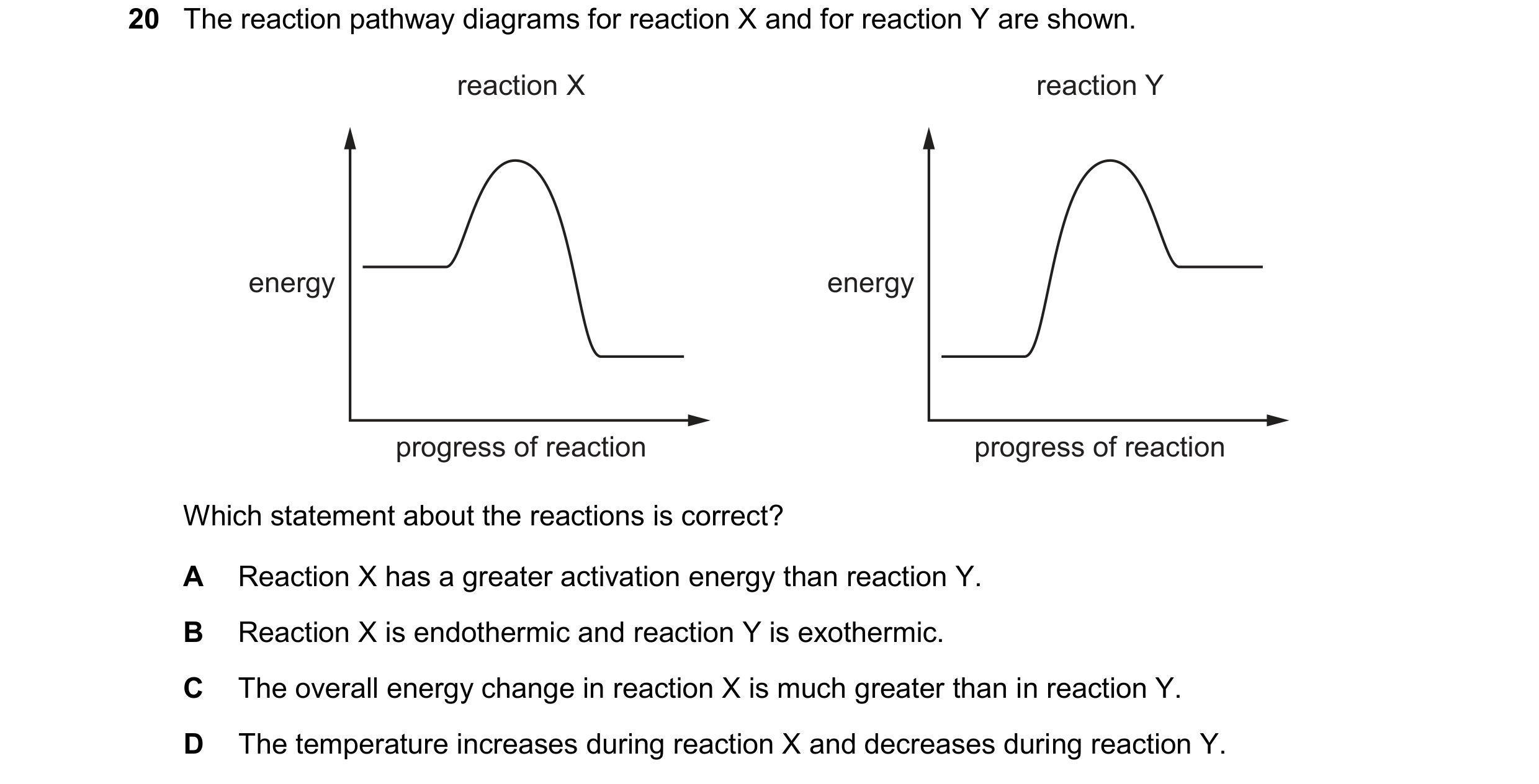

 18 / 20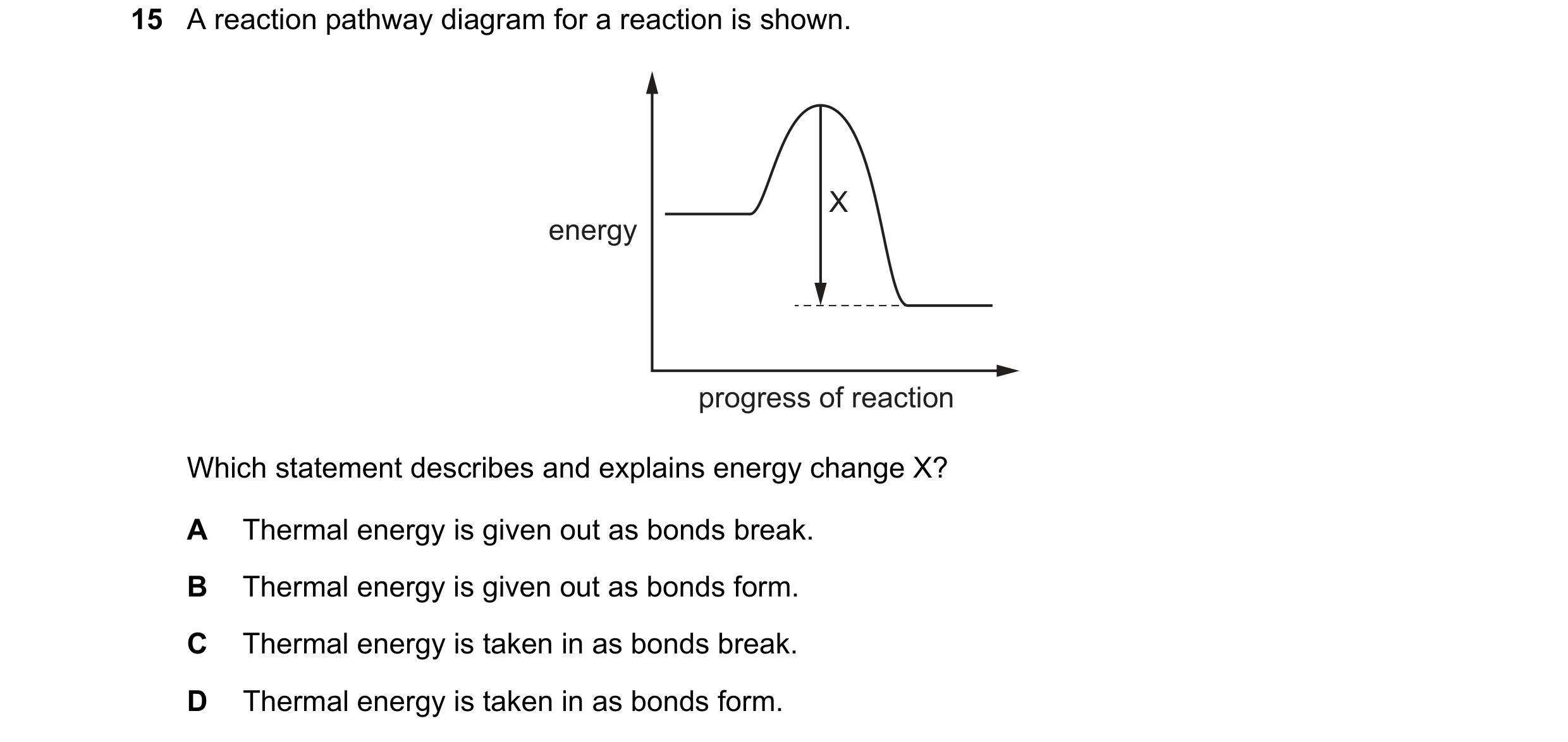
 19 / 20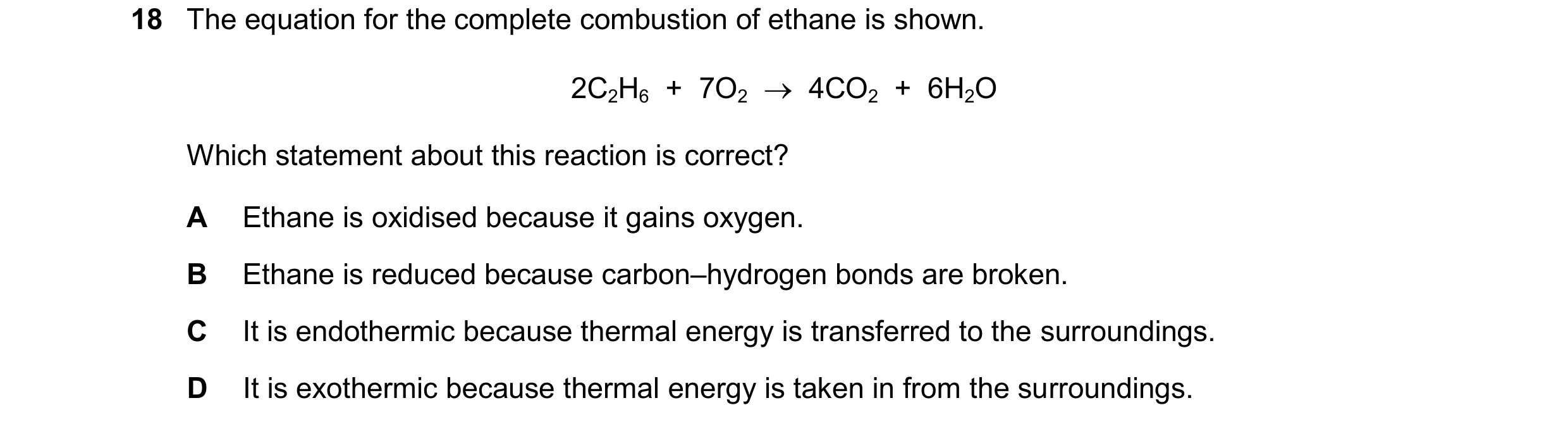
 20 / 20