Cambridge IGCSE Physics 0625 — 2015 Feb/March Paper 3 · Variant 2
0625/32/F/M/15 · 11 questions · 80 marks · ≈90 min
The question paper and its mark scheme, free to read here and free to download. This is Cambridge’s own paper, exactly as it was sat.
Question paper16 pages
Mark scheme8 pages
Answers below. Sit the paper first if you are practising.
Questions as text
Q1 · A large stone, initially at rest, falls from the top of a building
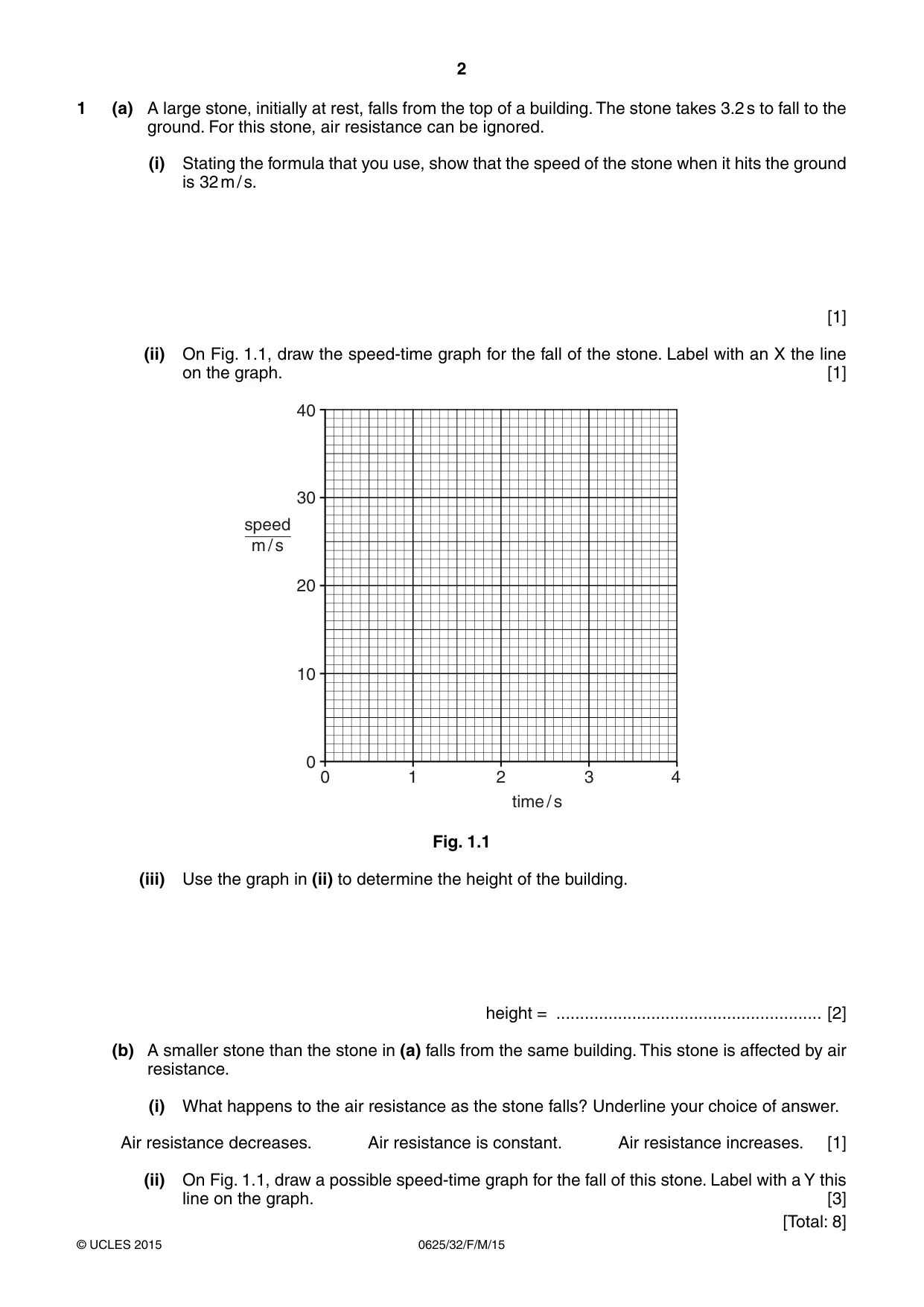
1 (a) A large stone, initially at rest, falls from the top of a building. The stone takes 3.2 s to fall to the ground. For this stone, air resistance can be ignored. (i) Stating the formula that you use, show that the speed of the stone when it hits the ground is 32 m / s. [1] (ii) On Fig. 1.1, draw the speed-time graph for the fall of the stone. Label with an X the line on the graph. [1] 40 30 speed m / s 20 10 0 0 1 2 3 4 time / s Fig. 1.1 (iii) Use the graph in (ii) to determine the height of the building. height = ........................................................ [2] (b) A smaller stone than the stone in (a) falls from the same building. This stone is affected by air resistance. (i) What happens to the air resistance as the stone falls? Underline your choice of answer. Air resistance decreases. Air resistance is constant. Air resistance increases. [1] (ii) On Fig. 1.1, draw a possible speed-time graph for the fall of this stone. Label with a Y this line on the graph. [3] [Total: 8]
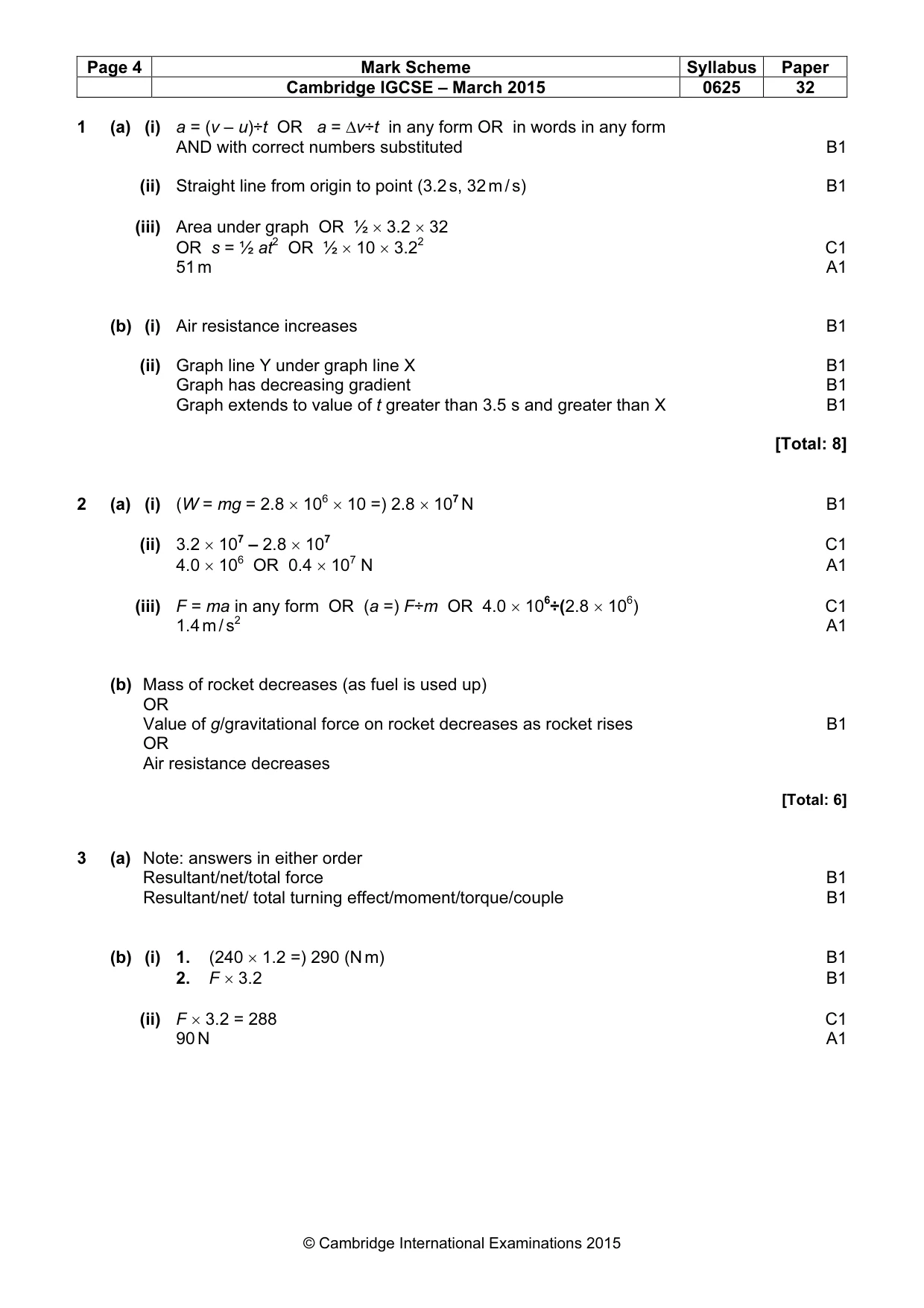
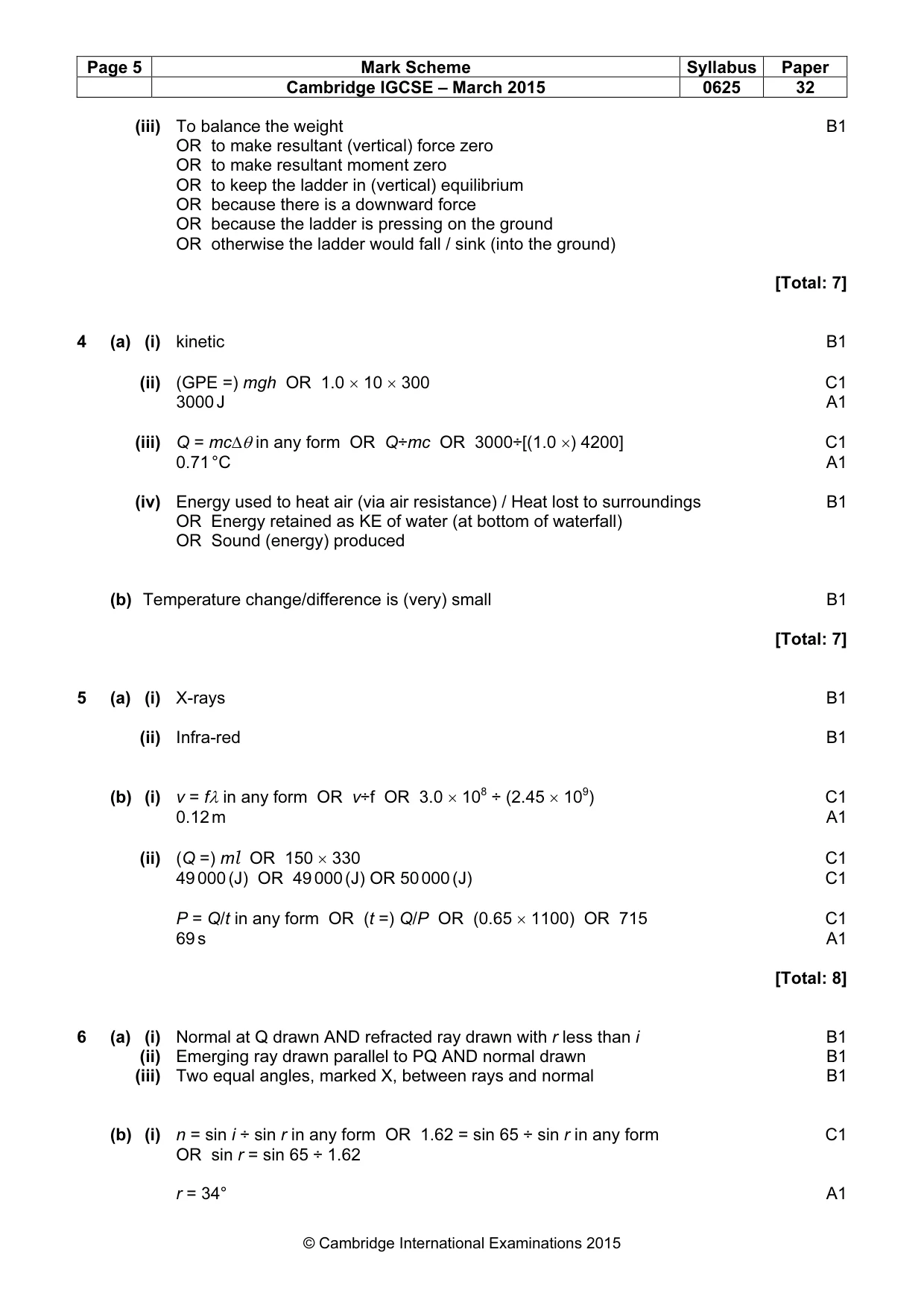
Mark scheme: 1 (a) (i) a = (v – u)÷t OR a = ∆v÷t in any form OR in words in any form AND with correct numbers substituted B1 (ii) Straight line from origin to point (3.2 s, 32 m / s) B1 (iii) Area under graph OR ½ × 3.2 × 32 OR s = ½ at2 OR ½ × 10 × 3.22 C1 51 m A1 (b) (i) Air resistance increases B1 (ii) Graph line Y under graph line X B1 Graph has decreasing gradient B1 Graph extends to value of t greater than 3.5 s and greater than X B1 [Total: 8] 6 7
Q2 · The rocket shown in Fig
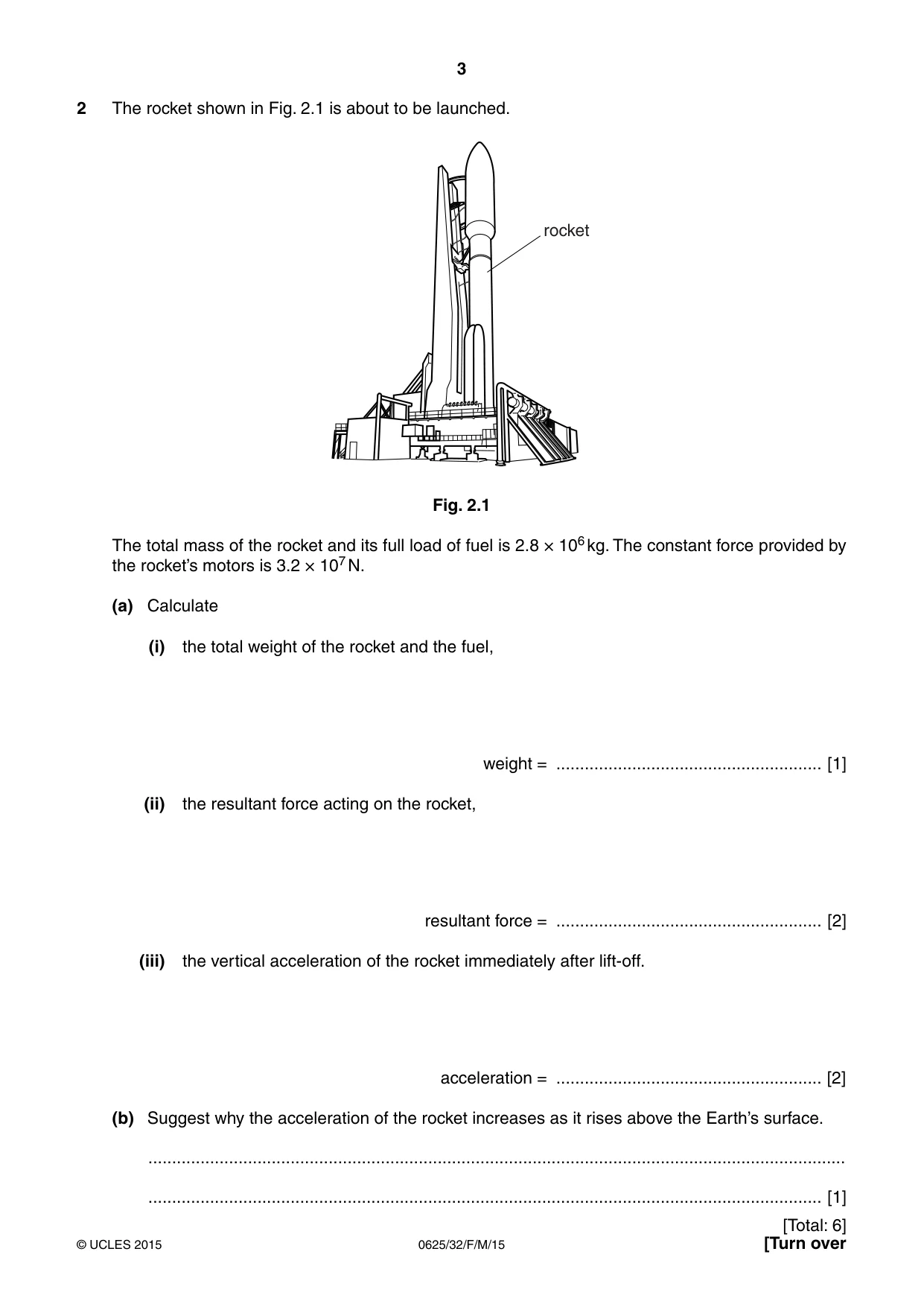
2 The rocket shown in Fig. 2.1 is about to be launched. rocket Fig. 2.1 The total mass of the rocket and its full load of fuel is 2.8 × 10⁶ kg. The constant force provided by the rocket’s motors is 3.2 × 10⁷ N. (a) Calculate (i) the total weight of the rocket and the fuel, weight = ........................................................ [1] (ii) the resultant force acting on the rocket, resultant force = ........................................................ [2] (iii) the vertical acceleration of the rocket immediately after lift-off. acceleration = ........................................................ [2] (b) Suggest why the acceleration of the rocket increases as it rises above the Earth’s surface. ................................................................................................................................................... .............................................................................................................................................. [1] [Total: 6]
Mark scheme: 2 (a) (i) (W = mg = 2.8 × 106 × 10 =) 2.8 × 10⁷ N B1 (ii) 3.2 × 10⁷ – 2.8 × 10⁷ C1 4.0 × 10⁶ OR 0.4 × 10⁷ N A1 (iii) F = ma in any form OR (a =) F÷m OR 4.0 × 10⁶÷(2.8 × 10⁶) C1 1.4 m / s2 A1 (b) Mass of rocket decreases (as fuel is used up) OR Value of g/gravitational force on rocket decreases as rocket rises B1 OR Air resistance decreases [Total: 6]
Q3 · Complete the following statement
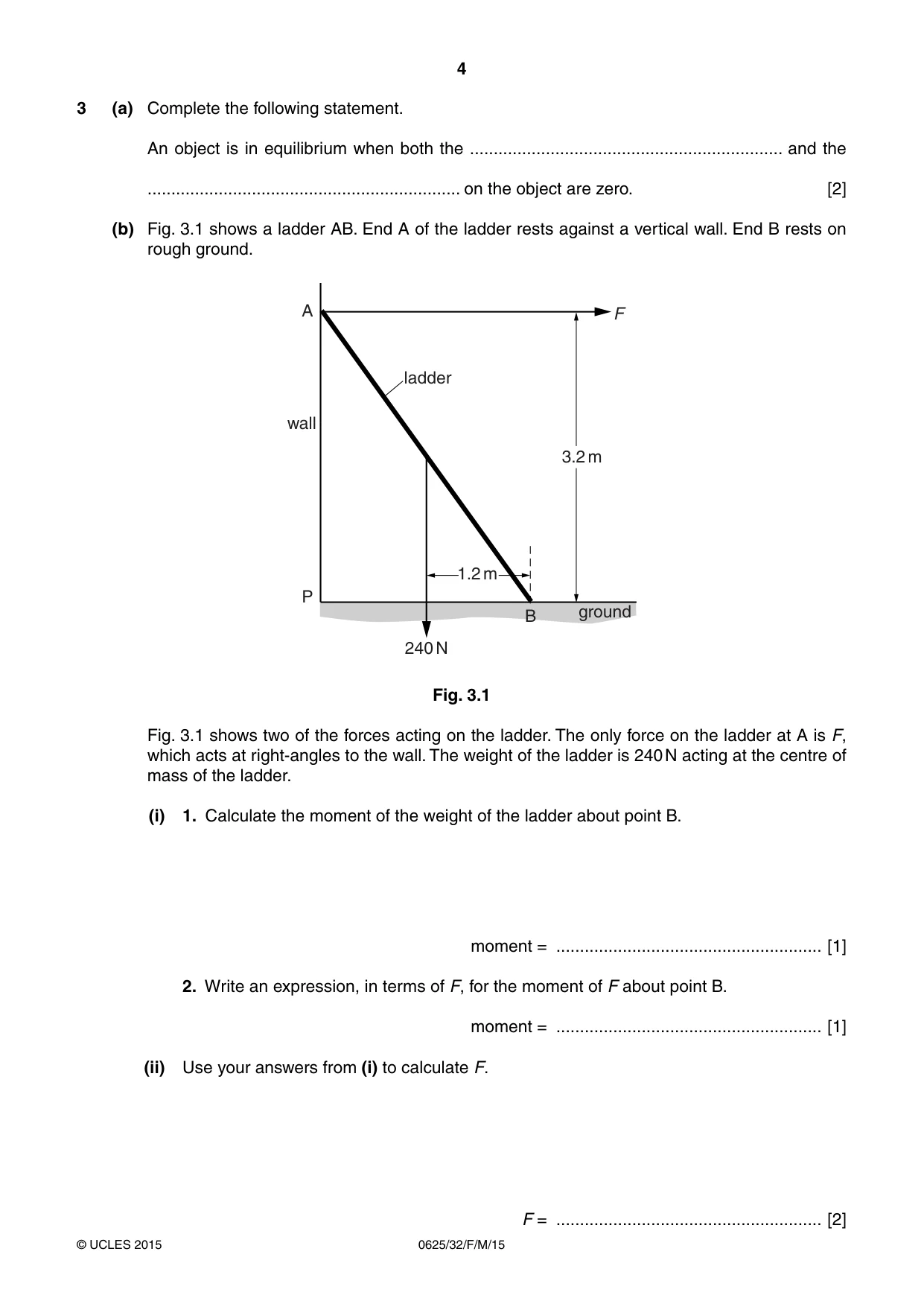
3 (a) Complete the following statement. An object is in equilibrium when both the .................................................................. and the .................................................................. on the object are zero. [2] (b) Fig. 3.1 shows a ladder AB. End A of the ladder rests against a vertical wall. End B rests on rough ground. A F ladder wall 3.2 m 1.2 m P B ground 240 N Fig. 3.1 Fig. 3.1 shows two of the forces acting on the ladder. The only force on the ladder at A is F, which acts at right-angles to the wall. The weight of the ladder is 240 N acting at the centre of mass of the ladder. (i) 1. Calculate the moment of the weight of the ladder about point B. moment = ........................................................ [1] 2. Write an expression, in terms of F, for the moment of F about point B. moment = ........................................................ [1] (ii) Use your answers from (i) to calculate F. F = ........................................................ [2] (iii) Explain why there must be an upwards force acting on the ladder at B. ........................................................................................................................................... ...................................................................................................................................... [1] [Total: 7]
Mark scheme: 3 (a) Note: answers in either order Resultant/net/total force B1 Resultant/net/ total turning effect/moment/torque/couple B1 (b) (i) 1. (240 × 1.2 =) 290 (N m) B1 2. F × 3.2 B1 (ii) F × 3.2 = 288 C1 90 N A1 (iii) To balance the weight B1 OR to make resultant (vertical) force zero OR to make resultant moment zero OR to keep the ladder in (vertical) equilibrium OR because there is a downward force OR because the ladder is pressing on the ground OR otherwise the ladder would fall / sink (into the ground) [Total: 7]
Q4 · A scientist finds that the temperature of the water at the bottom of waterfalls is…
4 A scientist finds that the temperature of the water at the bottom of waterfalls is greater than the temperature of the water at the tops of those waterfalls. (a) (i) State the type of energy that falling water has because of its motion. ...................................................................................................................................... [1] (ii) In one waterfall, the water falls 300 m. Calculate the decrease in the gravitational potential energy (g.p.e.) of 1.0 kg of water as it falls through this distance. decrease in g.p.e. = ........................................................ [2] (iii) Assume that the increase in internal energy of the 1.0 kg of water is equal to its decrease in g.p.e. Calculate the rise in temperature of the water. The specific heat capacity of water is 4200 J / (kg °C). rise in temperature = ........................................................ [2] (iv) Suggest a reason why the actual increase in temperature of the water is less than the value calculated in (a)(iii). ........................................................................................................................................... ...................................................................................................................................... [1] (b) State why the thermometer used to measure the temperature of the water in the scientist’s experiment required a high sensitivity. ................................................................................................................................................... .............................................................................................................................................. [1] [Total: 7]
Mark scheme: 4 (a) (i) kinetic B1 (ii) (GPE =) mgh OR 1.0 × 10 × 300 C1 3000 J A1 (iii) Q = mc∆θ in any form OR Q÷mc OR 3000÷[(1.0 ×) 4200] C1 0.71 °C A1 (iv) Energy used to heat air (via air resistance) / Heat lost to surroundings B1 OR Energy retained as KE of water (at bottom of waterfall) OR Sound (energy) produced (b) Temperature change/difference is (very) small B1 [Total: 7]
Q5 · State the type of electromagnetic radiation (i) used in luggage security checks at…
5 (a) State the type of electromagnetic radiation (i) used in luggage security checks at airports, ........................................................................................................................................... (ii) used by remote controls for TV sets. ........................................................................................................................................... [2] (b) (i) The electromagnetic waves used in a microwave oven have a frequency of 2.45 × 10⁹ Hz. The speed of the waves is 3.00 × 10⁸ m / s. Calculate the wavelength of the waves. wavelength = ........................................................ [2] (ii) A 150 g block of ice at 0 °C is placed in the oven. The input power of the oven is 1100 W. The energy absorbed by the block is 65% of the input energy. Calculate the time taken to melt the ice to water at 0 °C. The specific latent heat of fusion of ice is 330 J / g. time = ........................................................ [4] [Total: 8]
Mark scheme: 5 (a) (i) X-rays B1 (ii) Infra-red B1 (b) (i) v = fλ in any form OR v÷f OR 3.0 × 10⁸ ÷ (2.45 × 10⁹) C1 0.12 m A1 (ii) (Q =) ml OR 150 × 330 C1 49 000 (J) OR 49 000 (J) OR 50 000 (J) C1 P = Q/t in any form OR (t =) Q/P OR (0.65 × 1100) OR 715 C1 69 s A1 [Total: 8]
Q6 · A glass block ABCD surrounded by air
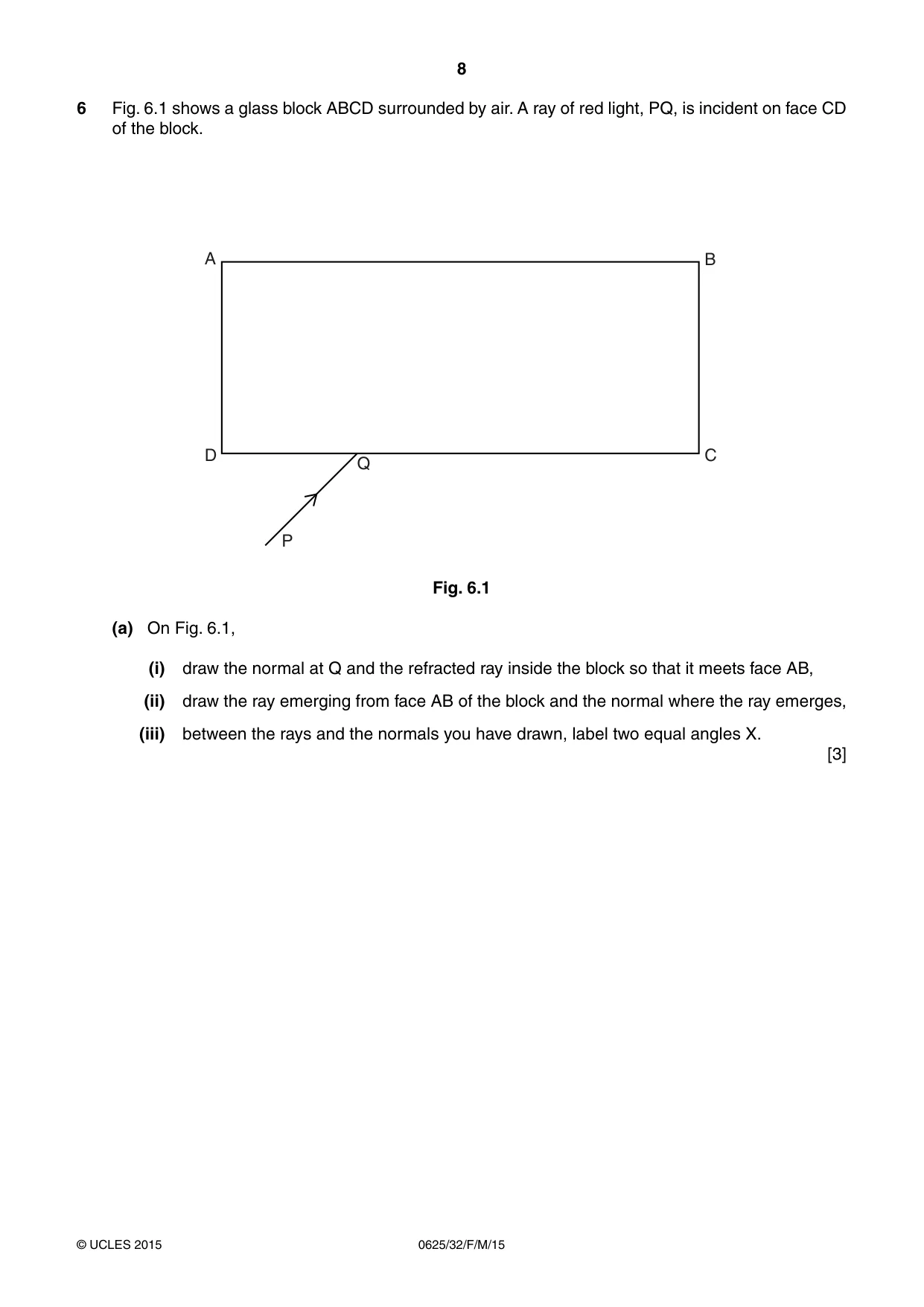
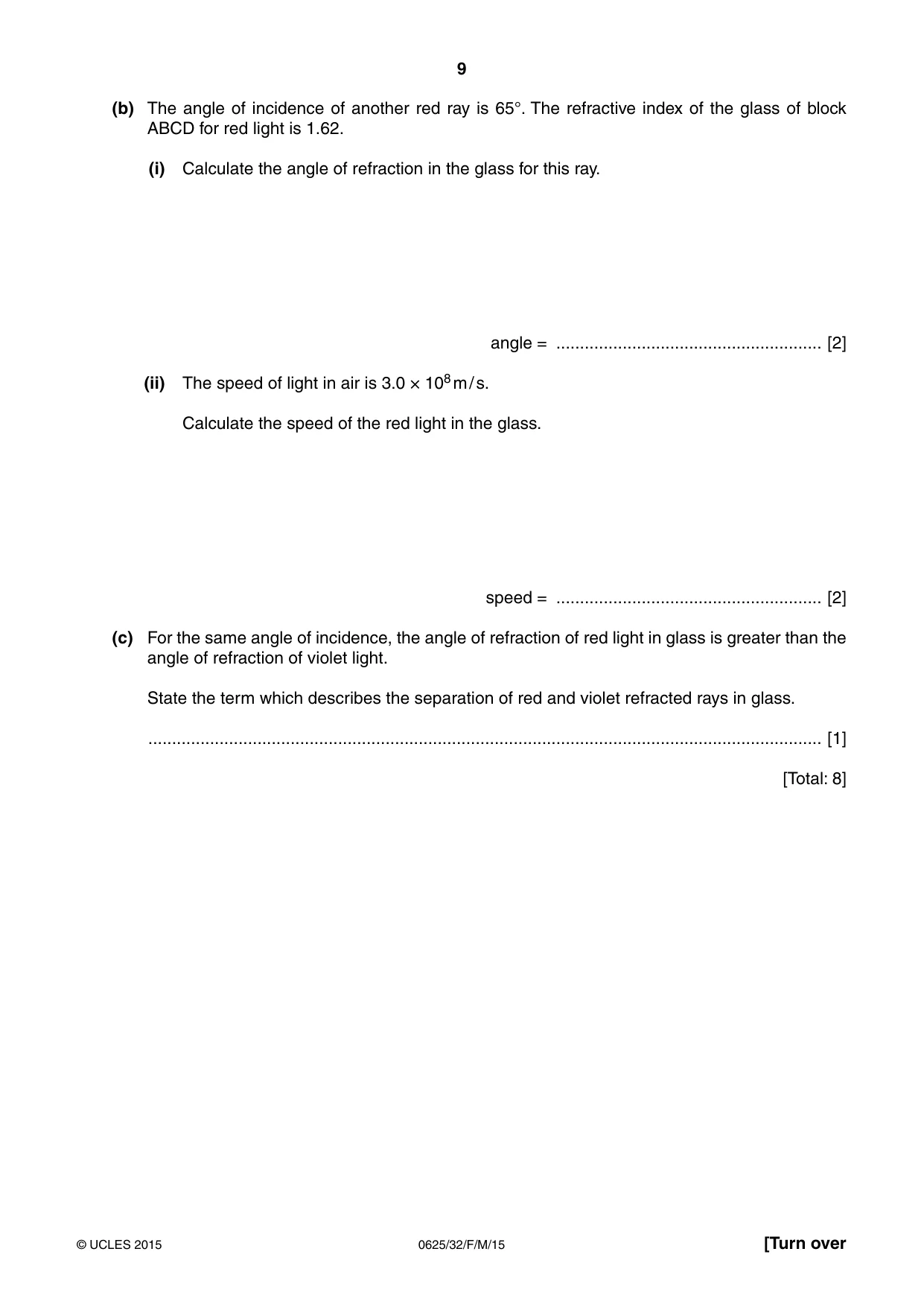
6 Fig. 6.1 shows a glass block ABCD surrounded by air. A ray of red light, PQ, is incident on face CD of the block. A B D C Q P Fig. 6.1 (a) On Fig. 6.1, (i) draw the normal at Q and the refracted ray inside the block so that it meets face AB, (ii) draw the ray emerging from face AB of the block and the normal where the ray emerges, (iii) between the rays and the normals you have drawn, label two equal angles X. [3] (b) The angle of incidence of another red ray is 65°. The refractive index of the glass of block ABCD for red light is 1.62. (i) Calculate the angle of refraction in the glass for this ray. angle = ........................................................ [2] (ii) The speed of light in air is 3.0 × 10⁸ m / s. Calculate the speed of the red light in the glass. speed = ........................................................ [2] (c) For the same angle of incidence, the angle of refraction of red light in glass is greater than the angle of refraction of violet light. State the term which describes the separation of red and violet refracted rays in glass. .............................................................................................................................................. [1] [Total: 8]
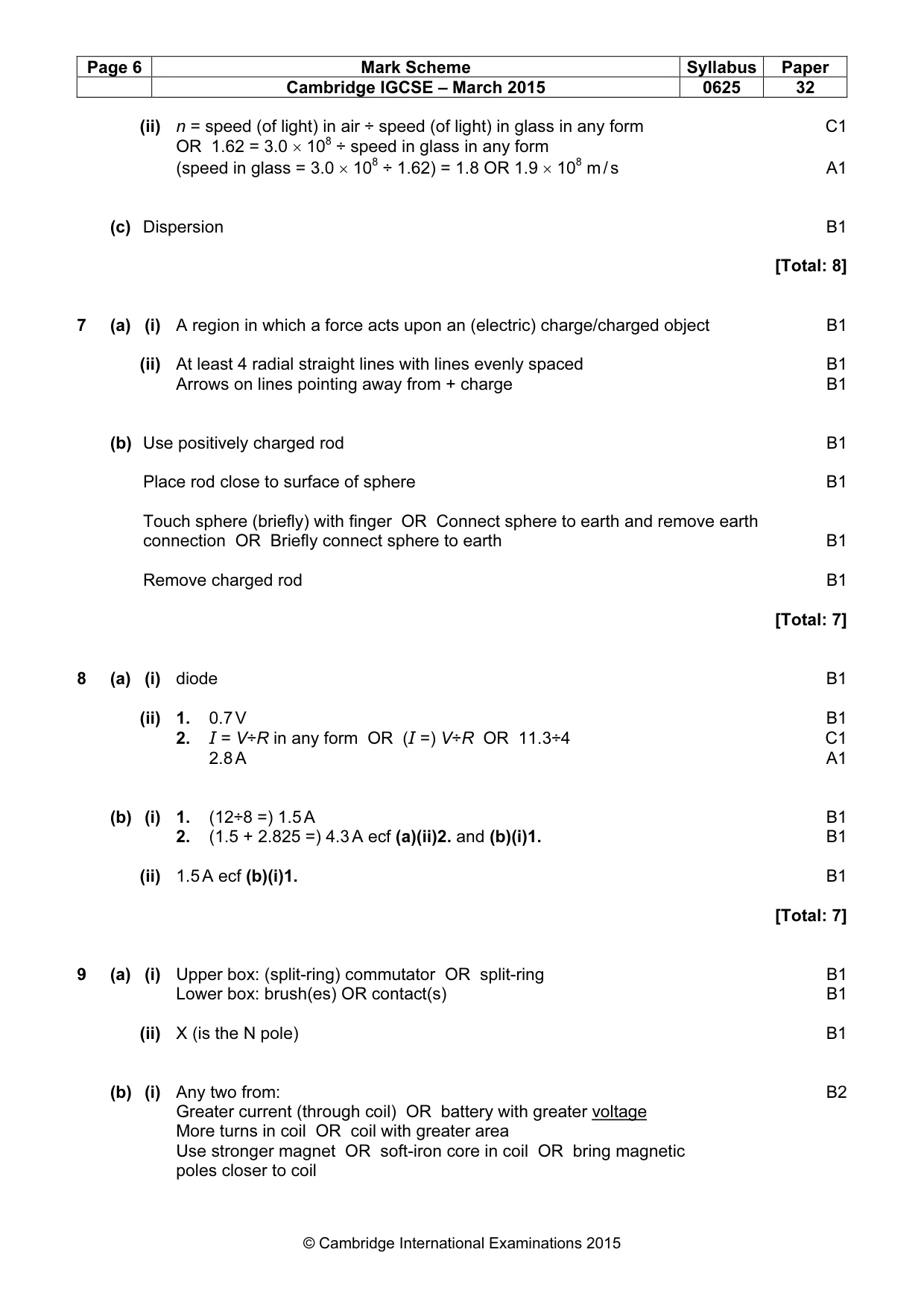
Mark scheme: 6 (a) (i) Normal at Q drawn AND refracted ray drawn with r less than i B1 (ii) Emerging ray drawn parallel to PQ AND normal drawn B1 (iii) Two equal angles, marked X, between rays and normal B1 (b) (i) n = sin i ÷ sin r in any form OR 1.62 = sin 65 ÷ sin r in any form C1 OR sin r = sin 65 ÷ 1.62 r = 34° A1 (ii) n = speed (of light) in air ÷ speed (of light) in glass in any form C1 OR 1.62 = 3.0 × 10⁸ ÷ speed in glass in any form (speed in glass = 3.0 × 10⁸ ÷ 1.62) = 1.8 OR 1.9 × 10⁸ m / s A1 (c) Dispersion B1 [Total: 8]
Q7 · State what is meant by an electric field
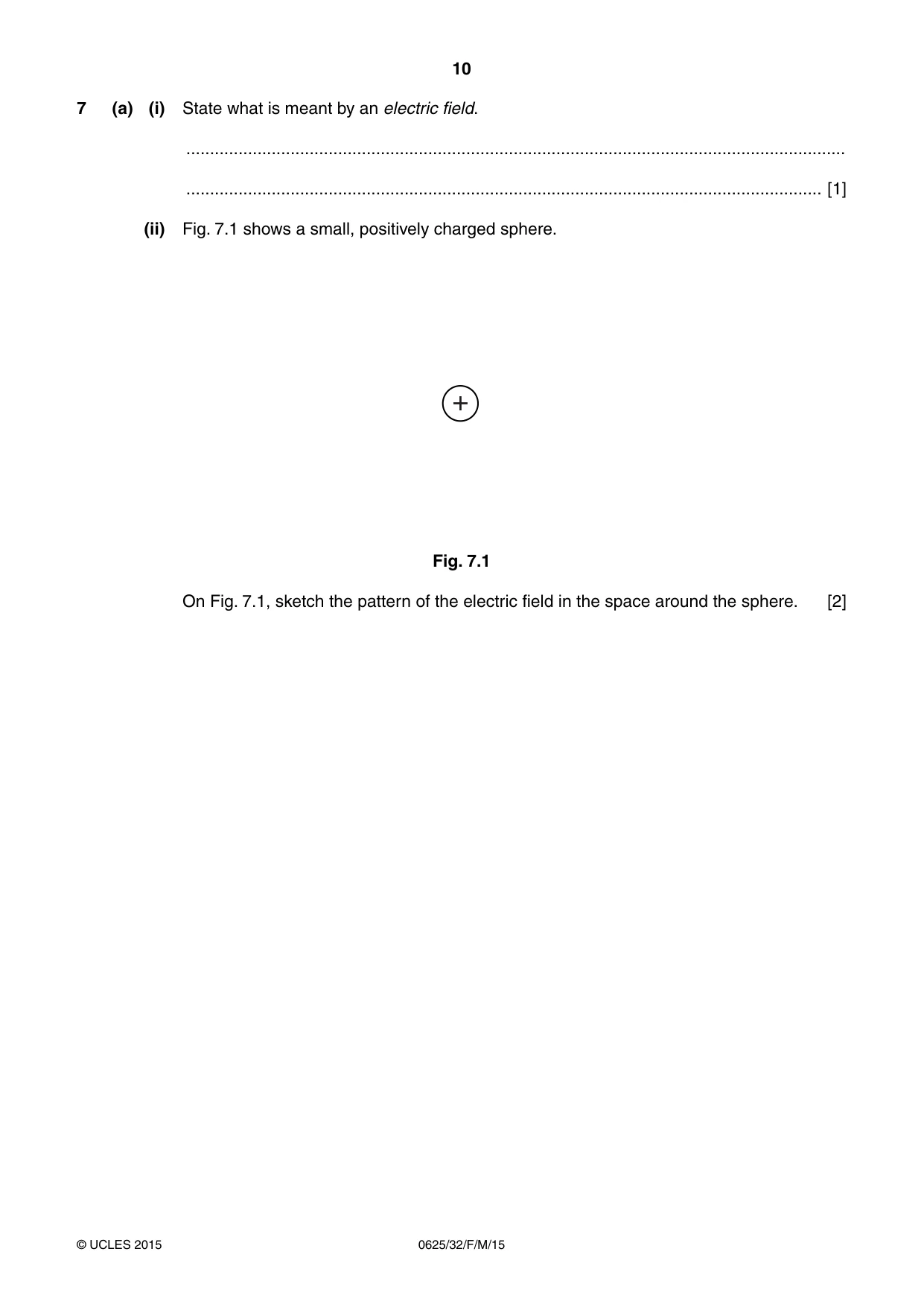
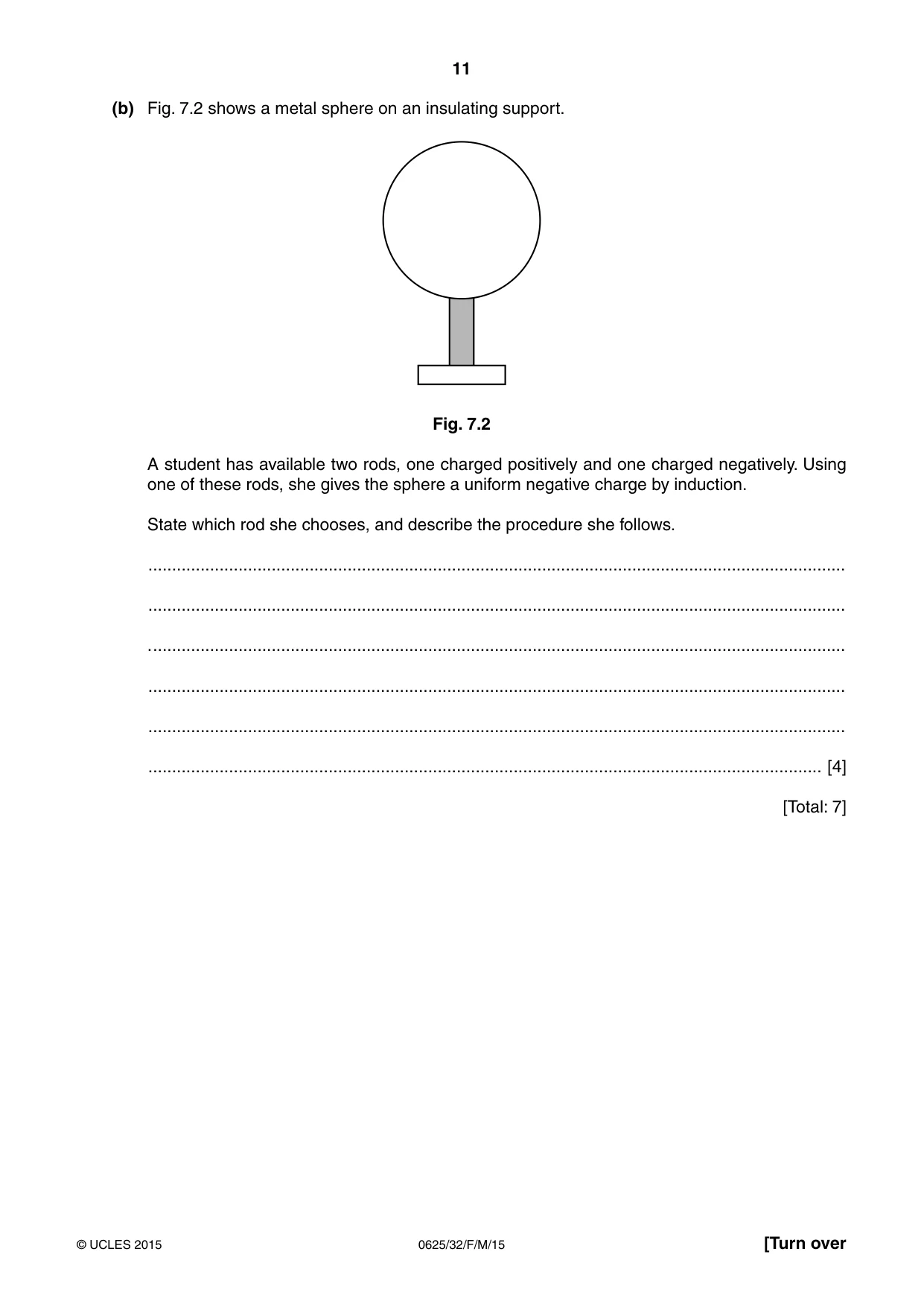
7 (a) (i) State what is meant by an electric field. ........................................................................................................................................... ...................................................................................................................................... [1] (ii) Fig. 7.1 shows a small, positively charged sphere. + Fig. 7.1 On Fig. 7.1, sketch the pattern of the electric field in the space around the sphere. [2] (b) Fig. 7.2 shows a metal sphere on an insulating support. Fig. 7.2 A student has available two rods, one charged positively and one charged negatively. Using one of these rods, she gives the sphere a uniform negative charge by induction. State which rod she chooses, and describe the procedure she follows. ................................................................................................................................................... ................................................................................................................................................... . .................................................................................................................................................. ................................................................................................................................................... ................................................................................................................................................... .............................................................................................................................................. [4] [Total: 7]
Mark scheme: 7 (a) (i) A region in which a force acts upon an (electric) charge/charged object B1 (ii) At least 4 radial straight lines with lines evenly spaced B1 Arrows on lines pointing away from + charge B1 (b) Use positively charged rod B1 Place rod close to surface of sphere B1 Touch sphere (briefly) with finger OR Connect sphere to earth and remove earth connection OR Briefly connect sphere to earth B1 Remove charged rod B1 [Total: 7]
Q8 · A 12.0 V battery connected to a resistor and a component X in series
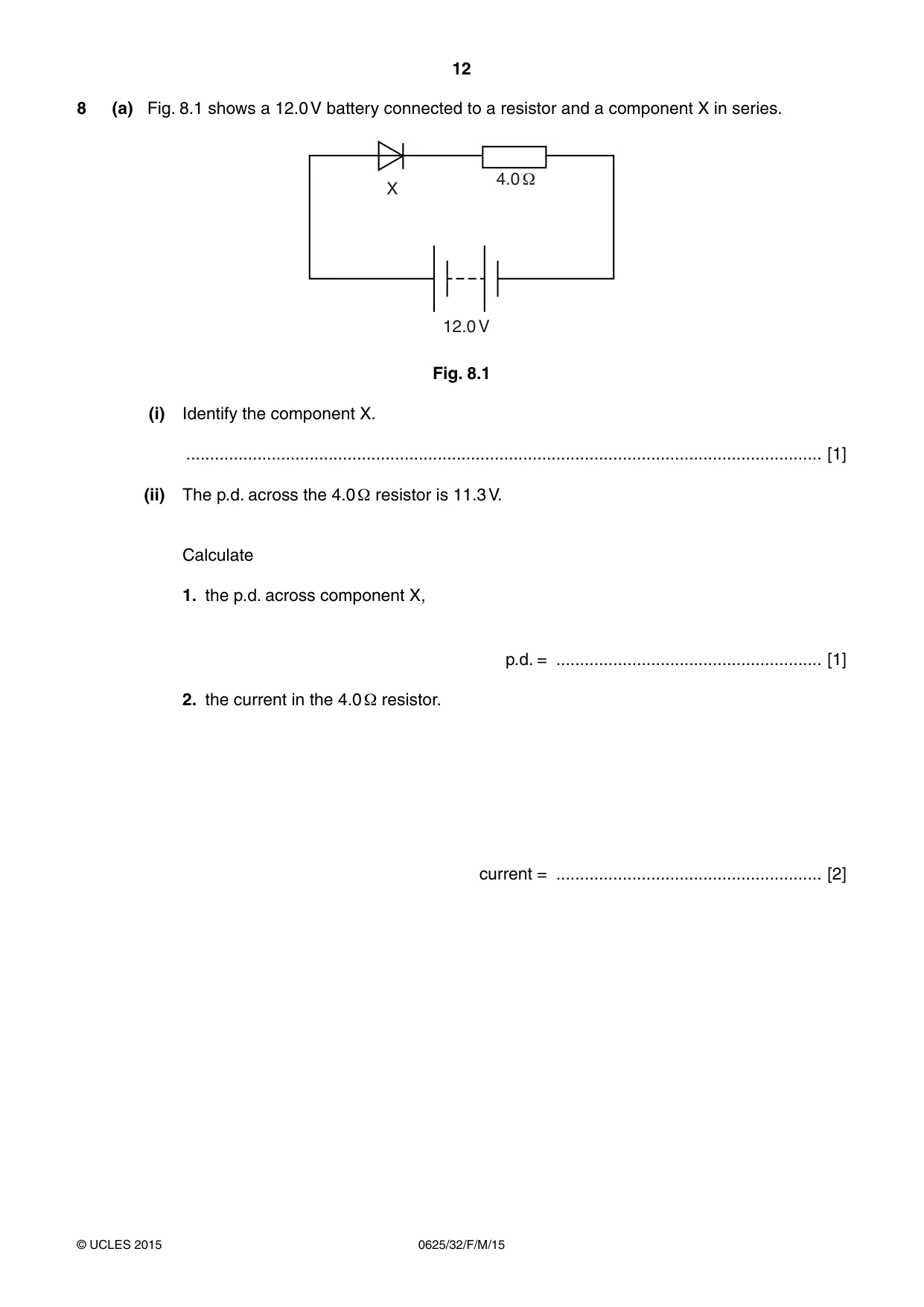
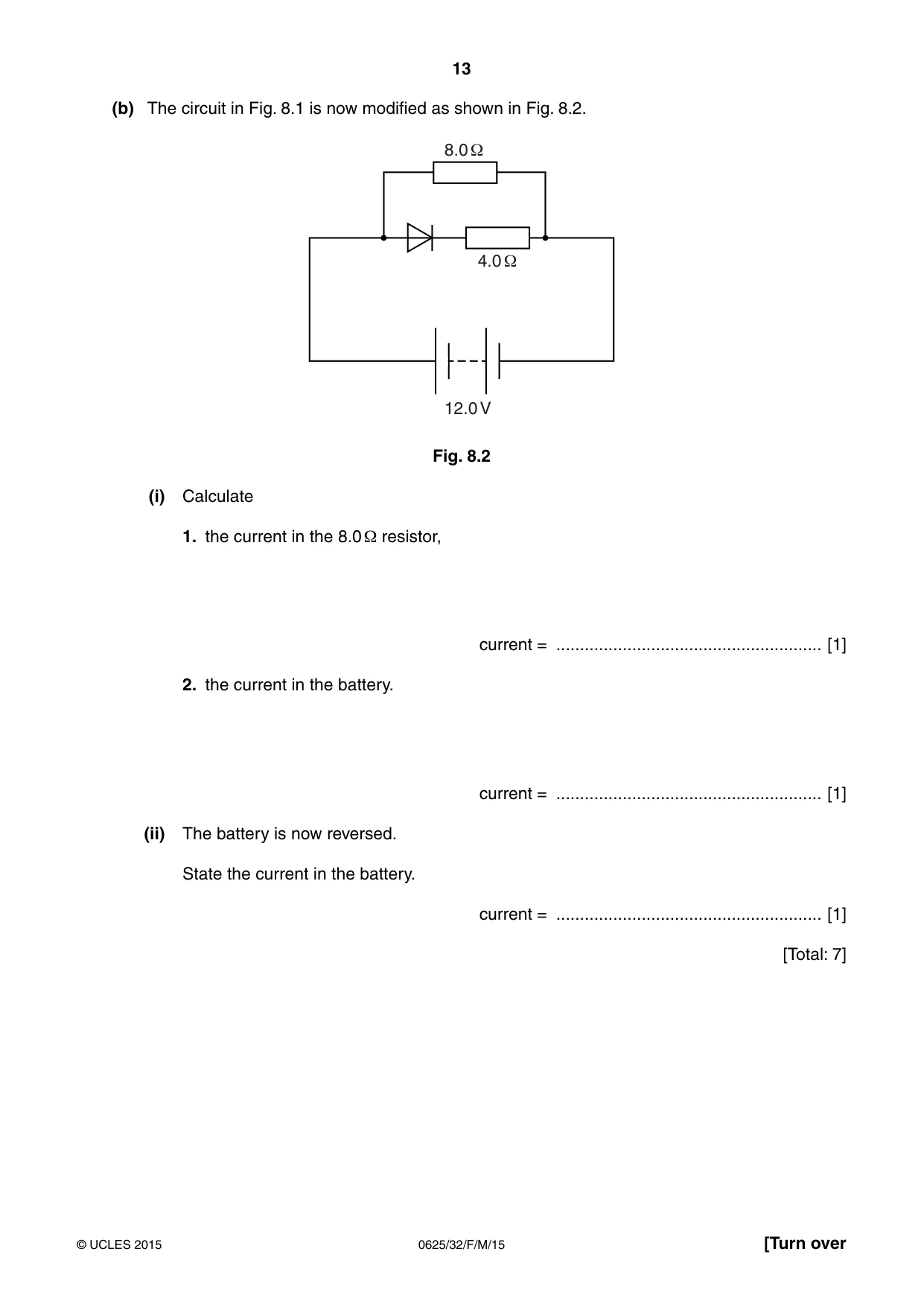
8 (a) Fig. 8.1 shows a 12.0 V battery connected to a resistor and a component X in series. 4.0 1 X 12.0 V Fig. 8.1 (i) Identify the component X. ...................................................................................................................................... [1] (ii) The p.d. across the 4.0 Ω resistor is 11.3 V. Calculate 1. the p.d. across component X, p.d. = ........................................................ [1] 2. the current in the 4.0 Ω resistor. current = ........................................................ [2] (b) The circuit in Fig. 8.1 is now modified as shown in Fig. 8.2. 8.0 1 4.0 1 12.0 V Fig. 8.2 (i) Calculate 1. the current in the 8.0 Ω resistor, current = ........................................................ [1] 2. the current in the battery. current = ........................................................ [1] (ii) The battery is now reversed. State the current in the battery. current = ........................................................ [1] [Total: 7]
Mark scheme: 8 (a) (i) diode B1 (ii) 1. 0.7 V B1 2. I = V÷R in any form OR (I =) V÷R OR 11.3÷4 C1 2.8 A A1 (b) (i) 1. (12÷8 =) 1.5 A B1 2. (1.5 + 2.825 =) 4.3 A ecf (a)(ii)2. and (b)(i)1. B1 (ii) 1.5 A ecf (b)(i)1. B1 [Total: 7]
Q9 · A simple electric motor with a single rectangular coil between magnetic poles X and Y
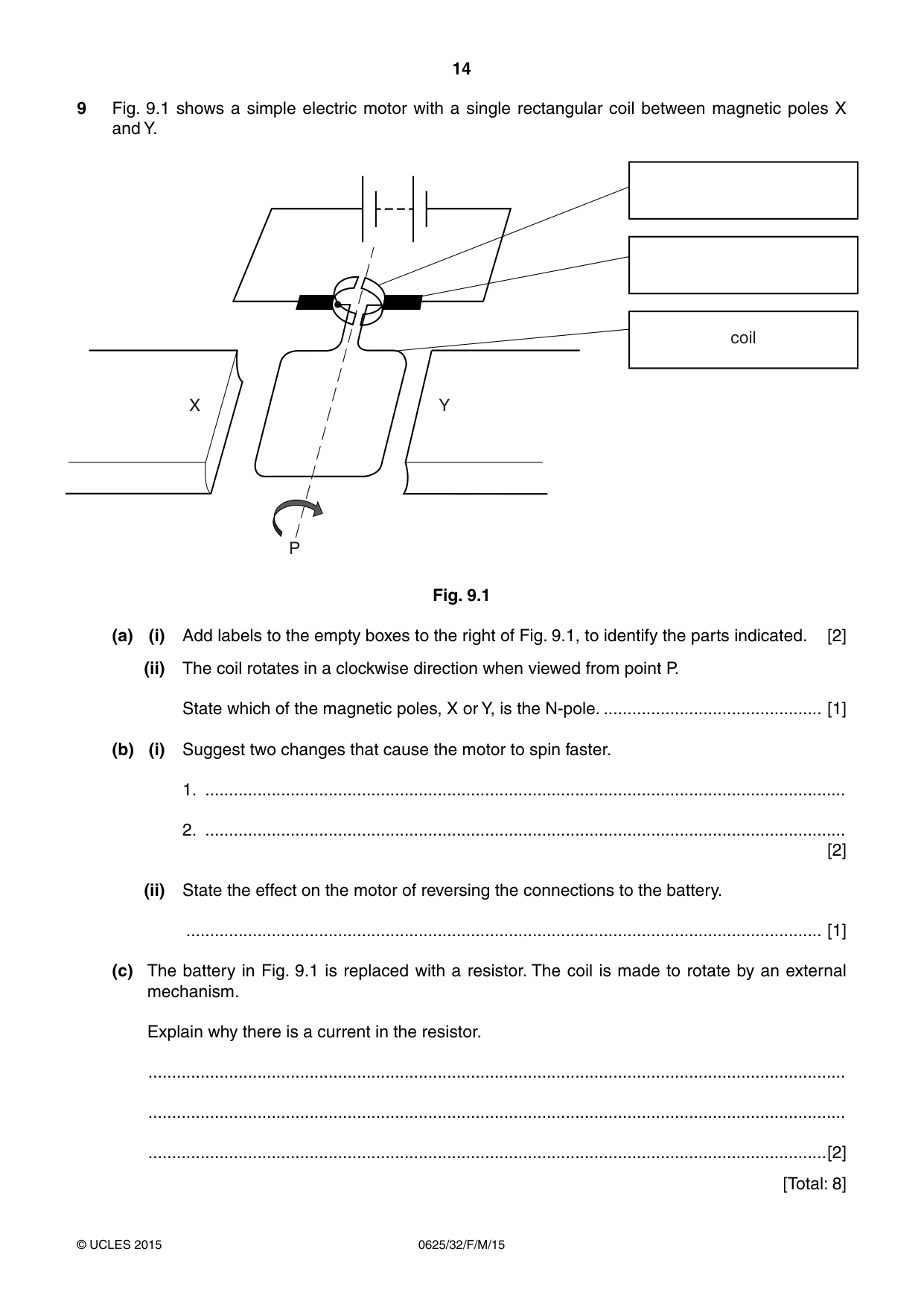
9 Fig. 9.1 shows a simple electric motor with a single rectangular coil between magnetic poles X and Y. coil X Y P Fig. 9.1 (a) (i) Add labels to the empty boxes to the right of Fig. 9.1, to identify the parts indicated. [2] (ii) The coil rotates in a clockwise direction when viewed from point P. State which of the magnetic poles, X or Y, is the N-pole. .............................................. [1] (b) (i) Suggest two changes that cause the motor to spin faster. 1. ....................................................................................................................................... 2. ....................................................................................................................................... [2] (ii) State the effect on the motor of reversing the connections to the battery. ...................................................................................................................................... [1] (c) The battery in Fig. 9.1 is replaced with a resistor. The coil is made to rotate by an external mechanism. Explain why there is a current in the resistor. ................................................................................................................................................... ................................................................................................................................................... ...............................................................................................................................................[2] [Total: 8]
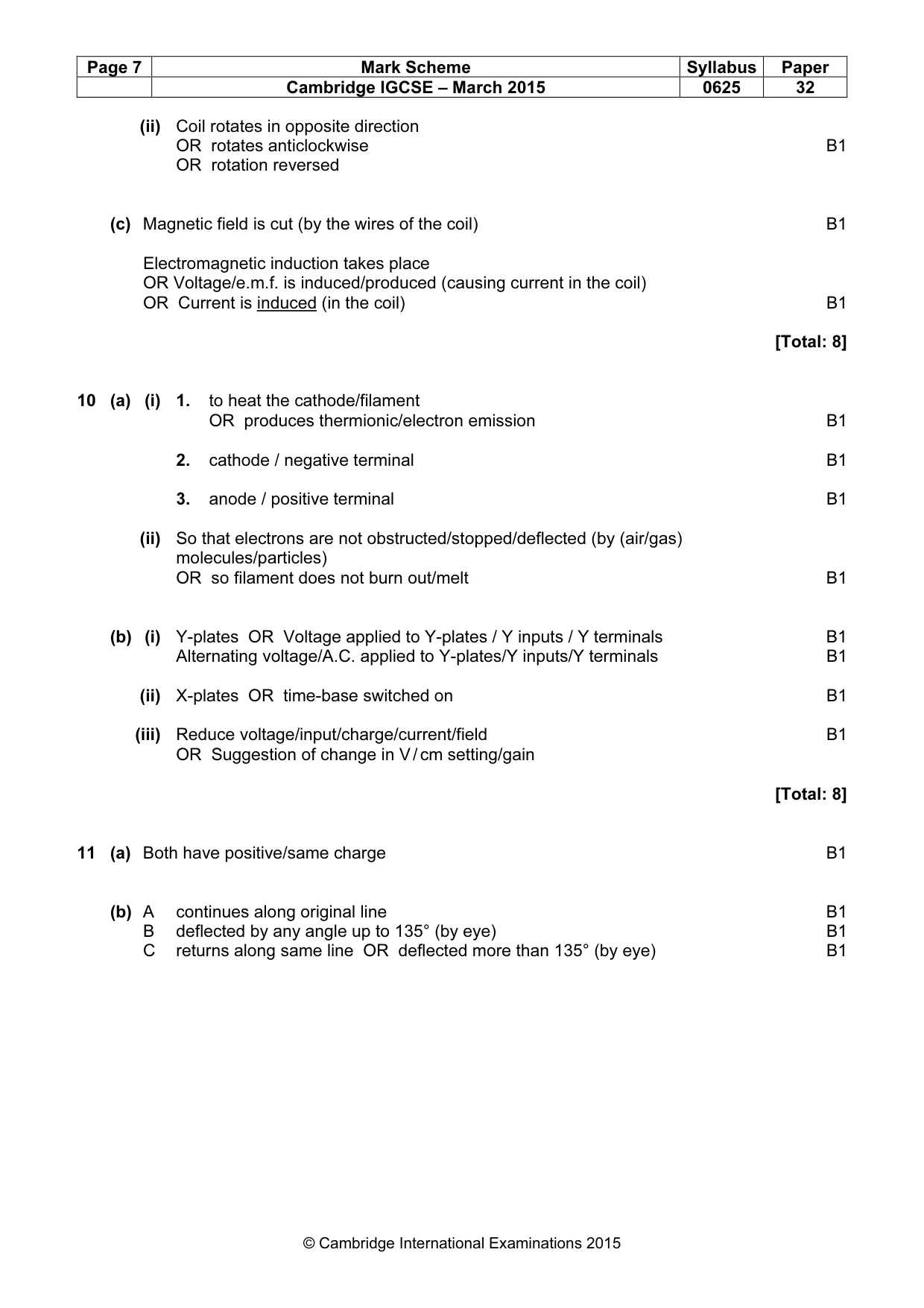
Mark scheme: 9 (a) (i) Upper box: (split-ring) commutator OR split-ring B1 Lower box: brush(es) OR contact(s) B1 (ii) X (is the N pole) B1 (b) (i) Any two from: B2 Greater current (through coil) OR battery with greater voltage More turns in coil OR coil with greater area Use stronger magnet OR soft-iron core in coil OR bring magnetic poles closer to coil (ii) Coil rotates in opposite direction OR rotates anticlockwise B1 OR rotation reversed (c) Magnetic field is cut (by the wires of the coil) B1 Electromagnetic induction takes place OR Voltage/e.m.f. is induced/produced (causing current in the coil) OR Current is induced (in the coil) B1 [Total: 8]
Q10 · Some older types of oscilloscope contain a cathode-ray tube
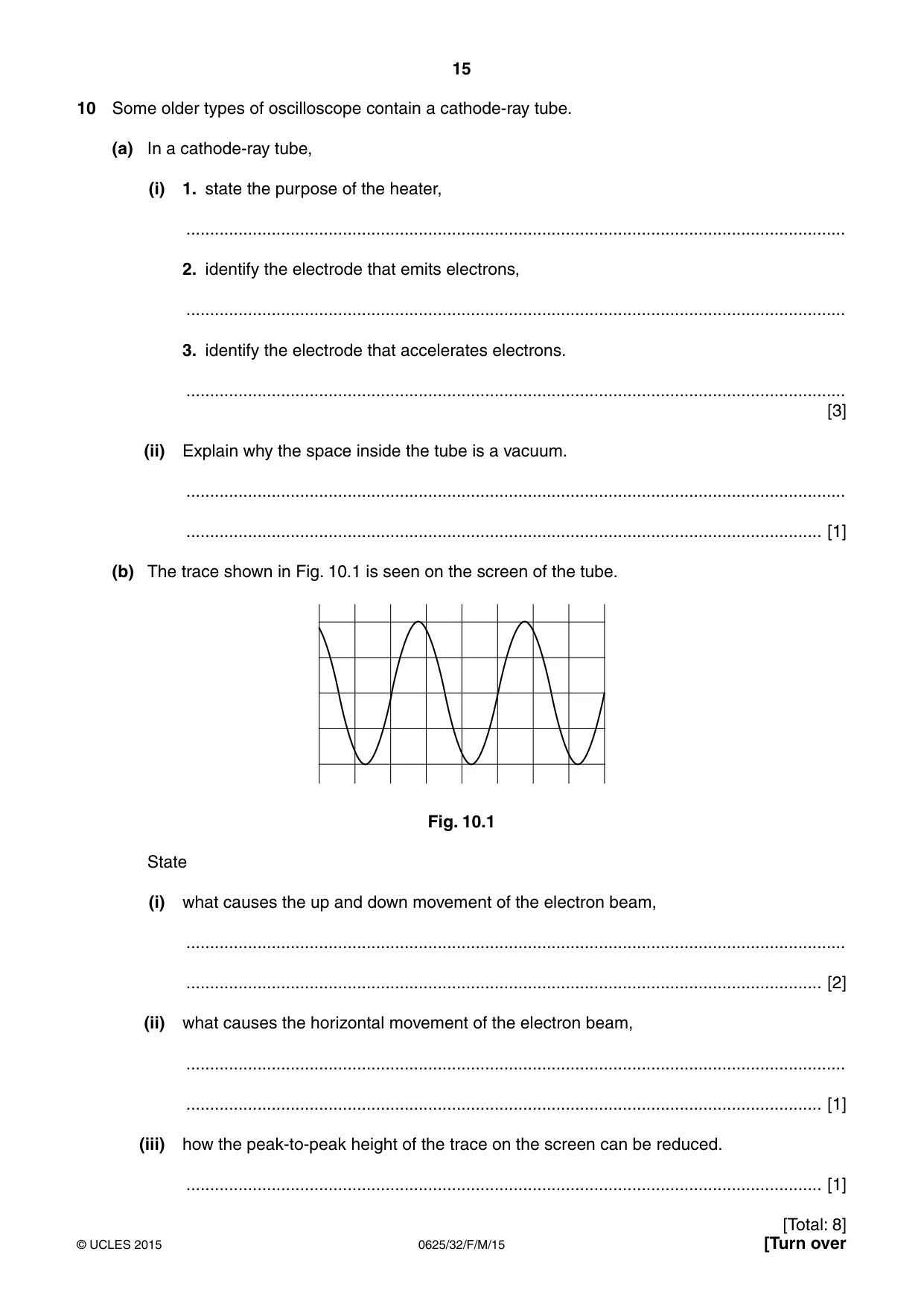
10 Some older types of oscilloscope contain a cathode-ray tube. (a) In a cathode-ray tube, (i) 1. state the purpose of the heater, ........................................................................................................................................... 2. identify the electrode that emits electrons, ........................................................................................................................................... 3. identify the electrode that accelerates electrons. ........................................................................................................................................... [3] (ii) Explain why the space inside the tube is a vacuum. ........................................................................................................................................... ...................................................................................................................................... [1] (b) The trace shown in Fig. 10.1 is seen on the screen of the tube. Fig. 10.1 State (i) what causes the up and down movement of the electron beam, ........................................................................................................................................... ...................................................................................................................................... [2] (ii) what causes the horizontal movement of the electron beam, ........................................................................................................................................... ...................................................................................................................................... [1] (iii) how the peak-to-peak height of the trace on the screen can be reduced. ...................................................................................................................................... [1] [Total: 8]
Mark scheme: 10 (a) (i) 1. to heat the cathode/filament OR produces thermionic/electron emission B1 2. cathode / negative terminal B1 3. anode / positive terminal B1 (ii) So that electrons are not obstructed/stopped/deflected (by (air/gas) molecules/particles) OR so filament does not burn out/melt B1 (b) (i) Y-plates OR Voltage applied to Y-plates / Y inputs / Y terminals B1 Alternating voltage/A.C. applied to Y-plates/Y inputs/Y terminals B1 (ii) X-plates OR time-base switched on B1 (iii) Reduce voltage/input/charge/current/field B1 OR Suggestion of change in V / cm setting/gain [Total: 8]
Q11 · In a famous experiment, a beam consisting of a very large number of α-particles was…
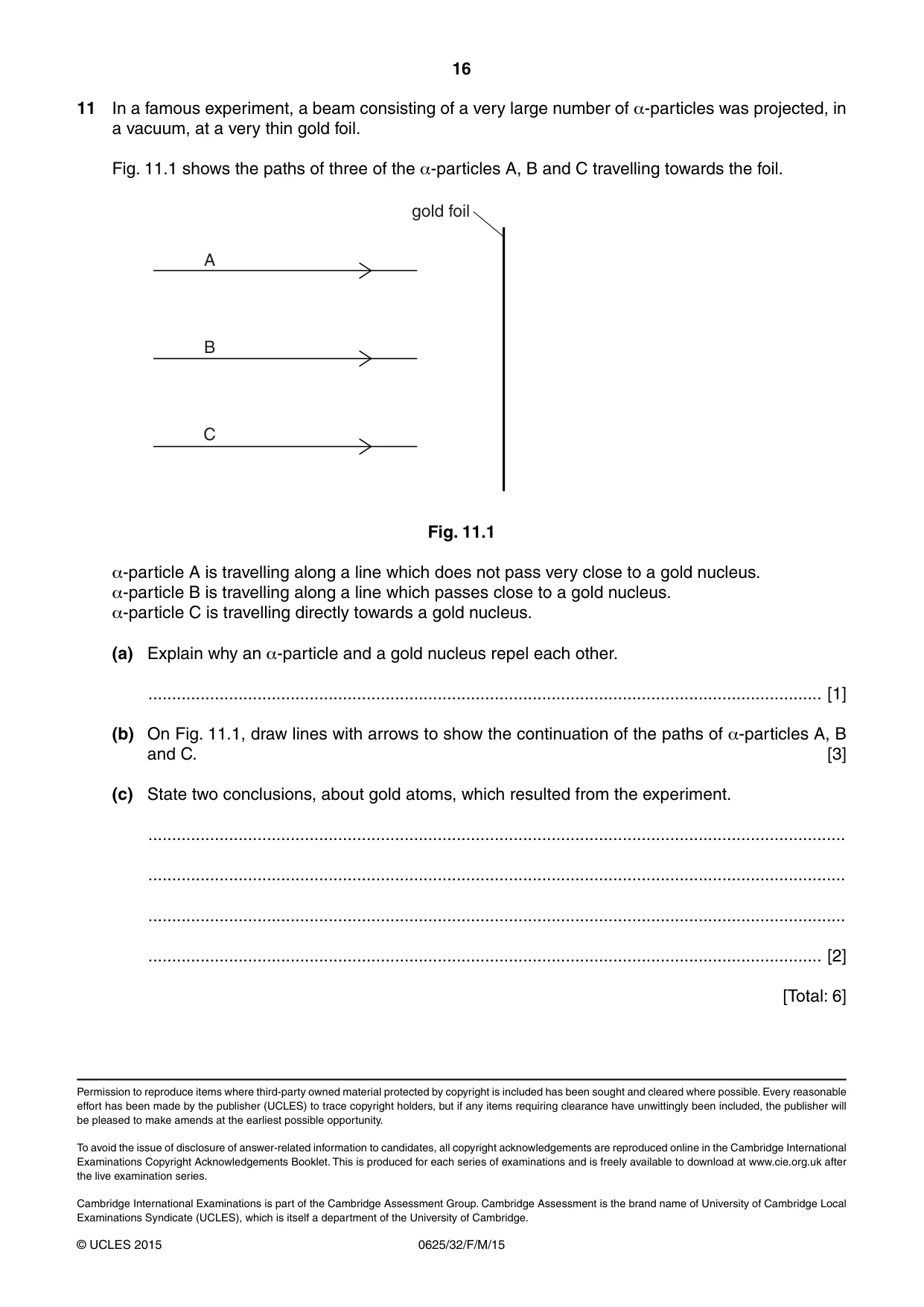
11 In a famous experiment, a beam consisting of a very large number of α-particles was projected, in a vacuum, at a very thin gold foil. Fig. 11.1 shows the paths of three of the α-particles A, B and C travelling towards the foil. gold foil A B C Fig. 11.1 α-particle A is travelling along a line which does not pass very close to a gold nucleus. α-particle B is travelling along a line which passes close to a gold nucleus. α-particle C is travelling directly towards a gold nucleus. (a) Explain why an α-particle and a gold nucleus repel each other. .............................................................................................................................................. [1] (b) On Fig. 11.1, draw lines with arrows to show the continuation of the paths of α-particles A, B and C. [3] (c) State two conclusions, about gold atoms, which resulted from the experiment. ................................................................................................................................................... ................................................................................................................................................... ................................................................................................................................................... .............................................................................................................................................. [2] [Total: 6]
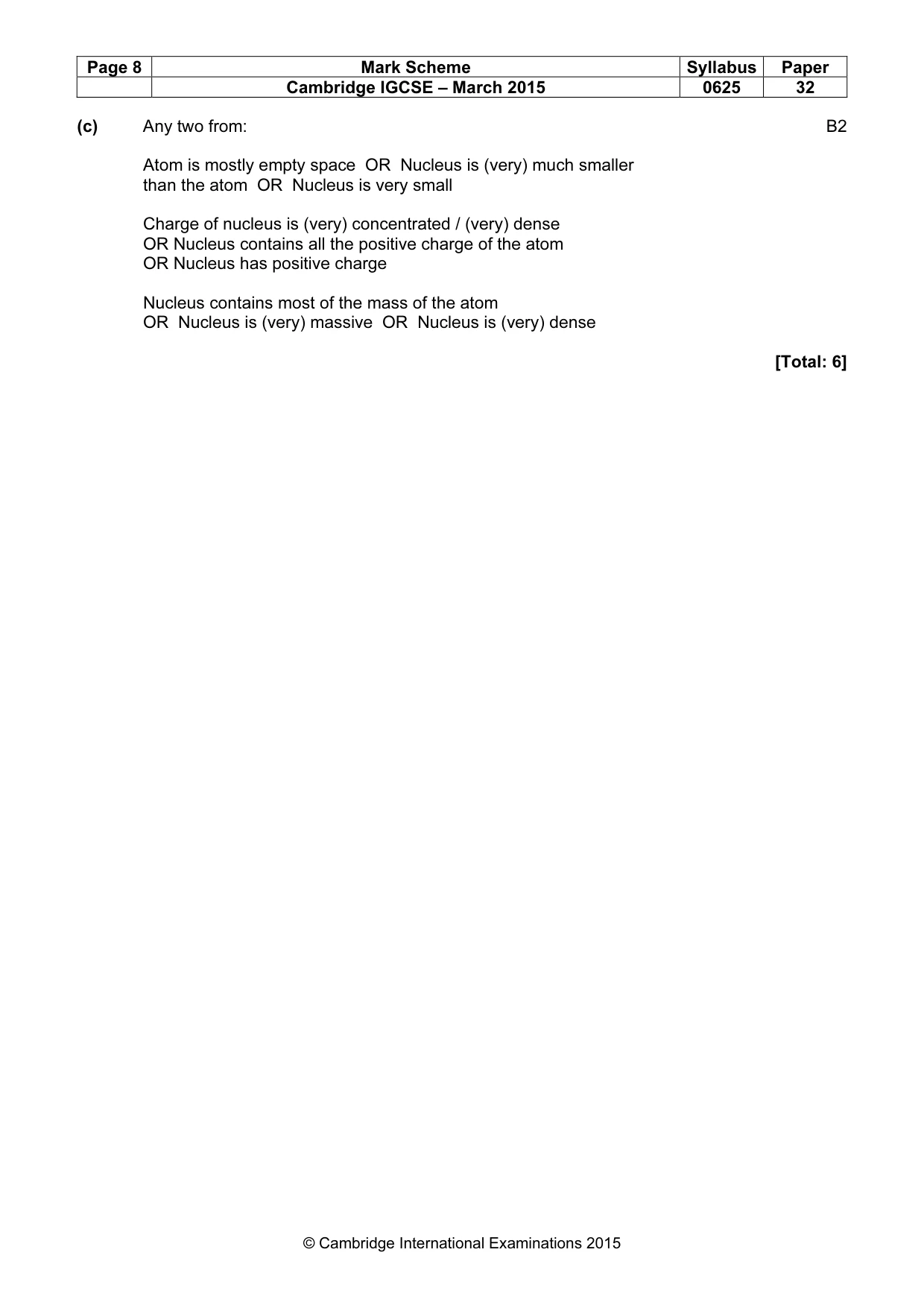
Mark scheme: 11 (a) Both have positive/same charge B1 (b) A continues along original line B1 B deflected by any angle up to 135° (by eye) B1 C returns along same line OR deflected more than 135° (by eye) B1 (c) Any two from: B2 Atom is mostly empty space OR Nucleus is (very) much smaller than the atom OR Nucleus is very small Charge of nucleus is (very) concentrated / (very) dense OR Nucleus contains all the positive charge of the atom OR Nucleus has positive charge Nucleus contains most of the mass of the atom OR Nucleus is (very) massive OR Nucleus is (very) dense [Total: 6]
What was in this paper
The subtopics covered by these 11 questions, and how many questions each got. Open one in a new tab to see every Cambridge question on it.
What you needed in this session
Cambridge’s own grade thresholds for 2015 Feb/March, Paper 3 · Variant 2. A higher threshold means an easier paper — the bar moves with how the cohort did.