Questions as text
Q1 · A particle of mass m strikes a vertical rigid wall perpendicularly from the left with… 9702/11 Oct/Nov 2004
11 A particle of mass m strikes a vertical rigid wall perpendicularly from the left with velocity v. v rigid wall m If the collision is perfectly elastic, the total change in momentum of the particle that occurs as a result of the collision is A 2mv to the right. B 2mv to the left. C mv to the right. D mv to the left.
1 marks
Answer: B
This question in 9702/11 Oct/Nov 2004
Q2 · Which is a statement of the principle of conservation of momentum? 9702/11 Oct/Nov 2005
9 Which is a statement of the principle of conservation of momentum? A A force is equal to the rate of change of momentum of the body upon which it acts. B In a perfectly elastic collision, the relative momentum of the bodies before impact is equal to their relative momentum after impact. C The momentum of a body is the product of the mass of the body and its velocity. D The total momentum of a system of interacting bodies remains constant, providing no external force acts.
1 marks
Answer: D
This question in 9702/11 Oct/Nov 2005
Q3 · In perfectly elastic collisions between two atoms, it is always true to say that A the… 9702/11 May/June 2006
11 In perfectly elastic collisions between two atoms, it is always true to say that A the initial speed of one atom will be the same as the final speed of the other atom. B the relative speed of approach between the two atoms equals their relative speed of separation. C the total momentum must be conserved, but a small amount of the total kinetic energy may be lost in the collision. D whatever their initial states of motion, neither atom can be stationary after the collision.
1 marks
Answer: B
This question in 9702/11 May/June 2006
Q4 · Two railway trucks of masses m and 3m move towards each other in opposite directions with… 9702/11 May/June 2006
12 Two railway trucks of masses m and 3m move towards each other in opposite directions with speeds 2v and v respectively. These trucks collide and stick together. What is the speed of the trucks after the collision? v v 5v A B C v D 4 2 4
1 marks
Answer: A
This question in 9702/11 May/June 2006
Q5 · The diagram shows two identical spheres X and Y 9702/11 Oct/Nov 2006
11 The diagram shows two identical spheres X and Y. v X Y Initially X moves with speed v directly towards Y. Y is stationary. The spheres collide elastically. What happens? X Y 1 v to the right 1 v to the right A moves with speed 2 moves with speed 2 B moves with speed v to the left remains stationary 1 v to the left 1 v to the right C moves with speed 2 moves with speed 2 D stops moves with speed v to the right
1 marks
Answer: D
This question in 9702/11 Oct/Nov 2006
Q6 · The diagram shows a cannon ball fired from a cannon 9702/11 Oct/Nov 2006
12 The diagram shows a cannon ball fired from a cannon. cannon cannon ball The mass of the cannon is 1000 kg and the mass of the cannon ball is 10 kg. The recoil velocity of the cannon is 5 m s–1 horizontally. What is the horizontal velocity of the cannon ball? A 200 m s–1 B 500 m s–1 C 2000 m s–1 D 5000 m s–1
1 marks
Answer: B
This question in 9702/11 Oct/Nov 2006
Q7 · The graph shows the variation with time of the momentum of a ball as it is kicked in a… 9702/11 May/June 2007
10 The graph shows the variation with time of the momentum of a ball as it is kicked in a straight line. p1 momentum 0 0 t1 t2 time p2 Initially, the momentum is p1 at time t1. At time t2 the momentum is p2. What is the magnitude of the average force acting on the ball between times t1 and t2? A p 1 − p 2 B p 1 − p 2 C p 1 + p 2 D p 1 + p 2 t 2 t 2 − t 1 t 2 t 2 − t 1
1 marks
Answer: B
This question in 9702/11 May/June 2007
Q8 · A lorry of mass 20 000 kg is travelling at 20.0 m s–1 9702/11 May/June 2007
11 A lorry of mass 20 000 kg is travelling at 20.0 m s–1. A car of mass 900 kg is travelling at 30.0 m s–1 towards the lorry. 20.0 m s _1 30.0 m s _1 mass of lorry mass of car 20 000 kg 900 kg What is the magnitude of the total momentum? A 209 kN s B 373 kN s C 427 kN s D 1045 kN s
1 marks
Answer: B
This question in 9702/11 May/June 2007
Q9 · The diagram shows the masses and velocities of two trolleys about to collide 9702/11 May/June 2007
12 The diagram shows the masses and velocities of two trolleys about to collide. 4 m s–1 1 m s–1 2 kg 4 kg After the impact they move off together. What is the total kinetic energy of the trolleys after the collision? A 1.3 J B 12 J C 18 J D 19 J
1 marks
Answer: B
This question in 9702/11 May/June 2007
Q10 · Which is a statement of the principle of conservation of momentum? 9702/11 May/June 2008
9 Which is a statement of the principle of conservation of momentum? A Momentum is the product of mass and velocity. B Momentum is conserved only in elastic collisions. C Momentum is conserved by all bodies in a collision. D Momentum is conserved providing no external forces act.
1 marks
Answer: D
This question in 9702/11 May/June 2008
Q11 · Two equal masses X and Y are moving towards each other on a frictionless air track as… 9702/11 May/June 2008
10 Two equal masses X and Y are moving towards each other on a frictionless air track as shown. The masses make an elastic collision. air track 50 cm s–1 30 cm s–1 X Y Which row gives possible velocities for the two masses after the collision? velocity of X velocity of Y A zero 20 cm s–1 to the right B 10 cm s–1 to the right 10 cm s–1 to the right C 20 cm s–1 to the left zero D 30 cm s–1 to the left 50 cm s–1 to the right
1 marks
Answer: D
This question in 9702/11 May/June 2008
Q12 · Which quantities are conserved in an inelastic collision? 9702/11 May/June 2008
17 Which quantities are conserved in an inelastic collision? kinetic energy total energy linear momentum A conserved not conserved conserved B conserved not conserved not conserved C not conserved conserved conserved D not conserved conserved not conserved
1 marks
Answer: C
This question in 9702/11 May/June 2008
Q13 · Two spheres approach each other along the same straight line 9702/11 Oct/Nov 2008
10 Two spheres approach each other along the same straight line. Their speeds are u1 and u2 before collision, and v1 and v2 after collision, in the directions shown below. before collision u1 u2 after collision v1 v2 Which equation is correct if the collision is perfectly elastic? A u1 – u2 = v2 + v1 B u1 – u2 = v2 – v1 C u1 + u2 = v2 + v1 D u1 + u2 = v2 – v1
1 marks
Answer: D
This question in 9702/11 Oct/Nov 2008
Q14 · A tennis ball of mass 100 g is struck by a tennis racket 9702/11 May/June 2009
9 A tennis ball of mass 100 g is struck by a tennis racket. The velocity of the ball is changed as shown. 20 m s–1 30 m s–1 What is the magnitude of the change in momentum of the ball? A 1 kg m s–1 B 5 kg m s–1 C 1000 kg m s–1 D 5000 kg m s–1
1 marks
Answer: B
This question in 9702/11 May/June 2009
Q15 · A stationary body explodes into two components of masses m and 2m 9702/11 May/June 2009
10 A stationary body explodes into two components of masses m and 2m. The components gain kinetic energies X and Y respectively. m 2m direction m moves direction 2m moves with kinetic energy X with kinetic energy Y X What is the value of the ratio ? Y 1 1 2 4 A B C D 4 2 1 1 Space for working
1 marks
Answer: C
This question in 9702/11 May/June 2009
Q16 · Which statement about a ball that strikes a tennis racket and rebounds is always correct? 9702/11 Oct/Nov 2009
8 Which statement about a ball that strikes a tennis racket and rebounds is always correct? A Total kinetic energy of the ball is conserved. B Total kinetic energy of the system is conserved. C Total momentum of the ball is conserved. D Total momentum of the system is conserved. Space for working
1 marks
Answer: D
This question in 9702/11 Oct/Nov 2009
Q17 · The diagram shows two spherical masses approaching each other head-on at an equal speed u 9702/11 Oct/Nov 2009
9 The diagram shows two spherical masses approaching each other head-on at an equal speed u. One has mass 2m and the other has mass m. 2m m u u Which diagram, showing the situation after the collision, shows the result of an elastic collision? A B 2m m 2m m u 5u u 2u 3 3 6 3 C D 2m m 2m m u 2u u 6 3 3 the spheres stick together
1 marks
Answer: A
This question in 9702/11 Oct/Nov 2009
Q18 · Two trolleys are placed together on a horizontal runway with a compressed spring between… 9702/11 Oct/Nov 2009
15 Two trolleys are placed together on a horizontal runway with a compressed spring between them. 2 kg 1 kg When they are released, the 2 kg trolley moves to the left at 2 m s–1. How much energy was stored in the spring? A 4 J B 6 J C 8 J D 12 J
1 marks
Answer: D
This question in 9702/11 Oct/Nov 2009
Q19 · Which statement about a ball that strikes a tennis racket and rebounds is always correct? 9702/12 Oct/Nov 2009
7 Which statement about a ball that strikes a tennis racket and rebounds is always correct? A Total kinetic energy of the ball is conserved. B Total kinetic energy of the system is conserved. C Total momentum of the ball is conserved. D Total momentum of the system is conserved. Space for working
1 marks
Answer: D
This question in 9702/12 Oct/Nov 2009
Q20 · The diagram shows two spherical masses approaching each other head-on at an equal speed u 9702/12 Oct/Nov 2009
8 The diagram shows two spherical masses approaching each other head-on at an equal speed u. One has mass 2m and the other has mass m. 2m m u u Which diagram, showing the situation after the collision, shows the result of an elastic collision? A B 2m m 2m m u 5u u 2u 3 3 6 3 C D 2m m 2m m u 2u u 6 3 3 the spheres stick together
1 marks
Answer: A
This question in 9702/12 Oct/Nov 2009
Q21 · Two trolleys are placed together on a horizontal runway with a compressed spring between… 9702/12 Oct/Nov 2009
14 Two trolleys are placed together on a horizontal runway with a compressed spring between them. 2 kg 1 kg When they are released, the 2 kg trolley moves to the left at 2 m s–1. How much energy was stored in the spring? A 4 J B 6 J C 8 J D 12 J
1 marks
Answer: D
This question in 9702/12 Oct/Nov 2009
Q22 · An ion is accelerated by a series of electrodes in a vacuum 9702/11 May/June 2010
3 An ion is accelerated by a series of electrodes in a vacuum. A graph of the power supplied to the ion is plotted against time. What is represented by the area under the graph between two times? A the change in kinetic energy of the ion B the average force on the ion C the change in momentum of the ion D the change in velocity of the ion Space for working
1 marks
Answer: A
This question in 9702/11 May/June 2010
Q23 · Two equal masses travel towards each other on a frictionless air track at speeds of 60 cm… 9702/11 May/June 2010
10 Two equal masses travel towards each other on a frictionless air track at speeds of 60 cm s–1 and 40 cm s–1. They stick together on impact. 60 cm s–1 40 cm s–1 What is the speed of the masses after impact? A 10 cm s–1 B 20 cm s–1 C 40 cm s–1 D 50 cm s–1
1 marks
Answer: A
This question in 9702/11 May/June 2010
Q24 · The diagram shows two identical spheres X and Y 9702/11 May/June 2010
12 The diagram shows two identical spheres X and Y. v X Y Initially, X moves with speed v directly towards Y. Y is stationary. The spheres collide elastically. What happens? X Y 1 v to the right 1 v to the right A moves with speed 2 moves with speed 2 B moves with speed v to the left remains stationary 1 v to the left 1 v to the right C moves with speed 2 moves with speed 2 D stops moves with speed v to the right
1 marks
Answer: D
This question in 9702/11 May/June 2010
Q25 · An ion is accelerated by a series of electrodes in a vacuum 9702/13 May/June 2010
7 An ion is accelerated by a series of electrodes in a vacuum. A graph of the power supplied to the ion is plotted against time. What is represented by the area under the graph between two times? A the change in kinetic energy of the ion B the average force on the ion C the change in momentum of the ion D the change in velocity of the ion Space for working
1 marks
Answer: A
This question in 9702/13 May/June 2010
Q26 · The diagram shows two identical spheres X and Y 9702/13 May/June 2010
9 The diagram shows two identical spheres X and Y. v X Y Initially, X moves with speed v directly towards Y. Y is stationary. The spheres collide elastically. What happens? X Y 1 v to the right 1 v to the right A moves with speed 2 moves with speed 2 B moves with speed v to the left remains stationary 1 v to the left 1 v to the right C moves with speed 2 moves with speed 2 D stops moves with speed v to the right Space for working
1 marks
Answer: D
This question in 9702/13 May/June 2010
Q27 · Two equal masses travel towards each other on a frictionless air track at speeds of 60 cm… 9702/13 May/June 2010
12 Two equal masses travel towards each other on a frictionless air track at speeds of 60 cm s–1 and 40 cm s–1. They stick together on impact. 60 cm s–1 40 cm s–1 What is the speed of the masses after impact? A 10 cm s–1 B 20 cm s–1 C 40 cm s–1 D 50 cm s–1
1 marks
Answer: A
This question in 9702/13 May/June 2010
Q28 · A particle of mass 2m and velocity v strikes a wall 9702/12 Oct/Nov 2010
9 A particle of mass 2m and velocity v strikes a wall. 2m v The particle rebounds along the same path after colliding with the wall. The collision is inelastic. What is a possible change in the momentum of the ball during the collision? A mv B 2mv C 3mv D 4mv
1 marks
Answer: C
This question in 9702/12 Oct/Nov 2010
Q29 · A body, initially at rest, explodes into two masses M1 and M2 that move apart with speeds… 9702/13 Oct/Nov 2010
9 A body, initially at rest, explodes into two masses M1 and M2 that move apart with speeds v1 and v2 respectively. v ? What is the ratio 1 v 2 M M M M A 1 B 2 C 1 D 2 M M M M 2 1 2 1 Space for working
1 marks
Answer: B
This question in 9702/13 Oct/Nov 2010
Q30 · Two experiments are carried out using two trolleys of equal mass 9702/13 Oct/Nov 2010
10 Two experiments are carried out using two trolleys of equal mass. All moving parts of the trolleys are frictionless, as is the surface that the trolleys move over. In both experiments, trolley X moves towards trolley Y, which is initially stationary. X Y After the collision in experiment 1, X is stationary and Y moves off to the right. After the collision in experiment 2, the trolleys join and move off together. What types of collision occur in these experiments? experiment 1 experiment 2 A elastic elastic B elastic inelastic C inelastic elastic D inelastic inelastic
1 marks
Answer: B
This question in 9702/13 Oct/Nov 2010
Q31 · A body of mass m, moving at velocity v, collides with a stationary body of the same mass… 9702/11 May/June 2011
9 A body of mass m, moving at velocity v, collides with a stationary body of the same mass and sticks to it. Which row describes the momentum and kinetic energy of the two bodies after the collision? momentum kinetic energy A mv 1 mv 2 4 B mv 1 mv 2 8 C 2mv 1 mv 2 2 D 2mv mv 2 Space for working
1 marks
Answer: A
This question in 9702/11 May/June 2011
Q32 · A molecule of mass m travelling horizontally with velocity u hits a vertical wall at… 9702/11 May/June 2011
10 A molecule of mass m travelling horizontally with velocity u hits a vertical wall at right-angles to its velocity. It then rebounds horizontally with the same speed. What is its change in momentum? A zero B mu C – mu D – 2mu
1 marks
Answer: D
This question in 9702/11 May/June 2011
Q33 · A steel sphere is dropped vertically onto a horizontal metal plate 9702/11 May/June 2011
14 A steel sphere is dropped vertically onto a horizontal metal plate. The sphere hits the plate with a speed u, leaves it at a speed v, and rebounds vertically to half of its original height. v ? Which expression gives the value of u A 1 B 1 C 1 D 1 – 1 2 2 2 2 2 Space for working
1 marks
Answer: C
This question in 9702/11 May/June 2011
Q34 · The diagram shows a particle P, travelling at speed v, about to collide with a stationary… 9702/12 May/June 2011
13 The diagram shows a particle P, travelling at speed v, about to collide with a stationary particle Q of the same mass. The collision is perfectly elastic. v P Q Which statement describes the motion of P and of Q immediately after the collision? A P rebounds with speed 2 1 v and Q acquires speed 2 1 v. B P rebounds with speed v and Q remains stationary. C P and Q both travel in the same direction with speed 2 1 v. D P comes to a standstill and Q acquires speed v.
1 marks
Answer: D
This question in 9702/12 May/June 2011
Q35 · A molecule of mass m travelling horizontally with velocity u hits a vertical wall at… 9702/13 May/June 2011
9 A molecule of mass m travelling horizontally with velocity u hits a vertical wall at right-angles to its velocity. It then rebounds horizontally with the same speed. What is its change in momentum? A zero B mu C – mu D – 2mu Space for working
1 marks
Answer: D
This question in 9702/13 May/June 2011
Q36 · A body of mass m, moving at velocity v, collides with a stationary body of the same mass… 9702/13 May/June 2011
10 A body of mass m, moving at velocity v, collides with a stationary body of the same mass and sticks to it. Which row describes the momentum and kinetic energy of the two bodies after the collision? momentum kinetic energy A mv 1 mv 2 4 B mv 1 mv 2 8 C 2mv 1 mv 2 2 D 2mv mv 2
1 marks
Answer: A
This question in 9702/13 May/June 2011
Q37 · A steel sphere is dropped vertically onto a horizontal metal plate 9702/13 May/June 2011
14 A steel sphere is dropped vertically onto a horizontal metal plate. The sphere hits the plate with a speed u, leaves it at a speed v, and rebounds vertically to half of its original height. Which expression gives the value of u v ? A 1 B 1 C 1 D 1 – 1 2 2 2 2 2
1 marks
Answer: C
This question in 9702/13 May/June 2011
Q38 · An ice-hockey puck slides along a horizontal, frictionless ice-rink surface 9702/11 Oct/Nov 2011
12 An ice-hockey puck slides along a horizontal, frictionless ice-rink surface. It collides inelastically with a wall at right angles to its path, and then rebounds along its original path. Which graph shows the variation with time t of the momentum p of the puck? A B C D p p p p 00 00 00 00 t t t t Space for working
1 marks
Answer: A
This question in 9702/11 Oct/Nov 2011
Q39 · The diagram shows a particle X, with kinetic energy Ek, about to collide with a… 9702/11 Oct/Nov 2011
16 The diagram shows a particle X, with kinetic energy Ek, about to collide with a stationary particle Y. Both particles have the same mass. X Y After colliding, X and Y travel onwards together as a single larger particle. How much kinetic energy is lost in the collision? E E 3 E A 0 B k C k D k 4 2 4
1 marks
Answer: C
This question in 9702/11 Oct/Nov 2011
Q40 · A golf ball is hit by a club 9702/12 Oct/Nov 2011
9 A golf ball is hit by a club. The graph shows the variation with time of the force exerted on the ball by the club. force 00 time Which quantity, for the time of contact, cannot be found from the graph? A the average force on the ball B the change in momentum of the ball C the contact time between the ball and the club D the maximum acceleration of the ball Space for working
1 marks
Answer: D
This question in 9702/12 Oct/Nov 2011
Q41 · A group of students investigating the principle of conservation of momentum use a small… 9702/12 Oct/Nov 2011
10 A group of students investigating the principle of conservation of momentum use a small truck travelling over a frictionless surface. Sand is dropped into the truck as it passes X. At Y, a trapdoor in the bottom of the truck opens and the sand falls out. X Y How does the velocity of the truck change when the sand is added to the truck at X and then leaves the truck at Y? at X at Y A decreases increases B decreases stays the same C stays the same increases D stays the same stays the same
1 marks
Answer: B
This question in 9702/12 Oct/Nov 2011
Q42 · An object of mass 20 kg is travelling at a constant speed of 6.0 m s–1 9702/12 Oct/Nov 2011
11 An object of mass 20 kg is travelling at a constant speed of 6.0 m s–1. It collides with an object of mass 12 kg travelling at a constant speed of 15 m s–1 in the opposite direction. The objects stick together. What is the speed of the objects immediately after the collision? A 1.9 m s–1 B 9.0 m s–1 C 9.4 m s–1 D 21 m s–1 Space for working
1 marks
Answer: A
This question in 9702/12 Oct/Nov 2011
Q43 · An ice-hockey puck slides along a horizontal, frictionless ice-rink surface 9702/13 Oct/Nov 2011
10 An ice-hockey puck slides along a horizontal, frictionless ice-rink surface. It collides inelastically with a wall at right angles to its path, and then rebounds along its original path. Which graph shows the variation with time t of the momentum p of the puck? A B C D p p p p 00 00 00 00 t t t t
1 marks
Answer: A
This question in 9702/13 Oct/Nov 2011
Q44 · The diagram shows a particle X, with kinetic energy Ek, about to collide with a… 9702/13 Oct/Nov 2011
17 The diagram shows a particle X, with kinetic energy Ek, about to collide with a stationary particle Y. Both particles have the same mass. X Y After colliding, X and Y travel onwards together as a single larger particle. How much kinetic energy is lost in the collision? E E 3 E A 0 B k C k D k 4 2 4
1 marks
Answer: C
This question in 9702/13 Oct/Nov 2011
Q45 · Which row correctly states whether momentum and kinetic energy are conserved in an… 9702/12 May/June 2012
11 Which row correctly states whether momentum and kinetic energy are conserved in an inelastic collision in which there are no external forces? momentum kinetic energy A conserved conserved B conserved not conserved C not conserved conserved D not conserved not conserved Space for working
1 marks
Answer: B
This question in 9702/12 May/June 2012
Q46 · Two spheres approach each other along the same straight line 9702/12 May/June 2012
12 Two spheres approach each other along the same straight line. Their speeds are u1 and u2 before collision. After the collision, the spheres separate with speeds v1 and v2 in the directions shown below. u1 u2 v1 v2 before collision after collision Which equation must be correct if the collision is perfectly elastic? A u1 – u2 = v2 + v1 B u1 – u2 = v2 – v1 C u1 + u2 = v2 + v1 D u1 + u2 = v2 – v1
1 marks
Answer: D
This question in 9702/12 May/June 2012
Q47 · An object travelling with velocity v strikes a wall and rebounds as shown 9702/11 Oct/Nov 2012
11 An object travelling with velocity v strikes a wall and rebounds as shown. v v Which property of the object is not conserved? A kinetic energy B mass C momentum D speed Space for working
1 marks
Answer: C
This question in 9702/11 Oct/Nov 2012
Q48 · A particle X has speed v and collides with a stationary identical particle Y 9702/11 Oct/Nov 2012
12 A particle X has speed v and collides with a stationary identical particle Y. The collision is perfectly elastic. X Y v What are the speed and direction of motion of each of the two particles after the collision? X Y A stationary v to the right v to the right v to the right B 2 2 v to the left v to the right C 2 2 D v to the left stationary Space for working
1 marks
Answer: A
This question in 9702/11 Oct/Nov 2012
Q49 · A lead pellet is shot vertically upwards into a clay block that is stationary at the… 9702/11 Oct/Nov 2012
14 A lead pellet is shot vertically upwards into a clay block that is stationary at the moment of impact but is able to rise freely after impact. stationary clay block mass 95 g impact velocity 200 m s–1 lead pellet mass 5.0 g The pellet hits the block with an initial velocity of 200 m s–1. It embeds itself in the block and does not emerge. How high above its initial position will the block rise? (Mass of pellet = 5.0 g; mass of clay block = 95 g.) A 5.1 m B 5.6 m C 10 m D 2000 m Space for working
1 marks
Answer: A
This question in 9702/11 Oct/Nov 2012
Q50 · A ball of mass 0.5 kg is thrown against a wall at a speed of 12 m s–1 9702/12 Oct/Nov 2012
12 A ball of mass 0.5 kg is thrown against a wall at a speed of 12 m s–1. It bounces back with a speed of 8 m s–1. The collision lasts for 0.10 s. 12 m s–1 8 m s–1 What is the average force on the ball due to the collision? A 0.2 N B 1 N C 20 N D 100 N Space for working
1 marks
Answer: D
This question in 9702/12 Oct/Nov 2012
Q51 · Two identical, perfectly elastic spheres have the same mass m 9702/12 Oct/Nov 2012
13 Two identical, perfectly elastic spheres have the same mass m. They travel towards each other with the same speed v along a horizontal frictionless surface. mass m mass m speed v speed v Which statement about the sum of the kinetic energies of the spheres is correct? A The sum of their kinetic energies before impact is zero. B The sum of their kinetic energies before impact is 2 1 mv 2. C The sum of their kinetic energies after impact is zero. D The sum of their kinetic energies after impact is mv 2.
1 marks
Answer: D
This question in 9702/12 Oct/Nov 2012
Q52 · A lorry of mass 20 000 kg has a constant resultant force F acting on it 9702/12 Oct/Nov 2012
15 A lorry of mass 20 000 kg has a constant resultant force F acting on it. It accelerates from 6.0 m s–1 to 30.0 m s–1 in a time of 300 s. What is the change in momentum of the lorry and the value of F ? change in force F / N momentum / N s A 48 000 160 B 480 000 1600 C 600 000 2000 D 600 000 20 000
1 marks
Answer: B
This question in 9702/12 Oct/Nov 2012
Q53 · The diagram shows two spherical masses approaching each other head-on at an equal speed u 9702/13 Oct/Nov 2012
11 The diagram shows two spherical masses approaching each other head-on at an equal speed u. One is of mass m and the other of mass 2m. 2m m u u Which diagram, showing the situation after the collision, is not consistent with the principle of conservation of momentum? A B 2m m 2m m u 5 u 2 u 3 u 3 3 6 C D 2m m 2m m u 2 u 3 u 6 3 the spheres stick together Space for working
1 marks
Answer: B
This question in 9702/13 Oct/Nov 2012
Q54 · A molecule of mass m travelling at speed v hits a wall in a direction perpendicular to… 9702/13 Oct/Nov 2012
12 A molecule of mass m travelling at speed v hits a wall in a direction perpendicular to the wall. The collision is elastic. What are the changes in the kinetic energy and in the momentum of the molecule caused by the collision? change in change in momentum kinetic energy A 0 0 B 0 mv 2 C 2mv 0 D mv 2 0
1 marks
Answer: C
This question in 9702/13 Oct/Nov 2012
Q55 · Which of the following is a statement of the principle of conservation of momentum? 9702/11 May/June 2013
10 Which of the following is a statement of the principle of conservation of momentum? A In an elastic collision momentum is constant. B Momentum is the product of mass and velocity. C The force acting on a body is proportional to its rate of change of momentum. D The momentum of an isolated system is constant.
1 marks
Answer: D
This question in 9702/11 May/June 2013
Q56 · A 2.0 kg mass travelling at 3.0 m s–1 on a frictionless surface collides head-on with a… 9702/11 May/June 2013
11 A 2.0 kg mass travelling at 3.0 m s–1 on a frictionless surface collides head-on with a stationary 1.0 kg mass. The masses stick together on impact. 2.0 kg 1.0 kg 3.0 m s–1 at rest How much kinetic energy is lost on impact? A zero B 2.0 J C 2.4 J D 3.0 J
1 marks
Answer: D
This question in 9702/11 May/June 2013
Q57 · A strong wind of speed 33 m s–1 blows against a wall 9702/12 May/June 2013
9 A strong wind of speed 33 m s–1 blows against a wall. The density of the air is 1.2 kg m–3. The wall has an area of 12 m2 at right angles to the wind velocity. The air has its speed reduced to zero when it hits the wall. What is the approximate force exerted by the air on the wall? A 330 N B 400 N C 480 N D 16 000 N Space for working
1 marks
Answer: D
This question in 9702/12 May/June 2013
Q58 · Two bodies travelling in a straight line collide in a perfectly elastic collision 9702/12 May/June 2013
10 Two bodies travelling in a straight line collide in a perfectly elastic collision. Which of the following statements must be correct? A The initial speed of one body will be the same as the final speed of the other body. B The relative speed of approach between the two bodies equals their relative speed of separation. C The total momentum is conserved but the total kinetic energy will be reduced. D One of the bodies will be stationary at one instant.
1 marks
Answer: B
This question in 9702/12 May/June 2013
Q59 · A stationary nucleus has nucleon number A 9702/13 May/June 2013
10 A stationary nucleus has nucleon number A. The nucleus decays by emitting a proton with speed v to form a new nucleus with speed u. The new nucleus and the proton move away from one another in opposite directions. Which equation gives v in terms of A and u? A v = ( 4 A – 1)u B v = (A – 1)u C v = Au D v = (A + 1)u
1 marks
Answer: B
This question in 9702/13 May/June 2013
Q60 · Two spheres travel along the same line with velocities u1 and u2 9702/13 May/June 2013
11 Two spheres travel along the same line with velocities u1 and u2. They collide and after collision their velocities are v1 and v2. before collision u1 before collision u2 after collision v1 after collision v2 Which collision is not elastic? u1 / m s–1 u2 / m s–1 v1 / m s–1 v2 / m s–1 A 2 –5 –5 –2 B 3 –3 0 6 C 3 –2 1 6 D 5 2 3 6 Space for working
1 marks
Answer: A
This question in 9702/13 May/June 2013
Q61 · A beam of α-particles collides with a lead sheet 9702/11 Oct/Nov 2013
11 A beam of α-particles collides with a lead sheet. Each α-particle in the beam has a mass of 6.6 × 10⁻²⁷ kg and a speed of 1.5 × 10⁷ m s–1. 5.0 × 10⁴ α-particles per second collide with an area of 1.0 cm2 of lead. Almost all of the α-particles are absorbed by the lead so that they have zero speed after collision. What is an estimate of the average pressure exerted on the lead by the α-particles? A 5.0 × 10⁻¹⁵ Pa B 5.0 × 10⁻¹³ Pa C 5.0 × 10⁻¹¹ Pa D 5.0 × 10⁻⁹ Pa
1 marks
Answer: C
This question in 9702/11 Oct/Nov 2013
Q62 · A beam of α-particles collides with a lead sheet 9702/12 Oct/Nov 2013
11 A beam of α-particles collides with a lead sheet. Each α-particle in the beam has a mass of 6.6 × 10⁻²⁷ kg and a speed of 1.5 × 10⁷ m s–1. 5.0 × 10⁴ α-particles per second collide with an area of 1.0 cm2 of lead. Almost all of the α-particles are absorbed by the lead so that they have zero speed after collision. What is an estimate of the average pressure exerted on the lead by the α-particles? A 5.0 × 10⁻¹⁵ Pa B 5.0 × 10⁻¹³ Pa C 5.0 × 10⁻¹¹ Pa D 5.0 × 10⁻⁹ Pa
1 marks
Answer: C
This question in 9702/12 Oct/Nov 2013
Q63 · A moving thorium nucleus 230 Th spontaneously emits an α-particle 9702/13 Oct/Nov 2013
10 A moving thorium nucleus 230 Th spontaneously emits an α-particle. The nucleus formed is a 90 radium nucleus 226 Ra , as shown. 88 230 Th 90 before emission after emission 226 88 Ra 4 He 2 Which statement is correct? A The kinetic energy of the α-particle equals the kinetic energy of the radium nucleus. B The momentum of the α-particle equals the momentum of the radium nucleus. C The total momentum before the emission equals the total momentum after the emission. D The velocity of the α-particle equals the velocity of the radium nucleus. Space for working
1 marks
Answer: C
This question in 9702/13 Oct/Nov 2013
Q64 · An isolated system consists of two bodies on which no external forces act 9702/13 Oct/Nov 2013
11 An isolated system consists of two bodies on which no external forces act. The two bodies collide with each other and stick together on impact. Which row correctly compares the total kinetic energy and the total momentum of the bodies before and after the collision? total kinetic energy before total momentum before and after the collision and after the collision A different different B different the same C the same different D the same the same
1 marks
Answer: B
This question in 9702/13 Oct/Nov 2013
Q65 · A lead pellet of mass 10.0 g is shot horizontally into a stationary wooden block of mass… 9702/13 Oct/Nov 2013
13 A lead pellet of mass 10.0 g is shot horizontally into a stationary wooden block of mass 100 g. The pellet hits the block with an impact velocity of 250 m s–1. It embeds itself in the block and it does not emerge. impact velocity of 250 m s–1 lead pellet of mass 10.0 g stationary wooden block of mass 100 g What will be the speed of the block immediately after the pellet is embedded? A 23 m s–1 B 25 m s–1 C 75 m s–1 D 79 m s–1 Space for working
1 marks
Answer: A
This question in 9702/13 Oct/Nov 2013
Q66 · An object of mass 4.0 kg moving with a speed of 3.0 m s–1 strikes a stationary object in… 9702/11 May/June 2014
9 An object of mass 4.0 kg moving with a speed of 3.0 m s–1 strikes a stationary object in an inelastic collision. Which statement is correct? A After collision, the total kinetic energy is 18 J. B After collision, the total kinetic energy is less than 18 J. C Before collision, the total kinetic energy is 12 J. D Before collision, the total kinetic energy is less than 12 J.
1 marks
Answer: B
This question in 9702/11 May/June 2014
Q67 · Two train carriages each of mass 5000 kg roll toward one another on a level track 9702/12 May/June 2014
7 Two train carriages each of mass 5000 kg roll toward one another on a level track. One is travelling at 2.00 m s–1 and the other at 1.00 m s–1, as shown. 2.00 m s–1 1.00 m s–1 5000 kg 5000 kg They collide and join together. What is the kinetic energy lost during the collision? A 1250 J B 7500 J C 11 250 J D 12 500 J Space for working
1 marks
Answer: C
This question in 9702/12 May/June 2014
Q68 · A resultant force of 10 N acts on a body for a time of 2.0 s 9702/13 May/June 2014
11 A resultant force of 10 N acts on a body for a time of 2.0 s. Which graph could show the variation with time t of the momentum p of the body? 20 p / kg m s–1 15 A 10 B C 5 D 0 0 1.0 2.0 t / s
1 marks
Answer: B
This question in 9702/13 May/June 2014
Q69 · A stationary body explodes into two components of masses m and 2m 9702/13 May/June 2014
12 A stationary body explodes into two components of masses m and 2m. The components gain kinetic energies X and Y respectively. m 2m moves with moves with kinetic energy X kinetic energy Y X What is the value of the ratio ? Y 1 1 2 4 A B C D 4 2 1 1 Space for working
1 marks
Answer: C
This question in 9702/13 May/June 2014
Q70 · What is the principle of conservation of momentum? 9702/11 Oct/Nov 2014
7 What is the principle of conservation of momentum? A Force is equal to the rate of change of momentum. B Momentum is the product of mass and velocity. C The total momentum of a system remains constant provided no external force acts on it. D The total momentum of two bodies after collision is equal to their total momentum before collision.
1 marks
Answer: C
This question in 9702/11 Oct/Nov 2014
Q71 · Two railway trucks of masses m and 3m move towards each other in opposite directions with… 9702/11 Oct/Nov 2014
9 Two railway trucks of masses m and 3m move towards each other in opposite directions with speeds 2v and v respectively. These trucks collide and stick together. What is the speed of the trucks after the collision? v v 5v A B C v D 4 2 4
1 marks
Answer: A
This question in 9702/11 Oct/Nov 2014
Q72 · What is the principle of conservation of momentum? 9702/12 Oct/Nov 2014
7 What is the principle of conservation of momentum? A Force is equal to the rate of change of momentum. B Momentum is the product of mass and velocity. C The total momentum of a system remains constant provided no external force acts on it. D The total momentum of two bodies after collision is equal to their total momentum before collision.
1 marks
Answer: C
This question in 9702/12 Oct/Nov 2014
Q73 · Water is pumped through a hose-pipe at a rate of 90 kg per minute 9702/12 Oct/Nov 2014
8 Water is pumped through a hose-pipe at a rate of 90 kg per minute. It emerges from the hose-pipe horizontally with a speed of 20 m s–1. Which force is required from a person holding the hose-pipe to prevent it moving backwards? A 30 N B 270 N C 1800 N D 10 800 N Space for working
1 marks
Answer: A
This question in 9702/12 Oct/Nov 2014
Q74 · Two railway trucks of masses m and 3m move towards each other in opposite directions with… 9702/12 Oct/Nov 2014
9 Two railway trucks of masses m and 3m move towards each other in opposite directions with speeds 2v and v respectively. These trucks collide and stick together. What is the speed of the trucks after the collision? v v 5v A B C v D 4 2 4
1 marks
Answer: A
This question in 9702/12 Oct/Nov 2014
Q75 · A golf ball of mass m is dropped onto a hard surface from a height h1 and rebounds to a… 9702/13 Oct/Nov 2014
11 A golf ball of mass m is dropped onto a hard surface from a height h1 and rebounds to a height h2. The momentum of the golf ball just as it reaches the surface is different from its momentum just as it leaves the surface. What is the total change in the momentum of the golf ball between these two instants? (Ignore air resistance.) A m 2gh – m 2gh 1 2 B m 2gh + m 2gh 1 2 C m 2 g ( h − h ) 1 2 D m 2 g ( h + h ) 1 2
1 marks
Answer: B
This question in 9702/13 Oct/Nov 2014
Q76 · The diagram shows a particle X, with kinetic energy Ek, about to collide with a… 9702/13 Oct/Nov 2014
16 The diagram shows a particle X, with kinetic energy Ek, about to collide with a stationary particle Y. Both particles have the same mass. X Y After colliding, X and Y travel onwards together as a single larger particle. How much kinetic energy is lost in the collision? E E 3 E A 0 B k C k D k 4 2 4
1 marks
Answer: C
This question in 9702/13 Oct/Nov 2014
Q77 · A molecule of mass m travelling at speed v hits a wall in a direction perpendicular to… 9702/11 May/June 2015
11 A molecule of mass m travelling at speed v hits a wall in a direction perpendicular to the wall. The collision is elastic. What are the changes in the momentum and in the kinetic energy of the molecule caused by the collision? change in change in momentum kinetic energy A 0 0 B 0 mv 2 C 2mv 0 D mv 2 0
1 marks
Answer: C
This question in 9702/11 May/June 2015
Q78 · A conveyor belt is driven at velocity v by a motor 9702/11 May/June 2015
19 A conveyor belt is driven at velocity v by a motor. Sand drops vertically on to the belt at a rate of m kg s–1. What is the additional power needed to keep the conveyor belt moving at a steady speed when the sand starts to fall on it? A 1 mv B mv C 1 mv 2 D mv 2 2 2
1 marks
Answer: D
This question in 9702/11 May/June 2015
Q79 · Trolley X, moving along a horizontal frictionless track, collides with a stationary… 9702/12 May/June 2015
11 Trolley X, moving along a horizontal frictionless track, collides with a stationary trolley Y. The two trolleys become attached and move off together. Which statement about this interaction is correct? A Some of the kinetic energy of trolley X is changed to momentum in the collision. B Some of the momentum of trolley X is changed to kinetic energy in the collision. C Trolley X loses some of its momentum as heat in the collision. D Trolley X shares its momentum with trolley Y but some of its kinetic energy is lost.
1 marks
Answer: D
This question in 9702/12 May/June 2015
Q80 · Which of the following is a statement of the principle of conservation of momentum? 9702/13 May/June 2015
10 Which of the following is a statement of the principle of conservation of momentum? A Momentum is the product of mass and velocity. B In an elastic collision, momentum is constant. C The momentum of an isolated system is constant. D The force acting on a body is proportional to its rate of change of momentum.
1 marks
Answer: C
This question in 9702/13 May/June 2015
Q81 · A moving object strikes a stationary object 9702/13 May/June 2015
11 A moving object strikes a stationary object. The collision is inelastic. The objects move off together. Which row shows the possible values of total momentum and total kinetic energy for the system before and after the collision? total momentum total momentum total kinetic total kinetic before collision after collision energy before energy after / kg m s–1 / kg m s–1 collision / J collision / J A 6 2 90 30 B 6 6 30 90 C 6 6 90 30 D 6 6 90 90
1 marks
Answer: C
This question in 9702/13 May/June 2015
Q82 · Two balls X and Y are moving towards each other with speeds of 5 m s–1 and 15 m s–1… 9702/13 May/June 2015
12 Two balls X and Y are moving towards each other with speeds of 5 m s–1 and 15 m s–1 respectively. 5 m s–1 15 m s–1 X Y They make a perfectly elastic head-on collision and ball Y moves to the right with a speed of 7 m s–1. What is the speed and direction of ball X after the collision? A 3 m s–1 to the left B 13 m s–1 to the left C 3 m s–1 to the right D 13 m s–1 to the right
1 marks
Answer: B
This question in 9702/13 May/June 2015
Q83 · A wooden block is freely supported on brackets at a height of 4.0 m above the ground, as… 9702/13 May/June 2015
13 A wooden block is freely supported on brackets at a height of 4.0 m above the ground, as shown. wooden block of mass 95 g impact bracket velocity 200 m s–1 4.0 m bullet of mass 5.0 g A bullet of mass 5.0 g is shot vertically upwards into the wooden block of mass 95 g. It embeds itself in the block. The impact causes the block to rise above its supporting brackets. The bullet hits the block with a velocity of 200 m s–1. How far above the ground will the block be at the maximum height of its path? A 5.1 m B 5.6 m C 9.1 m D 9.6 m
1 marks
Answer: C
This question in 9702/13 May/June 2015
Q84 · Which statement about a ball that strikes a tennis racket and rebounds is always correct? 9702/11 Oct/Nov 2015
12 Which statement about a ball that strikes a tennis racket and rebounds is always correct? A The total kinetic energy of the ball is conserved. B The total kinetic energy of the system is conserved. C The total momentum of the ball is conserved. D The total momentum of the system is conserved.
1 marks
Answer: D
This question in 9702/11 Oct/Nov 2015
Q85 · An object of mass m travelling with speed v has a head-on collision with another object… 9702/12 Oct/Nov 2015
13 An object of mass m travelling with speed v has a head-on collision with another object of mass m travelling with speed v in the opposite direction. The two objects stick together after the collision. What is the total loss of kinetic energy in the collision? A 0 B 1 mv 2 C mv 2 D 2mv 2 2
1 marks
Answer: C
This question in 9702/12 Oct/Nov 2015
Q86 · Two identical spheres X and Y approach each other with the speeds shown and undergo a… 9702/12 Oct/Nov 2015
14 Two identical spheres X and Y approach each other with the speeds shown and undergo a head- on elastic collision. 4 m s–1 2 m s–1 X Y What are the velocities of the spheres after the collision? sphere X sphere Y A 0 m s–1 2 m s–1 B 2 m s–1 4 m s–1 C 2 m s–1 4 m s–1 D 4 m s–1 2 m s–1
1 marks
Answer: C
This question in 9702/12 Oct/Nov 2015
Q87 · Two equal masses X and Y are moving towards each other on a frictionless air track as… 9702/13 Oct/Nov 2015
12 Two equal masses X and Y are moving towards each other on a frictionless air track as shown. The masses make an elastic collision. air track 50 cm s–1 30 cm s–1 X Y Which row gives possible velocities for the two masses after the collision? velocity of X velocity of Y A zero 20 cm s–1 to the right B 10 cm s–1 to the right 10 cm s–1 to the right C 20 cm s–1 to the left zero D 30 cm s–1 to the left 50 cm s–1 to the right
1 marks
Answer: D
This question in 9702/13 Oct/Nov 2015
Q88 · Which statement is correct with reference to perfectly elastic collisions between two… 9702/13 Oct/Nov 2015
13 Which statement is correct with reference to perfectly elastic collisions between two bodies? A Neither total momentum nor total kinetic energy need be conserved but total energy must be conserved. B Total momentum and total energy are conserved but total kinetic energy may be changed into some other form of energy. C Total kinetic energy and total energy are both conserved but total momentum is conserved only if the two bodies have equal masses. D Total momentum, total kinetic energy and total energy are all conserved.
1 marks
Answer: D
This question in 9702/13 Oct/Nov 2015
Q89 · A simple theory of α-particle scattering by a thin metal foil uses the four assumptions… 9702/13 Oct/Nov 2015
40 A simple theory of α-particle scattering by a thin metal foil uses the four assumptions given below. Which assumption is exact and is not an approximation? A Each α-particle interacts with just one nucleus. B The α-particles lose no kinetic energy when they are deflected. C The metal nuclei do not recoil. D Total momentum is conserved.
1 marks
Answer: D
This question in 9702/13 Oct/Nov 2015
Q90 · A particle of mass m, travelling with speed u, collides with a stationary particle of… 9702/12 Feb/March 2016
10 A particle of mass m, travelling with speed u, collides with a stationary particle of mass M. The velocities of the two particles before and after the collision are shown. u 3 M u α m M β m u 2 before collision after collision Which vector diagram correctly shows the momenta before and after the collision? A B mu mu α β β α mu mu 2 Mu 2 Mu 3 3 C D mu mu α β β α mu mu 2 Mu 2 Mu 3 3
1 marks
Answer: B
This question in 9702/12 Feb/March 2016
Q91 · Which statement about a perfectly elastic collision between two bodies in an isolated… 9702/11 May/June 2016
9 Which statement about a perfectly elastic collision between two bodies in an isolated system is correct? A Both total kinetic energy and total momentum are conserved. B Total kinetic energy is conserved, but total momentum is not conserved. C Total momentum is conserved, but total kinetic energy is not conserved. D Neither total kinetic energy nor total momentum is conserved.
1 marks
Answer: A
This question in 9702/11 May/June 2016
Q92 · Two spheres approach each other along the same straight line 9702/11 May/June 2016
10 Two spheres approach each other along the same straight line. Their speeds are u1 and u2 before they collide. After the collision, the spheres separate with speeds v1 and v2 in the directions shown below. u1 u2 v1 v2 before collision after collision The collision is perfectly elastic. Which equation must be correct? A u1 – u2 = v2 + v1 B u1 – u2 = v2 – v1 C u1 + u2 = v2 + v1 D u1 + u2 = v2 – v1
1 marks
Answer: D
This question in 9702/11 May/June 2016
Q93 · The diagram shows a man standing on a platform that is attached to a flexible pipe 9702/11 May/June 2016
11 The diagram shows a man standing on a platform that is attached to a flexible pipe. Water is pumped through the pipe so that the man and platform remain at a constant height. flexible pipe platform water in vertical jet of water out, mass flow rate 40 kg s–1 The resultant vertical force on the platform is zero. The combined mass of the man and platform is 96 kg. The mass of water that is discharged vertically downwards from the platform each second is 40 kg. What is the speed of the water leaving the platform? A 2.4 m s–1 B 6.9 m s–1 C 24 m s–1 D 47 m s–1
1 marks
Answer: C
This question in 9702/11 May/June 2016
Q94 · A ball falls vertically onto horizontal ground and rebounds, as shown 9702/12 May/June 2016
9 A ball falls vertically onto horizontal ground and rebounds, as shown. p2 p1 before after The ball has momentum p1 downwards just before hitting the ground. After rebounding, the ball leaves the ground with momentum p2 upwards. The ball is in contact with the ground for 0.020 s. During this time interval, an average resultant force of 25 N acts on the ball. What is a possible combination of values for p1 and p2? p1 / kg m s–1 p2 / kg m s–1 A 0.15 0.65 B 0.20 0.30 C 0.30 0.20 D 0.65 0.15
1 marks
Answer: C
This question in 9702/12 May/June 2016
Q95 · A ball of mass m travelling at velocity u collides with a stationary ball of mass M 9702/12 May/June 2016
11 A ball of mass m travelling at velocity u collides with a stationary ball of mass M. After collision the two balls travel at velocities v and V respectively, in the directions shown. m v m u M 30° 40° before collision not to M scale V after collision A student writes three equations relating to the collision. Which row in the table indicates the correct and incorrect equations? mv sin 30° = mu = mu = MV + mv MV sin 40° mv cos 30° + MV cos 40° A correct correct correct B incorrect correct incorrect C correct incorrect incorrect D incorrect correct correct
1 marks
Answer: D
This question in 9702/12 May/June 2016
Q96 · Which row in the table gives the quantities that are conserved in a perfectly elastic… 9702/13 May/June 2016
9 Which row in the table gives the quantities that are conserved in a perfectly elastic collision between two gas molecules? total momentum total kinetic energy A conserved conserved B conserved not conserved C not conserved conserved D not conserved not conserved
1 marks
Answer: A
This question in 9702/13 May/June 2016
Q97 · Two equal masses travel towards each other on a frictionless track at speeds of 60 cm s–1… 9702/13 May/June 2016
10 Two equal masses travel towards each other on a frictionless track at speeds of 60 cm s–1 and 30 cm s–1. They stick together on impact. 60 cm s–1 30 cm s–1 What is the speed of the masses after impact? A 15 cm s–1 B 20 cm s–1 C 30 cm s–1 D 45 cm s–1
1 marks
Answer: A
This question in 9702/13 May/June 2016
Q98 · Two spheres travel along the same line with velocities u1 and u2 9702/11 Oct/Nov 2016
13 Two spheres travel along the same line with velocities u1 and u2. They collide and after collision their velocities are v1 and v2. before collision u1 before collision u2 after collision v1 after collision v2 Which collision is not elastic? u1 / m s–1 u2 / m s–1 v1 / m s–1 v2 / m s–1 A 2 –5 –5 –2 B 3 –3 0 6 C 3 –2 1 6 D 5 2 3 6
1 marks
Answer: A
This question in 9702/11 Oct/Nov 2016
Q99 · Two spheres travel along the same line with velocities u1 and u2 9702/13 Oct/Nov 2016
13 Two spheres travel along the same line with velocities u1 and u2. They collide and after collision their velocities are v1 and v2. before collision u1 before collision u2 after collision v1 after collision v2 Which collision is not elastic? u1 / m s–1 u2 / m s–1 v1 / m s–1 v2 / m s–1 A 2 –5 –5 –2 B 3 –3 0 6 C 3 –2 1 6 D 5 2 3 6
1 marks
Answer: A
This question in 9702/13 Oct/Nov 2016
Q100 · Water flows out of a pipe and hits a wall 9702/12 Feb/March 2017
9 Water flows out of a pipe and hits a wall. wall pipe velocity v cross-sectional area A water When the jet of water hits the wall, it has horizontal velocity v and cross-sectional area A. The density of the water is ρ. The water does not rebound from the wall. What is the force exerted on the wall by the water? ρ v ρ v 2 A B C ρ Av D ρ Av 2 A A
1 marks
Answer: D
This question in 9702/12 Feb/March 2017
Q101 · A stationary firework explodes into three pieces 9702/12 Feb/March 2017
10 A stationary firework explodes into three pieces. The masses and the velocities of the three pieces immediately after the explosion are shown. v1 v2 50 g 50 g 60° 60° 100 g 8 m s–1 What are speed v1 and speed v2? v1 / m s–1 v2 / m s–1 A 4.0 4.0 B 9.2 9.2 C 14 14 D 16 16
1 marks
Answer: B
This question in 9702/12 Feb/March 2017
Q102 · The graph shows how the momentum of a motorcycle changes with time 9702/11 May/June 2017
10 The graph shows how the momentum of a motorcycle changes with time. 5000 momentum / kg m s–1 00 10 time / s What is the resultant force on the motorcycle? A 500 N B 5000 N C 25 000 N D 50 000 N
1 marks
Answer: A
This question in 9702/11 May/June 2017
Q103 · A golf ball of mass m is dropped onto a hard surface from a height h1 and rebounds to a… 9702/12 May/June 2017
8 A golf ball of mass m is dropped onto a hard surface from a height h1 and rebounds to a height h2. The momentum of the golf ball just as it reaches the surface is different from its momentum just as it leaves the surface. What is the total change in the momentum of the golf ball between these two instants? (Ignore air resistance.) A m 2gh – m 2gh 1 2 B m 2gh + m 2gh 1 2 C m 2 g ( h − h ) 1 2 D m 2 g ( h + h ) 1 2
1 marks
Answer: B
This question in 9702/12 May/June 2017
Q104 · Which quantities are conserved in an inelastic collision? 9702/12 May/June 2017
14 Which quantities are conserved in an inelastic collision? kinetic energy total energy linear momentum A conserved not conserved conserved B conserved not conserved not conserved C not conserved conserved conserved D not conserved conserved not conserved
1 marks
Answer: C
This question in 9702/12 May/June 2017
Q105 · A ball of mass 2.0 kg travels horizontally with a speed of 4.0 m s–1 9702/13 May/June 2017
9 A ball of mass 2.0 kg travels horizontally with a speed of 4.0 m s–1. The ball collides with a wall and rebounds in the opposite direction with a speed of 2.8 m s–1. The time of the collision is 150 ms. What is the average force exerted on the wall? A 16 N B 37 N C 53 N D 91 N
1 marks
Answer: D
This question in 9702/13 May/June 2017
Q106 · What is a statement of the principle of conservation of momentum? 9702/11 Oct/Nov 2017
10 What is a statement of the principle of conservation of momentum? A In an elastic collision momentum is constant. B Momentum is the product of mass and velocity. C The force acting on a body is proportional to its rate of change of momentum. D The momentum of an isolated system is constant.
1 marks
Answer: D
This question in 9702/11 Oct/Nov 2017
Q107 · Two solid spheres form an isolated system 9702/11 Oct/Nov 2017
11 Two solid spheres form an isolated system. Sphere X moves with speed 6 cm s–1 in a straight line directly towards a stationary sphere Y, as shown. sphere X sphere Y 6 cm s–1 The spheres have a perfectly elastic collision. After the collision, sphere X moves with speed 2 cm s–1 in the same direction as before the collision. What is the speed of sphere Y? A 2 cm s–1 B 4 cm s–1 C 6 cm s–1 D 8 cm s–1
1 marks
Answer: D
This question in 9702/11 Oct/Nov 2017
Q108 · A slow vehicle and a fast vehicle travel towards each other in a straight line and then… 9702/12 Oct/Nov 2017
9 A slow vehicle and a fast vehicle travel towards each other in a straight line and then collide. Which outcome is never possible, regardless of the masses of the vehicles? A Both vehicles stop. B Only one vehicle stops. C The fast vehicle’s speed increases. D The slow vehicle’s speed increases.
1 marks
Answer: C
This question in 9702/12 Oct/Nov 2017
Q109 · A snooker ball of mass 200 g hits the cushion of a snooker table at right-angles with a… 9702/13 Oct/Nov 2017
9 A snooker ball of mass 200 g hits the cushion of a snooker table at right-angles with a speed of 14.0 m s–1. The ball rebounds with half of its initial speed. The ball is in contact with the cushion for 0.60 s. velocity velocity 14.0 m s–1 cushion 7.0 m s–1 ball of mass 200 g before after What is the average force exerted on the ball by the cushion? A 2.3 N B 7.0 N C 2300 N D 7000 N
1 marks
Answer: B
This question in 9702/13 Oct/Nov 2017
Q110 · Two railway trucks of masses m and 3m move towards each other in opposite directions with… 9702/13 Oct/Nov 2017
10 Two railway trucks of masses m and 3m move towards each other in opposite directions with speeds 2v and v respectively. These trucks collide and stick together. What is the speed of the trucks after the collision? v v 5v A B C v D 4 2 4
1 marks
Answer: A
This question in 9702/13 Oct/Nov 2017
Q111 · Steel pellets, each with a mass of 0.60 g, fall vertically onto a horizontal plate at a… 9702/12 Feb/March 2018
10 Steel pellets, each with a mass of 0.60 g, fall vertically onto a horizontal plate at a rate of 100 pellets per minute. They strike the plate with a velocity of 5.0 m s–1 and rebound with a velocity of 4.0 m s–1. What is the average force exerted on the plate by the pellets? A 0.0010 N B 0.0054 N C 0.0090 N D 0.54 N
1 marks
Answer: C
This question in 9702/12 Feb/March 2018
Q112 · The momentum of a car of mass m increases from p1 to p2 9702/11 May/June 2018
8 The momentum of a car of mass m increases from p1 to p2. What is the increase in the kinetic energy of the car? ( p 2 − 2 p 2 ) ( p 2 − p ) 2 p 2 − p p 1− p A 1 B 1 C 1 D 2 2 m 2 m 2 m 2 m
1 marks
Answer: A
This question in 9702/11 May/June 2018
Q113 · Two similar spheres, each of mass m and travelling with speed v, are moving towards each… 9702/11 May/June 2018
9 Two similar spheres, each of mass m and travelling with speed v, are moving towards each other. v v m m The spheres have a head-on elastic collision. Which statement is correct? A The spheres stick together on impact. B The total kinetic energy after impact is mv 2. C The total kinetic energy before impact is zero. D The total momentum before impact is 2mv.
1 marks
Answer: B
This question in 9702/11 May/June 2018
Q114 · A tennis ball of mass 55 g is travelling horizontally with a speed of 30 m s–1 9702/12 May/June 2018
8 A tennis ball of mass 55 g is travelling horizontally with a speed of 30 m s–1. The ball makes contact with a wall before rebounding in the horizontal direction with a speed of 20 m s–1. The ball is in contact with the wall for a time of 5.0 × 10⁻³ s. What is the average force exerted on the wall by the ball? A 110 N B 220 N C 330 N D 550 N
1 marks
Answer: D
This question in 9702/12 May/June 2018
Q115 · An elastic collision occurs between two bodies X and Y 9702/12 May/June 2018
9 An elastic collision occurs between two bodies X and Y. The mass of body X is m and the mass 3v in the opposite of body Y is 4m. Body X travels at speed v before the collision and speed 5 direction after the collision. Body Y is stationary before the collision. 3v v 5 X Y X Y m 4m m 4m before after What is the kinetic energy of body Y after the collision? 8 mv 2 34 mv 2 16 mv 2 1 mv 2 A B C D 10 50 50 5
1 marks
Answer: C
This question in 9702/12 May/June 2018
Q116 · A ball of mass 0.20 kg, travelling in the x-direction at a speed of 0.50 m s–1, collides… 9702/13 May/June 2018
9 A ball of mass 0.20 kg, travelling in the x-direction at a speed of 0.50 m s–1, collides with a ball of mass 0.30 kg travelling in the y-direction at a speed of 0.40 m s–1. The two balls stick together after the collision, travelling at an angle θ to the x-direction. 0.30 kg 0.40 m s–1 x-direction 0.50 m s–1 θ 0.20 kg y-direction What is the value of θ ? A 39° B 40° C 50° D 51°
1 marks
Answer: C
This question in 9702/13 May/June 2018
Q117 · Water is pumped through a hose-pipe at a rate of 90 kg per minute 9702/11 Oct/Nov 2018
7 Water is pumped through a hose-pipe at a rate of 90 kg per minute. Water emerges horizontally from the hose-pipe with a speed of 20 m s–1. What is the minimum force required from a person holding the hose-pipe to prevent it moving backwards? A 30 N B 270 N C 1800 N D 108 000 N
1 marks
Answer: A
This question in 9702/11 Oct/Nov 2018
Q118 · What is a statement of the principle of conservation of momentum? 9702/11 Oct/Nov 2018
9 What is a statement of the principle of conservation of momentum? A A force is equal to the rate of change of momentum of the body upon which it acts. B In a perfectly elastic collision, the relative momentum of the bodies before impact is equal to their relative momentum after impact. C The momentum of a body is the product of the mass of the body and its velocity. D The total momentum of a system of interacting bodies remains constant, providing no resultant external force acts on the system.
1 marks
Answer: D
This question in 9702/11 Oct/Nov 2018
Q119 · A car is travelling at a speed of 20 m s–1 9702/12 Oct/Nov 2018
1 A car is travelling at a speed of 20 m s–1. The table contains values for the kinetic energy and the momentum of the car. Which values are reasonable estimates? kinetic energy momentum / J / kg m s–1 A 3 × 10⁵ 3 × 10⁴ B 3 × 10⁵ 5 × 10⁶ C 2 × 10⁷ 3 × 10⁴ D 2 × 10⁷ 5 × 10⁶
1 marks
Answer: A
This question in 9702/12 Oct/Nov 2018
Q120 · Two bodies travelling along the same straight line collide in a perfectly elastic… 9702/12 Oct/Nov 2018
9 Two bodies travelling along the same straight line collide in a perfectly elastic collision. Which statement must be correct? A The initial speed of one body will be the same as the final speed of the other body. B The relative speed of approach between the two bodies equals their relative speed of separation. C The total momentum is conserved but the total kinetic energy will be reduced. D One of the bodies will be stationary at one instant.
1 marks
Answer: B
This question in 9702/12 Oct/Nov 2018
Q121 · The diagram shows two identical spheres X and Y 9702/12 Oct/Nov 2018
10 The diagram shows two identical spheres X and Y. v X Y Initially, X moves with speed v directly towards Y. Y is stationary. The spheres collide elastically. What happens? X Y 1 v to the right 1 v to the right A moves with speed 2 moves with speed 2 B moves with speed v to the left remains stationary 1 v to the left 1 v to the right C moves with speed 2 moves with speed 2 D stops moves with speed v to the right
1 marks
Answer: D
This question in 9702/12 Oct/Nov 2018
Q122 · A ship of mass 8.4 × 10⁷ kg is approaching a harbour with speed 16.4 m s–1 9702/13 Oct/Nov 2018
10 A ship of mass 8.4 × 10⁷ kg is approaching a harbour with speed 16.4 m s–1. By using reverse thrust it can maintain a constant total stopping force of 920 000 N. How long will it take to stop? A 15 seconds B 150 seconds C 25 minutes D 250 minutes
1 marks
Answer: C
This question in 9702/13 Oct/Nov 2018
Q123 · Two balls X and Y are moving towards each other with speeds of 5 m s–1 and 15 m s–1… 9702/12 Feb/March 2019
8 Two balls X and Y are moving towards each other with speeds of 5 m s–1 and 15 m s–1 respectively. 5 m s–1 15 m s–1 X Y They make a perfectly elastic head-on collision and ball Y moves to the right with a speed of 7 m s–1. What is the speed and direction of ball X after the collision? A 3 m s–1 to the left B 13 m s–1 to the left C 3 m s–1 to the right D 13 m s–1 to the right
1 marks
Answer: B
This question in 9702/12 Feb/March 2019
Q124 · Two balls, of masses m and 2m, travelling in a vacuum with initial velocities 2v and v… 9702/12 Feb/March 2019
10 Two balls, of masses m and 2m, travelling in a vacuum with initial velocities 2v and v respectively, collide with each other head-on, as shown. m 2v v 2m After the collision, the ball of mass m rebounds to the left with velocity v. What is the loss of kinetic energy in the collision? A 3 mv2 B 3 mv2 C 9 mv2 D 9 mv2 4 2 4 2
1 marks
Answer: C
This question in 9702/12 Feb/March 2019
Q125 · A helium atom of mass m collides normally with a wall 9702/11 May/June 2019
11 A helium atom of mass m collides normally with a wall. The atom arrives at the wall with speed v and then rebounds along its original path. Assume that the collision is perfectly elastic. What is the change in the momentum of the atom during its collision? A zero B 0.5 mv C mv D 2mv
1 marks
Answer: D
This question in 9702/11 May/June 2019
Q126 · Two bar magnets P and Q are mounted on floats which can slide without friction along an… 9702/12 May/June 2019
11 Two bar magnets P and Q are mounted on floats which can slide without friction along an air track. P Q S N N S air track floats The two magnets slide towards each other along the air track and interact, without making contact. The relative speed of approach of the magnets is equal to their relative speed of separation. Which statement about P and Q must be correct? A During the interaction between P and Q some of the total kinetic energy is lost. B During the interaction between P and Q some of the total momentum is lost. C The momentum of Q after the interaction is equal to the momentum of P before the interaction. D The values of (kinetic energy of P + kinetic energy of Q) before and after the interaction are equal.
1 marks
Answer: D
This question in 9702/12 May/June 2019
Q127 · A nucleus collides with a stationary nucleus in a vacuum 9702/13 May/June 2019
9 A nucleus collides with a stationary nucleus in a vacuum. The diagrams show the paths of the nuclei before and after the collision. No other particles are involved in the collision. Which diagram is not possible? A B C D
1 marks
Answer: C
This question in 9702/13 May/June 2019
Q128 · A lead pellet is shot vertically upwards into a clay block that is stationary at the… 9702/13 May/June 2019
17 A lead pellet is shot vertically upwards into a clay block that is stationary at the moment of impact but is able to rise freely after impact. stationary clay block mass 95 g impact velocity 200 m s–1 lead pellet mass 5.0 g The mass of the pellet is 5.0 g and the mass of the clay block is 95 g. The pellet hits the block with an initial vertical velocity of 200 m s–1. It embeds itself in the block and does not emerge. How high above its initial position will the block rise? A 5.1 m B 5.6 m C 10 m D 100 m
1 marks
Answer: A
This question in 9702/13 May/June 2019
Q129 · Two gliders are travelling towards each other on a horizontal air track 9702/11 Oct/Nov 2019
10 Two gliders are travelling towards each other on a horizontal air track. Glider P has mass 0.30 kg and is moving with a constant speed of 1.2 m s–1. Glider Q has mass 0.60 kg and is moving with a constant speed of 1.8 m s–1. 1.2 m s–1 1.8 m s–1 air air glider P track glider Q mass 0.30 kg mass 0.60 kg The gliders have a perfectly elastic collision. What are the speeds of the two gliders after the collision? speed of P speed of Q / m s–1 / m s–1 A 1.2 0.6 B 2.0 1.4 C 2.8 0.2 D 3.6 0.6
1 marks
Answer: C
This question in 9702/11 Oct/Nov 2019
Q130 · A cyclist has a speed of 5 m s–1 and a small car has a speed of 12 m s–1 9702/12 Oct/Nov 2019
1 A cyclist has a speed of 5 m s–1 and a small car has a speed of 12 m s–1. Which statement does not give a reasonable estimate? A The kinetic energy of the cyclist is 1 × 10³ J. B The kinetic energy of the car is 7 × 10⁴ J. C The momentum of the cyclist is 4 × 10² kg m s–1. D The momentum of the car is 2 × 10⁵ kg m s–1.
1 marks
Answer: D
This question in 9702/12 Oct/Nov 2019
Q131 · The space probe Rosetta was designed to investigate a comet 9702/12 Oct/Nov 2019
9 The space probe Rosetta was designed to investigate a comet. The probe consisted of an orbiter and a lander. The orbiter had a mass of 170 kg and the lander had a mass of 100 kg. When the two parts separated, the lander was pushed towards the surface of the comet so that its change in velocity towards the comet was 3.0 m s–1. orbiter mass 170 kg lander mass 100 kg 3.0 m s–1 Assume that the orbiter and lander were an isolated system. The orbiter moved away from the comet during the separation. What was the change in the speed of the orbiter? A 1.8 m s–1 B 2.3 m s–1 C 3.0 m s–1 D 5.1 m s–1
1 marks
Answer: A
This question in 9702/12 Oct/Nov 2019
Q132 · Two objects X and Y in an isolated system undergo a perfectly elastic collision 9702/13 Oct/Nov 2019
9 Two objects X and Y in an isolated system undergo a perfectly elastic collision. The velocities of the objects before and after the collision are shown. 20 m s–1 12 m s–1 10 m s–1 v X Y X Y before after collision collision What is the speed v of Y after the collision? A 2.0 m s–1 B 18 m s–1 C 22 m s–1 D 24 m s–1
1 marks
Answer: B
This question in 9702/13 Oct/Nov 2019
Q133 · The diagram shows a particle P, travelling at speed v, about to collide with a stationary… 9702/12 Feb/March 2020
10 The diagram shows a particle P, travelling at speed v, about to collide with a stationary particle Q of the same mass. The collision is perfectly elastic. v P Q Which statement describes the motion of P and of Q immediately after the collision? A P and Q both travel in the same direction with speed 1 2 v . B P comes to rest and Q acquires speed v. C P rebounds with speed 1 2 v and Q acquires speed 1 2 v . D P rebounds with speed v and Q remains stationary.
1 marks
Answer: B
This question in 9702/12 Feb/March 2020
Q134 · A car accelerates from rest in a straight line with constant acceleration 9702/11 May/June 2020
8 A car accelerates from rest in a straight line with constant acceleration. Which graph best represents the variation of the momentum p of the car with the distance s travelled by the car? A B C D p p p p 0 0 0 0 0 s 0 s 0 s 0 s
1 marks
Answer: A
This question in 9702/11 May/June 2020
Q135 · A stationary toy gun fires a bullet 9702/11 May/June 2020
10 A stationary toy gun fires a bullet. Which statement about the bullet and the gun, immediately after firing, is not correct? A The force exerted on the bullet by the gun has the same magnitude as the force exerted on the gun by the bullet. B The force exerted on the bullet by the gun is in the opposite direction to the force exerted on the gun by the bullet. C The gun and the bullet have the same magnitude of momentum. D The kinetic energy of the gun must equal the kinetic energy of the bullet.
1 marks
Answer: D
This question in 9702/11 May/June 2020
Q136 · A mass m1 travelling with speed u1 collides with a mass m2 travelling with speed u2 in… 9702/12 May/June 2020
9 A mass m1 travelling with speed u1 collides with a mass m2 travelling with speed u2 in the same direction. After the collision, mass m1 has speed v1 and mass m2 has speed v2 in the same direction. The collision is perfectly elastic. u1 u2 v1 v2 m1 m2 m1 m2 before the collision after the collision Which equation is not correct? A m1u1 2 – m1v1 2 = m2v2 2 – m2u2 2 B v2 + u2 = v1 + u1 C m1(u1 – v1) = m2(v2 – u2) D m1(u1 – v1)2 = m2(u2 – v2)2
1 marks
Answer: D
This question in 9702/12 May/June 2020
Q137 · A ball of mass m travels vertically downwards and then hits a horizontal floor at speed u 9702/13 May/June 2020
8 A ball of mass m travels vertically downwards and then hits a horizontal floor at speed u. It rebounds vertically upwards with speed v. The collision lasts a time ∆t. What is the average resultant force exerted on the ball during the collision? mv mu downwards – A ∆ t mv mu upwards – B ∆ t mv mu downwards + C ∆ t mv mu upwards + D ∆ t
1 marks
Answer: D
This question in 9702/13 May/June 2020
Q138 · A ball of mass m, moving at a velocity v, collides with a stationary ball of mass 2m 9702/13 May/June 2020
10 A ball of mass m, moving at a velocity v, collides with a stationary ball of mass 2m. The two balls stick together. Which fraction of the initial kinetic energy is lost on impact? 1 1 2 8 A 9 B 3 C 3 D 9
1 marks
Answer: C
This question in 9702/13 May/June 2020
Q139 · A rock R of mass 1.0 x 10*’kg is a large distance from a star S and is travelling at a… 9702/11 Oct/Nov 2020
9 A rock R of mass 1.0 x 10*’kg is a large distance from a star S and is travelling at a speed of
1.0 x 10*ms™'. The star has mass 1.0 x 10°°kg. The rock travels around the star on the path
shown so that it reverses its direction of motion and, when finally again a large distance from the
star, has the same speed as initially.
R
speed 1.0 x 10*ms™
mass 1.0 x 10?’kg mass 1.0 x 10°°kg
speed 1.0 x 10*ms™'
Which statement is correct?
A_ The change in the momentum of S is in the direction of arrow X.
B Thechange in the velocity of S is approximately 20ms™.
C The magnitude of the change of momentum of R is 10° times greater than the magnitude of
the change of momentum of S.
D The momentum of R does not change.
1 marks
Answer: B
This question in 9702/11 Oct/Nov 2020
Q140 · The diagram shows the masses and velocities of two trolleys that are about to collide 9702/11 Oct/Nov 2020
10 The diagram shows the masses and velocities of two trolleys that are about to collide. 4.0 m s–1 1.0 m s–1 2.0 kg 4.0 kg After the impact they move off together. What is the kinetic energy lost in the collision? A 4 J B 6 J C 12 J D 14 J
1 marks
Answer: B
This question in 9702/11 Oct/Nov 2020
Q141 · What is not a statement of one of Newton’s laws of motion? 9702/12 Oct/Nov 2020
8 What is not a statement of one of Newton’s laws of motion? A If body X exerts a force on body Y, body Y exerts an equal and opposite force on body X. B If no resultant force acts on a body it has constant velocity. C The rate of change of momentum of a body is proportional to the resultant force acting on it and takes place in the direction of the force. D The total momentum of a system of interacting bodies is constant if there is no external force.
1 marks
Answer: D
This question in 9702/12 Oct/Nov 2020
Q142 · Two balls, one of mass 2m and one of mass m, collide 9702/12 Oct/Nov 2020
10 Two balls, one of mass 2m and one of mass m, collide. The diagrams show the initial and final velocities of the balls. Which collision is not elastic? before collision after collision 2m m 2m m A 4.0 m s–1 1.0 m s–1 2.0 m s–1 5.0 m s–1 2m m 2m m B 6.0 m s–1 3.0 m s–1 4.0 m s–1 7.0 m s–1 2m m 2m m C 8.0 m s–1 2.0 m s–1 5.0 m s–1 8.0 m s–1 2m m 2m m D 10.0 m s–1 4.0 m s–1 6.0 m s–1 12.0 m s–1
1 marks
Answer: C
This question in 9702/12 Oct/Nov 2020
Q143 · The diagram shows a ‘ballistic pendulum’ 9702/12 Oct/Nov 2020
11 The diagram shows a ‘ballistic pendulum’. block pellet M m A pellet of mass m travelling at a speed u hits a stationary block of mass M. The pellet becomes embedded in the block and causes the block to move at a speed v immediately after the impact. When a pellet of mass 2m, travelling at a speed 2u, hits a block of mass 2M, what is the speed of the block immediately after the impact? (Neglect the small increase in the mass of the block as the pellet’s mass is added during the collision.) A v B v 2 C 2v D 4v
1 marks
Answer: C
This question in 9702/12 Oct/Nov 2020
Q144 · A device for spraying paint consists of a box with its axes horizontal and vertical 9702/13 Oct/Nov 2020
8 A device for spraying paint consists of a box with its axes horizontal and vertical. One of its vertical faces contains small holes. Paint is fed into the box under pressure via a vertical tube and exits through the holes as fine streams moving horizontally. paint in paint out through holes (only a few holes are shown) The paint is ejected at a speed of 2.5 m s–1 through 400 holes, each of area 0.4 mm2. The density of the paint is 900 kg m–3. What is the horizontal force required to hold the device stationary as it ejects the paint? A 0.36 N B 0.90 N C 2.3 N D 900 N
1 marks
Answer: B
This question in 9702/13 Oct/Nov 2020
Q145 · An object of mass m travelling with speed 5u collides with, and sticks to, an object of… 9702/13 Oct/Nov 2020
10 An object of mass m travelling with speed 5u collides with, and sticks to, an object of mass 5m travelling in the same direction with speed u. 5u u m 5m What is the speed with which the two objects travel together in the original direction? 3 u 6 u 10 u A B u C D 10 5 6
1 marks
Answer: D
This question in 9702/13 Oct/Nov 2020
Q146 · A ball strikes a horizontal surface with momentum p at an angle @to the surface, as shown 9702/12 Feb/March 2021
8 A ball strikes a horizontal surface with momentum p at an angle @to the surface, as shown.
p p
(o\ fo surface
The ball rebounds with the same magnitude of momentum at an angle @to the surface.
The ball is in contact with the surface for time ¢.
What is the magnitude of the average resultant force acting on the ball during the collision?
2 2psi
A zero B 2p Cc 2pcosé D 2psing
t t t
1 marks
Answer: D
This question in 9702/12 Feb/March 2021
Q147 · A stationary firework explodes into four fragments which travel in different directions… 9702/12 Feb/March 2021
10 A stationary firework explodes into four fragments which travel in different directions in a horizontal plane. The diagram shows the velocity and mass of each fragment. 25 g 10 g NOT TO SCALE 240 m s–1 300 m s–1 v 300 m s–1 15 g X 20 g What is the speed v of fragment X? A 200 m s–1 B 240 m s–1 C 300 m s–1 D 360 m s–1
1 marks
Answer: A
This question in 9702/12 Feb/March 2021
Q148 · Two blocks, X and Y, are on a horizontal frictionless surface 9702/12 Feb/March 2021
15 Two blocks, X and Y, are on a horizontal frictionless surface. The mass of block Y is greater than that of block X. Block Y has a spring attached to its end. The blocks are pushed together so that the spring is compressed between them and the blocks are held stationary as shown. compressed spring frictionless surface X Y before release When released, the blocks move in opposite directions. Which statement is correct? A After release, the kinetic energy of block X must equal the kinetic energy of block Y. B After release, the sum of the kinetic energies of the blocks is equal to zero. C The total energy of the spring and blocks immediately before release is zero. D The total energy of the spring and blocks is equal to the energy needed to bring the blocks together.
1 marks
Answer: D
This question in 9702/12 Feb/March 2021
Q149 · Which quantities are conserved in an inelastic collision? 9702/11 May/June 2021
10 Which quantities are conserved in an inelastic collision? kinetic energy total energy linear momentum A conserved not conserved conserved B conserved not conserved not conserved C not conserved conserved conserved D not conserved conserved not conserved
1 marks
Answer: C
This question in 9702/11 May/June 2021
Q150 · What is a unit of momentum? 9702/13 May/June 2021
2 What is a unit of momentum? A kg m s–2 B N s–1 C N s D kg s m–1
1 marks
Answer: C
This question in 9702/13 May/June 2021
Q151 · A rock in deep space is travelling towards a distant star and collides with a stationary… 9702/13 May/June 2021
10 A rock in deep space is travelling towards a distant star and collides with a stationary spacecraft. What is not a possible outcome of the collision? A The rock becomes stationary and the spacecraft moves towards the star. B The rock moves away from the star and so does the spacecraft. C The rock moves away from the star and the spacecraft moves towards the star. D The rock moves towards the star and so does the spacecraft.
1 marks
Answer: B
This question in 9702/13 May/June 2021
Q152 · A beam of -particles is incident on a thin gold foil 9702/13 May/June 2021
39 A beam of -particles is incident on a thin gold foil. One -particle collides head-on with a gold nucleus and is deflected back along its original path. Which statement could explain why the recoil speed of the gold nucleus is small compared with the recoil speed of the -particle? A Most -particles are only slightly deflected as they pass through the gold foil. B The -particle and the gold nucleus repel each other. C The mass of the gold nucleus is much greater than the mass of the -particle. D The momentum of the -particle decreases as it approaches the gold nucleus.
1 marks
Answer: C
This question in 9702/13 May/June 2021
Q153 · A ball of mass 0.16 kg is travelling horizontally at a speed of 20 m s–1 9702/11 Oct/Nov 2021
10 A ball of mass 0.16 kg is travelling horizontally at a speed of 20 m s–1. It collides with a wall and rebounds with a speed of 15 m s–1 along its original path. The ball is in contact with the wall for a time of 1.0 ms. What is the average force exerted by the wall on the ball? A 800 N B 2400 N C 3200 N D 5600 N
1 marks
Answer: D
This question in 9702/11 Oct/Nov 2021
Q154 · Water is pumped through a hose-pipe at a rate of 90 kg per minute 9702/13 Oct/Nov 2021
8 Water is pumped through a hose-pipe at a rate of 90 kg per minute. Water emerges horizontally from the hose-pipe with a speed of 20 m s–1. What is the minimum force required from a person holding the hose-pipe to prevent it moving backwards? A 30 N B 270 N C 1800 N D 110 000 N
1 marks
Answer: A
This question in 9702/13 Oct/Nov 2021
Q155 · The diagram shows two spheres approaching each other head-on 9702/13 Oct/Nov 2021
10 The diagram shows two spheres approaching each other head-on. Each sphere has speed u. One sphere has mass 2m and the other has mass m. 2m m u u Which diagram shows the result of a perfectly elastic collision? A B 2m m 2m m u 5u u 2u 3 3 6 3 C D 2m m 2m m u 2u u 6 3 3 the spheres stick together
1 marks
Answer: A
This question in 9702/13 Oct/Nov 2021
Q156 · A rock of mass 2m, travelling in deep space at velocity v, explodes into two parts of… 9702/12 Feb/March 2022
10 A rock of mass 2m, travelling in deep space at velocity v, explodes into two parts of equal mass, one of which is then stationary. What is the kinetic energy of the moving part after the explosion? A 1 mv2 B mv2 C 3 2 mv2 D 2mv2 2
1 marks
Answer: D
This question in 9702/12 Feb/March 2022
Q157 · Water flows out of a pipe and hits a wall 9702/11 May/June 2022
8 Water flows out of a pipe and hits a wall. wall pipe velocity v cross-sectional area A water When the jet of water hits the wall, it has horizontal velocity v and cross-sectional area A. The density of the water is . The water does not rebound from the wall. What is the force exerted on the wall by the water? v v 2 A B C Av D Av 2 A A
1 marks
Answer: D
This question in 9702/11 May/June 2022
Q158 · What is a statement of the principle of conservation of momentum? 9702/11 May/June 2022
10 What is a statement of the principle of conservation of momentum? A A force is equal to the rate of change of momentum of the object upon which it acts. B In a perfectly elastic collision, the relative momentum of the objects before impact is equal to their relative momentum after impact. C The momentum of an object is the product of the mass of the object and its velocity. D The total momentum of a system of interacting objects remains constant, providing no resultant external force acts on the system.
1 marks
Answer: D
This question in 9702/11 May/June 2022
Q159 · Two balls X and Y are moving towards each other with speeds of 5 m s–1 and 15 m s–1… 9702/12 May/June 2022
10 Two balls X and Y are moving towards each other with speeds of 5 m s–1 and 15 m s–1 respectively. 5 m s–1 15 m s–1 X Y They make a perfectly elastic head-on collision and ball Y moves to the right with a speed of 7 m s–1. What is the speed and direction of ball X after the collision? A 3 m s–1 to the left B 13 m s–1 to the left C 3 m s–1 to the right D 13 m s–1 to the right
1 marks
Answer: B
This question in 9702/12 May/June 2022
Q160 · What is the definition of linear momentum? 9702/11 Oct/Nov 2022
7 What is the definition of linear momentum? A force per unit time B product of force and time C product of velocity and mass D velocity per unit mass
1 marks
Answer: C
This question in 9702/11 Oct/Nov 2022
Q161 · Two trolleys are held together on a horizontal surface with a compressed spring between… 9702/11 Oct/Nov 2022
10 Two trolleys are held together on a horizontal surface with a compressed spring between them. 2 kg 1 kg When they are released, the trolleys lose contact with the spring. The trolley of mass 2 kg moves to the left at a final speed of 2 m s–1. How much elastic potential energy was stored in the spring? A 4 J B 6 J C 8 J D 12 J
1 marks
Answer: D
This question in 9702/11 Oct/Nov 2022
Q162 · An -particle passes close to a gold nucleus and is deflected through an angle greater… 9702/11 Oct/Nov 2022
38 An -particle passes close to a gold nucleus and is deflected through an angle greater than 90. Which property of the -particle changes as a result of the deflection? A charge B momentum C nucleon number D proton number
1 marks
Answer: B
This question in 9702/11 Oct/Nov 2022
Q163 · A constant resultant force F acts on an object of mass m for time t 9702/12 Oct/Nov 2022
8 A constant resultant force F acts on an object of mass m for time t. What is the change in momentum of the object? F Ft F A B C Ft D t m mt
1 marks
Answer: C
This question in 9702/12 Oct/Nov 2022
Q164 · Two solid spheres form an isolated system 9702/12 Oct/Nov 2022
11 Two solid spheres form an isolated system. Sphere X moves with speed 6 cm s–1 in a straight line directly towards a stationary sphere Y, as shown. sphere X sphere Y 6 cm s–1 The spheres have a perfectly elastic collision. After the collision, sphere X moves with speed 2 cm s–1 in the same direction as before the collision. What is the speed of sphere Y? A 2 cm s–1 B 4 cm s–1 C 6 cm s–1 D 8 cm s–1
1 marks
Answer: D
This question in 9702/12 Oct/Nov 2022
Q165 · A ball of mass 0.5 kg hits a vertical wall at a speed of 12 m s–1 9702/13 Oct/Nov 2022
8 A ball of mass 0.5 kg hits a vertical wall at a speed of 12 m s–1. It bounces back along its original path with a speed of 8 m s–1. The collision lasts for 0.10 s. 12 m s–1 8 m s–1 What is the average force on the ball due to the collision? A 0.2 N B 1 N C 20 N D 100 N
1 marks
Answer: D
This question in 9702/13 Oct/Nov 2022
Q166 · Two blocks are at rest on a frictionless horizontal surface 9702/13 Oct/Nov 2022
10 Two blocks are at rest on a frictionless horizontal surface. One block is made of wood and the other block is made of steel. A steel ball is fired horizontally with a speed v at the wooden block. The ball embeds itself in the block, and the ball and block move together after impact. A second identical steel ball is fired horizontally with speed v at the steel block. The steel ball v . then rebounds back along its original path with speed 2 before impact after impact v wood wood v v 2 steel steel The wooden block and the steel block have equal mass. Which statement about the blocks immediately after the collisions is correct? A Both blocks must travel with the same speed. B The steel block must travel faster than the wooden block. C The wooden block must travel faster than the steel block. D The masses of the blocks and the steel ball are needed to determine which block travels faster.
1 marks
Answer: B
This question in 9702/13 Oct/Nov 2022
Q167 · A snooker ball of mass 0.20 kg has a collision so that its direction of movement changes… 9702/12 Feb/March 2023
4 A snooker ball of mass 0.20 kg has a collision so that its direction of movement changes by an angle of 90°, as shown. snooker ball, 0.30 m s–1 mass 0.20 kg 0.40 m s–1 before the collision after the collision The ball has a speed of 0.40 m s–1 before the collision and a speed of 0.30 m s–1 after the collision. What is the magnitude of the change in momentum of the snooker ball? A 0.020 kg m s–1 B 0.10 kg m s–1 C 0.14 kg m s–1 D 0.50 kg m s–1
1 marks
Answer: B
This question in 9702/12 Feb/March 2023
Q168 · Which statement about collisions is correct? 9702/12 Feb/March 2023
10 Which statement about collisions is correct? A Kinetic energy is conserved in all collisions. B Momentum is only conserved in perfectly elastic collisions. C The relative speed of approach is equal to the relative speed of separation for perfectly elastic collisions. D When two objects of different masses collide, they exert forces of different magnitudes on each other.
1 marks
Answer: C
This question in 9702/12 Feb/March 2023
Q169 · A camera drone of mass 1.20 kg hovers at a fixed point above the ground 9702/11 May/June 2023
7 A camera drone of mass 1.20 kg hovers at a fixed point above the ground. The drone has four propellers. propeller camera In a time of 1.00 s, each propeller pushes a mass of 0.400 kg of air vertically downwards. Assume that the air above the propellers is stationary. What is the speed of the air leaving each propeller? A 0.750 m s–1 B 3.00 m s–1 C 7.36 m s–1 D 29.4 m s–1
1 marks
Answer: C
This question in 9702/11 May/June 2023
Q170 · An object of mass m, moving at speed u along a frictionless horizontal surface, collides… 9702/11 May/June 2023
10 An object of mass m, moving at speed u along a frictionless horizontal surface, collides head-on with a stationary object of mass 4m. u m 4m before the collision 1 of its kinetic energy After the collision, the object of mass m rebounds along its initial path with 4 before the collision. What is the speed of the object of mass 4m after the collision? u 3u 5u 3u A B C D 8 16 16 8
1 marks
Answer: D
This question in 9702/11 May/June 2023
Q171 · Two balls, X and Y, approach each other along the same straight line and collide 9702/12 May/June 2023
10 Two balls, X and Y, approach each other along the same straight line and collide. The collision is perfectly elastic. Their initial speeds are uX and uY respectively. After the collision they move apart with speeds vX and vY respectively. Their directions are shown. uX uY before X Y vX vY after X Y Which equation is correct? A uX + uY = vX + vY B uX + uY = vX – vY C uX – uY = vX + vY D uX – uY = vX – vY
1 marks
Answer: A
This question in 9702/12 May/June 2023
Q172 · A device for spraying paint consists of a box with its faces horizontal and vertical 9702/13 May/June 2023
7 A device for spraying paint consists of a box with its faces horizontal and vertical. One of its vertical faces contains small holes. Paint is fed into the box under pressure via a vertical tube and exits through the holes as fine streams moving horizontally. paint in paint out through holes (only a few holes are shown) The paint is ejected at a speed of 2.5 m s–1 through 400 holes, each of area 0.4 mm2. The density of the paint is 900 kg m–3. What is the horizontal force required to hold the device stationary as it ejects the paint? A 0.36 N B 0.90 N C 2.3 N D 900 N
1 marks
Answer: B
This question in 9702/13 May/June 2023
Q173 · A perfectly elastic collision occurs between two objects X and Y 9702/13 May/June 2023
10 A perfectly elastic collision occurs between two objects X and Y. The mass of X is m and the 3v in the opposite mass of Y is 4m. Object X travels at speed v before the collision and speed 5 direction after the collision. Object Y is stationary before the collision. 3v v 5 X Y X Y m 4m m 4m before after What is the kinetic energy of Y after the collision? 8 mv 2 34 mv 2 16 mv 2 1 mv 2 A B C D 10 50 50 5
1 marks
Answer: C
This question in 9702/13 May/June 2023
Q174 · A resultant force causes an object to accelerate 9702/12 Oct/Nov 2023
8 A resultant force causes an object to accelerate. What is equal to the resultant force? A the acceleration of the object per unit mass B the change in kinetic energy of the object per unit time C the change in momentum of the object per unit time D the change in velocity of the object per unit time
1 marks
Answer: C
This question in 9702/12 Oct/Nov 2023
Q175 · Two balls, of masses m and 2m, travelling in a vacuum with initial velocities 2v and v… 9702/12 Oct/Nov 2023
10 Two balls, of masses m and 2m, travelling in a vacuum with initial velocities 2v and v respectively, collide with each other head-on, as shown. m 2v v 2m After the collision, the ball of mass m rebounds to the left with velocity v. What is the loss of kinetic energy in the collision? A 3 mv2 B 3 mv2 C 9 mv2 D 9 mv2 4 2 4 2
1 marks
Answer: C
This question in 9702/12 Oct/Nov 2023
Q176 · A snooker ball has a mass of 200 g 9702/13 Oct/Nov 2023
8 A snooker ball has a mass of 200 g. It hits the cushion of a snooker table and rebounds along its original path. The ball arrives at the cushion with a speed of 14.0 m s–1 and then leaves it with a speed of 7.0 m s–1. The ball and the cushion are in contact for a time of 0.60 s. What is the average force exerted on the ball by the cushion? A 1.4 N B 2.3 N C 4.2 N D 7.0 N
1 marks
Answer: D
This question in 9702/13 Oct/Nov 2023
Q177 · An object X of mass 0.30kg is travelling in a straight line at a constant velocity of… 9702/13 Oct/Nov 2023
10 An object X of mass 0.30kg is travelling in a straight line at a constant velocity of 3.0ms" ona
horizontal frictionless surface. Object X collides with a stationary object Y of mass 0.50 kg.
After the collision, X moves with a velocity of 2.0ms" at an angle of 60° to its direction before the
collision. Object Y moves with a velocity v at an angle of 41° to the direction of X before the
collision, as shown.
Xx Y Ne 60°
0.30kg 0.50 kg XQ 20 me!
before collision after collision
What is the value of v?
A 0.80ms" B 1.2ms" C 1.6ms™ D 1.8ms"'
1 marks
Answer: C
This question in 9702/13 Oct/Nov 2023
Q178 · Two balls P and Q, of equal mass, move along a straight line directly towards each other… 9702/12 Feb/March 2024
8 Two balls P and Q, of equal mass, move along a straight line directly towards each other as shown. 1.30 m s–1 0.50 m s–1 P Q Ball P has velocity 1.30 m s–1 to the right. Ball Q has velocity 0.50 m s–1 to the left. P and Q collide with one another. The collision is perfectly elastic and the total momentum is conserved. Which diagram correctly shows the motion of P and Q after the collision? A B 0.22 m s–1 0.58 m s–1 0.40 m s–1 0.40 m s–1 P Q P Q C D 0.19 m s–1 0.99 m s–1 0.50 m s–1 1.30 m s–1 P Q P Q
1 marks
Answer: D
This question in 9702/12 Feb/March 2024
Q179 · An initially stationary firework explodes and splits into two fragments that move… 9702/12 Feb/March 2024
20 An initially stationary firework explodes and splits into two fragments that move horizontally in opposite directions. The total kinetic energy transferred to the fragments by the explosion is E. One fragment has mass m and the other one has mass 2m. What is the speed of the fragment of mass m immediately after the explosion? E 2 E 2 E 4 E A B C D m m 3 m 3 m
1 marks
Answer: D
This question in 9702/12 Feb/March 2024
Q180 · Spheres X and Y form an isolated system 9702/11 May/June 2024
12 Spheres X and Y form an isolated system. The mass of Y is greater than the mass of X. Sphere Y is initially stationary. Sphere X collides elastically with sphere Y. The speed of sphere X before the collision is u. Which statement must be correct? A Sphere X rebounds with a speed that is greater than u, and sphere Y moves off with a speed that is less than u. B Sphere X rebounds with a speed that is less than u, and sphere Y moves off with a speed that is also less than u. C Sphere X rebounds with speed u, and sphere Y remains stationary. D Sphere X remains stationary, and sphere Y moves off with a speed that is less than u.
1 marks
Answer: B
This question in 9702/11 May/June 2024
Q181 · A ball of mass 0.10 kg is thrown towards a stationary vertical bat 9702/11 May/June 2024
13 A ball of mass 0.10 kg is thrown towards a stationary vertical bat. The ball hits the bat with a horizontal velocity of 20 m s–1. 20 m s–1 bat ball The ball rebounds and leaves the bat with a horizontal velocity of 15 m s–1. What is the change in momentum of the ball? A 0.20 N s B 0.50 N s C 1.5 N s D 3.5 N s
1 marks
Answer: D
This question in 9702/11 May/June 2024
Q182 · Two satellites in deep space collide inelastically 9702/12 May/June 2024
7 Two satellites in deep space collide inelastically. What happens to the total kinetic energy and total momentum? total total kinetic energy momentum A conserved conserved B conserved reduced C reduced conserved D reduced reduced
1 marks
Answer: C
This question in 9702/12 May/June 2024
Q183 · What is a reasonable estimate of the momentum of a family car travelling at 25 kilometres… 9702/12 May/June 2024
8 What is a reasonable estimate of the momentum of a family car travelling at 25 kilometres per hour? A 1 104 kg m s–1 B 1 105 kg m s–1 C 1 106 kg m s–1 D 1 107 kg m s–1
1 marks
Answer: A
This question in 9702/12 May/June 2024
Q184 · A ball collides with a wall 9702/12 May/June 2024
9 A ball collides with a wall. Before the collision, the ball moves with velocity 8 m s–1 to the right. After the collision, it moves with velocity 3 m s–1 to the left. What is the change in velocity of the ball during the collision? A 5 m s–1 to the left B 5 m s–1 to the right C 11 m s–1 to the left D 11 m s–1 to the right
1 marks
Answer: C
This question in 9702/12 May/June 2024
Q185 · A lead pellet is shot vertically upwards into a clay block that is stationary at the… 9702/12 May/June 2024
10 A lead pellet is shot vertically upwards into a clay block that is stationary at the moment of impact, but is able to rise freely after impact. stationary clay block mass 95 g impact velocity 200 m s–1 lead pellet mass 5.0 g The mass of the pellet is 5.0 g and the mass of the clay block is 95 g. The pellet hits the block with an initial vertical velocity of 200 m s–1. It embeds itself in the block and does not emerge. How high above its initial position will the block rise? A 5.1 m B 5.6 m C 10 m D 100 m
1 marks
Answer: A
This question in 9702/12 May/June 2024
Q186 · A block is moving along a horizontal frictionless surface 9702/13 May/June 2024
6 A block is moving along a horizontal frictionless surface. A constant force F and a constant resistive force of 5.0 N act on the block as it is moving in the direction of the force F, as shown. direction of movement frictionless surface F 5.0 N The graph shows the variation with time of the momentum of the block. 2.7 momentum / kg m s–1 1.5 0 0.40 time / s What is the magnitude of force F ? A 2.0 N B 3.0 N C 5.0 N D 8.0 N
1 marks
Answer: A
This question in 9702/13 May/June 2024
Q187 · Which statement about a perfectly elastic collision between two objects is correct? 9702/13 May/June 2024
9 Which statement about a perfectly elastic collision between two objects is correct? A Total kinetic energy is conserved and the relative speed of approach equals the relative speed of separation. B Total kinetic energy is conserved but the relative speed of approach does not equal the relative speed of separation. C Total kinetic energy is not conserved and the relative speed of approach does not equal the relative speed of separation. D Total kinetic energy is not conserved but the relative speed of approach does equal the relative speed of separation.
1 marks
Answer: A
This question in 9702/13 May/June 2024
Q188 · A car of mass 1200 kg has momentum 18 000 kg m s–1 9702/11 Oct/Nov 2024
7 A car of mass 1200 kg has momentum 18 000 kg m s–1. What is the kinetic energy of the car? A 4.65 kJ B 6.57 kJ C 135 kJ D 270 kJ
1 marks
Answer: C
This question in 9702/11 Oct/Nov 2024
Q189 · A stationary ball of mass m is hit by a bat 9702/11 Oct/Nov 2024
11 A stationary ball of mass m is hit by a bat. The ball leaves the bat with velocity v. The bat is in contact with the ball for a short time t. What is the average force of the bat on the ball? mv 1 mv 2 A mvt B C 1 mv 2 t D 2 t 2 t
1 marks
Answer: B
This question in 9702/11 Oct/Nov 2024
Q190 · A disc of mass M is moving across a horizontal frictionless surface with constant… 9702/11 Oct/Nov 2024
12 A disc of mass M is moving across a horizontal frictionless surface with constant velocity u. It
collides with a stationary disc of mass 4M.
The diagram shows the view from above of the motion
collision.
before collision
What is the initial velocity u of the disc of mass M?
A 1.1ms7 B 1.4ms" C 3.5ms"
of the two discs before and after the
after collision
1 marks
Answer: D
This question in 9702/11 Oct/Nov 2024
Q191 · A moving object strikes a stationary object 9702/12 Oct/Nov 2024
7 A moving object strikes a stationary object. The collision is inelastic. The objects move off together. Assume that the two objects form an isolated system. Which row shows the possible values of total momentum and total kinetic energy for the system before and after the collision? total momentum total momentum total kinetic total kinetic before collision after collision energy before energy after / kg m s–1 / kg m s–1 collision / J collision / J A 6 2 90 30 B 6 6 30 90 C 6 6 90 30 D 6 6 90 90
1 marks
Answer: C
This question in 9702/12 Oct/Nov 2024
Q192 · Two train carriages each of mass 5000 kg roll toward one another on a horizontal… 9702/12 Oct/Nov 2024
10 Two train carriages each of mass 5000 kg roll toward one another on a horizontal frictionless track. One is travelling at a speed of 2.00 m s–1 and the other at a speed of 1.00 m s–1, as shown. 2.00 m s–1 1.00 m s–1 5000 kg 5000 kg They collide and join together. What is the kinetic energy lost during the collision? A 1250 J B 7500 J C 11 250 J D 12 500 J
1 marks
Answer: C
This question in 9702/12 Oct/Nov 2024
Q193 · Two objects X and Y form an isolated system 9702/13 Oct/Nov 2024
10 Two objects X and Y form an isolated system. X and Y collide and then separate. The mass of X is greater than the mass of Y. Which statement about the collision is correct? A The change of momentum of Y is greater than the change of momentum of X. B The force on Y is greater than the force on X. C The forces that X and Y exert on each other act for the same length of time. D The forces that X and Y exert on each other are gravitational forces only.
1 marks
Answer: C
This question in 9702/13 Oct/Nov 2024
Q194 · Which row states whether total momentum and total kinetic energy are conserved in an… 9702/13 Oct/Nov 2024
11 Which row states whether total momentum and total kinetic energy are conserved in an inelastic collision in which there are no external forces? total momentum total kinetic energy A conserved conserved B conserved not conserved C not conserved conserved D not conserved not conserved
1 marks
Answer: B
This question in 9702/13 Oct/Nov 2024
Q195 · What is a statement of the principle of conservation of momentum for a system? 9702/12 Feb/March 2025
6 What is a statement of the principle of conservation of momentum for a system? A The total momentum and the total kinetic energy are always conserved. B The total momentum is conserved only in elastic collisions. C The total momentum is conserved provided that no external forces act. D The total momentum of each object in the system is the product of its mass and velocity.
1 marks
Answer: C
This question in 9702/12 Feb/March 2025
Q196 · Objects P and Q form an isolated system 9702/12 Feb/March 2025
7 Objects P and Q form an isolated system. Object P has mass 6.0 kg and is moving at a speed of 3.0 m s–1. Object Q has mass 2.0 kg and is moving at a speed of 4.2 m s–1 at an angle of 35° to the path of P. Q 2.0 kg 35° P 4.2 m s–1 6.0 kg 3.0 m s–1 Objects P and Q collide and stick together. What is the magnitude of the component of the final momentum of the combined objects in the original direction of P? A 9.6 kg m s–1 B 11 kg m s–1 C 13 kg m s–1 D 25 kg m s–1
1 marks
Answer: B
This question in 9702/12 Feb/March 2025
Q197 · A stationary nucleus has nucleon number A 9702/12 Feb/March 2025
38 A stationary nucleus has nucleon number A. The nucleus decays by emitting a proton with speed v to form a new nucleus with speed u. The new nucleus and the proton move away from one another in opposite directions. Which equation gives v in terms of A and u? A v = ( 4 A – 1)u B v = (A – 1)u C v = Au D v = (A + 1)u
1 marks
Answer: B
This question in 9702/12 Feb/March 2025
Q198 · What is always conserved in elastic collisions? 9702/11 May/June 2025
9 What is always conserved in elastic collisions? total kinetic energy total velocity A yes yes B yes no C no yes D no no
1 marks
Answer: B
This question in 9702/11 May/June 2025
Q199 · Two blocks K and L slide towards each other along a horizontal frictionless surface 9702/11 May/June 2025
11 Two blocks K and L slide towards each other along a horizontal frictionless surface. The diagram shows the momentum of the two blocks just before they collide. 0.72 kg m s–1 0.46 kg m s–1 K L During the collision, the blocks are in contact with each other for a time of 0.084 s. After the collision, the blocks separate and block L moves back along its original path with a momentum of 0.12 kg m s–1. What is the magnitude of the average force exerted on block L by block K during the collision? A 3.1 N B 4.0 N C 6.9 N D 7.1 N
1 marks
Answer: C
This question in 9702/11 May/June 2025
Q200 · The momentum of a car of mass m increases from p1 to p2 9702/11 May/June 2025
19 The momentum of a car of mass m increases from p1 to p2. What is the increase in the kinetic energy of the car? ( p 2 – p 2 ) ( p – p ) 2 p – p p – p A 2 1 B 2 1 C 2 1 D 1 2 2 m 2 m 2 m 2 m
1 marks
Answer: A
This question in 9702/11 May/June 2025
Q201 · A rocket engine ejects 90 kg of exhaust gas per second at a velocity of 190 m s–1… 9702/12 May/June 2025
9 A rocket engine ejects 90 kg of exhaust gas per second at a velocity of 190 m s–1 relative to the rocket. What is the force acting on the rocket due to the ejected gas? A 2.1 kN B 17 kN C 18 kN D 162 kN
1 marks
Answer: B
This question in 9702/12 May/June 2025
Q202 · Which statement does not describe an elastic collision between two objects? 9702/12 May/June 2025
10 Which statement does not describe an elastic collision between two objects? A The relative speed of approach of the two objects equals the relative speed of separation. B The total kinetic energy of the objects is conserved. C The total kinetic energy of the objects is reduced. D The total linear momentum of the objects is conserved.
1 marks
Answer: C
This question in 9702/12 May/June 2025
Q203 · An empty cart is moving along a horizontal track at a constant velocity 9702/12 May/June 2025
13 An empty cart is moving along a horizontal track at a constant velocity. Resistive forces acting on the cart are negligible. A heavy rock is dropped vertically into the cart. velocity of rock velocity of cart The cart continues to move horizontally with the rock inside. How does the momentum and kinetic energy of the cart with the rock inside compare with the momentum and kinetic energy of the empty cart? A The cart with the rock inside has a smaller momentum and a smaller kinetic energy. B The cart with the rock inside has a smaller momentum and the same kinetic energy. C The cart with the rock inside has the same momentum and a smaller kinetic energy. D The cart with the rock inside has the same momentum and the same kinetic energy.
1 marks
Answer: C
This question in 9702/12 May/June 2025
Q204 · A nucleus collides with a stationary nucleus in a vacuum 9702/13 May/June 2025
11 A nucleus collides with a stationary nucleus in a vacuum. The diagrams show the paths of the nuclei before and after the collision. No other particles are involved in the collision. Which diagram is not possible? A B C D
1 marks
Answer: C
This question in 9702/13 May/June 2025
Q205 · Two gliders are travelling towards each other on a horizontal air track 9702/14 May/June 2025
9 Two gliders are travelling towards each other on a horizontal air track. Glider P has mass 0.30 kg and is moving with a constant speed of 1.2 m s–1. Glider Q has mass 0.60 kg and is moving with a constant speed of 1.8 m s–1. 1.2 m s–1 1.8 m s–1 air air glider P track glider Q mass 0.30 kg mass 0.60 kg The gliders have a perfectly elastic collision. What are the speeds of the two gliders after the collision? speed of P speed of Q / m s–1 / m s–1 A 1.2 0.6 B 2.0 1.4 C 2.8 0.2 D 3.6 0.6
1 marks
Answer: C
This question in 9702/14 May/June 2025
Q206 · In which situation is total linear momentum always conserved? 9702/11 Oct/Nov 2025
9 In which situation is total linear momentum always conserved? A in all collisions between two objects B in collisions between two objects moving at equal and opposite velocity C in collisions between two objects that form an isolated system D in collisions between two objects with the same mass
1 marks
Answer: C
This question in 9702/11 Oct/Nov 2025
Q207 · An object of mass m moving with velocity 9.0 m s–1 has a head-on elastic collision with a… 9702/11 Oct/Nov 2025
10 An object of mass m moving with velocity 9.0 m s–1 has a head-on elastic collision with a stationary object of mass 2m. After the collision, both objects are moving. No external forces act on the system. What is the velocity of the object of mass 2m after the collision? A –6.0 m s–1 B –3.0 m s–1 C 4.5 m s–1 D 6.0 m s–1
1 marks
Answer: D
This question in 9702/11 Oct/Nov 2025
Q208 · What is a statement of the principle of conservation of momentum? 9702/12 Oct/Nov 2025
9 What is a statement of the principle of conservation of momentum? A In an elastic collision, momentum is constant. B Momentum is the product of mass and velocity. C The force acting on a body is proportional to its rate of change of momentum. D The momentum of an isolated system is constant.
1 marks
Answer: D
This question in 9702/12 Oct/Nov 2025
Q209 · The diagram shows the view from above of two balls moving along a horizontal frictionless… 9702/12 Oct/Nov 2025
10 The diagram shows the view from above of two balls moving along a horizontal frictionless surface before they collide. The momentum of each ball is also shown. 4.0 N s 8.0 N s The balls stick together during the collision. Which vector diagram represents the combined momentum of the balls after the collision? A B C D
1 marks
Answer: B
This question in 9702/12 Oct/Nov 2025
Q210 · Two different blocks, P and Q, slide towards each other on a horizontal frictionless… 9702/12 Oct/Nov 2025
12 Two different blocks, P and Q, slide towards each other on a horizontal frictionless surface. The blocks have an elastic collision. The diagram shows the velocities of the two blocks immediately after the collision. 70 cm s–1 20 cm s–1 P Q Which row gives possible velocities of the two blocks immediately before the collision? velocity of P velocity of Q A 10 cm s–1 to the right 60 cm s–1 to the left B 50 cm s–1 to the right zero C 20 cm s–1 to the left 70 cm s–1 to the right D 60 cm s–1 to the right 30 cm s–1 to the left
1 marks
Answer: D
This question in 9702/12 Oct/Nov 2025
Q211 · In which situation is total linear momentum always conserved? 9702/13 Oct/Nov 2025
9 In which situation is total linear momentum always conserved? A in all collisions between two objects B in collisions between two objects moving at equal and opposite velocity C in collisions between two objects that form an isolated system D in collisions between two objects with the same mass
1 marks
Answer: C
This question in 9702/13 Oct/Nov 2025
Q212 · An object of mass m moving with velocity 9.0 m s–1 has a head-on elastic collision with a… 9702/13 Oct/Nov 2025
10 An object of mass m moving with velocity 9.0 m s–1 has a head-on elastic collision with a stationary object of mass 2m. After the collision, both objects are moving. No external forces act on the system. What is the velocity of the object of mass 2m after the collision? A –6.0 m s–1 B –3.0 m s–1 C 4.5 m s–1 D 6.0 m s–1
1 marks
Answer: D
This question in 9702/13 Oct/Nov 2025
Q213 · An object falls from rest towards the ground 9702/14 Oct/Nov 2025
4 An object falls from rest towards the ground. Air resistance is negligible. Which graph shows the variation of the momentum p of the object with time t until it hits the ground? A B p p 0 0 0 t 0 t C D p p 0 0 0 t 0 t
1 marks
Answer: C
This question in 9702/14 Oct/Nov 2025
Q214 · An object of mass 2.0 kg is travelling at a speed of 3.0 m s–1 on a horizontal… 9702/14 Oct/Nov 2025
10 An object of mass 2.0 kg is travelling at a speed of 3.0 m s–1 on a horizontal frictionless surface. This object collides head-on with a stationary object of mass 1.0 kg. The two objects stick together on impact. 2.0 kg 1.0 kg 3.0 m s–1 at rest How much kinetic energy is lost on impact? A zero B 2.0 J C 2.4 J D 3.0 J
1 marks
Answer: D
This question in 9702/14 Oct/Nov 2025
Q215 · A moving object X collides with a stationary object Y 9702/14 Oct/Nov 2025
11 A moving object X collides with a stationary object Y. The objects separate after the collision. The collision is perfectly elastic and there are no external forces acting. Which word equation is not correct? A during the collision, (force acting on object X) + (force acting on object Y) = zero B (relative speed of approach of X and Y) + (relative speed of separation of X and Y) = zero C (total kinetic energy before collision) = (total kinetic energy after collision) D (total momentum before collision) = (total momentum after collision)
1 marks
Answer: B
This question in 9702/14 Oct/Nov 2025
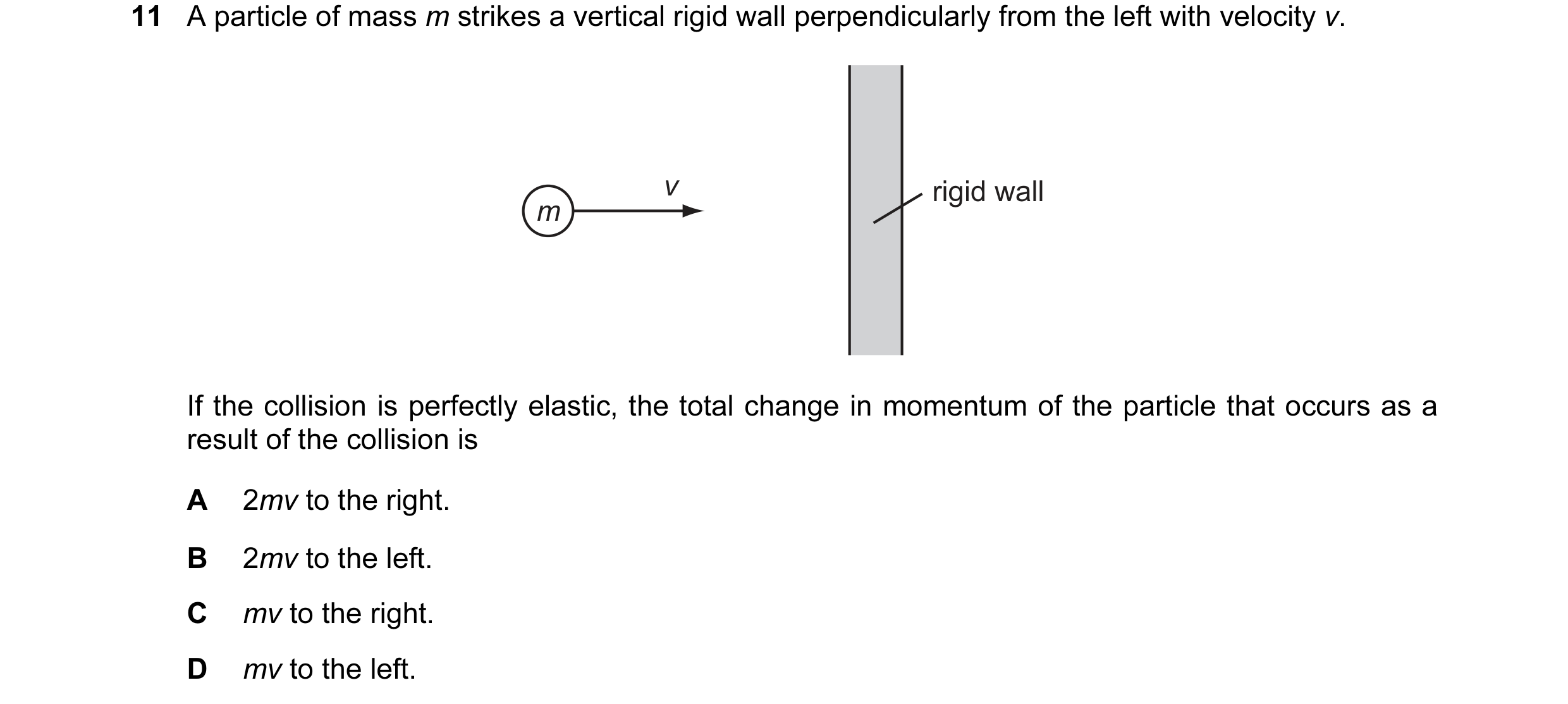
 1 / 66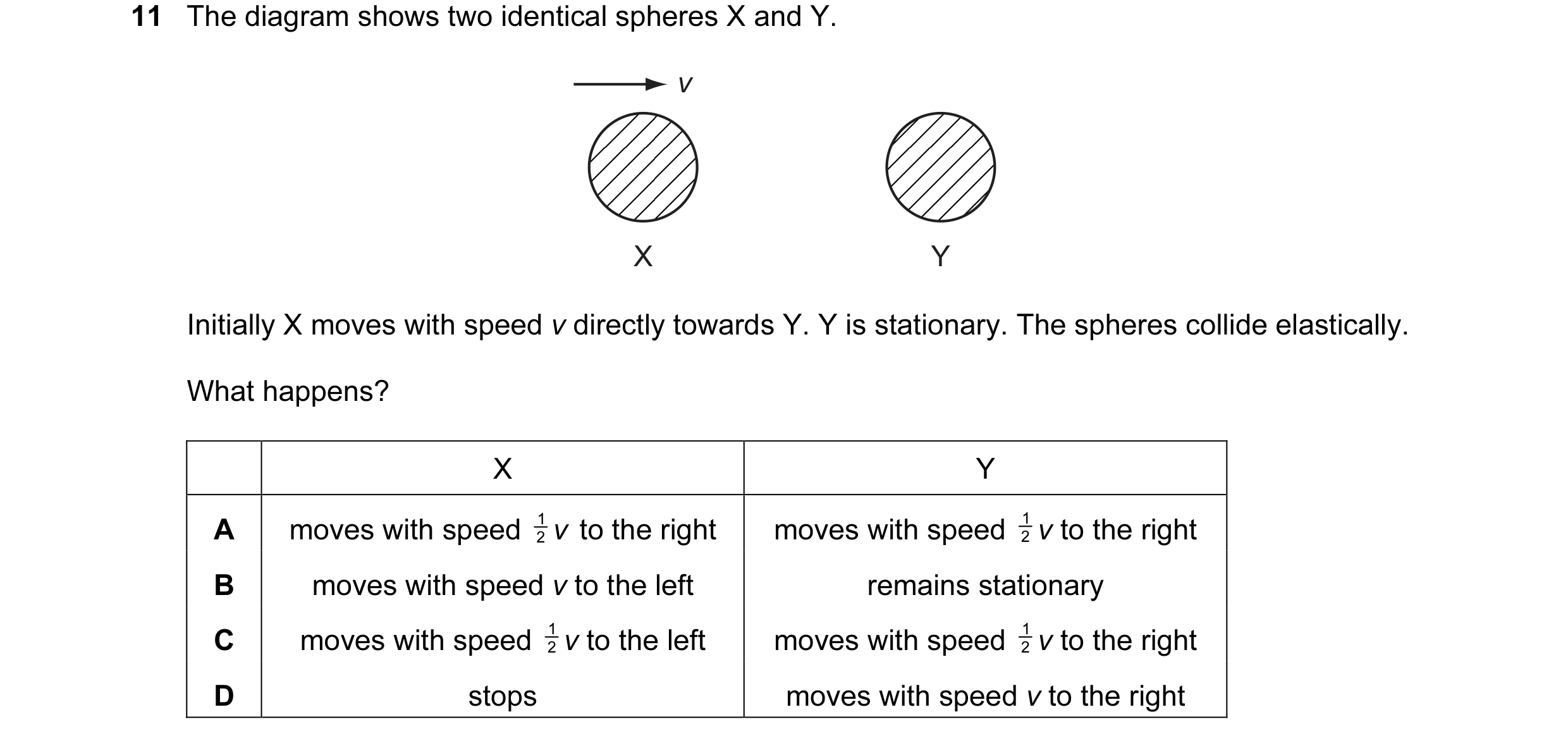
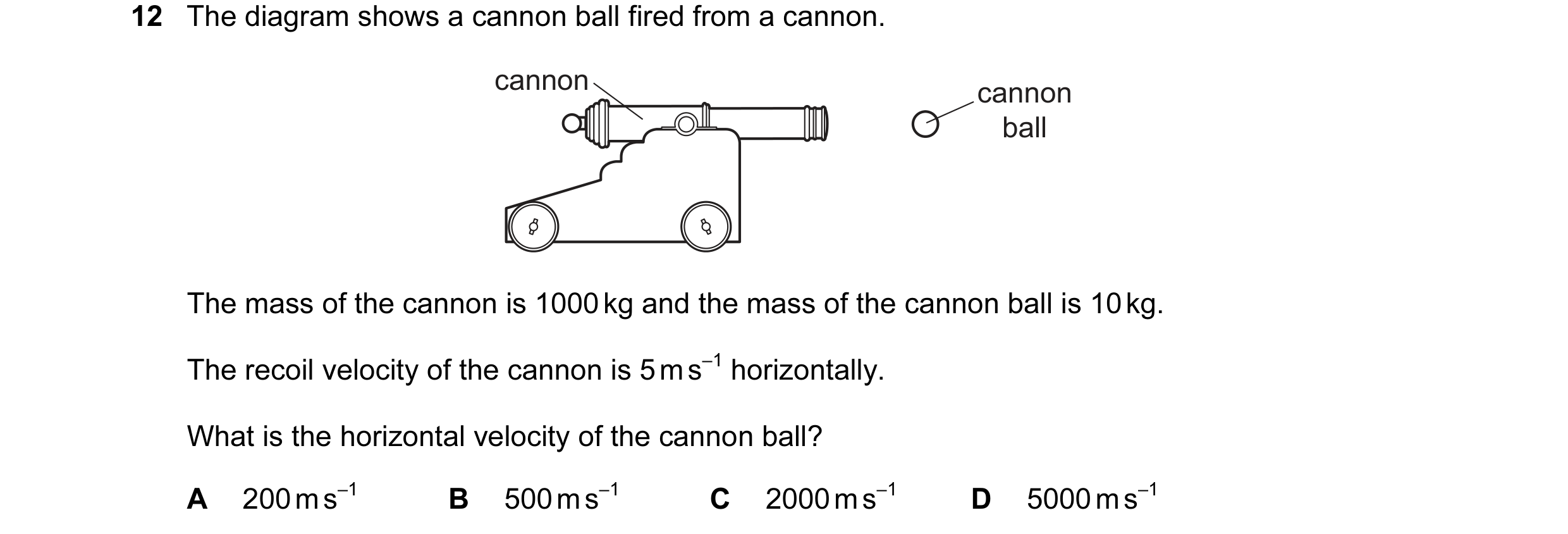
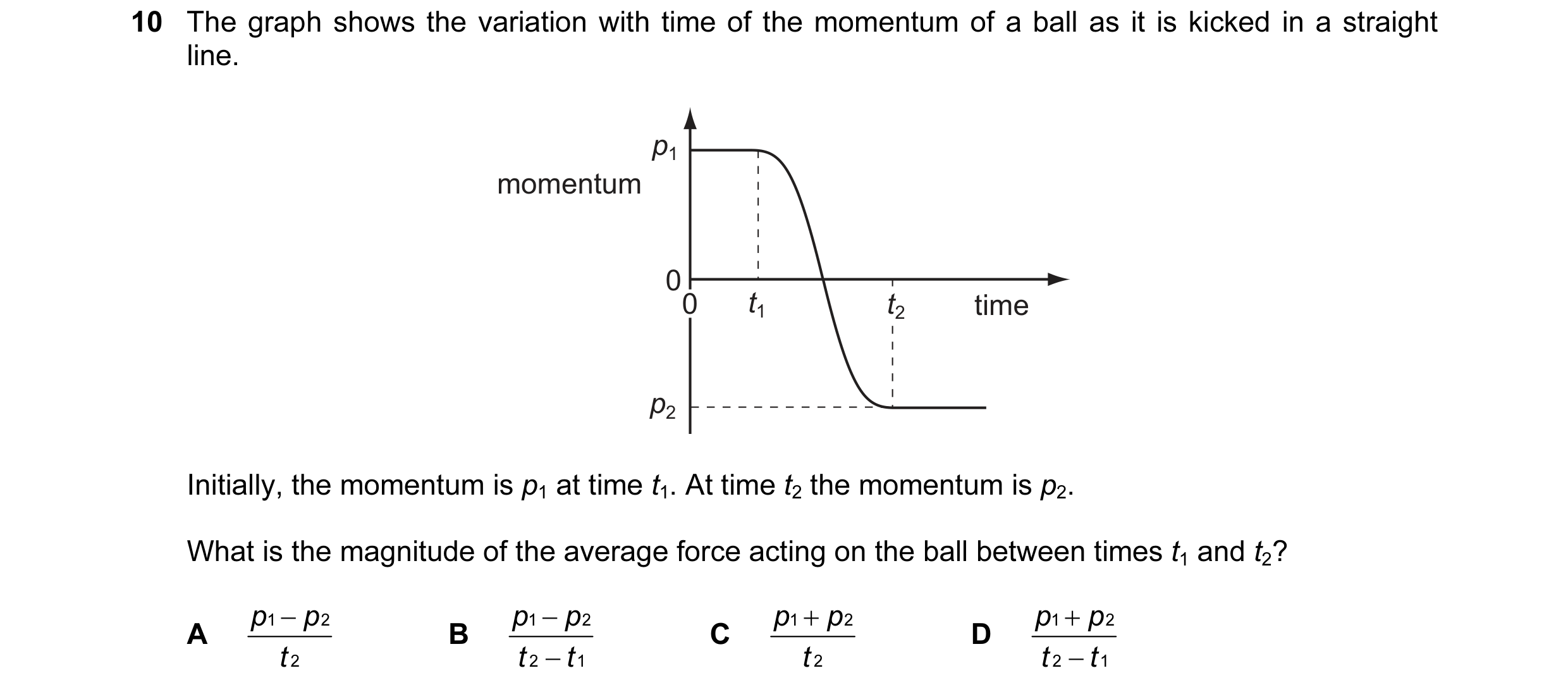 2 / 66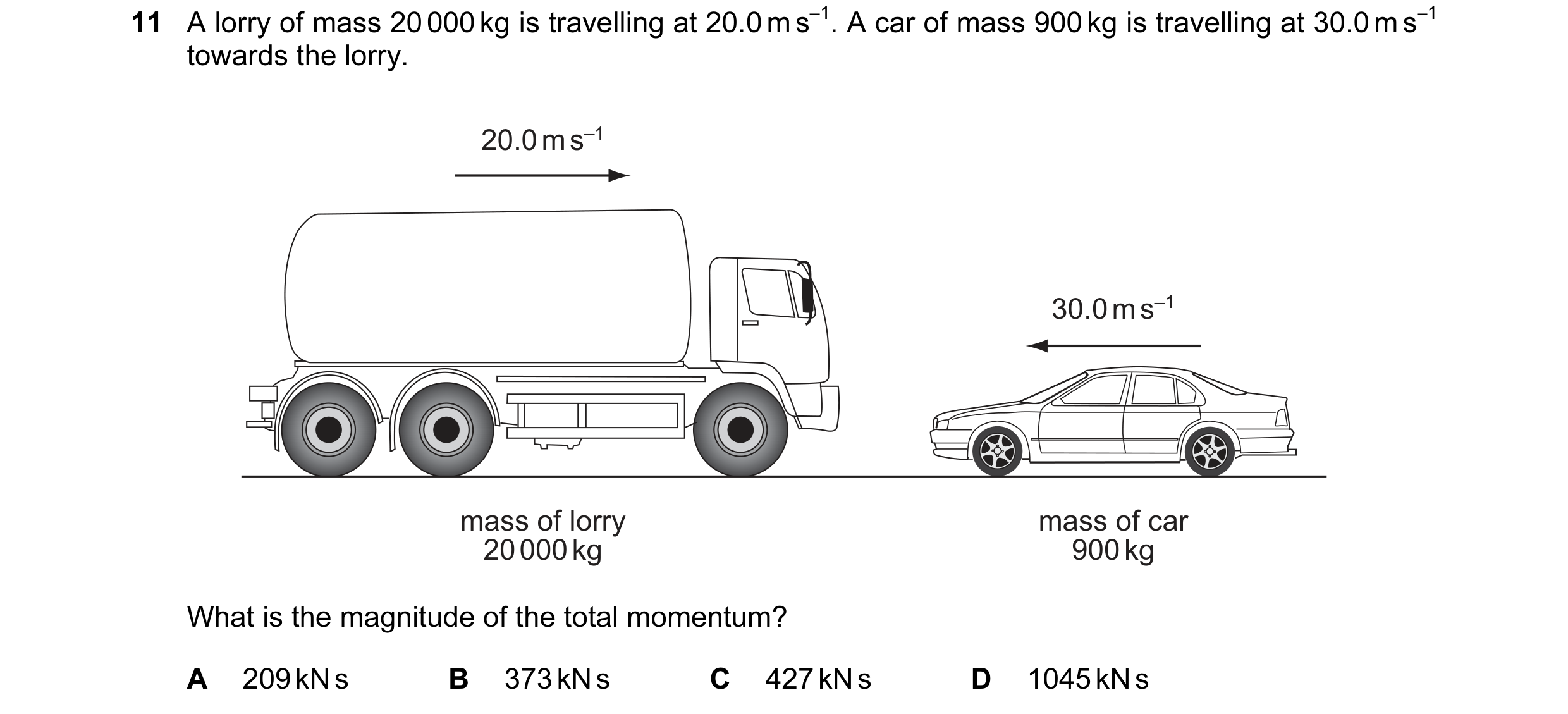
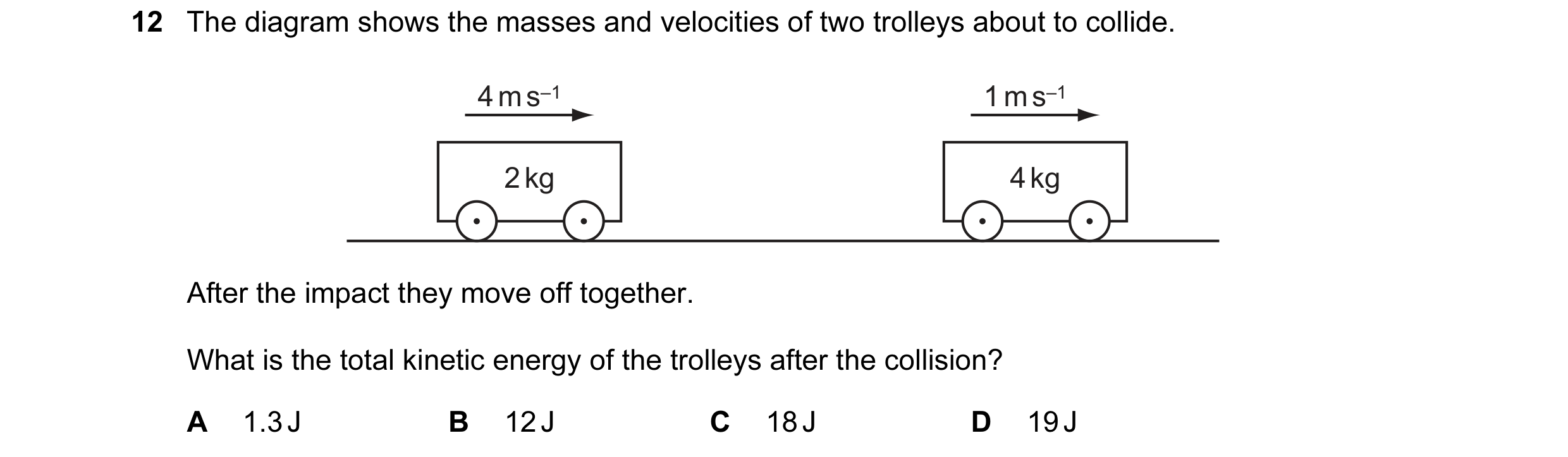

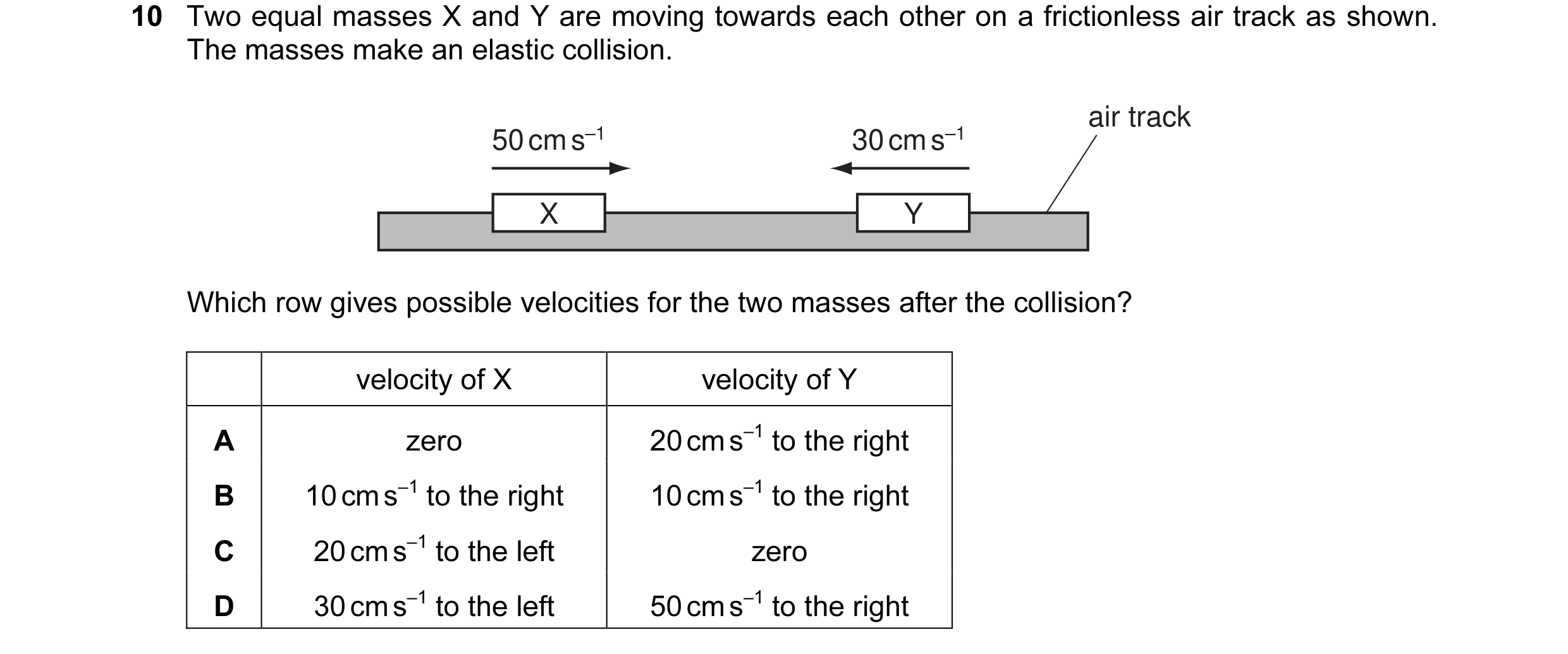 3 / 66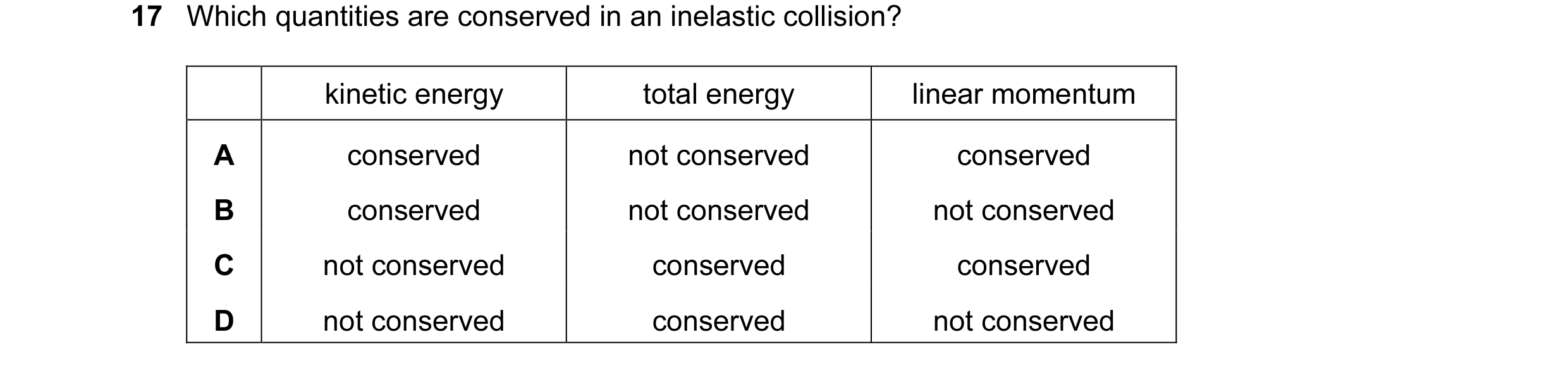
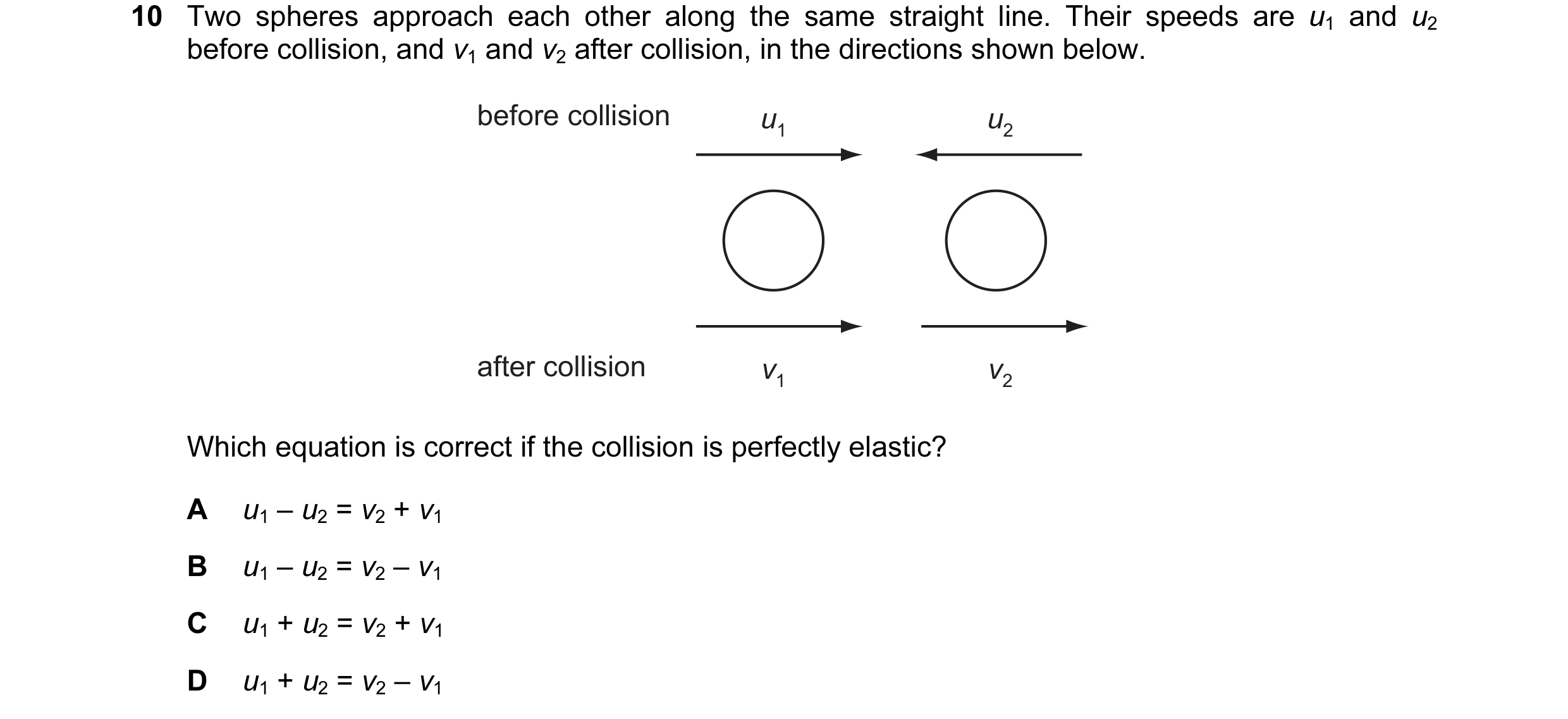
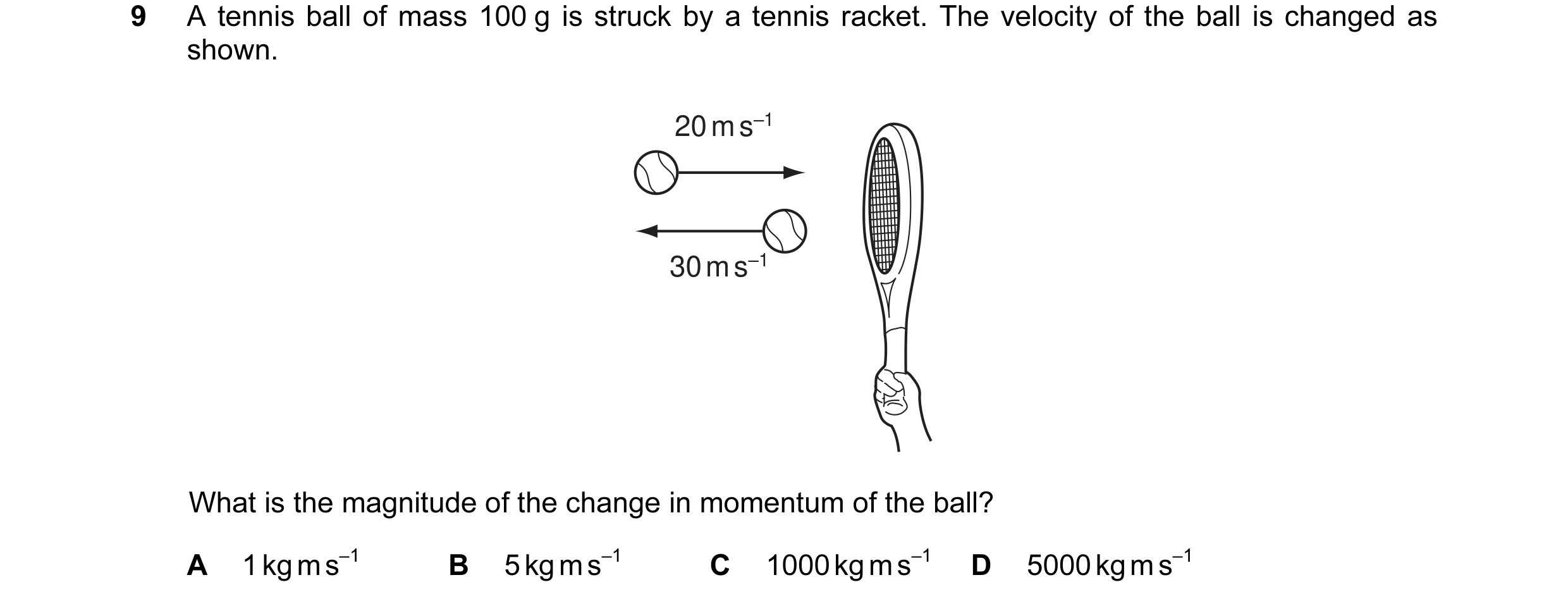 4 / 66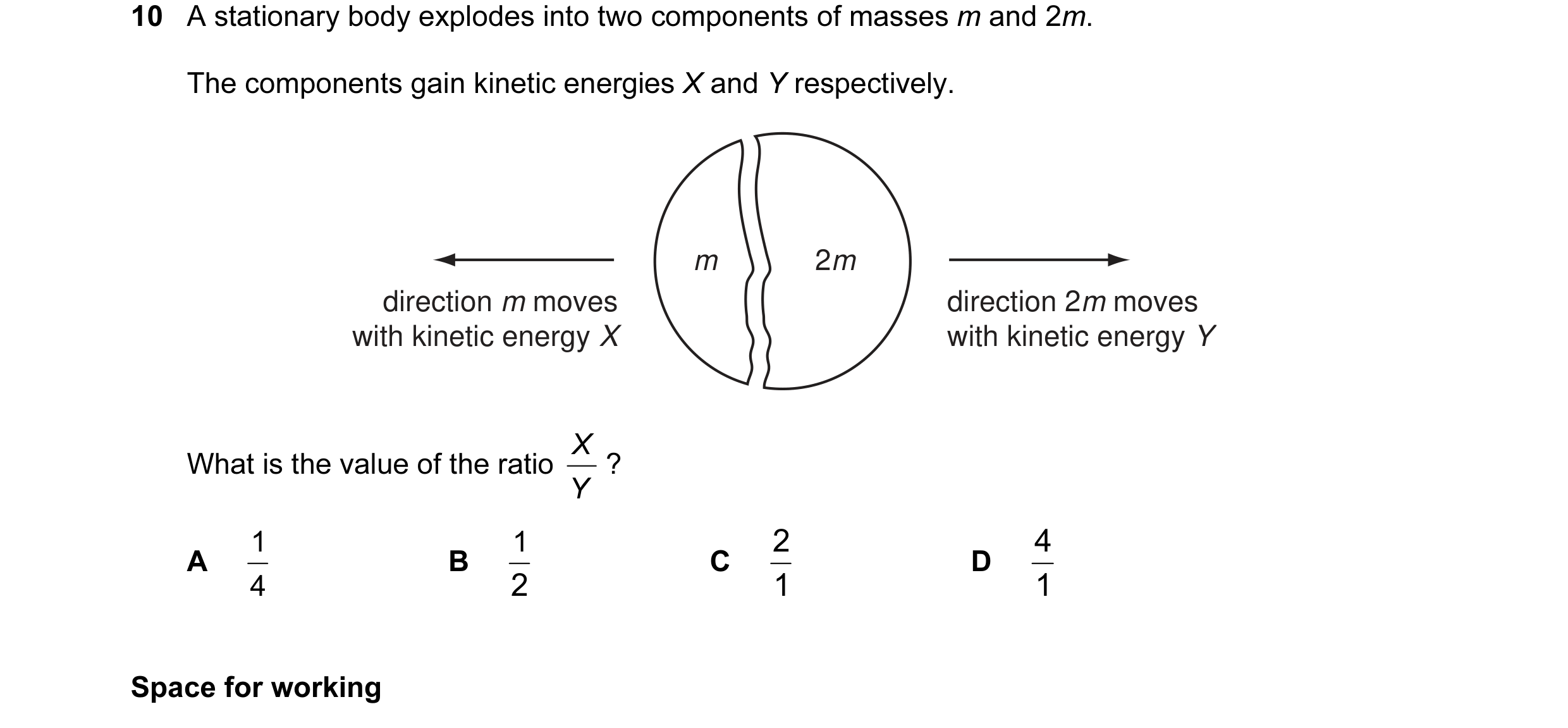
 5 / 66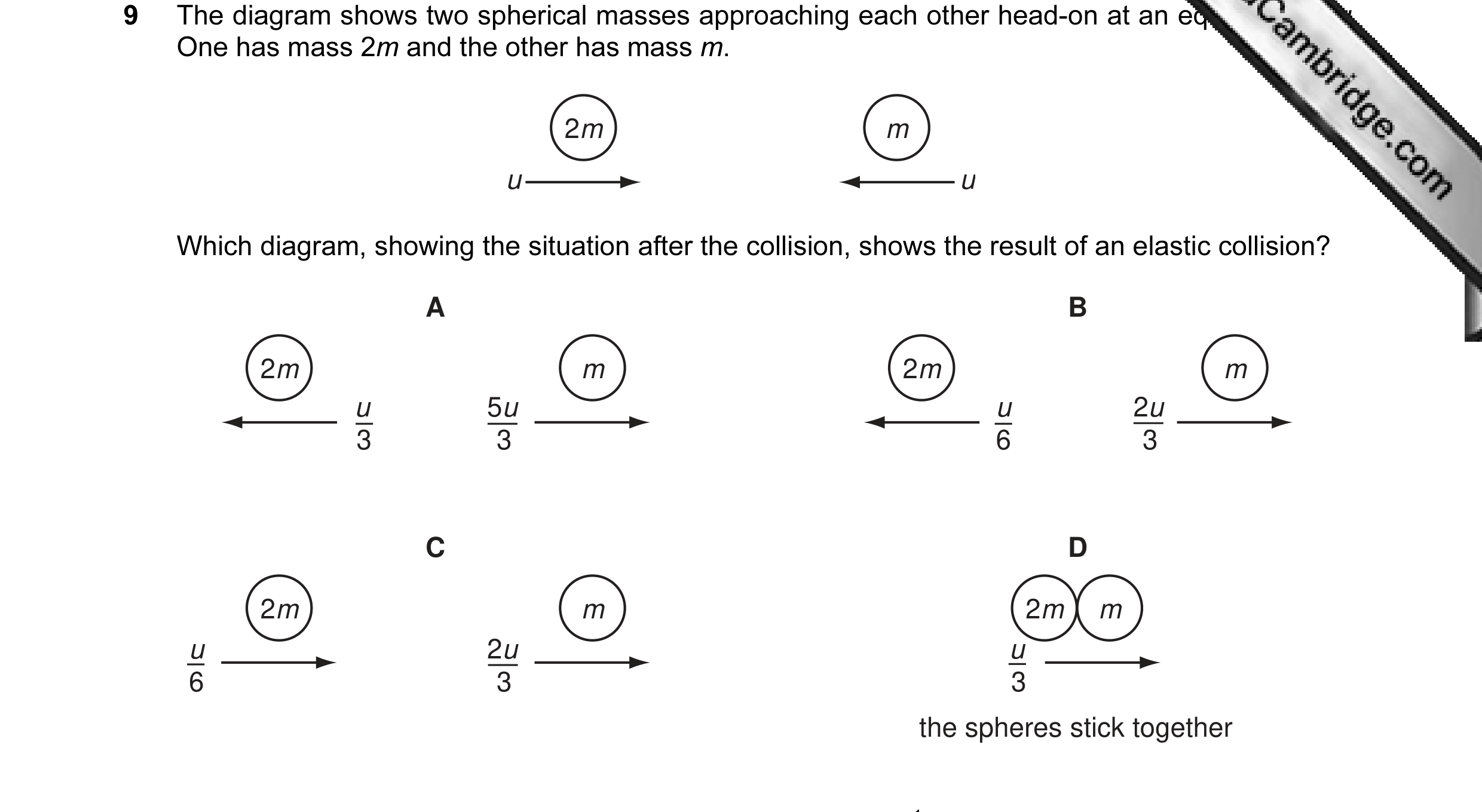
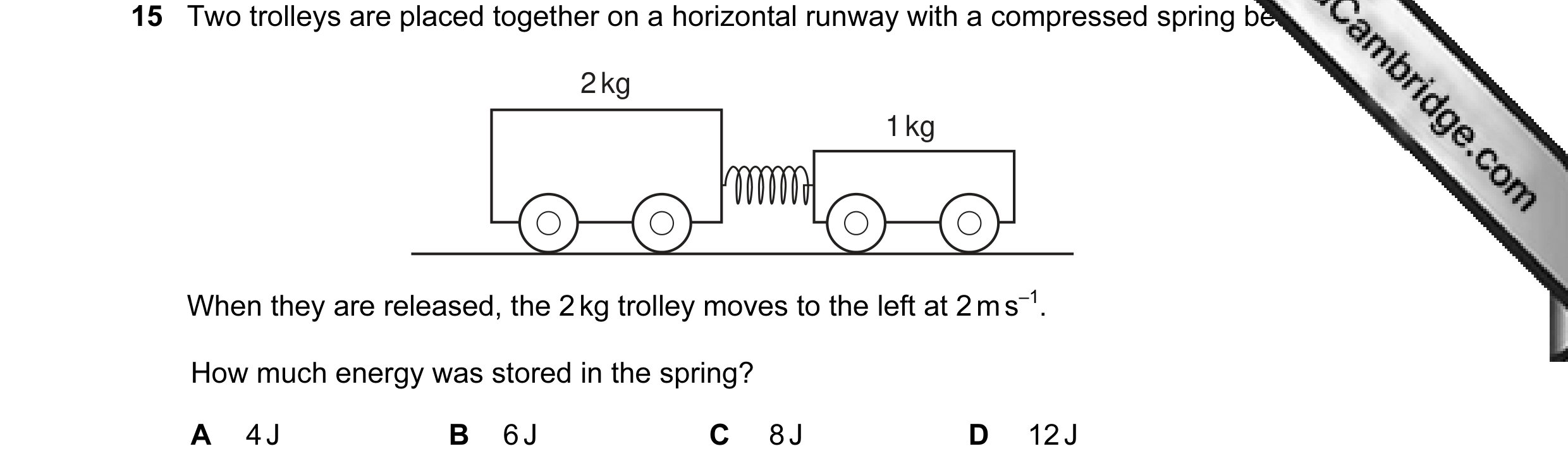 6 / 66
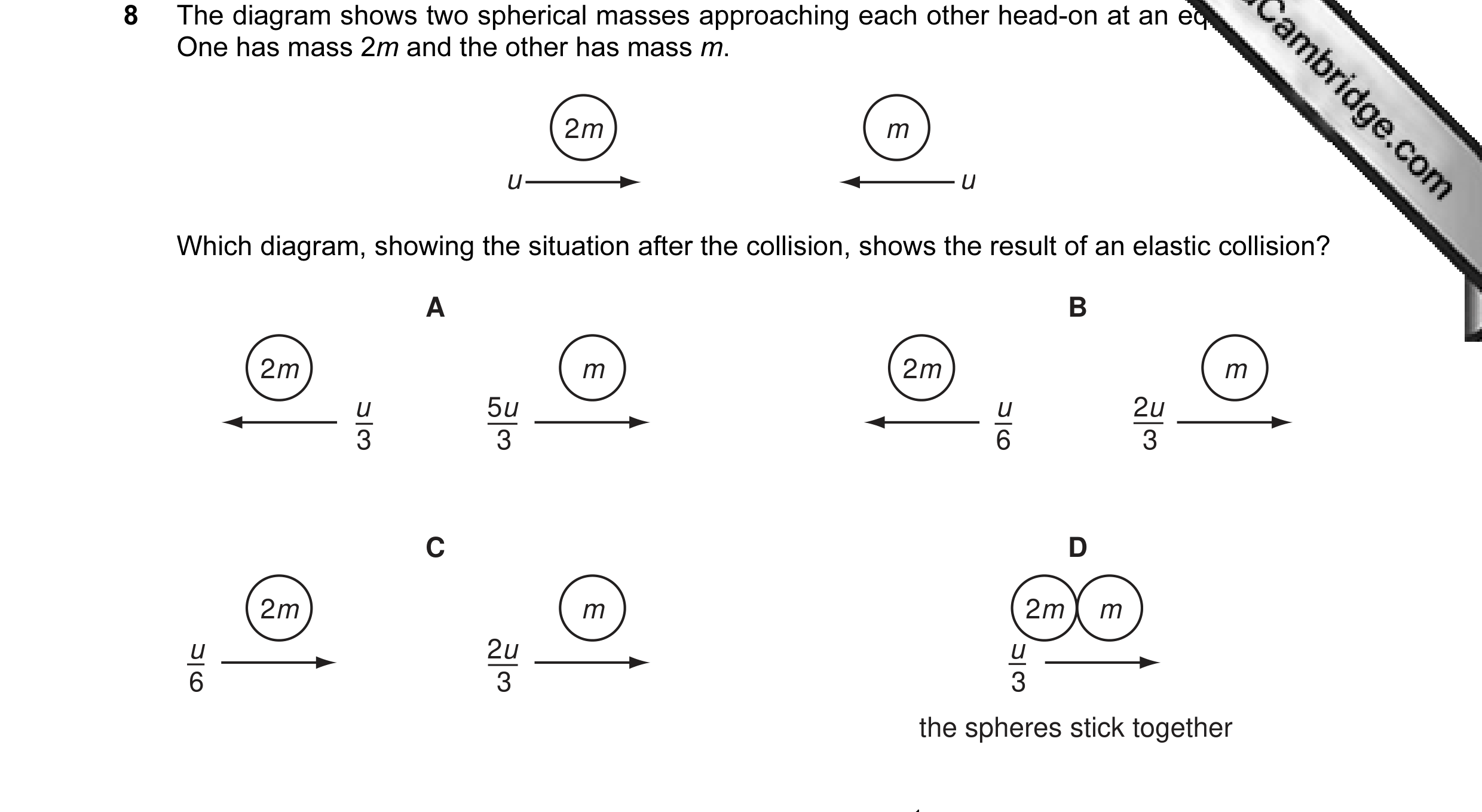 7 / 66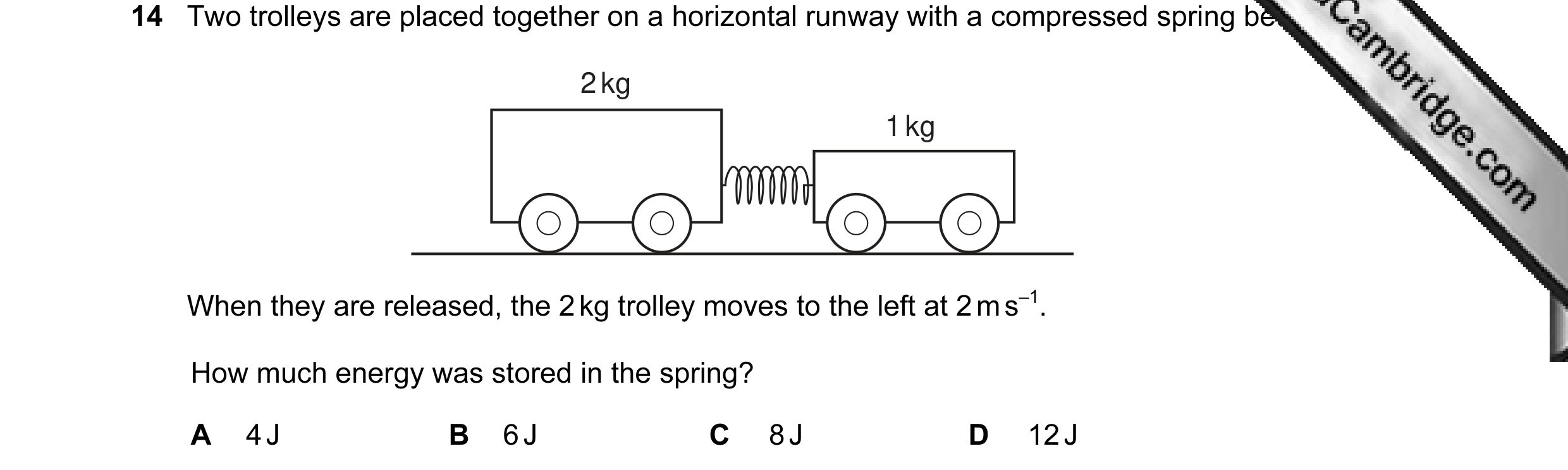
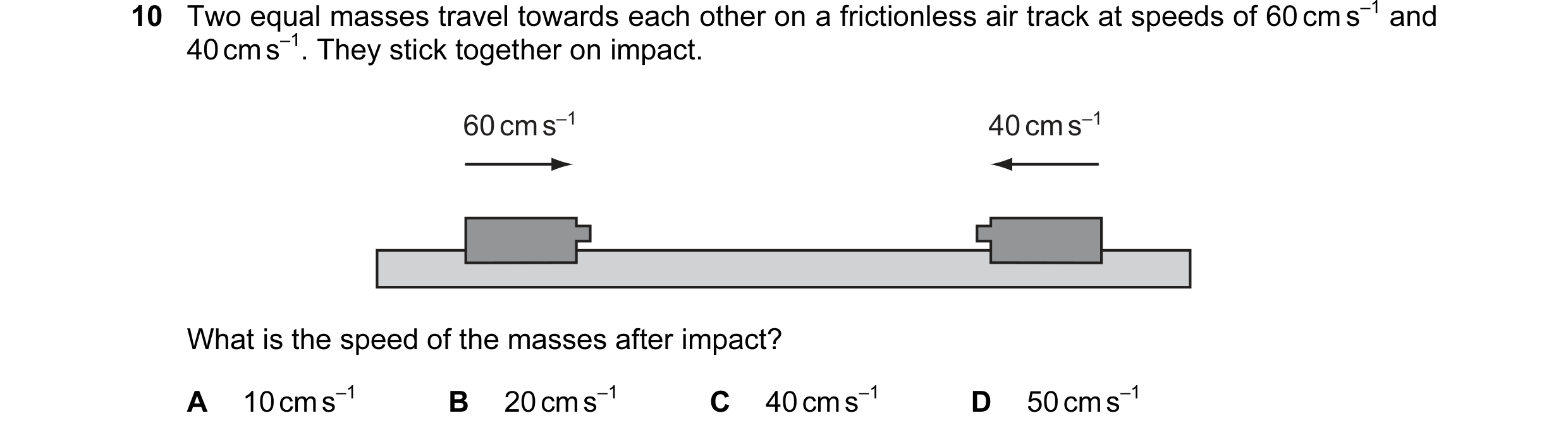 8 / 66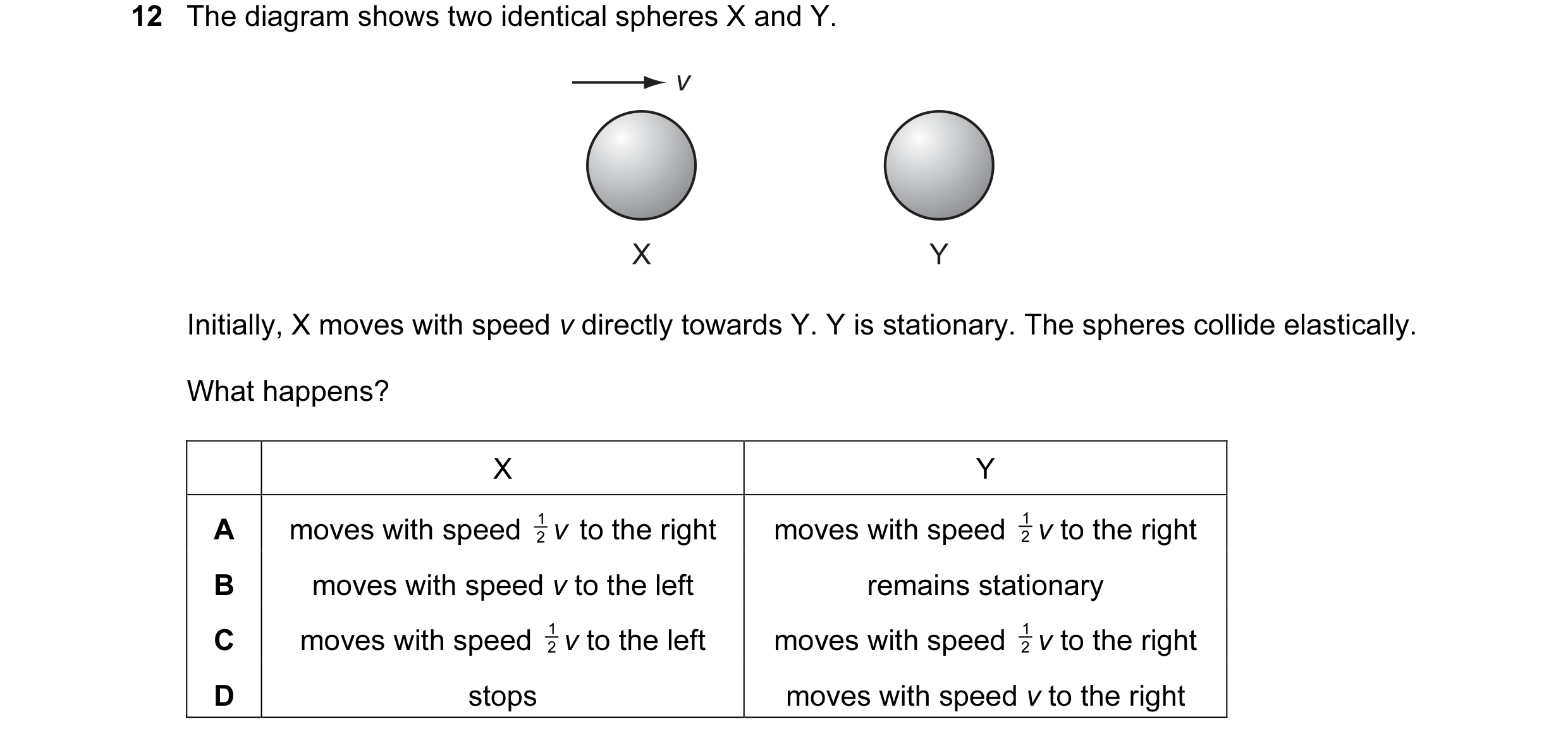
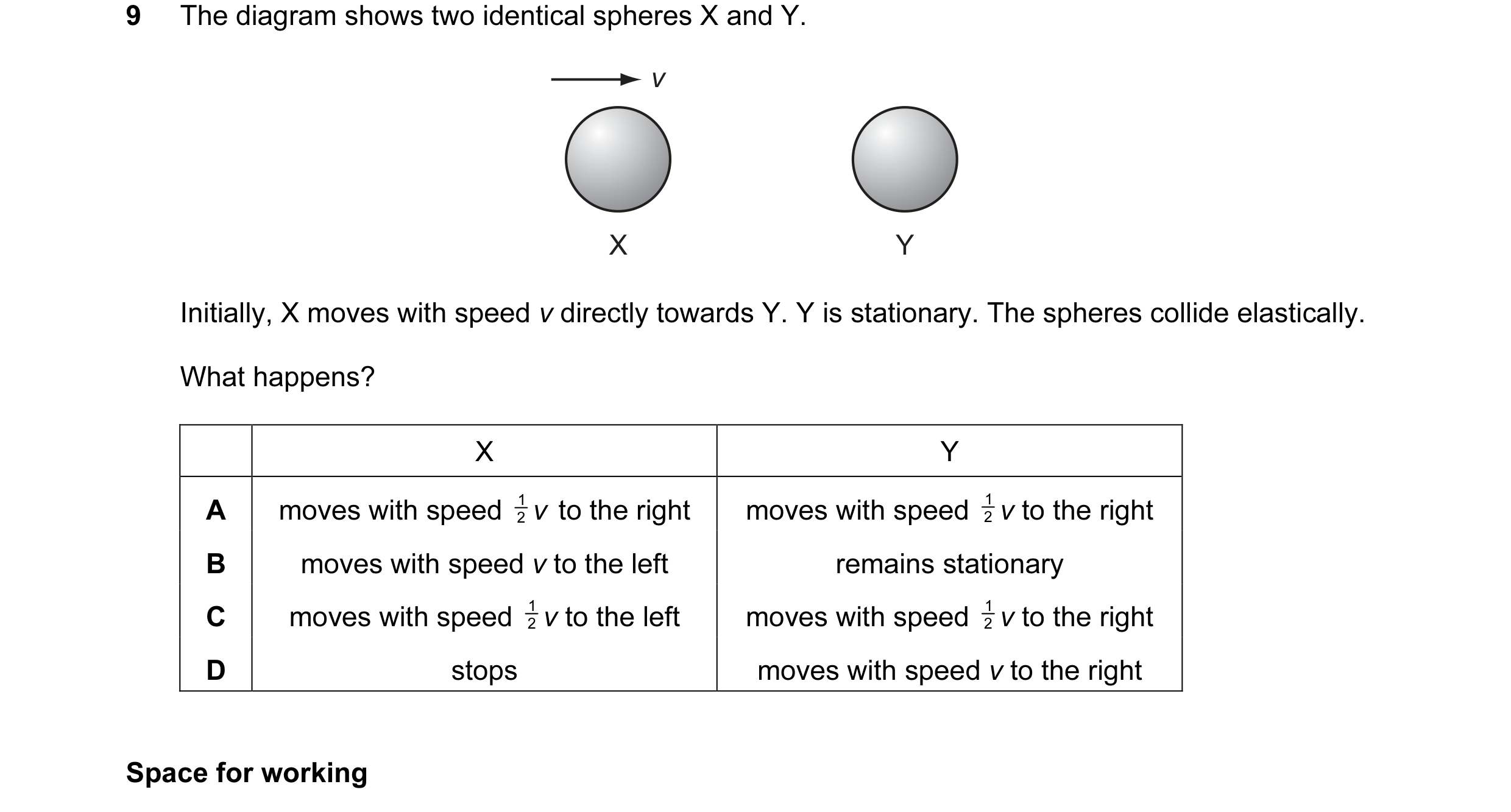 9 / 66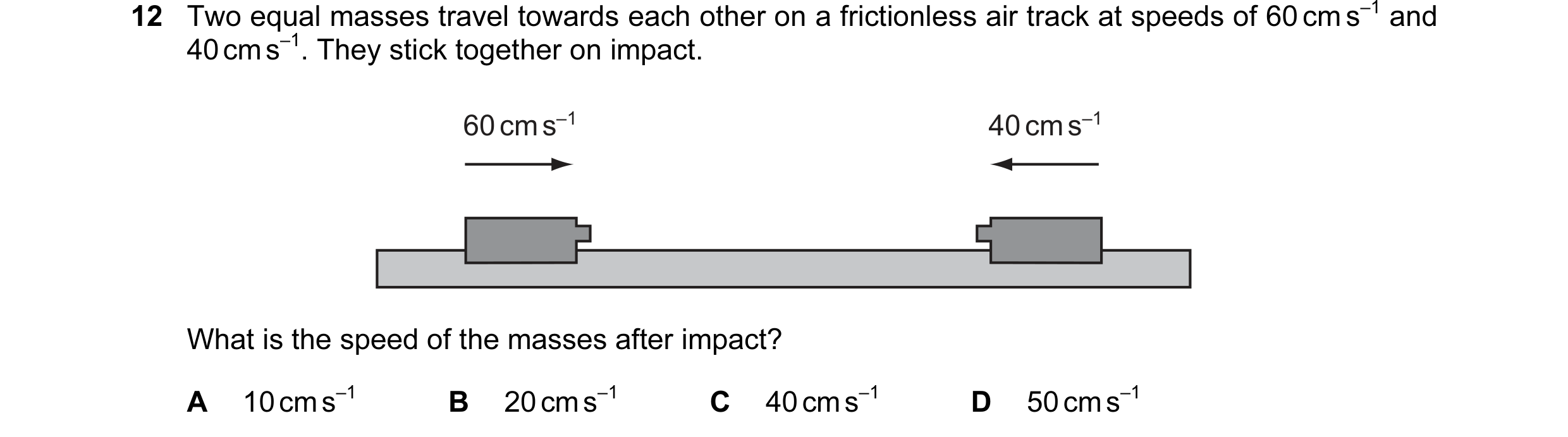
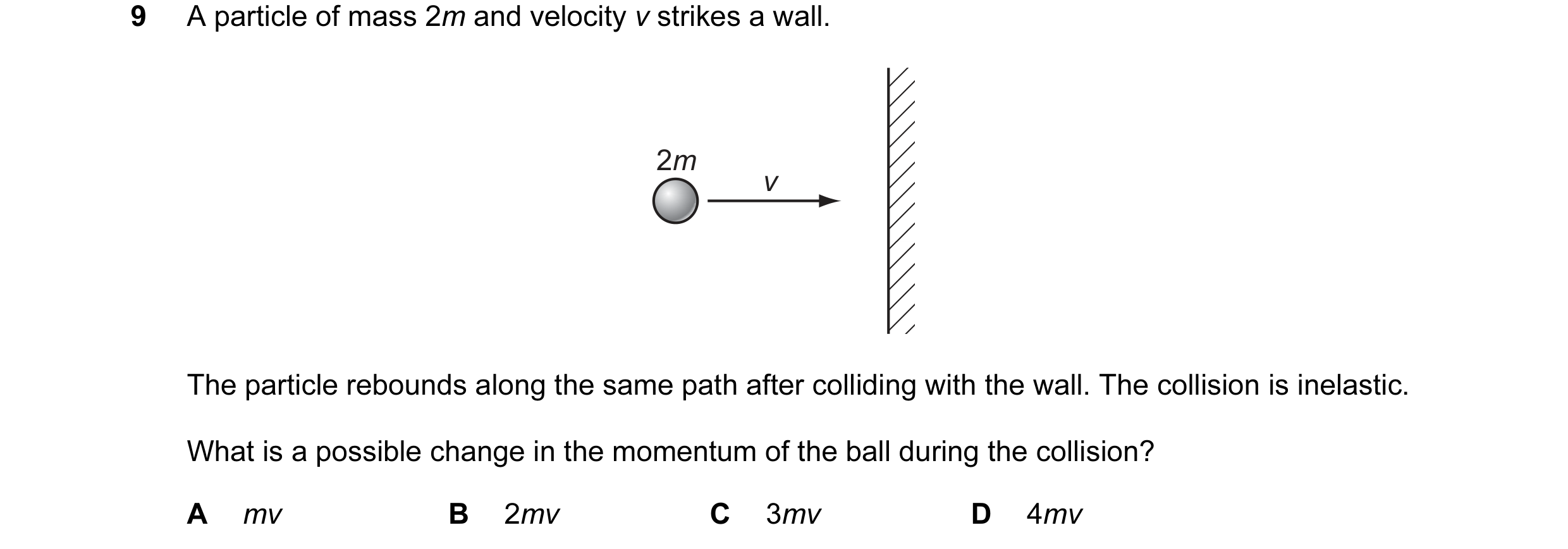
 10 / 66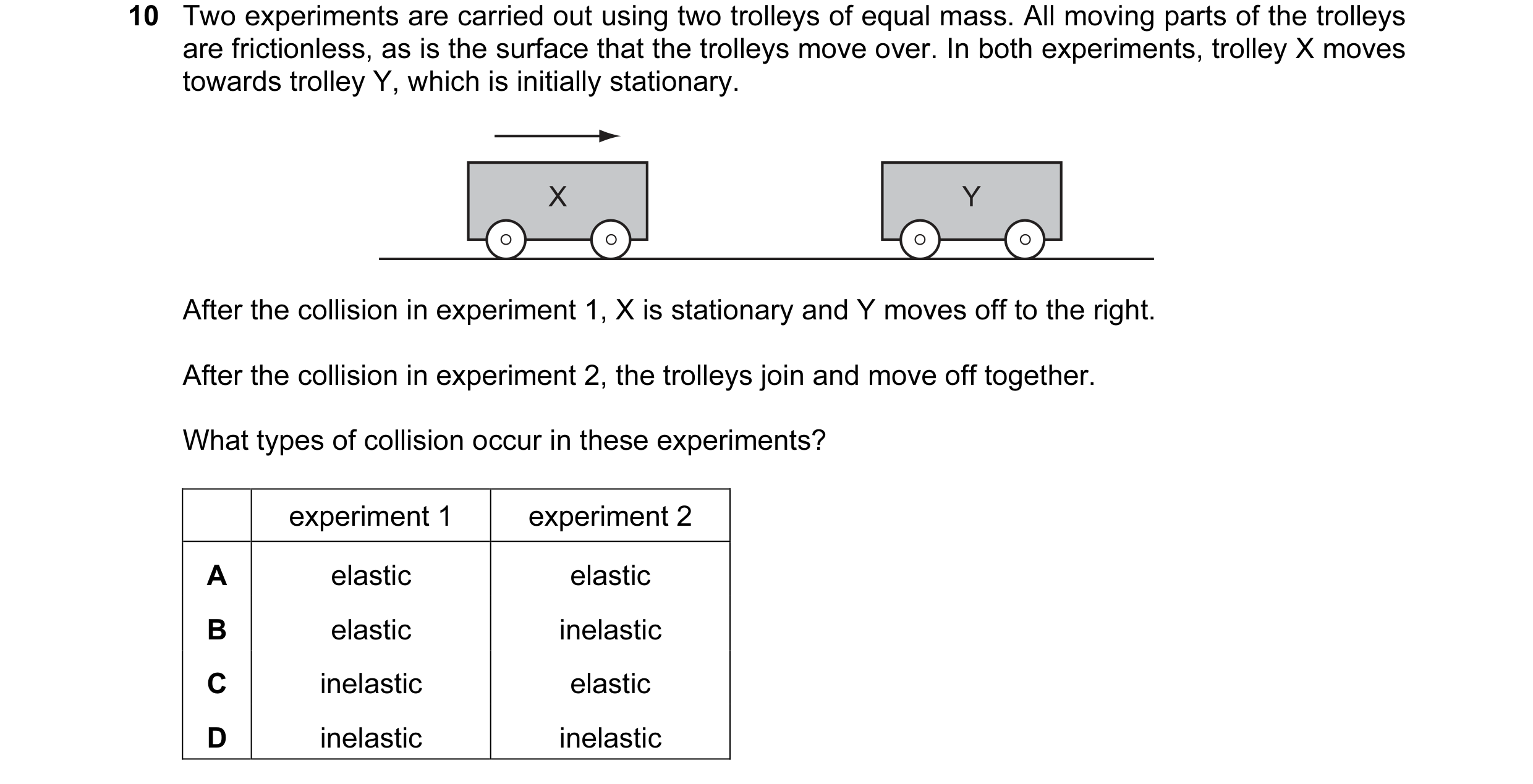
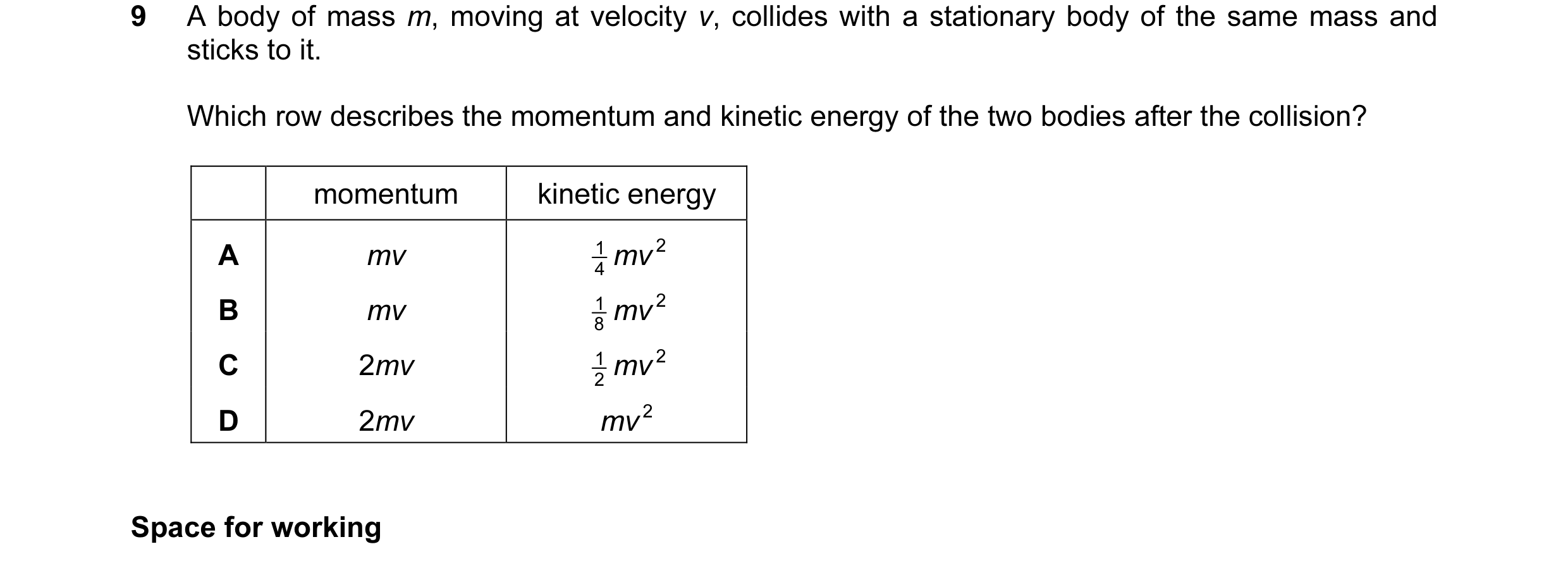

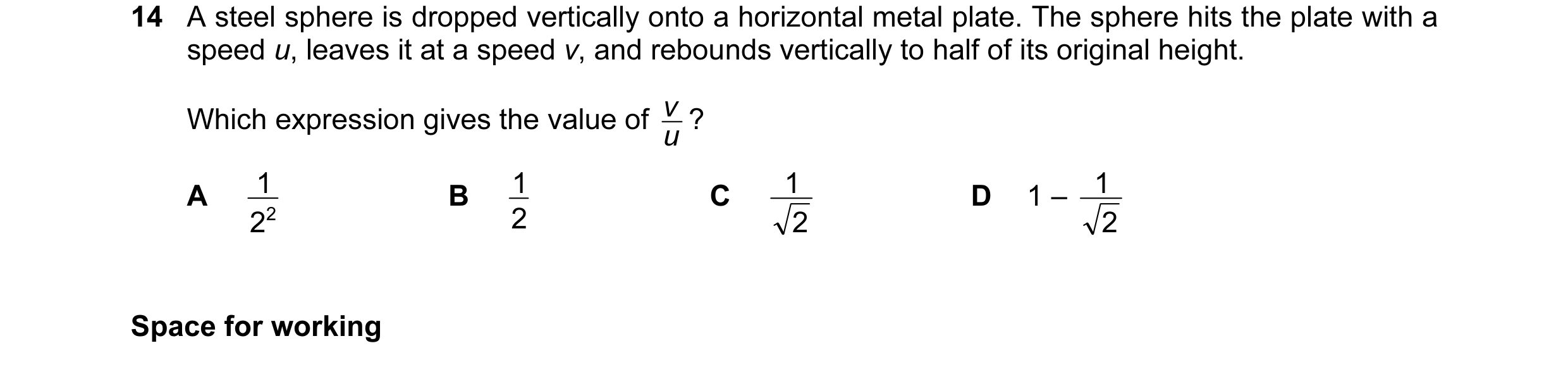 11 / 66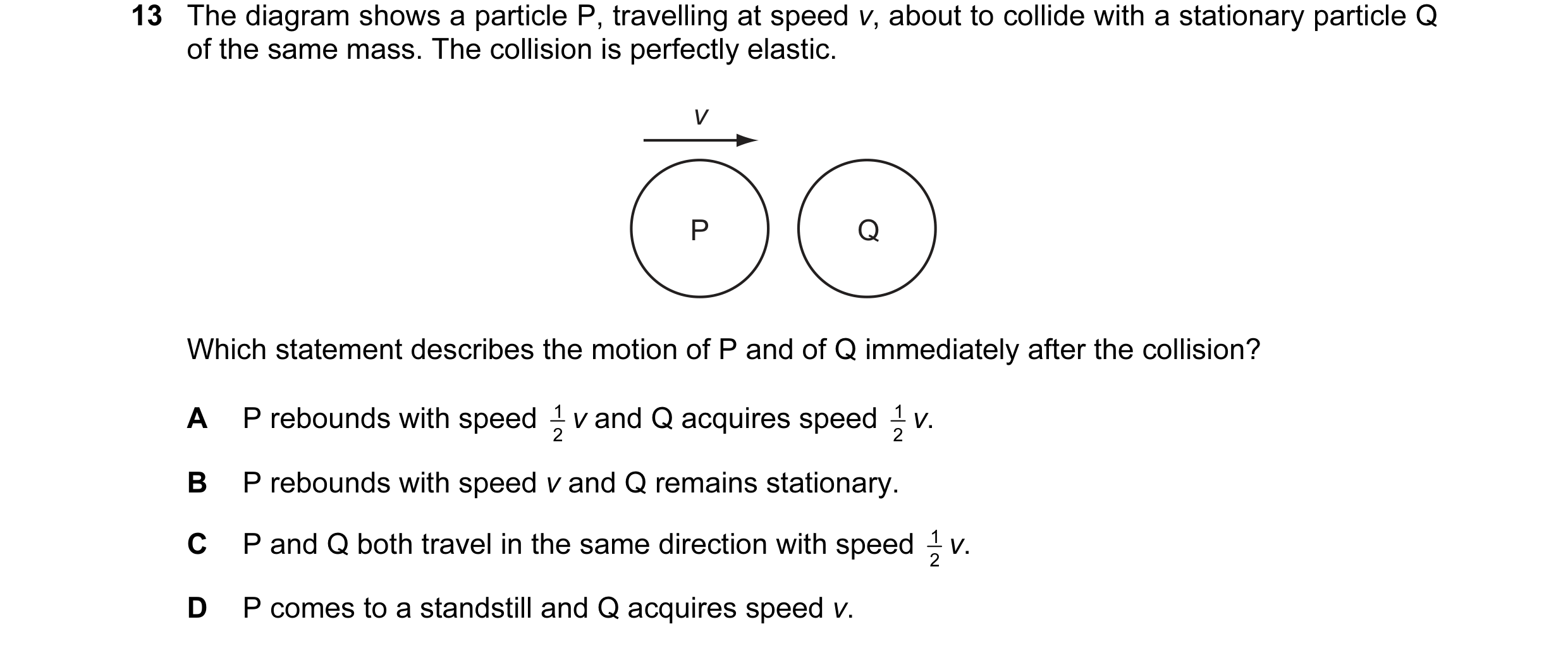
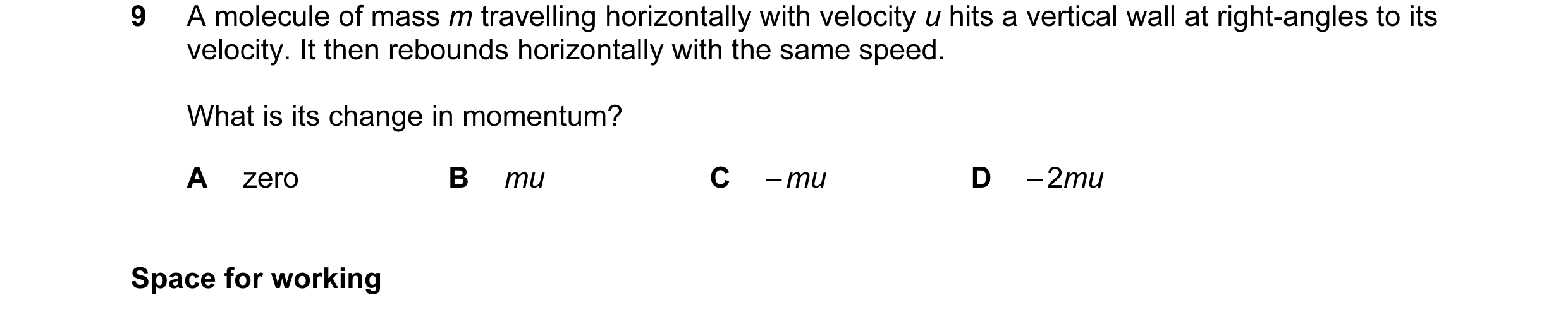
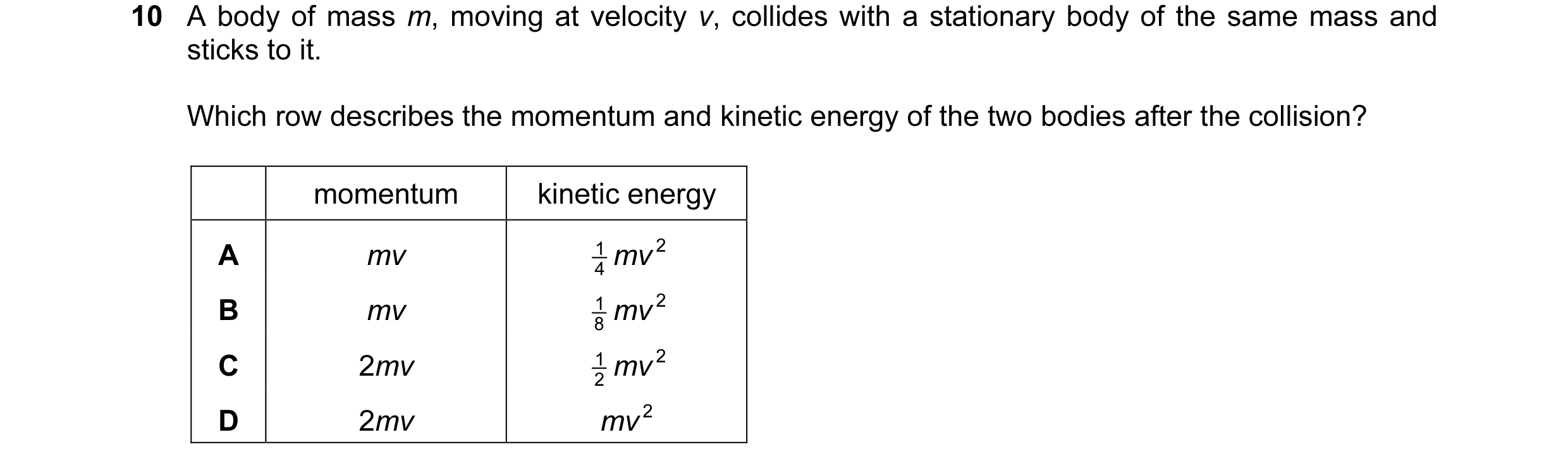
 12 / 66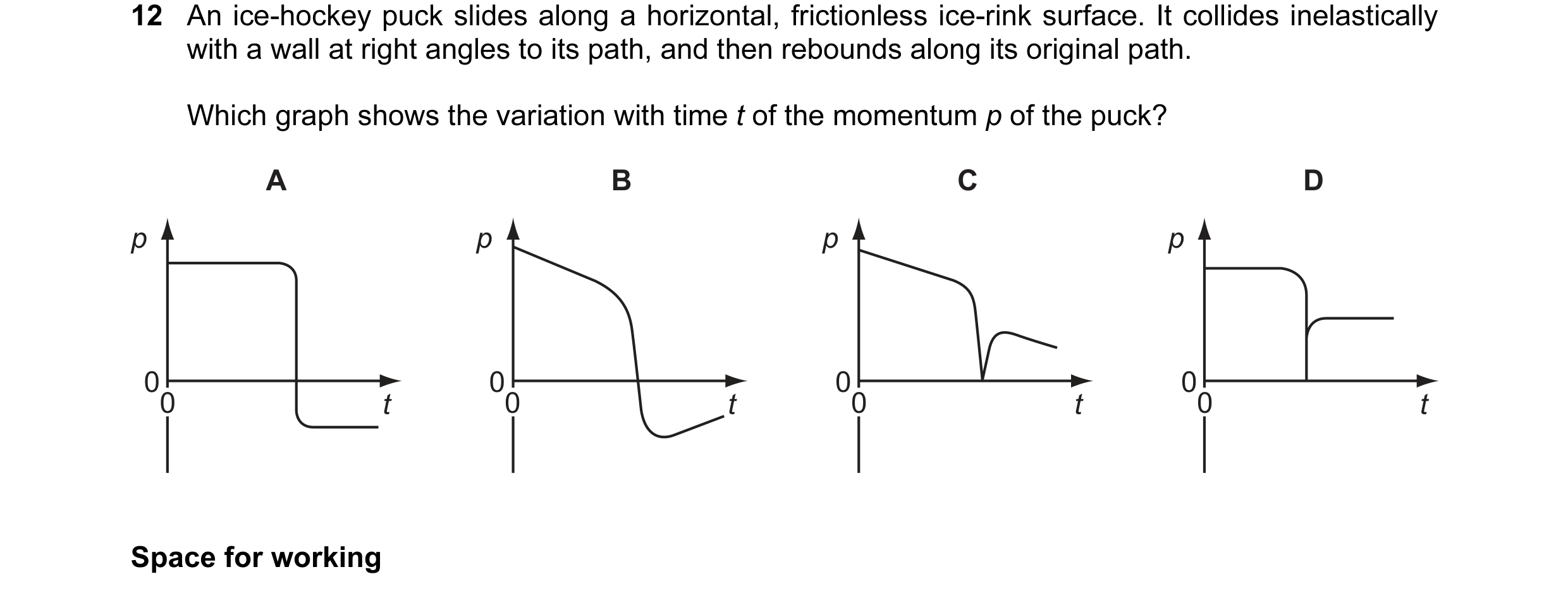
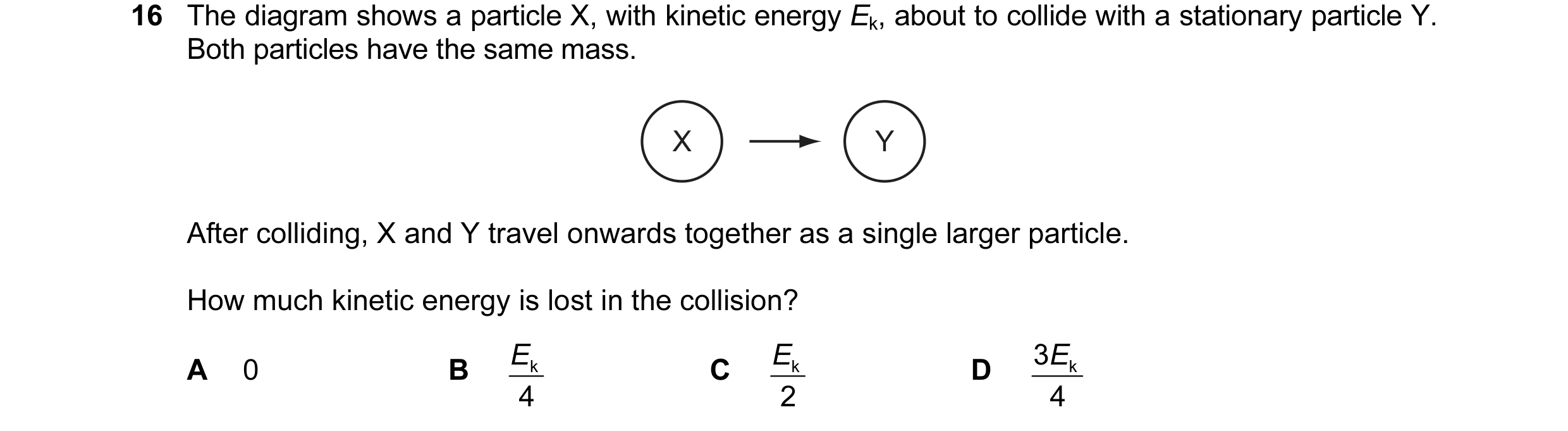
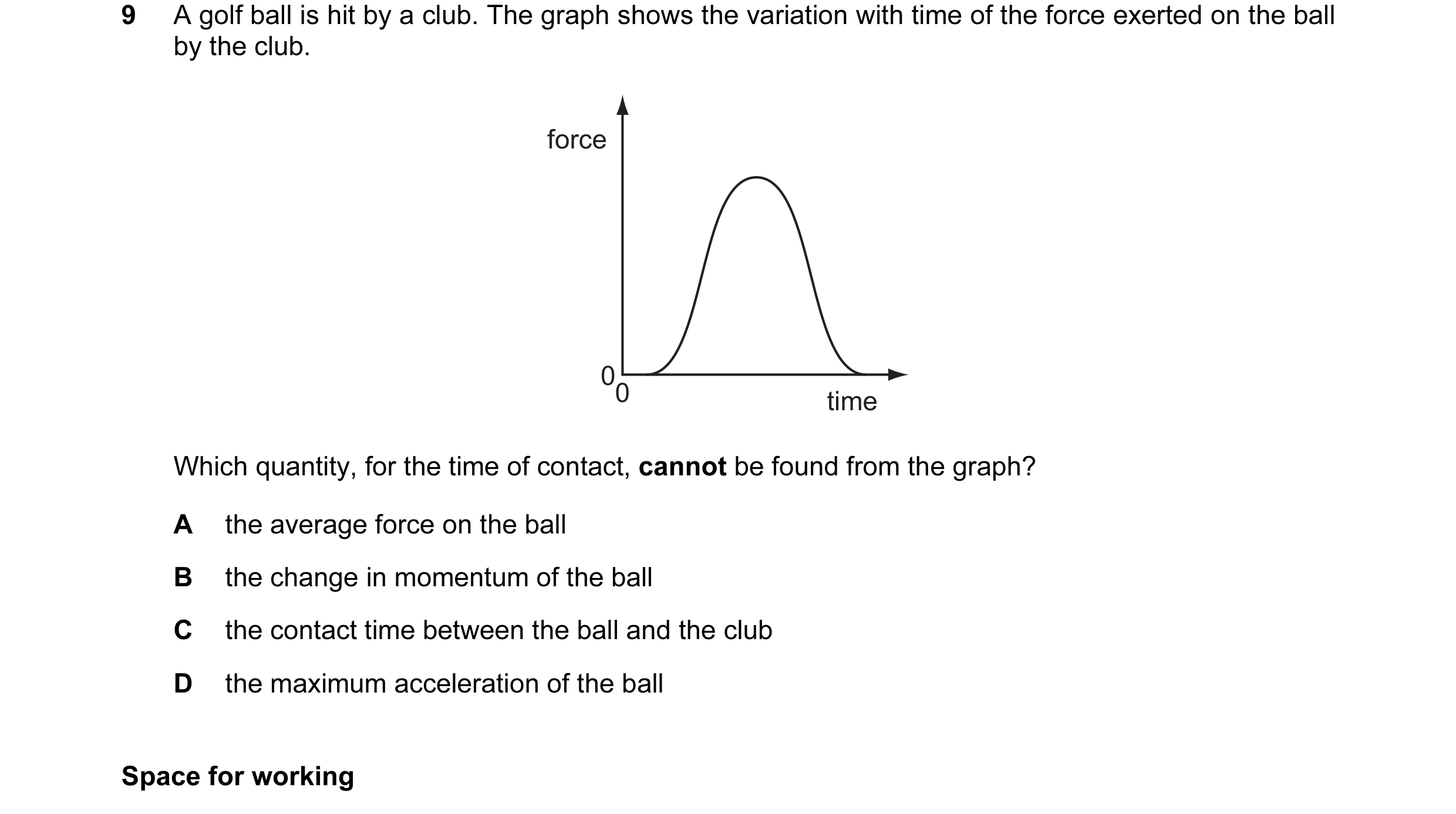 13 / 66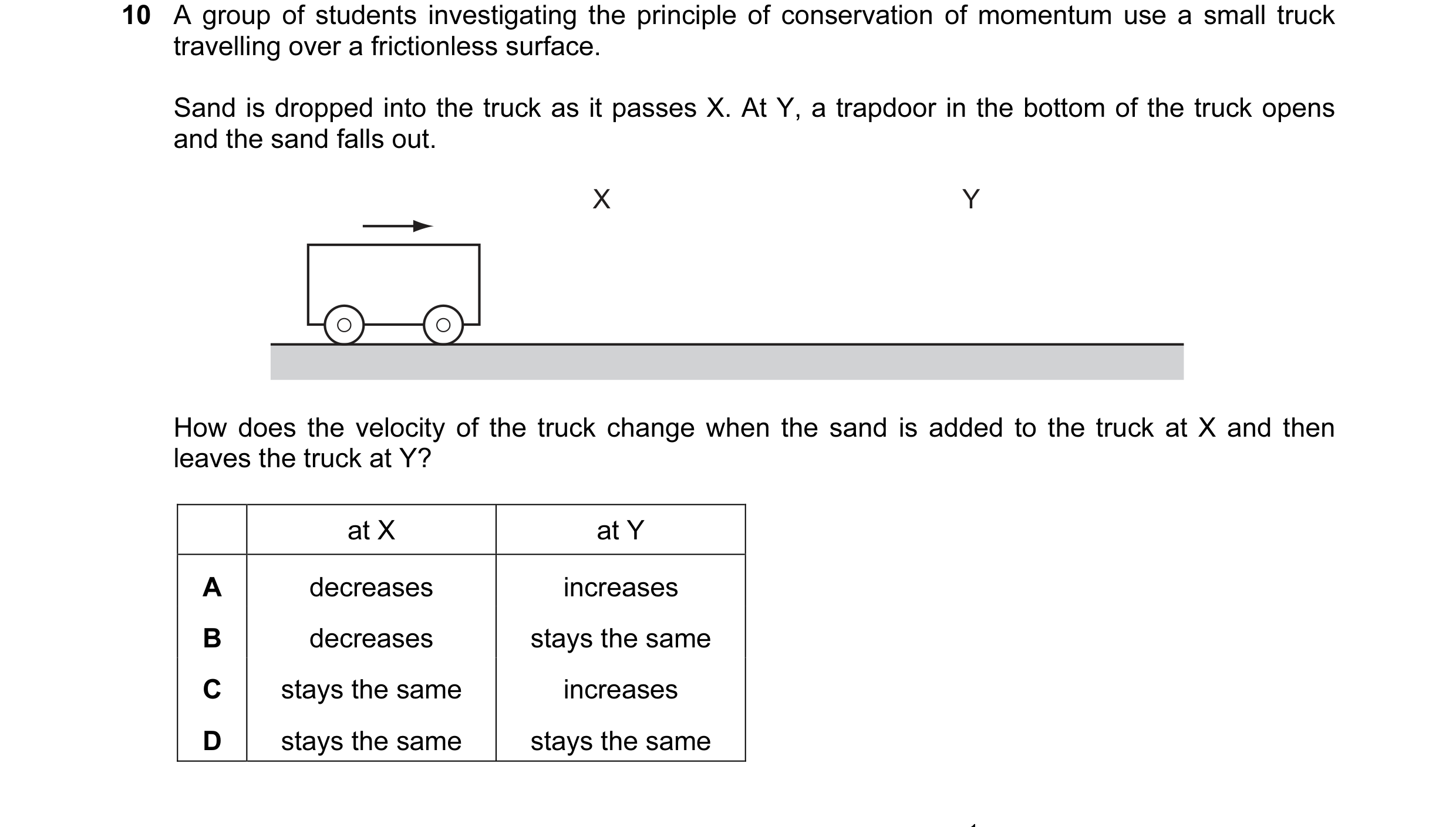
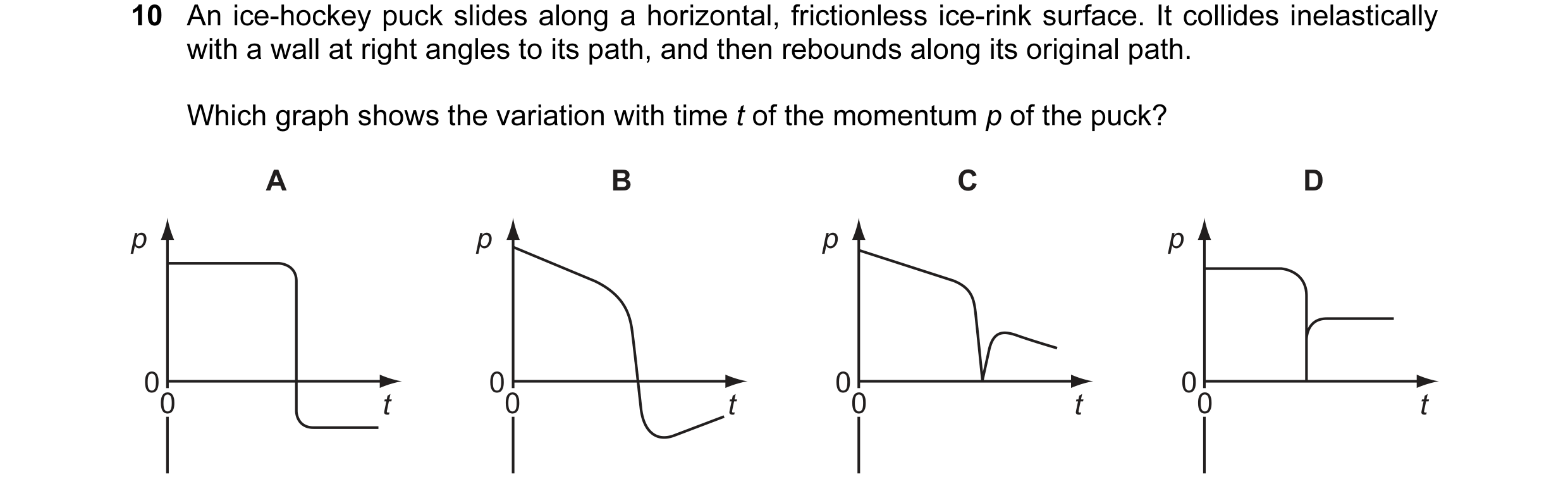 14 / 66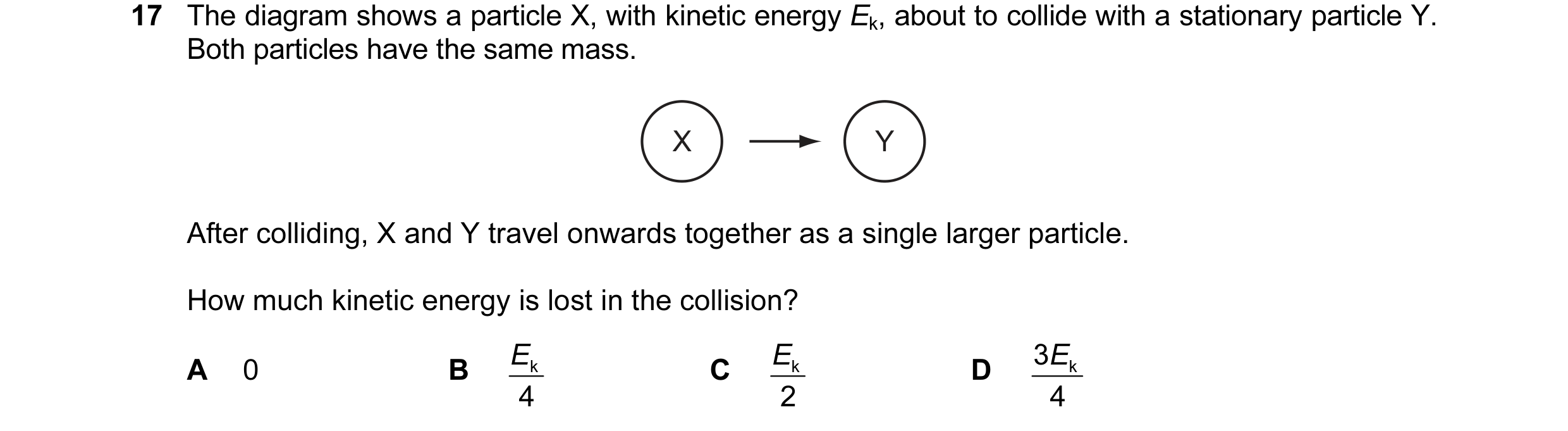
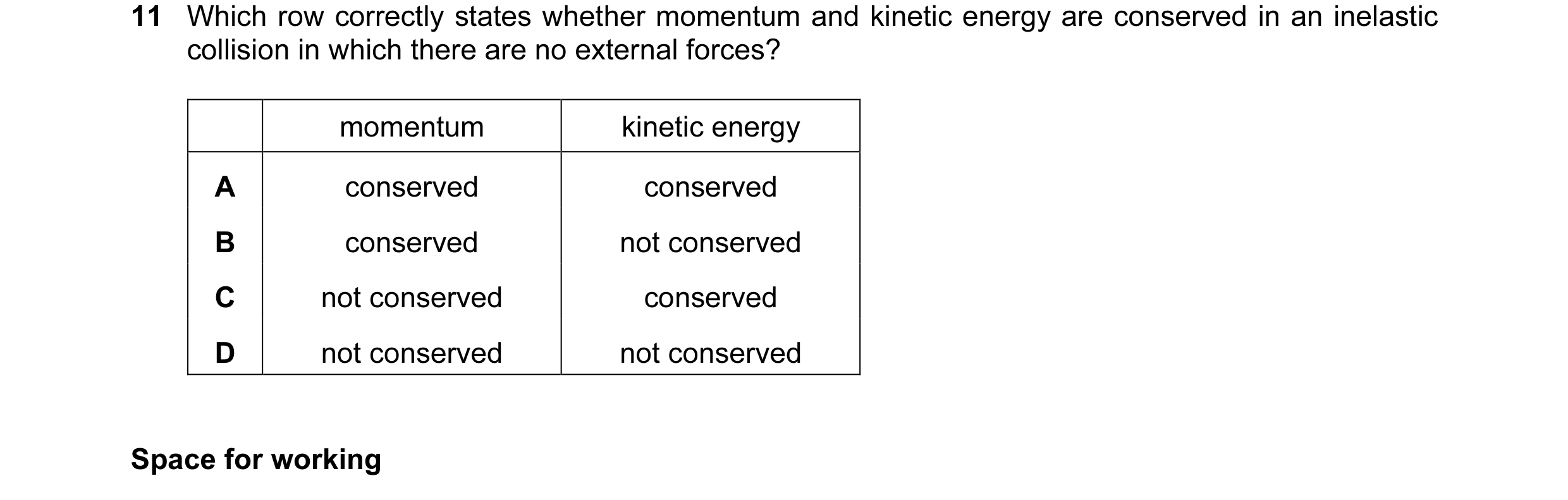
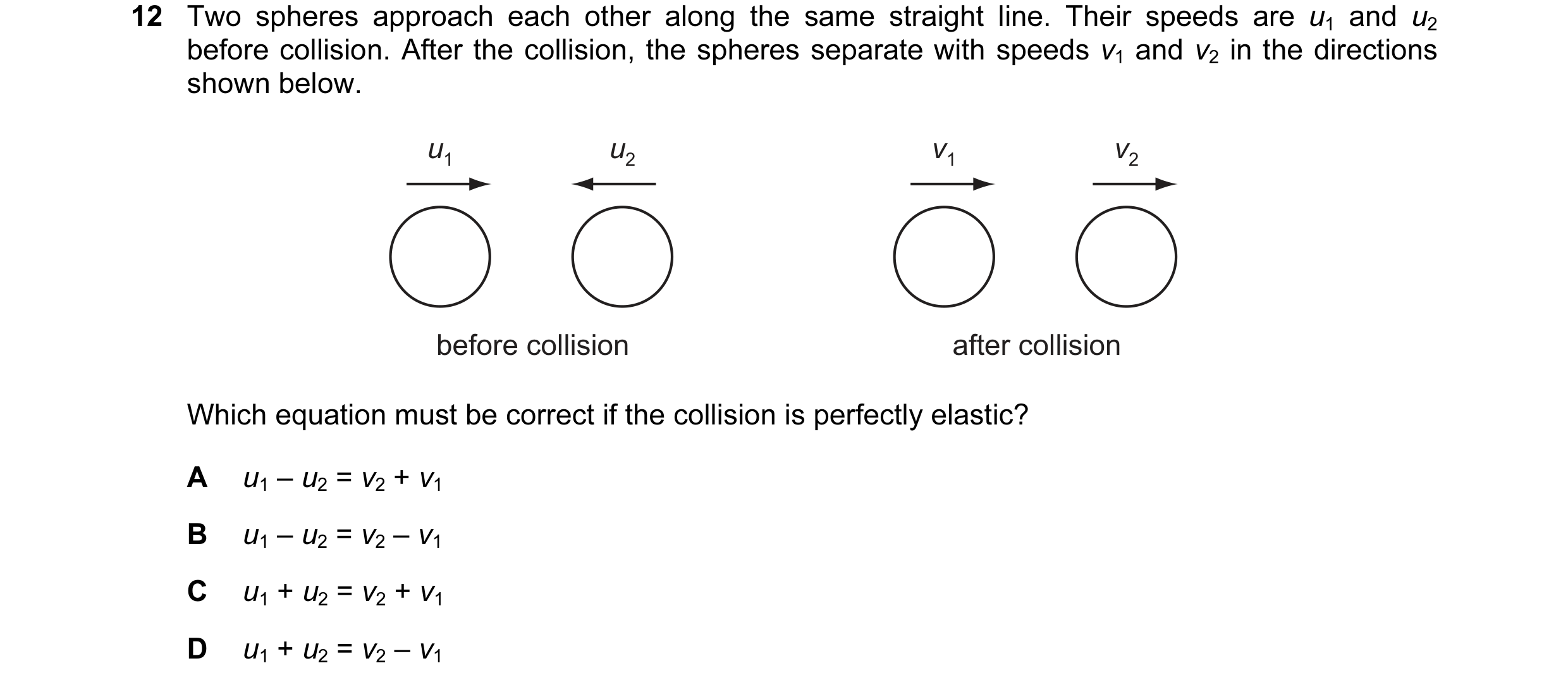 15 / 66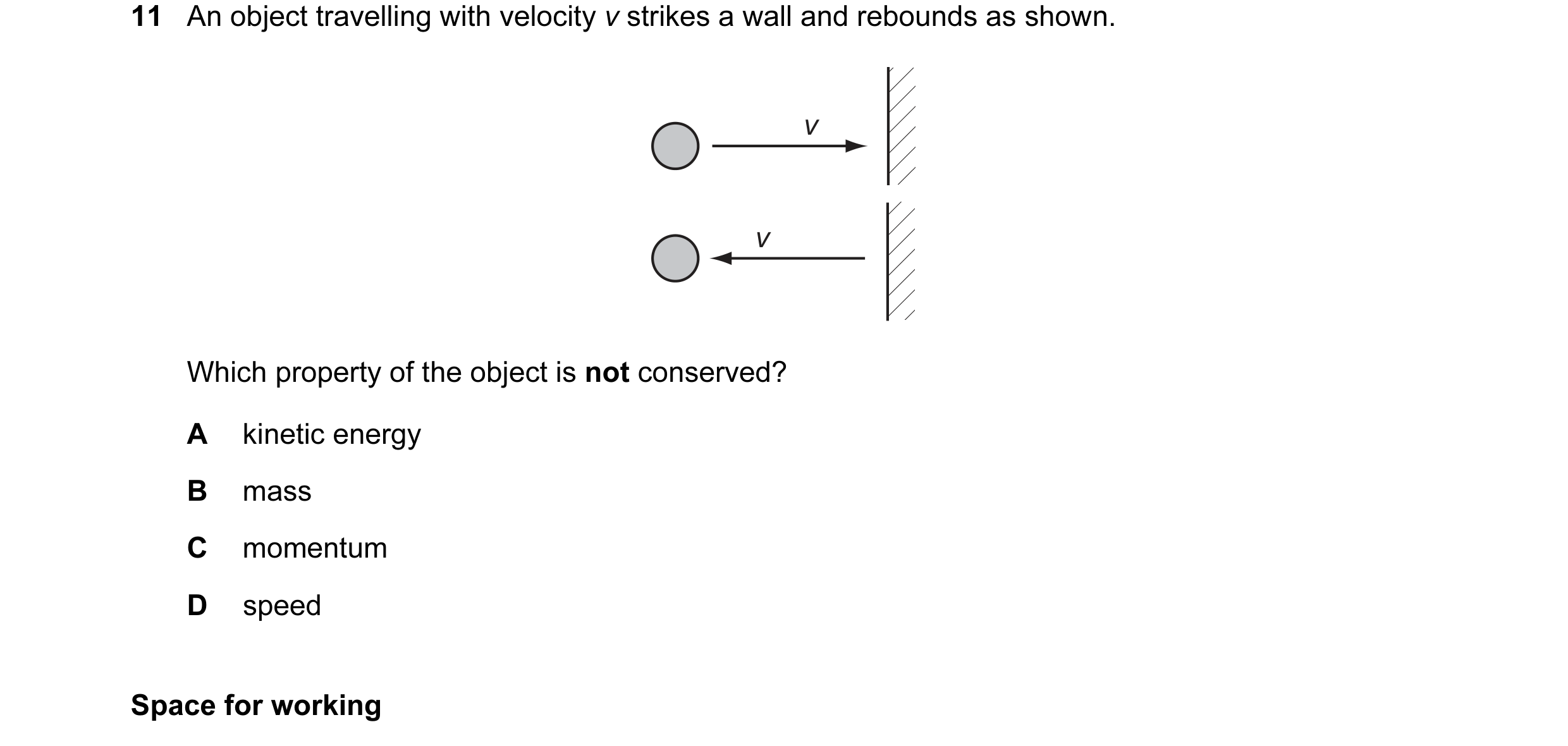
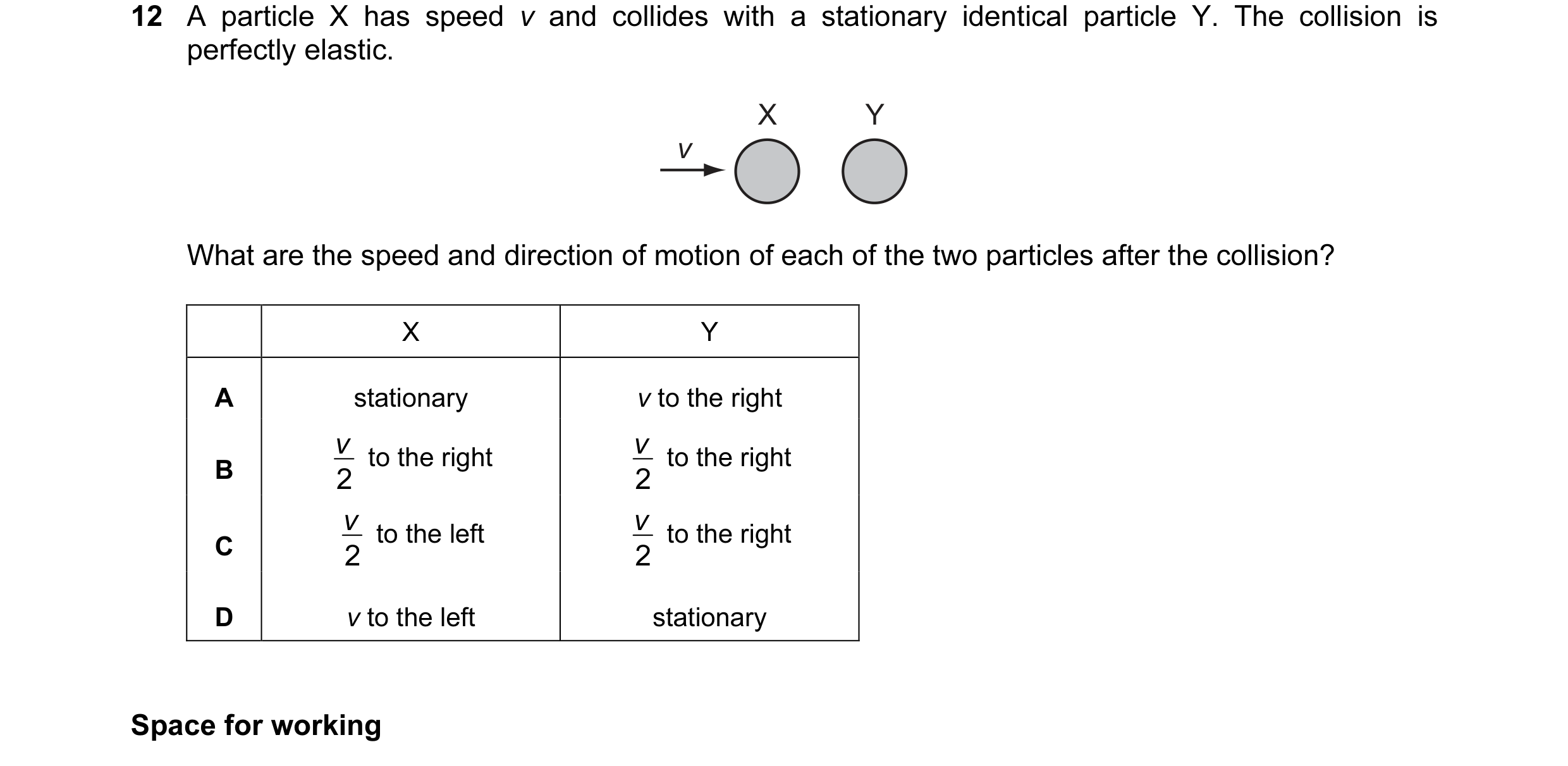 16 / 66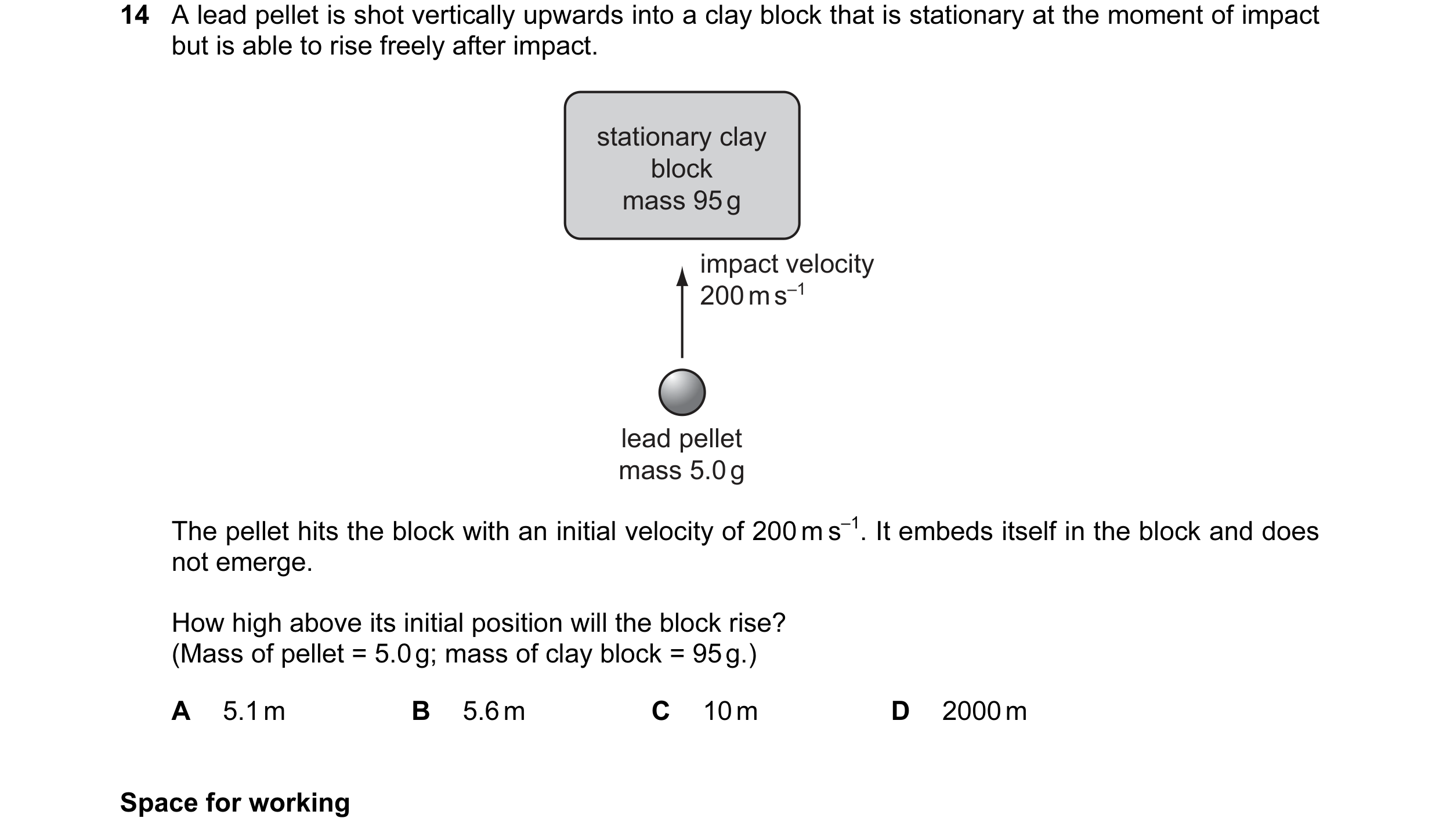
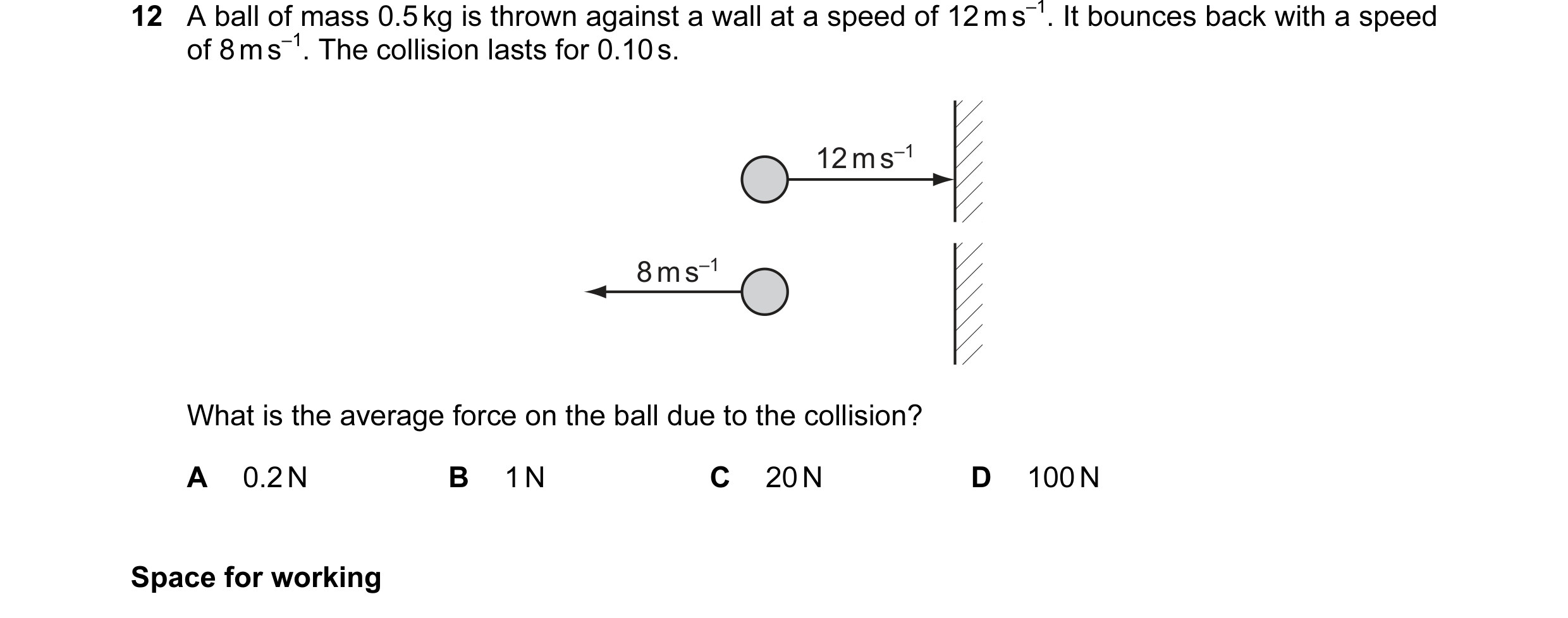
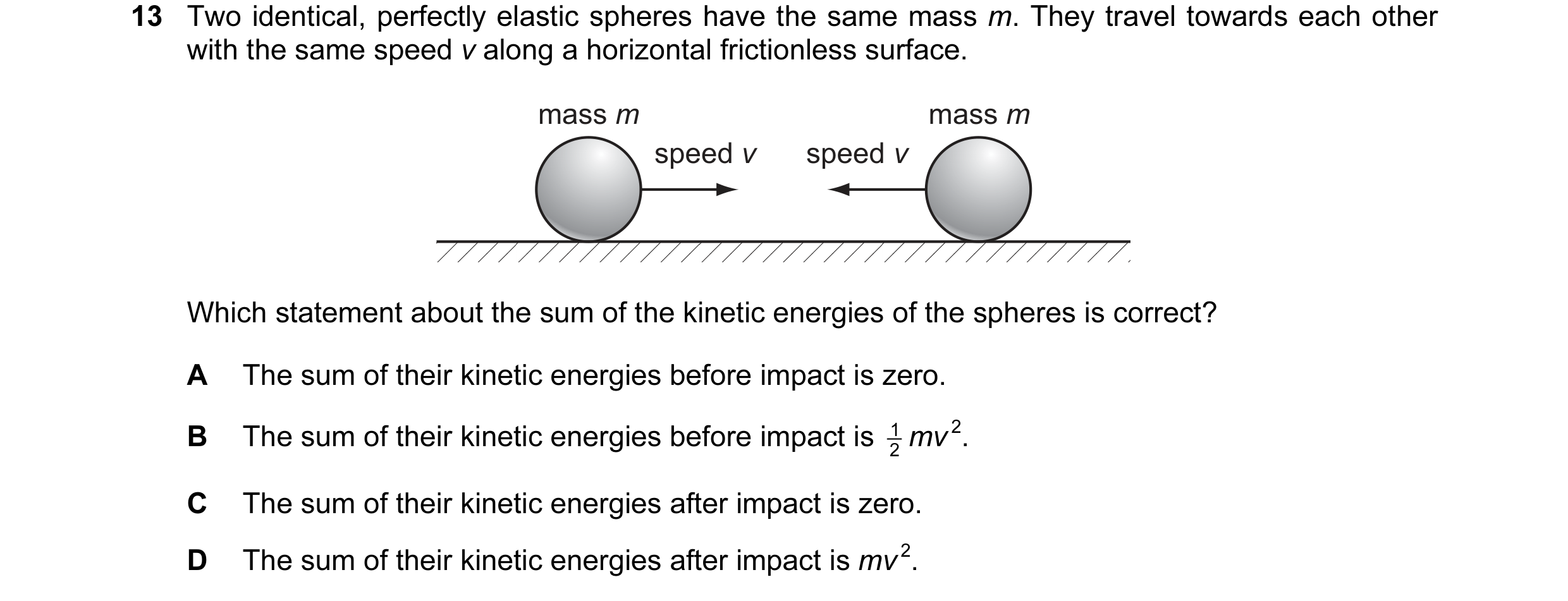 17 / 66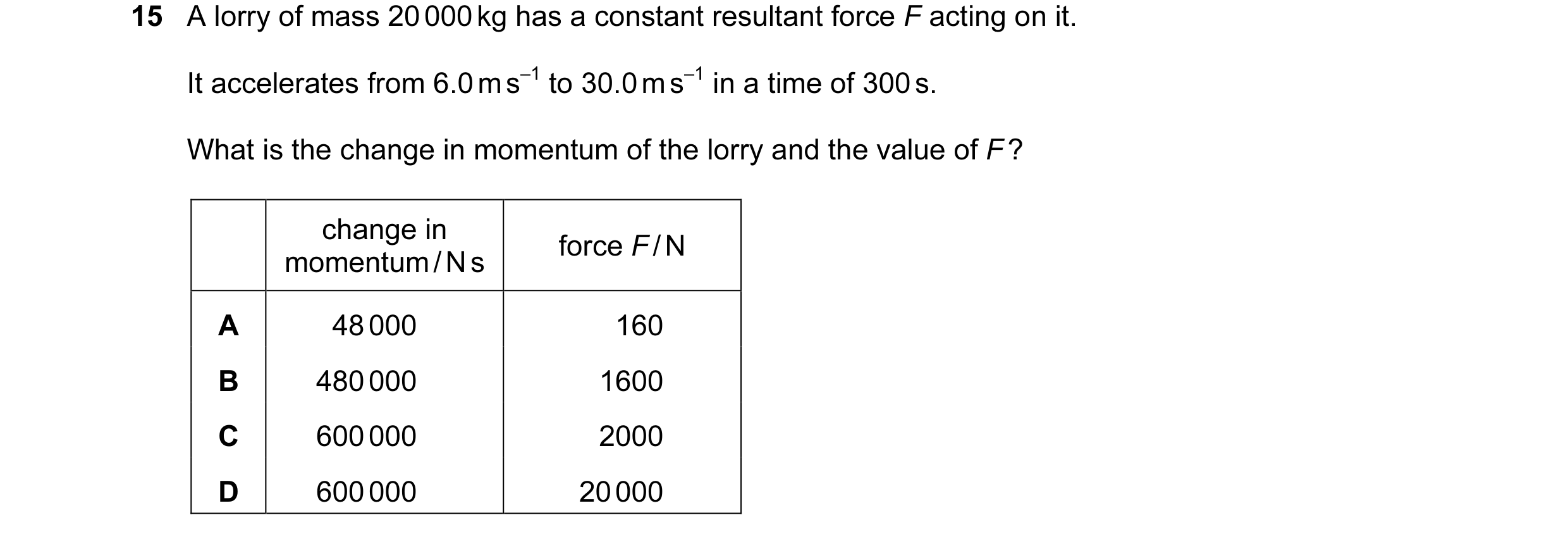
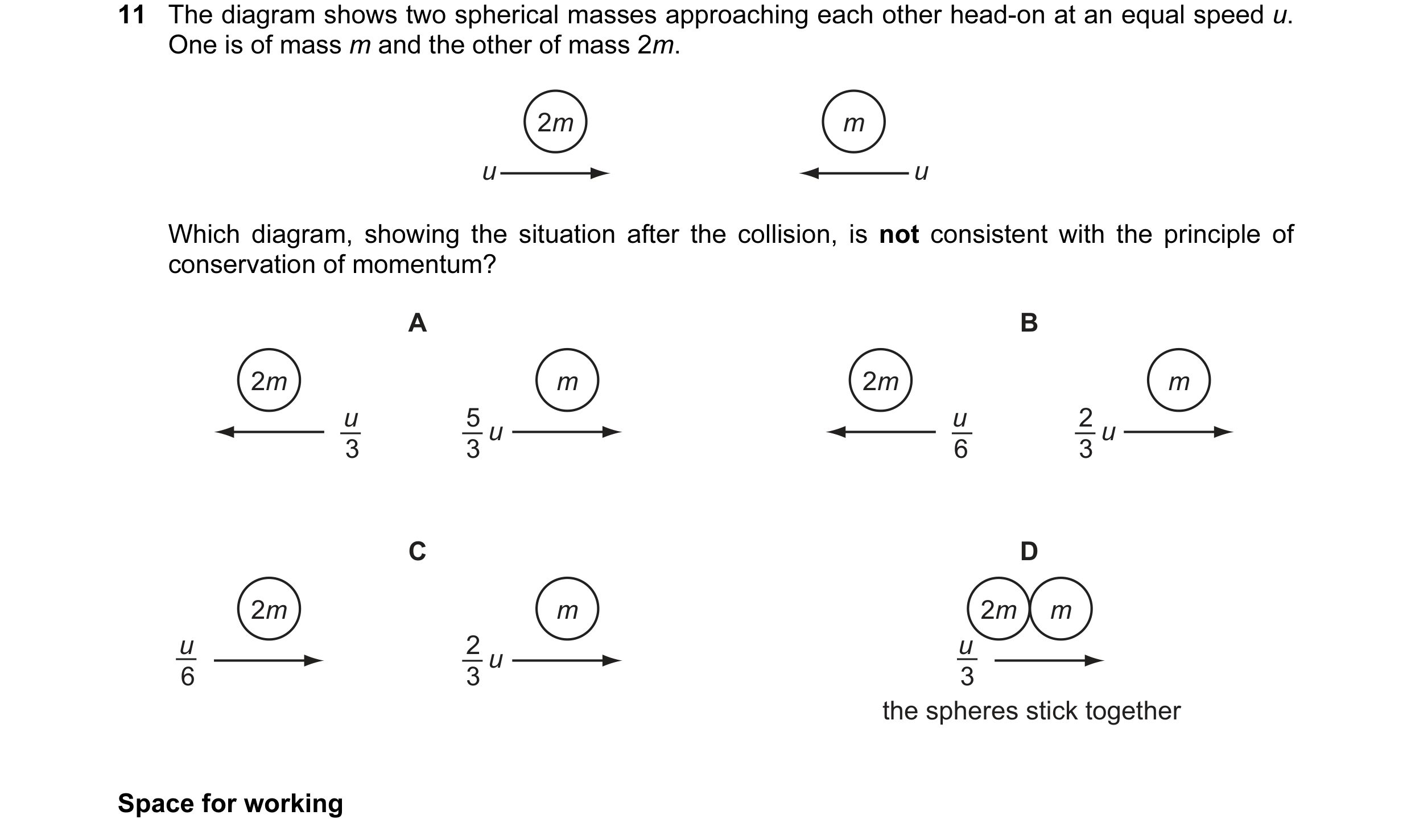
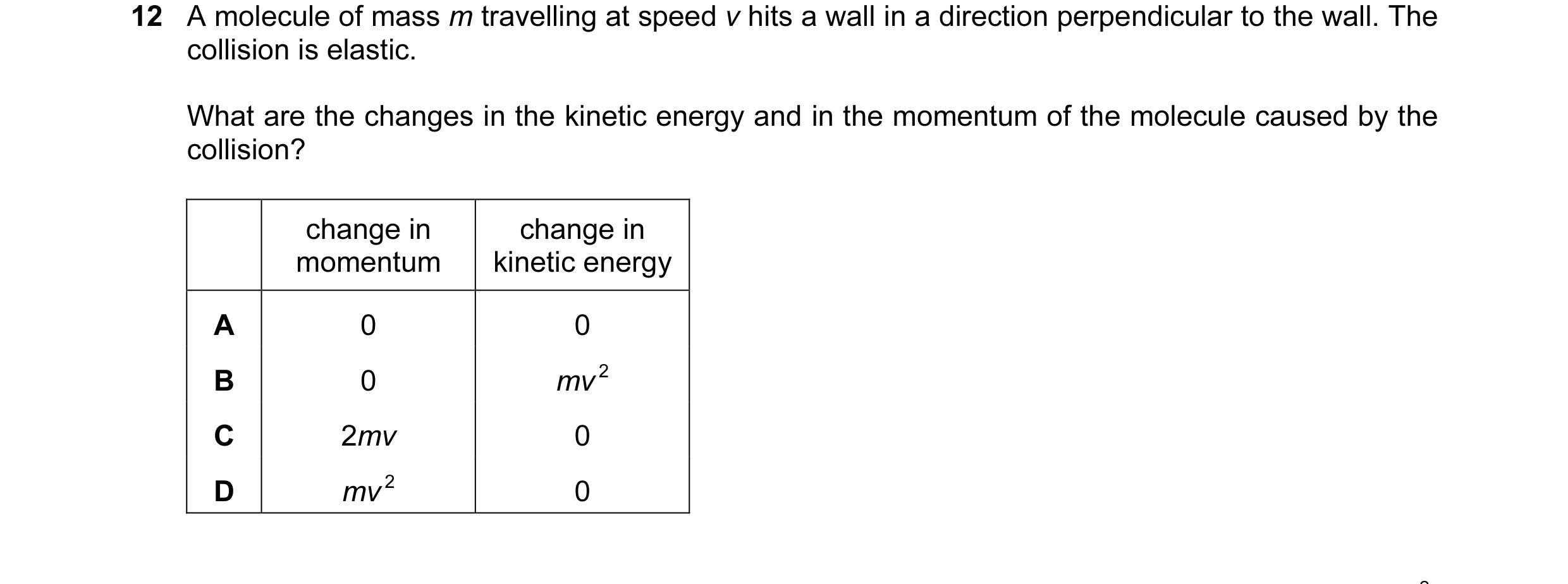 18 / 66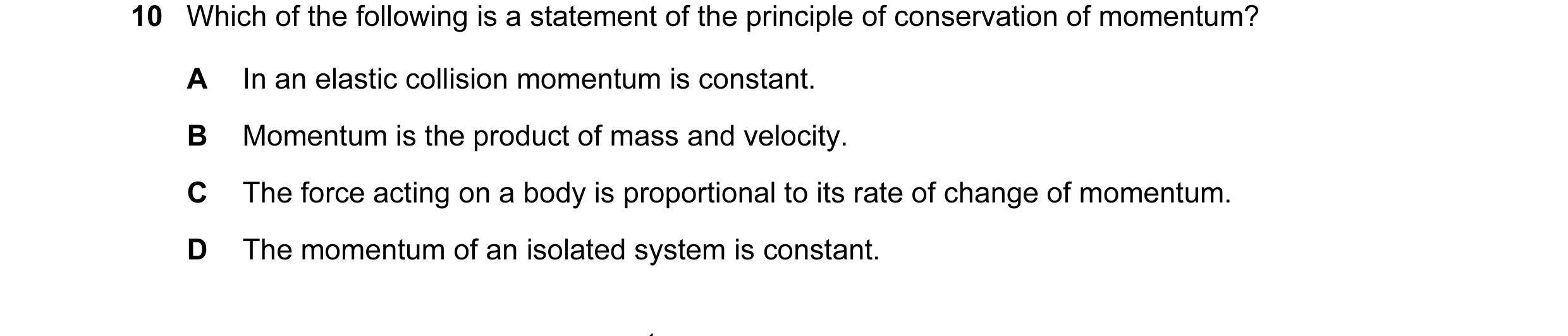
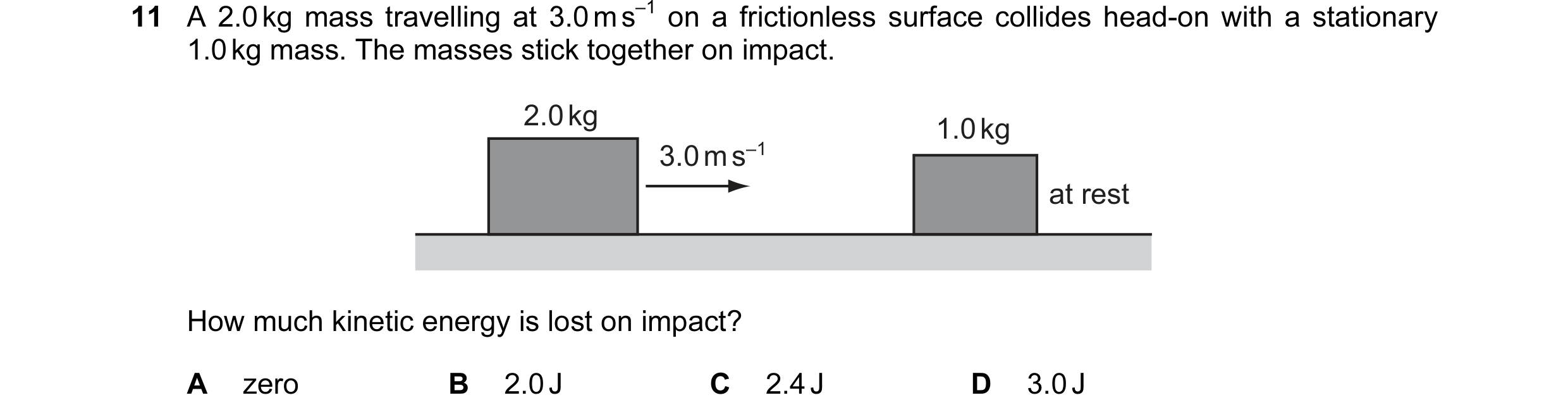
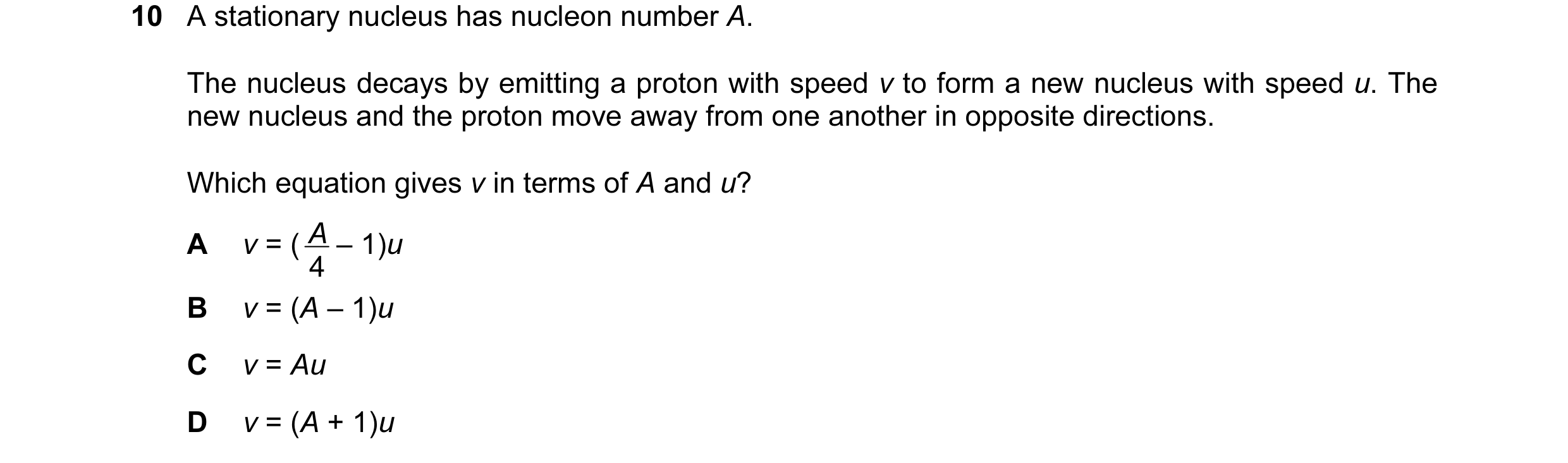 19 / 66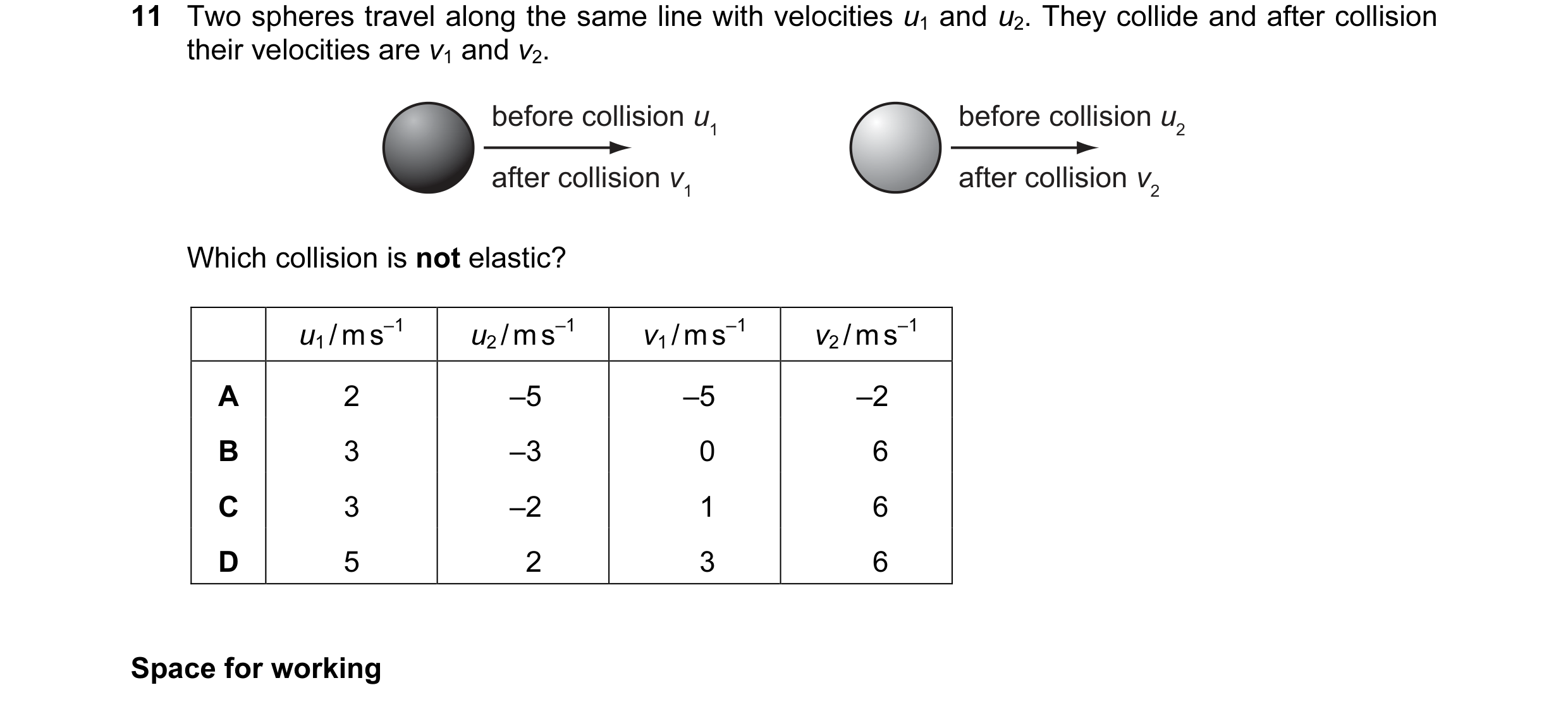
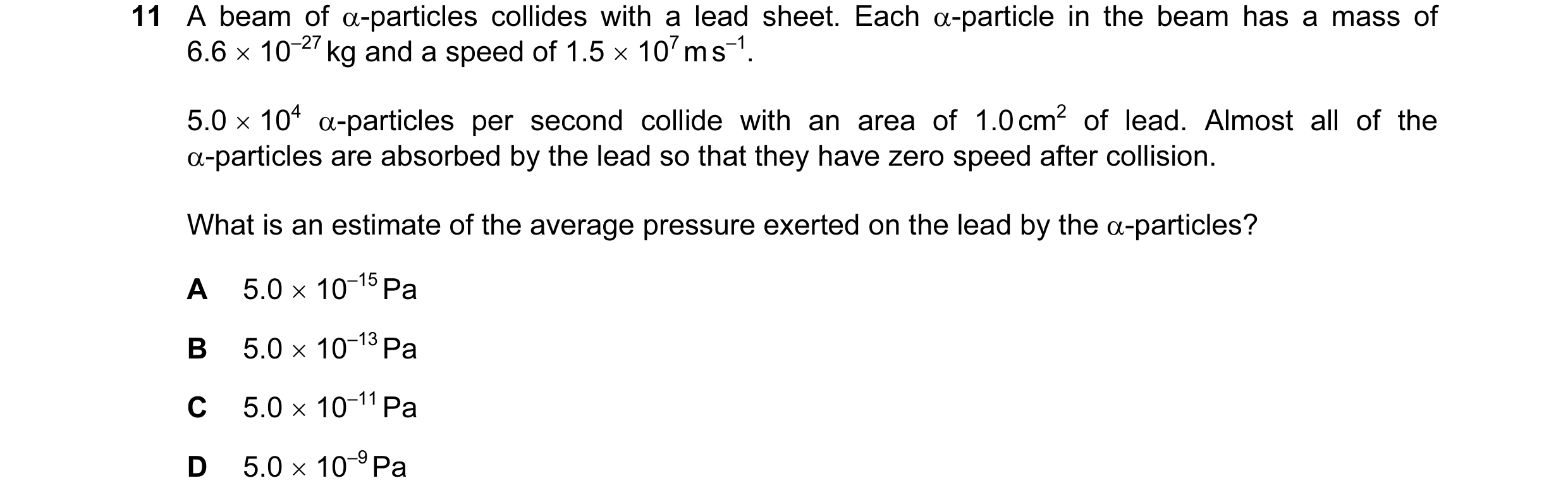
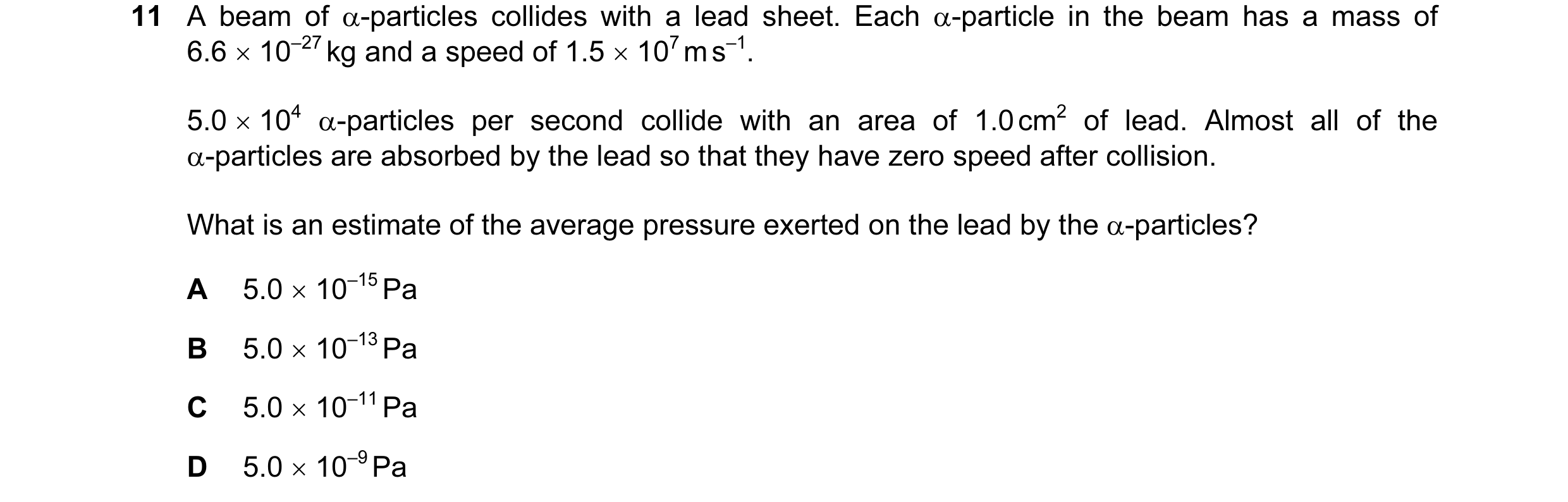 20 / 66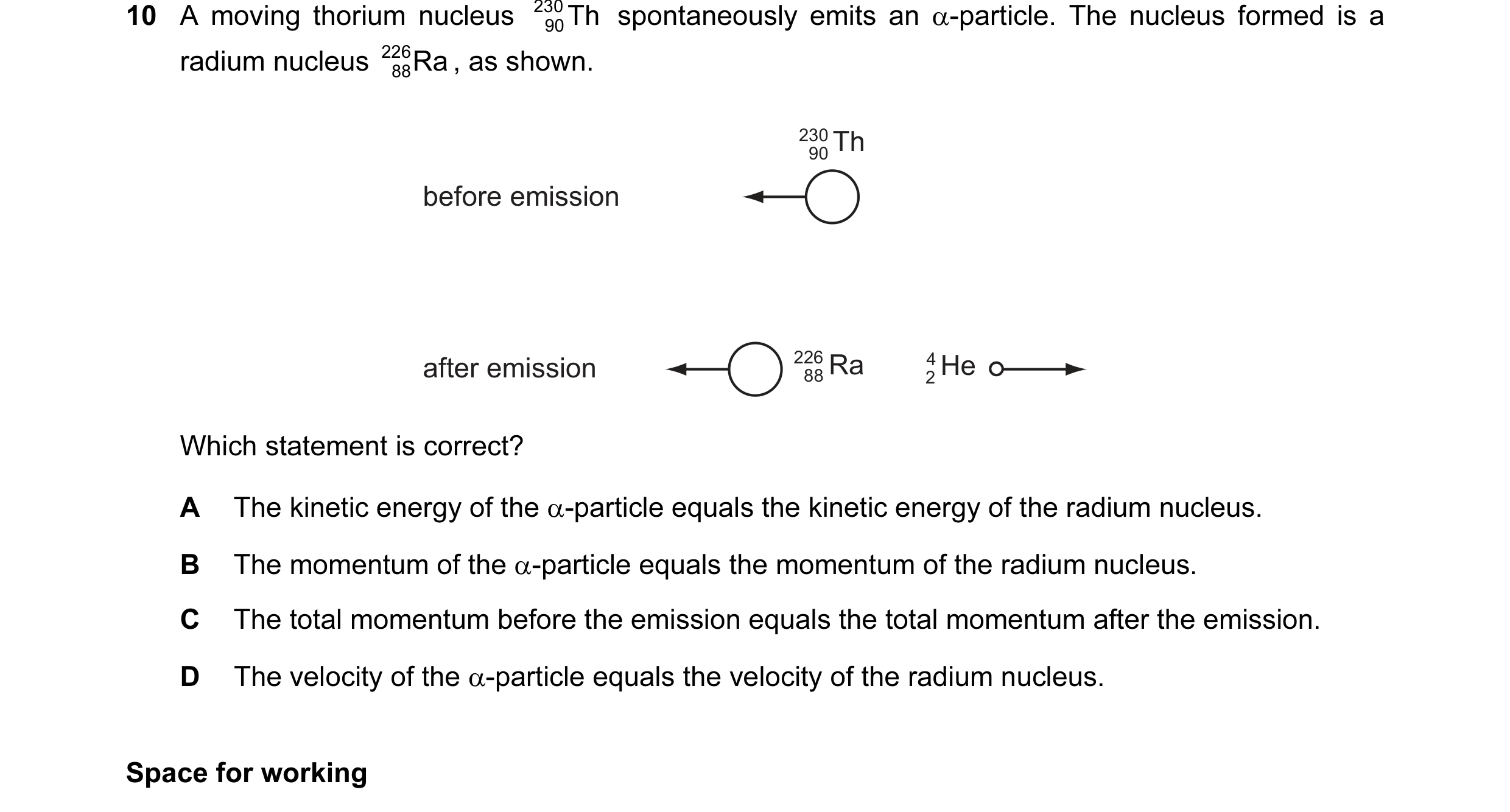
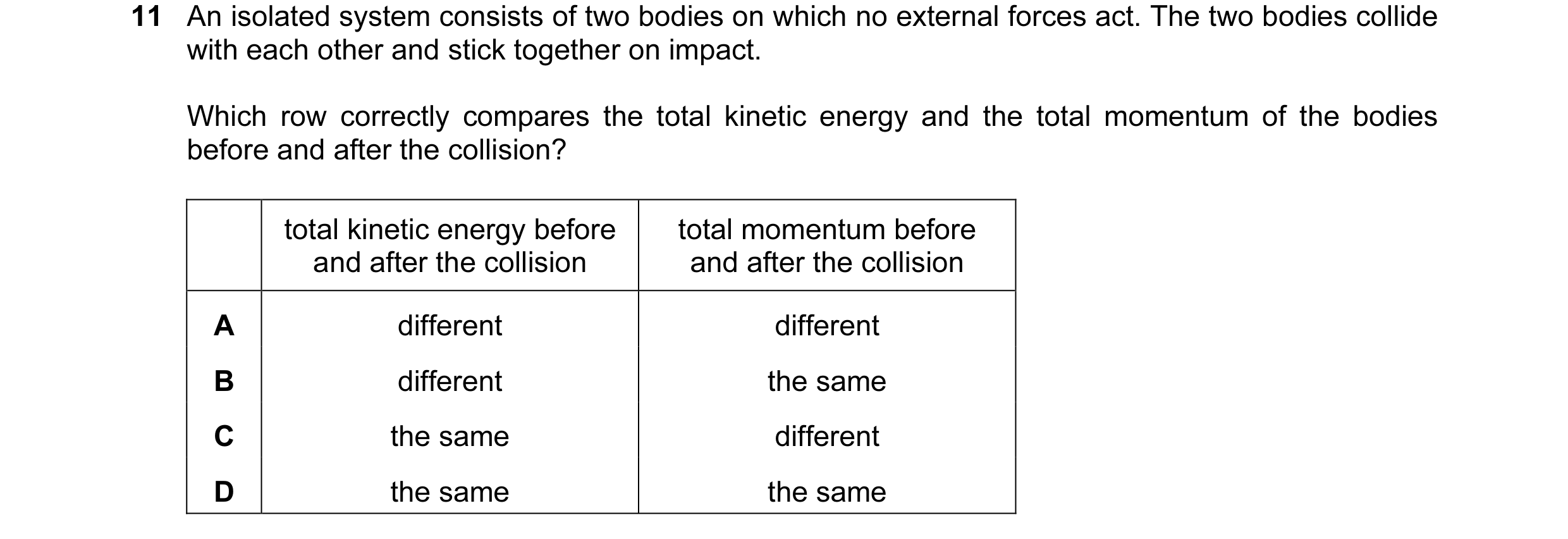
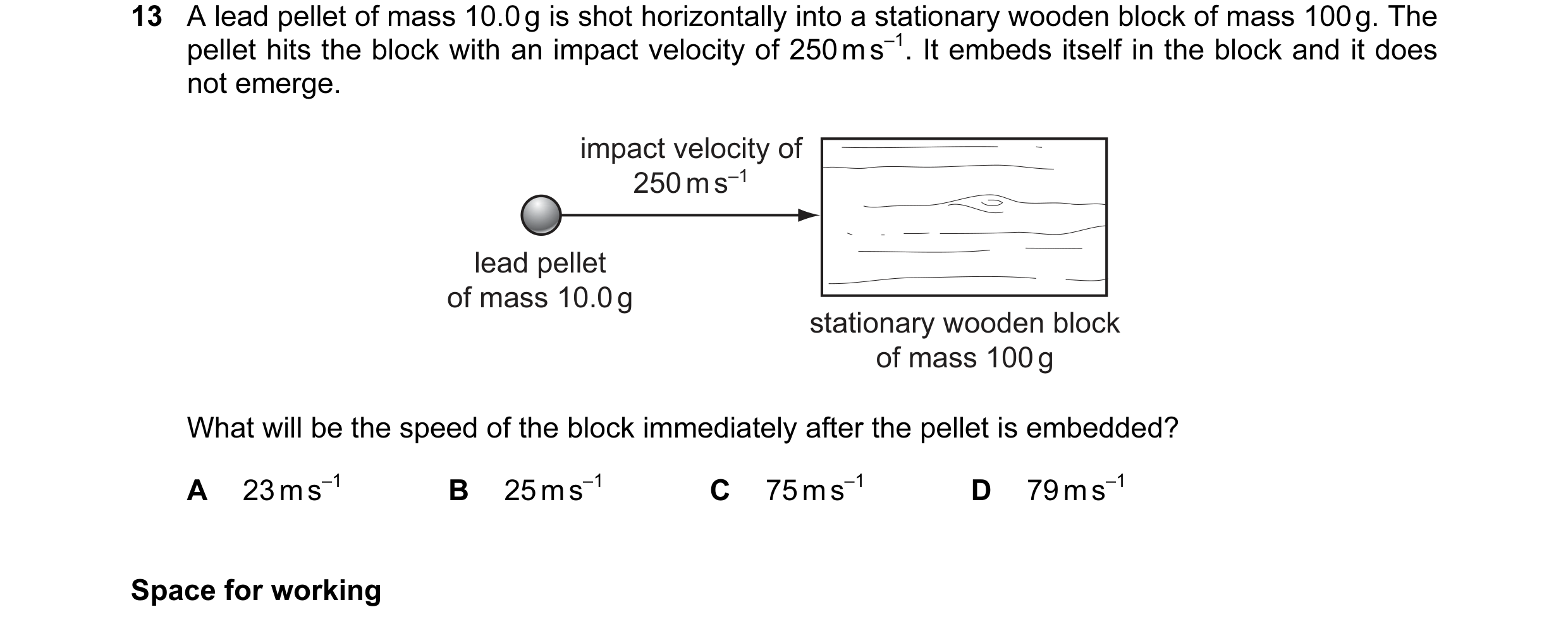 21 / 66
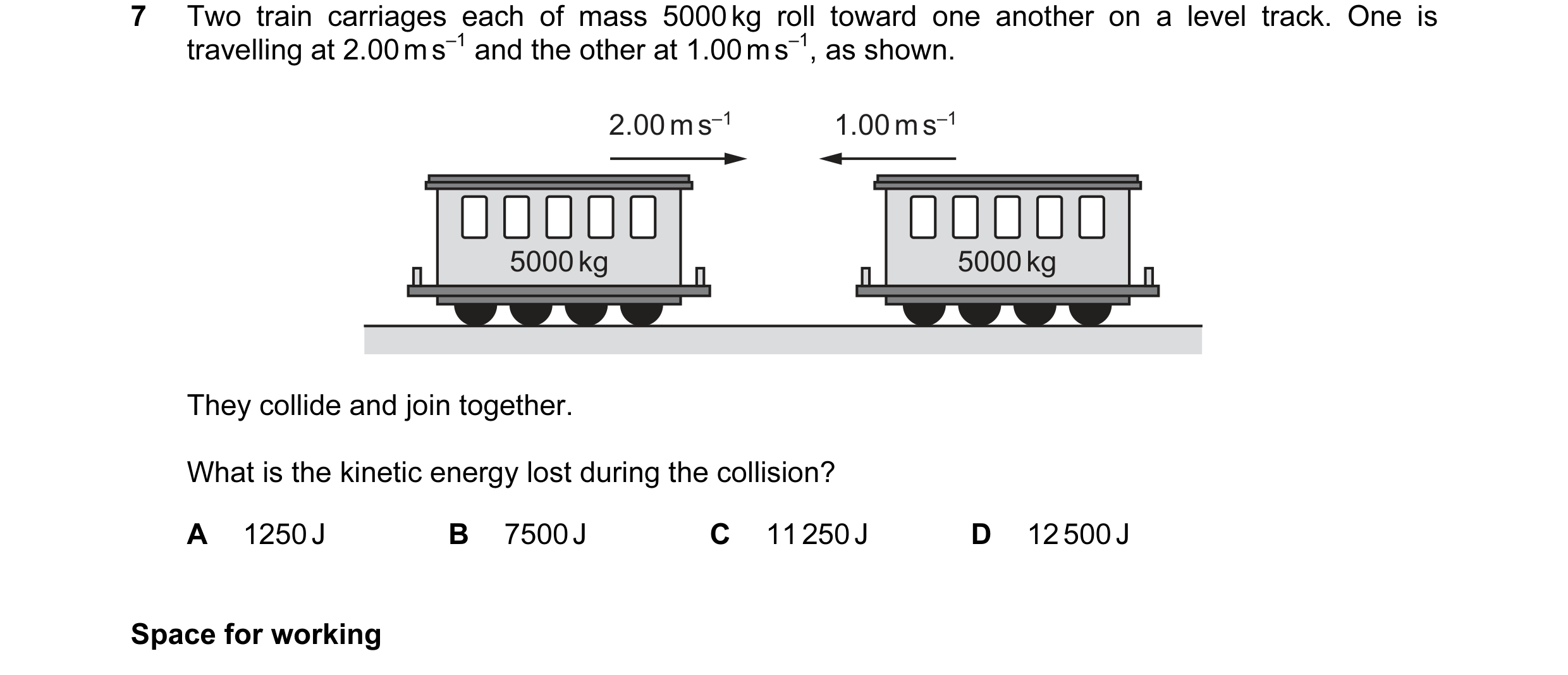
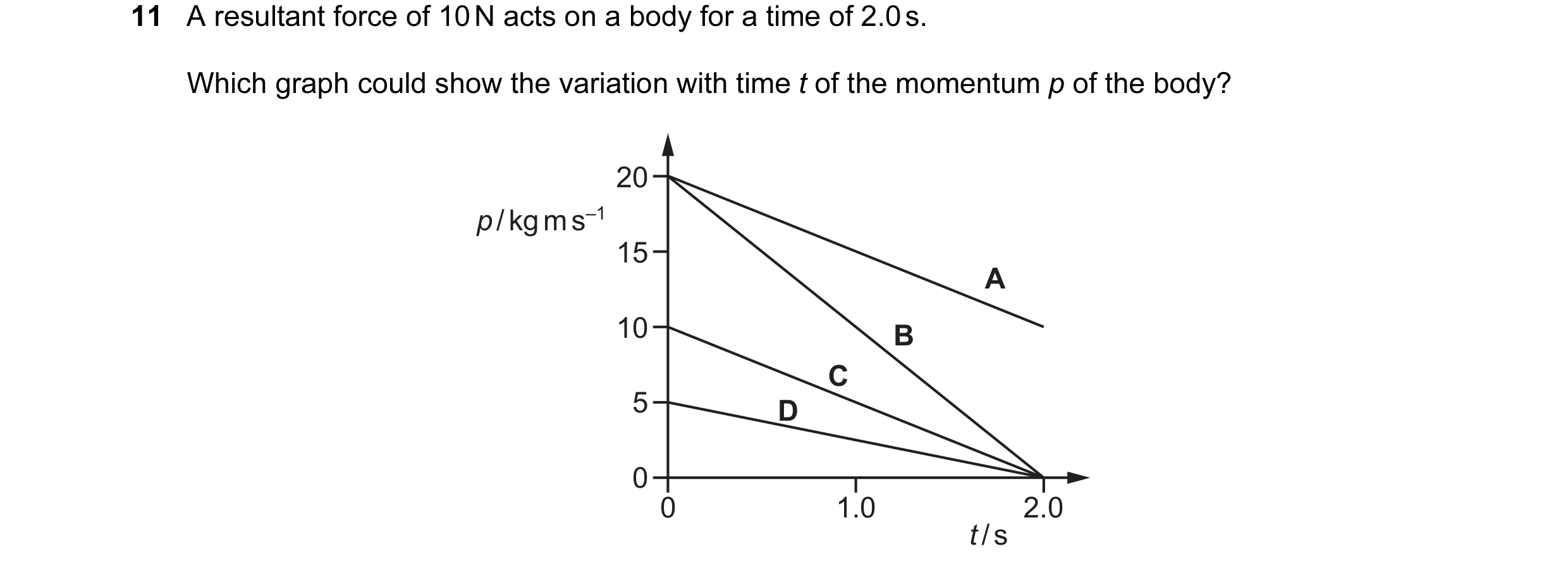 22 / 66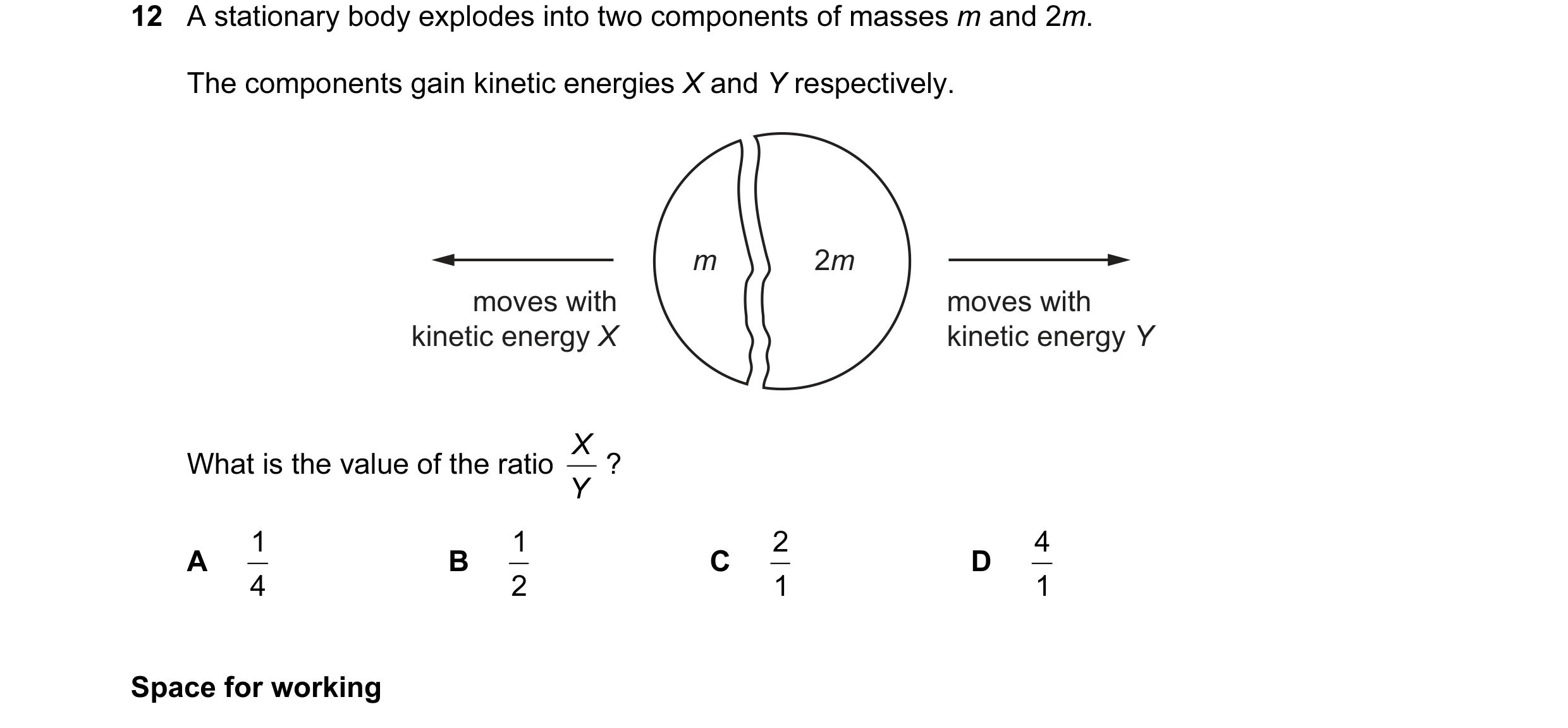

 23 / 66
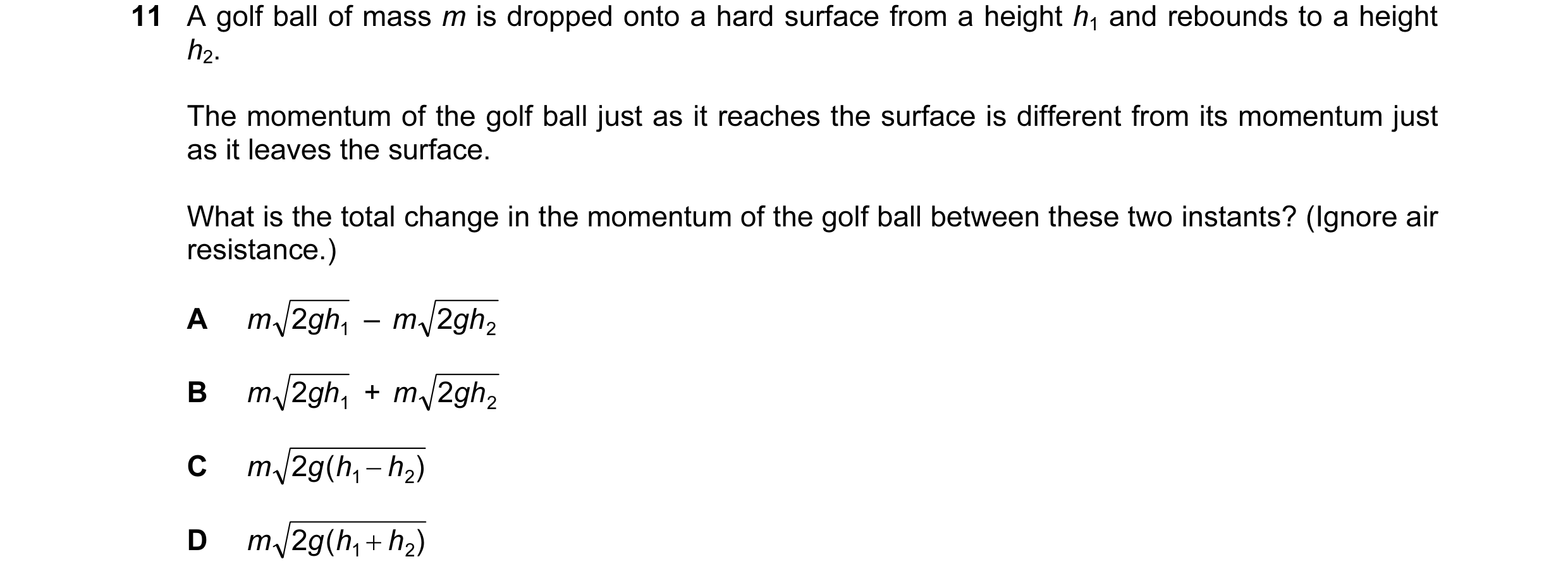
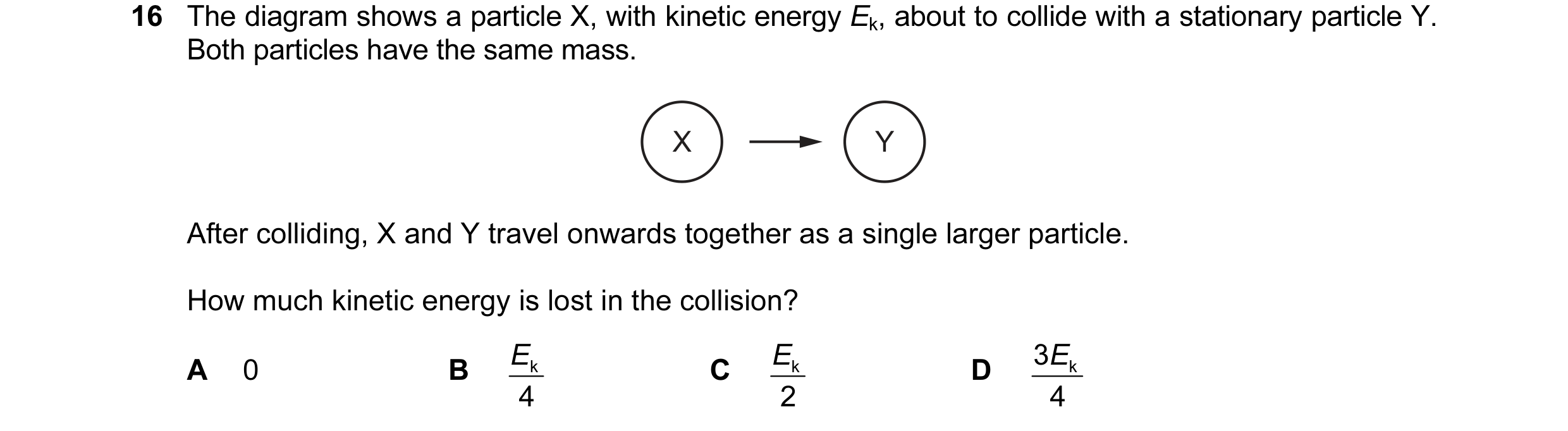
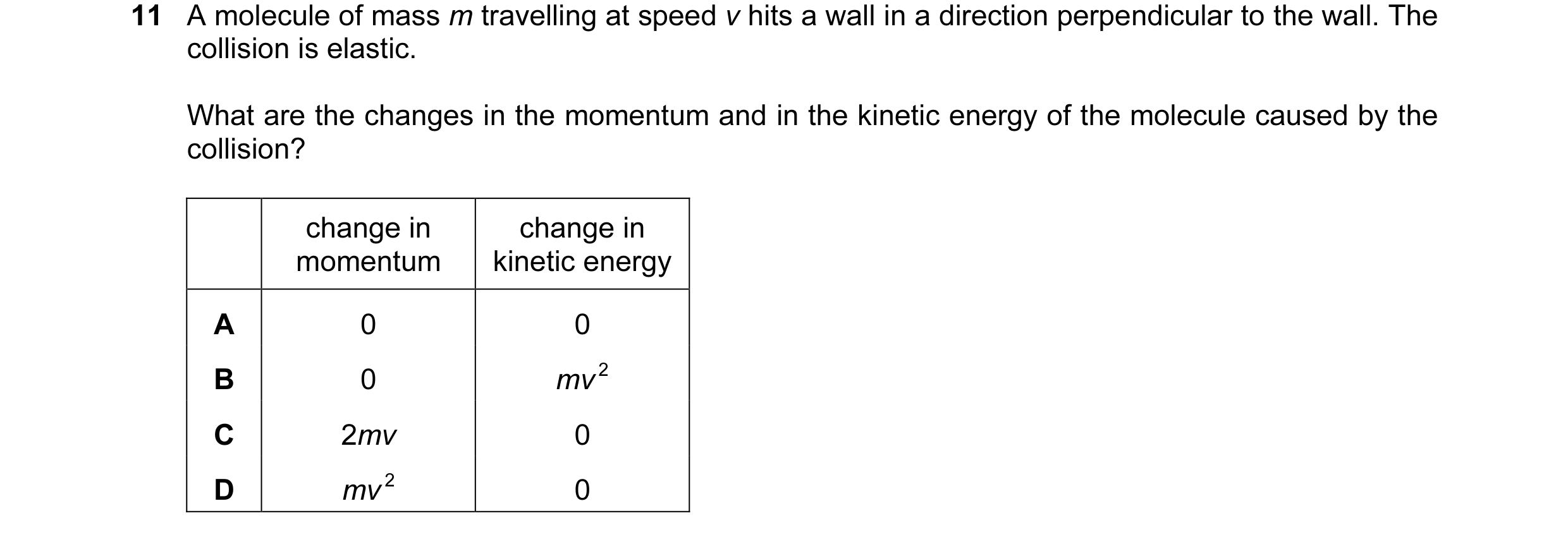
 24 / 66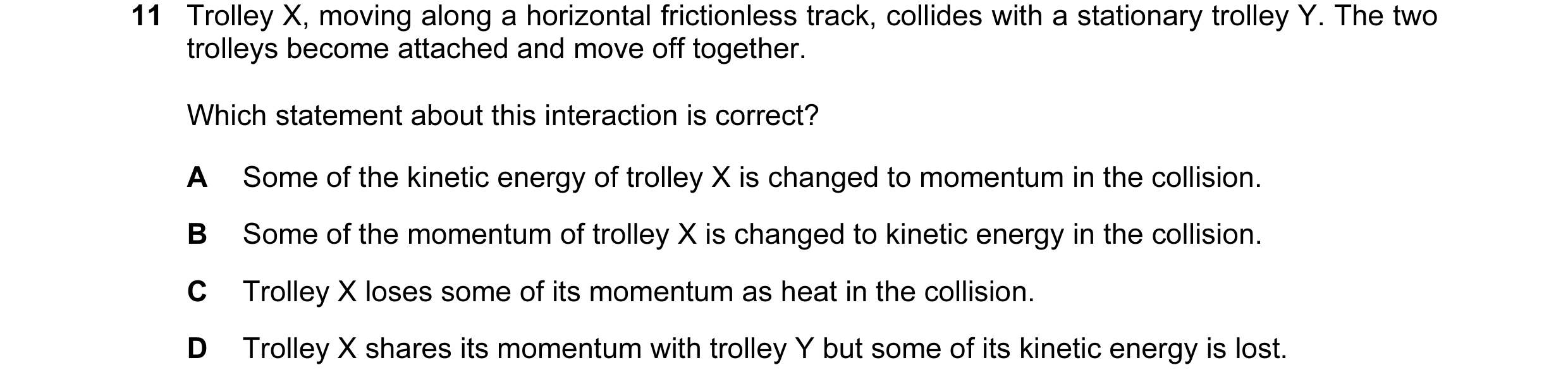

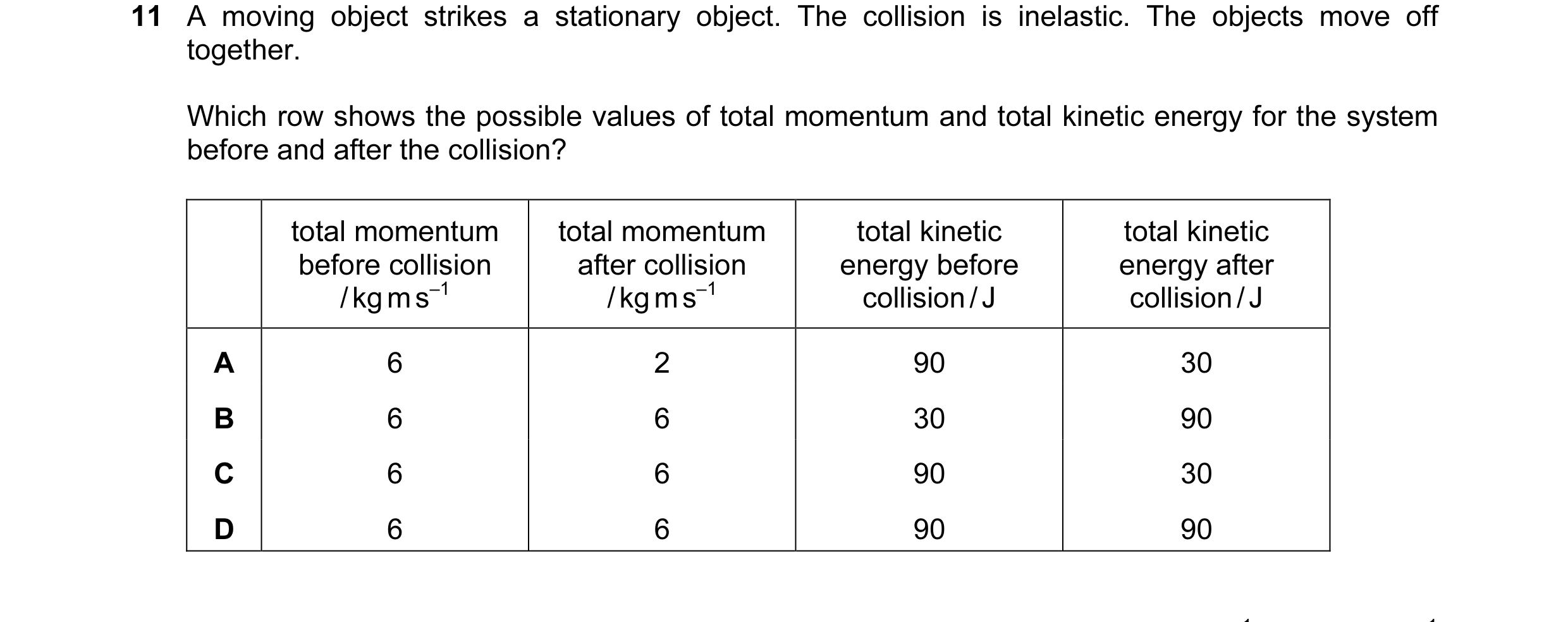
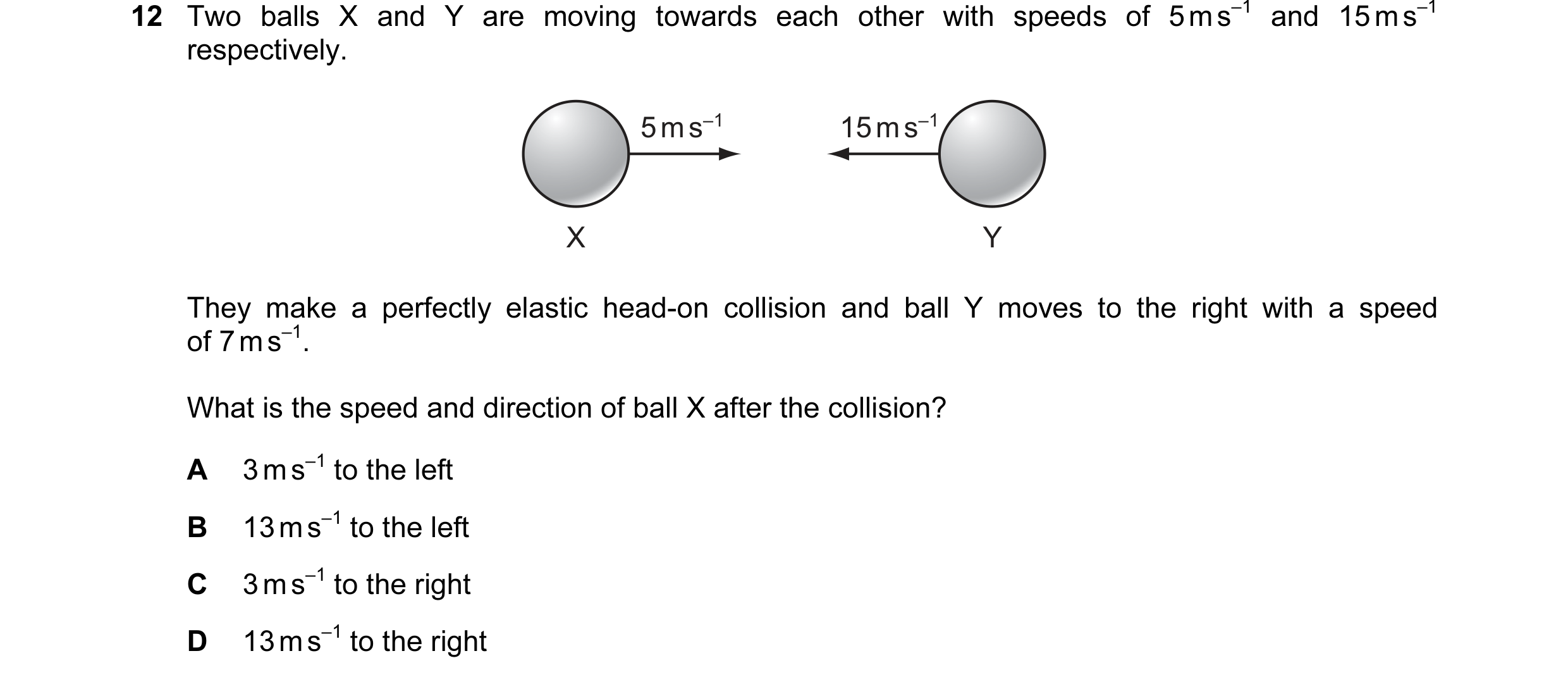 25 / 66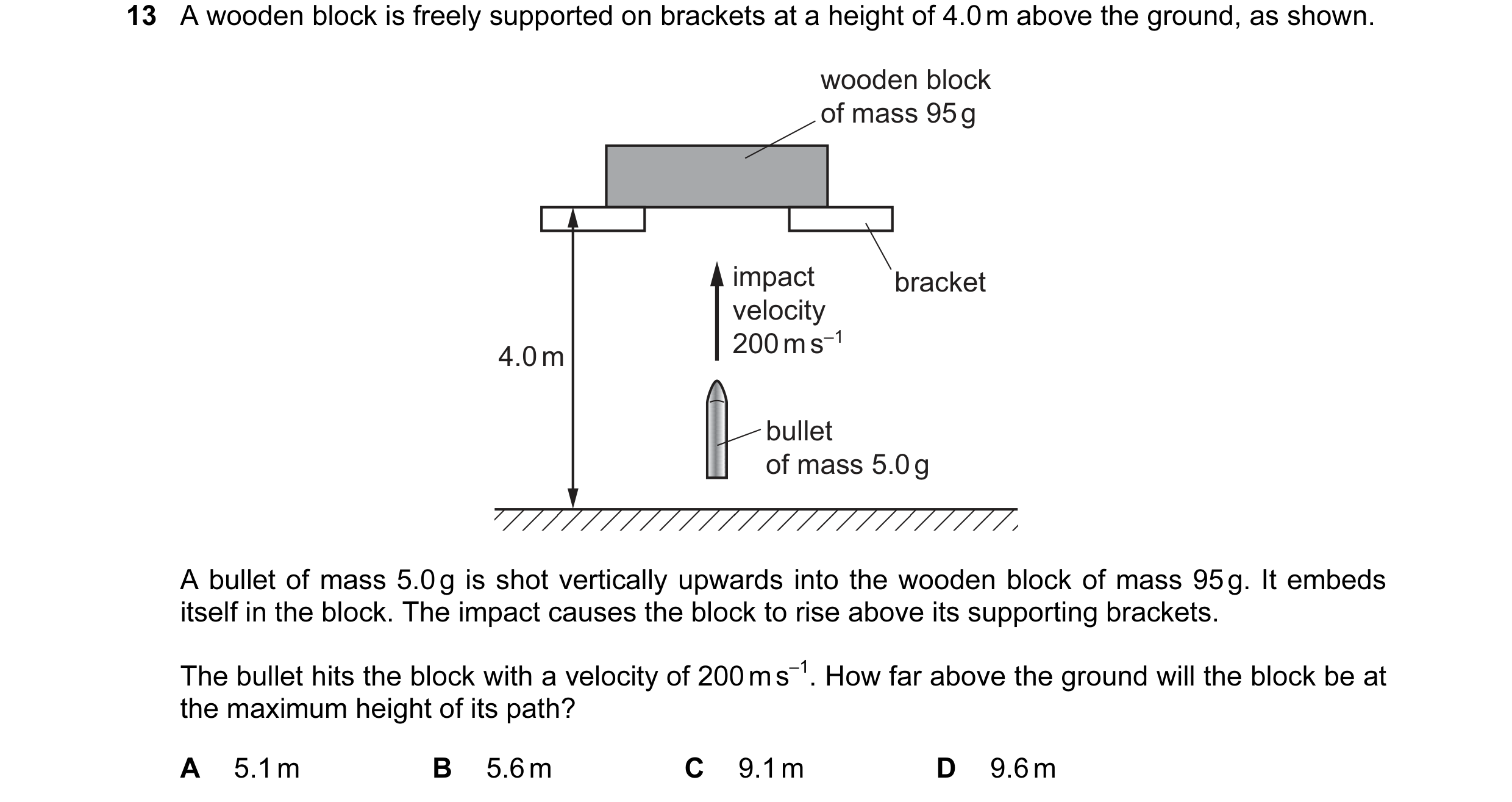


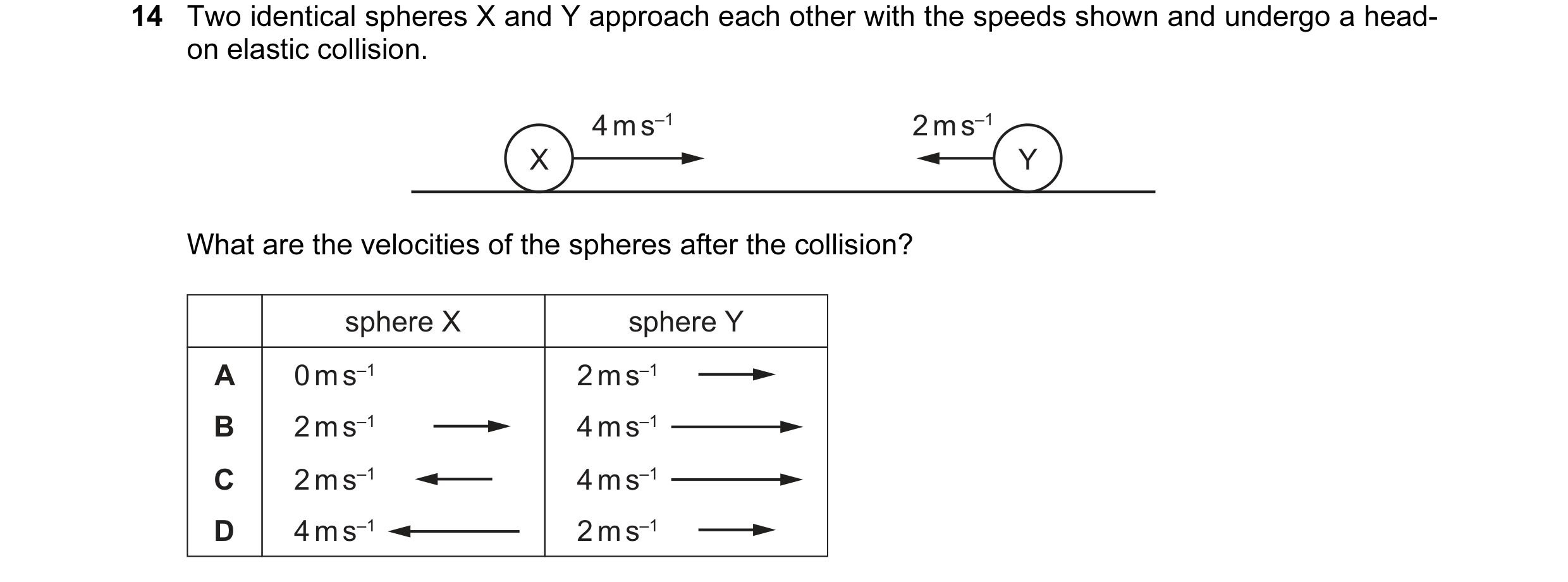 26 / 66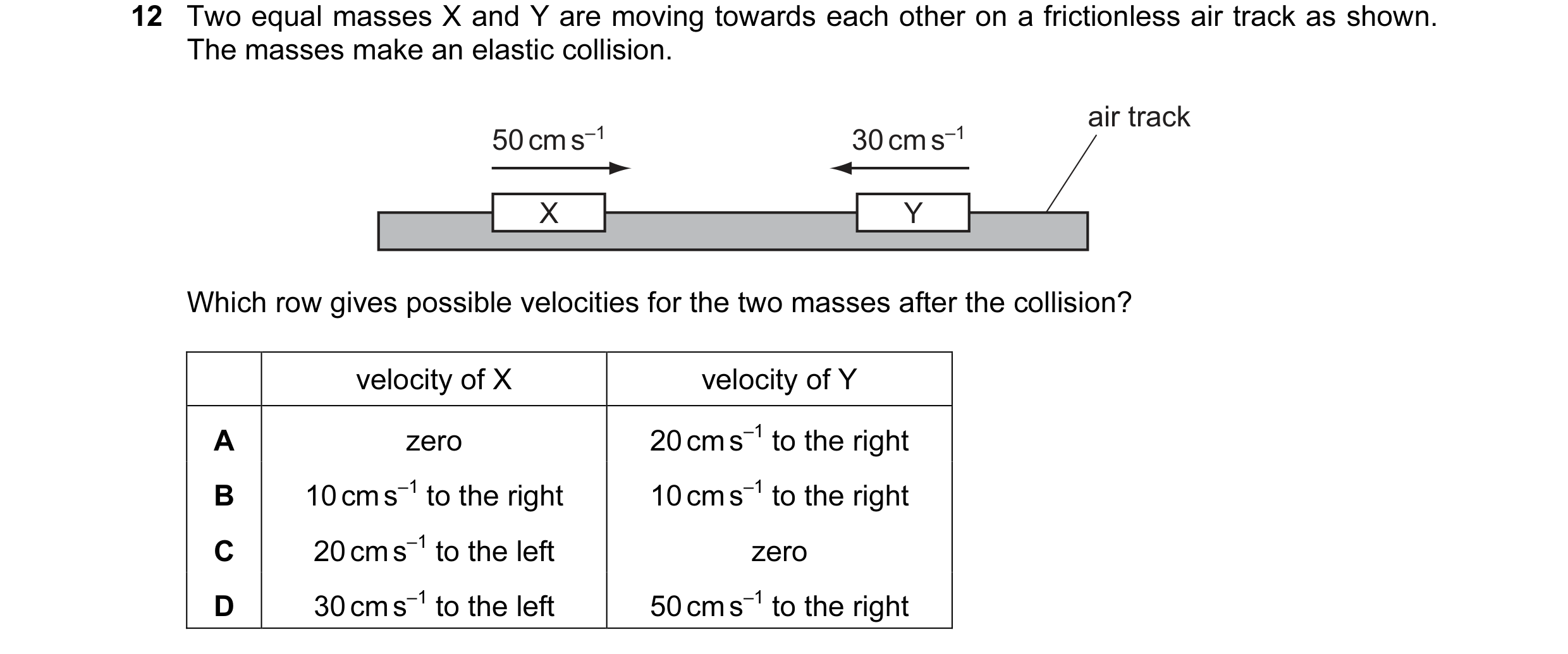
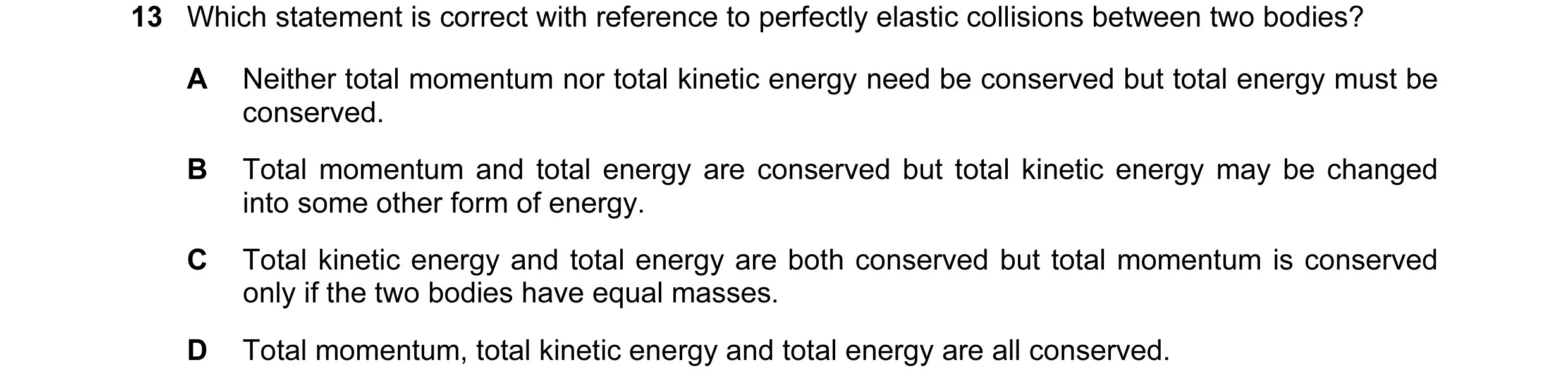
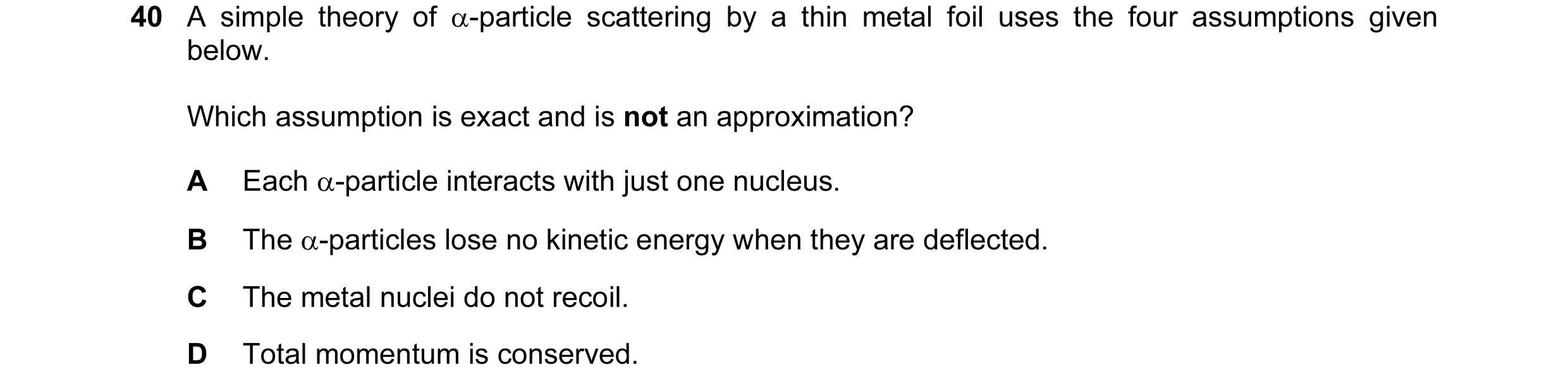 27 / 66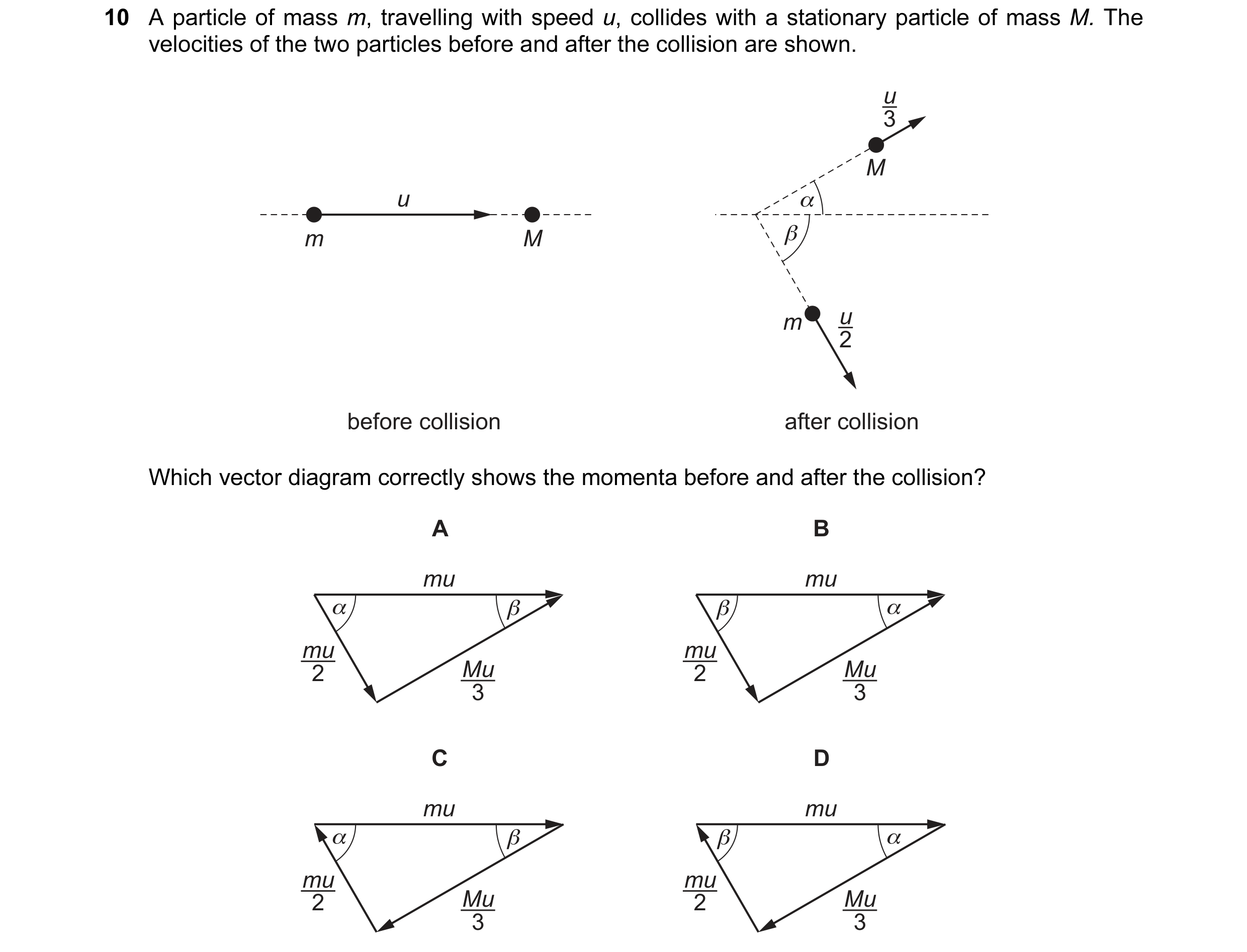
 28 / 66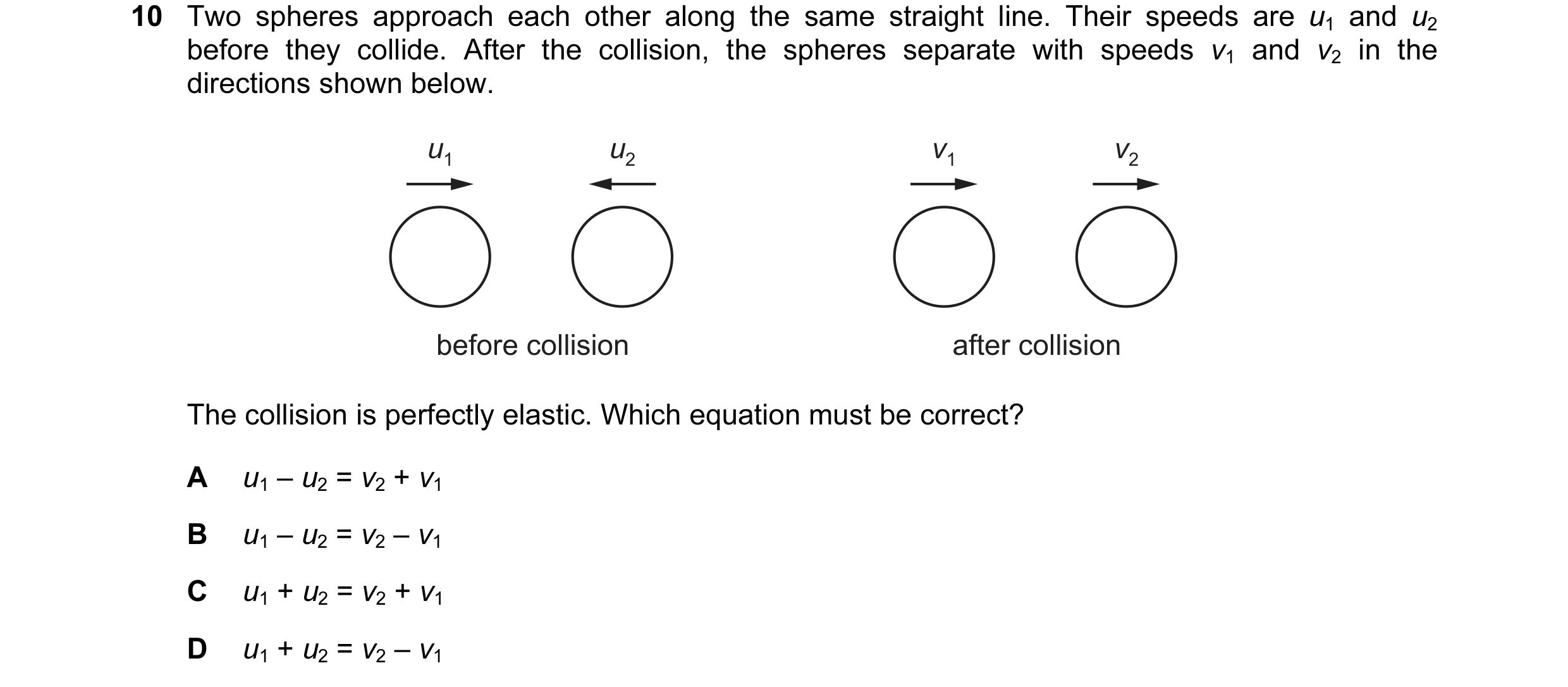
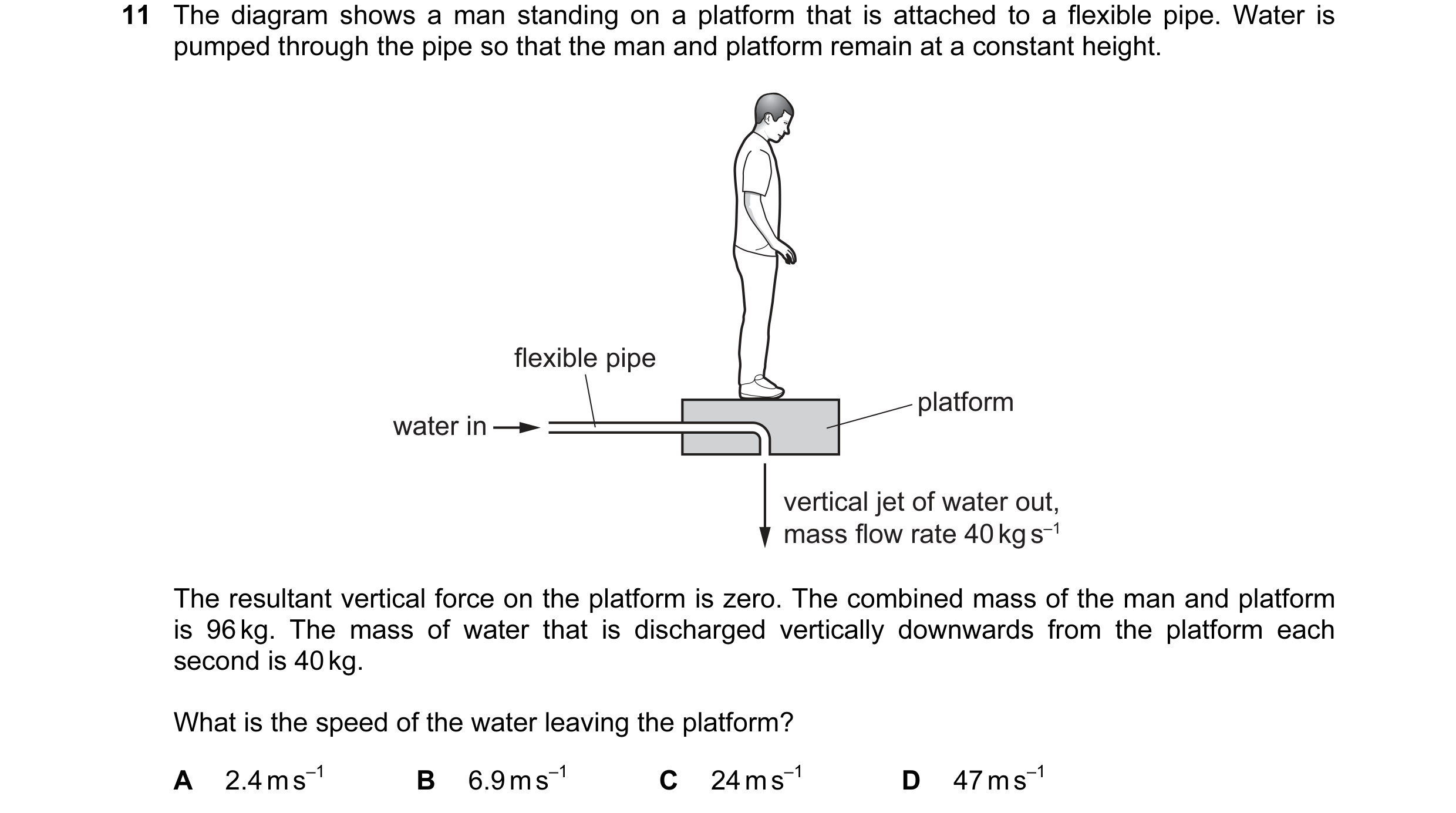 29 / 66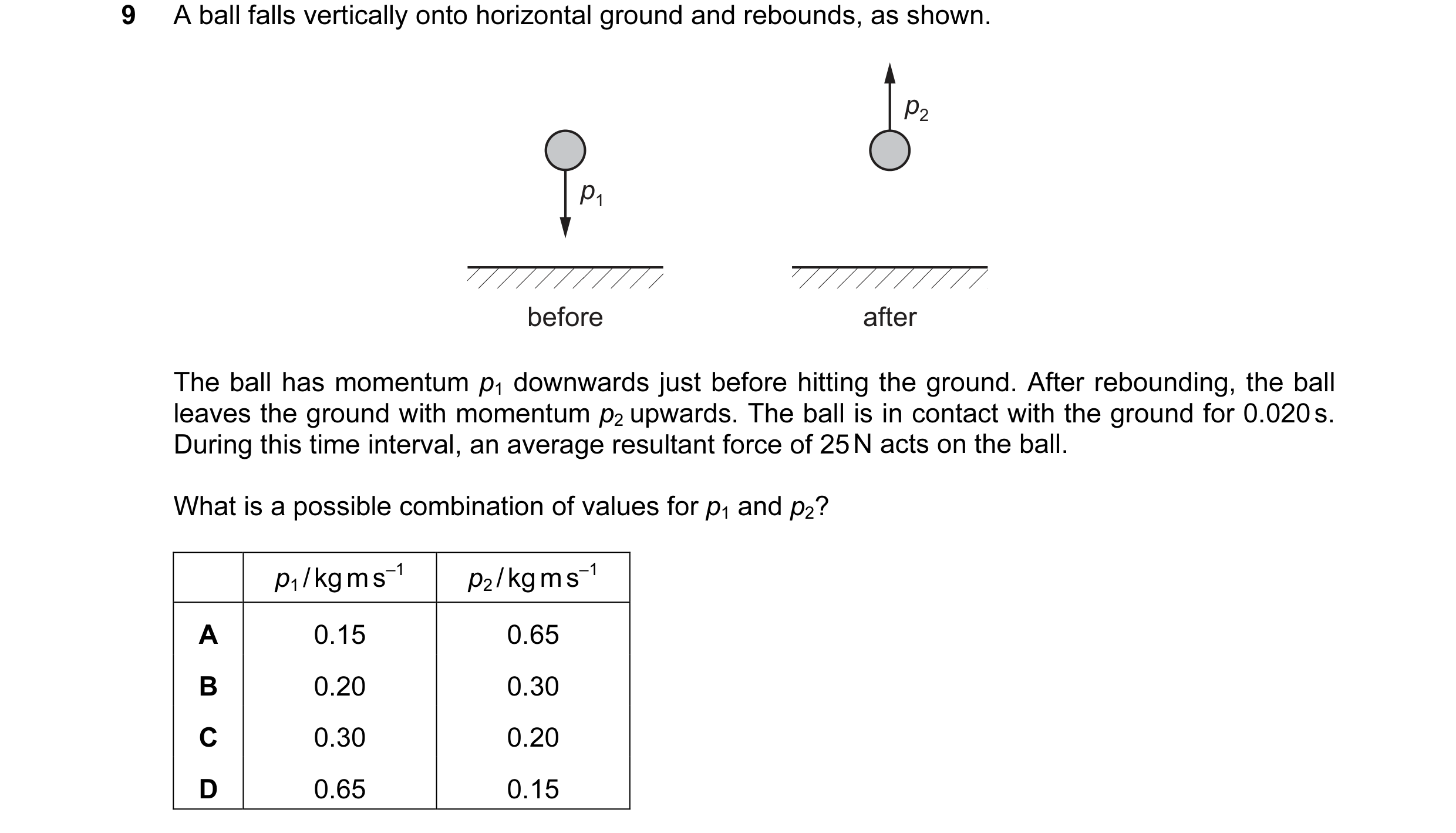
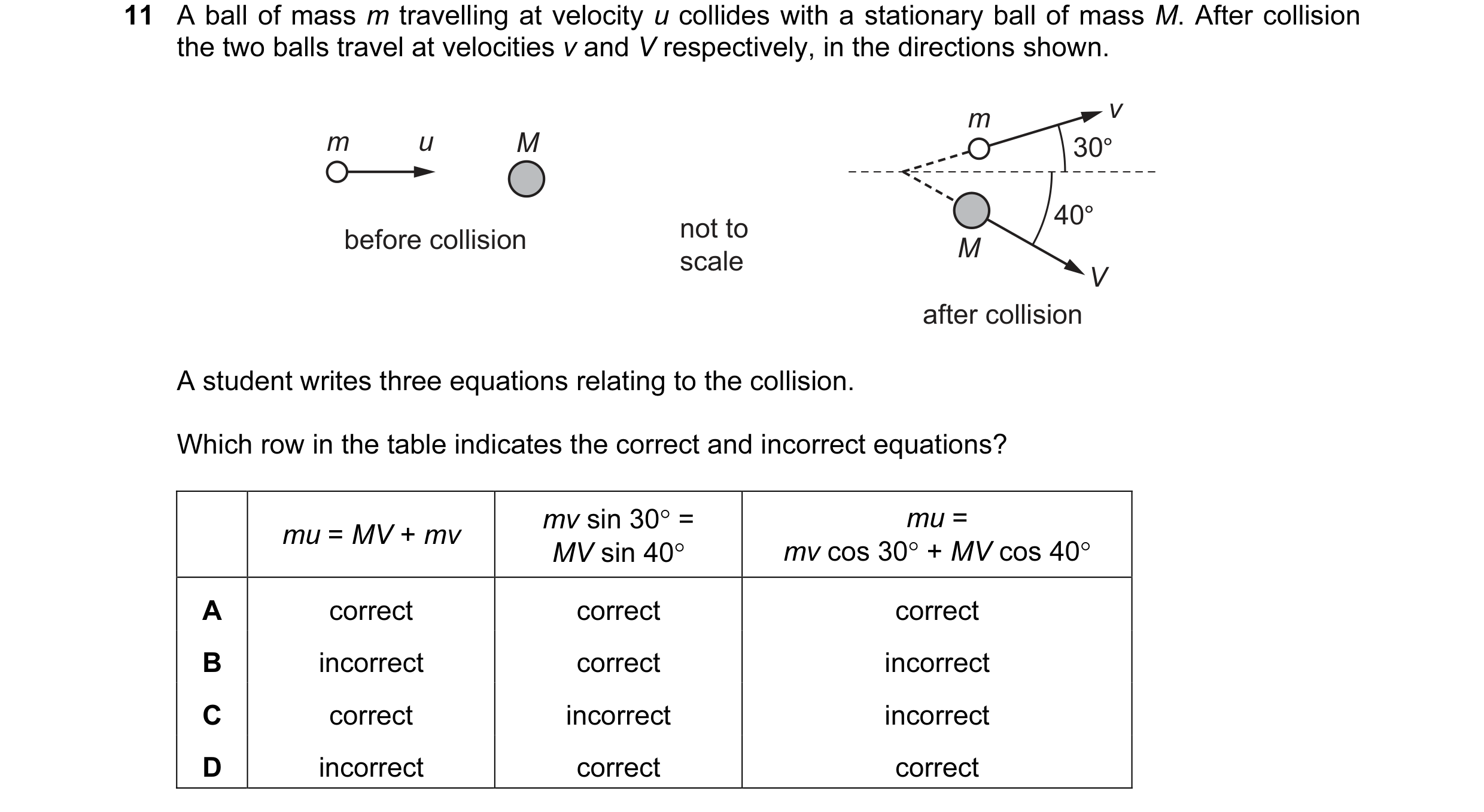 30 / 66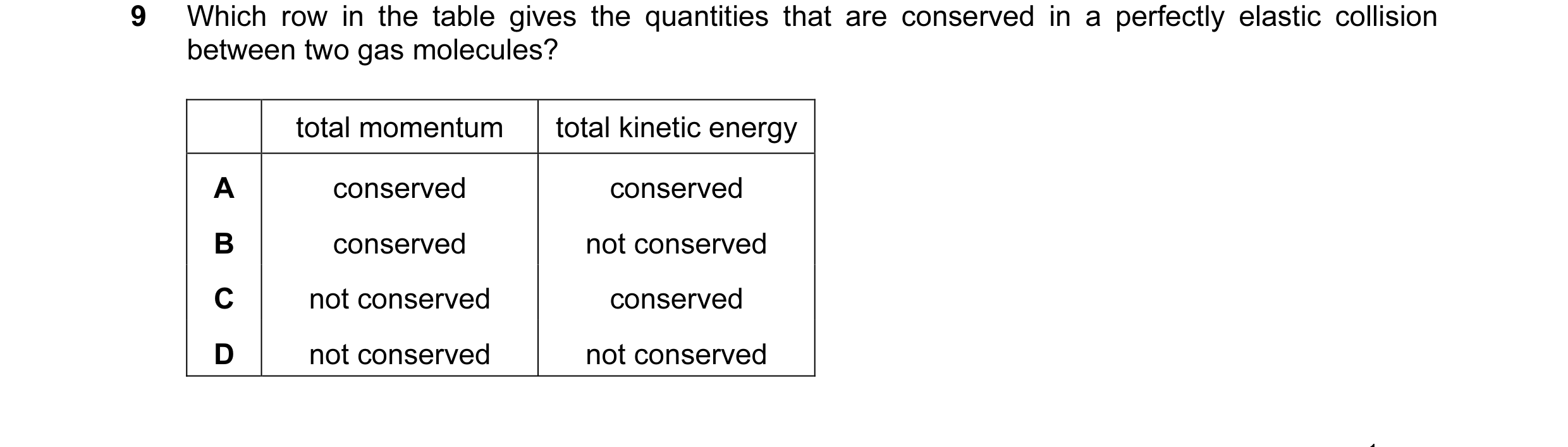
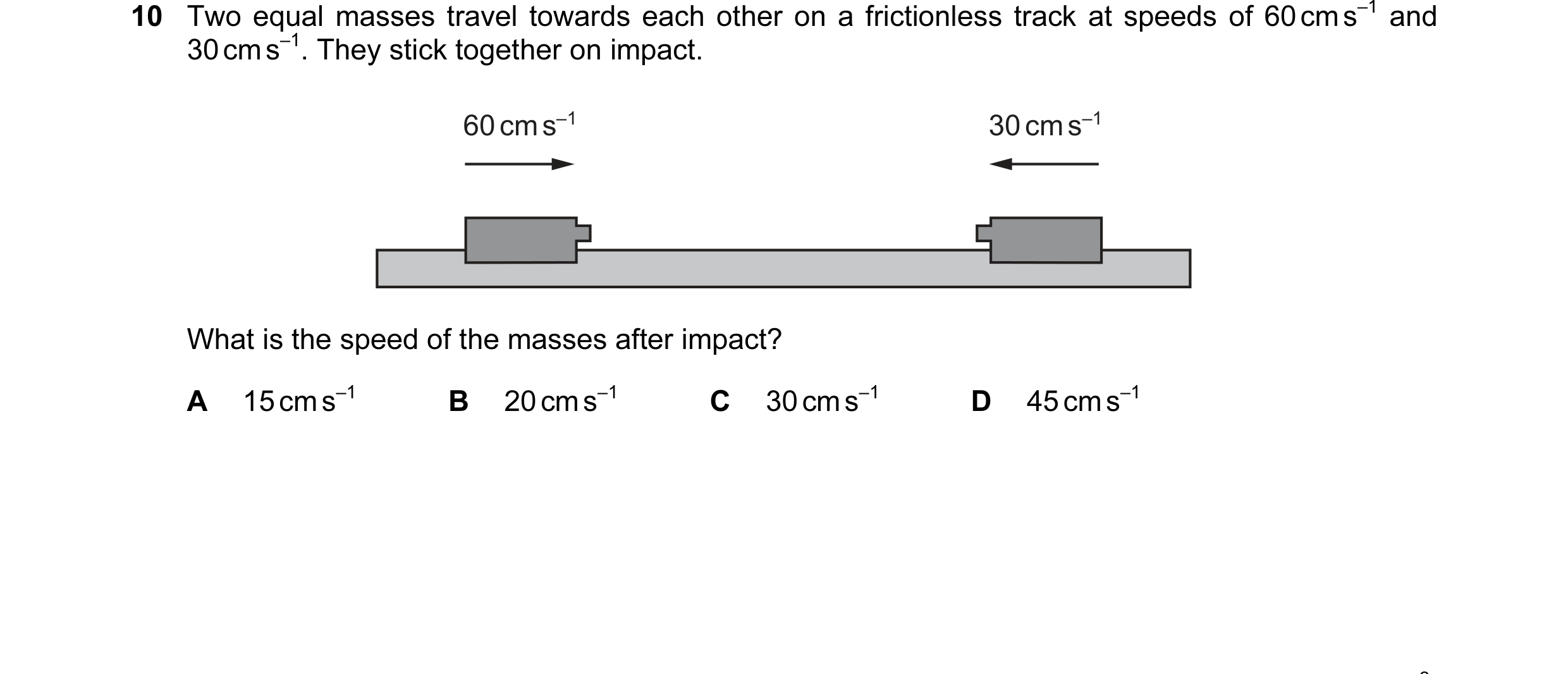
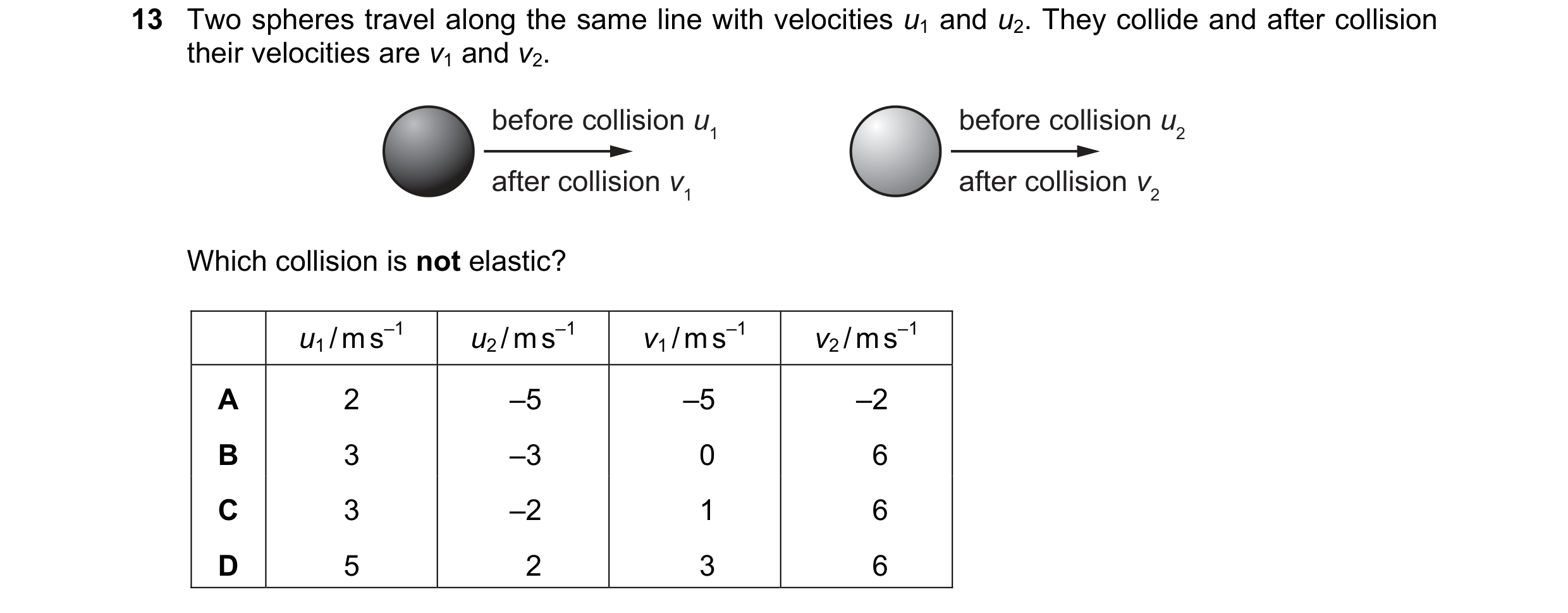 31 / 66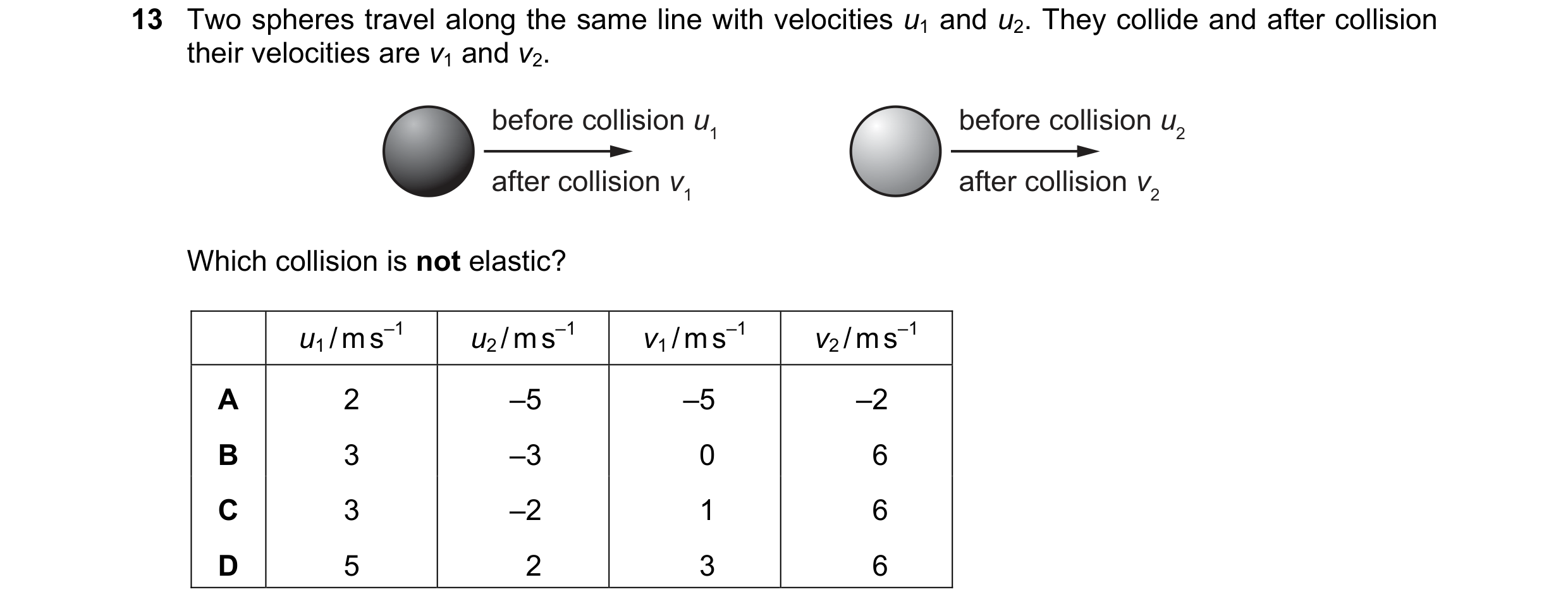
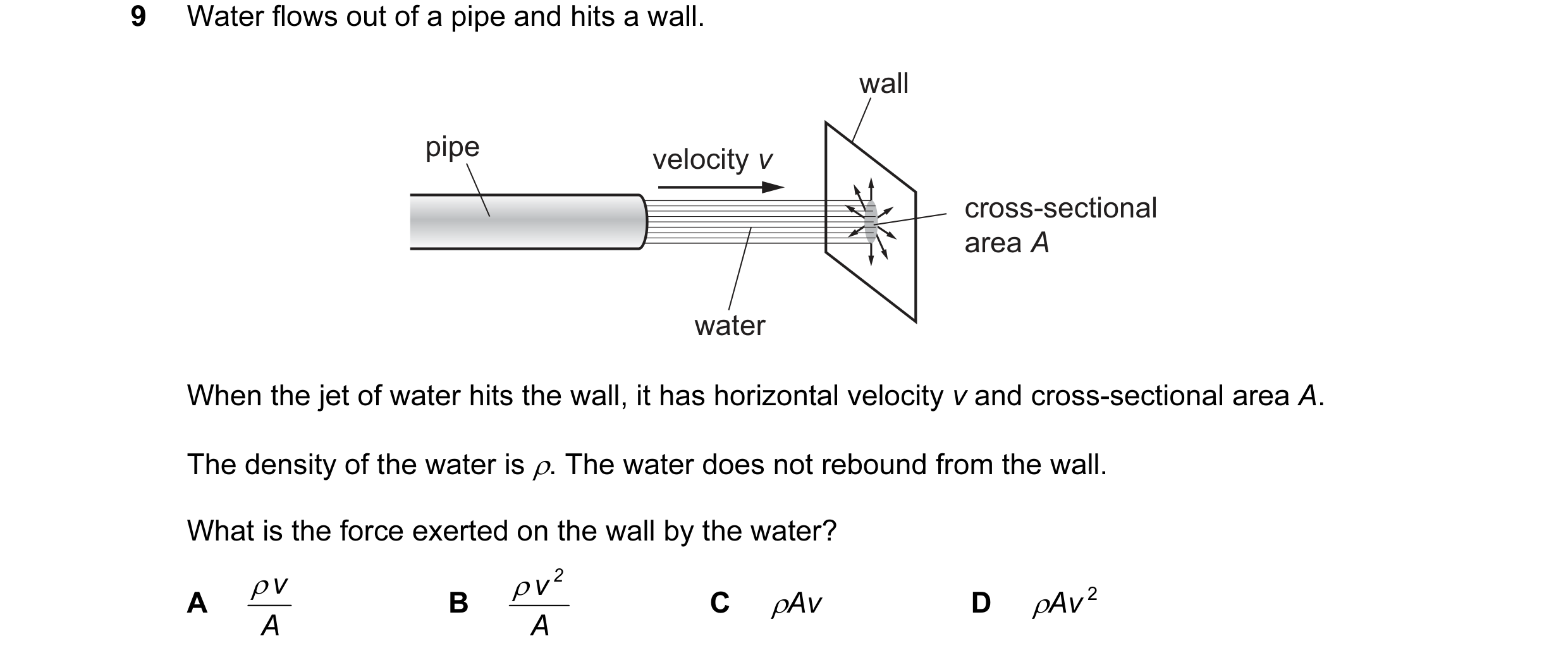
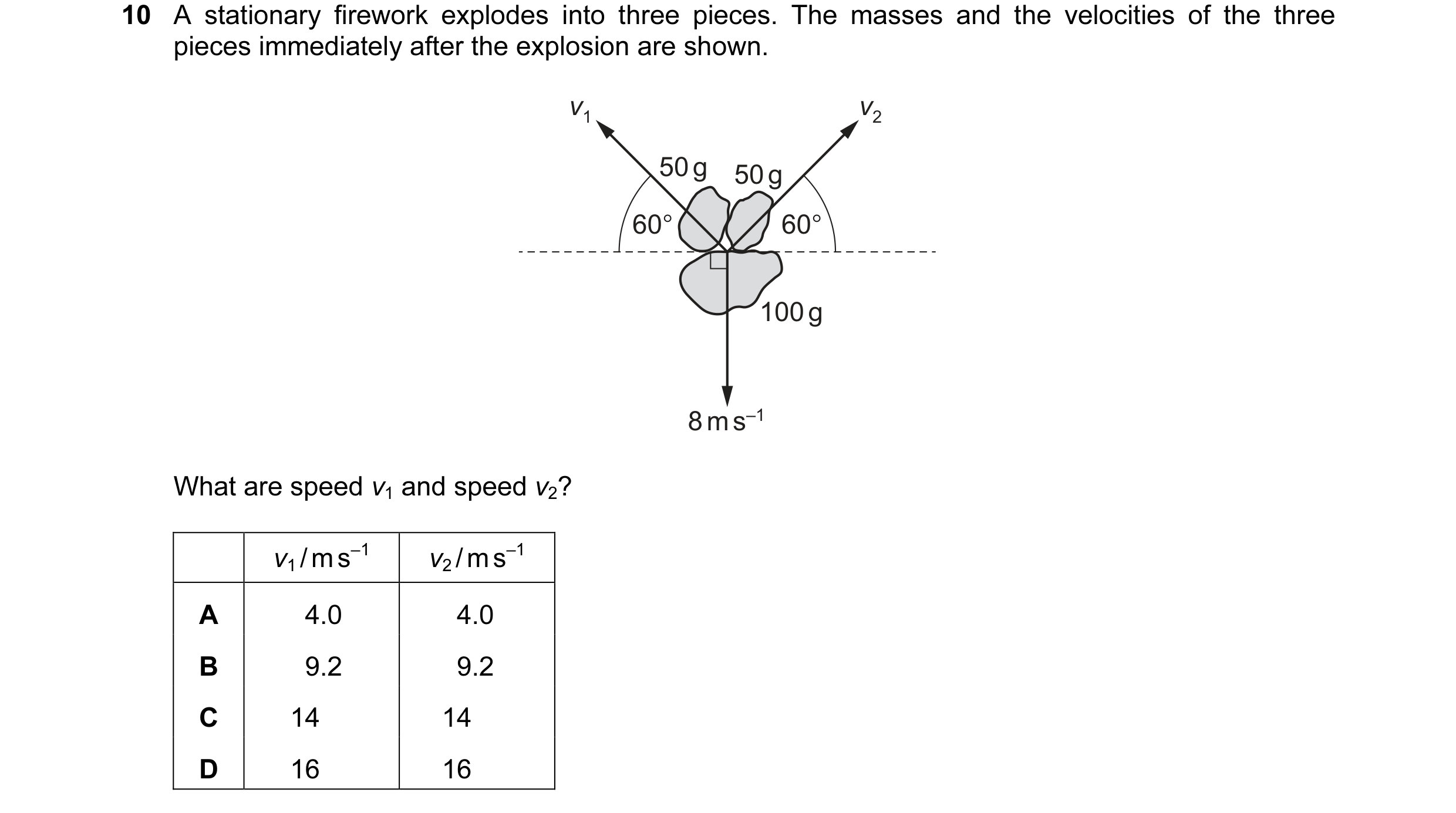 32 / 66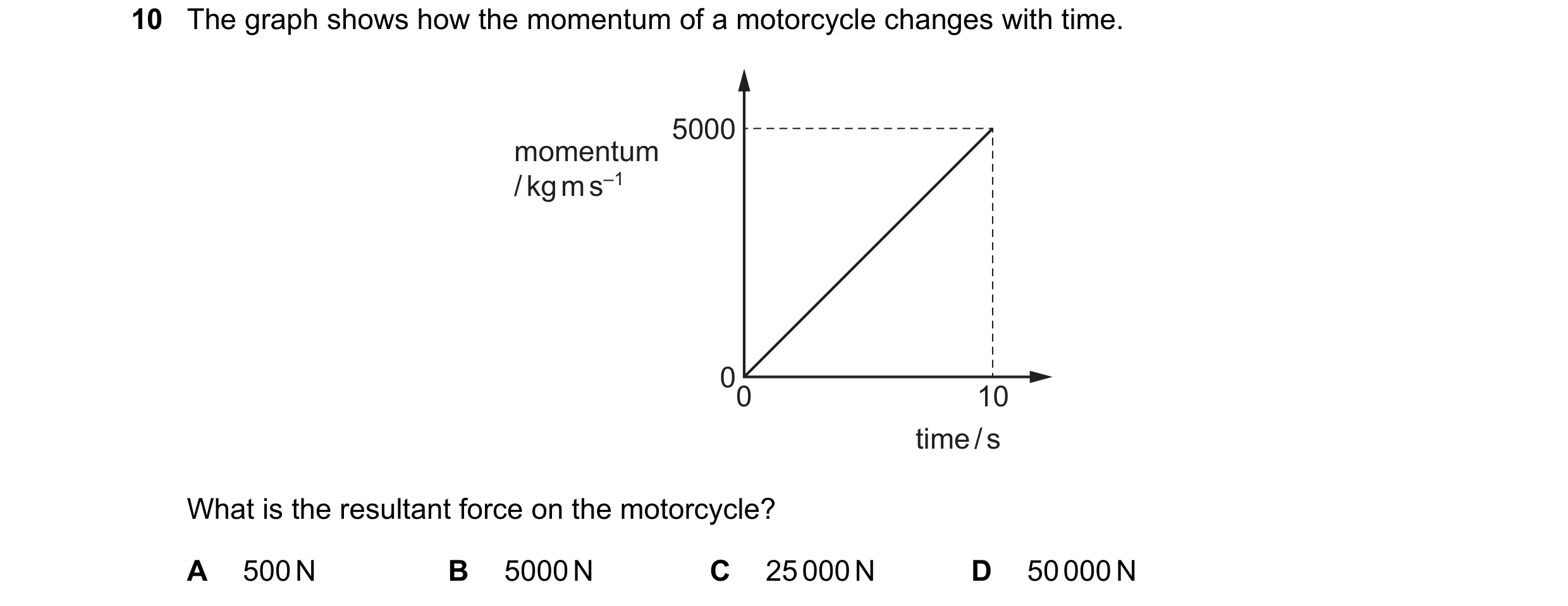
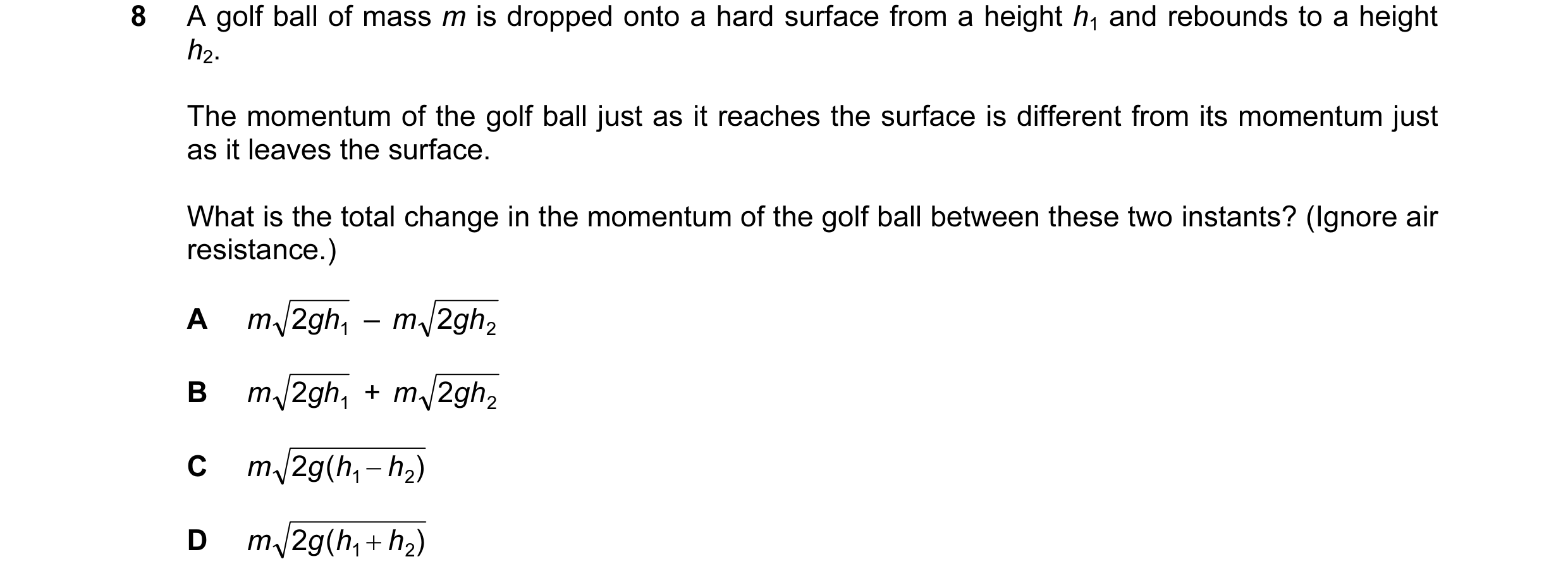
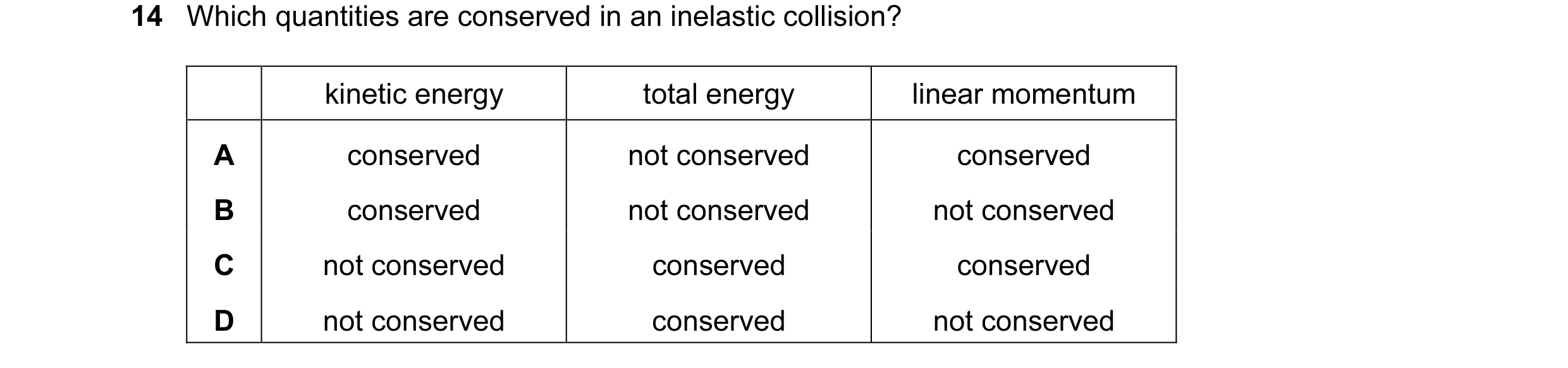
 33 / 66
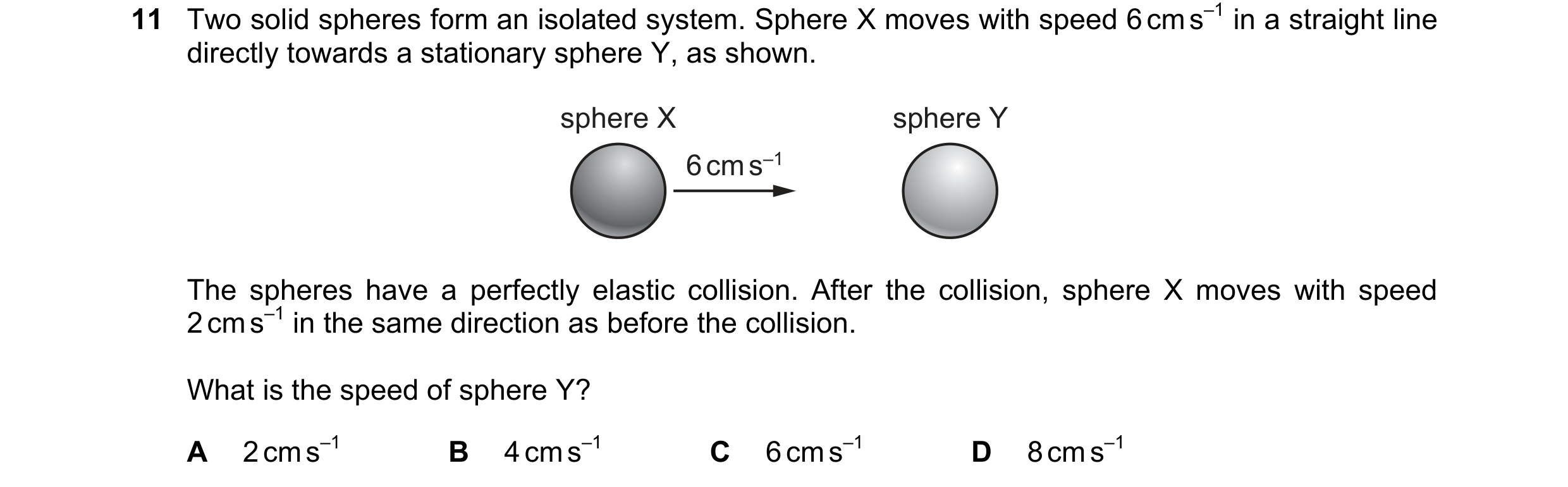
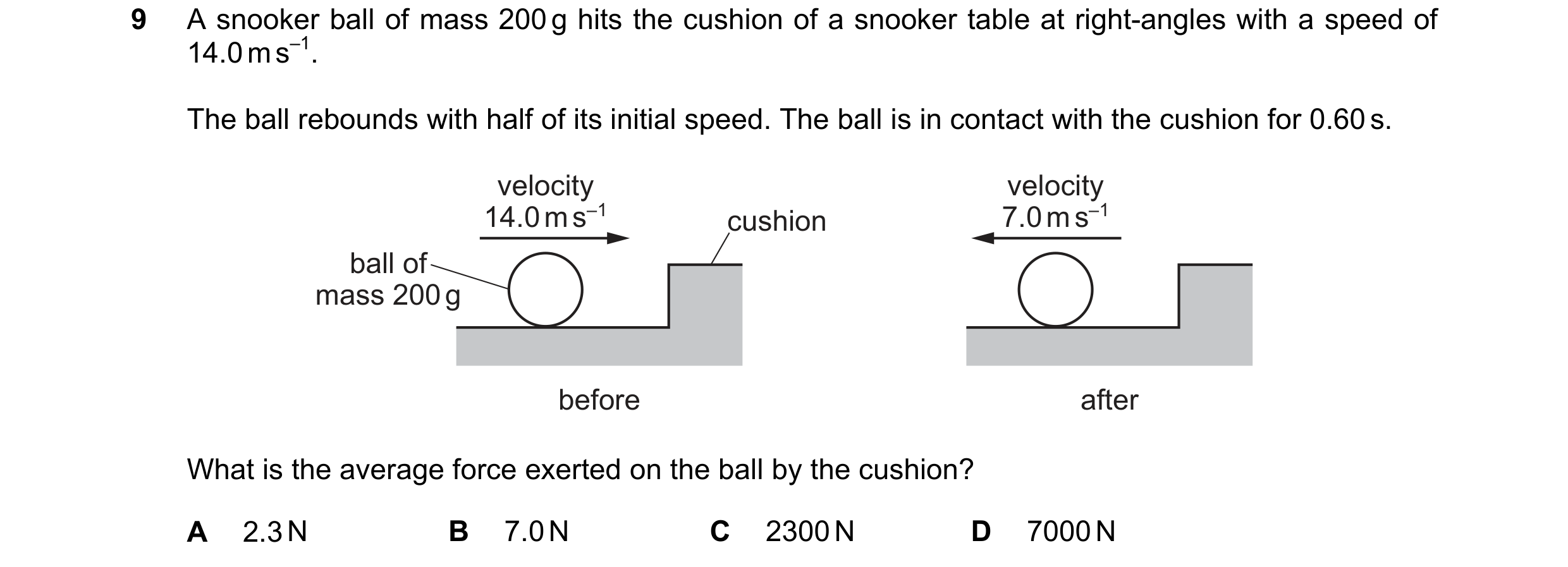
 34 / 66

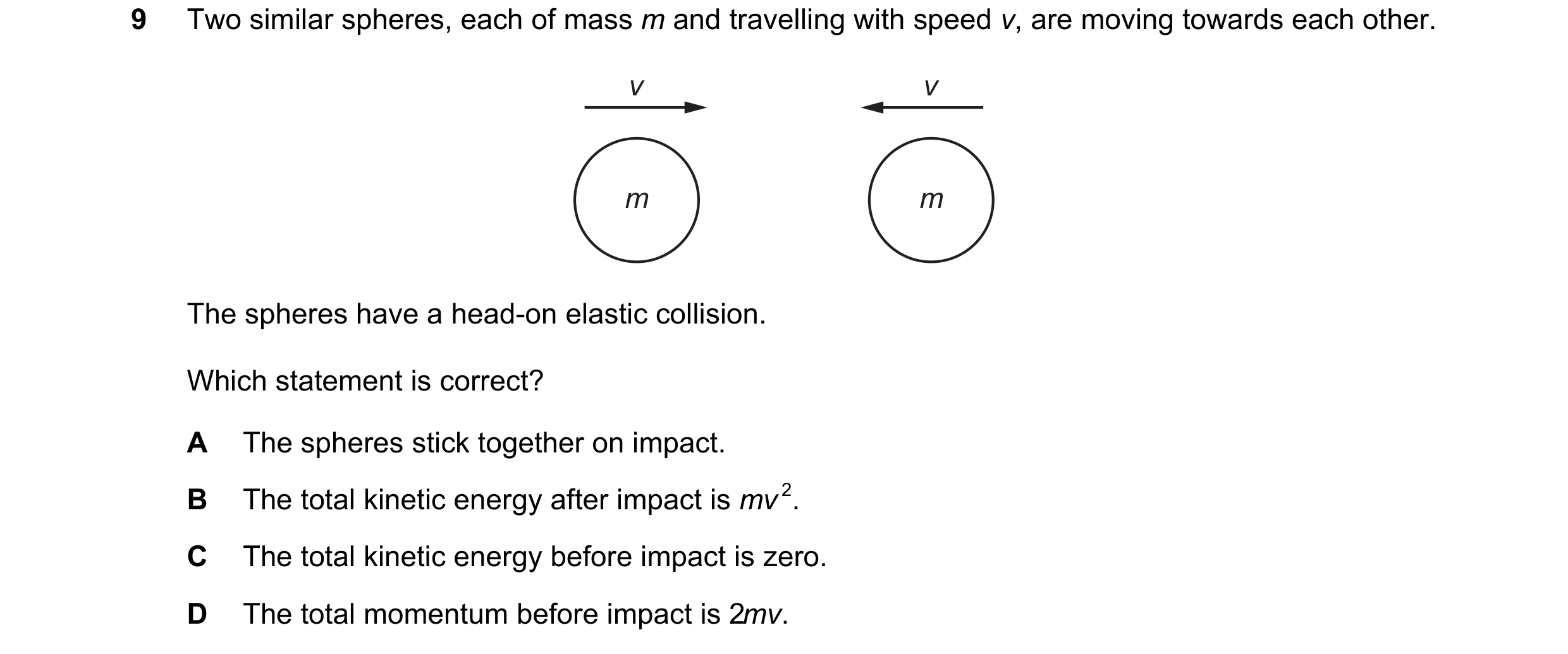

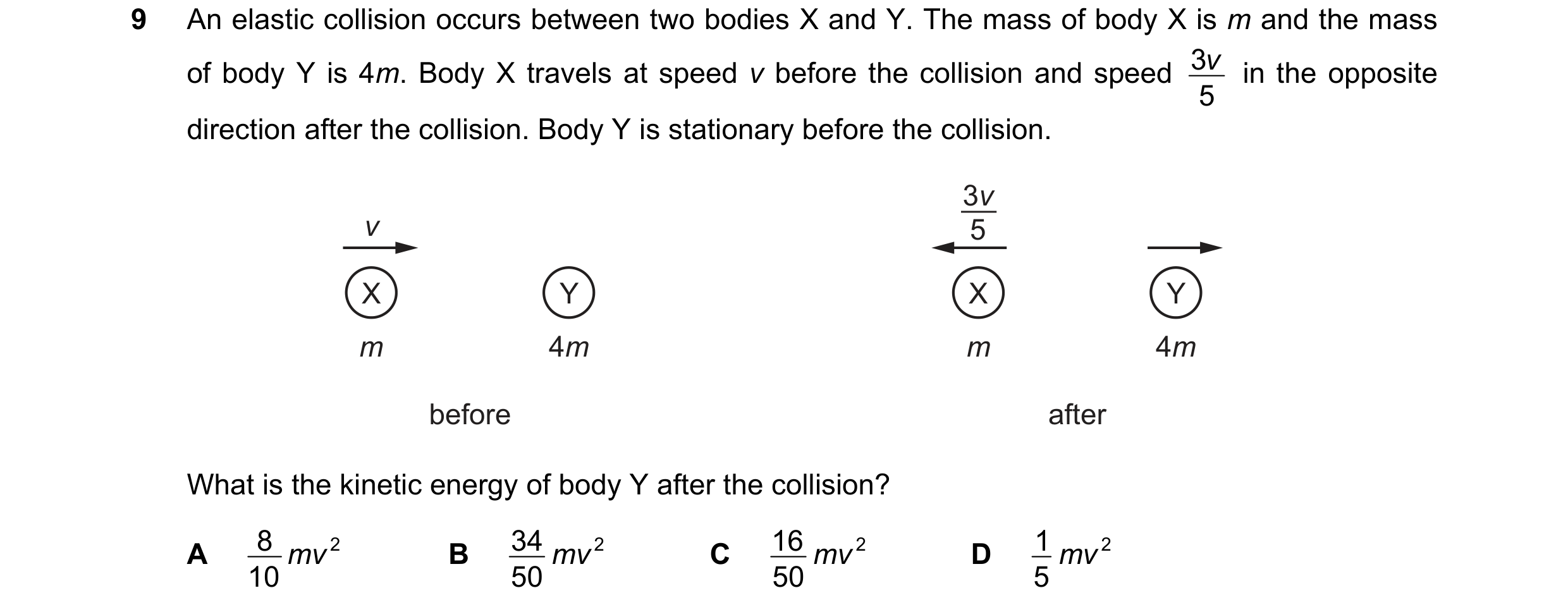 35 / 66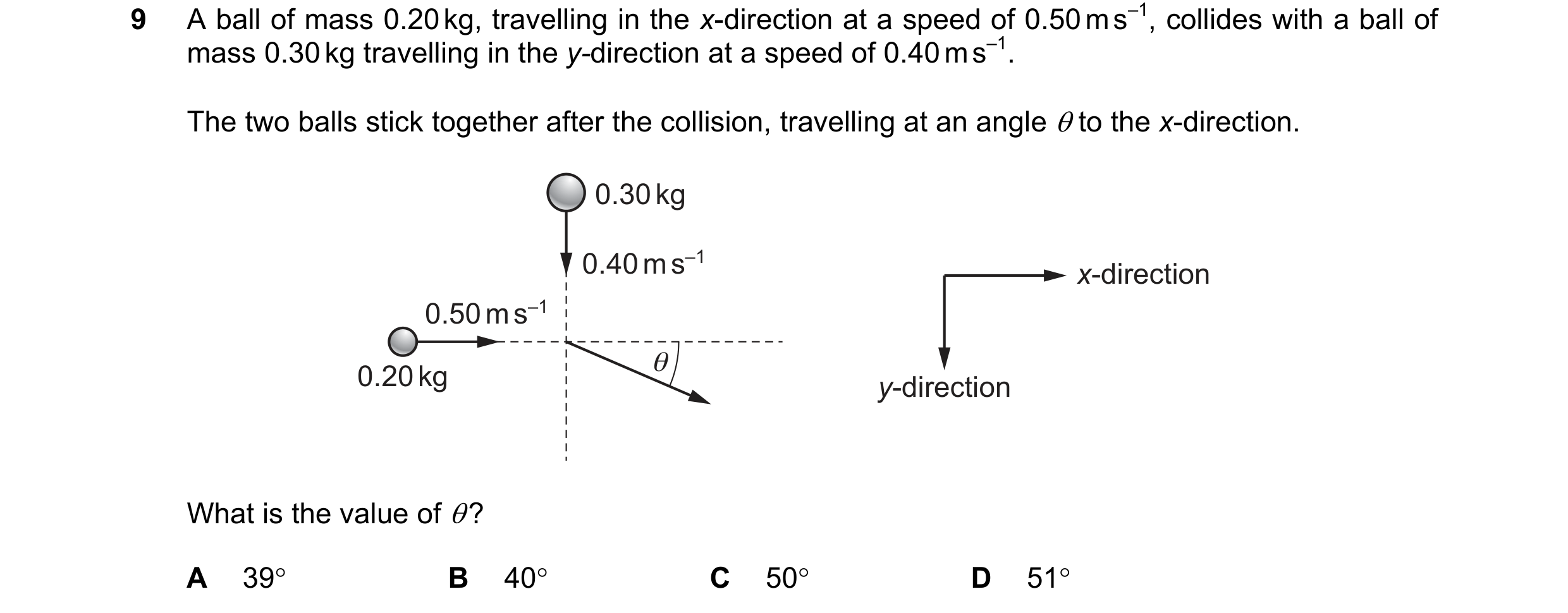

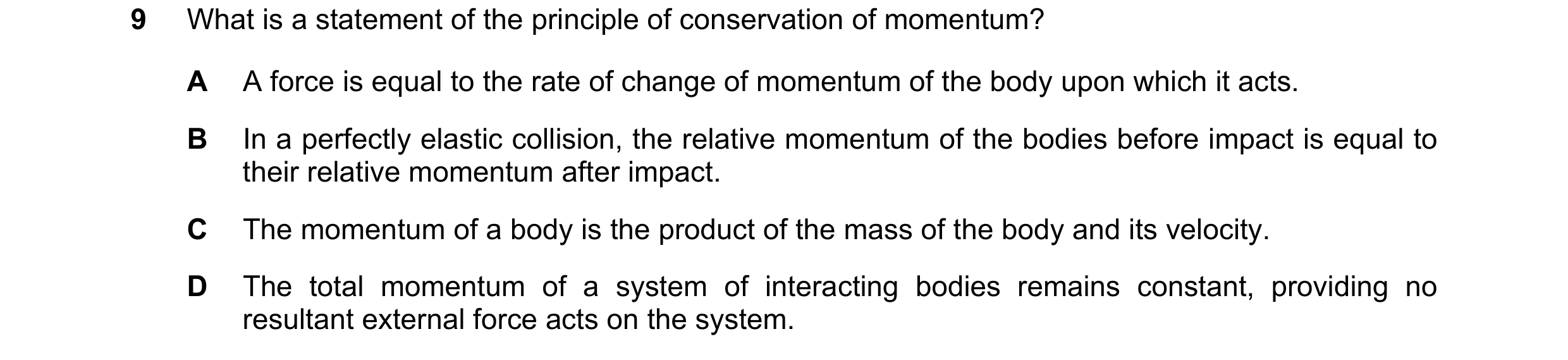
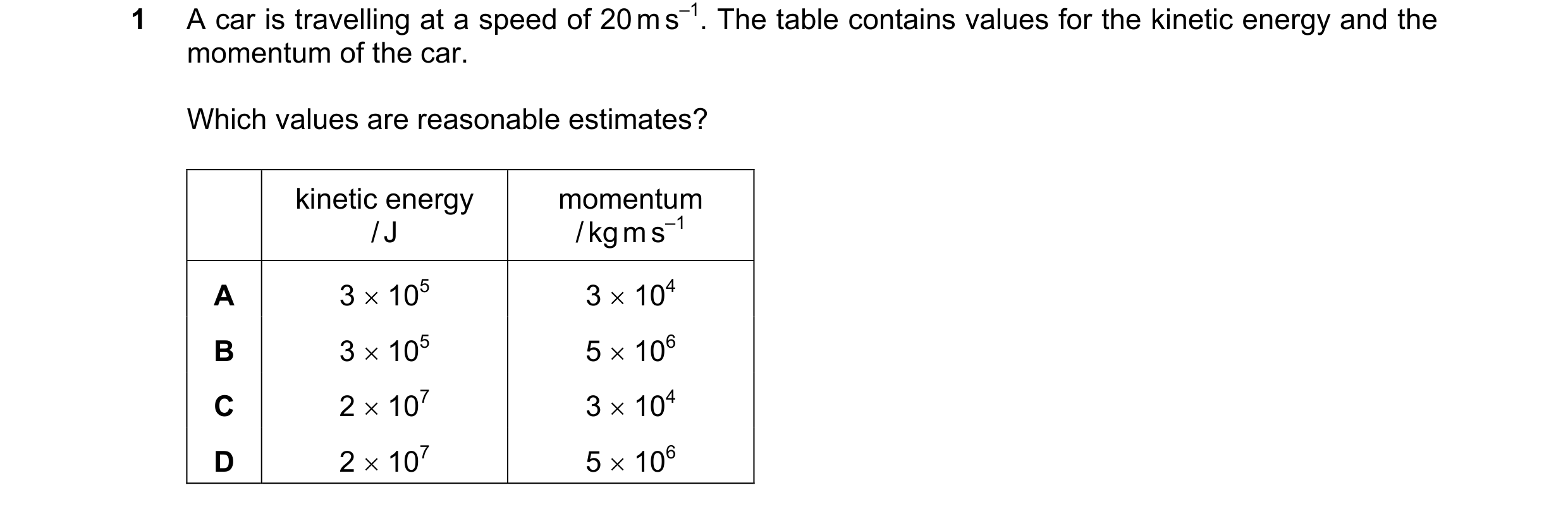 36 / 66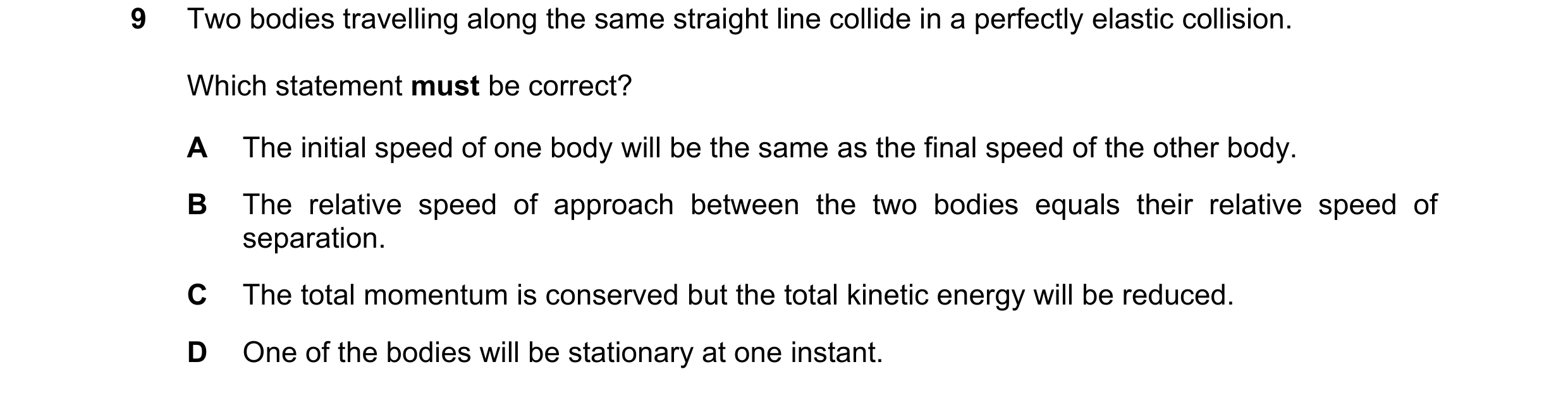
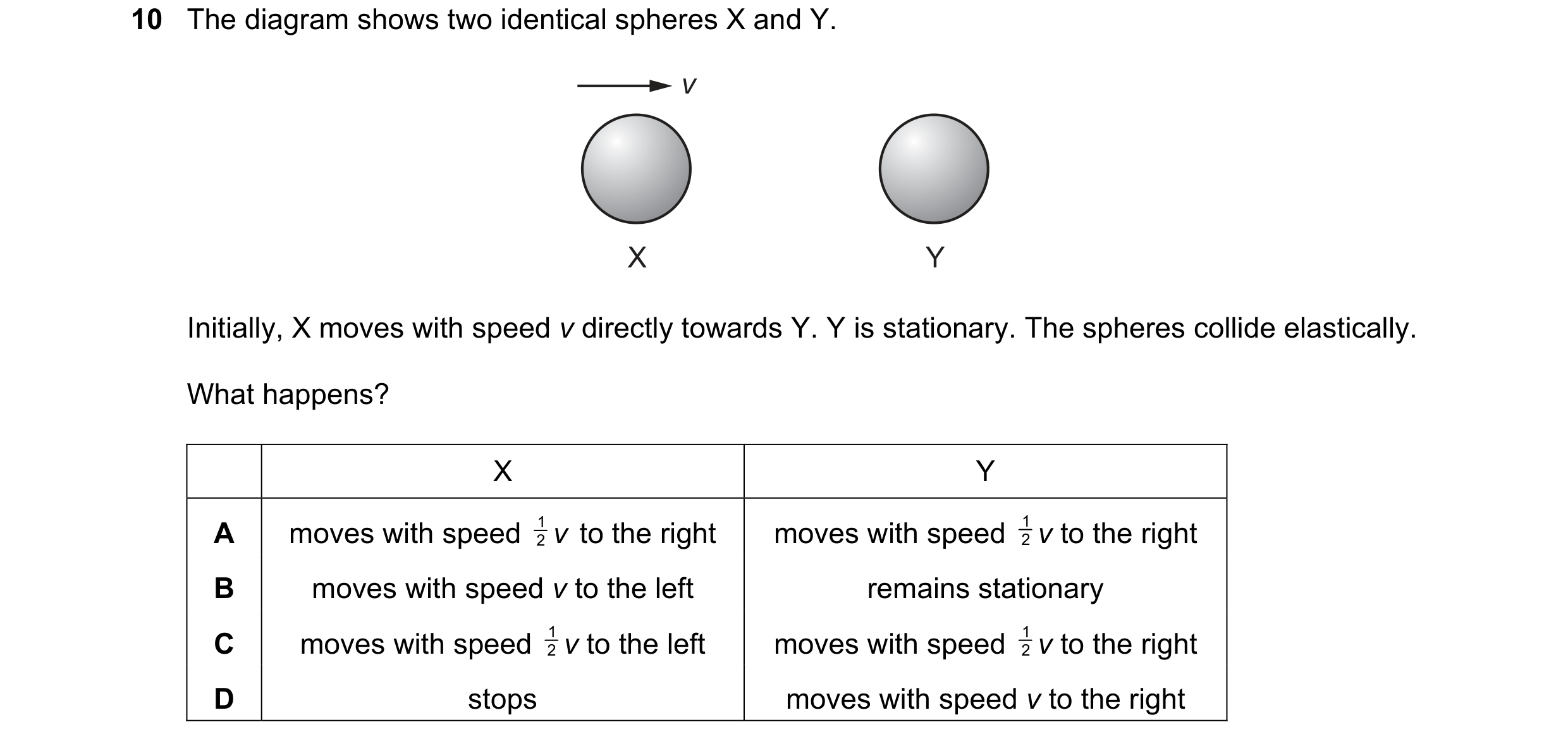
 37 / 66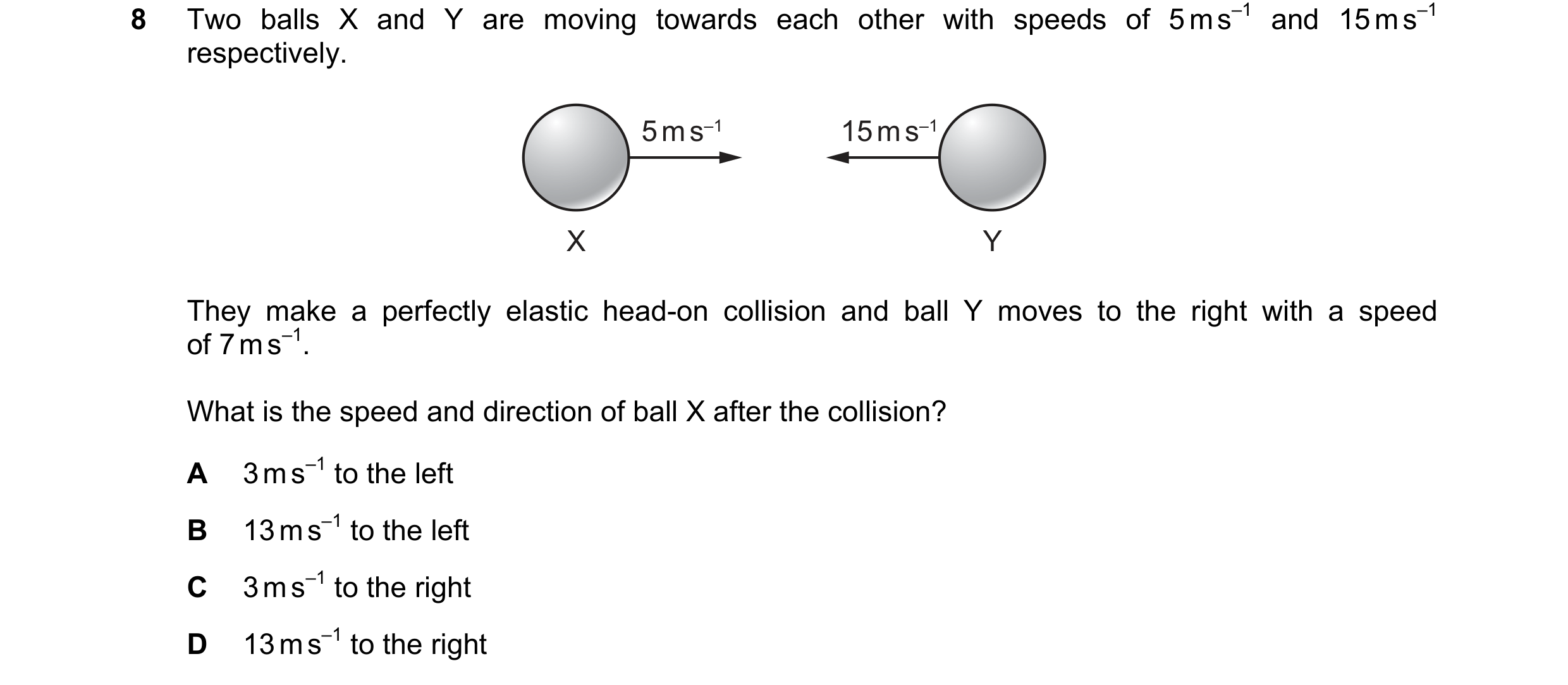
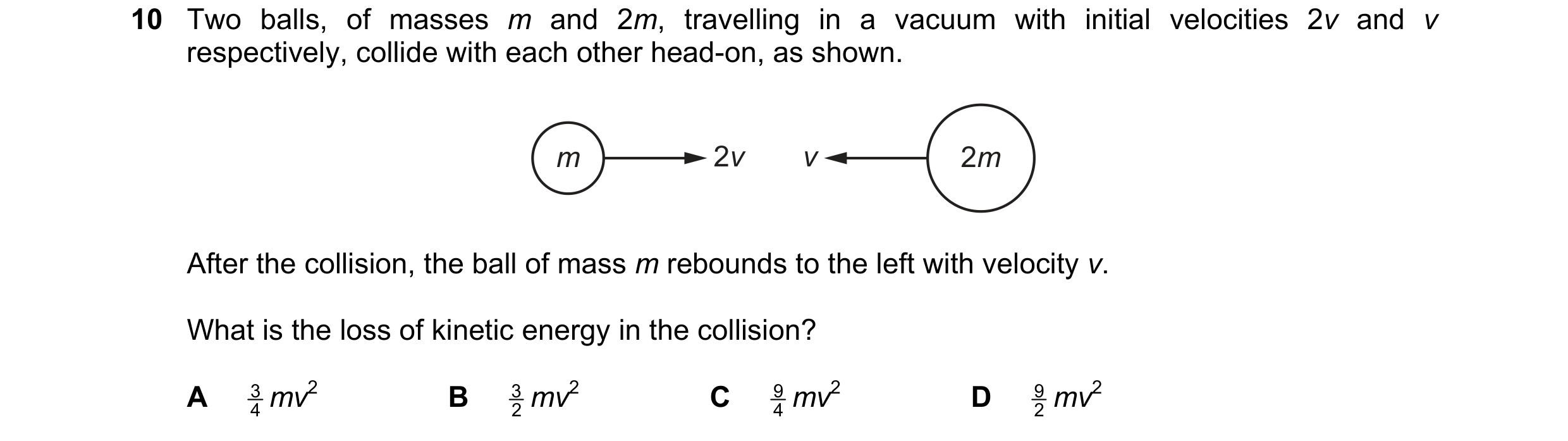
 38 / 66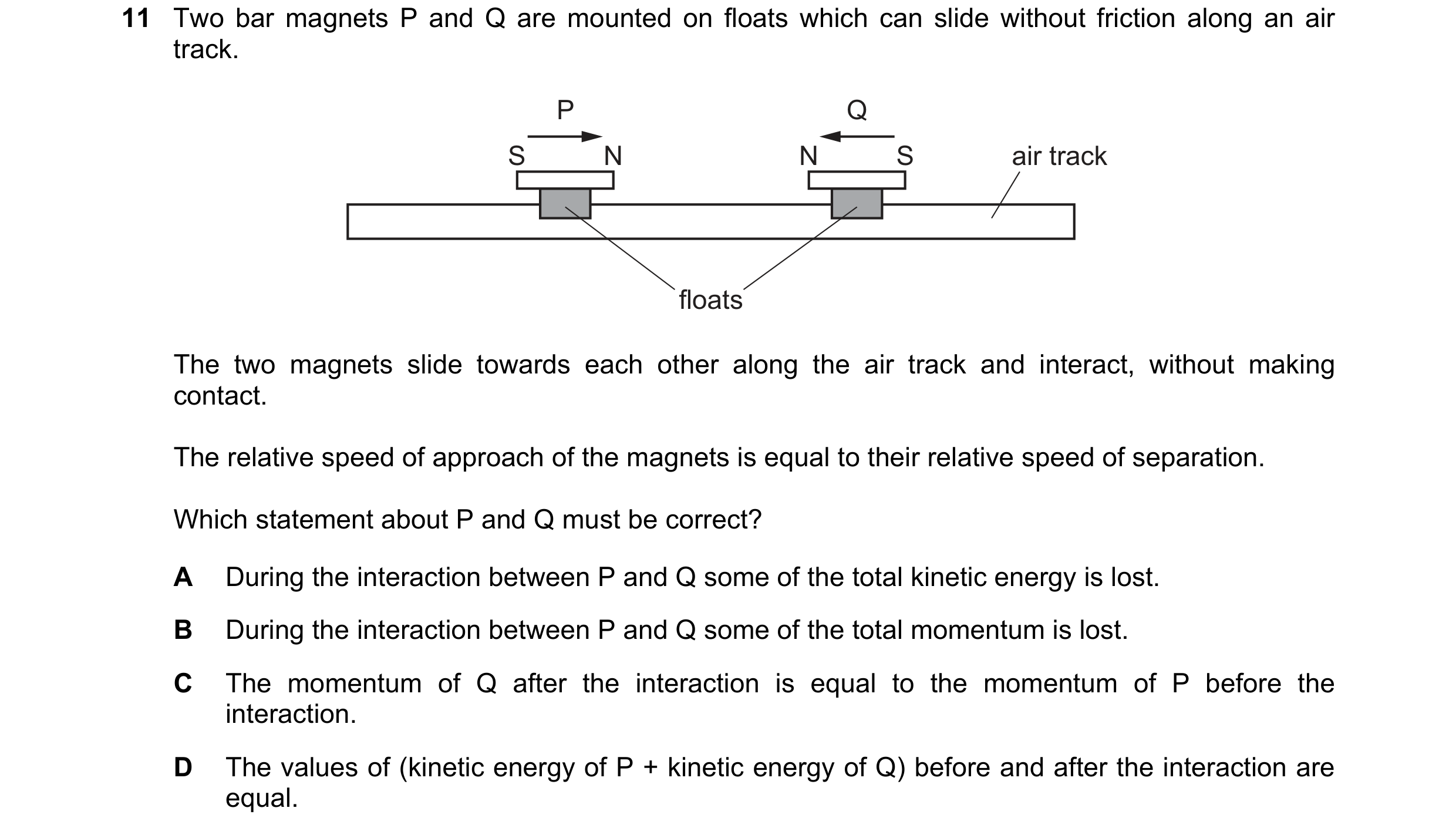
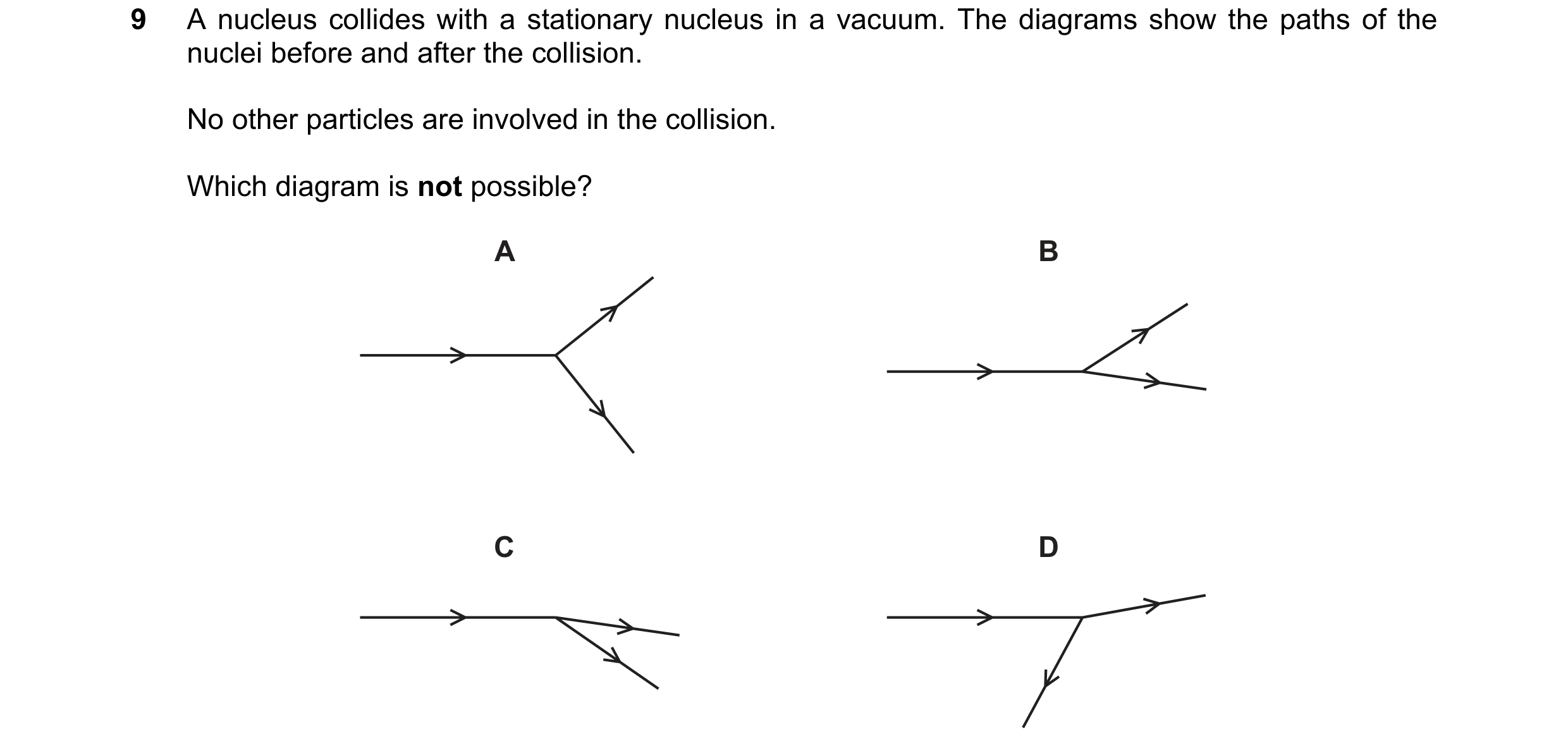 39 / 66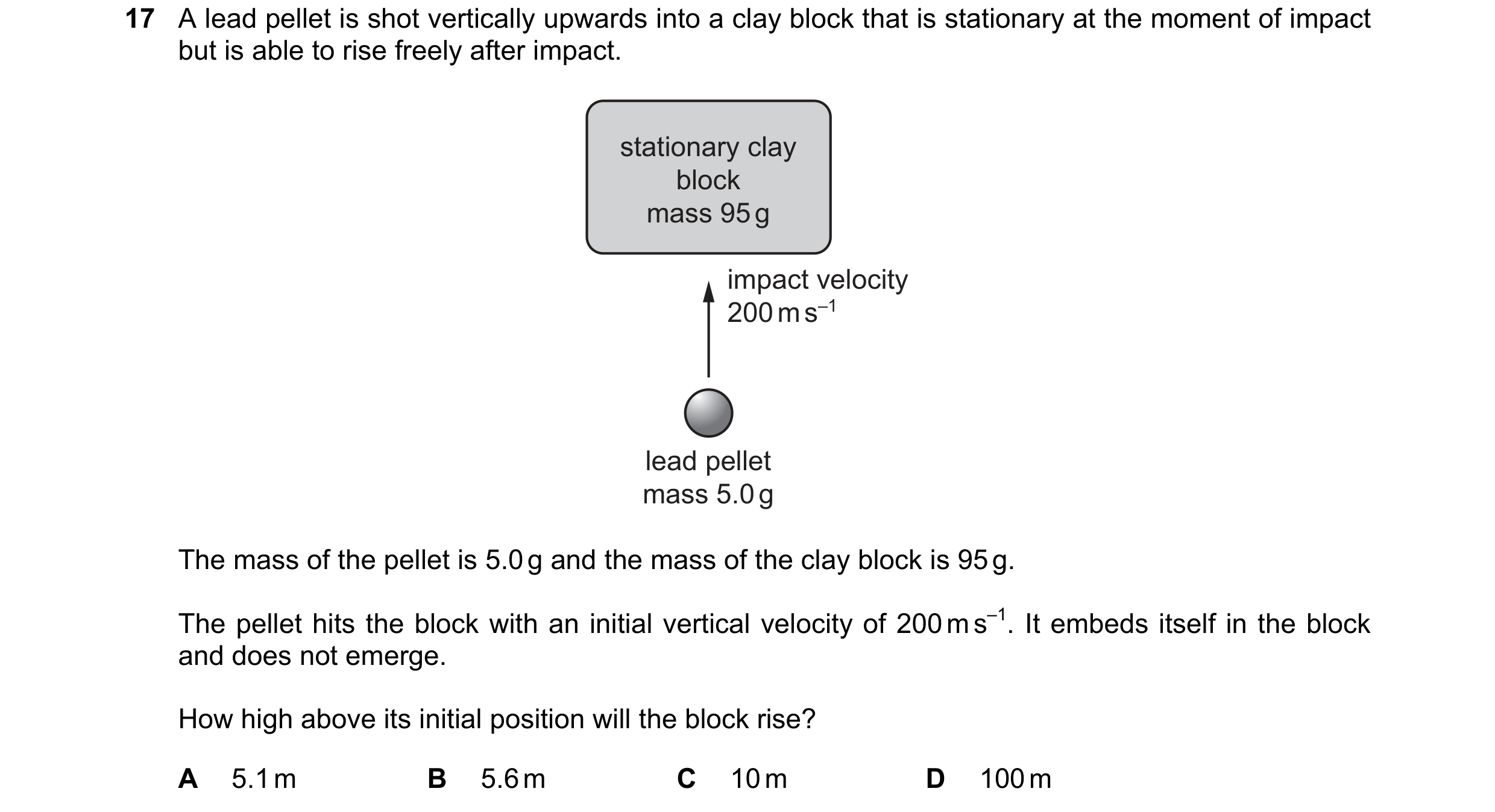
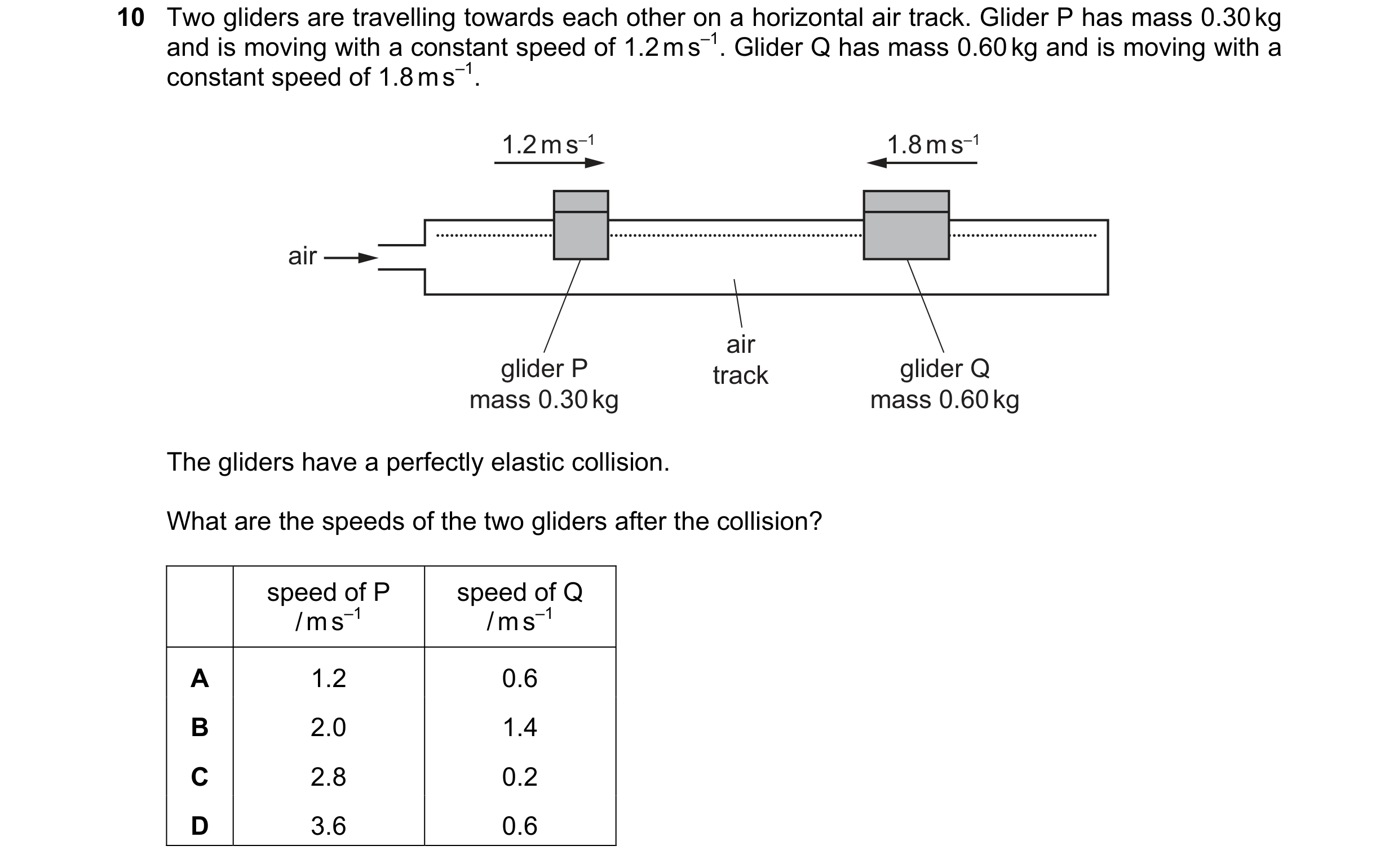 40 / 66
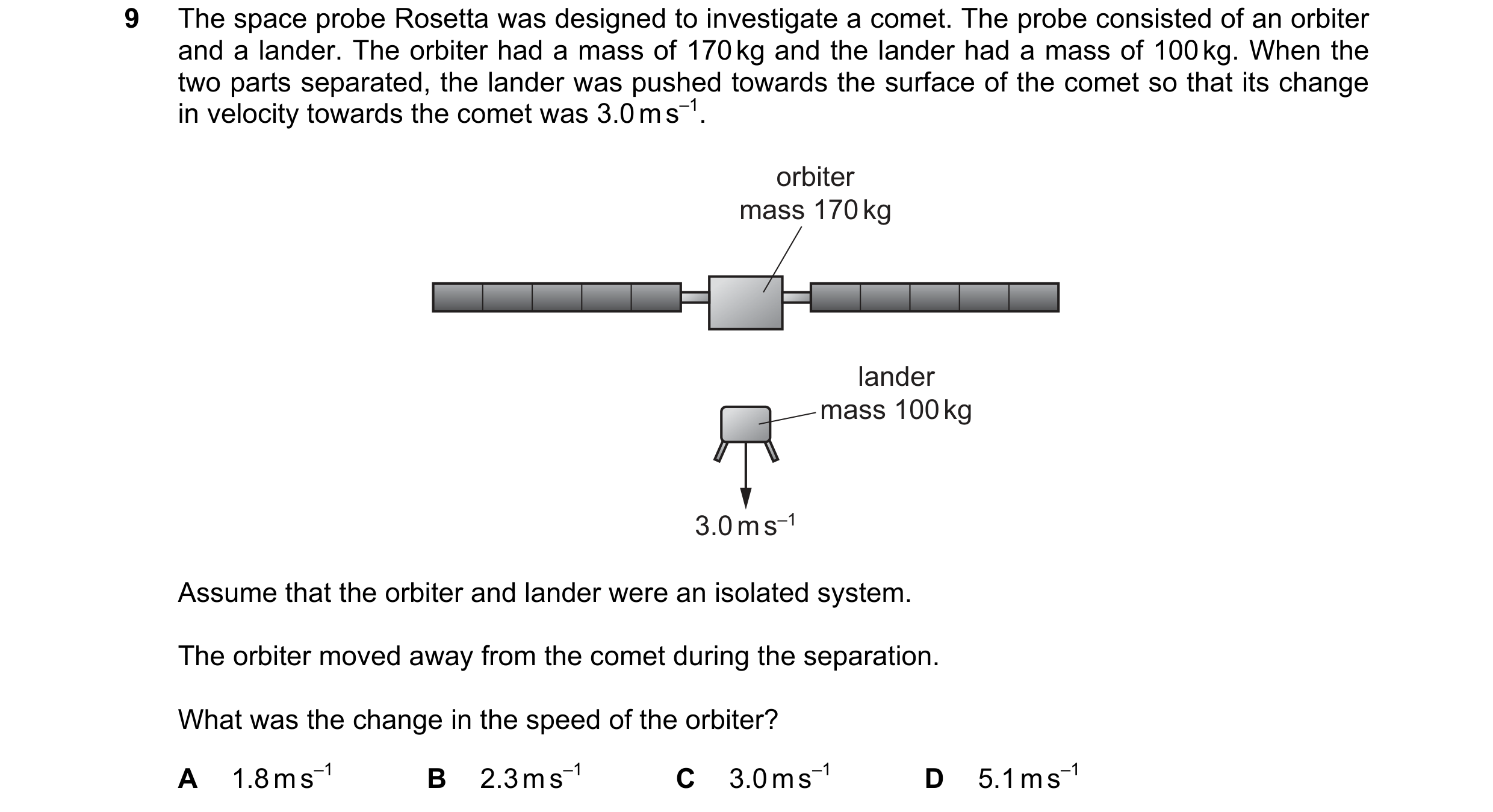
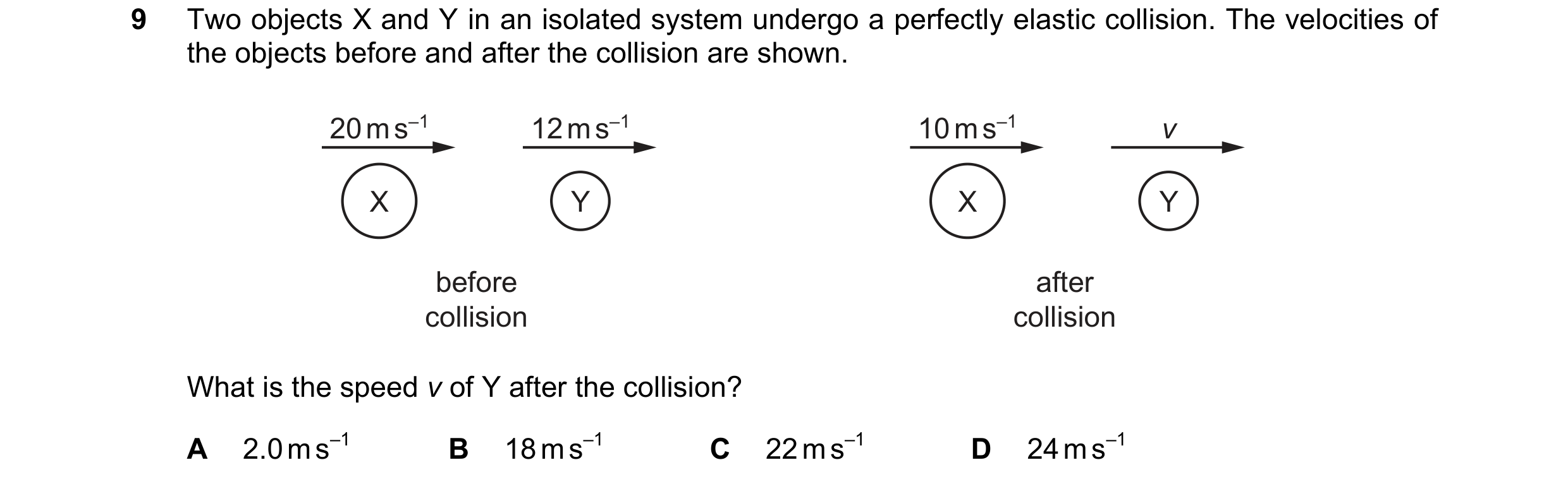 41 / 66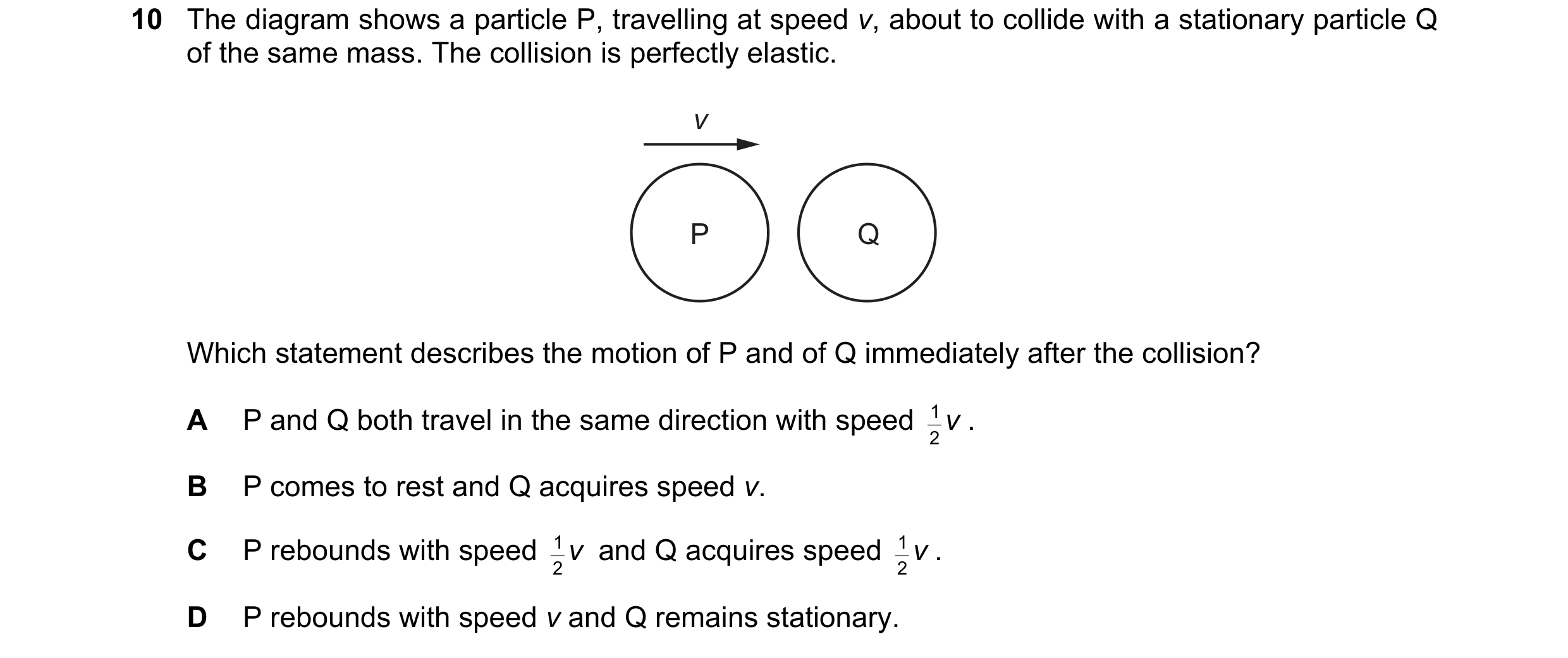
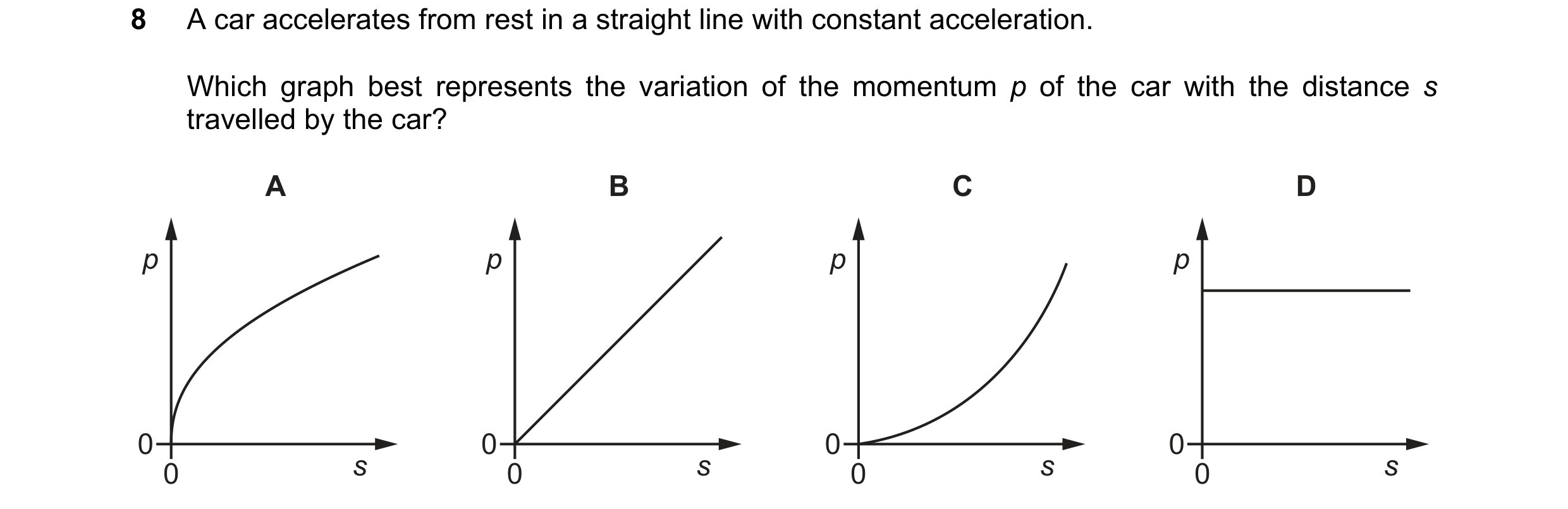
 42 / 66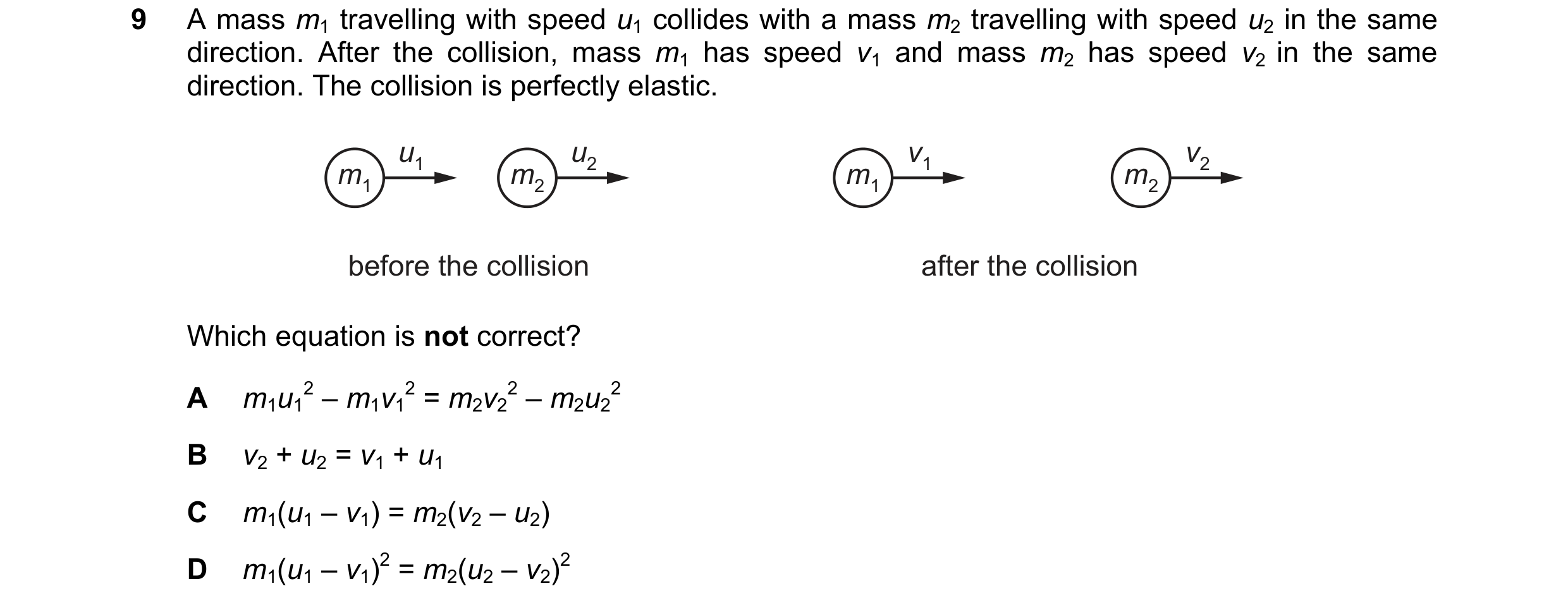
 43 / 66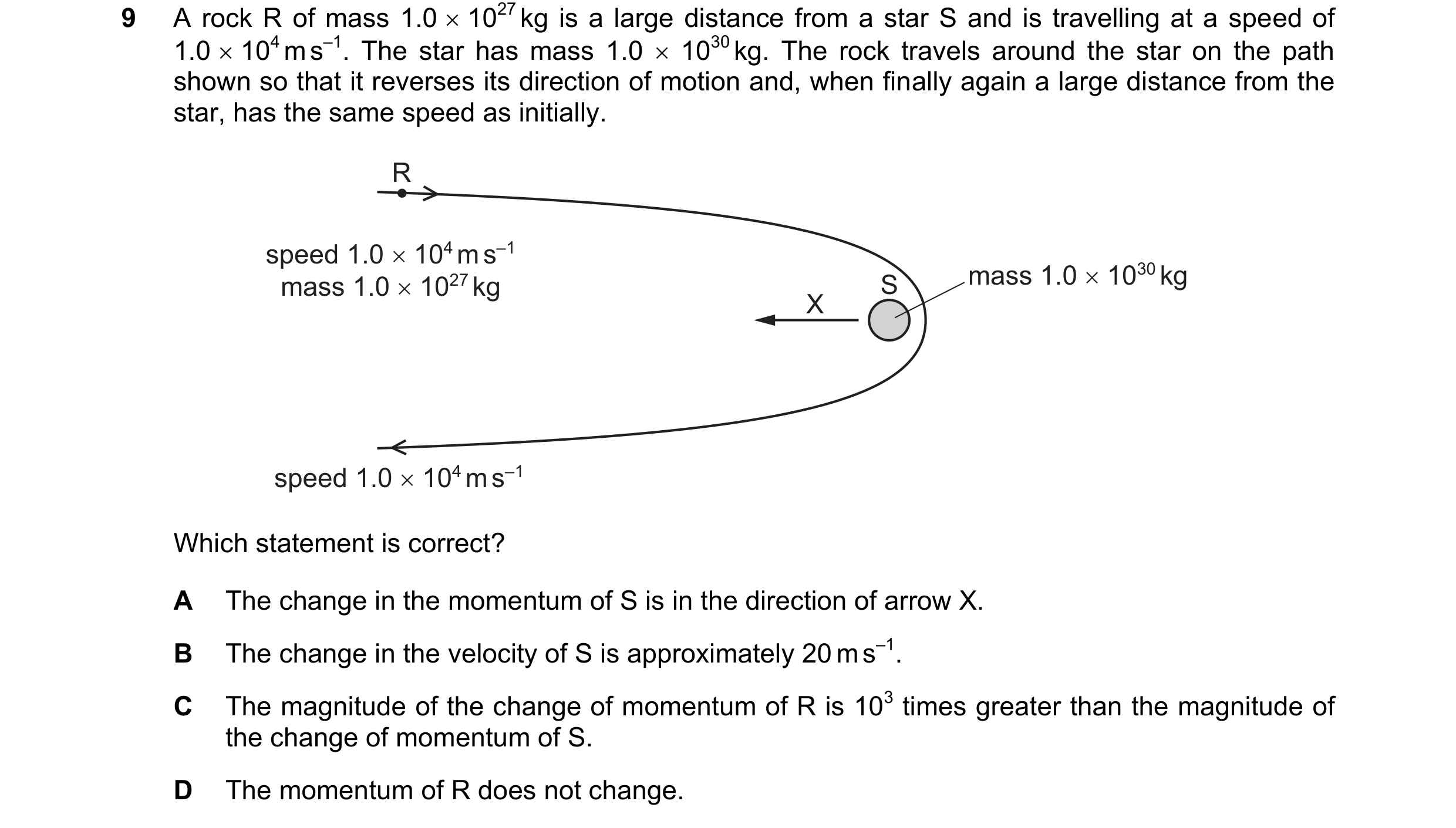
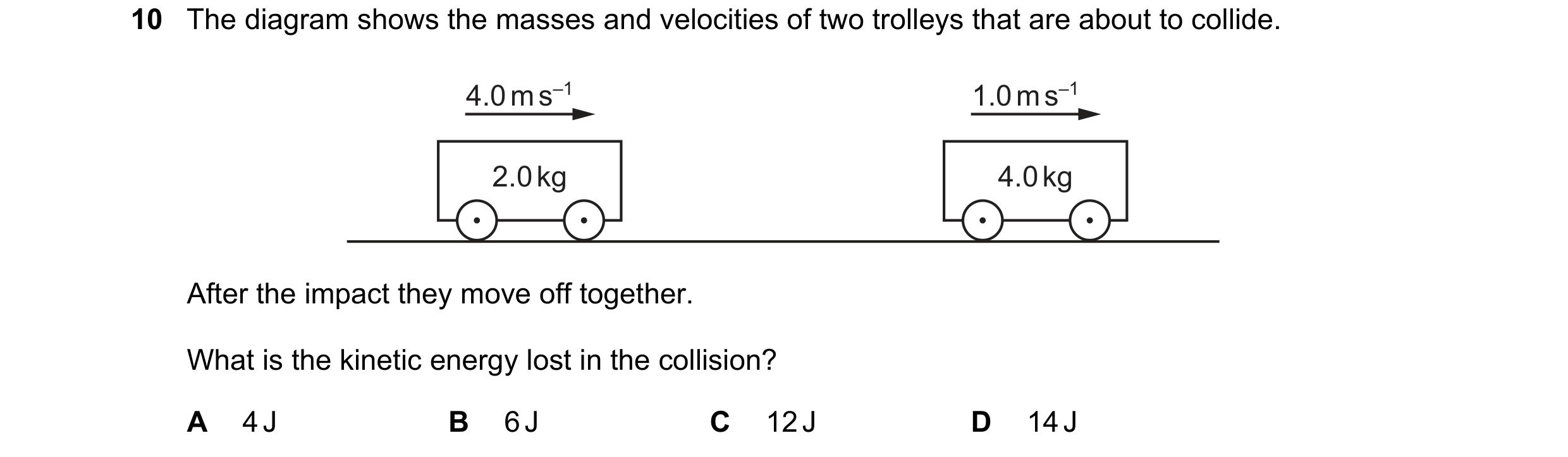
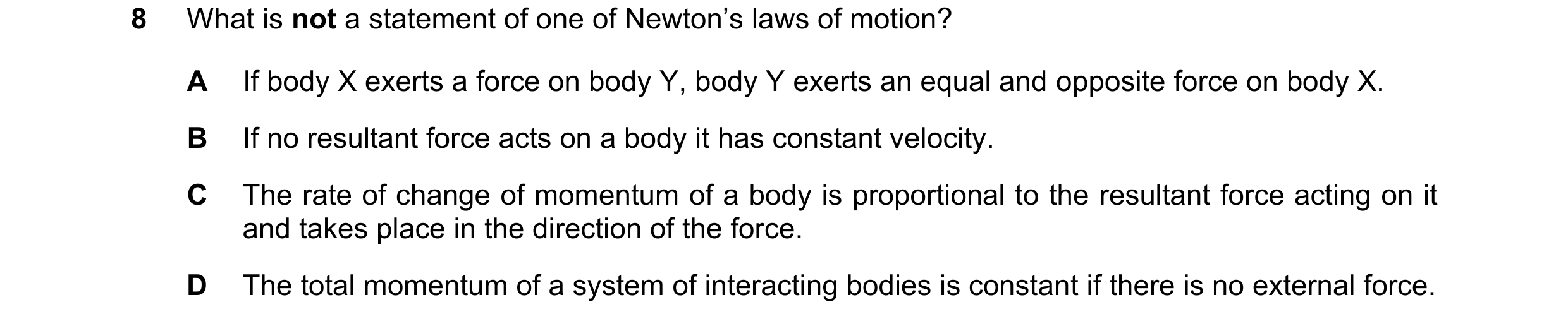 44 / 66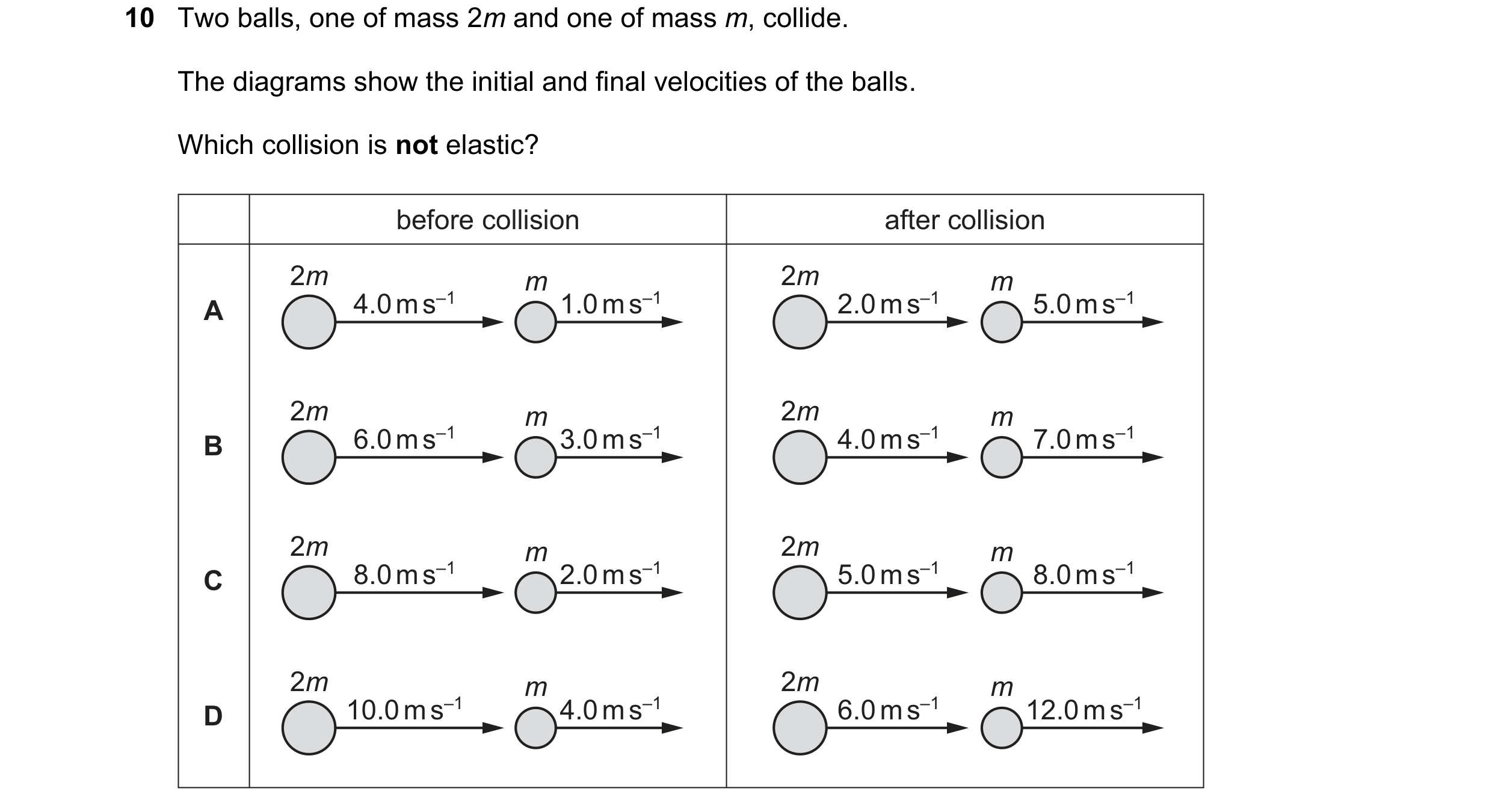
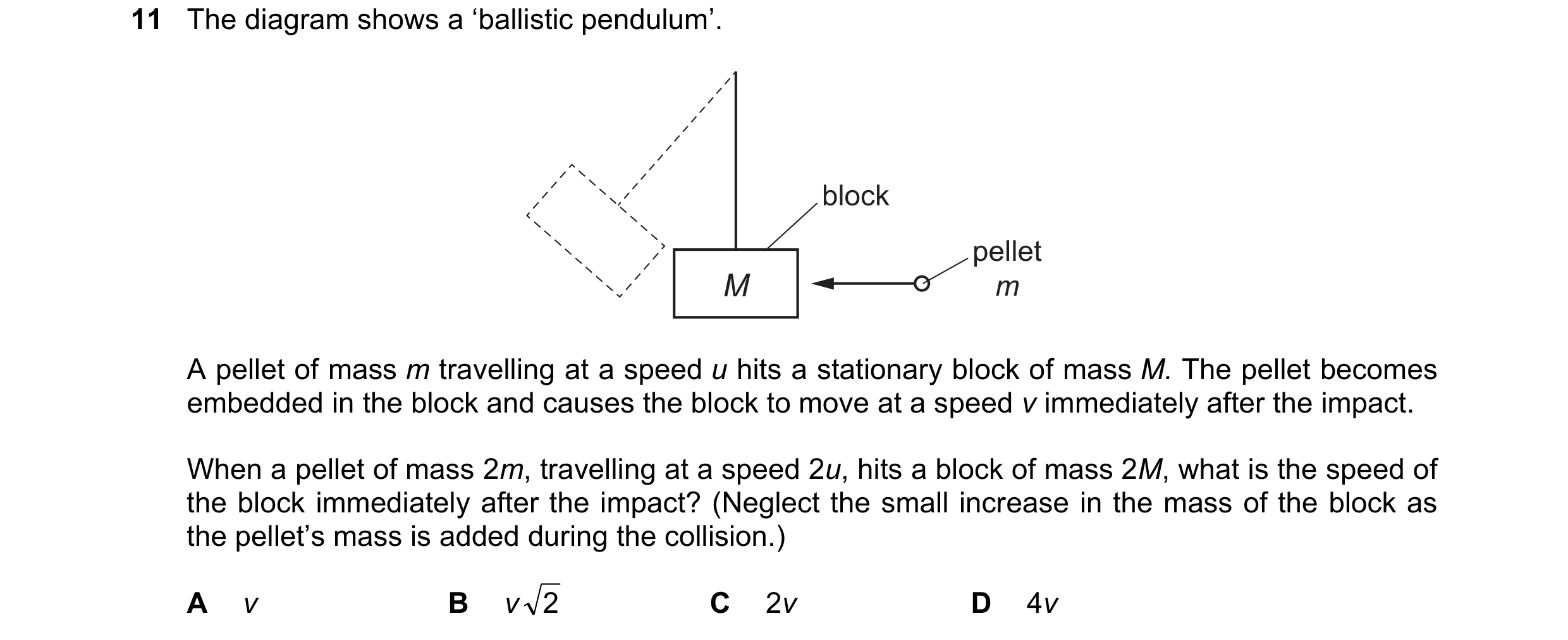 45 / 66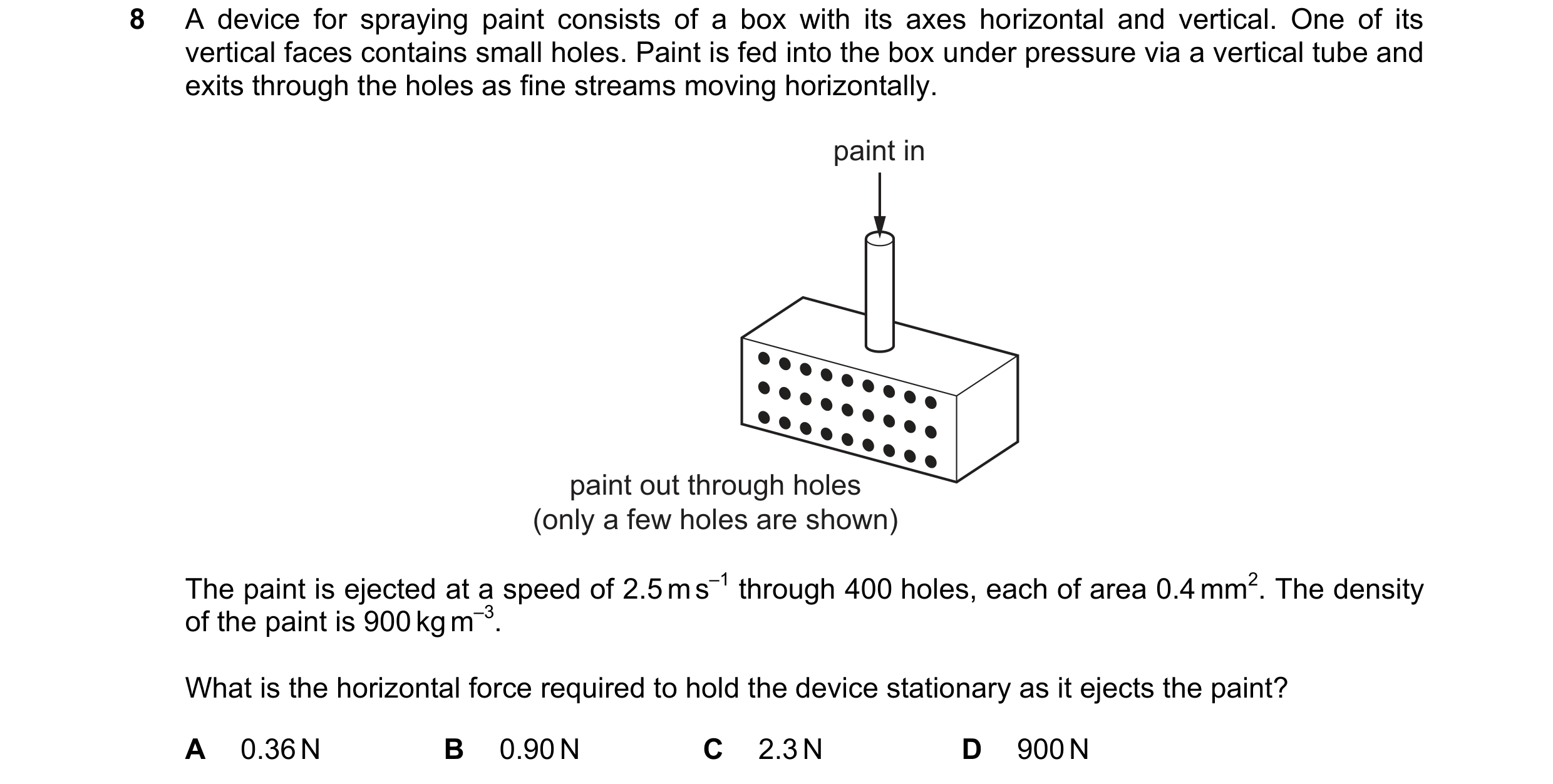
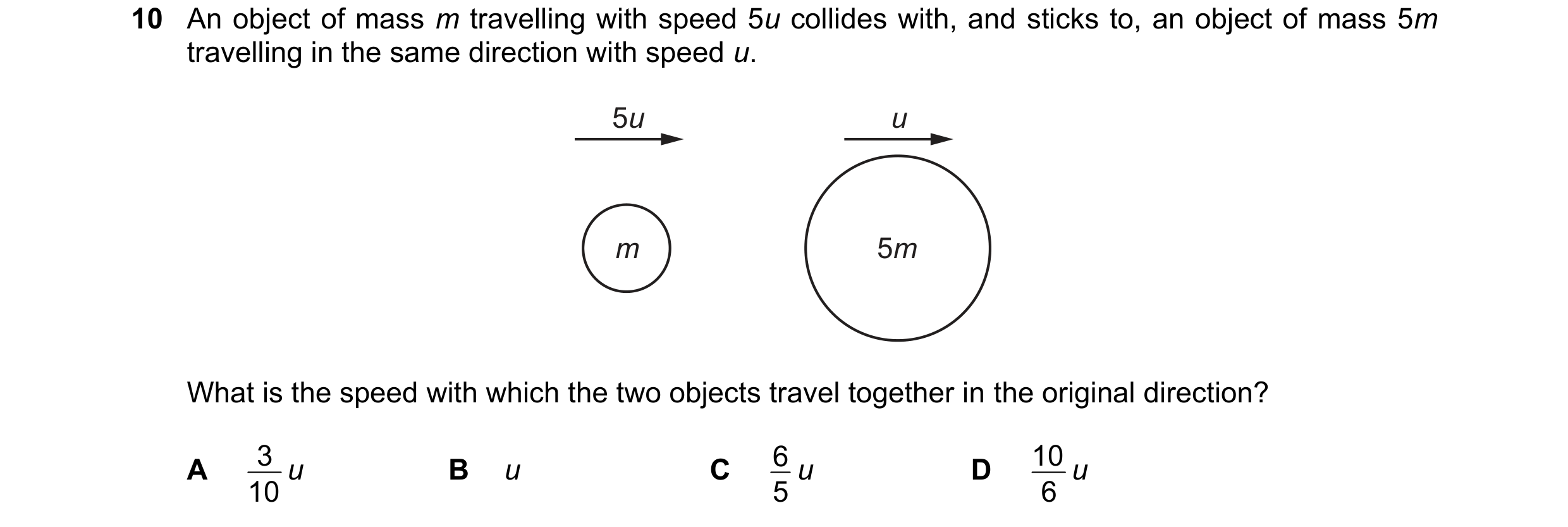
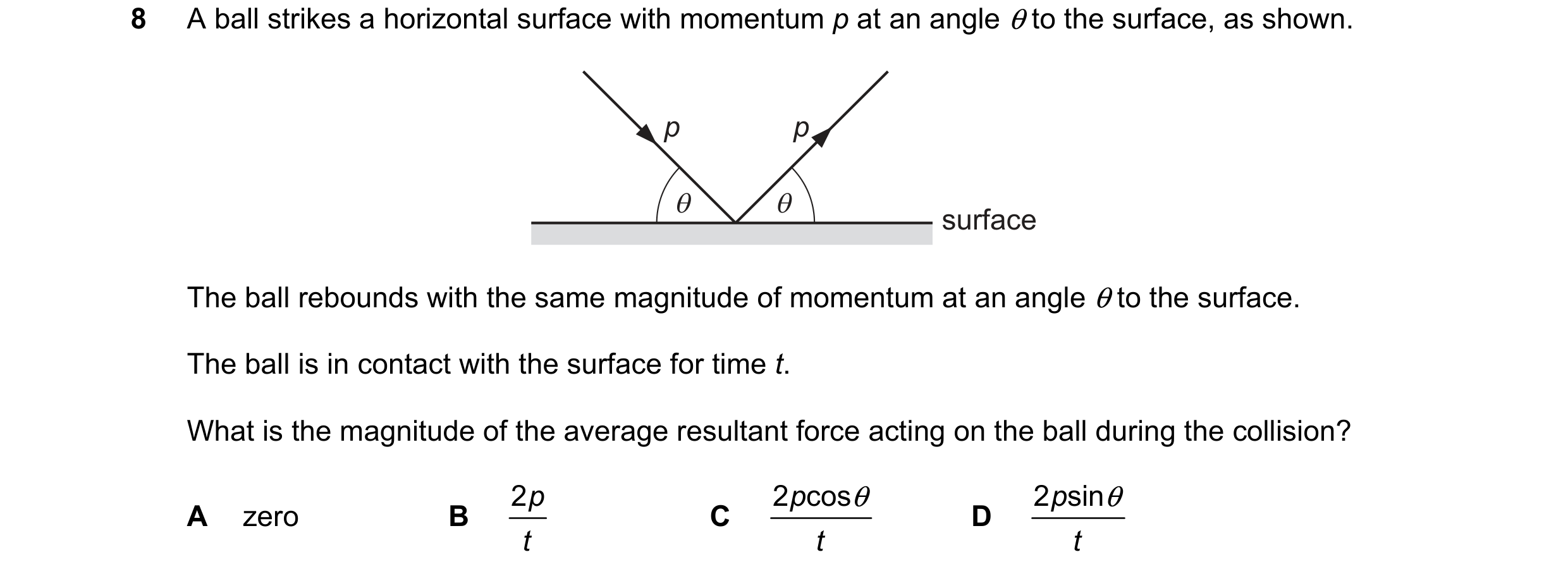 46 / 66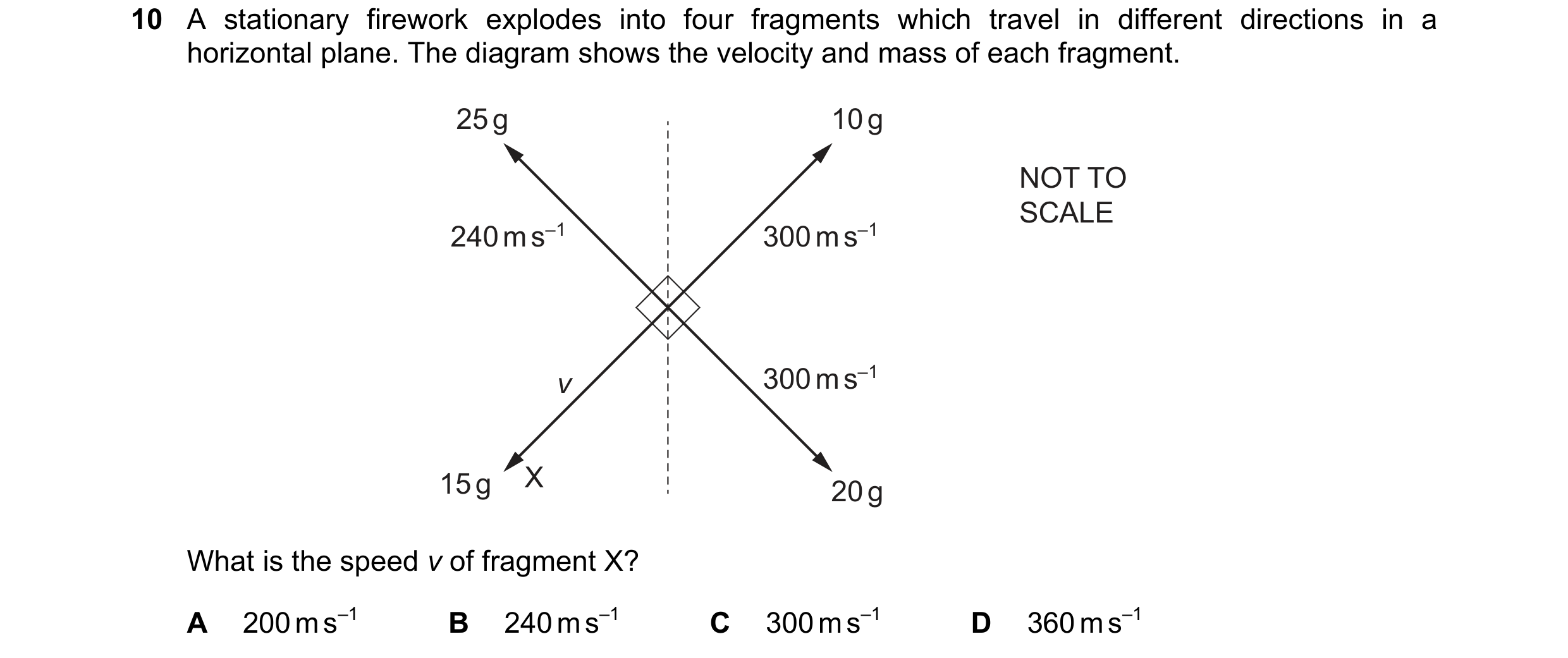
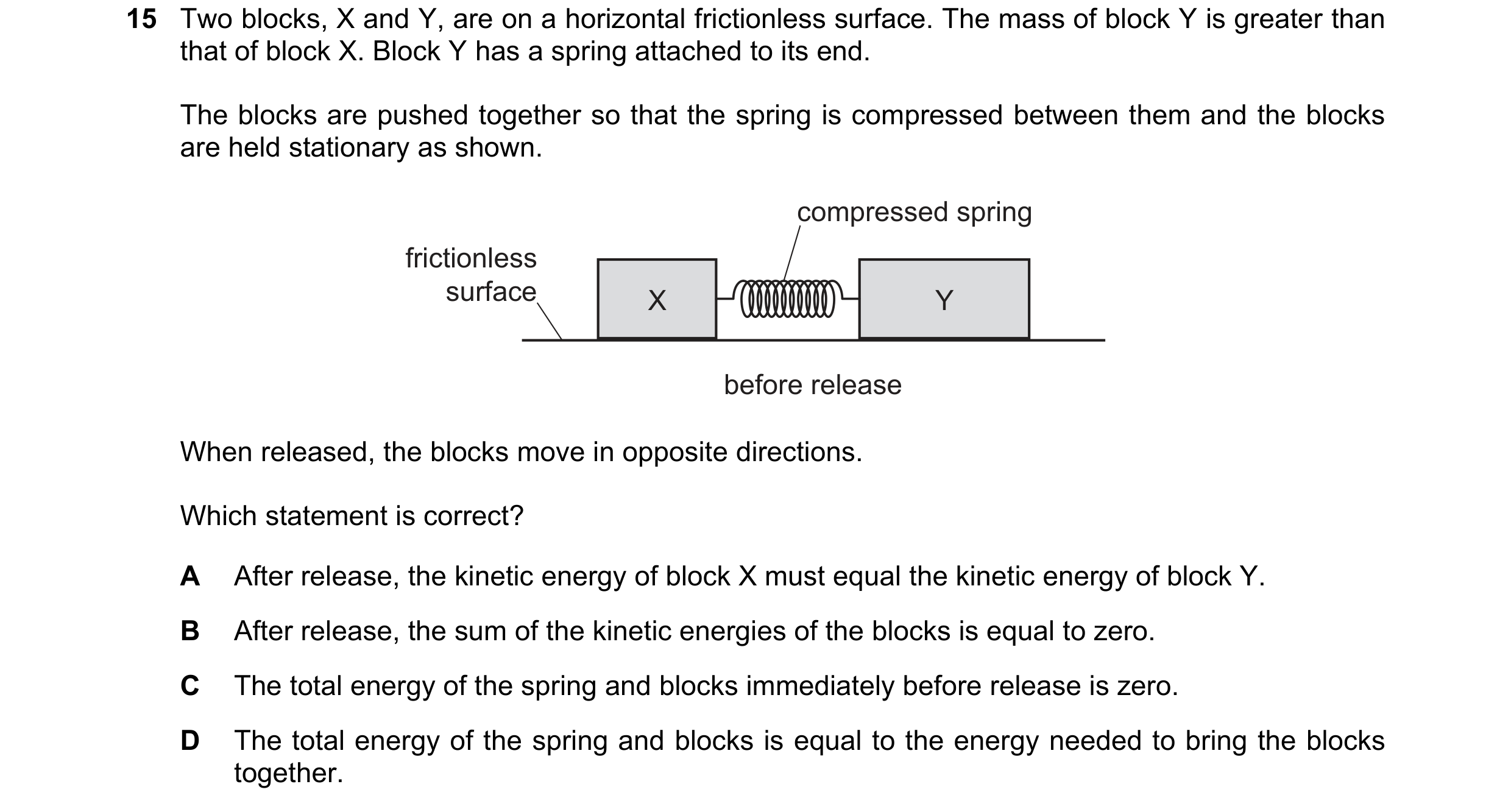
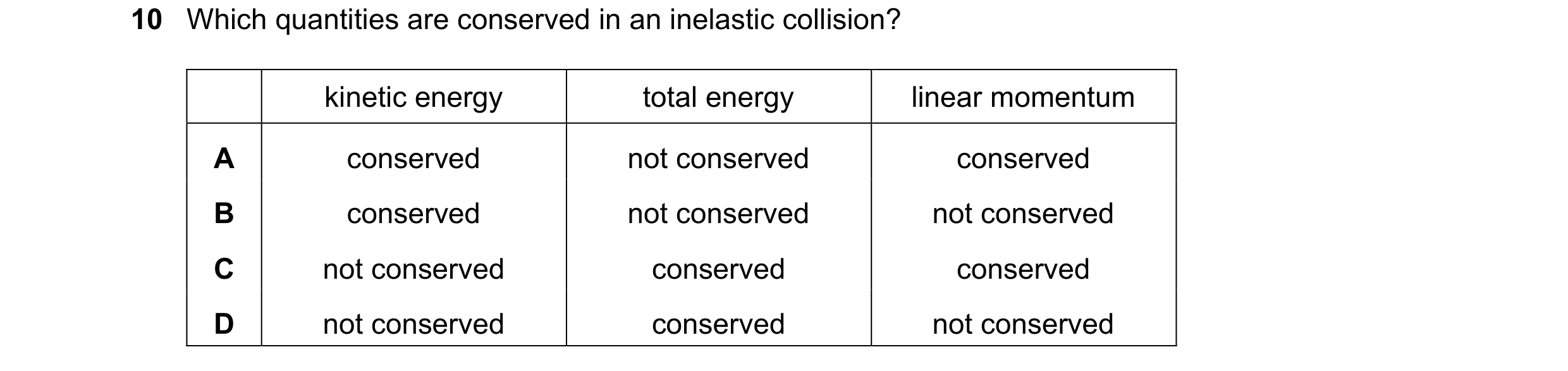
 47 / 66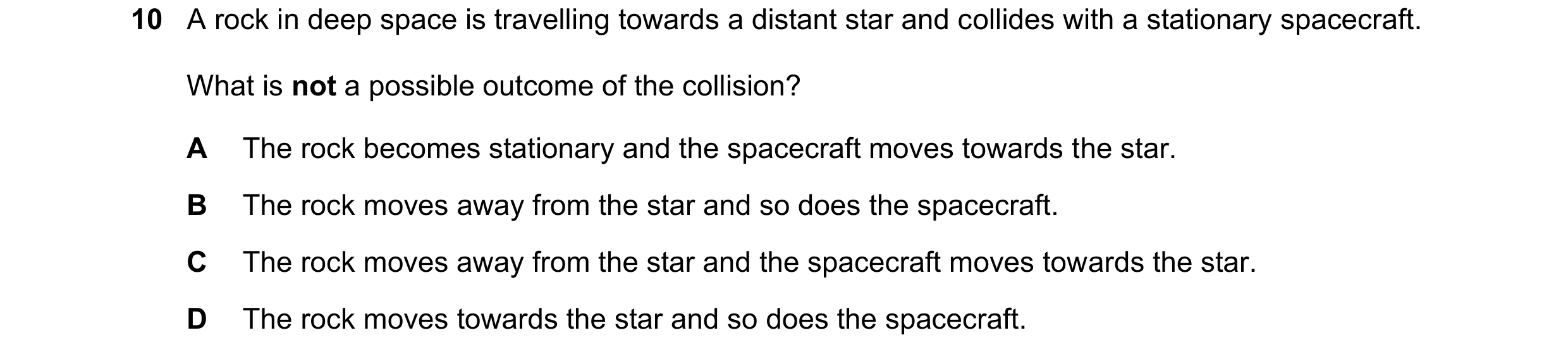
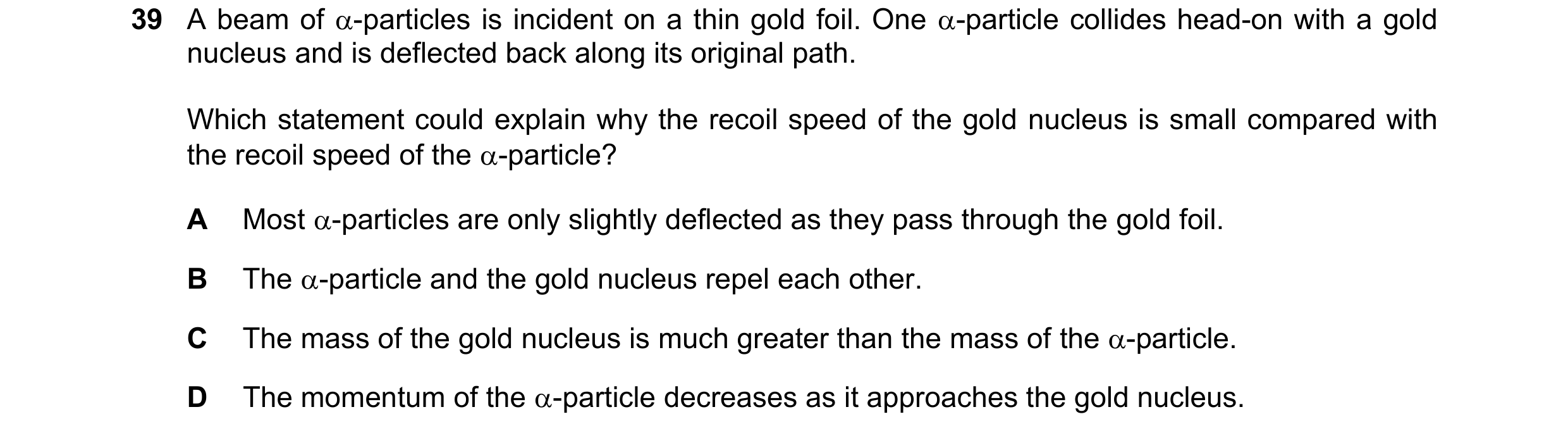

 48 / 66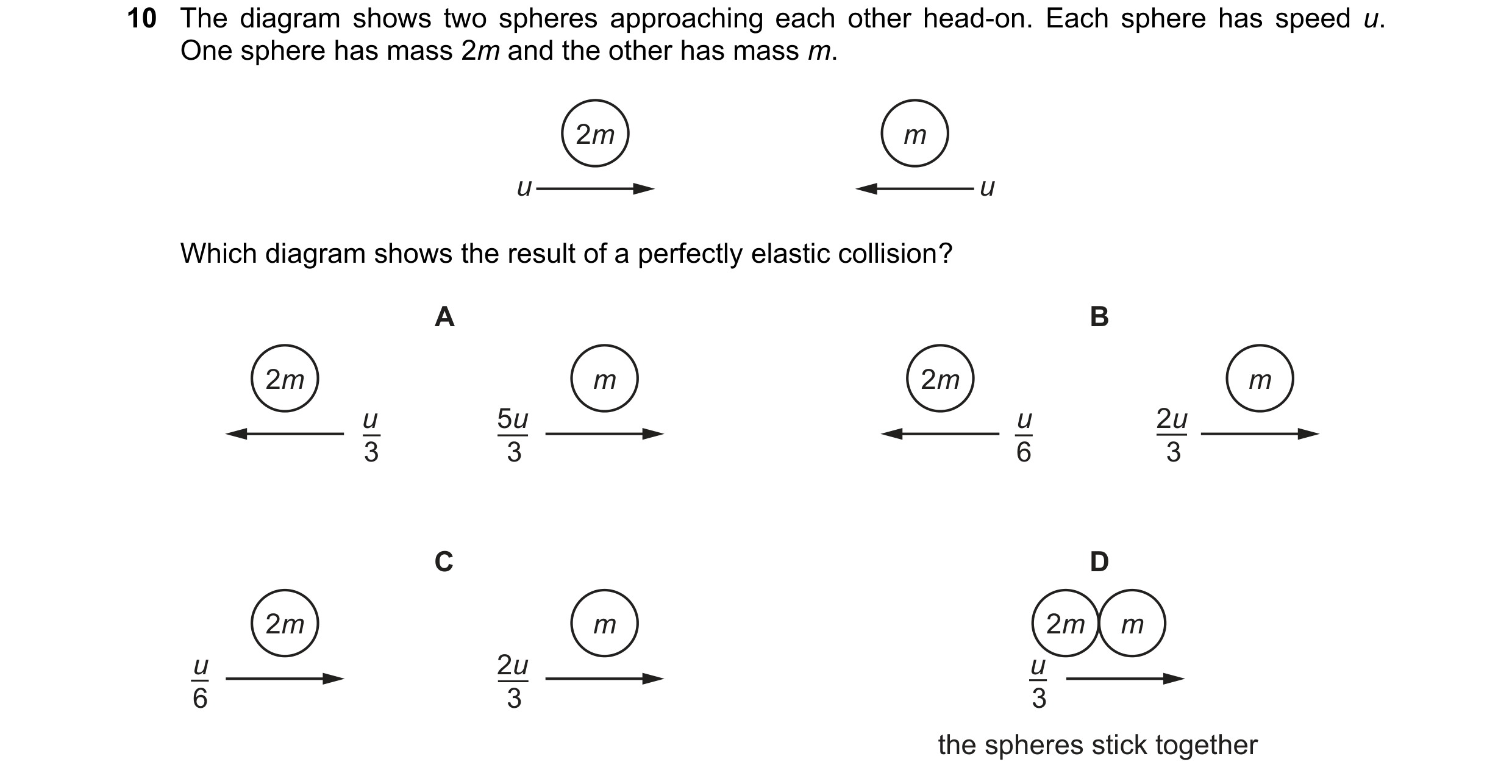

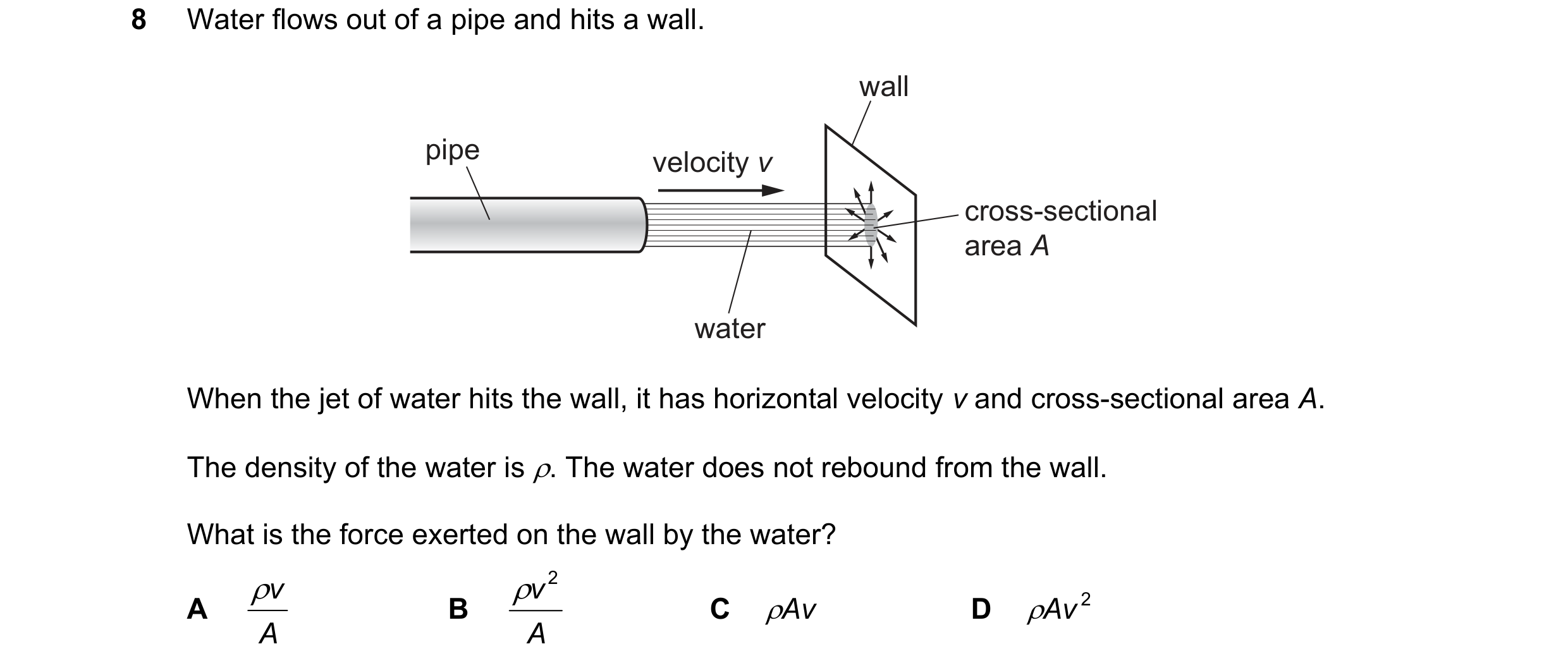
 49 / 66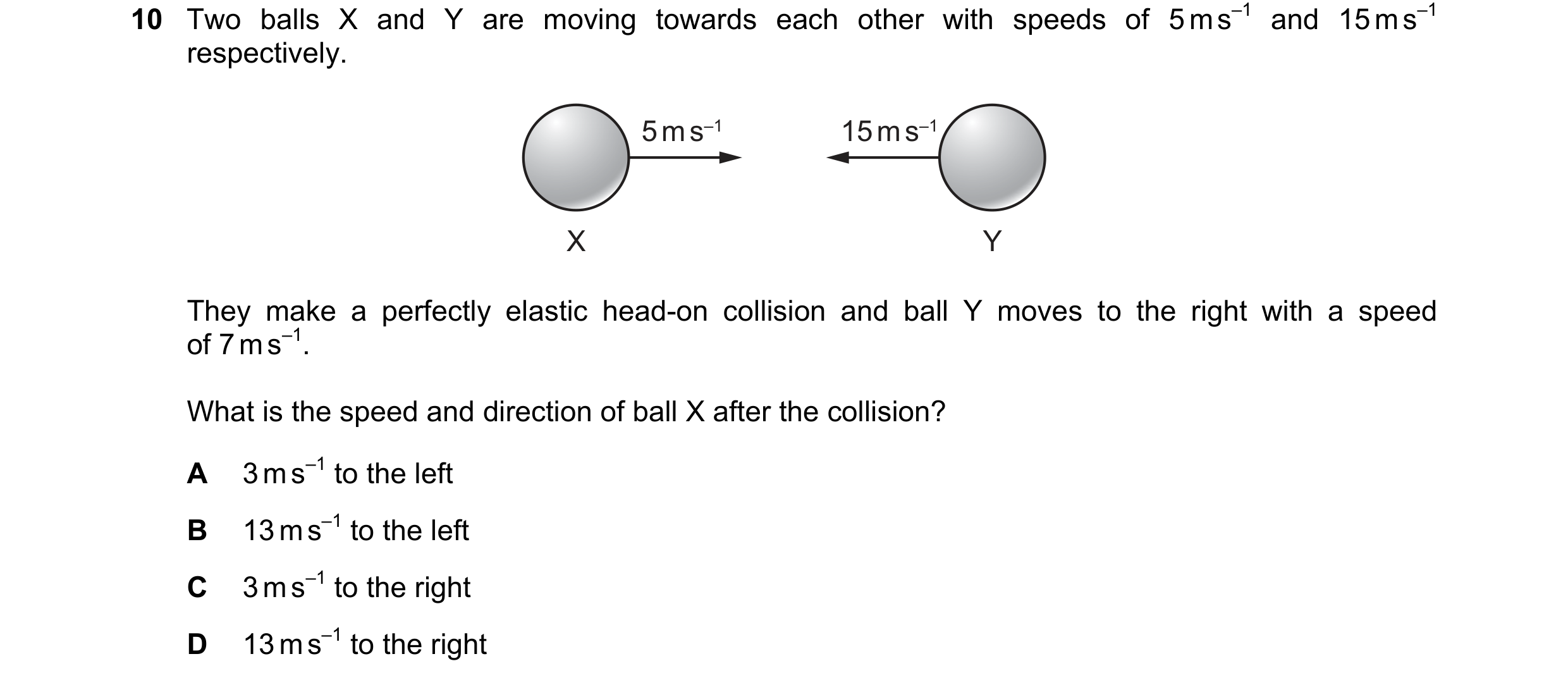

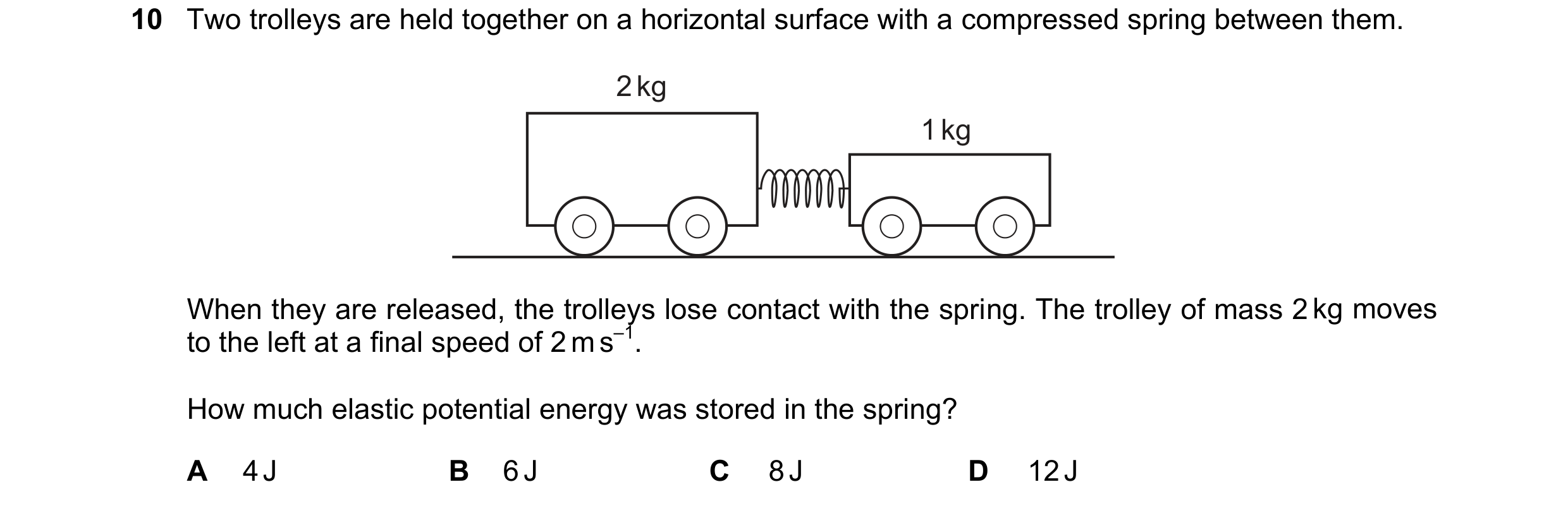
 50 / 66
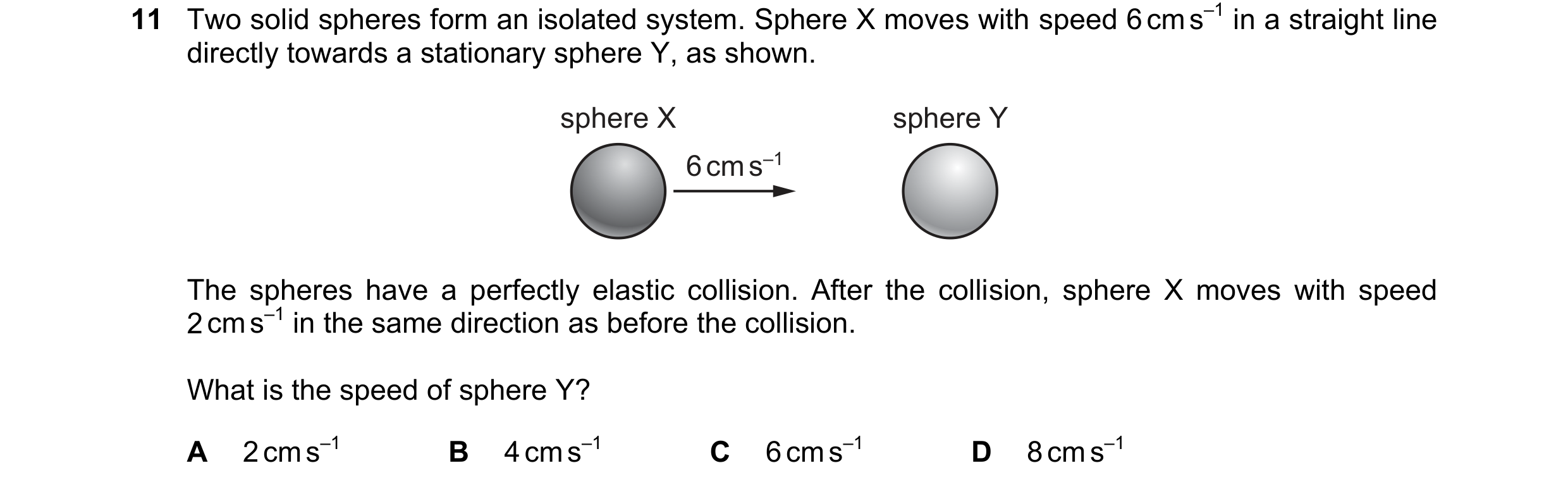
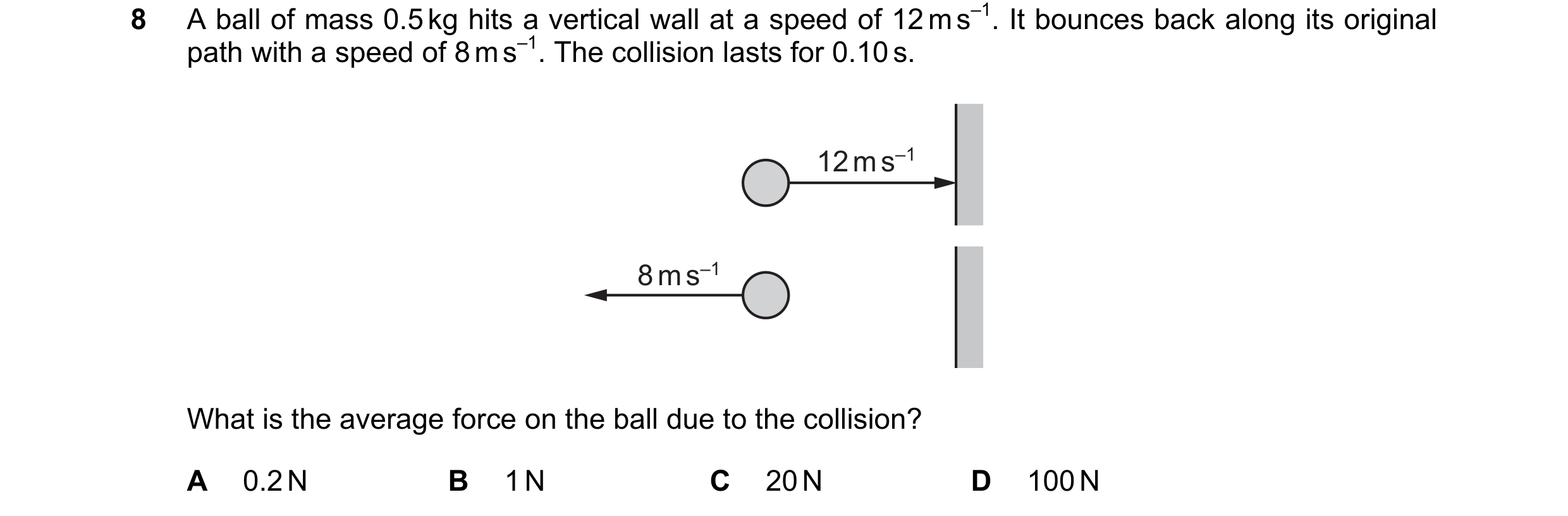 51 / 66
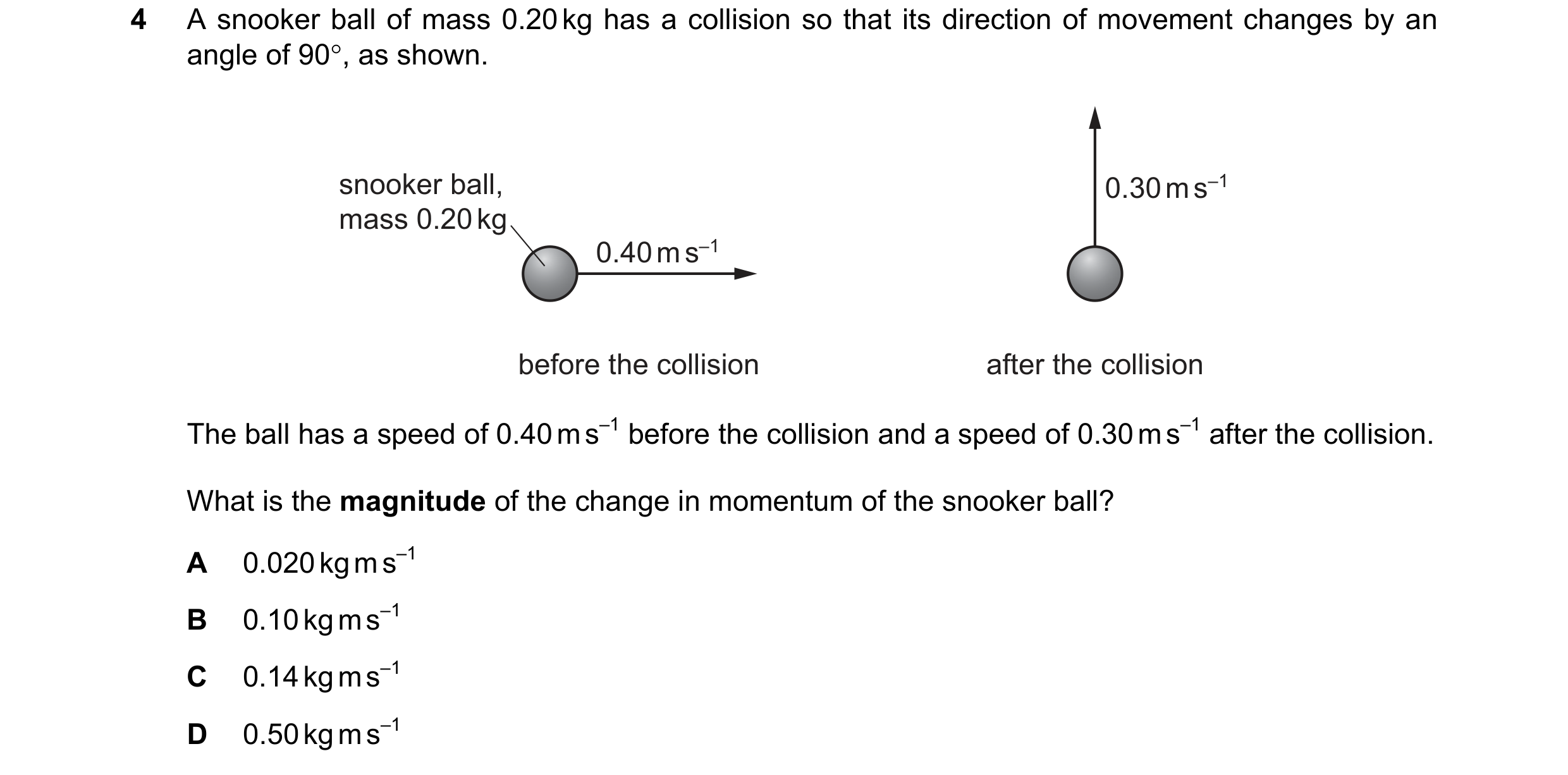
 52 / 66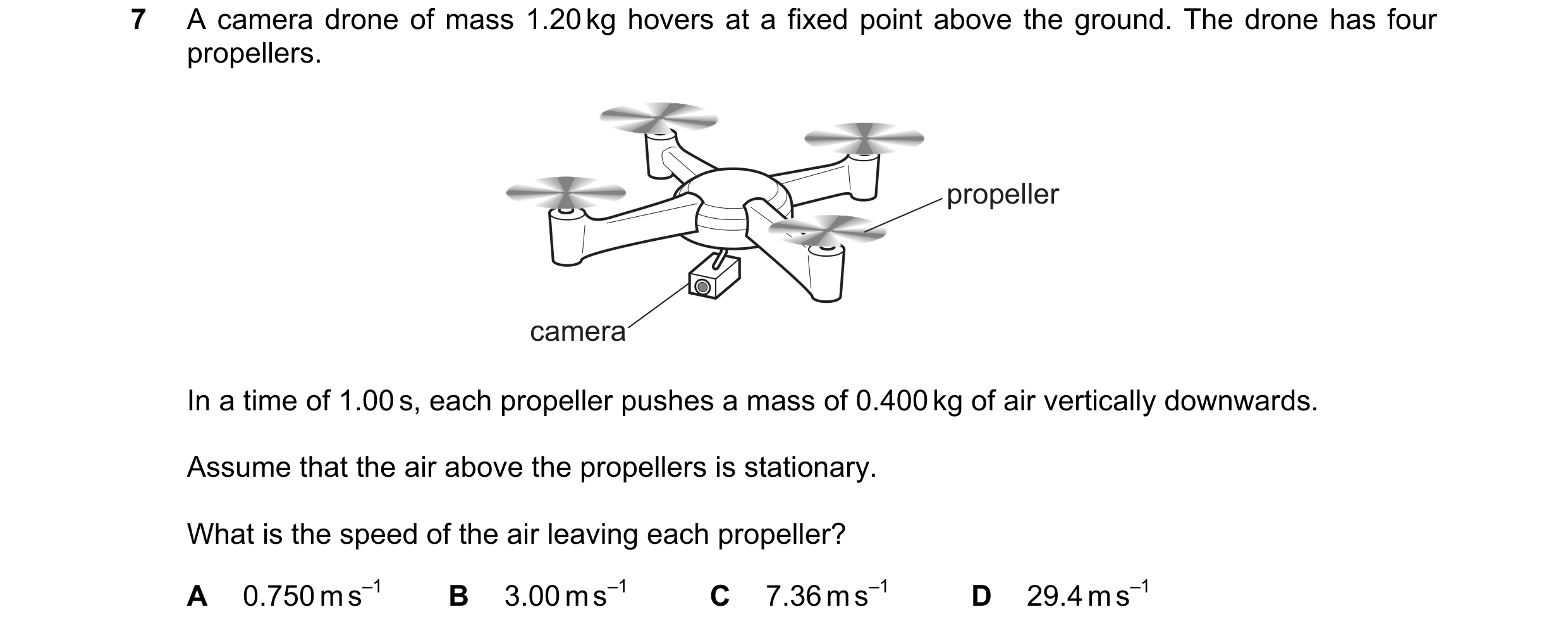
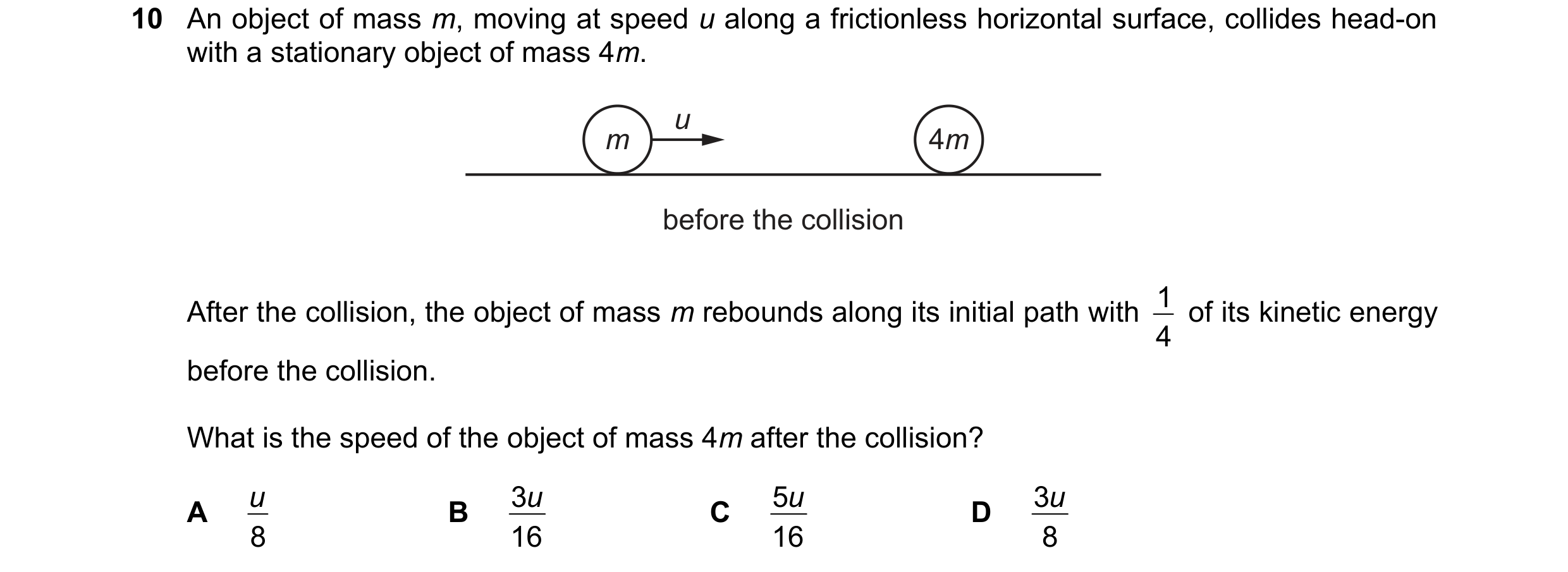
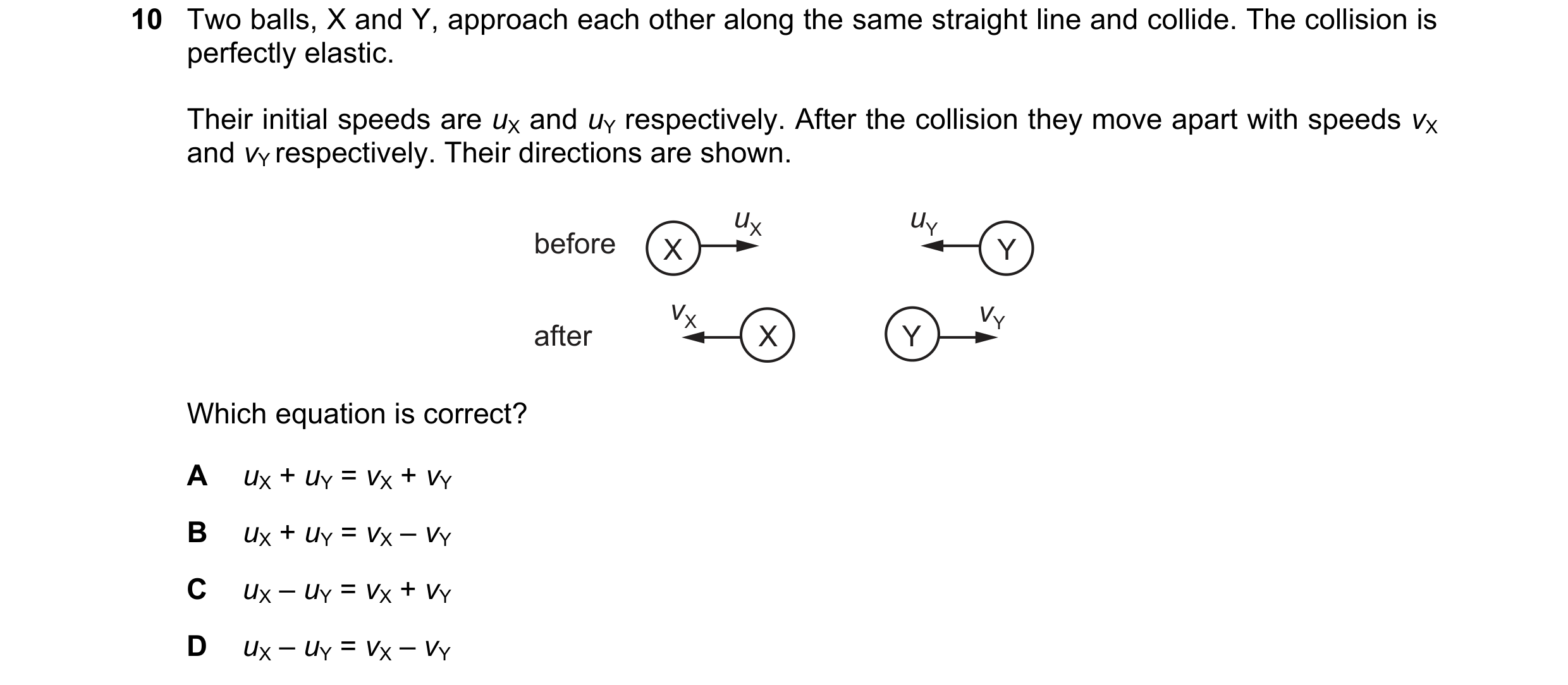 53 / 66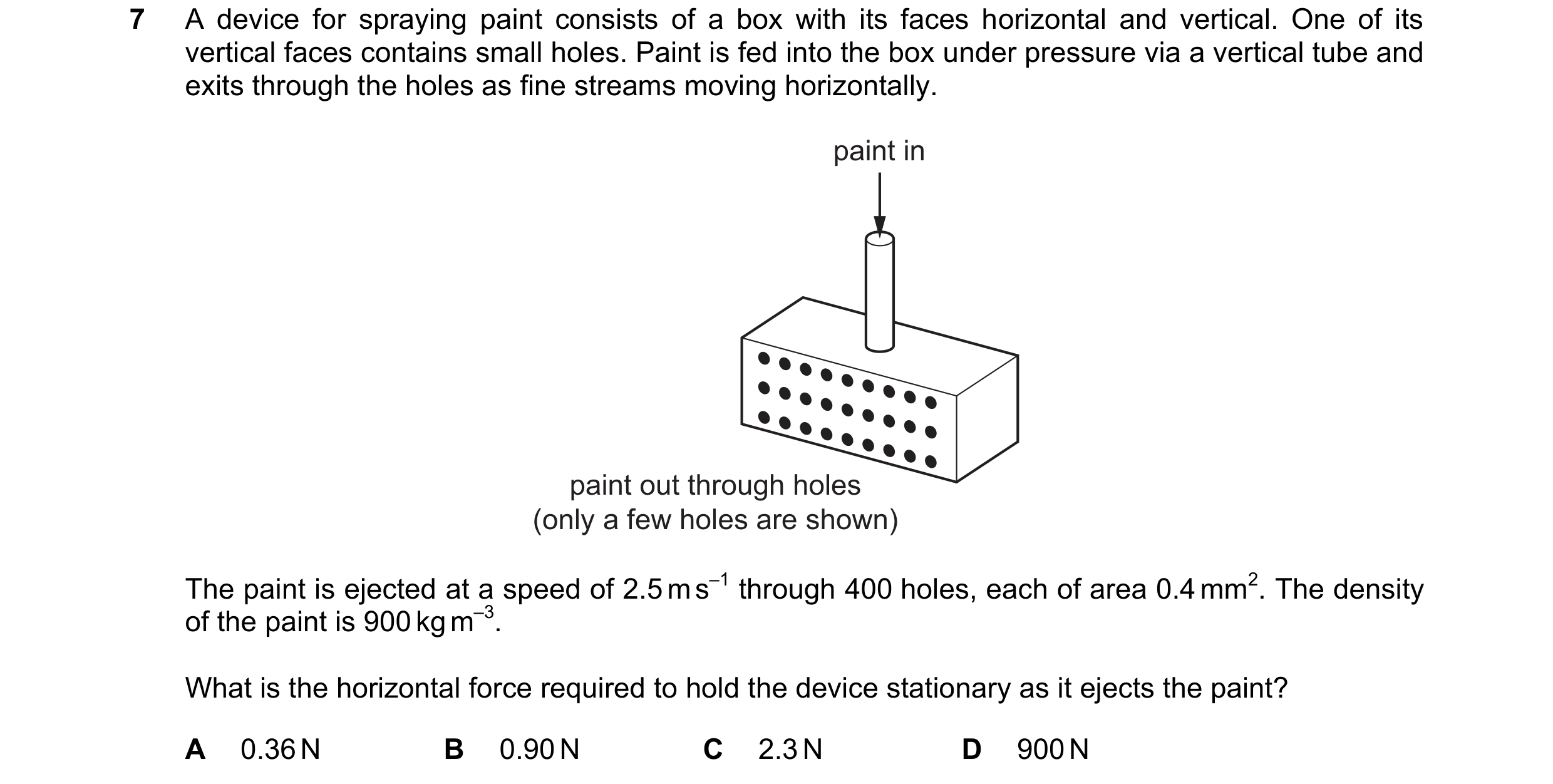
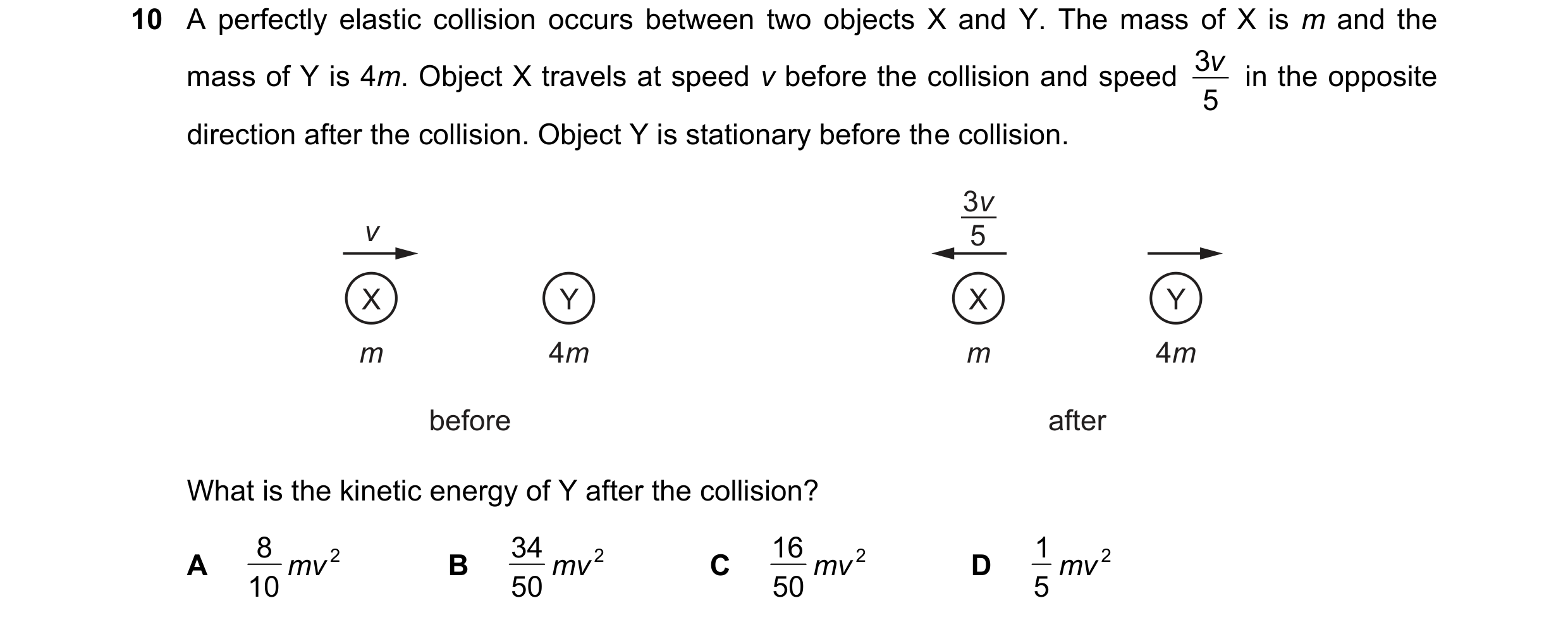
 54 / 66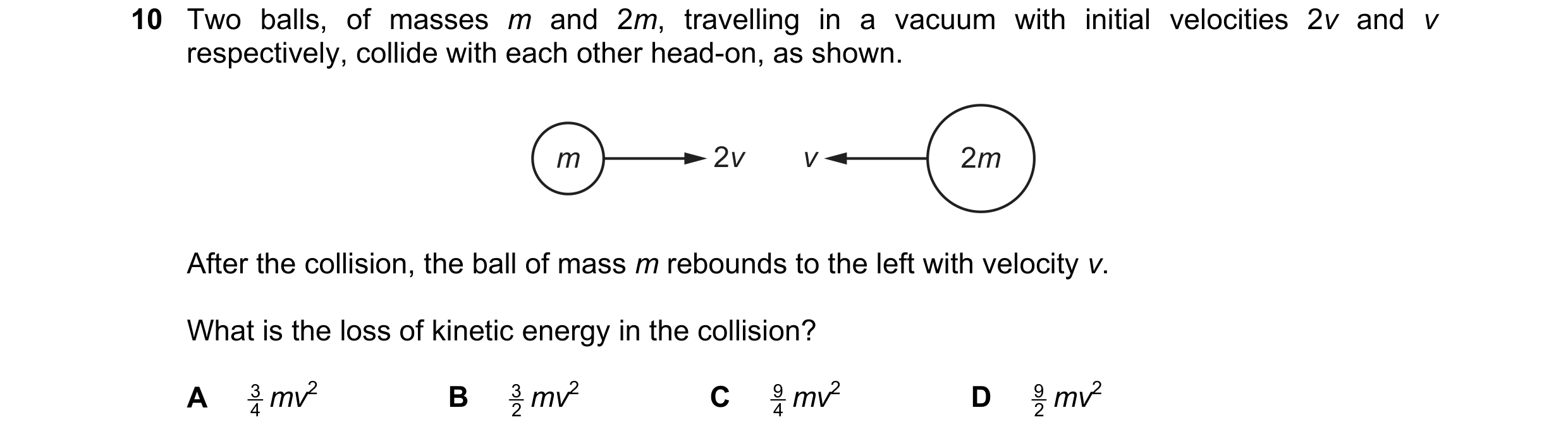
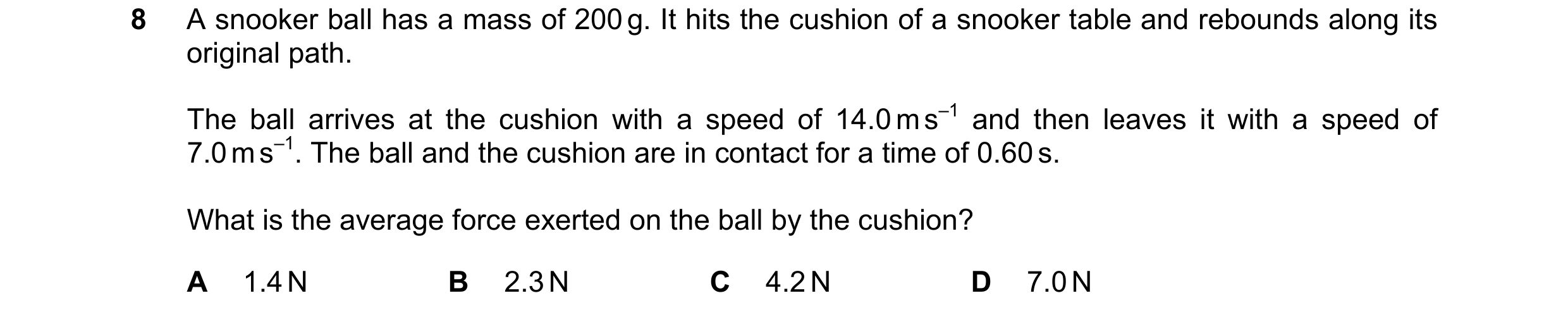
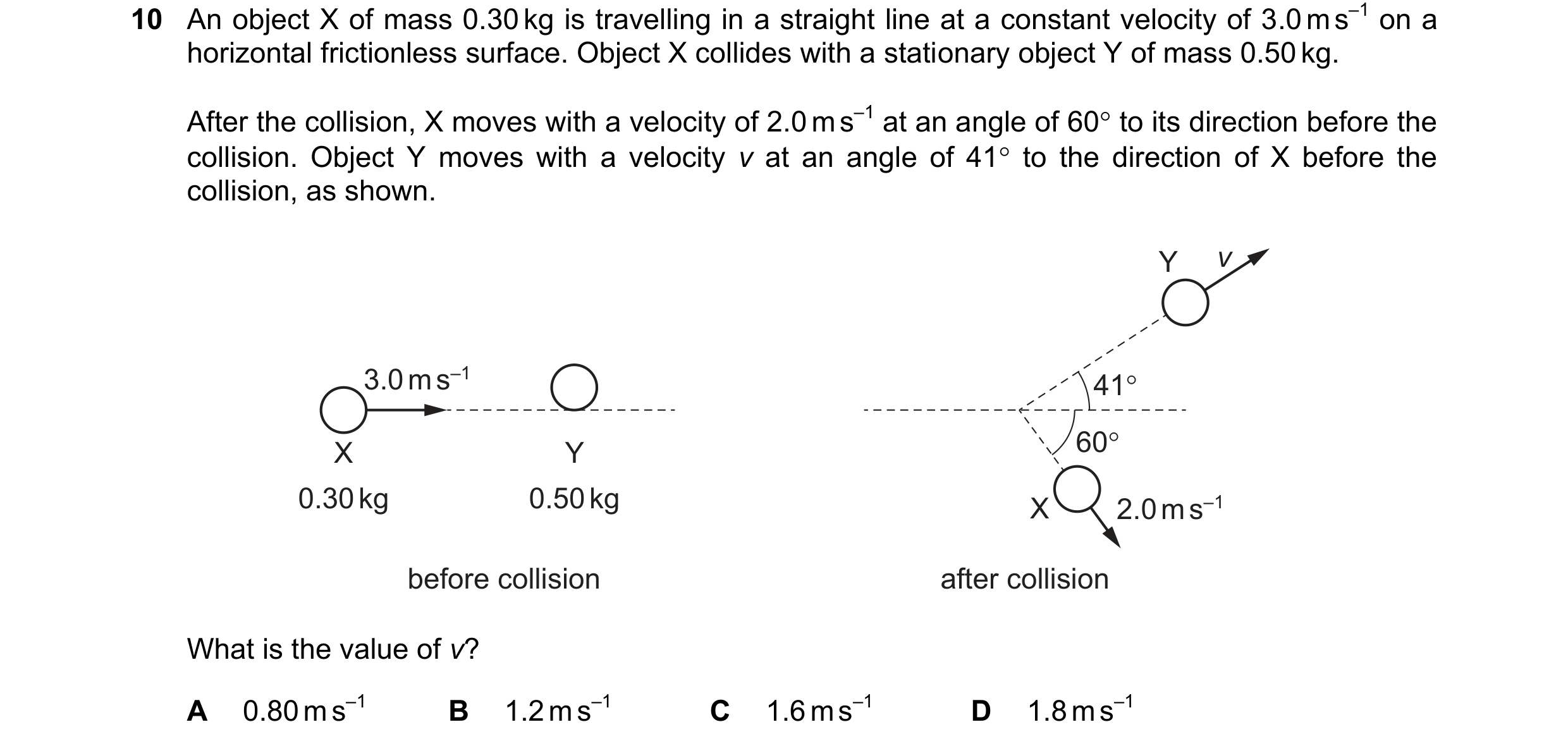 55 / 66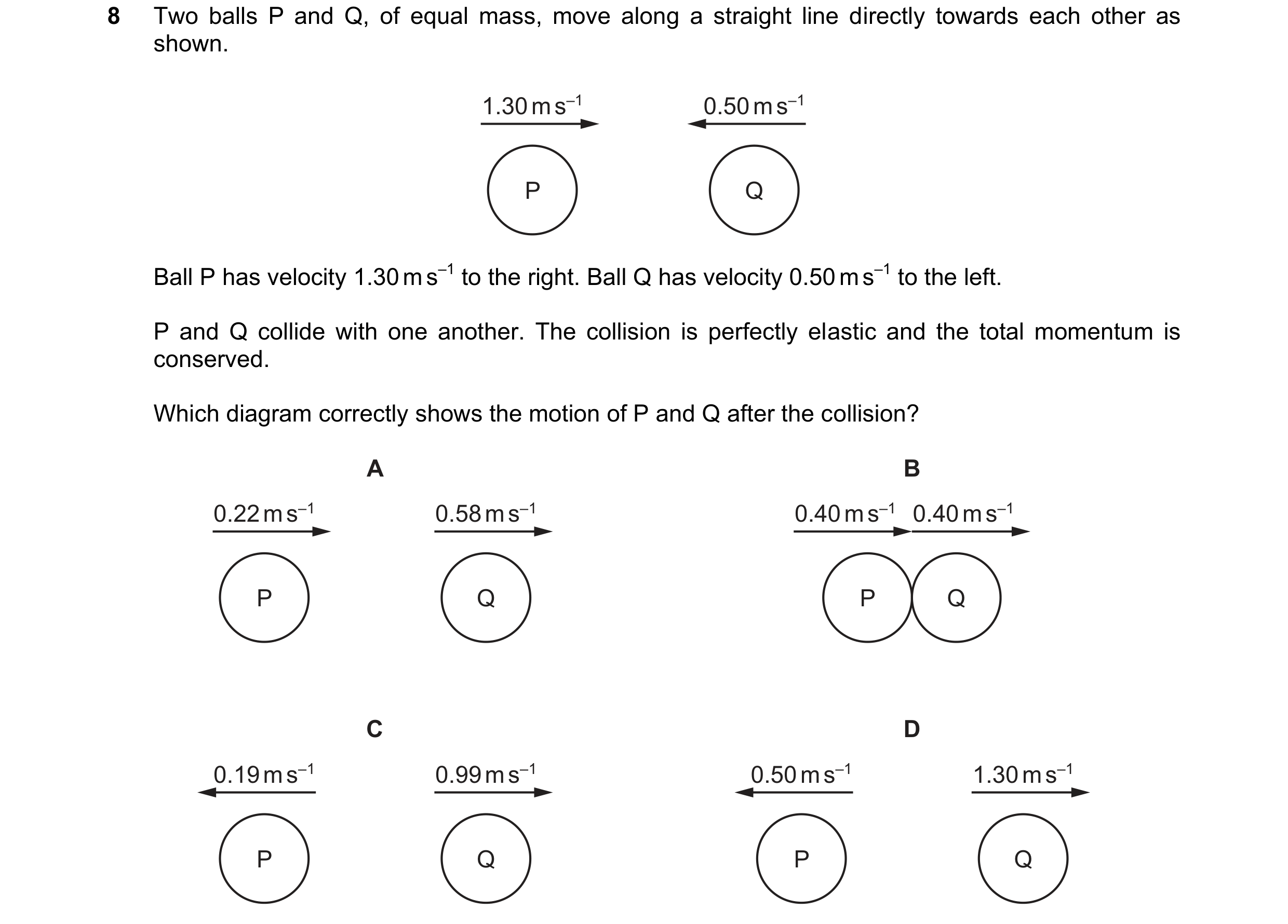
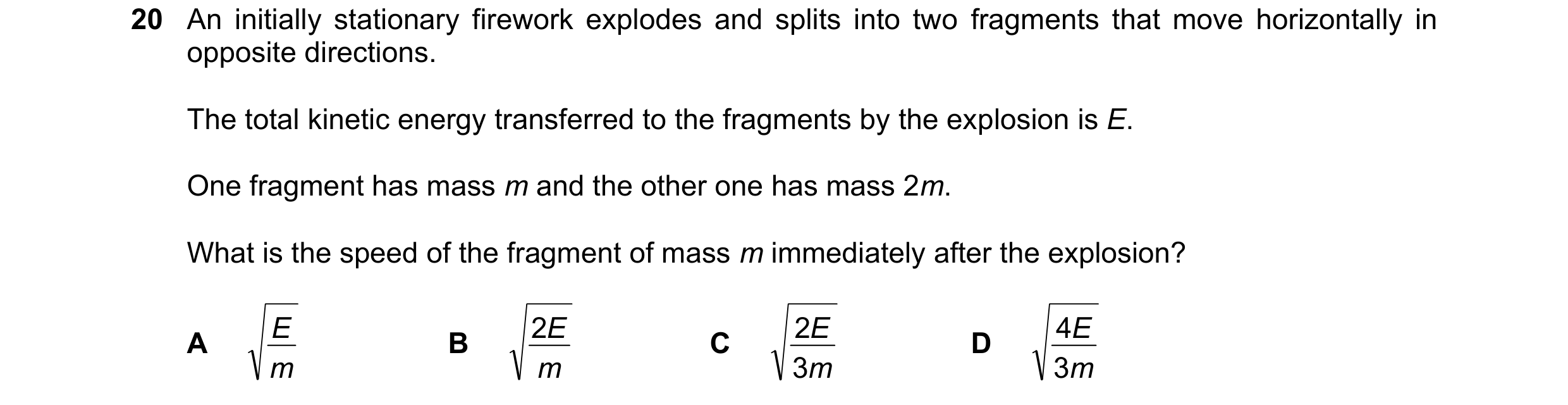
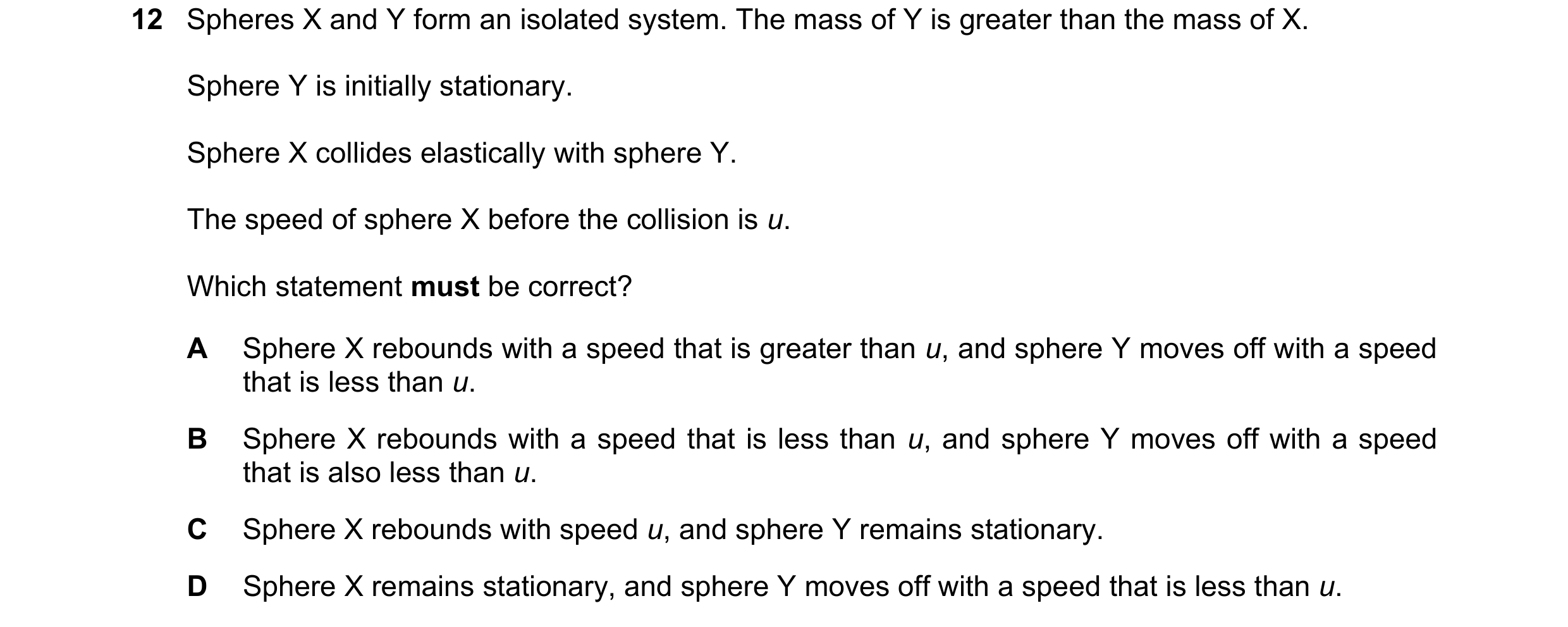 56 / 66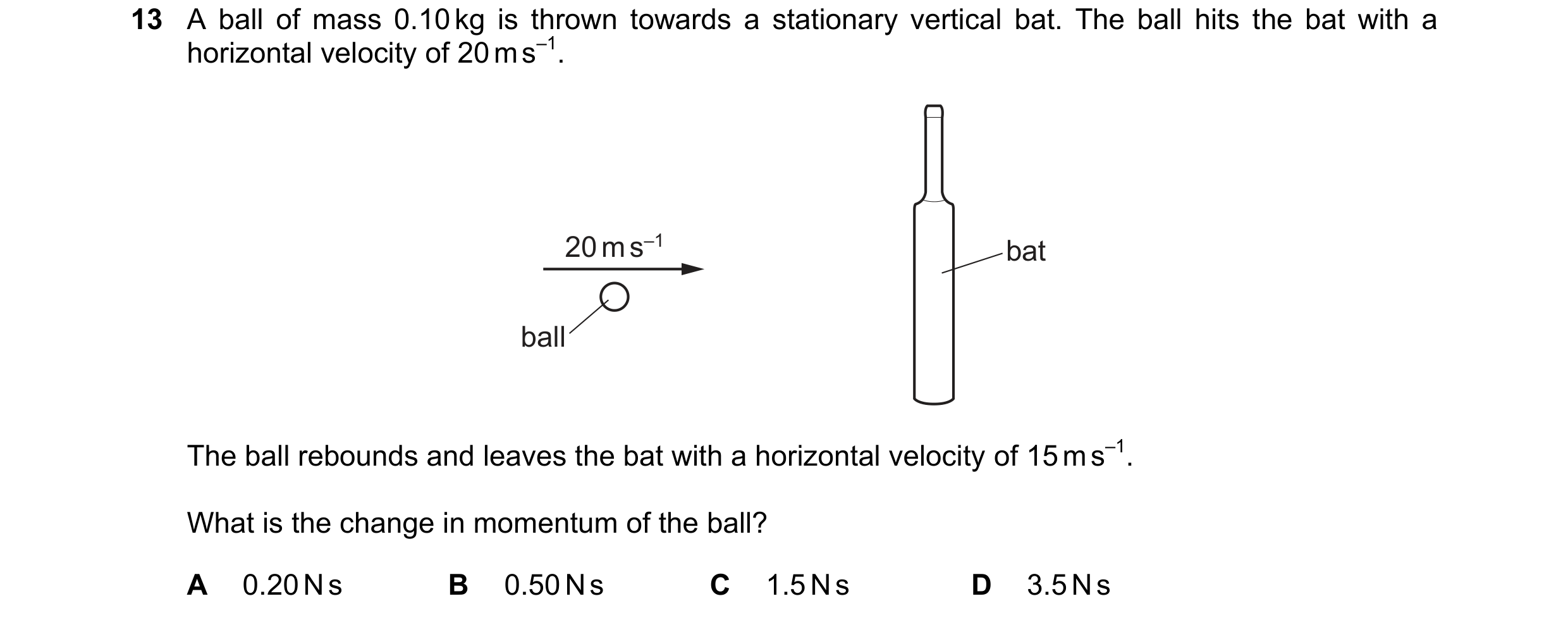
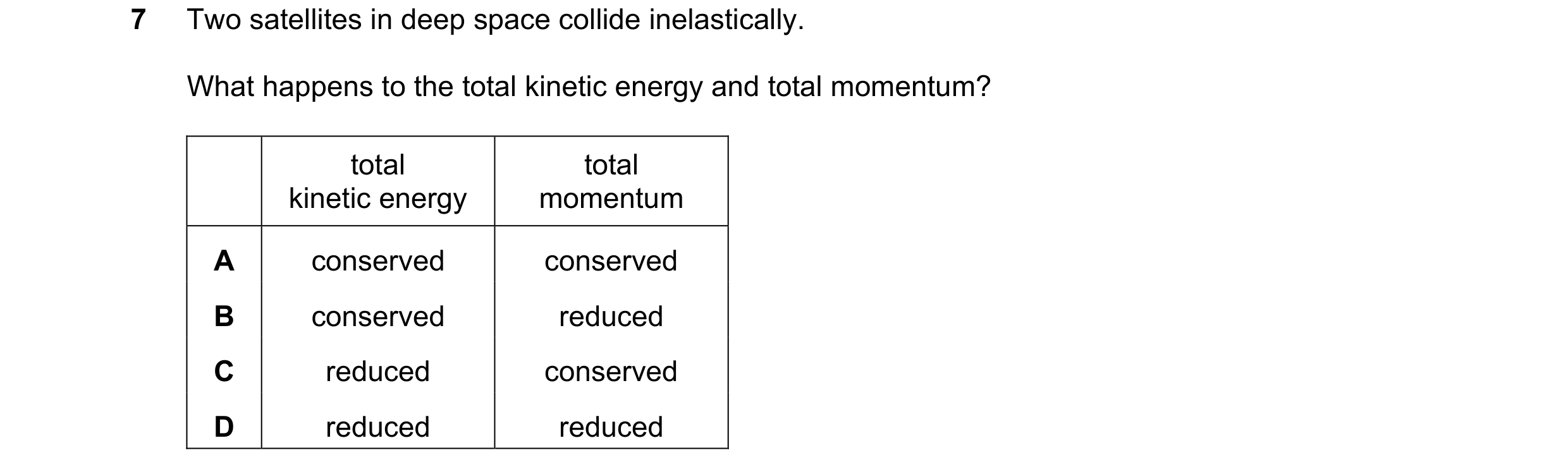
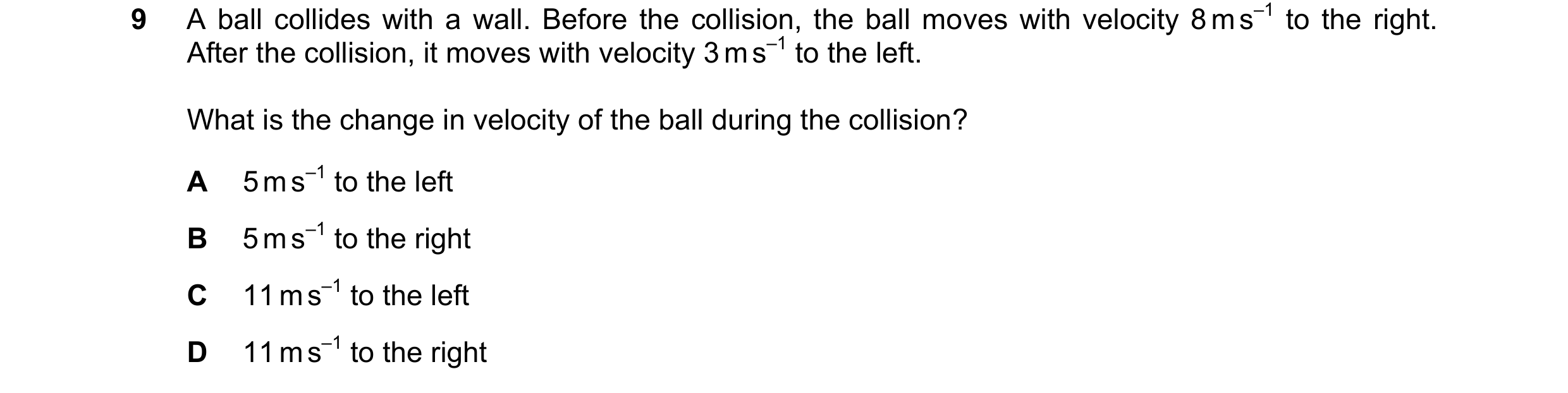 57 / 66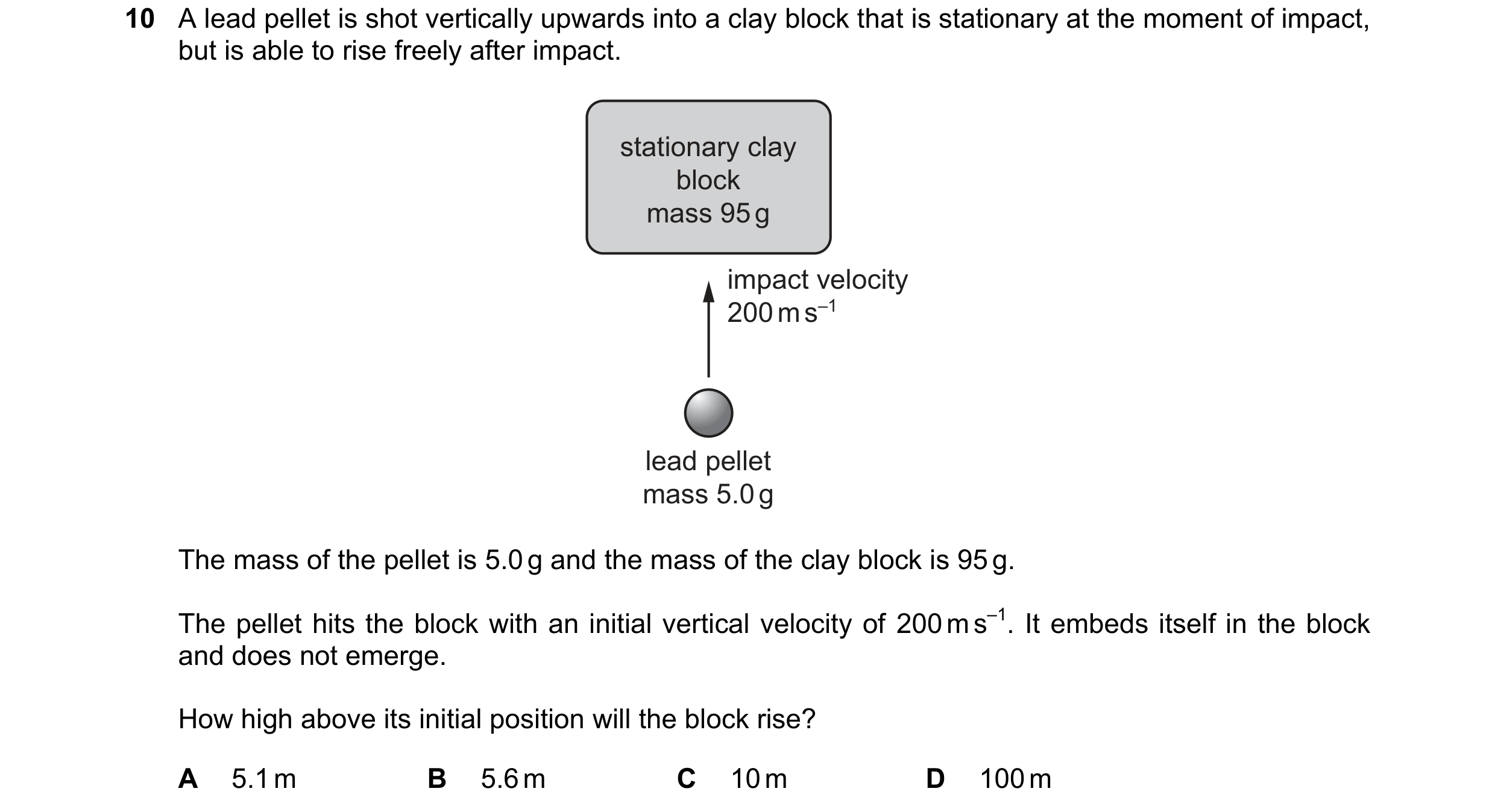
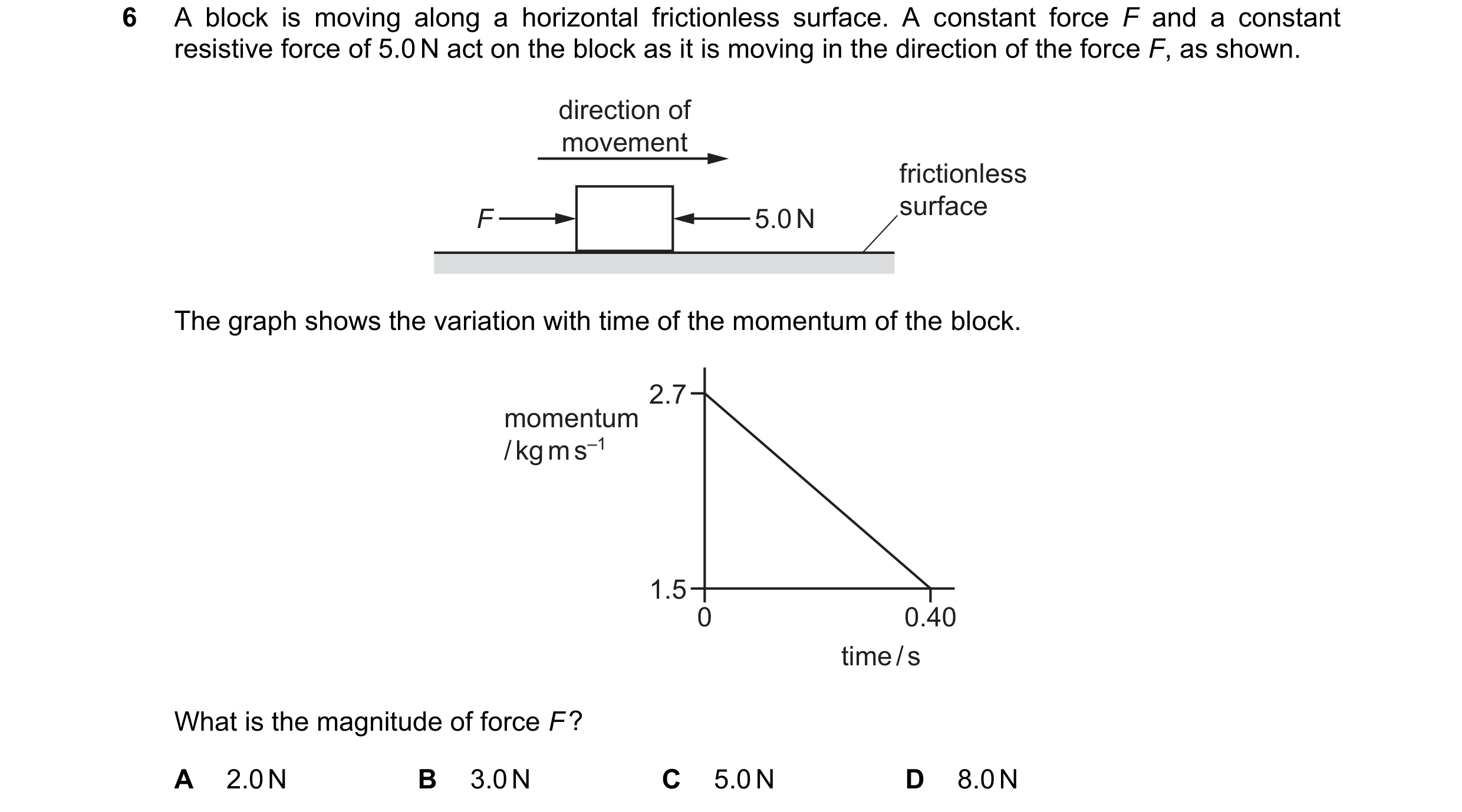
 58 / 66

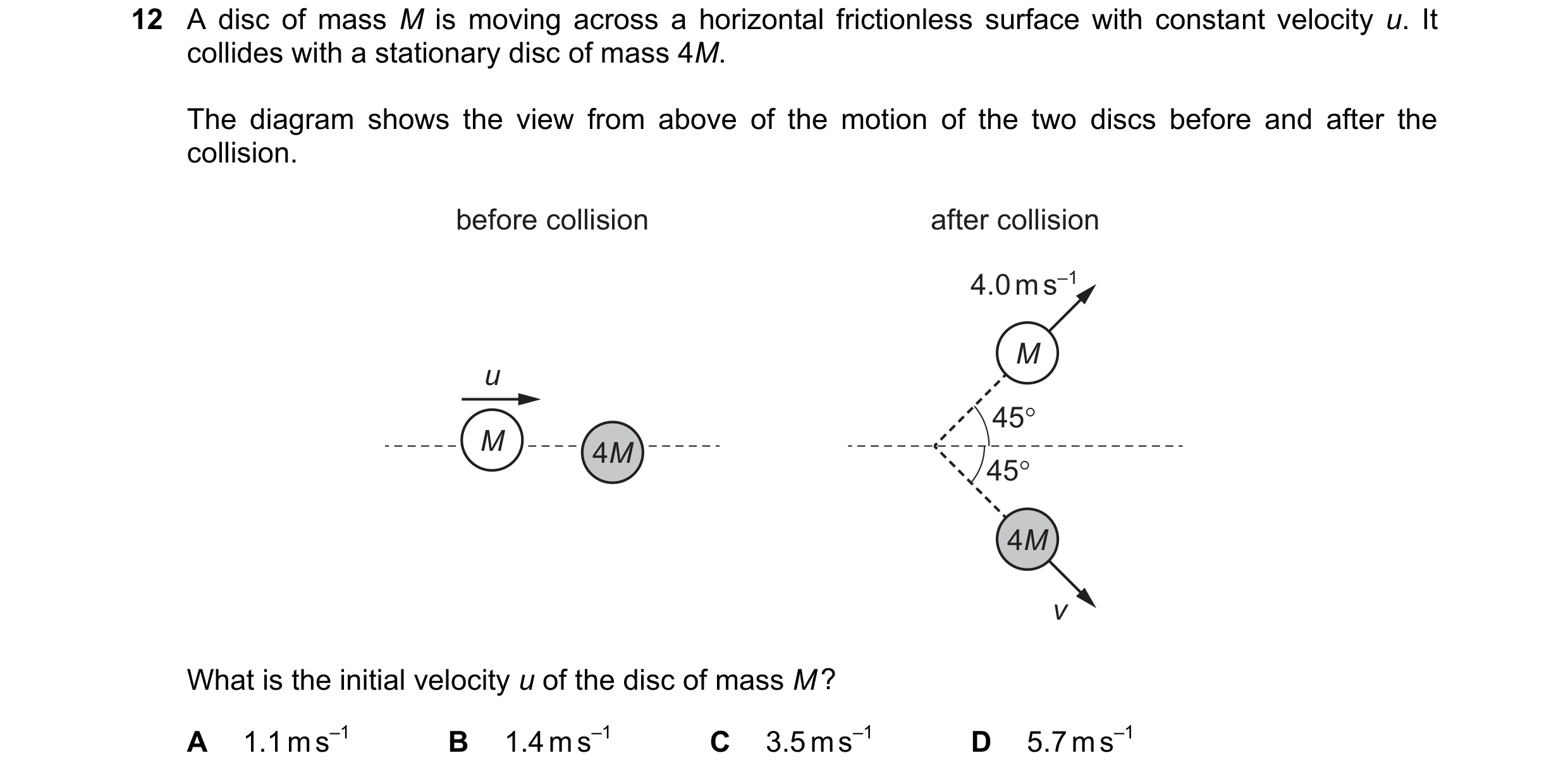
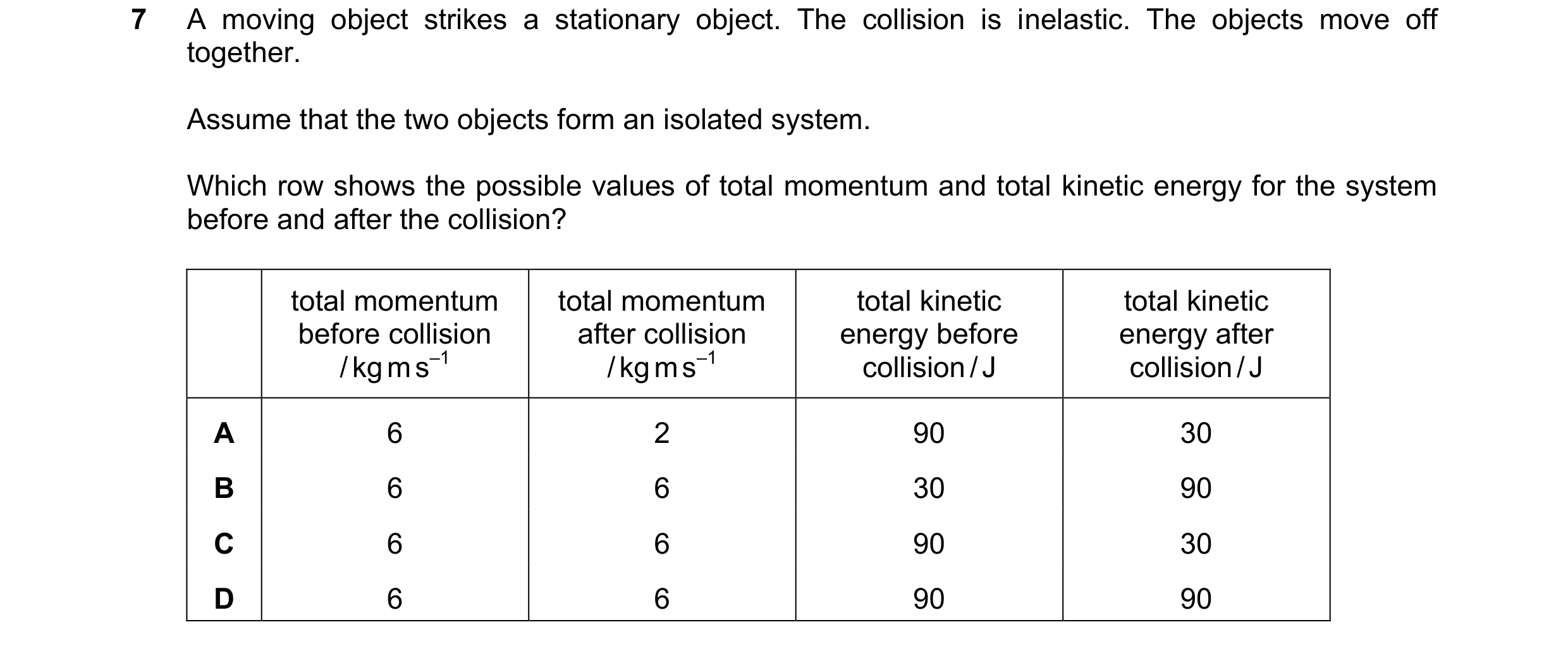 59 / 66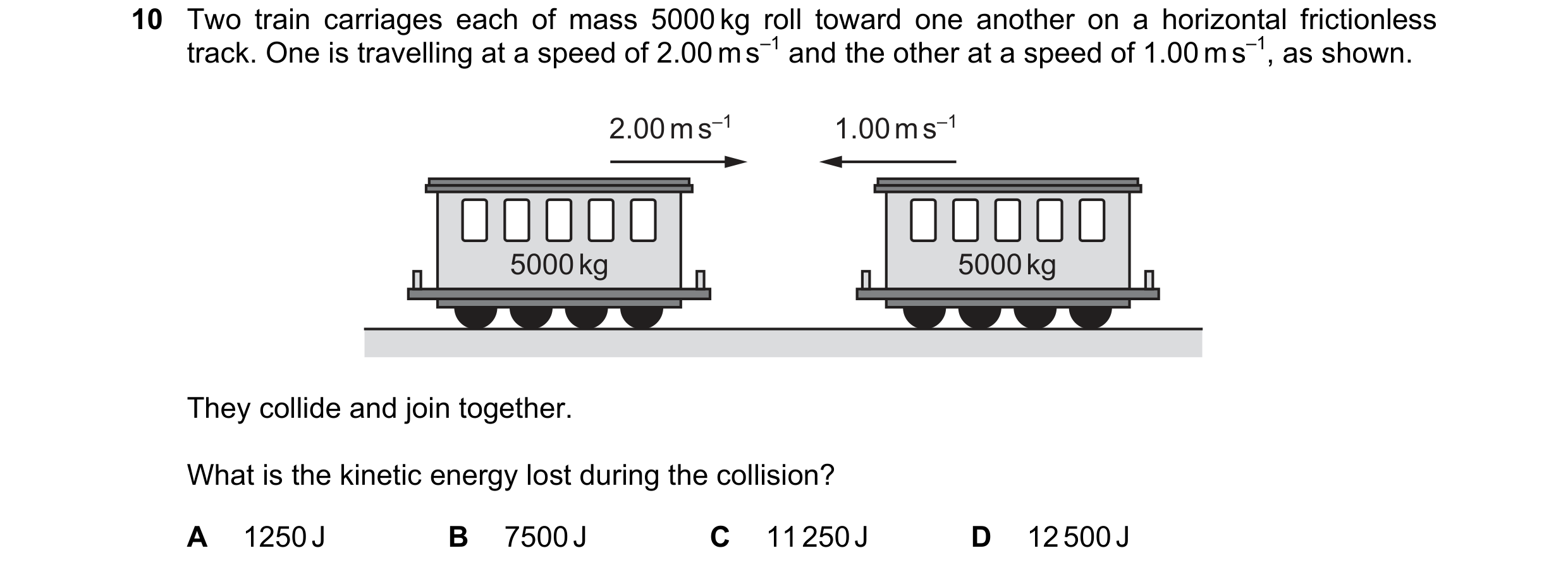
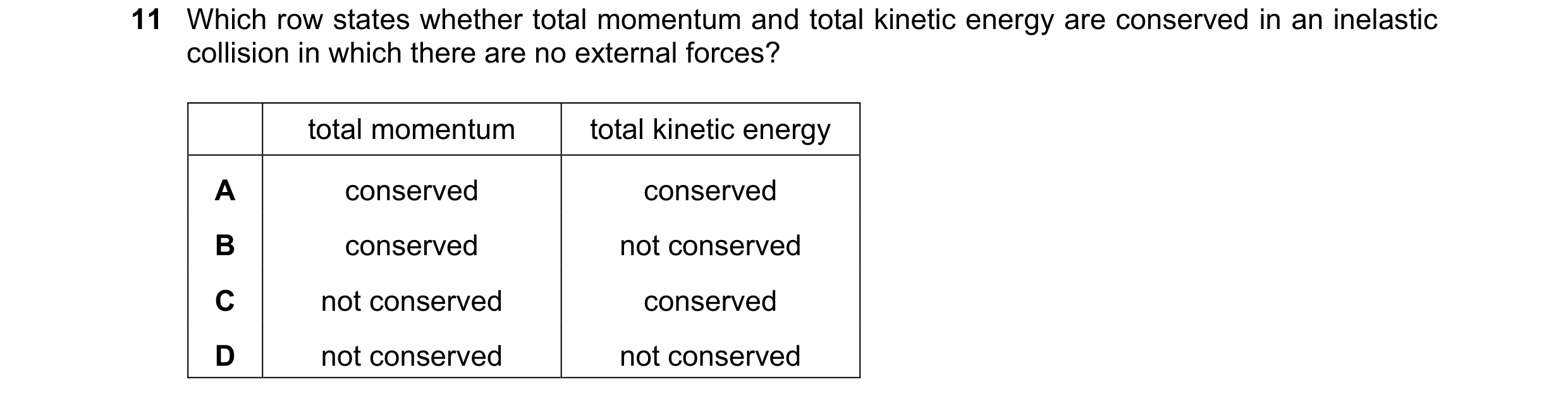
 60 / 66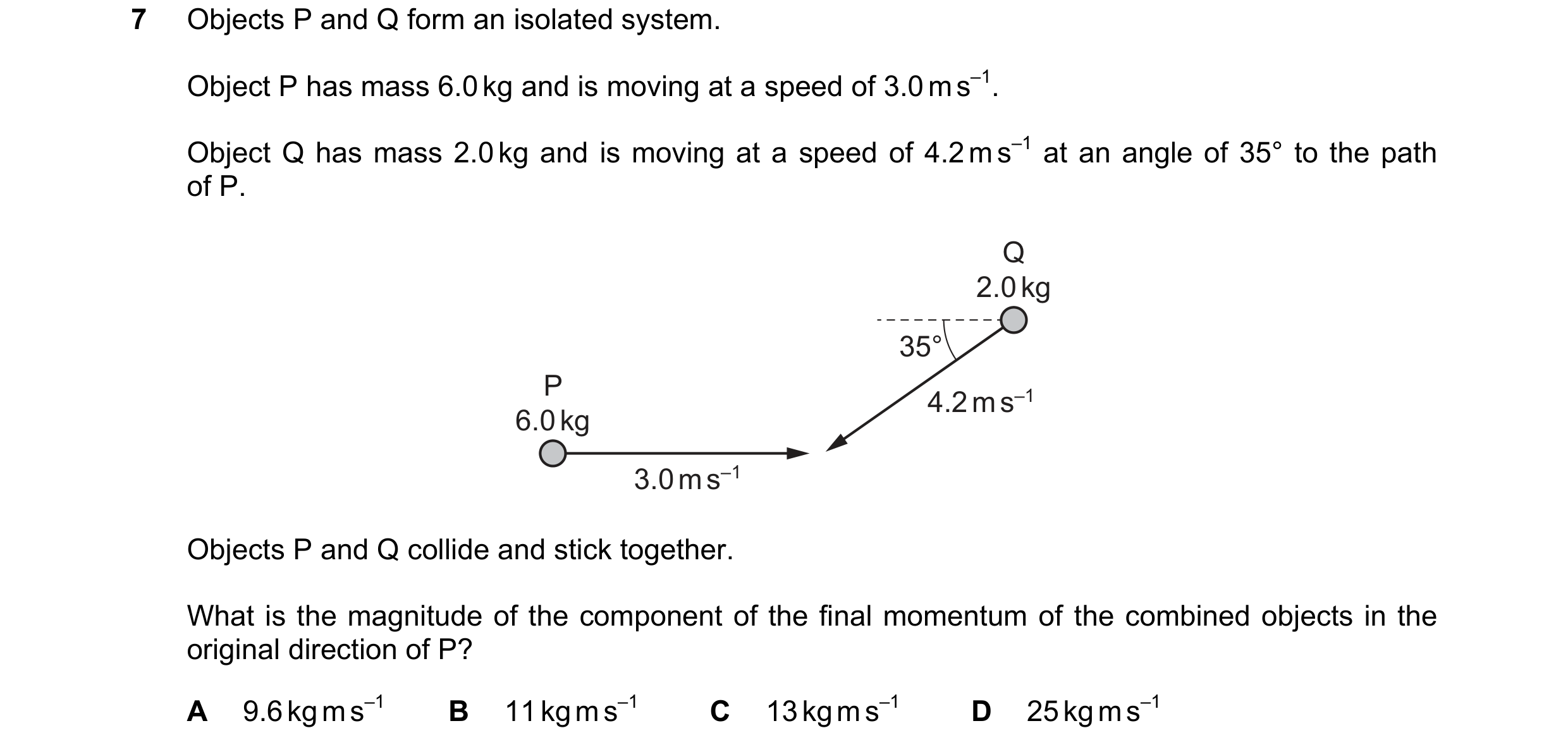
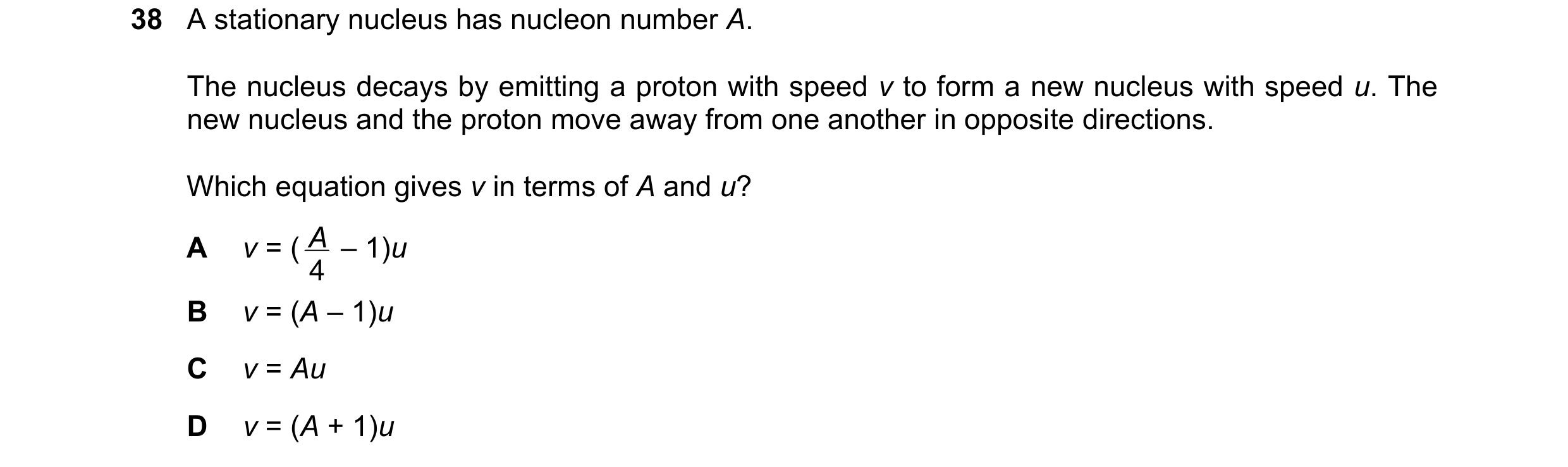
 61 / 66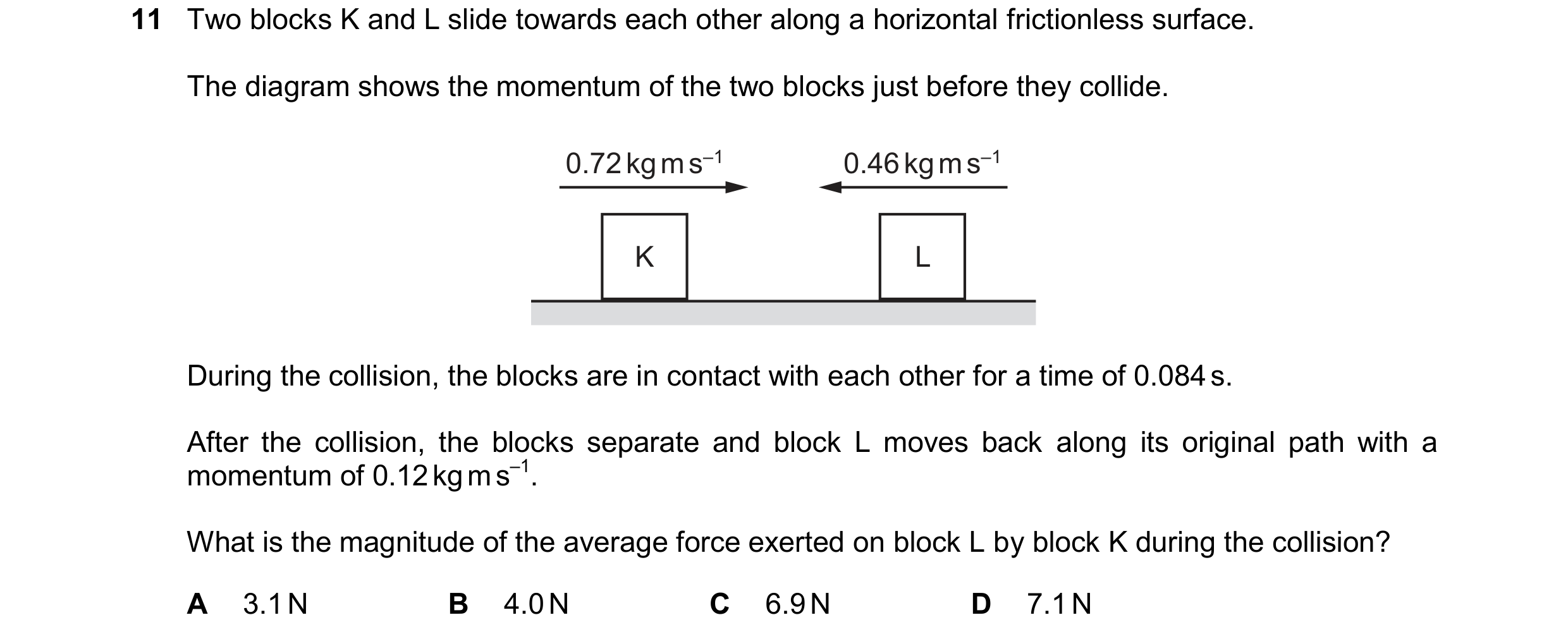


 62 / 66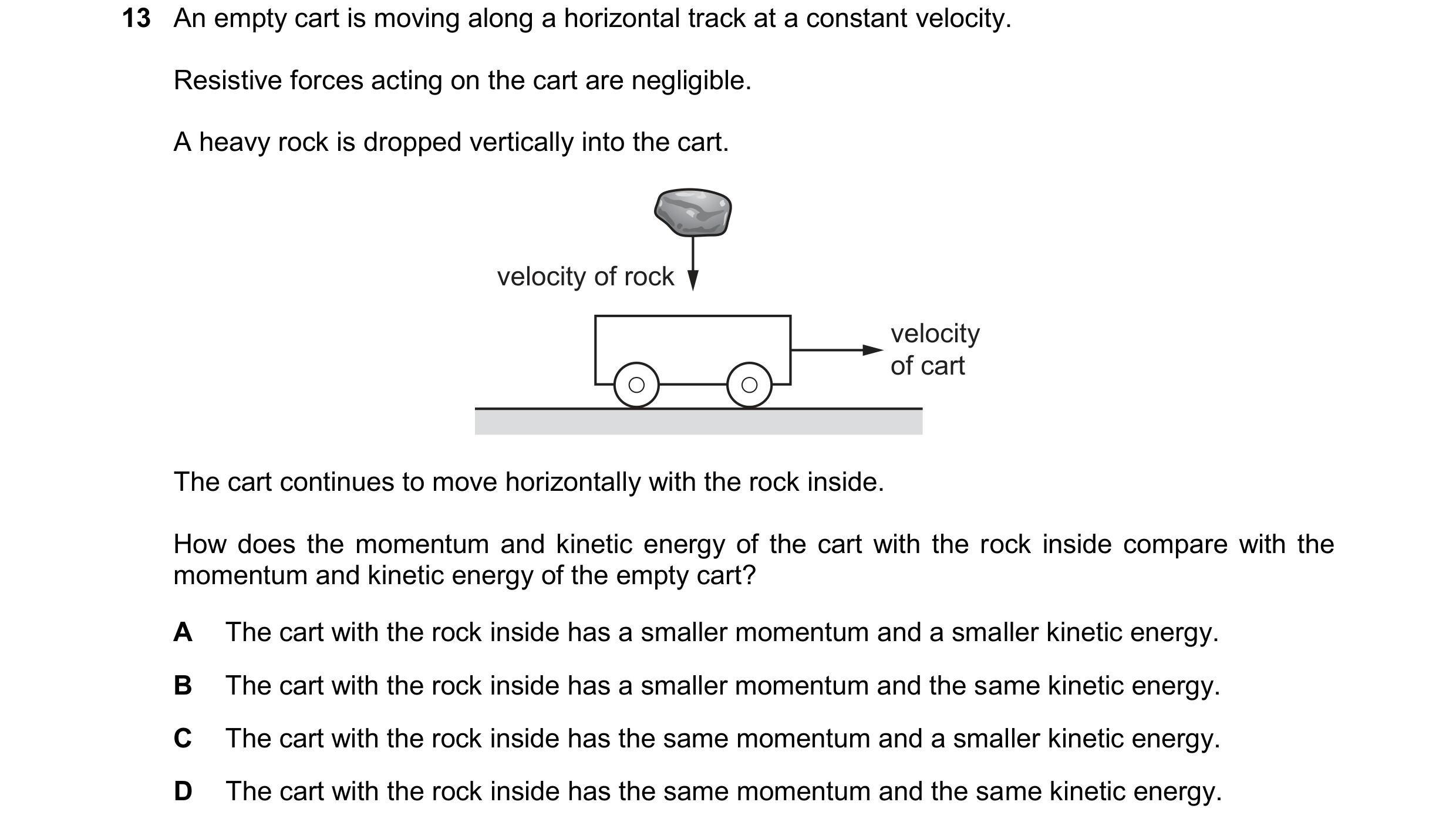
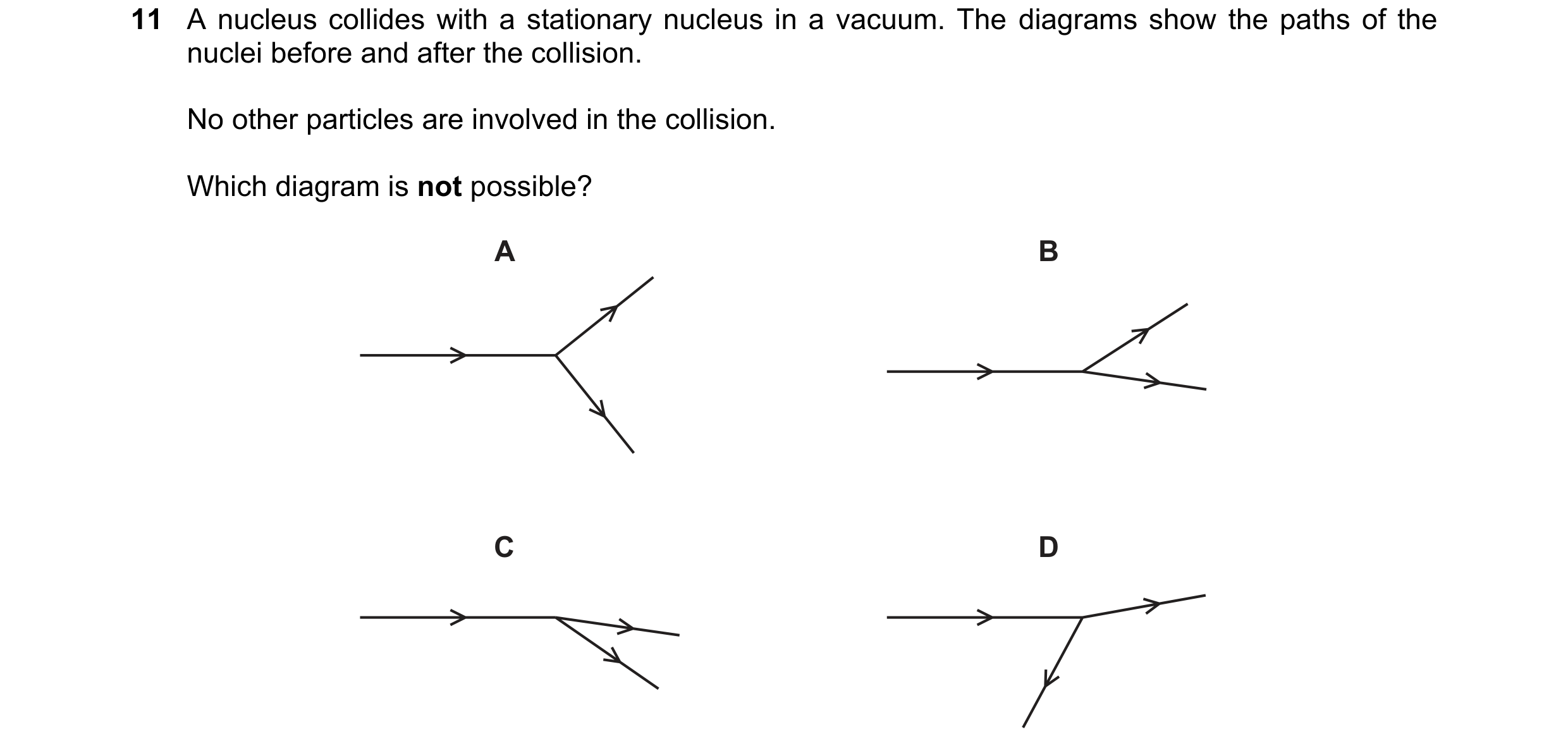 63 / 66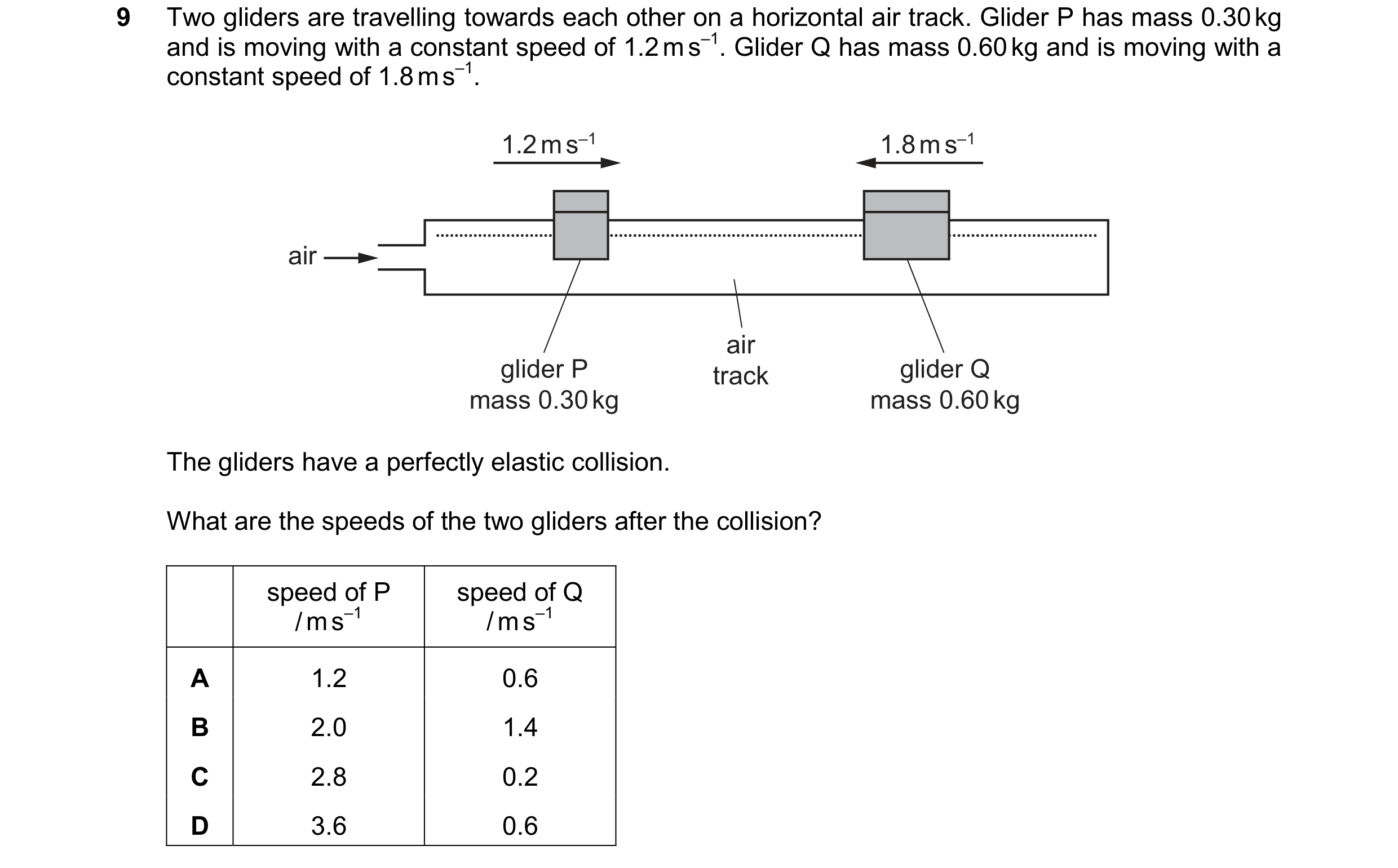


 64 / 66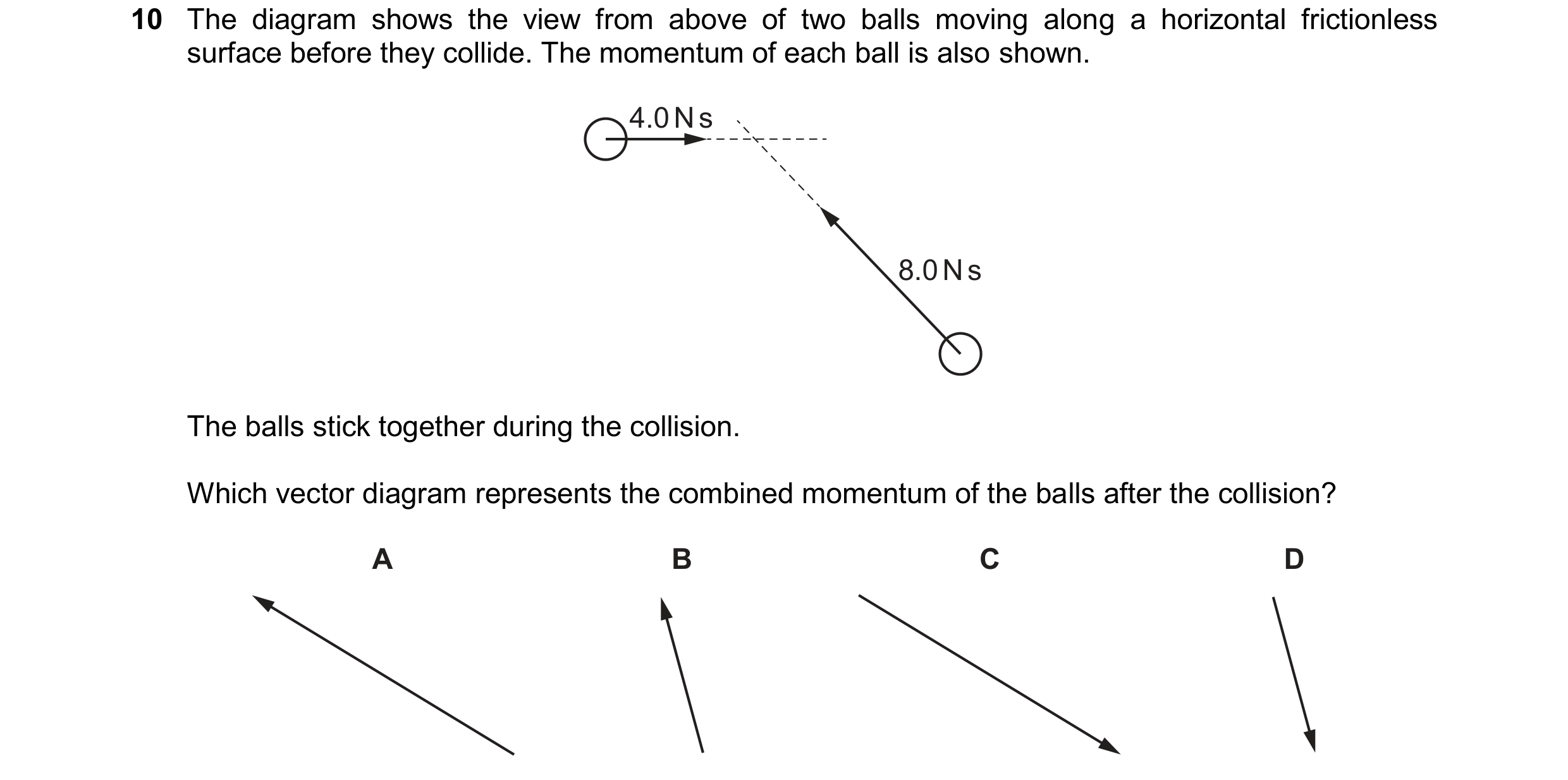
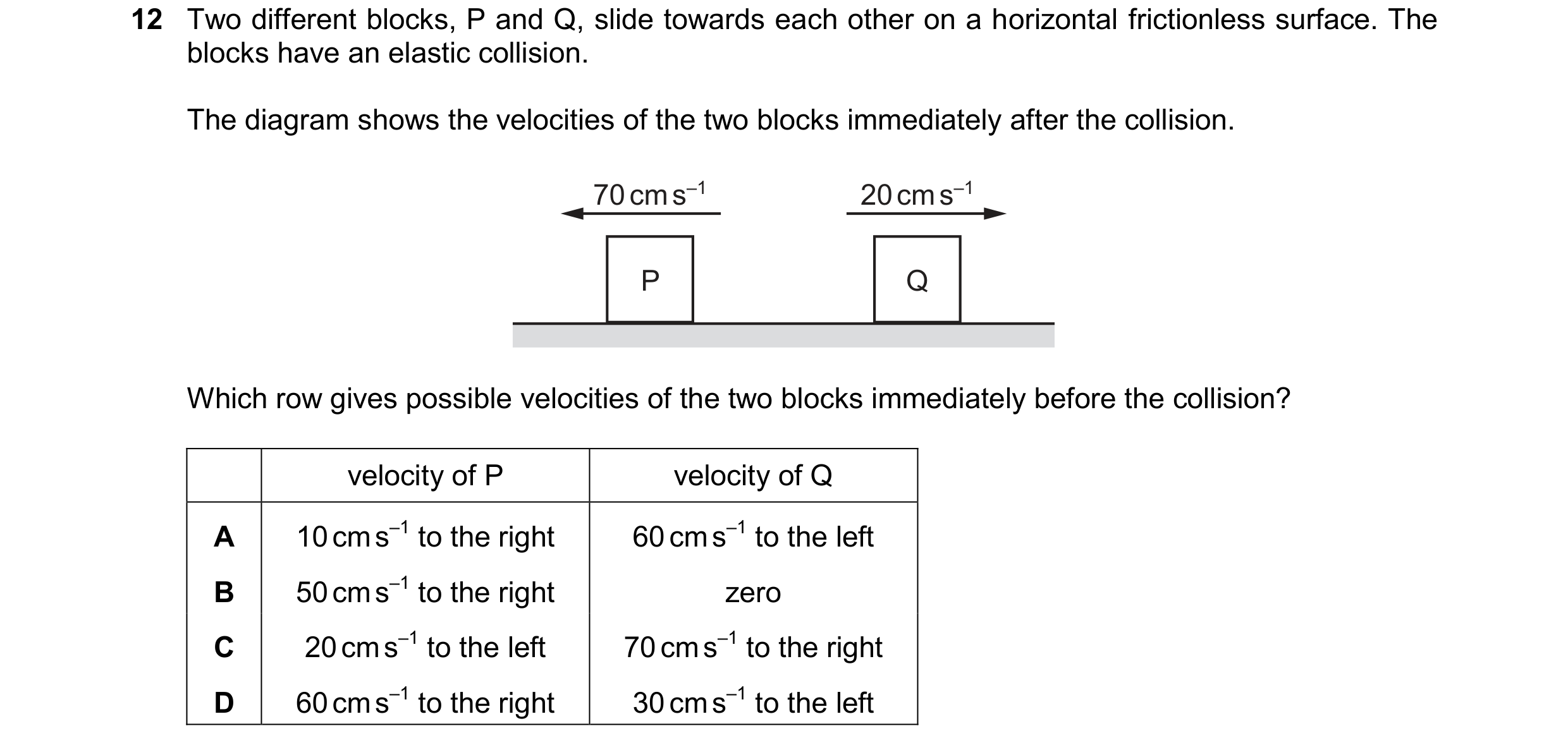

 65 / 66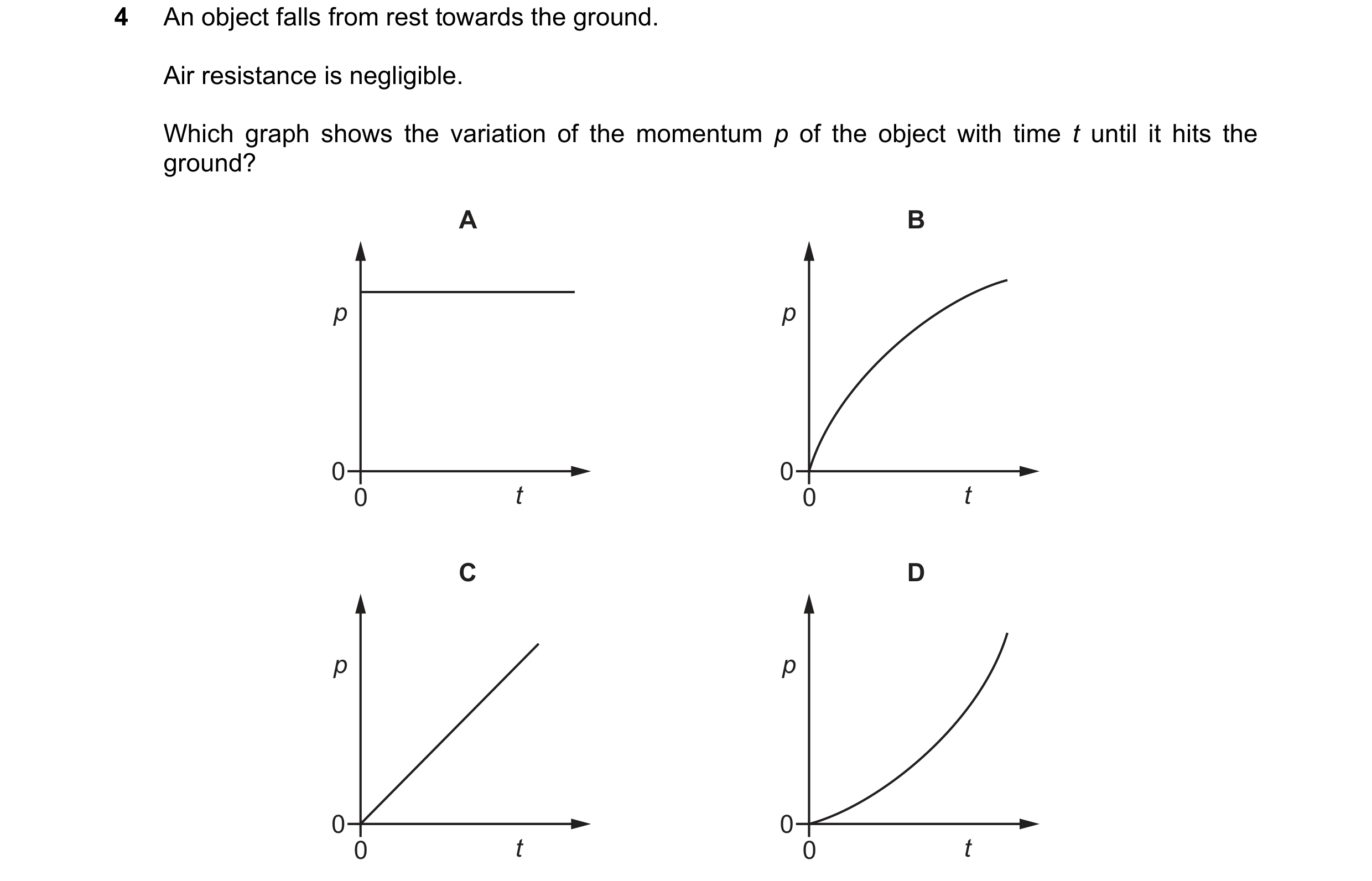
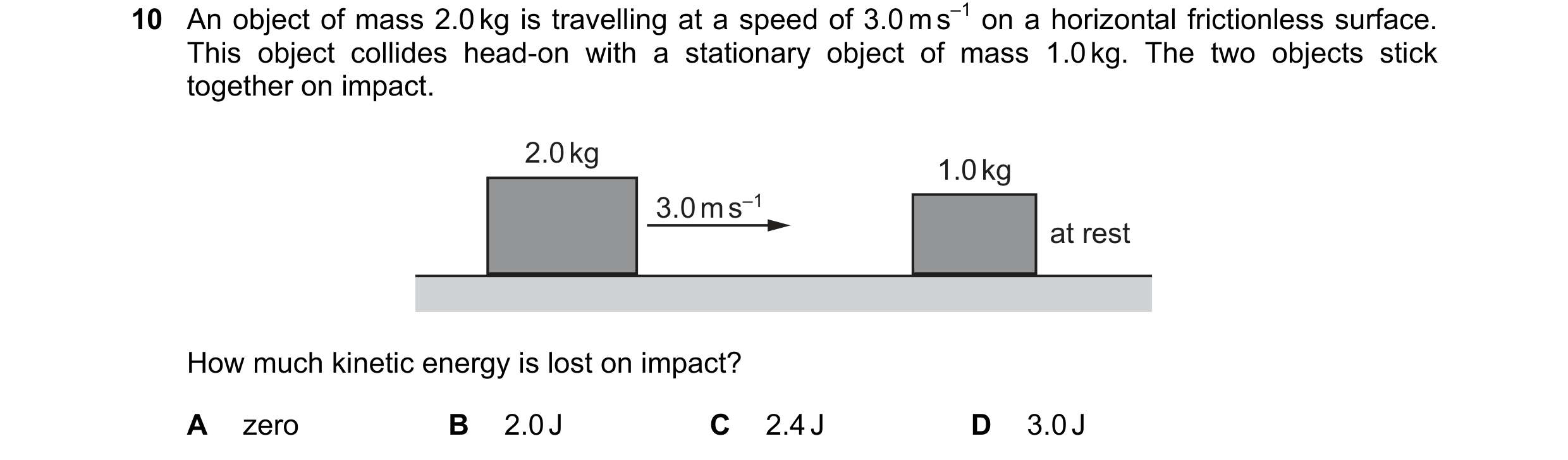
 66 / 66