Cambridge A Level Physics 9702 — 2024 May/June Paper 1 · Variant 2
9702/12/M/J/24 · 40 questions · 40 marks · ≈45 min
The question paper and its mark scheme, free to read here and free to download. This is Cambridge’s own paper, exactly as it was sat.
Question paper16 pages
Mark scheme3 pages
Answers below. Sit the paper first if you are practising.
Questions as text
Q1 · What is a scalar quantity?
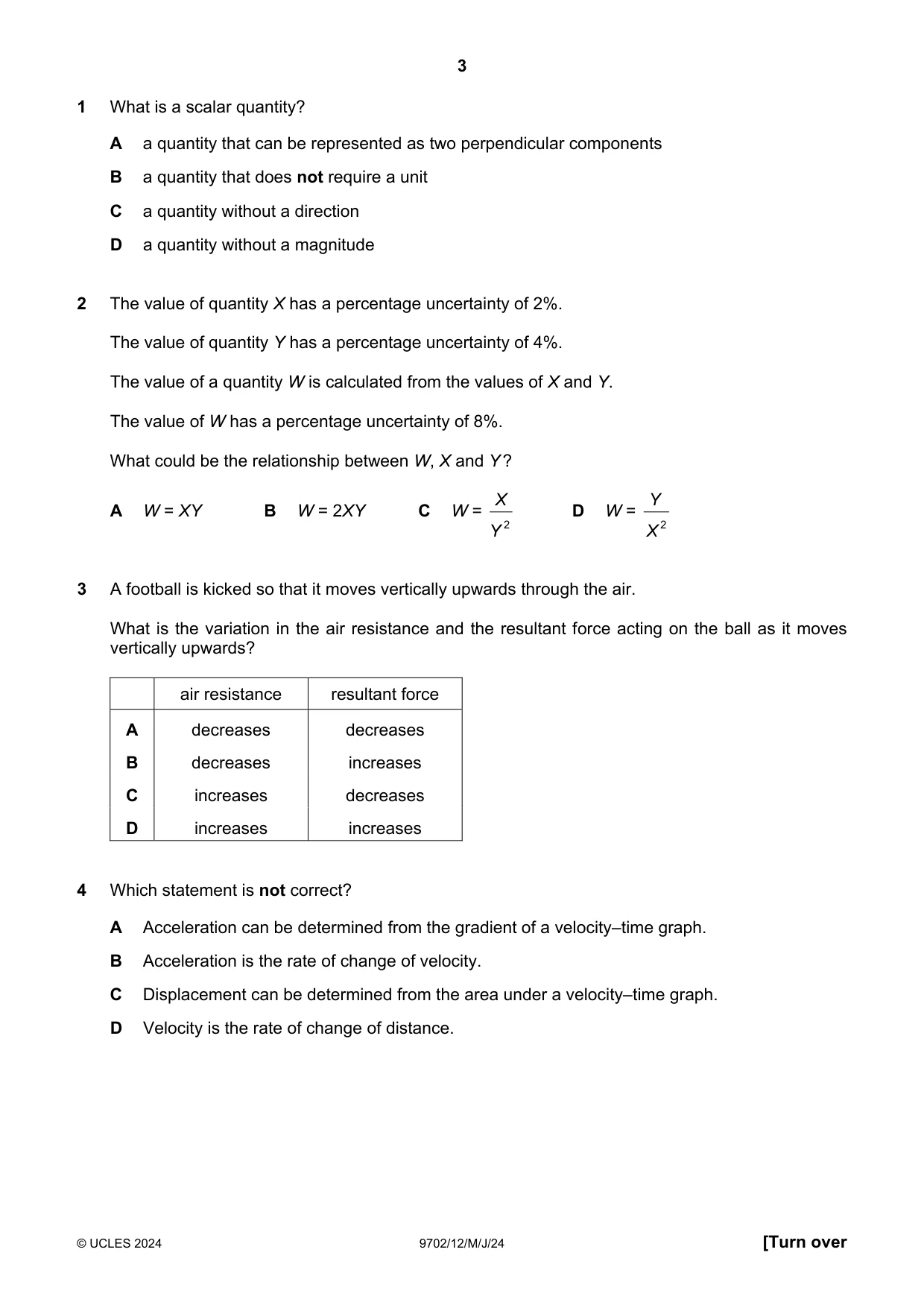
1 What is a scalar quantity? A a quantity that can be represented as two perpendicular components B a quantity that does not require a unit C a quantity without a direction D a quantity without a magnitude
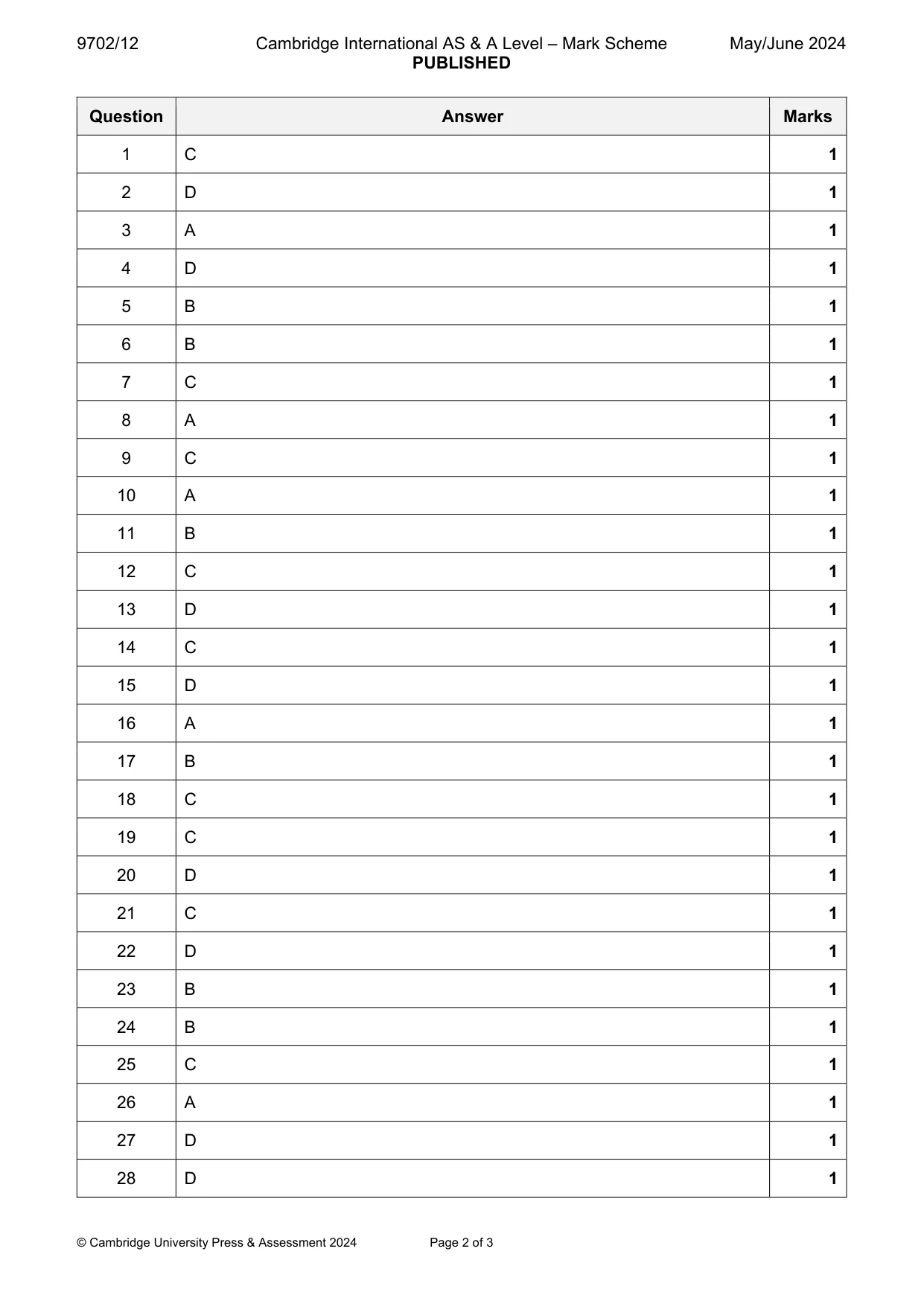
Mark scheme: C
Q2 · The value of quantity X has a percentage uncertainty of 2%
2 The value of quantity X has a percentage uncertainty of 2%. The value of quantity Y has a percentage uncertainty of 4%. The value of a quantity W is calculated from the values of X and Y. The value of W has a percentage uncertainty of 8%. What could be the relationship between W, X and Y ? X Y A W = XY B W = 2XY C W = D W = Y 2 X 2
Mark scheme: D
Q3 · A football is kicked so that it moves vertically upwards through the air
3 A football is kicked so that it moves vertically upwards through the air. What is the variation in the air resistance and the resultant force acting on the ball as it moves vertically upwards? air resistance resultant force A decreases decreases B decreases increases C increases decreases D increases increases
Mark scheme: A
Q4 · Which statement is not correct?
4 Which statement is not correct? A Acceleration can be determined from the gradient of a velocity–time graph. B Acceleration is the rate of change of velocity. C Displacement can be determined from the area under a velocity–time graph. D Velocity is the rate of change of distance.
Mark scheme: D
Q5 · The diagram shows a laboratory experiment in which a feather falls from rest in a long…
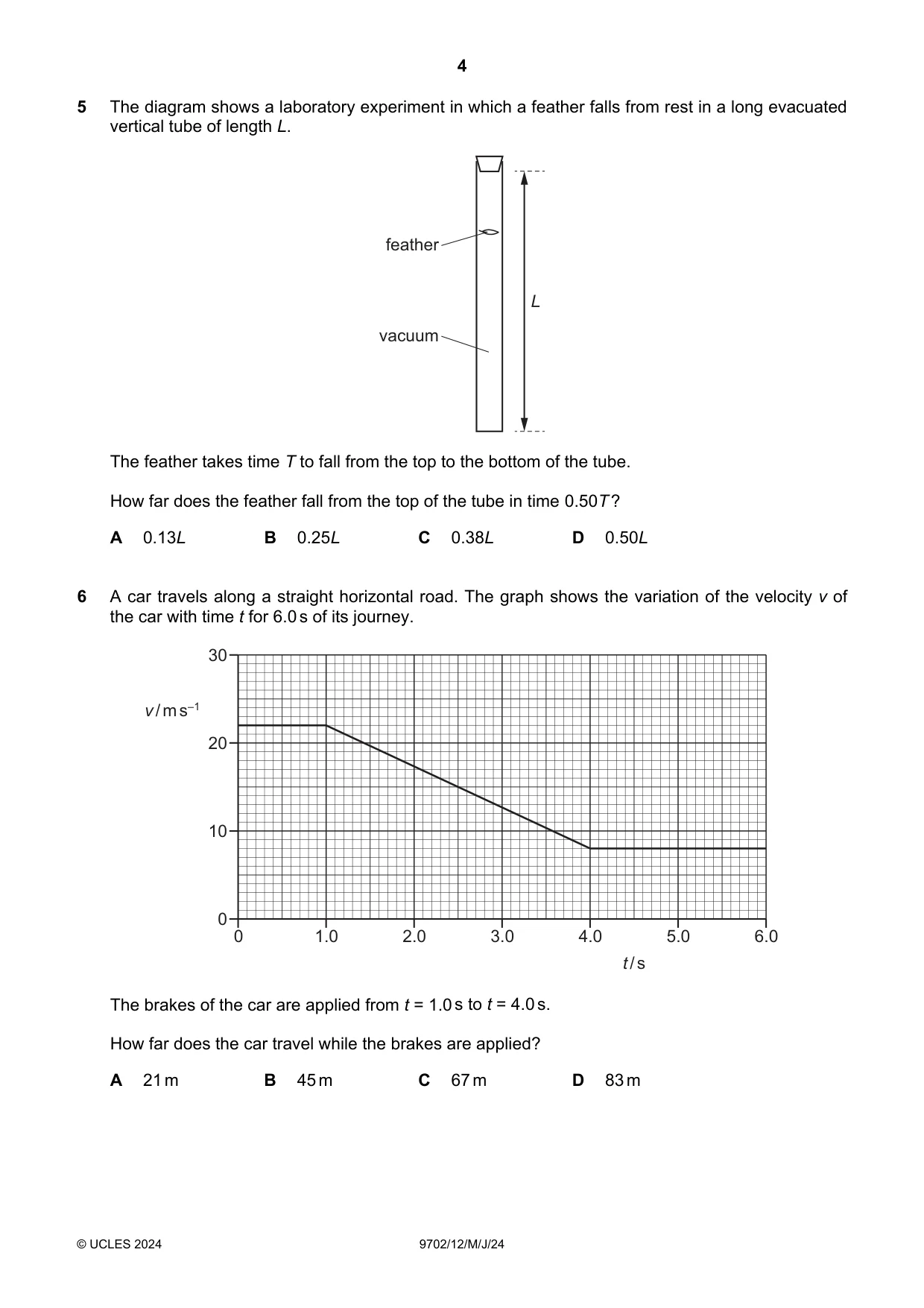
5 The diagram shows a laboratory experiment in which a feather falls from rest in a long evacuated vertical tube of length L. feather L vacuum The feather takes time T to fall from the top to the bottom of the tube. How far does the feather fall from the top of the tube in time 0.50T ? A 0.13L B 0.25L C 0.38L D 0.50L
Mark scheme: B
Q6 · A car travels along a straight horizontal road
6 A car travels along a straight horizontal road. The graph shows the variation of the velocity v of the car with time t for 6.0 s of its journey. 30 v / m s–1 20 10 0 0 1.0 2.0 3.0 4.0 5.0 6.0 t / s The brakes of the car are applied from t = 1.0 s to t = 4.0 s. How far does the car travel while the brakes are applied? A 21 m B 45 m C 67 m D 83 m
Mark scheme: B
Q7 · Two satellites in deep space collide inelastically
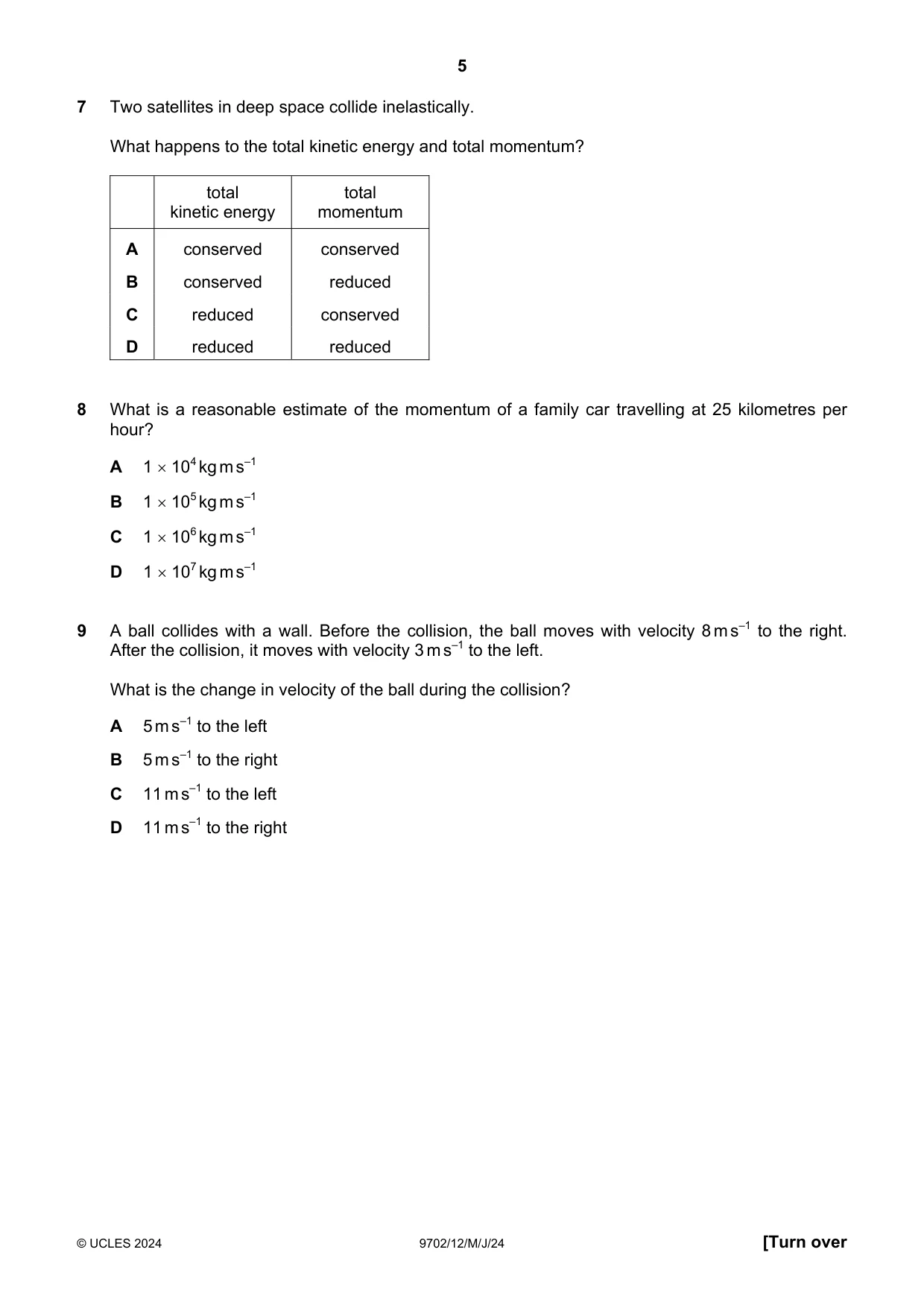
7 Two satellites in deep space collide inelastically. What happens to the total kinetic energy and total momentum? total total kinetic energy momentum A conserved conserved B conserved reduced C reduced conserved D reduced reduced
Mark scheme: C
Q8 · What is a reasonable estimate of the momentum of a family car travelling at 25 kilometres…
8 What is a reasonable estimate of the momentum of a family car travelling at 25 kilometres per hour? A 1 104 kg m s–1 B 1 105 kg m s–1 C 1 106 kg m s–1 D 1 107 kg m s–1
Mark scheme: A
Q9 · A ball collides with a wall
9 A ball collides with a wall. Before the collision, the ball moves with velocity 8 m s–1 to the right. After the collision, it moves with velocity 3 m s–1 to the left. What is the change in velocity of the ball during the collision? A 5 m s–1 to the left B 5 m s–1 to the right C 11 m s–1 to the left D 11 m s–1 to the right
Mark scheme: C
Q10 · A lead pellet is shot vertically upwards into a clay block that is stationary at the…
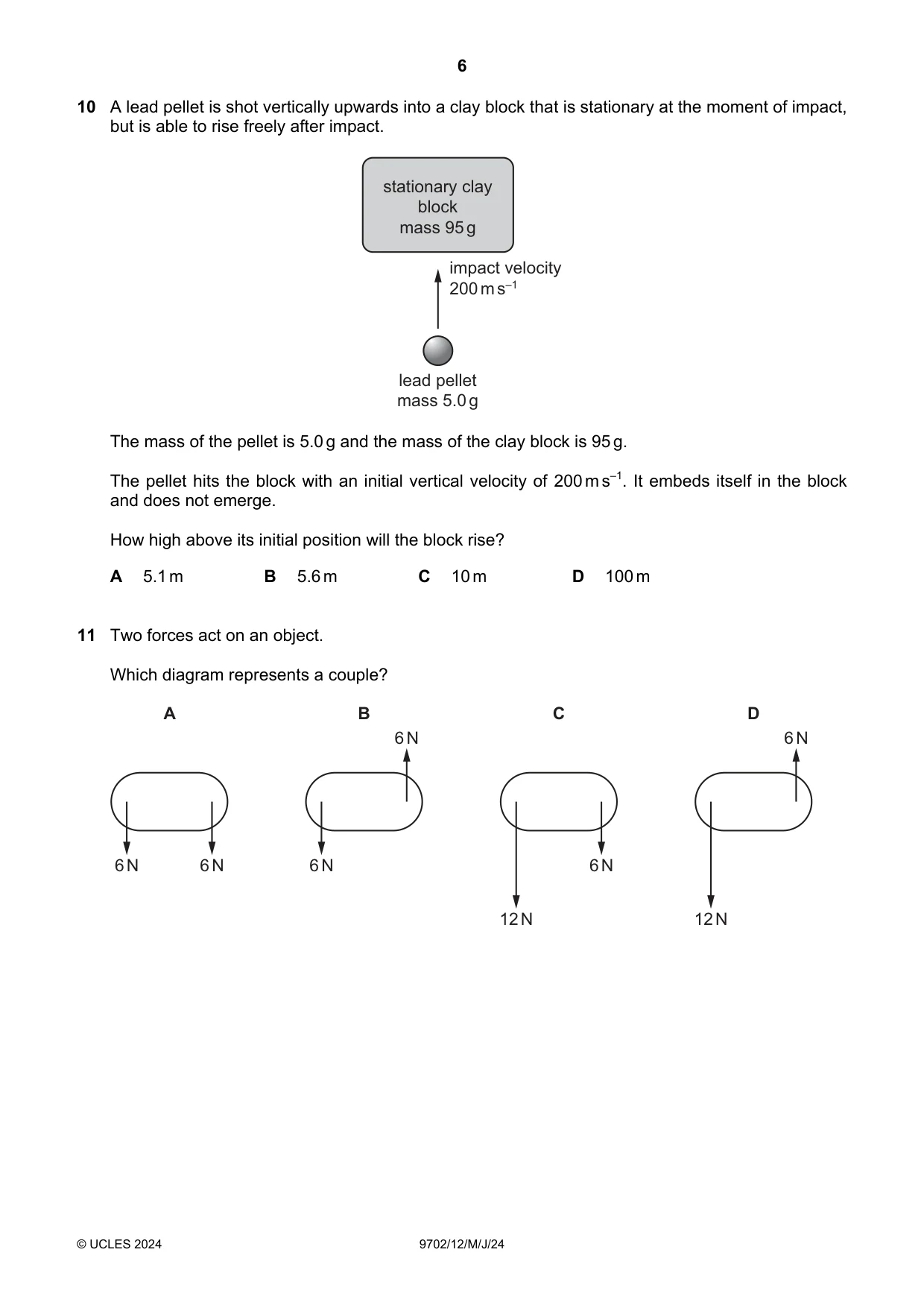
10 A lead pellet is shot vertically upwards into a clay block that is stationary at the moment of impact, but is able to rise freely after impact. stationary clay block mass 95 g impact velocity 200 m s–1 lead pellet mass 5.0 g The mass of the pellet is 5.0 g and the mass of the clay block is 95 g. The pellet hits the block with an initial vertical velocity of 200 m s–1. It embeds itself in the block and does not emerge. How high above its initial position will the block rise? A 5.1 m B 5.6 m C 10 m D 100 m
Mark scheme: A
Q11 · Two forces act on an object
11 Two forces act on an object. Which diagram represents a couple? A B C D 6 N 6 N 6 N 6 N 6 N 6 N 12 N 12 N
Mark scheme: B
Q12 · The diagram shows a uniform rod, XY, that is freely hinged to a vertical wall at end Y
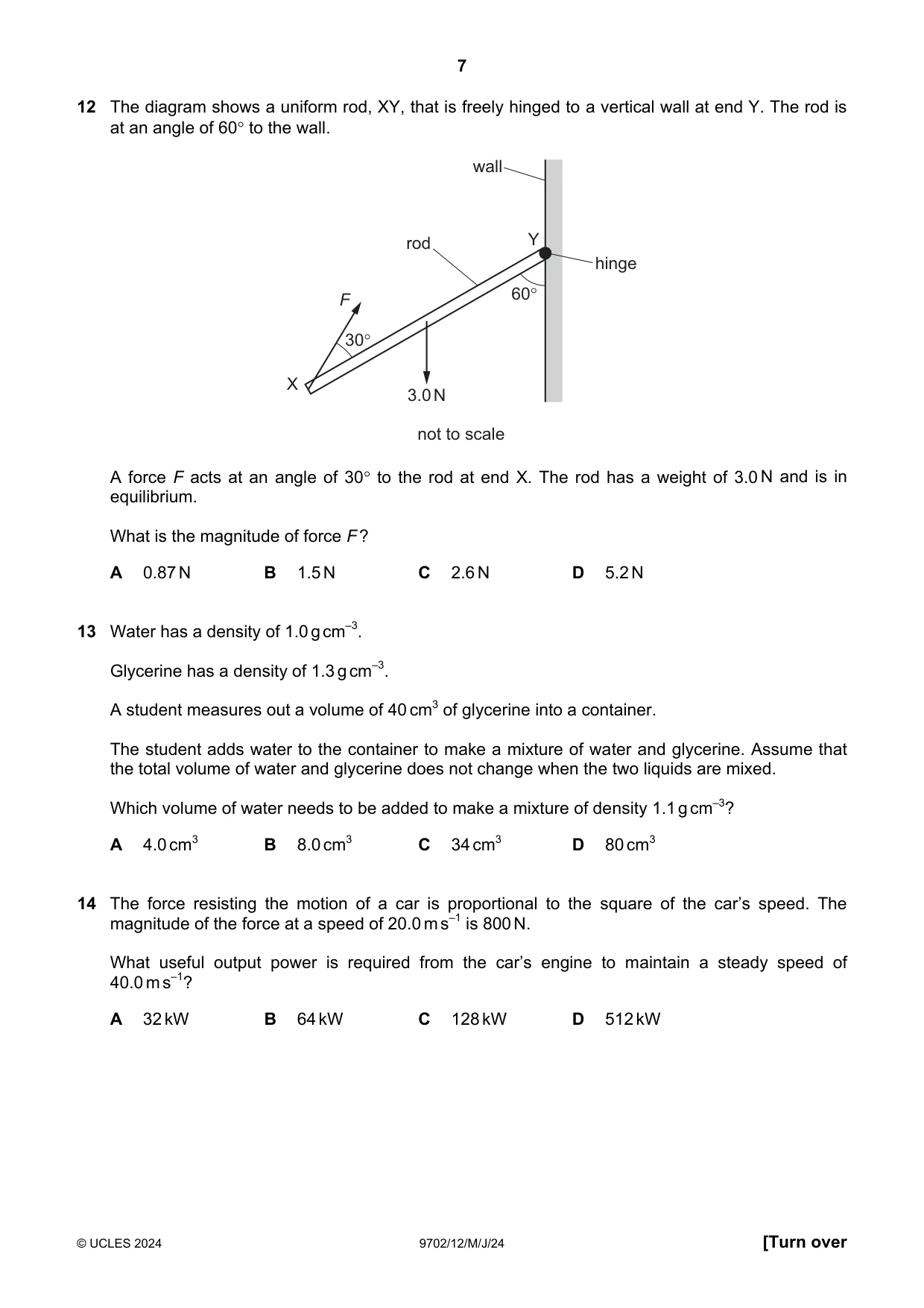
12 The diagram shows a uniform rod, XY, that is freely hinged to a vertical wall at end Y. The rod is at an angle of 60° to the wall. hinge 3.0N not to scale A force F acts at an angle of 30° to the rod at end X. The rod has a weight of 3.0N and is in equilibrium. What is the magnitude of force F? A 0.87N B 1.5N C 2.6N D 5.2N
Mark scheme: C
Q13 · Water has a density of 1.0 g cm–3
13 Water has a density of 1.0 g cm–3. Glycerine has a density of 1.3 g cm–3. A student measures out a volume of 40 cm3 of glycerine into a container. The student adds water to the container to make a mixture of water and glycerine. Assume that the total volume of water and glycerine does not change when the two liquids are mixed. Which volume of water needs to be added to make a mixture of density 1.1 g cm–3? A 4.0 cm3 B 8.0 cm3 C 34 cm3 D 80 cm3
Mark scheme: D
Q14 · The force resisting the motion of a car is proportional to the square of the car’s speed
14 The force resisting the motion of a car is proportional to the square of the car’s speed. The magnitude of the force at a speed of 20.0 m s–1 is 800 N. What useful output power is required from the car’s engine to maintain a steady speed of 40.0 m s–1? A 32 kW B 64 kW C 128 kW D 512 kW
Mark scheme: C
Q15 · A box of weight W is pulled by a force P along a slope
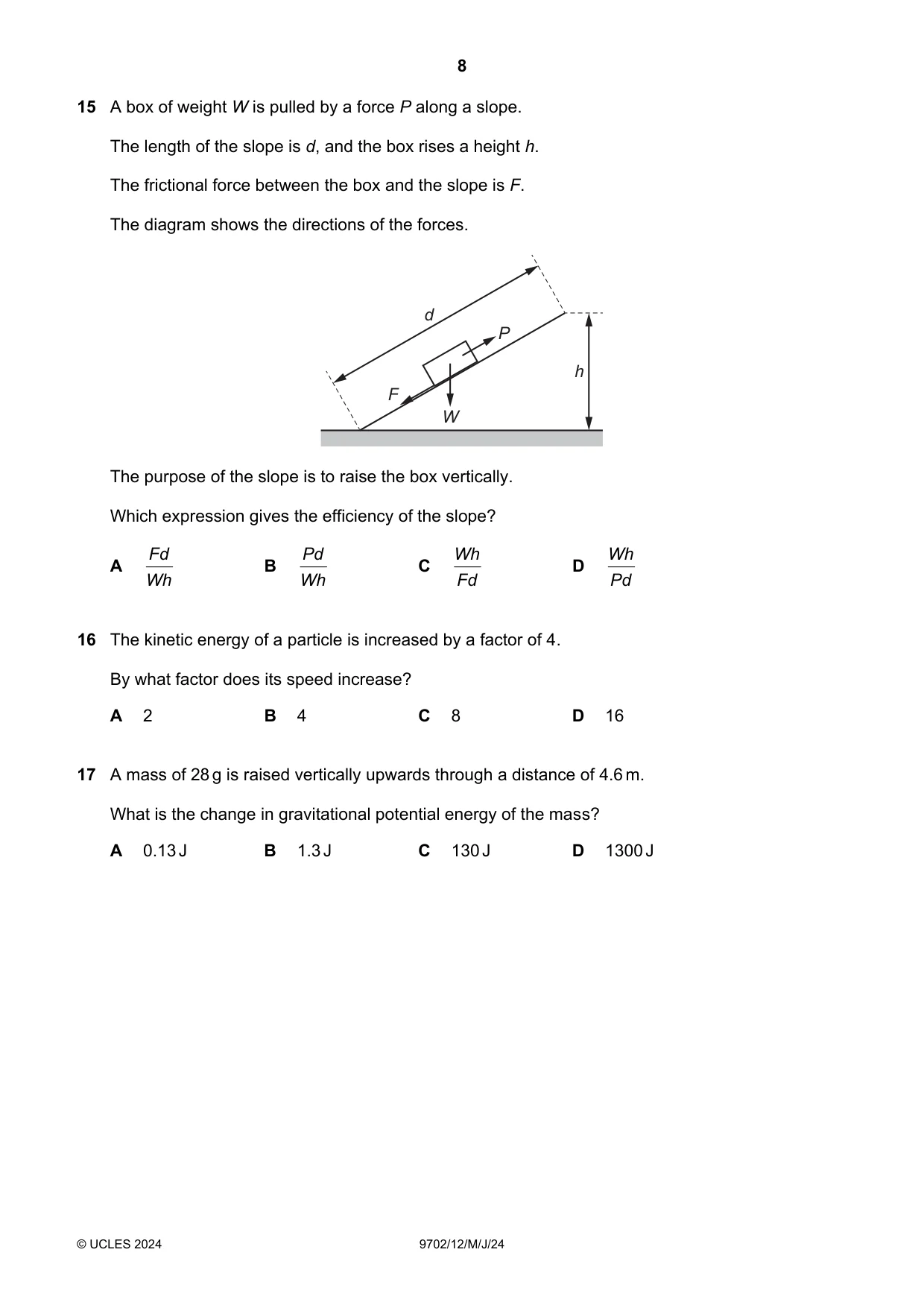
15 A box of weight W is pulled by a force P along a slope. The length of the slope is d, and the box rises a height h. The frictional force between the box and the slope is F. The diagram shows the directions of the forces. d P h F W The purpose of the slope is to raise the box vertically. Which expression gives the efficiency of the slope? Fd Pd Wh Wh A B C D Wh Wh Fd Pd
Mark scheme: D
Q16 · The kinetic energy of a particle is increased by a factor of 4
16 The kinetic energy of a particle is increased by a factor of 4. By what factor does its speed increase? A 2 B 4 C 8 D 16
Mark scheme: A
More questions on Gravitational potential energy and kinetic energy
Q17 · A mass of 28 g is raised vertically upwards through a distance of 4.6 m
17 A mass of 28 g is raised vertically upwards through a distance of 4.6 m. What is the change in gravitational potential energy of the mass? A 0.13 J B 1.3 J C 130 J D 1300 J
Mark scheme: B
More questions on Gravitational potential energy and kinetic energy
Q18 · A sample of metal is subjected to a force which increases to a maximum value and then…
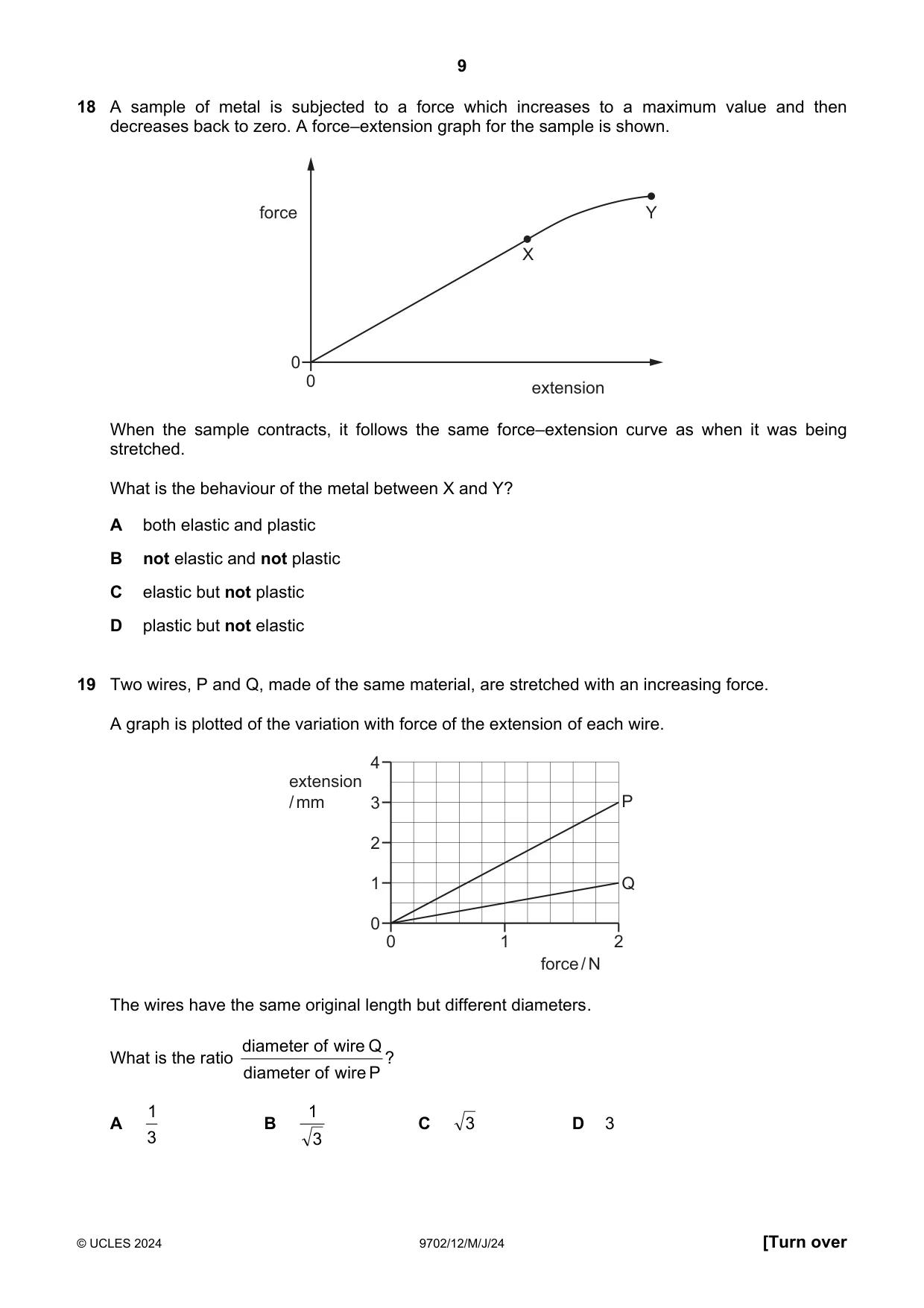
18 A sample of metal is subjected to a force which increases to a maximum value and then decreases back to zero. A force–extension graph for the sample is shown. force Y X 0 0 extension When the sample contracts, it follows the same force–extension curve as when it was being stretched. What is the behaviour of the metal between X and Y? A both elastic and plastic B not elastic and not plastic C elastic but not plastic D plastic but not elastic
Mark scheme: C
Q19 · Two wires, P and Q, made of the same material, are stretched with an increasing force
19 Two wires, P and Q, made of the same material, are stretched with an increasing force. A graph is plotted of the variation with force of the extension of each wire. 4 extension / mm 3 P 2 1 Q 0 0 1 2 force / N The wires have the same original length but different diameters. diameter of wire Q What is the ratio ? diameter of wire P 1 1 A B C 3 D 3 3 3
Mark scheme: C
Q20 · An extension–force graph for a spring is shown
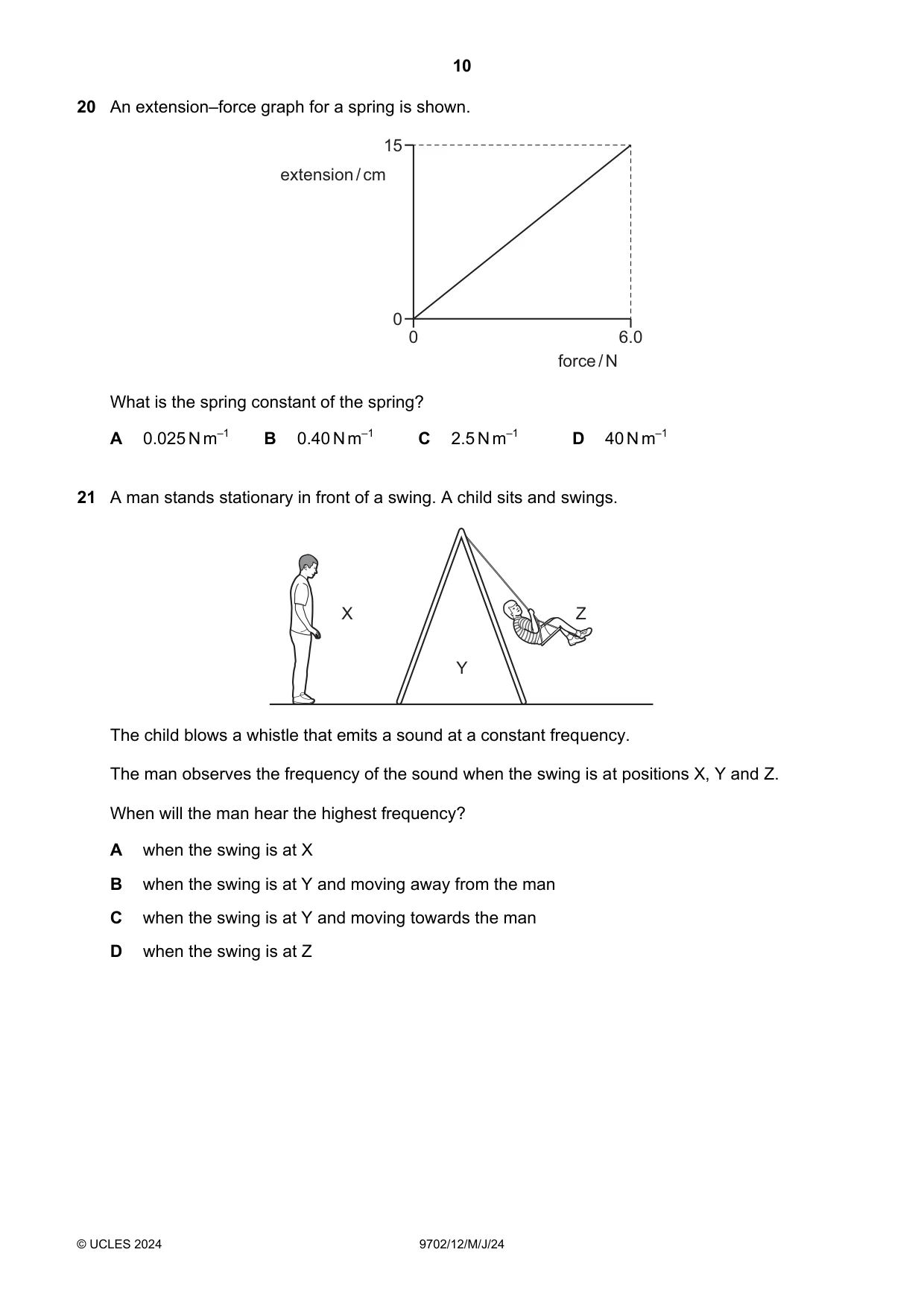
20 An extension–force graph for a spring is shown. 15 extension / cm 0 0 6.0 force / N What is the spring constant of the spring? A 0.025 N m–1 B 0.40 N m–1 C 2.5 N m–1 D 40 N m–1
Mark scheme: D
Q21 · A man stands stationary in front of a swing
21 A man stands stationary in front of a swing. A child sits and swings. X Z Y The child blows a whistle that emits a sound at a constant frequency. The man observes the frequency of the sound when the swing is at positions X, Y and Z. When will the man hear the highest frequency? A when the swing is at X B when the swing is at Y and moving away from the man C when the swing is at Y and moving towards the man D when the swing is at Z
Mark scheme: C
Q22 · A loudspeaker is playing music in a room
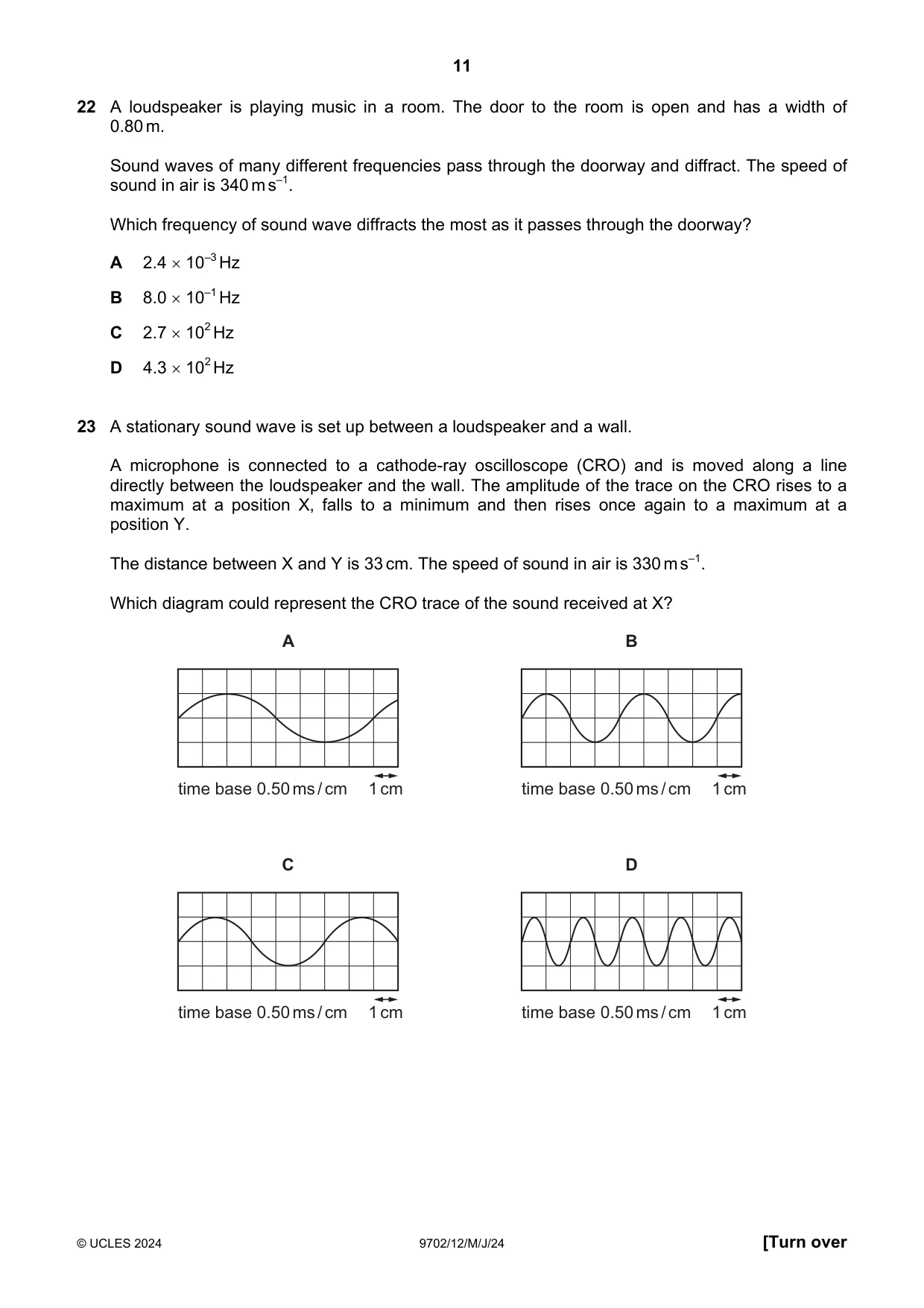
22 A loudspeaker is playing music in a room. The door to the room is open and has a width of 0.80 m. Sound waves of many different frequencies pass through the doorway and diffract. The speed of sound in air is 340 m s–1. Which frequency of sound wave diffracts the most as it passes through the doorway? A 2.4 10–3 Hz B 8.0 10–1 Hz C 2.7 102 Hz D 4.3 102 Hz
Mark scheme: D
Q23 · A stationary sound wave is set up between a loudspeaker and a wall
23 A stationary sound wave is set up between a loudspeaker and a wall. A microphone is connected to a cathode-ray oscilloscope (CRO) and is moved along a line directly between the loudspeaker and the wall. The amplitude of the trace on the CRO rises to a maximum at a position X, falls to a minimum and then rises once again to a maximum at a position Y. The distance between X and Y is 33 cm. The speed of sound in air is 330 m s–1. Which diagram could represent the CRO trace of the sound received at X? A B time base 0.50 ms / cm 1 cm time base 0.50 ms / cm 1 cm C D time base 0.50 ms / cm 1 cm time base 0.50 ms / cm 1 cm
Mark scheme: B
Q24 · Polarisation is associated with certain waves
24 Polarisation is associated with certain waves. Which waves cannot be polarised? A radio waves from a transmitter B sound waves from a moving source C ultraviolet rays from the Sun D X-rays from an X-ray emitter
Mark scheme: B
Q25 · A guitar string is plucked
25 A guitar string is plucked. Which statement describes the resulting waves? A Longitudinal waves on the string cause longitudinal waves in the air. B Longitudinal waves on the string cause transverse waves in the air. C Transverse waves on the string cause longitudinal waves in the air. D Transverse waves on the string cause transverse waves in the air.
Mark scheme: C
Q26 · A diffraction grating with N lines per metre is used to diffract light of various…
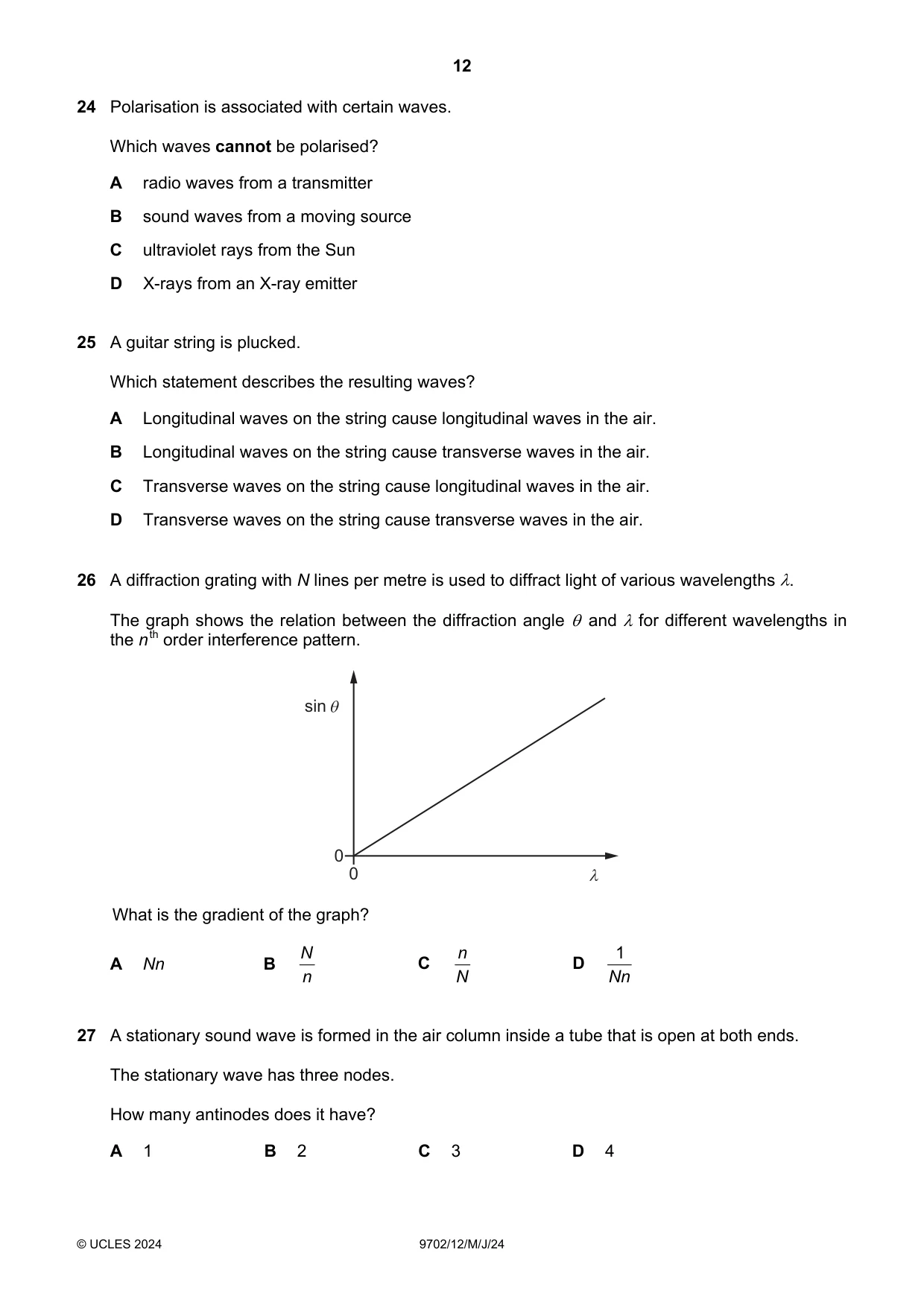
26 A diffraction grating with N lines per metre is used to diffract light of various wavelengths 4. The graph shows the relation between the diffraction angle @ and 4 for different wavelengths in the n" order interference pattern. sin 6 0 0 A What is the gradient of the graph? A Nn BN Cc n 2|5 = S
Mark scheme: A
Q27 · A stationary sound wave is formed in the air column inside a tube that is open at both…
27 A stationary sound wave is formed in the air column inside a tube that is open at both ends. The stationary wave has three nodes. How many antinodes does it have? A 1 B 2 C 3 D 4
Mark scheme: D
Q28 · Interference fringes of separation x are observed on a screen at a distance of 1.00 m…
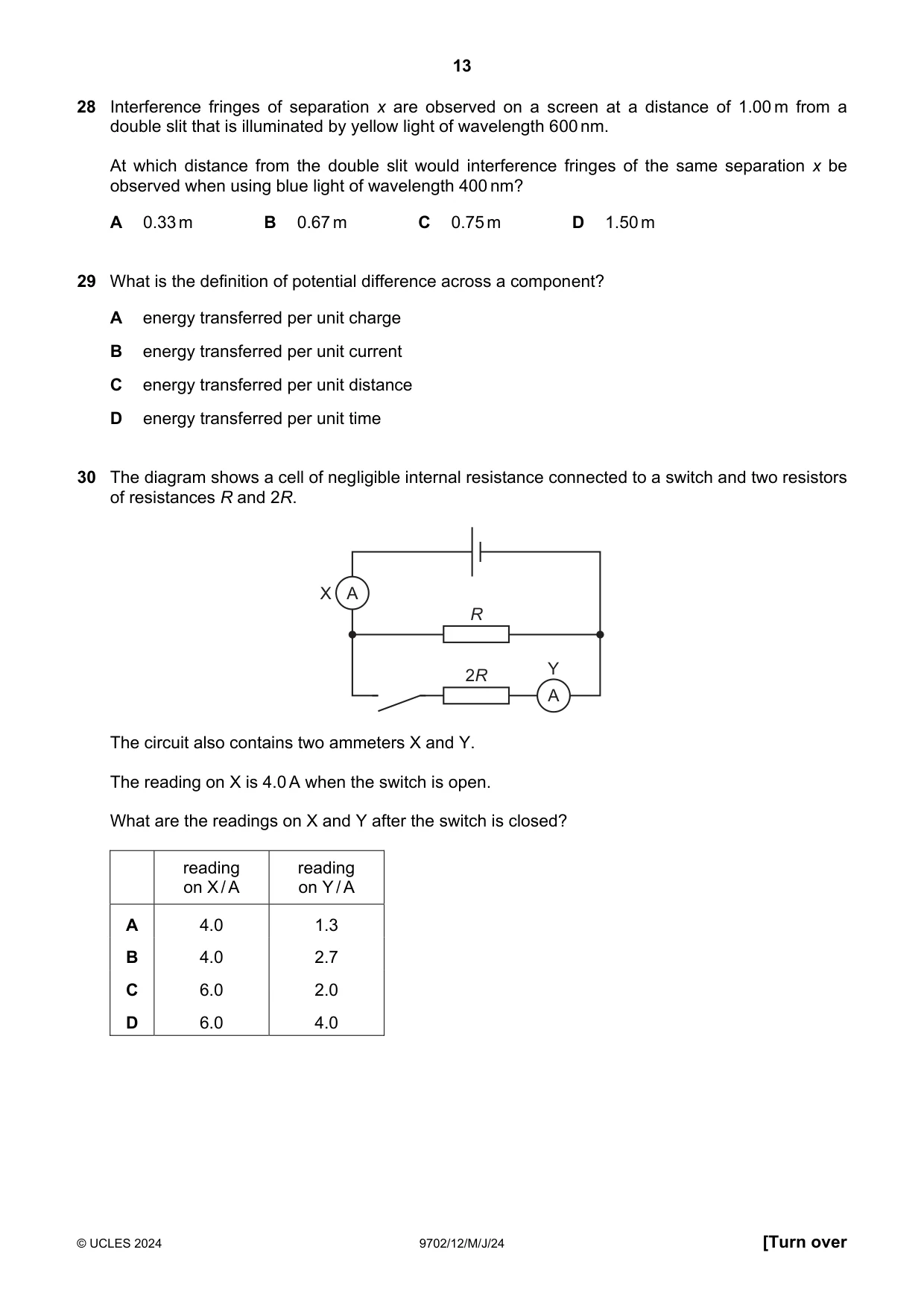
28 Interference fringes of separation x are observed on a screen at a distance of 1.00 m from a double slit that is illuminated by yellow light of wavelength 600 nm. At which distance from the double slit would interference fringes of the same separation x be observed when using blue light of wavelength 400 nm? A 0.33 m B 0.67 m C 0.75 m D 1.50 m
Mark scheme: D
Q29 · What is the definition of potential difference across a component?
29 What is the definition of potential difference across a component? A energy transferred per unit charge B energy transferred per unit current C energy transferred per unit distance D energy transferred per unit time
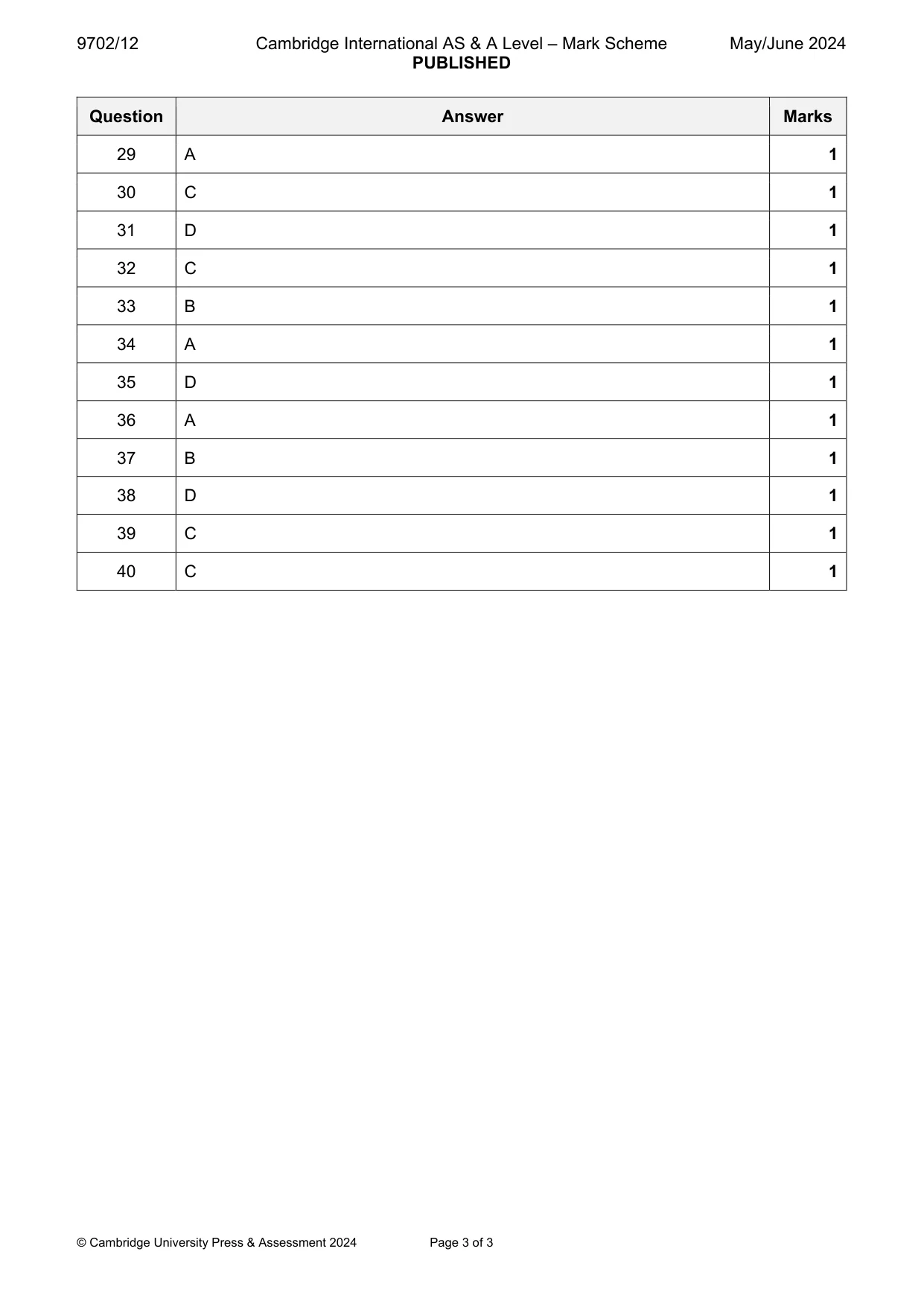
Mark scheme: A
Q30 · The diagram shows a cell of negligible internal resistance connected to a switch and two…
30 The diagram shows a cell of negligible internal resistance connected to a switch and two resistors of resistances R and 2R. X A R 2R Y A The circuit also contains two ammeters X and Y. The reading on X is 4.0 A when the switch is open. What are the readings on X and Y after the switch is closed? reading reading on X / A on Y / A A 4.0 1.3 B 4.0 2.7 C 6.0 2.0 D 6.0 4.0
Mark scheme: C
Q31 · The I–V characteristics for four components, A, B, C and D, are shown
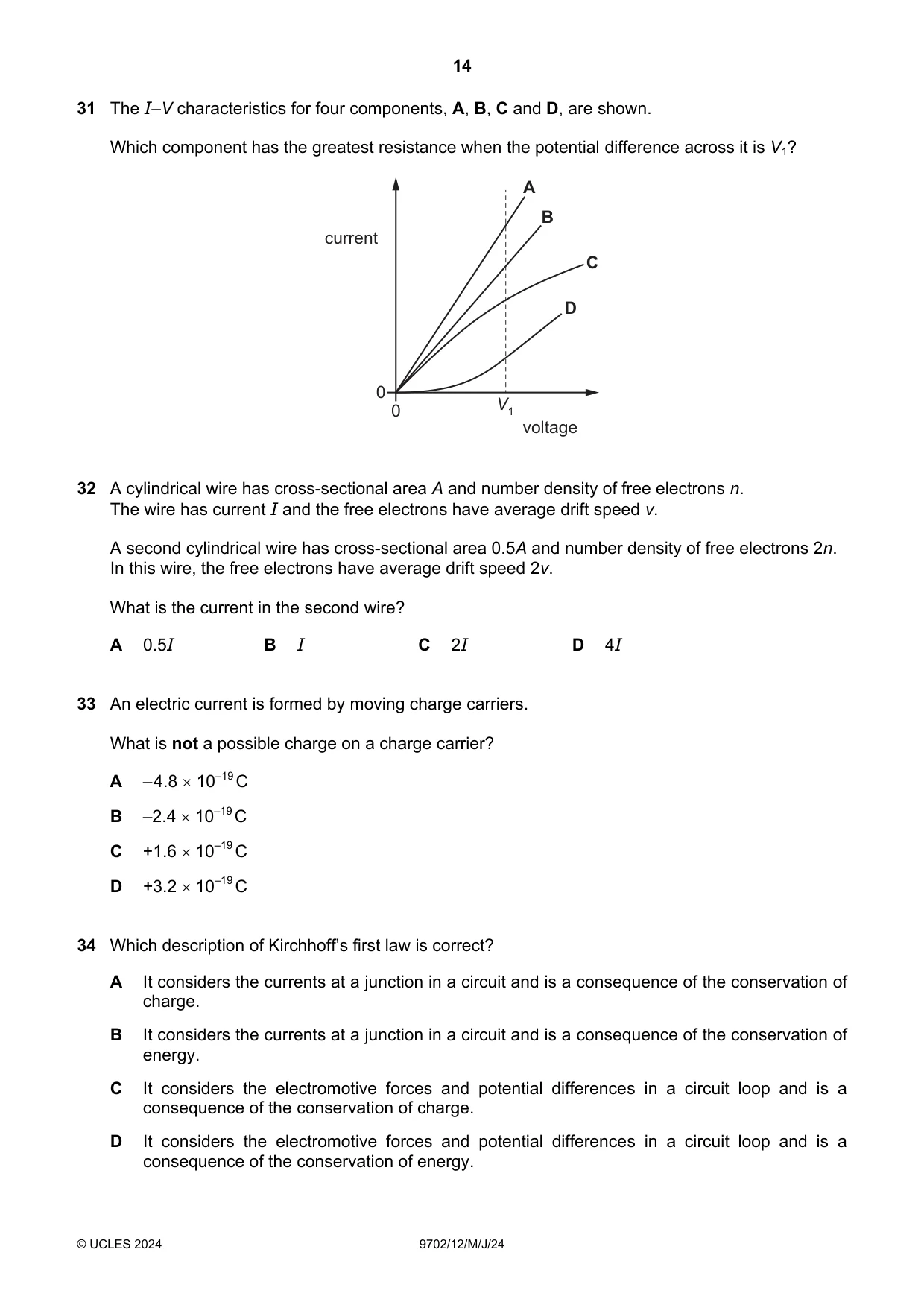
31 The I–V characteristics for four components, A, B, C and D, are shown. Which component has the greatest resistance when the potential difference across it is V1? A B current C D 0 V1 0 voltage
Mark scheme: D
Q32 · A cylindrical wire has cross-sectional area A and number density of free electrons n
32 A cylindrical wire has cross-sectional area A and number density of free electrons n. The wire has current I and the free electrons have average drift speed v. A second cylindrical wire has cross-sectional area 0.5A and number density of free electrons 2n. In this wire, the free electrons have average drift speed 2v. What is the current in the second wire? A 0.5I B I C 2I D 4I
Mark scheme: C
Q33 · An electric current is formed by moving charge carriers
33 An electric current is formed by moving charge carriers. What is not a possible charge on a charge carrier? A – 4.8 10–19 C B –2.4 10–19 C C +1.6 10–19 C D +3.2 10–19 C
Mark scheme: B
Q34 · Which description of Kirchhoff’s first law is correct?
34 Which description of Kirchhoff’s first law is correct? A It considers the currents at a junction in a circuit and is a consequence of the conservation of charge. B It considers the currents at a junction in a circuit and is a consequence of the conservation of energy. C It considers the electromotive forces and potential differences in a circuit loop and is a consequence of the conservation of charge. D It considers the electromotive forces and potential differences in a circuit loop and is a consequence of the conservation of energy.
Mark scheme: A
Q35 · Two resistors of resistances r and R are connected in parallel
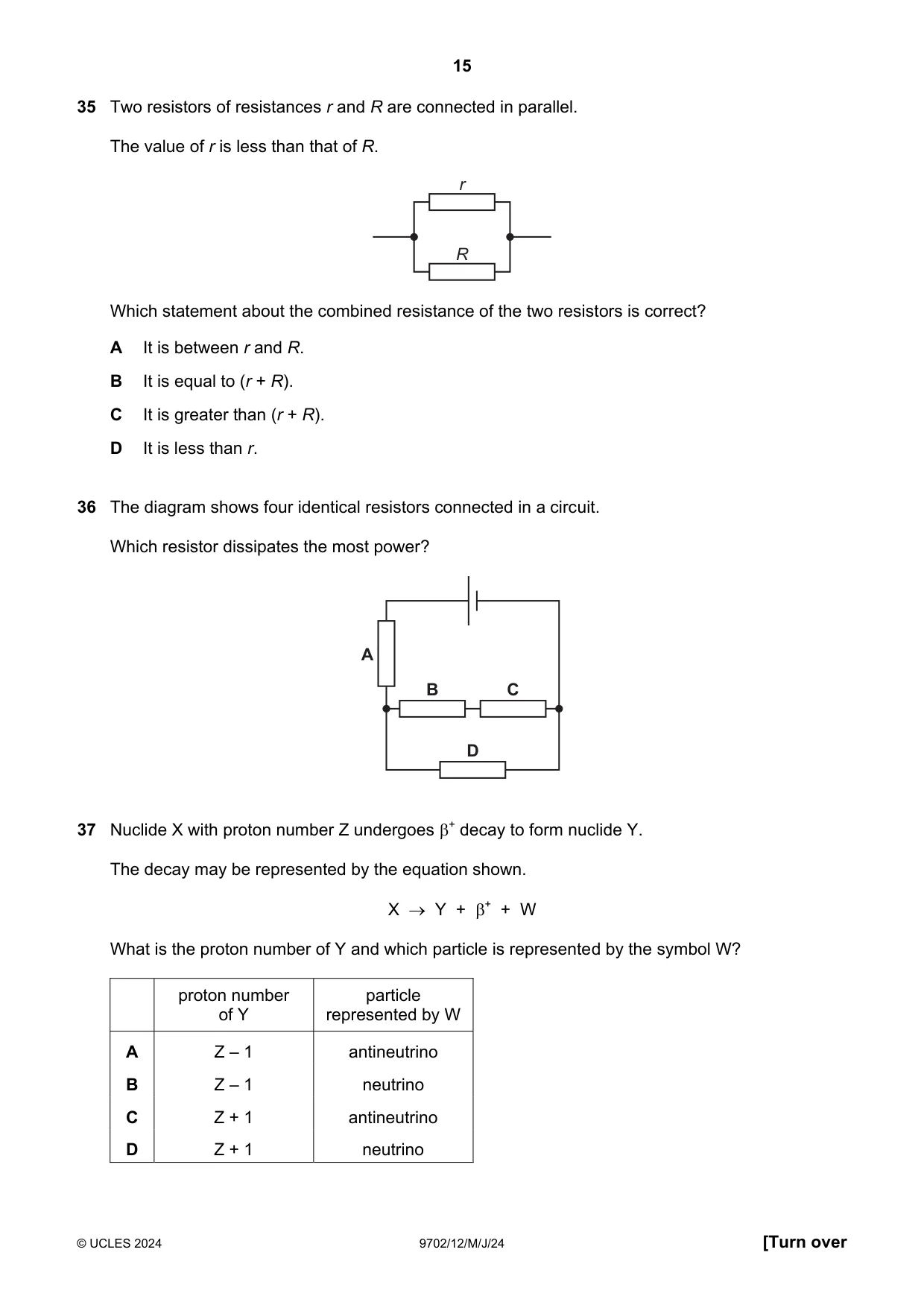
35 Two resistors of resistances r and R are connected in parallel. The value of r is less than that of R. r R Which statement about the combined resistance of the two resistors is correct? A It is between r and R. B It is equal to (r + R). C It is greater than (r + R). D It is less than r.
Mark scheme: D
Q36 · The diagram shows four identical resistors connected in a circuit
36 The diagram shows four identical resistors connected in a circuit. Which resistor dissipates the most power? A B C D
Mark scheme: A
Q37 · Nuclide X with proton number Z undergoes + decay to form nuclide Y
37 Nuclide X with proton number Z undergoes + decay to form nuclide Y. The decay may be represented by the equation shown. X Y + + + W What is the proton number of Y and which particle is represented by the symbol W? proton number particle of Y represented by W A Z – 1 antineutrino B Z – 1 neutrino C Z + 1 antineutrino D Z + 1 neutrino
Mark scheme: B
Q38 · Which fundamental particles form a hadron?
38 Which fundamental particles form a hadron? A leptons B nucleons C photons D quarks
Mark scheme: D
Q39 · The unstable nuclide 218 X decays through a sequence of emissions of and – particles…
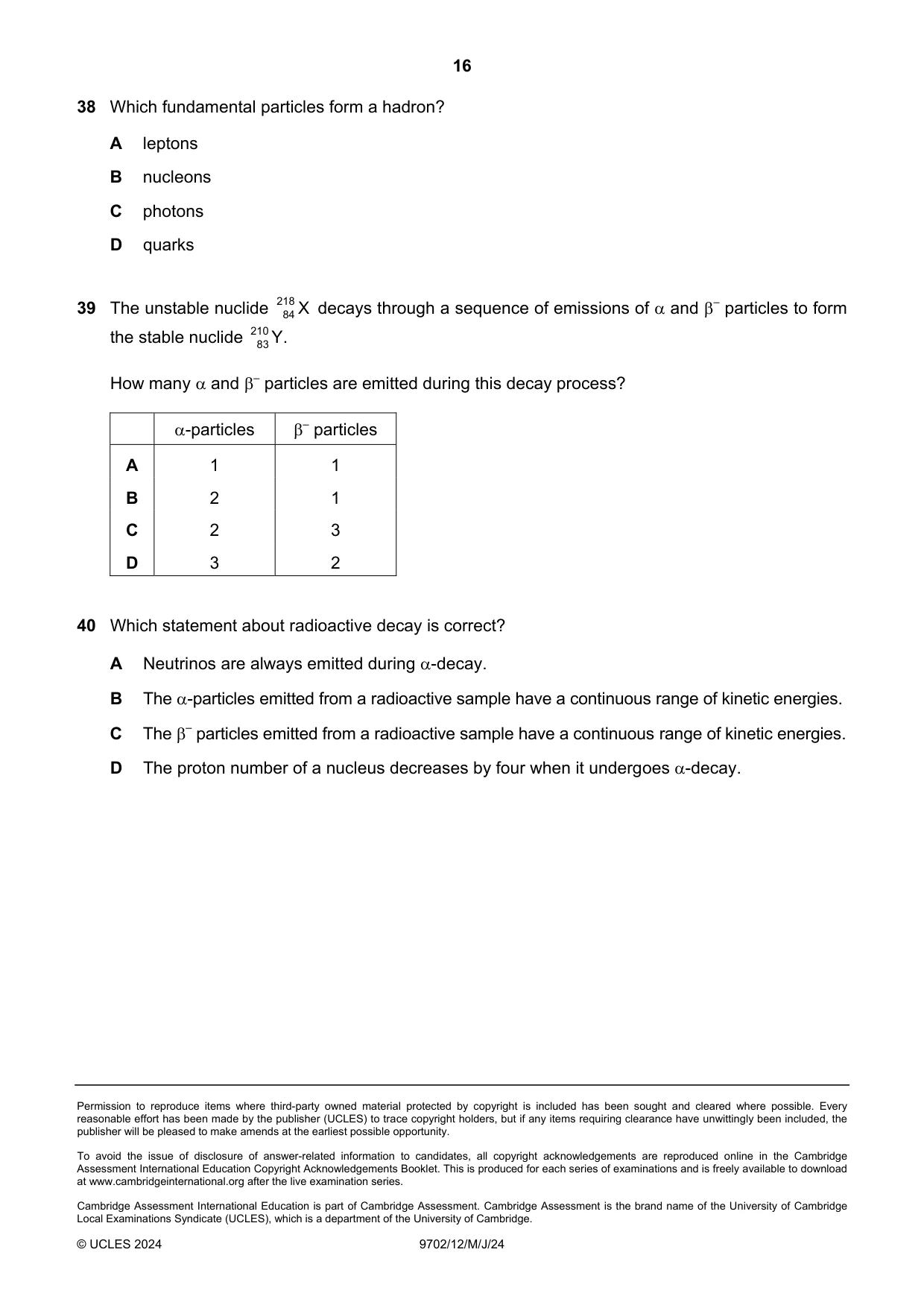
39 The unstable nuclide 218 X decays through a sequence of emissions of and – particles to form 84 the stable nuclide 210 Y. 83 How many and – particles are emitted during this decay process? -particles – particles A 1 1 B 2 1 C 2 3 D 3 2
Mark scheme: C
Q40 · Which statement about radioactive decay is correct?
40 Which statement about radioactive decay is correct? A Neutrinos are always emitted during -decay. B The -particles emitted from a radioactive sample have a continuous range of kinetic energies. C The – particles emitted from a radioactive sample have a continuous range of kinetic energies. D The proton number of a nucleus decreases by four when it undergoes -decay.
Mark scheme: C
What was in this paper
The subtopics covered by these 40 questions, and how many questions each got. Open one in a new tab to see every Cambridge question on it.
4Atoms, nuclei and radiation3Equations of motion3Electric current2Energy conservation2Gravitational potential energy and kinetic energy2Potential difference and power2Practical circuits2Stationary waves2Stress and strain2Density and pressure1Diffraction1Doppler effect for sound waves1Elastic and plastic behaviour1Equilibrium of forces1Errors and uncertainties1Fundamental particles1Interference1Kirchhoff’s laws1Momentum and Newton’s laws of motion1Polarisation1Resistance and resistivity1Scalars and vectors1The diffraction grating1Transverse and longitudinal waves1Turning effects of forces1What you needed in this session
Cambridge’s own grade thresholds for 2024 May/June, Paper 1 · Variant 2. A higher threshold means an easier paper — the bar moves with how the cohort did.