Questions as text
Q1 · State what is meant by a photon 9702/41 Oct/Nov 2017
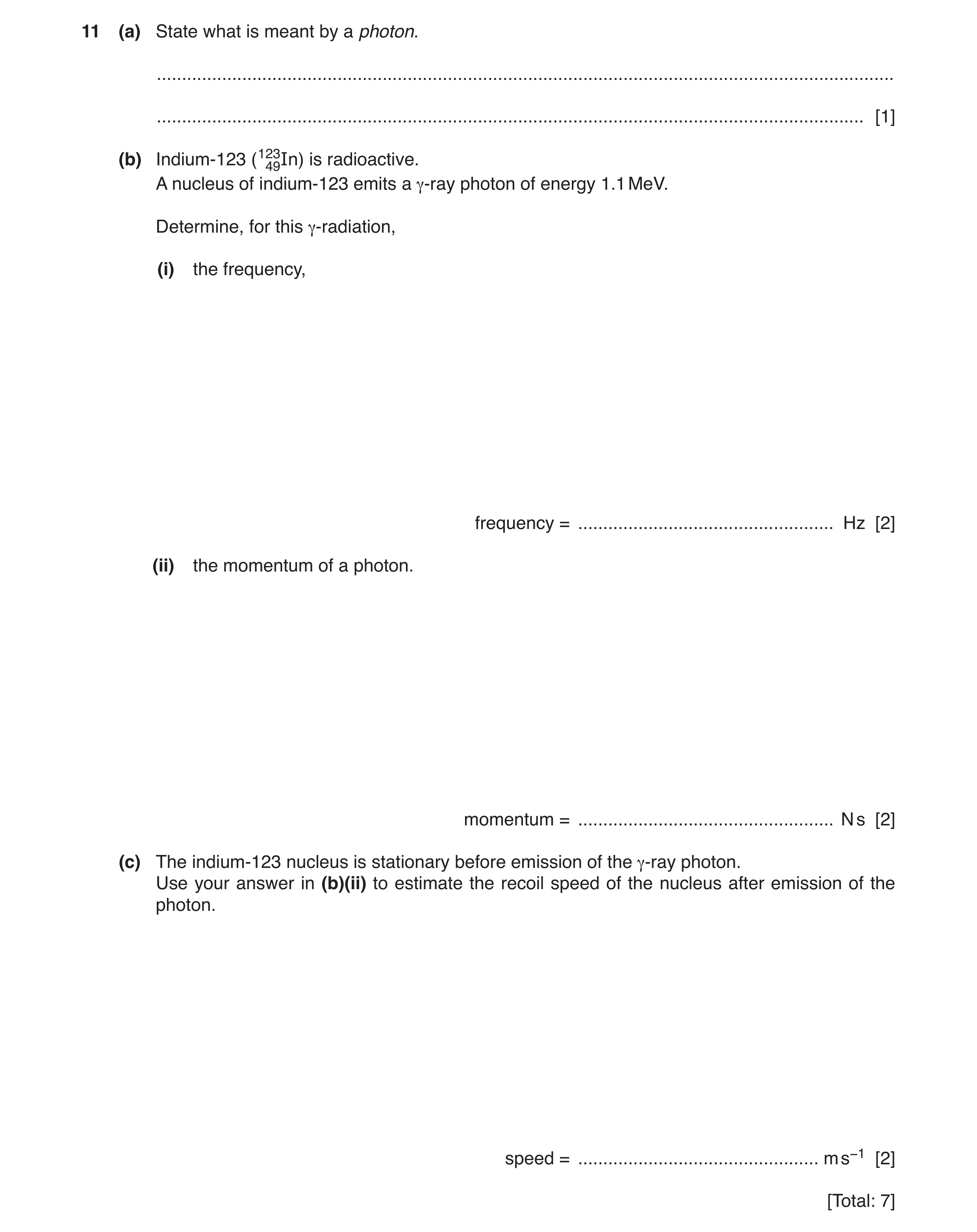
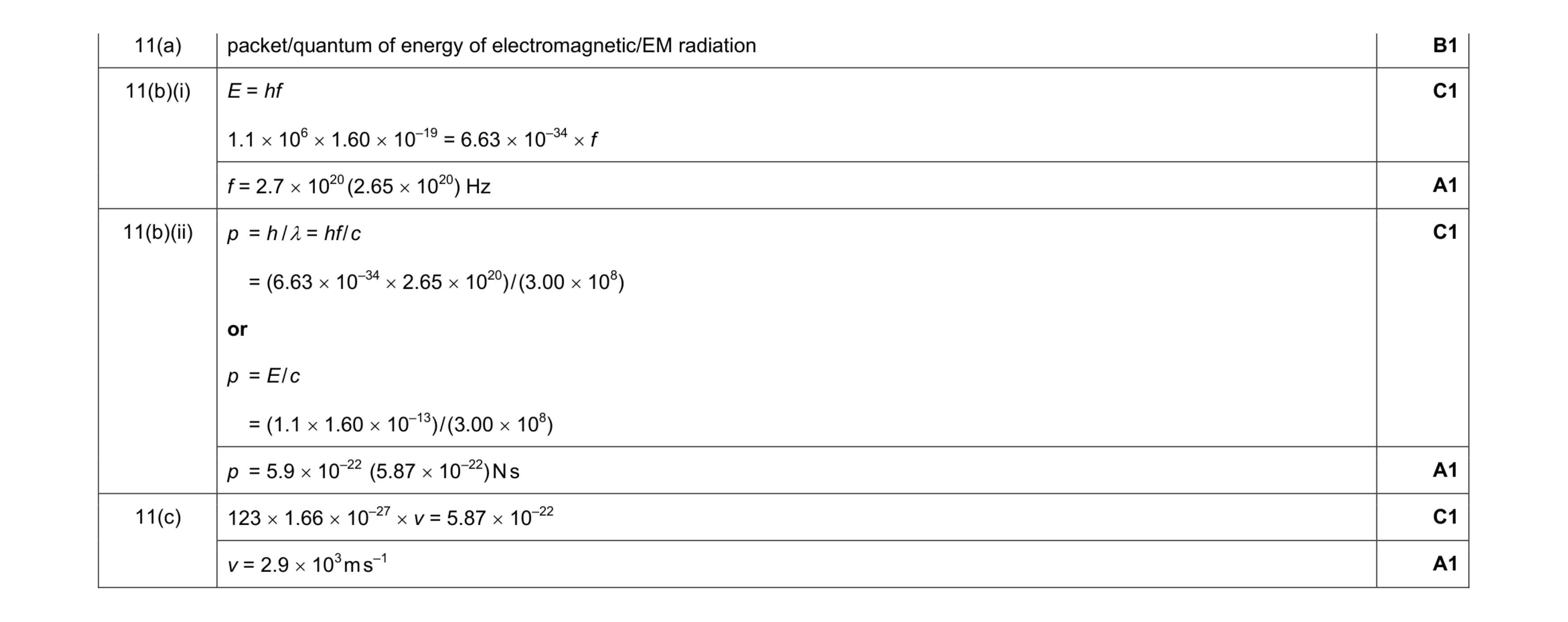
11 (a) State what is meant by a photon. … … [1] (b) Indium-123 (12349In) is radioactive. A nucleus of indium-123 emits a γ-ray photon of energy 1.1 MeV. Determine, for this γ-radiation, (i) the frequency, frequency = … Hz [2] (ii) the momentum of a photon. momentum = … N s [2] (c) The indium-123 nucleus is stationary before emission of the γ-ray photon. Use your answer in (b)(ii) to estimate the recoil speed of the nucleus after emission of the photon. speed = … m s−1 [2] [Total: 7]
7 marks
Mark scheme: 11(a) packet/quantum of energy of electromagnetic/EM radiation B1 11(b)(i) E = hf 1.1 × 106 × 1.60 × 10–19 = 6.63 × 10⁻³⁴ × f C1 f = 2.7 × 10²⁰ (2.65 × 10²⁰) Hz A1 11(b)(ii) p = h / λ = hf / c = (6.63 × 10–34 × 2.65 × 1020) / (3.00 × 10⁸) or p = E / c = (1.1 × 1.60 × 10–13) / (3.00 × 10⁸) C1 p = 5.9 × 10⁻²² (5.87 × 10⁻²²) N s A1 11(c) 123 × 1.66 × 10–27 × v = 5.87 × 10⁻²² C1 v = 2.9 × 10³ m s–1 A1
This question in 9702/41 Oct/Nov 2017
Q2 · State what is meant by a photon 9702/43 Oct/Nov 2017
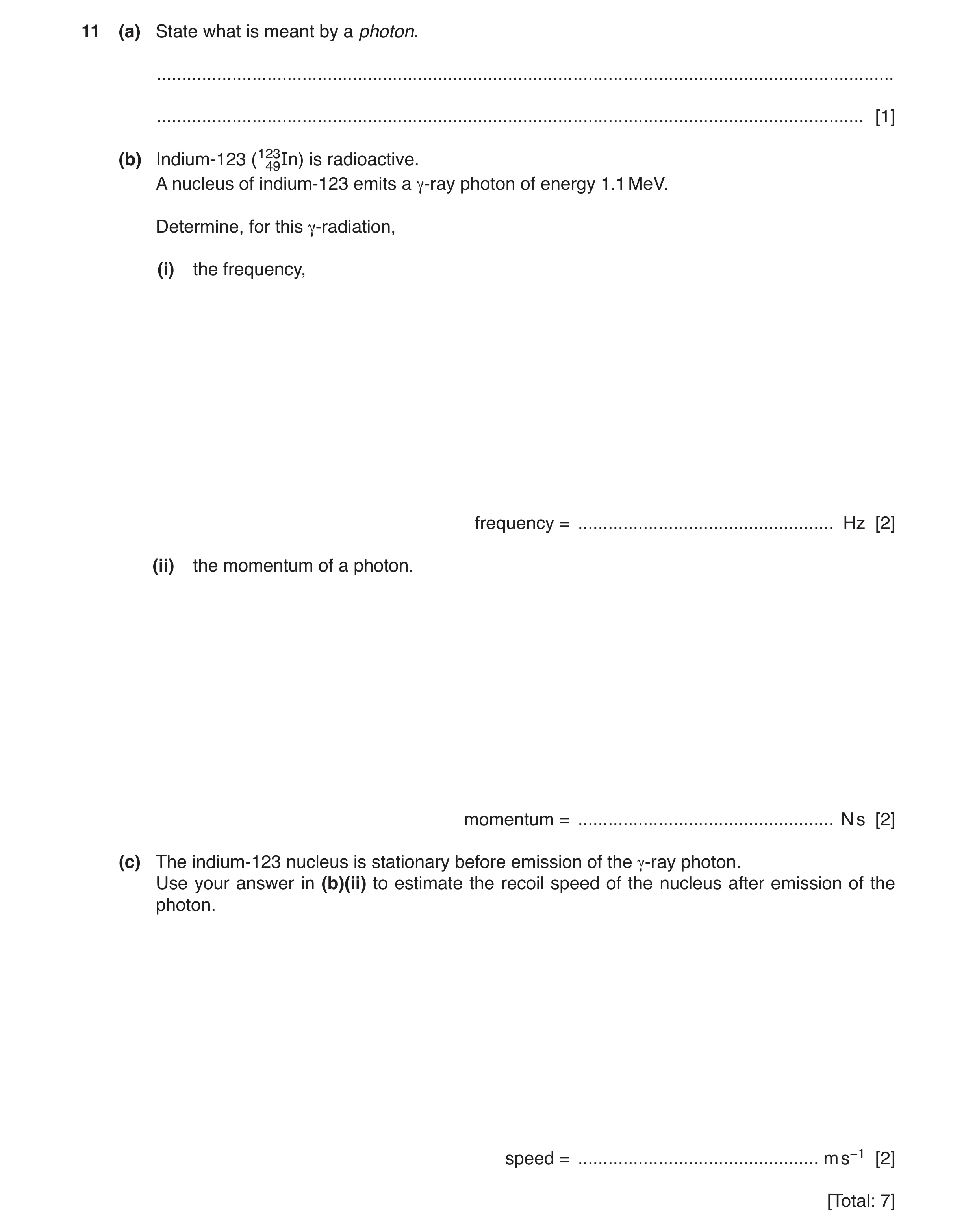
11 (a) State what is meant by a photon. … … [1] (b) Indium-123 (12349In) is radioactive. A nucleus of indium-123 emits a γ-ray photon of energy 1.1 MeV. Determine, for this γ-radiation, (i) the frequency, frequency = … Hz [2] (ii) the momentum of a photon. momentum = … N s [2] (c) The indium-123 nucleus is stationary before emission of the γ-ray photon. Use your answer in (b)(ii) to estimate the recoil speed of the nucleus after emission of the photon. speed = … m s−1 [2] [Total: 7]
7 marks
Mark scheme: 11(a) packet/quantum of energy of electromagnetic/EM radiation B1 11(b)(i) E = hf 1.1 × 106 × 1.60 × 10–19 = 6.63 × 10⁻³⁴ × f C1 f = 2.7 × 10²⁰ (2.65 × 10²⁰) Hz A1 11(b)(ii) p = h / λ = hf / c = (6.63 × 10–34 × 2.65 × 1020) / (3.00 × 10⁸) or p = E / c = (1.1 × 1.60 × 10–13) / (3.00 × 10⁸) C1 p = 5.9 × 10⁻²² (5.87 × 10⁻²²) N s A1 11(c) 123 × 1.66 × 10–27 × v = 5.87 × 10⁻²² C1 v = 2.9 × 10³ m s–1 A1
This question in 9702/43 Oct/Nov 2017
Q3 · State three pieces of evidence provided by the photoelectric effect for a particulate… 9702/41 May/June 2019
11 (a) State three pieces of evidence provided by the photoelectric effect for a particulate nature of electromagnetic radiation. 1. … … 2. … … 3. … … [3] (b) The work function energies of some metals are shown in Fig. 11.1. work function energy / eV sodium 2.4 calcium 2.9 zinc 3.6 silver 4.3 Fig. 11.1 Each metal is irradiated with electromagnetic radiation of wavelength 380 nm. (i) Calculate the energy, in eV, of a photon of electromagnetic radiation of wavelength 380 nm. energy = … eV [3] (ii) Determine which metals will give rise to the emission of photoelectrons. Explain your answer. … … [2] (c) Photons of wavelength 380 nm are incident normally on a metal surface at a rate of 7.6 × 10¹⁴ s–1. All the photons are absorbed in the surface and no photoelectrons are emitted. Calculate the force exerted on the metal surface by the incident photons. force = … N [3] [Total: 11]
11 marks
Mark scheme: 11(a) Any three points from: • (max) energy of emitted electrons depends on frequency • (max) energy of emitted electrons does not depend on intensity • rate of emission of electrons depends on intensity (at constant frequency) • existence of frequency below which no emission of electrons • instantaneous emission of electrons • increasing the frequency at constant intensity decreases the rate of emission of electrons B3 11(b)(i) photon energy = hc / λ C1 = (6.63 × 10–34 × 3.0 × 108) / (380 × 10–9) ( = 5.23 × 10⁻¹⁹ J) C1 = 3.3 eV A1 11(b)(ii) photon energy must be greater than work function (energy) B1 so sodium and calcium B1 11(c) λ = h / p C1 p = (6.63 × 10⁻³⁴) / (380 × 10–9) = 1.74 × 10⁻²⁷ N s C1 force = 1.74 × 10–27 × 7.6 × 1014 = 1.3 × 10⁻¹² N A1
This question in 9702/41 May/June 2019
Q4 · State what is meant by a photon 9702/42 May/June 2019
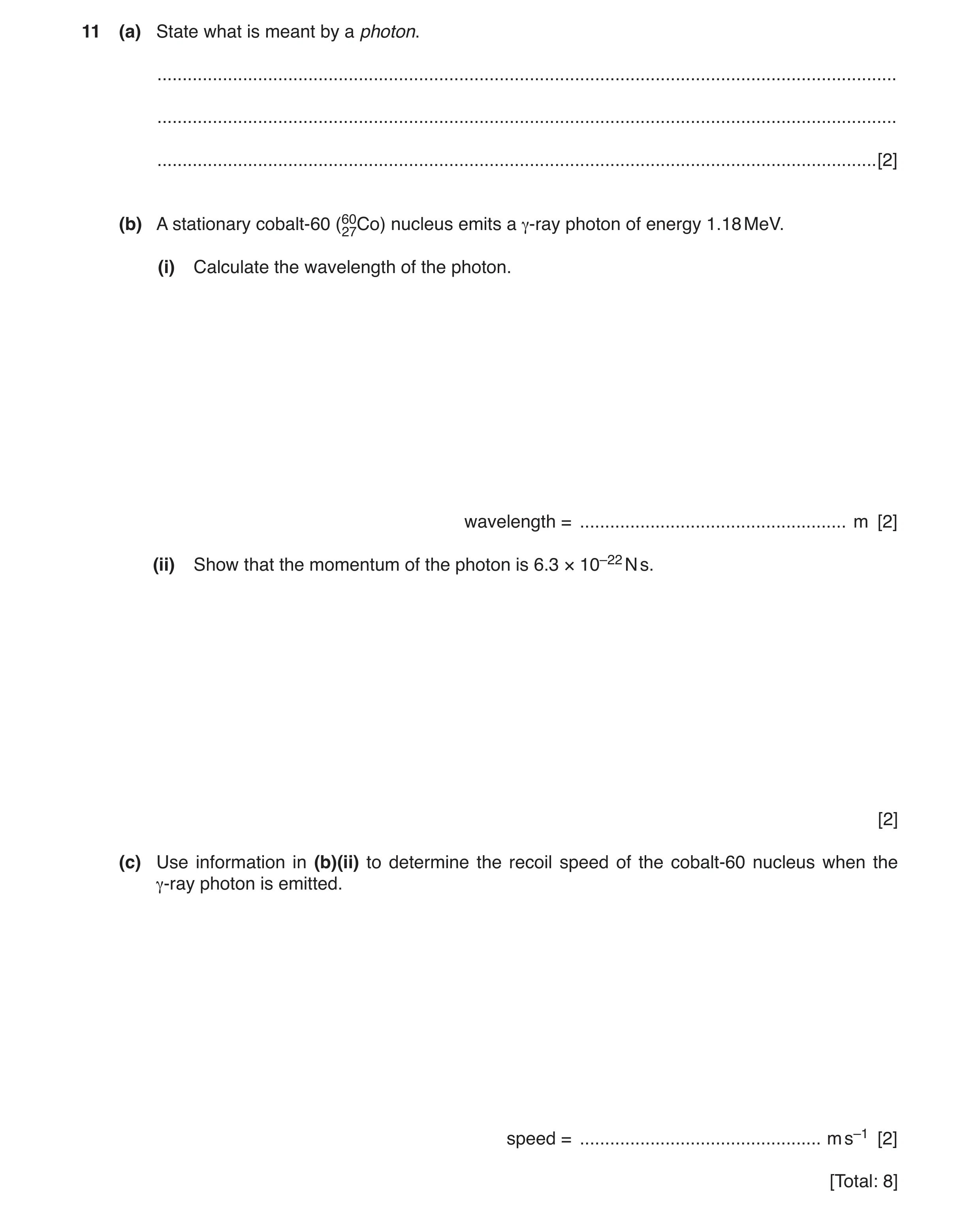
11 (a) State what is meant by a photon. … … … [2] (b) A stationary cobalt-60 (6027Co) nucleus emits a γ-ray photon of energy 1.18 MeV. (i) Calculate the wavelength of the photon. wavelength = … m [2] (ii) Show that the momentum of the photon is 6.3 × 10⁻²² N s. [2] (c) Use information in (b)(ii) to determine the recoil speed of the cobalt-60 nucleus when the γ-ray photon is emitted. speed = … m s–1 [2] [Total: 8]
8 marks
Mark scheme: 11(a) packet/quantum of energy M1 of electromagnetic radiation A1 11(b)(i) E = hc / λ C1 1.18 × 1.60 × 10–13 = (6.63 × 10–34 × 3.00 × 108) / λ λ = 1.05 × 10⁻¹² m A1 11(b)(ii) λ = h / p or E = pc C1 p = (6.63 × 10⁻³⁴) / (1.05 × 10⁻¹²) or p = (1.18 × 1.60 × 10–13) / (3.00 × 10⁸) leading to p = 6.3 × 10⁻²² N s B1 11(c) 6.3 × 10–22 = 60 × 1.66 × 10–27 × v C1 v = 6.3 × 10³ m s–1 A1
This question in 9702/42 May/June 2019
Q5 · State three pieces of evidence provided by the photoelectric effect for a particulate… 9702/43 May/June 2019
11 (a) State three pieces of evidence provided by the photoelectric effect for a particulate nature of electromagnetic radiation. 1. … … 2. … … 3. … … [3] (b) The work function energies of some metals are shown in Fig. 11.1. work function energy / eV sodium 2.4 calcium 2.9 zinc 3.6 silver 4.3 Fig. 11.1 Each metal is irradiated with electromagnetic radiation of wavelength 380 nm. (i) Calculate the energy, in eV, of a photon of electromagnetic radiation of wavelength 380 nm. energy = … eV [3] (ii) Determine which metals will give rise to the emission of photoelectrons. Explain your answer. … … [2] (c) Photons of wavelength 380 nm are incident normally on a metal surface at a rate of 7.6 × 10¹⁴ s–1. All the photons are absorbed in the surface and no photoelectrons are emitted. Calculate the force exerted on the metal surface by the incident photons. force = … N [3] [Total: 11]
11 marks
Mark scheme: 11(a) Any three points from: • (max) energy of emitted electrons depends on frequency • (max) energy of emitted electrons does not depend on intensity • rate of emission of electrons depends on intensity (at constant frequency) • existence of frequency below which no emission of electrons • instantaneous emission of electrons • increasing the frequency at constant intensity decreases the rate of emission of electrons B3 11(b)(i) photon energy = hc / λ C1 = (6.63 × 10–34 × 3.0 × 108) / (380 × 10–9) ( = 5.23 × 10⁻¹⁹ J) C1 = 3.3 eV A1 11(b)(ii) photon energy must be greater than work function (energy) B1 so sodium and calcium B1 11(c) λ = h / p C1 p = (6.63 × 10⁻³⁴) / (380 × 10–9) = 1.74 × 10⁻²⁷ N s C1 force = 1.74 × 10–27 × 7.6 × 1014 = 1.3 × 10⁻¹² N A1
This question in 9702/43 May/June 2019
Q6 · An electron, at rest, has mass me and charge –q 9702/41 May/June 2020
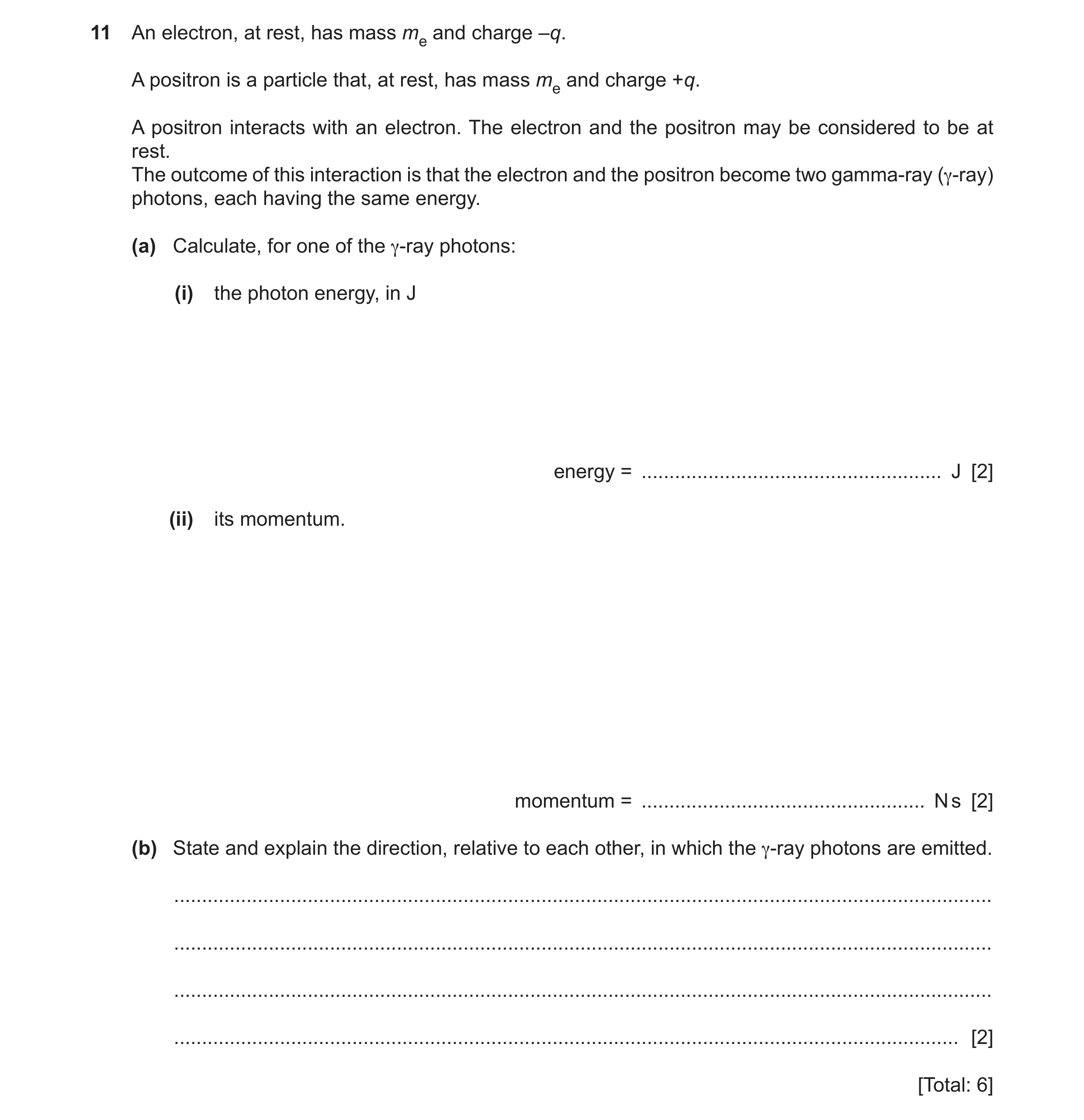
11 An electron, at rest, has mass me and charge –q. A positron is a particle that, at rest, has mass me and charge +q. A positron interacts with an electron. The electron and the positron may be considered to be at rest. The outcome of this interaction is that the electron and the positron become two gamma-ray (γ-ray) photons, each having the same energy. (a) Calculate, for one of the γ-ray photons: (i) the photon energy, in J energy = … J [2] (ii) its momentum. momentum = … N s [2] (b) State and explain the direction, relative to each other, in which the γ-ray photons are emitted. … … … … [2] [Total: 6]
6 marks
Mark scheme: 11(a)(i) E = mc2 C1 = 9.11 × 10–31 × (3.0 × 108)2 = 8.2 × 10⁻¹⁴ J A1 11(a)(ii) p = h / λ and E = hc / λ or E = pc C1 p = (8.2 × 10⁻¹⁴) / (3.0 × 10⁸) = 2.7 × 10⁻²² N s A1 11(b) total momentum (before and after interaction) is zero or momentum must be conserved (in the interaction) or momentum of the photons must be equal and opposite B1 (photons emitted in) opposite directions B1
This question in 9702/41 May/June 2020
Q7 · An electron, at rest, has mass me and charge –q 9702/43 May/June 2020
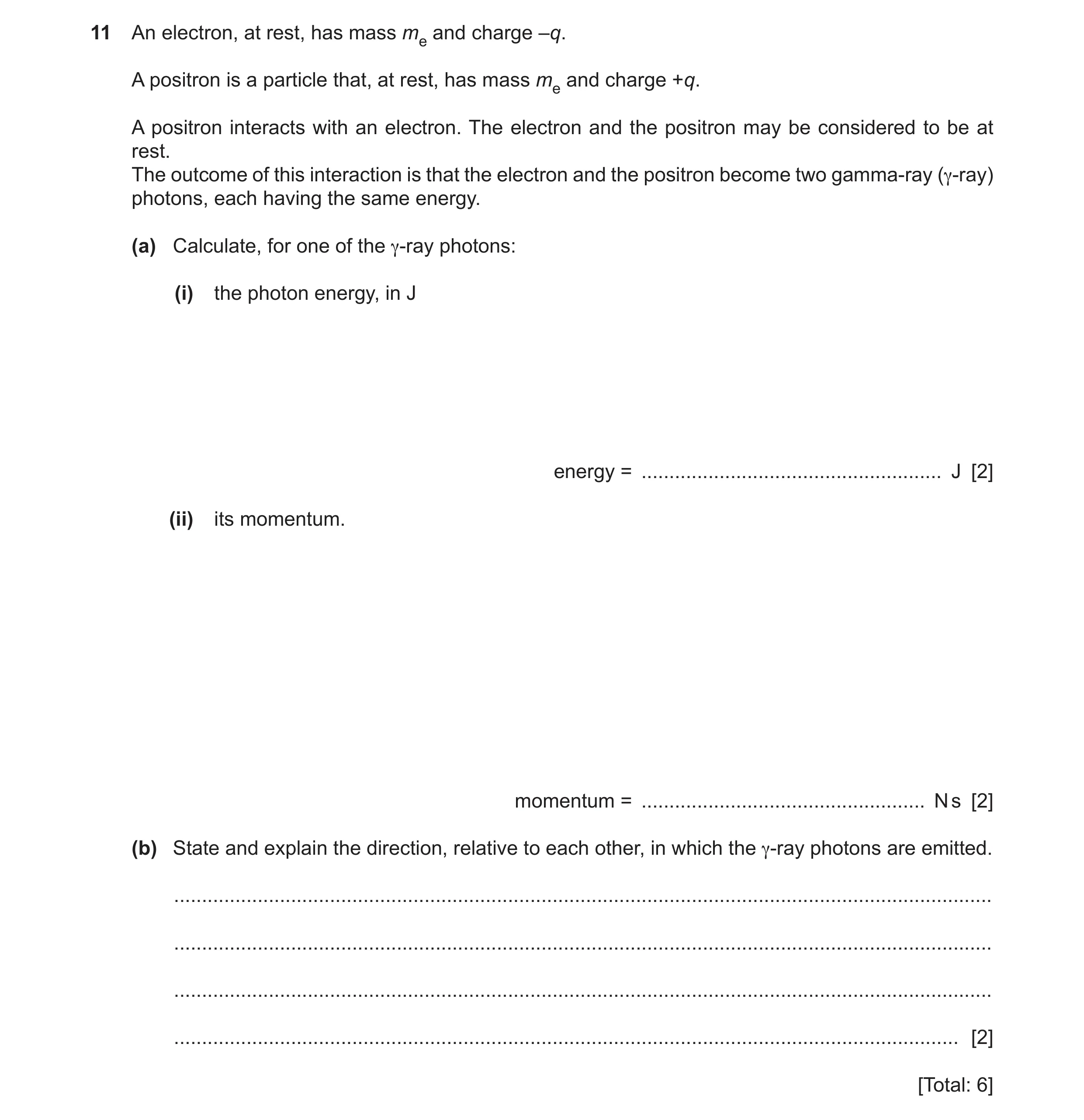
11 An electron, at rest, has mass me and charge –q. A positron is a particle that, at rest, has mass me and charge +q. A positron interacts with an electron. The electron and the positron may be considered to be at rest. The outcome of this interaction is that the electron and the positron become two gamma-ray (γ-ray) photons, each having the same energy. (a) Calculate, for one of the γ-ray photons: (i) the photon energy, in J energy = … J [2] (ii) its momentum. momentum = … N s [2] (b) State and explain the direction, relative to each other, in which the γ-ray photons are emitted. … … … … [2] [Total: 6]
6 marks
Mark scheme: 11(a)(i) E = mc2 C1 = 9.11 × 10–31 × (3.0 × 108)2 = 8.2 × 10⁻¹⁴ J A1 11(a)(ii) p = h / λ and E = hc / λ or E = pc C1 p = (8.2 × 10⁻¹⁴) / (3.0 × 10⁸) = 2.7 × 10⁻²² N s A1 11(b) total momentum (before and after interaction) is zero or momentum must be conserved (in the interaction) or momentum of the photons must be equal and opposite B1 (photons emitted in) opposite directions B1
This question in 9702/43 May/June 2020
Q8 · A photon of wavelength 540 nm collides with an isolated stationary electron, as… 9702/41 Oct/Nov 2020
11 A photon of wavelength 540 nm collides with an isolated stationary electron, as illustrated in Fig. 11.1. electron incident photon wavelength 540 nm deflected photon wavelength 544 nm Fig. 11.1 The photon is deflected elastically by the electron. The wavelength of the deflected photon is 544 nm. (a) (i) State what is meant by a photon. … … … [2] (ii) On Fig. 11.1, draw an arrow to indicate the approximate direction of motion of the deflected electron. [1] (b) Calculate: (i) the momentum of the deflected photon momentum = … N s [2] (ii) the energy transferred to the deflected electron. energy = … J [2] (c) Another photon of wavelength 540 nm collides with an isolated stationary electron. Explain why it is not possible for the deflected photon to have a wavelength less than 540 nm. … … … [2] [Total: 9]
9 marks
Mark scheme: 11(a)(i) quantum of energy M1 of electromagnetic radiation A1 11(a)(ii) arrow (on Fig. 11.1) pointing upwards and to the right B1 11(b)(i) λ = h / p C1 p = (6.63 × 10⁻³⁴) / (544 × 10–9) = 1.22 × 10⁻²⁷ N s A1 11(b)(ii) energy = hc / λ C1 = 6.63 × 10–34 × 3.00 × 108 × (540–1 – 544–1) × 109 = 2.7 × 10⁻²¹ J A1 11(c) (smaller wavelength corresponds to) greater photon energy B1 any one point from: • (deflected) photon loses energy (so not possible) • (deflected) photon would need to gain energy (so not possible) • electron would need to lose energy (so not possible) • initially electron energy is zero (so not possible) B1
This question in 9702/41 Oct/Nov 2020
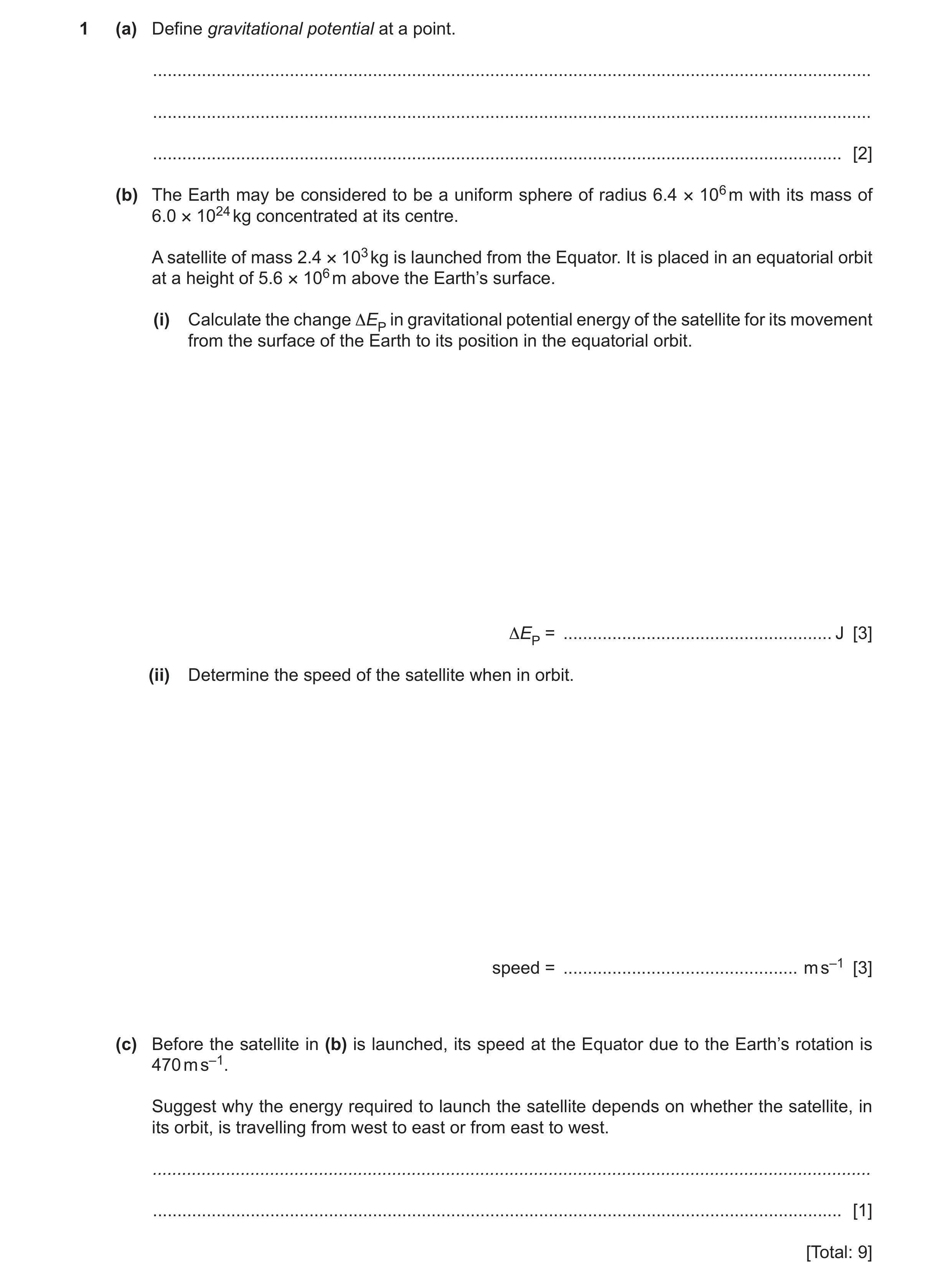
Q9 · Define gravitational potential at a point 9702/42 Oct/Nov 2020
1 (a) Define gravitational potential at a point. … … … [2] (b) The Earth may be considered to be a uniform sphere of radius 6.4 × 10⁶ m with its mass of 6.0 × 1024 kg concentrated at its centre. A satellite of mass 2.4 × 10³ kg is launched from the Equator. It is placed in an equatorial orbit at a height of 5.6 × 10⁶ m above the Earth’s surface. (i) Calculate the change ΔEP in gravitational potential energy of the satellite for its movement from the surface of the Earth to its position in the equatorial orbit. ΔEP = … J [3] (ii) Determine the speed of the satellite when in orbit. speed = … m s–1 [3] (c) Before the satellite in (b) is launched, its speed at the Equator due to the Earth’s rotation is 470 m s–1. Suggest why the energy required to launch the satellite depends on whether the satellite, in its orbit, is travelling from west to east or from east to west. … … [1] [Total: 9]
9 marks
Mark scheme: 1(a) work done per unit mass B1 (work done) moving mass from infinity (to the point) B1 1(b)(i) gravitational potential energy = (–)GMm / r C1 ΔEP = 6.67 × 10–11 × 6.0 × 1024 × 2.4 × 103 × [(6.4 × 10⁶)–1 – (1.2 × 10⁷)–1] C1 or Δφ = 6.67 × 10–11 × 6.0 × 1024 × [(6.4 × 10⁶)–1 – (1.2 × 10⁷)–1] (C1) ΔEP = mΔφ (C1) ΔEP = 7.0 × 10¹⁰ J A1 1(b)(ii) GMm / r2 = mv2 / r C1 v2 = GM / r = (6.67 × 10–11 × 6.0 × 1024) / (1.2 × 10⁷) C1 v = 5800 m s–1 A1 1(c) any one point from: • smaller gain in energy required if orbit is west to east • smaller change in velocity if orbit is west to east • smaller gain in energy if orbit is in same direction as Earth’s rotation • smaller change in velocity if orbit is in same direction as Earth’s rotation • satellite already moving west to east at launch • Earth’s rotation is from west to east B1
This question in 9702/42 Oct/Nov 2020
Q10 · A photon of wavelength 540 nm collides with an isolated stationary electron, as… 9702/43 Oct/Nov 2020
11 A photon of wavelength 540 nm collides with an isolated stationary electron, as illustrated in Fig. 11.1. electron incident photon wavelength 540 nm deflected photon wavelength 544 nm Fig. 11.1 The photon is deflected elastically by the electron. The wavelength of the deflected photon is 544 nm. (a) (i) State what is meant by a photon. … … … [2] (ii) On Fig. 11.1, draw an arrow to indicate the approximate direction of motion of the deflected electron. [1] (b) Calculate: (i) the momentum of the deflected photon momentum = … N s [2] (ii) the energy transferred to the deflected electron. energy = … J [2] (c) Another photon of wavelength 540 nm collides with an isolated stationary electron. Explain why it is not possible for the deflected photon to have a wavelength less than 540 nm. … … … [2] [Total: 9]
9 marks
Mark scheme: 11(a)(i) quantum of energy M1 of electromagnetic radiation A1 11(a)(ii) arrow (on Fig. 11.1) pointing upwards and to the right B1 11(b)(i) λ = h / p C1 p = (6.63 × 10⁻³⁴) / (544 × 10–9) = 1.22 × 10⁻²⁷ N s A1 11(b)(ii) energy = hc / λ C1 = 6.63 × 10–34 × 3.00 × 108 × (540–1 – 544–1) × 109 = 2.7 × 10⁻²¹ J A1 11(c) (smaller wavelength corresponds to) greater photon energy B1 any one point from: • (deflected) photon loses energy (so not possible) • (deflected) photon would need to gain energy (so not possible) • electron would need to lose energy (so not possible) • initially electron energy is zero (so not possible) B1
This question in 9702/43 Oct/Nov 2020
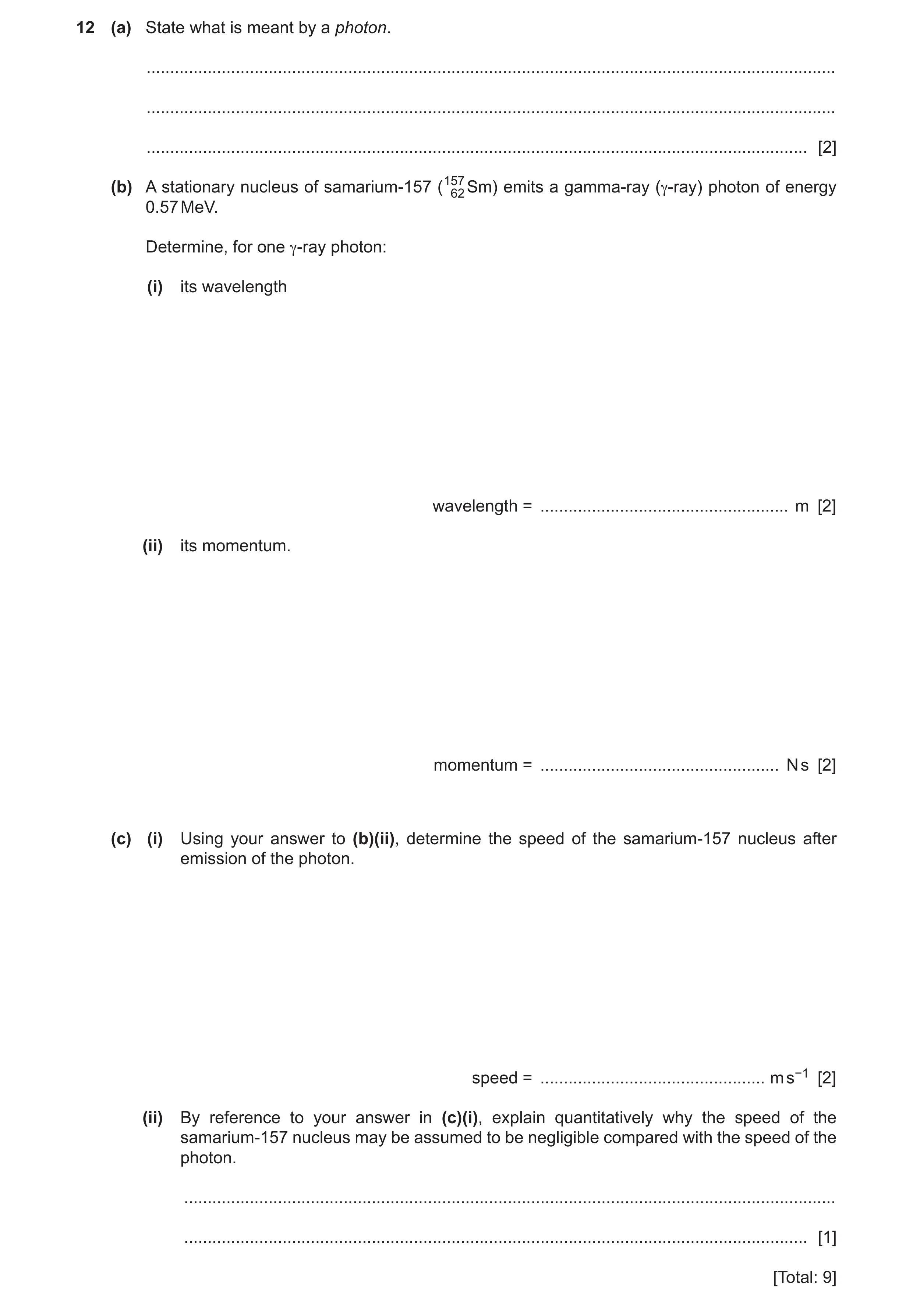
Q11 · State what is meant by a photon 9702/42 May/June 2021
12 (a) State what is meant by a photon. … … … [2] (b) A stationary nucleus of samarium-157 (15762 Sm) emits a gamma-ray (γ-ray) photon of energy 0.57 MeV. Determine, for one γ-ray photon: (i) its wavelength wavelength = … m [2] (ii) its momentum. momentum = … N s [2] (c) (i) Using your answer to (b)(ii), determine the speed of the samarium-157 nucleus after emission of the photon. speed = … m s−1 [2] (ii) By reference to your answer in (c)(i), explain quantitatively why the speed of the samarium-157 nucleus may be assumed to be negligible compared with the speed of the photon. … … [1] [Total: 9]
9 marks
Mark scheme: 12(a) quantum of energy M1 of electromagnetic radiation A1 12(b)(i) energy = hc / λ or energy = hf and f = c / λ C1 0.57 × 106 × 1.60 × 10–19 = (6.63 × 10–34 × 3.00 × 108) / λ λ = 2.2 × 10⁻¹² m A1 Question Answer Marks 12(b)(ii) p = h / λ C1 = (6.63 × 10⁻³⁴) / (2.2 × 10⁻¹²) = 3.0 × 10⁻²² N s A1 or p = E / c (C1) = (0.57 × 106 × 1.60 × 10–19) / (3.00 × 10⁸) = 3.0 × 10⁻²² N s (A1) 12(c)(i) mass (of Sm-157 nucleus) = 157 × 1.66 × 10–27 or mass (of Sm-157 nucleus) = 0.157 / (6.02 × 10²³) C1 recoil speed = (3.00 × 10⁻²²) / (157 × 1.66 × 10–27) = 1.2 × 10³ m s–1 A1 12(c)(ii) (1.2 ×) 103 m s–1 is much less than (3.0 ×) 108 m s–1 B1
This question in 9702/42 May/June 2021
 1 / 15
 2 / 15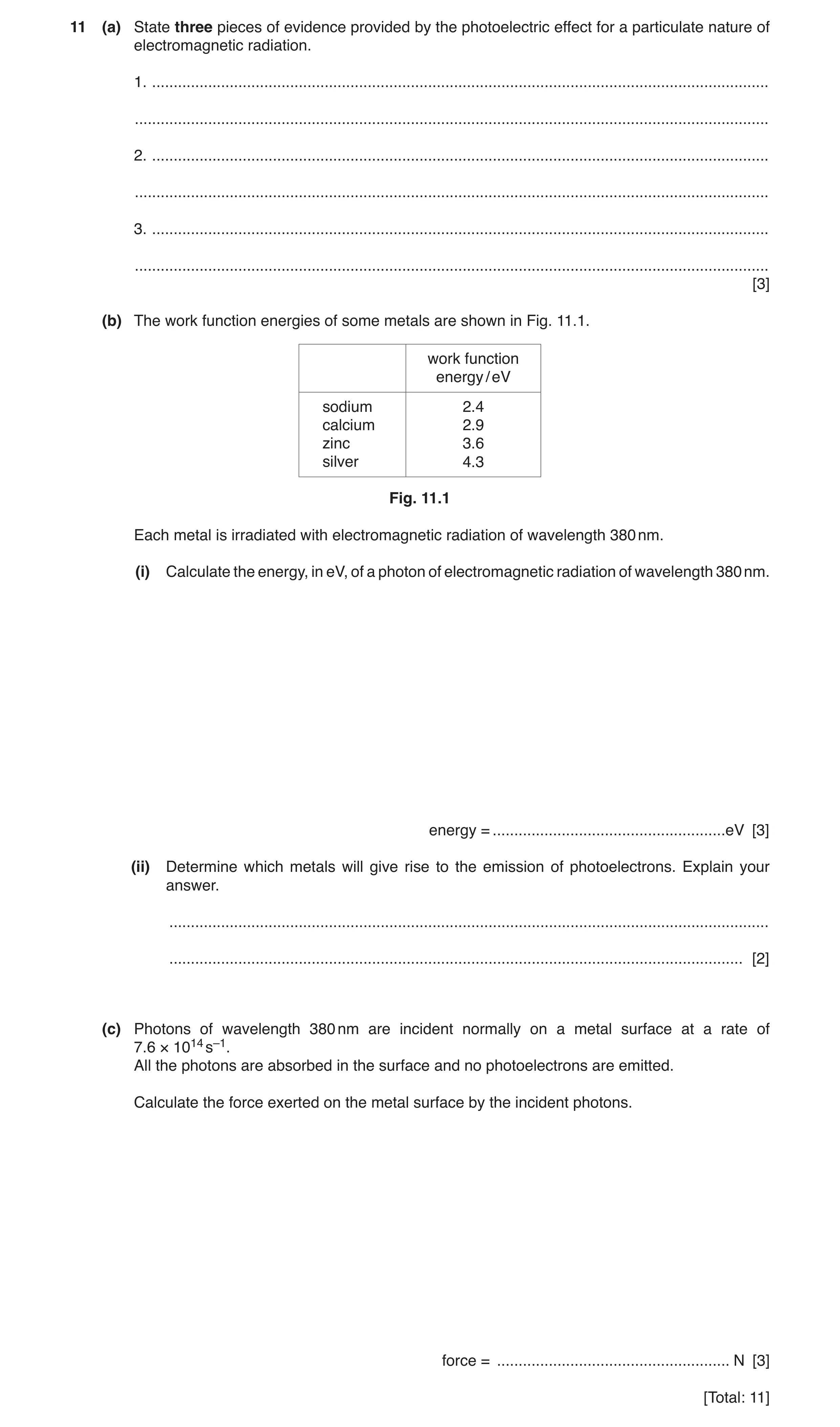
 5 / 15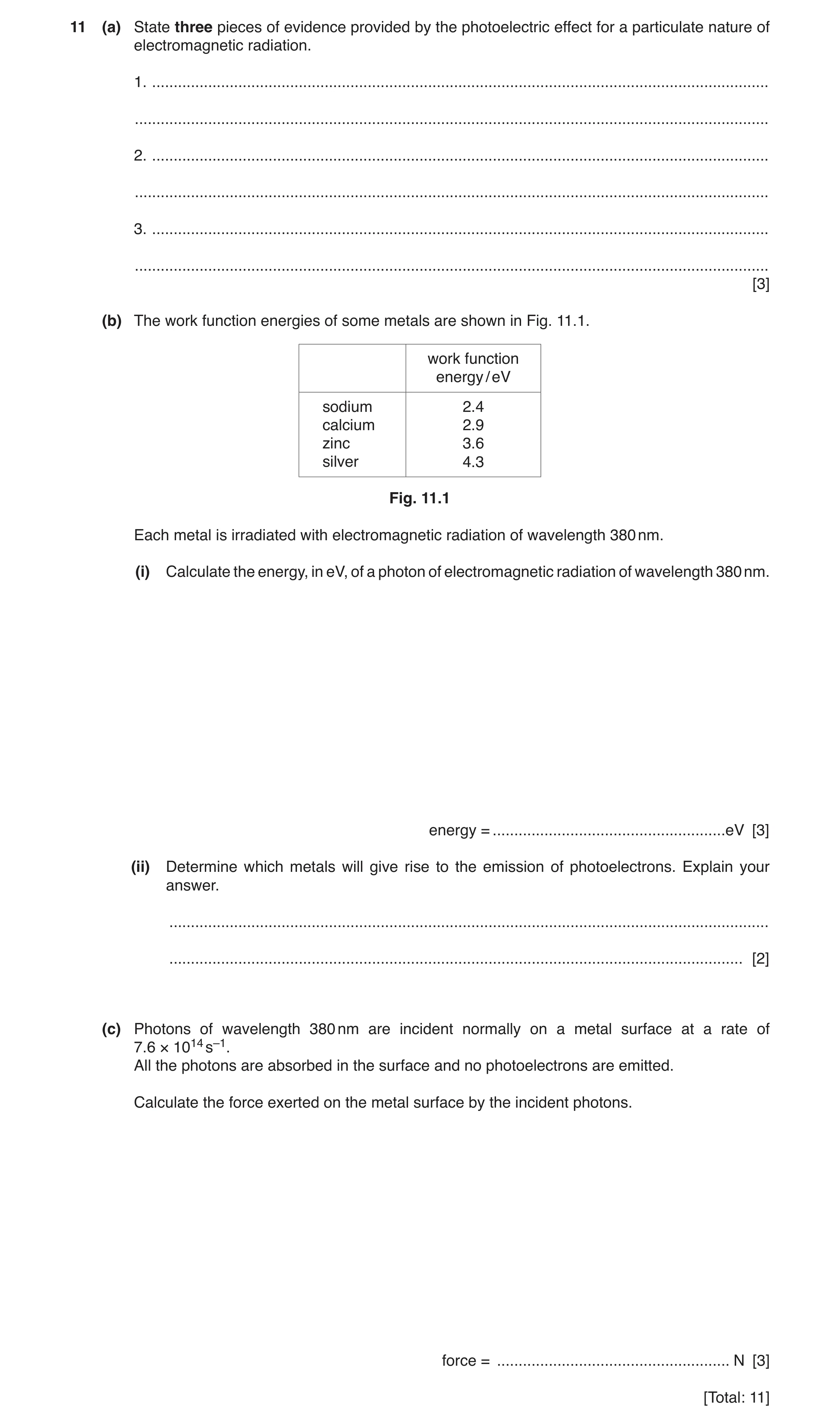
 8 / 15
 9 / 15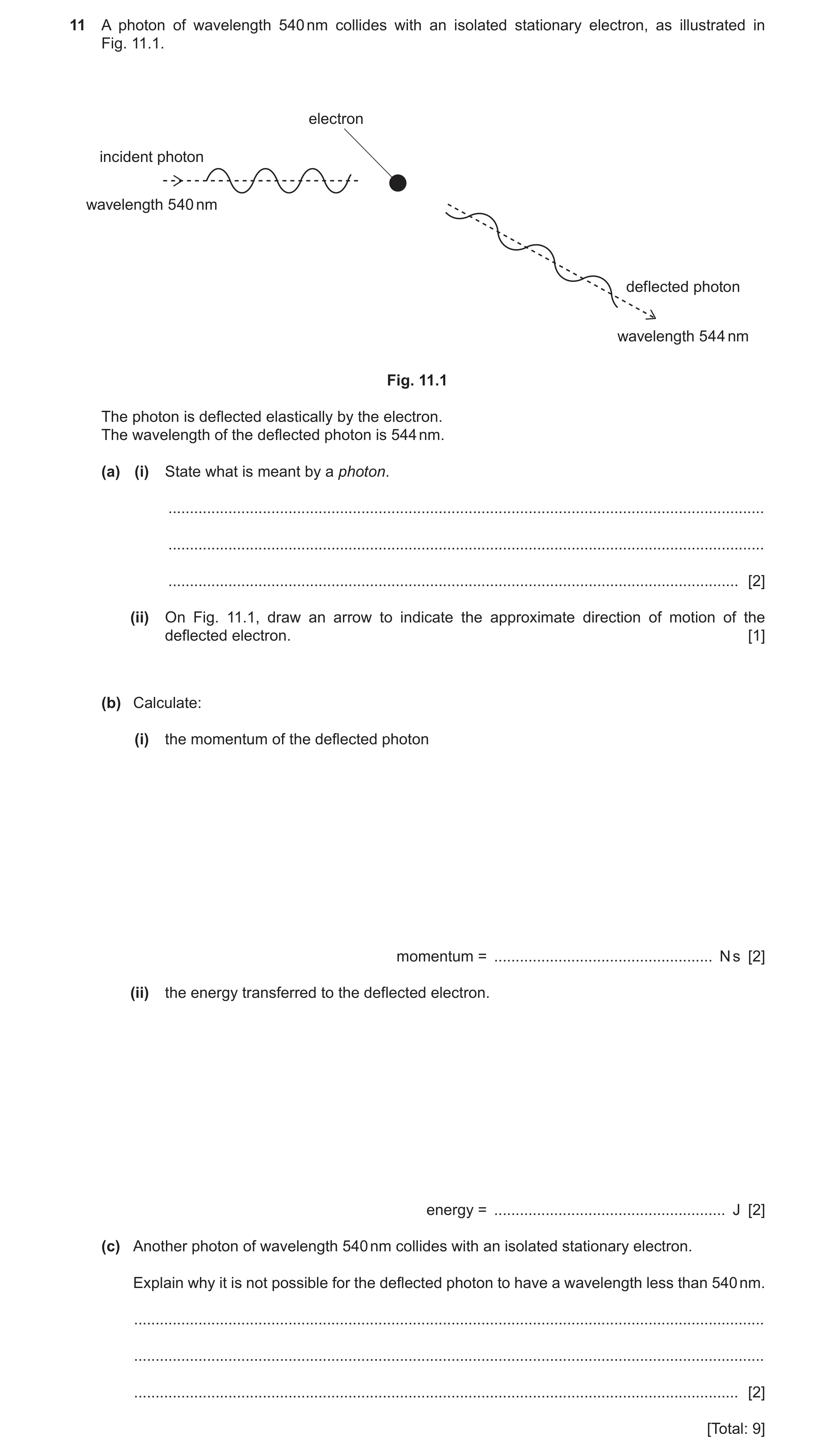
 12 / 15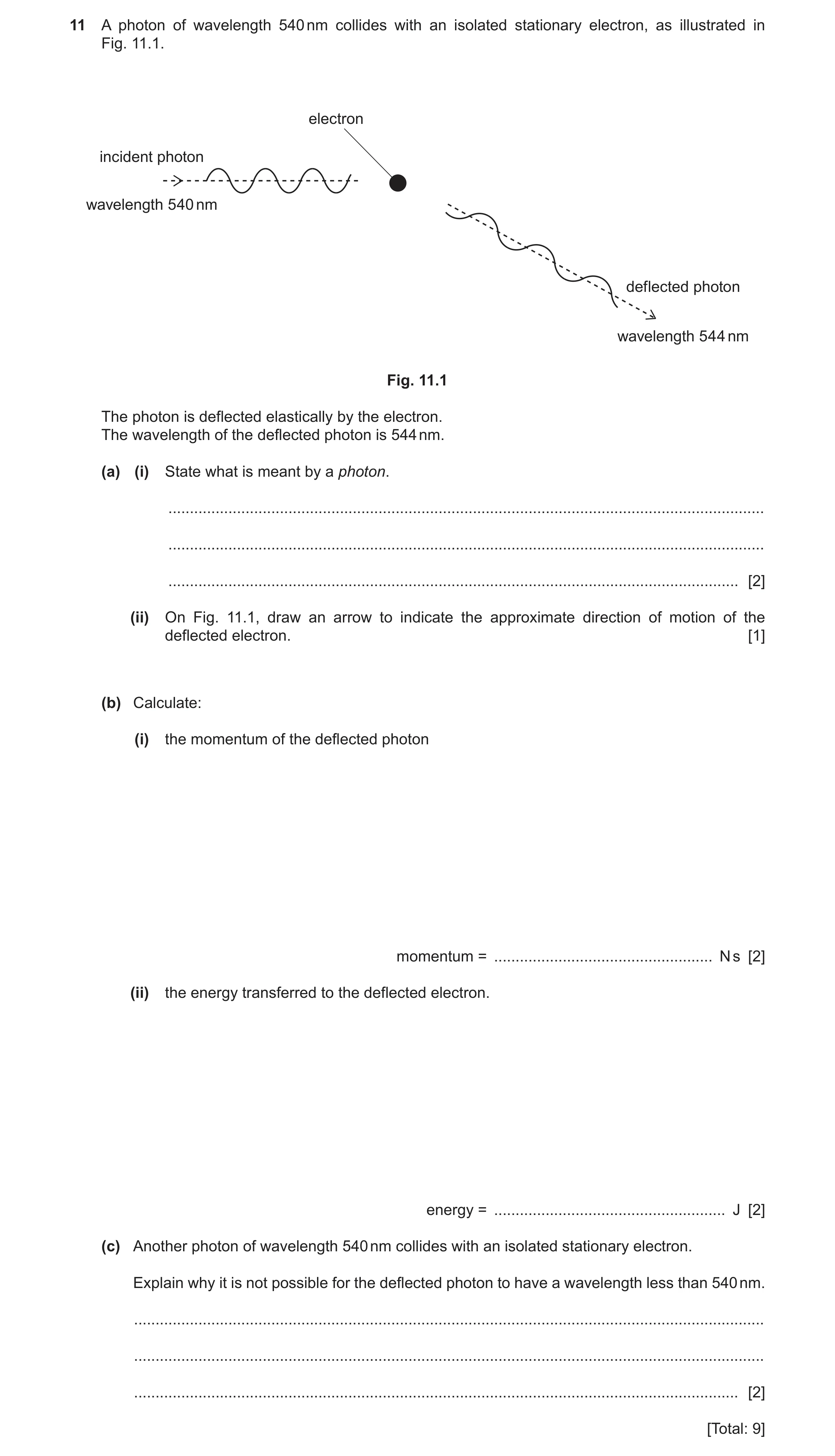
 15 / 15
 7
7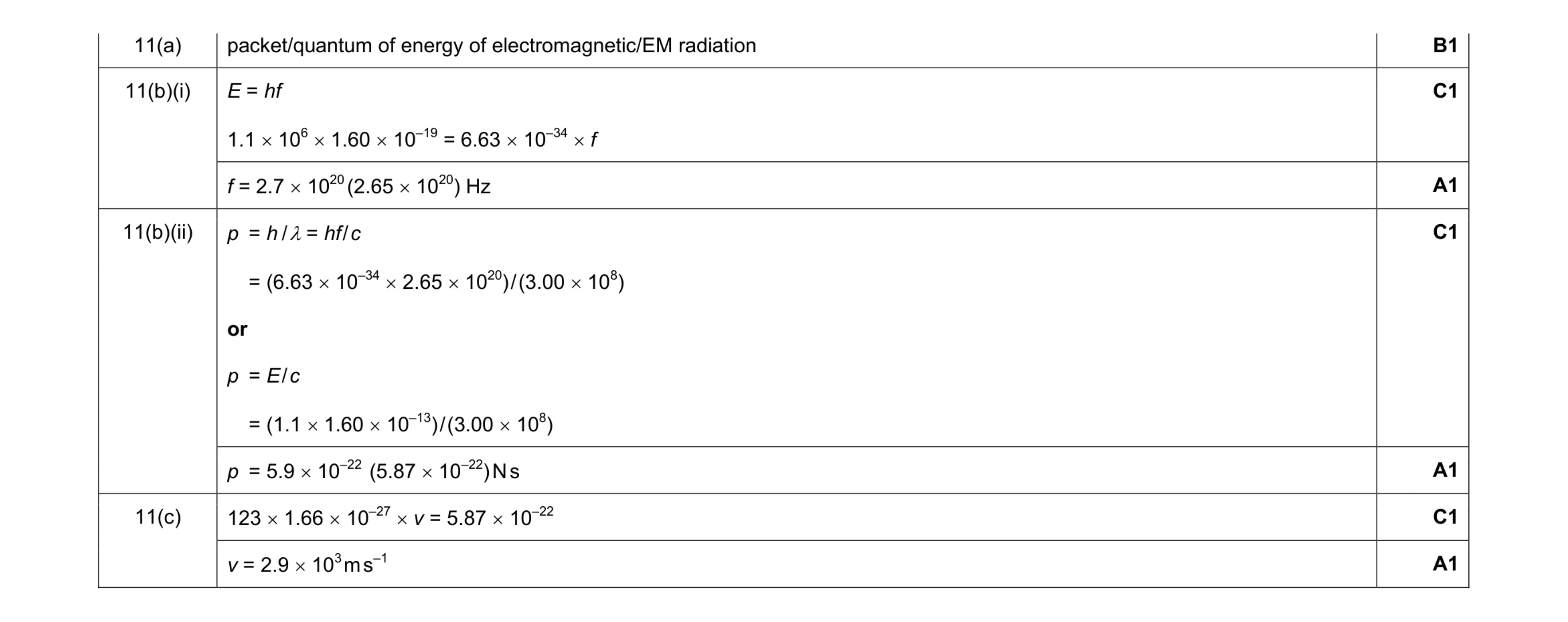 7
7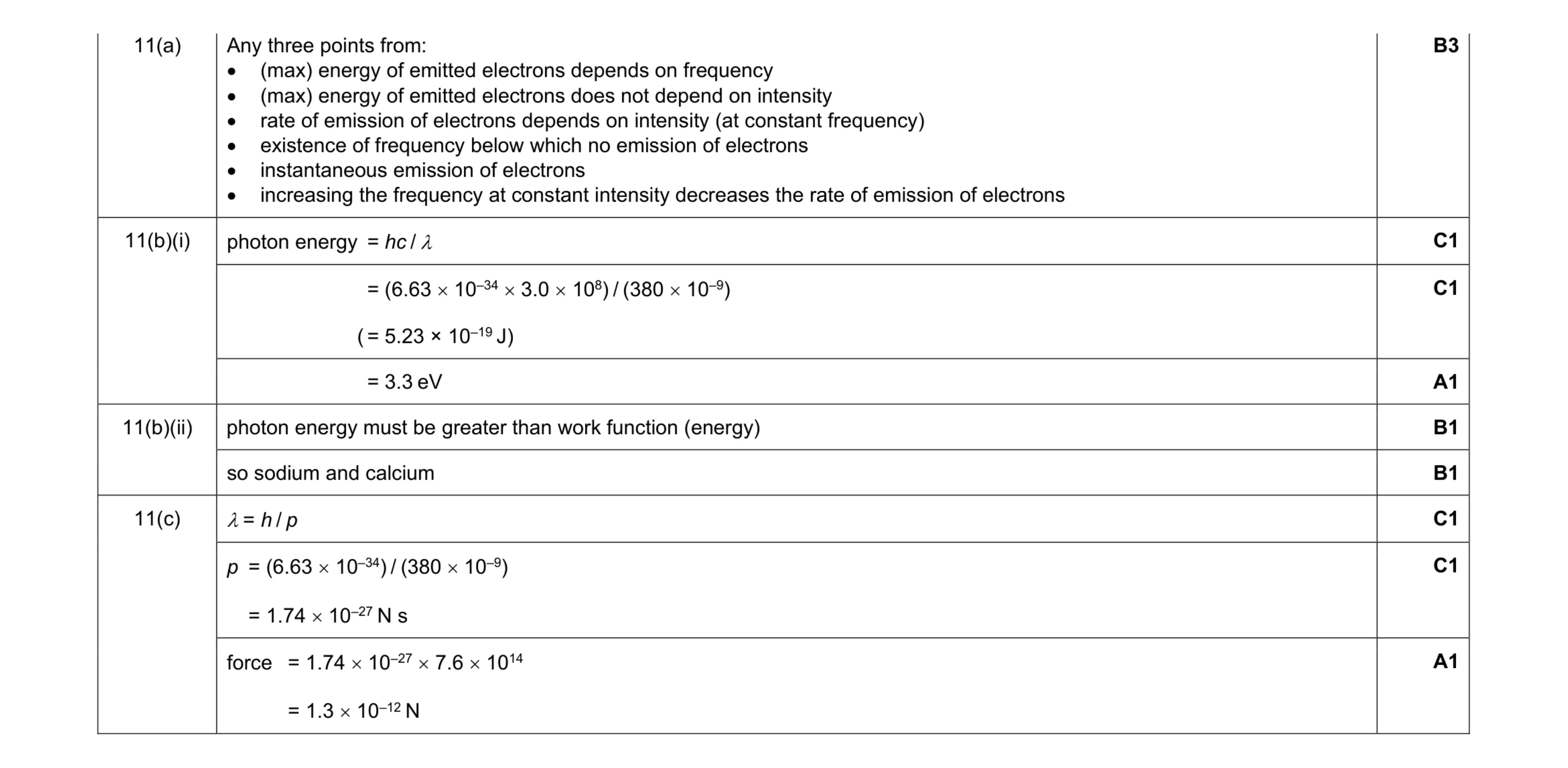 11
11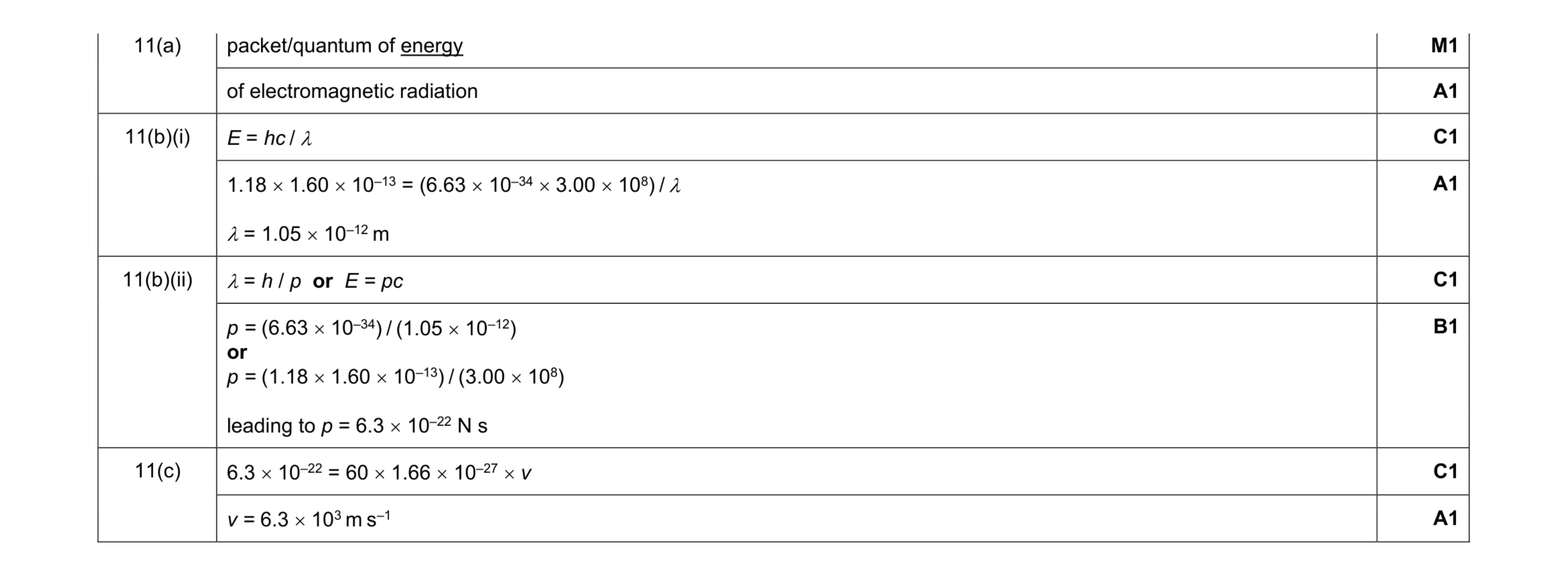 8
8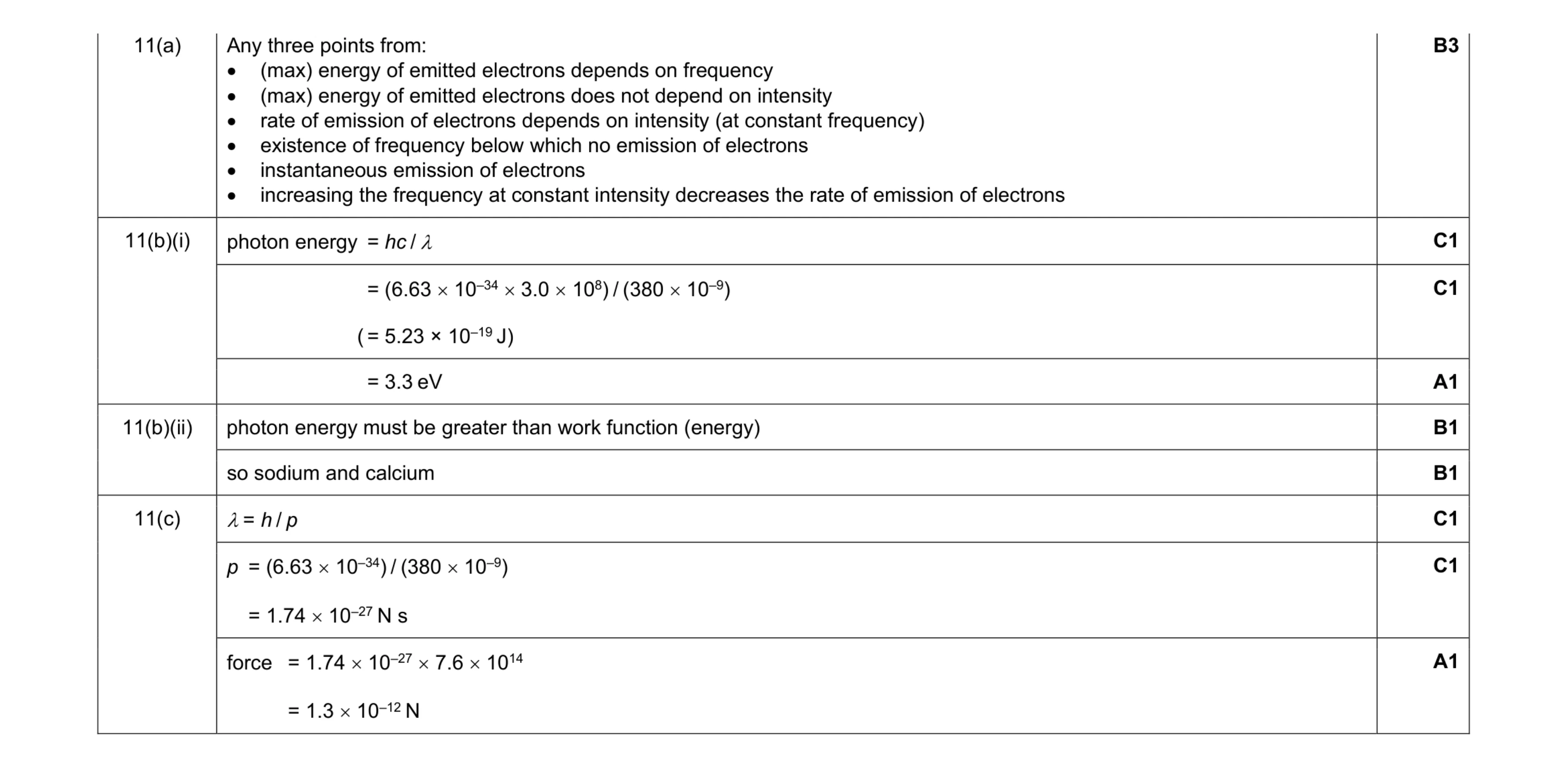 11
11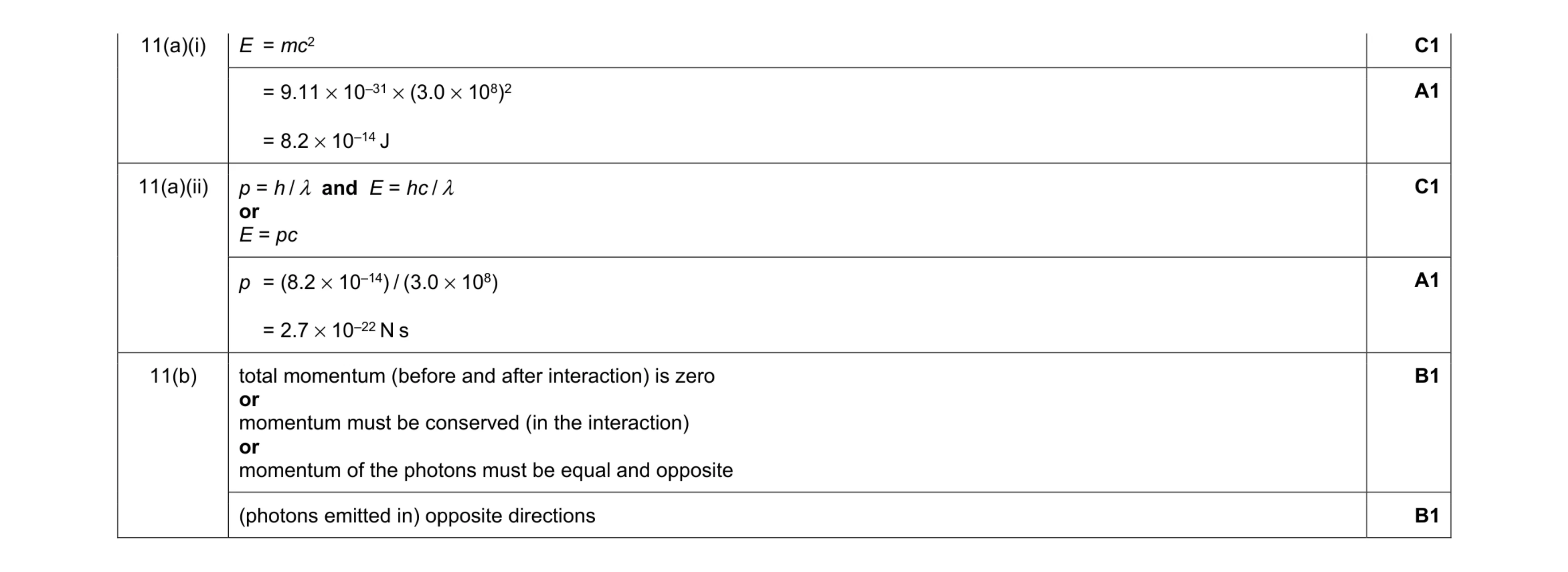 6
6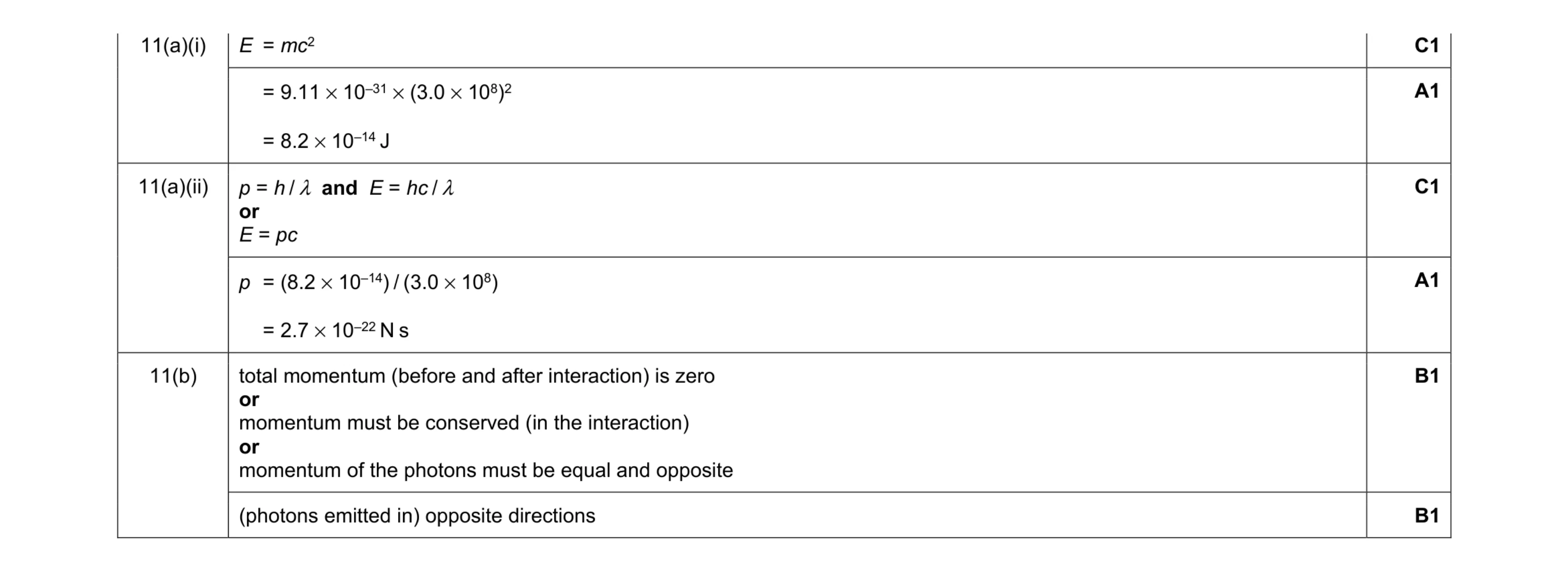 6
6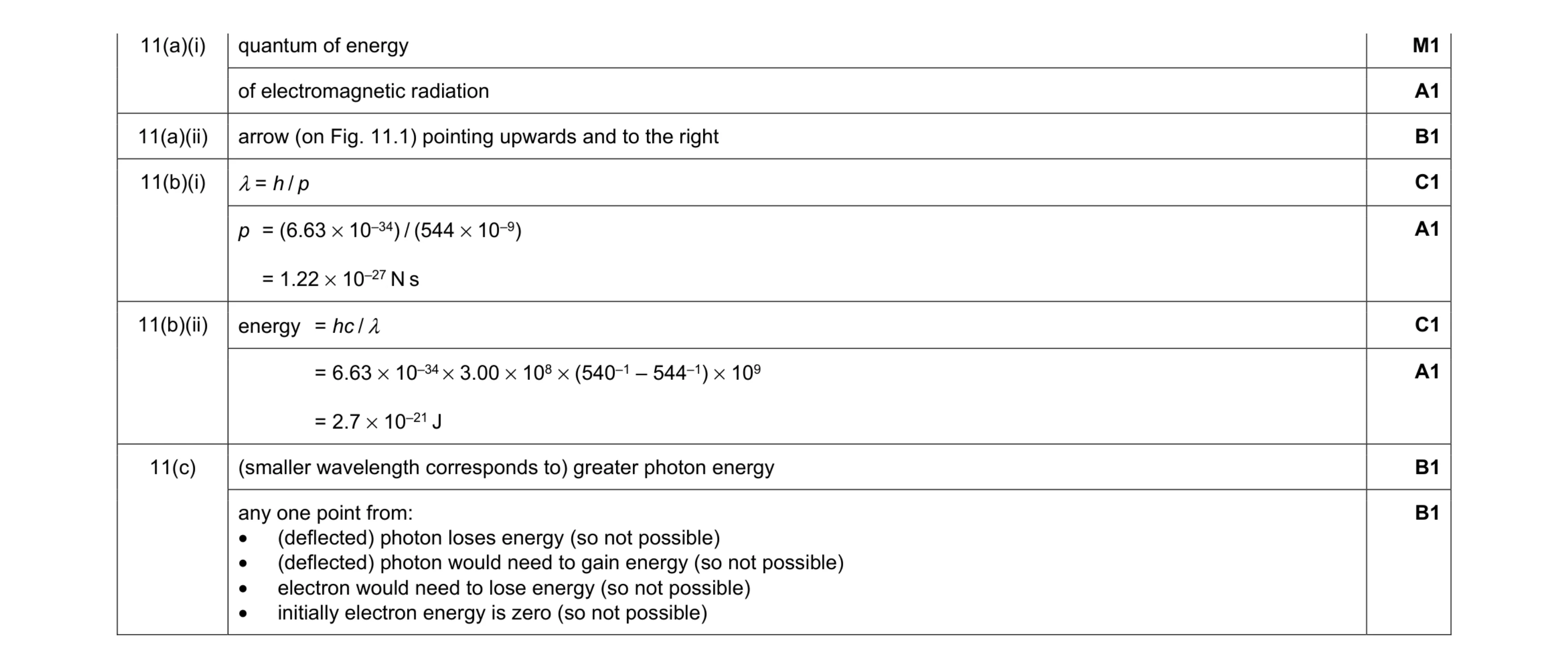 9
9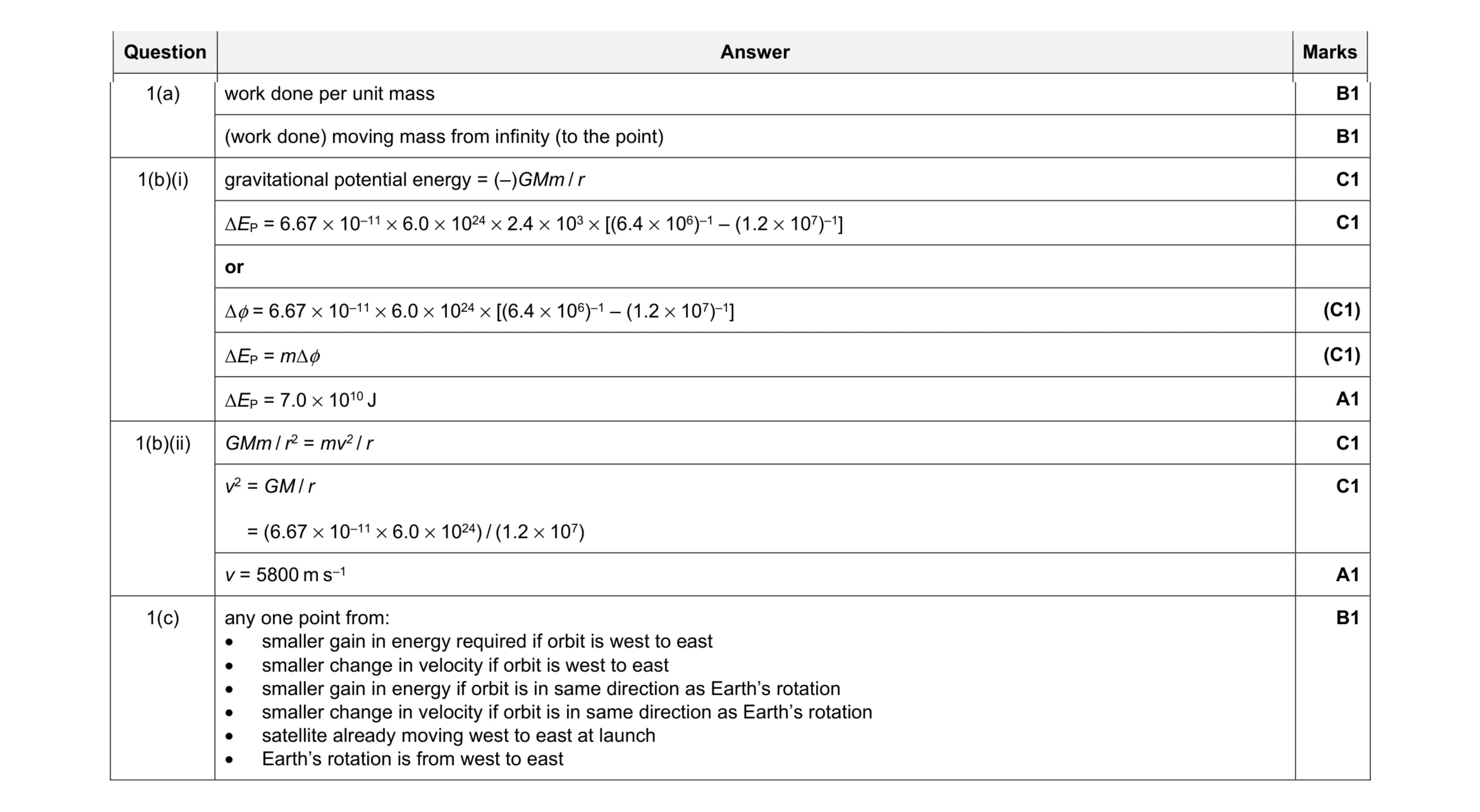 9
9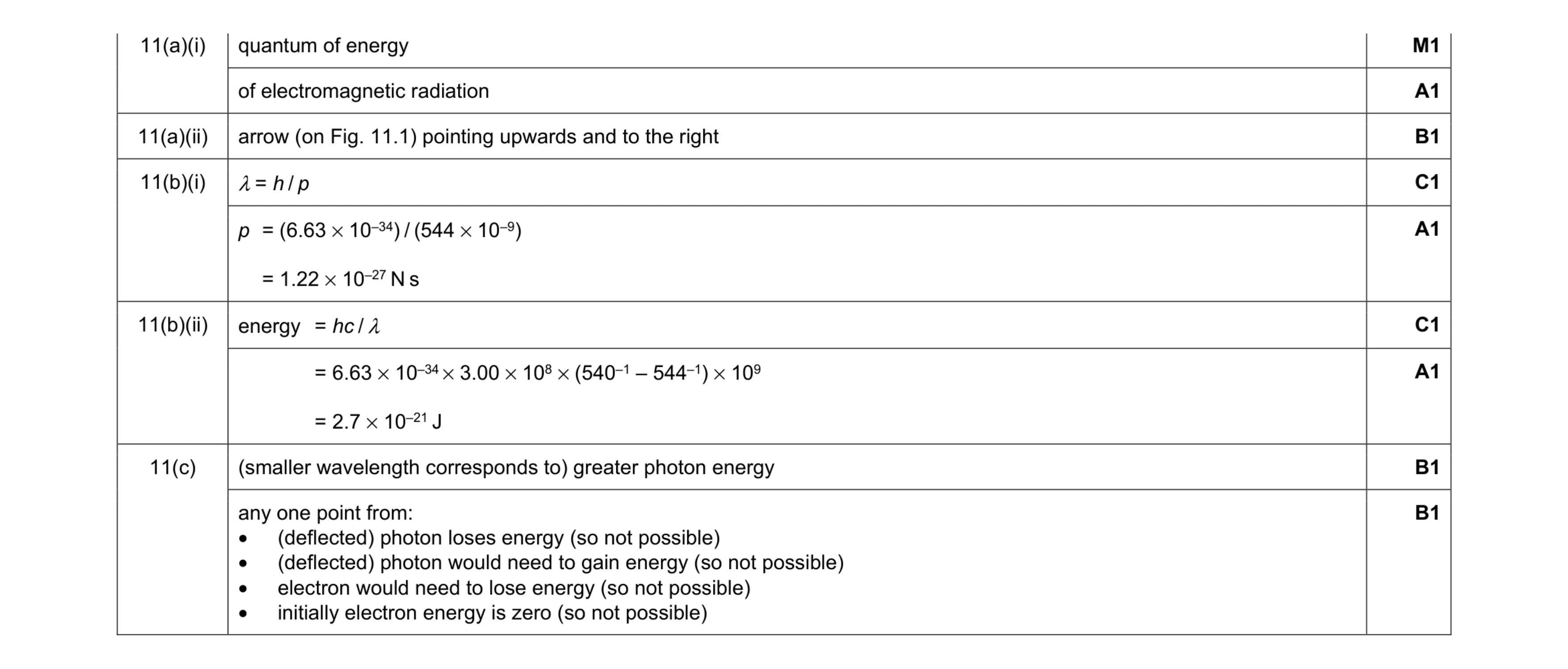 9
9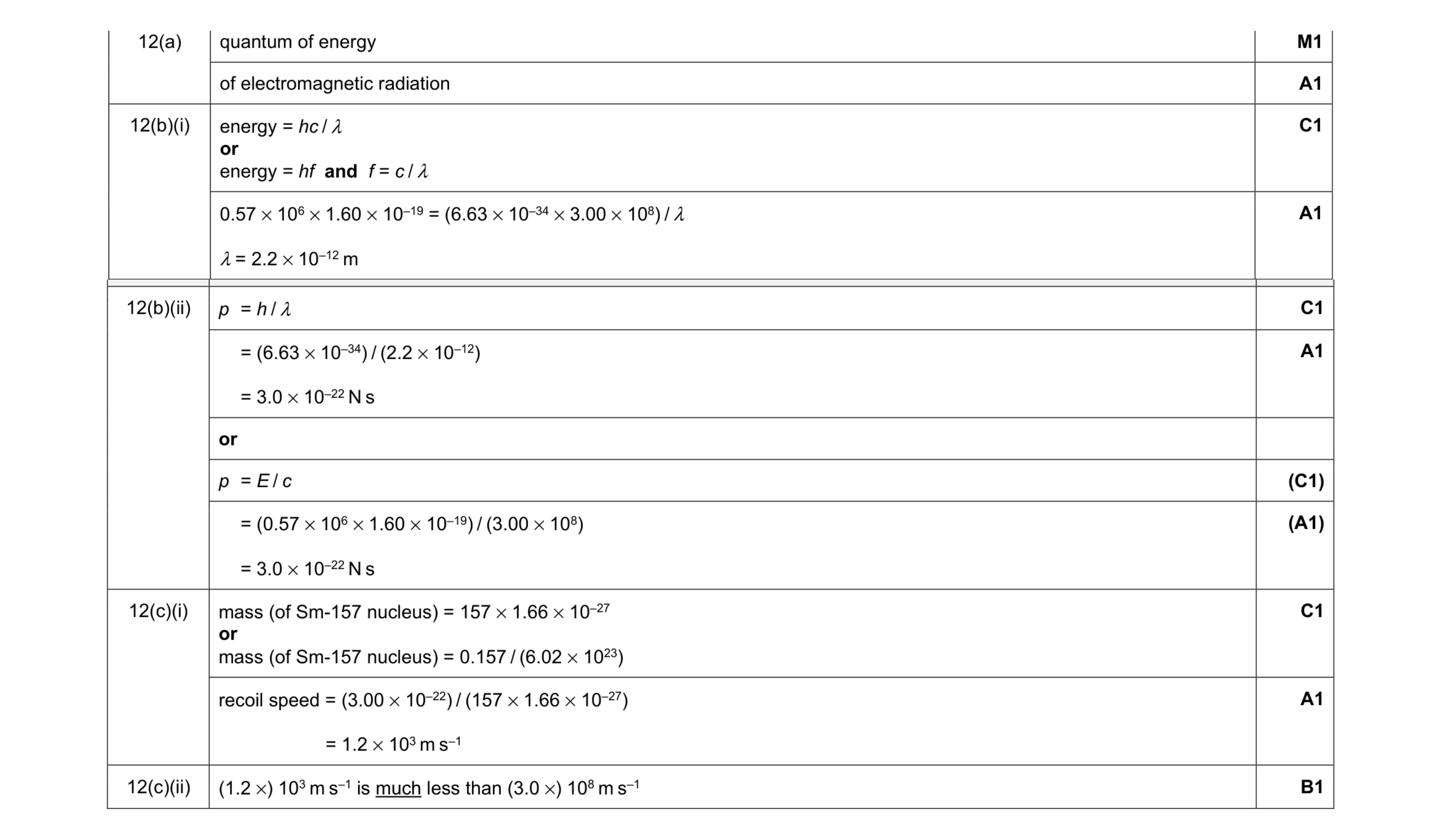 9
9