Cambridge A Level Physics 9702 — 2018 Feb/March Paper 1 · Variant 2
9702/12/F/M/18 · 40 questions · 40 marks · ≈45 min
The question paper and its mark scheme, free to read here and free to download. This is Cambridge’s own paper, exactly as it was sat.
Question paper20 pages
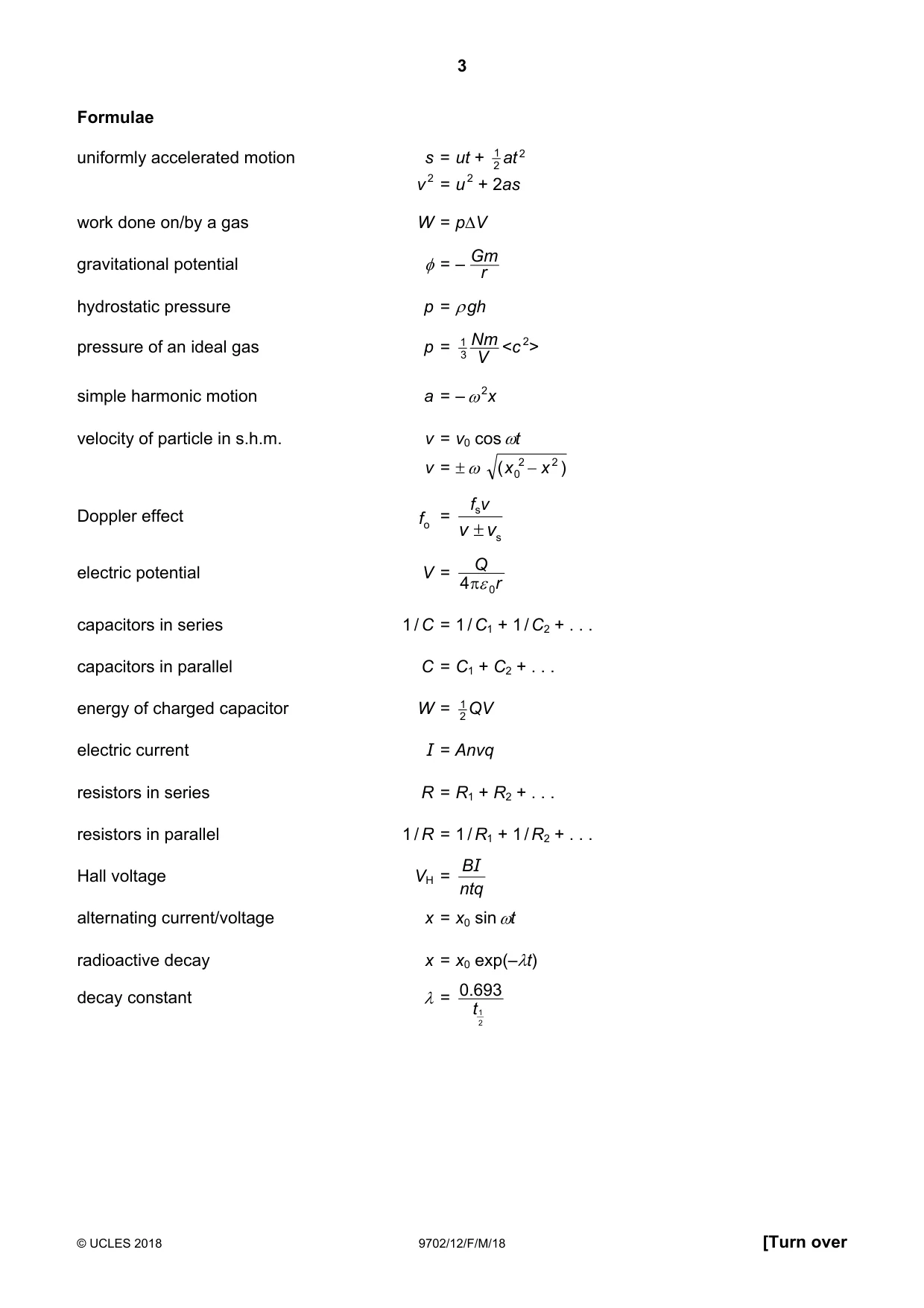
Mark scheme3 pages
Answers below. Sit the paper first if you are practising.
Questions as text
Q1 · Which unit is equivalent to the coulomb?
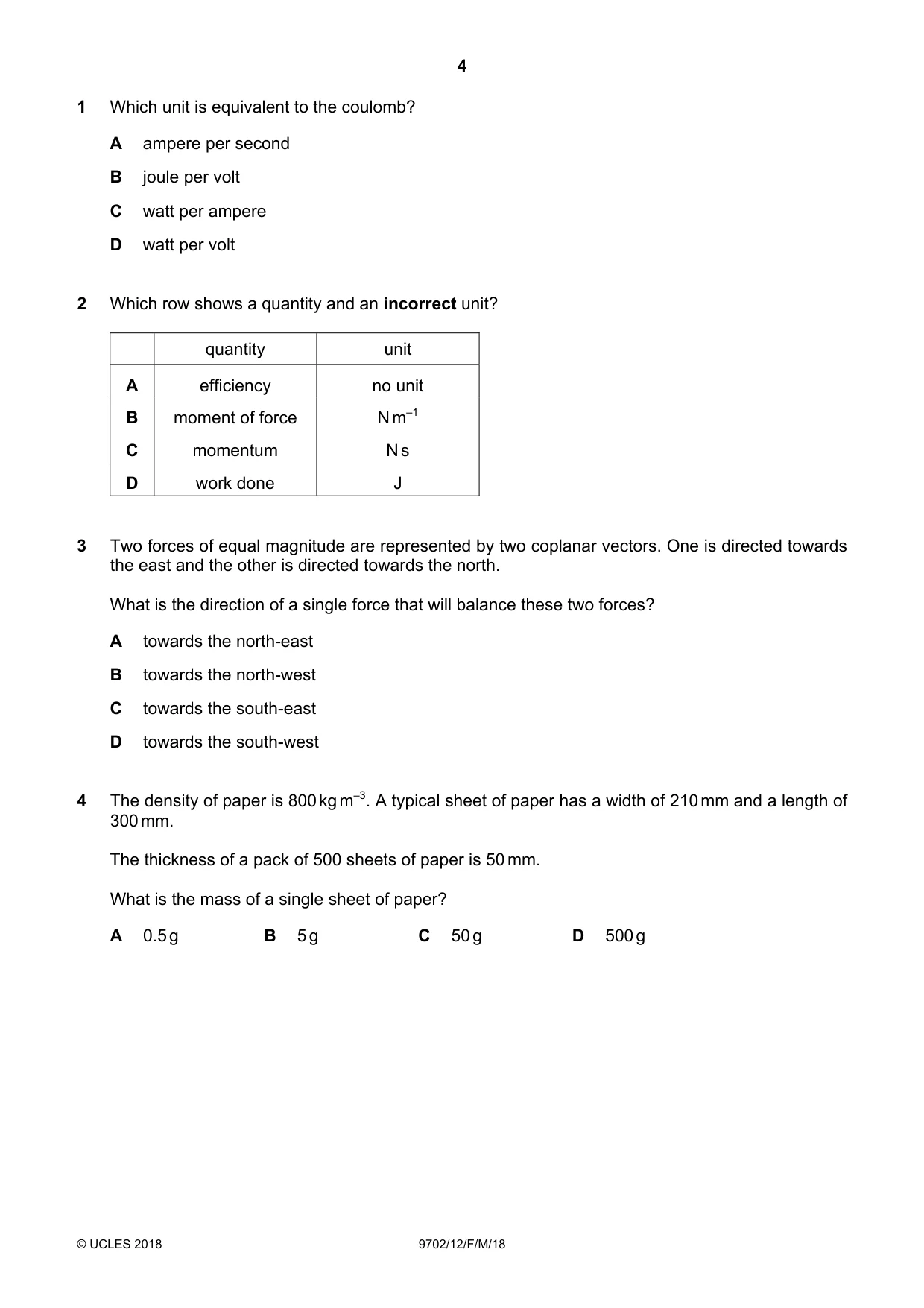
1 Which unit is equivalent to the coulomb? A ampere per second B joule per volt C watt per ampere D watt per volt
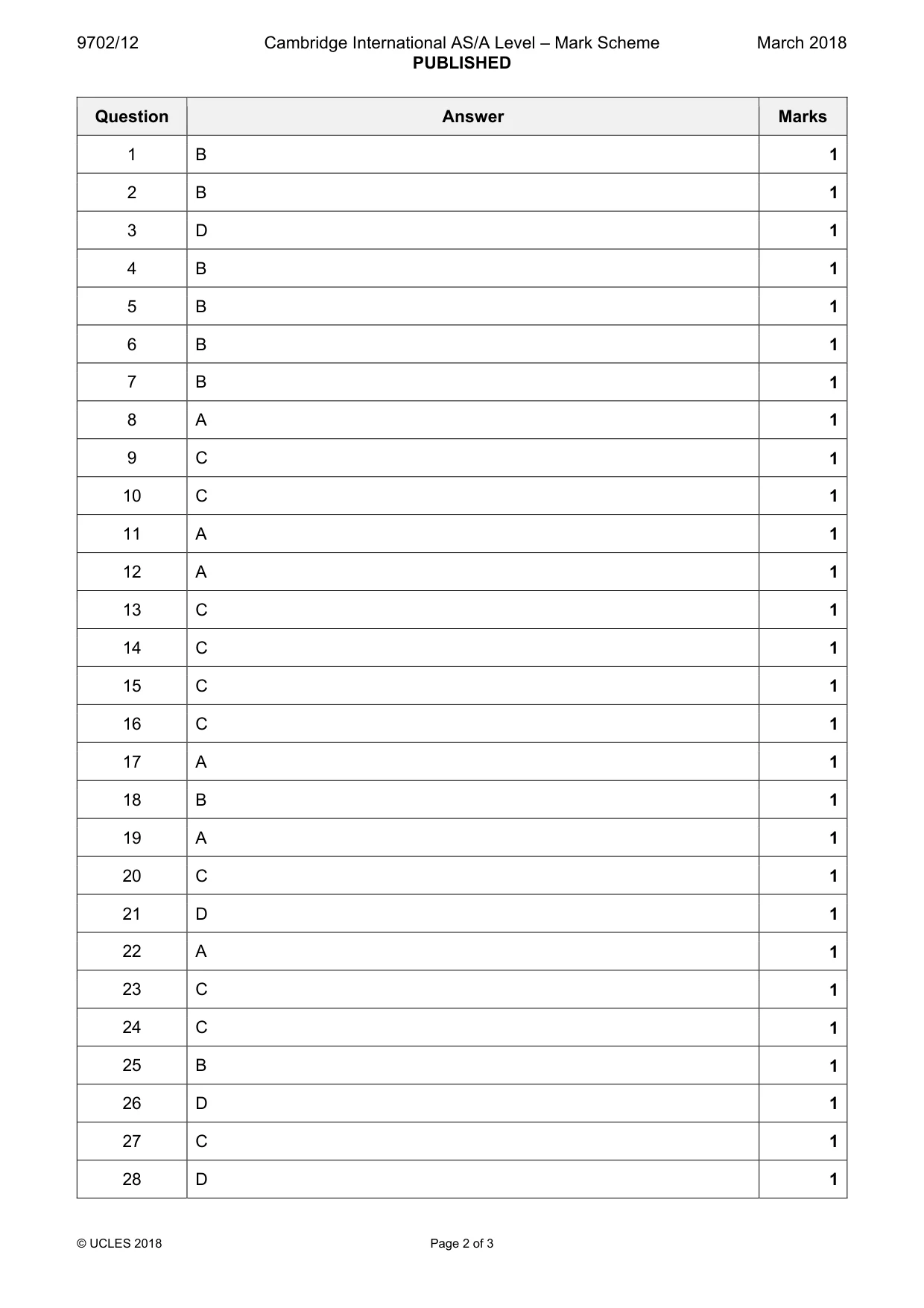
Mark scheme: B
Q2 · Which row shows a quantity and an incorrect unit?
2 Which row shows a quantity and an incorrect unit? quantity unit A efficiency no unit B moment of force N m–1 C momentum N s D work done J
Mark scheme: B
Q3 · Two forces of equal magnitude are represented by two coplanar vectors
3 Two forces of equal magnitude are represented by two coplanar vectors. One is directed towards the east and the other is directed towards the north. What is the direction of a single force that will balance these two forces? A towards the north-east B towards the north-west C towards the south-east D towards the south-west
Mark scheme: D
Q4 · The density of paper is 800 kg m–3
4 The density of paper is 800 kg m–3. A typical sheet of paper has a width of 210 mm and a length of 300 mm. The thickness of a pack of 500 sheets of paper is 50 mm. What is the mass of a single sheet of paper? A 0.5 g B 5 g C 50 g D 500 g
Mark scheme: B
Q5 · A person calculates the potential difference across a wire by using the measurements shown
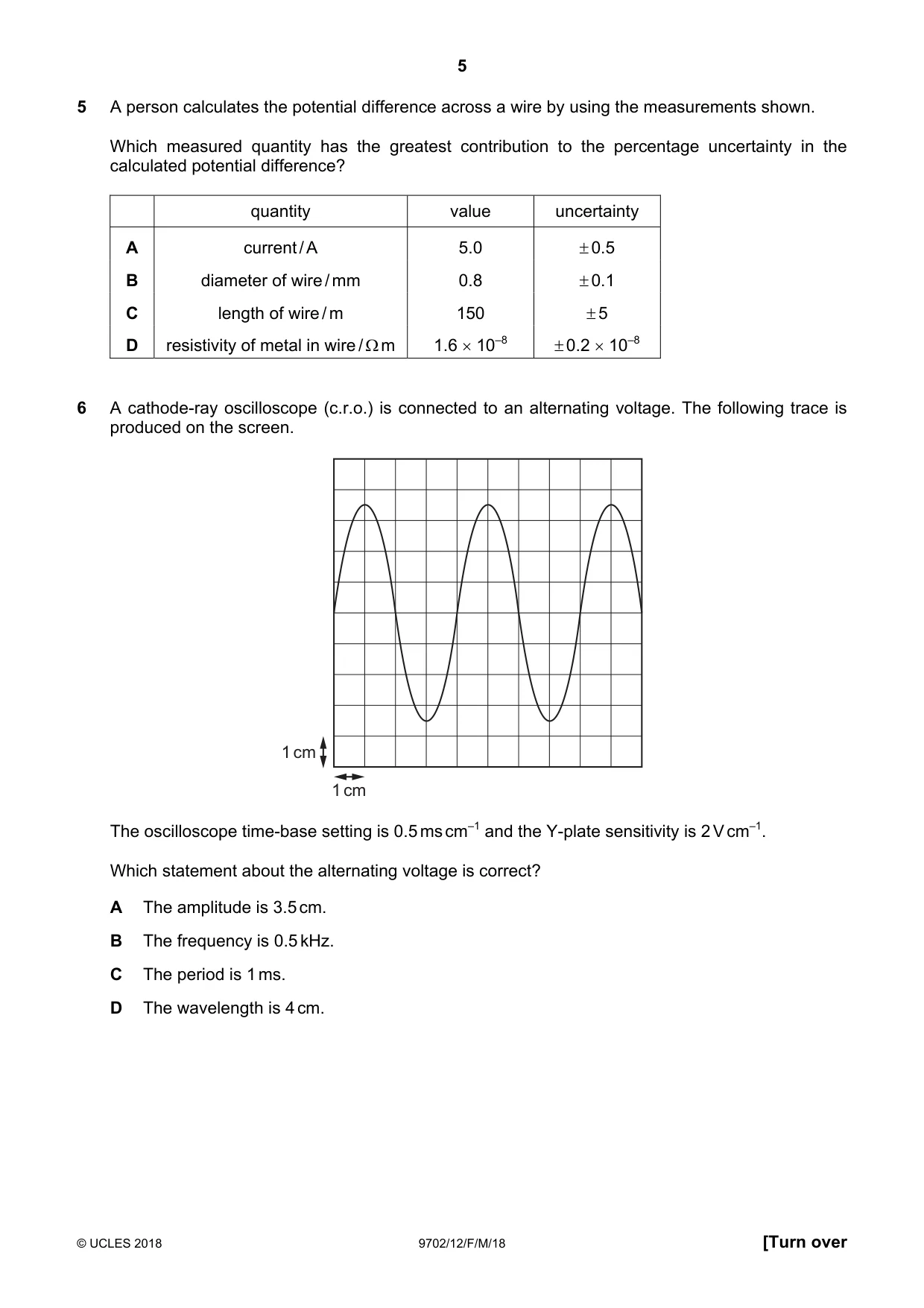
5 A person calculates the potential difference across a wire by using the measurements shown. Which measured quantity has the greatest contribution to the percentage uncertainty in the calculated potential difference? quantity value uncertainty A current / A 5.0 ± 0.5 B diameter of wire / mm 0.8 ± 0.1 C length of wire / m 150 ± 5 D resistivity of metal in wire / Ω m 1.6 × 10⁻⁸ ± 0.2 × 10⁻⁸
Mark scheme: B
Q6 · A cathode-ray oscilloscope (c.r.o.) is connected to an alternating voltage
6 A cathode-ray oscilloscope (c.r.o.) is connected to an alternating voltage. The following trace is produced on the screen. 1 cm 1 cm The oscilloscope time-base setting is 0.5 ms cm–1 and the Y-plate sensitivity is 2 V cm–1. Which statement about the alternating voltage is correct? A The amplitude is 3.5 cm. B The frequency is 0.5 kHz. C The period is 1 ms. D The wavelength is 4 cm.
Mark scheme: B
Q7 · A stone of mass m is dropped from a tall building
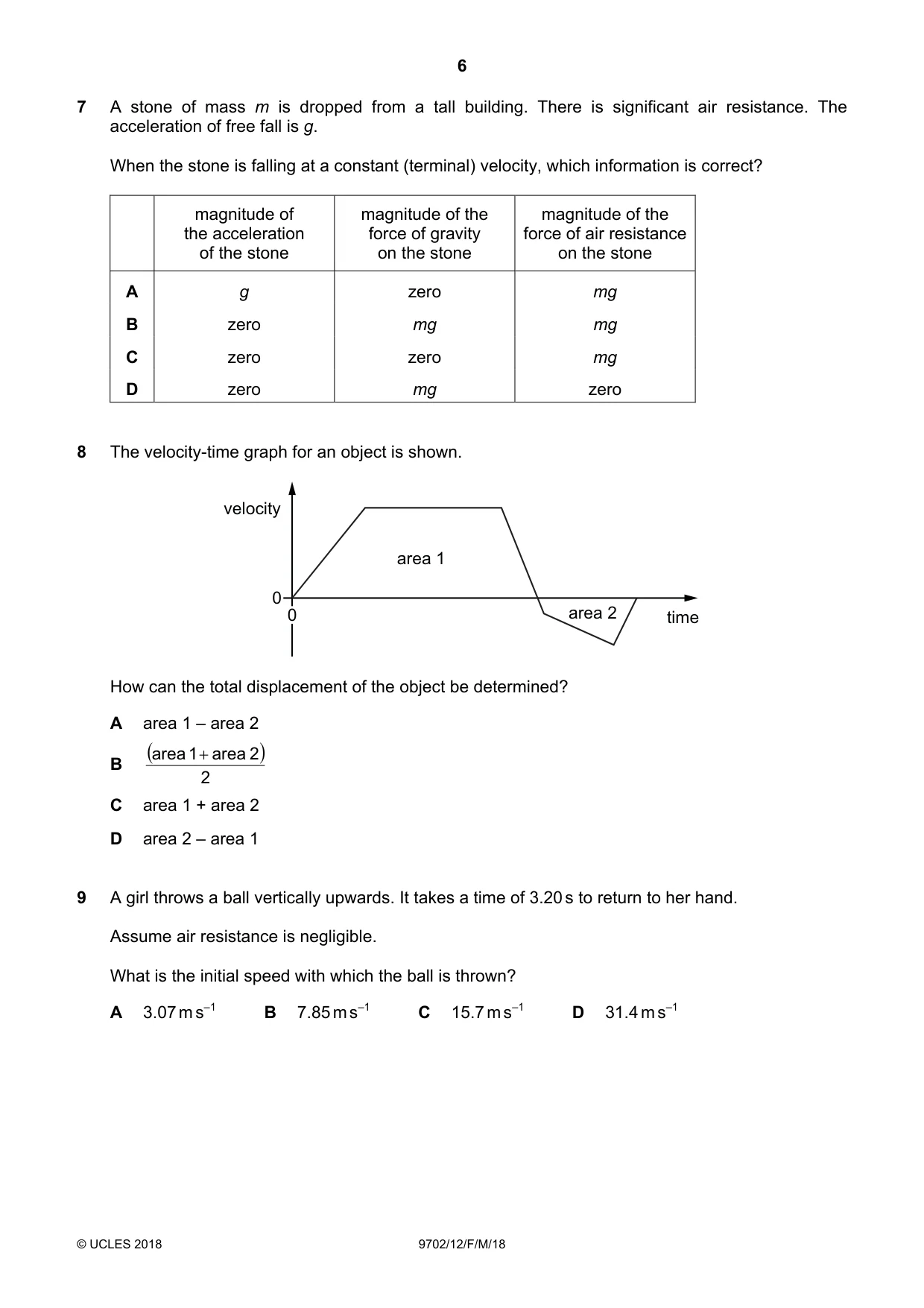
7 A stone of mass m is dropped from a tall building. There is significant air resistance. The acceleration of free fall is g. When the stone is falling at a constant (terminal) velocity, which information is correct? magnitude of magnitude of the magnitude of the the acceleration force of gravity force of air resistance of the stone on the stone on the stone A g zero mg B zero mg mg C zero zero mg D zero mg zero
Mark scheme: B
Q8 · The velocity-time graph for an object is shown
8 The velocity-time graph for an object is shown. velocity area 1 0 0 area 2 time How can the total displacement of the object be determined? A area 1 – area 2 ( area + ) 1 area 2 B 2 C area 1 + area 2 D area 2 – area 1
Mark scheme: A
Q9 · A girl throws a ball vertically upwards
9 A girl throws a ball vertically upwards. It takes a time of 3.20 s to return to her hand. Assume air resistance is negligible. What is the initial speed with which the ball is thrown? A 3.07 m s–1 B 7.85 m s–1 C 15.7 m s–1 D 31.4 m s–1
Mark scheme: C
Q10 · Steel pellets, each with a mass of 0.60 g, fall vertically onto a horizontal plate at a…
10 Steel pellets, each with a mass of 0.60 g, fall vertically onto a horizontal plate at a rate of 100 pellets per minute. They strike the plate with a velocity of 5.0 m s–1 and rebound with a velocity of 4.0 m s–1. What is the average force exerted on the plate by the pellets? A 0.0010 N B 0.0054 N C 0.0090 N D 0.54 N
Mark scheme: C
Q11 · The diagram shows four forces applied to a circular object
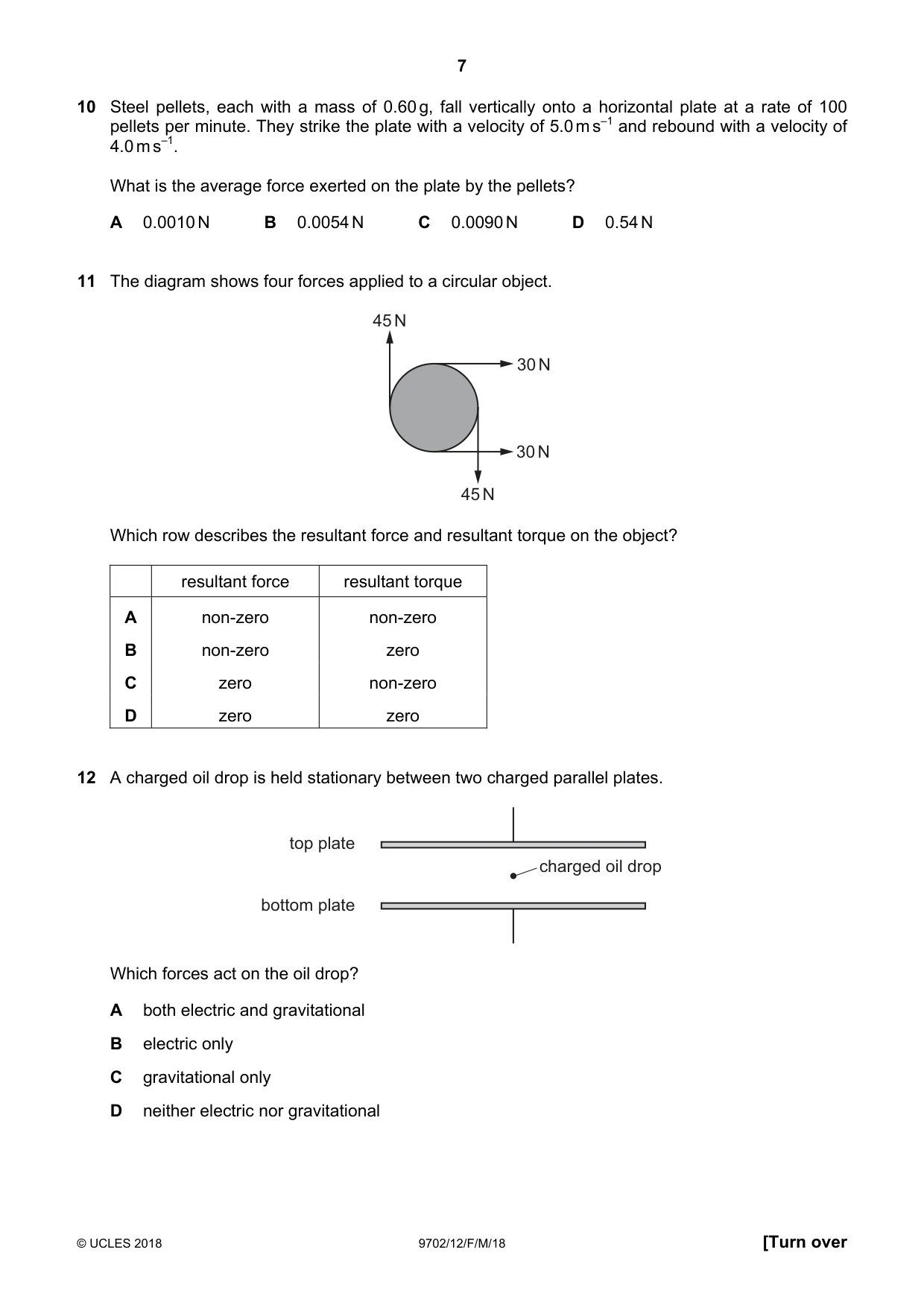
11 The diagram shows four forces applied to a circular object. 45 N 30 N 30 N 45 N Which row describes the resultant force and resultant torque on the object? resultant force resultant torque A non-zero non-zero B non-zero zero C zero non-zero D zero zero
Mark scheme: A
Q12 · A charged oil drop is held stationary between two charged parallel plates
12 A charged oil drop is held stationary between two charged parallel plates. top plate charged oil drop bottom plate Which forces act on the oil drop? A both electric and gravitational B electric only C gravitational only D neither electric nor gravitational
Mark scheme: A
Q13 · In which example is it not possible for the underlined body to be in equilibrium?
13 In which example is it not possible for the underlined body to be in equilibrium? A An aeroplane climbs at a steady rate. B An aeroplane tows a glider at a constant altitude. C A speedboat changes direction at a constant speed. D Two boats tow a ship into harbour.
Mark scheme: C
Q14 · A car of mass 1100 kg is travelling at a constant speed of 15 m s–1 up a slope inclined…
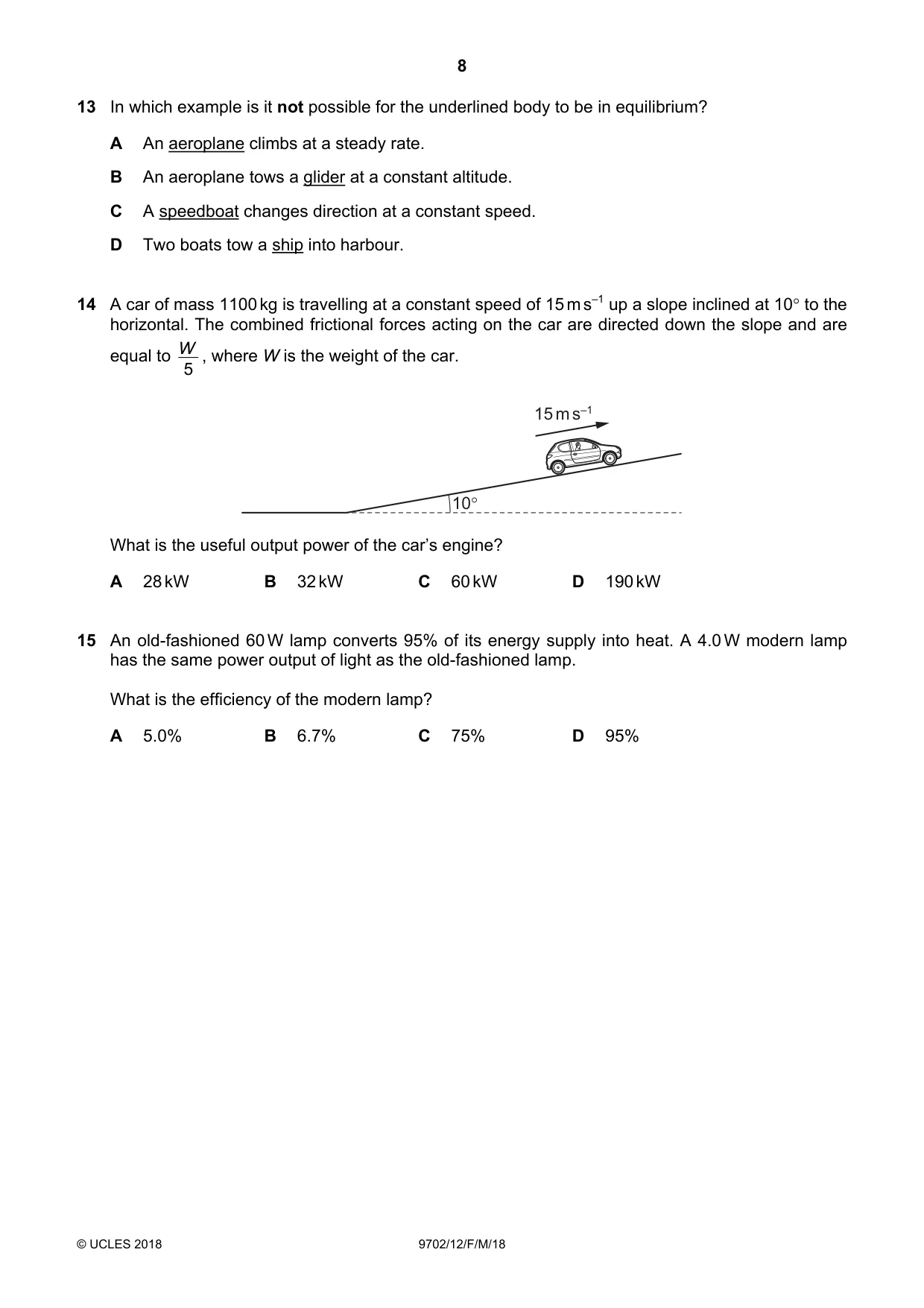
14 A car of mass 1100 kg is travelling at a constant speed of 15 m s–1 up a slope inclined at 10° to the horizontal. The combined frictional forces acting on the car are directed down the slope and are W , where W is the weight of the car. equal to 5 15 m s–1 10° What is the useful output power of the car’s engine? A 28 kW B 32 kW C 60 kW D 190 kW
Mark scheme: C
Q15 · An old-fashioned 60 W lamp converts 95% of its energy supply into heat
15 An old-fashioned 60 W lamp converts 95% of its energy supply into heat. A 4.0 W modern lamp has the same power output of light as the old-fashioned lamp. What is the efficiency of the modern lamp? A 5.0% B 6.7% C 75% D 95%
Mark scheme: C
Q16 · A bead is released from rest at point P and slides along a wire, as shown
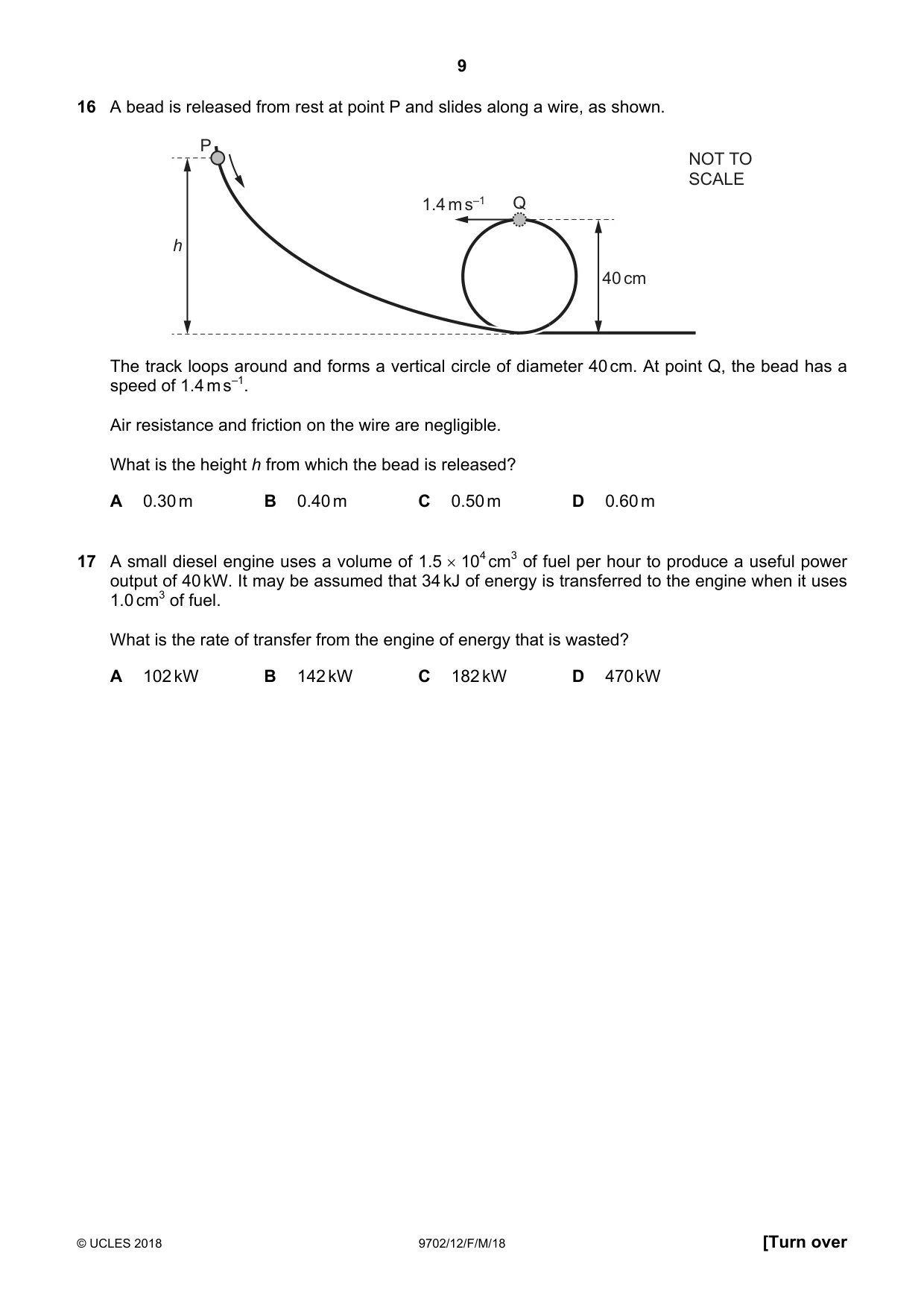
16 A bead is released from rest at point P and slides along a wire, as shown. P NOT TO SCALE 1.4 m s–1 Q h 40 cm The track loops around and forms a vertical circle of diameter 40 cm. At point Q, the bead has a speed of 1.4 m s–1. Air resistance and friction on the wire are negligible. What is the height h from which the bead is released? A 0.30 m B 0.40 m C 0.50 m D 0.60 m
Mark scheme: C
More questions on Gravitational potential energy and kinetic energy
Q17 · A small diesel engine uses a volume of 1.5 × 104 cm3 of fuel per hour to produce a useful…
17 A small diesel engine uses a volume of 1.5 × 104 cm3 of fuel per hour to produce a useful power output of 40 kW. It may be assumed that 34 kJ of energy is transferred to the engine when it uses 1.0 cm3 of fuel. What is the rate of transfer from the engine of energy that is wasted? A 102 kW B 142 kW C 182 kW D 470 kW
Mark scheme: A
Q18 · Two boxes X and Y have the same mass
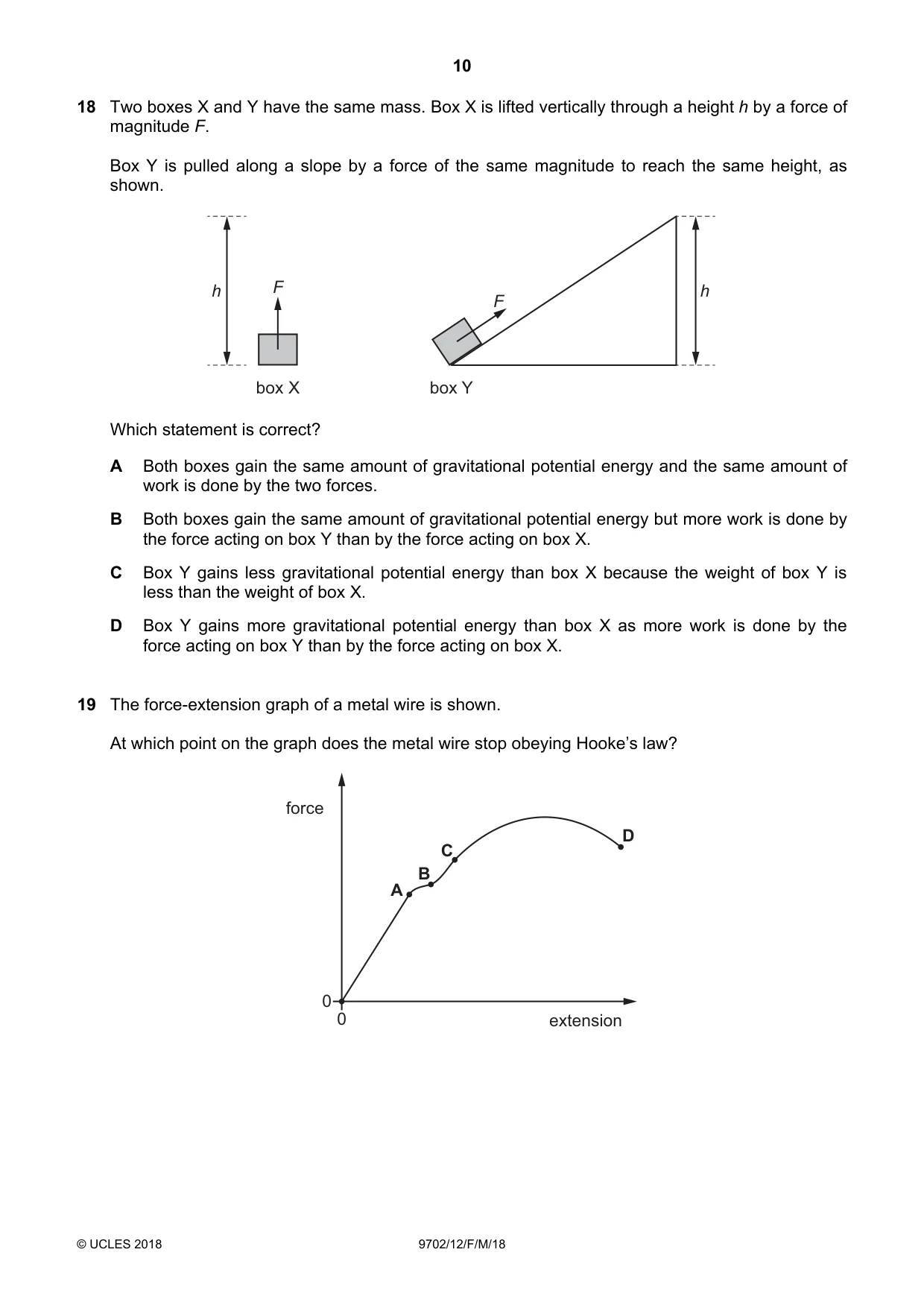
18 Two boxes X and Y have the same mass. Box X is lifted vertically through a height h by a force of magnitude F. Box Y is pulled along a slope by a force of the same magnitude to reach the same height, as shown. h F h F box X box Y Which statement is correct? A Both boxes gain the same amount of gravitational potential energy and the same amount of work is done by the two forces. B Both boxes gain the same amount of gravitational potential energy but more work is done by the force acting on box Y than by the force acting on box X. C Box Y gains less gravitational potential energy than box X because the weight of box Y is less than the weight of box X. D Box Y gains more gravitational potential energy than box X as more work is done by the force acting on box Y than by the force acting on box X.
Mark scheme: B
More questions on Gravitational potential energy and kinetic energy
Q19 · The force-extension graph of a metal wire is shown
19 The force-extension graph of a metal wire is shown. At which point on the graph does the metal wire stop obeying Hooke’s law? force D C B A 0 0 extension
Mark scheme: A
Q20 · The diagram shows a large crane on a construction site lifting a cube-shaped load at a…
20 The diagram shows a large crane on a construction site lifting a cube-shaped load at a constant speed. cable crane load A model is made of the crane, its load and the cable supporting the load. The material used for each part of the model is the same as that in the full-size crane, cable and load. The model is one tenth full-size in all linear dimensions. stress in the cable on the full - size crane What is the ratio ? stress in the cable on the model crane A 0.1 B 1 C 10 D 100
Mark scheme: C
Q21 · A wave pulse moves along a stretched rope in the direction shown
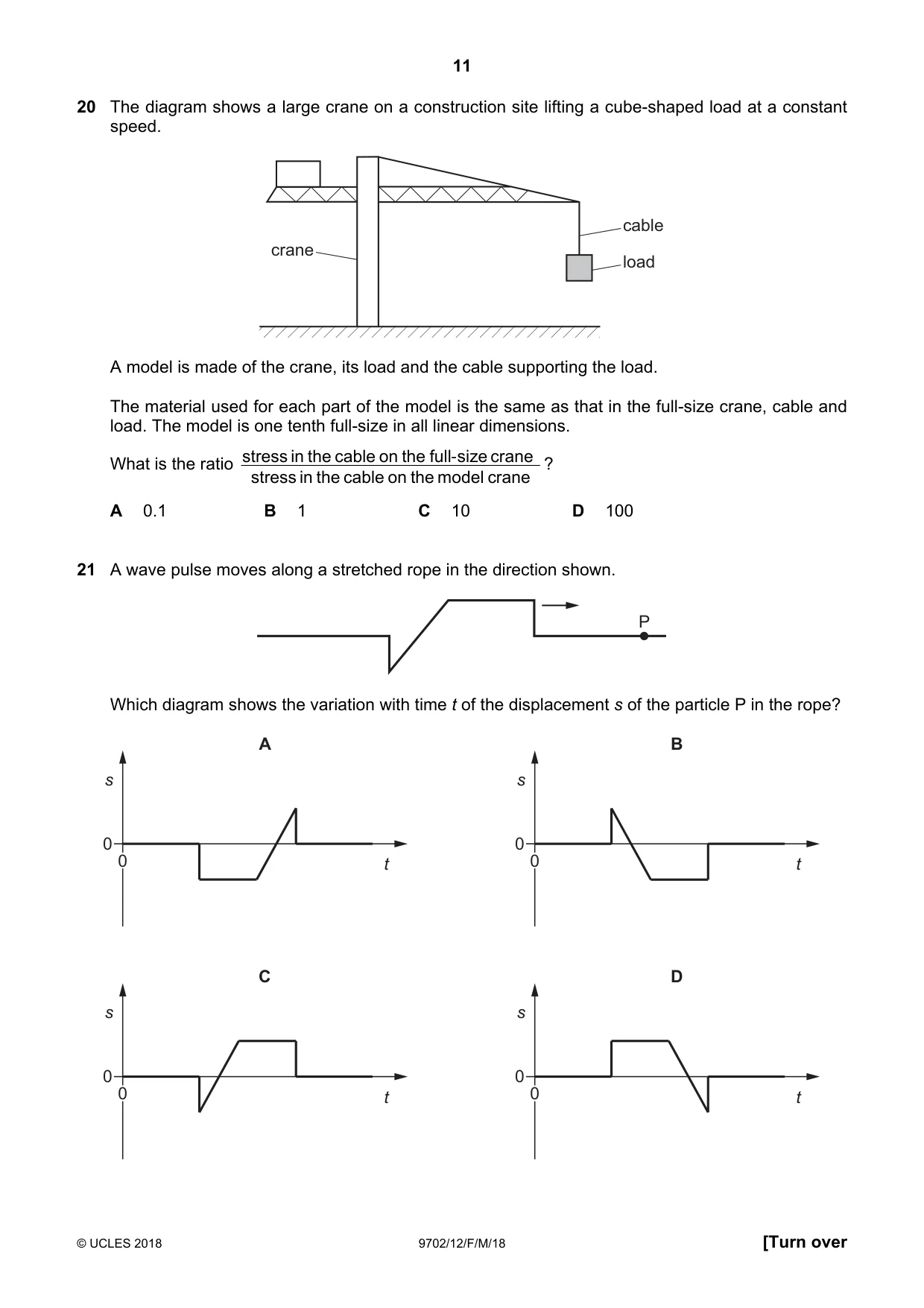
21 A wave pulse moves along a stretched rope in the direction shown. P Which diagram shows the variation with time t of the displacement s of the particle P in the rope? A B s s 0 0 0 t 0 t C D s s 0 0 0 t 0 t
Mark scheme: D
Q22 · A wave has period T, wavelength λ and amplitude A
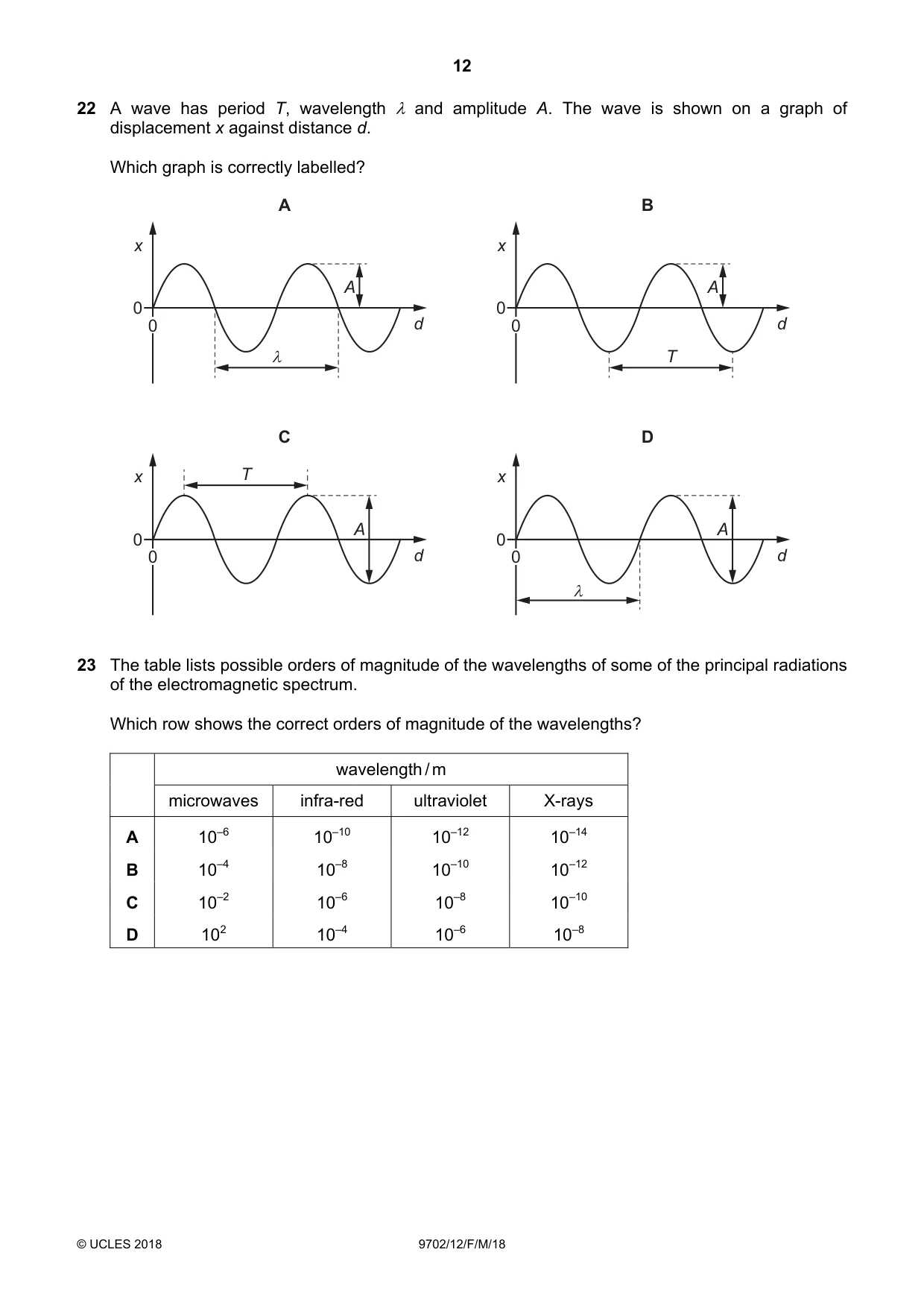
22 A wave has period T, wavelength λ and amplitude A. The wave is shown on a graph of displacement x against distance d. Which graph is correctly labelled? A B x x A A 0 0 0 d 0 d λ T C D x T x A A 0 0 0 d 0 d λ
Mark scheme: A
Q23 · The table lists possible orders of magnitude of the wavelengths of some of the principal…
23 The table lists possible orders of magnitude of the wavelengths of some of the principal radiations of the electromagnetic spectrum. Which row shows the correct orders of magnitude of the wavelengths? wavelength / m microwaves infra-red ultraviolet X-rays A 10–6 10–10 10–12 10–14 B 10–4 10–8 10–10 10–12 C 10–2 10–6 10–8 10–10 D 102 10–4 10–6 10–8
Mark scheme: C
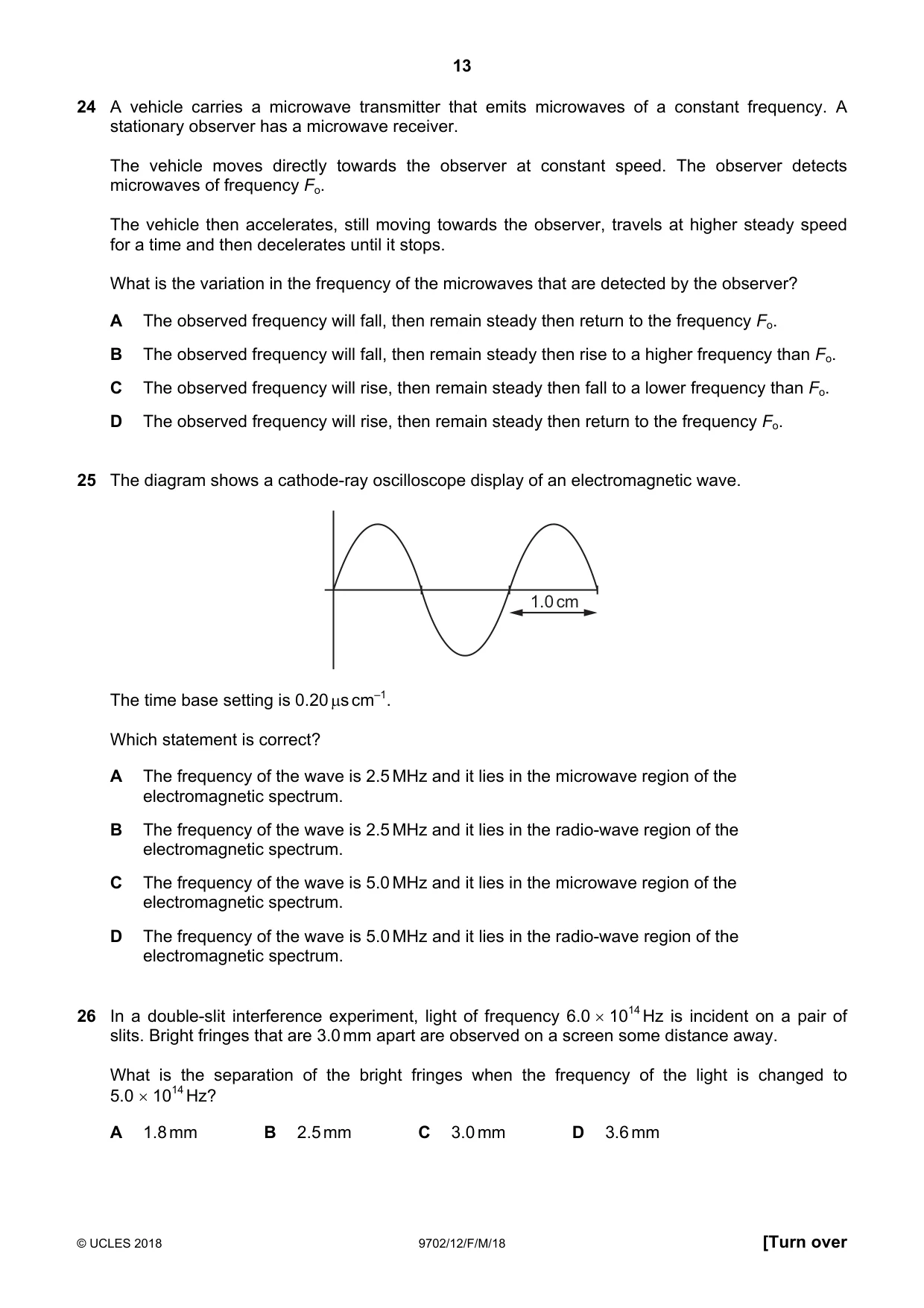
Q24 · A vehicle carries a microwave transmitter that emits microwaves of a constant frequency
24 A vehicle carries a microwave transmitter that emits microwaves of a constant frequency. A stationary observer has a microwave receiver. The vehicle moves directly towards the observer at constant speed. The observer detects microwaves of frequency Fo. The vehicle then accelerates, still moving towards the observer, travels at higher steady speed for a time and then decelerates until it stops. What is the variation in the frequency of the microwaves that are detected by the observer? A The observed frequency will fall, then remain steady then return to the frequency Fo. B The observed frequency will fall, then remain steady then rise to a higher frequency than Fo. C The observed frequency will rise, then remain steady then fall to a lower frequency than Fo. D The observed frequency will rise, then remain steady then return to the frequency Fo.
Mark scheme: C
Q25 · The diagram shows a cathode-ray oscilloscope display of an electromagnetic wave
25 The diagram shows a cathode-ray oscilloscope display of an electromagnetic wave. 1.0 cm The time base setting is 0.20 µs cm–1. Which statement is correct? A The frequency of the wave is 2.5 MHz and it lies in the microwave region of the electromagnetic spectrum. B The frequency of the wave is 2.5 MHz and it lies in the radio-wave region of the electromagnetic spectrum. C The frequency of the wave is 5.0 MHz and it lies in the microwave region of the electromagnetic spectrum. D The frequency of the wave is 5.0 MHz and it lies in the radio-wave region of the electromagnetic spectrum.
Mark scheme: B
Q26 · In a double-slit interference experiment, light of frequency 6.0 × 10¹⁴ Hz is incident on…
26 In a double-slit interference experiment, light of frequency 6.0 × 10¹⁴ Hz is incident on a pair of slits. Bright fringes that are 3.0 mm apart are observed on a screen some distance away. What is the separation of the bright fringes when the frequency of the light is changed to 5.0 × 10¹⁴ Hz? A 1.8 mm B 2.5 mm C 3.0 mm D 3.6 mm
Mark scheme: D
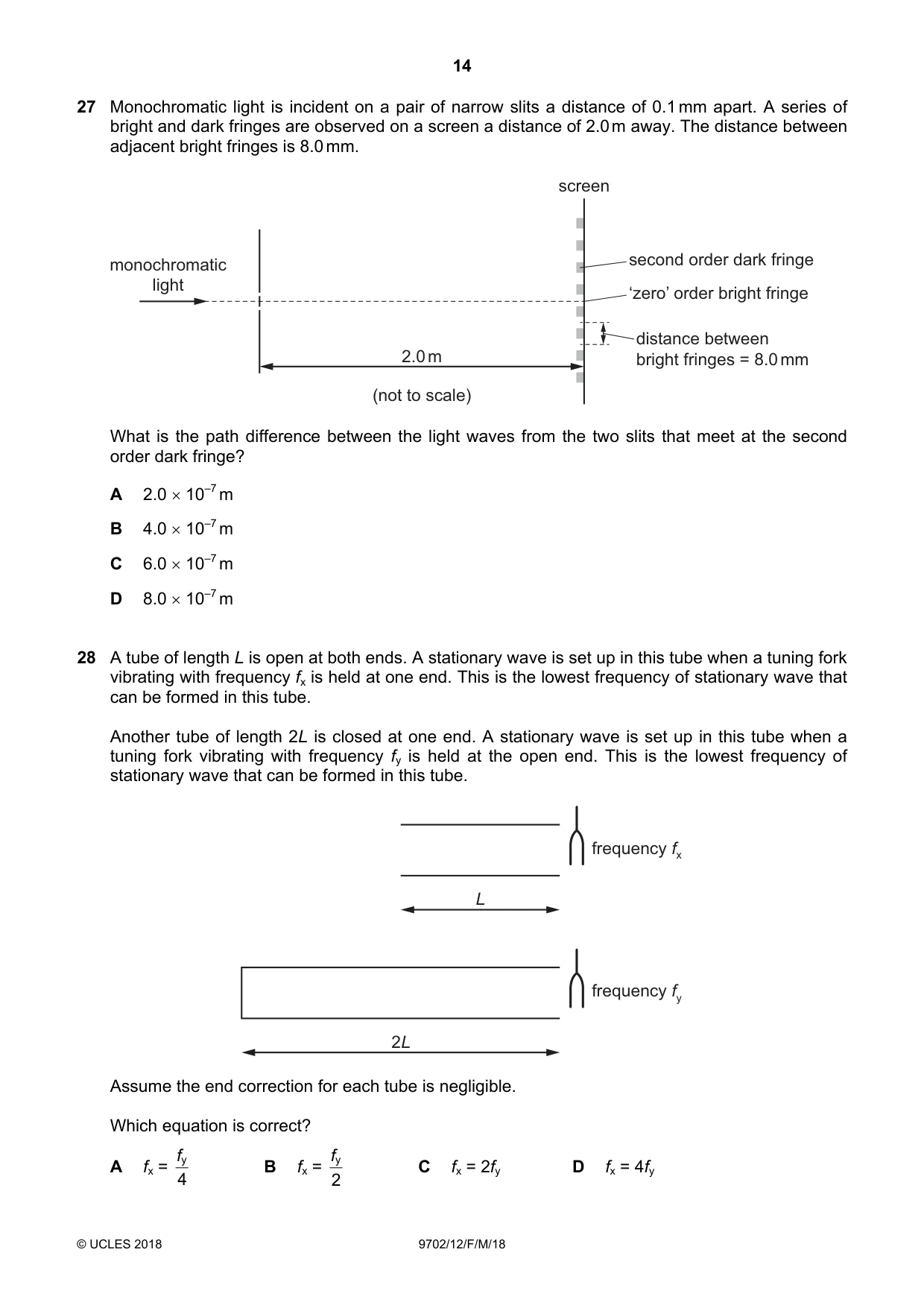
Q27 · Monochromatic light is incident on a pair of narrow slits a distance of 0.1 mm apart
27 Monochromatic light is incident on a pair of narrow slits a distance of 0.1 mm apart. A series of bright and dark fringes are observed on a screen a distance of 2.0 m away. The distance between adjacent bright fringes is 8.0 mm. screen monochromatic second order dark fringe light ‘zero’ order bright fringe distance between 2.0 m bright fringes = 8.0 mm (not to scale) What is the path difference between the light waves from the two slits that meet at the second order dark fringe? A 2.0 × 10⁻⁷ m B 4.0 × 10⁻⁷ m C 6.0 × 10⁻⁷ m D 8.0 × 10⁻⁷ m
Mark scheme: C
Q28 · A tube of length L is open at both ends
28 A tube of length L is open at both ends. A stationary wave is set up in this tube when a tuning fork vibrating with frequency fx is held at one end. This is the lowest frequency of stationary wave that can be formed in this tube. Another tube of length 2L is closed at one end. A stationary wave is set up in this tube when a tuning fork vibrating with frequency fy is held at the open end. This is the lowest frequency of stationary wave that can be formed in this tube. frequency fx L frequency fy 2L Assume the end correction for each tube is negligible. Which equation is correct? yf yf A fx = 4 B fx = 2 C fx = 2fy D fx = 4fy
Mark scheme: D
Q29 · Which statement gives a condition that enables diffraction to occur?
29 Which statement gives a condition that enables diffraction to occur? A A source of waves moves towards a stationary observer. B A wave is partially blocked by an obstacle. C Two coherent waves are superposed. D Two waves of equal speed and frequency are travelling through the same part of a medium in opposite directions.
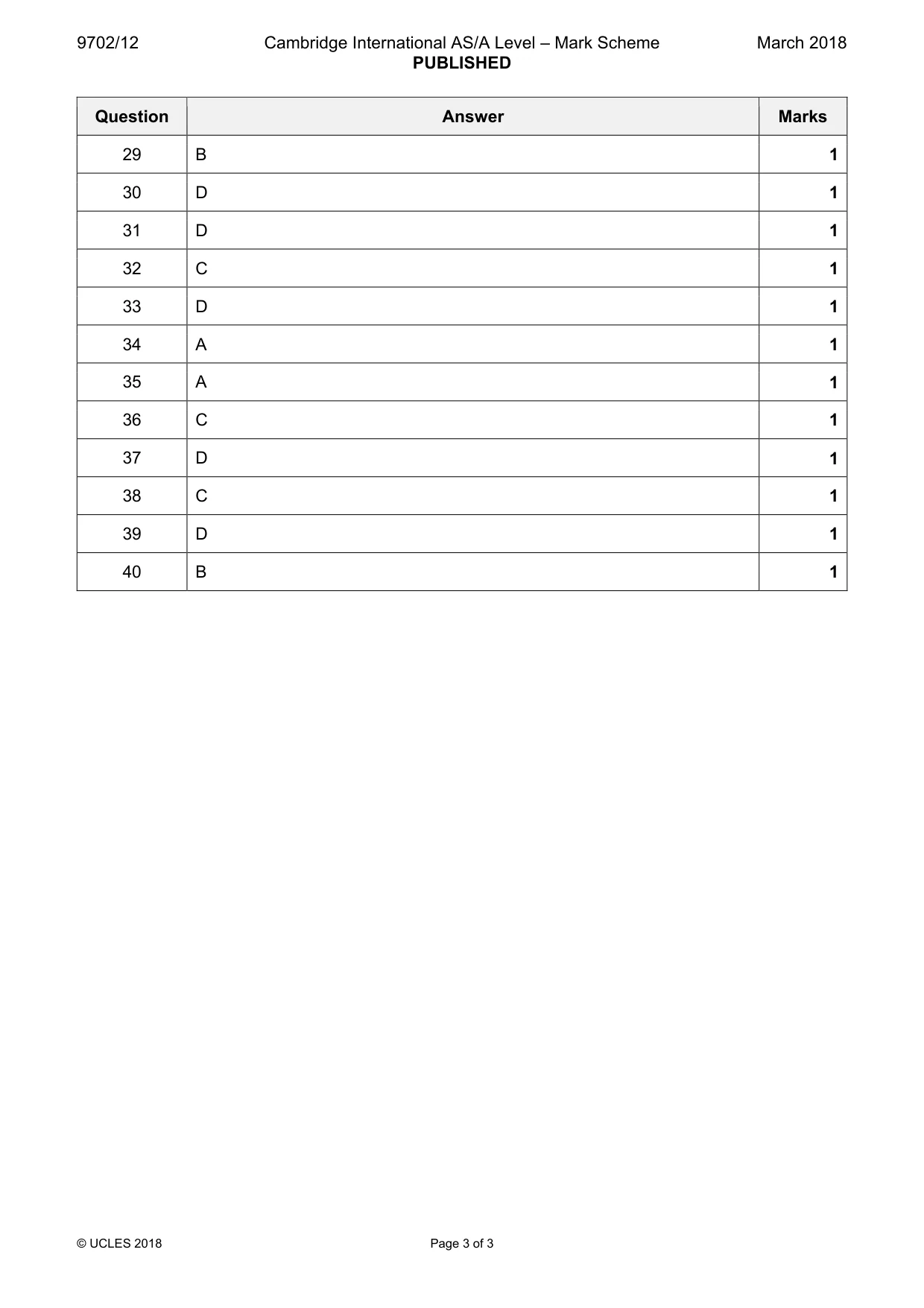
Mark scheme: B
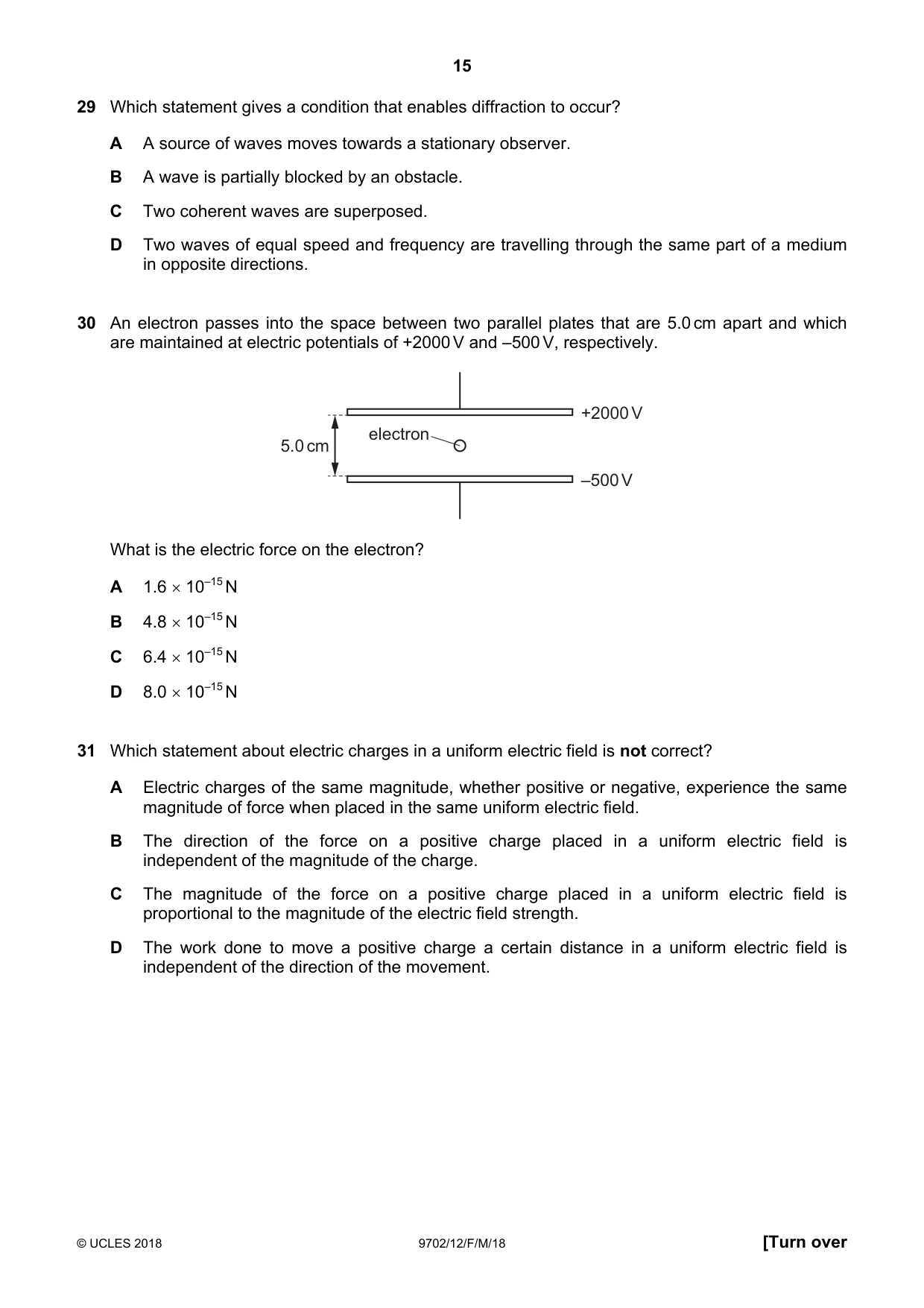
Q30 · An electron passes into the space between two parallel plates that are 5.0 cm apart and…
30 An electron passes into the space between two parallel plates that are 5.0 cm apart and which are maintained at electric potentials of +2000 V and –500 V, respectively. +2000 V electron 5.0 cm –500 V What is the electric force on the electron? A 1.6 × 10⁻¹⁵ N B 4.8 × 10⁻¹⁵ N C 6.4 × 10⁻¹⁵ N D 8.0 × 10⁻¹⁵ N
Mark scheme: D
Q31 · Which statement about electric charges in a uniform electric field is not correct?
31 Which statement about electric charges in a uniform electric field is not correct? A Electric charges of the same magnitude, whether positive or negative, experience the same magnitude of force when placed in the same uniform electric field. B The direction of the force on a positive charge placed in a uniform electric field is independent of the magnitude of the charge. C The magnitude of the force on a positive charge placed in a uniform electric field is proportional to the magnitude of the electric field strength. D The work done to move a positive charge a certain distance in a uniform electric field is independent of the direction of the movement.
Mark scheme: D
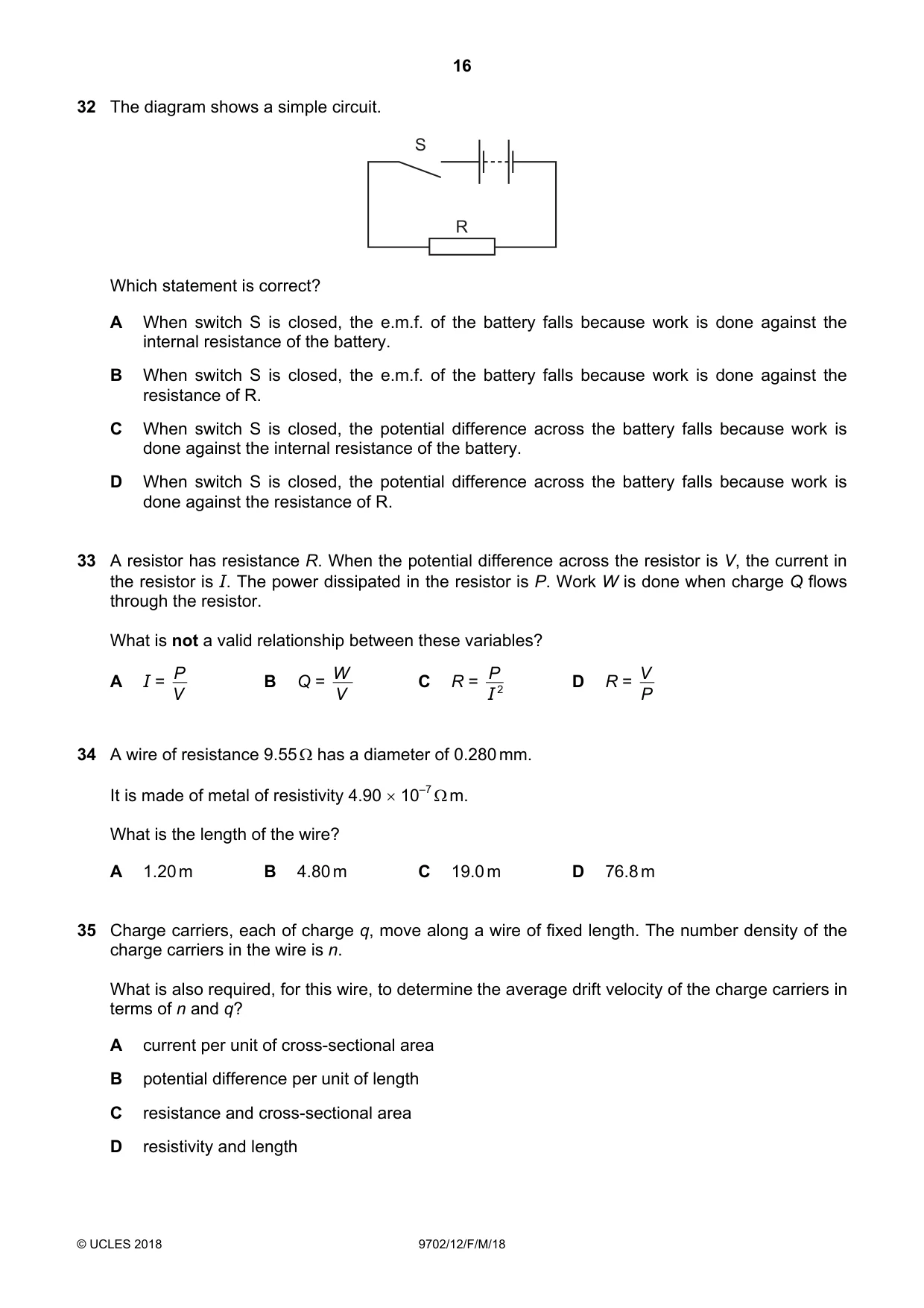
Q32 · The diagram shows a simple circuit
32 The diagram shows a simple circuit. S R Which statement is correct? A When switch S is closed, the e.m.f. of the battery falls because work is done against the internal resistance of the battery. B When switch S is closed, the e.m.f. of the battery falls because work is done against the resistance of R. C When switch S is closed, the potential difference across the battery falls because work is done against the internal resistance of the battery. D When switch S is closed, the potential difference across the battery falls because work is done against the resistance of R.
Mark scheme: C
Q33 · A resistor has resistance R
33 A resistor has resistance R. When the potential difference across the resistor is V, the current in the resistor is I. The power dissipated in the resistor is P. Work W is done when charge Q flows through the resistor. What is not a valid relationship between these variables? I = V P W P V A B Q = V C R = D R = P I 2
Mark scheme: D
Q34 · A wire of resistance 9.55 Ω has a diameter of 0.280 mm
34 A wire of resistance 9.55 Ω has a diameter of 0.280 mm. It is made of metal of resistivity 4.90 × 10⁻⁷ Ω m. What is the length of the wire? A 1.20 m B 4.80 m C 19.0 m D 76.8 m
Mark scheme: A
Q35 · Charge carriers, each of charge q, move along a wire of fixed length
35 Charge carriers, each of charge q, move along a wire of fixed length. The number density of the charge carriers in the wire is n. What is also required, for this wire, to determine the average drift velocity of the charge carriers in terms of n and q? A current per unit of cross-sectional area B potential difference per unit of length C resistance and cross-sectional area D resistivity and length
Mark scheme: A
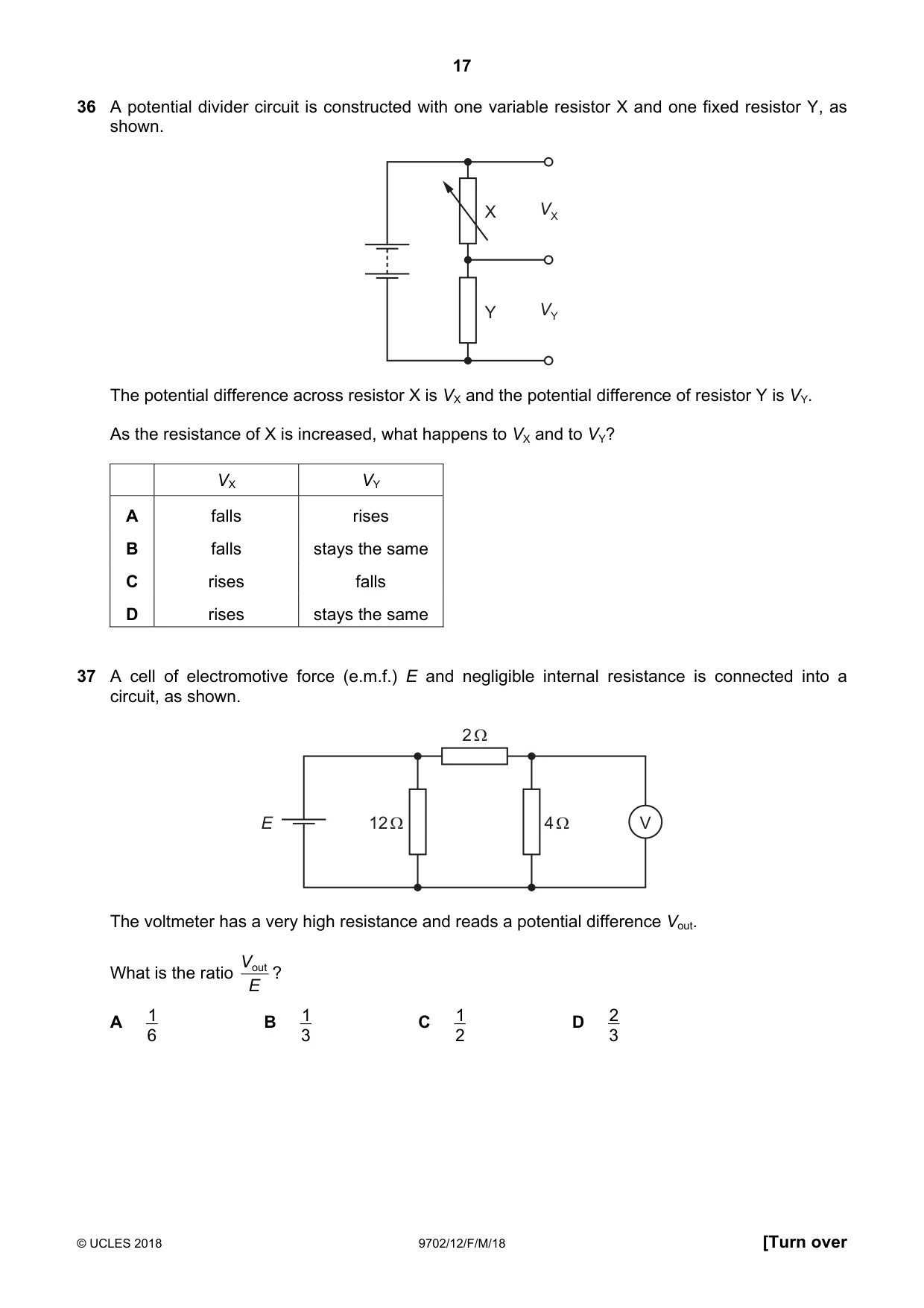
Q36 · A potential divider circuit is constructed with one variable resistor X and one fixed…
36 A potential divider circuit is constructed with one variable resistor X and one fixed resistor Y, as shown. X VX Y VY The potential difference across resistor X is VX and the potential difference of resistor Y is VY. As the resistance of X is increased, what happens to VX and to VY? VX VY A falls rises B falls stays the same C rises falls D rises stays the same
Mark scheme: C
Q37 · A cell of electromotive force (e.m.f.) E and negligible internal resistance is connected…
37 A cell of electromotive force (e.m.f.) E and negligible internal resistance is connected into a circuit, as shown. 2 Ω E 12 Ω 4 Ω V The voltmeter has a very high resistance and reads a potential difference Vout. Vout ? What is the ratio E A 1 B 1 C 1 D 2 6 3 2 3
Mark scheme: D
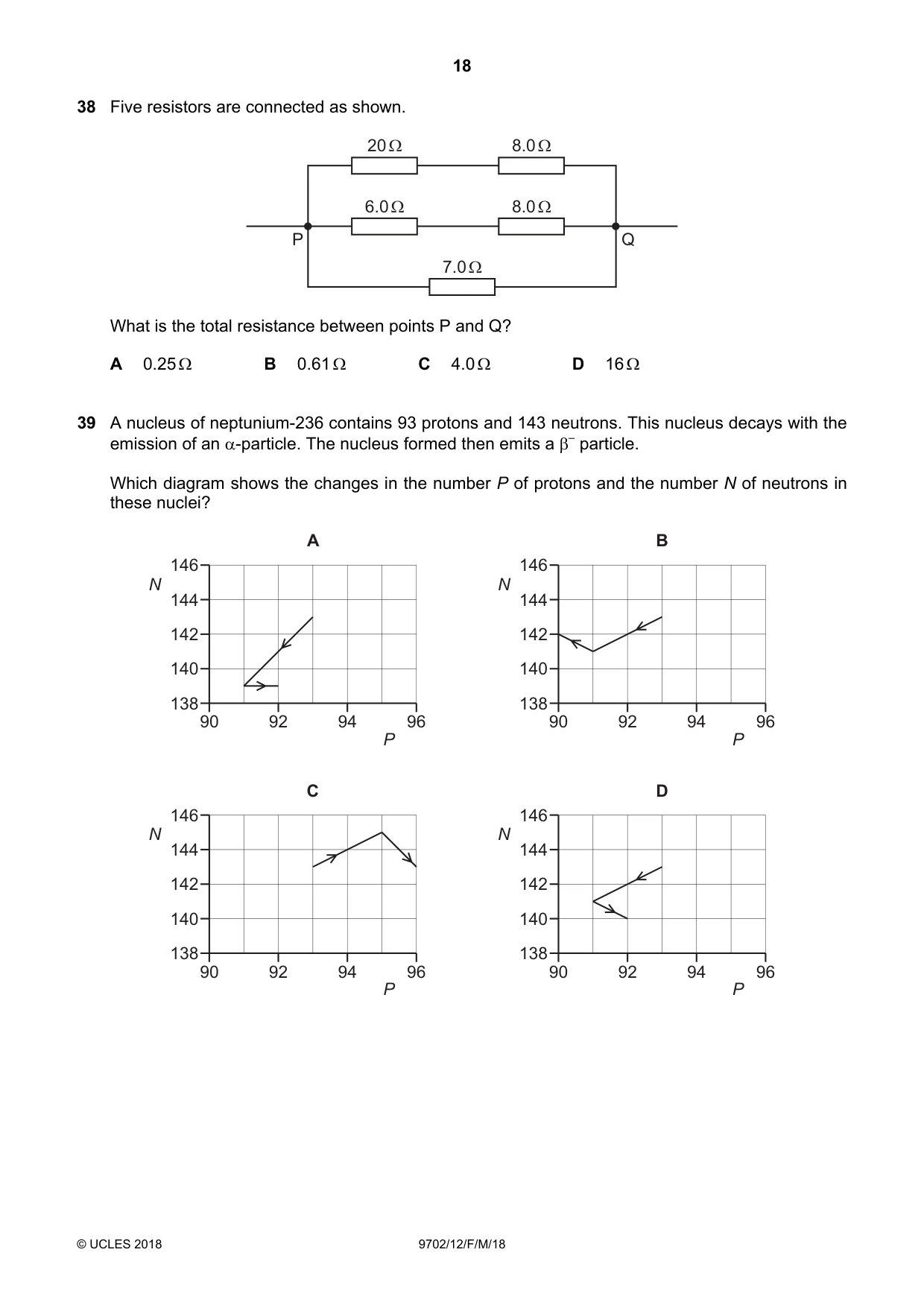
Q38 · Five resistors are connected as shown
38 Five resistors are connected as shown. 20 Ω 8.0 Ω 6.0 Ω 8.0 Ω P Q 7.0 Ω What is the total resistance between points P and Q? A 0.25 Ω B 0.61 Ω C 4.0 Ω D 16 Ω
Mark scheme: C
Q39 · A nucleus of neptunium-236 contains 93 protons and 143 neutrons
39 A nucleus of neptunium-236 contains 93 protons and 143 neutrons. This nucleus decays with the emission of an α-particle. The nucleus formed then emits a β– particle. Which diagram shows the changes in the number P of protons and the number N of neutrons in these nuclei? A B 146 146 N N 144 144 142 142 140 140 138 138 90 92 94 96 90 92 94 96 P P C D 146 146 N N 144 144 142 142 140 140 138 138 90 92 94 96 90 92 94 96 P P
Mark scheme: D
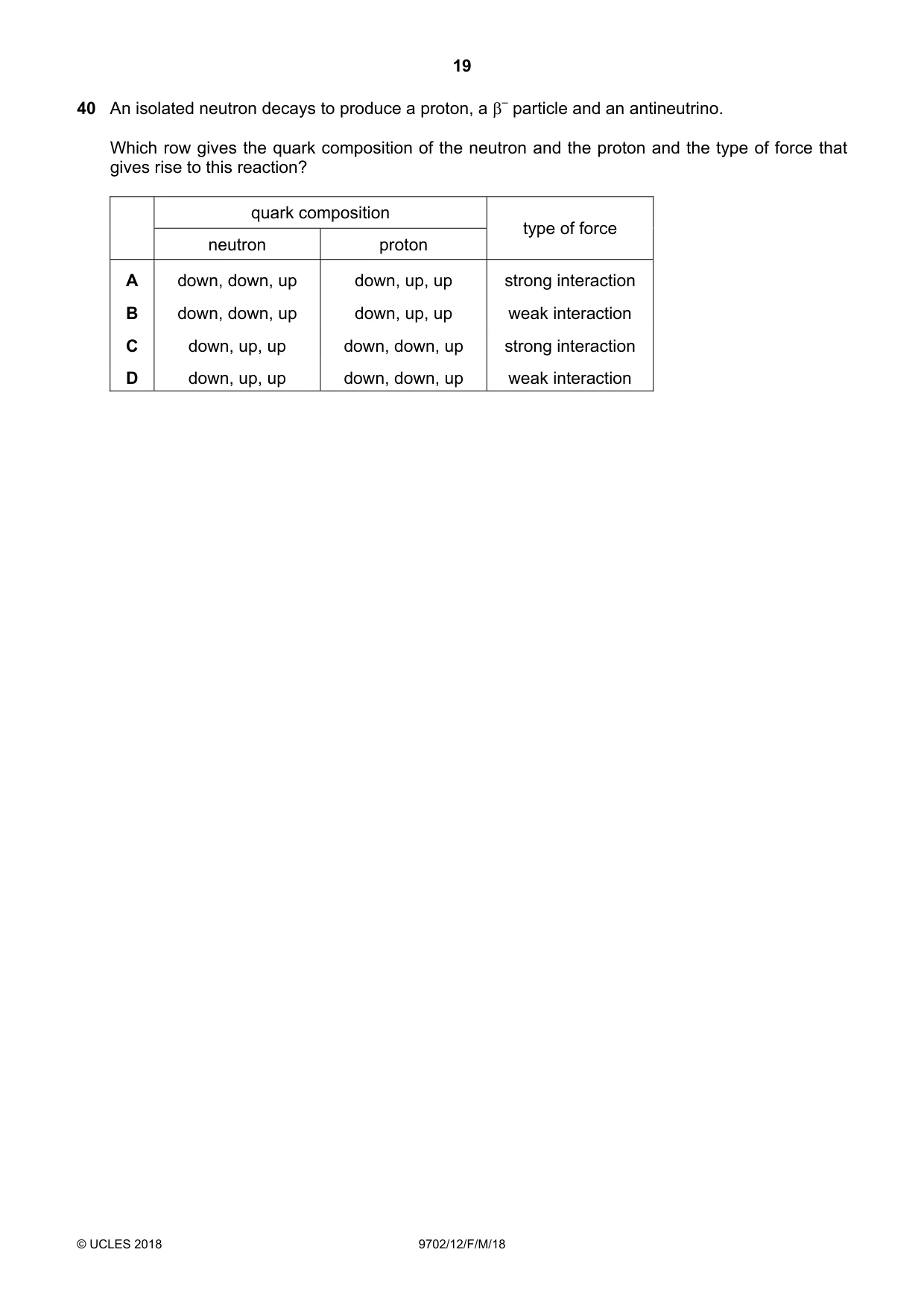
Q40 · An isolated neutron decays to produce a proton, a β– particle and an antineutrino
40 An isolated neutron decays to produce a proton, a β– particle and an antineutrino. Which row gives the quark composition of the neutron and the proton and the type of force that gives rise to this reaction? quark composition type of force neutron proton A down, down, up down, up, up strong interaction B down, down, up down, up, up weak interaction C down, up, up down, down, up strong interaction D down, up, up down, down, up weak interaction
Mark scheme: B
What was in this paper
The subtopics covered by these 40 questions, and how many questions each got. Open one in a new tab to see every Cambridge question on it.
3Uniform electric fields3Electromagnetic spectrum2Equations of motion2Gravitational potential energy and kinetic energy2Interference2Potential dividers2Practical circuits2Progressive waves2SI units2Characteristics of alternating currents1Density and pressure1Diffraction1Doppler effect for sound waves1Elastic and plastic behaviour1Electric current1Equilibrium of forces1Errors and uncertainties1Fundamental particles1Linear momentum and its conservation1Momentum and Newton’s laws of motion1Potential difference and power1Radioactive decay1Resistance and resistivity1Scalars and vectors1Stationary waves1Stress and strain1Turning effects of forces1What you needed in this session
Cambridge’s own grade thresholds for 2018 Feb/March, Paper 1 · Variant 2. A higher threshold means an easier paper — the bar moves with how the cohort did.