Cambridge A Level Physics 9702 — 2019 Oct/Nov Paper 1 · Variant 2
9702/12/O/N/19 · 40 questions · 40 marks · ≈45 min
The question paper and its mark scheme, free to read here and free to download. This is Cambridge’s own paper, exactly as it was sat.
Question paper20 pages


Mark scheme3 pages
Answers below. Sit the paper first if you are practising.
Questions as text
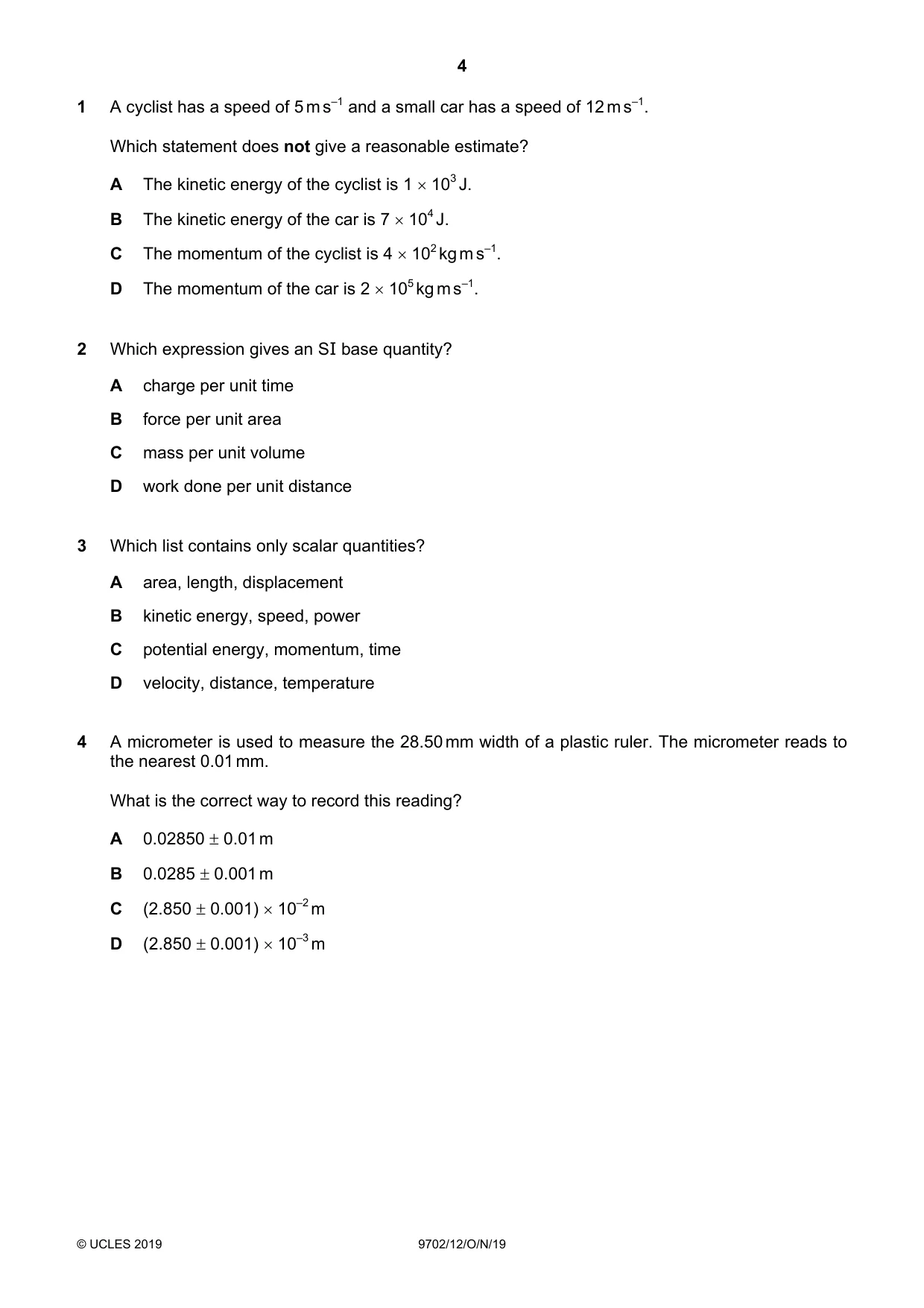
Q1 · A cyclist has a speed of 5 m s–1 and a small car has a speed of 12 m s–1
1 A cyclist has a speed of 5 m s–1 and a small car has a speed of 12 m s–1. Which statement does not give a reasonable estimate? A The kinetic energy of the cyclist is 1 × 10³ J. B The kinetic energy of the car is 7 × 10⁴ J. C The momentum of the cyclist is 4 × 10² kg m s–1. D The momentum of the car is 2 × 10⁵ kg m s–1.
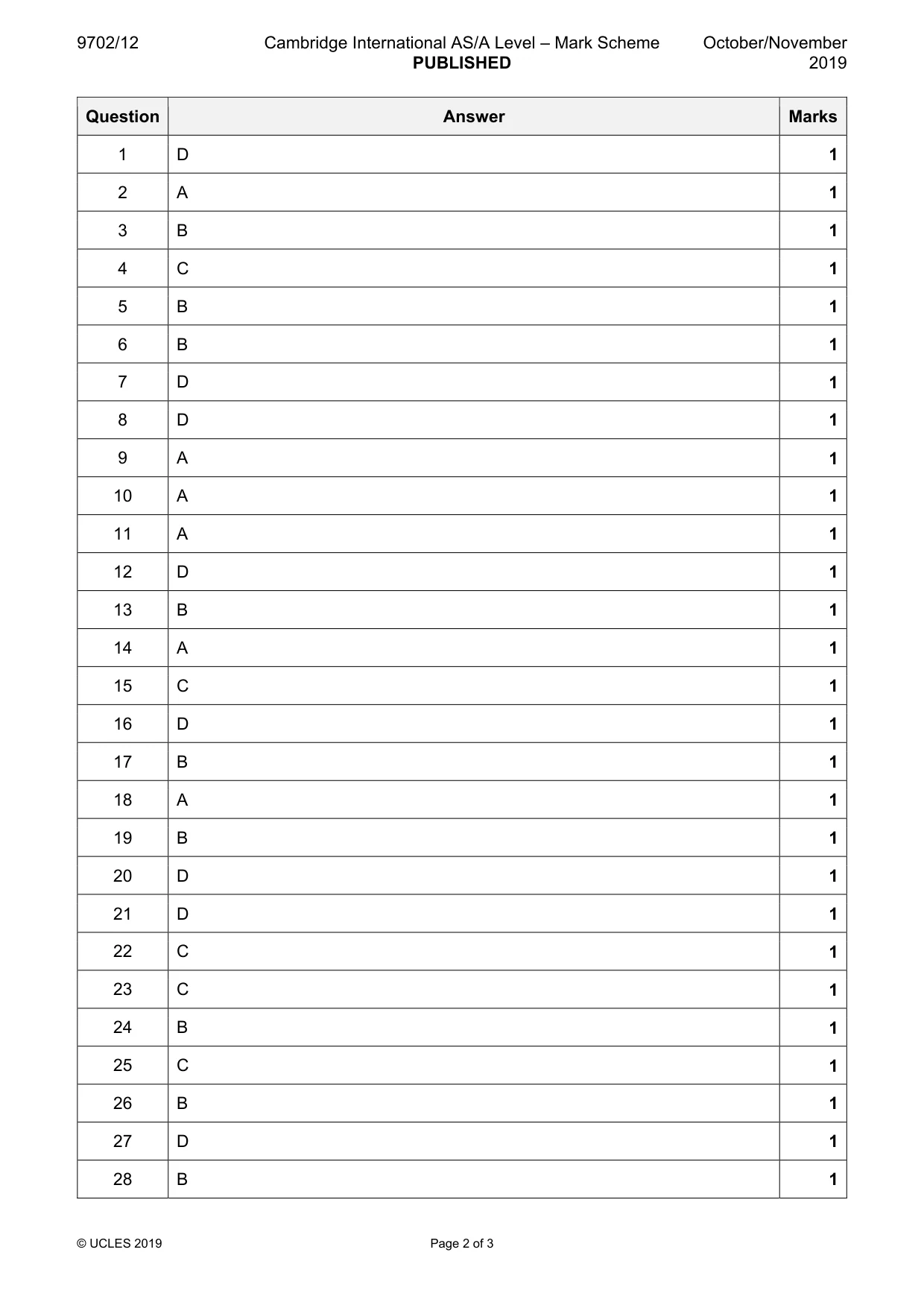
Mark scheme: D
Q2 · Which expression gives an SI base quantity?
2 Which expression gives an SI base quantity? A charge per unit time B force per unit area C mass per unit volume D work done per unit distance
Mark scheme: A
Q3 · Which list contains only scalar quantities?
3 Which list contains only scalar quantities? A area, length, displacement B kinetic energy, speed, power C potential energy, momentum, time D velocity, distance, temperature
Mark scheme: B
Q4 · A micrometer is used to measure the 28.50 mm width of a plastic ruler
4 A micrometer is used to measure the 28.50 mm width of a plastic ruler. The micrometer reads to the nearest 0.01 mm. What is the correct way to record this reading? A 0.02850 ± 0.01 m B 0.0285 ± 0.001 m C (2.850 ± 0.001) × 10–2 m D (2.850 ± 0.001) × 10–3 m
Mark scheme: C
Q5 · The sides of a wooden block are measured with calipers
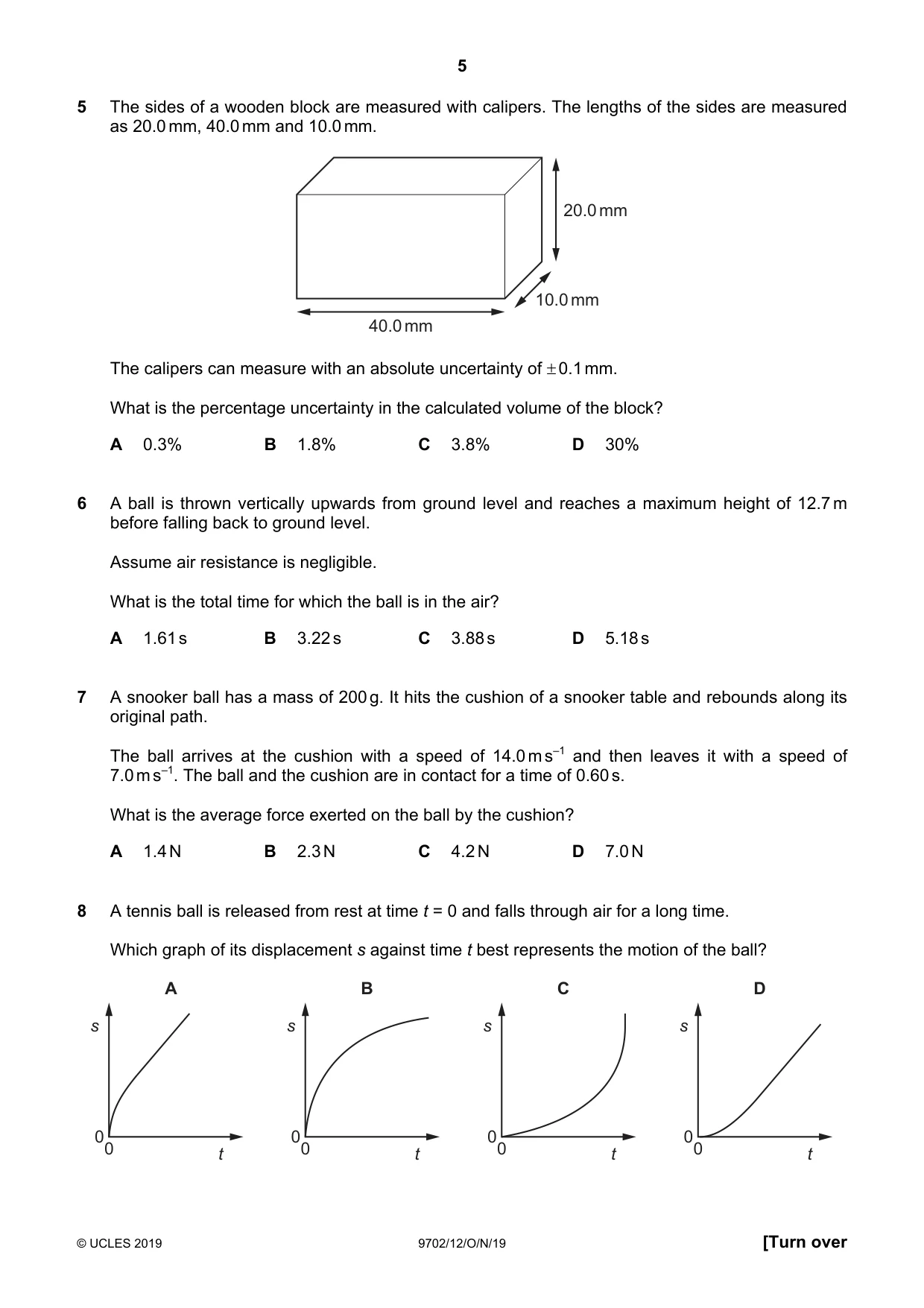
5 The sides of a wooden block are measured with calipers. The lengths of the sides are measured as 20.0 mm, 40.0 mm and 10.0 mm. 20.0 mm 10.0 mm 40.0 mm The calipers can measure with an absolute uncertainty of ± 0.1 mm. What is the percentage uncertainty in the calculated volume of the block? A 0.3% B 1.8% C 3.8% D 30%
Mark scheme: B
Q6 · A ball is thrown vertically upwards from ground level and reaches a maximum height of…
6 A ball is thrown vertically upwards from ground level and reaches a maximum height of 12.7 m before falling back to ground level. Assume air resistance is negligible. What is the total time for which the ball is in the air? A 1.61 s B 3.22 s C 3.88 s D 5.18 s
Mark scheme: B
Q7 · A snooker ball has a mass of 200 g
7 A snooker ball has a mass of 200 g. It hits the cushion of a snooker table and rebounds along its original path. The ball arrives at the cushion with a speed of 14.0 m s–1 and then leaves it with a speed of 7.0 m s–1. The ball and the cushion are in contact for a time of 0.60 s. What is the average force exerted on the ball by the cushion? A 1.4 N B 2.3 N C 4.2 N D 7.0 N
Mark scheme: D
Q8 · A tennis ball is released from rest at time t = 0 and falls through air for a long time
8 A tennis ball is released from rest at time t = 0 and falls through air for a long time. Which graph of its displacement s against time t best represents the motion of the ball? A B C D s s s s 00 00 00 00 t t t t
Mark scheme: D
Q9 · The space probe Rosetta was designed to investigate a comet
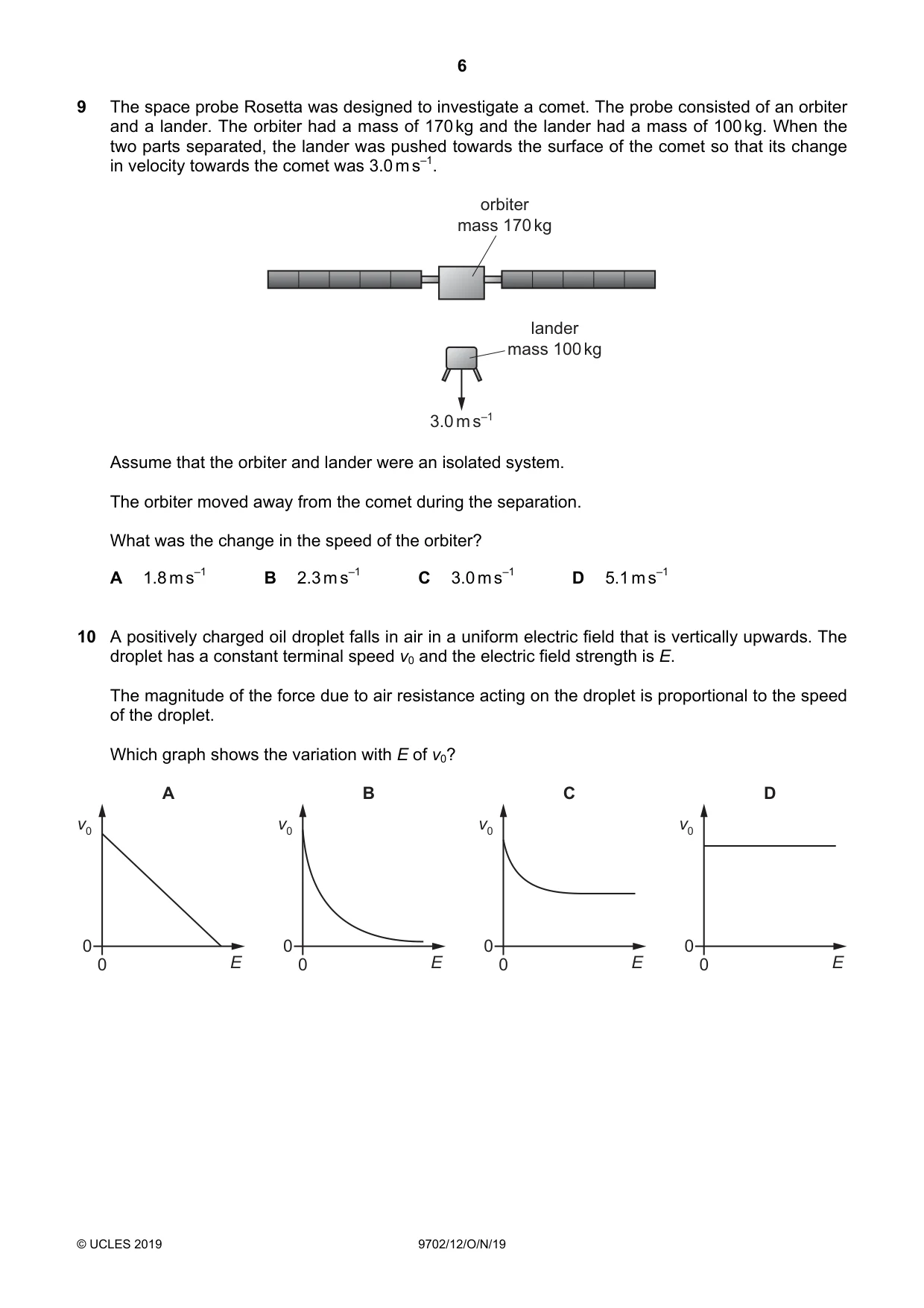
9 The space probe Rosetta was designed to investigate a comet. The probe consisted of an orbiter and a lander. The orbiter had a mass of 170 kg and the lander had a mass of 100 kg. When the two parts separated, the lander was pushed towards the surface of the comet so that its change in velocity towards the comet was 3.0 m s–1. orbiter mass 170 kg lander mass 100 kg 3.0 m s–1 Assume that the orbiter and lander were an isolated system. The orbiter moved away from the comet during the separation. What was the change in the speed of the orbiter? A 1.8 m s–1 B 2.3 m s–1 C 3.0 m s–1 D 5.1 m s–1
Mark scheme: A
Q10 · A positively charged oil droplet falls in air in a uniform electric field that is…
10 A positively charged oil droplet falls in air in a uniform electric field that is vertically upwards. The droplet has a constant terminal speed v0 and the electric field strength is E. The magnitude of the force due to air resistance acting on the droplet is proportional to the speed of the droplet. Which graph shows the variation with E of v0? A B C D v0 v0 v0 v0 0 0 0 0 0 E 0 E 0 E 0 E
Mark scheme: A
Q11 · A rigid uniform bar of length 2.4 m is pivoted horizontally at its midpoint
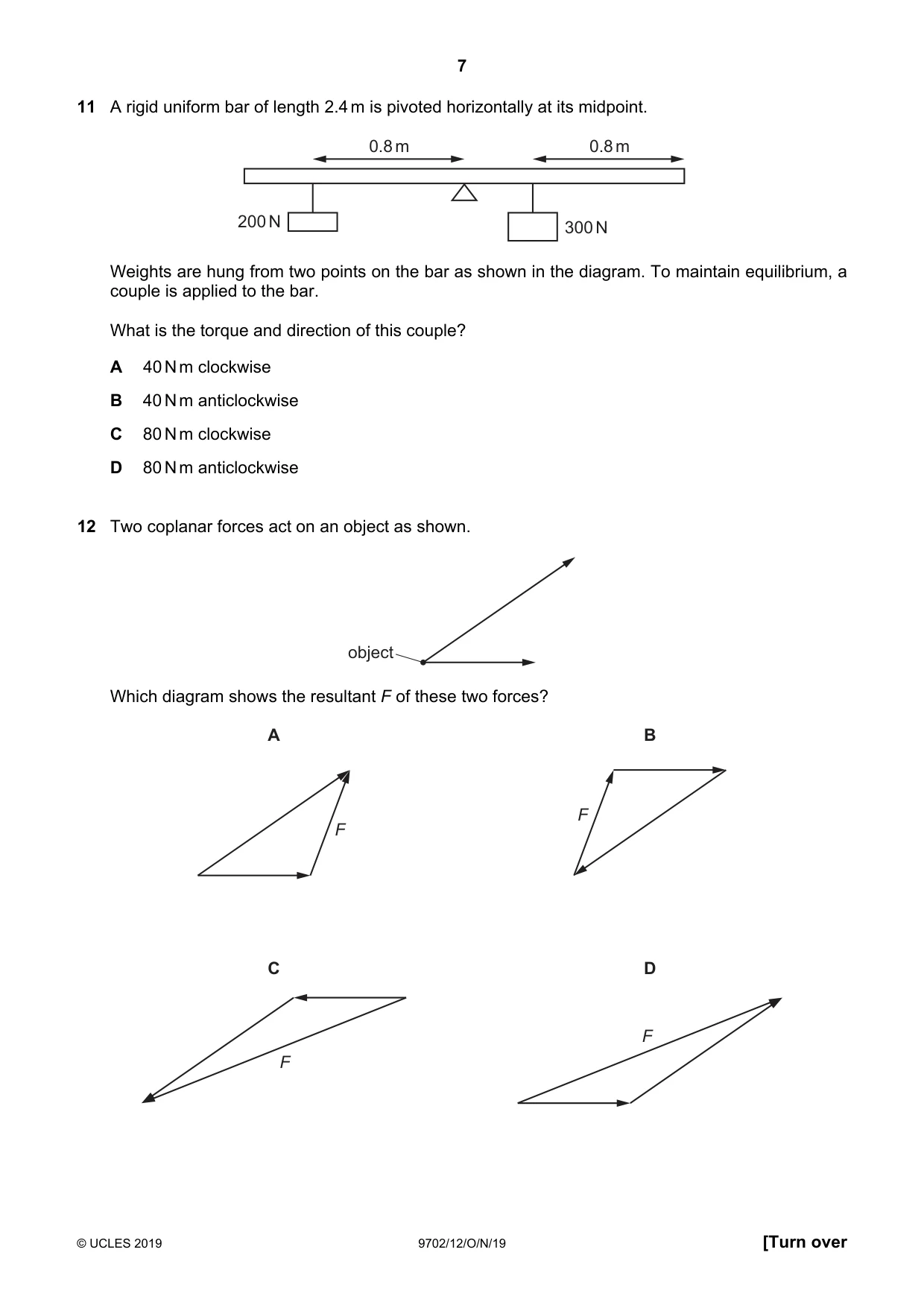
11 A rigid uniform bar of length 2.4 m is pivoted horizontally at its midpoint. 0.8 m 0.8 m 200 N 300 N Weights are hung from two points on the bar as shown in the diagram. To maintain equilibrium, a couple is applied to the bar. What is the torque and direction of this couple? A 40 N m clockwise B 40 N m anticlockwise C 80 N m clockwise D 80 N m anticlockwise
Mark scheme: A
Q12 · Two coplanar forces act on an object as shown
12 Two coplanar forces act on an object as shown. object Which diagram shows the resultant F of these two forces? A B F F C D F F
Mark scheme: D
Q13 · Four measuring cylinders are filled with the same liquid to the heights shown
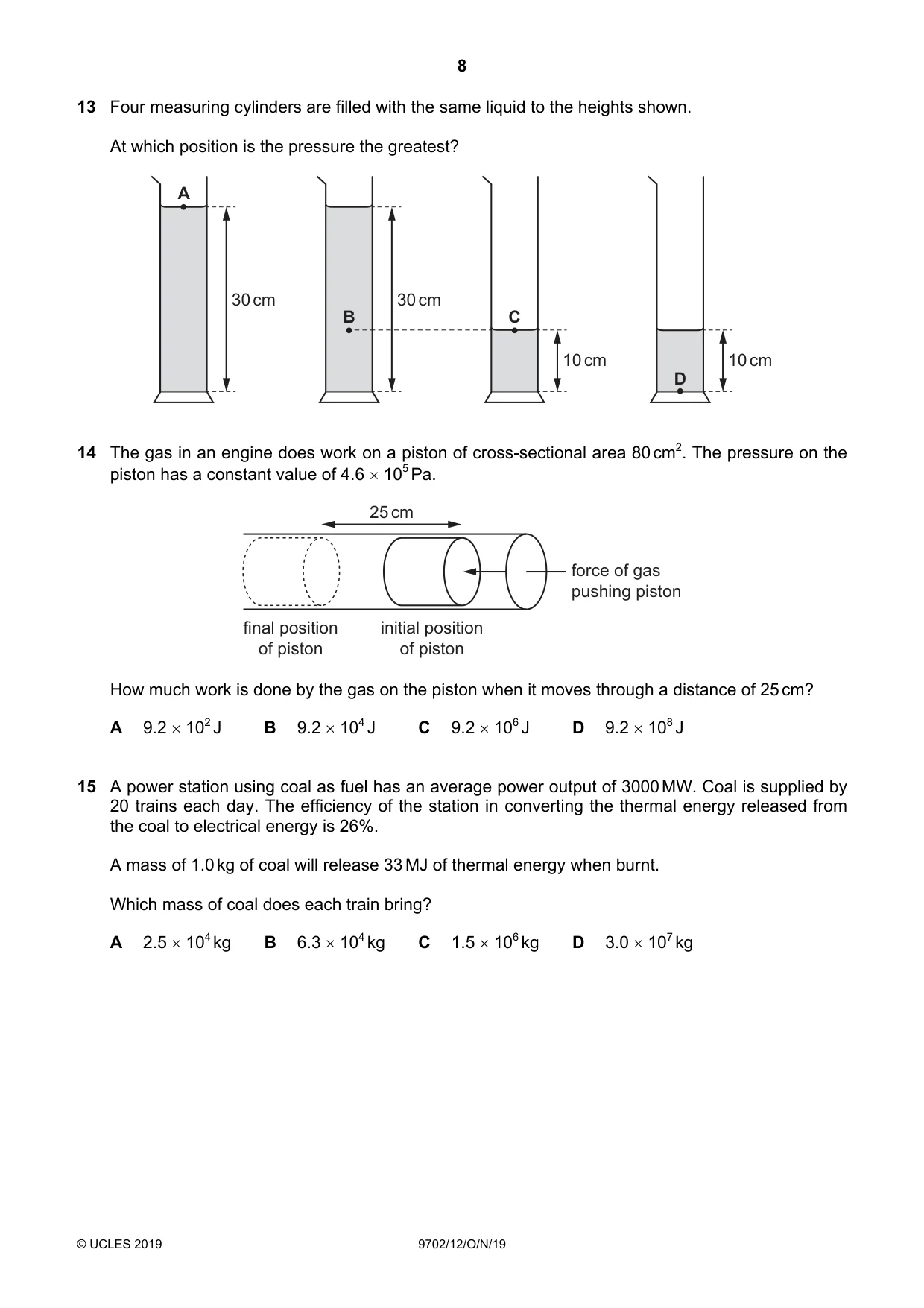
13 Four measuring cylinders are filled with the same liquid to the heights shown. At which position is the pressure the greatest? A 30 cm 30 cm B C 10 cm 10 cm D
Mark scheme: B
Q14 · The gas in an engine does work on a piston of cross-sectional area 80 cm2
14 The gas in an engine does work on a piston of cross-sectional area 80 cm2. The pressure on the piston has a constant value of 4.6 × 10⁵ Pa. 25 cm force of gas pushing piston final position initial position of piston of piston How much work is done by the gas on the piston when it moves through a distance of 25 cm? A 9.2 × 10² J B 9.2 × 10⁴ J C 9.2 × 10⁶ J D 9.2 × 10⁸ J
Mark scheme: A
Q15 · A power station using coal as fuel has an average power output of 3000 MW
15 A power station using coal as fuel has an average power output of 3000 MW. Coal is supplied by 20 trains each day. The efficiency of the station in converting the thermal energy released from the coal to electrical energy is 26%. A mass of 1.0 kg of coal will release 33 MJ of thermal energy when burnt. Which mass of coal does each train bring? A 2.5 × 10⁴ kg B 6.3 × 10⁴ kg C 1.5 × 10⁶ kg D 3.0 × 10⁷ kg
Mark scheme: C
Q16 · A wooden cylinder floats partially submerged in a bath of water
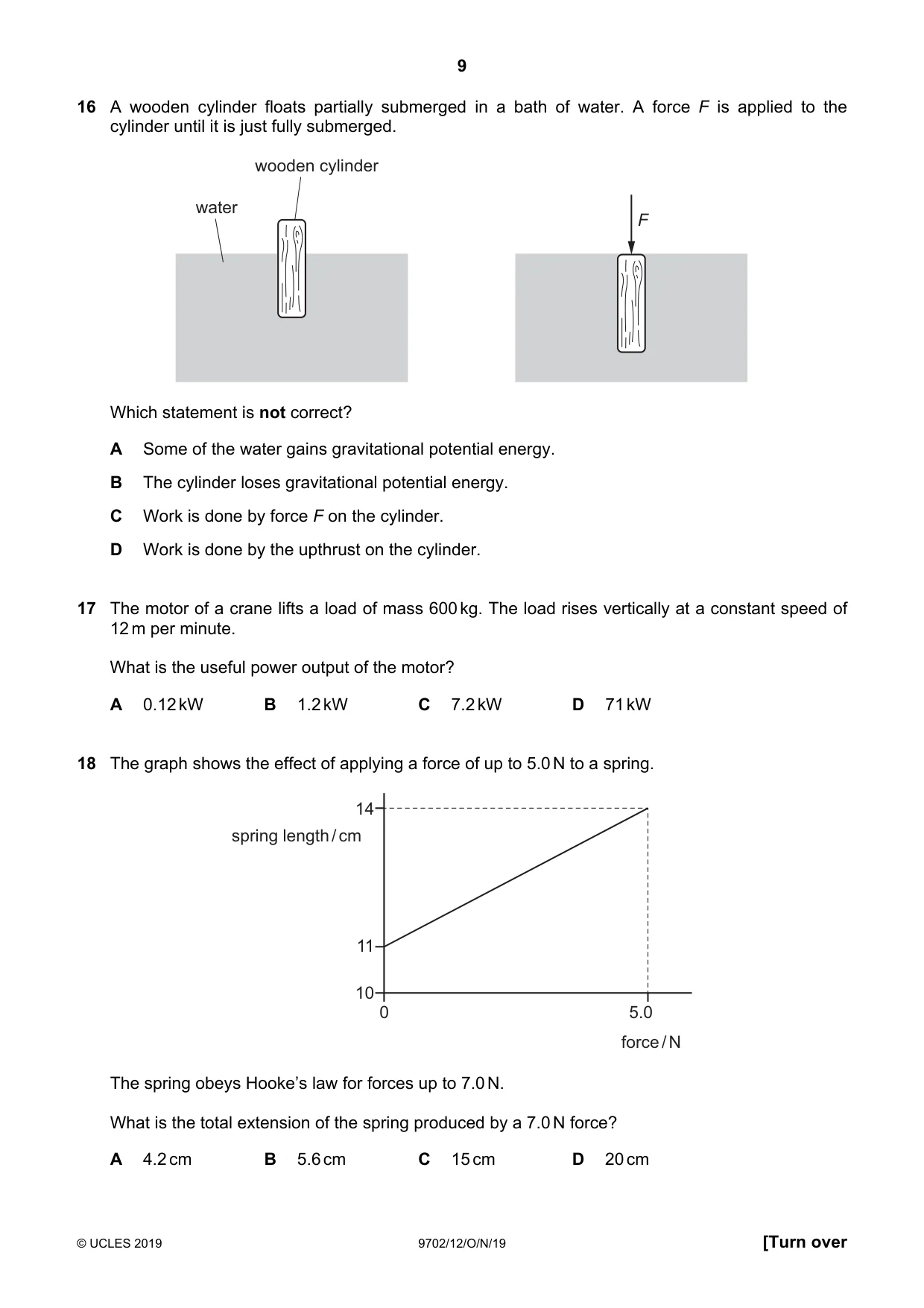
16 A wooden cylinder floats partially submerged in a bath of water. A force F is applied to the cylinder until it is just fully submerged. wooden cylinder water F Which statement is not correct? A Some of the water gains gravitational potential energy. B The cylinder loses gravitational potential energy. C Work is done by force F on the cylinder. D Work is done by the upthrust on the cylinder.
Mark scheme: D
Q17 · The motor of a crane lifts a load of mass 600 kg
17 The motor of a crane lifts a load of mass 600 kg. The load rises vertically at a constant speed of 12 m per minute. What is the useful power output of the motor? A 0.12 kW B 1.2 kW C 7.2 kW D 71 kW
Mark scheme: B
More questions on Gravitational potential energy and kinetic energy
Q18 · The graph shows the effect of applying a force of up to 5.0 N to a spring
18 The graph shows the effect of applying a force of up to 5.0 N to a spring. 14 spring length / cm 11 10 0 5.0 force / N The spring obeys Hooke’s law for forces up to 7.0 N. What is the total extension of the spring produced by a 7.0 N force? A 4.2 cm B 5.6 cm C 15 cm D 20 cm
Mark scheme: A
Q19 · A rubber cord hangs from a rigid support
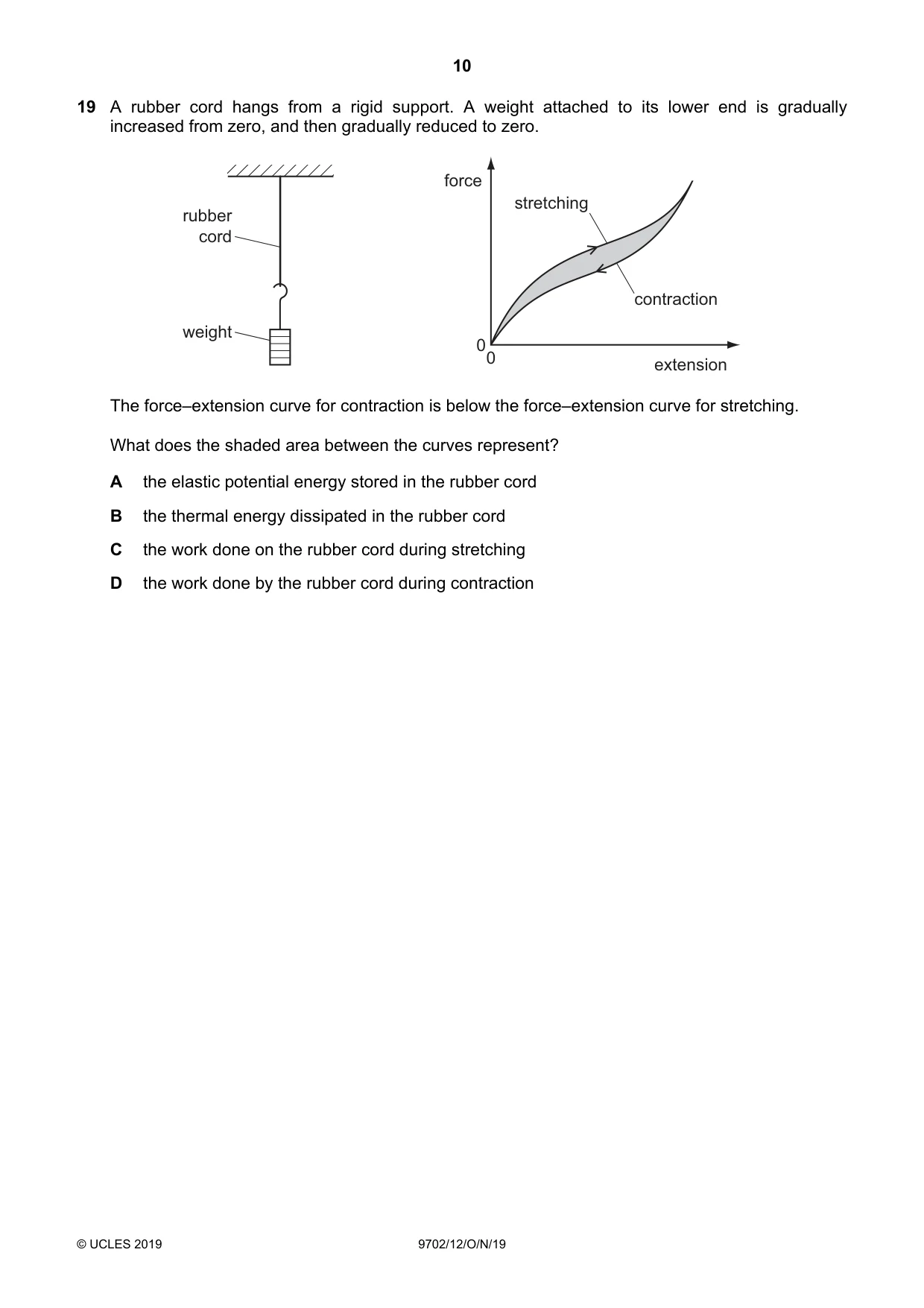
19 A rubber cord hangs from a rigid support. A weight attached to its lower end is gradually increased from zero, and then gradually reduced to zero. force stretching rubber cord contraction weight 00 extension The force–extension curve for contraction is below the force–extension curve for stretching. What does the shaded area between the curves represent? A the elastic potential energy stored in the rubber cord B the thermal energy dissipated in the rubber cord C the work done on the rubber cord during stretching D the work done by the rubber cord during contraction
Mark scheme: B
Q20 · A transverse wave is travelling along a rope
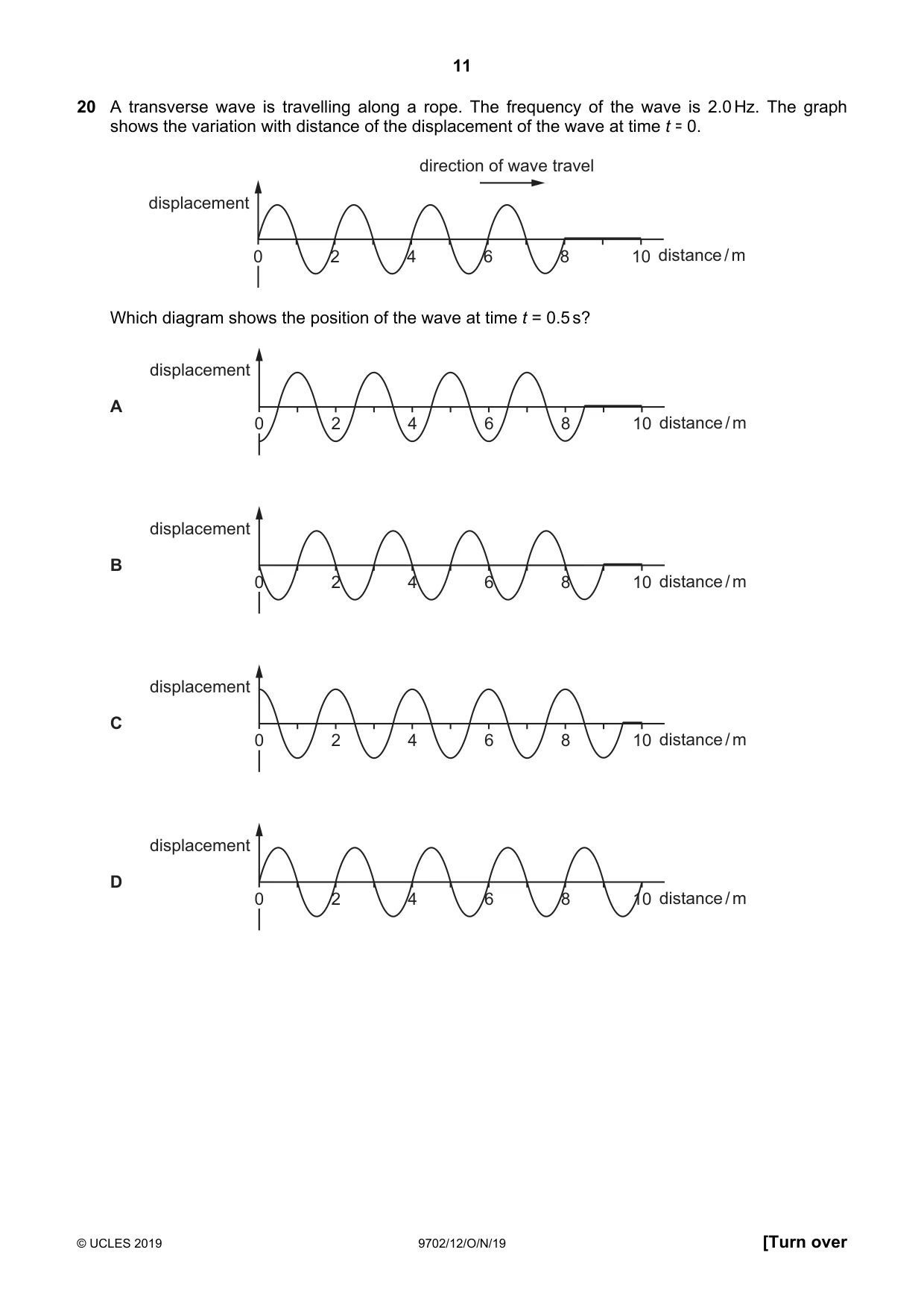
20 A transverse wave is travelling along a rope. The frequency of the wave is 2.0 Hz. The graph shows the variation with distance of the displacement of the wave at time t ꞊ 0. direction of wave travel displacement 0 2 4 6 8 10 distance / m Which diagram shows the position of the wave at time t = 0.5 s? displacement A 0 2 4 6 8 10 distance / m displacement B 0 2 4 6 8 10 distance / m displacement C 0 2 4 6 8 10 distance / m displacement D 0 2 4 6 8 10 distance / m
Mark scheme: D
Q21 · The two graphs represent the same wave
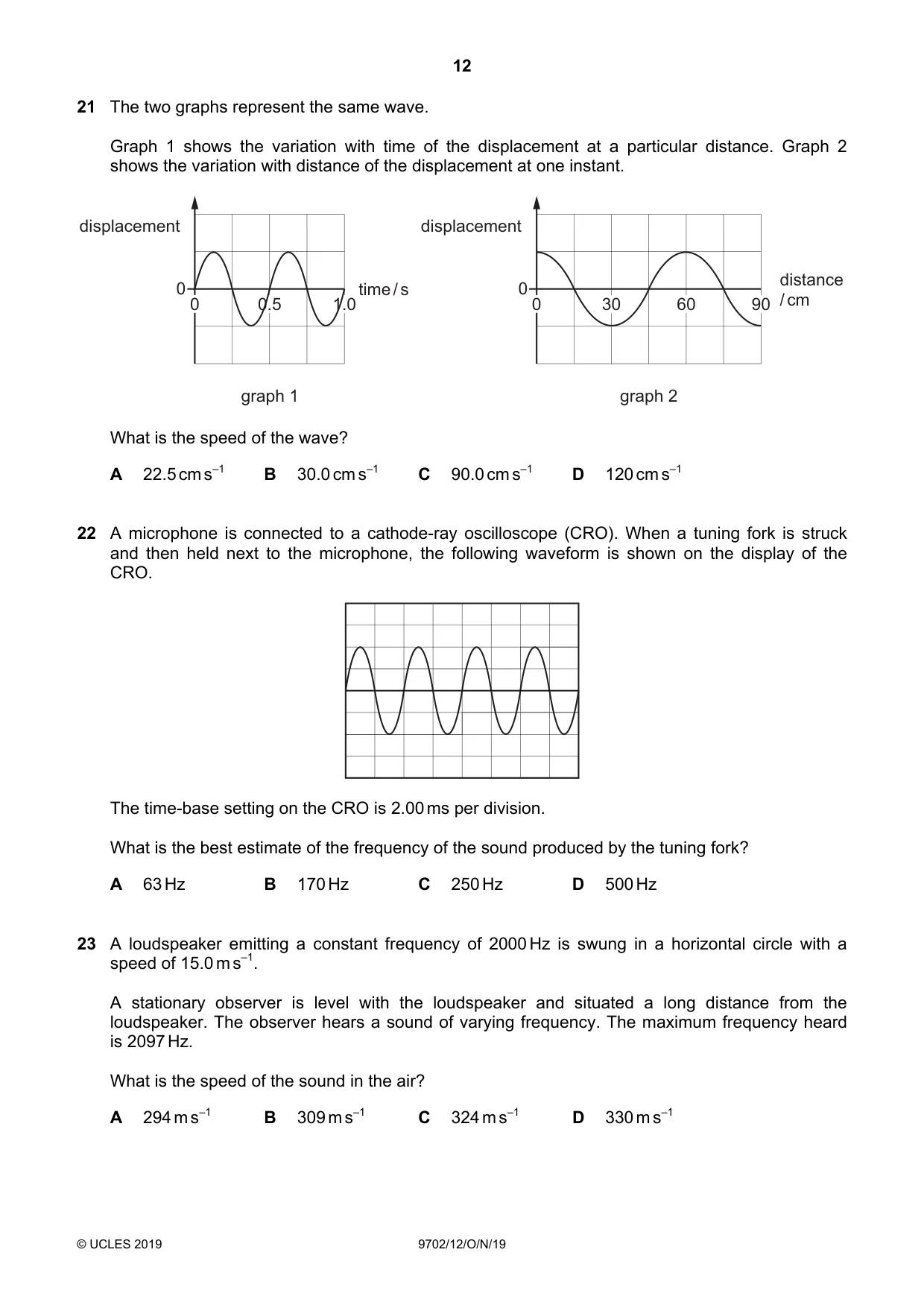
21 The two graphs represent the same wave. Graph 1 shows the variation with time of the displacement at a particular distance. Graph 2 shows the variation with distance of the displacement at one instant. displacement displacement distance 0 time / s 0 0 0.5 1.0 0 30 60 90 / cm graph 1 graph 2 What is the speed of the wave? A 22.5 cm s–1 B 30.0 cm s–1 C 90.0 cm s–1 D 120 cm s–1
Mark scheme: D
Q22 · A microphone is connected to a cathode-ray oscilloscope (CRO)
22 A microphone is connected to a cathode-ray oscilloscope (CRO). When a tuning fork is struck and then held next to the microphone, the following waveform is shown on the display of the CRO. The time-base setting on the CRO is 2.00 ms per division. What is the best estimate of the frequency of the sound produced by the tuning fork? A 63 Hz B 170 Hz C 250 Hz D 500 Hz
Mark scheme: C
Q23 · A loudspeaker emitting a constant frequency of 2000 Hz is swung in a horizontal circle…
23 A loudspeaker emitting a constant frequency of 2000 Hz is swung in a horizontal circle with a speed of 15.0 m s–1. A stationary observer is level with the loudspeaker and situated a long distance from the loudspeaker. The observer hears a sound of varying frequency. The maximum frequency heard is 2097 Hz. What is the speed of the sound in the air? A 294 m s–1 B 309 m s–1 C 324 m s–1 D 330 m s–1
Mark scheme: C
Q24 · Two electromagnetic waves have wavelengths of 5.0 × 10⁻⁷ m and 5.0 × 10⁻² m
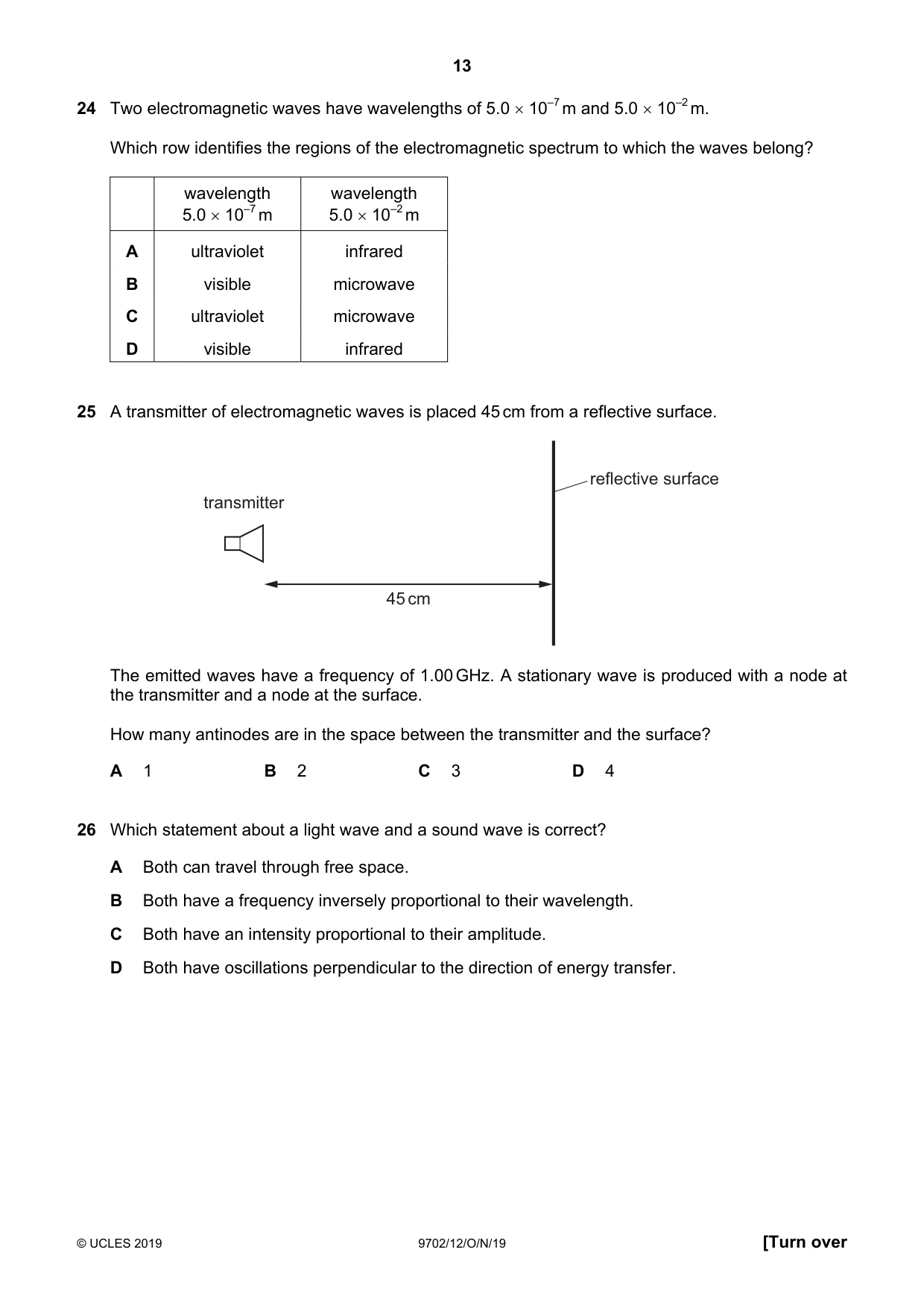
24 Two electromagnetic waves have wavelengths of 5.0 × 10⁻⁷ m and 5.0 × 10⁻² m. Which row identifies the regions of the electromagnetic spectrum to which the waves belong? wavelength wavelength 5.0 × 10⁻⁷ m 5.0 × 10⁻² m A ultraviolet infrared B visible microwave C ultraviolet microwave D visible infrared
Mark scheme: B
Q25 · A transmitter of electromagnetic waves is placed 45 cm from a reflective surface
25 A transmitter of electromagnetic waves is placed 45 cm from a reflective surface. reflective surface transmitter 45 cm The emitted waves have a frequency of 1.00 GHz. A stationary wave is produced with a node at the transmitter and a node at the surface. How many antinodes are in the space between the transmitter and the surface? A 1 B 2 C 3 D 4
Mark scheme: C
Q26 · Which statement about a light wave and a sound wave is correct?
26 Which statement about a light wave and a sound wave is correct? A Both can travel through free space. B Both have a frequency inversely proportional to their wavelength. C Both have an intensity proportional to their amplitude. D Both have oscillations perpendicular to the direction of energy transfer.
Mark scheme: B
Q27 · An outdoor concert has two large speakers beside the stage for broadcasting music
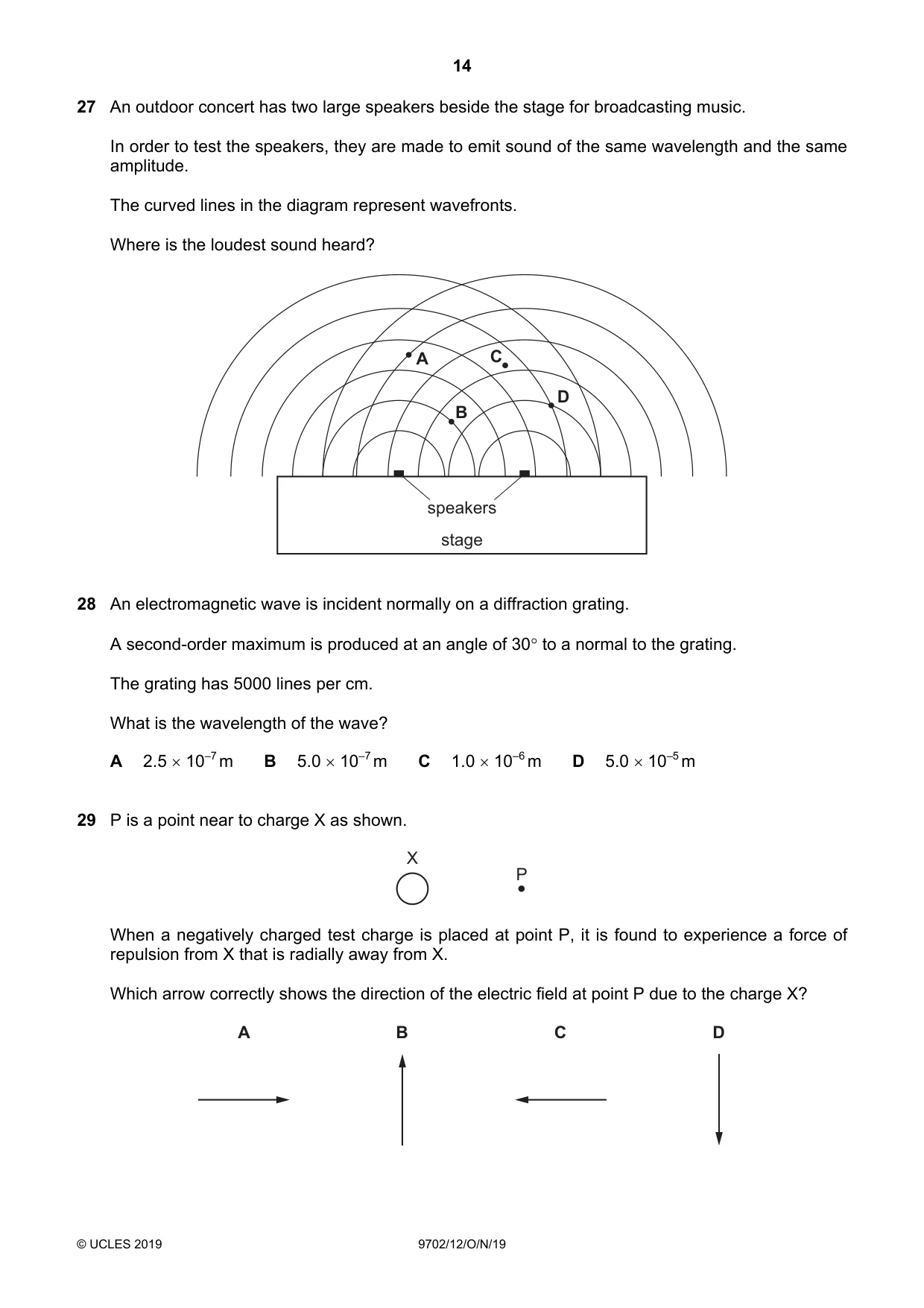
27 An outdoor concert has two large speakers beside the stage for broadcasting music. In order to test the speakers, they are made to emit sound of the same wavelength and the same amplitude. The curved lines in the diagram represent wavefronts. Where is the loudest sound heard? A C D B speakers stage
Mark scheme: D
Q28 · An electromagnetic wave is incident normally on a diffraction grating
28 An electromagnetic wave is incident normally on a diffraction grating. A second-order maximum is produced at an angle of 30° to a normal to the grating. The grating has 5000 lines per cm. What is the wavelength of the wave? A 2.5 × 10⁻⁷ m B 5.0 × 10⁻⁷ m C 1.0 × 10⁻⁶ m D 5.0 × 10⁻⁵ m
Mark scheme: B
Q29 · P is a point near to charge X as shown
29 P is a point near to charge X as shown. X P When a negatively charged test charge is placed at point P, it is found to experience a force of repulsion from X that is radially away from X. Which arrow correctly shows the direction of the electric field at point P due to the charge X? A B C D
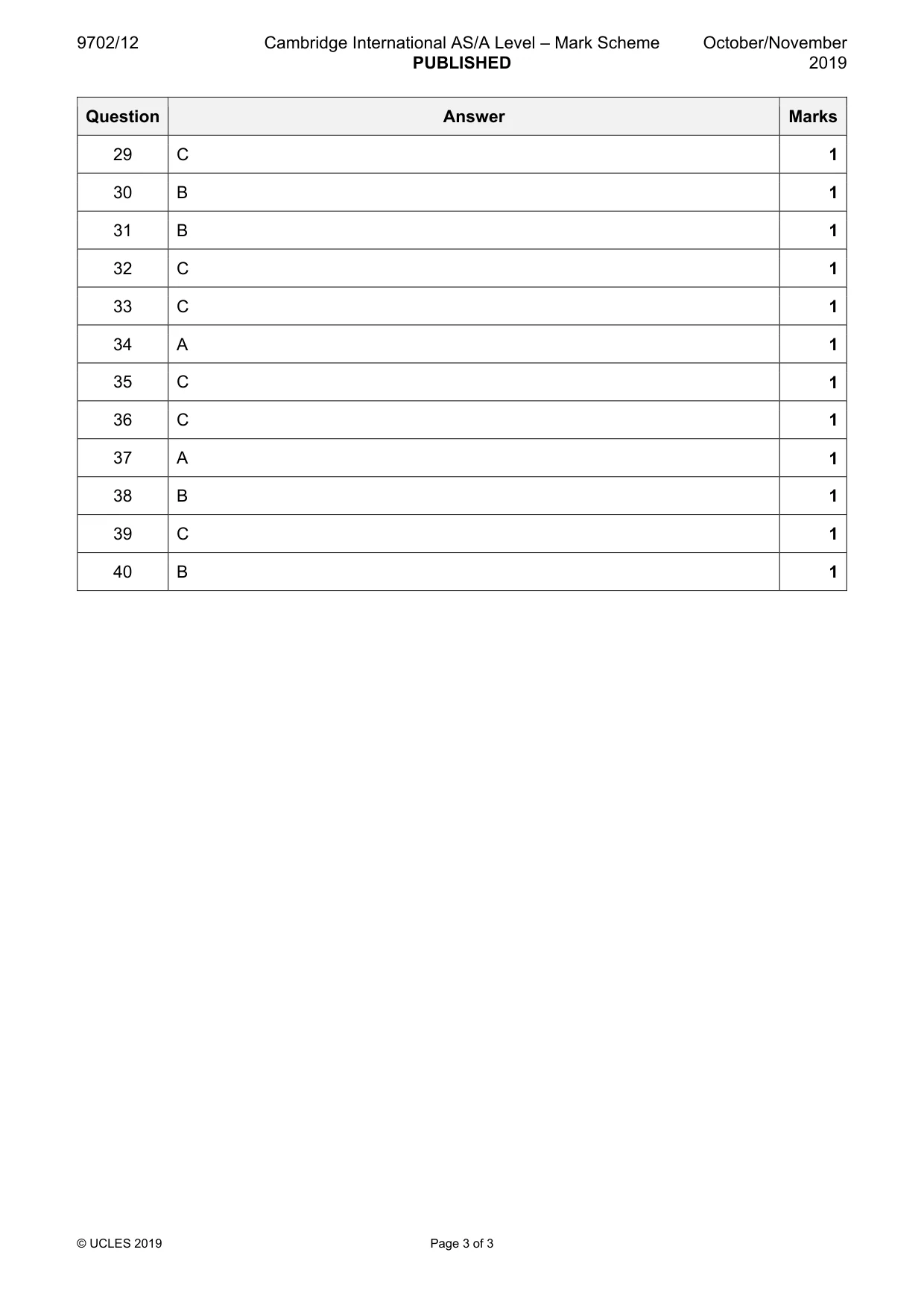
Mark scheme: C
Q30 · A charged oil drop of mass m, with n excess electrons, is held stationary in the uniform…
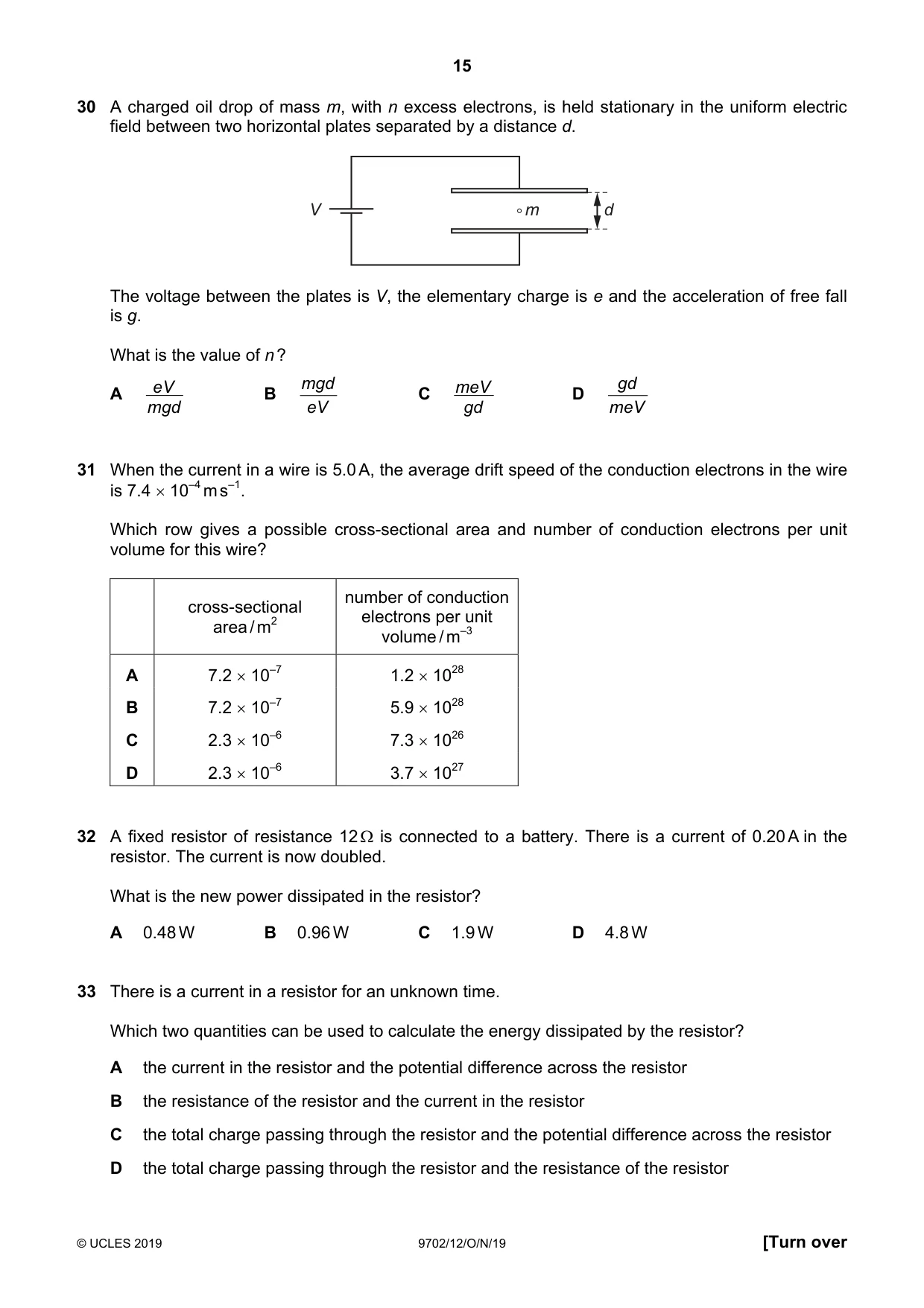
30 A charged oil drop of mass m, with n excess electrons, is held stationary in the uniform electric field between two horizontal plates separated by a distance d. V m d The voltage between the plates is V, the elementary charge is e and the acceleration of free fall is g. What is the value of n ? eV mgd meV gd A B C D mgd eV gd meV
Mark scheme: B
Q31 · When the current in a wire is 5.0 A, the average drift speed of the conduction electrons…
31 When the current in a wire is 5.0 A, the average drift speed of the conduction electrons in the wire is 7.4 × 10⁻⁴ m s–1. Which row gives a possible cross-sectional area and number of conduction electrons per unit volume for this wire? number of conduction cross-sectional area / m2 electrons per unit volume / m–3 A 7.2 × 10⁻⁷ 1.2 × 1028 B 7.2 × 10⁻⁷ 5.9 × 1028 C 2.3 × 10⁻⁶ 7.3 × 1026 D 2.3 × 10⁻⁶ 3.7 × 1027
Mark scheme: B
Q32 · A fixed resistor of resistance 12 Ω is connected to a battery
32 A fixed resistor of resistance 12 Ω is connected to a battery. There is a current of 0.20 A in the resistor. The current is now doubled. What is the new power dissipated in the resistor? A 0.48 W B 0.96 W C 1.9 W D 4.8 W
Mark scheme: C
Q33 · There is a current in a resistor for an unknown time
33 There is a current in a resistor for an unknown time. Which two quantities can be used to calculate the energy dissipated by the resistor? A the current in the resistor and the potential difference across the resistor B the resistance of the resistor and the current in the resistor C the total charge passing through the resistor and the potential difference across the resistor D the total charge passing through the resistor and the resistance of the resistor
Mark scheme: C
Q34 · Two cells with electromotive forces E1 and E2 and internal resistances r1 and r2 are…
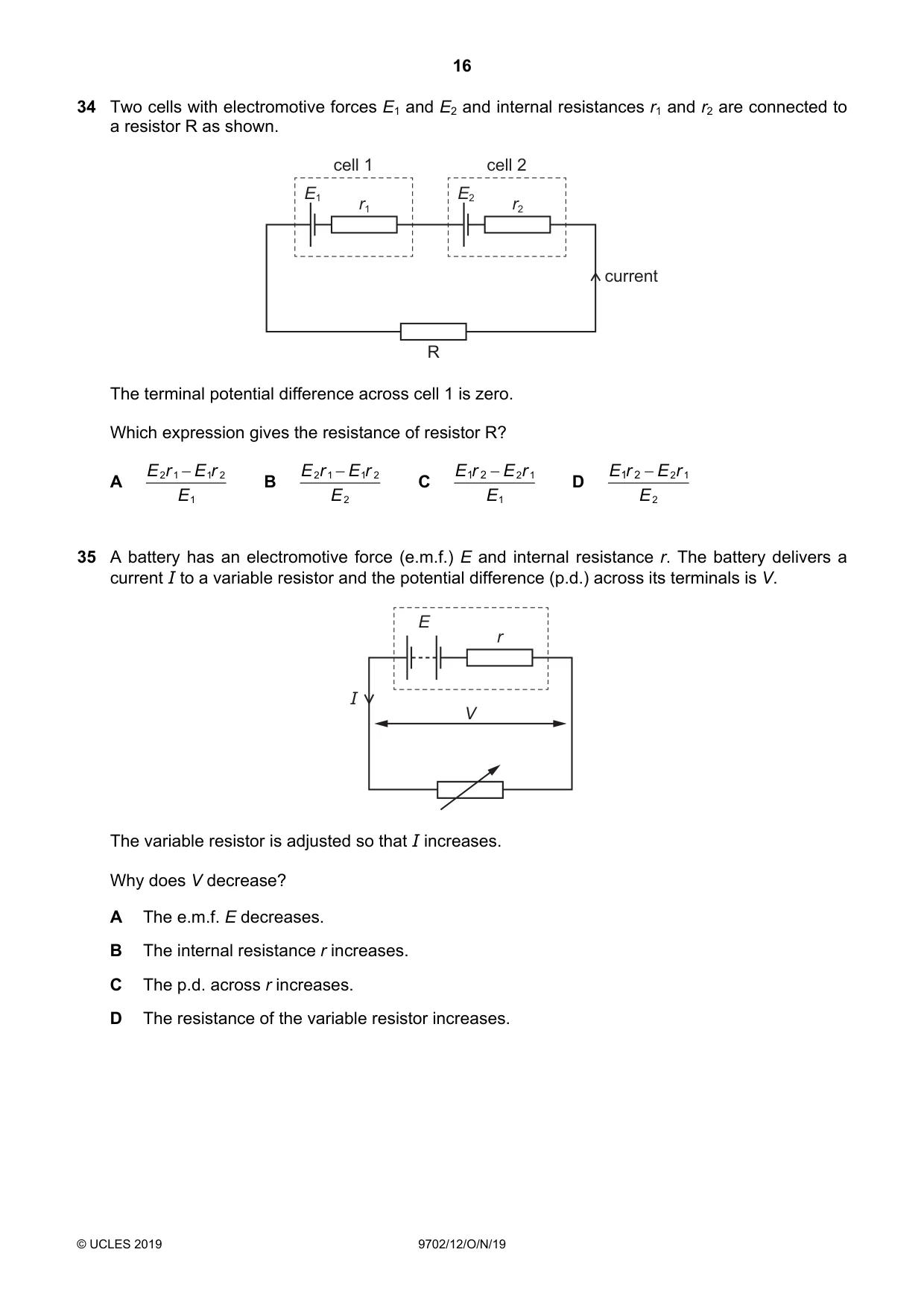
34 Two cells with electromotive forces E1 and E2 and internal resistances r1 and r2 are connected to a resistor R as shown. cell 1 cell 2 E1 E2 r1 r2 current R The terminal potential difference across cell 1 is zero. Which expression gives the resistance of resistor R? E r − E r E r − E r E r 1 2 − E r E r 1 2 − E r A 2 1 1 2 B 2 1 1 2 C 2 1 D 2 1 E E E E 1 2 1 2
Mark scheme: A
Q35 · A battery has an electromotive force (e.m.f.) E and internal resistance r
35 A battery has an electromotive force (e.m.f.) E and internal resistance r. The battery delivers a current I to a variable resistor and the potential difference (p.d.) across its terminals is V. E r I V The variable resistor is adjusted so that I increases. Why does V decrease? A The e.m.f. E decreases. B The internal resistance r increases. C The p.d. across r increases. D The resistance of the variable resistor increases.
Mark scheme: C
Q36 · Three identical resistors are connected between terminals P and Q in different networks…
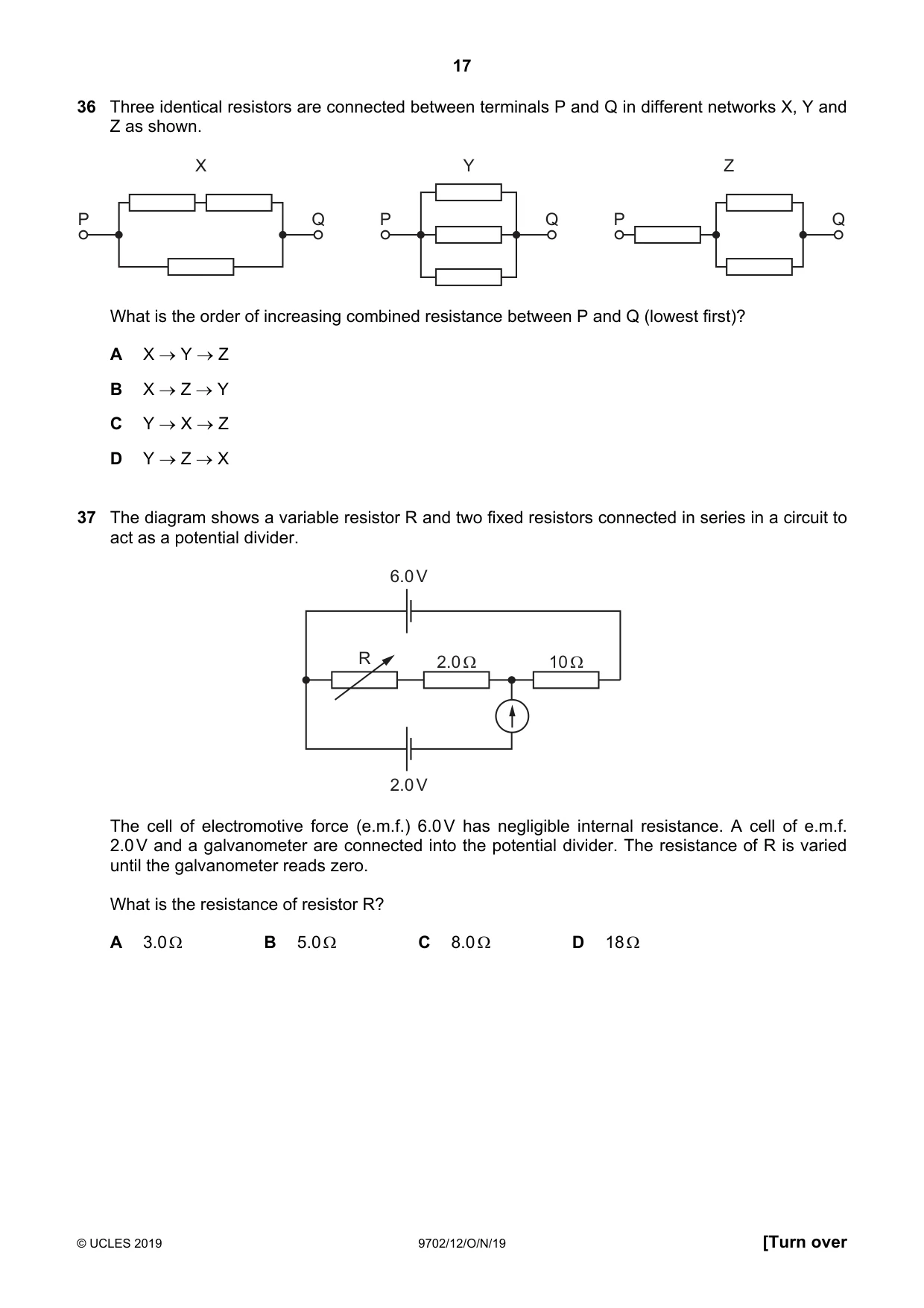
36 Three identical resistors are connected between terminals P and Q in different networks X, Y and Z as shown. X Y Z P Q P Q P Q What is the order of increasing combined resistance between P and Q (lowest first)? A X → Y → Z B X → Z → Y C Y → X → Z D Y → Z → X
Mark scheme: C
Q37 · The diagram shows a variable resistor R and two fixed resistors connected in series in a…
37 The diagram shows a variable resistor R and two fixed resistors connected in series in a circuit to act as a potential divider. 6.0 V R 2.0 Ω 10 Ω 2.0 V The cell of electromotive force (e.m.f.) 6.0 V has negligible internal resistance. A cell of e.m.f. 2.0 V and a galvanometer are connected into the potential divider. The resistance of R is varied until the galvanometer reads zero. What is the resistance of resistor R? A 3.0 Ω B 5.0 Ω C 8.0 Ω D 18 Ω
Mark scheme: A
Q38 · The table gives some data relating to four neutral (uncharged) atoms W, X, Y and Z
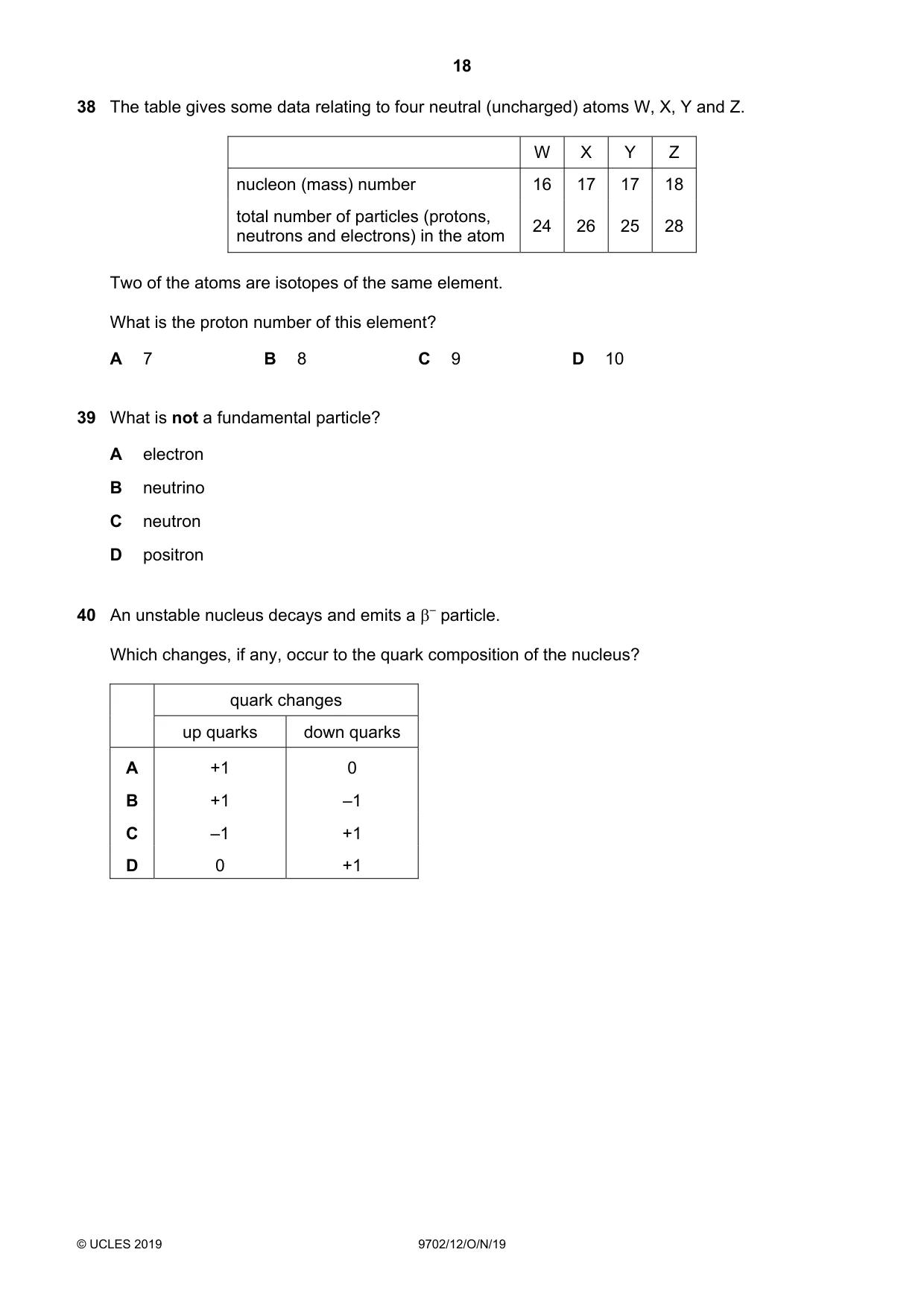
38 The table gives some data relating to four neutral (uncharged) atoms W, X, Y and Z. W X Y Z nucleon (mass) number 16 17 17 18 total number of particles (protons, 24 26 25 28 neutrons and electrons) in the atom Two of the atoms are isotopes of the same element. What is the proton number of this element? A 7 B 8 C 9 D 10
Mark scheme: B
Q39 · What is not a fundamental particle?
39 What is not a fundamental particle? A electron B neutrino C neutron D positron
Mark scheme: C
Q40 · An unstable nucleus decays and emits a β– particle
40 An unstable nucleus decays and emits a β– particle. Which changes, if any, occur to the quark composition of the nucleus? quark changes up quarks down quarks A +1 0 B +1 –1 C –1 +1 D 0 +1
Mark scheme: B
What was in this paper
The subtopics covered by these 40 questions, and how many questions each got. Open one in a new tab to see every Cambridge question on it.
3Density and pressure2Energy conservation2Errors and uncertainties2Fundamental particles2Linear momentum and its conservation2Potential difference and power2Practical circuits2Scalars and vectors2Uniform electric fields2Atoms, nuclei and radiation1Doppler effect for sound waves1Elastic and plastic behaviour1Electric current1Electric fields and field lines1Electromagnetic spectrum1Equations of motion1Gravitational potential energy and kinetic energy1Interference1Kirchhoff’s laws1Momentum and Newton’s laws of motion1Non-uniform motion1Potential dividers1SI units1Stationary waves1Stress and strain1The diffraction grating1Transverse and longitudinal waves1Turning effects of forces1What you needed in this session
Cambridge’s own grade thresholds for 2019 Oct/Nov, Paper 1 · Variant 2. A higher threshold means an easier paper — the bar moves with how the cohort did.