Cambridge A Level Physics 9702 — 2020 Oct/Nov Paper 1 · Variant 3
9702/13/O/N/20 · 40 questions · 40 marks · ≈45 min
The question paper and its mark scheme, free to read here and free to download. This is Cambridge’s own paper, exactly as it was sat.
Question paper20 pages


Mark scheme3 pages
Answers below. Sit the paper first if you are practising.
Questions as text
Q1 · What is a reasonable estimate of the volume of a fully inflated standard football?
1 What is a reasonable estimate of the volume of a fully inflated standard football? A 600 cm3 B 6000 cm3 C 60 000 cm3 D 600 000 cm3
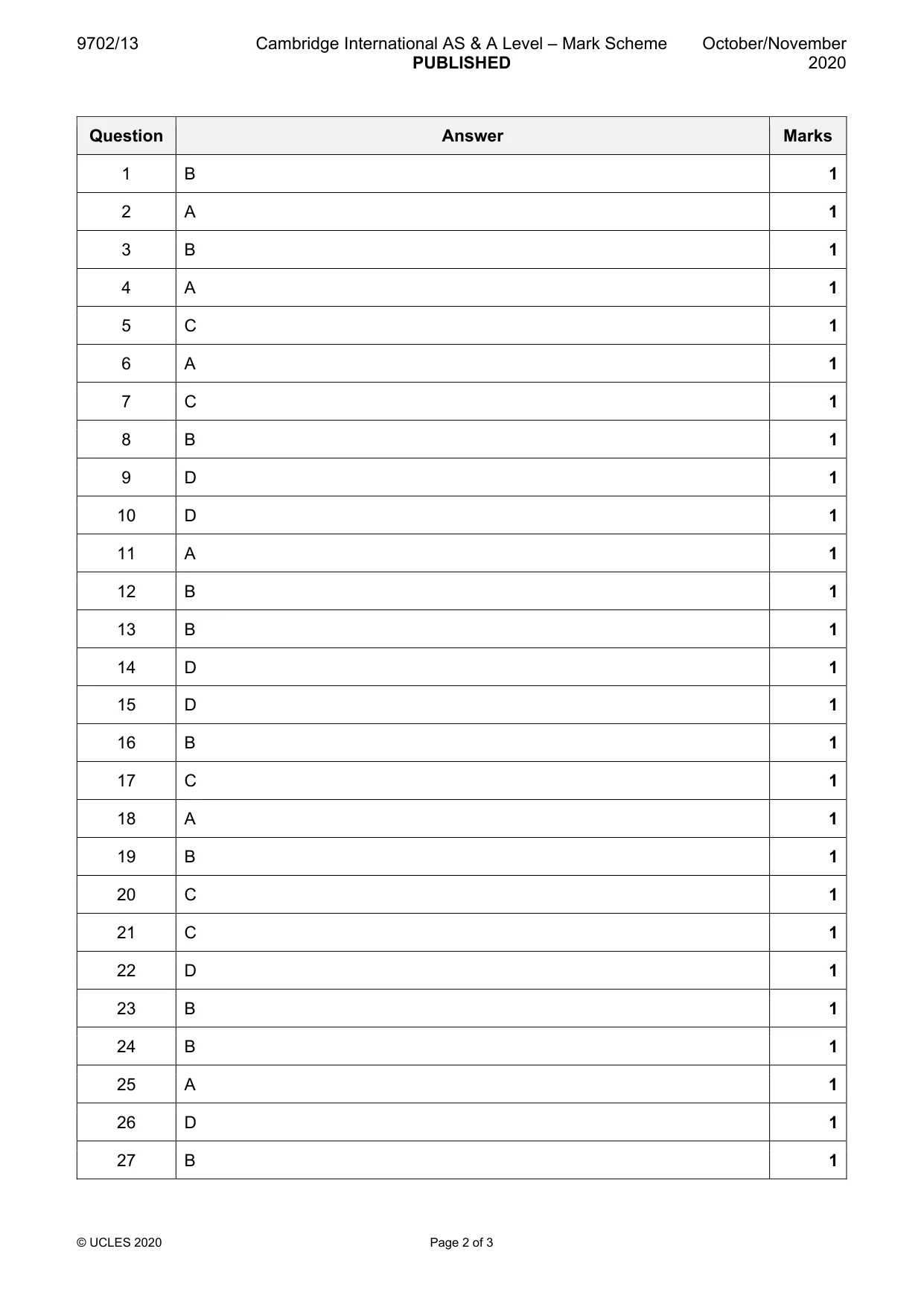
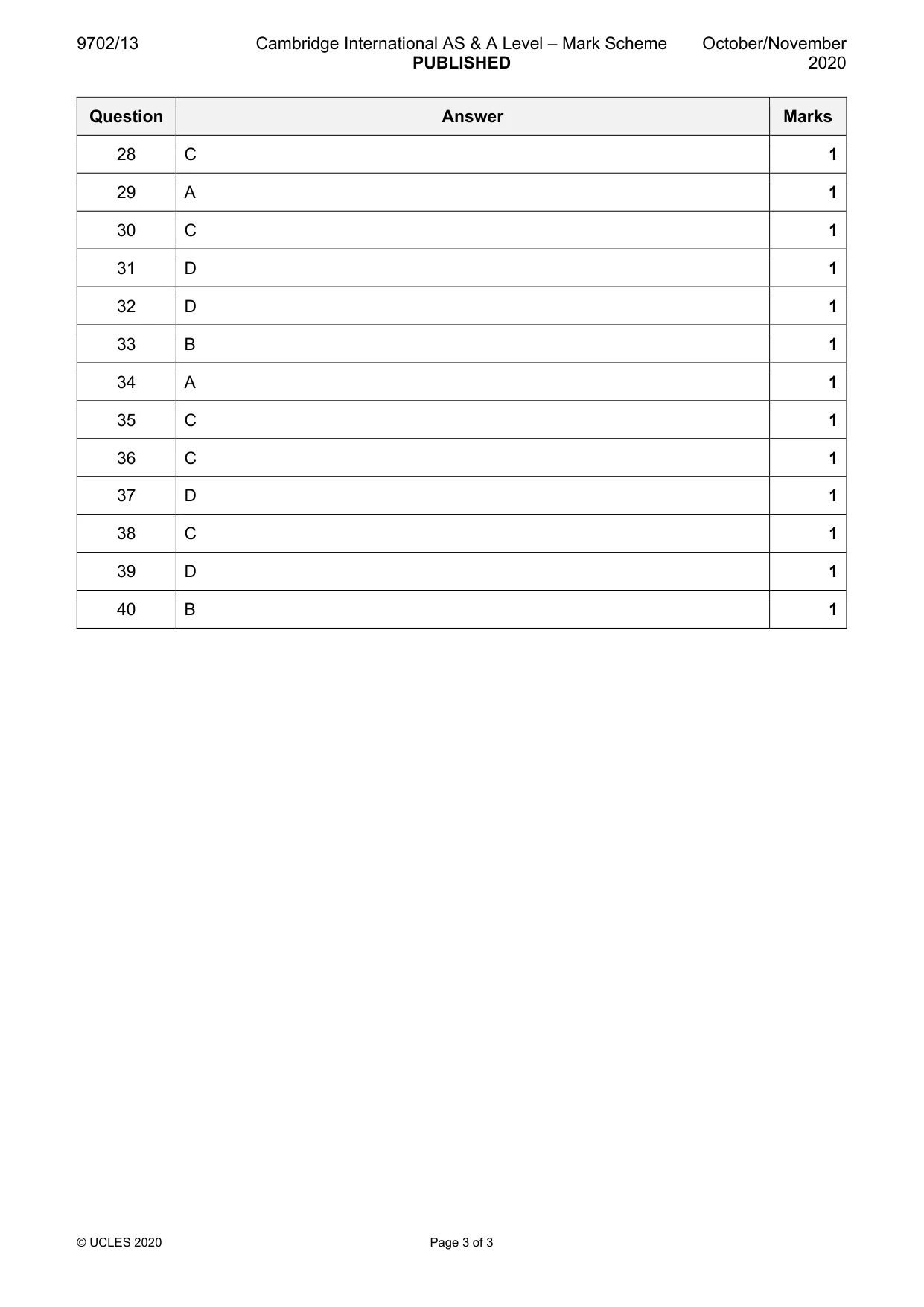
Mark scheme: B
Q2 · What is not an SI base unit?
2 What is not an SI base unit? A coulomb B kelvin C kilogram D second
Mark scheme: A
Q3 · Which two quantities are both vector quantities?
3 Which two quantities are both vector quantities? A displacement and distance B force and momentum C torque and time D weight and pressure
Mark scheme: B
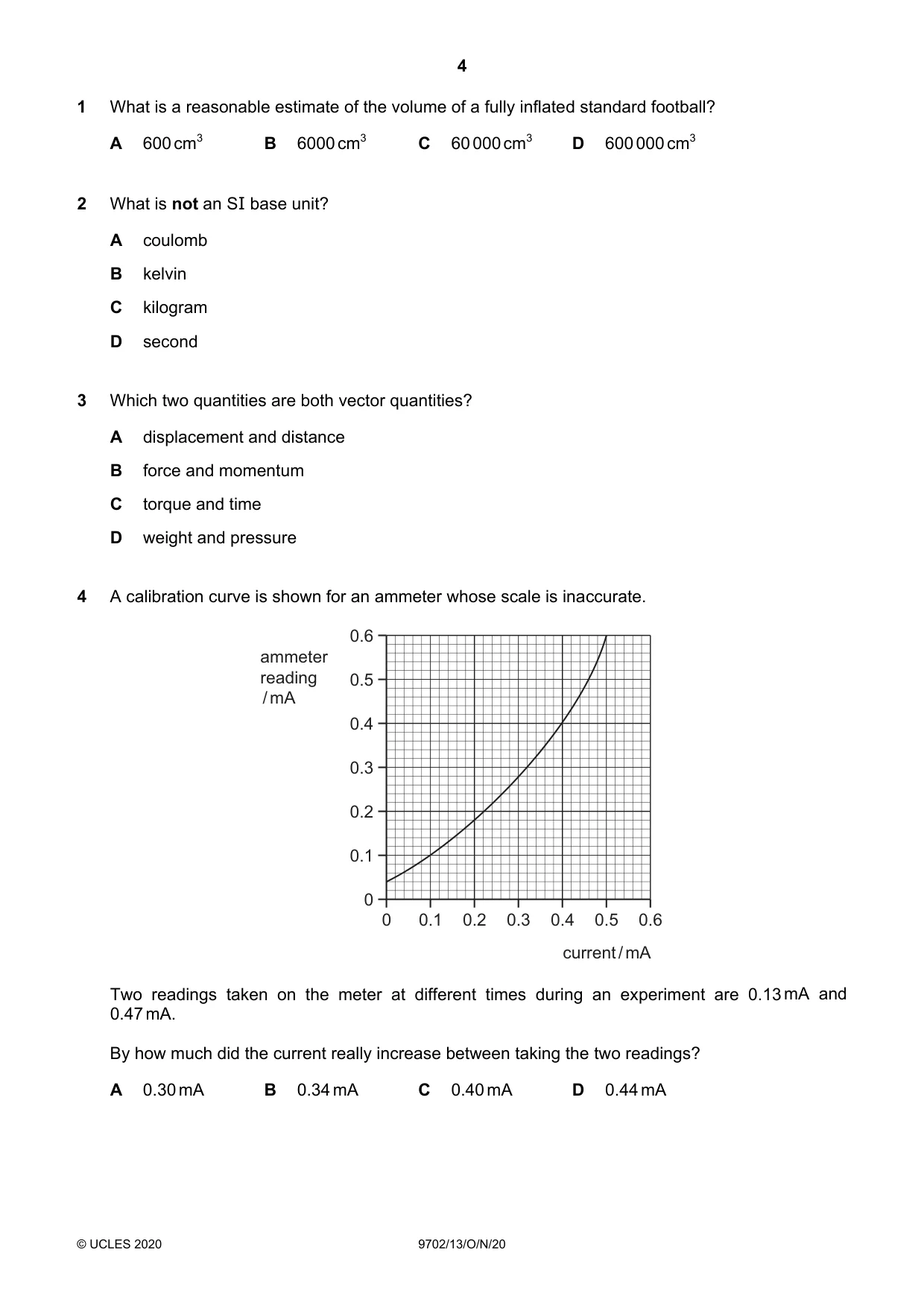
Q4 · A calibration curve is shown for an ammeter whose scale is inaccurate
4 A calibration curve is shown for an ammeter whose scale is inaccurate. 0.6 ammeter reading 0.5 / mA 0.4 0.3 0.2 0.1 0 0 0.1 0.2 0.3 0.4 0.5 0.6 current / mA Two readings taken on the meter at different times during an experiment are 0.13 mA and 0.47 mA. By how much did the current really increase between taking the two readings? A 0.30 mA B 0.34 mA C 0.40 mA D 0.44 mA
Mark scheme: A
Q5 · A student measures the length l and the period T of oscillation of a simple pendulum
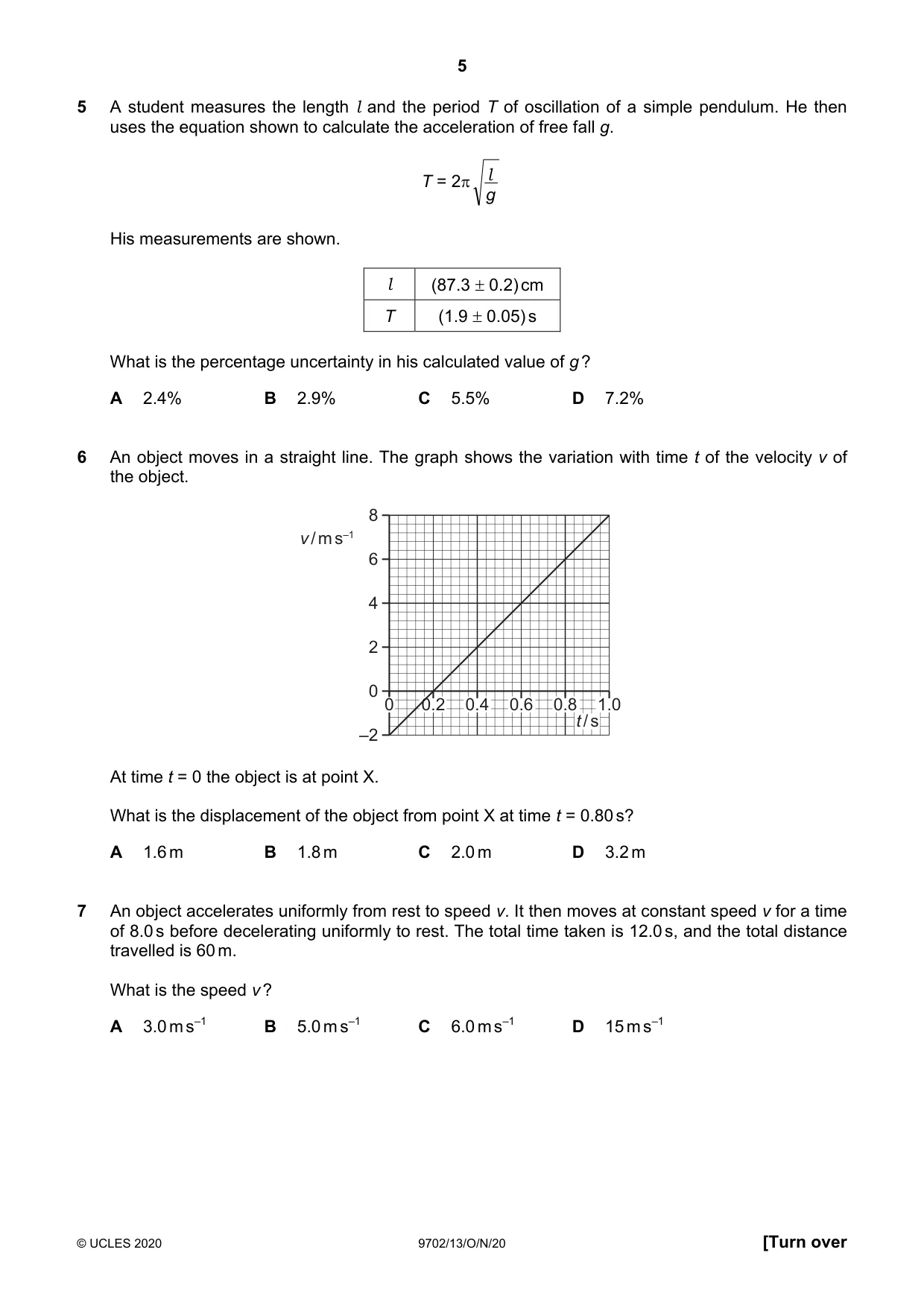
5 A student measures the length l and the period T of oscillation of a simple pendulum. He then uses the equation shown to calculate the acceleration of free fall g. T = 2 l g His measurements are shown. l (87.3 0.2) cm T (1.9 0.05) s What is the percentage uncertainty in his calculated value of g ? A 2.4% B 2.9% C 5.5% D 7.2%
Mark scheme: C
Q6 · An object moves in a straight line
6 An object moves in a straight line. The graph shows the variation with time t of the velocity v of the object. 8 v / m s–1 6 4 2 0 0 0.2 0.4 0.6 0.8 1.0 t / s –2 At time t = 0 the object is at point X. What is the displacement of the object from point X at time t = 0.80 s? A 1.6 m B 1.8 m C 2.0 m D 3.2 m
Mark scheme: A
Q7 · An object accelerates uniformly from rest to speed v
7 An object accelerates uniformly from rest to speed v. It then moves at constant speed v for a time of 8.0 s before decelerating uniformly to rest. The total time taken is 12.0 s, and the total distance travelled is 60 m. What is the speed v ? A 3.0 m s–1 B 5.0 m s–1 C 6.0 m s–1 D 15 m s–1
Mark scheme: C
Q8 · A device for spraying paint consists of a box with its axes horizontal and vertical
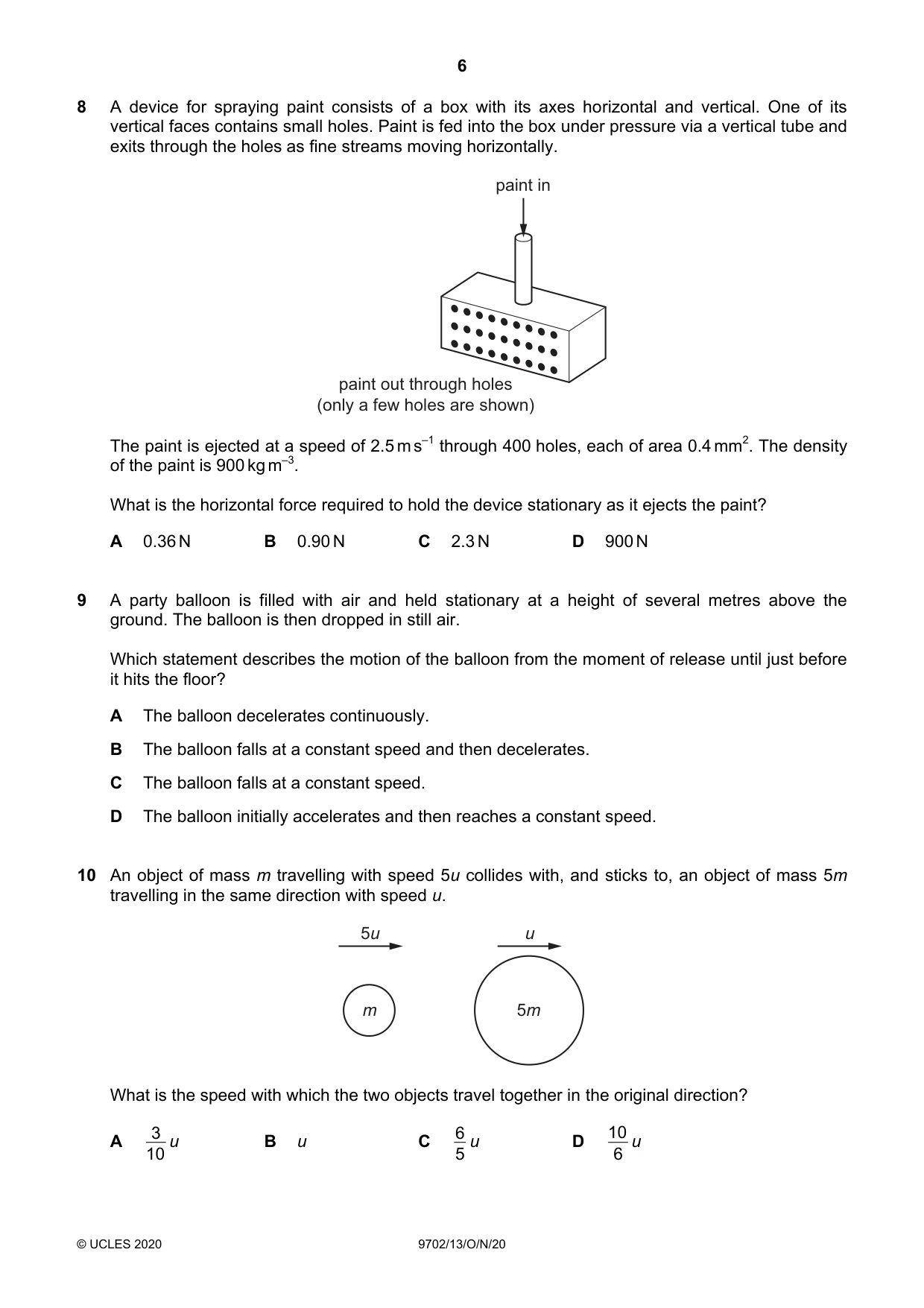
8 A device for spraying paint consists of a box with its axes horizontal and vertical. One of its vertical faces contains small holes. Paint is fed into the box under pressure via a vertical tube and exits through the holes as fine streams moving horizontally. paint in paint out through holes (only a few holes are shown) The paint is ejected at a speed of 2.5 m s–1 through 400 holes, each of area 0.4 mm2. The density of the paint is 900 kg m–3. What is the horizontal force required to hold the device stationary as it ejects the paint? A 0.36 N B 0.90 N C 2.3 N D 900 N
Mark scheme: B
Q9 · A party balloon is filled with air and held stationary at a height of several metres…
9 A party balloon is filled with air and held stationary at a height of several metres above the ground. The balloon is then dropped in still air. Which statement describes the motion of the balloon from the moment of release until just before it hits the floor? A The balloon decelerates continuously. B The balloon falls at a constant speed and then decelerates. C The balloon falls at a constant speed. D The balloon initially accelerates and then reaches a constant speed.
Mark scheme: D
Q10 · An object of mass m travelling with speed 5u collides with, and sticks to, an object of…
10 An object of mass m travelling with speed 5u collides with, and sticks to, an object of mass 5m travelling in the same direction with speed u. 5u u m 5m What is the speed with which the two objects travel together in the original direction? 3 u 6 u 10 u A B u C D 10 5 6
Mark scheme: D
Q11 · An air bubble is rising through a liquid at a constant speed
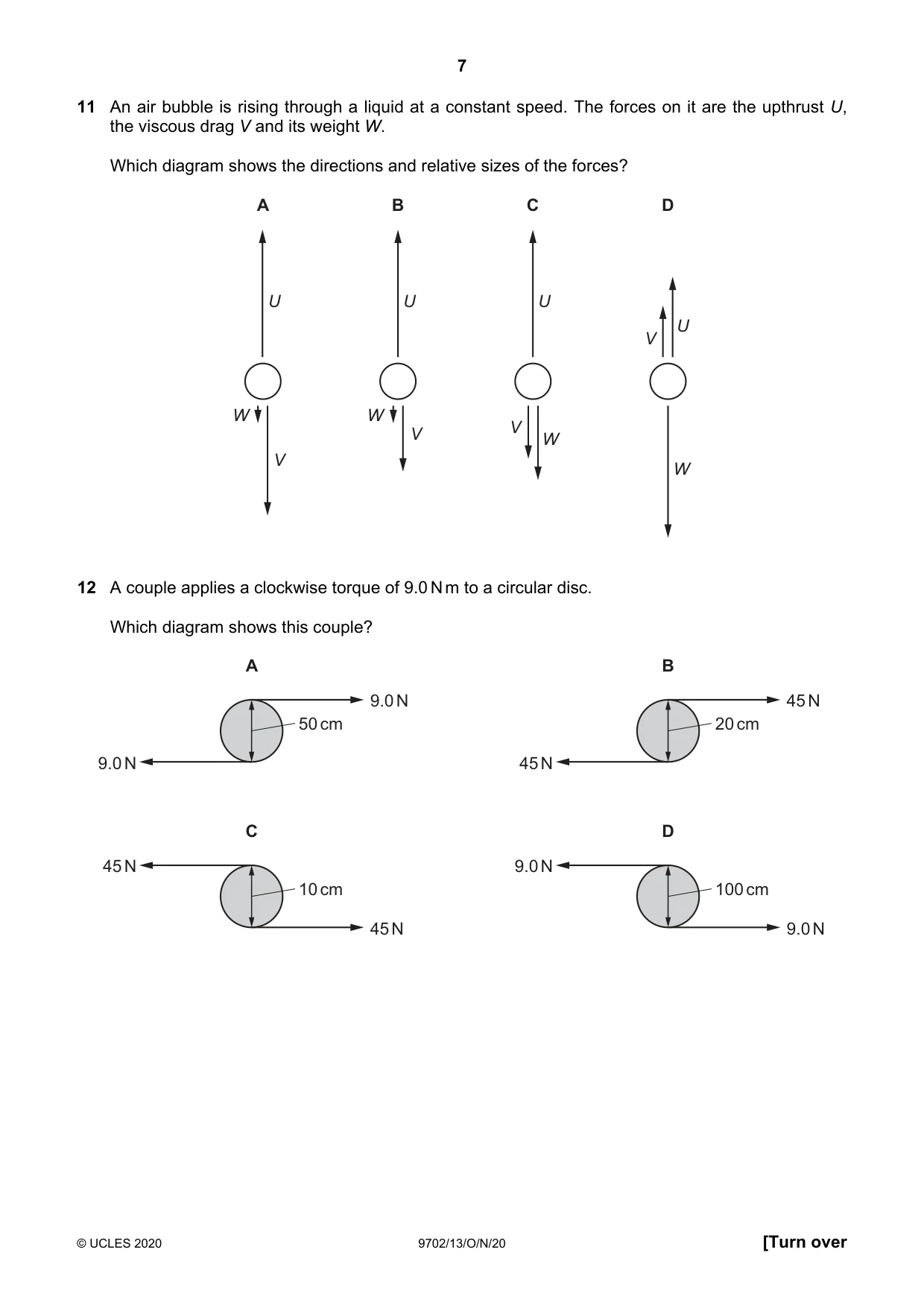
11 An air bubble is rising through a liquid at a constant speed. The forces on it are the upthrust U, the viscous drag V and its weight W. Which diagram shows the directions and relative sizes of the forces? A B C D U U U U V W W V V W V W
Mark scheme: A
Q12 · A couple applies a clockwise torque of 9.0 N m to a circular disc
12 A couple applies a clockwise torque of 9.0 N m to a circular disc. Which diagram shows this couple? A B 9.0 N 45 N 50 cm 20 cm 9.0 N 45 N C D 45 N 9.0 N 10 cm 100 cm 45 N 9.0 N
Mark scheme: B
Q13 · A shelf PQ is attached to a vertical wall at P and supports a book
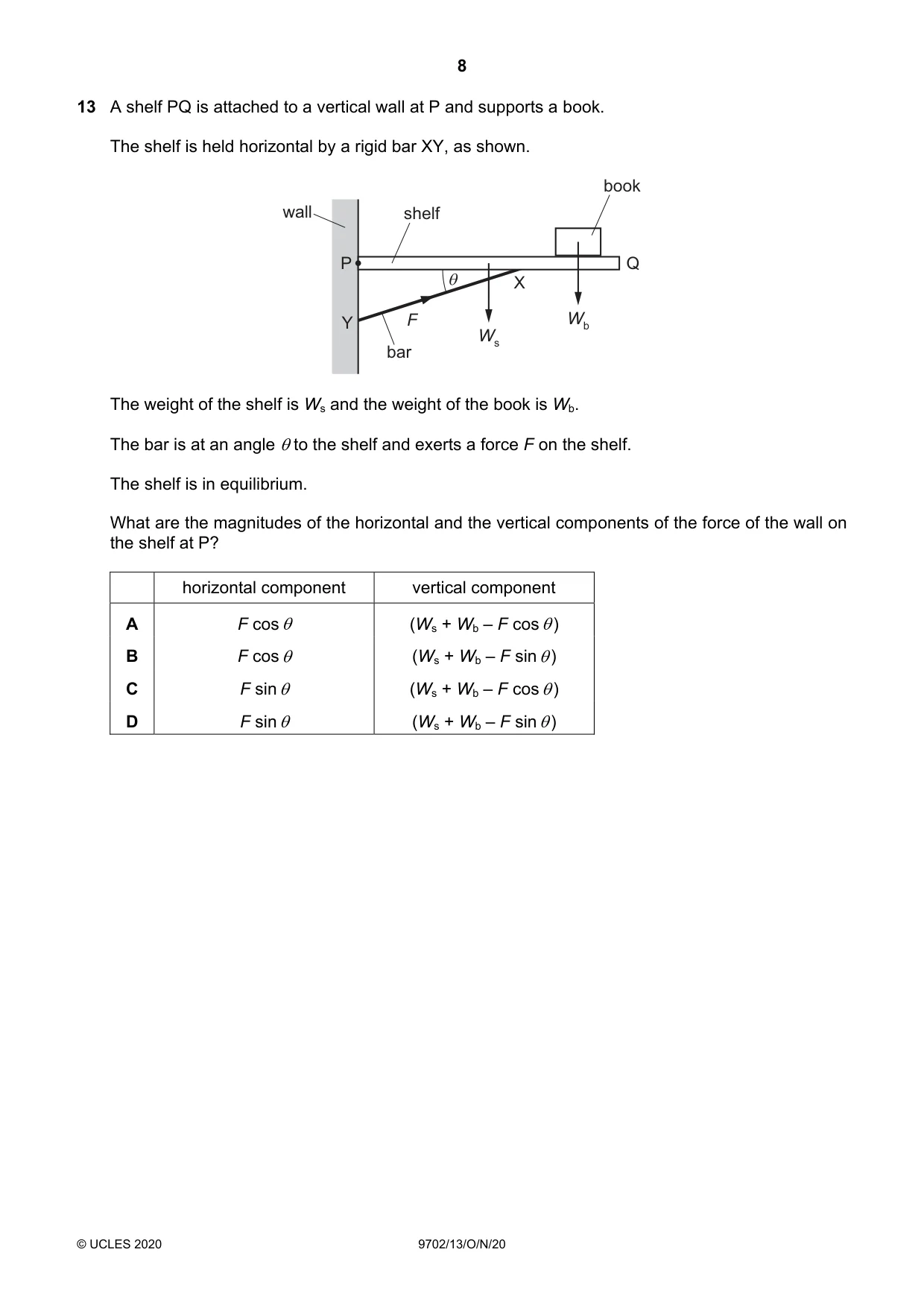
13 A shelf PQ is attached to a vertical wall at P and supports a book. The shelf is held horizontal by a rigid bar XY, as shown. book wall shelf P Q θ X Y F Wb Ws bar The weight of the shelf is Ws and the weight of the book is Wb. The bar is at an angle to the shelf and exerts a force F on the shelf. The shelf is in equilibrium. What are the magnitudes of the horizontal and the vertical components of the force of the wall on the shelf at P? horizontal component vertical component A F cos (Ws + Wb – F cos ) B F cos (Ws + Wb – F sin ) C F sin (Ws + Wb – F cos ) D F sin (Ws + Wb – F sin )
Mark scheme: B
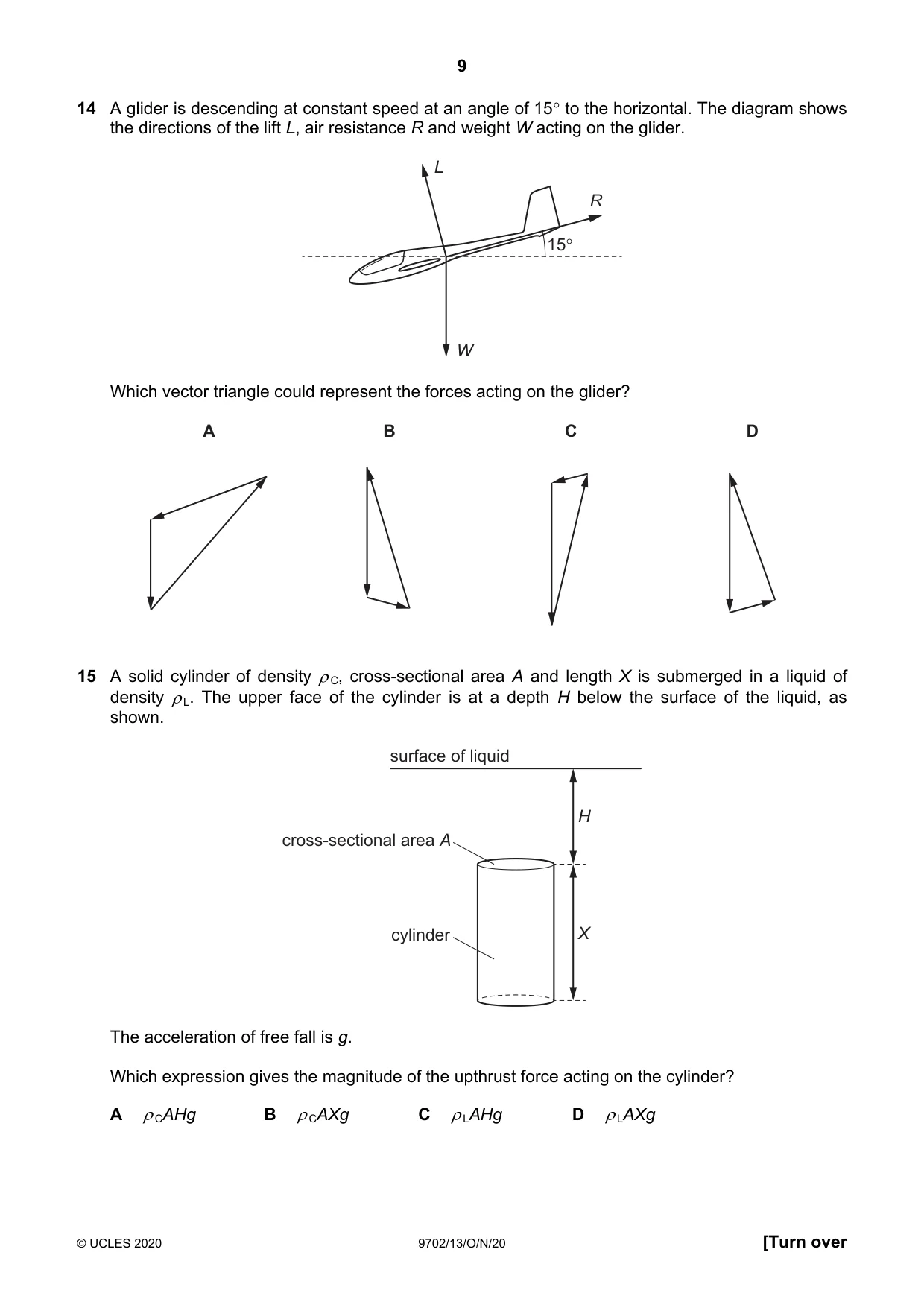
Q14 · A glider is descending at constant speed at an angle of 15 to the horizontal
14 A glider is descending at constant speed at an angle of 15 to the horizontal. The diagram shows the directions of the lift L, air resistance R and weight W acting on the glider. L R 15° W Which vector triangle could represent the forces acting on the glider? A B C D
Mark scheme: D
Q15 · A solid cylinder of density C, cross-sectional area A and length X is submerged in a…
15 A solid cylinder of density C, cross-sectional area A and length X is submerged in a liquid of density L. The upper face of the cylinder is at a depth H below the surface of the liquid, as shown. surface of liquid H cross-sectional area A cylinder X The acceleration of free fall is g. Which expression gives the magnitude of the upthrust force acting on the cylinder? A CAHg B CAXg C LAHg D LAXg
Mark scheme: D
Q16 · A ball drops onto a horizontal surface and bounces elastically
16 A ball drops onto a horizontal surface and bounces elastically. What happens to the kinetic energy of the ball during the very short time that it is in contact with the surface? A Most of the kinetic energy is lost as heat and sound. B The kinetic energy decreases to zero and then returns to its original value. C The kinetic energy remains constant because it is an elastic collision. D The kinetic energy remains constant in magnitude but changes direction.
Mark scheme: B
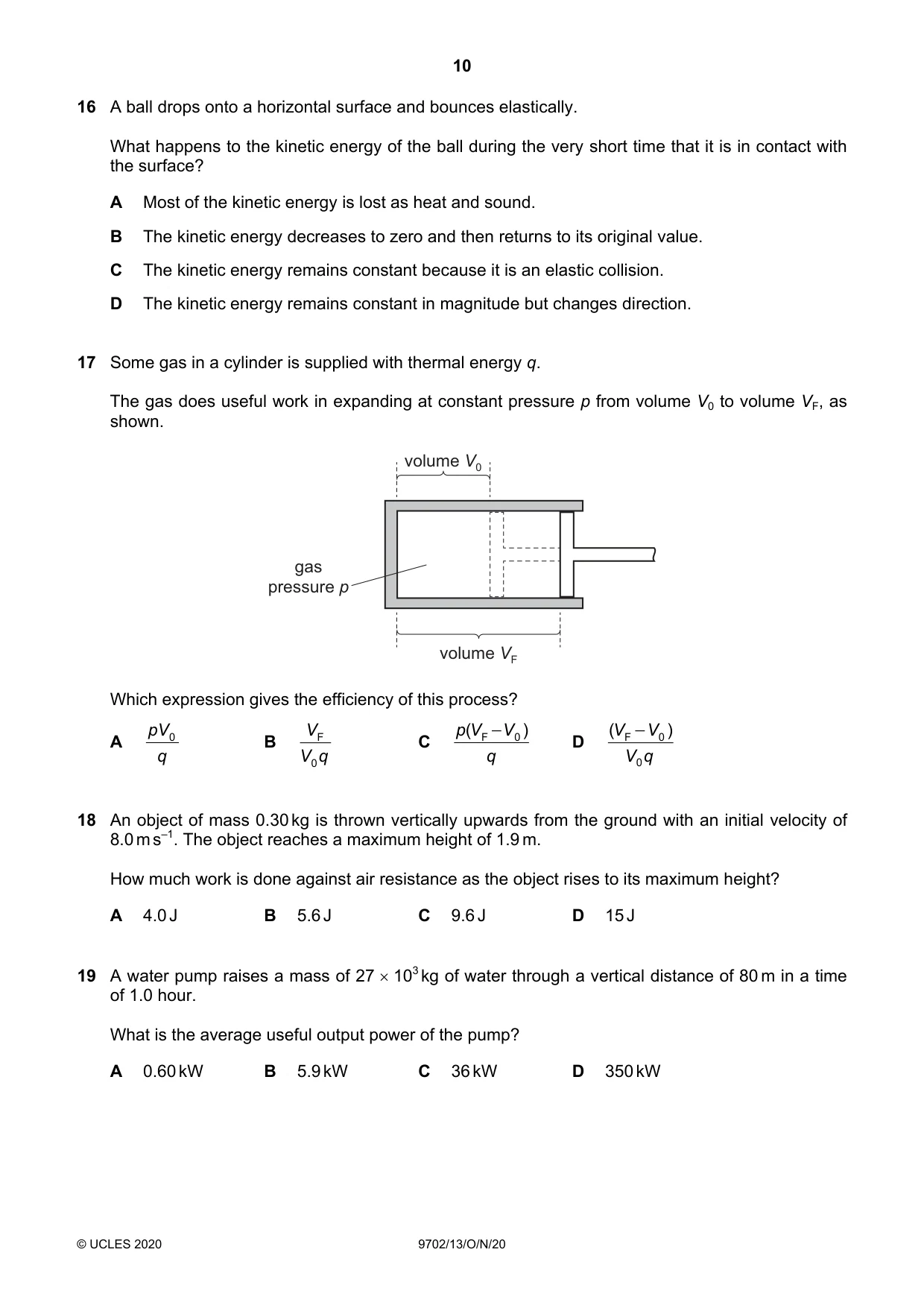
Q17 · Some gas in a cylinder is supplied with thermal energy q
17 Some gas in a cylinder is supplied with thermal energy q. The gas does useful work in expanding at constant pressure p from volume V0 to volume VF, as shown. volume V0 gas pressure p volume VF Which expression gives the efficiency of this process? pV0 V p ( V F V ) ( V V ) A B F C 0 D F 0 q V q q V q 0 0
Mark scheme: C
Q18 · An object of mass 0.30 kg is thrown vertically upwards from the ground with an initial…
18 An object of mass 0.30 kg is thrown vertically upwards from the ground with an initial velocity of 8.0 m s–1. The object reaches a maximum height of 1.9 m. How much work is done against air resistance as the object rises to its maximum height? A 4.0 J B 5.6 J C 9.6 J D 15 J
Mark scheme: A
Q19 · A water pump raises a mass of 27 103 kg of water through a vertical distance of 80 m in…
19 A water pump raises a mass of 27 103 kg of water through a vertical distance of 80 m in a time of 1.0 hour. What is the average useful output power of the pump? A 0.60 kW B 5.9 kW C 36 kW D 350 kW
Mark scheme: B
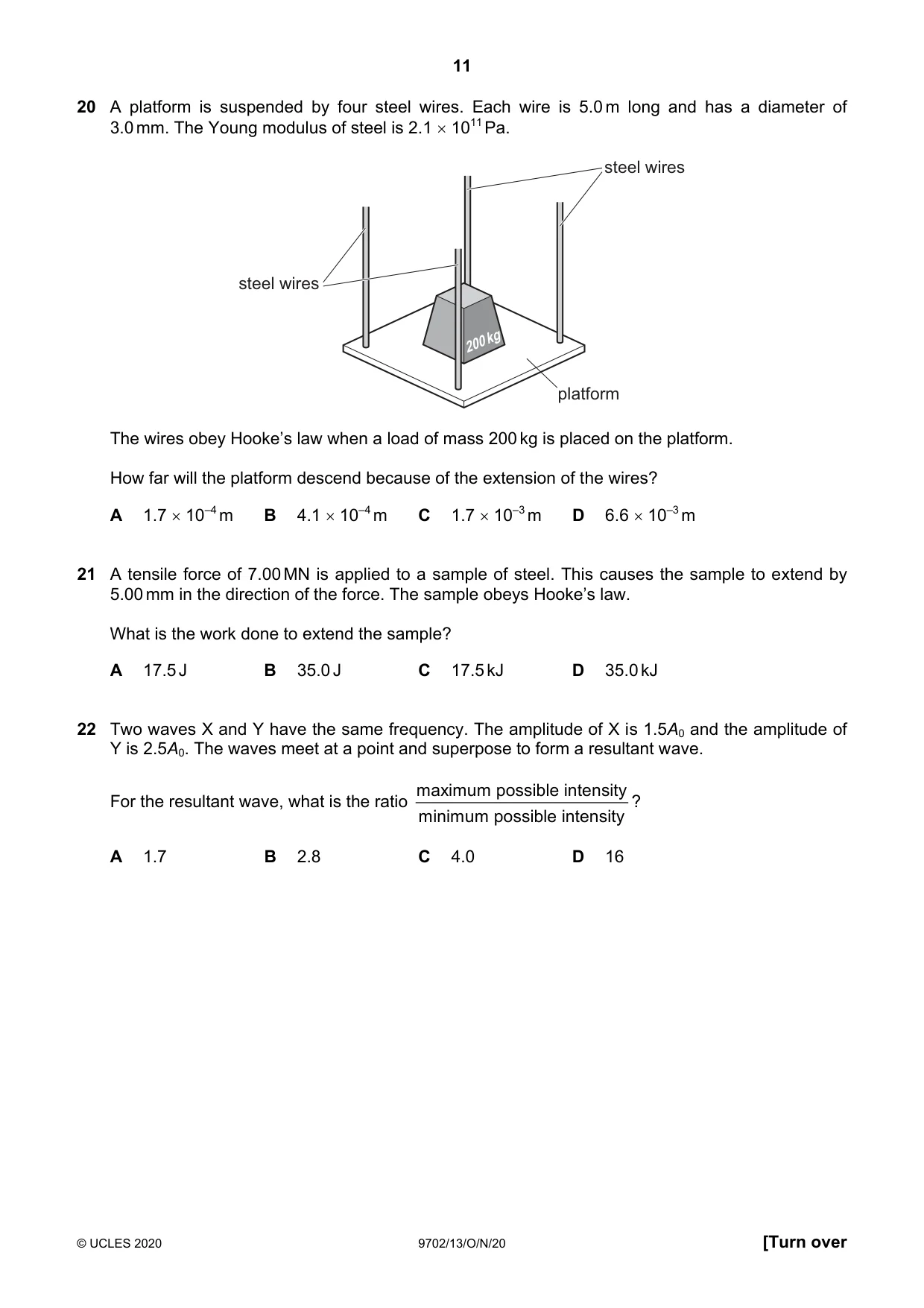
Q20 · A platform is suspended by four steel wires
20 A platform is suspended by four steel wires. Each wire is 5.0 m long and has a diameter of 3.0 mm. The Young modulus of steel is 2.1 1011 Pa. steel wires steel wires 200 kg platform The wires obey Hooke’s law when a load of mass 200 kg is placed on the platform. How far will the platform descend because of the extension of the wires? A 1.7 10–4 m B 4.1 10–4 m C 1.7 10–3 m D 6.6 10–3 m
Mark scheme: C
Q21 · A tensile force of 7.00 MN is applied to a sample of steel
21 A tensile force of 7.00 MN is applied to a sample of steel. This causes the sample to extend by 5.00 mm in the direction of the force. The sample obeys Hooke’s law. What is the work done to extend the sample? A 17.5 J B 35.0 J C 17.5 kJ D 35.0 kJ
Mark scheme: C
Q22 · Two waves X and Y have the same frequency
22 Two waves X and Y have the same frequency. The amplitude of X is 1.5A0 and the amplitude of Y is 2.5A0. The waves meet at a point and superpose to form a resultant wave. For the resultant wave, what is the ratio maximum possible intensity ? minimum possible intensity A 1.7 B 2.8 C 4.0 D 16
Mark scheme: D
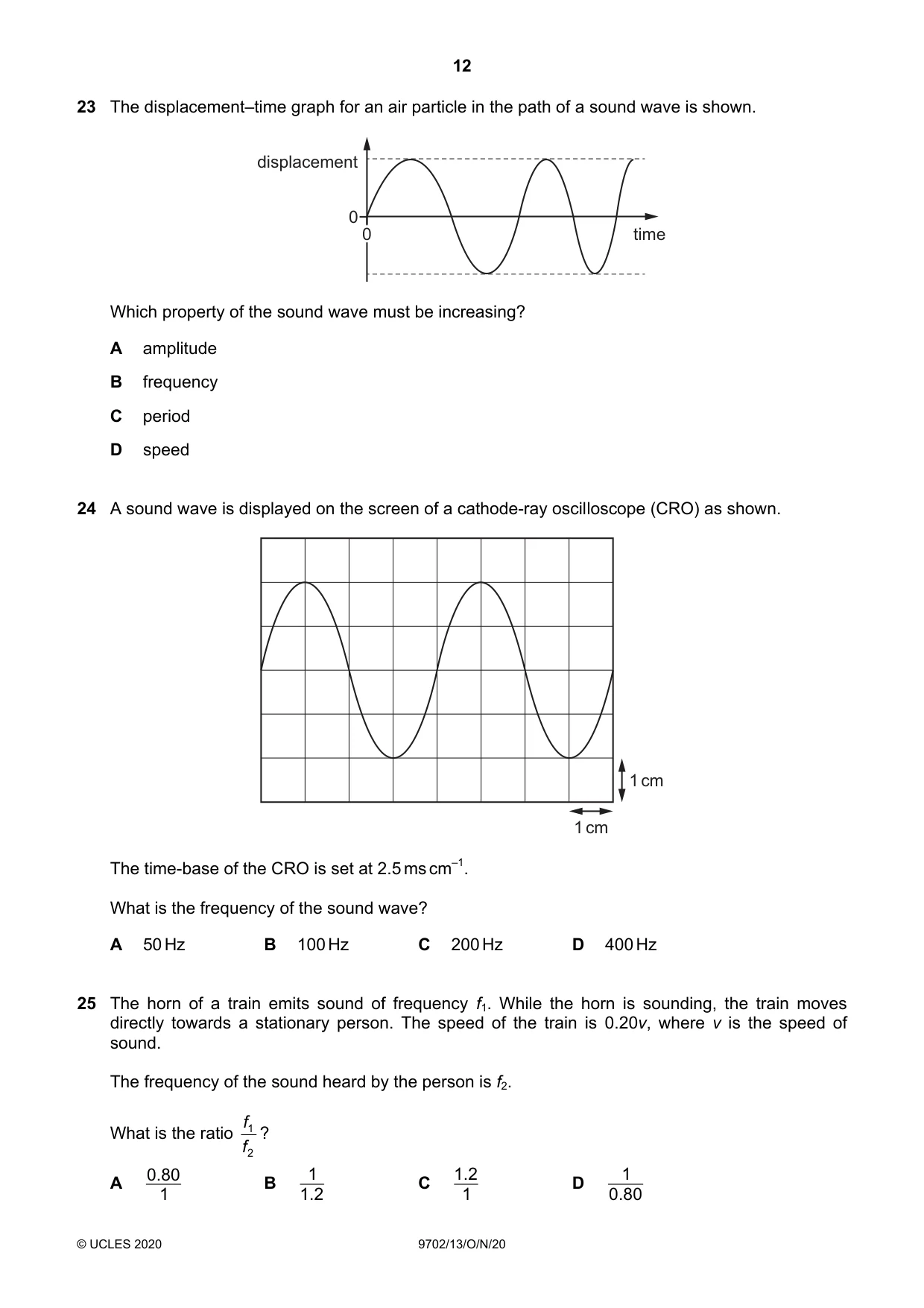
Q23 · The displacement–time graph for an air particle in the path of a sound wave is shown
23 The displacement–time graph for an air particle in the path of a sound wave is shown. displacement 0 0 time Which property of the sound wave must be increasing? A amplitude B frequency C period D speed
Mark scheme: B
Q24 · A sound wave is displayed on the screen of a cathode-ray oscilloscope (CRO) as shown
24 A sound wave is displayed on the screen of a cathode-ray oscilloscope (CRO) as shown. 1 cm 1 cm The time-base of the CRO is set at 2.5 ms cm–1. What is the frequency of the sound wave? A 50 Hz B 100 Hz C 200 Hz D 400 Hz
Mark scheme: B
Q25 · The horn of a train emits sound of frequency f1
25 The horn of a train emits sound of frequency f1. While the horn is sounding, the train moves directly towards a stationary person. The speed of the train is 0.20v, where v is the speed of sound. The frequency of the sound heard by the person is f2. f ? What is the ratio 1 f 2 0.80 1 1.2 1 A B 1.2 C 1 D 0.80 1
Mark scheme: A
Q26 · Two satellites in orbit around the Earth are at a constant distance of 100 km apart from…
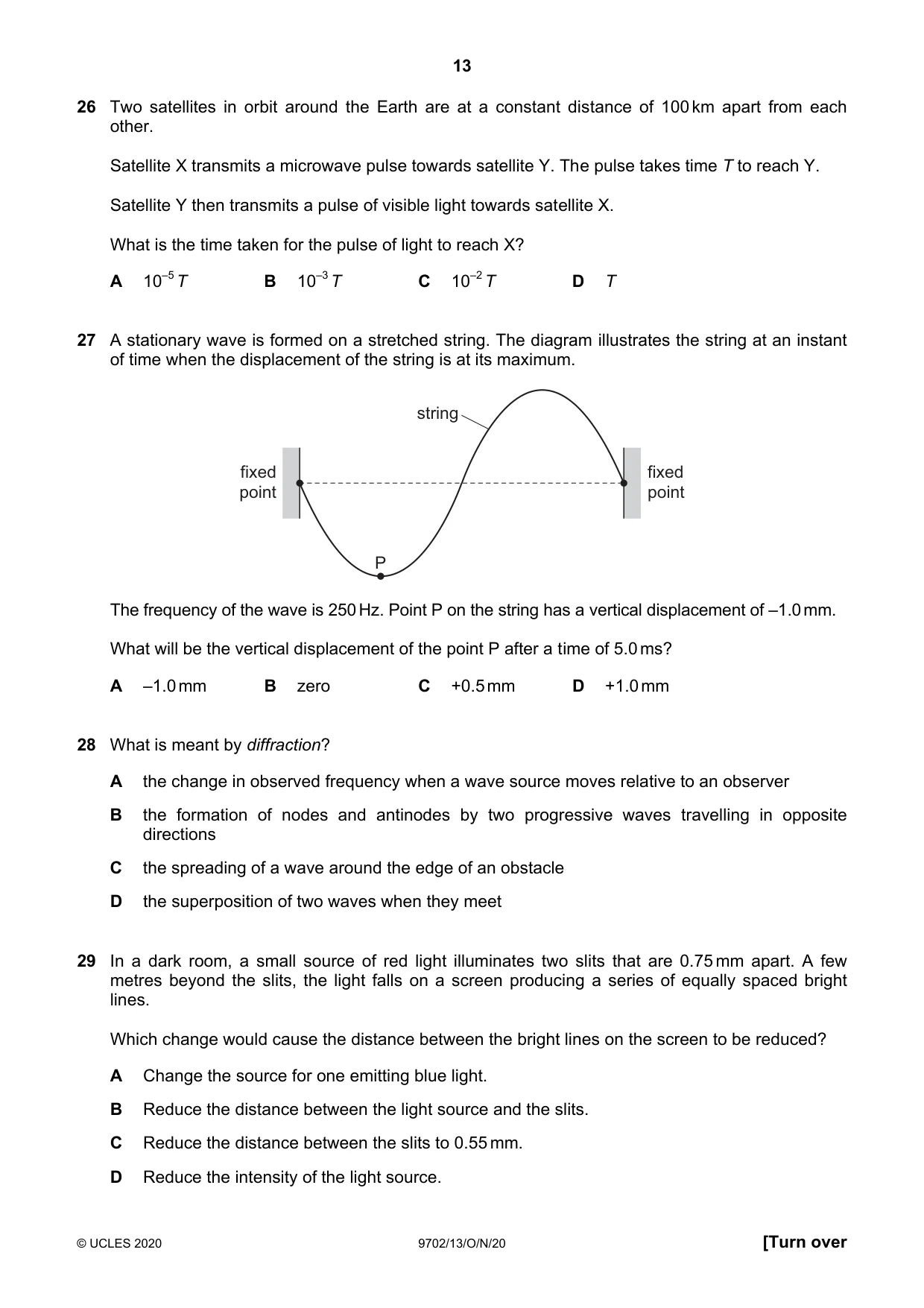
26 Two satellites in orbit around the Earth are at a constant distance of 100 km apart from each other. Satellite X transmits a microwave pulse towards satellite Y. The pulse takes time T to reach Y. Satellite Y then transmits a pulse of visible light towards satellite X. What is the time taken for the pulse of light to reach X? A 10–5 T B 10–3 T C 10–2 T D T
Mark scheme: D
Q27 · A stationary wave is formed on a stretched string
27 A stationary wave is formed on a stretched string. The diagram illustrates the string at an instant of time when the displacement of the string is at its maximum. string fixed fixed point point P The frequency of the wave is 250 Hz. Point P on the string has a vertical displacement of –1.0 mm. What will be the vertical displacement of the point P after a time of 5.0 ms? A –1.0 mm B zero C +0.5 mm D +1.0 mm
Mark scheme: B
Q28 · What is meant by diffraction?
28 What is meant by diffraction? A the change in observed frequency when a wave source moves relative to an observer B the formation of nodes and antinodes by two progressive waves travelling in opposite directions C the spreading of a wave around the edge of an obstacle D the superposition of two waves when they meet
Mark scheme: C
Q29 · In a dark room, a small source of red light illuminates two slits that are 0.75 mm apart
29 In a dark room, a small source of red light illuminates two slits that are 0.75 mm apart. A few metres beyond the slits, the light falls on a screen producing a series of equally spaced bright lines. Which change would cause the distance between the bright lines on the screen to be reduced? A Change the source for one emitting blue light. B Reduce the distance between the light source and the slits. C Reduce the distance between the slits to 0.55 mm. D Reduce the intensity of the light source.
Mark scheme: A
Q30 · Light of wavelength 5.30 10–7 m is incident normally on a diffraction grating
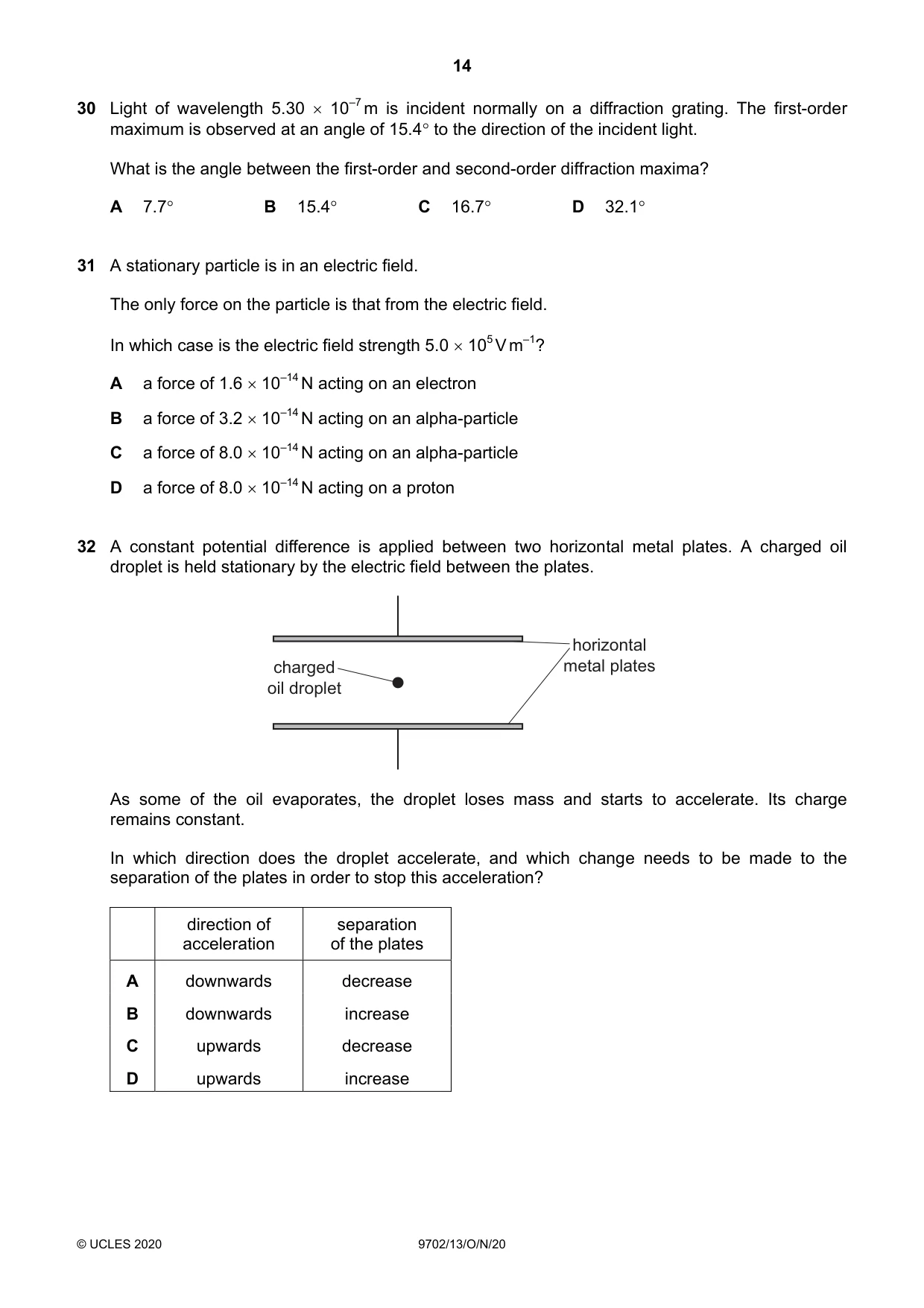
30 Light of wavelength 5.30 10–7 m is incident normally on a diffraction grating. The first-order maximum is observed at an angle of 15.4 to the direction of the incident light. What is the angle between the first-order and second-order diffraction maxima? A 7.7 B 15.4 C 16.7 D 32.1
Mark scheme: C
Q31 · A stationary particle is in an electric field
31 A stationary particle is in an electric field. The only force on the particle is that from the electric field. In which case is the electric field strength 5.0 105 V m–1? A a force of 1.6 10–14 N acting on an electron B a force of 3.2 10–14 N acting on an alpha-particle C a force of 8.0 10–14 N acting on an alpha-particle D a force of 8.0 10–14 N acting on a proton
Mark scheme: D
Q32 · A constant potential difference is applied between two horizontal metal plates
32 A constant potential difference is applied between two horizontal metal plates. A charged oil droplet is held stationary by the electric field between the plates. horizontal charged metal plates oil droplet As some of the oil evaporates, the droplet loses mass and starts to accelerate. Its charge remains constant. In which direction does the droplet accelerate, and which change needs to be made to the separation of the plates in order to stop this acceleration? direction of separation acceleration of the plates A downwards decrease B downwards increase C upwards decrease D upwards increase
Mark scheme: D
Q33 · Two resistors R1 and R2 are made from wire of the same material
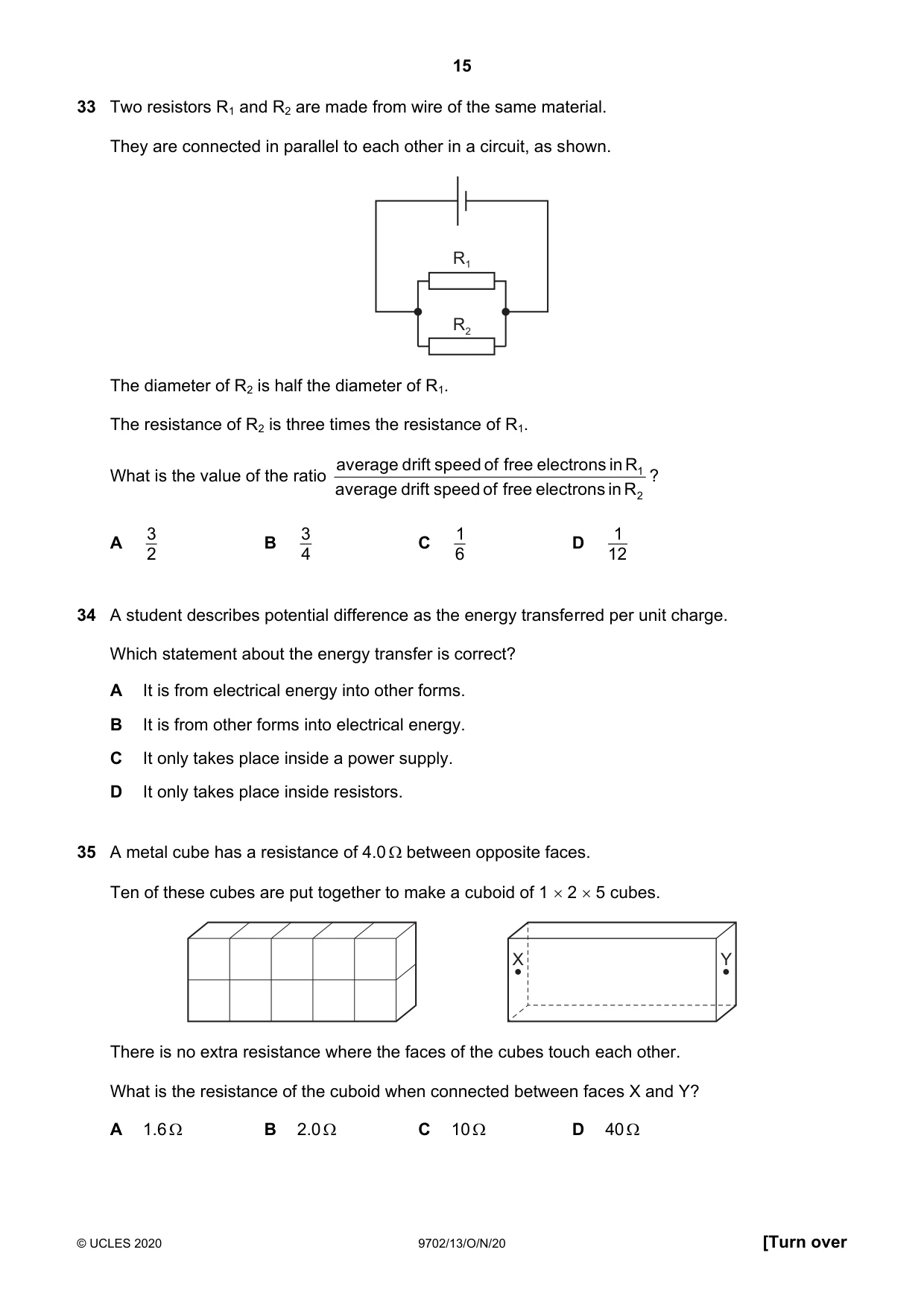
33 Two resistors R1 and R2 are made from wire of the same material. They are connected in parallel to each other in a circuit, as shown. R1 R2 The diameter of R2 is half the diameter of R1. The resistance of R2 is three times the resistance of R1. average drift speed of free electrons in R What is the value of the ratio average drift speed of free electrons inR ? 1 2 3 3 1 1 A 2 B 4 C 6 D 12
Mark scheme: B
Q34 · A student describes potential difference as the energy transferred per unit charge
34 A student describes potential difference as the energy transferred per unit charge. Which statement about the energy transfer is correct? A It is from electrical energy into other forms. B It is from other forms into electrical energy. C It only takes place inside a power supply. D It only takes place inside resistors.
Mark scheme: A
Q35 · A metal cube has a resistance of 4.0 between opposite faces
35 A metal cube has a resistance of 4.0 between opposite faces. Ten of these cubes are put together to make a cuboid of 1 2 5 cubes. X Y There is no extra resistance where the faces of the cubes touch each other. What is the resistance of the cuboid when connected between faces X and Y? A 1.6 B 2.0 C 10 D 40
Mark scheme: C
Q36 · A cell is connected to a fixed resistor
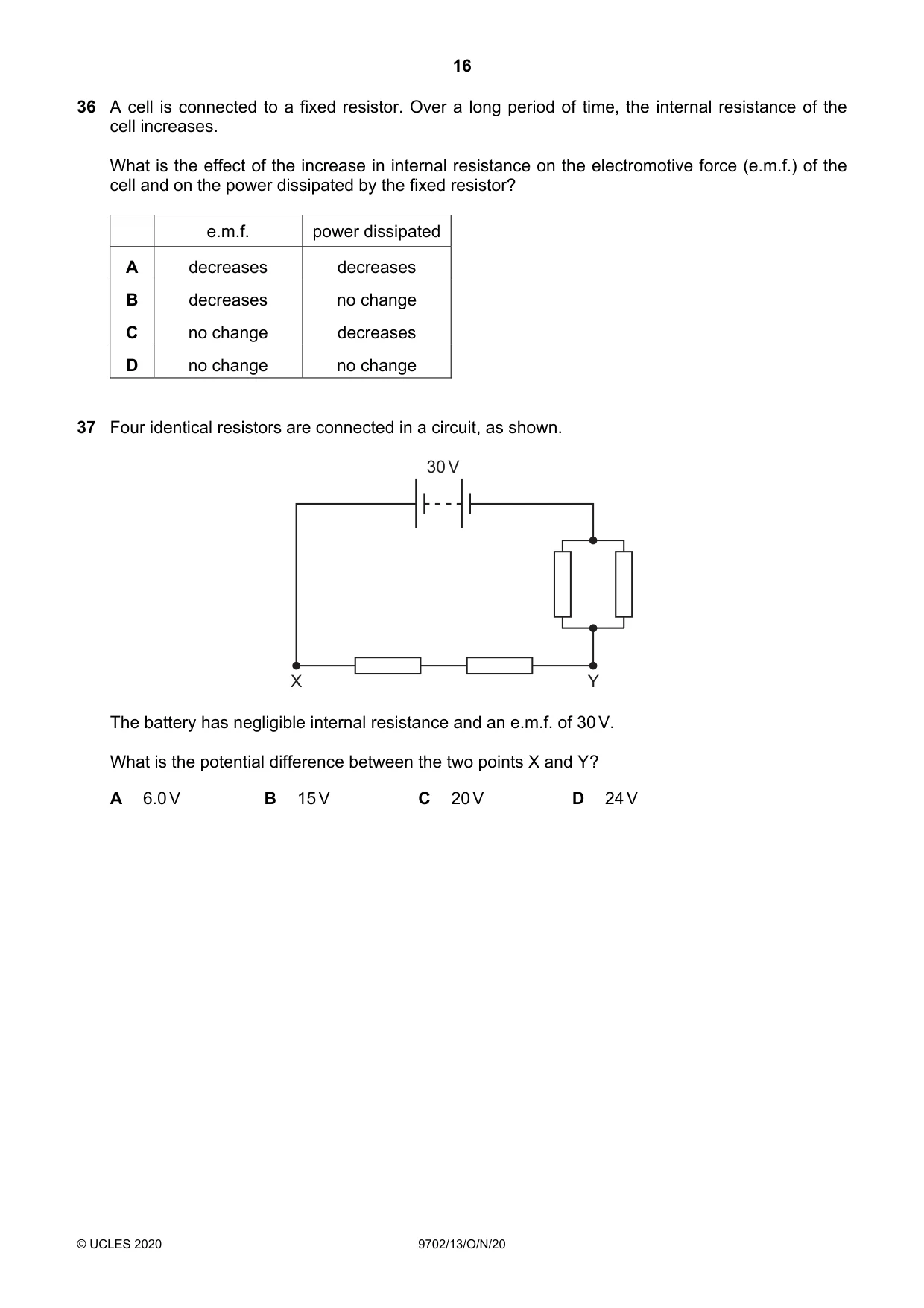
36 A cell is connected to a fixed resistor. Over a long period of time, the internal resistance of the cell increases. What is the effect of the increase in internal resistance on the electromotive force (e.m.f.) of the cell and on the power dissipated by the fixed resistor? e.m.f. power dissipated A decreases decreases B decreases no change C no change decreases D no change no change
Mark scheme: C
Q37 · Four identical resistors are connected in a circuit, as shown
37 Four identical resistors are connected in a circuit, as shown. 30 V X Y The battery has negligible internal resistance and an e.m.f. of 30 V. What is the potential difference between the two points X and Y? A 6.0 V B 15 V C 20 V D 24 V
Mark scheme: D
Q38 · A power supply and a solar cell are compared using the potentiometer circuit shown
38 A power supply and a solar cell are compared using the potentiometer circuit shown. power supply 2.000 V + – R S P Q 40.0 cm galvanometer solar cell The potentiometer wire PQ is 100.0 cm long and has a resistance of 5.00 . The power supply has an e.m.f. of 2.000 V and the solar cell has an e.m.f. of 5.00 mV. Which resistance R must be used so that the galvanometer reads zero when PS = 40.0 cm? A 395 B 405 C 795 D 805
Mark scheme: C
Q39 · The table contains data for four different nuclei P, Q, R and S
39 The table contains data for four different nuclei P, Q, R and S. number nucleon nucleus of neutrons number P 5 10 Q 6 10 R 6 14 S 8 16 Which two nuclei are isotopes of the same element? A P and Q B P and S C Q and R D R and S
Mark scheme: D
Q40 · Which particle is a fundamental particle?
40 Which particle is a fundamental particle? A alpha-particle B electron C neutron D proton
Mark scheme: B
What was in this paper
The subtopics covered by these 40 questions, and how many questions each got. Open one in a new tab to see every Cambridge question on it.
3Equilibrium of forces3Equations of motion2Errors and uncertainties2Interference2Linear momentum and its conservation2Potential dividers2Progressive waves2Stress and strain2Uniform electric fields2Atoms, nuclei and radiation1Density and pressure1Diffraction1Doppler effect for sound waves1Electric current1Electromagnetic spectrum1Fundamental particles1Momentum and Newton’s laws of motion1Physical quantities1Potential difference and power1Practical circuits1Resistance and resistivity1Scalars and vectors1SI units1Stationary waves1The diffraction grating1The first law of thermodynamics1Turning effects of forces1What you needed in this session
Cambridge’s own grade thresholds for 2020 Oct/Nov, Paper 1 · Variant 3. A higher threshold means an easier paper — the bar moves with how the cohort did.