Cambridge A Level Physics 9702 — 2010 Oct/Nov Paper 1 · Variant 2
9702/12/O/N/10 · 40 questions · 40 marks · ≈45 min
The question paper and its mark scheme, free to read here and free to download. This is Cambridge’s own paper, exactly as it was sat.
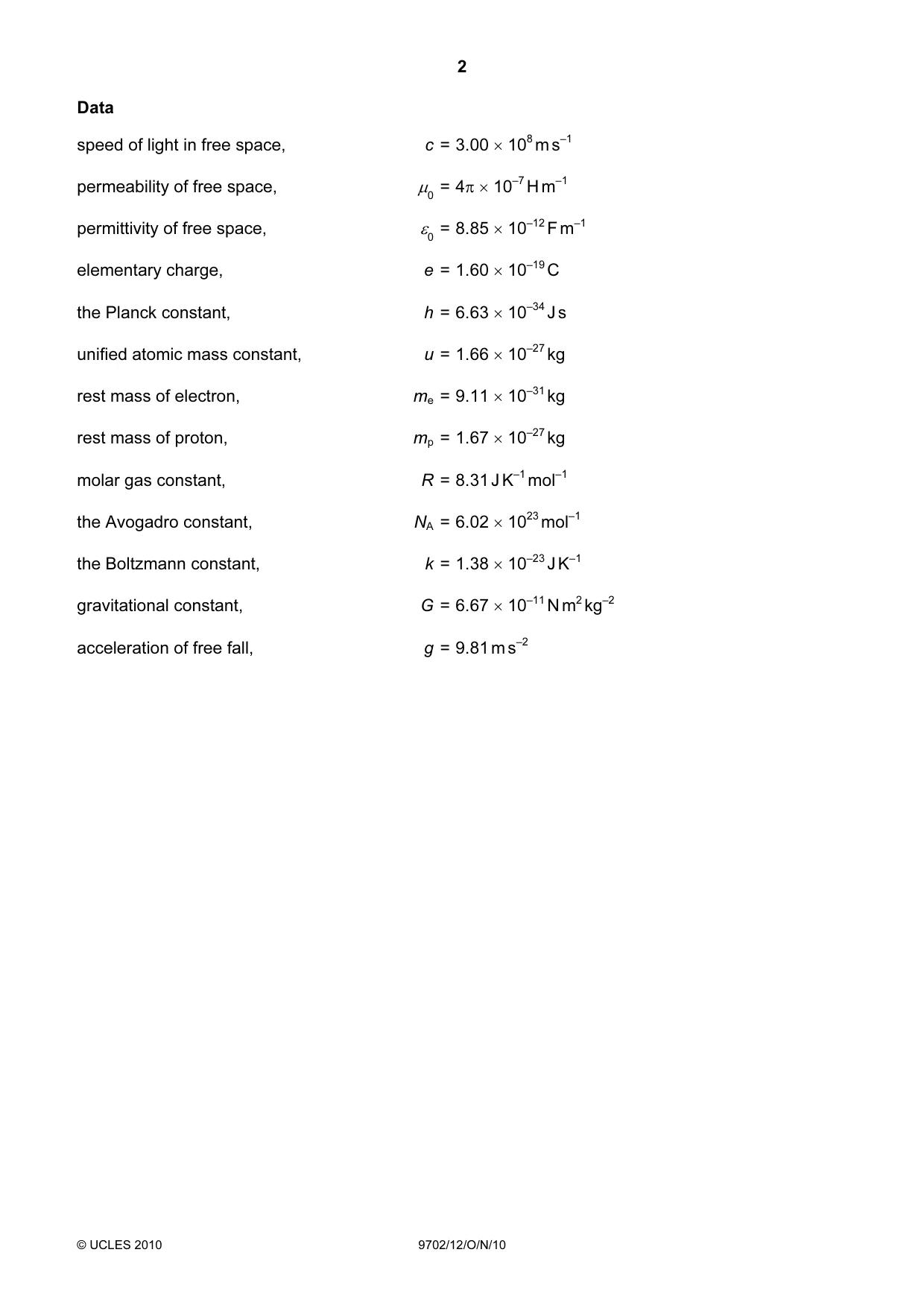
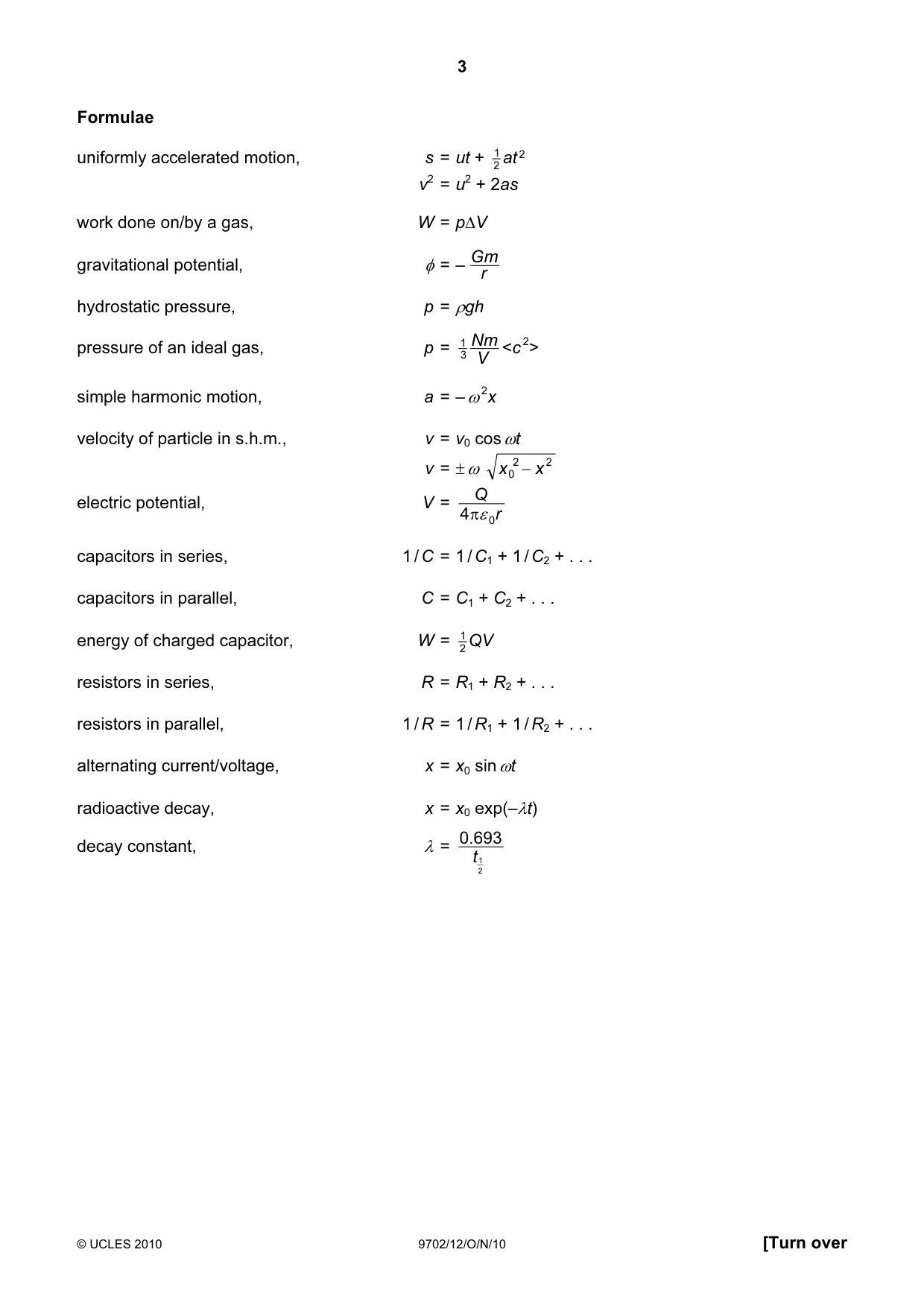
Question paper24 pages
Mark scheme2 pages
Answers below. Sit the paper first if you are practising.
Questions as text
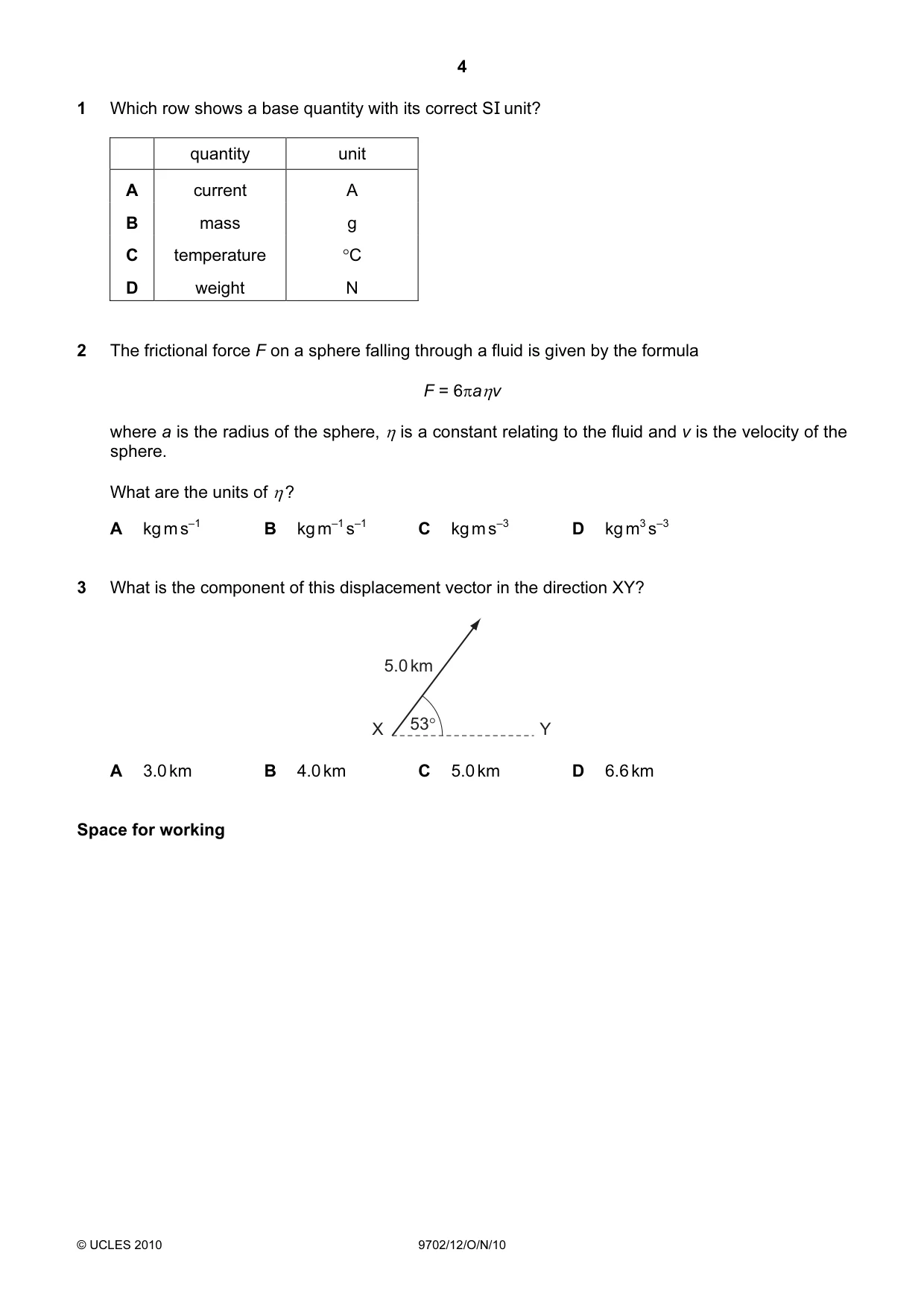
Q1 · Which row shows a base quantity with its correct SI unit?
1 Which row shows a base quantity with its correct SI unit? quantity unit A current A B mass g C temperature °C D weight N
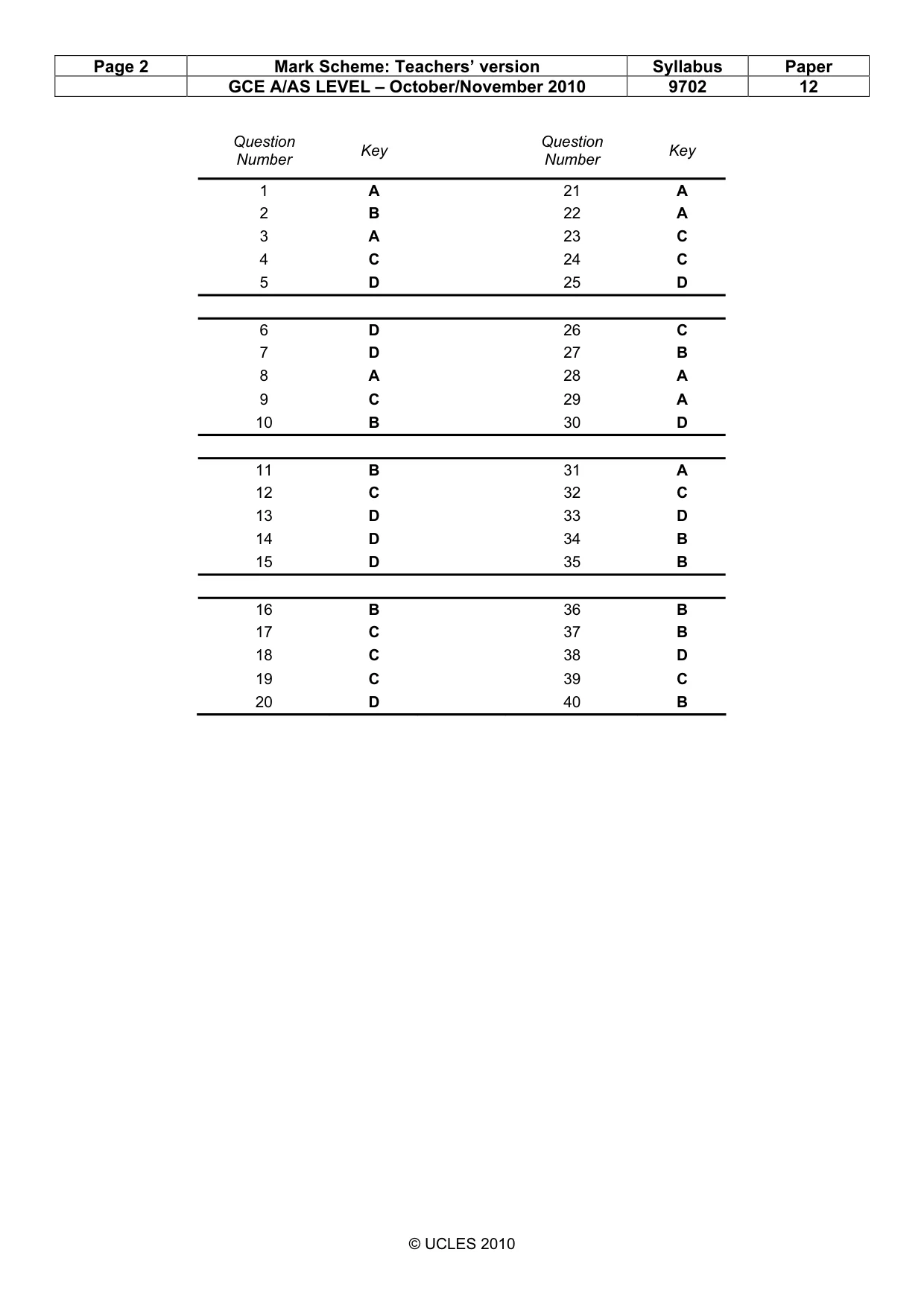
Mark scheme: A
Q2 · The frictional force F on a sphere falling through a fluid is given by the formula F =…
2 The frictional force F on a sphere falling through a fluid is given by the formula F = 6πaηv where a is the radius of the sphere, η is a constant relating to the fluid and v is the velocity of the sphere. What are the units of η ? A kg m s–1 B kg m–1 s–1 C kg m s–3 D kg m3 s–3
Mark scheme: B
Q3 · What is the component of this displacement vector in the direction XY?
3 What is the component of this displacement vector in the direction XY? 5.0 km X 53° Y A 3.0 km B 4.0 km C 5.0 km D 6.6 km Space for working
Mark scheme: A
Q4 · A metre rule is used to measure the length of a piece of wire
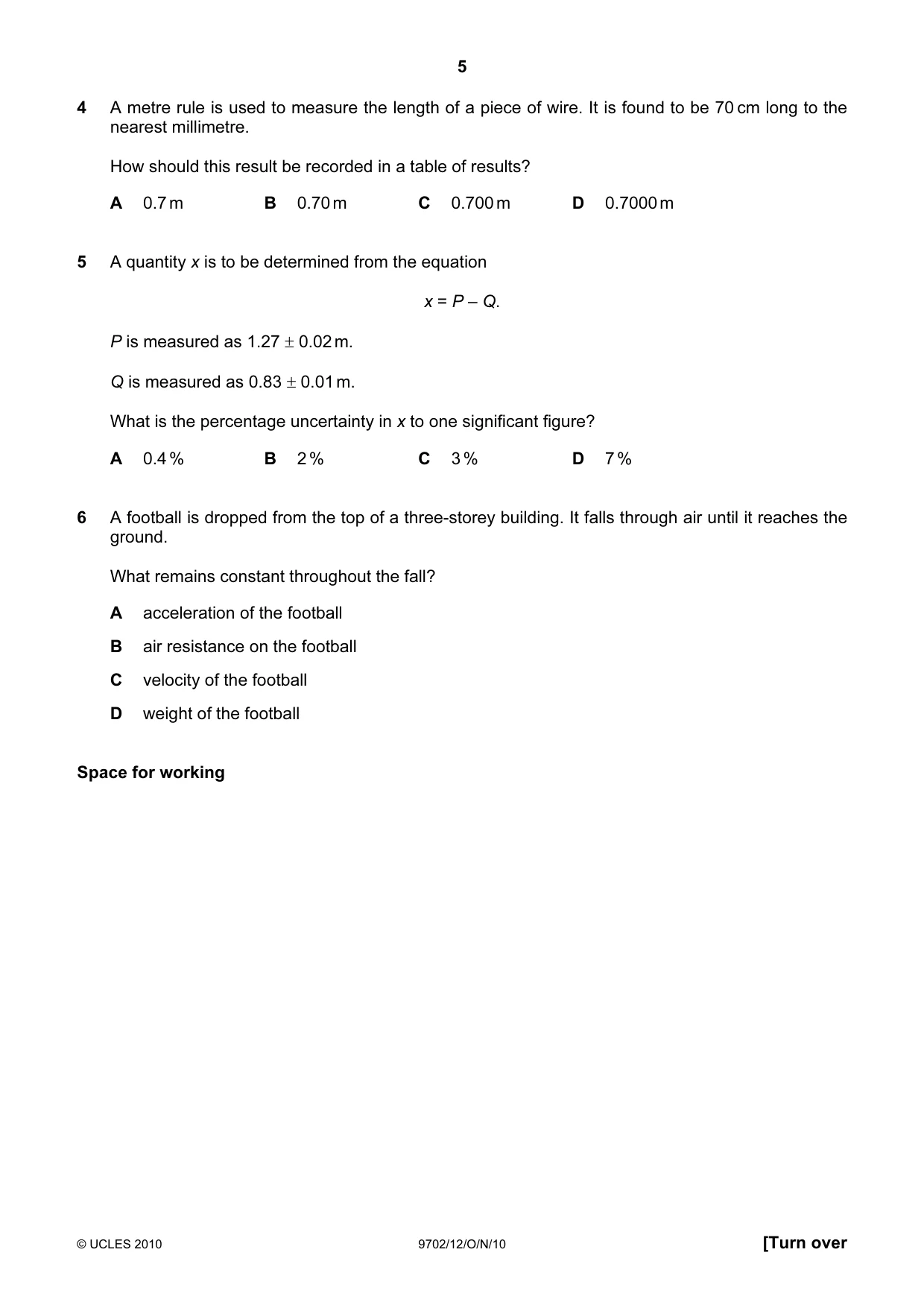
4 A metre rule is used to measure the length of a piece of wire. It is found to be 70 cm long to the nearest millimetre. How should this result be recorded in a table of results? A 0.7 m B 0.70 m C 0.700 m D 0.7000 m
Mark scheme: C
Q5 · A quantity x is to be determined from the equation x = P – Q
5 A quantity x is to be determined from the equation x = P – Q. P is measured as 1.27 ± 0.02 m. Q is measured as 0.83 ± 0.01 m. What is the percentage uncertainty in x to one significant figure? A 0.4 % B 2 % C 3 % D 7 %
Mark scheme: D
Q6 · A football is dropped from the top of a three-storey building
6 A football is dropped from the top of a three-storey building. It falls through air until it reaches the ground. What remains constant throughout the fall? A acceleration of the football B air resistance on the football C velocity of the football D weight of the football Space for working
Mark scheme: D
Q7 · A student throws a ball in the positive direction vertically upwards
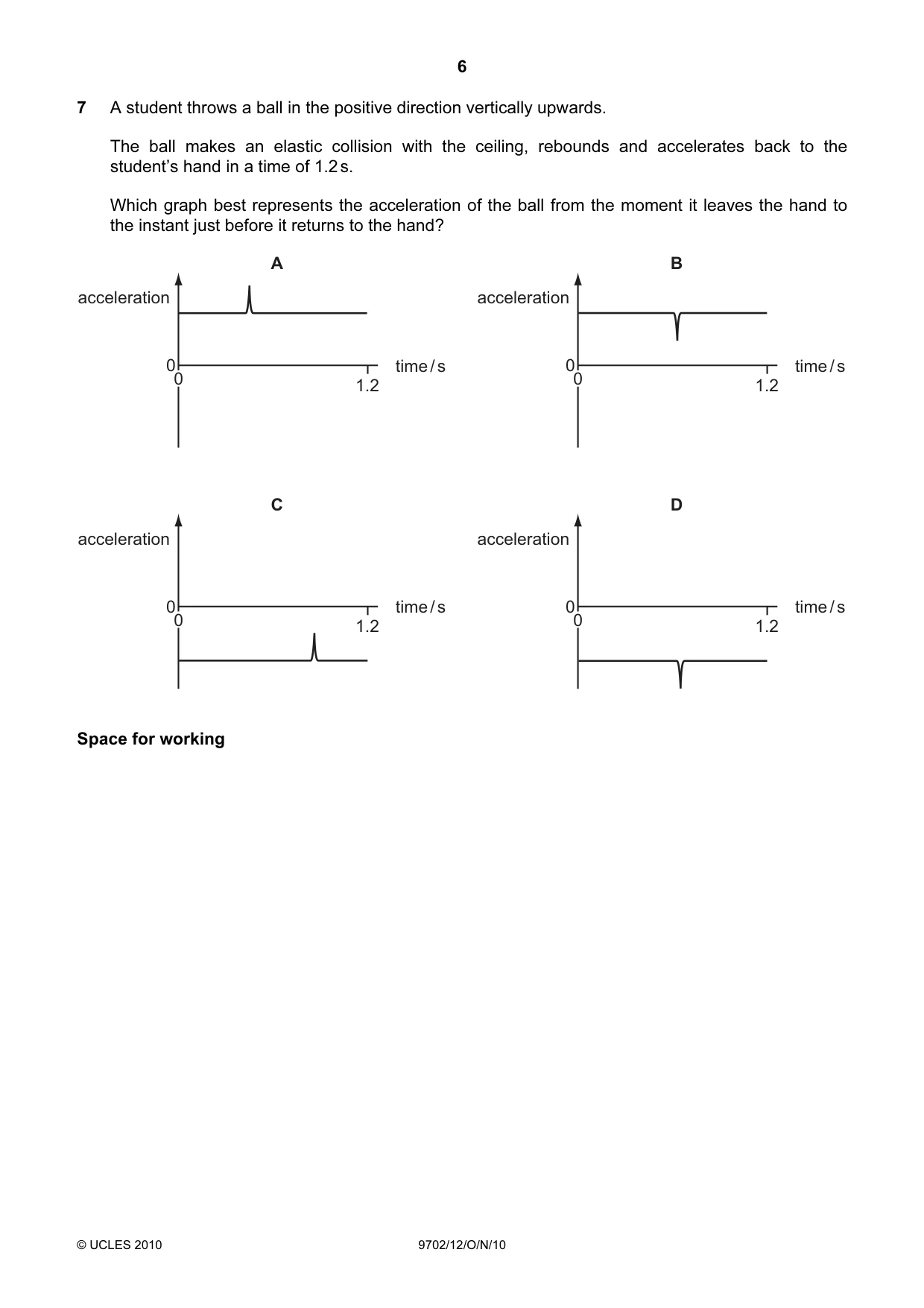
7 A student throws a ball in the positive direction vertically upwards. The ball makes an elastic collision with the ceiling, rebounds and accelerates back to the student’s hand in a time of 1.2 s. Which graph best represents the acceleration of the ball from the moment it leaves the hand to the instant just before it returns to the hand? A B acceleration acceleration 0 time / s 0 time / s 0 1.2 0 1.2 C D acceleration acceleration 0 time / s 0 time / s 0 1.2 0 1.2 Space for working
Mark scheme: D
Q8 · A moving body undergoes uniform acceleration while travelling in a straight line between…
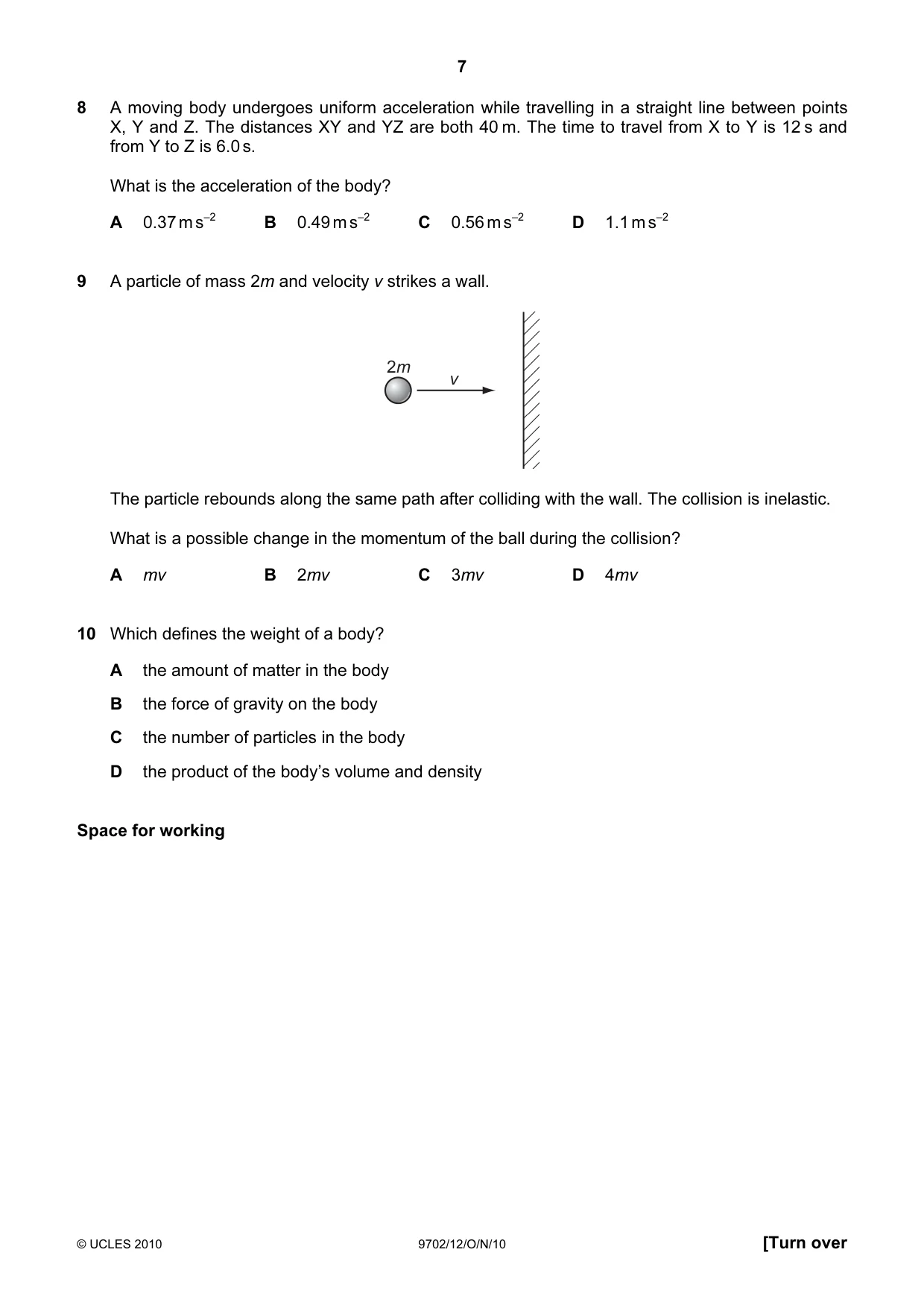
8 A moving body undergoes uniform acceleration while travelling in a straight line between points X, Y and Z. The distances XY and YZ are both 40 m. The time to travel from X to Y is 12 s and from Y to Z is 6.0 s. What is the acceleration of the body? A 0.37 m s–2 B 0.49 m s–2 C 0.56 m s–2 D 1.1 m s–2
Mark scheme: A
Q9 · A particle of mass 2m and velocity v strikes a wall
9 A particle of mass 2m and velocity v strikes a wall. 2m v The particle rebounds along the same path after colliding with the wall. The collision is inelastic. What is a possible change in the momentum of the ball during the collision? A mv B 2mv C 3mv D 4mv
Mark scheme: C
Q10 · Which defines the weight of a body?
10 Which defines the weight of a body? A the amount of matter in the body B the force of gravity on the body C the number of particles in the body D the product of the body’s volume and density Space for working
Mark scheme: B
Q11 · The diagram shows a rope bridge that a student makes on an adventure training course
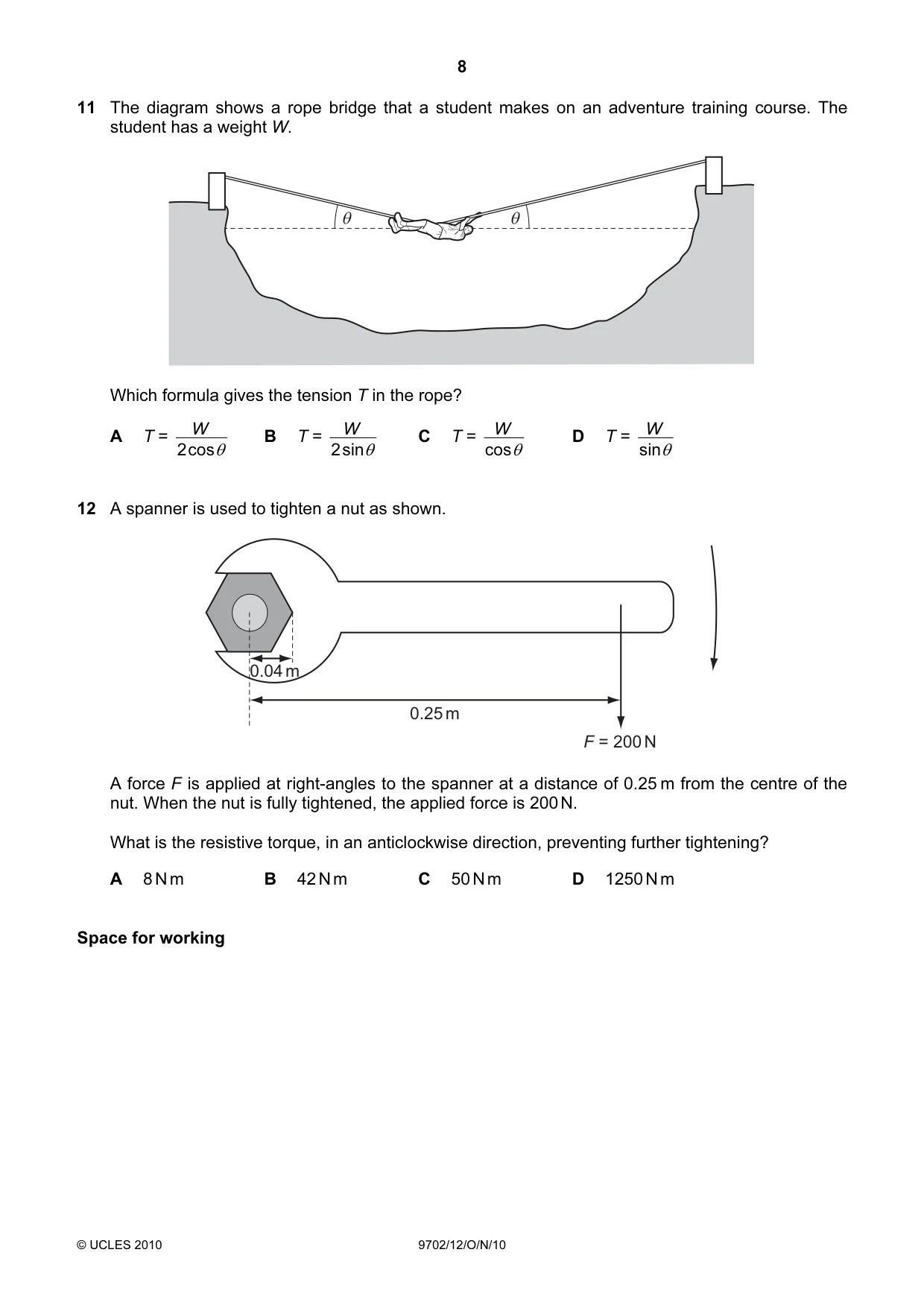
11 The diagram shows a rope bridge that a student makes on an adventure training course. The student has a weight W. θ θ Which formula gives the tension T in the rope? A W B W C W D W T = T = T = T = 2 cos θ 2 sin θ cos θ sin θ
Mark scheme: B
Q12 · A spanner is used to tighten a nut as shown
12 A spanner is used to tighten a nut as shown. 0.04 m 0.25 m F = 200 N A force F is applied at right-angles to the spanner at a distance of 0.25 m from the centre of the nut. When the nut is fully tightened, the applied force is 200 N. What is the resistive torque, in an anticlockwise direction, preventing further tightening? A 8 N m B 42 N m C 50 N m D 1250 N m Space for working
Mark scheme: C
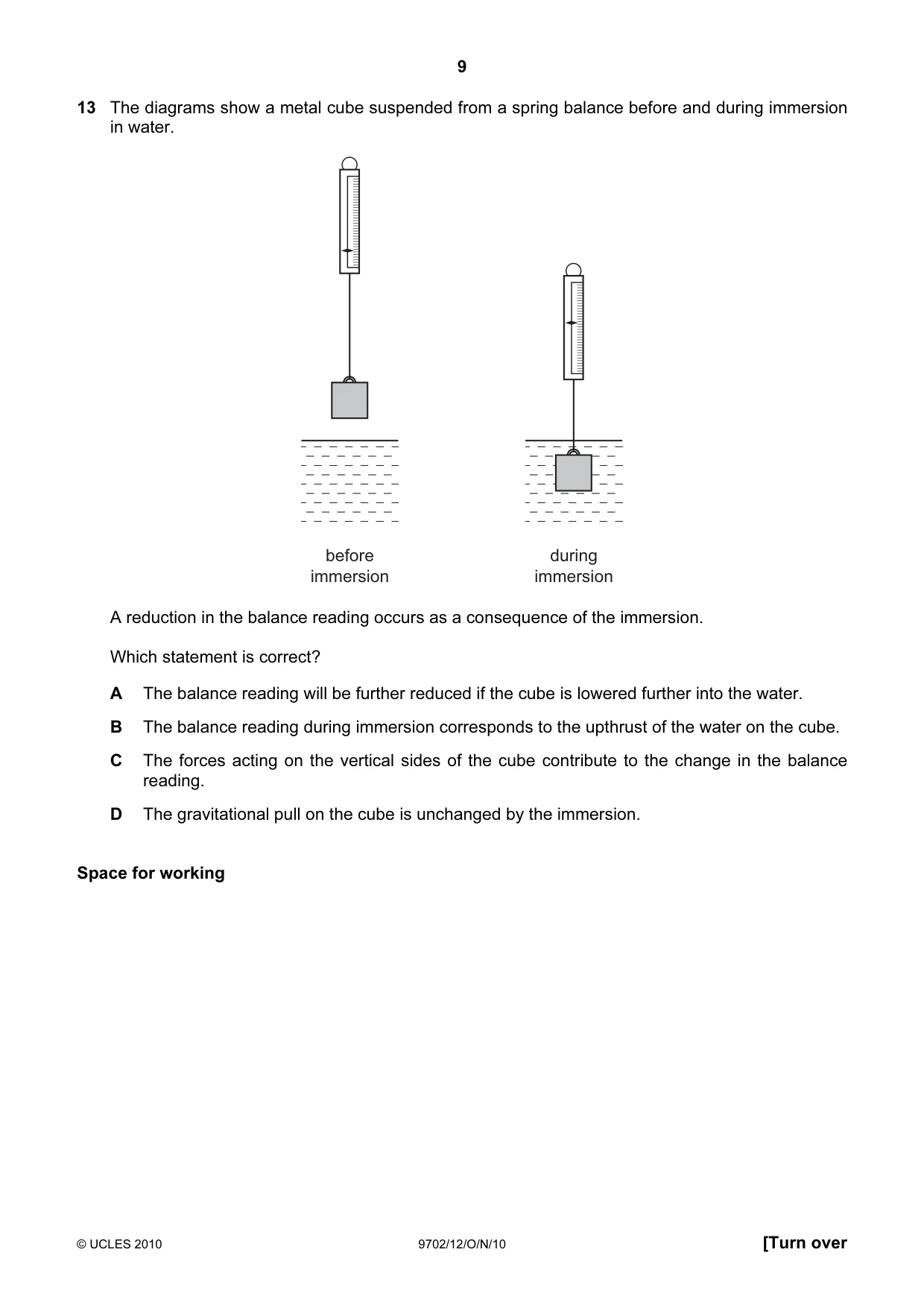
Q13 · The diagrams show a metal cube suspended from a spring balance before and during…
13 The diagrams show a metal cube suspended from a spring balance before and during immersion in water. before during immersion immersion A reduction in the balance reading occurs as a consequence of the immersion. Which statement is correct? A The balance reading will be further reduced if the cube is lowered further into the water. B The balance reading during immersion corresponds to the upthrust of the water on the cube. C The forces acting on the vertical sides of the cube contribute to the change in the balance reading. D The gravitational pull on the cube is unchanged by the immersion. Space for working
Mark scheme: D
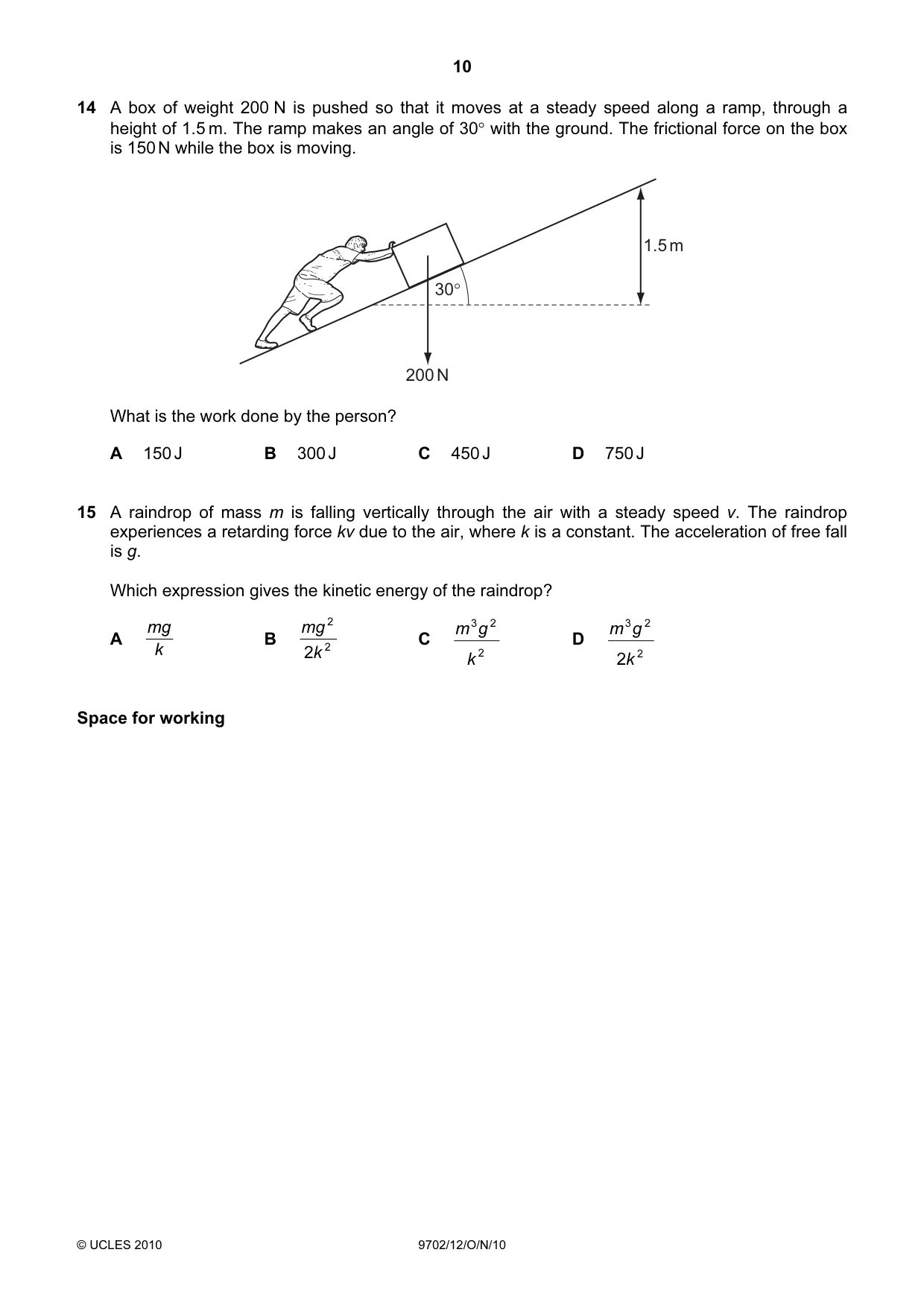
Q14 · A box of weight 200 N is pushed so that it moves at a steady speed along a ramp, through…
14 A box of weight 200 N is pushed so that it moves at a steady speed along a ramp, through a height of 1.5 m. The ramp makes an angle of 30° with the ground. The frictional force on the box is 150 N while the box is moving. 1.5 m 30° 200 N What is the work done by the person? A 150 J B 300 J C 450 J D 750 J
Mark scheme: D
Q15 · A raindrop of mass m is falling vertically through the air with a steady speed v
15 A raindrop of mass m is falling vertically through the air with a steady speed v. The raindrop experiences a retarding force kv due to the air, where k is a constant. The acceleration of free fall is g. Which expression gives the kinetic energy of the raindrop? mg mg 2 m 3 g 2 m 3 g 2 A B C D k 2k 2 2 2 k 2k Space for working
Mark scheme: D
More questions on Gravitational potential energy and kinetic energy
Q16 · The kinetic energy of a vehicle of mass 1000 kg is 4.5 × 10⁵ J
16 The kinetic energy of a vehicle of mass 1000 kg is 4.5 × 10⁵ J. It is stopped by applying a constant braking force of 6000 N. What is its stopping distance? A 37 m B 75 m C 150 m D 300 m
Mark scheme: B
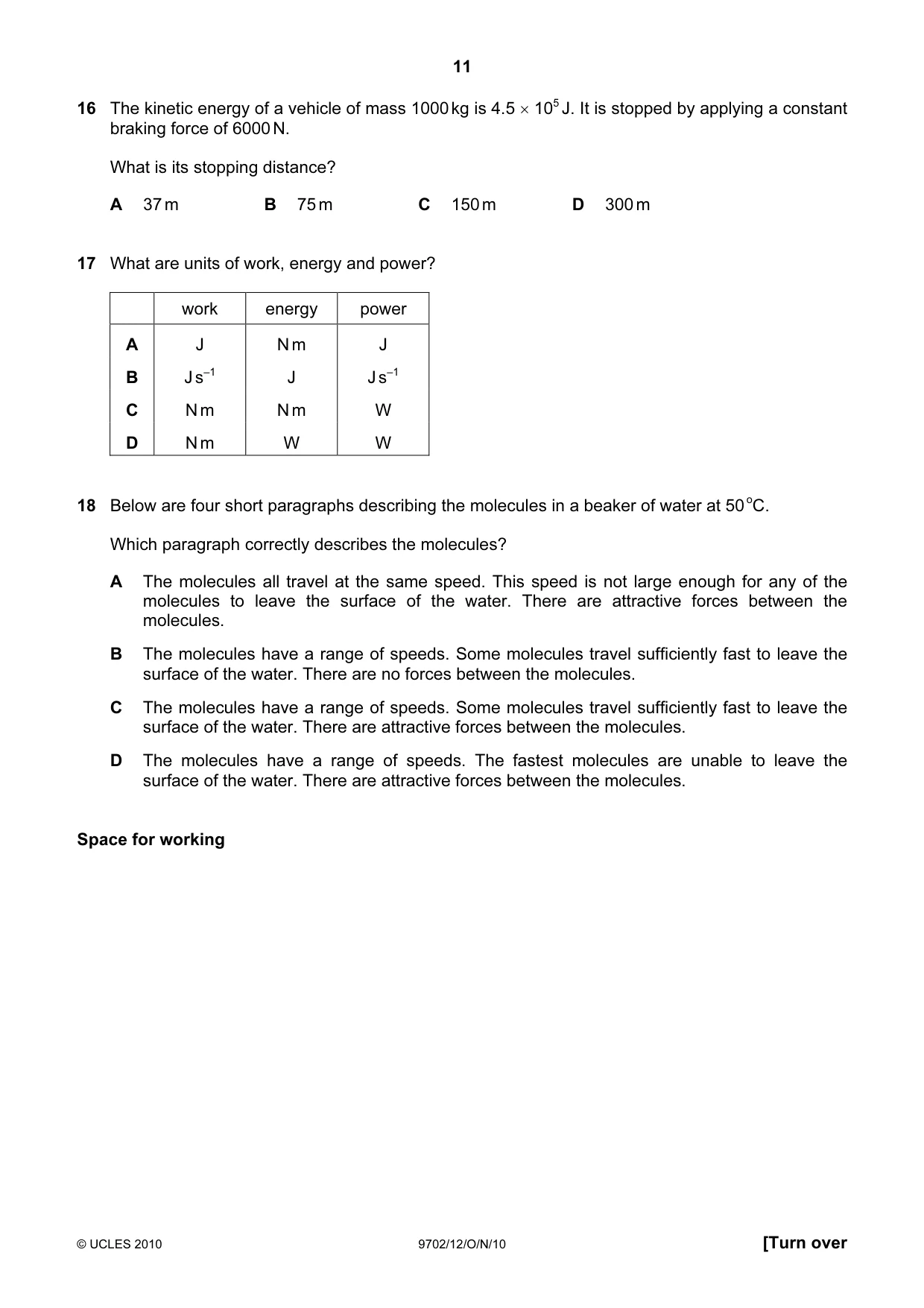
Q17 · What are units of work, energy and power?
17 What are units of work, energy and power? work energy power A J N m J B J s–1 J J s–1 C N m N m W D N m W W
Mark scheme: C
Q18 · Below are four short paragraphs describing the molecules in a beaker of water at 50 oC
18 Below are four short paragraphs describing the molecules in a beaker of water at 50 oC. Which paragraph correctly describes the molecules? A The molecules all travel at the same speed. This speed is not large enough for any of the molecules to leave the surface of the water. There are attractive forces between the molecules. B The molecules have a range of speeds. Some molecules travel sufficiently fast to leave the surface of the water. There are no forces between the molecules. C The molecules have a range of speeds. Some molecules travel sufficiently fast to leave the surface of the water. There are attractive forces between the molecules. D The molecules have a range of speeds. The fastest molecules are unable to leave the surface of the water. There are attractive forces between the molecules. Space for working
Mark scheme: C
Q19 · Which group of materials contains two polymers?
19 Which group of materials contains two polymers? A copper sand polystyrene B glass wood aluminium C nylon sugar rubber D stone diamond steel
Mark scheme: C
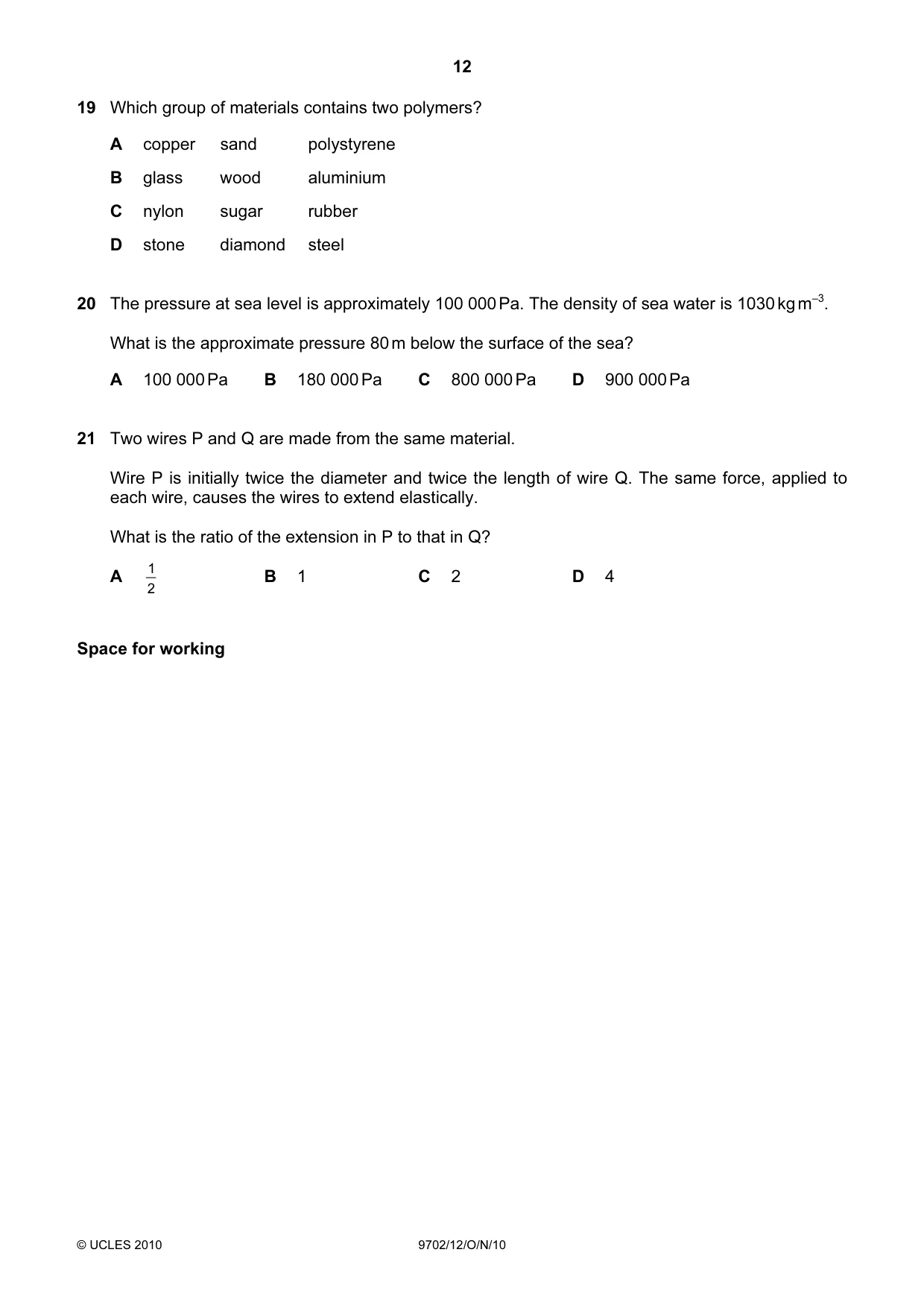
Q20 · The pressure at sea level is approximately 100 000 Pa
20 The pressure at sea level is approximately 100 000 Pa. The density of sea water is 1030 kg m–3. What is the approximate pressure 80 m below the surface of the sea? A 100 000 Pa B 180 000 Pa C 800 000 Pa D 900 000 Pa
Mark scheme: D
Q21 · Two wires P and Q are made from the same material
21 Two wires P and Q are made from the same material. Wire P is initially twice the diameter and twice the length of wire Q. The same force, applied to each wire, causes the wires to extend elastically. What is the ratio of the extension in P to that in Q? 1 A B 1 C 2 D 4 2 Space for working
Mark scheme: A
Q22 · To determine the mass of food in a pan, a scale is used that has high sensitivity for…
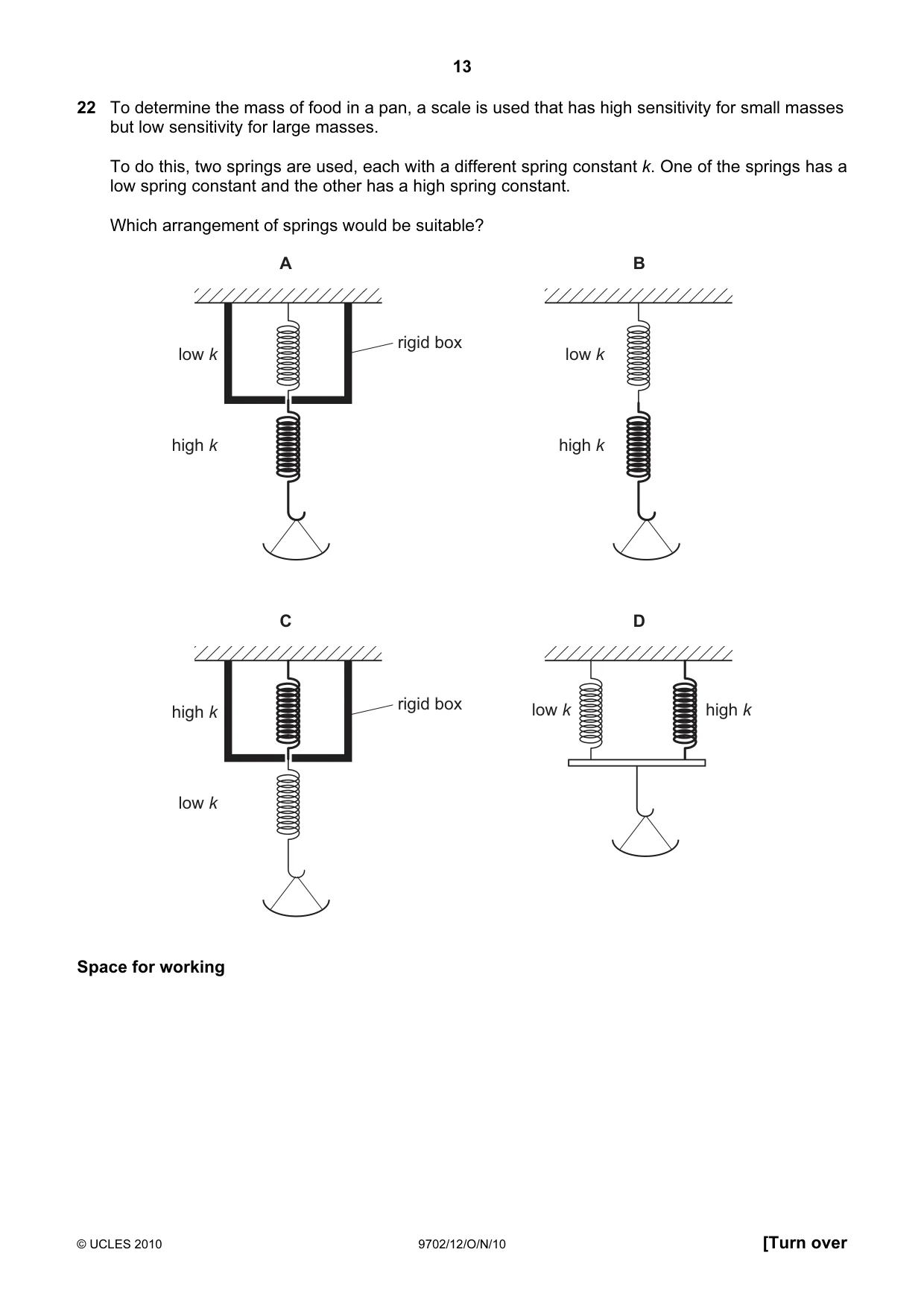
22 To determine the mass of food in a pan, a scale is used that has high sensitivity for small masses but low sensitivity for large masses. To do this, two springs are used, each with a different spring constant k. One of the springs has a low spring constant and the other has a high spring constant. Which arrangement of springs would be suitable? A B rigid box low k low k high k high k C D high k rigid box low k high k low k Space for working
Mark scheme: A
Q23 · The amplitude of a wave is A and its intensity is I
23 The amplitude of a wave is A and its intensity is I. Which amplitude is necessary for the intensity to be doubled to 2I ? A A2 B A C 2 A D 2A
Mark scheme: C
Q24 · Which value is a possible wavelength for radiation in the ultra-violet region of the…
24 Which value is a possible wavelength for radiation in the ultra-violet region of the electromagnetic spectrum? A 3 × 10⁻² m B 3 × 10⁻⁵ m C 3 × 10⁻⁸ m D 3 × 10⁻¹⁰ m
Mark scheme: C
Q25 · The diagram shows two tubes
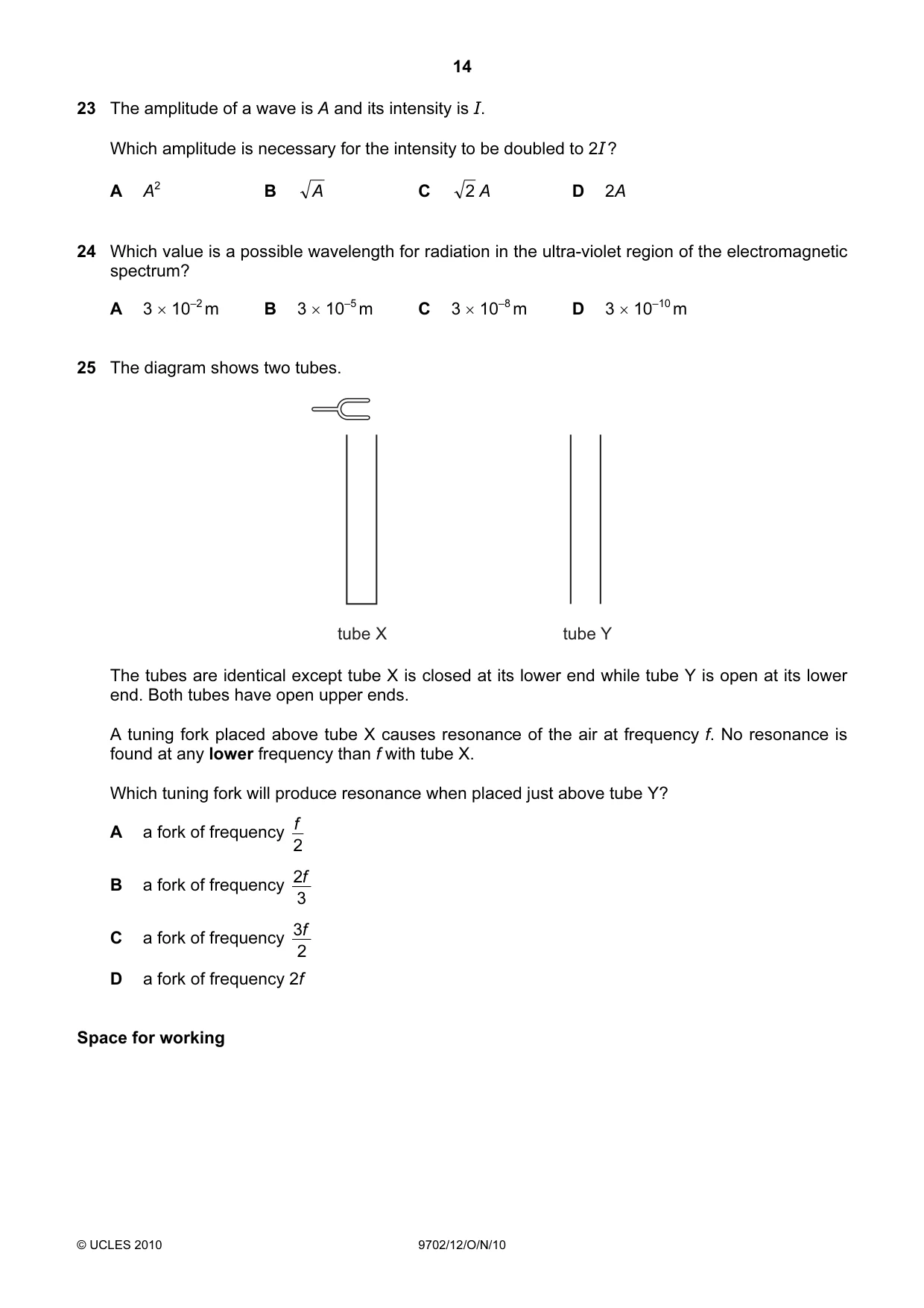
25 The diagram shows two tubes. tube X tube Y The tubes are identical except tube X is closed at its lower end while tube Y is open at its lower end. Both tubes have open upper ends. A tuning fork placed above tube X causes resonance of the air at frequency f. No resonance is found at any lower frequency than f with tube X. Which tuning fork will produce resonance when placed just above tube Y? f A a fork of frequency 2 2f B a fork of frequency 3 3f C a fork of frequency 2 D a fork of frequency 2f Space for working
Mark scheme: D
Q26 · A microwave transmitter emits waves towards a metal plate
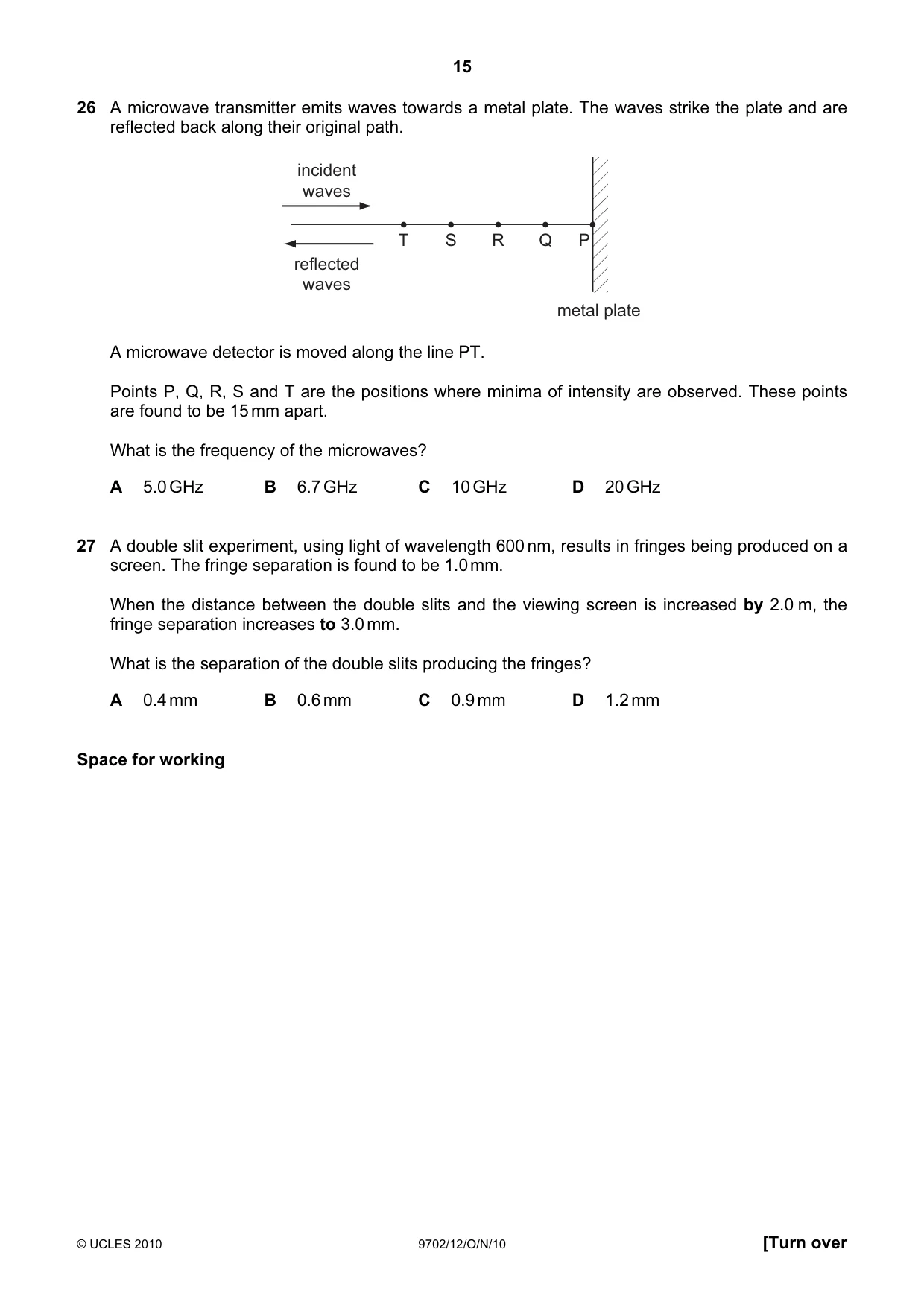
26 A microwave transmitter emits waves towards a metal plate. The waves strike the plate and are reflected back along their original path. incident waves T S R Q P reflected waves metal plate A microwave detector is moved along the line PT. Points P, Q, R, S and T are the positions where minima of intensity are observed. These points are found to be 15 mm apart. What is the frequency of the microwaves? A 5.0 GHz B 6.7 GHz C 10 GHz D 20 GHz
Mark scheme: C
Q27 · A double slit experiment, using light of wavelength 600 nm, results in fringes being…
27 A double slit experiment, using light of wavelength 600 nm, results in fringes being produced on a screen. The fringe separation is found to be 1.0 mm. When the distance between the double slits and the viewing screen is increased by 2.0 m, the fringe separation increases to 3.0 mm. What is the separation of the double slits producing the fringes? A 0.4 mm B 0.6 mm C 0.9 mm D 1.2 mm Space for working
Mark scheme: B
Q28 · The diagram shows a vertical uniform electric field in a vacuum
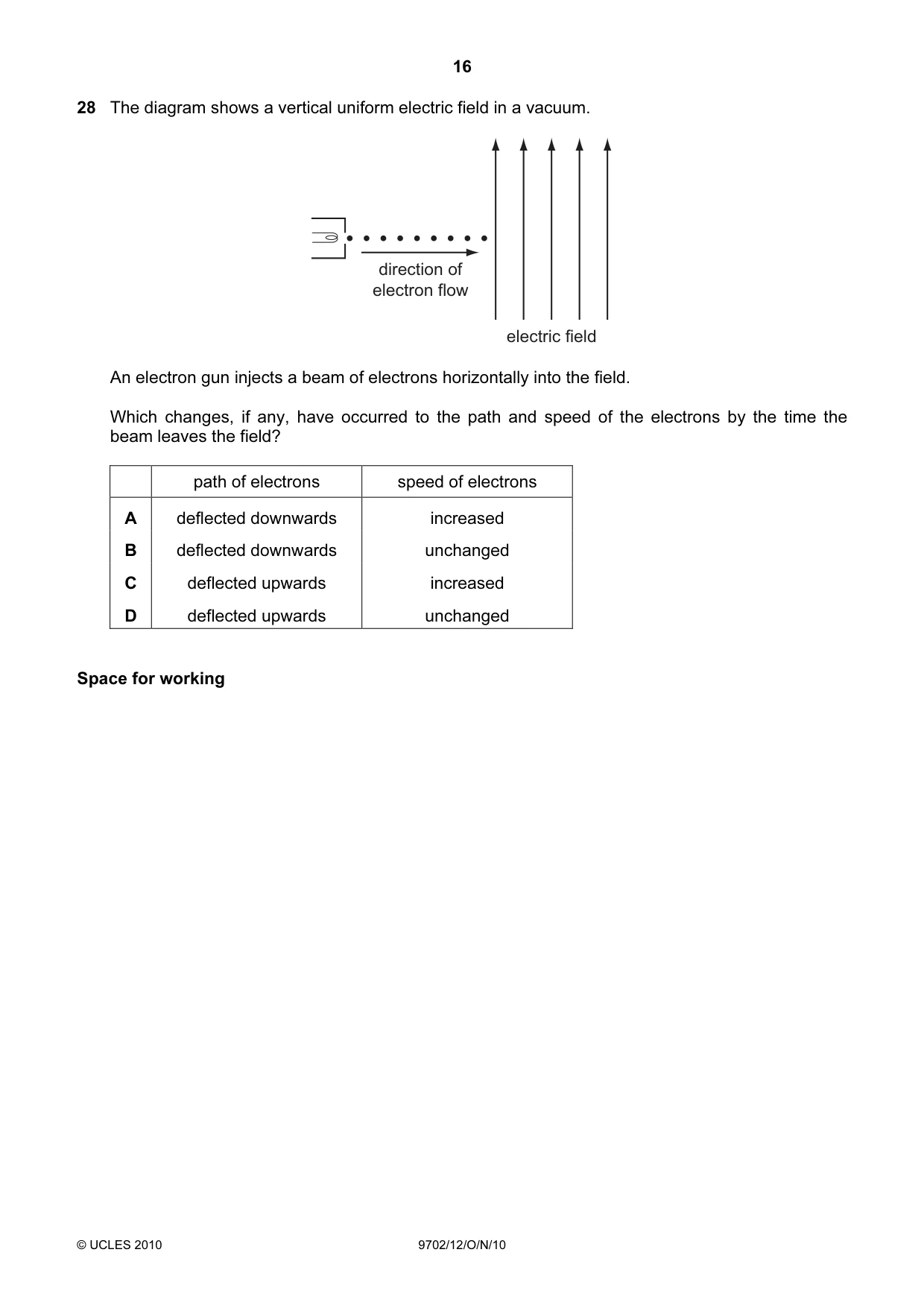
28 The diagram shows a vertical uniform electric field in a vacuum. direction of electron flow electric field An electron gun injects a beam of electrons horizontally into the field. Which changes, if any, have occurred to the path and speed of the electrons by the time the beam leaves the field? path of electrons speed of electrons A deflected downwards increased B deflected downwards unchanged C deflected upwards increased D deflected upwards unchanged Space for working
Mark scheme: A
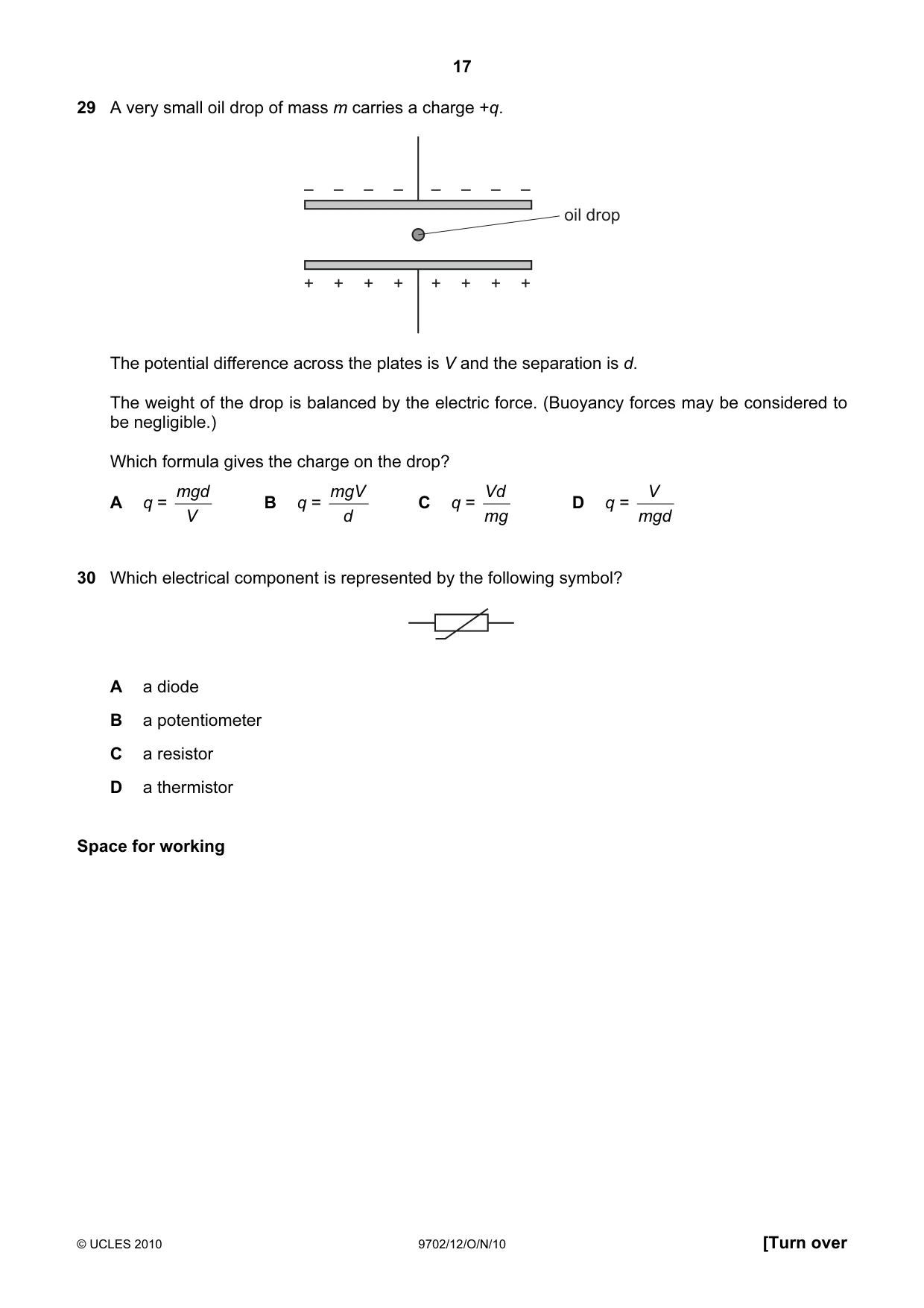
Q29 · A very small oil drop of mass m carries a charge +q
29 A very small oil drop of mass m carries a charge +q. – – – – – – – – oil drop + + + + + + + + The potential difference across the plates is V and the separation is d. The weight of the drop is balanced by the electric force. (Buoyancy forces may be considered to be negligible.) Which formula gives the charge on the drop? mgd mgV Vd V A q = B q = C q = mg D q = mgd V d
Mark scheme: A
Q30 · Which electrical component is represented by the following symbol?
30 Which electrical component is represented by the following symbol? A a diode B a potentiometer C a resistor D a thermistor Space for working
Mark scheme: D
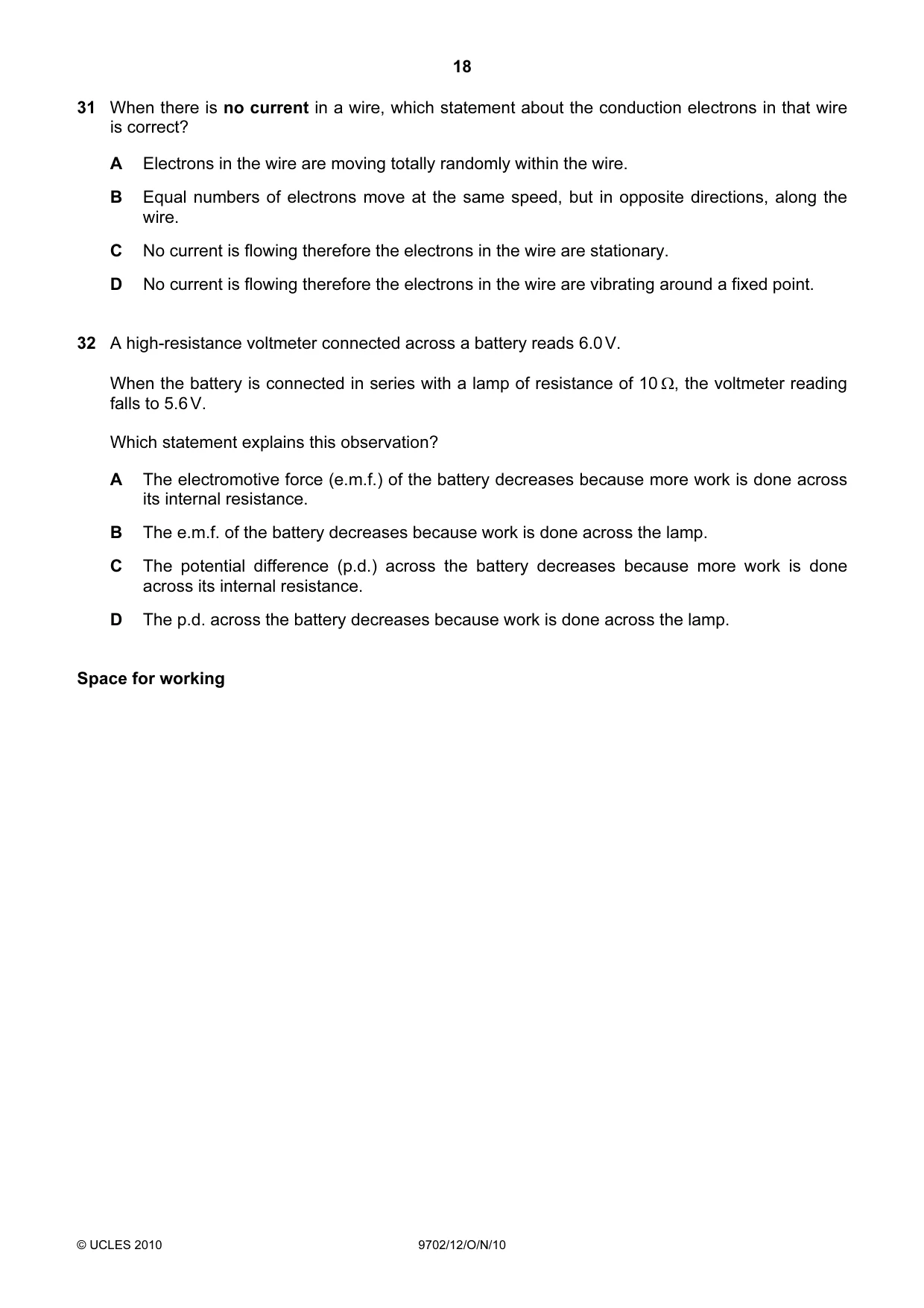
Q31 · When there is no current in a wire, which statement about the conduction electrons in…
31 When there is no current in a wire, which statement about the conduction electrons in that wire is correct? A Electrons in the wire are moving totally randomly within the wire. B Equal numbers of electrons move at the same speed, but in opposite directions, along the wire. C No current is flowing therefore the electrons in the wire are stationary. D No current is flowing therefore the electrons in the wire are vibrating around a fixed point.
Mark scheme: A
Q32 · A high-resistance voltmeter connected across a battery reads 6.0 V
32 A high-resistance voltmeter connected across a battery reads 6.0 V. When the battery is connected in series with a lamp of resistance of 10 Ω, the voltmeter reading falls to 5.6 V. Which statement explains this observation? A The electromotive force (e.m.f.) of the battery decreases because more work is done across its internal resistance. B The e.m.f. of the battery decreases because work is done across the lamp. C The potential difference (p.d.) across the battery decreases because more work is done across its internal resistance. D The p.d. across the battery decreases because work is done across the lamp. Space for working
Mark scheme: C
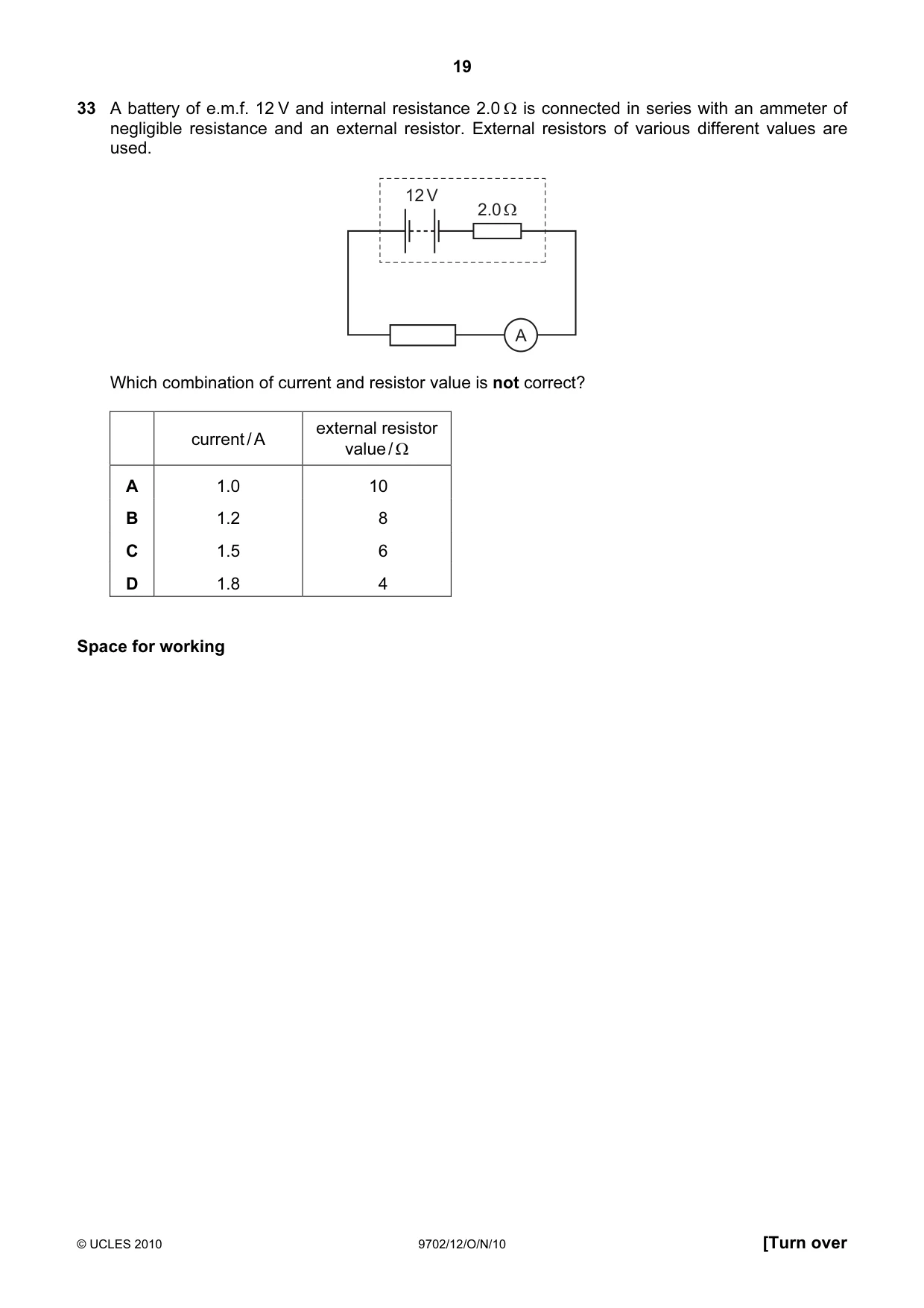
Q33 · A battery of e.m.f
33 A battery of e.m.f. 12 V and internal resistance 2.0 Ω is connected in series with an ammeter of negligible resistance and an external resistor. External resistors of various different values are used. 12 V 2.0 Ω A Which combination of current and resistor value is not correct? external resistor current / A value / Ω A 1.0 10 B 1.2 8 C 1.5 6 D 1.8 4 Space for working
Mark scheme: D
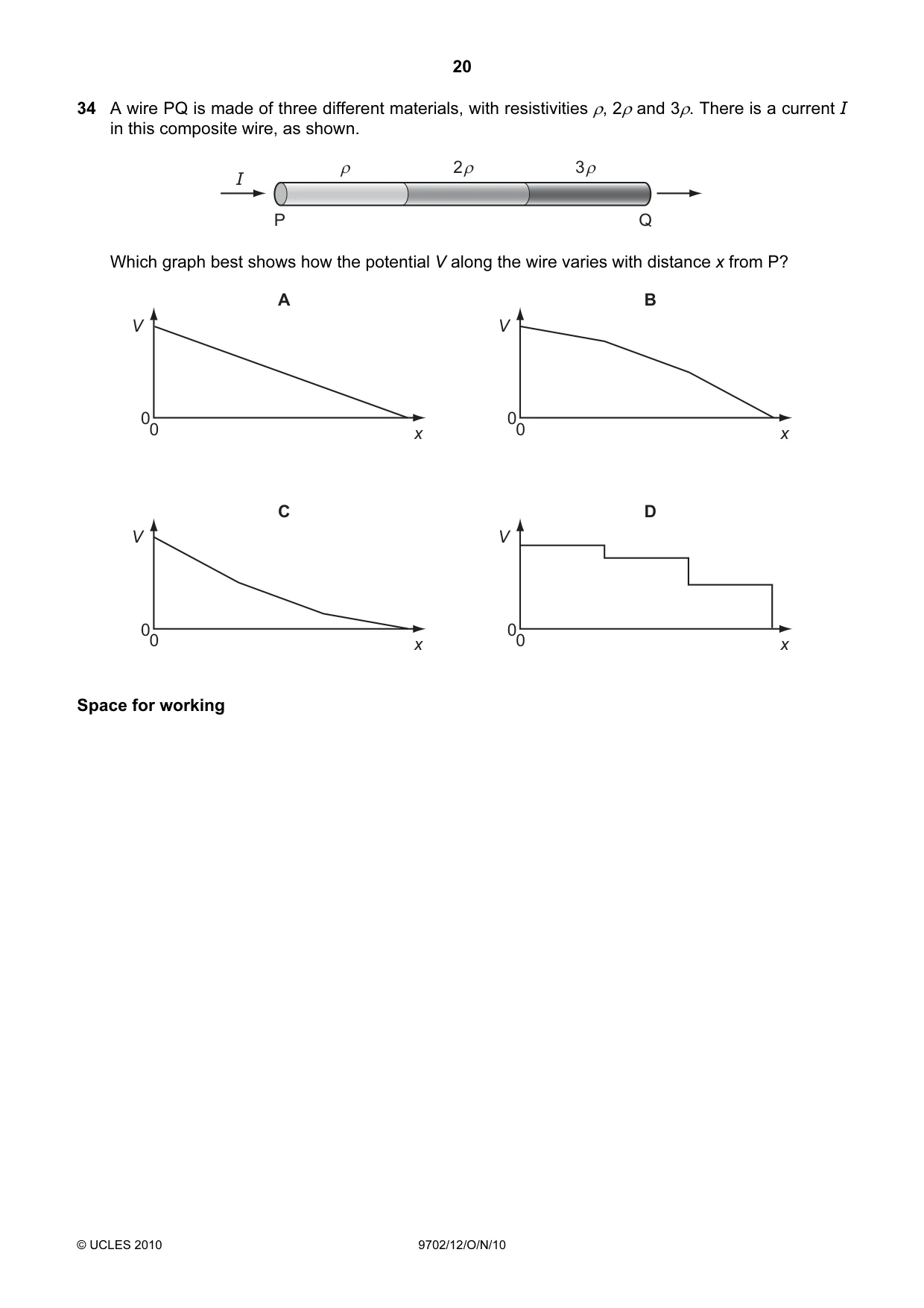
Q34 · A wire PQ is made of three different materials, with resistivities ρ, 2ρ and 3ρ
34 A wire PQ is made of three different materials, with resistivities ρ, 2ρ and 3ρ. There is a current I in this composite wire, as shown. ρ 2 ρ 3 ρ I P Q Which graph best shows how the potential V along the wire varies with distance x from P? A B V V 00 00 x x C D V V 00 00 x x Space for working
Mark scheme: B
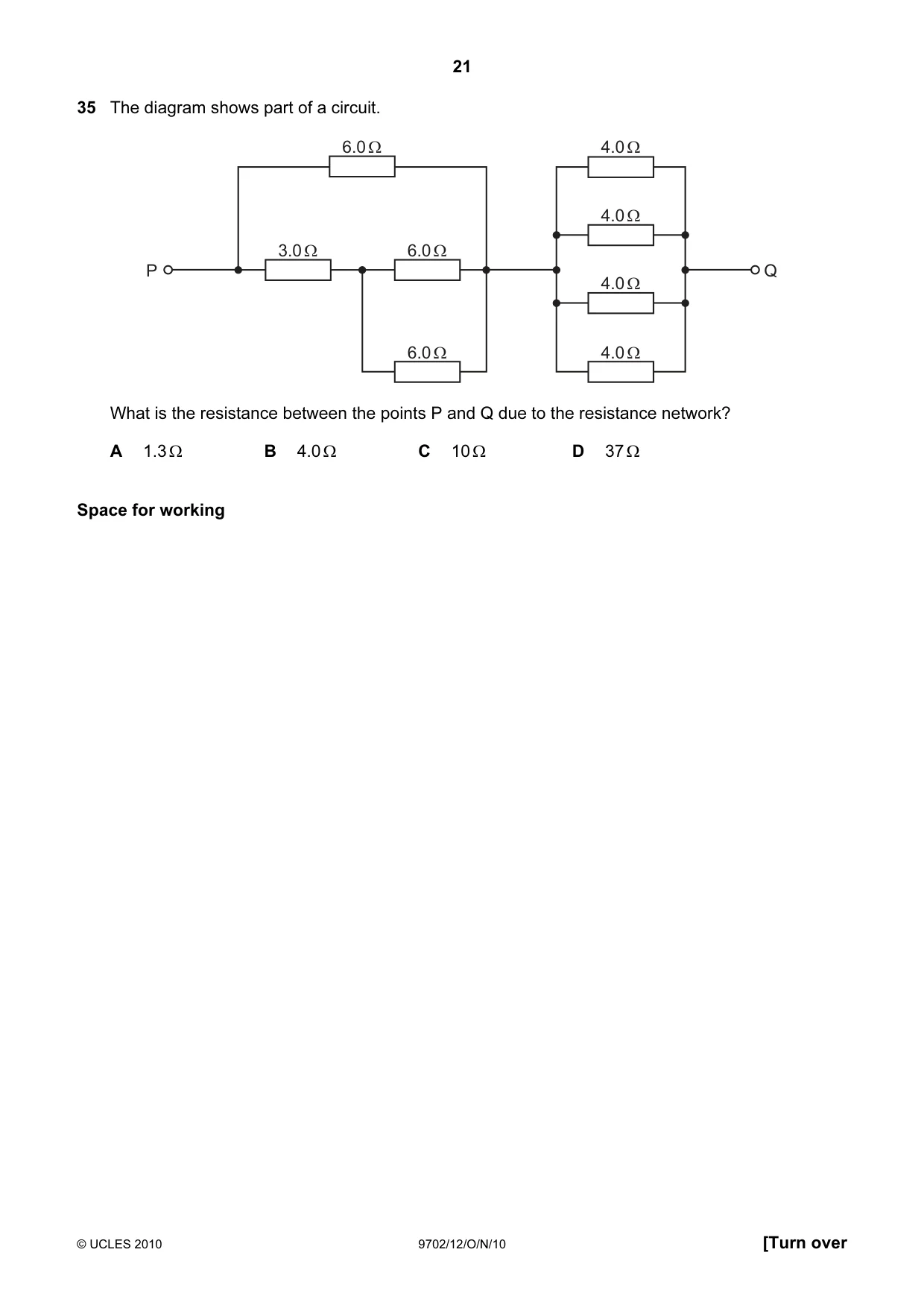
Q35 · The diagram shows part of a circuit
35 The diagram shows part of a circuit. 6.0 Ω 4.0 Ω 4.0 Ω 3.0 Ω 6.0 Ω P Q 4.0 Ω 6.0 Ω 4.0 Ω What is the resistance between the points P and Q due to the resistance network? A 1.3 Ω B 4.0 Ω C 10 Ω D 37 Ω Space for working
Mark scheme: B
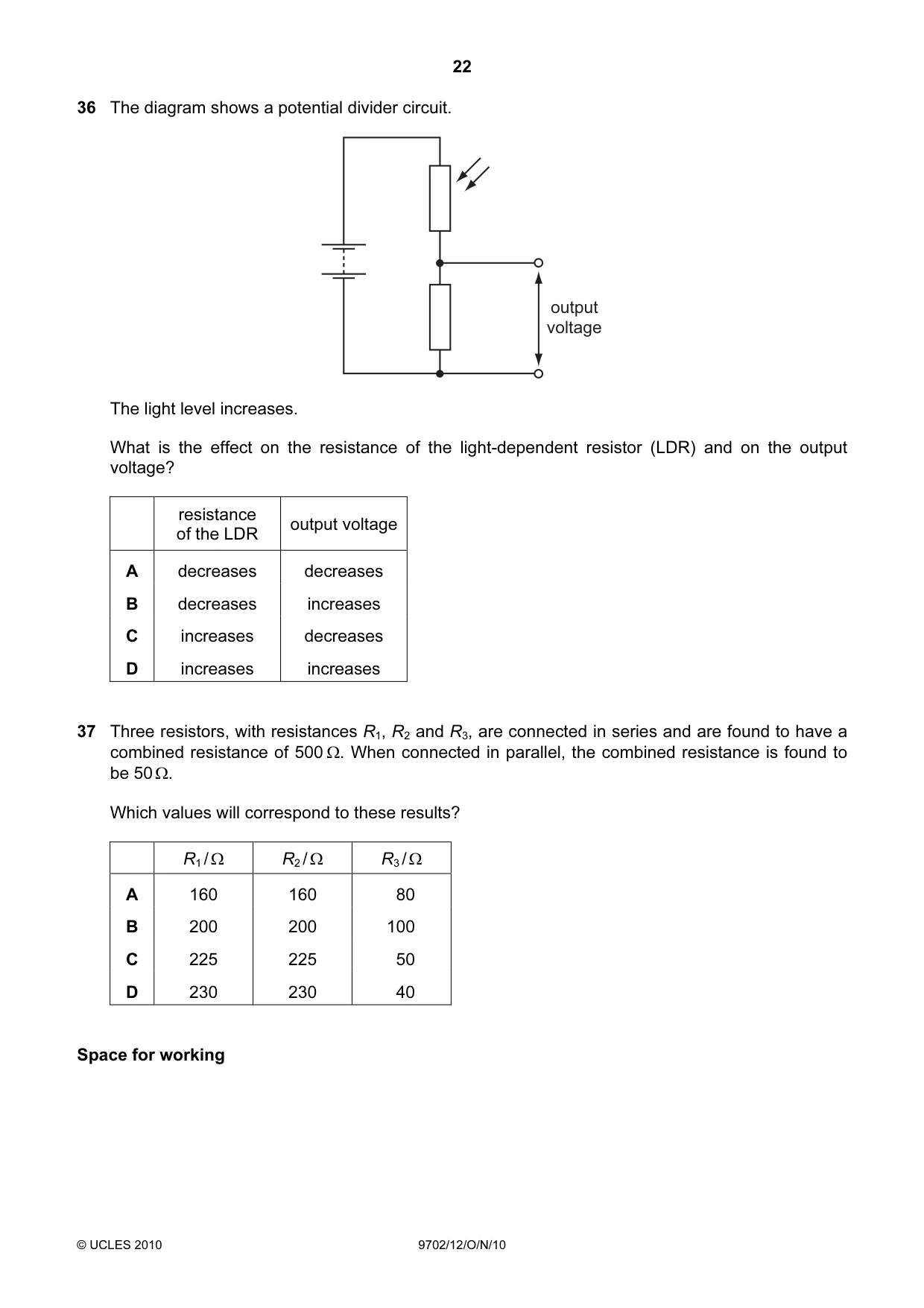
Q36 · The diagram shows a potential divider circuit
36 The diagram shows a potential divider circuit. output voltage The light level increases. What is the effect on the resistance of the light-dependent resistor (LDR) and on the output voltage? resistance output voltage of the LDR A decreases decreases B decreases increases C increases decreases D increases increases
Mark scheme: B
Q37 · Three resistors, with resistances R1, R2 and R3, are connected in series and are found to…
37 Three resistors, with resistances R1, R2 and R3, are connected in series and are found to have a combined resistance of 500 Ω. When connected in parallel, the combined resistance is found to be 50 Ω. Which values will correspond to these results? R1 / Ω R2 / Ω R3 / Ω A 160 160 80 B 200 200 100 C 225 225 50 D 230 230 40 Space for working
Mark scheme: B
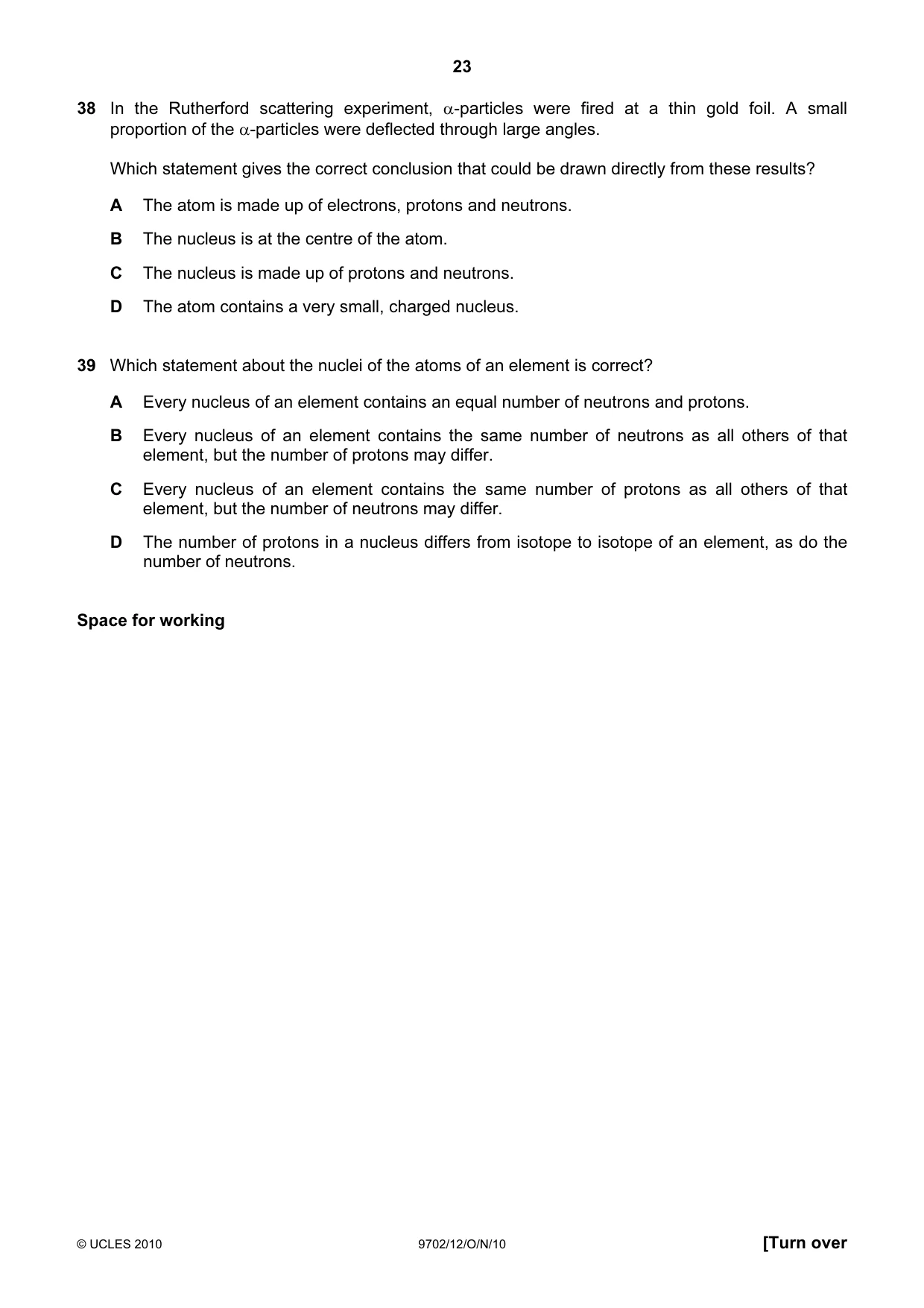
Q38 · In the Rutherford scattering experiment, α-particles were fired at a thin gold foil
38 In the Rutherford scattering experiment, α-particles were fired at a thin gold foil. A small proportion of the α-particles were deflected through large angles. Which statement gives the correct conclusion that could be drawn directly from these results? A The atom is made up of electrons, protons and neutrons. B The nucleus is at the centre of the atom. C The nucleus is made up of protons and neutrons. D The atom contains a very small, charged nucleus.
Mark scheme: D
Q39 · Which statement about the nuclei of the atoms of an element is correct?
39 Which statement about the nuclei of the atoms of an element is correct? A Every nucleus of an element contains an equal number of neutrons and protons. B Every nucleus of an element contains the same number of neutrons as all others of that element, but the number of protons may differ. C Every nucleus of an element contains the same number of protons as all others of that element, but the number of neutrons may differ. D The number of protons in a nucleus differs from isotope to isotope of an element, as do the number of neutrons. Space for working
Mark scheme: C
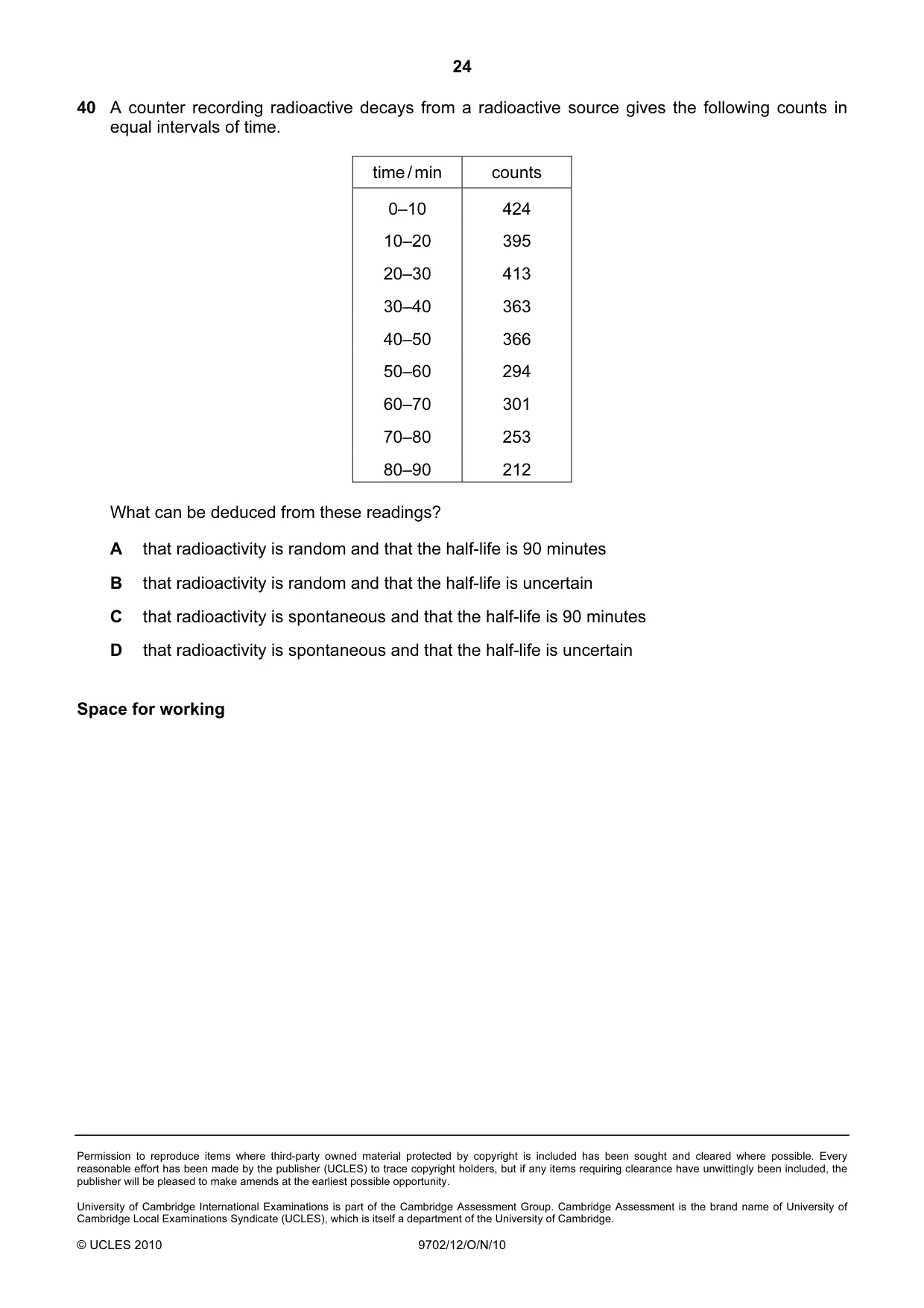
Q40 · A counter recording radioactive decays from a radioactive source gives the following…
40 A counter recording radioactive decays from a radioactive source gives the following counts in equal intervals of time. time / min counts 0–10 424 10–20 395 20–30 413 30–40 363 40–50 366 50–60 294 60–70 301 70–80 253 80–90 212 What can be deduced from these readings? A that radioactivity is random and that the half-life is 90 minutes B that radioactivity is random and that the half-life is uncertain C that radioactivity is spontaneous and that the half-life is 90 minutes D that radioactivity is spontaneous and that the half-life is uncertain Space for working
Mark scheme: B
What was in this paper
The subtopics covered by these 40 questions, and how many questions each got. Open one in a new tab to see every Cambridge question on it.
4Energy conservation3Atoms, nuclei and radiation2Density and pressure2Elastic and plastic behaviour2Equations of motion2Errors and uncertainties2Momentum and Newton’s laws of motion2SI units2Stationary waves2Uniform electric fields2Electric current1Electromagnetic spectrum1Equilibrium of forces1Gravitational potential energy and kinetic energy1Interference1Kinetic theory of gases1Linear momentum and its conservation1Potential difference and power1Potential dividers1Progressive waves1Radioactive decay1Resistance and resistivity1Scalars and vectors1Stress and strain1Turning effects of forces1What you needed in this session
Cambridge’s own grade thresholds for 2010 Oct/Nov, Paper 1 · Variant 2. A higher threshold means an easier paper — the bar moves with how the cohort did.