Cambridge A Level Physics 9702 — 2017 Feb/March Paper 1 · Variant 2
9702/12/F/M/17 · 40 questions · 40 marks · ≈45 min
The question paper and its mark scheme, free to read here and free to download. This is Cambridge’s own paper, exactly as it was sat.
Question paper20 pages
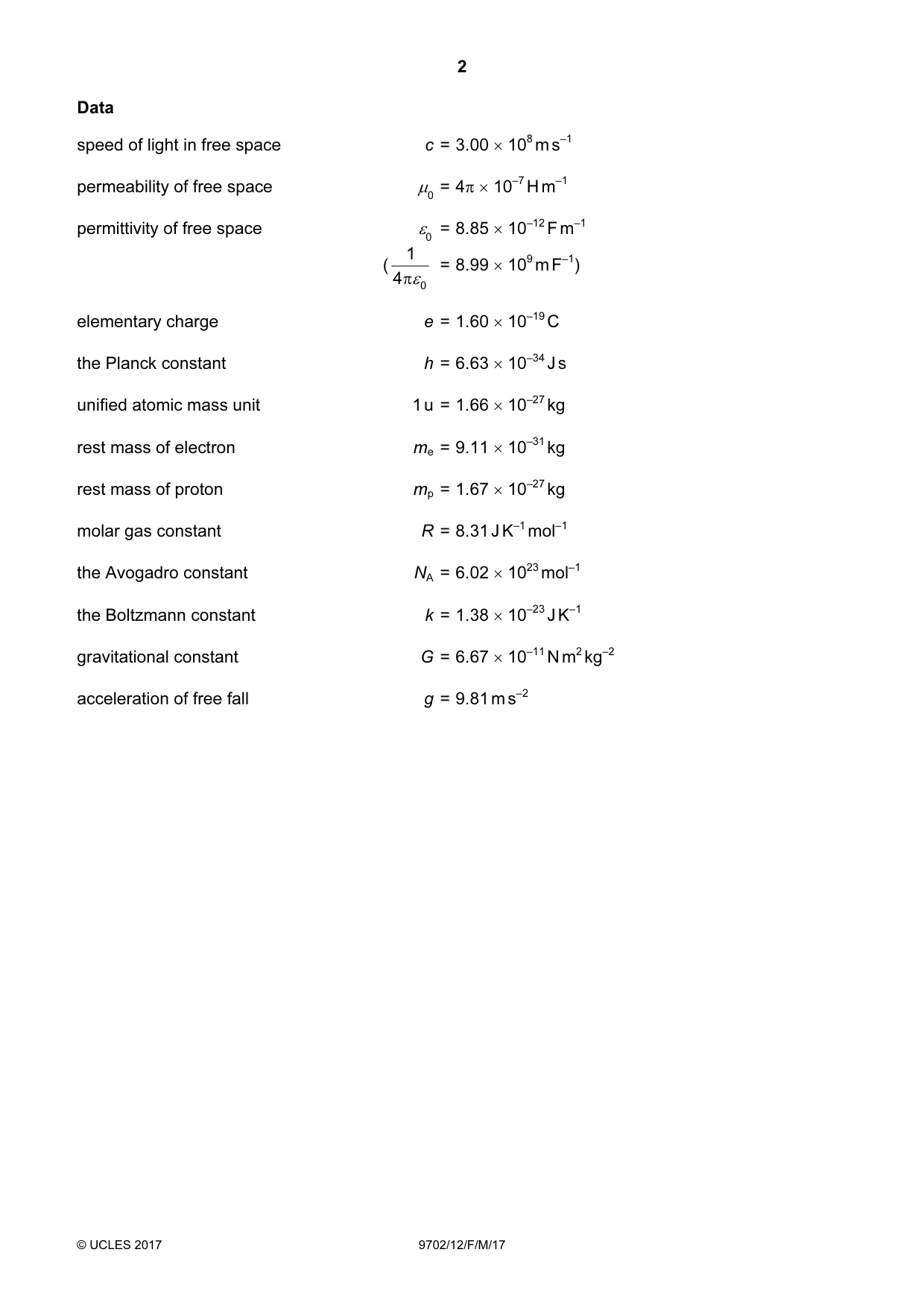
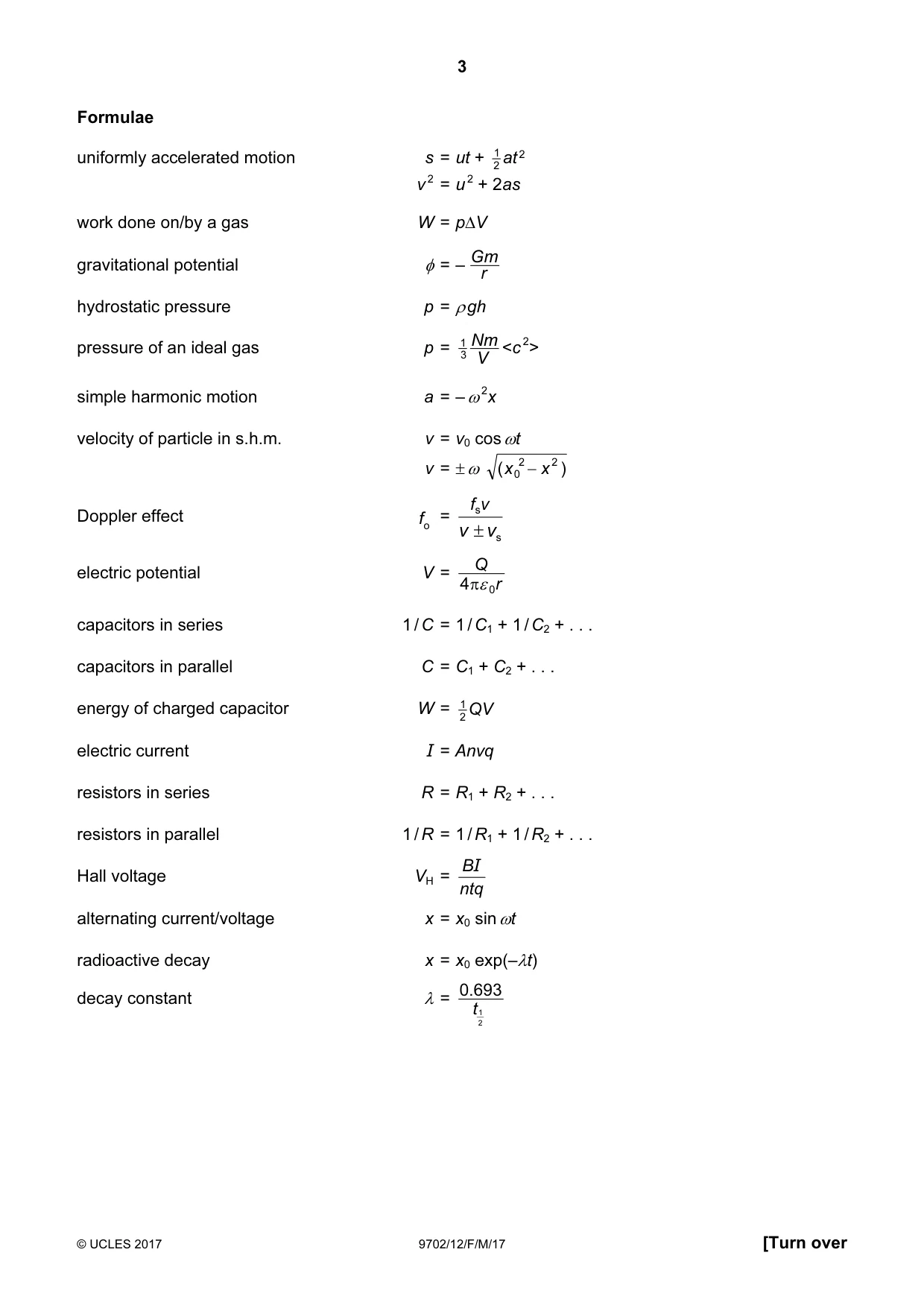

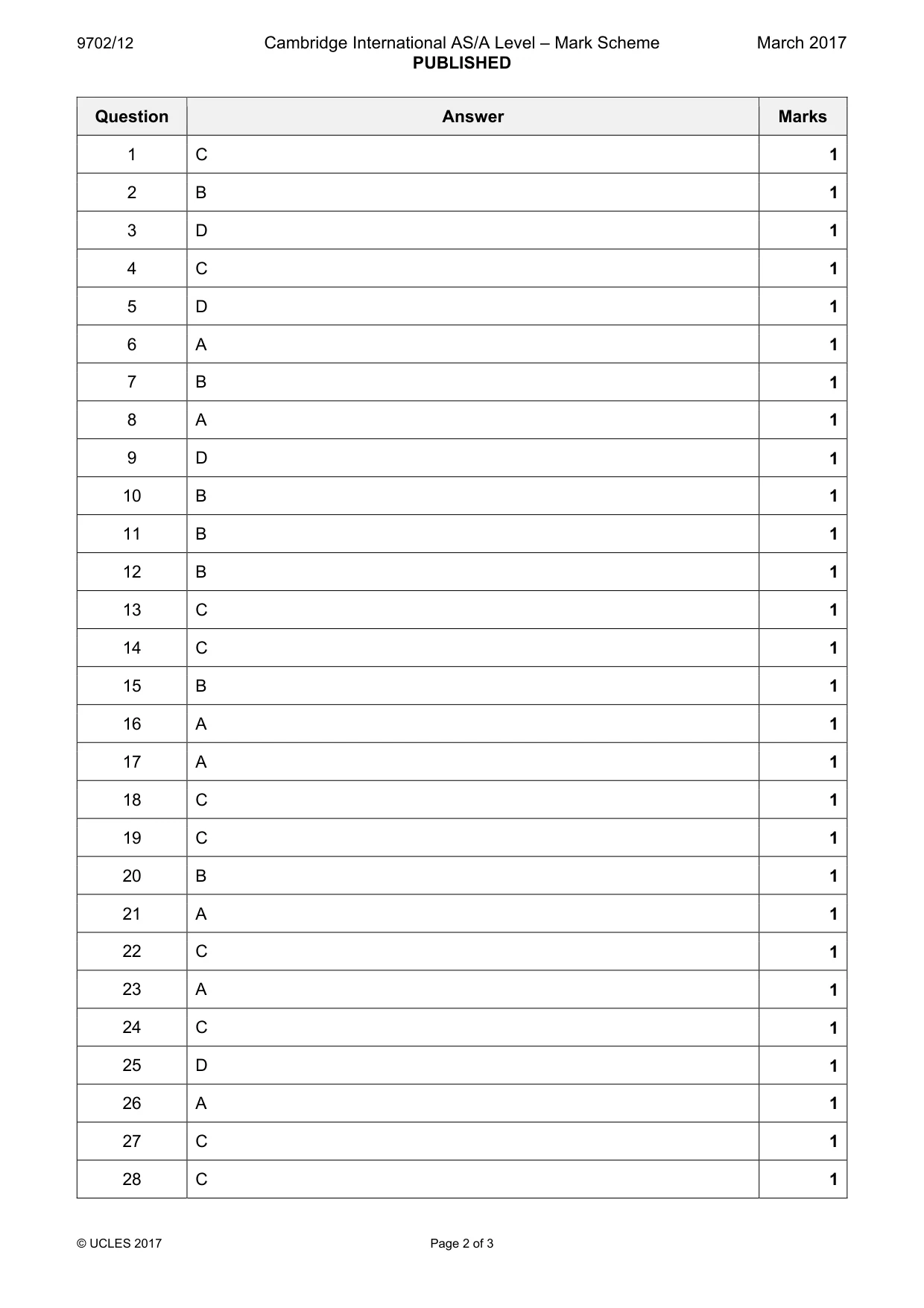
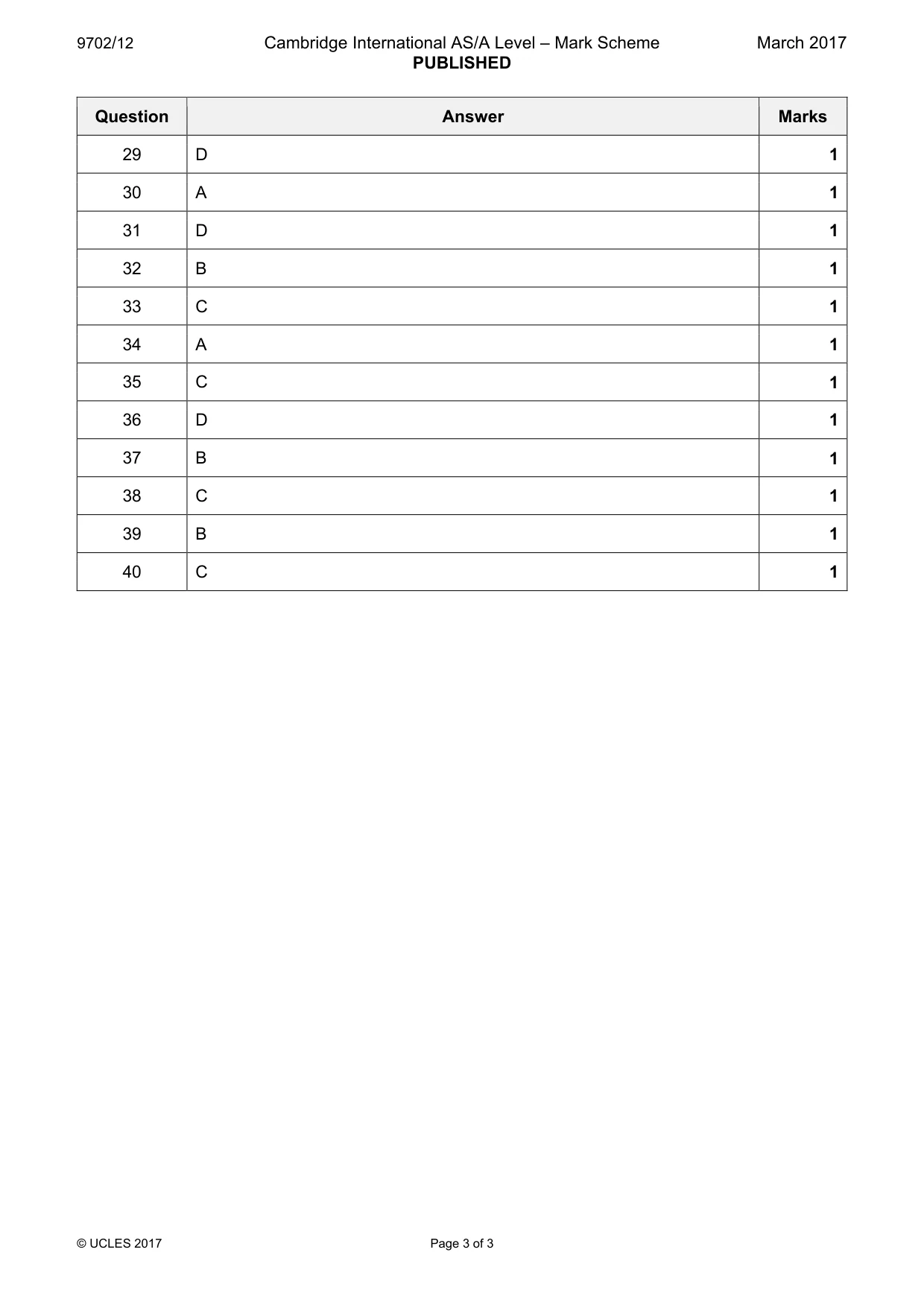
Mark scheme3 pages
Answers below. Sit the paper first if you are practising.
Questions as text
Q1 · Which expression has the same SI base units as pressure?
1 Which expression has the same SI base units as pressure? force A length × speed force B length × time mass C length × ( time )2 mass × ( time ) 2 D length
Mark scheme: C
Q2 · What is an approximate value for the speed of sound in air?
2 What is an approximate value for the speed of sound in air? A 30 m s–1 B 300 m s–1 C 30 000 m s–1 D 300 000 000 m s–1
Mark scheme: B
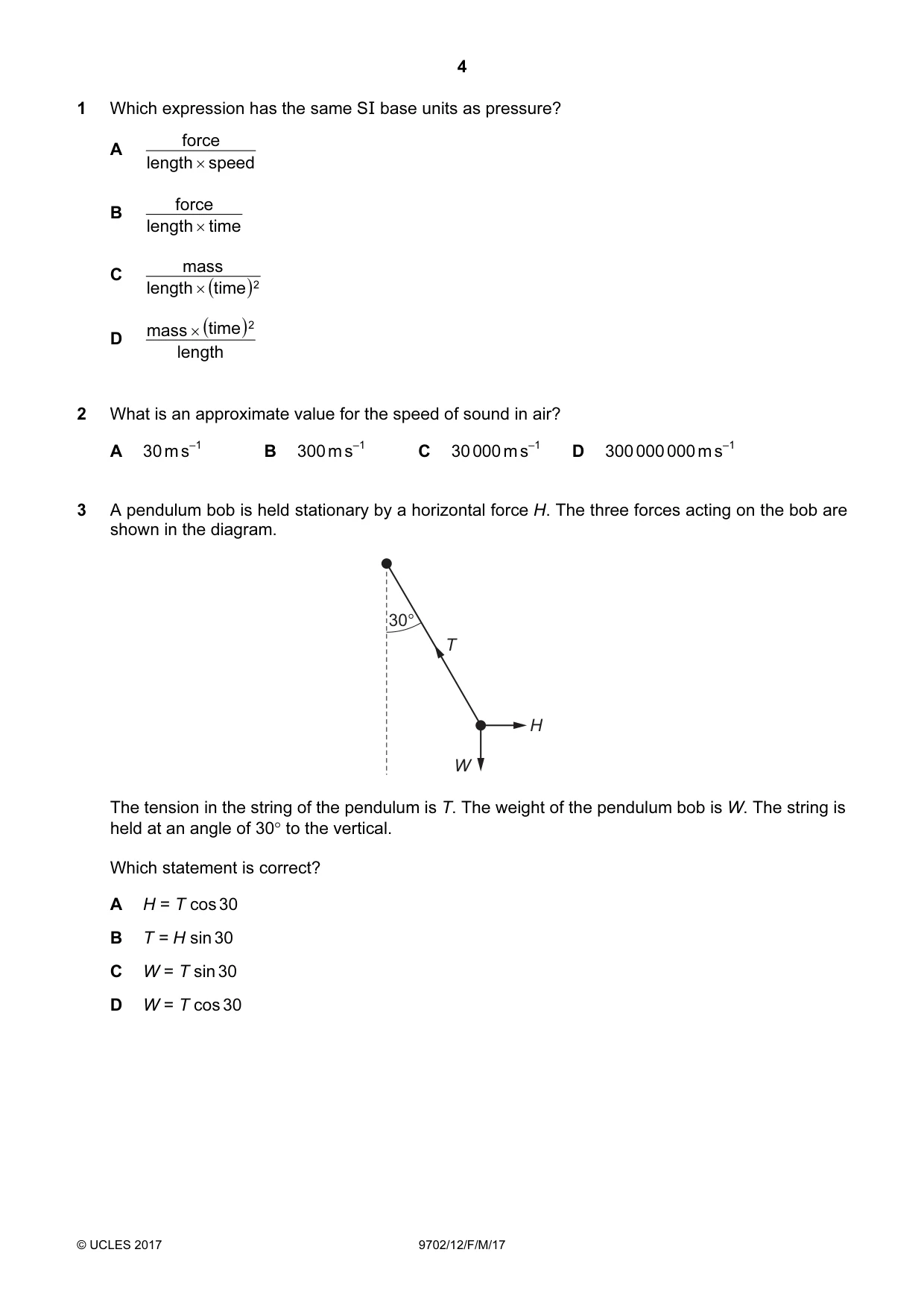
Q3 · A pendulum bob is held stationary by a horizontal force H
3 A pendulum bob is held stationary by a horizontal force H. The three forces acting on the bob are shown in the diagram. 30° T H W The tension in the string of the pendulum is T. The weight of the pendulum bob is W. The string is held at an angle of 30° to the vertical. Which statement is correct? A H = T cos 30 B T = H sin 30 C W = T sin 30 D W = T cos 30
Mark scheme: D
Q4 · A student is investigating an electrical signal using a cathode-ray oscilloscope (c.r.o)
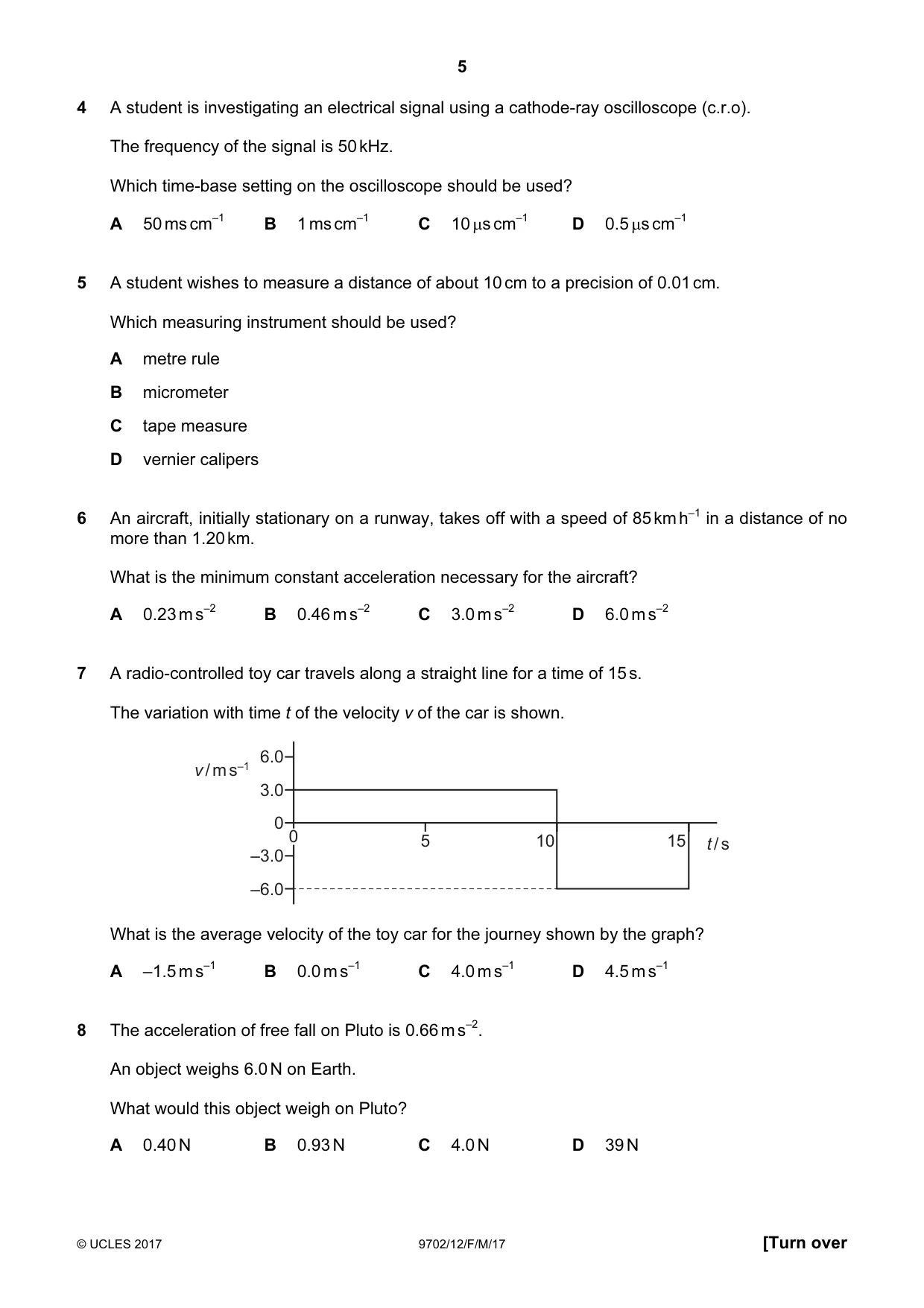
4 A student is investigating an electrical signal using a cathode-ray oscilloscope (c.r.o). The frequency of the signal is 50 kHz. Which time-base setting on the oscilloscope should be used? A 50 ms cm–1 B 1 ms cm–1 C 10 µs cm–1 D 0.5 µs cm–1
Mark scheme: C
Q5 · A student wishes to measure a distance of about 10 cm to a precision of 0.01 cm
5 A student wishes to measure a distance of about 10 cm to a precision of 0.01 cm. Which measuring instrument should be used? A metre rule B micrometer C tape measure D vernier calipers
Mark scheme: D
Q6 · An aircraft, initially stationary on a runway, takes off with a speed of 85 km h–1 in a…
6 An aircraft, initially stationary on a runway, takes off with a speed of 85 km h–1 in a distance of no more than 1.20 km. What is the minimum constant acceleration necessary for the aircraft? A 0.23 m s–2 B 0.46 m s–2 C 3.0 m s–2 D 6.0 m s–2
Mark scheme: A
Q7 · A radio-controlled toy car travels along a straight line for a time of 15 s
7 A radio-controlled toy car travels along a straight line for a time of 15 s. The variation with time t of the velocity v of the car is shown. 6.0 v / m s–1 3.0 0 0 5 10 15 t / s –3.0 –6.0 What is the average velocity of the toy car for the journey shown by the graph? A –1.5 m s–1 B 0.0 m s–1 C 4.0 m s–1 D 4.5 m s–1
Mark scheme: B
Q8 · The acceleration of free fall on Pluto is 0.66 m s–2
8 The acceleration of free fall on Pluto is 0.66 m s–2. An object weighs 6.0 N on Earth. What would this object weigh on Pluto? A 0.40 N B 0.93 N C 4.0 N D 39 N
Mark scheme: A
Q9 · Water flows out of a pipe and hits a wall
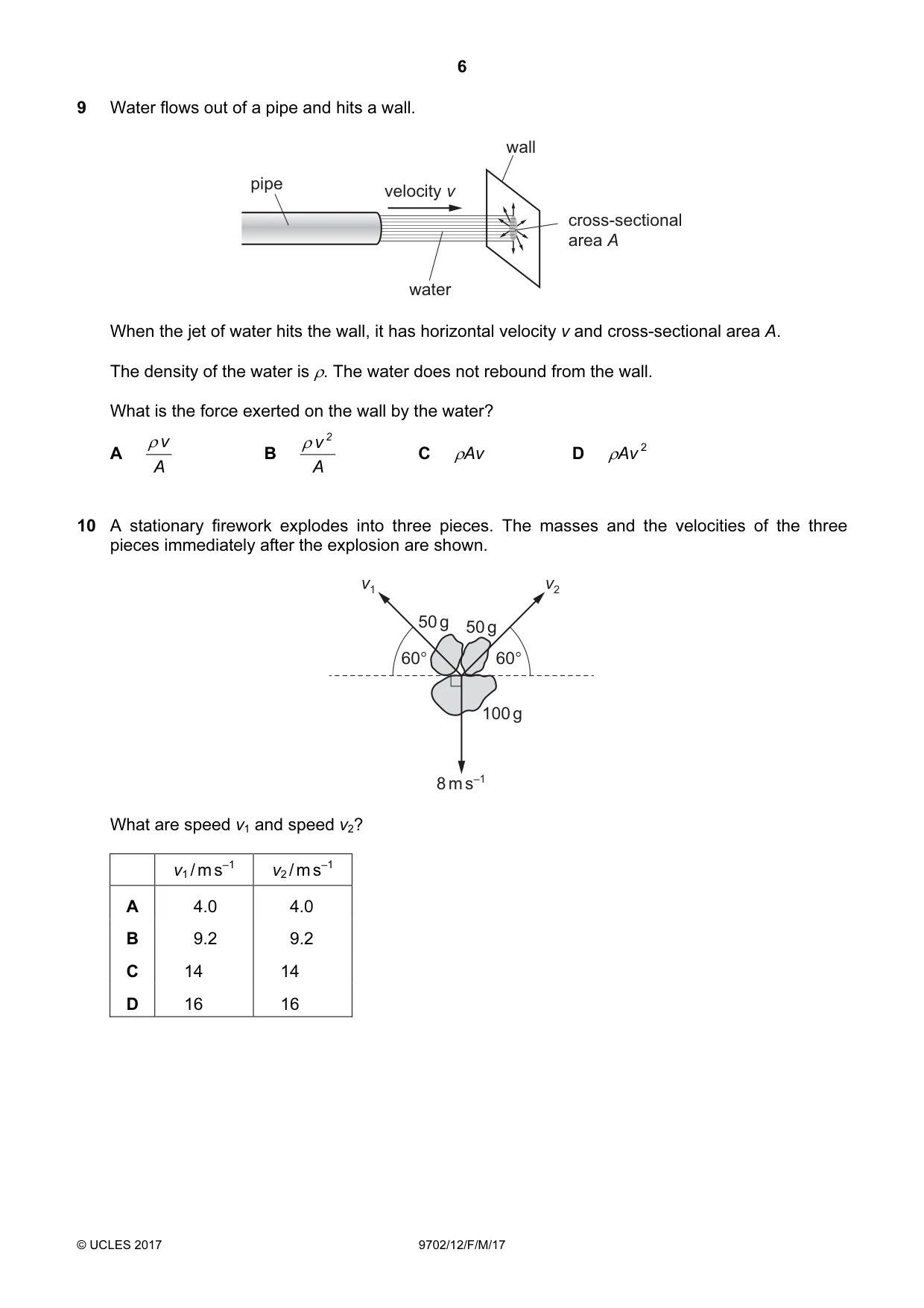
9 Water flows out of a pipe and hits a wall. wall pipe velocity v cross-sectional area A water When the jet of water hits the wall, it has horizontal velocity v and cross-sectional area A. The density of the water is ρ. The water does not rebound from the wall. What is the force exerted on the wall by the water? ρ v ρ v 2 A B C ρ Av D ρ Av 2 A A
Mark scheme: D
Q10 · A stationary firework explodes into three pieces
10 A stationary firework explodes into three pieces. The masses and the velocities of the three pieces immediately after the explosion are shown. v1 v2 50 g 50 g 60° 60° 100 g 8 m s–1 What are speed v1 and speed v2? v1 / m s–1 v2 / m s–1 A 4.0 4.0 B 9.2 9.2 C 14 14 D 16 16
Mark scheme: B
Q11 · A spherical object falls through water at constant speed
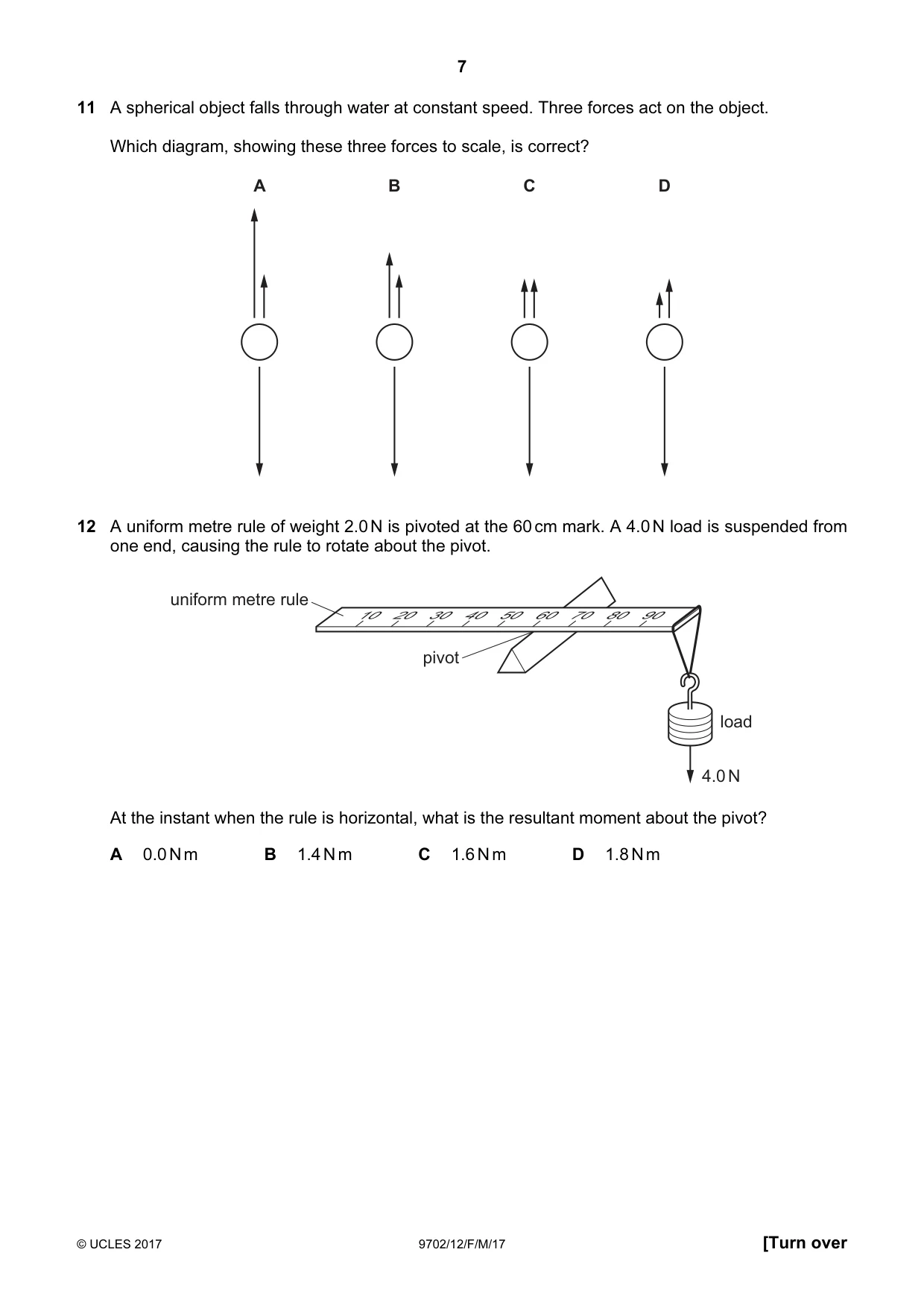
11 A spherical object falls through water at constant speed. Three forces act on the object. Which diagram, showing these three forces to scale, is correct? A B C D
Mark scheme: B
Q12 · A uniform metre rule of weight 2.0 N is pivoted at the 60 cm mark
12 A uniform metre rule of weight 2.0 N is pivoted at the 60 cm mark. A 4.0 N load is suspended from one end, causing the rule to rotate about the pivot. uniform metre rule 10 20 30 40 50 60 70 80 90 pivot load 4.0 N At the instant when the rule is horizontal, what is the resultant moment about the pivot? A 0.0 N m B 1.4 N m C 1.6 N m D 1.8 N m
Mark scheme: B
Q13 · The vertical forces that the ground exerts on a stationary van are shown
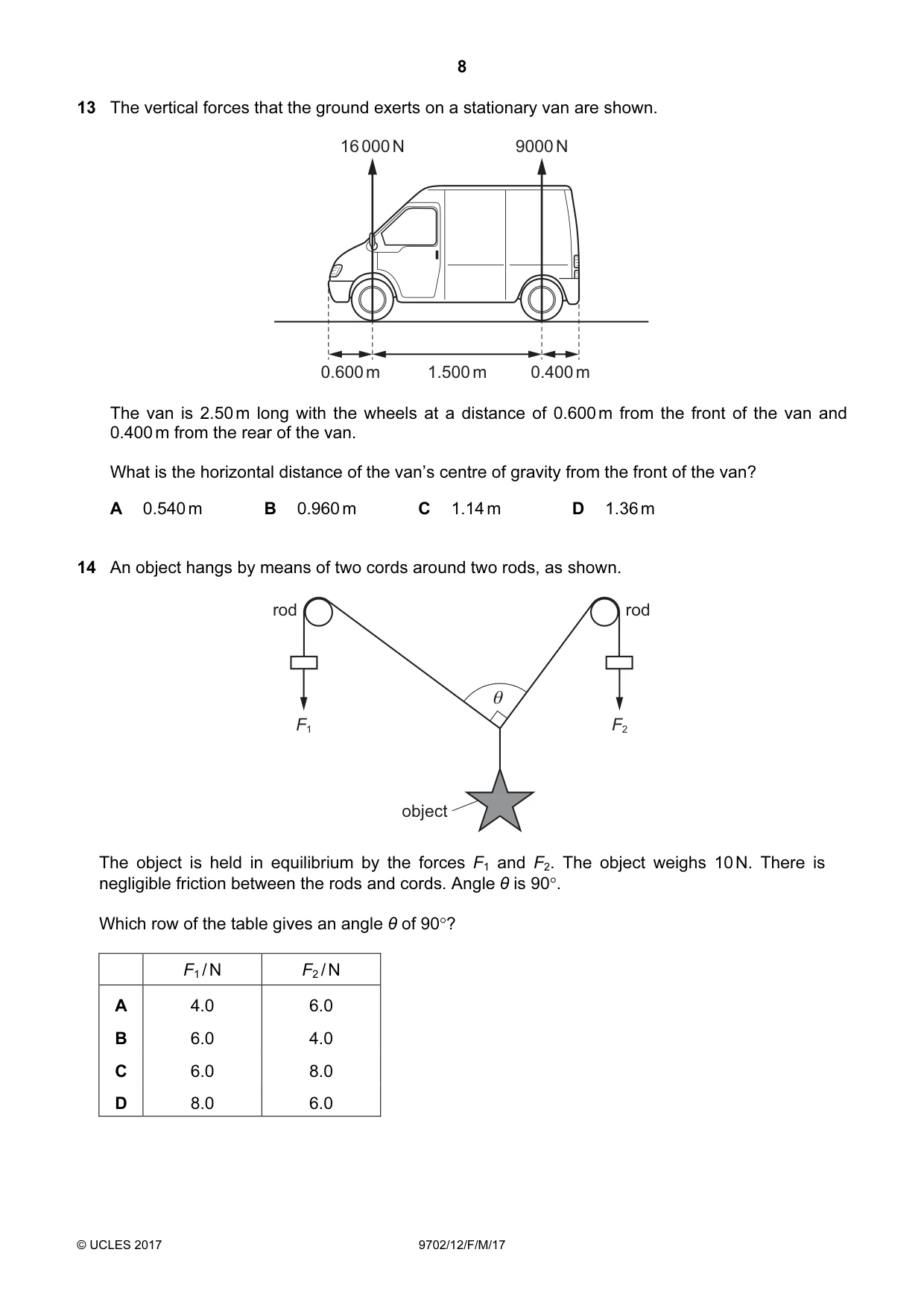
13 The vertical forces that the ground exerts on a stationary van are shown. 16 000 N 9000 N 0.600 m 1.500 m 0.400 m The van is 2.50 m long with the wheels at a distance of 0.600 m from the front of the van and 0.400 m from the rear of the van. What is the horizontal distance of the van’s centre of gravity from the front of the van? A 0.540 m B 0.960 m C 1.14 m D 1.36 m
Mark scheme: C
Q14 · An object hangs by means of two cords around two rods, as shown
14 An object hangs by means of two cords around two rods, as shown. rod rod θ F1 F2 object The object is held in equilibrium by the forces F1 and F2. The object weighs 10 N. There is negligible friction between the rods and cords. Angle θ is 90°. Which row of the table gives an angle θ of 90°? F1 / N F2 / N A 4.0 6.0 B 6.0 4.0 C 6.0 8.0 D 8.0 6.0
Mark scheme: C
Q15 · Which force is caused only by a pressure difference?
15 Which force is caused only by a pressure difference? A friction B upthrust C viscous force D weight
Mark scheme: B
Q16 · The total energy input Ein in a process is partly transferred to useful energy output U…
16 The total energy input Ein in a process is partly transferred to useful energy output U and partly transfered to energy that is wasted W. What is the efficiency of the process? A U × 100% E in B W × 100% E in C U × 100% W D U + W × 100% E in
Mark scheme: A
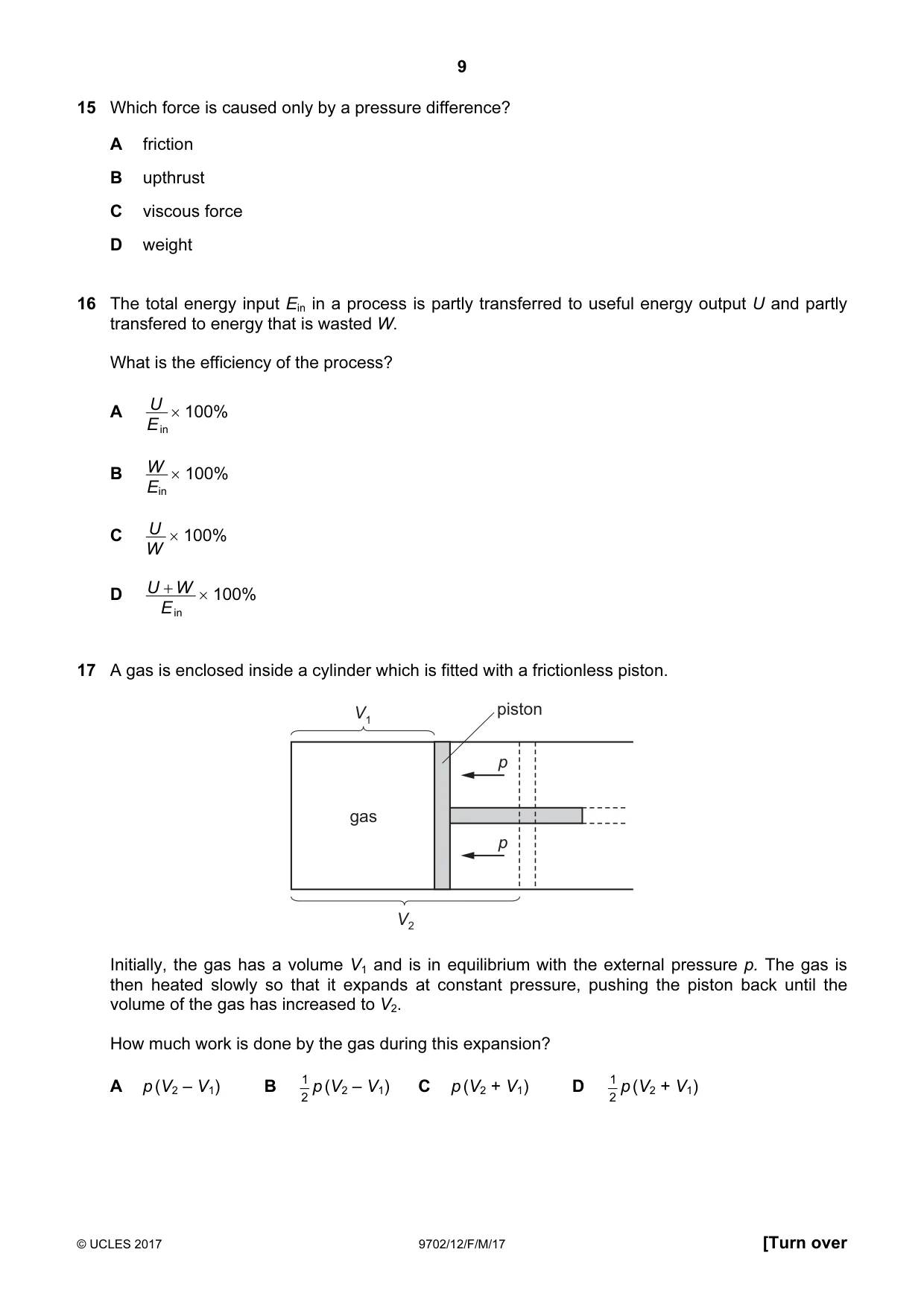
Q17 · A gas is enclosed inside a cylinder which is fitted with a frictionless piston
17 A gas is enclosed inside a cylinder which is fitted with a frictionless piston. V1 piston p gas p V2 Initially, the gas has a volume V1 and is in equilibrium with the external pressure p. The gas is then heated slowly so that it expands at constant pressure, pushing the piston back until the volume of the gas has increased to V2. How much work is done by the gas during this expansion? A B 1 p (V2 – V1) C D 1 p (V2 + V1) p (V2 – V1) p (V2 + V1) 2 2
Mark scheme: A
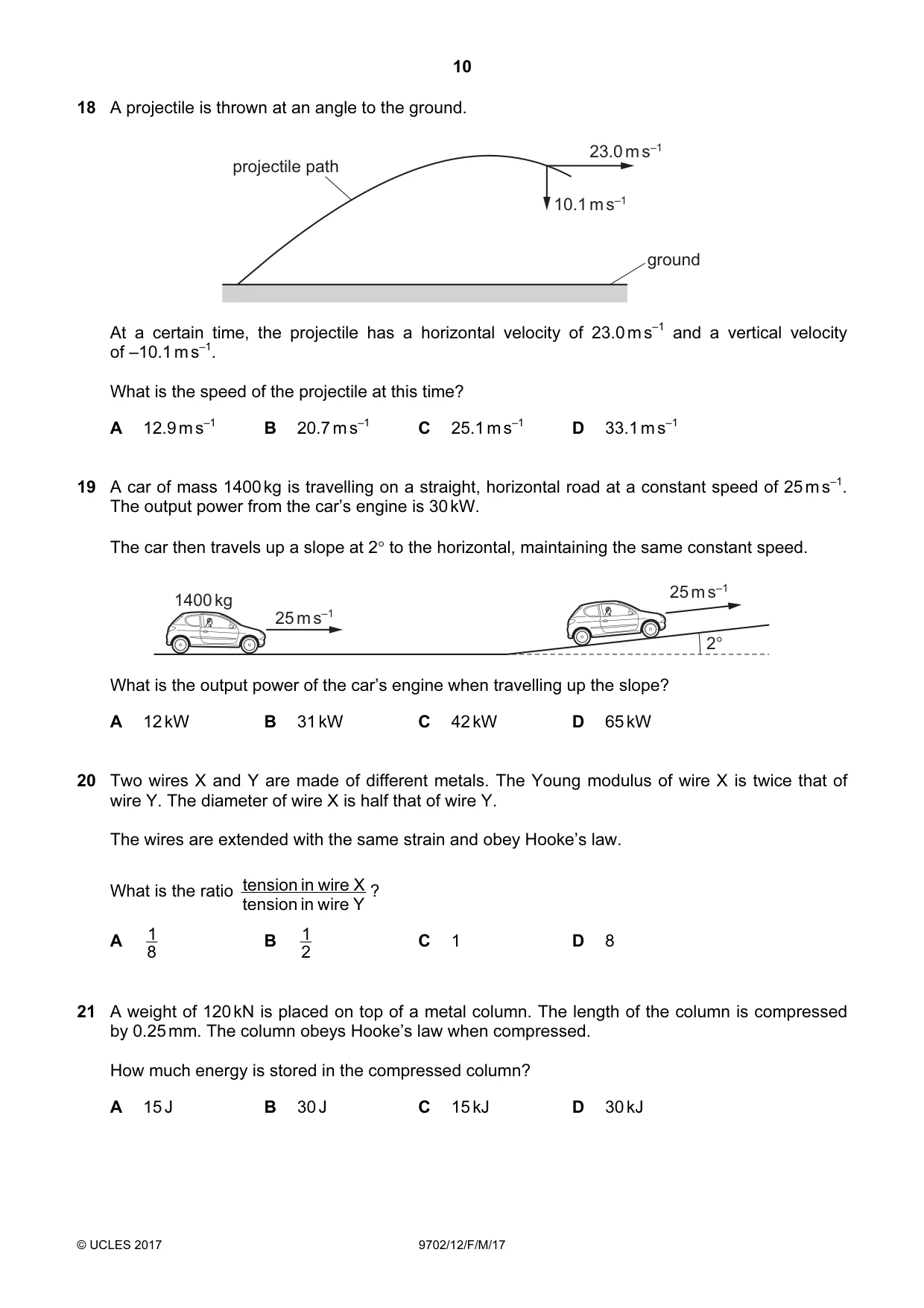
Q18 · A projectile is thrown at an angle to the ground
18 A projectile is thrown at an angle to the ground. 23.0 m s–1 projectile path 10.1 m s–1 ground At a certain time, the projectile has a horizontal velocity of 23.0 m s–1 and a vertical velocity of –10.1 m s–1. What is the speed of the projectile at this time? A 12.9 m s–1 B 20.7 m s–1 C 25.1 m s–1 D 33.1 m s–1
Mark scheme: C
Q19 · A car of mass 1400 kg is travelling on a straight, horizontal road at a constant speed of…
19 A car of mass 1400 kg is travelling on a straight, horizontal road at a constant speed of 25 m s–1. The output power from the car’s engine is 30 kW. The car then travels up a slope at 2° to the horizontal, maintaining the same constant speed. 25 m s–1 1400 kg 25 m s–1 2° What is the output power of the car’s engine when travelling up the slope? A 12 kW B 31 kW C 42 kW D 65 kW
Mark scheme: C
Q20 · Two wires X and Y are made of different metals
20 Two wires X and Y are made of different metals. The Young modulus of wire X is twice that of wire Y. The diameter of wire X is half that of wire Y. The wires are extended with the same strain and obey Hooke’s law. What is the ratio tension in wire X ? tension in wire Y A 1 B 1 C 1 D 8 8 2
Mark scheme: B
Q21 · A weight of 120 kN is placed on top of a metal column
21 A weight of 120 kN is placed on top of a metal column. The length of the column is compressed by 0.25 mm. The column obeys Hooke’s law when compressed. How much energy is stored in the compressed column? A 15 J B 30 J C 15 kJ D 30 kJ
Mark scheme: A
Q22 · What is the relationship between the amplitude of a wave and its intensity?
22 What is the relationship between the amplitude of a wave and its intensity? A amplitude ∝ intensity B amplitude ∝ (intensity)2 C amplitude ∝ intensity D (amplitude)2 ∝ intensity
Mark scheme: C
Q23 · Which statement about light waves and sound waves is correct?
23 Which statement about light waves and sound waves is correct? A Both light waves and sound waves show the Doppler effect. B Light waves can be diffracted but sound waves cannot be diffracted. C Sound waves are transverse waves and light waves are longitudinal waves. D Sound waves can travel in a vacuum but light waves cannot travel in a vacuum.
Mark scheme: A
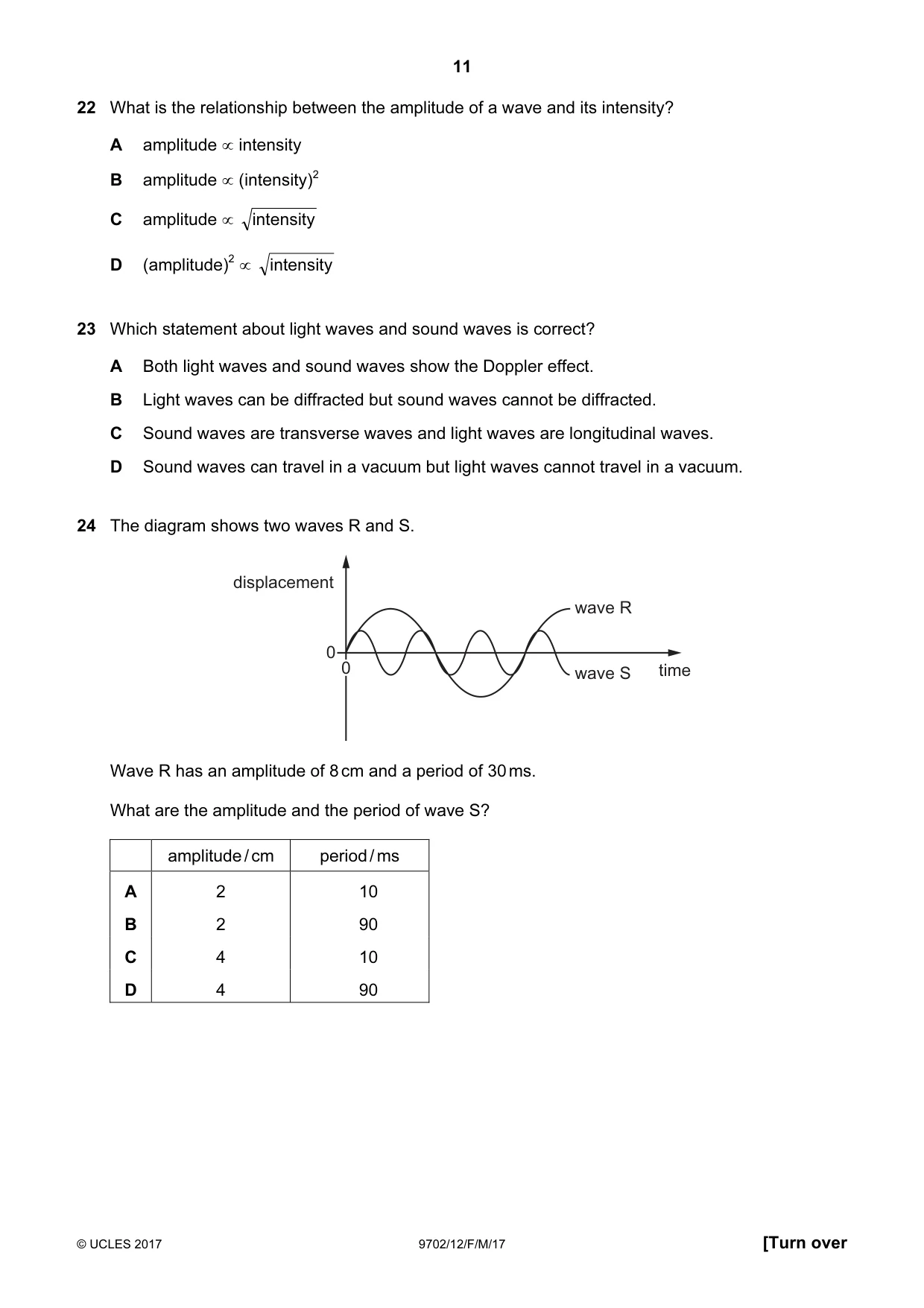
Q24 · The diagram shows two waves R and S
24 The diagram shows two waves R and S. displacement wave R 0 0 wave S time Wave R has an amplitude of 8 cm and a period of 30 ms. What are the amplitude and the period of wave S? amplitude / cm period / ms A 2 10 B 2 90 C 4 10 D 4 90
Mark scheme: C
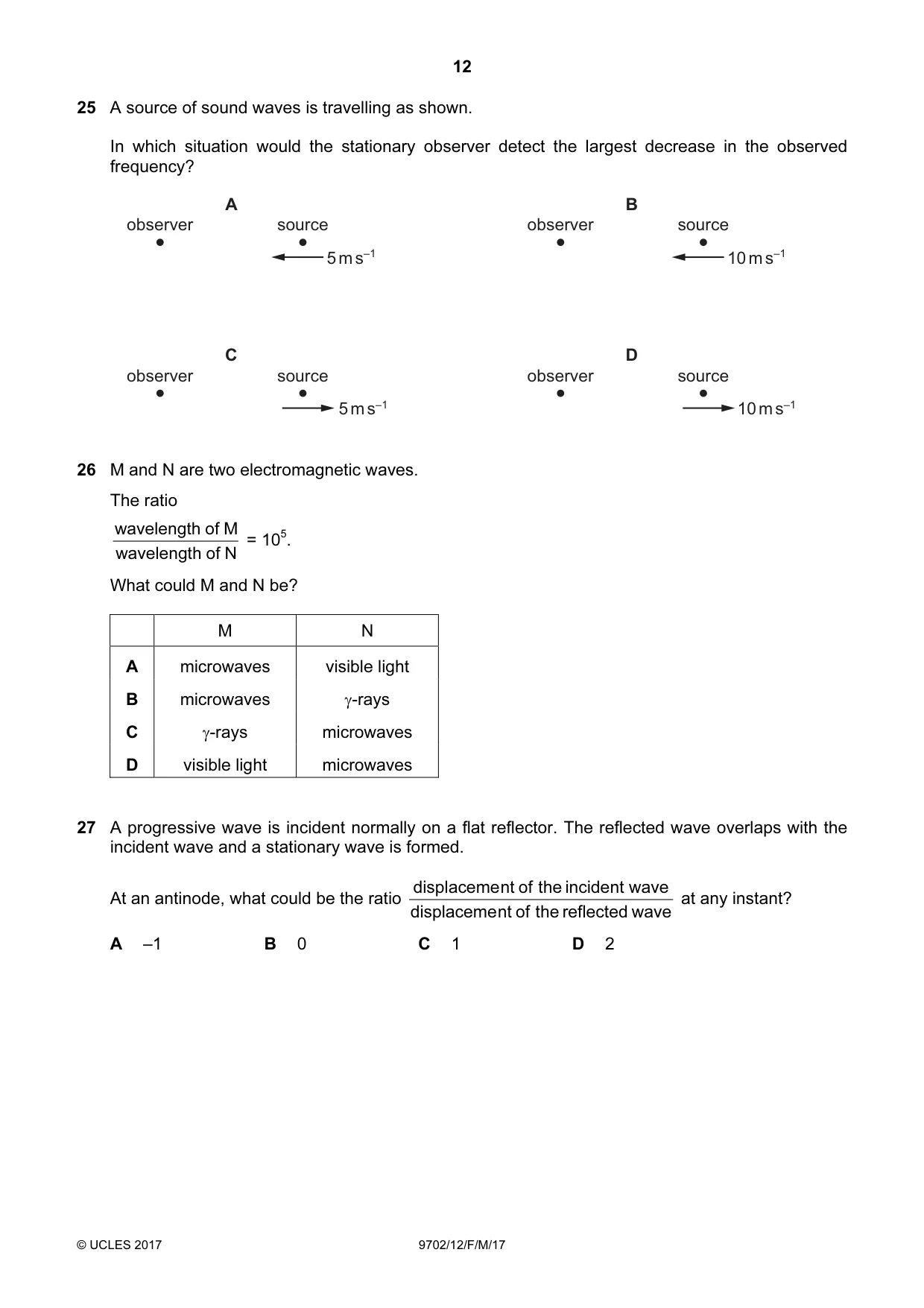
Q25 · A source of sound waves is travelling as shown
25 A source of sound waves is travelling as shown. In which situation would the stationary observer detect the largest decrease in the observed frequency? A B observer source observer source 5 m s–1 10 m s–1 C D observer source observer source 5 m s–1 10 m s–1
Mark scheme: D
Q26 · M and N are two electromagnetic waves
26 M and N are two electromagnetic waves. The ratio wavelength of M = 105. wavelength of N What could M and N be? M N A microwaves visible light B microwaves γ-rays C γ-rays microwaves D visible light microwaves
Mark scheme: A
Q27 · A progressive wave is incident normally on a flat reflector
27 A progressive wave is incident normally on a flat reflector. The reflected wave overlaps with the incident wave and a stationary wave is formed. displaceme nt of the incident wave At an antinode, what could be the ratio at any instant? displaceme nt of the reflected wave A –1 B 0 C 1 D 2
Mark scheme: C
Q28 · A monochromatic plane wave of speed c and wavelength λ is diffracted at a small aperture
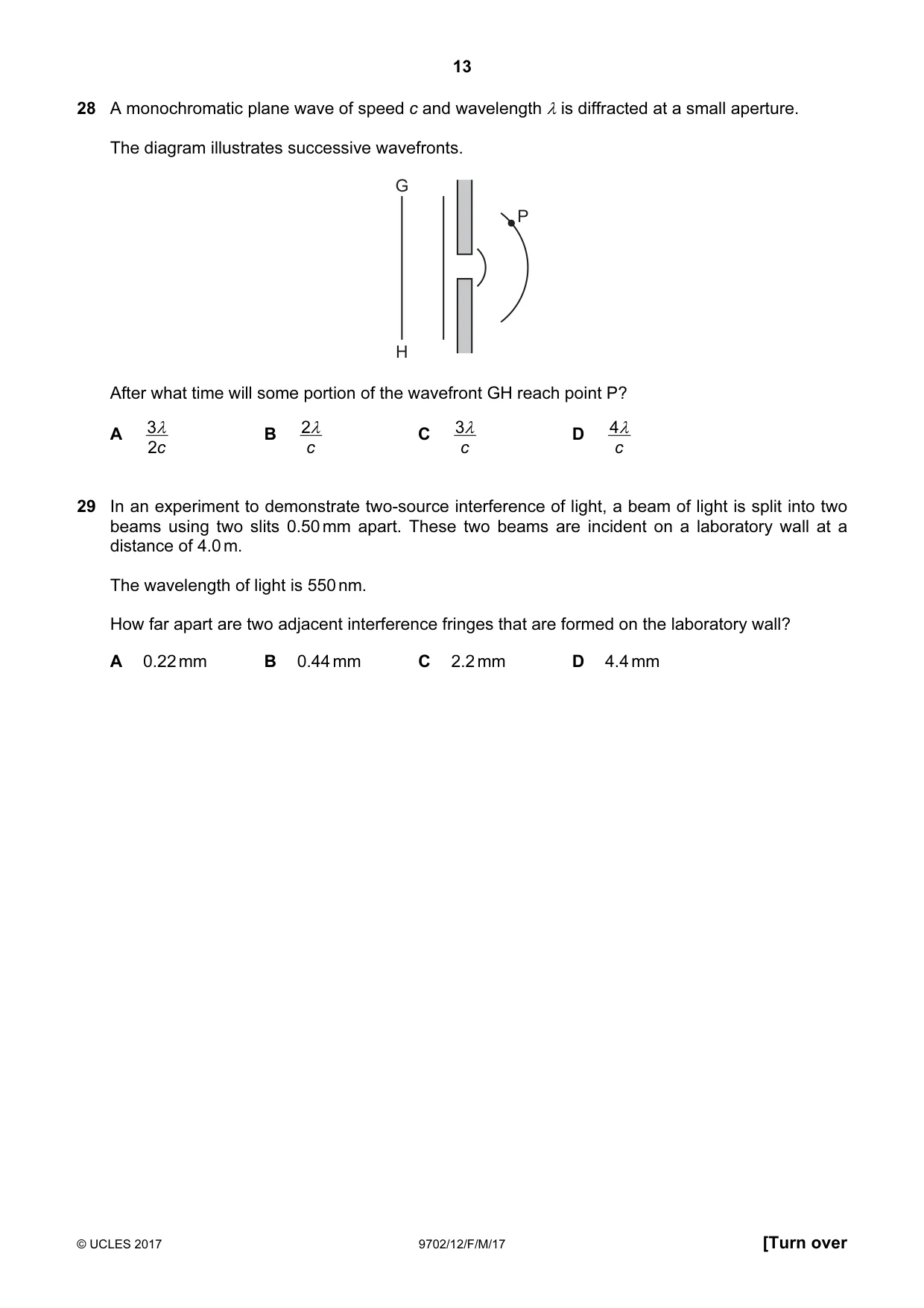
28 A monochromatic plane wave of speed c and wavelength λ is diffracted at a small aperture. The diagram illustrates successive wavefronts. G P H After what time will some portion of the wavefront GH reach point P? A 3λ B 2 λ C 3 λ D 4 λ 2 c c c c
Mark scheme: C
Q29 · In an experiment to demonstrate two-source interference of light, a beam of light is…
29 In an experiment to demonstrate two-source interference of light, a beam of light is split into two beams using two slits 0.50 mm apart. These two beams are incident on a laboratory wall at a distance of 4.0 m. The wavelength of light is 550 nm. How far apart are two adjacent interference fringes that are formed on the laboratory wall? A 0.22 mm B 0.44 mm C 2.2 mm D 4.4 mm
Mark scheme: D
Q30 · Two positive charges and one negative charge, all of equal magnitude, are set at the…
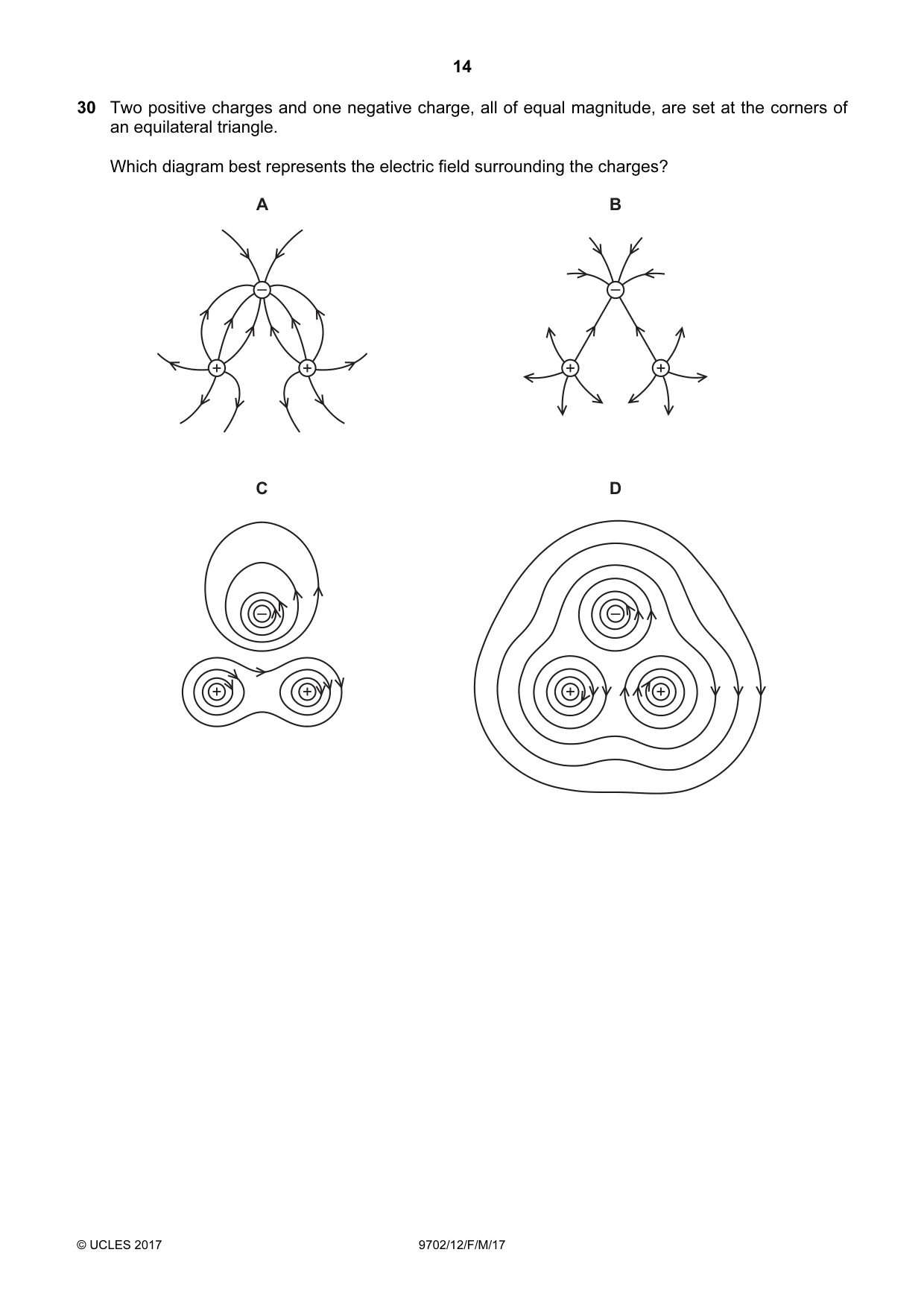
30 Two positive charges and one negative charge, all of equal magnitude, are set at the corners of an equilateral triangle. Which diagram best represents the electric field surrounding the charges? A B – – + + + + C D – – + + + +
Mark scheme: A
Q31 · A constant potential difference is applied between two horizontal metal plates
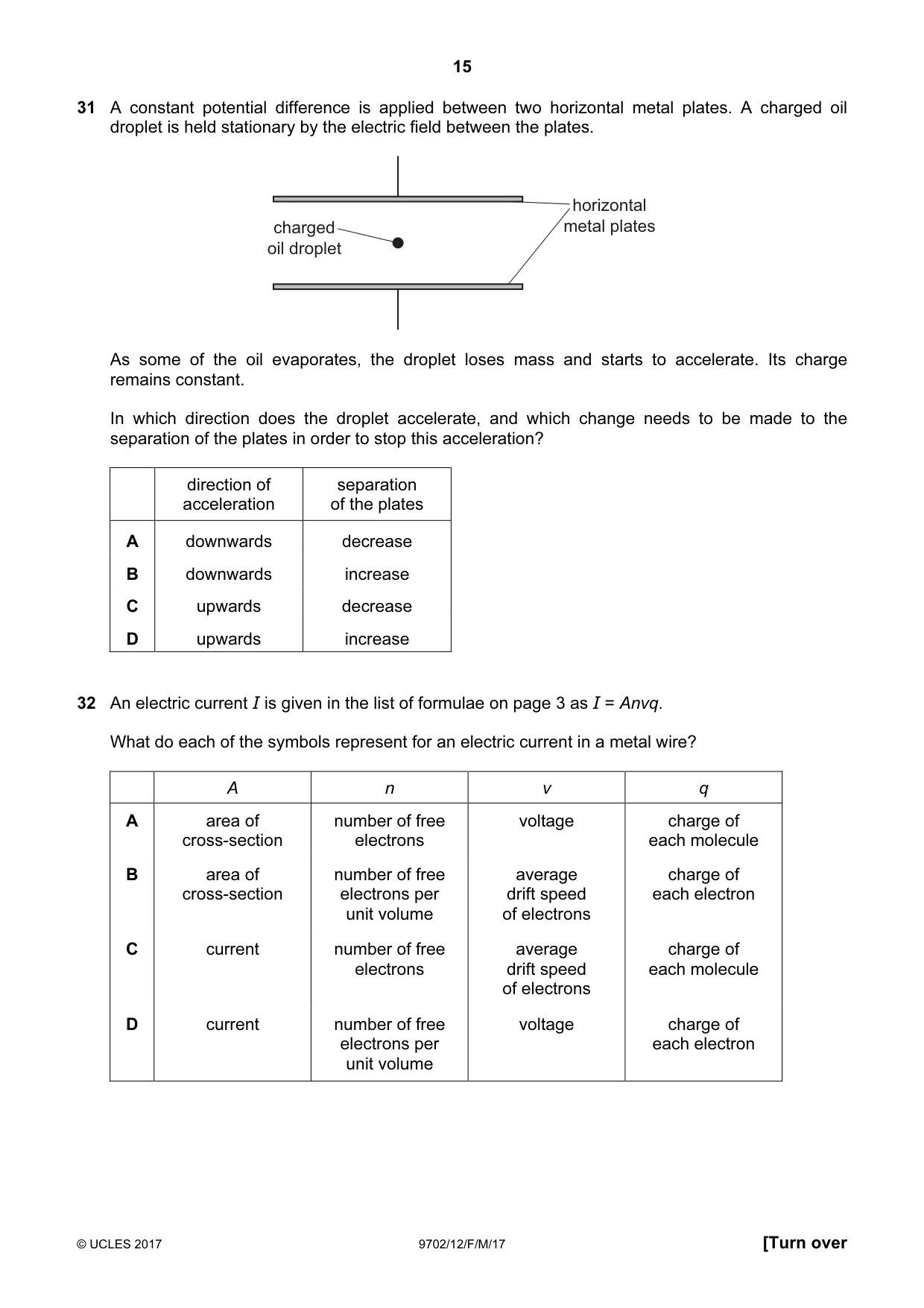
31 A constant potential difference is applied between two horizontal metal plates. A charged oil droplet is held stationary by the electric field between the plates. horizontal charged metal plates oil droplet As some of the oil evaporates, the droplet loses mass and starts to accelerate. Its charge remains constant. In which direction does the droplet accelerate, and which change needs to be made to the separation of the plates in order to stop this acceleration? direction of separation acceleration of the plates A downwards decrease B downwards increase C upwards decrease D upwards increase
Mark scheme: D
Q32 · An electric current I is given in the list of formulae on page 3 as I = Anvq
32 An electric current I is given in the list of formulae on page 3 as I = Anvq. What do each of the symbols represent for an electric current in a metal wire? A n v q A area of number of free voltage charge of cross-section electrons each molecule B area of number of free average charge of cross-section electrons per drift speed each electron unit volume of electrons C current number of free average charge of electrons drift speed each molecule of electrons D current number of free voltage charge of electrons per each electron unit volume
Mark scheme: B
Q33 · The potential difference across a resistor is 12 V
33 The potential difference across a resistor is 12 V. The current in the resistor is 2.0 A. A charge of 4.0 C passes through the resistor. What is the energy transferred in the resistor and the time taken for the charge to pass through the resistor? energy / J time / s A 3.0 2.0 B 3.0 8.0 C 48 2.0 D 48 8.0
Mark scheme: C
Q34 · A coil contains N turns of insulated copper wire wound on to a cylindrical iron core of…
34 A coil contains N turns of insulated copper wire wound on to a cylindrical iron core of diameter D. The copper wire has a diameter d. The resistivity of copper is ρ. Diameter D is much greater than diameter d. What is the total resistance between the two ends of the coil? 4 Nρ D 4 Nρ d 8 Nρ D 8 Nρ d A B C D d 2 D 2 d 2 D 2
Mark scheme: A
Q35 · Two cells are connected to a load resistor of resistance 3.0 Ω
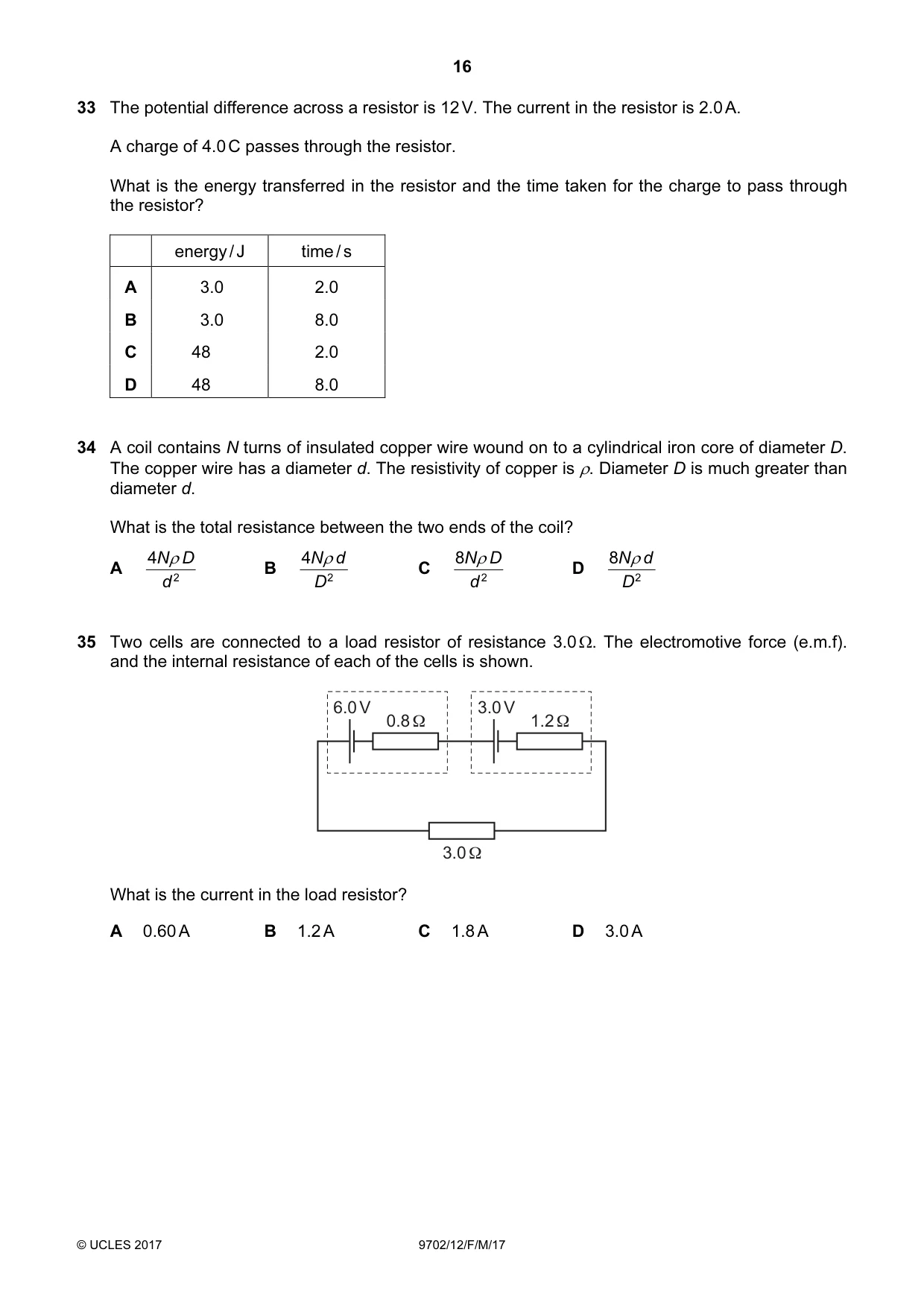
35 Two cells are connected to a load resistor of resistance 3.0 Ω. The electromotive force (e.m.f). and the internal resistance of each of the cells is shown. 6.0 V 3.0 V 0.8 Ω 1.2 Ω 3.0 Ω What is the current in the load resistor? A 0.60 A B 1.2 A C 1.8 A D 3.0 A
Mark scheme: C
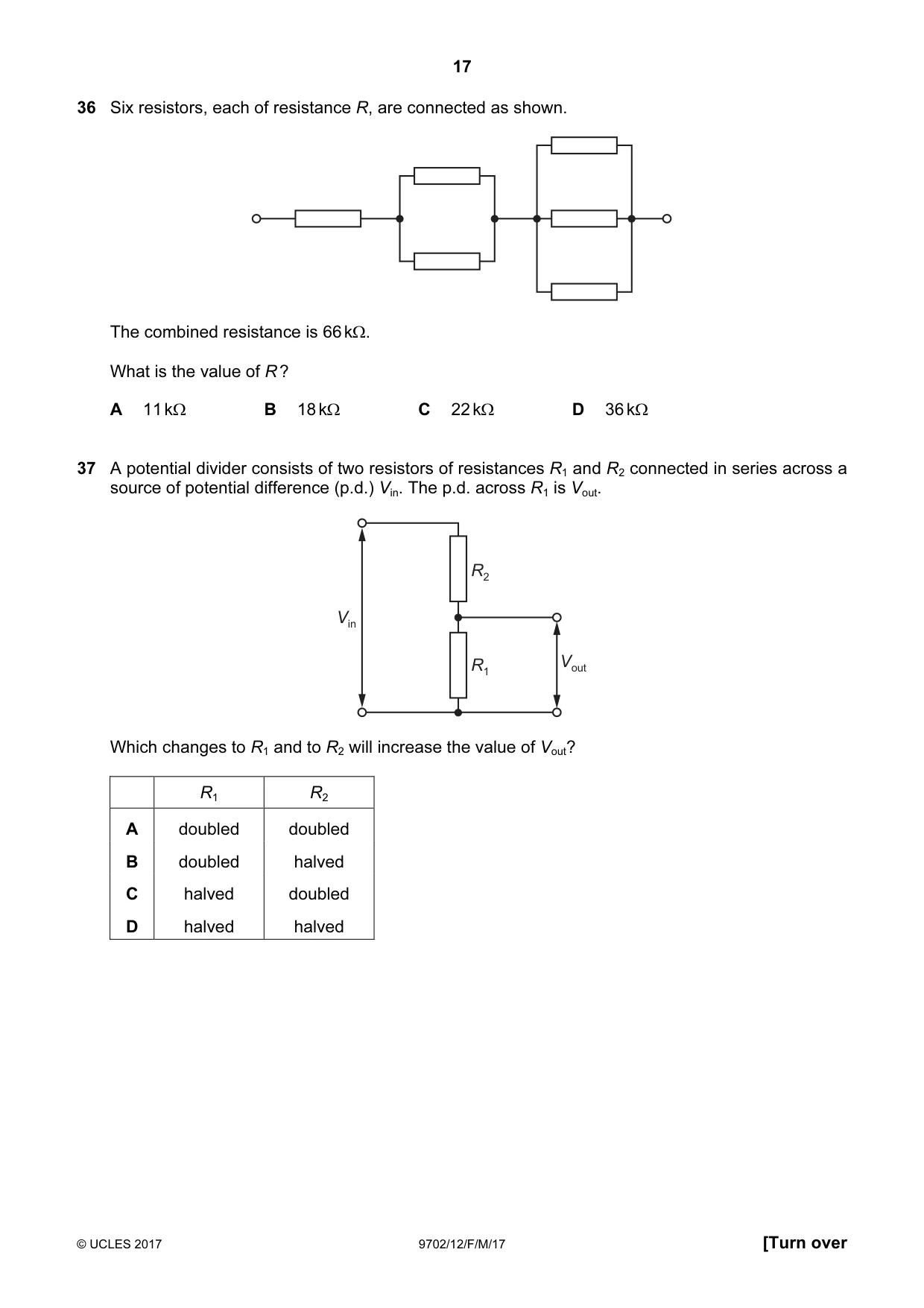
Q36 · Six resistors, each of resistance R, are connected as shown
36 Six resistors, each of resistance R, are connected as shown. The combined resistance is 66 kΩ. What is the value of R ? A 11 kΩ B 18 kΩ C 22 kΩ D 36 kΩ
Mark scheme: D
Q37 · A potential divider consists of two resistors of resistances R1 and R2 connected in…
37 A potential divider consists of two resistors of resistances R1 and R2 connected in series across a source of potential difference (p.d.) Vin. The p.d. across R1 is Vout. R2 Vin R1 Vout Which changes to R1 and to R2 will increase the value of Vout? R1 R2 A doubled doubled B doubled halved C halved doubled D halved halved
Mark scheme: B
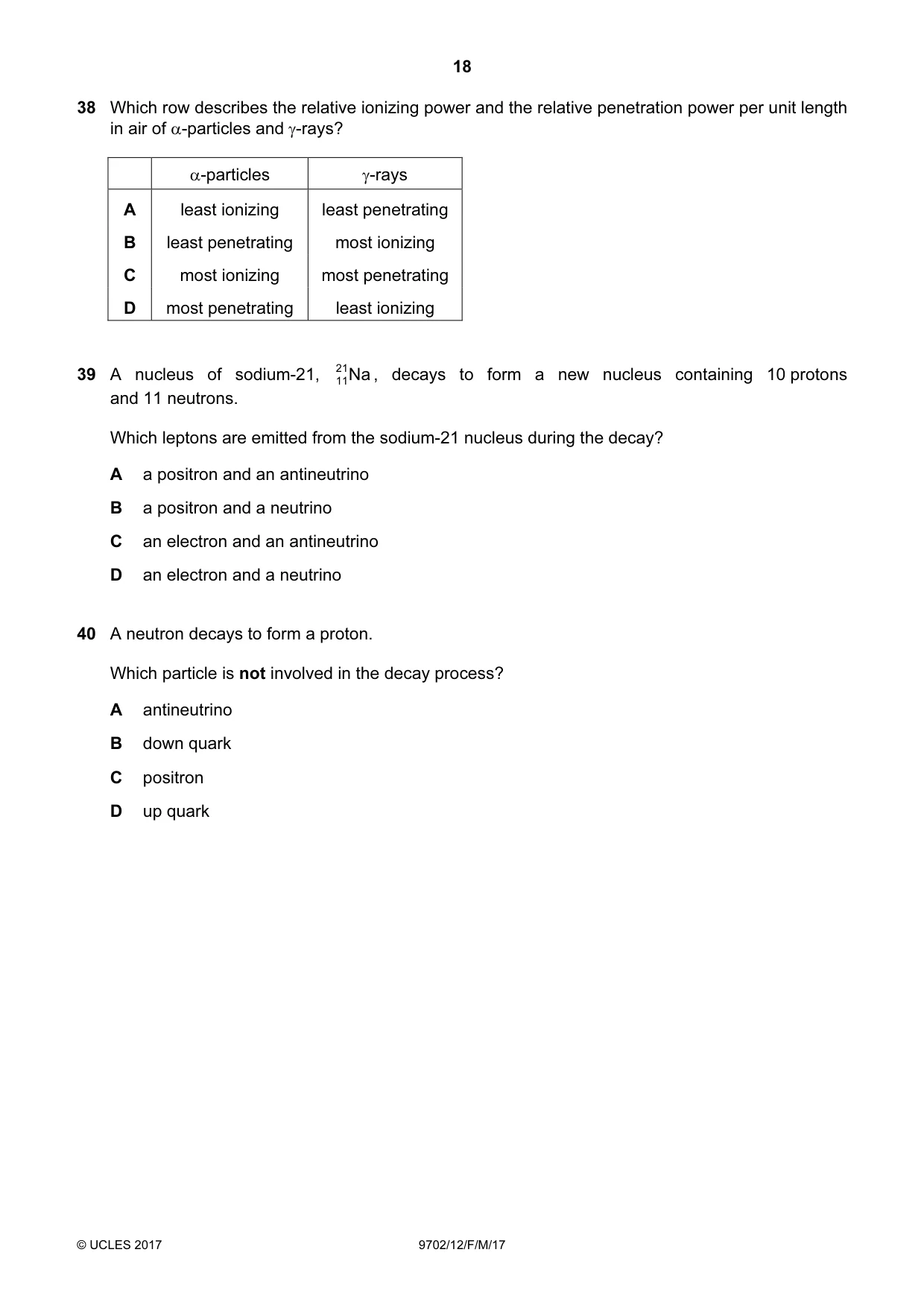
Q38 · Which row describes the relative ionizing power and the relative penetration power per…
38 Which row describes the relative ionizing power and the relative penetration power per unit length in air of α-particles and γ-rays? α-particles γ-rays A least ionizing least penetrating B least penetrating most ionizing C most ionizing most penetrating D most penetrating least ionizing
Mark scheme: C
Q39 · A nucleus of sodium-21, 21 Na , decays to form a new nucleus containing 10 protons 11 and…
39 A nucleus of sodium-21, 21 Na , decays to form a new nucleus containing 10 protons 11 and 11 neutrons. Which leptons are emitted from the sodium-21 nucleus during the decay? A a positron and an antineutrino B a positron and a neutrino C an electron and an antineutrino D an electron and a neutrino
Mark scheme: B
Q40 · A neutron decays to form a proton
40 A neutron decays to form a proton. Which particle is not involved in the decay process? A antineutrino B down quark C positron D up quark
Mark scheme: C
What was in this paper
The subtopics covered by these 40 questions, and how many questions each got. Open one in a new tab to see every Cambridge question on it.
3Physical quantities3Energy conservation2Equations of motion2Linear momentum and its conservation2Practical circuits2Progressive waves2Turning effects of forces2Atoms, nuclei and radiation1Density and pressure1Diffraction1Doppler effect for sound waves1Elastic and plastic behaviour1Electric current1Electric fields and field lines1Electromagnetic spectrum1Errors and uncertainties1Fundamental particles1Interference1Potential difference and power1Potential dividers1Radioactive decay1Resistance and resistivity1Scalars and vectors1SI units1Stationary waves1Stress and strain1The first law of thermodynamics1Transverse and longitudinal waves1Uniform electric fields1What you needed in this session
Cambridge’s own grade thresholds for 2017 Feb/March, Paper 1 · Variant 2. A higher threshold means an easier paper — the bar moves with how the cohort did.