Cambridge A Level Physics 9702 — 2021 Feb/March Paper 1 · Variant 2
9702/12/F/M/21 · 40 questions · 40 marks · ≈45 min
The question paper and its mark scheme, free to read here and free to download. This is Cambridge’s own paper, exactly as it was sat.
Question paper20 pages
Mark scheme3 pages
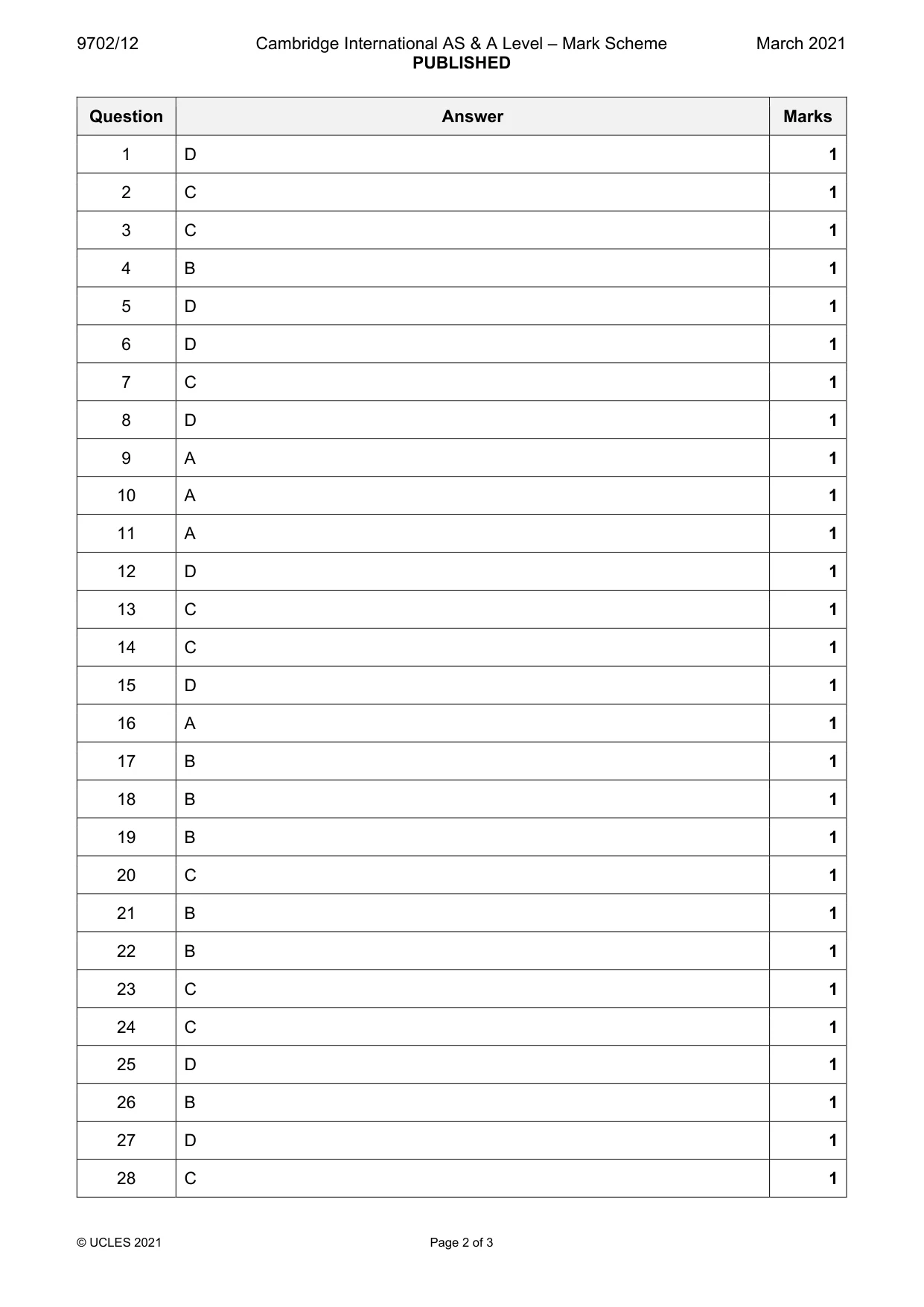
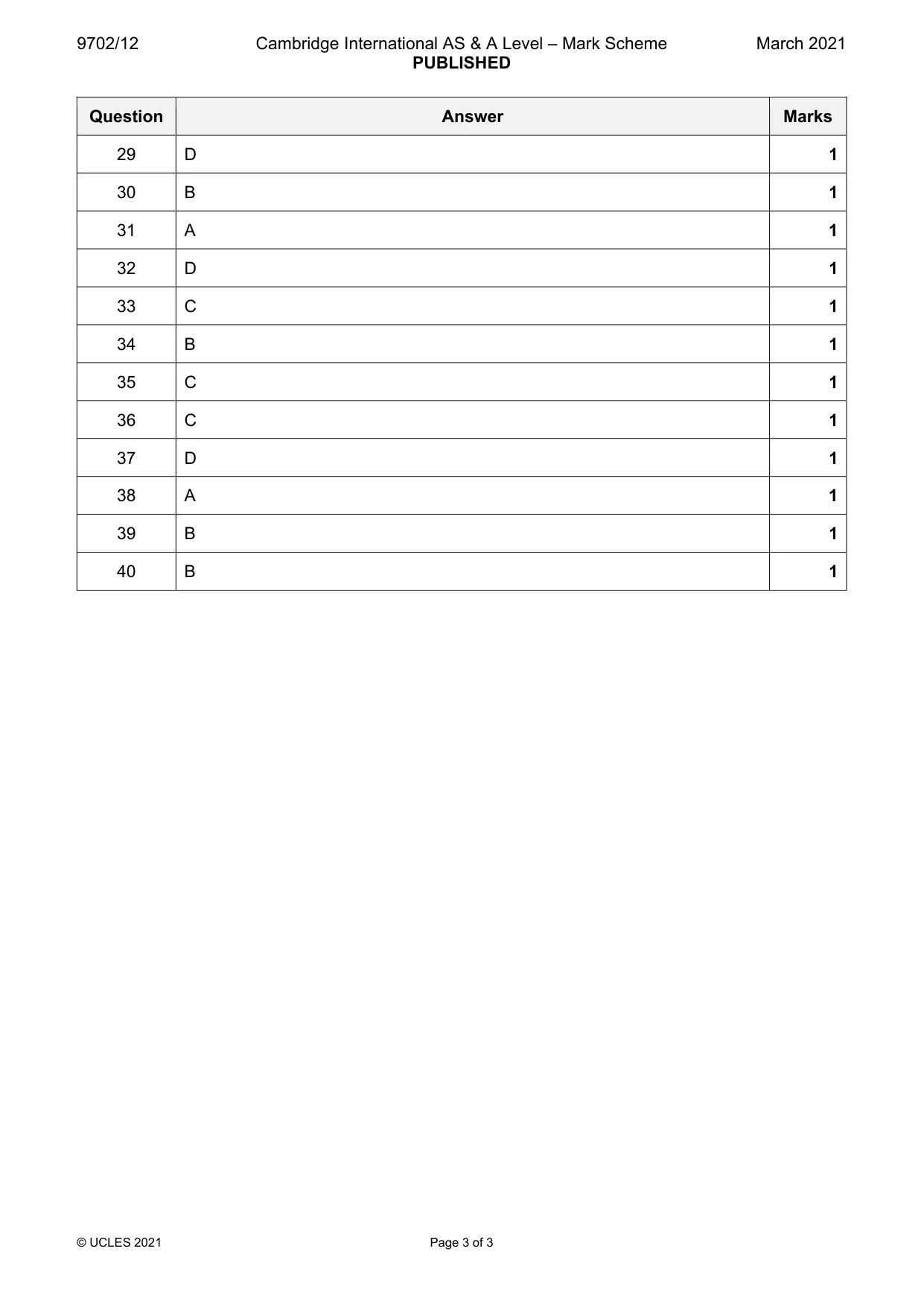
Answers below. Sit the paper first if you are practising.
Questions as text
Q1 · What is a reasonable estimate for the density of sand?
1 What is a reasonable estimate for the density of sand? A 2 × 10² g cm–3 B 2 × 10³ g cm–3 C 2 × 101 kg m–3 D 2 × 10³ kg m–3
Mark scheme: D
Q2 · Which physical quantity could have units of N s2 m–1?
2 Which physical quantity could have units of N s2 m–1? A acceleration B force C mass D momentum
Mark scheme: C
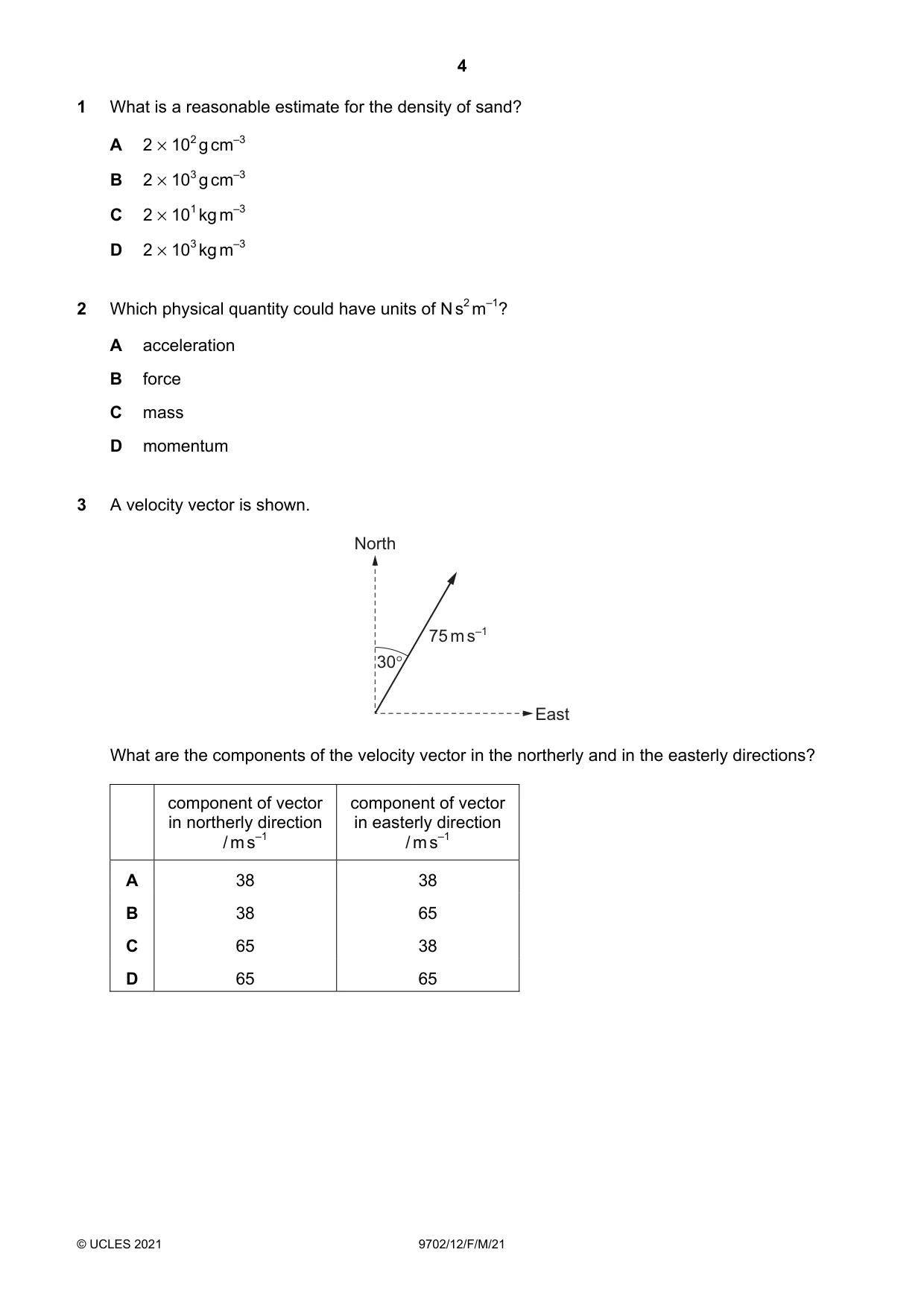
Q3 · A velocity vector is shown
3 A velocity vector is shown. What are the components of the velocity vector in the northerly and in the easterly directions? component of vector | component of vector in northerly direction in easterly direction /ms"' /ms"' A 38 38 B 38 65 Cc 65 38 D 65 65
Mark scheme: C
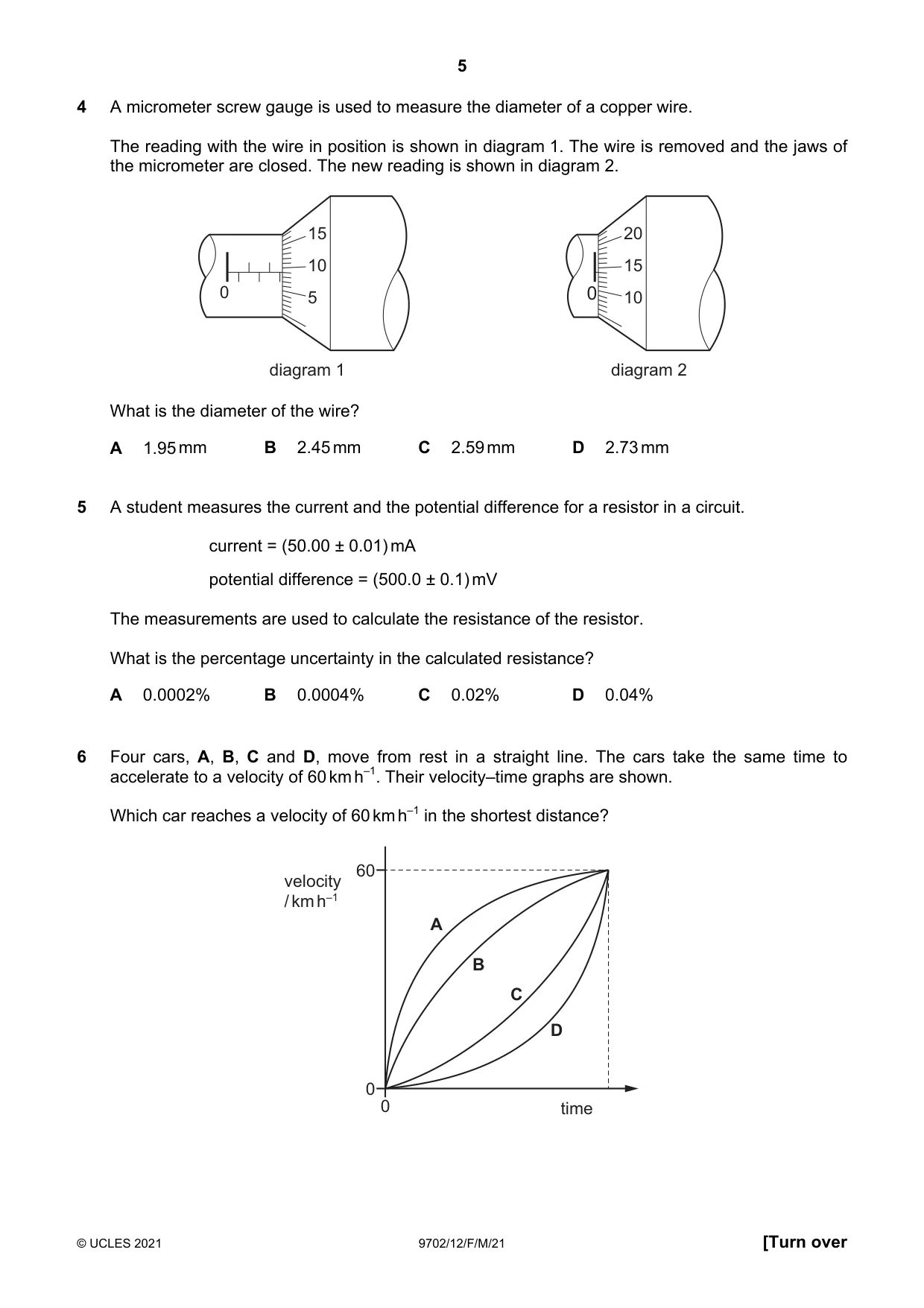
Q4 · A micrometer screw gauge is used to measure the diameter of a copper wire
4 A micrometer screw gauge is used to measure the diameter of a copper wire. The reading with the wire in position is shown in diagram 1. The wire is removed and the jaws of the micrometer are closed. The new reading is shown in diagram 2. 15 20 10 15 0 5 0 10 diagram 1 diagram 2 What is the diameter of the wire? A 1.95 mm B 2.45 mm C 2.59 mm D 2.73 mm
Mark scheme: B
Q5 · A student measures the current and the potential difference for a resistor in a circuit
5 A student measures the current and the potential difference for a resistor in a circuit. current = (50.00 ± 0.01) mA potential difference = (500.0 ± 0.1) mV The measurements are used to calculate the resistance of the resistor. What is the percentage uncertainty in the calculated resistance? A 0.0002% B 0.0004% C 0.02% D 0.04%
Mark scheme: D
Q6 · Four cars, A, B, C and D, move from rest in a straight line
6 Four cars, A, B, C and D, move from rest in a straight line. The cars take the same time to accelerate to a velocity of 60 km h–1. Their velocity–time graphs are shown. Which car reaches a velocity of 60 km h–1 in the shortest distance? 60 velocity / km h–1 A B C D 0 0 time
Mark scheme: D
Q7 · Acannon fires a cannonball with an initial speed v at an angle ato the horizontal
7 Acannon fires a cannonball with an initial speed v at an angle ato the horizontal. Which equation is correct for the maximum height H reached? A H=Sina B H=gsine c H=lWsine? p y= 9’sina 2g 2v 29 2v
Mark scheme: C
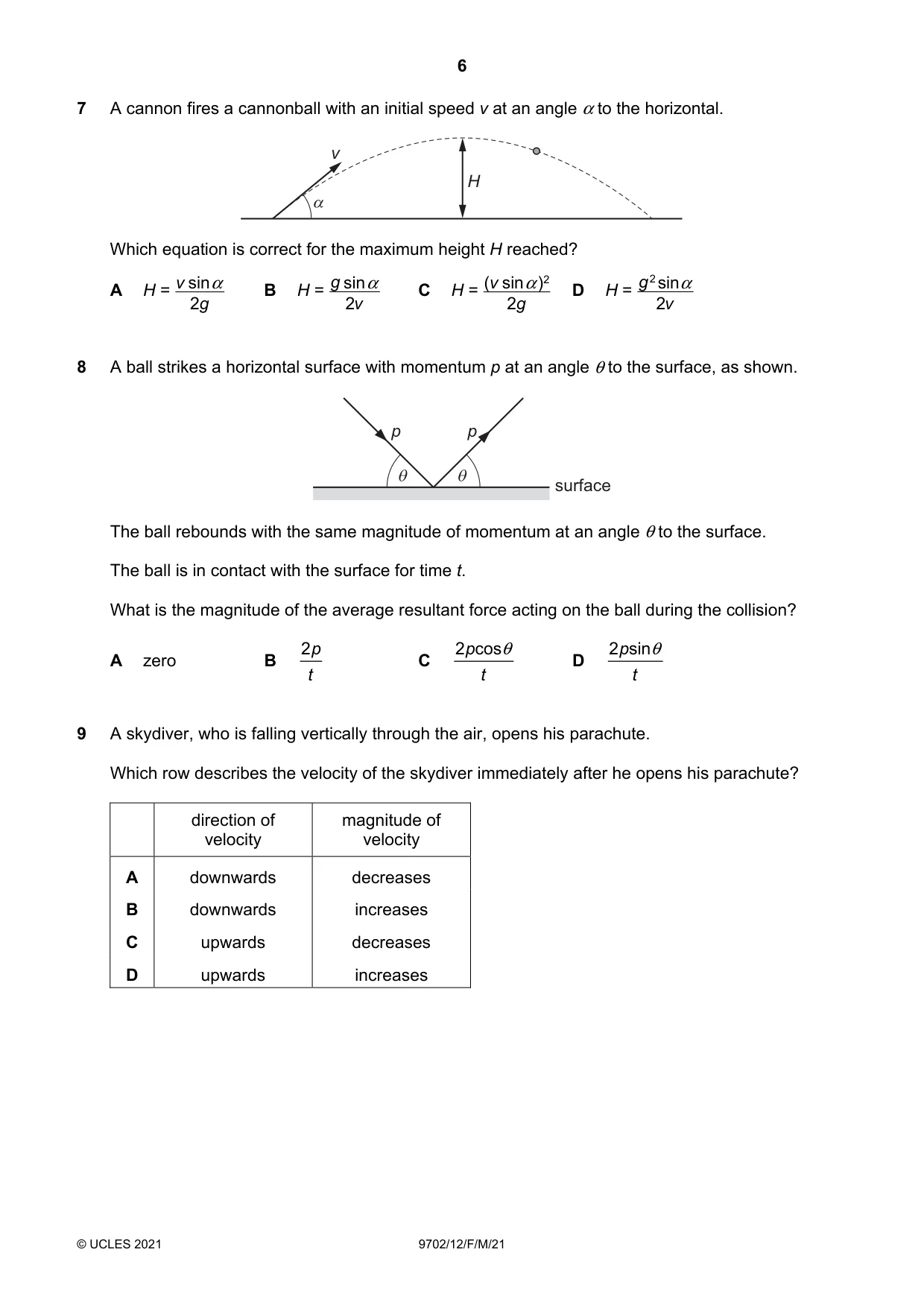
Q8 · A ball strikes a horizontal surface with momentum p at an angle @to the surface, as shown
8 A ball strikes a horizontal surface with momentum p at an angle @to the surface, as shown. p p (o\ fo surface The ball rebounds with the same magnitude of momentum at an angle @to the surface. The ball is in contact with the surface for time ¢. What is the magnitude of the average resultant force acting on the ball during the collision? 2 2psi A zero B 2p Cc 2pcosé D 2psing t t t
Mark scheme: D
Q9 · A skydiver, who is falling vertically through the air, opens his parachute
9 A skydiver, who is falling vertically through the air, opens his parachute. Which row describes the velocity of the skydiver immediately after he opens his parachute? direction of magnitude of velocity velocity A downwards decreases B downwards increases C upwards decreases D upwards increases
Mark scheme: A
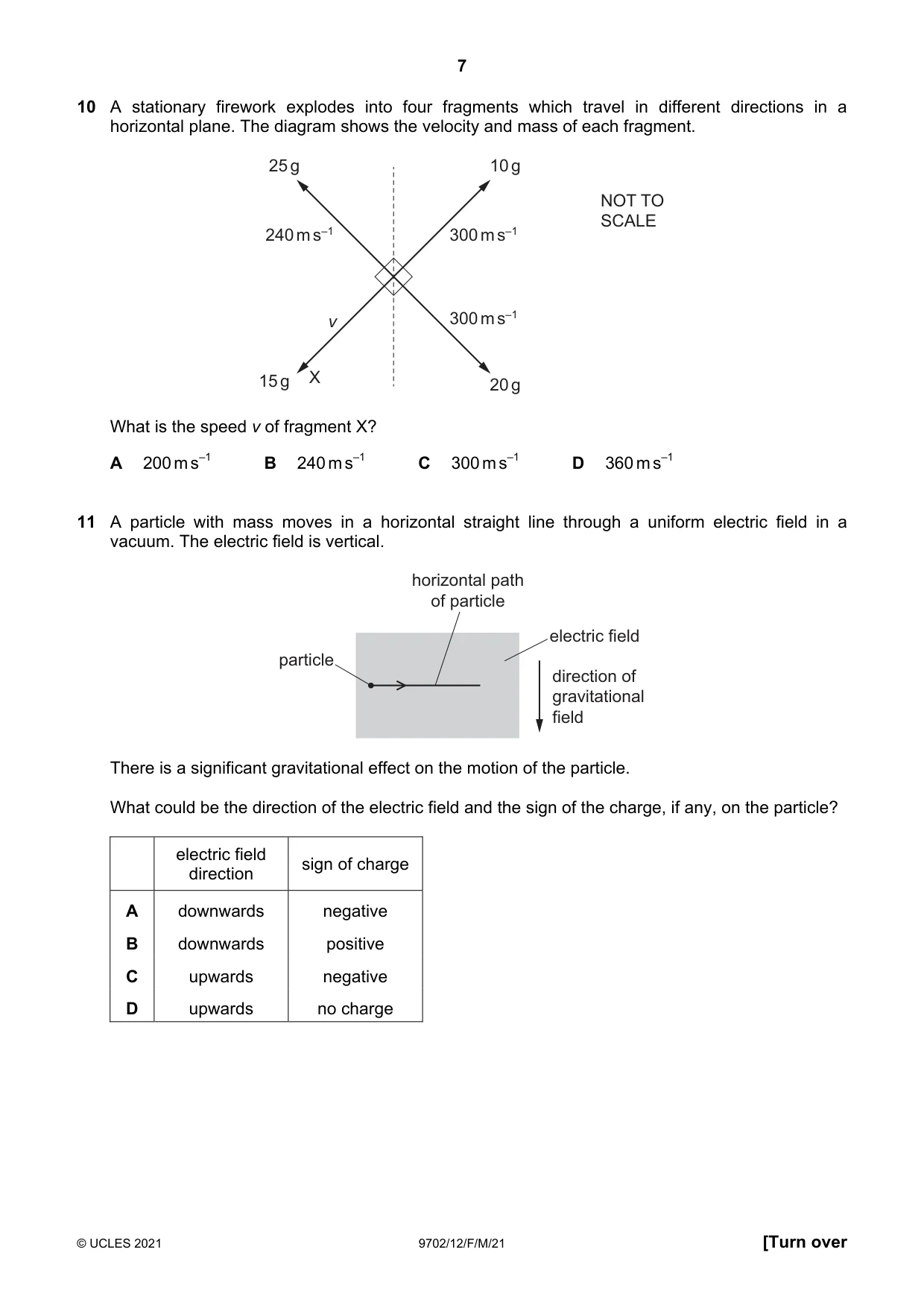
Q10 · A stationary firework explodes into four fragments which travel in different directions…
10 A stationary firework explodes into four fragments which travel in different directions in a horizontal plane. The diagram shows the velocity and mass of each fragment. 25 g 10 g NOT TO SCALE 240 m s–1 300 m s–1 v 300 m s–1 15 g X 20 g What is the speed v of fragment X? A 200 m s–1 B 240 m s–1 C 300 m s–1 D 360 m s–1
Mark scheme: A
Q11 · A particle with mass moves in a horizontal straight line through a uniform electric field…
11 A particle with mass moves in a horizontal straight line through a uniform electric field in a vacuum. The electric field is vertical. horizontal path of particle electric field particle direction of gravitational field There is a significant gravitational effect on the motion of the particle. What could be the direction of the electric field and the sign of the charge, if any, on the particle? electric field sign of charge direction A downwards negative B downwards positive C upwards negative D upwards no charge
Mark scheme: A
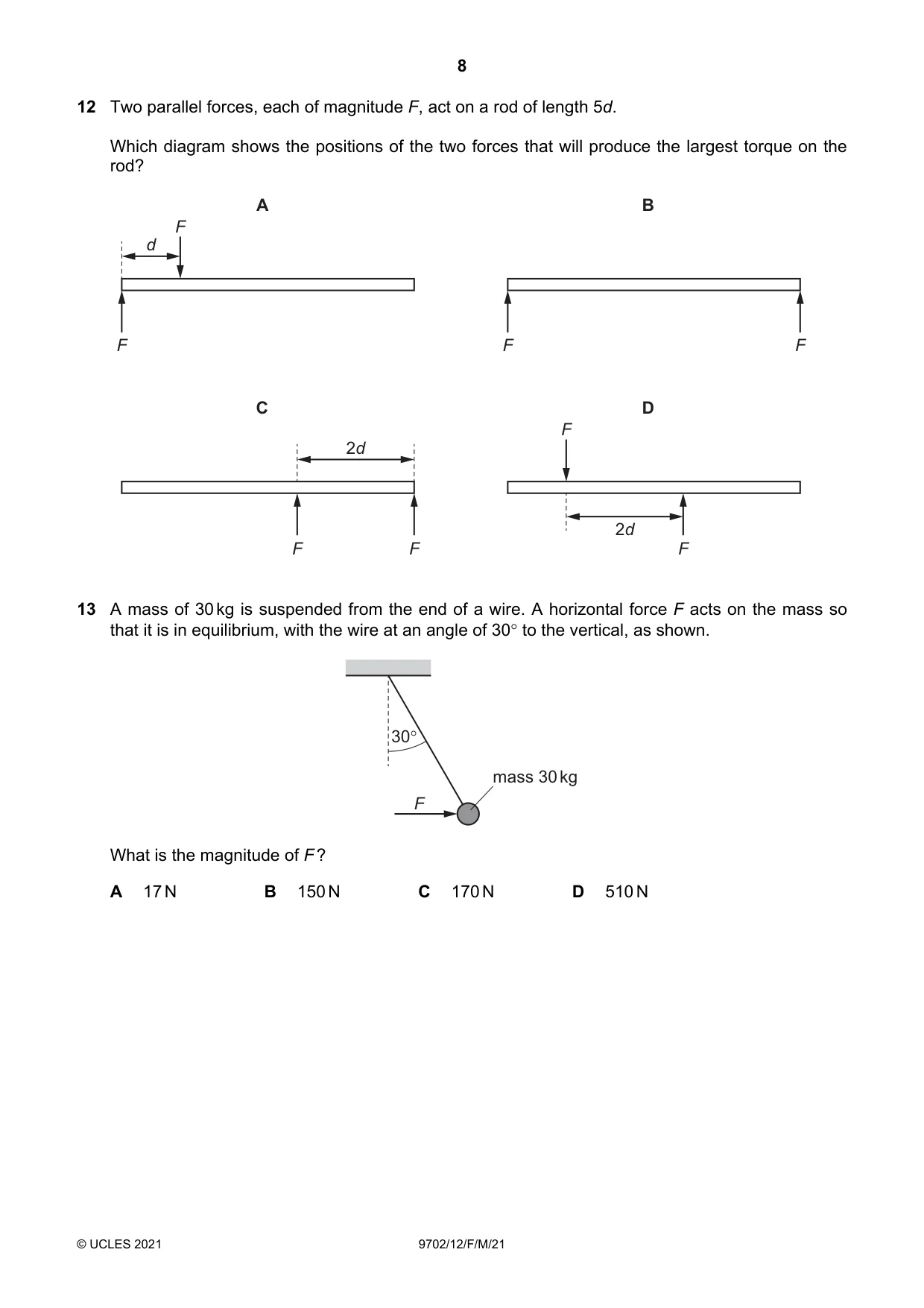
Q12 · Two parallel forces, each of magnitude F, act on a rod of length 5d
12 Two parallel forces, each of magnitude F, act on a rod of length 5d. Which diagram shows the positions of the two forces that will produce the largest torque on the rod? A B F d F F F C D F 2d 2d F F F
Mark scheme: D
Q13 · A mass of 30 kg is suspended from the end of a wire
13 A mass of 30 kg is suspended from the end of a wire. A horizontal force F acts on the mass so that it is in equilibrium, with the wire at an angle of 30° to the vertical, as shown. 30° mass 30 kg F What is the magnitude of F ? A 17 N B 150 N C 170 N D 510 N
Mark scheme: C
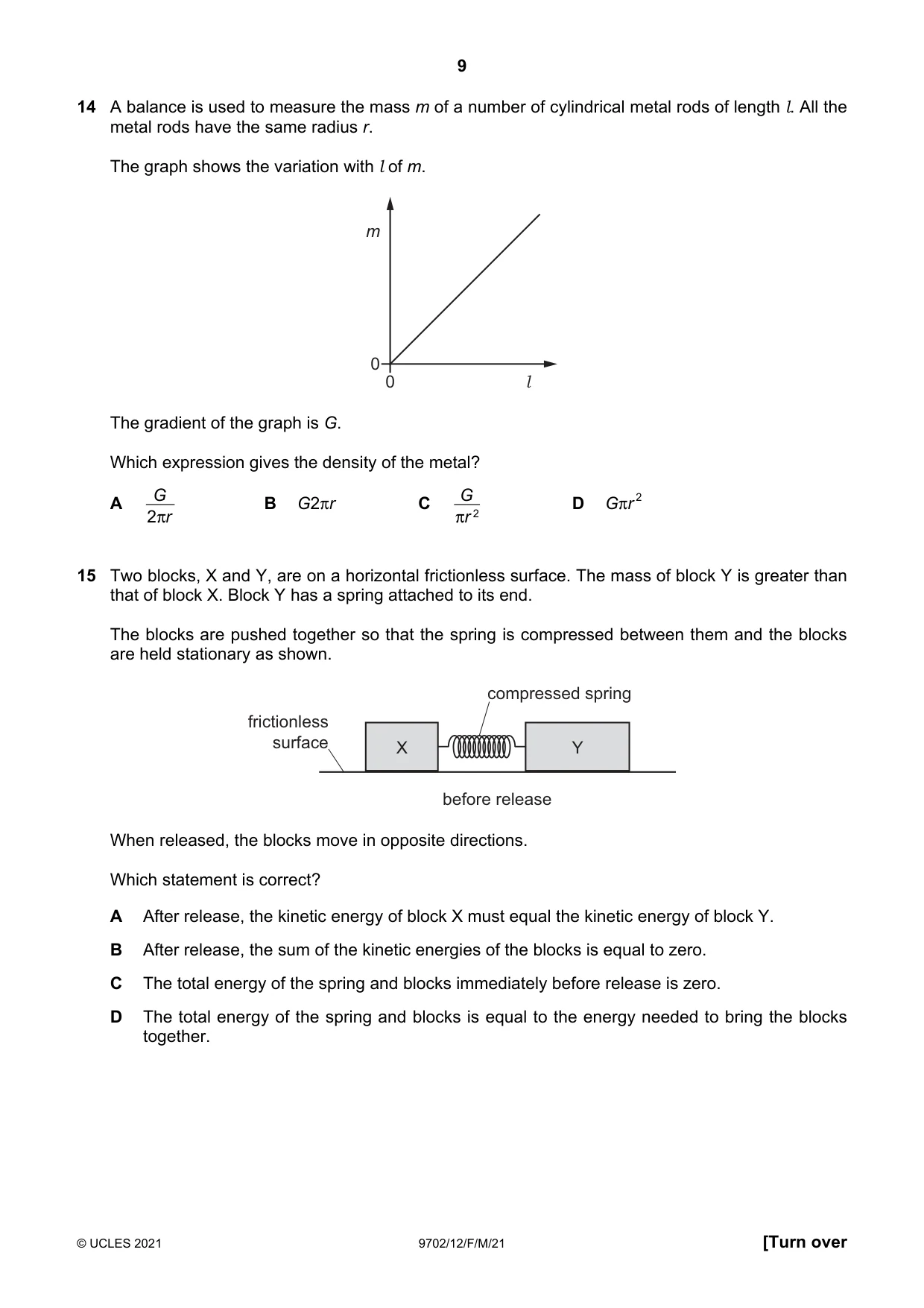
Q14 · A balance is used to measure the mass m of a number of cylindrical metal rods of length l
14 A balance is used to measure the mass m of a number of cylindrical metal rods of length l. All the metal rods have the same radius r. The graph shows the variation with l of m. m 0 0 l The gradient of the graph is G. Which expression gives the density of the metal? G G Gπr 2 A π B G2πr C D 2 r π r 2
Mark scheme: C
Q15 · Two blocks, X and Y, are on a horizontal frictionless surface
15 Two blocks, X and Y, are on a horizontal frictionless surface. The mass of block Y is greater than that of block X. Block Y has a spring attached to its end. The blocks are pushed together so that the spring is compressed between them and the blocks are held stationary as shown. compressed spring frictionless surface X Y before release When released, the blocks move in opposite directions. Which statement is correct? A After release, the kinetic energy of block X must equal the kinetic energy of block Y. B After release, the sum of the kinetic energies of the blocks is equal to zero. C The total energy of the spring and blocks immediately before release is zero. D The total energy of the spring and blocks is equal to the energy needed to bring the blocks together.
Mark scheme: D
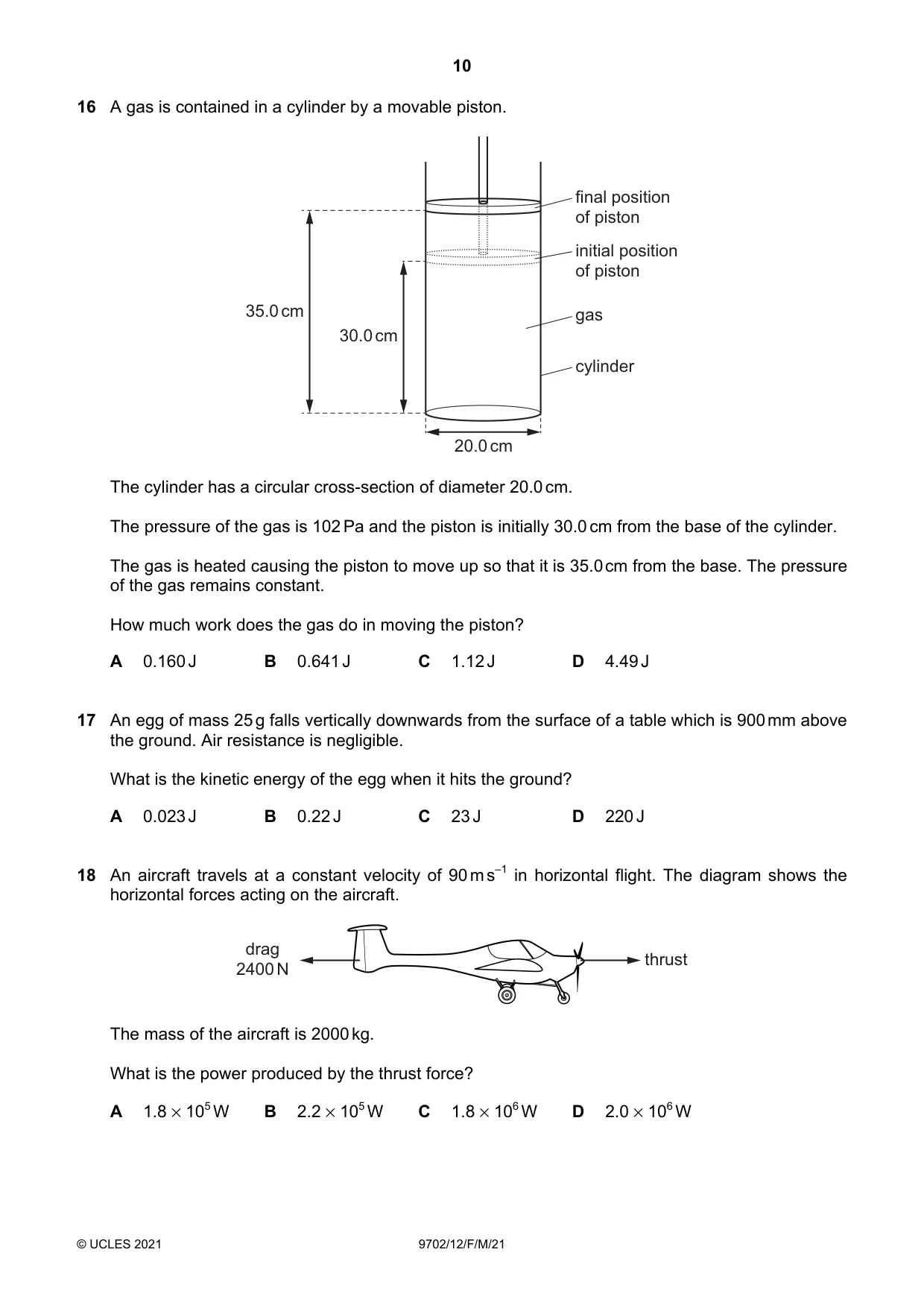
Q16 · A gas is contained in a cylinder by a movable piston
16 A gas is contained in a cylinder by a movable piston. final position of piston initial position of piston 35.0 cm gas 30.0 cm cylinder 20.0 cm The cylinder has a circular cross-section of diameter 20.0 cm. The pressure of the gas is 102 Pa and the piston is initially 30.0 cm from the base of the cylinder. The gas is heated causing the piston to move up so that it is 35.0 cm from the base. The pressure of the gas remains constant. How much work does the gas do in moving the piston? A 0.160 J B 0.641 J C 1.12 J D 4.49 J
Mark scheme: A
Q17 · An egg of mass 25 g falls vertically downwards from the surface of a table which is 900…
17 An egg of mass 25 g falls vertically downwards from the surface of a table which is 900 mm above the ground. Air resistance is negligible. What is the kinetic energy of the egg when it hits the ground? A 0.023 J B 0.22 J C 23 J D 220 J
Mark scheme: B
More questions on Gravitational potential energy and kinetic energy
Q18 · An aircraft travels at a constant velocity of 90 m s–1 in horizontal flight
18 An aircraft travels at a constant velocity of 90 m s–1 in horizontal flight. The diagram shows the horizontal forces acting on the aircraft. drag thrust 2400 N The mass of the aircraft is 2000 kg. What is the power produced by the thrust force? A 1.8 × 10⁵ W B 2.2 × 10⁵ W C 1.8 × 10⁶ W D 2.0 × 10⁶ W
Mark scheme: B
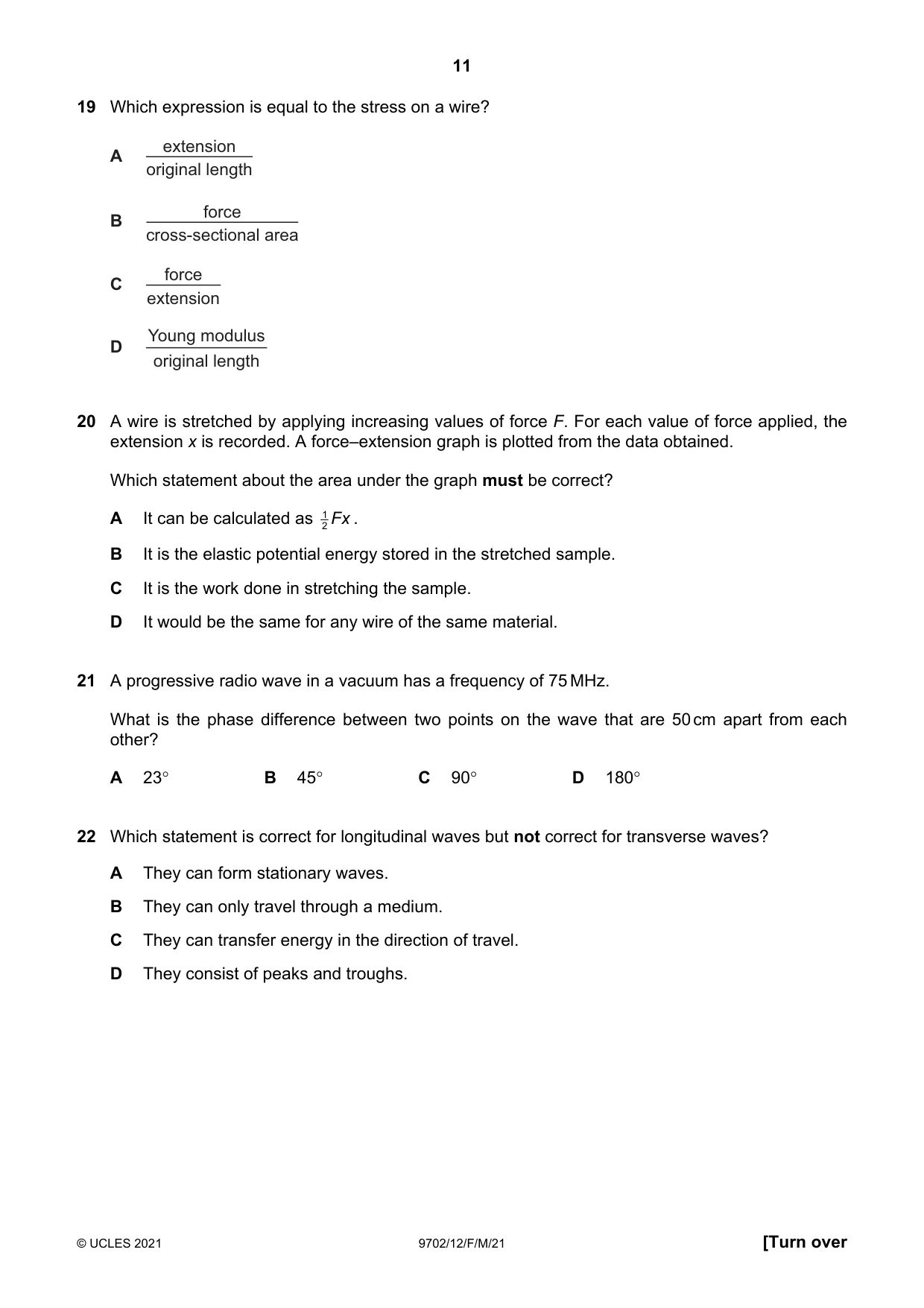
Q19 · Which expression is equal to the stress on a wire?
19 Which expression is equal to the stress on a wire? extension A original length force B cross-sectional area force C extension Young modulus D original length
Mark scheme: B
Q20 · A wire is stretched by applying increasing values of force F
20 A wire is stretched by applying increasing values of force F. For each value of force applied, the extension x is recorded. A force–extension graph is plotted from the data obtained. Which statement about the area under the graph must be correct? A It can be calculated as 1 2 Fx . B It is the elastic potential energy stored in the stretched sample. C It is the work done in stretching the sample. D It would be the same for any wire of the same material.
Mark scheme: C
Q21 · A progressive radio wave in a vacuum has a frequency of 75 MHz
21 A progressive radio wave in a vacuum has a frequency of 75 MHz. What is the phase difference between two points on the wave that are 50 cm apart from each other? A 23° B 45° C 90° D 180°
Mark scheme: B
Q22 · Which statement is correct for longitudinal waves but not correct for transverse waves?
22 Which statement is correct for longitudinal waves but not correct for transverse waves? A They can form stationary waves. B They can only travel through a medium. C They can transfer energy in the direction of travel. D They consist of peaks and troughs.
Mark scheme: B
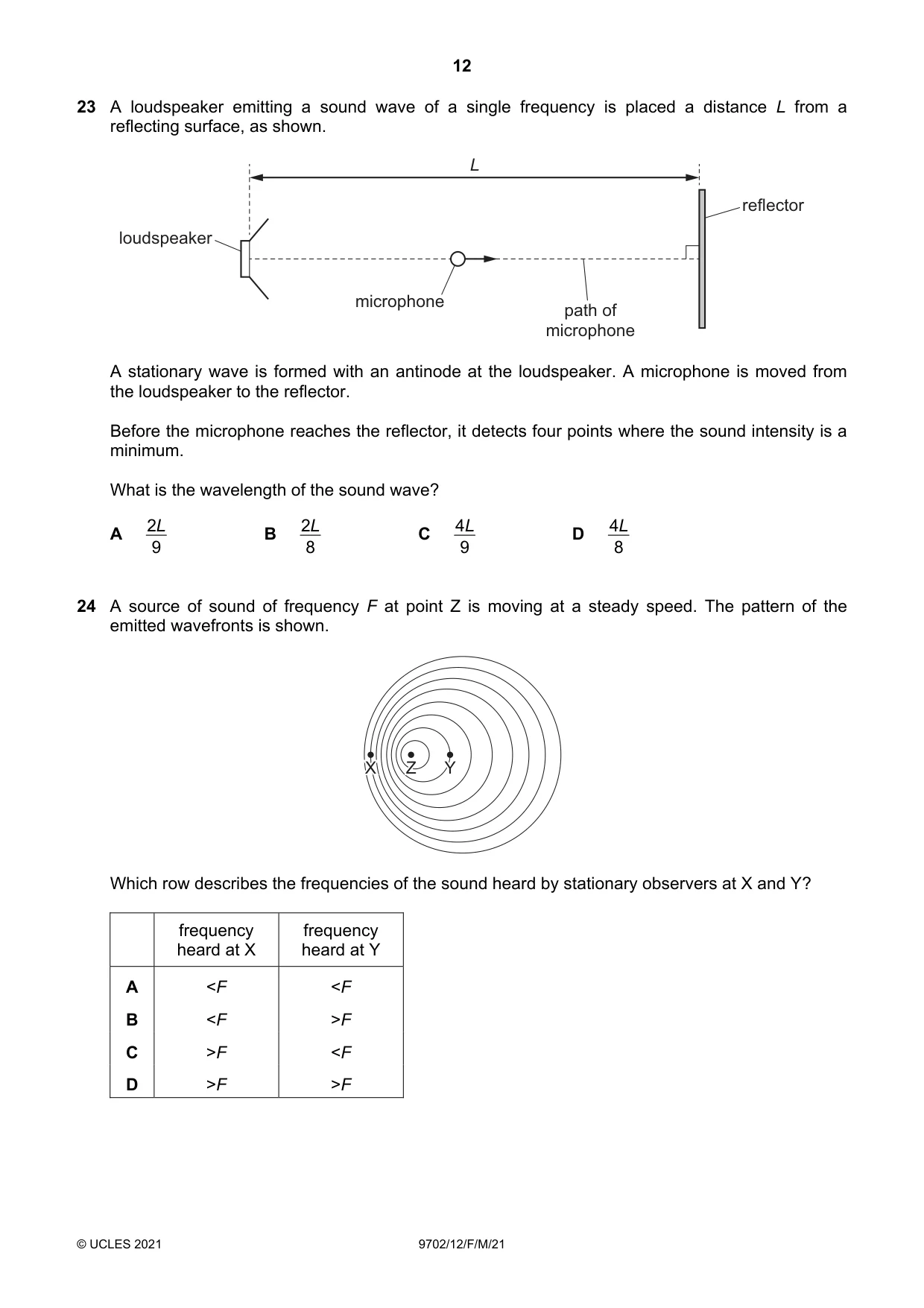
Q23 · A loudspeaker emitting a sound wave of a single frequency is placed a distance L from a…
23 A loudspeaker emitting a sound wave of a single frequency is placed a distance L from a reflecting surface, as shown. L reflector loudspeaker microphone path of microphone A stationary wave is formed with an antinode at the loudspeaker. A microphone is moved from the loudspeaker to the reflector. Before the microphone reaches the reflector, it detects four points where the sound intensity is a minimum. What is the wavelength of the sound wave? 2 L 2 L 4 L 4 L A B C D 9 8 9 8
Mark scheme: C
Q24 · A source of sound of frequency F at point Z is moving at a steady speed
24 A source of sound of frequency F at point Z is moving at a steady speed. The pattern of the emitted wavefronts is shown. X X Z Z Y Y Which row describes the frequencies of the sound heard by stationary observers at X and Y? frequency frequency heard at X heard at Y A <F <F B <F >F C >F <F D >F >F
Mark scheme: C
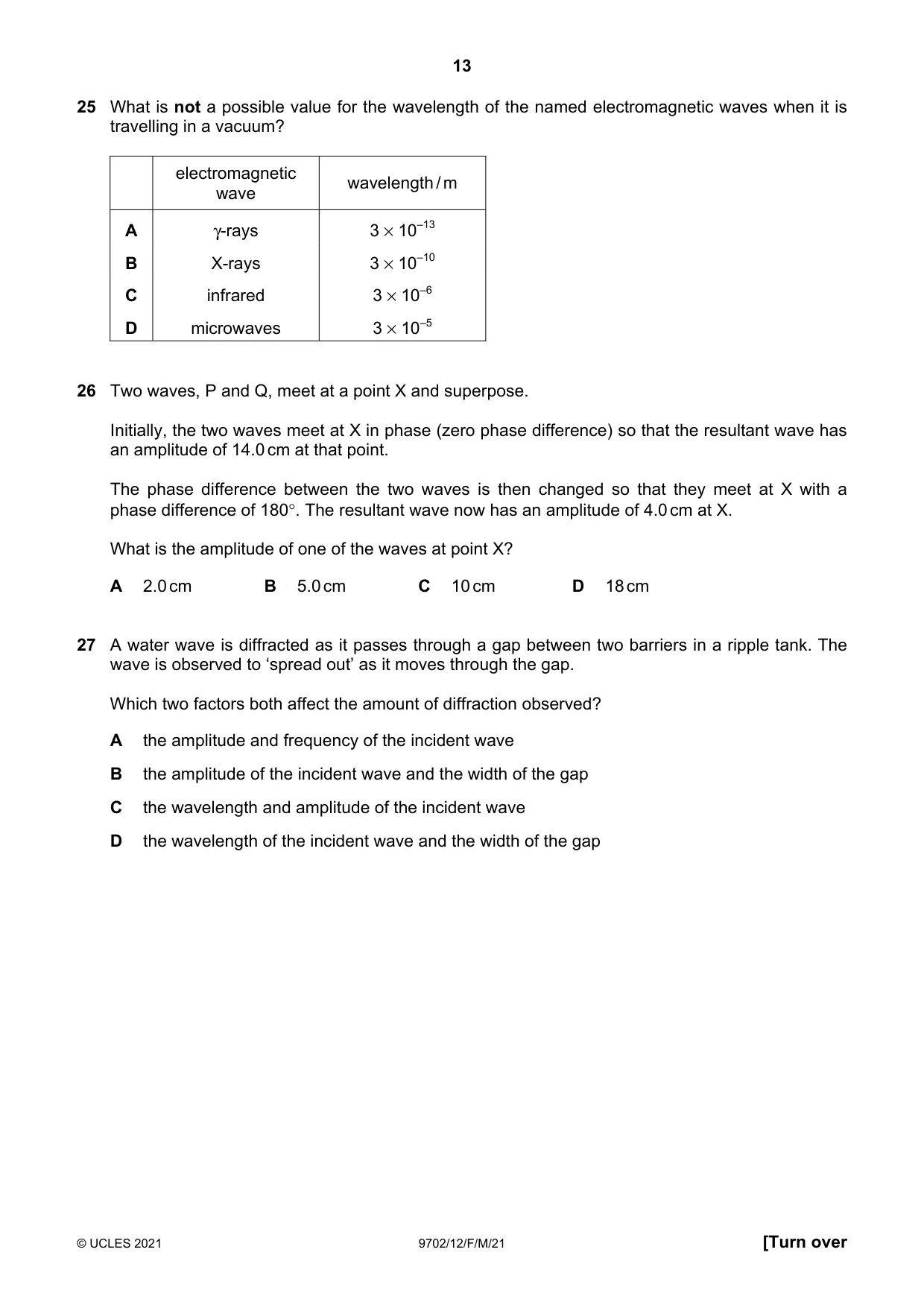
Q25 · What is not a possible value for the wavelength of the named electromagnetic waves when…
25 What is not a possible value for the wavelength of the named electromagnetic waves when it is travelling in a vacuum? electromagnetic wavelength / m wave A γ-rays 3 × 10–13 B X-rays 3 × 10⁻¹⁰ C infrared 3 × 10⁻⁶ D microwaves 3 × 10⁻⁵
Mark scheme: D
Q26 · Two waves, P and Q, meet at a point X and superpose
26 Two waves, P and Q, meet at a point X and superpose. Initially, the two waves meet at X in phase (zero phase difference) so that the resultant wave has an amplitude of 14.0 cm at that point. The phase difference between the two waves is then changed so that they meet at X with a phase difference of 180°. The resultant wave now has an amplitude of 4.0 cm at X. What is the amplitude of one of the waves at point X? A 2.0 cm B 5.0 cm C 10 cm D 18 cm
Mark scheme: B
Q27 · A water wave is diffracted as it passes through a gap between two barriers in a ripple…
27 A water wave is diffracted as it passes through a gap between two barriers in a ripple tank. The wave is observed to ‘spread out’ as it moves through the gap. Which two factors both affect the amount of diffraction observed? A the amplitude and frequency of the incident wave B the amplitude of the incident wave and the width of the gap C the wavelength and amplitude of the incident wave D the wavelength of the incident wave and the width of the gap
Mark scheme: D
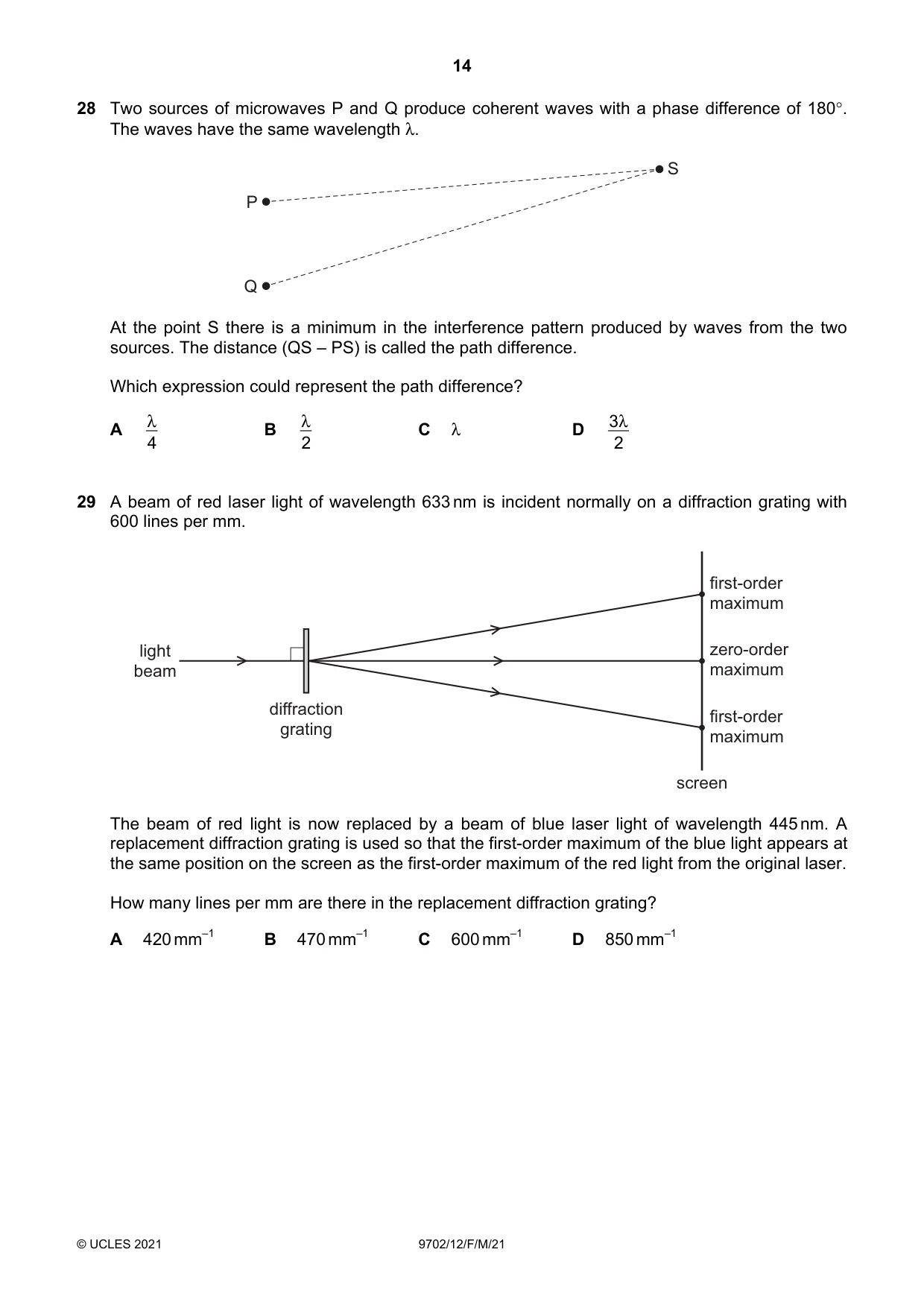
Q28 · Two sources of microwaves P and Q produce coherent waves with a phase difference of 180°
28 Two sources of microwaves P and Q produce coherent waves with a phase difference of 180°. The waves have the same wavelength λ. S P Q At the point S there is a minimum in the interference pattern produced by waves from the two sources. The distance (QS – PS) is called the path difference. Which expression could represent the path difference? λ λ 3 λ A 4 B 2 C λ D 2
Mark scheme: C
Q29 · A beam of red laser light of wavelength 633 nm is incident normally on a diffraction…
29 A beam of red laser light of wavelength 633 nm is incident normally on a diffraction grating with 600 lines per mm. first-order maximum light zero-order beam maximum diffraction first-order grating maximum screen The beam of red light is now replaced by a beam of blue laser light of wavelength 445 nm. A replacement diffraction grating is used so that the first-order maximum of the blue light appears at the same position on the screen as the first-order maximum of the red light from the original laser. How many lines per mm are there in the replacement diffraction grating? A 420 mm–1 B 470 mm–1 C 600 mm–1 D 850 mm–1
Mark scheme: D
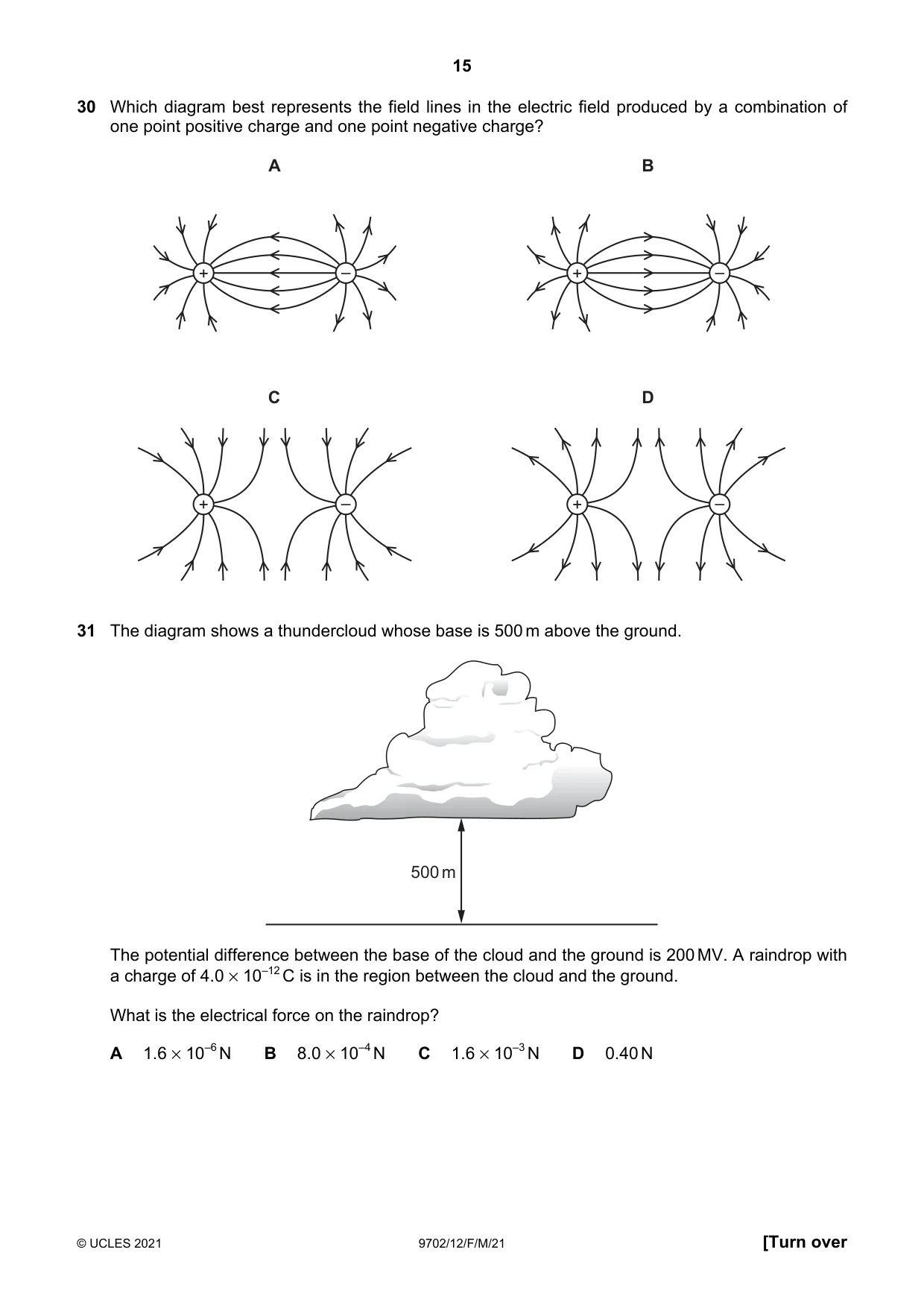
Q30 · Which diagram best represents the field lines in the electric field produced by a…
30 Which diagram best represents the field lines in the electric field produced by a combination of one point positive charge and one point negative charge? A B + – + – C D + – + –
Mark scheme: B
Q31 · The diagram shows a thundercloud whose base is 500 m above the ground
31 The diagram shows a thundercloud whose base is 500 m above the ground. 500 m The potential difference between the base of the cloud and the ground is 200 MV. A raindrop with a charge of 4.0 × 10⁻¹² C is in the region between the cloud and the ground. What is the electrical force on the raindrop? A 1.6 × 10⁻⁶ N B 8.0 × 10⁻⁴ N C 1.6 × 10⁻³ N D 0.40 N
Mark scheme: A
Q32 · The current I in a metal wire is given by the equation I = Anvq
32 The current I in a metal wire is given by the equation I = Anvq. What does the symbol n represent? A the number of charge carriers in the wire B the number of charge carriers per unit cross-sectional area of the wire C the number of charge carriers per unit length of the wire D the number of charge carriers per unit volume of the wire
Mark scheme: D
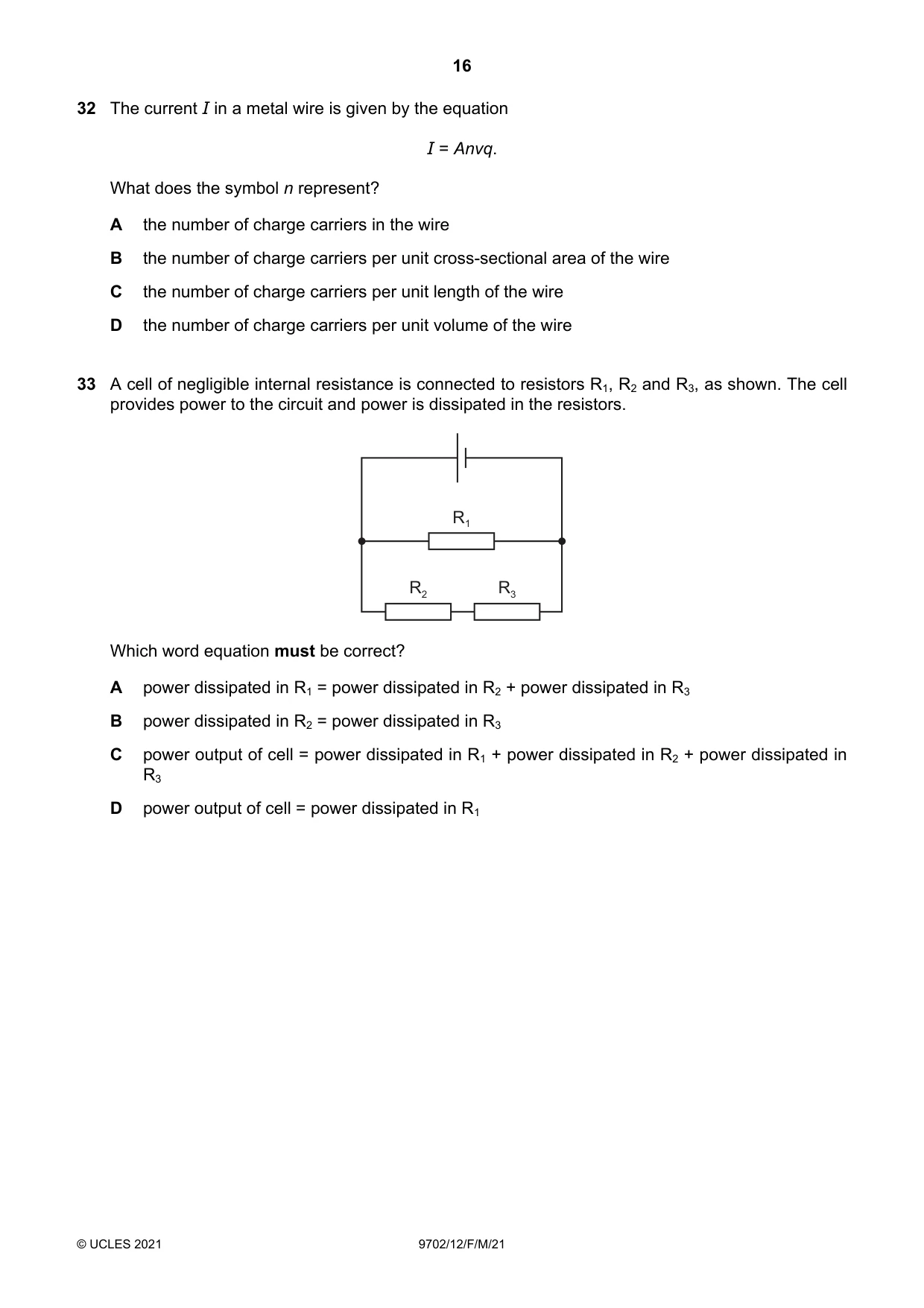
Q33 · A cell of negligible internal resistance is connected to resistors R1, R2 and R3, as shown
33 A cell of negligible internal resistance is connected to resistors R1, R2 and R3, as shown. The cell provides power to the circuit and power is dissipated in the resistors. R1 R2 R3 Which word equation must be correct? A power dissipated in R1 = power dissipated in R2 + power dissipated in R3 B power dissipated in R2 = power dissipated in R3 C power output of cell = power dissipated in R1 + power dissipated in R2 + power dissipated in R3 D power output of cell = power dissipated in R1
Mark scheme: C
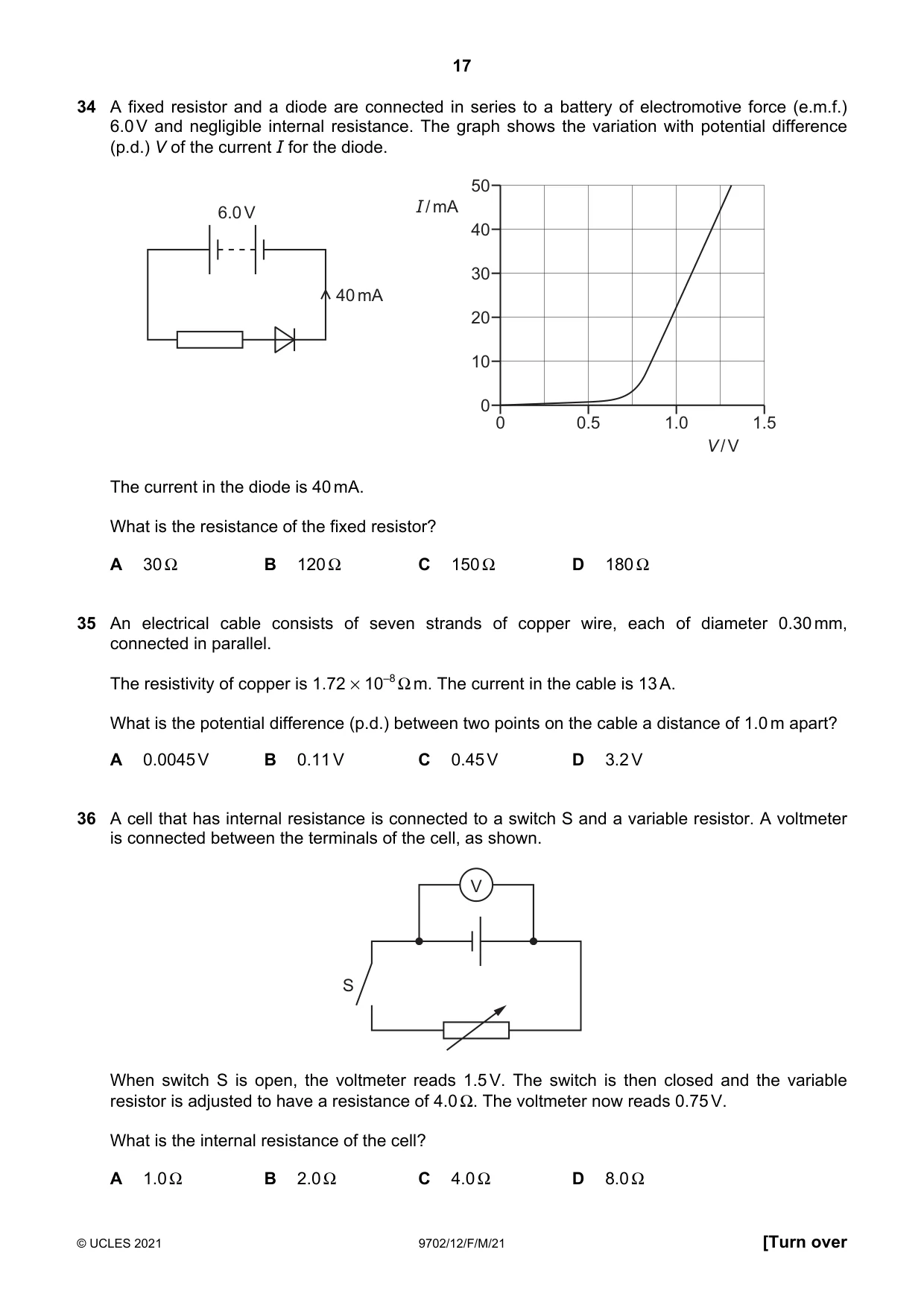
Q34 · A fixed resistor and a diode are connected in series to a battery of electromotive force…
34 A fixed resistor and a diode are connected in series to a battery of electromotive force (e.m.f.) 6.0 V and negligible internal resistance. The graph shows the variation with potential difference (p.d.) V of the current I for the diode. 50 6.0 V I / mA 40 30 40 mA 20 10 0 0 0.5 1.0 1.5 V / V The current in the diode is 40 mA. What is the resistance of the fixed resistor? A 30 Ω B 120 Ω C 150 Ω D 180 Ω
Mark scheme: B
Q35 · An electrical cable consists of seven strands of copper wire, each of diameter 0.30 mm…
35 An electrical cable consists of seven strands of copper wire, each of diameter 0.30 mm, connected in parallel. The resistivity of copper is 1.72 × 10⁻⁸ Ω m. The current in the cable is 13 A. What is the potential difference (p.d.) between two points on the cable a distance of 1.0 m apart? A 0.0045 V B 0.11 V C 0.45 V D 3.2 V
Mark scheme: C
Q36 · A cell that has internal resistance is connected to a switch S and a variable resistor
36 A cell that has internal resistance is connected to a switch S and a variable resistor. A voltmeter is connected between the terminals of the cell, as shown. V S When switch S is open, the voltmeter reads 1.5 V. The switch is then closed and the variable resistor is adjusted to have a resistance of 4.0 Ω. The voltmeter now reads 0.75 V. What is the internal resistance of the cell? A 1.0 Ω B 2.0 Ω C 4.0 Ω D 8.0 Ω
Mark scheme: C
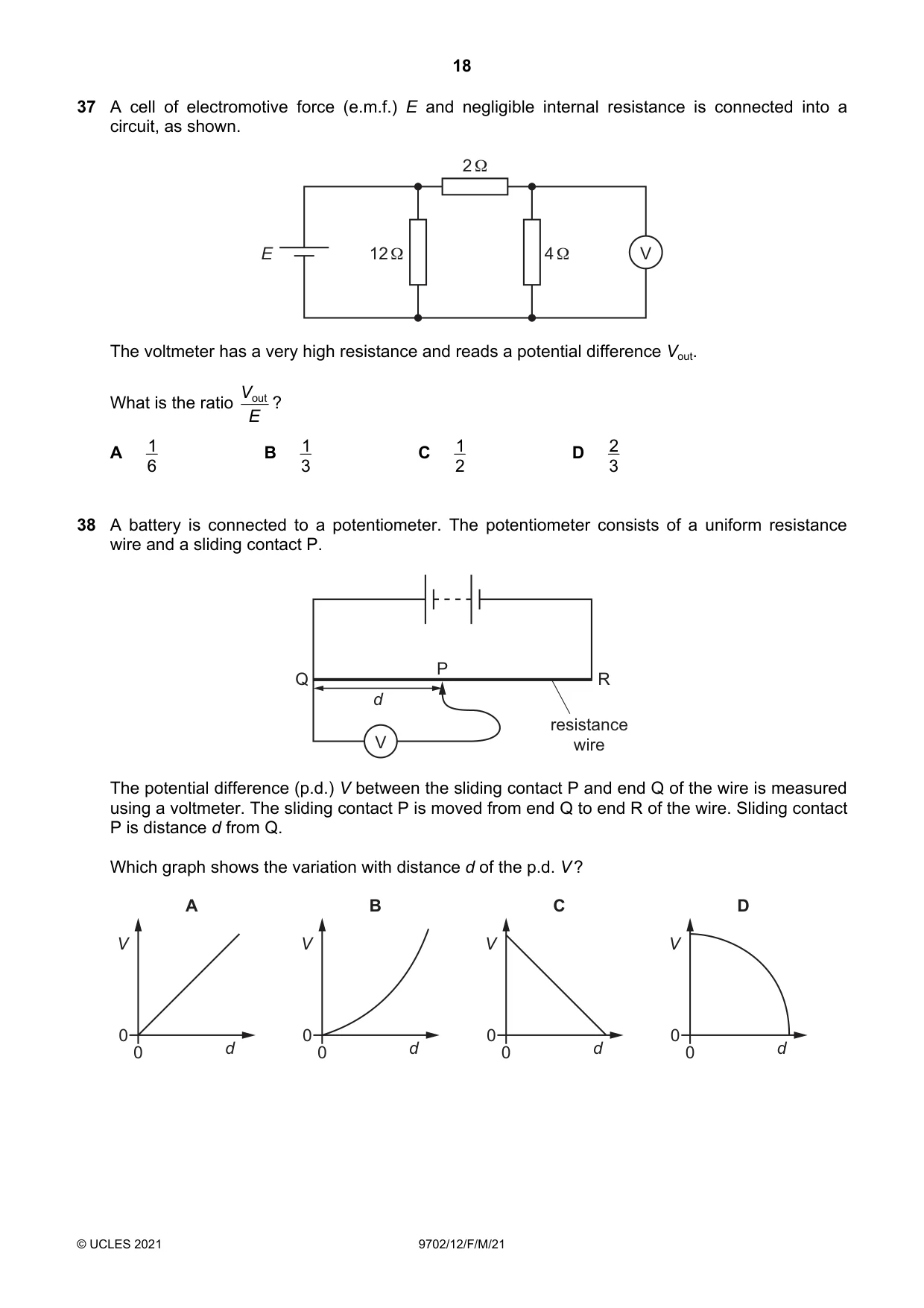
Q37 · A cell of electromotive force (e.m.f.) E and negligible internal resistance is connected…
37 A cell of electromotive force (e.m.f.) E and negligible internal resistance is connected into a circuit, as shown. 2 Ω E 12 Ω 4 Ω V The voltmeter has a very high resistance and reads a potential difference Vout. Vout ? What is the ratio E A 1 B 1 C 1 D 2 6 3 2 3
Mark scheme: D
Q38 · A battery is connected to a potentiometer
38 A battery is connected to a potentiometer. The potentiometer consists of a uniform resistance wire and a sliding contact P. P Q R d resistance V wire The potential difference (p.d.) V between the sliding contact P and end Q of the wire is measured using a voltmeter. The sliding contact P is moved from end Q to end R of the wire. Sliding contact P is distance d from Q. Which graph shows the variation with distance d of the p.d. V ? A B C D V V V V 0 0 0 0 d d d d 0 0 0 0
Mark scheme: A
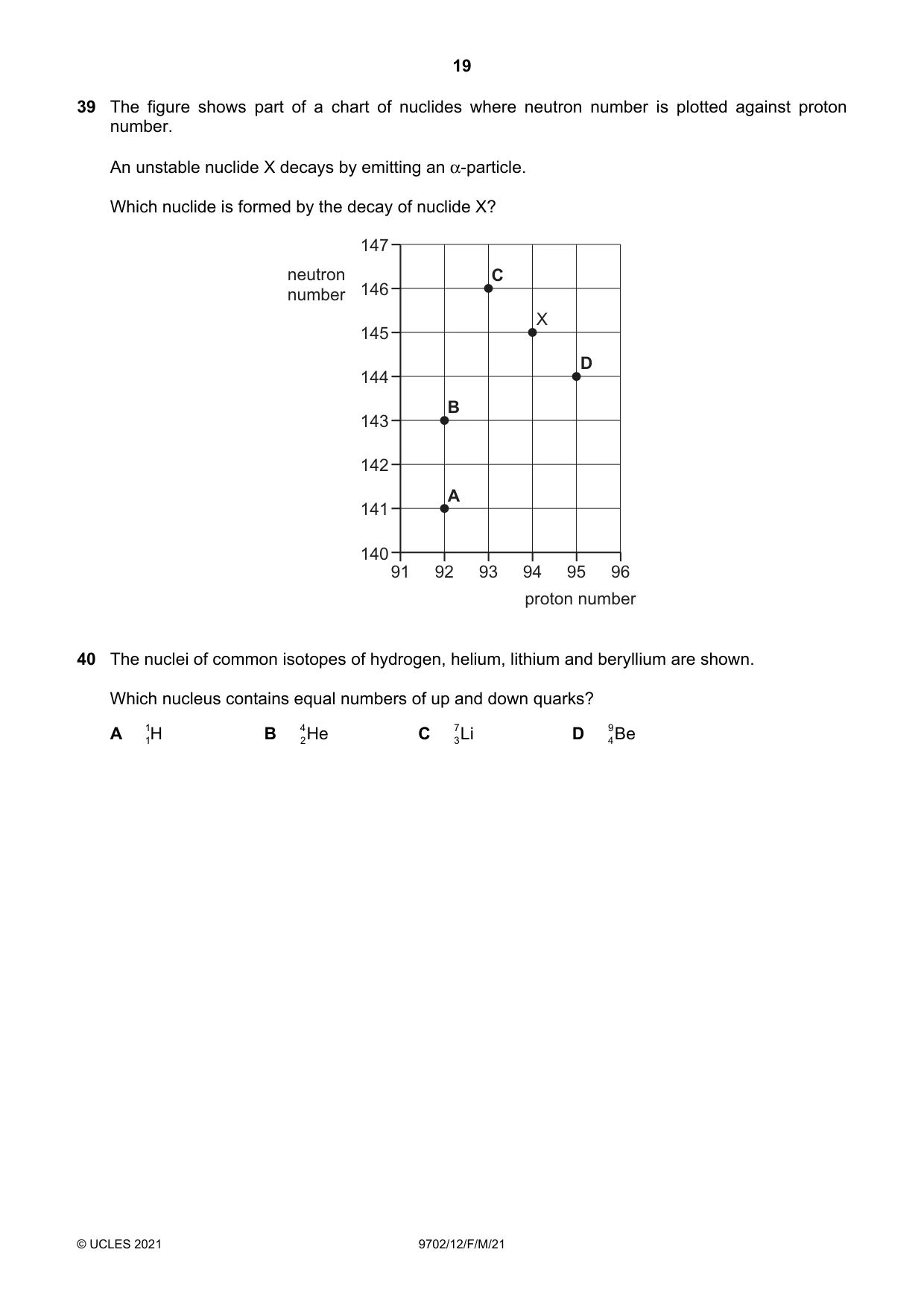
Q39 · The figure shows part of a chart of nuclides where neutron number is plotted against…
39 The figure shows part of a chart of nuclides where neutron number is plotted against proton number. An unstable nuclide X decays by emitting an α-particle. Which nuclide is formed by the decay of nuclide X? 147 neutron C number 146 X 145 D 144 B 143 142 A 141 140 91 92 93 94 95 96 proton number
Mark scheme: B
Q40 · The nuclei of common isotopes of hydrogen, helium, lithium and beryllium are shown
40 The nuclei of common isotopes of hydrogen, helium, lithium and beryllium are shown. Which nucleus contains equal numbers of up and down quarks? A 1 1H B 4 2He C 7 3Li D 9 4Be
Mark scheme: B
What was in this paper
The subtopics covered by these 40 questions, and how many questions each got. Open one in a new tab to see every Cambridge question on it.
3Density and pressure2Equations of motion2Errors and uncertainties2Interference2Linear momentum and its conservation2Potential dividers2Practical circuits2Uniform electric fields2Diffraction1Doppler effect for sound waves1Elastic and plastic behaviour1Electric current1Electric fields and field lines1Electromagnetic spectrum1Equilibrium of forces1Fundamental particles1Gravitational potential energy and kinetic energy1Momentum and Newton’s laws of motion1Potential difference and power1Progressive waves1Radioactive decay1Resistance and resistivity1Scalars and vectors1SI units1Stationary waves1Stress and strain1The diffraction grating1Transverse and longitudinal waves1Turning effects of forces1What you needed in this session
Cambridge’s own grade thresholds for 2021 Feb/March, Paper 1 · Variant 2. A higher threshold means an easier paper — the bar moves with how the cohort did.