Cambridge A Level Physics 9702 — 2015 May/June Paper 1 · Variant 1
9702/11/M/J/15 · 40 questions · 40 marks · ≈45 min
The question paper and its mark scheme, free to read here and free to download. This is Cambridge’s own paper, exactly as it was sat.
Question paper20 pages
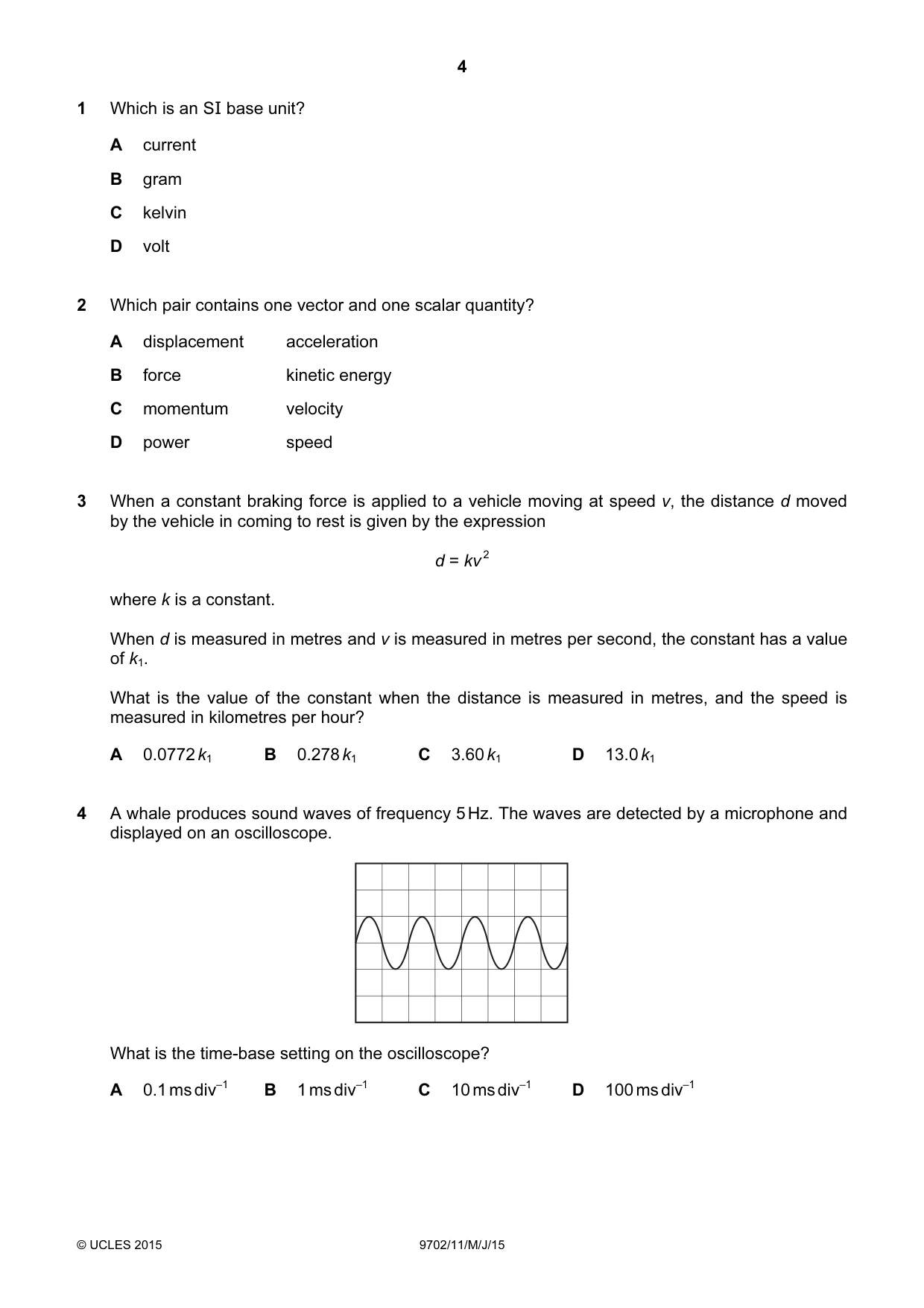
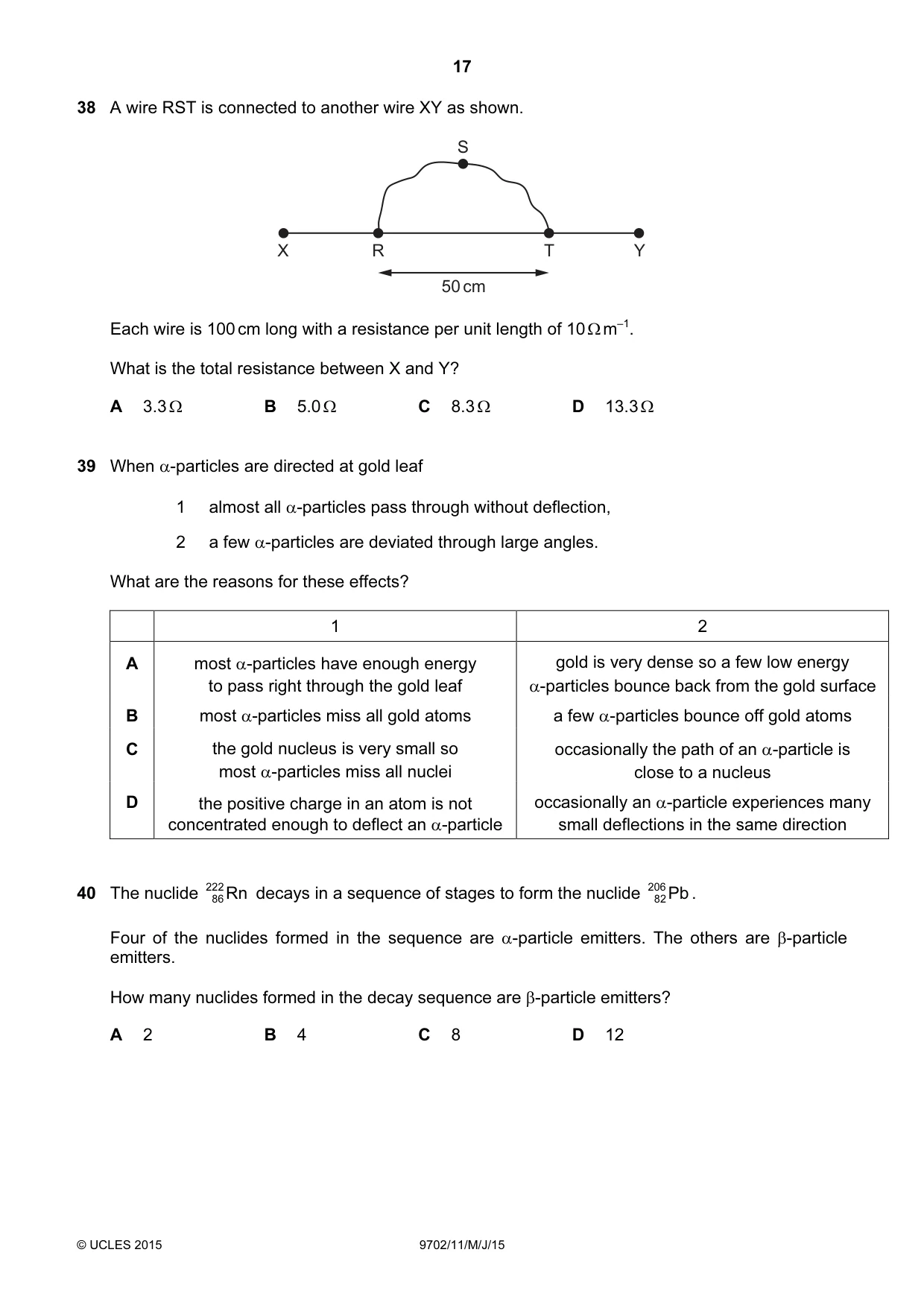


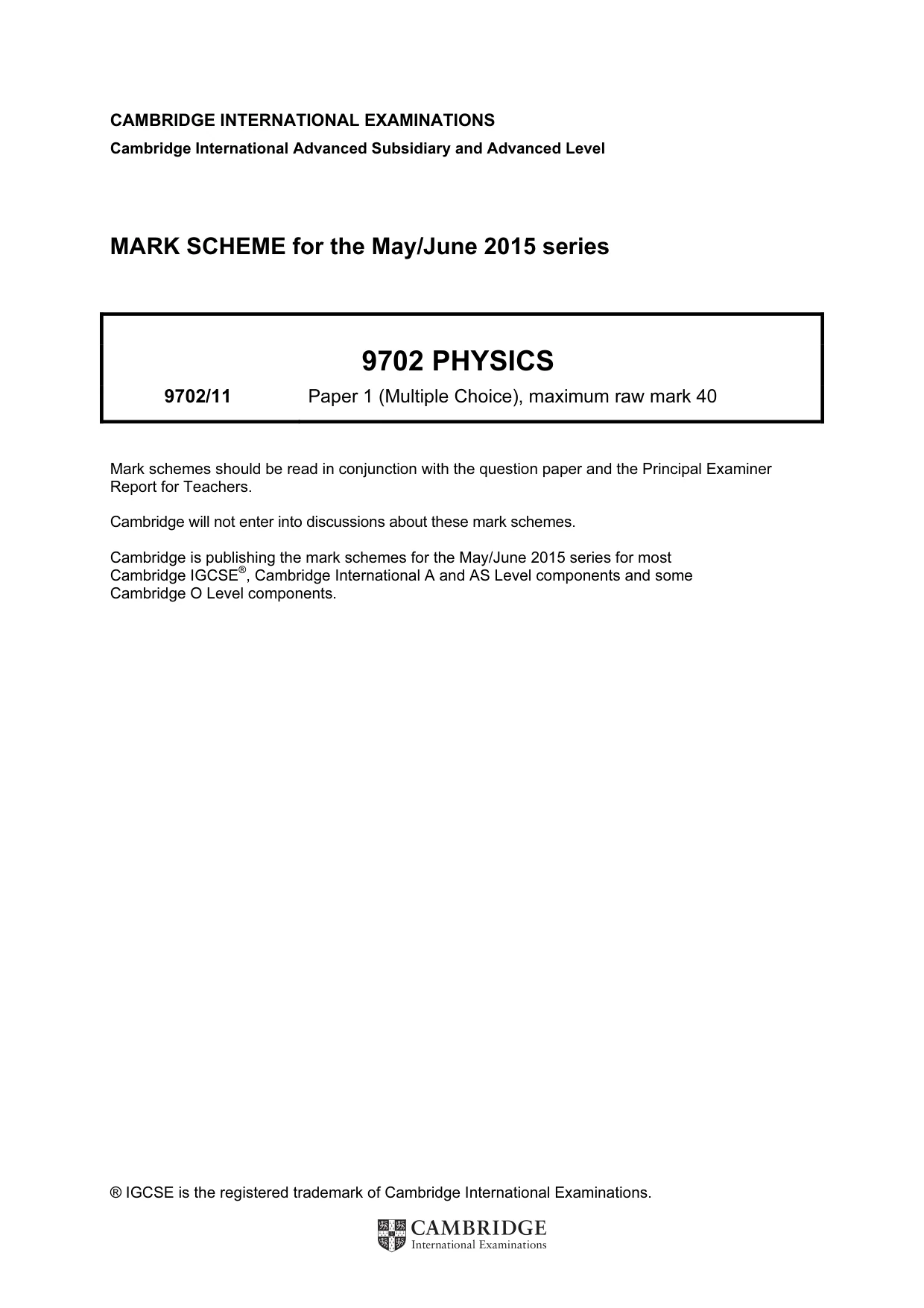
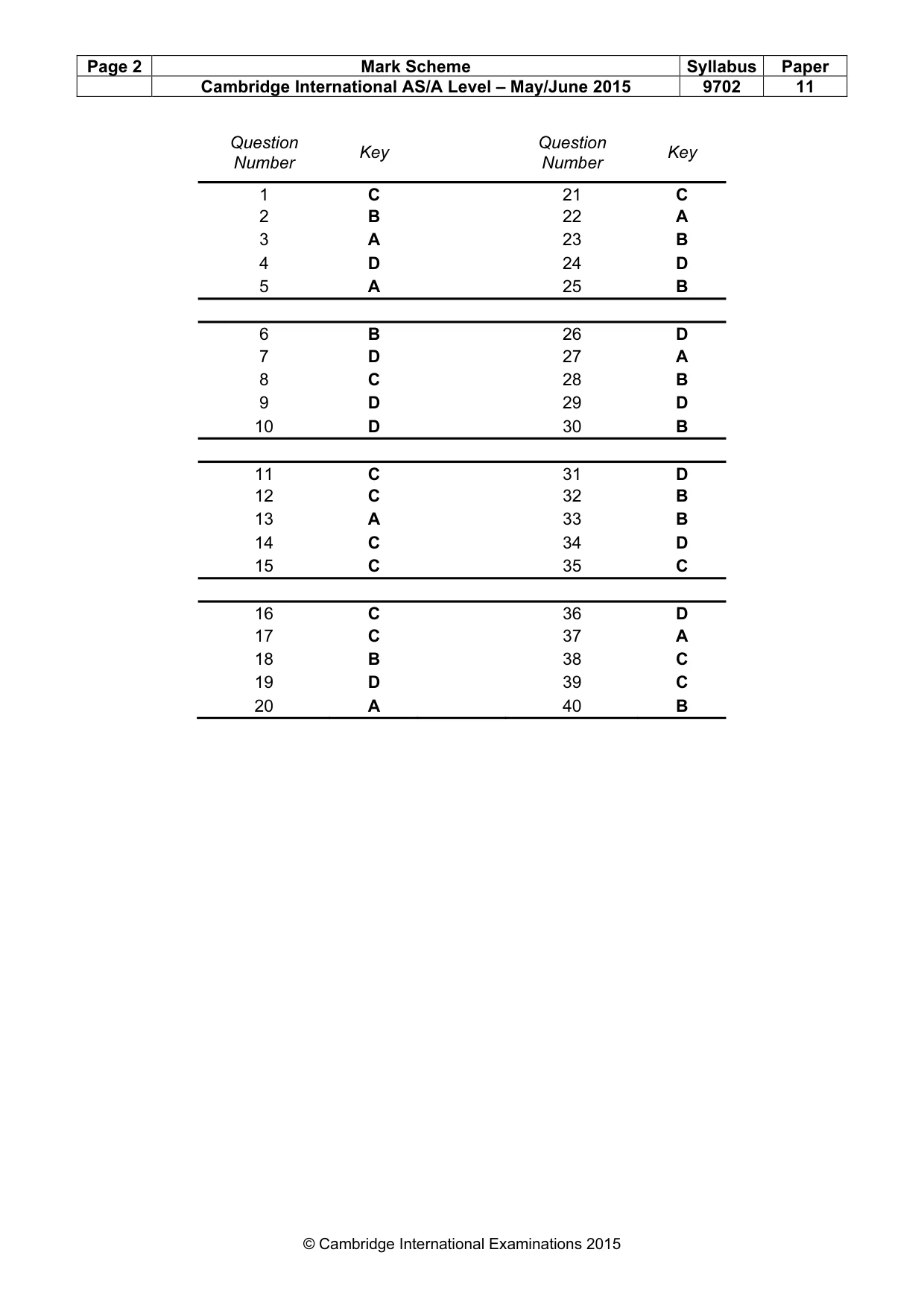
Mark scheme2 pages
Answers below. Sit the paper first if you are practising.
Questions as text
Q1 · Which is an SI base unit?
1 Which is an SI base unit? A current B gram C kelvin D volt
Mark scheme: C
Q2 · Which pair contains one vector and one scalar quantity?
2 Which pair contains one vector and one scalar quantity? A displacement acceleration B force kinetic energy C momentum velocity D power speed
Mark scheme: B
Q3 · When a constant braking force is applied to a vehicle moving at speed v, the distance d…
3 When a constant braking force is applied to a vehicle moving at speed v, the distance d moved by the vehicle in coming to rest is given by the expression d = kv 2 where k is a constant. When d is measured in metres and v is measured in metres per second, the constant has a value of k1. What is the value of the constant when the distance is measured in metres, and the speed is measured in kilometres per hour? A 0.0772 k1 B 0.278 k1 C 3.60 k1 D 13.0 k1
Mark scheme: A
Q4 · A whale produces sound waves of frequency 5 Hz
4 A whale produces sound waves of frequency 5 Hz. The waves are detected by a microphone and displayed on an oscilloscope. What is the time-base setting on the oscilloscope? A 0.1 ms div–1 B 1 ms div–1 C 10 ms div–1 D 100 ms div–1
Mark scheme: D
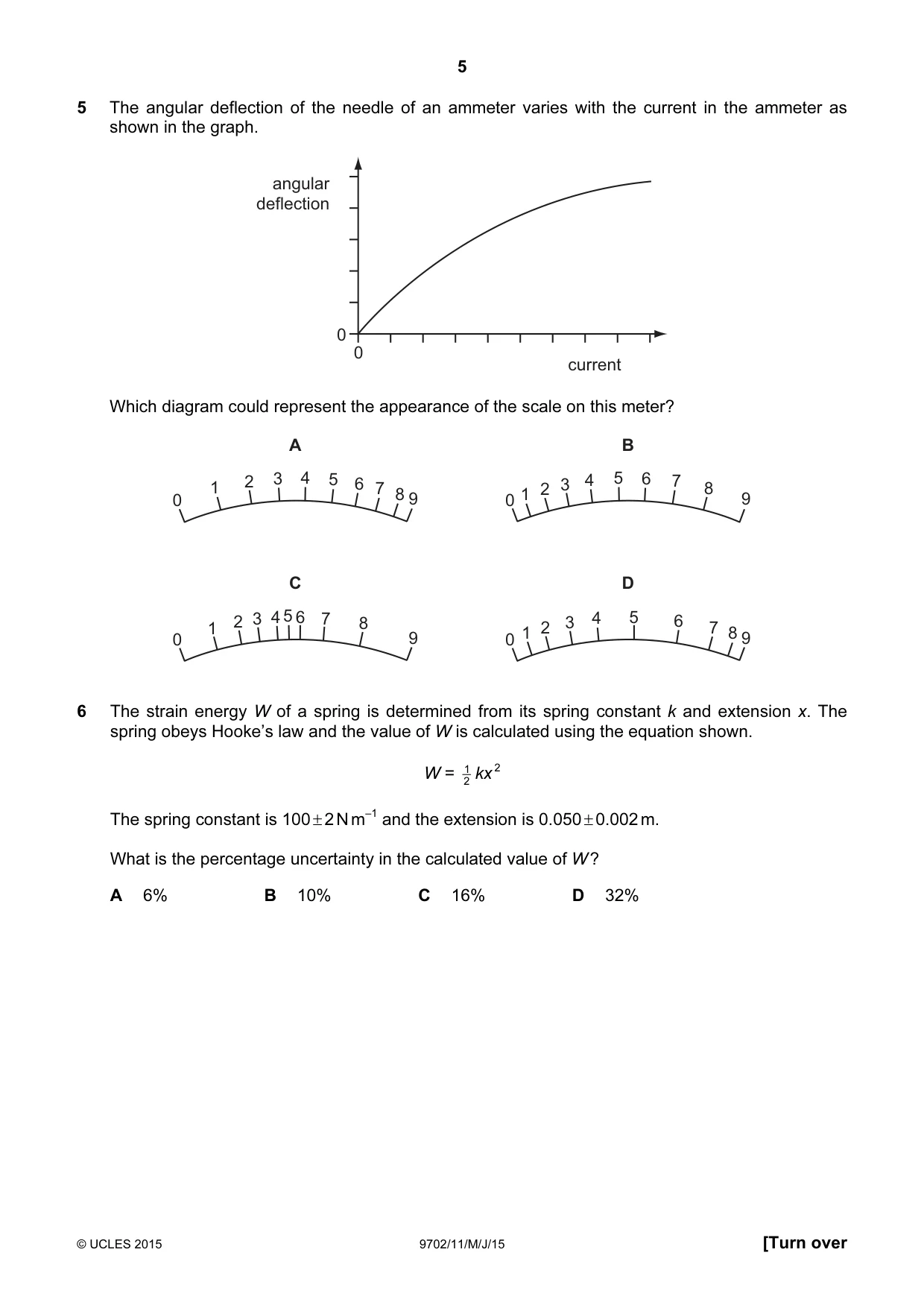
Q5 · The angular deflection of the needle of an ammeter varies with the current in the ammeter…
5 The angular deflection of the needle of an ammeter varies with the current in the ammeter as shown in the graph. angular deflection 0 0 current Which diagram could represent the appearance of the scale on this meter? A B 2 3 4 5 6 7 8 9 0 1 2 3 4 5 6 7 1 8 0 9 C D 2 3 45 6 7 8 3 4 5 6 1 0 1 2 7 8 9 0 9
Mark scheme: A
Q6 · The strain energy W of a spring is determined from its spring constant k and extension x
6 The strain energy W of a spring is determined from its spring constant k and extension x. The spring obeys Hooke’s law and the value of W is calculated using the equation shown. W = 2 1 kx 2 The spring constant is 100 ± 2 N m–1 and the extension is 0.050 ± 0.002 m. What is the percentage uncertainty in the calculated value of W ? A 6% B 10% C 16% D 32%
Mark scheme: B
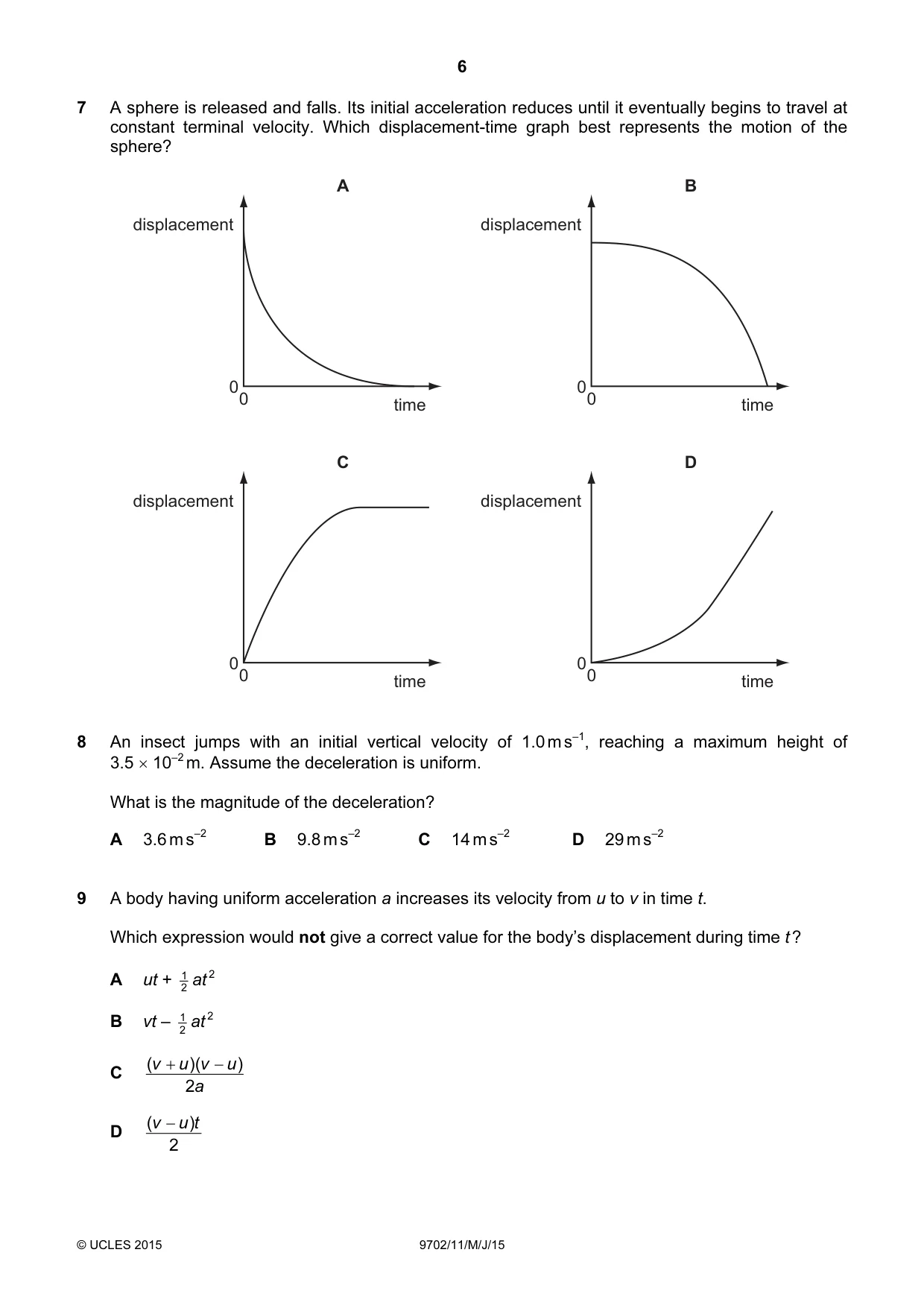
Q7 · A sphere is released and falls
7 A sphere is released and falls. Its initial acceleration reduces until it eventually begins to travel at constant terminal velocity. Which displacement-time graph best represents the motion of the sphere? A B displacement displacement 00 00 time time C D displacement displacement 00 00 time time
Mark scheme: D
Q8 · An insect jumps with an initial vertical velocity of 1.0 m s–1, reaching a maximum height…
8 An insect jumps with an initial vertical velocity of 1.0 m s–1, reaching a maximum height of 3.5 × 10⁻² m. Assume the deceleration is uniform. What is the magnitude of the deceleration? A 3.6 m s–2 B 9.8 m s–2 C 14 m s–2 D 29 m s–2
Mark scheme: C
Q9 · A body having uniform acceleration a increases its velocity from u to v in time t
9 A body having uniform acceleration a increases its velocity from u to v in time t. Which expression would not give a correct value for the body’s displacement during time t ? A ut + 2 1 at 2 B vt – 2 1 at 2 ( v + u )( v − u ) C 2 a ( v − u ) t D 2
Mark scheme: D
Q10 · What is a reasonable estimate of the average gravitational force acting on a fully grown…
10 What is a reasonable estimate of the average gravitational force acting on a fully grown woman standing on the Earth? A 60 N B 250 N C 350 N D 650 N
Mark scheme: D
Q11 · A molecule of mass m travelling at speed v hits a wall in a direction perpendicular to…
11 A molecule of mass m travelling at speed v hits a wall in a direction perpendicular to the wall. The collision is elastic. What are the changes in the momentum and in the kinetic energy of the molecule caused by the collision? change in change in momentum kinetic energy A 0 0 B 0 mv 2 C 2mv 0 D mv 2 0
Mark scheme: C
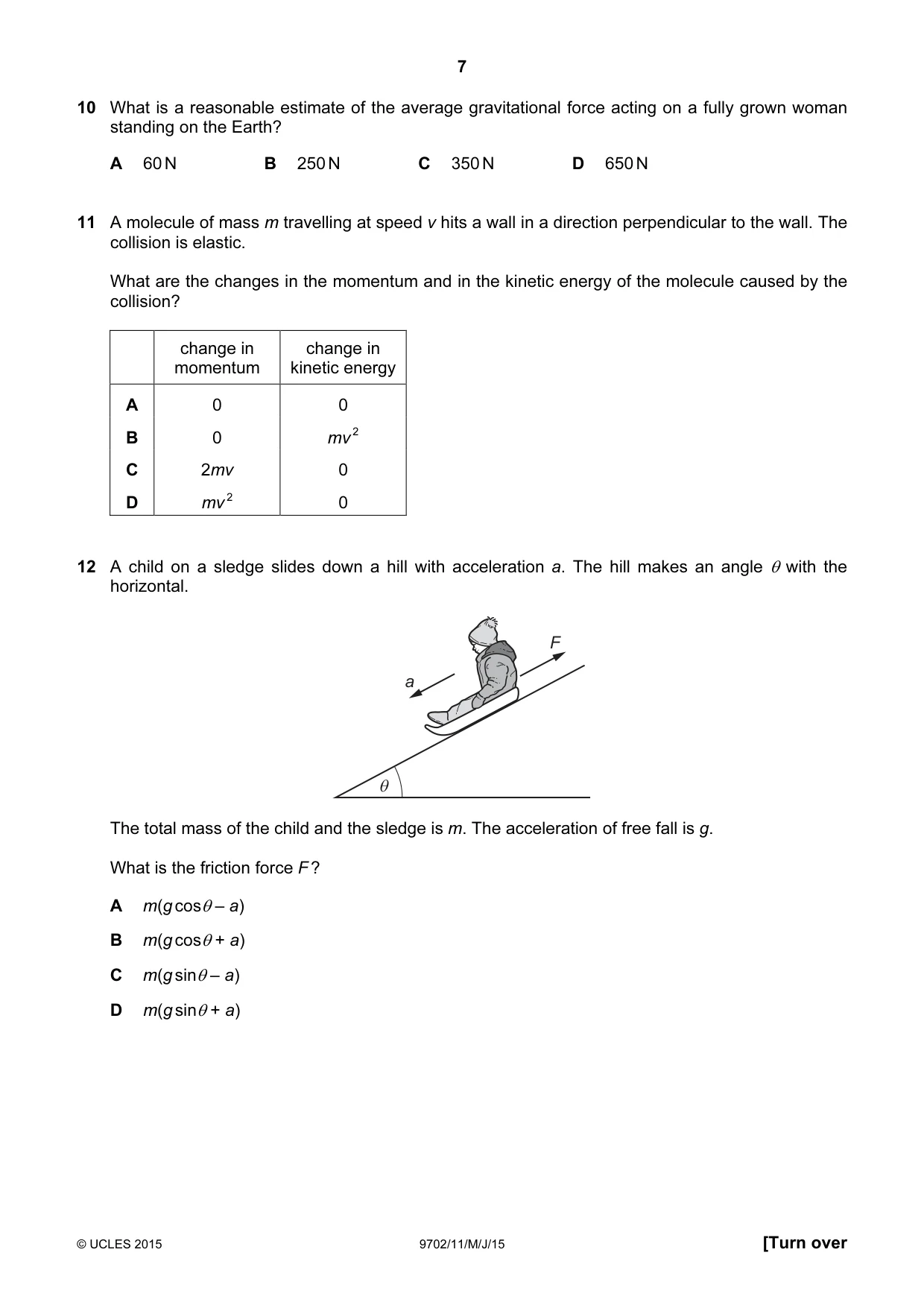
Q12 · A child on a sledge slides down a hill with acceleration a
12 A child on a sledge slides down a hill with acceleration a. The hill makes an angle θ with the horizontal. F a θ The total mass of the child and the sledge is m. The acceleration of free fall is g. What is the friction force F ? A m(g cosθ – a) B m(g cosθ + a) C m(g sinθ – a) D m(g sinθ + a)
Mark scheme: C
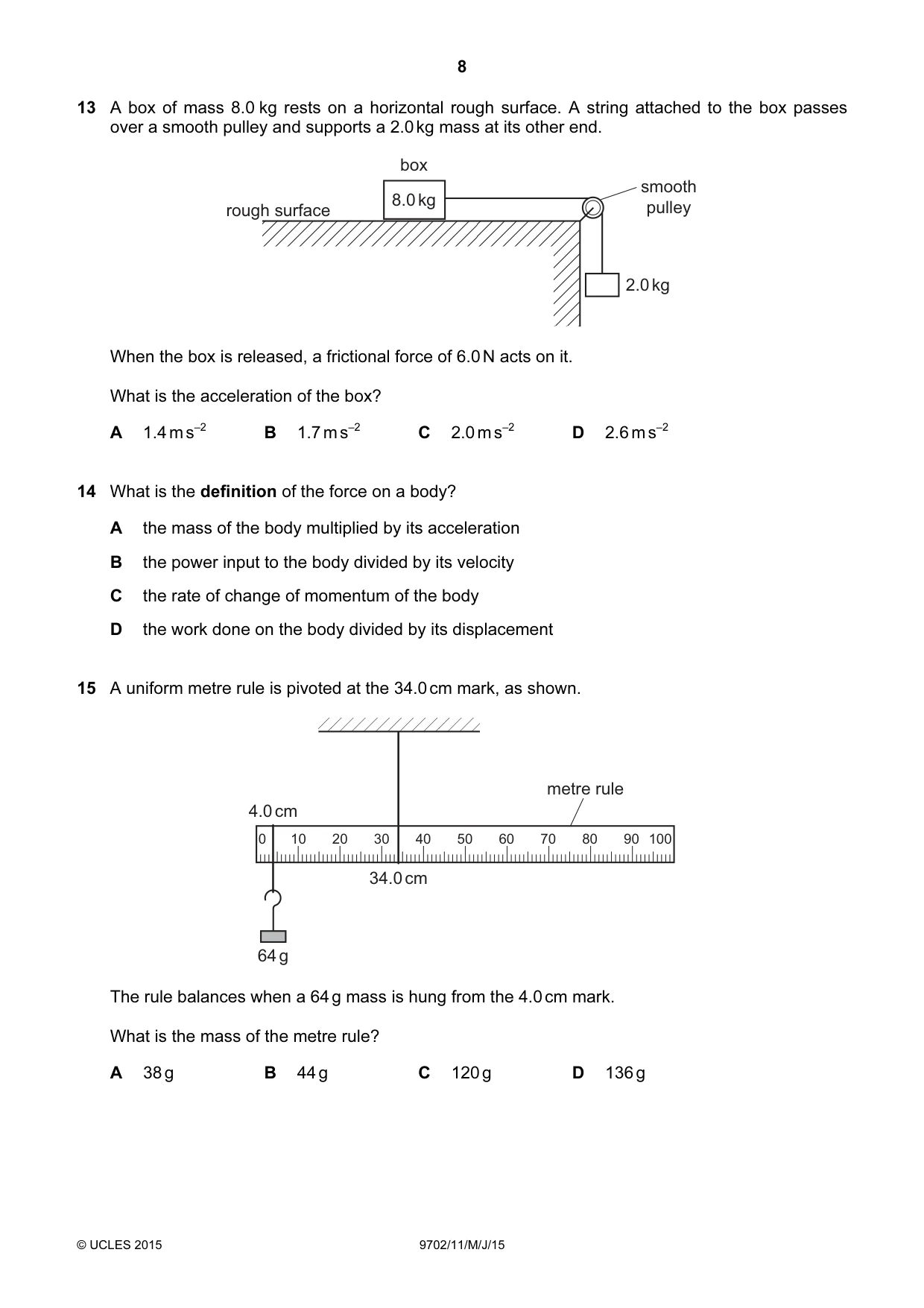
Q13 · A box of mass 8.0 kg rests on a horizontal rough surface
13 A box of mass 8.0 kg rests on a horizontal rough surface. A string attached to the box passes over a smooth pulley and supports a 2.0 kg mass at its other end. box smooth 8.0 kg pulley rough surface 2.0 kg When the box is released, a frictional force of 6.0 N acts on it. What is the acceleration of the box? A 1.4 m s–2 B 1.7 m s–2 C 2.0 m s–2 D 2.6 m s–2
Mark scheme: A
Q14 · What is the definition of the force on a body?
14 What is the definition of the force on a body? A the mass of the body multiplied by its acceleration B the power input to the body divided by its velocity C the rate of change of momentum of the body D the work done on the body divided by its displacement
Mark scheme: C
Q15 · A uniform metre rule is pivoted at the 34.0 cm mark, as shown
15 A uniform metre rule is pivoted at the 34.0 cm mark, as shown. metre rule 4.0 cm 0 10 20 30 40 50 60 70 80 90 100 34.0 cm 64 g The rule balances when a 64 g mass is hung from the 4.0 cm mark. What is the mass of the metre rule? A 38 g B 44 g C 120 g D 136 g
Mark scheme: C
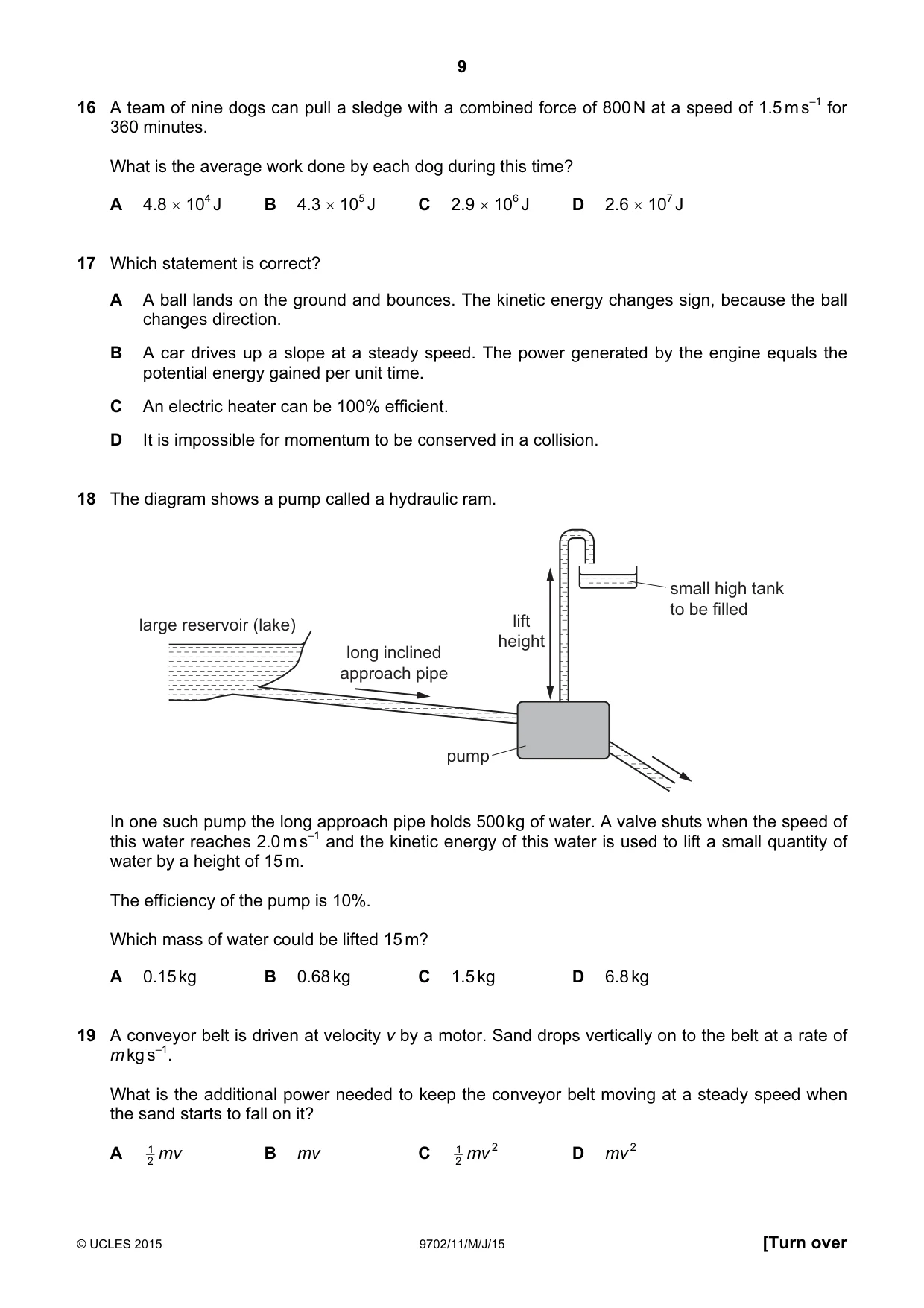
Q16 · A team of nine dogs can pull a sledge with a combined force of 800 N at a speed of 1.5 m…
16 A team of nine dogs can pull a sledge with a combined force of 800 N at a speed of 1.5 m s–1 for 360 minutes. What is the average work done by each dog during this time? A 4.8 × 10⁴ J B 4.3 × 10⁵ J C 2.9 × 10⁶ J D 2.6 × 10⁷ J
Mark scheme: C
Q17 · Which statement is correct?
17 Which statement is correct? A A ball lands on the ground and bounces. The kinetic energy changes sign, because the ball changes direction. B A car drives up a slope at a steady speed. The power generated by the engine equals the potential energy gained per unit time. C An electric heater can be 100% efficient. D It is impossible for momentum to be conserved in a collision.
Mark scheme: C
Q18 · The diagram shows a pump called a hydraulic ram
18 The diagram shows a pump called a hydraulic ram. small high tank to be filled large reservoir (lake) lift height long inclined approach pipe pump In one such pump the long approach pipe holds 500 kg of water. A valve shuts when the speed of this water reaches 2.0 m s–1 and the kinetic energy of this water is used to lift a small quantity of water by a height of 15 m. The efficiency of the pump is 10%. Which mass of water could be lifted 15 m? A 0.15 kg B 0.68 kg C 1.5 kg D 6.8 kg
Mark scheme: B
Q19 · A conveyor belt is driven at velocity v by a motor
19 A conveyor belt is driven at velocity v by a motor. Sand drops vertically on to the belt at a rate of m kg s–1. What is the additional power needed to keep the conveyor belt moving at a steady speed when the sand starts to fall on it? A 1 mv B mv C 1 mv 2 D mv 2 2 2
Mark scheme: D
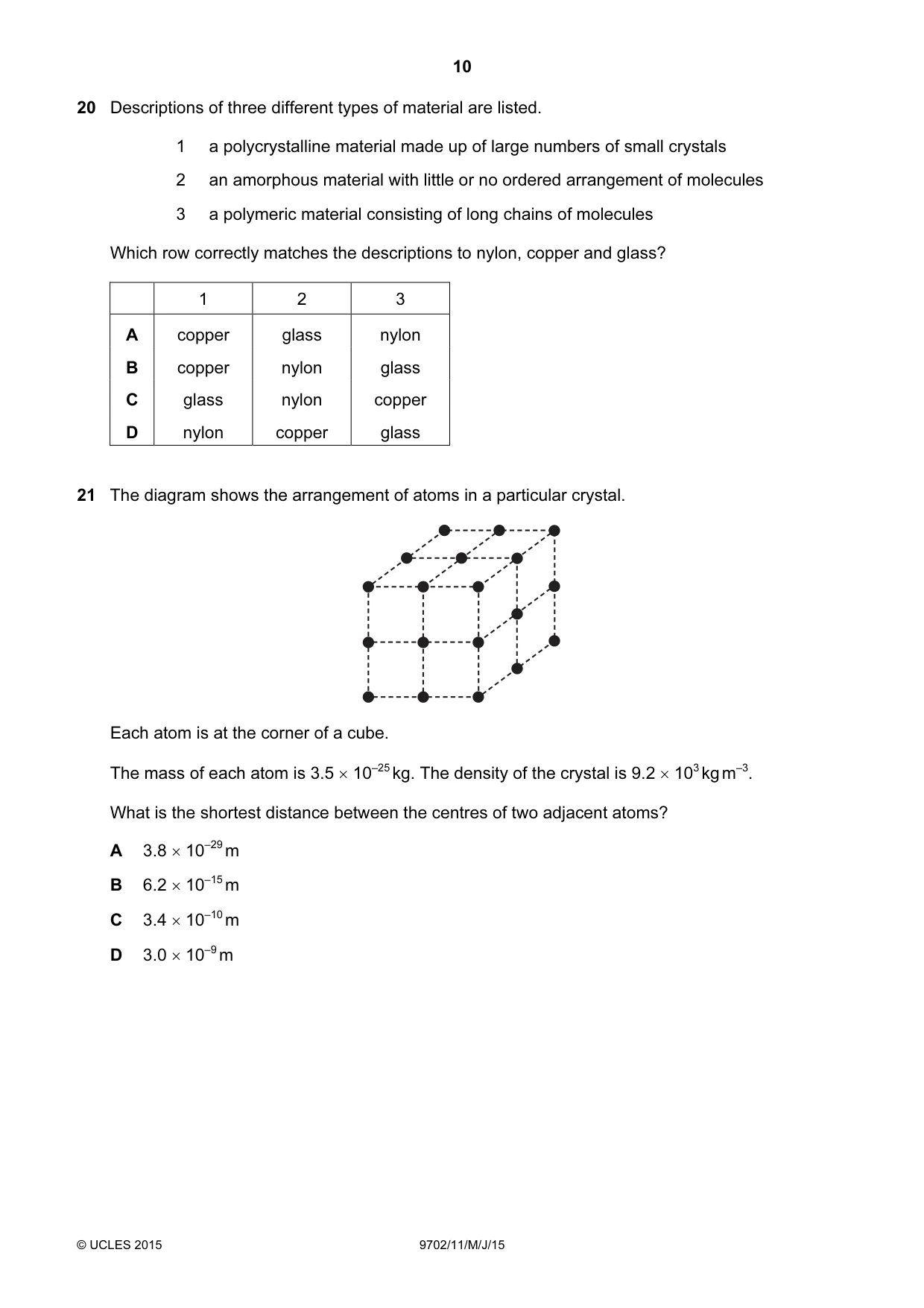
Q20 · Descriptions of three different types of material are listed
20 Descriptions of three different types of material are listed. 1 a polycrystalline material made up of large numbers of small crystals 2 an amorphous material with little or no ordered arrangement of molecules 3 a polymeric material consisting of long chains of molecules Which row correctly matches the descriptions to nylon, copper and glass? 1 2 3 A copper glass nylon B copper nylon glass C glass nylon copper D nylon copper glass
Mark scheme: A
Q21 · The diagram shows the arrangement of atoms in a particular crystal
21 The diagram shows the arrangement of atoms in a particular crystal. Each atom is at the corner of a cube. The mass of each atom is 3.5 × 10⁻²⁵ kg. The density of the crystal is 9.2 × 10³ kg m–3. What is the shortest distance between the centres of two adjacent atoms? A 3.8 × 10⁻²⁹ m B 6.2 × 10⁻¹⁵ m C 3.4 × 10⁻¹⁰ m D 3.0 × 10⁻⁹ m
Mark scheme: C
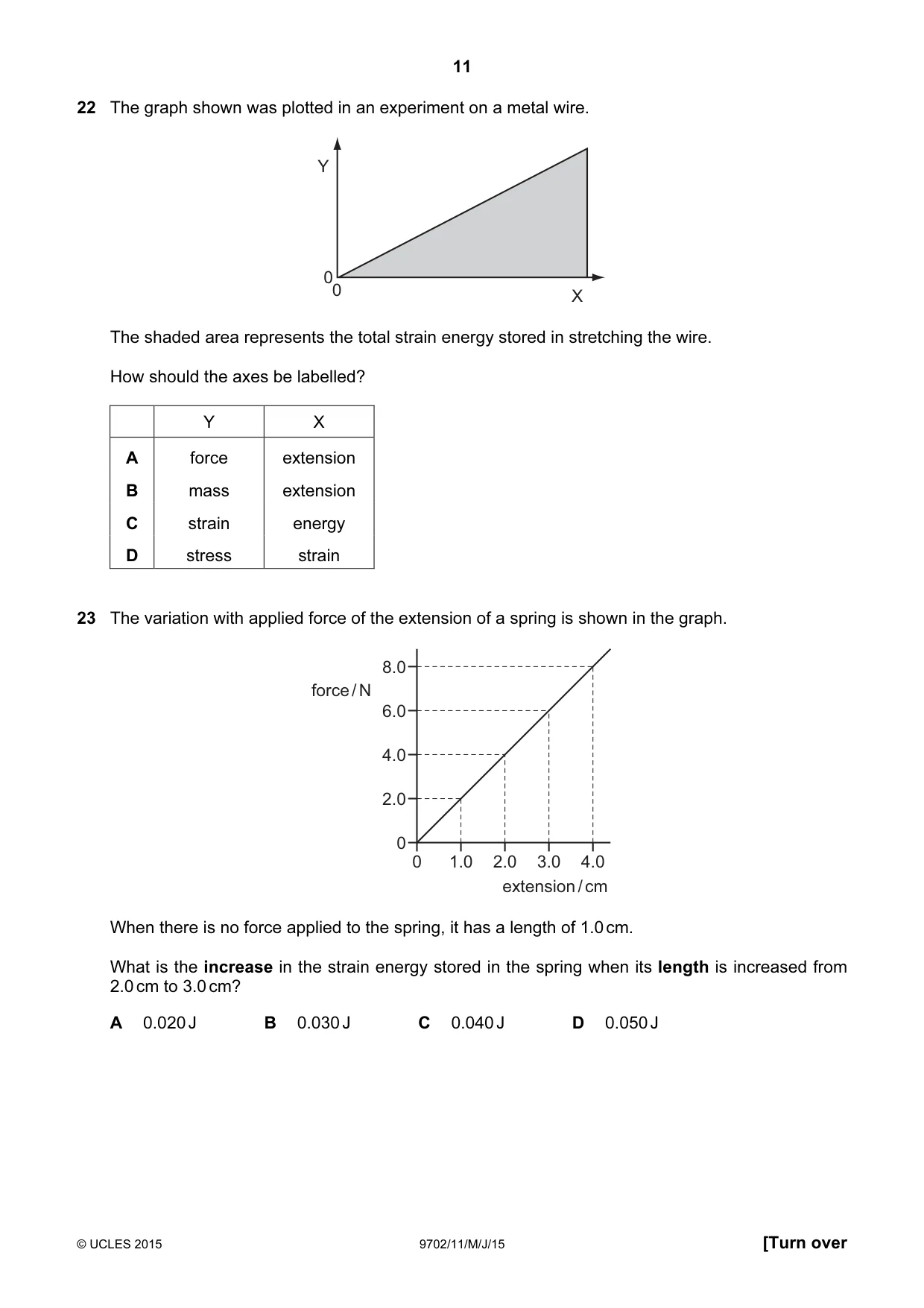
Q22 · The graph shown was plotted in an experiment on a metal wire
22 The graph shown was plotted in an experiment on a metal wire. Y 00 X The shaded area represents the total strain energy stored in stretching the wire. How should the axes be labelled? Y X A force extension B mass extension C strain energy D stress strain
Mark scheme: A
Q23 · The variation with applied force of the extension of a spring is shown in the graph
23 The variation with applied force of the extension of a spring is shown in the graph. 8.0 force / N 6.0 4.0 2.0 0 0 1.0 2.0 3.0 4.0 extension / cm When there is no force applied to the spring, it has a length of 1.0 cm. What is the increase in the strain energy stored in the spring when its length is increased from 2.0 cm to 3.0 cm? A 0.020 J B 0.030 J C 0.040 J D 0.050 J
Mark scheme: B
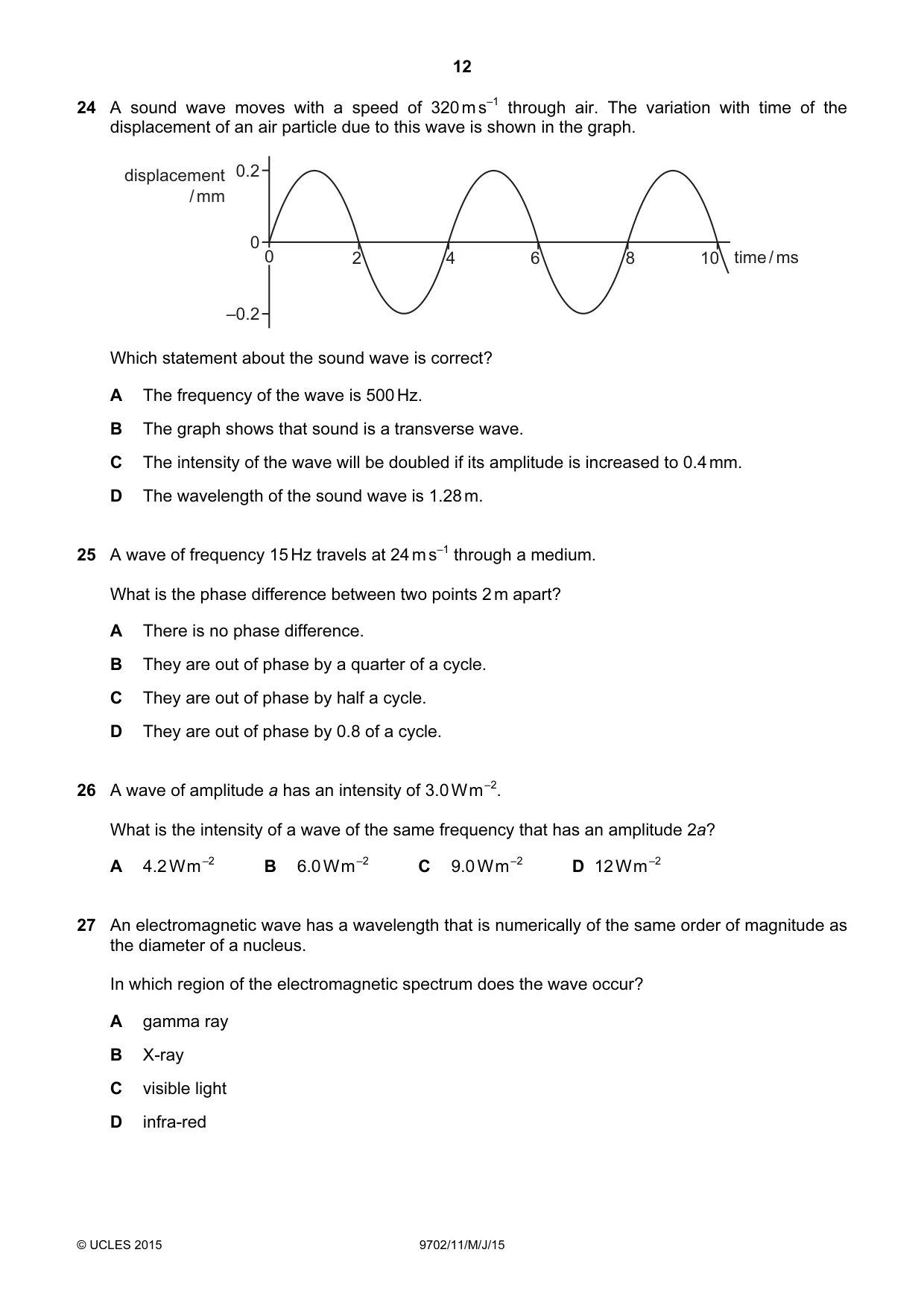
Q24 · A sound wave moves with a speed of 320 m s–1 through air
24 A sound wave moves with a speed of 320 m s–1 through air. The variation with time of the displacement of an air particle due to this wave is shown in the graph. displacement 0.2 / mm 0 0 2 4 6 8 10 time / ms –0.2 Which statement about the sound wave is correct? A The frequency of the wave is 500 Hz. B The graph shows that sound is a transverse wave. C The intensity of the wave will be doubled if its amplitude is increased to 0.4 mm. D The wavelength of the sound wave is 1.28 m.
Mark scheme: D
Q25 · A wave of frequency 15 Hz travels at 24 m s–1 through a medium
25 A wave of frequency 15 Hz travels at 24 m s–1 through a medium. What is the phase difference between two points 2 m apart? A There is no phase difference. B They are out of phase by a quarter of a cycle. C They are out of phase by half a cycle. D They are out of phase by 0.8 of a cycle.
Mark scheme: B
Q26 · A wave of amplitude a has an intensity of 3.0 Wm–2
26 A wave of amplitude a has an intensity of 3.0 Wm–2. What is the intensity of a wave of the same frequency that has an amplitude 2a? A 4.2 Wm–2 B 6.0 Wm–2 C 9.0 Wm–2 D 12 Wm–2
Mark scheme: D
Q27 · An electromagnetic wave has a wavelength that is numerically of the same order of…
27 An electromagnetic wave has a wavelength that is numerically of the same order of magnitude as the diameter of a nucleus. In which region of the electromagnetic spectrum does the wave occur? A gamma ray B X-ray C visible light D infra-red
Mark scheme: A
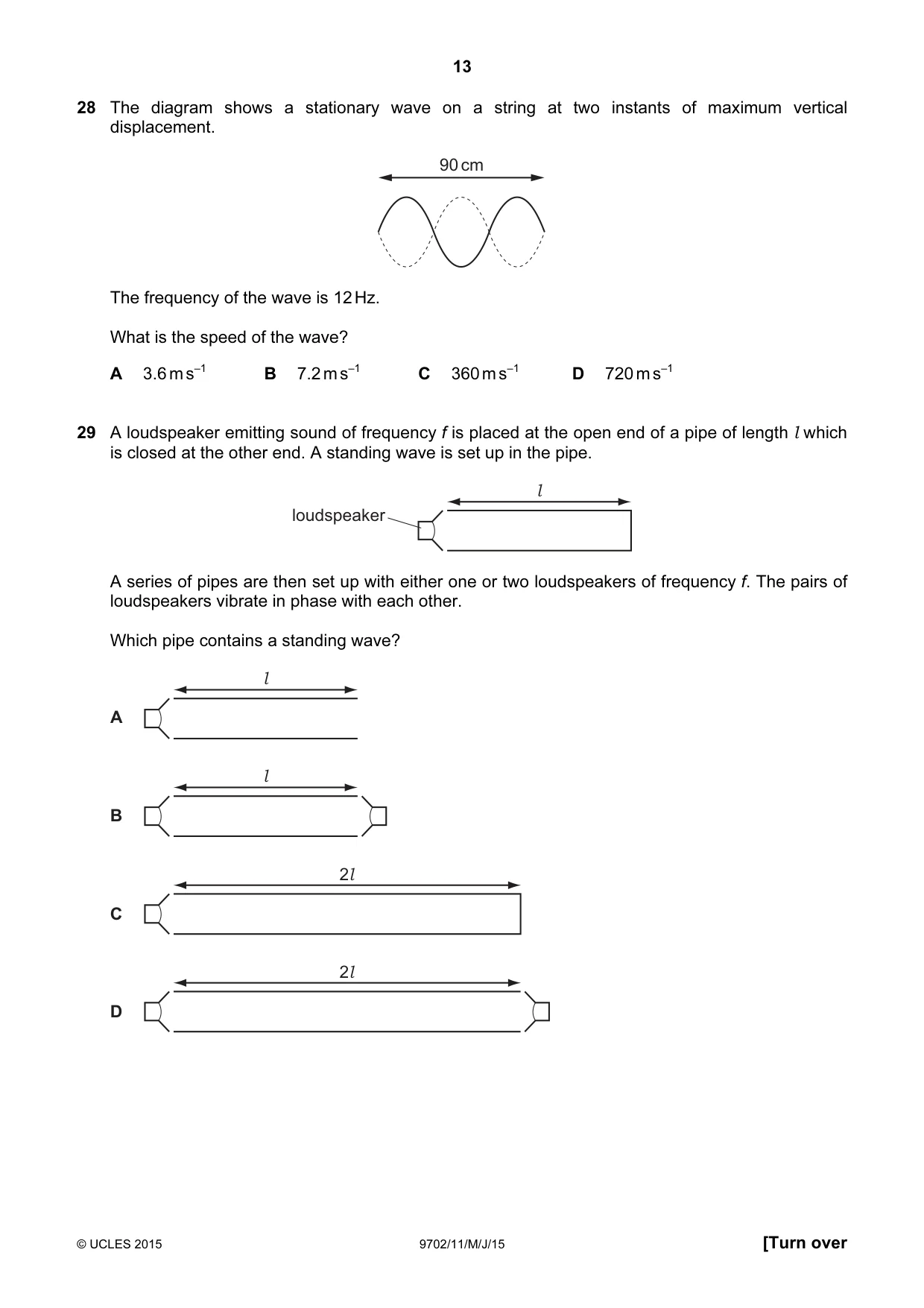
Q28 · The diagram shows a stationary wave on a string at two instants of maximum vertical…
28 The diagram shows a stationary wave on a string at two instants of maximum vertical displacement. 90 cm The frequency of the wave is 12 Hz. What is the speed of the wave? A 3.6 m s–1 B 7.2 m s–1 C 360 m s–1 D 720 m s–1
Mark scheme: B
Q29 · A loudspeaker emitting sound of frequency f is placed at the open end of a pipe of length…
29 A loudspeaker emitting sound of frequency f is placed at the open end of a pipe of length l which is closed at the other end. A standing wave is set up in the pipe. l loudspeaker A series of pipes are then set up with either one or two loudspeakers of frequency f. The pairs of loudspeakers vibrate in phase with each other. Which pipe contains a standing wave? l A l B 2l C 2l D
Mark scheme: D
Q30 · In a double-slit experiment the distance between the fringes, on a screen, was too small…
30 In a double-slit experiment the distance between the fringes, on a screen, was too small to measure. What would increase the distance between the fringes? A increasing the distance between the light source and the slits B increasing the distance between the slits and the screen C increasing the distance between the slits D increasing the frequency of the light source
Mark scheme: B
Q31 · Two parallel metal plates, a distance of 2 mm apart, have a potential difference of 1000…
31 Two parallel metal plates, a distance of 2 mm apart, have a potential difference of 1000 V across them. What is the electric field strength between the plates? A 500 V m–1 B 50 000 V m–1 C 50 000 N C–1 D 500 000 N C–1
Mark scheme: D
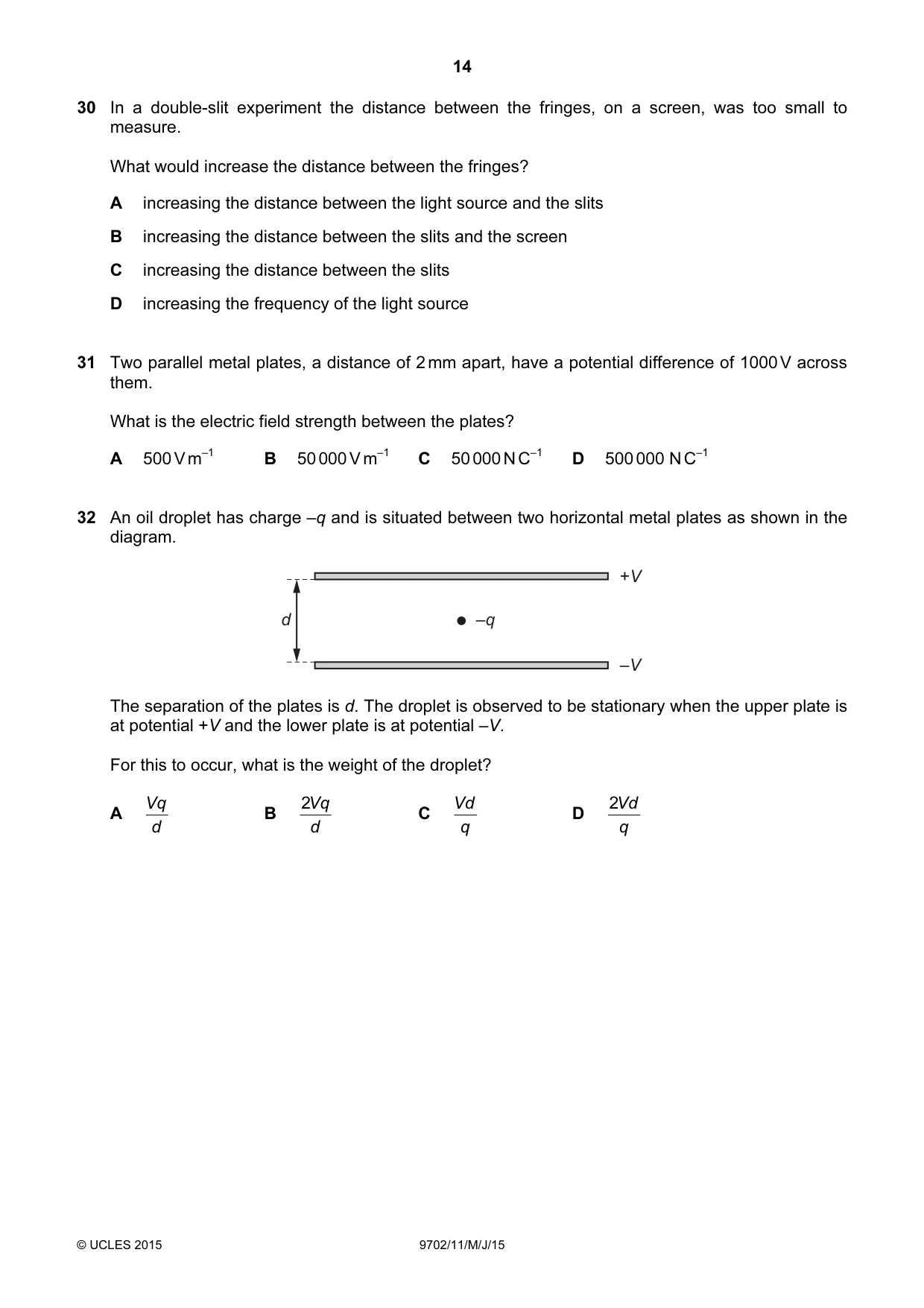
Q32 · An oil droplet has charge –q and is situated between two horizontal metal plates as shown…
32 An oil droplet has charge –q and is situated between two horizontal metal plates as shown in the diagram. +V d –q –V The separation of the plates is d. The droplet is observed to be stationary when the upper plate is at potential +V and the lower plate is at potential –V. For this to occur, what is the weight of the droplet? Vq 2 Vq Vd 2 Vd A B C D d d q q
Mark scheme: B
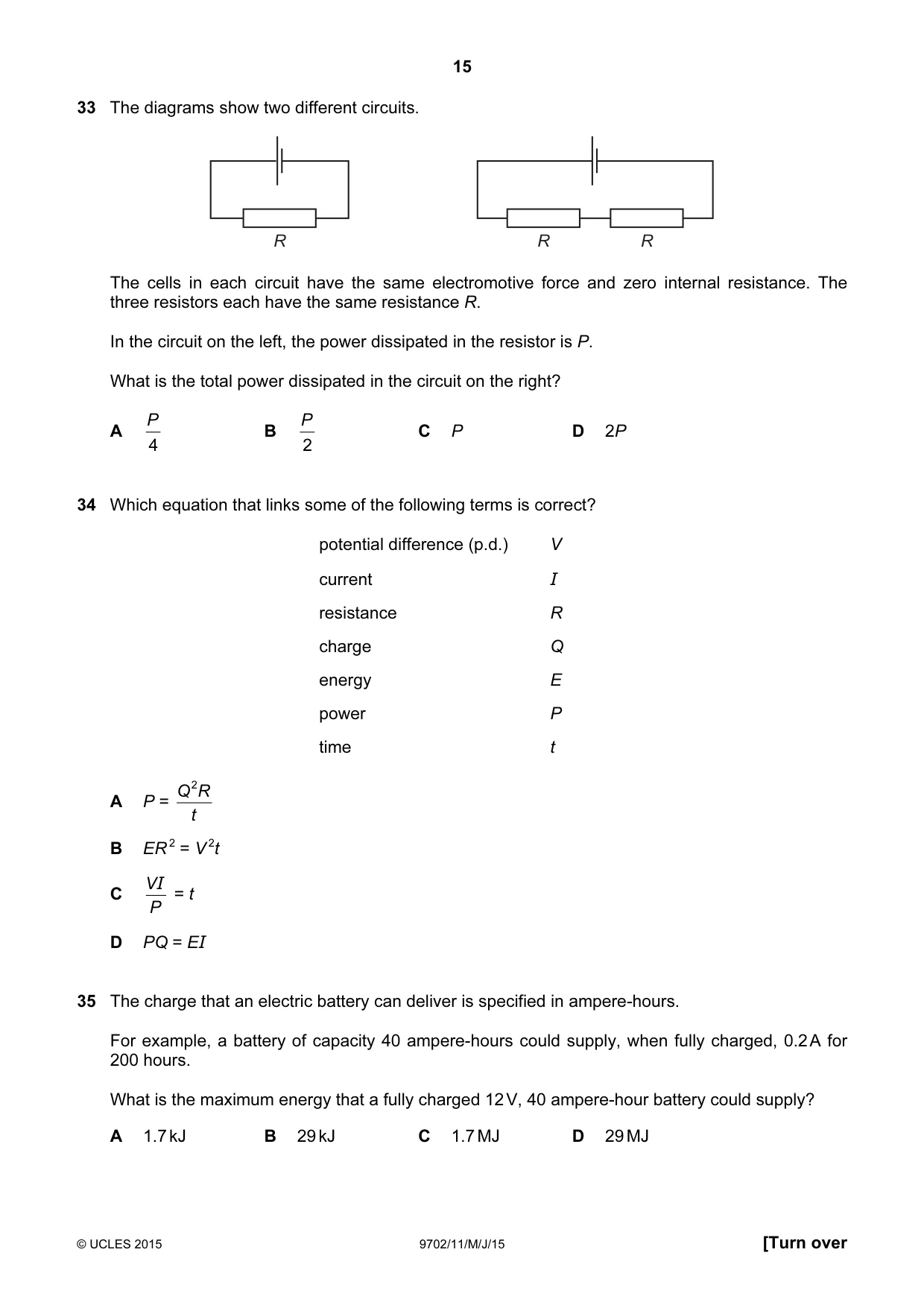
Q33 · The diagrams show two different circuits
33 The diagrams show two different circuits. R R R The cells in each circuit have the same electromotive force and zero internal resistance. The three resistors each have the same resistance R. In the circuit on the left, the power dissipated in the resistor is P. What is the total power dissipated in the circuit on the right? P P A B C P D 2P 4 2
Mark scheme: B
Q34 · Which equation that links some of the following terms is correct?
34 Which equation that links some of the following terms is correct? potential difference (p.d.) V current I resistance R charge Q energy E power P time t Q2 R A P = t B ER 2 = V 2t VI = t C P D PQ = EI
Mark scheme: D
Q35 · The charge that an electric battery can deliver is specified in ampere-hours
35 The charge that an electric battery can deliver is specified in ampere-hours. For example, a battery of capacity 40 ampere-hours could supply, when fully charged, 0.2 A for 200 hours. What is the maximum energy that a fully charged 12 V, 40 ampere-hour battery could supply? A 1.7 kJ B 29 kJ C 1.7 MJ D 29 MJ
Mark scheme: C
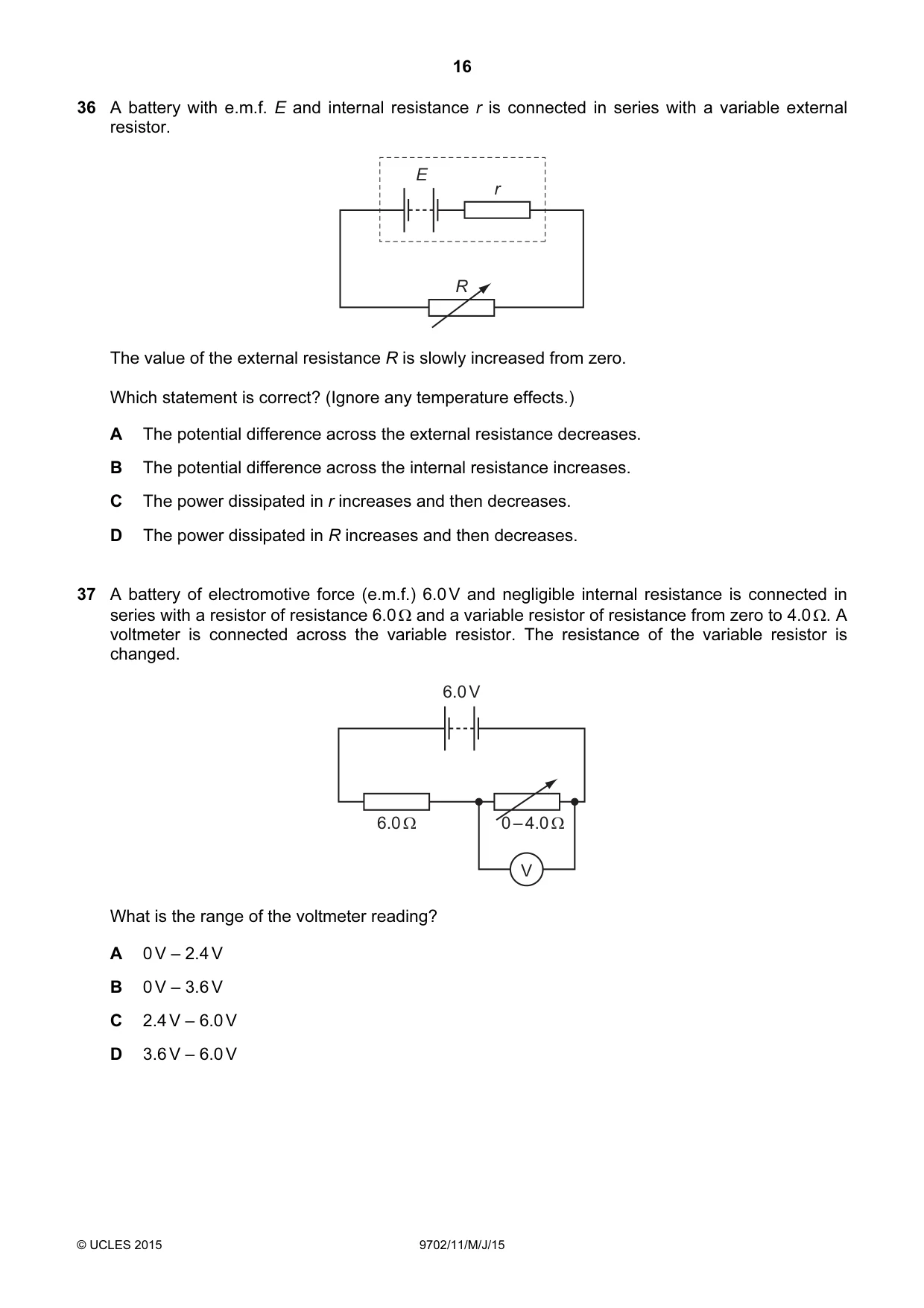
Q36 · A battery with e.m.f
36 A battery with e.m.f. E and internal resistance r is connected in series with a variable external resistor. E r R The value of the external resistance R is slowly increased from zero. Which statement is correct? (Ignore any temperature effects.) A The potential difference across the external resistance decreases. B The potential difference across the internal resistance increases. C The power dissipated in r increases and then decreases. D The power dissipated in R increases and then decreases.
Mark scheme: D
Q37 · A battery of electromotive force (e.m.f.) 6.0 V and negligible internal resistance is…
37 A battery of electromotive force (e.m.f.) 6.0 V and negligible internal resistance is connected in series with a resistor of resistance 6.0 Ω and a variable resistor of resistance from zero to 4.0 Ω. A voltmeter is connected across the variable resistor. The resistance of the variable resistor is changed. 6.0 V 6.0 Ω 0 – 4.0 Ω V What is the range of the voltmeter reading? A 0 V – 2.4 V B 0 V – 3.6 V C 2.4 V – 6.0 V D 3.6 V – 6.0 V
Mark scheme: A
Q38 · A wire RST is connected to another wire XY as shown
38 A wire RST is connected to another wire XY as shown. S X R T Y 50 cm Each wire is 100 cm long with a resistance per unit length of 10 Ω m–1. What is the total resistance between X and Y? A 3.3 Ω B 5.0 Ω C 8.3 Ω D 13.3 Ω
Mark scheme: C
Q39 · When α-particles are directed at gold leaf 1 almost all α-particles pass through without…
39 When α-particles are directed at gold leaf 1 almost all α-particles pass through without deflection, 2 a few α-particles are deviated through large angles. What are the reasons for these effects? 1 2 A most α-particles have enough energy gold is very dense so a few low energy to pass right through the gold leaf α-particles bounce back from the gold surface B most α-particles miss all gold atoms a few α-particles bounce off gold atoms C the gold nucleus is very small so occasionally the path of an α-particle is most α-particles miss all nuclei close to a nucleus D the positive charge in an atom is not occasionally an α-particle experiences many concentrated enough to deflect an α-particle small deflections in the same direction
Mark scheme: C
Q40 · The nuclide 222 Rn decays in a sequence of stages to form the nuclide 206 Pb
40 The nuclide 222 Rn decays in a sequence of stages to form the nuclide 206 Pb . 86 82 Four of the nuclides formed in the sequence are α-particle emitters. The others are β-particle emitters. How many nuclides formed in the decay sequence are β-particle emitters? A 2 B 4 C 8 D 12
Mark scheme: B
What was in this paper
The subtopics covered by these 40 questions, and how many questions each got. Open one in a new tab to see every Cambridge question on it.
4Energy conservation3Equations of motion3Momentum and Newton’s laws of motion3Elastic and plastic behaviour2Linear momentum and its conservation2Physical quantities2Potential difference and power2Stationary waves2Uniform electric fields2Atoms, nuclei and radiation1Density and pressure1Electric current1Electromagnetic spectrum1Errors and uncertainties1Gravitational force between point masses1Interference1Potential dividers1Practical circuits1Radioactive decay1Resistance and resistivity1Scalars and vectors1SI units1Stress and strain1Turning effects of forces1What you needed in this session
Cambridge’s own grade thresholds for 2015 May/June, Paper 1 · Variant 1. A higher threshold means an easier paper — the bar moves with how the cohort did.