Cambridge A Level Physics 9702 — 2020 Feb/March Paper 1 · Variant 2
9702/12/F/M/20 · 40 questions · 40 marks · ≈45 min
The question paper and its mark scheme, free to read here and free to download. This is Cambridge’s own paper, exactly as it was sat.
Question paper20 pages
Mark scheme3 pages
Answers below. Sit the paper first if you are practising.
Questions as text
Q1 · The table shows some measurable quantities
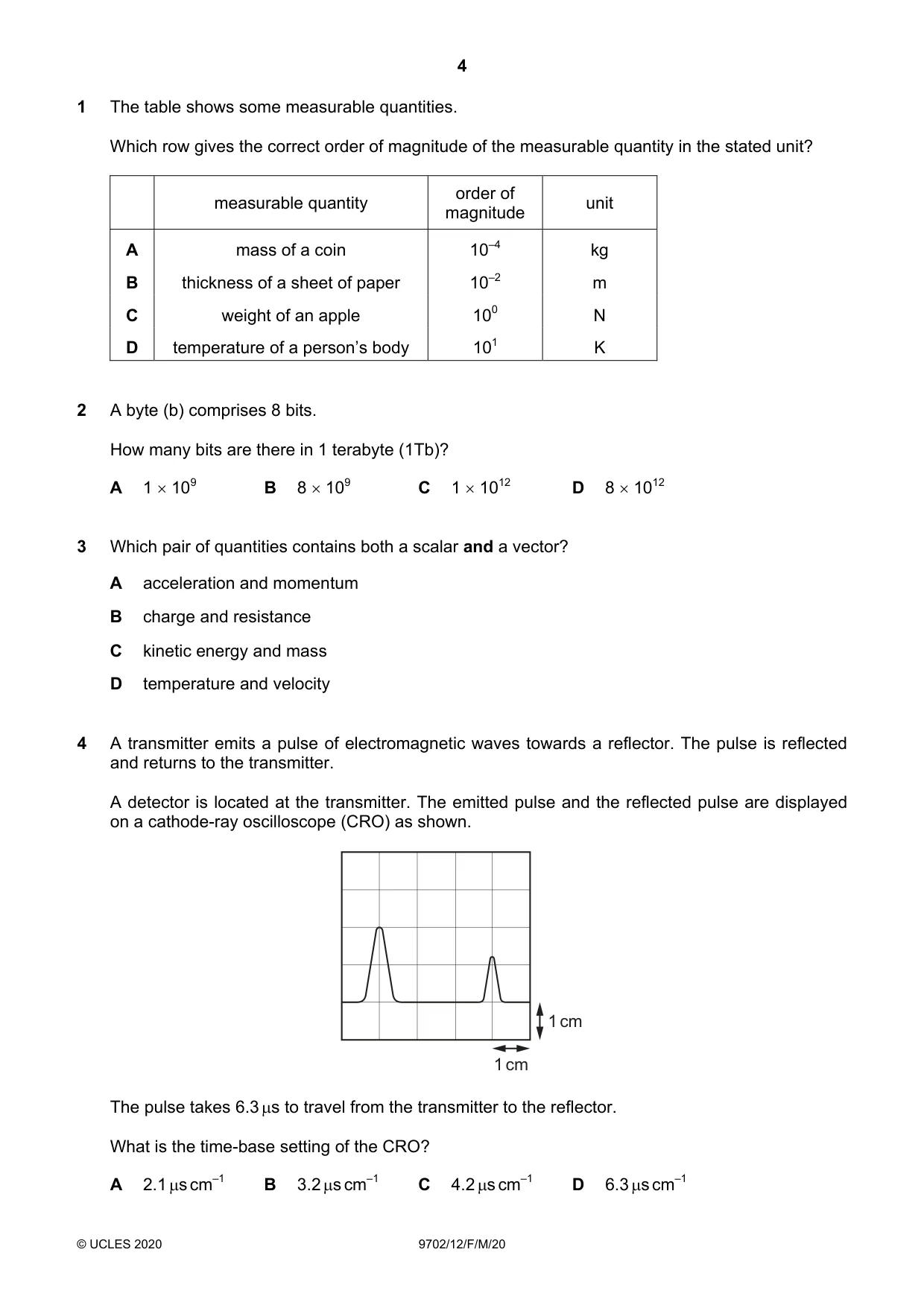
1 The table shows some measurable quantities. Which row gives the correct order of magnitude of the measurable quantity in the stated unit? order of measurable quantity unit magnitude A mass of a coin 10–4 kg B thickness of a sheet of paper 10–2 m C weight of an apple 100 N D temperature of a person’s body 101 K
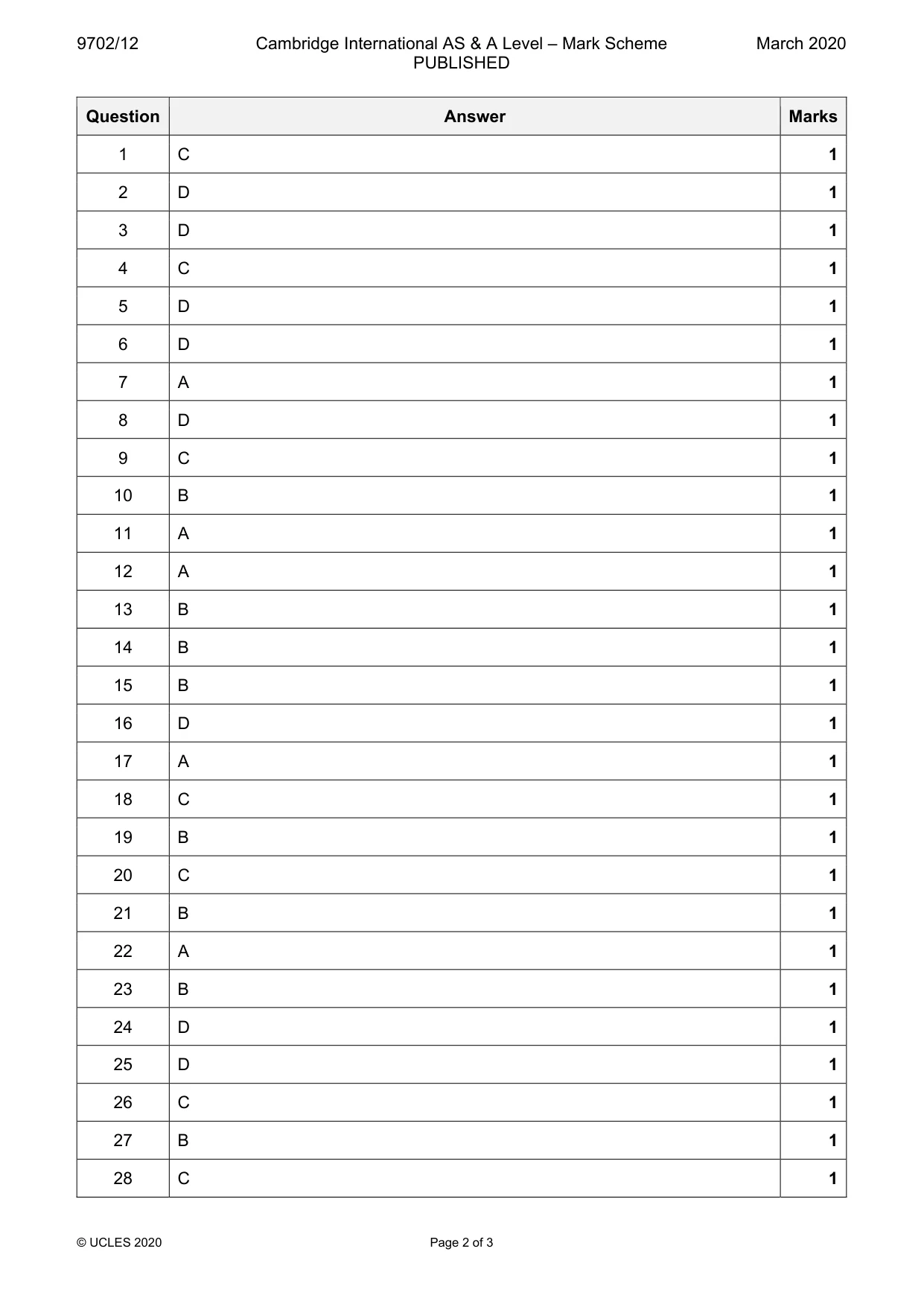
Mark scheme: C
Q2 · A byte (b) comprises 8 bits
2 A byte (b) comprises 8 bits. How many bits are there in 1 terabyte (1Tb)? A 1 × 10⁹ B 8 × 10⁹ C 1 × 10¹² D 8 × 10¹²
Mark scheme: D
Q3 · Which pair of quantities contains both a scalar and a vector?
3 Which pair of quantities contains both a scalar and a vector? A acceleration and momentum B charge and resistance C kinetic energy and mass D temperature and velocity
Mark scheme: D
Q4 · A transmitter emits a pulse of electromagnetic waves towards a reflector
4 A transmitter emits a pulse of electromagnetic waves towards a reflector. The pulse is reflected and returns to the transmitter. A detector is located at the transmitter. The emitted pulse and the reflected pulse are displayed on a cathode-ray oscilloscope (CRO) as shown. 1 cm 1 cm The pulse takes 6.3 µs to travel from the transmitter to the reflector. What is the time-base setting of the CRO? A 2.1 µs cm–1 B 3.2 µs cm–1 C 4.2 µs cm–1 D 6.3 µs cm–1
Mark scheme: C
Q5 · A micrometer is used to measure the diameters of two cylinders
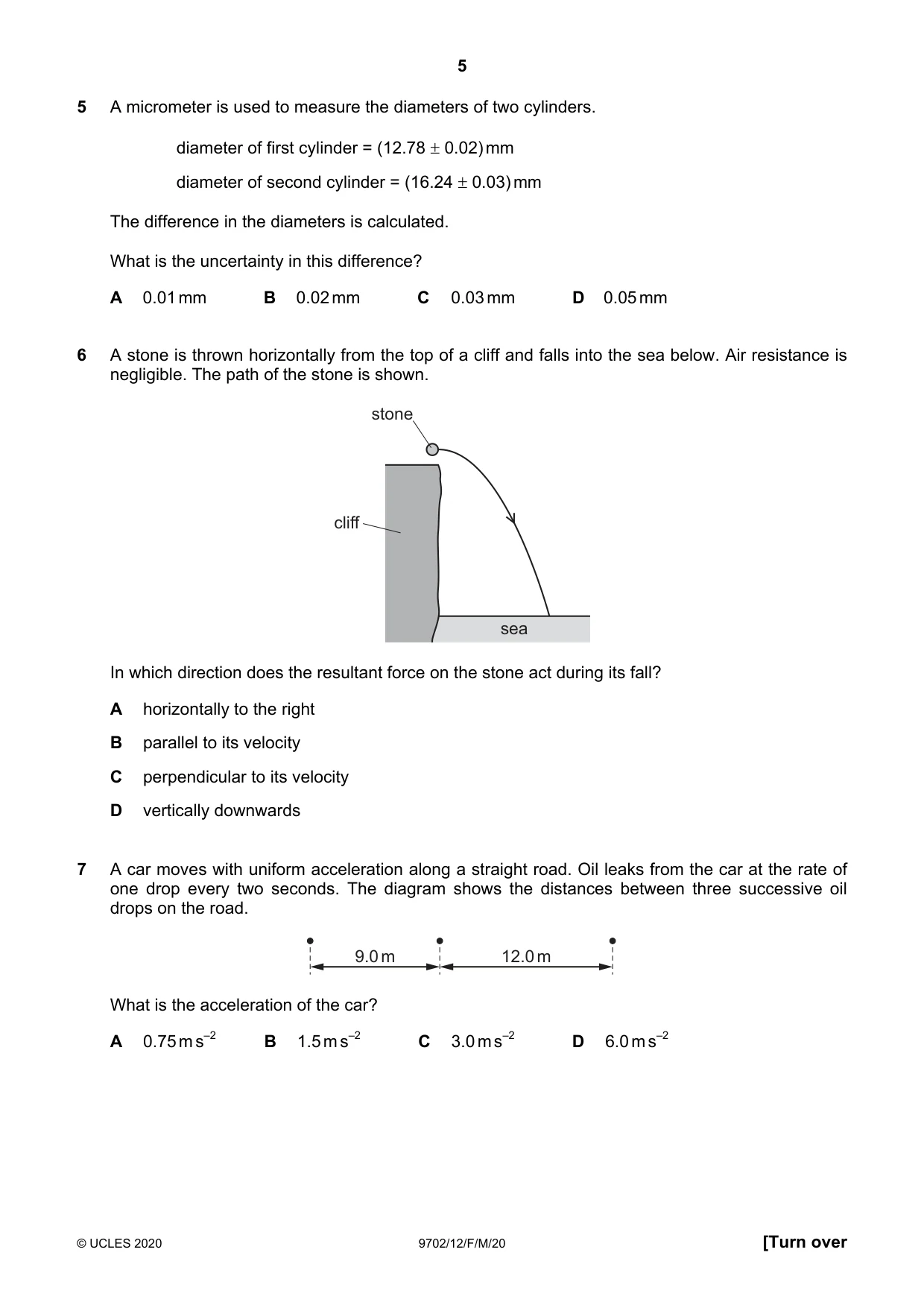
5 A micrometer is used to measure the diameters of two cylinders. diameter of first cylinder = (12.78 ± 0.02) mm diameter of second cylinder = (16.24 ± 0.03) mm The difference in the diameters is calculated. What is the uncertainty in this difference? A 0.01 mm B 0.02 mm C 0.03 mm D 0.05 mm
Mark scheme: D
Q6 · A stone is thrown horizontally from the top of a cliff and falls into the sea below
6 A stone is thrown horizontally from the top of a cliff and falls into the sea below. Air resistance is negligible. The path of the stone is shown. stone cliff sea In which direction does the resultant force on the stone act during its fall? A horizontally to the right B parallel to its velocity C perpendicular to its velocity D vertically downwards
Mark scheme: D
Q7 · A car moves with uniform acceleration along a straight road
7 A car moves with uniform acceleration along a straight road. Oil leaks from the car at the rate of one drop every two seconds. The diagram shows the distances between three successive oil drops on the road. 9.0 m 12.0 m What is the acceleration of the car? A 0.75 m s–2 B 1.5 m s–2 C 3.0 m s–2 D 6.0 m s–2
Mark scheme: A
Q8 · A person of mass 60 kg stands on accurate bathroom scales, placed on the floor of an…
8 A person of mass 60 kg stands on accurate bathroom scales, placed on the floor of an elevator (lift) which operates in a tall building. At a certain instant the bathroom scales read 58 kg. Which row could give the person’s direction of movement and type of motion? direction motion A downwards constant speed B downwards slowing down C upwards constant speed D upwards slowing down
Mark scheme: D
Q9 · The diagram shows graphs of various quantities plotted against time for an object dropped…
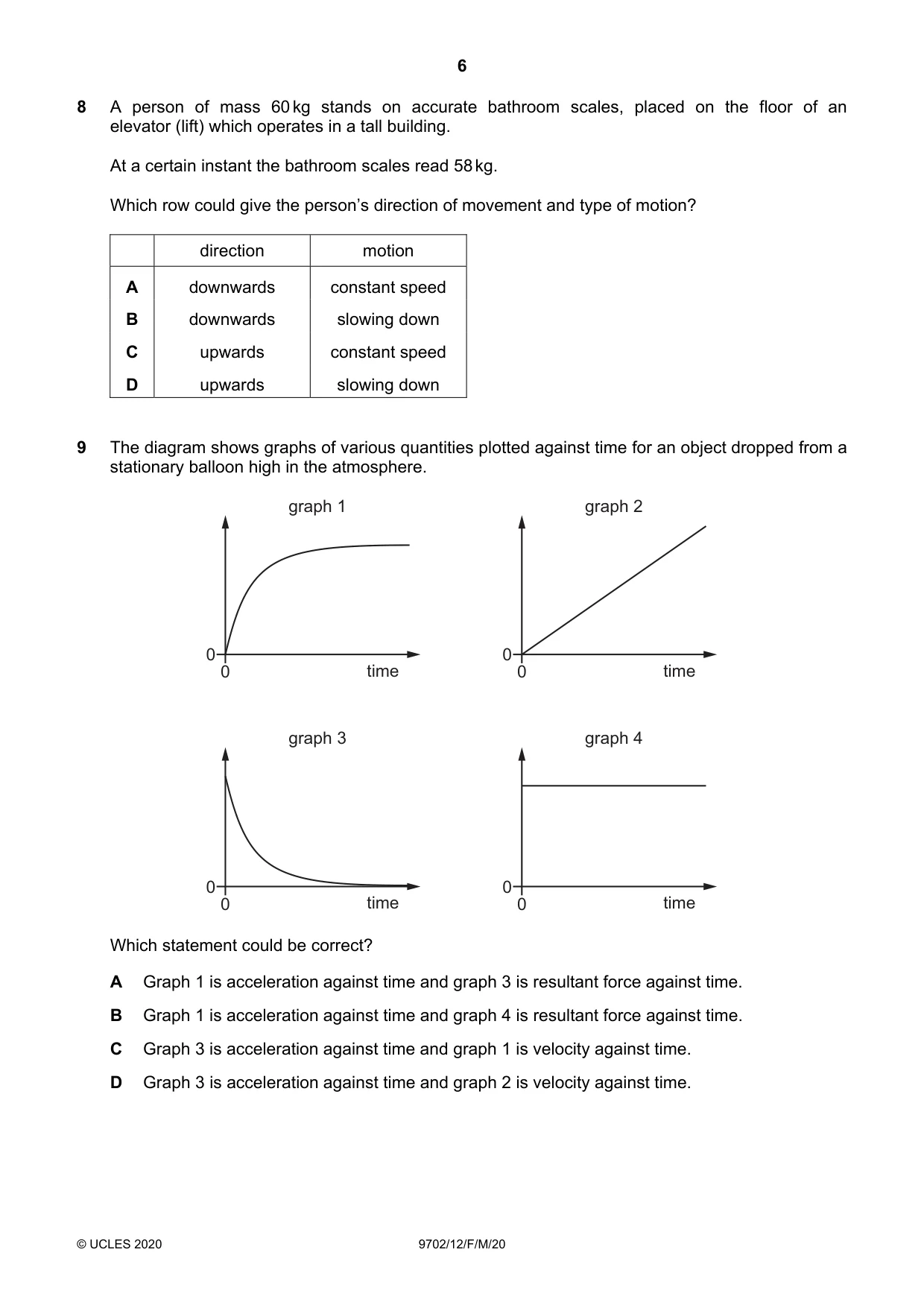
9 The diagram shows graphs of various quantities plotted against time for an object dropped from a stationary balloon high in the atmosphere. graph 1 graph 2 0 0 0 time 0 time graph 3 graph 4 0 0 0 time 0 time Which statement could be correct? A Graph 1 is acceleration against time and graph 3 is resultant force against time. B Graph 1 is acceleration against time and graph 4 is resultant force against time. C Graph 3 is acceleration against time and graph 1 is velocity against time. D Graph 3 is acceleration against time and graph 2 is velocity against time.
Mark scheme: C
Q10 · The diagram shows a particle P, travelling at speed v, about to collide with a stationary…
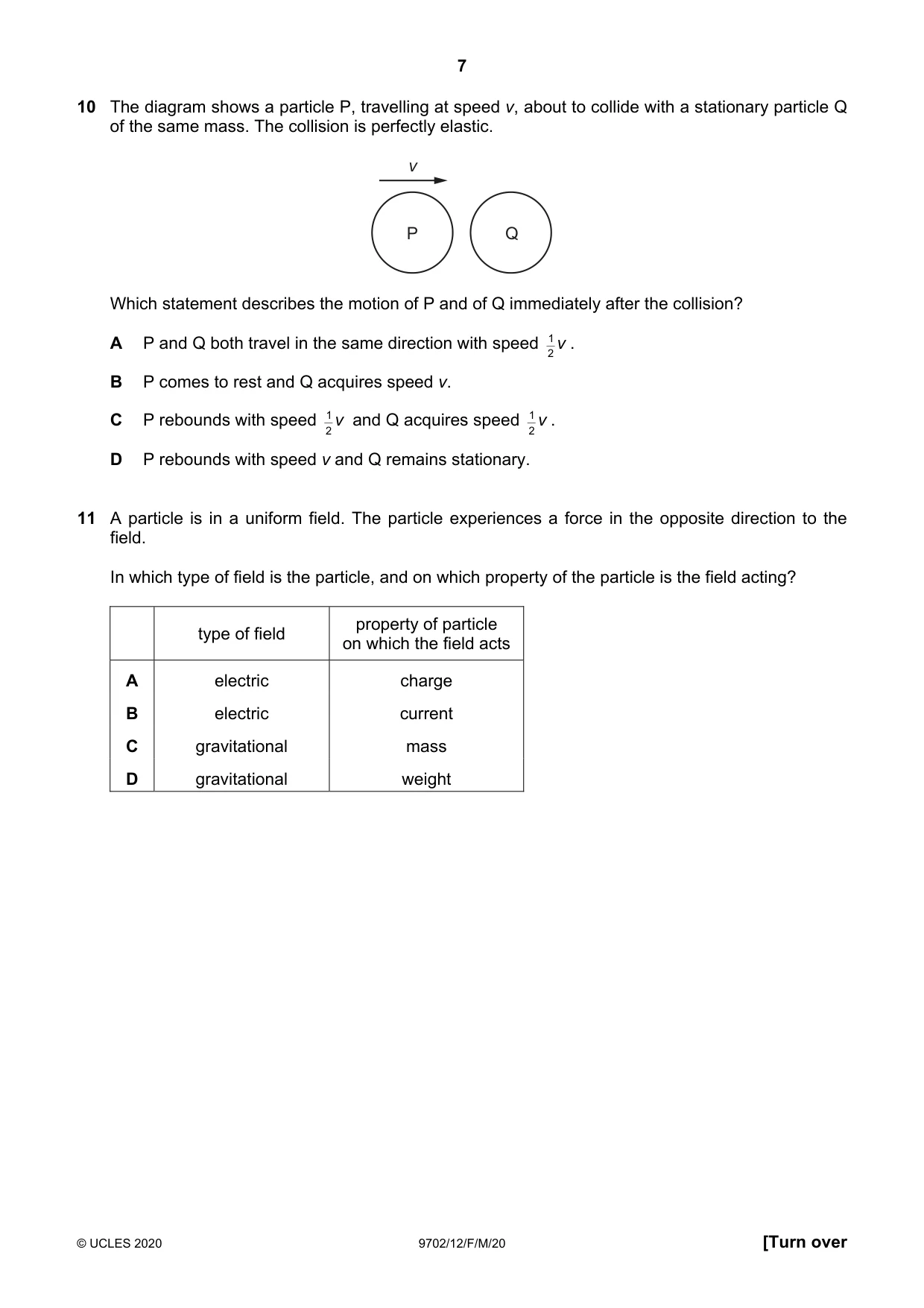
10 The diagram shows a particle P, travelling at speed v, about to collide with a stationary particle Q of the same mass. The collision is perfectly elastic. v P Q Which statement describes the motion of P and of Q immediately after the collision? A P and Q both travel in the same direction with speed 1 2 v . B P comes to rest and Q acquires speed v. C P rebounds with speed 1 2 v and Q acquires speed 1 2 v . D P rebounds with speed v and Q remains stationary.
Mark scheme: B
Q11 · A particle is in a uniform field
11 A particle is in a uniform field. The particle experiences a force in the opposite direction to the field. In which type of field is the particle, and on which property of the particle is the field acting? property of particle type of field on which the field acts A electric charge B electric current C gravitational mass D gravitational weight
Mark scheme: A
Q12 · A uniform rod of weight 20 N and length 2.0 m is acted upon by two vertical forces, as…
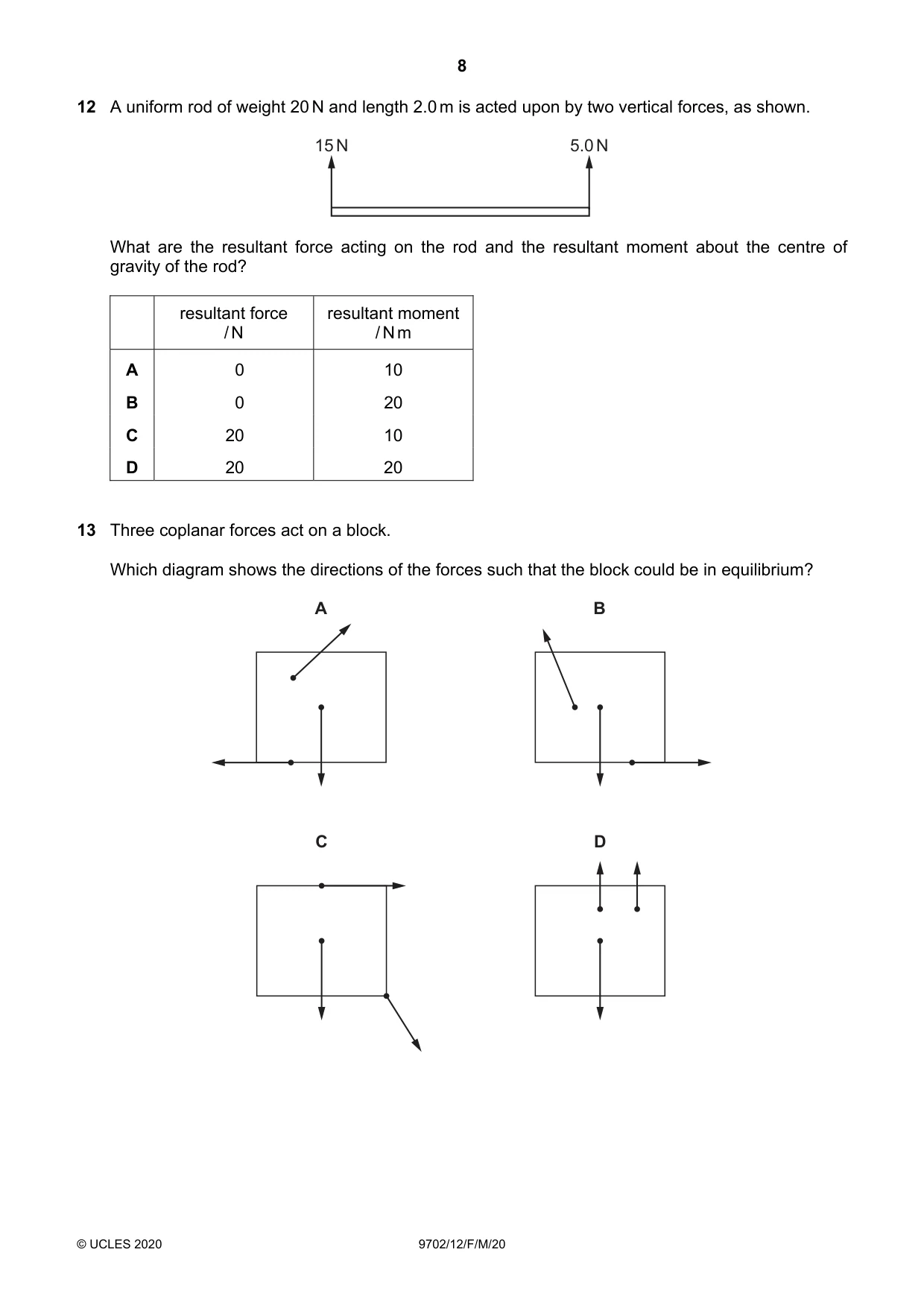
12 A uniform rod of weight 20 N and length 2.0 m is acted upon by two vertical forces, as shown. 15 N 5.0 N What are the resultant force acting on the rod and the resultant moment about the centre of gravity of the rod? resultant force resultant moment / N / N m A 0 10 B 0 20 C 20 10 D 20 20
Mark scheme: A
Q13 · Three coplanar forces act on a block
13 Three coplanar forces act on a block. Which diagram shows the directions of the forces such that the block could be in equilibrium? A B C D
Mark scheme: B
Q14 · A cylinder contains a volume of 0.012 m3 of gas at a pressure of 1.0 × 10⁵ Pa
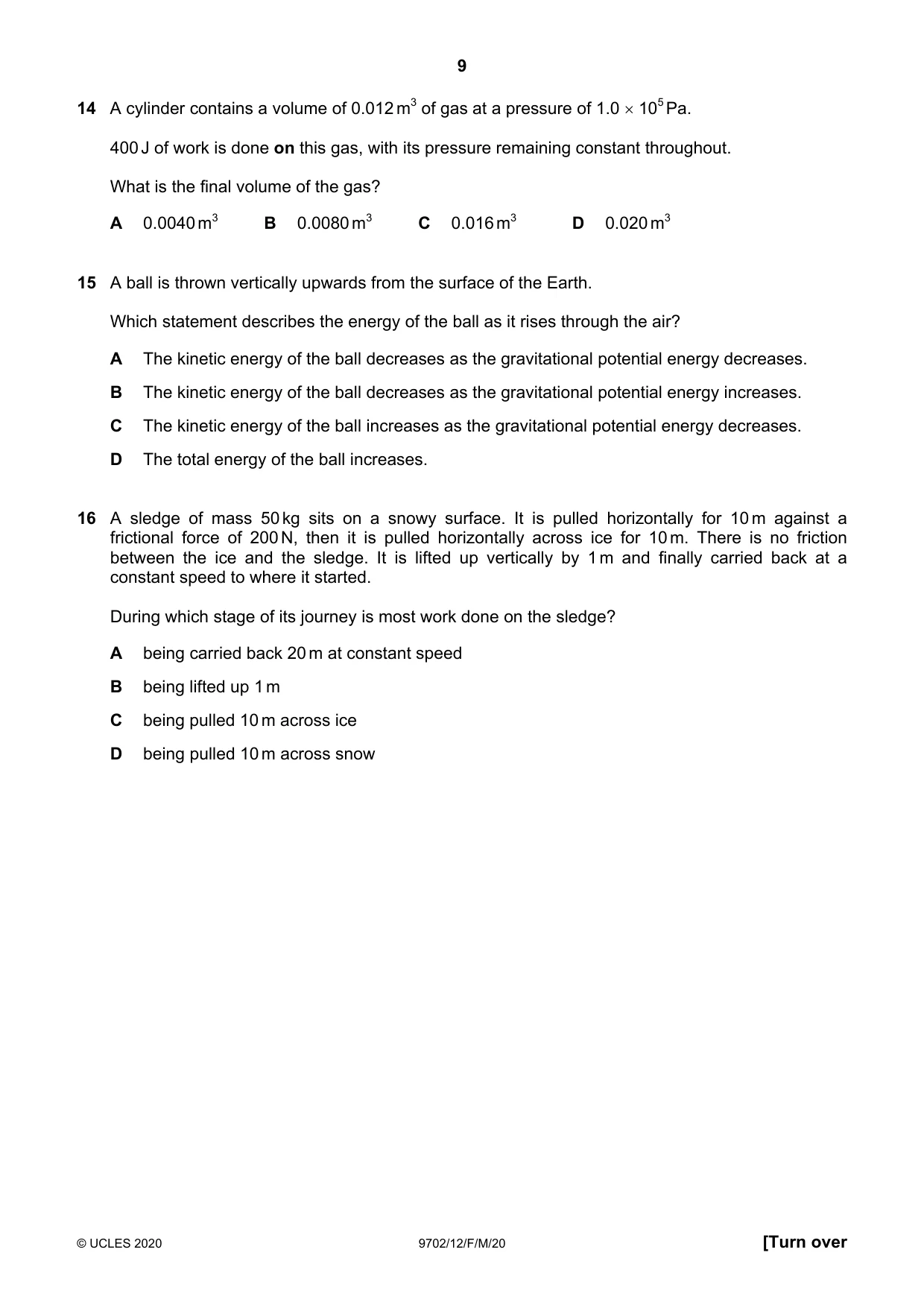
14 A cylinder contains a volume of 0.012 m3 of gas at a pressure of 1.0 × 10⁵ Pa. 400 J of work is done on this gas, with its pressure remaining constant throughout. What is the final volume of the gas? A 0.0040 m3 B 0.0080 m3 C 0.016 m3 D 0.020 m3
Mark scheme: B
Q15 · A ball is thrown vertically upwards from the surface of the Earth
15 A ball is thrown vertically upwards from the surface of the Earth. Which statement describes the energy of the ball as it rises through the air? A The kinetic energy of the ball decreases as the gravitational potential energy decreases. B The kinetic energy of the ball decreases as the gravitational potential energy increases. C The kinetic energy of the ball increases as the gravitational potential energy decreases. D The total energy of the ball increases.
Mark scheme: B
Q16 · A sledge of mass 50 kg sits on a snowy surface
16 A sledge of mass 50 kg sits on a snowy surface. It is pulled horizontally for 10 m against a frictional force of 200 N, then it is pulled horizontally across ice for 10 m. There is no friction between the ice and the sledge. It is lifted up vertically by 1 m and finally carried back at a constant speed to where it started. During which stage of its journey is most work done on the sledge? A being carried back 20 m at constant speed B being lifted up 1 m C being pulled 10 m across ice D being pulled 10 m across snow
Mark scheme: D
Q17 · An object is moved in a vertical plane from X to Y, and then from Y to Z, as shown in the…
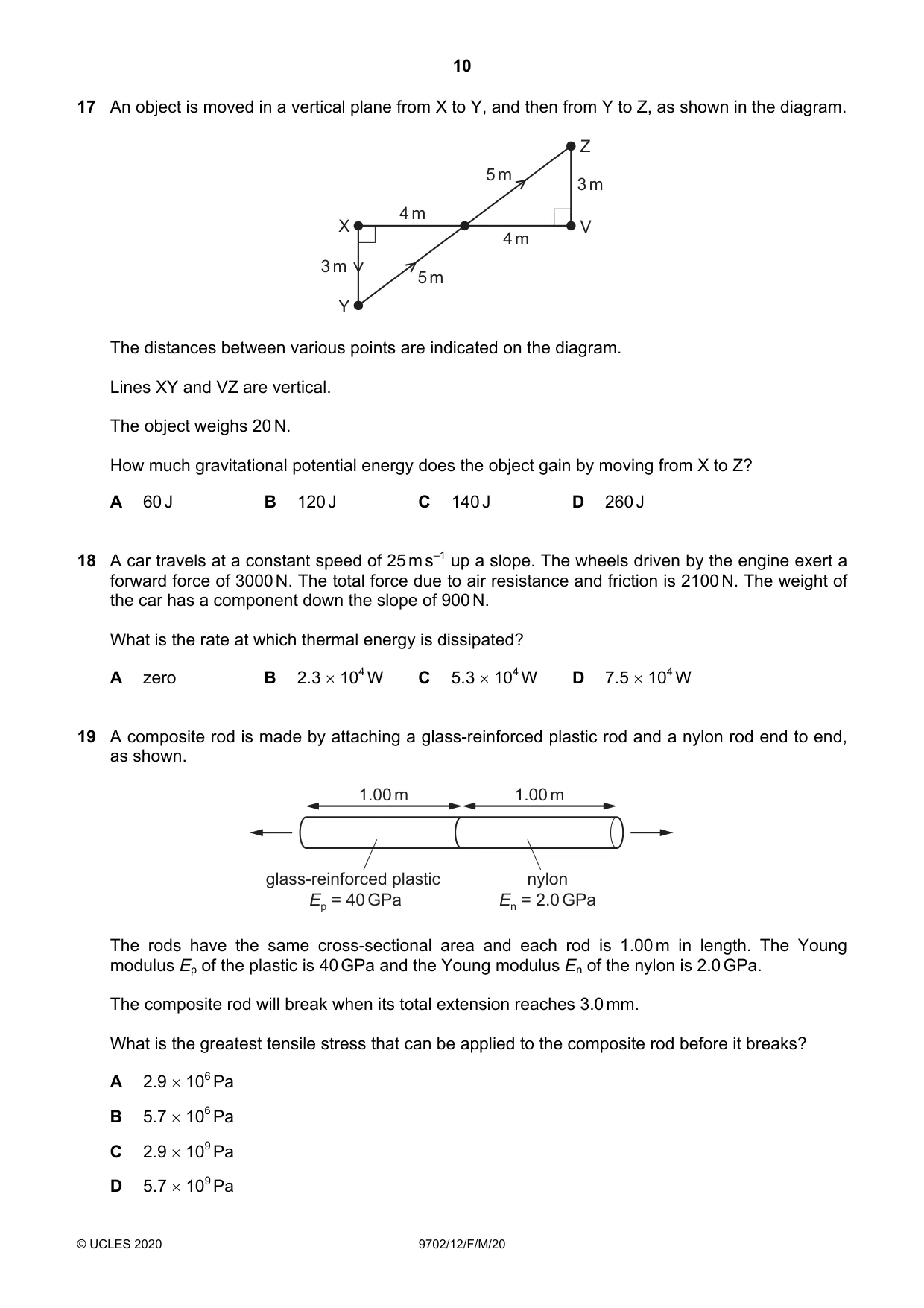
17 An object is moved in a vertical plane from X to Y, and then from Y to Z, as shown in the diagram. Z 5 m 3 m 4 m X V 4 m 3 m 5 m Y The distances between various points are indicated on the diagram. Lines XY and VZ are vertical. The object weighs 20 N. How much gravitational potential energy does the object gain by moving from X to Z? A 60 J B 120 J C 140 J D 260 J
Mark scheme: A
More questions on Gravitational potential energy and kinetic energy
Q18 · A car travels at a constant speed of 25 m s–1 up a slope
18 A car travels at a constant speed of 25 m s–1 up a slope. The wheels driven by the engine exert a forward force of 3000 N. The total force due to air resistance and friction is 2100 N. The weight of the car has a component down the slope of 900 N. What is the rate at which thermal energy is dissipated? A zero B 2.3 × 10⁴ W C 5.3 × 10⁴ W D 7.5 × 10⁴ W
Mark scheme: C
Q19 · A composite rod is made by attaching a glass-reinforced plastic rod and a nylon rod end…
19 A composite rod is made by attaching a glass-reinforced plastic rod and a nylon rod end to end, as shown. 1.00 m 1.00 m glass-reinforced plastic nylon Ep = 40 GPa En = 2.0 GPa The rods have the same cross-sectional area and each rod is 1.00 m in length. The Young modulus Ep of the plastic is 40 GPa and the Young modulus En of the nylon is 2.0 GPa. The composite rod will break when its total extension reaches 3.0 mm. What is the greatest tensile stress that can be applied to the composite rod before it breaks? A 2.9 × 10⁶ Pa B 5.7 × 10⁶ Pa C 2.9 × 10⁹ Pa D 5.7 × 10⁹ Pa
Mark scheme: B
Q20 · The graph shows the non-linear force–extension curve for a wire made from a new composite…
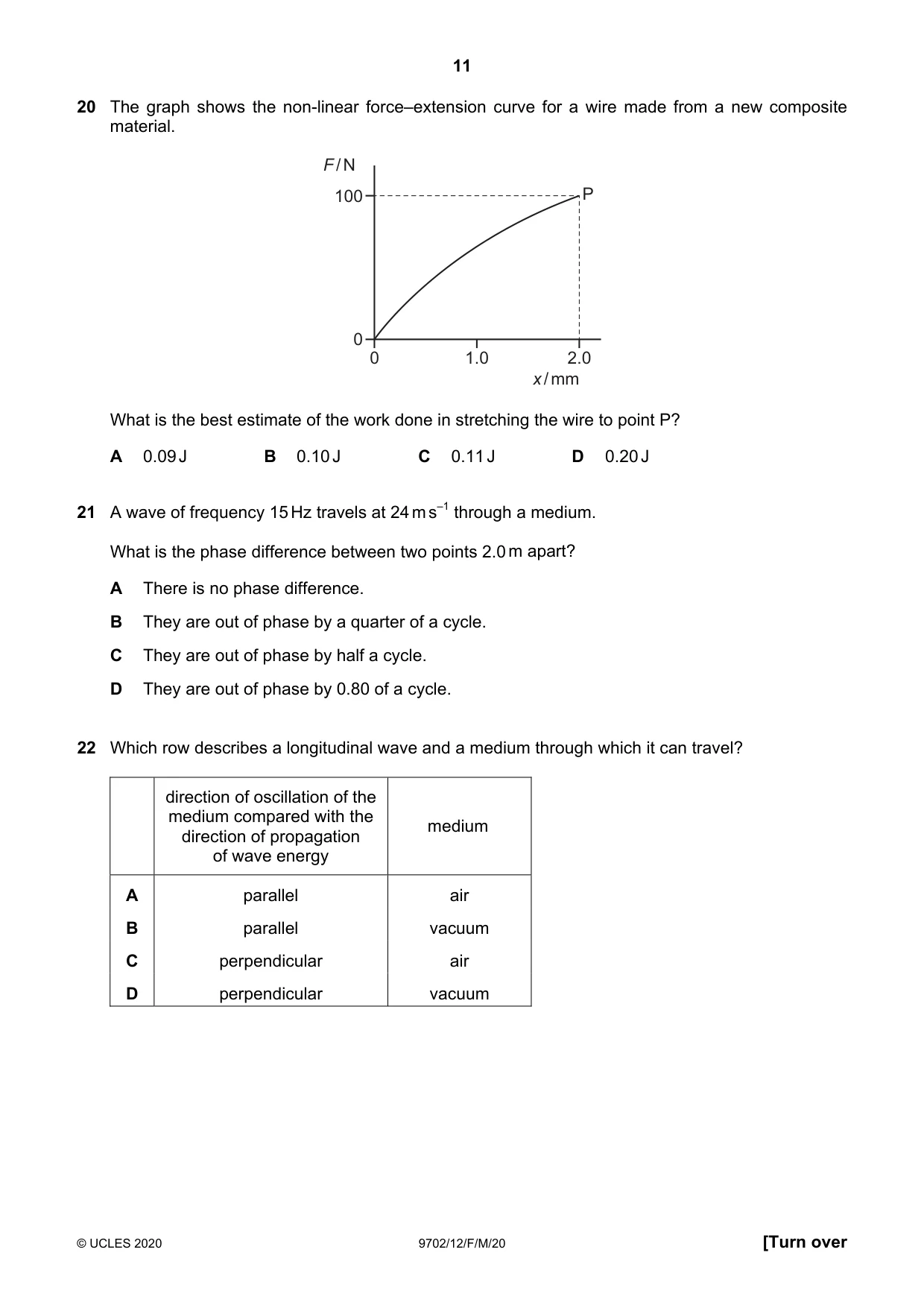
20 The graph shows the non-linear force–extension curve for a wire made from a new composite material. F / N 100 P 0 0 1.0 2.0 x / mm What is the best estimate of the work done in stretching the wire to point P? A 0.09 J B 0.10 J C 0.11 J D 0.20 J
Mark scheme: C
Q21 · A wave of frequency 15 Hz travels at 24 m s–1 through a medium
21 A wave of frequency 15 Hz travels at 24 m s–1 through a medium. What is the phase difference between two points 2.0 m apart? A There is no phase difference. B They are out of phase by a quarter of a cycle. C They are out of phase by half a cycle. D They are out of phase by 0.80 of a cycle.
Mark scheme: B
Q22 · Which row describes a longitudinal wave and a medium through which it can travel?
22 Which row describes a longitudinal wave and a medium through which it can travel? direction of oscillation of the medium compared with the medium direction of propagation of wave energy A parallel air B parallel vacuum C perpendicular air D perpendicular vacuum
Mark scheme: A
Q23 · A sound wave is displayed on the screen of a cathode-ray oscilloscope, as shown
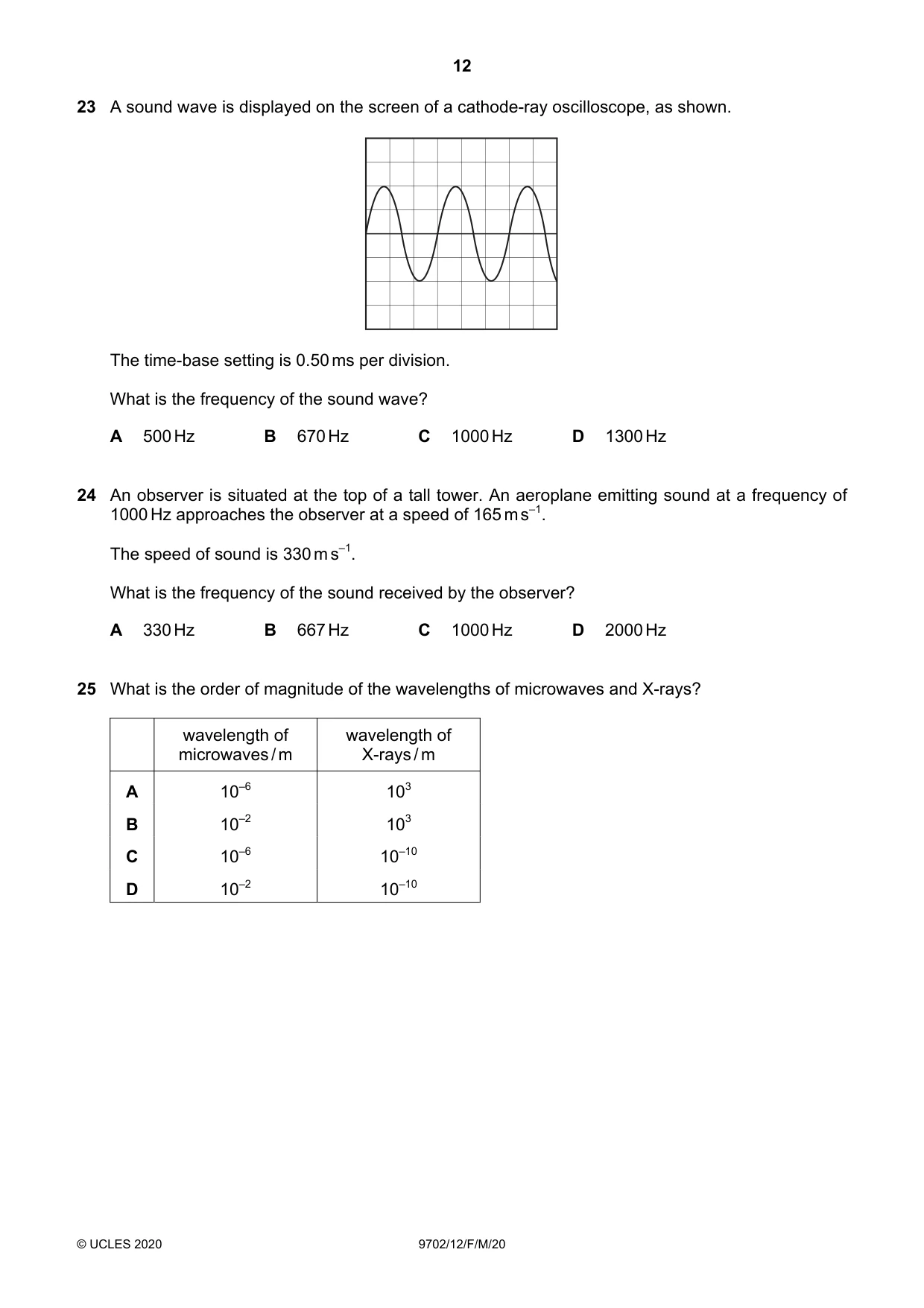
23 A sound wave is displayed on the screen of a cathode-ray oscilloscope, as shown. The time-base setting is 0.50 ms per division. What is the frequency of the sound wave? A 500 Hz B 670 Hz C 1000 Hz D 1300 Hz
Mark scheme: B
Q24 · An observer is situated at the top of a tall tower
24 An observer is situated at the top of a tall tower. An aeroplane emitting sound at a frequency of 1000 Hz approaches the observer at a speed of 165 m s–1. The speed of sound is 330 m s–1. What is the frequency of the sound received by the observer? A 330 Hz B 667 Hz C 1000 Hz D 2000 Hz
Mark scheme: D
Q25 · What is the order of magnitude of the wavelengths of microwaves and X-rays?
25 What is the order of magnitude of the wavelengths of microwaves and X-rays? wavelength of wavelength of microwaves / m X-rays / m A 10–6 103 B 10–2 103 C 10–6 10–10 D 10–2 10–10
Mark scheme: D
Q26 · A musical instrument is made using a long tube with a mouthpiece at one end
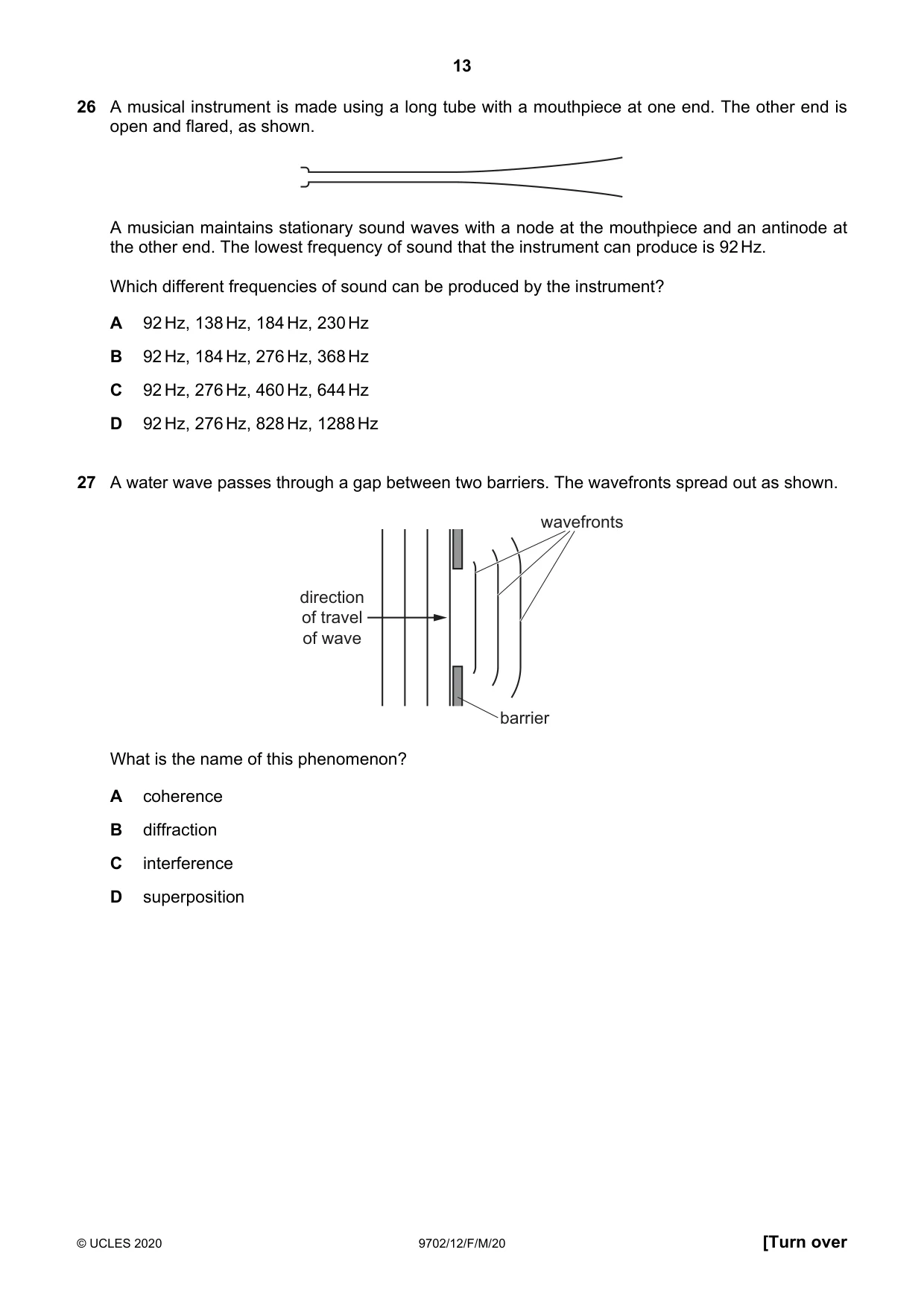
26 A musical instrument is made using a long tube with a mouthpiece at one end. The other end is open and flared, as shown. A musician maintains stationary sound waves with a node at the mouthpiece and an antinode at the other end. The lowest frequency of sound that the instrument can produce is 92 Hz. Which different frequencies of sound can be produced by the instrument? A 92 Hz, 138 Hz, 184 Hz, 230 Hz B 92 Hz, 184 Hz, 276 Hz, 368 Hz C 92 Hz, 276 Hz, 460 Hz, 644 Hz D 92 Hz, 276 Hz, 828 Hz, 1288 Hz
Mark scheme: C
Q27 · A water wave passes through a gap between two barriers
27 A water wave passes through a gap between two barriers. The wavefronts spread out as shown. wavefronts direction of travel of wave barrier What is the name of this phenomenon? A coherence B diffraction C interference D superposition
Mark scheme: B
Q28 · The table shows four possible combinations of values for the laser wavelength, slit…
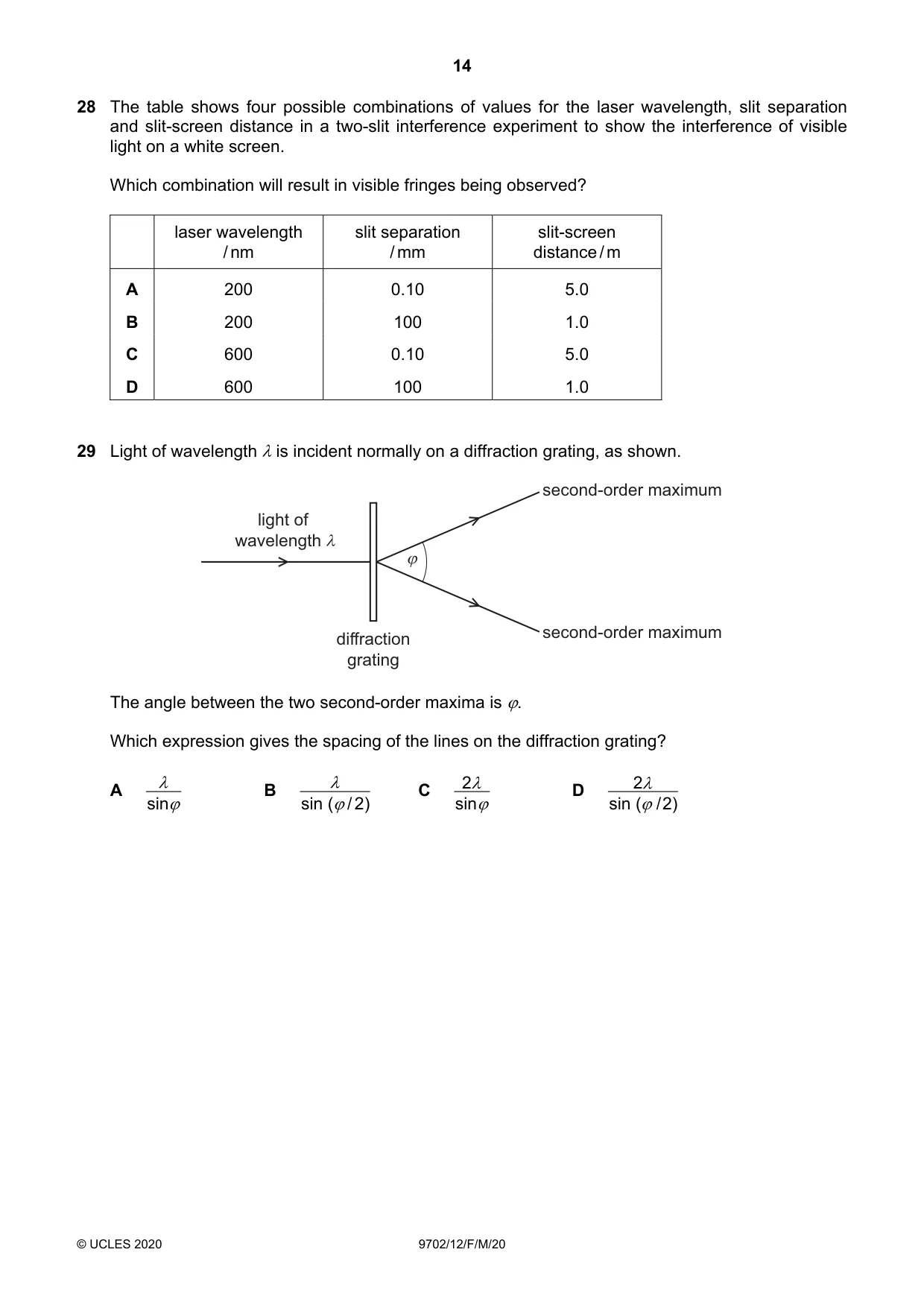
28 The table shows four possible combinations of values for the laser wavelength, slit separation and slit-screen distance in a two-slit interference experiment to show the interference of visible light on a white screen. Which combination will result in visible fringes being observed? laser wavelength slit separation slit-screen / nm / mm distance / m A 200 0.10 5.0 B 200 100 1.0 C 600 0.10 5.0 D 600 100 1.0
Mark scheme: C
Q29 · Light of wavelength λ is incident normally on a diffraction grating, as shown
29 Light of wavelength λ is incident normally on a diffraction grating, as shown. second-order maximum light of wavelength λ ϕ diffraction second-order maximum grating The angle between the two second-order maxima is ϕ. Which expression gives the spacing of the lines on the diffraction grating? λ λ 2 λ 2 λ A ϕ B C ϕ D sin sin ( ϕ /2 ) sin sin ϕ ( / 2)
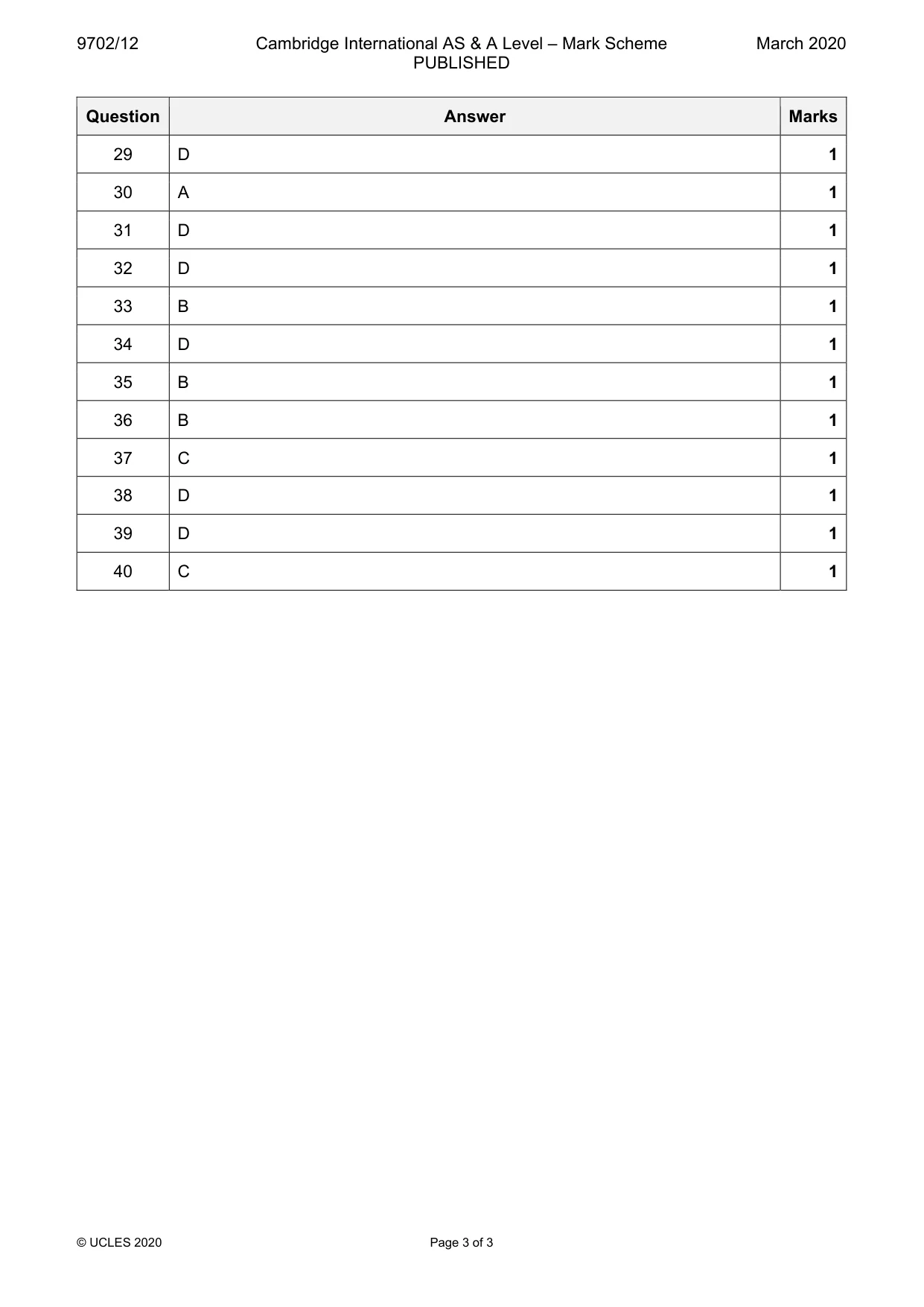
Mark scheme: D
Q30 · Two positive charges and one negative charge, all of equal magnitude, are set at the…
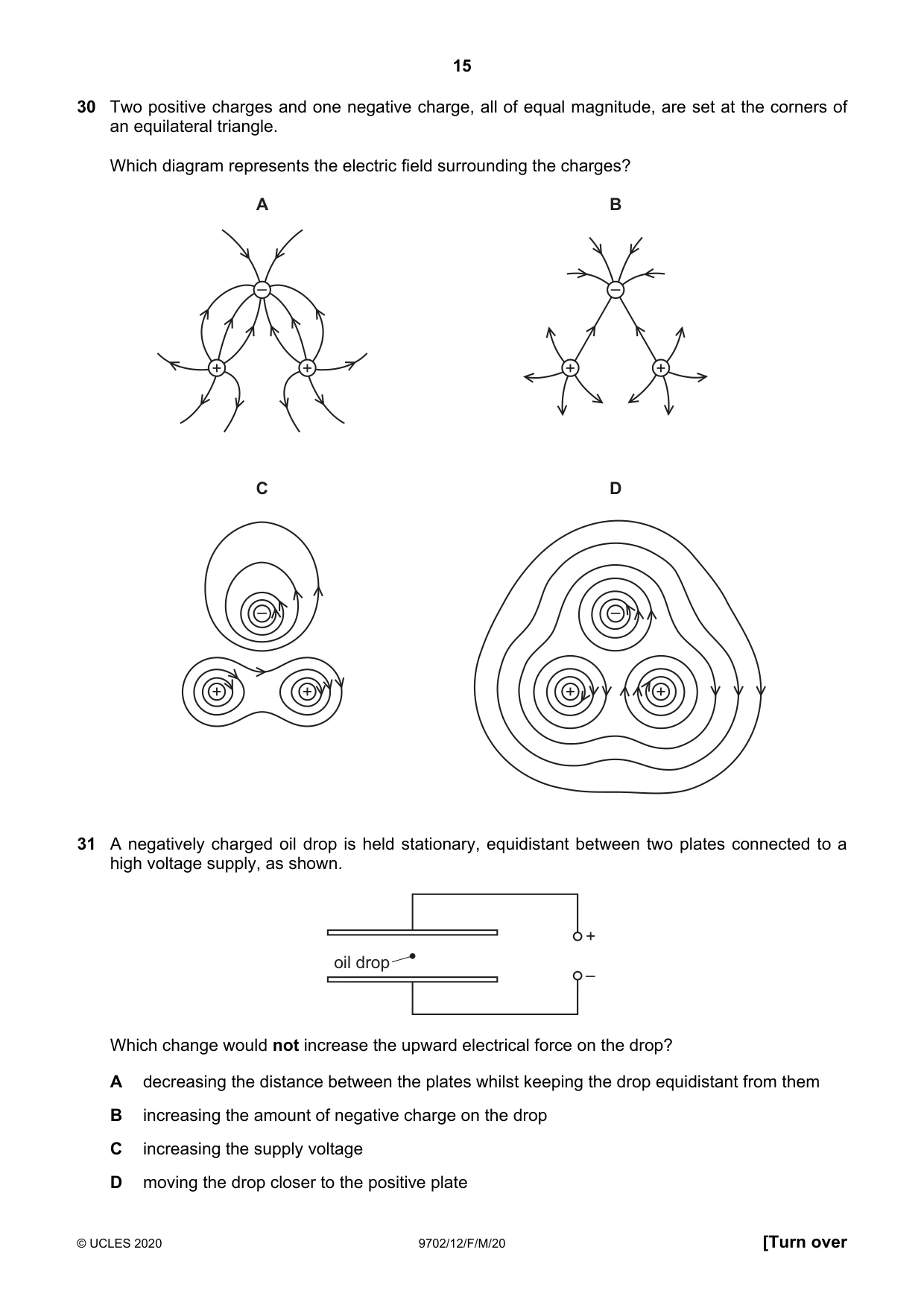
30 Two positive charges and one negative charge, all of equal magnitude, are set at the corners of an equilateral triangle. Which diagram represents the electric field surrounding the charges? A B – – + + + + C D – – + + + +
Mark scheme: A
Q31 · A negatively charged oil drop is held stationary, equidistant between two plates…
31 A negatively charged oil drop is held stationary, equidistant between two plates connected to a high voltage supply, as shown. + oil drop – Which change would not increase the upward electrical force on the drop? A decreasing the distance between the plates whilst keeping the drop equidistant from them B increasing the amount of negative charge on the drop C increasing the supply voltage D moving the drop closer to the positive plate
Mark scheme: D
Q32 · Electrons move in a vacuum from one metal plate to another metal plate
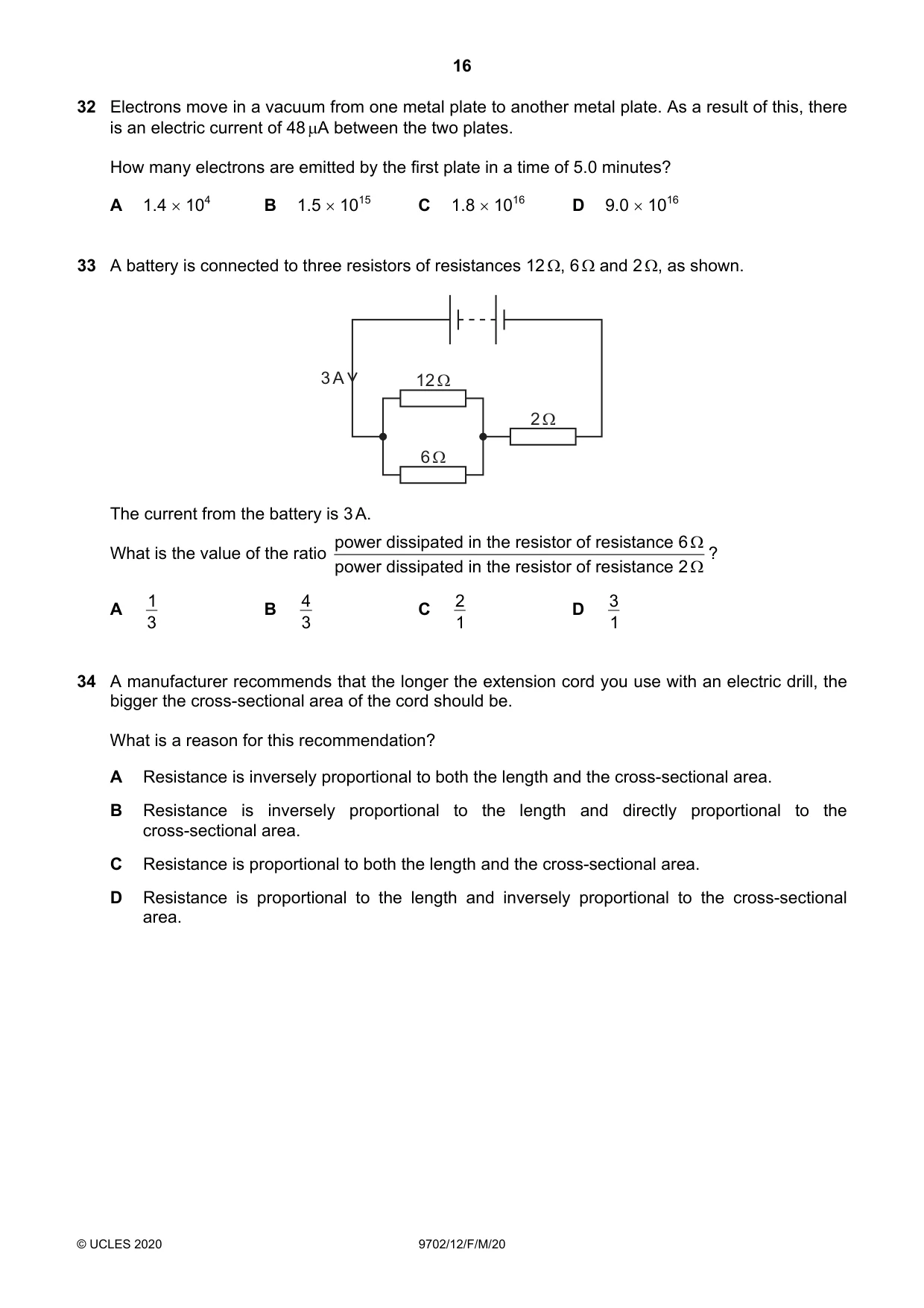
32 Electrons move in a vacuum from one metal plate to another metal plate. As a result of this, there is an electric current of 48 µA between the two plates. How many electrons are emitted by the first plate in a time of 5.0 minutes? A 1.4 × 10⁴ B 1.5 × 10¹⁵ C 1.8 × 10¹⁶ D 9.0 × 10¹⁶
Mark scheme: D
Q33 · A battery is connected to three resistors of resistances 12 Ω, 6 Ω and 2 Ω, as shown
33 A battery is connected to three resistors of resistances 12 Ω, 6 Ω and 2 Ω, as shown. 3 A 12 Ω 2 Ω 6 Ω The current from the battery is 3 A. power dissipated in the resistor of resistance 6 Ω What is the value of the ratio Ω? power dissipated in the resistor of resistance 2 1 4 2 3 A B C D 3 3 1 1
Mark scheme: B
Q34 · A manufacturer recommends that the longer the extension cord you use with an electric…
34 A manufacturer recommends that the longer the extension cord you use with an electric drill, the bigger the cross-sectional area of the cord should be. What is a reason for this recommendation? A Resistance is inversely proportional to both the length and the cross-sectional area. B Resistance is inversely proportional to the length and directly proportional to the cross-sectional area. C Resistance is proportional to both the length and the cross-sectional area. D Resistance is proportional to the length and inversely proportional to the cross-sectional area.
Mark scheme: D
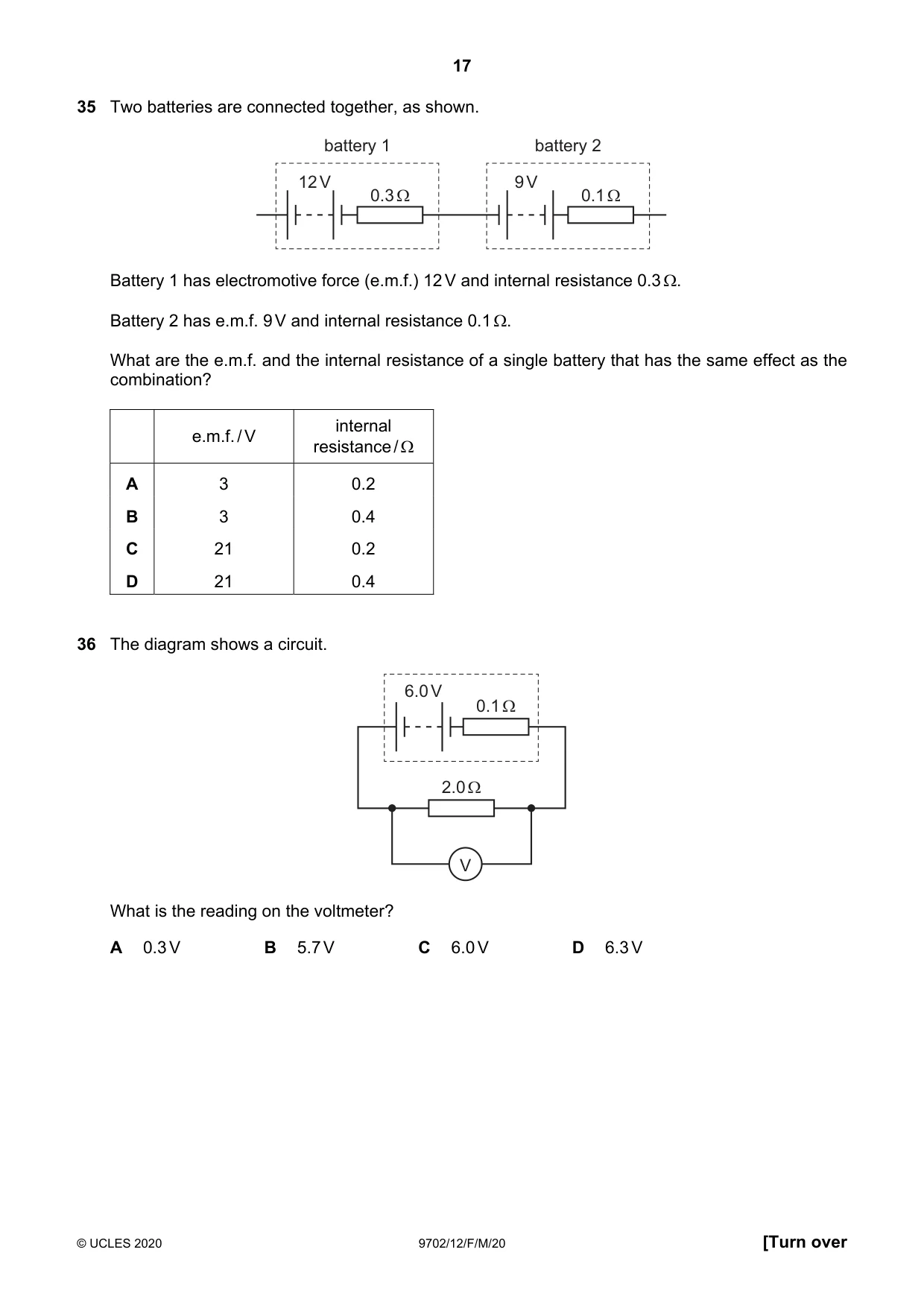
Q35 · Two batteries are connected together, as shown
35 Two batteries are connected together, as shown. battery 1 battery 2 12 V 9 V 0.3 Ω 0.1 Ω Battery 1 has electromotive force (e.m.f.) 12 V and internal resistance 0.3 Ω. Battery 2 has e.m.f. 9 V and internal resistance 0.1 Ω. What are the e.m.f. and the internal resistance of a single battery that has the same effect as the combination? internal e.m.f. / V resistance / Ω A 3 0.2 B 3 0.4 C 21 0.2 D 21 0.4
Mark scheme: B
Q36 · The diagram shows a circuit
36 The diagram shows a circuit. 6.0 V 0.1 Ω 2.0 Ω V What is the reading on the voltmeter? A 0.3 V B 5.7 V C 6.0 V D 6.3 V
Mark scheme: B
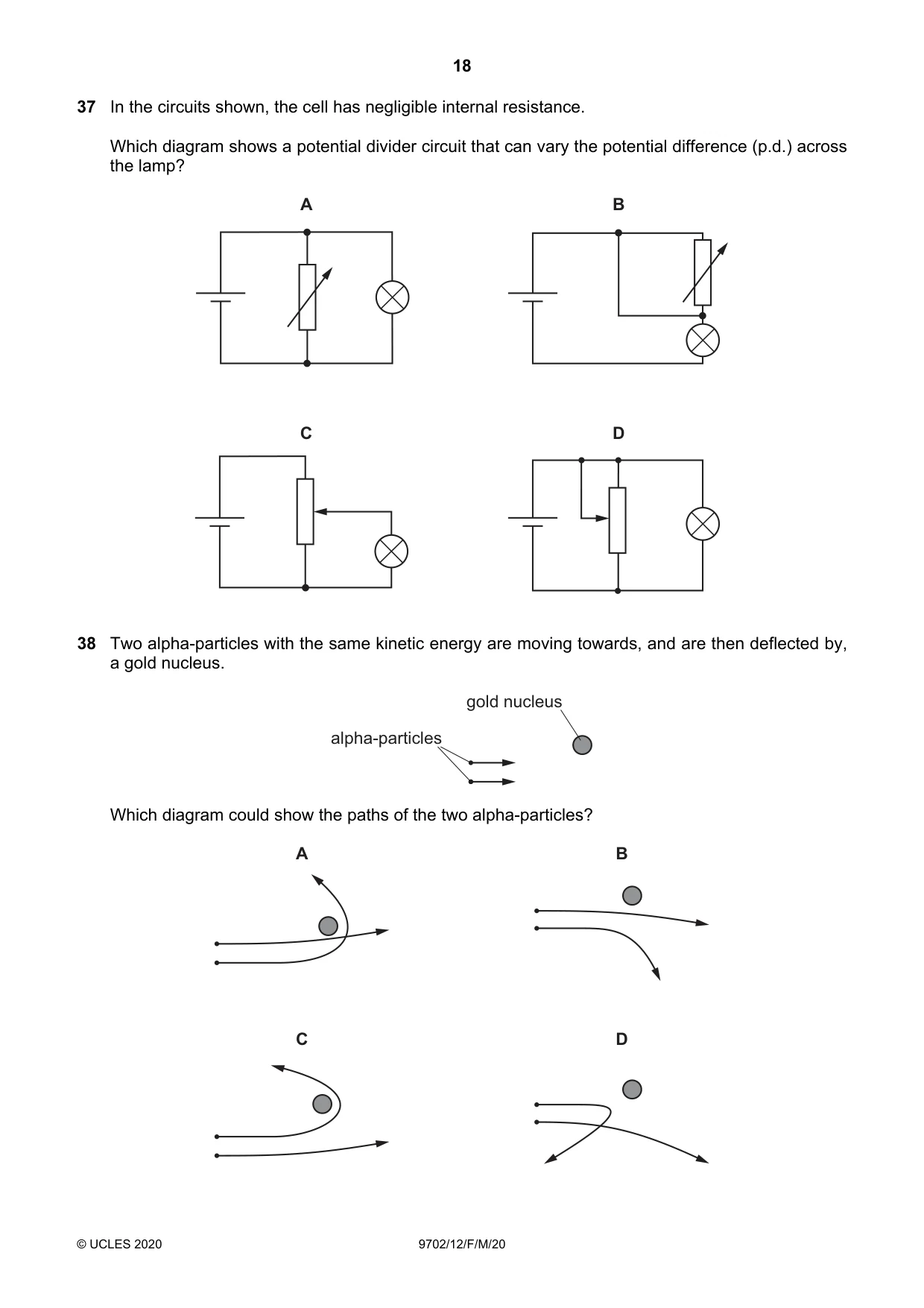
Q37 · In the circuits shown, the cell has negligible internal resistance
37 In the circuits shown, the cell has negligible internal resistance. Which diagram shows a potential divider circuit that can vary the potential difference (p.d.) across the lamp? A B C D
Mark scheme: C
Q38 · Two alpha-particles with the same kinetic energy are moving towards, and are then…
38 Two alpha-particles with the same kinetic energy are moving towards, and are then deflected by, a gold nucleus. gold nucleus alpha-particles Which diagram could show the paths of the two alpha-particles? A B C D
Mark scheme: D
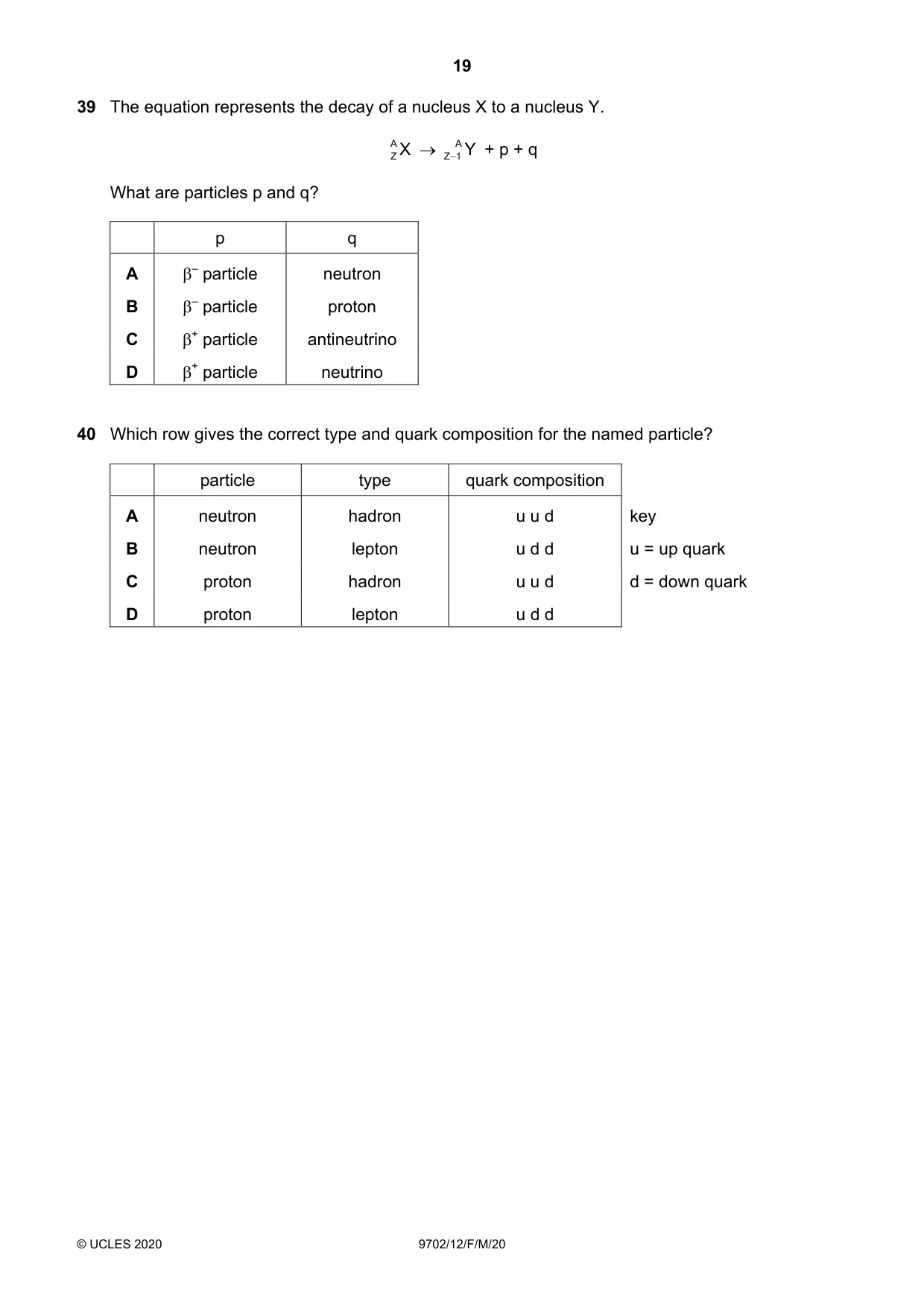
Q39 · The equation represents the decay of a nucleus X to a nucleus Y
39 The equation represents the decay of a nucleus X to a nucleus Y. A ZX → Z 1 Y A + p + q − What are particles p and q? p q A β– particle neutron B β– particle proton C β+ particle antineutrino D β+ particle neutrino
Mark scheme: D
Q40 · Which row gives the correct type and quark composition for the named particle?
40 Which row gives the correct type and quark composition for the named particle? particle type quark composition A neutron hadron u u d key B neutron lepton u d d u = up quark C proton hadron u u d d = down quark D proton lepton u d d
Mark scheme: C
What was in this paper
The subtopics covered by these 40 questions, and how many questions each got. Open one in a new tab to see every Cambridge question on it.
3Momentum and Newton’s laws of motion3Electric fields and field lines2Physical quantities2Progressive waves2Density and pressure1Diffraction1Doppler effect for sound waves1Elastic and plastic behaviour1Electric current1Electric field of a point charge1Electromagnetic spectrum1Equations of motion1Equilibrium of forces1Errors and uncertainties1Fundamental particles1Gravitational potential energy and kinetic energy1Interference1Kirchhoff’s laws1Linear momentum and its conservation1Potential difference and power1Potential dividers1Practical circuits1Radioactive decay1Resistance and resistivity1Scalars and vectors1SI units1Stationary waves1Stress and strain1The diffraction grating1Transverse and longitudinal waves1Turning effects of forces1Uniform electric fields1What you needed in this session
Cambridge’s own grade thresholds for 2020 Feb/March, Paper 1 · Variant 2. A higher threshold means an easier paper — the bar moves with how the cohort did.