Cambridge A Level Physics 9702 — 2022 Oct/Nov Paper 1 · Variant 2
9702/12/O/N/22 · 40 questions · 40 marks · ≈45 min
The question paper and its mark scheme, free to read here and free to download. This is Cambridge’s own paper, exactly as it was sat.
Question paper16 pages
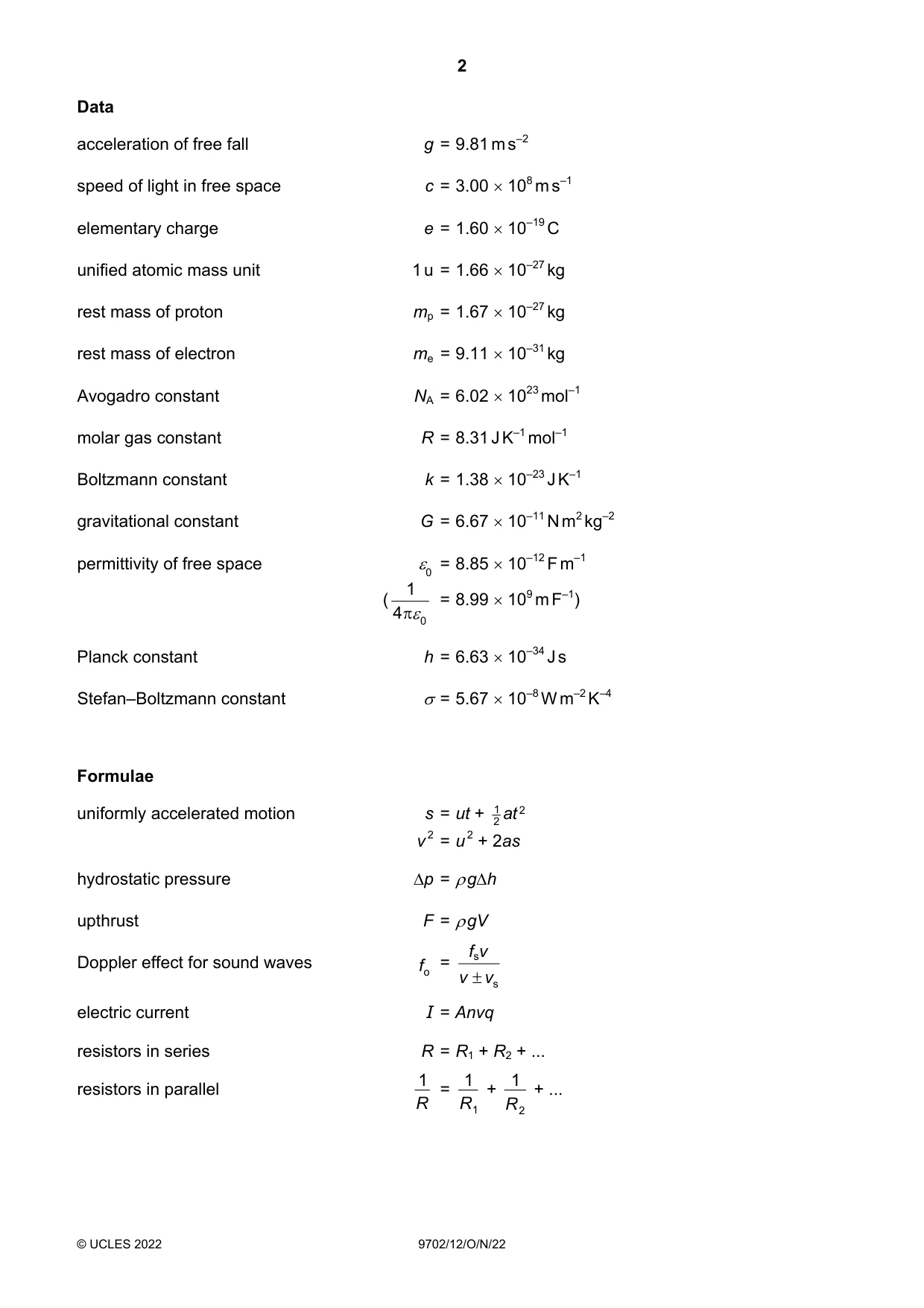
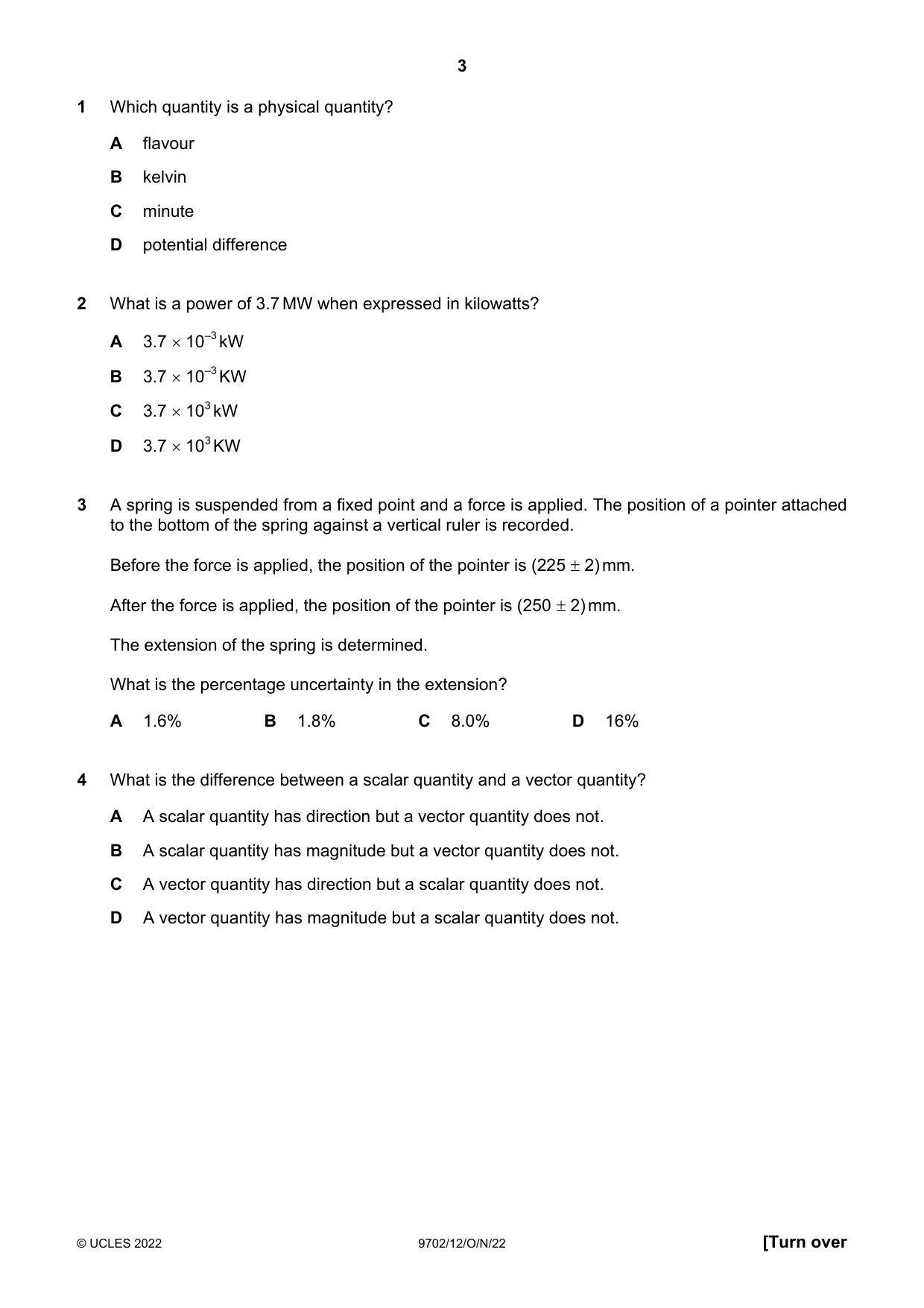
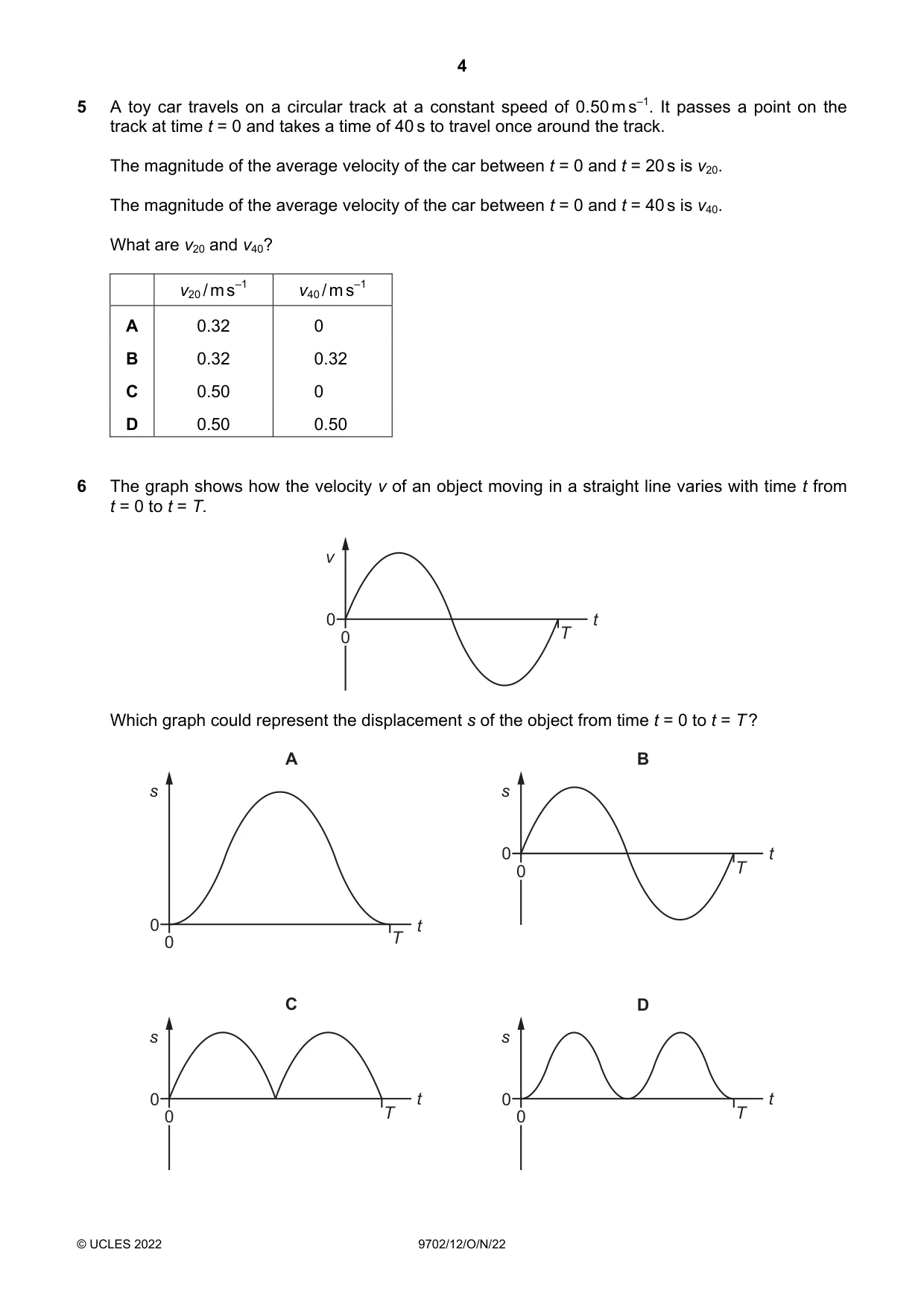
Mark scheme3 pages
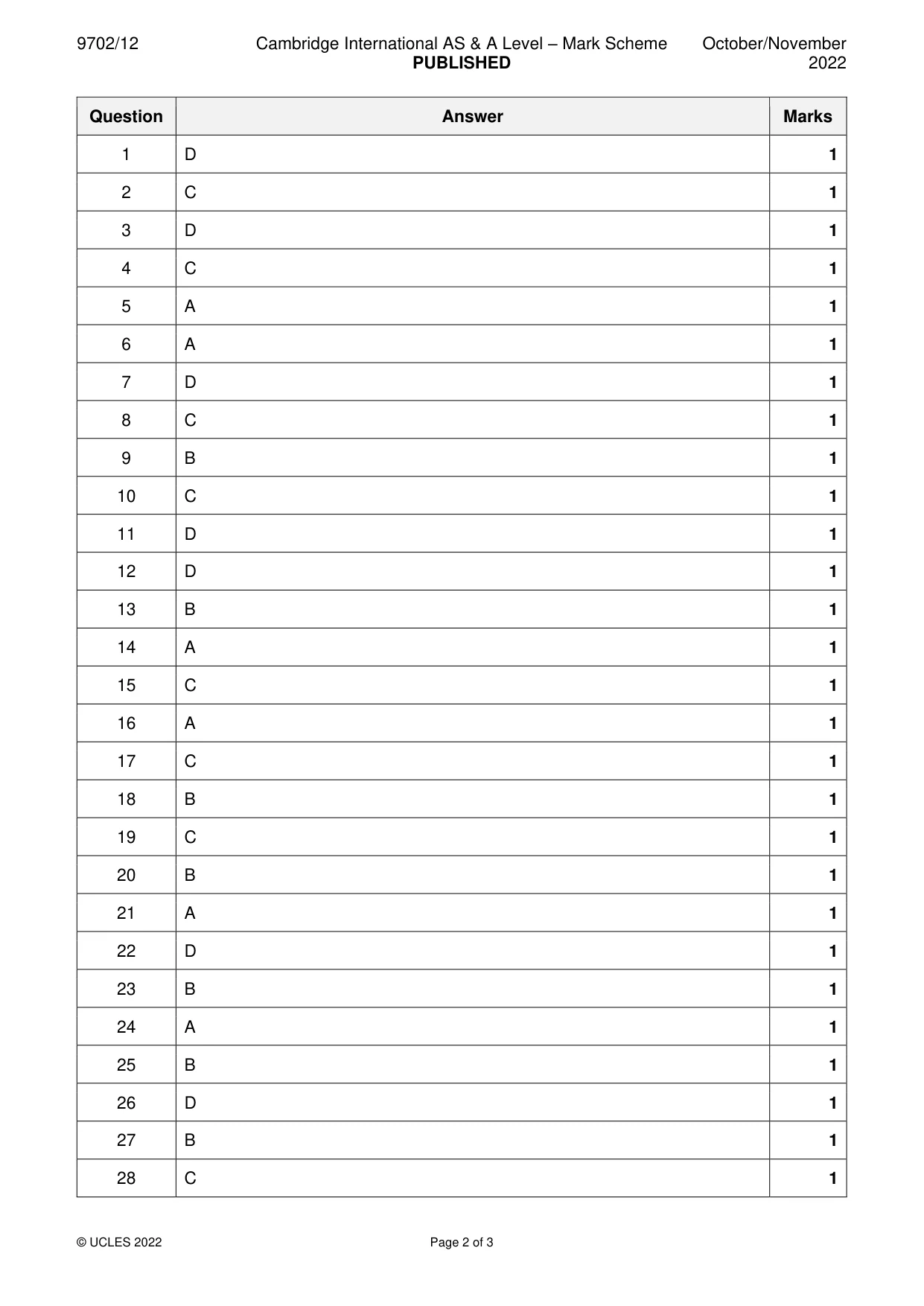
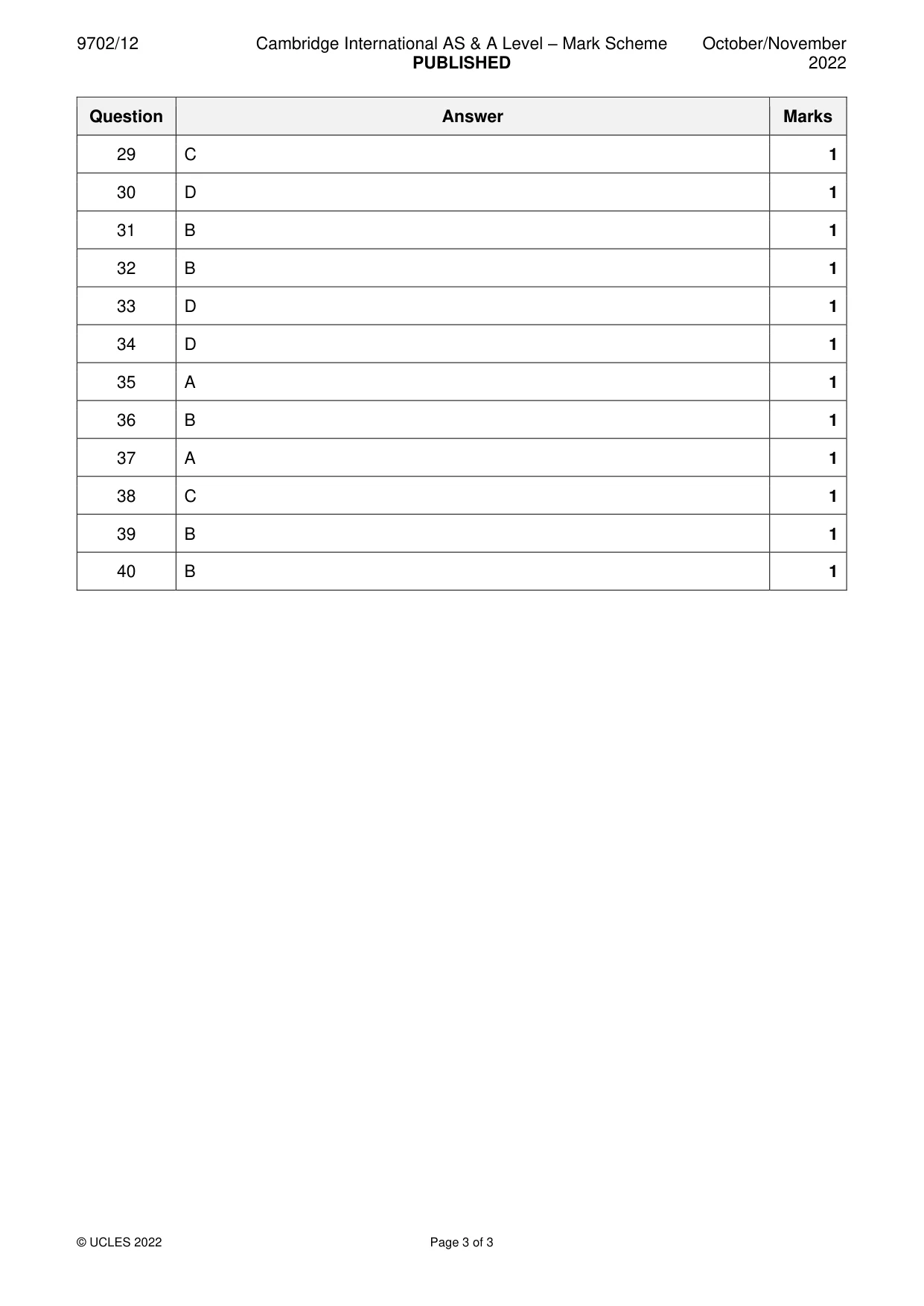
Answers below. Sit the paper first if you are practising.
Questions as text
Q1 · Which quantity is a physical quantity?
1 Which quantity is a physical quantity? A flavour B kelvin C minute D potential difference
Mark scheme: D
Q2 · What is a power of 3.7 MW when expressed in kilowatts?
2 What is a power of 3.7 MW when expressed in kilowatts? A 3.7 10–3 kW B 3.7 10–3 KW C 3.7 103 kW D 3.7 103 KW
Mark scheme: C
Q3 · A spring is suspended from a fixed point and a force is applied
3 A spring is suspended from a fixed point and a force is applied. The position of a pointer attached to the bottom of the spring against a vertical ruler is recorded. Before the force is applied, the position of the pointer is (225 2) mm. After the force is applied, the position of the pointer is (250 2) mm. The extension of the spring is determined. What is the percentage uncertainty in the extension? A 1.6% B 1.8% C 8.0% D 16%
Mark scheme: D
Q4 · What is the difference between a scalar quantity and a vector quantity?
4 What is the difference between a scalar quantity and a vector quantity? A A scalar quantity has direction but a vector quantity does not. B A scalar quantity has magnitude but a vector quantity does not. C A vector quantity has direction but a scalar quantity does not. D A vector quantity has magnitude but a scalar quantity does not.
Mark scheme: C
Q5 · A toy car travels on a circular track at a constant speed of 0.50 m s–1
5 A toy car travels on a circular track at a constant speed of 0.50 m s–1. It passes a point on the track at time t = 0 and takes a time of 40 s to travel once around the track. The magnitude of the average velocity of the car between t = 0 and t = 20 s is v20. The magnitude of the average velocity of the car between t = 0 and t = 40 s is v40. What are v20 and v40? v20 / m s–1 v40 / m s–1 A 0.32 0 B 0.32 0.32 C 0.50 0 D 0.50 0.50
Mark scheme: A
Q6 · The graph shows how the velocity v of an object moving in a straight line varies with…
6 The graph shows how the velocity v of an object moving in a straight line varies with time t from t = 0 to t = T. v 0 t 0 T Which graph could represent the displacement s of the object from time t = 0 to t = T ? A B s s 0 t 0 T 0 t 0 T C D s s 0 t 0 t 0 T 0 T
Mark scheme: A
Q7 · A goods train passes through a station at a steady speed of 10 m s–1 at time t = 0
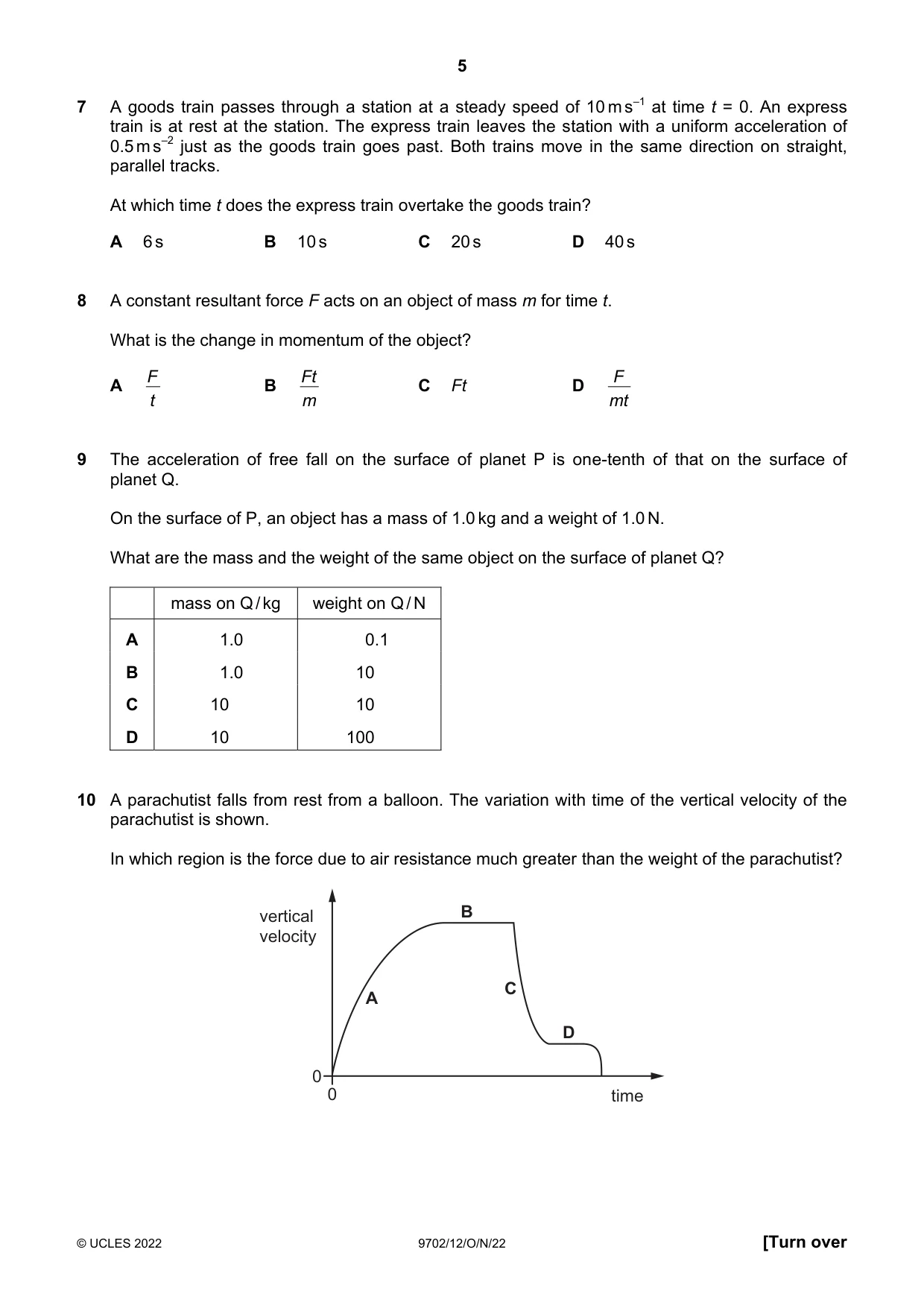
7 A goods train passes through a station at a steady speed of 10 m s–1 at time t = 0. An express train is at rest at the station. The express train leaves the station with a uniform acceleration of 0.5 m s–2 just as the goods train goes past. Both trains move in the same direction on straight, parallel tracks. At which time t does the express train overtake the goods train? A 6 s B 10 s C 20 s D 40 s
Mark scheme: D
Q8 · A constant resultant force F acts on an object of mass m for time t
8 A constant resultant force F acts on an object of mass m for time t. What is the change in momentum of the object? F Ft F A B C Ft D t m mt
Mark scheme: C
Q9 · The acceleration of free fall on the surface of planet P is one-tenth of that on the…
9 The acceleration of free fall on the surface of planet P is one-tenth of that on the surface of planet Q. On the surface of P, an object has a mass of 1.0 kg and a weight of 1.0 N. What are the mass and the weight of the same object on the surface of planet Q? mass on Q / kg weight on Q / N A 1.0 0.1 B 1.0 10 C 10 10 D 10 100
Mark scheme: B
Q10 · A parachutist falls from rest from a balloon
10 A parachutist falls from rest from a balloon. The variation with time of the vertical velocity of the parachutist is shown. In which region is the force due to air resistance much greater than the weight of the parachutist? vertical B velocity C A D 0 0 time
Mark scheme: C
Q11 · Two solid spheres form an isolated system
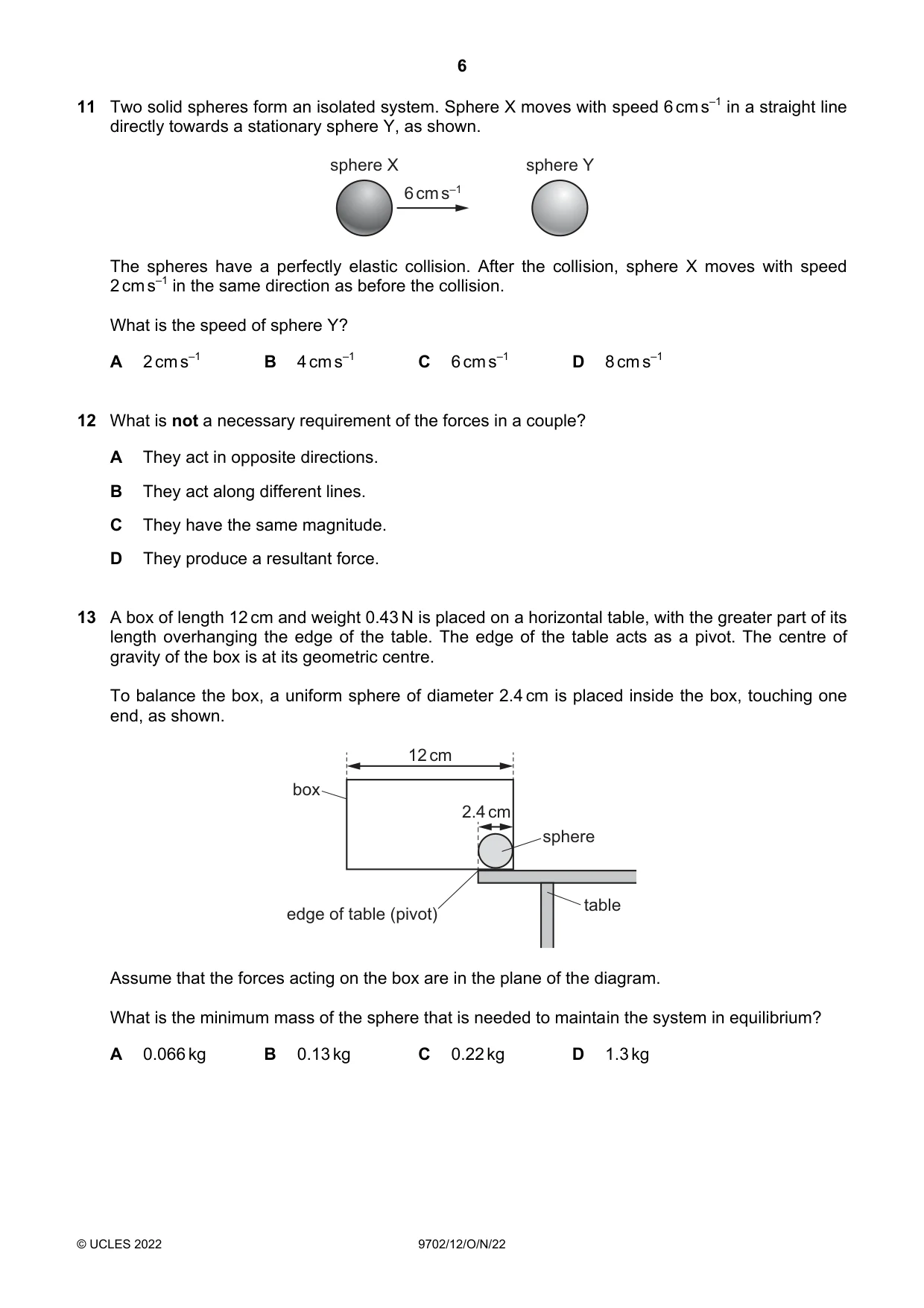
11 Two solid spheres form an isolated system. Sphere X moves with speed 6 cm s–1 in a straight line directly towards a stationary sphere Y, as shown. sphere X sphere Y 6 cm s–1 The spheres have a perfectly elastic collision. After the collision, sphere X moves with speed 2 cm s–1 in the same direction as before the collision. What is the speed of sphere Y? A 2 cm s–1 B 4 cm s–1 C 6 cm s–1 D 8 cm s–1
Mark scheme: D
Q12 · What is not a necessary requirement of the forces in a couple?
12 What is not a necessary requirement of the forces in a couple? A They act in opposite directions. B They act along different lines. C They have the same magnitude. D They produce a resultant force.
Mark scheme: D
Q13 · A box of length 12 cm and weight 0.43 N is placed on a horizontal table, with the greater…
13 A box of length 12 cm and weight 0.43 N is placed on a horizontal table, with the greater part of its length overhanging the edge of the table. The edge of the table acts as a pivot. The centre of gravity of the box is at its geometric centre. To balance the box, a uniform sphere of diameter 2.4 cm is placed inside the box, touching one end, as shown. 12 cm box 2.4 cm sphere table edge of table (pivot) Assume that the forces acting on the box are in the plane of the diagram. What is the minimum mass of the sphere that is needed to maintain the system in equilibrium? A 0.066 kg B 0.13 kg C 0.22 kg D 1.3 kg
Mark scheme: B
Q14 · An object is suspended by two ropes
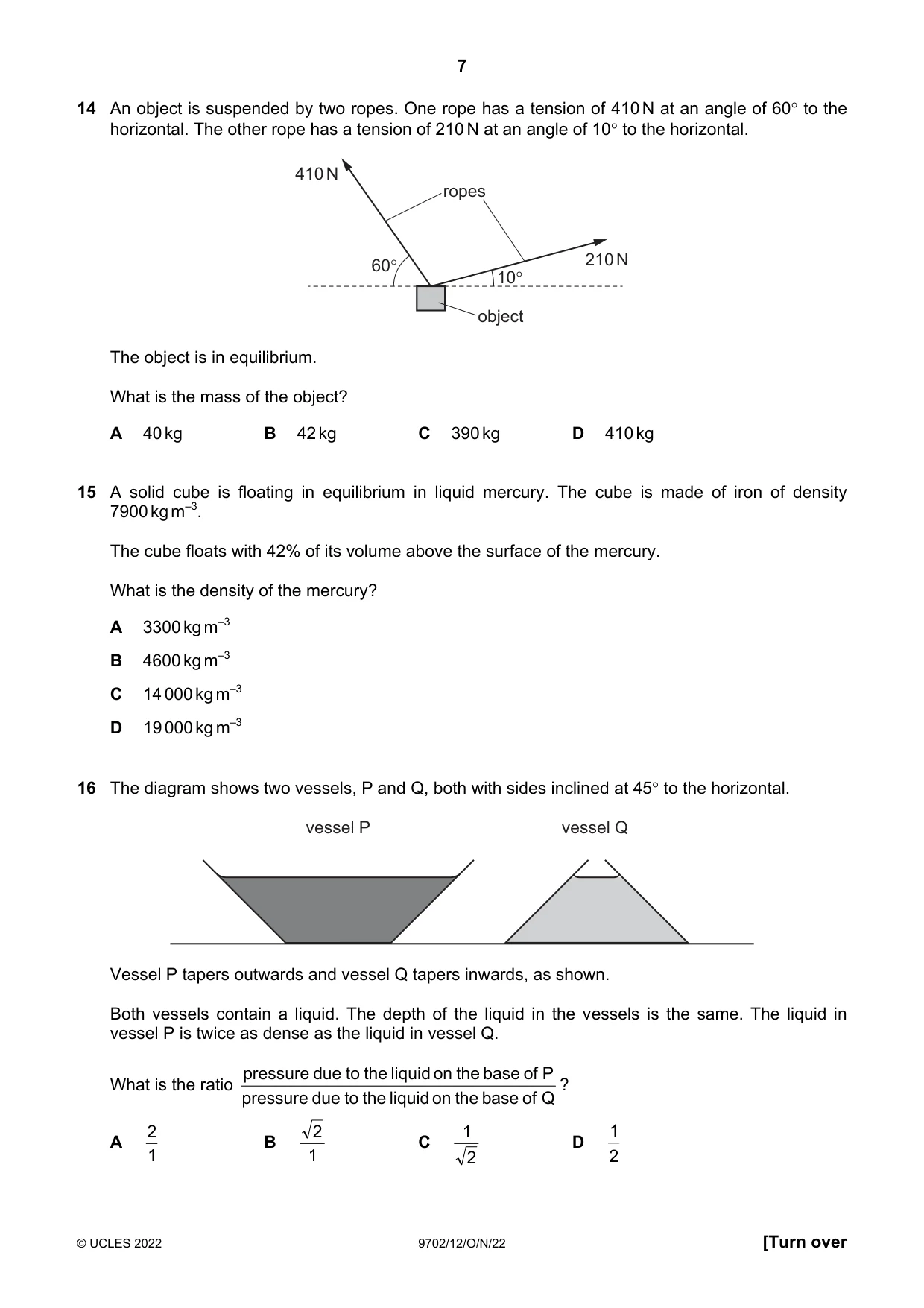
14 An object is suspended by two ropes. One rope has a tension of 410N at an angle of 60° to the horizontal. The other rope has a tension of 210 N at an angle of 10° to the horizontal. 410N The object is in equilibrium. What is the mass of the object? A 40kg B 42kg C 390kg D 410kg
Mark scheme: A
Q15 · A solid cube is floating in equilibrium in liquid mercury
15 A solid cube is floating in equilibrium in liquid mercury. The cube is made of iron of density 7900 kg m–3. The cube floats with 42% of its volume above the surface of the mercury. What is the density of the mercury? A 3300 kg m–3 B 4600 kg m–3 C 14 000 kg m–3 D 19 000 kg m–3
Mark scheme: C
Q16 · The diagram shows two vessels, P and Q, both with sides inclined at 45 to the horizontal
16 The diagram shows two vessels, P and Q, both with sides inclined at 45 to the horizontal. vessel P vessel Q Vessel P tapers outwards and vessel Q tapers inwards, as shown. Both vessels contain a liquid. The depth of the liquid in the vessels is the same. The liquid in vessel P is twice as dense as the liquid in vessel Q. pressure due to the liquid on the base of P What is the ratio ? pressure due to the liquid on the base of Q 2 2 1 1 A B C D 1 1 2 2
Mark scheme: A
Q17 · A motor is used to lift a load vertically upwards
17 A motor is used to lift a load vertically upwards. The load has weight W. The motor produces useful power output P. The load is lifted at constant velocity v. Which expression gives the time taken for the motor to lift the load vertically upwards through a distance d ? P Wv Wd Pv A B C D Wd P P W
Mark scheme: C
Q18 · A lamp is switched on for 2.0 hours
18 A lamp is switched on for 2.0 hours. The power input to the lamp is 1.0 W. The energy given out by the lamp as light is 7.0 103 J. How much energy is converted to other forms by the lamp? A 120 J B 200 J C 3400 J D 7200 J
Mark scheme: B
Q19 · An object of mass m is dropped onto the surface of two planets, X and Y, which have no…
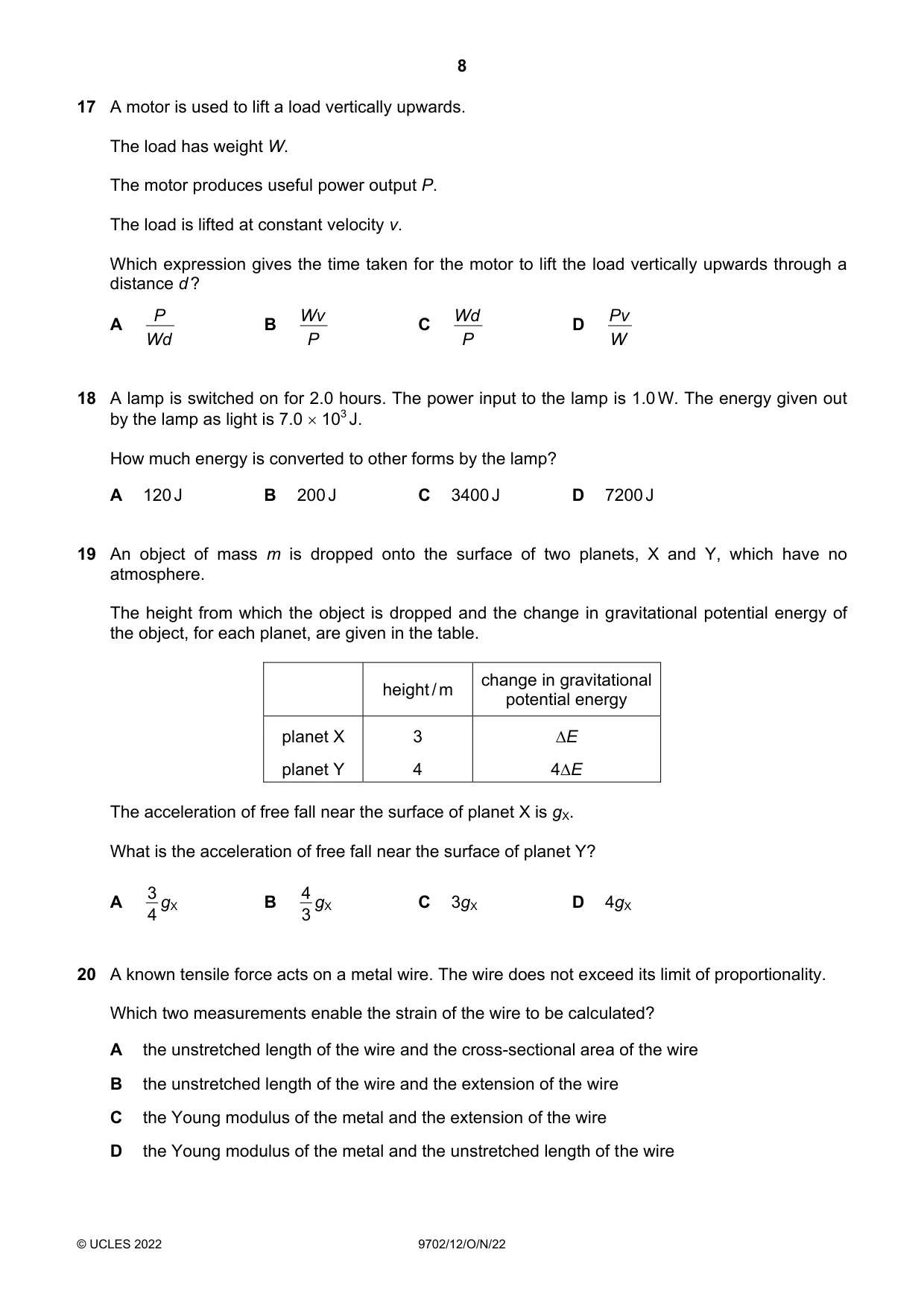
19 An object of mass m is dropped onto the surface of two planets, X and Y, which have no atmosphere. The height from which the object is dropped and the change in gravitational potential energy of the object, for each planet, are given in the table. change in gravitational height / m potential energy planet X 3 ∆E planet Y 4 4∆E The acceleration of free fall near the surface of planet X is gX. What is the acceleration of free fall near the surface of planet Y? 3 g 4 g A B C 3gX D 4gX 4 X 3 X
Mark scheme: C
Q20 · A known tensile force acts on a metal wire
20 A known tensile force acts on a metal wire. The wire does not exceed its limit of proportionality. Which two measurements enable the strain of the wire to be calculated? A the unstretched length of the wire and the cross-sectional area of the wire B the unstretched length of the wire and the extension of the wire C the Young modulus of the metal and the extension of the wire D the Young modulus of the metal and the unstretched length of the wire
Mark scheme: B
Q21 · A wire is extended by different forces
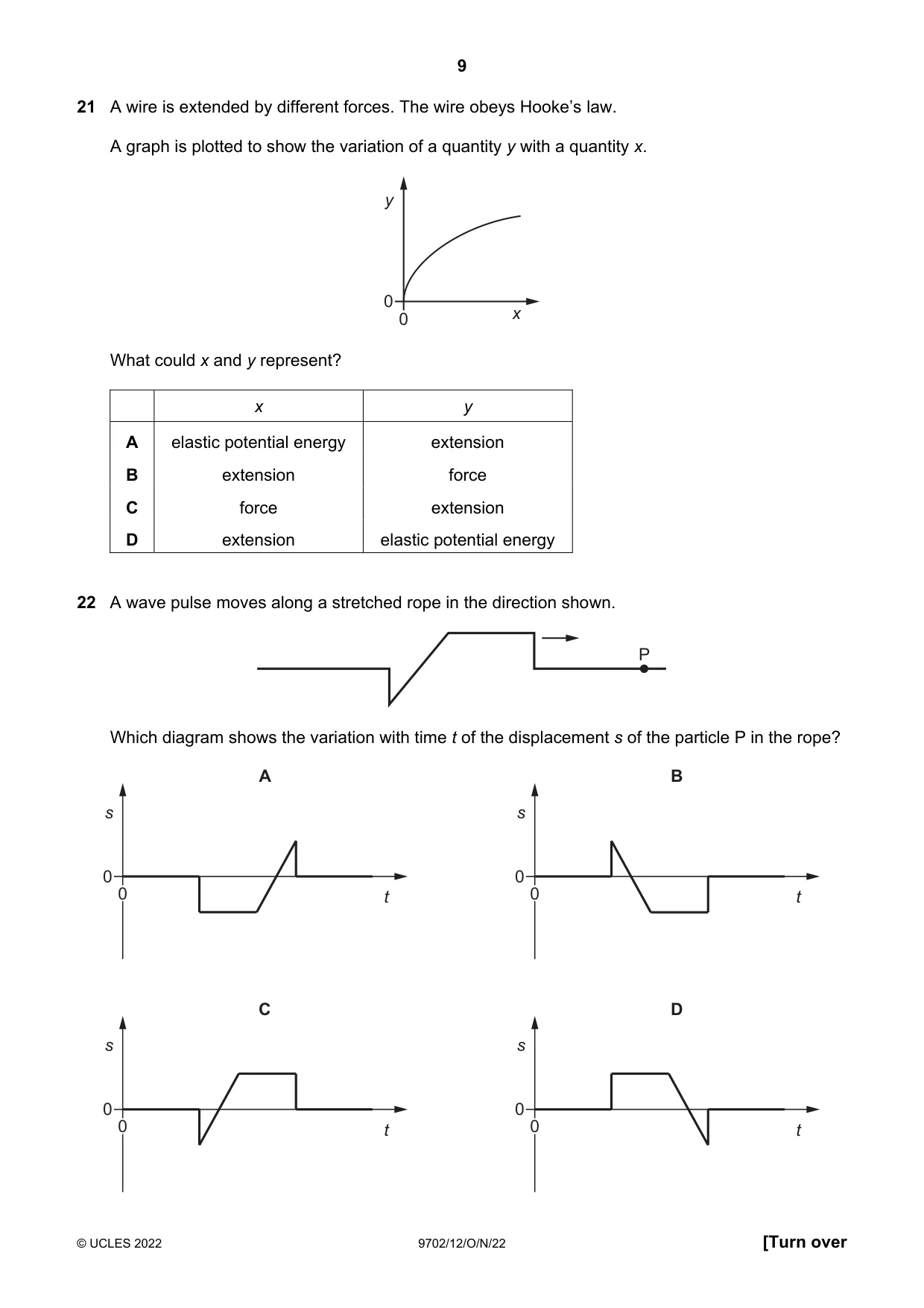
21 A wire is extended by different forces. The wire obeys Hooke’s law. A graph is plotted to show the variation of a quantity y with a quantity x. y 0 0 x What could x and y represent? x y A elastic potential energy extension B extension force C force extension D extension elastic potential energy
Mark scheme: A
Q22 · A wave pulse moves along a stretched rope in the direction shown
22 A wave pulse moves along a stretched rope in the direction shown. P Which diagram shows the variation with time t of the displacement s of the particle P in the rope? A B s s 0 0 0 t 0 t C D s s 0 0 0 t 0 t
Mark scheme: D
Q23 · Which statement about progressive transverse and longitudinal waves is correct?
23 Which statement about progressive transverse and longitudinal waves is correct? A Particles in a transverse wave have fixed equilibrium positions but those in longitudinal waves do not. B Transverse waves can be polarised but longitudinal waves cannot. C Transverse waves transfer energy but longitudinal waves do not. D Two-source interference can be demonstrated with transverse waves but not with longitudinal waves.
Mark scheme: B
Q24 · A miniature loudspeaker, initially at rest, falls vertically from a window in a high…
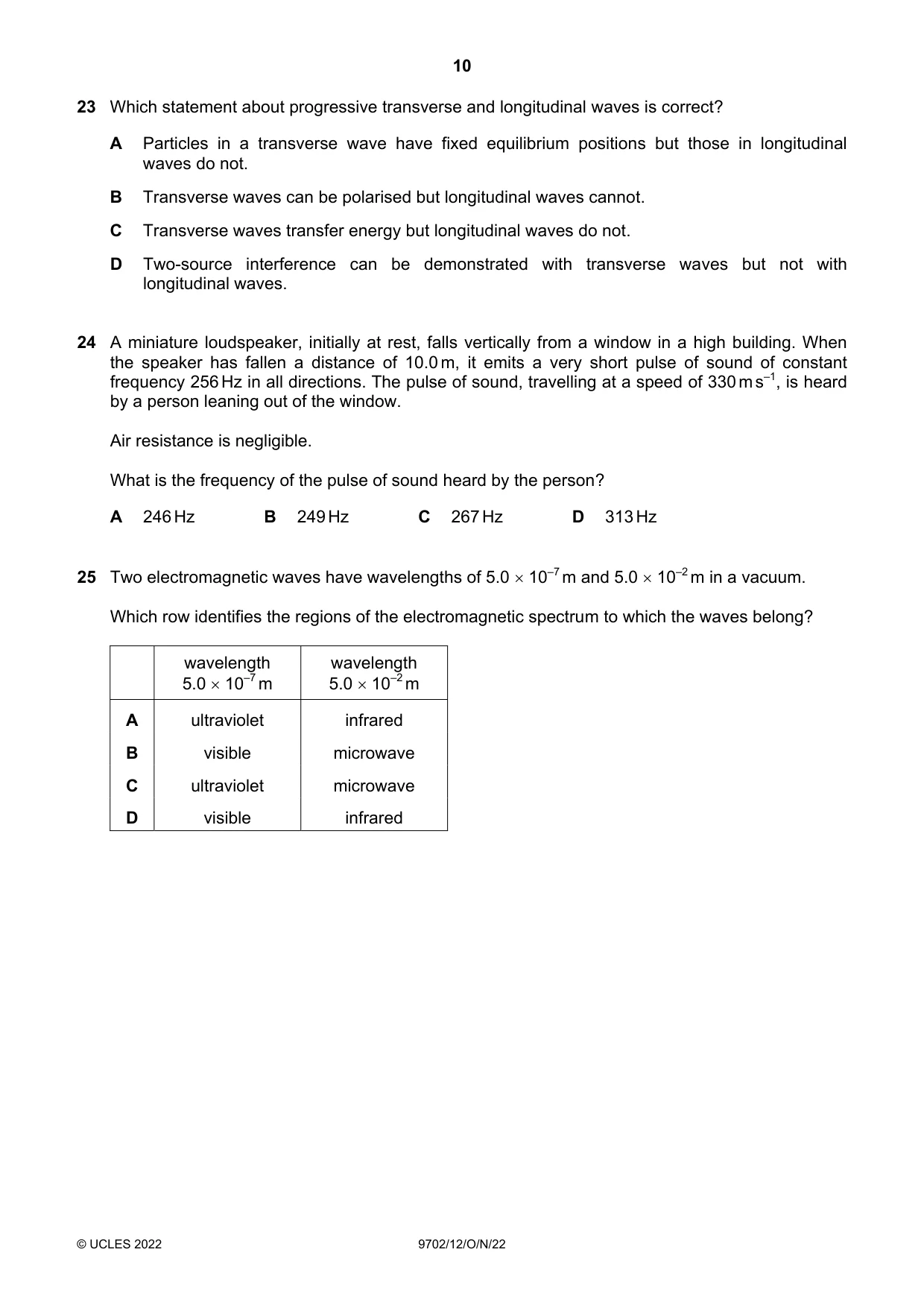
24 A miniature loudspeaker, initially at rest, falls vertically from a window in a high building. When the speaker has fallen a distance of 10.0 m, it emits a very short pulse of sound of constant frequency 256 Hz in all directions. The pulse of sound, travelling at a speed of 330 m s–1, is heard by a person leaning out of the window. Air resistance is negligible. What is the frequency of the pulse of sound heard by the person? A 246 Hz B 249 Hz C 267 Hz D 313 Hz
Mark scheme: A
Q25 · Two electromagnetic waves have wavelengths of 5.0 10–7 m and 5.0 10–2 m in a vacuum
25 Two electromagnetic waves have wavelengths of 5.0 10–7 m and 5.0 10–2 m in a vacuum. Which row identifies the regions of the electromagnetic spectrum to which the waves belong? wavelength wavelength 5.0 10–7 m 5.0 10–2 m A ultraviolet infrared B visible microwave C ultraviolet microwave D visible infrared
Mark scheme: B
Q26 · The wavelength of sound in air may be determined by using stationary waves
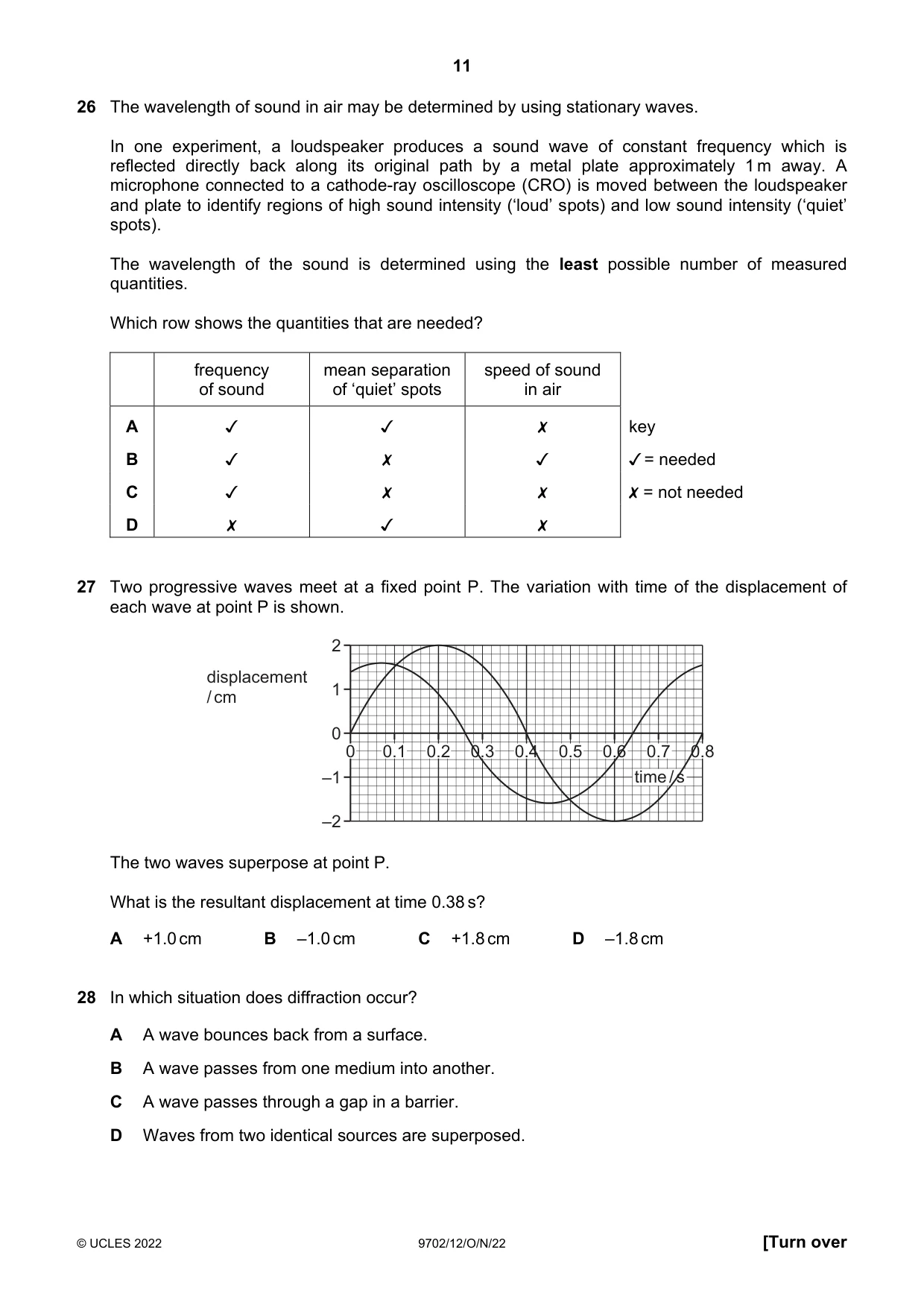
26 The wavelength of sound in air may be determined by using stationary waves. In one experiment, a loudspeaker produces a sound wave of constant frequency which is reflected directly back along its original path by a metal plate approximately 1m away. A microphone connected to a cathode-ray oscilloscope (CRO) is moved between the loudspeaker and plate to identify regions of high sound intensity (‘loud’ spots) and low sound intensity (‘quiet’ spots). The wavelength of the sound is determined using the least possible number of measured quantities. Which row shows the quantities that are needed? frequency mean separation speed of sound of sound of ‘quiet’ spots in air A v v x key B v x v / = needed Cc v x x X = not needed D x Jv x
Mark scheme: D
Q27 · Two progressive waves meet at a fixed point P
27 Two progressive waves meet at a fixed point P. The variation with time of the displacement of each wave at point P is shown. 2 displacement / cm 1 0 0 0.1 0.2 0.3 0.4 0.5 0.6 0.7 0.8 –1 time / s –2 The two waves superpose at point P. What is the resultant displacement at time 0.38 s? A +1.0 cm B –1.0 cm C +1.8 cm D –1.8 cm
Mark scheme: B
Q28 · In which situation does diffraction occur?
28 In which situation does diffraction occur? A A wave bounces back from a surface. B A wave passes from one medium into another. C A wave passes through a gap in a barrier. D Waves from two identical sources are superposed.
Mark scheme: C
Q29 · Light of a single frequency is incident on a pair of narrow slits that are a distance of…
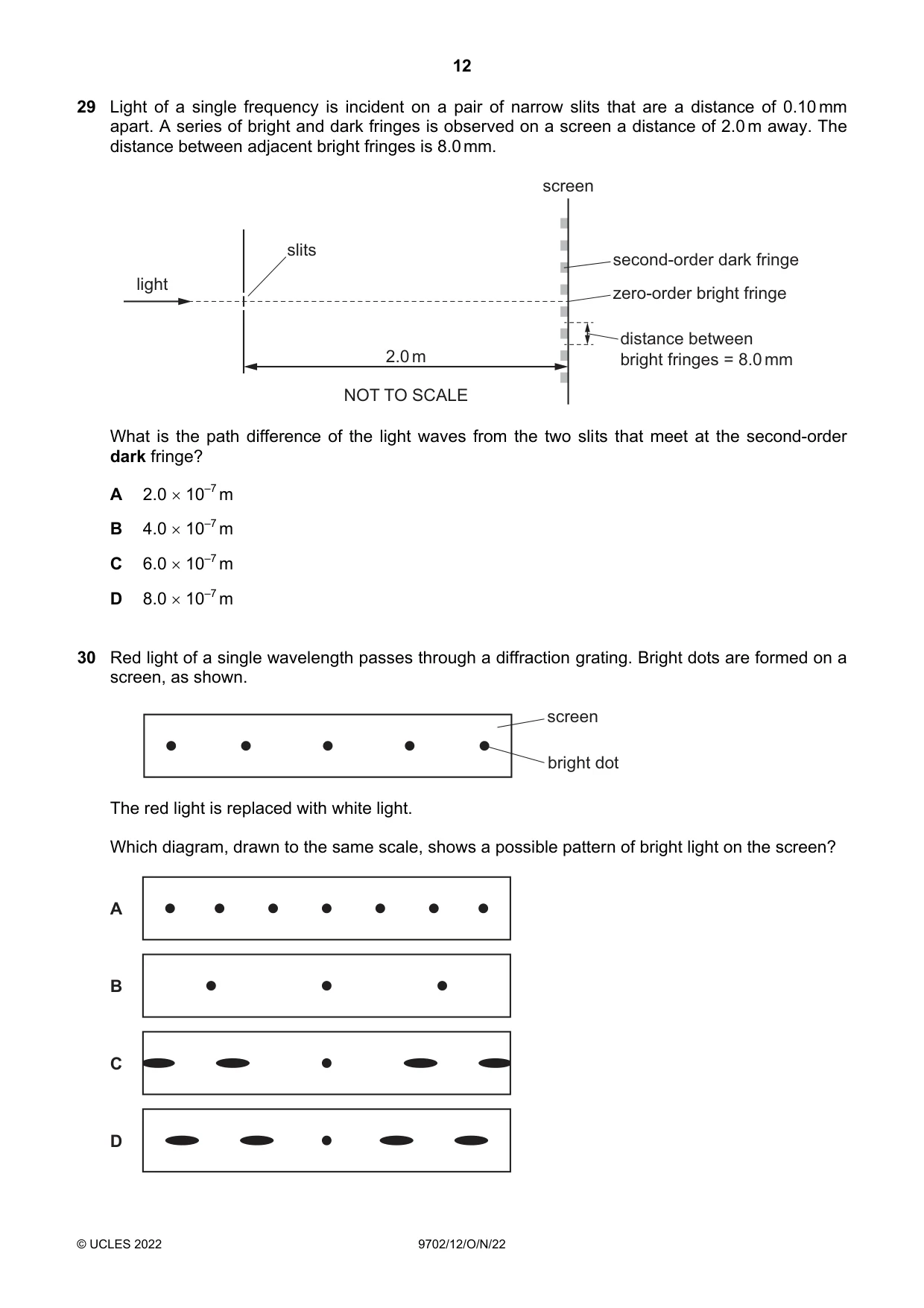
29 Light of a single frequency is incident on a pair of narrow slits that are a distance of 0.10 mm apart. A series of bright and dark fringes is observed on a screen a distance of 2.0 m away. The distance between adjacent bright fringes is 8.0 mm. screen slits second-order dark fringe light zero-order bright fringe distance between 2.0 m bright fringes = 8.0 mm NOT TO SCALE What is the path difference of the light waves from the two slits that meet at the second-order dark fringe? A 2.0 10–7 m B 4.0 10–7 m C 6.0 10–7 m D 8.0 10–7 m
Mark scheme: C
Q30 · Red light of a single wavelength passes through a diffraction grating
30 Red light of a single wavelength passes through a diffraction grating. Bright dots are formed on a screen, as shown. screen bright dot The red light is replaced with white light. Which diagram, drawn to the same scale, shows a possible pattern of bright light on the screen? A B C D
Mark scheme: D
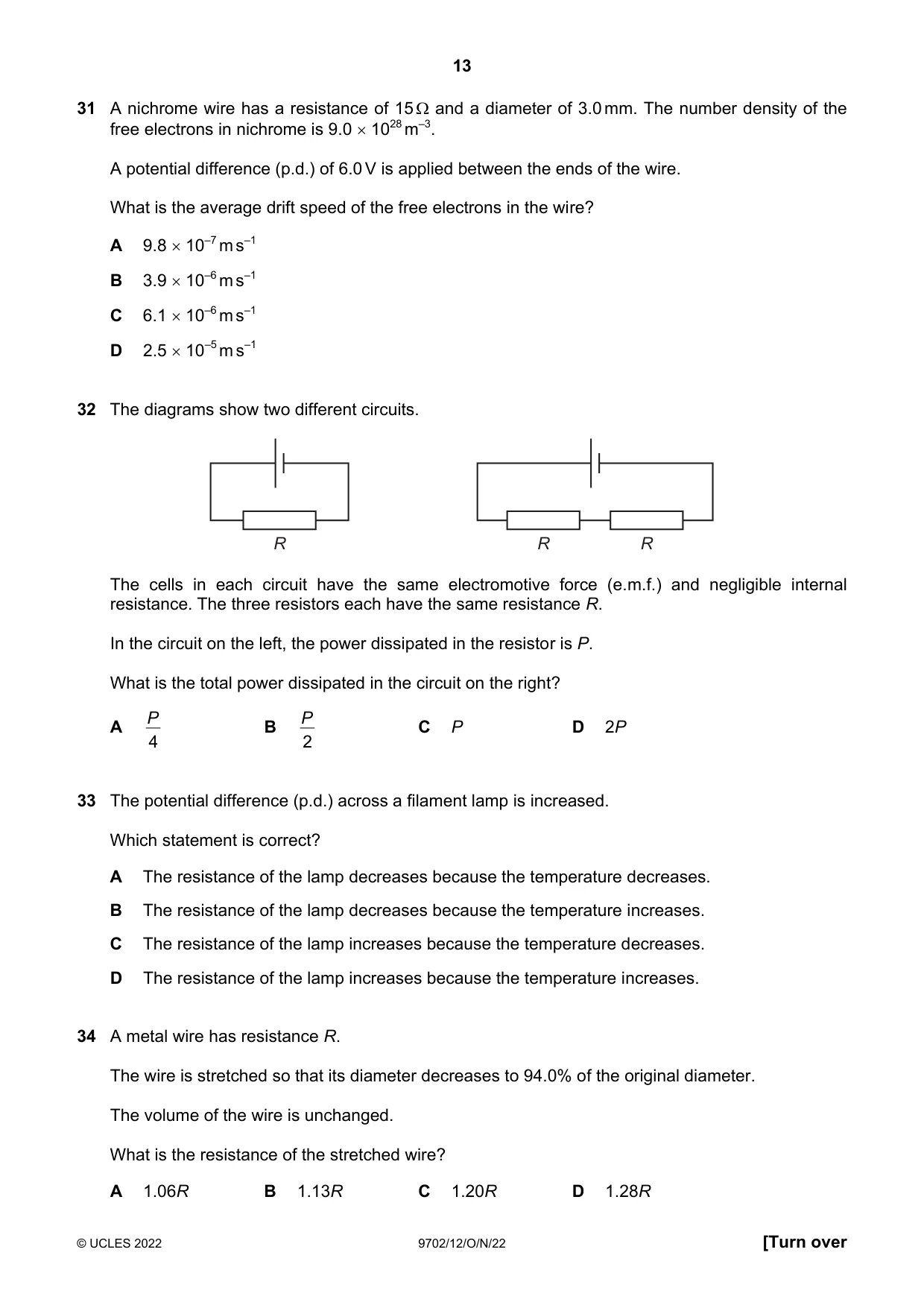
Q31 · A nichrome wire has a resistance of 15 and a diameter of 3.0 mm
31 A nichrome wire has a resistance of 15 and a diameter of 3.0 mm. The number density of the free electrons in nichrome is 9.0 1028 m–3. A potential difference (p.d.) of 6.0 V is applied between the ends of the wire. What is the average drift speed of the free electrons in the wire? A 9.8 10–7 m s–1 B 3.9 10–6 m s–1 C 6.1 10–6 m s–1 D 2.5 10–5 m s–1
Mark scheme: B
Q32 · The diagrams show two different circuits
32 The diagrams show two different circuits. R R R The cells in each circuit have the same electromotive force (e.m.f.) and negligible internal resistance. The three resistors each have the same resistance R. In the circuit on the left, the power dissipated in the resistor is P. What is the total power dissipated in the circuit on the right? P P A B C P D 2P 4 2
Mark scheme: B
Q33 · The potential difference (p.d.) across a filament lamp is increased
33 The potential difference (p.d.) across a filament lamp is increased. Which statement is correct? A The resistance of the lamp decreases because the temperature decreases. B The resistance of the lamp decreases because the temperature increases. C The resistance of the lamp increases because the temperature decreases. D The resistance of the lamp increases because the temperature increases.
Mark scheme: D
Q34 · A metal wire has resistance R
34 A metal wire has resistance R. The wire is stretched so that its diameter decreases to 94.0% of the original diameter. The volume of the wire is unchanged. What is the resistance of the stretched wire? A 1.06R B 1.13R C 1.20R D 1.28R
Mark scheme: D
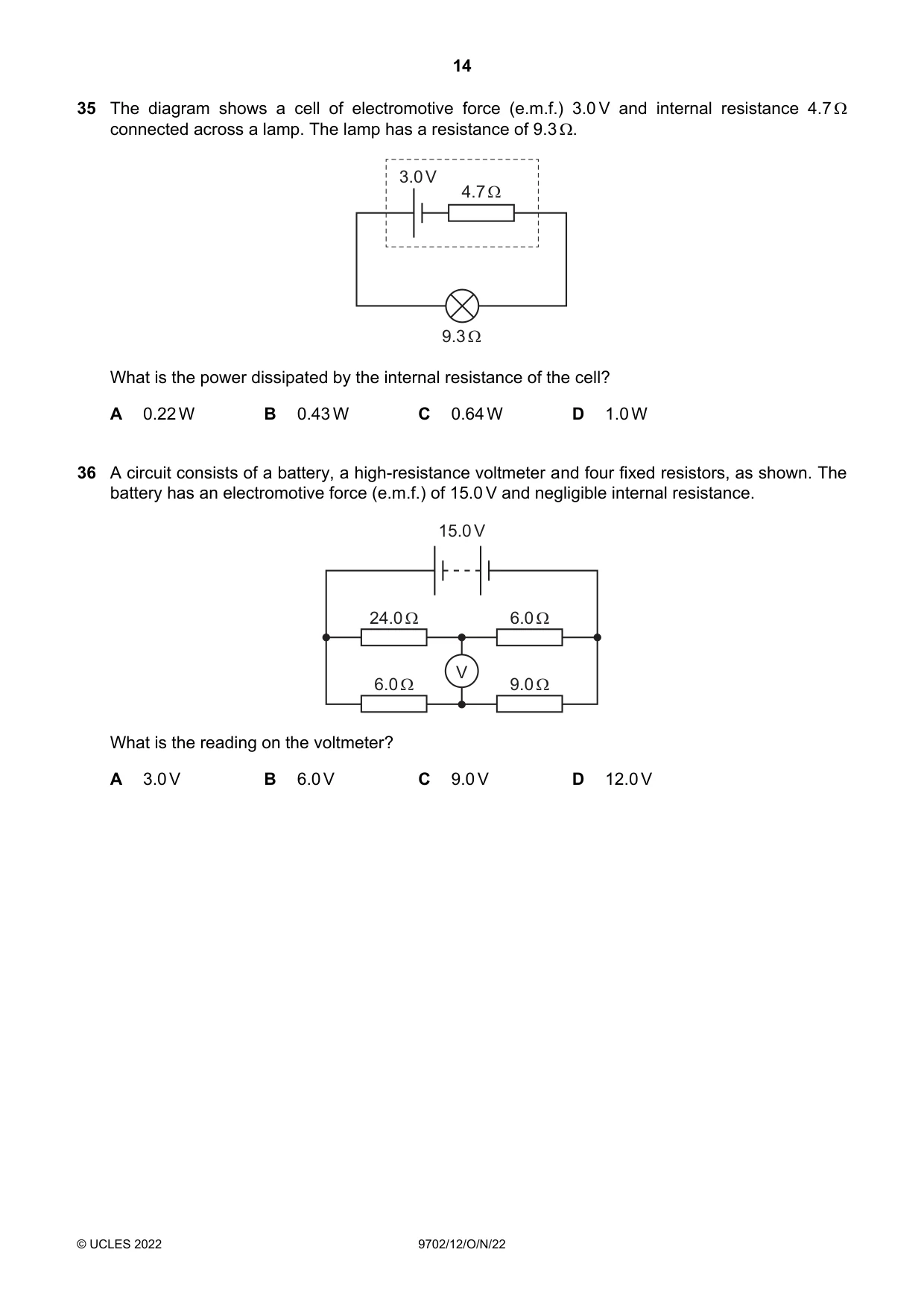
Q35 · The diagram shows a cell of electromotive force (e.m.f.) 3.0V and internal resistance…
35 The diagram shows a cell of electromotive force (e.m.f.) 3.0V and internal resistance 4.7Q connected across a lamp. The lamp has a resistance of 9.3Q. 9.30 What is the power dissipated by the internal resistance of the cell? A 0.22W B 0.43W C 0.64W D 1.0W
Mark scheme: A
Q36 · A circuit consists of a battery, a high-resistance voltmeter and four fixed resistors, as…
36 A circuit consists of a battery, a high-resistance voltmeter and four fixed resistors, as shown. The battery has an electromotive force (e.m.f.) of 15.0 V and negligible internal resistance. 15.0V What is the reading on the voltmeter? A 3.0V B 6.0V C 9.0V D 12.0V
Mark scheme: B
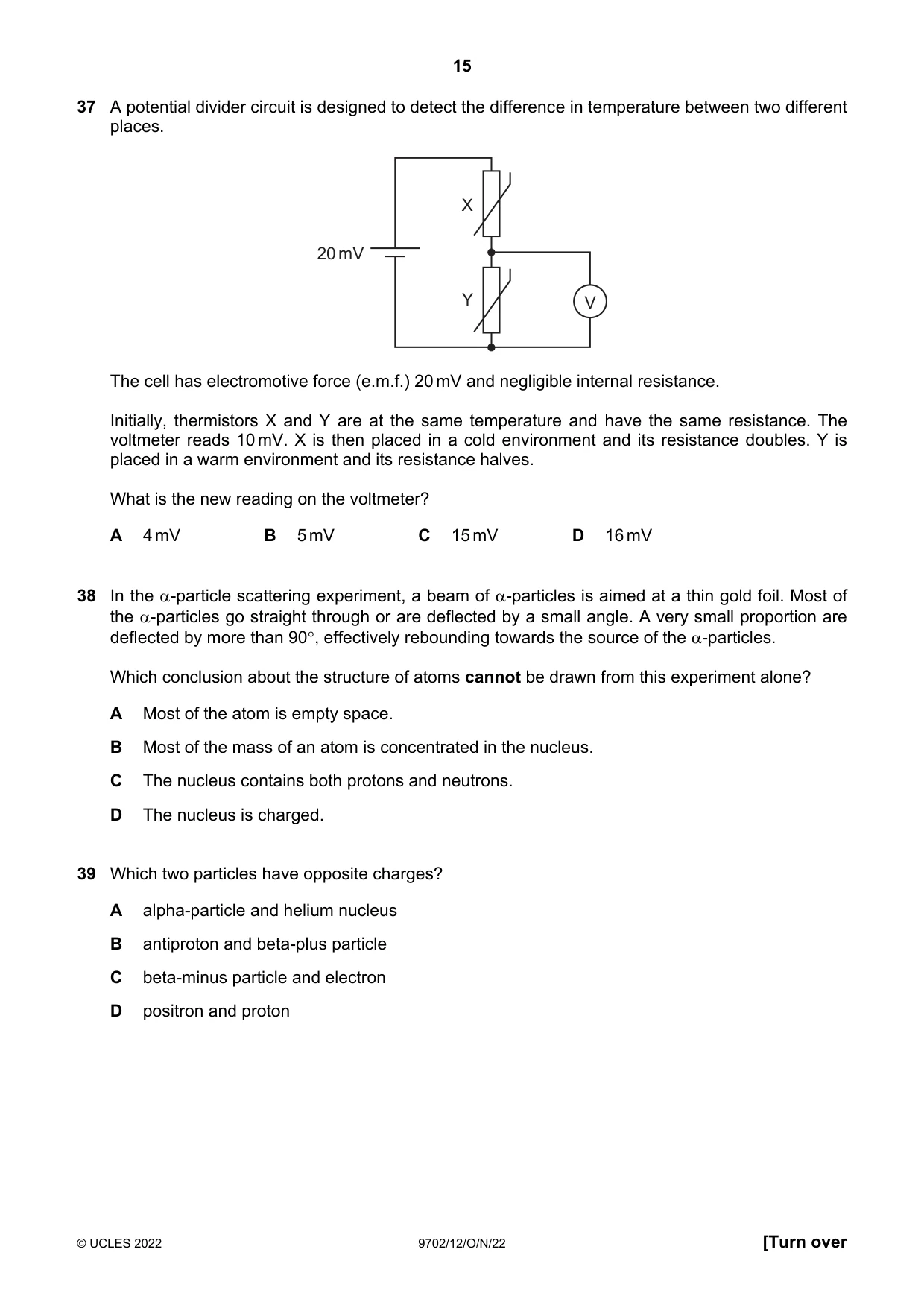
Q37 · A potential divider circuit is designed to detect the difference in temperature between…
37 A potential divider circuit is designed to detect the difference in temperature between two different places. X 20 mV Y V The cell has electromotive force (e.m.f.) 20 mV and negligible internal resistance. Initially, thermistors X and Y are at the same temperature and have the same resistance. The voltmeter reads 10 mV. X is then placed in a cold environment and its resistance doubles. Y is placed in a warm environment and its resistance halves. What is the new reading on the voltmeter? A 4 mV B 5 mV C 15 mV D 16 mV
Mark scheme: A
Q38 · In the -particle scattering experiment, a beam of -particles is aimed at a thin gold…
38 In the -particle scattering experiment, a beam of -particles is aimed at a thin gold foil. Most of the -particles go straight through or are deflected by a small angle. A very small proportion are deflected by more than 90, effectively rebounding towards the source of the -particles. Which conclusion about the structure of atoms cannot be drawn from this experiment alone? A Most of the atom is empty space. B Most of the mass of an atom is concentrated in the nucleus. C The nucleus contains both protons and neutrons. D The nucleus is charged.
Mark scheme: C
Q39 · Which two particles have opposite charges?
39 Which two particles have opposite charges? A alpha-particle and helium nucleus B antiproton and beta-plus particle C beta-minus particle and electron D positron and proton
Mark scheme: B
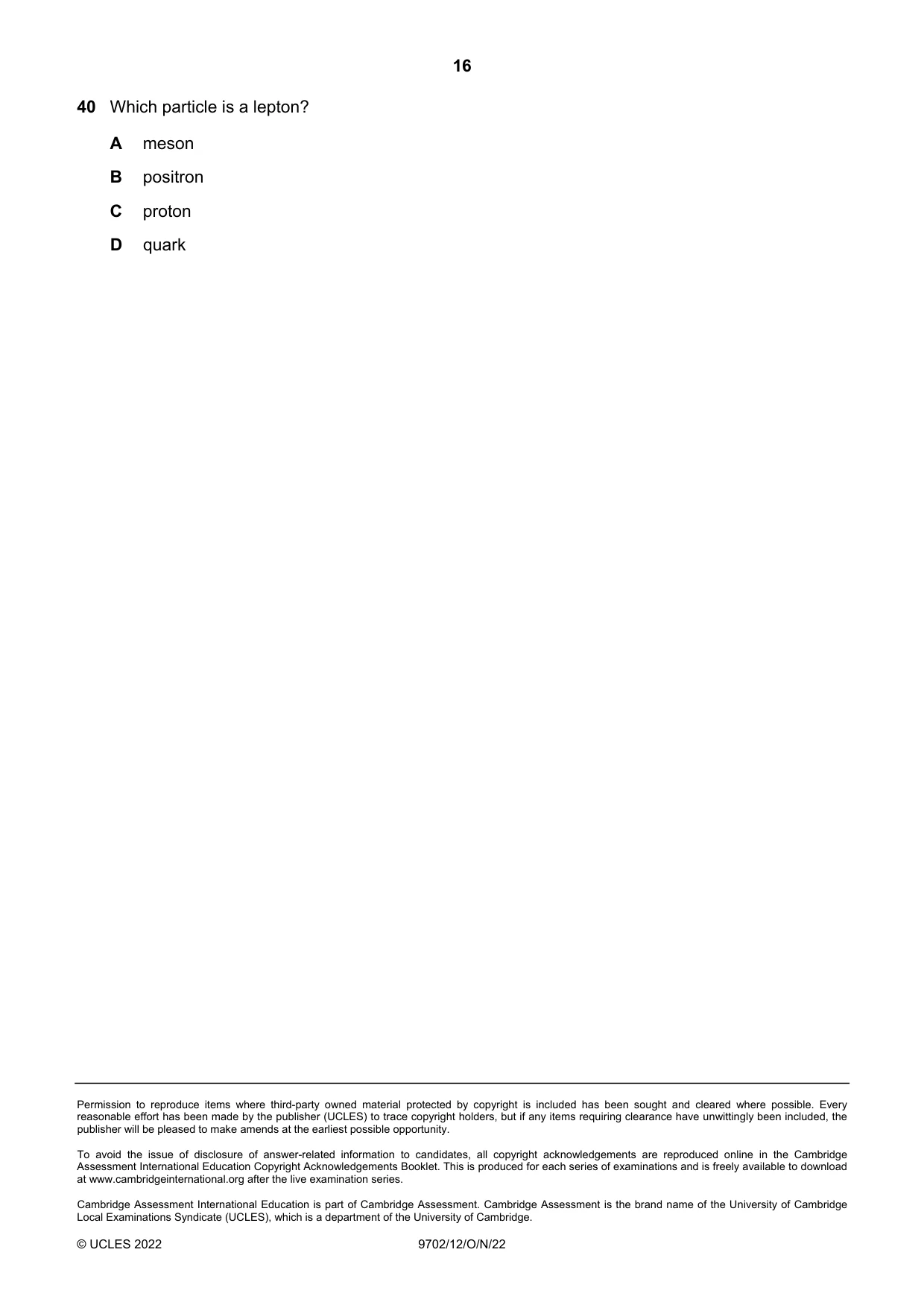
Q40 · Which particle is a lepton?
40 Which particle is a lepton? A meson B positron C proton D quark
Mark scheme: B
What was in this paper
The subtopics covered by these 40 questions, and how many questions each got. Open one in a new tab to see every Cambridge question on it.
2Energy conservation2Equations of motion2Fundamental particles2Interference2Linear momentum and its conservation2Momentum and Newton’s laws of motion2Potential dividers2Resistance and resistivity2Scalars and vectors2Turning effects of forces2Atoms, nuclei and radiation1Diffraction1Doppler effect for sound waves1Elastic and plastic behaviour1Electric current1Electromagnetic spectrum1Equilibrium of forces1Errors and uncertainties1Gravitational field1Physical quantities1Potential difference and power1Practical circuits1Progressive waves1SI units1Stationary waves1Stress and strain1The diffraction grating1Transverse and longitudinal waves1What you needed in this session
Cambridge’s own grade thresholds for 2022 Oct/Nov, Paper 1 · Variant 2. A higher threshold means an easier paper — the bar moves with how the cohort did.