Cambridge A Level Physics 9702 — 2025 Feb/March Paper 1 · Variant 2
9702/12/F/M/25 · 40 questions · 40 marks · 75 min
The question paper and its mark scheme, free to read here and free to download. This is Cambridge’s own paper, exactly as it was sat.
Question paper16 pages
Mark scheme3 pages
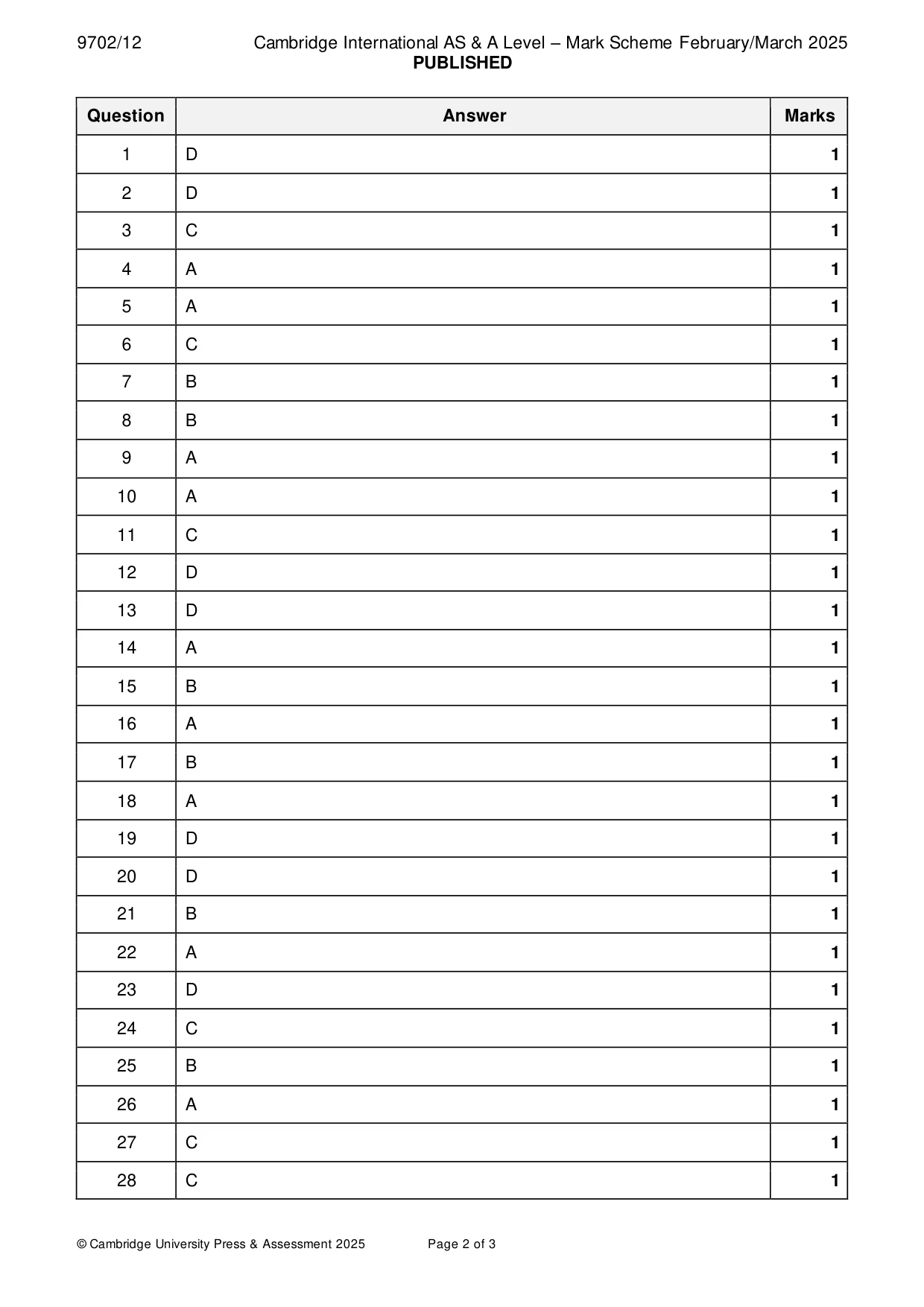
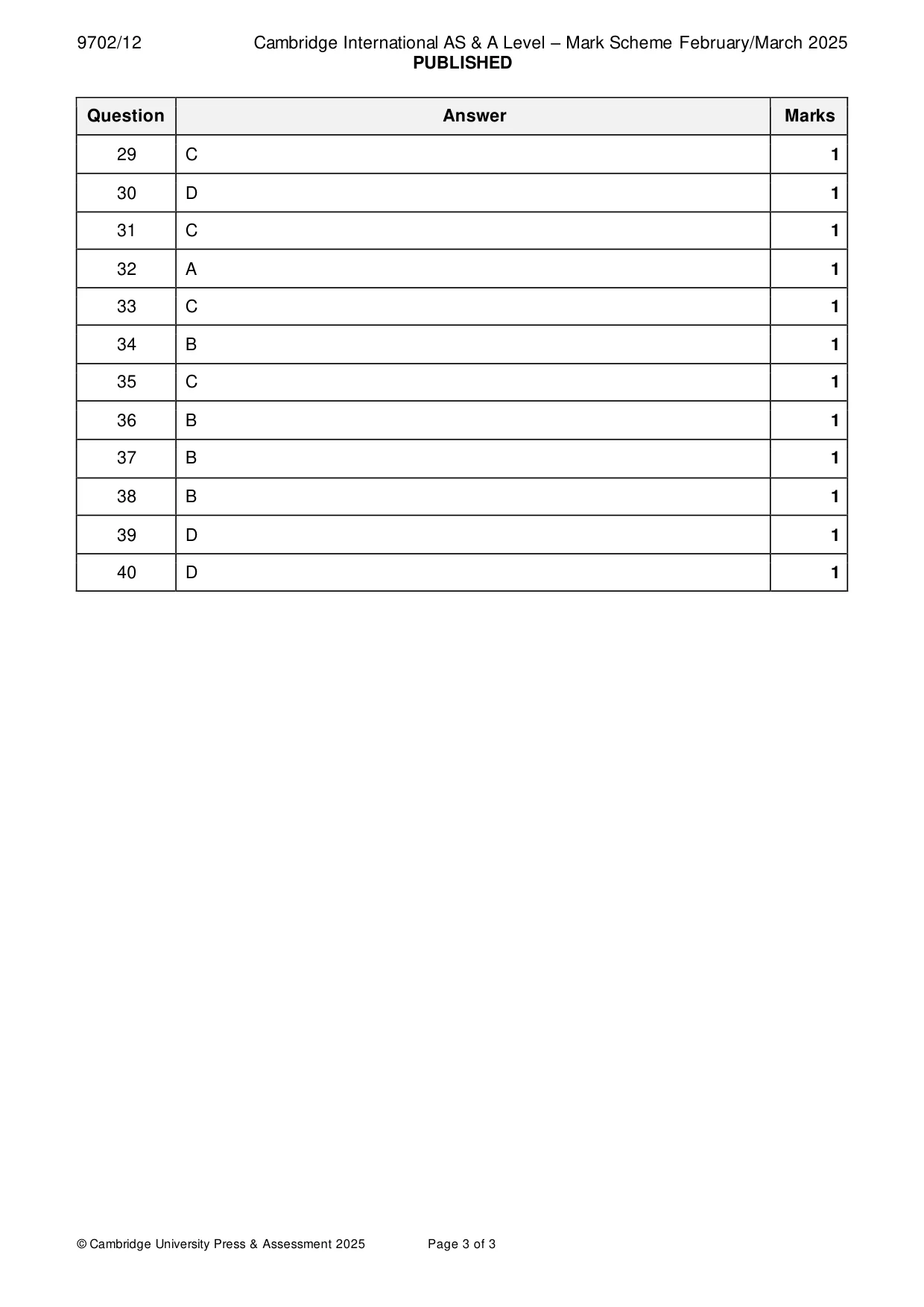
Answers below. Sit the paper first if you are practising.
Questions as text
Q1 · Which quantity is a scalar quantity?
1 Which quantity is a scalar quantity? A force B momentum C velocity D work
Mark scheme: D
Q2 · What is the effect of a systematic error on the measurement of a physical quantity?
2 What is the effect of a systematic error on the measurement of a physical quantity? A It limits the precision of the measured value. B It limits the range of values obtained in repeated measurements. C It results in repeated measurements having different values from each other. D It results in the measured value being different from the correct value.
Mark scheme: D
Q3 · A car is accelerated by a constant resultant force of 300 N for 5.0 s
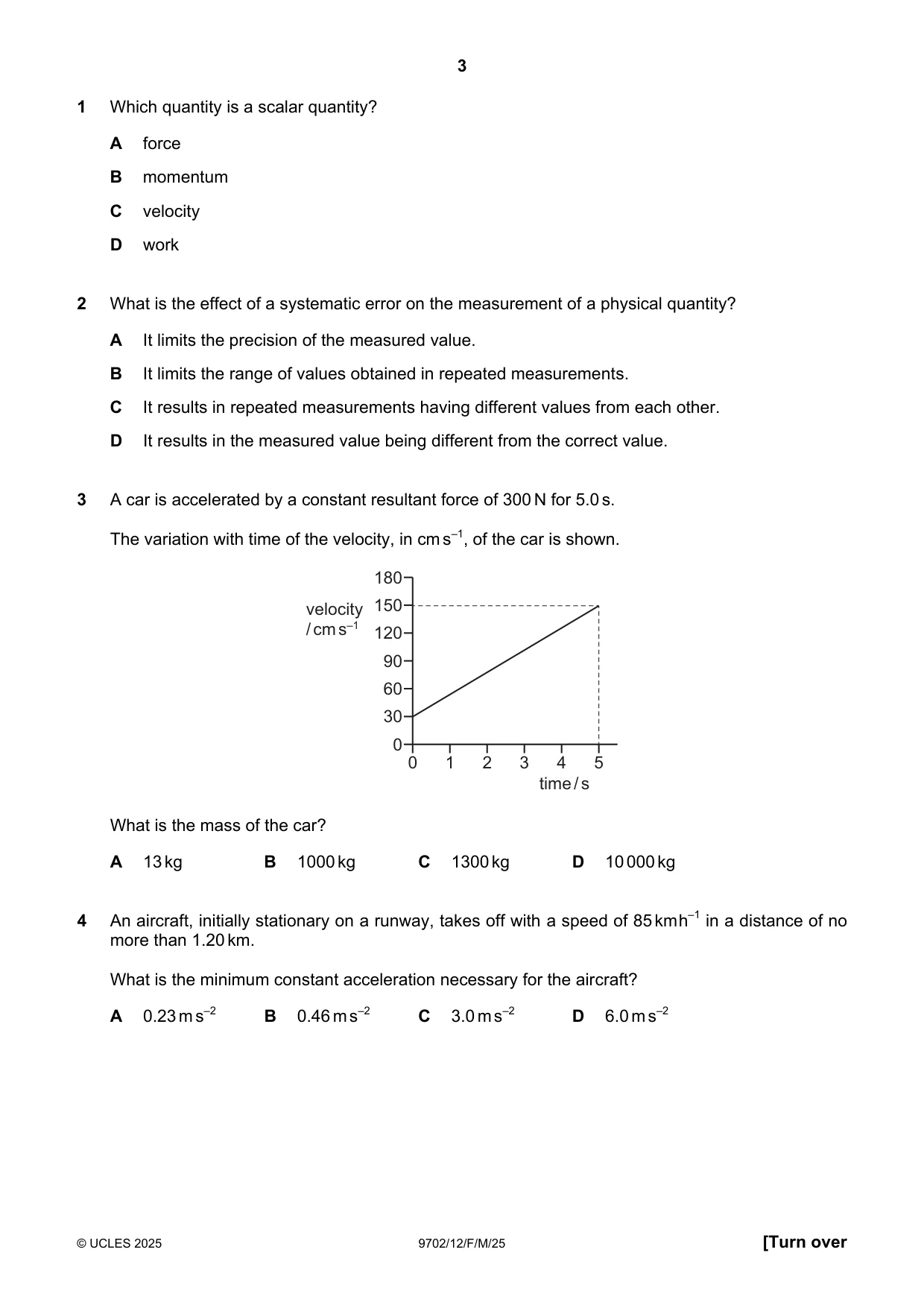
3 A car is accelerated by a constant resultant force of 300 N for 5.0 s. The variation with time of the velocity, in cm s–1, of the car is shown. 180 velocity 150 / cm s–1 120 90 60 30 0 0 1 2 3 4 5 time / s What is the mass of the car? A 13 kg B 1000 kg C 1300 kg D 10 000 kg
Mark scheme: C
Q4 · An aircraft, initially stationary on a runway, takes off with a speed of 85 km h–1 in a…
4 An aircraft, initially stationary on a runway, takes off with a speed of 85 km h–1 in a distance of no more than 1.20 km. What is the minimum constant acceleration necessary for the aircraft? A 0.23 m s–2 B 0.46 m s–2 C 3.0 m s–2 D 6.0 m s–2
Mark scheme: A
Q5 · An object is fired upwards from horizontal ground
5 An object is fired upwards from horizontal ground. The object has an initial velocity of 20 m s–1 at an angle of 45° to the horizontal. Air resistance is negligible. Which statement describes the speed of the object after it is fired until immediately before it reaches the ground again? A Its speed decreases to a value greater than zero, then increases to 20 m s–1. B Its speed decreases to a value greater than zero, then increases to a value greater than 20 m s–1. C Its speed decreases to zero, then increases to 20 m s–1. D Its speed decreases to zero, then increases to a value less than 20 m s–1.
Mark scheme: A
Q6 · What is a statement of the principle of conservation of momentum for a system?
6 What is a statement of the principle of conservation of momentum for a system? A The total momentum and the total kinetic energy are always conserved. B The total momentum is conserved only in elastic collisions. C The total momentum is conserved provided that no external forces act. D The total momentum of each object in the system is the product of its mass and velocity.
Mark scheme: C
Q7 · Objects P and Q form an isolated system
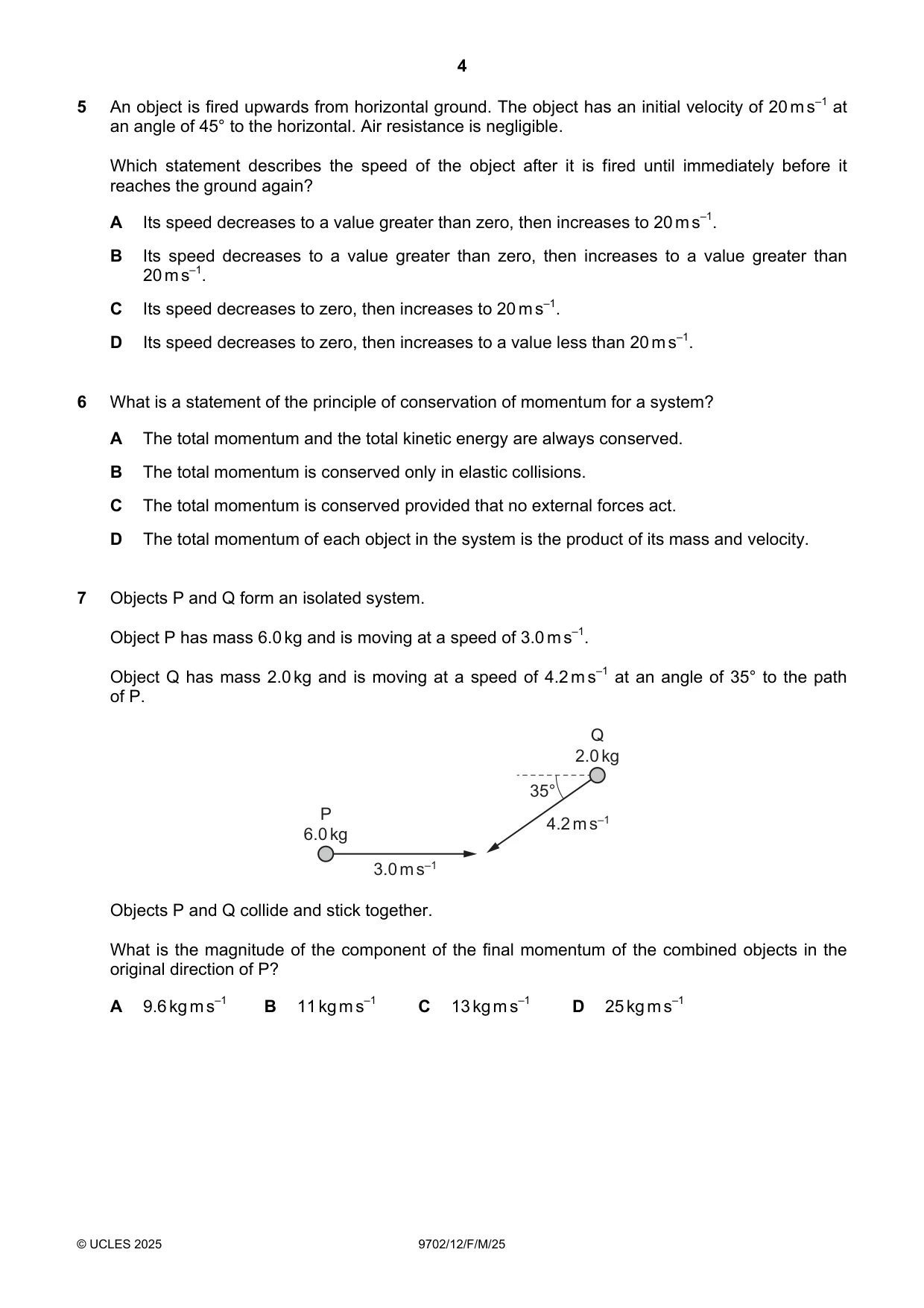
7 Objects P and Q form an isolated system. Object P has mass 6.0 kg and is moving at a speed of 3.0 m s–1. Object Q has mass 2.0 kg and is moving at a speed of 4.2 m s–1 at an angle of 35° to the path of P. Q 2.0 kg 35° P 4.2 m s–1 6.0 kg 3.0 m s–1 Objects P and Q collide and stick together. What is the magnitude of the component of the final momentum of the combined objects in the original direction of P? A 9.6 kg m s–1 B 11 kg m s–1 C 13 kg m s–1 D 25 kg m s–1
Mark scheme: B
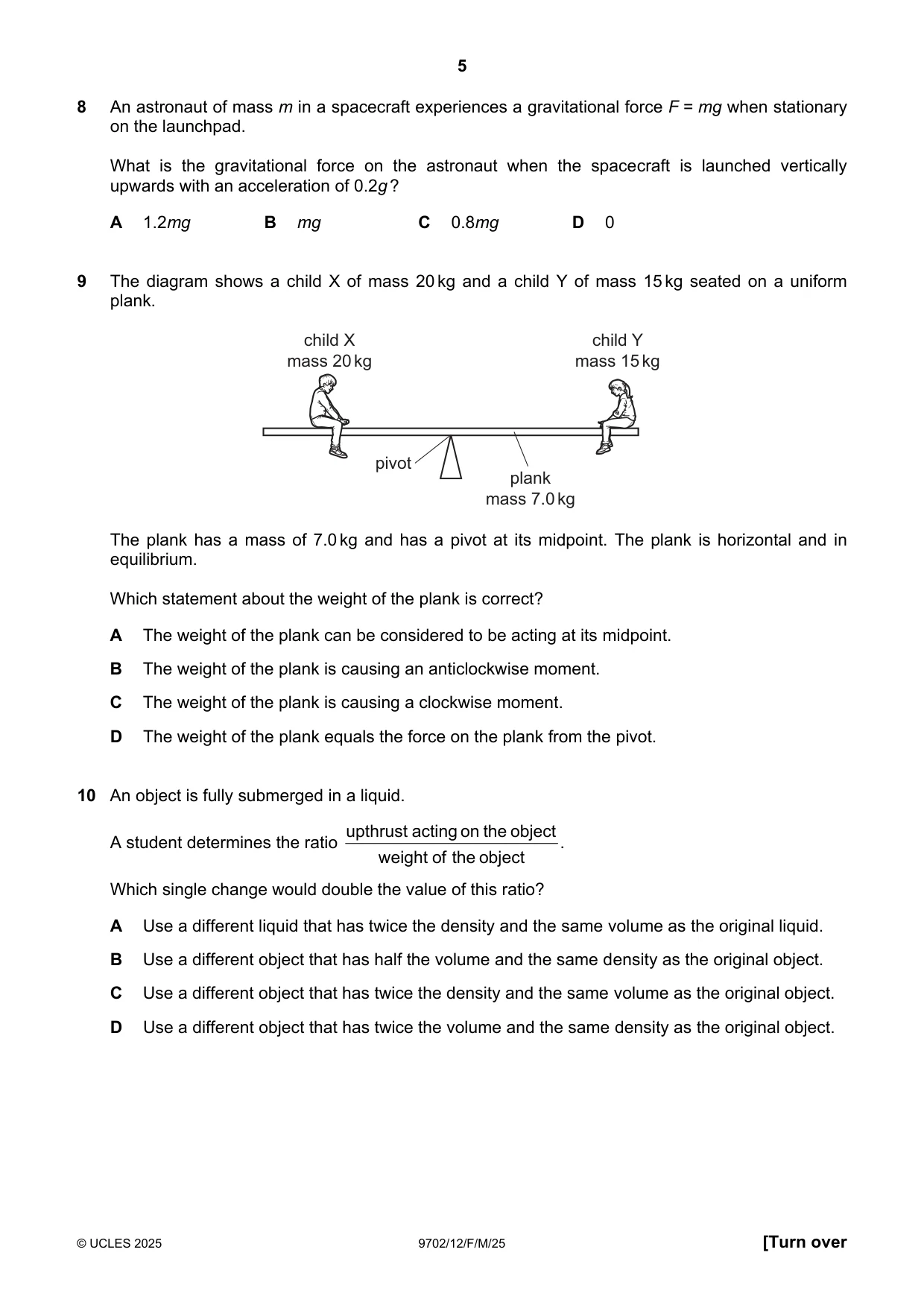
Q8 · An astronaut of mass m in a spacecraft experiences a gravitational force F = mg when…
8 An astronaut of mass m in a spacecraft experiences a gravitational force F = mg when stationary on the launchpad. What is the gravitational force on the astronaut when the spacecraft is launched vertically upwards with an acceleration of 0.2g ? A 1.2mg B mg C 0.8mg D 0
Mark scheme: B
Q9 · The diagram shows a child X of mass 20 kg and a child Y of mass 15 kg seated on a uniform…
9 The diagram shows a child X of mass 20 kg and a child Y of mass 15 kg seated on a uniform plank. child X child Y mass 20 kg mass 15 kg pivot plank mass 7.0 kg The plank has a mass of 7.0 kg and has a pivot at its midpoint. The plank is horizontal and in equilibrium. Which statement about the weight of the plank is correct? A The weight of the plank can be considered to be acting at its midpoint. B The weight of the plank is causing an anticlockwise moment. C The weight of the plank is causing a clockwise moment. D The weight of the plank equals the force on the plank from the pivot.
Mark scheme: A
Q10 · An object is fully submerged in a liquid
10 An object is fully submerged in a liquid. upthrust acting on the object A student determines the ratio . weight of the object Which single change would double the value of this ratio? A Use a different liquid that has twice the density and the same volume as the original liquid. B Use a different object that has half the volume and the same density as the original object. C Use a different object that has twice the density and the same volume as the original object. D Use a different object that has twice the volume and the same density as the original object.
Mark scheme: A
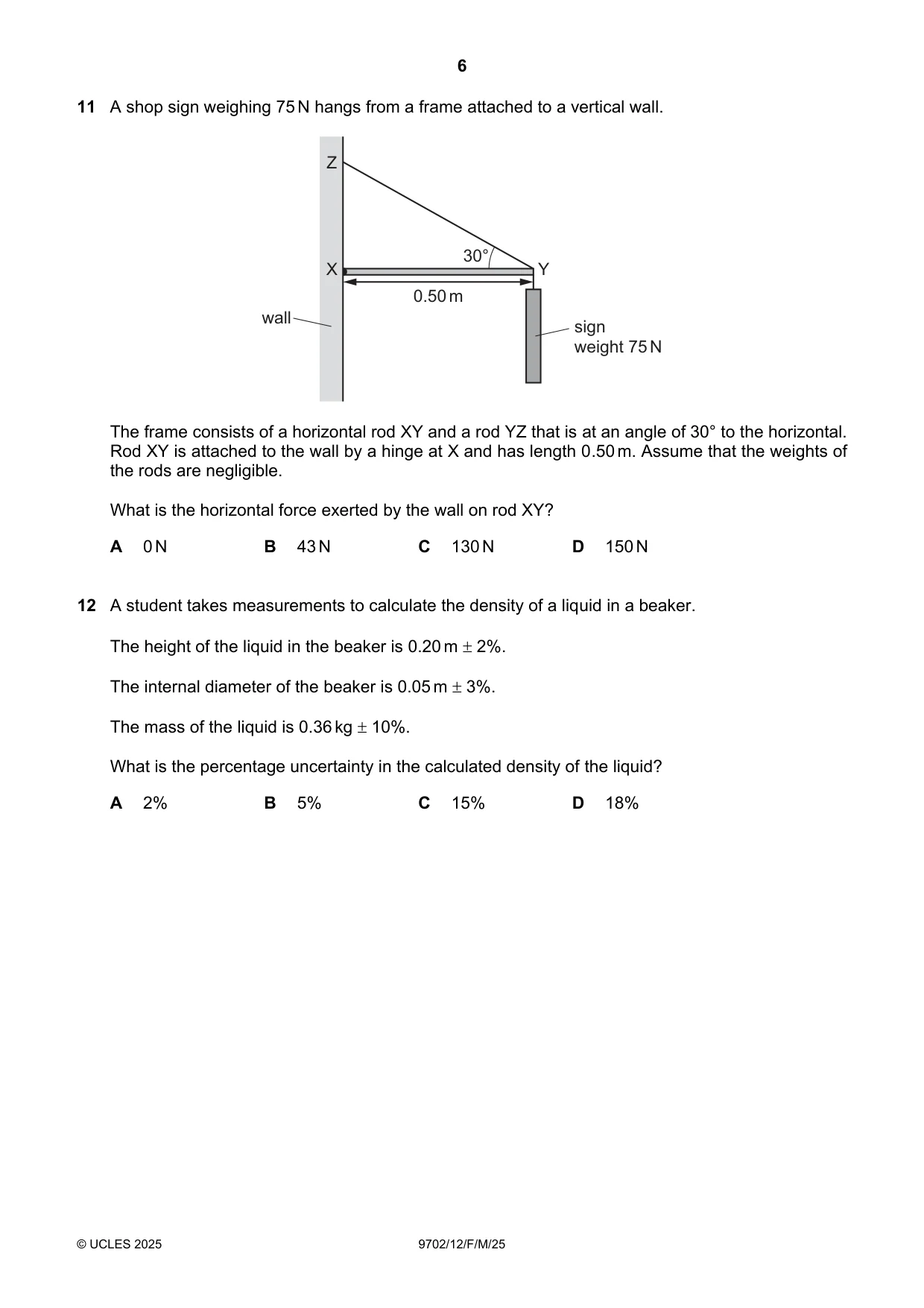
Q11 · A shop sign weighing 75 N hangs from a frame attached to a vertical wall
11 A shop sign weighing 75 N hangs from a frame attached to a vertical wall. Z 30° X Y 0.50 m wall sign weight 75 N The frame consists of a horizontal rod XY and a rod YZ that is at an angle of 30° to the horizontal. Rod XY is attached to the wall by a hinge at X and has length 0.50 m. Assume that the weights of the rods are negligible. What is the horizontal force exerted by the wall on rod XY? A 0 N B 43 N C 130 N D 150 N
Mark scheme: C
Q12 · A student takes measurements to calculate the density of a liquid in a beaker
12 A student takes measurements to calculate the density of a liquid in a beaker. The height of the liquid in the beaker is 0.20 m 2%. The internal diameter of the beaker is 0.05 m 3%. The mass of the liquid is 0.36 kg 10%. What is the percentage uncertainty in the calculated density of the liquid? A 2% B 5% C 15% D 18%
Mark scheme: D
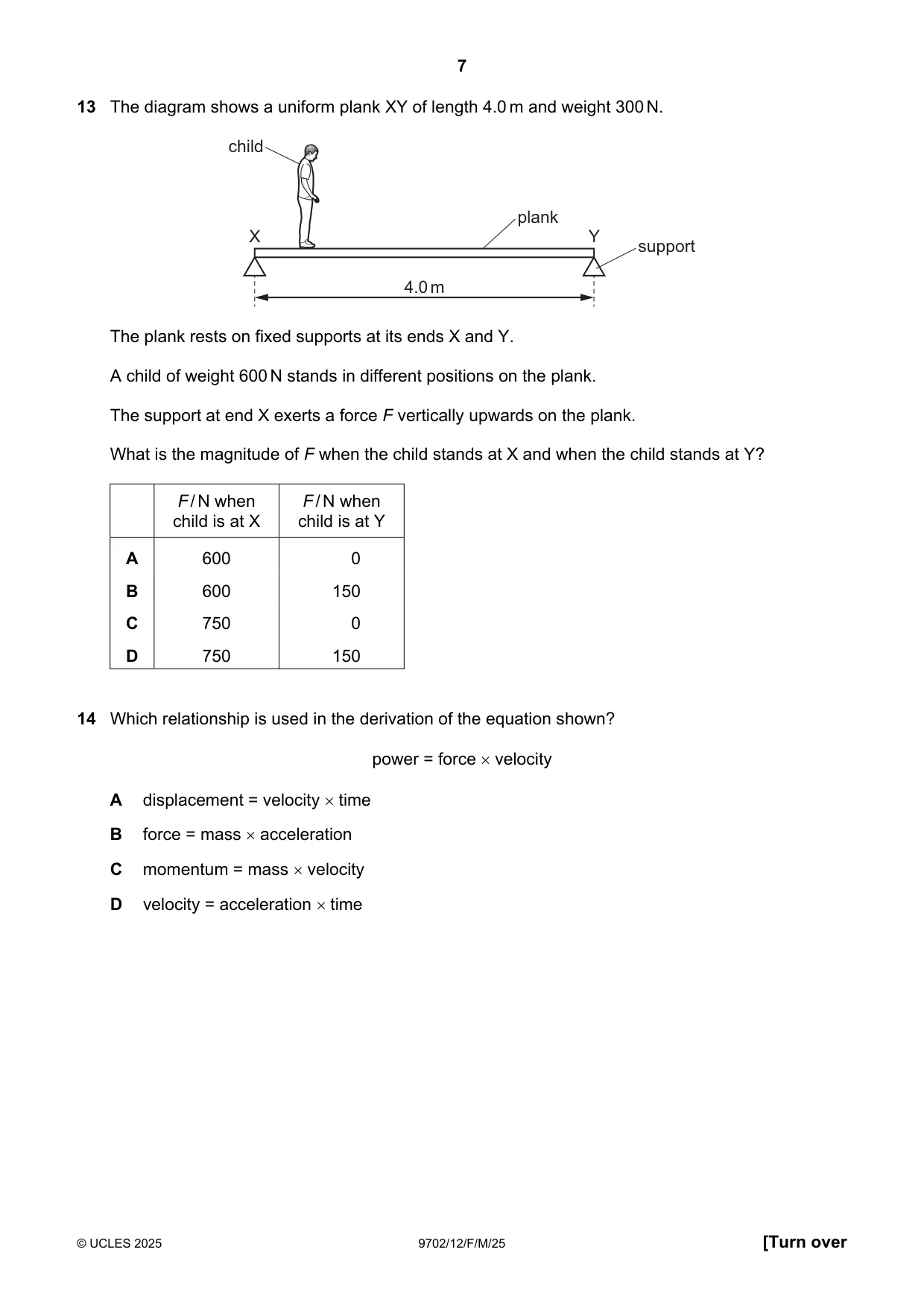
Q13 · The diagram shows a uniform plank XY of length 4.0 m and weight 300 N
13 The diagram shows a uniform plank XY of length 4.0 m and weight 300 N. child plank X Y support 4.0 m The plank rests on fixed supports at its ends X and Y. A child of weight 600 N stands in different positions on the plank. The support at end X exerts a force F vertically upwards on the plank. What is the magnitude of F when the child stands at X and when the child stands at Y? F / N when F / N when child is at X child is at Y A 600 0 B 600 150 C 750 0 D 750 150
Mark scheme: D
Q14 · Which relationship is used in the derivation of the equation shown?
14 Which relationship is used in the derivation of the equation shown? power = force velocity A displacement = velocity time B force = mass acceleration C momentum = mass velocity D velocity = acceleration time
Mark scheme: A
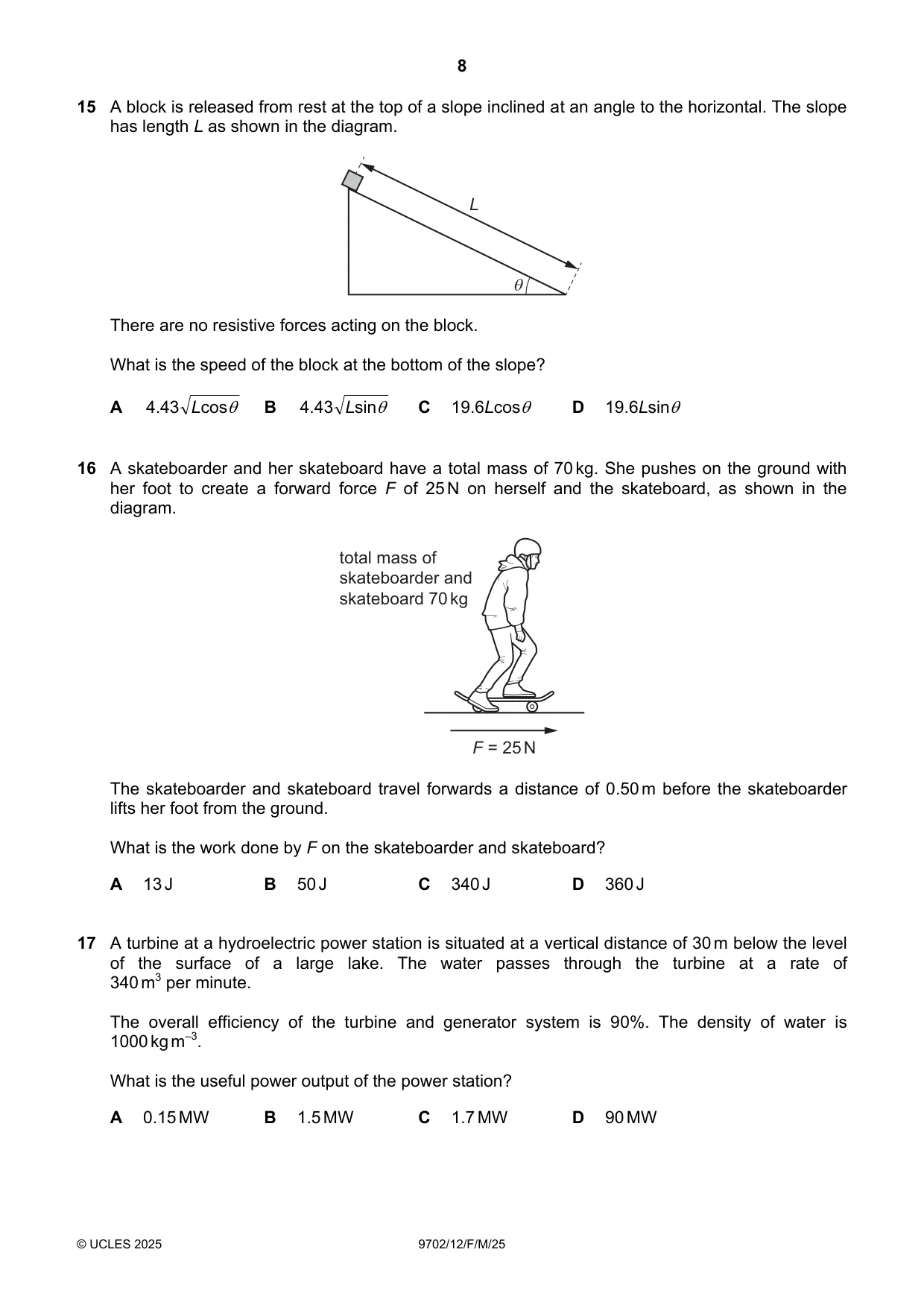
Q15 · A block is released from rest at the top of a slope inclined at an angle to the horizontal
15 A block is released from rest at the top of a slope inclined at an angle to the horizontal. The slope has length L as shown in the diagram. c7 There are no resistive forces acting on the block. What is the speed of the block at the bottom of the slope? A 4.43V/Lcos9¢ B 4.43VLsin@ C 19.6Lcos@ D 19.6Lsin6é
Mark scheme: B
More questions on Gravitational potential energy and kinetic energy
Q16 · A skateboarder and her skateboard have a total mass of 70 kg
16 A skateboarder and her skateboard have a total mass of 70 kg. She pushes on the ground with her foot to create a forward force F of 25 N on herself and the skateboard, as shown in the diagram. total mass of skateboarder and skateboard 70 kg F = 25 N The skateboarder and skateboard travel forwards a distance of 0.50 m before the skateboarder lifts her foot from the ground. What is the work done by F on the skateboarder and skateboard? A 13 J B 50 J C 340 J D 360 J
Mark scheme: A
Q17 · A turbine at a hydroelectric power station is situated at a vertical distance of 30 m…
17 A turbine at a hydroelectric power station is situated at a vertical distance of 30 m below the level of the surface of a large lake. The water passes through the turbine at a rate of 340 m3 per minute. The overall efficiency of the turbine and generator system is 90%. The density of water is 1000 kg m–3. What is the useful power output of the power station? A 0.15 MW B 1.5 MW C 1.7 MW D 90 MW
Mark scheme: B
Q18 · A projectile is launched at 45° to the horizontal with initial kinetic energy E
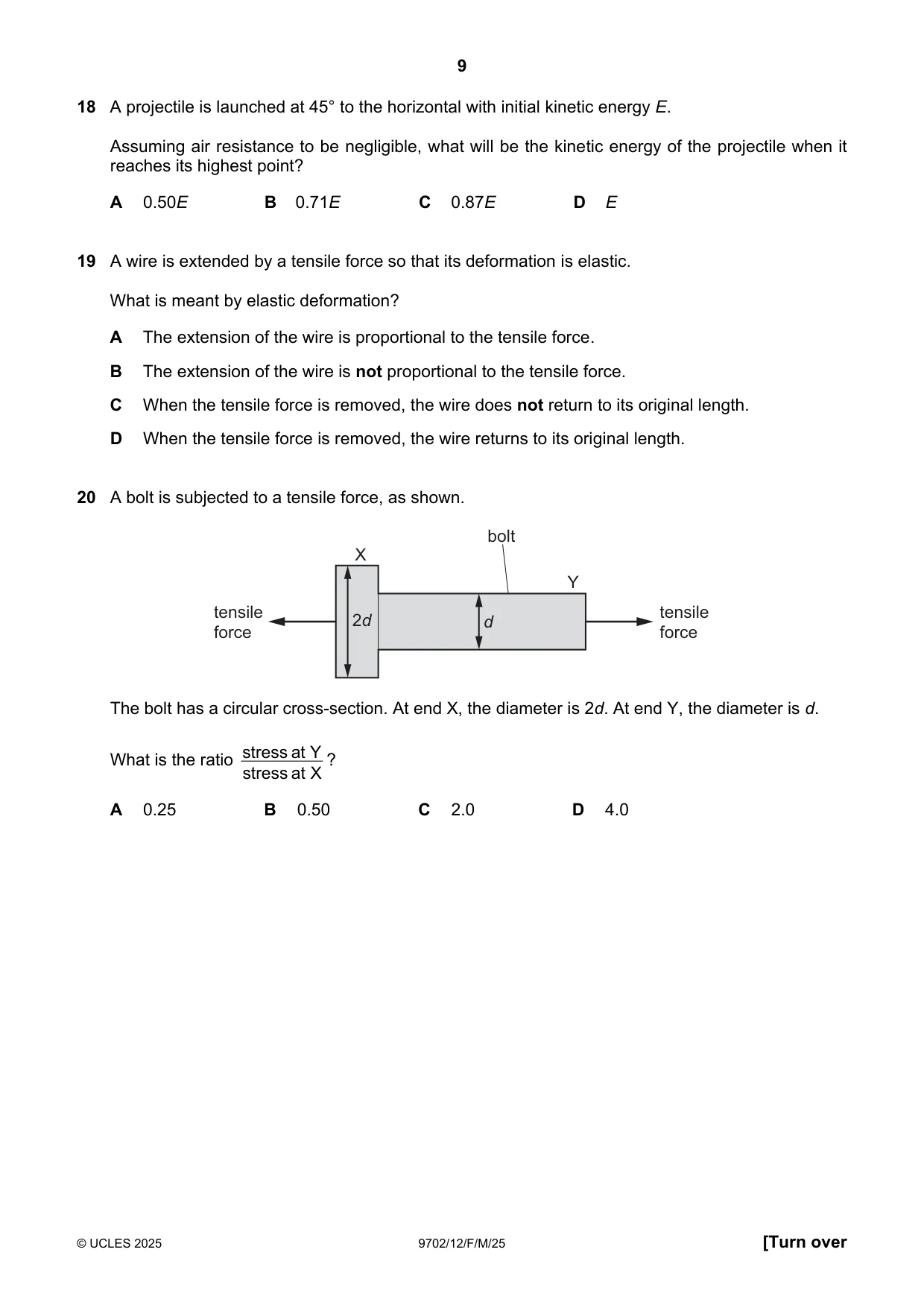
18 A projectile is launched at 45° to the horizontal with initial kinetic energy E. Assuming air resistance to be negligible, what will be the kinetic energy of the projectile when it reaches its highest point? A 0.50E B 0.71E C 0.87E D E
Mark scheme: A
More questions on Gravitational potential energy and kinetic energy
Q19 · A wire is extended by a tensile force so that its deformation is elastic
19 A wire is extended by a tensile force so that its deformation is elastic. What is meant by elastic deformation? A The extension of the wire is proportional to the tensile force. B The extension of the wire is not proportional to the tensile force. C When the tensile force is removed, the wire does not return to its original length. D When the tensile force is removed, the wire returns to its original length.
Mark scheme: D
Q20 · A bolt is subjected to a tensile force, as shown
20 A bolt is subjected to a tensile force, as shown. bolt X Y tensile 2d d tensile force force The bolt has a circular cross-section. At end X, the diameter is 2d. At end Y, the diameter is d. What is the ratio stress at Y ? stress at X A 0.25 B 0.50 C 2.0 D 4.0
Mark scheme: D
Q21 · The graph shows the relationship between force acting on a compression spring and change…
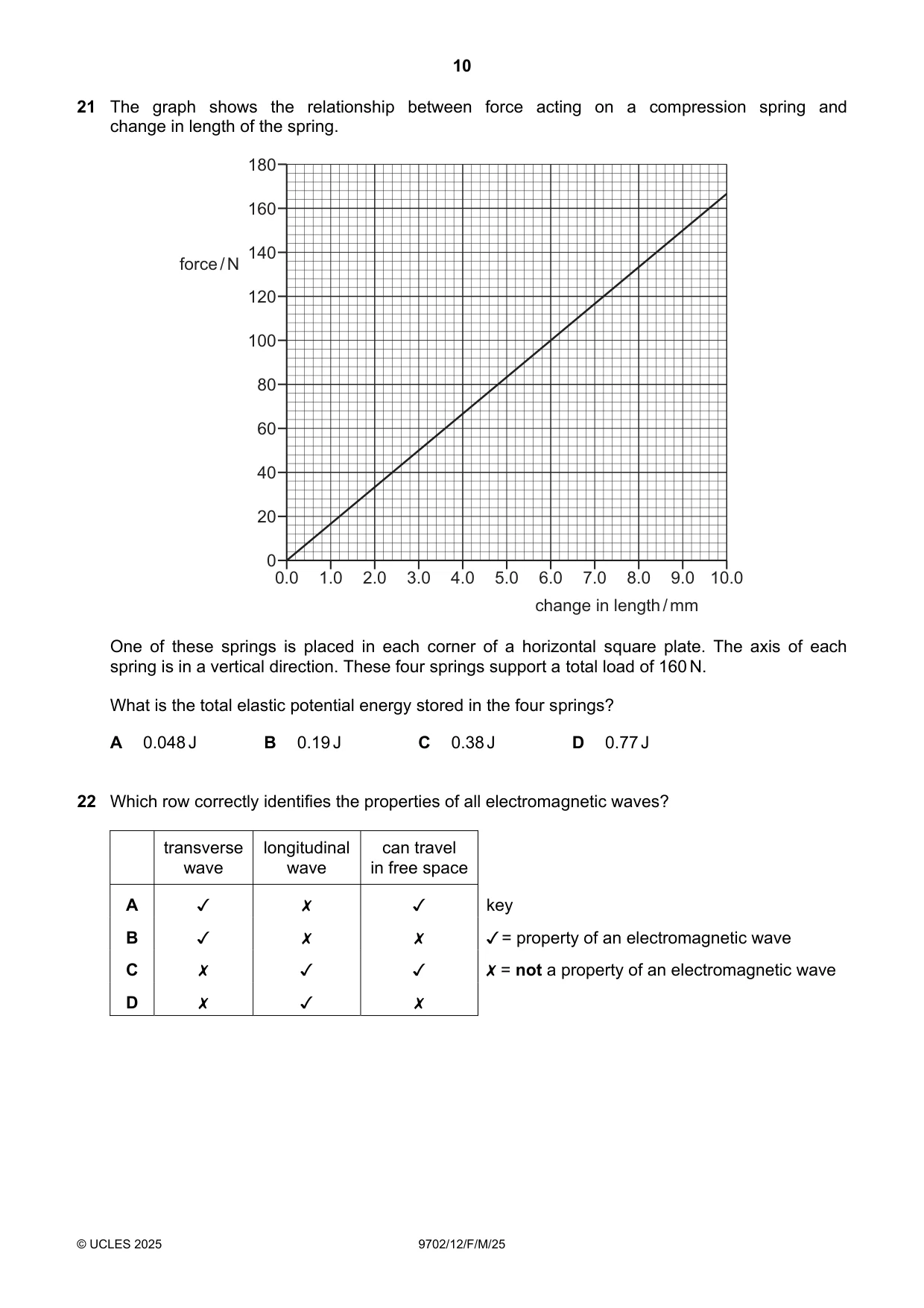
21 The graph shows the relationship between force acting on a compression spring and change in length of the spring. 180 160 140 force / N 120 100 80 60 40 20 0 0.0 1.0 2.0 3.0 4.0 5.0 6.0 7.0 8.0 9.0 10.0 change in length / mm One of these springs is placed in each corner of a horizontal square plate. The axis of each spring is in a vertical direction. These four springs support a total load of 160 N. What is the total elastic potential energy stored in the four springs? A 0.048 J B 0.19 J C 0.38 J D 0.77 J
Mark scheme: B
Q22 · Which row correctly identifies the properties of all electromagnetic waves?
22 Which row correctly identifies the properties of all electromagnetic waves? transverse | longitudinal can travel wave wave in free space A v x v B v x x Cc x v v D x v x key / = property of an electromagnetic wave X = not a property of an electromagnetic wave
Mark scheme: A
Q23 · What is the approximate range of wavelengths in free space for infrared radiation?
23 What is the approximate range of wavelengths in free space for infrared radiation? A 100 nm to 400 nm B 300 m to 30 cm C 400 nm to 700 nm D 800 nm to 1000 m
Mark scheme: D
Q24 · The diagram shows a car travelling at a constant speed in a straight line between person…
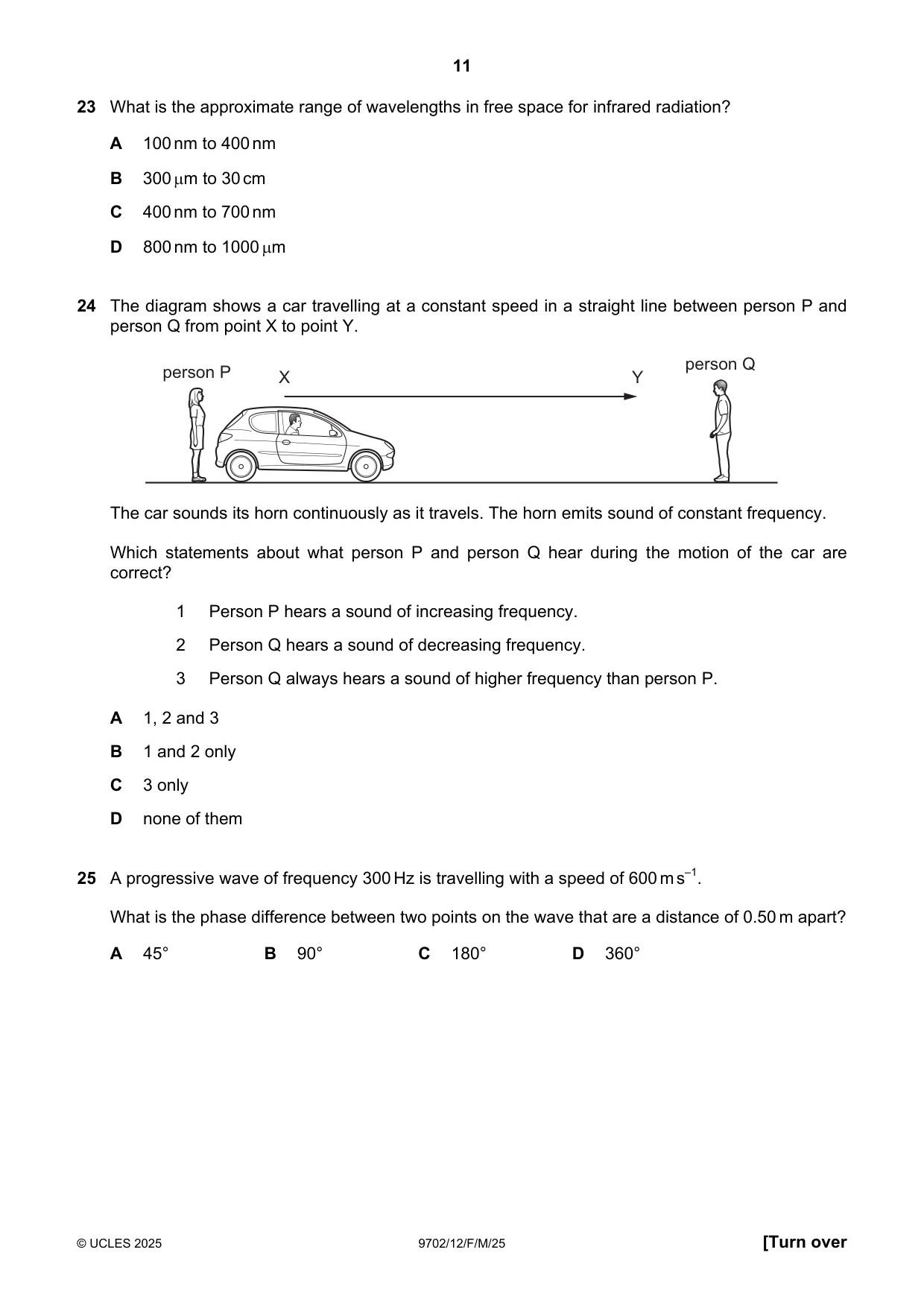
24 The diagram shows a car travelling at a constant speed in a straight line between person P and person Q from point X to point Y. person P person Q X Y The car sounds its horn continuously as it travels. The horn emits sound of constant frequency. Which statements about what person P and person Q hear during the motion of the car are correct? 1 Person P hears a sound of increasing frequency. 2 Person Q hears a sound of decreasing frequency. 3 Person Q always hears a sound of higher frequency than person P. A 1, 2 and 3 B 1 and 2 only C 3 only D none of them
Mark scheme: C
Q25 · A progressive wave of frequency 300 Hz is travelling with a speed of 600 m s–1
25 A progressive wave of frequency 300 Hz is travelling with a speed of 600 m s–1. What is the phase difference between two points on the wave that are a distance of 0.50 m apart? A 45° B 90° C 180° D 360°
Mark scheme: B
Q26 · A polarised beam of light with intensity I is incident normally on a polarising filter
26 A polarised beam of light with intensity I is incident normally on a polarising filter. The transmitted light has intensity I. The filter is rotated about the normal axis through an angle . The transmitted light has intensity 0.75I. What is the angle ? A 30° B 42° C 49° D 60°
Mark scheme: A
Q27 · Light waves are emitted from two sources
27 Light waves are emitted from two sources. What is a necessary condition for observable interference fringes to be produced? A The waves must be polarised. B The waves must not be polarised. C The waves must be coherent. D The waves must have equal amplitudes.
Mark scheme: C
Q28 · The diagram shows a water wave in a shallow tank
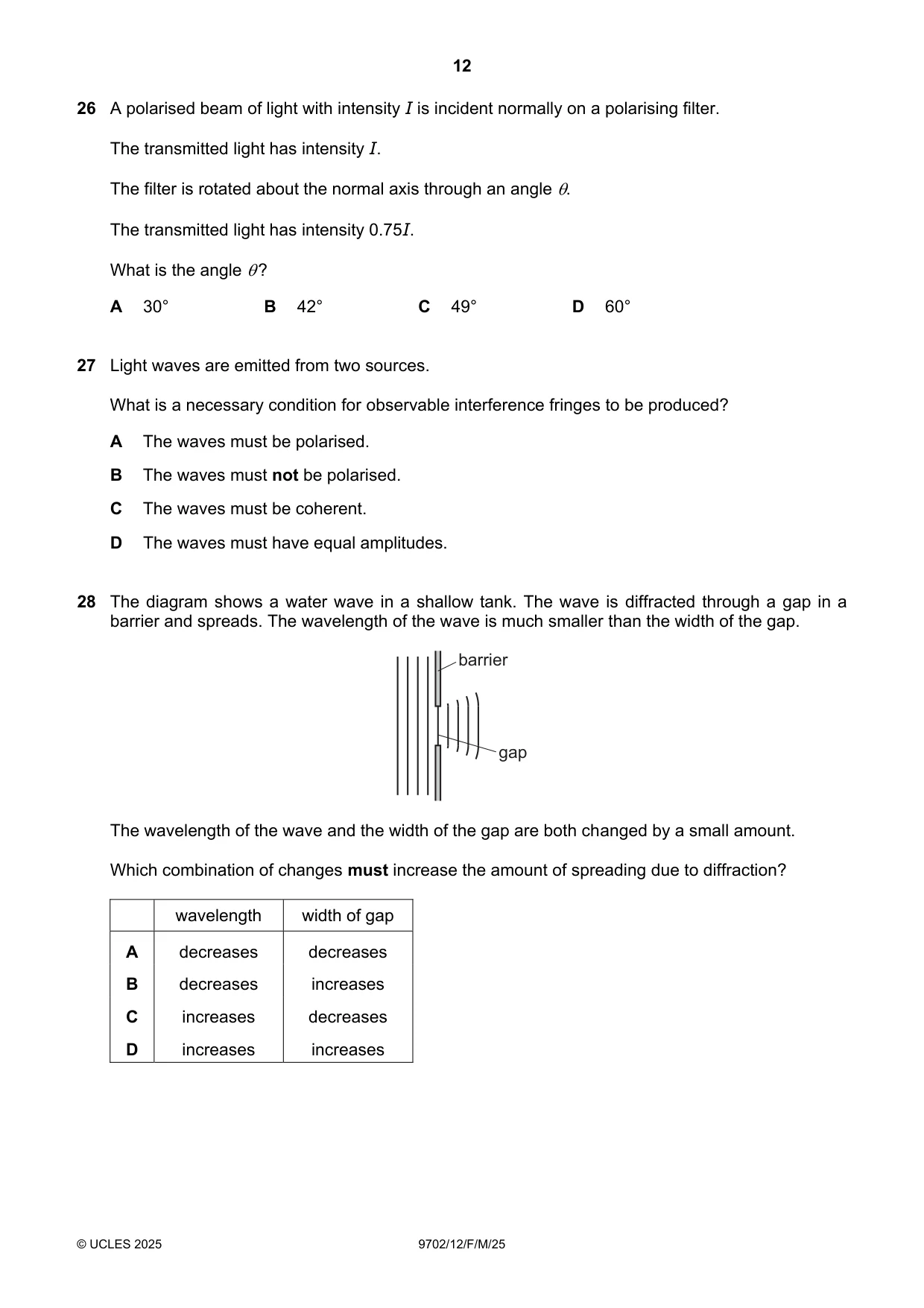
28 The diagram shows a water wave in a shallow tank. The wave is diffracted through a gap in a barrier and spreads. The wavelength of the wave is much smaller than the width of the gap. barrier gap The wavelength of the wave and the width of the gap are both changed by a small amount. Which combination of changes must increase the amount of spreading due to diffraction? wavelength width of gap A decreases decreases B decreases increases C increases decreases D increases increases
Mark scheme: C
Q29 · Light of wavelength 567 nm is incident normally on a diffraction grating
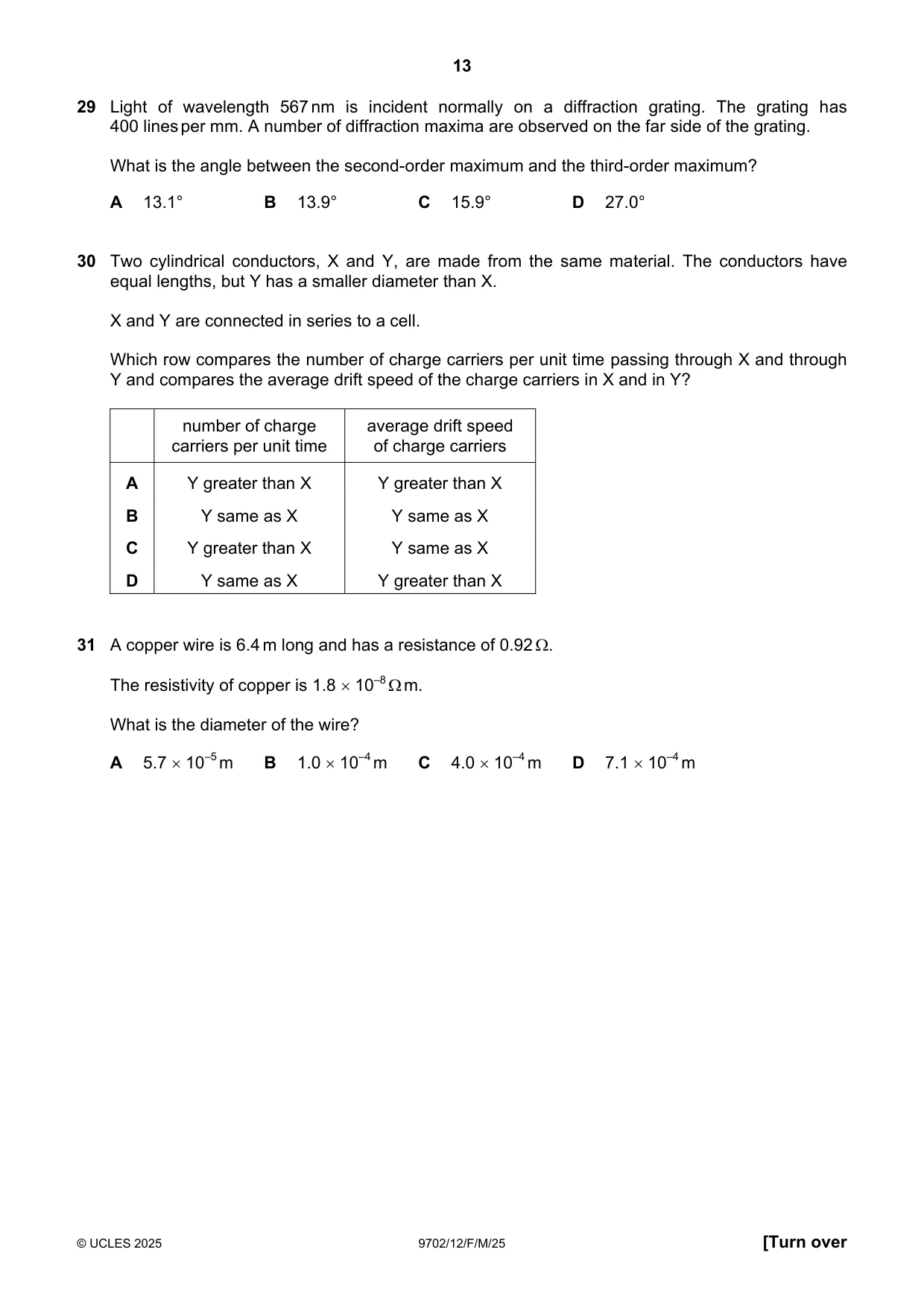
29 Light of wavelength 567 nm is incident normally on a diffraction grating. The grating has 400 lines per mm. A number of diffraction maxima are observed on the far side of the grating. What is the angle between the second-order maximum and the third-order maximum? A 13.1° B 13.9° C 15.9° D 27.0°
Mark scheme: C
Q30 · Two cylindrical conductors, X and Y, are made from the same material
30 Two cylindrical conductors, X and Y, are made from the same material. The conductors have equal lengths, but Y has a smaller diameter than X. X and Y are connected in series to a cell. Which row compares the number of charge carriers per unit time passing through X and through Y and compares the average drift speed of the charge carriers in X and in Y? number of charge average drift speed carriers per unit time of charge carriers A Y greater than X Y greater than X B Y same as X Y same as X C Y greater than X Y same as X D Y same as X Y greater than X
Mark scheme: D
Q31 · A copper wire is 6.4 m long and has a resistance of 0.92
31 A copper wire is 6.4 m long and has a resistance of 0.92 . The resistivity of copper is 1.8 10–8 m. What is the diameter of the wire? A 5.7 10–5 m B 1.0 10–4 m C 4.0 10–4 m D 7.1 10–4 m
Mark scheme: C
Q32 · A thermistor is connected to a cell with negligible internal resistance
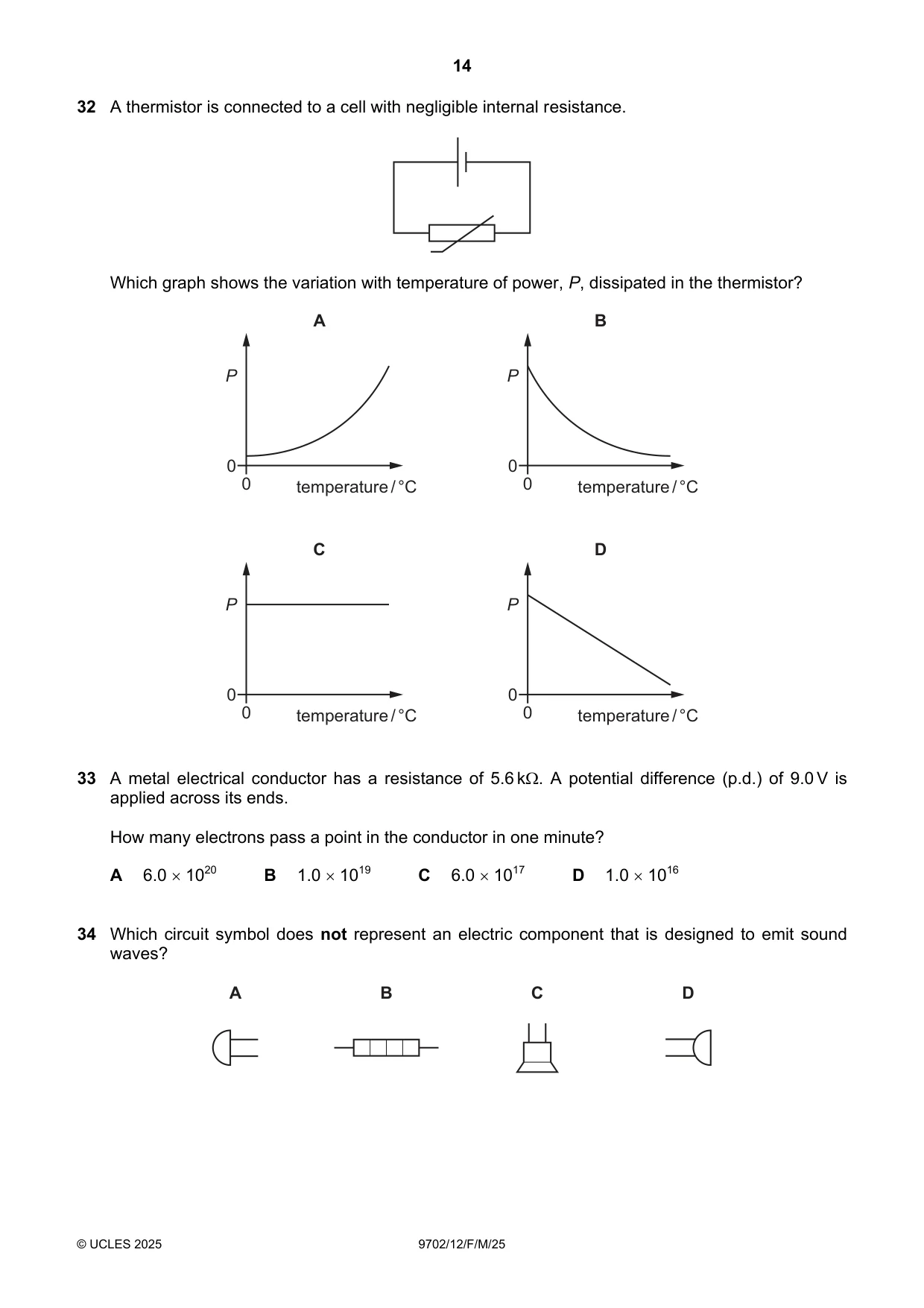
32 A thermistor is connected to a cell with negligible internal resistance. Which graph shows the variation with temperature of power, P, dissipated in the thermistor? A B P P 0 0 0 temperature / °C 0 temperature / °C C D P P 0 0 0 temperature / °C 0 temperature / °C
Mark scheme: A
Q33 · A metal electrical conductor has a resistance of 5.6 k
33 A metal electrical conductor has a resistance of 5.6 k. A potential difference (p.d.) of 9.0 V is applied across its ends. How many electrons pass a point in the conductor in one minute? A 6.0 1020 B 1.0 1019 C 6.0 1017 D 1.0 1016
Mark scheme: C
Q34 · Which circuit symbol does not represent an electric component that is designed to emit…
34 Which circuit symbol does not represent an electric component that is designed to emit sound waves? A B C D
Mark scheme: B
Q35 · The diagram shows a junction in a circuit where three wires, P, Q and R, meet
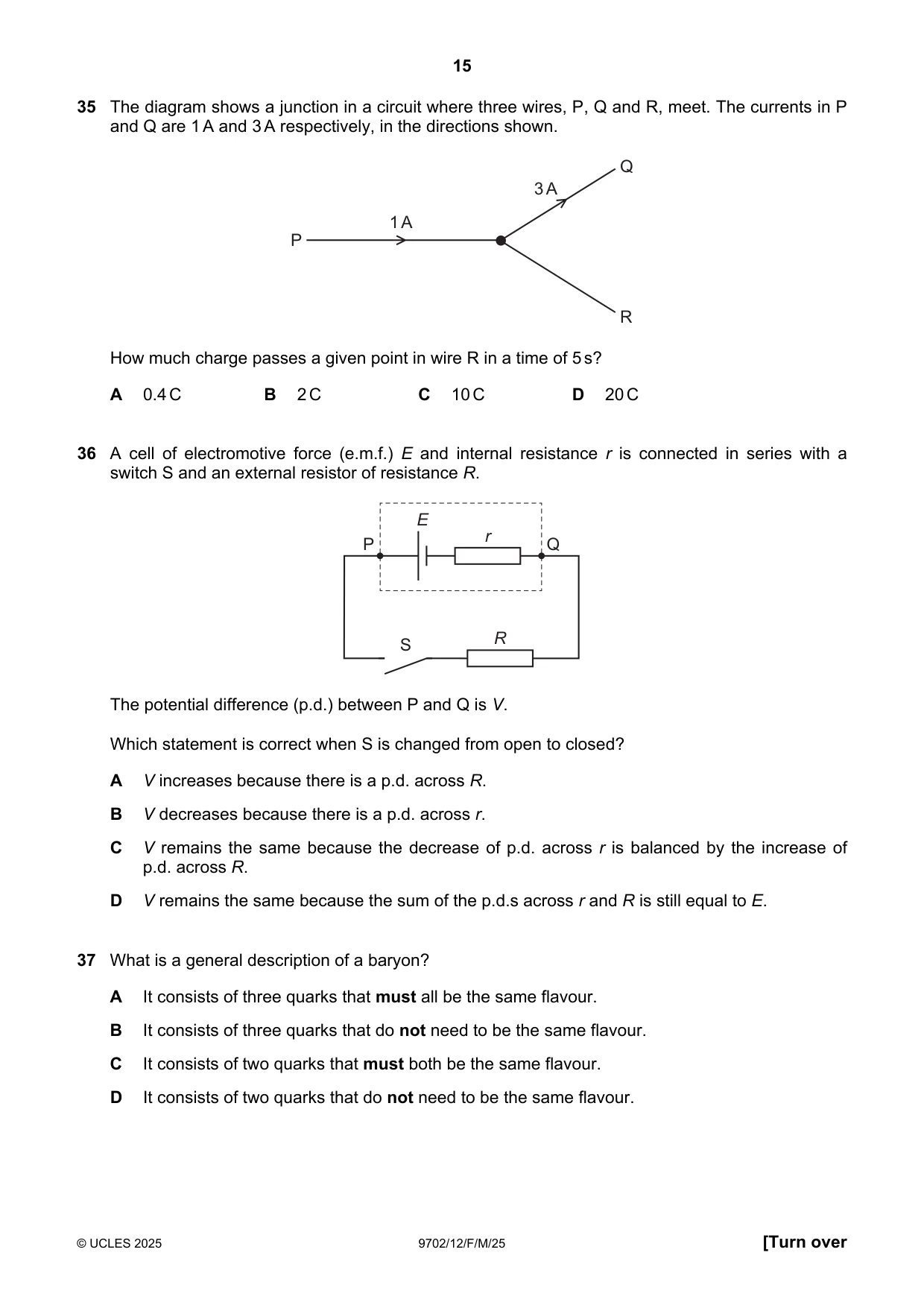
35 The diagram shows a junction in a circuit where three wires, P, Q and R, meet. The currents in P and Q are 1 A and 3 A respectively, in the directions shown. Q 3 A 1 A P R How much charge passes a given point in wire R in a time of 5 s? A 0.4 C B 2 C C 10 C D 20 C
Mark scheme: C
Q36 · A cell of electromotive force (e.m.f.) E and internal resistance r is connected in series…
36 A cell of electromotive force (e.m.f.) E and internal resistance r is connected in series with a switch S and an external resistor of resistance R. E r P Q R S The potential difference (p.d.) between P and Q is V. Which statement is correct when S is changed from open to closed? A V increases because there is a p.d. across R. B V decreases because there is a p.d. across r. C V remains the same because the decrease of p.d. across r is balanced by the increase of p.d. across R. D V remains the same because the sum of the p.d.s across r and R is still equal to E.
Mark scheme: B
Q37 · What is a general description of a baryon?
37 What is a general description of a baryon? A It consists of three quarks that must all be the same flavour. B It consists of three quarks that do not need to be the same flavour. C It consists of two quarks that must both be the same flavour. D It consists of two quarks that do not need to be the same flavour.
Mark scheme: B
Q38 · A stationary nucleus has nucleon number A
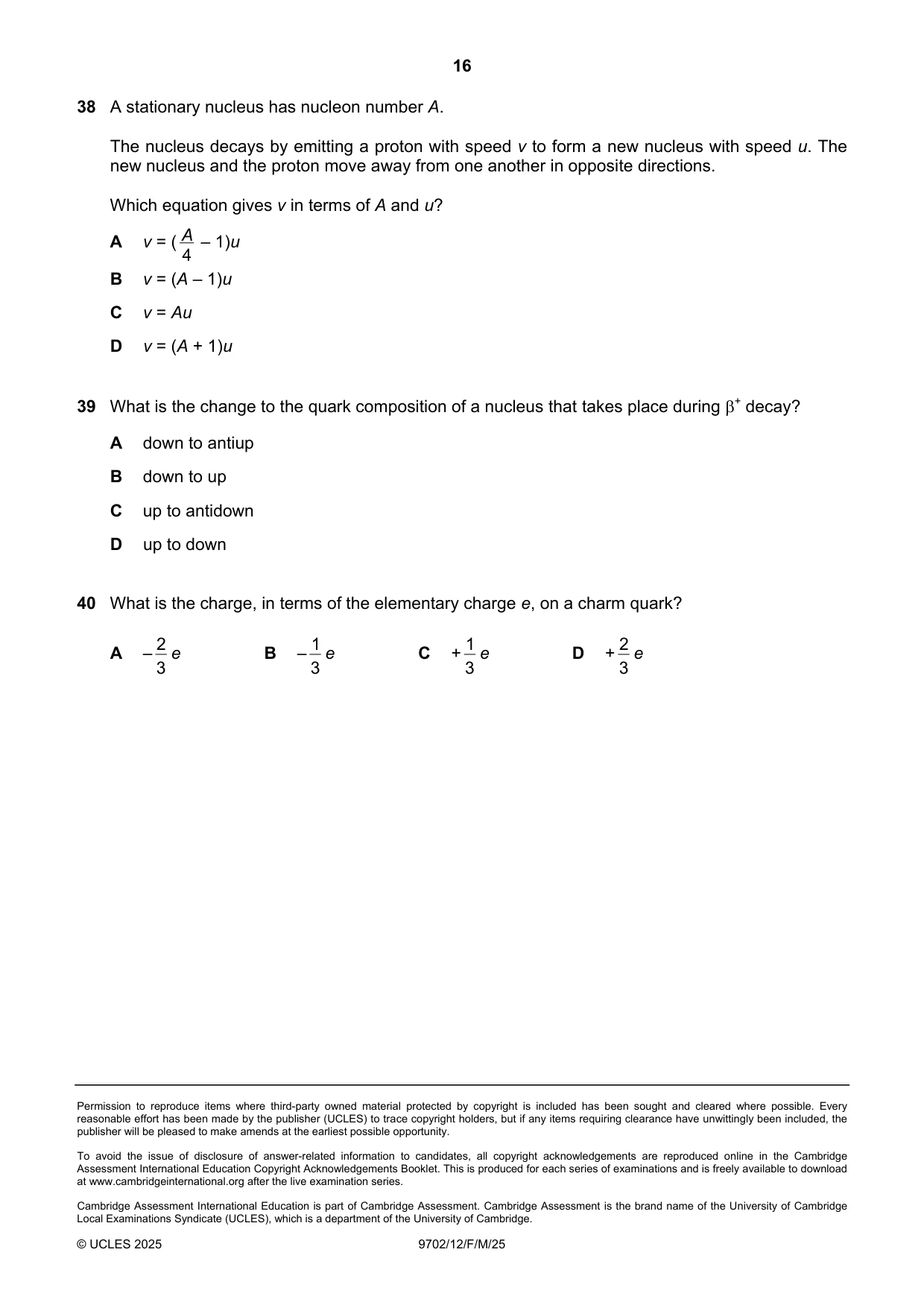
38 A stationary nucleus has nucleon number A. The nucleus decays by emitting a proton with speed v to form a new nucleus with speed u. The new nucleus and the proton move away from one another in opposite directions. Which equation gives v in terms of A and u? A v = ( 4 A – 1)u B v = (A – 1)u C v = Au D v = (A + 1)u
Mark scheme: B
Q39 · What is the change to the quark composition of a nucleus that takes place during + decay?
39 What is the change to the quark composition of a nucleus that takes place during + decay? A down to antiup B down to up C up to antidown D up to down
Mark scheme: D
Q40 · What is the charge, in terms of the elementary charge e, on a charm quark?
40 What is the charge, in terms of the elementary charge e, on a charm quark? 2 e 1 e 1 e 2 e A – B – C + D + 3 3 3 3
Mark scheme: D
What was in this paper
The subtopics covered by these 40 questions, and how many questions each got. Open one in a new tab to see every Cambridge question on it.
3Fundamental particles3Linear momentum and its conservation3Elastic and plastic behaviour2Electric current2Equations of motion2Equilibrium of forces2Errors and uncertainties2Gravitational potential energy and kinetic energy2Momentum and Newton’s laws of motion2Practical circuits2Resistance and resistivity2Density and pressure1Diffraction1Doppler effect for sound waves1Electromagnetic spectrum1Interference1Kirchhoff’s laws1Polarisation1Progressive waves1Scalars and vectors1Stress and strain1The diffraction grating1Transverse and longitudinal waves1Turning effects of forces1What you needed in this session
Cambridge’s own grade thresholds for 2025 Feb/March, Paper 1 · Variant 2. A higher threshold means an easier paper — the bar moves with how the cohort did.