Cambridge A Level Physics 9702 — 2017 Oct/Nov Paper 1 · Variant 2
9702/12/O/N/17 · 40 questions · 40 marks · ≈45 min
The question paper and its mark scheme, free to read here and free to download. This is Cambridge’s own paper, exactly as it was sat.
Question paper20 pages
Mark scheme3 pages
Answers below. Sit the paper first if you are practising.
Questions as text
Q1 · Which pair of units are not the same when expressed in SI base units?
1 Which pair of units are not the same when expressed in SI base units? A m s–2 and N kg–1 B N s and kg m s–1 C Pa and N m–2 D V m–2 and N C–1
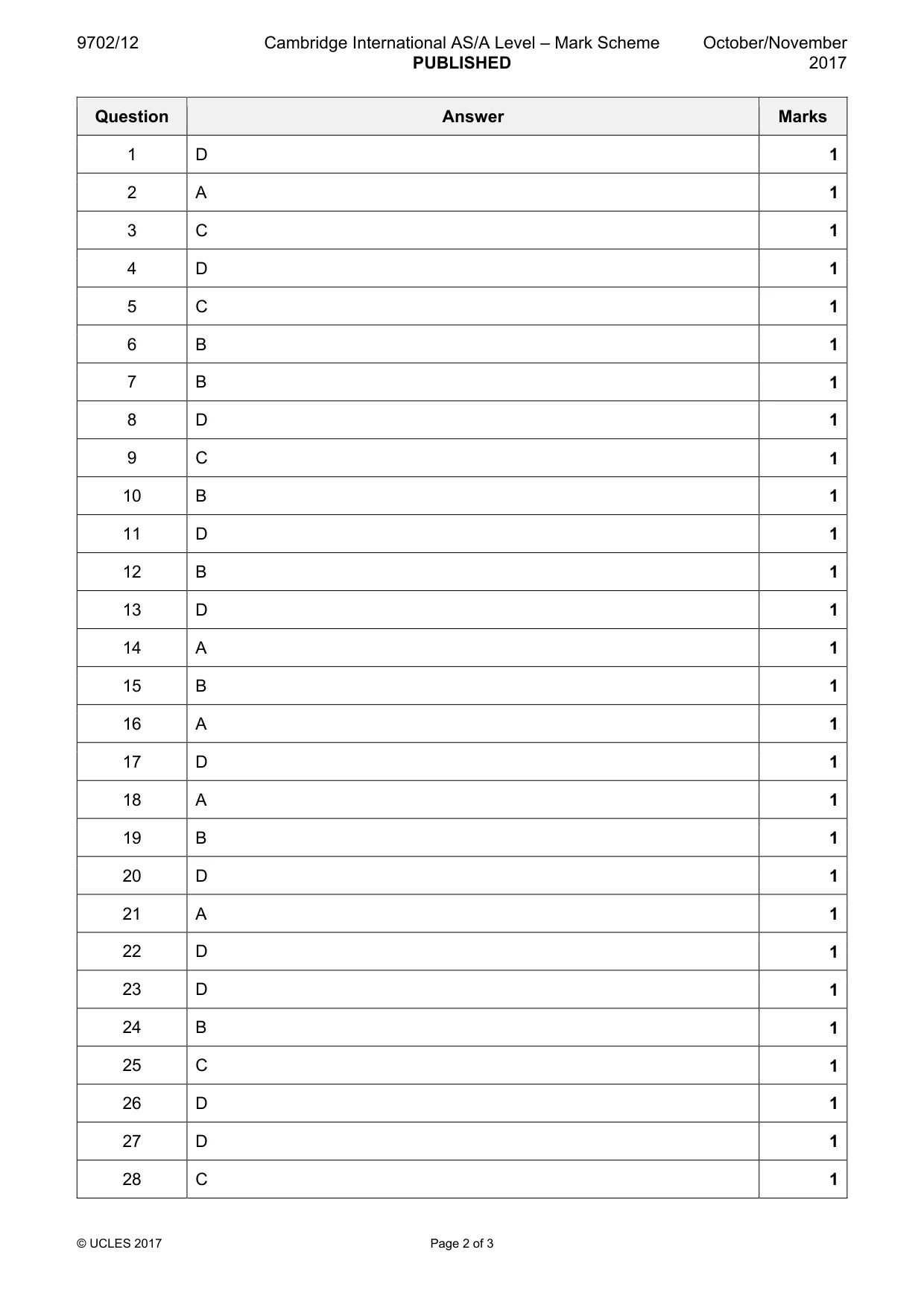
Mark scheme: D
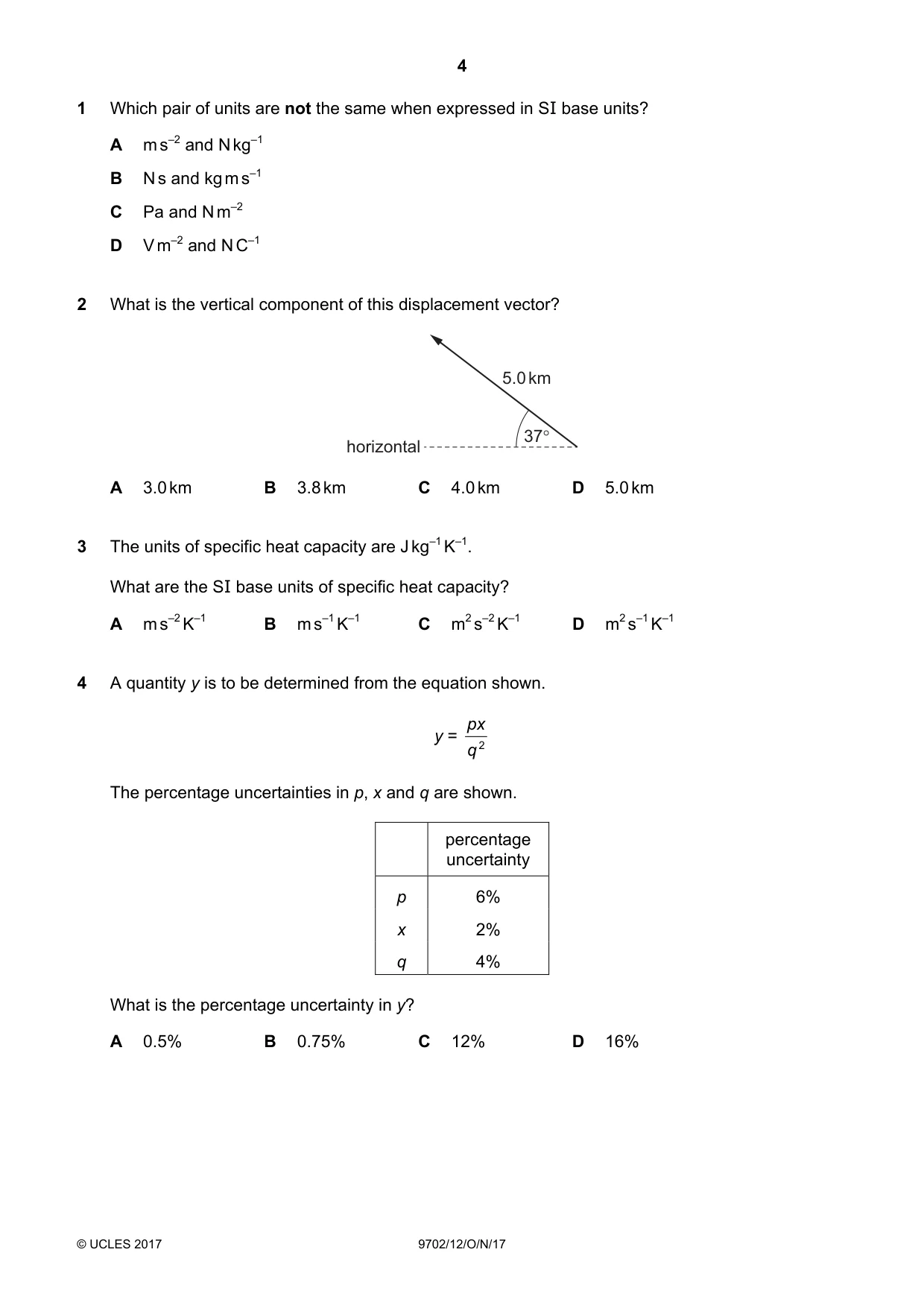
Q2 · What is the vertical component of this displacement vector?
2 What is the vertical component of this displacement vector? 5.0 km 37° horizontal A 3.0 km B 3.8 km C 4.0 km D 5.0 km
Mark scheme: A
Q3 · The units of specific heat capacity are J kg–1 K–1
3 The units of specific heat capacity are J kg–1 K–1. What are the SI base units of specific heat capacity? A m s–2 K–1 B m s–1 K–1 C m2 s–2 K–1 D m2 s–1 K–1
Mark scheme: C
Q4 · A quantity y is to be determined from the equation shown
4 A quantity y is to be determined from the equation shown. px y = q 2 The percentage uncertainties in p, x and q are shown. percentage uncertainty p 6% x 2% q 4% What is the percentage uncertainty in y? A 0.5% B 0.75% C 12% D 16%
Mark scheme: D
Q5 · A transmitter emits a pulse of electromagnetic waves towards a reflector
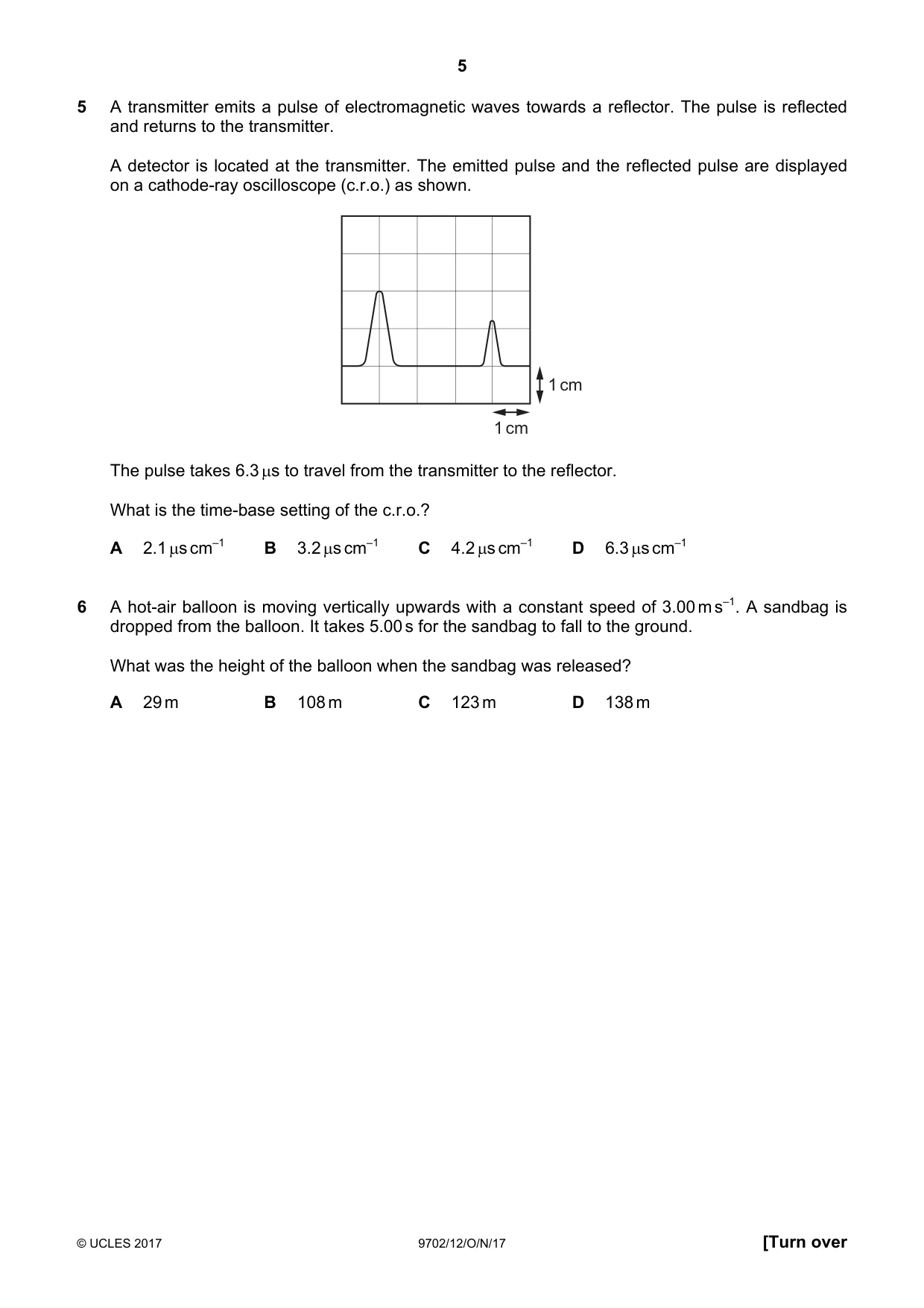
5 A transmitter emits a pulse of electromagnetic waves towards a reflector. The pulse is reflected and returns to the transmitter. A detector is located at the transmitter. The emitted pulse and the reflected pulse are displayed on a cathode-ray oscilloscope (c.r.o.) as shown. 1 cm 1 cm The pulse takes 6.3 µs to travel from the transmitter to the reflector. What is the time-base setting of the c.r.o.? A 2.1 µs cm–1 B 3.2 µs cm–1 C 4.2 µs cm–1 D 6.3 µs cm–1
Mark scheme: C
Q6 · A hot-air balloon is moving vertically upwards with a constant speed of 3.00 m s–1
6 A hot-air balloon is moving vertically upwards with a constant speed of 3.00 m s–1. A sandbag is dropped from the balloon. It takes 5.00 s for the sandbag to fall to the ground. What was the height of the balloon when the sandbag was released? A 29 m B 108 m C 123 m D 138 m
Mark scheme: B
Q7 · The velocity-time graph for a train starting at one station and stopping at the next is…
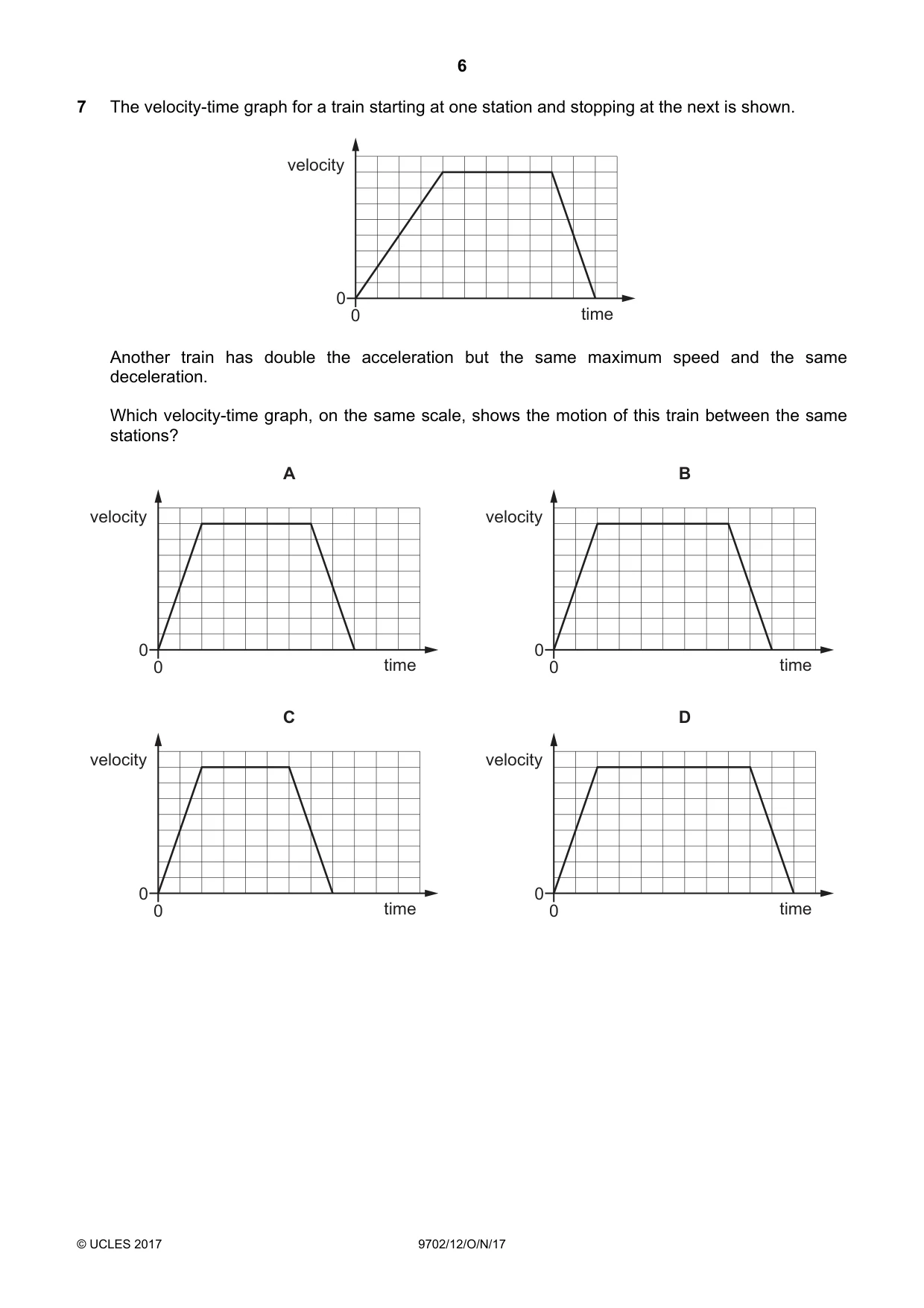
7 The velocity-time graph for a train starting at one station and stopping at the next is shown. velocity 0 0 time Another train has double the acceleration but the same maximum speed and the same deceleration. Which velocity-time graph, on the same scale, shows the motion of this train between the same stations? A B velocity velocity 0 0 0 time 0 time C D velocity velocity 0 0 0 time 0 time
Mark scheme: B
Q8 · A stone is released from rest and falls a long distance in air
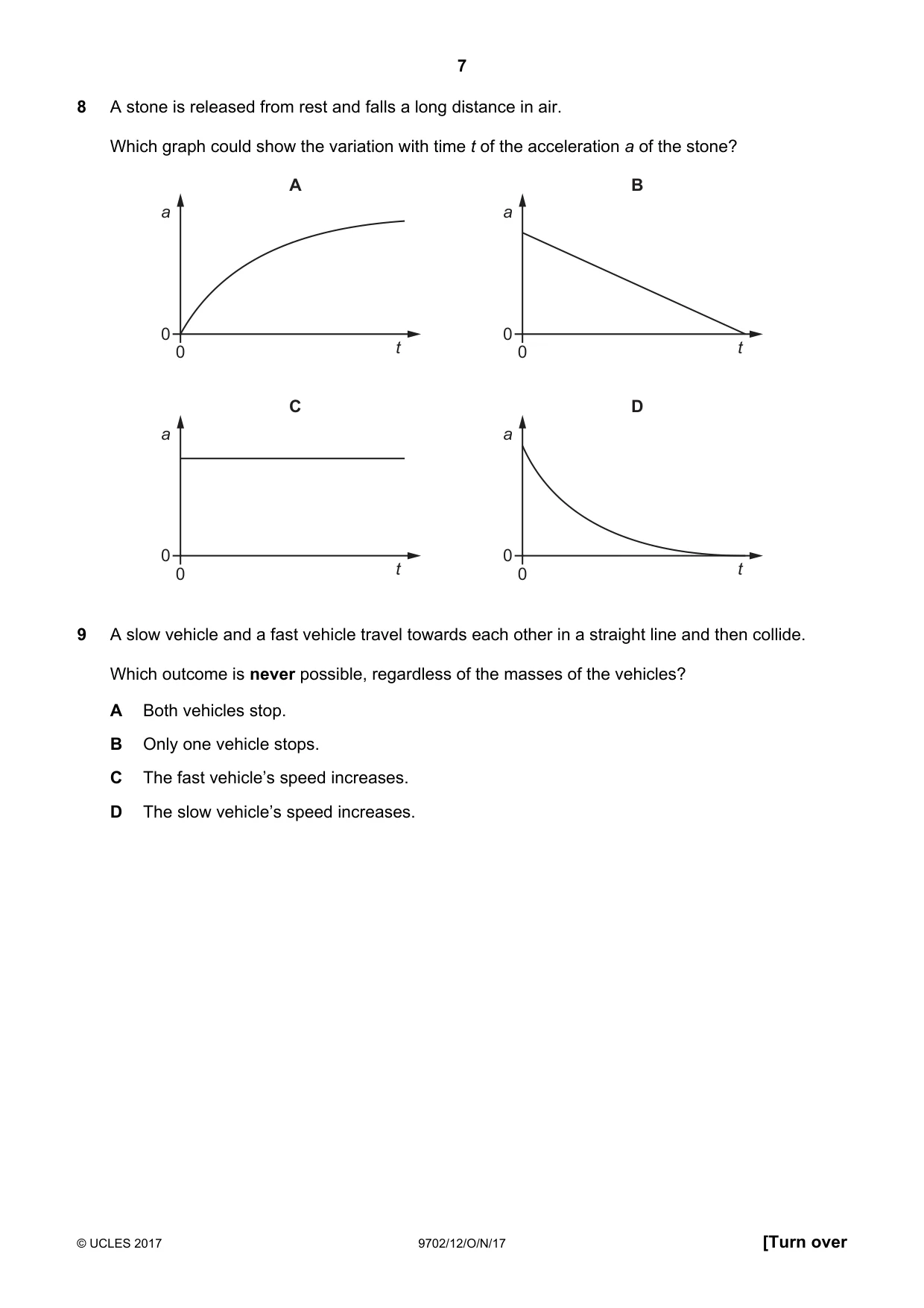
8 A stone is released from rest and falls a long distance in air. Which graph could show the variation with time t of the acceleration a of the stone? A B a a 0 0 0 t 0 t C D a a 0 0 0 t 0 t
Mark scheme: D
Q9 · A slow vehicle and a fast vehicle travel towards each other in a straight line and then…
9 A slow vehicle and a fast vehicle travel towards each other in a straight line and then collide. Which outcome is never possible, regardless of the masses of the vehicles? A Both vehicles stop. B Only one vehicle stops. C The fast vehicle’s speed increases. D The slow vehicle’s speed increases.
Mark scheme: C
Q10 · Two blocks of masses M and m are joined by a thin string which passes over a frictionless…
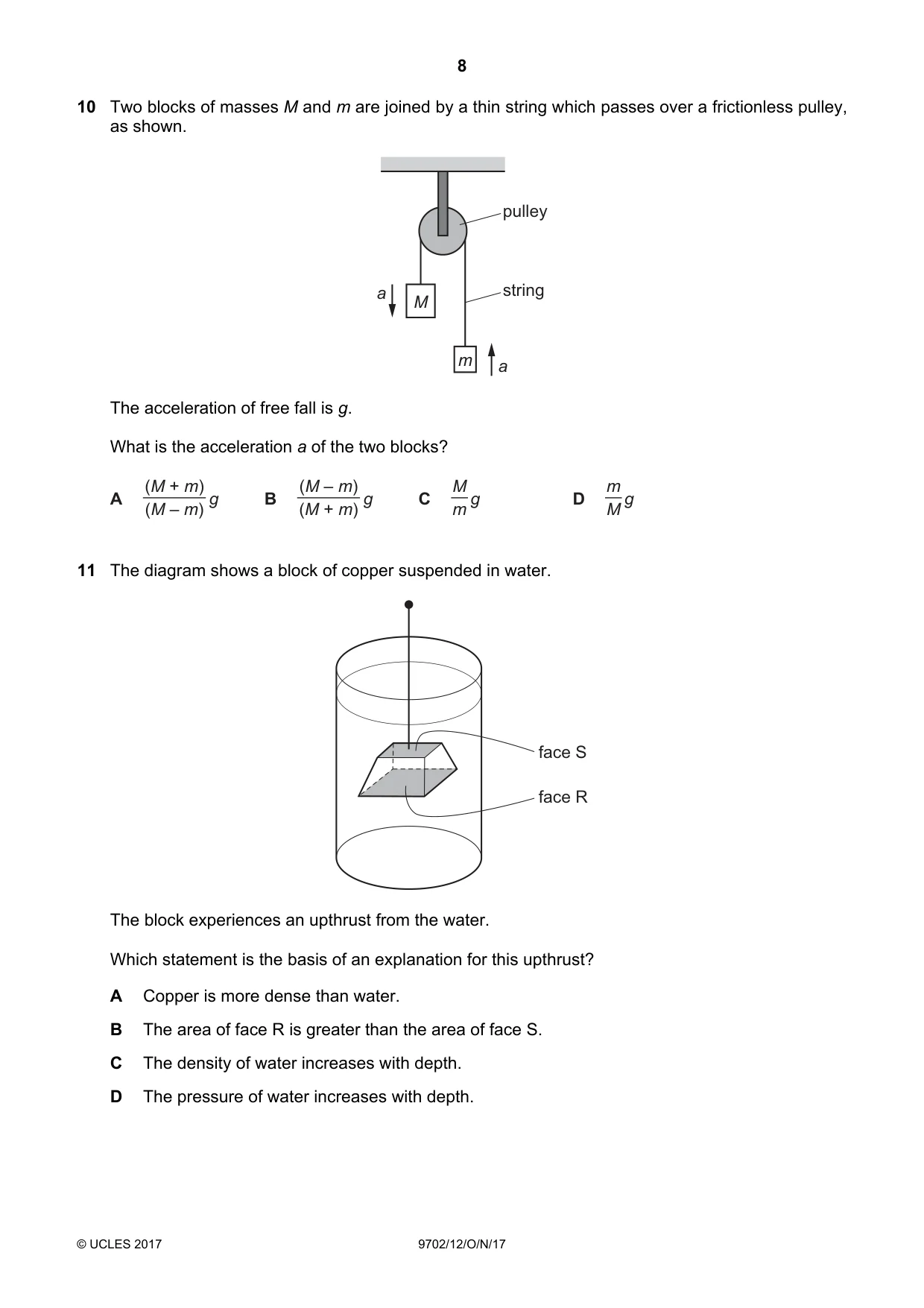
10 Two blocks of masses M and m are joined by a thin string which passes over a frictionless pulley, as shown. pulley a string M m a The acceleration of free fall is g. What is the acceleration a of the two blocks? (M + m) (M – m) M m A g B g C g D g (M – m) (M + m) m M
Mark scheme: B
Q11 · The diagram shows a block of copper suspended in water
11 The diagram shows a block of copper suspended in water. face S face R The block experiences an upthrust from the water. Which statement is the basis of an explanation for this upthrust? A Copper is more dense than water. B The area of face R is greater than the area of face S. C The density of water increases with depth. D The pressure of water increases with depth.
Mark scheme: D
Q12 · The diagram shows a solid cube with weight W and sides of length L
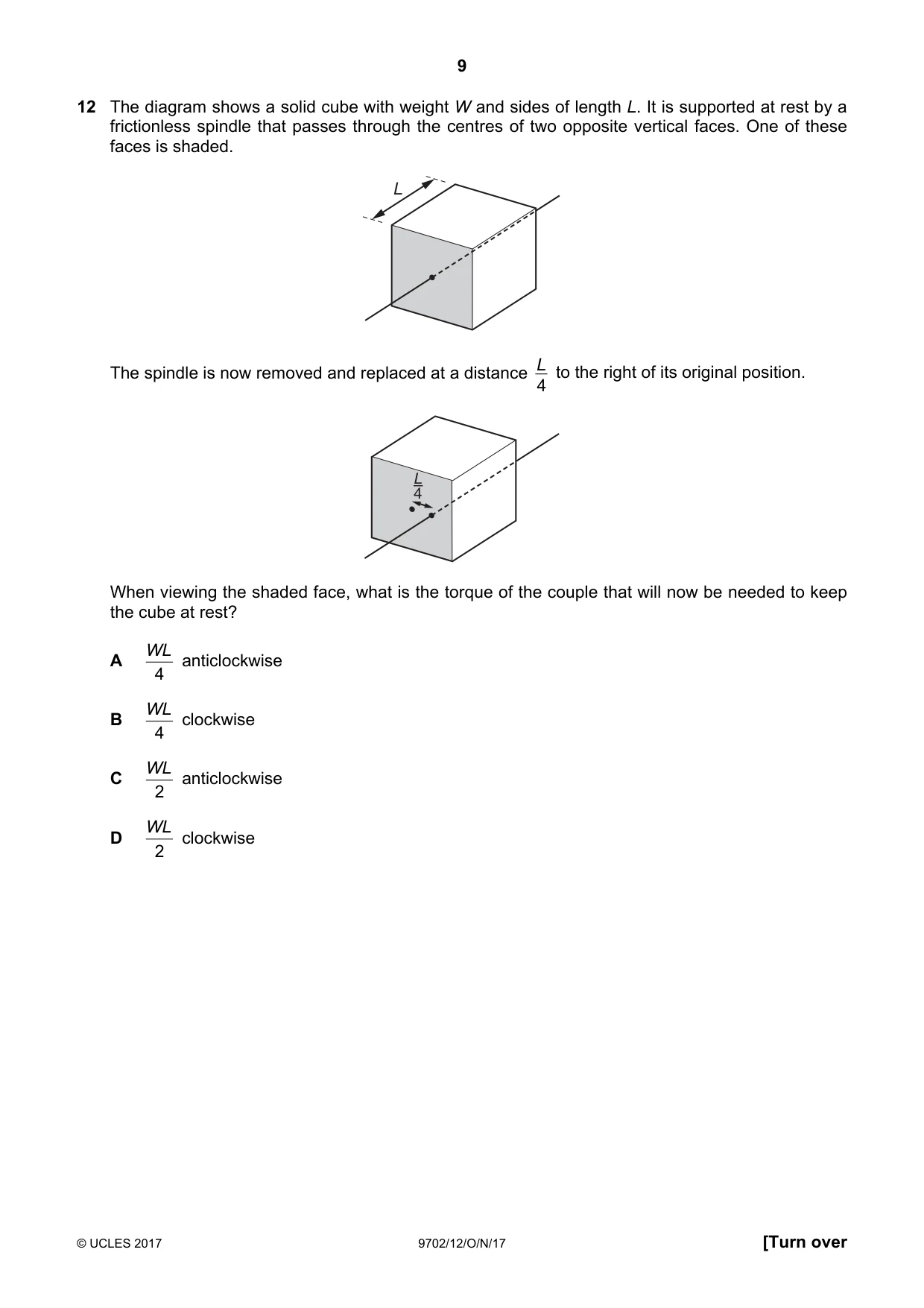
12 The diagram shows a solid cube with weight W and sides of length L. It is supported at rest by a frictionless spindle that passes through the centres of two opposite vertical faces. One of these faces is shaded. L L to the right of its original position. The spindle is now removed and replaced at a distance 4 L 4 When viewing the shaded face, what is the torque of the couple that will now be needed to keep the cube at rest? WL anticlockwise A 4 WL clockwise B 4 WL anticlockwise C 2 WL clockwise D 2
Mark scheme: B
Q13 · A street lamp is fixed to a wall by a metal rod and a cable
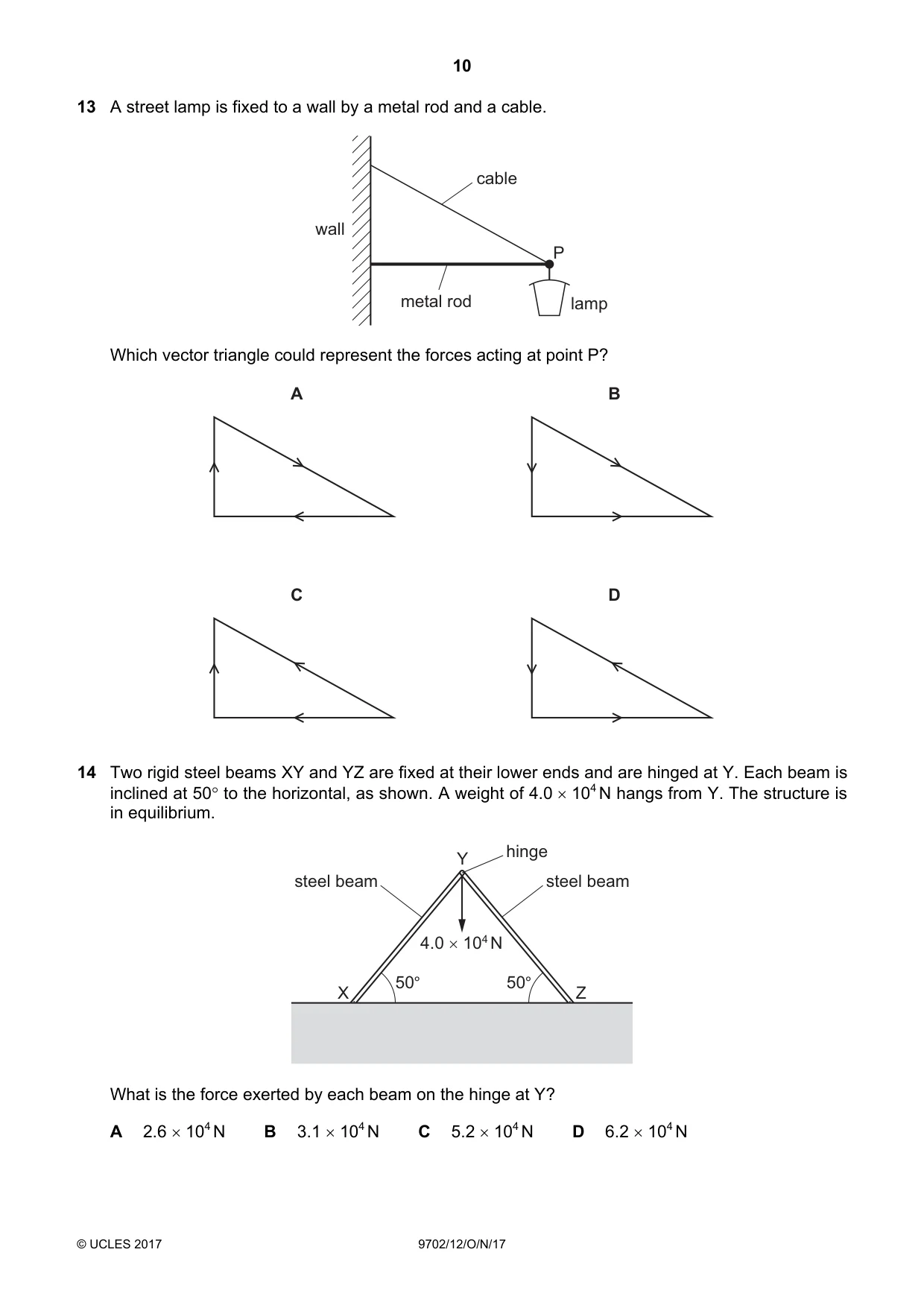
13 A street lamp is fixed to a wall by a metal rod and a cable. cable wall P metal rod lamp Which vector triangle could represent the forces acting at point P? A B C D
Mark scheme: D
Q14 · Two rigid steel beams XY and YZ are fixed at their lower ends and are hinged at Y
14 Two rigid steel beams XY and YZ are fixed at their lower ends and are hinged at Y. Each beam is inclined at 50° to the horizontal, as shown. A weight of 4.0 × 10⁴ N hangs from Y. The structure is in equilibrium. hinge Y steel beam steel beam 4.0 × 10⁴ N 50° 50° X Z What is the force exerted by each beam on the hinge at Y? A 2.6 × 10⁴ N B 3.1 × 10⁴ N C 5.2 × 10⁴ N D 6.2 × 10⁴ N
Mark scheme: A
Q15 · Air is trapped inside a glass bulb which is immersed in water and attached to a U-tube…
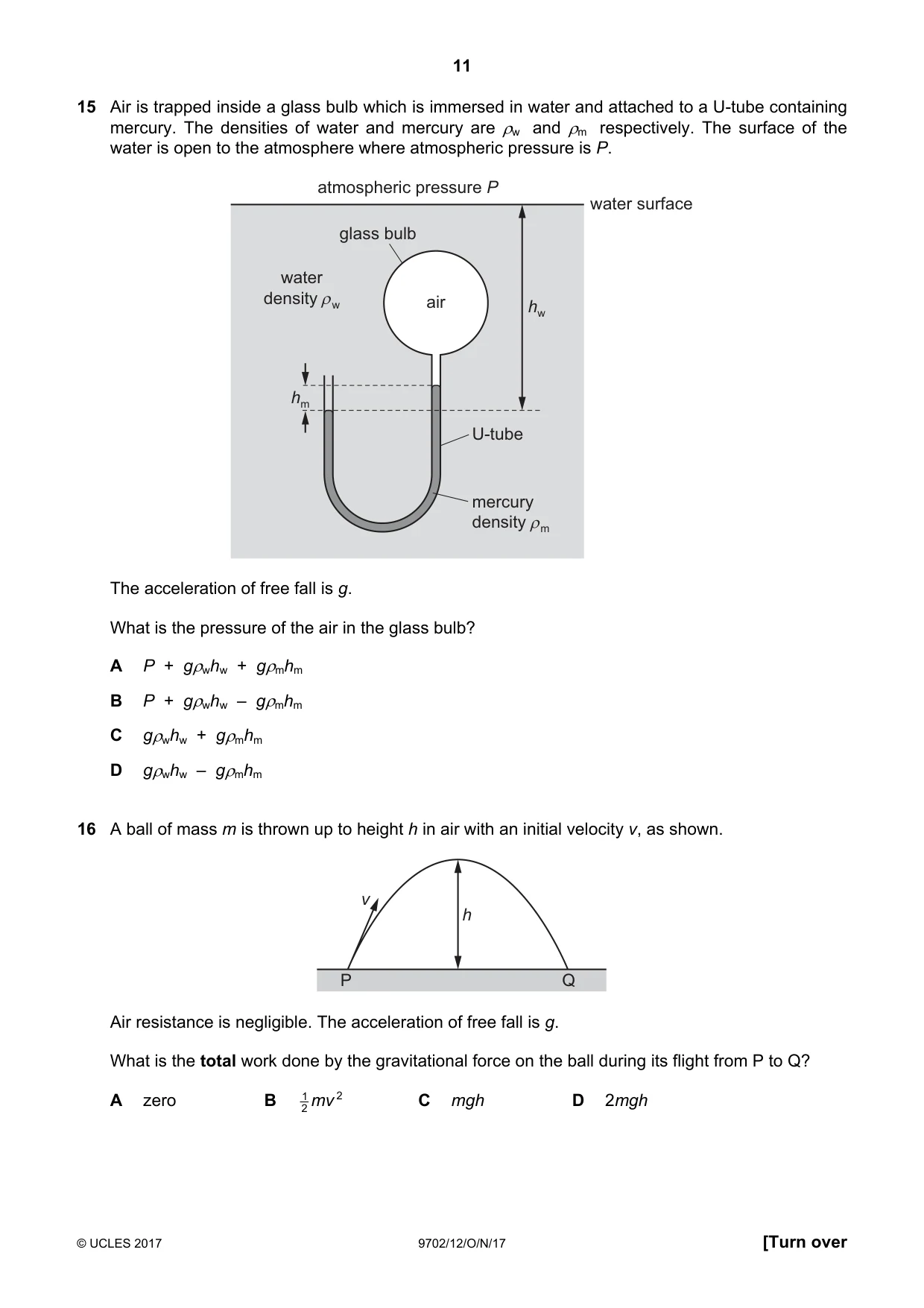
15 Air is trapped inside a glass bulb which is immersed in water and attached to a U-tube containing mercury. The densities of water and mercury are ρw and ρm respectively. The surface of the water is open to the atmosphere where atmospheric pressure is P. atmospheric pressure P water surface glass bulb water density ρw ρ air hw hm U-tube mercury density ρm ρ The acceleration of free fall is g. What is the pressure of the air in the glass bulb? A P + gρwhw + gρmhm B P + gρwhw – gρmhm C gρwhw + gρmhm D gρwhw – gρmhm
Mark scheme: B
Q16 · A ball of mass m is thrown up to height h in air with an initial velocity v, as shown
16 A ball of mass m is thrown up to height h in air with an initial velocity v, as shown. v h P Q Air resistance is negligible. The acceleration of free fall is g. What is the total work done by the gravitational force on the ball during its flight from P to Q? A zero B 1 mv 2 C mgh D 2mgh 2
Mark scheme: A
Q17 · A constant force F, acting on a car of mass m, moves the car up a slope through a…
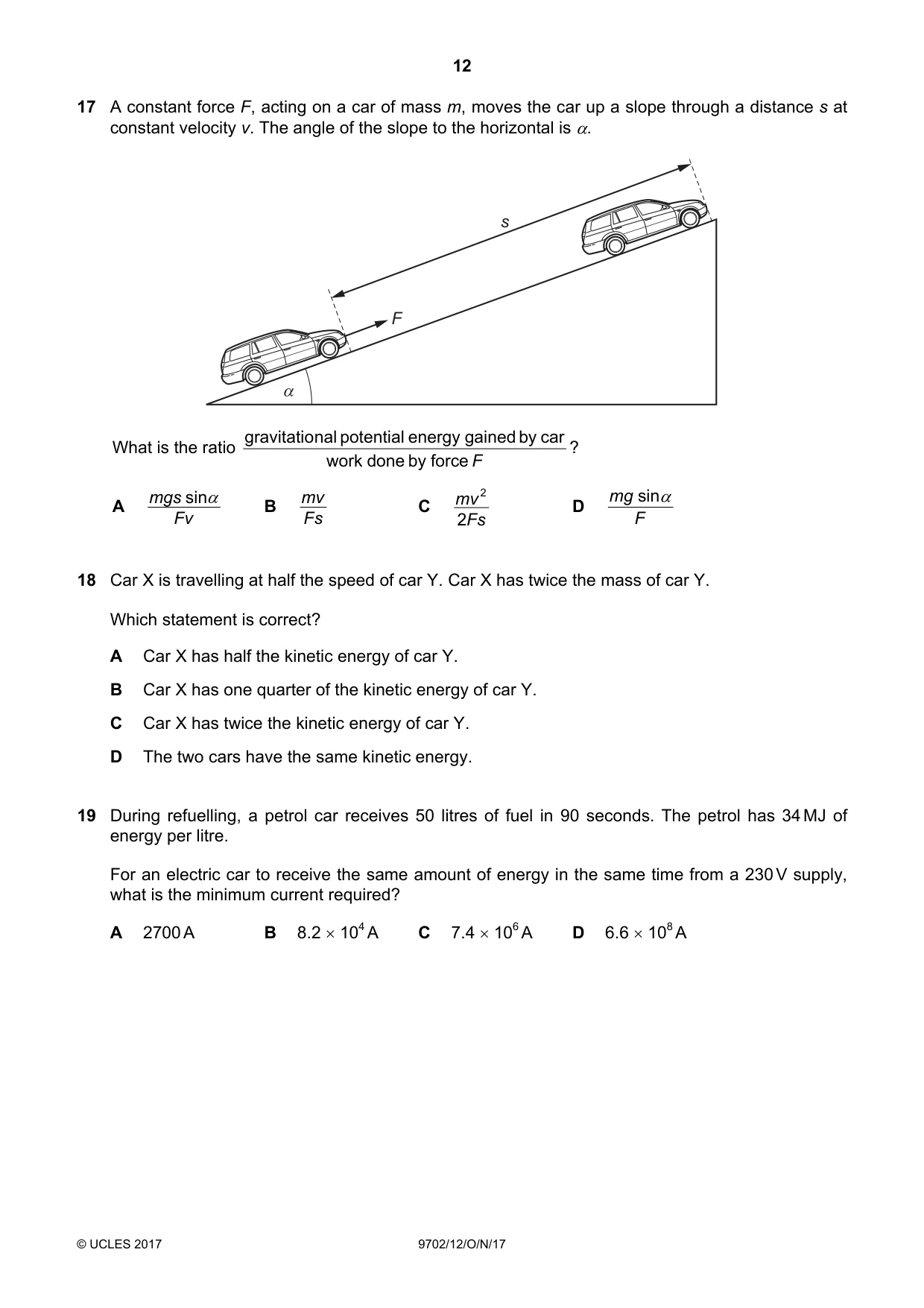
17 A constant force F, acting on a car of mass m, moves the car up a slope through a distance s at constant velocity v. The angle of the slope to the horizontal is α. s F α gravitatio nal potential energy gained by car What is the ratio ? work done by force F mgs sin α mv mv 2 mg sin α A B C D Fv Fs 2 Fs F
Mark scheme: D
Q18 · Car X is travelling at half the speed of car Y
18 Car X is travelling at half the speed of car Y. Car X has twice the mass of car Y. Which statement is correct? A Car X has half the kinetic energy of car Y. B Car X has one quarter of the kinetic energy of car Y. C Car X has twice the kinetic energy of car Y. D The two cars have the same kinetic energy.
Mark scheme: A
More questions on Gravitational potential energy and kinetic energy
Q19 · During refuelling, a petrol car receives 50 litres of fuel in 90 seconds
19 During refuelling, a petrol car receives 50 litres of fuel in 90 seconds. The petrol has 34 MJ of energy per litre. For an electric car to receive the same amount of energy in the same time from a 230 V supply, what is the minimum current required? A 2700 A B 8.2 × 10⁴ A C 7.4 × 10⁶ A D 6.6 × 10⁸ A
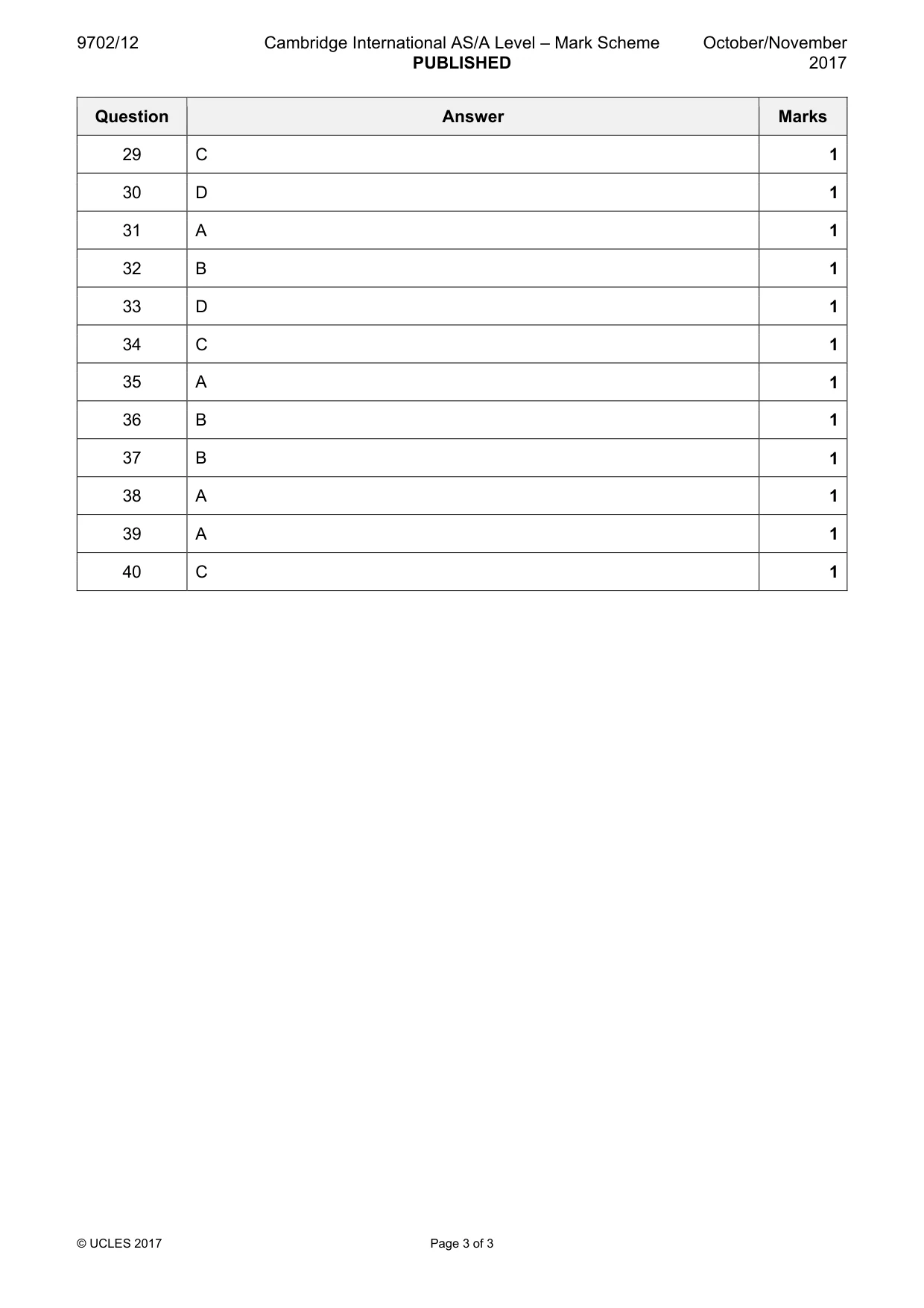
Mark scheme: B
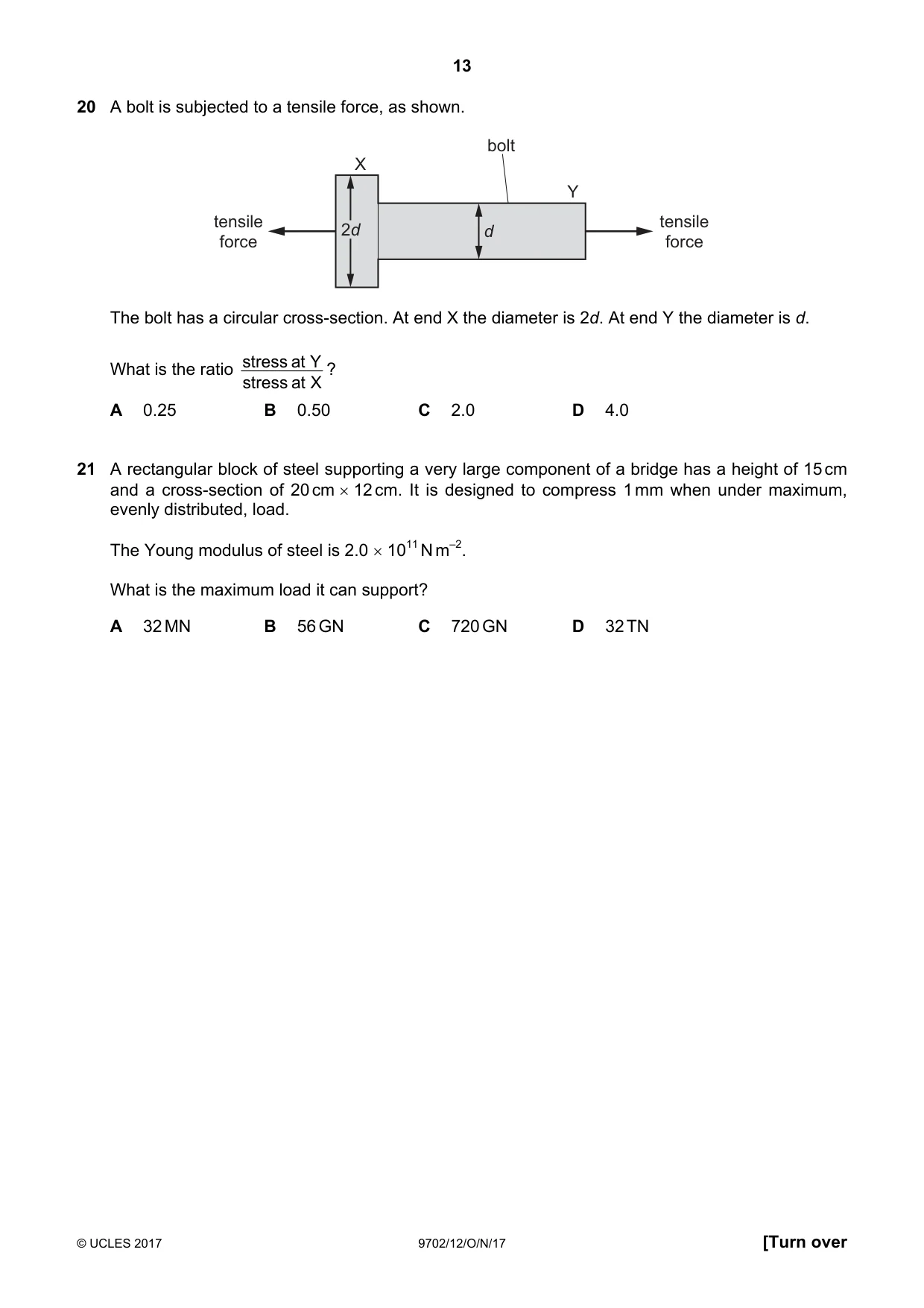
Q20 · A bolt is subjected to a tensile force, as shown
20 A bolt is subjected to a tensile force, as shown. bolt X Y tensile tensile 2d d force force The bolt has a circular cross-section. At end X the diameter is 2d. At end Y the diameter is d. What is the ratio stress at Y ? stress at X A 0.25 B 0.50 C 2.0 D 4.0
Mark scheme: D
Q21 · A rectangular block of steel supporting a very large component of a bridge has a height…
21 A rectangular block of steel supporting a very large component of a bridge has a height of 15 cm and a cross-section of 20 cm × 12 cm. It is designed to compress 1 mm when under maximum, evenly distributed, load. The Young modulus of steel is 2.0 × 10¹¹ N m–2. What is the maximum load it can support? A 32 MN B 56 GN C 720 GN D 32 TN
Mark scheme: A
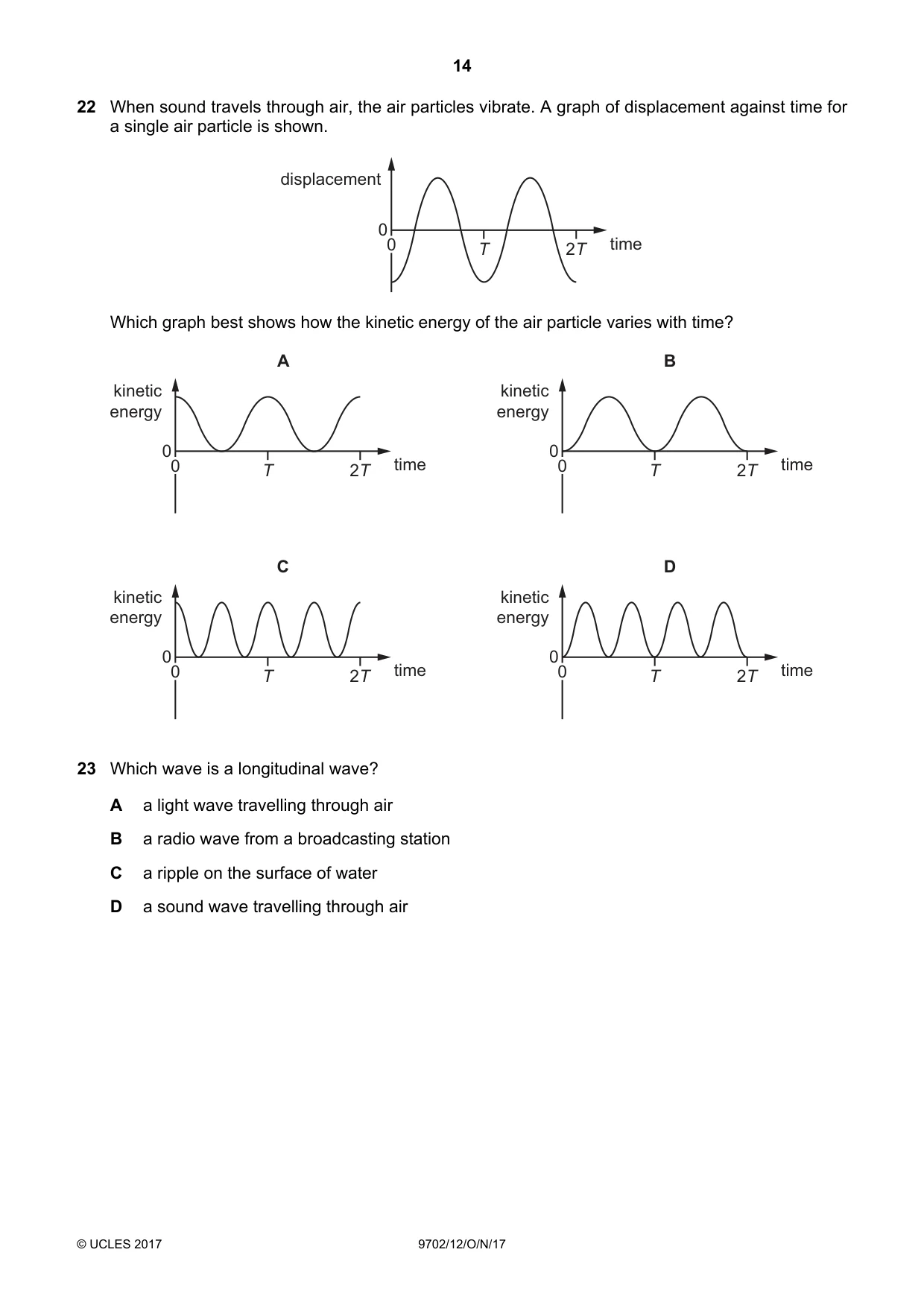
Q22 · When sound travels through air, the air particles vibrate
22 When sound travels through air, the air particles vibrate. A graph of displacement against time for a single air particle is shown. displacement 0 0 T 2T time Which graph best shows how the kinetic energy of the air particle varies with time? A B kinetic kinetic energy energy 0 0 0 T 2T time 0 T 2T time C D kinetic kinetic energy energy 0 0 0 T 2T time 0 T 2T time
Mark scheme: D
Q23 · Which wave is a longitudinal wave?
23 Which wave is a longitudinal wave? A a light wave travelling through air B a radio wave from a broadcasting station C a ripple on the surface of water D a sound wave travelling through air
Mark scheme: D
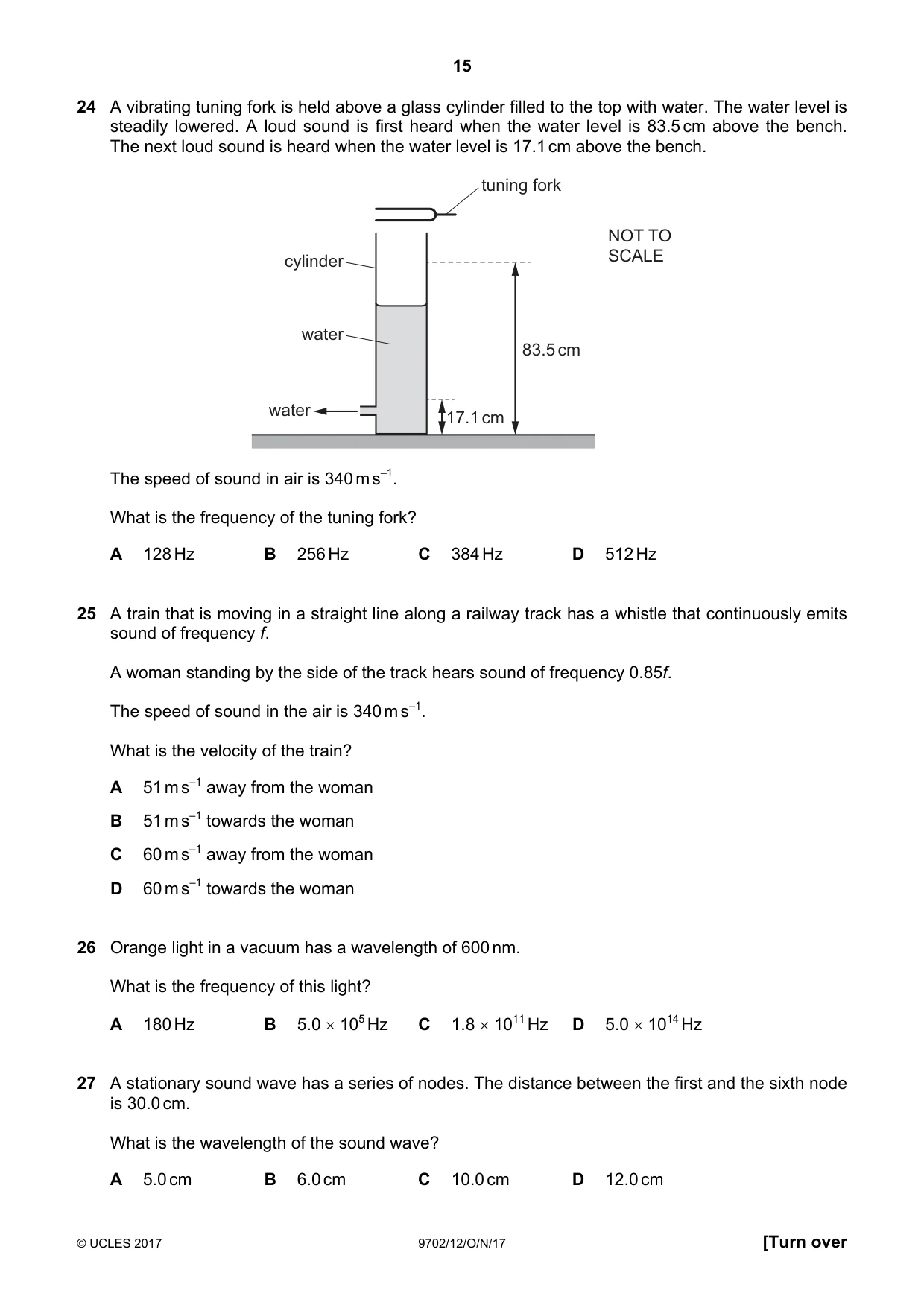
Q24 · A vibrating tuning fork is held above a glass cylinder filled to the top with water
24 A vibrating tuning fork is held above a glass cylinder filled to the top with water. The water level is steadily lowered. A loud sound is first heard when the water level is 83.5 cm above the bench. The next loud sound is heard when the water level is 17.1 cm above the bench. tuning fork NOT TO cylinder SCALE water 83.5 cm water 17.1 cm The speed of sound in air is 340 m s–1. What is the frequency of the tuning fork? A 128 Hz B 256 Hz C 384 Hz D 512 Hz
Mark scheme: B
Q25 · A train that is moving in a straight line along a railway track has a whistle that…
25 A train that is moving in a straight line along a railway track has a whistle that continuously emits sound of frequency f. A woman standing by the side of the track hears sound of frequency 0.85f. The speed of sound in the air is 340 m s–1. What is the velocity of the train? A 51 m s–1 away from the woman B 51 m s–1 towards the woman C 60 m s–1 away from the woman D 60 m s–1 towards the woman
Mark scheme: C
Q26 · Orange light in a vacuum has a wavelength of 600 nm
26 Orange light in a vacuum has a wavelength of 600 nm. What is the frequency of this light? A 180 Hz B 5.0 × 10⁵ Hz C 1.8 × 10¹¹ Hz D 5.0 × 10¹⁴ Hz
Mark scheme: D
Q27 · A stationary sound wave has a series of nodes
27 A stationary sound wave has a series of nodes. The distance between the first and the sixth node is 30.0 cm. What is the wavelength of the sound wave? A 5.0 cm B 6.0 cm C 10.0 cm D 12.0 cm
Mark scheme: D
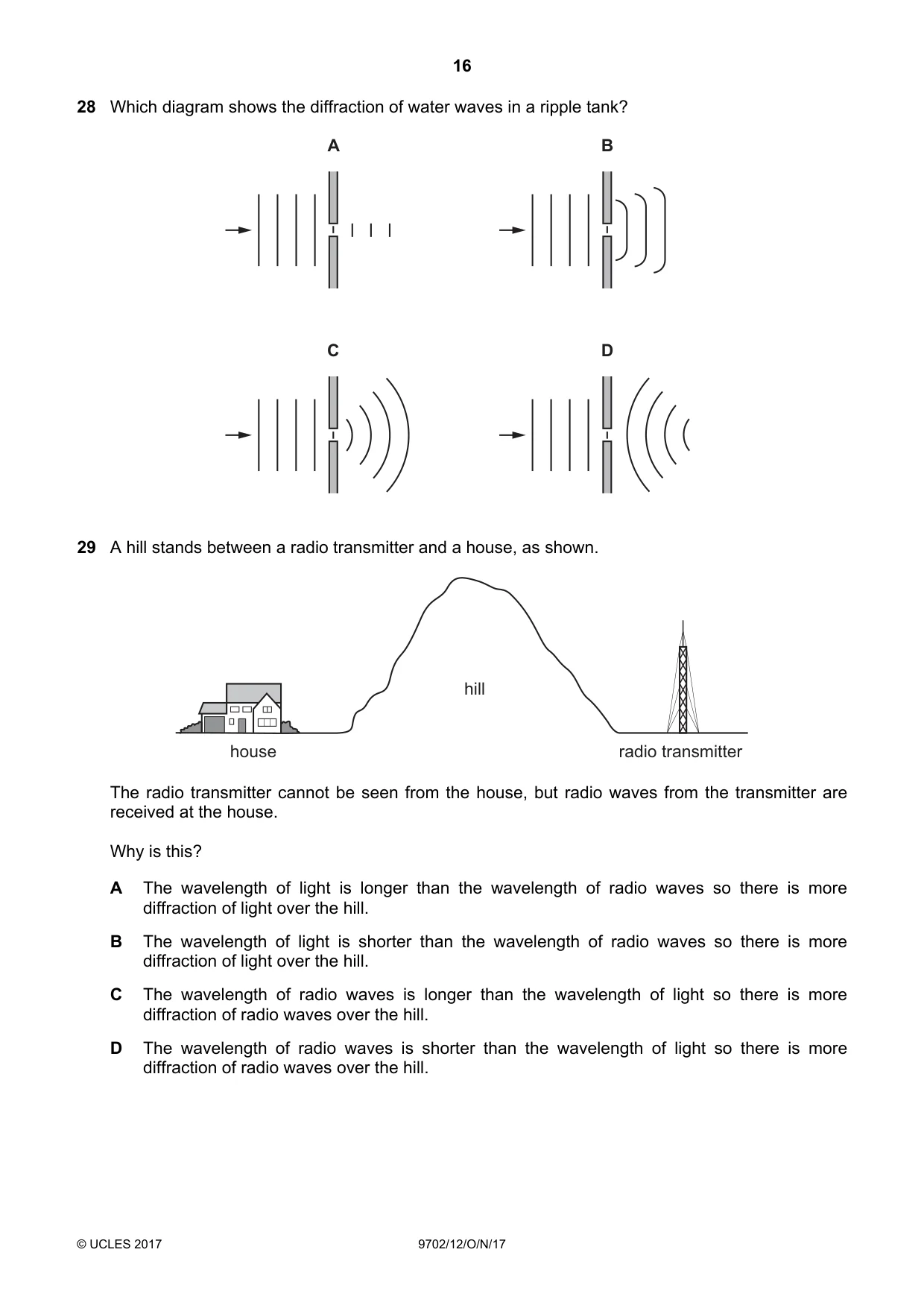
Q28 · Which diagram shows the diffraction of water waves in a ripple tank?
28 Which diagram shows the diffraction of water waves in a ripple tank? A B C D
Mark scheme: C
Q29 · A hill stands between a radio transmitter and a house, as shown
29 A hill stands between a radio transmitter and a house, as shown. hill house radio transmitter The radio transmitter cannot be seen from the house, but radio waves from the transmitter are received at the house. Why is this? A The wavelength of light is longer than the wavelength of radio waves so there is more diffraction of light over the hill. B The wavelength of light is shorter than the wavelength of radio waves so there is more diffraction of light over the hill. C The wavelength of radio waves is longer than the wavelength of light so there is more diffraction of radio waves over the hill. D The wavelength of radio waves is shorter than the wavelength of light so there is more diffraction of radio waves over the hill.
Mark scheme: C
Q30 · In an experiment to demonstrate double-slit interference using light, the distance from…
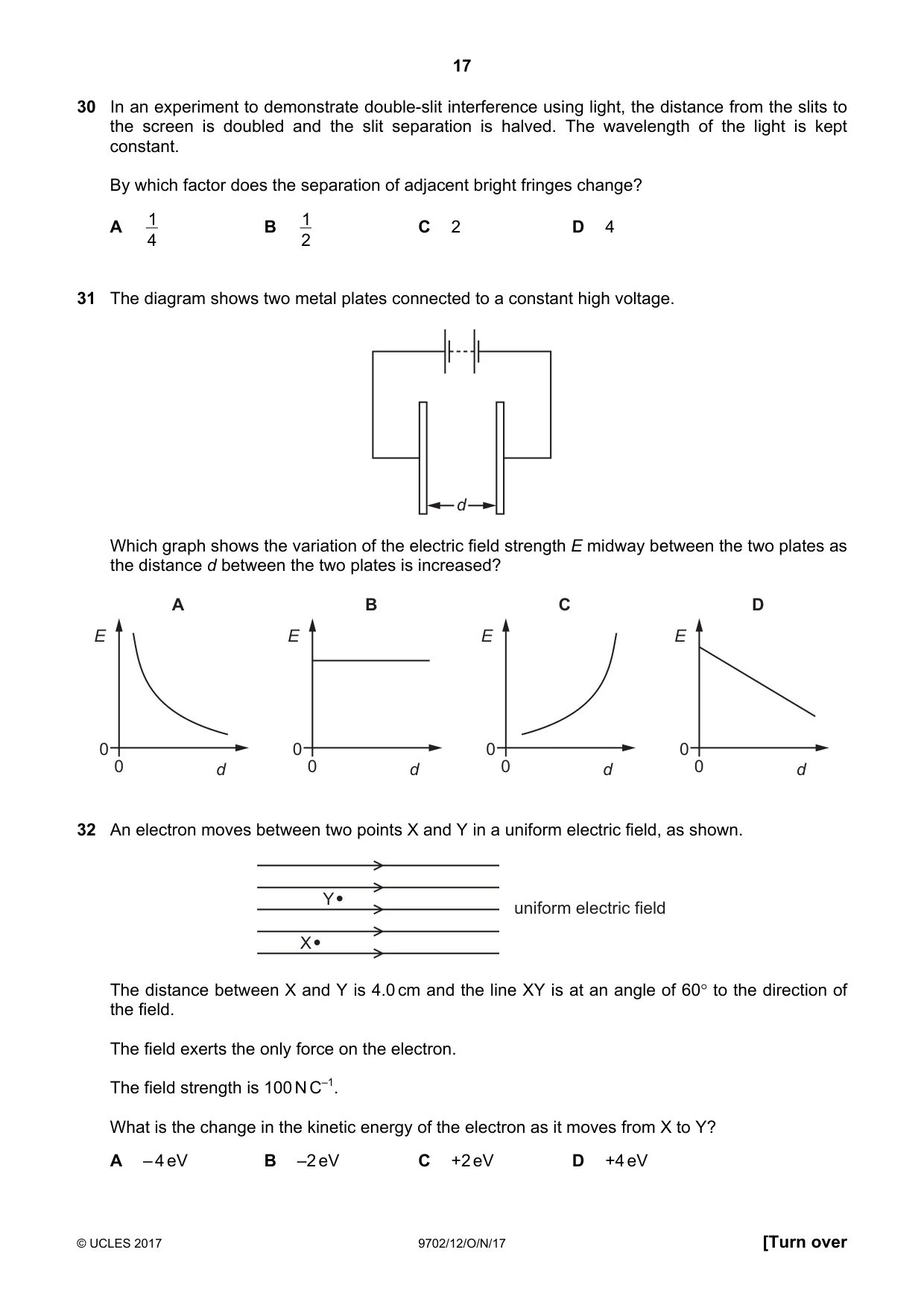
30 In an experiment to demonstrate double-slit interference using light, the distance from the slits to the screen is doubled and the slit separation is halved. The wavelength of the light is kept constant. By which factor does the separation of adjacent bright fringes change? A 1 B 1 C 2 D 4 4 2
Mark scheme: D
Q31 · The diagram shows two metal plates connected to a constant high voltage
31 The diagram shows two metal plates connected to a constant high voltage. d Which graph shows the variation of the electric field strength E midway between the two plates as the distance d between the two plates is increased? A B C D E E E E 0 0 0 0 0 d 0 d 0 d 0 d
Mark scheme: A
Q32 · An electron moves between two points X and Y in a uniform electric field, as shown
32 An electron moves between two points X and Y in a uniform electric field, as shown. Y uniform electric field X The distance between X and Y is 4.0 cm and the line XY is at an angle of 60° to the direction of the field. The field exerts the only force on the electron. The field strength is 100 N C–1. What is the change in the kinetic energy of the electron as it moves from X to Y? A – 4 eV B –2 eV C +2 eV D +4 eV
Mark scheme: B
Q33 · Two copper wires are joined together and carry a current, as shown
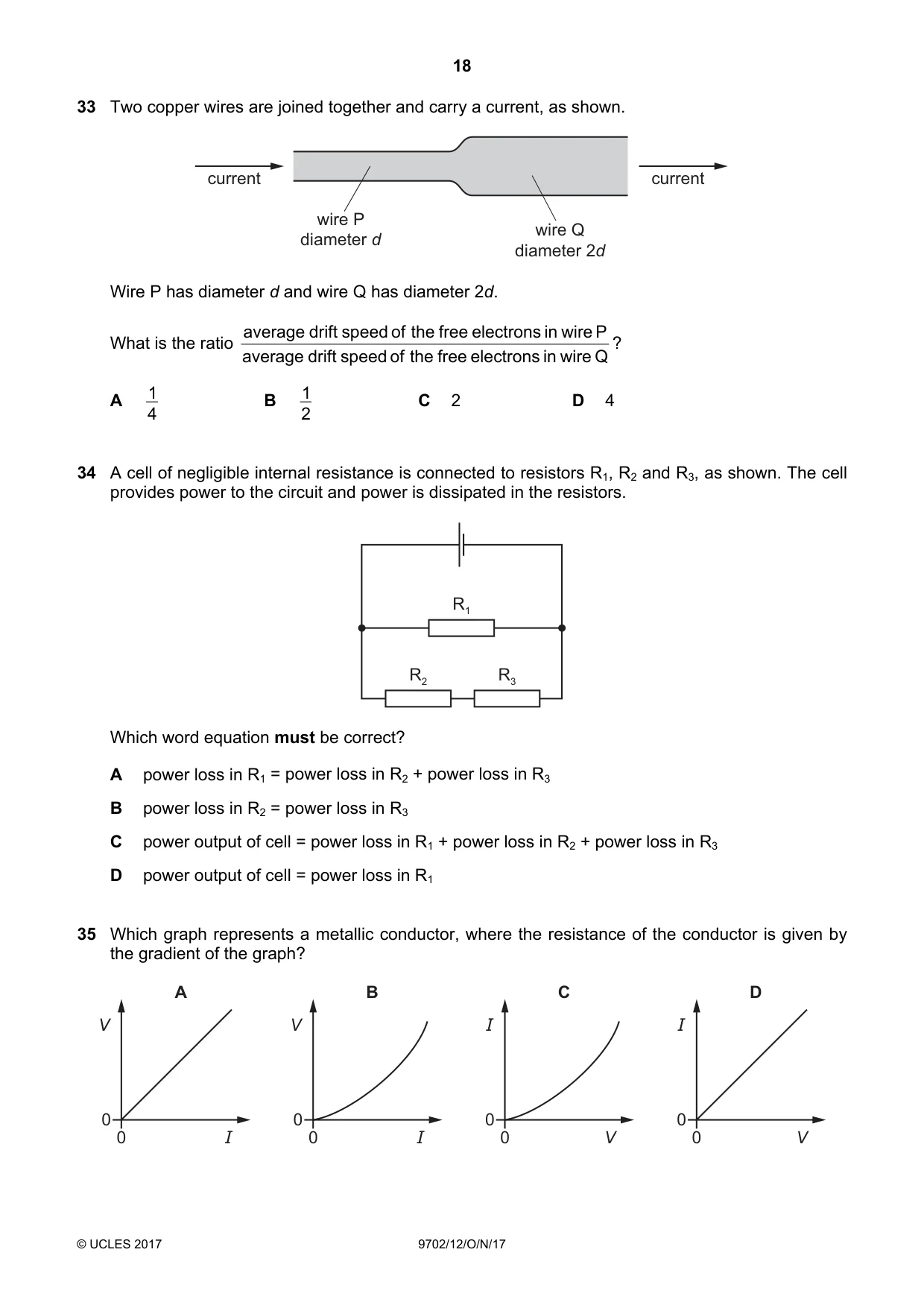
33 Two copper wires are joined together and carry a current, as shown. current current wire P wire Q diameter d diameter 2d Wire P has diameter d and wire Q has diameter 2d. average drift speed of the free electrons in wire P What is the ratio ? average drift speed of the free electrons in wire Q A 1 B 1 C 2 D 4 4 2
Mark scheme: D
Q34 · A cell of negligible internal resistance is connected to resistors R1, R2 and R3, as shown
34 A cell of negligible internal resistance is connected to resistors R1, R2 and R3, as shown. The cell provides power to the circuit and power is dissipated in the resistors. R1 R2 R3 Which word equation must be correct? A power loss in R1 = power loss in R2 + power loss in R3 B power loss in R2 = power loss in R3 C power output of cell = power loss in R1 + power loss in R2 + power loss in R3 D power output of cell = power loss in R1
Mark scheme: C
Q35 · Which graph represents a metallic conductor, where the resistance of the conductor is…
35 Which graph represents a metallic conductor, where the resistance of the conductor is given by the gradient of the graph? A B C D V V I I 0 0 0 0 0 I 0 I 0 V 0 V
Mark scheme: A
Q36 · A typical mobile phone battery has an e.m.f
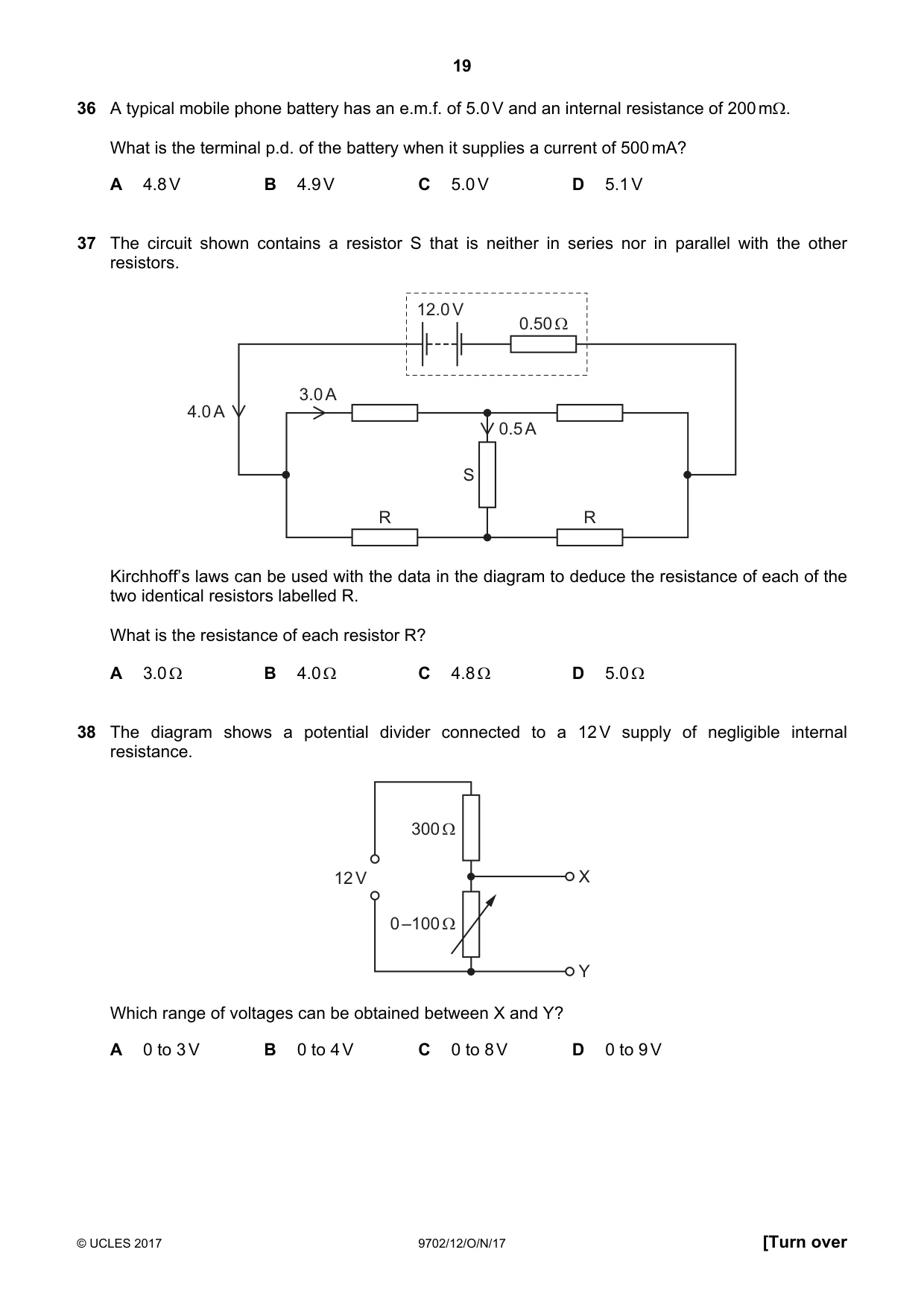
36 A typical mobile phone battery has an e.m.f. of 5.0 V and an internal resistance of 200 mΩ. What is the terminal p.d. of the battery when it supplies a current of 500 mA? A 4.8 V B 4.9 V C 5.0 V D 5.1 V
Mark scheme: B
Q37 · The circuit shown contains a resistor S that is neither in series nor in parallel with…
37 The circuit shown contains a resistor S that is neither in series nor in parallel with the other resistors. 12.0 V 0.50 Ω 3.0 A 4.0 A 0.5 A S R R Kirchhoff’s laws can be used with the data in the diagram to deduce the resistance of each of the two identical resistors labelled R. What is the resistance of each resistor R? A 3.0 Ω B 4.0 Ω C 4.8 Ω D 5.0 Ω
Mark scheme: B
Q38 · The diagram shows a potential divider connected to a 12 V supply of negligible internal…
38 The diagram shows a potential divider connected to a 12 V supply of negligible internal resistance. 300 Ω 12 V X 0 –100 Ω Y Which range of voltages can be obtained between X and Y? A 0 to 3 V B 0 to 4 V C 0 to 8 V D 0 to 9 V
Mark scheme: A
Q39 · The diagram shows a sequence of radioactive decays involving three α-particles and a β…
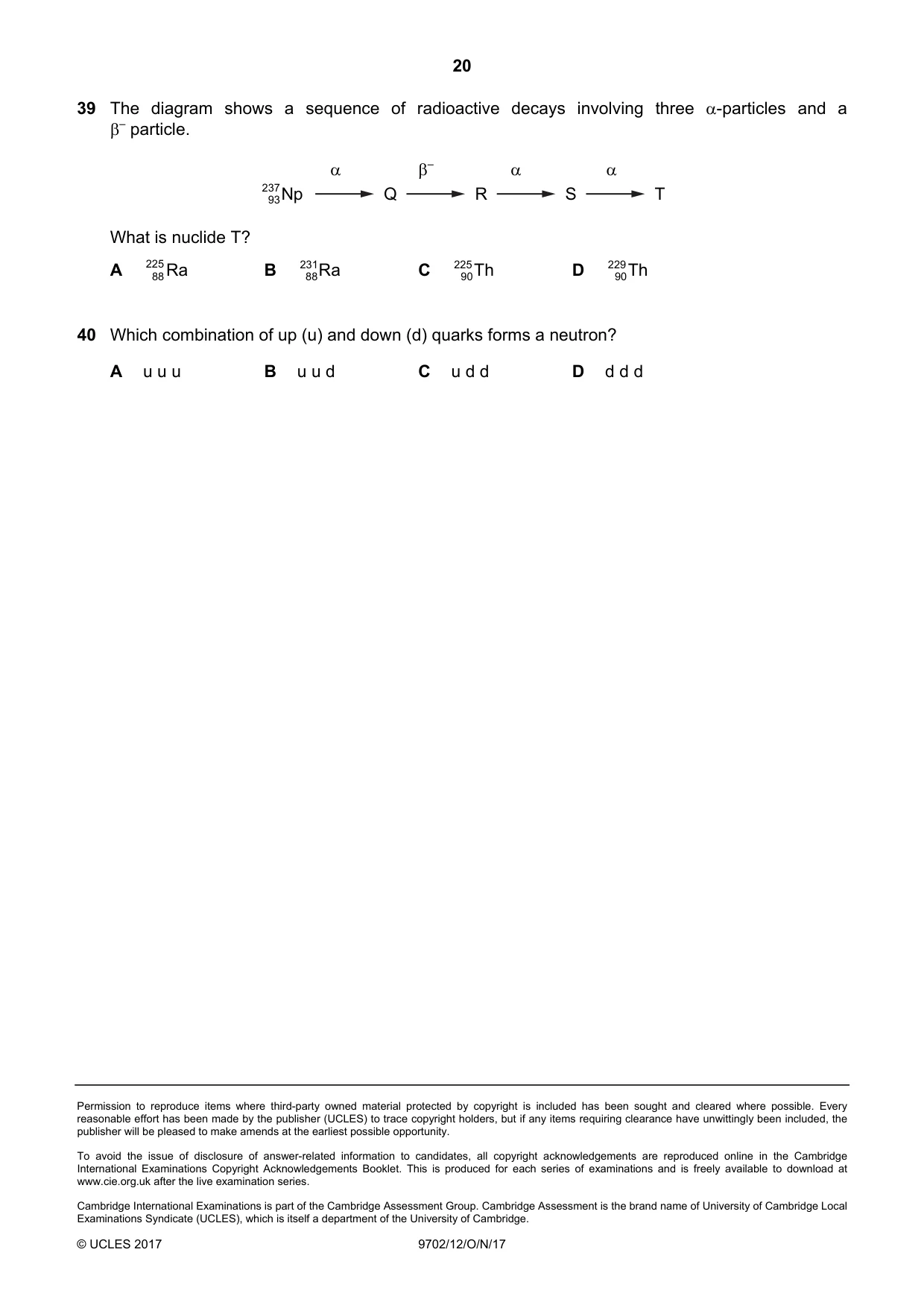
39 The diagram shows a sequence of radioactive decays involving three α-particles and a β– particle. α β– α α 237 N p Q R S T 93 What is nuclide T? A 225 Ra B 231 Ra C 225 Th D 229 Th 88 88 90 90
Mark scheme: A
Q40 · Which combination of up (u) and down (d) quarks forms a neutron?
40 Which combination of up (u) and down (d) quarks forms a neutron? A u u u B u u d C u d d D d d d
Mark scheme: C
What was in this paper
The subtopics covered by these 40 questions, and how many questions each got. Open one in a new tab to see every Cambridge question on it.
2Diffraction2Energy conservation2Equations of motion2Equilibrium of forces2Potential difference and power2SI units2Stationary waves2Stress and strain2Uniform electric fields2Doppler effect for sound waves1Electric current1Electromagnetic spectrum1Energy in simple harmonic motion1Errors and uncertainties1Fundamental particles1Gravitational potential energy and kinetic energy1Interference1Kirchhoff’s laws1Linear momentum and its conservation1Momentum and Newton’s laws of motion1Non-uniform motion1Physical quantities1Potential dividers1Practical circuits1Radioactive decay1Resistance and resistivity1Scalars and vectors1Transverse and longitudinal waves1Turning effects of forces1What you needed in this session
Cambridge’s own grade thresholds for 2017 Oct/Nov, Paper 1 · Variant 2. A higher threshold means an easier paper — the bar moves with how the cohort did.