Cambridge A Level Physics 9702 — 2010 May/June Paper 1 · Variant 1
9702/11/M/J/10 · 40 questions · 40 marks · ≈45 min
The question paper and its mark scheme, free to read here and free to download. This is Cambridge’s own paper, exactly as it was sat.
Question paper24 pages
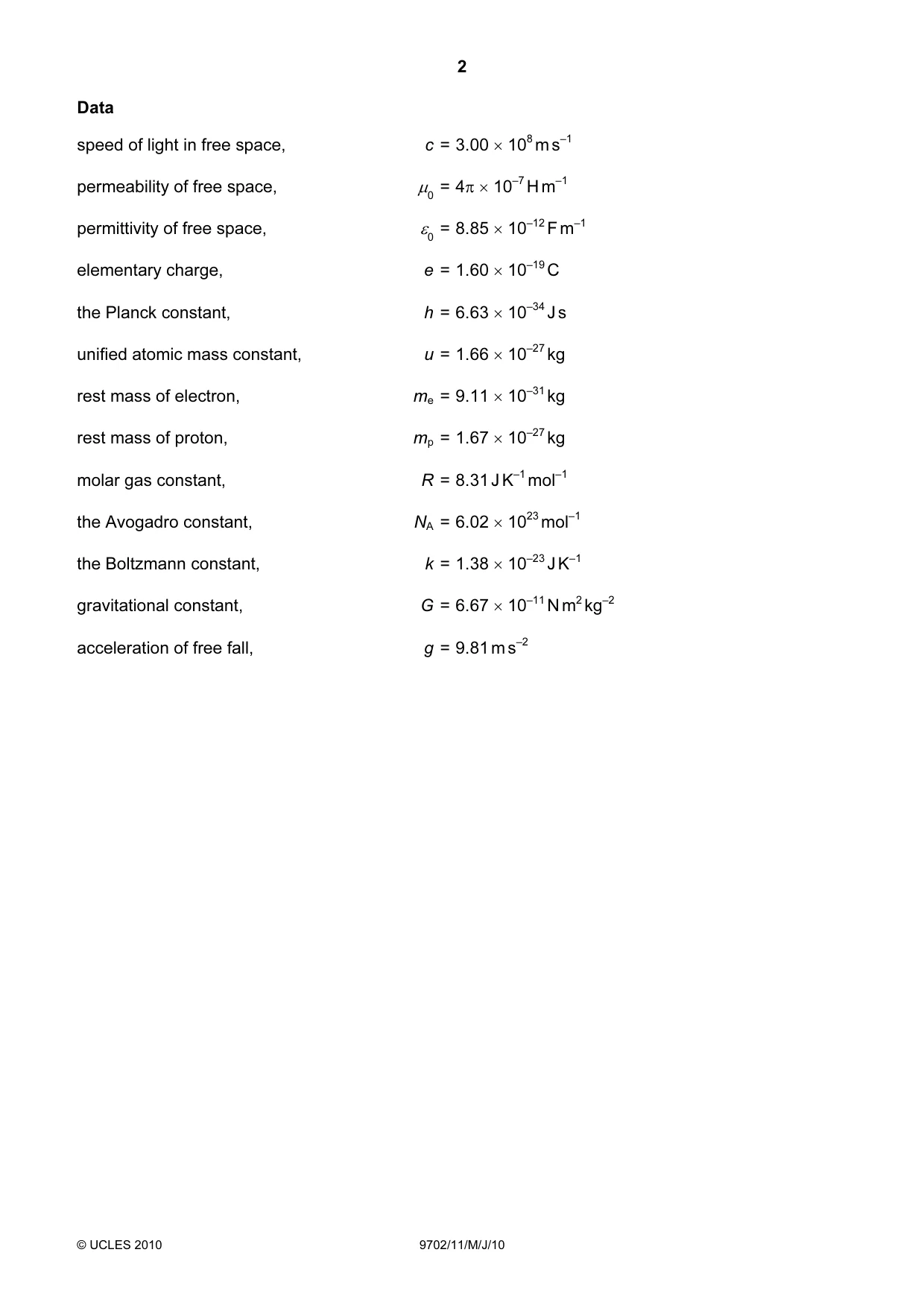
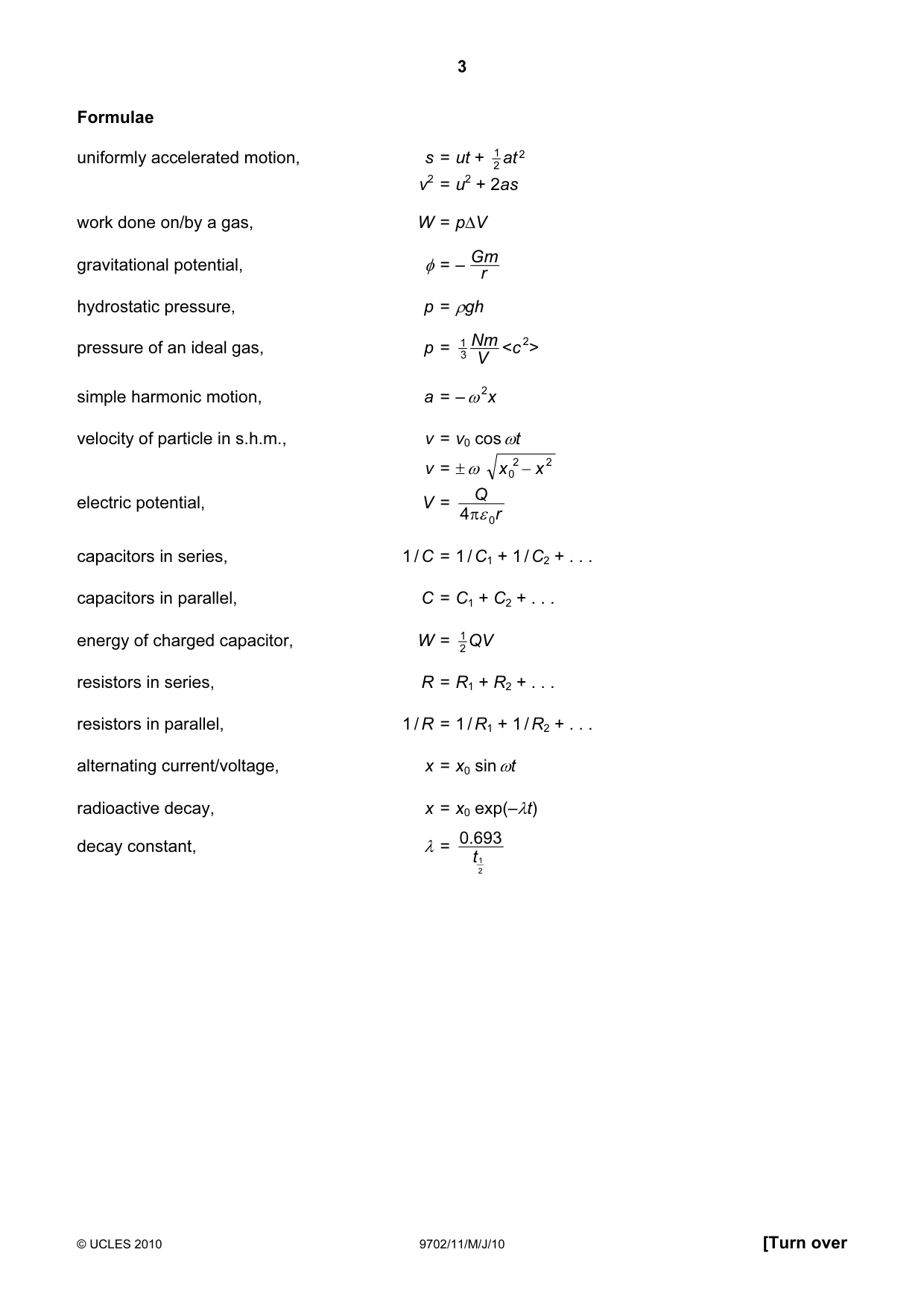
Mark scheme2 pages
Answers below. Sit the paper first if you are practising.
Questions as text
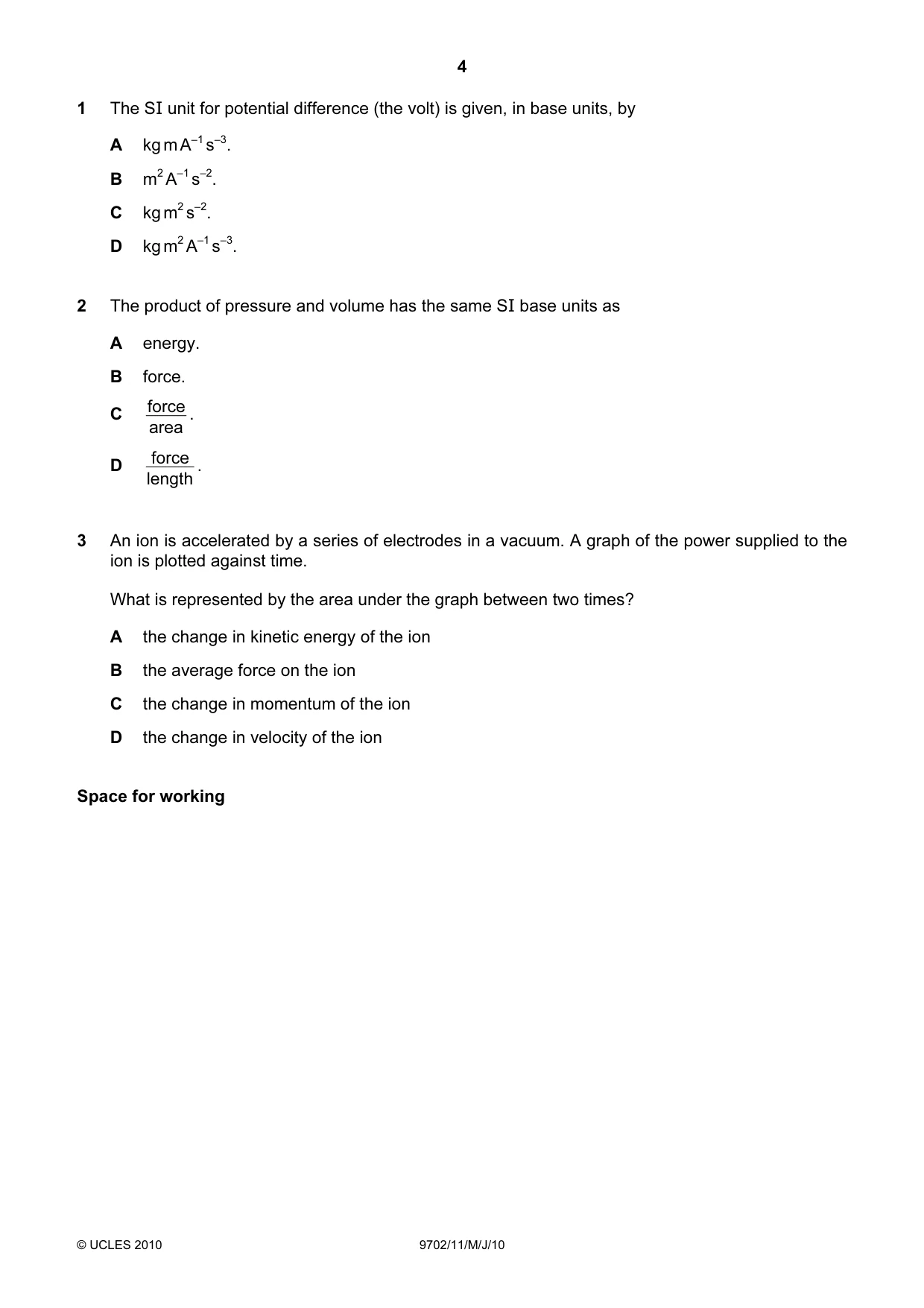
Q1 · The SI unit for potential difference (the volt) is given, in base units, by A kg m A–1 s–3
1 The SI unit for potential difference (the volt) is given, in base units, by A kg m A–1 s–3. B m2 A–1 s–2. C kg m2 s–2. D kg m2 A–1 s–3.
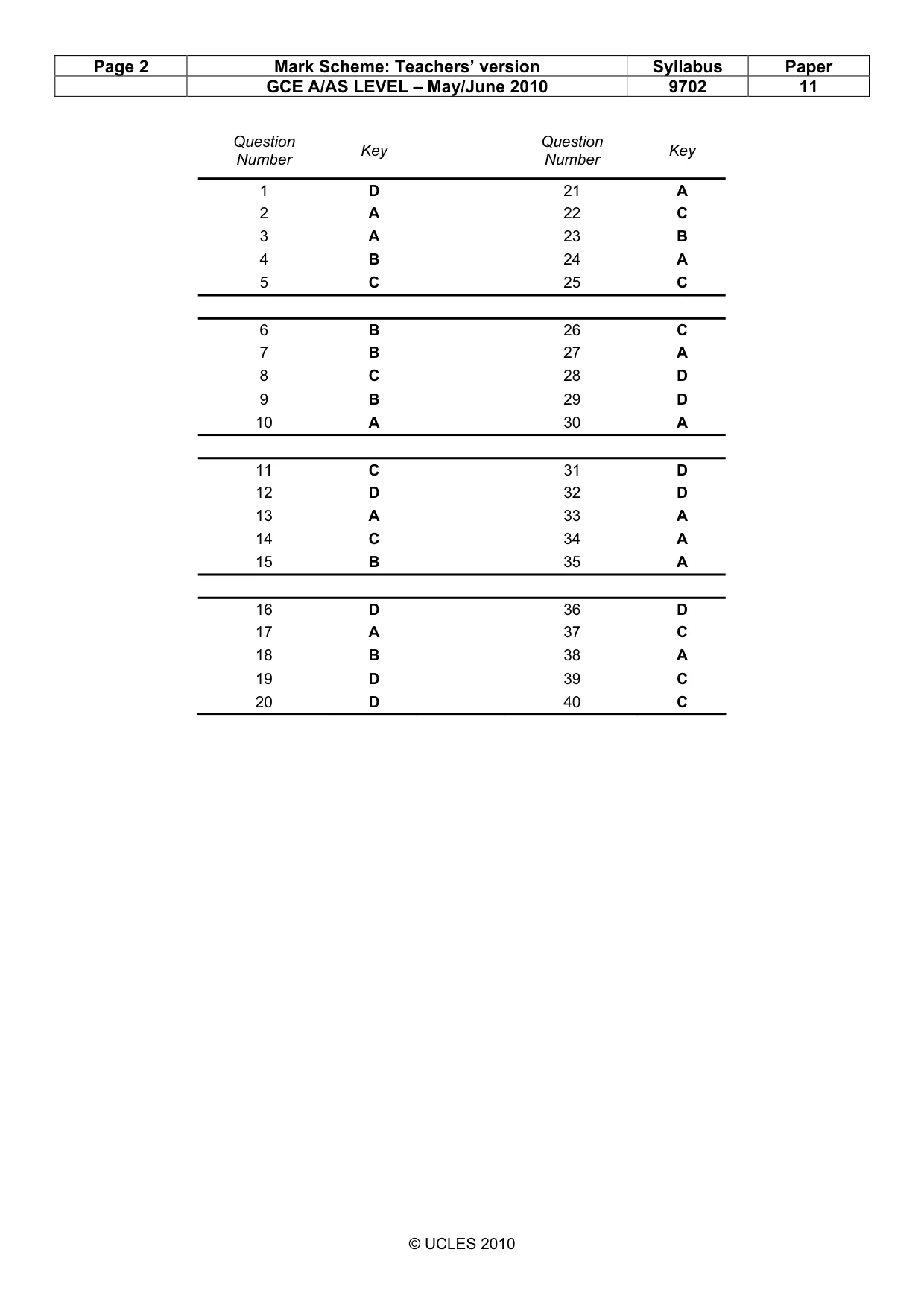
Mark scheme: D
Q2 · The product of pressure and volume has the same SI base units as A energy
2 The product of pressure and volume has the same SI base units as A energy. B force. force . C area force . D length
Mark scheme: A
Q3 · An ion is accelerated by a series of electrodes in a vacuum
3 An ion is accelerated by a series of electrodes in a vacuum. A graph of the power supplied to the ion is plotted against time. What is represented by the area under the graph between two times? A the change in kinetic energy of the ion B the average force on the ion C the change in momentum of the ion D the change in velocity of the ion Space for working
Mark scheme: A
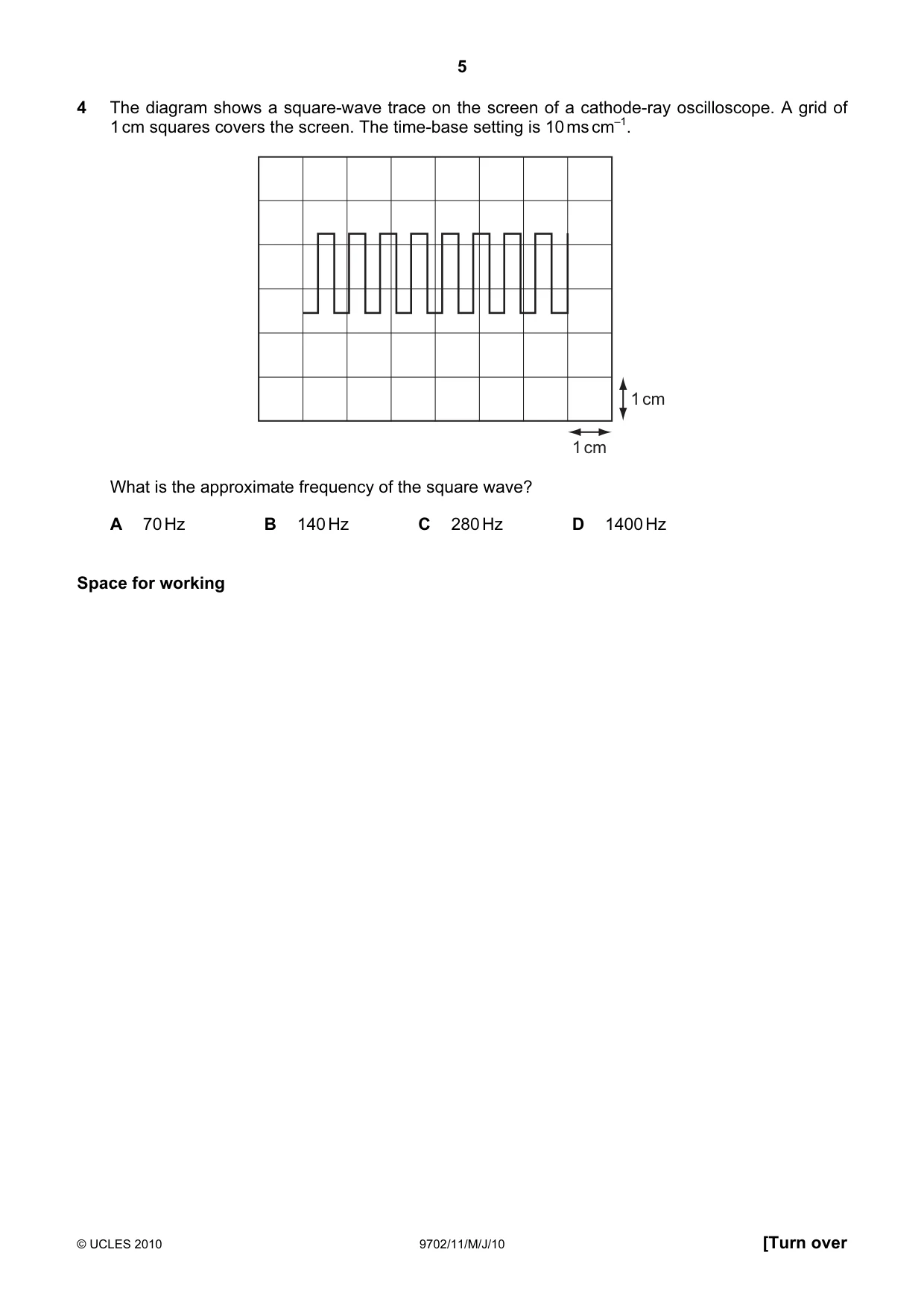
Q4 · The diagram shows a square-wave trace on the screen of a cathode-ray oscilloscope
4 The diagram shows a square-wave trace on the screen of a cathode-ray oscilloscope. A grid of 1 cm squares covers the screen. The time-base setting is 10 ms cm–1. 1 cm 1 cm What is the approximate frequency of the square wave? A 70 Hz B 140 Hz C 280 Hz D 1400 Hz Space for working
Mark scheme: B
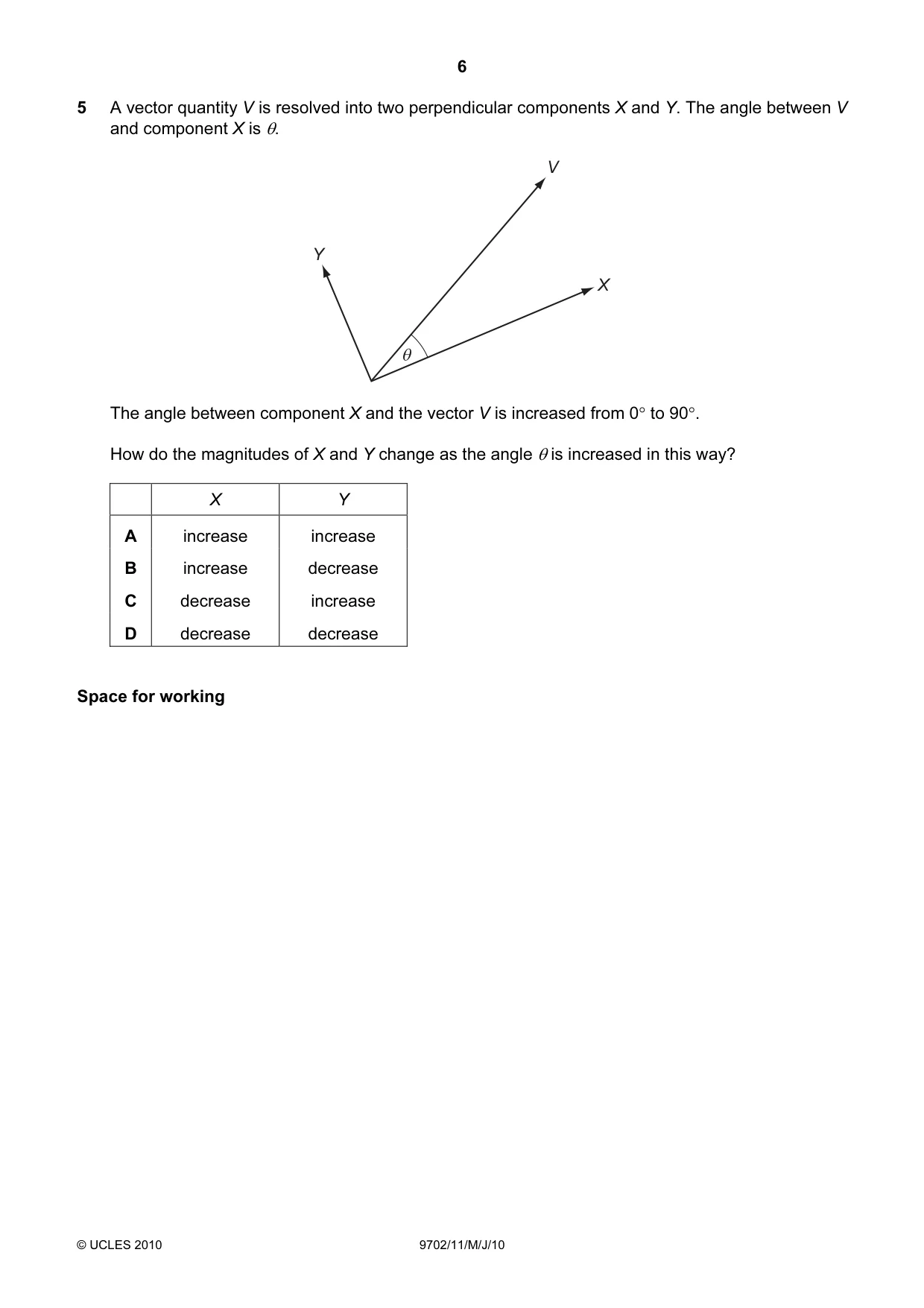
Q5 · A vector quantity V is resolved into two perpendicular components X and Y
5 A vector quantity V is resolved into two perpendicular components X and Y. The angle between V and component X is θ. V Y X θ The angle between component X and the vector V is increased from 0° to 90°. How do the magnitudes of X and Y change as the angle θ is increased in this way? X Y A increase increase B increase decrease C decrease increase D decrease decrease Space for working
Mark scheme: C
Q6 · A student finds the density of a liquid by measuring its mass and its volume
6 A student finds the density of a liquid by measuring its mass and its volume. The following is a summary of his measurements. mass of empty beaker = (20 ± 1) g mass of beaker + liquid = (70 ± 1) g volume of liquid = (10.0 ± 0.6) cm3 He correctly calculates the density of the liquid as 5.0 g cm–3. What is the uncertainty in this value? A 0.3 g cm–3 B 0.5 g cm–3 C 0.6 g cm–3 D 2.6 g cm–3
Mark scheme: B
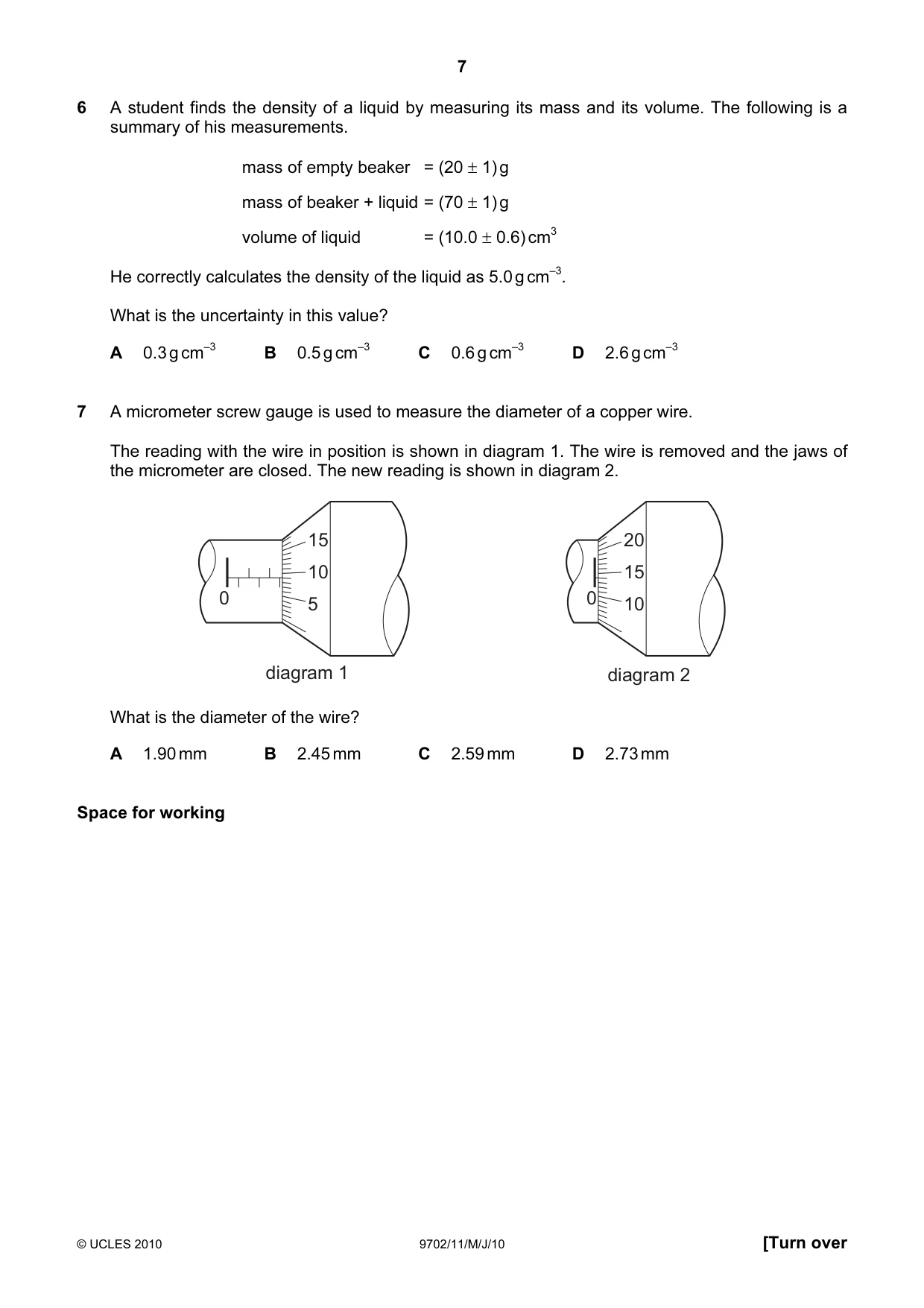
Q7 · A micrometer screw gauge is used to measure the diameter of a copper wire
7 A micrometer screw gauge is used to measure the diameter of a copper wire. The reading with the wire in position is shown in diagram 1. The wire is removed and the jaws of the micrometer are closed. The new reading is shown in diagram 2. 15 20 10 15 0 5 0 10 diagram 1 diagram 2 What is the diameter of the wire? A 1.90 mm B 2.45 mm C 2.59 mm D 2.73 mm Space for working
Mark scheme: B
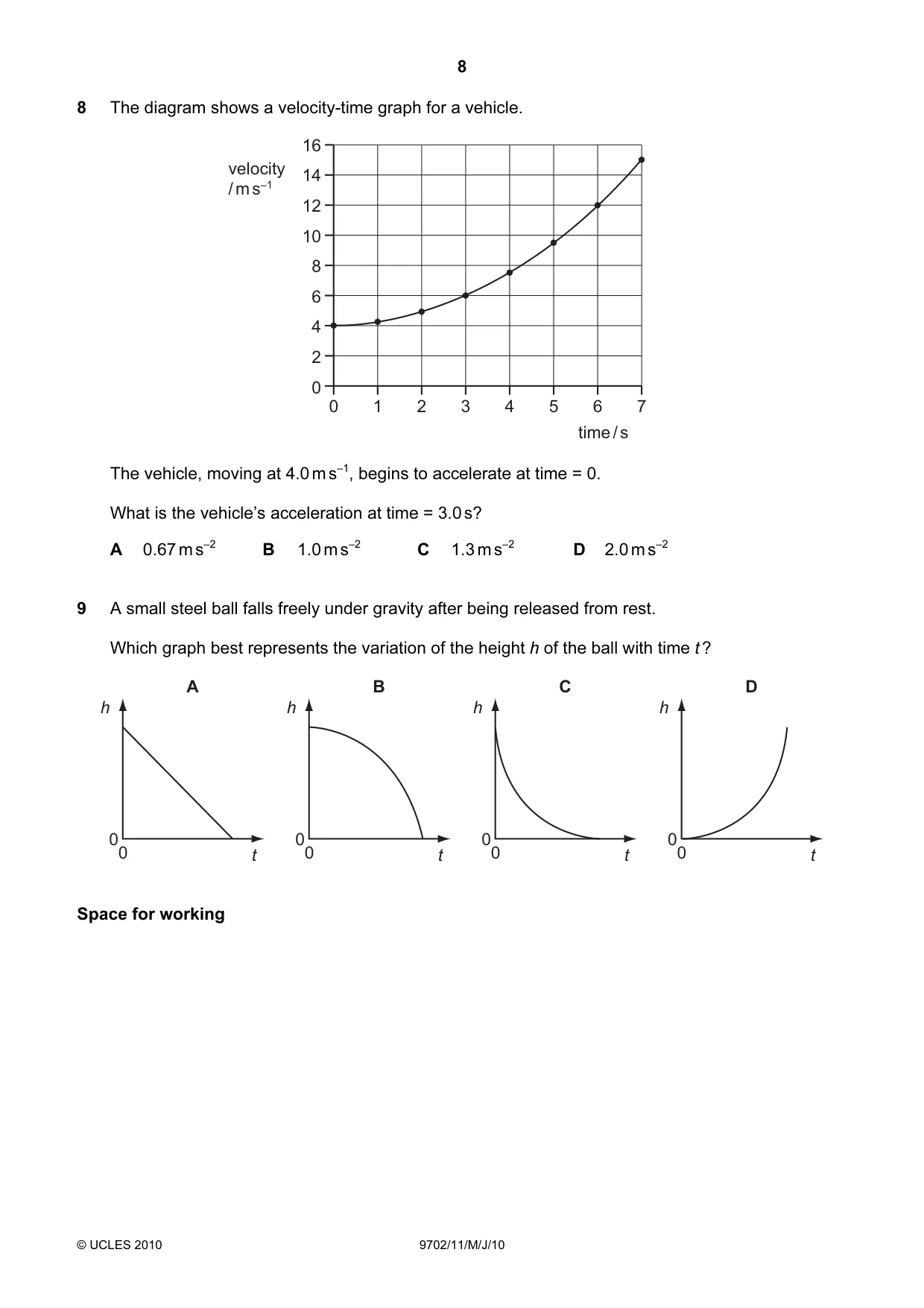
Q8 · The diagram shows a velocity-time graph for a vehicle
8 The diagram shows a velocity-time graph for a vehicle. 16 velocity 14 / m s–1 12 10 8 6 4 2 0 0 1 2 3 4 5 6 7 time / s The vehicle, moving at 4.0 m s–1, begins to accelerate at time = 0. What is the vehicle’s acceleration at time = 3.0 s? A 0.67 m s–2 B 1.0 m s–2 C 1.3 m s–2 D 2.0 m s–2
Mark scheme: C
Q9 · A small steel ball falls freely under gravity after being released from rest
9 A small steel ball falls freely under gravity after being released from rest. Which graph best represents the variation of the height h of the ball with time t ? A B C D h h h h 00 00 00 00 t t t t Space for working
Mark scheme: B
Q10 · Two equal masses travel towards each other on a frictionless air track at speeds of 60 cm…
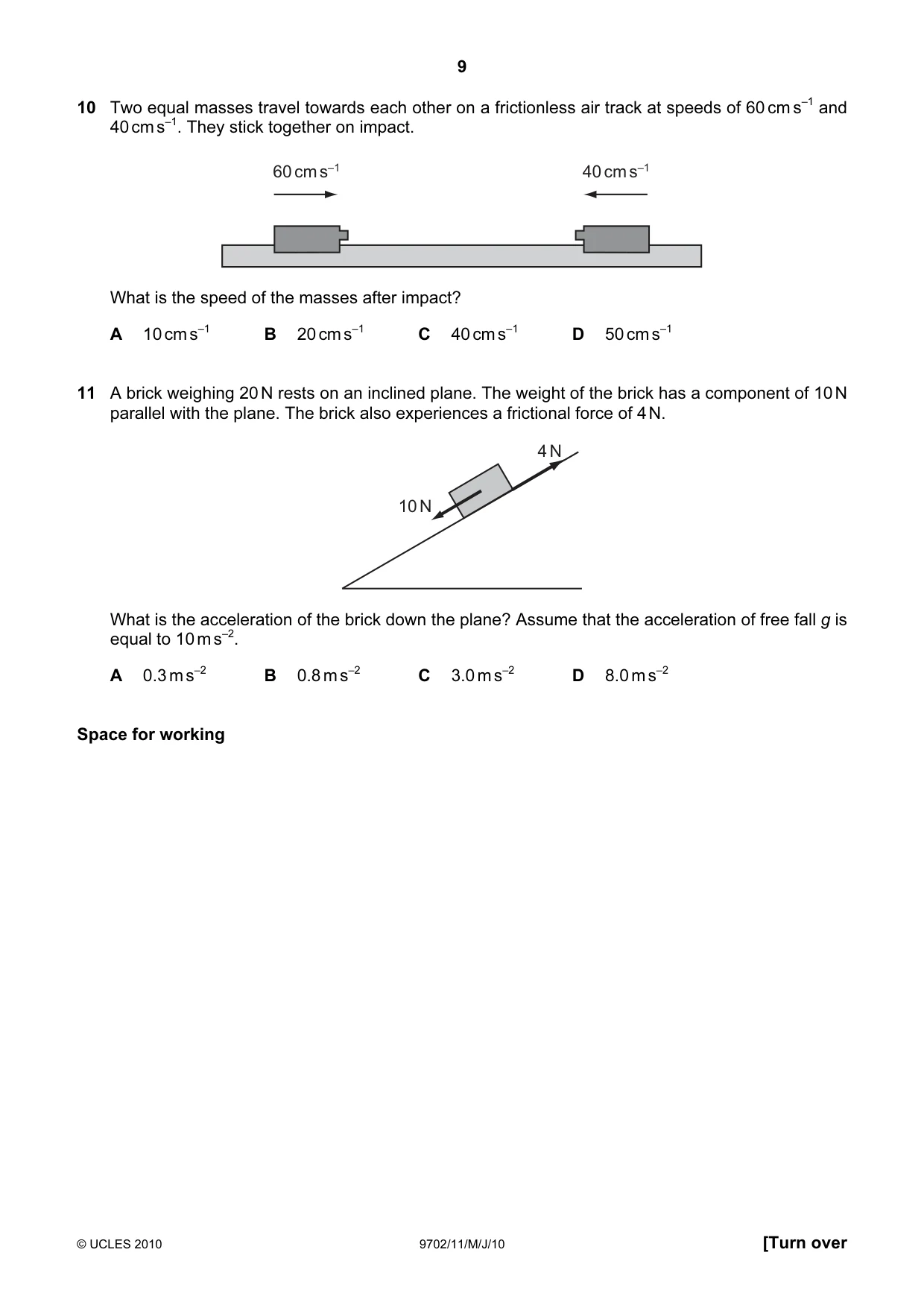
10 Two equal masses travel towards each other on a frictionless air track at speeds of 60 cm s–1 and 40 cm s–1. They stick together on impact. 60 cm s–1 40 cm s–1 What is the speed of the masses after impact? A 10 cm s–1 B 20 cm s–1 C 40 cm s–1 D 50 cm s–1
Mark scheme: A
Q11 · A brick weighing 20 N rests on an inclined plane
11 A brick weighing 20 N rests on an inclined plane. The weight of the brick has a component of 10 N parallel with the plane. The brick also experiences a frictional force of 4 N. 4 N 10 N What is the acceleration of the brick down the plane? Assume that the acceleration of free fall g is equal to 10 m s–2. A 0.3 m s–2 B 0.8 m s–2 C 3.0 m s–2 D 8.0 m s–2 Space for working
Mark scheme: C
Q12 · The diagram shows two identical spheres X and Y
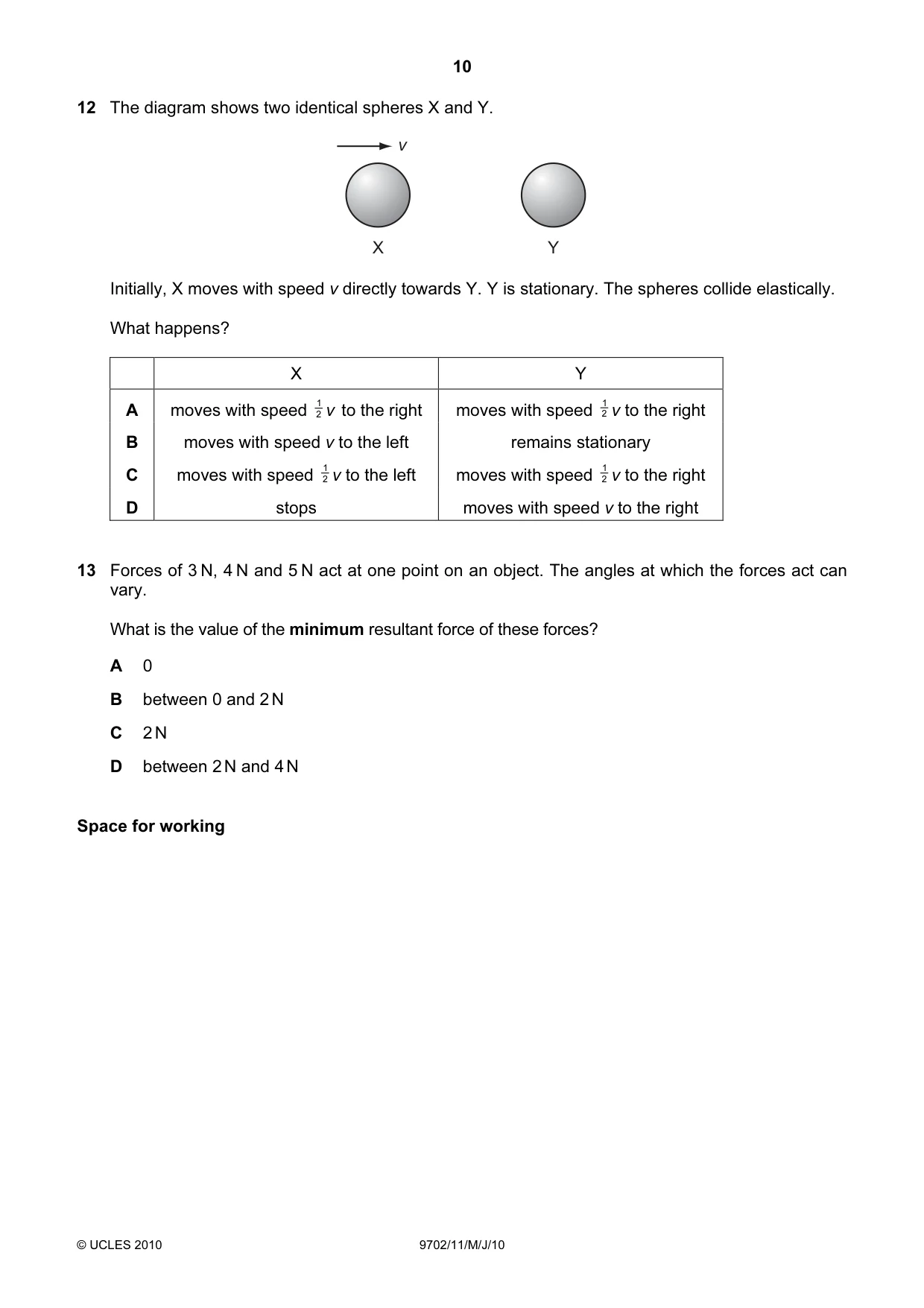
12 The diagram shows two identical spheres X and Y. v X Y Initially, X moves with speed v directly towards Y. Y is stationary. The spheres collide elastically. What happens? X Y 1 v to the right 1 v to the right A moves with speed 2 moves with speed 2 B moves with speed v to the left remains stationary 1 v to the left 1 v to the right C moves with speed 2 moves with speed 2 D stops moves with speed v to the right
Mark scheme: D
Q13 · Forces of 3 N, 4 N and 5 N act at one point on an object
13 Forces of 3 N, 4 N and 5 N act at one point on an object. The angles at which the forces act can vary. What is the value of the minimum resultant force of these forces? A 0 B between 0 and 2 N C 2 N D between 2 N and 4 N Space for working
Mark scheme: A
Q14 · An object, immersed in a liquid in a tank, experiences an upthrust
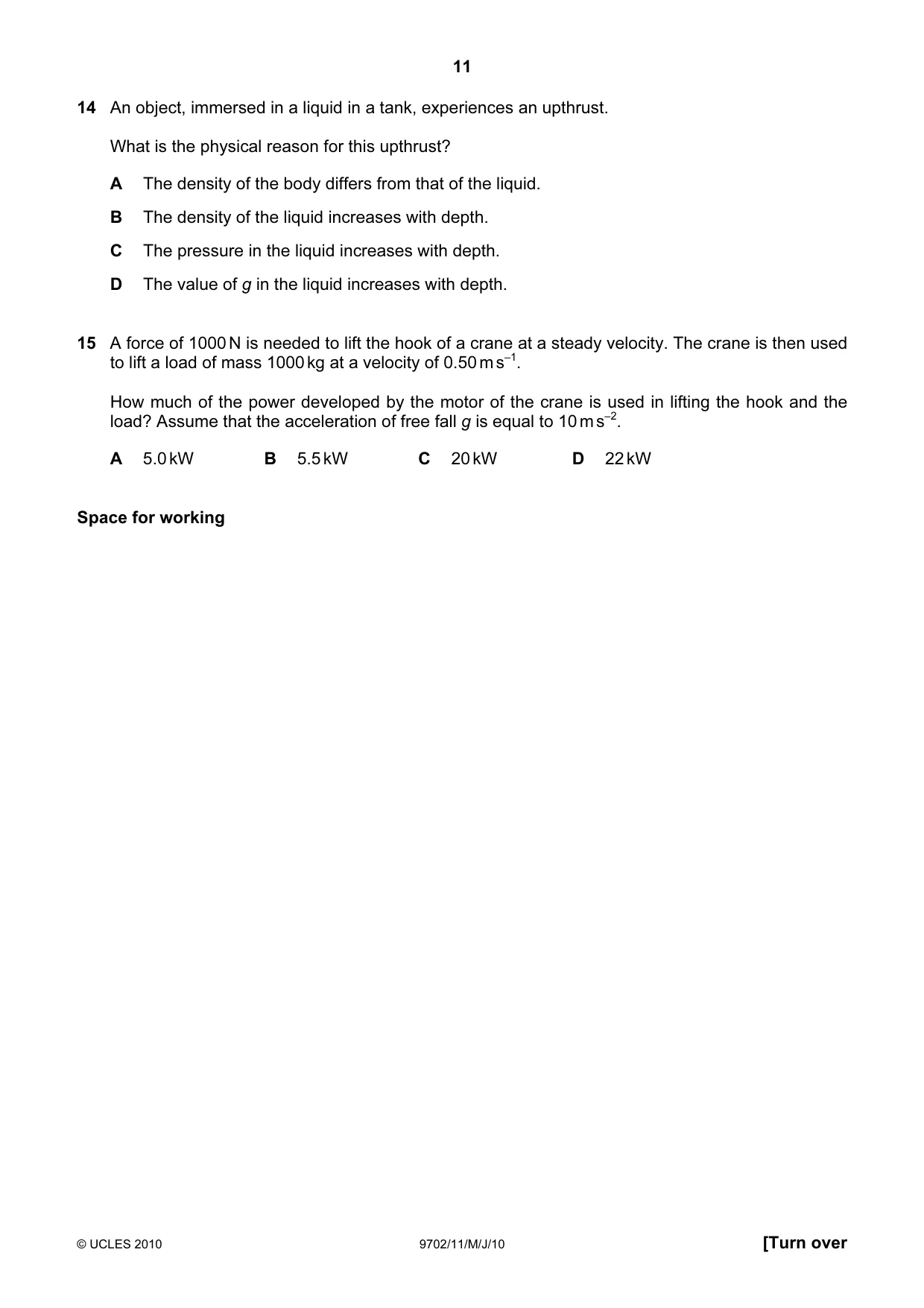
14 An object, immersed in a liquid in a tank, experiences an upthrust. What is the physical reason for this upthrust? A The density of the body differs from that of the liquid. B The density of the liquid increases with depth. C The pressure in the liquid increases with depth. D The value of g in the liquid increases with depth.
Mark scheme: C
Q15 · A force of 1000 N is needed to lift the hook of a crane at a steady velocity
15 A force of 1000 N is needed to lift the hook of a crane at a steady velocity. The crane is then used to lift a load of mass 1000 kg at a velocity of 0.50 m s–1. How much of the power developed by the motor of the crane is used in lifting the hook and the load? Assume that the acceleration of free fall g is equal to 10 m s–2. A 5.0 kW B 5.5 kW C 20 kW D 22 kW Space for working
Mark scheme: B
Q16 · A constant force F, acting on a car of mass m, moves the car up the slope through a…
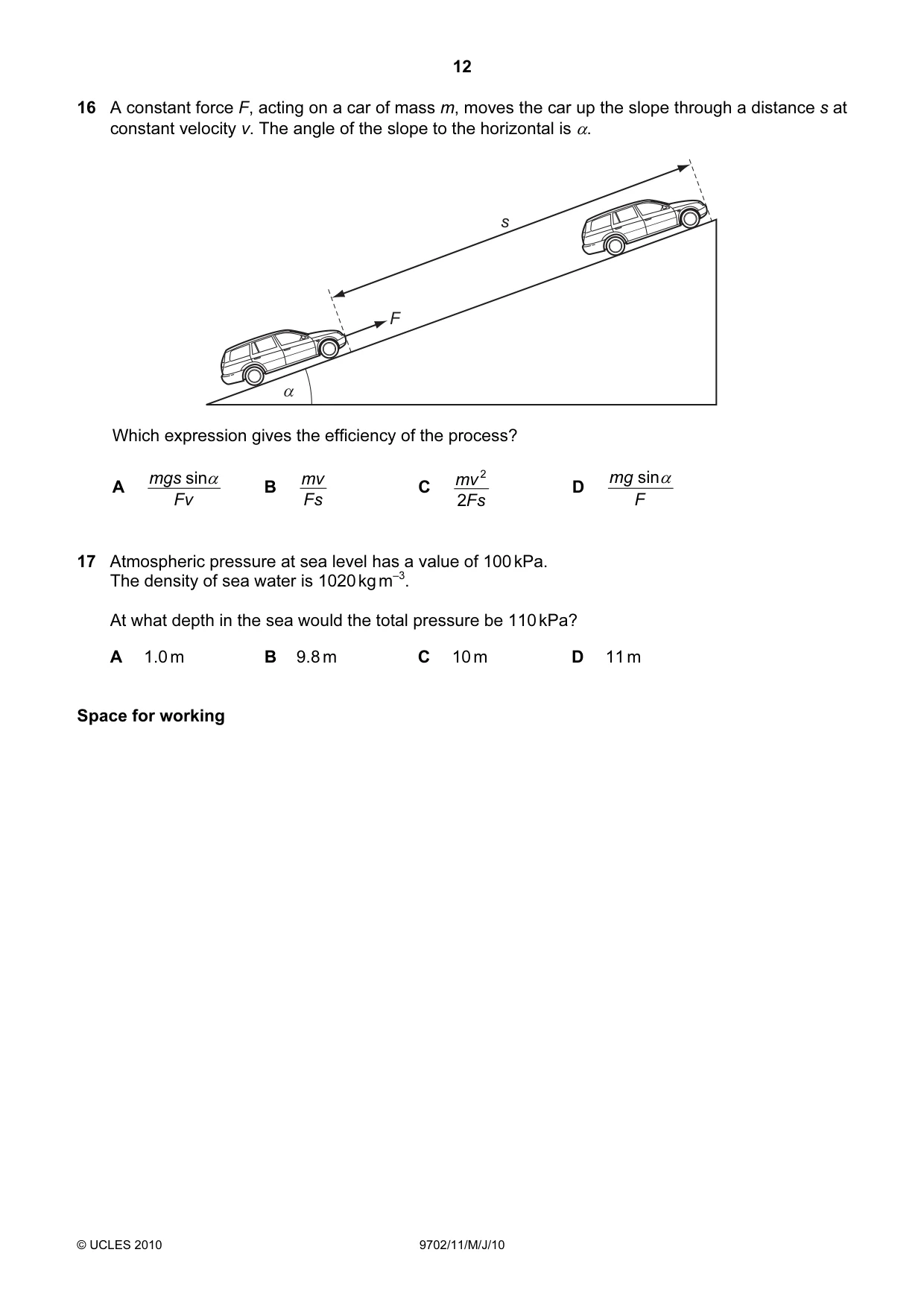
16 A constant force F, acting on a car of mass m, moves the car up the slope through a distance s at constant velocity v. The angle of the slope to the horizontal is α. s F α Which expression gives the efficiency of the process? mgs sin α mv mv 2 mg sin α A B C D Fv Fs 2 Fs F
Mark scheme: D
Q17 · Atmospheric pressure at sea level has a value of 100 kPa
17 Atmospheric pressure at sea level has a value of 100 kPa. The density of sea water is 1020 kg m–3. At what depth in the sea would the total pressure be 110 kPa? A 1.0 m B 9.8 m C 10 m D 11 m Space for working
Mark scheme: A
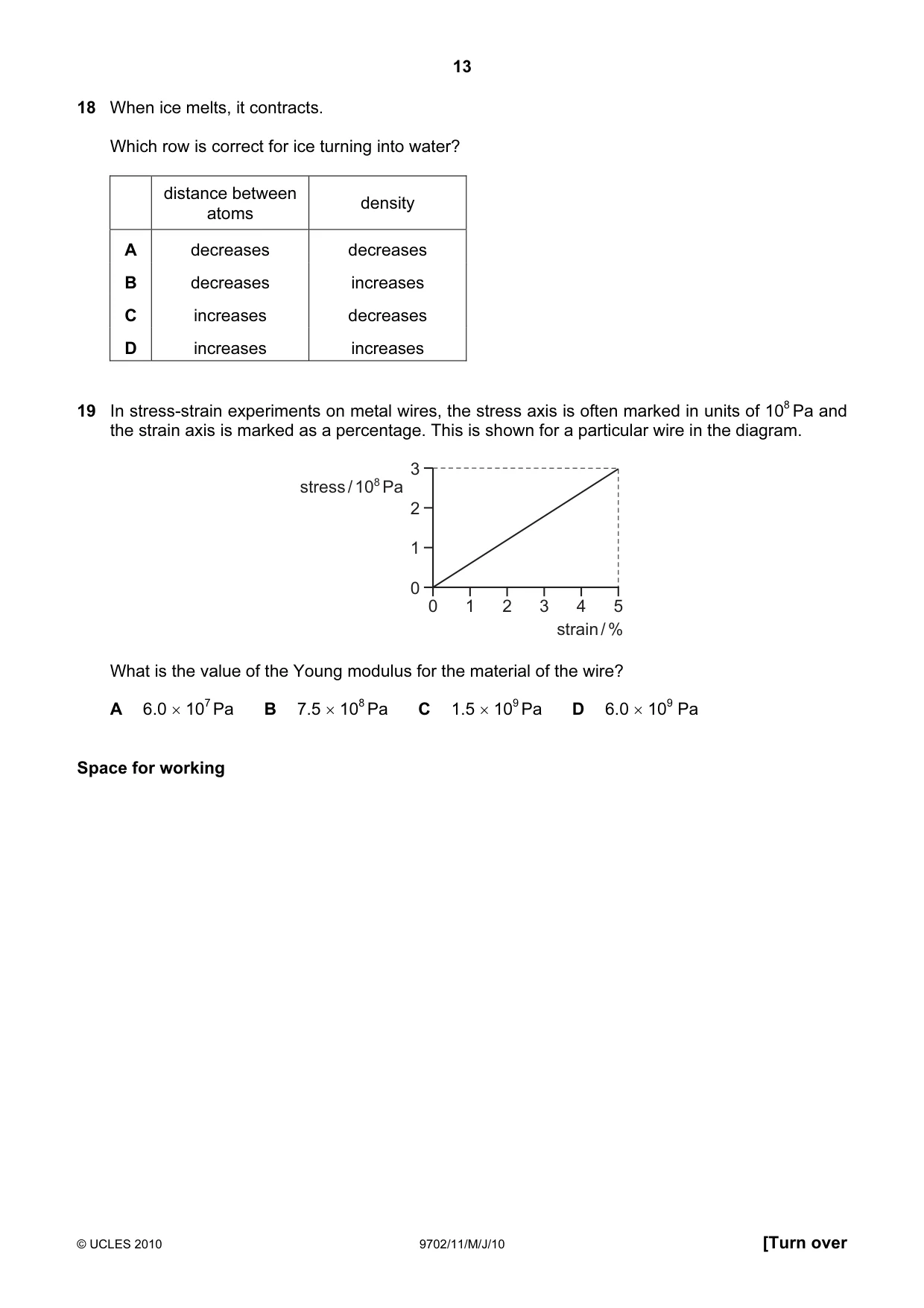
Q18 · When ice melts, it contracts
18 When ice melts, it contracts. Which row is correct for ice turning into water? distance between density atoms A decreases decreases B decreases increases C increases decreases D increases increases
Mark scheme: B
Q19 · In stress-strain experiments on metal wires, the stress axis is often marked in units of…
19 In stress-strain experiments on metal wires, the stress axis is often marked in units of 108 Pa and the strain axis is marked as a percentage. This is shown for a particular wire in the diagram. 3 stress / 108 Pa 2 1 0 0 1 2 3 4 5 strain / % What is the value of the Young modulus for the material of the wire? A 6.0 × 10⁷ Pa B 7.5 × 10⁸ Pa C 1.5 × 10⁹ Pa D 6.0 × 10⁹ Pa Space for working
Mark scheme: D
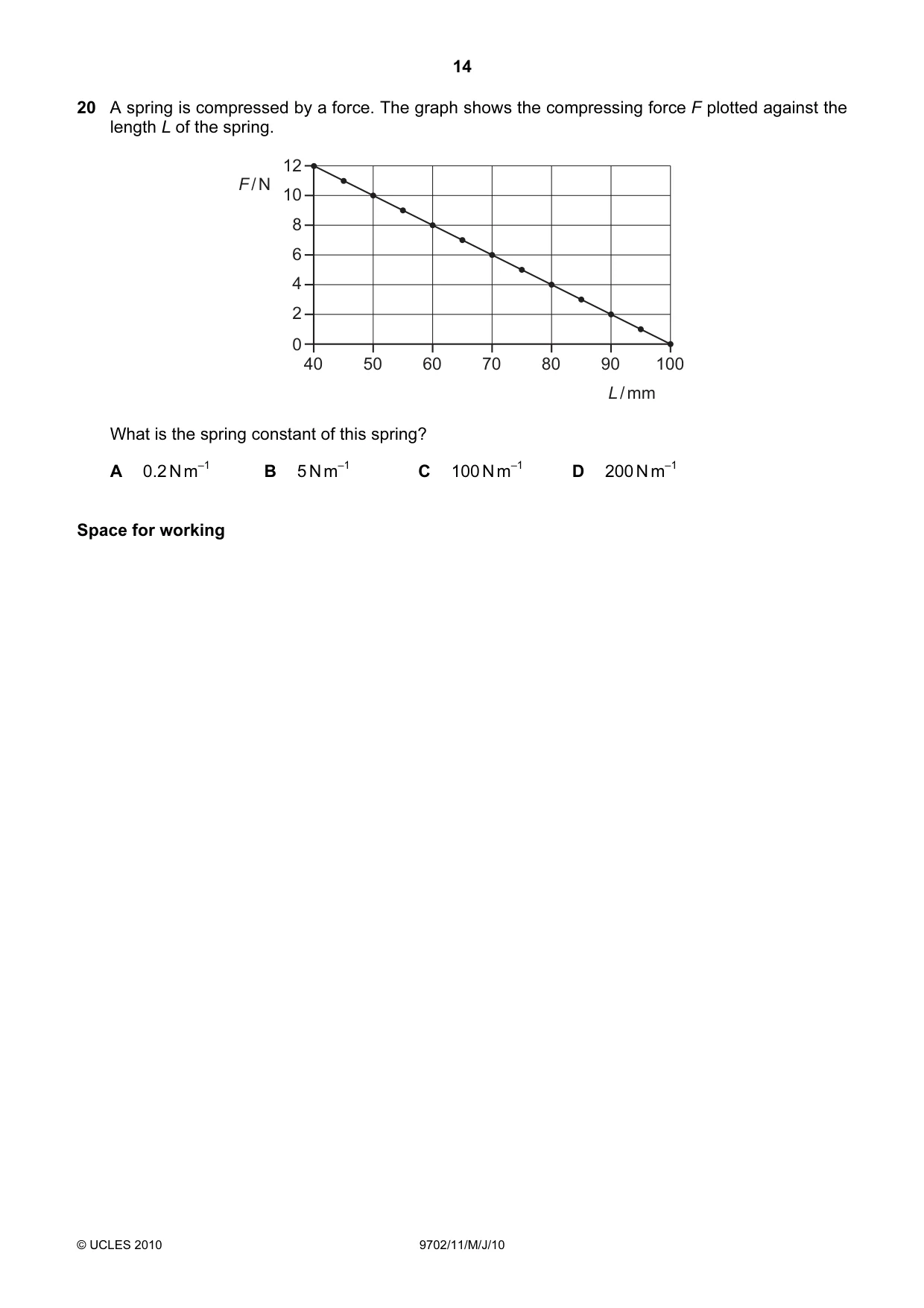
Q20 · A spring is compressed by a force
20 A spring is compressed by a force. The graph shows the compressing force F plotted against the length L of the spring. 12 F / N 10 8 6 4 2 0 40 50 60 70 80 90 100 L / mm What is the spring constant of this spring? A 0.2 N m–1 B 5 N m–1 C 100 N m–1 D 200 N m–1 Space for working
Mark scheme: D
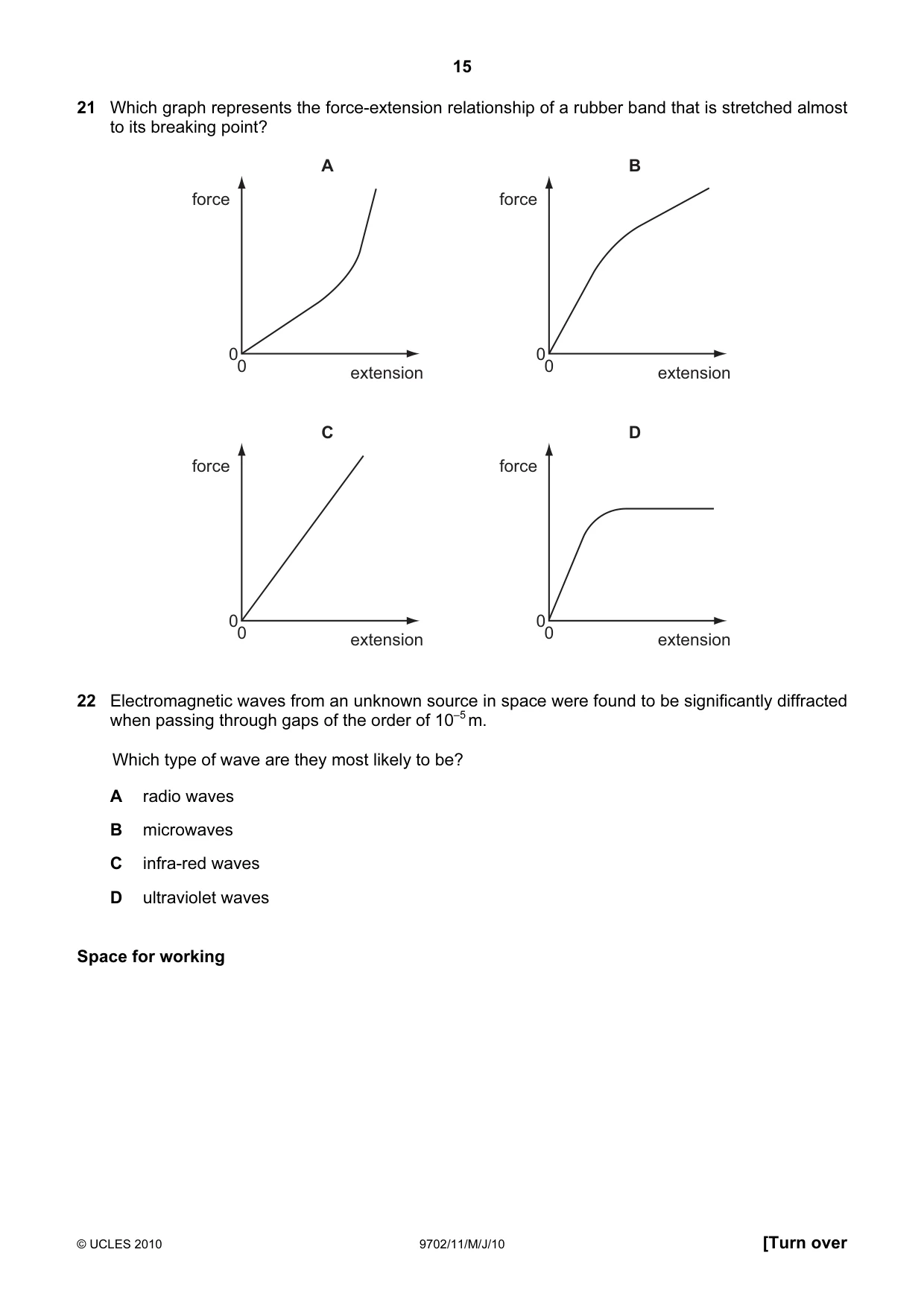
Q21 · Which graph represents the force-extension relationship of a rubber band that is…
21 Which graph represents the force-extension relationship of a rubber band that is stretched almost to its breaking point? A B force force 00 00 extension extension C D force force 00 00 extension extension
Mark scheme: A
Q22 · Electromagnetic waves from an unknown source in space were found to be significantly…
22 Electromagnetic waves from an unknown source in space were found to be significantly diffracted when passing through gaps of the order of 10–5 m. Which type of wave are they most likely to be? A radio waves B microwaves C infra-red waves D ultraviolet waves Space for working
Mark scheme: C
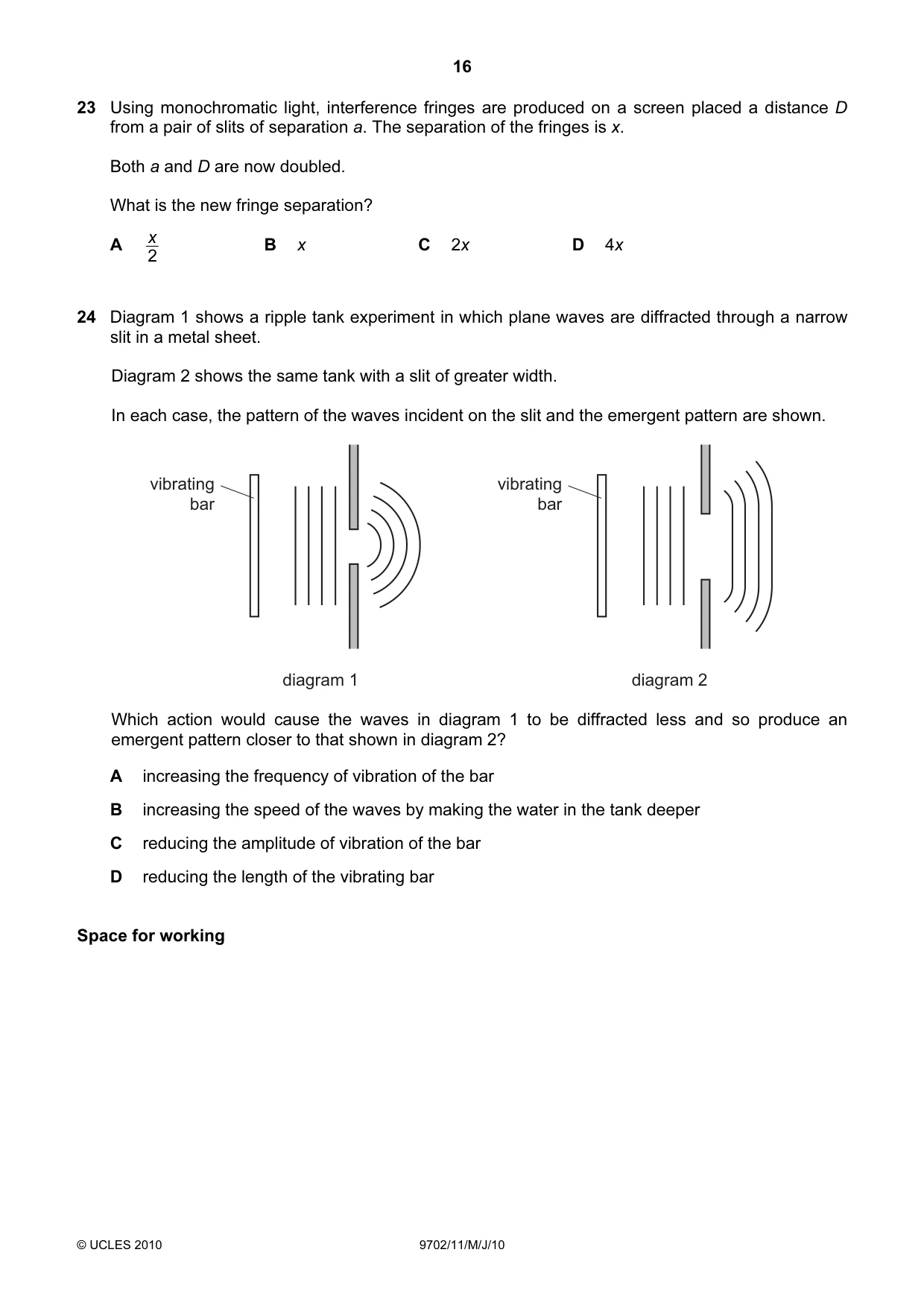
Q23 · Using monochromatic light, interference fringes are produced on a screen placed a…
23 Using monochromatic light, interference fringes are produced on a screen placed a distance D from a pair of slits of separation a. The separation of the fringes is x. Both a and D are now doubled. What is the new fringe separation? A x B x C 2x D 4x 2
Mark scheme: B
Q24 · A ripple tank experiment in which plane waves are diffracted through a narrow slit in a…
24 Diagram 1 shows a ripple tank experiment in which plane waves are diffracted through a narrow slit in a metal sheet. Diagram 2 shows the same tank with a slit of greater width. In each case, the pattern of the waves incident on the slit and the emergent pattern are shown. vibrating vibrating bar bar diagram 1 diagram 2 Which action would cause the waves in diagram 1 to be diffracted less and so produce an emergent pattern closer to that shown in diagram 2? A increasing the frequency of vibration of the bar B increasing the speed of the waves by making the water in the tank deeper C reducing the amplitude of vibration of the bar D reducing the length of the vibrating bar Space for working
Mark scheme: A
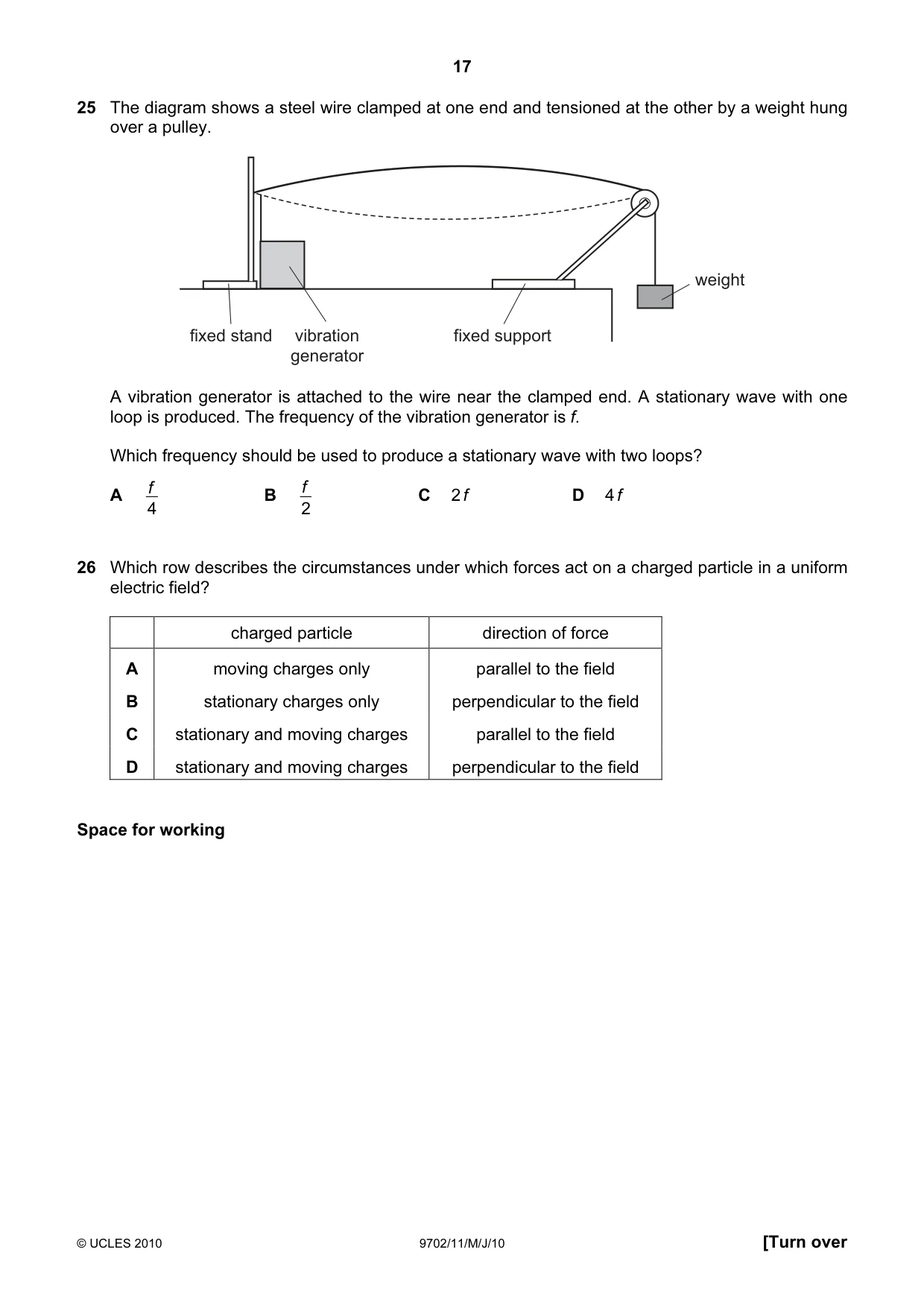
Q25 · The diagram shows a steel wire clamped at one end and tensioned at the other by a weight…
25 The diagram shows a steel wire clamped at one end and tensioned at the other by a weight hung over a pulley. weight fixed stand vibration fixed support generator A vibration generator is attached to the wire near the clamped end. A stationary wave with one loop is produced. The frequency of the vibration generator is f. Which frequency should be used to produce a stationary wave with two loops? f f A B C 2 f D 4 f 4 2
Mark scheme: C
Q26 · Which row describes the circumstances under which forces act on a charged particle in a…
26 Which row describes the circumstances under which forces act on a charged particle in a uniform electric field? charged particle direction of force A moving charges only parallel to the field B stationary charges only perpendicular to the field C stationary and moving charges parallel to the field D stationary and moving charges perpendicular to the field Space for working
Mark scheme: C
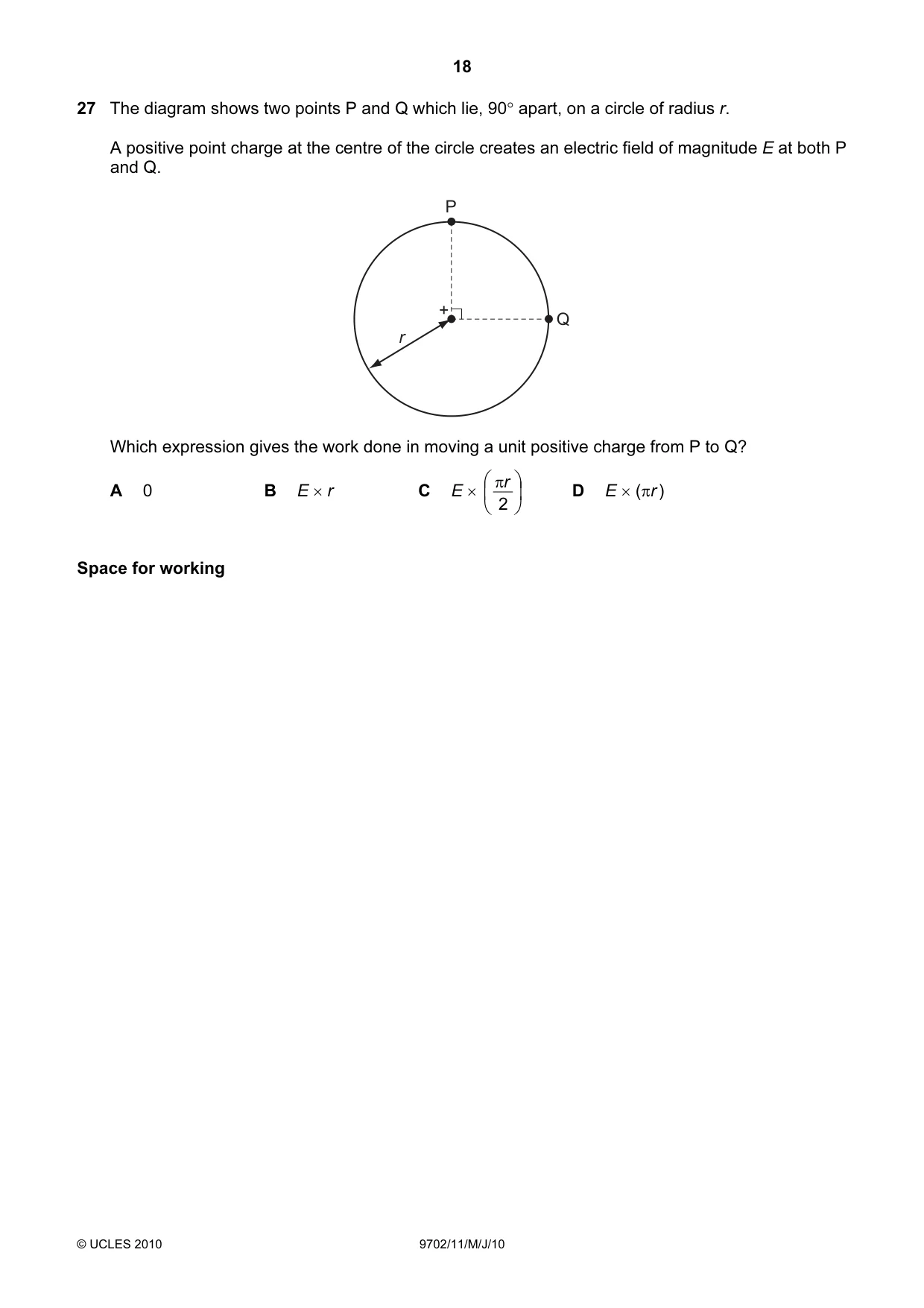
Q27 · The diagram shows two points P and Q which lie, 90° apart, on a circle of radius r
27 The diagram shows two points P and Q which lie, 90° apart, on a circle of radius r. A positive point charge at the centre of the circle creates an electric field of magnitude E at both P and Q. P + Q r Which expression gives the work done in moving a unit positive charge from P to Q? π r A 0 B E × r C E × D E × (πr ) 2 Space for working
Mark scheme: A
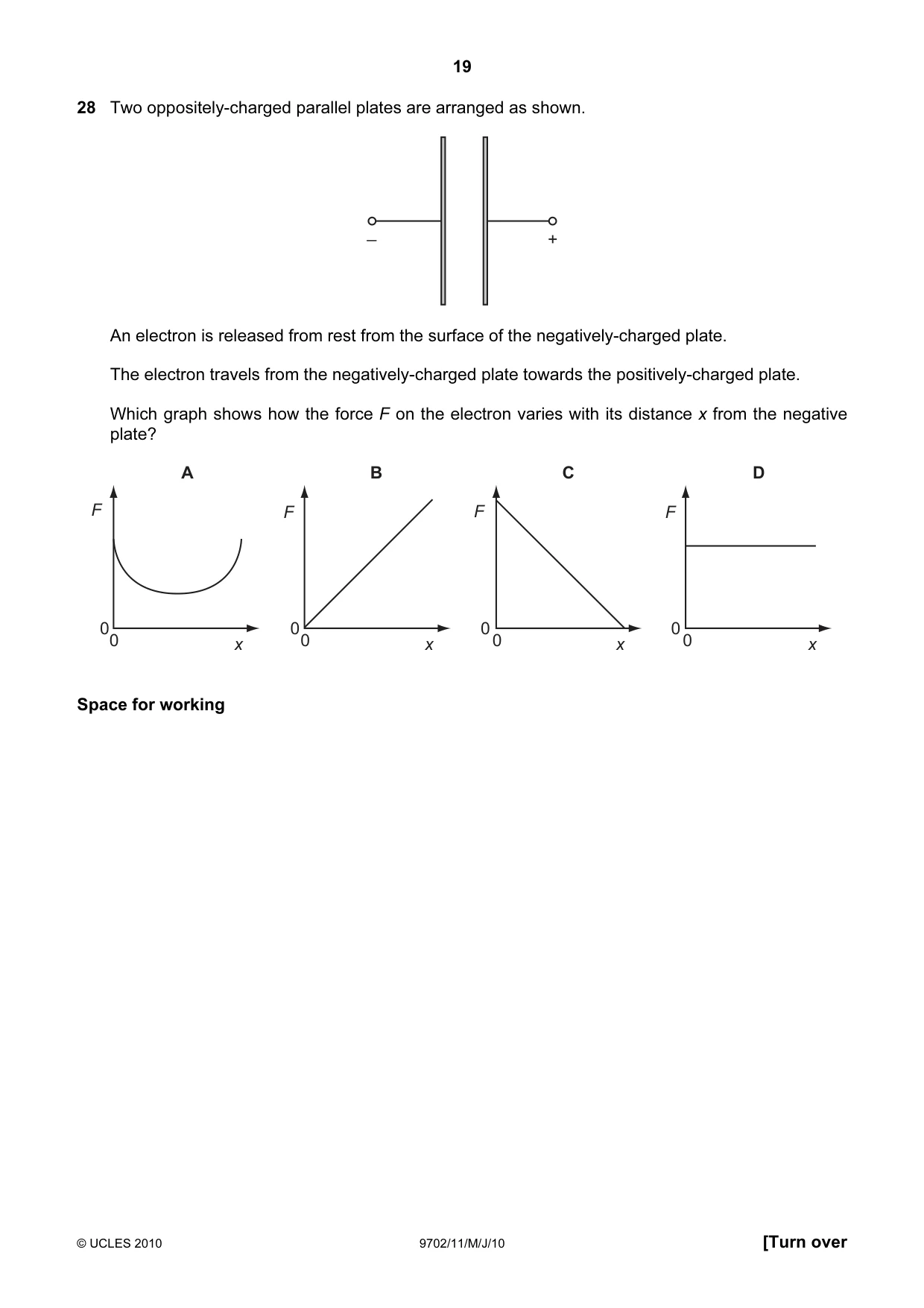
Q28 · Two oppositely-charged parallel plates are arranged as shown
28 Two oppositely-charged parallel plates are arranged as shown. _ + An electron is released from rest from the surface of the negatively-charged plate. The electron travels from the negatively-charged plate towards the positively-charged plate. Which graph shows how the force F on the electron varies with its distance x from the negative plate? A B C D F F F F 00 00 00 00 x x x x Space for working
Mark scheme: D
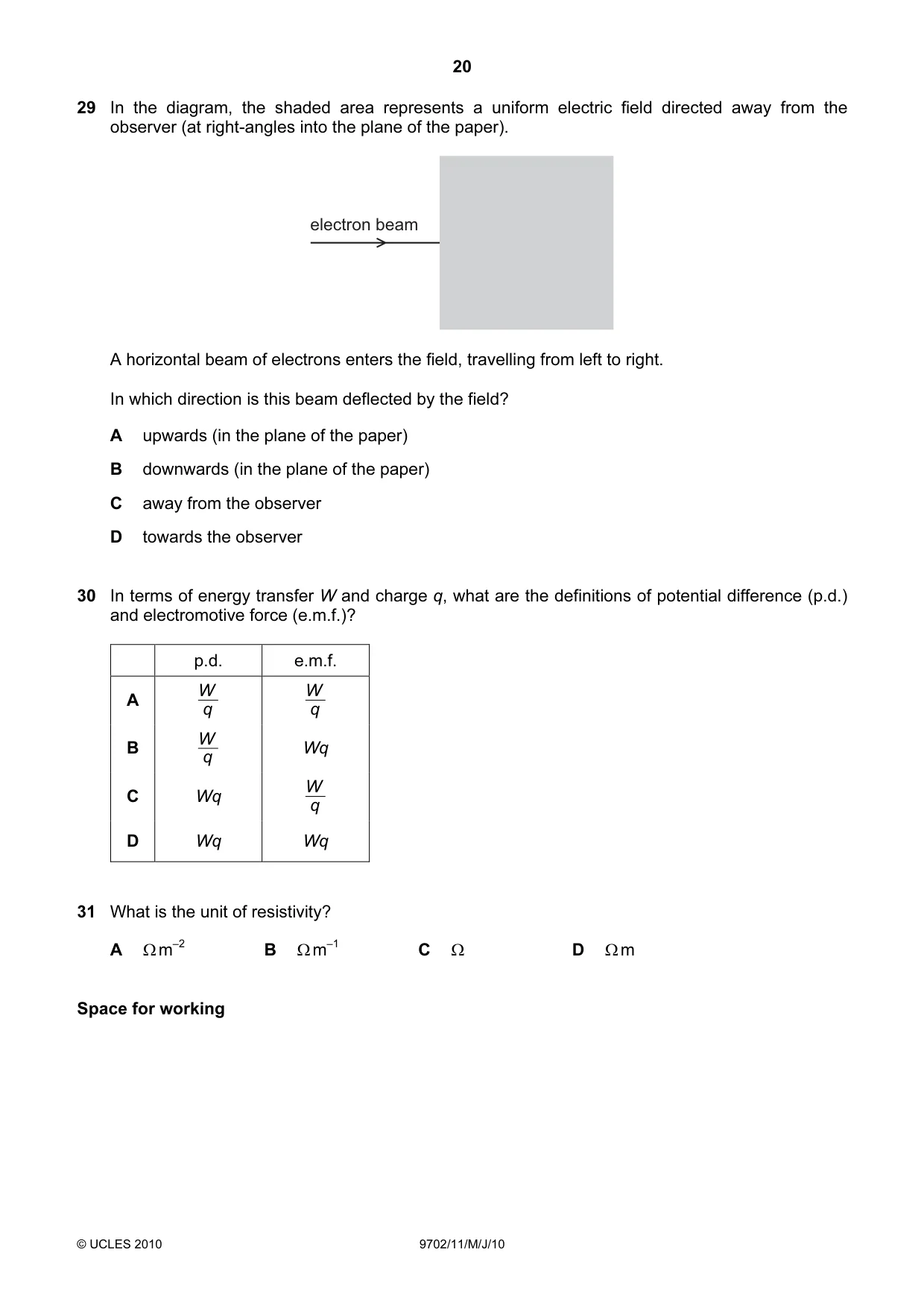
Q29 · In the diagram, the shaded area represents a uniform electric field directed away from…
29 In the diagram, the shaded area represents a uniform electric field directed away from the observer (at right-angles into the plane of the paper). electron beam A horizontal beam of electrons enters the field, travelling from left to right. In which direction is this beam deflected by the field? A upwards (in the plane of the paper) B downwards (in the plane of the paper) C away from the observer D towards the observer
Mark scheme: D
Q30 · In terms of energy transfer W and charge q, what are the definitions of potential…
30 In terms of energy transfer W and charge q, what are the definitions of potential difference (p.d.) and electromotive force (e.m.f.)? p.d. e.m.f. W W A q q W B Wq q W C Wq q D Wq Wq
Mark scheme: A
Q31 · What is the unit of resistivity?
31 What is the unit of resistivity? A Ω m–2 B Ω m–1 C Ω D Ω m Space for working
Mark scheme: D
Q32 · The resistance of a thermistor depends on its temperature, and the resistance of a…
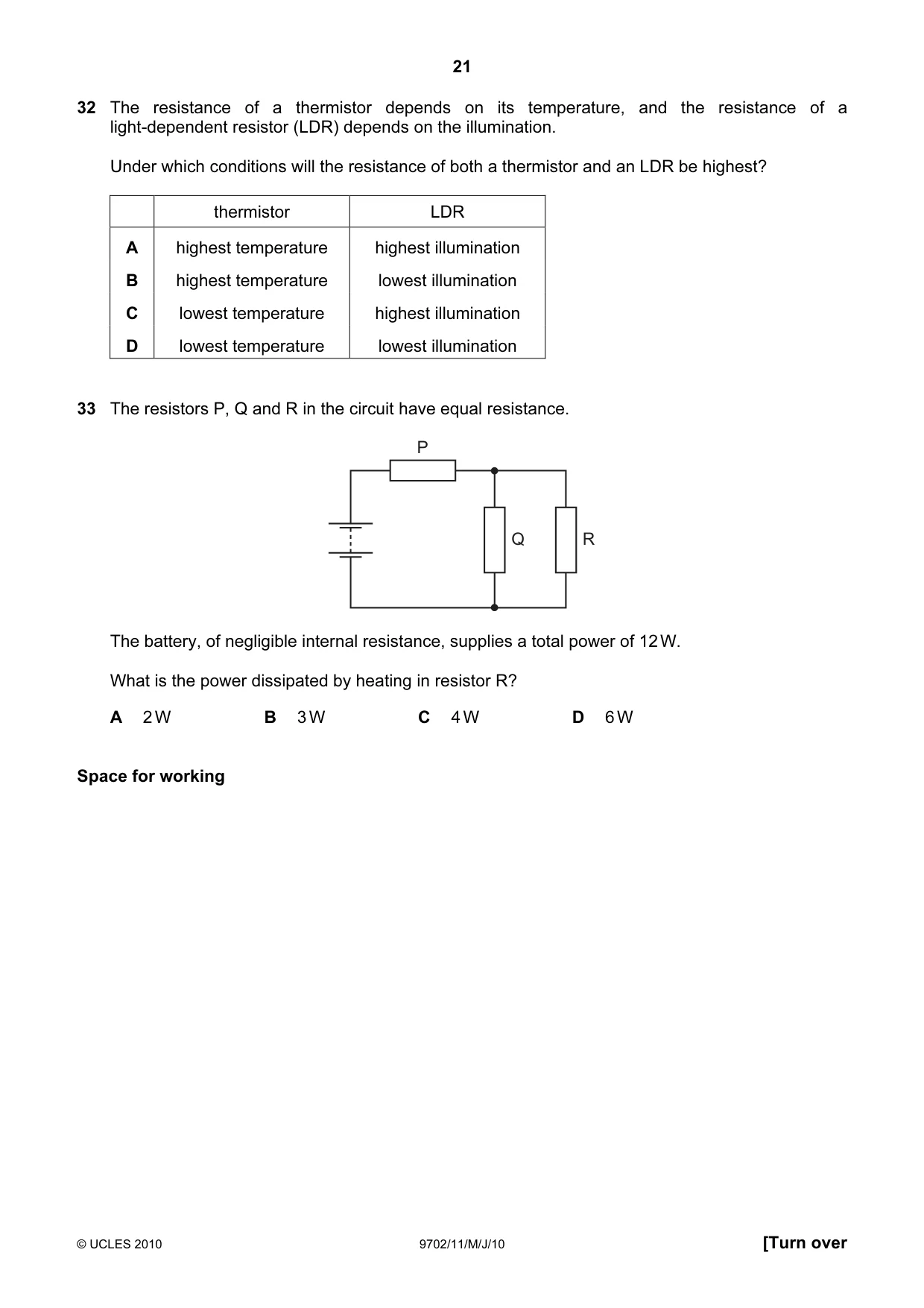
32 The resistance of a thermistor depends on its temperature, and the resistance of a light-dependent resistor (LDR) depends on the illumination. Under which conditions will the resistance of both a thermistor and an LDR be highest? thermistor LDR A highest temperature highest illumination B highest temperature lowest illumination C lowest temperature highest illumination D lowest temperature lowest illumination
Mark scheme: D
Q33 · The resistors P, Q and R in the circuit have equal resistance
33 The resistors P, Q and R in the circuit have equal resistance. P Q R The battery, of negligible internal resistance, supplies a total power of 12 W. What is the power dissipated by heating in resistor R? A 2 W B 3 W C 4 W D 6 W Space for working
Mark scheme: A
Q34 · In deriving a formula for the combined resistance of three different resistors in series…
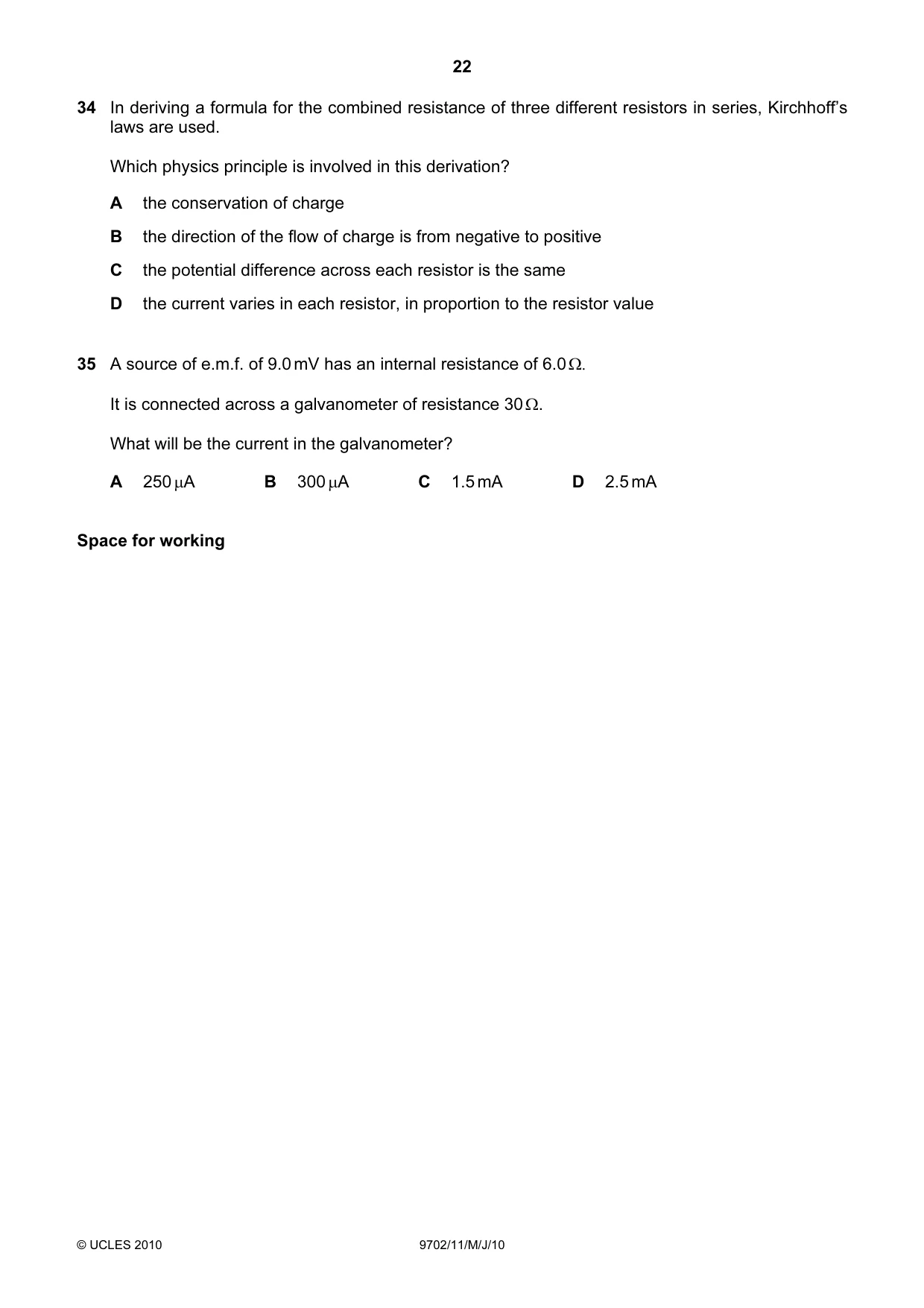
34 In deriving a formula for the combined resistance of three different resistors in series, Kirchhoff’s laws are used. Which physics principle is involved in this derivation? A the conservation of charge B the direction of the flow of charge is from negative to positive C the potential difference across each resistor is the same D the current varies in each resistor, in proportion to the resistor value
Mark scheme: A
Q35 · A source of e.m.f
35 A source of e.m.f. of 9.0 mV has an internal resistance of 6.0 Ω. It is connected across a galvanometer of resistance 30 Ω. What will be the current in the galvanometer? A 250 µA B 300 µA C 1.5 mA D 2.5 mA Space for working
Mark scheme: A
Q36 · In each arrangement of resistors, the ammeter has a resistance of 2 Ω
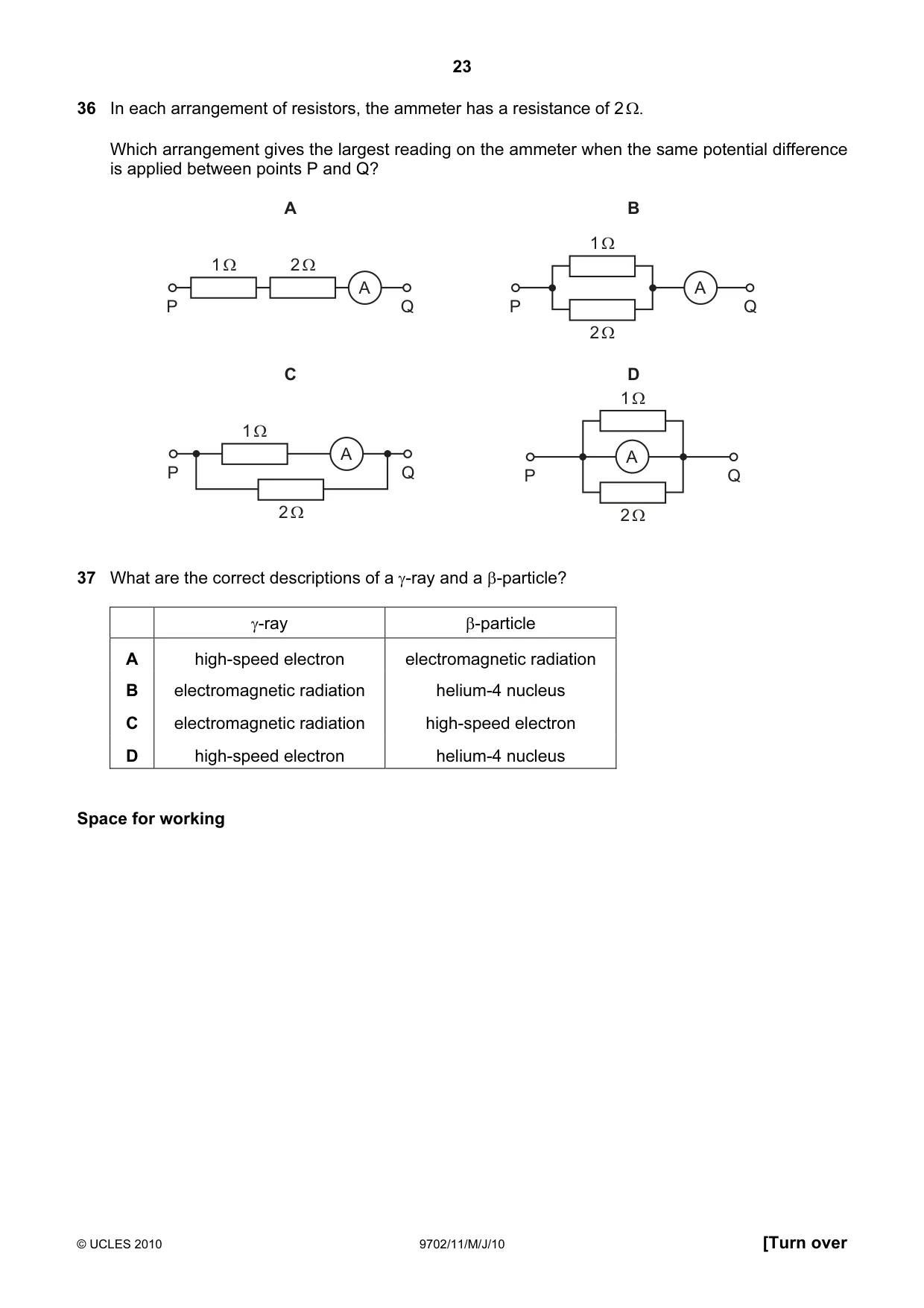
36 In each arrangement of resistors, the ammeter has a resistance of 2 Ω. Which arrangement gives the largest reading on the ammeter when the same potential difference is applied between points P and Q? A B 1 Ω 1 Ω 2 Ω A A P Q P Q 2 Ω C D 1 Ω 1 Ω A A P Q P Q 2 Ω 2 Ω
Mark scheme: D
Q37 · What are the correct descriptions of a γ-ray and a β-particle?
37 What are the correct descriptions of a γ-ray and a β-particle? γ-ray β-particle A high-speed electron electromagnetic radiation B electromagnetic radiation helium-4 nucleus C electromagnetic radiation high-speed electron D high-speed electron helium-4 nucleus Space for working
Mark scheme: C
Q38 · The grid shows a number of nuclides arranged according to the number of protons and the…
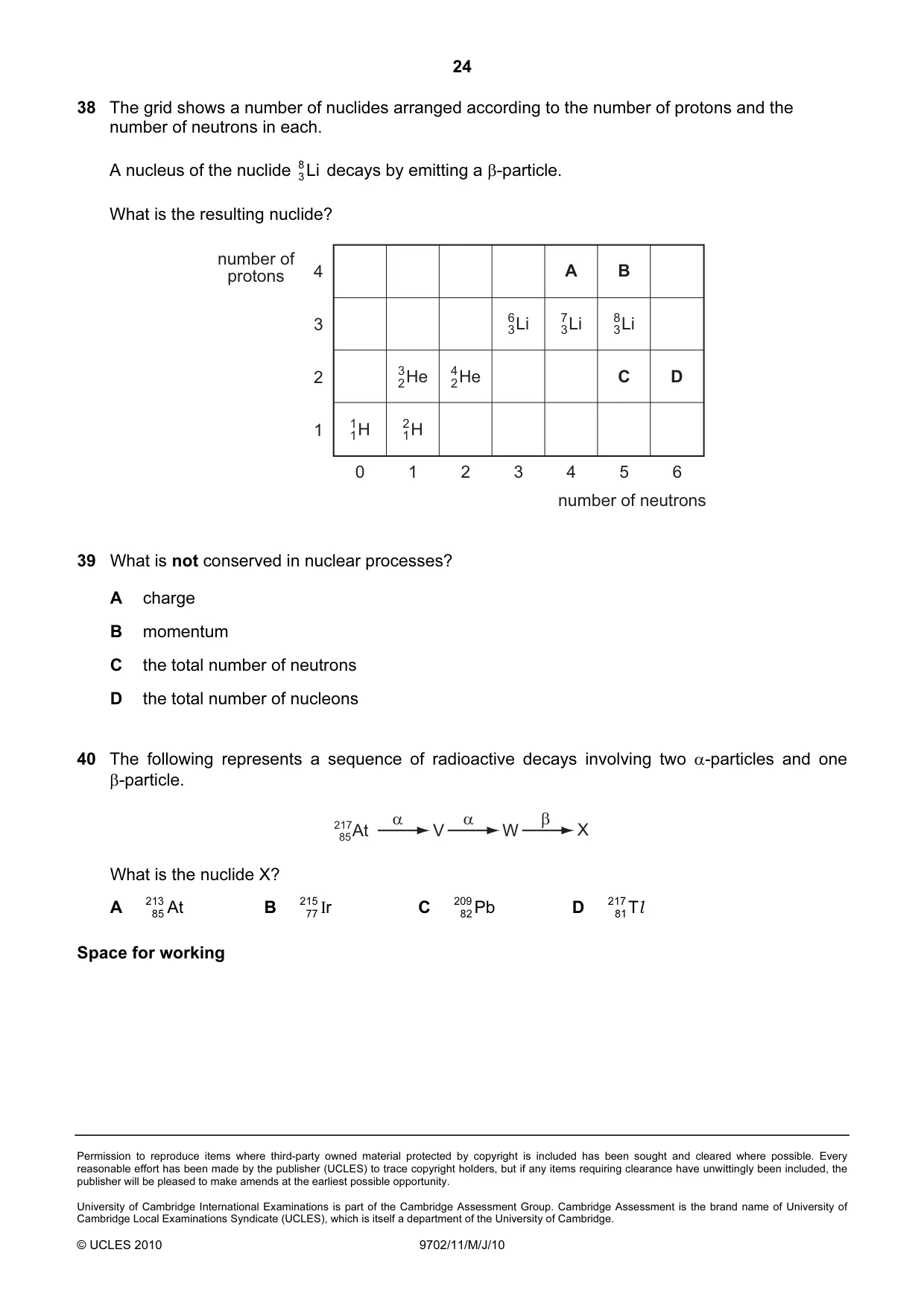
38 The grid shows a number of nuclides arranged according to the number of protons and the number of neutrons in each. A nucleus of the nuclide Li 8 decays by emitting a β-particle. 3 What is the resulting nuclide? number of protons 4 A B 3 6 3Li 7 3Li 8 3Li 2 3 2He 4 2He C D 1 1 1H 2 1H 0 1 2 3 4 5 6 number of neutrons
Mark scheme: A
Q39 · What is not conserved in nuclear processes?
39 What is not conserved in nuclear processes? A charge B momentum C the total number of neutrons D the total number of nucleons
Mark scheme: C
Q40 · The following represents a sequence of radioactive decays involving two α-particles and…
40 The following represents a sequence of radioactive decays involving two α-particles and one β-particle. α α β 217At V W X 85 What is the nuclide X? A 213 At B 215 77 I r C 209 Pb D 217 T l 85 82 81 Space for working
Mark scheme: C
What was in this paper
The subtopics covered by these 40 questions, and how many questions each got. Open one in a new tab to see every Cambridge question on it.
3Energy conservation3Practical circuits3Diffraction2Elastic and plastic behaviour2Errors and uncertainties2Linear momentum and its conservation2Radioactive decay2Resistance and resistivity2Scalars and vectors2SI units2Uniform electric fields2Atoms, nuclei and radiation1Characteristics of alternating currents1Electric potential1Equations of motion1Force on a moving charge1Interference1Kirchhoff’s laws1Mass defect and nuclear binding energy1Momentum and Newton’s laws of motion1Non-uniform motion1Potential difference and power1Stationary waves1Stress and strain1What you needed in this session
Cambridge’s own grade thresholds for 2010 May/June, Paper 1 · Variant 1. A higher threshold means an easier paper — the bar moves with how the cohort did.