Cambridge A Level Physics 9702 — 2025 May/June Paper 1 · Variant 3
9702/13/M/J/25 · 40 questions · 40 marks · 75 min
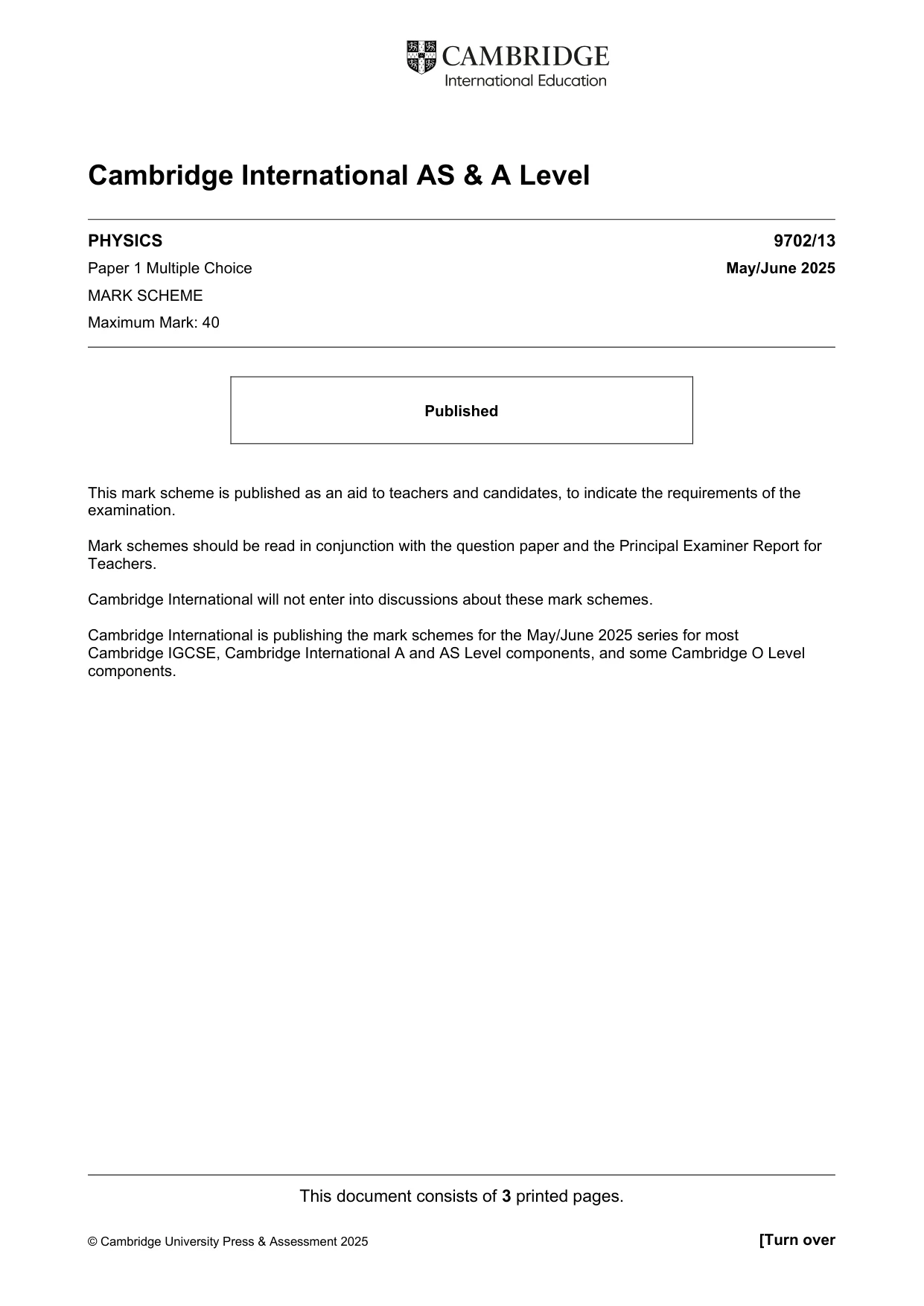
The question paper and its mark scheme, free to read here and free to download. This is Cambridge’s own paper, exactly as it was sat.
Question paper20 pages
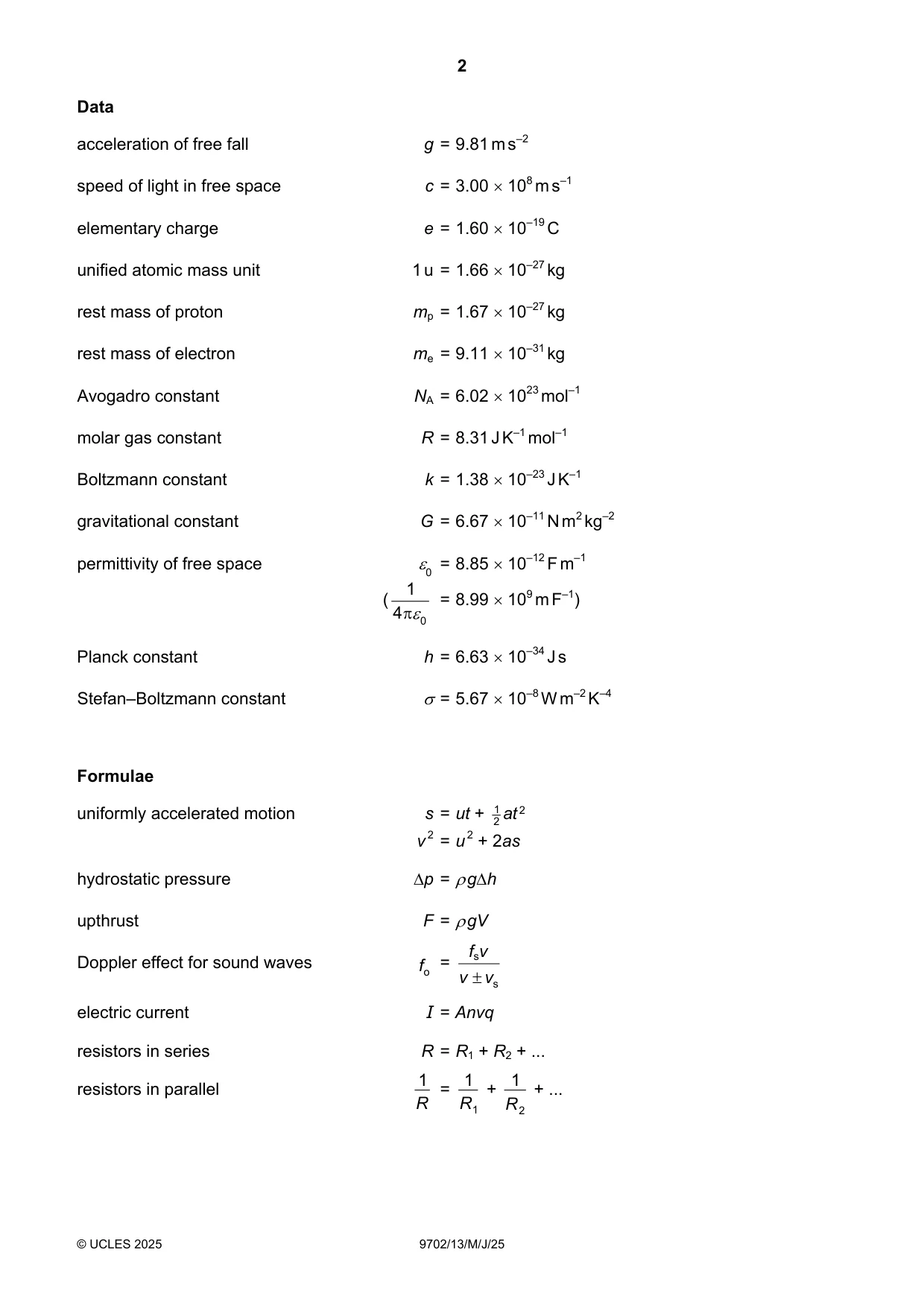
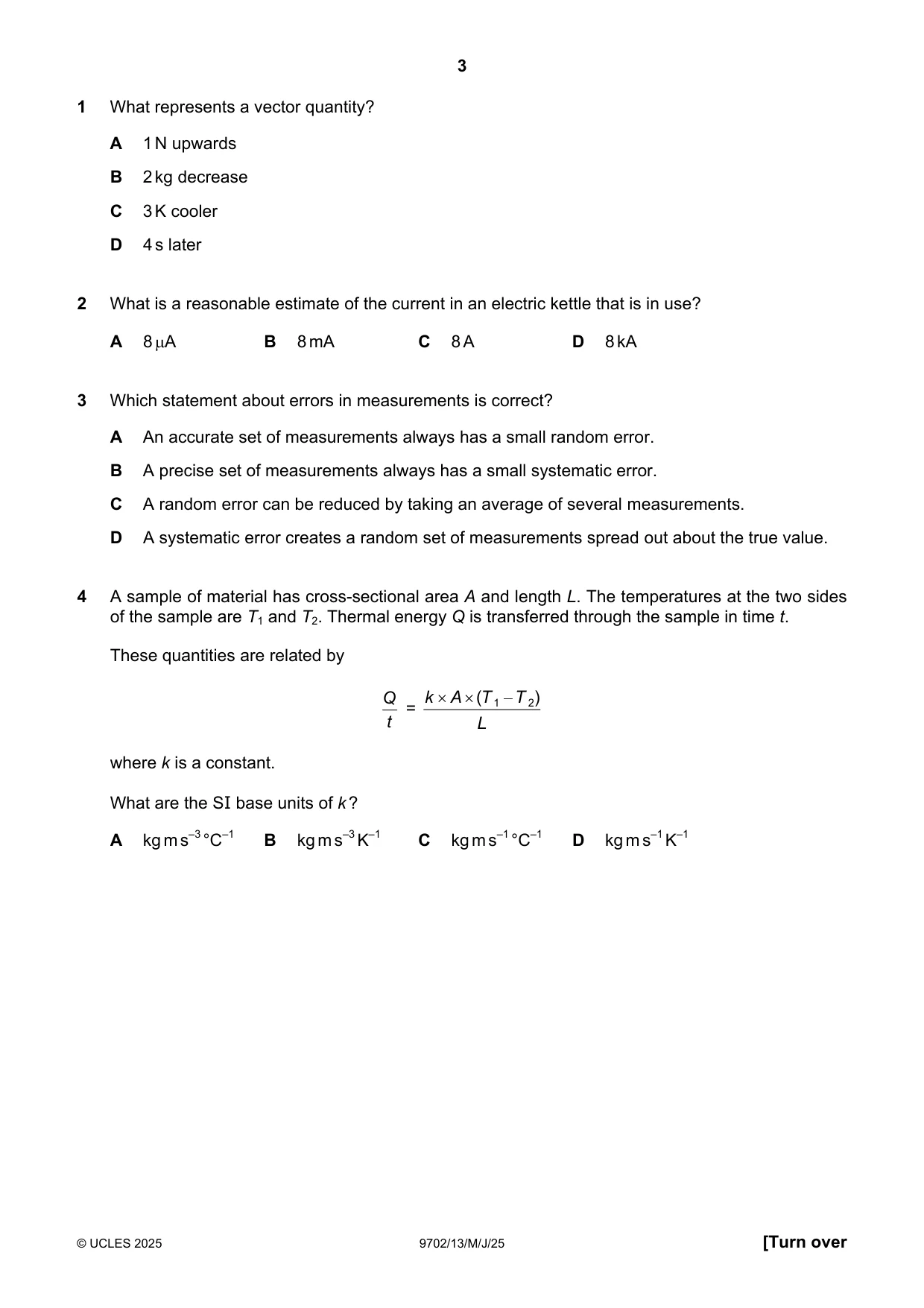
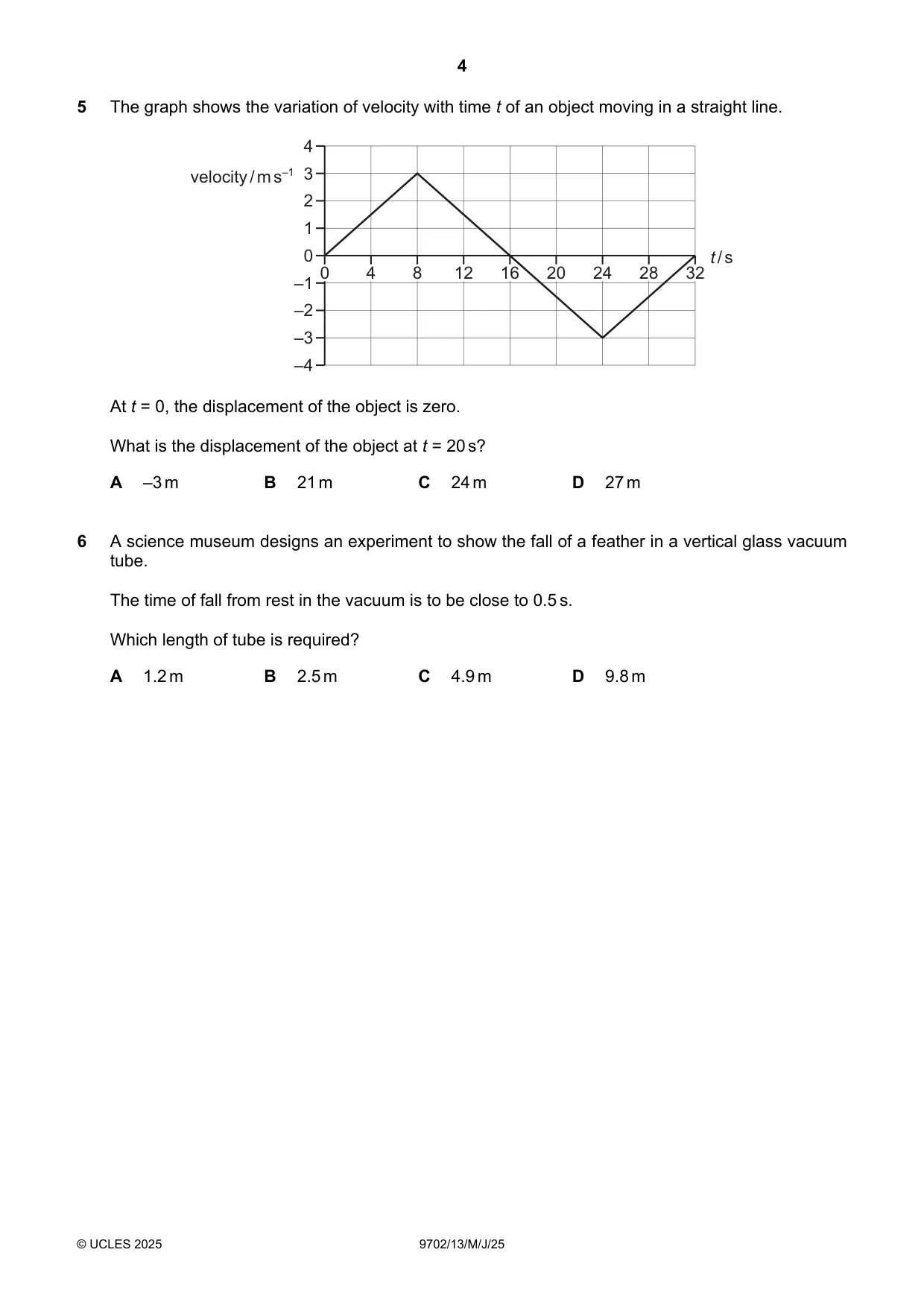
Mark scheme3 pages
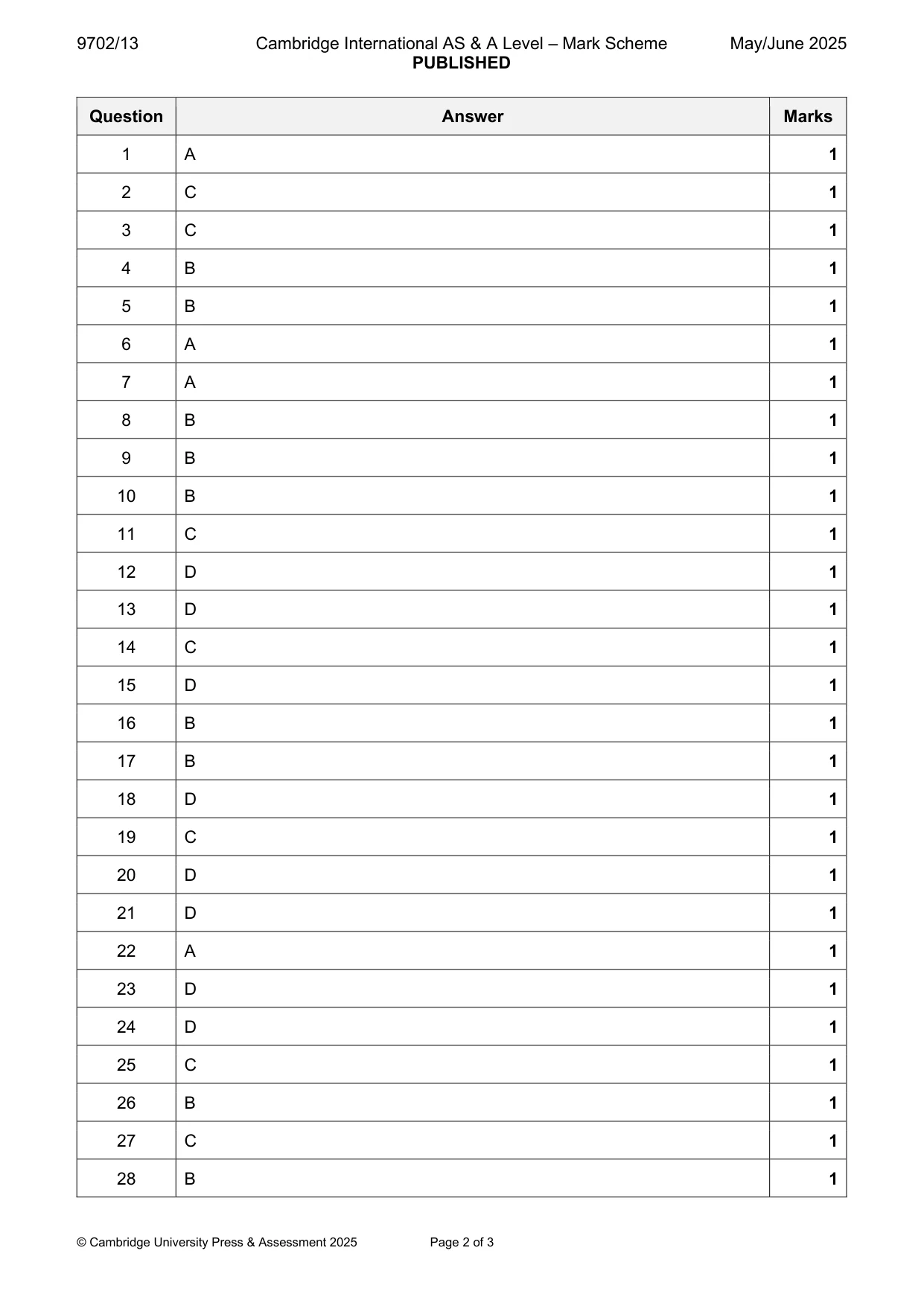
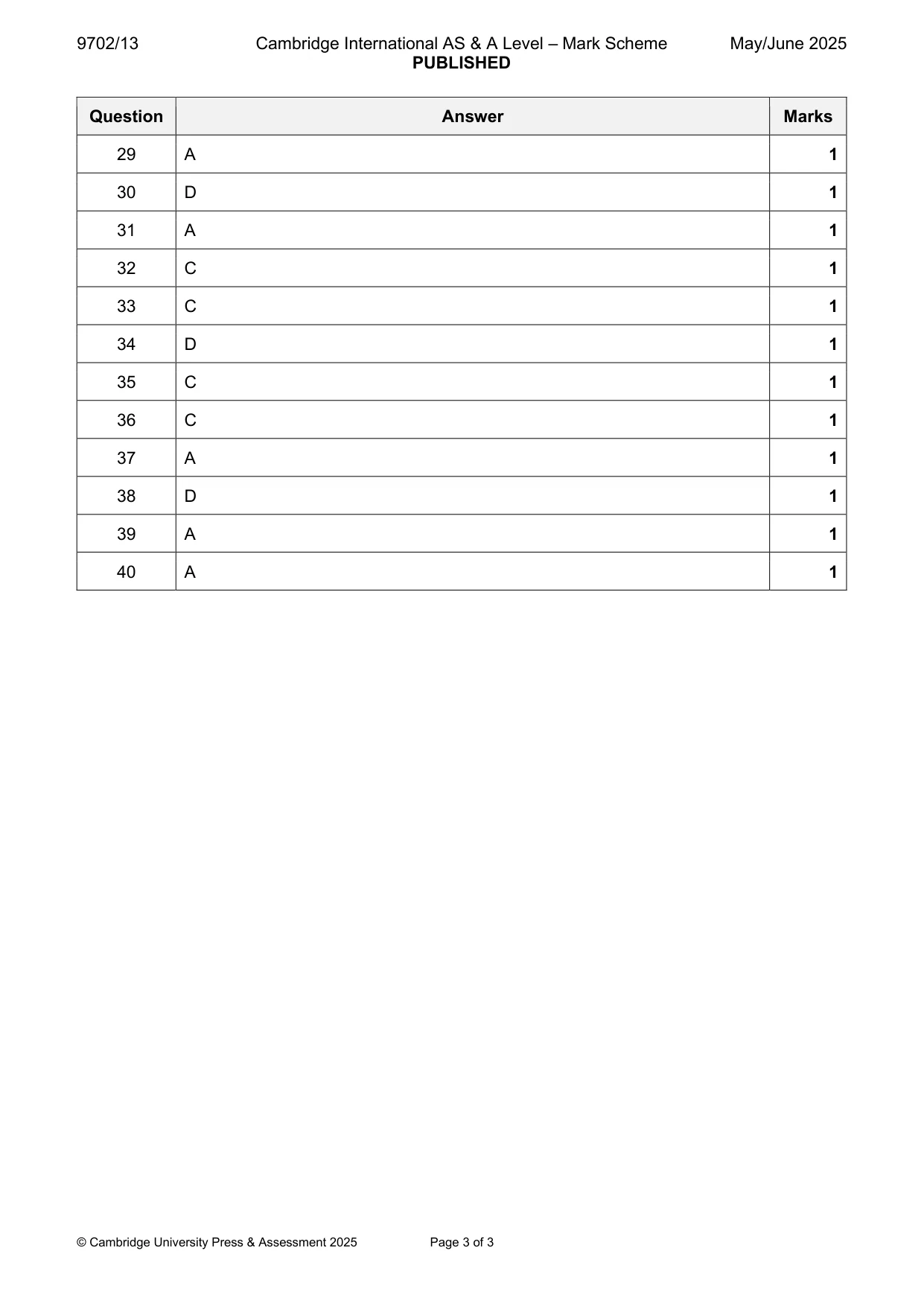
Answers below. Sit the paper first if you are practising.
Questions as text
Q1 · What represents a vector quantity?
1 What represents a vector quantity? A 1 N upwards B 2 kg decrease C 3 K cooler D 4 s later
Mark scheme: A
Q2 · What is a reasonable estimate of the current in an electric kettle that is in use?
2 What is a reasonable estimate of the current in an electric kettle that is in use? A 8 A B 8 mA C 8 A D 8 kA
Mark scheme: C
Q3 · Which statement about errors in measurements is correct?
3 Which statement about errors in measurements is correct? A An accurate set of measurements always has a small random error. B A precise set of measurements always has a small systematic error. C A random error can be reduced by taking an average of several measurements. D A systematic error creates a random set of measurements spread out about the true value.
Mark scheme: C
Q4 · A sample of material has cross-sectional area A and length L
4 A sample of material has cross-sectional area A and length L. The temperatures at the two sides of the sample are T1 and T2. Thermal energy Q is transferred through the sample in time t. These quantities are related by Q = k A ( T 1 – T ) 2 t L where k is a constant. What are the SI base units of k ? A kg m s–3 °C–1 B kg m s–3 K–1 C kg m s–1 °C–1 D kg m s–1 K–1
Mark scheme: B
Q5 · The graph shows the variation of velocity with time t of an object moving in a straight…
5 The graph shows the variation of velocity with time t of an object moving in a straight line. 4 velocity / m s–1 3 2 1 0 t / s 0 4 8 12 16 20 24 28 32 –1 –2 –3 –4 At t = 0, the displacement of the object is zero. What is the displacement of the object at t = 20 s? A –3 m B 21 m C 24 m D 27 m
Mark scheme: B
Q6 · A science museum designs an experiment to show the fall of a feather in a vertical glass…
6 A science museum designs an experiment to show the fall of a feather in a vertical glass vacuum tube. The time of fall from rest in the vacuum is to be close to 0.5 s. Which length of tube is required? A 1.2 m B 2.5 m C 4.9 m D 9.8 m
Mark scheme: A
Q7 · Two coins are projected from a horizontal table at the same initial speed u
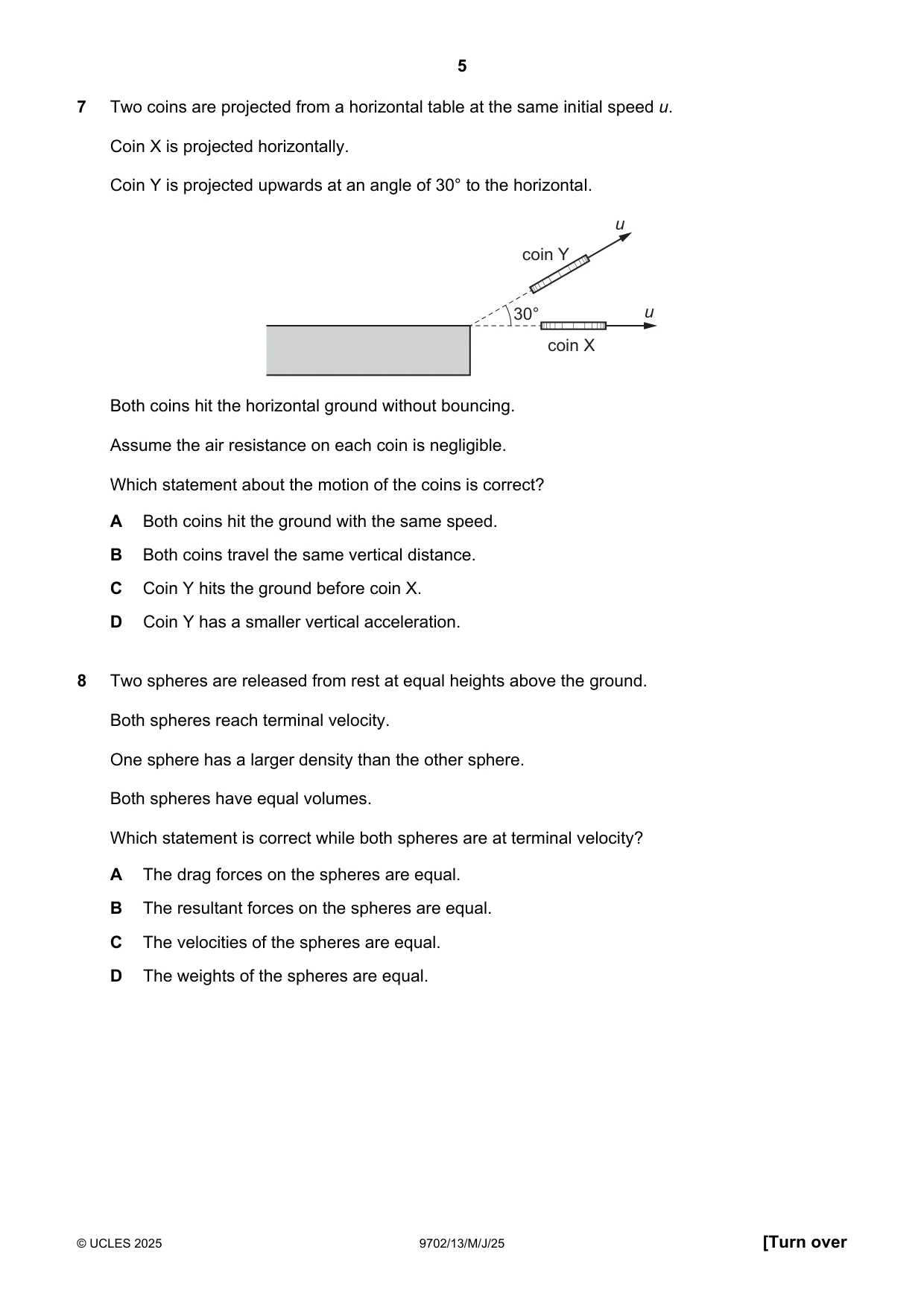
7 Two coins are projected from a horizontal table at the same initial speed u. Coin X is projected horizontally. Coin Y is projected upwards at an angle of 30° to the horizontal. u coin Y 30° u coin X Both coins hit the horizontal ground without bouncing. Assume the air resistance on each coin is negligible. Which statement about the motion of the coins is correct? A Both coins hit the ground with the same speed. B Both coins travel the same vertical distance. C Coin Y hits the ground before coin X. D Coin Y has a smaller vertical acceleration.
Mark scheme: A
Q8 · Two spheres are released from rest at equal heights above the ground
8 Two spheres are released from rest at equal heights above the ground. Both spheres reach terminal velocity. One sphere has a larger density than the other sphere. Both spheres have equal volumes. Which statement is correct while both spheres are at terminal velocity? A The drag forces on the spheres are equal. B The resultant forces on the spheres are equal. C The velocities of the spheres are equal. D The weights of the spheres are equal.
Mark scheme: B
Q9 · Which statement defines force?
9 Which statement defines force? A When a force acts on a body that is free to move, the force is the product of the mass of the body and its acceleration. B When a force acts on a body that is free to move, the force is the rate of change of momentum of the body. C When a force acts on a body that is free to move, the force is the work done by the force divided by the distance moved by the body. D When a force acts on a lever and causes a moment, the force is the moment divided by the perpendicular distance of the force from the pivot.
Mark scheme: B
Q10 · Four forces, all in the same plane, act on an object
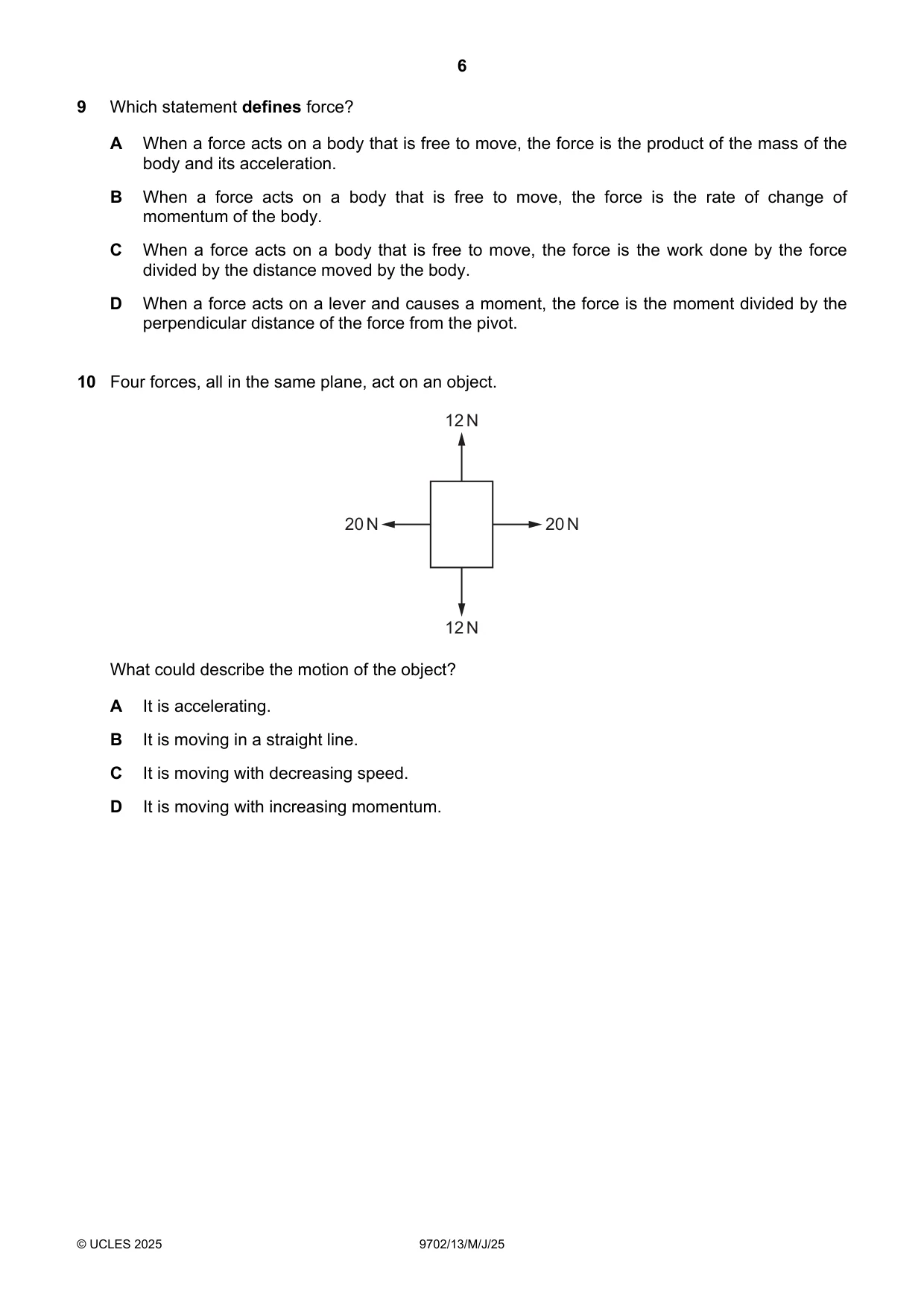
10 Four forces, all in the same plane, act on an object. 12 N 20 N 20 N 12 N What could describe the motion of the object? A It is accelerating. B It is moving in a straight line. C It is moving with decreasing speed. D It is moving with increasing momentum.
Mark scheme: B
Q11 · A nucleus collides with a stationary nucleus in a vacuum
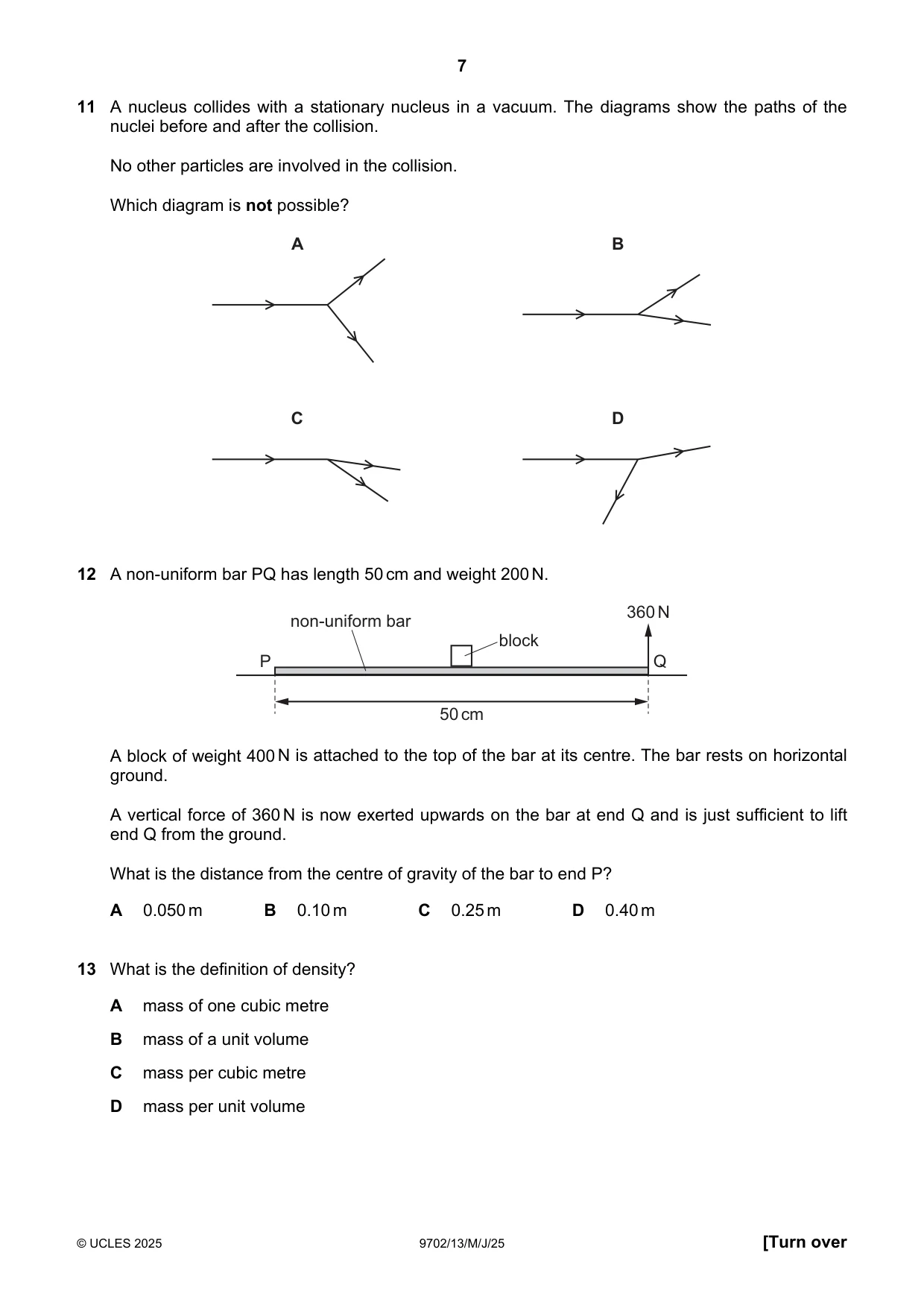
11 A nucleus collides with a stationary nucleus in a vacuum. The diagrams show the paths of the nuclei before and after the collision. No other particles are involved in the collision. Which diagram is not possible? A B C D
Mark scheme: C
Q12 · A non-uniform bar PQ has length 50 cm and weight 200 N
12 A non-uniform bar PQ has length 50 cm and weight 200 N. 360 N non-uniform bar block P Q 50 cm A block of weight 400 N is attached to the top of the bar at its centre. The bar rests on horizontal ground. A vertical force of 360 N is now exerted upwards on the bar at end Q and is just sufficient to lift end Q from the ground. What is the distance from the centre of gravity of the bar to end P? A 0.050 m B 0.10 m C 0.25 m D 0.40 m
Mark scheme: D
Q13 · What is the definition of density?
13 What is the definition of density? A mass of one cubic metre B mass of a unit volume C mass per cubic metre D mass per unit volume
Mark scheme: D
Q14 · A block is in equilibrium on a slope
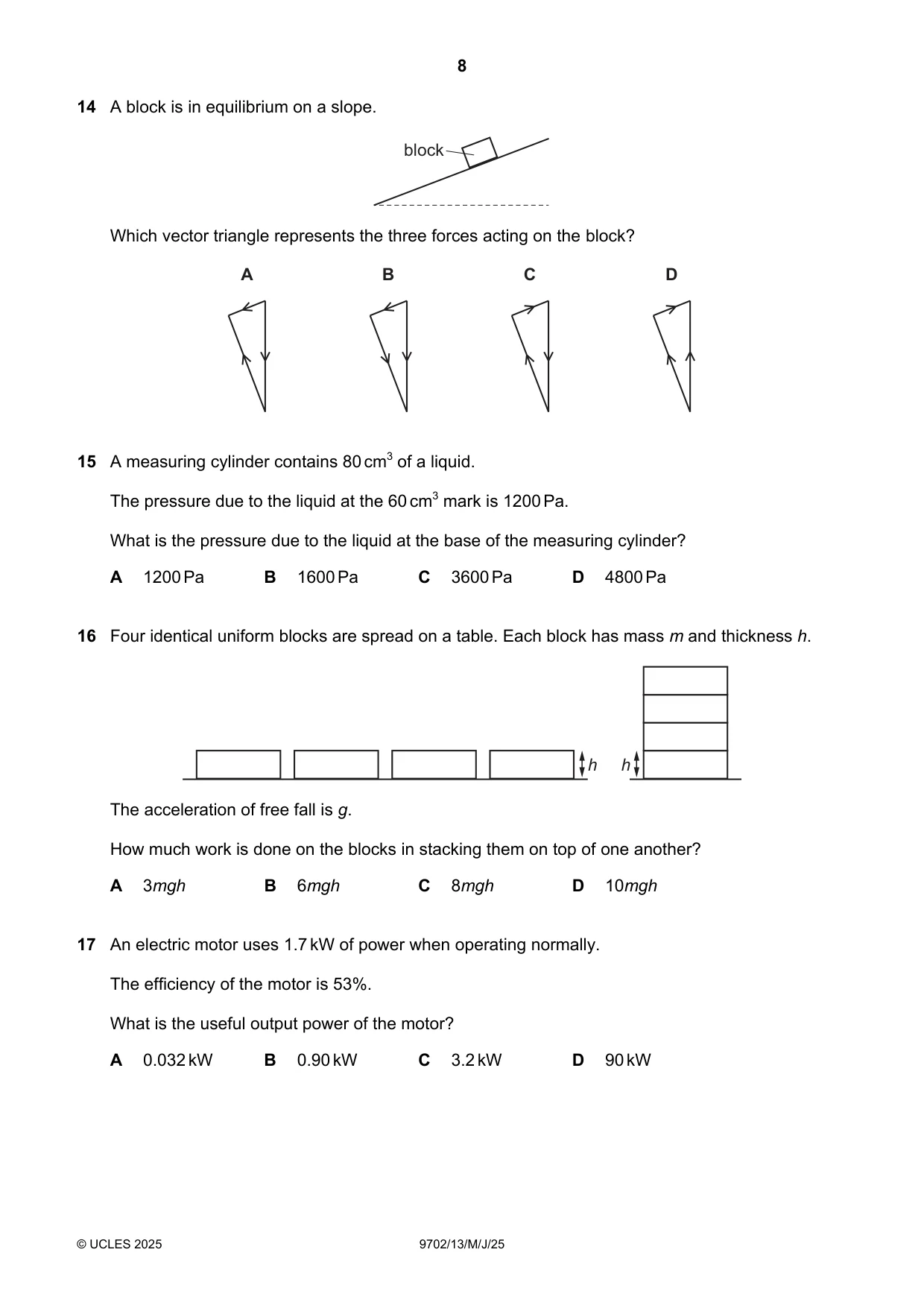
14 A block is in equilibrium on a slope. block Which vector triangle represents the three forces acting on the block? A B C D
Mark scheme: C
Q15 · A measuring cylinder contains 80 cm3 of a liquid
15 A measuring cylinder contains 80 cm3 of a liquid. The pressure due to the liquid at the 60 cm3 mark is 1200 Pa. What is the pressure due to the liquid at the base of the measuring cylinder? A 1200 Pa B 1600 Pa C 3600 Pa D 4800 Pa
Mark scheme: D
Q16 · Four identical uniform blocks are spread on a table
16 Four identical uniform blocks are spread on a table. Each block has mass m and thickness h. h h The acceleration of free fall is g. How much work is done on the blocks in stacking them on top of one another? A 3mgh B 6mgh C 8mgh D 10mgh
Mark scheme: B
More questions on Gravitational potential energy and kinetic energy
Q17 · An electric motor uses 1.7 kW of power when operating normally
17 An electric motor uses 1.7 kW of power when operating normally. The efficiency of the motor is 53%. What is the useful output power of the motor? A 0.032 kW B 0.90 kW C 3.2 kW D 90 kW
Mark scheme: B
Q18 · A ball is released from rest and falls vertically to the ground
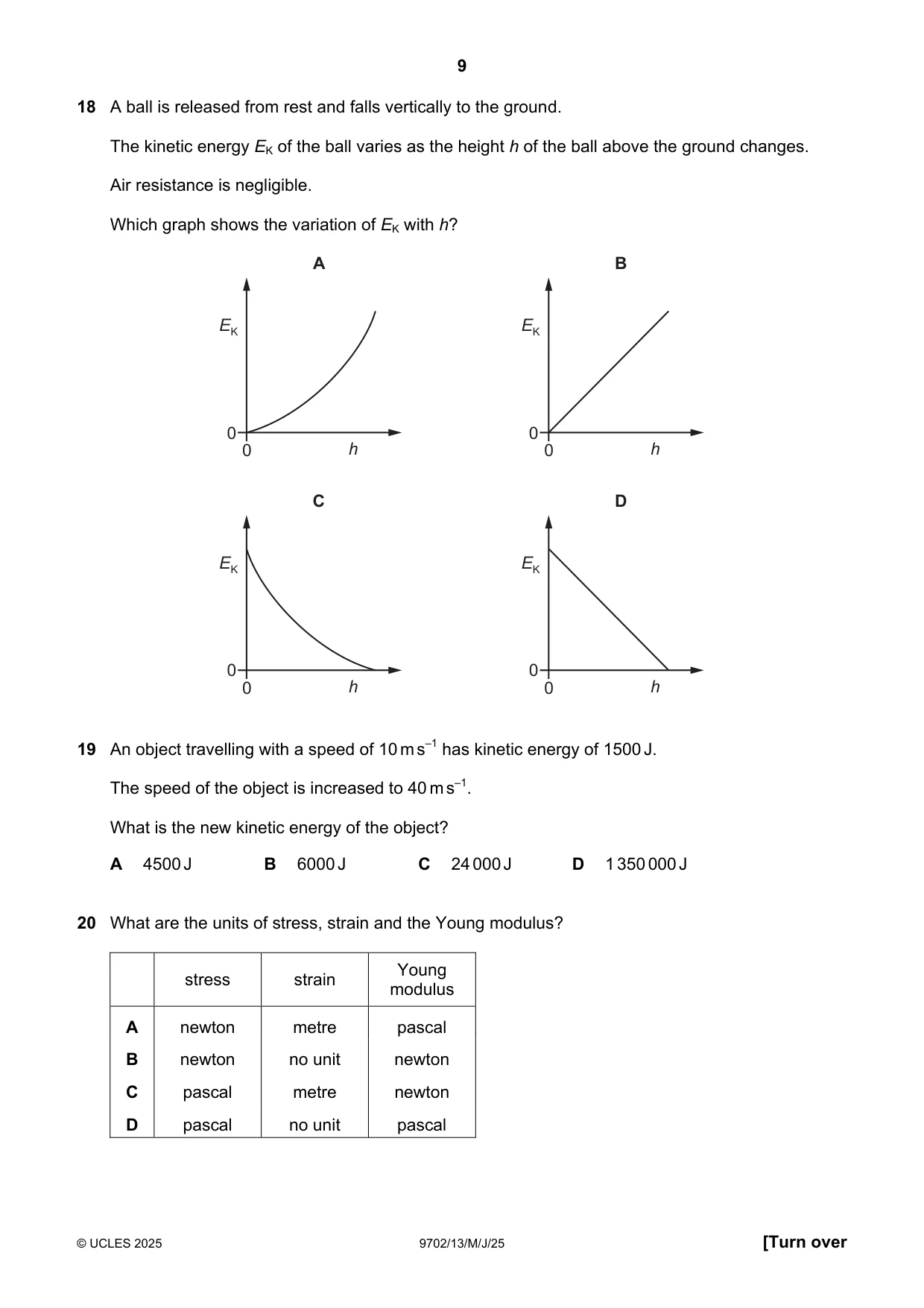
18 A ball is released from rest and falls vertically to the ground. The kinetic energy EK of the ball varies as the height h of the ball above the ground changes. Air resistance is negligible. Which graph shows the variation of EK with h? A B EK EK 0 0 0 h 0 h C D EK EK 0 0 0 h 0 h
Mark scheme: D
Q19 · An object travelling with a speed of 10 m s–1 has kinetic energy of 1500 J
19 An object travelling with a speed of 10 m s–1 has kinetic energy of 1500 J. The speed of the object is increased to 40 m s–1. What is the new kinetic energy of the object? A 4500 J B 6000 J C 24 000 J D 1 350 000 J
Mark scheme: C
More questions on Gravitational potential energy and kinetic energy
Q20 · What are the units of stress, strain and the Young modulus?
20 What are the units of stress, strain and the Young modulus? Young stress strain modulus A newton metre pascal B newton no unit newton C pascal metre newton D pascal no unit pascal
Mark scheme: D
Q21 · The force–extension graph for a metal wire is shown
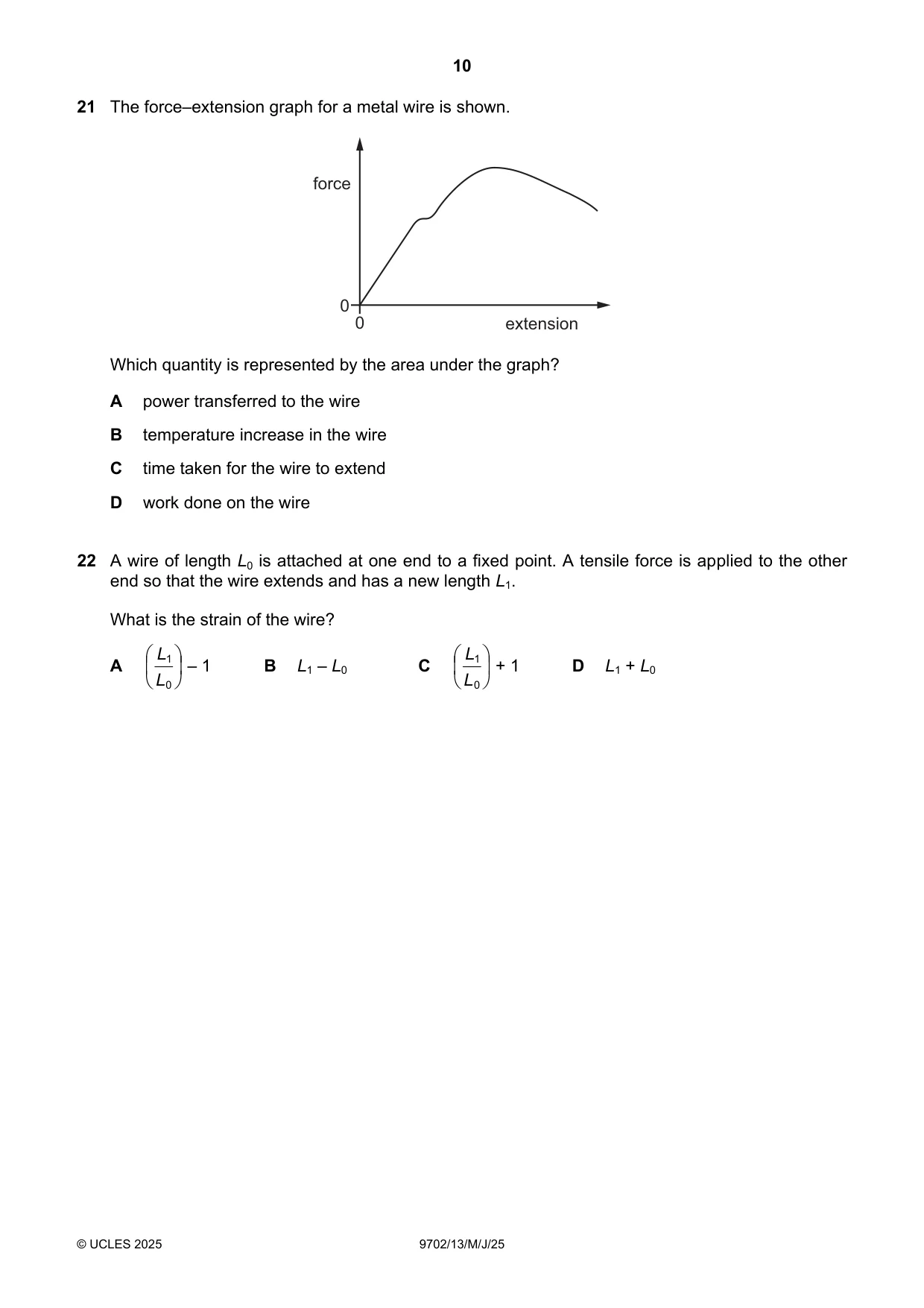
21 The force–extension graph for a metal wire is shown. force 0 0 extension Which quantity is represented by the area under the graph? A power transferred to the wire B temperature increase in the wire C time taken for the wire to extend D work done on the wire
Mark scheme: D
Q22 · A wire of length L0 is attached at one end to a fixed point
22 A wire of length L0 is attached at one end to a fixed point. A tensile force is applied to the other end so that the wire extends and has a new length L1. What is the strain of the wire? L L A 1 – 1 B L1 – L0 C 1 + 1 D L1 + L0 L L 0 0
Mark scheme: A
Q23 · A wire of length L is stretched to determine its limit of proportionality
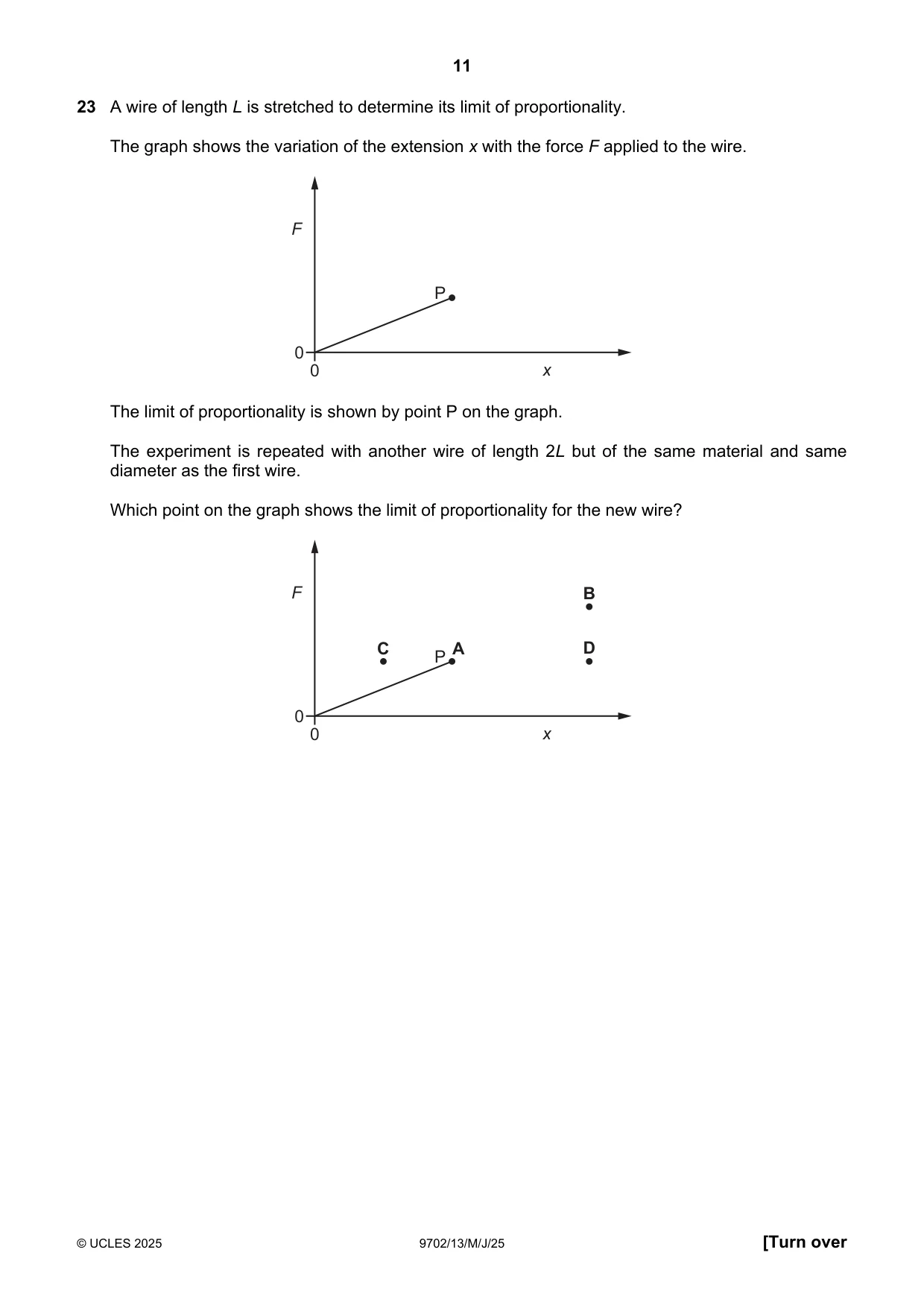
23 A wire of length L is stretched to determine its limit of proportionality. The graph shows the variation of the extension x with the force F applied to the wire. F P 0 0 x The limit of proportionality is shown by point P on the graph. The experiment is repeated with another wire of length 2L but of the same material and same diameter as the first wire. Which point on the graph shows the limit of proportionality for the new wire? F B C P A D 0 0 x
Mark scheme: D
Q24 · The graph shows the variation with distance along the wave of the displacement of water…
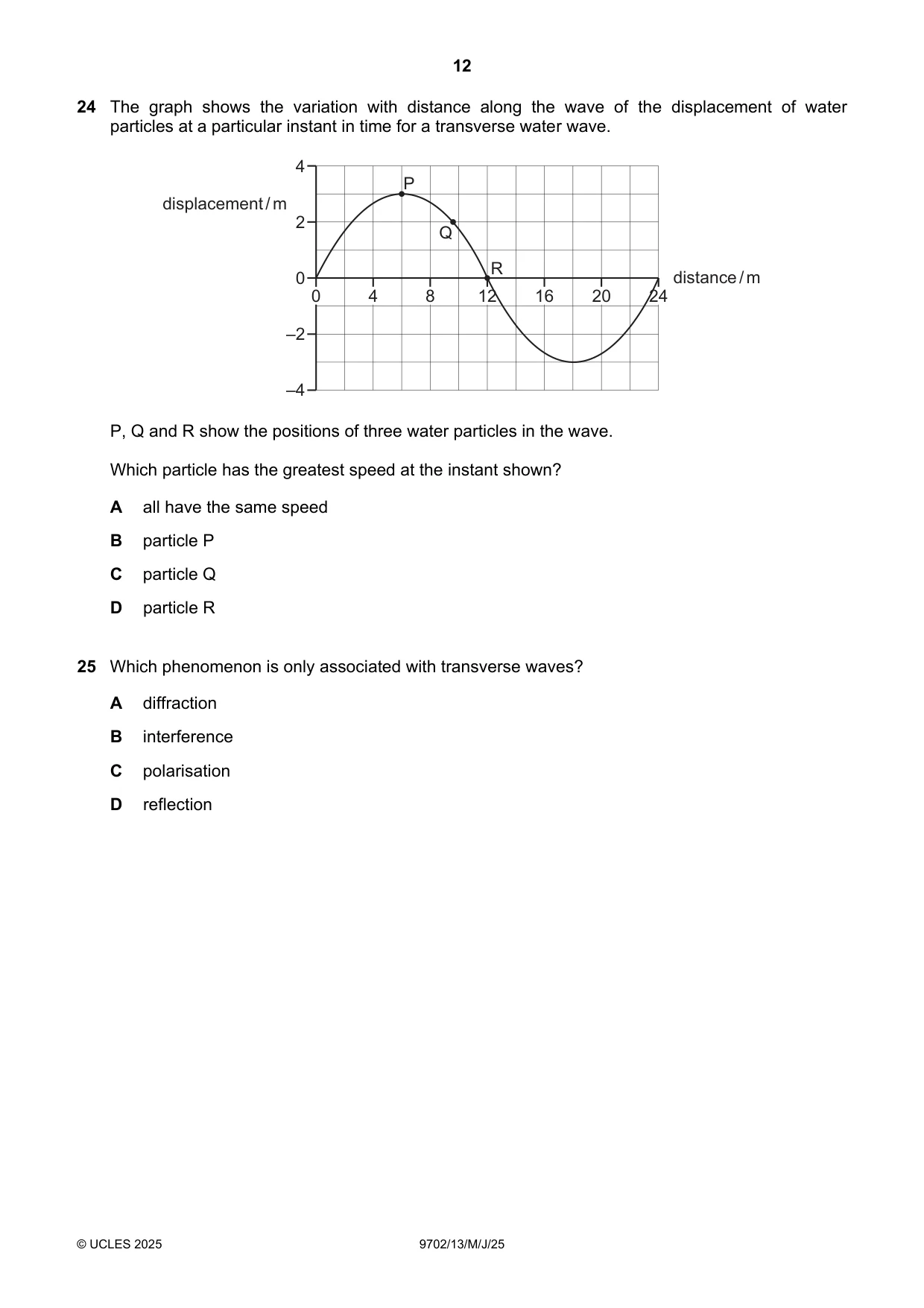
24 The graph shows the variation with distance along the wave of the displacement of water particles at a particular instant in time for a transverse water wave. 4 P displacement / m 2 Q R 0 distance / m 0 4 8 12 16 20 24 –2 –4 P, Q and R show the positions of three water particles in the wave. Which particle has the greatest speed at the instant shown? A all have the same speed B particle P C particle Q D particle R
Mark scheme: D
Q25 · Which phenomenon is only associated with transverse waves?
25 Which phenomenon is only associated with transverse waves? A diffraction B interference C polarisation D reflection
Mark scheme: C
Q26 · A wave is displayed on an oscilloscope
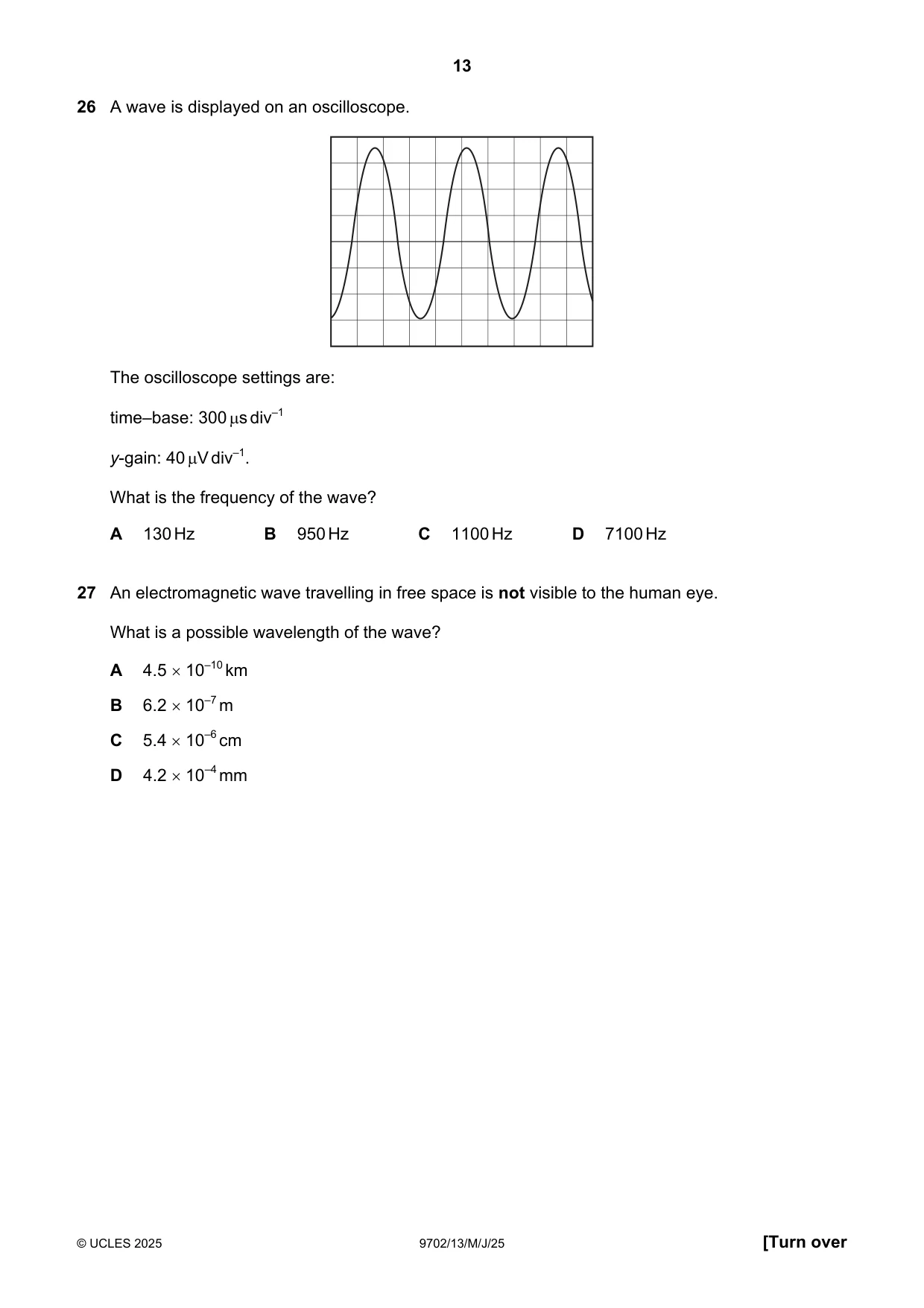
26 A wave is displayed on an oscilloscope. The oscilloscope settings are: time–base: 300 s div–1 y-gain: 40 V div–1. What is the frequency of the wave? A 130 Hz B 950 Hz C 1100 Hz D 7100 Hz
Mark scheme: B
Q27 · An electromagnetic wave travelling in free space is not visible to the human eye
27 An electromagnetic wave travelling in free space is not visible to the human eye. What is a possible wavelength of the wave? A 4.5 10–10 km B 6.2 10–7 m C 5.4 10–6 cm D 4.2 10–4 mm
Mark scheme: C
Q28 · Electromagnetic waves of equal wavelengths are emitted from two sources, X and Y
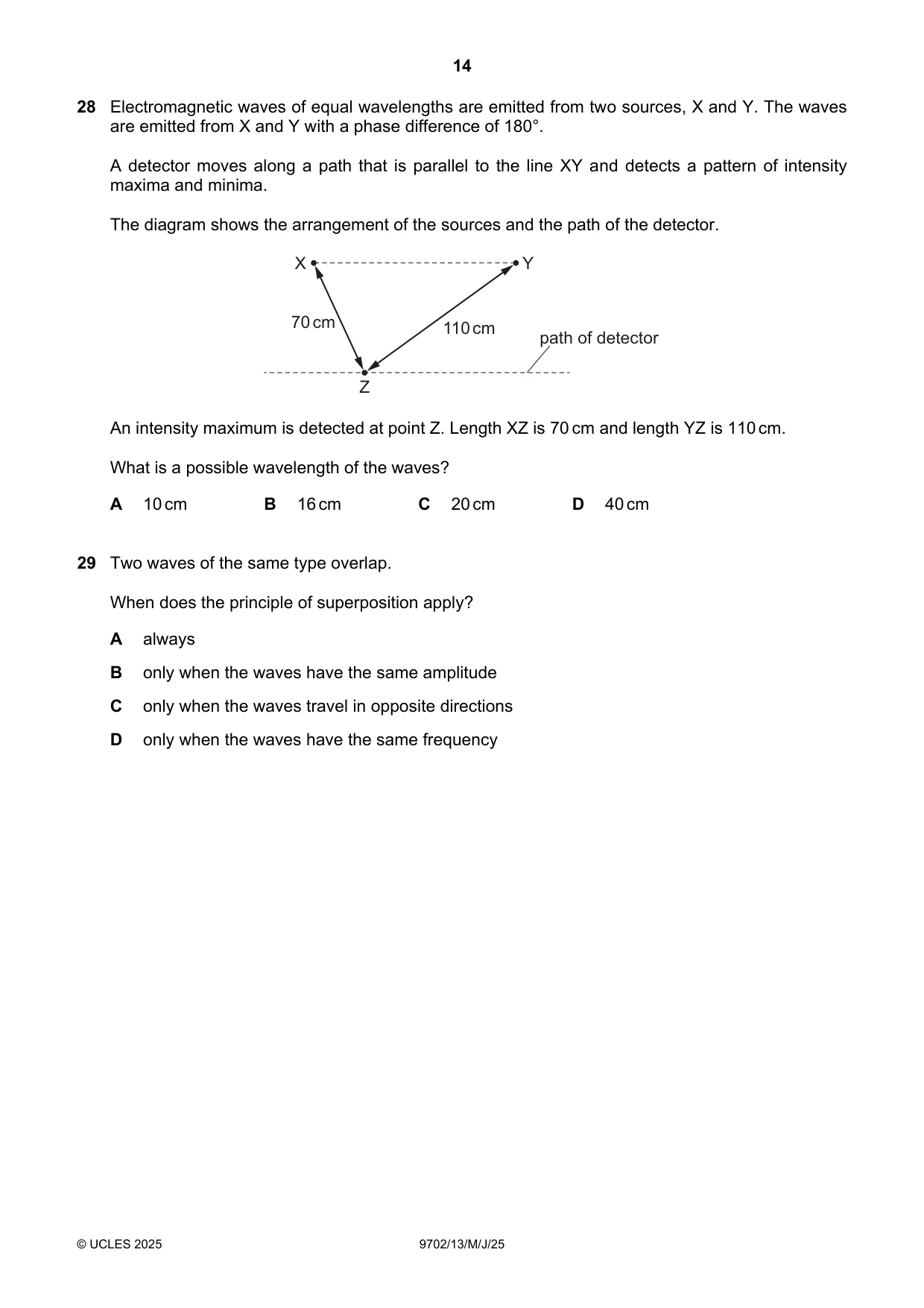
28 Electromagnetic waves of equal wavelengths are emitted from two sources, X and Y. The waves are emitted from X and Y with a phase difference of 180°. A detector moves along a path that is parallel to the line XY and detects a pattern of intensity maxima and minima. The diagram shows the arrangement of the sources and the path of the detector. X Y 70 cm 110 cm path of detector Z An intensity maximum is detected at point Z. Length XZ is 70 cm and length YZ is 110 cm. What is a possible wavelength of the waves? A 10 cm B 16 cm C 20 cm D 40 cm
Mark scheme: B
Q29 · Two waves of the same type overlap
29 Two waves of the same type overlap. When does the principle of superposition apply? A always B only when the waves have the same amplitude C only when the waves travel in opposite directions D only when the waves have the same frequency
Mark scheme: A
Q30 · A ripple tank contains water at a constant depth
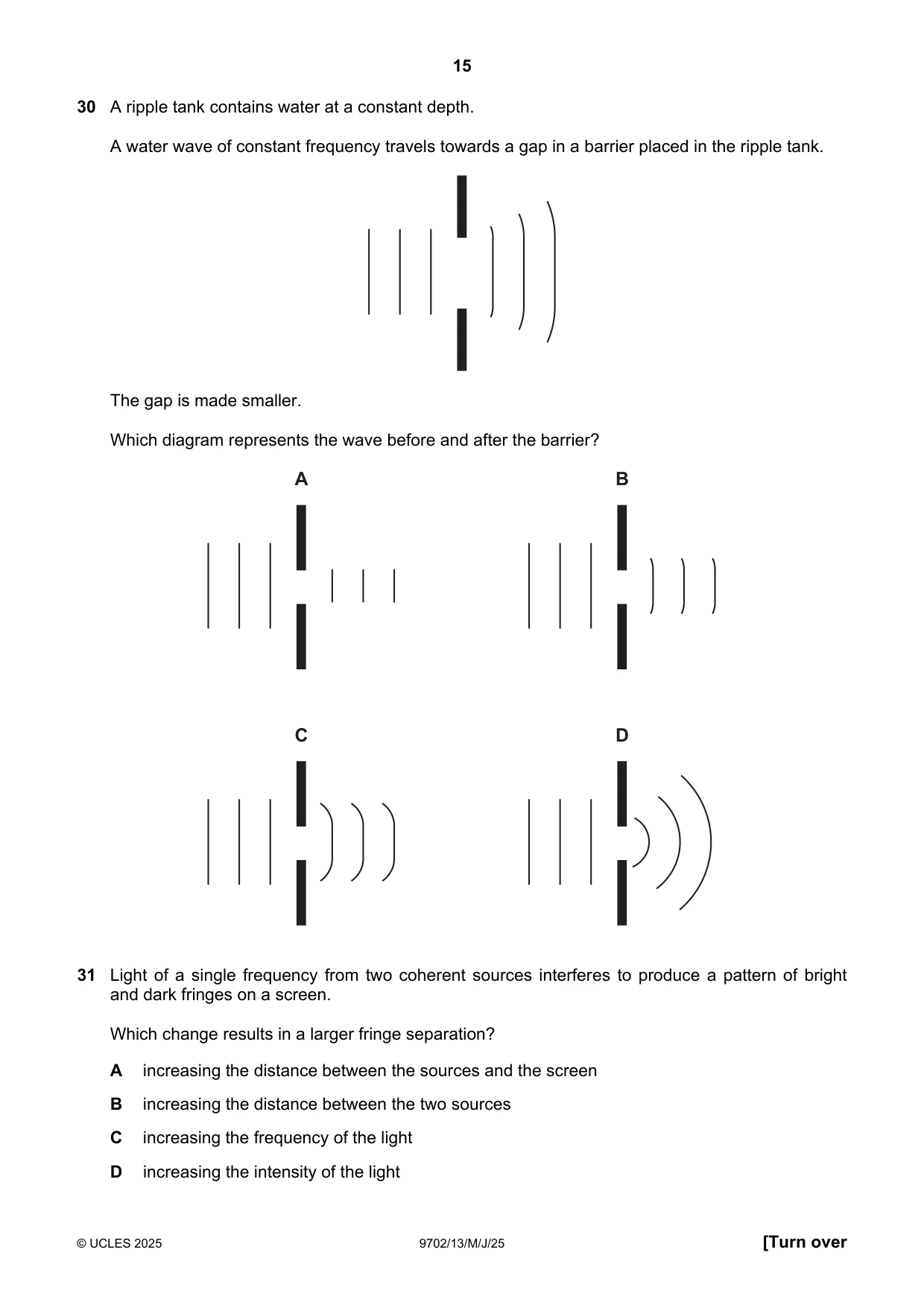
30 A ripple tank contains water at a constant depth. A water wave of constant frequency travels towards a gap in a barrier placed in the ripple tank. The gap is made smaller. Which diagram represents the wave before and after the barrier? A B C D
Mark scheme: D
Q31 · Light of a single frequency from two coherent sources interferes to produce a pattern of…
31 Light of a single frequency from two coherent sources interferes to produce a pattern of bright and dark fringes on a screen. Which change results in a larger fringe separation? A increasing the distance between the sources and the screen B increasing the distance between the two sources C increasing the frequency of the light D increasing the intensity of the light
Mark scheme: A
Q32 · The current I in a metallic conductor of cross-sectional area A is given by I = Anve…
32 The current I in a metallic conductor of cross-sectional area A is given by I = Anve where e is the elementary charge and v is the mean drift velocity of the conduction electrons. What is represented by the letter n in the equation? A density of conduction electrons B number of conduction electrons per unit time C number of conduction electrons per unit volume D volume of conduction electrons
Mark scheme: C
Q33 · What cannot be the charge on a charge carrier?
33 What cannot be the charge on a charge carrier? A – 4.8 10–19 C B –3.2 10–19 C C –2.4 10–19 C D +3.2 10–19 C
Mark scheme: C
Q34 · A steel wire with a length of 2.20 m is connected to a battery as shown
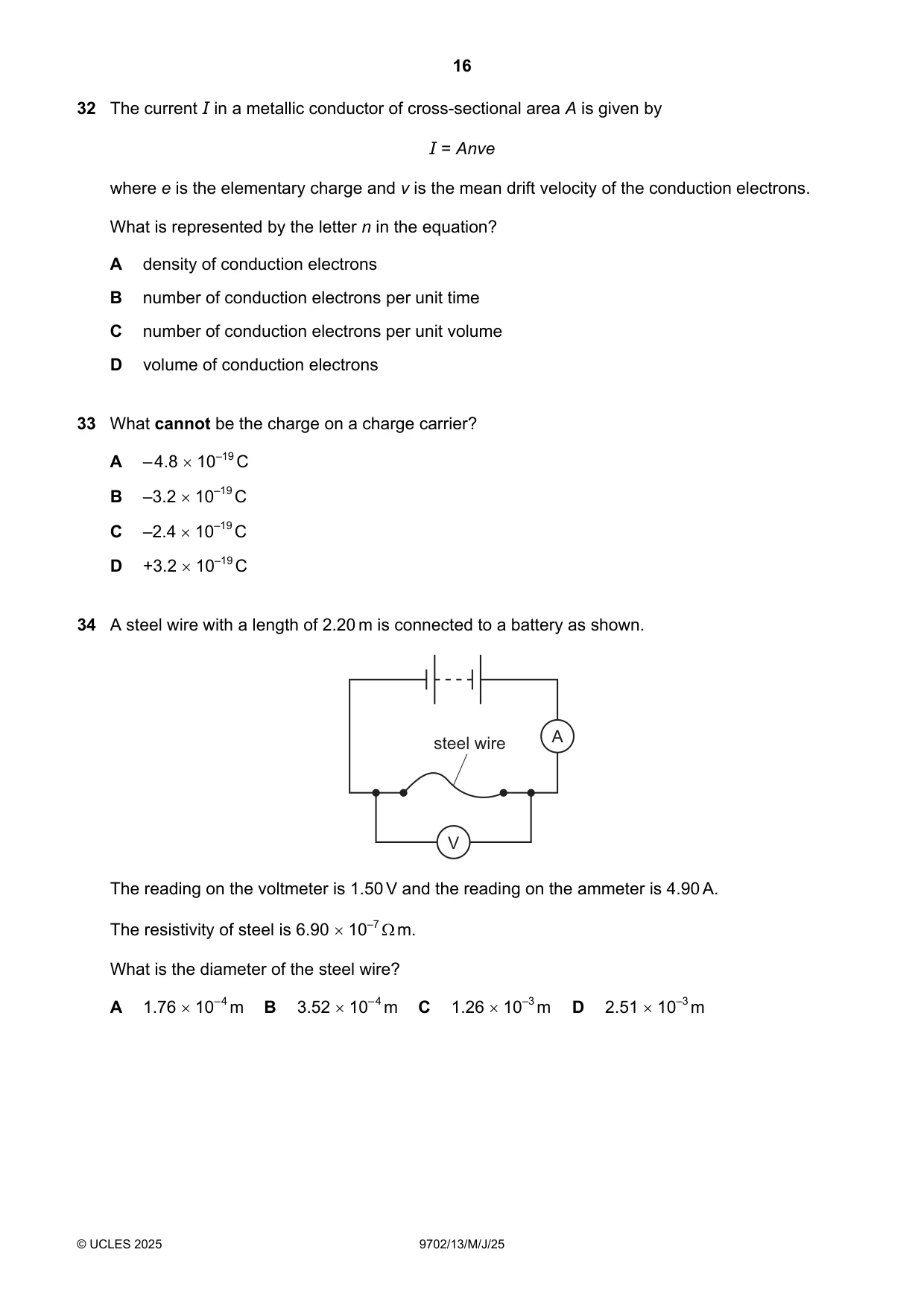
34 A steel wire with a length of 2.20 m is connected to a battery as shown. steel wire A V The reading on the voltmeter is 1.50 V and the reading on the ammeter is 4.90 A. The resistivity of steel is 6.90 10–7 m. What is the diameter of the steel wire? A 1.76 10– 4 m B 3.52 10– 4 m C 1.26 10–3 m D 2.51 10–3 m
Mark scheme: D
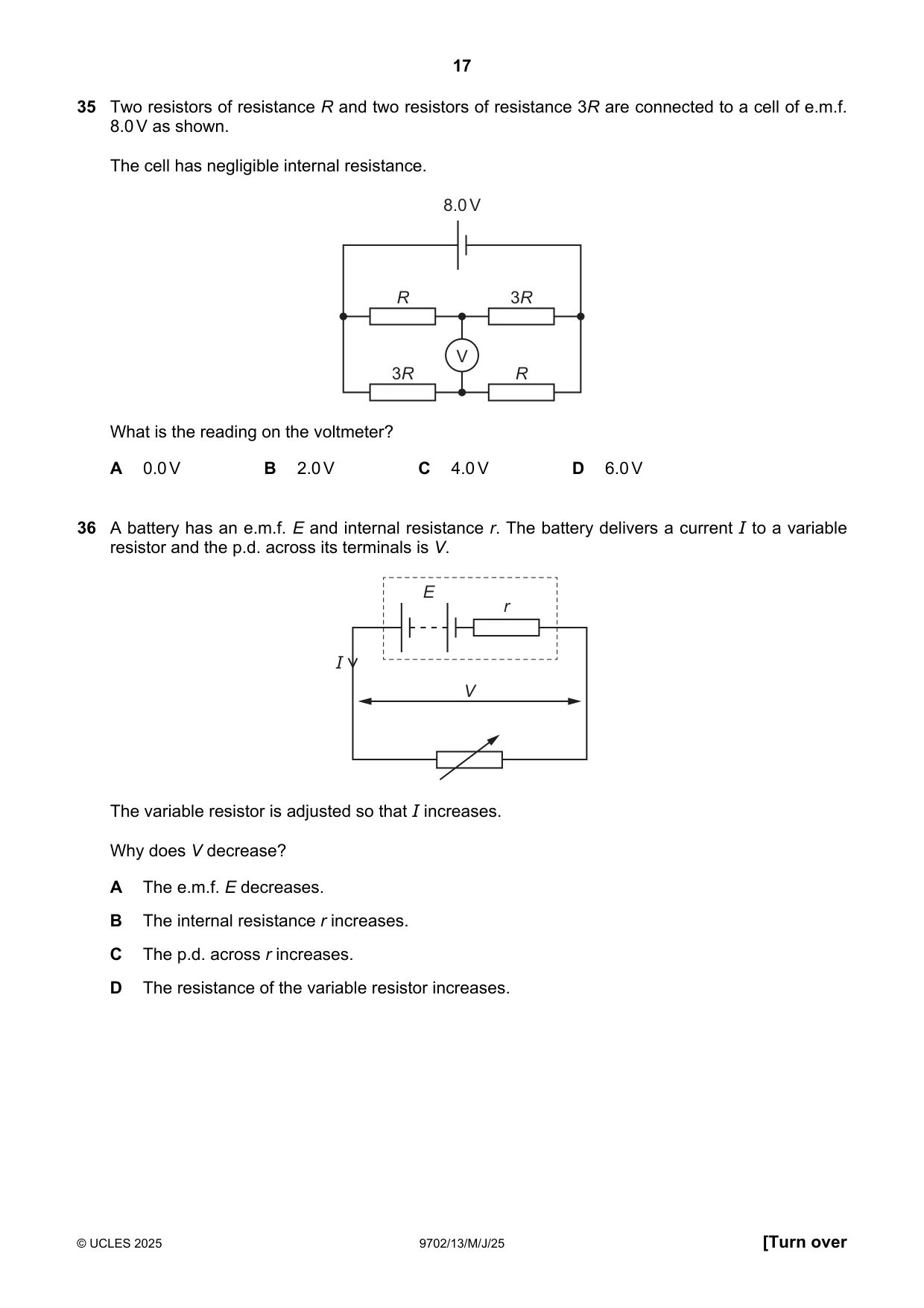
Q35 · Two resistors of resistance R and two resistors of resistance 3R are connected to a cell…
35 Two resistors of resistance R and two resistors of resistance 3R are connected to a cell of e.m.f. 8.0 V as shown. The cell has negligible internal resistance. 8.0 V R 3R V 3R R What is the reading on the voltmeter? A 0.0 V B 2.0 V C 4.0 V D 6.0 V
Mark scheme: C
Q36 · A battery has an e.m.f
36 A battery has an e.m.f. E and internal resistance r. The battery delivers a current I to a variable resistor and the p.d. across its terminals is V. E r I V The variable resistor is adjusted so that I increases. Why does V decrease? A The e.m.f. E decreases. B The internal resistance r increases. C The p.d. across r increases. D The resistance of the variable resistor increases.
Mark scheme: C
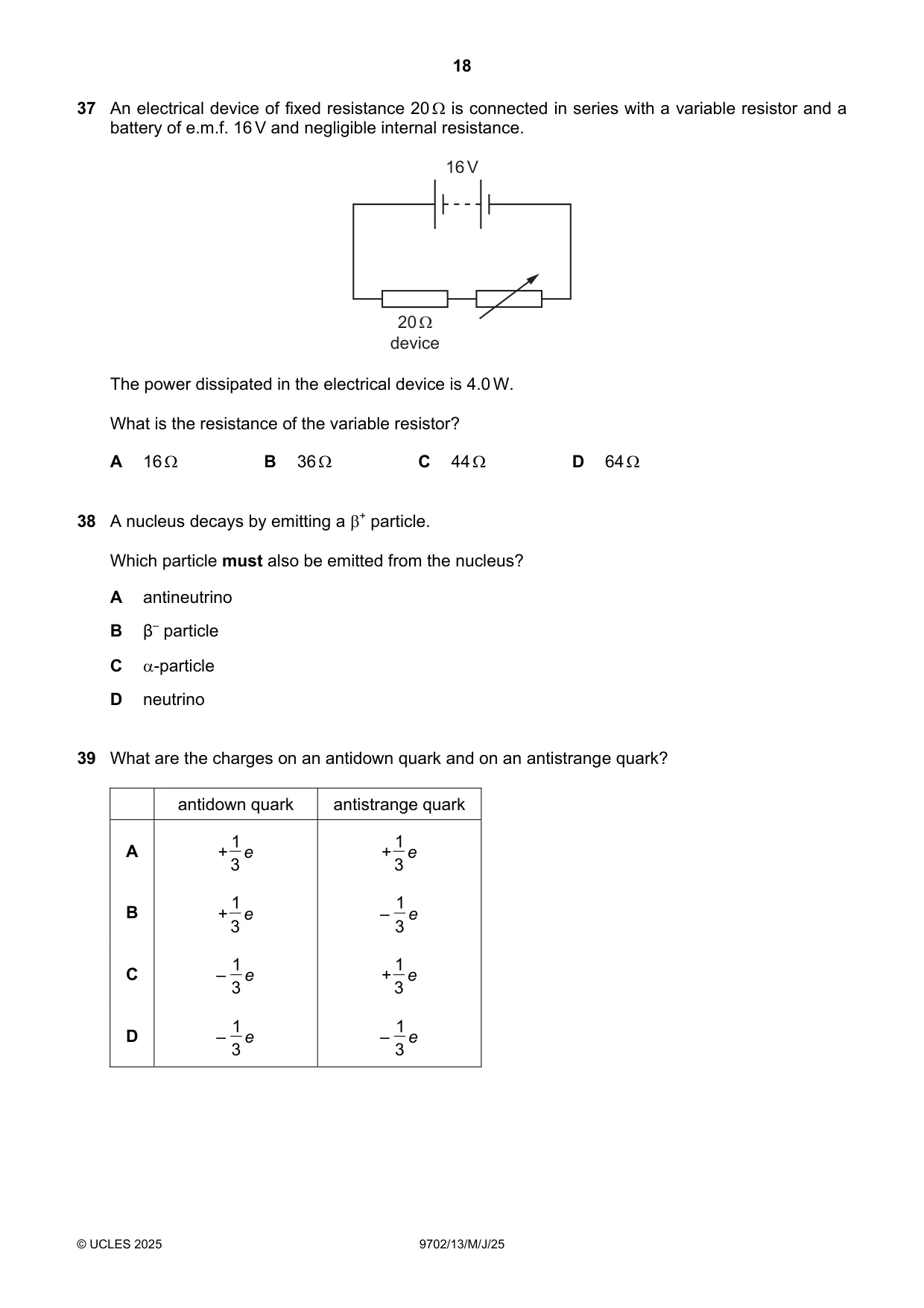
Q37 · An electrical device of fixed resistance 20Q is connected in series with a variable…
37 An electrical device of fixed resistance 20Q is connected in series with a variable resistor and a battery of e.m.f. 16 V and negligible internal resistance. 16V } - - 200 device The power dissipated in the electrical device is 4.0 W. What is the resistance of the variable resistor? A 16 B 360 C 440 D 64Q
Mark scheme: A
Q38 · A nucleus decays by emitting a + particle
38 A nucleus decays by emitting a + particle. Which particle must also be emitted from the nucleus? A antineutrino B β– particle C -particle D neutrino
Mark scheme: D
Q39 · What are the charges on an antidown quark and on an antistrange quark?
39 What are the charges on an antidown quark and on an antistrange quark? antidown quark antistrange quark 1 1 A + e + e 3 3 1 1 B + e – e 3 3 1 1 C – e + e 3 3 1 1 D – e – e 3 3
Mark scheme: A
Q40 · The nucleus of a radioactive isotope of an element emits an -particle
40 The nucleus of a radioactive isotope of an element emits an -particle. The daughter nucleus then emits a – particle and then the daughter nucleus of that reaction emits another – particle. Which statement describes the final nuclide that is formed? A It is a different isotope of the original element. B It is a nuclide of a different element of higher proton number. C It is a nuclide of the same element but with different proton number. D It is identical to the original nuclide.
Mark scheme: A
What was in this paper
The subtopics covered by these 40 questions, and how many questions each got. Open one in a new tab to see every Cambridge question on it.
3Equations of motion3Interference3Density and pressure2Elastic and plastic behaviour2Energy conservation2Equilibrium of forces2Gravitational potential energy and kinetic energy2Momentum and Newton’s laws of motion2Progressive waves2Stress and strain2Atoms, nuclei and radiation1Diffraction1Electromagnetic spectrum1Errors and uncertainties1Fundamental particles1Linear momentum and its conservation1Polarisation1Potential difference and power1Potential dividers1Practical circuits1Radioactive decay1Resistance and resistivity1Scalars and vectors1SI units1Turning effects of forces1What you needed in this session
Cambridge’s own grade thresholds for 2025 May/June, Paper 1 · Variant 3. A higher threshold means an easier paper — the bar moves with how the cohort did.