Cambridge A Level Physics 9702 — 2009 Oct/Nov Paper 1 · Variant 2
9702/12/O/N/09 · 40 questions · 40 marks · ≈45 min
The question paper and its mark scheme, free to read here and free to download. This is Cambridge’s own paper, exactly as it was sat.
Question paper24 pages
Mark scheme2 pages
Answers below. Sit the paper first if you are practising.
Questions as text
Q1 · The drag force F acting on a moving sphere obeys an equation of the form F = kAv 2, where…
1 The drag force F acting on a moving sphere obeys an equation of the form F = kAv 2, where A represents the sphere’s frontal area and v represents its speed. What are the base units of the constant k ? A kg m5 s–4 B kg m–2 s–1 C kg m–3 D kg m–4 s2
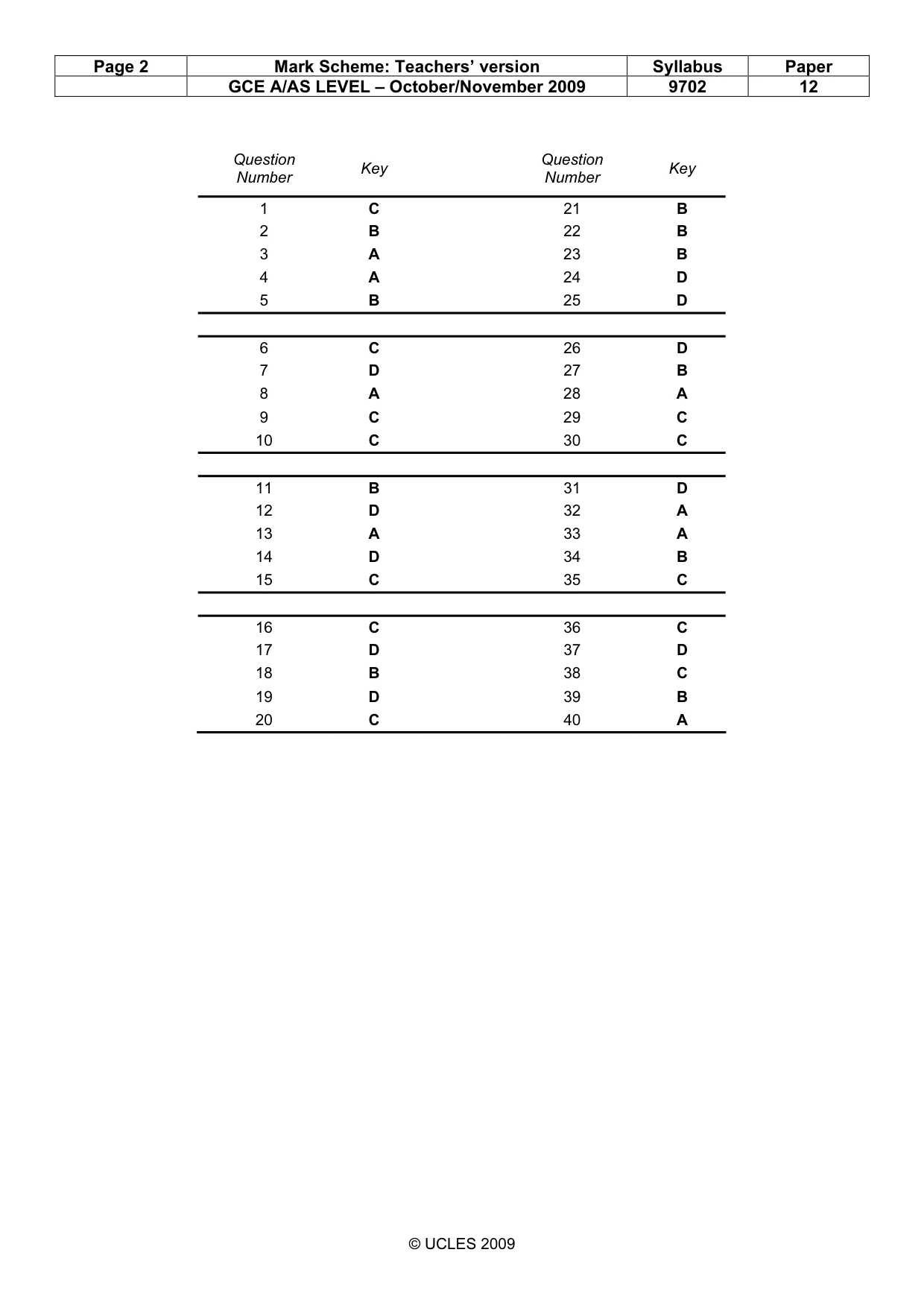
Mark scheme: C
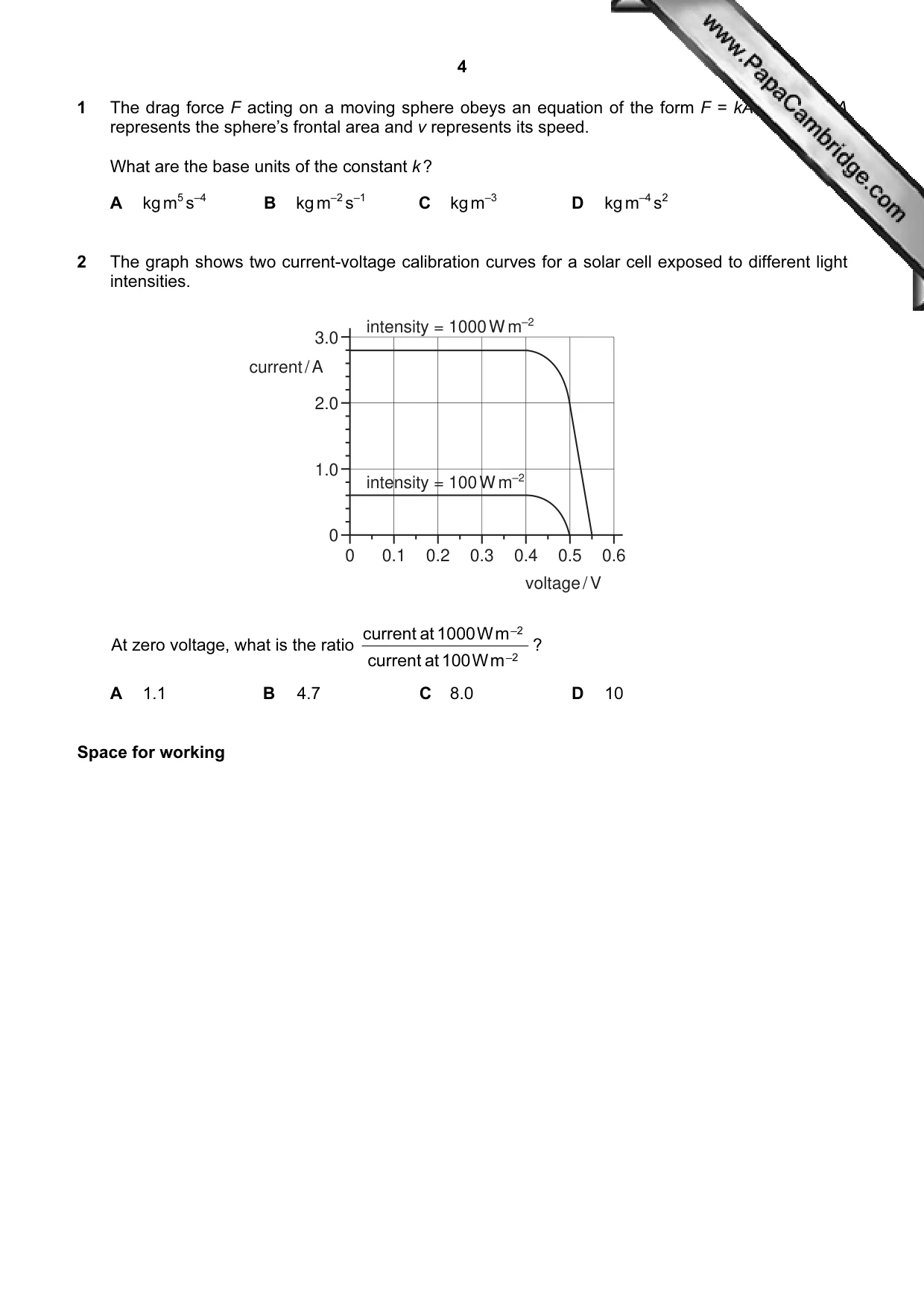
Q2 · The graph shows two current-voltage calibration curves for a solar cell exposed to…
2 The graph shows two current-voltage calibration curves for a solar cell exposed to different light intensities. intensity = 1000 W m–2 3.0 current / A 2.0 1.0 intensity = 100 W m–2 0 0 0.1 0.2 0.3 0.4 0.5 0.6 voltage / V current at 1000 W m _ 2 At zero voltage, what is the ratio ? current at 100 W m _ 2 A 1.1 B 4.7 C 8.0 D 10 Space for working
Mark scheme: B
Q3 · The diagram shows an oscilloscope screen displaying two signals
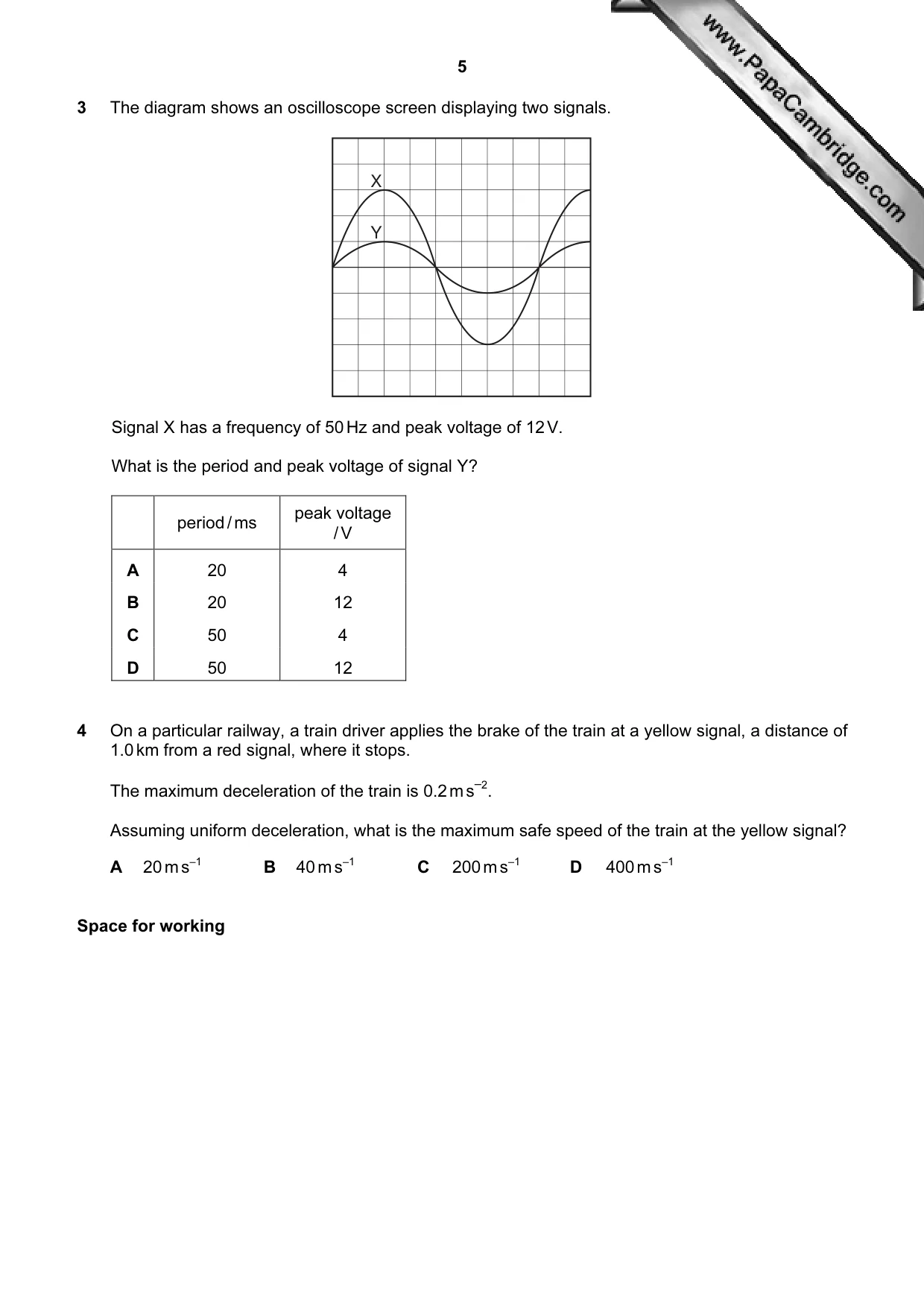
3 The diagram shows an oscilloscope screen displaying two signals. X Y Signal X has a frequency of 50 Hz and peak voltage of 12 V. What is the period and peak voltage of signal Y? peak voltage period / ms / V A 20 4 B 20 12 C 50 4 D 50 12
Mark scheme: A
Q4 · On a particular railway, a train driver applies the brake of the train at a yellow…
4 On a particular railway, a train driver applies the brake of the train at a yellow signal, a distance of 1.0 km from a red signal, where it stops. The maximum deceleration of the train is 0.2 m s–2. Assuming uniform deceleration, what is the maximum safe speed of the train at the yellow signal? A 20 m s–1 B 40 m s–1 C 200 m s–1 D 400 m s–1 Space for working
Mark scheme: A
Q5 · A ball is released from rest above a horizontal surface and bounces several times
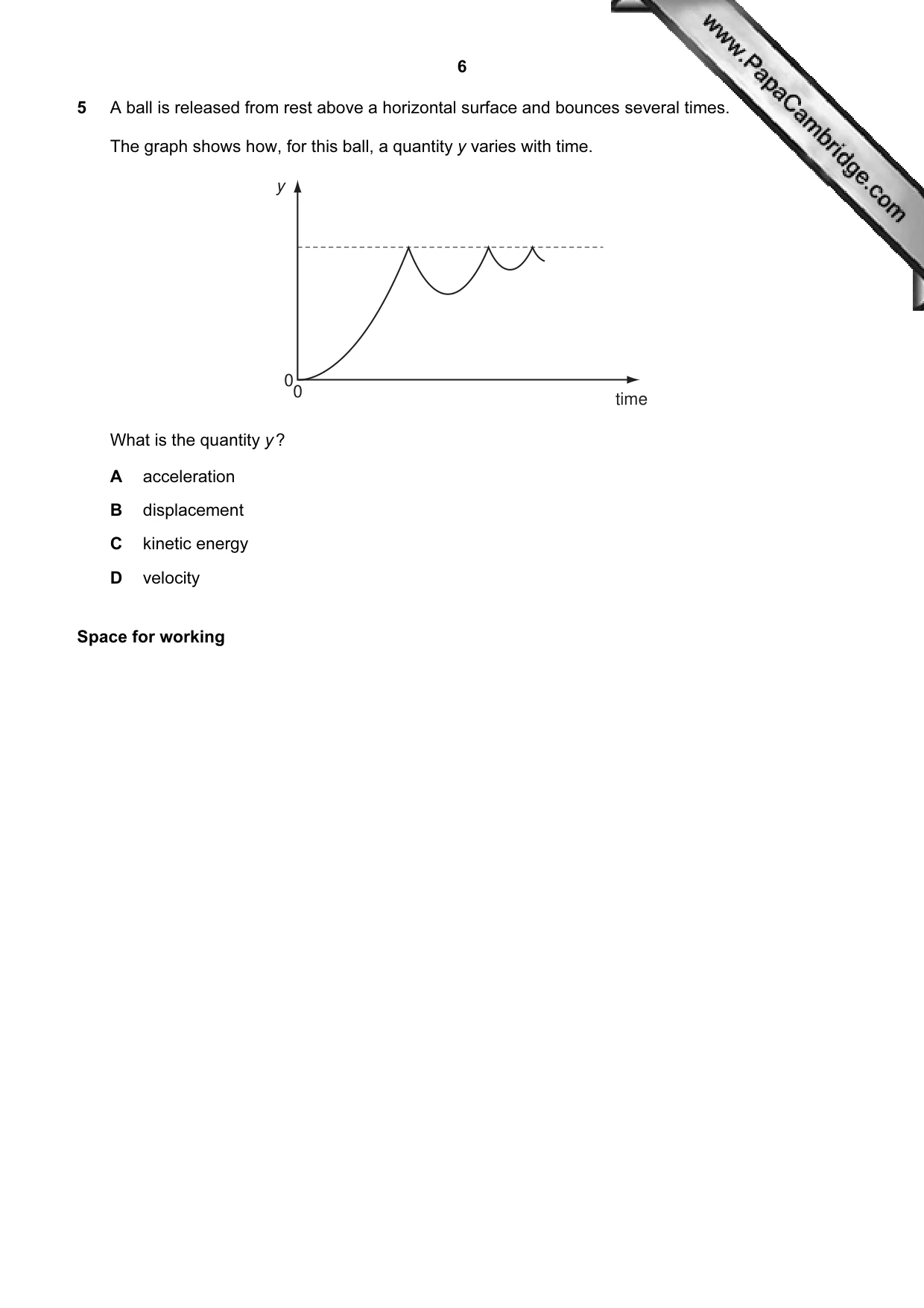
5 A ball is released from rest above a horizontal surface and bounces several times. The graph shows how, for this ball, a quantity y varies with time. y 00 time What is the quantity y ? A acceleration B displacement C kinetic energy D velocity Space for working
Mark scheme: B
Q6 · The diagram shows a velocity-time graph
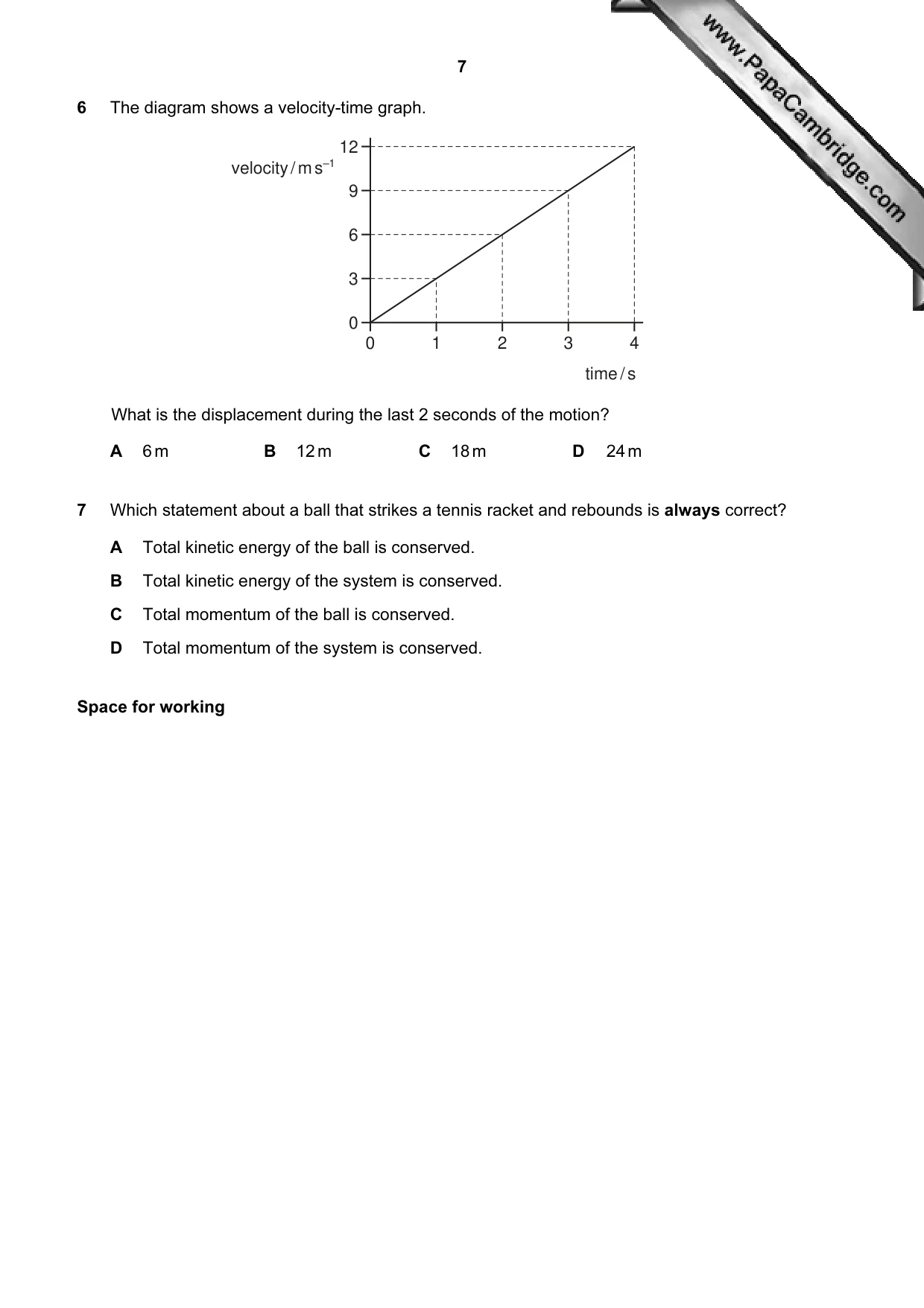
6 The diagram shows a velocity-time graph. 12 velocity / m s–1 9 6 3 0 0 1 2 3 4 time / s What is the displacement during the last 2 seconds of the motion? A 6 m B 12 m C 18 m D 24 m
Mark scheme: C
Q7 · Which statement about a ball that strikes a tennis racket and rebounds is always correct?
7 Which statement about a ball that strikes a tennis racket and rebounds is always correct? A Total kinetic energy of the ball is conserved. B Total kinetic energy of the system is conserved. C Total momentum of the ball is conserved. D Total momentum of the system is conserved. Space for working
Mark scheme: D
Q8 · The diagram shows two spherical masses approaching each other head-on at an equal speed u
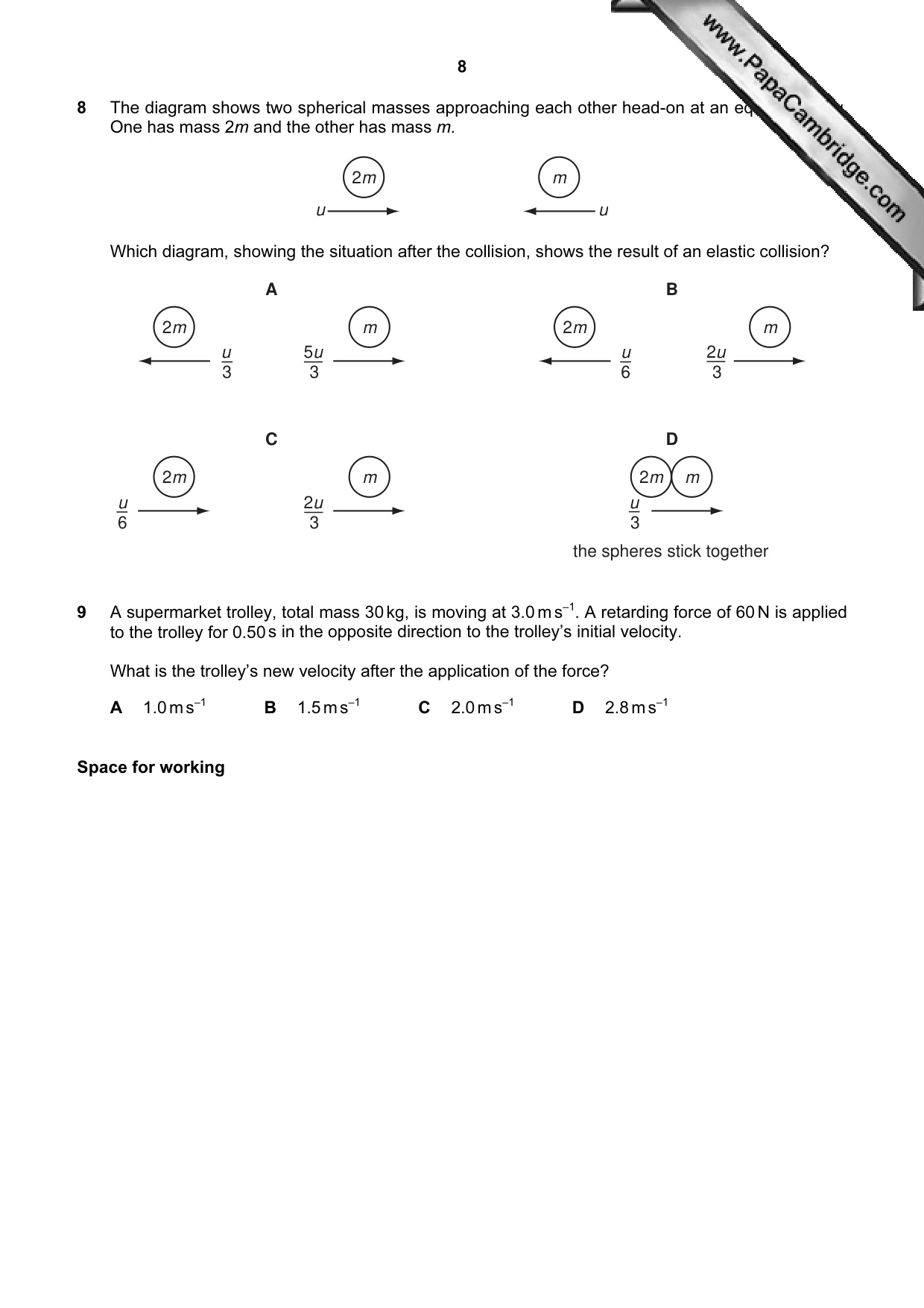
8 The diagram shows two spherical masses approaching each other head-on at an equal speed u. One has mass 2m and the other has mass m. 2m m u u Which diagram, showing the situation after the collision, shows the result of an elastic collision? A B 2m m 2m m u 5u u 2u 3 3 6 3 C D 2m m 2m m u 2u u 6 3 3 the spheres stick together
Mark scheme: A
Q9 · A supermarket trolley, total mass 30 kg, is moving at 3.0 m s–1
9 A supermarket trolley, total mass 30 kg, is moving at 3.0 m s–1. A retarding force of 60 N is applied to the trolley for 0.50 s in the opposite direction to the trolley’s initial velocity. What is the trolley’s new velocity after the application of the force? A 1.0 m s–1 B 1.5 m s–1 C 2.0 m s–1 D 2.8 m s–1 Space for working
Mark scheme: C
Q10 · What is the centre of gravity of an object?
10 What is the centre of gravity of an object? A the geometrical centre of the object B the point about which the total torque is zero C the point at which the weight of the object may be considered to act D the point through which gravity acts
Mark scheme: C
Q11 · The diagrams show two ways of hanging the same picture
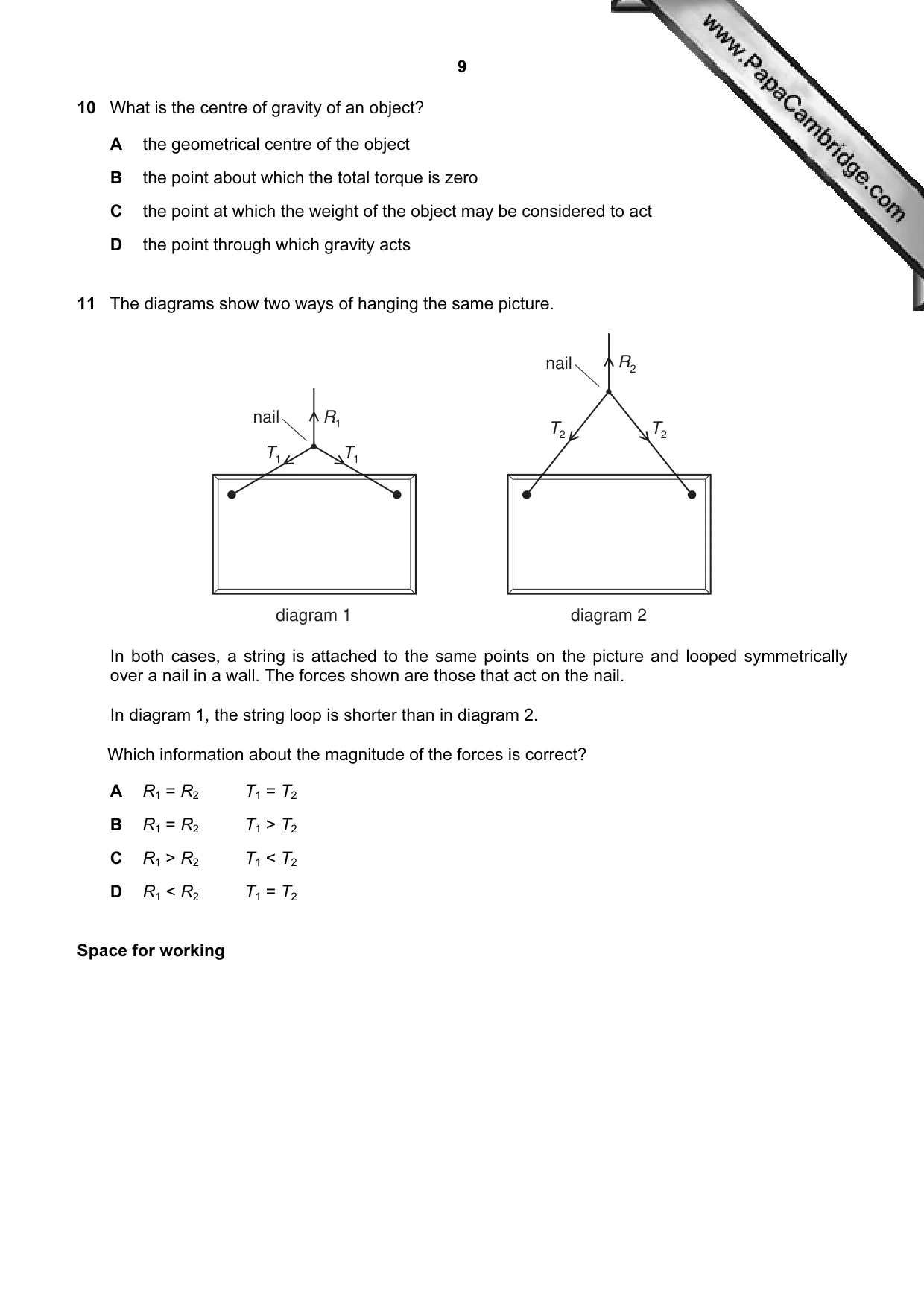
11 The diagrams show two ways of hanging the same picture. nail R2 nail R1 T2 T2 T1 T1 diagram 1 diagram 2 In both cases, a string is attached to the same points on the picture and looped symmetrically over a nail in a wall. The forces shown are those that act on the nail. In diagram 1, the string loop is shorter than in diagram 2. Which information about the magnitude of the forces is correct? A R1 = R2 T1 = T2 B R1 = R2 T1 > T2 C R1 > R2 T1 < T2 D R1 < R2 T1 = T2 Space for working
Mark scheme: B
Q12 · The diagram shows two pulley wheels connected by a belt
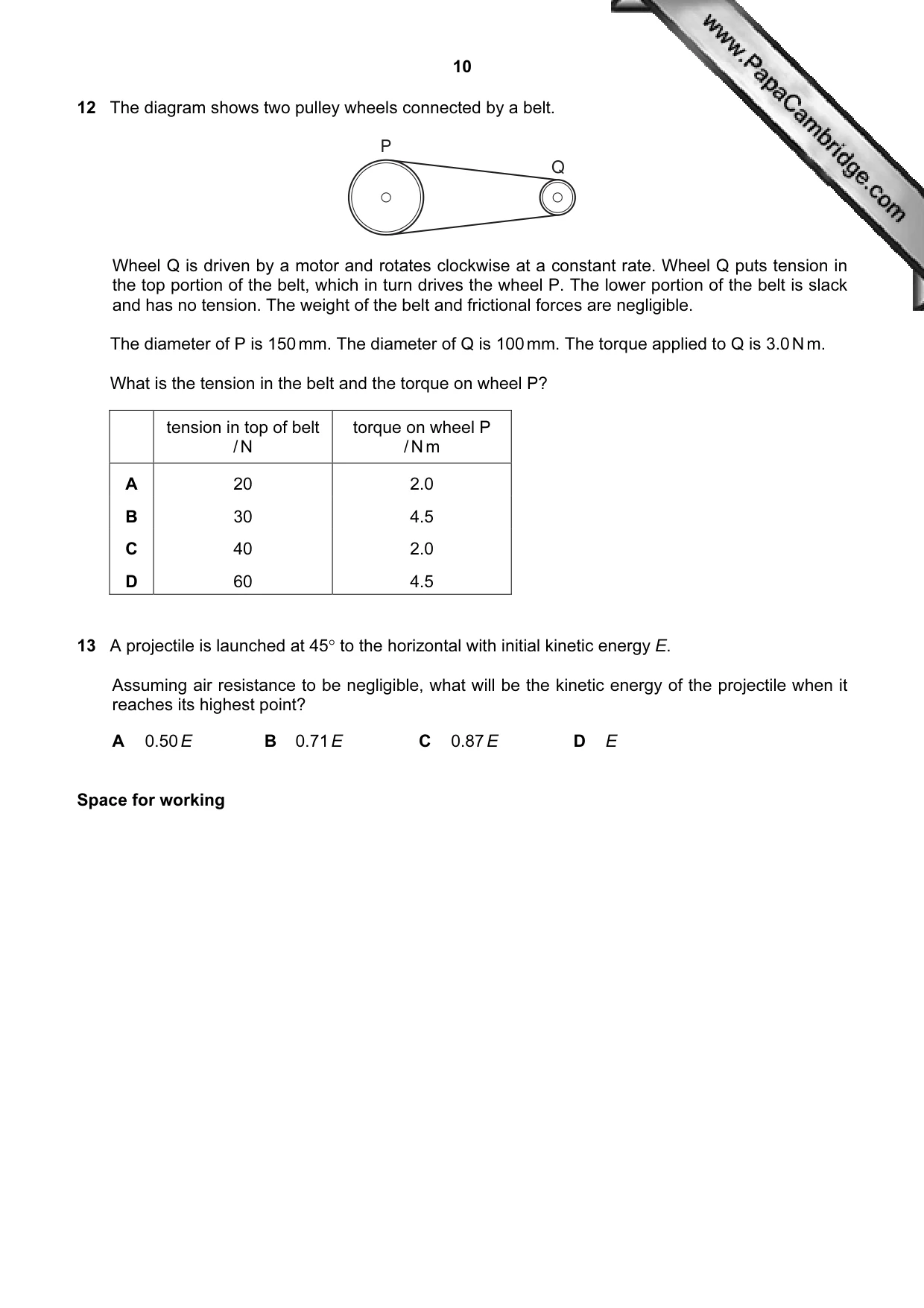
12 The diagram shows two pulley wheels connected by a belt. P Q Wheel Q is driven by a motor and rotates clockwise at a constant rate. Wheel Q puts tension in the top portion of the belt, which in turn drives the wheel P. The lower portion of the belt is slack and has no tension. The weight of the belt and frictional forces are negligible. The diameter of P is 150 mm. The diameter of Q is 100 mm. The torque applied to Q is 3.0 N m. What is the tension in the belt and the torque on wheel P? tension in top of belt torque on wheel P / N / N m A 20 2.0 B 30 4.5 C 40 2.0 D 60 4.5
Mark scheme: D
Q13 · A projectile is launched at 45° to the horizontal with initial kinetic energy E
13 A projectile is launched at 45° to the horizontal with initial kinetic energy E. Assuming air resistance to be negligible, what will be the kinetic energy of the projectile when it reaches its highest point? A 0.50 E B 0.71 E C 0.87 E D E Space for working
Mark scheme: A
More questions on Gravitational potential energy and kinetic energy
Q14 · Two trolleys are placed together on a horizontal runway with a compressed spring between…
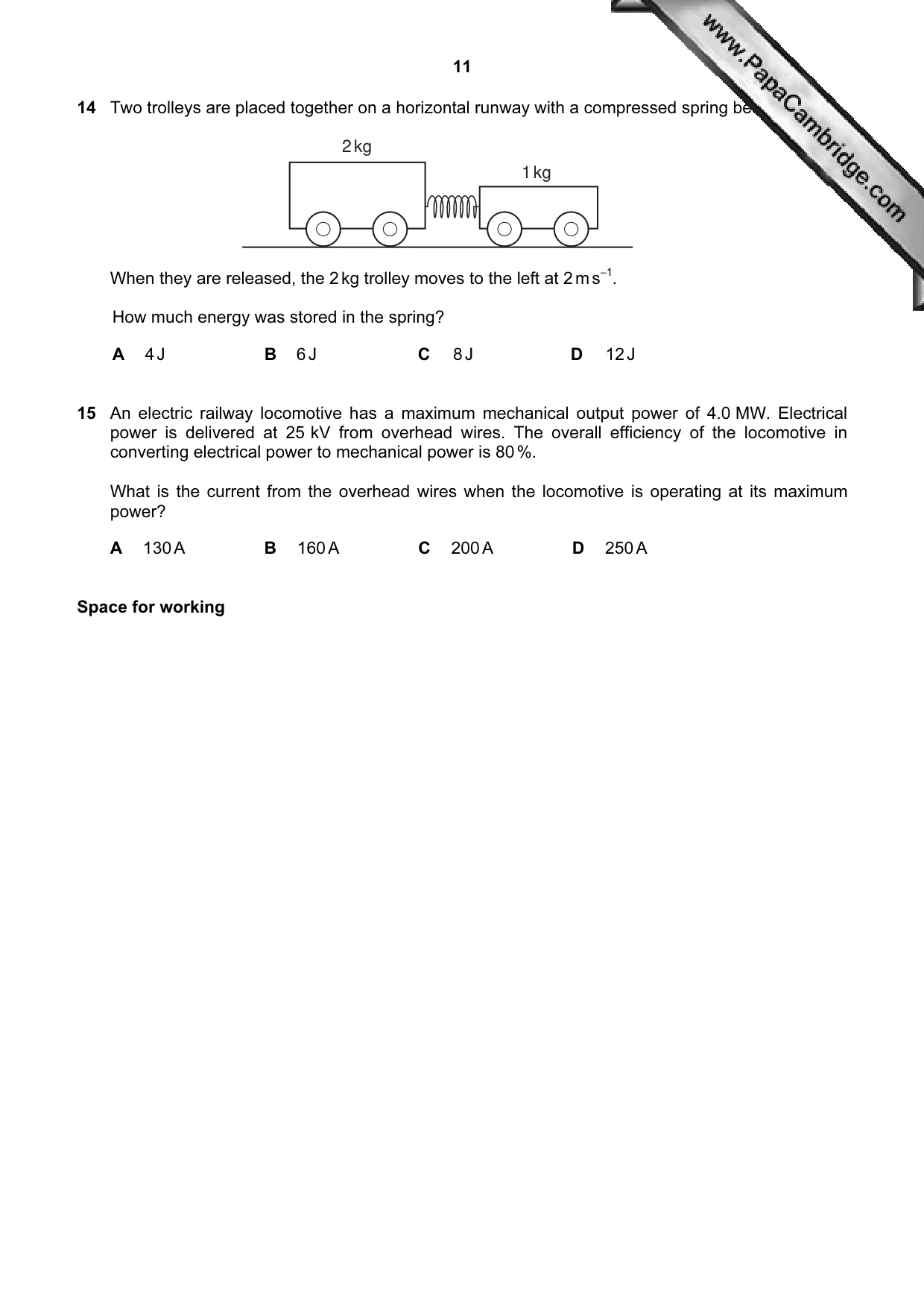
14 Two trolleys are placed together on a horizontal runway with a compressed spring between them. 2 kg 1 kg When they are released, the 2 kg trolley moves to the left at 2 m s–1. How much energy was stored in the spring? A 4 J B 6 J C 8 J D 12 J
Mark scheme: D
Q15 · An electric railway locomotive has a maximum mechanical output power of 4.0 MW
15 An electric railway locomotive has a maximum mechanical output power of 4.0 MW. Electrical power is delivered at 25 kV from overhead wires. The overall efficiency of the locomotive in converting electrical power to mechanical power is 80 %. What is the current from the overhead wires when the locomotive is operating at its maximum power? A 130 A B 160 A C 200 A D 250 A Space for working
Mark scheme: C
Q16 · The diagram shows an ice cube floating in water
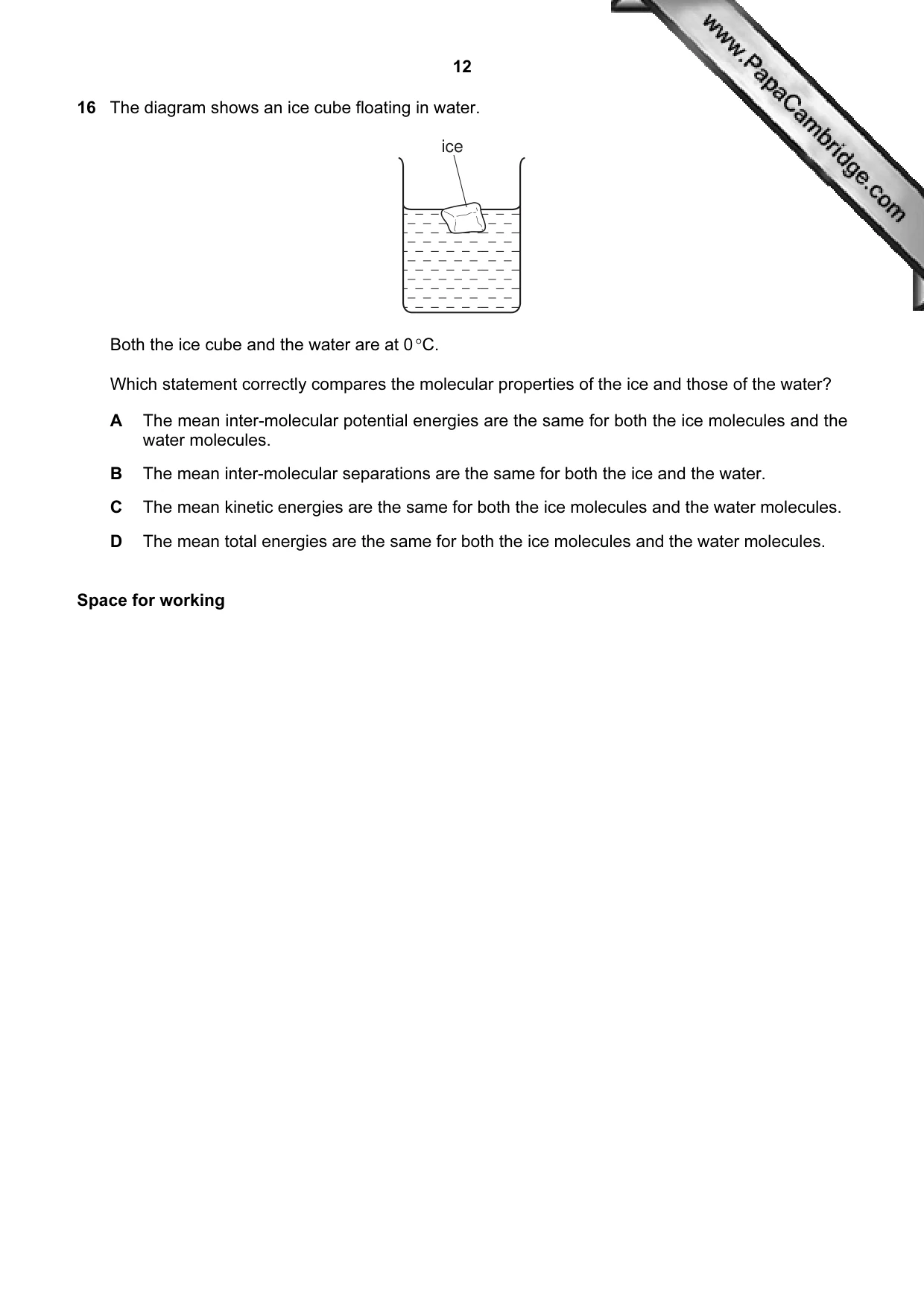
16 The diagram shows an ice cube floating in water. ice Both the ice cube and the water are at 0 °C. Which statement correctly compares the molecular properties of the ice and those of the water? A The mean inter-molecular potential energies are the same for both the ice molecules and the water molecules. B The mean inter-molecular separations are the same for both the ice and the water. C The mean kinetic energies are the same for both the ice molecules and the water molecules. D The mean total energies are the same for both the ice molecules and the water molecules. Space for working
Mark scheme: C
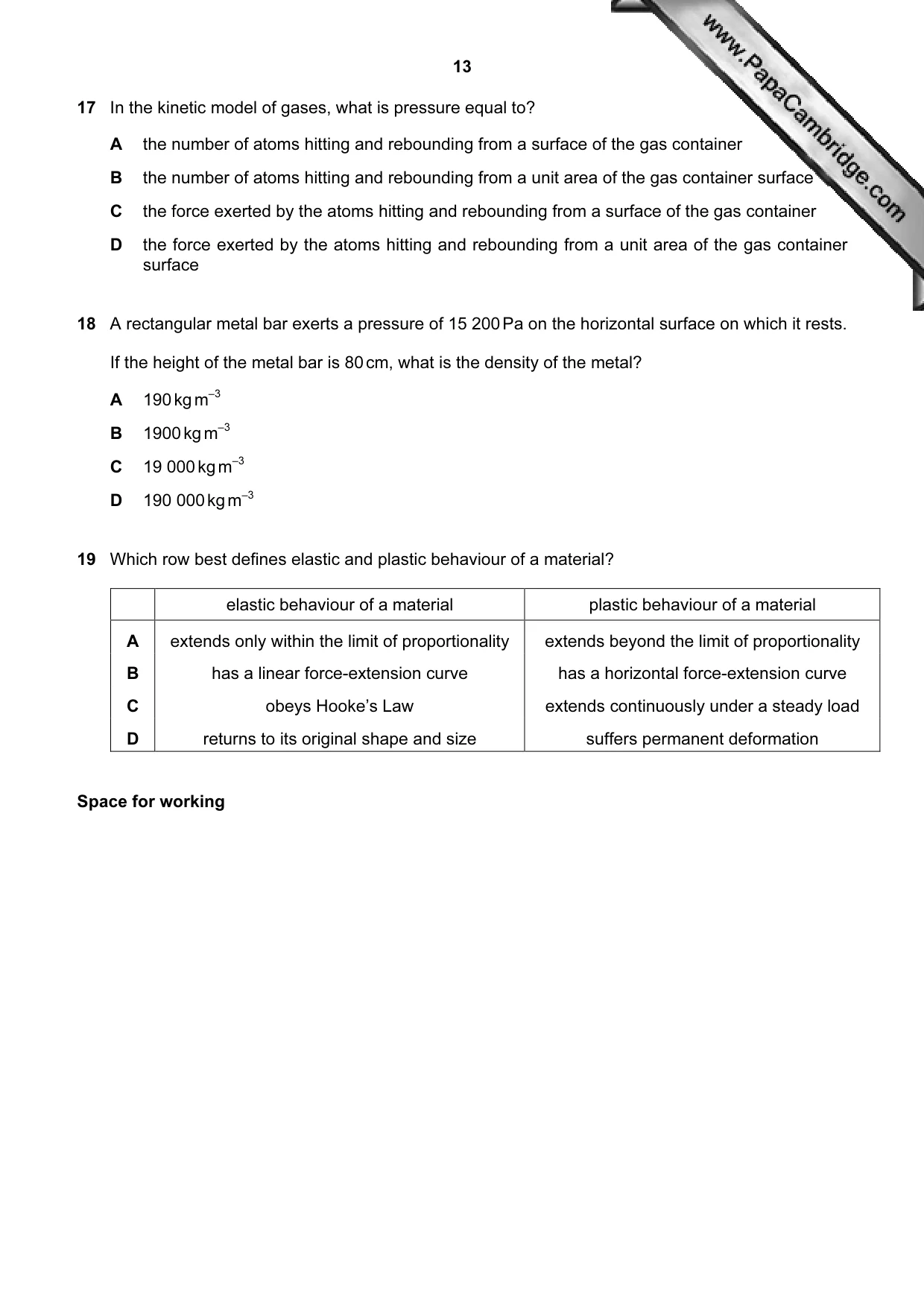
Q17 · In the kinetic model of gases, what is pressure equal to?
17 In the kinetic model of gases, what is pressure equal to? A the number of atoms hitting and rebounding from a surface of the gas container B the number of atoms hitting and rebounding from a unit area of the gas container surface C the force exerted by the atoms hitting and rebounding from a surface of the gas container D the force exerted by the atoms hitting and rebounding from a unit area of the gas container surface
Mark scheme: D
Q18 · A rectangular metal bar exerts a pressure of 15 200 Pa on the horizontal surface on which…
18 A rectangular metal bar exerts a pressure of 15 200 Pa on the horizontal surface on which it rests. If the height of the metal bar is 80 cm, what is the density of the metal? A 190 kg m–3 B 1900 kg m–3 C 19 000 kg m–3 D 190 000 kg m–3
Mark scheme: B
Q19 · Which row best defines elastic and plastic behaviour of a material?
19 Which row best defines elastic and plastic behaviour of a material? elastic behaviour of a material plastic behaviour of a material A extends only within the limit of proportionality extends beyond the limit of proportionality B has a linear force-extension curve has a horizontal force-extension curve C obeys Hooke’s Law extends continuously under a steady load D returns to its original shape and size suffers permanent deformation Space for working
Mark scheme: D
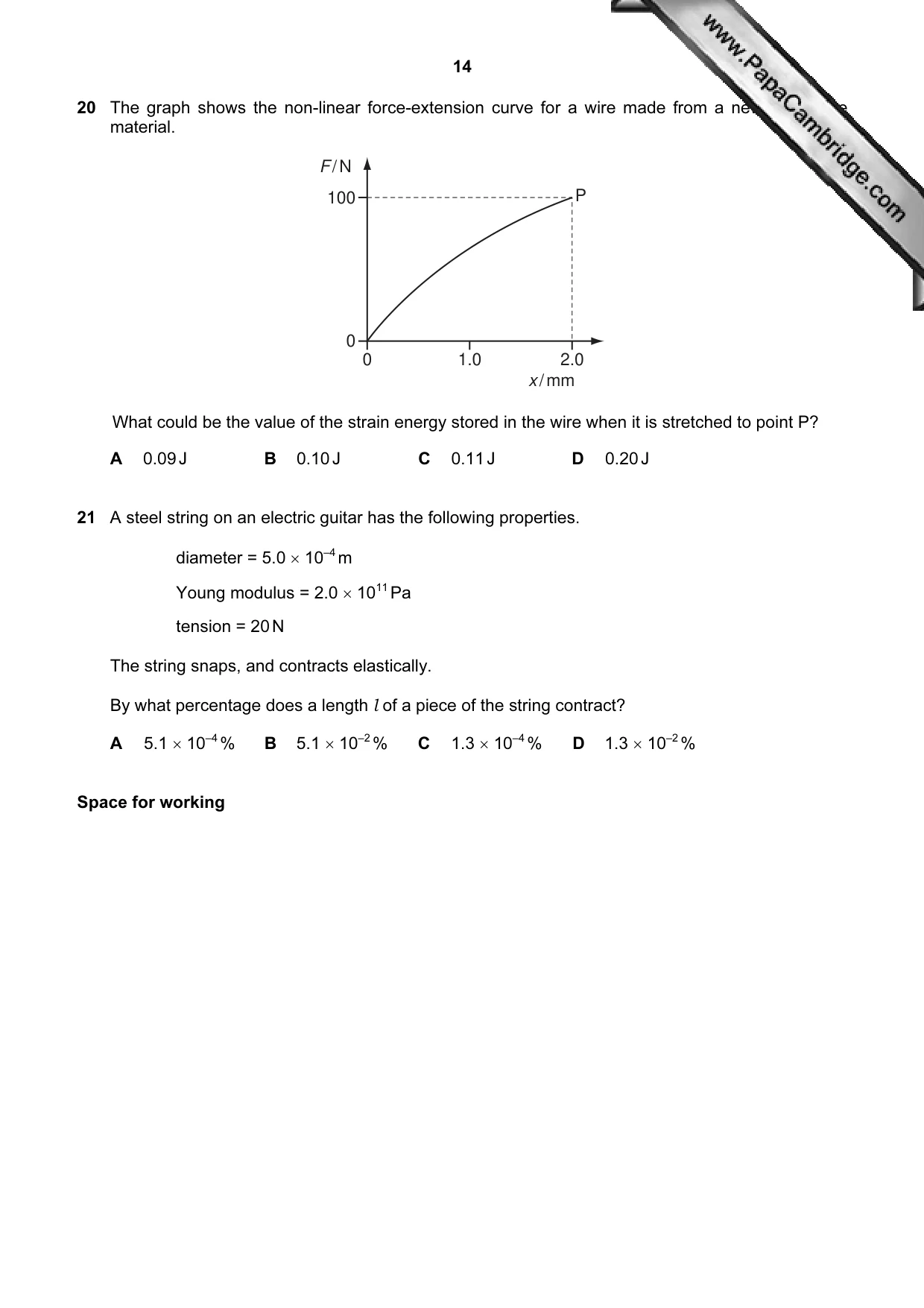
Q20 · The graph shows the non-linear force-extension curve for a wire made from a new composite…
20 The graph shows the non-linear force-extension curve for a wire made from a new composite material. F / N 100 P 0 0 1.0 2.0 x / mm What could be the value of the strain energy stored in the wire when it is stretched to point P? A 0.09 J B 0.10 J C 0.11 J D 0.20 J
Mark scheme: C
Q21 · A steel string on an electric guitar has the following properties
21 A steel string on an electric guitar has the following properties. diameter = 5.0 × 10⁻⁴ m Young modulus = 2.0 × 10¹¹ Pa tension = 20 N The string snaps, and contracts elastically. By what percentage does a length l of a piece of the string contract? A 5.1 × 10⁻⁴ % B 5.1 × 10⁻² % C 1.3 × 10⁻⁴ % D 1.3 × 10⁻² % Space for working
Mark scheme: B
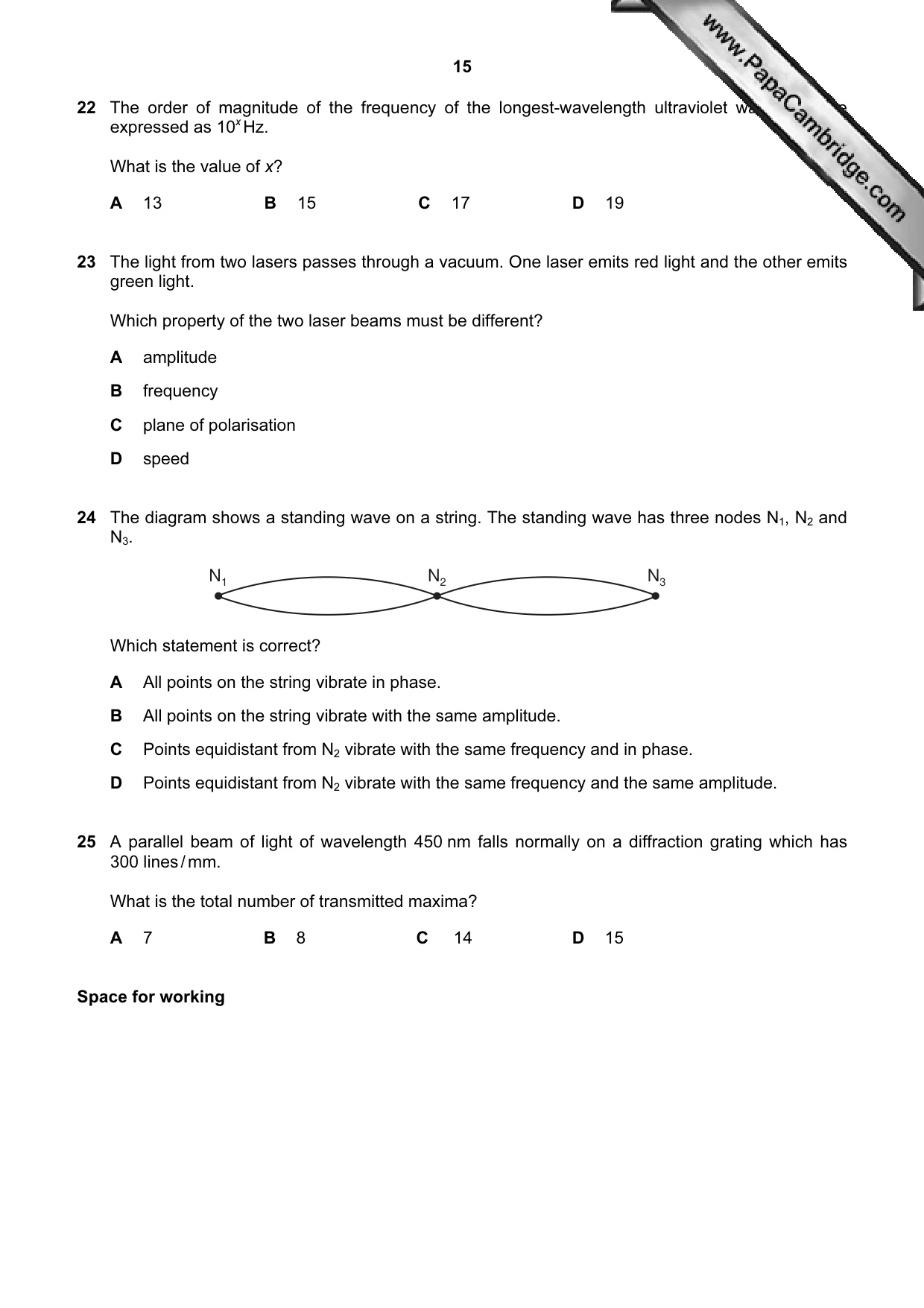
Q22 · The order of magnitude of the frequency of the longest-wavelength ultraviolet waves can…
22 The order of magnitude of the frequency of the longest-wavelength ultraviolet waves can be expressed as 10x Hz. What is the value of x? A 13 B 15 C 17 D 19
Mark scheme: B
Q23 · The light from two lasers passes through a vacuum
23 The light from two lasers passes through a vacuum. One laser emits red light and the other emits green light. Which property of the two laser beams must be different? A amplitude B frequency C plane of polarisation D speed
Mark scheme: B
Q24 · The diagram shows a standing wave on a string
24 The diagram shows a standing wave on a string. The standing wave has three nodes N1, N2 and N3. N1 N2 N3 Which statement is correct? A All points on the string vibrate in phase. B All points on the string vibrate with the same amplitude. C Points equidistant from N2 vibrate with the same frequency and in phase. D Points equidistant from N2 vibrate with the same frequency and the same amplitude.
Mark scheme: D
Q25 · A parallel beam of light of wavelength 450 nm falls normally on a diffraction grating…
25 A parallel beam of light of wavelength 450 nm falls normally on a diffraction grating which has 300 lines / mm. What is the total number of transmitted maxima? A 7 B 8 C 14 D 15 Space for working
Mark scheme: D
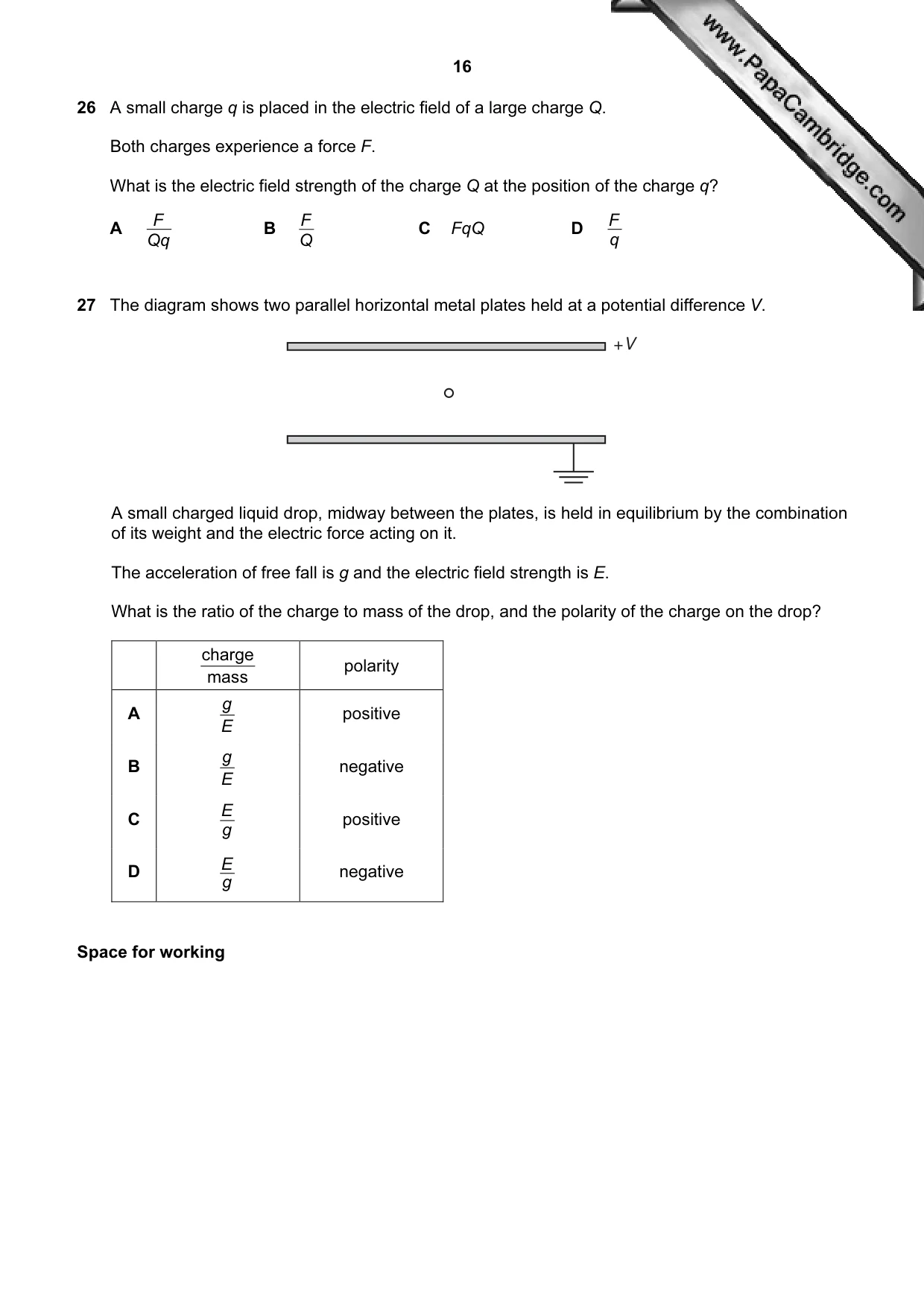
Q26 · A small charge q is placed in the electric field of a large charge Q
26 A small charge q is placed in the electric field of a large charge Q. Both charges experience a force F. What is the electric field strength of the charge Q at the position of the charge q? F F F A B C FqQ D Qq Q q
Mark scheme: D
Q27 · The diagram shows two parallel horizontal metal plates held at a potential difference V
27 The diagram shows two parallel horizontal metal plates held at a potential difference V. +V A small charged liquid drop, midway between the plates, is held in equilibrium by the combination of its weight and the electric force acting on it. The acceleration of free fall is g and the electric field strength is E. What is the ratio of the charge to mass of the drop, and the polarity of the charge on the drop? charge polarity mass g A positive E g B negative E E C positive g E D negative g Space for working
Mark scheme: B
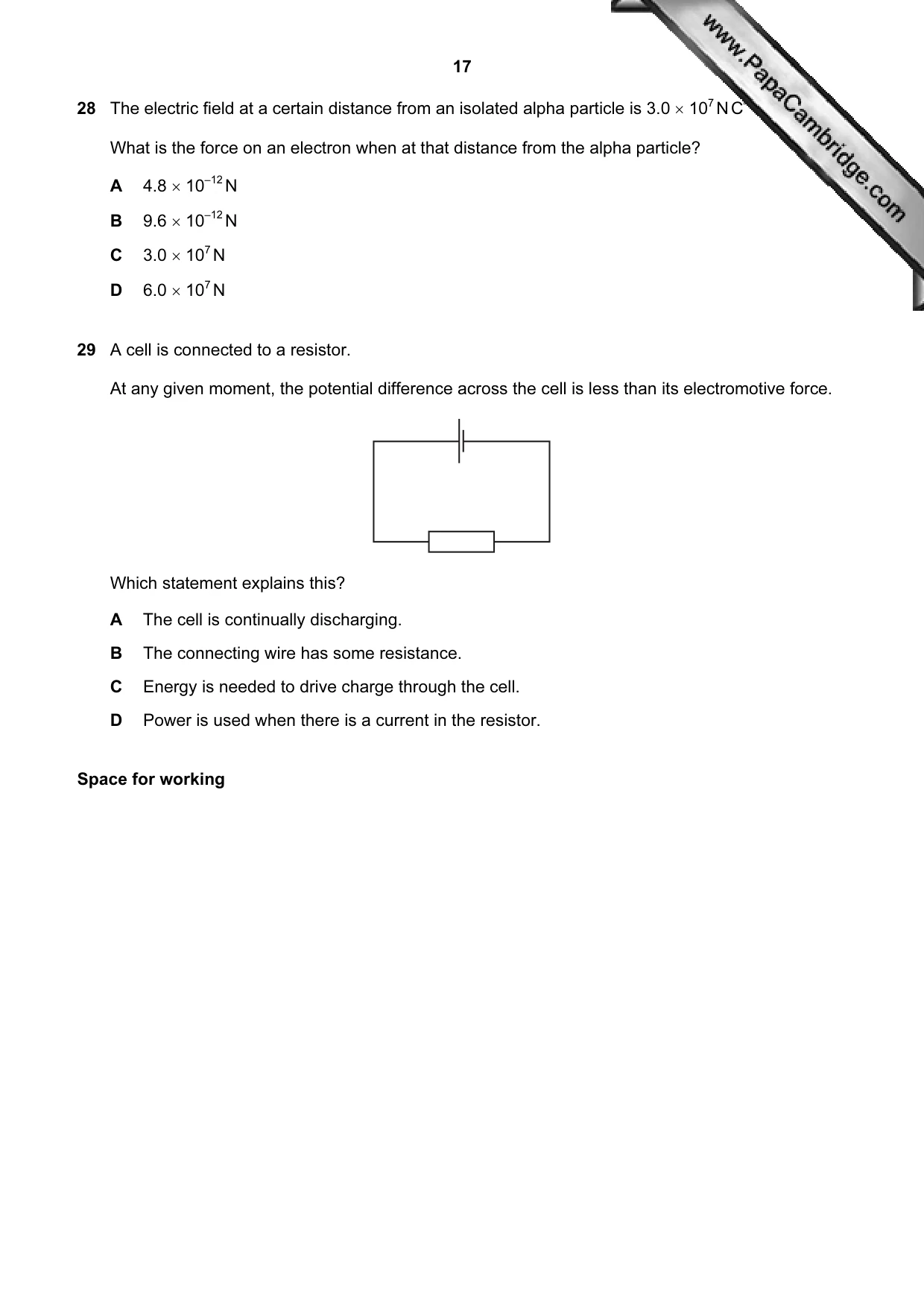
Q28 · The electric field at a certain distance from an isolated alpha particle is 3.0 × 10⁷ N…
28 The electric field at a certain distance from an isolated alpha particle is 3.0 × 10⁷ N C–1. What is the force on an electron when at that distance from the alpha particle? A 4.8 × 10⁻¹² N B 9.6 × 10⁻¹² N C 3.0 × 10⁷ N D 6.0 × 10⁷ N
Mark scheme: A
Q29 · A cell is connected to a resistor
29 A cell is connected to a resistor. At any given moment, the potential difference across the cell is less than its electromotive force. Which statement explains this? A The cell is continually discharging. B The connecting wire has some resistance. C Energy is needed to drive charge through the cell. D Power is used when there is a current in the resistor. Space for working
Mark scheme: C
Q30 · Which values of current and resistance will produce a rate of energy transfer of 16 J s–1?
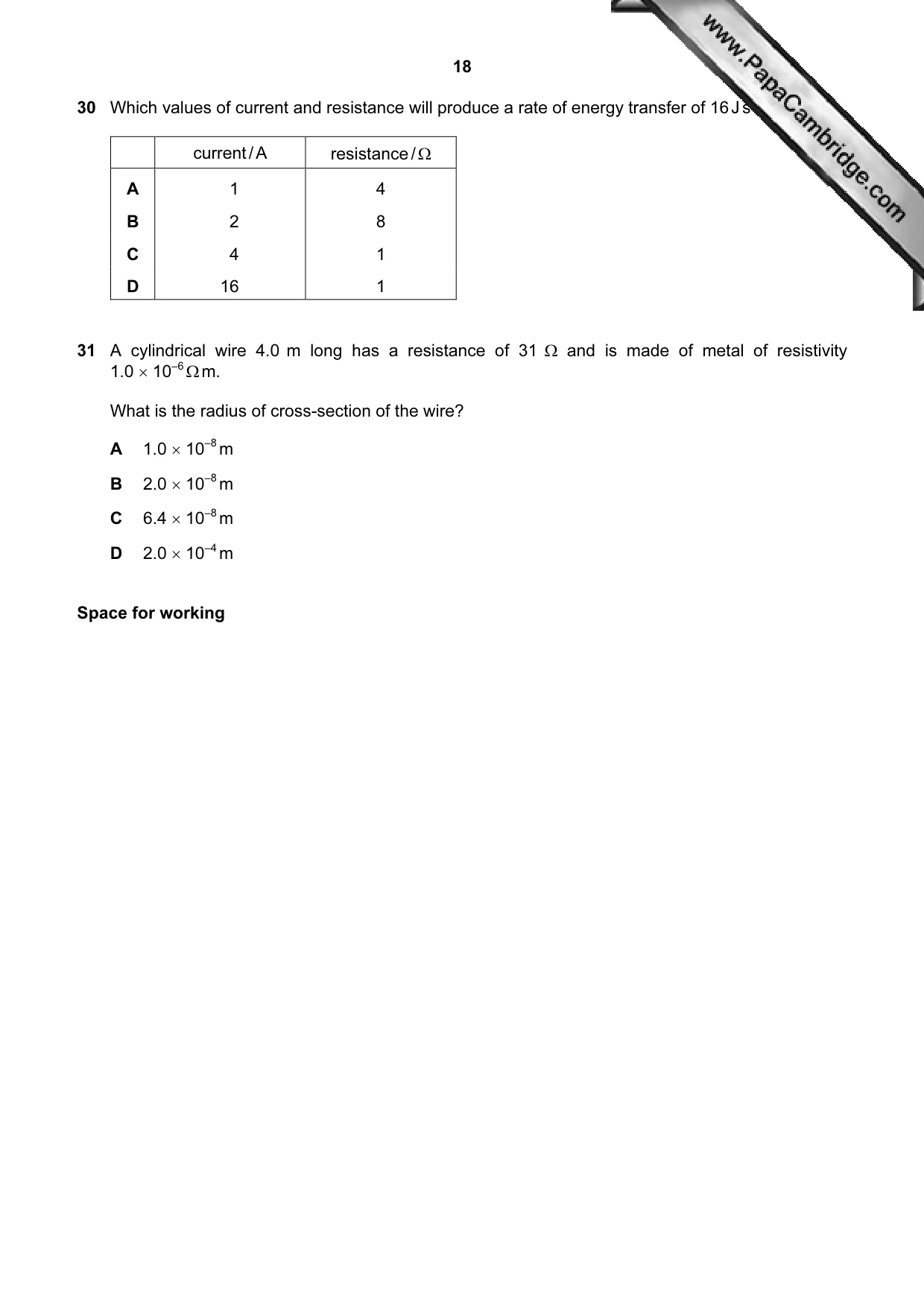
30 Which values of current and resistance will produce a rate of energy transfer of 16 J s–1? current / A resistance / Ω A 1 4 B 2 8 C 4 1 D 16 1
Mark scheme: C
Q31 · A cylindrical wire 4.0 m long has a resistance of 31 Ω and is made of metal of…
31 A cylindrical wire 4.0 m long has a resistance of 31 Ω and is made of metal of resistivity 1.0 × 10⁻⁶ Ω m. What is the radius of cross-section of the wire? A 1.0 × 10⁻⁸ m B 2.0 × 10⁻⁸ m C 6.4 × 10⁻⁸ m D 2.0 × 10⁻⁴ m Space for working
Mark scheme: D
Q32 · Each of Kirchhoff's two laws presumes that some quantity is conserved
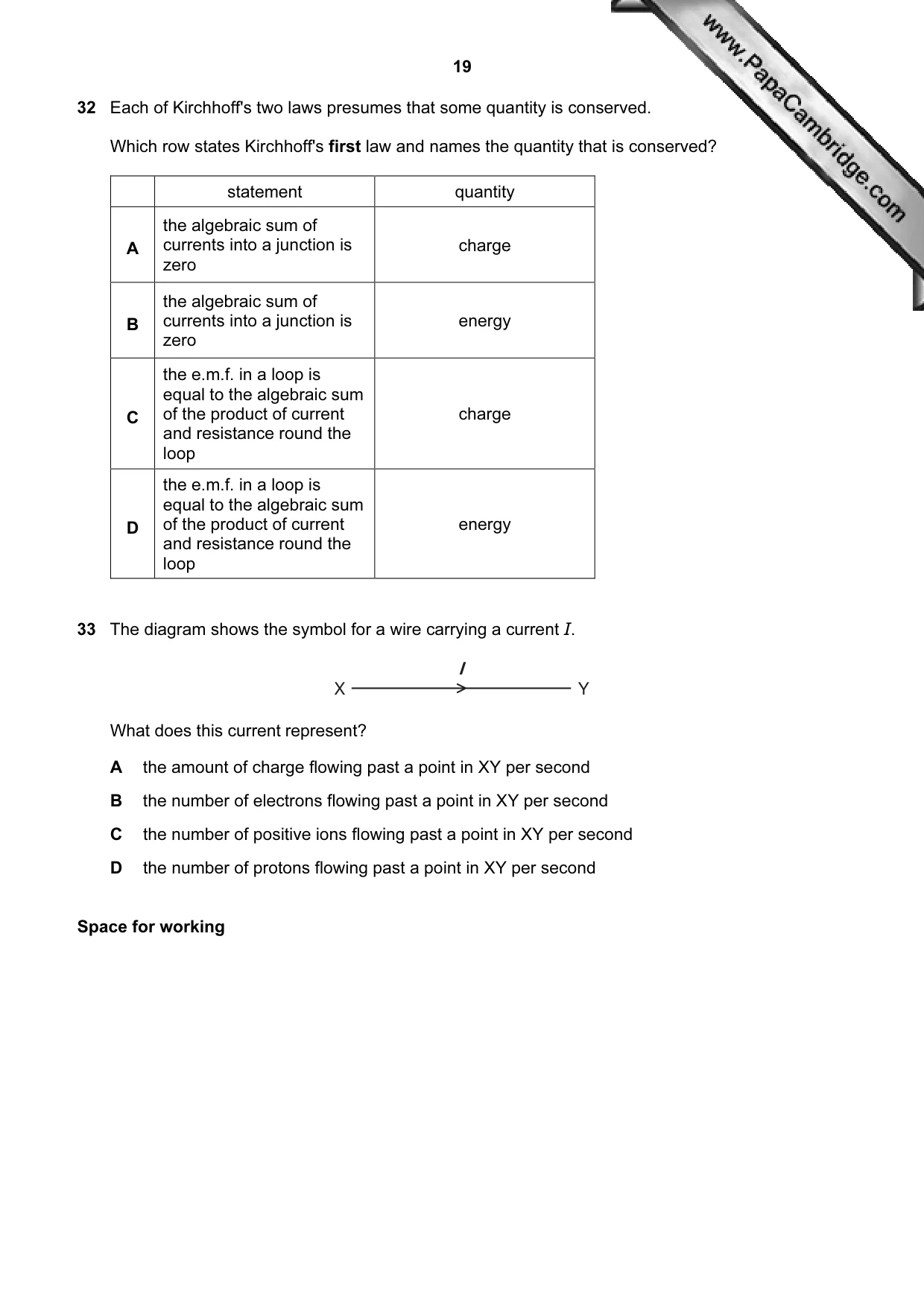
32 Each of Kirchhoff's two laws presumes that some quantity is conserved. Which row states Kirchhoff's first law and names the quantity that is conserved? statement quantity the algebraic sum of A currents into a junction is charge zero the algebraic sum of B currents into a junction is energy zero the e.m.f. in a loop is equal to the algebraic sum C of the product of current charge and resistance round the loop the e.m.f. in a loop is equal to the algebraic sum D of the product of current energy and resistance round the loop
Mark scheme: A
Q33 · The diagram shows the symbol for a wire carrying a current I
33 The diagram shows the symbol for a wire carrying a current I. I X Y What does this current represent? A the amount of charge flowing past a point in XY per second B the number of electrons flowing past a point in XY per second C the number of positive ions flowing past a point in XY per second D the number of protons flowing past a point in XY per second Space for working
Mark scheme: A
Q34 · A potential divider consisting of resistors of resistance R1 and R2 is connected to an…
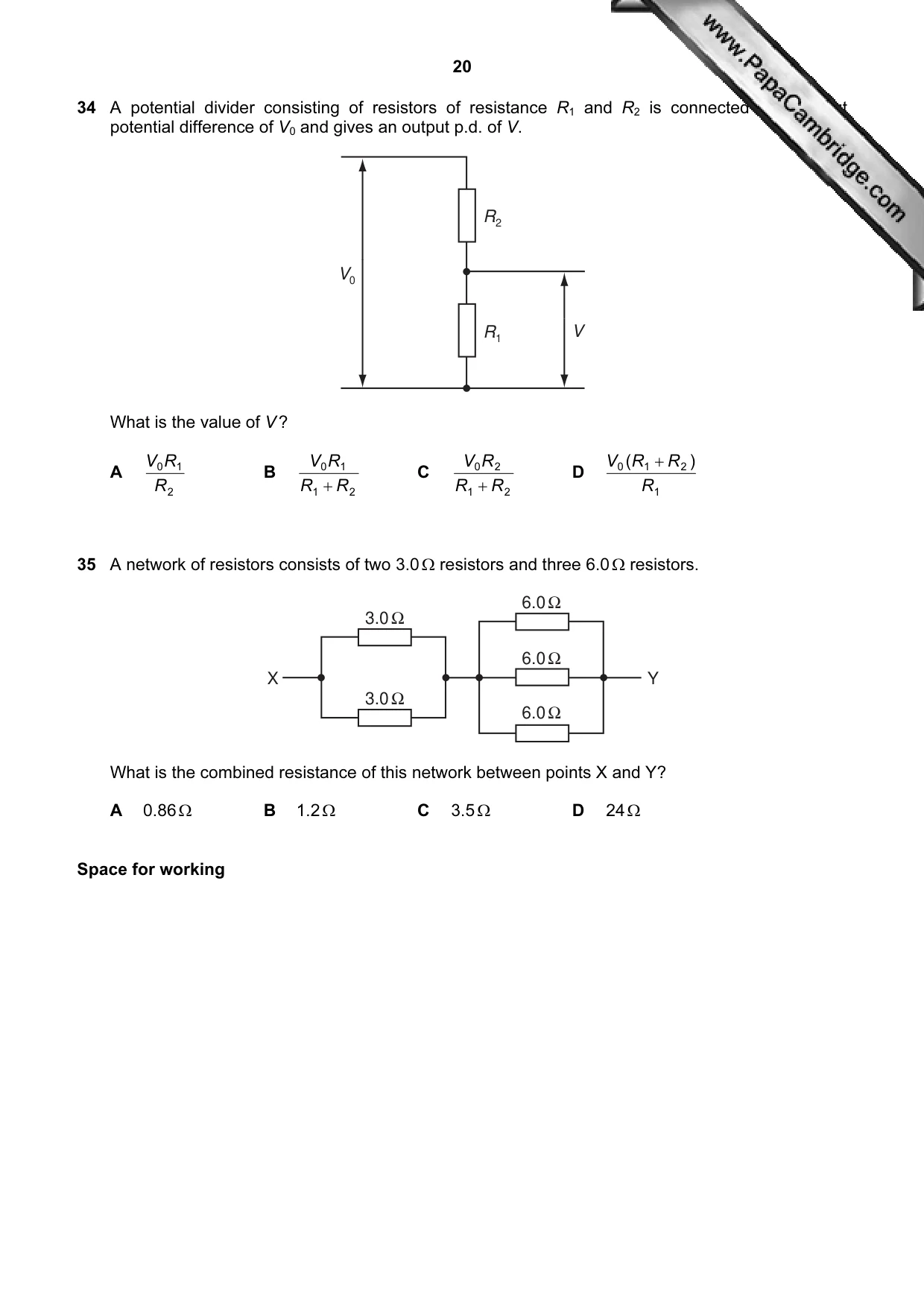
34 A potential divider consisting of resistors of resistance R1 and R2 is connected to an input potential difference of V0 and gives an output p.d. of V. R2 V0 R1 V What is the value of V ? V R V R V R V ( R + R ) A 0 1 B 0 1 C 0 2 D 0 1 2 R R + R R + R R 2 1 2 1 2 1
Mark scheme: B
Q35 · A network of resistors consists of two 3.0 Ω resistors and three 6.0 Ω resistors
35 A network of resistors consists of two 3.0 Ω resistors and three 6.0 Ω resistors. 6.0 Ω 3.0 Ω 6.0 Ω X Y 3.0 Ω 6.0 Ω What is the combined resistance of this network between points X and Y? A 0.86 Ω B 1.2 Ω C 3.5 Ω D 24 Ω Space for working
Mark scheme: C
Q36 · The gold nucleus 185 Au undergoes alpha decay
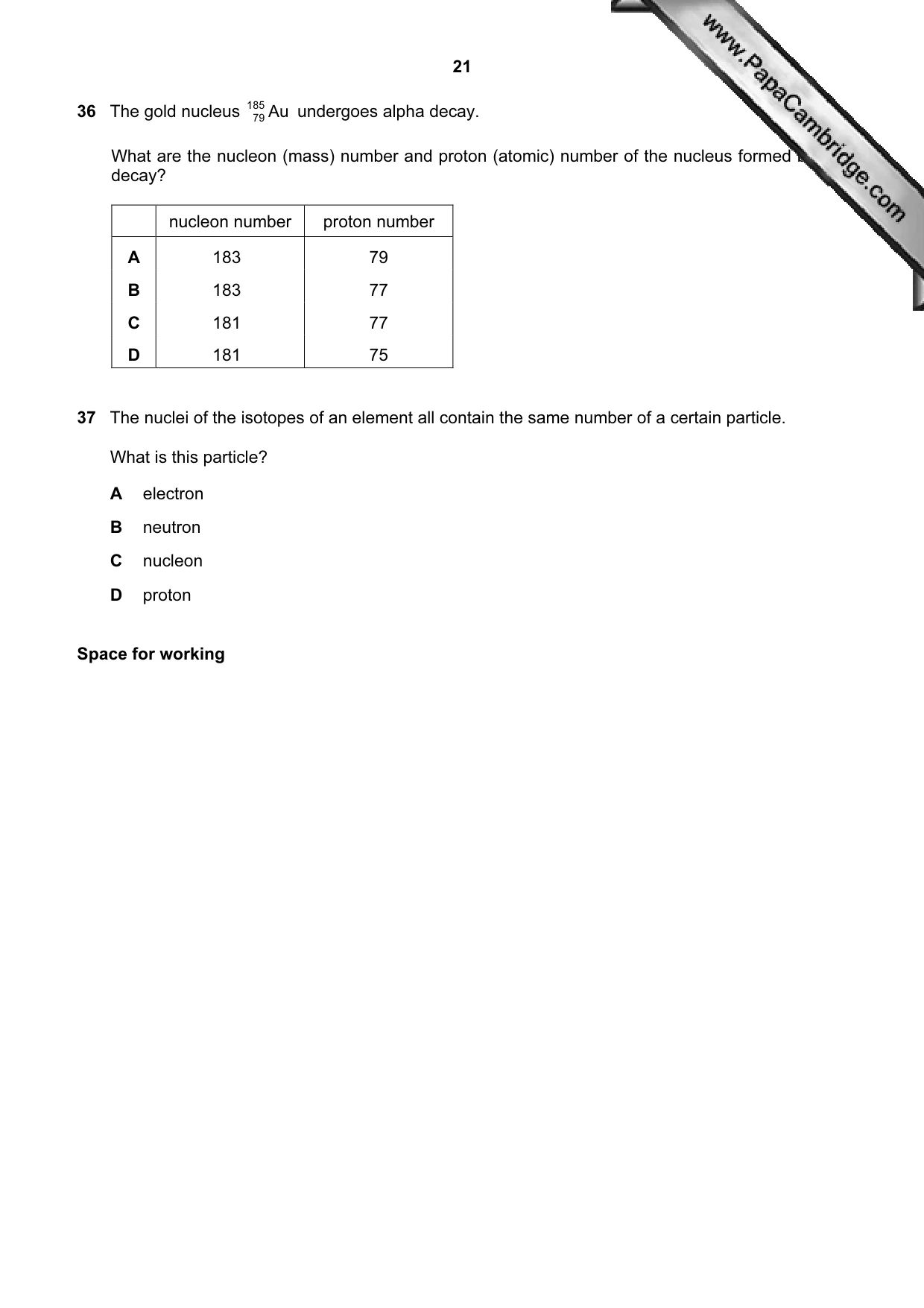
36 The gold nucleus 185 Au undergoes alpha decay. 79 What are the nucleon (mass) number and proton (atomic) number of the nucleus formed by this decay? nucleon number proton number A 183 79 B 183 77 C 181 77 D 181 75
Mark scheme: C
Q37 · The nuclei of the isotopes of an element all contain the same number of a certain particle
37 The nuclei of the isotopes of an element all contain the same number of a certain particle. What is this particle? A electron B neutron C nucleon D proton Space for working
Mark scheme: D
Q38 · Alpha, beta and gamma radiations 1 are absorbed to different extents in solids, 2 behave…
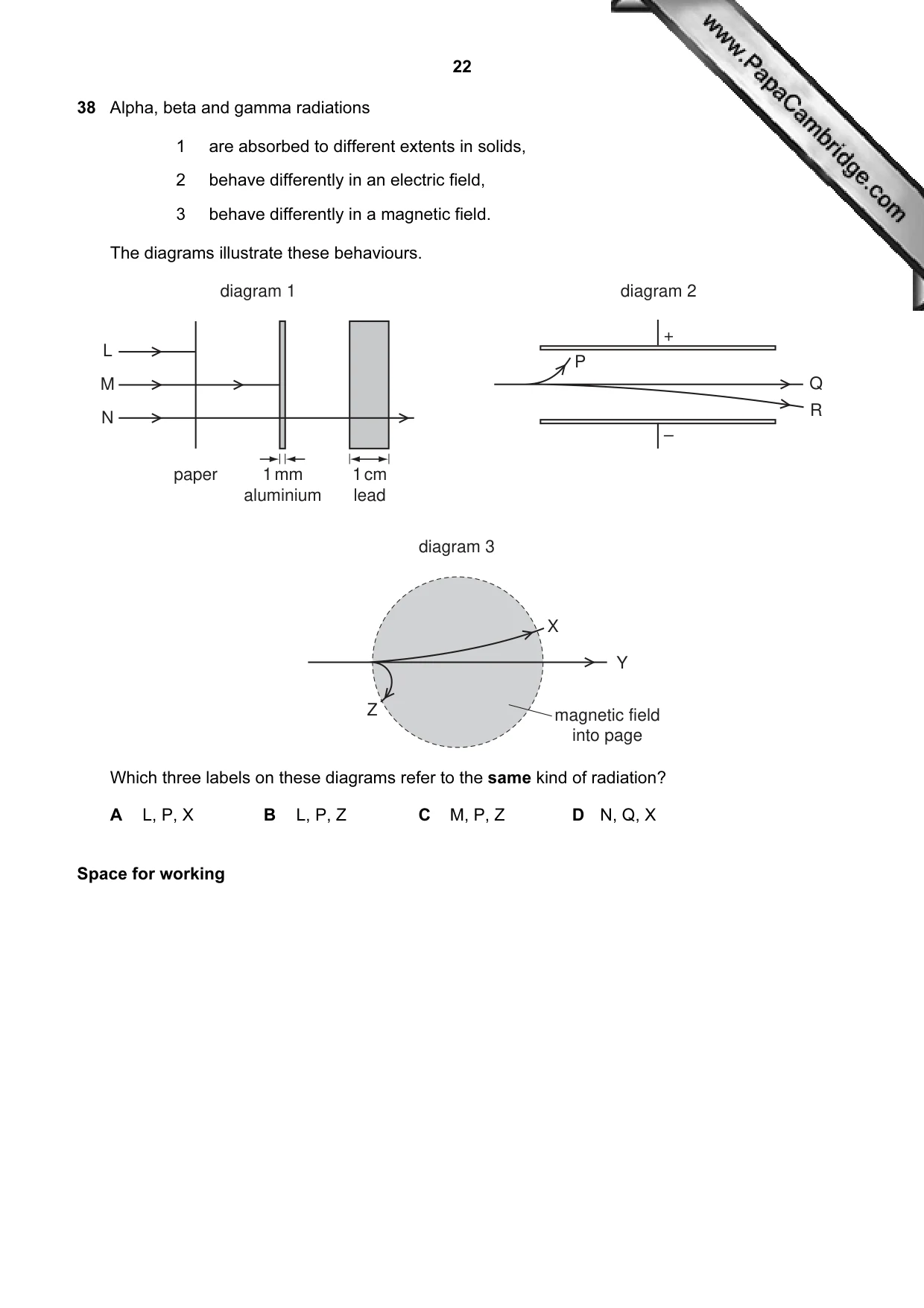
38 Alpha, beta and gamma radiations 1 are absorbed to different extents in solids, 2 behave differently in an electric field, 3 behave differently in a magnetic field. The diagrams illustrate these behaviours. diagram 1 diagram 2 + L P M Q N R – paper 1 mm 1 cm aluminium lead diagram 3 X Y Z magnetic field into page Which three labels on these diagrams refer to the same kind of radiation? A L, P, X B L, P, Z C M, P, Z D N, Q, X Space for working
Mark scheme: C
Q39 · Two α-particles with equal energies are fired towards the nucleus of a gold atom
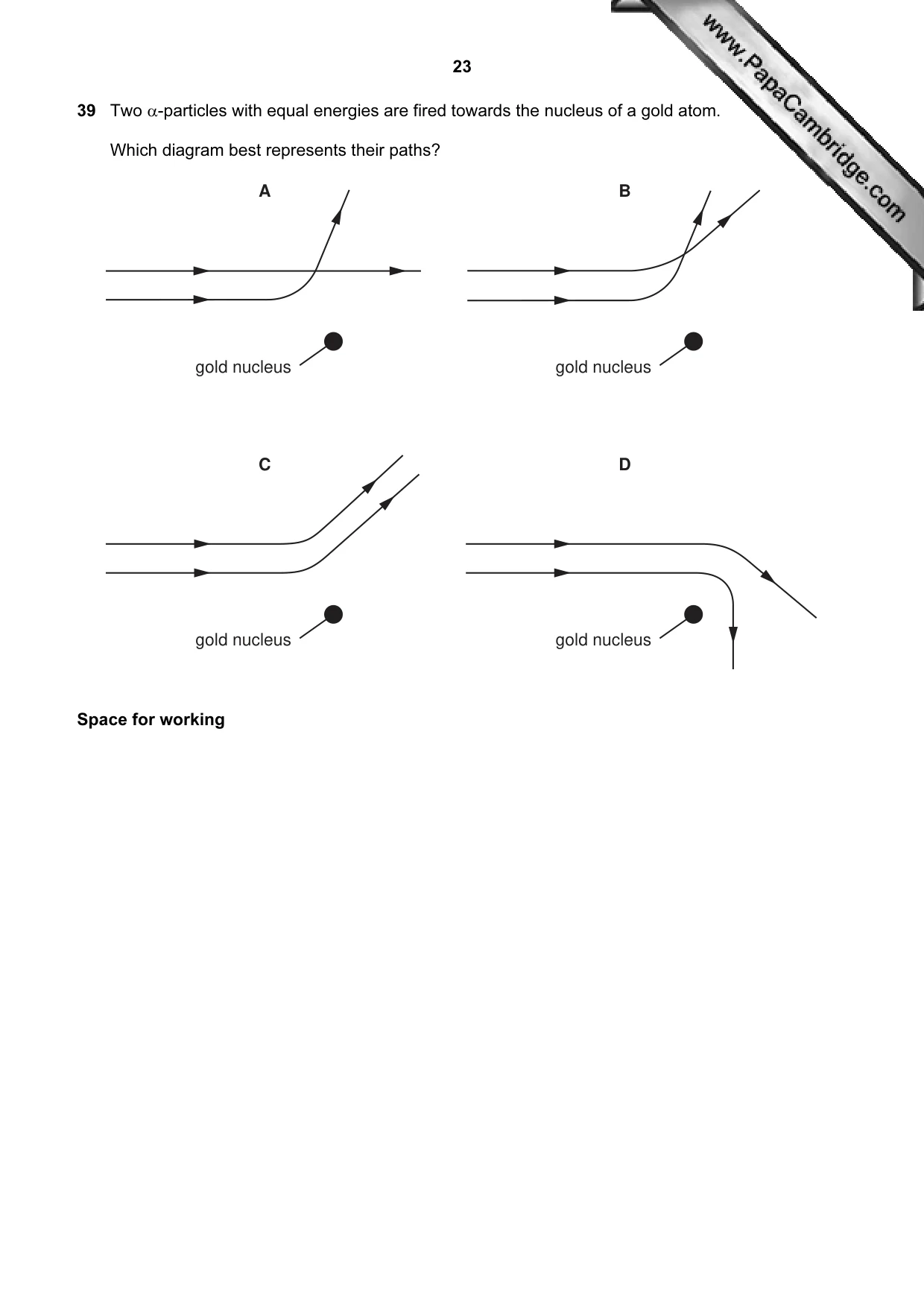
39 Two α-particles with equal energies are fired towards the nucleus of a gold atom. Which diagram best represents their paths? A B gold nucleus gold nucleus C D gold nucleus gold nucleus Space for working
Mark scheme: B
Q40 · The table contains some quantities, together with their symbols and units
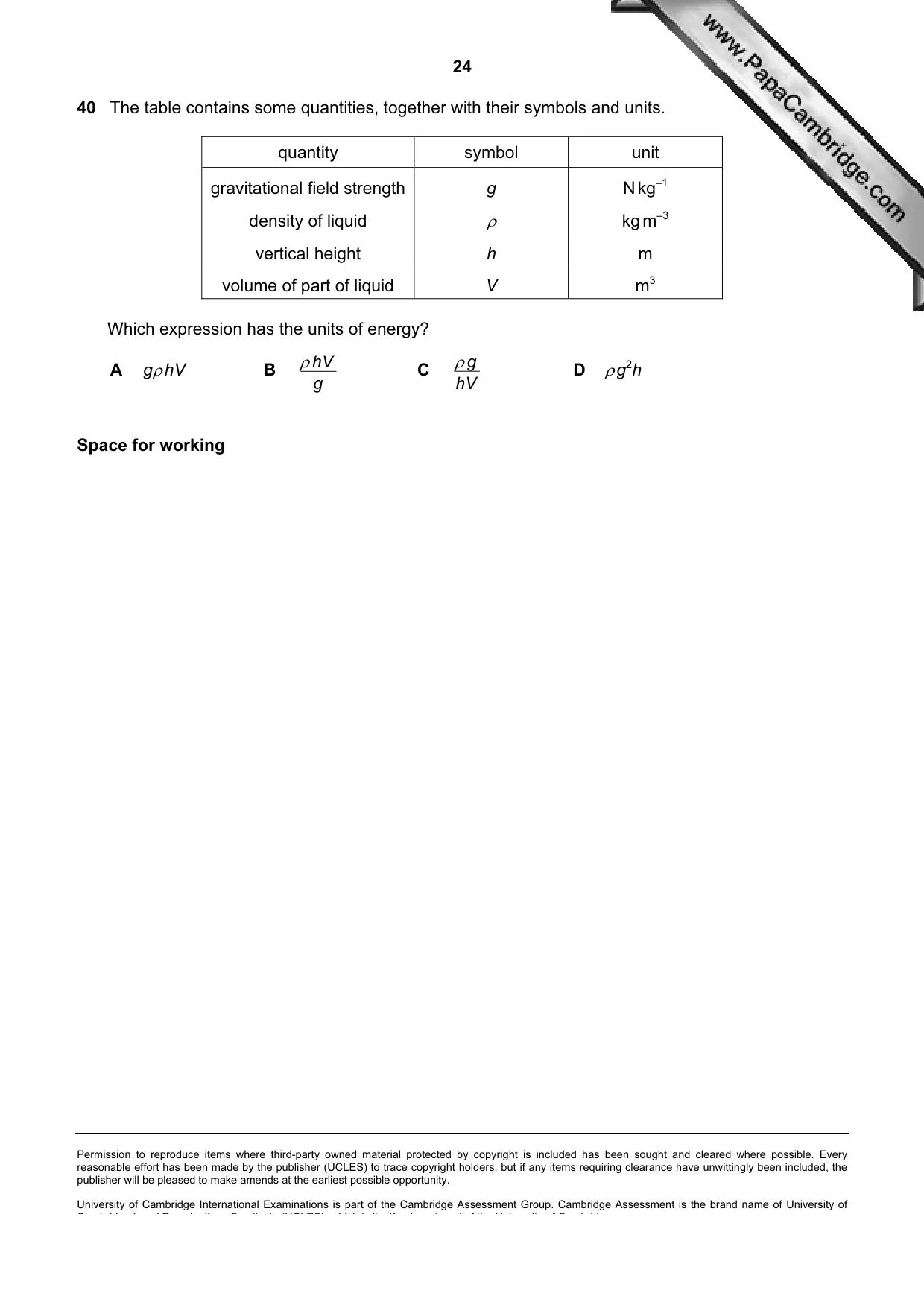
40 The table contains some quantities, together with their symbols and units. quantity symbol unit gravitational field strength g N kg–1 density of liquid ρ kg m–3 vertical height h m volume of part of liquid V m3 Which expression has the units of energy? ρ hV ρ g ρ g2h A gρ hV B C D g hV Space for working
Mark scheme: A
What was in this paper
The subtopics covered by these 40 questions, and how many questions each got. Open one in a new tab to see every Cambridge question on it.
4Equations of motion3Linear momentum and its conservation3Elastic and plastic behaviour2Electric current2Potential difference and power2Practical circuits2SI units2Turning effects of forces2Characteristics of alternating currents1Density and pressure1Electric field of a point charge1Electric fields and field lines1Electromagnetic spectrum1Equilibrium of forces1Gravitational potential energy and kinetic energy1Internal energy1Kinetic theory of gases1Kirchhoff’s laws1Momentum and Newton’s laws of motion1Potential dividers1Progressive waves1Resistance and resistivity1Stationary waves1Stress and strain1The diffraction grating1Uniform electric fields1What you needed in this session
Cambridge’s own grade thresholds for 2009 Oct/Nov, Paper 1 · Variant 2. A higher threshold means an easier paper — the bar moves with how the cohort did.