Cambridge A Level Physics 9702 — 2022 Oct/Nov Paper 1 · Variant 3
9702/13/O/N/22 · 40 questions · 40 marks · ≈45 min
The question paper and its mark scheme, free to read here and free to download. This is Cambridge’s own paper, exactly as it was sat.
Question paper20 pages
Mark scheme3 pages
Answers below. Sit the paper first if you are practising.
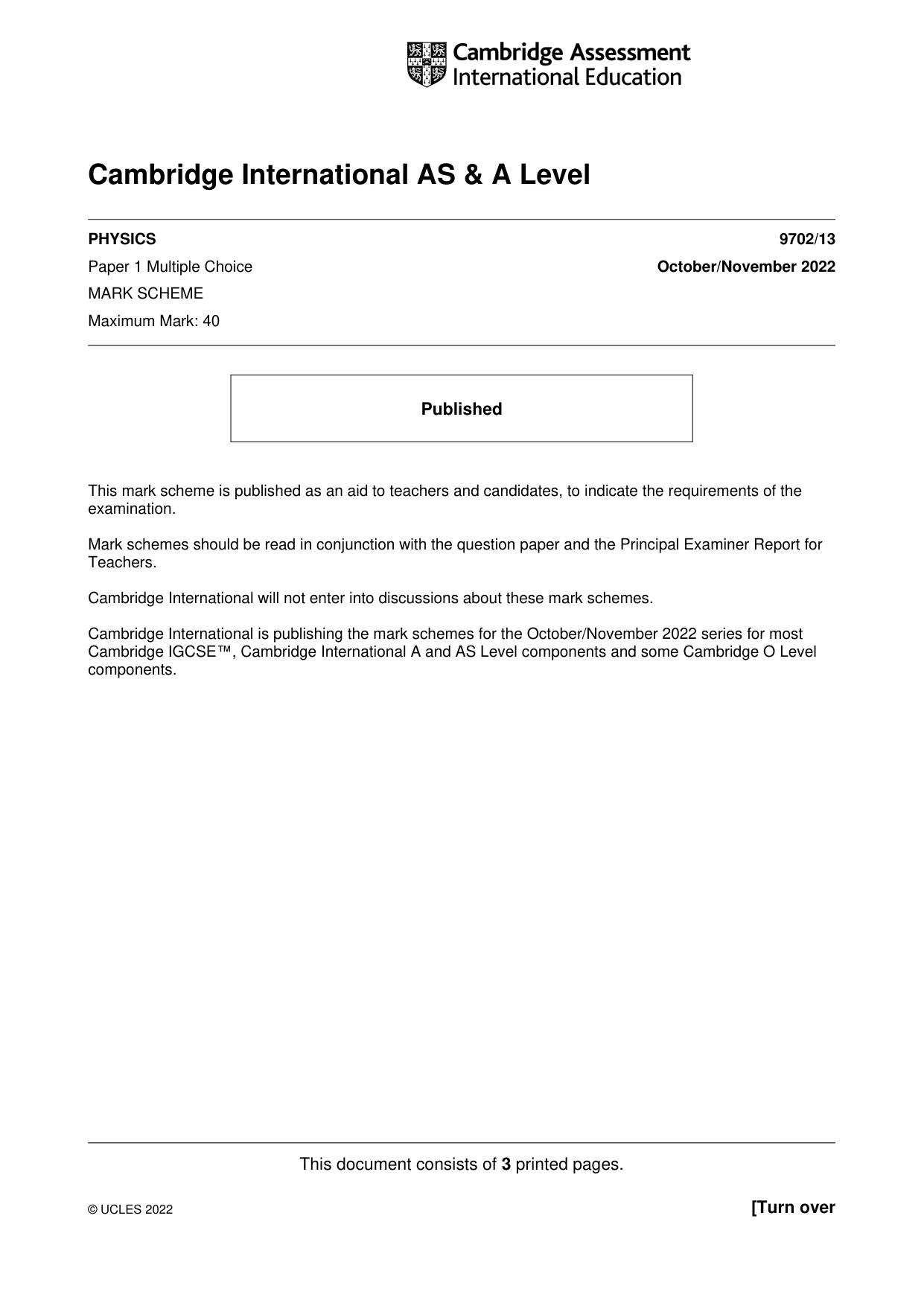
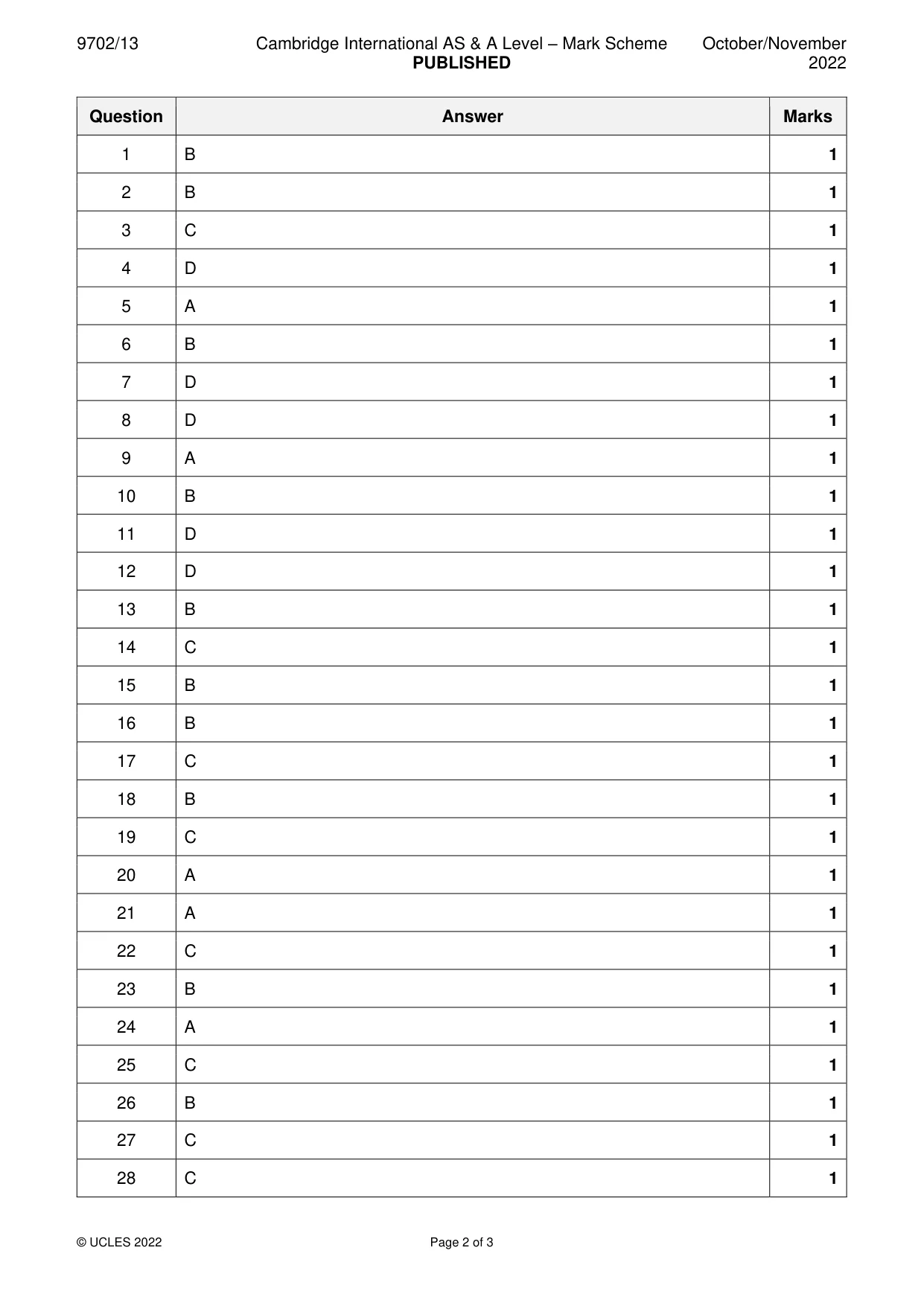
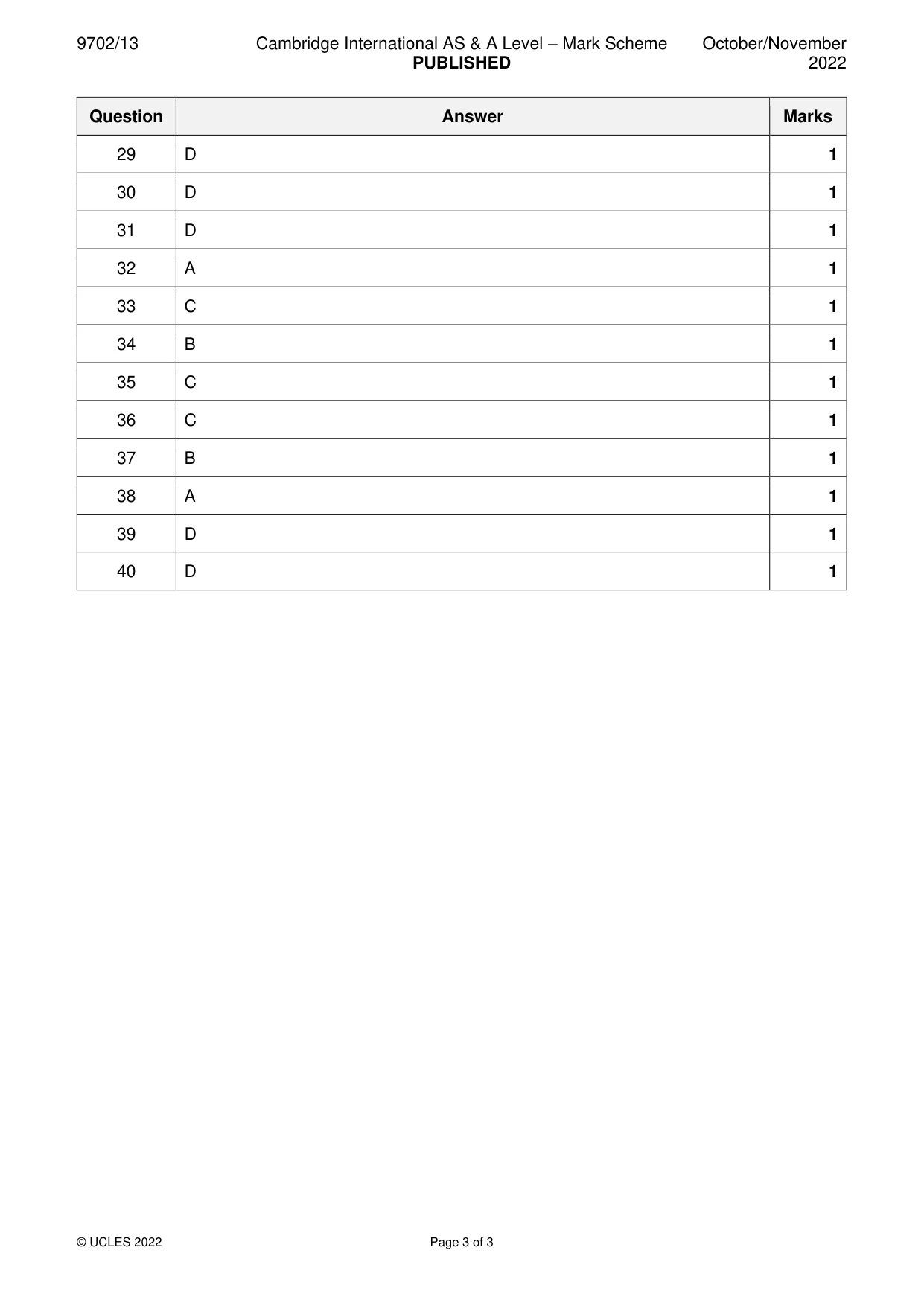
Questions as text
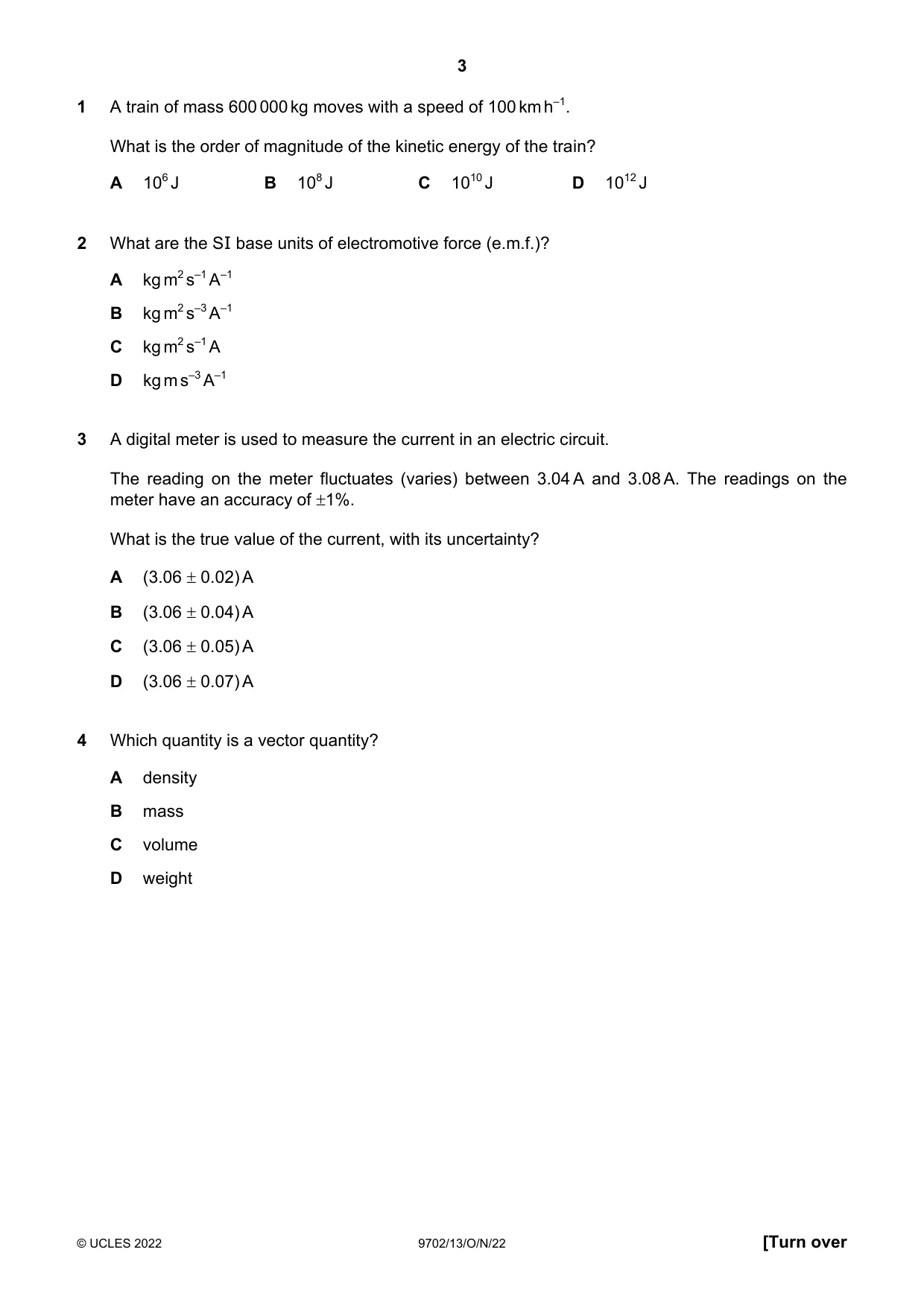
Q1 · A train of mass 600 000 kg moves with a speed of 100 km h–1
1 A train of mass 600 000 kg moves with a speed of 100 km h–1. What is the order of magnitude of the kinetic energy of the train? A 106 J B 108 J C 1010 J D 1012 J
Mark scheme: B
More questions on Gravitational potential energy and kinetic energy
Q2 · What are the SI base units of electromotive force (e.m.f.)?
2 What are the SI base units of electromotive force (e.m.f.)? A kg m2 s–1 A–1 B kg m2 s–3 A–1 C kg m2 s–1 A D kg m s–3 A–1
Mark scheme: B
Q3 · A digital meter is used to measure the current in an electric circuit
3 A digital meter is used to measure the current in an electric circuit. The reading on the meter fluctuates (varies) between 3.04 A and 3.08 A. The readings on the meter have an accuracy of 1%. What is the true value of the current, with its uncertainty? A (3.06 0.02) A B (3.06 0.04) A C (3.06 0.05) A D (3.06 0.07) A
Mark scheme: C
Q4 · Which quantity is a vector quantity?
4 Which quantity is a vector quantity? A density B mass C volume D weight
Mark scheme: D
Q5 · A stone is projected horizontally at time t = 0 and falls
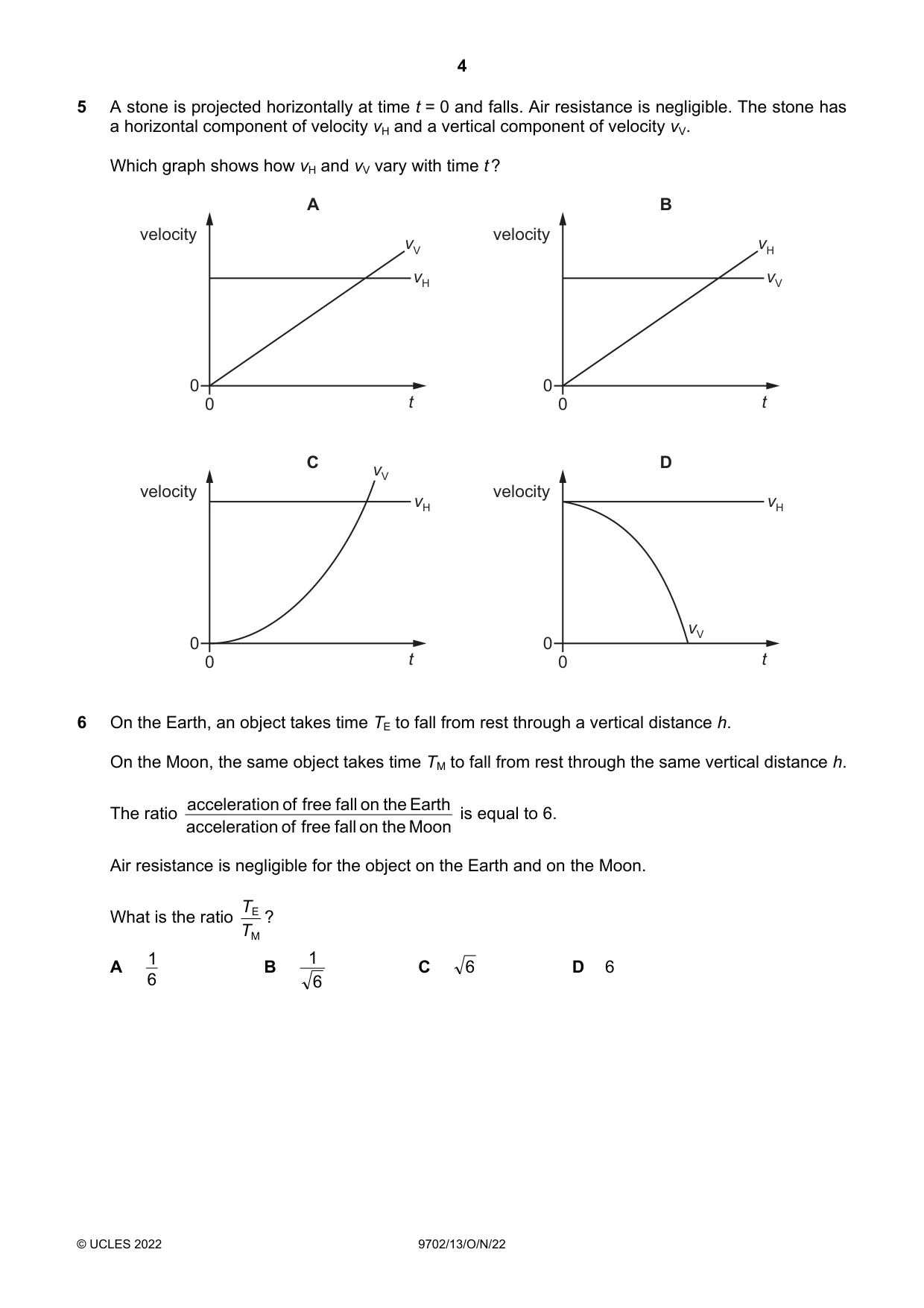
5 A stone is projected horizontally at time t = 0 and falls. Air resistance is negligible. The stone has a horizontal component of velocity vH and a vertical component of velocity vV. Which graph shows how vH and vV vary with time t ? A B velocity velocity vV vH vH vV 0 0 0 t 0 t C vV D velocity velocity vH vH vV 0 0 0 t 0 t
Mark scheme: A
Q6 · On the Earth, an object takes time TE to fall from rest through a vertical distance h
6 On the Earth, an object takes time TE to fall from rest through a vertical distance h. On the Moon, the same object takes time TM to fall from rest through the same vertical distance h. accelerati on of free fall on the Earth The ratio is equal to 6. accelerati on of free fall on the Moon Air resistance is negligible for the object on the Earth and on the Moon. T ? What is the ratio E T M 1 1 A B C 6 D 6 6 6
Mark scheme: B
Q7 · A cyclist in still air pedals as hard as she can
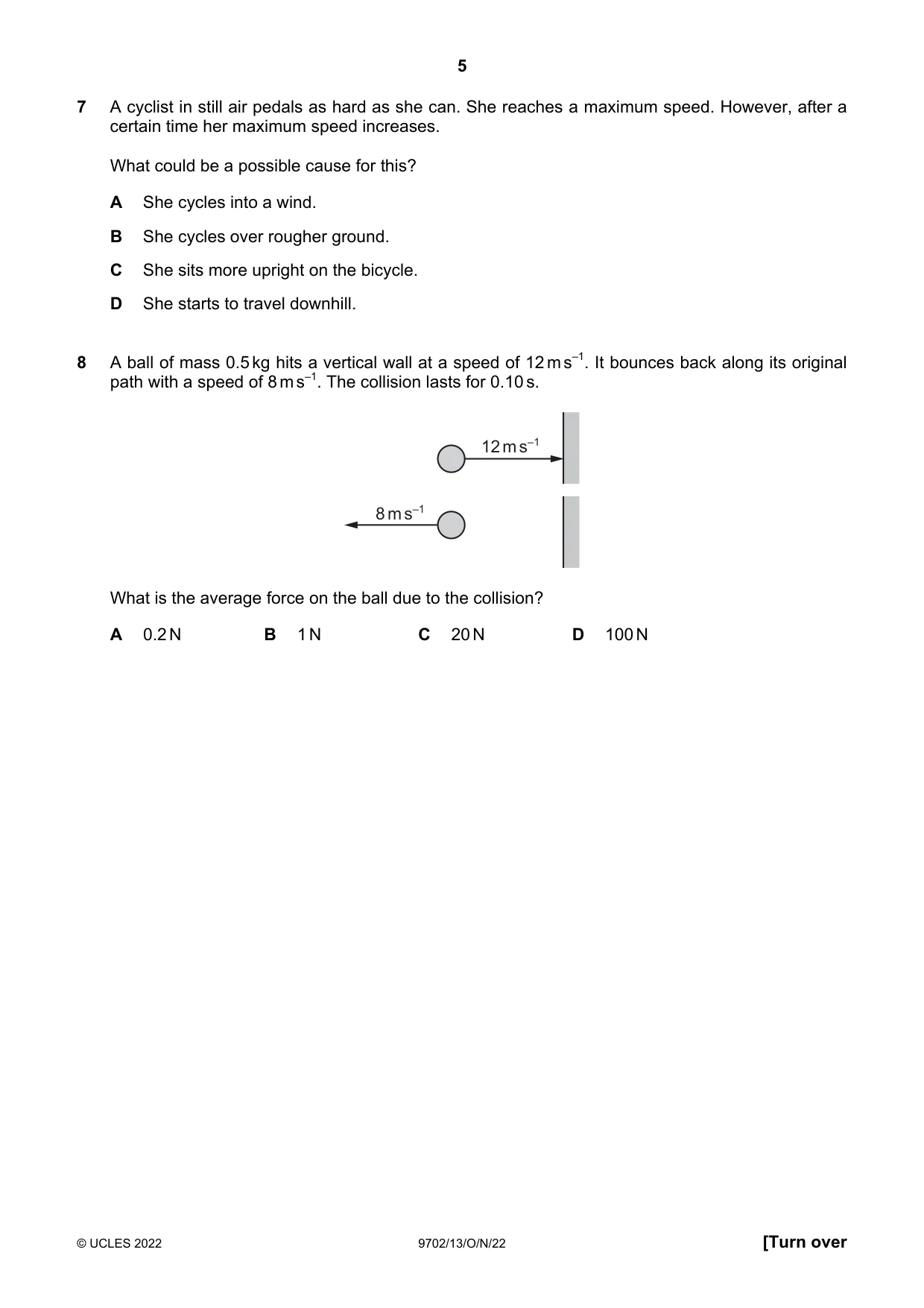
7 A cyclist in still air pedals as hard as she can. She reaches a maximum speed. However, after a certain time her maximum speed increases. What could be a possible cause for this? A She cycles into a wind. B She cycles over rougher ground. C She sits more upright on the bicycle. D She starts to travel downhill.
Mark scheme: D
Q8 · A ball of mass 0.5 kg hits a vertical wall at a speed of 12 m s–1
8 A ball of mass 0.5 kg hits a vertical wall at a speed of 12 m s–1. It bounces back along its original path with a speed of 8 m s–1. The collision lasts for 0.10 s. 12 m s–1 8 m s–1 What is the average force on the ball due to the collision? A 0.2 N B 1 N C 20 N D 100 N
Mark scheme: D
Q9 · An air bubble in a tank of water is rising with terminal (constant) velocity
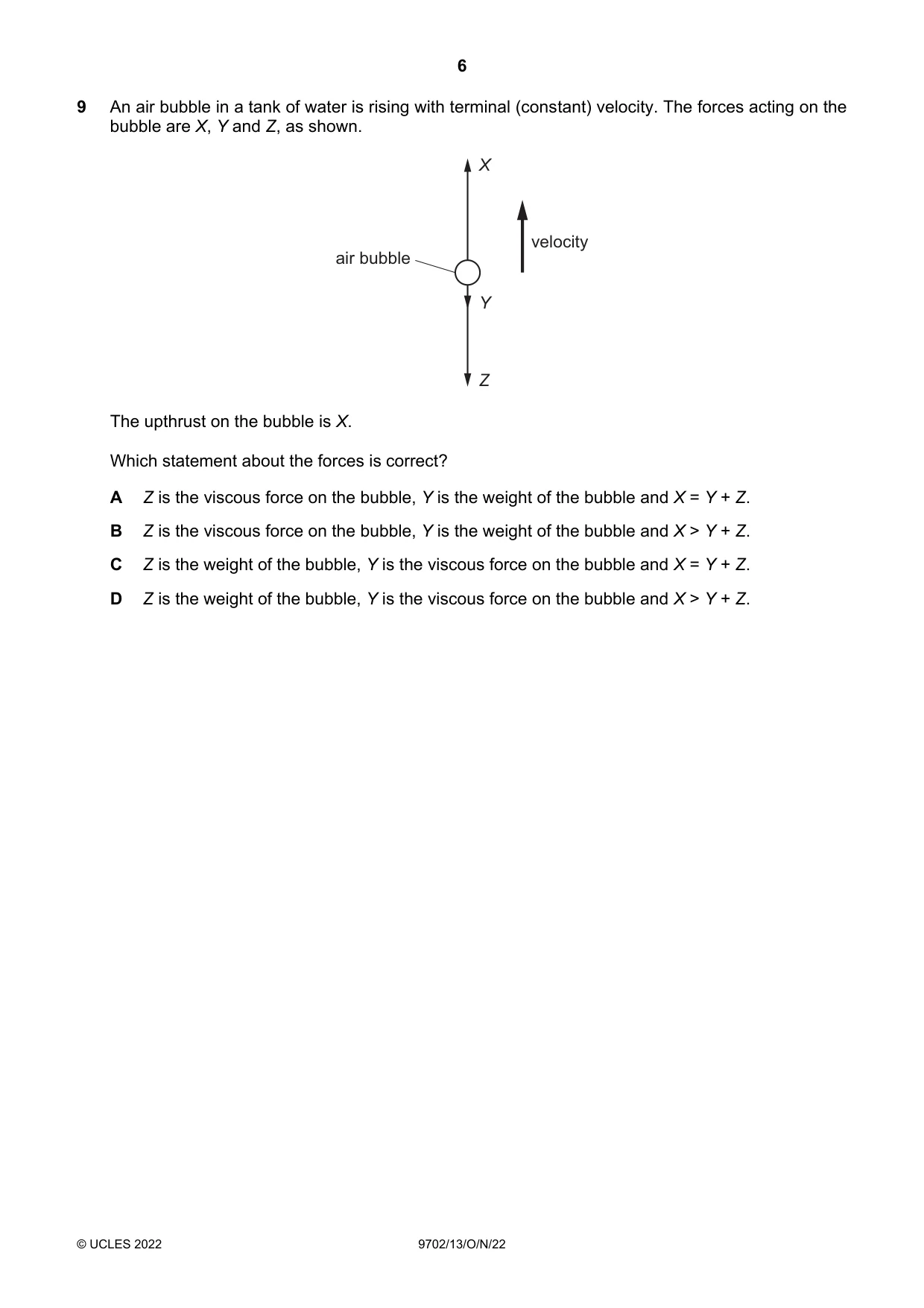
9 An air bubble in a tank of water is rising with terminal (constant) velocity. The forces acting on the bubble are X, Y and Z, as shown. X velocity air bubble Y Z The upthrust on the bubble is X. Which statement about the forces is correct? A Z is the viscous force on the bubble, Y is the weight of the bubble and X = Y + Z. B Z is the viscous force on the bubble, Y is the weight of the bubble and X > Y + Z. C Z is the weight of the bubble, Y is the viscous force on the bubble and X = Y + Z. D Z is the weight of the bubble, Y is the viscous force on the bubble and X > Y + Z.
Mark scheme: A
Q10 · Two blocks are at rest on a frictionless horizontal surface
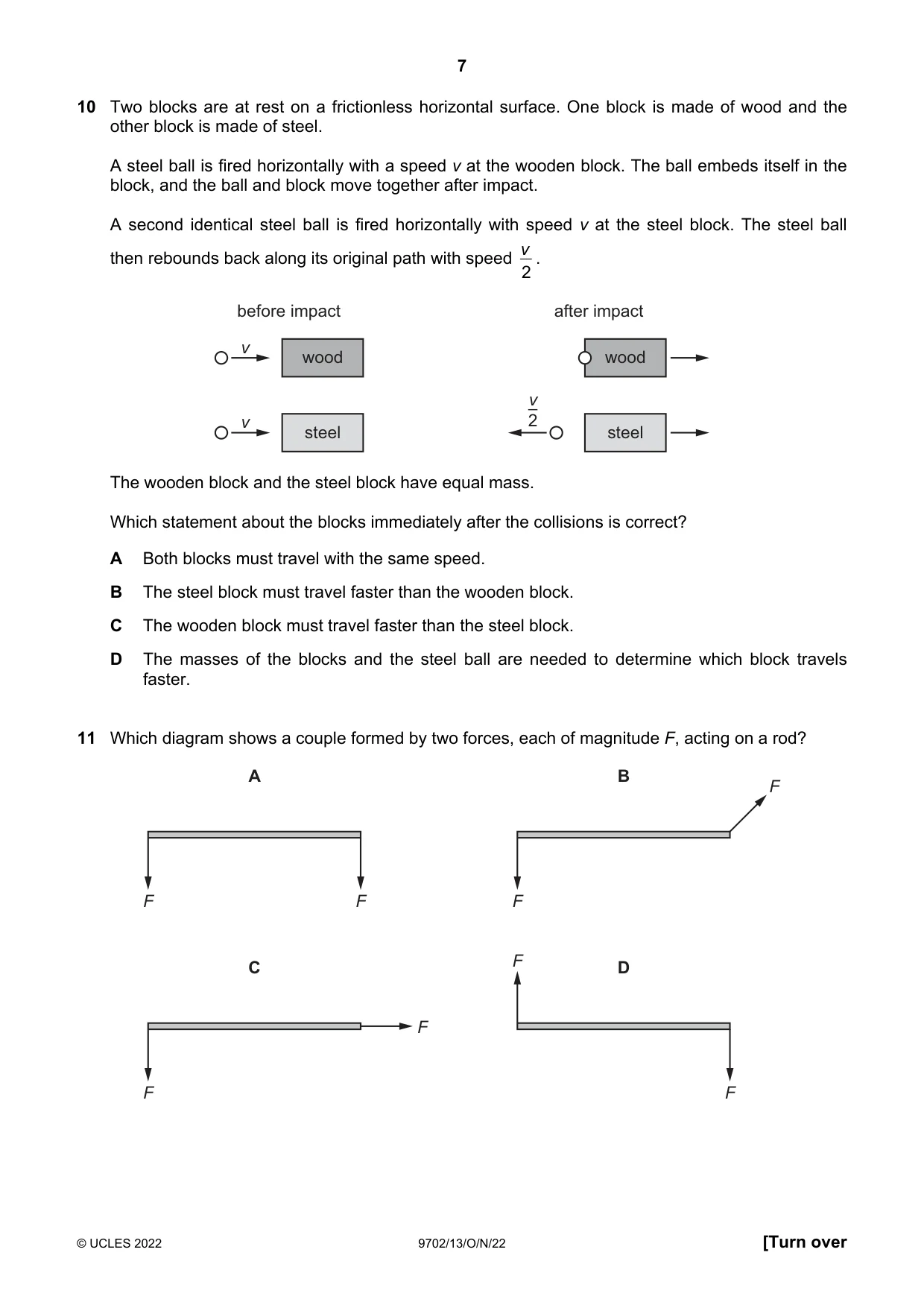
10 Two blocks are at rest on a frictionless horizontal surface. One block is made of wood and the other block is made of steel. A steel ball is fired horizontally with a speed v at the wooden block. The ball embeds itself in the block, and the ball and block move together after impact. A second identical steel ball is fired horizontally with speed v at the steel block. The steel ball v . then rebounds back along its original path with speed 2 before impact after impact v wood wood v v 2 steel steel The wooden block and the steel block have equal mass. Which statement about the blocks immediately after the collisions is correct? A Both blocks must travel with the same speed. B The steel block must travel faster than the wooden block. C The wooden block must travel faster than the steel block. D The masses of the blocks and the steel ball are needed to determine which block travels faster.
Mark scheme: B
Q11 · Which diagram shows a couple formed by two forces, each of magnitude F, acting on a rod?
11 Which diagram shows a couple formed by two forces, each of magnitude F, acting on a rod? A B F F F F C F D F F F
Mark scheme: D
Q12 · A student states that: ‘If an object is in equilibrium, the sum of the clockwise moments…
12 A student states that: ‘If an object is in equilibrium, the sum of the clockwise moments about a point X is equal to the sum of the anticlockwise moments about a point Y.’ Which condition would make the student’s statement correct? A Either X or Y is the centre of gravity of the object. B Either X or Y is the pivot of the object. C X and Y are at opposite ends of the object. D X and Y are the same point on the object.
Mark scheme: D
Q13 · Auniform rod of length 30cm and weight 5.2 N is attached to a wall by a hinge at one end
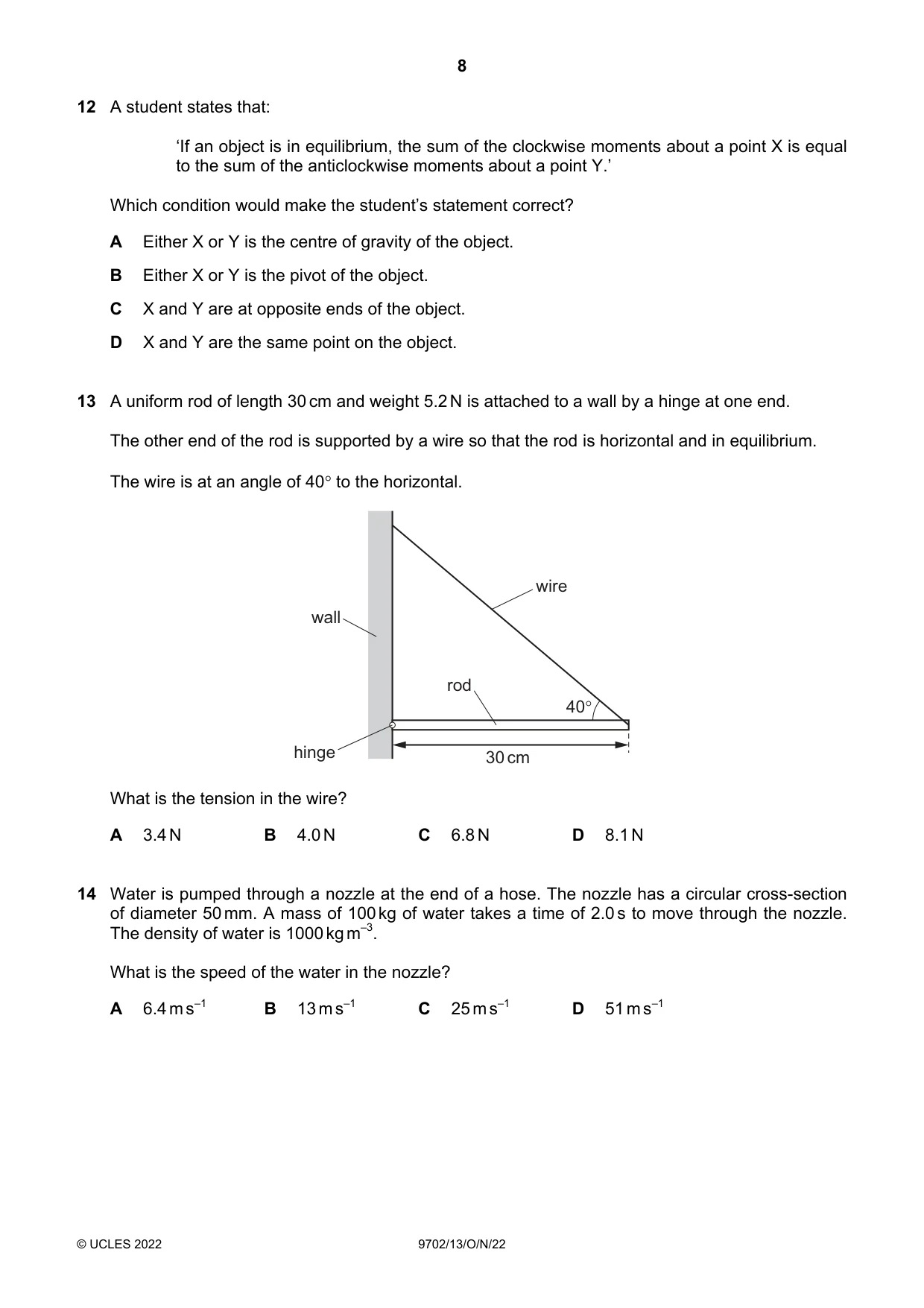
13 Auniform rod of length 30cm and weight 5.2 N is attached to a wall by a hinge at one end. The other end of the rod is supported by a wire so that the rod is horizontal and in equilibrium. The wire is at an angle of 40° to the horizontal. wall hinge What is the tension in the wire? A 3.4N B 4.0N C 6.8N D 8.1N
Mark scheme: B
Q14 · Water is pumped through a nozzle at the end of a hose
14 Water is pumped through a nozzle at the end of a hose. The nozzle has a circular cross-section of diameter 50 mm. A mass of 100 kg of water takes a time of 2.0 s to move through the nozzle. The density of water is 1000 kg m–3. What is the speed of the water in the nozzle? A 6.4 m s–1 B 13 m s–1 C 25 m s–1 D 51 m s–1
Mark scheme: C
Q15 · A solid wooden cube rests on a horizontal surface
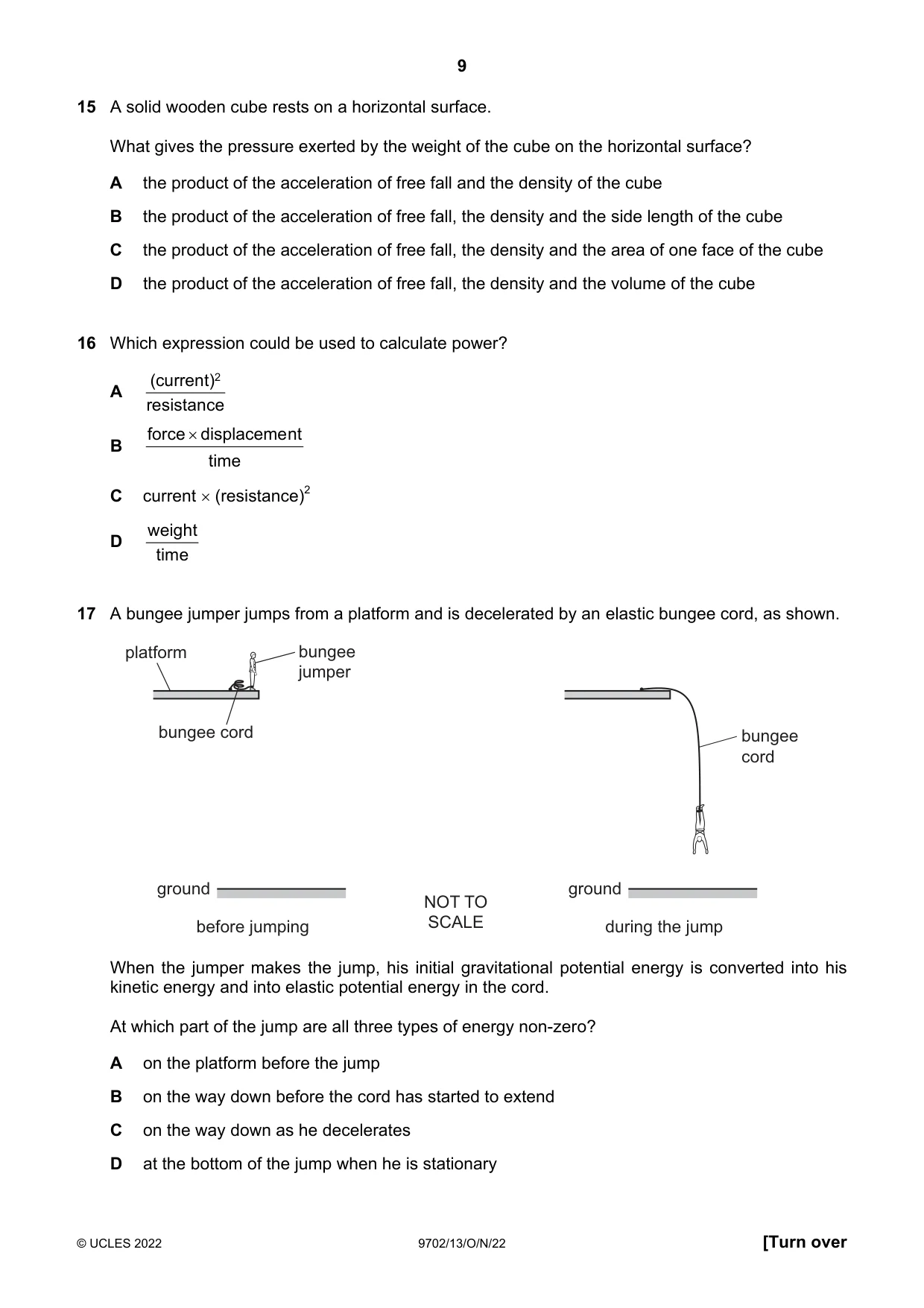
15 A solid wooden cube rests on a horizontal surface. What gives the pressure exerted by the weight of the cube on the horizontal surface? A the product of the acceleration of free fall and the density of the cube B the product of the acceleration of free fall, the density and the side length of the cube C the product of the acceleration of free fall, the density and the area of one face of the cube D the product of the acceleration of free fall, the density and the volume of the cube
Mark scheme: B
Q16 · Which expression could be used to calculate power?
16 Which expression could be used to calculate power? (current) 2 A resistance force displaceme nt B time C current (resistance)2 weight D time
Mark scheme: B
Q17 · A bungee jumper jumps from a platform and is decelerated by an elastic bungee cord, as…
17 A bungee jumper jumps from a platform and is decelerated by an elastic bungee cord, as shown. platform bungee jumper bungee cord bungee cord ground ground NOT TO before jumping SCALE during the jump When the jumper makes the jump, his initial gravitational potential energy is converted into his kinetic energy and into elastic potential energy in the cord. At which part of the jump are all three types of energy non-zero? A on the platform before the jump B on the way down before the cord has started to extend C on the way down as he decelerates D at the bottom of the jump when he is stationary
Mark scheme: C
Q18 · An object is displaced horizontally to the right in a uniform vertical gravitational field
18 An object is displaced horizontally to the right in a uniform vertical gravitational field. Which statement describes the change in the gravitational potential energy of the object? A It decreases in direct proportion to the displacement. B It does not change with the displacement. C It increases in direct proportion to the displacement. D It increases in direct proportion to the square of the displacement.
Mark scheme: B
Q19 · A copper wire of length 3.6 m and diameter 1.22 mm is stretched by a force of 37 N
19 A copper wire of length 3.6 m and diameter 1.22 mm is stretched by a force of 37 N. The wire obeys Hooke’s law. The Young modulus of copper is 1.17 1011 Pa. Which extension is caused by this force? A 0.24 mm B 0.76 mm C 0.97 mm D 3.1 mm
Mark scheme: C
Q20 · A spring has spring constant k
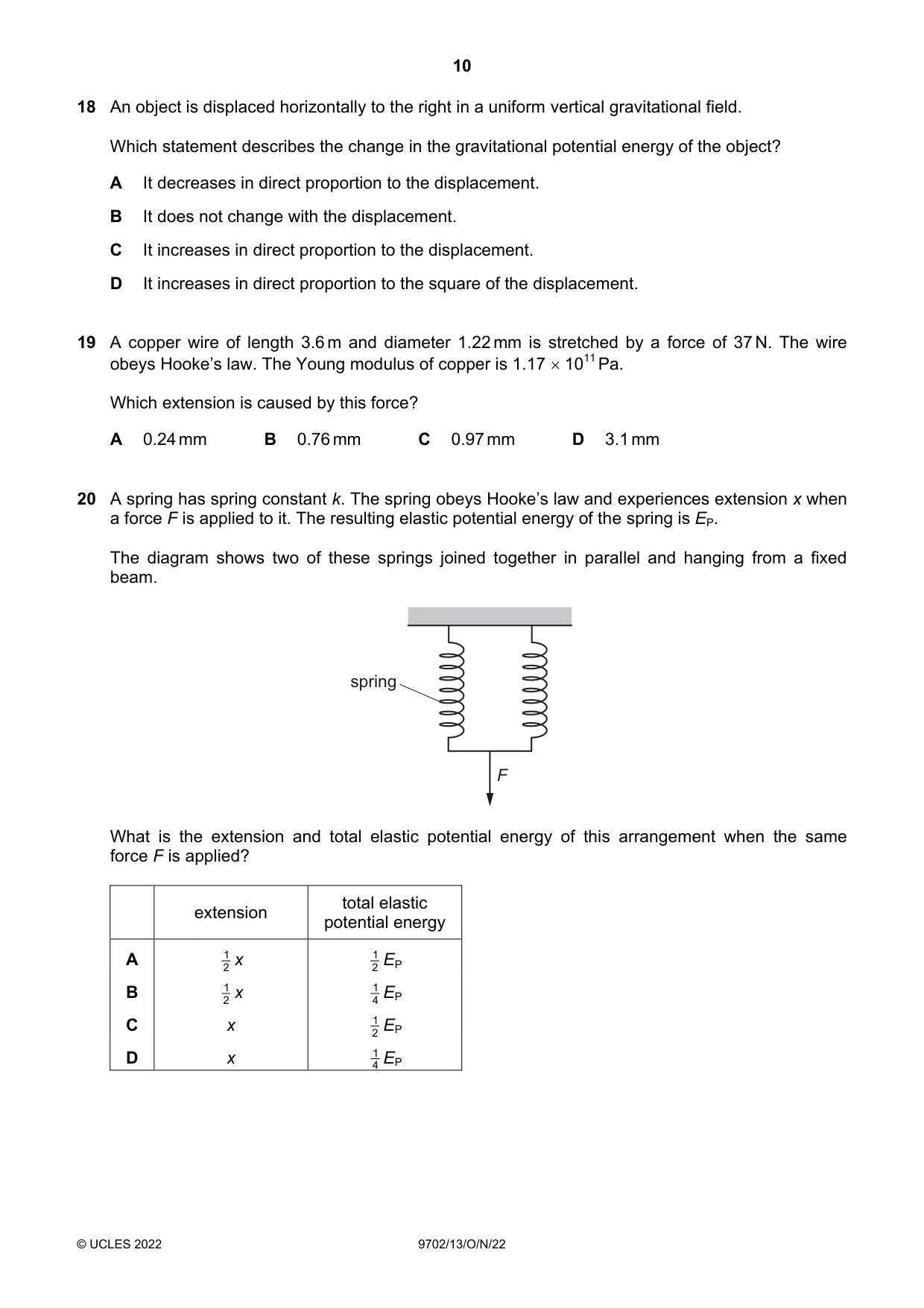
20 A spring has spring constant k. The spring obeys Hooke’s law and experiences extension x when a force F is applied to it. The resulting elastic potential energy of the spring is EP. The diagram shows two of these springs joined together in parallel and hanging from a fixed beam. spring F What is the extension and total elastic potential energy of this arrangement when the same force F is applied? total elastic extension potential energy A 1 x 1 EP 2 2 B 1 x 1 EP 2 4 C x 1 EP 2 D x 1 EP 4
Mark scheme: A
Q21 · The diagram shows a transverse wave on a rope
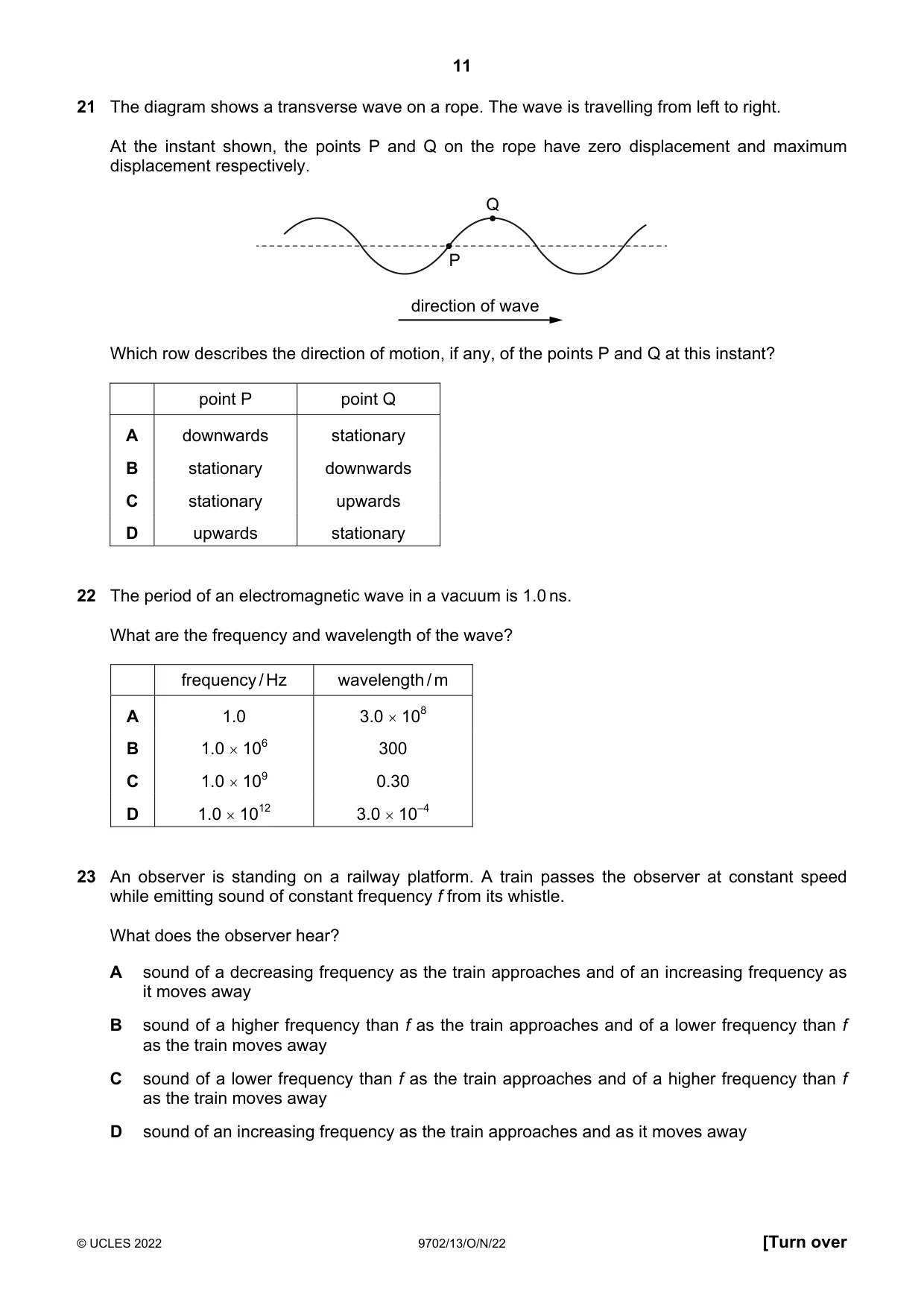
21 The diagram shows a transverse wave on a rope. The wave is travelling from left to right. At the instant shown, the points P and Q on the rope have zero displacement and maximum displacement respectively. Q P direction of wave Which row describes the direction of motion, if any, of the points P and Q at this instant? point P point Q A downwards stationary B stationary downwards C stationary upwards D upwards stationary
Mark scheme: A
Q22 · The period of an electromagnetic wave in a vacuum is 1.0 ns
22 The period of an electromagnetic wave in a vacuum is 1.0 ns. What are the frequency and wavelength of the wave? frequency / Hz wavelength / m A 1.0 3.0 108 B 1.0 106 300 C 1.0 109 0.30 D 1.0 1012 3.0 10–4
Mark scheme: C
Q23 · An observer is standing on a railway platform
23 An observer is standing on a railway platform. A train passes the observer at constant speed while emitting sound of constant frequency f from its whistle. What does the observer hear? A sound of a decreasing frequency as the train approaches and of an increasing frequency as it moves away B sound of a higher frequency than f as the train approaches and of a lower frequency than f as the train moves away C sound of a lower frequency than f as the train approaches and of a higher frequency than f as the train moves away D sound of an increasing frequency as the train approaches and as it moves away
Mark scheme: B
Q24 · Which microorganisms have a length that is equal to the wavelength in free space of an…
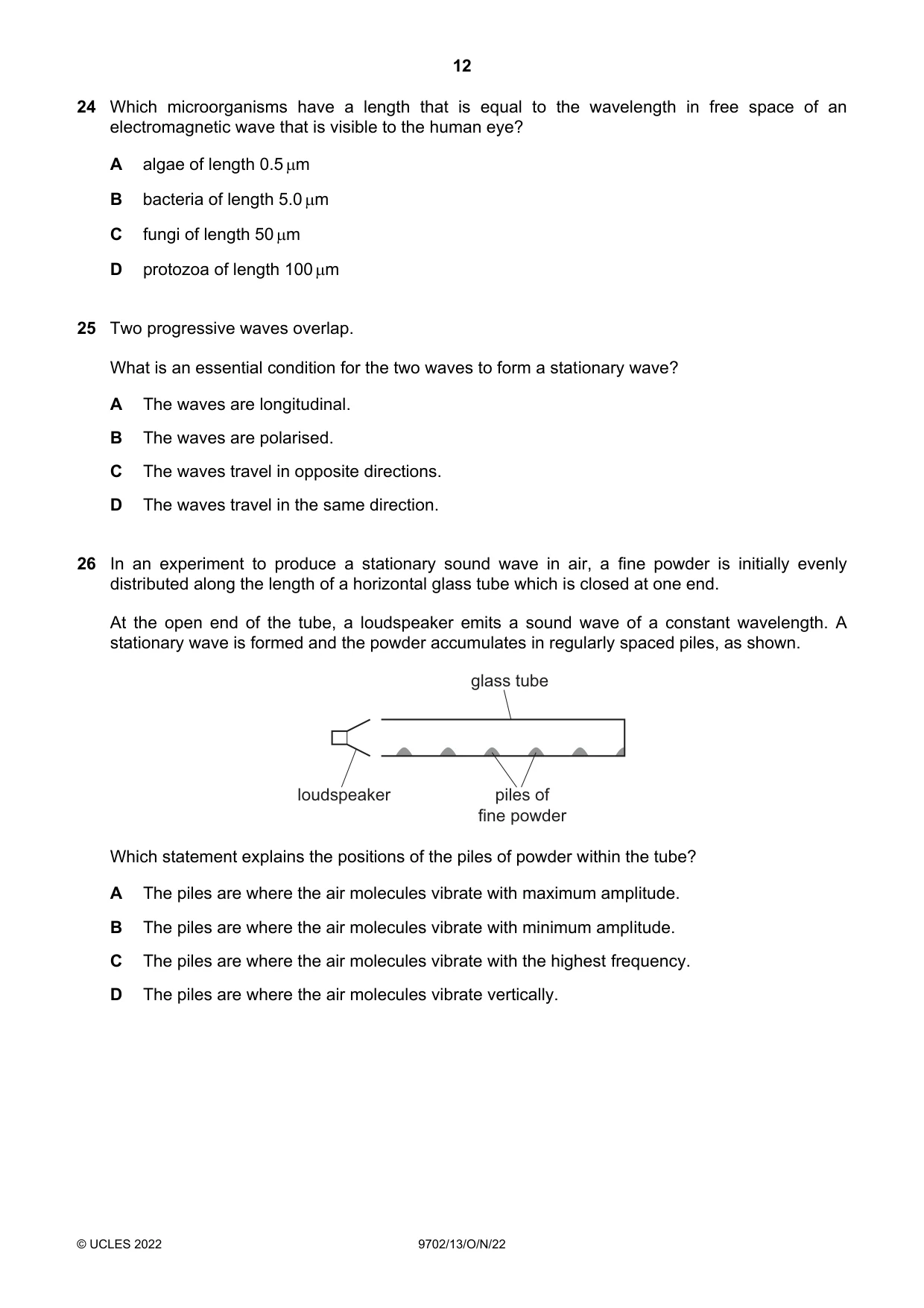
24 Which microorganisms have a length that is equal to the wavelength in free space of an electromagnetic wave that is visible to the human eye? A algae of length 0.5 m B bacteria of length 5.0 m C fungi of length 50 m D protozoa of length 100 m
Mark scheme: A
Q25 · Two progressive waves overlap
25 Two progressive waves overlap. What is an essential condition for the two waves to form a stationary wave? A The waves are longitudinal. B The waves are polarised. C The waves travel in opposite directions. D The waves travel in the same direction.
Mark scheme: C
Q26 · In an experiment to produce a stationary sound wave in air, a fine powder is initially…
26 In an experiment to produce a stationary sound wave in air, a fine powder is initially evenly distributed along the length of a horizontal glass tube which is closed at one end. At the open end of the tube, a loudspeaker emits a sound wave of a constant wavelength. A stationary wave is formed and the powder accumulates in regularly spaced piles, as shown. glass tube loudspeaker piles of fine powder Which statement explains the positions of the piles of powder within the tube? A The piles are where the air molecules vibrate with maximum amplitude. B The piles are where the air molecules vibrate with minimum amplitude. C The piles are where the air molecules vibrate with the highest frequency. D The piles are where the air molecules vibrate vertically.
Mark scheme: B
Q27 · A sound wave of wavelength 0.50 m passes through a doorway of width 1.0 m between two…
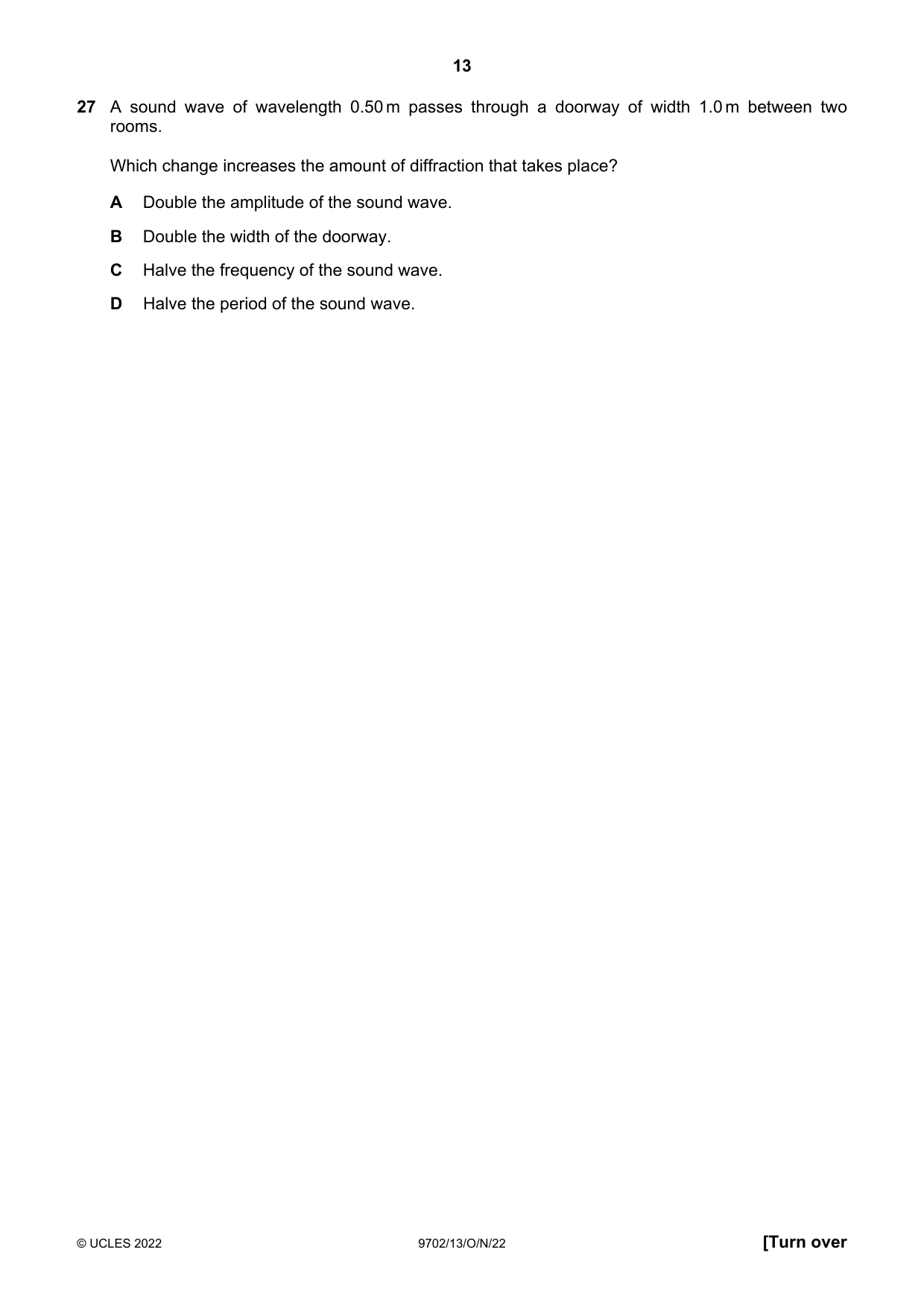
27 A sound wave of wavelength 0.50 m passes through a doorway of width 1.0 m between two rooms. Which change increases the amount of diffraction that takes place? A Double the amplitude of the sound wave. B Double the width of the doorway. C Halve the frequency of the sound wave. D Halve the period of the sound wave.
Mark scheme: C
Q28 · A light source consists of a vertical slit illuminated by red light (R) and violet light…
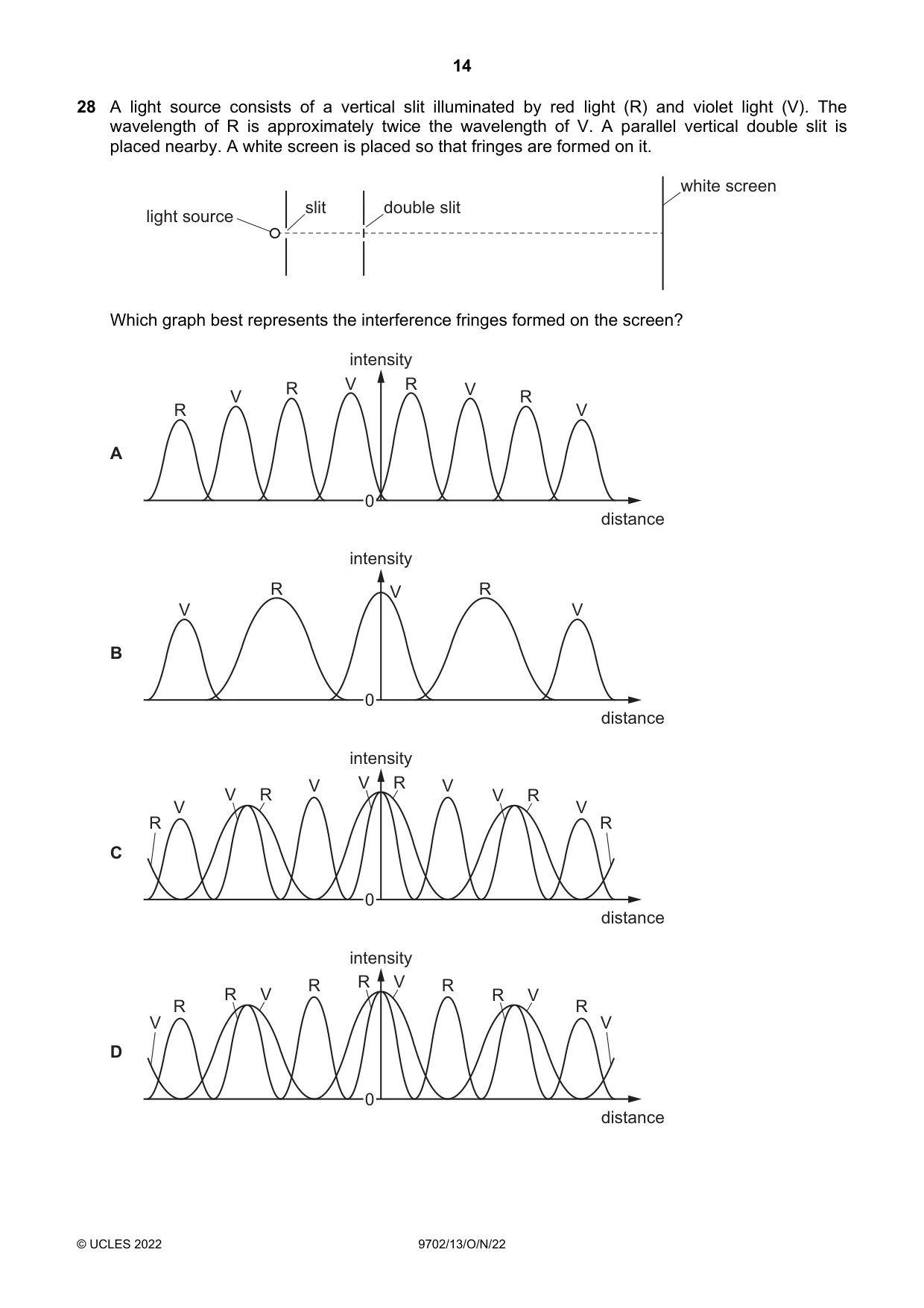
28 A light source consists of a vertical slit illuminated by red light (R) and violet light (V). The wavelength of R is approximately twice the wavelength of V. A parallel vertical double slit is placed nearby. A white screen is placed so that fringes are formed on it. white screen slit double slit light source Which graph best represents the interference fringes formed on the screen? intensity R V R V V R R V A 0 distance intensity R V R V V B 0 distance intensity V V R V V R V R V V R R C 0 distance intensity R R V R R V R V R R V V D 0 distance
Mark scheme: C
Q29 · Which property of a light wave can be determined using a diffraction grating?
29 Which property of a light wave can be determined using a diffraction grating? A amplitude B intensity C speed D wavelength
Mark scheme: D
Q30 · There is an electric current in a copper wire
30 There is an electric current in a copper wire. Which statement describing the average drift speed of the charge carriers in the wire is correct? A It is nearly 3 108 m s–1. B It is proportional to the cross-sectional area of the wire. C It is proportional to the length of the wire. D It is proportional to the magnitude of the current.
Mark scheme: D
Q31 · A battery with a constant internal resistance is connected to a resistor of resistance…
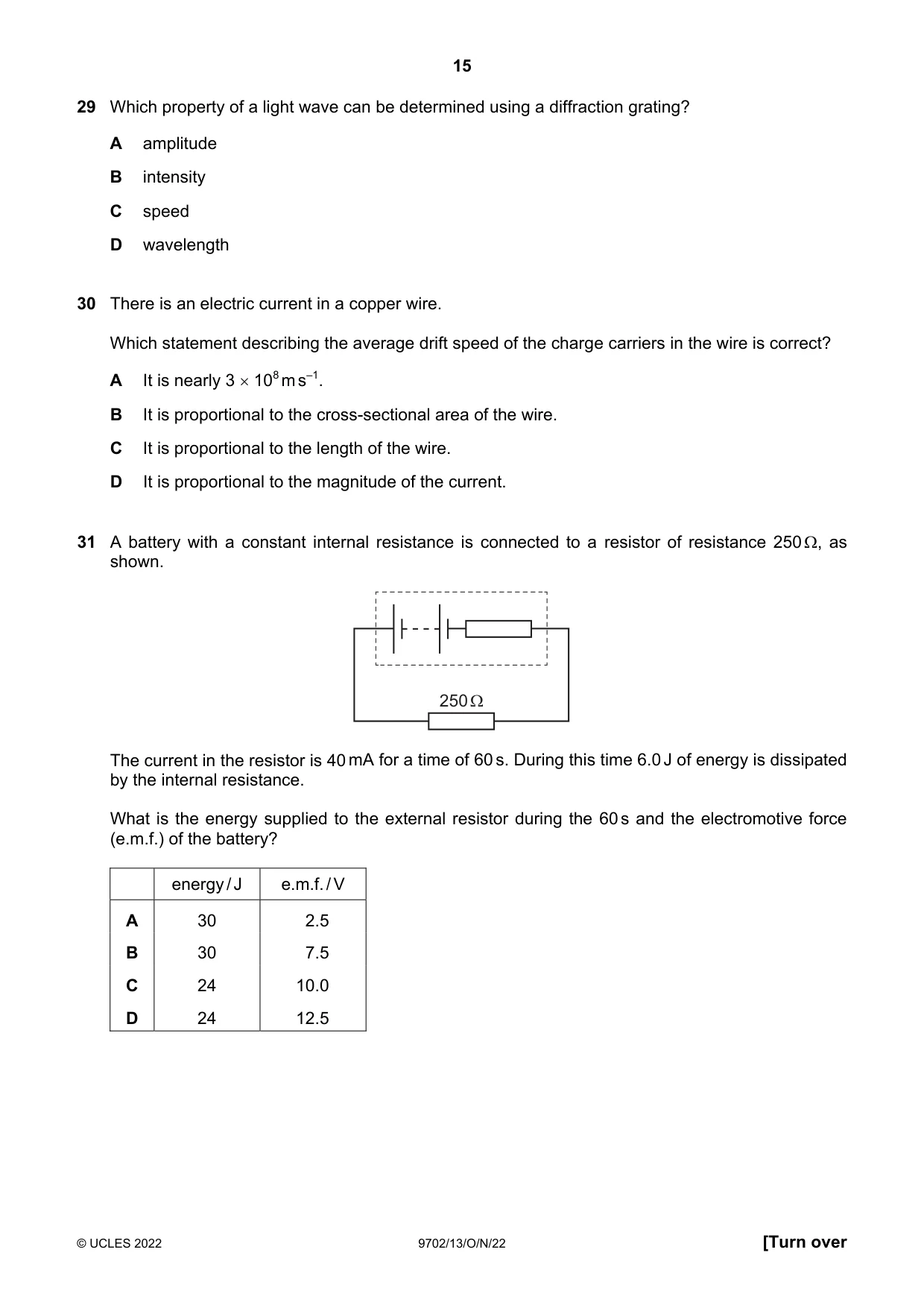
31 A battery with a constant internal resistance is connected to a resistor of resistance 250Q, as shown. The current in the resistor is 40 mA for a time of 60s. During this time 6.0 J of energy is dissipated by the internal resistance. What is the energy supplied to the external resistor during the 60s and the electromotive force (e.m.f.) of the battery? energy/J e.m.f./V
Mark scheme: D
Q32 · Which component has the I–V graph shown?
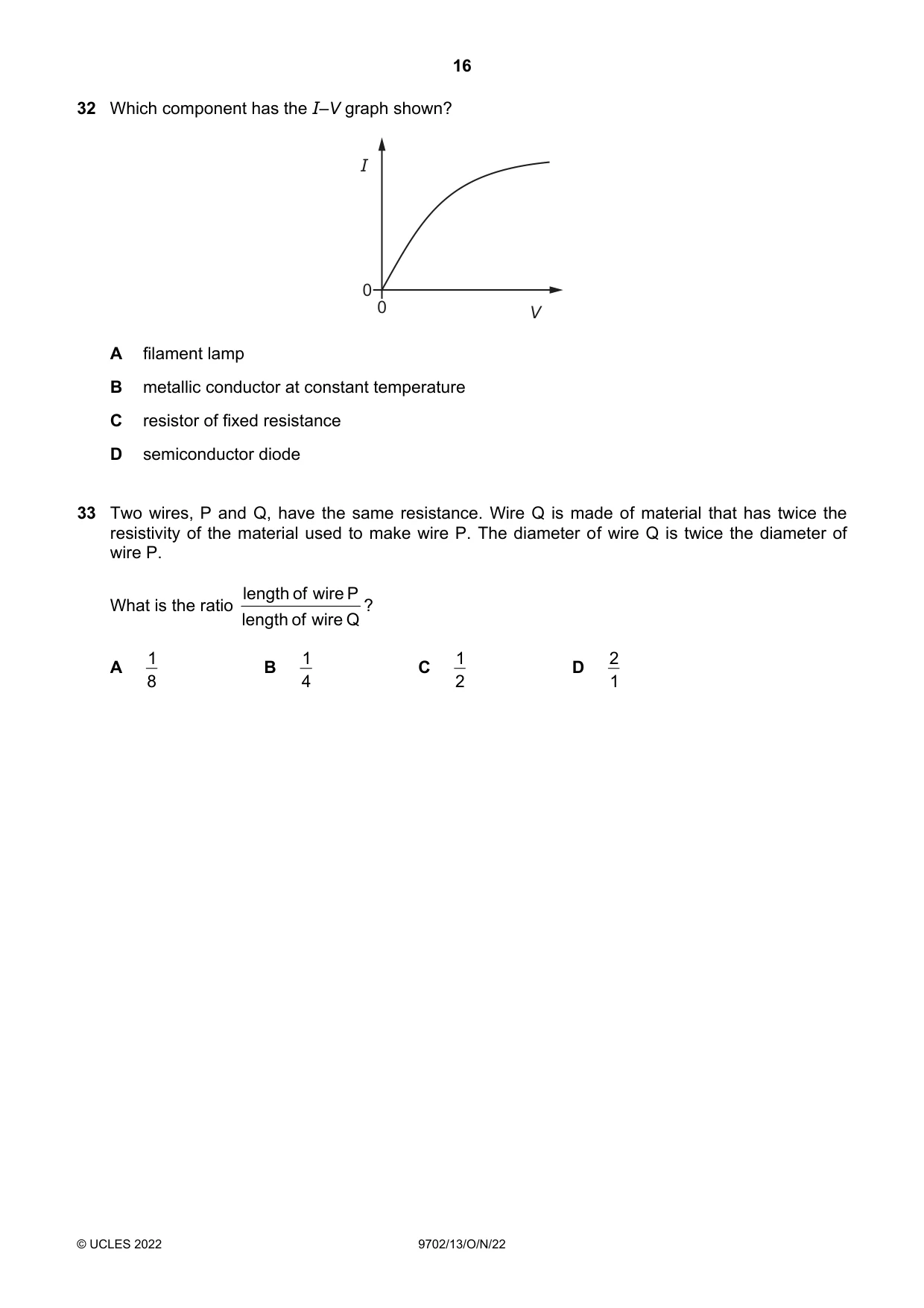
32 Which component has the I–V graph shown? I 0 0 V A filament lamp B metallic conductor at constant temperature C resistor of fixed resistance D semiconductor diode
Mark scheme: A
Q33 · Two wires, P and Q, have the same resistance
33 Two wires, P and Q, have the same resistance. Wire Q is made of material that has twice the resistivity of the material used to make wire P. The diameter of wire Q is twice the diameter of wire P. length of wire P What is the ratio ? length of wire Q 1 1 1 2 A B C D 8 4 2 1
Mark scheme: C
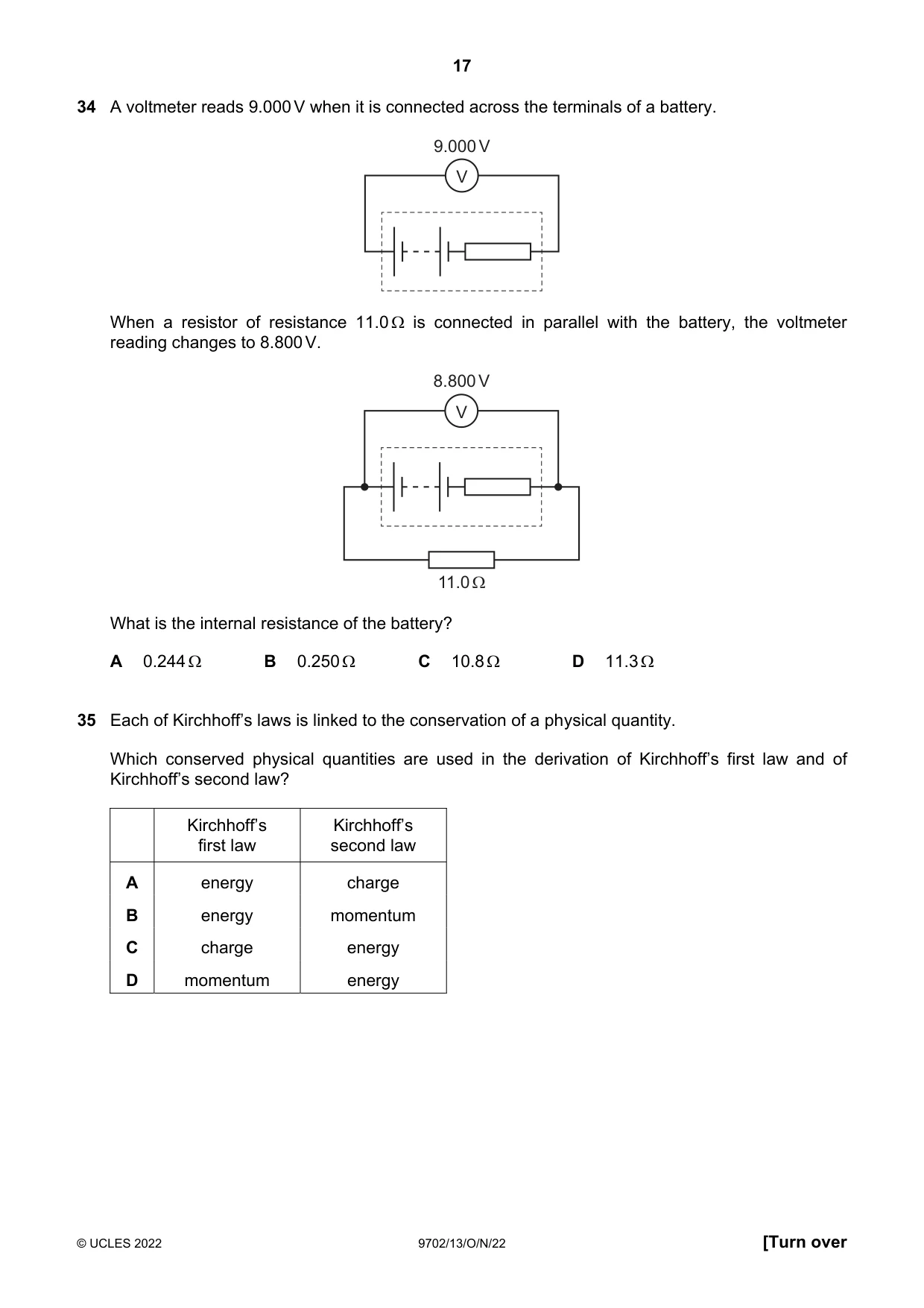
Q34 · A voltmeter reads 9.000V when it is connected across the terminals of a battery
34 A voltmeter reads 9.000V when it is connected across the terminals of a battery. 9.000 V When a resistor of resistance 11.0Q is connected in parallel with the battery, the voltmeter reading changes to 8.800 V. 8.800 V 11.00 What is the internal resistance of the battery? A 0.244Q B 0.2509 C 10.80 D 11.30
Mark scheme: B
Q35 · Each of Kirchhoff’s laws is linked to the conservation of a physical quantity
35 Each of Kirchhoff’s laws is linked to the conservation of a physical quantity. Which conserved physical quantities are used in the derivation of Kirchhoff’s first law and of Kirchhoff’s second law? Kirchhoff’s Kirchhoff’s first law second law A energy charge B energy momentum C charge energy D momentum energy
Mark scheme: C
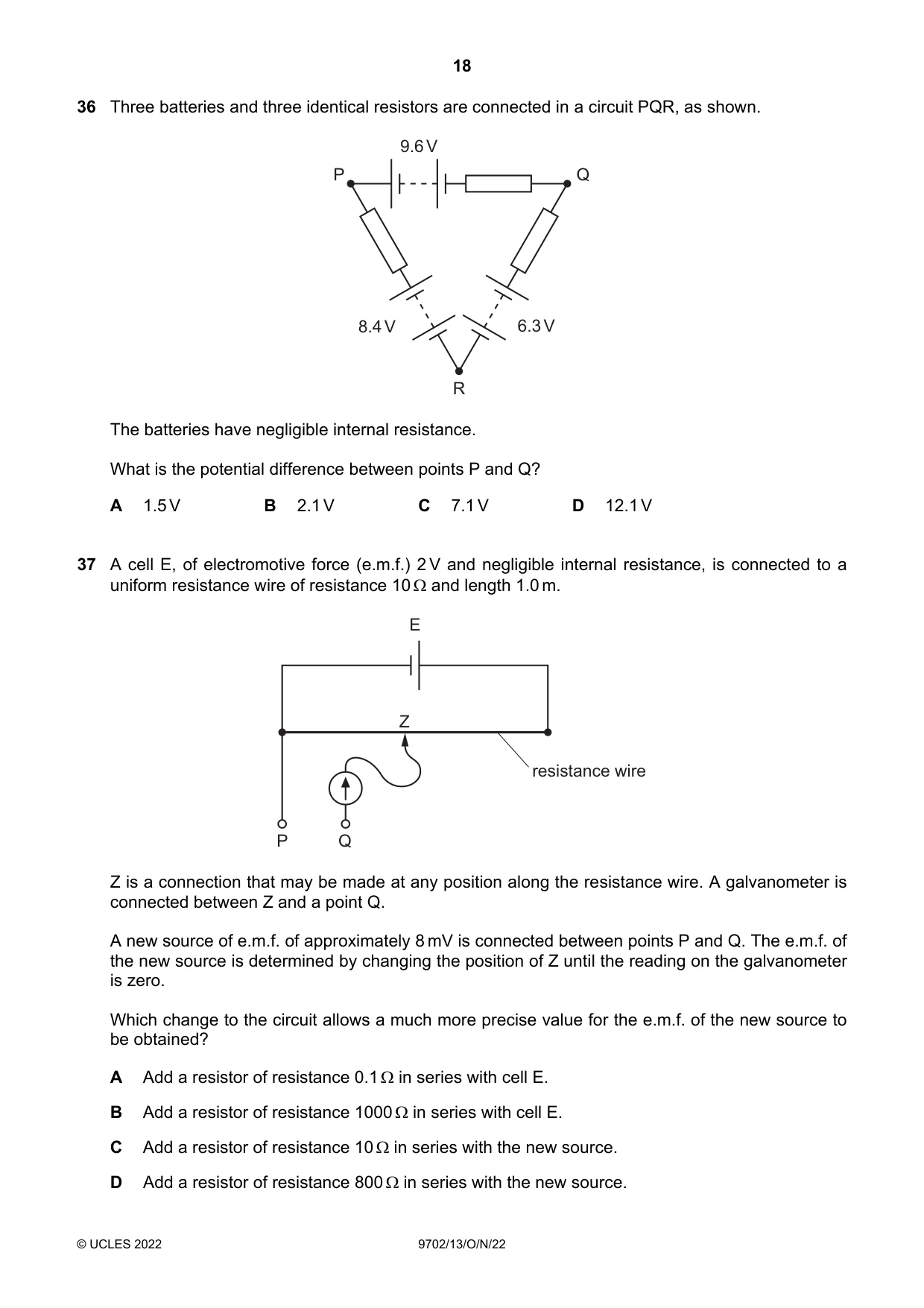
Q36 · Three batteries and three identical resistors are connected in a circuit PQR, as shown
36 Three batteries and three identical resistors are connected in a circuit PQR, as shown. 9.6 V P Q 8.4 V 6.3 V R The batteries have negligible internal resistance. What is the potential difference between points P and Q? A 1.5 V B 2.1 V C 7.1 V D 12.1 V
Mark scheme: C
Q37 · A cell E, of electromotive force (e.m.f.) 2 V and negligible internal resistance, is…
37 A cell E, of electromotive force (e.m.f.) 2 V and negligible internal resistance, is connected to a uniform resistance wire of resistance 10 and length 1.0 m. E Z resistance wire P Q Z is a connection that may be made at any position along the resistance wire. A galvanometer is connected between Z and a point Q. A new source of e.m.f. of approximately 8 mV is connected between points P and Q. The e.m.f. of the new source is determined by changing the position of Z until the reading on the galvanometer is zero. Which change to the circuit allows a much more precise value for the e.m.f. of the new source to be obtained? A Add a resistor of resistance 0.1 in series with cell E. B Add a resistor of resistance 1000 in series with cell E. C Add a resistor of resistance 10 in series with the new source. D Add a resistor of resistance 800 in series with the new source.
Mark scheme: B
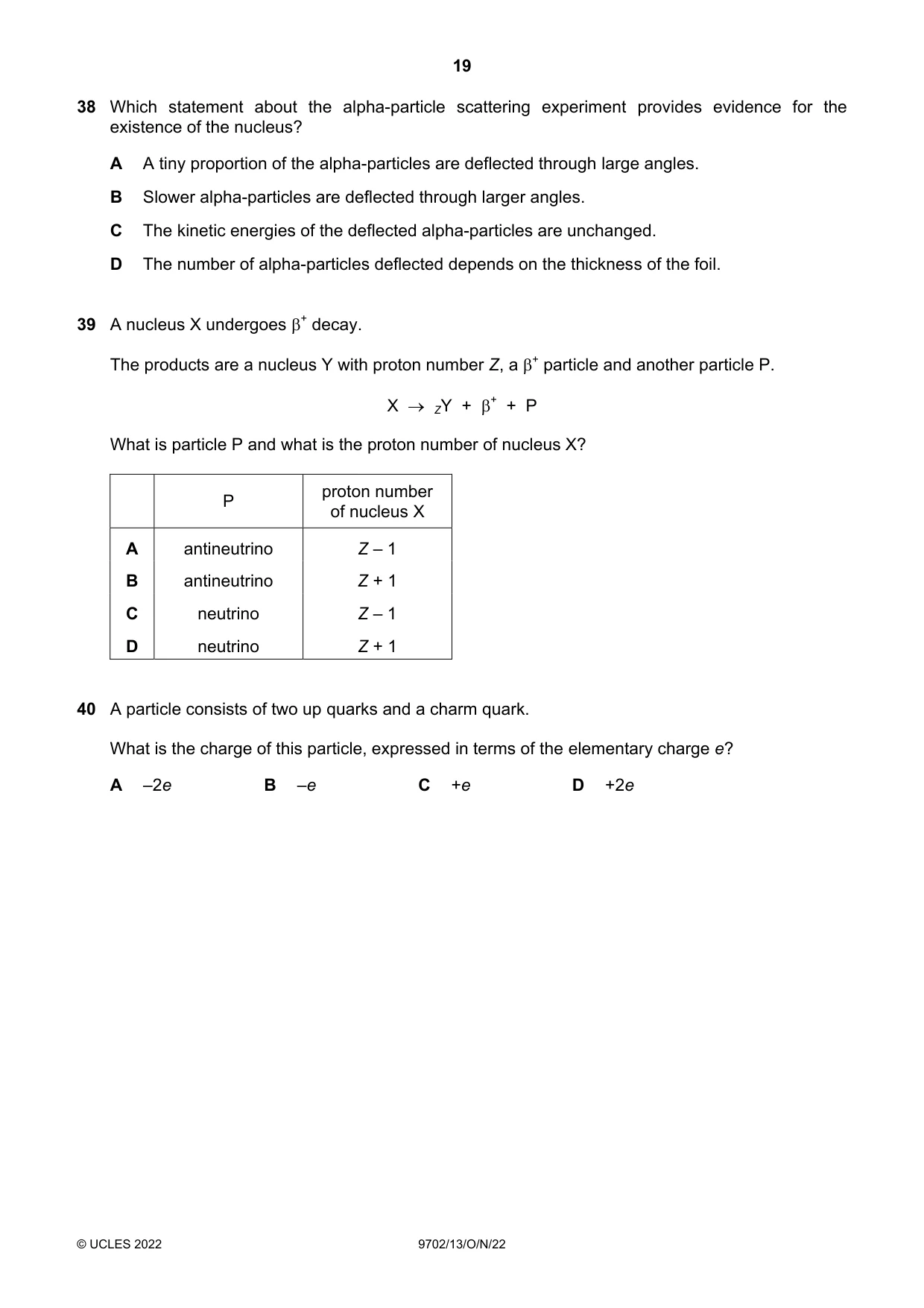
Q38 · Which statement about the alpha-particle scattering experiment provides evidence for the…
38 Which statement about the alpha-particle scattering experiment provides evidence for the existence of the nucleus? A A tiny proportion of the alpha-particles are deflected through large angles. B Slower alpha-particles are deflected through larger angles. C The kinetic energies of the deflected alpha-particles are unchanged. D The number of alpha-particles deflected depends on the thickness of the foil.
Mark scheme: A
Q39 · A nucleus X undergoes + decay
39 A nucleus X undergoes + decay. The products are a nucleus Y with proton number Z, a + particle and another particle P. X ZY + + + P What is particle P and what is the proton number of nucleus X? proton number P of nucleus X A antineutrino Z – 1 B antineutrino Z + 1 C neutrino Z – 1 D neutrino Z + 1
Mark scheme: D
Q40 · A particle consists of two up quarks and a charm quark
40 A particle consists of two up quarks and a charm quark. What is the charge of this particle, expressed in terms of the elementary charge e? A –2e B –e C +e D +2e
Mark scheme: D
What was in this paper
The subtopics covered by these 40 questions, and how many questions each got. Open one in a new tab to see every Cambridge question on it.
3Density and pressure2Electromagnetic spectrum2Equations of motion2Fundamental particles2Kirchhoff’s laws2Linear momentum and its conservation2Potential difference and power2Resistance and resistivity2Stationary waves2Atoms, nuclei and radiation1Diffraction1Doppler effect for sound waves1Electric current1Energy conservation1Energy stored in a capacitor1Equilibrium of forces1Errors and uncertainties1Gravitational potential1Gravitational potential energy and kinetic energy1Interference1Non-uniform motion1Potential dividers1Practical circuits1Progressive waves1Scalars and vectors1SI units1Stress and strain1The diffraction grating1What you needed in this session
Cambridge’s own grade thresholds for 2022 Oct/Nov, Paper 1 · Variant 3. A higher threshold means an easier paper — the bar moves with how the cohort did.