Cambridge A Level Physics 9702 — 2004 Oct/Nov Paper 1 · Variant 1
9702/11/O/N/04 · 40 questions · 40 marks · ≈45 min
The question paper and its mark scheme, free to read here and free to download. This is Cambridge’s own paper, exactly as it was sat.
Question paper20 pages
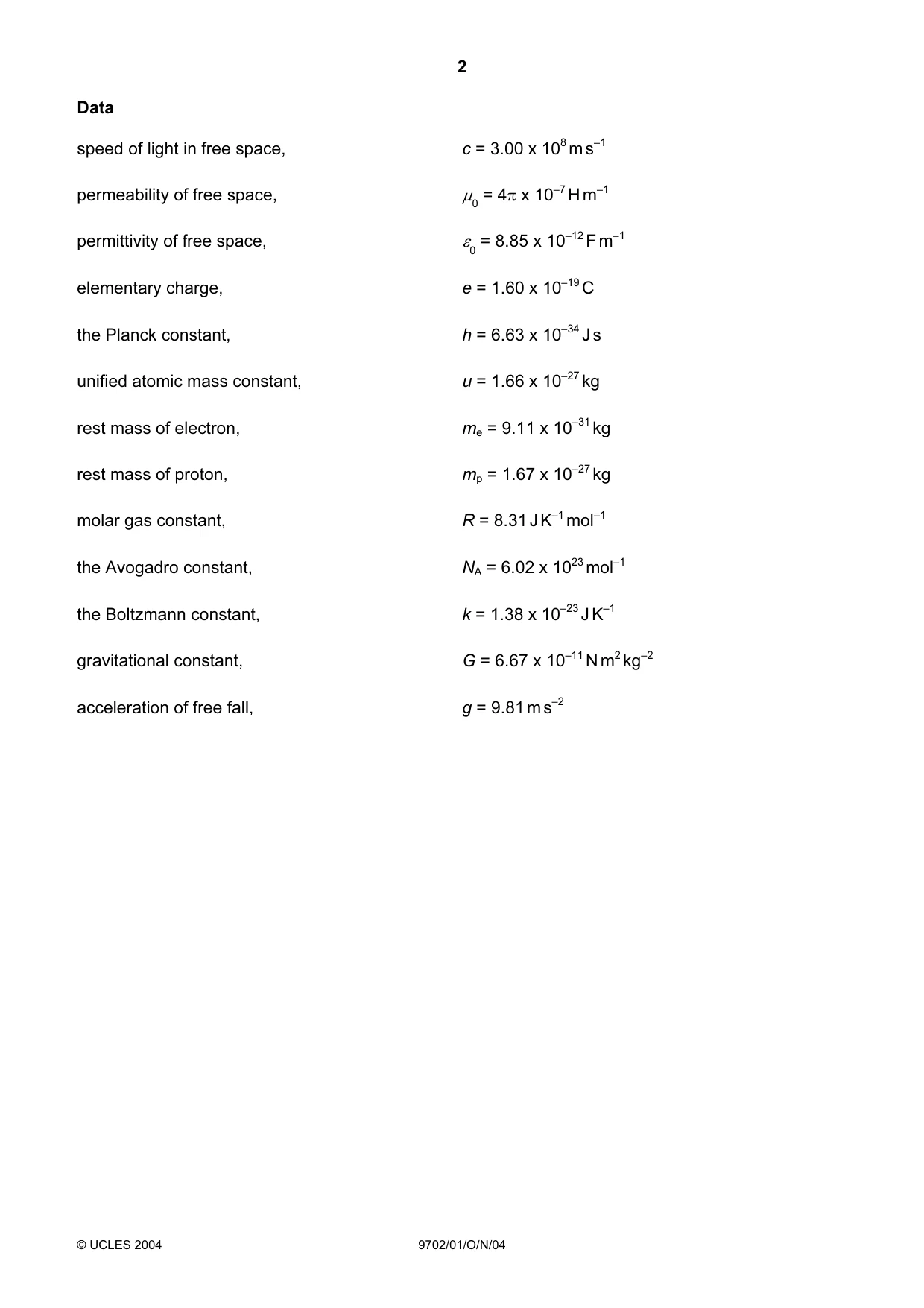
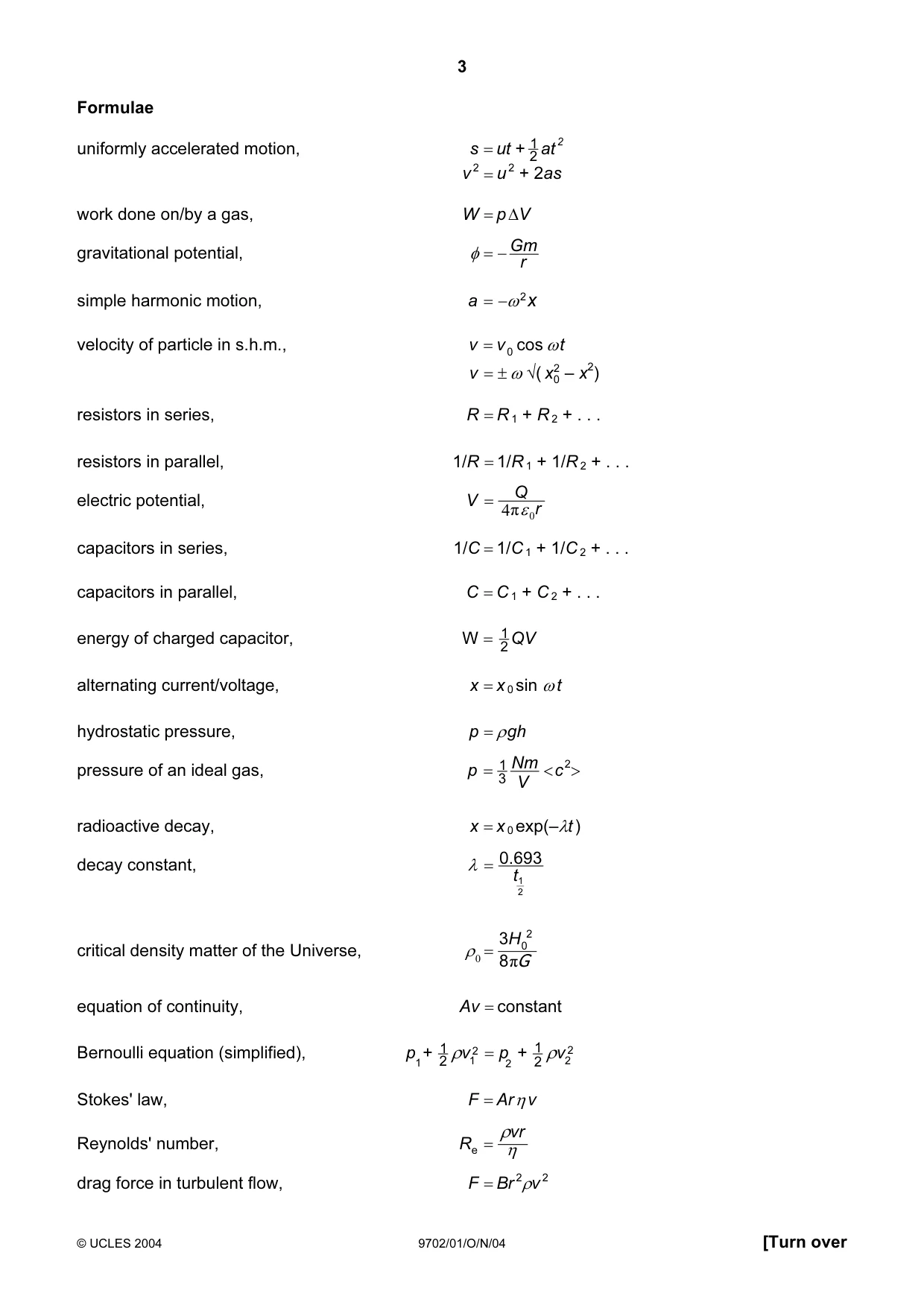


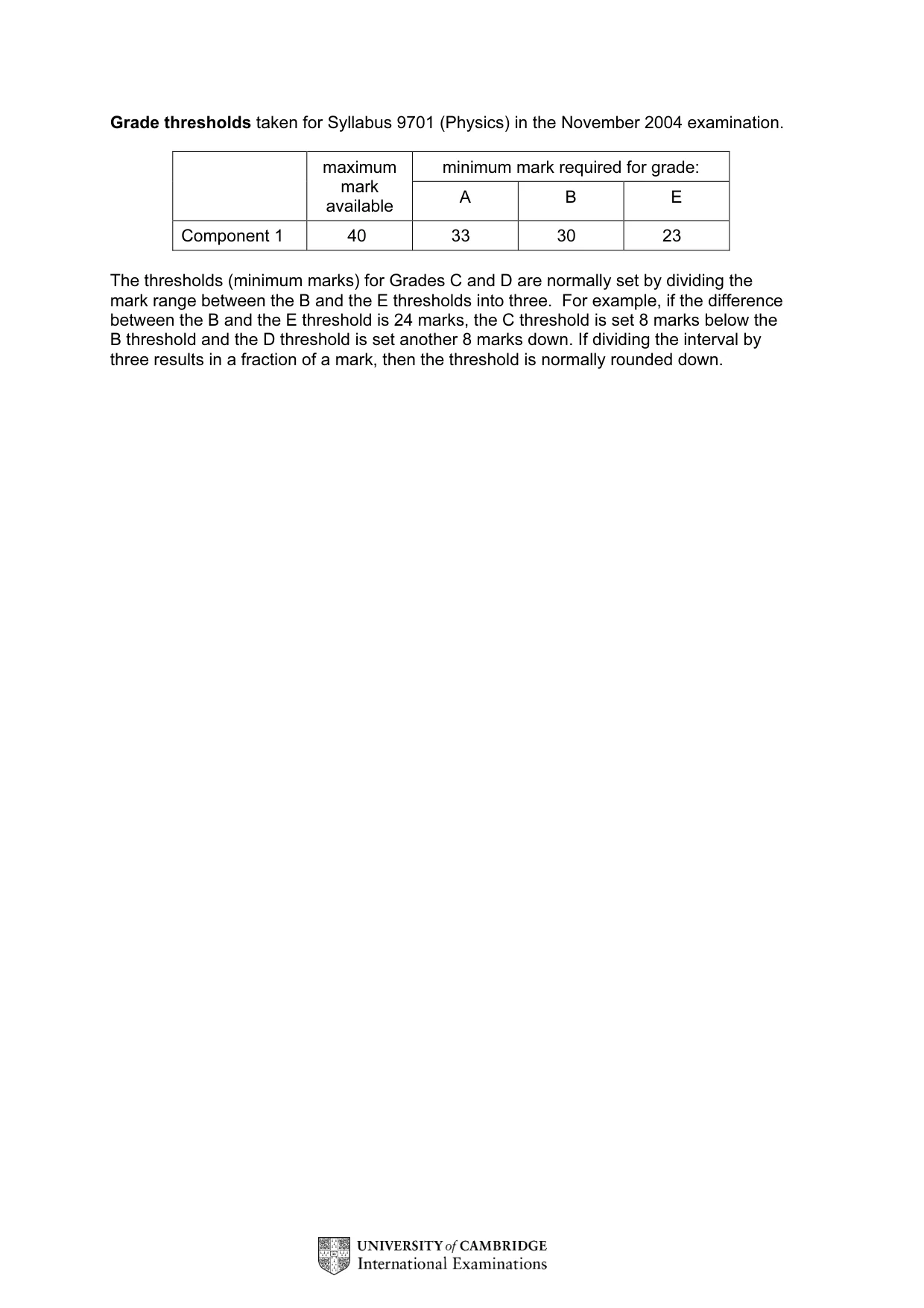
Mark scheme4 pages
Answers below. Sit the paper first if you are practising.
Questions as text
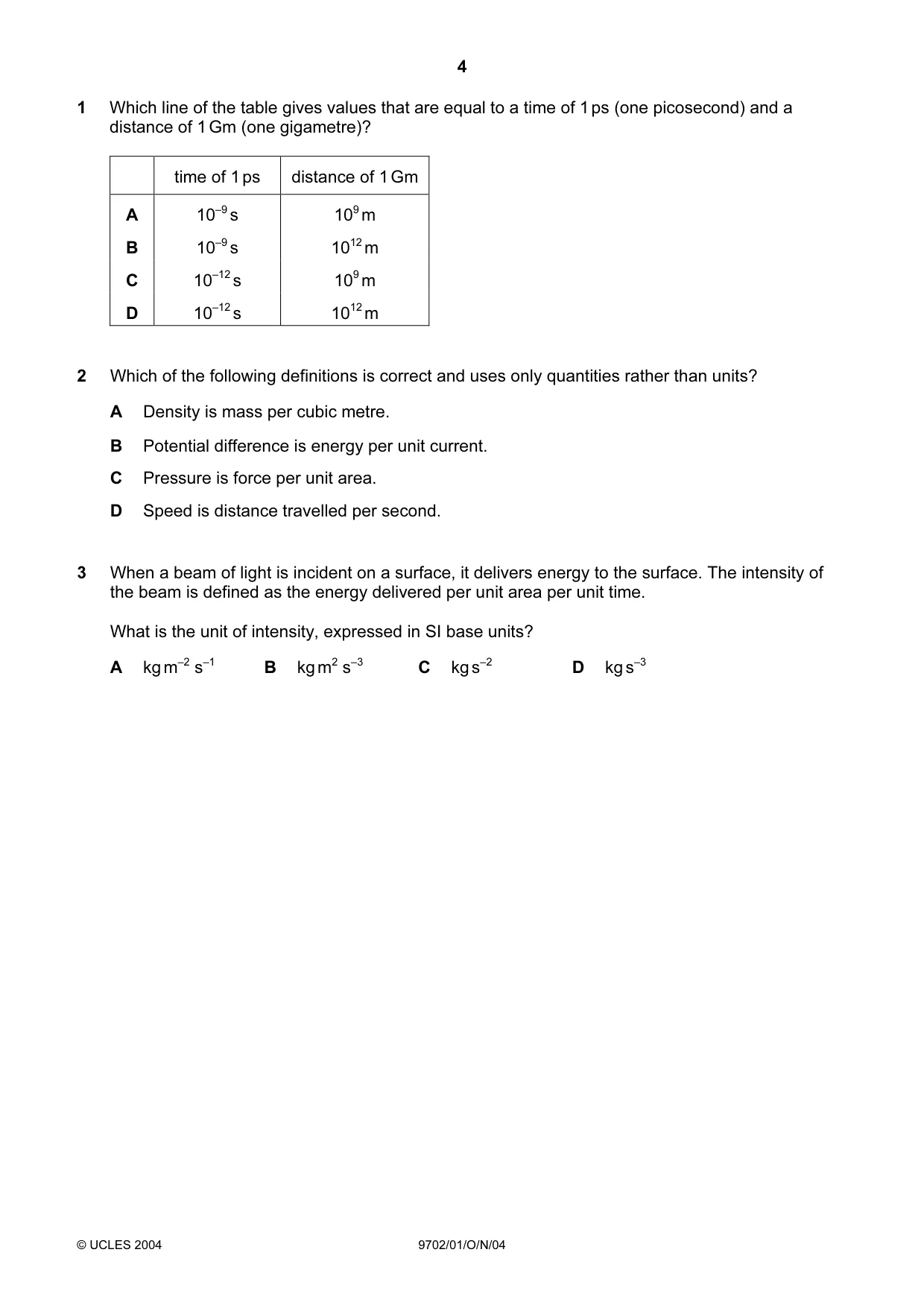
Q1 · Which line of the table gives values that are equal to a time of 1 ps (one picosecond)…
1 Which line of the table gives values that are equal to a time of 1 ps (one picosecond) and a distance of 1 Gm (one gigametre)? time of 1 ps distance of 1 Gm A 10–9 s 109 m B 10–9 s 1012 m C 10–12 s 109 m D 10–12 s 1012 m
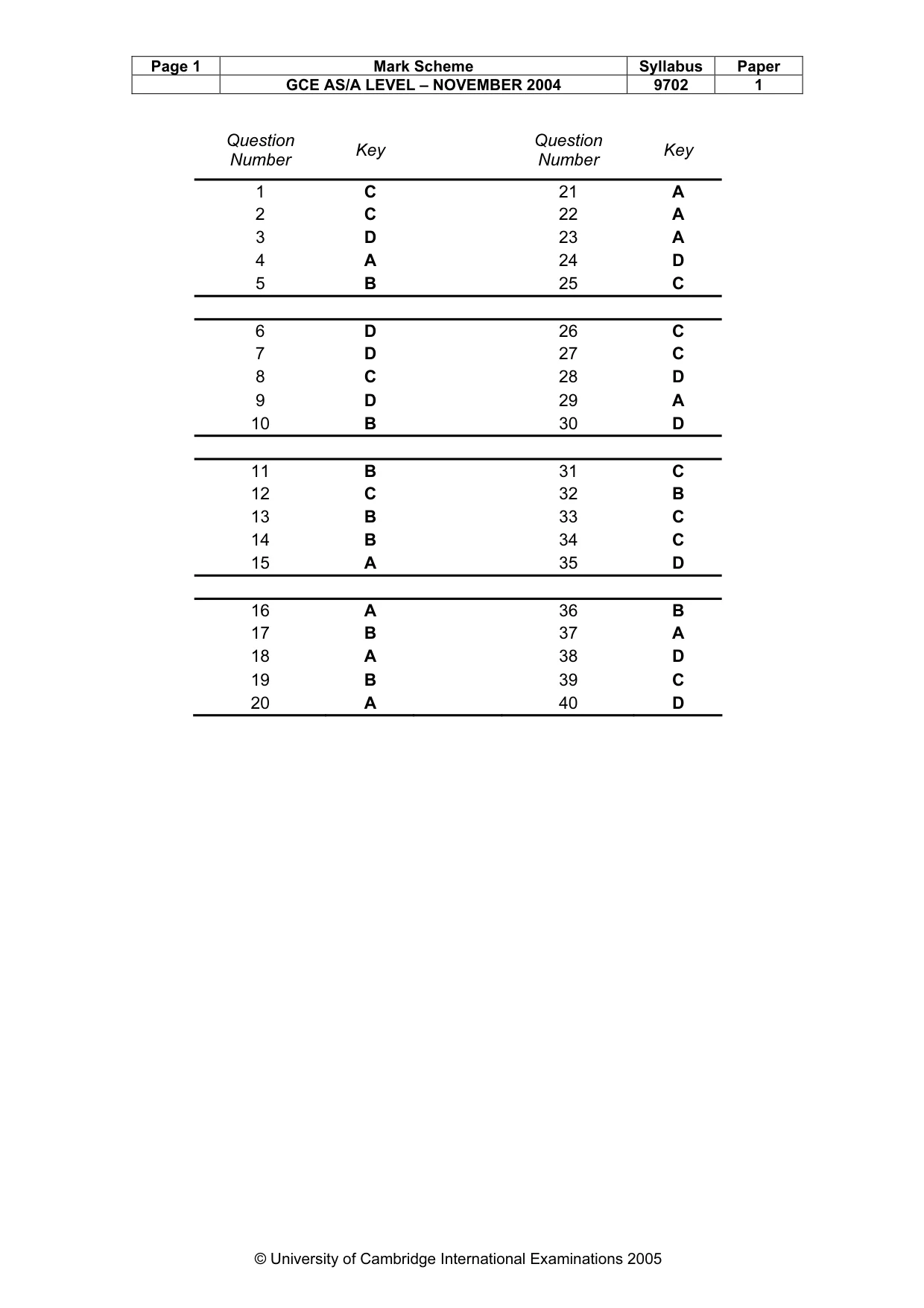
Mark scheme: C
Q2 · Which of the following definitions is correct and uses only quantities rather than units?
2 Which of the following definitions is correct and uses only quantities rather than units? A Density is mass per cubic metre. B Potential difference is energy per unit current. C Pressure is force per unit area. D Speed is distance travelled per second.
Mark scheme: C
Q3 · When a beam of light is incident on a surface, it delivers energy to the surface
3 When a beam of light is incident on a surface, it delivers energy to the surface. The intensity of the beam is defined as the energy delivered per unit area per unit time. What is the unit of intensity, expressed in SI base units? A kg m–2 s–1 B kg m2 s–3 C kg s–2 D kg s–3
Mark scheme: D
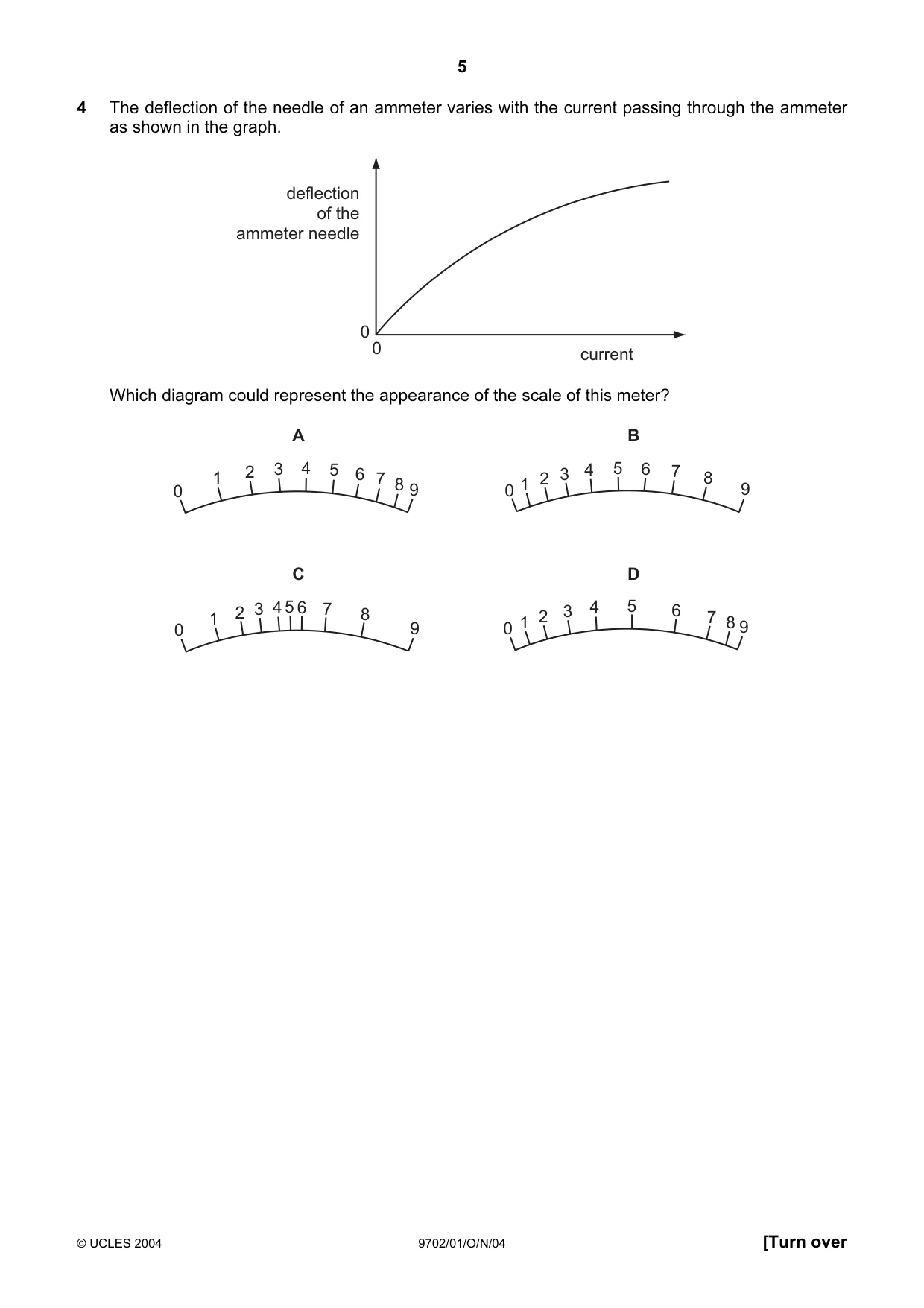
Q4 · The deflection of the needle of an ammeter varies with the current passing through the…
4 The deflection of the needle of an ammeter varies with the current passing through the ammeter as shown in the graph. deflection of the ammeter needle 0 0 current Which diagram could represent the appearance of the scale of this meter? A B 2 3 4 5 6 7 8 9 0 1 2 3 4 5 6 7 1 8 0 9 C D 2 3 45 6 7 3 4 5 6 1 8 0 1 2 7 8 9 0 9
Mark scheme: A
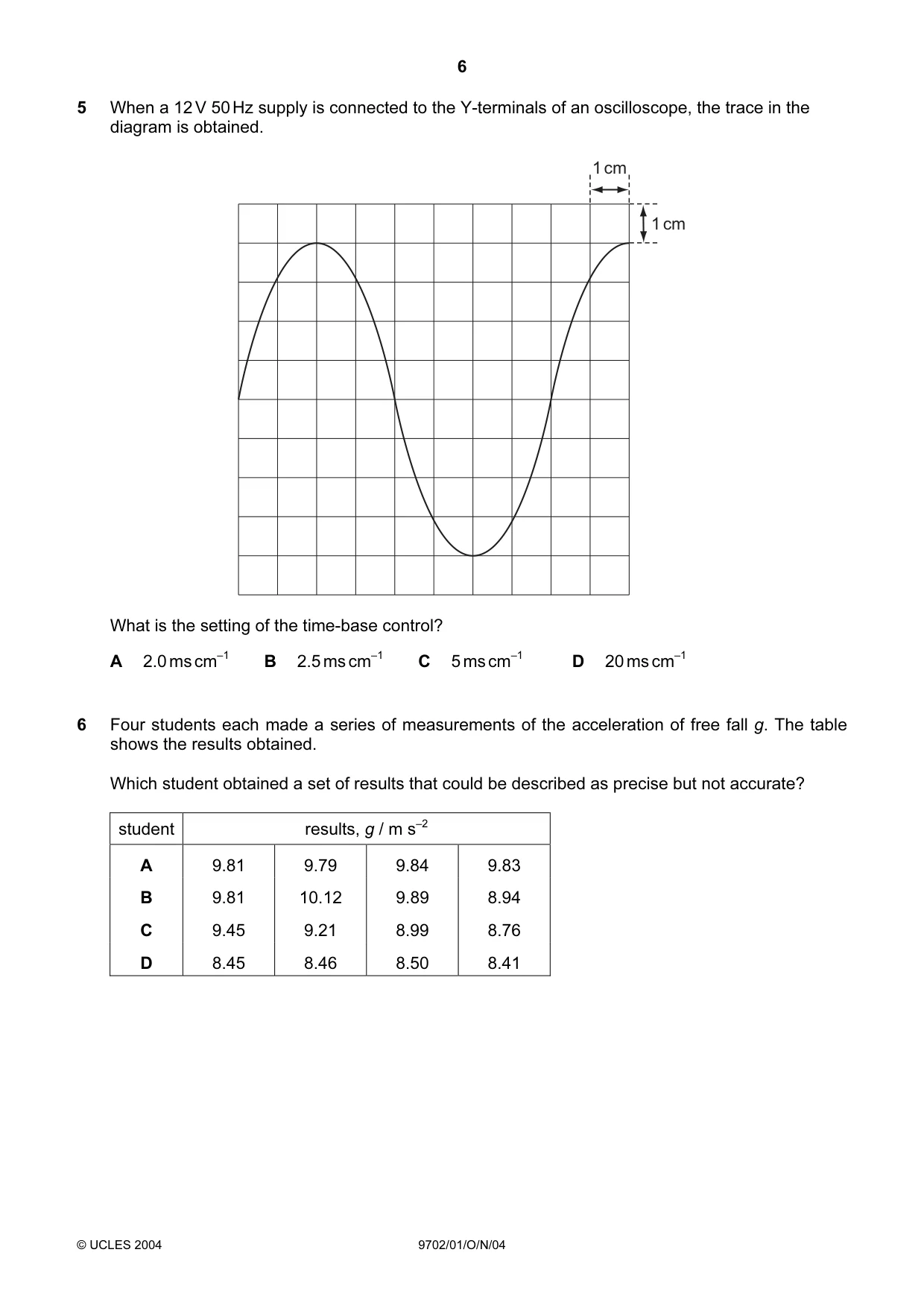
Q5 · When a 12 V 50 Hz supply is connected to the Y-terminals of an oscilloscope, the trace in…
5 When a 12 V 50 Hz supply is connected to the Y-terminals of an oscilloscope, the trace in the diagram is obtained. 1 cm 1 cm What is the setting of the time-base control? A 2.0 ms cm–1 B 2.5 ms cm–1 C 5 ms cm–1 D 20 ms cm–1
Mark scheme: B
Q6 · Four students each made a series of measurements of the acceleration of free fall g
6 Four students each made a series of measurements of the acceleration of free fall g. The table shows the results obtained. Which student obtained a set of results that could be described as precise but not accurate? student results, g / m s–2 A 9.81 9.79 9.84 9.83 B 9.81 10.12 9.89 8.94 C 9.45 9.21 8.99 8.76 D 8.45 8.46 8.50 8.41
Mark scheme: D
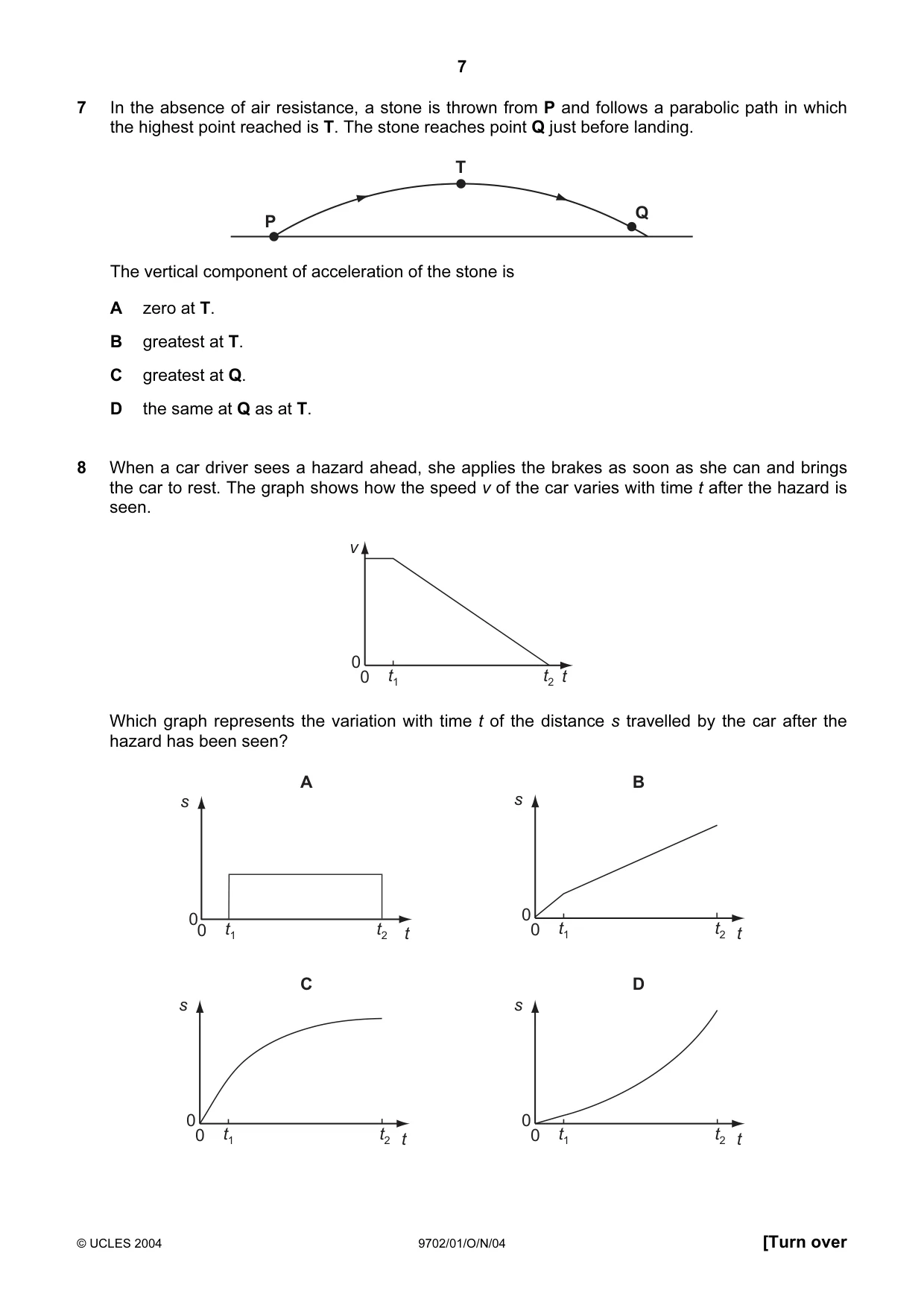
Q7 · In the absence of air resistance, a stone is thrown from P and follows a parabolic path…
7 In the absence of air resistance, a stone is thrown from P and follows a parabolic path in which the highest point reached is T. The stone reaches point Q just before landing. T Q P The vertical component of acceleration of the stone is A zero at T. B greatest at T. C greatest at Q. D the same at Q as at T.
Mark scheme: D
Q8 · When a car driver sees a hazard ahead, she applies the brakes as soon as she can and…
8 When a car driver sees a hazard ahead, she applies the brakes as soon as she can and brings the car to rest. The graph shows how the speed v of the car varies with time t after the hazard is seen. v 0 0 t1 t2 t Which graph represents the variation with time t of the distance s travelled by the car after the hazard has been seen? A B s s 0 0 0 t1 t2 t 0 t1 t2 t C D s s 0 0 0 t1 t2 t 0 t1 t2 t
Mark scheme: C
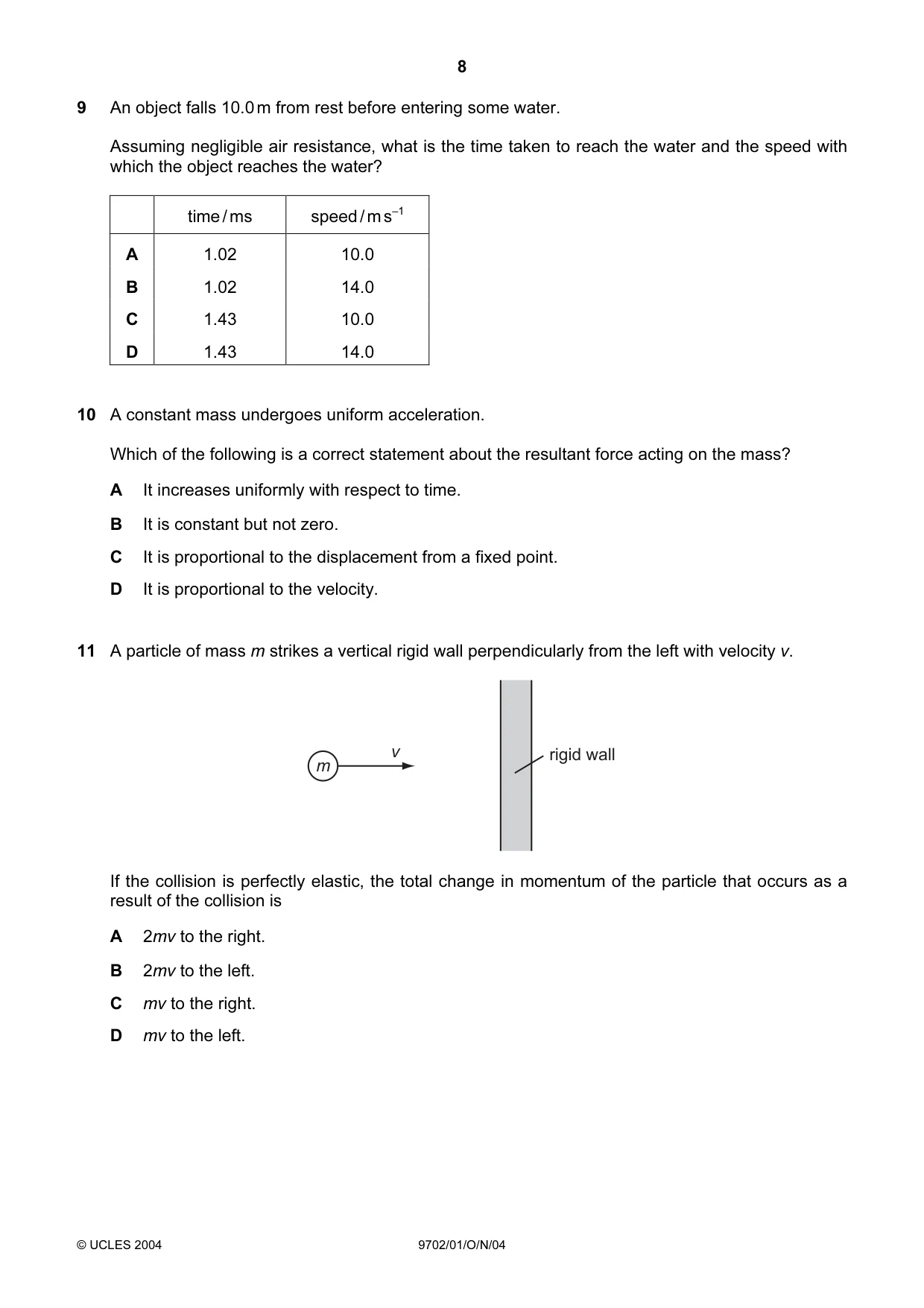
Q9 · An object falls 10.0 m from rest before entering some water
9 An object falls 10.0 m from rest before entering some water. Assuming negligible air resistance, what is the time taken to reach the water and the speed with which the object reaches the water? time / ms speed / m s–1 A 1.02 10.0 B 1.02 14.0 C 1.43 10.0 D 1.43 14.0
Mark scheme: D
Q10 · A constant mass undergoes uniform acceleration
10 A constant mass undergoes uniform acceleration. Which of the following is a correct statement about the resultant force acting on the mass? A It increases uniformly with respect to time. B It is constant but not zero. C It is proportional to the displacement from a fixed point. D It is proportional to the velocity.
Mark scheme: B
Q11 · A particle of mass m strikes a vertical rigid wall perpendicularly from the left with…
11 A particle of mass m strikes a vertical rigid wall perpendicularly from the left with velocity v. v rigid wall m If the collision is perfectly elastic, the total change in momentum of the particle that occurs as a result of the collision is A 2mv to the right. B 2mv to the left. C mv to the right. D mv to the left.
Mark scheme: B
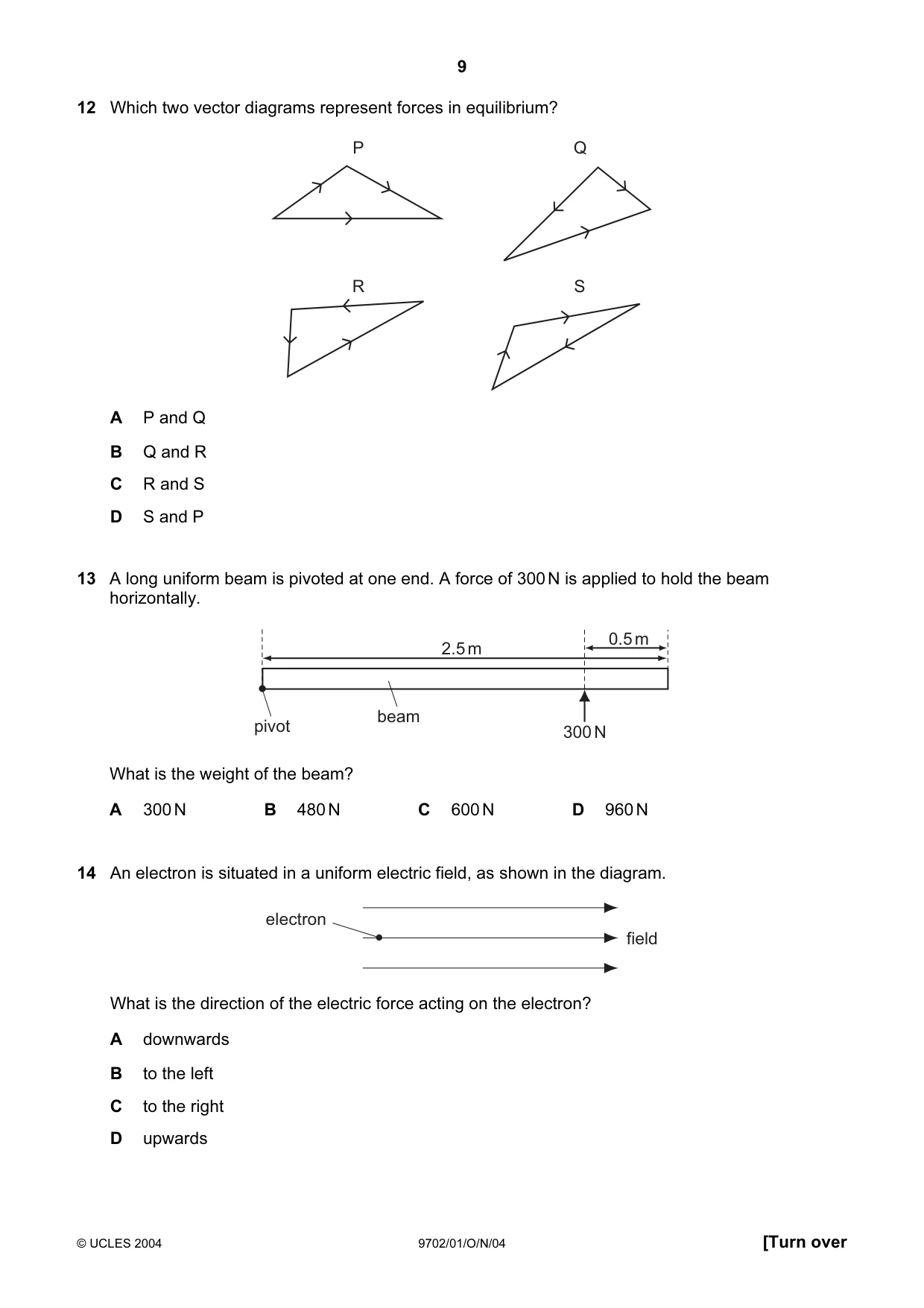
Q12 · Which two vector diagrams represent forces in equilibrium?
12 Which two vector diagrams represent forces in equilibrium? P Q R S A P and Q B Q and R C R and S D S and P
Mark scheme: C
Q13 · A long uniform beam is pivoted at one end
13 A long uniform beam is pivoted at one end. A force of 300 N is applied to hold the beam horizontally. 0.5 m 2.5 m beam pivot 300 N What is the weight of the beam? A 300 N B 480 N C 600 N D 960 N
Mark scheme: B
Q14 · An electron is situated in a uniform electric field, as shown in the diagram
14 An electron is situated in a uniform electric field, as shown in the diagram. electron field What is the direction of the electric force acting on the electron? A downwards B to the left C to the right D upwards
Mark scheme: B
Q15 · The kinetic energy of a particle is increased by a factor of 4
15 The kinetic energy of a particle is increased by a factor of 4. By what factor does its speed increase? A 2 B 4 C 8 D 16
Mark scheme: A
More questions on Gravitational potential energy and kinetic energy
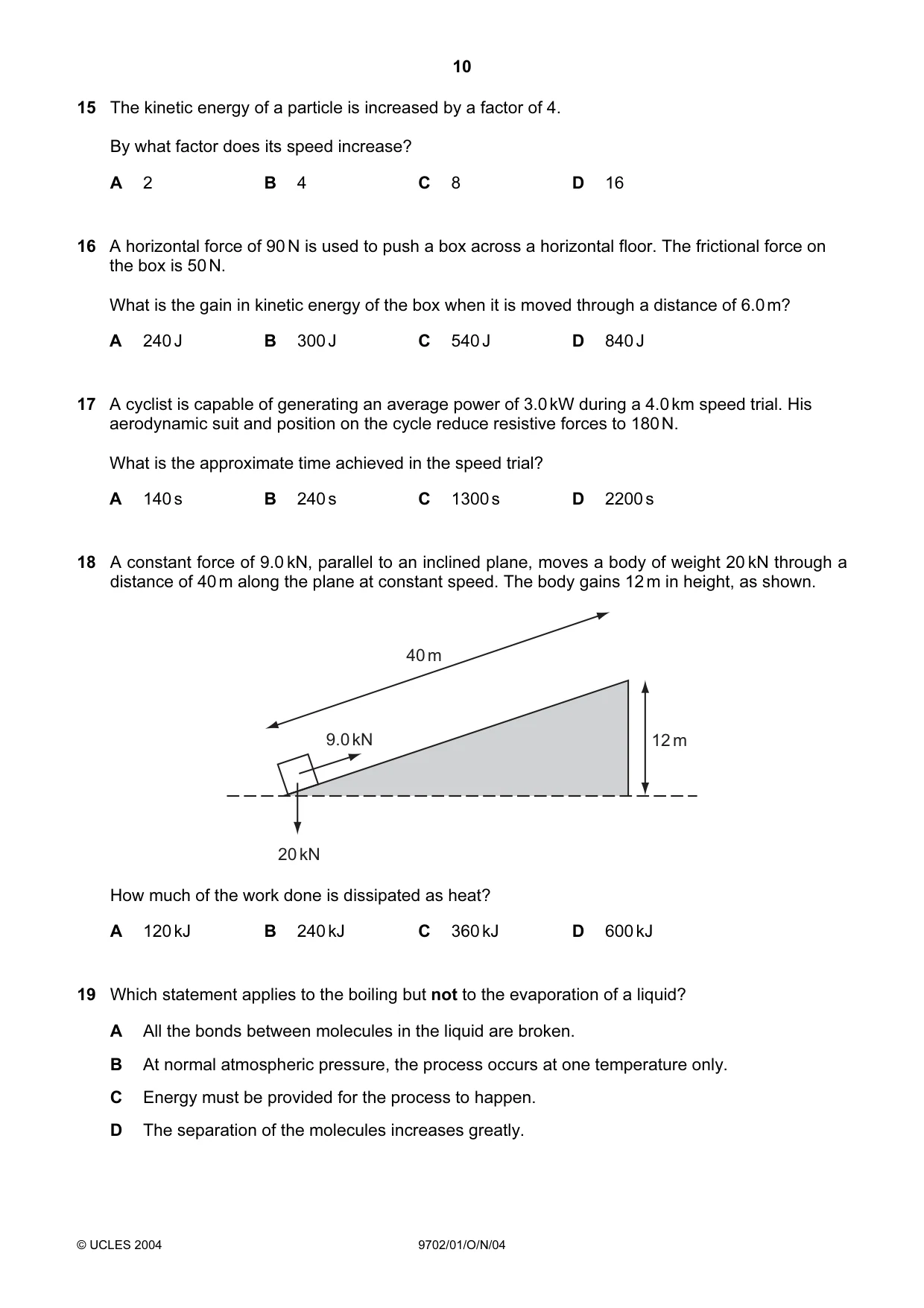
Q16 · A horizontal force of 90 N is used to push a box across a horizontal floor
16 A horizontal force of 90 N is used to push a box across a horizontal floor. The frictional force on the box is 50 N. What is the gain in kinetic energy of the box when it is moved through a distance of 6.0 m? A 240 J B 300 J C 540 J D 840 J
Mark scheme: A
Q17 · A cyclist is capable of generating an average power of 3.0 kW during a 4.0 km speed trial
17 A cyclist is capable of generating an average power of 3.0 kW during a 4.0 km speed trial. His aerodynamic suit and position on the cycle reduce resistive forces to 180 N. What is the approximate time achieved in the speed trial? A 140 s B 240 s C 1300 s D 2200 s
Mark scheme: B
Q18 · A constant force of 9.0 kN, parallel to an inclined plane, moves a body of weight 20 kN…
18 A constant force of 9.0 kN, parallel to an inclined plane, moves a body of weight 20 kN through a distance of 40 m along the plane at constant speed. The body gains 12 m in height, as shown. 40 m 9.0 kN 12 m 20 kN How much of the work done is dissipated as heat? A 120 kJ B 240 kJ C 360 kJ D 600 kJ
Mark scheme: A
Q19 · Which statement applies to the boiling but not to the evaporation of a liquid?
19 Which statement applies to the boiling but not to the evaporation of a liquid? A All the bonds between molecules in the liquid are broken. B At normal atmospheric pressure, the process occurs at one temperature only. C Energy must be provided for the process to happen. D The separation of the molecules increases greatly.
Mark scheme: B
More questions on Specific heat capacity and specific latent heat
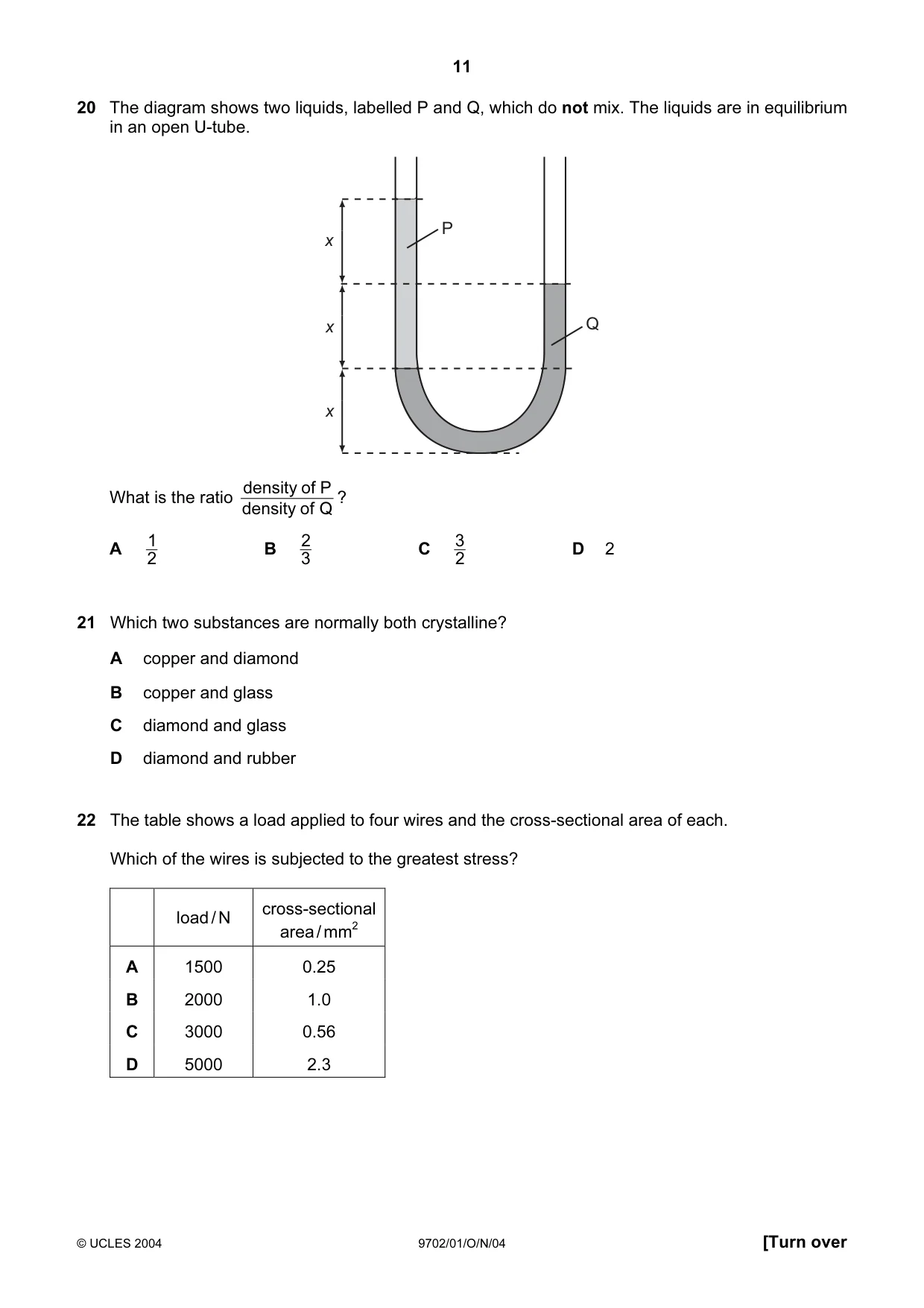
Q20 · The diagram shows two liquids, labelled P and Q, which do not mix
20 The diagram shows two liquids, labelled P and Q, which do not mix. The liquids are in equilibrium in an open U-tube. P x x Q x density of P What is the ratio density of Q ? 1 2 3 A B C D 2 2 3 2
Mark scheme: A
Q21 · Which two substances are normally both crystalline?
21 Which two substances are normally both crystalline? A copper and diamond B copper and glass C diamond and glass D diamond and rubber
Mark scheme: A
Q22 · The table shows a load applied to four wires and the cross-sectional area of each
22 The table shows a load applied to four wires and the cross-sectional area of each. Which of the wires is subjected to the greatest stress? cross-sectional load / N area / mm2 A 1500 0.25 B 2000 1.0 C 3000 0.56 D 5000 2.3
Mark scheme: A
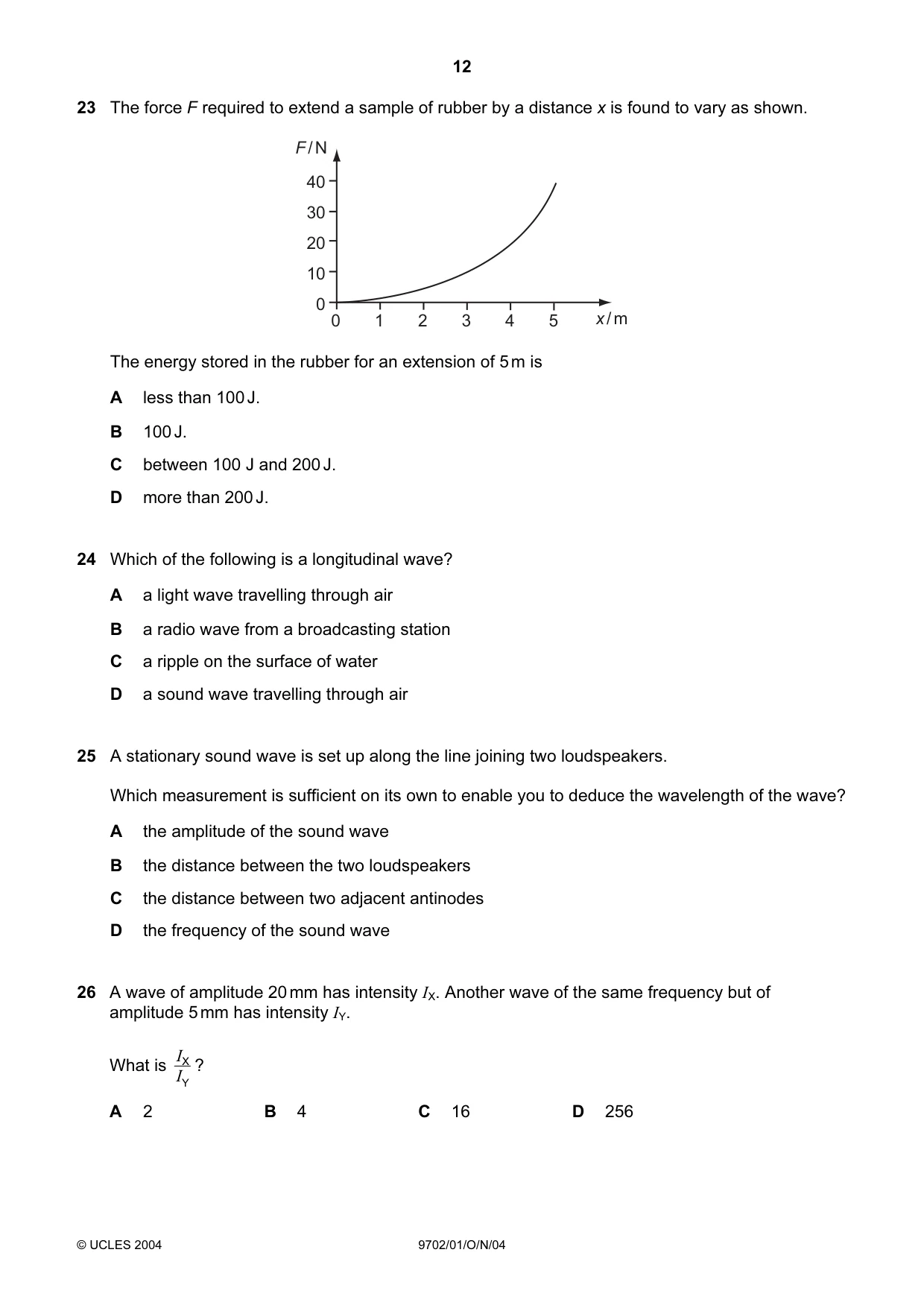
Q23 · The force F required to extend a sample of rubber by a distance x is found to vary as…
23 The force F required to extend a sample of rubber by a distance x is found to vary as shown. F / N 40 30 20 10 0 0 1 2 3 4 5 x / m The energy stored in the rubber for an extension of 5 m is A less than 100 J. B 100 J. C between 100 J and 200 J. D more than 200 J.
Mark scheme: A
Q24 · Which of the following is a longitudinal wave?
24 Which of the following is a longitudinal wave? A a light wave travelling through air B a radio wave from a broadcasting station C a ripple on the surface of water D a sound wave travelling through air
Mark scheme: D
Q25 · A stationary sound wave is set up along the line joining two loudspeakers
25 A stationary sound wave is set up along the line joining two loudspeakers. Which measurement is sufficient on its own to enable you to deduce the wavelength of the wave? A the amplitude of the sound wave B the distance between the two loudspeakers C the distance between two adjacent antinodes D the frequency of the sound wave
Mark scheme: C
Q26 · A wave of amplitude 20 mm has intensity IX
26 A wave of amplitude 20 mm has intensity IX. Another wave of the same frequency but of amplitude 5 mm has intensity IY. I ? What is X I Y A 2 B 4 C 16 D 256
Mark scheme: C
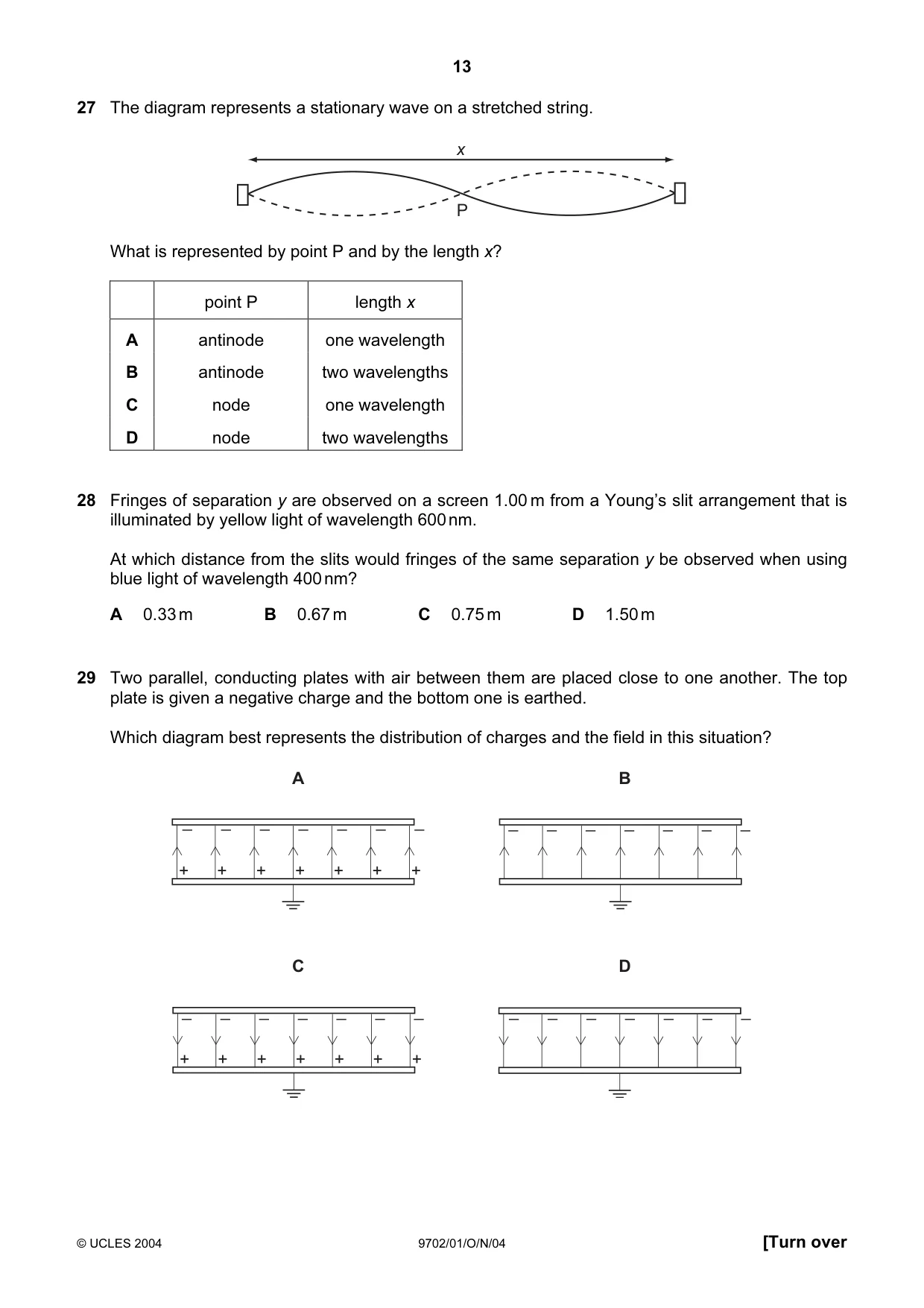
Q27 · The diagram represents a stationary wave on a stretched string
27 The diagram represents a stationary wave on a stretched string. x P What is represented by point P and by the length x? point P length x A antinode one wavelength B antinode two wavelengths C node one wavelength D node two wavelengths
Mark scheme: C
Q28 · Fringes of separation y are observed on a screen 1.00 m from a Young’s slit arrangement…
28 Fringes of separation y are observed on a screen 1.00 m from a Young’s slit arrangement that is illuminated by yellow light of wavelength 600 nm. At which distance from the slits would fringes of the same separation y be observed when using blue light of wavelength 400 nm? A 0.33 m B 0.67 m C 0.75 m D 1.50 m
Mark scheme: D
Q29 · Two parallel, conducting plates with air between them are placed close to one another
29 Two parallel, conducting plates with air between them are placed close to one another. The top plate is given a negative charge and the bottom one is earthed. Which diagram best represents the distribution of charges and the field in this situation? A B _ _ _ _ _ _ _ _ _ _ _ _ _ _ + + + + + + + C D _ _ _ _ _ _ _ _ _ _ _ _ _ _ + + + + + + +
Mark scheme: A
Q30 · In a uniform electric field, which statement is correct?
30 In a uniform electric field, which statement is correct? A All charged particles experience the same force. B All charged particles move with the same velocity. C All electric field lines are directed towards positive charges. D All electric field lines are parallel.
Mark scheme: D
Q31 · Which of the following describes the electric potential difference between two points in…
31 Which of the following describes the electric potential difference between two points in a wire that carries a current? A the force required to move a unit positive charge between the points B the ratio of the energy dissipated between the points to the current C the ratio of the power dissipated between the points to the current D the ratio of the power dissipated between the points to the charge moved
Mark scheme: C
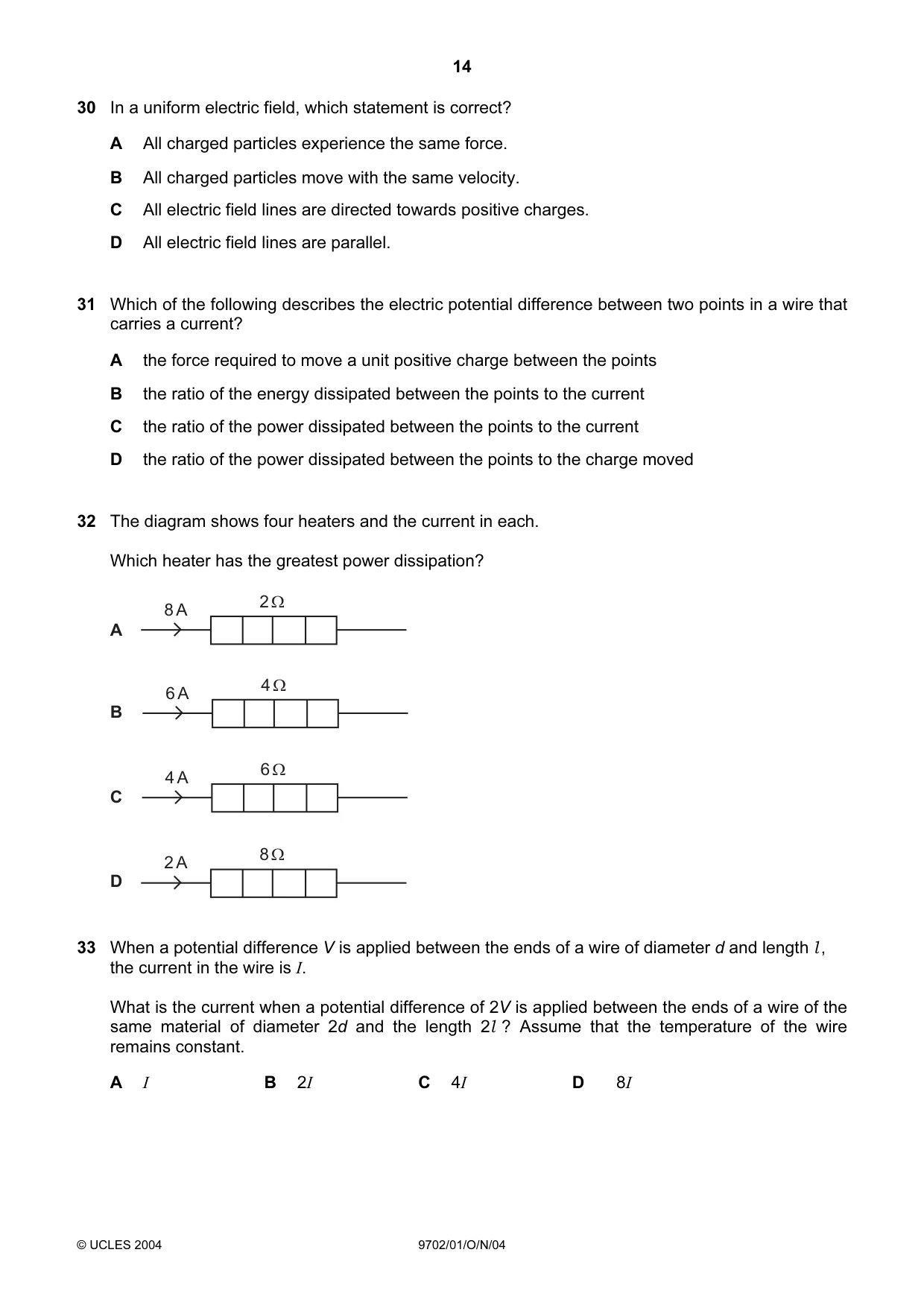
Q32 · The diagram shows four heaters and the current in each
32 The diagram shows four heaters and the current in each. Which heater has the greatest power dissipation? 2 Ω 8 A A 4 Ω 6 A B 6 Ω 4 A C 8 Ω 2 A D
Mark scheme: B
Q33 · When a potential difference V is applied between the ends of a wire of diameter d and…
33 When a potential difference V is applied between the ends of a wire of diameter d and length l , the current in the wire is I. What is the current when a potential difference of 2V is applied between the ends of a wire of the same material of diameter 2d and the length 2l ? Assume that the temperature of the wire remains constant. A I B 2I C 4I D 8I
Mark scheme: C
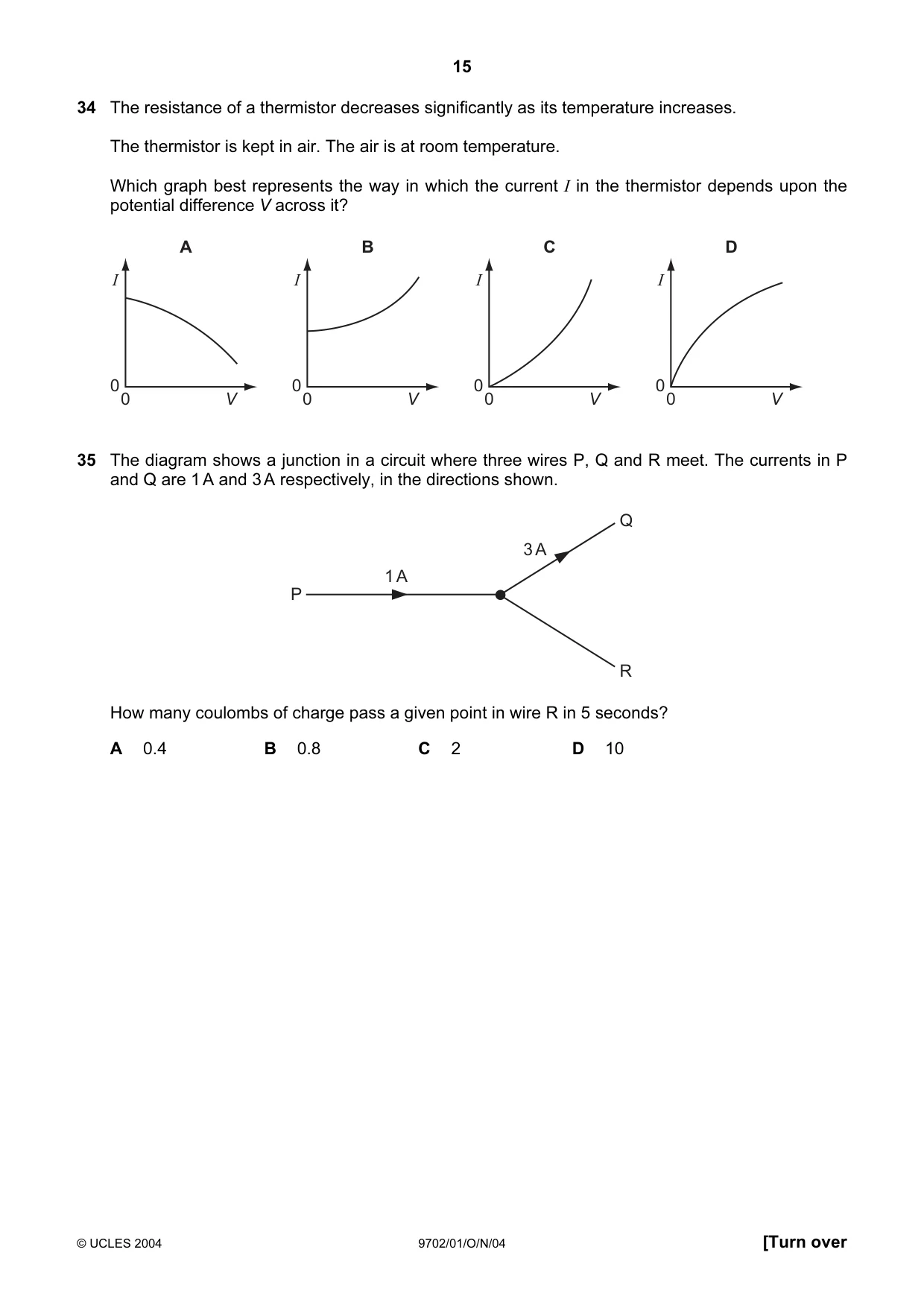
Q34 · The resistance of a thermistor decreases significantly as its temperature increases
34 The resistance of a thermistor decreases significantly as its temperature increases. The thermistor is kept in air. The air is at room temperature. Which graph best represents the way in which the current I in the thermistor depends upon the potential difference V across it? A B C D I I I I 00 00 00 00 V V V V
Mark scheme: C
Q35 · The diagram shows a junction in a circuit where three wires P, Q and R meet
35 The diagram shows a junction in a circuit where three wires P, Q and R meet. The currents in P and Q are 1 A and 3 A respectively, in the directions shown. Q 3 A 1 A P R How many coulombs of charge pass a given point in wire R in 5 seconds? A 0.4 B 0.8 C 2 D 10
Mark scheme: D
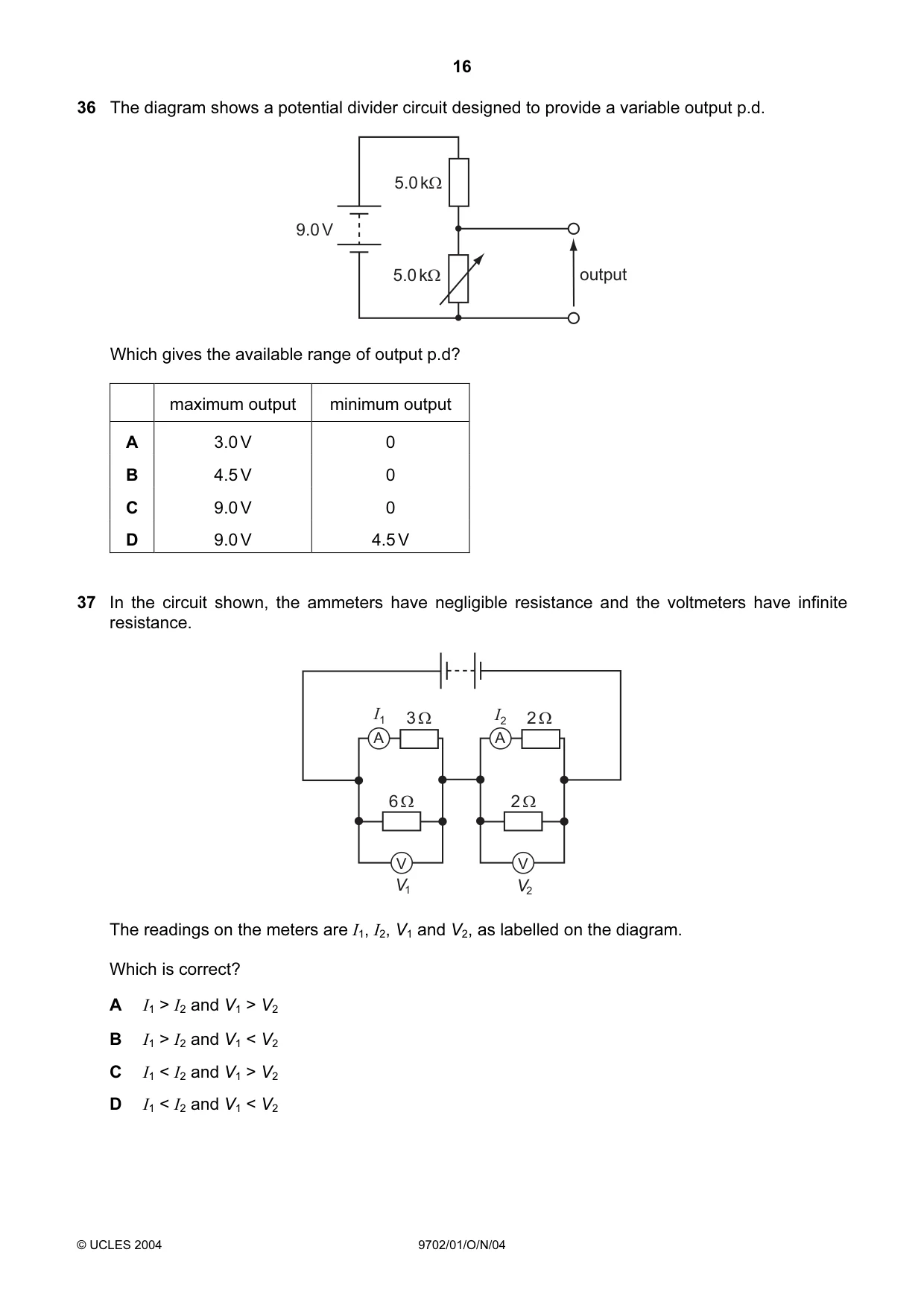
Q36 · The diagram shows a potential divider circuit designed to provide a variable output p.d
36 The diagram shows a potential divider circuit designed to provide a variable output p.d. 5.0 kΩ 9.0 V 5.0 kΩ output Which gives the available range of output p.d? maximum output minimum output A 3.0 V 0 B 4.5 V 0 C 9.0 V 0 D 9.0 V 4.5 V
Mark scheme: B
Q37 · In the circuit shown, the ammeters have negligible resistance and the voltmeters have…
37 In the circuit shown, the ammeters have negligible resistance and the voltmeters have infinite resistance. I1 3 Ω I2 2 Ω A A 6 Ω 2 Ω V V V1 V2 The readings on the meters are I1, I2, V1 and V2, as labelled on the diagram. Which is correct? A I1 > I2 and V1 > V2 B I1 > I2 and V1 < V2 C I1 < I2 and V1 > V2 D I1 < I2 and V1 < V2
Mark scheme: A
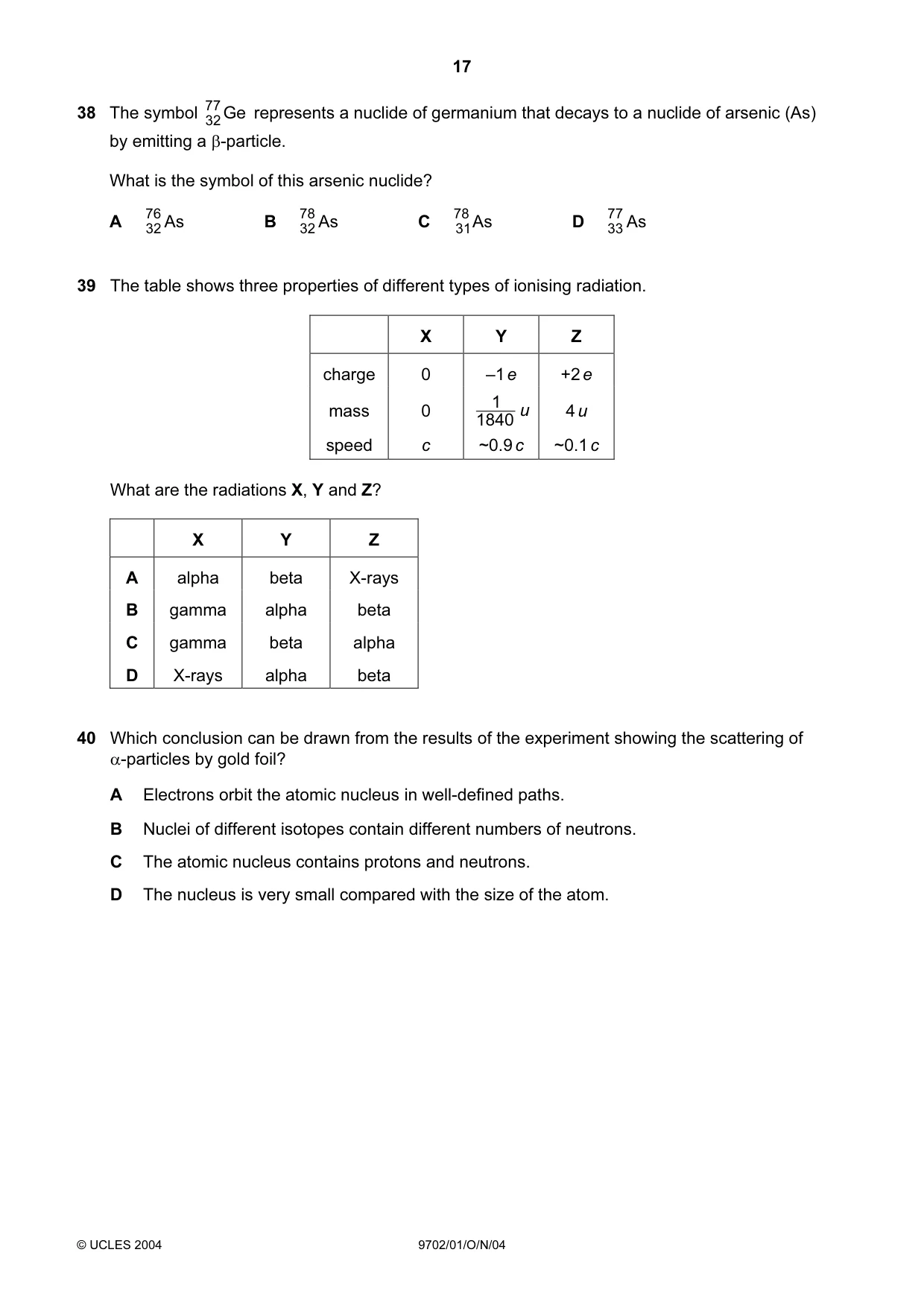
Q38 · The symbol 77 Ge represents a nuclide of germanium that decays to a nuclide of arsenic…
38 The symbol 77 Ge represents a nuclide of germanium that decays to a nuclide of arsenic (As) 32 by emitting a β-particle. What is the symbol of this arsenic nuclide? A 76 As B 78 As C 78 As D 77 As 32 32 31 33
Mark scheme: D
Q39 · The table shows three properties of different types of ionising radiation
39 The table shows three properties of different types of ionising radiation. X Y Z charge 0 –1 e +2 e 1 mass 0 u 4 u 1840 speed c ~0.9 c ~0.1 c What are the radiations X, Y and Z? X Y Z A alpha beta X-rays B gamma alpha beta C gamma beta alpha D X-rays alpha beta
Mark scheme: C
Q40 · Which conclusion can be drawn from the results of the experiment showing the scattering…
40 Which conclusion can be drawn from the results of the experiment showing the scattering of α-particles by gold foil? A Electrons orbit the atomic nucleus in well-defined paths. B Nuclei of different isotopes contain different numbers of neutrons. C The atomic nucleus contains protons and neutrons. D The nucleus is very small compared with the size of the atom.
Mark scheme: D
What was in this paper
The subtopics covered by these 40 questions, and how many questions each got. Open one in a new tab to see every Cambridge question on it.
3Energy conservation3Equations of motion3Elastic and plastic behaviour2Errors and uncertainties2Potential difference and power2Resistance and resistivity2SI units2Stationary waves2Uniform electric fields2Characteristics of alternating currents1Density and pressure1Electric current1Electric fields and field lines1Equilibrium of forces1Gravitational potential energy and kinetic energy1Interference1Kirchhoff’s laws1Linear momentum and its conservation1Momentum and Newton’s laws of motion1Physical quantities1Potential dividers1Progressive waves1Specific heat capacity and specific latent heat1Stress and strain1Transverse and longitudinal waves1Turning effects of forces1