Cambridge A Level Physics 9702 — 2021 May/June Paper 1 · Variant 3
9702/13/M/J/21 · 40 questions · 40 marks · ≈45 min
The question paper and its mark scheme, free to read here and free to download. This is Cambridge’s own paper, exactly as it was sat.
Question paper20 pages
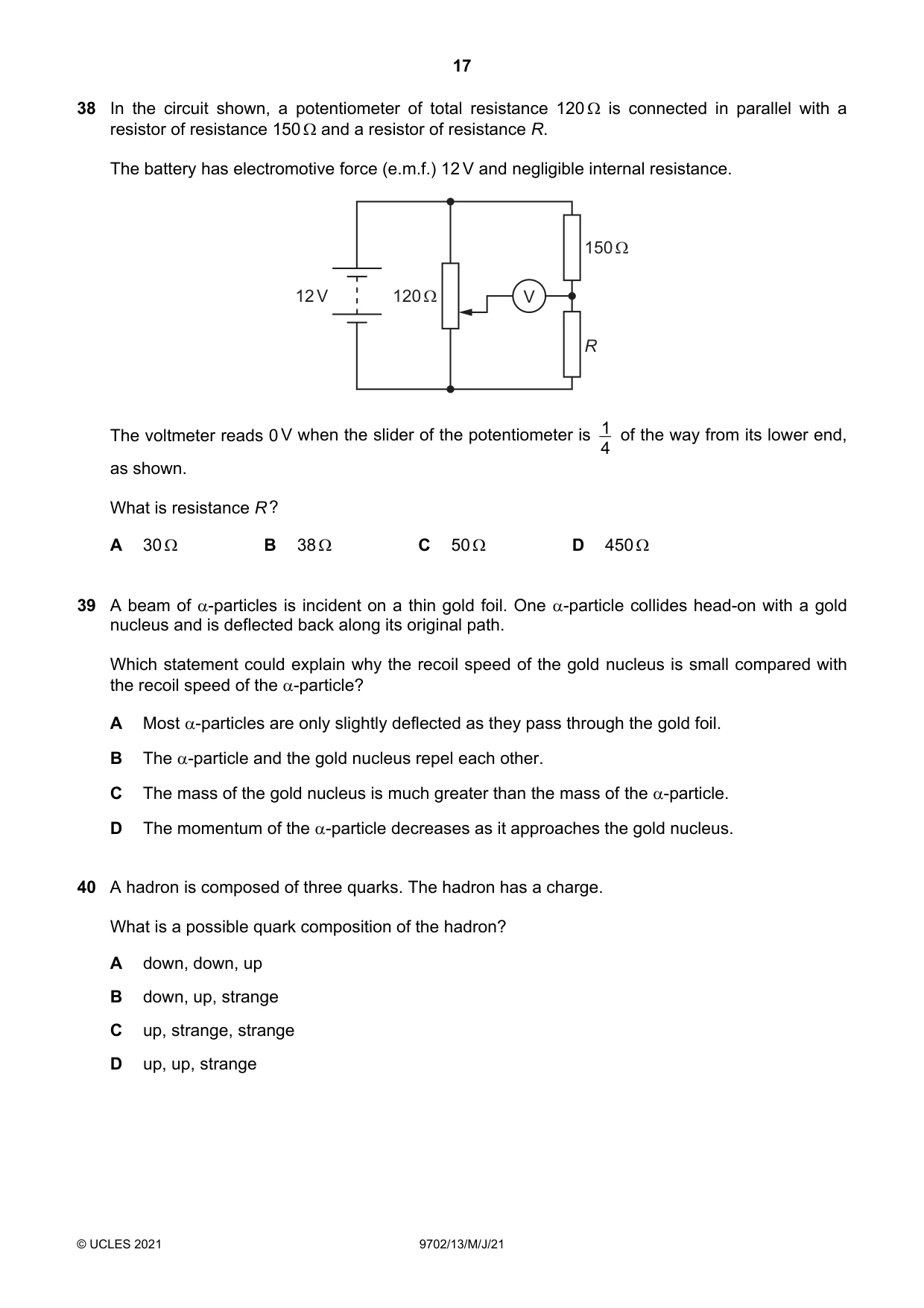


Mark scheme3 pages
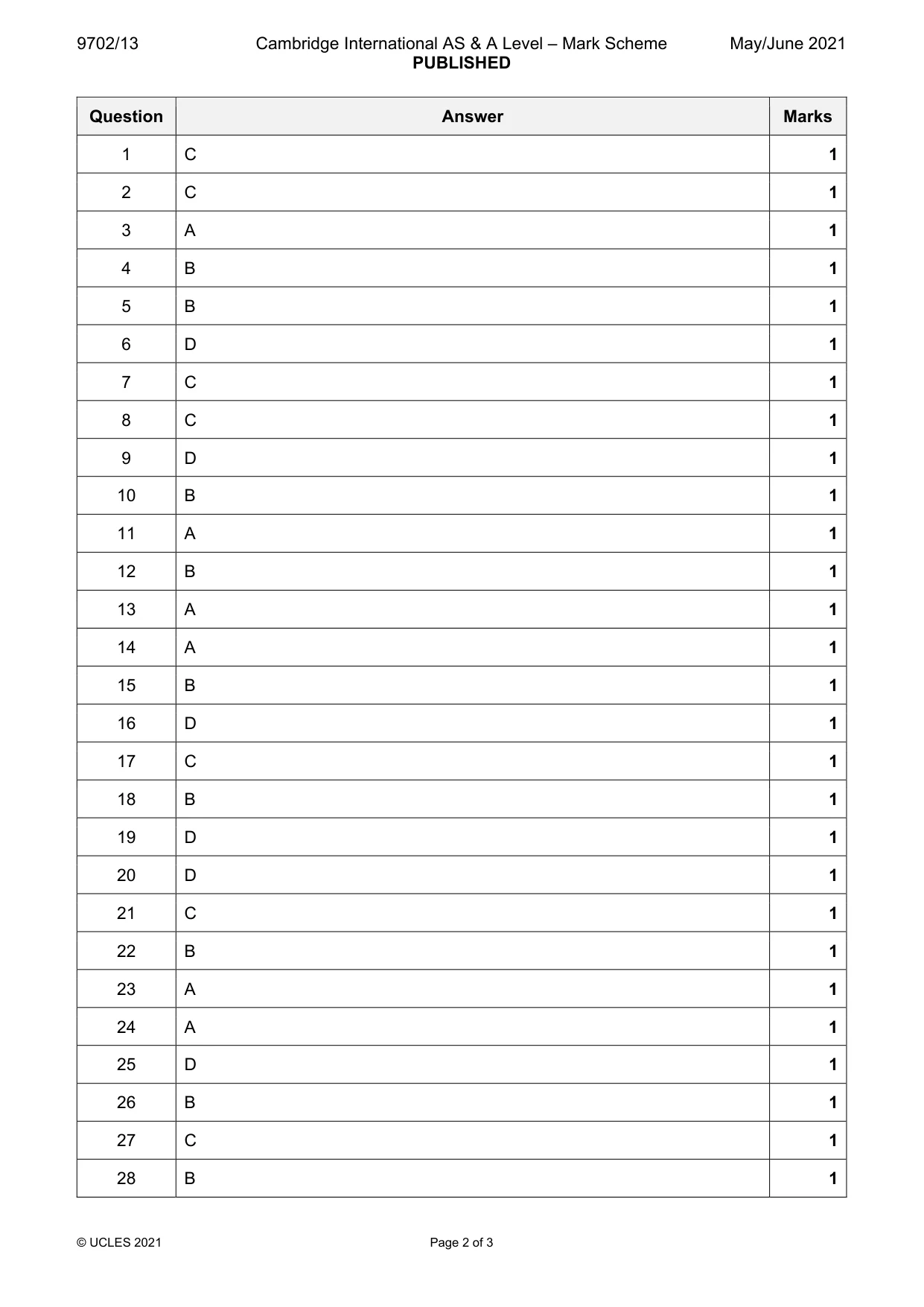
Answers below. Sit the paper first if you are practising.
Questions as text
Q1 · What is a reasonable estimate of the kinetic energy of an Olympic athlete sprinting in a…
1 What is a reasonable estimate of the kinetic energy of an Olympic athlete sprinting in a 100 m race? A 40 J B 400 J C 4000 J D 40 000 J
Mark scheme: C
More questions on Gravitational potential energy and kinetic energy
Q2 · What is a unit of momentum?
2 What is a unit of momentum? A kg m s–2 B N s–1 C N s D kg s m–1
Mark scheme: C
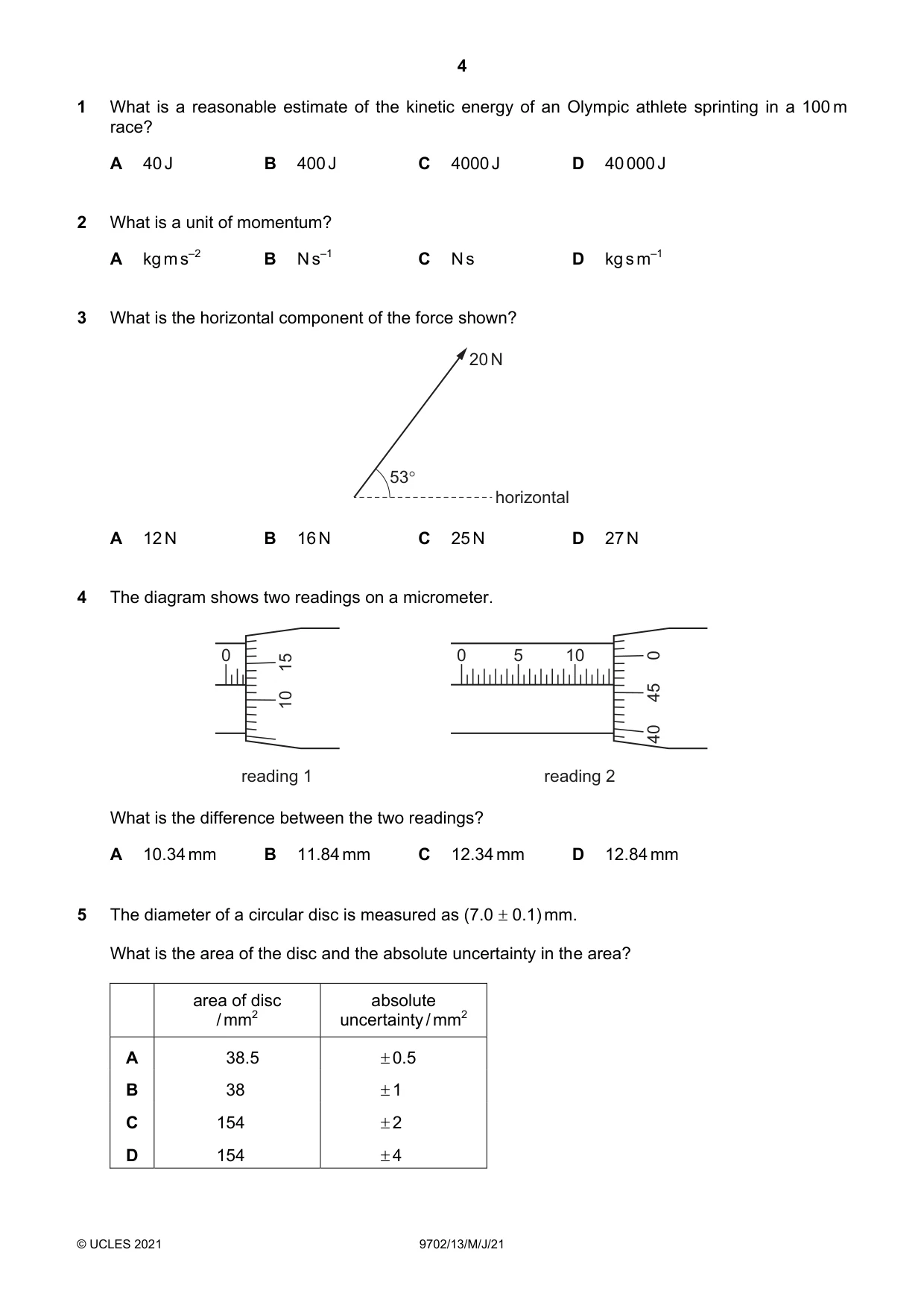
Q3 · What is the horizontal component of the force shown?
3. What is the horizontal component of the force shown? 20N woo cba wane n nnn anne horizontal A 12N B 16N C 25N D 27N
Mark scheme: A
Q4 · The diagram shows two readings on a micrometer
4 The diagram shows two readings on a micrometer. 0 15 0 5 10 0 10 45 40 reading 1 reading 2 What is the difference between the two readings? A 10.34 mm B 11.84 mm C 12.34 mm D 12.84 mm
Mark scheme: B
Q5 · The diameter of a circular disc is measured as (7.0 0.1) mm
5 The diameter of a circular disc is measured as (7.0 0.1) mm. What is the area of the disc and the absolute uncertainty in the area? area of disc absolute / mm2 uncertainty / mm2 A 38.5 0.5 B 38 1 C 154 2 D 154 4
Mark scheme: B
Q6 · The diagram shows a velocity–time graph for a car
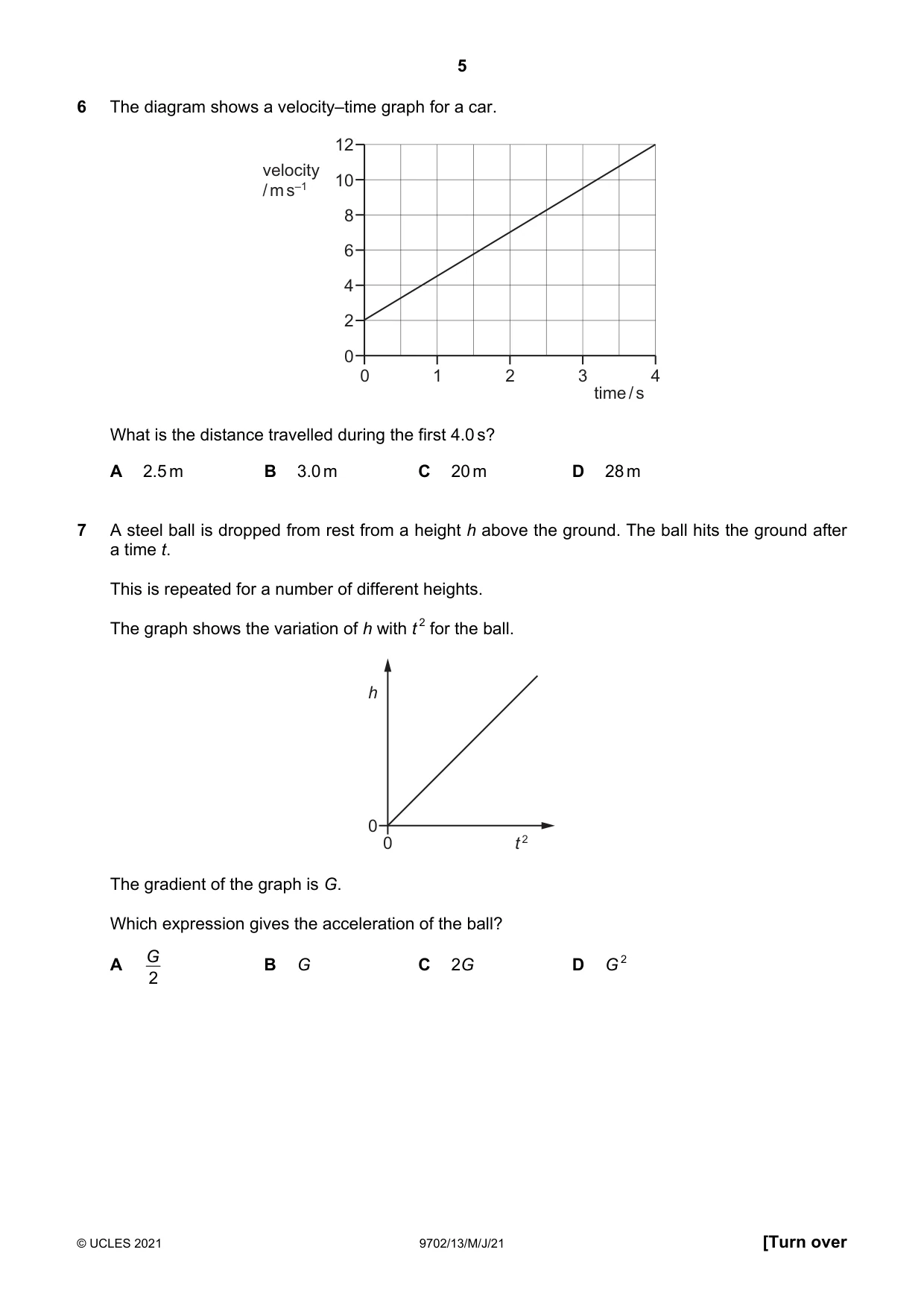
6 The diagram shows a velocity–time graph for a car. 12 velocity 10 / m s–1 8 6 4 2 0 0 1 2 3 4 time / s What is the distance travelled during the first 4.0 s? A 2.5 m B 3.0 m C 20 m D 28 m
Mark scheme: D
Q7 · A steel ball is dropped from rest from a height h above the ground
7 A steel ball is dropped from rest from a height h above the ground. The ball hits the ground after a time t. This is repeated for a number of different heights. The graph shows the variation of h with t 2 for the ball. h 0 0 t 2 The gradient of the graph is G. Which expression gives the acceleration of the ball? G G 2 A B G C 2G D 2
Mark scheme: C
Q8 · Two masses, M and m, are connected by an inextensible string which passes over a…
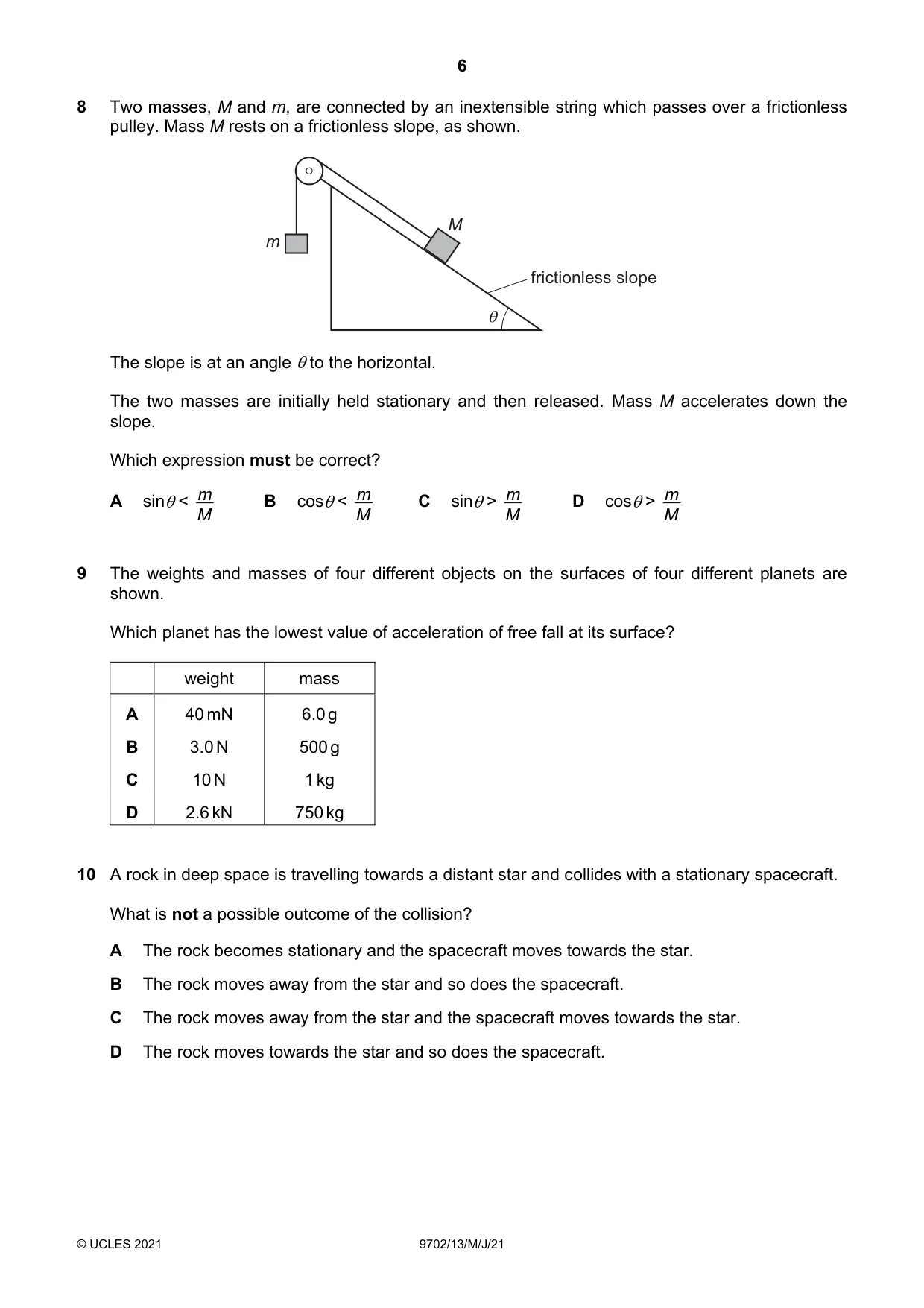
8 Two masses, M and m, are connected by an inextensible string which passes over a frictionless pulley. Mass M rests on a frictionless slope, as shown. M m frictionless slope θ The slope is at an angle to the horizontal. The two masses are initially held stationary and then released. Mass M accelerates down the slope. Which expression must be correct? A sin < M m B cos < M m C sin > M m D cos > M m
Mark scheme: C
Q9 · The weights and masses of four different objects on the surfaces of four different…
9 The weights and masses of four different objects on the surfaces of four different planets are shown. Which planet has the lowest value of acceleration of free fall at its surface? weight mass A 40 mN 6.0 g B 3.0 N 500 g C 10 N 1 kg D 2.6 kN 750 kg
Mark scheme: D
Q10 · A rock in deep space is travelling towards a distant star and collides with a stationary…
10 A rock in deep space is travelling towards a distant star and collides with a stationary spacecraft. What is not a possible outcome of the collision? A The rock becomes stationary and the spacecraft moves towards the star. B The rock moves away from the star and so does the spacecraft. C The rock moves away from the star and the spacecraft moves towards the star. D The rock moves towards the star and so does the spacecraft.
Mark scheme: B
Q11 · A steel ball is falling at a constant (terminal) speed in still air
11 A steel ball is falling at a constant (terminal) speed in still air. The forces acting on the ball are upthrust, viscous drag and weight. What is the order of increasing magnitude of these three forces? A upthrust viscous drag weight B viscous drag upthrust weight C viscous drag weight upthrust D weight upthrust viscous drag
Mark scheme: A
Q12 · What is a couple?
12 What is a couple? A a pair of equal forces acting in the same direction but along different lines B a pair of forces that are equal and opposite but acting along different lines C a pair of forces that produce no resultant force and no resultant moment D a pair of unequal forces acting in opposite directions but along the same line
Mark scheme: B
Q13 · Four coplanar forces act on a rigid rod, as shown
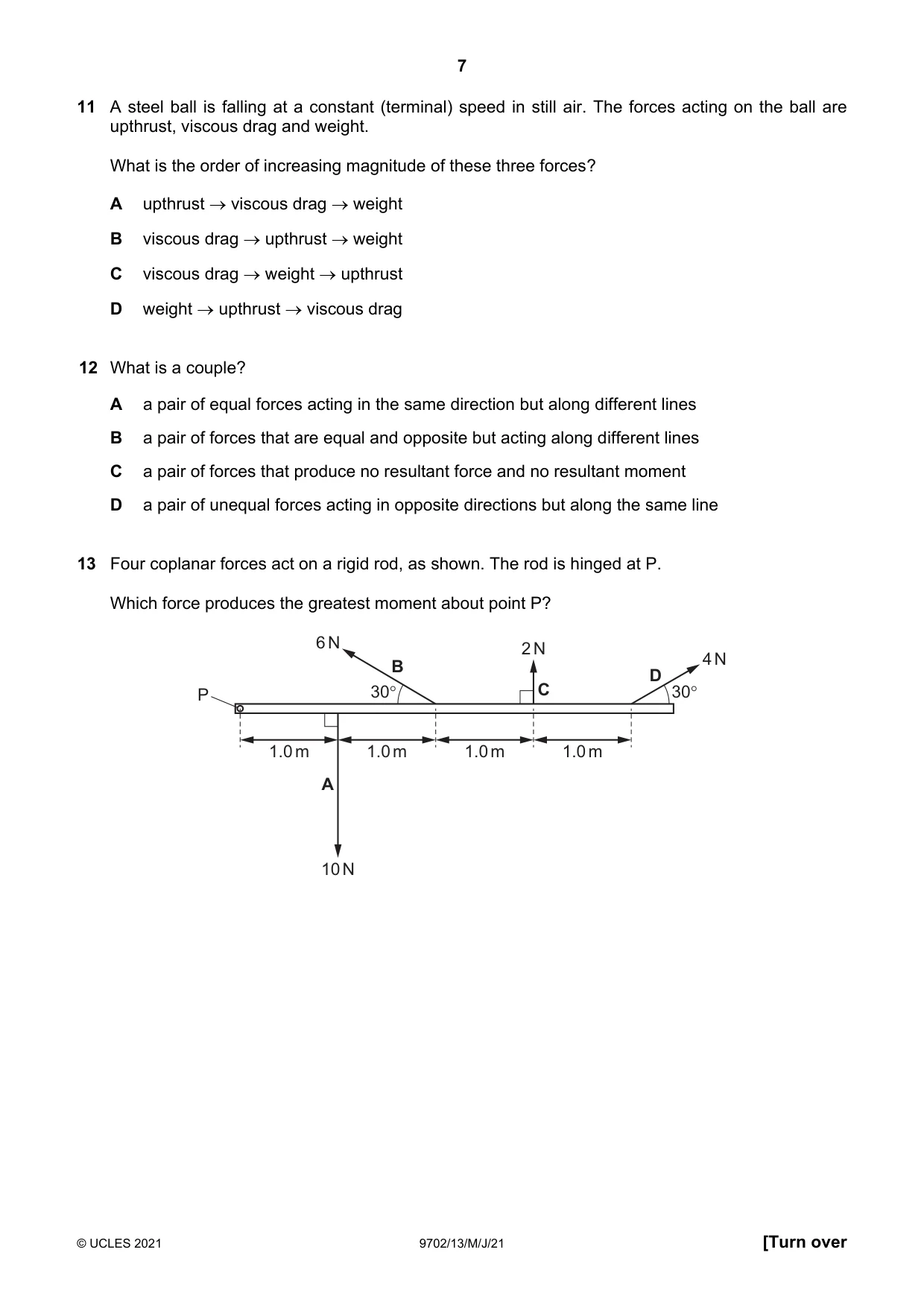
13 Four coplanar forces act on a rigid rod, as shown. The rod is hinged at P. Which force produces the greatest moment about point P? 6 N 2 N B 4 N D P 30° C 30° 1.0 m 1.0 m 1.0 m 1.0 m A 10 N
Mark scheme: A
Q14 · A book of weight W has a rectangular shape and is of uniform thickness
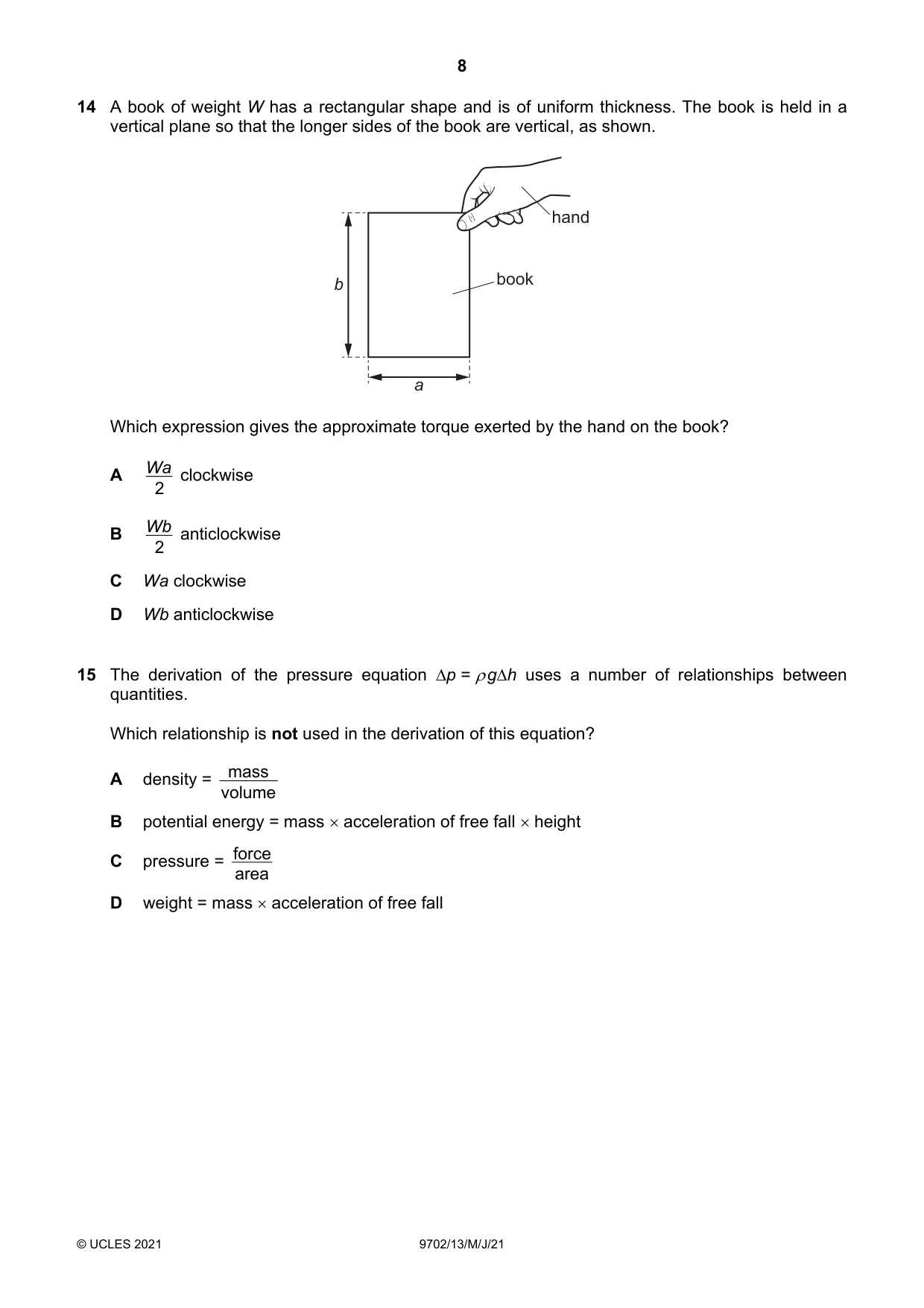
14 A book of weight W has a rectangular shape and is of uniform thickness. The book is held in a vertical plane so that the longer sides of the book are vertical, as shown. hand b book a Which expression gives the approximate torque exerted by the hand on the book? A Wa clockwise 2 B Wb anticlockwise 2 C Wa clockwise D Wb anticlockwise
Mark scheme: A
Q15 · The derivation of the pressure equation p = gh uses a number of relationships between…
15 The derivation of the pressure equation p = gh uses a number of relationships between quantities. Which relationship is not used in the derivation of this equation? A density = volume mass B potential energy = mass acceleration of free fall height C pressure = area force D weight = mass acceleration of free fall
Mark scheme: B
Q16 · A spring is initially neither compressed nor extended
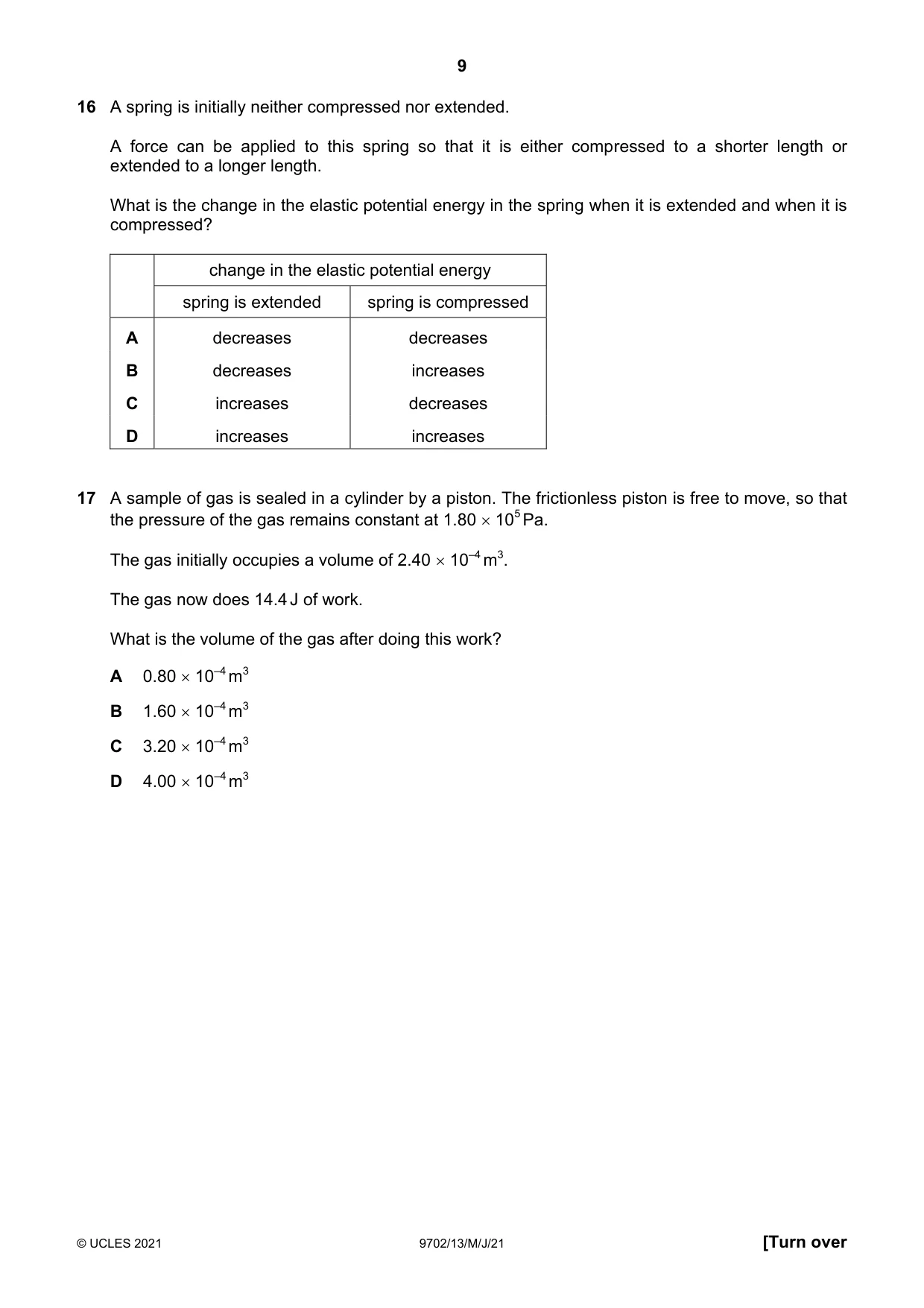
16 A spring is initially neither compressed nor extended. A force can be applied to this spring so that it is either compressed to a shorter length or extended to a longer length. What is the change in the elastic potential energy in the spring when it is extended and when it is compressed? change in the elastic potential energy spring is extended spring is compressed A decreases decreases B decreases increases C increases decreases D increases increases
Mark scheme: D
Q17 · A sample of gas is sealed in a cylinder by a piston
17 A sample of gas is sealed in a cylinder by a piston. The frictionless piston is free to move, so that the pressure of the gas remains constant at 1.80 105 Pa. The gas initially occupies a volume of 2.40 10–4 m3. The gas now does 14.4 J of work. What is the volume of the gas after doing this work? A 0.80 10–4 m3 B 1.60 10–4 m3 C 3.20 10–4 m3 D 4.00 10–4 m3
Mark scheme: C
Q18 · A car of mass 500 kg is at rest at point X on a slope, as shown
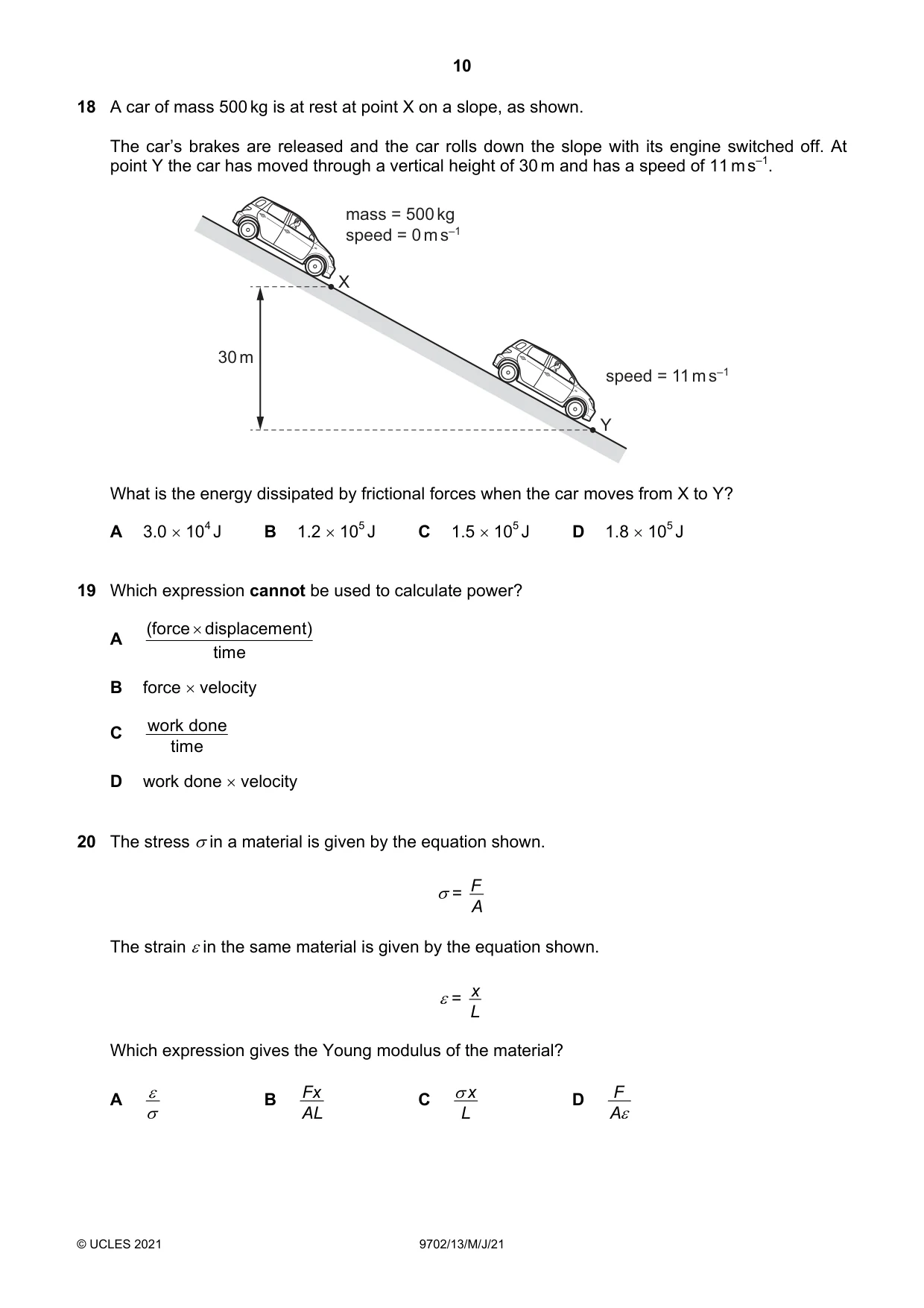
18 A car of mass 500 kg is at rest at point X on a slope, as shown. The car’s brakes are released and the car rolls down the slope with its engine switched off. At point Y the car has moved through a vertical height of 30 m and has a speed of 11 m s–1. mass = 500 kg speed = 0 m s–1 X 30 m speed = 11 m s–1 Y What is the energy dissipated by frictional forces when the car moves from X to Y? A 3.0 104 J B 1.2 105 J C 1.5 105 J D 1.8 105 J
Mark scheme: B
Q19 · Which expression cannot be used to calculate power?
19 Which expression cannot be used to calculate power? (force displacement) A time B force velocity C work done time D work done velocity
Mark scheme: D
Q20 · The stress in a material is given by the equation shown
20 The stress in a material is given by the equation shown. = F A The strain in the same material is given by the equation shown. = x L Which expression gives the Young modulus of the material? Fx x F A B AL C D A L
Mark scheme: D
Q21 · What is an example of plastic deformation?
21 What is an example of plastic deformation? A A rubber ball is momentarily compressed every time it hits the ground. B A spoon stirring some coffee in a ceramic mug hits its surface and makes a clinking sound. C A toolbox is left on a horizontal plank. When the toolbox is removed, the plank is no longer straight. D The spring in some bathroom weighing scales is compressed by a person standing on the scales.
Mark scheme: C
Q22 · A transverse progressive wave of wavelength / is set up on a stretched string
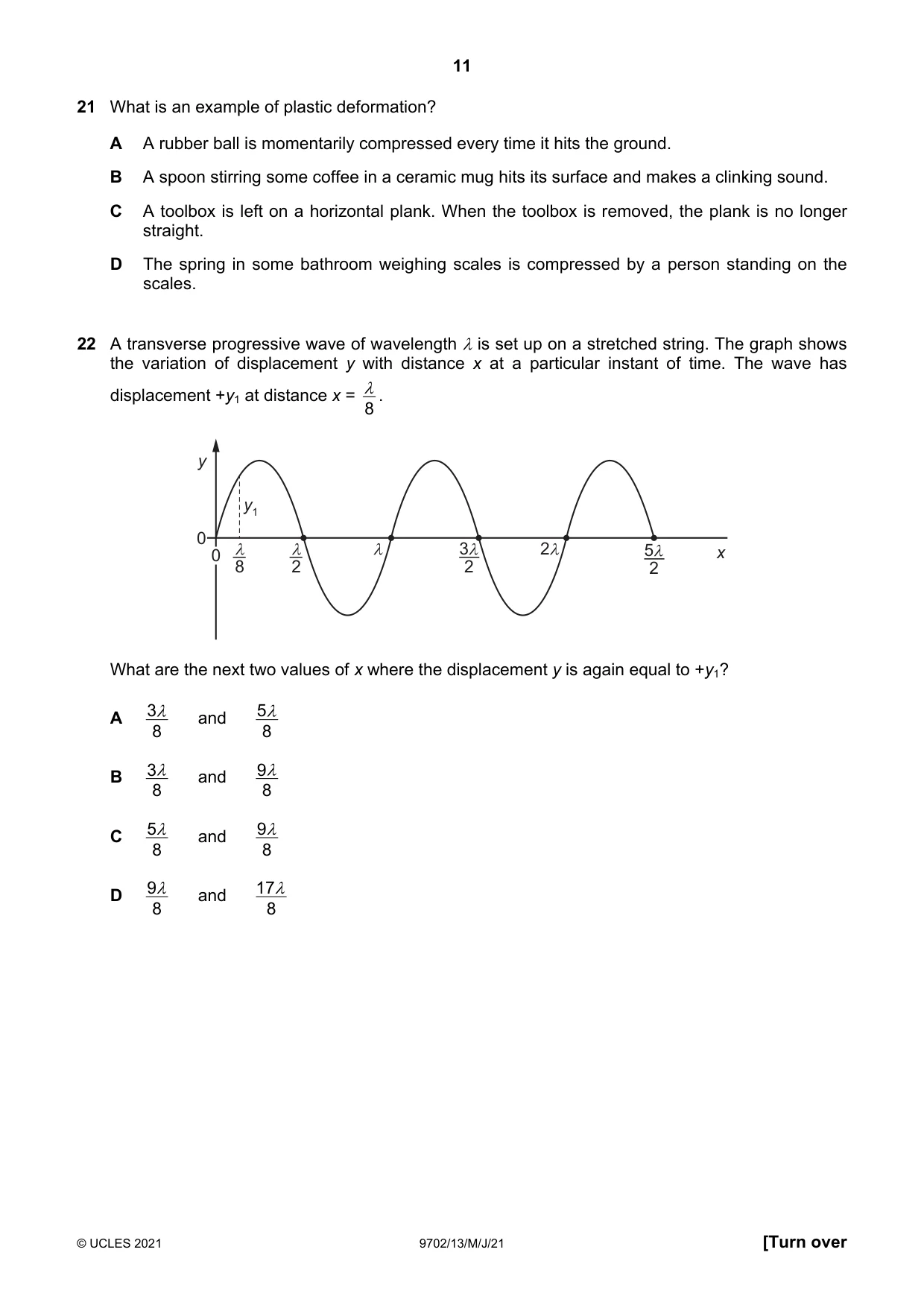
22 A transverse progressive wave of wavelength / is set up on a stretched string. The graph shows the variation of displacement y with distance x at a particular instant of time. The wave has displacement +y, at distance x = -. A 34 and 54 8 8 B 3A and 94 8 8 c 4 and 9A 8 8 p % and 17a
Mark scheme: B
Q23 · The graph shows the variation with time of the displacement of an air particle as a…
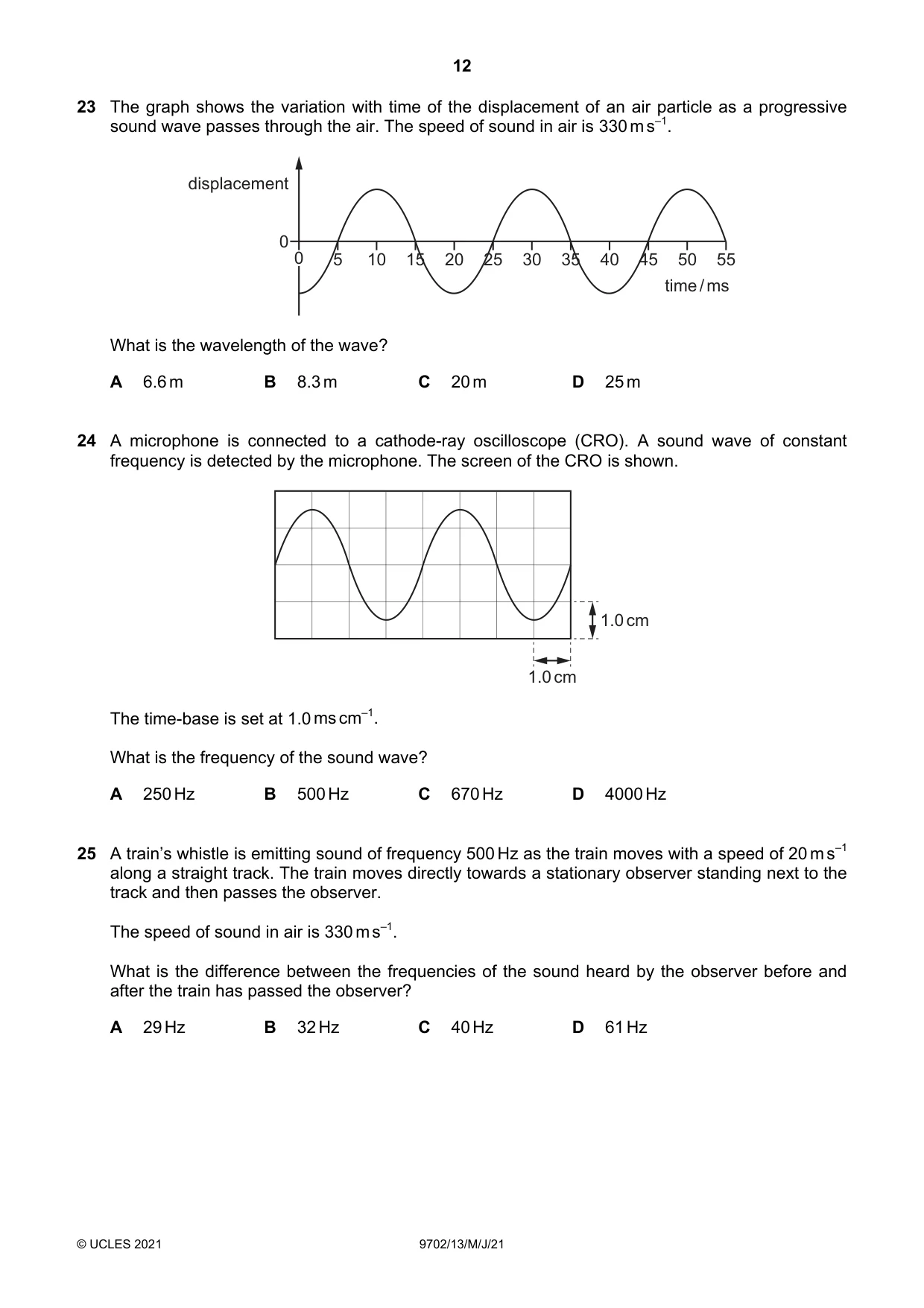
23 The graph shows the variation with time of the displacement of an air particle as a progressive sound wave passes through the air. The speed of sound in air is 330 m s–1. displacement 0 0 5 10 15 20 25 30 35 40 45 50 55 time / ms What is the wavelength of the wave? A 6.6 m B 8.3 m C 20 m D 25 m
Mark scheme: A
Q24 · A microphone is connected to a cathode-ray oscilloscope (CRO)
24 A microphone is connected to a cathode-ray oscilloscope (CRO). A sound wave of constant frequency is detected by the microphone. The screen of the CRO is shown. 1.0 cm 1.0 cm The time-base is set at 1.0 ms cm–1. What is the frequency of the sound wave? A 250 Hz B 500 Hz C 670 Hz D 4000 Hz
Mark scheme: A
Q25 · A train’s whistle is emitting sound of frequency 500 Hz as the train moves with a speed…
25 A train’s whistle is emitting sound of frequency 500 Hz as the train moves with a speed of 20 m s–1 along a straight track. The train moves directly towards a stationary observer standing next to the track and then passes the observer. The speed of sound in air is 330 m s–1. What is the difference between the frequencies of the sound heard by the observer before and after the train has passed the observer? A 29 Hz B 32 Hz C 40 Hz D 61 Hz
Mark scheme: D
Q26 · Gamma-rays, microwaves, visible light and X-rays are four regions of the electromagnetic…
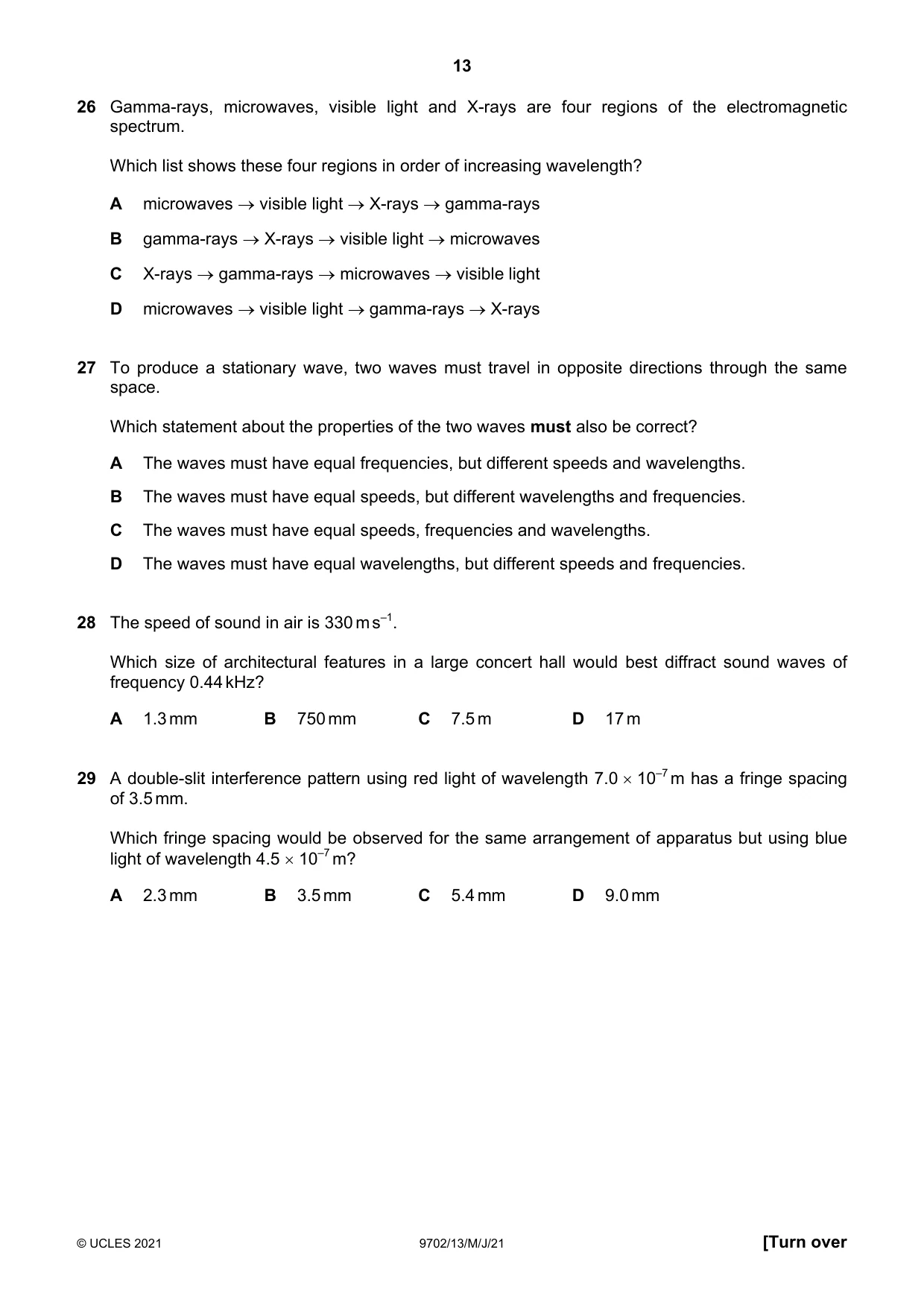
26 Gamma-rays, microwaves, visible light and X-rays are four regions of the electromagnetic spectrum. Which list shows these four regions in order of increasing wavelength? A microwaves visible light X-rays gamma-rays B gamma-rays X-rays visible light microwaves C X-rays gamma-rays microwaves visible light D microwaves visible light gamma-rays X-rays
Mark scheme: B
Q27 · To produce a stationary wave, two waves must travel in opposite directions through the…
27 To produce a stationary wave, two waves must travel in opposite directions through the same space. Which statement about the properties of the two waves must also be correct? A The waves must have equal frequencies, but different speeds and wavelengths. B The waves must have equal speeds, but different wavelengths and frequencies. C The waves must have equal speeds, frequencies and wavelengths. D The waves must have equal wavelengths, but different speeds and frequencies.
Mark scheme: C
Q28 · The speed of sound in air is 330 m s–1
28 The speed of sound in air is 330 m s–1. Which size of architectural features in a large concert hall would best diffract sound waves of frequency 0.44 kHz? A 1.3 mm B 750 mm C 7.5 m D 17 m
Mark scheme: B
Q29 · A double-slit interference pattern using red light of wavelength 7.0 10–7 m has a…
29 A double-slit interference pattern using red light of wavelength 7.0 10–7 m has a fringe spacing of 3.5 mm. Which fringe spacing would be observed for the same arrangement of apparatus but using blue light of wavelength 4.5 10–7 m? A 2.3 mm B 3.5 mm C 5.4 mm D 9.0 mm
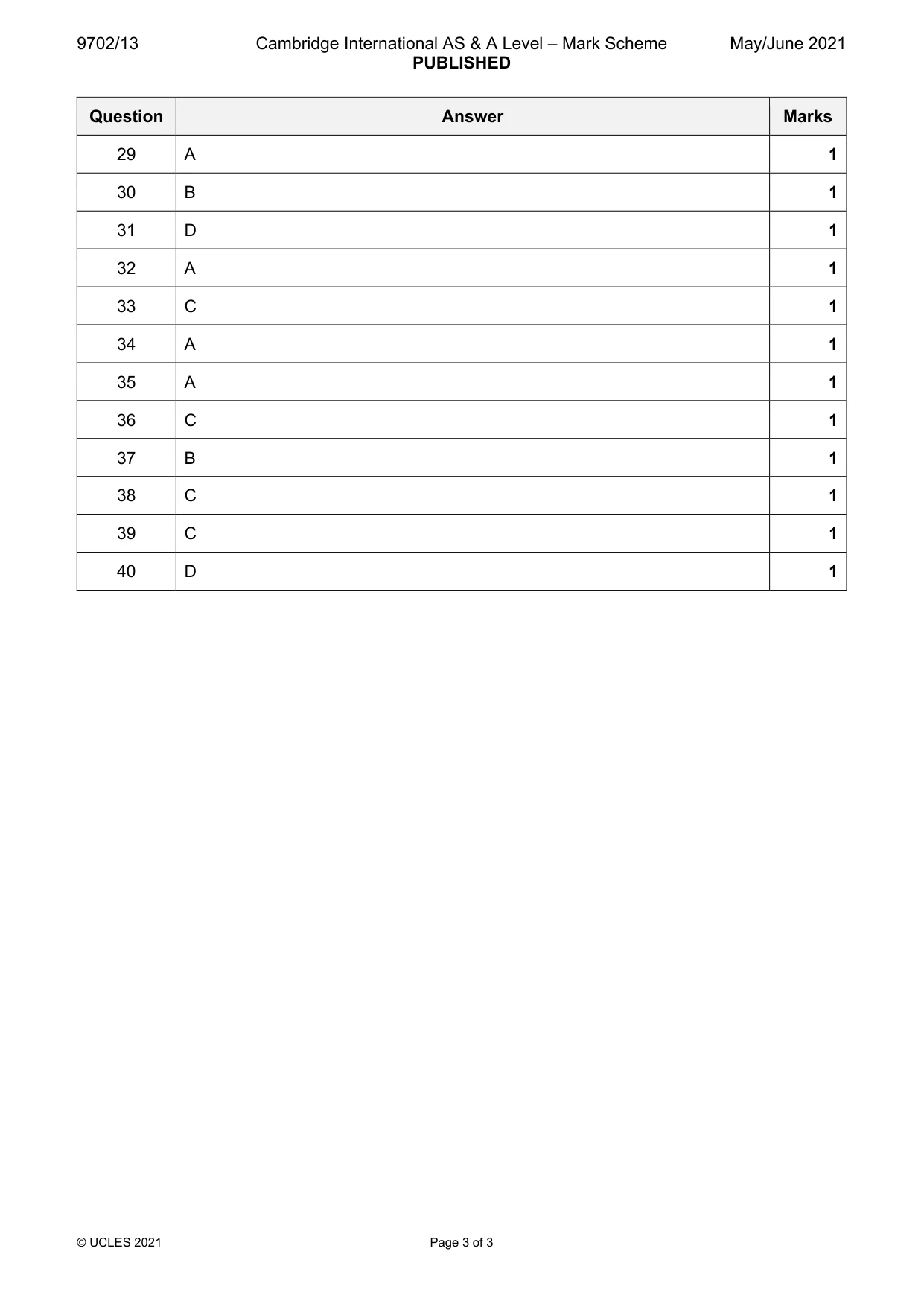
Mark scheme: A
Q30 · A beam of light of a single wavelength is incident normally on a diffraction grating
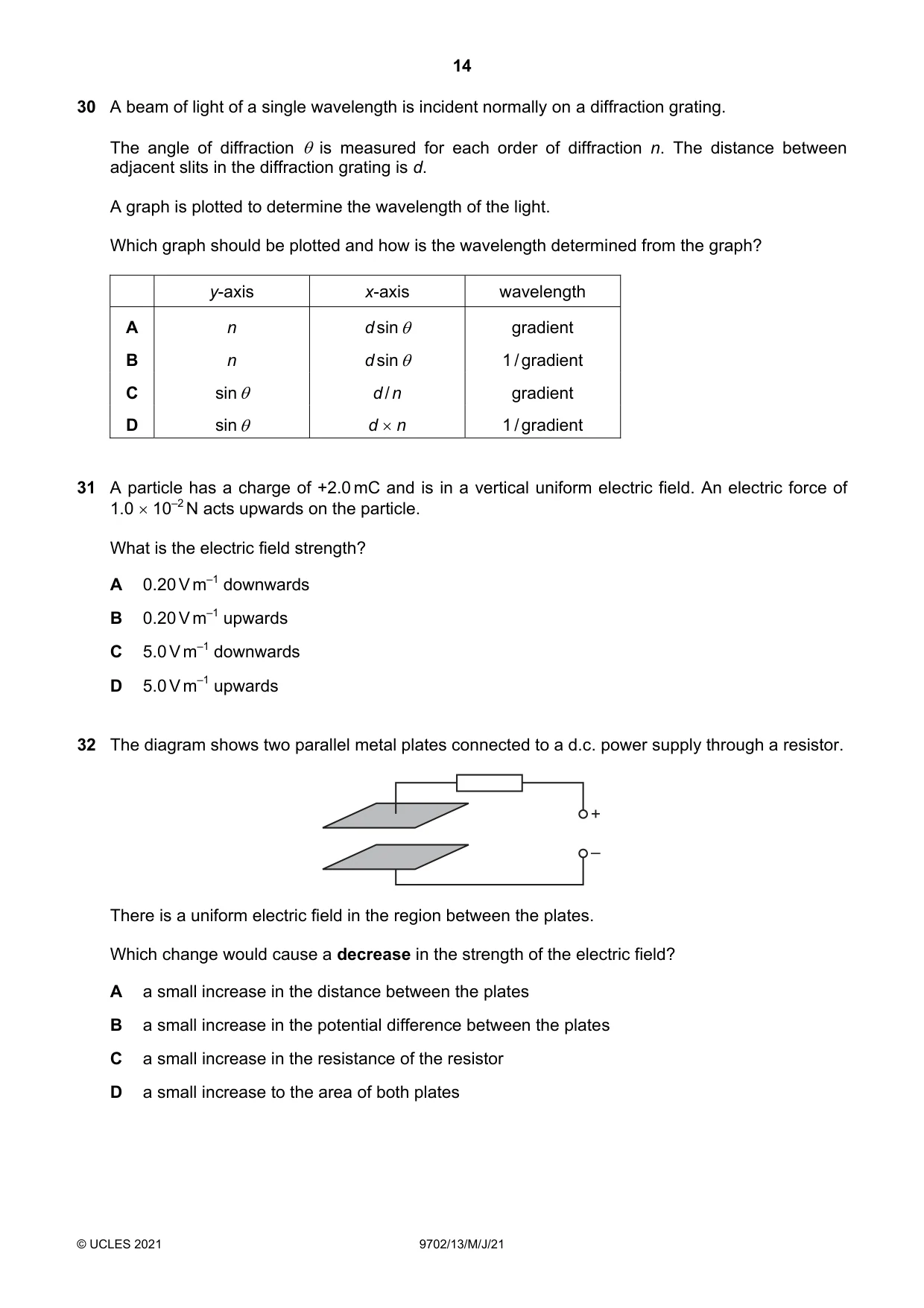
30 A beam of light of a single wavelength is incident normally on a diffraction grating. The angle of diffraction is measured for each order of diffraction n. The distance between adjacent slits in the diffraction grating is d. A graph is plotted to determine the wavelength of the light. Which graph should be plotted and how is the wavelength determined from the graph? y-axis x-axis wavelength A n d sin gradient B n d sin 1 / gradient C sin d / n gradient D sin d n 1 / gradient
Mark scheme: B
Q31 · A particle has a charge of +2.0 mC and is in a vertical uniform electric field
31 A particle has a charge of +2.0 mC and is in a vertical uniform electric field. An electric force of 1.0 10–2 N acts upwards on the particle. What is the electric field strength? A 0.20 V m–1 downwards B 0.20 V m–1 upwards C 5.0 V m–1 downwards D 5.0 V m–1 upwards
Mark scheme: D
Q32 · The diagram shows two parallel metal plates connected to a d.c
32 The diagram shows two parallel metal plates connected to a d.c. power supply through a resistor. + – There is a uniform electric field in the region between the plates. Which change would cause a decrease in the strength of the electric field? A a small increase in the distance between the plates B a small increase in the potential difference between the plates C a small increase in the resistance of the resistor D a small increase to the area of both plates
Mark scheme: A
Q33 · A wire has a length of 12 cm and contains a total of 5.1 1022 free electrons
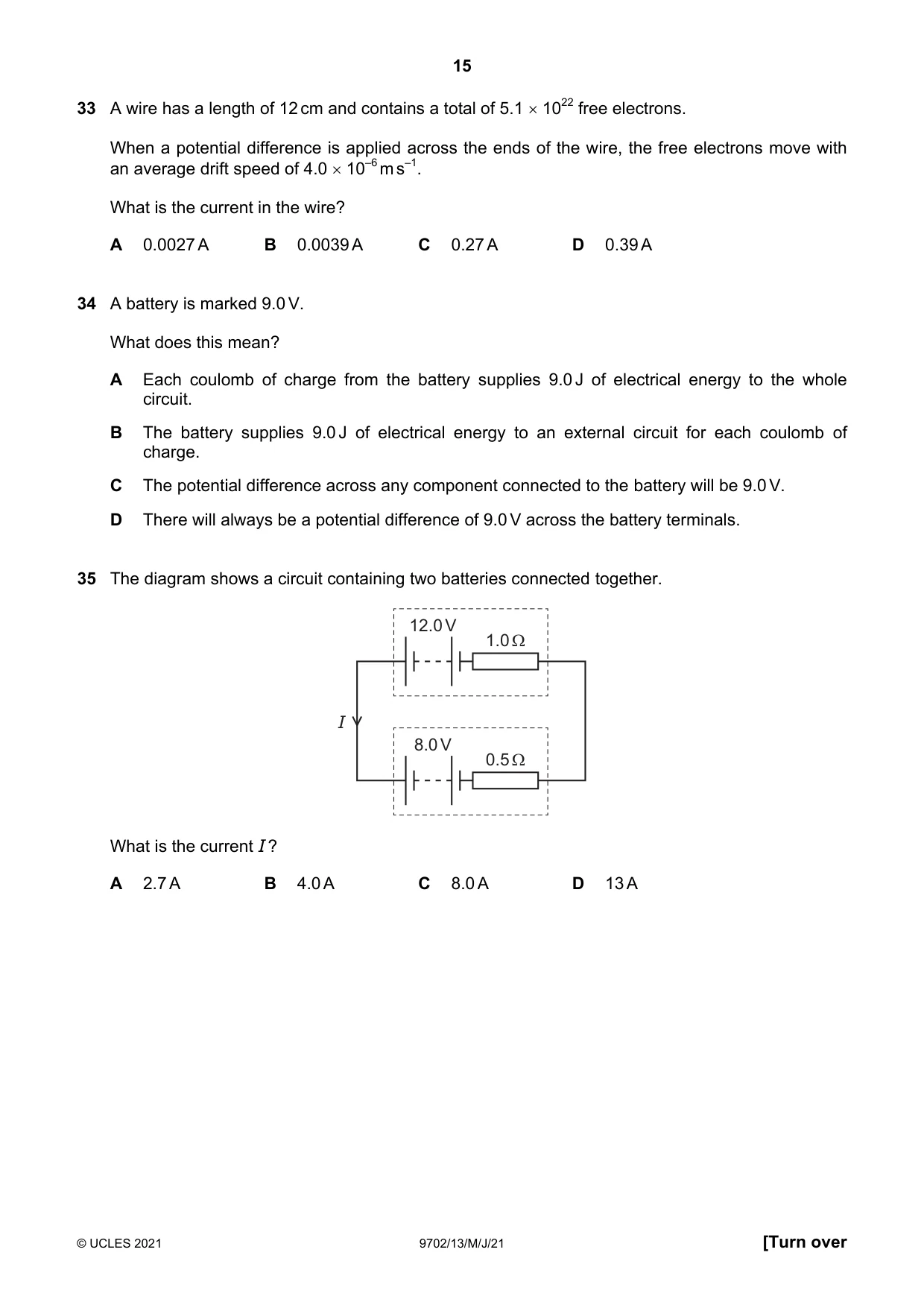
33 A wire has a length of 12 cm and contains a total of 5.1 1022 free electrons. When a potential difference is applied across the ends of the wire, the free electrons move with an average drift speed of 4.0 10–6 m s–1. What is the current in the wire? A 0.0027 A B 0.0039 A C 0.27 A D 0.39 A
Mark scheme: C
Q34 · A battery is marked 9.0 V
34 A battery is marked 9.0 V. What does this mean? A Each coulomb of charge from the battery supplies 9.0 J of electrical energy to the whole circuit. B The battery supplies 9.0 J of electrical energy to an external circuit for each coulomb of charge. C The potential difference across any component connected to the battery will be 9.0 V. D There will always be a potential difference of 9.0 V across the battery terminals.
Mark scheme: A
Q35 · The diagram shows a circuit containing two batteries connected together
35 The diagram shows a circuit containing two batteries connected together. 12.0 V 1.0 Ω I 8.0 V 0.5 Ω What is the current I ? A 2.7 A B 4.0 A C 8.0 A D 13 A
Mark scheme: A
Q36 · The circuit shown includes a cell of constant internal resistance and an external…
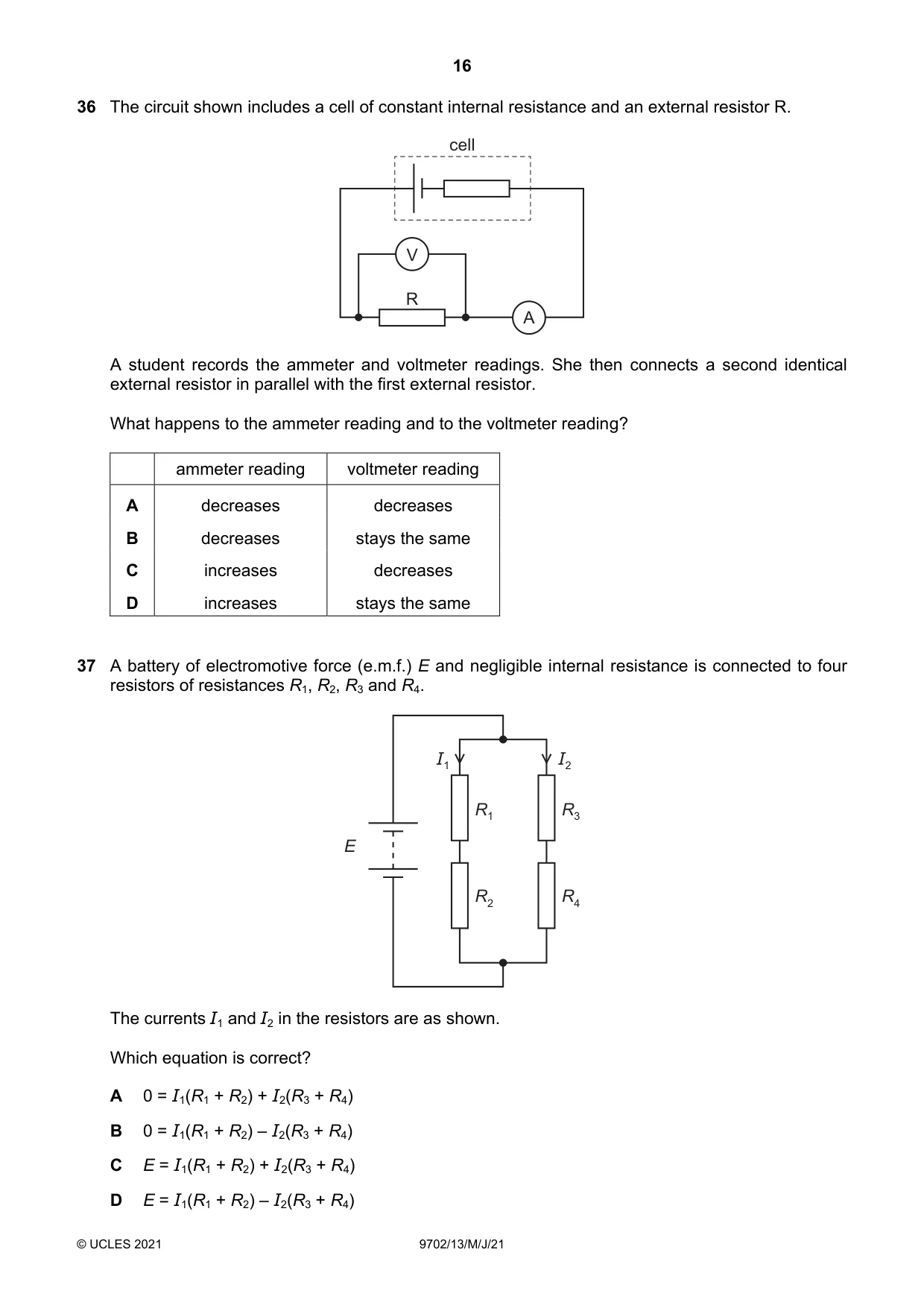
36 The circuit shown includes a cell of constant internal resistance and an external resistor R. cell V R A A student records the ammeter and voltmeter readings. She then connects a second identical external resistor in parallel with the first external resistor. What happens to the ammeter reading and to the voltmeter reading? ammeter reading voltmeter reading A decreases decreases B decreases stays the same C increases decreases D increases stays the same
Mark scheme: C
Q37 · A battery of electromotive force (e.m.f.) E and negligible internal resistance is…
37 A battery of electromotive force (e.m.f.) E and negligible internal resistance is connected to four resistors of resistances R1, R2, R3 and R4. I1 I2 R1 R3 E R2 R4 The currents I1 and I2 in the resistors are as shown. Which equation is correct? A 0 = I1(R1 + R2) + I2(R3 + R4) B 0 = I1(R1 + R2) – I2(R3 + R4) C E = I1(R1 + R2) + I2(R3 + R4) D E = I1(R1 + R2) – I2(R3 + R4)
Mark scheme: B
Q38 · In the circuit shown, a potentiometer of total resistance 120 is connected in parallel…
38 In the circuit shown, a potentiometer of total resistance 120 is connected in parallel with a resistor of resistance 150 and a resistor of resistance R. The battery has electromotive force (e.m.f.) 12 V and negligible internal resistance. 150 Ω 12 V 120 Ω V R The voltmeter reads 0 V when the slider of the potentiometer is 1 4 of the way from its lower end, as shown. What is resistance R ? A 30 B 38 C 50 D 450
Mark scheme: C
Q39 · A beam of -particles is incident on a thin gold foil
39 A beam of -particles is incident on a thin gold foil. One -particle collides head-on with a gold nucleus and is deflected back along its original path. Which statement could explain why the recoil speed of the gold nucleus is small compared with the recoil speed of the -particle? A Most -particles are only slightly deflected as they pass through the gold foil. B The -particle and the gold nucleus repel each other. C The mass of the gold nucleus is much greater than the mass of the -particle. D The momentum of the -particle decreases as it approaches the gold nucleus.
Mark scheme: C
Q40 · A hadron is composed of three quarks
40 A hadron is composed of three quarks. The hadron has a charge. What is a possible quark composition of the hadron? A down, down, up B down, up, strange C up, strange, strange D up, up, strange
Mark scheme: D
What was in this paper
The subtopics covered by these 40 questions, and how many questions each got. Open one in a new tab to see every Cambridge question on it.
3Progressive waves3Turning effects of forces3Elastic and plastic behaviour2Energy conservation2Equations of motion2Errors and uncertainties2Kirchhoff’s laws2Uniform electric fields2Density and pressure1Diffraction1Doppler effect for sound waves1Electric current1Electromagnetic spectrum1Equilibrium of forces1Fundamental particles1Gravitational potential energy and kinetic energy1Interference1Momentum and Newton’s laws of motion1Physical quantities1Potential difference and power1Potential dividers1Practical circuits1Scalars and vectors1Stationary waves1Stress and strain1The diffraction grating1The first law of thermodynamics1What you needed in this session
Cambridge’s own grade thresholds for 2021 May/June, Paper 1 · Variant 3. A higher threshold means an easier paper — the bar moves with how the cohort did.