Questions as text
Q1 · State the principle of conservation of momentum 9702/22 Feb/March 2017
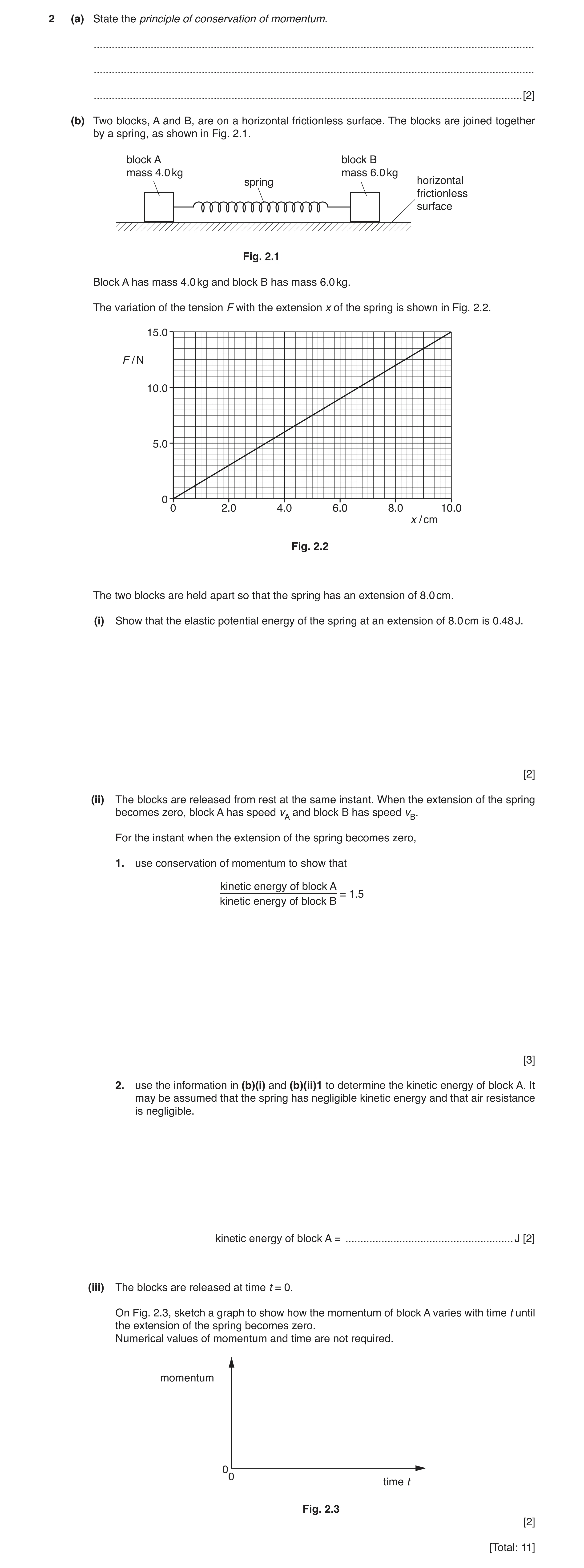
2 (a) State the principle of conservation of momentum. … … … [2] (b) Two blocks, A and B, are on a horizontal frictionless surface. The blocks are joined together by a spring, as shown in Fig. 2.1. block A block B mass 4.0 kg mass 6.0 kg spring horizontal frictionless surface Fig. 2.1 Block A has mass 4.0 kg and block B has mass 6.0 kg. The variation of the tension F with the extension x of the spring is shown in Fig. 2.2. 15.0 F / N 10.0 5.0 0 0 2.0 4.0 6.0 8.0 10.0 x / cm Fig. 2.2 The two blocks are held apart so that the spring has an extension of 8.0 cm. (i) Show that the elastic potential energy of the spring at an extension of 8.0 cm is 0.48 J. [2] (ii) The blocks are released from rest at the same instant. When the extension of the spring becomes zero, block A has speed vA and block B has speed vB. For the instant when the extension of the spring becomes zero, 1. use conservation of momentum to show that kinetic energy of block A = 1.5 kinetic energy of block B [3] 2. use the information in (b)(i) and (b)(ii)1 to determine the kinetic energy of block A. It may be assumed that the spring has negligible kinetic energy and that air resistance is negligible. kinetic energy of block A = … J [2] (iii) The blocks are released at time t = 0. On Fig. 2.3, sketch a graph to show how the momentum of block A varies with time t until the extension of the spring becomes zero. Numerical values of momentum and time are not required. momentum 0 0 time t Fig. 2.3 [2] [Total: 11]
11 marks
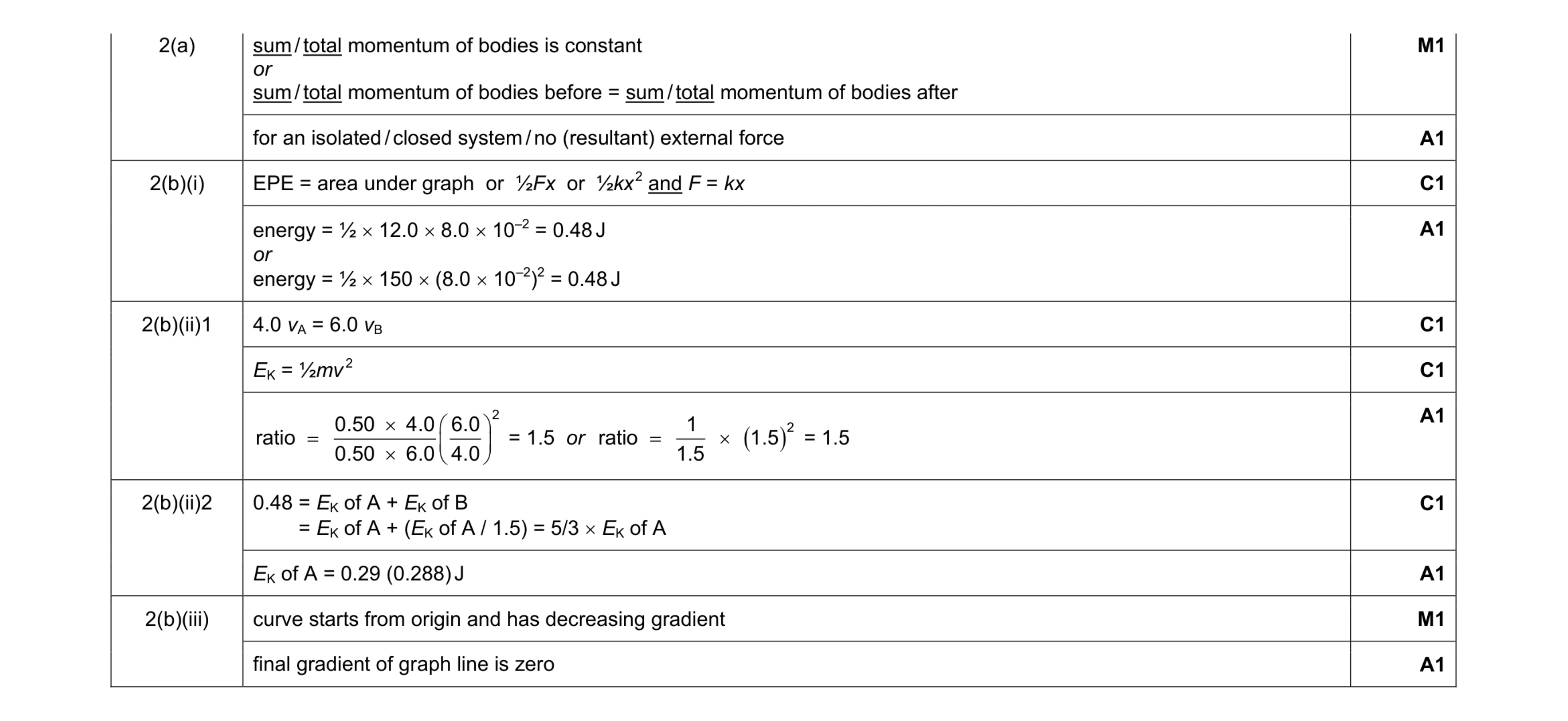
Mark scheme: 2(a) sum / total momentum of bodies is constant or sum / total momentum of bodies before = sum / total momentum of bodies after M1 for an isolated / closed system / no (resultant) external force A1 2(b)(i) EPE = area under graph or ½Fx or ½kx 2 and F = kx C1 energy = ½ × 12.0 × 8.0 × 10–2 = 0.48 J or energy = ½ × 150 × (8.0 × 10–2)2 = 0.48 J A1 2(b)(ii)1 4.0 vA = 6.0 vB C1 EK = ½mv 2 C1 × = × 2 0.50 4.0 6.0 ratio 0.50 6.0 4.0 = 1.5 or ( ) = × 2 1 ratio 1.5 1.5 = 1.5 A1 2(b)(ii)2 0.48 = EK of A + EK of B = EK of A + (EK of A / 1.5) = 5/3 × EK of A C1 EK of A = 0.29 (0.288) J A1 2(b)(iii) curve starts from origin and has decreasing gradient M1 final gradient of graph line is zero A1
This question in 9702/22 Feb/March 2017
Q2 · State Newton’s second law of motion 9702/23 May/June 2017
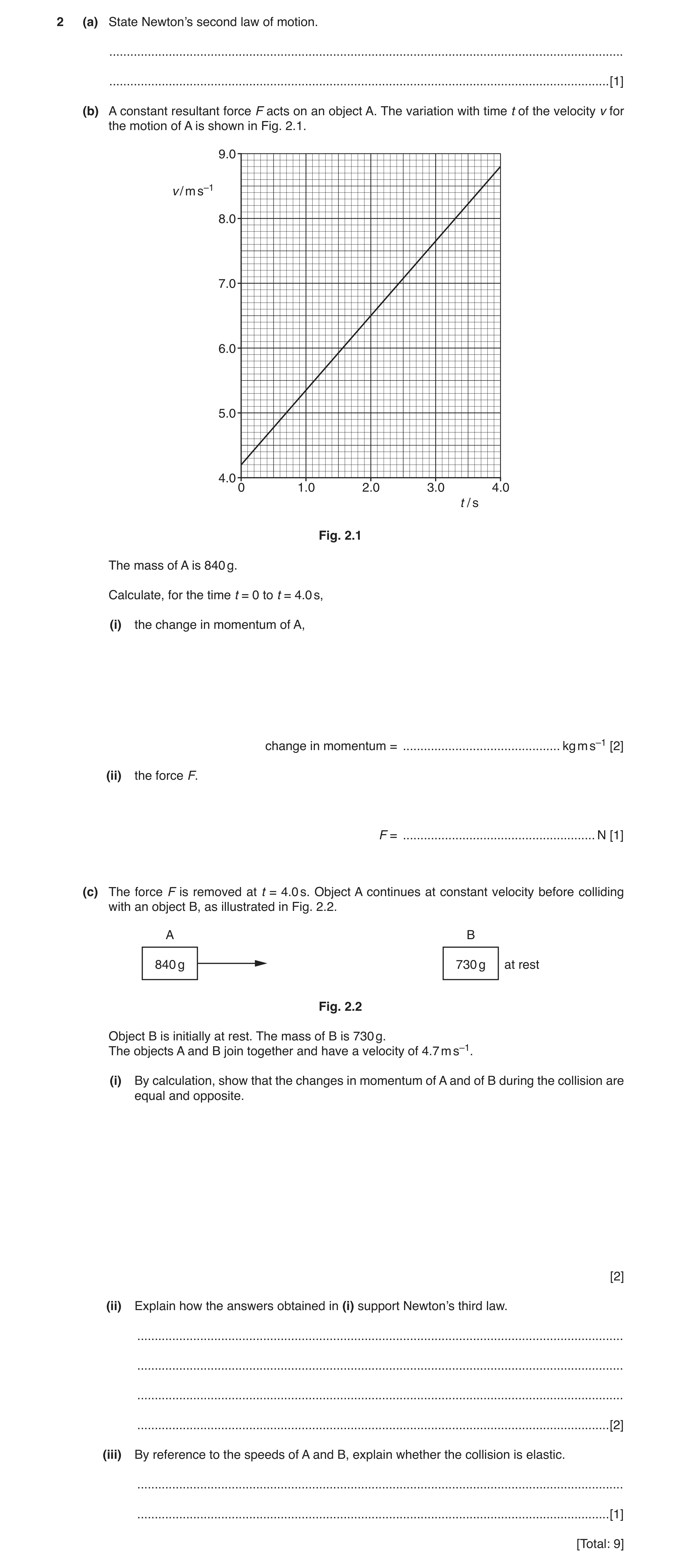
2 (a) State Newton’s second law of motion. … … [1] (b) A constant resultant force F acts on an object A. The variation with time t of the velocity v for the motion of A is shown in Fig. 2.1. 9.0 v / m s–1 8.0 7.0 6.0 5.0 4.0 0 1.0 2.0 3.0 4.0 t / s Fig. 2.1 The mass of A is 840 g. Calculate, for the time t = 0 to t = 4.0 s, (i) the change in momentum of A, change in momentum = … kg m s–1 [2] (ii) the force F. F = … N [1] (c) The force F is removed at t = 4.0 s. Object A continues at constant velocity before colliding with an object B, as illustrated in Fig. 2.2. A B 840 g 730 g at rest Fig. 2.2 Object B is initially at rest. The mass of B is 730 g. The objects A and B join together and have a velocity of 4.7 m s–1. (i) By calculation, show that the changes in momentum of A and of B during the collision are equal and opposite. [2] (ii) Explain how the answers obtained in (i) support Newton’s third law. … … … … [2] (iii) By reference to the speeds of A and B, explain whether the collision is elastic. … … [1] [Total: 9]
9 marks
Mark scheme: 2(a) (resultant) force is proportional/equal to the rate of change of momentum B1 2(b)(i) change in momentum = m(v2 − v1) = 0.84 × (8.8 − 4.2) C1 = 3.9 (3.86) kg m s–1 A1 2(b)(ii) F = (3.9 / 4.0) = 0.97 (0.965) N A1 2(c)(i) change in momentum for A: 0.84 × (4.7 − 8.8) = −3.4 (3.44) change in momentum for B: 0.73 × (4.7 − 0) = 3.4 (3.43) M1 change in momentum for B is equal and opposite to A A1 2(c)(ii) change in momentum equal (for A and B) M1 force is change in momentum / time and time (of collision) is the same hence force on A and B equal and opposite as for Newton’s third law A1 2(c)(iii) inelastic as relative speed of approach not equal to relative speed of separation B1
This question in 9702/23 May/June 2017
Q3 · State what is meant by the mass of a body 9702/21 May/June 2018
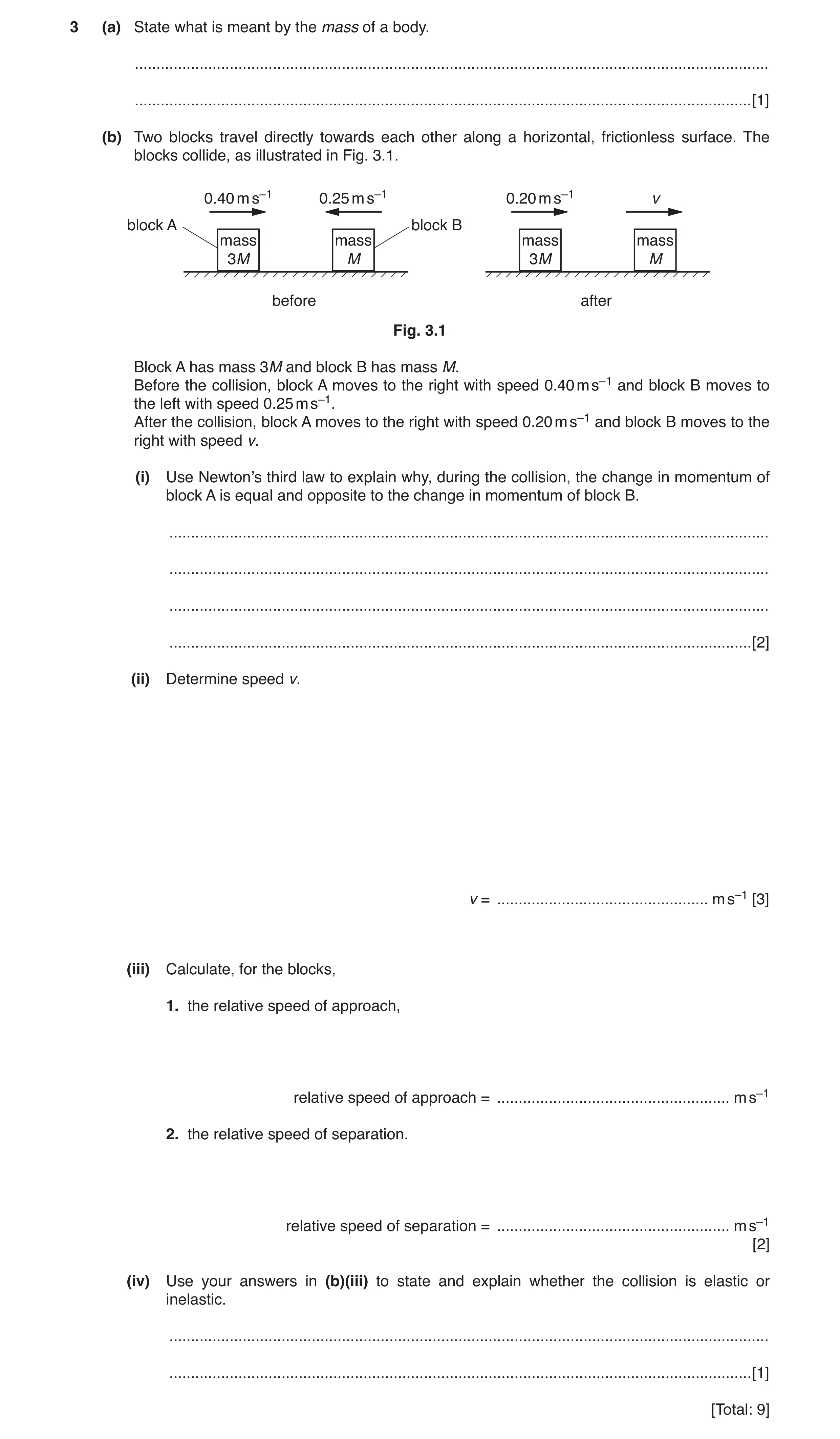
3 (a) State what is meant by the mass of a body. … … [1] (b) Two blocks travel directly towards each other along a horizontal, frictionless surface. The blocks collide, as illustrated in Fig. 3.1. 0.40 m s–1 0.25 m s–1 0.20 m s–1 v block A block B mass mass mass mass 3M M 3M M before after Fig. 3.1 Block A has mass 3M and block B has mass M. Before the collision, block A moves to the right with speed 0.40 m s–1 and block B moves to the left with speed 0.25 m s–1. After the collision, block A moves to the right with speed 0.20 m s–1 and block B moves to the right with speed v. (i) Use Newton’s third law to explain why, during the collision, the change in momentum of block A is equal and opposite to the change in momentum of block B. … … … … [2] (ii) Determine speed v. v = … m s–1 [3] (iii) Calculate, for the blocks, 1. the relative speed of approach, relative speed of approach = … m s–1 2. the relative speed of separation. relative speed of separation = … m s–1 [2] (iv) Use your answers in (b)(iii) to state and explain whether the collision is elastic or inelastic. … … [1] [Total: 9]
9 marks
Mark scheme: 3(a) mass is the property (of a body/object) resisting changes in motion or mass is the quantity of matter (in a body) B1 3(b)(i) force on A (by B) equal and opposite to force on B (by A) or both A and B exert equal and opposite forces on each other B1 force is rate of change of momentum and time (of contact) is same B1 3(b)(ii) p = mv or 3M × 0.40 or M × 0.25 or 3M × 0.2 or Mv C1 (3M × 0.40) – (M × 0.25) = (3M × 0.2) + Mv C1 v = (3 × 0.40) – 0.25 – (3 × 0.2) = 0.35 m s–1 A1 3(b)(iii) 1. relative speed of approach = 0.40 + 0.25 = 0.65 m s–1 A1 2. relative speed of separation = 0.35 – 0.20 = 0.15 m s–1 A1 3(b)(iv) (relative) speed of separation not equal to/less than (relative) speed of approach or answers (to (b)(iii) are) not equal and so inelastic collision B1
This question in 9702/21 May/June 2018
Q4 · State the principle of conservation of momentum 9702/22 May/June 2018
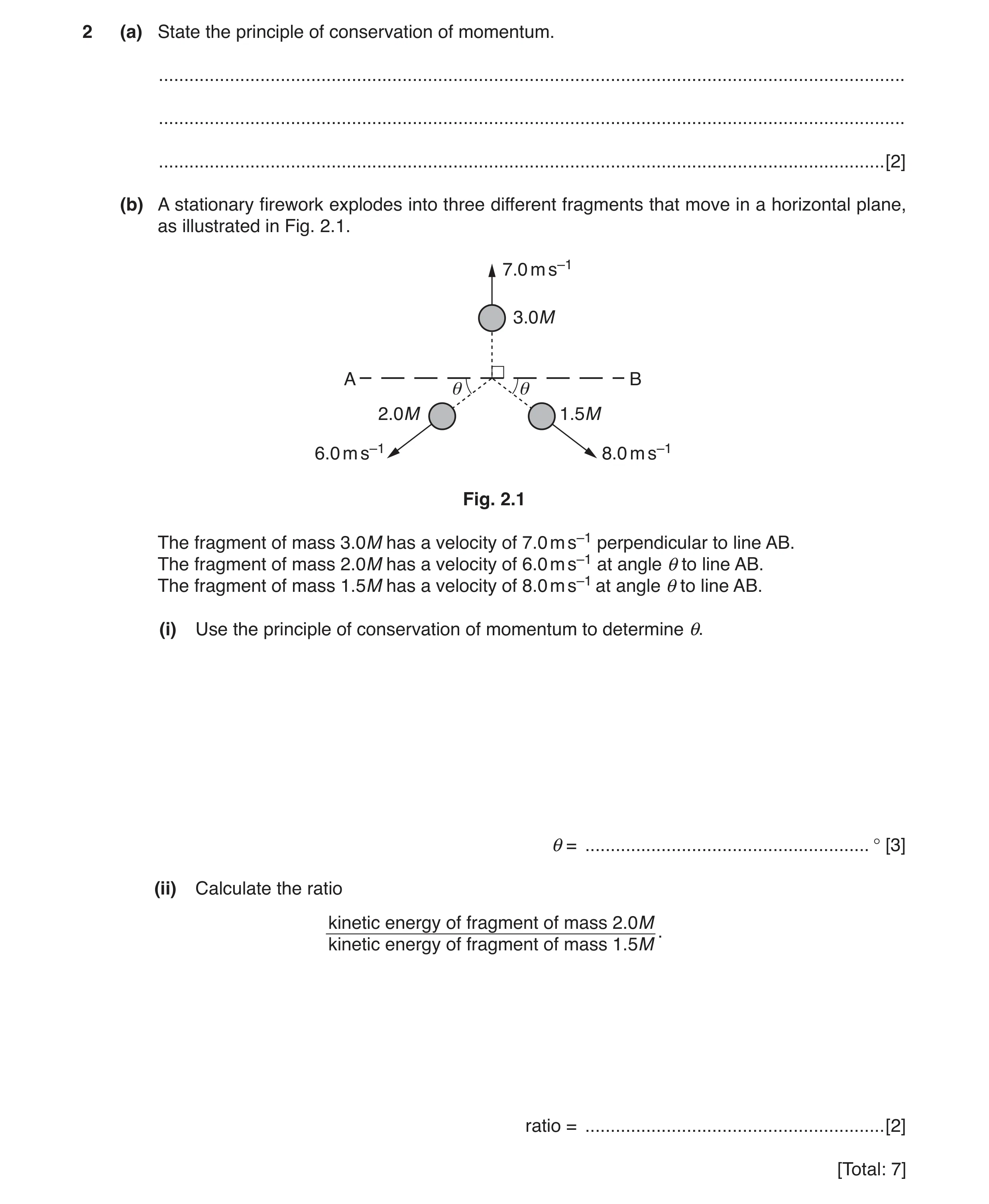
2 (a) State the principle of conservation of momentum. … … … [2] (b) A stationary firework explodes into three different fragments that move in a horizontal plane, as illustrated in Fig. 2.1. 7.0 m s–1 3.0M A B θ θ 2.0M 1.5M 6.0 m s–1 8.0 m s–1 Fig. 2.1 The fragment of mass 3.0M has a velocity of 7.0 m s–1 perpendicular to line AB. The fragment of mass 2.0M has a velocity of 6.0 m s–1 at angle θ to line AB. The fragment of mass 1.5M has a velocity of 8.0 m s–1 at angle θ to line AB. (i) Use the principle of conservation of momentum to determine θ. θ = … ° [3] (ii) Calculate the ratio kinetic energy of fragment of mass 2.0M . kinetic energy of fragment of mass 1.5M ratio = … [2] [Total: 7]
7 marks
Mark scheme: 2(a) sum/total momentum (of a system of bodies) is constant or sum/total momentum before = sum/total momentum after M1 for an isolated system or no (resultant) external force A1 2(b)(i) (p =) mv or (3.0M × 7.0) or (2.0M × 6.0) or (1.5M × 8.0) C1 3.0M × 7.0 = 2.0M × 6.0 sinθ + 1.5M × 8.0 sinθ C1 θ = 61° A1 or (vector triangle method) momentum vector triangle drawn (C1) θ = 61° (2 marks for ±1°, 1 mark for ±2°) (A2) or (use of cosine rule) p = mv or (3.0M × 7.0) or (2.0M × 6.0) or (1.5M × 8.0) (C1) (21M)2 = (12M)2 + (12M)2 – (2 × 12M × 12M × cos 2θ ) (C1) θ = 61° (A1) 2(b)(ii) (E =) ½mv2 C1 ratio = (½ × 2.0M × 6.02) / (½ × 1.5M × 8.02) = 0.75 A1
This question in 9702/22 May/June 2018
Q5 · A ball is thrown vertically upwards towards a ceiling and then rebounds, as illustrated… 9702/23 May/June 2018
3 A ball is thrown vertically upwards towards a ceiling and then rebounds, as illustrated in Fig. 3.1. ceiling ball leaving speed 3.8 m s–1 ceiling ball thrown speed 9.6 m s–1 upwards Fig. 3.1 The ball is thrown with speed 9.6 m s–1 and takes a time of 0.37 s to reach the ceiling. The ball is then in contact with the ceiling for a further time of 0.085 s until leaving it with a speed of 3.8 m s–1. The mass of the ball is 0.056 kg. Assume that air resistance is negligible. (a) Show that the ball reaches the ceiling with a speed of 6.0 m s–1. [1] (b) Calculate the height of the ceiling above the point from which the ball was thrown. height = … m [2] (c) Calculate (i) the increase in gravitational potential energy of the ball for its movement from its initial position to the ceiling, increase in gravitational potential energy = … J [2] (ii) the decrease in kinetic energy of the ball while it is in contact with the ceiling. decrease in kinetic energy = … J [2] (d) State how Newton’s third law applies to the collision between the ball and the ceiling. … … … … [2] (e) Calculate the change in momentum of the ball during the collision. change in momentum = … N s [2] (f) Determine the magnitude of the average force exerted by the ceiling on the ball during the collision. average force = … N [2] [Total: 13]
13 marks
Mark scheme: 3(a) v = u + at v = 9.6 – (9.81 × 0.37) = 6.0 m s–1 A1 3(b) s = ½ × (9.6 + 6.0) × 0.37 or 6.02 = 9.62 – (2 × 9.81 × s) or s = (9.6 × 0.37) – (½ × 9.81 × 0.372) or s = (6.0 × 0.37) + (½ × 9.81 × 0.372) C1 s = 2.9 m A1 3(c)(i) (∆)E = mg(∆)h C1 ∆E = 0.056 × 9.81 × 2.9 = 1.6 J A1 3(c)(ii) E = ½mv 2 C1 ∆E = ½ × 0.056 × (6.02 – 3.82) = 0.60 J A1 3(d) force on ball (by ceiling) equal to force on ceiling (by ball) M1 and opposite (in direction) A1 3(e) (p =) mv or 0.056 × 6.0 or 0.056 × 3.8 C1 change in momentum = 0.056 × (6.0 + 3.8) = 0.55 N s A1 Question Answer Mark 3(f) resultant force = 0.55 / 0.085 (= 6.47 N) C1 force by ceiling = 6.47 – (0.056 × 9.81) = 5.9 N A1
This question in 9702/23 May/June 2018
Q6 · A wooden block moves along a horizontal frictionless surface, as shown in Fig 9702/21 Oct/Nov 2018
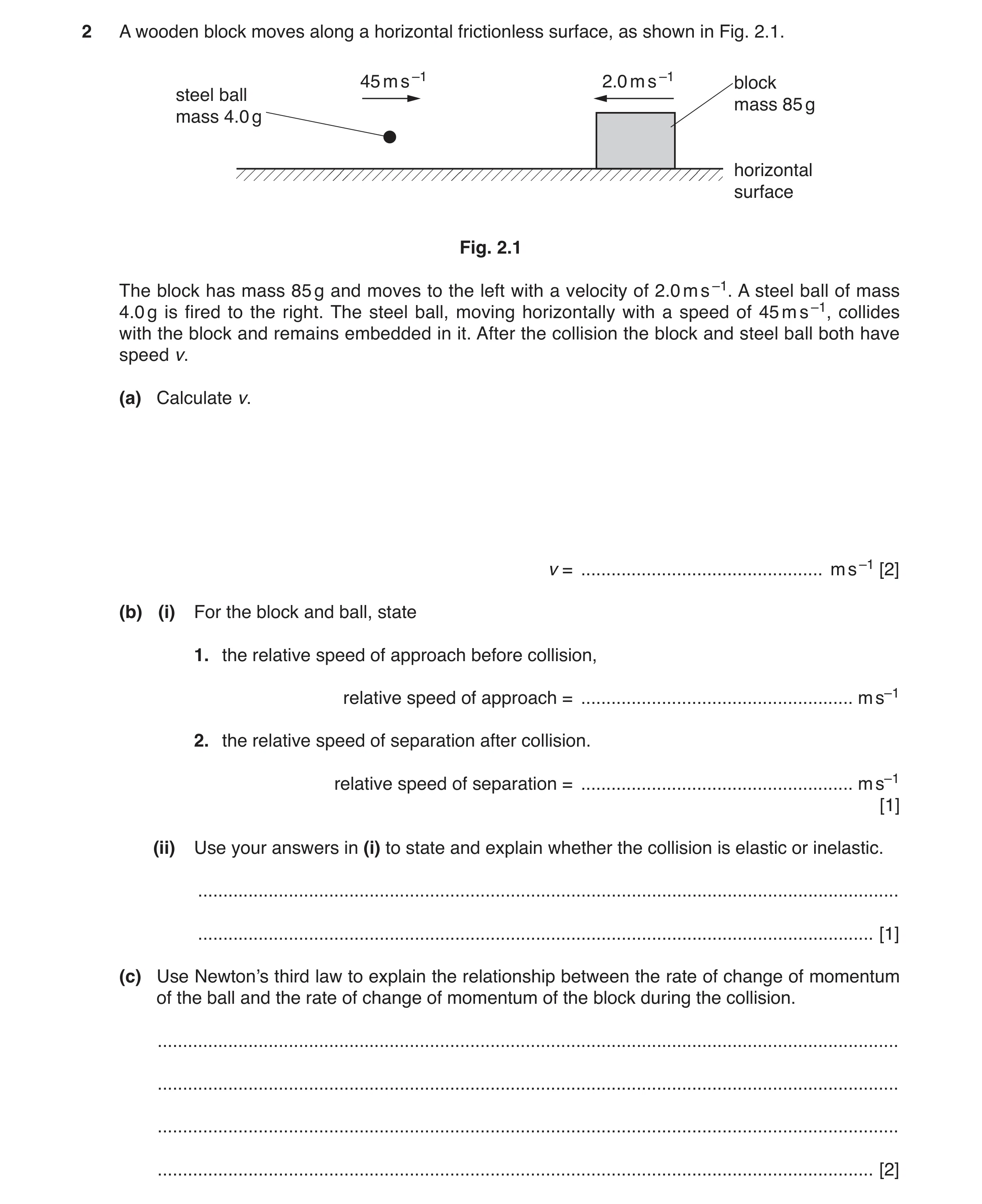
2 A wooden block moves along a horizontal frictionless surface, as shown in Fig. 2.1. 45 m s –1 2.0 m s –1 block steel ball mass 85 g mass 4.0 g horizontal surface Fig. 2.1 The block has mass 85 g and moves to the left with a velocity of 2.0 m s –1. A steel ball of mass 4.0 g is fired to the right. The steel ball, moving horizontally with a speed of 45 m s –1, collides with the block and remains embedded in it. After the collision the block and steel ball both have speed v. (a) Calculate v. v = … m s –1 [2] (b) (i) For the block and ball, state 1. the relative speed of approach before collision, relative speed of approach = … m s–1 2. the relative speed of separation after collision. relative speed of separation = … m s–1 [1] (ii) Use your answers in (i) to state and explain whether the collision is elastic or inelastic. … … [1] (c) Use Newton’s third law to explain the relationship between the rate of change of momentum of the ball and the rate of change of momentum of the block during the collision. … … … … [2]
6 marks
Mark scheme: 2(a) C1 (4.0 × 45) – (2.0 × 85) = 89 v v = 0.11 m s–1 A1 2(b)(i) 1. speed of approach = 47 m s–1 and 2. speed of separation = 0 A1 2(b)(ii) speed of separation less than/not equal to speed of approach and so inelastic collision A1 2(c) force is equal to rate of change of momentum B1 force on ball (by block) equal and opposite to force on block (by ball) so rates of change of momentum are equal and opposite B1 or force on ball (by block) equal and opposite to force on block (by ball) (B1) force is equal to rate of change of momentum so rates of change of momentum are equal and opposite (B1)
This question in 9702/21 Oct/Nov 2018
Q7 · State the principle of conservation of momentum 9702/22 Oct/Nov 2018
3 (a) State the principle of conservation of momentum. … … … [2] (b) The propulsion system of a toy car consists of a propeller attached to an electric motor, as illustrated in Fig. 3.1. propeller moving air 0.045 m speed 1.8 m s–1 electric motor of car body of car 0.045 m ground Fig. 3.1 The car is on horizontal ground and is initially held at rest by its brakes. When the motor is switched on, it rotates the propeller so that air is propelled horizontally to the left. The density of the air is 1.3 kg m–3. Assume that the air moves with a speed of 1.8 m s–1 in a uniform cylinder of radius 0.045 m. Also assume that the air to the right of the propeller is stationary. (i) Show that, in a time interval of 2.0 s, the mass of air propelled to the left is 0.030 kg. [2] (ii) Calculate 1. the increase in the momentum of the mass of air in (b)(i), increase in momentum = … N s 2. the force exerted on this mass of air by the propeller. force = … N [3] (iii) Explain how Newton’s third law applies to the movement of the air by the propeller. … … … [2] (iv) The total mass of the car is 0.20 kg. The brakes of the car are released and the car begins to move with an initial acceleration of 0.075 m s–2. Determine the initial frictional force acting on the car. frictional force = … N [2] [Total: 11]
11 marks
Mark scheme: 3(a) sum/total momentum (of a system of bodies) is constant or sum/total momentum before = sum/total momentum after M1 for an isolated system or no (resultant) external force A1 3(b)(i) m = ρV C1 = 1.3 × π × 0.0452 × 1.8 × 2.0 = 0.030 (kg) A1 3(b)(ii) 1. (∆)p = (∆)mv C1 = 0.030 × 1.8 = 0.054 N s A1 2. F = 0.054 / 2.0 or 0.030 × 1.8 / 2.0 = 0.027 N A1 3(b)(iii) force on air (by propeller) equal to force on propeller (by air) M1 and opposite (in direction) A1 3(b)(iv) resultant force = 0.20 × 0.075 (= 0.015 N) frictional force = 0.027 – 0.015 C1 = 0.012 N A1
This question in 9702/22 Oct/Nov 2018
Q8 · State Newton’s second law of motion 9702/23 Oct/Nov 2018
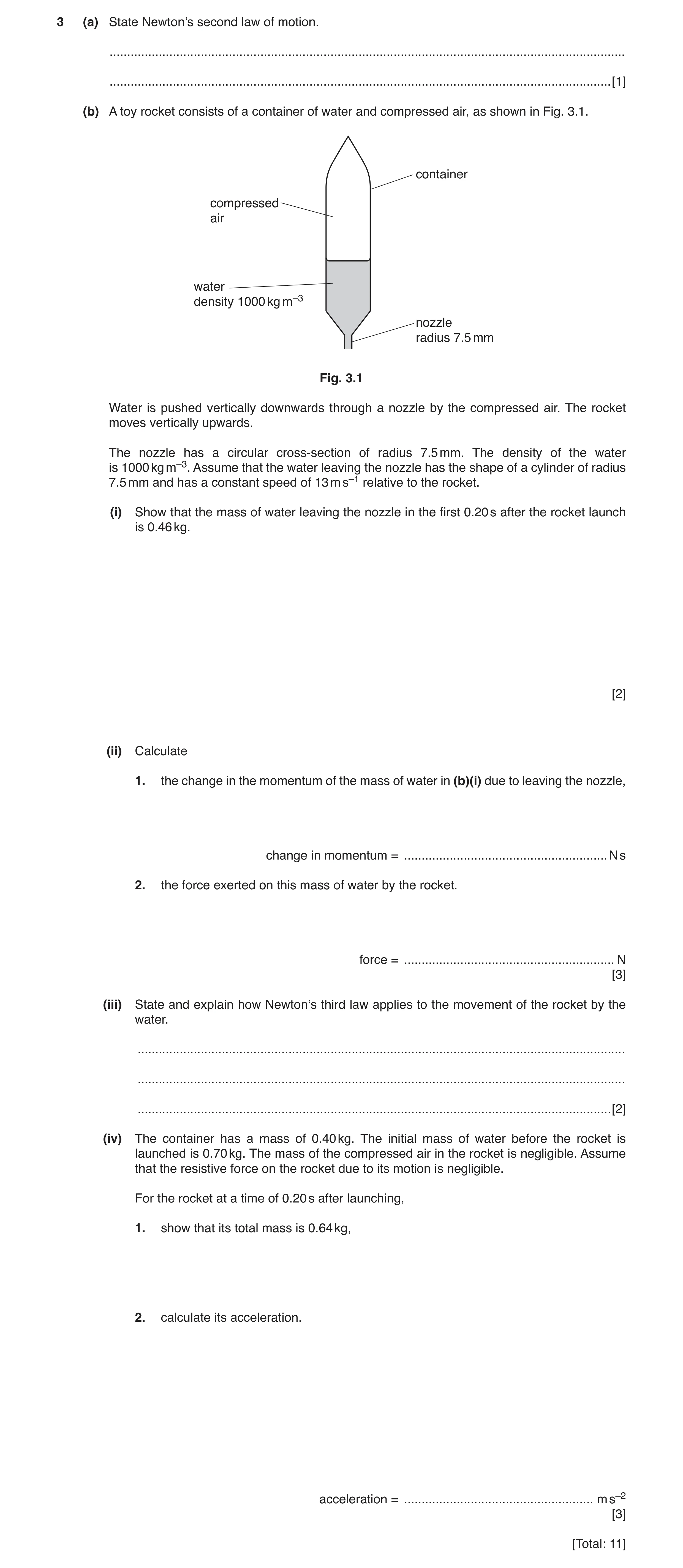
3 (a) State Newton’s second law of motion. … … [1] (b) A toy rocket consists of a container of water and compressed air, as shown in Fig. 3.1. container compressed air water density 1000 kg m–3 nozzle radius 7.5 mm Fig. 3.1 Water is pushed vertically downwards through a nozzle by the compressed air. The rocket moves vertically upwards. The nozzle has a circular cross-section of radius 7.5 mm. The density of the water is 1000 kg m–3. Assume that the water leaving the nozzle has the shape of a cylinder of radius 7.5 mm and has a constant speed of 13 m s–1 relative to the rocket. (i) Show that the mass of water leaving the nozzle in the first 0.20 s after the rocket launch is 0.46 kg. [2] (ii) Calculate 1. the change in the momentum of the mass of water in (b)(i) due to leaving the nozzle, change in momentum = … N s 2. the force exerted on this mass of water by the rocket. force = … N [3] (iii) State and explain how Newton’s third law applies to the movement of the rocket by the water. … … … [2] (iv) The container has a mass of 0.40 kg. The initial mass of water before the rocket is launched is 0.70 kg. The mass of the compressed air in the rocket is negligible. Assume that the resistive force on the rocket due to its motion is negligible. For the rocket at a time of 0.20 s after launching, 1. show that its total mass is 0.64 kg, 2. calculate its acceleration. acceleration = … m s–2 [3] [Total: 11]
11 marks
Mark scheme: 3(a) (resultant) force proportional/equal to rate of change of momentum B1 3(b)(i) ρ = m / V C1 V = π × (7.5 × 10⁻³)2 × 13 × 0.2 (= 4.59 × 10⁻⁴ m3) m = π × (7.5 × 10⁻³)2 × 13 × 0.2 × 1000 = 0.46 kg A1 3(b)(ii) 1. (∆)p = (∆m)v C1 (∆)p = 0.46 × 13 = 6.0 N s A1 2. F = 6.0 / 0.20 = 30 N A1 3(b)(iii) force on water (by rocket/nozzle) equal to force on rocket/nozzle (by water) M1 in the opposite direction A1 3(b)(iv) 1. mass = 0.40 + 0.70 – 0.46 = 0.64 kg A1 2. acceleration = [30 – (0.64 × 9.81)] / 0.64 or 30 / 0.64 – 9.81 C1 = 37 m s–2 A1
This question in 9702/23 Oct/Nov 2018
Q9 · Two balls, X and Y, move along a horizontal frictionless surface, as illustrated in Fig 9702/22 Feb/March 2019
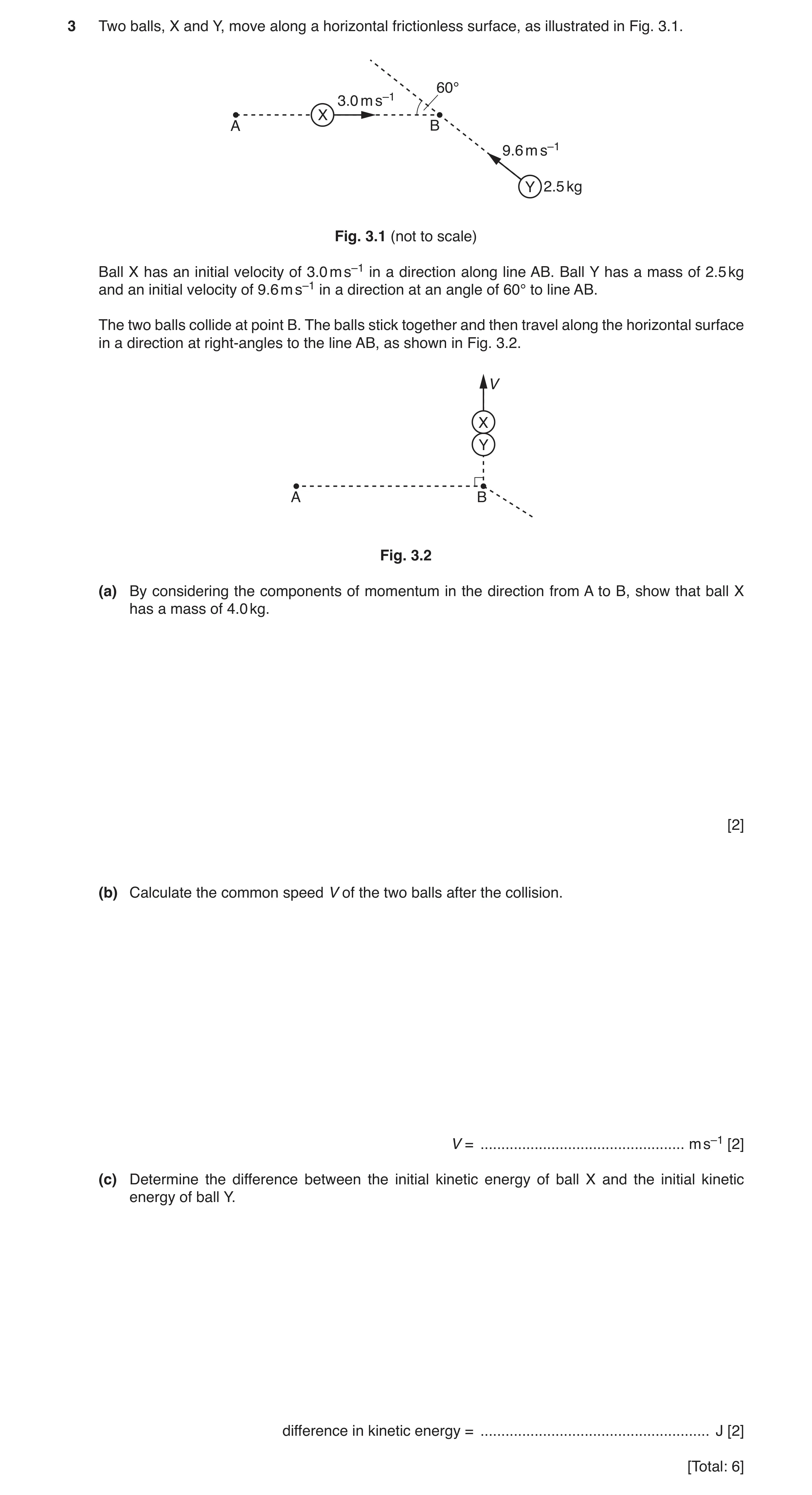
3 Two balls, X and Y, move along a horizontal frictionless surface, as illustrated in Fig. 3.1. 60° 3.0 m s–1 X A B 9.6 m s–1 Y 2.5 kg Fig. 3.1 (not to scale) Ball X has an initial velocity of 3.0 m s–1 in a direction along line AB. Ball Y has a mass of 2.5 kg and an initial velocity of 9.6 m s–1 in a direction at an angle of 60° to line AB. The two balls collide at point B. The balls stick together and then travel along the horizontal surface in a direction at right-angles to the line AB, as shown in Fig. 3.2. V X Y A B Fig. 3.2 (a) By considering the components of momentum in the direction from A to B, show that ball X has a mass of 4.0 kg. [2] (b) Calculate the common speed V of the two balls after the collision. V = … m s–1 [2] (c) Determine the difference between the initial kinetic energy of ball X and the initial kinetic energy of ball Y. difference in kinetic energy = … J [2] [Total: 6]
6 marks
Mark scheme: 3(a) C1 (m × 3.0) – (2.5 × 9.6 × cos 60°) = 0 so m = 4.0 (kg) A1 Question Answer Marks 3(b) 2.5 × 9.6 × sin60° = (4.0 + 2.5) × V C1 V = 3.2 m s–1 A1 or use of momentum vector triangle: (4.0 × 3.0)2 + [(4.0 + 2.5) × V]2 = (2.5 × 9.6)2 (C1) V = 3.2 m s–1 (A1) 3(c) E = ½mv 2 difference in EK = ½ × 2.5 × (9.6)2 – ½ × 4.0 × (3.0)2 C1 = 97 J A1
This question in 9702/22 Feb/March 2019
Q10 · A small remote-controlled model aircraft has two propellers, each of diameter 16 cm 9702/21 Oct/Nov 2019
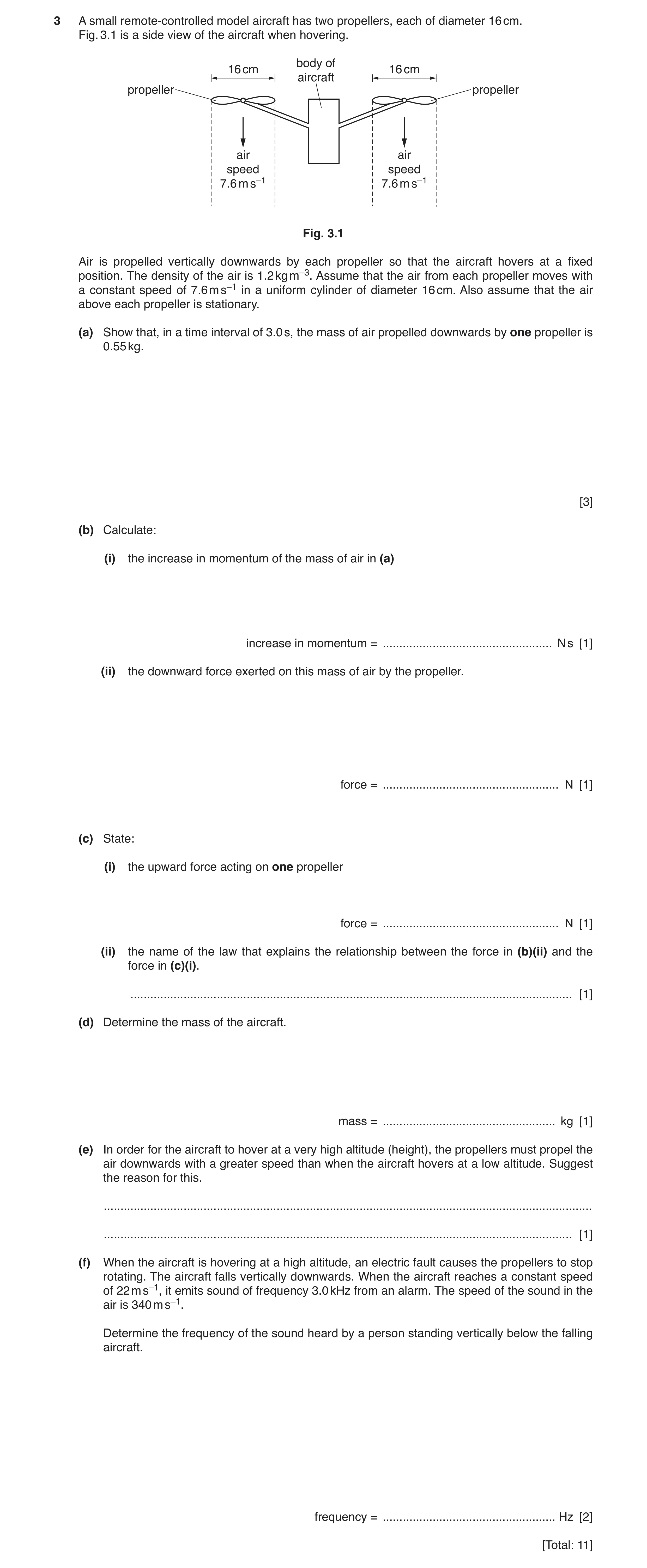
3 A small remote-controlled model aircraft has two propellers, each of diameter 16 cm. Fig. 3.1 is a side view of the aircraft when hovering. body of 16 cm 16 cm aircraft propeller propeller air air speed speed 7.6 m s–1 7.6 m s–1 Fig. 3.1 Air is propelled vertically downwards by each propeller so that the aircraft hovers at a fixed position. The density of the air is 1.2 kg m–3. Assume that the air from each propeller moves with a constant speed of 7.6 m s–1 in a uniform cylinder of diameter 16 cm. Also assume that the air above each propeller is stationary. (a) Show that, in a time interval of 3.0 s, the mass of air propelled downwards by one propeller is 0.55 kg. [3] (b) Calculate: (i) the increase in momentum of the mass of air in (a) increase in momentum = … N s [1] (ii) the downward force exerted on this mass of air by the propeller. force = … N [1] (c) State: (i) the upward force acting on one propeller force = … N [1] (ii) the name of the law that explains the relationship between the force in (b)(ii) and the force in (c)(i). … [1] (d) Determine the mass of the aircraft. mass = … kg [1] (e) In order for the aircraft to hover at a very high altitude (height), the propellers must propel the air downwards with a greater speed than when the aircraft hovers at a low altitude. Suggest the reason for this. … … [1] (f) When the aircraft is hovering at a high altitude, an electric fault causes the propellers to stop rotating. The aircraft falls vertically downwards. When the aircraft reaches a constant speed of 22 m s–1, it emits sound of frequency 3.0 kHz from an alarm. The speed of the sound in the air is 340 m s–1. Determine the frequency of the sound heard by a person standing vertically below the falling aircraft. frequency = … Hz [2] [Total: 11]
11 marks
Mark scheme: 3(a) C1 V = π × (0.16 / 2)2 × 7.6 × 3.0 (= 0.458 m3) C1 m = π × (0.16 / 2)2 × 7.6 × 3.0 × 1.2 = 0.55 kg A1 3(b)(i) ∆p = 0.55 × 7.6 = 4.2 N s A1 3(b)(ii) F = 4.2 / 3.0 or 0.55 × 7.6 / 3.0 = 1.4 N A1 3(c)(i) F = 1.4 N A1 3(c)(ii) Newton’s third law (of motion) B1 3(d) 2 × 1.4 = m × 9.81 m = 0.29 kg A1 3(e) the density of air is less at high altitude B1 3(f) fo = fsv / (v – vs) = 3000 × 340 / (340 – 22) C1 = 3200 Hz A1
This question in 9702/21 Oct/Nov 2019
Q11 · State Newton’s third law of motion 9702/22 Oct/Nov 2019
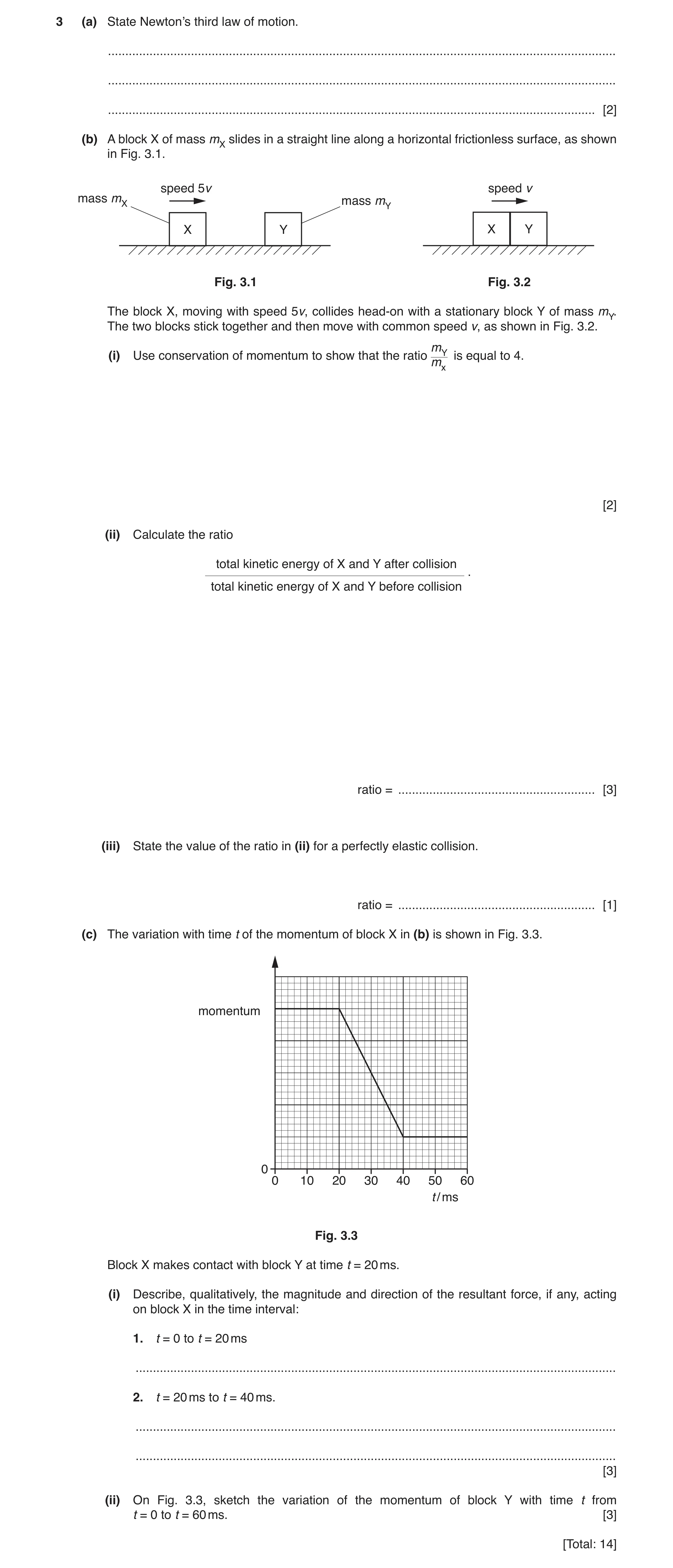
3 (a) State Newton’s third law of motion. … … … [2] (b) A block X of mass mX slides in a straight line along a horizontal frictionless surface, as shown in Fig. 3.1. speed 5v speed v mass mX mass mY X Y X Y Fig. 3.1 Fig. 3.2 The block X, moving with speed 5v, collides head-on with a stationary block Y of mass mY. The two blocks stick together and then move with common speed v, as shown in Fig. 3.2. mY (i) Use conservation of momentum to show that the ratio is equal to 4. mx [2] (ii) Calculate the ratio total kinetic energy of X and Y after collision . total kinetic energy of X and Y before collision ratio = … [3] (iii) State the value of the ratio in (ii) for a perfectly elastic collision. ratio = … [1] (c) The variation with time t of the momentum of block X in (b) is shown in Fig. 3.3. momentum 0 0 10 20 30 40 50 60 t / ms Fig. 3.3 Block X makes contact with block Y at time t = 20 ms. (i) Describe, qualitatively, the magnitude and direction of the resultant force, if any, acting on block X in the time interval: 1. t = 0 to t = 20 ms … 2. t = 20 ms to t = 40 ms. … … [3] (ii) On Fig. 3.3, sketch the variation of the momentum of block Y with time t from t = 0 to t = 60 ms. [3] [Total: 14]
14 marks
Mark scheme: 3(a) force on body A (by body B) is equal (in magnitude) to force on body B (by body A) B1 force on body A (by body B) is opposite (in direction) to force on body B (by body A) B1 3(b)(i) mX × 5v or (mX + mY) × v C1 mX × 5v = (mX + mY) × v (so) mY / mX = 4 A1 3(b)(ii) (E =) ½mv2 C1 ratio = [½ × (mX + mY) × v2] / [½ × mX × (5v)2] C1 ratio = 0.2 A1 3(b)(iii) ratio = 1 A1 3(c)(i) 1. (magnitude of resultant force is) zero B1 2. (magnitude of resultant force is) constant B1 (direction of resultant force is) opposite to the momentum B1 3(c)(ii) horizontal line from (0 ms, 0 squares) ending at (20 ms, 0 squares) B1 straight line from (20 ms, 0 squares) ending at (40 ms, 4.0 squares [= 4.0 cm vertically]) B1 horizontal line from (40 ms, 4.0 squares) ending at (60 ms, 4.0 squares) B1
This question in 9702/22 Oct/Nov 2019
Q12 · A ball X moves along a horizontal frictionless surface and collides with another ball Y… 9702/23 Oct/Nov 2019
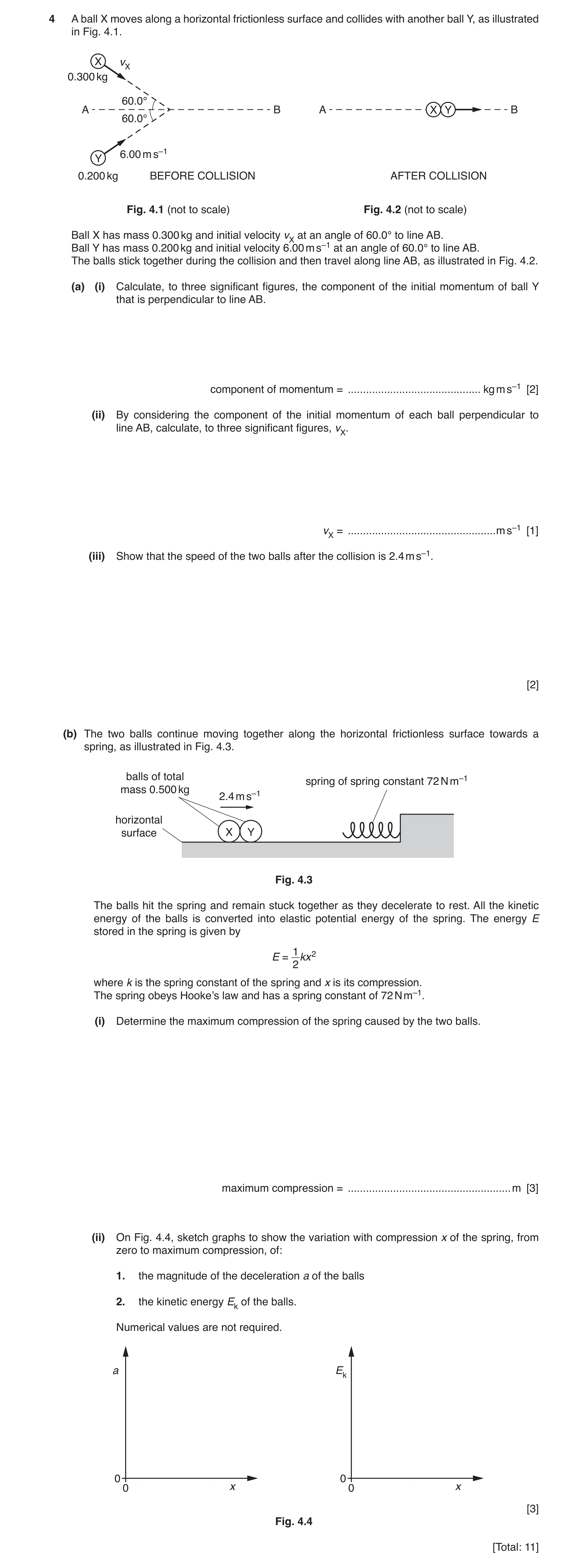
4 A ball X moves along a horizontal frictionless surface and collides with another ball Y, as illustrated in Fig. 4.1. X vX 0.300 kg 60.0° A B A X Y B 60.0° 6.00 m s–1 Y 0.200 kg BEFORE COLLISION AFTER COLLISION Fig. 4.1 (not to scale) Fig. 4.2 (not to scale) Ball X has mass 0.300 kg and initial velocity vX at an angle of 60.0° to line AB. Ball Y has mass 0.200 kg and initial velocity 6.00 m s–1 at an angle of 60.0° to line AB. The balls stick together during the collision and then travel along line AB, as illustrated in Fig. 4.2. (a) (i) Calculate, to three significant figures, the component of the initial momentum of ball Y that is perpendicular to line AB. component of momentum = … kg m s–1 [2] (ii) By considering the component of the initial momentum of each ball perpendicular to line AB, calculate, to three significant figures, vX. vX = … m s–1 [1] (iii) Show that the speed of the two balls after the collision is 2.4 m s–1. [2] (b) The two balls continue moving together along the horizontal frictionless surface towards a spring, as illustrated in Fig. 4.3. balls of total spring of spring constant 72 N m–1 mass 0.500 kg 2.4 m s–1 horizontal surface X Y Fig. 4.3 The balls hit the spring and remain stuck together as they decelerate to rest. All the kinetic energy of the balls is converted into elastic potential energy of the spring. The energy E stored in the spring is given by 1 E = 2kx2 where k is the spring constant of the spring and x is its compression. The spring obeys Hooke’s law and has a spring constant of 72 N m–1. (i) Determine the maximum compression of the spring caused by the two balls. maximum compression = … m [3] (ii) On Fig. 4.4, sketch graphs to show the variation with compression x of the spring, from zero to maximum compression, of: 1. the magnitude of the deceleration a of the balls 2. the kinetic energy Ek of the balls. Numerical values are not required. a Ek 0 0 0 x 0 x [3] Fig. 4.4 [Total: 11]
11 marks
Mark scheme: 4(a)(i) p = mv C1 = 0.2(00) × 6.(00) × sin 60(.0)° or 0.2(00) × 6.(00) × cos 30(.0)° = 1.04 kg m s–1 A1 4(a)(ii) 0.300 × vx × sin 60.0°= 1.04 vx = 4.00 m s–1 A1 4(a)(iii) 0.30 × 4.0 × cos 60° or 0.20 × 6.0 × cos 60° or (0.30 + 0.20)v or 0.50v C1 0.30 × 4.0 × cos 60° + 0.20 × 6.0 × cos 60° = (0.30 + 0.20)v or 0.50v so v = 2.4 m s–1 A1 4(b)(i) E = ½mv2 C1 ½ × 0.50 × 2.42 = ½ × 72 × x2 C1 x = 0.20 m A1 4(b)(ii) 1. straight line from the origin sloping upwards B1 2. line drawn from a positive value of Ek at x = 0 to a positive value of x at Ek = 0 M1 line has an increasing downwards slope A1
This question in 9702/23 Oct/Nov 2019
Q13 · A stationary nucleus of a radioactive isotope X decays by emitting an α-particle to… 9702/23 Oct/Nov 2019
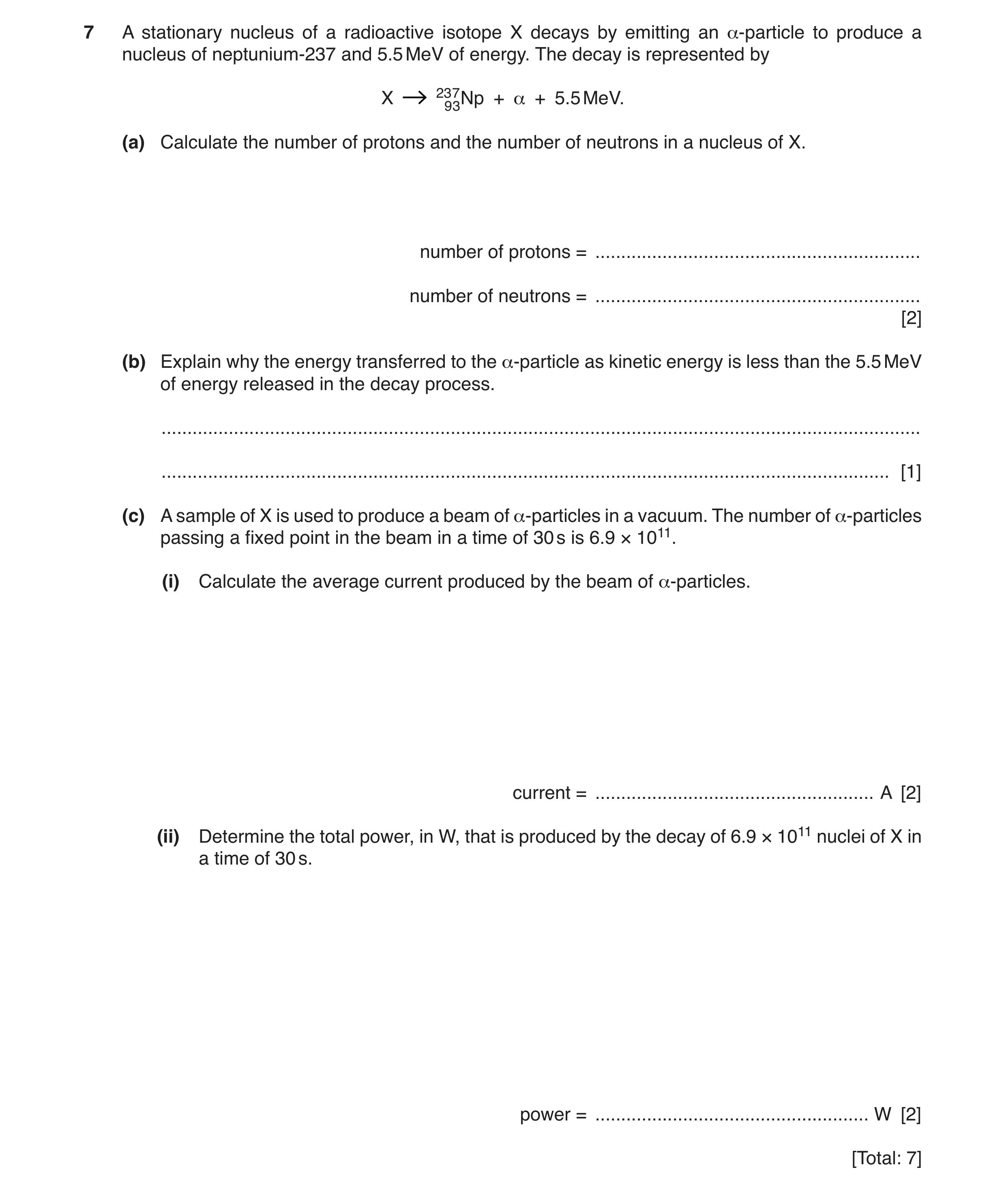
7 A stationary nucleus of a radioactive isotope X decays by emitting an α-particle to produce a nucleus of neptunium-237 and 5.5 MeV of energy. The decay is represented by α + 5.5 MeV. X 23973Np + (a) Calculate the number of protons and the number of neutrons in a nucleus of X. number of protons = … number of neutrons = … [2] (b) Explain why the energy transferred to the α-particle as kinetic energy is less than the 5.5 MeV of energy released in the decay process. … … [1] (c) A sample of X is used to produce a beam of α-particles in a vacuum. The number of α-particles passing a fixed point in the beam in a time of 30 s is 6.9 × 10¹¹. (i) Calculate the average current produced by the beam of α-particles. current = … A [2] (ii) Determine the total power, in W, that is produced by the decay of 6.9 × 10¹¹ nuclei of X in a time of 30 s. power = … W [2] [Total: 7]
7 marks
Mark scheme: 7(a) number of protons = 95 A1 number of neutrons = 146 A1 7(b) Np/neptunium (nucleus) has kinetic energy or gamma/γ-radiation produced B1 7(c)(i) I = NQ / t C1 I = (6.9 × 1011 × 2 × 1.60 × 10–19) / 30 = 7.4 × 10⁻⁹ A A1 7(c)(ii) P = (6.9 × 1011 × 5.5 × 106 × 1.60 × 10–19) / 30 C1 = 0.020 W A1
This question in 9702/23 Oct/Nov 2019
Question 14 9702/21 Oct/Nov 2020
3 (a) Define force. … … [1] (b) A ball falls vertically downwards towards a horizontal floor and then rebounds along its original path, as illustrated in Fig. 3.1. ball reaching ball leaving speed the floor speed the floor 3.8 m s–1 1.7 m s–1 Fig. 3.1 The ball reaches the floor with speed 3.8 m s–1. The ball is then in contact with the floor for a time of 0.081 s before leaving it with speed 1.7 m s–1. The mass of the ball is 0.062 kg. (i) Calculate the loss of kinetic energy of the ball during the collision. loss of kinetic energy = … J [2] (ii) Determine the magnitude of the change in momentum of the ball during the collision. change in momentum = … N s [2] (iii) Show that the magnitude of the average resultant force acting on the ball during the collision is 4.2 N. [1] (iv) Use the information in (iii) to calculate the magnitude of: 1. the average force of the floor on the ball during the collision average force = … N 2. the average force of the ball on the floor during the collision. average force = … N [2] [Total: 8]
8 marks
Mark scheme: 3(a) (force =) rate of change of momentum B1 3(b)(i) E = ½mv2 or ½ × 0.062 × 3.82 or ½ × 0.062 × 1.72 C1 loss of KE = ½ × 0.062 × (3.82 – 1.72) = 0.36 J A1 3(b)(ii) p = mv or 0.062 × 3.8 or 0.062 × 1.7 C1 change in momentum = 0.062 × (1.7 + 3.8) = 0.34 N s A1 3(b)(iii) (average resultant force =) 0.34 / 0.081 = 4.2 (N) or (average resultant force =) 0.062 × (1.7 + 3.8) / 0.081 = 4.2 (N) A1 3(b)(iv) 1. average force = 4.2 + (0.062 × 9.81) = 4.8 N A1 2. average force = 4.8 N A1
This question in 9702/21 Oct/Nov 2020
Q15 · A ball is fired horizontally with a speed of 41.0 m s–1 from a stationary cannon at the… 9702/23 Oct/Nov 2020
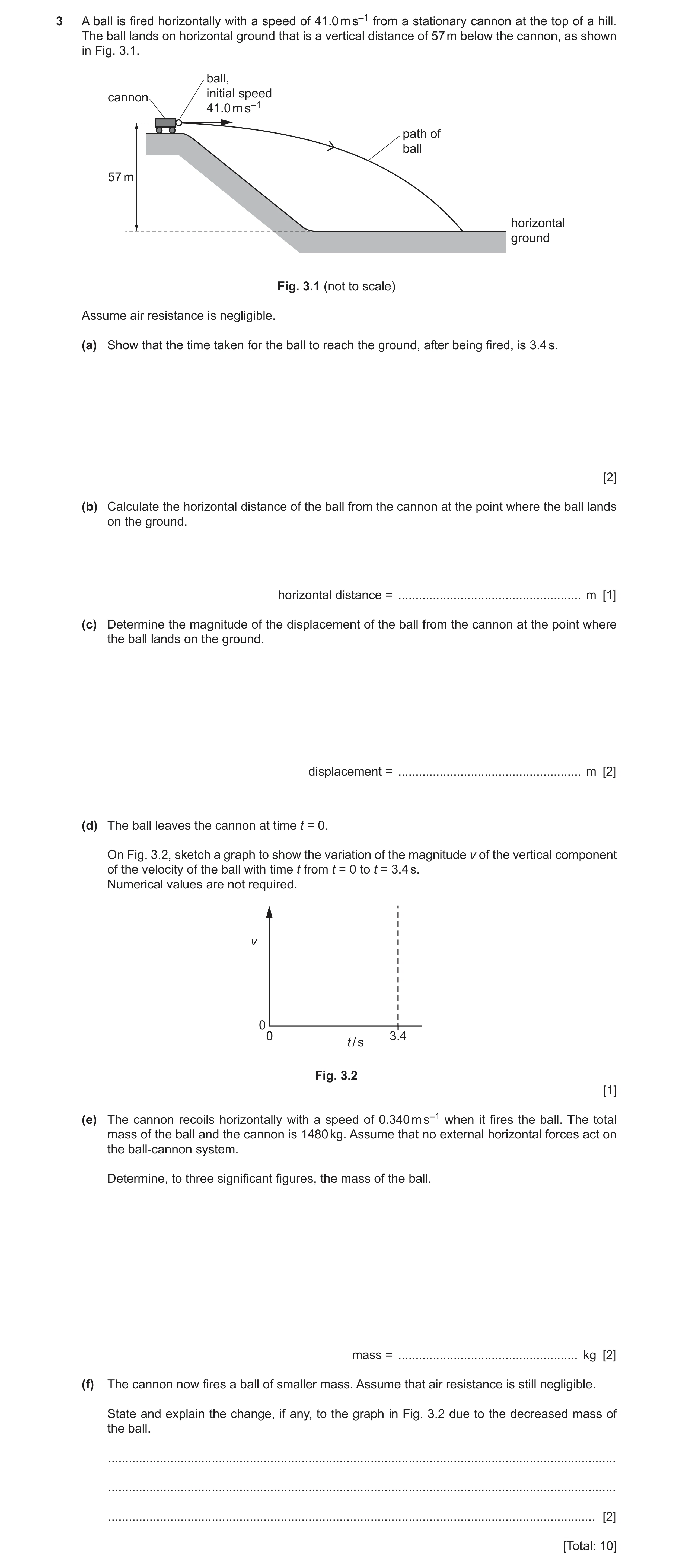
3 A ball is fired horizontally with a speed of 41.0 m s–1 from a stationary cannon at the top of a hill. The ball lands on horizontal ground that is a vertical distance of 57 m below the cannon, as shown in Fig. 3.1. ball, initial speed cannon 41.0 m s–1 path of ball 57 m horizontal ground Fig. 3.1 (not to scale) Assume air resistance is negligible. (a) Show that the time taken for the ball to reach the ground, after being fired, is 3.4 s. [2] (b) Calculate the horizontal distance of the ball from the cannon at the point where the ball lands on the ground. horizontal distance = … m [1] (c) Determine the magnitude of the displacement of the ball from the cannon at the point where the ball lands on the ground. displacement = … m [2] (d) The ball leaves the cannon at time t = 0. On Fig. 3.2, sketch a graph to show the variation of the magnitude v of the vertical component of the velocity of the ball with time t from t = 0 to t = 3.4 s. Numerical values are not required. v 0 0 3.4 t / s Fig. 3.2 [1] (e) The cannon recoils horizontally with a speed of 0.340 m s–1 when it fires the ball. The total mass of the ball and the cannon is 1480 kg. Assume that no external horizontal forces act on the ball-cannon system. Determine, to three significant figures, the mass of the ball. mass = … kg [2] (f) The cannon now fires a ball of smaller mass. Assume that air resistance is still negligible. State and explain the change, if any, to the graph in Fig. 3.2 due to the decreased mass of the ball. … … … [2] [Total: 10]
10 marks
Mark scheme: 3(a) s = ½at 2 C1 57 = ½ × 9.81 × t 2 and t = 3.4 (s) A1 3(b) horizontal distance = 41 × 3.4 = 140 m A1 3(c) (displacement)2 = 572 + 1402 C1 displacement = ( 572 + 1402)0.5 = 150 m A1 3(d) straight line from the origin with positive gradient B1 3(e) (1480 – m) × 0.340 = m × 41.0 C1 m = 12.2 kg A1 or mc 0.34 = mb 41 and mc + mb = 1480 (C1) mc = (41 / 0.34)mb (41 / 0.34)mb + mb = 1480 mb = 12.2 kg (A1) 3(f) acceleration (of free fall) is unchanged/is not dependent on mass M1 (so) no change (to the graph) A1
This question in 9702/23 Oct/Nov 2020
Q16 · A ball is thrown vertically downwards to the ground, as illustrated in Fig 9702/22 May/June 2021
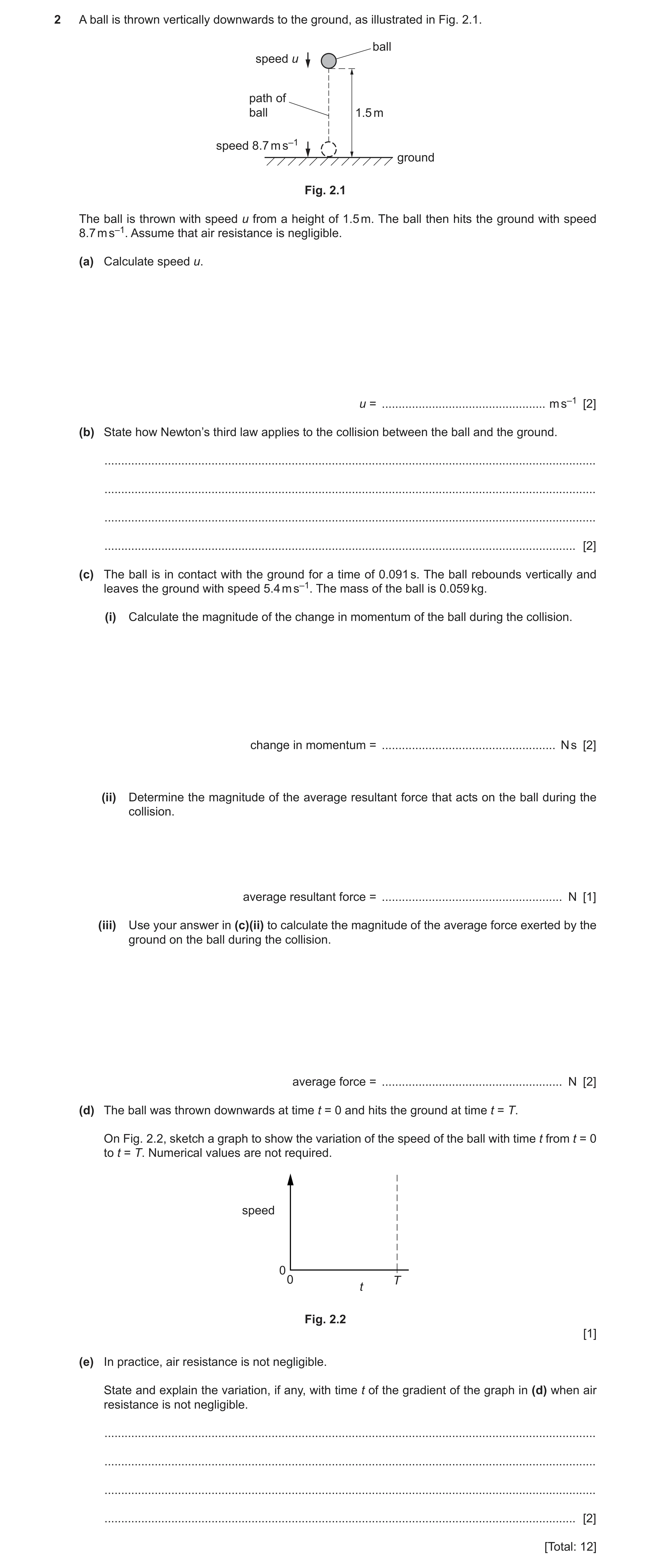
2 A ball is thrown vertically downwards to the ground, as illustrated in Fig. 2.1. ball speed u path of ball 1.5 m speed 8.7 m s–1 ground Fig. 2.1 The ball is thrown with speed u from a height of 1.5 m. The ball then hits the ground with speed 8.7 m s–1. Assume that air resistance is negligible. (a) Calculate speed u. u = … m s–1 [2] (b) State how Newton’s third law applies to the collision between the ball and the ground. … … … … [2] (c) The ball is in contact with the ground for a time of 0.091 s. The ball rebounds vertically and leaves the ground with speed 5.4 m s–1. The mass of the ball is 0.059 kg. (i) Calculate the magnitude of the change in momentum of the ball during the collision. change in momentum = … N s [2] (ii) Determine the magnitude of the average resultant force that acts on the ball during the collision. average resultant force = … N [1] (iii) Use your answer in (c)(ii) to calculate the magnitude of the average force exerted by the ground on the ball during the collision. average force = … N [2] (d) The ball was thrown downwards at time t = 0 and hits the ground at time t = T. On Fig. 2.2, sketch a graph to show the variation of the speed of the ball with time t from t = 0 to t = T. Numerical values are not required. speed 0 0 T t Fig. 2.2 [1] (e) In practice, air resistance is not negligible. State and explain the variation, if any, with time t of the gradient of the graph in (d) when air resistance is not negligible. … … … … [2] [Total: 12]
12 marks
Mark scheme: 2(a) v2 = u2 + 2as u2 = 8.72 – (2 × 9.81 × 1.5) C1 u = 6.8 m s–1 A1 2(b) (magnitude of) force on ball (by ground) equal to force on ground (by ball) B1 (direction of) force on ball (by ground) opposite to force on ground (by ball) B1 2(c)(i) (p = ) 0.059 × 8.7 or 0.059 × 5.4 C1 change in momentum = 0.059 (8.7 + 5.4) = 0.83 N s A1 2(c)(ii) resultant force = 0.83 / 0.091 or 0.059 [(8.7 + 5.4) / 0.091] = 9.1 N A1 2(c)(iii) (W =) 0.059 × 9.81 C1 (W =) 0.58 (N) force = 9.1 + 0.58 = 9.7 N A1 2(d) straight line with a positive gradient and starting from a non-zero value of speed at t = 0 and ending when t = T B1 2(e) air resistance increases B1 resultant force/acceleration decreases so gradient (of curve) decreases B1
This question in 9702/22 May/June 2021
Question 17 9702/21 Oct/Nov 2021
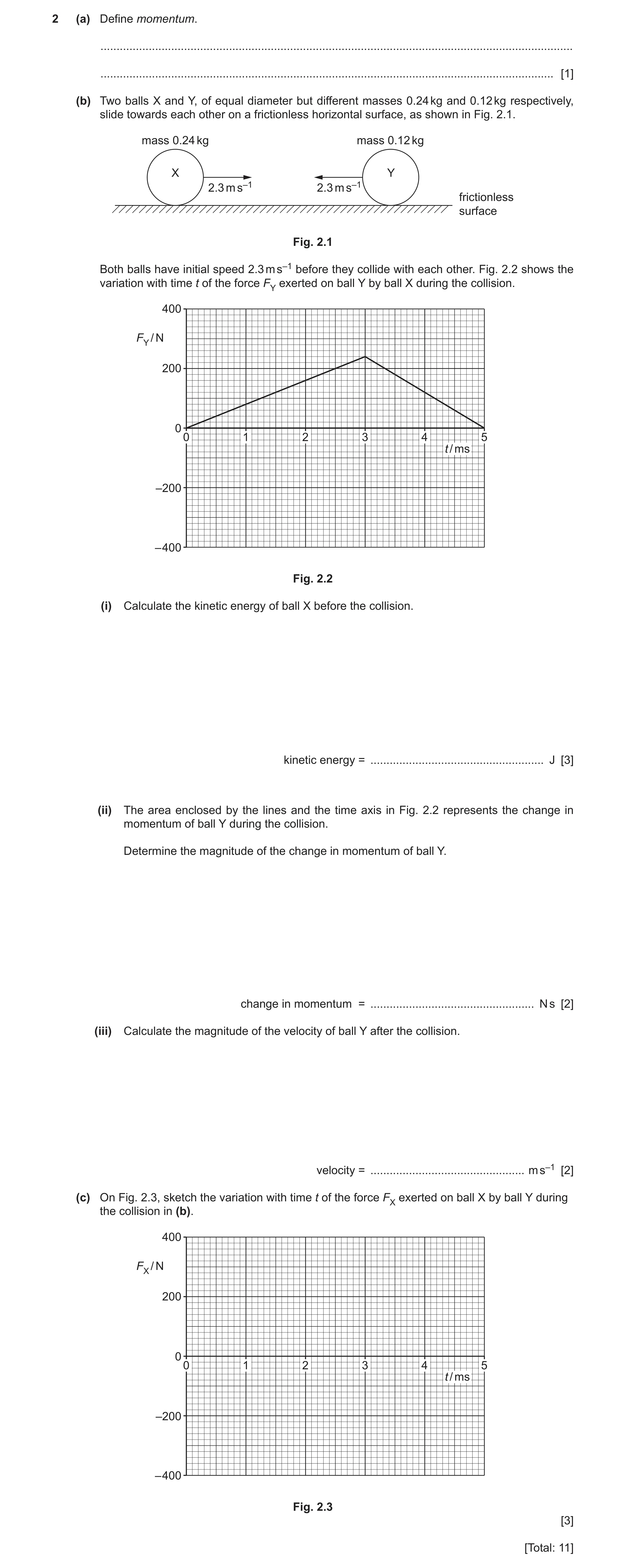
2 (a) Define momentum. … … [1] (b) Two balls X and Y, of equal diameter but different masses 0.24 kg and 0.12 kg respectively, slide towards each other on a frictionless horizontal surface, as shown in Fig. 2.1. mass 0.24 kg mass 0.12 kg X Y 2.3 m s–1 2.3 m s–1 frictionless surface Fig. 2.1 Both balls have initial speed 2.3 m s–1 before they collide with each other. Fig. 2.2 shows the variation with time t of the force FY exerted on ball Y by ball X during the collision. 400 FY / N 200 0 0 1 2 3 4 5 t / ms –200 – 400 Fig. 2.2 (i) Calculate the kinetic energy of ball X before the collision. kinetic energy = … J [3] (ii) The area enclosed by the lines and the time axis in Fig. 2.2 represents the change in momentum of ball Y during the collision. Determine the magnitude of the change in momentum of ball Y. change in momentum = … N s [2] (iii) Calculate the magnitude of the velocity of ball Y after the collision. velocity = … m s–1 [2] (c) On Fig. 2.3, sketch the variation with time t of the force FX exerted on ball X by ball Y during the collision in (b). 400 FX / N 200 0 0 1 2 3 4 5 t / ms –200 – 400 Fig. 2.3 [3] [Total: 11]
11 marks
Mark scheme: 2(a) mass × velocity B1 2(b)(i) kinetic energy = ½mv2 C1 = ½ × 0.24 × 2.32 C1 = 0.63 J A1 2(b)(ii) change in momentum = ½ × 240 × 5.0 × 10–3 C1 = 0.60 N s A1 2(b)(iii) (change in velocity of Y) = 0.60 / 0.12 ( = 5.0 m s–1) C1 final velocity of Y = 5.0 – 2.3 = 2.7 m s–1 A1 or (final momentum of Y) = 0.60 – 0.12 × 2.3 ( = 0.324 N s) (C1) final velocity of Y = 0.324 / 0.12 = 2.7 m s–1 (A1) 2(c) sloping straight line from (0, 0) to t = 3.0 ms and another straight line continuous with the first from t = 3.0 ms to (5.0, 0) B1 lines showing maximum force of magnitude 240 N B1 lines wholly in the negative F region of the graph B1
This question in 9702/21 Oct/Nov 2021
Q18 · A stationary nucleus P of mass 243 u decays by emitting an α-particle of mass 4 u to form… 9702/22 Oct/Nov 2021
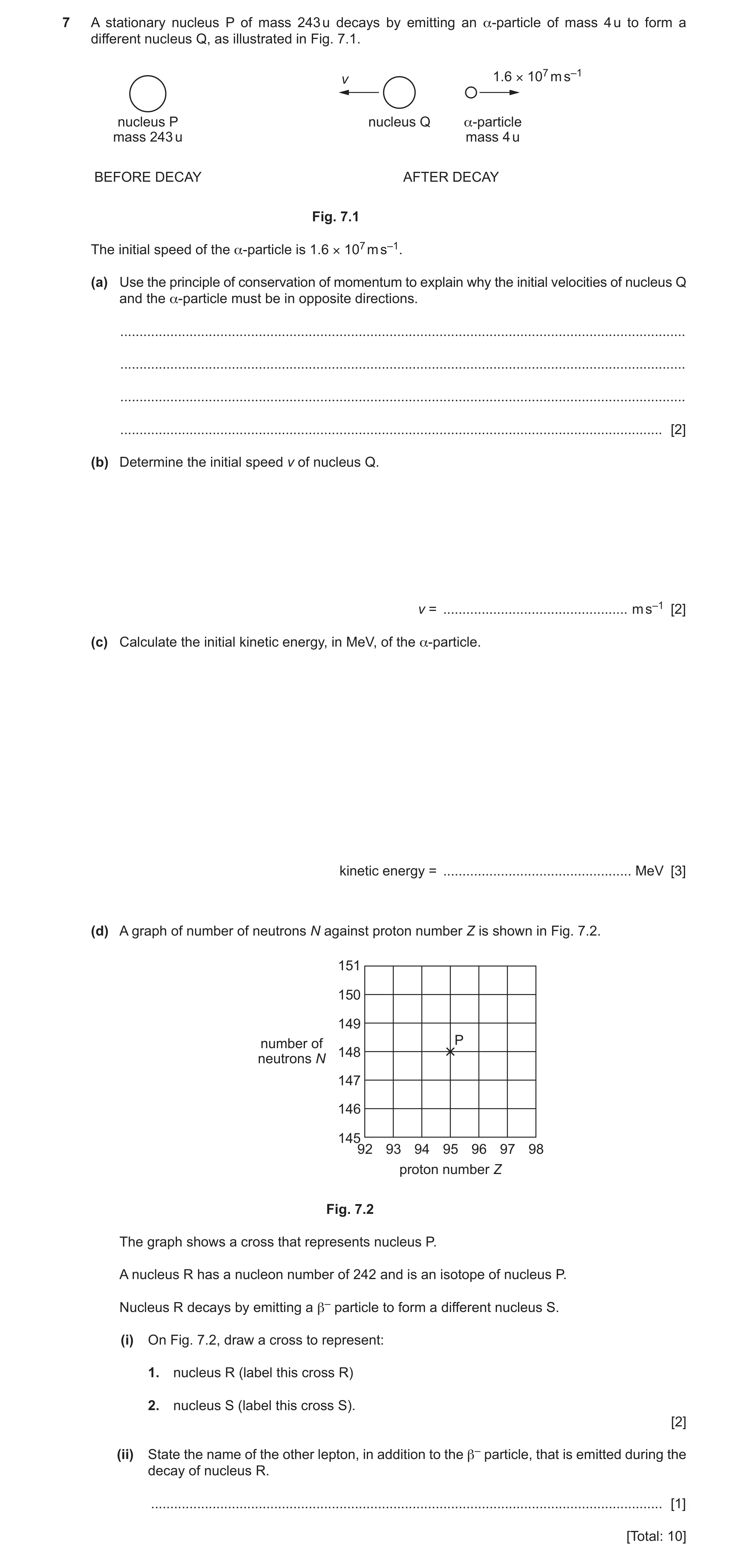
7 A stationary nucleus P of mass 243 u decays by emitting an α-particle of mass 4 u to form a different nucleus Q, as illustrated in Fig. 7.1. v 1.6 × 10⁷ m s–1 nucleus P nucleus Q α-particle mass 243 u mass 4 u BEFORE DECAY AFTER DECAY Fig. 7.1 The initial speed of the α-particle is 1.6 × 10⁷ m s–1. (a) Use the principle of conservation of momentum to explain why the initial velocities of nucleus Q and the α-particle must be in opposite directions. … … … … [2] (b) Determine the initial speed v of nucleus Q. v = … m s–1 [2] (c) Calculate the initial kinetic energy, in MeV, of the α-particle. kinetic energy = … MeV [3] (d) A graph of number of neutrons N against proton number Z is shown in Fig. 7.2. 151 150 149 number of P 148 neutrons N 147 146 14592 93 94 95 96 97 98 proton number Z Fig. 7.2 The graph shows a cross that represents nucleus P. A nucleus R has a nucleon number of 242 and is an isotope of nucleus P. Nucleus R decays by emitting a β– particle to form a different nucleus S. (i) On Fig. 7.2, draw a cross to represent: 1. nucleus R (label this cross R) 2. nucleus S (label this cross S). [2] (ii) State the name of the other lepton, in addition to the β– particle, that is emitted during the decay of nucleus R. … [1] [Total: 10]
10 marks
Mark scheme: 7(a) (total) momentum before (decay) is zero or P has zero momentum B1 (total momentum after decay must be zero so) α-particle and Q have momenta in opposite directions (and therefore velocities are in opposite directions) B1 7(b) p = 239 (u) × v or 4 (u) × 1.6 × 10⁷ C1 239 (u) × v = 4 (u) × 1.6 × 10⁷ v = 2.7 × 10⁵ m s–1 A1 7(c) E(K) = ½mv2 C1 = ½ × 4 × 1.66 × 10–27 × (1.6 × 107)2 C1 = 8.5 × 10⁻¹³ (J) = 8.5 × 10⁻¹³ / 1.60 × 10⁻¹³ (MeV) = 5.3 MeV A1 7(d)(i) 1. R plotted at (95,147) B1 2. S plotted at (96,146) B1 7(d)(ii) (electron) antineutrino B1
This question in 9702/22 Oct/Nov 2021
Q19 · Two blocks slide directly towards each other along a frictionless horizontal surface, as… 9702/22 Feb/March 2023
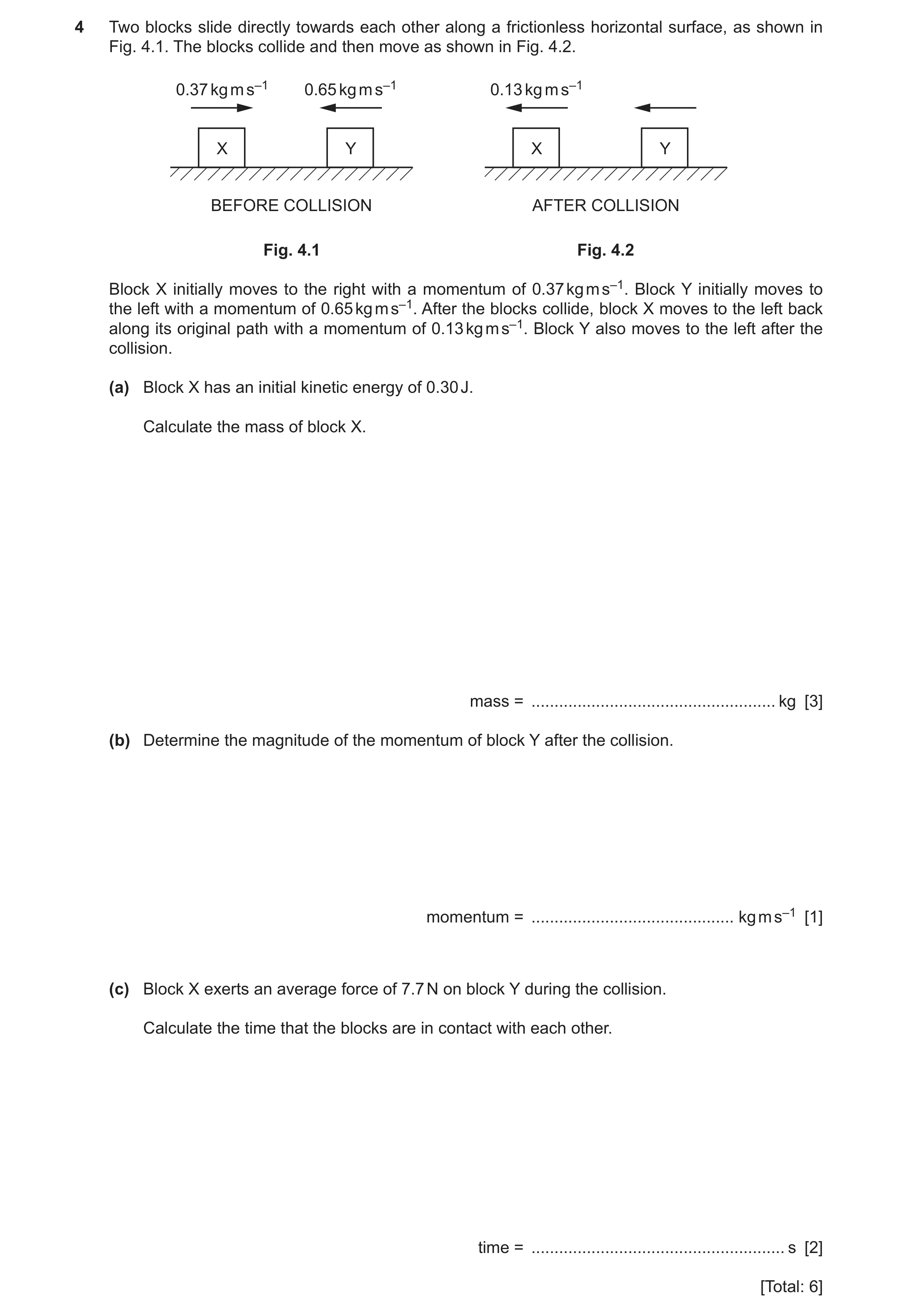
4 Two blocks slide directly towards each other along a frictionless horizontal surface, as shown in Fig. 4.1. The blocks collide and then move as shown in Fig. 4.2. 0.37 kg m s–1 0.65 kg m s–1 0.13 kg m s–1 X Y X Y BEFORE COLLISION AFTER COLLISION Fig. 4.1 Fig. 4.2 Block X initially moves to the right with a momentum of 0.37 kg m s–1. Block Y initially moves to the left with a momentum of 0.65 kg m s–1. After the blocks collide, block X moves to the left back along its original path with a momentum of 0.13 kg m s–1. Block Y also moves to the left after the collision. (a) Block X has an initial kinetic energy of 0.30 J. Calculate the mass of block X. mass = … kg [3] (b) Determine the magnitude of the momentum of block Y after the collision. momentum = … kg m s–1 [1] (c) Block X exerts an average force of 7.7 N on block Y during the collision. Calculate the time that the blocks are in contact with each other. time = … s [2] [Total: 6]
6 marks
Mark scheme: 4(a) E = ½mv2 C1 p = mv C1 m = 0.372 / (2 0.30) or 0.37 / 1.6 or (0.30 2) / 1.62 A1 = 0.23 kg 4(b) 0.37 – 0.65 = –0.13 – p A1 p = 0.15 kg m s–1 4(c) 7.7 = (0.13 + 0.37) / (∆)t C1 or 7.7 = (0.65 – 0.15) / (∆)t time = 0.065 s A1
This question in 9702/22 Feb/March 2023
Q20 · State the principle of conservation of momentum 9702/23 May/June 2023
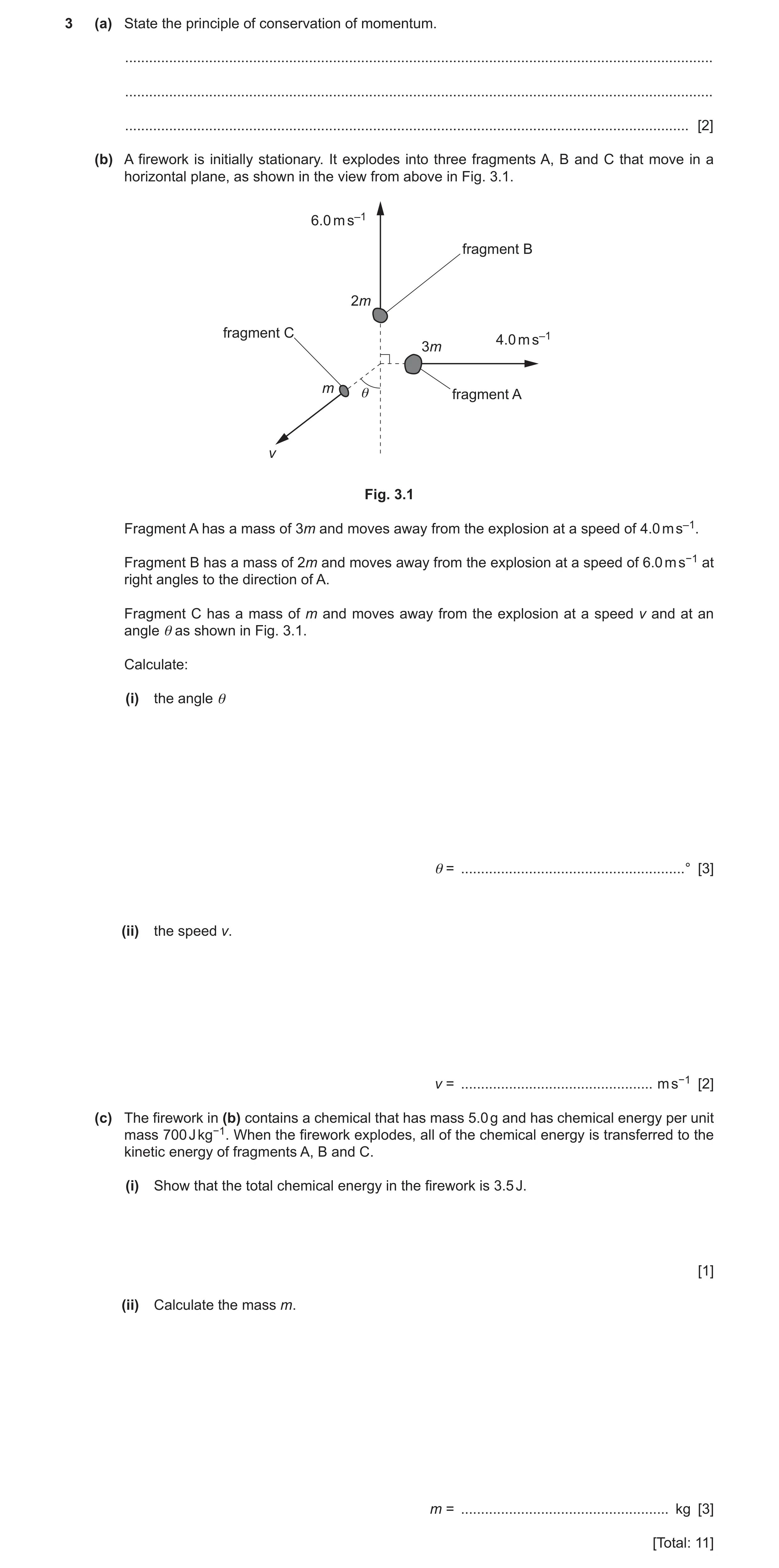
3 (a) State the principle of conservation of momentum. … … … [2] (b) A firework is initially stationary. It explodes into three fragments A, B and C that move in a horizontal plane, as shown in the view from above in Fig. 3.1. 6.0 m s–1 fragment B 2m fragment C 4.0 m s–1 3m m θ fragment A v Fig. 3.1 Fragment A has a mass of 3m and moves away from the explosion at a speed of 4.0 m s–1. Fragment B has a mass of 2m and moves away from the explosion at a speed of 6.0 m s−1 at right angles to the direction of A. Fragment C has a mass of m and moves away from the explosion at a speed v and at an angle θ as shown in Fig. 3.1. Calculate: (i) the angle θ θ = … ° [3] (ii) the speed v. v = … m s−1 [2] (c) The firework in (b) contains a chemical that has mass 5.0 g and has chemical energy per unit mass 700 J kg−1. When the firework explodes, all of the chemical energy is transferred to the kinetic energy of fragments A, B and C. (i) Show that the total chemical energy in the firework is 3.5 J. [1] (ii) Calculate the mass m. m = … kg [3] [Total: 11]
11 marks
Mark scheme: 3(a) sum / total momentum before = sum / total momentum after or sum / total momentum (of a system of objects) is constant M1 if no (resultant) external force / for an isolated system A1 3(b)(i) 3m 4 = m v sin (v sin = 12) C1 2m 6 = m v cos (v cos = 12) C1 therefore sin = cos or tan = 1 = 45° A1 3(b)(ii) mv cos 45° = 12m or mv sin 45° = 12m or (mv)2 = (3m 4)2 + (2m 6)2 C1 v = 17 m s–1 A1 3(c)(i) (chemical energy) = 0.0050 700 = 3.5 (J) or (chemical energy) = 5.0 0.700 = 3.5 (J) A1 Question Answer Marks 3(c)(ii) E = ½mv2 C1 total E = (0.5 3m 42) + (0.5 2m 62) + (0.5 m 172) C1 3.5 = 204m m = 0.017 kg A1
This question in 9702/23 May/June 2023
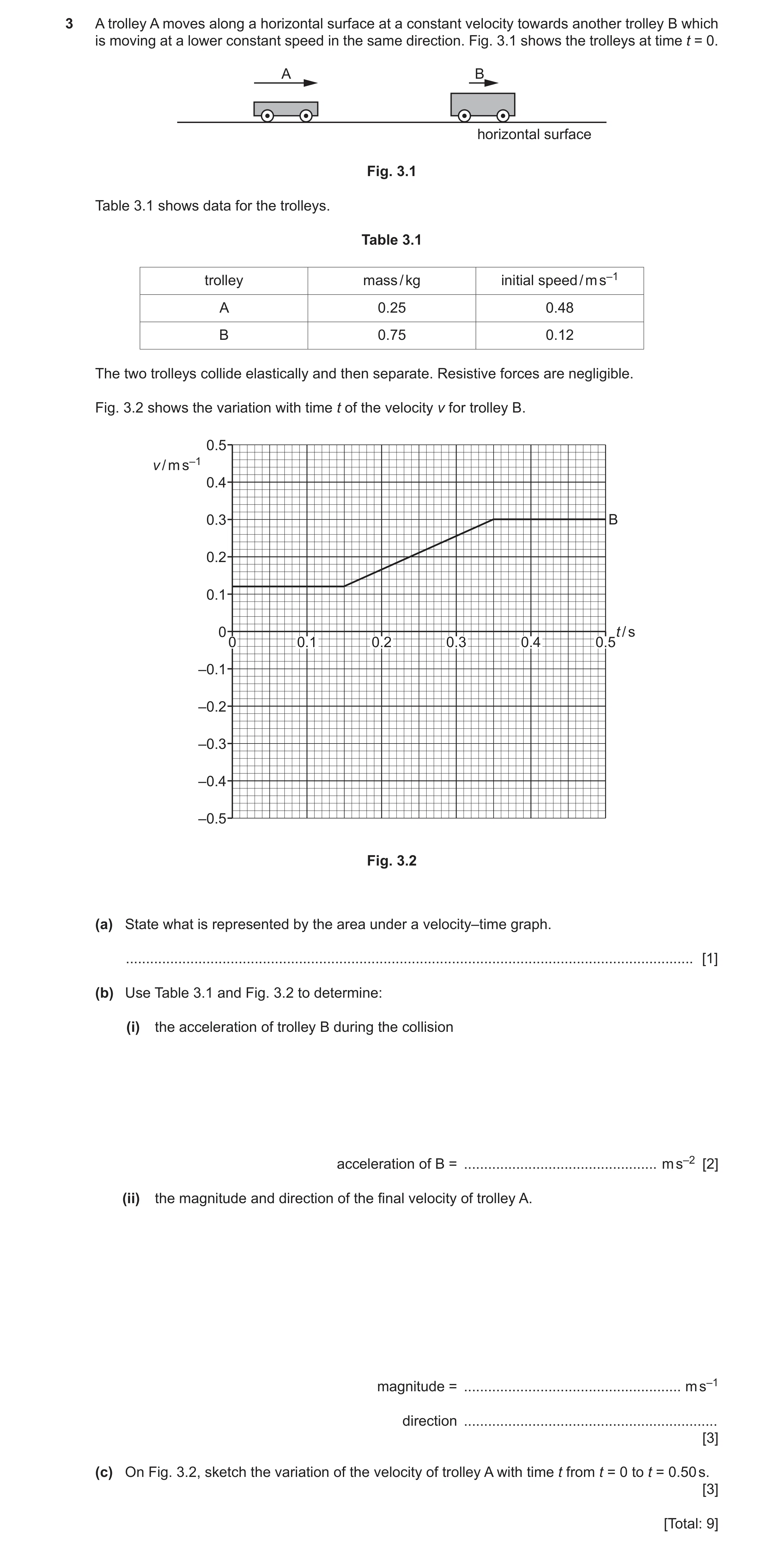
Q21 · A trolley A moves along a horizontal surface at a constant velocity towards another… 9702/21 Oct/Nov 2023
3 A trolley A moves along a horizontal surface at a constant velocity towards another trolley B which is moving at a lower constant speed in the same direction. Fig. 3.1 shows the trolleys at time t = 0. A B horizontal surface Fig. 3.1 Table 3.1 shows data for the trolleys. Table 3.1 trolley mass / kg initial speed / m s–1 A 0.25 0.48 B 0.75 0.12 The two trolleys collide elastically and then separate. Resistive forces are negligible. Fig. 3.2 shows the variation with time t of the velocity v for trolley B. 0.5 v / m s–1 0.4 0.3 B 0.2 0.1 0 / s 0 0.1 0.2 0.3 0.4 0.5t –0.1 –0.2 –0.3 –0.4 –0.5 Fig. 3.2 (a) State what is represented by the area under a velocity–time graph. … [1] (b) Use Table 3.1 and Fig. 3.2 to determine: (i) the acceleration of trolley B during the collision acceleration of B = … m s–2 [2] (ii) the magnitude and direction of the final velocity of trolley A. magnitude = … m s–1 direction … [3] (c) On Fig. 3.2, sketch the variation of the velocity of trolley A with time t from t = 0 to t = 0.50 s. [3] [Total: 9]
9 marks
Mark scheme: 3(a) displacement A1 3(b)(i) a = gradient or a = v / ()t or a = (v – u) / t C1 e.g. a = (0.30 – 0.12) / (0.35 – 0.15) A1 a = 0.90 m s–2 3(b)(ii) (0.25 0.48) + (0.75 0.12) = (0.25 v) + (0.75 0.30) C1 or (0.48 – 0.12) = (0.30 – v) or (½ 0.25 0.482) + (½ 0.75 0.122) = (½ 0.25 × v 2) + (½ × 0.75 0.302) v = (–)0.060 m s–1 A1 direction: to the left / from the right / opposite to (its) initial velocity / opposite to (initial / final) velocity of B B1 3(c) sketch: horizontal line from (0, 0.48) to (0.15, 0.48) B1 horizontal line from (0.35, –0.06) to (0.5, –0.06) B1 straight line between (0.15, 0.48) and (0.35, –0.06) B1
This question in 9702/21 Oct/Nov 2023
Q22 · A nucleus P undergoes α-decay to form nucleus Q 9702/22 Feb/March 2024
4 A nucleus P undergoes α-decay to form nucleus Q. (a) Complete the equation for this decay. ___ ___ 215 [2] ___ Q + ___ α 84 P (b) (i) State the principle of conservation of momentum. … … … [2] (ii) Before the decay, nucleus P has a speed of 3.2 × 10⁵ m s–1. After the decay, nucleus Q is stationary. Calculate the speed of the alpha particle after the decay. speed = … m s–1 [2] [Total: 6]
6 marks
Mark scheme: 4(a) 4 B1 2α 21182Q B1 4(b)(i) sum / total momentum (of a system of bodies) is constant M1 or sum / total momentum before = sum / total momentum after for an isolated system / no (resultant) external force A1 4(b)(ii) pα = pP – pQ C1 4(u)v = 215(u) 3.2 105 (– 0) v = 215(u) 3.2 105/ 4(u) v = 1.7 107 m s–1 A1
This question in 9702/22 Feb/March 2024
Q23 · State the principle of conservation of momentum 9702/21 May/June 2024
3 (a) State the principle of conservation of momentum. … … … [2] (b) An object of mass 2m is travelling at a speed of 5.0 m s–1 in a straight line. It collides with an object of mass 3m which is initially stationary, as shown in Fig. 3.1. 5.0 m s–1 object, mass 2m object, mass 3m Fig. 3.1 After the collision, the object of mass 2m moves with velocity v at an angle of 30° to its original direction of motion. The object of mass 3m moves with velocity w also at an angle of 30°, as shown in Fig. 3.2. object, mass 2m v original path 30° 30° w object, mass 3m Fig. 3.2 By considering the conservation of momentum in two dimensions, calculate the magnitudes of v and w. v = … m s–1 w = … m s–1 [4] (c) An object of mass 4.2 kg is travelling in a straight line at a speed of 6.0 m s–1. The object is brought to rest in a distance of 0.050 m by a constant force. Calculate the magnitude of this force. force = … N [3] [Total: 9]
9 marks
Mark scheme: 3(a) sum / total momentum before (a collision) = sum / total momentum after (a collision) or sum / total momentum (of a system) is constant M1 if no (resultant) external force (acts) / for an isolated system A1 3(b) along direction of motion: 10m = 2mv cos 30° + 3mw cos 30° C1 perpendicular to direction of motion: 2mv cos 60° = 3mw cos 60° (v = 3w / 2) C1 v = 2.9 m s–1 A1 w = 1.9 m s–1 A1 3(c) EK = ½ m v2 ( = ½ 4.2 6.02) ( = 76 J) C1 force = work done / distance C1 force = 76 / 0.050 = 1500 N A1 Question Answer Marks 3(c) or a = (–)u2 / 2s = (–)6.02 / (2 0.050) ( = (–)360 m s–2) (C1) F = ma (C1) F = 4.2 360 = 1500 N (A1) or a = (–)u2 / 2s = (–)6.02 / (2 0.050) ( = (–)360 m s–2) (C1) t = –u / a = –6.0 / –360 (= 0.017 s) F = p / t (C1) F = (0 – 4.2 6) / 0.017 = 1500 N (A1)
This question in 9702/21 May/June 2024
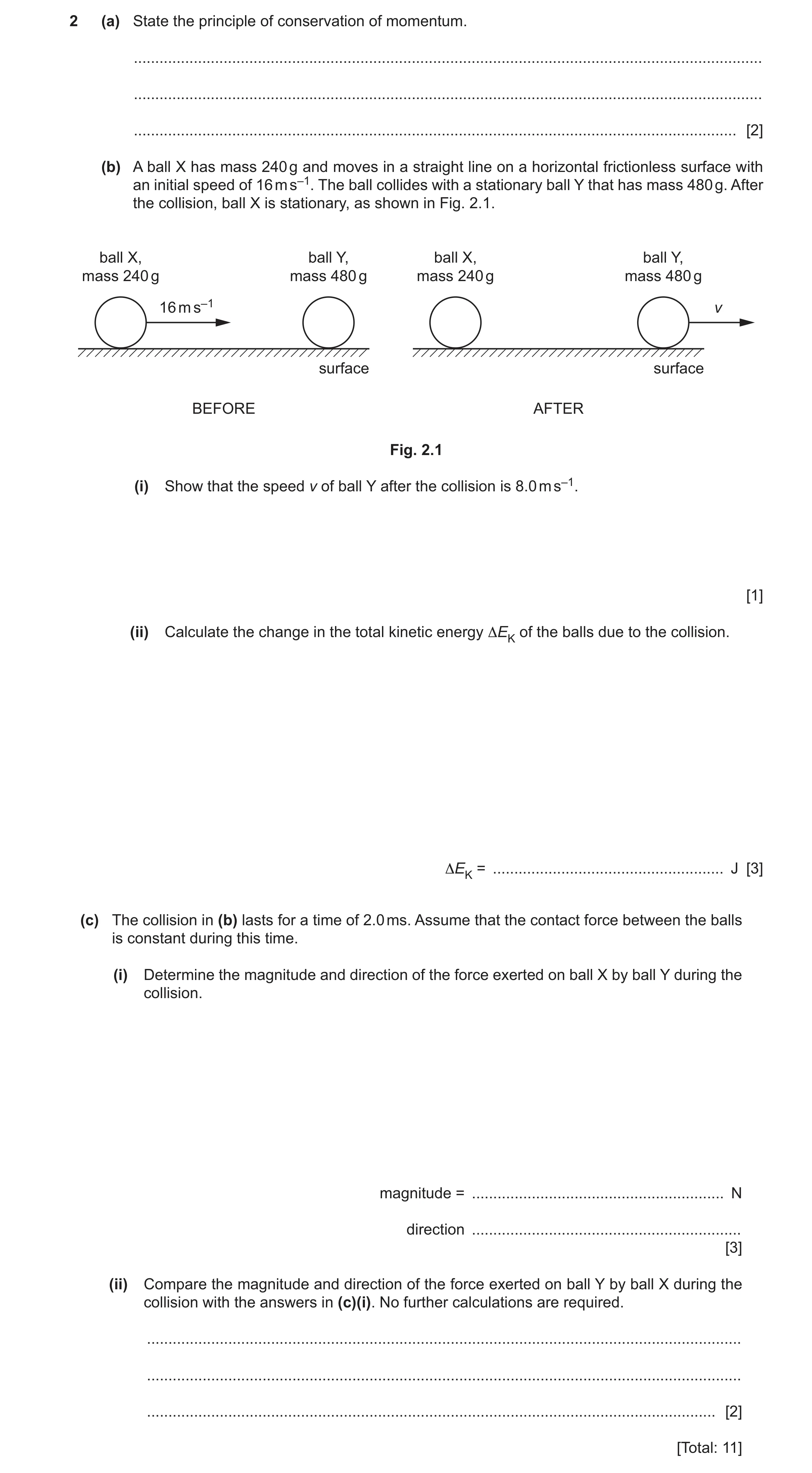
Q24 · State the principle of conservation of momentum 9702/23 Oct/Nov 2024
2 (a) State the principle of conservation of momentum. … … … [2] (b) A ball X has mass 240 g and moves in a straight line on a horizontal frictionless surface with an initial speed of 16 m s–1. The ball collides with a stationary ball Y that has mass 480 g. After the collision, ball X is stationary, as shown in Fig. 2.1. ball X, ball Y, ball X, ball Y, mass 240 g mass 480 g mass 240 g mass 480 g 16 m s–1 v surface surface BEFORE AFTER Fig. 2.1 (i) Show that the speed v of ball Y after the collision is 8.0 m s–1. [1] (ii) Calculate the change in the total kinetic energy ∆EK of the balls due to the collision. ∆EK = … J [3] (c) The collision in (b) lasts for a time of 2.0 ms. Assume that the contact force between the balls is constant during this time. (i) Determine the magnitude and direction of the force exerted on ball X by ball Y during the collision. magnitude = … N direction … [3] (ii) Compare the magnitude and direction of the force exerted on ball Y by ball X during the collision with the answers in (c)(i). No further calculations are required. … … … [2] [Total: 11]
11 marks
Mark scheme: 2(a) sum / total momentum (of a system of bodies) is constant M1 or sum / total momentum before = sum / total momentum after for an isolated system / no (resultant) external force A1 2(b)(i) 240 16 = 480v and so v = 8.0 m s–1 A1 or (initial momentum =) 240 16 (= 3840 g m s–1) and v = 3840 / 480 = 8.0 m s–1 2(b)(ii) (EK =) ½ mv2 C1 EK = ½ [(0.24 162) – (0.48 8.02)] C1 = 15 J A1 2(c)(i) F = (0.24 16) / (2.0 10–3) or F = (0.48 8) / (2.0 10–3) C1 = 1900 N A1 direction: to the left B1 2(c)(ii) equal (magnitude) B1 opposite (direction) B1
This question in 9702/23 Oct/Nov 2024
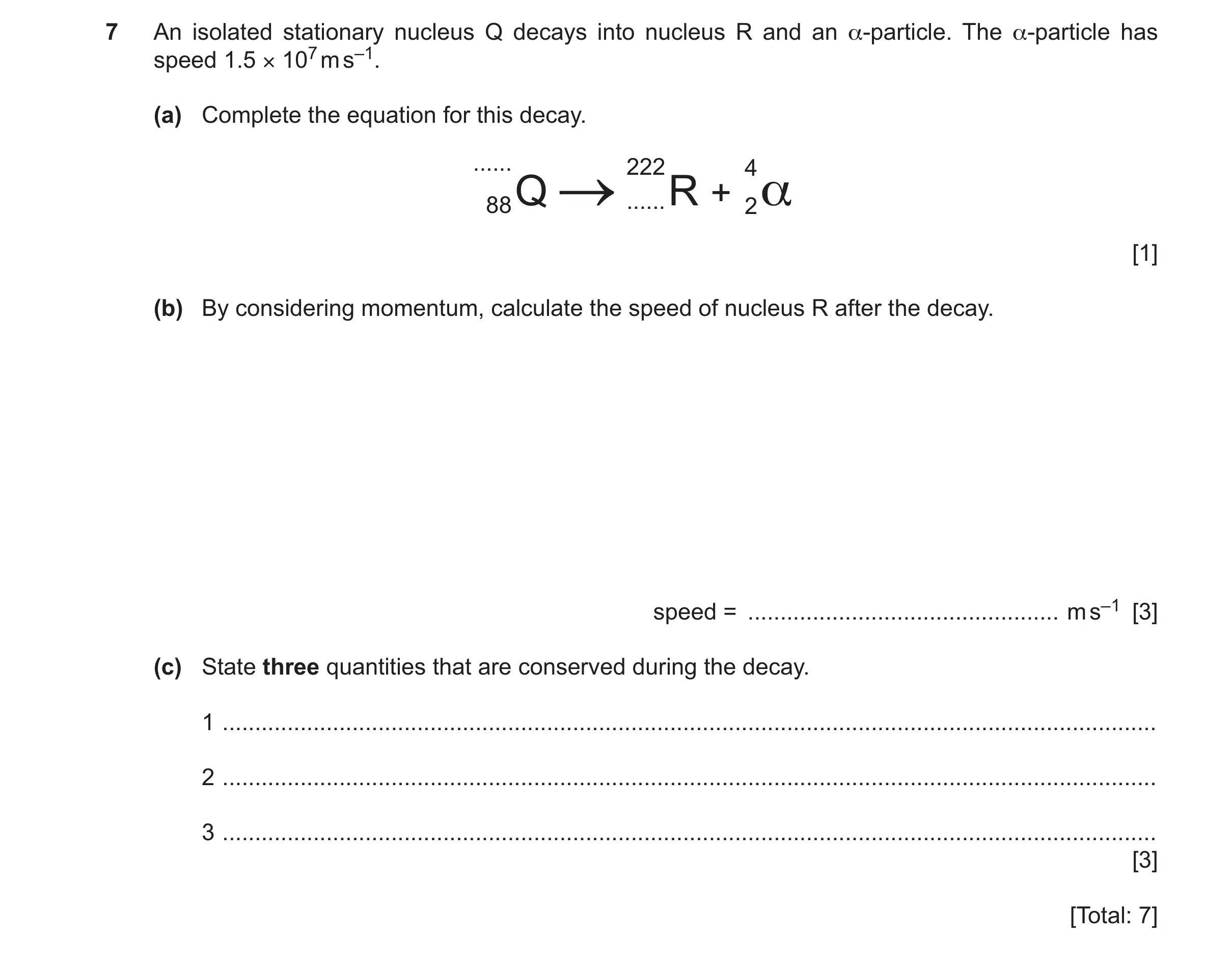
Q25 · An isolated stationary nucleus Q decays into nucleus R and an α-particle 9702/22 Feb/March 2025
7 An isolated stationary nucleus Q decays into nucleus R and an α-particle. The α-particle has speed 1.5 × 10⁷ m s–1. (a) Complete the equation for this decay. … 222 4 88 Q … R + 2 α [1] (b) By considering momentum, calculate the speed of nucleus R after the decay. speed = … m s–1 [3] (c) State three quantities that are conserved during the decay. 1 … 2 … 3 … [3] [Total: 7]
7 marks
Mark scheme: 7(a) nucleon number of Q = 226 and proton number of R = 86 B1 7(b) 4(u) 1.5 107 or 222(u) v C1 v = 4(u) 1.5 107 / 222(u) C1 = 2.7 105 m s–1 A1 7(c) Any three from: B3 • momentum • charge • nucleon number • neutron number • proton number
This question in 9702/22 Feb/March 2025
Q26 · A small ball is dropped from rest from height h1 above the ground and falls vertically… 9702/22 May/June 2025
4 A small ball is dropped from rest from height h1 above the ground and falls vertically downwards. The ball collides with the ground and bounces back vertically upwards, reaching a maximum height h2. Fig. 4.1 shows the ball just before and just after hitting the ground. ball, mass 0.25 kg speed 3.6 m s–1 ground speed 5.2 m s–1 before hitting ground after hitting ground Fig. 4.1 The ball has mass 0.25 kg and is in contact with the ground for a time of 0.18 s. Just before the ball hits the ground, it has speed 5.2 m s–1. Just after it leaves the ground, it has speed 3.6 m s–1. Air resistance acting on the ball is negligible. (a) State and explain whether the collision is elastic or inelastic. … … … [1] (b) (i) Calculate the change in momentum of the ball during the collision with the ground. change in momentum = … kg m s–1 [2] (ii) Determine the average force on the ball during the collision with the ground. force = … N [2] h2 (c) Calculate the ratio . h1 ratio = … [3] [Total: 8]
8 marks
Mark scheme: 4(a) The (total) kinetic energy changes / decreases so (the collision is) inelastic B1 OR (B1) (relative) speed of approach not equal to / greater than (relative) speed of separation so (collision is) inelastic 4(b)(i) p = mv or 0.25 3.6 or 0.25 5.2 C1 p = 0.25 (3.6 + 5.2) = 2.2 kg m s–1 A1 4(b)(ii) F = p / ()t C1 = 2.2 / 0.18 = 12 N A1 OR (C1) F = ma and a = (v–u) / t = mv / t = 0.25 (3.6 + 5.2) / 0.18 = 12 N (A1) 4(c) ½ mv2 = mg()h C1 ½ 0.25 5.22 = 0.25 g h1 h1 = 5.22 / 2g h1 = 1.38 ½ 0.25 3.62 = 0.25 g h2 C1 h2 = 3.62/2g h2 = 0.66 h2 / h1 = 0.66 / 1.38 ratio = 0.48 A1
This question in 9702/22 May/June 2025
Q27 · State the principle of conservation of momentum 9702/23 May/June 2025
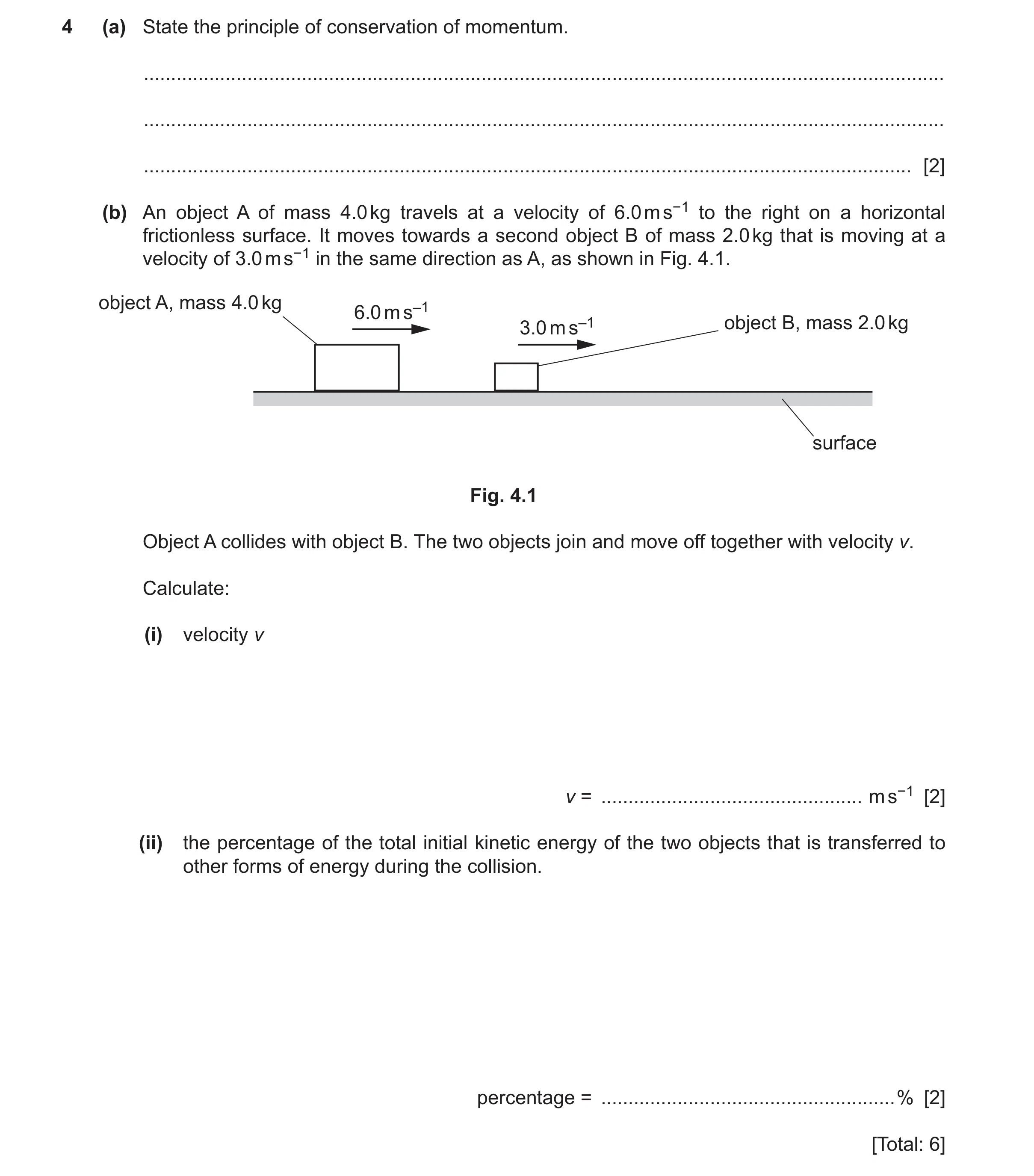
4 (a) State the principle of conservation of momentum. … … … [2] (b) An object A of mass 4.0 kg travels at a velocity of 6.0 m s−1 to the right on a horizontal frictionless surface. It moves towards a second object B of mass 2.0 kg that is moving at a velocity of 3.0 m s−1 in the same direction as A, as shown in Fig. 4.1. object A, mass 4.0 kg 6.0 m s–1 3.0 m s–1 object B, mass 2.0 kg surface Fig. 4.1 Object A collides with object B. The two objects join and move off together with velocity v. Calculate: (i) velocity v v = … m s−1 [2] (ii) the percentage of the total initial kinetic energy of the two objects that is transferred to other forms of energy during the collision. percentage = … % [2] [Total: 6]
6 marks
Mark scheme: 4(a) sum / total momentum (of a system of bodies) is constant M1 or sum / total momentum before = sum / total momentum after for an isolated system / no (resultant) external force A1 4(b)(i) p = mv or 4.0 6.0 or 2.0 3.0 C1 (4.0 6.0) + (2.0 3.0) = 6.0 v so v = 5.0 m s−1 A1 4(b)(ii) KE before = (0.5 4.0 6.02) + (0.5 2.0 3.02) C1 = 81 J KE after = (0.5 6.0 5.02) (C1) = 75 J percentage transferred = [(81 – 75) / 81] 100 A1 = 7%
This question in 9702/23 May/June 2025
Q28 · A spacecraft in deep space uses jets of hot gas from its thrusters to change its velocity 9702/22 Oct/Nov 2025
2 A spacecraft in deep space uses jets of hot gas from its thrusters to change its velocity. Fig. 2.1 shows a side view of the spacecraft and some of its thrusters. upwards thruster C 0.40 m centre of gravity thruster A thruster B 1.6 m leftwards Fig. 2.1 (not to scale) Thruster A is a distance of 1.6 m leftwards from the centre of gravity of the spacecraft. Thruster C is a distance of 0.40 m upwards from the centre of gravity of the spacecraft. Thrusters A and B can produce forces on the spacecraft in the upwards direction only. Thruster C can produce a force on the spacecraft in the leftwards direction only. All the thrusters shown produce forces entirely in the same plane as the centre of gravity. (a) (i) Thruster A is activated, producing a force of 60 N upwards on the spacecraft. Thruster C is also activated, producing a force of 220 N in the leftwards direction on the spacecraft. Calculate the resultant moment due to these forces about the centre of gravity. resultant moment = … N m [2] (ii) State and explain whether the forces from A and C are a couple. … … … [1] (b) Thrusters A and C are now switched off and the spacecraft is stationary. Thruster B is activated at time t1, producing a constant force on the spacecraft until the fuel runs out at time t2. As the fuel is used, the total mass of the spacecraft decreases. On Fig. 2.2, sketch the variation of speed of the spacecraft with time from t1 to t2. speed 0 t1 t2 time Fig. 2.2 [2] (c) The spacecraft now splits apart into a carrier and a payload as shown in Fig. 2.3. payload upwards carrier Fig. 2.3 During the split, an average force of 5500 N acts on the payload for a time of 0.36 s. The velocity of the payload increases by 8.5 m s–1 in the upwards direction. The combined mass of the carrier and payload is 2.5 × 10³ kg. (i) State the principle of conservation of momentum. … … … [2] (ii) Show that the mass of the payload is 230 kg. [2] (iii) Calculate the magnitude of the change in velocity of the carrier. change in velocity = … m s–1 [3] [Total: 12]
12 marks
Mark scheme: 2(a)(i) 60 1.6 (= 96 N m) C1 or 220 0.40 (= 88 N m) resultant moment = 96 – 88 A1 = 8.0 N m 2(a)(ii) the resultant force (of A and C) is not zero B1 or forces (from A and C) are not parallel or forces (from A and C) are not equal (magnitude) or forces (from A and C) are not opposite (direction) or forces (from A and C) act through the same point so (they are) not a couple 2(b) line with a positive gradient from (t1, 0) to t2 B1 line with increasing positive gradient from t1 to t2 B1 2(c)(i) sum / total momentum before = sum / total momentum after M1 or sum / total momentum (of a system of objects) is constant if no (resultant) external force / for an isolated system A1 2(c)(ii) ()p = F()t C1 m = Ft / ()v A1 (m =) 5500 × 0.36 / 8.5 = 230 (kg) or F = ma and a = ()v / ()t (C1) (m =) 5500 / (8.5 / 0.36) = 230 (kg) (A1) 2(c)(iii) (p =) 5500 0.36 (= 1980 N s) C1 or (p =) 230 8.5 (= 1955 N s) 1980 = (2.5 103 – 230)v C1 or 1955 = (2.5 103 – 230)v v = 0.87 m s–1 or 0.86 m s–1 A1 or a = 5500 / (2.5 103 – 230) (C1) (= 2.42 m s–2) v = 2.42 0.36 (C1) v = 0.87 m s–1 or 0.86 m s–1 (A1)
This question in 9702/22 Oct/Nov 2025
Q29 · A child kicks a ball so that it leaves horizontal ground with a velocity of 28 m s–1 at… 9702/24 Oct/Nov 2025
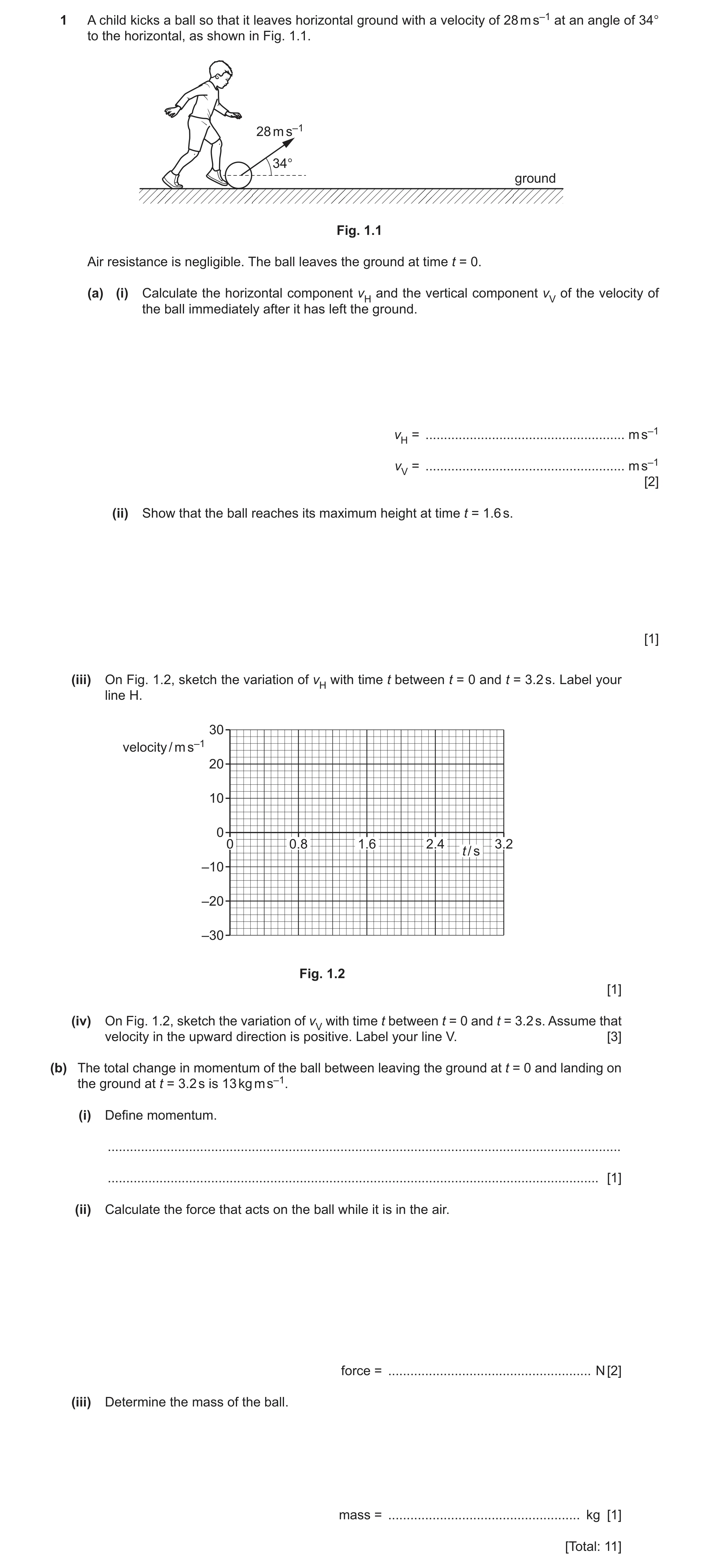
1 A child kicks a ball so that it leaves horizontal ground with a velocity of 28 m s–1 at an angle of 34° to the horizontal, as shown in Fig. 1.1. 28 m s–1 34° ground Fig. 1.1 Air resistance is negligible. The ball leaves the ground at time t = 0. (a) (i) Calculate the horizontal component vH and the vertical component vV of the velocity of the ball immediately after it has left the ground. vH = … m s–1 vV = … m s–1 [2] (ii) Show that the ball reaches its maximum height at time t = 1.6 s. [1] (iii) On Fig. 1.2, sketch the variation of vH with time t between t = 0 and t = 3.2 s. Label your line H. 30 velocity / m s–1 20 10 0 0 0.8 1.6 2.4 3.2 t / s –10 –20 –30 Fig. 1.2 [1] (iv) On Fig. 1.2, sketch the variation of vV with time t between t = 0 and t = 3.2 s. Assume that velocity in the upward direction is positive. Label your line V. [3] (b) The total change in momentum of the ball between leaving the ground at t = 0 and landing on the ground at t = 3.2 s is 13 kg m s–1. (i) Define momentum. … … [1] (ii) Calculate the force that acts on the ball while it is in the air. force = … N [2] (iii) Determine the mass of the ball. mass = … kg [1] [Total: 11]
11 marks
Mark scheme: Question Answer Marks 1(a)(i) vH = 28 × cos 34° A1 = 23 m s–1 vV = 28 × sin 34° A1 = 16 m s–1 1(a)(ii) time = 16 / 9.81 = 1.6 s A1 1(a)(iii) horizontal straight line at v = 23 m s–1 from t = 0 to t = 3.2 s B1 1(a)(iv) straight diagonal line starting at a positive velocity from t = 0 to t = 3.2 s, crossing the time axis B1 line starting at v = 16 m s–1 and ending at v = –16 m s–1 B1 line passing through v = 0 at t = 1.6 s B1 1(b)(i) product of mass and velocity B1 1(b)(ii) F = p / t C1 = 13 / 3.2 A1 = 4.1 N 1(b)(iii) m = p / v A1 = 13 / (2 16) = 0.41 kg or m = F / g = 4.06 / 9.81 = 0.41 kg
This question in 9702/24 Oct/Nov 2025
 7 / 45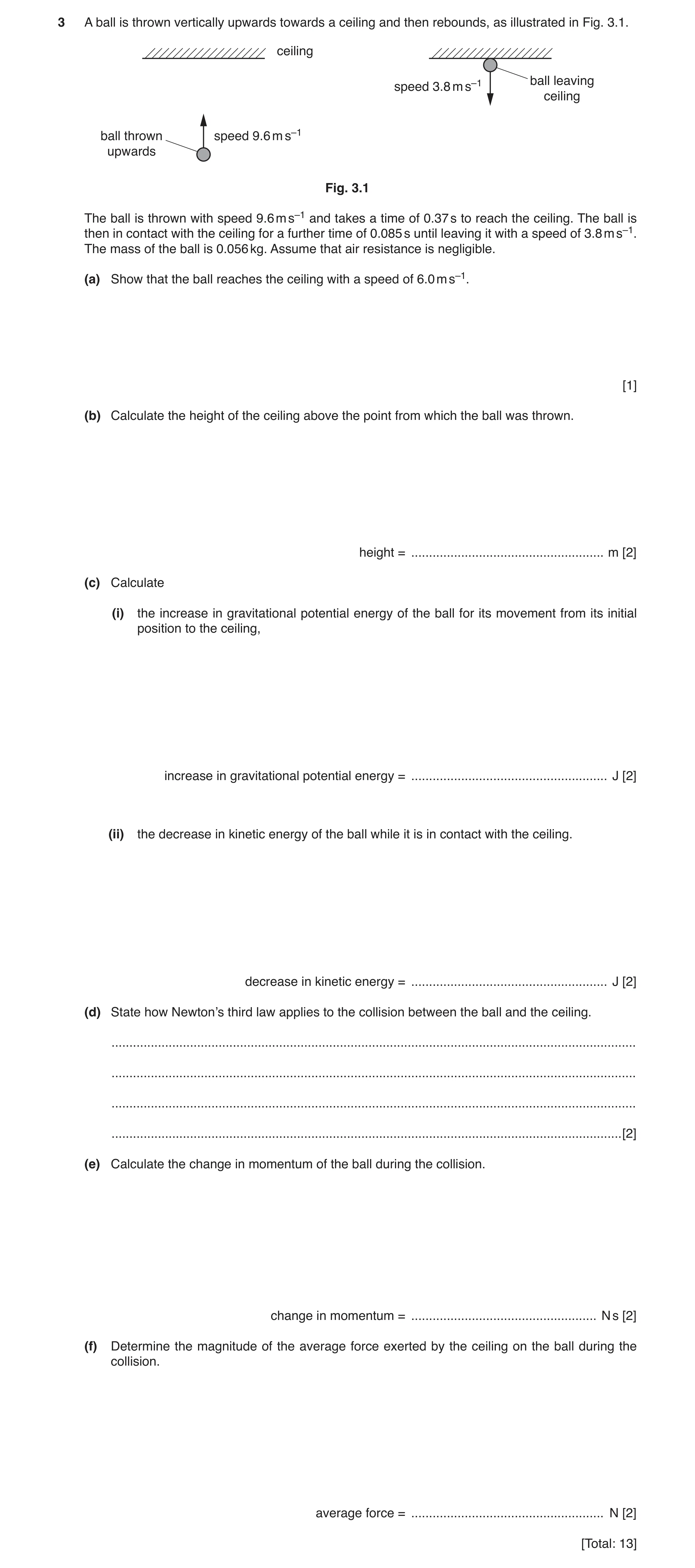
 10 / 45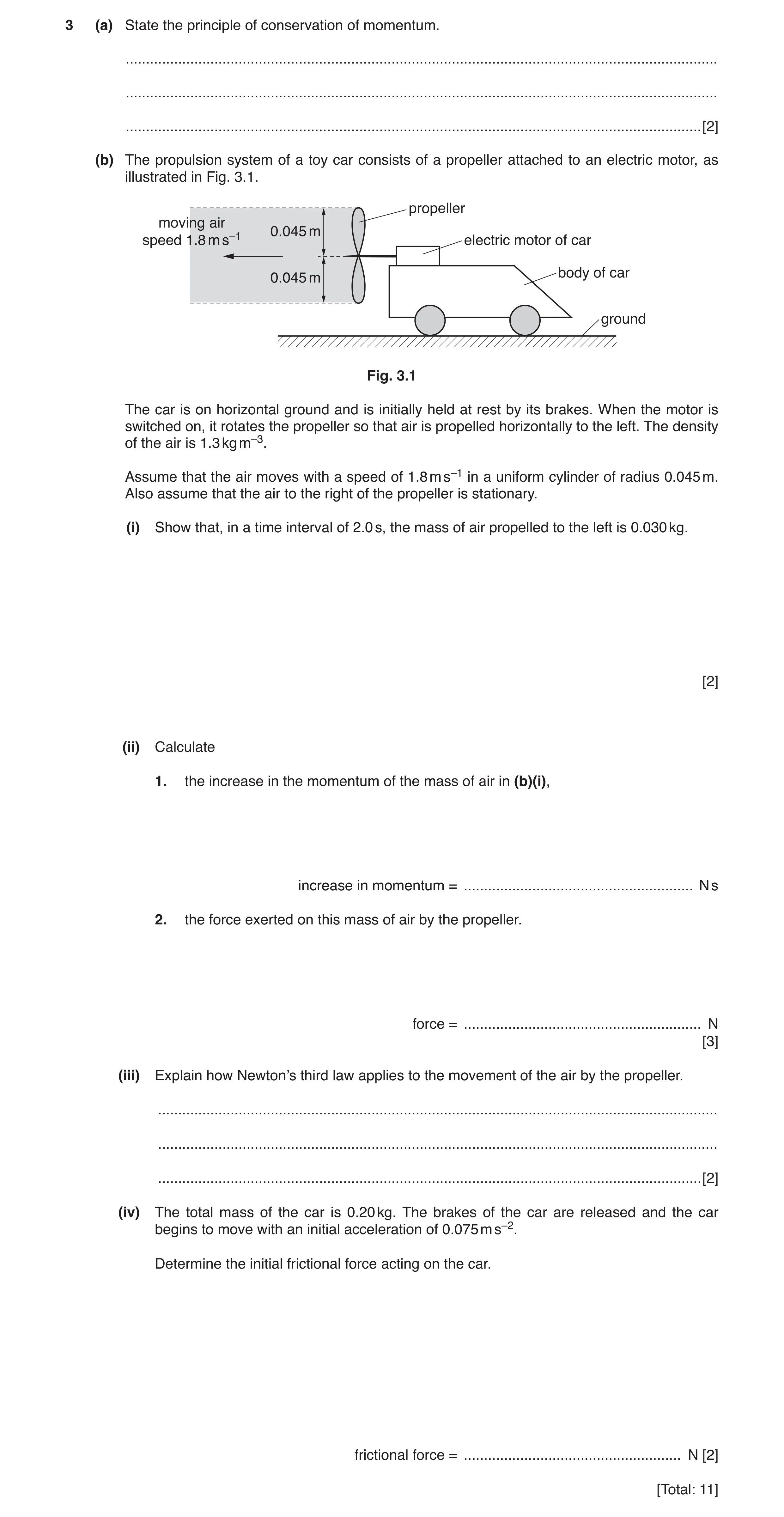
 21 / 45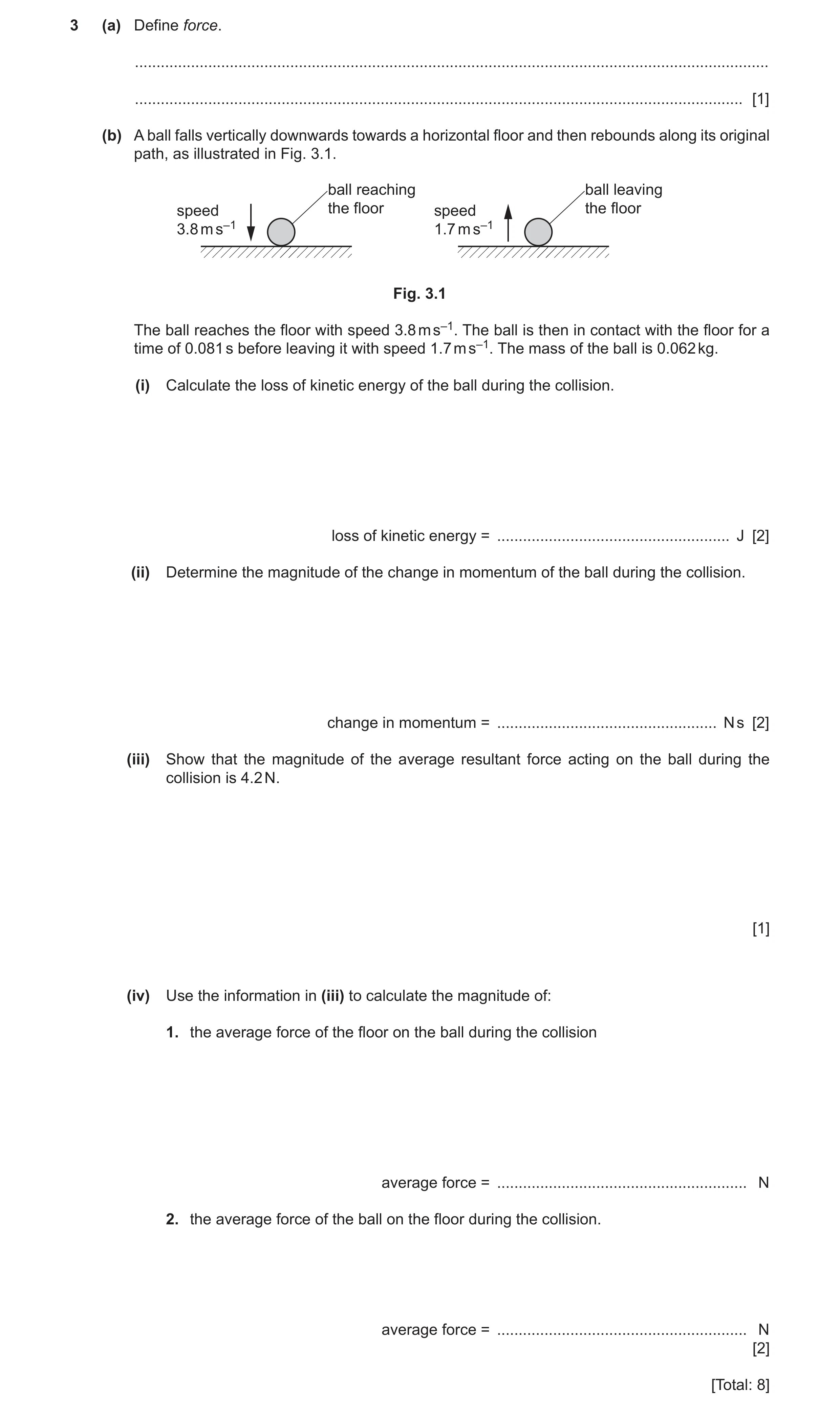
![Question 22: A nucleus P undergoes α-decay to form nucleus Q. (a) Complete the equation for this decay. ___ ___ 215 [2] ___ Q + ___ α 84 P (b) (i) State…](https://img.pastlit.com/crops/6d756b06-004a-4f34-9d1f-a422e647b00c/q4.webp) 34 / 45
34 / 45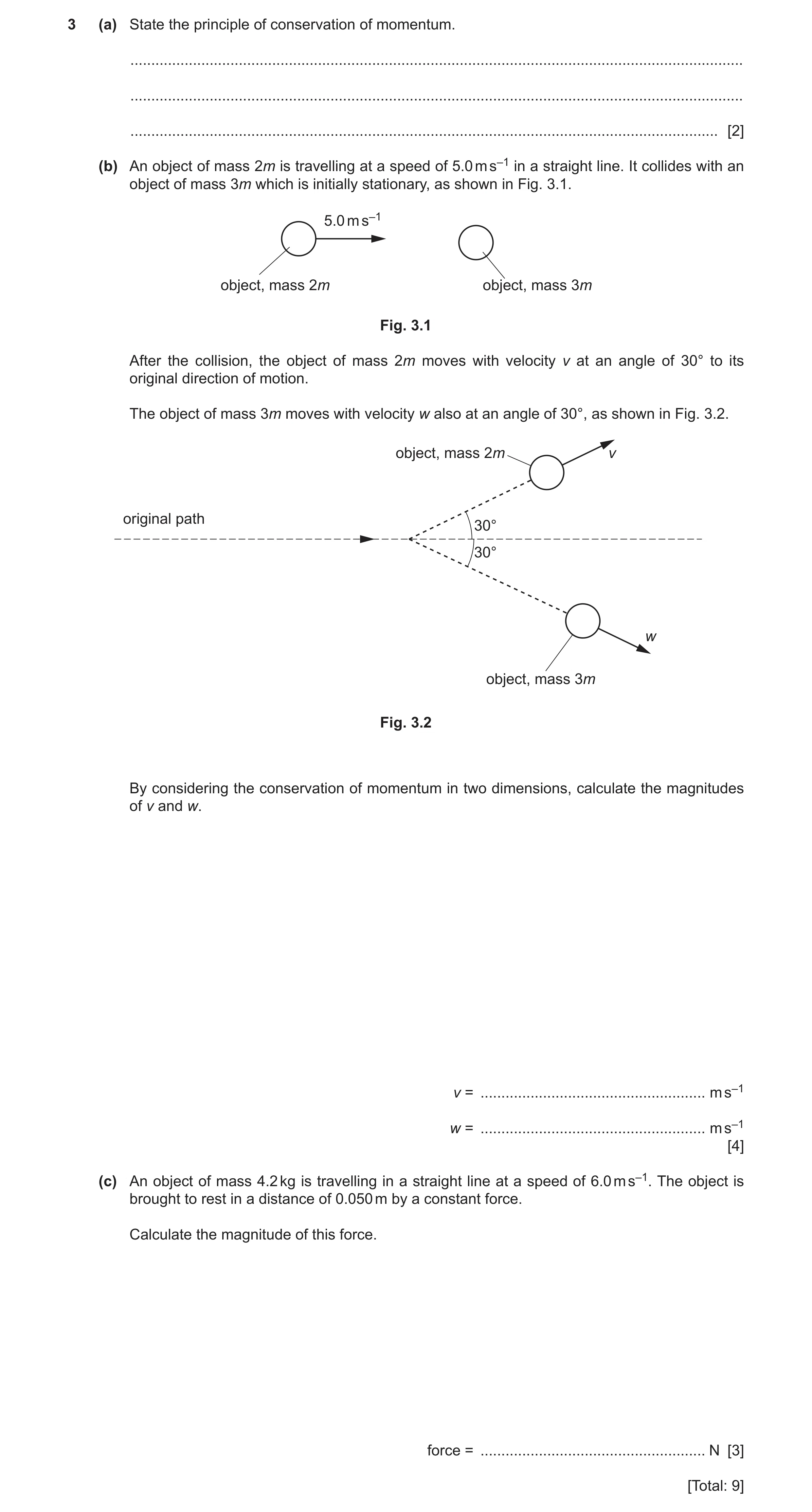
 38 / 45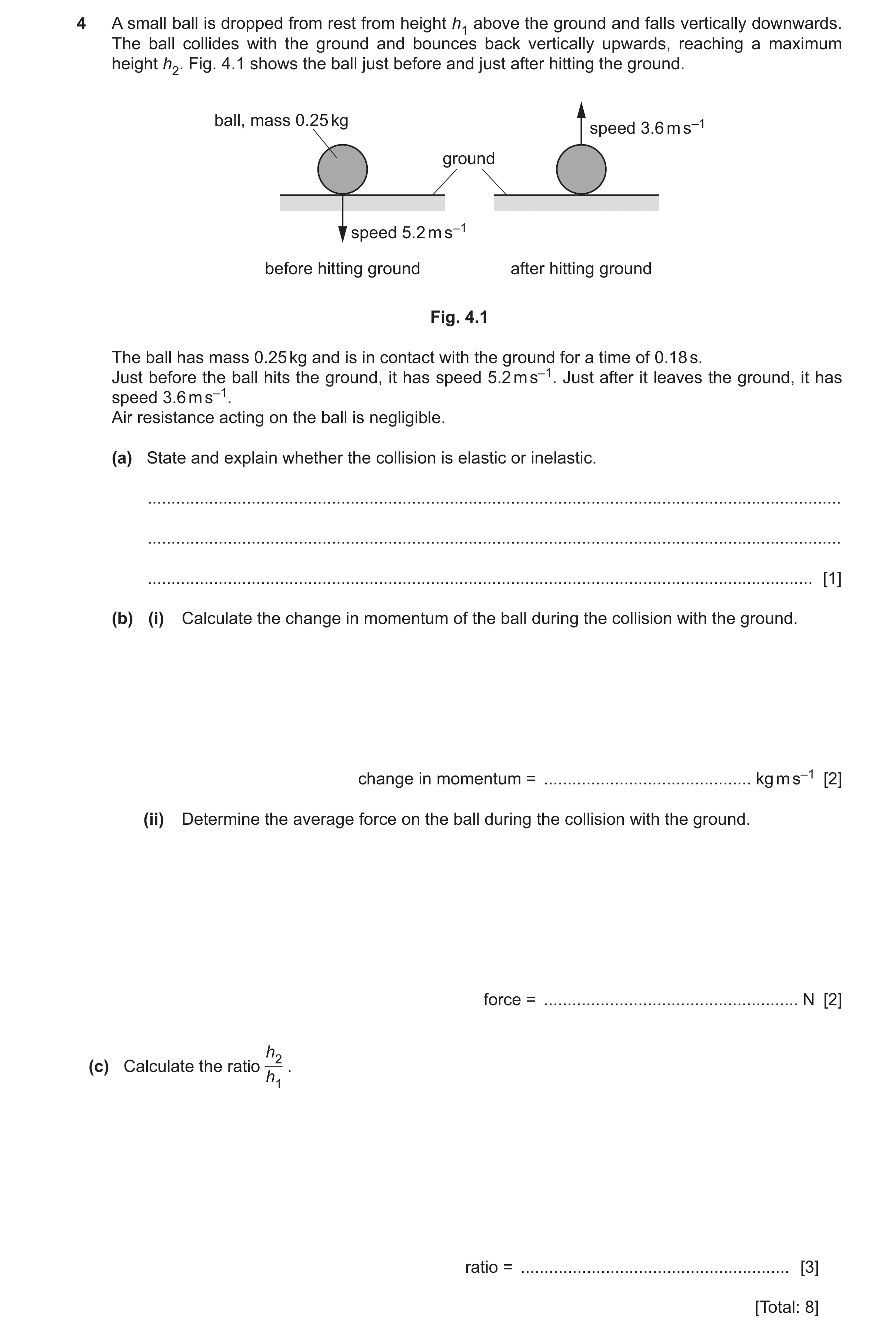
 40 / 45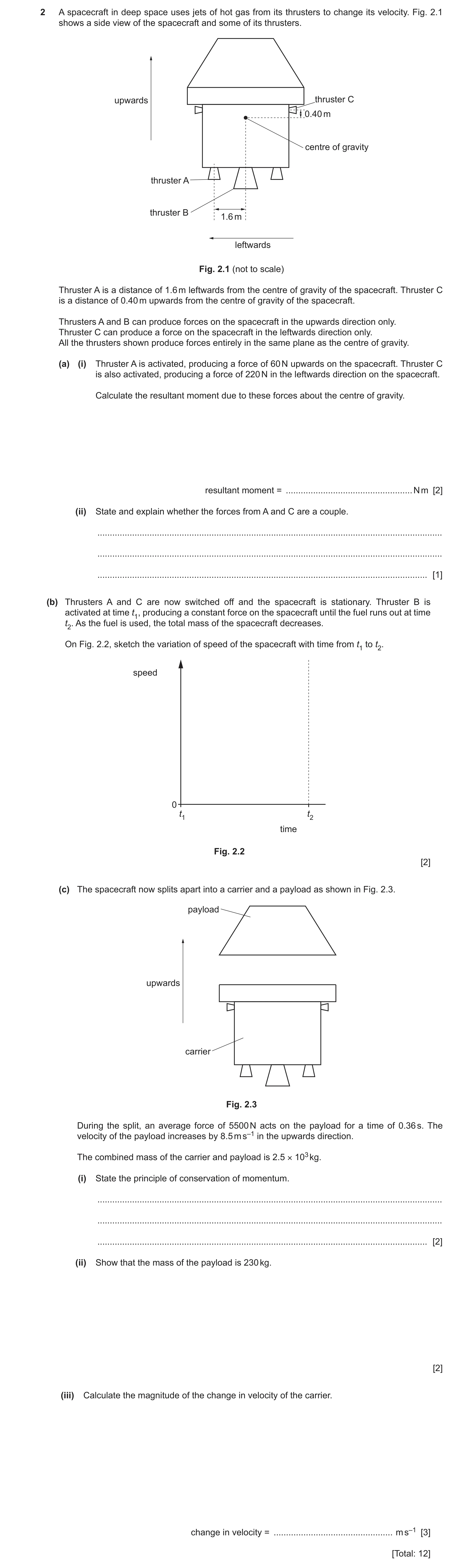
 11
11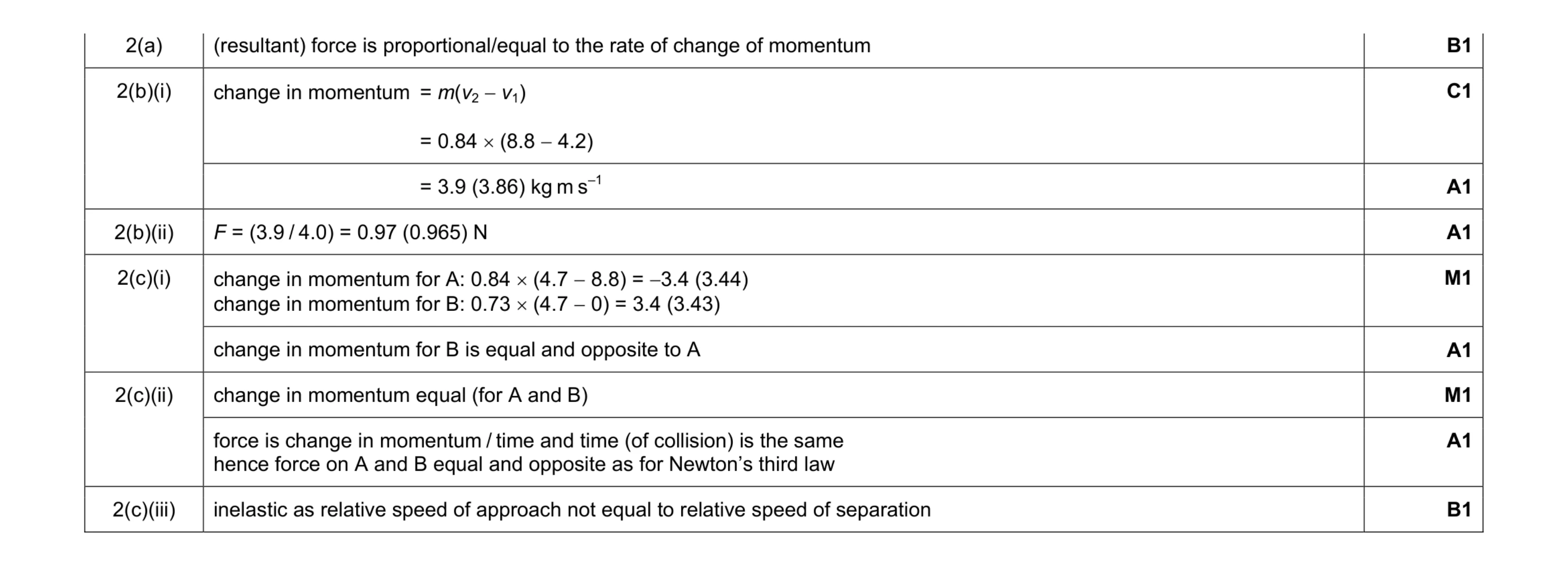 9
9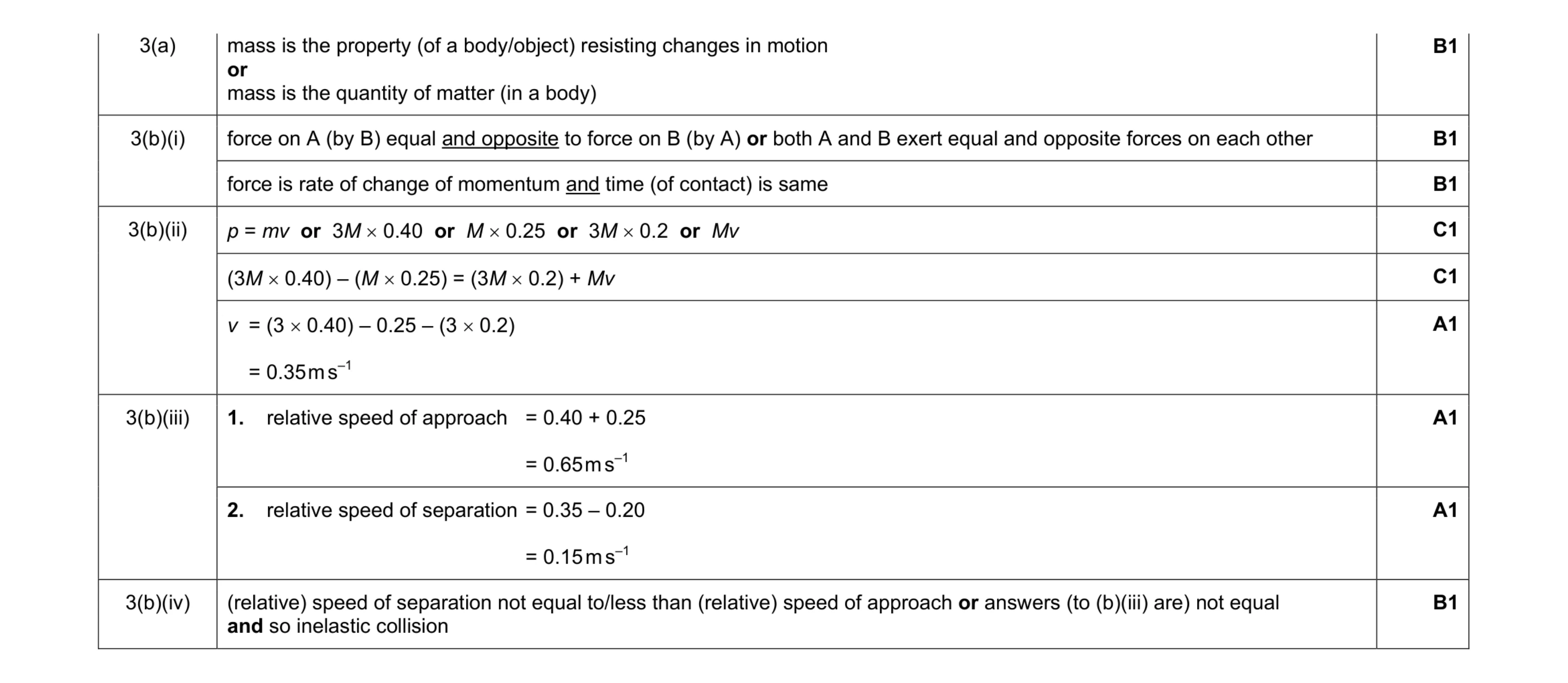 9
9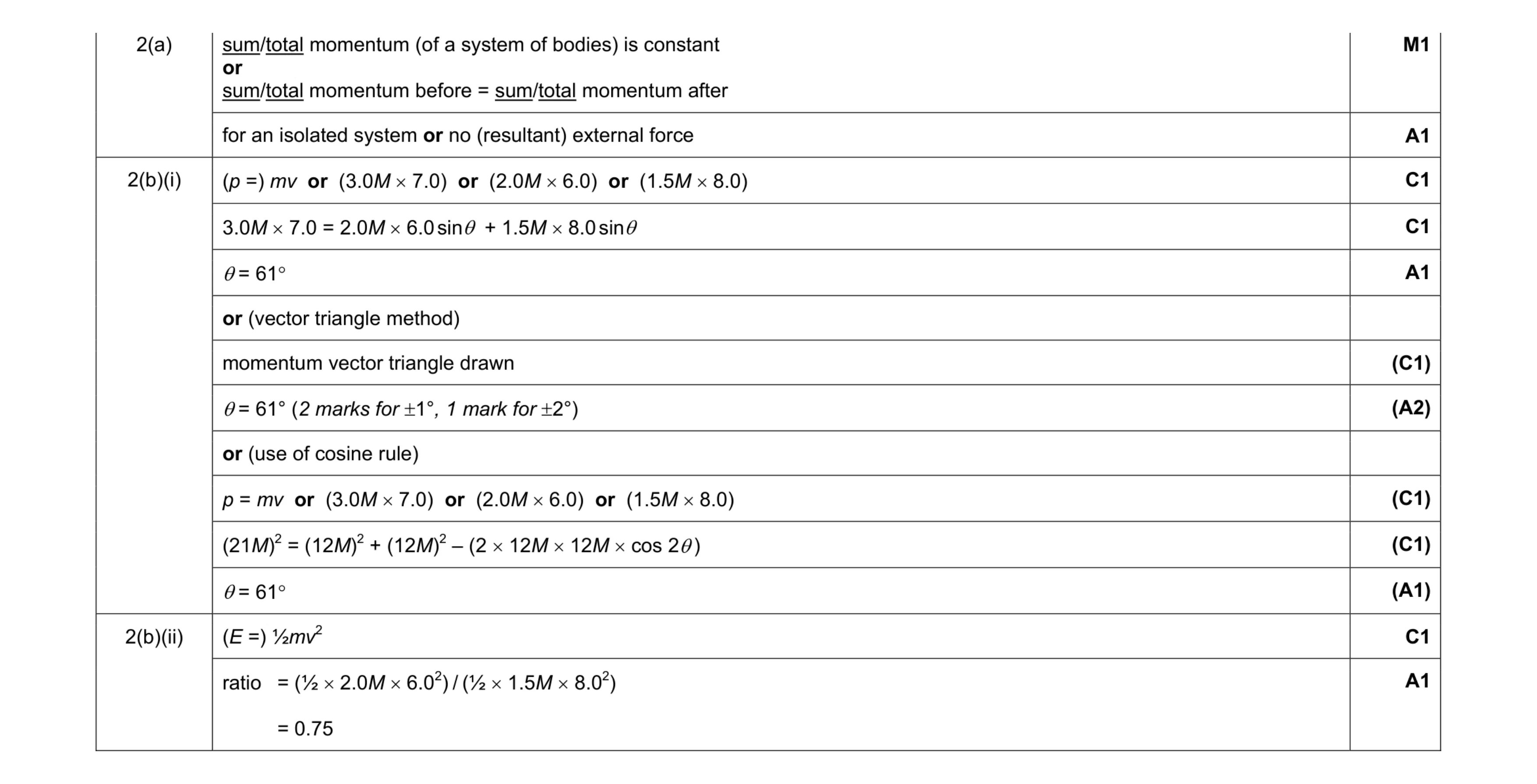 7
7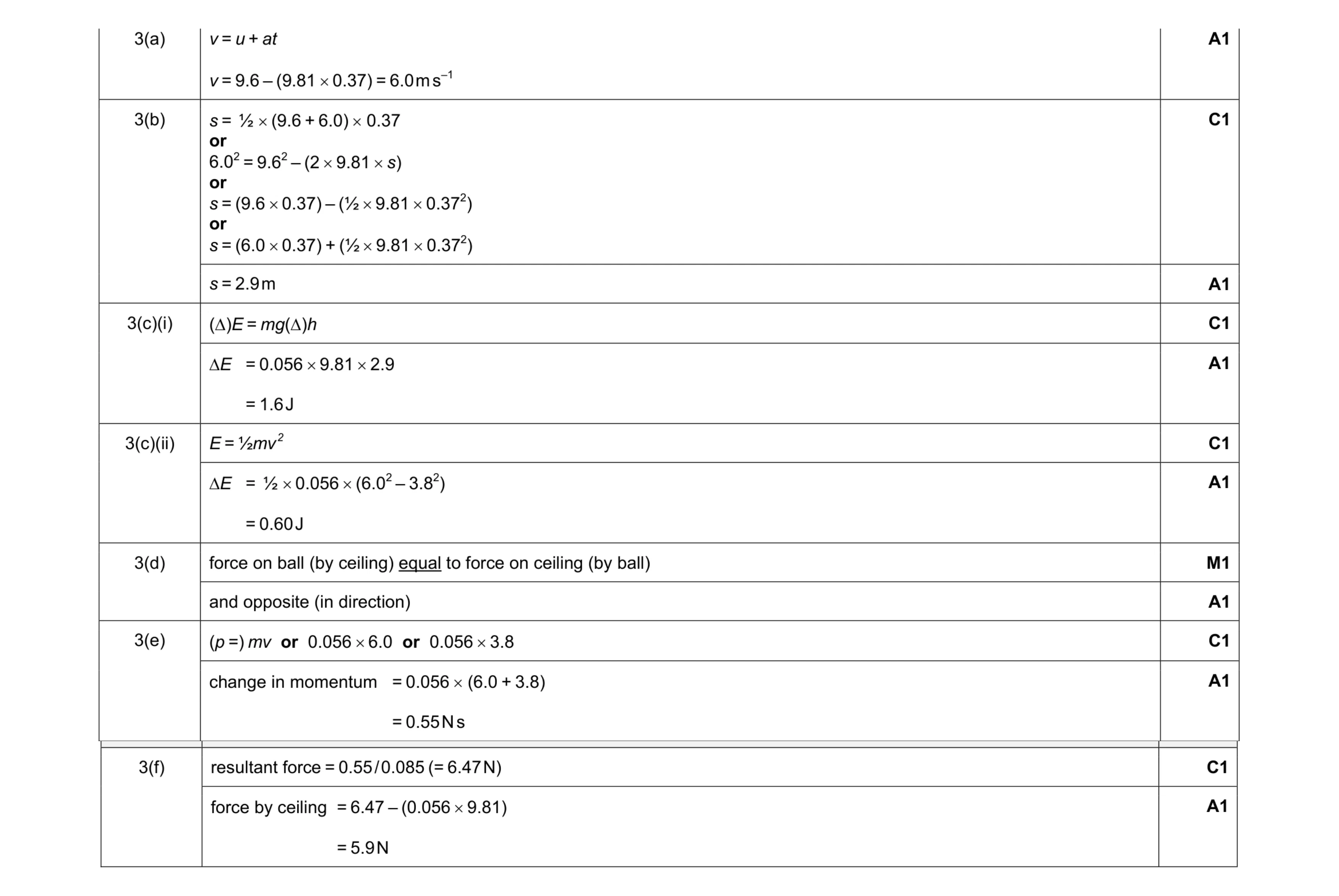 13
13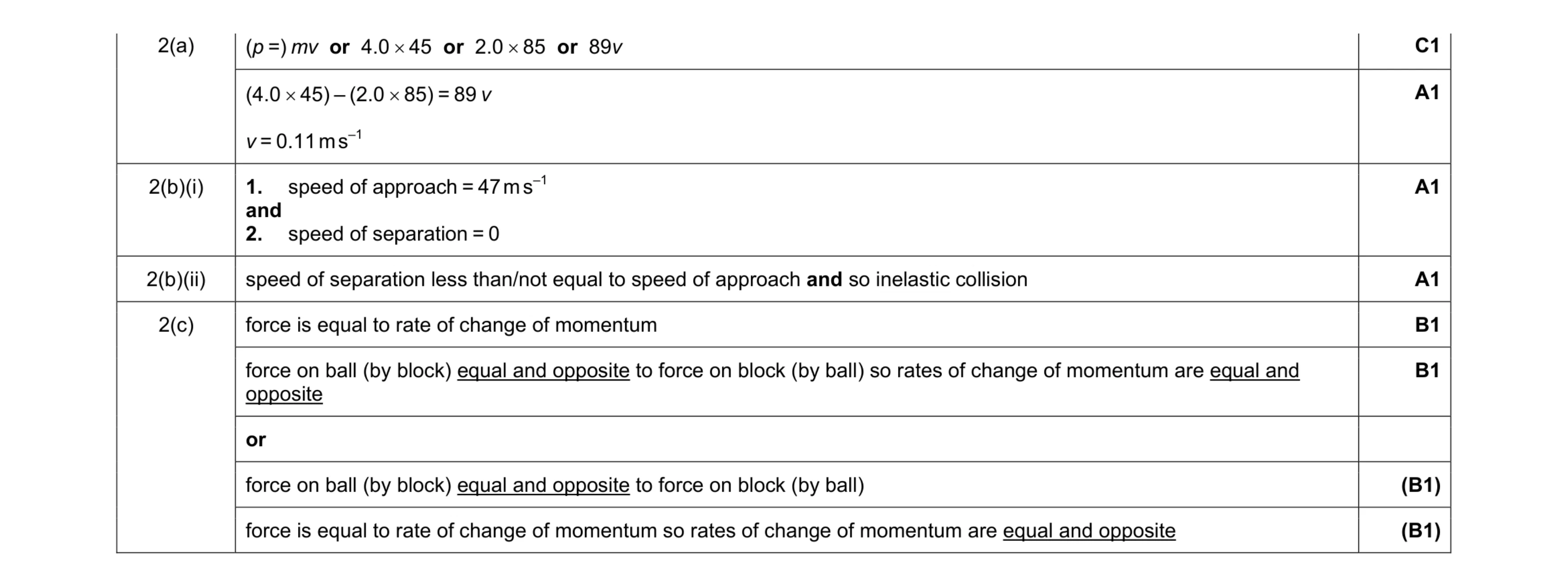 6
6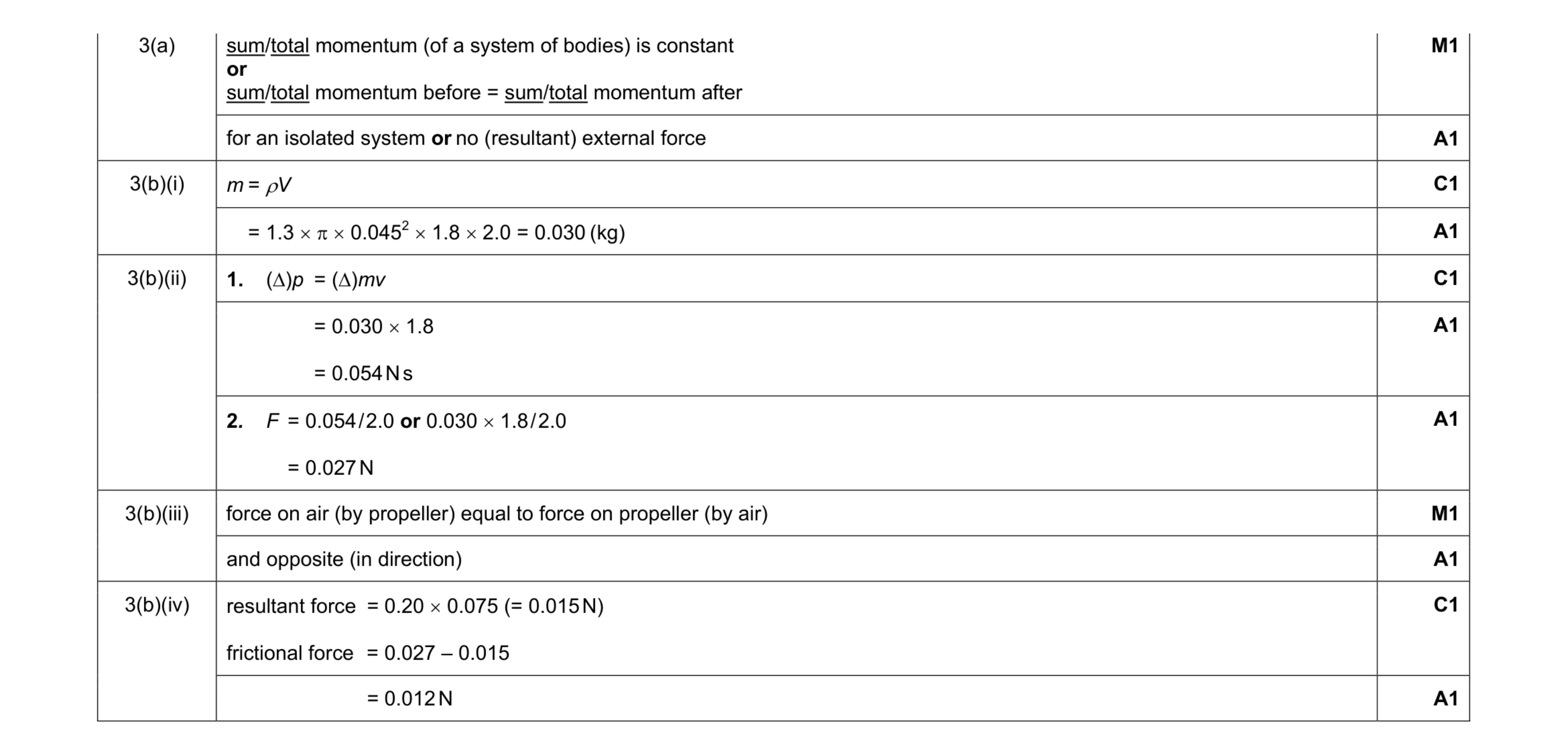 11
11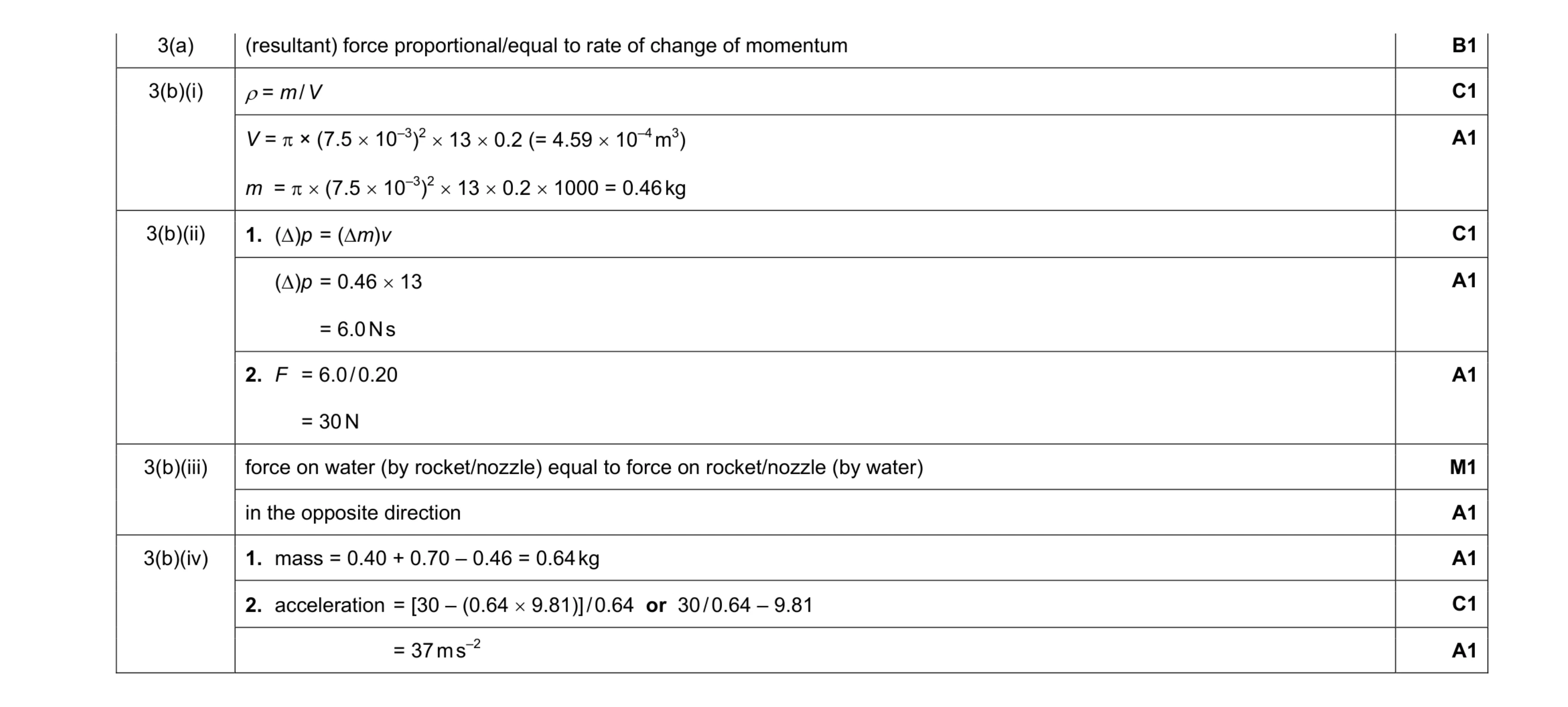 11
11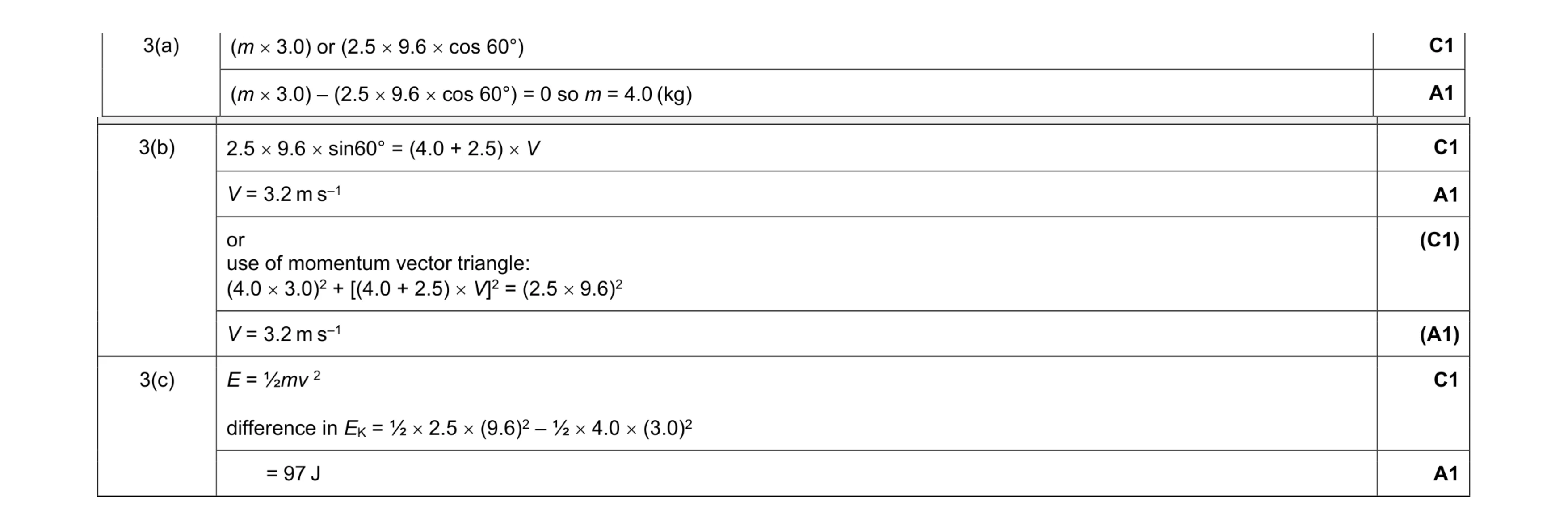 6
6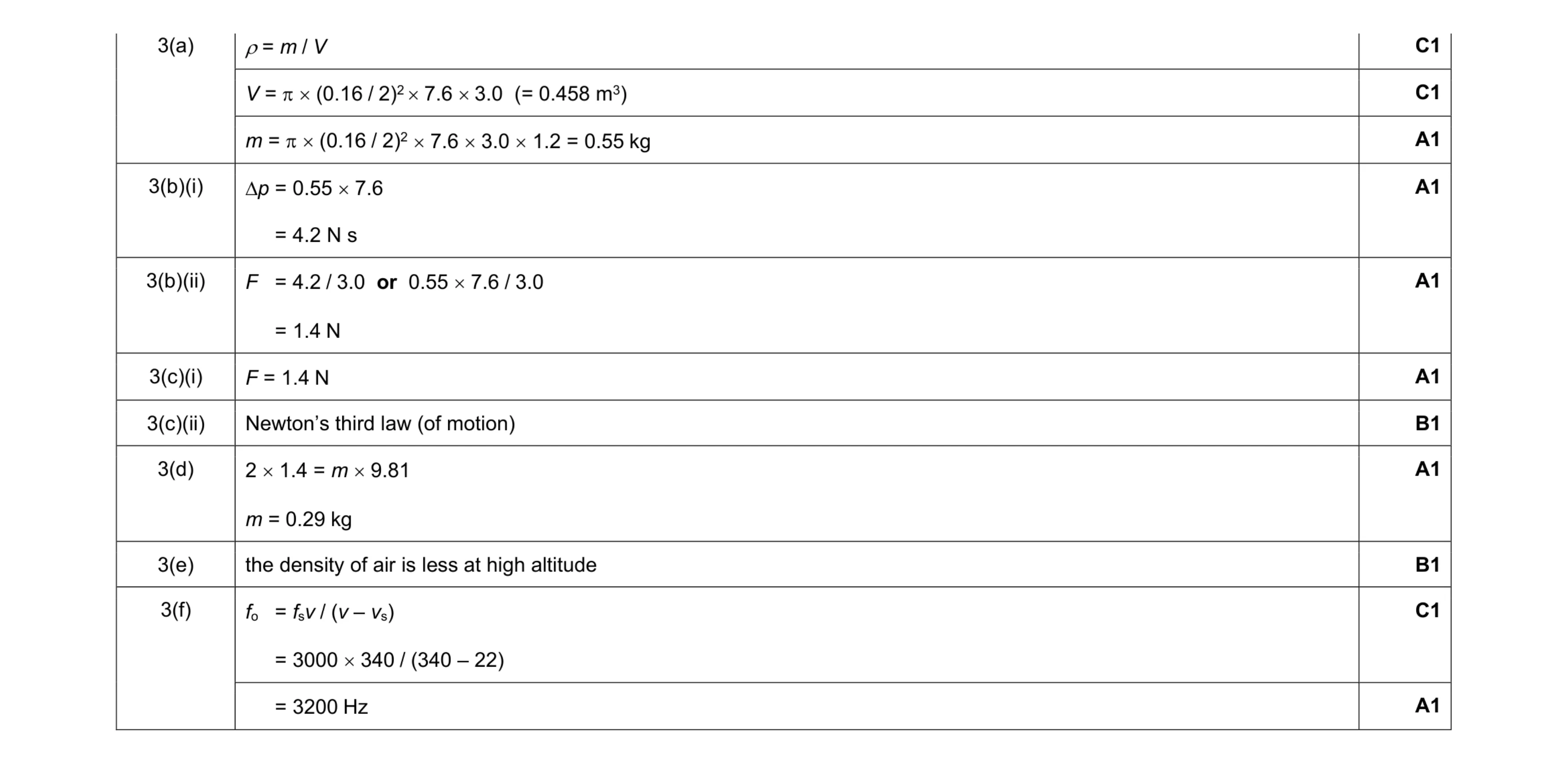 11
11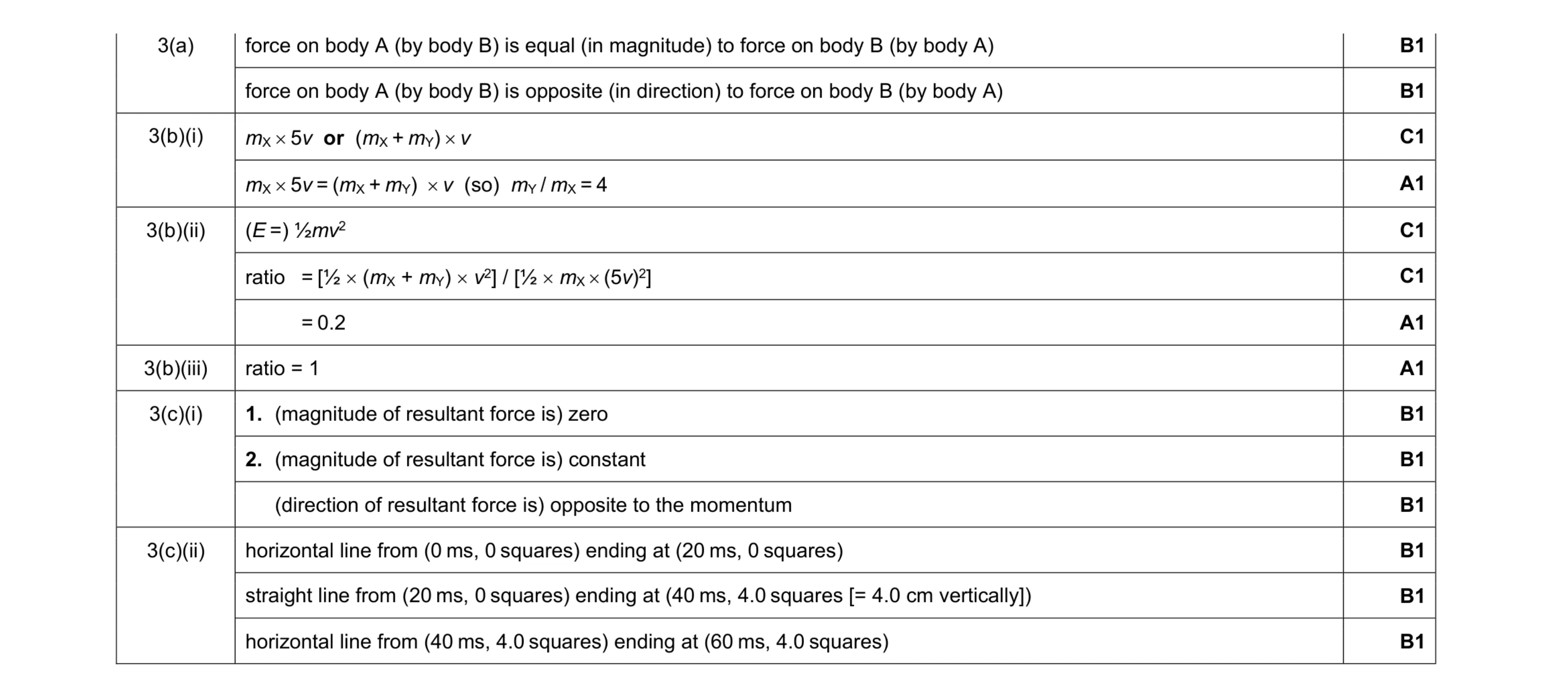 14
14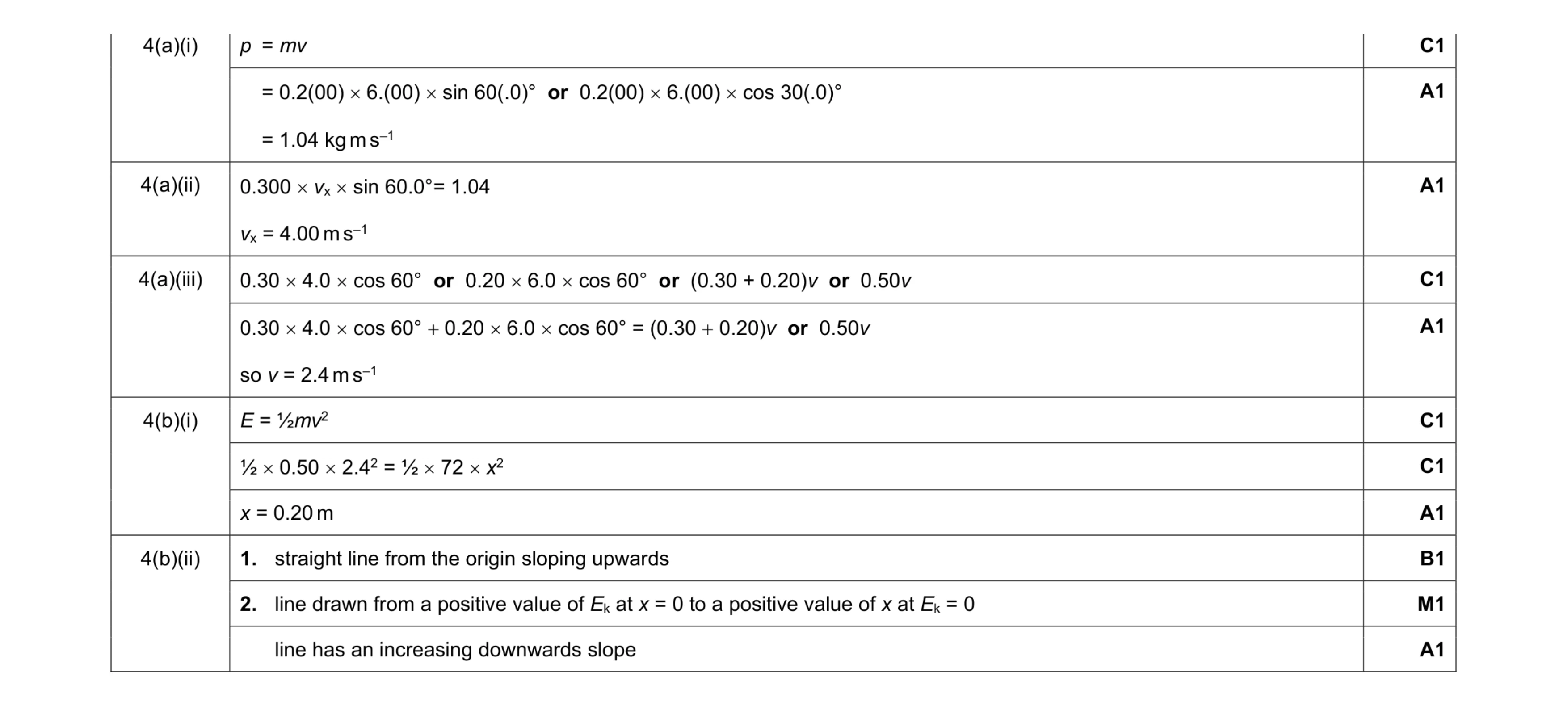 11
11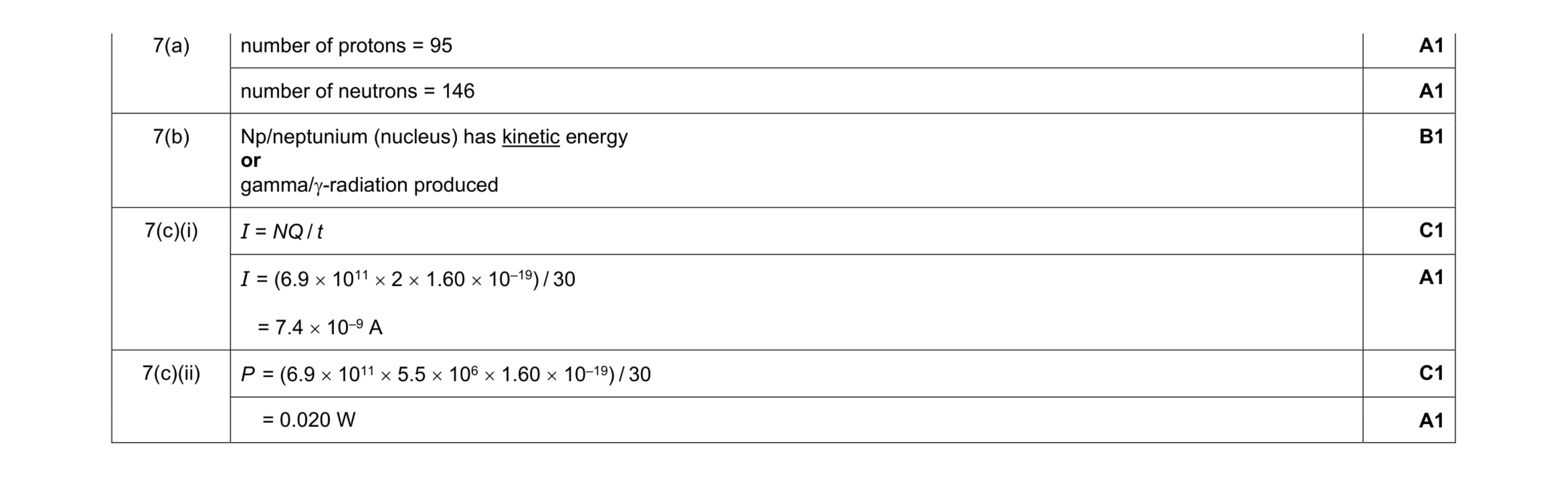 7
7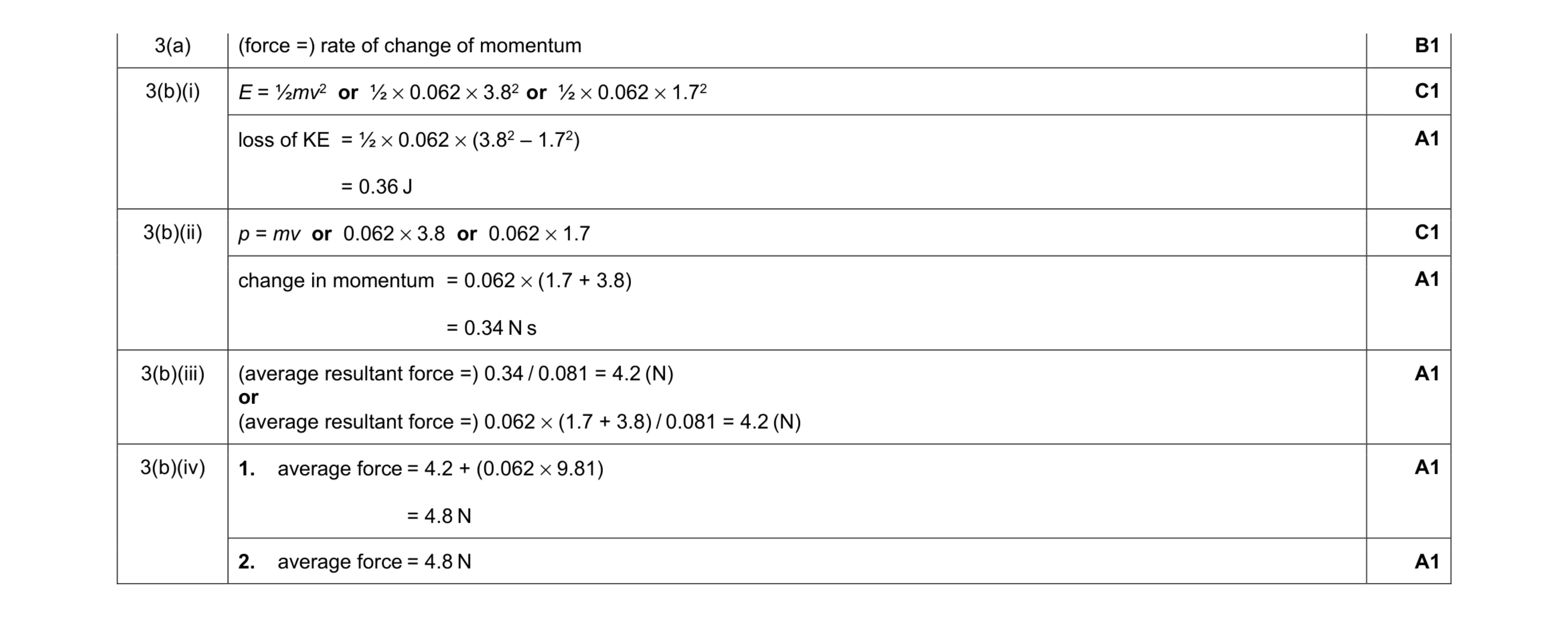 8
8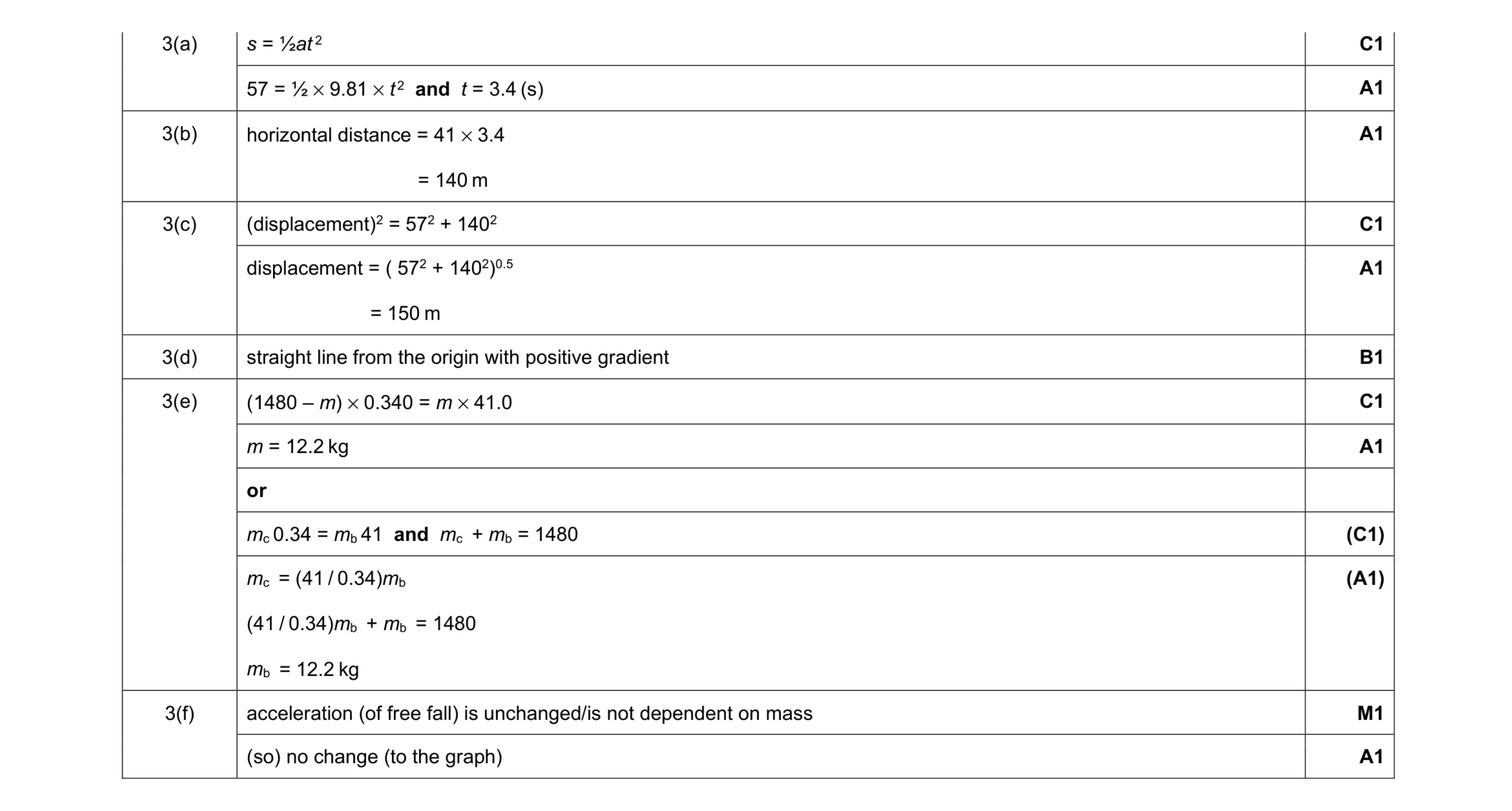 10
10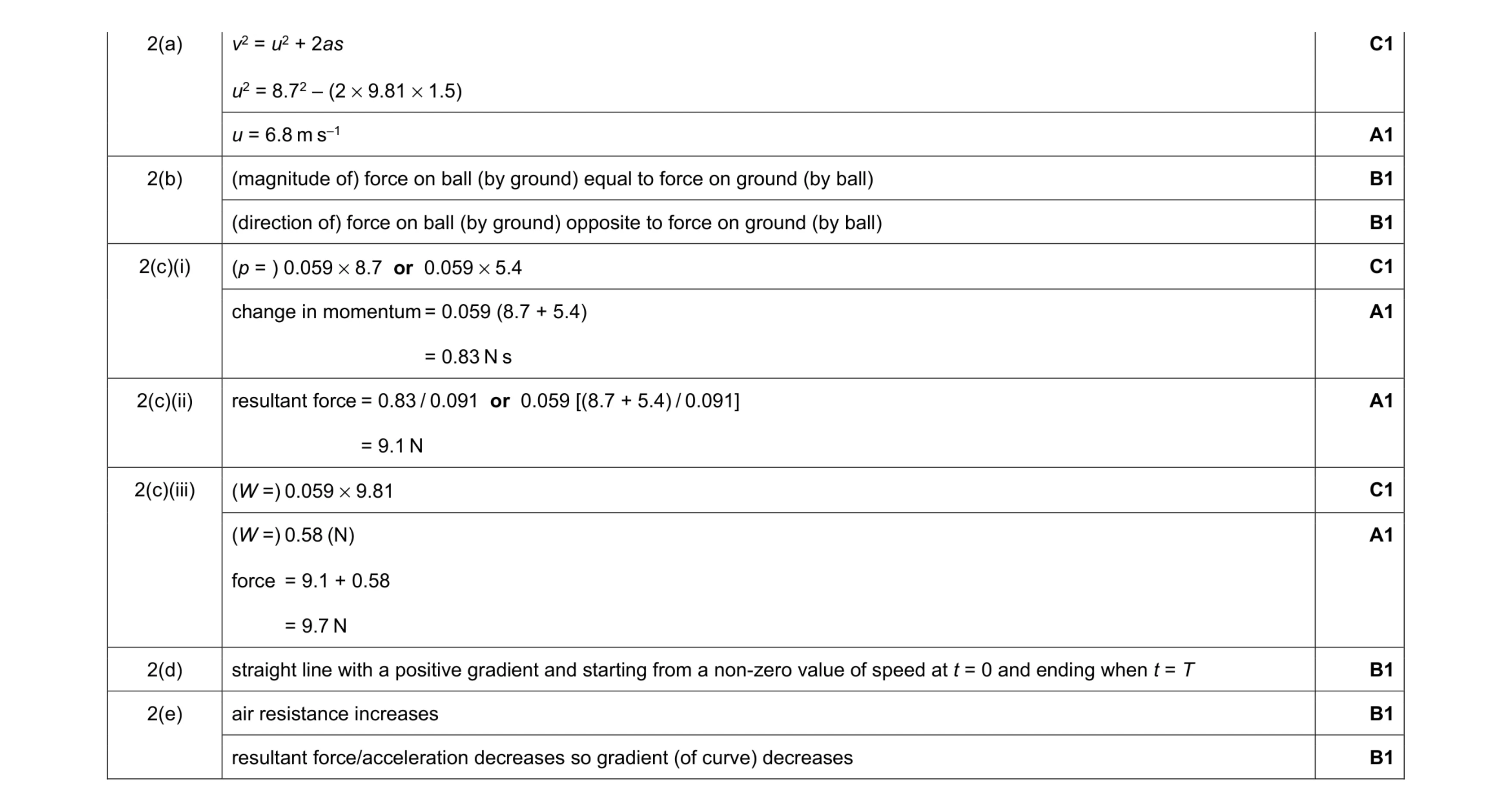 12
12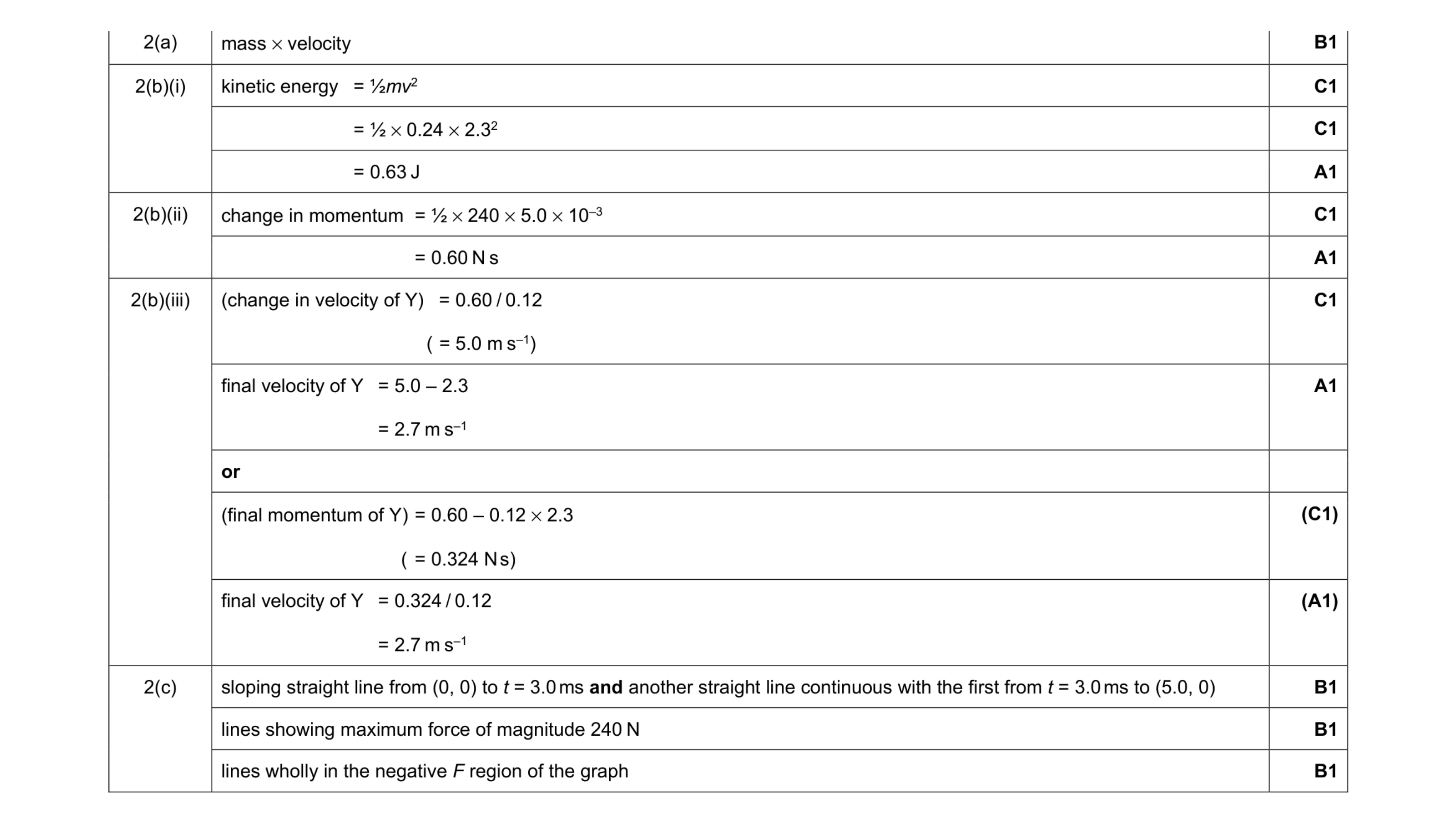 11
11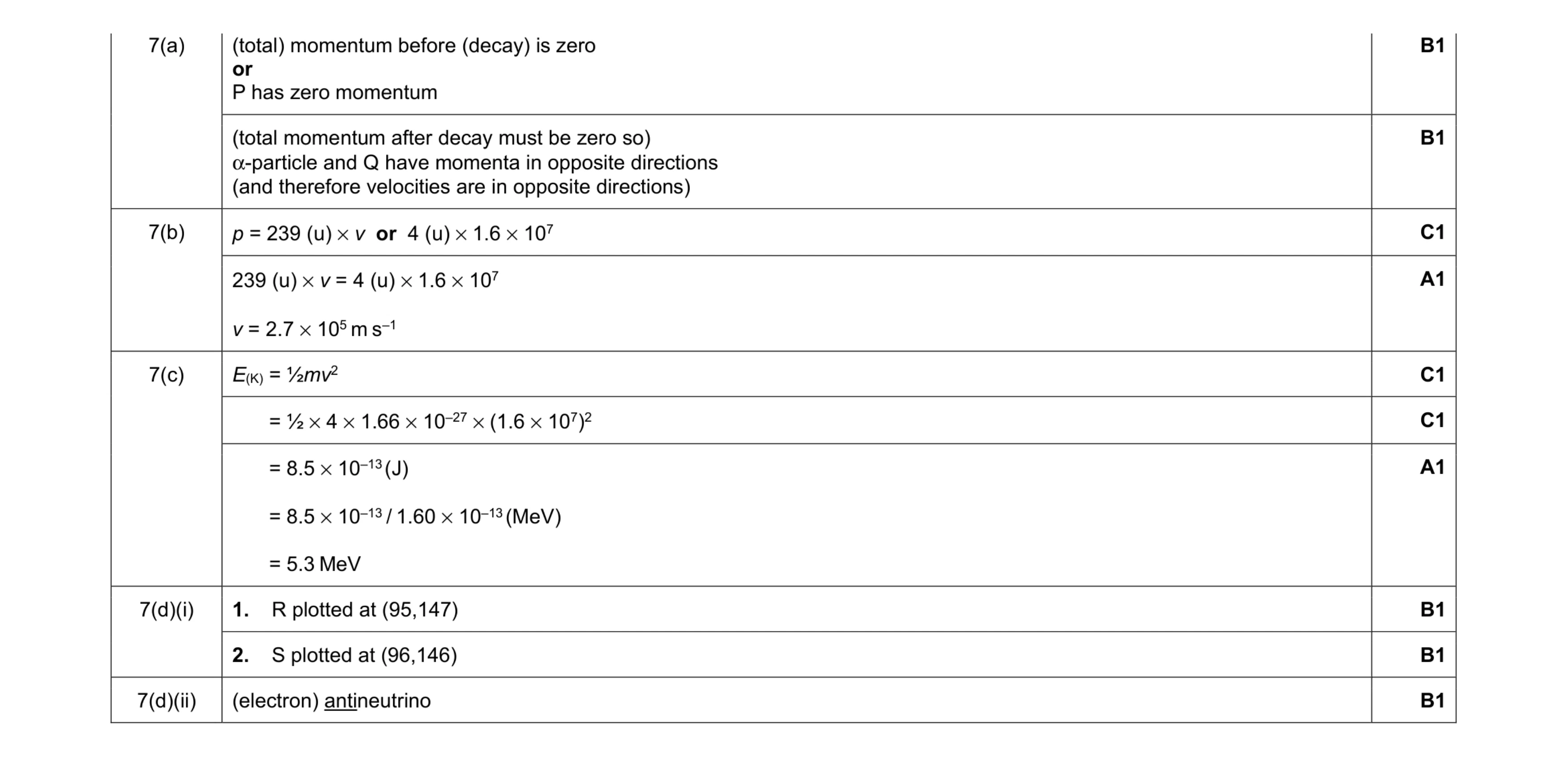 10
10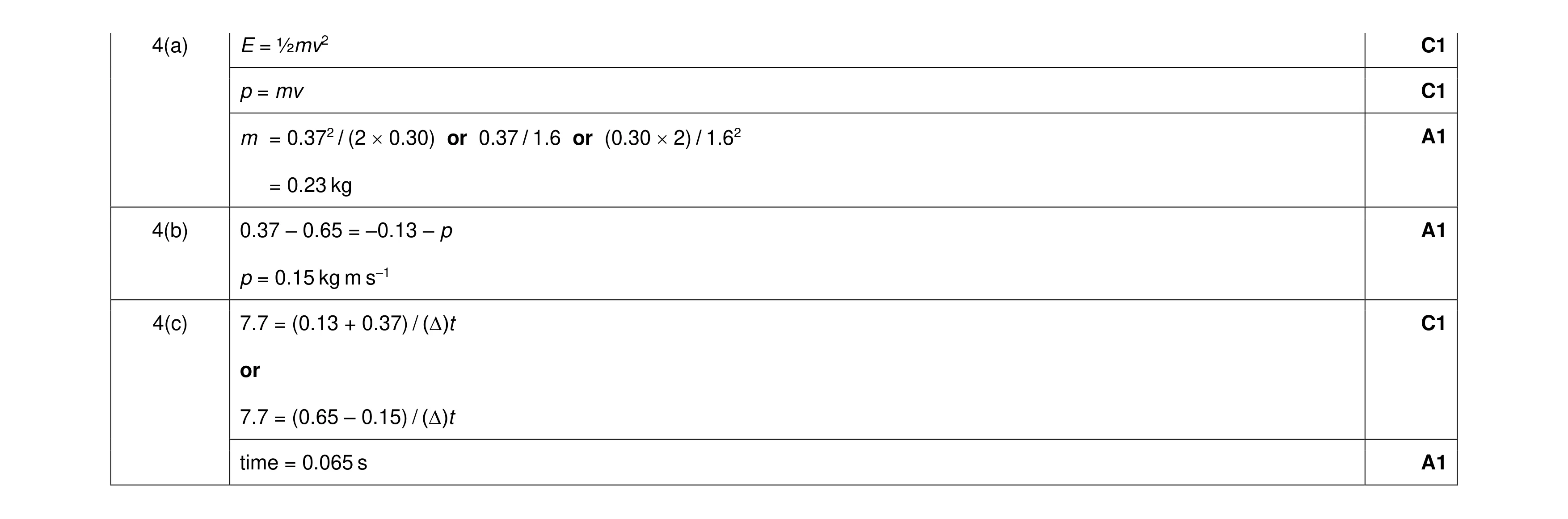 6
6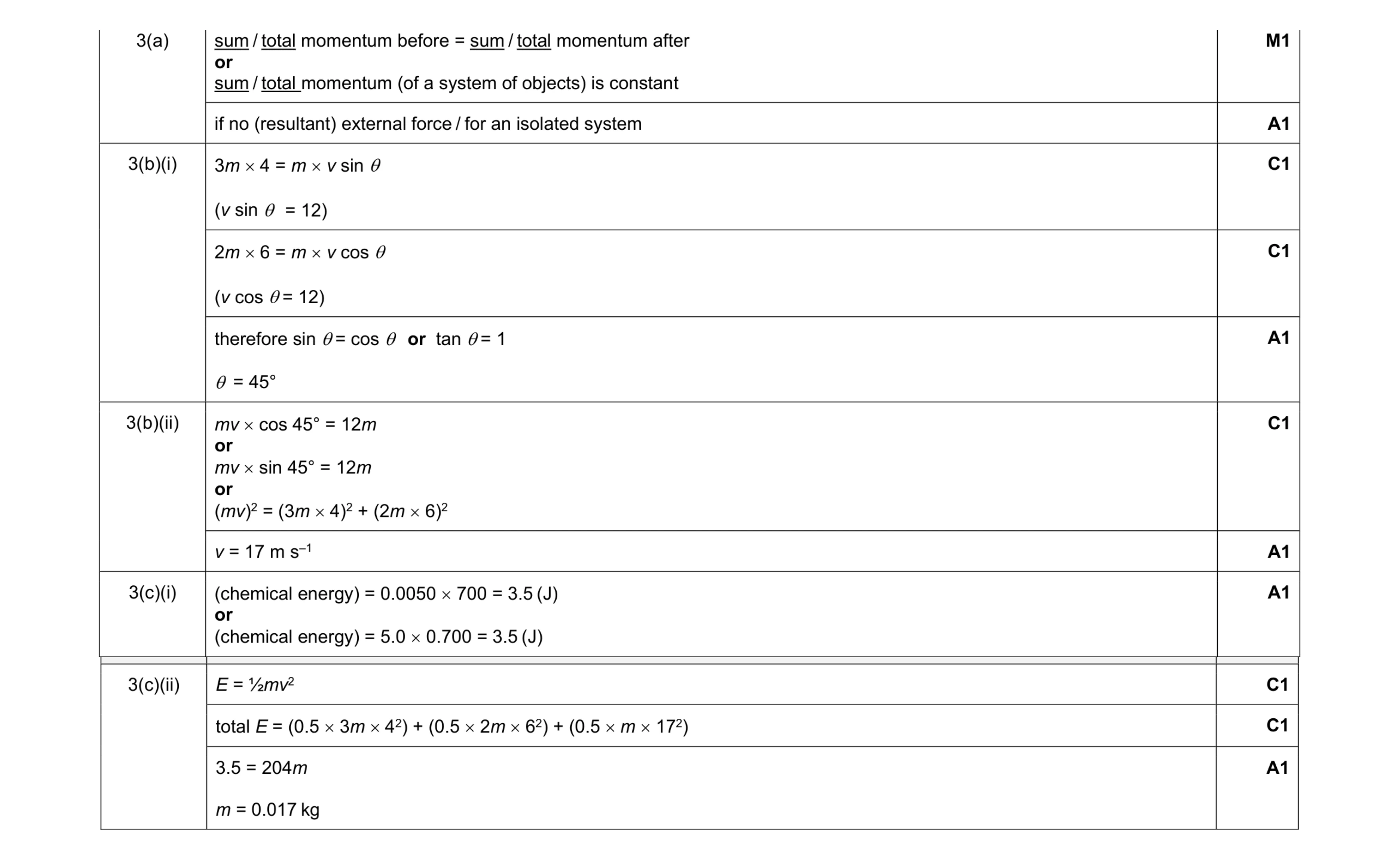 11
11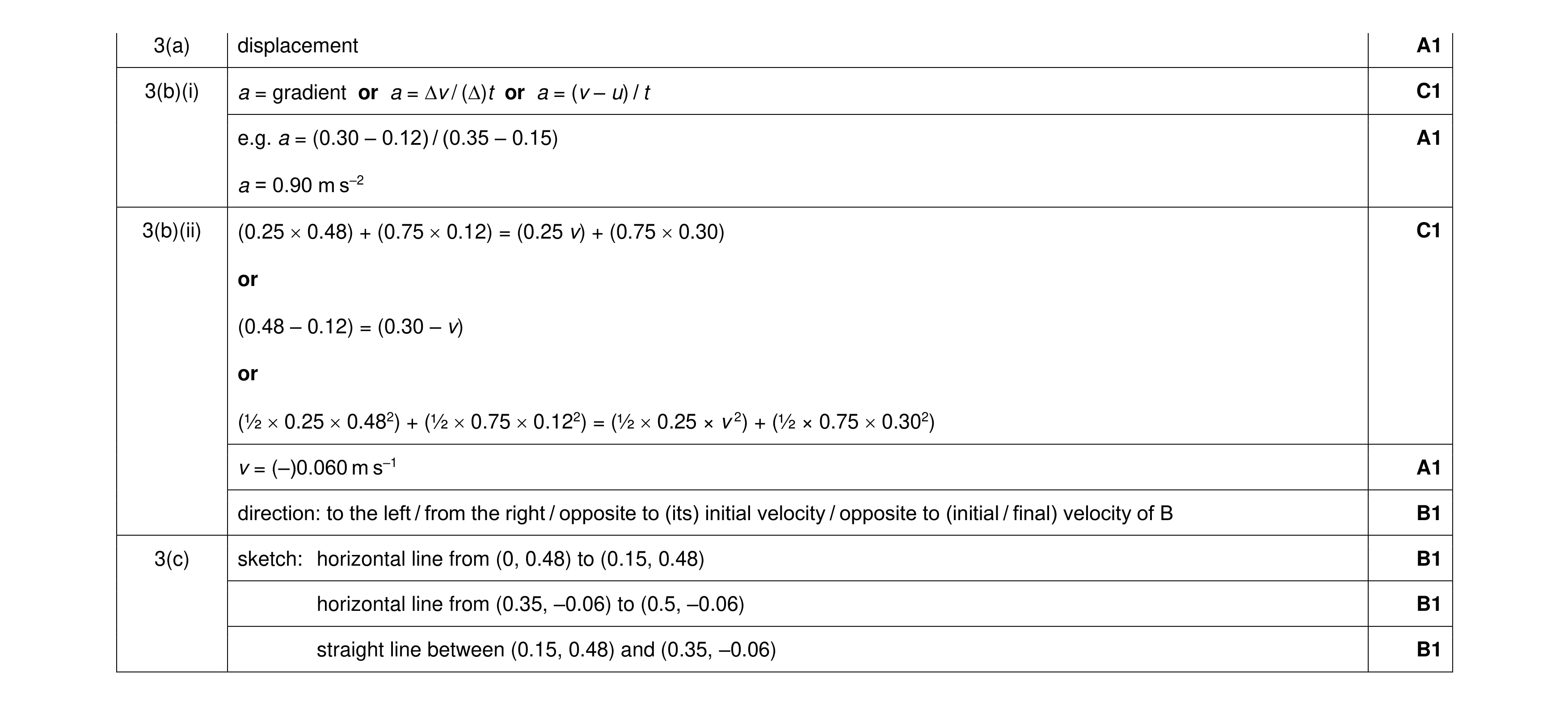 9
9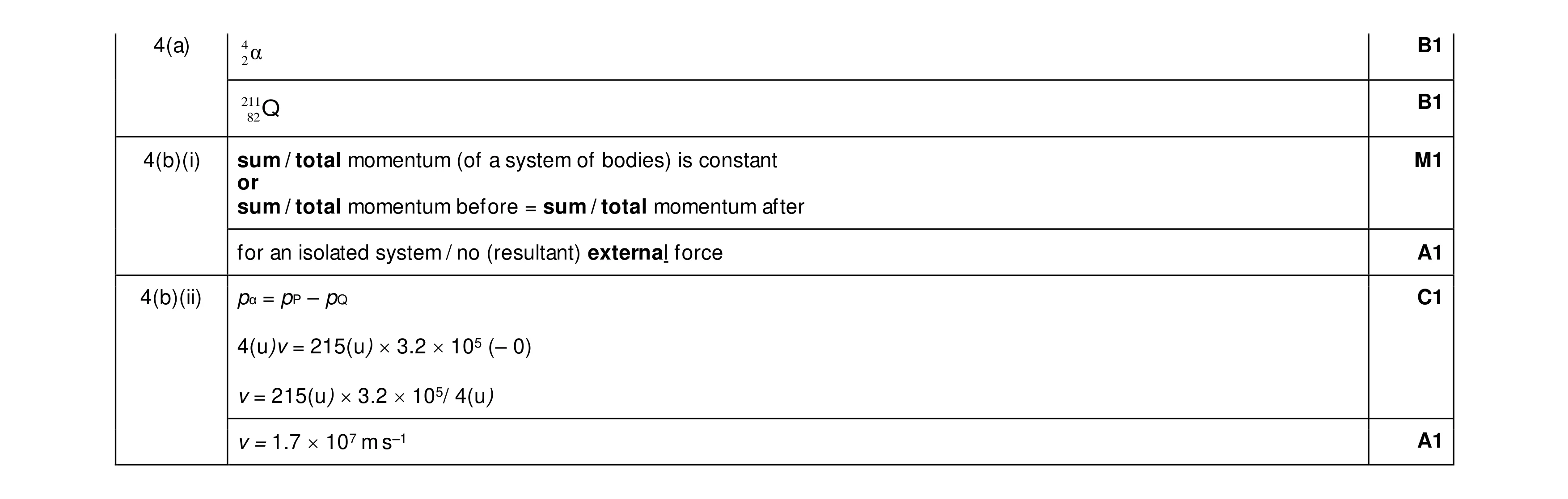 6
6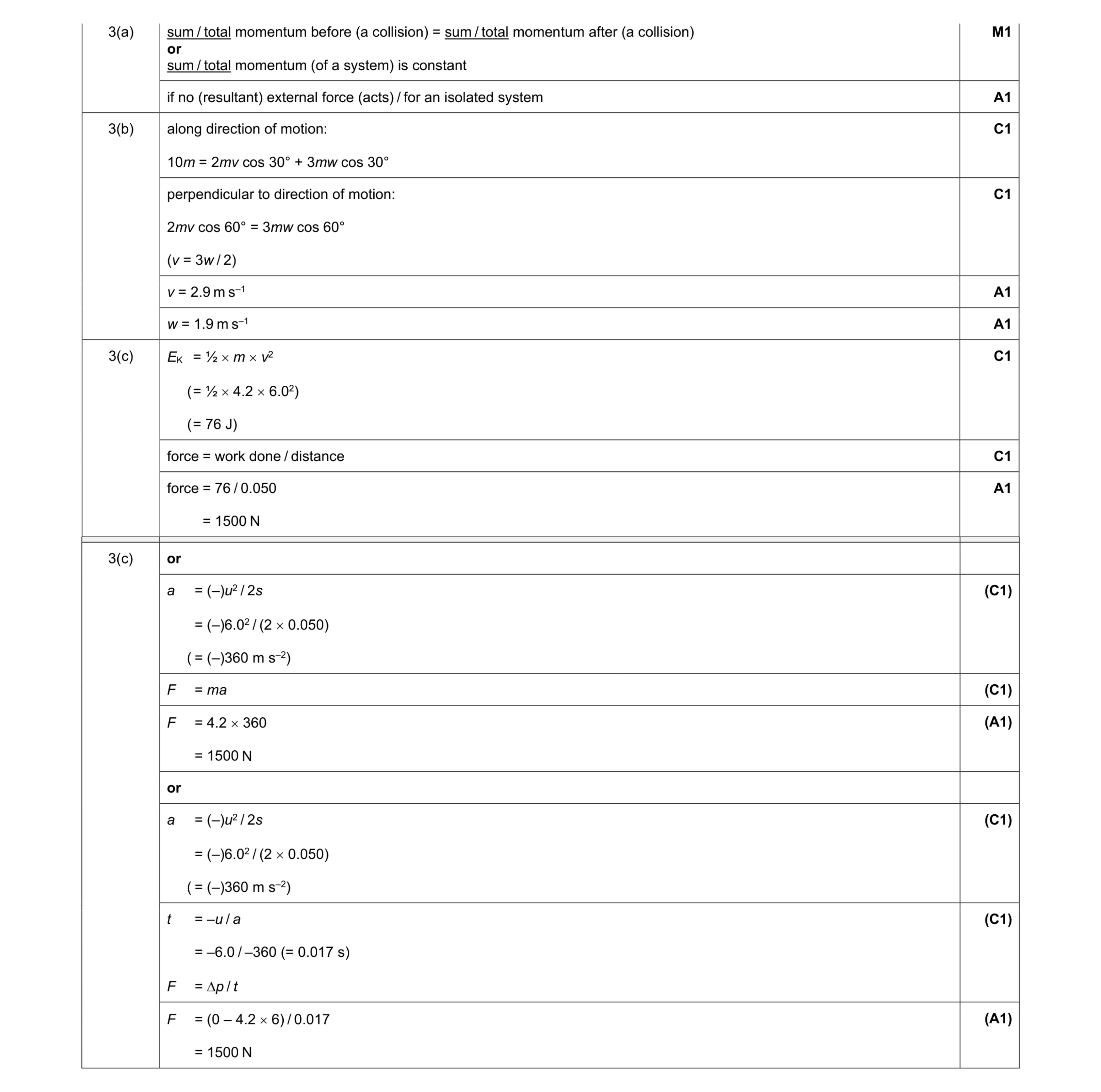 9
9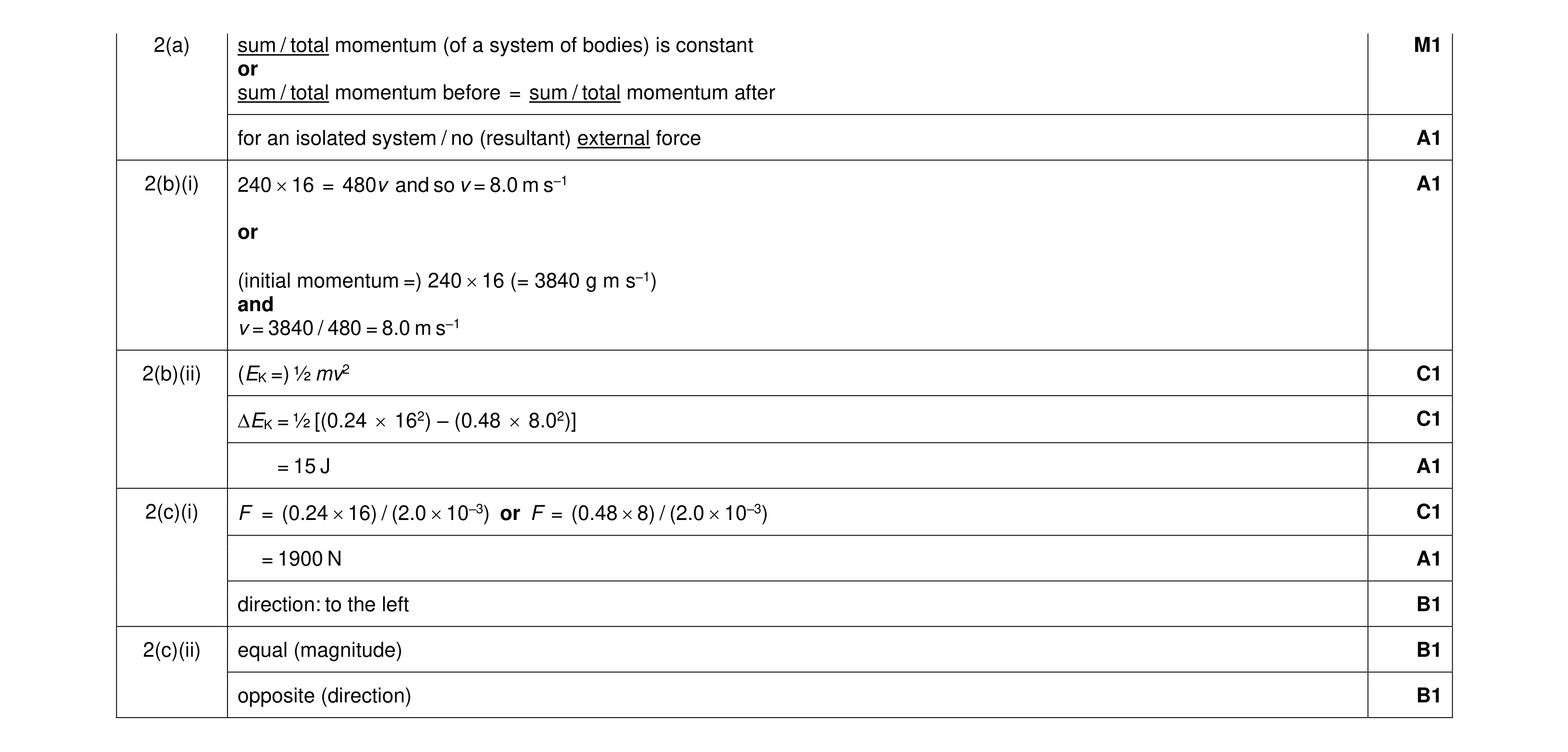 11
11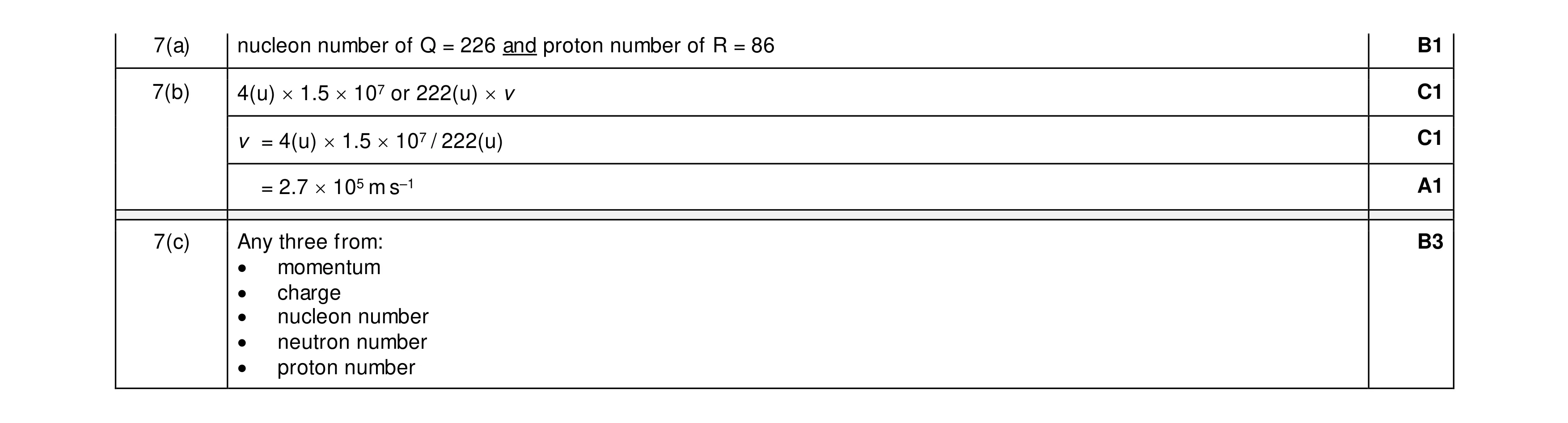 7
7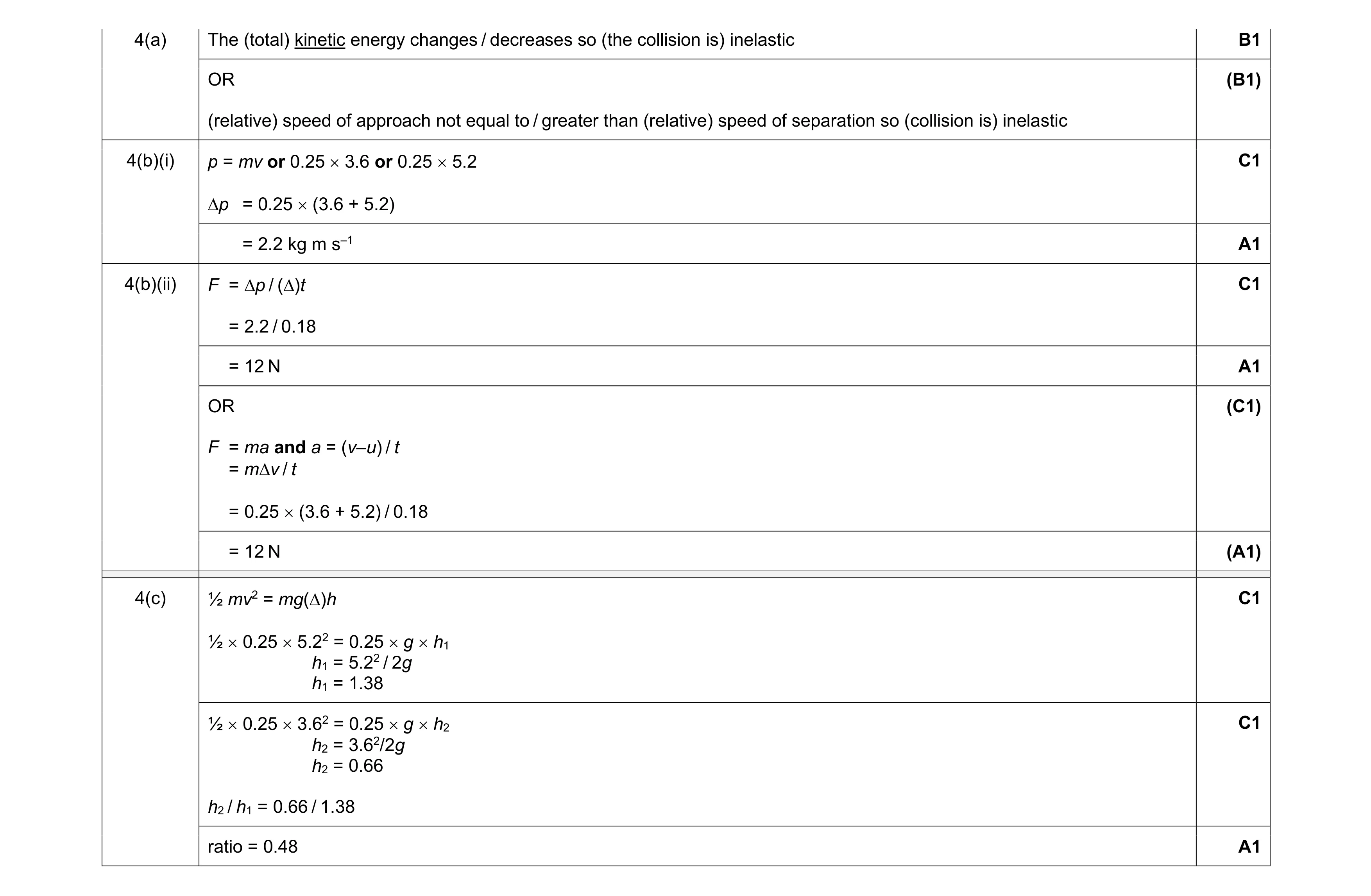 8
8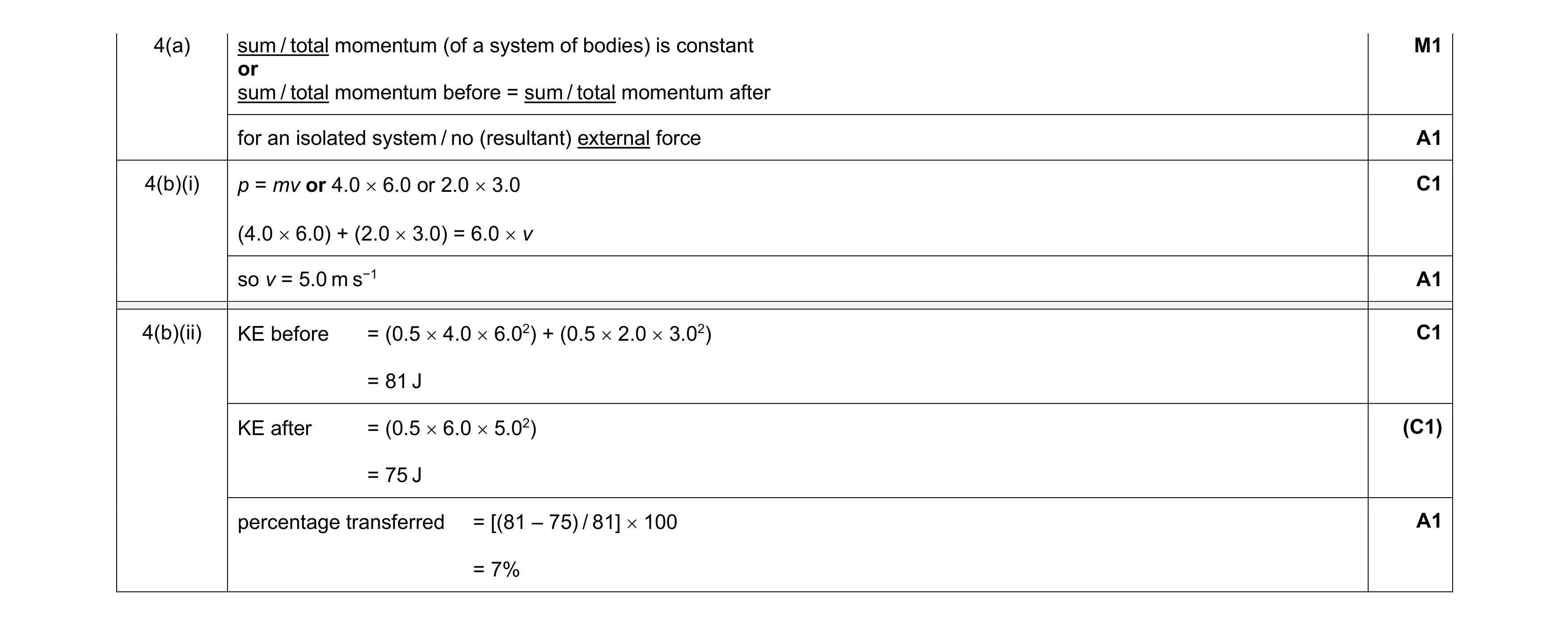 6
6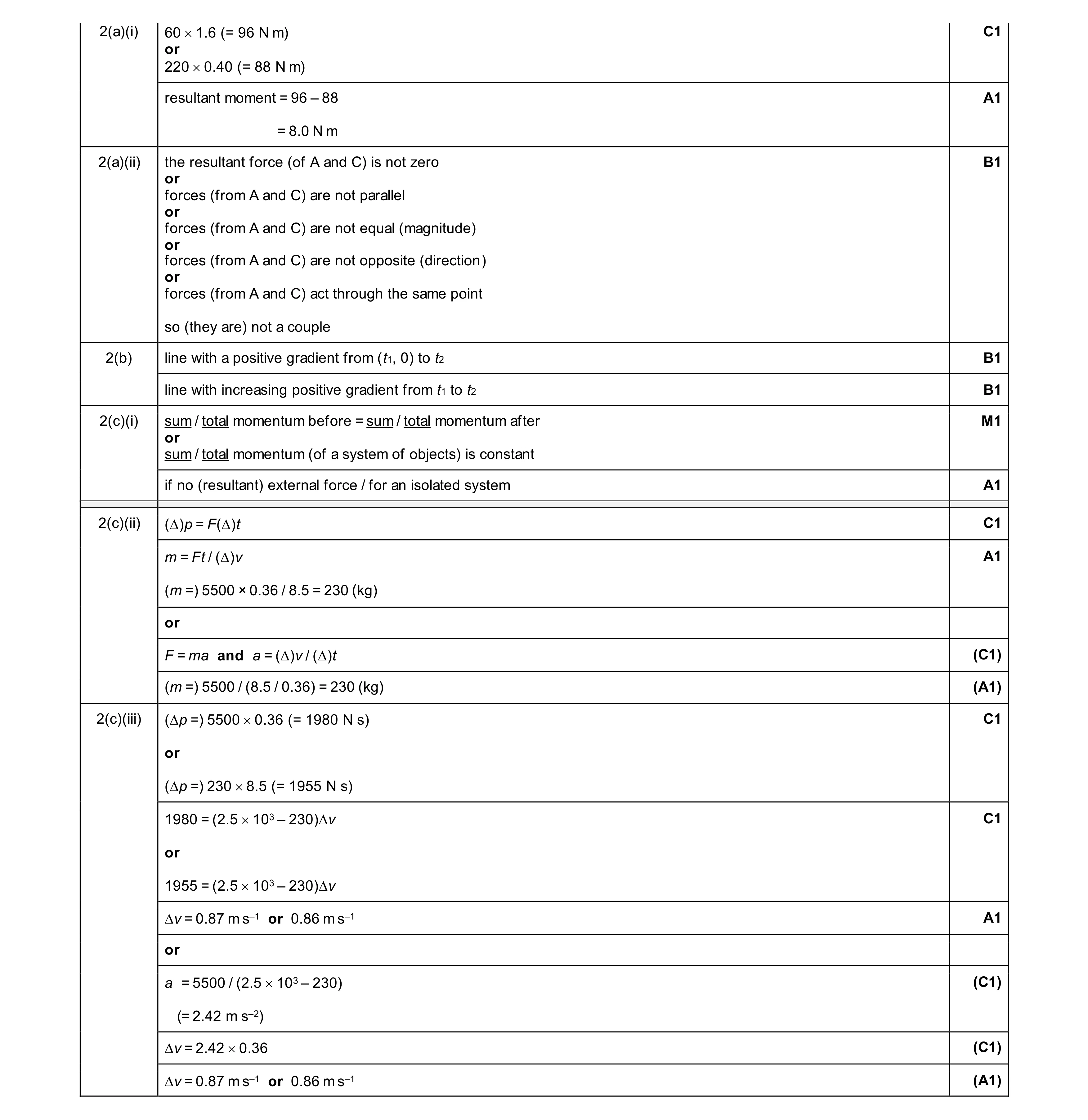 12
12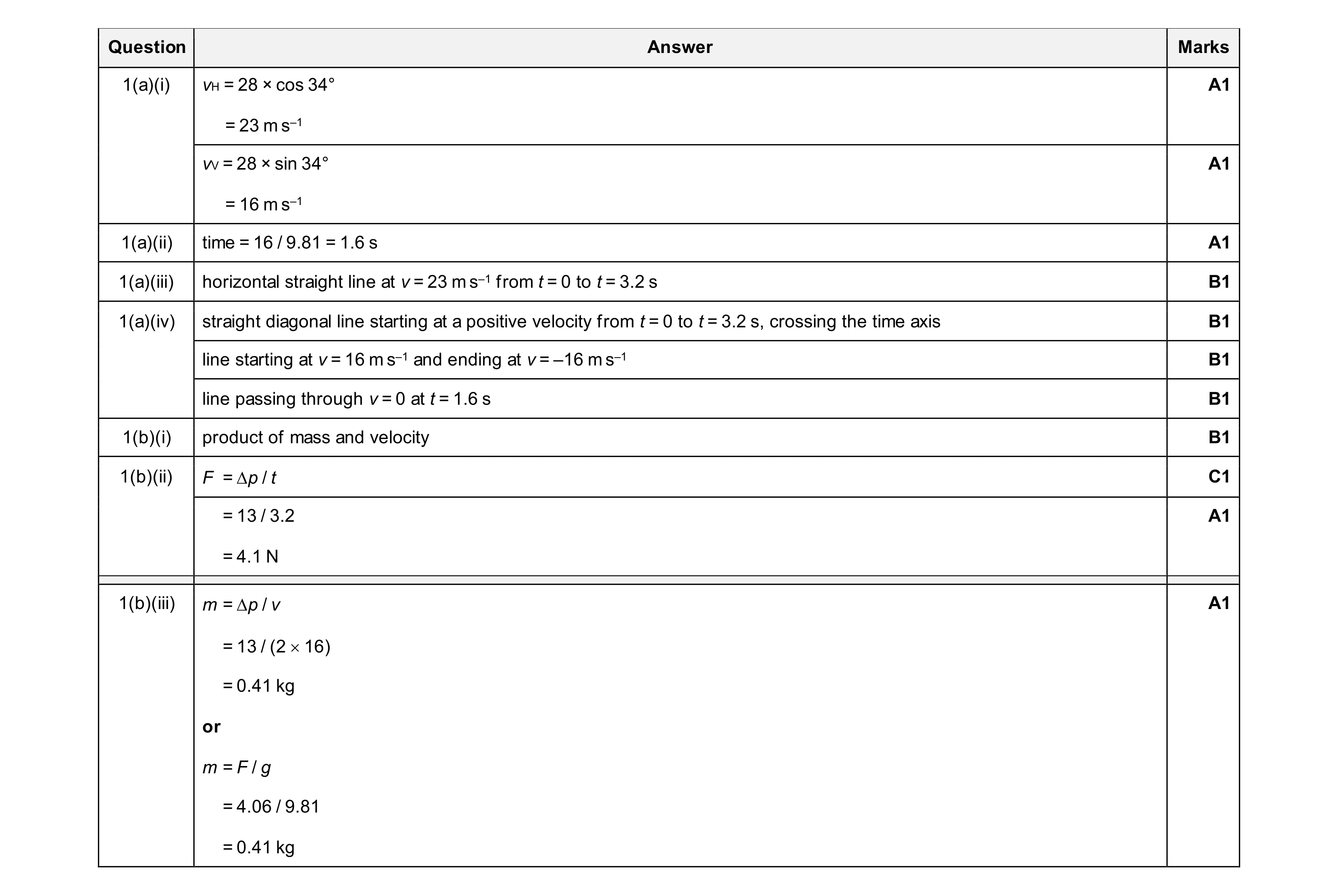 11
11