Cambridge A Level Physics 9702 — 2023 Feb/March Paper 1 · Variant 2
9702/12/F/M/23 · 40 questions · 40 marks · ≈45 min
The question paper and its mark scheme, free to read here and free to download. This is Cambridge’s own paper, exactly as it was sat.
Question paper20 pages


Mark scheme3 pages
Answers below. Sit the paper first if you are practising.
Questions as text
Q1 · What represents a physical quantity?
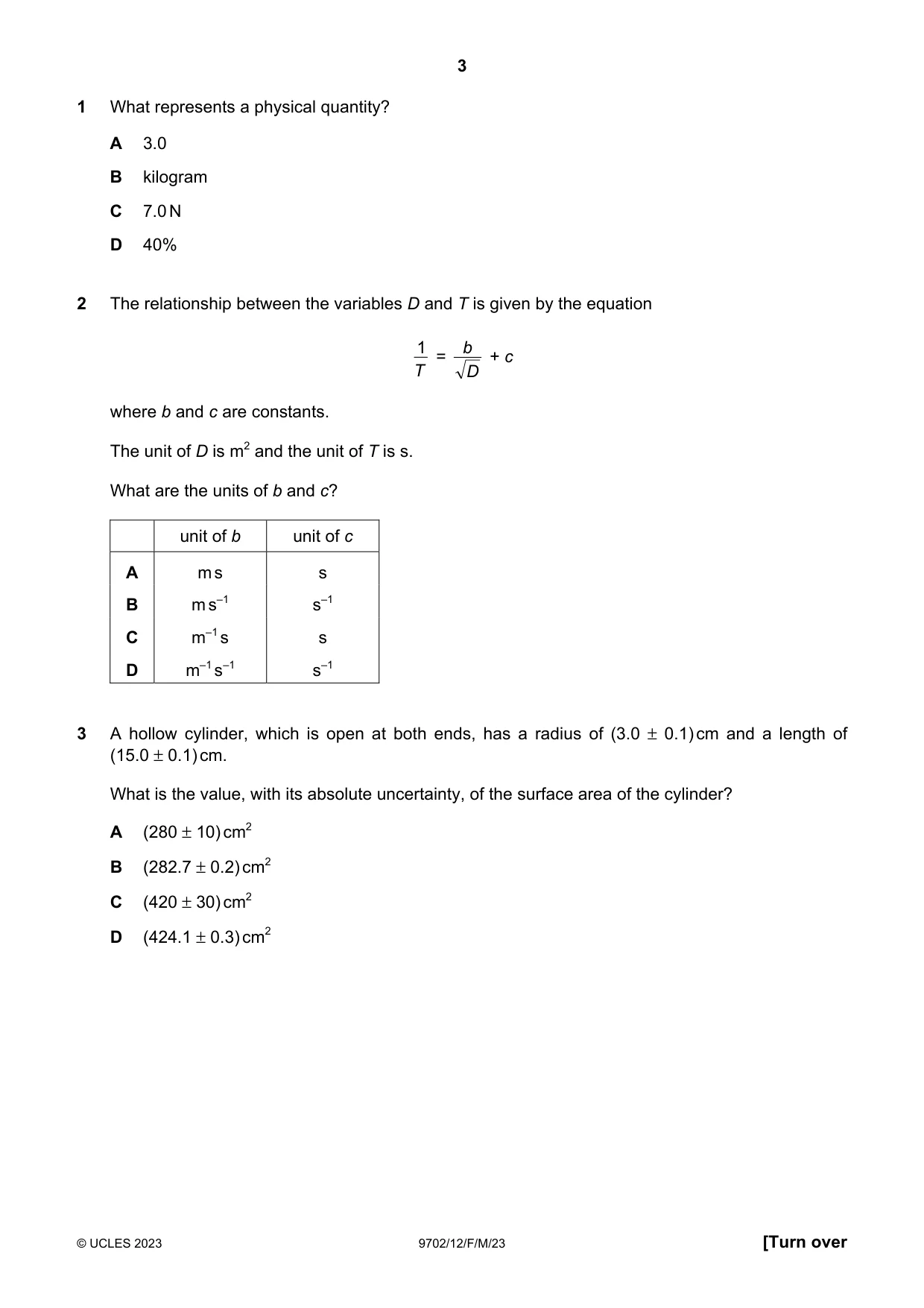
1 What represents a physical quantity? A 3.0 B kilogram C 7.0 N D 40%
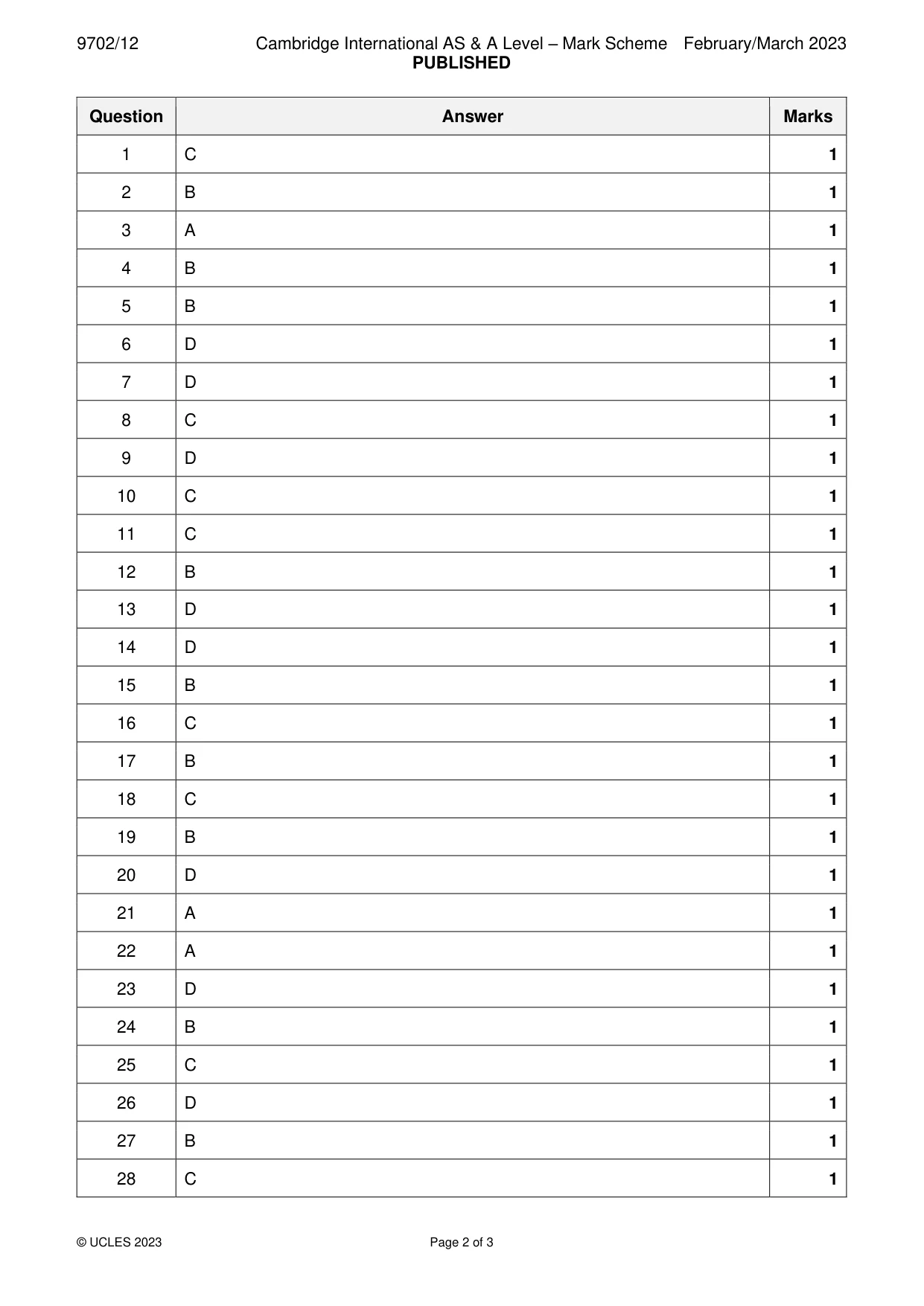
Mark scheme: C
Q2 · The relationship between the variables D and T is given by the equation 1 = b + c T D…
2 The relationship between the variables D and T is given by the equation 1 = b + c T D where b and c are constants. The unit of D is m2 and the unit of T is s. What are the units of b and c? unit of b unit of c A m s s B m s–1 s–1 C m–1 s s D m–1 s–1 s–1
Mark scheme: B
Q3 · A hollow cylinder, which is open at both ends, has a radius of (3.0 ± 0.1) cm and a…
3 A hollow cylinder, which is open at both ends, has a radius of (3.0 ± 0.1) cm and a length of (15.0 ± 0.1) cm. What is the value, with its absolute uncertainty, of the surface area of the cylinder? A (280 ± 10) cm2 B (282.7 ± 0.2) cm2 C (420 ± 30) cm2 D (424.1 ± 0.3) cm2
Mark scheme: A
Q4 · A snooker ball of mass 0.20 kg has a collision so that its direction of movement changes…
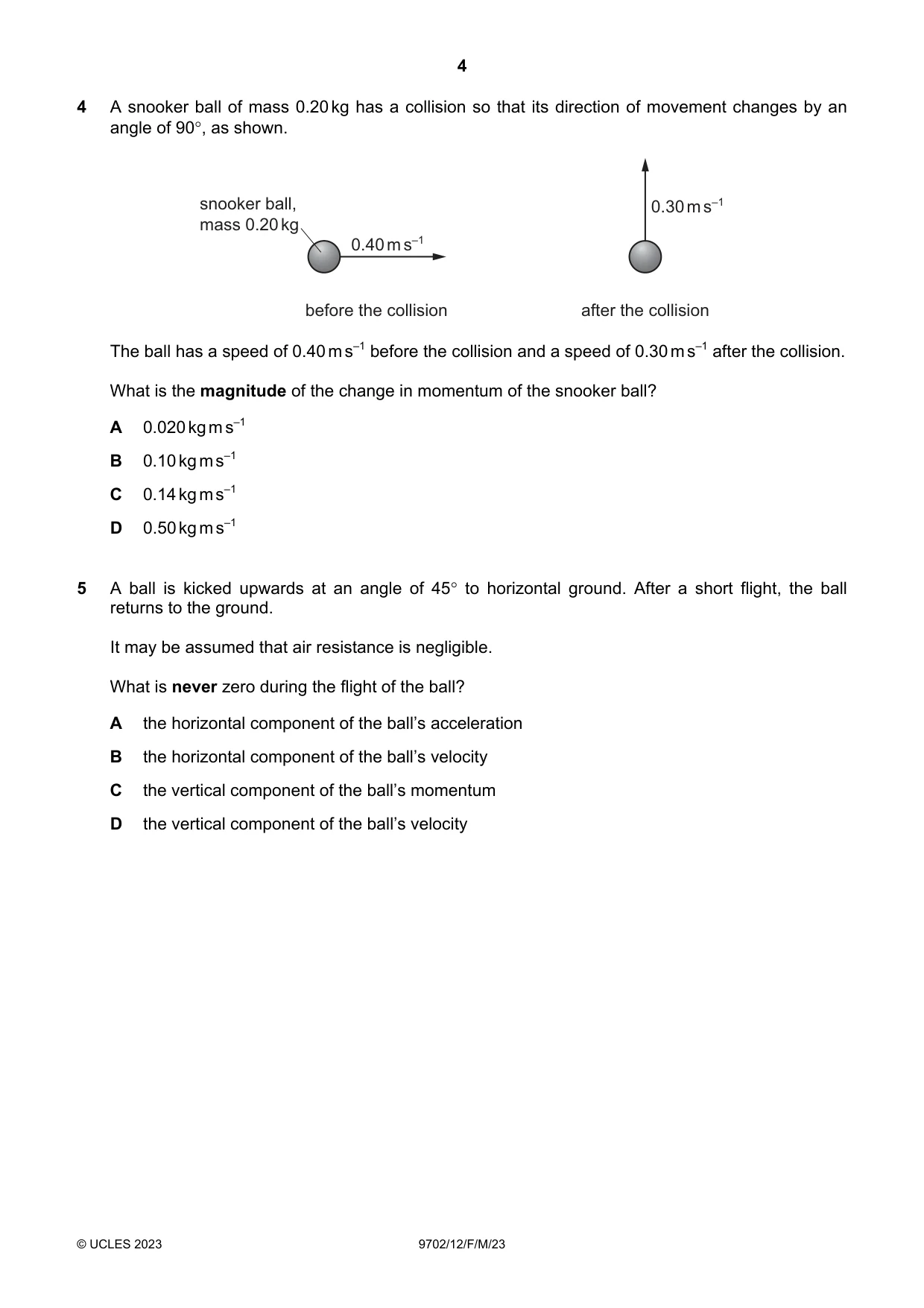
4 A snooker ball of mass 0.20 kg has a collision so that its direction of movement changes by an angle of 90°, as shown. snooker ball, 0.30 m s–1 mass 0.20 kg 0.40 m s–1 before the collision after the collision The ball has a speed of 0.40 m s–1 before the collision and a speed of 0.30 m s–1 after the collision. What is the magnitude of the change in momentum of the snooker ball? A 0.020 kg m s–1 B 0.10 kg m s–1 C 0.14 kg m s–1 D 0.50 kg m s–1
Mark scheme: B
Q5 · A ball is kicked upwards at an angle of 45° to horizontal ground
5 A ball is kicked upwards at an angle of 45° to horizontal ground. After a short flight, the ball returns to the ground. It may be assumed that air resistance is negligible. What is never zero during the flight of the ball? A the horizontal component of the ball’s acceleration B the horizontal component of the ball’s velocity C the vertical component of the ball’s momentum D the vertical component of the ball’s velocity
Mark scheme: B
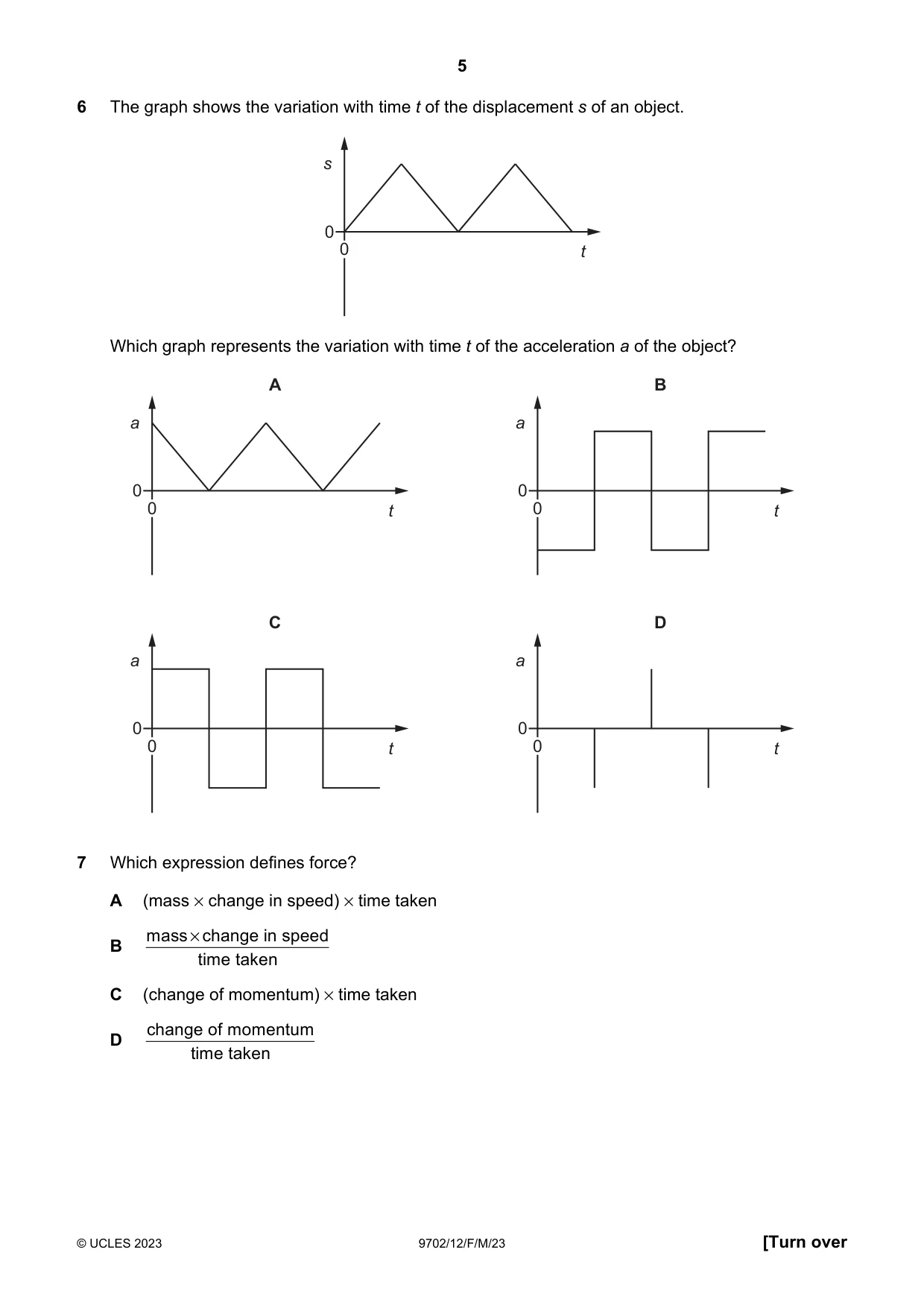
Q6 · The graph shows the variation with time t of the displacement s of an object
6 The graph shows the variation with time t of the displacement s of an object. s 0 0 t Which graph represents the variation with time t of the acceleration a of the object? A B a a 0 0 0 t 0 t C D a a 0 0 0 t 0 t
Mark scheme: D
Q7 · Which expression defines force?
7 Which expression defines force? A (mass × change in speed) × time taken mass × change in speed B time taken C (change of momentum) × time taken change of momentum D time taken
Mark scheme: D
Q8 · A ship of mass 8.4 × 10⁷ kg is approaching a harbour with speed 16.4 m s–1
8 A ship of mass 8.4 × 10⁷ kg is approaching a harbour with speed 16.4 m s–1. By using reverse thrust it can maintain a constant total stopping force of 920 000 N. How long will it take to stop? A 15 seconds B 150 seconds C 25 minutes D 250 minutes
Mark scheme: C
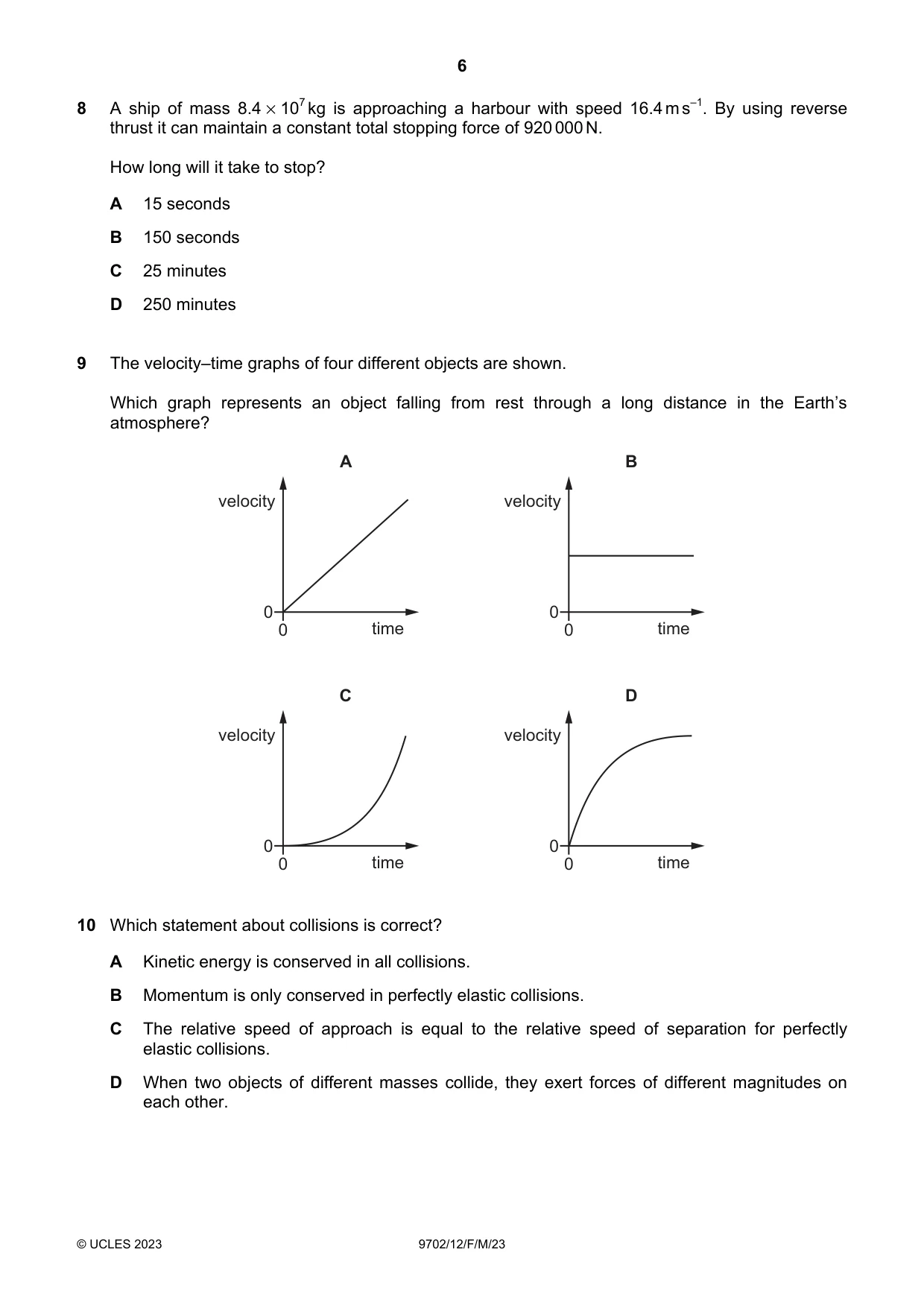
Q9 · The velocity–time graphs of four different objects are shown
9 The velocity–time graphs of four different objects are shown. Which graph represents an object falling from rest through a long distance in the Earth’s atmosphere? A B velocity velocity 0 0 0 time 0 time C D velocity velocity 0 0 0 time 0 time
Mark scheme: D
Q10 · Which statement about collisions is correct?
10 Which statement about collisions is correct? A Kinetic energy is conserved in all collisions. B Momentum is only conserved in perfectly elastic collisions. C The relative speed of approach is equal to the relative speed of separation for perfectly elastic collisions. D When two objects of different masses collide, they exert forces of different magnitudes on each other.
Mark scheme: C
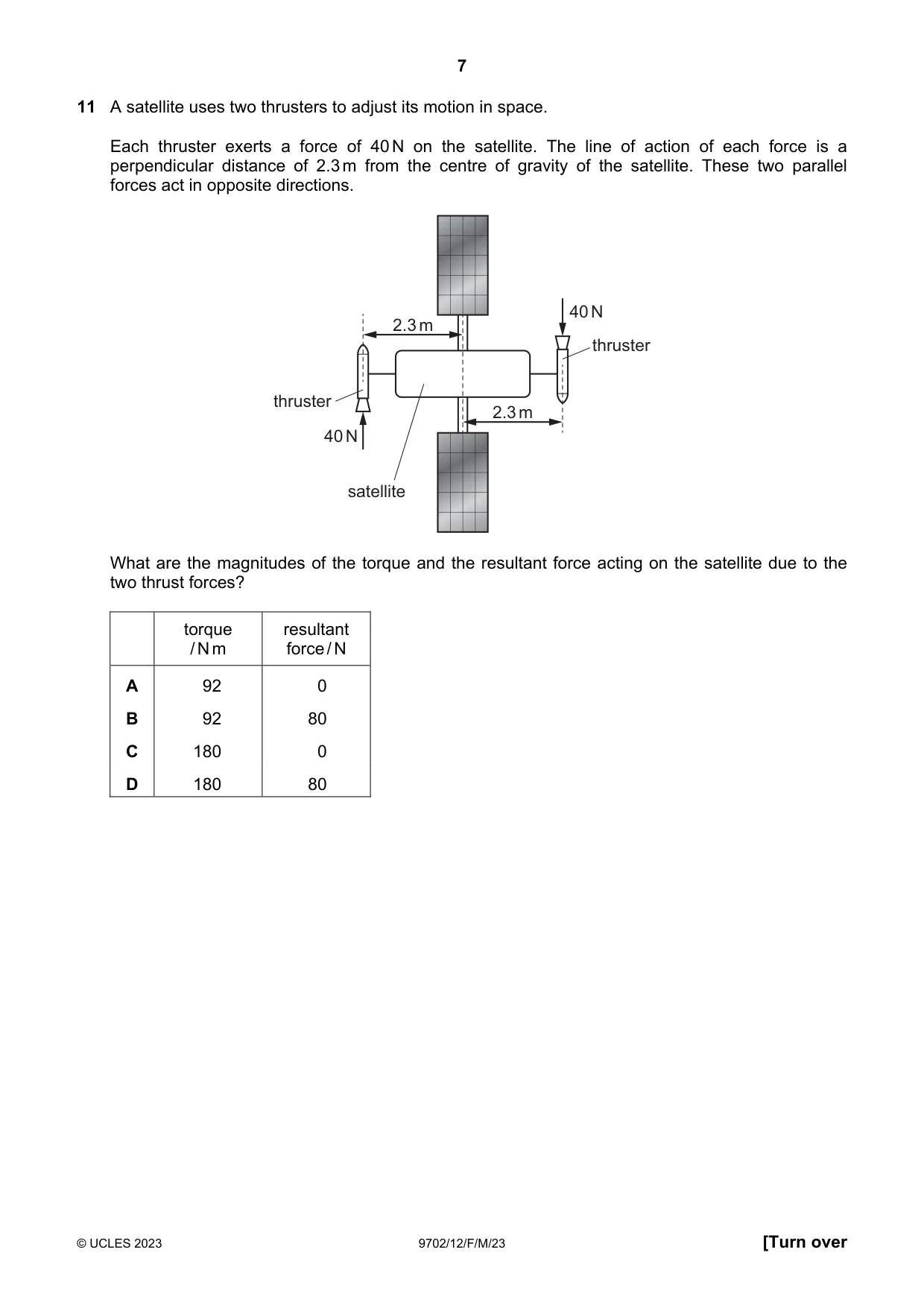
Q11 · A satellite uses two thrusters to adjust its motion in space
11 A satellite uses two thrusters to adjust its motion in space. Each thruster exerts a force of 40 N on the satellite. The line of action of each force is a perpendicular distance of 2.3 m from the centre of gravity of the satellite. These two parallel forces act in opposite directions. 40 N 2.3 m thruster thruster 2.3 m 40 N satellite What are the magnitudes of the torque and the resultant force acting on the satellite due to the two thrust forces? torque resultant / N m force / N A 92 0 B 92 80 C 180 0 D 180 80
Mark scheme: C
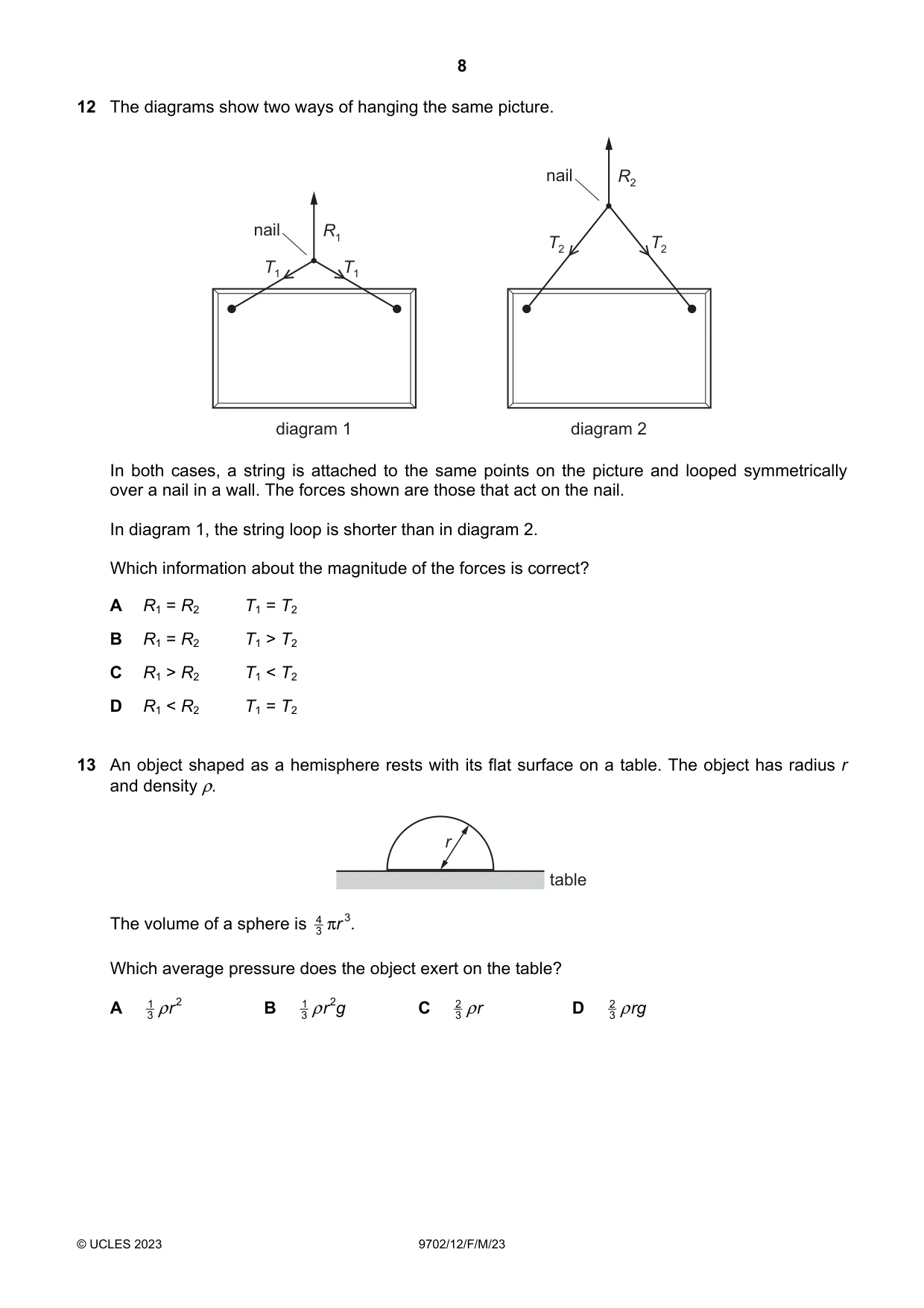
Q12 · The diagrams show two ways of hanging the same picture
12 The diagrams show two ways of hanging the same picture. nail R2 nail R1 T2 T2 T1 T1 diagram 1 diagram 2 In both cases, a string is attached to the same points on the picture and looped symmetrically over a nail in a wall. The forces shown are those that act on the nail. In diagram 1, the string loop is shorter than in diagram 2. Which information about the magnitude of the forces is correct? A R1 = R2 T1 = T2 B R1 = R2 T1 > T2 C R1 > R2 T1 < T2 D R1 < R2 T1 = T2
Mark scheme: B
Q13 · An object shaped as a hemisphere rests with its flat surface on a table
13 An object shaped as a hemisphere rests with its flat surface on a table. The object has radius r and density ρ. r table The volume of a sphere is 3 4 πr 3. Which average pressure does the object exert on the table? A 1 ρ r 2 B 1 ρ r 2g C 2 ρ r D 2 ρ rg 3 3 3 3
Mark scheme: D
Q14 · A probe is used to monitor the quality of the water in the sea
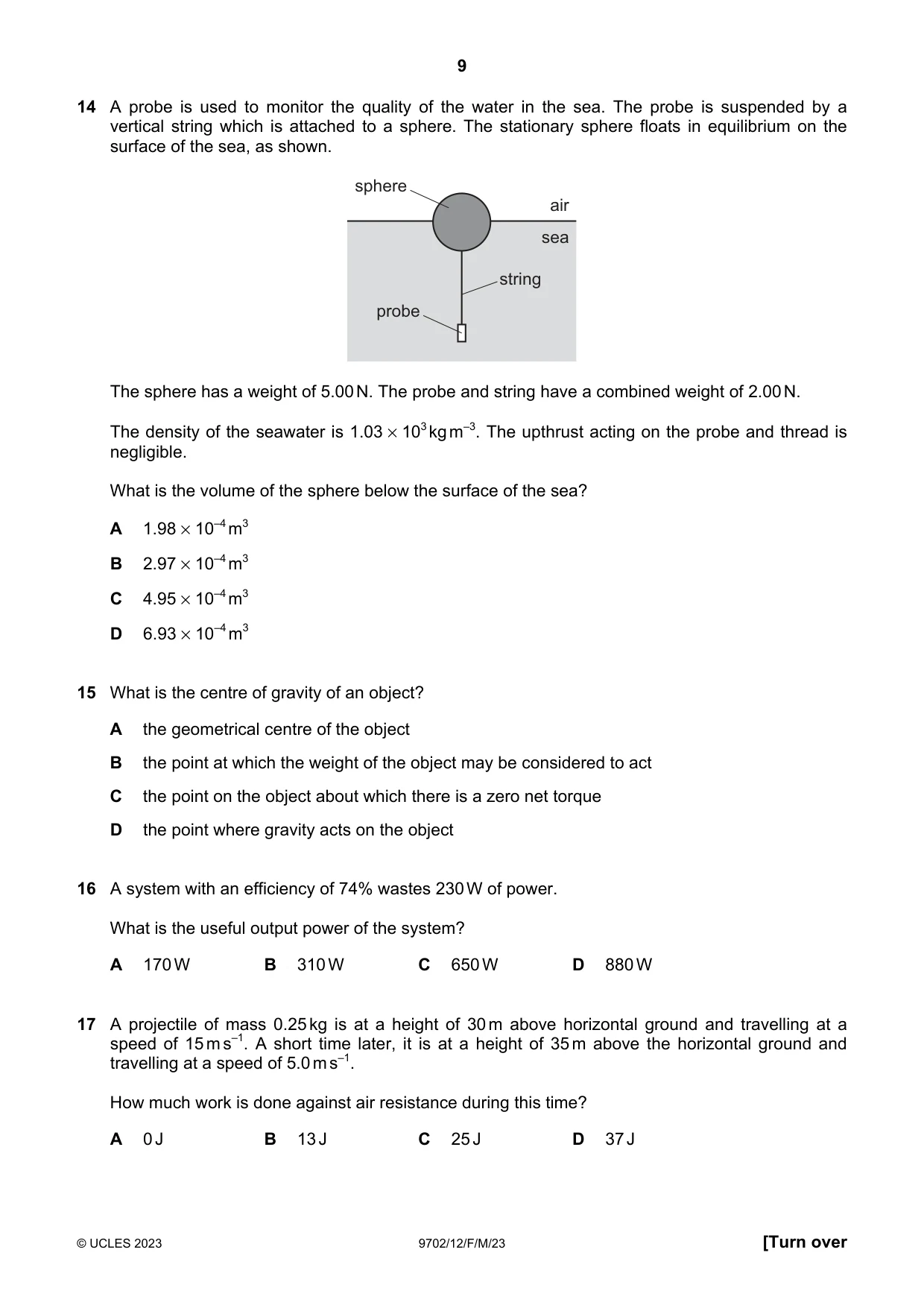
14 A probe is used to monitor the quality of the water in the sea. The probe is suspended by a vertical string which is attached to a sphere. The stationary sphere floats in equilibrium on the surface of the sea, as shown. sphere air sea string probe The sphere has a weight of 5.00 N. The probe and string have a combined weight of 2.00 N. The density of the seawater is 1.03 × 10³ kg m–3. The upthrust acting on the probe and thread is negligible. What is the volume of the sphere below the surface of the sea? A 1.98 × 10⁻⁴ m3 B 2.97 × 10⁻⁴ m3 C 4.95 × 10⁻⁴ m3 D 6.93 × 10⁻⁴ m3
Mark scheme: D
Q15 · What is the centre of gravity of an object?
15 What is the centre of gravity of an object? A the geometrical centre of the object B the point at which the weight of the object may be considered to act C the point on the object about which there is a zero net torque D the point where gravity acts on the object
Mark scheme: B
Q16 · A system with an efficiency of 74% wastes 230 W of power
16 A system with an efficiency of 74% wastes 230 W of power. What is the useful output power of the system? A 170 W B 310 W C 650 W D 880 W
Mark scheme: C
Q17 · A projectile of mass 0.25 kg is at a height of 30 m above horizontal ground and…
17 A projectile of mass 0.25 kg is at a height of 30 m above horizontal ground and travelling at a speed of 15 m s–1. A short time later, it is at a height of 35 m above the horizontal ground and travelling at a speed of 5.0 m s–1. How much work is done against air resistance during this time? A 0 J B 13 J C 25 J D 37 J
Mark scheme: B
Q18 · A spring has an unstretched length of 4.50 cm
18 A spring has an unstretched length of 4.50 cm. The spring is fixed at one end and a force of 35.0 N is applied to the other end so that the spring extends. The spring obeys Hooke’s law and has a spring constant of 420 N m–1. What is the strain of the extended spring? A 0.019 B 0.083 C 1.85 D 2.67
Mark scheme: C
Q19 · A wire is fixed at one end and extended by a force that is applied to the other end
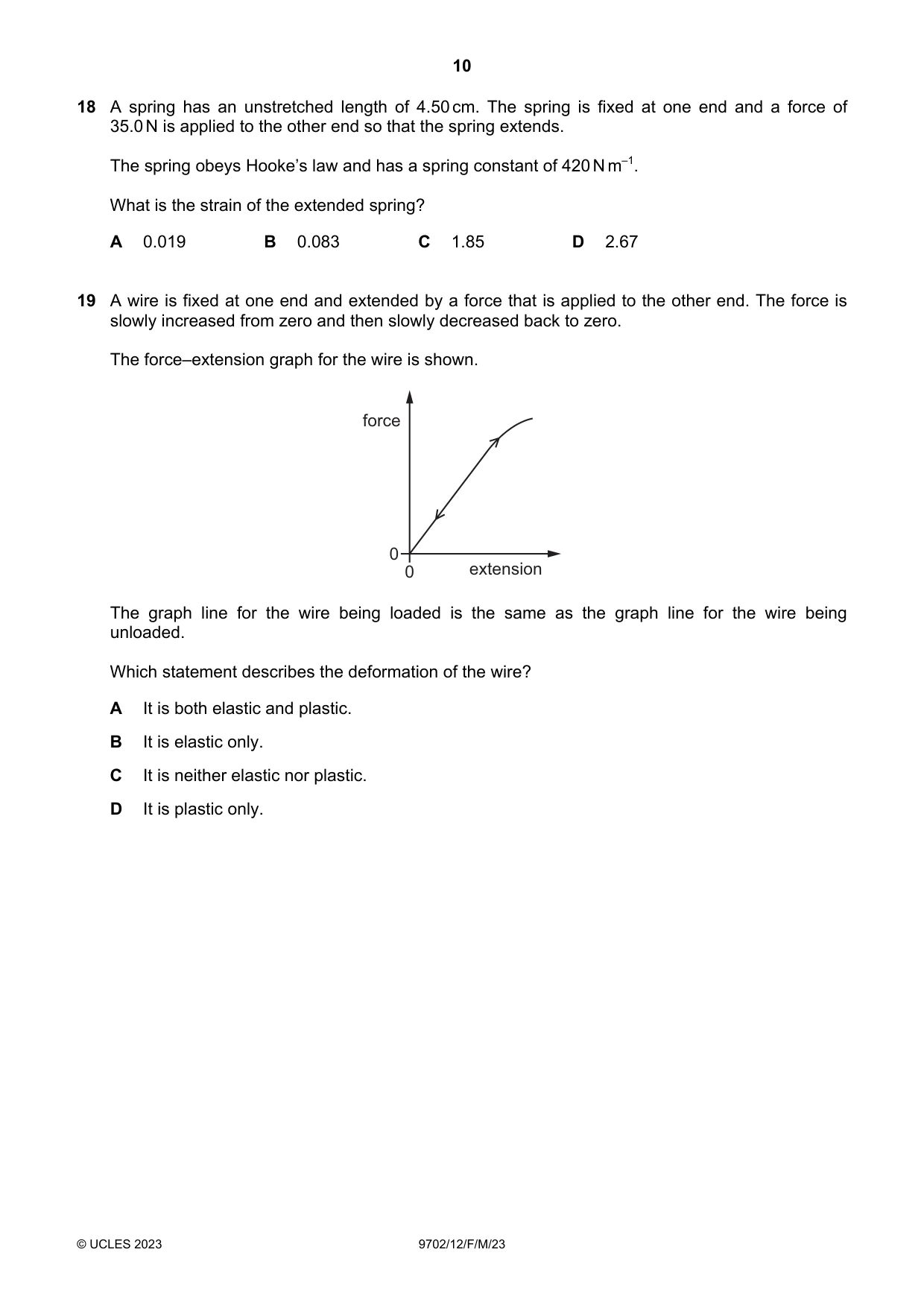
19 A wire is fixed at one end and extended by a force that is applied to the other end. The force is slowly increased from zero and then slowly decreased back to zero. The force–extension graph for the wire is shown. force 0 0 extension The graph line for the wire being loaded is the same as the graph line for the wire being unloaded. Which statement describes the deformation of the wire? A It is both elastic and plastic. B It is elastic only. C It is neither elastic nor plastic. D It is plastic only.
Mark scheme: B
Q20 · In a progressive water wave, two particles, P and Q, on the surface of the water, are a…
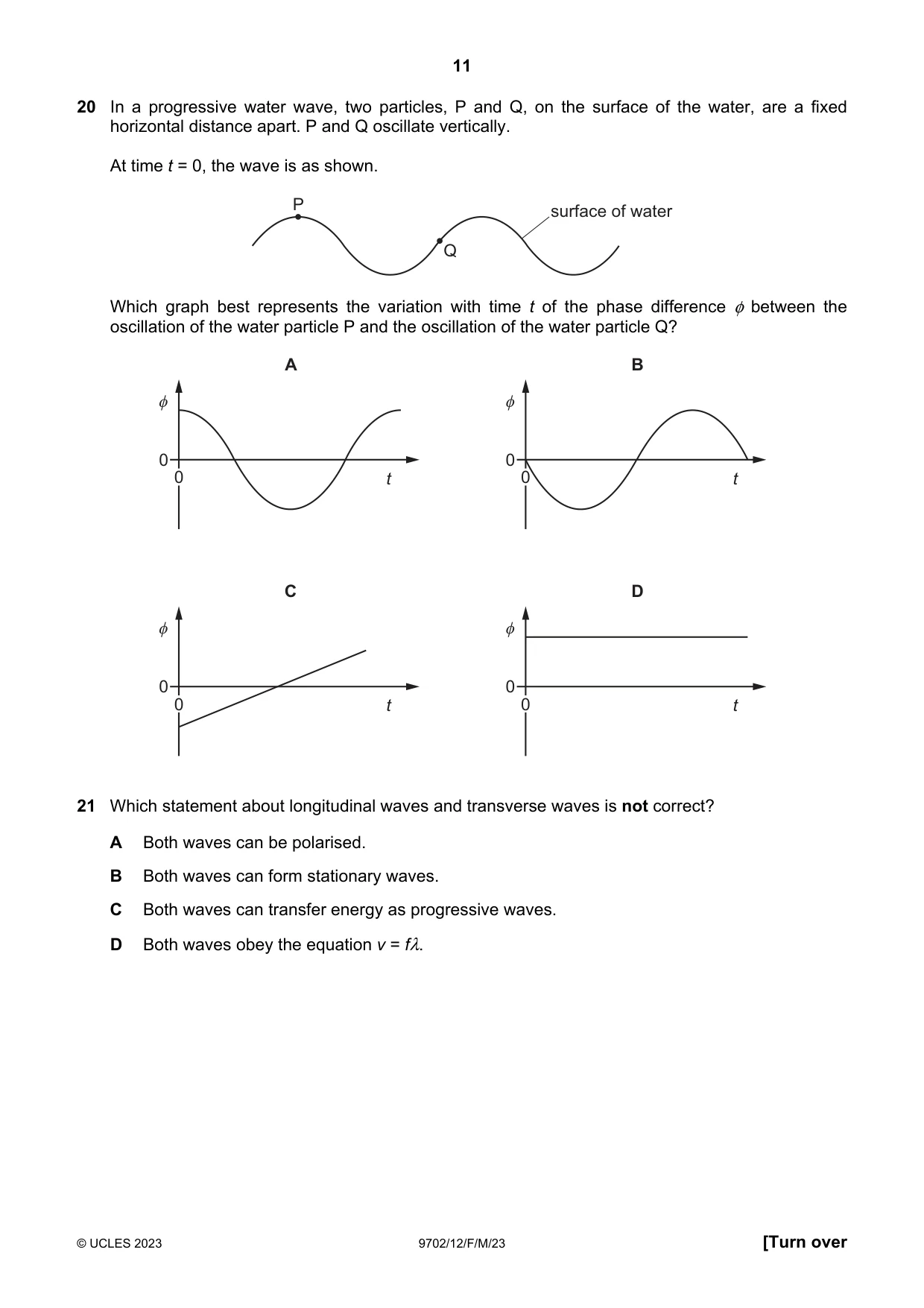
20 In a progressive water wave, two particles, P and Q, on the surface of the water, are a fixed horizontal distance apart. P and Q oscillate vertically. At time t = 0, the wave is as shown. P surface of water ON FN Which graph best represents the variation with time t of the phase difference ¢ between the oscillation of the water particle P and the oscillation of the water particle Q? B p 0 A 0 \ / t Cc 9 9 0 0 0 t 0 t p 0
Mark scheme: D
Q21 · Which statement about longitudinal waves and transverse waves is not correct?
21 Which statement about longitudinal waves and transverse waves is not correct? A Both waves can be polarised. B Both waves can form stationary waves. C Both waves can transfer energy as progressive waves. D Both waves obey the equation v = fλ.
Mark scheme: A
Q22 · An observer hears a sound wave emitted from a moving source
22 An observer hears a sound wave emitted from a moving source. The observed frequency is less than the frequency of sound emitted from the source. What could be the reason for this? A The source is moving away from the observer. B The source is moving towards the observer. C The speed of the sound wave in air decreases due to the movement of the source. D The speed of the sound wave in air increases due to the movement of the source.
Mark scheme: A
Q23 · What is the approximate range of frequencies of electromagnetic radiation visible to the…
23 What is the approximate range of frequencies of electromagnetic radiation visible to the human eye? A (430–750) kHz B (430–750) MHz C (430–750) GHz D (430–750) THz
Mark scheme: D
Q24 · A beam of vertically polarised light is incident normally on a polarising filter
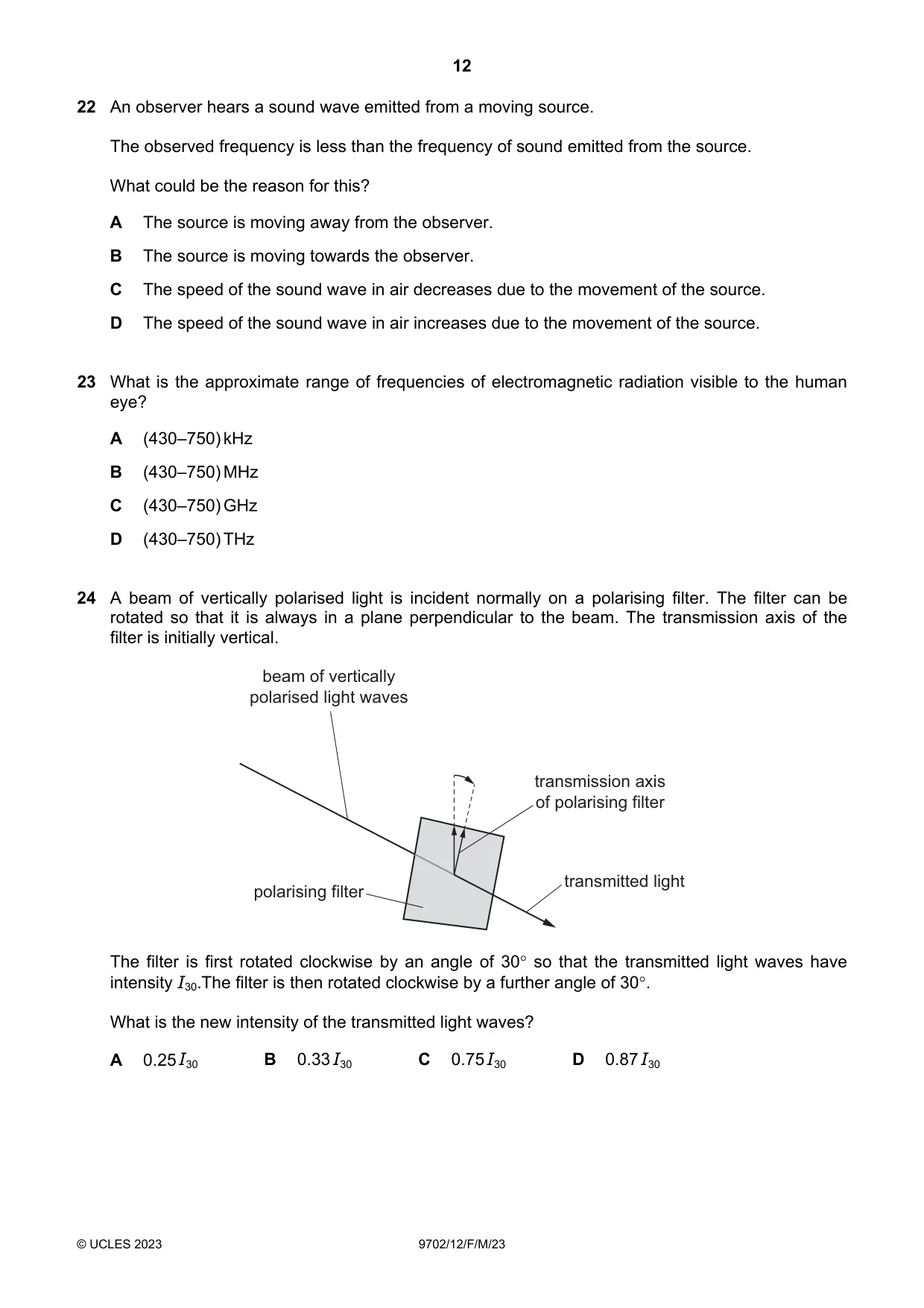
24 A beam of vertically polarised light is incident normally on a polarising filter. The filter can be rotated so that it is always in a plane perpendicular to the beam. The transmission axis of the filter is initially vertical. beam of vertically polarised light waves transmission axis of polarising filter transmitted light polarising filter The filter is first rotated clockwise by an angle of 30° so that the transmitted light waves have intensity I30.The filter is then rotated clockwise by a further angle of 30°. What is the new intensity of the transmitted light waves? A 0.25 I30 B 0.33 I30 C 0.75 I30 D 0.87 I30
Mark scheme: B
Q25 · A musical instrument is made using a long tube with a mouthpiece at one end
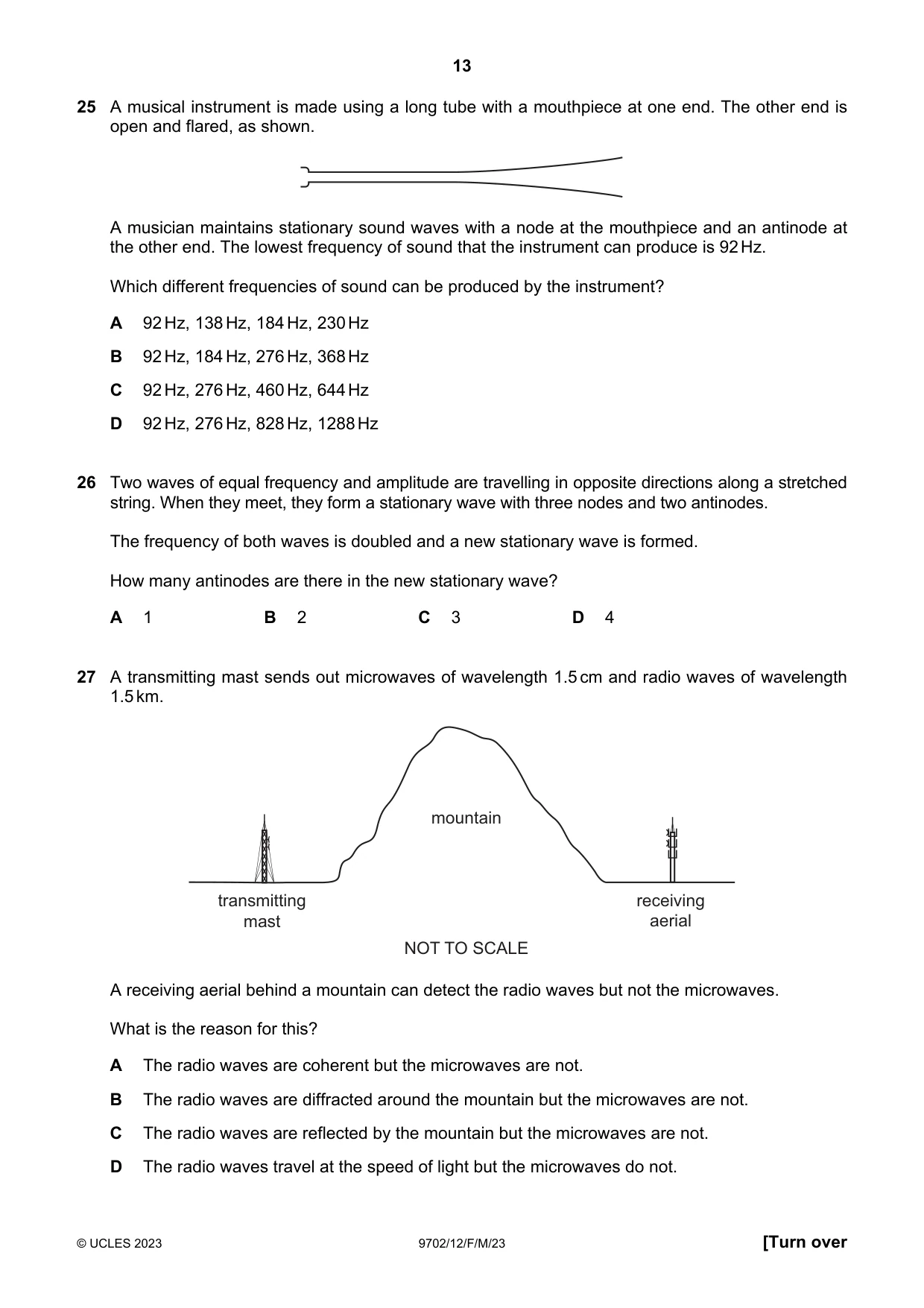
25 A musical instrument is made using a long tube with a mouthpiece at one end. The other end is open and flared, as shown. A musician maintains stationary sound waves with a node at the mouthpiece and an antinode at the other end. The lowest frequency of sound that the instrument can produce is 92 Hz. Which different frequencies of sound can be produced by the instrument? A 92 Hz, 138 Hz, 184 Hz, 230 Hz B 92 Hz, 184 Hz, 276 Hz, 368 Hz C 92 Hz, 276 Hz, 460 Hz, 644 Hz D 92 Hz, 276 Hz, 828 Hz, 1288 Hz
Mark scheme: C
Q26 · Two waves of equal frequency and amplitude are travelling in opposite directions along a…
26 Two waves of equal frequency and amplitude are travelling in opposite directions along a stretched string. When they meet, they form a stationary wave with three nodes and two antinodes. The frequency of both waves is doubled and a new stationary wave is formed. How many antinodes are there in the new stationary wave? A 1 B 2 C 3 D 4
Mark scheme: D
Q27 · A transmitting mast sends out microwaves of wavelength 1.5 cm and radio waves of…
27 A transmitting mast sends out microwaves of wavelength 1.5 cm and radio waves of wavelength 1.5 km. mountain transmitting receiving mast aerial NOT TO SCALE A receiving aerial behind a mountain can detect the radio waves but not the microwaves. What is the reason for this? A The radio waves are coherent but the microwaves are not. B The radio waves are diffracted around the mountain but the microwaves are not. C The radio waves are reflected by the mountain but the microwaves are not. D The radio waves travel at the speed of light but the microwaves do not.
Mark scheme: B
Q28 · Waves are emitted from two coherent sources
28 Waves are emitted from two coherent sources. Which statement about the waves must be correct? A They are in phase. B They are transverse waves. C They have a constant phase difference. D They have the same amplitude.
Mark scheme: C
Q29 · The diagram shows a screen that is a distance L from a diffraction grating
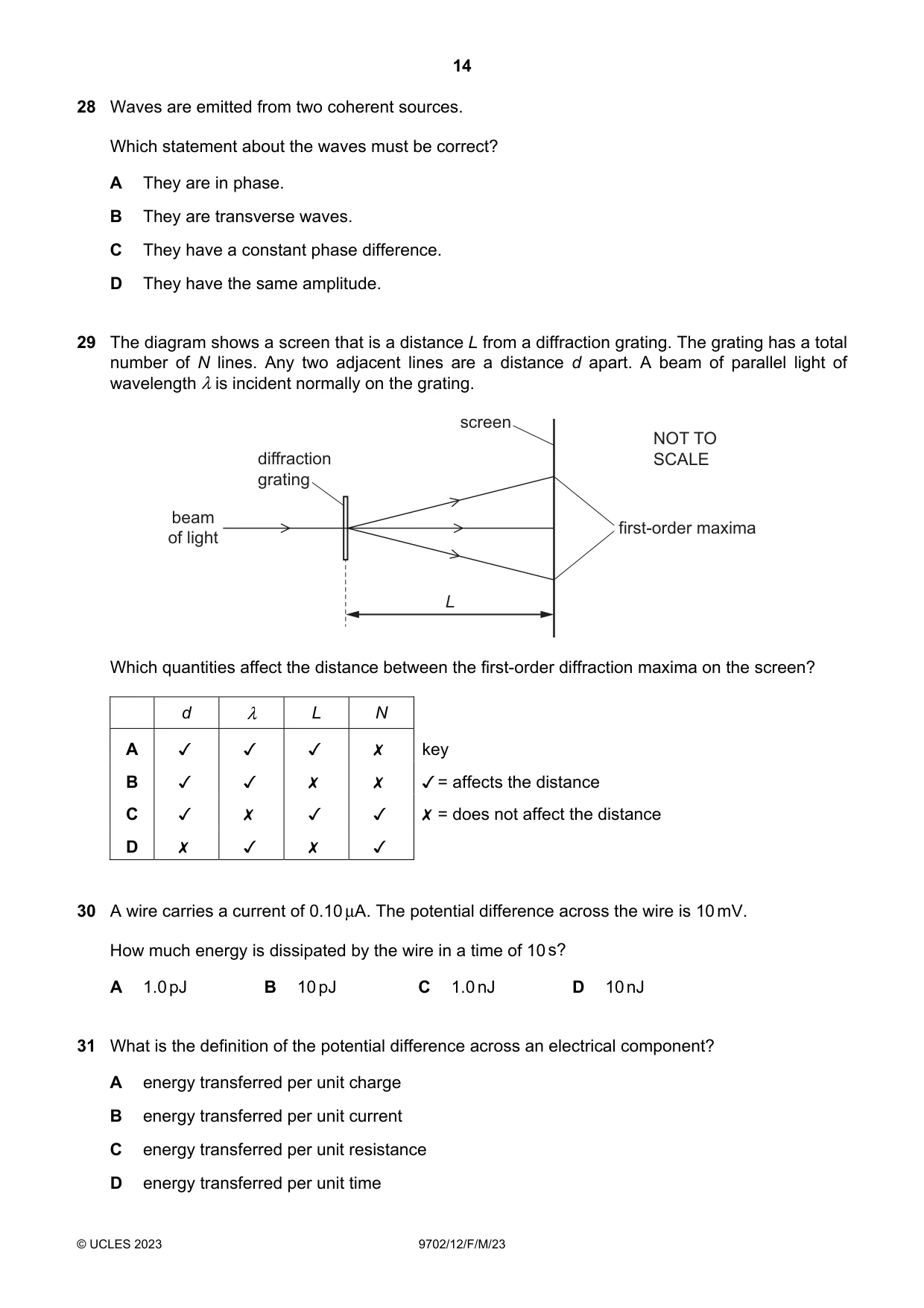
29 The diagram shows a screen that is a distance L from a diffraction grating. The grating has a total number of N lines. Any two adjacent lines are a distance d apart. A beam of parallel light of wavelength J is incident normally on the grating. screen NOT TO diffraction SCALE grating beam of light first-order maxima Which quantities affect the distance between the first-order diffraction maxima on the screen? key JY = affects the distance X = does not affect the distance <x x |= NN *€ NN NJ ~*~ Q KW Nr 0 0O WwW > ~*~ << Klao
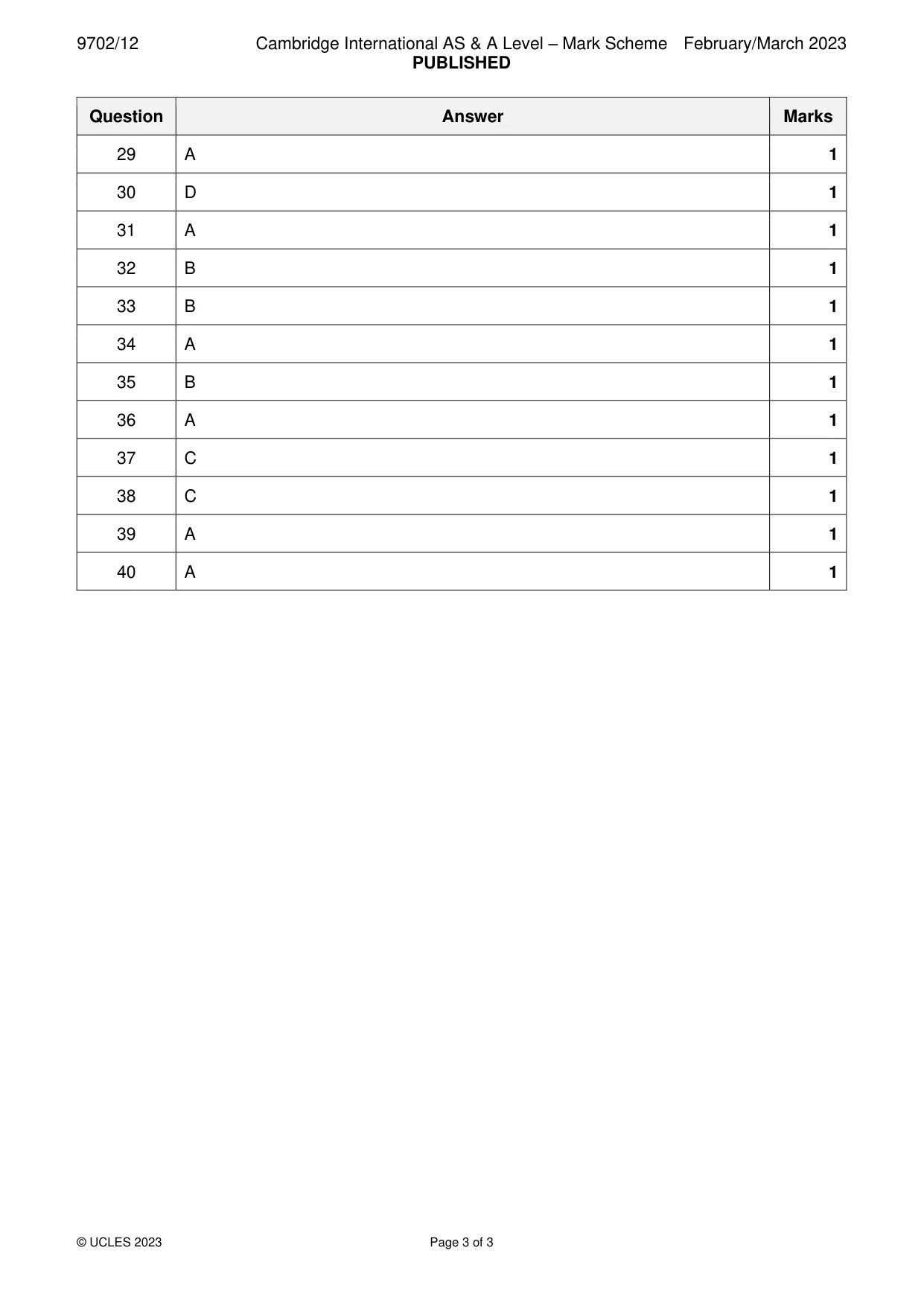
Mark scheme: A
Q30 · A wire carries a current of 0.10 µA
30 A wire carries a current of 0.10 µA. The potential difference across the wire is 10 mV. How much energy is dissipated by the wire in a time of 10 s? A 1.0 pJ B 10 pJ C 1.0 nJ D 10 nJ
Mark scheme: D
Q31 · What is the definition of the potential difference across an electrical component?
31 What is the definition of the potential difference across an electrical component? A energy transferred per unit charge B energy transferred per unit current C energy transferred per unit resistance D energy transferred per unit time
Mark scheme: A
Q32 · Which graph represents the way the current I through a filament lamp varies with the…
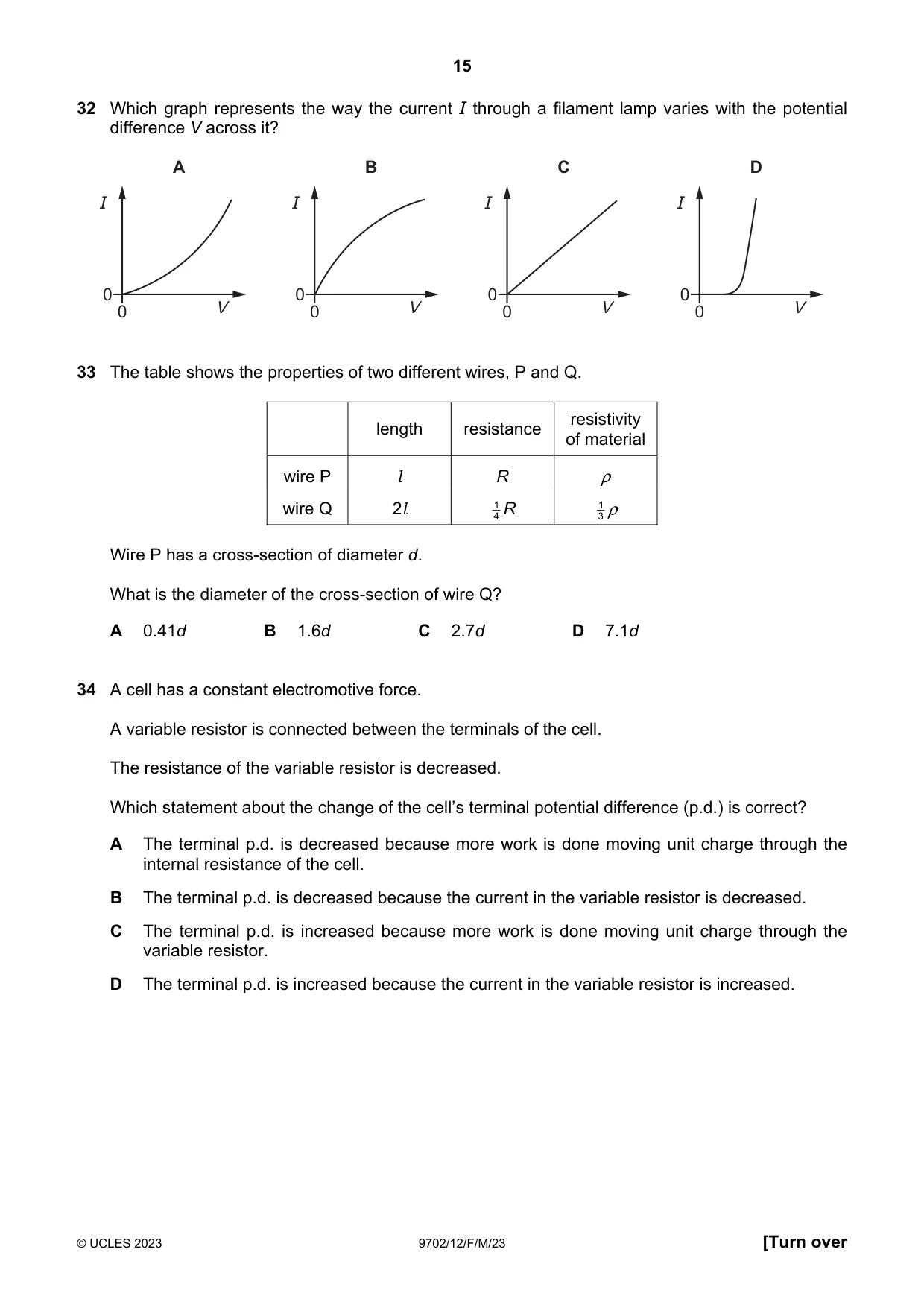
32 Which graph represents the way the current I through a filament lamp varies with the potential difference V across it? A B C D I I I I 0 0 0 0 0 V 0 V 0 V 0 V
Mark scheme: B
Q33 · The table shows the properties of two different wires, P and Q
33 The table shows the properties of two different wires, P and Q. resistivity length resistance of material wire P l R ρ wire Q 2l 4 R 1 3 ρ 1 Wire P has a cross-section of diameter d. What is the diameter of the cross-section of wire Q? A 0.41d B 1.6d C 2.7d D 7.1d
Mark scheme: B
Q34 · A cell has a constant electromotive force
34 A cell has a constant electromotive force. A variable resistor is connected between the terminals of the cell. The resistance of the variable resistor is decreased. Which statement about the change of the cell’s terminal potential difference (p.d.) is correct? A The terminal p.d. is decreased because more work is done moving unit charge through the internal resistance of the cell. B The terminal p.d. is decreased because the current in the variable resistor is decreased. C The terminal p.d. is increased because more work is done moving unit charge through the variable resistor. D The terminal p.d. is increased because the current in the variable resistor is increased.
Mark scheme: A
Q35 · Kirchhoff’s two laws for electric circuits can be derived by using conservation laws
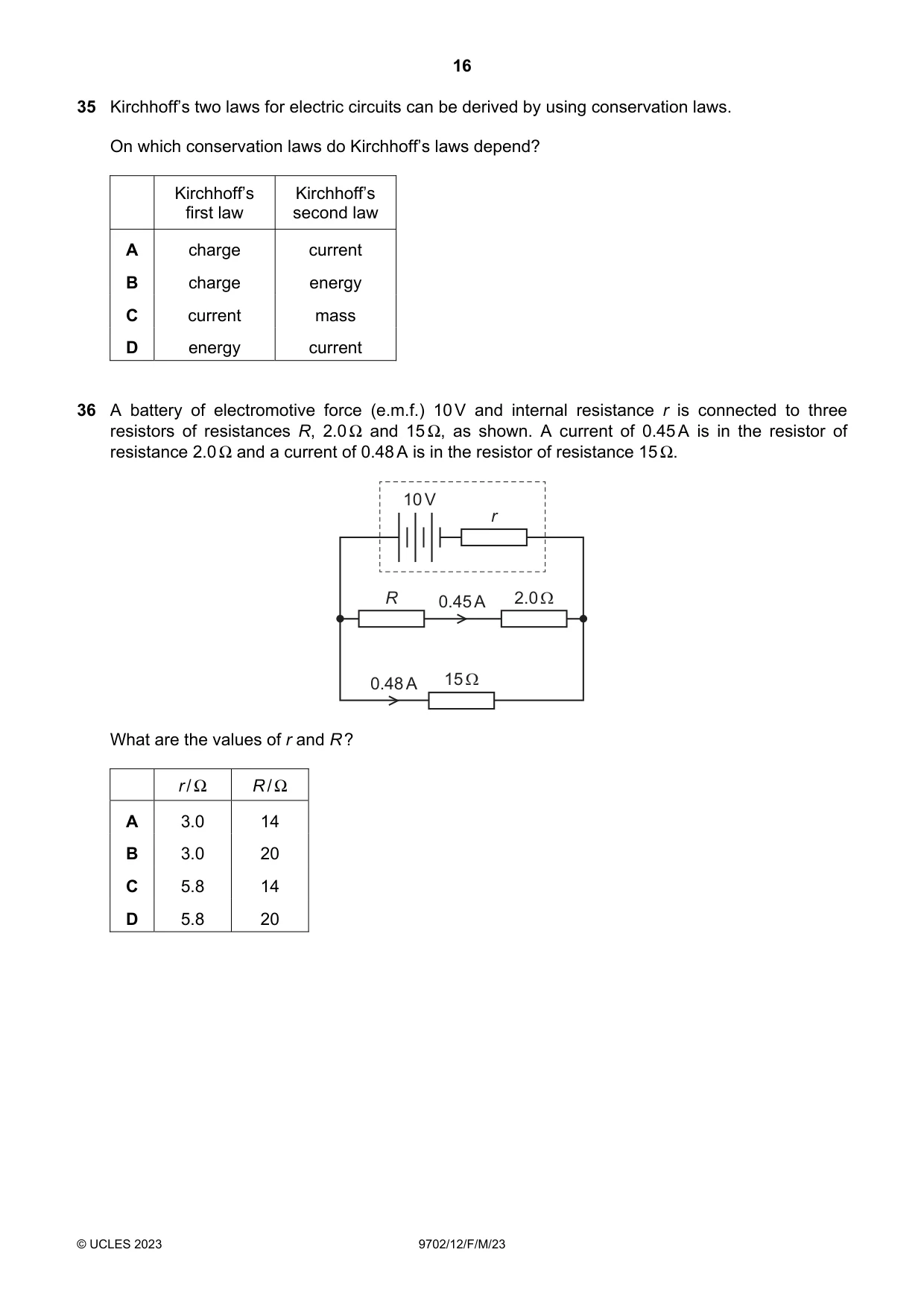
35 Kirchhoff’s two laws for electric circuits can be derived by using conservation laws. On which conservation laws do Kirchhoff’s laws depend? Kirchhoff’s Kirchhoff’s first law second law A charge current B charge energy C current mass D energy current
Mark scheme: B
Q36 · A battery of electromotive force (e.m.f.) 10V and internal resistance r is connected to…
36 A battery of electromotive force (e.m.f.) 10V and internal resistance r is connected to three resistors of resistances R, 2.02 and 15Q, as shown. A current of 0.45A is in the resistor of resistance 2.0Q and a current of 0.48A is in the resistor of resistance 15Q. 150 What are the values of rand R? r/Q. R/Q. A 3.0 14 B 3.0 20 Cc 5.8 14 D 5.8 20
Mark scheme: A
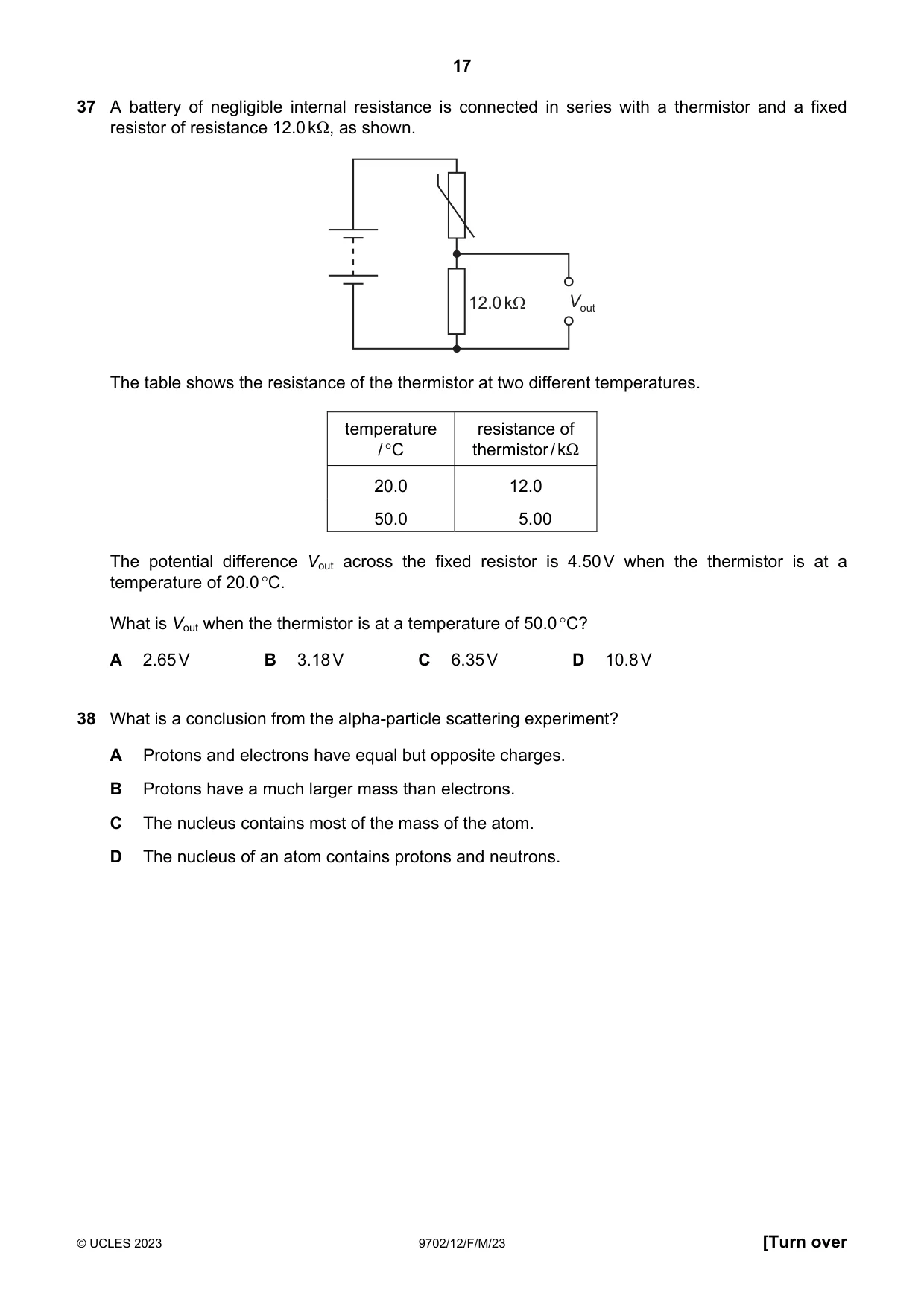
Q37 · A battery of negligible internal resistance is connected in series with a thermistor and…
37 A battery of negligible internal resistance is connected in series with a thermistor and a fixed resistor of resistance 12.0kQ, as shown. 12.0kQ Vout The table shows the resistance of the thermistor at two different temperatures. temperature resistance of [°C thermistor /kQ 20.0 12.0 50.0 5.00 The potential difference V.,, across the fixed resistor is 4.50V when the thermistor is at a temperature of 20.0 °C. What is Vou when the thermistor is at a temperature of 50.0°C? A 2.65V B 3.18V C 6.35V D 10.8V
Mark scheme: C
Q38 · What is a conclusion from the alpha-particle scattering experiment?
38 What is a conclusion from the alpha-particle scattering experiment? A Protons and electrons have equal but opposite charges. B Protons have a much larger mass than electrons. C The nucleus contains most of the mass of the atom. D The nucleus of an atom contains protons and neutrons.
Mark scheme: C
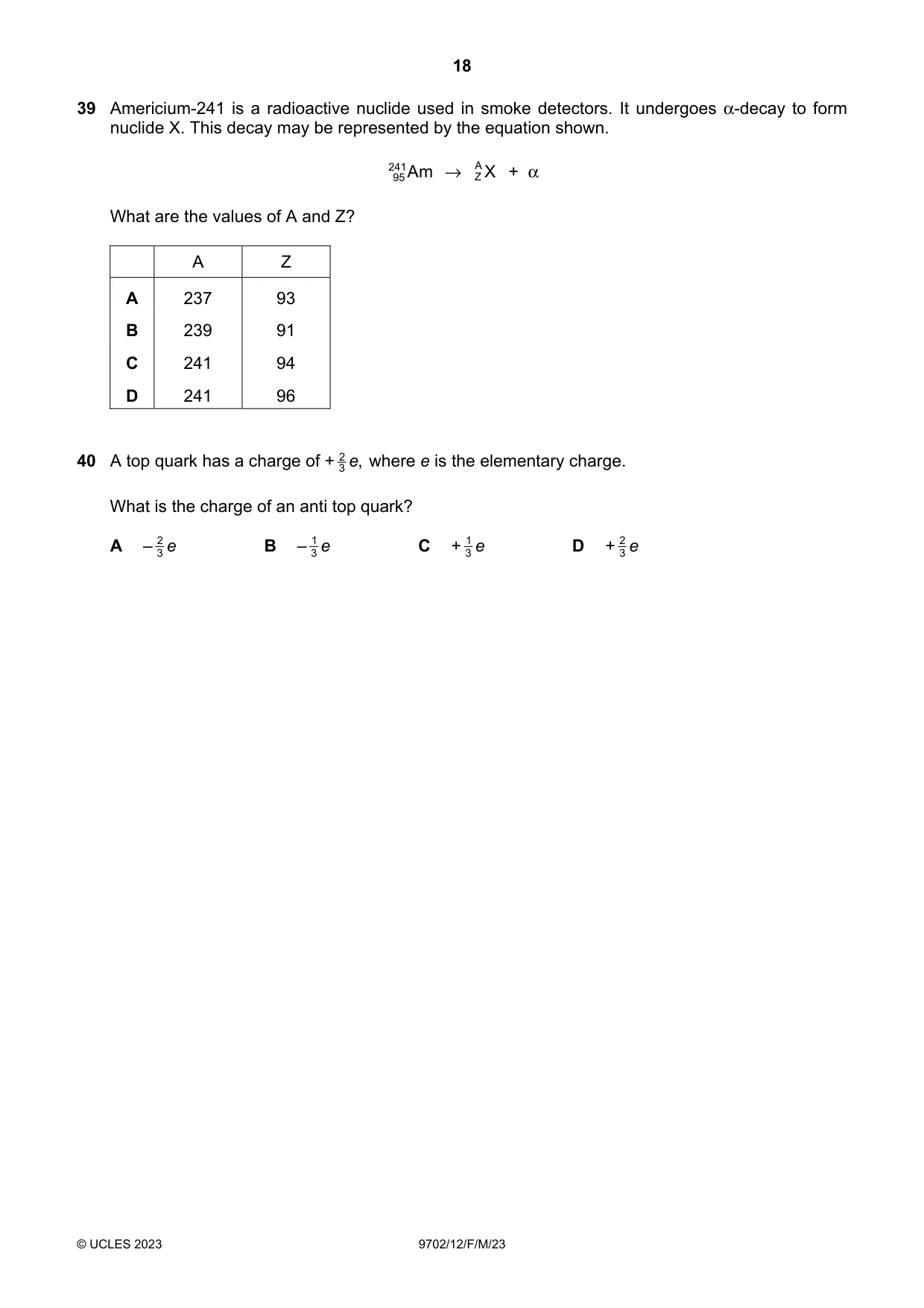
Q39 · Americium-241 is a radioactive nuclide used in smoke detectors
39 Americium-241 is a radioactive nuclide used in smoke detectors. It undergoes α-decay to form nuclide X. This decay may be represented by the equation shown. 241 95Am → A Z X + α What are the values of A and Z? A Z A 237 93 B 239 91 C 241 94 D 241 96
Mark scheme: A
Q40 · A top quark has a charge of + 2 e where e is the elementary charge
40 A top quark has a charge of + 2 e where e is the elementary charge. , 3 What is the charge of an anti top quark? A – 2 e B – 1 e C + 1 e D + 2 e 3 3 3 3
Mark scheme: A
What was in this paper
The subtopics covered by these 40 questions, and how many questions each got. Open one in a new tab to see every Cambridge question on it.
2Energy conservation2Kirchhoff’s laws2Linear momentum and its conservation2Momentum and Newton’s laws of motion2Non-uniform motion2Potential difference and power2Resistance and resistivity2Stationary waves2Turning effects of forces2Atoms, nuclei and radiation1Diffraction1Doppler effect for sound waves1Elastic and plastic behaviour1Electromagnetic spectrum1Equations of motion1Equilibrium of forces1Errors and uncertainties1Fundamental particles1Interference1Physical quantities1Polarisation1Potential dividers1Practical circuits1Progressive waves1Radioactive decay1SI units1Stress and strain1The diffraction grating1Transverse and longitudinal waves1What you needed in this session
Cambridge’s own grade thresholds for 2023 Feb/March, Paper 1 · Variant 2. A higher threshold means an easier paper — the bar moves with how the cohort did.