Cambridge A Level Physics 9702 — 2023 Oct/Nov Paper 1 · Variant 3
9702/13/O/N/23 · 40 questions · 40 marks · ≈45 min
The question paper and its mark scheme, free to read here and free to download. This is Cambridge’s own paper, exactly as it was sat.
Question paper20 pages

Mark scheme3 pages
Answers below. Sit the paper first if you are practising.
Questions as text
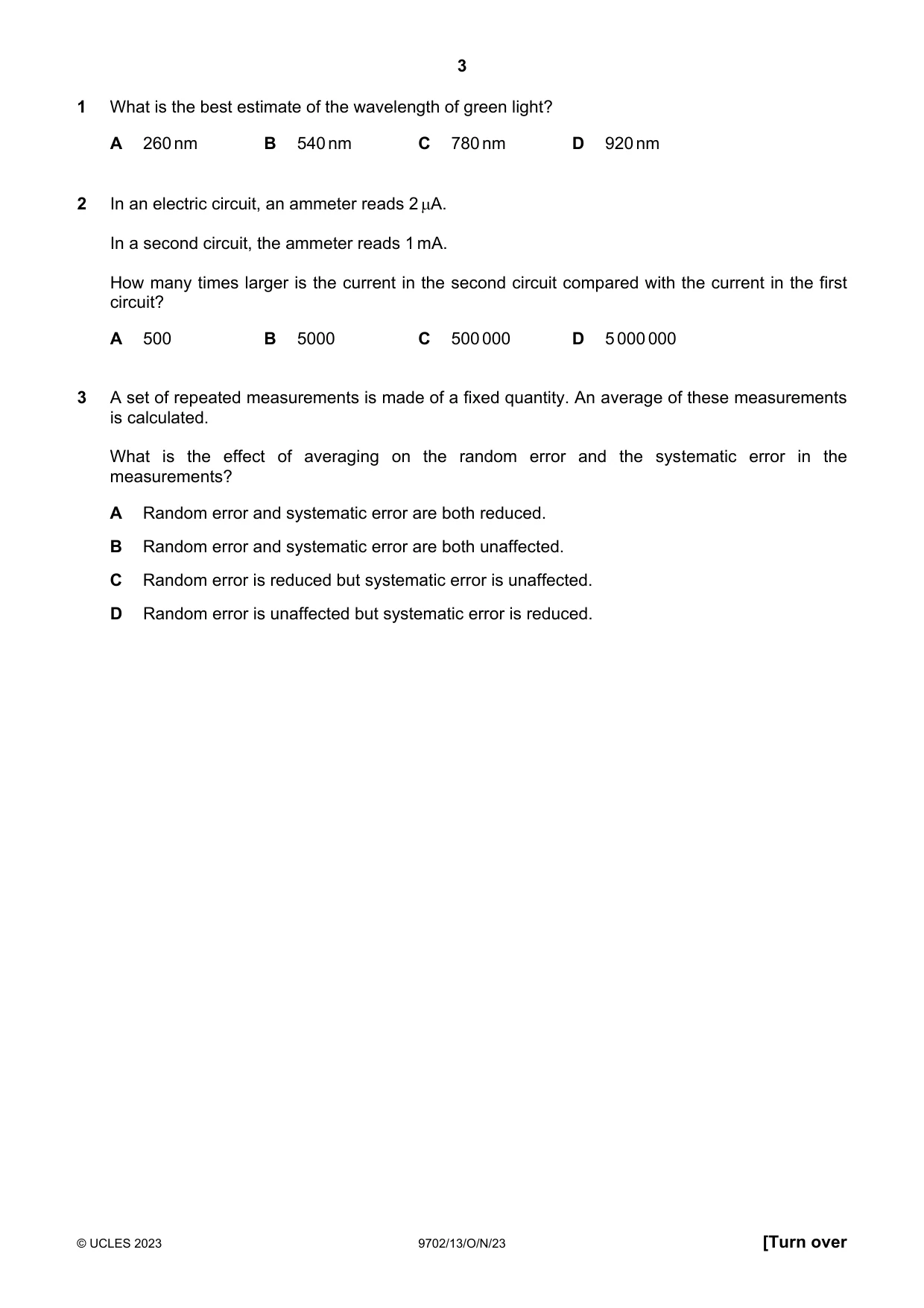
Q1 · What is the best estimate of the wavelength of green light?
1 What is the best estimate of the wavelength of green light? A 260 nm B 540 nm C 780 nm D 920 nm
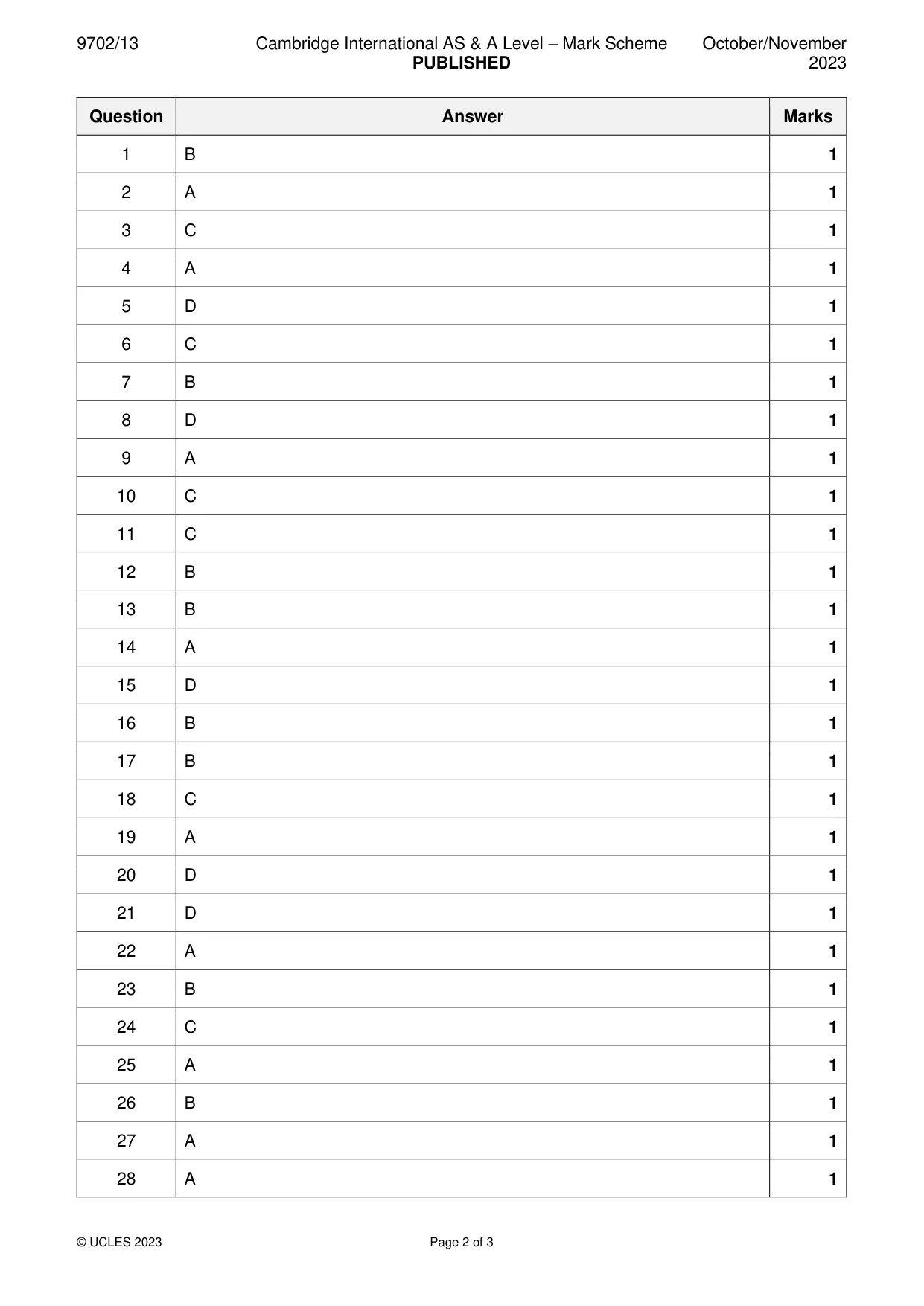
Mark scheme: B
Q2 · In an electric circuit, an ammeter reads 2 A
2 In an electric circuit, an ammeter reads 2 A. In a second circuit, the ammeter reads 1 mA. How many times larger is the current in the second circuit compared with the current in the first circuit? A 500 B 5000 C 500 000 D 5 000 000
Mark scheme: A
Q3 · A set of repeated measurements is made of a fixed quantity
3 A set of repeated measurements is made of a fixed quantity. An average of these measurements is calculated. What is the effect of averaging on the random error and the systematic error in the measurements? A Random error and systematic error are both reduced. B Random error and systematic error are both unaffected. C Random error is reduced but systematic error is unaffected. D Random error is unaffected but systematic error is reduced.
Mark scheme: C
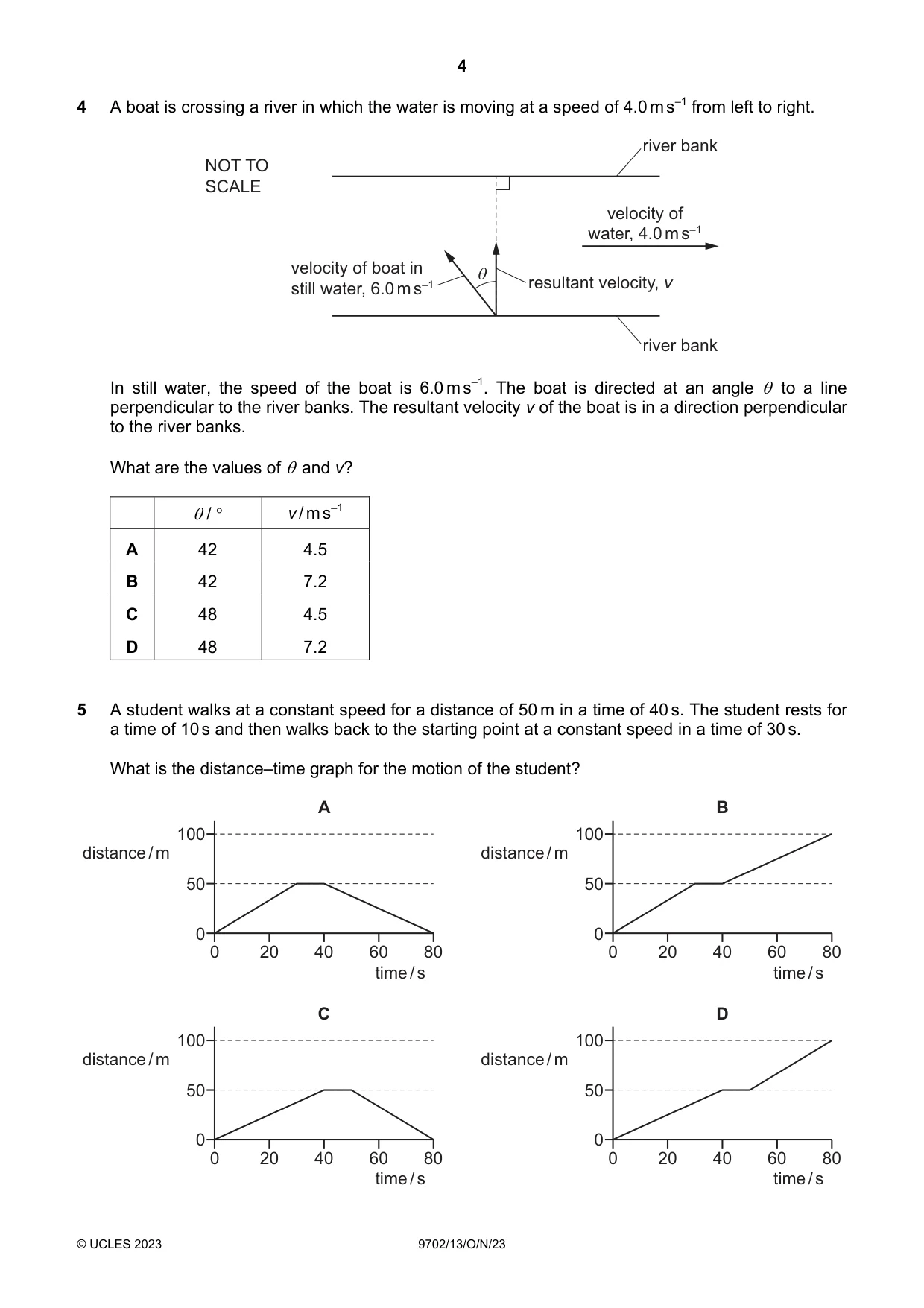
Q4 · A boat is crossing a river in which the water is moving at a speed of 4.0ms™ from left to…
4 A boat is crossing a river in which the water is moving at a speed of 4.0ms™ from left to right. river bank NOT TO VA SCALE velocity of water, 4.0ms — TT _£_§__= velocity of boat in f) still water. 6.0ms7 resultant velocity, v river bank In still water, the speed of the boat is 6.0ms™'. The boat is directed at an angle @ to a line perpendicular to the river banks. The resultant velocity v of the boat is in a direction perpendicular to the river banks. What are the values of 0 and v? gl° vims' A 42 4.5 B 42 7.2 Cc 48 4.5 D 48 7.2
Mark scheme: A
Q5 · A student walks at a constant speed for a distance of 50 m in a time of 40 s
5 A student walks at a constant speed for a distance of 50 m in a time of 40 s. The student rests for a time of 10 s and then walks back to the starting point at a constant speed in a time of 30 s. What is the distance–time graph for the motion of the student? A B 100 100 distance / m distance / m 50 50 0 0 0 20 40 60 80 0 20 40 60 80 time / s time / s C D 100 100 distance / m distance / m 50 50 0 0 0 20 40 60 80 0 20 40 60 80 time / s time / s
Mark scheme: D
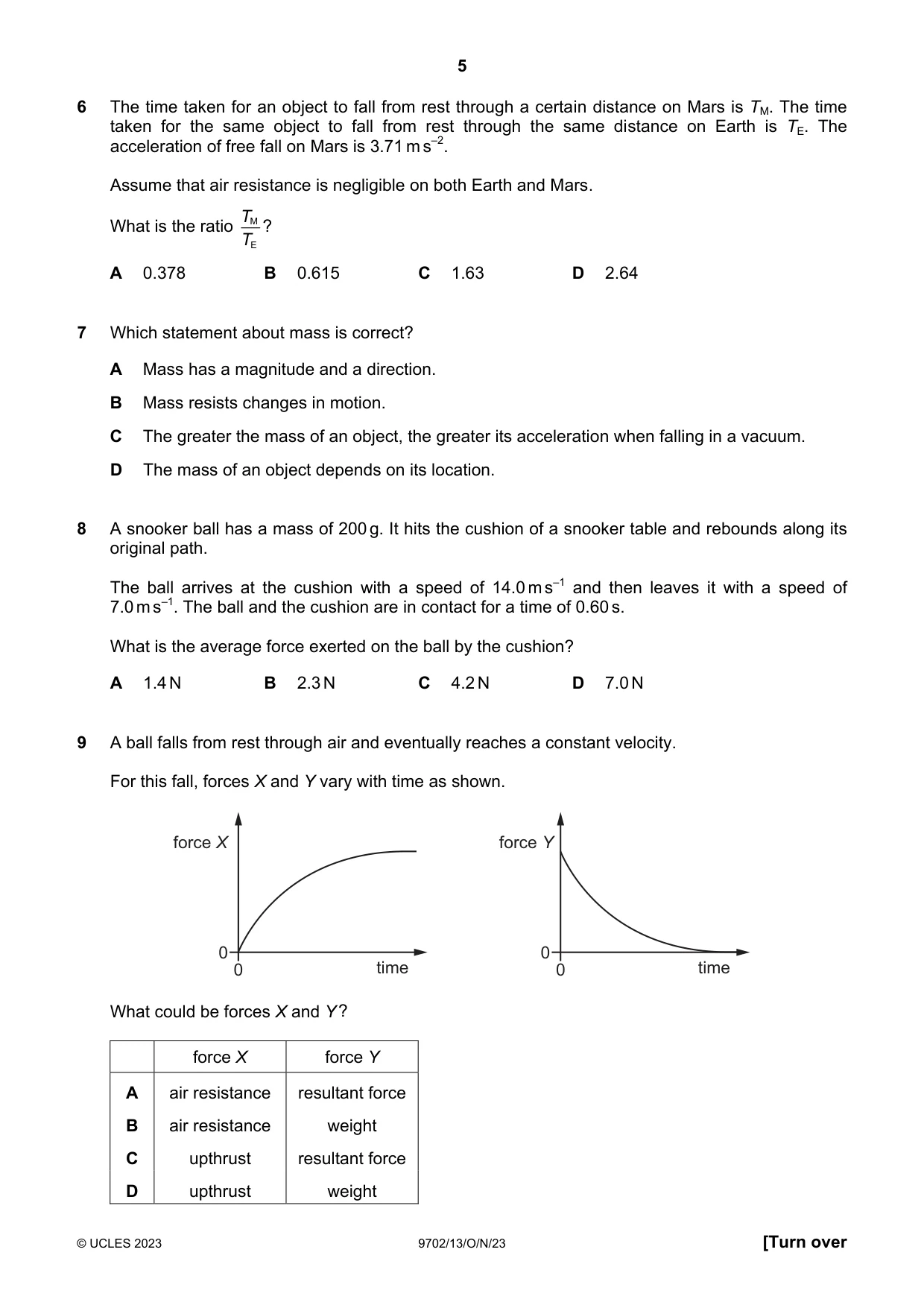
Q6 · The time taken for an object to fall from rest through a certain distance on Mars is TM
6 The time taken for an object to fall from rest through a certain distance on Mars is TM. The time taken for the same object to fall from rest through the same distance on Earth is TE. The acceleration of free fall on Mars is 3.71 m s–2. Assume that air resistance is negligible on both Earth and Mars. T What is the ratio M ? T E A 0.378 B 0.615 C 1.63 D 2.64
Mark scheme: C
Q7 · Which statement about mass is correct?
7 Which statement about mass is correct? A Mass has a magnitude and a direction. B Mass resists changes in motion. C The greater the mass of an object, the greater its acceleration when falling in a vacuum. D The mass of an object depends on its location.
Mark scheme: B
Q8 · A snooker ball has a mass of 200 g
8 A snooker ball has a mass of 200 g. It hits the cushion of a snooker table and rebounds along its original path. The ball arrives at the cushion with a speed of 14.0 m s–1 and then leaves it with a speed of 7.0 m s–1. The ball and the cushion are in contact for a time of 0.60 s. What is the average force exerted on the ball by the cushion? A 1.4 N B 2.3 N C 4.2 N D 7.0 N
Mark scheme: D
Q9 · A ball falls from rest through air and eventually reaches a constant velocity
9 A ball falls from rest through air and eventually reaches a constant velocity. For this fall, forces X and Y vary with time as shown. force X force Y 0 0 0 time 0 time What could be forces X and Y ? force X force Y A air resistance resultant force B air resistance weight C upthrust resultant force D upthrust weight
Mark scheme: A
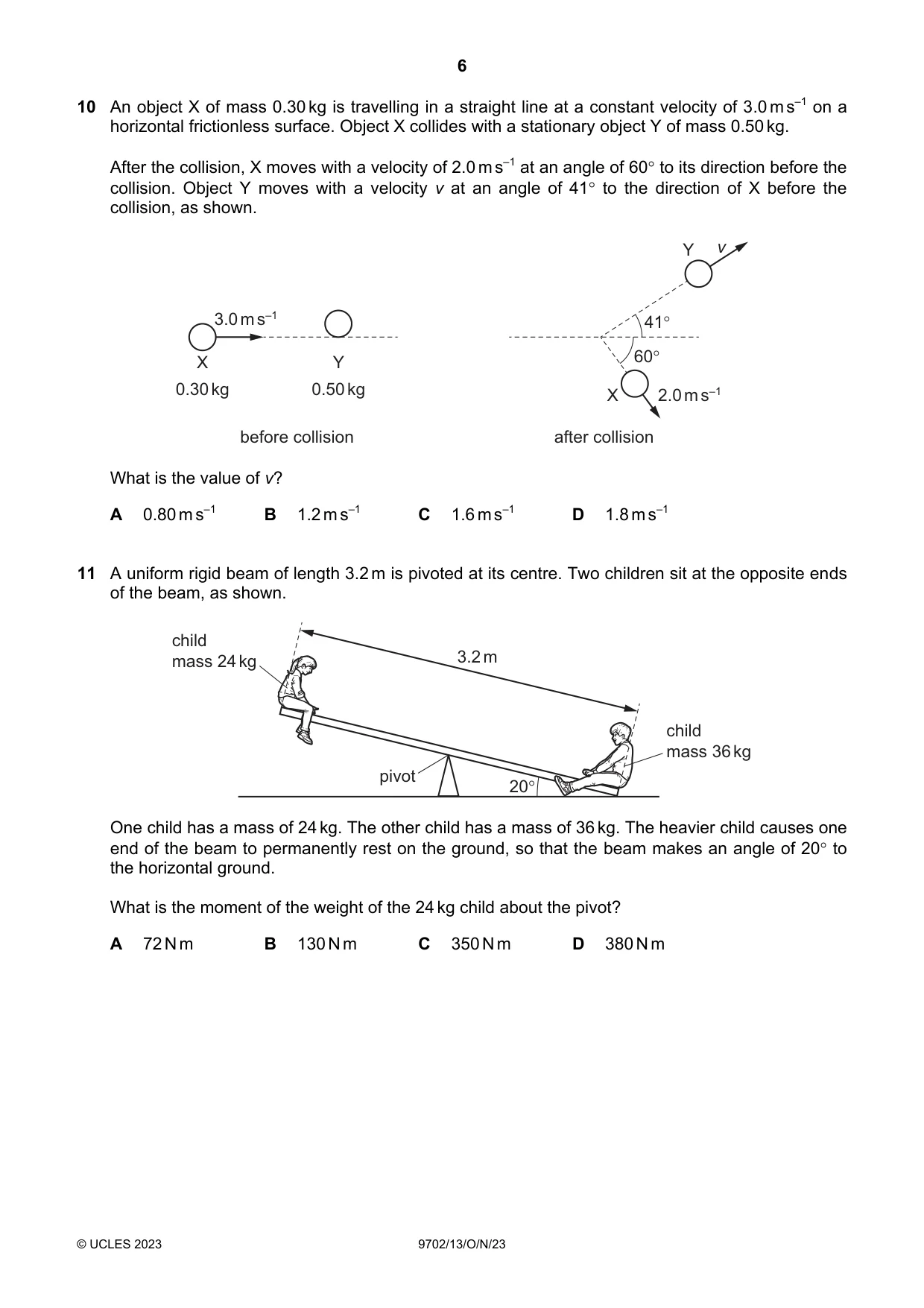
Q10 · An object X of mass 0.30kg is travelling in a straight line at a constant velocity of…
10 An object X of mass 0.30kg is travelling in a straight line at a constant velocity of 3.0ms" ona horizontal frictionless surface. Object X collides with a stationary object Y of mass 0.50 kg. After the collision, X moves with a velocity of 2.0ms" at an angle of 60° to its direction before the collision. Object Y moves with a velocity v at an angle of 41° to the direction of X before the collision, as shown. Xx Y Ne 60° 0.30kg 0.50 kg XQ 20 me! before collision after collision What is the value of v? A 0.80ms" B 1.2ms" C 1.6ms™ D 1.8ms"'
Mark scheme: C
Q11 · A uniform rigid beam of length 3.2m is pivoted at its centre
11 A uniform rigid beam of length 3.2m is pivoted at its centre. Two children sit at the opposite ends of the beam, as shown. child mass 24 kg child mass 36 kg One child has a mass of 24 kg. The other child has a mass of 36 kg. The heavier child causes one end of the beam to permanently rest on the ground, so that the beam makes an angle of 20° to the horizontal ground. What is the moment of the weight of the 24 kg child about the pivot? A 72Nm B 130Nm C 350Nm D 380Nm
Mark scheme: C
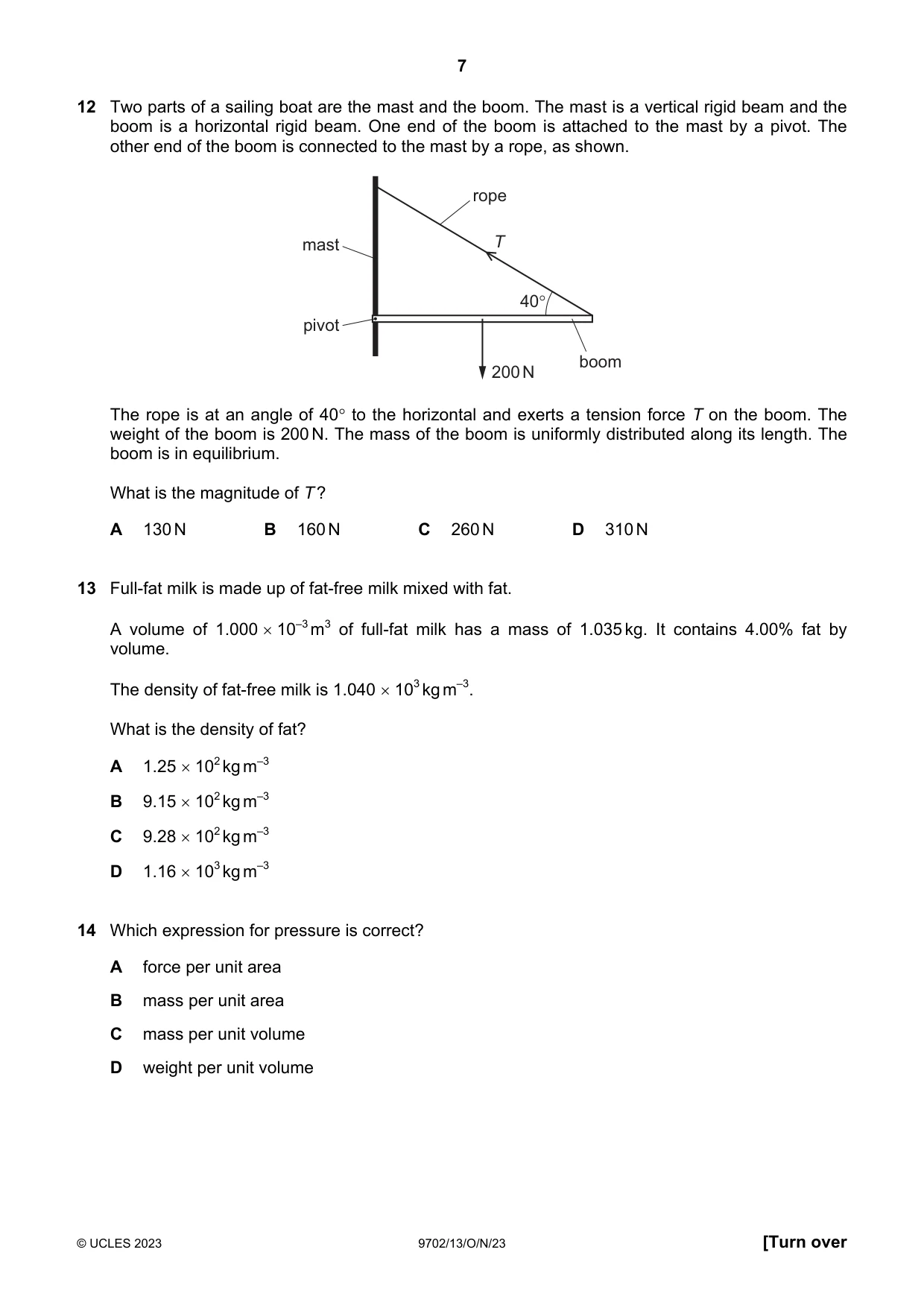
Q12 · Two parts of a sailing boat are the mast and the boom
12 Two parts of a sailing boat are the mast and the boom. The mast is a vertical rigid beam and the boom is a horizontal rigid beam. One end of the boom is attached to the mast by a pivot. The other end of the boom is connected to the mast by a rope, as shown. rope mast T pivot 200N boom The rope is at an angle of 40° to the horizontal and exerts a tension force T on the boom. The weight of the boom is 200N. The mass of the boom is uniformly distributed along its length. The boom is in equilibrium. What is the magnitude of 7? A 130N B 160N C 260N D 310N
Mark scheme: B
Q13 · Full-fat milk is made up of fat-free milk mixed with fat
13 Full-fat milk is made up of fat-free milk mixed with fat. A volume of 1.000 10–3 m3 of full-fat milk has a mass of 1.035 kg. It contains 4.00% fat by volume. The density of fat-free milk is 1.040 103 kg m–3. What is the density of fat? A 1.25 102 kg m–3 B 9.15 102 kg m–3 C 9.28 102 kg m–3 D 1.16 103 kg m–3
Mark scheme: B
Q14 · Which expression for pressure is correct?
14 Which expression for pressure is correct? A force per unit area B mass per unit area C mass per unit volume D weight per unit volume
Mark scheme: A
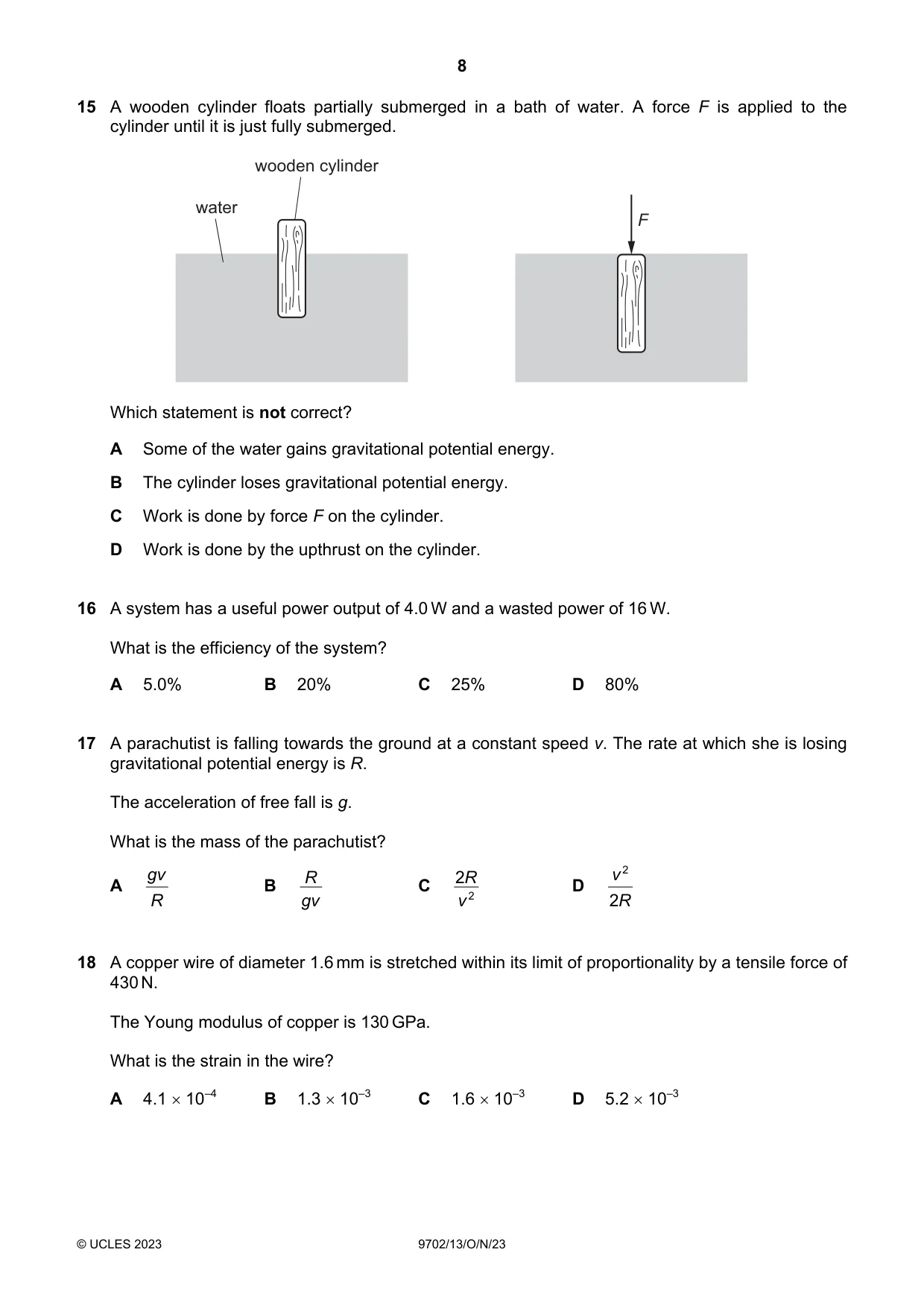
Q15 · A wooden cylinder floats partially submerged in a bath of water
15 A wooden cylinder floats partially submerged in a bath of water. A force F is applied to the cylinder until it is just fully submerged. wooden cylinder water F Which statement is not correct? A Some of the water gains gravitational potential energy. B The cylinder loses gravitational potential energy. C Work is done by force F on the cylinder. D Work is done by the upthrust on the cylinder.
Mark scheme: D
Q16 · A system has a useful power output of 4.0 W and a wasted power of 16 W
16 A system has a useful power output of 4.0 W and a wasted power of 16 W. What is the efficiency of the system? A 5.0% B 20% C 25% D 80%
Mark scheme: B
Q17 · A parachutist is falling towards the ground at a constant speed v
17 A parachutist is falling towards the ground at a constant speed v. The rate at which she is losing gravitational potential energy is R. The acceleration of free fall is g. What is the mass of the parachutist? gv R 2 R v 2 A B C D R gv v 2 2 R
Mark scheme: B
More questions on Gravitational potential energy and kinetic energy
Q18 · A copper wire of diameter 1.6 mm is stretched within its limit of proportionality by a…
18 A copper wire of diameter 1.6 mm is stretched within its limit of proportionality by a tensile force of 430 N. The Young modulus of copper is 130 GPa. What is the strain in the wire? A 4.1 10–4 B 1.3 10–3 C 1.6 10–3 D 5.2 10–3
Mark scheme: C
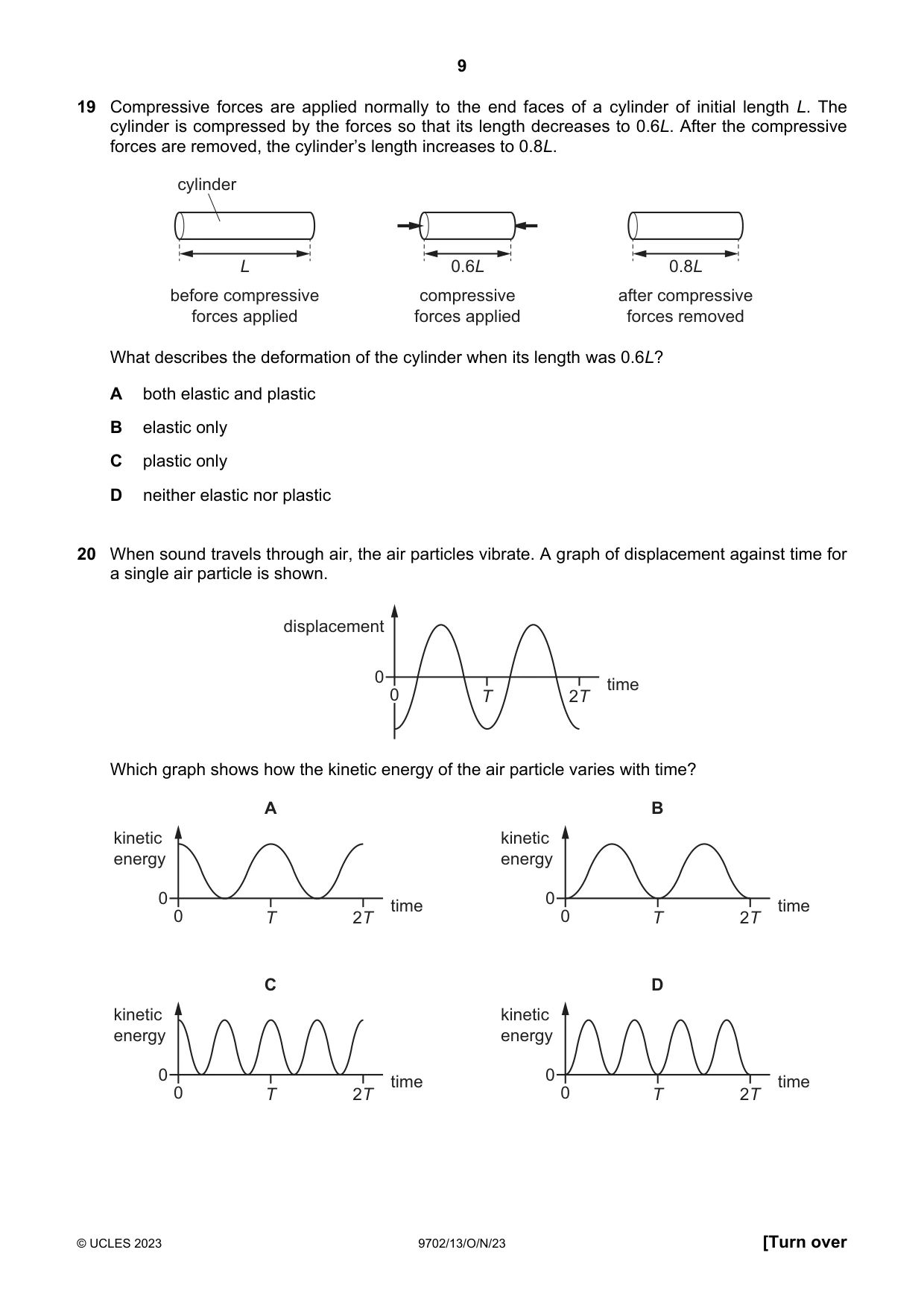
Q19 · Compressive forces are applied normally to the end faces of a cylinder of initial length L
19 Compressive forces are applied normally to the end faces of a cylinder of initial length L. The cylinder is compressed by the forces so that its length decreases to 0.6L. After the compressive forces are removed, the cylinder’s length increases to 0.8L. cylinder L 0.6L 0.8L before compressive compressive after compressive forces applied forces applied forces removed What describes the deformation of the cylinder when its length was 0.6L? A both elastic and plastic B elastic only C plastic only D neither elastic nor plastic
Mark scheme: A
Q20 · When sound travels through air, the air particles vibrate
20 When sound travels through air, the air particles vibrate. A graph of displacement against time for a single air particle is shown. displacement 0 time 0 T 2T Which graph shows how the kinetic energy of the air particle varies with time? A B kinetic kinetic energy energy 0 time 0 time 0 T 2T 0 T 2T C D kinetic kinetic energy energy 0 time 0 time 0 T 2T 0 T 2T
Mark scheme: D
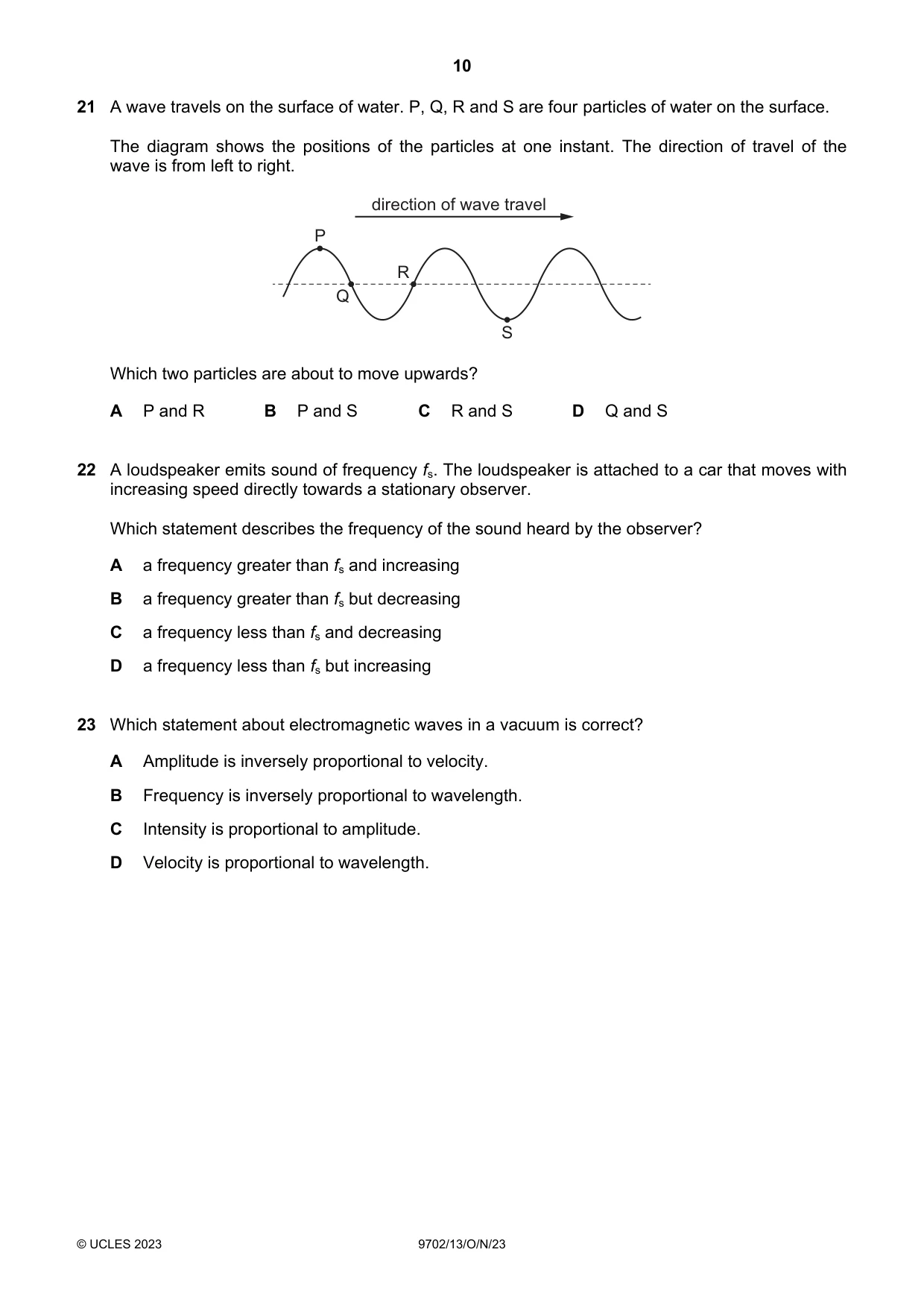
Q21 · A wave travels on the surface of water
21 A wave travels on the surface of water. P, Q, R and S are four particles of water on the surface. The diagram shows the positions of the particles at one instant. The direction of travel of the wave is from left to right. direction of wave travel P R Q S Which two particles are about to move upwards? A P and R B P and S C R and S D Q and S
Mark scheme: D
Q22 · A loudspeaker emits sound of frequency fs
22 A loudspeaker emits sound of frequency fs. The loudspeaker is attached to a car that moves with increasing speed directly towards a stationary observer. Which statement describes the frequency of the sound heard by the observer? A a frequency greater than fs and increasing B a frequency greater than fs but decreasing C a frequency less than fs and decreasing D a frequency less than fs but increasing
Mark scheme: A
Q23 · Which statement about electromagnetic waves in a vacuum is correct?
23 Which statement about electromagnetic waves in a vacuum is correct? A Amplitude is inversely proportional to velocity. B Frequency is inversely proportional to wavelength. C Intensity is proportional to amplitude. D Velocity is proportional to wavelength.
Mark scheme: B
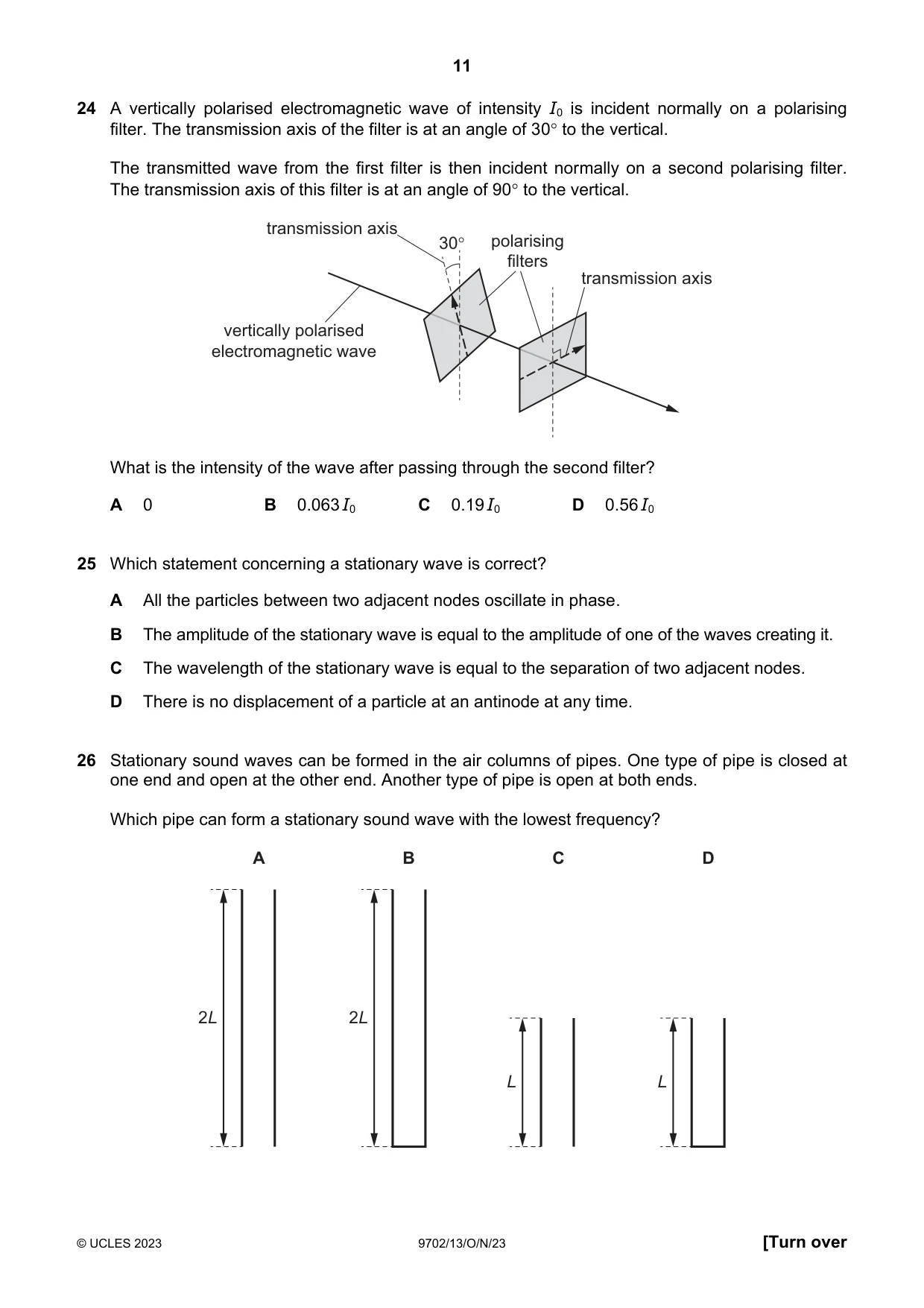
Q24 · A vertically polarised electromagnetic wave of intensity Jp is incident normally on a…
24 A vertically polarised electromagnetic wave of intensity Jp is incident normally on a polarising filter. The transmission axis of the filter is at an angle of 30° to the vertical. The transmitted wave from the first filter is then incident normally on a second polarising filter. The transmission axis of this filter is at an angle of 90° to the vertical. transmission axis 30° __— polarising VA filters transmission axis vertically polarised electromagnetic wave What is the intensity of the wave after passing through the second filter? A 0 B 0.063 Ip C 0.19Ip D 0.561
Mark scheme: C
Q25 · Which statement concerning a stationary wave is correct?
25 Which statement concerning a stationary wave is correct? A All the particles between two adjacent nodes oscillate in phase. B The amplitude of the stationary wave is equal to the amplitude of one of the waves creating it. C The wavelength of the stationary wave is equal to the separation of two adjacent nodes. D There is no displacement of a particle at an antinode at any time.
Mark scheme: A
Q26 · Stationary sound waves can be formed in the air columns of pipes
26 Stationary sound waves can be formed in the air columns of pipes. One type of pipe is closed at one end and open at the other end. Another type of pipe is open at both ends. Which pipe can form a stationary sound wave with the lowest frequency? A B C D 2L 2L L L
Mark scheme: B
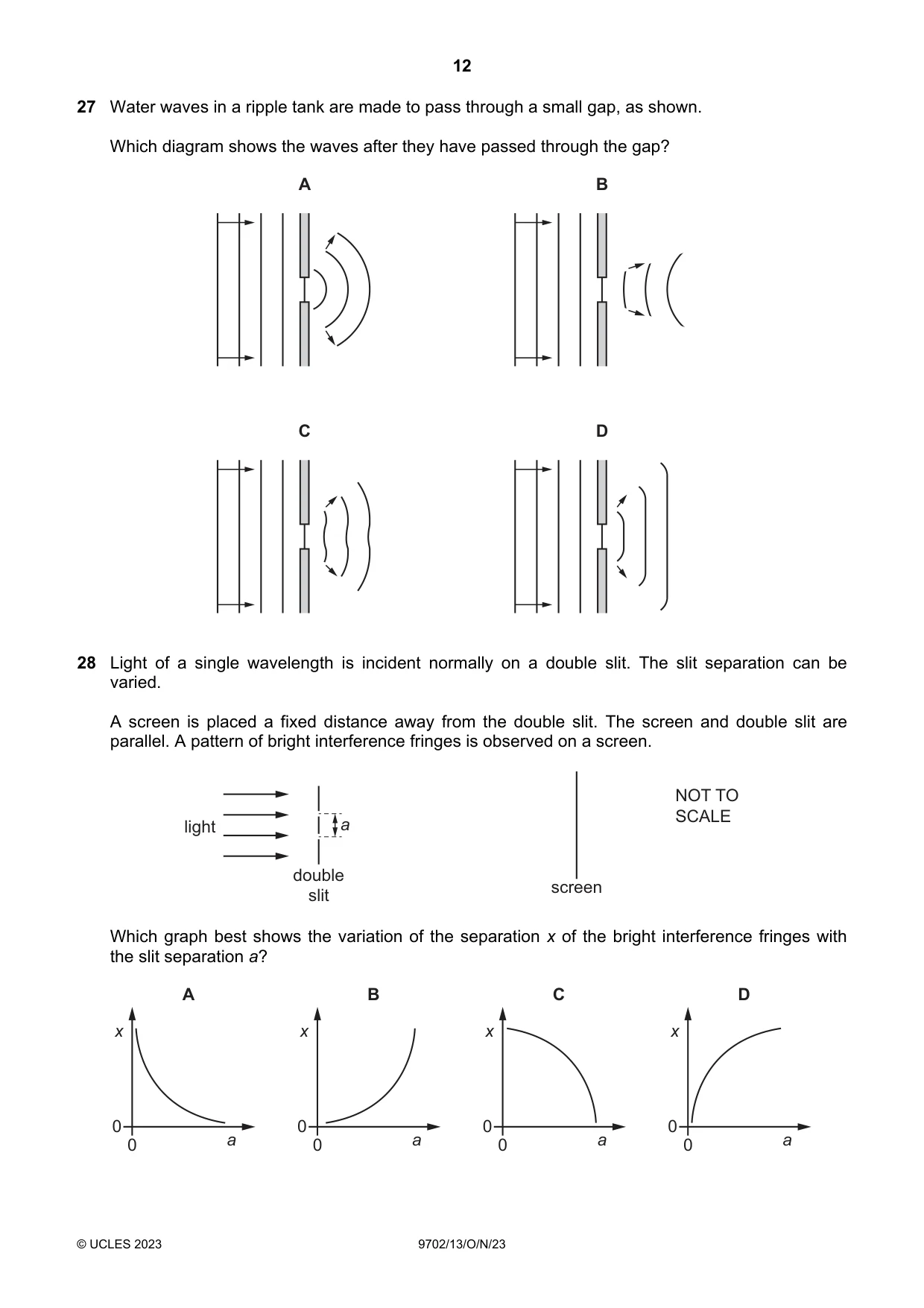
Q27 · Water waves in a ripple tank are made to pass through a small gap, as shown
27 Water waves in a ripple tank are made to pass through a small gap, as shown. Which diagram shows the waves after they have passed through the gap? A B C D
Mark scheme: A
Q28 · Light of a single wavelength is incident normally on a double slit
28 Light of a single wavelength is incident normally on a double slit. The slit separation can be varied. A screen is placed a fixed distance away from the double slit. The screen and double slit are parallel. A pattern of bright interference fringes is observed on a screen. NOT TO a SCALE light double screen slit Which graph best shows the variation of the separation x of the bright interference fringes with the slit separation a? A B C D x x x x 0 0 0 0 0 a 0 a 0 a 0 a
Mark scheme: A
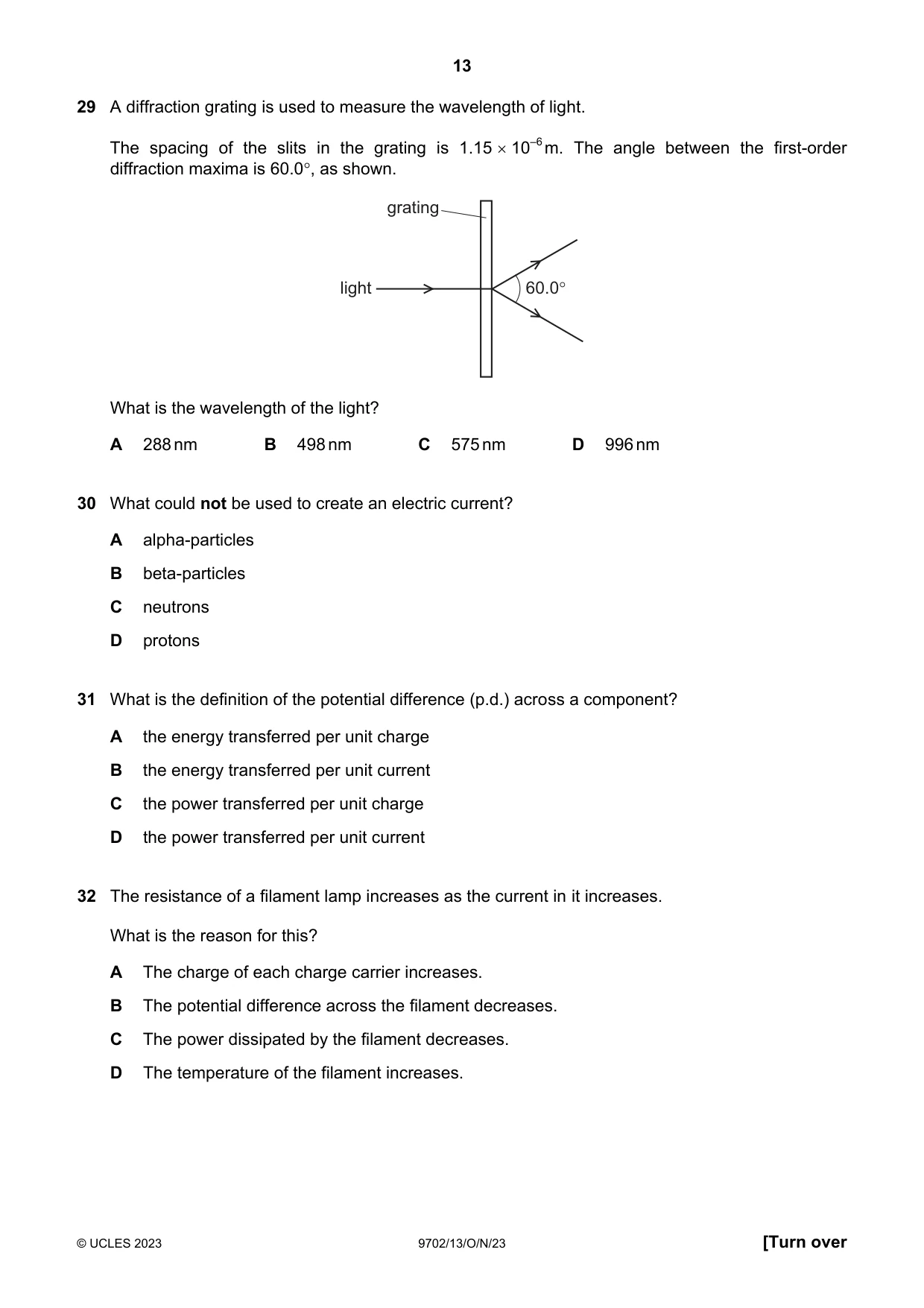
Q29 · A diffraction grating is used to measure the wavelength of light
29 A diffraction grating is used to measure the wavelength of light. The spacing of the slits in the grating is 1.15 10°m. The angle between the first-order diffraction maxima is 60.0°, as shown. grating light 60.0° What is the wavelength of the light? A 288nm B 498nm C 575nm D 996nm
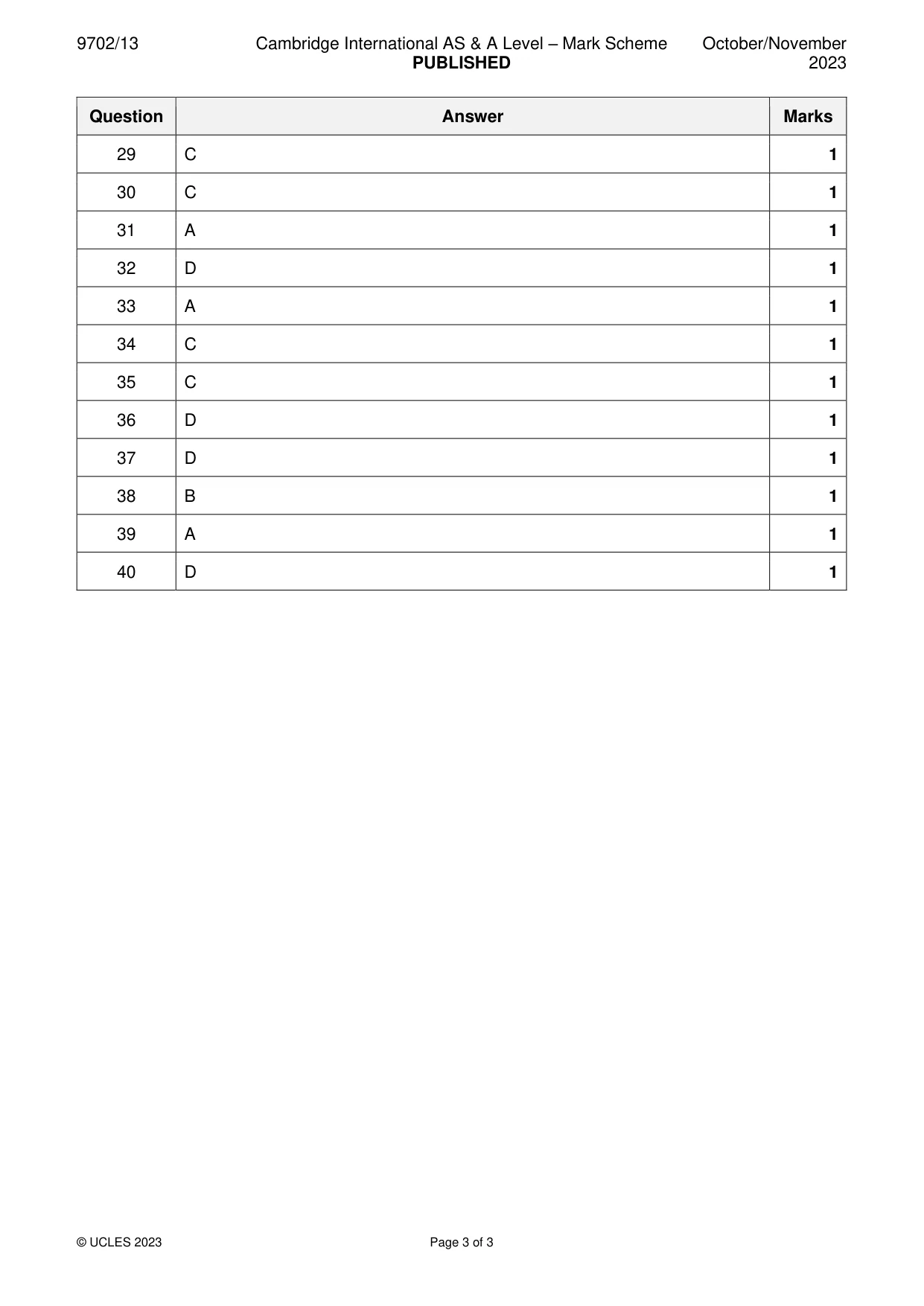
Mark scheme: C
Q30 · What could not be used to create an electric current?
30 What could not be used to create an electric current? A alpha-particles B beta-particles C neutrons D protons
Mark scheme: C
Q31 · What is the definition of the potential difference (p.d.) across a component?
31 What is the definition of the potential difference (p.d.) across a component? A the energy transferred per unit charge B the energy transferred per unit current C the power transferred per unit charge D the power transferred per unit current
Mark scheme: A
Q32 · The resistance of a filament lamp increases as the current in it increases
32 The resistance of a filament lamp increases as the current in it increases. What is the reason for this? A The charge of each charge carrier increases. B The potential difference across the filament decreases. C The power dissipated by the filament decreases. D The temperature of the filament increases.
Mark scheme: D
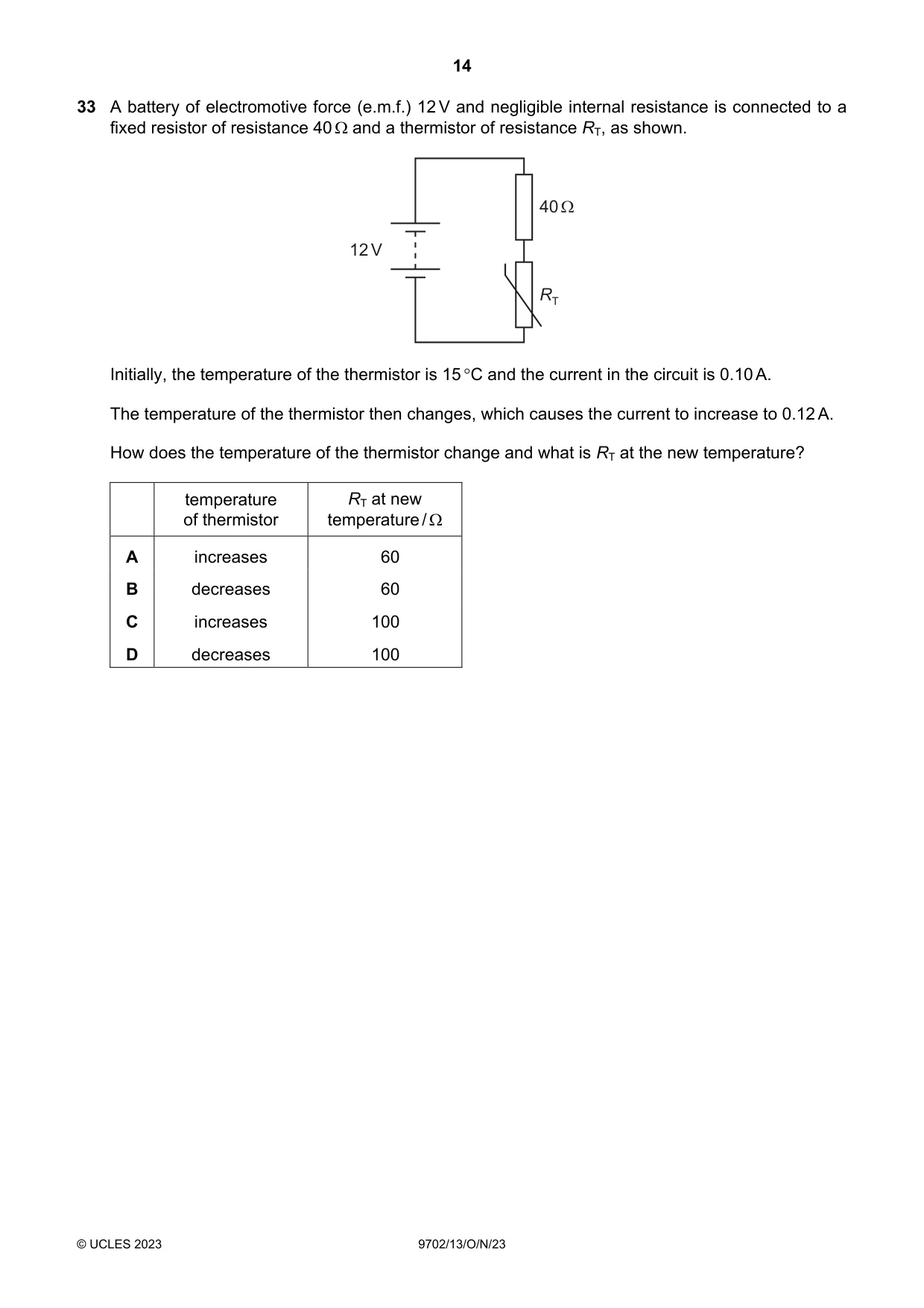
Q33 · A battery of electromotive force (e.m.f.) 12V and negligible internal resistance is…
33 A battery of electromotive force (e.m.f.) 12V and negligible internal resistance is connected to a fixed resistor of resistance 40 Q and a thermistor of resistance R;, as shown. 400 R; Initially, the temperature of the thermistor is 15°C and the current in the circuit is 0.10A. The temperature of the thermistor then changes, which causes the current to increase to 0.12A. How does the temperature of the thermistor change and what is Ry; at the new temperature? temperature Ry at new of thermistor temperature /Q A increases 60 B decreases 60 Cc increases 100 D decreases 100
Mark scheme: A
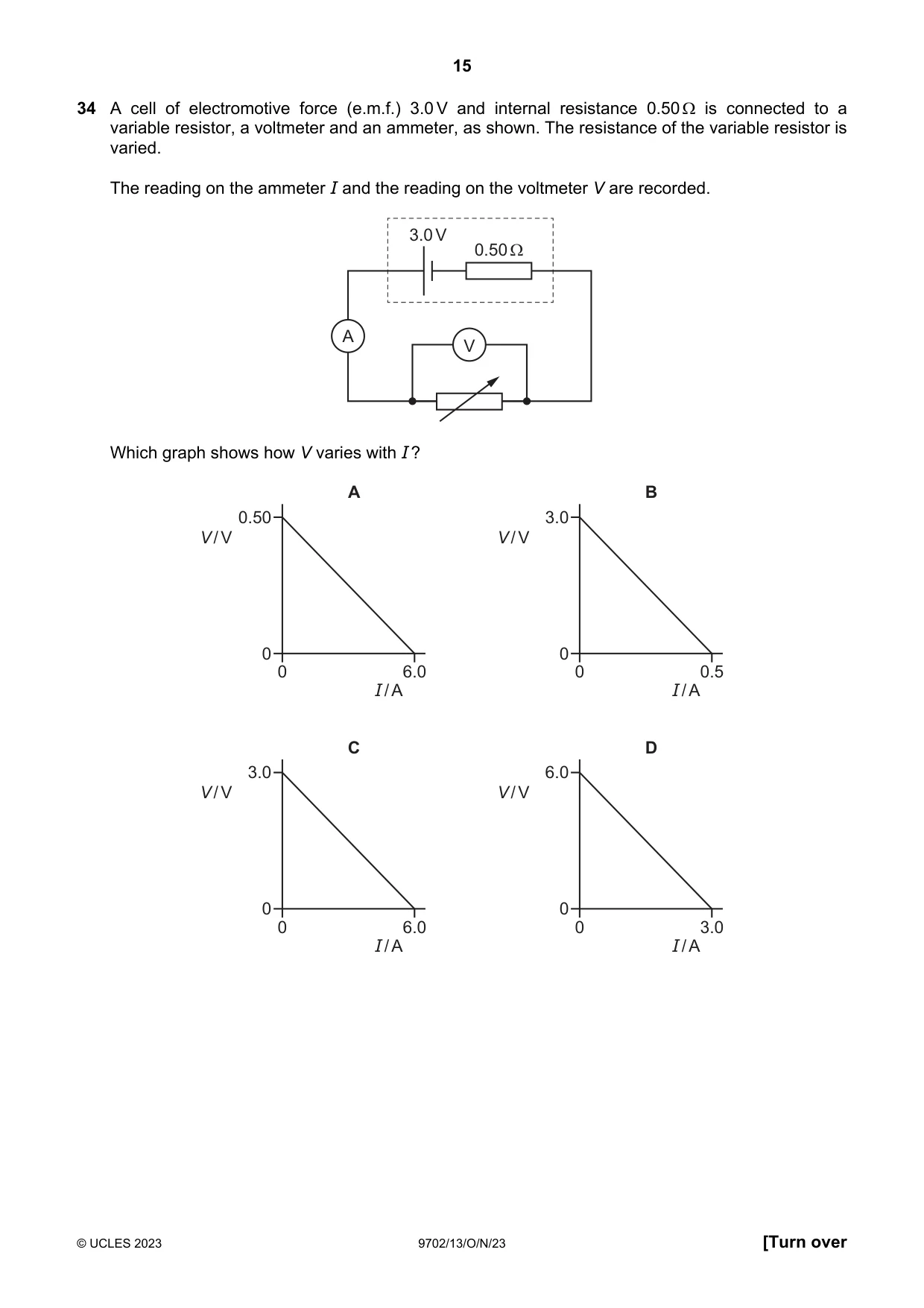
Q34 · A cell of electromotive force (e.m.f.) 3.0V and internal resistance 0.509 is connected to…
34 A cell of electromotive force (e.m.f.) 3.0V and internal resistance 0.509 is connected to a variable resistor, a voltmeter and an ammeter, as shown. The resistance of the variable resistor is varied. The reading on the ammeter J and the reading on the voltmeter V are recorded. Which graph shows how V varies with I? A 0.50 V/IV 0 0 6.0 I/A Cc 3.0 V/IV 0 0 6.0 I/A B 3.0 V/IV 0 0 0.5 I/A D 6.0 V/IV 0 0 3.0 I/A
Mark scheme: C
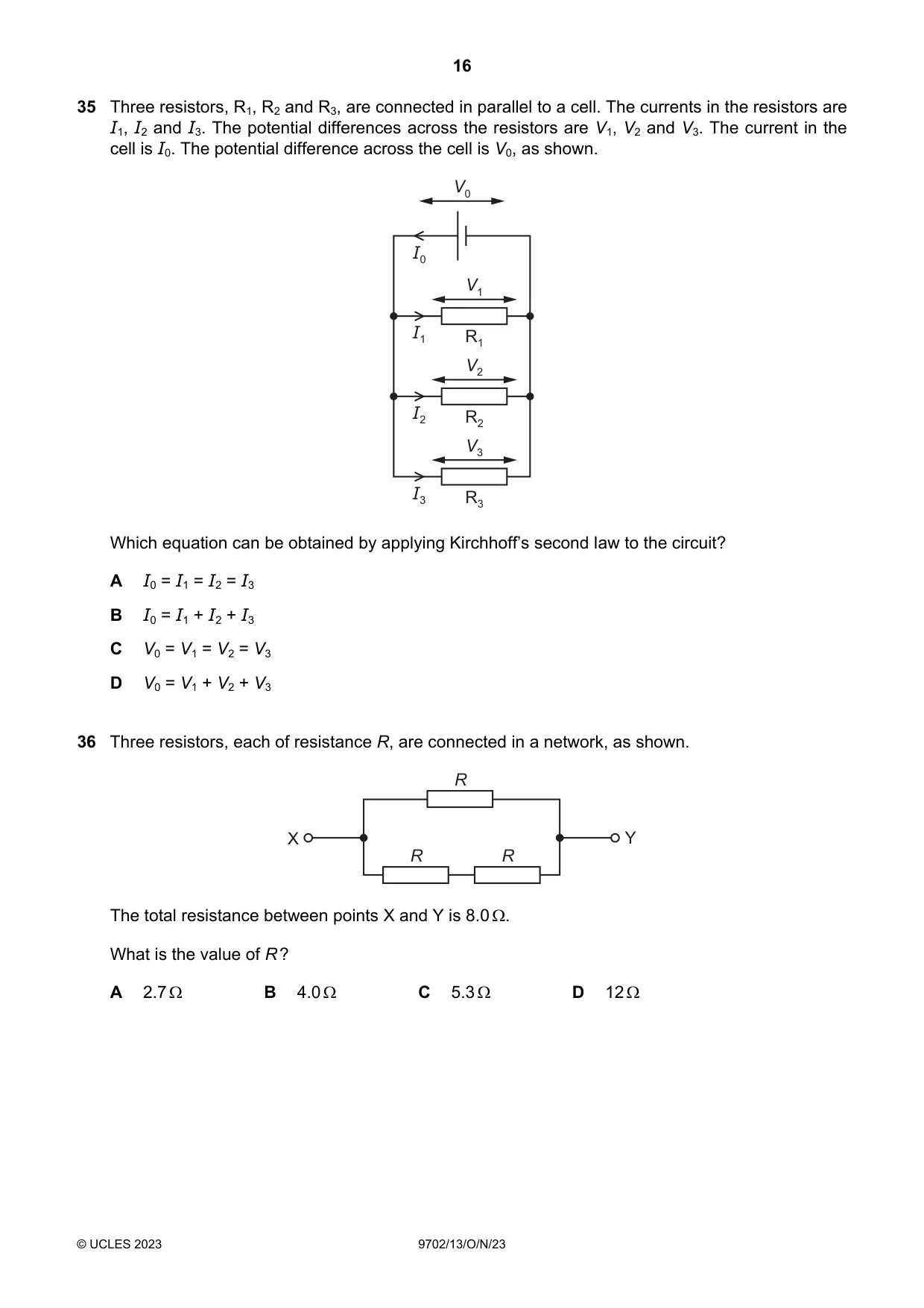
Q35 · Three resistors, R1, R2 and R3, are connected in parallel to a cell
35 Three resistors, R1, R2 and R3, are connected in parallel to a cell. The currents in the resistors are I1, I2 and I3. The potential differences across the resistors are V1, V2 and V3. The current in the cell is I0. The potential difference across the cell is V0, as shown. V0 I0 V1 I1 R1 V2 I2 R2 V3 I3 R3 Which equation can be obtained by applying Kirchhoff’s second law to the circuit? A I0 = I1 = I2 = I3 B I0 = I1 + I2 + I3 C V0 = V1 = V2 = V3 D V0 = V1 + V2 + V3
Mark scheme: C
Q36 · Three resistors, each of resistance R, are connected in a network, as shown
36 Three resistors, each of resistance R, are connected in a network, as shown. R X Y R R The total resistance between points X and Y is 8.0 . What is the value of R ? A 2.7 B 4.0 C 5.3 D 12
Mark scheme: D
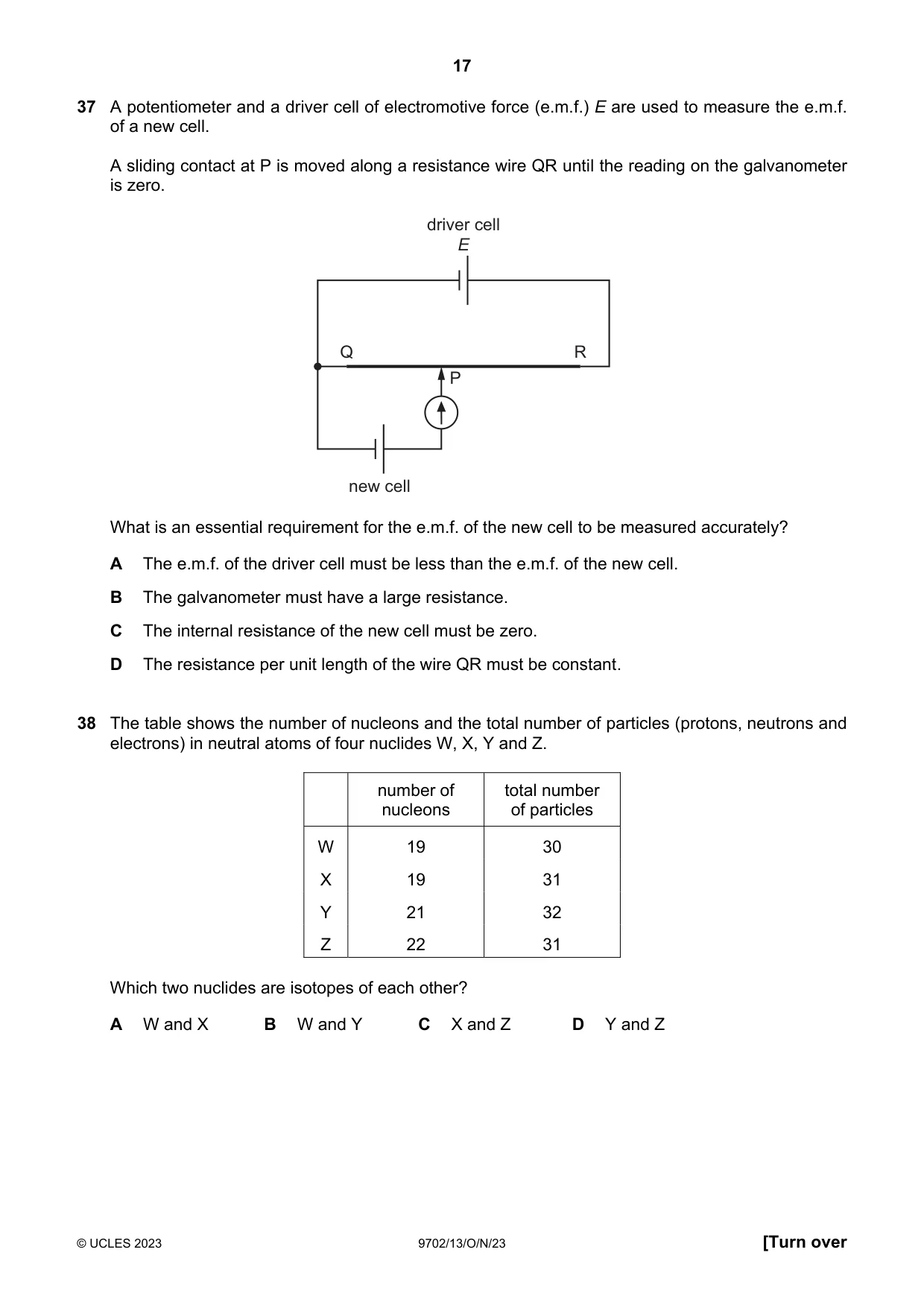
Q37 · A potentiometer and a driver cell of electromotive force (e.m.f.) E are used to measure…
37 A potentiometer and a driver cell of electromotive force (e.m.f.) E are used to measure the e.m.f. of a new cell. A sliding contact at P is moved along a resistance wire QR until the reading on the galvanometer is zero. driver cell E Q R P new cell What is an essential requirement for the e.m.f. of the new cell to be measured accurately? A The e.m.f. of the driver cell must be less than the e.m.f. of the new cell. B The galvanometer must have a large resistance. C The internal resistance of the new cell must be zero. D The resistance per unit length of the wire QR must be constant.
Mark scheme: D
Q38 · The table shows the number of nucleons and the total number of particles (protons…
38 The table shows the number of nucleons and the total number of particles (protons, neutrons and electrons) in neutral atoms of four nuclides W, X, Y and Z. number of total number nucleons of particles W 19 30 X 19 31 Y 21 32 Z 22 31 Which two nuclides are isotopes of each other? A W and X B W and Y C X and Z D Y and Z
Mark scheme: B
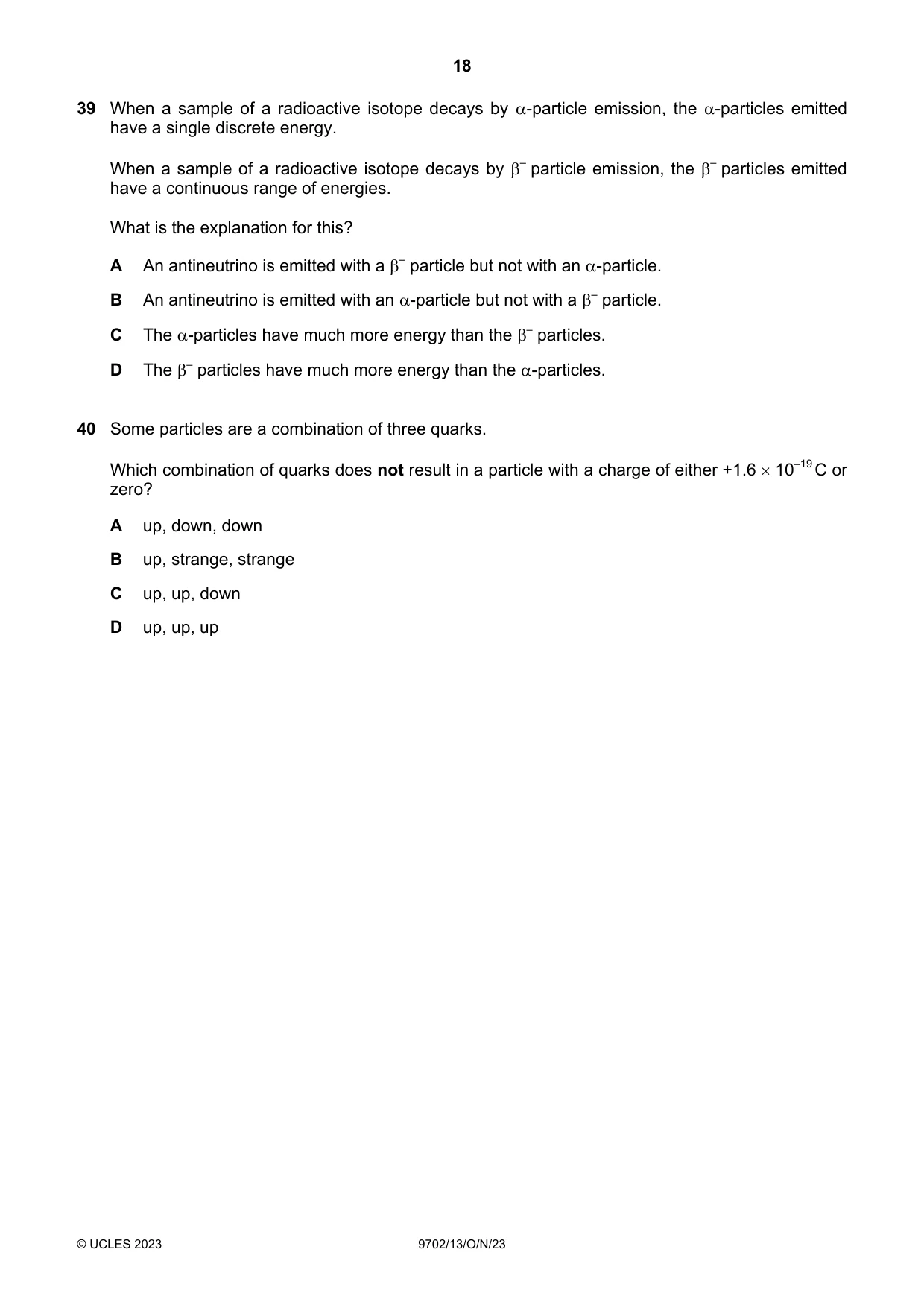
Q39 · When a sample of a radioactive isotope decays by -particle emission, the -particles…
39 When a sample of a radioactive isotope decays by -particle emission, the -particles emitted have a single discrete energy. When a sample of a radioactive isotope decays by – particle emission, the – particles emitted have a continuous range of energies. What is the explanation for this? A An antineutrino is emitted with a – particle but not with an -particle. B An antineutrino is emitted with an -particle but not with a – particle. C The -particles have much more energy than the – particles. D The – particles have much more energy than the -particles.
Mark scheme: A
Q40 · Some particles are a combination of three quarks
40 Some particles are a combination of three quarks. Which combination of quarks does not result in a particle with a charge of either +1.6 10–19 C or zero? A up, down, down B up, strange, strange C up, up, down D up, up, up
Mark scheme: D
What was in this paper
The subtopics covered by these 40 questions, and how many questions each got. Open one in a new tab to see every Cambridge question on it.
2Electromagnetic spectrum2Energy conservation2Equations of motion2Fundamental particles2Linear momentum and its conservation2Momentum and Newton’s laws of motion2Potential dividers2Practical circuits2Stationary waves2Atoms, nuclei and radiation1Diffraction1Doppler effect for sound waves1Elastic and plastic behaviour1Electric current1Energy in simple harmonic motion1Equilibrium of forces1Errors and uncertainties1Gravitational potential energy and kinetic energy1Interference1Kirchhoff’s laws1Polarisation1Potential difference and power1Progressive waves1Radioactive decay1Resistance and resistivity1Scalars and vectors1Stress and strain1The diffraction grating1Turning effects of forces1What you needed in this session
Cambridge’s own grade thresholds for 2023 Oct/Nov, Paper 1 · Variant 3. A higher threshold means an easier paper — the bar moves with how the cohort did.