Cambridge A Level Physics 9702 — 2013 Oct/Nov Paper 1 · Variant 3
9702/13/O/N/13 · 40 questions · 40 marks · ≈45 min
The question paper and its mark scheme, free to read here and free to download. This is Cambridge’s own paper, exactly as it was sat.
Question paper24 pages
Mark scheme2 pages
Answers below. Sit the paper first if you are practising.
Questions as text
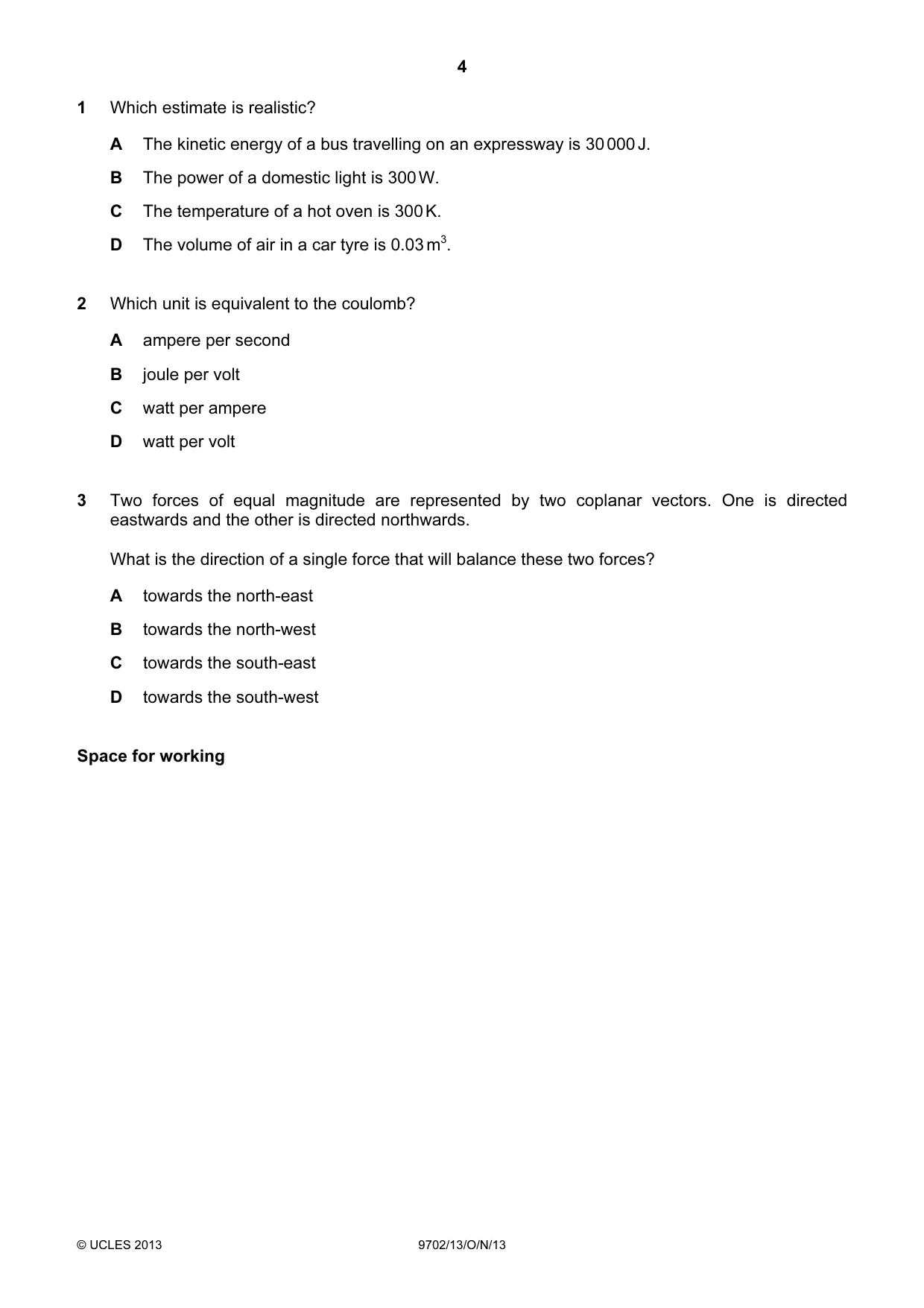
Q1 · Which estimate is realistic?
1 Which estimate is realistic? A The kinetic energy of a bus travelling on an expressway is 30 000 J. B The power of a domestic light is 300 W. C The temperature of a hot oven is 300 K. D The volume of air in a car tyre is 0.03 m3.
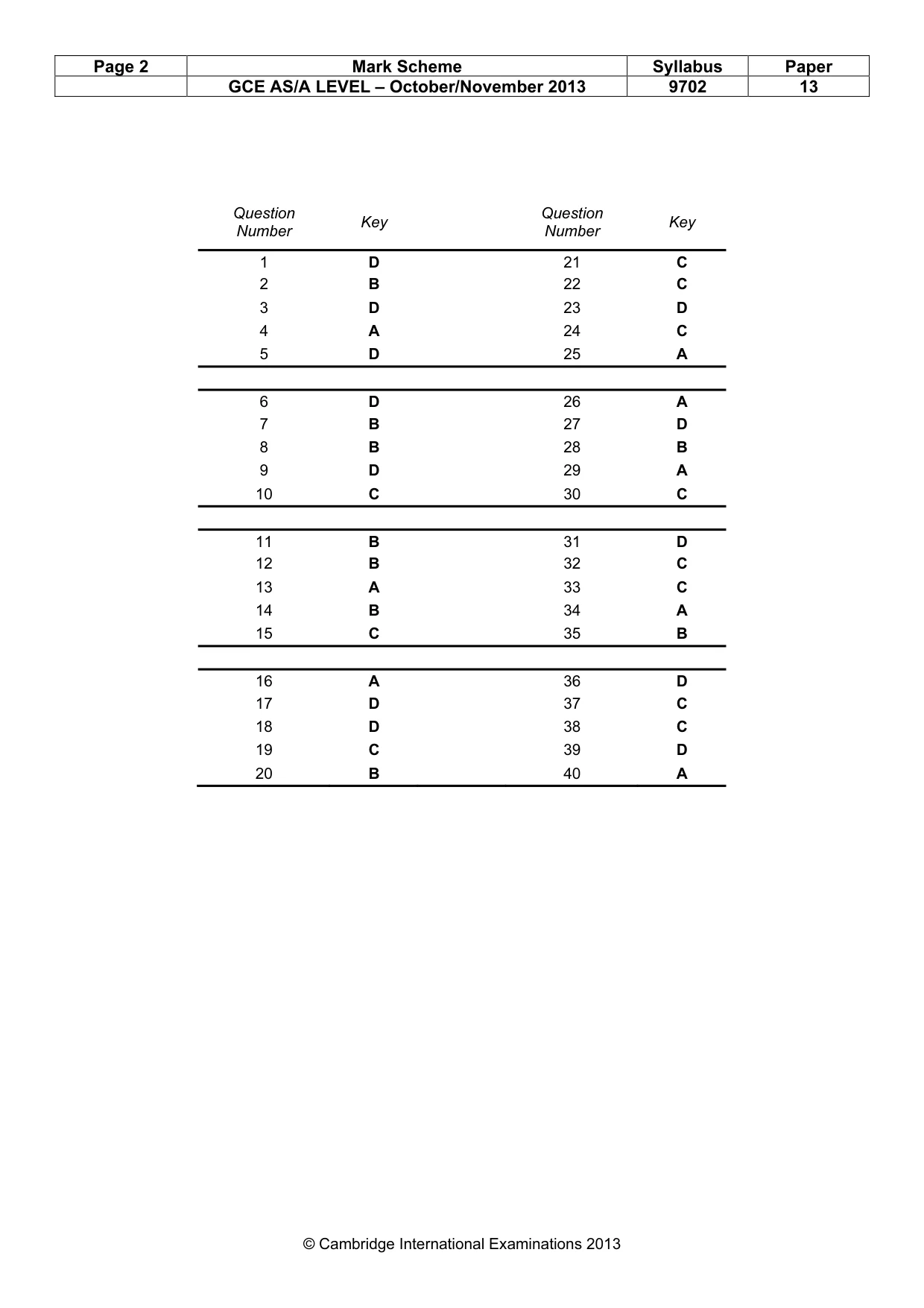
Mark scheme: D
Q2 · Which unit is equivalent to the coulomb?
2 Which unit is equivalent to the coulomb? A ampere per second B joule per volt C watt per ampere D watt per volt
Mark scheme: B
Q3 · Two forces of equal magnitude are represented by two coplanar vectors
3 Two forces of equal magnitude are represented by two coplanar vectors. One is directed eastwards and the other is directed northwards. What is the direction of a single force that will balance these two forces? A towards the north-east B towards the north-west C towards the south-east D towards the south-west Space for working
Mark scheme: D
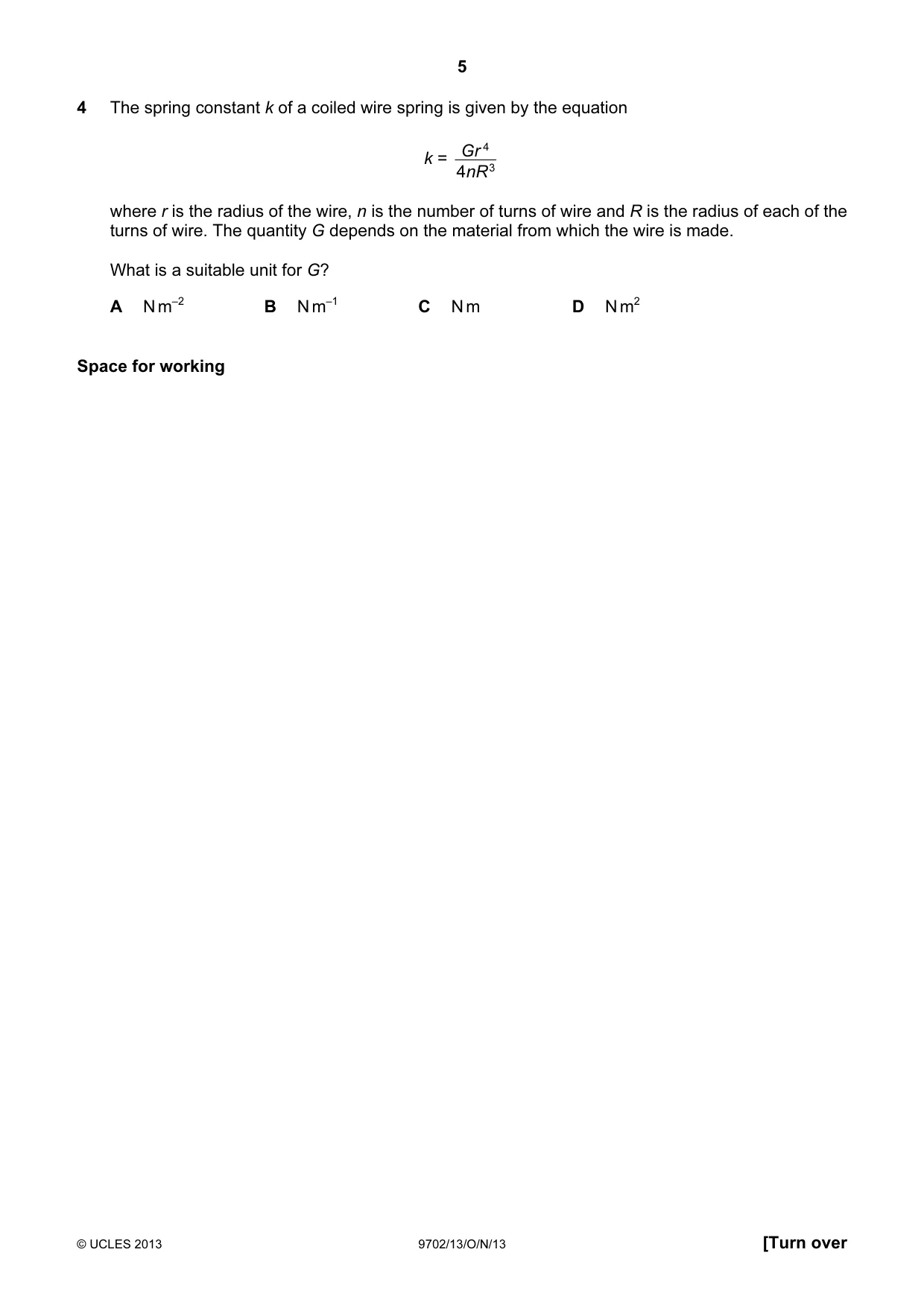
Q4 · The spring constant k of a coiled wire spring is given by the equation Gr 4 k = 4nR 3…
4 The spring constant k of a coiled wire spring is given by the equation Gr 4 k = 4nR 3 where r is the radius of the wire, n is the number of turns of wire and R is the radius of each of the turns of wire. The quantity G depends on the material from which the wire is made. What is a suitable unit for G? A N m–2 B N m–1 C N m D N m2 Space for working
Mark scheme: A
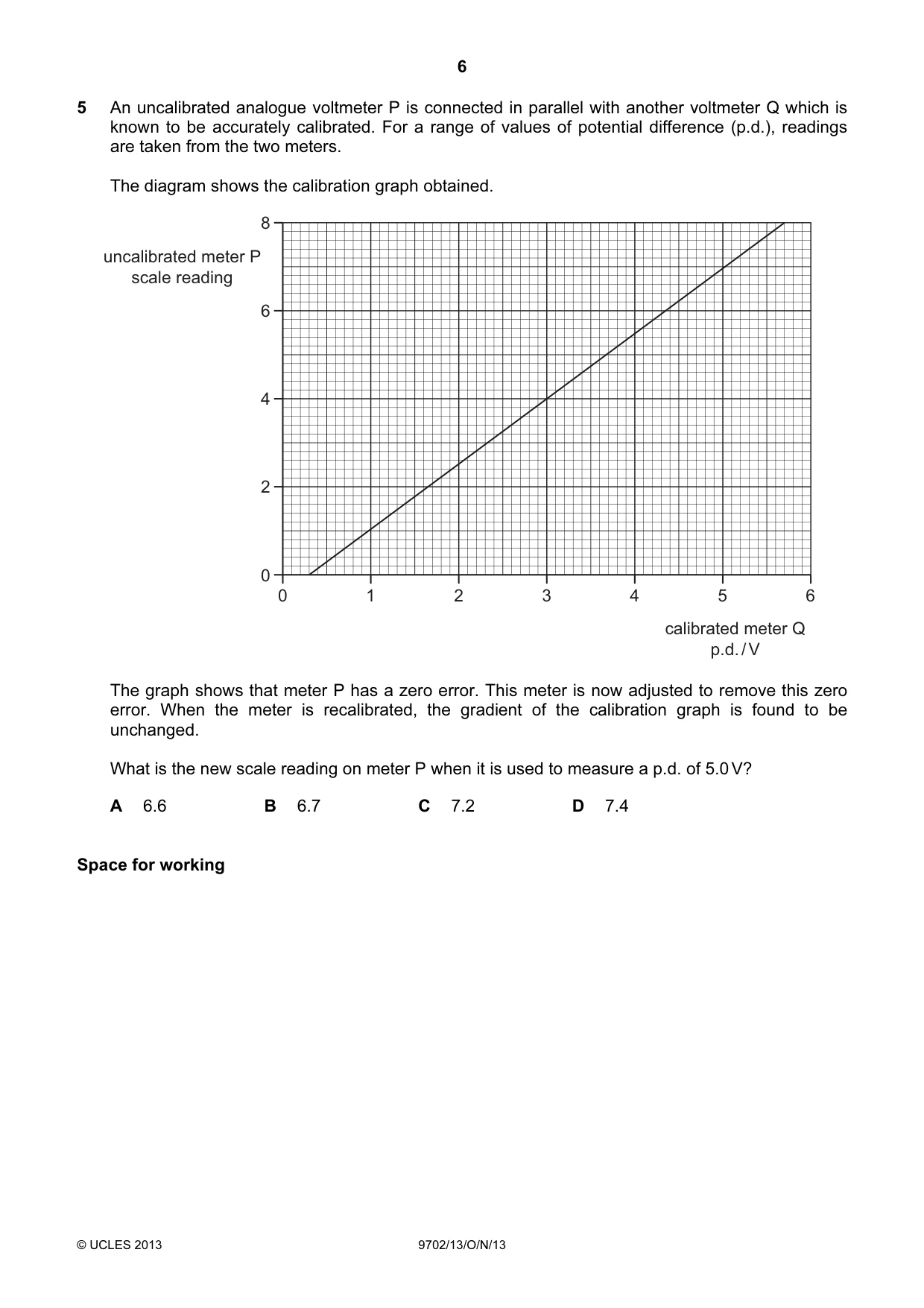
Q5 · An uncalibrated analogue voltmeter P is connected in parallel with another voltmeter Q…
5 An uncalibrated analogue voltmeter P is connected in parallel with another voltmeter Q which is known to be accurately calibrated. For a range of values of potential difference (p.d.), readings are taken from the two meters. The diagram shows the calibration graph obtained. 8 uncalibrated meter P scale reading 6 4 2 0 0 1 2 3 4 5 6 calibrated meter Q p.d. / V The graph shows that meter P has a zero error. This meter is now adjusted to remove this zero error. When the meter is recalibrated, the gradient of the calibration graph is found to be unchanged. What is the new scale reading on meter P when it is used to measure a p.d. of 5.0 V? A 6.6 B 6.7 C 7.2 D 7.4 Space for working
Mark scheme: D
Q6 · A student wishes to determine the density ρ of lead
6 A student wishes to determine the density ρ of lead. She measures the mass and diameter of a small sphere of lead: mass = (0.506 ± 0.005) g diameter = (2.20 ± 0.02) mm. What is the best estimate of the percentage uncertainty in her value of ρ ? A 1.9% B 2.0% C 2.8% D 3.7%
Mark scheme: D
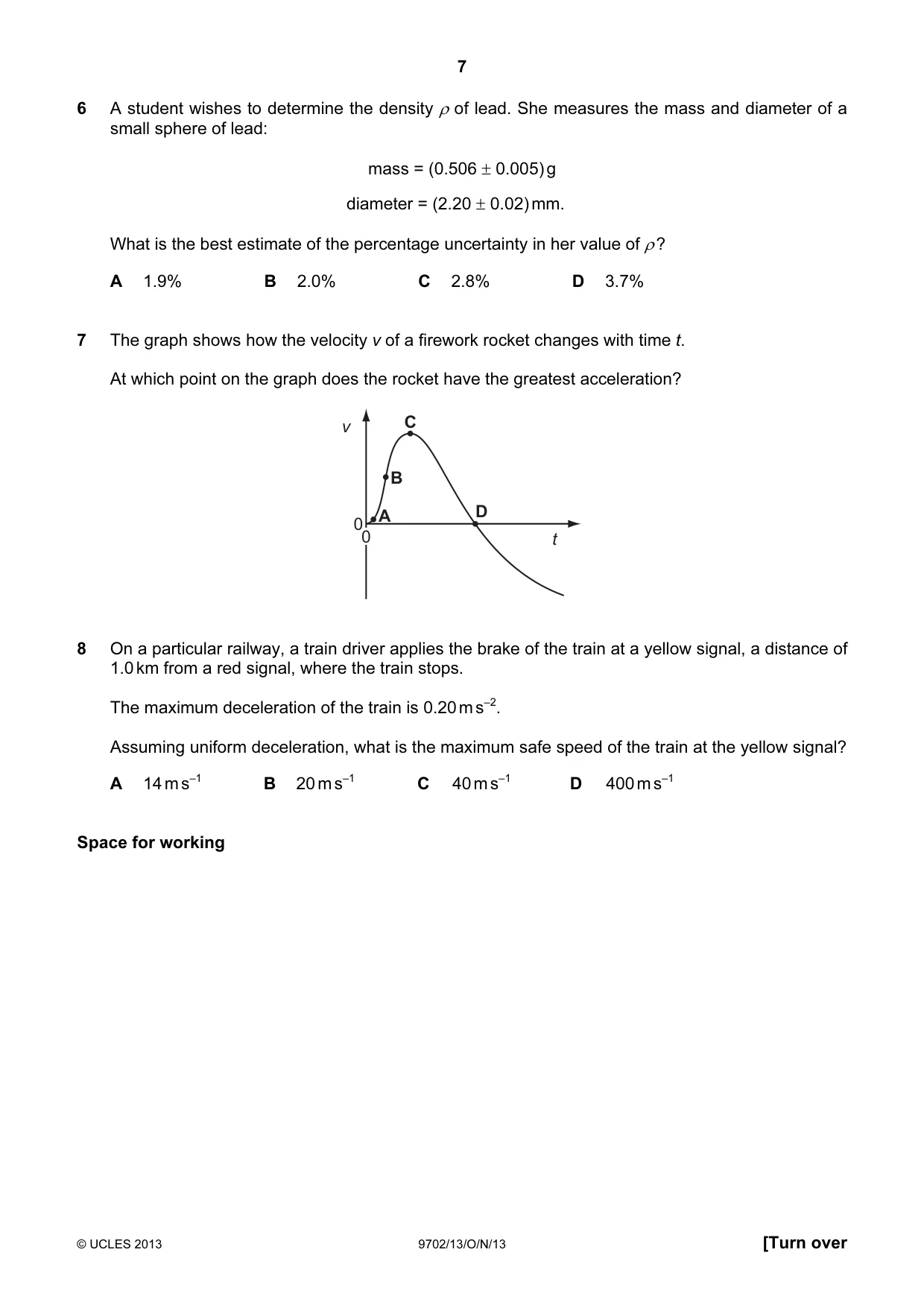
Q7 · The graph shows how the velocity v of a firework rocket changes with time t
7 The graph shows how the velocity v of a firework rocket changes with time t. At which point on the graph does the rocket have the greatest acceleration? v C B A D 00 t
Mark scheme: B
Q8 · On a particular railway, a train driver applies the brake of the train at a yellow…
8 On a particular railway, a train driver applies the brake of the train at a yellow signal, a distance of 1.0 km from a red signal, where the train stops. The maximum deceleration of the train is 0.20 m s–2. Assuming uniform deceleration, what is the maximum safe speed of the train at the yellow signal? A 14 m s–1 B 20 m s–1 C 40 m s–1 D 400 m s–1 Space for working
Mark scheme: B
Q9 · A person, travelling on a motorway a total distance of 200 km, travels the first 90 km at…
9 A person, travelling on a motorway a total distance of 200 km, travels the first 90 km at an average speed of 80 km h–1. Which average speed must be obtained for the rest of the journey if the person is to reach the destination in a total time of 2 hours 0 minutes? A 110 km h–1 B 120 km h–1 C 122 km h–1 D 126 km h–1
Mark scheme: D
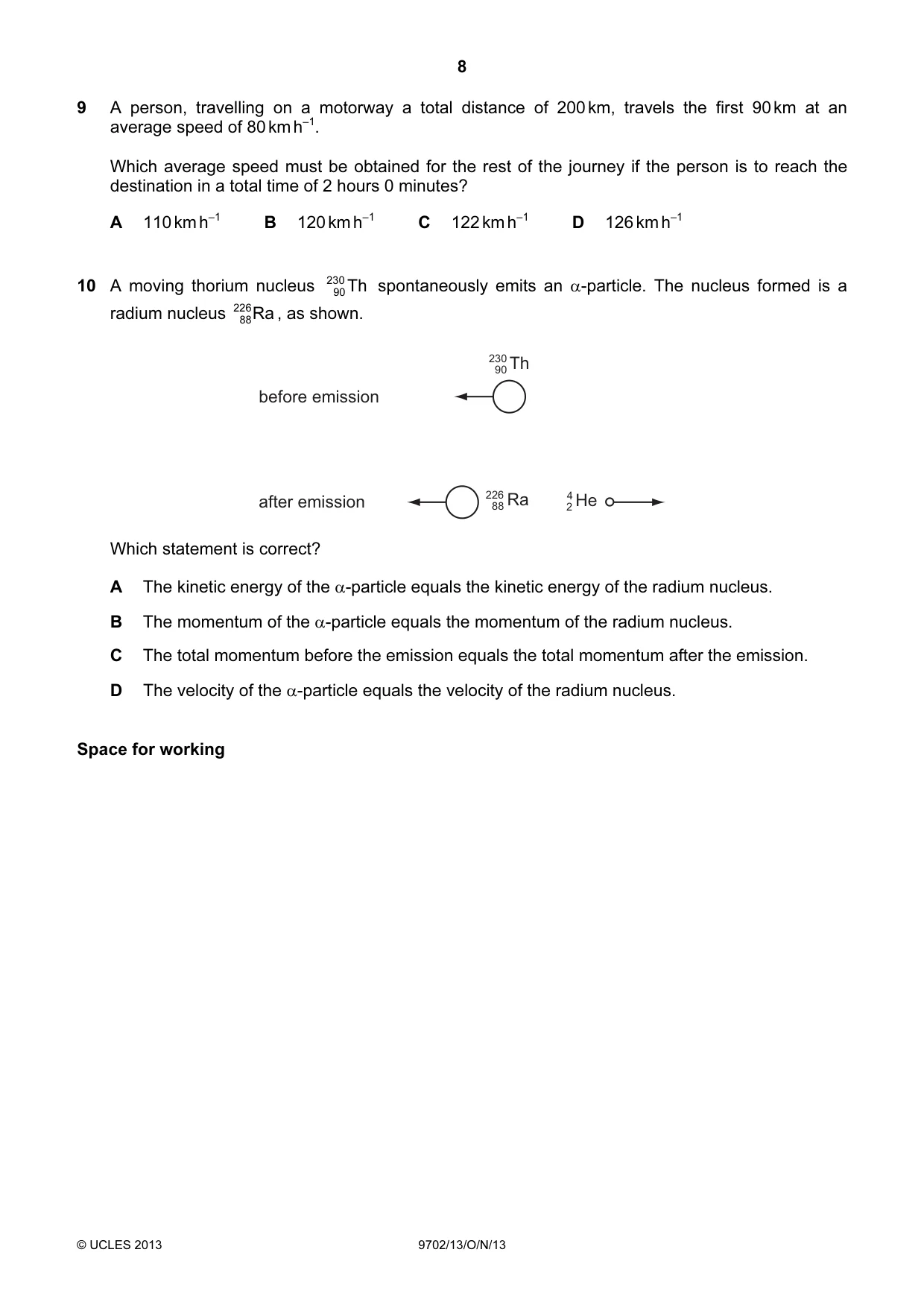
Q10 · A moving thorium nucleus 230 Th spontaneously emits an α-particle
10 A moving thorium nucleus 230 Th spontaneously emits an α-particle. The nucleus formed is a 90 radium nucleus 226 Ra , as shown. 88 230 Th 90 before emission after emission 226 88 Ra 4 He 2 Which statement is correct? A The kinetic energy of the α-particle equals the kinetic energy of the radium nucleus. B The momentum of the α-particle equals the momentum of the radium nucleus. C The total momentum before the emission equals the total momentum after the emission. D The velocity of the α-particle equals the velocity of the radium nucleus. Space for working
Mark scheme: C
Q11 · An isolated system consists of two bodies on which no external forces act
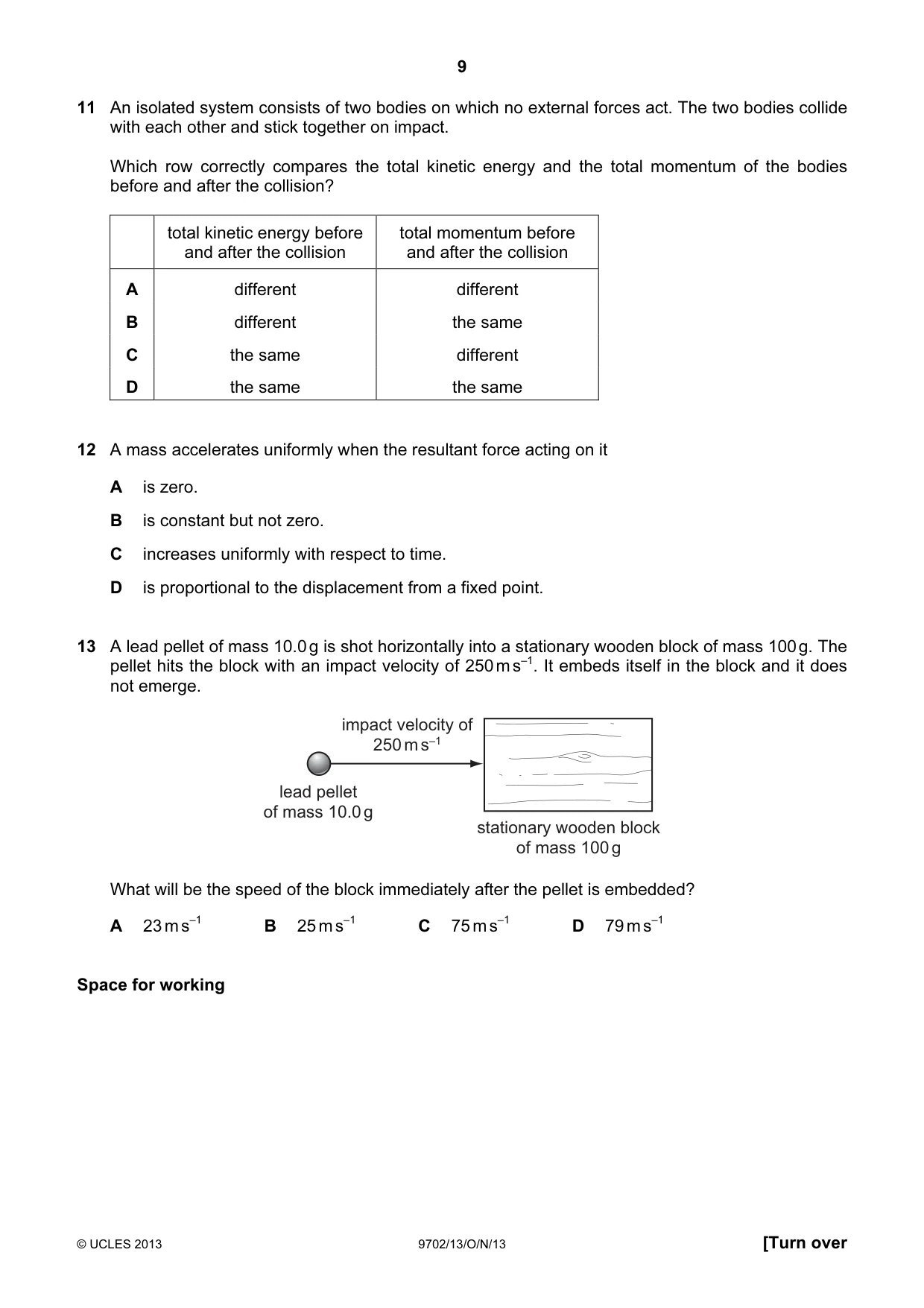
11 An isolated system consists of two bodies on which no external forces act. The two bodies collide with each other and stick together on impact. Which row correctly compares the total kinetic energy and the total momentum of the bodies before and after the collision? total kinetic energy before total momentum before and after the collision and after the collision A different different B different the same C the same different D the same the same
Mark scheme: B
Q12 · A mass accelerates uniformly when the resultant force acting on it A is zero
12 A mass accelerates uniformly when the resultant force acting on it A is zero. B is constant but not zero. C increases uniformly with respect to time. D is proportional to the displacement from a fixed point.
Mark scheme: B
Q13 · A lead pellet of mass 10.0 g is shot horizontally into a stationary wooden block of mass…
13 A lead pellet of mass 10.0 g is shot horizontally into a stationary wooden block of mass 100 g. The pellet hits the block with an impact velocity of 250 m s–1. It embeds itself in the block and it does not emerge. impact velocity of 250 m s–1 lead pellet of mass 10.0 g stationary wooden block of mass 100 g What will be the speed of the block immediately after the pellet is embedded? A 23 m s–1 B 25 m s–1 C 75 m s–1 D 79 m s–1 Space for working
Mark scheme: A
Q14 · A cupboard is attached to a wall by a screw
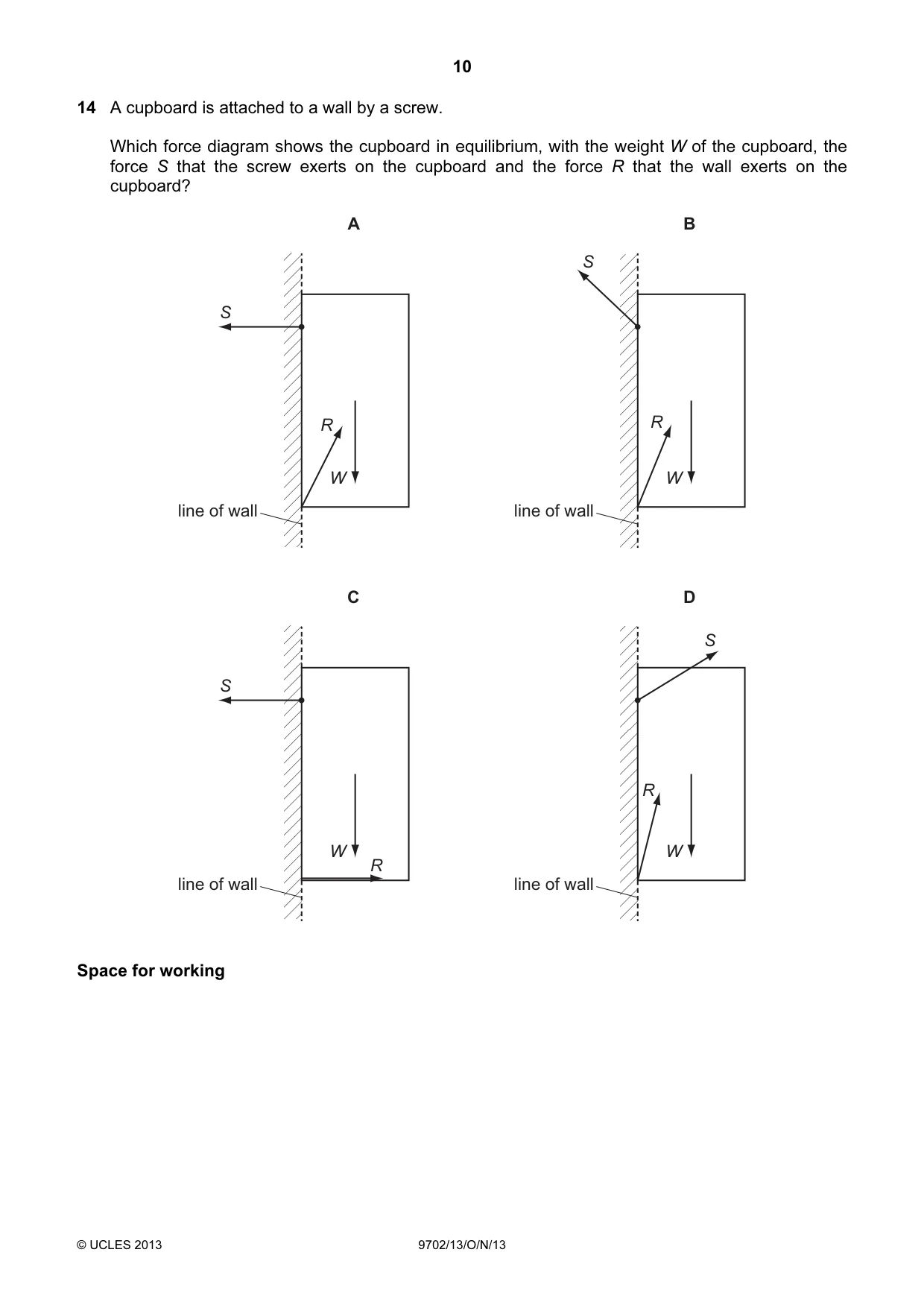
14 A cupboard is attached to a wall by a screw. Which force diagram shows the cupboard in equilibrium, with the weight W of the cupboard, the force S that the screw exerts on the cupboard and the force R that the wall exerts on the cupboard? A B S S R R W W line of wall line of wall C D S S R W W R line of wall line of wall Space for working
Mark scheme: B
Q15 · A diving board of length 5.0 m is hinged at one end and supported 2.0 m from this end by…
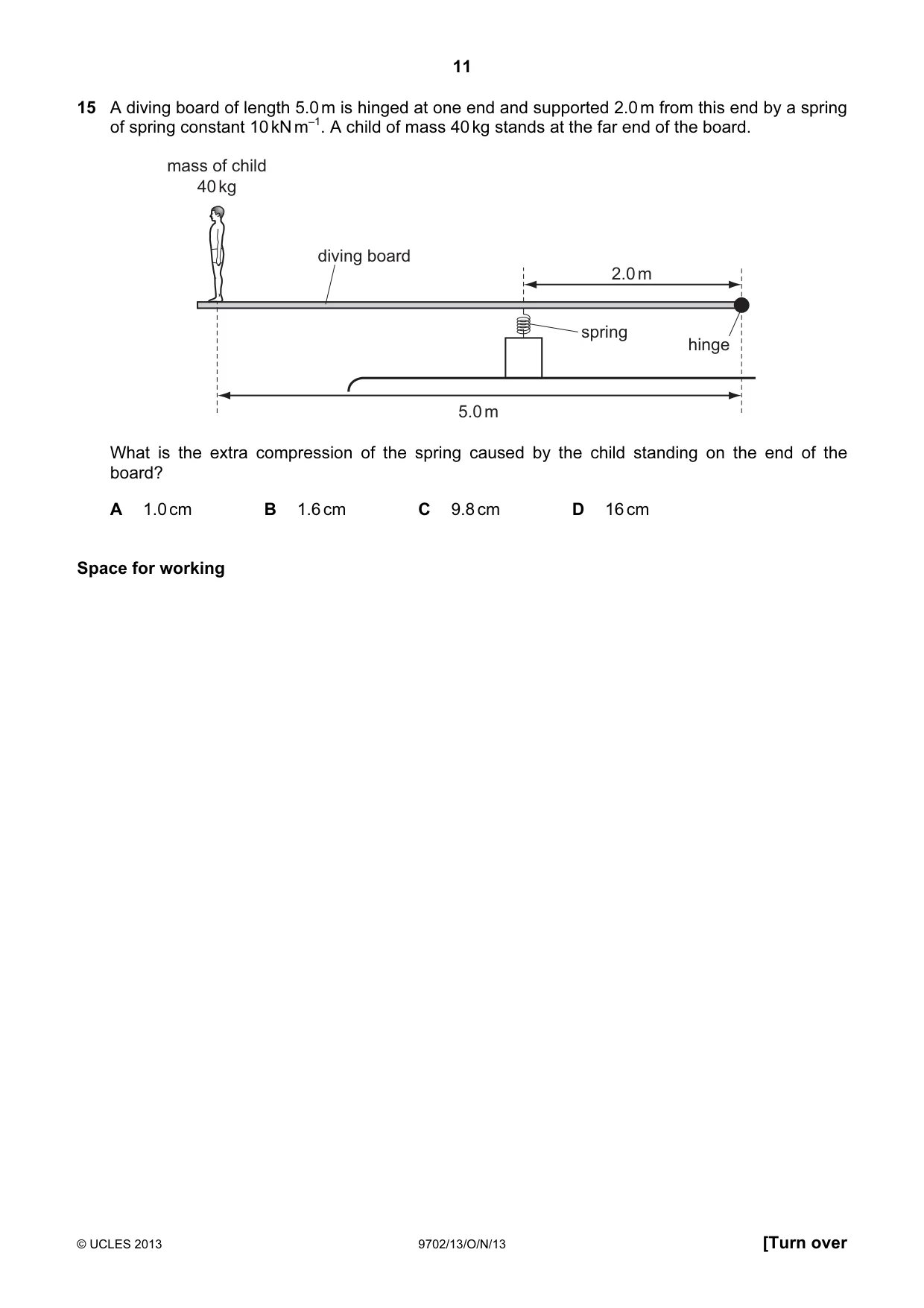
15 A diving board of length 5.0 m is hinged at one end and supported 2.0 m from this end by a spring of spring constant 10 kN m–1. A child of mass 40 kg stands at the far end of the board. mass of child 40 kg diving board 2.0 m spring hinge 5.0 m What is the extra compression of the spring caused by the child standing on the end of the board? A 1.0 cm B 1.6 cm C 9.8 cm D 16 cm Space for working
Mark scheme: C
Q16 · The graph shows how the total resistive force acting on a train varies with its speed
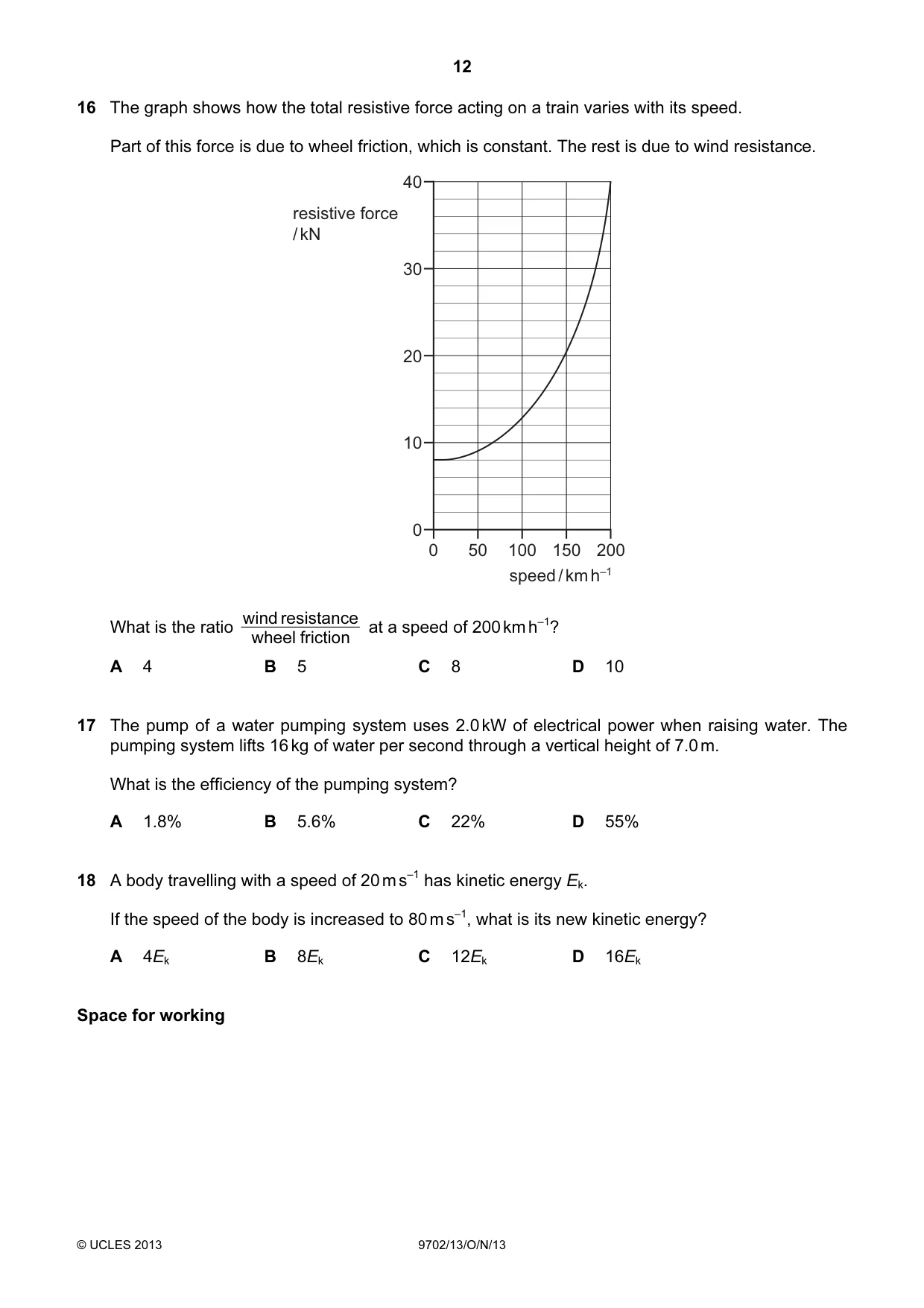
16 The graph shows how the total resistive force acting on a train varies with its speed. Part of this force is due to wheel friction, which is constant. The rest is due to wind resistance. 40 resistive force / kN 30 20 10 0 0 50 100 150 200 speed / km h–1 wind resistance What is the ratio at a speed of 200 km h–1? wheel friction A 4 B 5 C 8 D 10
Mark scheme: A
Q17 · The pump of a water pumping system uses 2.0 kW of electrical power when raising water
17 The pump of a water pumping system uses 2.0 kW of electrical power when raising water. The pumping system lifts 16 kg of water per second through a vertical height of 7.0 m. What is the efficiency of the pumping system? A 1.8% B 5.6% C 22% D 55%
Mark scheme: D
Q18 · A body travelling with a speed of 20 m s–1 has kinetic energy Ek
18 A body travelling with a speed of 20 m s–1 has kinetic energy Ek. If the speed of the body is increased to 80 m s–1, what is its new kinetic energy? A 4Ek B 8Ek C 12Ek D 16Ek Space for working
Mark scheme: D
More questions on Gravitational potential energy and kinetic energy
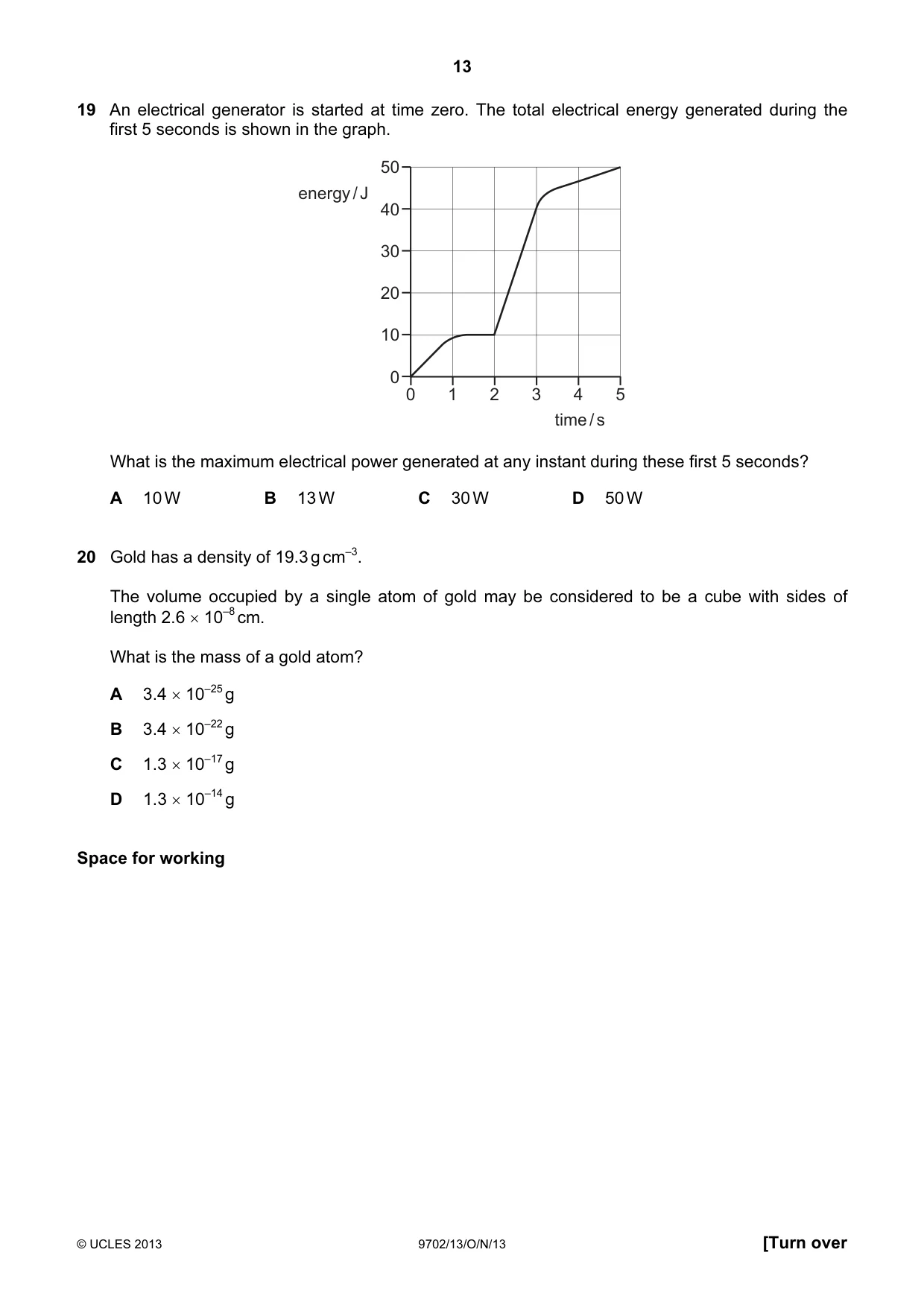
Q19 · An electrical generator is started at time zero
19 An electrical generator is started at time zero. The total electrical energy generated during the first 5 seconds is shown in the graph. 50 energy / J 40 30 20 10 0 0 1 2 3 4 5 time / s What is the maximum electrical power generated at any instant during these first 5 seconds? A 10 W B 13 W C 30 W D 50 W
Mark scheme: C
Q20 · Gold has a density of 19.3 g cm–3
20 Gold has a density of 19.3 g cm–3. The volume occupied by a single atom of gold may be considered to be a cube with sides of length 2.6 × 10⁻⁸ cm. What is the mass of a gold atom? A 3.4 × 10⁻²⁵ g B 3.4 × 10⁻²² g C 1.3 × 10⁻¹⁷ g D 1.3 × 10⁻¹⁴ g Space for working
Mark scheme: B
Q21 · In an experiment to demonstrate Brownian motion, a transparent container is filled with…
21 In an experiment to demonstrate Brownian motion, a transparent container is filled with smoke particles suspended in air. What can be seen when the contents of the container are strongly illuminated and viewed through a microscope? A molecules in random motion B molecules vibrating regularly C smoke particles in random motion D smoke particles vibrating regularly
Mark scheme: C
Q22 · A lift is supported by two steel cables each of length 20 m
22 A lift is supported by two steel cables each of length 20 m. Each of the cables consists of 100 parallel steel wires, each wire of cross-sectional area 3.2 × 10⁻⁶ m2. The Young modulus of steel is 2.1 × 10¹¹ N m–2. Which distance does the lift move downward when a man of mass 70 kg steps into it? A 0.010 mm B 0.020 mm C 0.10 mm D 0.20 mm
Mark scheme: C
Q23 · What is equal to the Young modulus of a material that is extended elastically within the…
23 What is equal to the Young modulus of a material that is extended elastically within the limit of proportionality? A area under the force-extension graph B area under the stress-strain graph C gradient of the force-extension graph D gradient of the stress-strain graph Space for working
Mark scheme: D
Q24 · Electromagnetic waves from an unknown source in space were found to be significantly…
24 Electromagnetic waves from an unknown source in space were found to be significantly diffracted when passing through gaps of the order of 10–5 m. Which type of wave are they most likely to be? A radio waves B microwaves C infra-red waves D ultraviolet waves
Mark scheme: C
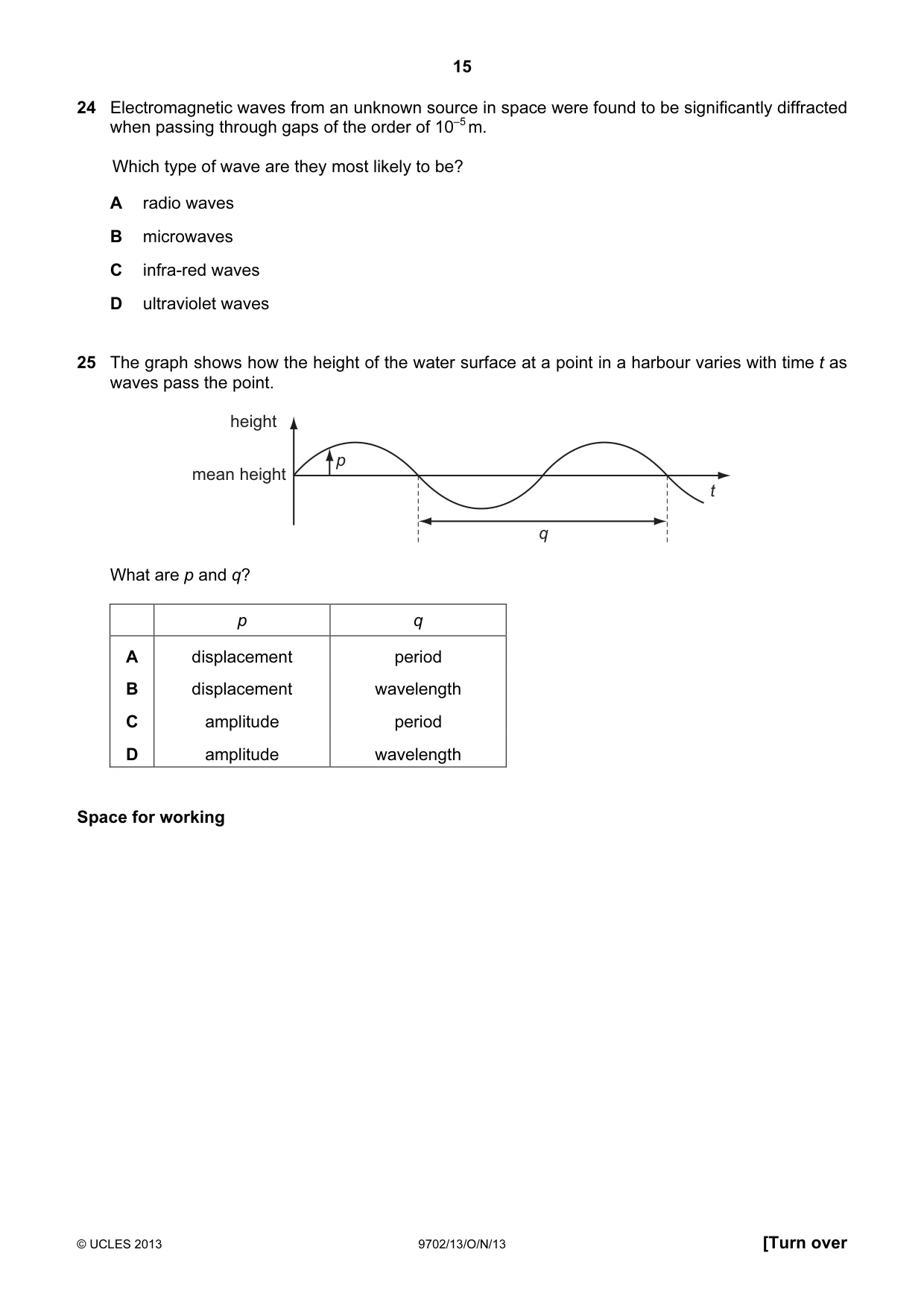
Q25 · The graph shows how the height of the water surface at a point in a harbour varies with…
25 The graph shows how the height of the water surface at a point in a harbour varies with time t as waves pass the point. height p mean height t q What are p and q? p q A displacement period B displacement wavelength C amplitude period D amplitude wavelength Space for working
Mark scheme: A
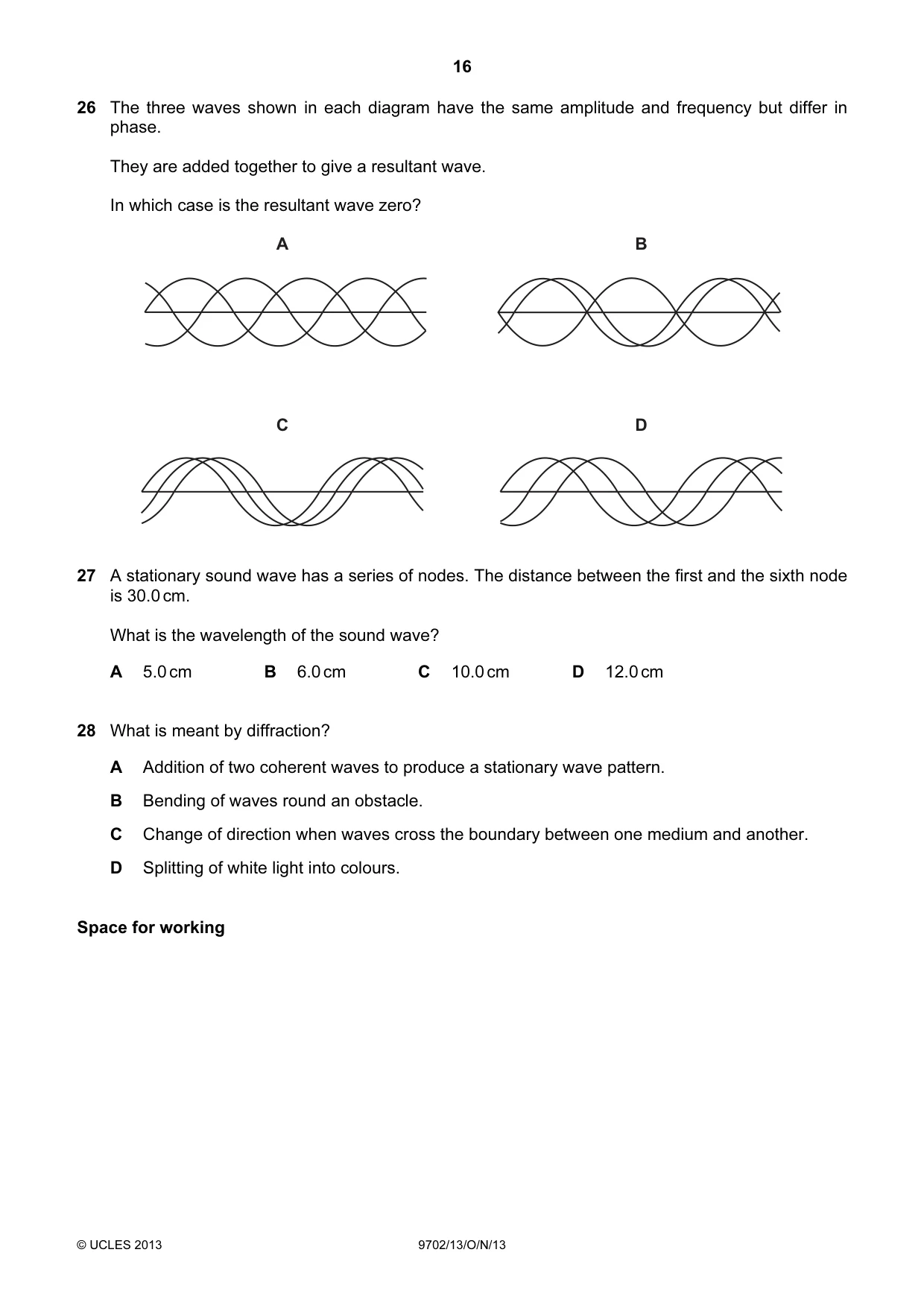
Q26 · The three waves shown in each diagram have the same amplitude and frequency but differ in…
26 The three waves shown in each diagram have the same amplitude and frequency but differ in phase. They are added together to give a resultant wave. In which case is the resultant wave zero? A B C D
Mark scheme: A
Q27 · A stationary sound wave has a series of nodes
27 A stationary sound wave has a series of nodes. The distance between the first and the sixth node is 30.0 cm. What is the wavelength of the sound wave? A 5.0 cm B 6.0 cm C 10.0 cm D 12.0 cm
Mark scheme: D
Q28 · What is meant by diffraction?
28 What is meant by diffraction? A Addition of two coherent waves to produce a stationary wave pattern. B Bending of waves round an obstacle. C Change of direction when waves cross the boundary between one medium and another. D Splitting of white light into colours. Space for working
Mark scheme: B
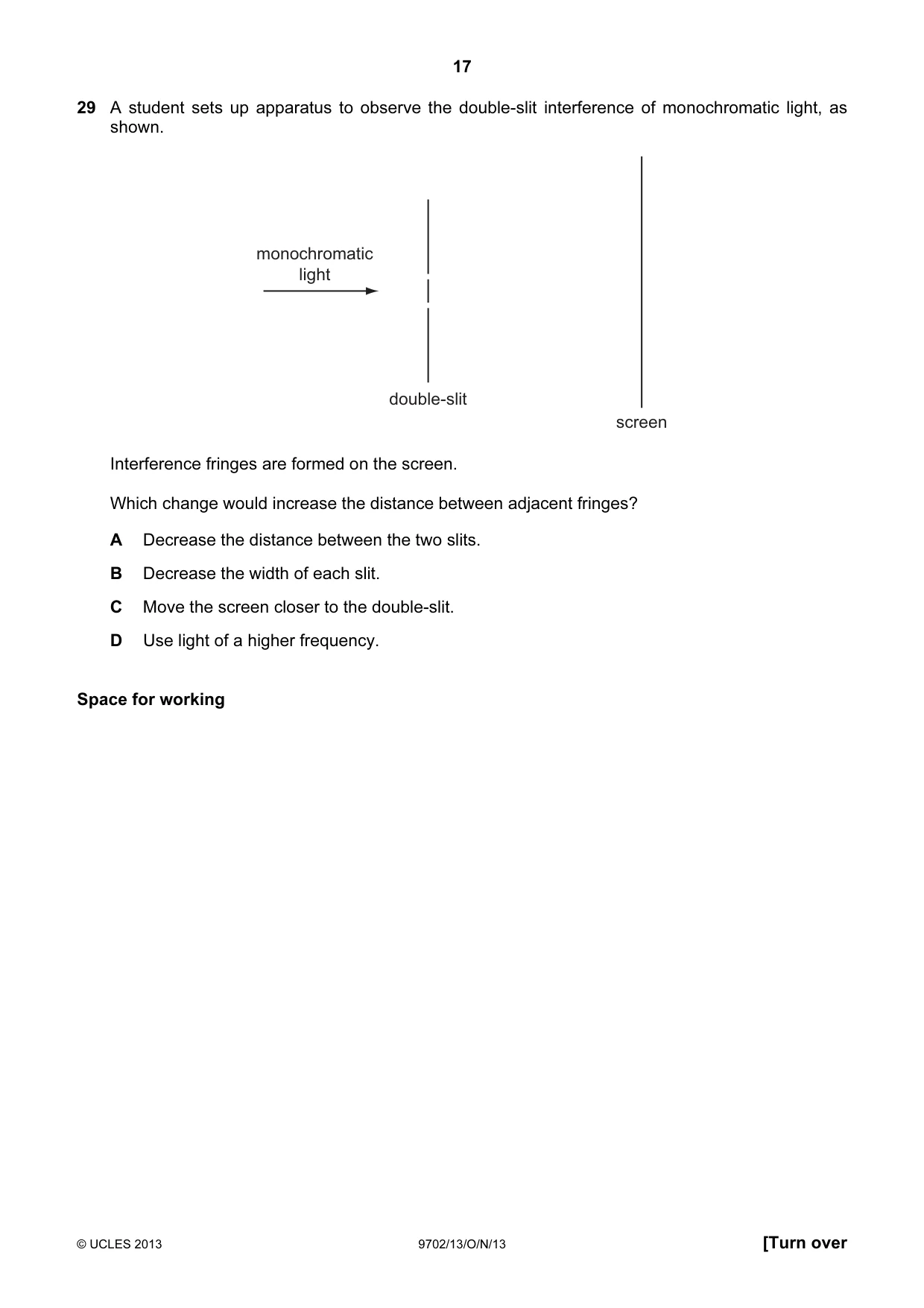
Q29 · A student sets up apparatus to observe the double-slit interference of monochromatic…
29 A student sets up apparatus to observe the double-slit interference of monochromatic light, as shown. monochromatic light double-slit screen Interference fringes are formed on the screen. Which change would increase the distance between adjacent fringes? A Decrease the distance between the two slits. B Decrease the width of each slit. C Move the screen closer to the double-slit. D Use light of a higher frequency. Space for working
Mark scheme: A
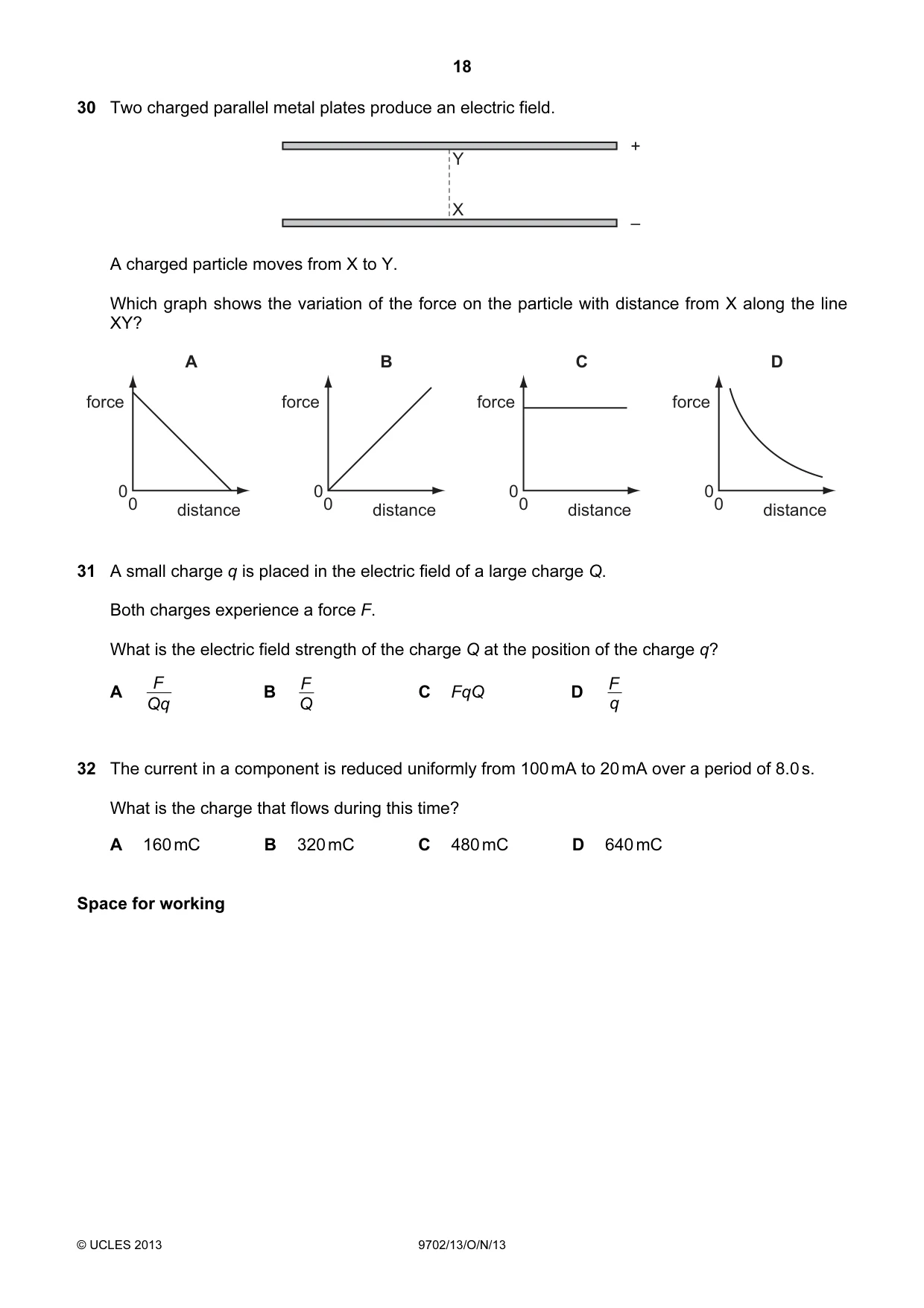
Q30 · Two charged parallel metal plates produce an electric field
30 Two charged parallel metal plates produce an electric field. + Y X – A charged particle moves from X to Y. Which graph shows the variation of the force on the particle with distance from X along the line XY? A B C D force force force force 00 00 00 00 distance distance distance distance
Mark scheme: C
Q31 · A small charge q is placed in the electric field of a large charge Q
31 A small charge q is placed in the electric field of a large charge Q. Both charges experience a force F. What is the electric field strength of the charge Q at the position of the charge q? F F F A B C FqQ D Qq Q q
Mark scheme: D
Q32 · The current in a component is reduced uniformly from 100 mA to 20 mA over a period of 8.0…
32 The current in a component is reduced uniformly from 100 mA to 20 mA over a period of 8.0 s. What is the charge that flows during this time? A 160 mC B 320 mC C 480 mC D 640 mC Space for working
Mark scheme: C
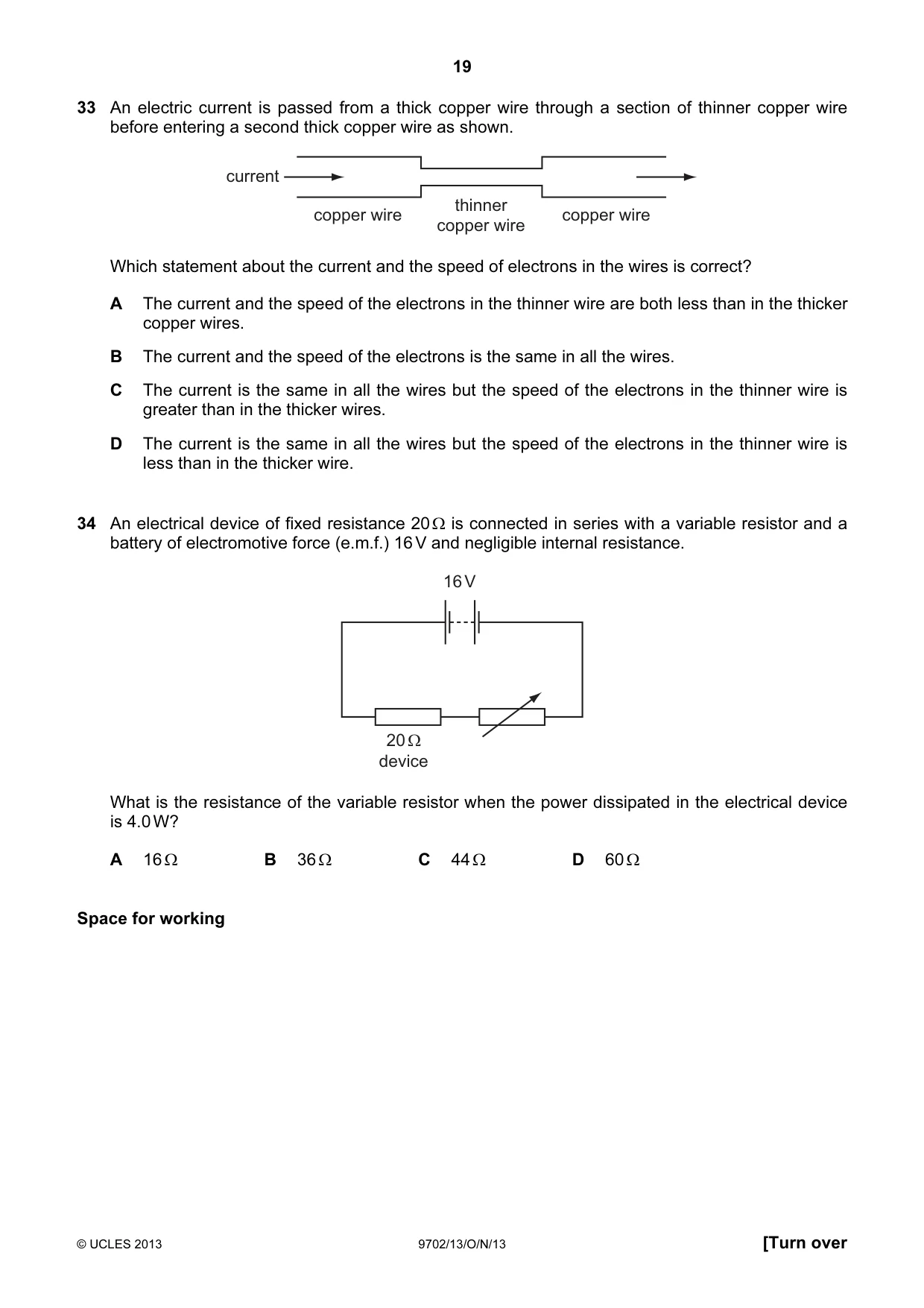
Q33 · An electric current is passed from a thick copper wire through a section of thinner…
33 An electric current is passed from a thick copper wire through a section of thinner copper wire before entering a second thick copper wire as shown. current thinner copper wire copper wire copper wire Which statement about the current and the speed of electrons in the wires is correct? A The current and the speed of the electrons in the thinner wire are both less than in the thicker copper wires. B The current and the speed of the electrons is the same in all the wires. C The current is the same in all the wires but the speed of the electrons in the thinner wire is greater than in the thicker wires. D The current is the same in all the wires but the speed of the electrons in the thinner wire is less than in the thicker wire.
Mark scheme: C
Q34 · An electrical device of fixed resistance 20 Ω is connected in series with a variable…
34 An electrical device of fixed resistance 20 Ω is connected in series with a variable resistor and a battery of electromotive force (e.m.f.) 16 V and negligible internal resistance. 16 V 20 Ω device What is the resistance of the variable resistor when the power dissipated in the electrical device is 4.0 W? A 16 Ω B 36 Ω C 44 Ω D 60 Ω Space for working
Mark scheme: A
Q35 · A copper wire is cylindrical and has resistance R
35 A copper wire is cylindrical and has resistance R. What will be the resistance of a copper wire of twice the length and twice the radius? R R A B C R D 2R 4 2
Mark scheme: B
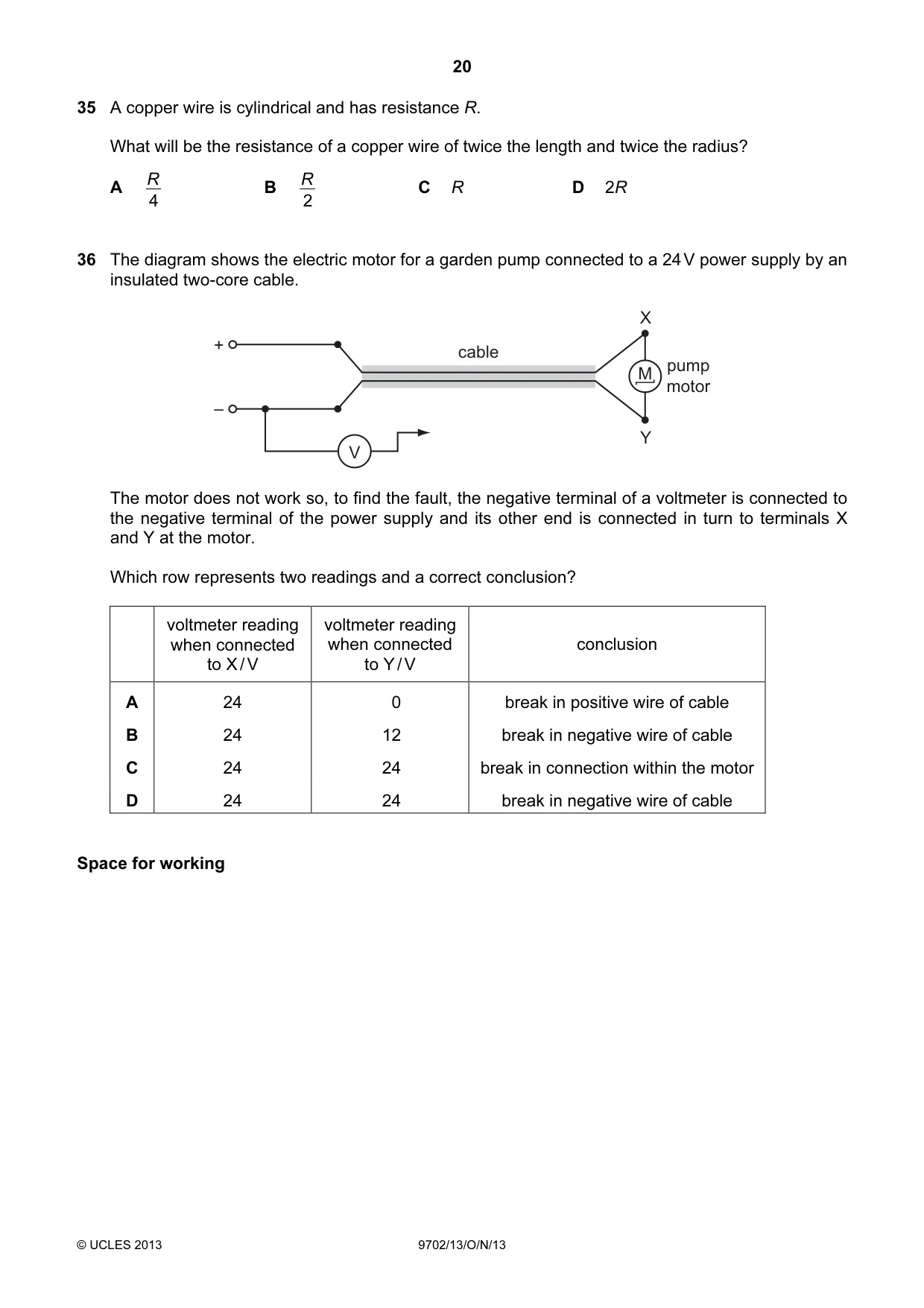
Q36 · The diagram shows the electric motor for a garden pump connected to a 24 V power supply…
36 The diagram shows the electric motor for a garden pump connected to a 24 V power supply by an insulated two-core cable. X + cable pump M motor – Y V The motor does not work so, to find the fault, the negative terminal of a voltmeter is connected to the negative terminal of the power supply and its other end is connected in turn to terminals X and Y at the motor. Which row represents two readings and a correct conclusion? voltmeter reading voltmeter reading when connected when connected conclusion to X / V to Y / V A 24 0 break in positive wire of cable B 24 12 break in negative wire of cable C 24 24 break in connection within the motor D 24 24 break in negative wire of cable Space for working
Mark scheme: D
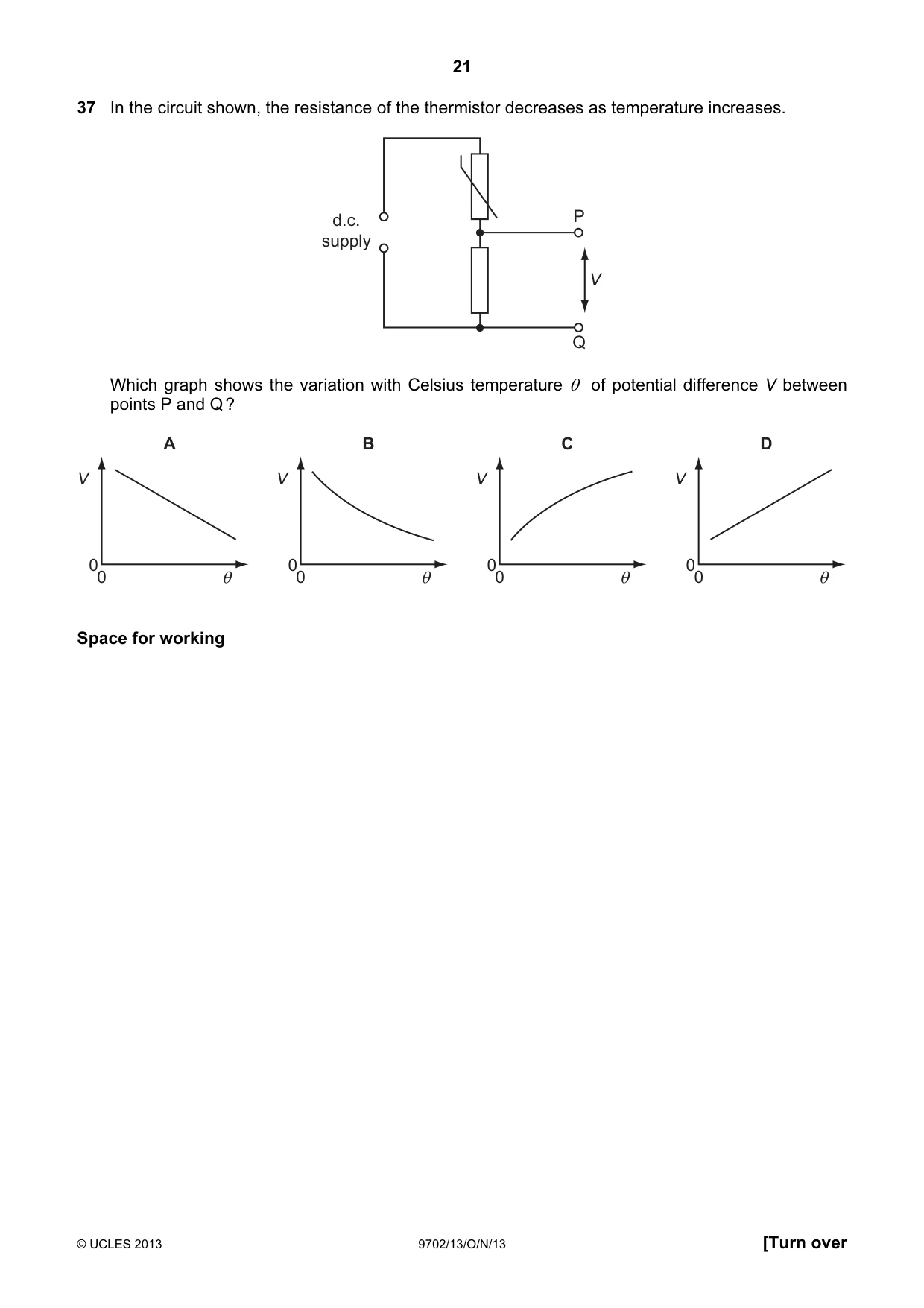
Q37 · In the circuit shown, the resistance of the thermistor decreases as temperature increases
37 In the circuit shown, the resistance of the thermistor decreases as temperature increases. d.c. P supply V Q Which graph shows the variation with Celsius temperature θ of potential difference V between points P and Q ? A B C D V V V V 00 00 00 00 θ θ θ θ Space for working
Mark scheme: C
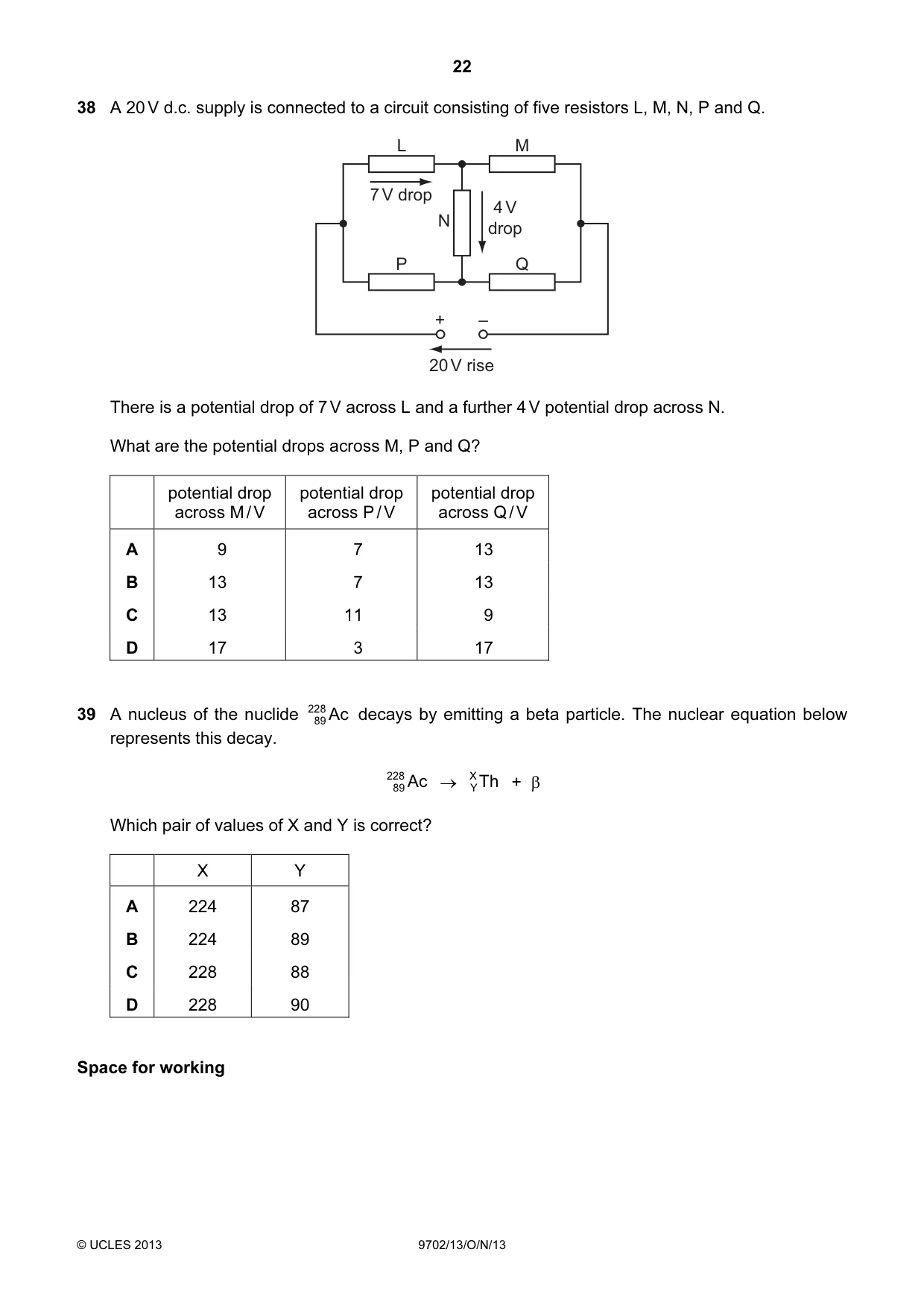
Q38 · A 20 V d.c
38 A 20 V d.c. supply is connected to a circuit consisting of five resistors L, M, N, P and Q. L M 7 V drop 4 V N drop P Q + – 20 V rise There is a potential drop of 7 V across L and a further 4 V potential drop across N. What are the potential drops across M, P and Q? potential drop potential drop potential drop across M / V across P / V across Q / V A 9 7 13 B 13 7 13 C 13 11 9 D 17 3 17
Mark scheme: C
Q39 · A nucleus of the nuclide 228 Ac decays by emitting a beta particle
39 A nucleus of the nuclide 228 Ac decays by emitting a beta particle. The nuclear equation below 89 represents this decay. 228 Ac → Th X + β 89 Y Which pair of values of X and Y is correct? X Y A 224 87 B 224 89 C 228 88 D 228 90 Space for working
Mark scheme: D
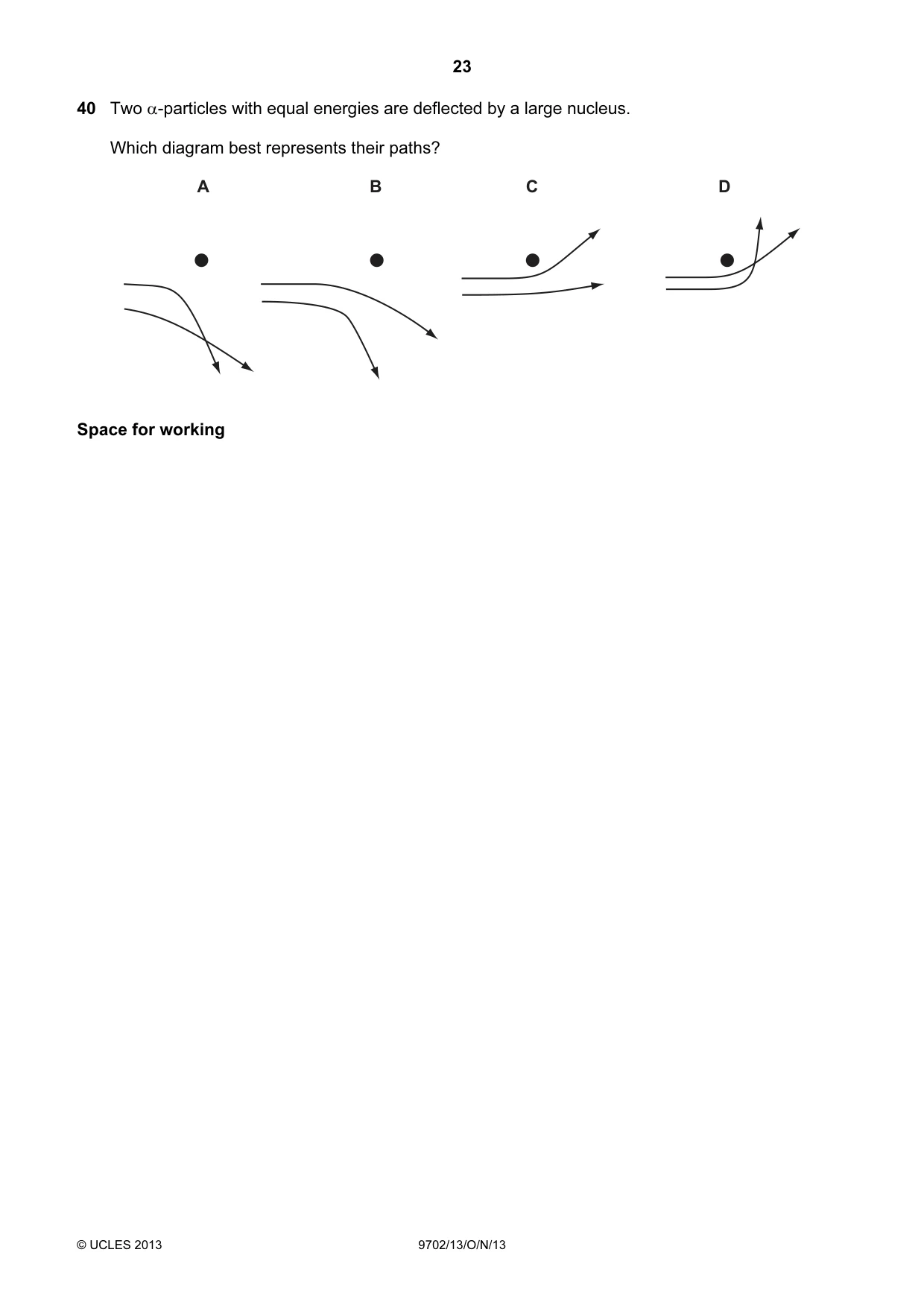
Q40 · Two α-particles with equal energies are deflected by a large nucleus
40 Two α-particles with equal energies are deflected by a large nucleus. Which diagram best represents their paths? A B C D Space for working
Mark scheme: A
What was in this paper
The subtopics covered by these 40 questions, and how many questions each got. Open one in a new tab to see every Cambridge question on it.
3Linear momentum and its conservation3Diffraction2Electric current2Equations of motion2Errors and uncertainties2Interference2Potential dividers2SI units2Stress and strain2Atoms, nuclei and radiation1Density and pressure1Electric field of a point charge1Electric fields and field lines1Equilibrium of forces1Gravitational potential energy and kinetic energy1Kinetic theory of gases1Kirchhoff’s laws1Momentum and Newton’s laws of motion1Non-uniform motion1Physical quantities1Practical circuits1Progressive waves1Resistance and resistivity1Scalars and vectors1Stationary waves1Turning effects of forces1Uniform electric fields1What you needed in this session
Cambridge’s own grade thresholds for 2013 Oct/Nov, Paper 1 · Variant 3. A higher threshold means an easier paper — the bar moves with how the cohort did.