Cambridge A Level Physics 9702 — 2011 Oct/Nov Paper 1 · Variant 1
9702/11/O/N/11 · 40 questions · 40 marks · ≈45 min
The question paper and its mark scheme, free to read here and free to download. This is Cambridge’s own paper, exactly as it was sat.
Question paper28 pages
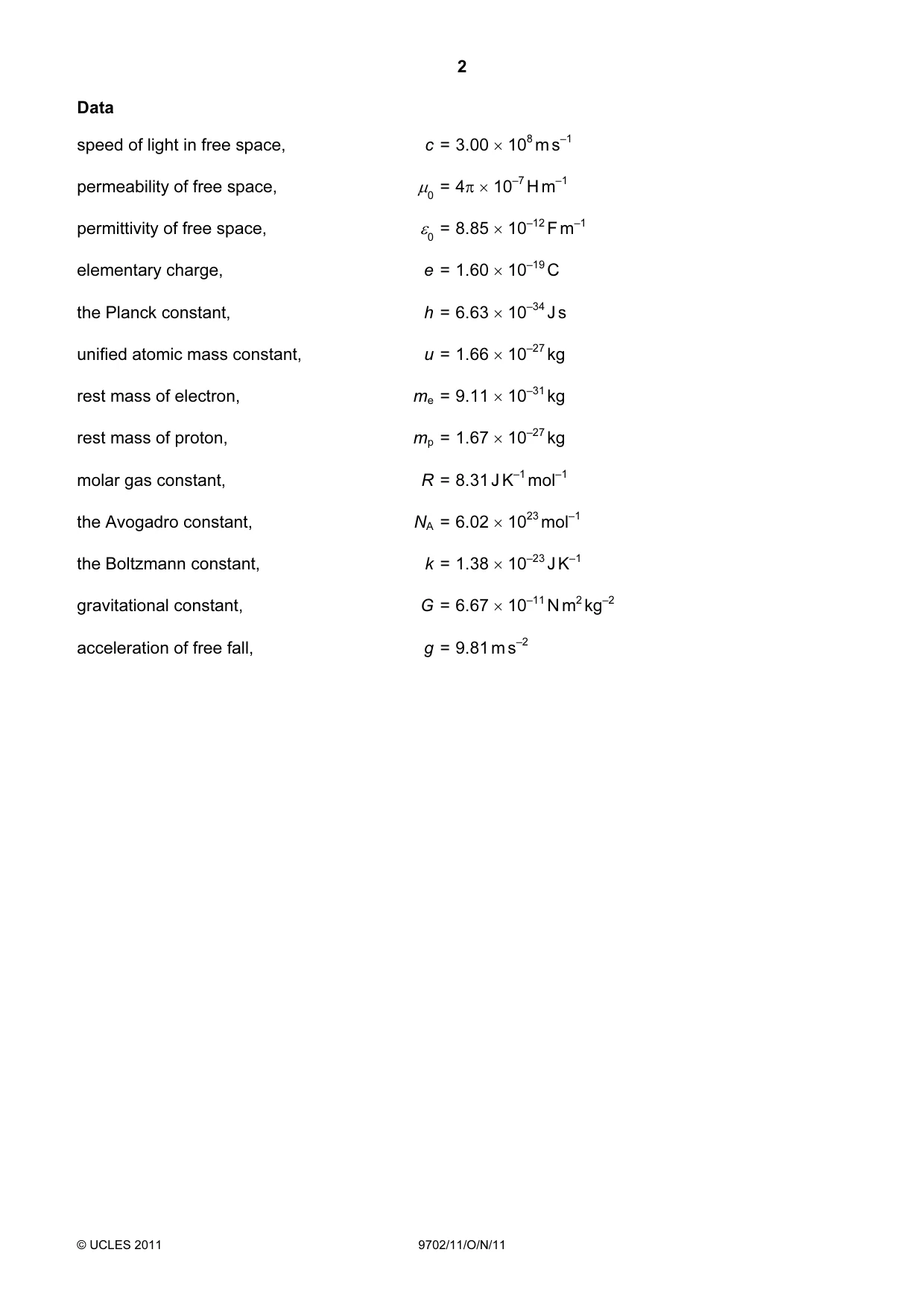
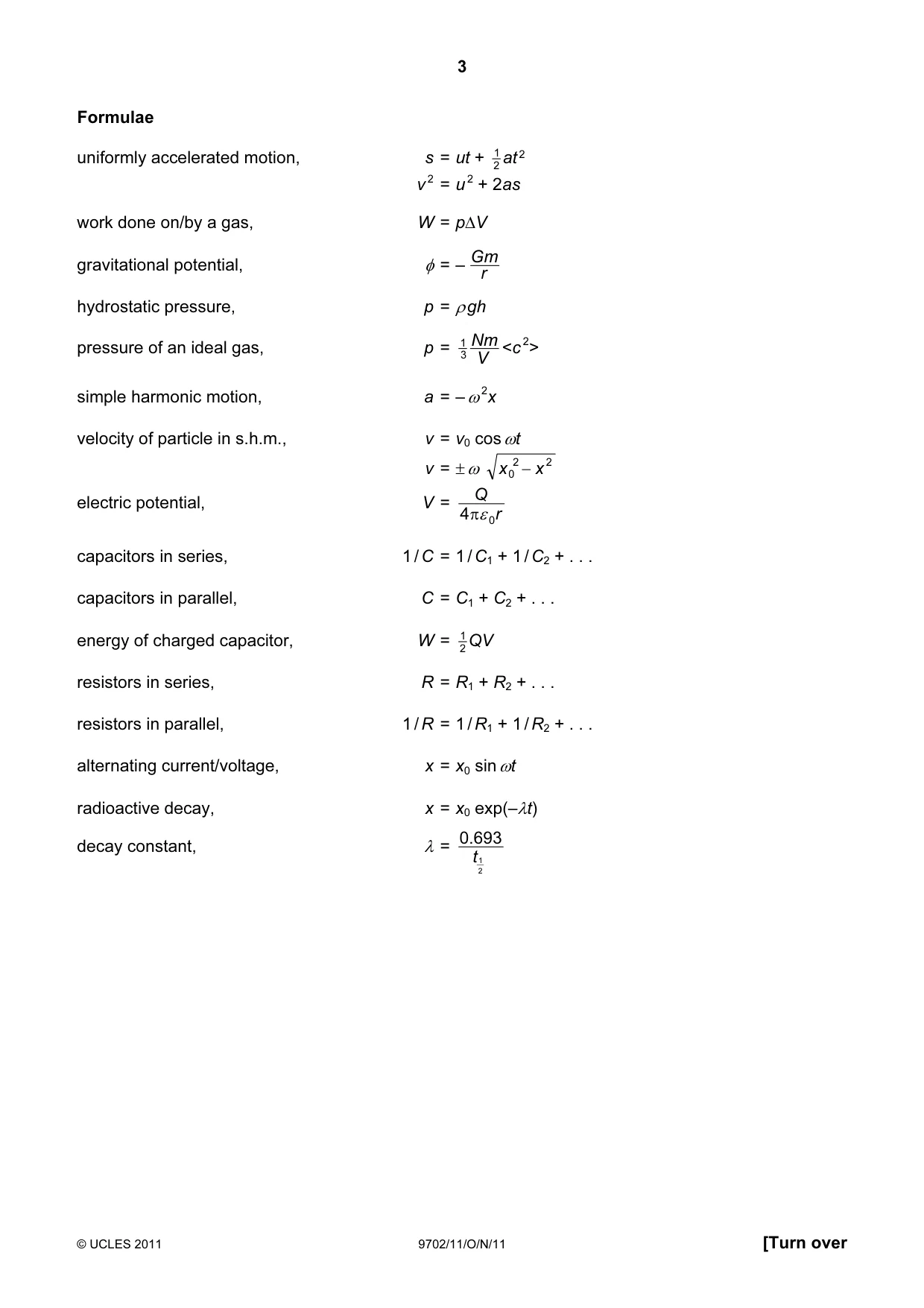
Mark scheme2 pages
Answers below. Sit the paper first if you are practising.
Questions as text
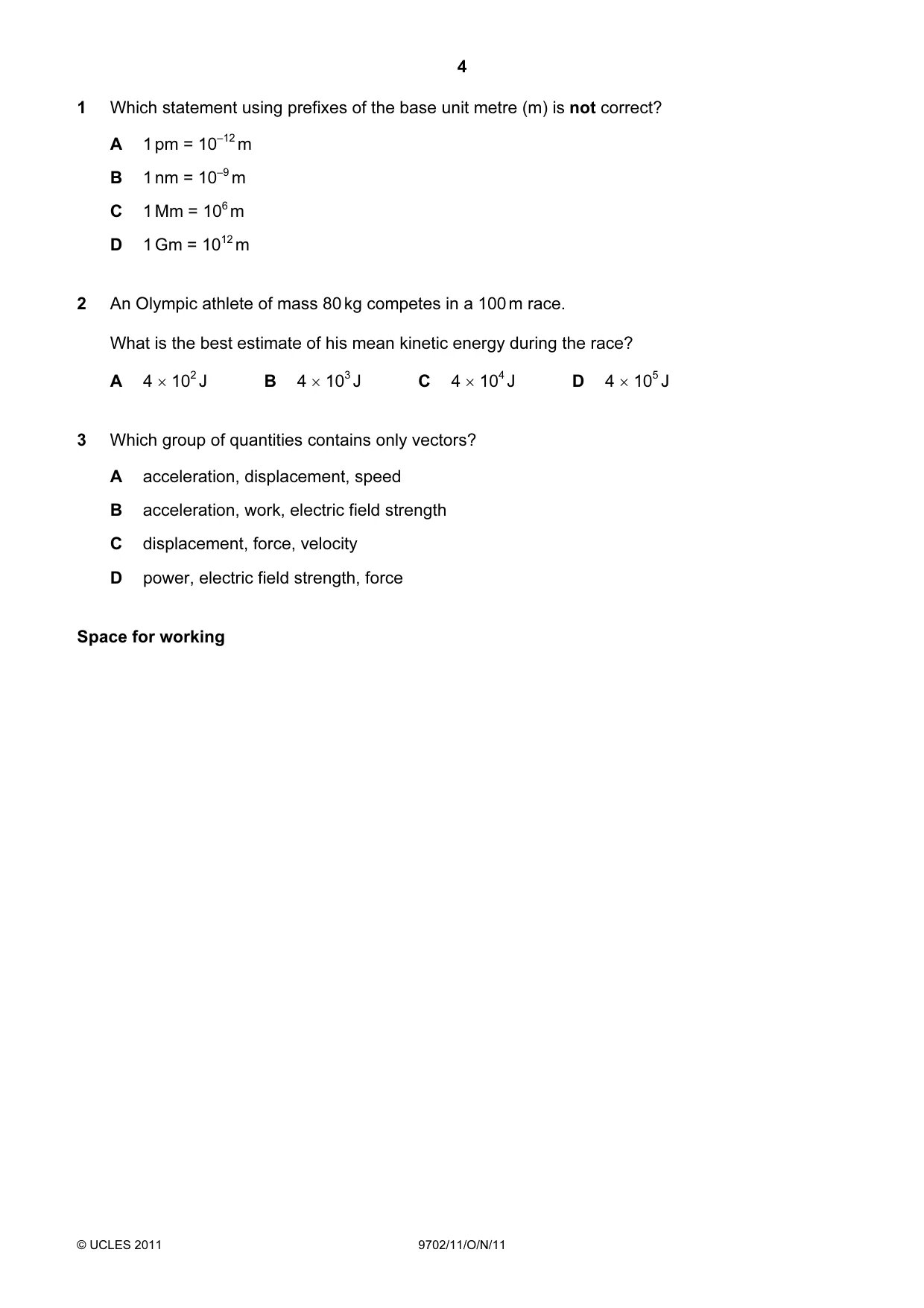
Q1 · Which statement using prefixes of the base unit metre (m) is not correct?
1 Which statement using prefixes of the base unit metre (m) is not correct? A 1 pm = 10–12 m B 1 nm = 10–9 m C 1 Mm = 106 m D 1 Gm = 1012 m
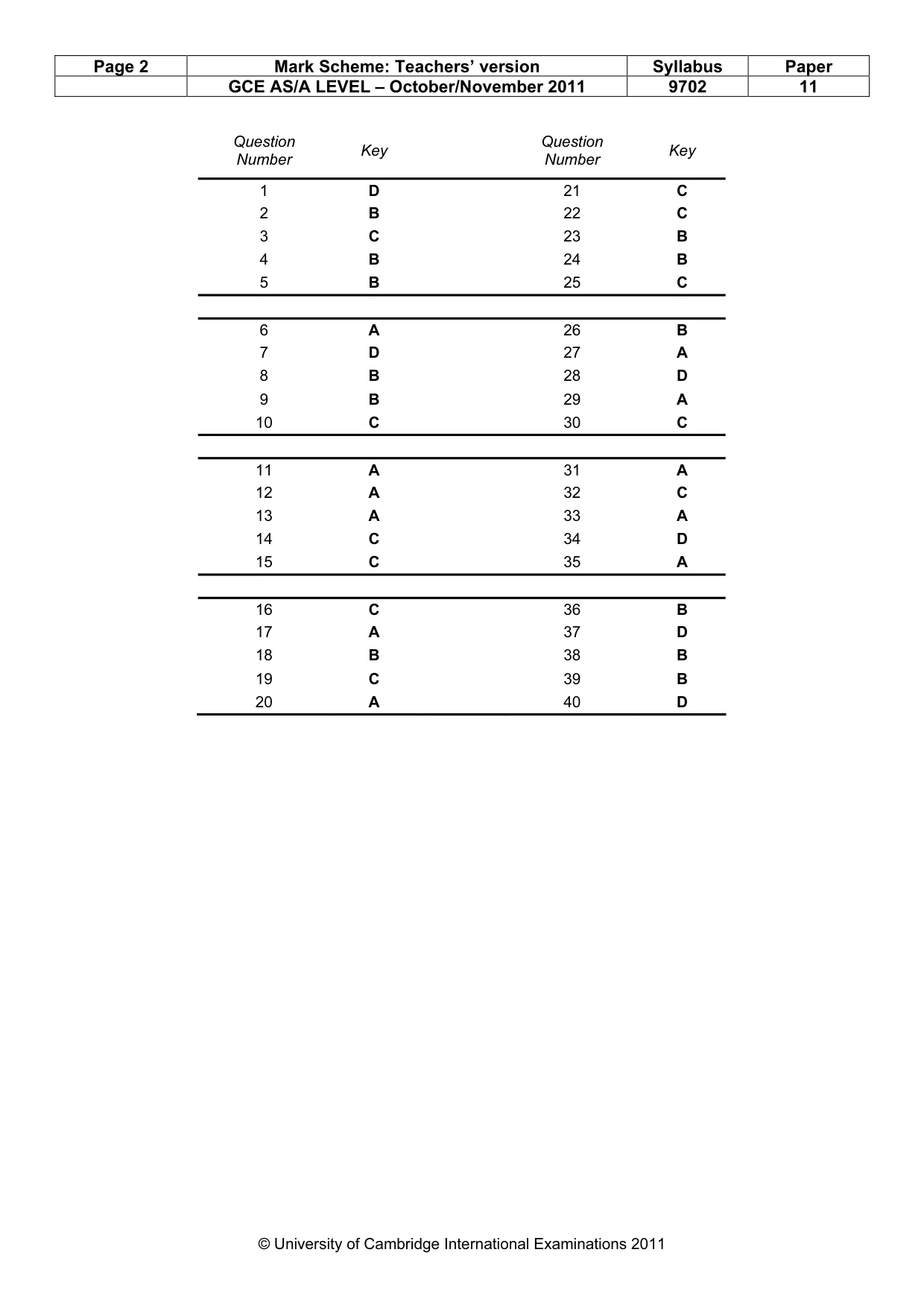
Mark scheme: D
Q2 · An Olympic athlete of mass 80 kg competes in a 100 m race
2 An Olympic athlete of mass 80 kg competes in a 100 m race. What is the best estimate of his mean kinetic energy during the race? A 4 × 10² J B 4 × 10³ J C 4 × 10⁴ J D 4 × 10⁵ J
Mark scheme: B
More questions on Gravitational potential energy and kinetic energy
Q3 · Which group of quantities contains only vectors?
3 Which group of quantities contains only vectors? A acceleration, displacement, speed B acceleration, work, electric field strength C displacement, force, velocity D power, electric field strength, force Space for working
Mark scheme: C
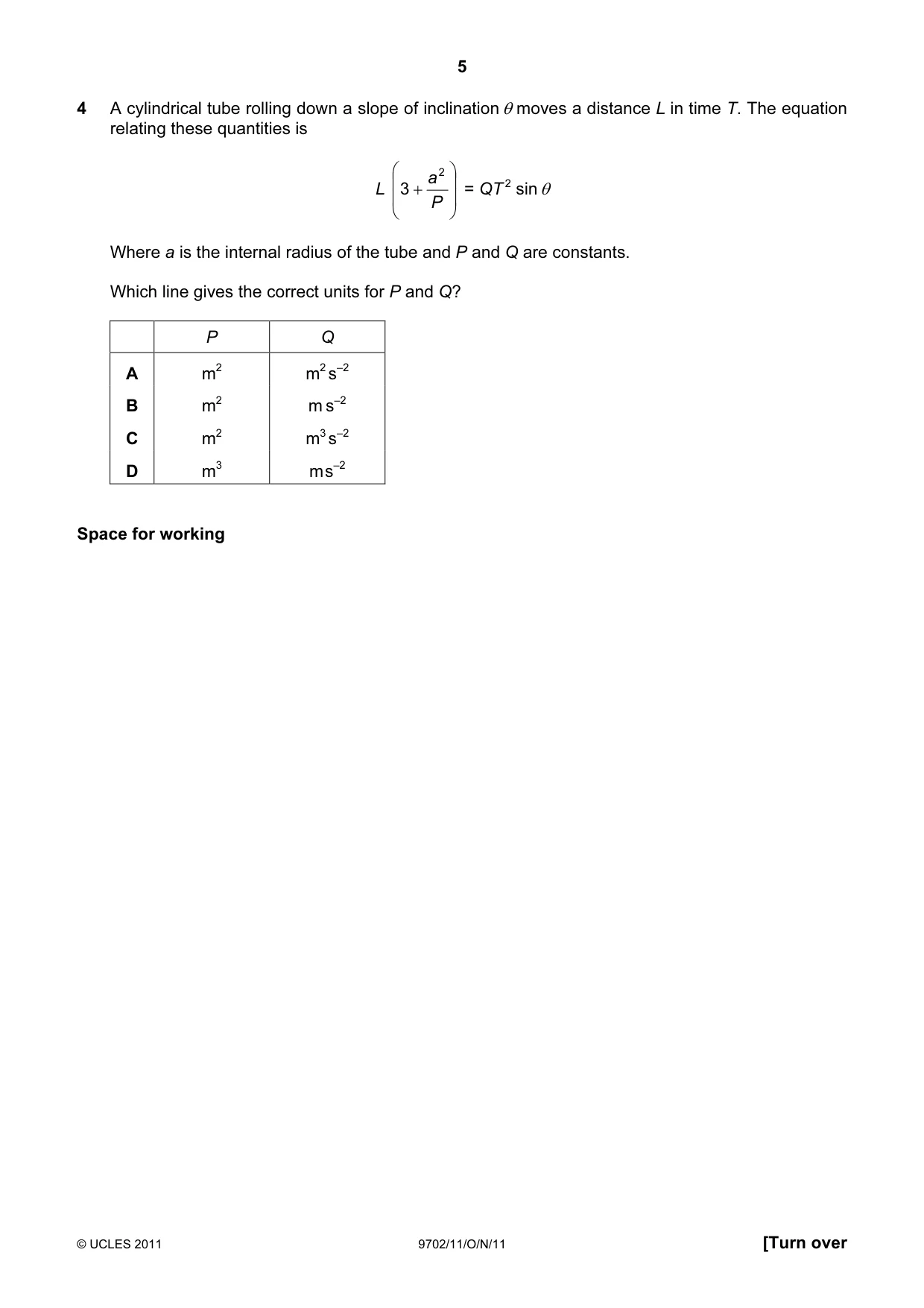
Q4 · A cylindrical tube rolling down a slope of inclination θ moves a distance L in time T
4 A cylindrical tube rolling down a slope of inclination θ moves a distance L in time T. The equation relating these quantities is a2 L 3 + P = QT 2 sin θ Where a is the internal radius of the tube and P and Q are constants. Which line gives the correct units for P and Q? P Q A m2 m2 s–2 B m2 m s–2 C m2 m3 s–2 D m3 m s–2 Space for working
Mark scheme: B
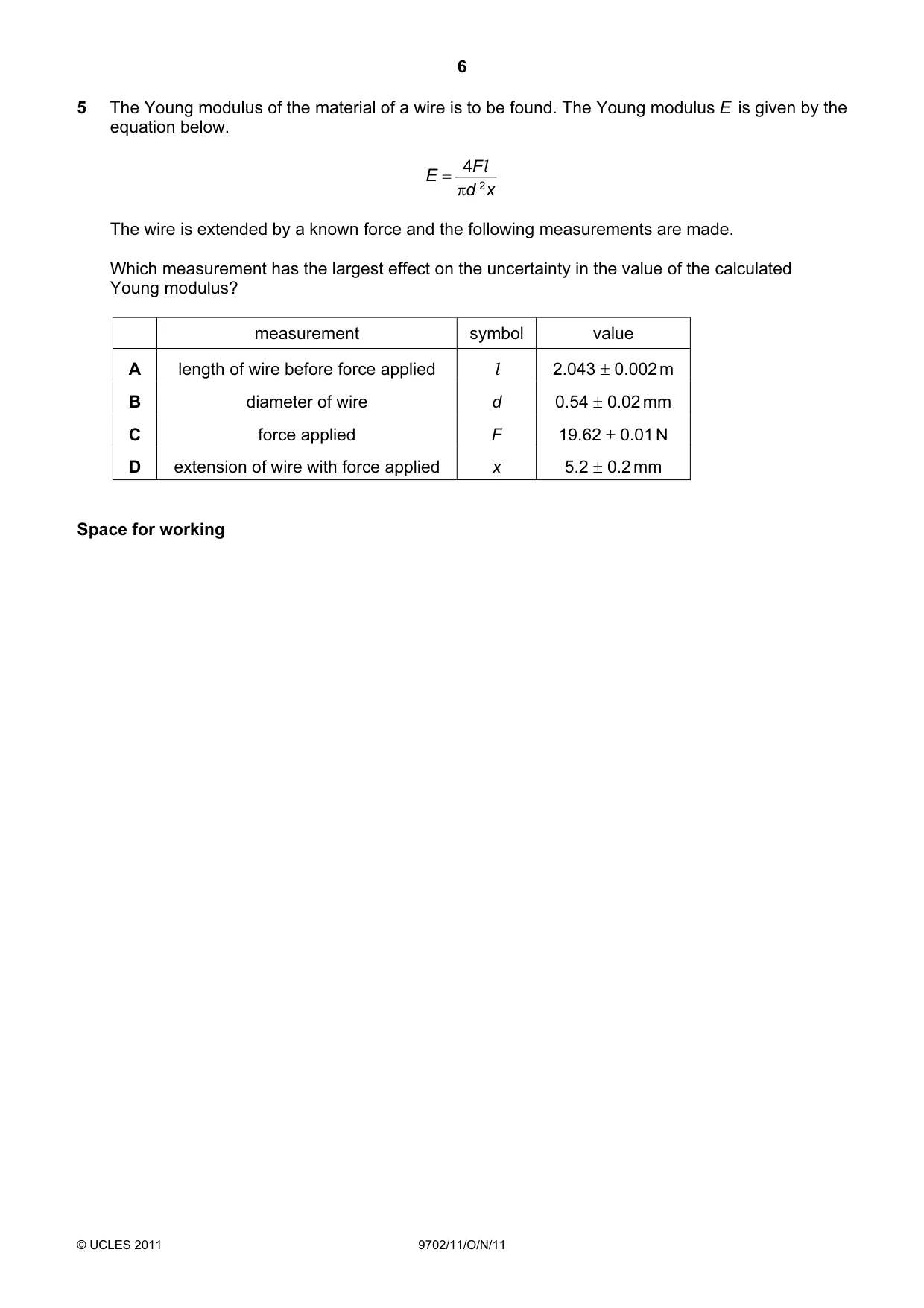
Q5 · The Young modulus of the material of a wire is to be found
5 The Young modulus of the material of a wire is to be found. The Young modulus E is given by the equation below. 4 F l E = π d 2 x The wire is extended by a known force and the following measurements are made. Which measurement has the largest effect on the uncertainty in the value of the calculated Young modulus? measurement symbol value A length of wire before force applied l 2.043 ± 0.002 m B diameter of wire d 0.54 ± 0.02 mm C force applied F 19.62 ± 0.01 N D extension of wire with force applied x 5.2 ± 0.2 mm Space for working
Mark scheme: B
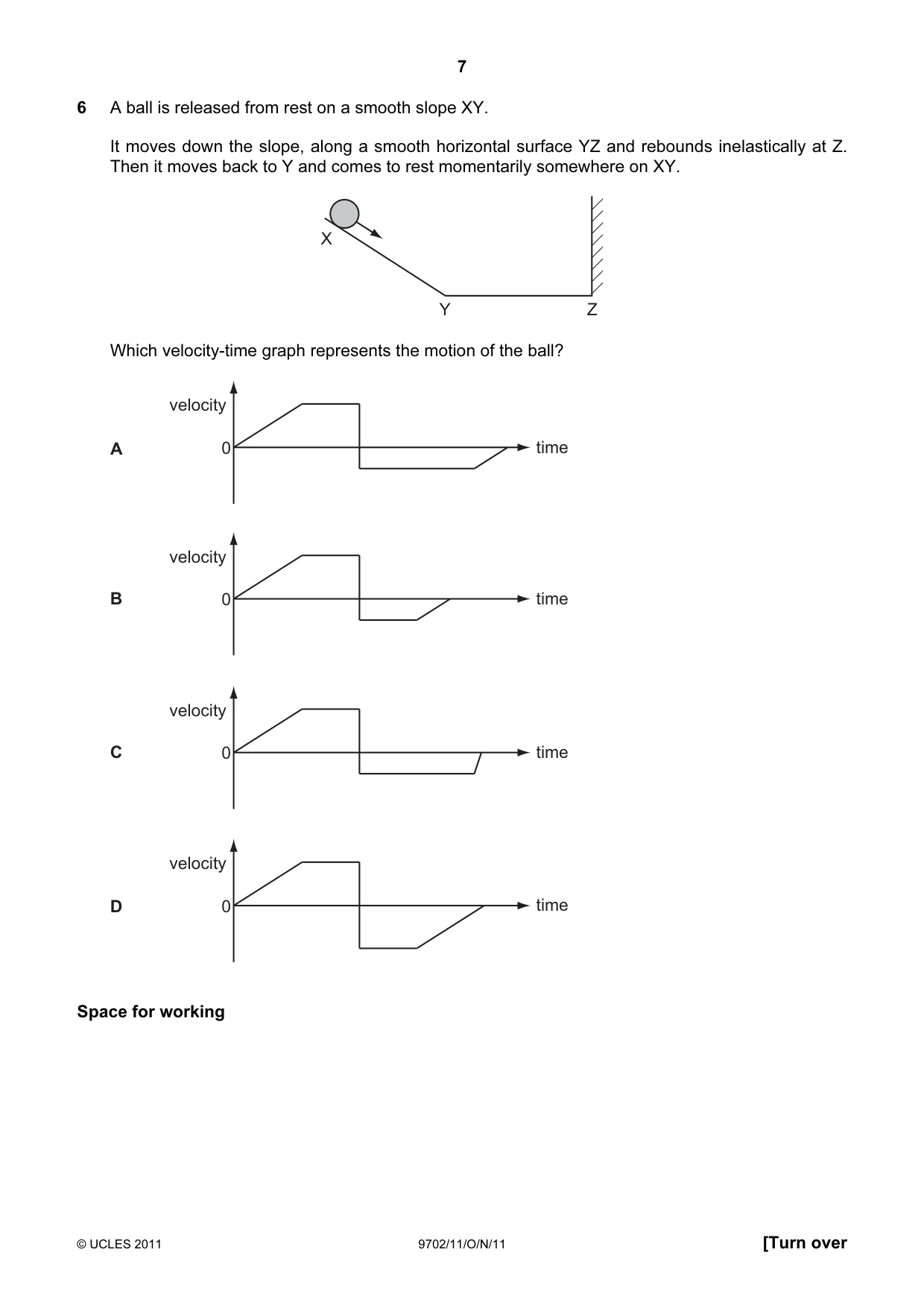
Q6 · A ball is released from rest on a smooth slope XY
6 A ball is released from rest on a smooth slope XY. It moves down the slope, along a smooth horizontal surface YZ and rebounds inelastically at Z. Then it moves back to Y and comes to rest momentarily somewhere on XY. X Y Z Which velocity-time graph represents the motion of the ball? velocity A 0 time velocity B 0 time velocity C 0 time velocity D 0 time Space for working
Mark scheme: A
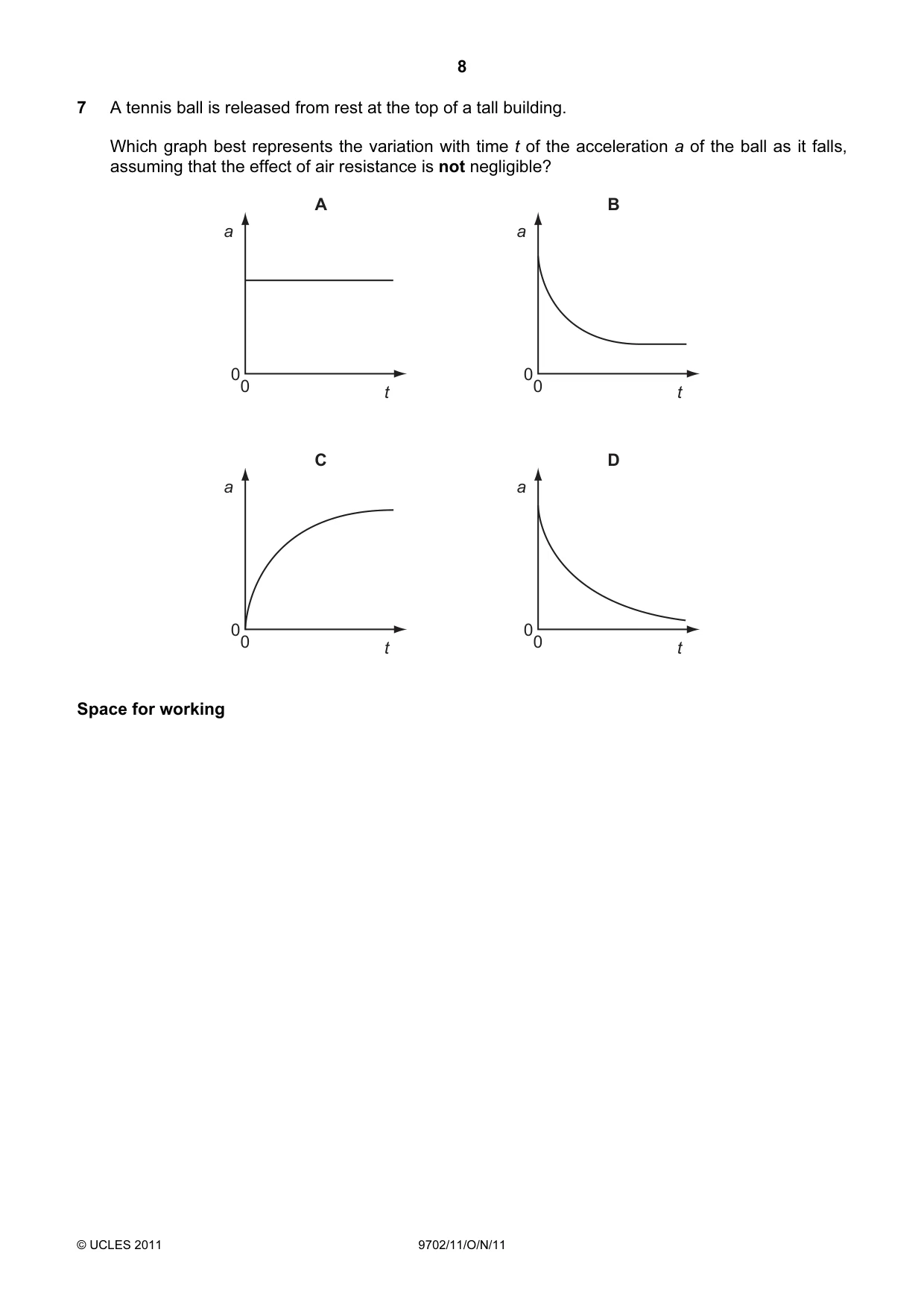
Q7 · A tennis ball is released from rest at the top of a tall building
7 A tennis ball is released from rest at the top of a tall building. Which graph best represents the variation with time t of the acceleration a of the ball as it falls, assuming that the effect of air resistance is not negligible? A B a a 00 00 t t C D a a 00 00 t t Space for working
Mark scheme: D
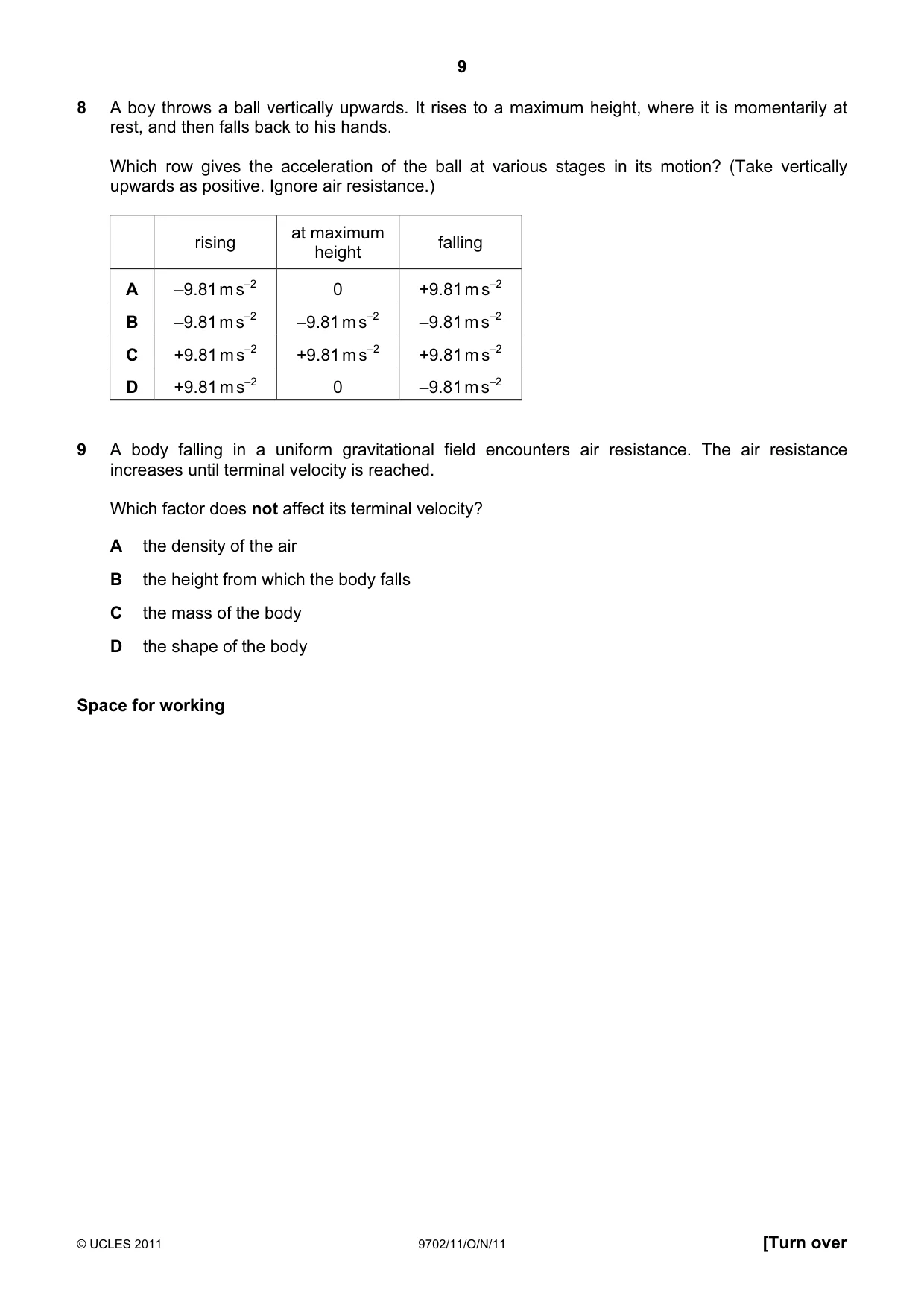
Q8 · A boy throws a ball vertically upwards
8 A boy throws a ball vertically upwards. It rises to a maximum height, where it is momentarily at rest, and then falls back to his hands. Which row gives the acceleration of the ball at various stages in its motion? (Take vertically upwards as positive. Ignore air resistance.) at maximum rising falling height A –9.81 m s–2 0 +9.81 m s–2 B –9.81 m s–2 –9.81 m s–2 –9.81 m s–2 C +9.81 m s–2 +9.81 m s–2 +9.81 m s–2 D +9.81 m s–2 0 –9.81 m s–2
Mark scheme: B
Q9 · A body falling in a uniform gravitational field encounters air resistance
9 A body falling in a uniform gravitational field encounters air resistance. The air resistance increases until terminal velocity is reached. Which factor does not affect its terminal velocity? A the density of the air B the height from which the body falls C the mass of the body D the shape of the body Space for working
Mark scheme: B
Q10 · What is the definition of the force on a body?
10 What is the definition of the force on a body? A the mass of the body multiplied by its acceleration B the power input to the body divided by its velocity C the rate of change of momentum of the body D the work done on the body divided by its displacement
Mark scheme: C
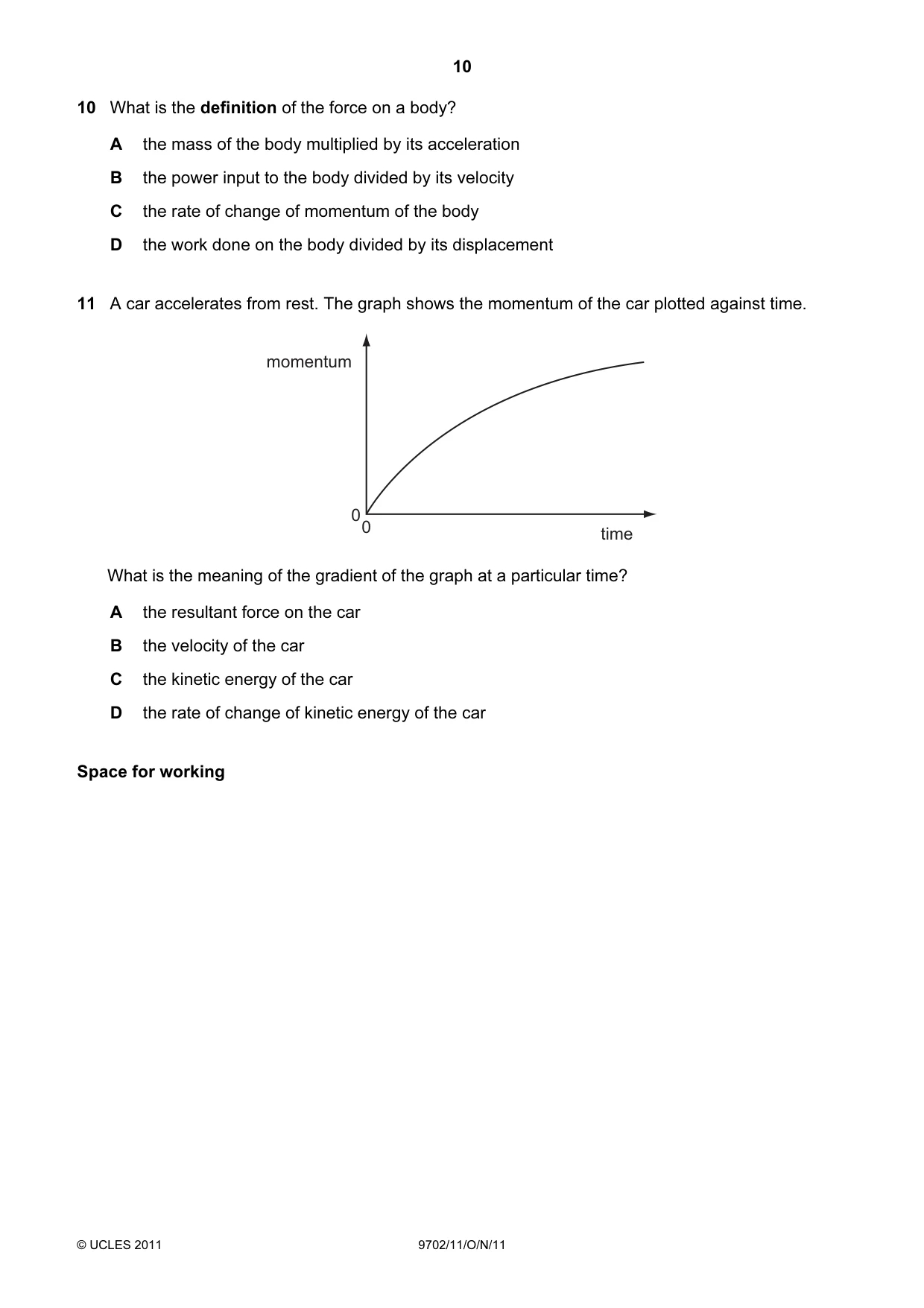
Q11 · A car accelerates from rest
11 A car accelerates from rest. The graph shows the momentum of the car plotted against time. momentum 0 0 time What is the meaning of the gradient of the graph at a particular time? A the resultant force on the car B the velocity of the car C the kinetic energy of the car D the rate of change of kinetic energy of the car Space for working
Mark scheme: A
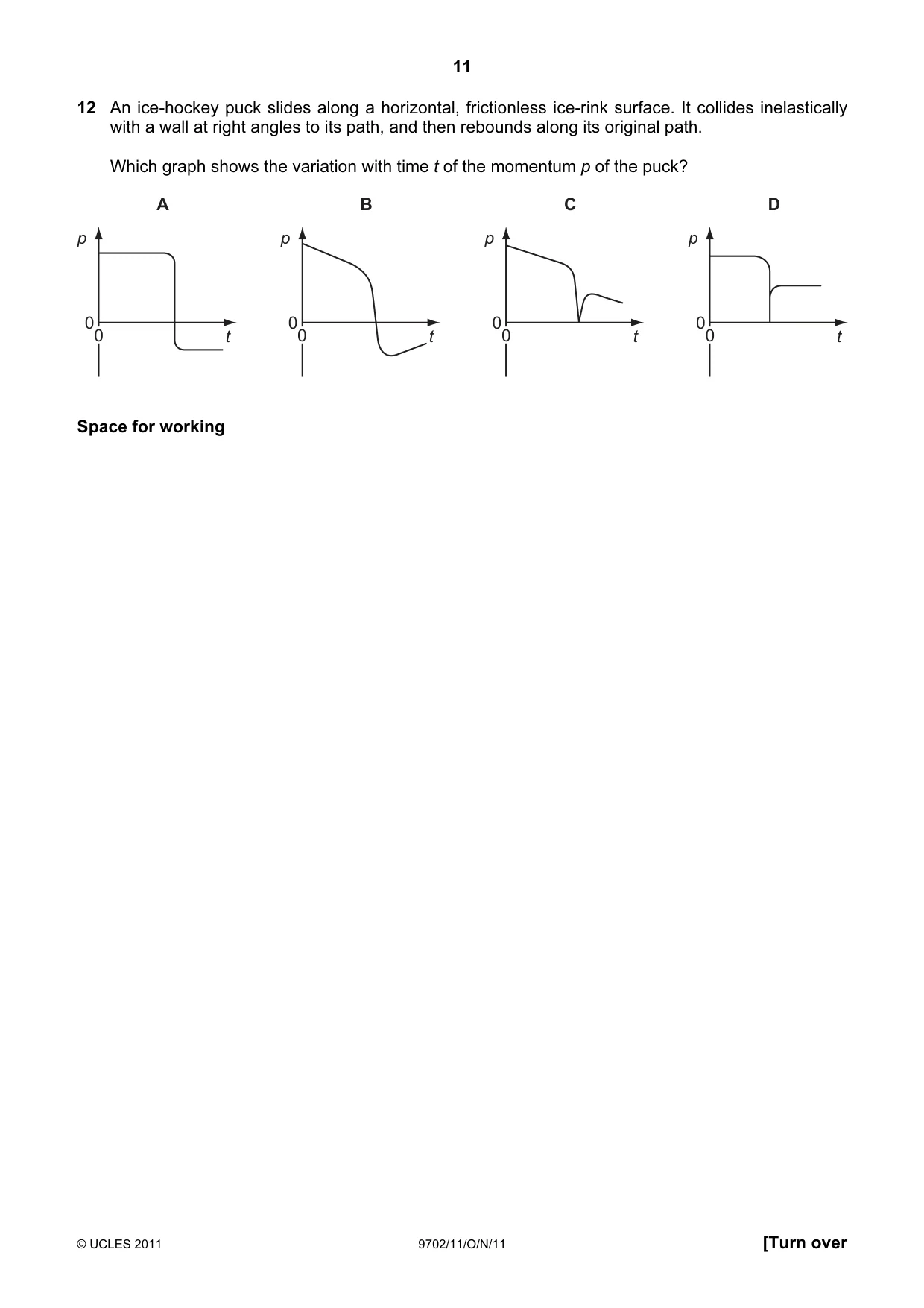
Q12 · An ice-hockey puck slides along a horizontal, frictionless ice-rink surface
12 An ice-hockey puck slides along a horizontal, frictionless ice-rink surface. It collides inelastically with a wall at right angles to its path, and then rebounds along its original path. Which graph shows the variation with time t of the momentum p of the puck? A B C D p p p p 00 00 00 00 t t t t Space for working
Mark scheme: A
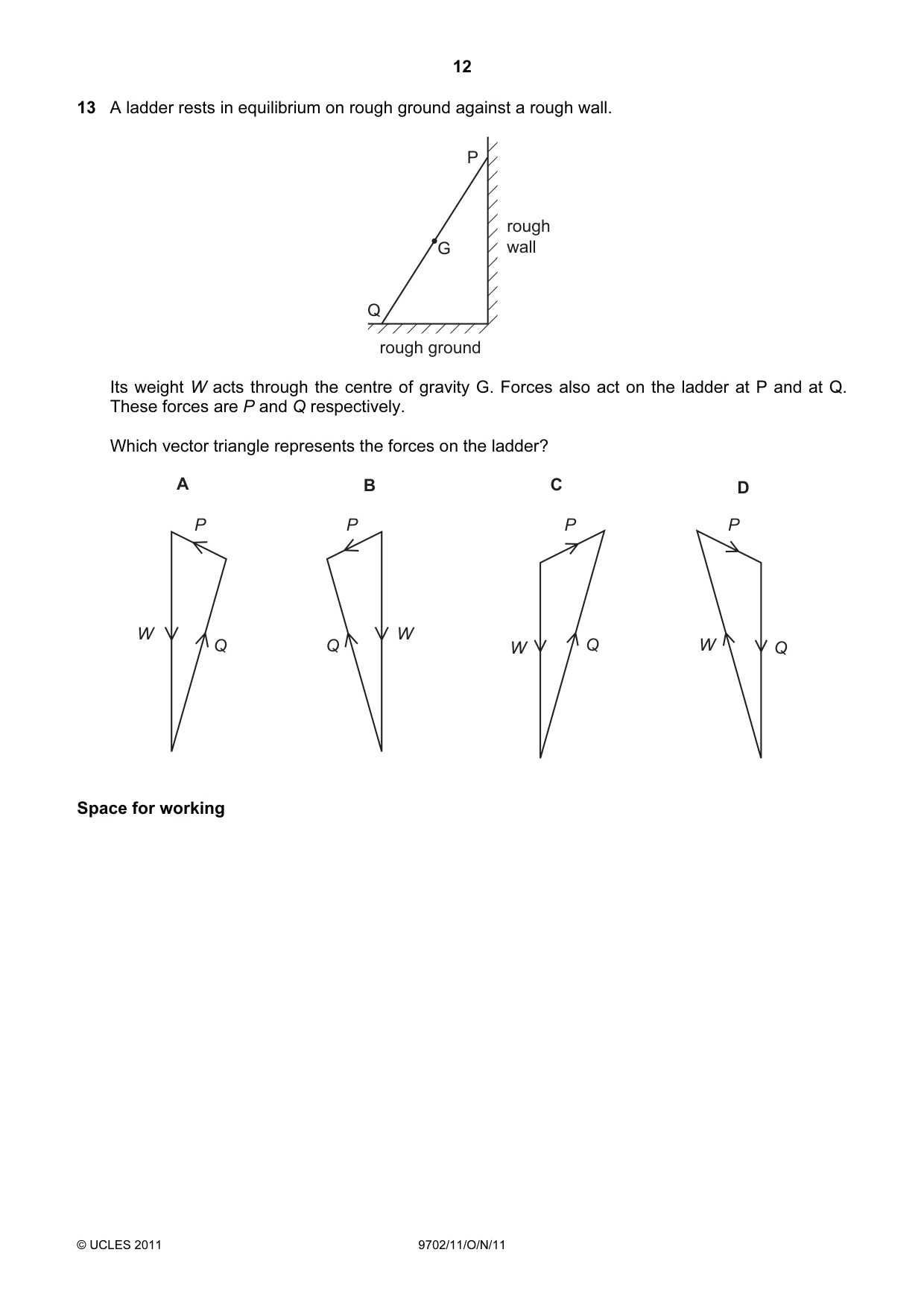
Q13 · A ladder rests in equilibrium on rough ground against a rough wall
13 A ladder rests in equilibrium on rough ground against a rough wall. P rough G wall Q rough ground Its weight W acts through the centre of gravity G. Forces also act on the ladder at P and at Q. These forces are P and Q respectively. Which vector triangle represents the forces on the ladder? A B C D P P P P W W Q Q W Q W Q Space for working
Mark scheme: A
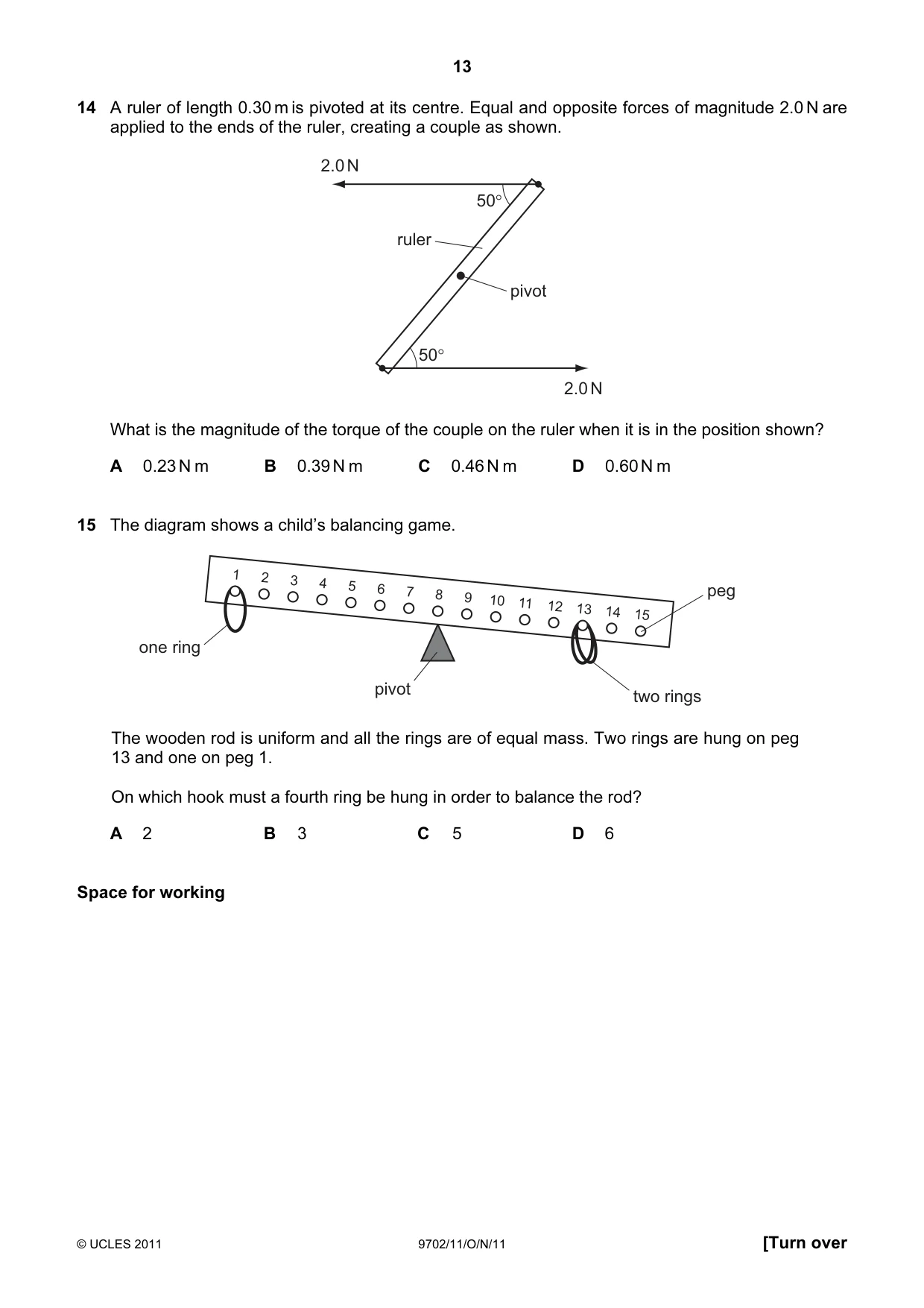
Q14 · A ruler of length 0.30 m is pivoted at its centre
14 A ruler of length 0.30 m is pivoted at its centre. Equal and opposite forces of magnitude 2.0 N are applied to the ends of the ruler, creating a couple as shown. 2.0 N 50° ruler pivot 50° 2.0 N What is the magnitude of the torque of the couple on the ruler when it is in the position shown? A 0.23 N m B 0.39 N m C 0.46 N m D 0.60 N m
Mark scheme: C
Q15 · The diagram shows a child’s balancing game
15 The diagram shows a child’s balancing game. 1 2 3 4 5 6 peg 7 8 9 10 11 12 13 14 15 one ring pivot two rings The wooden rod is uniform and all the rings are of equal mass. Two rings are hung on peg 13 and one on peg 1. On which hook must a fourth ring be hung in order to balance the rod? A 2 B 3 C 5 D 6 Space for working
Mark scheme: C
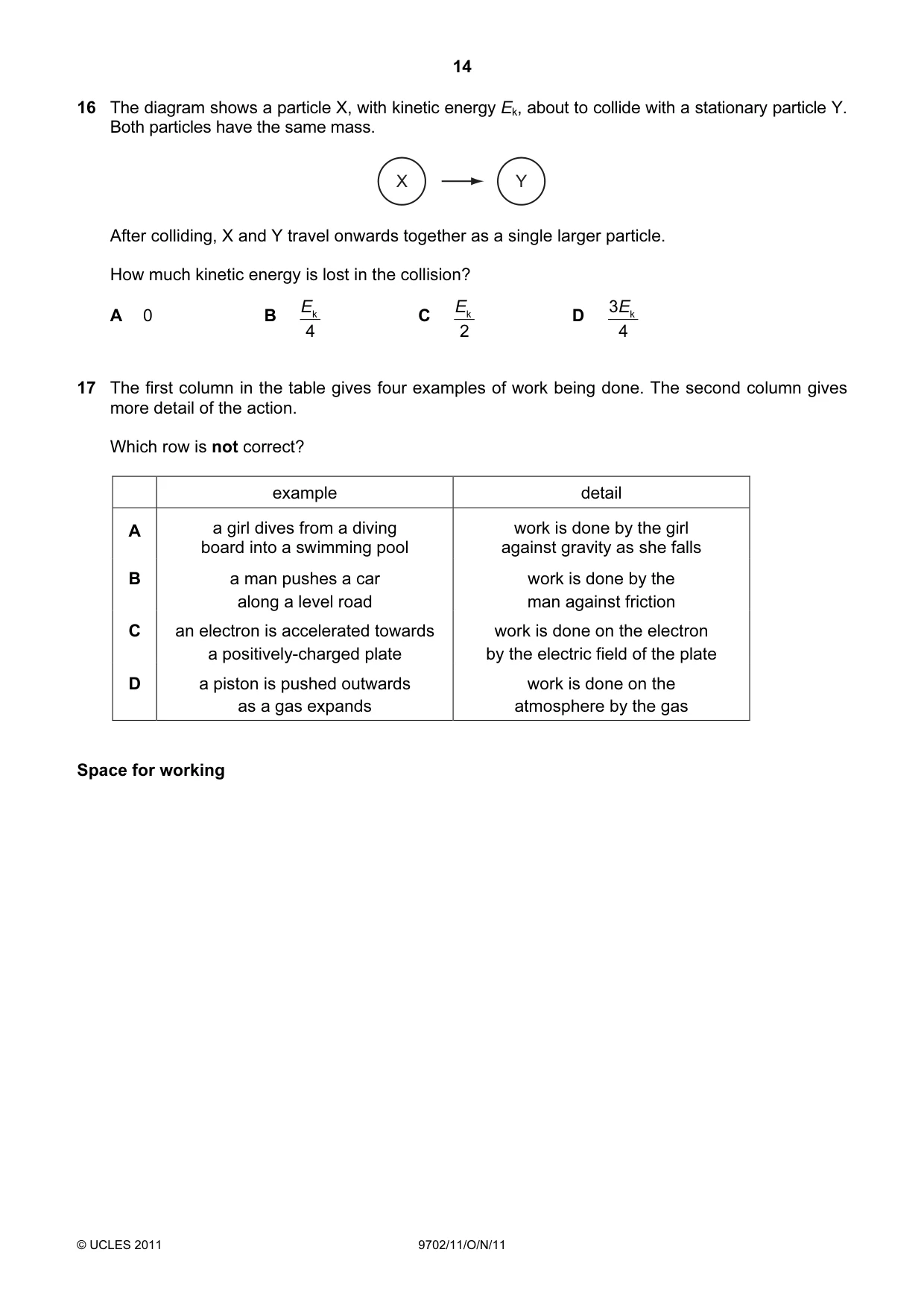
Q16 · The diagram shows a particle X, with kinetic energy Ek, about to collide with a…
16 The diagram shows a particle X, with kinetic energy Ek, about to collide with a stationary particle Y. Both particles have the same mass. X Y After colliding, X and Y travel onwards together as a single larger particle. How much kinetic energy is lost in the collision? E E 3 E A 0 B k C k D k 4 2 4
Mark scheme: C
Q17 · The first column in the table gives four examples of work being done
17 The first column in the table gives four examples of work being done. The second column gives more detail of the action. Which row is not correct? example detail A a girl dives from a diving work is done by the girl board into a swimming pool against gravity as she falls B a man pushes a car work is done by the along a level road man against friction C an electron is accelerated towards work is done on the electron a positively-charged plate by the electric field of the plate D a piston is pushed outwards work is done on the as a gas expands atmosphere by the gas Space for working
Mark scheme: A
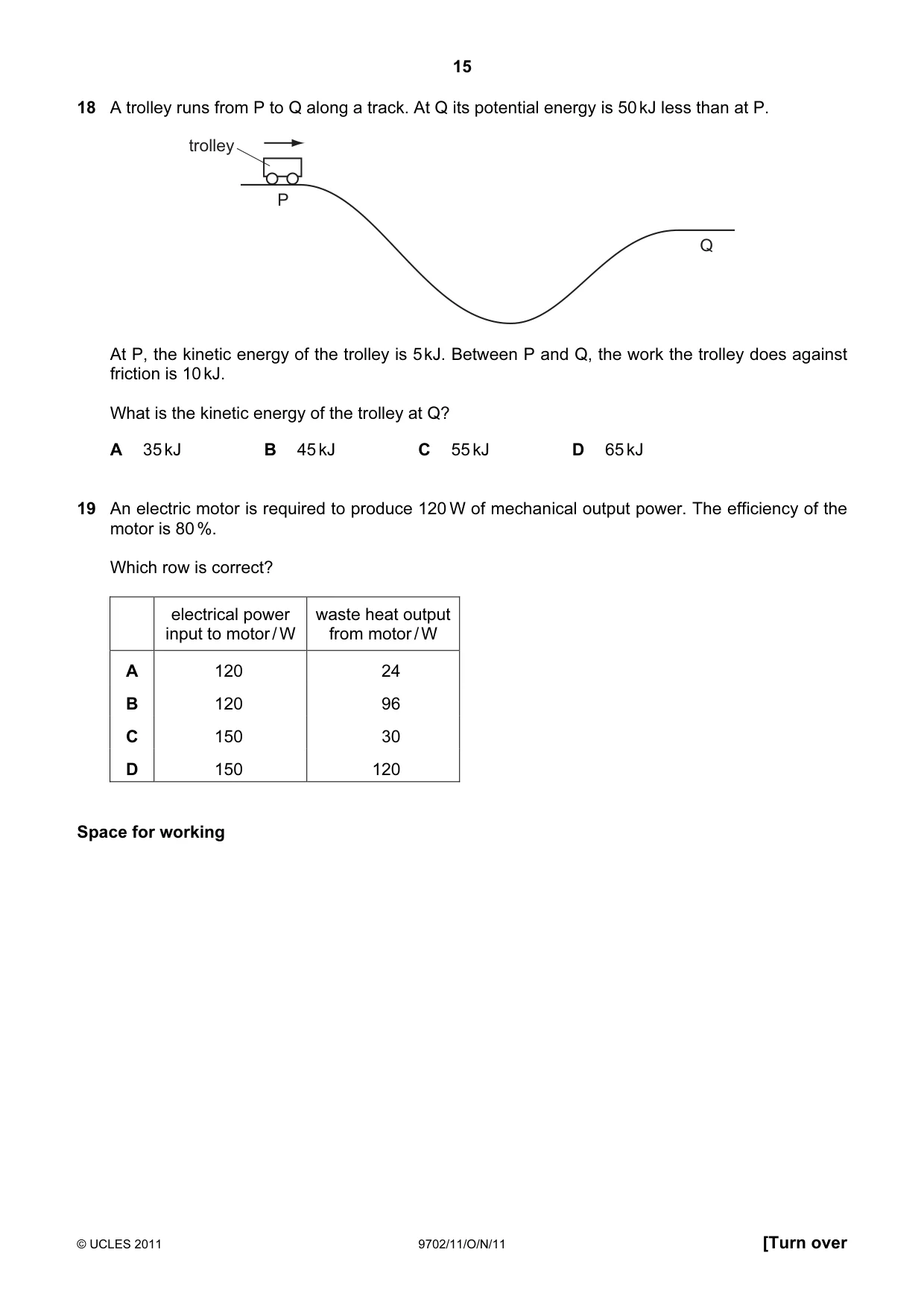
Q18 · A trolley runs from P to Q along a track
18 A trolley runs from P to Q along a track. At Q its potential energy is 50 kJ less than at P. trolley P Q At P, the kinetic energy of the trolley is 5 kJ. Between P and Q, the work the trolley does against friction is 10 kJ. What is the kinetic energy of the trolley at Q? A 35 kJ B 45 kJ C 55 kJ D 65 kJ
Mark scheme: B
Q19 · An electric motor is required to produce 120 W of mechanical output power
19 An electric motor is required to produce 120 W of mechanical output power. The efficiency of the motor is 80 %. Which row is correct? electrical power waste heat output input to motor / W from motor / W A 120 24 B 120 96 C 150 30 D 150 120 Space for working
Mark scheme: C
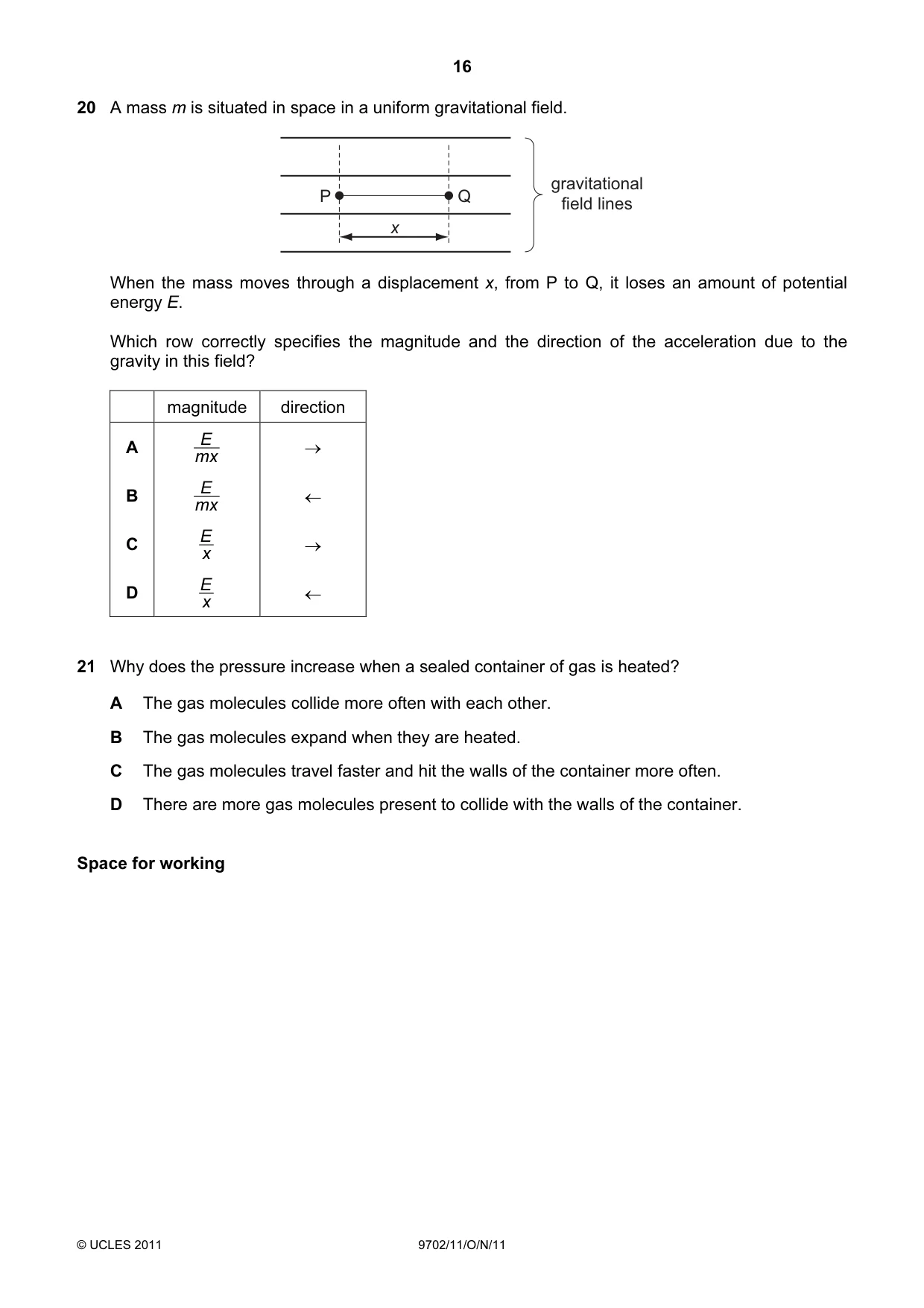
Q20 · A mass m is situated in space in a uniform gravitational field
20 A mass m is situated in space in a uniform gravitational field. gravitational P Q field lines x When the mass moves through a displacement x, from P to Q, it loses an amount of potential energy E. Which row correctly specifies the magnitude and the direction of the acceleration due to the gravity in this field? magnitude direction E A → mx E B ← mx E C → x E D ← x
Mark scheme: A
Q21 · Why does the pressure increase when a sealed container of gas is heated?
21 Why does the pressure increase when a sealed container of gas is heated? A The gas molecules collide more often with each other. B The gas molecules expand when they are heated. C The gas molecules travel faster and hit the walls of the container more often. D There are more gas molecules present to collide with the walls of the container. Space for working
Mark scheme: C
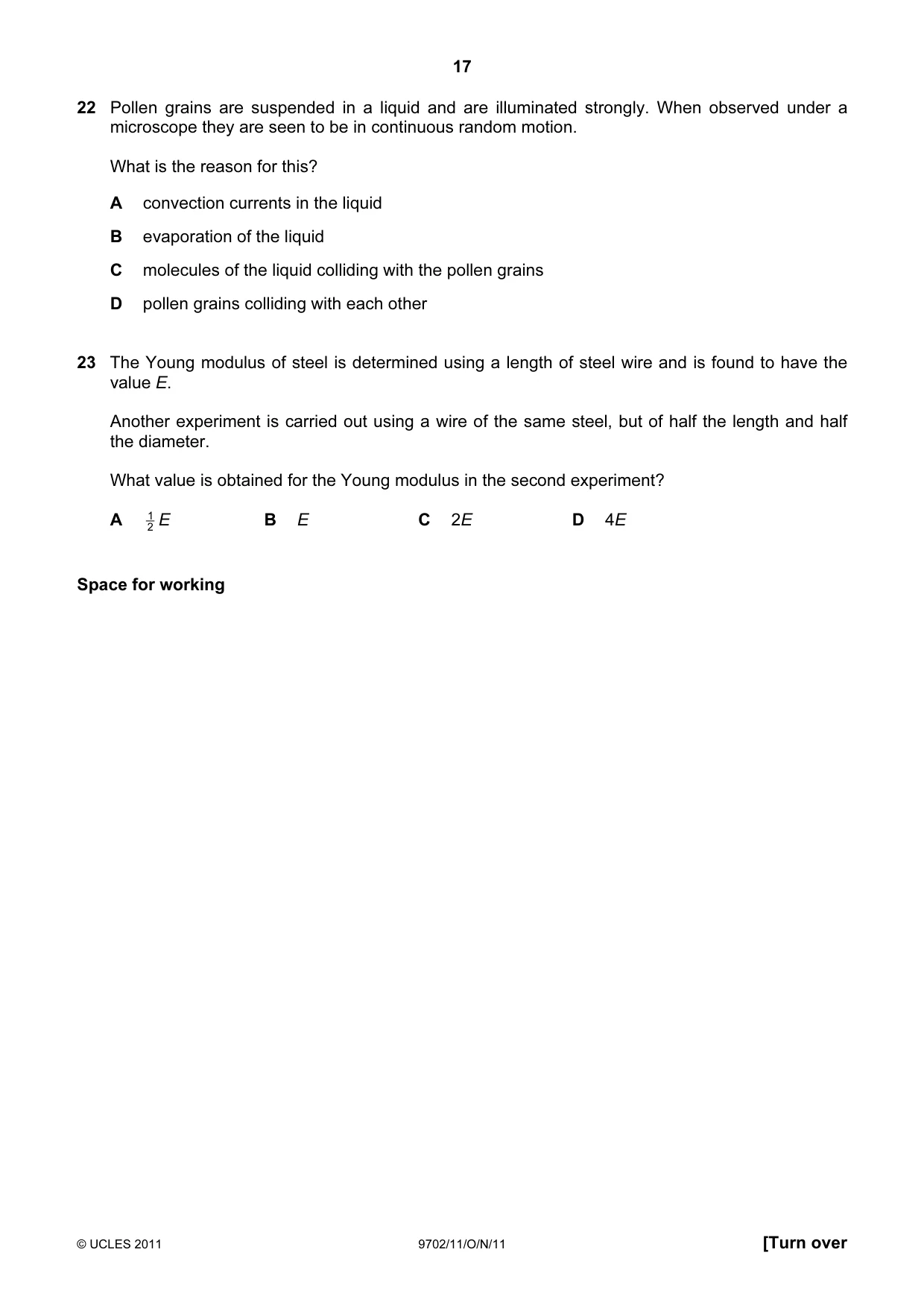
Q22 · Pollen grains are suspended in a liquid and are illuminated strongly
22 Pollen grains are suspended in a liquid and are illuminated strongly. When observed under a microscope they are seen to be in continuous random motion. What is the reason for this? A convection currents in the liquid B evaporation of the liquid C molecules of the liquid colliding with the pollen grains D pollen grains colliding with each other
Mark scheme: C
Q23 · The Young modulus of steel is determined using a length of steel wire and is found to…
23 The Young modulus of steel is determined using a length of steel wire and is found to have the value E. Another experiment is carried out using a wire of the same steel, but of half the length and half the diameter. What value is obtained for the Young modulus in the second experiment? A 1 E B E C 2E D 4E 2 Space for working
Mark scheme: B
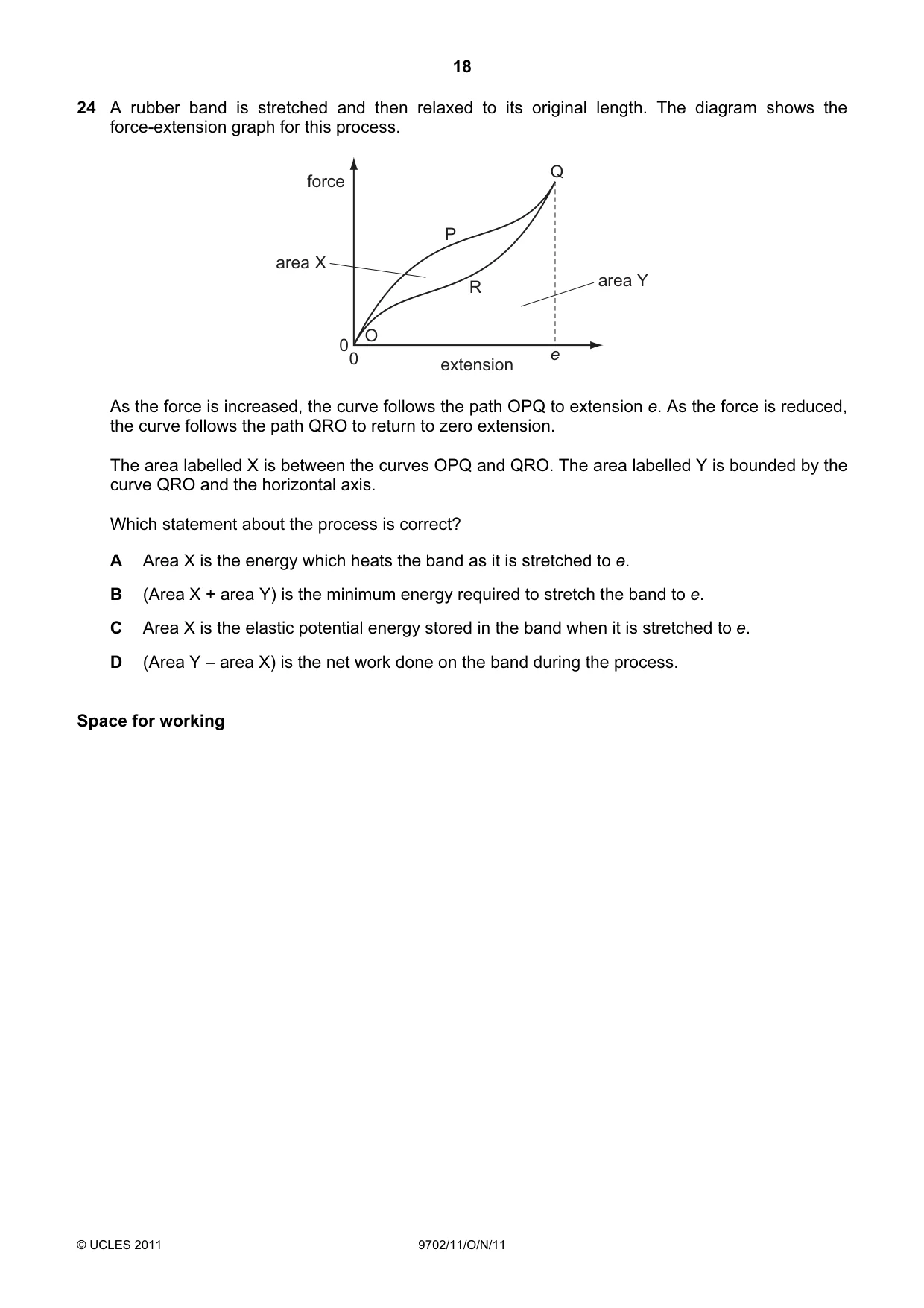
Q24 · A rubber band is stretched and then relaxed to its original length
24 A rubber band is stretched and then relaxed to its original length. The diagram shows the force-extension graph for this process. Q force P area X R area Y O 00 e extension As the force is increased, the curve follows the path OPQ to extension e. As the force is reduced, the curve follows the path QRO to return to zero extension. The area labelled X is between the curves OPQ and QRO. The area labelled Y is bounded by the curve QRO and the horizontal axis. Which statement about the process is correct? A Area X is the energy which heats the band as it is stretched to e. B (Area X + area Y) is the minimum energy required to stretch the band to e. C Area X is the elastic potential energy stored in the band when it is stretched to e. D (Area Y – area X) is the net work done on the band during the process. Space for working
Mark scheme: B
Q25 · When describing the behaviour of a spring, the spring constant is used
25 When describing the behaviour of a spring, the spring constant is used. Different loads are used to extend the spring by different amounts. To find the spring constant, which quantities are required? A the elastic limit and the loads B the elastic limit, extensions and the length of the spring C the loads and the extensions of the spring D the loads and the length of the spring
Mark scheme: C
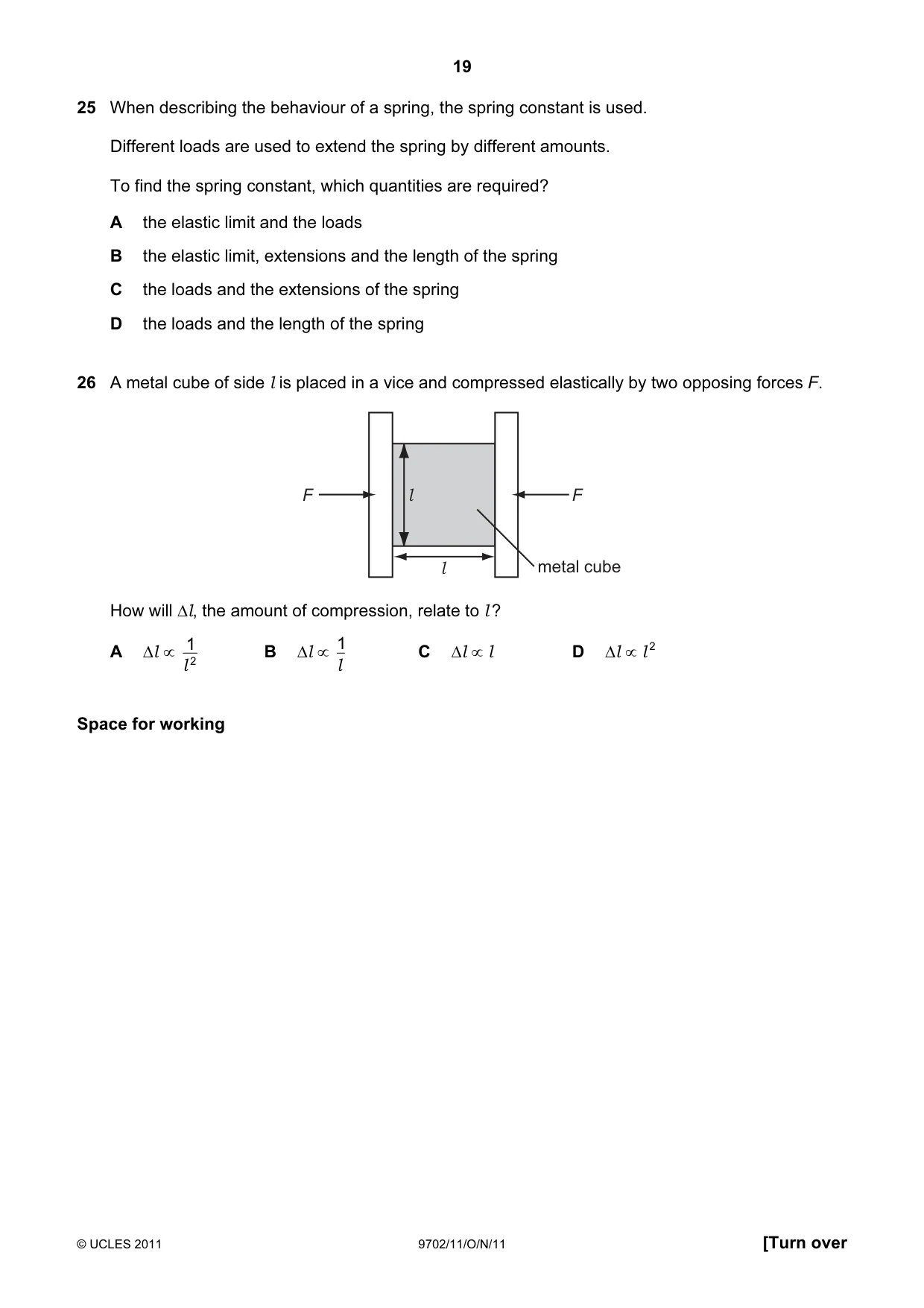
Q26 · A metal cube of side l is placed in a vice and compressed elastically by two opposing…
26 A metal cube of side l is placed in a vice and compressed elastically by two opposing forces F. F l F l metal cube How will ∆l, the amount of compression, relate to l ? 1 1 ∆l ∝ l 2 A ∆l ∝ B ∆l ∝ l C ∆l ∝ l D l 2 Space for working
Mark scheme: B
Q27 · P is a source emitting infra-red radiation and Q is a source emitting ultra-violet…
27 P is a source emitting infra-red radiation and Q is a source emitting ultra-violet radiation. The figures in the table are suggested values for the wavelengths emitted by P and Q. Which row is correct? wavelength wavelength emitted by P / m emitted by Q / m A 5 × 10⁻⁵ 5 × 10⁻⁸ B 5 × 10⁻⁵ 5 × 10⁻¹⁰ C 5 × 10⁻⁷ 5 × 10⁻⁸ D 5 × 10⁻⁷ 5 × 10⁻¹⁰
Mark scheme: A
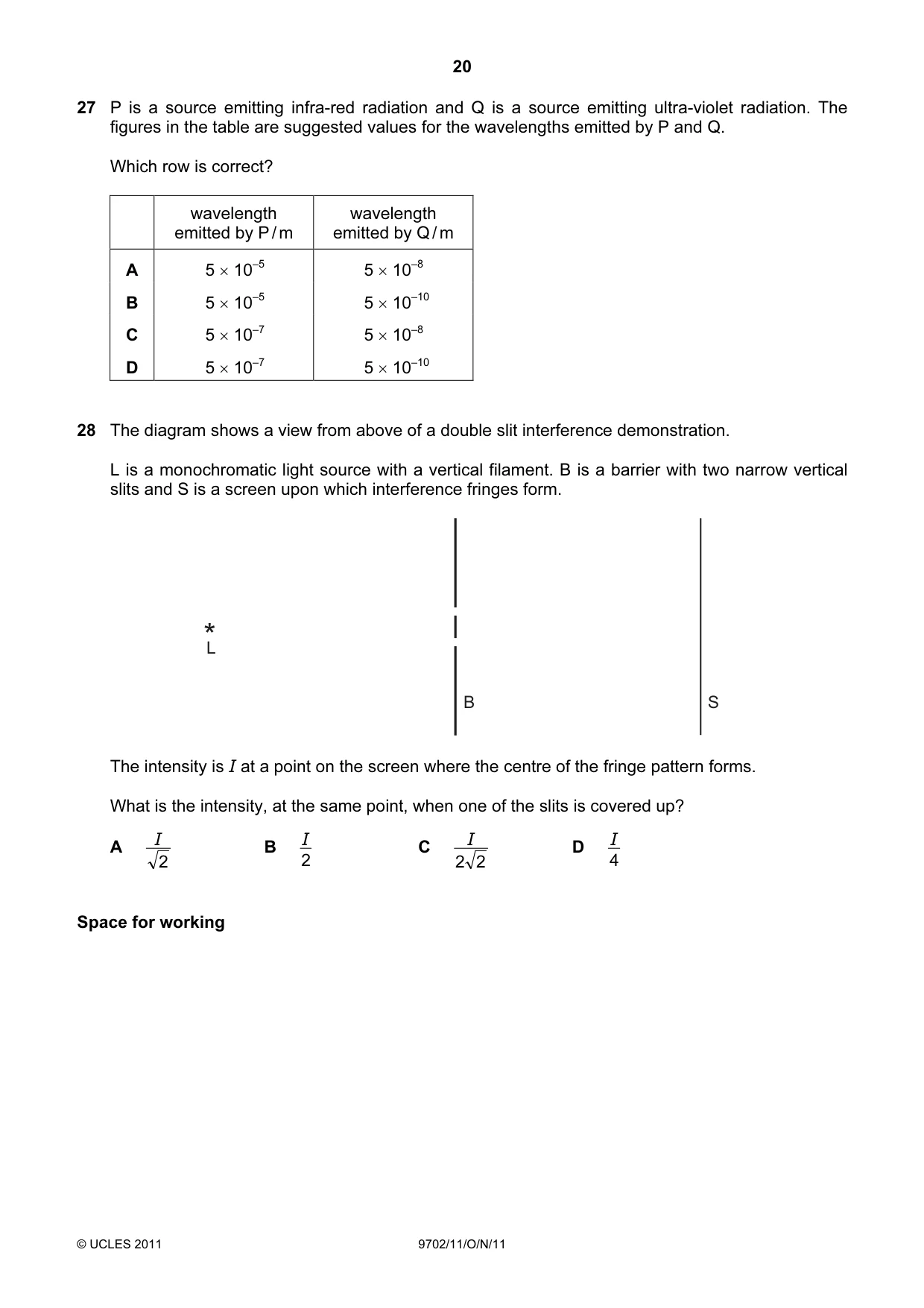
Q28 · The diagram shows a view from above of a double slit interference demonstration
28 The diagram shows a view from above of a double slit interference demonstration. L is a monochromatic light source with a vertical filament. B is a barrier with two narrow vertical slits and S is a screen upon which interference fringes form. L B S The intensity is I at a point on the screen where the centre of the fringe pattern forms. What is the intensity, at the same point, when one of the slits is covered up? A I B I C I D I 2 2 2 2 4 Space for working
Mark scheme: D
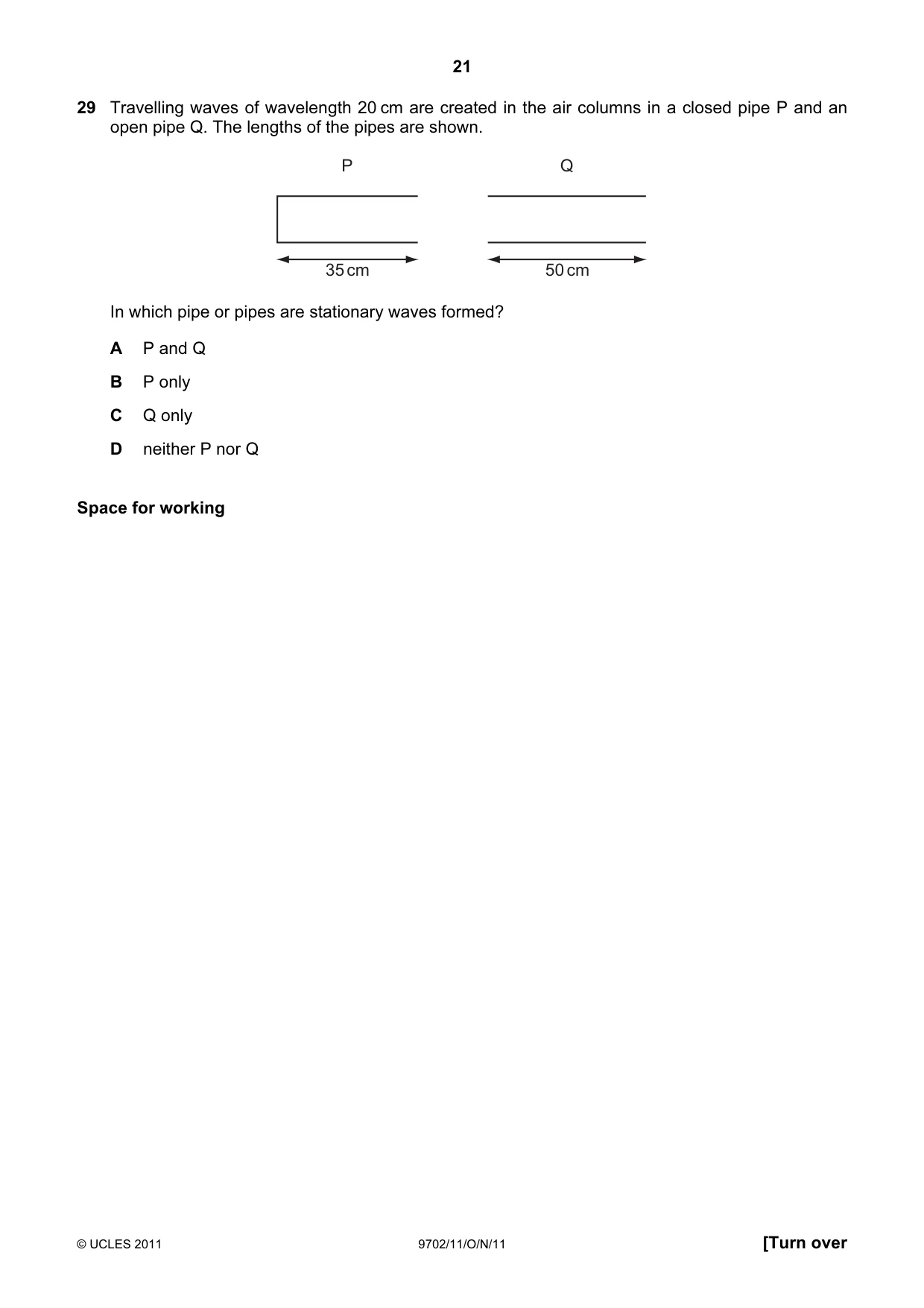
Q29 · Travelling waves of wavelength 20 cm are created in the air columns in a closed pipe P…
29 Travelling waves of wavelength 20 cm are created in the air columns in a closed pipe P and an open pipe Q. The lengths of the pipes are shown. P Q 35 cm 50 cm In which pipe or pipes are stationary waves formed? A P and Q B P only C Q only D neither P nor Q Space for working
Mark scheme: A
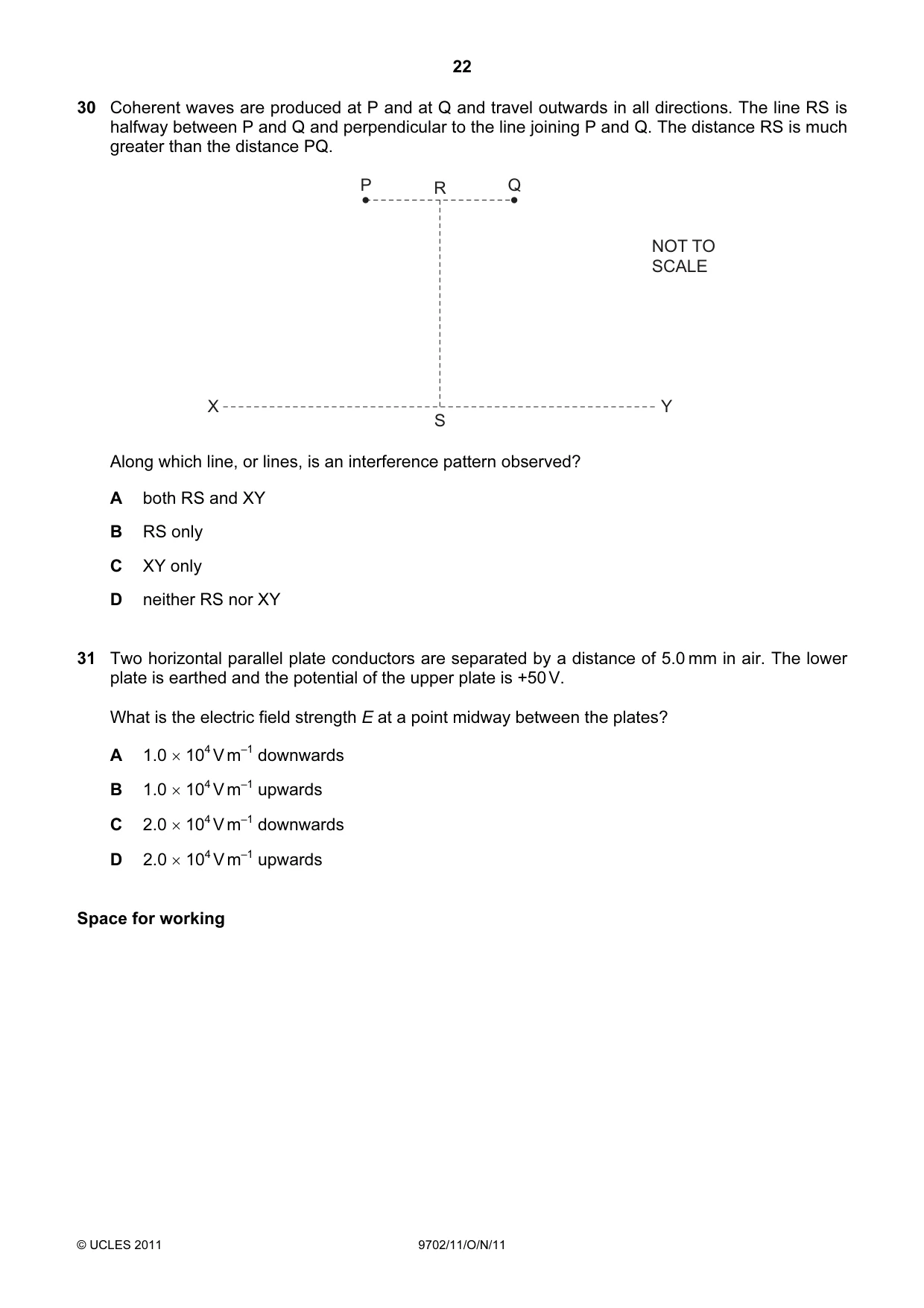
Q30 · Coherent waves are produced at P and at Q and travel outwards in all directions
30 Coherent waves are produced at P and at Q and travel outwards in all directions. The line RS is halfway between P and Q and perpendicular to the line joining P and Q. The distance RS is much greater than the distance PQ. P R Q NOT TO SCALE X Y S Along which line, or lines, is an interference pattern observed? A both RS and XY B RS only C XY only D neither RS nor XY
Mark scheme: C
Q31 · Two horizontal parallel plate conductors are separated by a distance of 5.0 mm in air
31 Two horizontal parallel plate conductors are separated by a distance of 5.0 mm in air. The lower plate is earthed and the potential of the upper plate is +50 V. What is the electric field strength E at a point midway between the plates? A 1.0 × 10⁴ V m–1 downwards B 1.0 × 10⁴ V m–1 upwards C 2.0 × 10⁴ V m–1 downwards D 2.0 × 10⁴ V m–1 upwards Space for working
Mark scheme: A
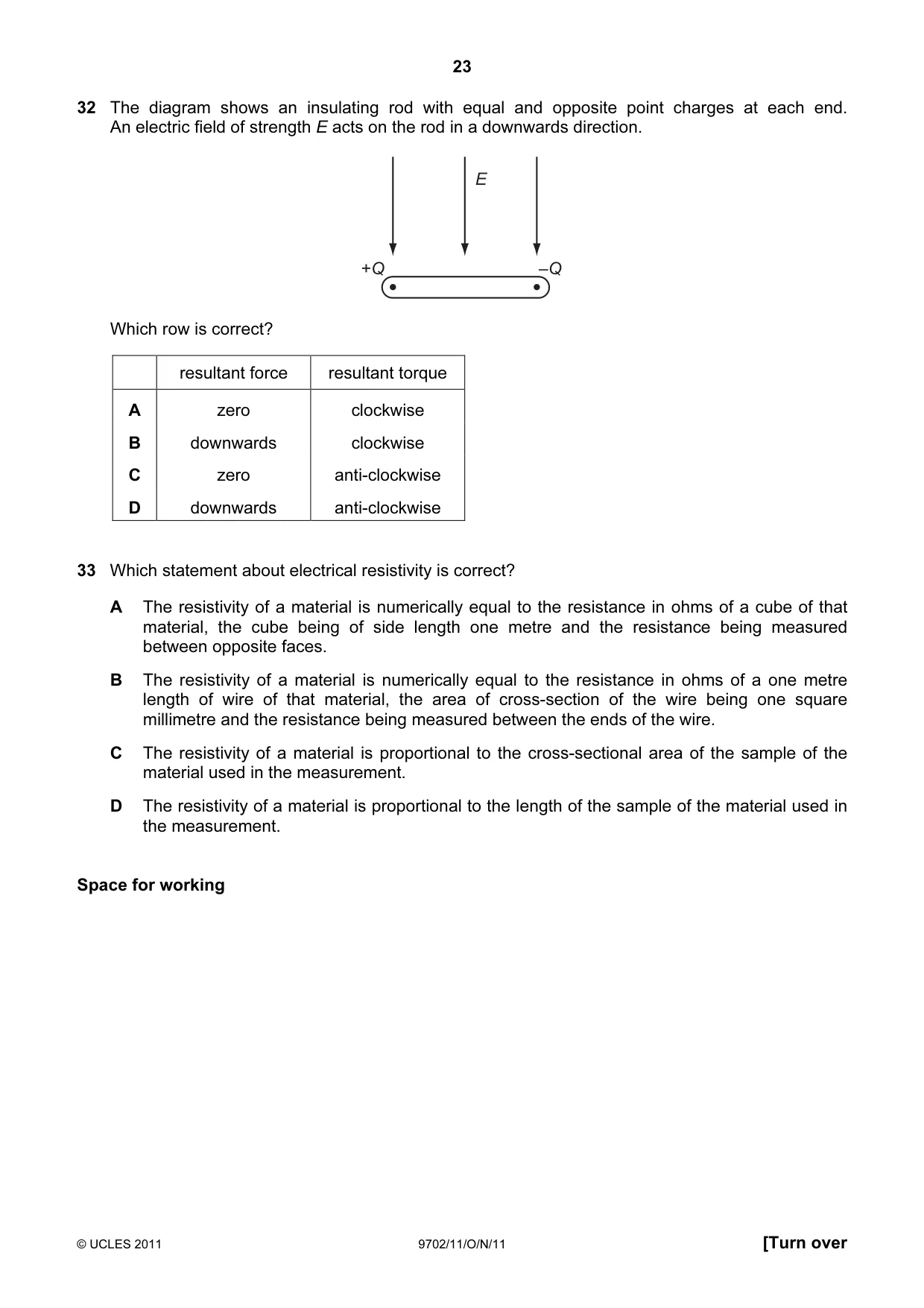
Q32 · The diagram shows an insulating rod with equal and opposite point charges at each end
32 The diagram shows an insulating rod with equal and opposite point charges at each end. An electric field of strength E acts on the rod in a downwards direction. E +Q –Q Which row is correct? resultant force resultant torque A zero clockwise B downwards clockwise C zero anti-clockwise D downwards anti-clockwise
Mark scheme: C
Q33 · Which statement about electrical resistivity is correct?
33 Which statement about electrical resistivity is correct? A The resistivity of a material is numerically equal to the resistance in ohms of a cube of that material, the cube being of side length one metre and the resistance being measured between opposite faces. B The resistivity of a material is numerically equal to the resistance in ohms of a one metre length of wire of that material, the area of cross-section of the wire being one square millimetre and the resistance being measured between the ends of the wire. C The resistivity of a material is proportional to the cross-sectional area of the sample of the material used in the measurement. D The resistivity of a material is proportional to the length of the sample of the material used in the measurement. Space for working
Mark scheme: A
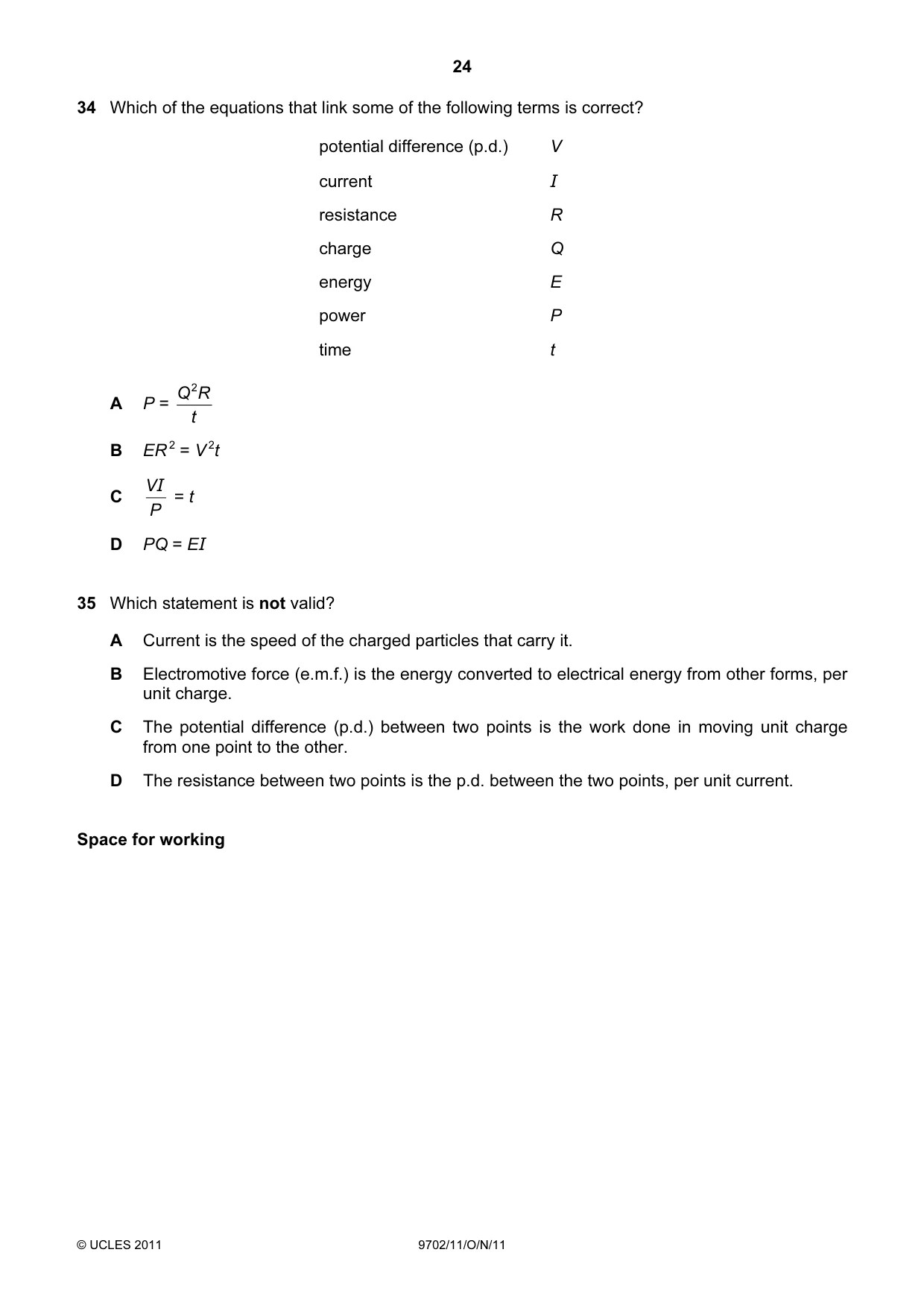
Q34 · Which of the equations that link some of the following terms is correct?
34 Which of the equations that link some of the following terms is correct? potential difference (p.d.) V current I resistance R charge Q energy E power P time t Q2 R A P = t B ER 2 = V 2t VI = t C P D PQ = EI
Mark scheme: D
Q35 · Which statement is not valid?
35 Which statement is not valid? A Current is the speed of the charged particles that carry it. B Electromotive force (e.m.f.) is the energy converted to electrical energy from other forms, per unit charge. C The potential difference (p.d.) between two points is the work done in moving unit charge from one point to the other. D The resistance between two points is the p.d. between the two points, per unit current. Space for working
Mark scheme: A
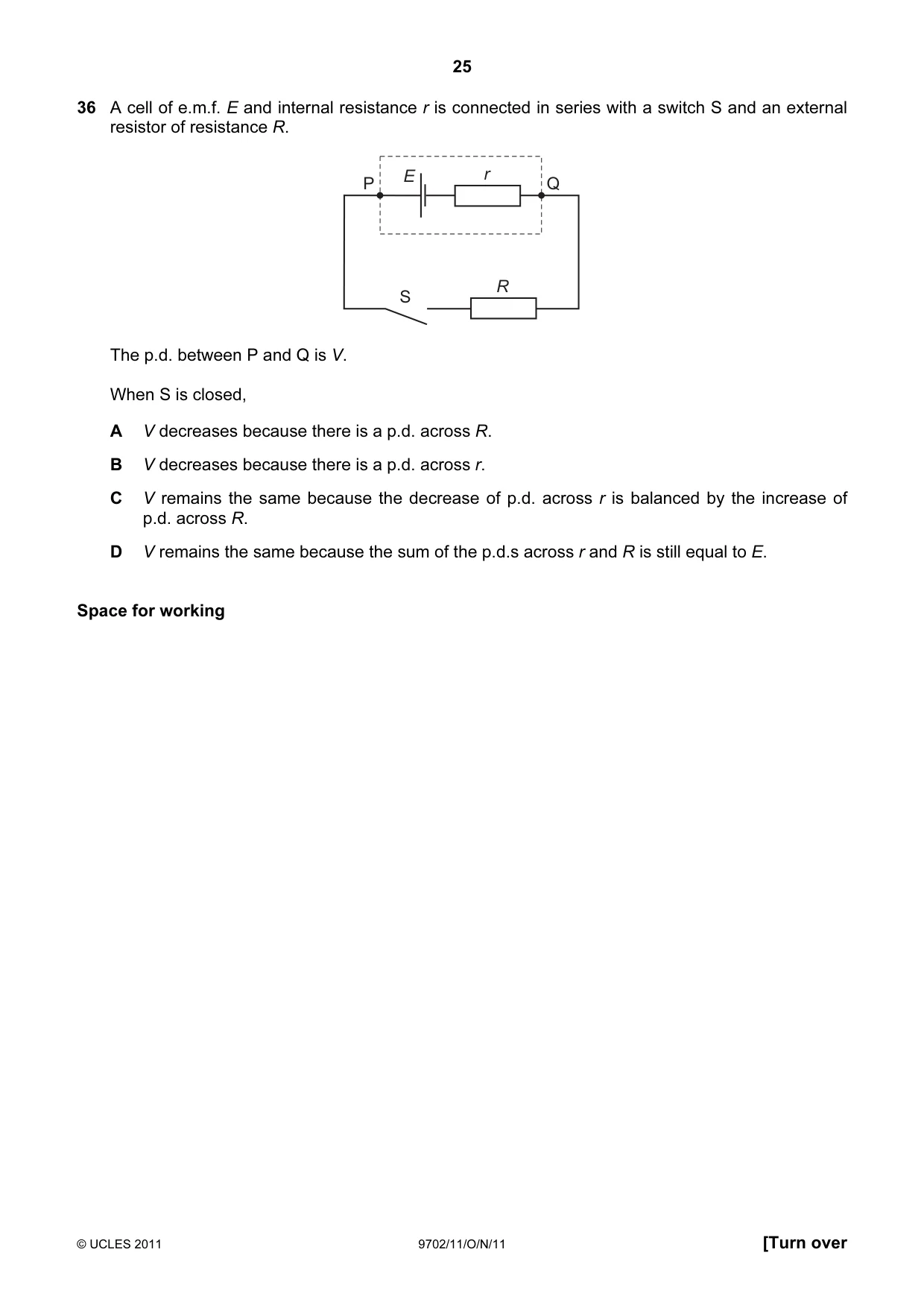
Q36 · A cell of e.m.f
36 A cell of e.m.f. E and internal resistance r is connected in series with a switch S and an external resistor of resistance R. E r P Q R S The p.d. between P and Q is V. When S is closed, A V decreases because there is a p.d. across R. B V decreases because there is a p.d. across r. C V remains the same because the decrease of p.d. across r is balanced by the increase of p.d. across R. D V remains the same because the sum of the p.d.s across r and R is still equal to E. Space for working
Mark scheme: B
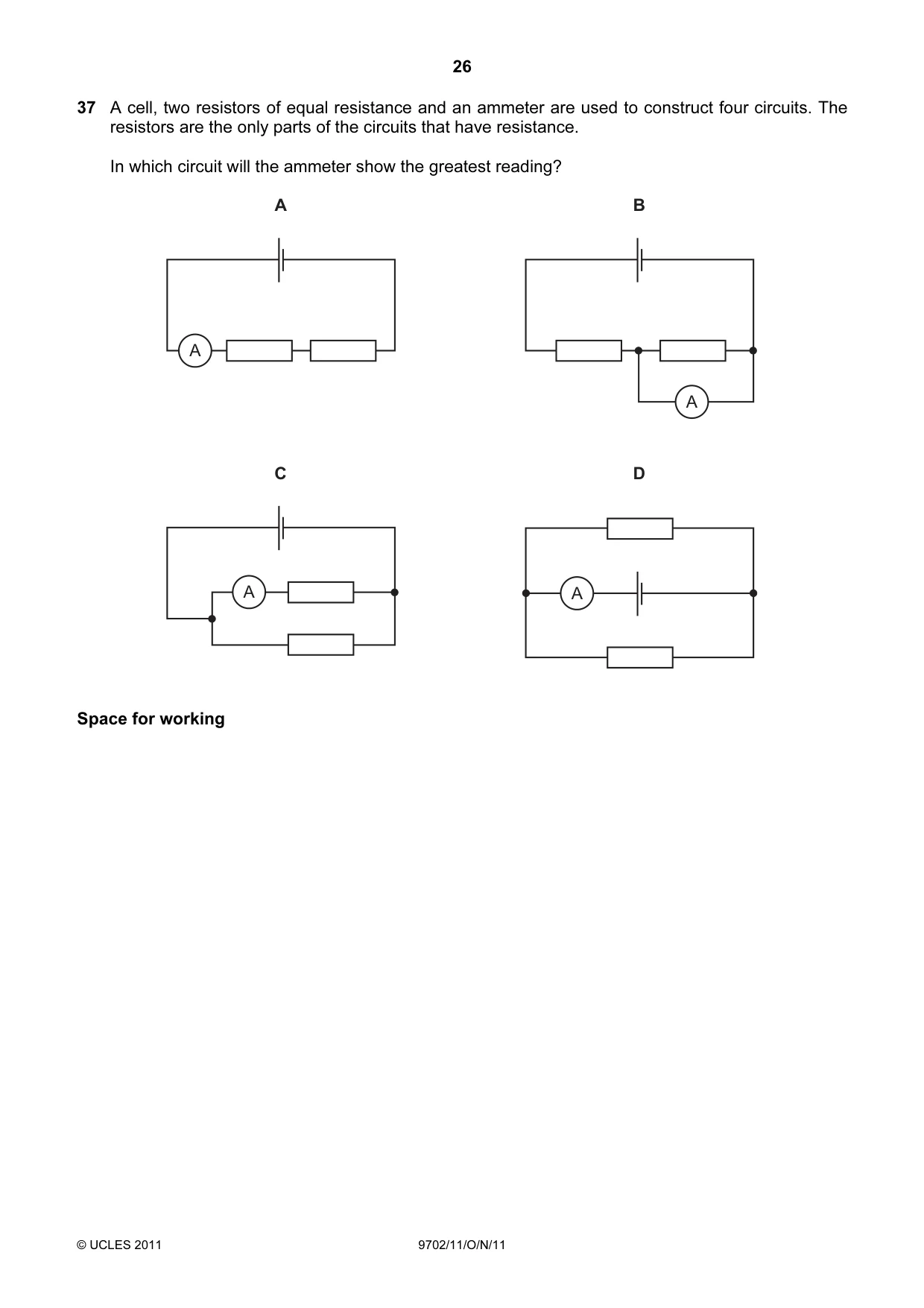
Q37 · A cell, two resistors of equal resistance and an ammeter are used to construct four…
37 A cell, two resistors of equal resistance and an ammeter are used to construct four circuits. The resistors are the only parts of the circuits that have resistance. In which circuit will the ammeter show the greatest reading? A B A A C D A A Space for working
Mark scheme: D
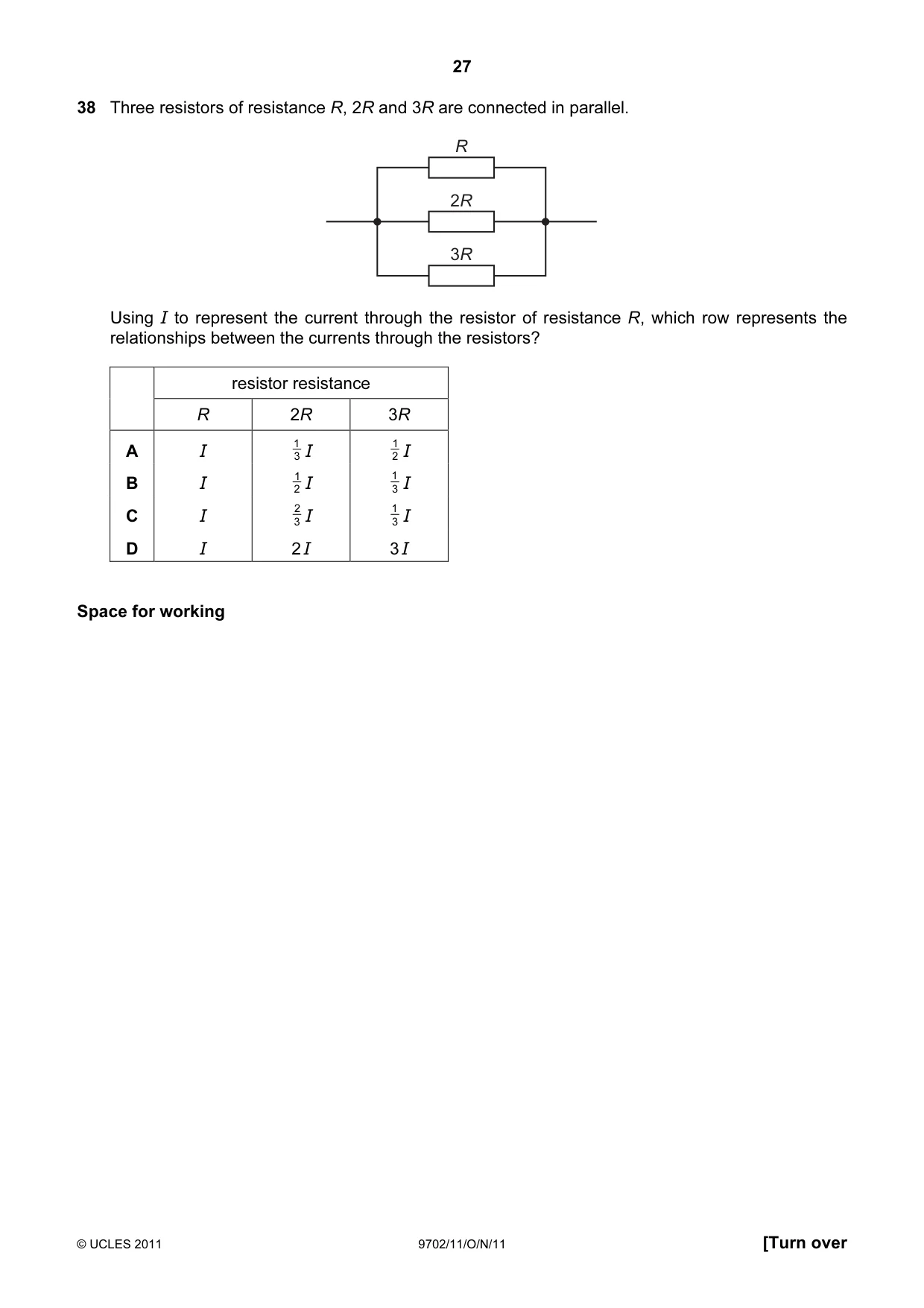
Q38 · Three resistors of resistance R, 2R and 3R are connected in parallel
38 Three resistors of resistance R, 2R and 3R are connected in parallel. R 2R 3R Using I to represent the current through the resistor of resistance R, which row represents the relationships between the currents through the resistors? resistor resistance R 2R 3R 1 I 1 I A I 3 2 1 I 1 I B I 2 3 2 I 1 I C I 3 3 D I 2 I 3 I Space for working
Mark scheme: B
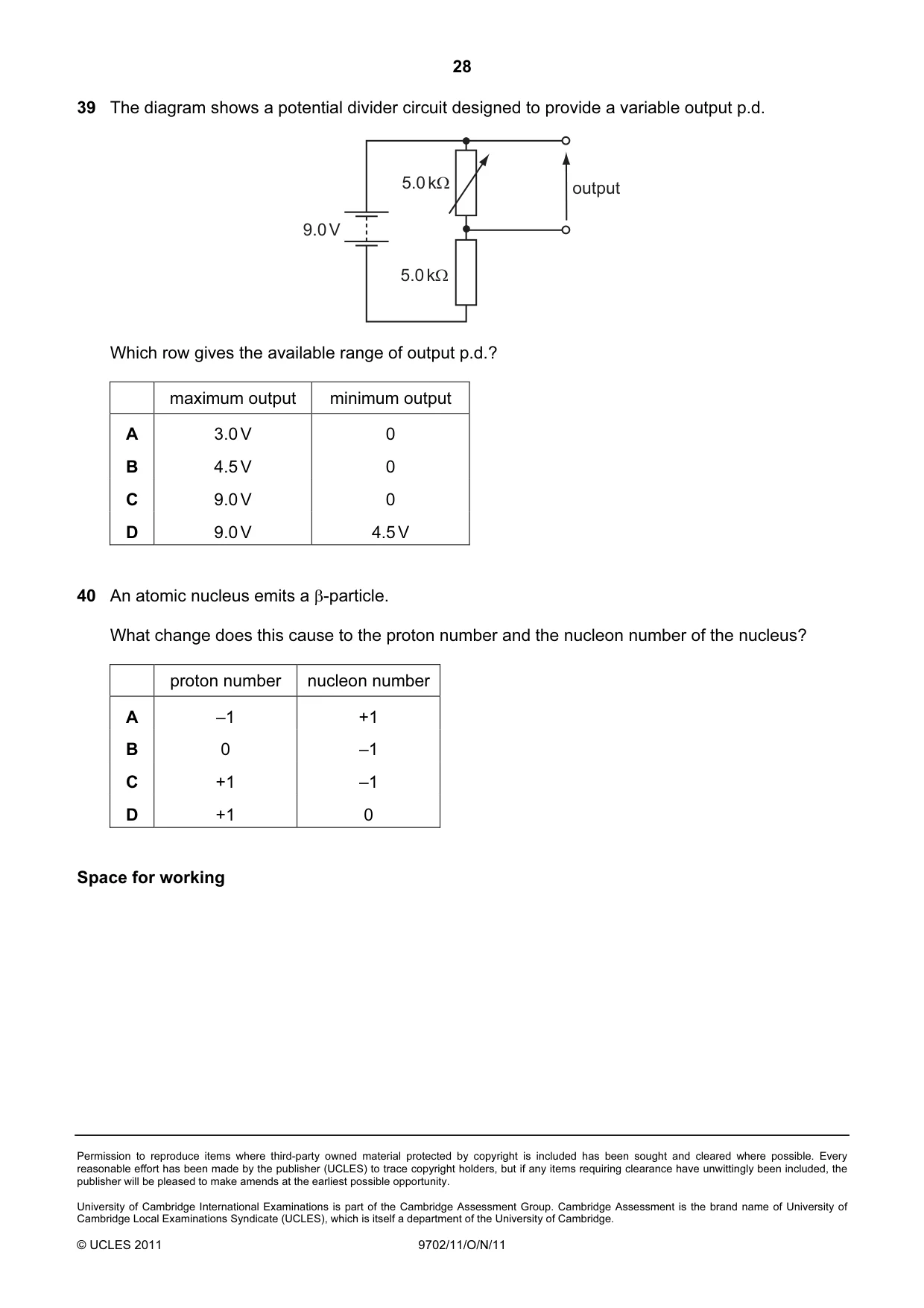
Q39 · The diagram shows a potential divider circuit designed to provide a variable output p.d
39 The diagram shows a potential divider circuit designed to provide a variable output p.d. 5.0 kΩ output 9.0 V 5.0 kΩ Which row gives the available range of output p.d.? maximum output minimum output A 3.0 V 0 B 4.5 V 0 C 9.0 V 0 D 9.0 V 4.5 V
Mark scheme: B
Q40 · An atomic nucleus emits a β-particle
40 An atomic nucleus emits a β-particle. What change does this cause to the proton number and the nucleon number of the nucleus? proton number nucleon number A –1 +1 B 0 –1 C +1 –1 D +1 0 Space for working
Mark scheme: D
What was in this paper
The subtopics covered by these 40 questions, and how many questions each got. Open one in a new tab to see every Cambridge question on it.
4Energy conservation3Practical circuits3Elastic and plastic behaviour2Equations of motion2Interference2Kinetic theory of gases2Linear momentum and its conservation2SI units2Stress and strain2Turning effects of forces2Uniform electric fields2Atoms, nuclei and radiation1Electric current1Electromagnetic spectrum1Equilibrium of forces1Errors and uncertainties1Gravitational field1Gravitational potential energy and kinetic energy1Potential difference and power1Potential dividers1Resistance and resistivity1Scalars and vectors1Stationary waves1What you needed in this session
Cambridge’s own grade thresholds for 2011 Oct/Nov, Paper 1 · Variant 1. A higher threshold means an easier paper — the bar moves with how the cohort did.