Cambridge A Level Physics 9702 — 2015 May/June Paper 1 · Variant 2
9702/12/M/J/15 · 40 questions · 40 marks · ≈45 min
The question paper and its mark scheme, free to read here and free to download. This is Cambridge’s own paper, exactly as it was sat.
Question paper20 pages
Mark scheme2 pages
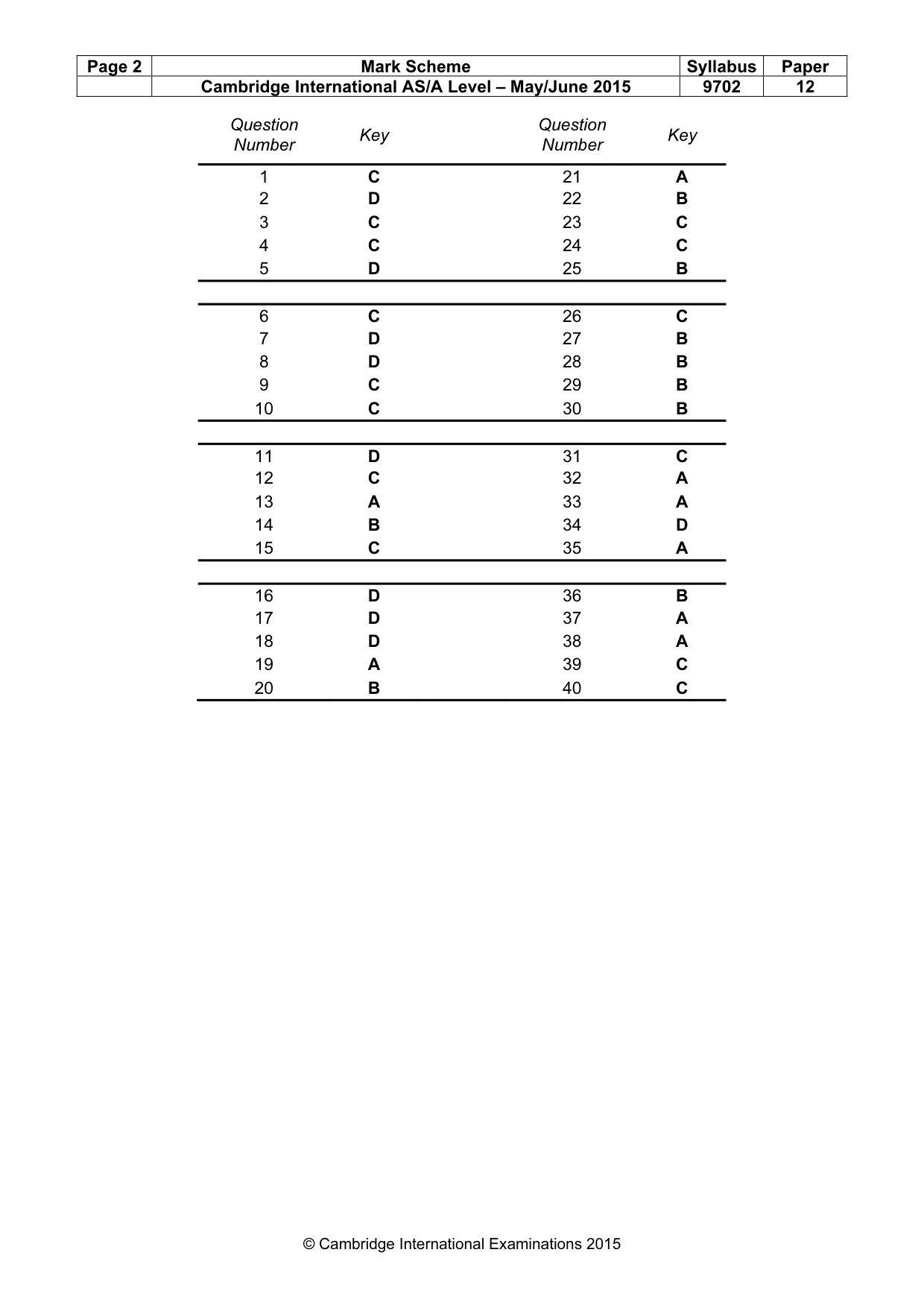
Answers below. Sit the paper first if you are practising.
Questions as text
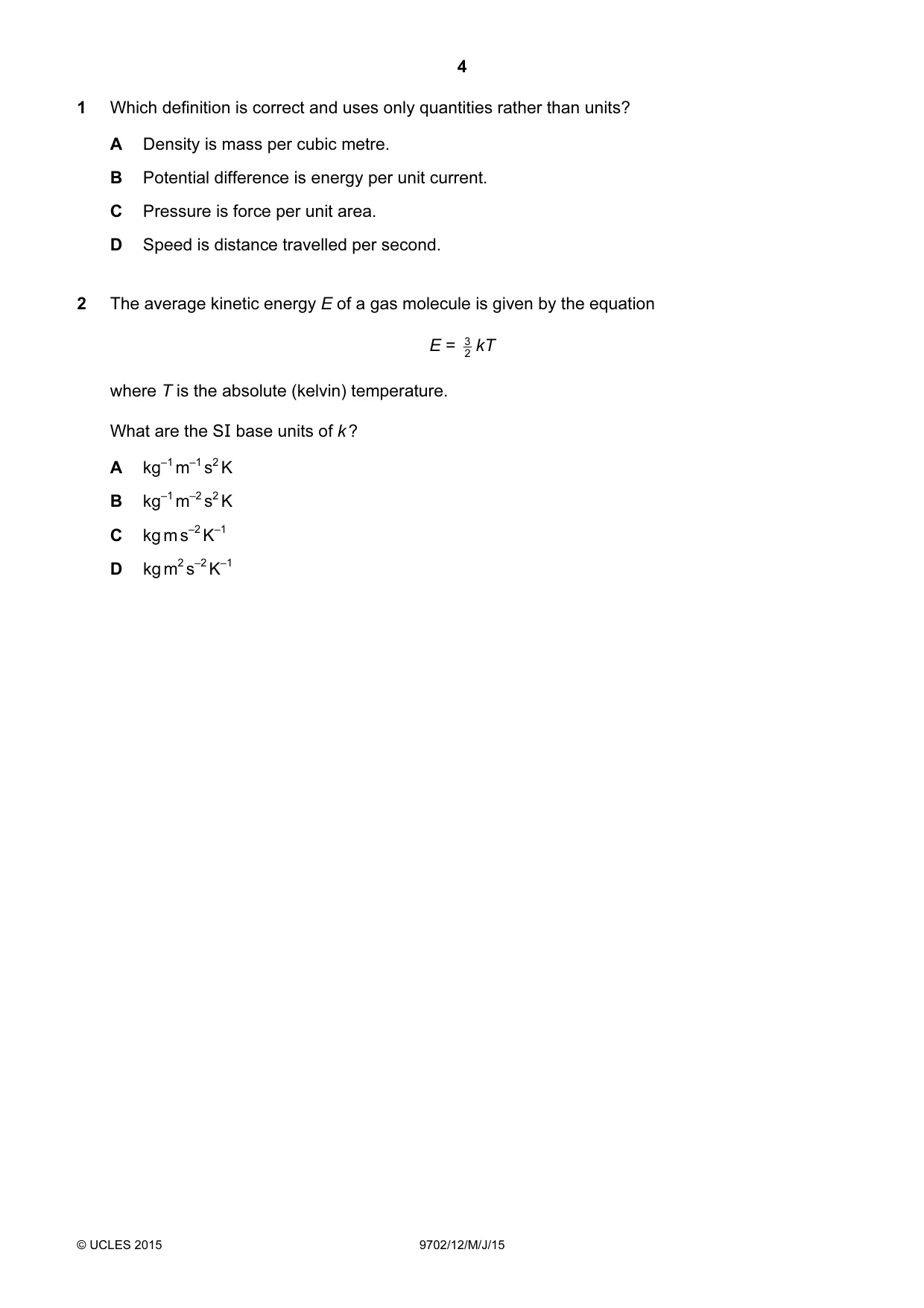
Q1 · Which definition is correct and uses only quantities rather than units?
1 Which definition is correct and uses only quantities rather than units? A Density is mass per cubic metre. B Potential difference is energy per unit current. C Pressure is force per unit area. D Speed is distance travelled per second.
Mark scheme: C
Q2 · The average kinetic energy E of a gas molecule is given by the equation E = 2 3 kT where…
2 The average kinetic energy E of a gas molecule is given by the equation E = 2 3 kT where T is the absolute (kelvin) temperature. What are the SI base units of k ? A kg–1 m–1 s2 K B kg–1 m–2 s2 K C kg m s–2 K–1 D kg m2 s–2 K–1
Mark scheme: D
Q3 · An analogue ammeter has a pointer which moves over a scale
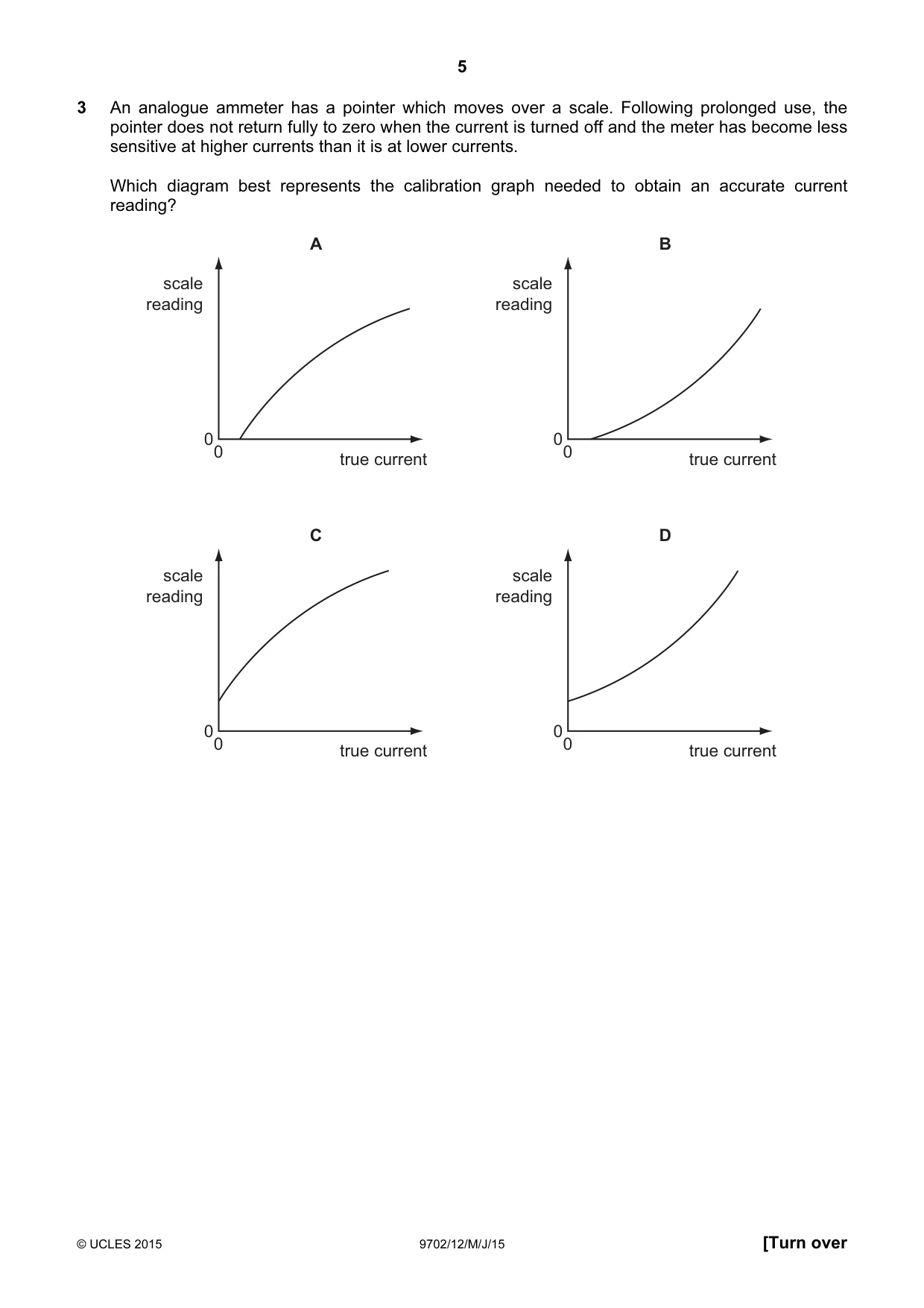
3 An analogue ammeter has a pointer which moves over a scale. Following prolonged use, the pointer does not return fully to zero when the current is turned off and the meter has become less sensitive at higher currents than it is at lower currents. Which diagram best represents the calibration graph needed to obtain an accurate current reading? A B scale scale reading reading 00 00 true current true current C D scale scale reading reading 00 00 true current true current
Mark scheme: C
Q4 · The arrow represents the vector R
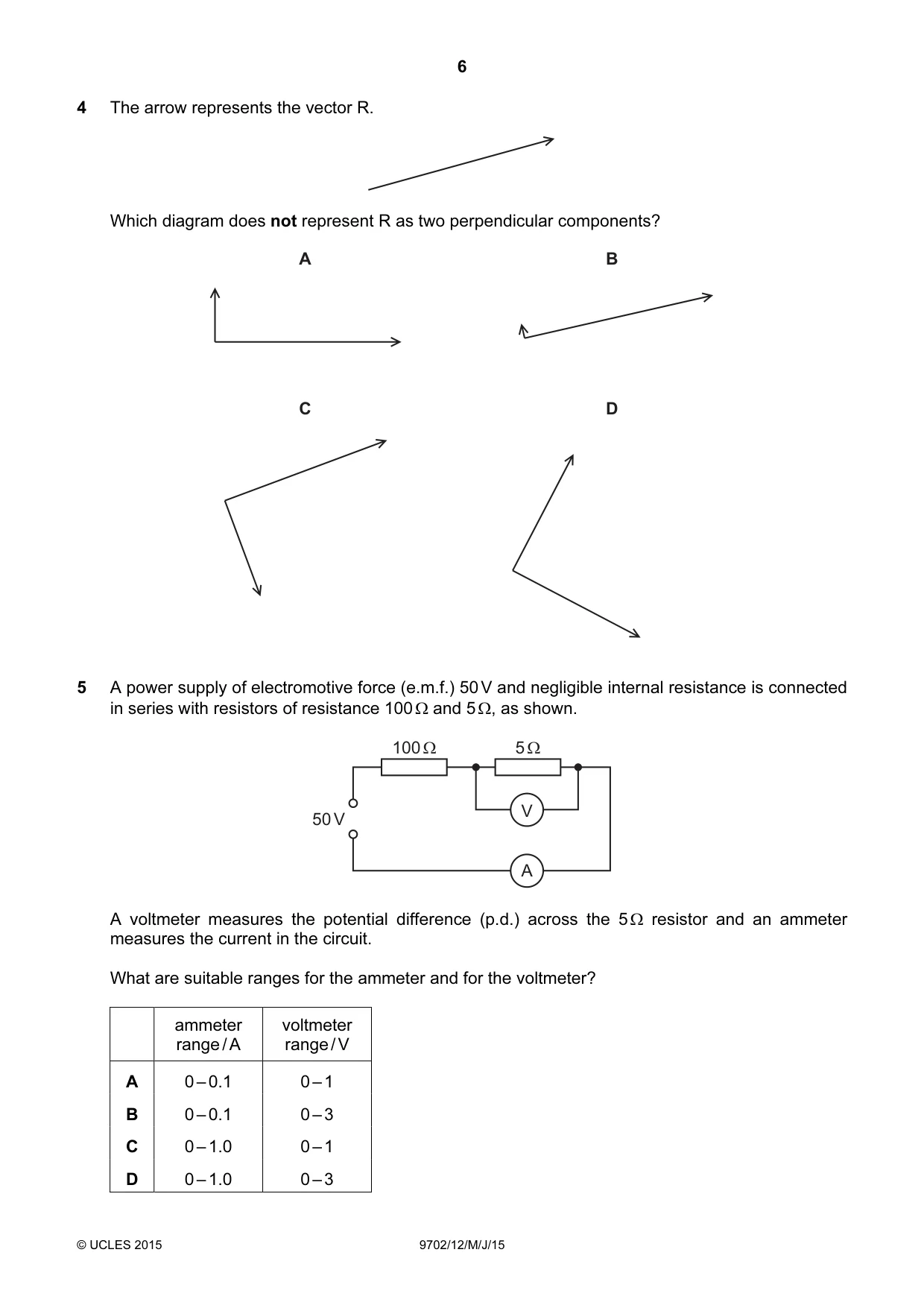
4 The arrow represents the vector R. Which diagram does not represent R as two perpendicular components? A B C D
Mark scheme: C
Q5 · A power supply of electromotive force (e.m.f.) 50 V and negligible internal resistance is…
5 A power supply of electromotive force (e.m.f.) 50 V and negligible internal resistance is connected in series with resistors of resistance 100 Ω and 5 Ω, as shown. 100 Ω 5 Ω V 50 V A A voltmeter measures the potential difference (p.d.) across the 5 Ω resistor and an ammeter measures the current in the circuit. What are suitable ranges for the ammeter and for the voltmeter? ammeter voltmeter range / A range / V A 0 – 0.1 0 – 1 B 0 – 0.1 0 – 3 C 0 – 1.0 0 – 1 D 0 – 1.0 0 – 3
Mark scheme: D
Q6 · A single sheet of aluminium foil is folded twice to produce a stack of four sheets
6 A single sheet of aluminium foil is folded twice to produce a stack of four sheets. The total thickness of the stack of sheets is measured to be (0.80 ± 0.02) mm. This measurement is made using a digital caliper with a zero error of (−0.20 ± 0.02) mm. What is the percentage uncertainty in the calculated thickness of a single sheet? A 1.0% B 2.0% C 4.0% D 6.7%
Mark scheme: C
Q7 · In an experiment to determine the acceleration of free fall g, a ball bearing is held by…
7 In an experiment to determine the acceleration of free fall g, a ball bearing is held by an electromagnet. When the current to the electromagnet is switched off, a clock starts and the ball bearing falls. After falling a distance h, the ball bearing strikes a switch to stop the clock which measures the time t of the fall. If systematic errors cause t and h to be measured incorrectly, which error must cause g to appear greater than 9.81 m s–2? A h measured as being smaller than it actually is and t is measured correctly B h measured as being smaller than it actually is and t measured as being larger than it actually is C h measured as being larger than it actually is and t measured as being larger than it actually is D h is measured correctly and t measured as being smaller than it actually is
Mark scheme: D
Q8 · A stone is thrown horizontally from the top of a cliff
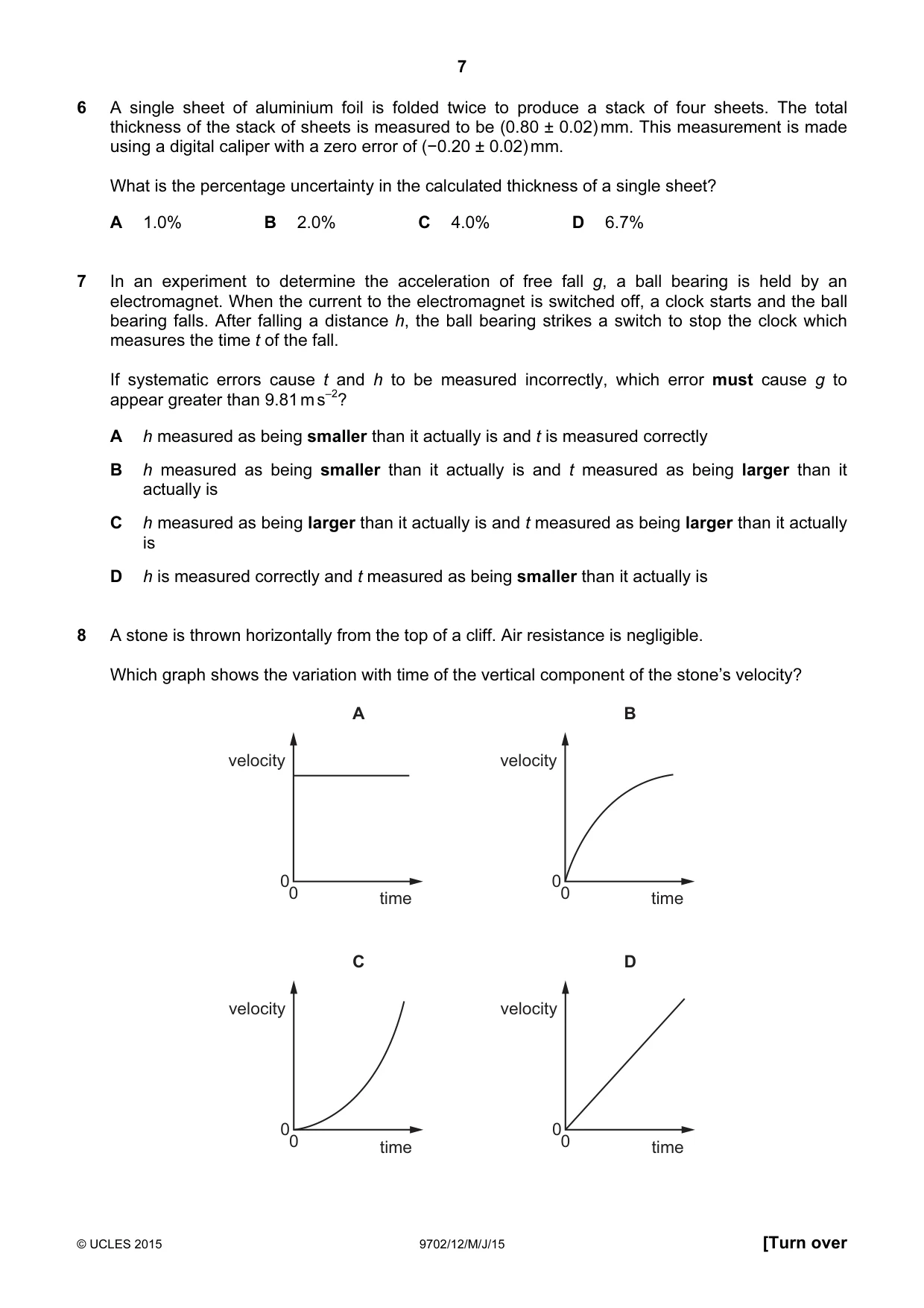
8 A stone is thrown horizontally from the top of a cliff. Air resistance is negligible. Which graph shows the variation with time of the vertical component of the stone’s velocity? A B velocity velocity 00 00 time time C D velocity velocity 00 00 time time
Mark scheme: D
Q9 · A sprinter runs a 100 m race in a straight line
9 A sprinter runs a 100 m race in a straight line. He accelerates from the starting block at a constant acceleration of 2.5 m s–2 to reach his maximum speed of 10 m s–1. He maintains this speed until he crosses the finish line. Which time does it take the sprinter to run the race? A 4 s B 10 s C 12 s D 20 s
Mark scheme: C
Q10 · A firework rocket is fired vertically upwards
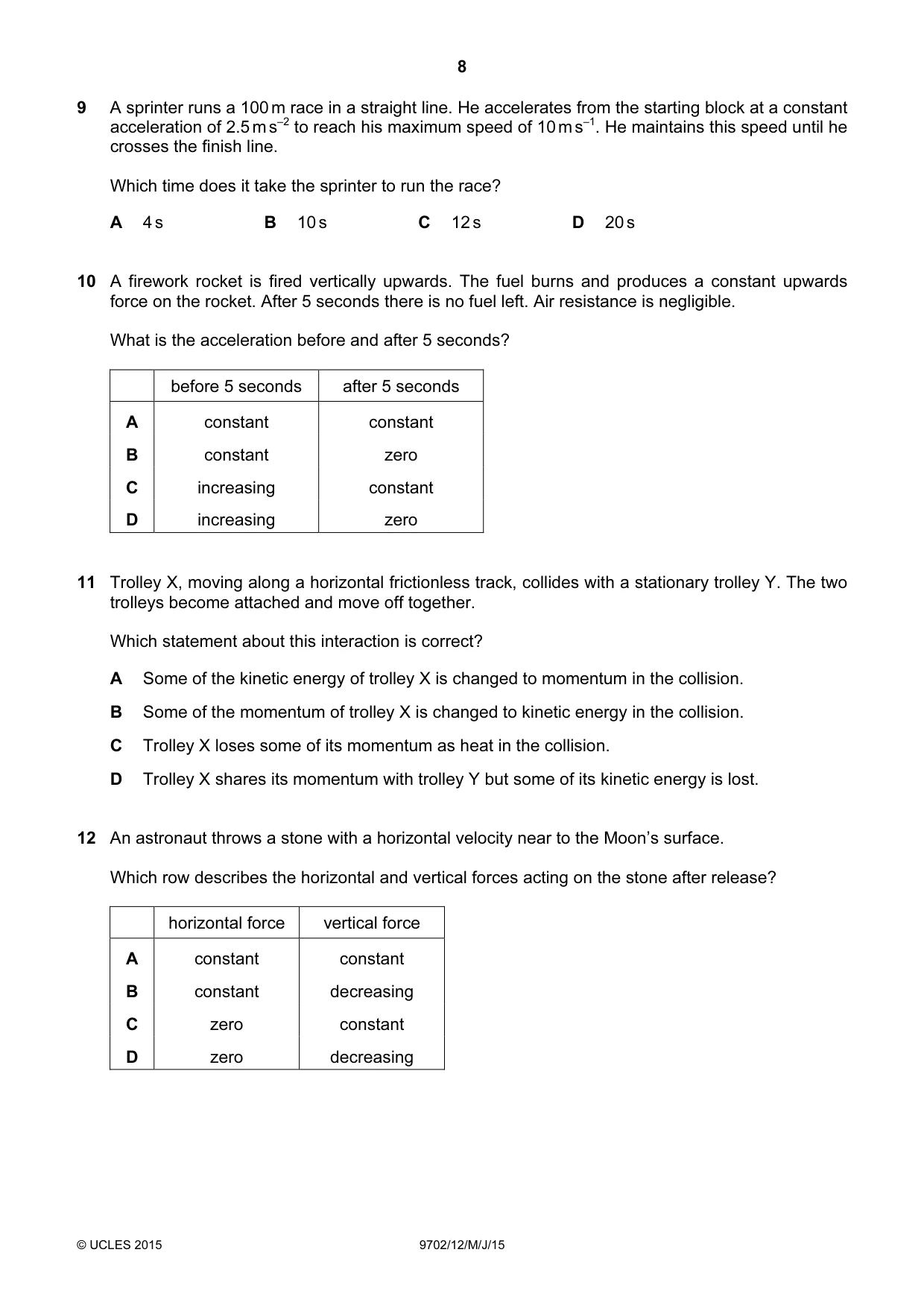
10 A firework rocket is fired vertically upwards. The fuel burns and produces a constant upwards force on the rocket. After 5 seconds there is no fuel left. Air resistance is negligible. What is the acceleration before and after 5 seconds? before 5 seconds after 5 seconds A constant constant B constant zero C increasing constant D increasing zero
Mark scheme: C
Q11 · Trolley X, moving along a horizontal frictionless track, collides with a stationary…
11 Trolley X, moving along a horizontal frictionless track, collides with a stationary trolley Y. The two trolleys become attached and move off together. Which statement about this interaction is correct? A Some of the kinetic energy of trolley X is changed to momentum in the collision. B Some of the momentum of trolley X is changed to kinetic energy in the collision. C Trolley X loses some of its momentum as heat in the collision. D Trolley X shares its momentum with trolley Y but some of its kinetic energy is lost.
Mark scheme: D
Q12 · An astronaut throws a stone with a horizontal velocity near to the Moon’s surface
12 An astronaut throws a stone with a horizontal velocity near to the Moon’s surface. Which row describes the horizontal and vertical forces acting on the stone after release? horizontal force vertical force A constant constant B constant decreasing C zero constant D zero decreasing
Mark scheme: C
Q13 · Newton’s third law of motion is often summarised as ‘Every action (force) has an equal…
13 Newton’s third law of motion is often summarised as ‘Every action (force) has an equal and opposite reaction.’ A book rests on a table. If the weight of the book is the ‘action’ force, what is the ‘reaction’ force? A the pull of the book on the Earth B the pull of the Earth on the book C the push of the book on the table D the push of the table on the book
Mark scheme: A
Q14 · A ladder is positioned on icy (frictionless) ground and is leant against a rough wall
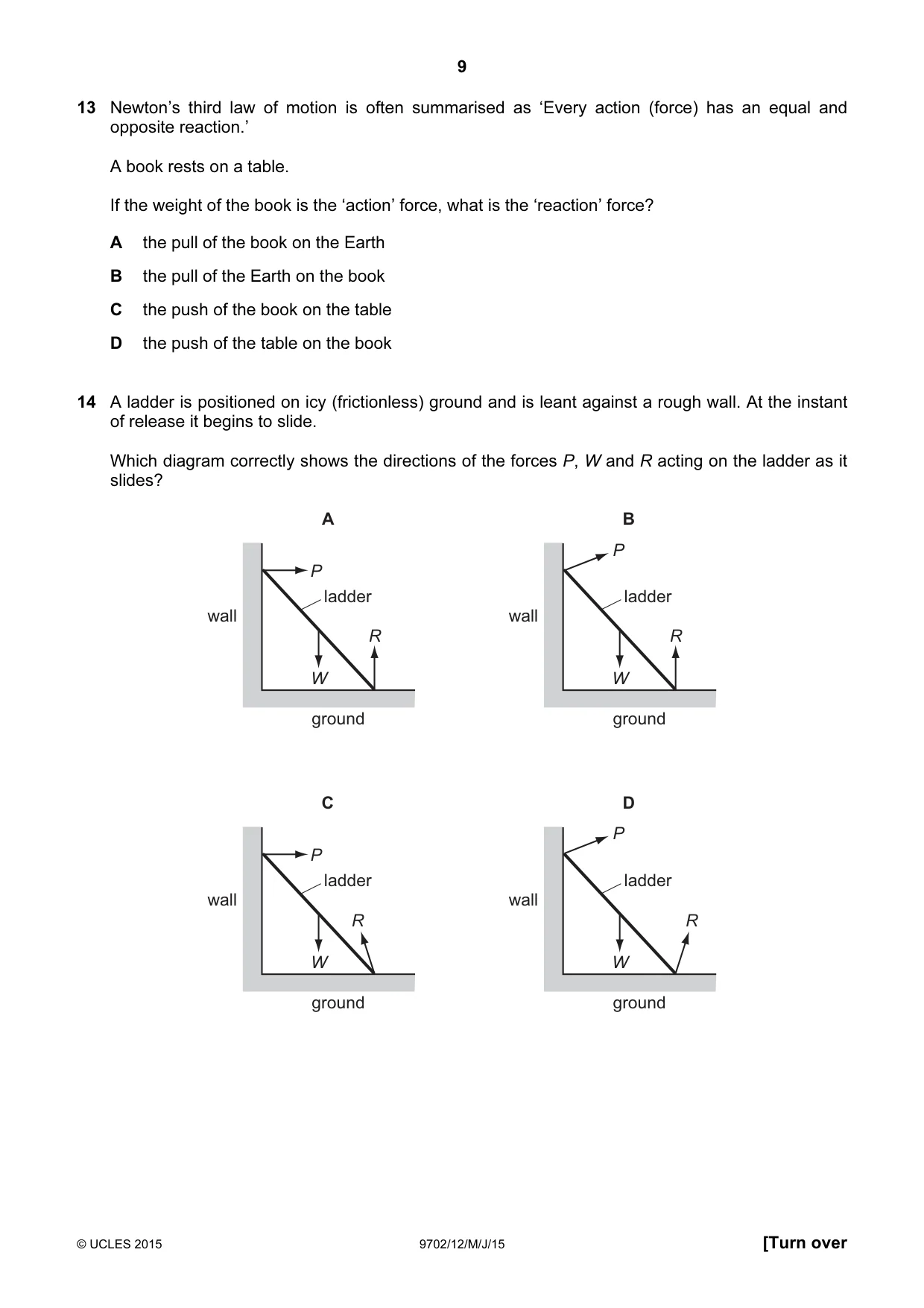
14 A ladder is positioned on icy (frictionless) ground and is leant against a rough wall. At the instant of release it begins to slide. Which diagram correctly shows the directions of the forces P, W and R acting on the ladder as it slides? A B P P ladder ladder wall wall R R W W ground ground C D P P ladder ladder wall wall R R W W ground ground
Mark scheme: B
Q15 · A uniform solid block has weight 500 N, width 0.4 m and height 0.6 m
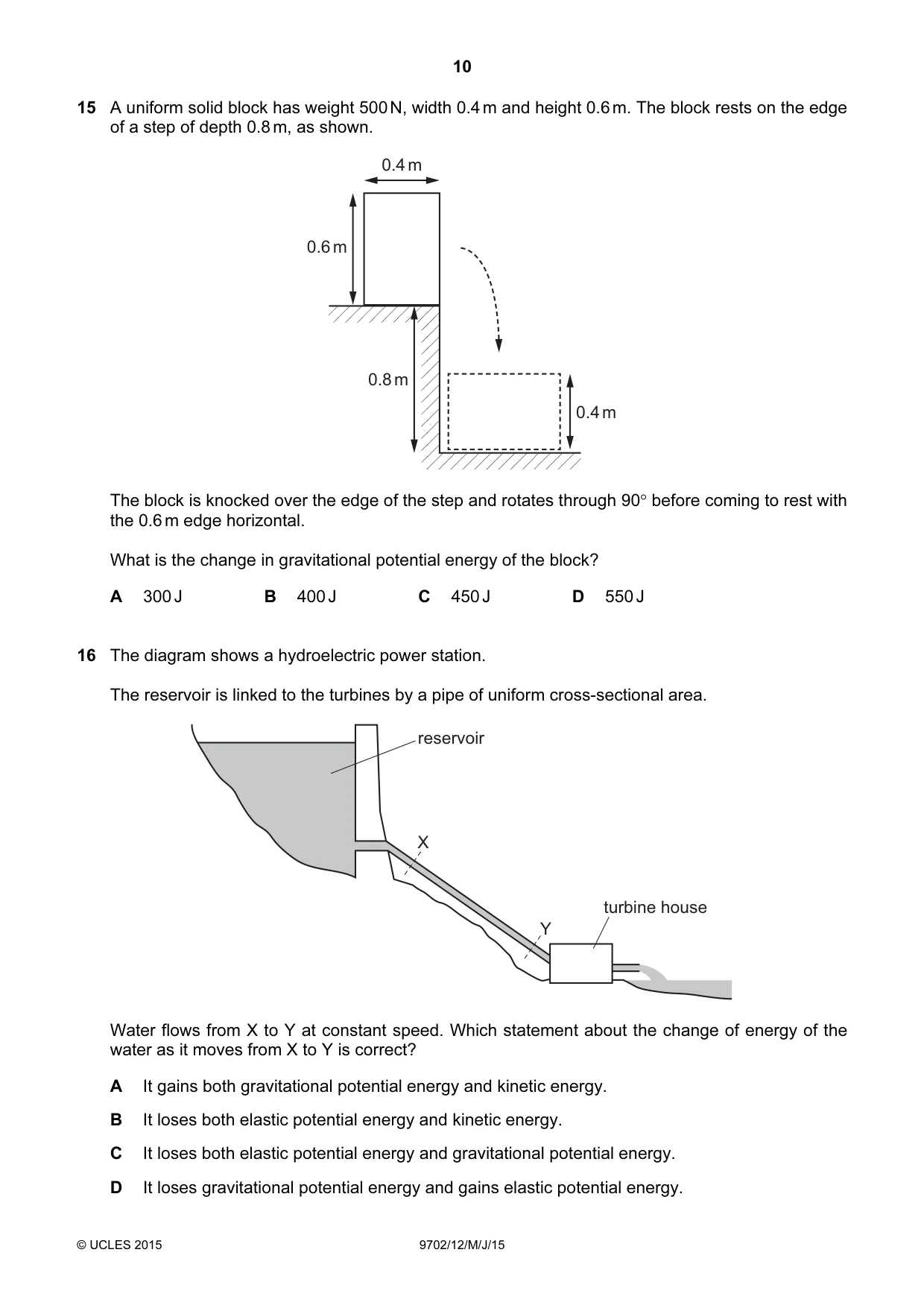
15 A uniform solid block has weight 500 N, width 0.4 m and height 0.6 m. The block rests on the edge of a step of depth 0.8 m, as shown. 0.4 m 0.6 m 0.8 m 0.4 m The block is knocked over the edge of the step and rotates through 90° before coming to rest with the 0.6 m edge horizontal. What is the change in gravitational potential energy of the block? A 300 J B 400 J C 450 J D 550 J
Mark scheme: C
More questions on Gravitational potential energy and kinetic energy
Q16 · The diagram shows a hydroelectric power station
16 The diagram shows a hydroelectric power station. The reservoir is linked to the turbines by a pipe of uniform cross-sectional area. reservoir X turbine house Y Water flows from X to Y at constant speed. Which statement about the change of energy of the water as it moves from X to Y is correct? A It gains both gravitational potential energy and kinetic energy. B It loses both elastic potential energy and kinetic energy. C It loses both elastic potential energy and gravitational potential energy. D It loses gravitational potential energy and gains elastic potential energy.
Mark scheme: D
Q17 · A fisherman lifts a fish of mass 250 g from rest through a vertical height of 1.8 m
17 A fisherman lifts a fish of mass 250 g from rest through a vertical height of 1.8 m. The fish gains a speed of 1.1 m s–1. What is the energy gained by the fish? A 0.15 J B 4.3 J C 4.4 J D 4.6 J
Mark scheme: D
More questions on Gravitational potential energy and kinetic energy
Q18 · Water from a reservoir is fed to the turbine of a hydroelectric system at a rate of 500…
18 Water from a reservoir is fed to the turbine of a hydroelectric system at a rate of 500 kg s–1. The reservoir is 300 m above the level of the turbine. The electrical output from the generator driven by the turbine is 200 A at a potential difference of 6000 V. What is the efficiency of the system? A 8.0% B 8.2% C 80% D 82%
Mark scheme: D
Q19 · Which row correctly describes the ordering and motion of the molecules in liquid water…
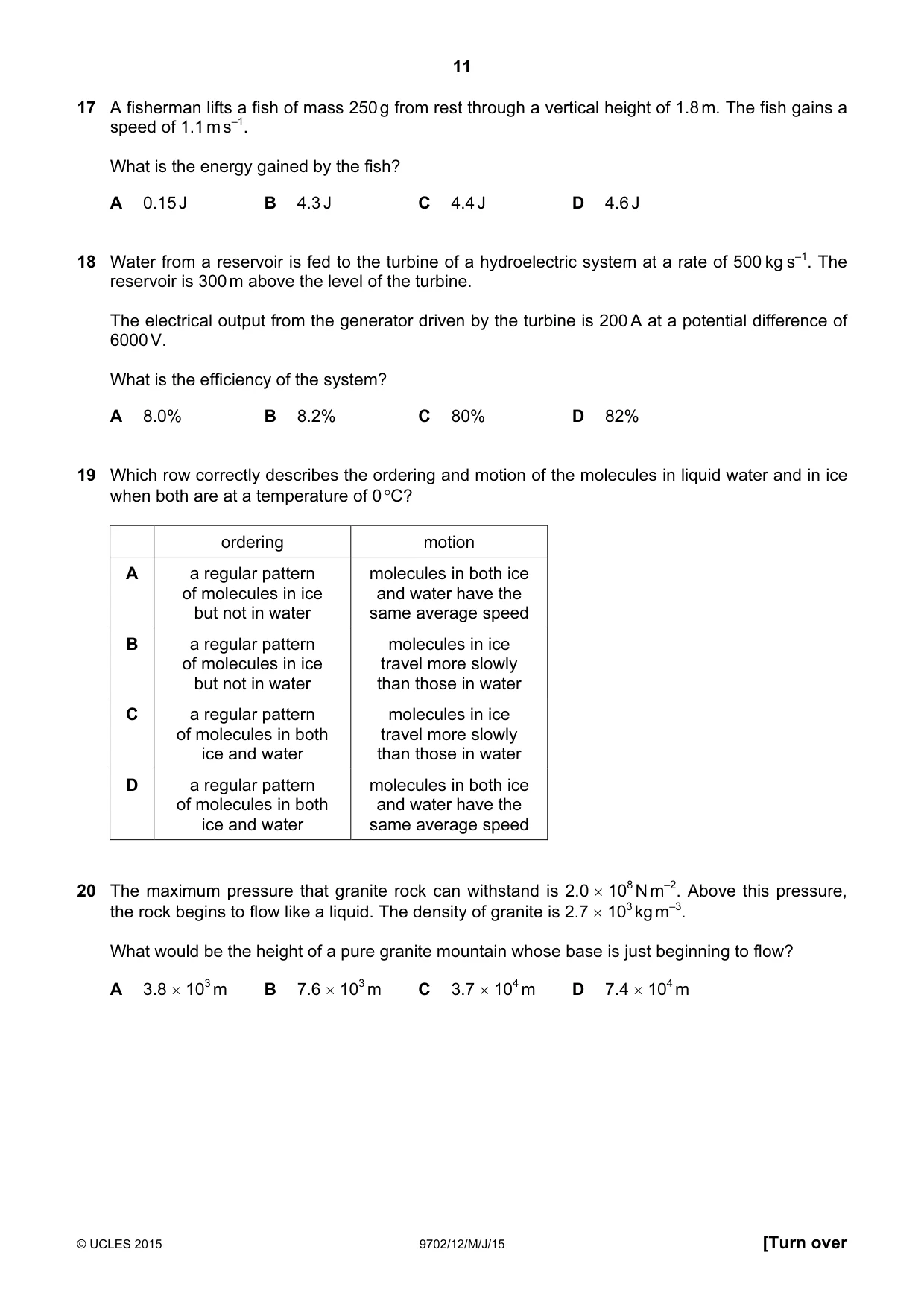
19 Which row correctly describes the ordering and motion of the molecules in liquid water and in ice when both are at a temperature of 0 °C? ordering motion A a regular pattern molecules in both ice of molecules in ice and water have the but not in water same average speed B a regular pattern molecules in ice of molecules in ice travel more slowly but not in water than those in water C a regular pattern molecules in ice of molecules in both travel more slowly ice and water than those in water D a regular pattern molecules in both ice of molecules in both and water have the ice and water same average speed
Mark scheme: A
Q20 · The maximum pressure that granite rock can withstand is 2.0 × 10⁸ N m–2
20 The maximum pressure that granite rock can withstand is 2.0 × 10⁸ N m–2. Above this pressure, the rock begins to flow like a liquid. The density of granite is 2.7 × 10³ kg m–3. What would be the height of a pure granite mountain whose base is just beginning to flow? A 3.8 × 10³ m B 7.6 × 10³ m C 3.7 × 10⁴ m D 7.4 × 10⁴ m
Mark scheme: B
Q21 · To determine the Young modulus of a wire, several measurements are taken
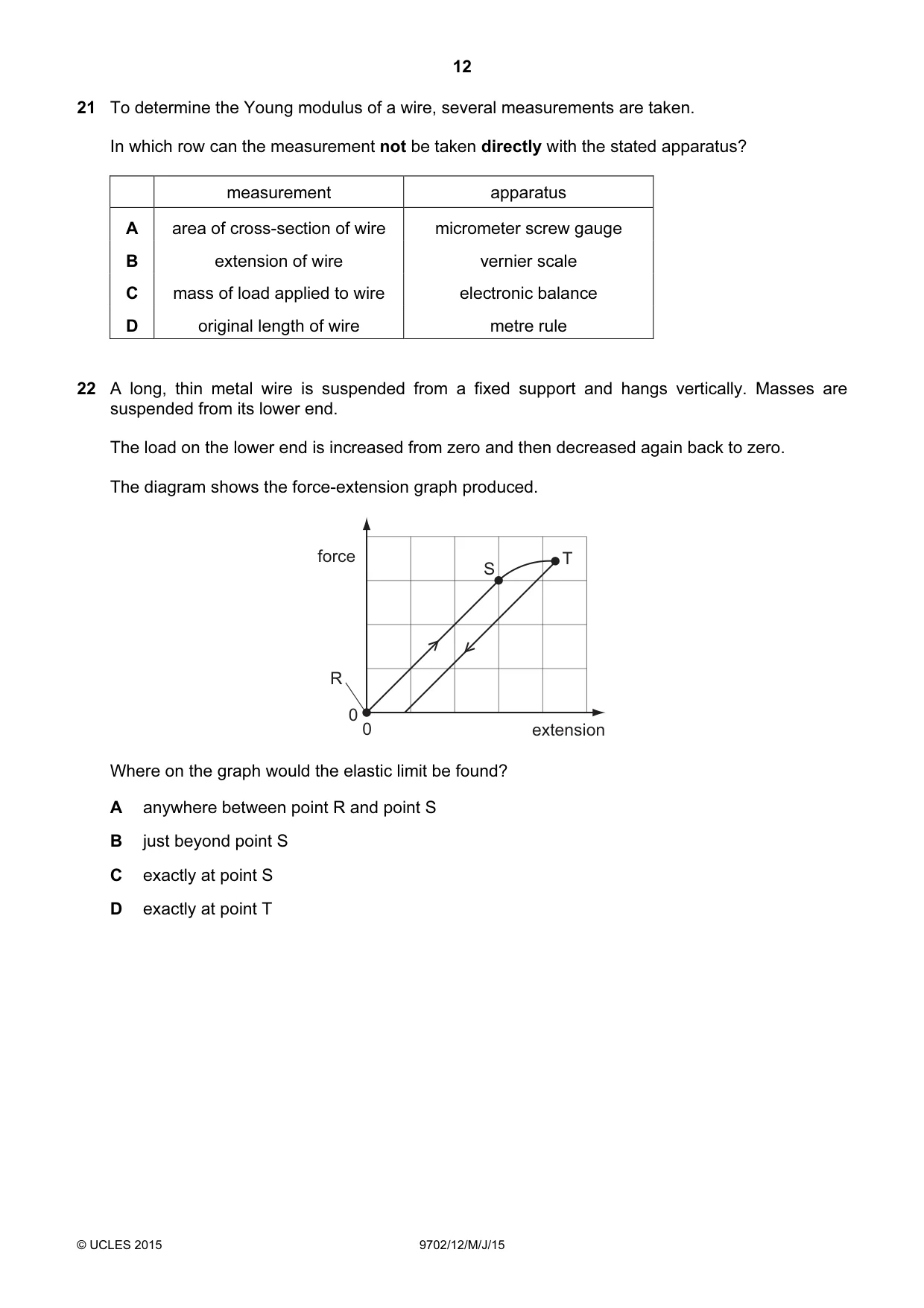
21 To determine the Young modulus of a wire, several measurements are taken. In which row can the measurement not be taken directly with the stated apparatus? measurement apparatus A area of cross-section of wire micrometer screw gauge B extension of wire vernier scale C mass of load applied to wire electronic balance D original length of wire metre rule
Mark scheme: A
Q22 · A long, thin metal wire is suspended from a fixed support and hangs vertically
22 A long, thin metal wire is suspended from a fixed support and hangs vertically. Masses are suspended from its lower end. The load on the lower end is increased from zero and then decreased again back to zero. The diagram shows the force-extension graph produced. force T S R 0 0 extension Where on the graph would the elastic limit be found? A anywhere between point R and point S B just beyond point S C exactly at point S D exactly at point T
Mark scheme: B
Q23 · The diagram represents a steel tube with wall thickness w which is small in comparison…
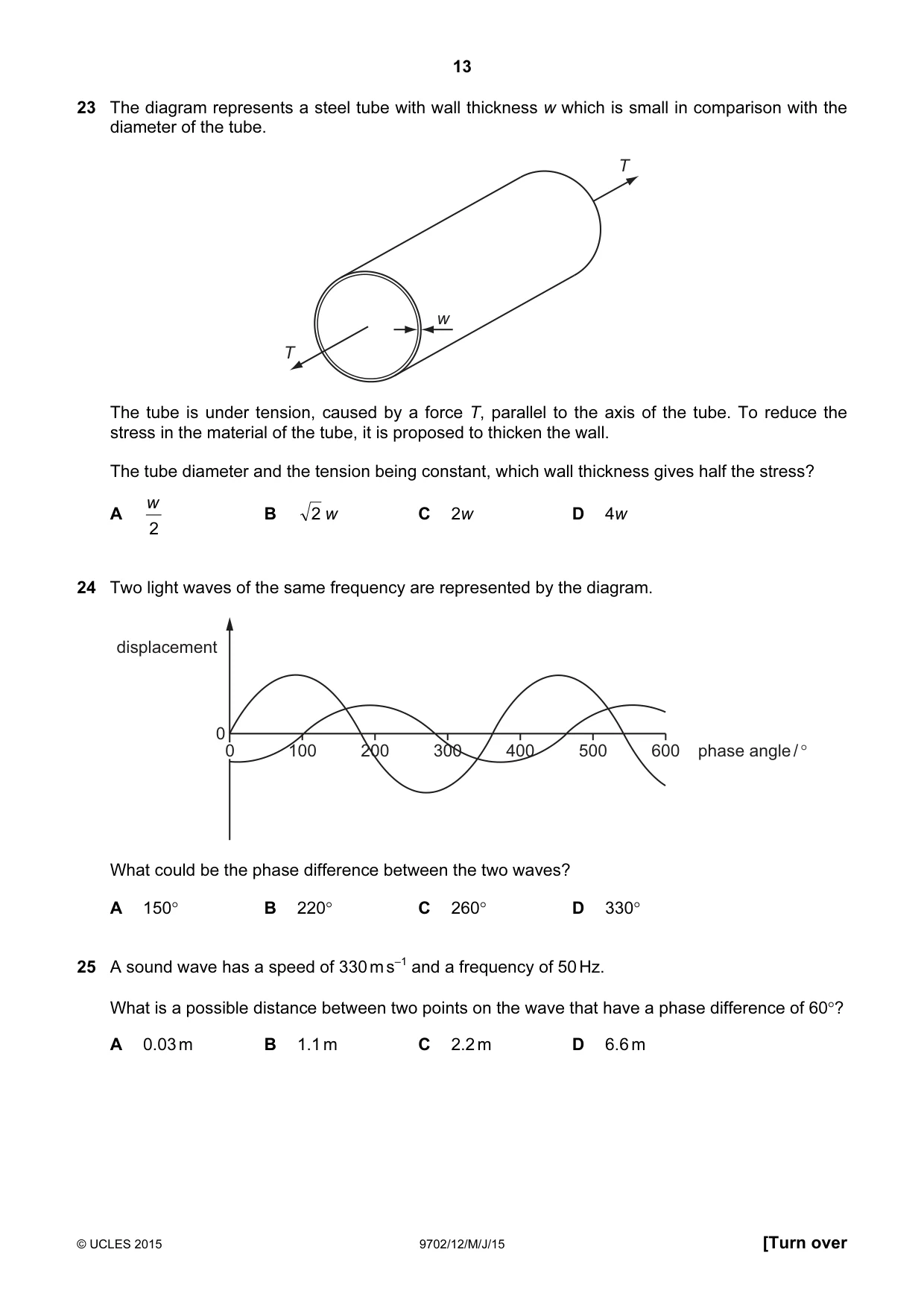
23 The diagram represents a steel tube with wall thickness w which is small in comparison with the diameter of the tube. T w T The tube is under tension, caused by a force T, parallel to the axis of the tube. To reduce the stress in the material of the tube, it is proposed to thicken the wall. The tube diameter and the tension being constant, which wall thickness gives half the stress? w A B 2 w C 2w D 4w 2
Mark scheme: C
Q24 · Two light waves of the same frequency are represented by the diagram
24 Two light waves of the same frequency are represented by the diagram. displacement 0 0 100 200 300 400 500 600 phase angle / ° What could be the phase difference between the two waves? A 150° B 220° C 260° D 330°
Mark scheme: C
Q25 · A sound wave has a speed of 330 m s–1 and a frequency of 50 Hz
25 A sound wave has a speed of 330 m s–1 and a frequency of 50 Hz. What is a possible distance between two points on the wave that have a phase difference of 60°? A 0.03 m B 1.1 m C 2.2 m D 6.6 m
Mark scheme: B
Q26 · What is not an essential condition for an observable interference pattern to occur…
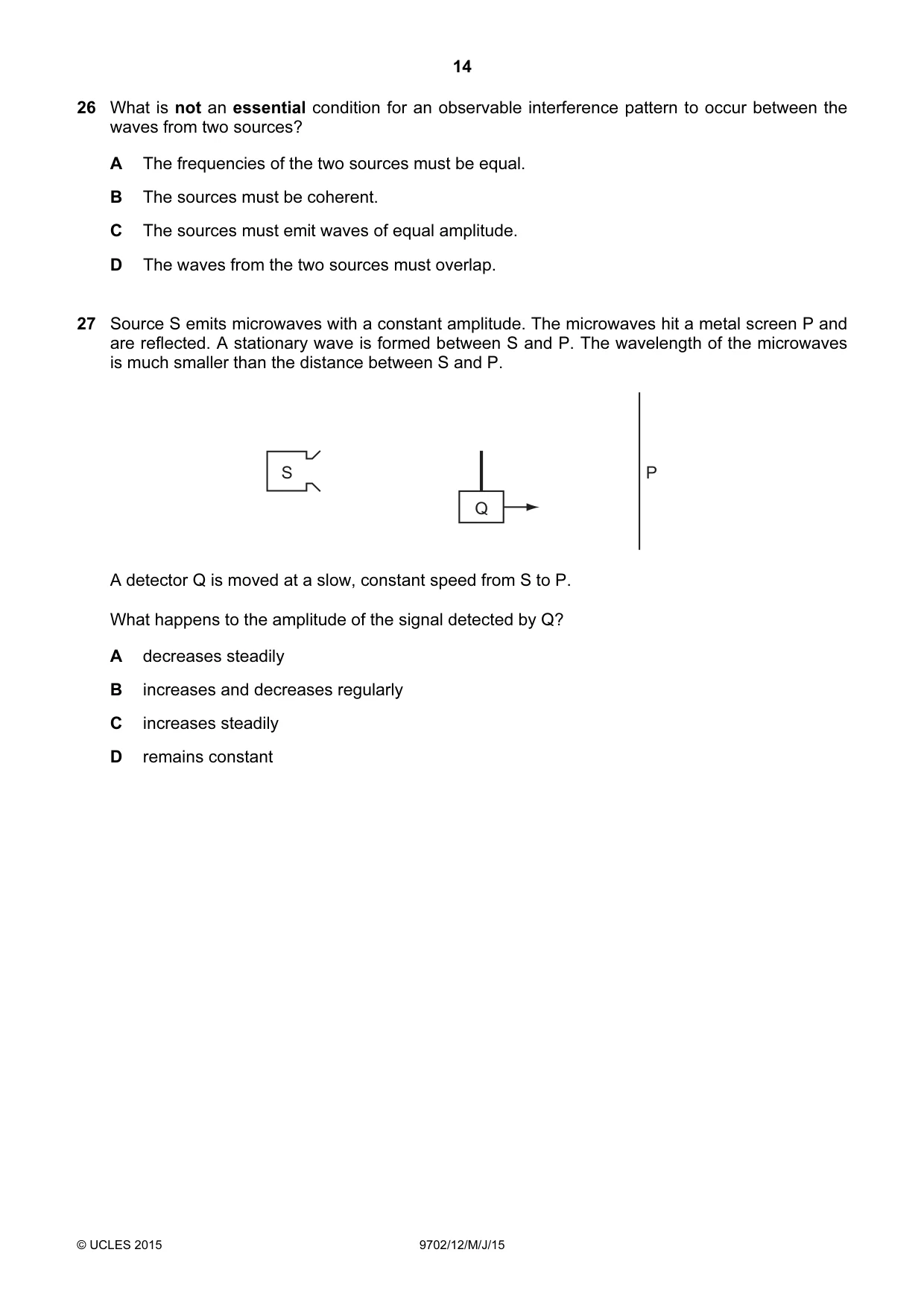
26 What is not an essential condition for an observable interference pattern to occur between the waves from two sources? A The frequencies of the two sources must be equal. B The sources must be coherent. C The sources must emit waves of equal amplitude. D The waves from the two sources must overlap.
Mark scheme: C
Q27 · Source S emits microwaves with a constant amplitude
27 Source S emits microwaves with a constant amplitude. The microwaves hit a metal screen P and are reflected. A stationary wave is formed between S and P. The wavelength of the microwaves is much smaller than the distance between S and P. S P Q A detector Q is moved at a slow, constant speed from S to P. What happens to the amplitude of the signal detected by Q? A decreases steadily B increases and decreases regularly C increases steadily D remains constant
Mark scheme: B
Q28 · A pattern of waves was observed without being able to view the source of the waves
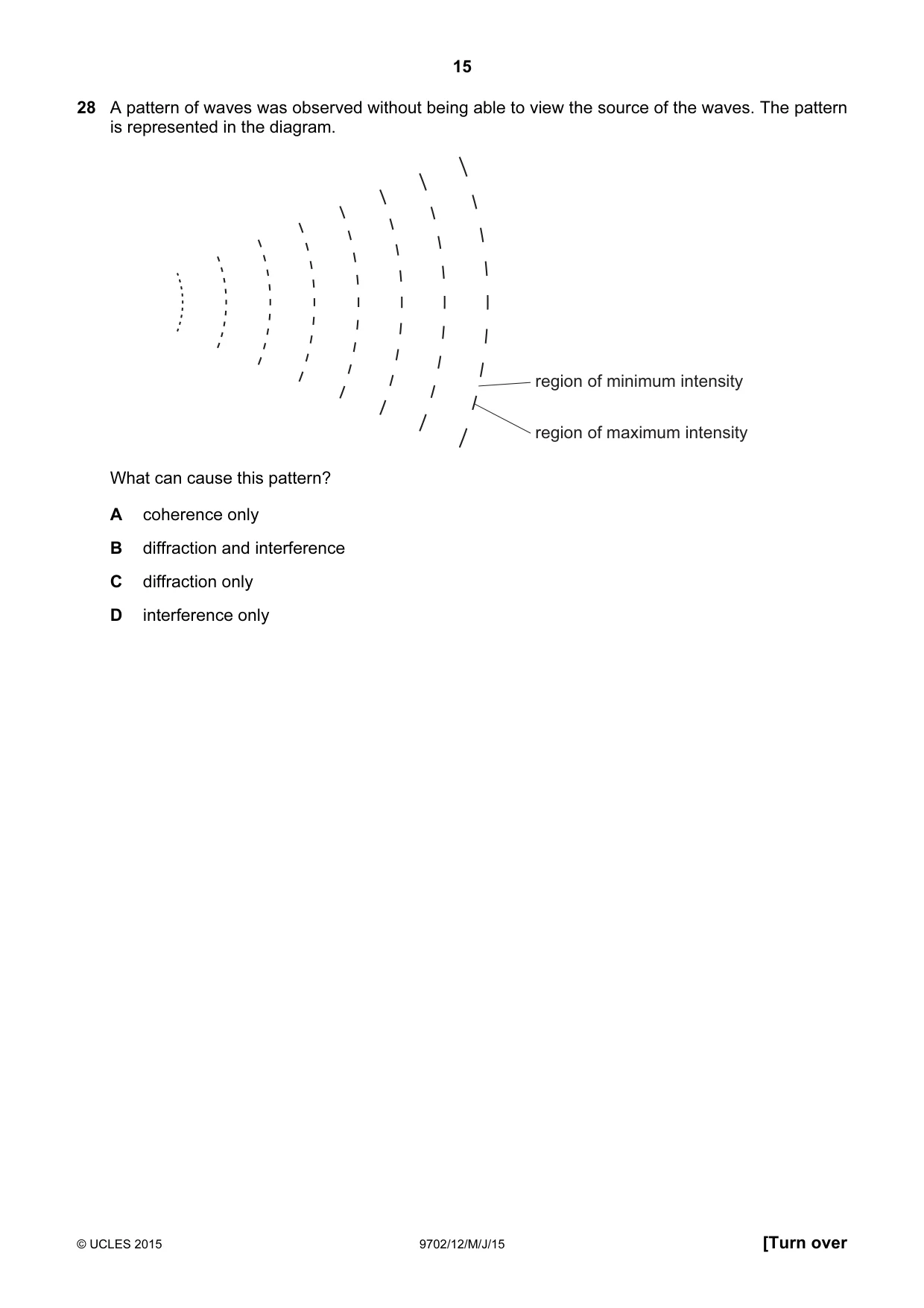
28 A pattern of waves was observed without being able to view the source of the waves. The pattern is represented in the diagram. region of minimum intensity region of maximum intensity What can cause this pattern? A coherence only B diffraction and interference C diffraction only D interference only
Mark scheme: B
Q29 · A positive charge and a negative charge of equal magnitude are placed a short distance…
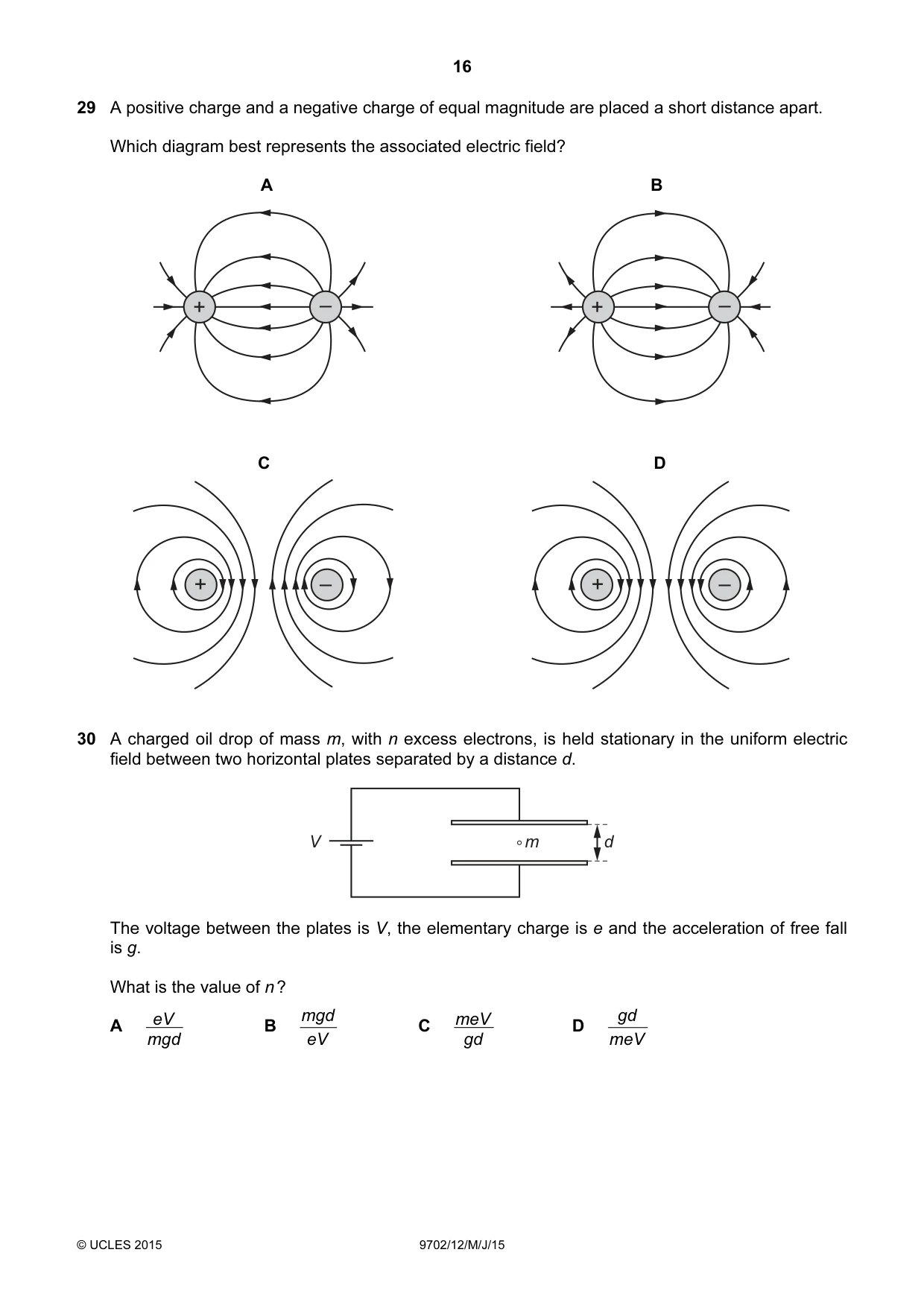
29 A positive charge and a negative charge of equal magnitude are placed a short distance apart. Which diagram best represents the associated electric field? A B + – + – C D + – + –
Mark scheme: B
Q30 · A charged oil drop of mass m, with n excess electrons, is held stationary in the uniform…
30 A charged oil drop of mass m, with n excess electrons, is held stationary in the uniform electric field between two horizontal plates separated by a distance d. V m d The voltage between the plates is V, the elementary charge is e and the acceleration of free fall is g. What is the value of n ? eV mgd meV gd A B C D mgd eV gd meV
Mark scheme: B
Q31 · Which unit is not used in either the definition of the coulomb or the definition of the…
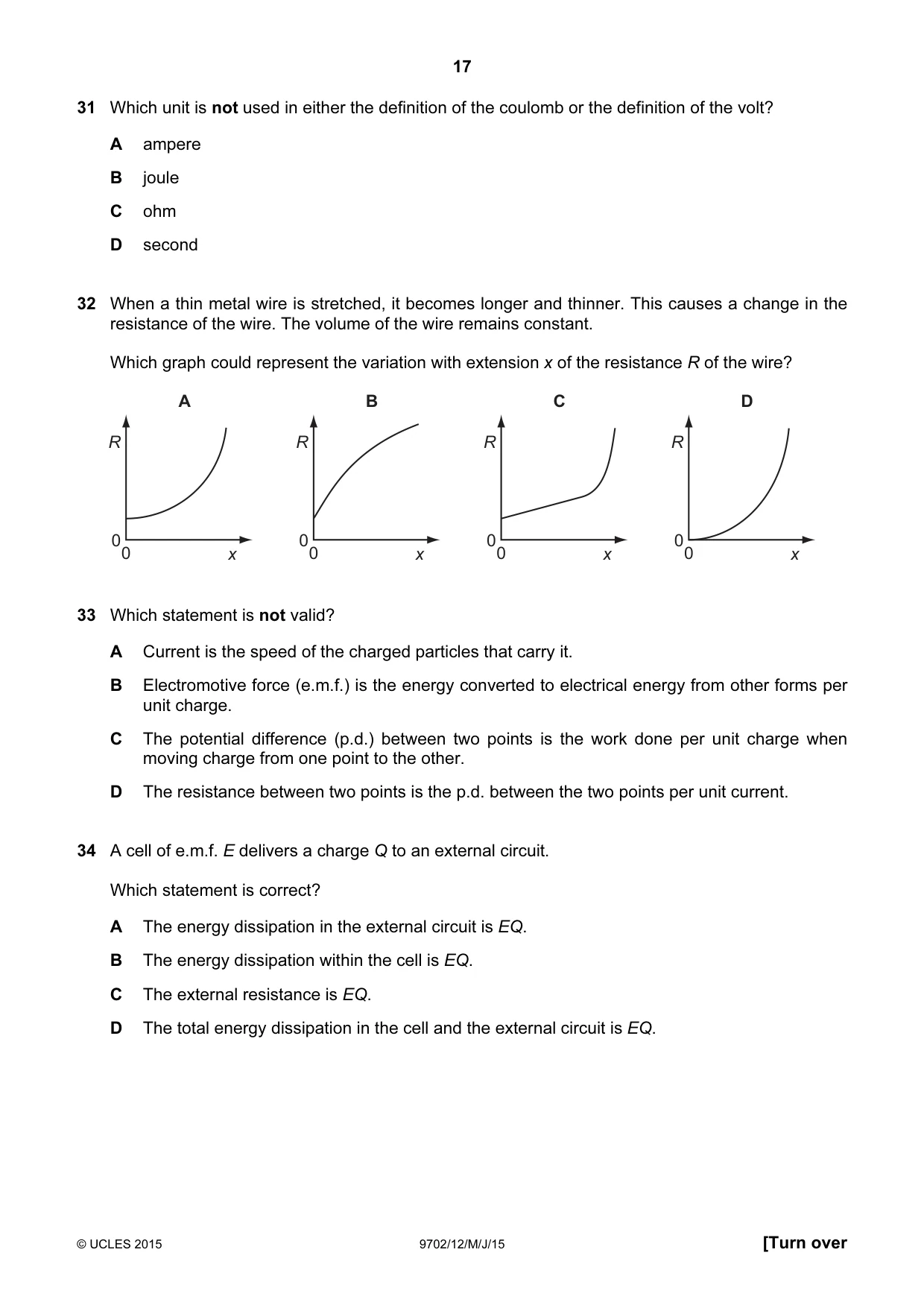
31 Which unit is not used in either the definition of the coulomb or the definition of the volt? A ampere B joule C ohm D second
Mark scheme: C
Q32 · When a thin metal wire is stretched, it becomes longer and thinner
32 When a thin metal wire is stretched, it becomes longer and thinner. This causes a change in the resistance of the wire. The volume of the wire remains constant. Which graph could represent the variation with extension x of the resistance R of the wire? A B C D R R R R 00 00 00 00 x x x x
Mark scheme: A
Q33 · Which statement is not valid?
33 Which statement is not valid? A Current is the speed of the charged particles that carry it. B Electromotive force (e.m.f.) is the energy converted to electrical energy from other forms per unit charge. C The potential difference (p.d.) between two points is the work done per unit charge when moving charge from one point to the other. D The resistance between two points is the p.d. between the two points per unit current.
Mark scheme: A
Q34 · A cell of e.m.f
34 A cell of e.m.f. E delivers a charge Q to an external circuit. Which statement is correct? A The energy dissipation in the external circuit is EQ. B The energy dissipation within the cell is EQ. C The external resistance is EQ. D The total energy dissipation in the cell and the external circuit is EQ.
Mark scheme: D
Q35 · Each of Kirchhoff's two laws presumes that some quantity is conserved
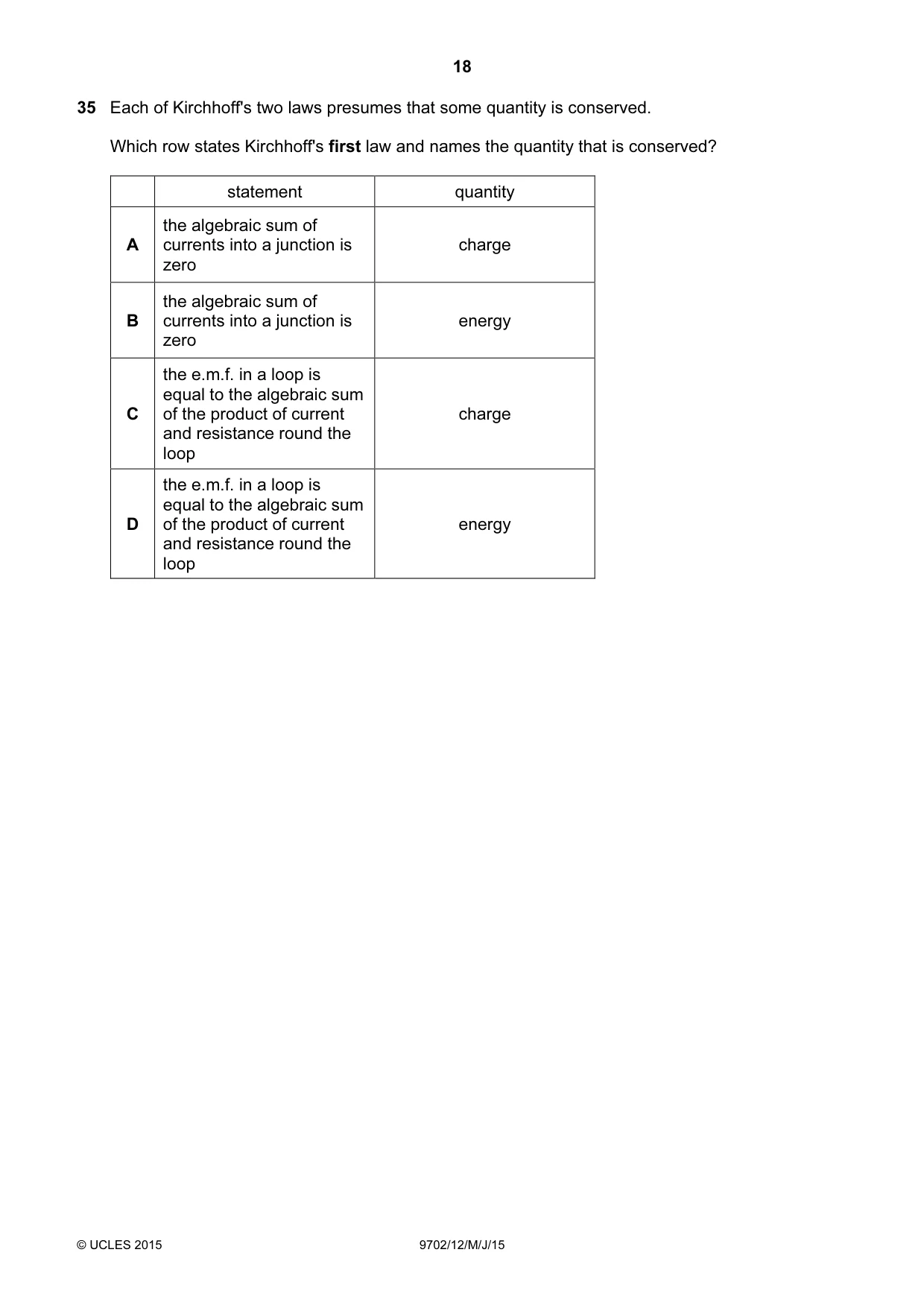
35 Each of Kirchhoff's two laws presumes that some quantity is conserved. Which row states Kirchhoff's first law and names the quantity that is conserved? statement quantity the algebraic sum of A currents into a junction is charge zero the algebraic sum of B currents into a junction is energy zero the e.m.f. in a loop is equal to the algebraic sum C of the product of current charge and resistance round the loop the e.m.f. in a loop is equal to the algebraic sum D of the product of current energy and resistance round the loop
Mark scheme: A
Q36 · A potential divider circuit consists of fixed resistors of resistance 2.0 Ω and 4.0 Ω…
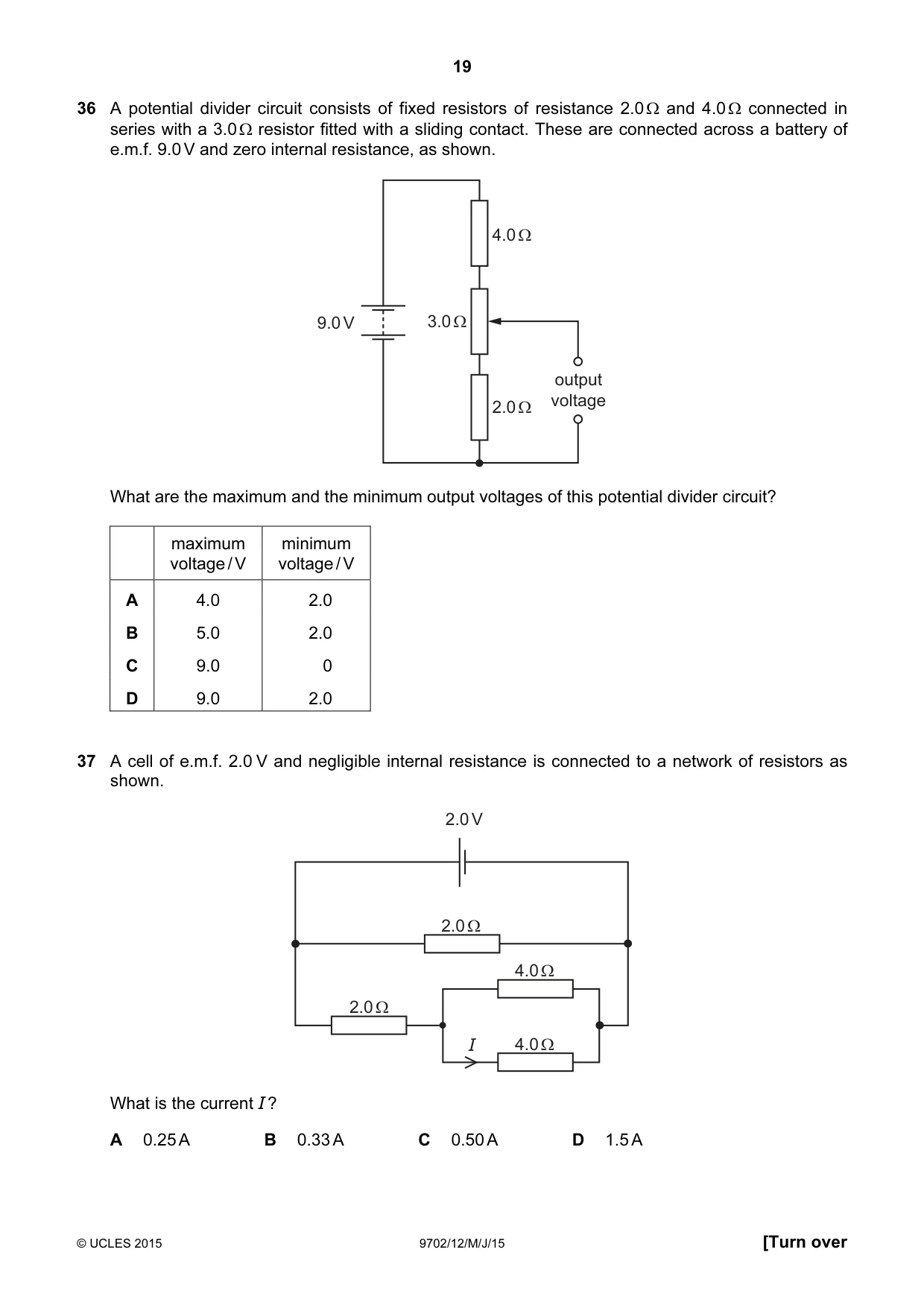
36 A potential divider circuit consists of fixed resistors of resistance 2.0 Ω and 4.0 Ω connected in series with a 3.0 Ω resistor fitted with a sliding contact. These are connected across a battery of e.m.f. 9.0 V and zero internal resistance, as shown. 4.0 Ω 9.0 V 3.0 Ω output 2.0 Ω voltage What are the maximum and the minimum output voltages of this potential divider circuit? maximum minimum voltage / V voltage / V A 4.0 2.0 B 5.0 2.0 C 9.0 0 D 9.0 2.0
Mark scheme: B
Q37 · A cell of e.m.f
37 A cell of e.m.f. 2.0 V and negligible internal resistance is connected to a network of resistors as shown. 2.0 V 2.0 Ω 4.0 Ω 2.0 Ω I 4.0 Ω What is the current I ? A 0.25 A B 0.33 A C 0.50 A D 1.5 A
Mark scheme: A
Q38 · An experiment in which α-particles were deflected by a gold foil produced new insights…
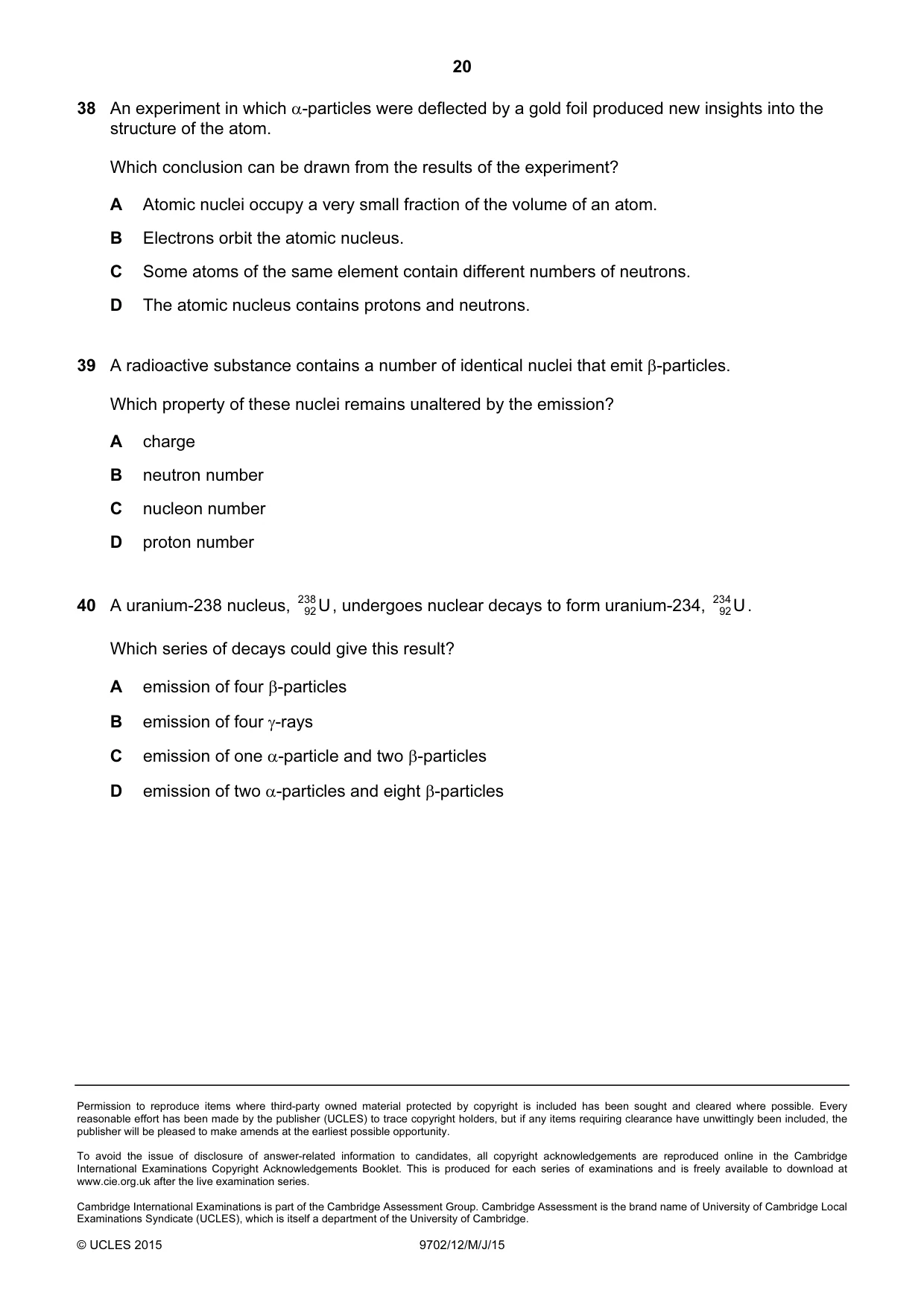
38 An experiment in which α-particles were deflected by a gold foil produced new insights into the structure of the atom. Which conclusion can be drawn from the results of the experiment? A Atomic nuclei occupy a very small fraction of the volume of an atom. B Electrons orbit the atomic nucleus. C Some atoms of the same element contain different numbers of neutrons. D The atomic nucleus contains protons and neutrons.
Mark scheme: A
Q39 · A radioactive substance contains a number of identical nuclei that emit β-particles
39 A radioactive substance contains a number of identical nuclei that emit β-particles. Which property of these nuclei remains unaltered by the emission? A charge B neutron number C nucleon number D proton number
Mark scheme: C
Q40 · A uranium-238 nucleus, 238 U , undergoes nuclear decays to form uranium-234, 234 U
40 A uranium-238 nucleus, 238 U , undergoes nuclear decays to form uranium-234, 234 U . 92 92 Which series of decays could give this result? A emission of four β-particles B emission of four γ-rays C emission of one α-particle and two β-particles D emission of two α-particles and eight β-particles
Mark scheme: C
What was in this paper
The subtopics covered by these 40 questions, and how many questions each got. Open one in a new tab to see every Cambridge question on it.
3Momentum and Newton’s laws of motion3Electric current2Energy conservation2Equations of motion2Gravitational potential energy and kinetic energy2Practical circuits2Progressive waves2Radioactive decay2Stress and strain2Atoms, nuclei and radiation1Density and pressure1Diffraction1Elastic and plastic behaviour1Electric fields and field lines1Equilibrium of forces1Interference1Kirchhoff’s laws1Linear momentum and its conservation1Physical quantities1Potential difference and power1Potential dividers1Resistance and resistivity1Scalars and vectors1SI units1Stationary waves1Thermal equilibrium1Uniform electric fields1What you needed in this session
Cambridge’s own grade thresholds for 2015 May/June, Paper 1 · Variant 2. A higher threshold means an easier paper — the bar moves with how the cohort did.