Cambridge A Level Physics 9702 — 2019 May/June Paper 1 · Variant 2
9702/12/M/J/19 · 40 questions · 40 marks · ≈45 min
The question paper and its mark scheme, free to read here and free to download. This is Cambridge’s own paper, exactly as it was sat.
Question paper24 pages
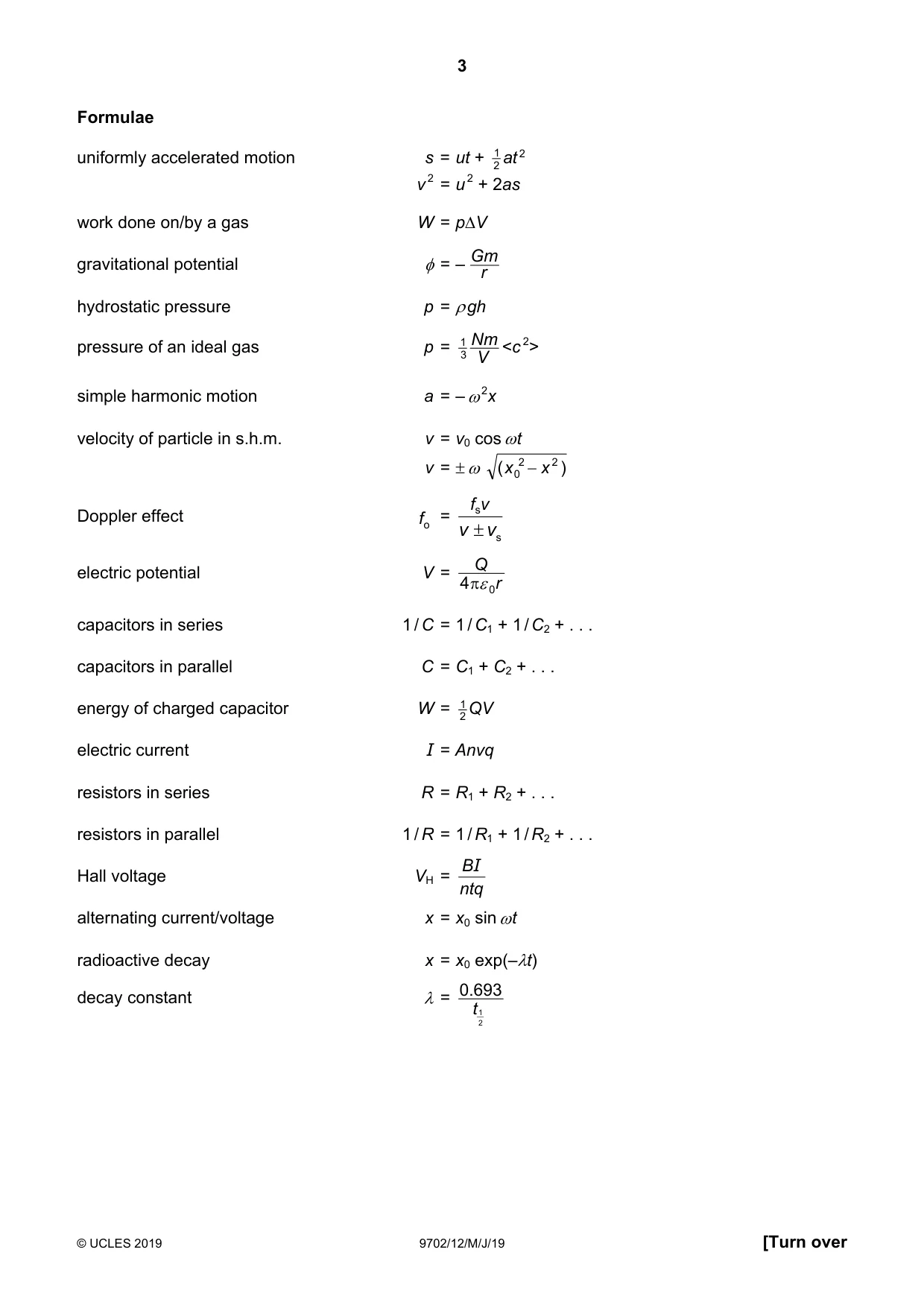



Mark scheme3 pages
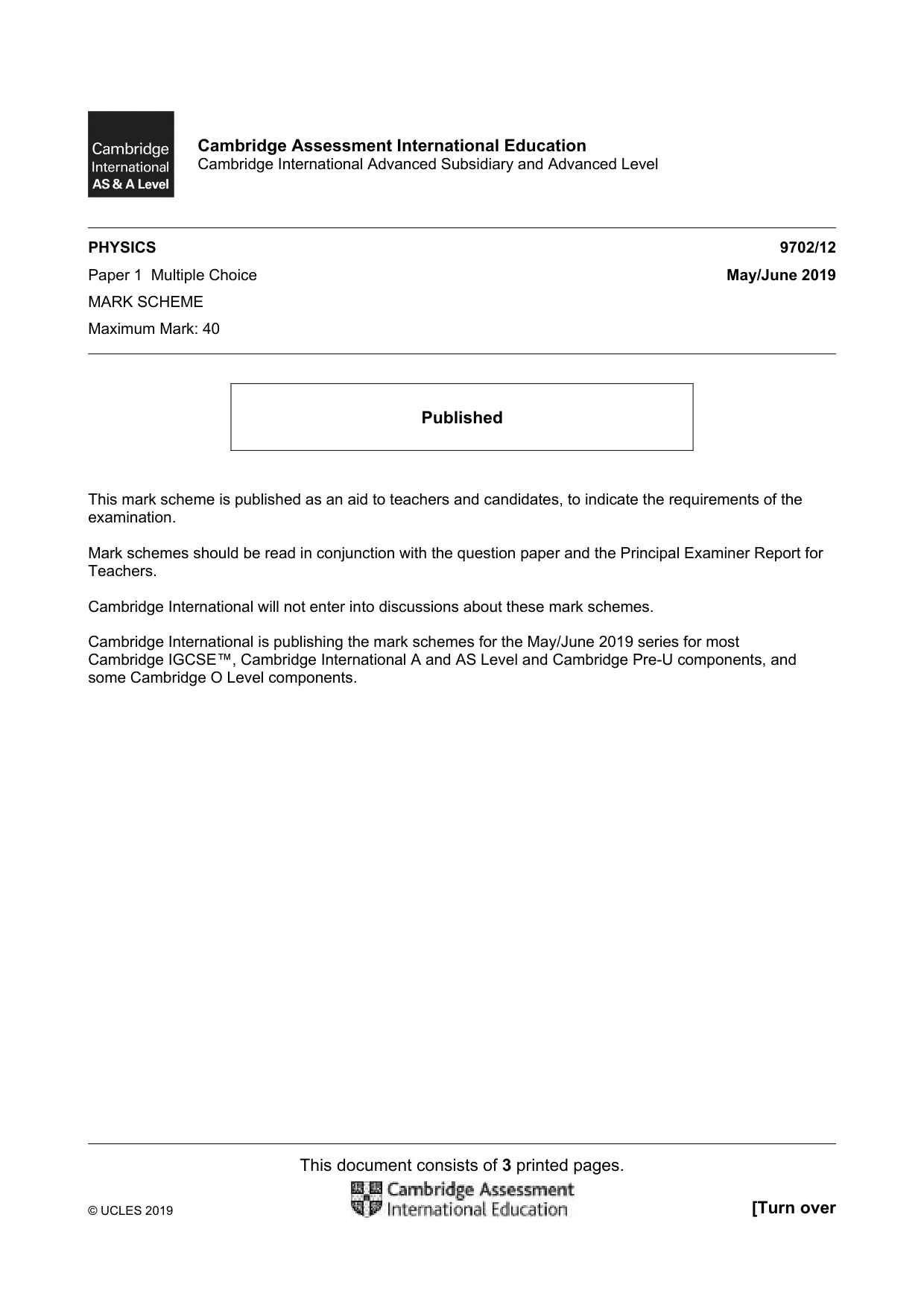
Answers below. Sit the paper first if you are practising.
Questions as text
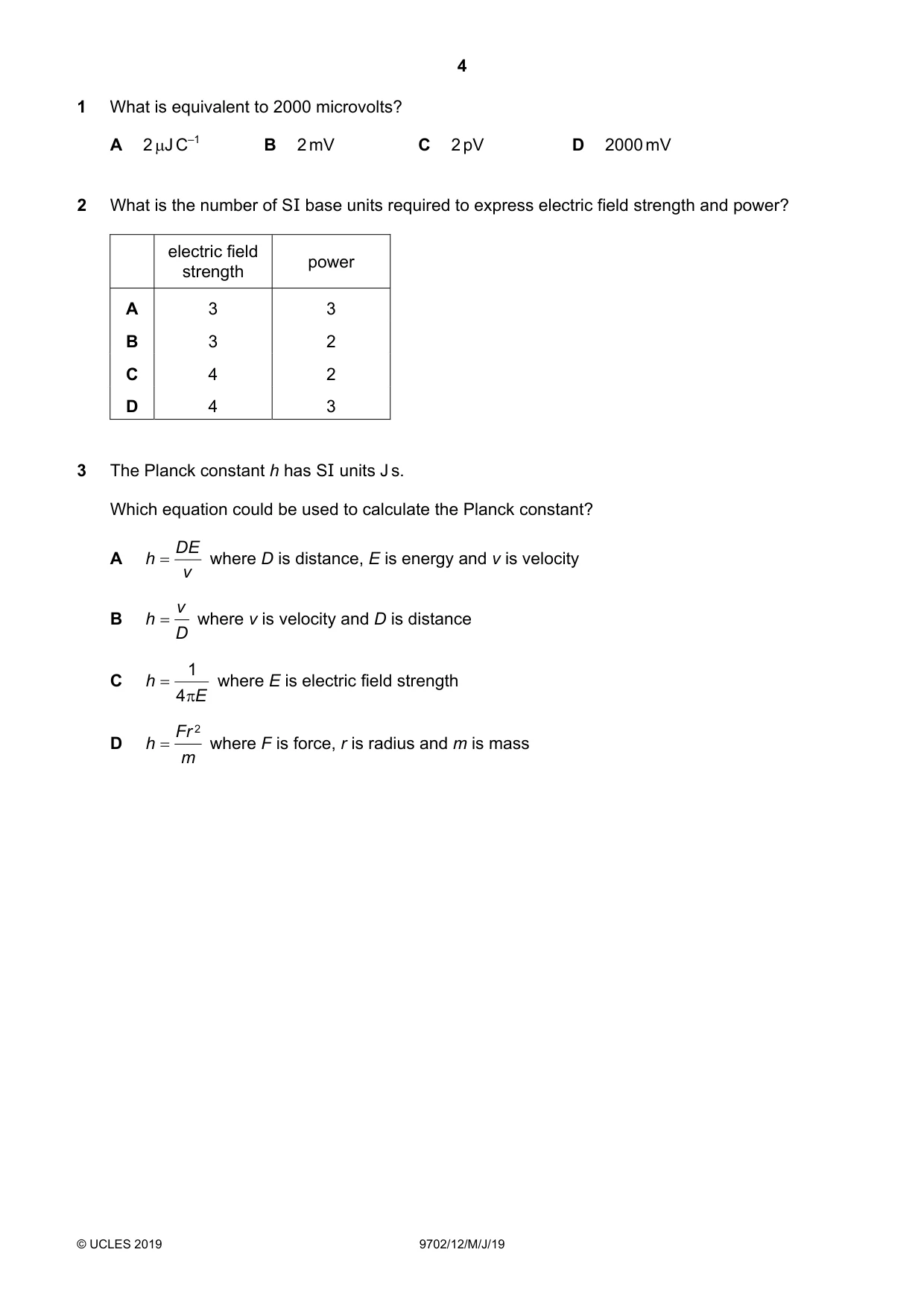
Q1 · What is equivalent to 2000 microvolts?
1 What is equivalent to 2000 microvolts? A 2 µJ C–1 B 2 mV C 2 pV D 2000 mV
Mark scheme: B
Q2 · What is the number of SI base units required to express electric field strength and power?
2 What is the number of SI base units required to express electric field strength and power? electric field power strength A 3 3 B 3 2 C 4 2 D 4 3
Mark scheme: D
Q3 · The Planck constant h has SI units J s
3 The Planck constant h has SI units J s. Which equation could be used to calculate the Planck constant? D E A h = where D is distance, E is energy and v is velocity v v B h = where v is velocity and D is distance D 1 C h = where E is electric field strength 4 π E Fr 2 D h = where F is force, r is radius and m is mass m
Mark scheme: A
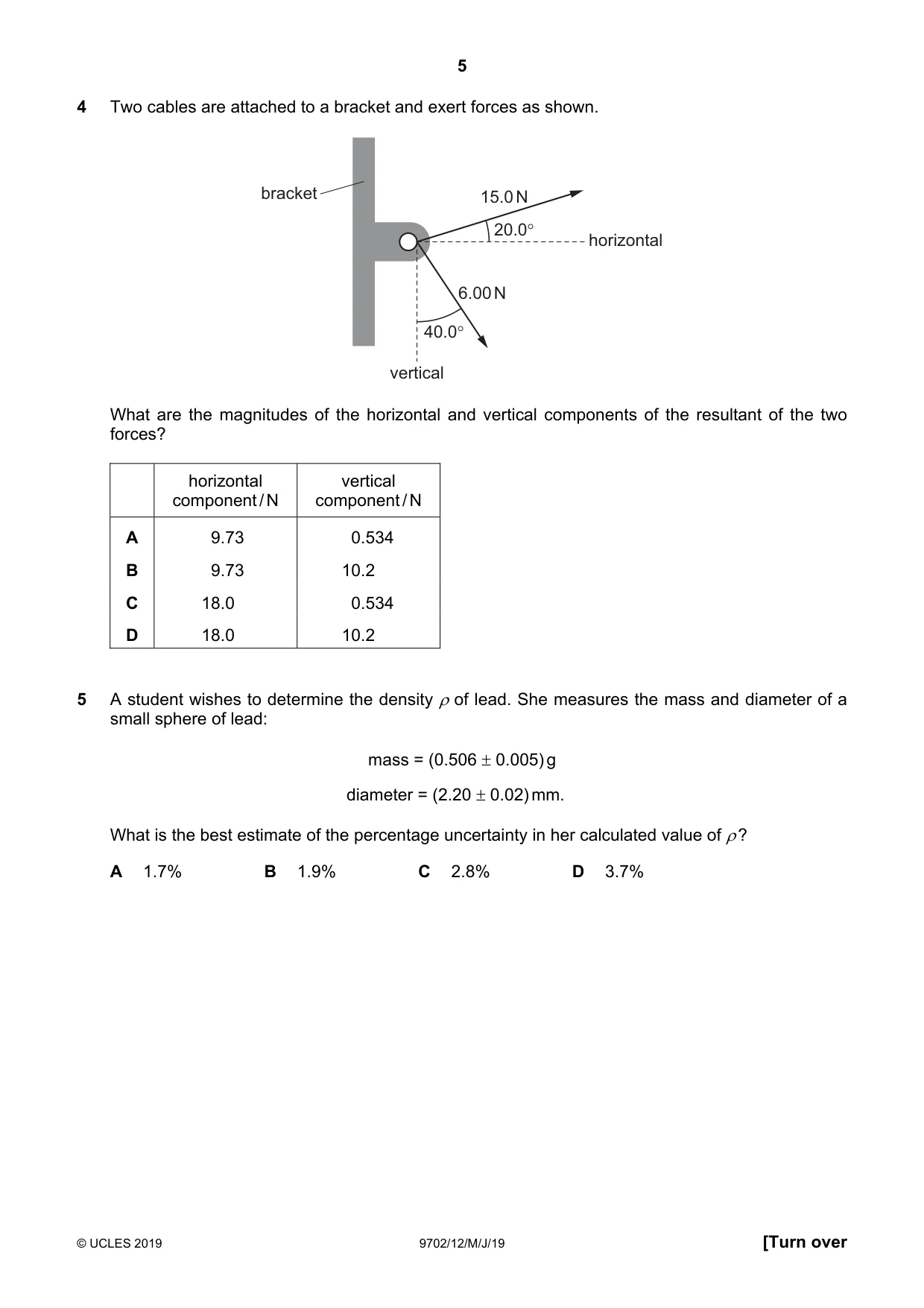
Q4 · Two cables are attached to a bracket and exert forces as shown
4 Two cables are attached to a bracket and exert forces as shown. bracket 15.0 N 20.0° horizontal 6.00 N 40.0° vertical What are the magnitudes of the horizontal and vertical components of the resultant of the two forces? horizontal vertical component / N component / N A 9.73 0.534 B 9.73 10.2 C 18.0 0.534 D 18.0 10.2
Mark scheme: C
Q5 · A student wishes to determine the density ρ of lead
5 A student wishes to determine the density ρ of lead. She measures the mass and diameter of a small sphere of lead: mass = (0.506 ± 0.005) g diameter = (2.20 ± 0.02) mm. What is the best estimate of the percentage uncertainty in her calculated value of ρ ? A 1.7% B 1.9% C 2.8% D 3.7%
Mark scheme: D
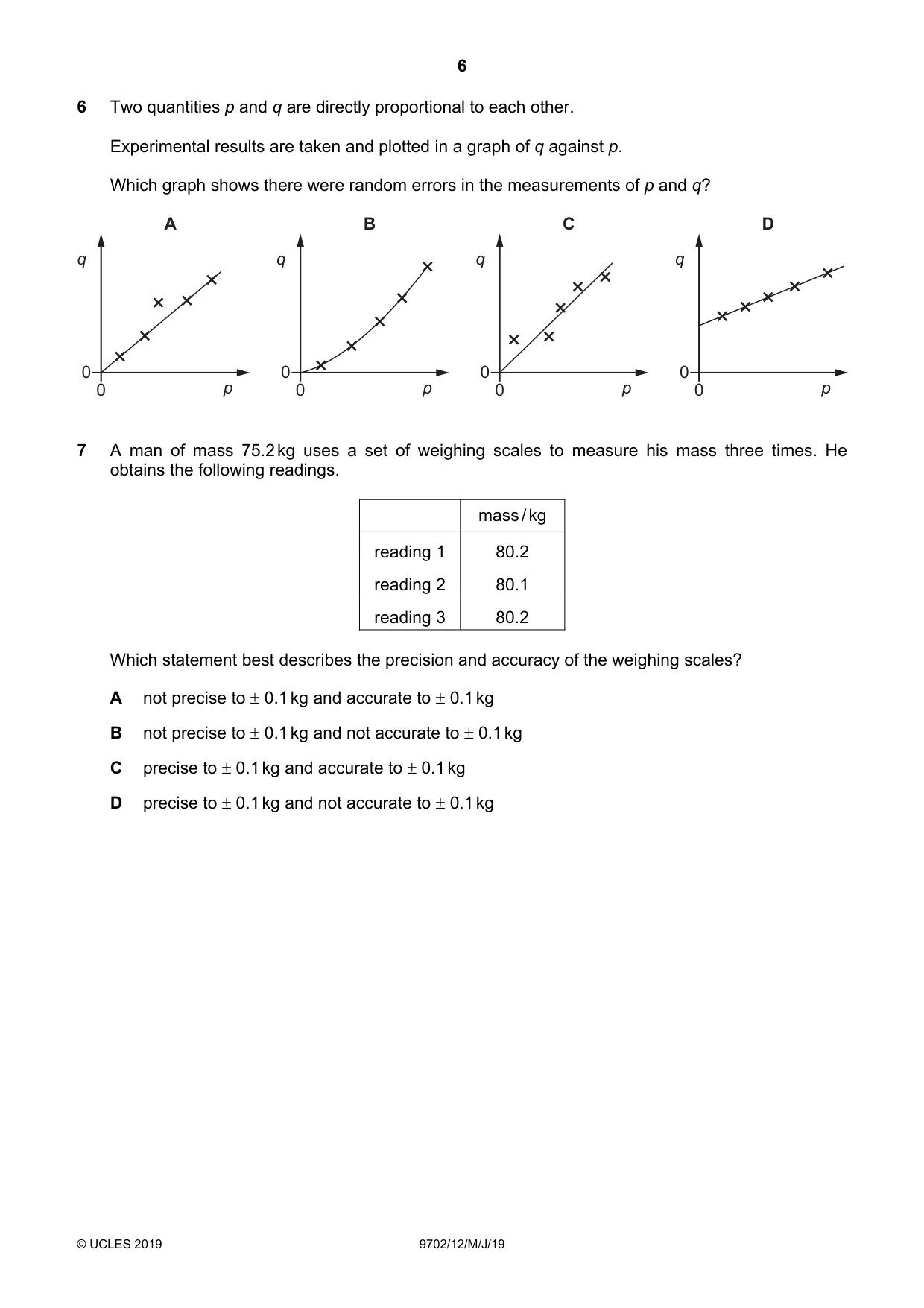
Q6 · Two quantities p and q are directly proportional to each other
6 Two quantities p and q are directly proportional to each other. Experimental results are taken and plotted in a graph of q against p. Which graph shows there were random errors in the measurements of p and q? A B C D q q q q 0 0 0 0 0 p 0 p 0 p 0 p
Mark scheme: C
Q7 · A man of mass 75.2 kg uses a set of weighing scales to measure his mass three times
7 A man of mass 75.2 kg uses a set of weighing scales to measure his mass three times. He obtains the following readings. mass / kg reading 1 80.2 reading 2 80.1 reading 3 80.2 Which statement best describes the precision and accuracy of the weighing scales? A not precise to ± 0.1 kg and accurate to ± 0.1 kg B not precise to ± 0.1 kg and not accurate to ± 0.1 kg C precise to ± 0.1 kg and accurate to ± 0.1 kg D precise to ± 0.1 kg and not accurate to ± 0.1 kg
Mark scheme: D
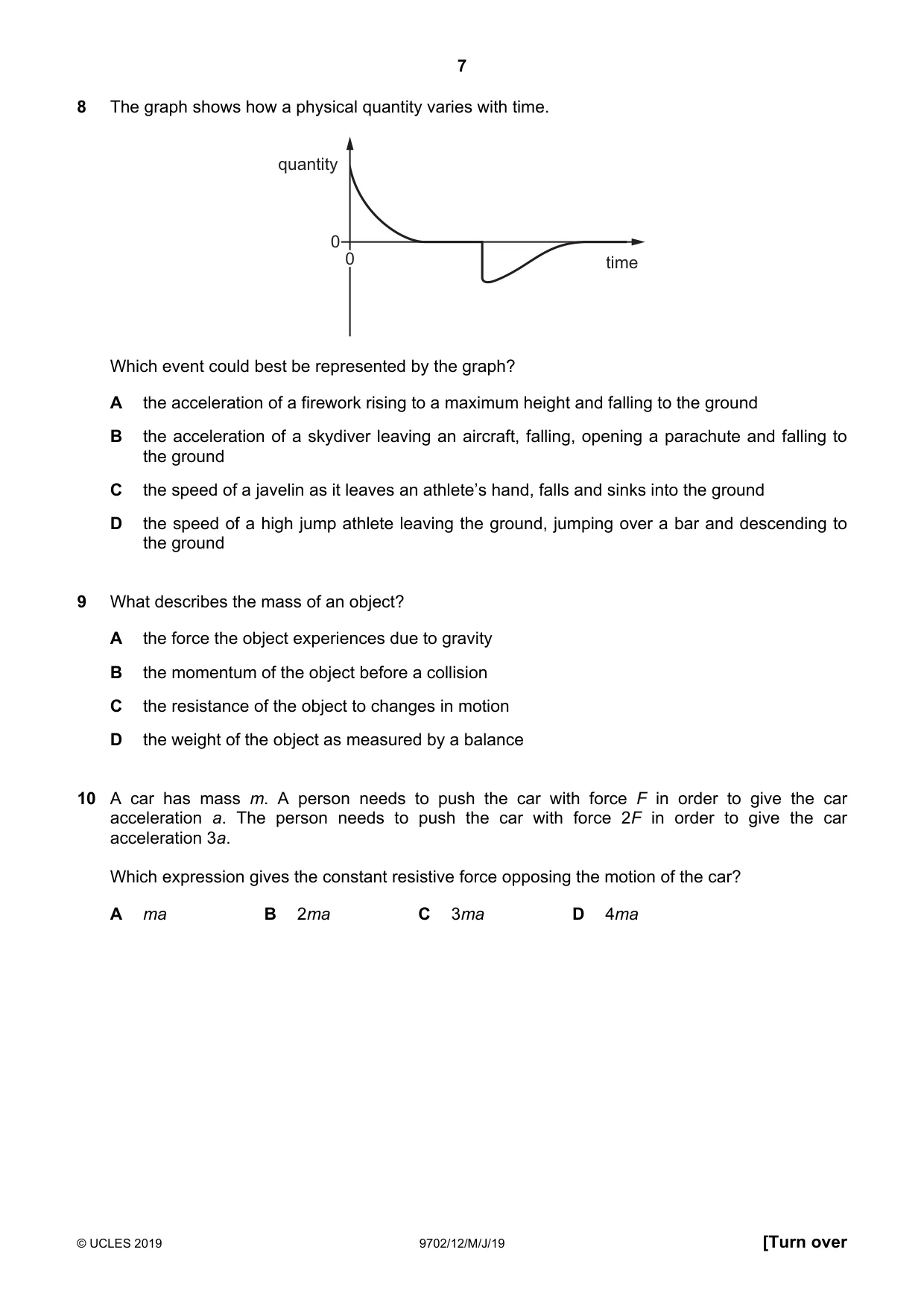
Q8 · The graph shows how a physical quantity varies with time
8 The graph shows how a physical quantity varies with time. quantity 0 0 time Which event could best be represented by the graph? A the acceleration of a firework rising to a maximum height and falling to the ground B the acceleration of a skydiver leaving an aircraft, falling, opening a parachute and falling to the ground C the speed of a javelin as it leaves an athlete’s hand, falls and sinks into the ground D the speed of a high jump athlete leaving the ground, jumping over a bar and descending to the ground
Mark scheme: B
Q9 · What describes the mass of an object?
9 What describes the mass of an object? A the force the object experiences due to gravity B the momentum of the object before a collision C the resistance of the object to changes in motion D the weight of the object as measured by a balance
Mark scheme: C
Q10 · A car has mass m
10 A car has mass m. A person needs to push the car with force F in order to give the car acceleration a. The person needs to push the car with force 2F in order to give the car acceleration 3a. Which expression gives the constant resistive force opposing the motion of the car? A ma B 2ma C 3ma D 4ma
Mark scheme: A
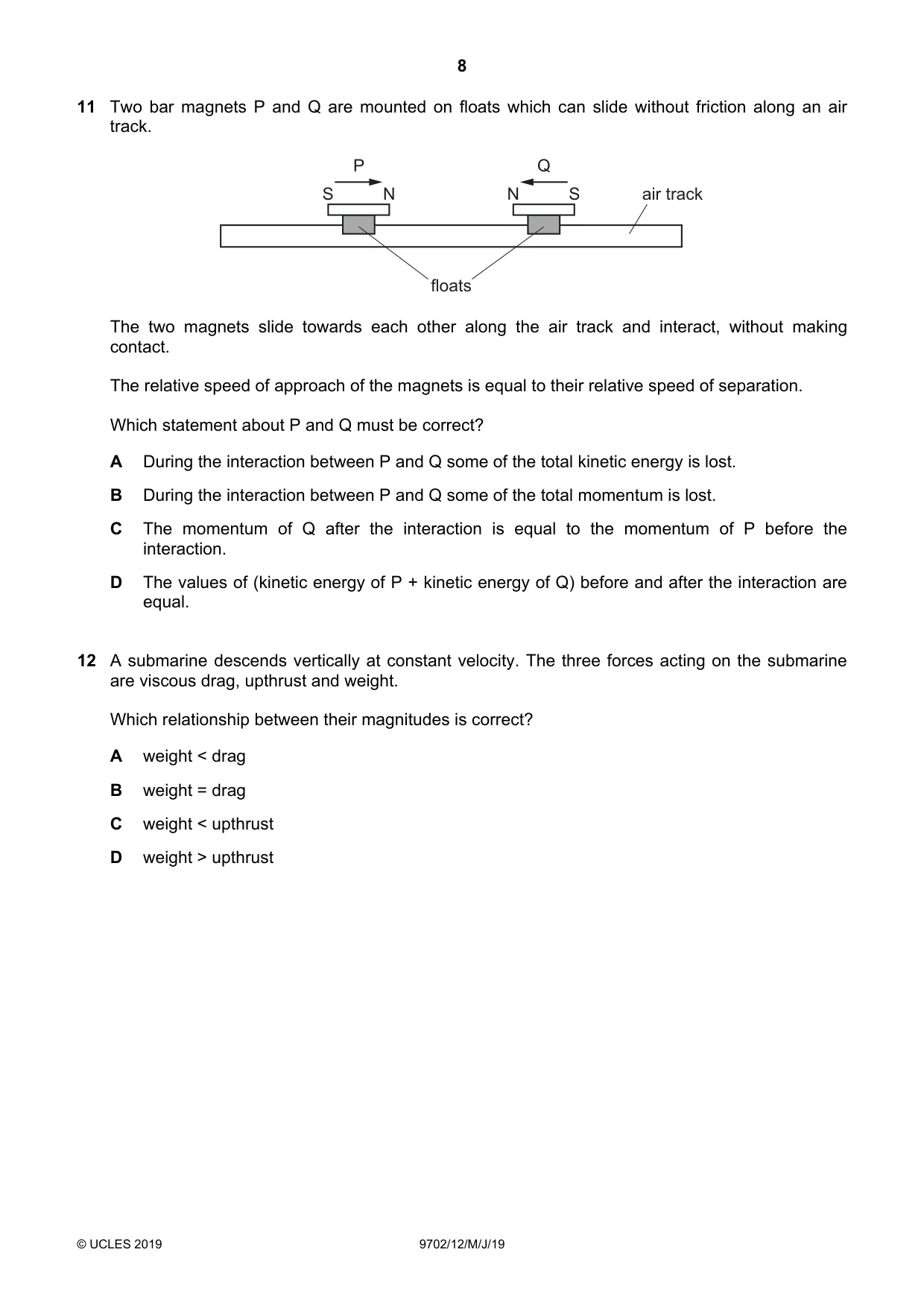
Q11 · Two bar magnets P and Q are mounted on floats which can slide without friction along an…
11 Two bar magnets P and Q are mounted on floats which can slide without friction along an air track. P Q S N N S air track floats The two magnets slide towards each other along the air track and interact, without making contact. The relative speed of approach of the magnets is equal to their relative speed of separation. Which statement about P and Q must be correct? A During the interaction between P and Q some of the total kinetic energy is lost. B During the interaction between P and Q some of the total momentum is lost. C The momentum of Q after the interaction is equal to the momentum of P before the interaction. D The values of (kinetic energy of P + kinetic energy of Q) before and after the interaction are equal.
Mark scheme: D
Q12 · A submarine descends vertically at constant velocity
12 A submarine descends vertically at constant velocity. The three forces acting on the submarine are viscous drag, upthrust and weight. Which relationship between their magnitudes is correct? A weight < drag B weight = drag C weight < upthrust D weight > upthrust
Mark scheme: D
Q13 · A small positive charge can move inside a uniform electric field
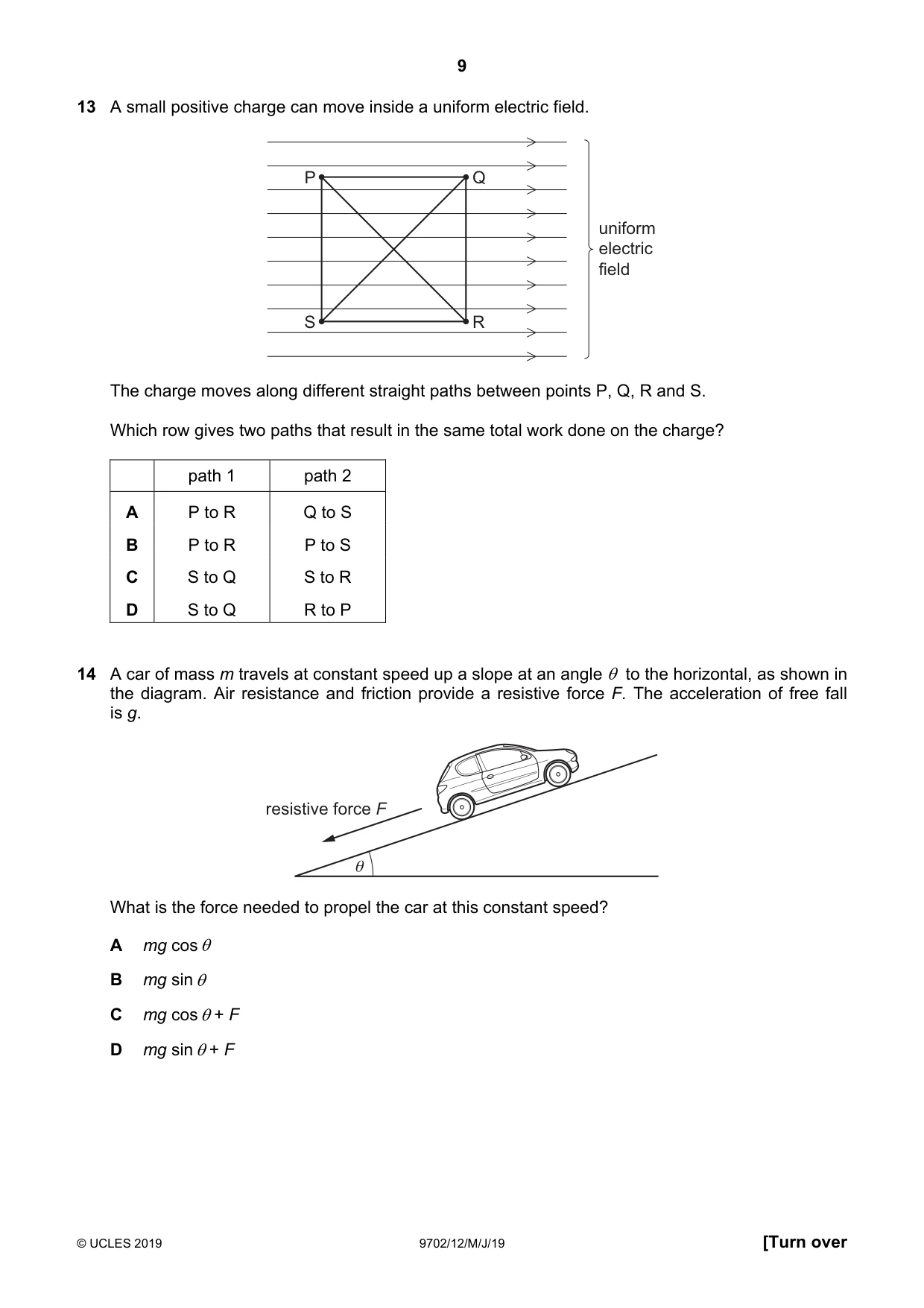
13 A small positive charge can move inside a uniform electric field. P Q uniform electric field S R The charge moves along different straight paths between points P, Q, R and S. Which row gives two paths that result in the same total work done on the charge? path 1 path 2 A P to R Q to S B P to R P to S C S to Q S to R D S to Q R to P
Mark scheme: C
Q14 · A car of mass m travels at constant speed up a slope at an angle θ to the horizontal, as…
14 A car of mass m travels at constant speed up a slope at an angle θ to the horizontal, as shown in the diagram. Air resistance and friction provide a resistive force F. The acceleration of free fall is g. resistive force F θ What is the force needed to propel the car at this constant speed? A mg cos θ B mg sin θ C mg cos θ + F D mg sin θ + F
Mark scheme: D
Q15 · A volume of 1.5 m3 of water is mixed with 0.50 m3 of alcohol
15 A volume of 1.5 m3 of water is mixed with 0.50 m3 of alcohol. The density of water is 1000 kg m–3 and the density of alcohol is 800 kg m–3. The volume of the mixture is 2.0 m3. What is the density of the mixture? A 850 kg m–3 B 900 kg m–3 C 940 kg m–3 D 950 kg m–3
Mark scheme: D
Q16 · A parachutist is falling at constant (terminal) velocity
16 A parachutist is falling at constant (terminal) velocity. Which statement is not correct? A Gravitational potential energy is converted into kinetic energy of the air. B Gravitational potential energy is converted into kinetic energy of the parachutist. C Gravitational potential energy is converted into thermal energy of the air. D Gravitational potential energy is converted into thermal energy of the parachutist.
Mark scheme: B
Q17 · A combined heat and power (CHP) station generates electrical power and useful heat
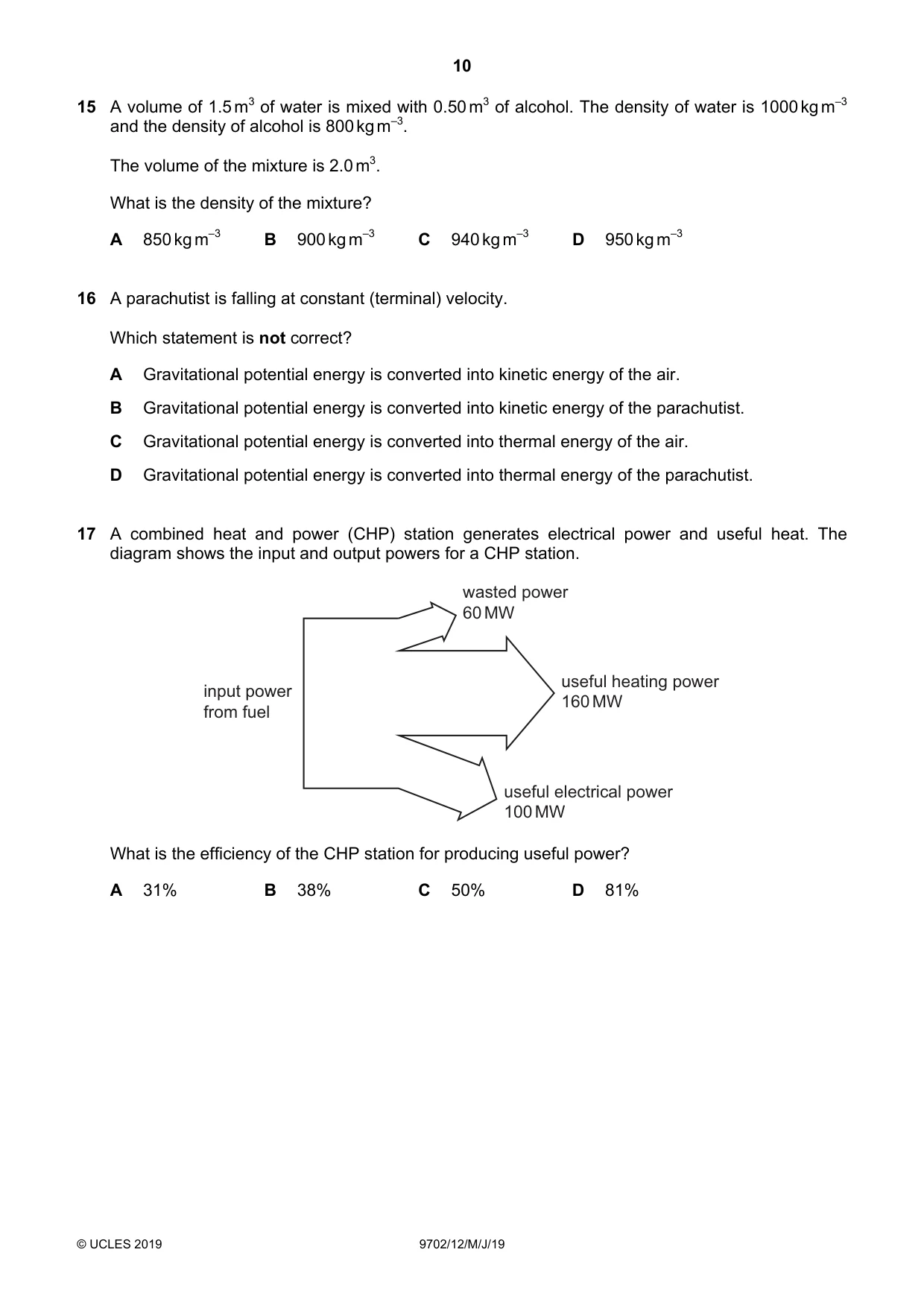
17 A combined heat and power (CHP) station generates electrical power and useful heat. The diagram shows the input and output powers for a CHP station. wasted power 60 MW useful heating power input power 160 MW from fuel useful electrical power 100 MW What is the efficiency of the CHP station for producing useful power? A 31% B 38% C 50% D 81%
Mark scheme: D
Q18 · A bungee jumper jumps off a high bridge, when attached to it by a long elastic rope which…
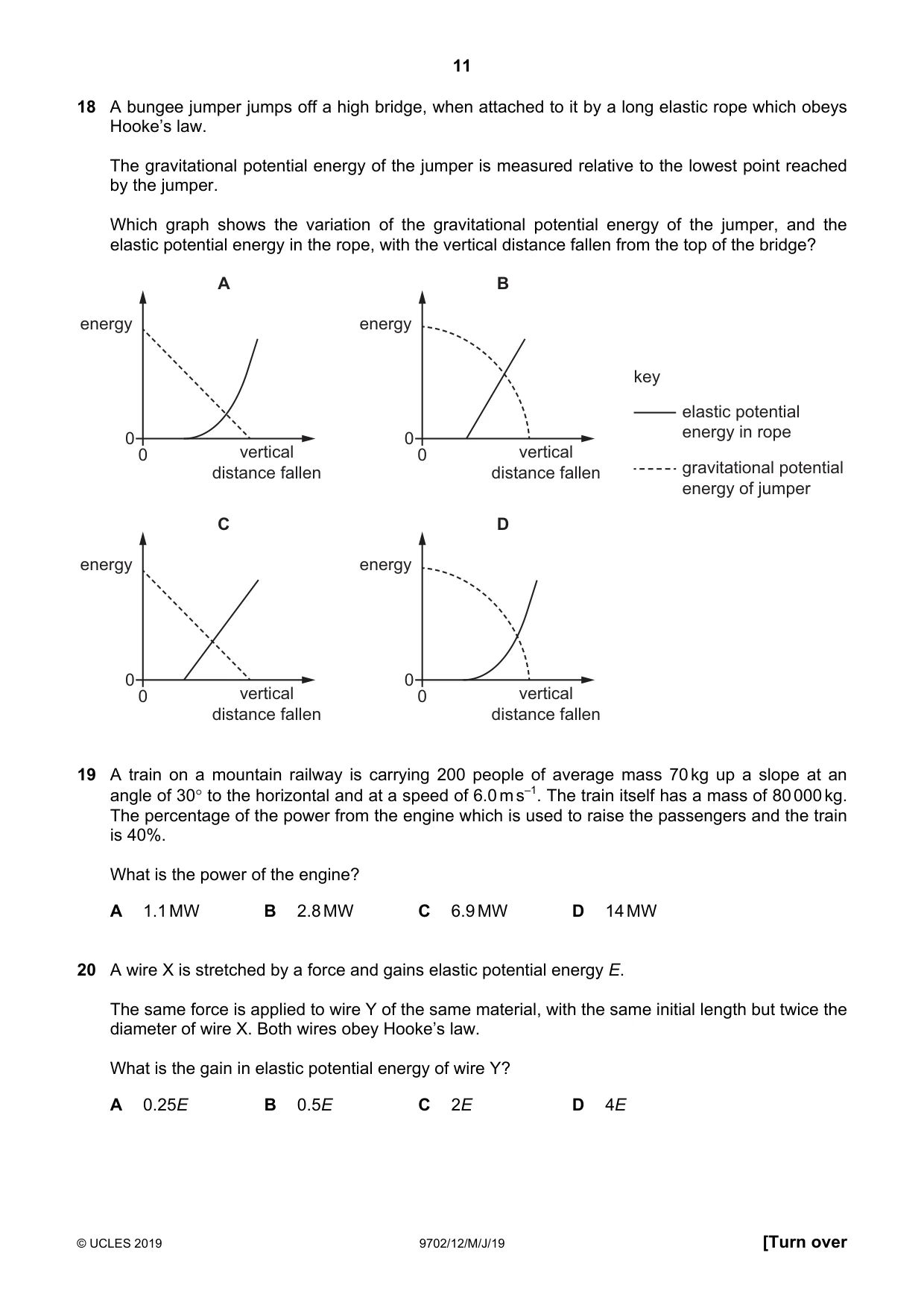
18 A bungee jumper jumps off a high bridge, when attached to it by a long elastic rope which obeys Hooke’s law. The gravitational potential energy of the jumper is measured relative to the lowest point reached by the jumper. Which graph shows the variation of the gravitational potential energy of the jumper, and the elastic potential energy in the rope, with the vertical distance fallen from the top of the bridge? A B energy energy key elastic potential 0 0 energy in rope 0 vertical 0 vertical distance fallen distance fallen gravitational potential energy of jumper C D energy energy 0 0 0 vertical 0 vertical distance fallen distance fallen
Mark scheme: A
More questions on Gravitational potential energy and kinetic energy
Q19 · A train on a mountain railway is carrying 200 people of average mass 70 kg up a slope at…
19 A train on a mountain railway is carrying 200 people of average mass 70 kg up a slope at an angle of 30° to the horizontal and at a speed of 6.0 m s–1. The train itself has a mass of 80 000 kg. The percentage of the power from the engine which is used to raise the passengers and the train is 40%. What is the power of the engine? A 1.1 MW B 2.8 MW C 6.9 MW D 14 MW
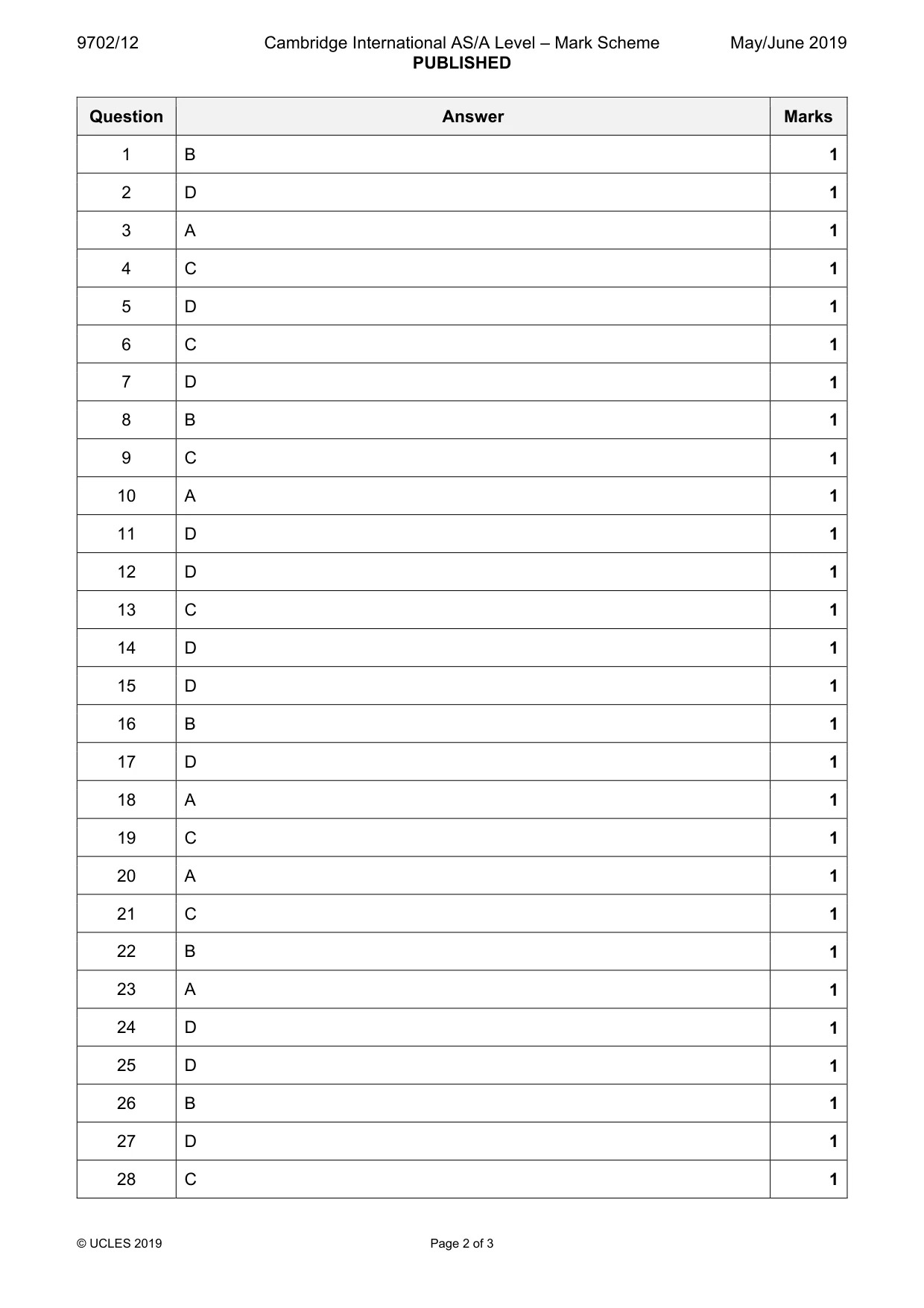
Mark scheme: C
Q20 · A wire X is stretched by a force and gains elastic potential energy E
20 A wire X is stretched by a force and gains elastic potential energy E. The same force is applied to wire Y of the same material, with the same initial length but twice the diameter of wire X. Both wires obey Hooke’s law. What is the gain in elastic potential energy of wire Y? A 0.25E B 0.5E C 2E D 4E
Mark scheme: A
Q21 · The diagram shows the arrangement of atoms in a particular crystal
21 The diagram shows the arrangement of atoms in a particular crystal. Each atom is at the corner of a cube. The mass of each atom is 3.5 × 10⁻²⁵ kg. The density of the crystal is 9.2 × 10³ kg m–3. What is the shortest distance between the centres of two adjacent atoms? A 3.8 × 10⁻²⁹ m B 6.2 × 10⁻¹⁵ m C 3.4 × 10⁻¹⁰ m D 3.0 × 10⁻⁹ m
Mark scheme: C
Q22 · The stress-strain graphs for loading and unloading four different materials are shown
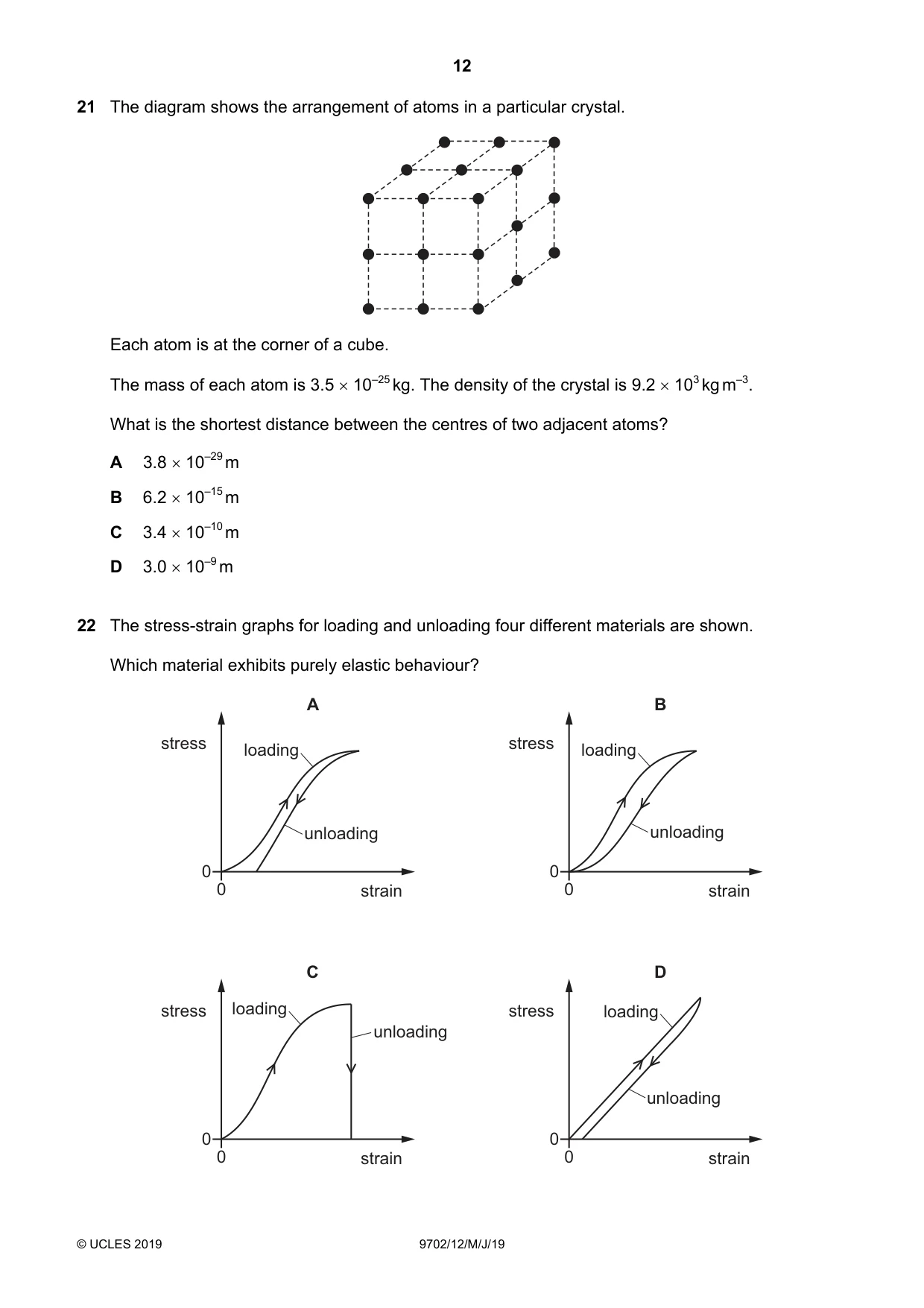
22 The stress-strain graphs for loading and unloading four different materials are shown. Which material exhibits purely elastic behaviour? A B stress loading stress loading unloading unloading 0 0 0 strain 0 strain C D stress loading stress loading unloading unloading 0 0 0 strain 0 strain
Mark scheme: B
Q23 · The diagram illustrates the position of particles in a progressive sound wave at one…
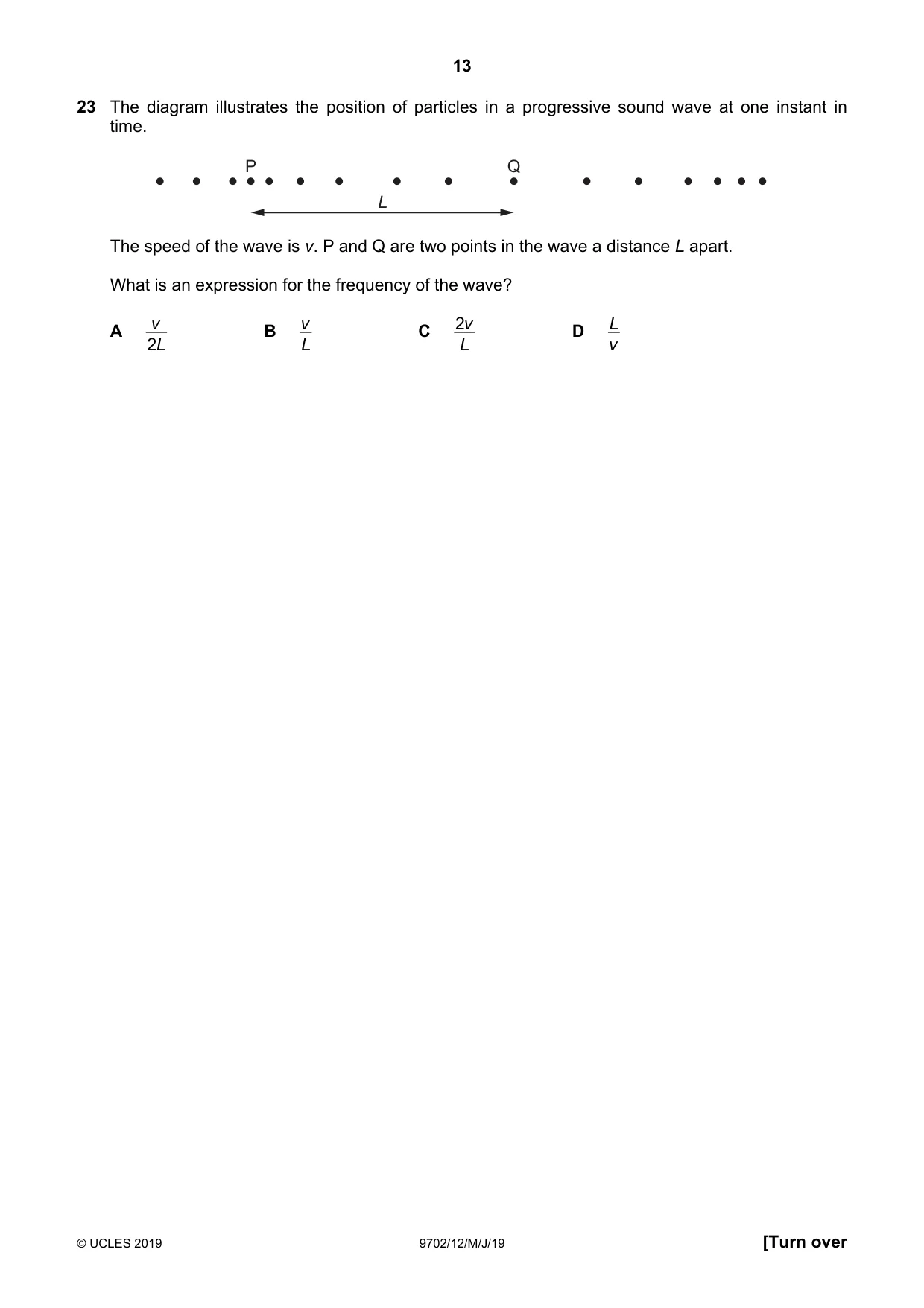
23 The diagram illustrates the position of particles in a progressive sound wave at one instant in time. P Q L The speed of the wave is v. P and Q are two points in the wave a distance L apart. What is an expression for the frequency of the wave? A v B v C 2 v D L 2 L L L v
Mark scheme: A
Q24 · A wave moves along the surface of water
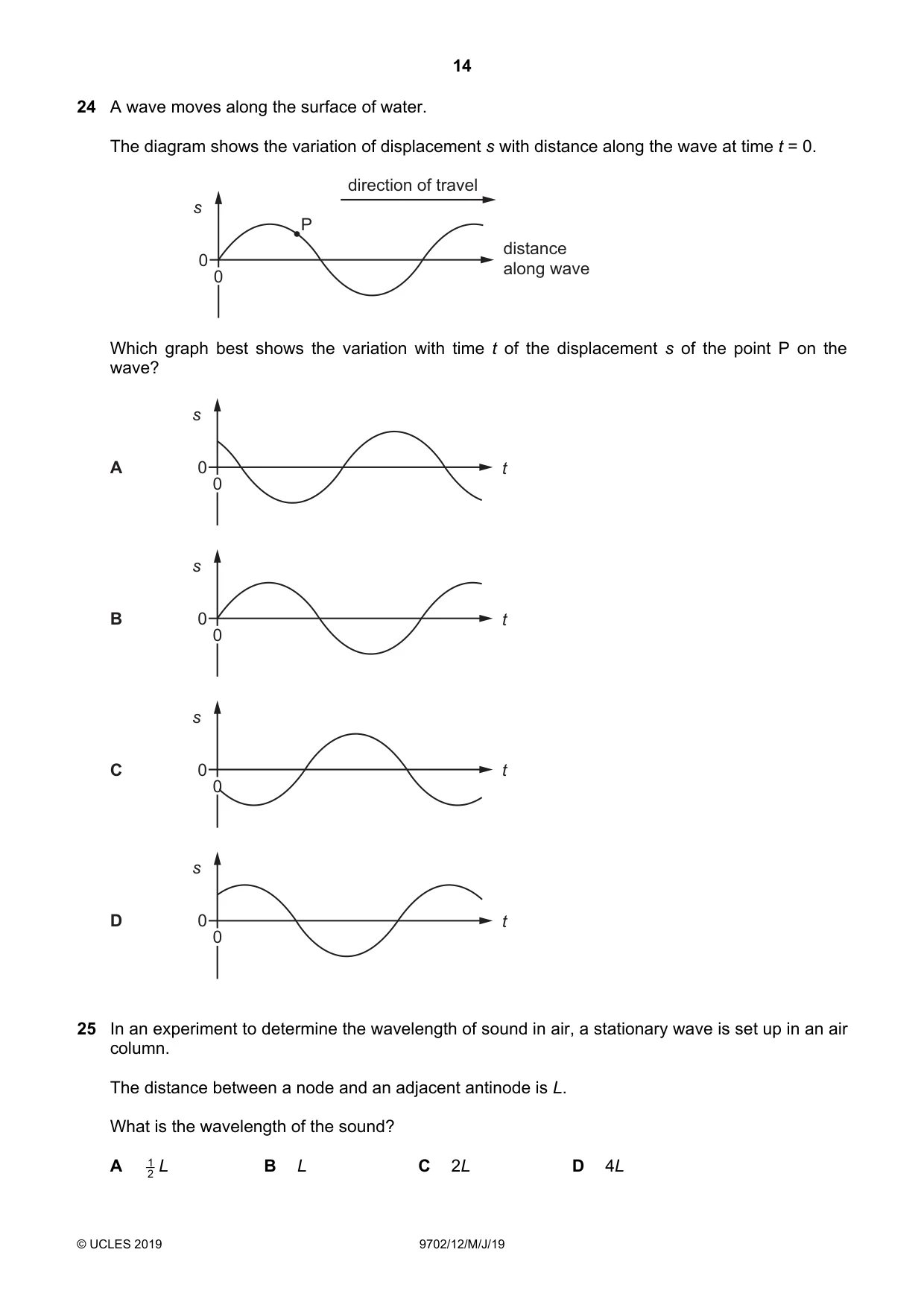
24 A wave moves along the surface of water. The diagram shows the variation of displacement s with distance along the wave at time t = 0. direction of travel s P distance 0 0 along wave Which graph best shows the variation with time t of the displacement s of the point P on the wave? s A 0 t 0 s B 0 t 0 s C 0 t 0 s D 0 t 0
Mark scheme: D
Q25 · In an experiment to determine the wavelength of sound in air, a stationary wave is set up…
25 In an experiment to determine the wavelength of sound in air, a stationary wave is set up in an air column. The distance between a node and an adjacent antinode is L. What is the wavelength of the sound? A 1 L B L C 2L D 4L 2
Mark scheme: D
Q26 · In one of the first experiments to demonstrate the Doppler effect, a train was filled…
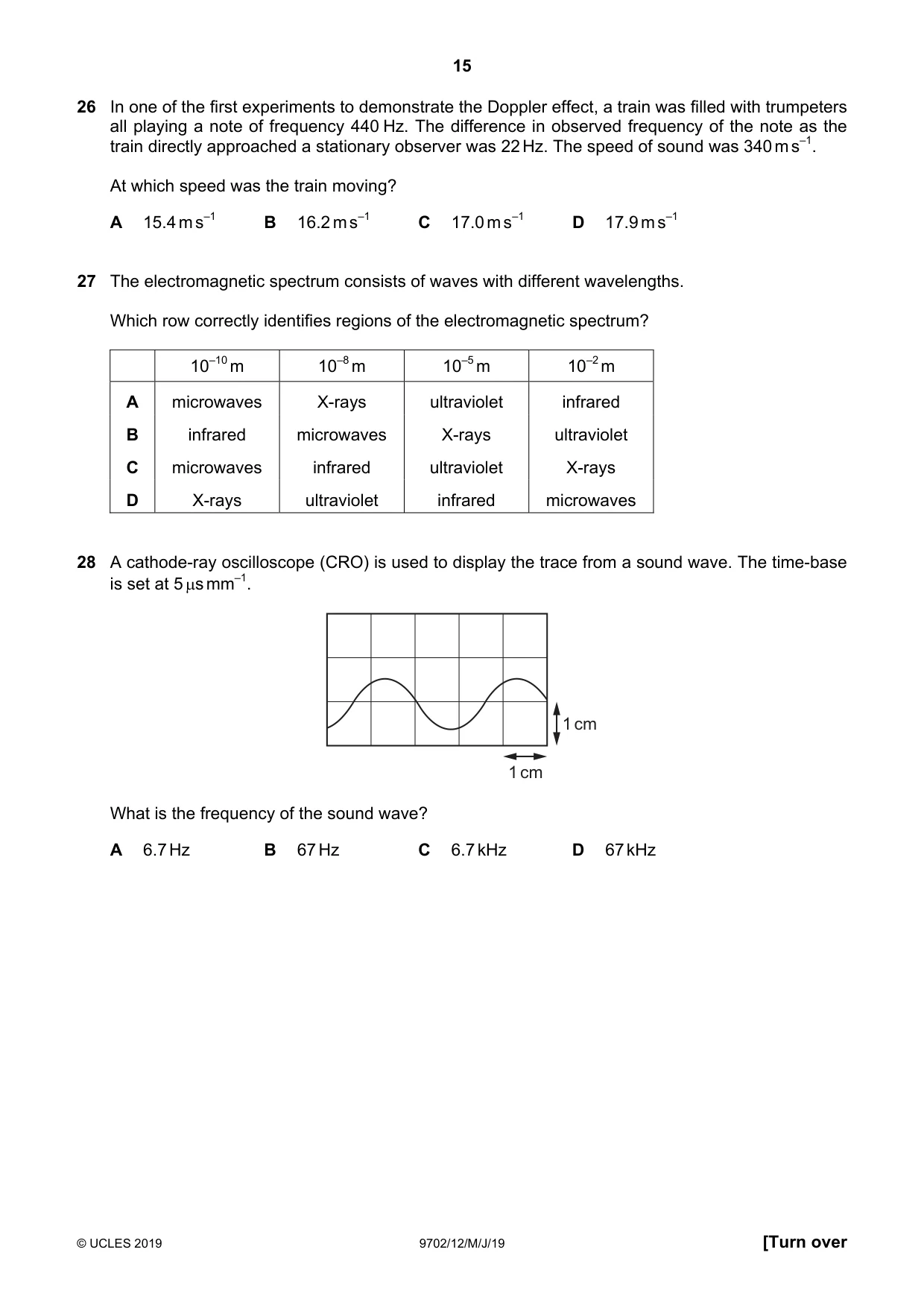
26 In one of the first experiments to demonstrate the Doppler effect, a train was filled with trumpeters all playing a note of frequency 440 Hz. The difference in observed frequency of the note as the train directly approached a stationary observer was 22 Hz. The speed of sound was 340 m s–1. At which speed was the train moving? A 15.4 m s–1 B 16.2 m s–1 C 17.0 m s–1 D 17.9 m s–1
Mark scheme: B
Q27 · The electromagnetic spectrum consists of waves with different wavelengths
27 The electromagnetic spectrum consists of waves with different wavelengths. Which row correctly identifies regions of the electromagnetic spectrum? 10–10 m 10–8 m 10–5 m 10–2 m A microwaves X-rays ultraviolet infrared B infrared microwaves X-rays ultraviolet C microwaves infrared ultraviolet X-rays D X-rays ultraviolet infrared microwaves
Mark scheme: D
Q28 · A cathode-ray oscilloscope (CRO) is used to display the trace from a sound wave
28 A cathode-ray oscilloscope (CRO) is used to display the trace from a sound wave. The time-base is set at 5 µs mm–1. 1 cm 1 cm What is the frequency of the sound wave? A 6.7 Hz B 67 Hz C 6.7 kHz D 67 kHz
Mark scheme: C
Q29 · Monochromatic light is directed at a diffraction grating, as shown
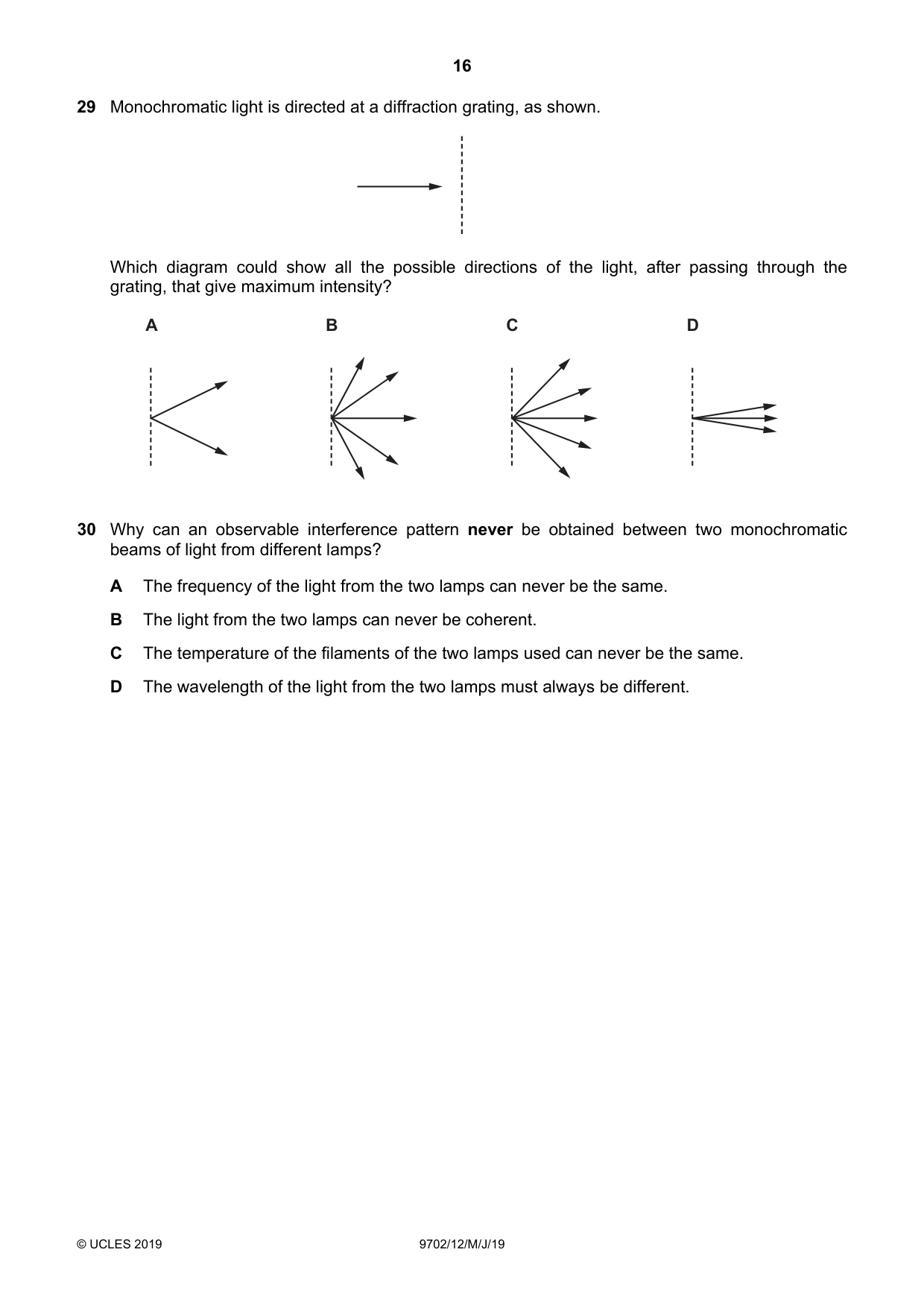
29 Monochromatic light is directed at a diffraction grating, as shown. Which diagram could show all the possible directions of the light, after passing through the grating, that give maximum intensity? A B C D
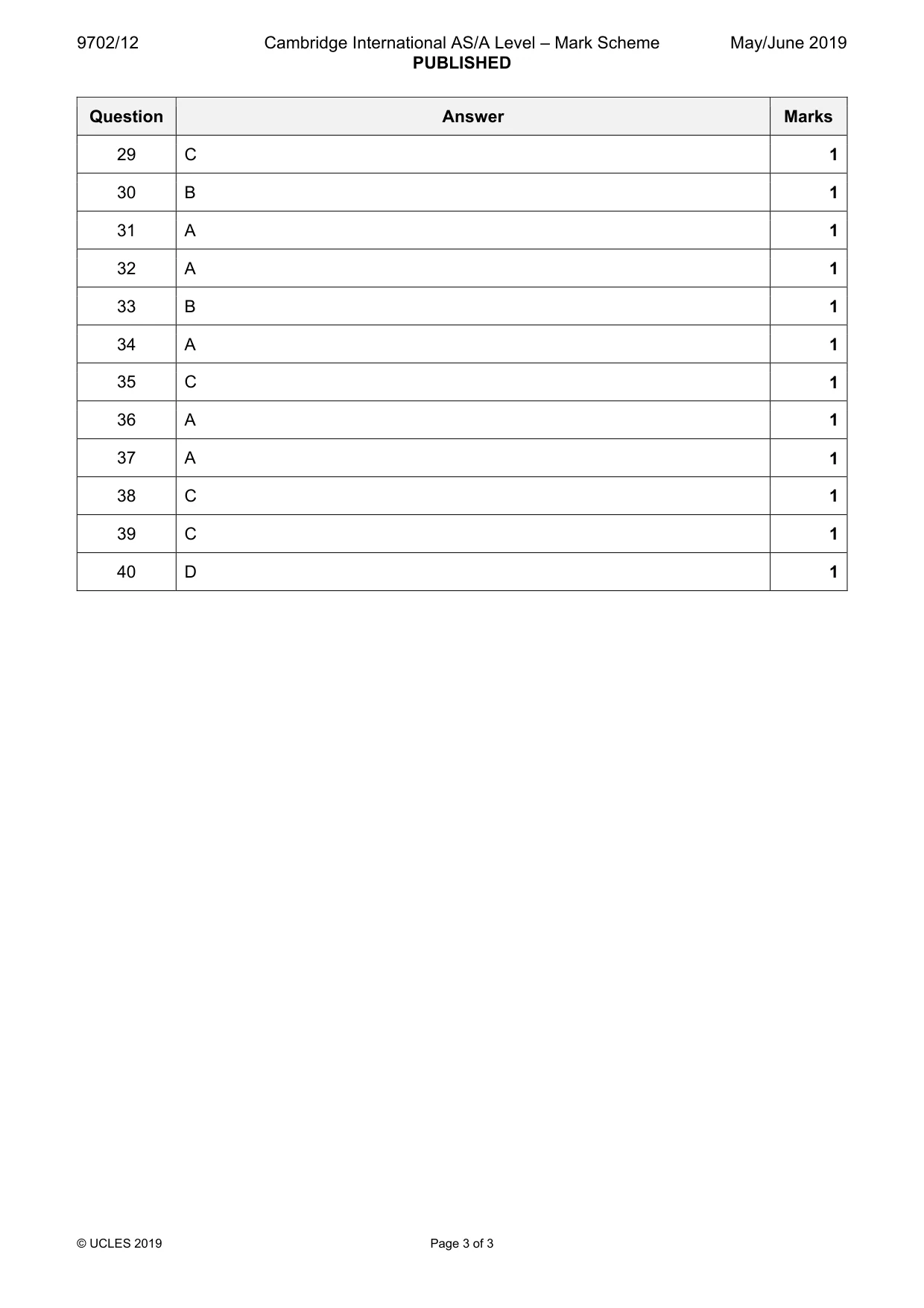
Mark scheme: C
Q30 · Why can an observable interference pattern never be obtained between two monochromatic…
30 Why can an observable interference pattern never be obtained between two monochromatic beams of light from different lamps? A The frequency of the light from the two lamps can never be the same. B The light from the two lamps can never be coherent. C The temperature of the filaments of the two lamps used can never be the same. D The wavelength of the light from the two lamps must always be different.
Mark scheme: B
Q31 · A student sets up apparatus to observe the double-slit interference of monochromatic…
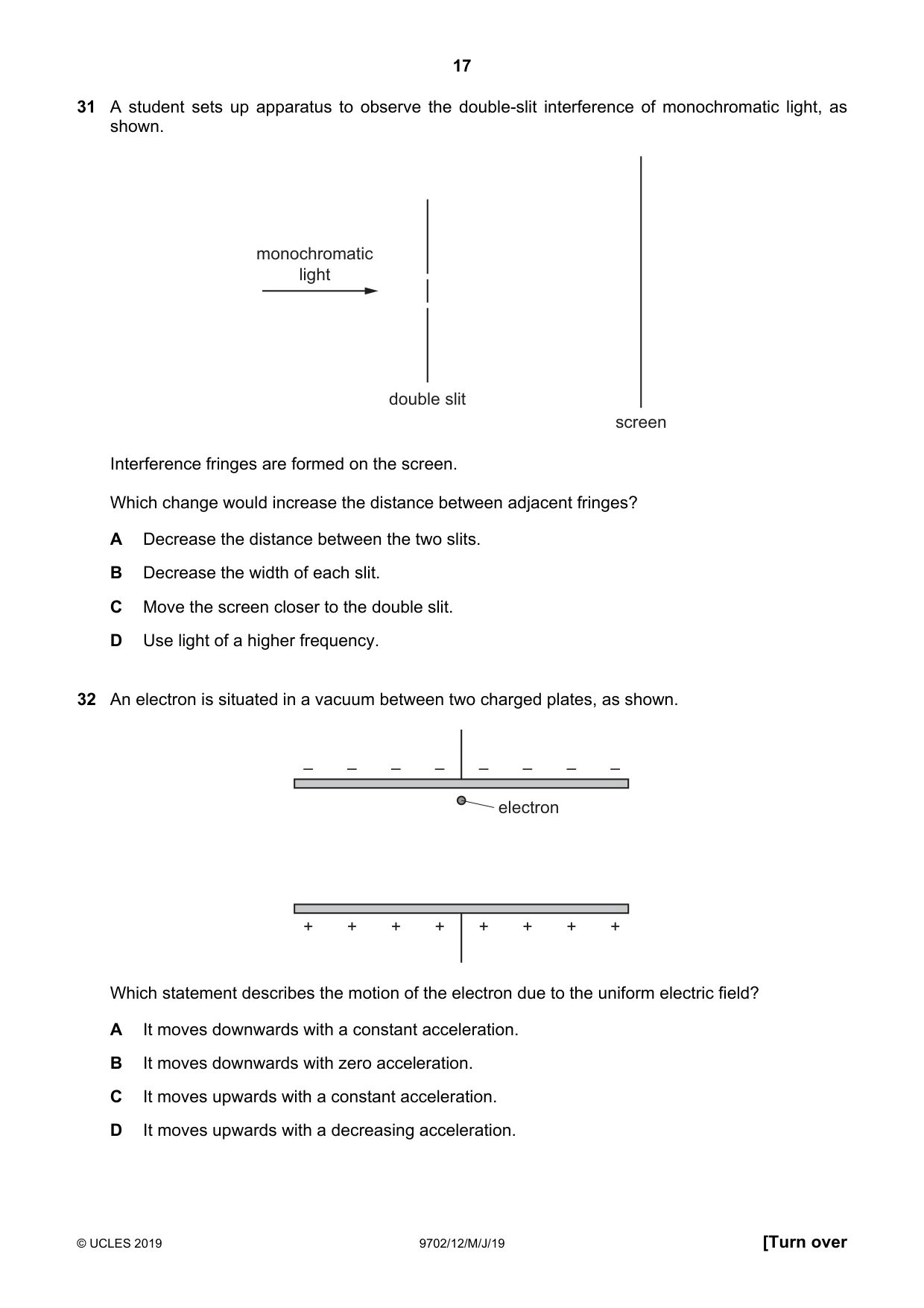
31 A student sets up apparatus to observe the double-slit interference of monochromatic light, as shown. monochromatic light double slit screen Interference fringes are formed on the screen. Which change would increase the distance between adjacent fringes? A Decrease the distance between the two slits. B Decrease the width of each slit. C Move the screen closer to the double slit. D Use light of a higher frequency.
Mark scheme: A
Q32 · An electron is situated in a vacuum between two charged plates, as shown
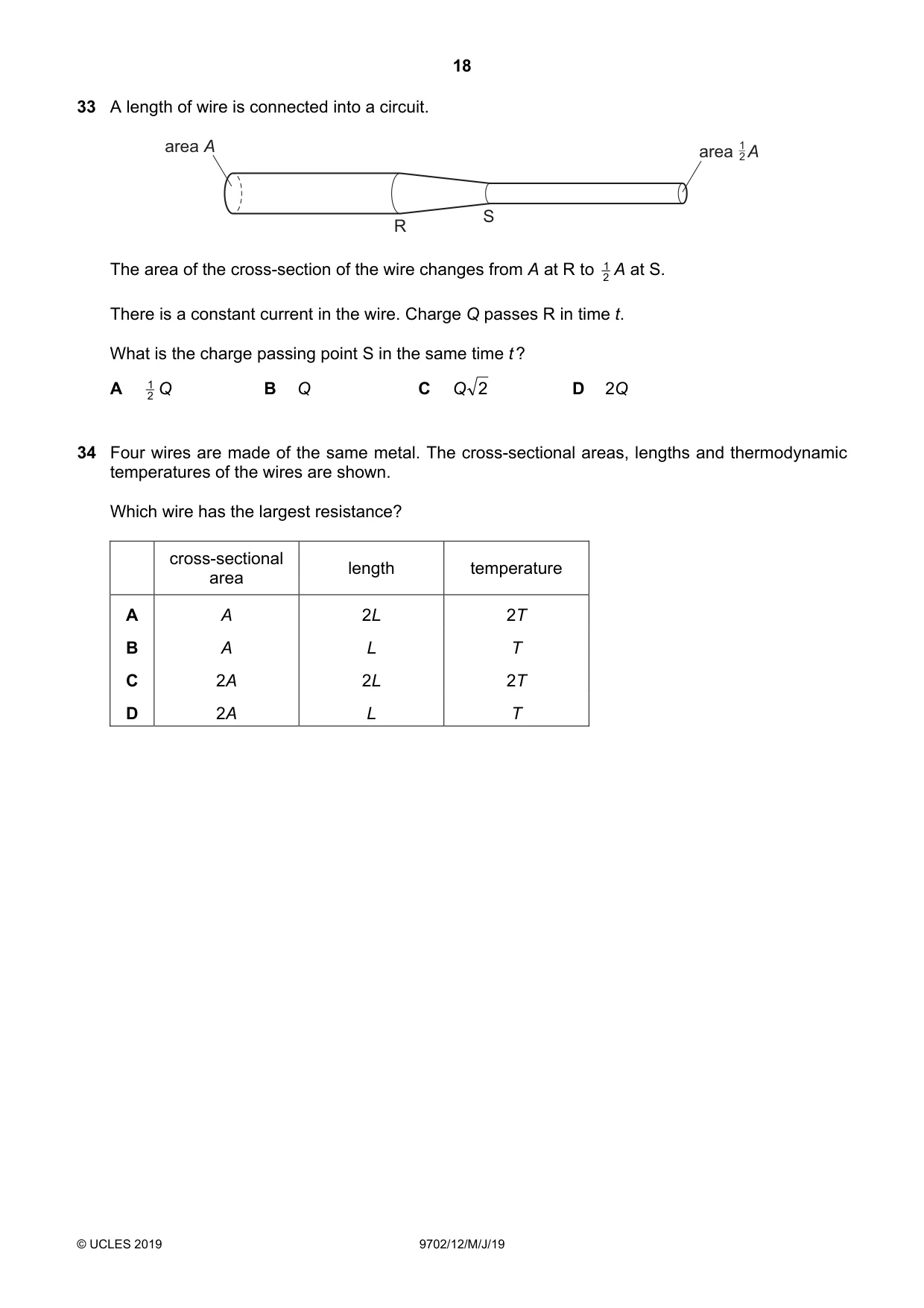
32 An electron is situated in a vacuum between two charged plates, as shown. – – – – – – – – electron + + + + + + + + Which statement describes the motion of the electron due to the uniform electric field? A It moves downwards with a constant acceleration. B It moves downwards with zero acceleration. C It moves upwards with a constant acceleration. D It moves upwards with a decreasing acceleration.
Mark scheme: A
Q33 · A length of wire is connected into a circuit
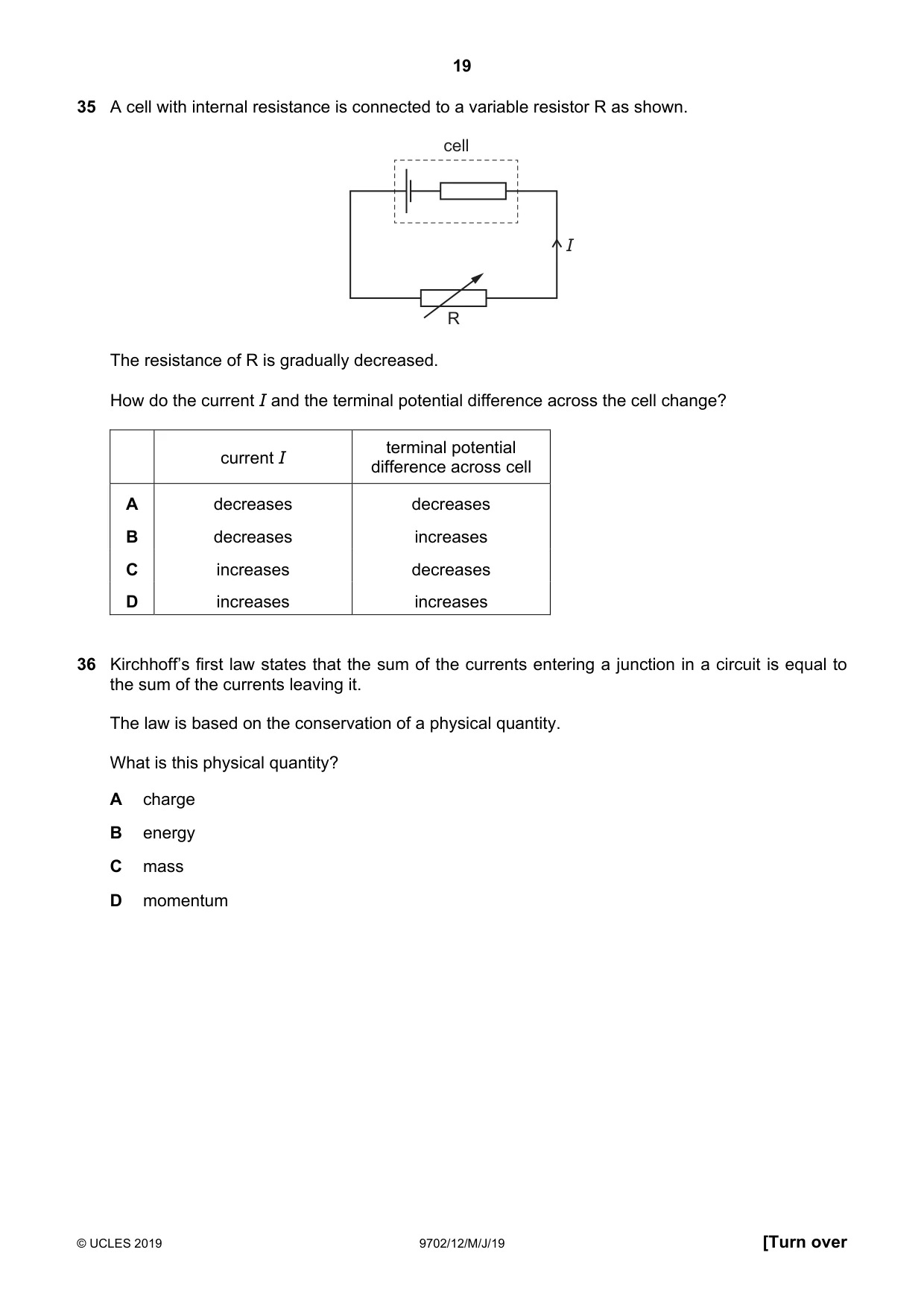
33 A length of wire is connected into a circuit. area A area A 1 2 S R The area of the cross-section of the wire changes from A at R to 2 1 A at S. There is a constant current in the wire. Charge Q passes R in time t. What is the charge passing point S in the same time t ? A 1 Q B Q C Q 2 D 2Q 2
Mark scheme: B
Q34 · Four wires are made of the same metal
34 Four wires are made of the same metal. The cross-sectional areas, lengths and thermodynamic temperatures of the wires are shown. Which wire has the largest resistance? cross-sectional length temperature area A A 2L 2T B A L T C 2A 2L 2T D 2A L T
Mark scheme: A
Q35 · A cell with internal resistance is connected to a variable resistor R as shown
35 A cell with internal resistance is connected to a variable resistor R as shown. cell I R The resistance of R is gradually decreased. How do the current I and the terminal potential difference across the cell change? terminal potential current I difference across cell A decreases decreases B decreases increases C increases decreases D increases increases
Mark scheme: C
Q36 · Kirchhoff’s first law states that the sum of the currents entering a junction in a…
36 Kirchhoff’s first law states that the sum of the currents entering a junction in a circuit is equal to the sum of the currents leaving it. The law is based on the conservation of a physical quantity. What is this physical quantity? A charge B energy C mass D momentum
Mark scheme: A
Q37 · A circuit contains two batteries, each of negligible internal resistance, and two…
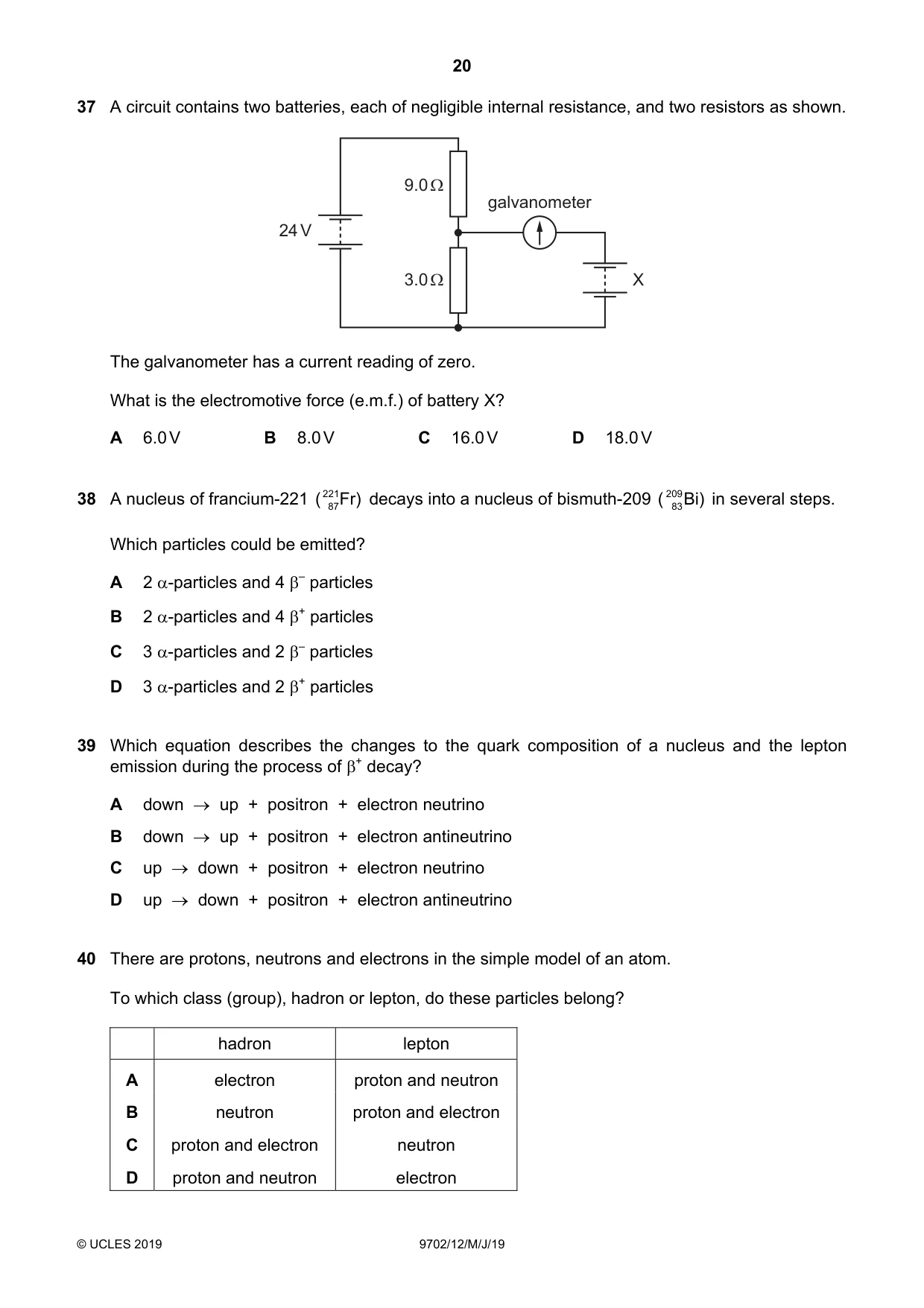
37 A circuit contains two batteries, each of negligible internal resistance, and two resistors as shown. 9.0 Ω galvanometer 24 V 3.0 Ω X The galvanometer has a current reading of zero. What is the electromotive force (e.m.f.) of battery X? A 6.0 V B 8.0 V C 16.0 V D 18.0 V
Mark scheme: A
Q38 · A nucleus of francium-221 ( 221 Fr) decays into a nucleus of bismuth-209 ( 209 Bi) in…
38 A nucleus of francium-221 ( 221 Fr) decays into a nucleus of bismuth-209 ( 209 Bi) in several steps. 87 83 Which particles could be emitted? A 2 α-particles and 4 β– particles B 2 α-particles and 4 β+ particles C 3 α-particles and 2 β– particles D 3 α-particles and 2 β+ particles
Mark scheme: C
Q39 · Which equation describes the changes to the quark composition of a nucleus and the lepton…
39 Which equation describes the changes to the quark composition of a nucleus and the lepton emission during the process of β+ decay? A down → up + positron + electron neutrino B down → up + positron + electron antineutrino C up → down + positron + electron neutrino D up → down + positron + electron antineutrino
Mark scheme: C
Q40 · There are protons, neutrons and electrons in the simple model of an atom
40 There are protons, neutrons and electrons in the simple model of an atom. To which class (group), hadron or lepton, do these particles belong? hadron lepton A electron proton and neutron B neutron proton and electron C proton and electron neutron D proton and neutron electron
Mark scheme: D
What was in this paper
The subtopics covered by these 40 questions, and how many questions each got. Open one in a new tab to see every Cambridge question on it.
3Errors and uncertainties3Progressive waves3SI units3Density and pressure2Equilibrium of forces2Fundamental particles2Interference2Kirchhoff’s laws2Momentum and Newton’s laws of motion2Doppler effect for sound waves1Elastic and plastic behaviour1Electric current1Electric potential1Electromagnetic spectrum1Equations of motion1Gravitational potential energy and kinetic energy1Linear momentum and its conservation1Practical circuits1Radioactive decay1Resistance and resistivity1Scalars and vectors1Stationary waves1Stress and strain1The diffraction grating1Uniform electric fields1What you needed in this session
Cambridge’s own grade thresholds for 2019 May/June, Paper 1 · Variant 2. A higher threshold means an easier paper — the bar moves with how the cohort did.