Cambridge A Level Physics 9702 — 2023 Oct/Nov Paper 1 · Variant 2
9702/12/O/N/23 · 40 questions · 40 marks · ≈45 min
The question paper and its mark scheme, free to read here and free to download. This is Cambridge’s own paper, exactly as it was sat.
Question paper20 pages


Mark scheme3 pages
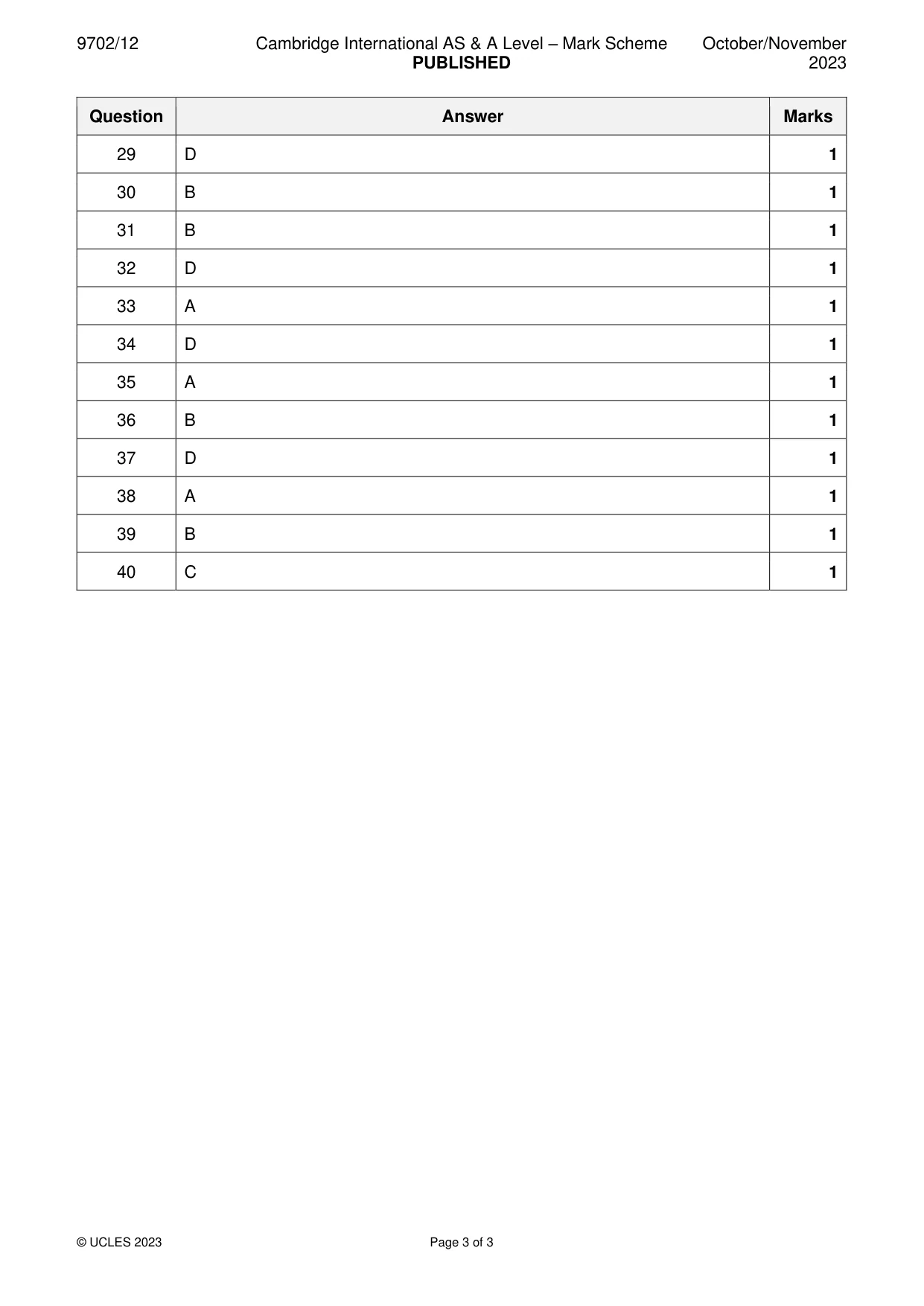
Answers below. Sit the paper first if you are practising.
Questions as text
Q1 · A student estimates the maximum speed of some different moving objects
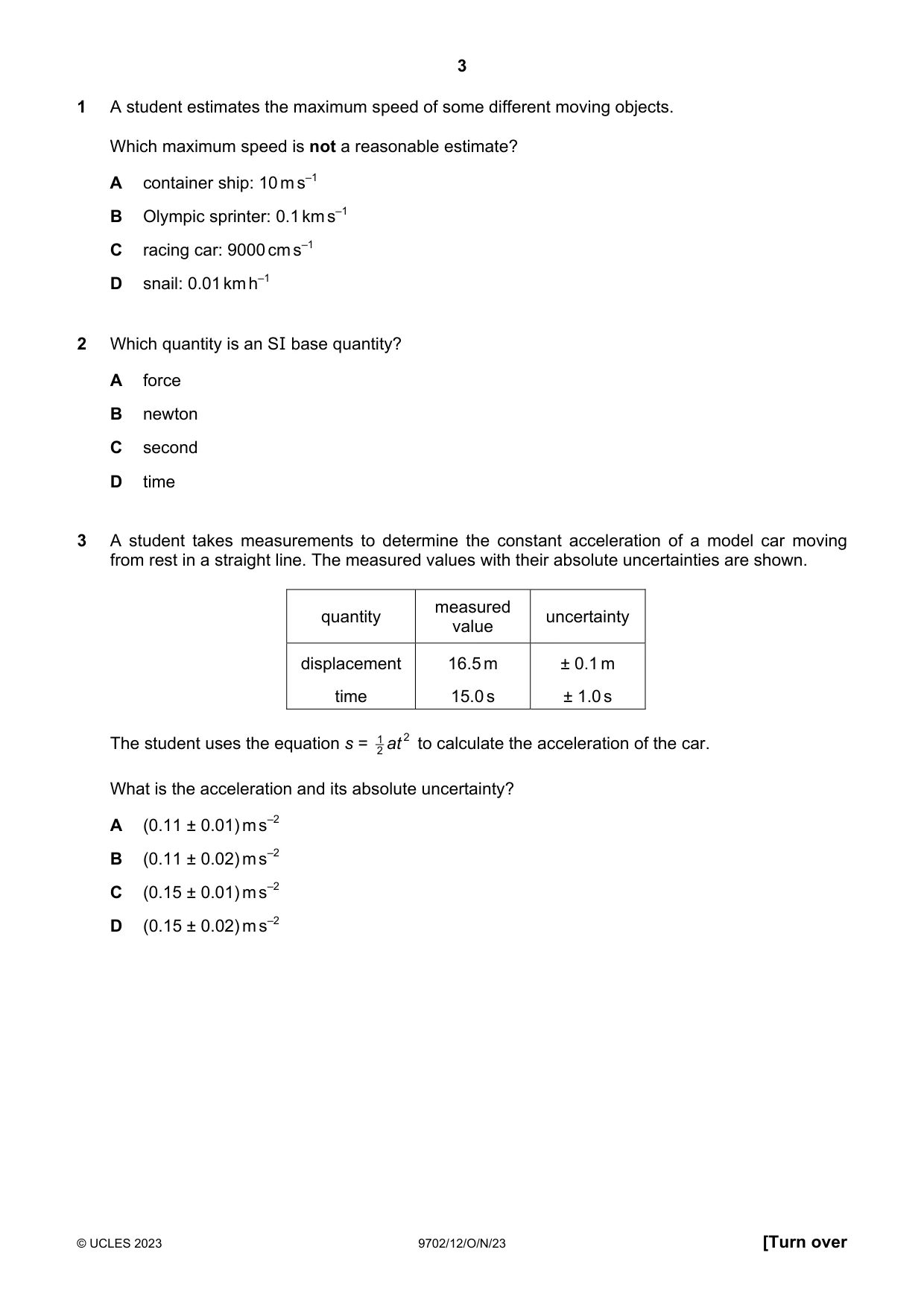
1 A student estimates the maximum speed of some different moving objects. Which maximum speed is not a reasonable estimate? A container ship: 10 m s–1 B Olympic sprinter: 0.1 km s–1 C racing car: 9000 cm s–1 D snail: 0.01 km h–1
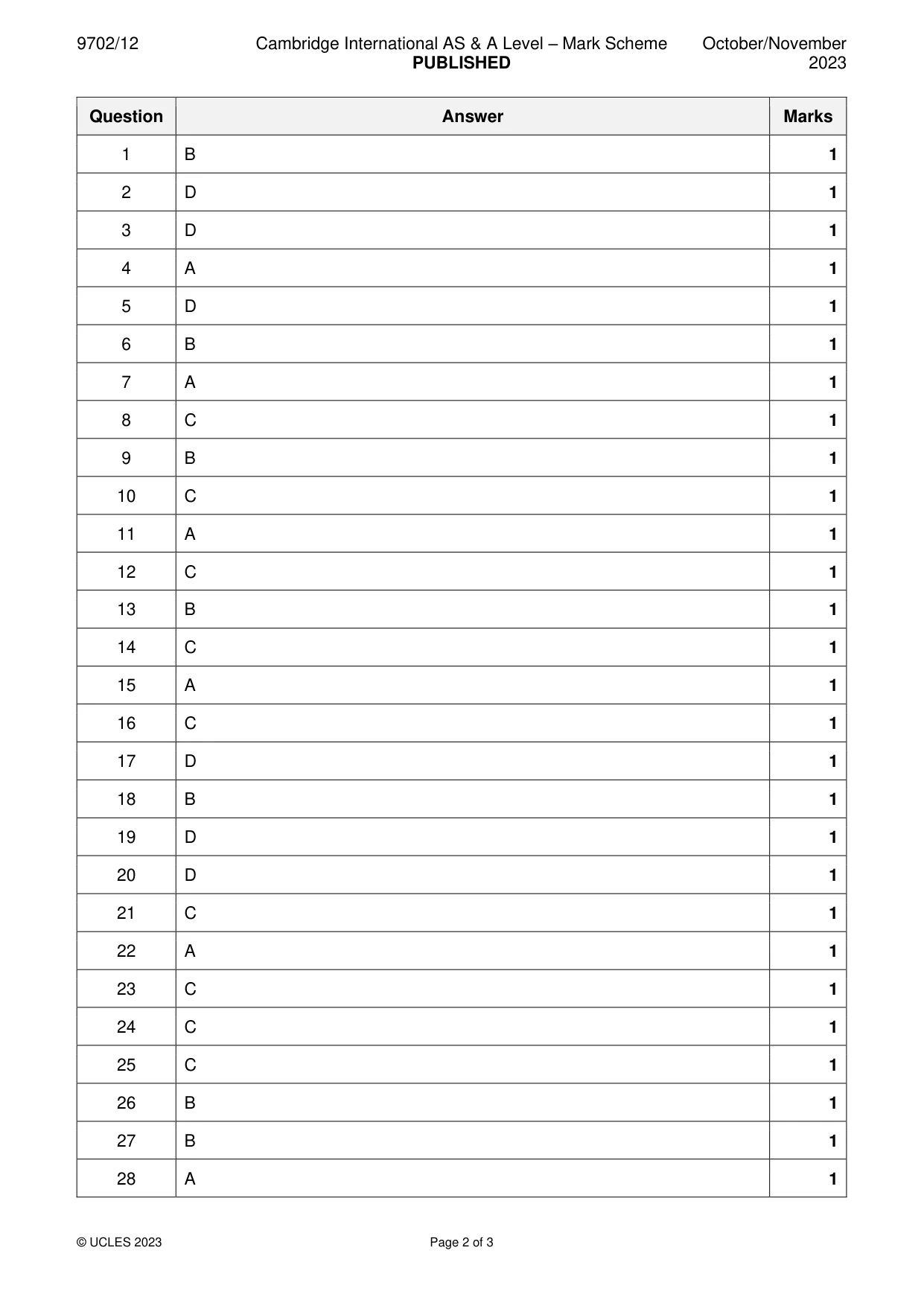
Mark scheme: B
Q2 · Which quantity is an SI base quantity?
2 Which quantity is an SI base quantity? A force B newton C second D time
Mark scheme: D
Q3 · A student takes measurements to determine the constant acceleration of a model car moving…
3 A student takes measurements to determine the constant acceleration of a model car moving from rest in a straight line. The measured values with their absolute uncertainties are shown. measured quantity uncertainty value displacement 16.5 m ± 0.1 m time 15.0 s ± 1.0 s The student uses the equation s = 1 at to calculate the acceleration of the car. 2 2 What is the acceleration and its absolute uncertainty? A (0.11 ± 0.01) m s–2 B (0.11 ± 0.02) m s–2 C (0.15 ± 0.01) m s–2 D (0.15 ± 0.02) m s–2
Mark scheme: D
Q4 · Anaeroplane is moving at a constant speed in a straight line at an angle @ to the…
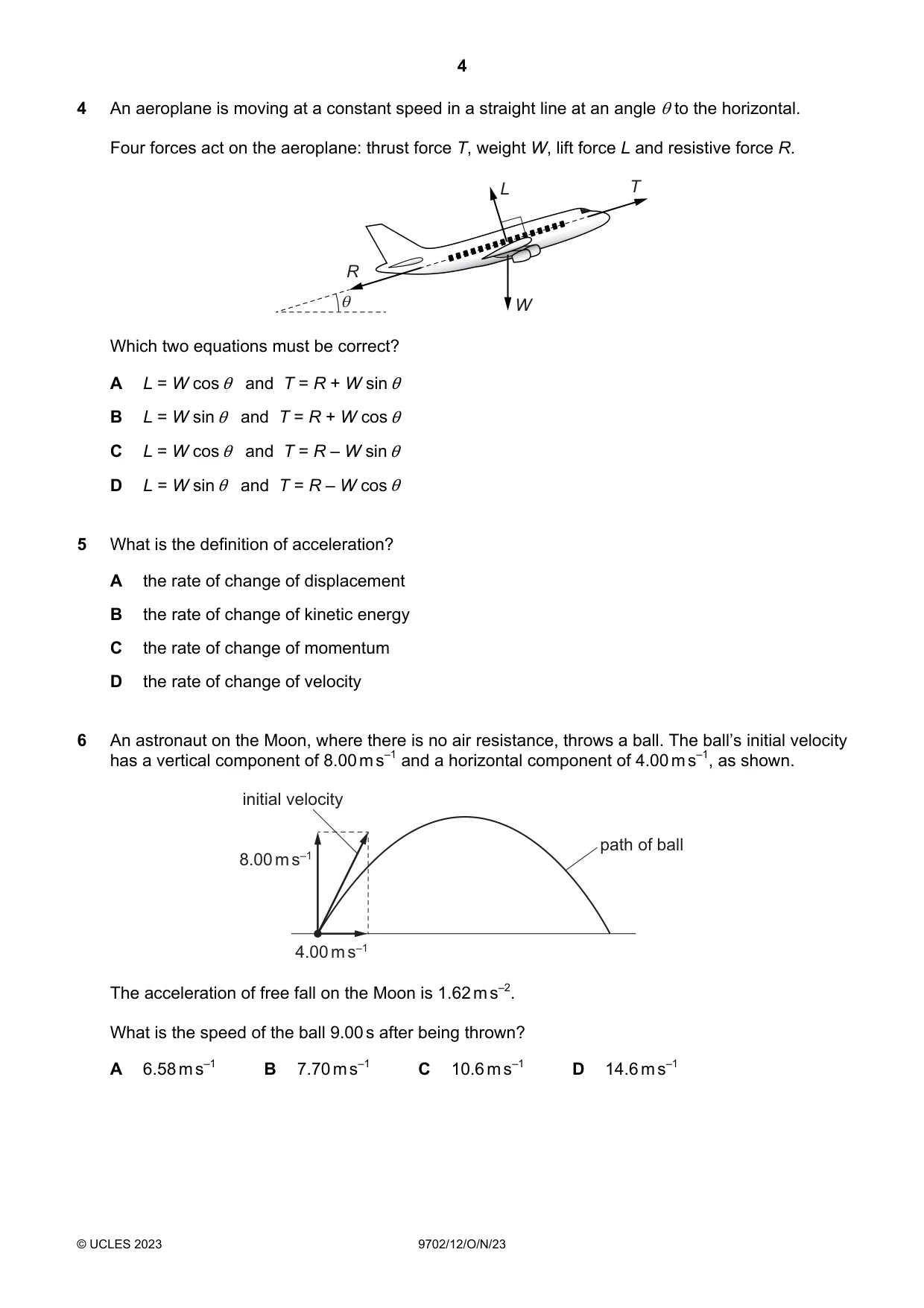
4 Anaeroplane is moving at a constant speed in a straight line at an angle @ to the horizontal. Four forces act on the aeroplane: thrust force 7, weight W, lift force L and resistive force R. L T Which two equations must be correct? A L=Wcos@ and T=R+Wsing B L=Wsin@ and T=R+Wcos@ C L=Wcosé@ and T=R-Wsin#@ D L=Wsin@ and T=R-Wcos@
Mark scheme: A
Q5 · What is the definition of acceleration?
5 What is the definition of acceleration? A the rate of change of displacement B the rate of change of kinetic energy C the rate of change of momentum D the rate of change of velocity
Mark scheme: D
Q6 · An astronaut on the Moon, where there is no air resistance, throws a ball
6 An astronaut on the Moon, where there is no air resistance, throws a ball. The ball’s initial velocity has a vertical component of 8.00 m s–1 and a horizontal component of 4.00 m s–1, as shown. initial velocity path of ball 8.00 m s–1 4.00 m s–1 The acceleration of free fall on the Moon is 1.62 m s–2. What is the speed of the ball 9.00 s after being thrown? A 6.58 m s–1 B 7.70 m s–1 C 10.6 m s–1 D 14.6 m s–1
Mark scheme: B
Q7 · Two blocks, of mass 0.20 kg and 0.50 kg, are connected by a light inextensible string…
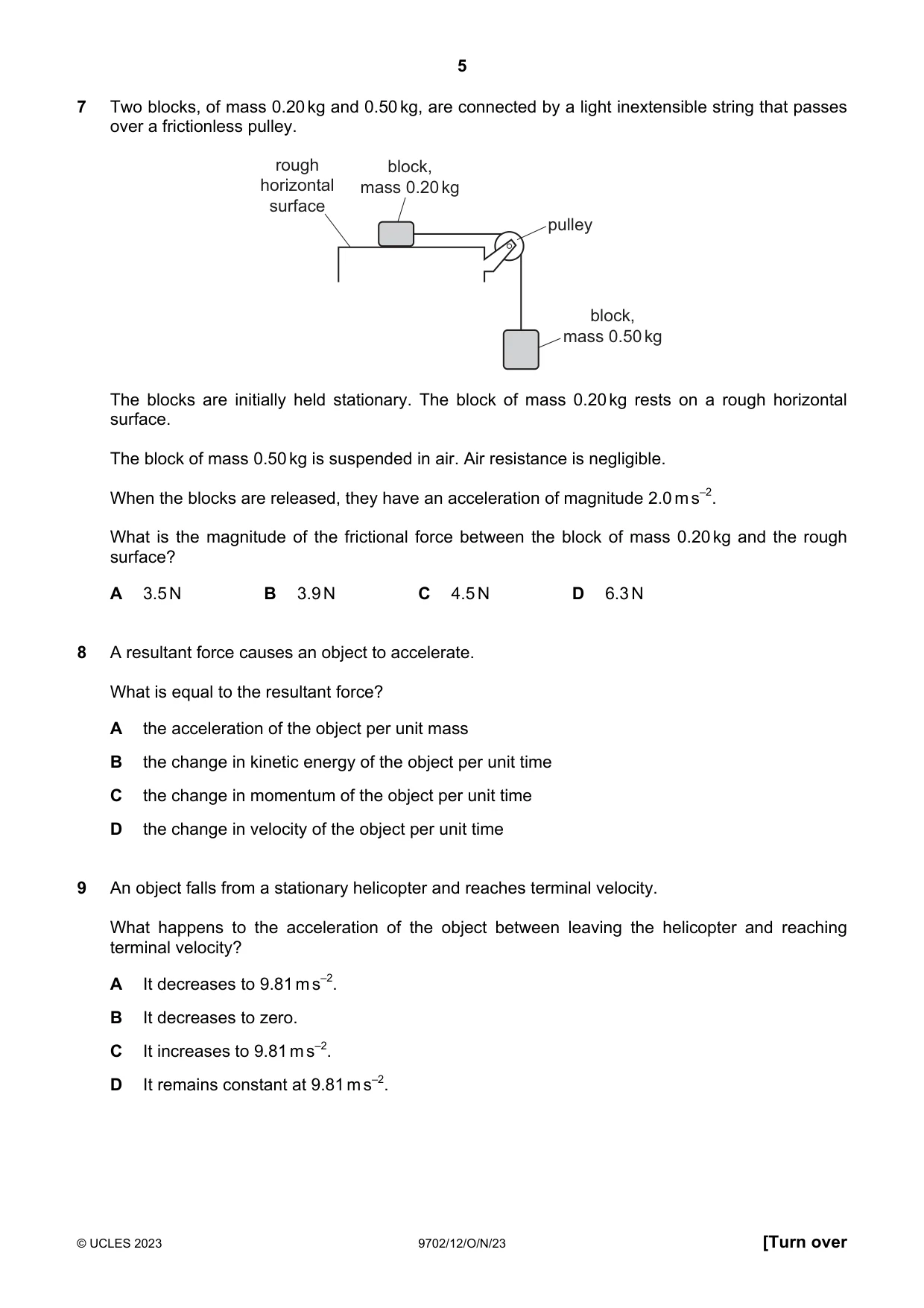
7 Two blocks, of mass 0.20 kg and 0.50 kg, are connected by a light inextensible string that passes over a frictionless pulley. rough block, horizontal mass 0.20 kg surface pulley block, mass 0.50 kg The blocks are initially held stationary. The block of mass 0.20 kg rests on a rough horizontal surface. The block of mass 0.50 kg is suspended in air. Air resistance is negligible. When the blocks are released, they have an acceleration of magnitude 2.0 m s–2. What is the magnitude of the frictional force between the block of mass 0.20 kg and the rough surface? A 3.5 N B 3.9 N C 4.5 N D 6.3 N
Mark scheme: A
Q8 · A resultant force causes an object to accelerate
8 A resultant force causes an object to accelerate. What is equal to the resultant force? A the acceleration of the object per unit mass B the change in kinetic energy of the object per unit time C the change in momentum of the object per unit time D the change in velocity of the object per unit time
Mark scheme: C
Q9 · An object falls from a stationary helicopter and reaches terminal velocity
9 An object falls from a stationary helicopter and reaches terminal velocity. What happens to the acceleration of the object between leaving the helicopter and reaching terminal velocity? A It decreases to 9.81 m s–2. B It decreases to zero. C It increases to 9.81 m s–2. D It remains constant at 9.81 m s–2.
Mark scheme: B
Q10 · Two balls, of masses m and 2m, travelling in a vacuum with initial velocities 2v and v…
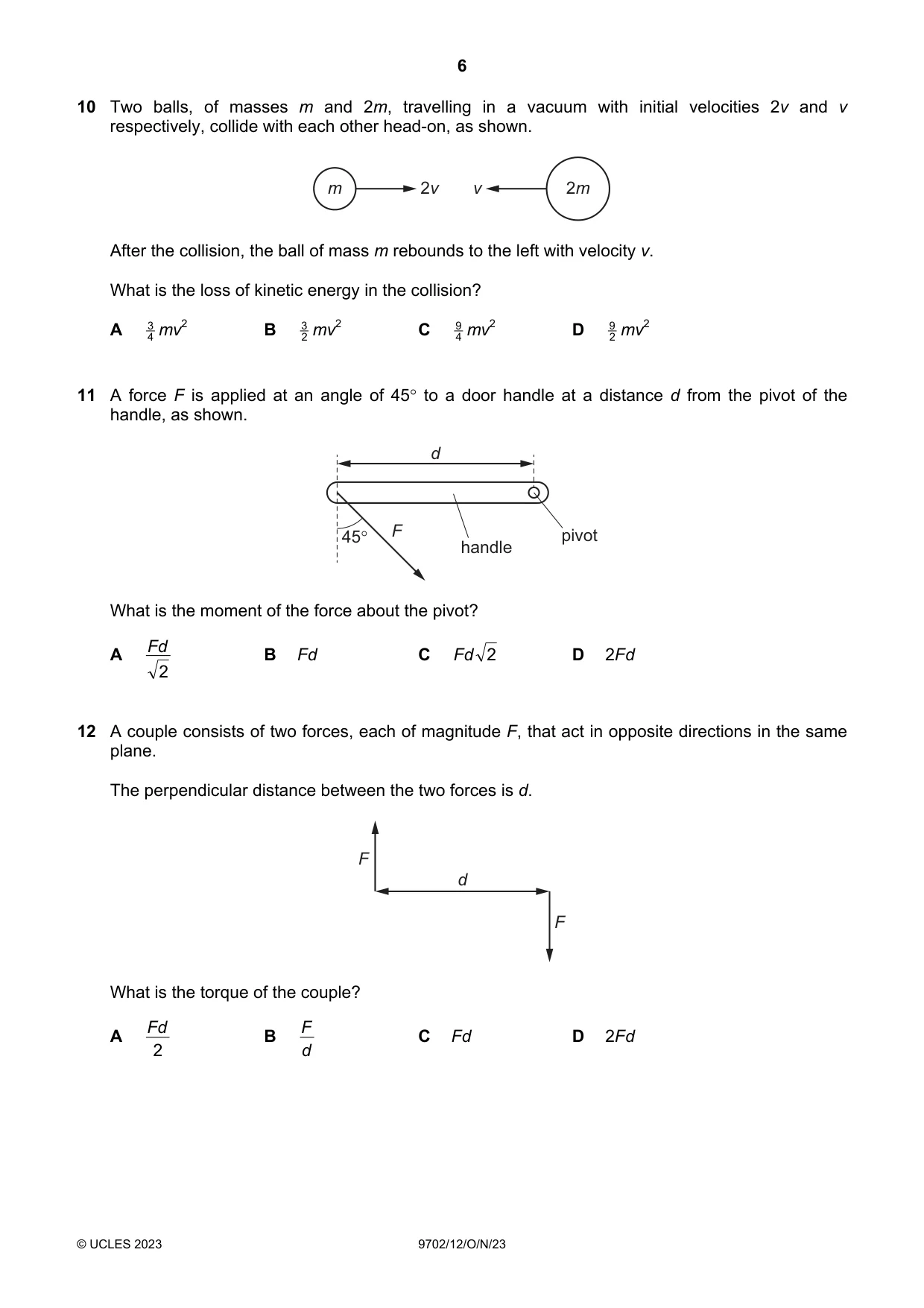
10 Two balls, of masses m and 2m, travelling in a vacuum with initial velocities 2v and v respectively, collide with each other head-on, as shown. m 2v v 2m After the collision, the ball of mass m rebounds to the left with velocity v. What is the loss of kinetic energy in the collision? A 3 mv2 B 3 mv2 C 9 mv2 D 9 mv2 4 2 4 2
Mark scheme: C
Q11 · A force F is applied at an angle of 45° to a door handle at a distance d from the pivot…
11 A force F is applied at an angle of 45° to a door handle at a distance d from the pivot of the handle, as shown. ° i t 48 handle pIvo What is the moment of the force about the pivot? Fd B Fd Cc FaV2 D 2Fd J2
Mark scheme: A
Q12 · A couple consists of two forces, each of magnitude F, that act in opposite directions in…
12 A couple consists of two forces, each of magnitude F, that act in opposite directions in the same plane. The perpendicular distance between the two forces is d. F d F What is the torque of the couple? Fd F A B C Fd D 2Fd 2 d
Mark scheme: C
Q13 · The diagram shows an experiment to determine the force exerted on a ball by a horizontal…
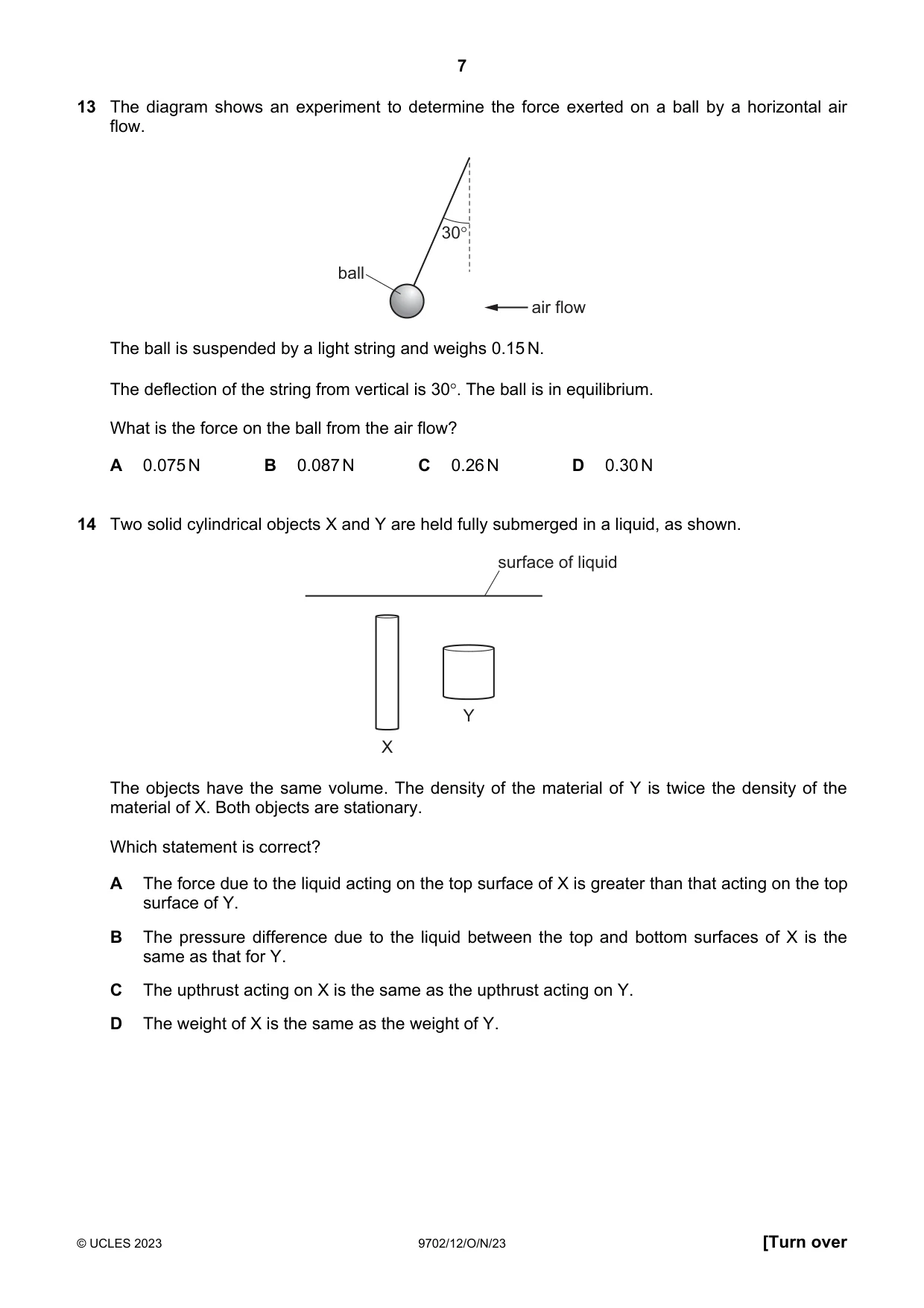
13 The diagram shows an experiment to determine the force exerted on a ball by a horizontal air flow. = _ air flow The ball is suspended by a light string and weighs 0.15N. The deflection of the string from vertical is 30°. The ball is in equilibrium. What is the force on the ball from the air flow? A 0.075N B 0.087N C 0.26N D 0.30N
Mark scheme: B
Q14 · Two solid cylindrical objects X and Y are held fully submerged in a liquid, as shown
14 Two solid cylindrical objects X and Y are held fully submerged in a liquid, as shown. surface of liquid Y X The objects have the same volume. The density of the material of Y is twice the density of the material of X. Both objects are stationary. Which statement is correct? A The force due to the liquid acting on the top surface of X is greater than that acting on the top surface of Y. B The pressure difference due to the liquid between the top and bottom surfaces of X is the same as that for Y. C The upthrust acting on X is the same as the upthrust acting on Y. D The weight of X is the same as the weight of Y.
Mark scheme: C
Q15 · An electric car travels at a constant speed of 70 km h–1 for 80 km on a straight…
15 An electric car travels at a constant speed of 70 km h–1 for 80 km on a straight horizontal road and uses energy E from its battery. The total resistive force acting on the car is proportional to (speed)2. Assume that the electric motor is 100% efficient. How much energy is used from the battery when the car travels at a constant speed of 60 km h–1 for 80 km on the straight horizontal road? A 0.73E B 0.86E C 1.2E D 1.4E
Mark scheme: A
Q16 · What is meant by the efficiency of a system?
16 What is meant by the efficiency of a system? A the total energy input to the system divided by the useful energy output by the system B the useful energy output from the system divided by the energy wasted by the system C the useful energy output from the system divided by the total energy input to the system D the energy wasted by the system divided by the total energy input to the system
Mark scheme: C
Q17 · When an object of mass m is raised through a vertical height ∆h, the gain of its…
17 When an object of mass m is raised through a vertical height ∆h, the gain of its gravitational potential energy is ∆EP. ∆EP and ∆h are related by the equation ∆EP = mg∆h, where g is the acceleration of free fall. The definition of which physical quantity is needed to derive this equation? A acceleration B momentum C power D work done
Mark scheme: D
More questions on Gravitational potential energy and kinetic energy
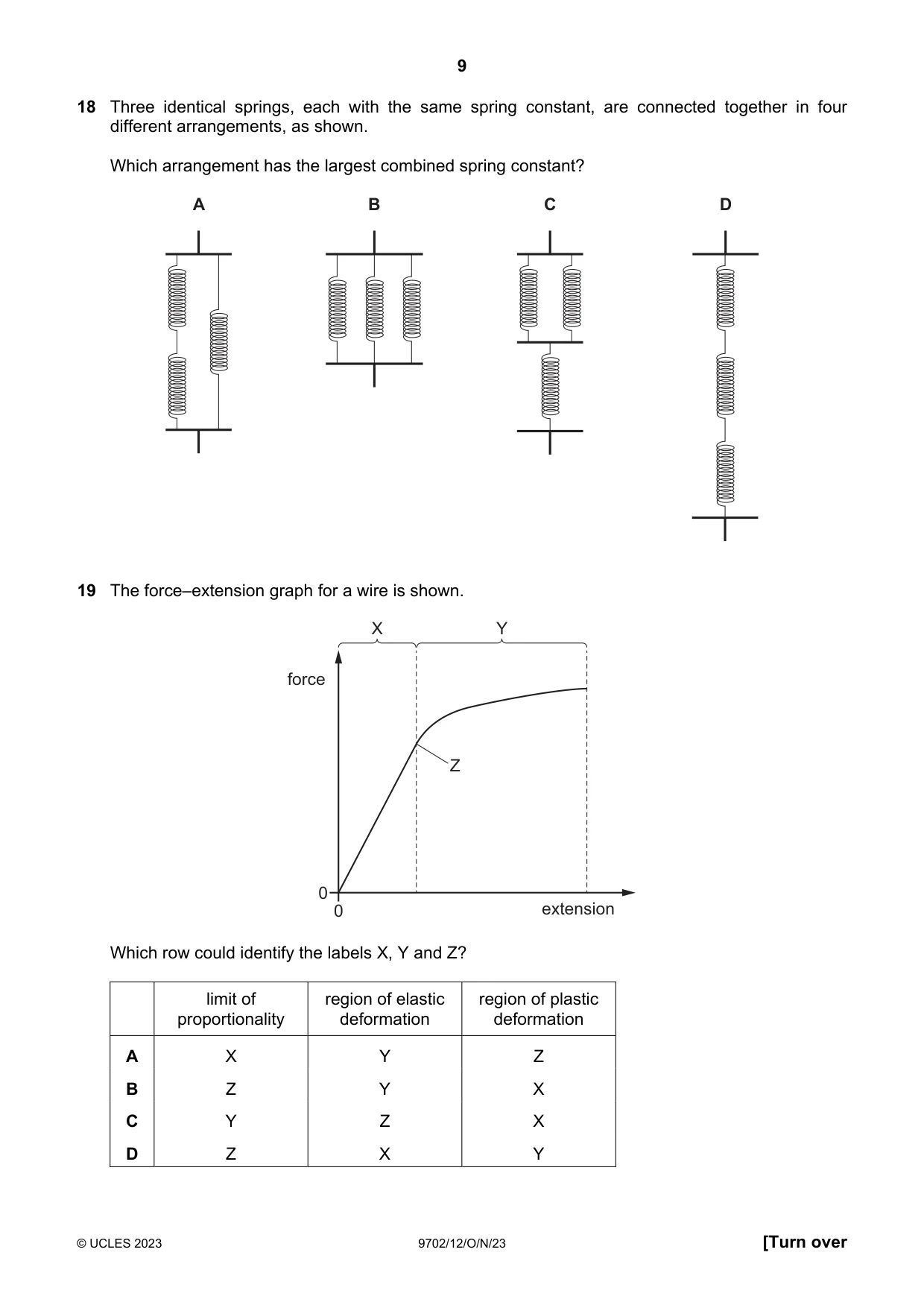
Q18 · Three identical springs, each with the same spring constant, are connected together in…
18 Three identical springs, each with the same spring constant, are connected together in four different arrangements, as shown. Which arrangement has the largest combined spring constant? A B C D
Mark scheme: B
Q19 · The force–extension graph for a wire is shown
19 The force–extension graph for a wire is shown. X Y force Z 0 0 extension Which row could identify the labels X, Y and Z? limit of region of elastic region of plastic proportionality deformation deformation A X Y Z B Z Y X C Y Z X D Z X Y
Mark scheme: D
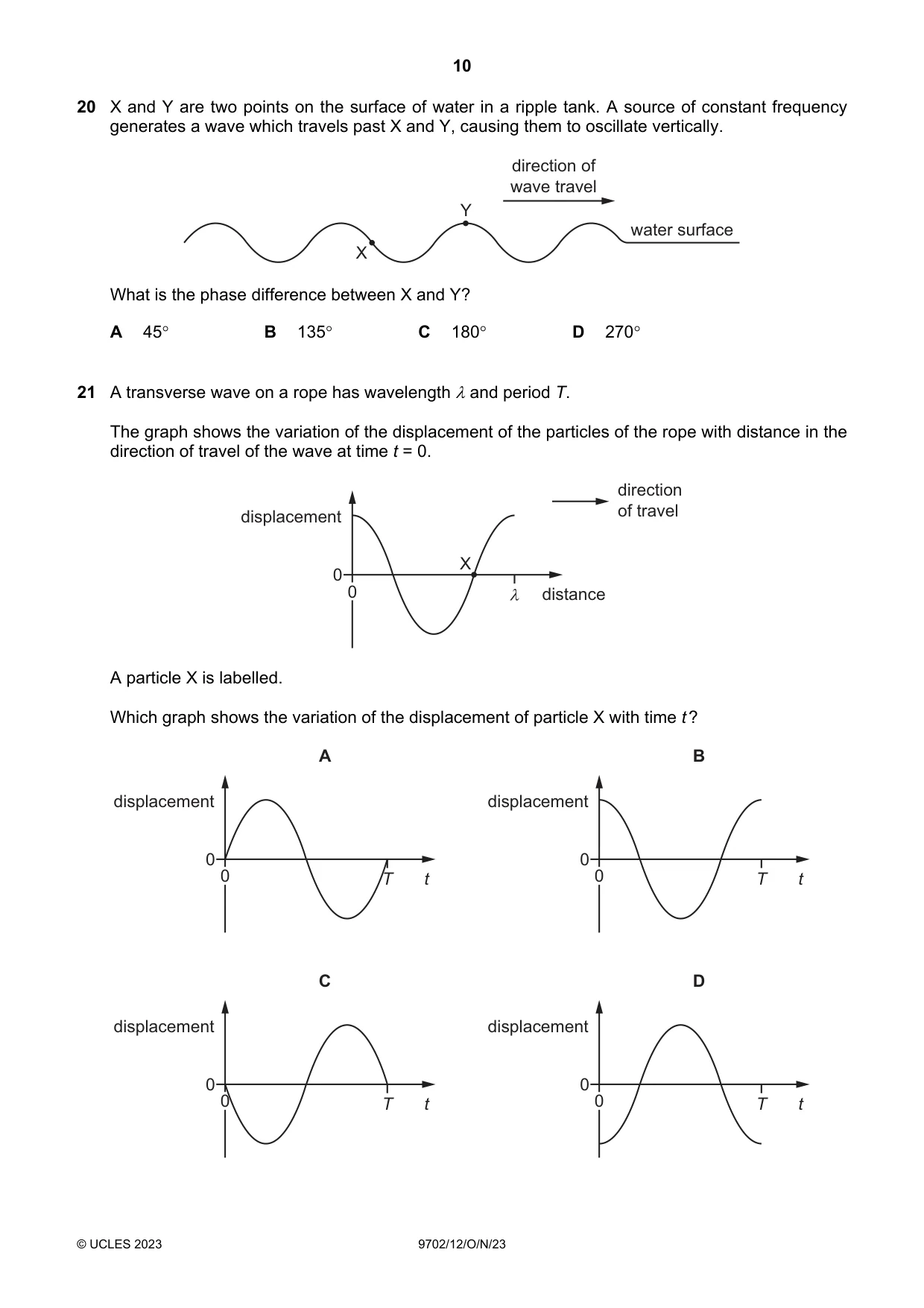
Q20 · X and Y are two points on the surface of water in a ripple tank
20 X and Y are two points on the surface of water in a ripple tank. A source of constant frequency generates a wave which travels past X and Y, causing them to oscillate vertically. direction of wave travel Y water surface X What is the phase difference between X and Y? A 45° B 135° C 180° D 270°
Mark scheme: D
Q21 · A transverse wave on a rope has wavelength λ and period T
21 A transverse wave on a rope has wavelength λ and period T. The graph shows the variation of the displacement of the particles of the rope with distance in the direction of travel of the wave at time t = 0. direction displacement of travel X 0 0 λ distance A particle X is labelled. Which graph shows the variation of the displacement of particle X with time t ? A B displacement displacement 0 0 0 T t 0 T t C D displacement displacement 0 0 0 T t 0 T t
Mark scheme: C
Q22 · A source of sound waves is moving at a constant speed directly towards a stationary…
22 A source of sound waves is moving at a constant speed directly towards a stationary observer. The sound waves have a speed of 340 m s–1 and a frequency of 480 Hz. The observer hears sound waves of frequency 650 Hz. What is the speed of the source? A 89 m s–1 B 120 m s–1 C 250 m s–1 D 340 m s–1
Mark scheme: A
Q23 · A student is investigating two electromagnetic waves, X and Y, in a vacuum
23 A student is investigating two electromagnetic waves, X and Y, in a vacuum. Wave X has a wavelength of 5.2 × 10⁻⁷ m. Wave Y has a frequency of 9.4 GHz. Which principal regions of the electromagnetic spectrum contain waves X and Y? X Y A radio wave ultraviolet B ultraviolet visible C visible microwave D microwave radio wave
Mark scheme: C
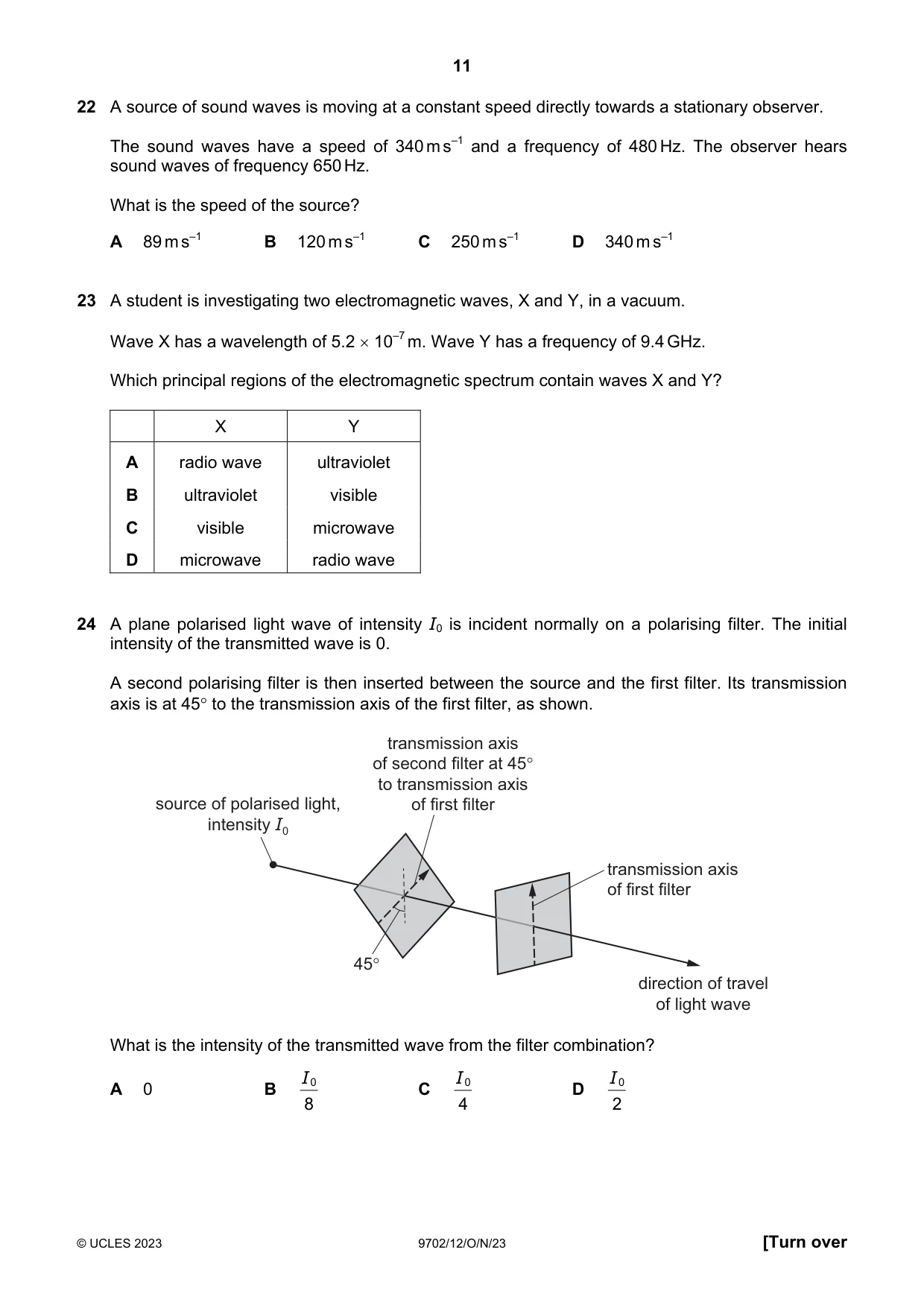
Q24 · A plane polarised light wave of intensity J is incident normally on a polarising filter
24 A plane polarised light wave of intensity J is incident normally on a polarising filter. The initial intensity of the transmitted wave is 0. A second polarising filter is then inserted between the source and the first filter. Its transmission axis is at 45° to the transmission axis of the first filter, as shown. transmission axis of second filter at 45° to transmission axis source of polarised light, of first filter intensity J, transmission axis of first filter direction of travel of light wave What is the intensity of the transmitted wave from the filter combination? Ip ob > be 8 4 2 A 0 B
Mark scheme: C
Q25 · What can explain how stationary waves are formed from progressive waves?
25 What can explain how stationary waves are formed from progressive waves? A diffraction B polarisation C superposition D the Doppler effect
Mark scheme: C
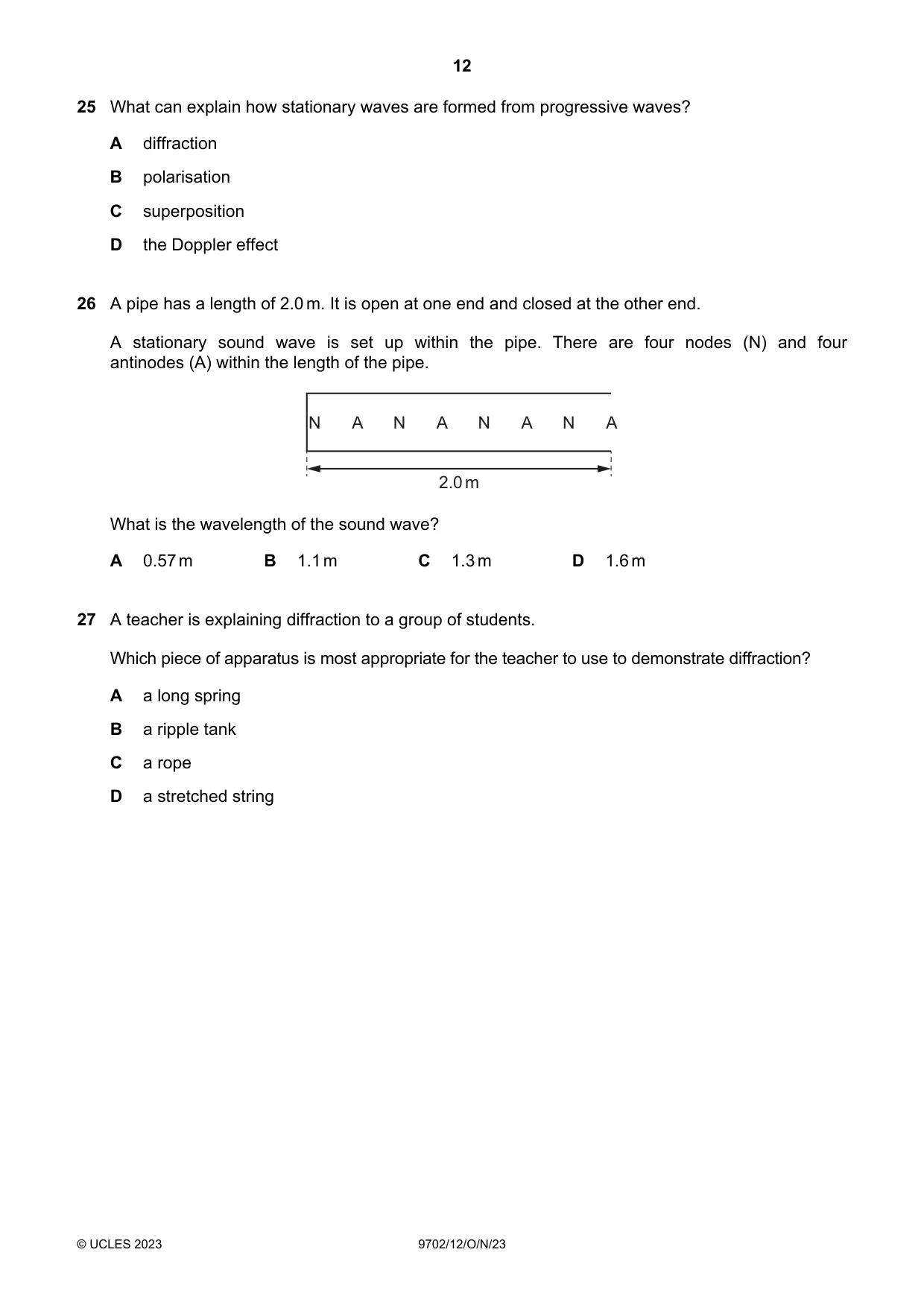
Q26 · A pipe has a length of 2.0 m
26 A pipe has a length of 2.0 m. It is open at one end and closed at the other end. A stationary sound wave is set up within the pipe. There are four nodes (N) and four antinodes (A) within the length of the pipe. N A N A N A N A 2.0 m What is the wavelength of the sound wave? A 0.57 m B 1.1 m C 1.3 m D 1.6 m
Mark scheme: B
Q27 · A teacher is explaining diffraction to a group of students
27 A teacher is explaining diffraction to a group of students. Which piece of apparatus is most appropriate for the teacher to use to demonstrate diffraction? A a long spring B a ripple tank C a rope D a stretched string
Mark scheme: B
Q28 · Coherent light of constant wavelength is incident normally on a double slit
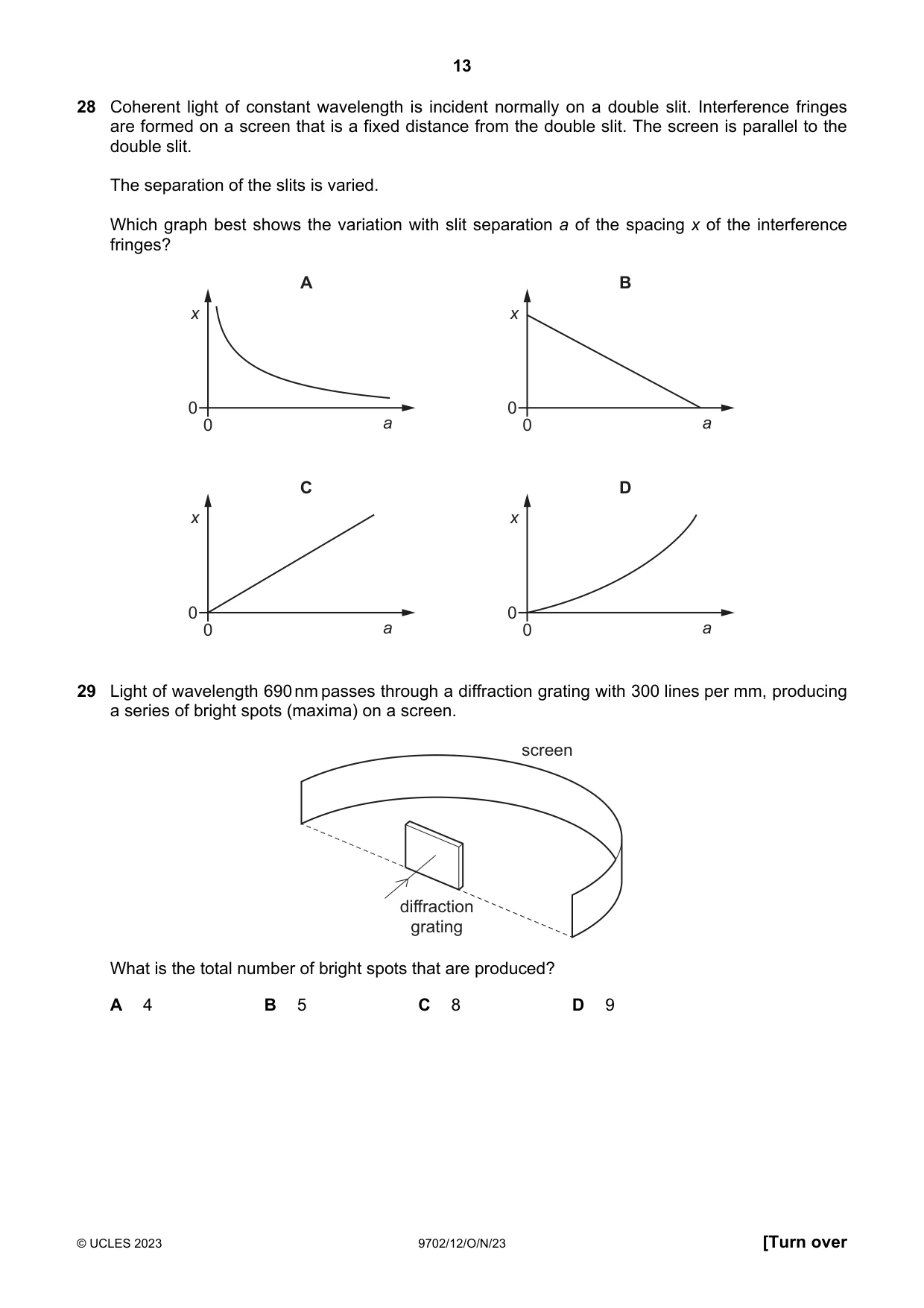
28 Coherent light of constant wavelength is incident normally on a double slit. Interference fringes are formed on a screen that is a fixed distance from the double slit. The screen is parallel to the double slit. The separation of the slits is varied. Which graph best shows the variation with slit separation a of the spacing x of the interference fringes? A B x x 0 0 0 a 0 a C D x x 0 0 0 a 0 a
Mark scheme: A
Q29 · Light of wavelength 690 nm passes through a diffraction grating with 300 lines per mm…
29 Light of wavelength 690 nm passes through a diffraction grating with 300 lines per mm, producing a series of bright spots (maxima) on a screen. screen diffraction grating What is the total number of bright spots that are produced? A 4 B 5 C 8 D 9
Mark scheme: D
Q30 · A fine mist of oil droplets is sprayed into air
30 A fine mist of oil droplets is sprayed into air. As the oil droplets leave the nozzle of the spraying device they can become electrically charged. What is not a possible value for the charge on an oil droplet? A zero B 1.0 × 10⁻¹⁹ C C 4.8 × 10⁻¹⁹ C D 8.0 × 10⁻¹⁹ C
Mark scheme: B
Q31 · In the circuit shown, a fixed resistor X is connected in series with a battery and a…
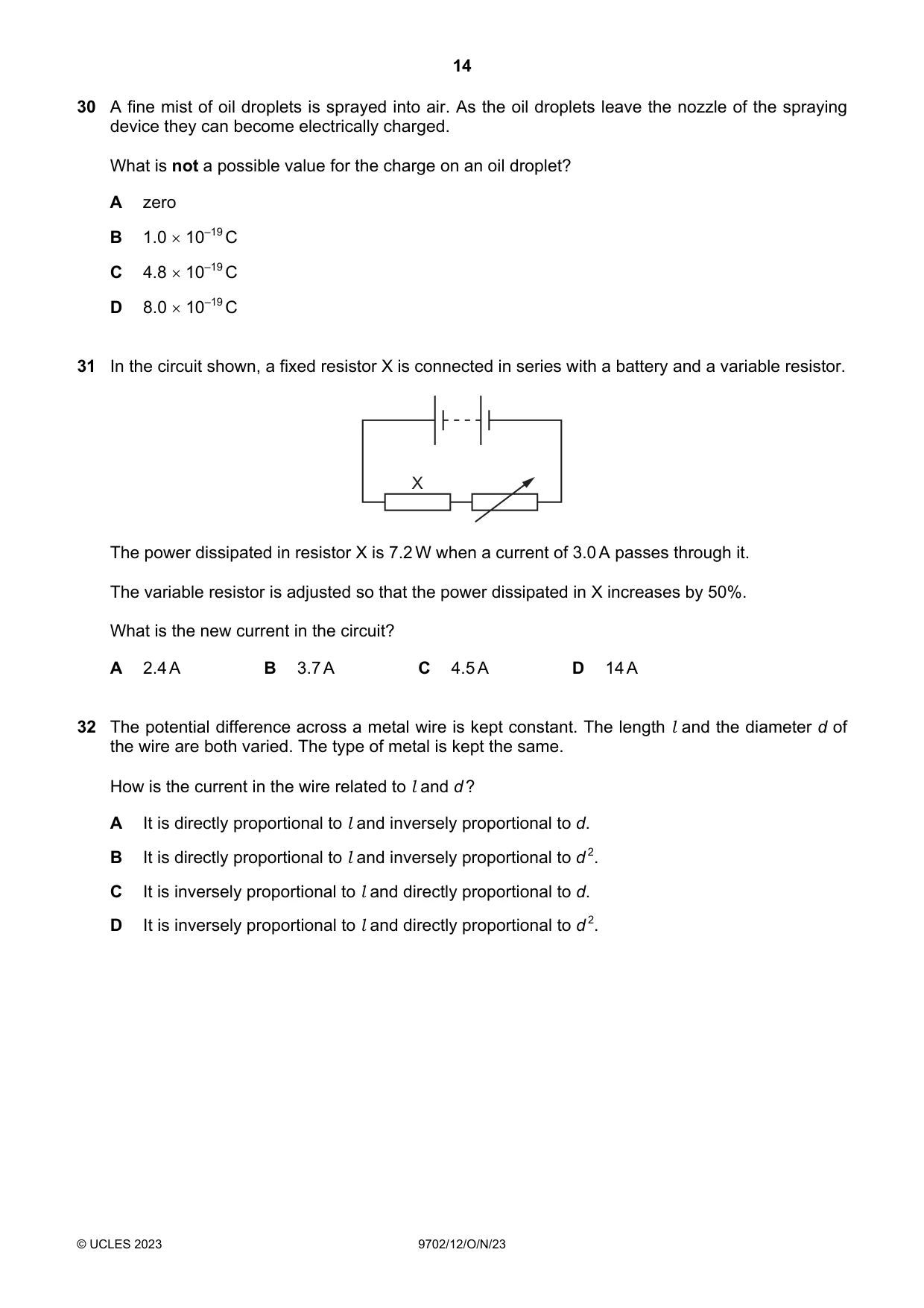
31 In the circuit shown, a fixed resistor X is connected in series with a battery and a variable resistor. X The power dissipated in resistor X is 7.2 W when a current of 3.0 A passes through it. The variable resistor is adjusted so that the power dissipated in X increases by 50%. What is the new current in the circuit? A 2.4 A B 3.7 A C 4.5 A D 14 A
Mark scheme: B
Q32 · The potential difference across a metal wire is kept constant
32 The potential difference across a metal wire is kept constant. The length l and the diameter d of the wire are both varied. The type of metal is kept the same. How is the current in the wire related to l and d ? A It is directly proportional to l and inversely proportional to d. B It is directly proportional to l and inversely proportional to d 2. C It is inversely proportional to l and directly proportional to d. D It is inversely proportional to l and directly proportional to d 2.
Mark scheme: D
Q33 · A student sets up a circuit
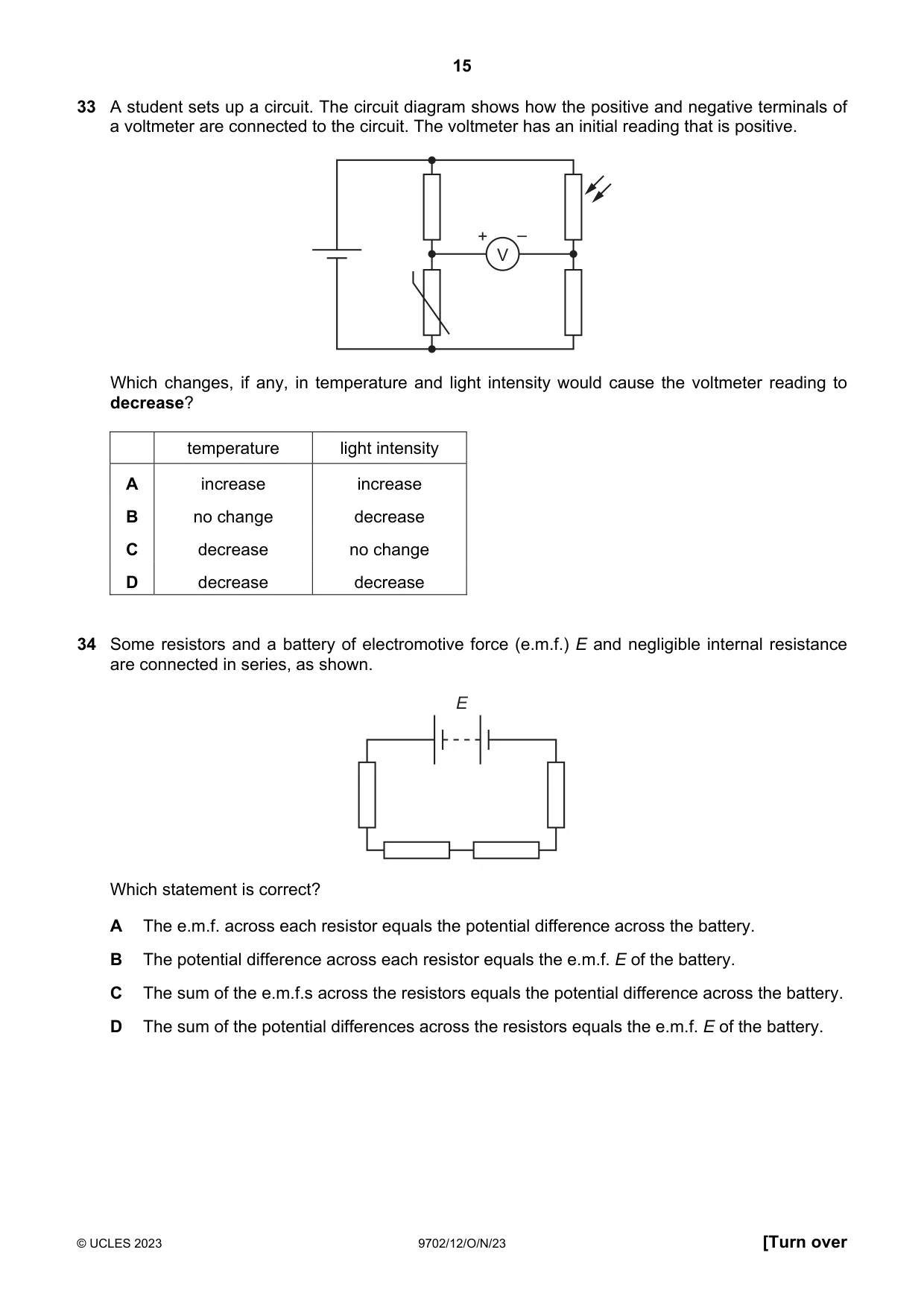
33 A student sets up a circuit. The circuit diagram shows how the positive and negative terminals of a voltmeter are connected to the circuit. The voltmeter has an initial reading that is positive. + – V Which changes, if any, in temperature and light intensity would cause the voltmeter reading to decrease? temperature light intensity A increase increase B no change decrease C decrease no change D decrease decrease
Mark scheme: A
Q34 · Some resistors and a battery of electromotive force (e.m.f.) E and negligible internal…
34 Some resistors and a battery of electromotive force (e.m.f.) E and negligible internal resistance are connected in series, as shown. E Which statement is correct? A The e.m.f. across each resistor equals the potential difference across the battery. B The potential difference across each resistor equals the e.m.f. E of the battery. C The sum of the e.m.f.s across the resistors equals the potential difference across the battery. D The sum of the potential differences across the resistors equals the e.m.f. E of the battery.
Mark scheme: D
Q35 · Kirchhoff’s first law is a consequence of the conservation of which physical quantity?
35 Kirchhoff’s first law is a consequence of the conservation of which physical quantity? A charge B energy C linear momentum D potential difference
Mark scheme: A
Q36 · The diagram shows a network of resistors
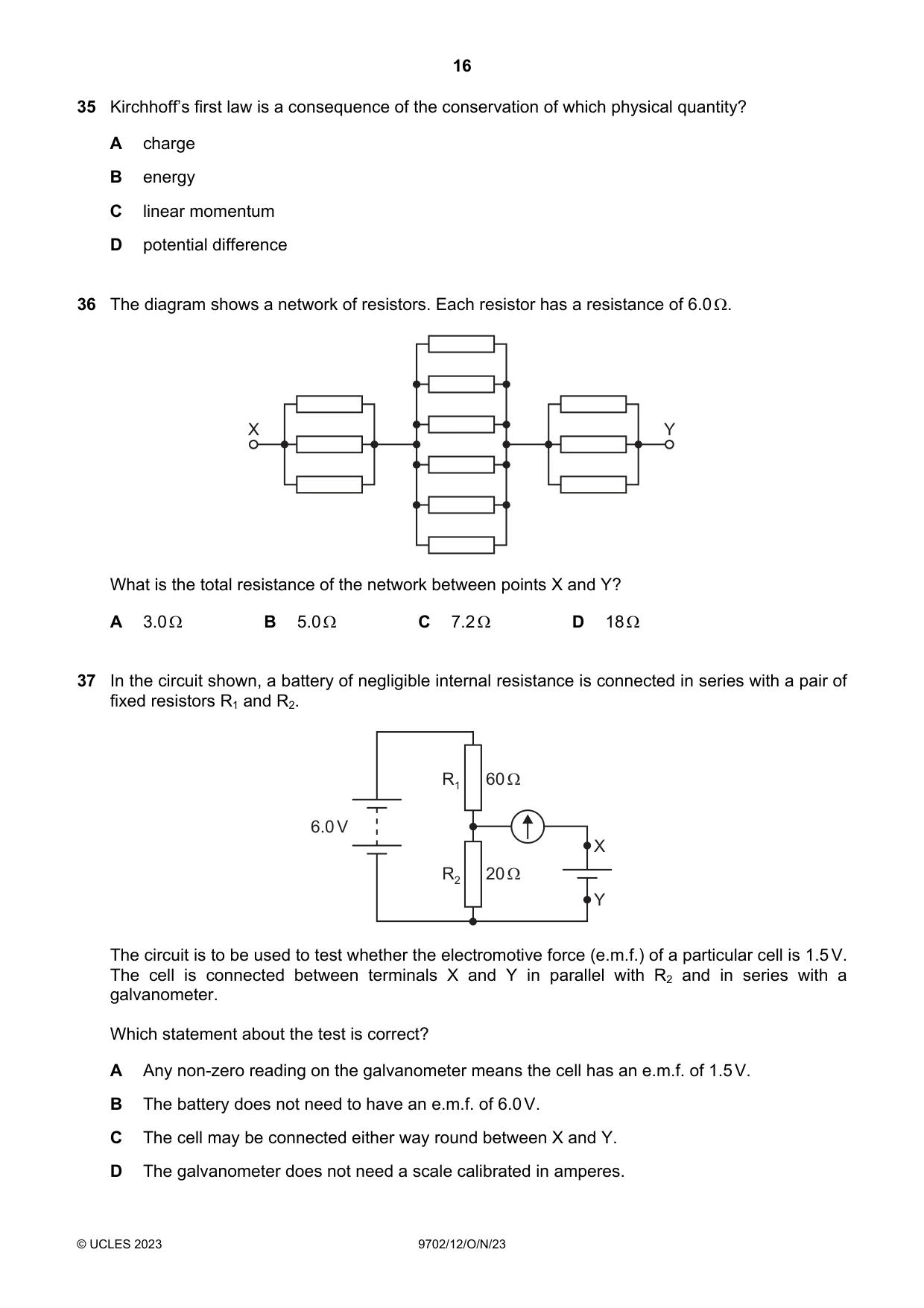
36 The diagram shows a network of resistors. Each resistor has a resistance of 6.0 Ω. X Y What is the total resistance of the network between points X and Y? A 3.0 Ω B 5.0 Ω C 7.2 Ω D 18 Ω
Mark scheme: B
Q37 · In the circuit shown, a battery of negligible internal resistance is connected in series…
37 In the circuit shown, a battery of negligible internal resistance is connected in series with a pair of fixed resistors R1 and R2. R1 60 Ω 6.0 V X R2 20 Ω Y The circuit is to be used to test whether the electromotive force (e.m.f.) of a particular cell is 1.5 V. The cell is connected between terminals X and Y in parallel with R2 and in series with a galvanometer. Which statement about the test is correct? A Any non-zero reading on the galvanometer means the cell has an e.m.f. of 1.5 V. B The battery does not need to have an e.m.f. of 6.0 V. C The cell may be connected either way round between X and Y. D The galvanometer does not need a scale calibrated in amperes.
Mark scheme: D
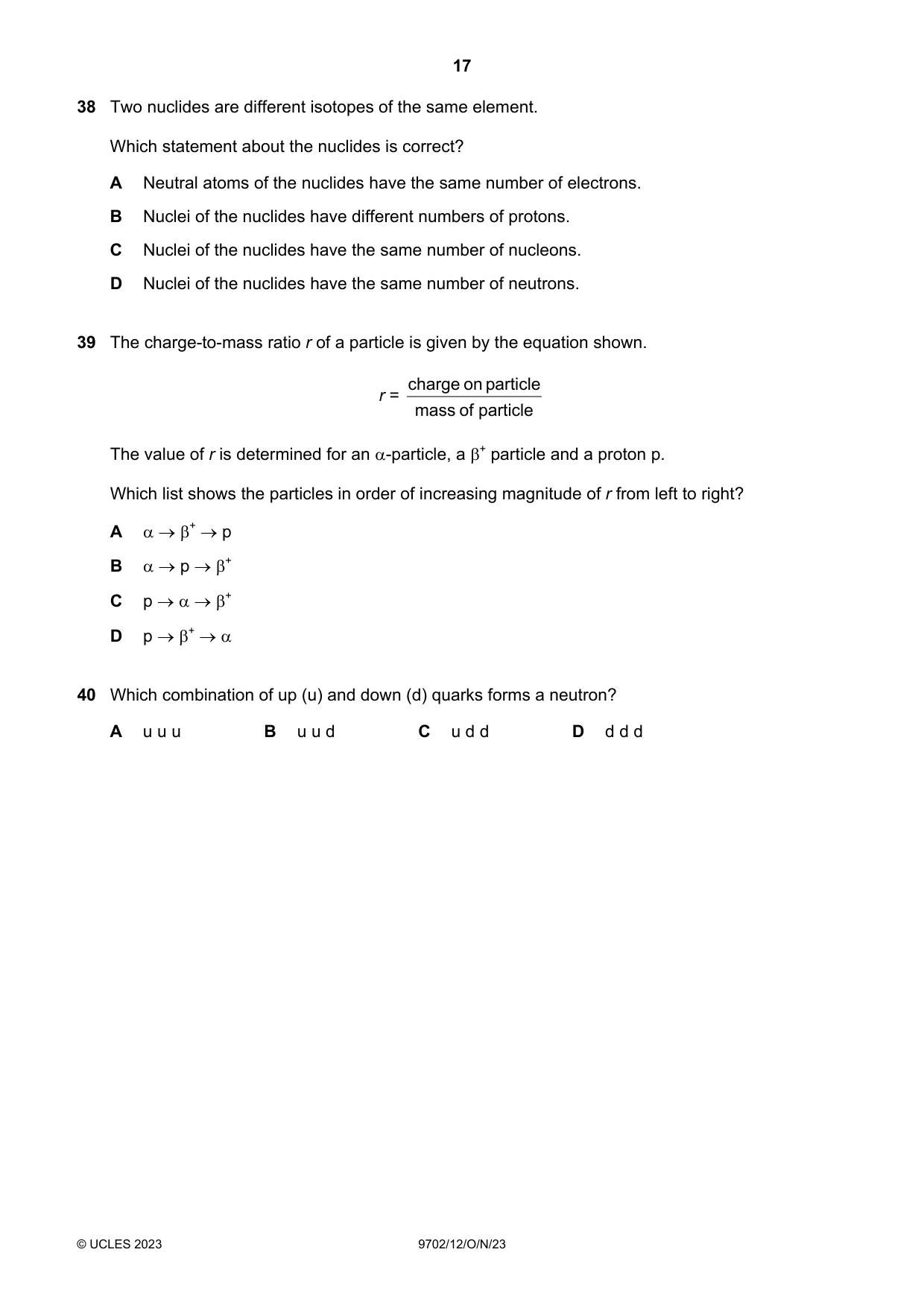
Q38 · Two nuclides are different isotopes of the same element
38 Two nuclides are different isotopes of the same element. Which statement about the nuclides is correct? A Neutral atoms of the nuclides have the same number of electrons. B Nuclei of the nuclides have different numbers of protons. C Nuclei of the nuclides have the same number of nucleons. D Nuclei of the nuclides have the same number of neutrons.
Mark scheme: A
Q39 · The charge-to-mass ratio r of a particle is given by the equation shown
39 The charge-to-mass ratio r of a particle is given by the equation shown. charge on particle r = mass of particle The value of r is determined for an α-particle, a β+ particle and a proton p. Which list shows the particles in order of increasing magnitude of r from left to right? A α → β+ → p B α → p → β+ C p → α → β+ D p → β+ → α
Mark scheme: B
Q40 · Which combination of up (u) and down (d) quarks forms a neutron?
40 Which combination of up (u) and down (d) quarks forms a neutron? A u u u B u u d C u d d D d d d
Mark scheme: C
What was in this paper
The subtopics covered by these 40 questions, and how many questions each got. Open one in a new tab to see every Cambridge question on it.
3Atoms, nuclei and radiation2Elastic and plastic behaviour2Energy conservation2Equations of motion2Equilibrium of forces2Kirchhoff’s laws2Practical circuits2Progressive waves2Stationary waves2Turning effects of forces2Density and pressure1Diffraction1Doppler effect for sound waves1Electric current1Electromagnetic spectrum1Errors and uncertainties1Fundamental particles1Gravitational potential energy and kinetic energy1Interference1Linear momentum and its conservation1Physical quantities1Polarisation1Potential difference and power1Potential dividers1Resistance and resistivity1SI units1The diffraction grating1What you needed in this session
Cambridge’s own grade thresholds for 2023 Oct/Nov, Paper 1 · Variant 2. A higher threshold means an easier paper — the bar moves with how the cohort did.