Cambridge A Level Physics 9702 — 2023 May/June Paper 1 · Variant 3
9702/13/M/J/23 · 40 questions · 40 marks · ≈45 min
The question paper and its mark scheme, free to read here and free to download. This is Cambridge’s own paper, exactly as it was sat.
Question paper20 pages
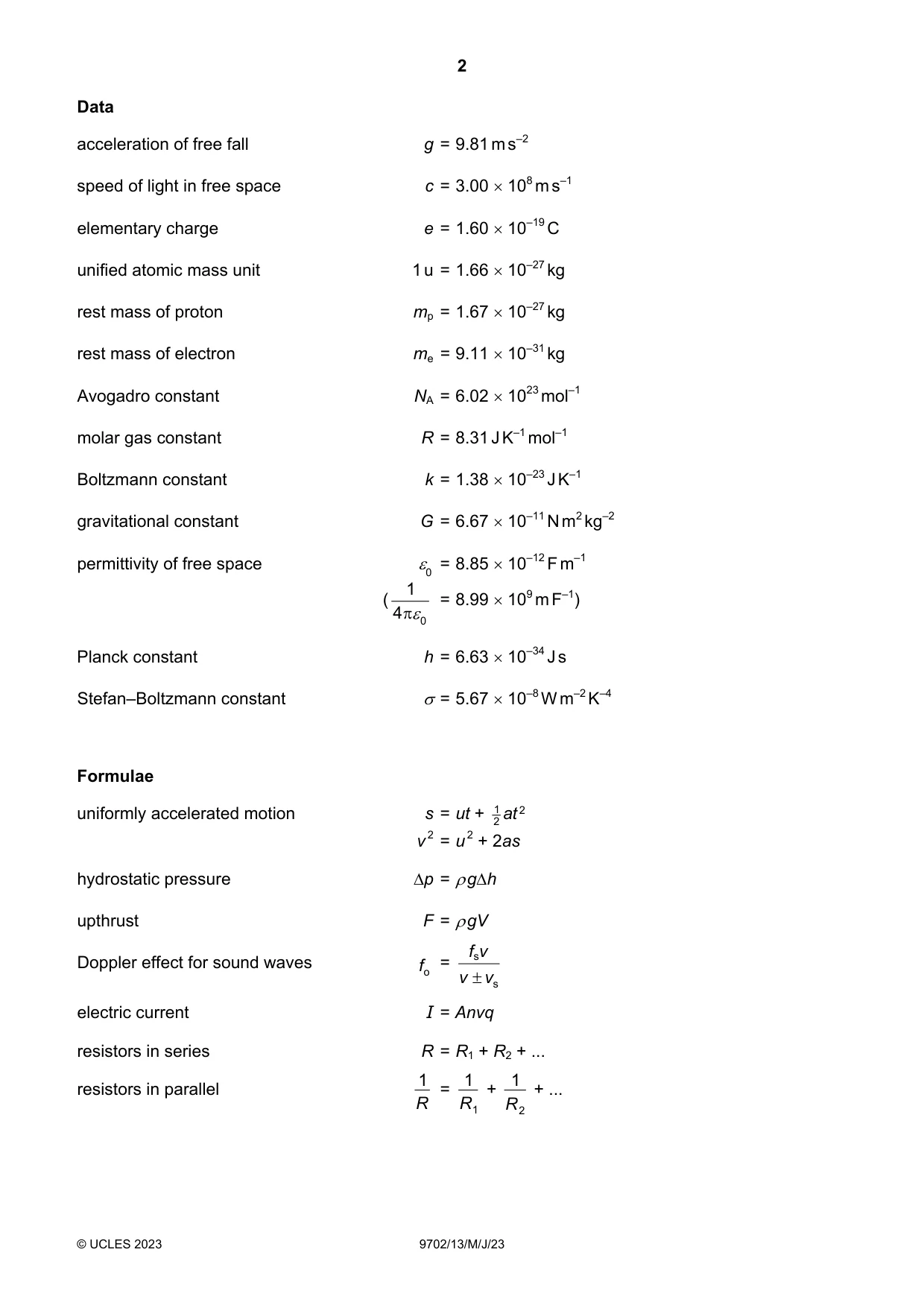


Mark scheme3 pages
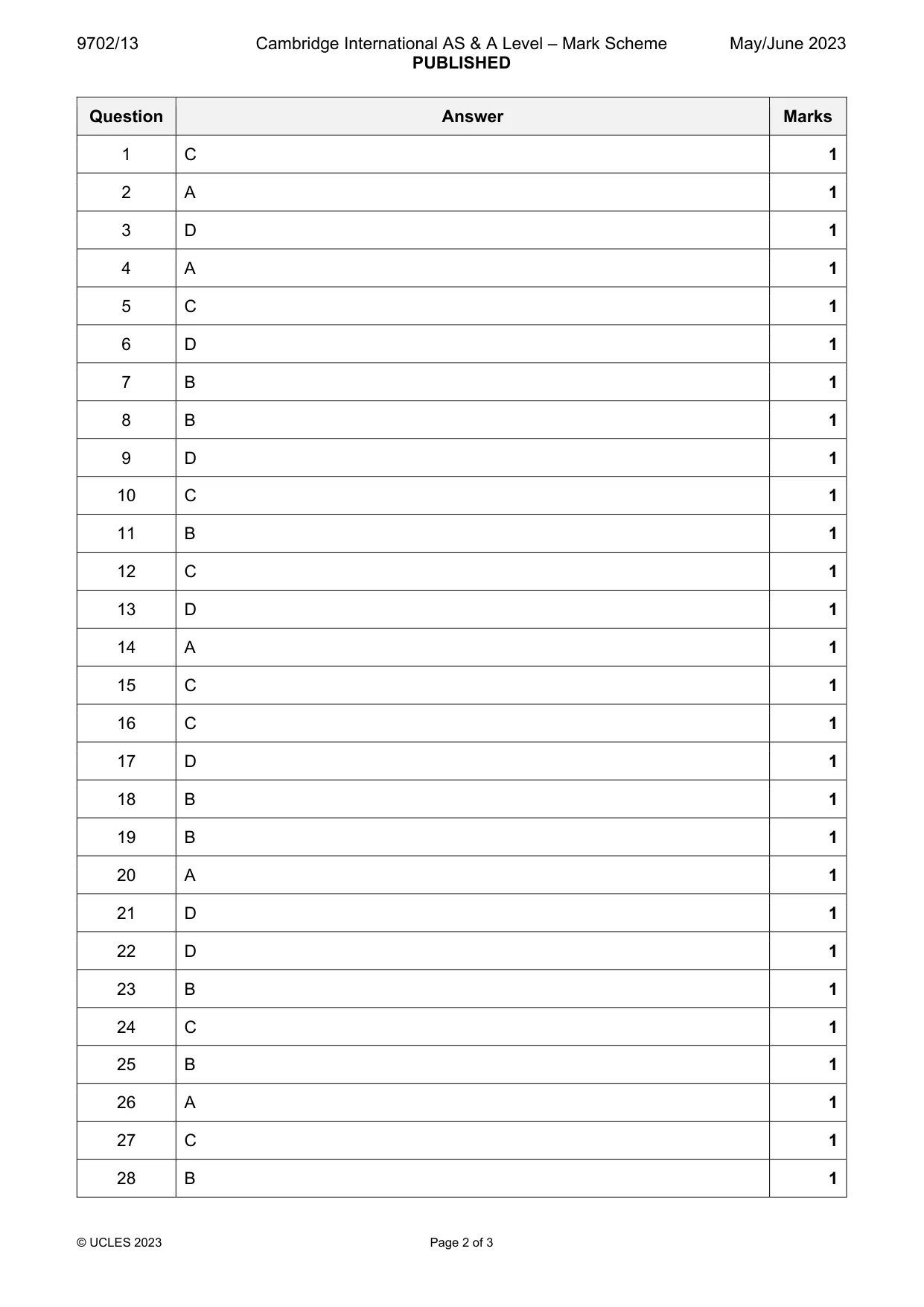
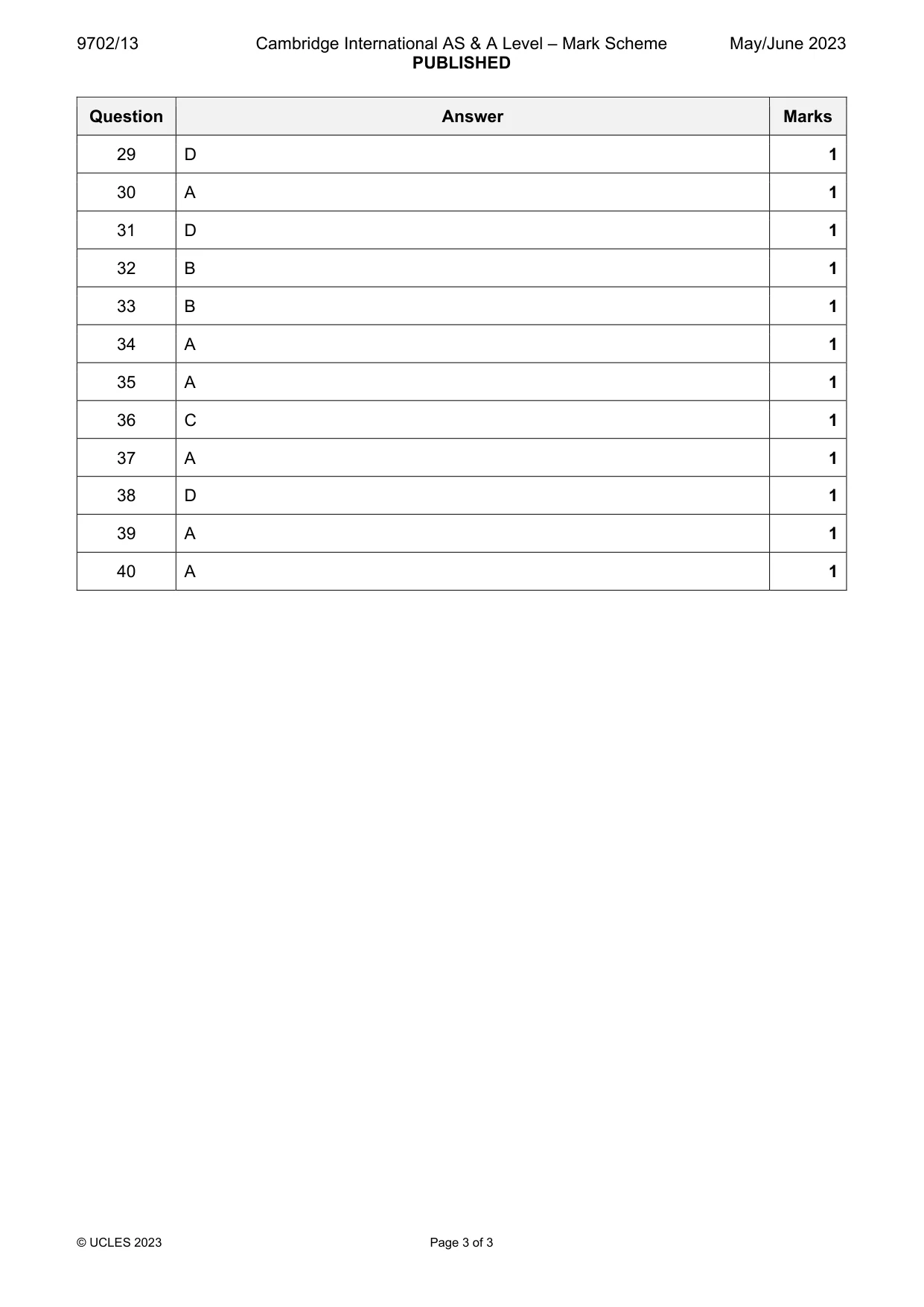
Answers below. Sit the paper first if you are practising.
Questions as text
Q1 · What must be included in a record of a physical quantity?
1 What must be included in a record of a physical quantity? A an integer value for the quantity B an SI unit C a numerical value for the quantity D a unit expressed in base units
Mark scheme: C
Q2 · What is the ohm expressed in SI base units?
2 What is the ohm expressed in SI base units? A kg m2 s–3 A–2 B kg–1 m–2 s3 A2 C J C–1 A–1 D W A–2
Mark scheme: A
Q3 · A desk has a true width of 50.0 cm
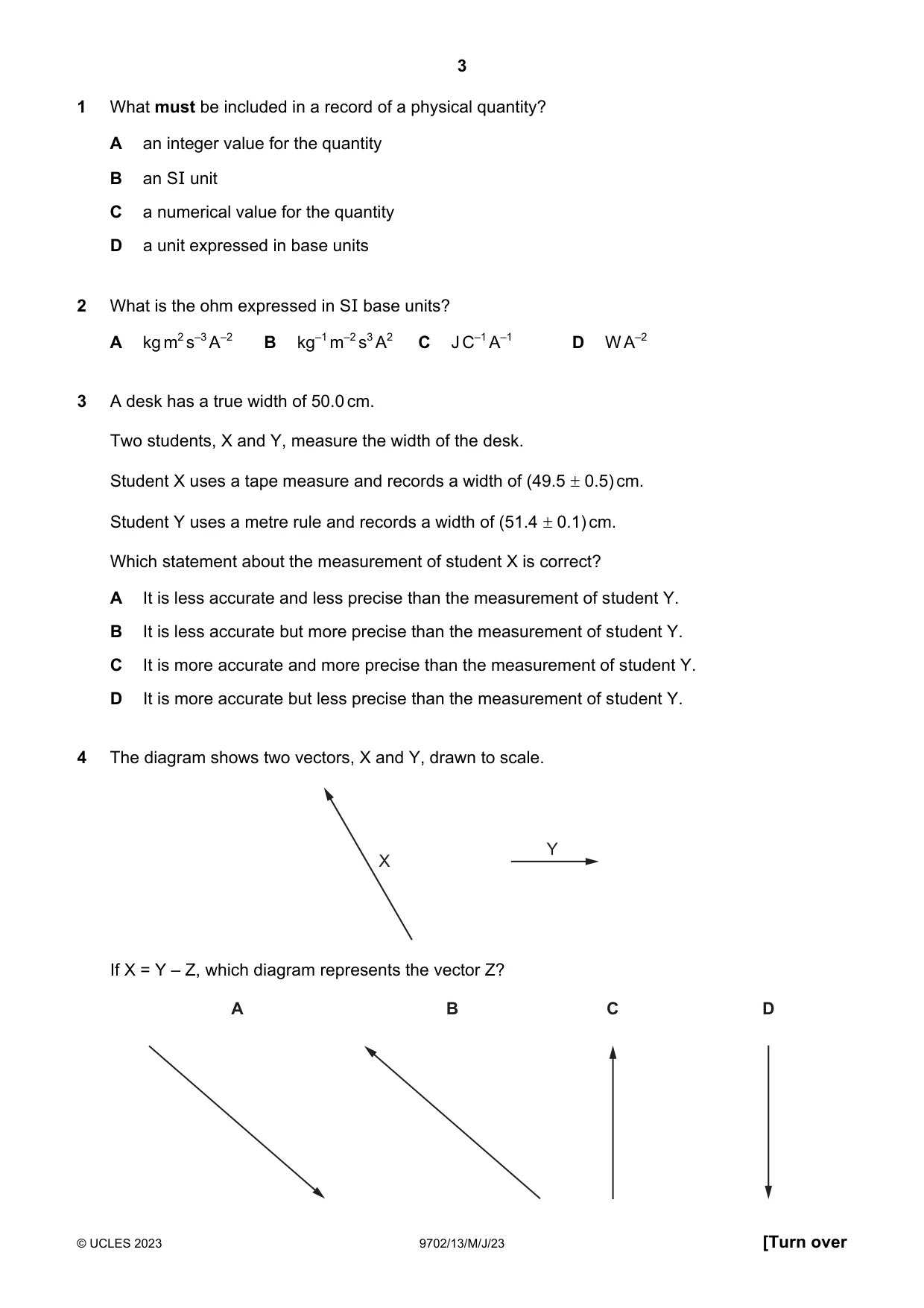
3 A desk has a true width of 50.0 cm. Two students, X and Y, measure the width of the desk. Student X uses a tape measure and records a width of (49.5 0.5) cm. Student Y uses a metre rule and records a width of (51.4 0.1) cm. Which statement about the measurement of student X is correct? A It is less accurate and less precise than the measurement of student Y. B It is less accurate but more precise than the measurement of student Y. C It is more accurate and more precise than the measurement of student Y. D It is more accurate but less precise than the measurement of student Y.
Mark scheme: D
Q4 · The diagram shows two vectors, X and Y, drawn to scale
4 The diagram shows two vectors, X and Y, drawn to scale. Y X If X = Y – Z, which diagram represents the vector Z? A B C D
Mark scheme: A
Q5 · Which equation, representing uniformly accelerated motion in a straight line, can be…
5 Which equation, representing uniformly accelerated motion in a straight line, can be determined using only the definition of acceleration? 1 at A s = ut + 2 2 B s = 1 ( + u v ) t 2 C v = u + at D v 2 = u 2 + 2as
Mark scheme: C
Q6 · An object moves from rest with uniform velocity horizontally and uniform acceleration…
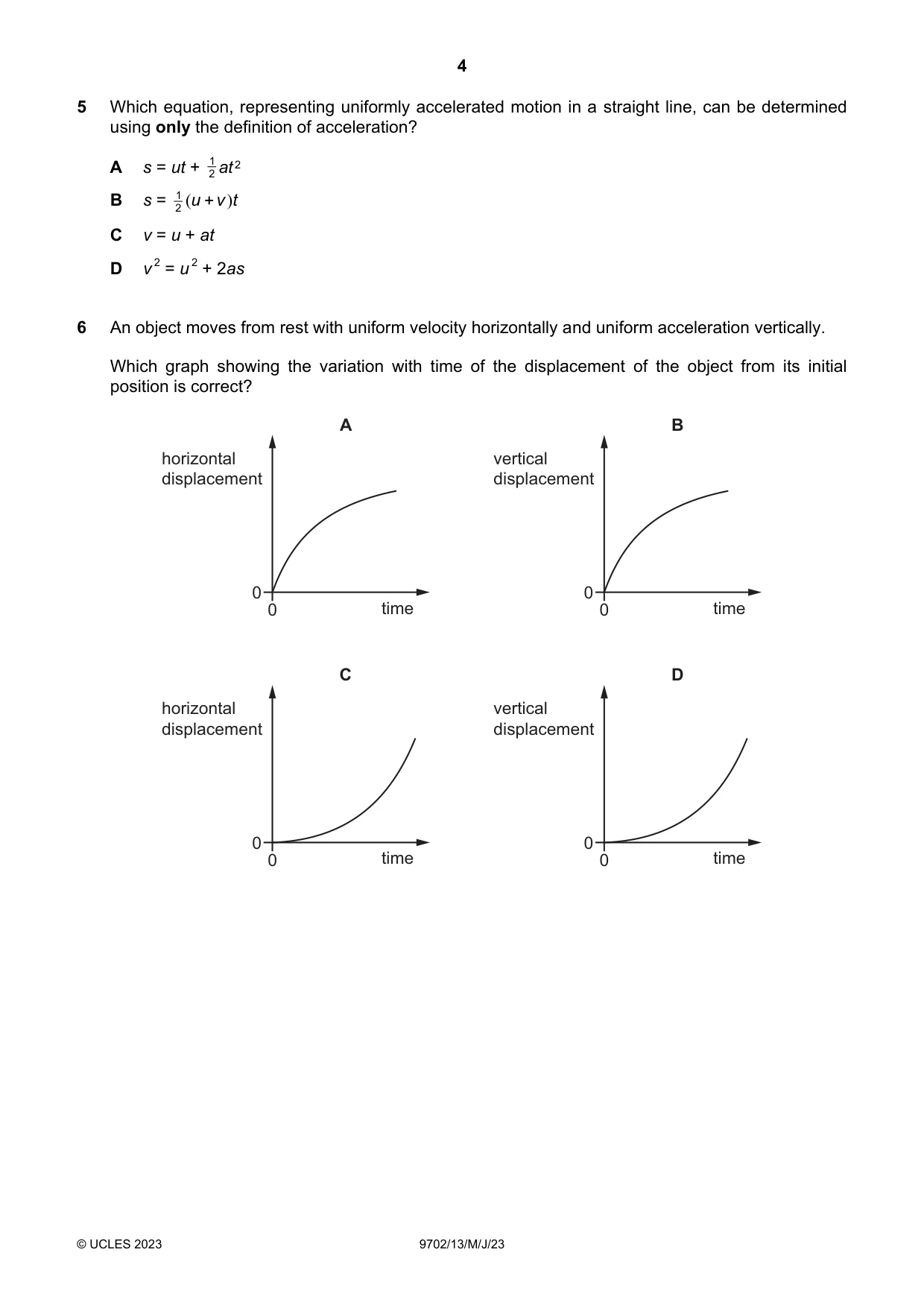
6 An object moves from rest with uniform velocity horizontally and uniform acceleration vertically. Which graph showing the variation with time of the displacement of the object from its initial position is correct? A B horizontal vertical displacement displacement 0 0 0 time 0 time C D horizontal vertical displacement displacement 0 0 0 time 0 time
Mark scheme: D
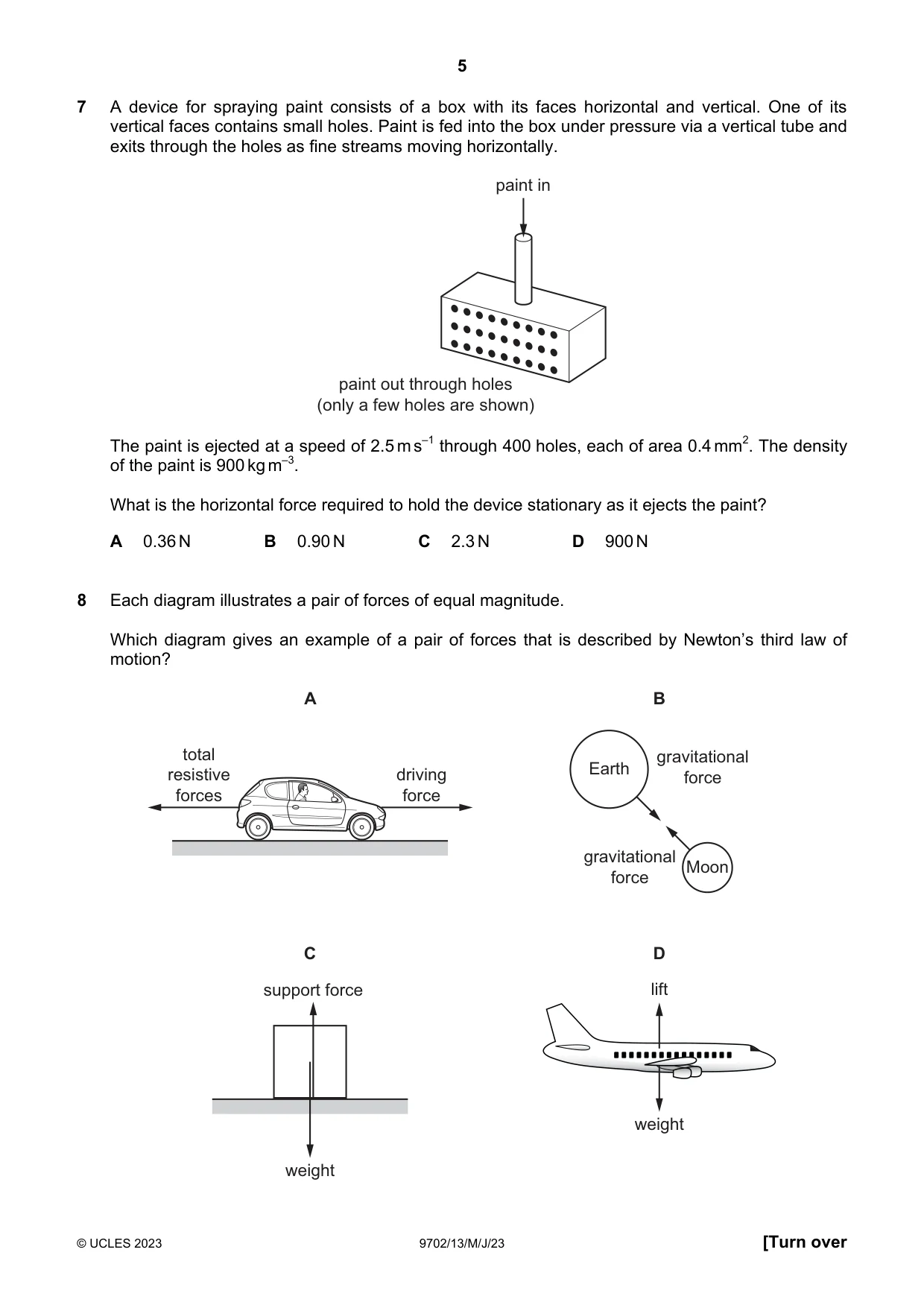
Q7 · A device for spraying paint consists of a box with its faces horizontal and vertical
7 A device for spraying paint consists of a box with its faces horizontal and vertical. One of its vertical faces contains small holes. Paint is fed into the box under pressure via a vertical tube and exits through the holes as fine streams moving horizontally. paint in paint out through holes (only a few holes are shown) The paint is ejected at a speed of 2.5 m s–1 through 400 holes, each of area 0.4 mm2. The density of the paint is 900 kg m–3. What is the horizontal force required to hold the device stationary as it ejects the paint? A 0.36 N B 0.90 N C 2.3 N D 900 N
Mark scheme: B
Q8 · Each diagram illustrates a pair of forces of equal magnitude
8 Each diagram illustrates a pair of forces of equal magnitude. Which diagram gives an example of a pair of forces that is described by Newton’s third law of motion? A B total gravitational resistive driving Earth force forces force gravitational Moon force C D support force lift weight weight
Mark scheme: B
Q9 · Two balls of identical shape and size but different masses are falling through the same…
9 Two balls of identical shape and size but different masses are falling through the same liquid. The sum of the drag force and upthrust acting on each ball is equal to its weight. Which statement about the two balls is correct? A The heavier ball has a larger acceleration than the lighter ball. B The heavier ball has a smaller deceleration than the lighter ball. C The heavier ball is falling at the same speed as the lighter ball. D The heavier ball is falling at a larger speed than the lighter ball.
Mark scheme: D
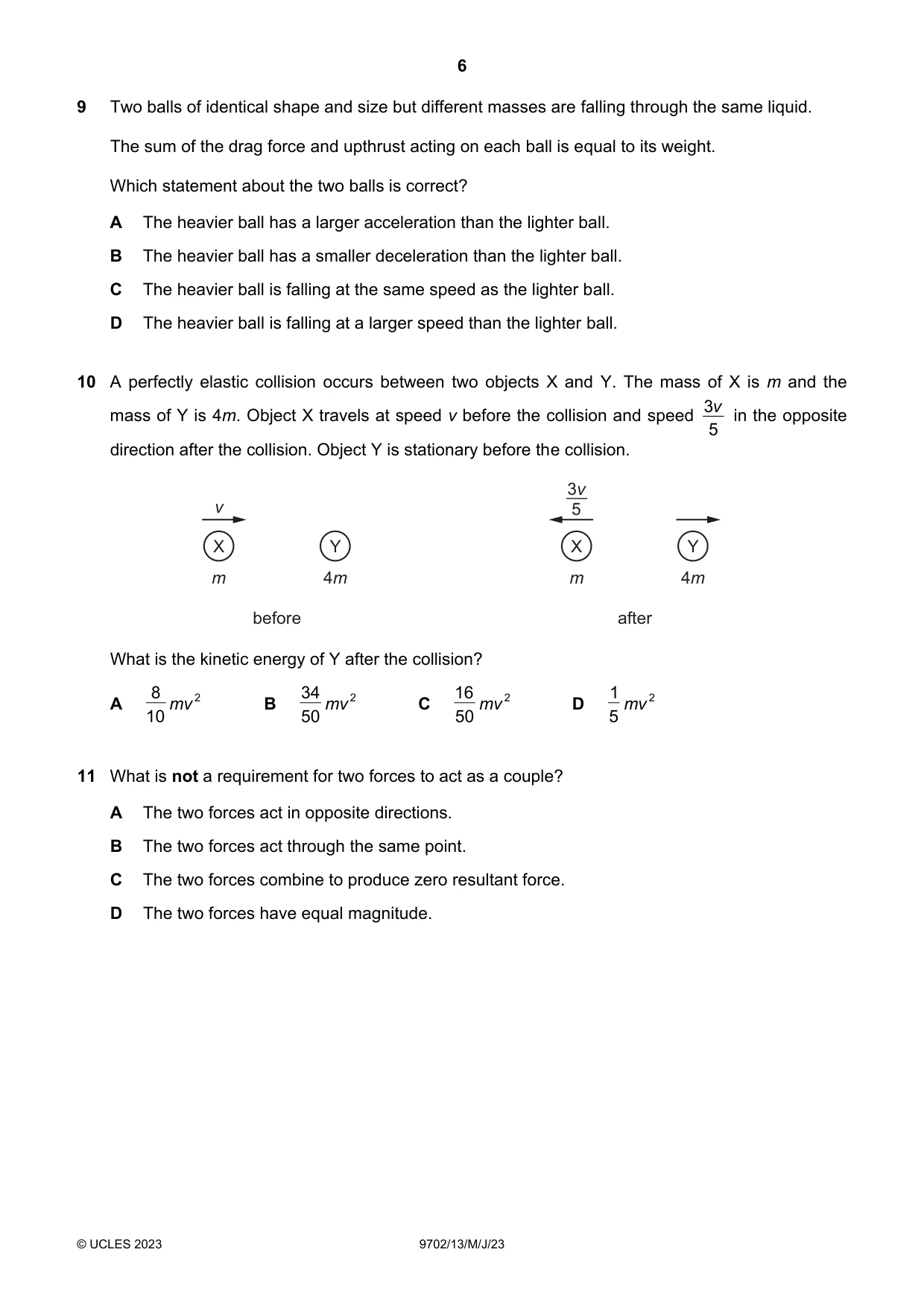
Q10 · A perfectly elastic collision occurs between two objects X and Y
10 A perfectly elastic collision occurs between two objects X and Y. The mass of X is m and the 3v in the opposite mass of Y is 4m. Object X travels at speed v before the collision and speed 5 direction after the collision. Object Y is stationary before the collision. 3v v 5 X Y X Y m 4m m 4m before after What is the kinetic energy of Y after the collision? 8 mv 2 34 mv 2 16 mv 2 1 mv 2 A B C D 10 50 50 5
Mark scheme: C
Q11 · What is not a requirement for two forces to act as a couple?
11 What is not a requirement for two forces to act as a couple? A The two forces act in opposite directions. B The two forces act through the same point. C The two forces combine to produce zero resultant force. D The two forces have equal magnitude.
Mark scheme: B
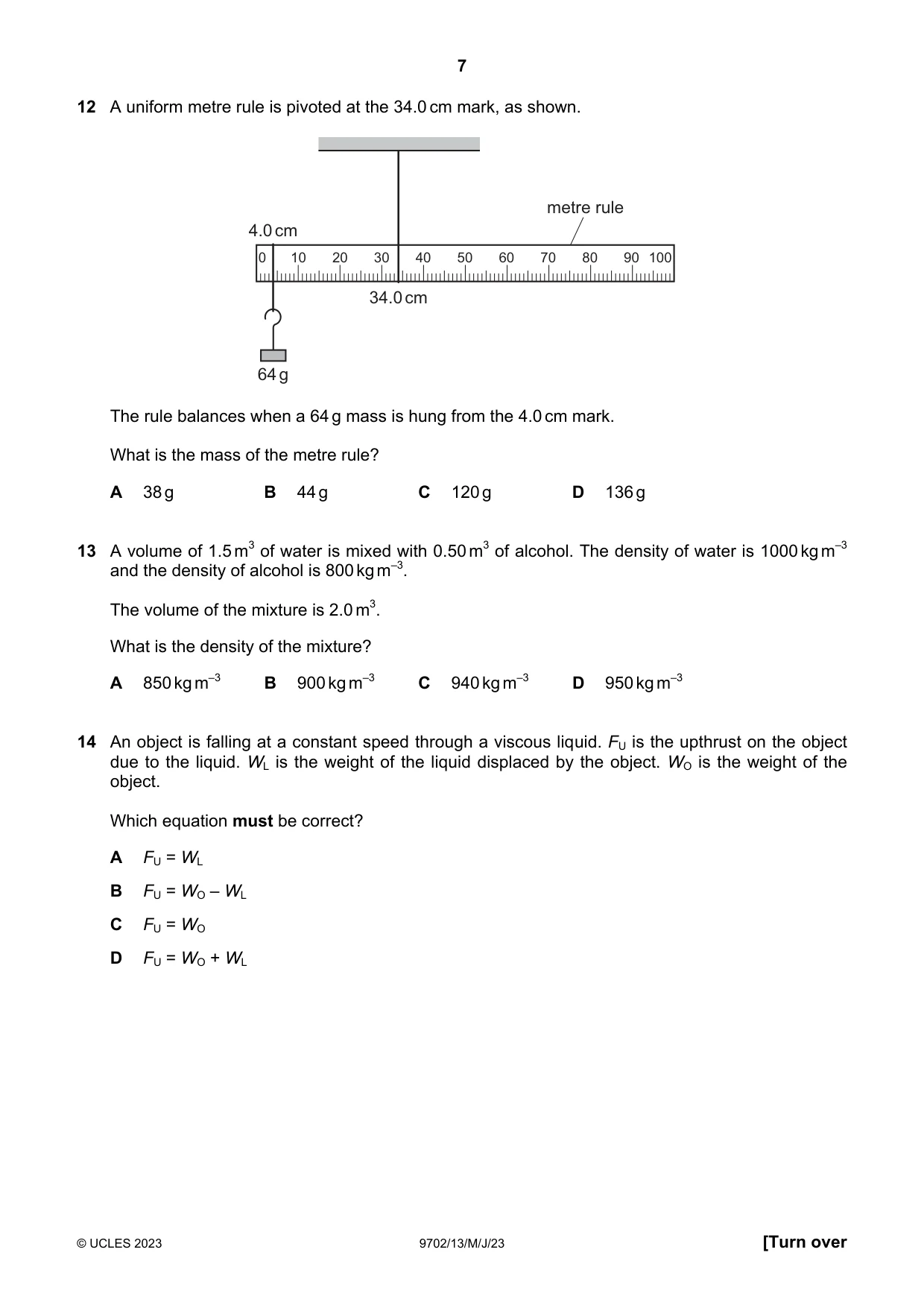
Q12 · A uniform metre rule is pivoted at the 34.0 cm mark, as shown
12 A uniform metre rule is pivoted at the 34.0 cm mark, as shown. metre rule 4.0 cm 0 10 20 30 40 50 60 70 80 90 100 34.0 cm 64 g The rule balances when a 64 g mass is hung from the 4.0 cm mark. What is the mass of the metre rule? A 38 g B 44 g C 120 g D 136 g
Mark scheme: C
Q13 · A volume of 1.5 m3 of water is mixed with 0.50 m3 of alcohol
13 A volume of 1.5 m3 of water is mixed with 0.50 m3 of alcohol. The density of water is 1000 kg m–3 and the density of alcohol is 800 kg m–3. The volume of the mixture is 2.0 m3. What is the density of the mixture? A 850 kg m–3 B 900 kg m–3 C 940 kg m–3 D 950 kg m–3
Mark scheme: D
Q14 · An object is falling at a constant speed through a viscous liquid
14 An object is falling at a constant speed through a viscous liquid. FU is the upthrust on the object due to the liquid. WL is the weight of the liquid displaced by the object. WO is the weight of the object. Which equation must be correct? A FU = WL B FU = WO – WL C FU = WO D FU = WO + WL
Mark scheme: A
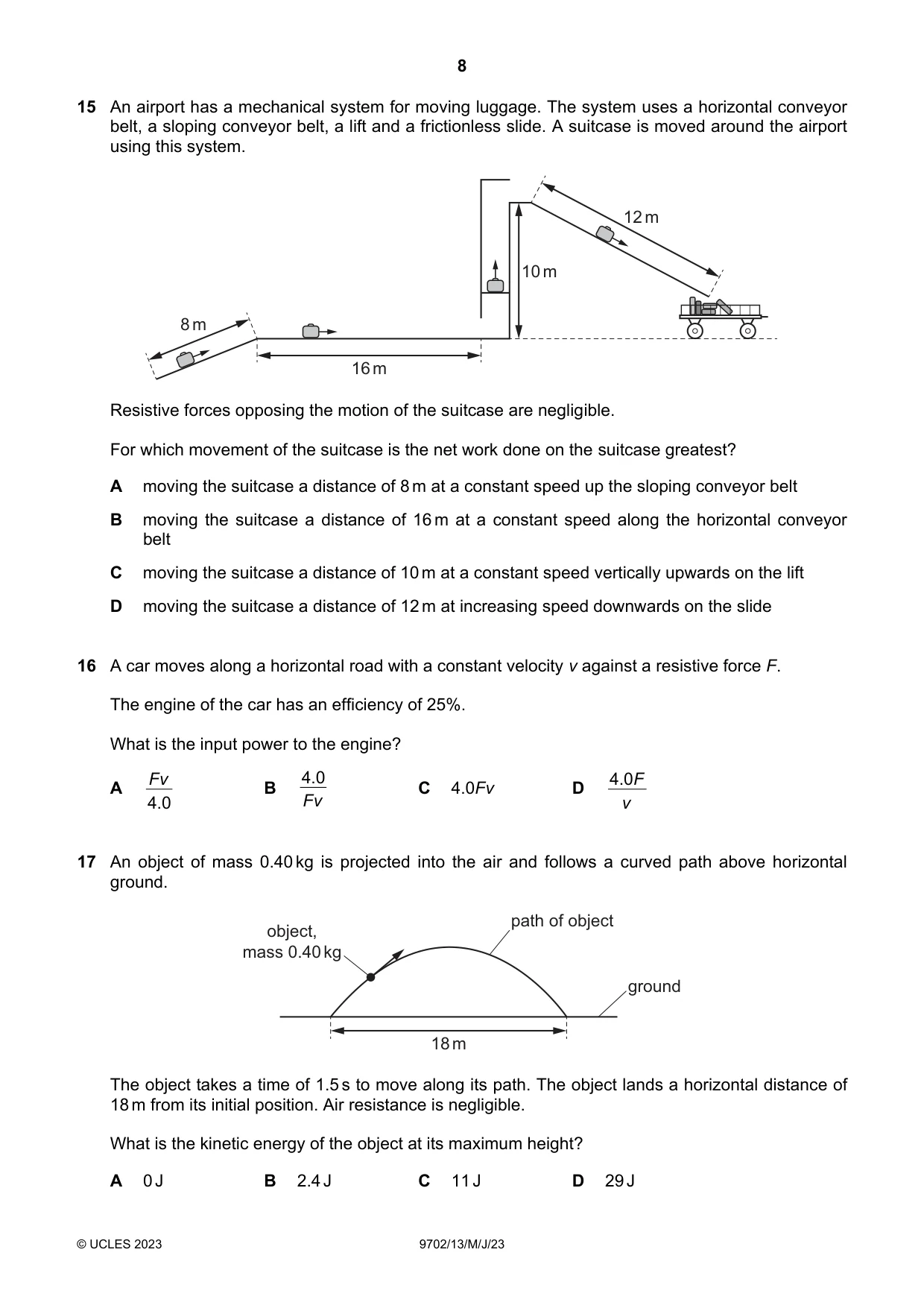
Q15 · An airport has a mechanical system for moving luggage
15 An airport has a mechanical system for moving luggage. The system uses a horizontal conveyor belt, a sloping conveyor belt, a lift and a frictionless slide. A suitcase is moved around the airport using this system. 12 m 10 m 8 m 16 m Resistive forces opposing the motion of the suitcase are negligible. For which movement of the suitcase is the net work done on the suitcase greatest? A moving the suitcase a distance of 8 m at a constant speed up the sloping conveyor belt B moving the suitcase a distance of 16 m at a constant speed along the horizontal conveyor belt C moving the suitcase a distance of 10 m at a constant speed vertically upwards on the lift D moving the suitcase a distance of 12 m at increasing speed downwards on the slide
Mark scheme: C
Q16 · A car moves along a horizontal road with a constant velocity v against a resistive force F
16 A car moves along a horizontal road with a constant velocity v against a resistive force F. The engine of the car has an efficiency of 25%. What is the input power to the engine? Fv 4.0 4.0 F A B C 4.0Fv D 4.0 Fv v
Mark scheme: C
Q17 · An object of mass 0.40 kg is projected into the air and follows a curved path above…
17 An object of mass 0.40 kg is projected into the air and follows a curved path above horizontal ground. path of object object, mass 0.40 kg ground 18 m The object takes a time of 1.5 s to move along its path. The object lands a horizontal distance of 18 m from its initial position. Air resistance is negligible. What is the kinetic energy of the object at its maximum height? A 0 J B 2.4 J C 11 J D 29 J
Mark scheme: D
More questions on Gravitational potential energy and kinetic energy
Q18 · A metal wire has length 5.2 m and diameter 1.0 mm
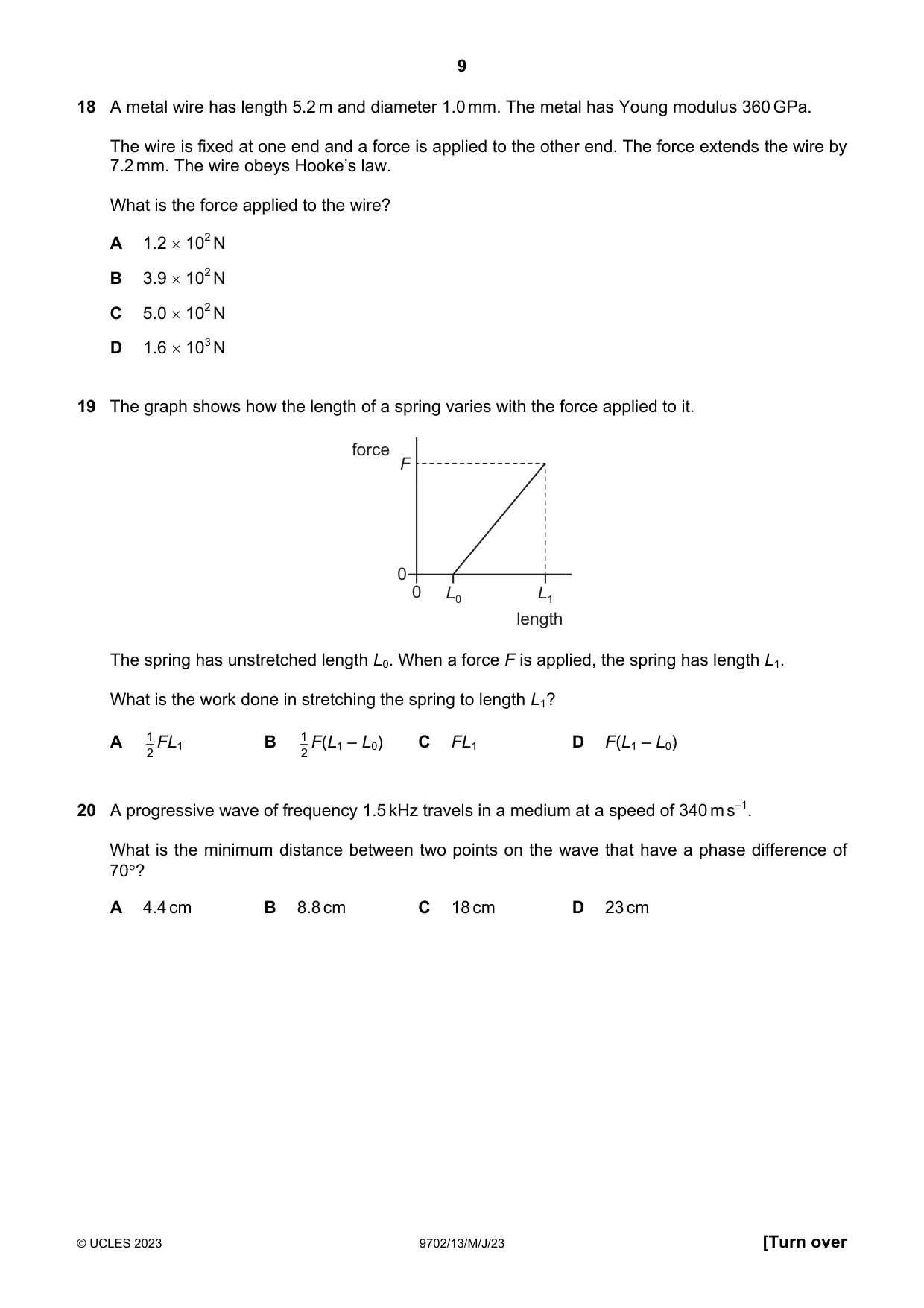
18 A metal wire has length 5.2 m and diameter 1.0 mm. The metal has Young modulus 360 GPa. The wire is fixed at one end and a force is applied to the other end. The force extends the wire by 7.2 mm. The wire obeys Hooke’s law. What is the force applied to the wire? A 1.2 102 N B 3.9 102 N C 5.0 102 N D 1.6 103 N
Mark scheme: B
Q19 · The graph shows how the length of a spring varies with the force applied to it
19 The graph shows how the length of a spring varies with the force applied to it. force F 0 0 L0 L1 length The spring has unstretched length L0. When a force F is applied, the spring has length L1. What is the work done in stretching the spring to length L1? A 1 2 FL1 B 1 2 F(L1 – L0) C FL1 D F(L1 – L0)
Mark scheme: B
Q20 · A progressive wave of frequency 1.5 kHz travels in a medium at a speed of 340 m s–1
20 A progressive wave of frequency 1.5 kHz travels in a medium at a speed of 340 m s–1. What is the minimum distance between two points on the wave that have a phase difference of 70? A 4.4 cm B 8.8 cm C 18 cm D 23 cm
Mark scheme: A
Q21 · The variation with time of displacement at a fixed distance along a progressive wave
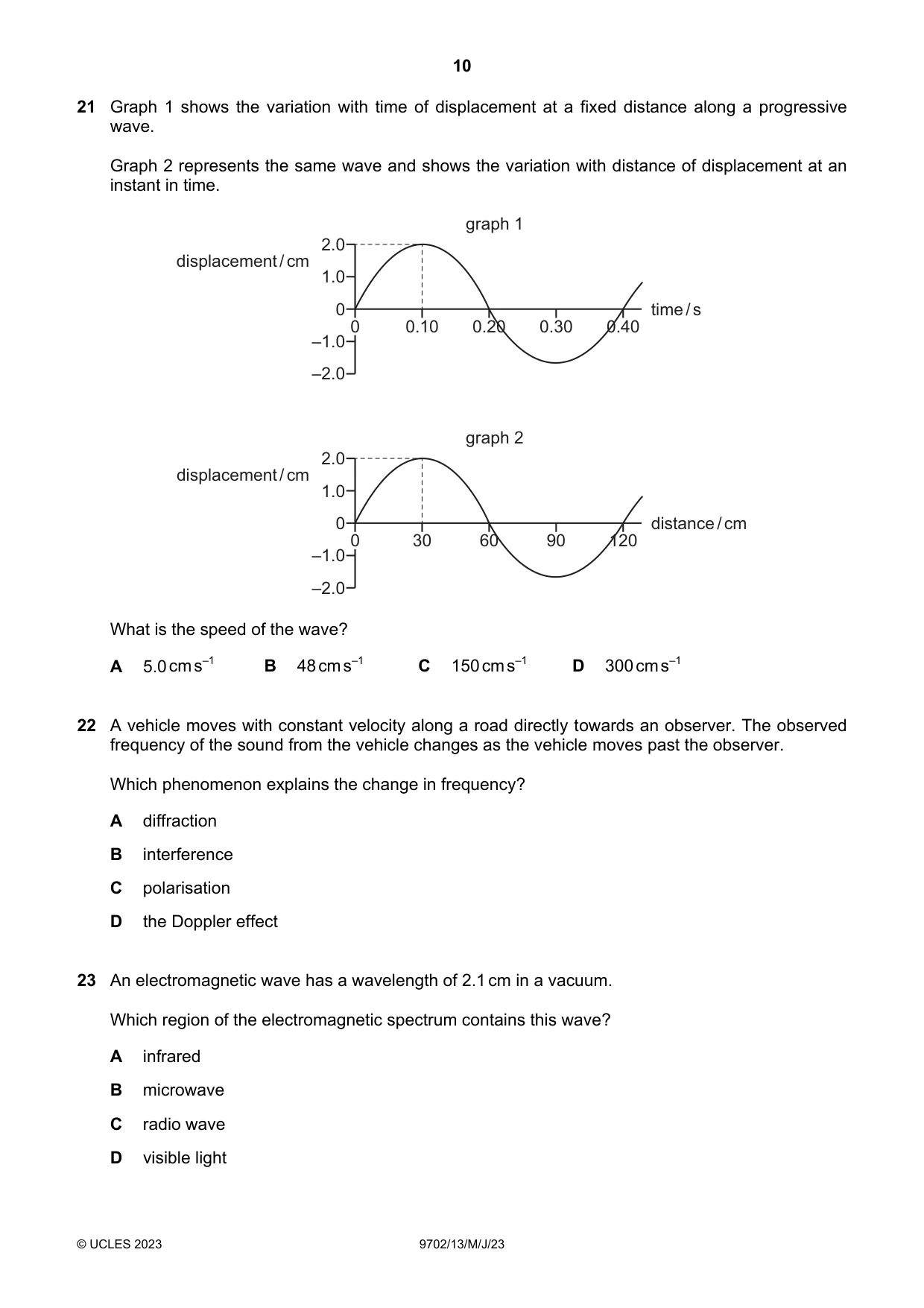
21 Graph 1 shows the variation with time of displacement at a fixed distance along a progressive wave. Graph 2 represents the same wave and shows the variation with distance of displacement at an instant in time. graph 1 2.0 displacement / cm 1.0 0 time / s 0 0.10 0.20 0.30 0.40 –1.0 –2.0 graph 2 2.0 displacement / cm 1.0 0 distance / cm 0 30 60 90 120 –1.0 –2.0 What is the speed of the wave? A 5.0 cm s–1 B 48 cm s–1 C 150 cm s–1 D 300 cm s–1
Mark scheme: D
Q22 · A vehicle moves with constant velocity along a road directly towards an observer
22 A vehicle moves with constant velocity along a road directly towards an observer. The observed frequency of the sound from the vehicle changes as the vehicle moves past the observer. Which phenomenon explains the change in frequency? A diffraction B interference C polarisation D the Doppler effect
Mark scheme: D
Q23 · An electromagnetic wave has a wavelength of 2.1 cm in a vacuum
23 An electromagnetic wave has a wavelength of 2.1 cm in a vacuum. Which region of the electromagnetic spectrum contains this wave? A infrared B microwave C radio wave D visible light
Mark scheme: B
Q24 · A source of plane polarised light is observed through two polarising filters
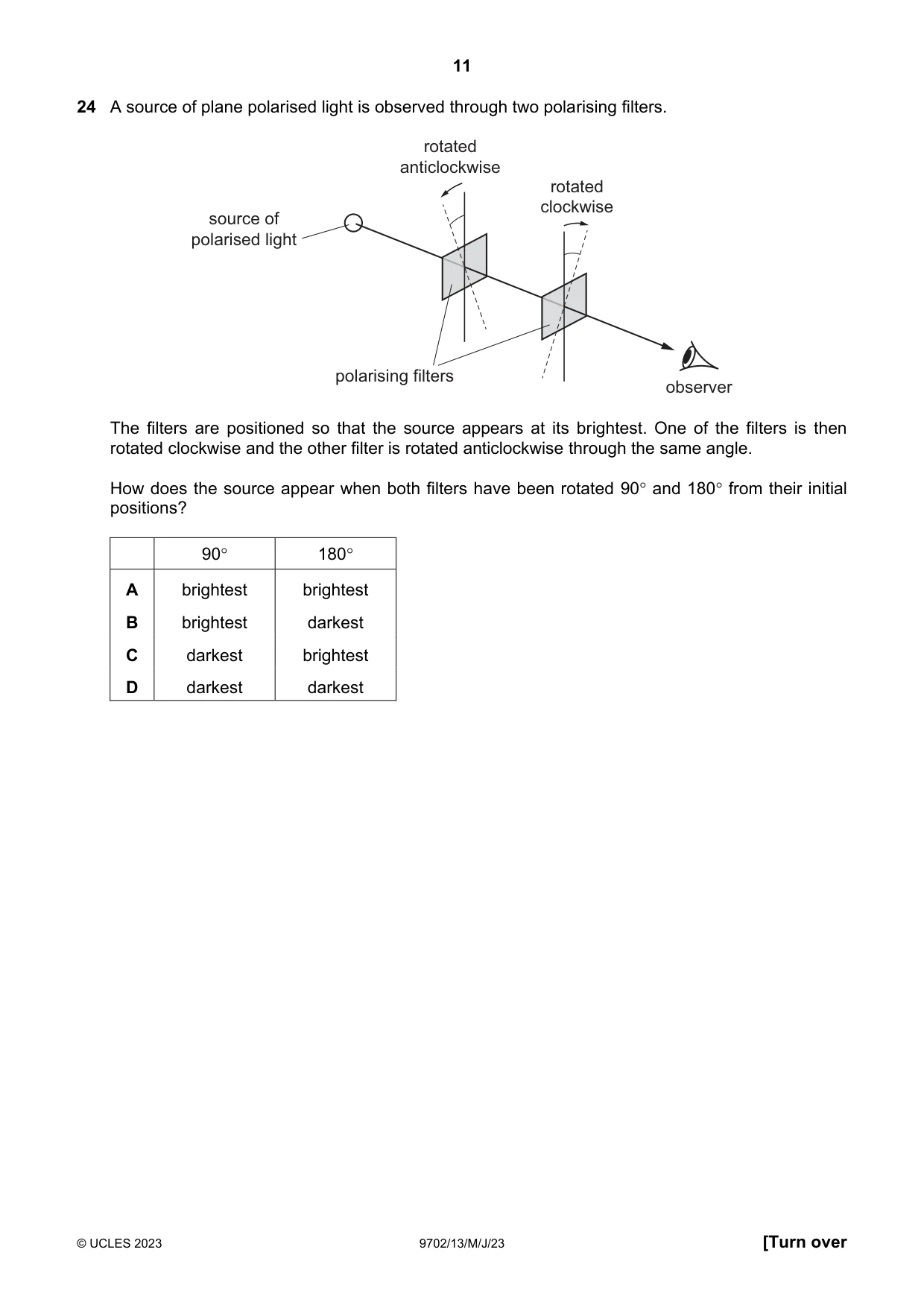
24 A source of plane polarised light is observed through two polarising filters. rotated anticlockwise rotated clockwise source of polarised light polarising filters observer The filters are positioned so that the source appears at its brightest. One of the filters is then rotated clockwise and the other filter is rotated anticlockwise through the same angle. How does the source appear when both filters have been rotated 90 and 180 from their initial positions? 90 180 A brightest brightest B brightest darkest C darkest brightest D darkest darkest
Mark scheme: C
Q25 · The diagram shows a string stretched between fixed points X and Y
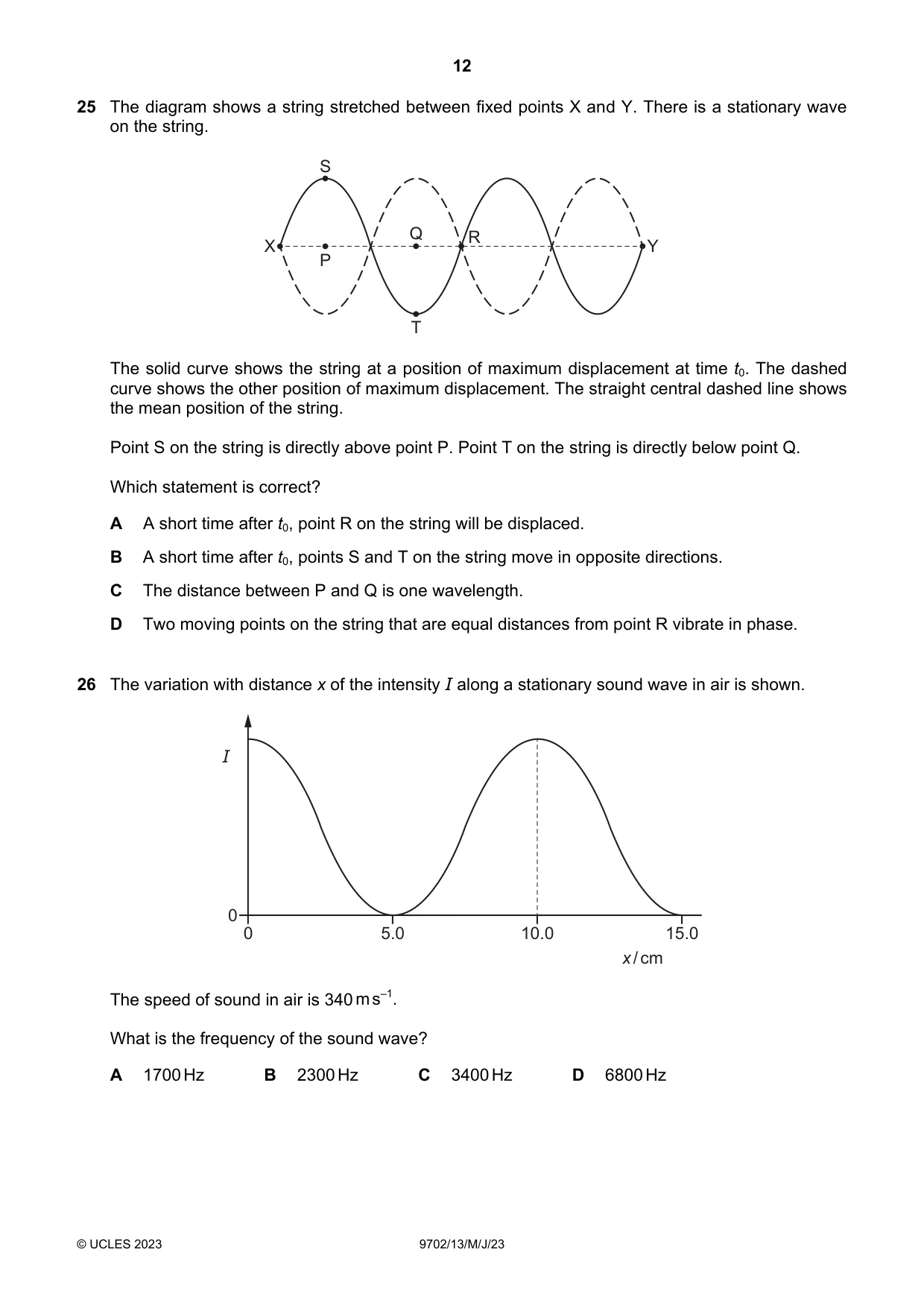
25 The diagram shows a string stretched between fixed points X and Y. There is a stationary wave on the string. S Q R X Y P T The solid curve shows the string at a position of maximum displacement at time t0. The dashed curve shows the other position of maximum displacement. The straight central dashed line shows the mean position of the string. Point S on the string is directly above point P. Point T on the string is directly below point Q. Which statement is correct? A A short time after t0, point R on the string will be displaced. B A short time after t0, points S and T on the string move in opposite directions. C The distance between P and Q is one wavelength. D Two moving points on the string that are equal distances from point R vibrate in phase.
Mark scheme: B
Q26 · The variation with distance x of the intensity I along a stationary sound wave in air is…
26 The variation with distance x of the intensity I along a stationary sound wave in air is shown. I 0 0 5.0 10.0 15.0 x / cm The speed of sound in air is 340 m s–1. What is the frequency of the sound wave? A 1700 Hz B 2300 Hz C 3400 Hz D 6800 Hz
Mark scheme: A
Q27 · An experiment is set up to demonstrate the diffraction of water waves in a ripple tank
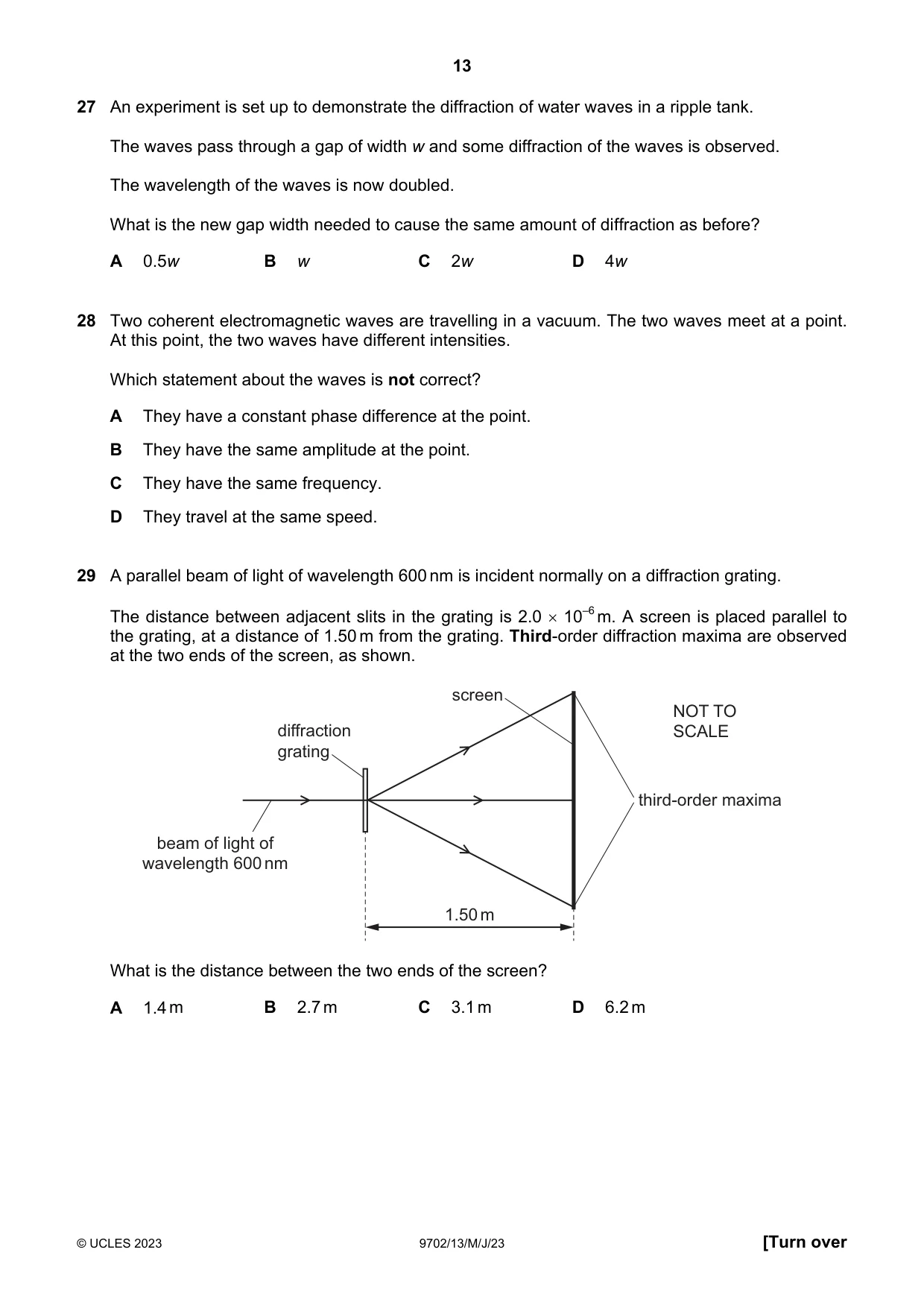
27 An experiment is set up to demonstrate the diffraction of water waves in a ripple tank. The waves pass through a gap of width w and some diffraction of the waves is observed. The wavelength of the waves is now doubled. What is the new gap width needed to cause the same amount of diffraction as before? A 0.5w B w C 2w D 4w
Mark scheme: C
Q28 · Two coherent electromagnetic waves are travelling in a vacuum
28 Two coherent electromagnetic waves are travelling in a vacuum. The two waves meet at a point. At this point, the two waves have different intensities. Which statement about the waves is not correct? A They have a constant phase difference at the point. B They have the same amplitude at the point. C They have the same frequency. D They travel at the same speed.
Mark scheme: B
Q29 · A parallel beam of light of wavelength 600 nm is incident normally on a diffraction…
29 A parallel beam of light of wavelength 600 nm is incident normally on a diffraction grating. The distance between adjacent slits in the grating is 2.0 10–6 m. A screen is placed parallel to the grating, at a distance of 1.50 m from the grating. Third-order diffraction maxima are observed at the two ends of the screen, as shown. screen NOT TO diffraction SCALE grating third-order maxima beam of light of wavelength 600 nm 1.50 m What is the distance between the two ends of the screen? A 1.4 m B 2.7 m C 3.1 m D 6.2 m
Mark scheme: D
Q30 · A metal wire is connected between the terminals of a cell so that there is a current in…
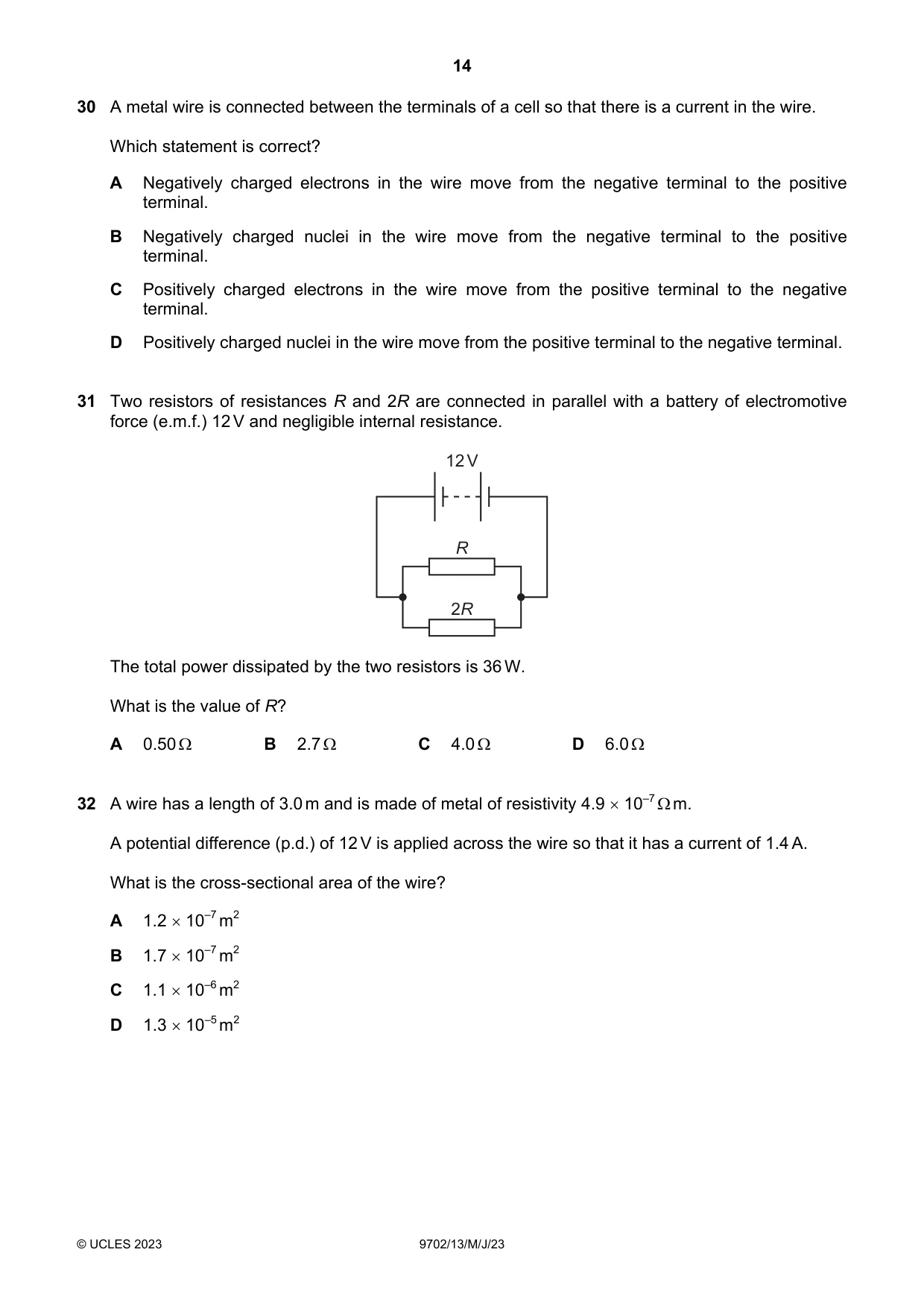
30 A metal wire is connected between the terminals of a cell so that there is a current in the wire. Which statement is correct? A Negatively charged electrons in the wire move from the negative terminal to the positive terminal. B Negatively charged nuclei in the wire move from the negative terminal to the positive terminal. C Positively charged electrons in the wire move from the positive terminal to the negative terminal. D Positively charged nuclei in the wire move from the positive terminal to the negative terminal.
Mark scheme: A
Q31 · Two resistors of resistances R and 2R are connected in parallel with a battery of…
31 Two resistors of resistances R and 2R are connected in parallel with a battery of electromotive force (e.m.f.) 12 V and negligible internal resistance. 12 V R 2R The total power dissipated by the two resistors is 36 W. What is the value of R? A 0.50 B 2.7 C 4.0 D 6.0
Mark scheme: D
Q32 · A wire has a length of 3.0 m and is made of metal of resistivity 4.9 10–7 m
32 A wire has a length of 3.0 m and is made of metal of resistivity 4.9 10–7 m. A potential difference (p.d.) of 12 V is applied across the wire so that it has a current of 1.4 A. What is the cross-sectional area of the wire? A 1.2 10–7 m2 B 1.7 10–7 m2 C 1.1 10–6 m2 D 1.3 10–5 m2
Mark scheme: B
Q33 · A cell of negligible internal resistance is connected in series with a thermistor, a…
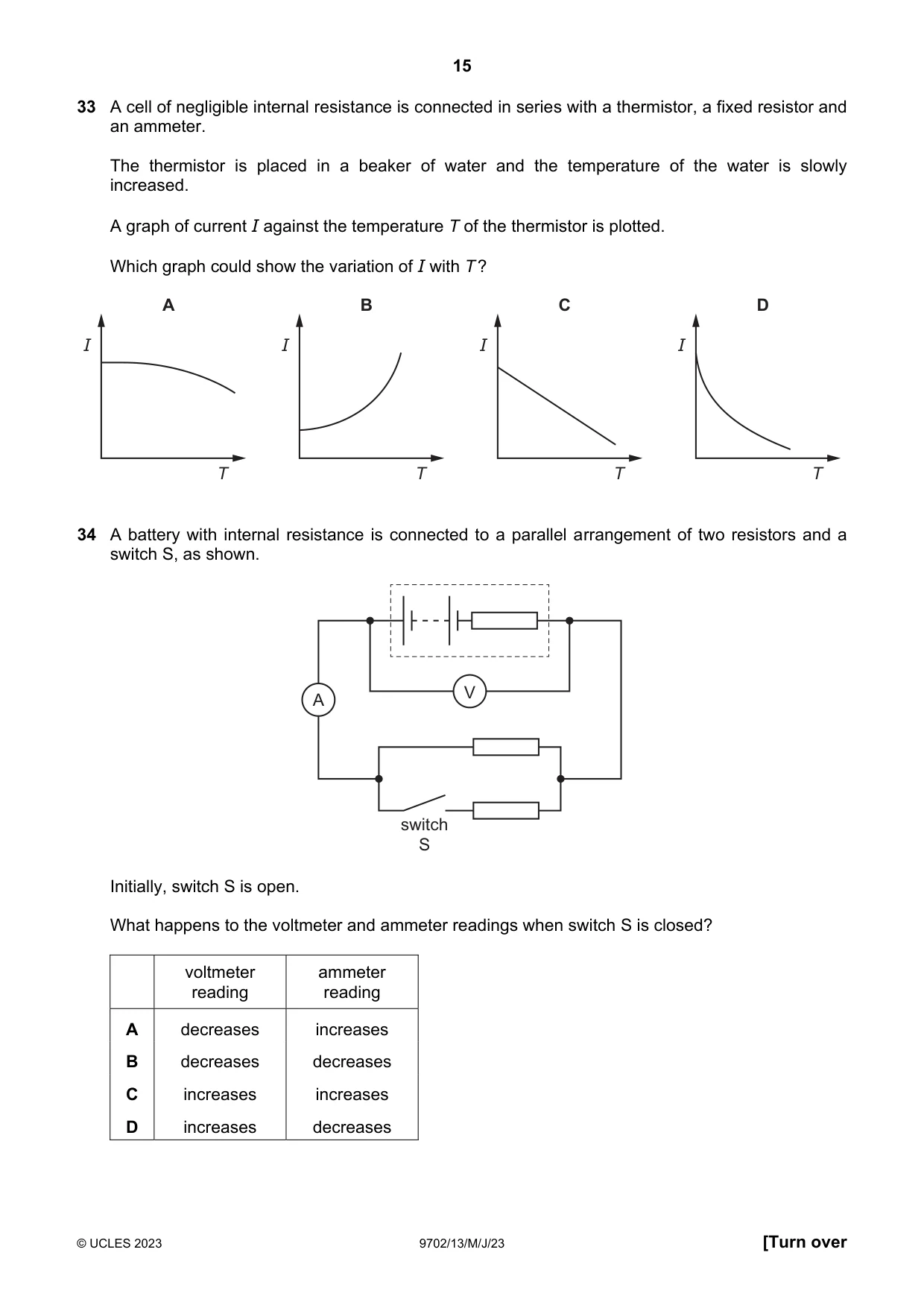
33 A cell of negligible internal resistance is connected in series with a thermistor, a fixed resistor and an ammeter. The thermistor is placed in a beaker of water and the temperature of the water is slowly increased. A graph of current I against the temperature T of the thermistor is plotted. Which graph could show the variation of I with T ? A B C D I I I I T T T T
Mark scheme: B
Q34 · A battery with internal resistance is connected to a parallel arrangement of two…
34 A battery with internal resistance is connected to a parallel arrangement of two resistors and a switch S, as shown. A V switch S Initially, switch S is open. What happens to the voltmeter and ammeter readings when switch S is closed? voltmeter ammeter reading reading A decreases increases B decreases decreases C increases increases D increases decreases
Mark scheme: A
Q35 · Kirchhoff’s first law states that the sum of the currents entering a junction in a…
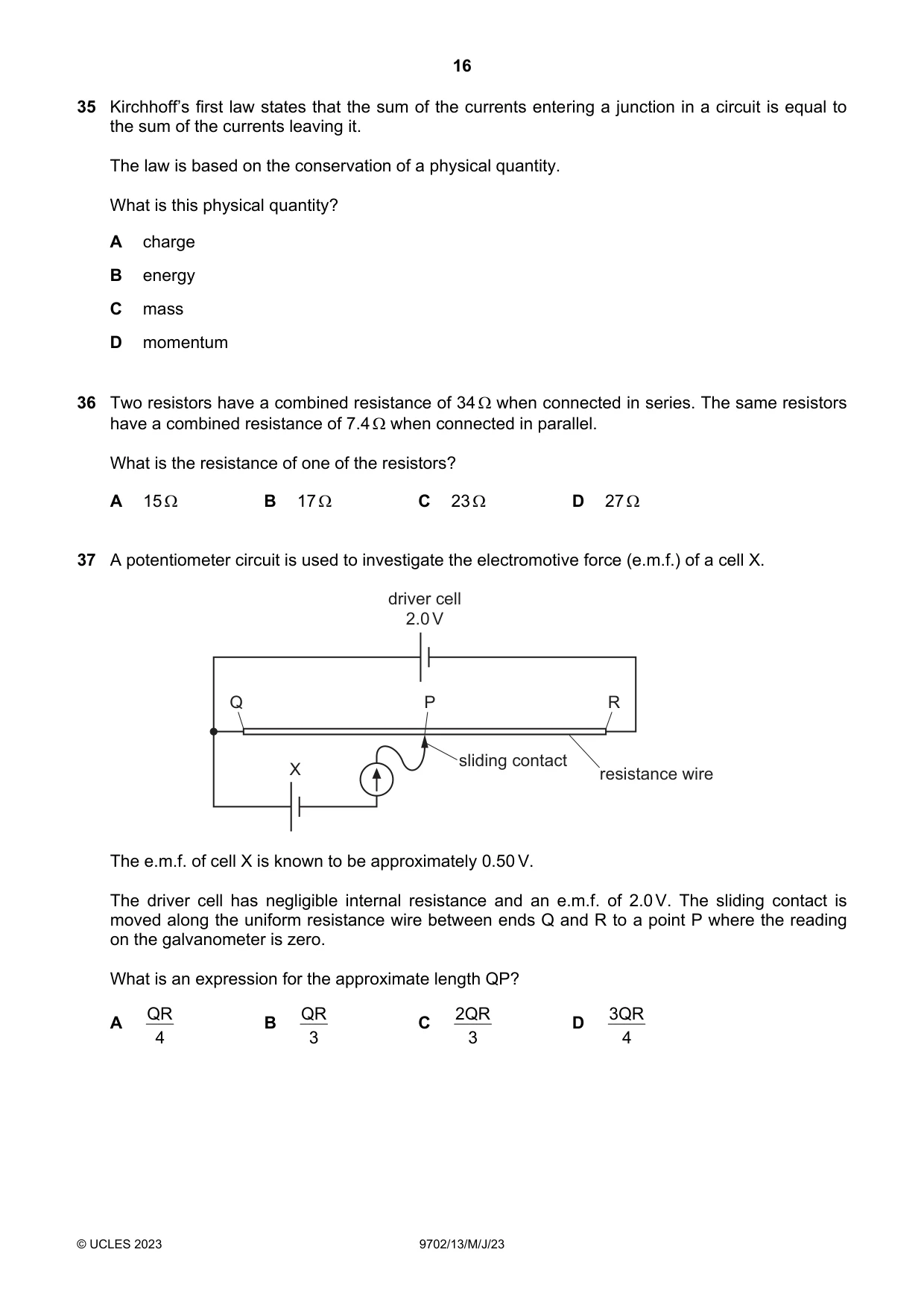
35 Kirchhoff’s first law states that the sum of the currents entering a junction in a circuit is equal to the sum of the currents leaving it. The law is based on the conservation of a physical quantity. What is this physical quantity? A charge B energy C mass D momentum
Mark scheme: A
Q36 · Two resistors have a combined resistance of 34 when connected in series
36 Two resistors have a combined resistance of 34 when connected in series. The same resistors have a combined resistance of 7.4 when connected in parallel. What is the resistance of one of the resistors? A 15 B 17 C 23 D 27
Mark scheme: C
Q37 · A potentiometer circuit is used to investigate the electromotive force (e.m.f.) of a cell…
37 A potentiometer circuit is used to investigate the electromotive force (e.m.f.) of a cell X. driver cell 2.0 V Q P R sliding contact X resistance wire The e.m.f. of cell X is known to be approximately 0.50 V. The driver cell has negligible internal resistance and an e.m.f. of 2.0 V. The sliding contact is moved along the uniform resistance wire between ends Q and R to a point P where the reading on the galvanometer is zero. What is an expression for the approximate length QP? QR QR 2QR 3QR A B C D 4 3 3 4
Mark scheme: A
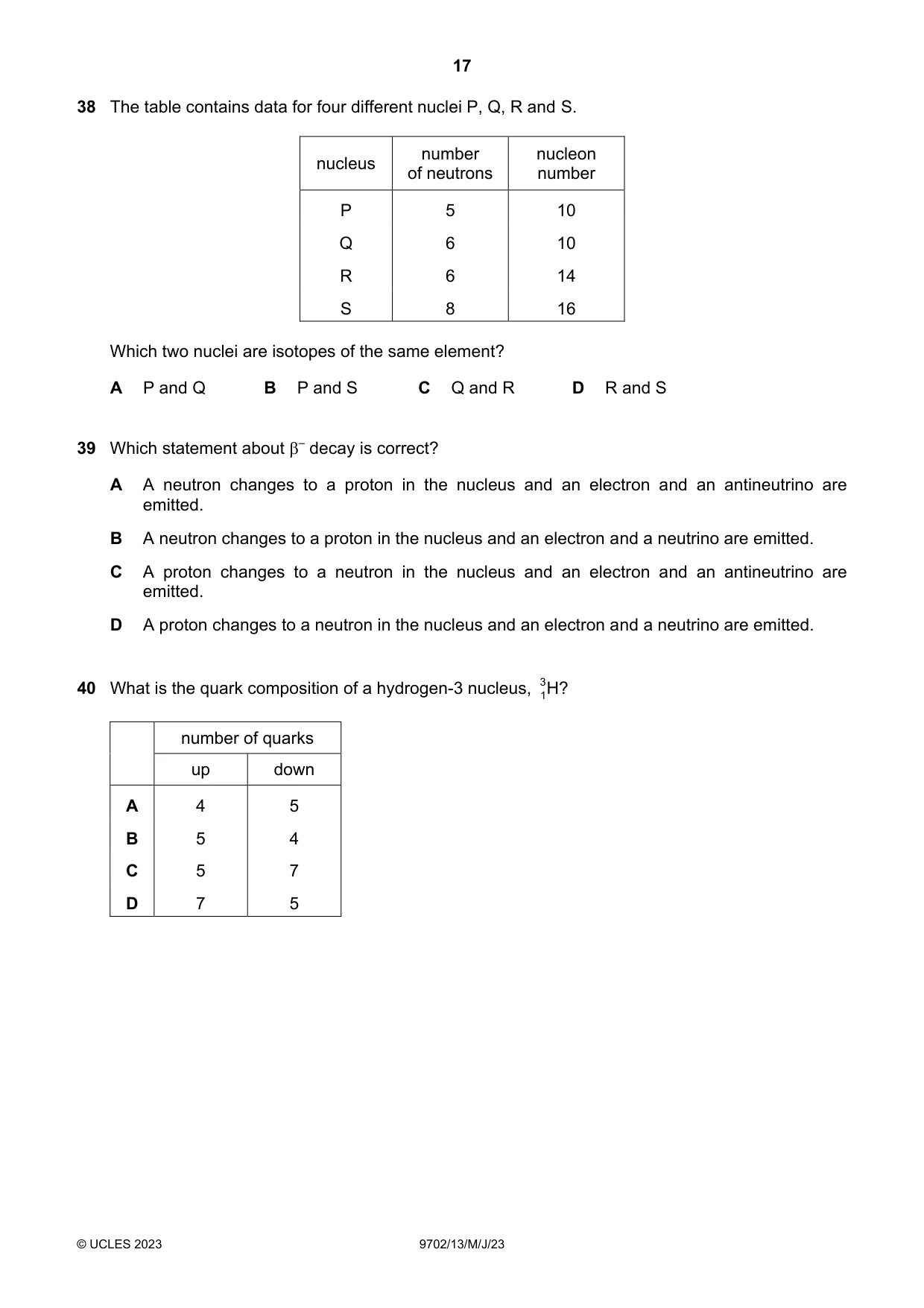
Q38 · The table contains data for four different nuclei P, Q, R and S
38 The table contains data for four different nuclei P, Q, R and S. number nucleon nucleus of neutrons number P 5 10 Q 6 10 R 6 14 S 8 16 Which two nuclei are isotopes of the same element? A P and Q B P and S C Q and R D R and S
Mark scheme: D
Q39 · Which statement about – decay is correct?
39 Which statement about – decay is correct? A A neutron changes to a proton in the nucleus and an electron and an antineutrino are emitted. B A neutron changes to a proton in the nucleus and an electron and a neutrino are emitted. C A proton changes to a neutron in the nucleus and an electron and an antineutrino are emitted. D A proton changes to a neutron in the nucleus and an electron and a neutrino are emitted.
Mark scheme: A
Q40 · What is the quark composition of a hydrogen-3 nucleus, H?
40 What is the quark composition of a hydrogen-3 nucleus, H? 3 1 number of quarks up down A 4 5 B 5 4 C 5 7 D 7 5
Mark scheme: A
What was in this paper
The subtopics covered by these 40 questions, and how many questions each got. Open one in a new tab to see every Cambridge question on it.
2Energy conservation2Equations of motion2Linear momentum and its conservation2Practical circuits2Progressive waves2Resistance and resistivity2Stationary waves2Turning effects of forces2Atoms, nuclei and radiation1Diffraction1Doppler effect for sound waves1Elastic and plastic behaviour1Electric current1Electromagnetic spectrum1Errors and uncertainties1Fundamental particles1Gravitational potential energy and kinetic energy1Interference1Kirchhoff’s laws1Momentum and Newton’s laws of motion1Non-uniform motion1Physical quantities1Polarisation1Potential difference and power1Potential dividers1Radioactive decay1Scalars and vectors1SI units1Stress and strain1The diffraction grating1What you needed in this session
Cambridge’s own grade thresholds for 2023 May/June, Paper 1 · Variant 3. A higher threshold means an easier paper — the bar moves with how the cohort did.