Cambridge A Level Physics 9702 — 2013 May/June Paper 1 · Variant 3
9702/13/M/J/13 · 40 questions · 40 marks · ≈45 min
The question paper and its mark scheme, free to read here and free to download. This is Cambridge’s own paper, exactly as it was sat.
Question paper28 pages
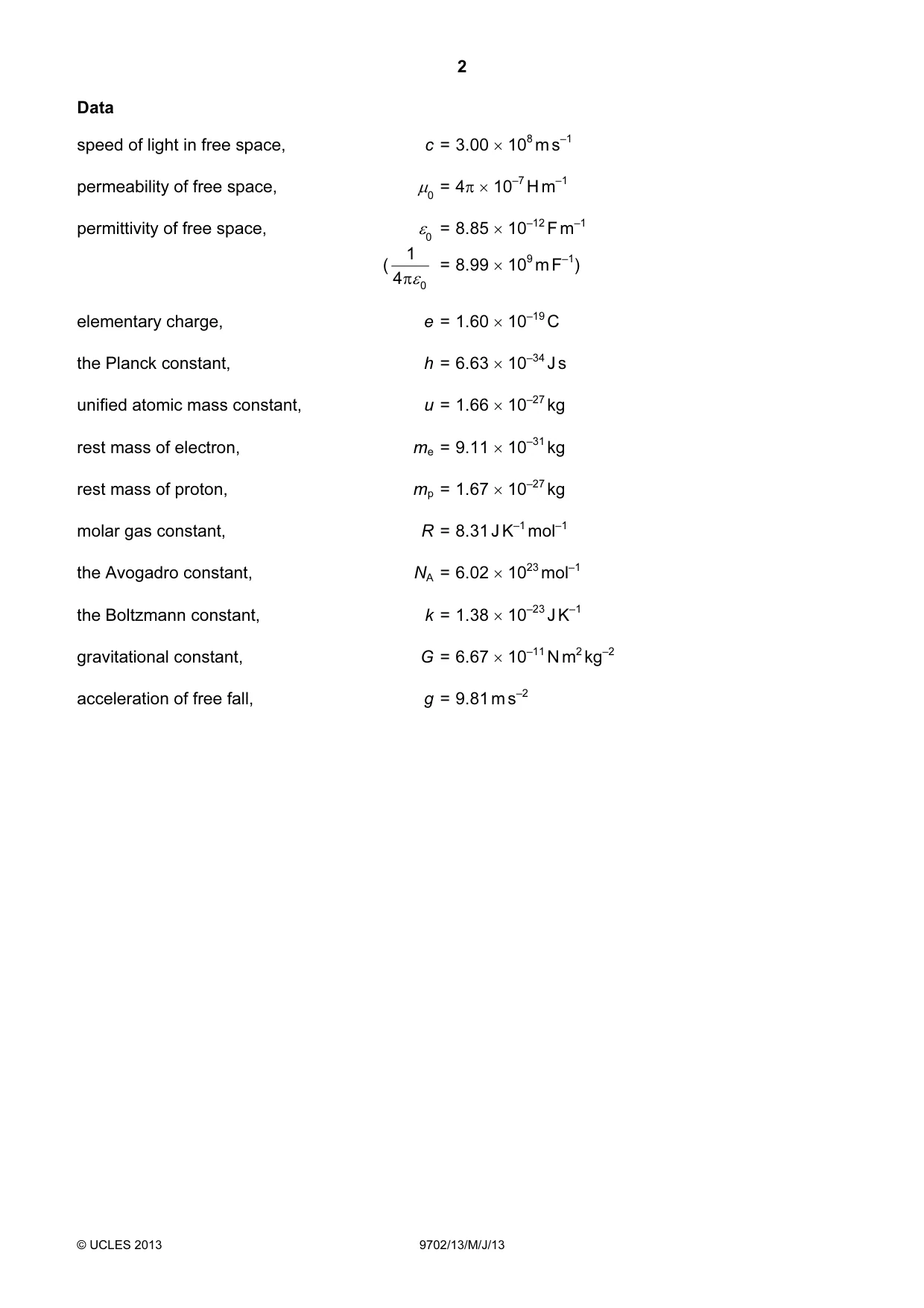
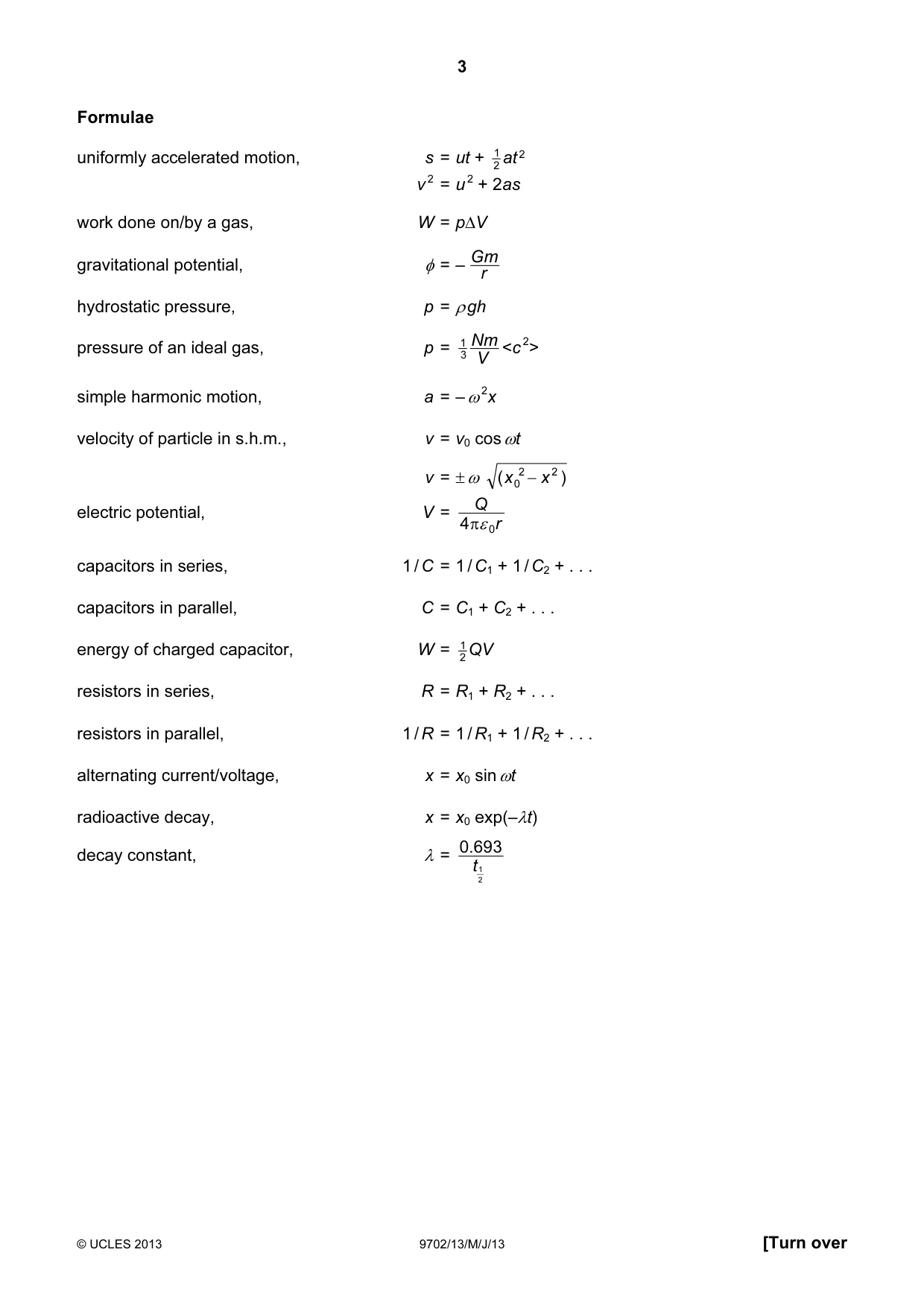

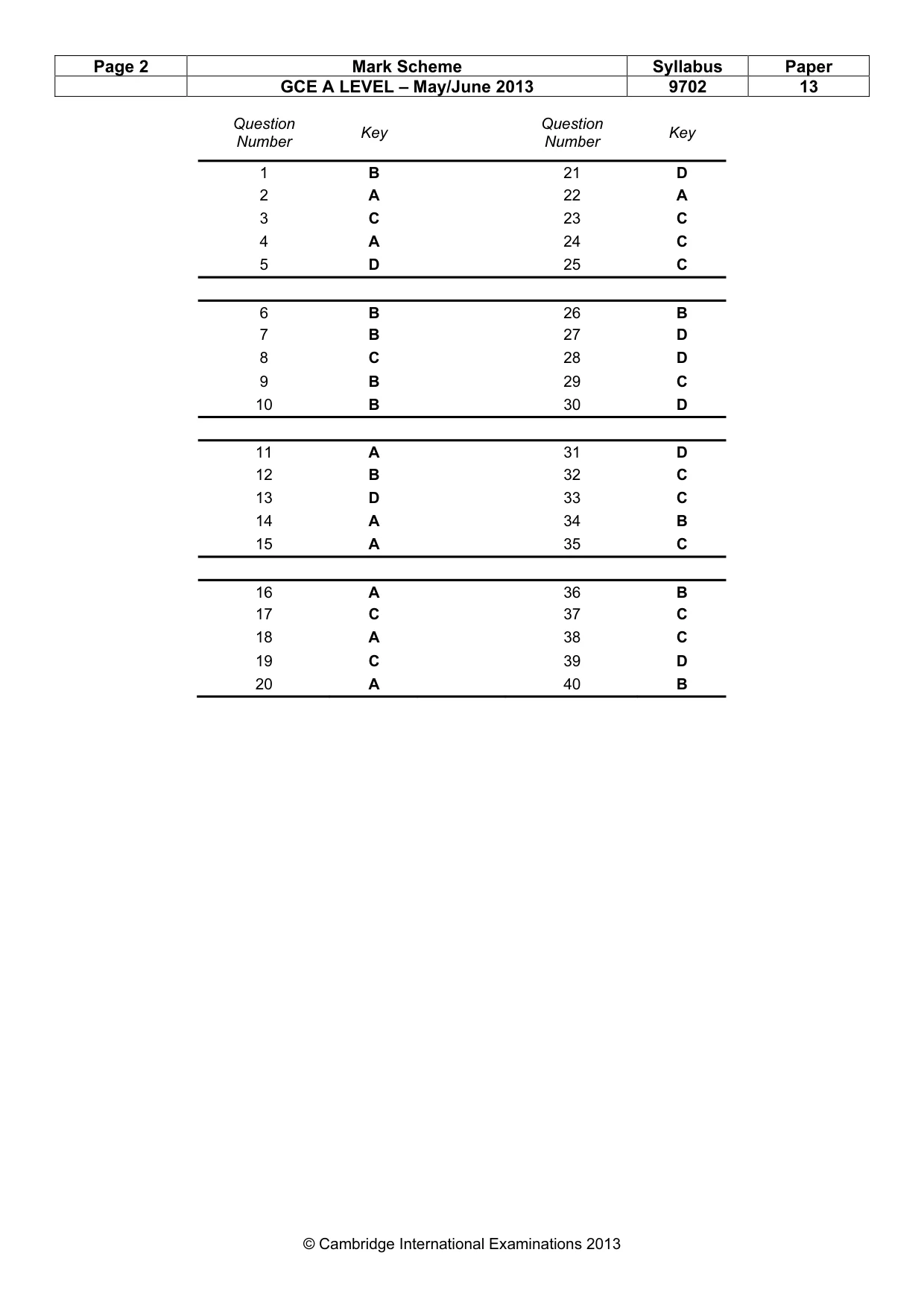
Mark scheme2 pages
Answers below. Sit the paper first if you are practising.
Questions as text
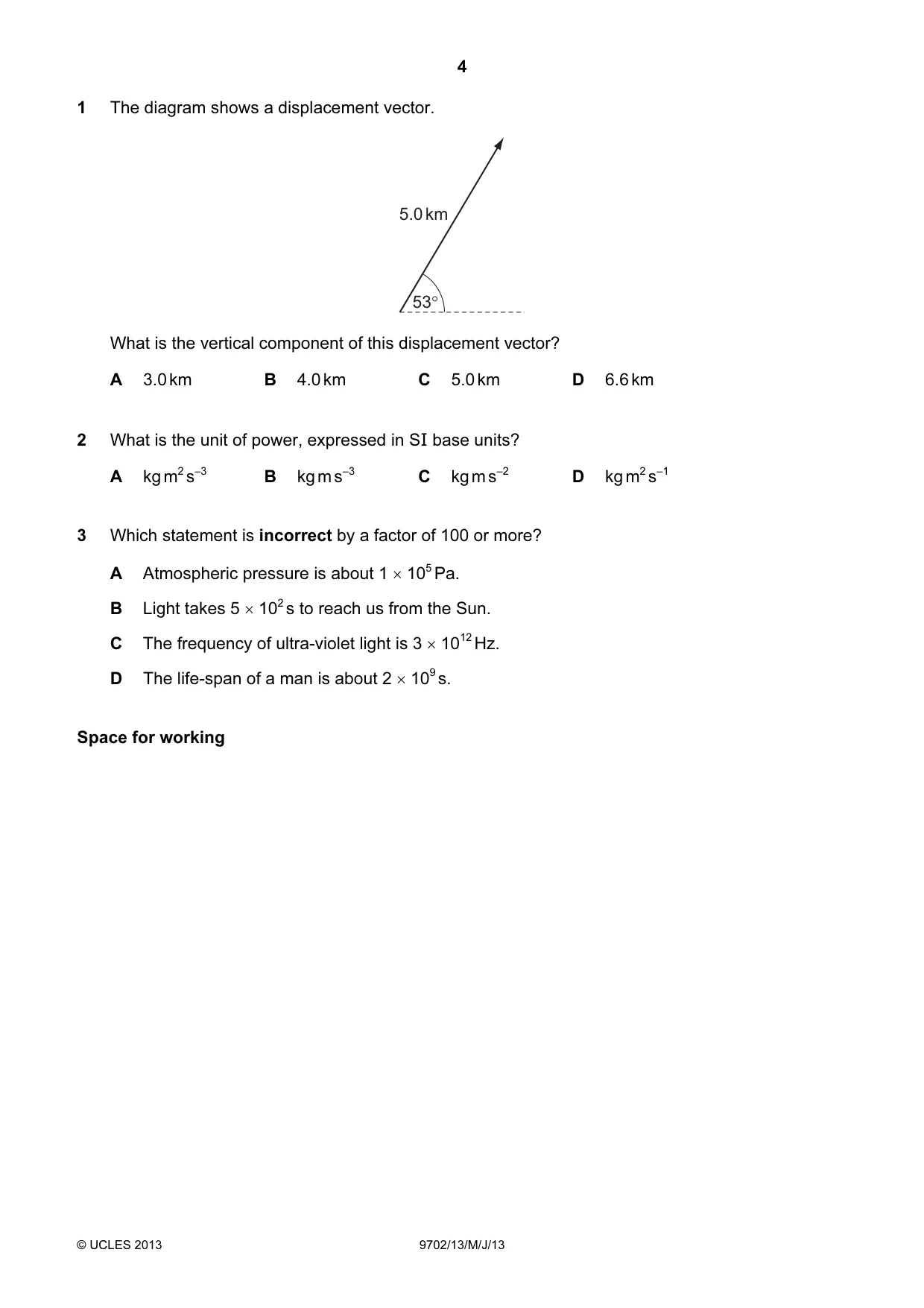
Q1 · The diagram shows a displacement vector
1 The diagram shows a displacement vector. 5.0 km 53° What is the vertical component of this displacement vector? A 3.0 km B 4.0 km C 5.0 km D 6.6 km
Mark scheme: B
Q2 · What is the unit of power, expressed in SI base units?
2 What is the unit of power, expressed in SI base units? A kg m2 s–3 B kg m s–3 C kg m s–2 D kg m2 s–1
Mark scheme: A
Q3 · Which statement is incorrect by a factor of 100 or more?
3 Which statement is incorrect by a factor of 100 or more? A Atmospheric pressure is about 1 × 10⁵ Pa. B Light takes 5 × 10² s to reach us from the Sun. C The frequency of ultra-violet light is 3 × 10¹² Hz. D The life-span of a man is about 2 × 10⁹ s. Space for working
Mark scheme: C
Q4 · A cyclist is travelling due south with velocity u
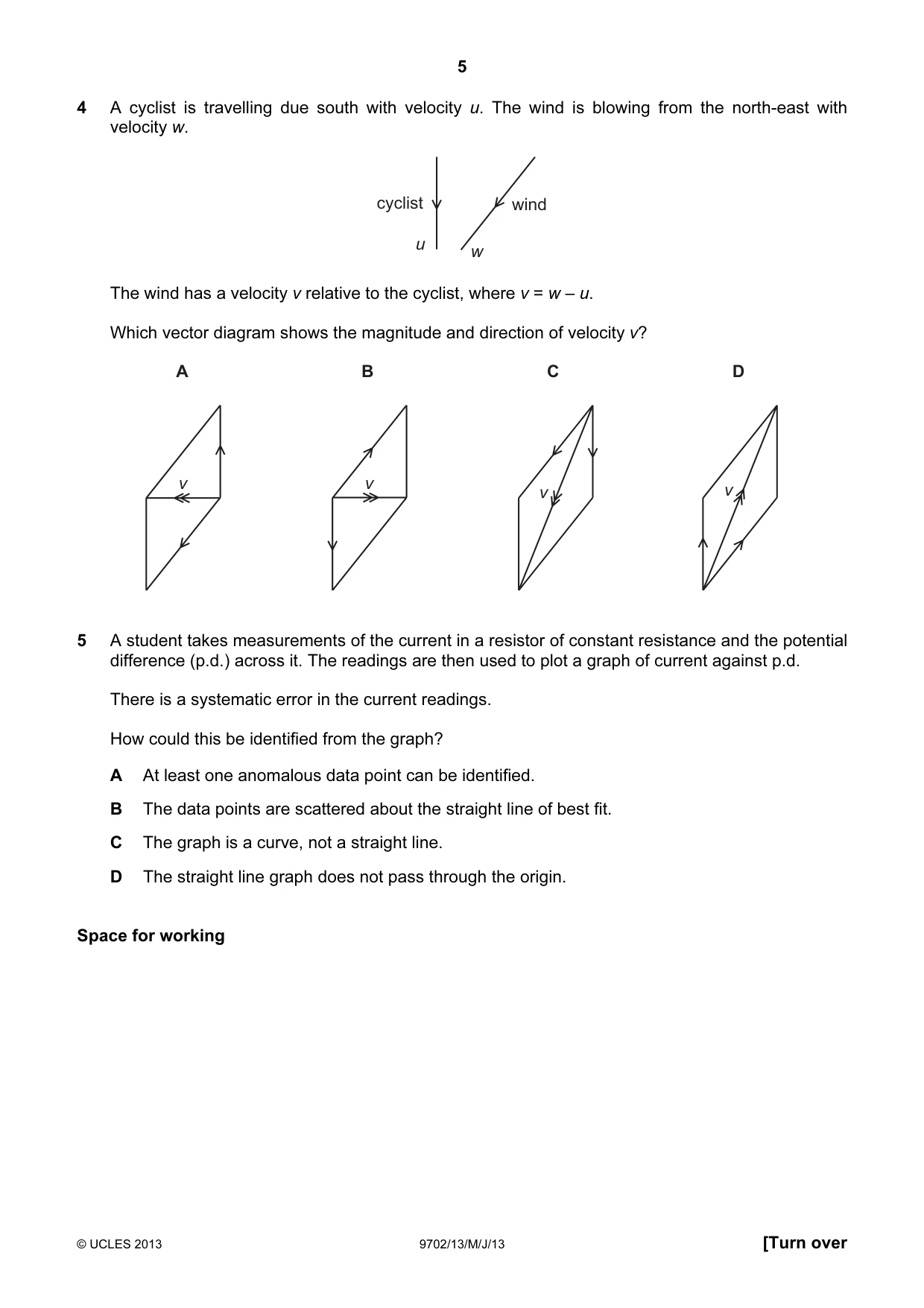
4 A cyclist is travelling due south with velocity u. The wind is blowing from the north-east with velocity w. cyclist wind u w The wind has a velocity v relative to the cyclist, where v = w – u. Which vector diagram shows the magnitude and direction of velocity v? A B C D v v v v
Mark scheme: A
Q5 · A student takes measurements of the current in a resistor of constant resistance and the…
5 A student takes measurements of the current in a resistor of constant resistance and the potential difference (p.d.) across it. The readings are then used to plot a graph of current against p.d. There is a systematic error in the current readings. How could this be identified from the graph? A At least one anomalous data point can be identified. B The data points are scattered about the straight line of best fit. C The graph is a curve, not a straight line. D The straight line graph does not pass through the origin. Space for working
Mark scheme: D
Q6 · The diagram shows the stem of a Celsius thermometer, marked to show initial and final…
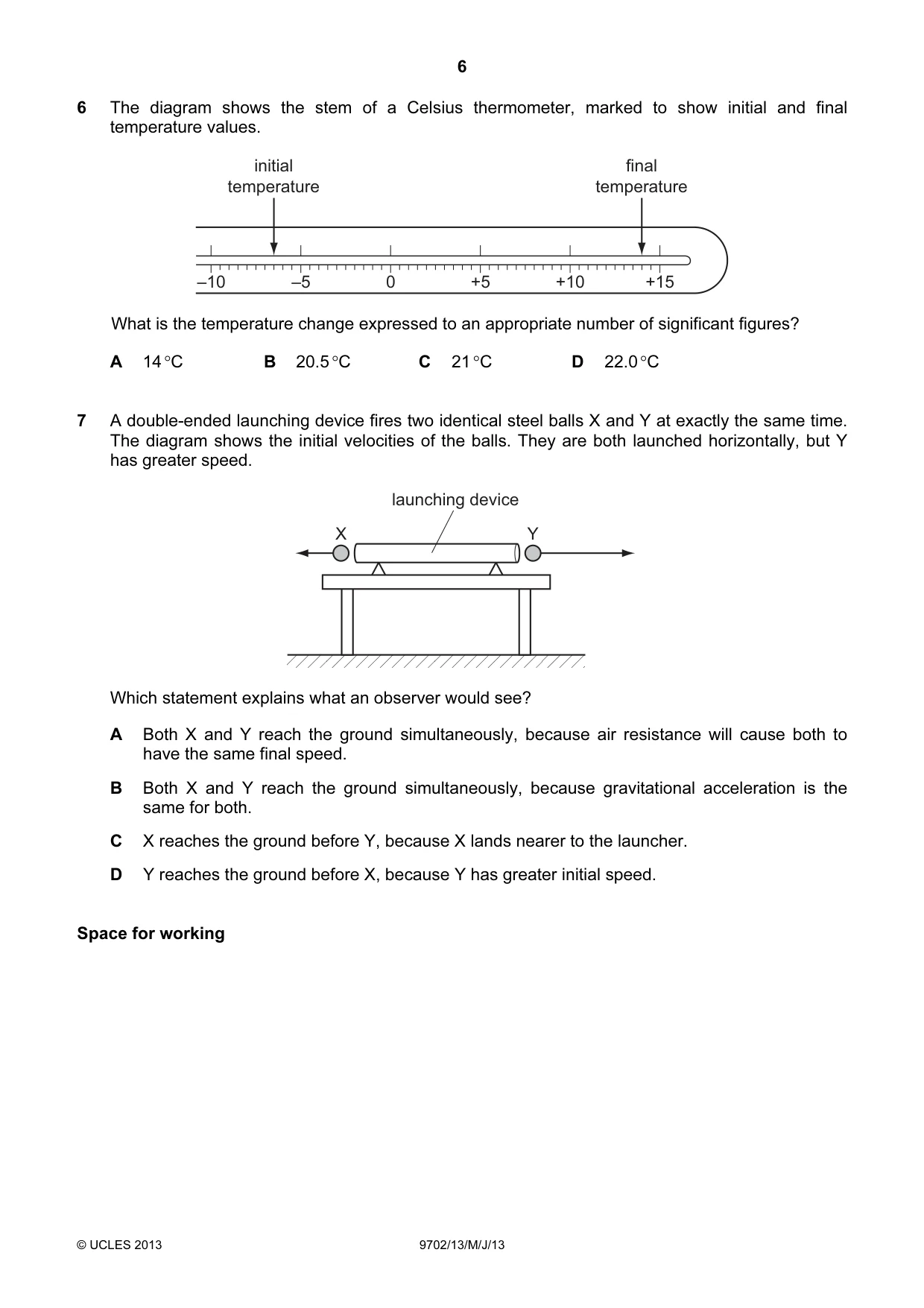
6 The diagram shows the stem of a Celsius thermometer, marked to show initial and final temperature values. initial final temperature temperature –10 –5 0 +5 +10 +15 What is the temperature change expressed to an appropriate number of significant figures? A 14 °C B 20.5 °C C 21 °C D 22.0 °C
Mark scheme: B
Q7 · A double-ended launching device fires two identical steel balls X and Y at exactly the…
7 A double-ended launching device fires two identical steel balls X and Y at exactly the same time. The diagram shows the initial velocities of the balls. They are both launched horizontally, but Y has greater speed. launching device X Y Which statement explains what an observer would see? A Both X and Y reach the ground simultaneously, because air resistance will cause both to have the same final speed. B Both X and Y reach the ground simultaneously, because gravitational acceleration is the same for both. C X reaches the ground before Y, because X lands nearer to the launcher. D Y reaches the ground before X, because Y has greater initial speed. Space for working
Mark scheme: B
Q8 · At time t = 0, a body moves from rest with constant acceleration in a straight line
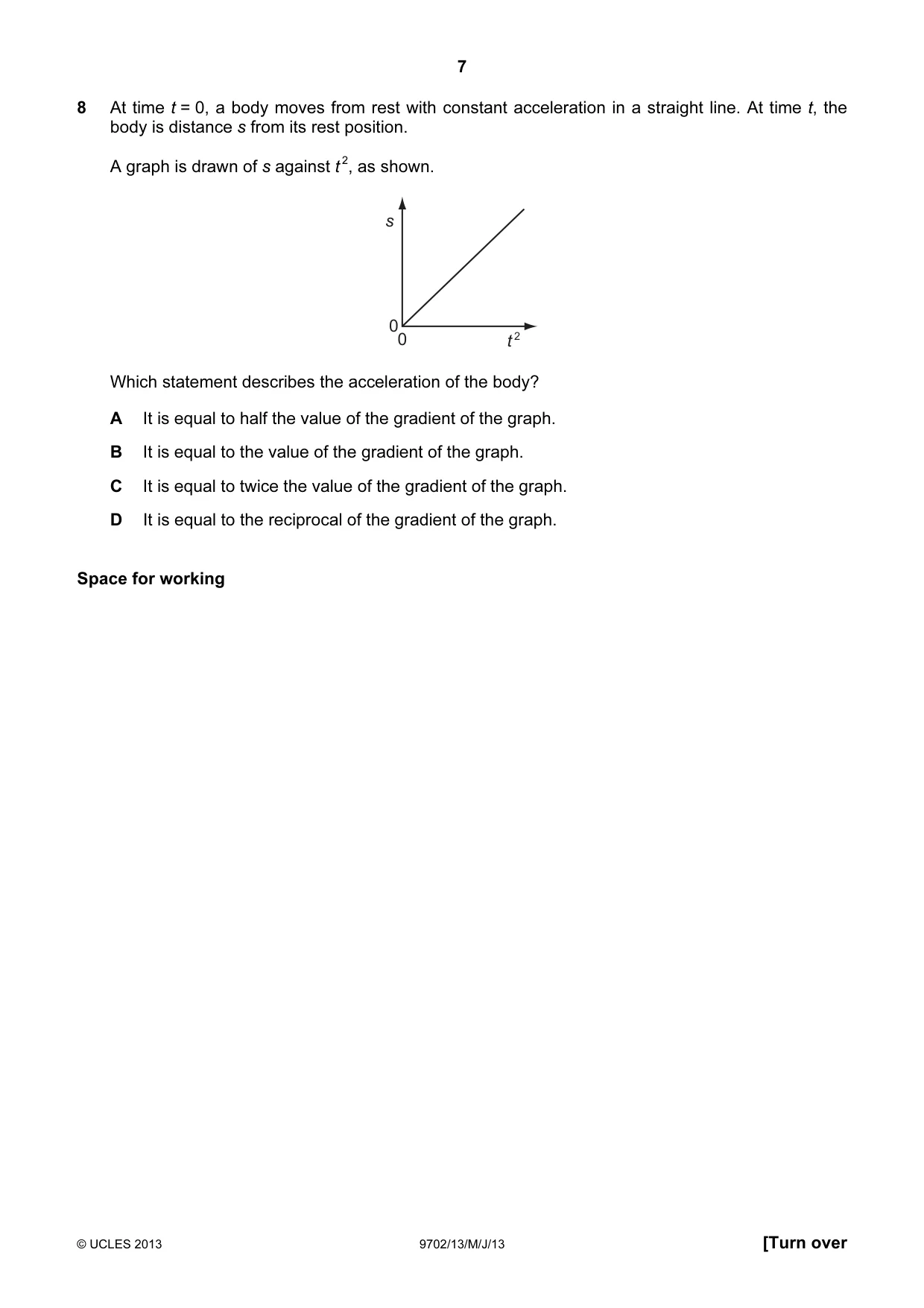
8 At time t = 0, a body moves from rest with constant acceleration in a straight line. At time t, the body is distance s from its rest position. A graph is drawn of s against t 2, as shown. s 00 t 2 Which statement describes the acceleration of the body? A It is equal to half the value of the gradient of the graph. B It is equal to the value of the gradient of the graph. C It is equal to twice the value of the gradient of the graph. D It is equal to the reciprocal of the gradient of the graph. Space for working
Mark scheme: C
Q9 · A lift (elevator) consists of a passenger car supported by a cable which runs over a…
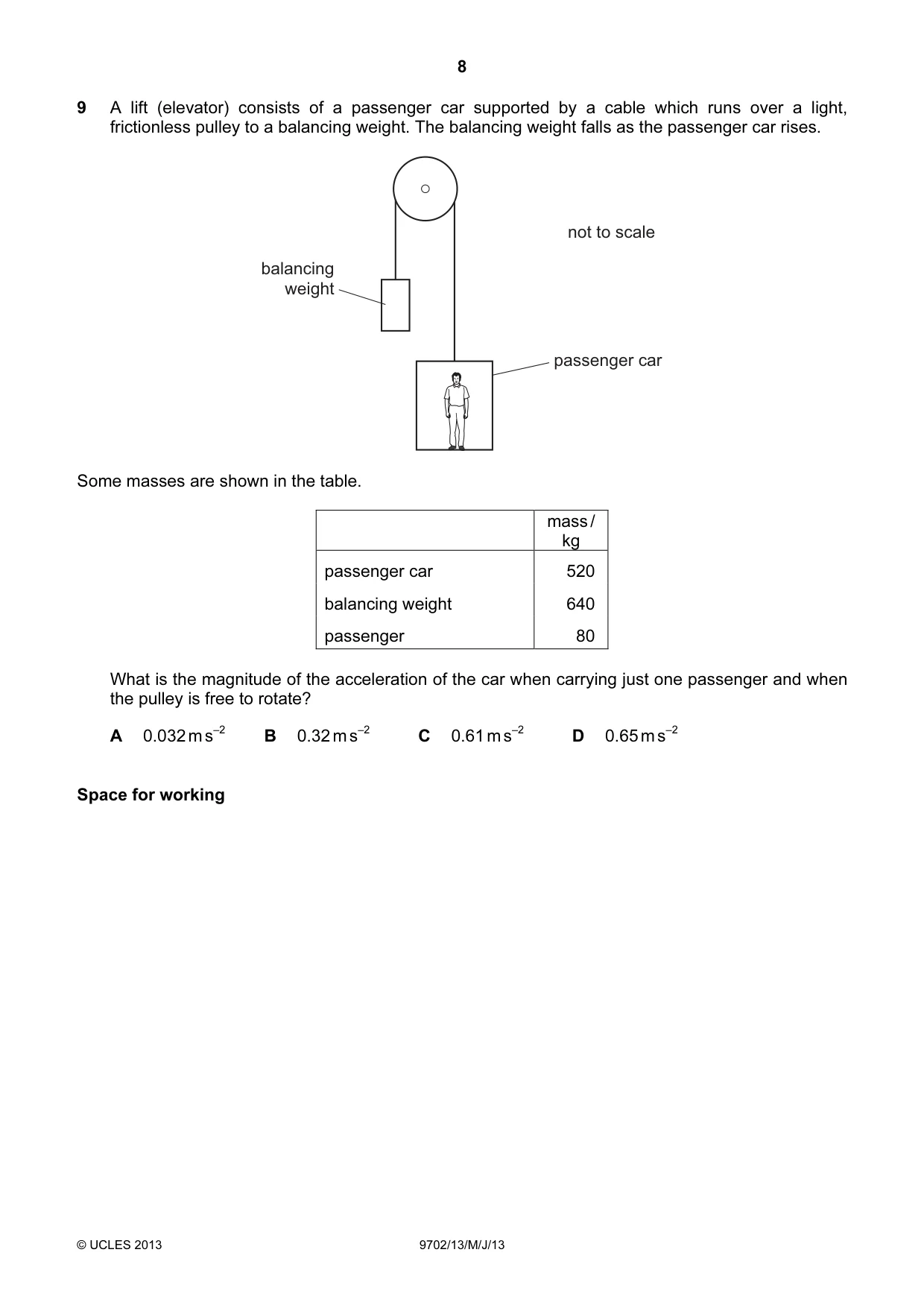
9 A lift (elevator) consists of a passenger car supported by a cable which runs over a light, frictionless pulley to a balancing weight. The balancing weight falls as the passenger car rises. not to scale balancing weight passenger car Some masses are shown in the table. mass / kg passenger car 520 balancing weight 640 passenger 80 What is the magnitude of the acceleration of the car when carrying just one passenger and when the pulley is free to rotate? A 0.032 m s–2 B 0.32 m s–2 C 0.61 m s–2 D 0.65 m s–2 Space for working
Mark scheme: B
Q10 · A stationary nucleus has nucleon number A
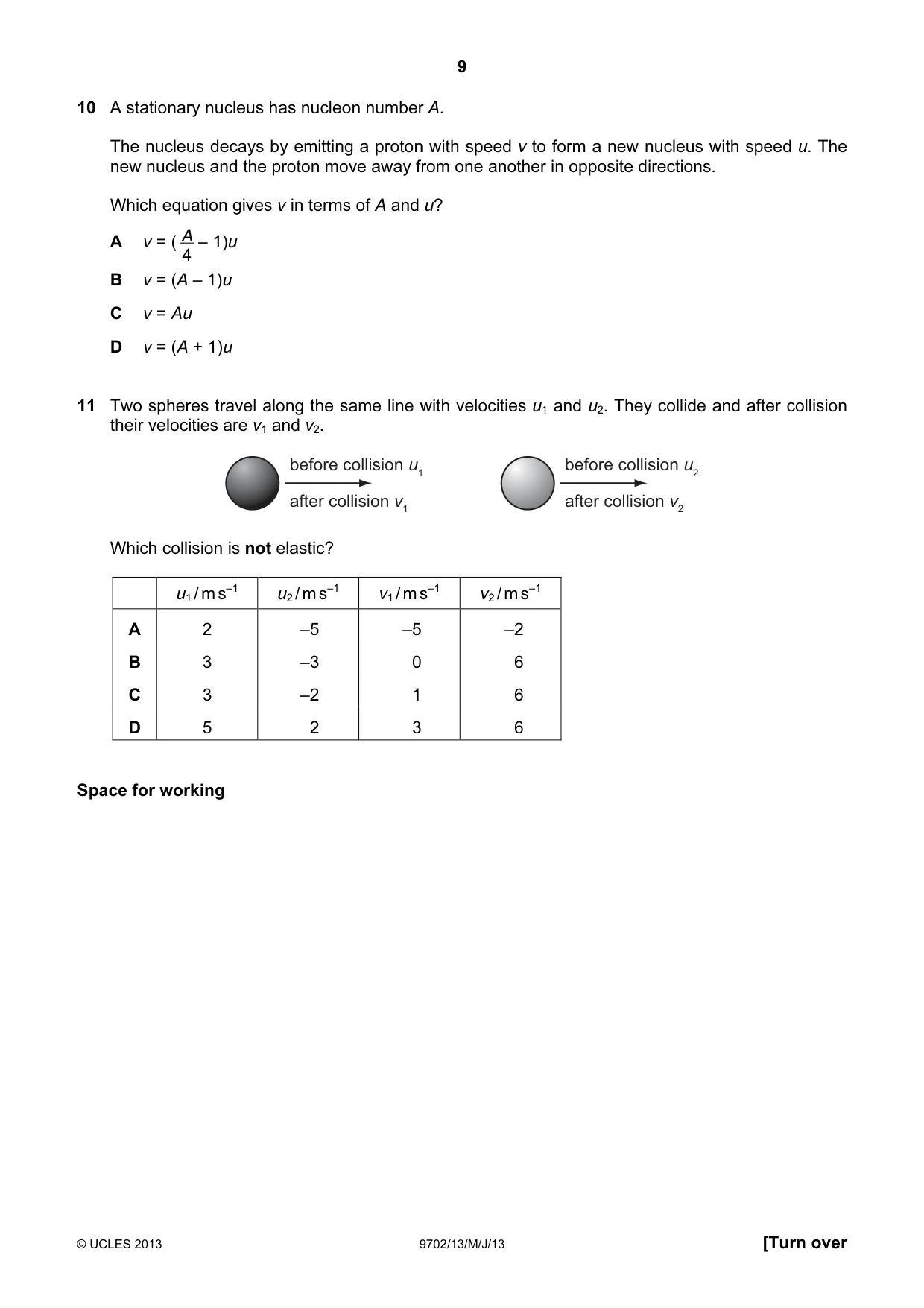
10 A stationary nucleus has nucleon number A. The nucleus decays by emitting a proton with speed v to form a new nucleus with speed u. The new nucleus and the proton move away from one another in opposite directions. Which equation gives v in terms of A and u? A v = ( 4 A – 1)u B v = (A – 1)u C v = Au D v = (A + 1)u
Mark scheme: B
Q11 · Two spheres travel along the same line with velocities u1 and u2
11 Two spheres travel along the same line with velocities u1 and u2. They collide and after collision their velocities are v1 and v2. before collision u1 before collision u2 after collision v1 after collision v2 Which collision is not elastic? u1 / m s–1 u2 / m s–1 v1 / m s–1 v2 / m s–1 A 2 –5 –5 –2 B 3 –3 0 6 C 3 –2 1 6 D 5 2 3 6 Space for working
Mark scheme: A
Q12 · The diagrams show a negative electric charge situated in a uniform electric field and a…
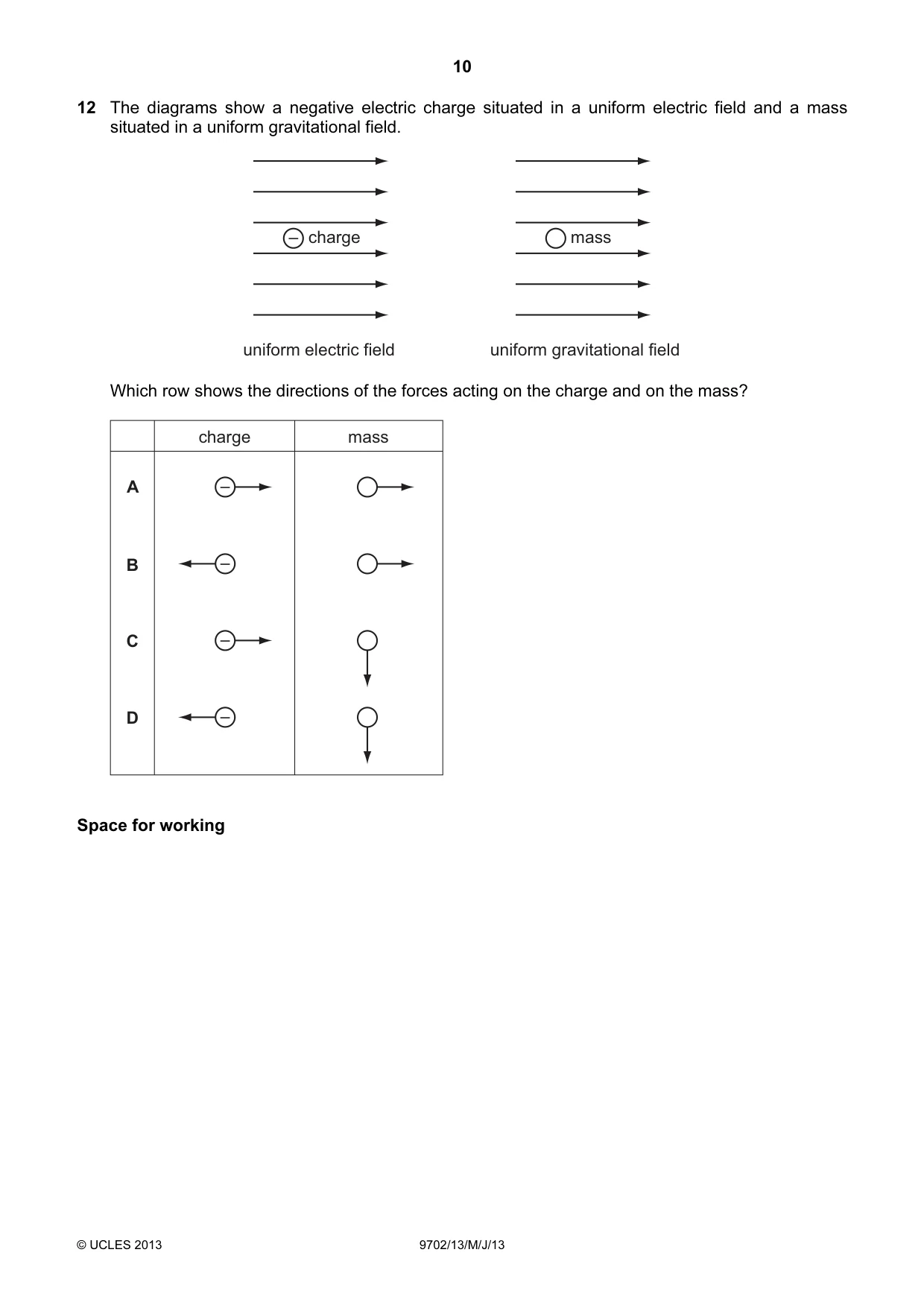
12 The diagrams show a negative electric charge situated in a uniform electric field and a mass situated in a uniform gravitational field. – charge mass uniform electric field uniform gravitational field Which row shows the directions of the forces acting on the charge and on the mass? charge mass A – B – C – D – Space for working
Mark scheme: B
Q13 · A wooden block rests on a rough board
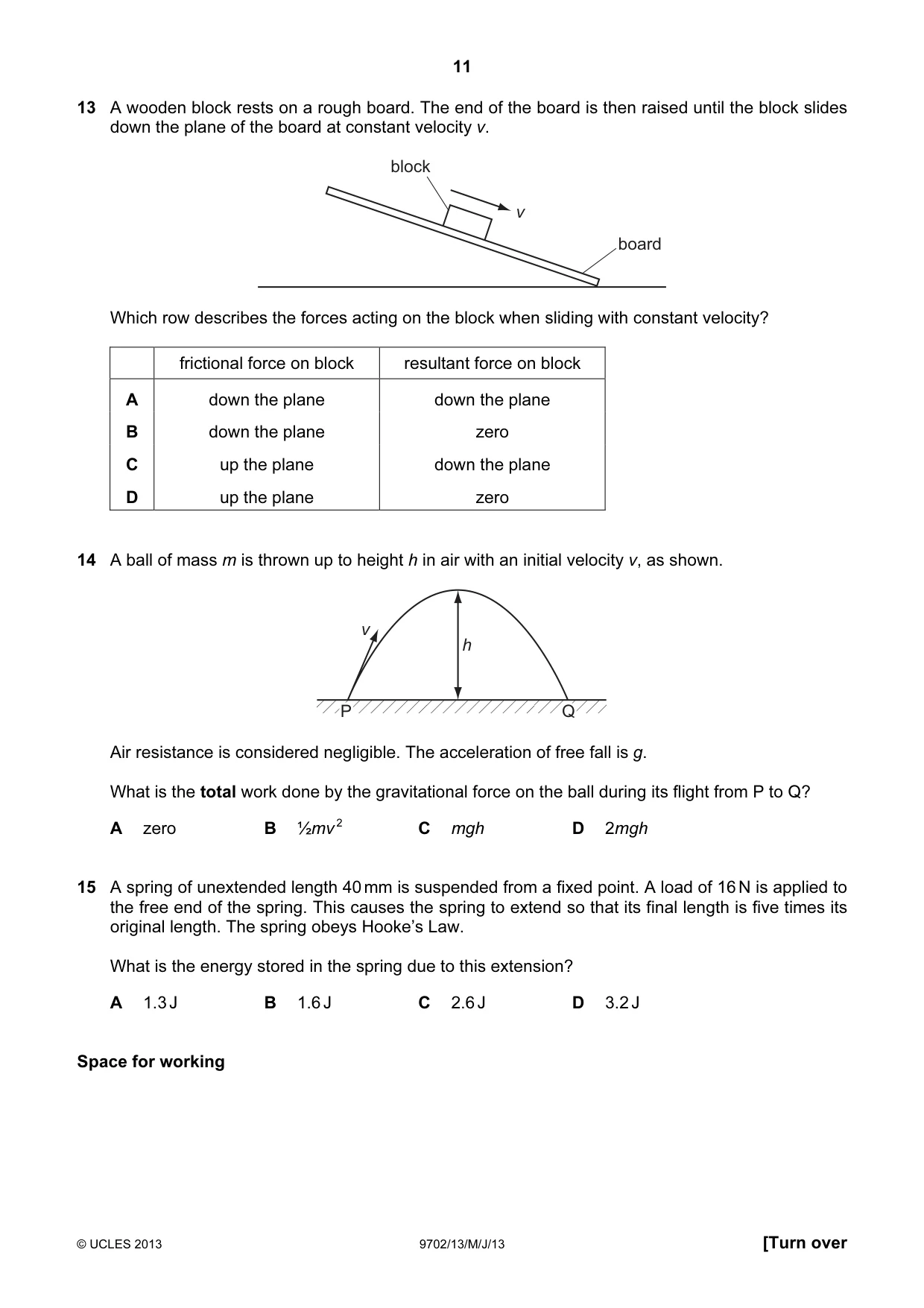
13 A wooden block rests on a rough board. The end of the board is then raised until the block slides down the plane of the board at constant velocity v. block v board Which row describes the forces acting on the block when sliding with constant velocity? frictional force on block resultant force on block A down the plane down the plane B down the plane zero C up the plane down the plane D up the plane zero
Mark scheme: D
Q14 · A ball of mass m is thrown up to height h in air with an initial velocity v, as shown
14 A ball of mass m is thrown up to height h in air with an initial velocity v, as shown. v h P P Q Q Air resistance is considered negligible. The acceleration of free fall is g. What is the total work done by the gravitational force on the ball during its flight from P to Q? A zero B ½mv 2 C mgh D 2mgh
Mark scheme: A
Q15 · A spring of unextended length 40 mm is suspended from a fixed point
15 A spring of unextended length 40 mm is suspended from a fixed point. A load of 16 N is applied to the free end of the spring. This causes the spring to extend so that its final length is five times its original length. The spring obeys Hooke’s Law. What is the energy stored in the spring due to this extension? A 1.3 J B 1.6 J C 2.6 J D 3.2 J Space for working
Mark scheme: A
Q16 · The diagram shows an arrangement used to find the output power of an electric motor
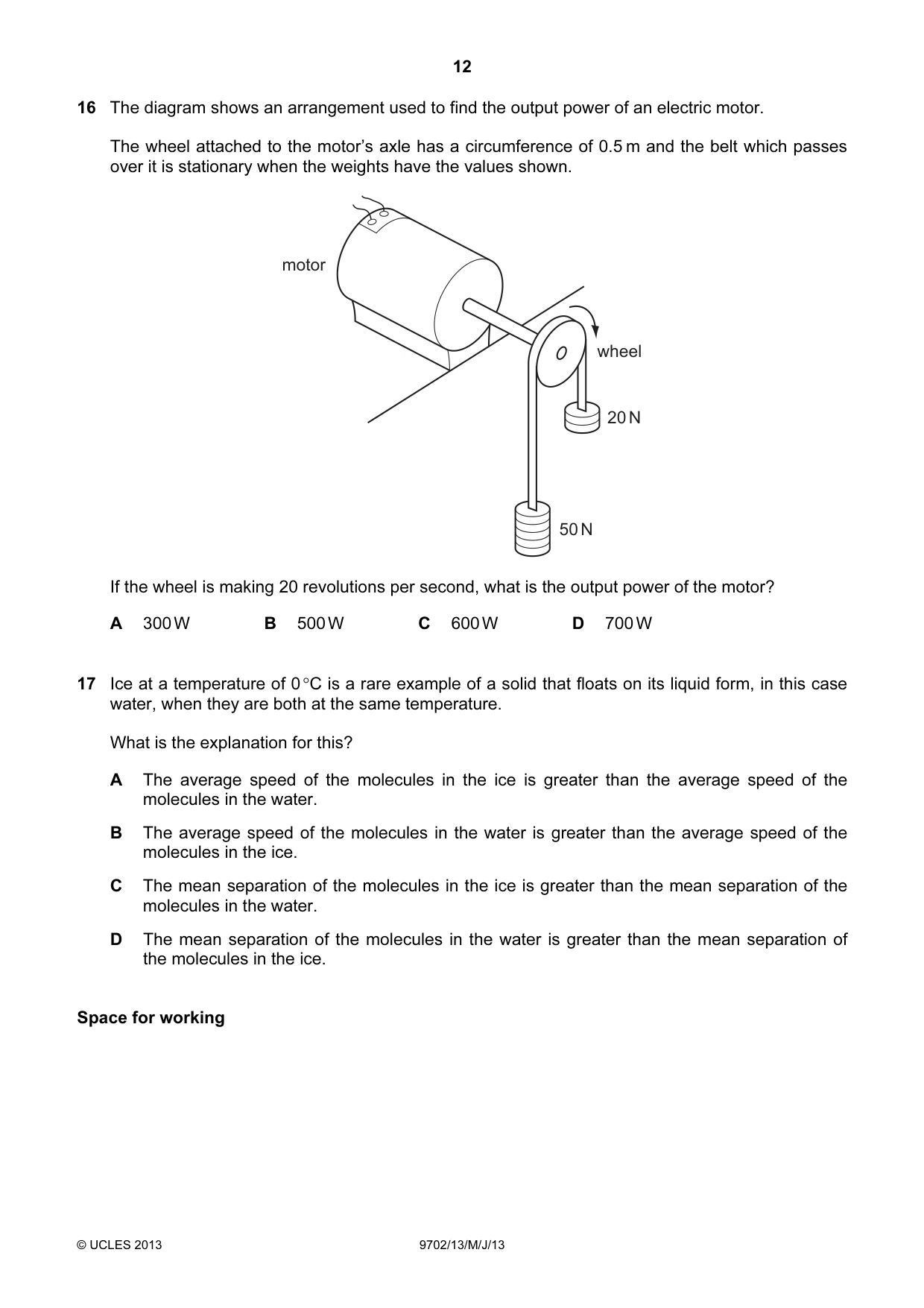
16 The diagram shows an arrangement used to find the output power of an electric motor. The wheel attached to the motor’s axle has a circumference of 0.5 m and the belt which passes over it is stationary when the weights have the values shown. motor wheel 20 N 50 N If the wheel is making 20 revolutions per second, what is the output power of the motor? A 300 W B 500 W C 600 W D 700 W
Mark scheme: A
Q17 · Ice at a temperature of 0 °C is a rare example of a solid that floats on its liquid form…
17 Ice at a temperature of 0 °C is a rare example of a solid that floats on its liquid form, in this case water, when they are both at the same temperature. What is the explanation for this? A The average speed of the molecules in the ice is greater than the average speed of the molecules in the water. B The average speed of the molecules in the water is greater than the average speed of the molecules in the ice. C The mean separation of the molecules in the ice is greater than the mean separation of the molecules in the water. D The mean separation of the molecules in the water is greater than the mean separation of the molecules in the ice. Space for working
Mark scheme: C
Q18 · The formula for hydrostatic pressure is p = ρ gh
18 The formula for hydrostatic pressure is p = ρ gh. Which equation, or principle of physics, is used in the derivation of this formula? mass A density = volume B potential energy = mgh C atmospheric pressure decreases with height D density increases with depth
Mark scheme: A
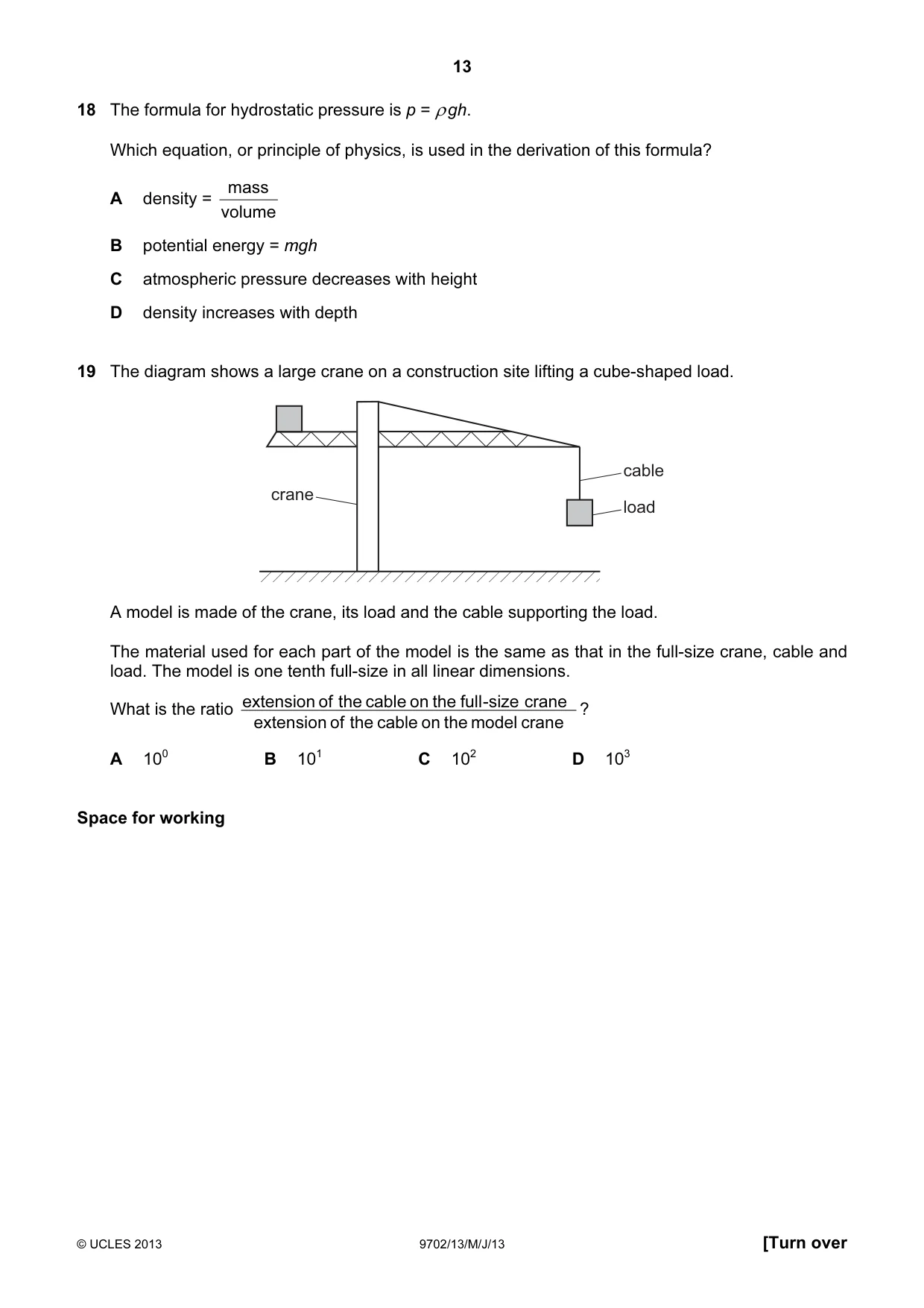
Q19 · The diagram shows a large crane on a construction site lifting a cube-shaped load
19 The diagram shows a large crane on a construction site lifting a cube-shaped load. cable crane load A model is made of the crane, its load and the cable supporting the load. The material used for each part of the model is the same as that in the full-size crane, cable and load. The model is one tenth full-size in all linear dimensions. extension of the cable on the full - size crane What is the ratio ? extension of the cable on the model crane A 100 B 101 C 102 D 103 Space for working
Mark scheme: C
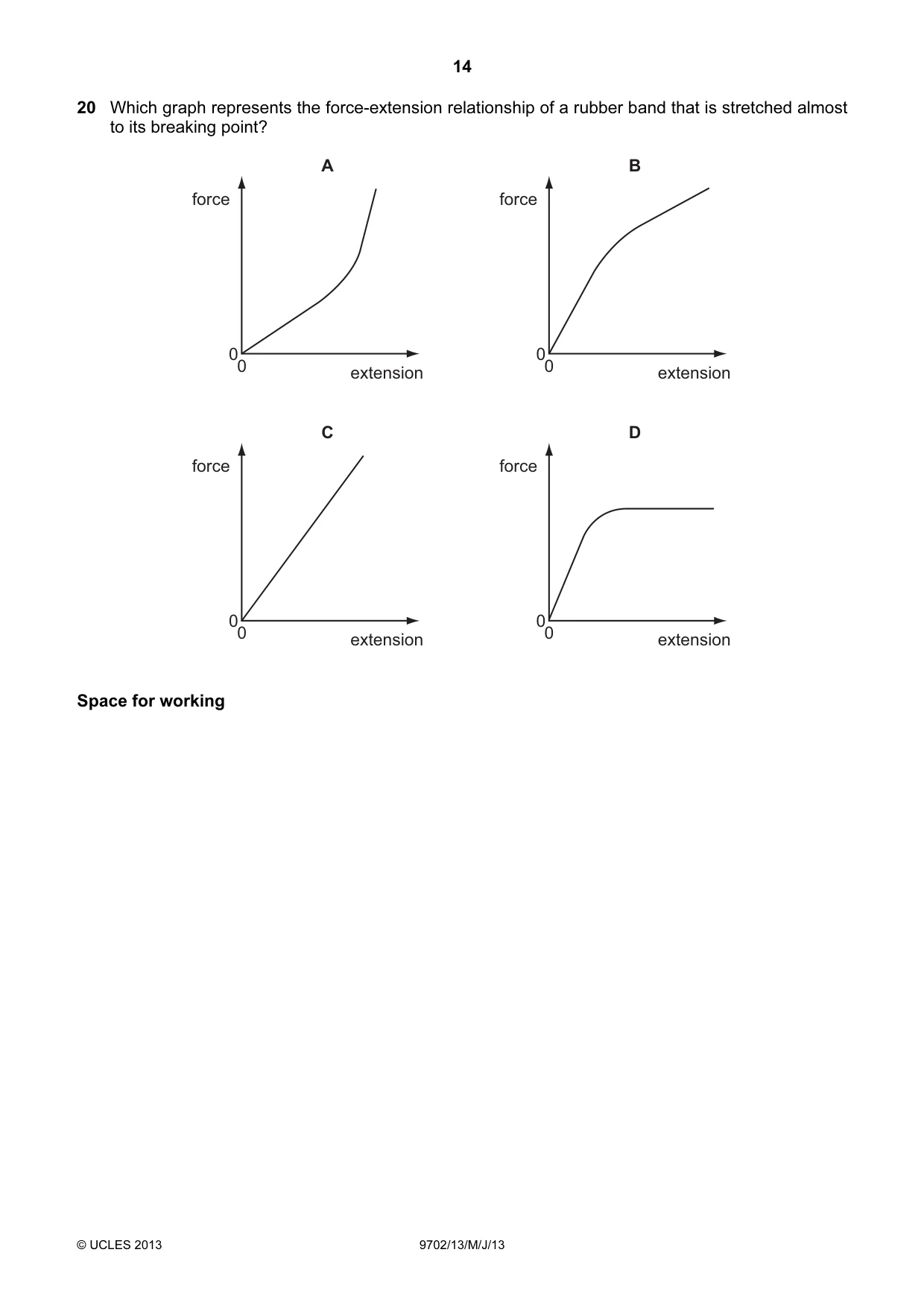
Q20 · Which graph represents the force-extension relationship of a rubber band that is…
20 Which graph represents the force-extension relationship of a rubber band that is stretched almost to its breaking point? A B force force 0 0 0 0 extension extension C D force force 0 0 0 0 extension extension Space for working
Mark scheme: A
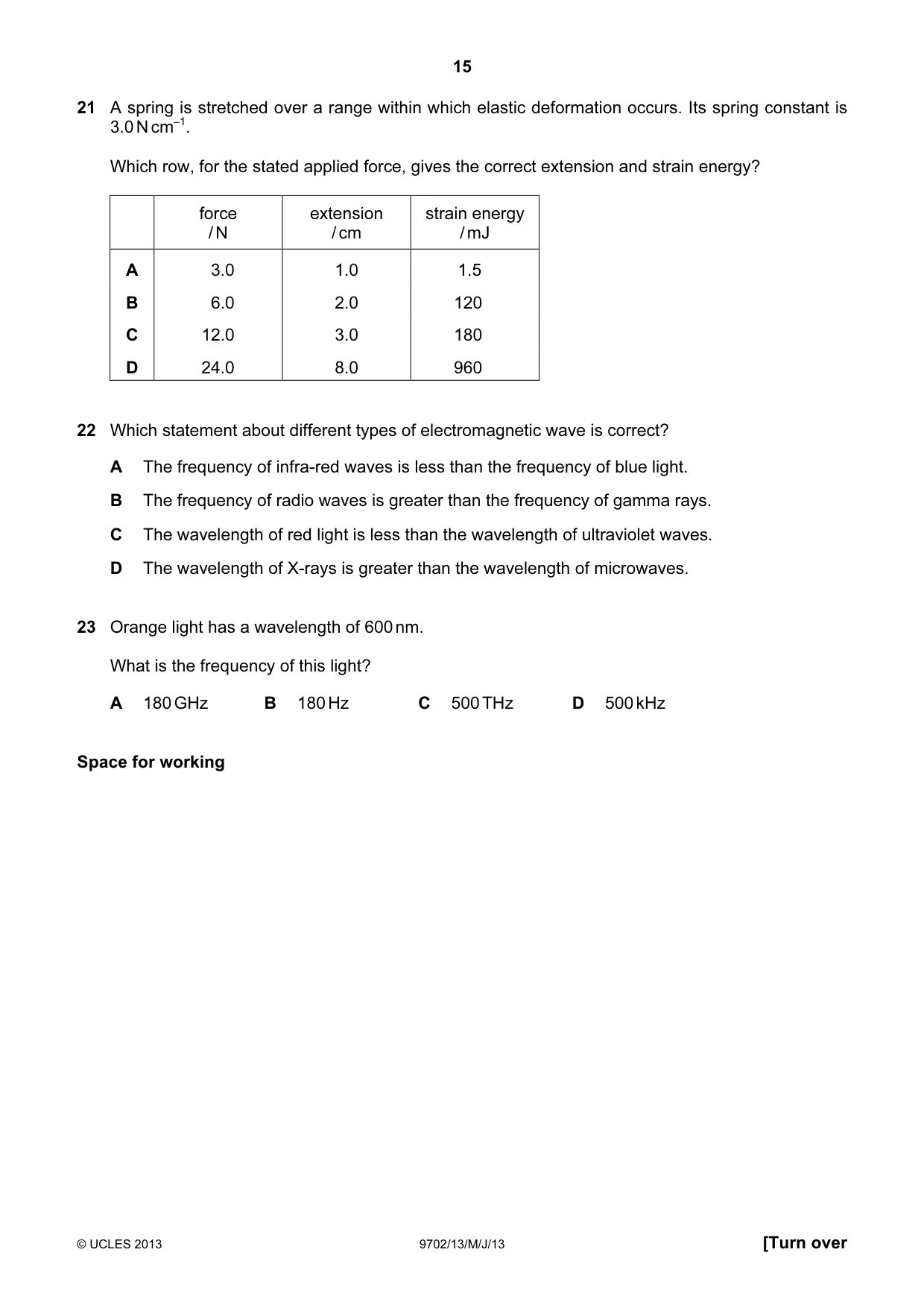
Q21 · A spring is stretched over a range within which elastic deformation occurs
21 A spring is stretched over a range within which elastic deformation occurs. Its spring constant is 3.0 N cm–1. Which row, for the stated applied force, gives the correct extension and strain energy? force extension strain energy / N / cm / mJ A 3.0 1.0 1.5 B 6.0 2.0 120 C 12.0 3.0 180 D 24.0 8.0 960
Mark scheme: D
Q22 · Which statement about different types of electromagnetic wave is correct?
22 Which statement about different types of electromagnetic wave is correct? A The frequency of infra-red waves is less than the frequency of blue light. B The frequency of radio waves is greater than the frequency of gamma rays. C The wavelength of red light is less than the wavelength of ultraviolet waves. D The wavelength of X-rays is greater than the wavelength of microwaves.
Mark scheme: A
Q23 · Orange light has a wavelength of 600 nm
23 Orange light has a wavelength of 600 nm. What is the frequency of this light? A 180 GHz B 180 Hz C 500 THz D 500 kHz Space for working
Mark scheme: C
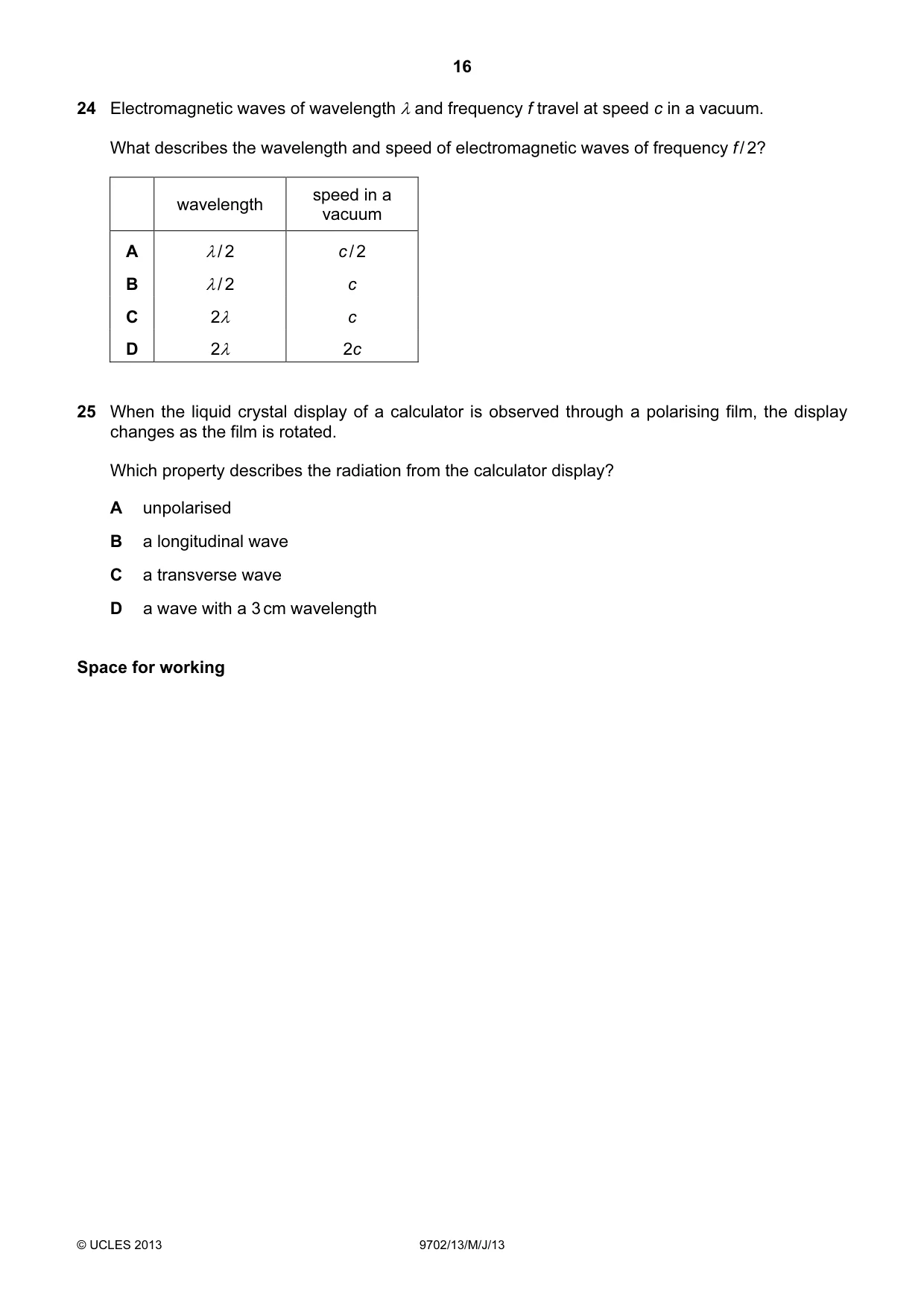
Q24 · Electromagnetic waves of wavelength λ and frequency f travel at speed c in a vacuum
24 Electromagnetic waves of wavelength λ and frequency f travel at speed c in a vacuum. What describes the wavelength and speed of electromagnetic waves of frequency f / 2? speed in a wavelength vacuum A λ / 2 c / 2 B λ / 2 c C 2λ c D 2λ 2c
Mark scheme: C
Q25 · When the liquid crystal display of a calculator is observed through a polarising film…
25 When the liquid crystal display of a calculator is observed through a polarising film, the display changes as the film is rotated. Which property describes the radiation from the calculator display? A unpolarised B a longitudinal wave C a transverse wave D a wave with a 3 cm wavelength Space for working
Mark scheme: C
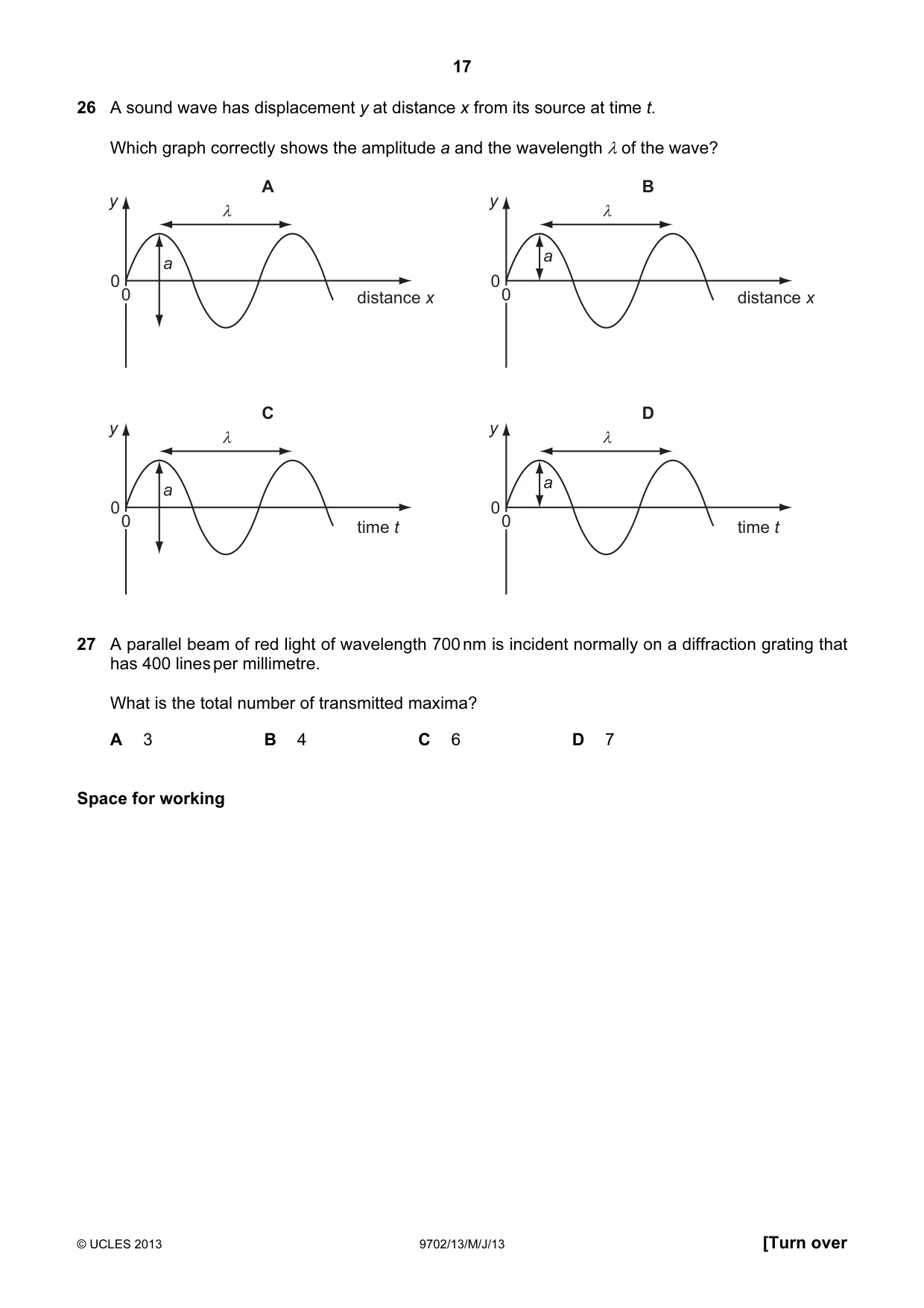
Q26 · A sound wave has displacement y at distance x from its source at time t
26 A sound wave has displacement y at distance x from its source at time t. Which graph correctly shows the amplitude a and the wavelength λ of the wave? A B y y λ λ a a 0 0 0 distance x 0 distance x C D y y λ λ a a 0 0 0 time t 0 time t
Mark scheme: B
Q27 · A parallel beam of red light of wavelength 700 nm is incident normally on a diffraction…
27 A parallel beam of red light of wavelength 700 nm is incident normally on a diffraction grating that has 400 lines per millimetre. What is the total number of transmitted maxima? A 3 B 4 C 6 D 7 Space for working
Mark scheme: D
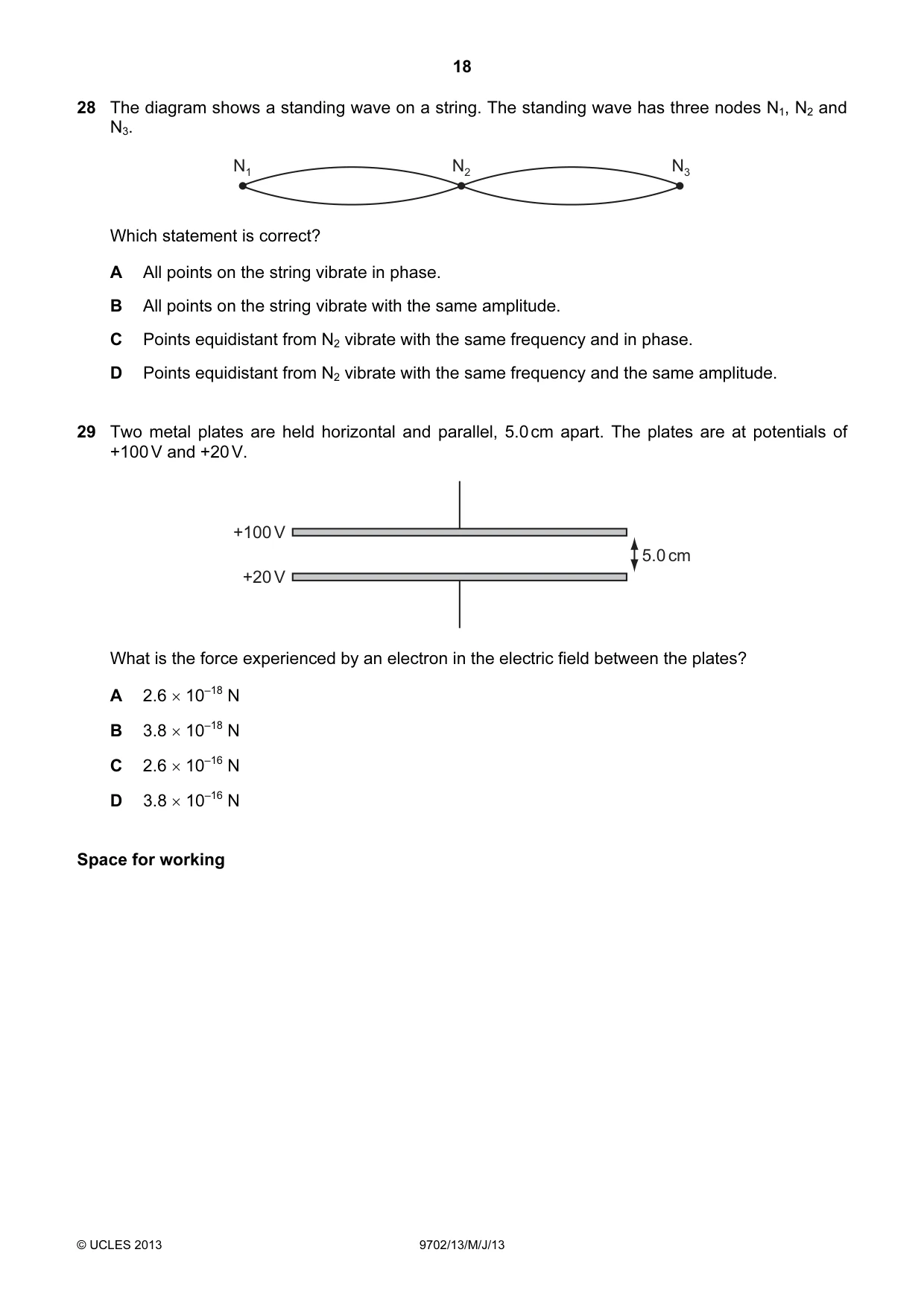
Q28 · The diagram shows a standing wave on a string
28 The diagram shows a standing wave on a string. The standing wave has three nodes N1, N2 and N3. N1 N2 N3 Which statement is correct? A All points on the string vibrate in phase. B All points on the string vibrate with the same amplitude. C Points equidistant from N2 vibrate with the same frequency and in phase. D Points equidistant from N2 vibrate with the same frequency and the same amplitude.
Mark scheme: D
Q29 · Two metal plates are held horizontal and parallel, 5.0 cm apart
29 Two metal plates are held horizontal and parallel, 5.0 cm apart. The plates are at potentials of +100 V and +20 V. +100 V 5.0 cm +20 V What is the force experienced by an electron in the electric field between the plates? A 2.6 × 10⁻¹⁸ N B 3.8 × 10⁻¹⁸ N C 2.6 × 10⁻¹⁶ N D 3.8 × 10⁻¹⁶ N Space for working
Mark scheme: C
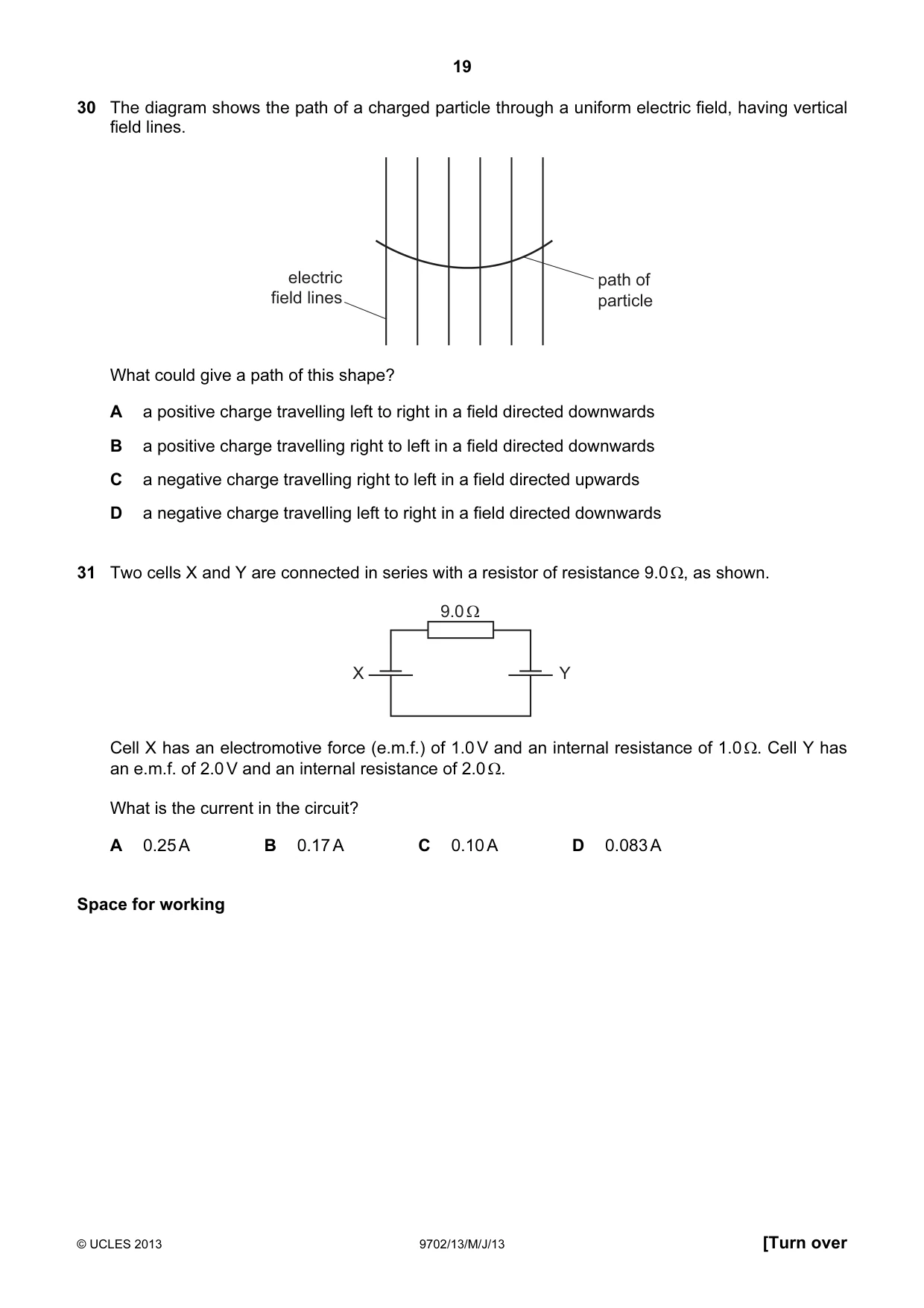
Q30 · The diagram shows the path of a charged particle through a uniform electric field, having…
30 The diagram shows the path of a charged particle through a uniform electric field, having vertical field lines. electric path of field lines particle What could give a path of this shape? A a positive charge travelling left to right in a field directed downwards B a positive charge travelling right to left in a field directed downwards C a negative charge travelling right to left in a field directed upwards D a negative charge travelling left to right in a field directed downwards
Mark scheme: D
Q31 · Two cells X and Y are connected in series with a resistor of resistance 9.0 Ω, as shown
31 Two cells X and Y are connected in series with a resistor of resistance 9.0 Ω, as shown. 9.0 Ω X Y Cell X has an electromotive force (e.m.f.) of 1.0 V and an internal resistance of 1.0 Ω. Cell Y has an e.m.f. of 2.0 V and an internal resistance of 2.0 Ω. What is the current in the circuit? A 0.25 A B 0.17 A C 0.10 A D 0.083 A Space for working
Mark scheme: D
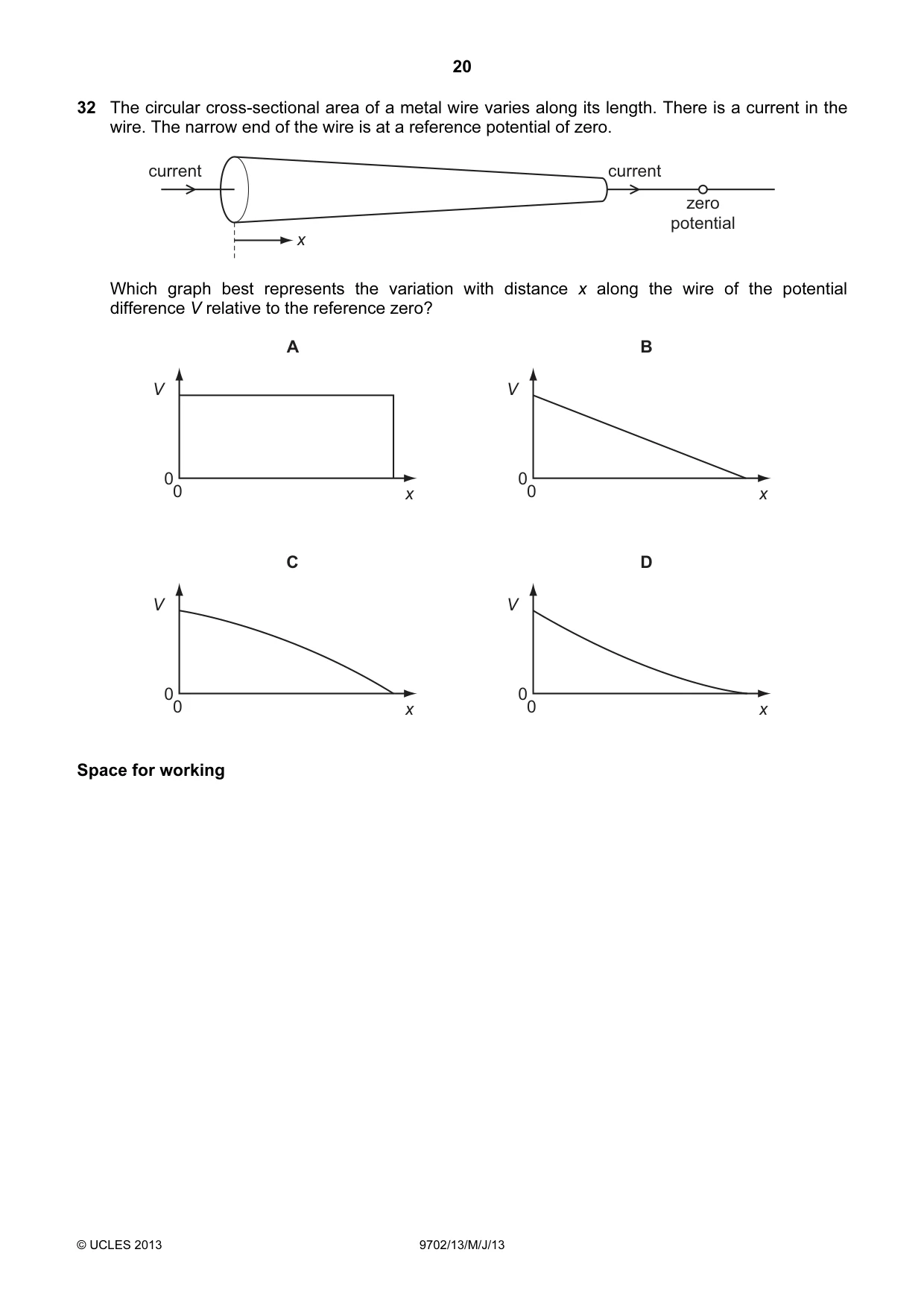
Q32 · The circular cross-sectional area of a metal wire varies along its length
32 The circular cross-sectional area of a metal wire varies along its length. There is a current in the wire. The narrow end of the wire is at a reference potential of zero. current current zero potential x Which graph best represents the variation with distance x along the wire of the potential difference V relative to the reference zero? A B V V 00 00 x x C D V V 00 00 x x Space for working
Mark scheme: C
Q33 · The graph shows how current I varies with voltage V for a filament lamp
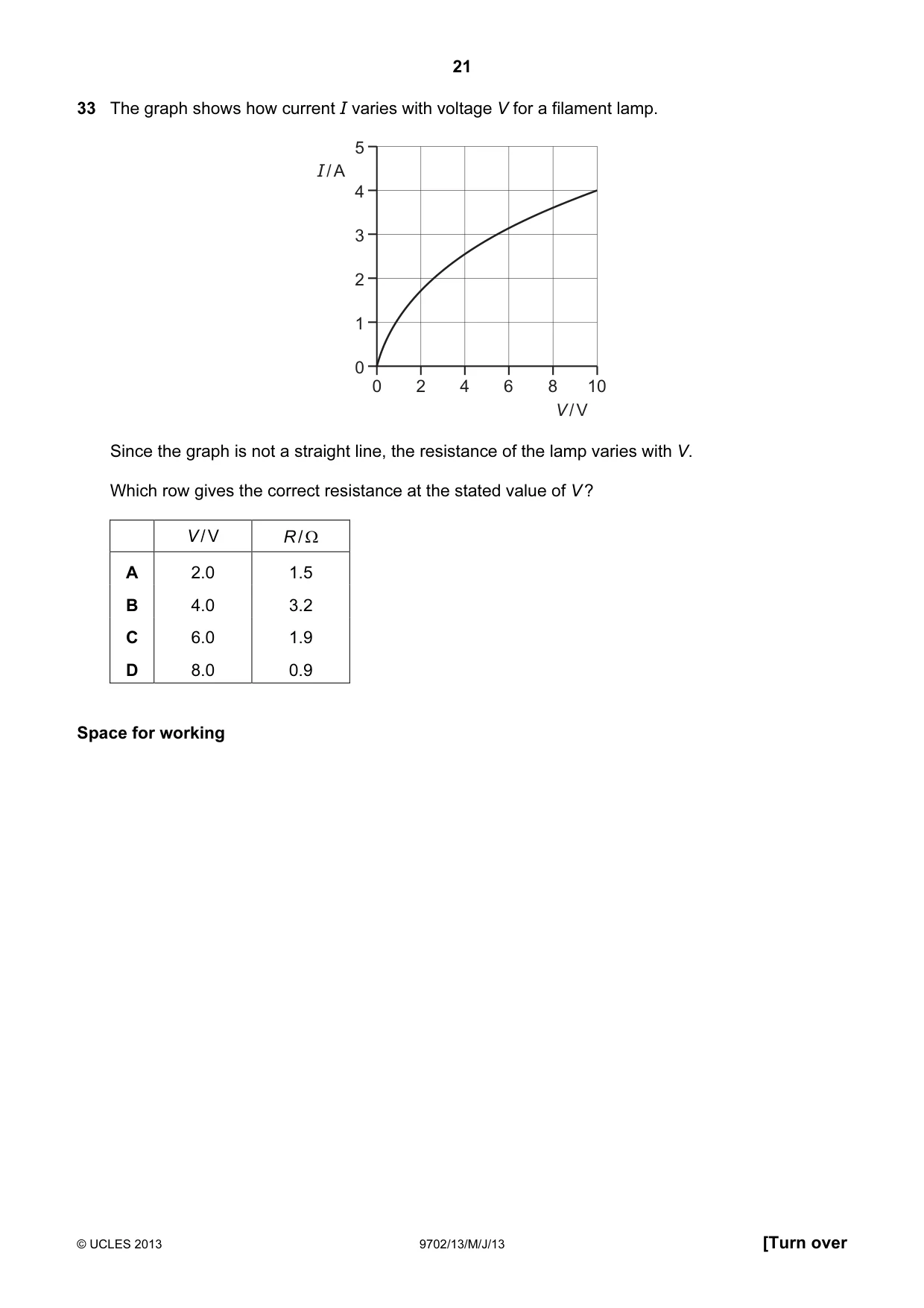
33 The graph shows how current I varies with voltage V for a filament lamp. 5 I / A 4 3 2 1 0 0 2 4 6 8 10 V / V Since the graph is not a straight line, the resistance of the lamp varies with V. Which row gives the correct resistance at the stated value of V ? V / V R / Ω A 2.0 1.5 B 4.0 3.2 C 6.0 1.9 D 8.0 0.9 Space for working
Mark scheme: C
Q34 · An electric power cable consists of six copper wires c surrounding a steel core s
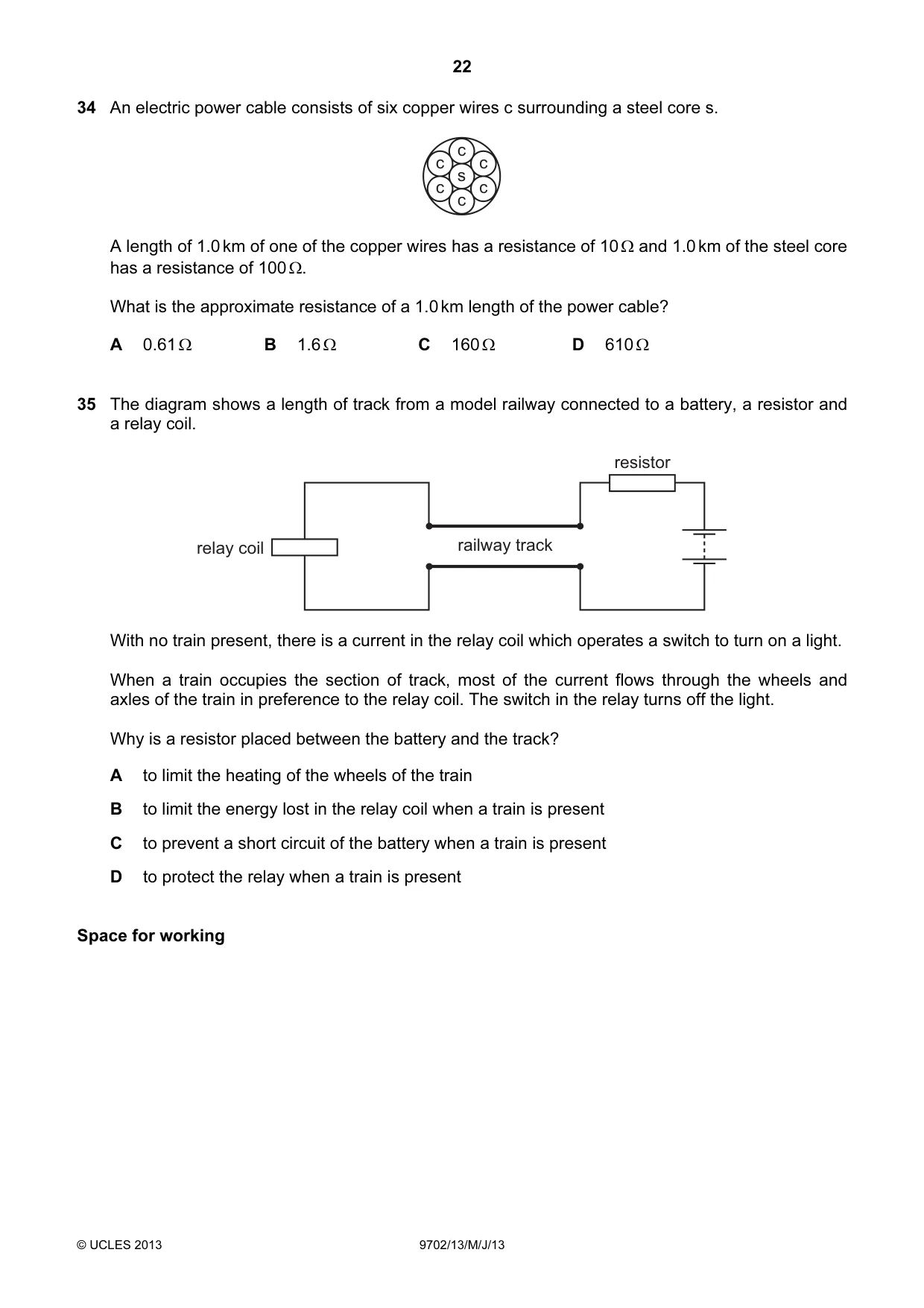
34 An electric power cable consists of six copper wires c surrounding a steel core s. c c c s c c c A length of 1.0 km of one of the copper wires has a resistance of 10 Ω and 1.0 km of the steel core has a resistance of 100 Ω. What is the approximate resistance of a 1.0 km length of the power cable? A 0.61 Ω B 1.6 Ω C 160 Ω D 610 Ω
Mark scheme: B
Q35 · The diagram shows a length of track from a model railway connected to a battery, a…
35 The diagram shows a length of track from a model railway connected to a battery, a resistor and a relay coil. resistor relay coil railway track With no train present, there is a current in the relay coil which operates a switch to turn on a light. When a train occupies the section of track, most of the current flows through the wheels and axles of the train in preference to the relay coil. The switch in the relay turns off the light. Why is a resistor placed between the battery and the track? A to limit the heating of the wheels of the train B to limit the energy lost in the relay coil when a train is present C to prevent a short circuit of the battery when a train is present D to protect the relay when a train is present Space for working
Mark scheme: C
Q36 · A 12 V battery is in series with an ammeter, a 2 Ω fixed resistor and a 0 – 10 Ω variable…
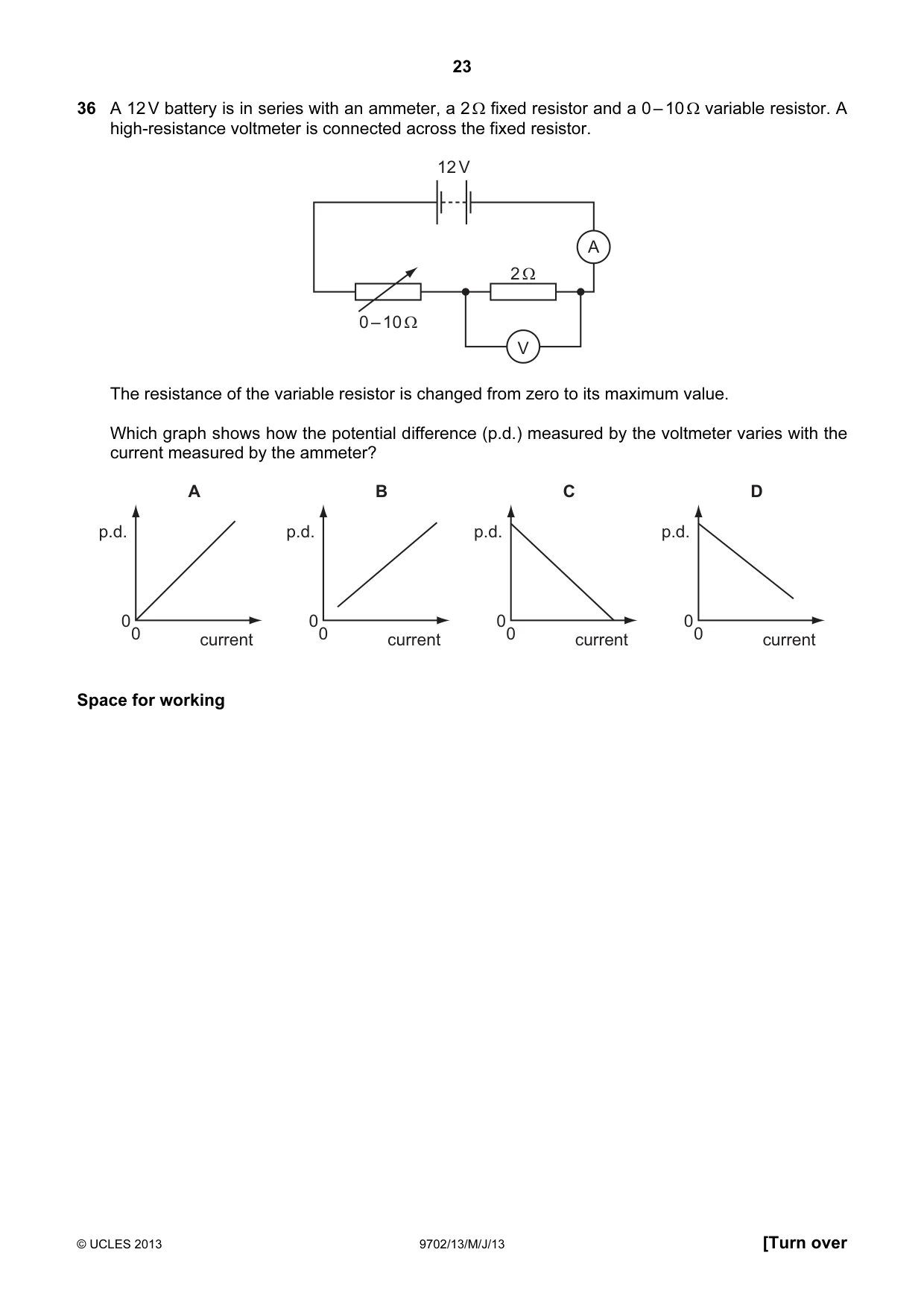
36 A 12 V battery is in series with an ammeter, a 2 Ω fixed resistor and a 0 – 10 Ω variable resistor. A high-resistance voltmeter is connected across the fixed resistor. 12 V A 2 Ω 0 – 10 Ω V The resistance of the variable resistor is changed from zero to its maximum value. Which graph shows how the potential difference (p.d.) measured by the voltmeter varies with the current measured by the ammeter? A B C D p.d. p.d. p.d. p.d. 00 00 00 00 current current current current Space for working
Mark scheme: B
Q37 · In the circuit shown, the battery and ammeter each have negligible resistance
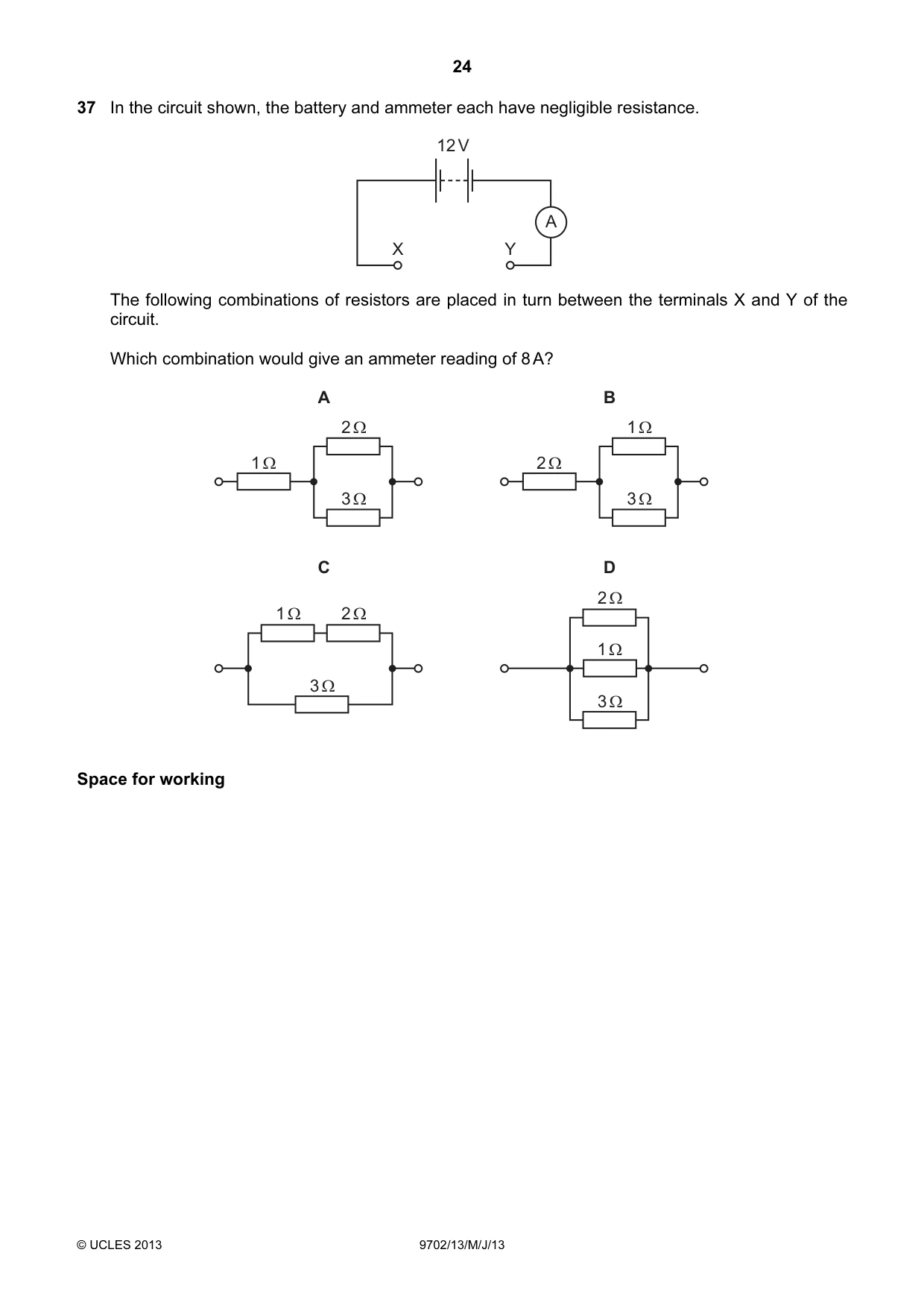
37 In the circuit shown, the battery and ammeter each have negligible resistance. 12 V A X Y The following combinations of resistors are placed in turn between the terminals X and Y of the circuit. Which combination would give an ammeter reading of 8 A? A B 2 Ω 1 Ω 1 Ω 2 Ω 3 Ω 3 Ω C D 2 Ω 1 Ω 2 Ω 1 Ω 3 Ω 3 Ω Space for working
Mark scheme: C
Q38 · Scientists investigating the count rate from a radioactive source observed that the count…
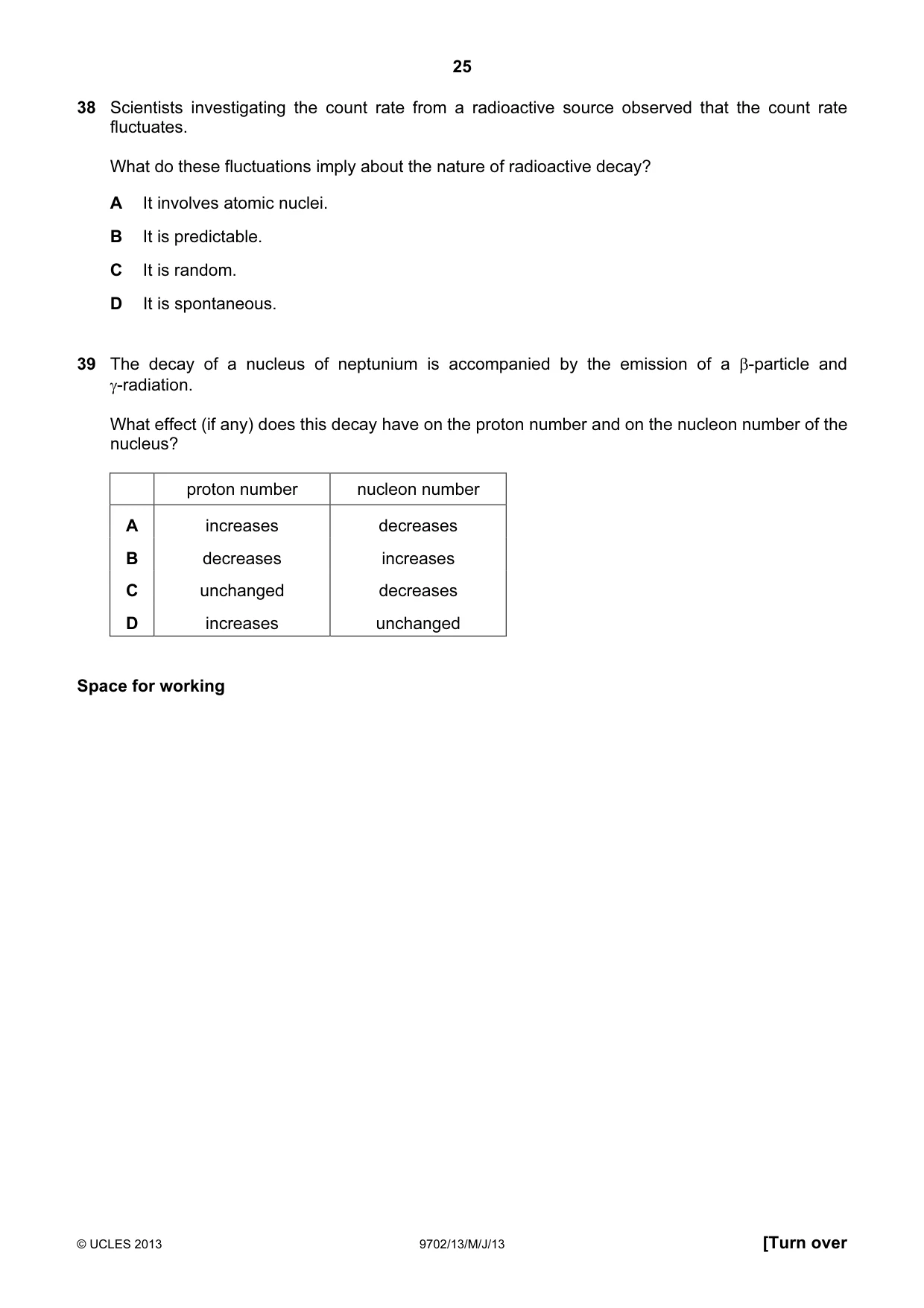
38 Scientists investigating the count rate from a radioactive source observed that the count rate fluctuates. What do these fluctuations imply about the nature of radioactive decay? A It involves atomic nuclei. B It is predictable. C It is random. D It is spontaneous.
Mark scheme: C
Q39 · The decay of a nucleus of neptunium is accompanied by the emission of a β-particle and…
39 The decay of a nucleus of neptunium is accompanied by the emission of a β-particle and γ-radiation. What effect (if any) does this decay have on the proton number and on the nucleon number of the nucleus? proton number nucleon number A increases decreases B decreases increases C unchanged decreases D increases unchanged Space for working
Mark scheme: D
Q40 · A radioactive nucleus is formed by β-decay
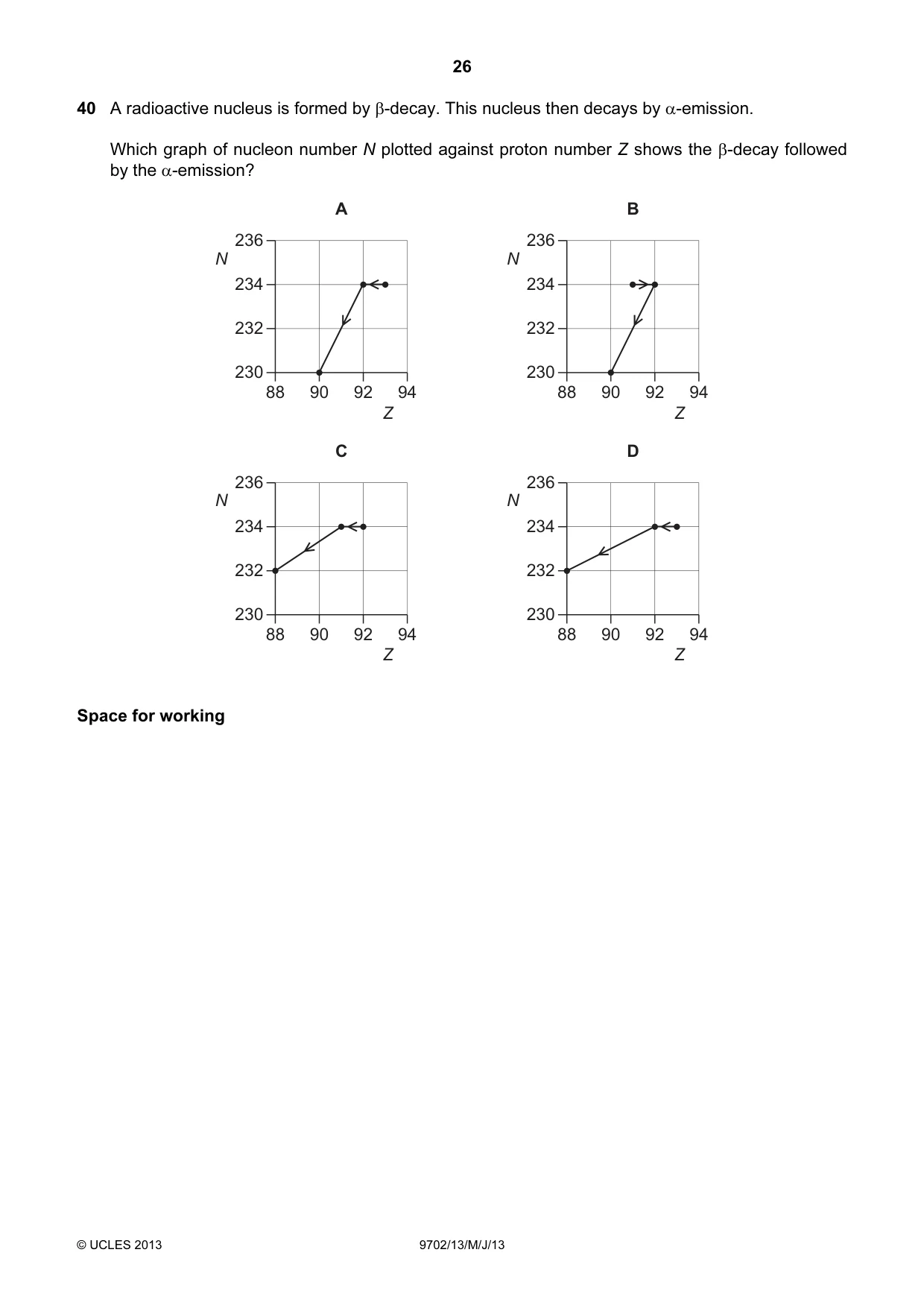
40 A radioactive nucleus is formed by β-decay. This nucleus then decays by α-emission. Which graph of nucleon number N plotted against proton number Z shows the β-decay followed by the α-emission? A B 236 236 N N 234 234 232 232 230 230 88 90 92 94 88 90 92 94 Z Z C D 236 236 N N 234 234 232 232 230 230 88 90 92 94 88 90 92 94 Z Z Space for working
Mark scheme: B
What was in this paper
The subtopics covered by these 40 questions, and how many questions each got. Open one in a new tab to see every Cambridge question on it.
3Electromagnetic spectrum3Resistance and resistivity3Uniform electric fields3Atoms, nuclei and radiation2Energy conservation2Equations of motion2Errors and uncertainties2Linear momentum and its conservation2Practical circuits2Scalars and vectors2Density and pressure1Equilibrium of forces1Kinetic theory of gases1Kirchhoff’s laws1Momentum and Newton’s laws of motion1Physical quantities1Polarisation1Potential dividers1Progressive waves1Radioactive decay1SI units1Stationary waves1Stress and strain1The diffraction grating1What you needed in this session
Cambridge’s own grade thresholds for 2013 May/June, Paper 1 · Variant 3. A higher threshold means an easier paper — the bar moves with how the cohort did.