Cambridge A Level Physics 9702 — 2018 May/June Paper 1 · Variant 3
9702/13/M/J/18 · 40 questions · 40 marks · ≈45 min
The question paper and its mark scheme, free to read here and free to download. This is Cambridge’s own paper, exactly as it was sat.
Question paper20 pages
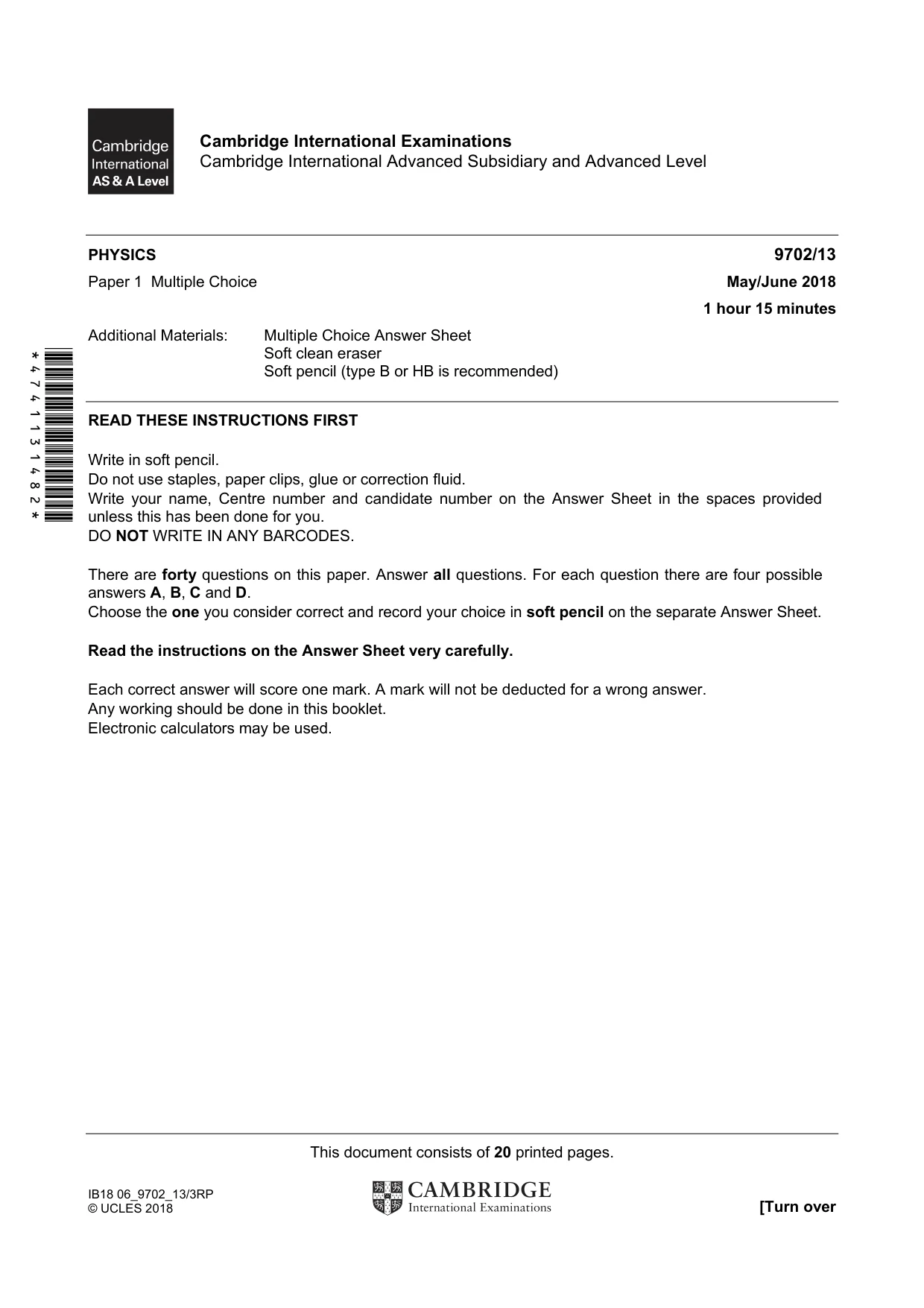
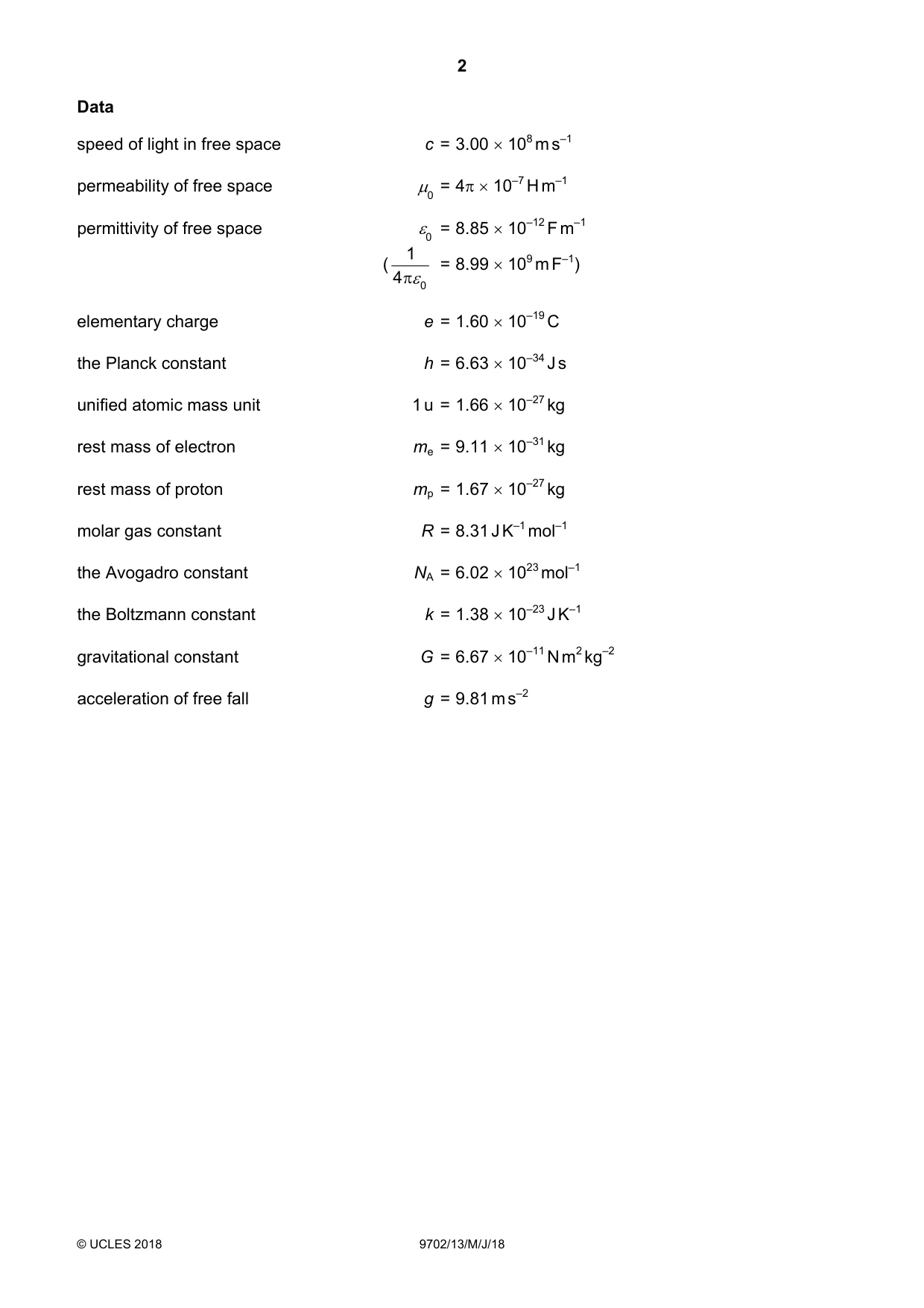
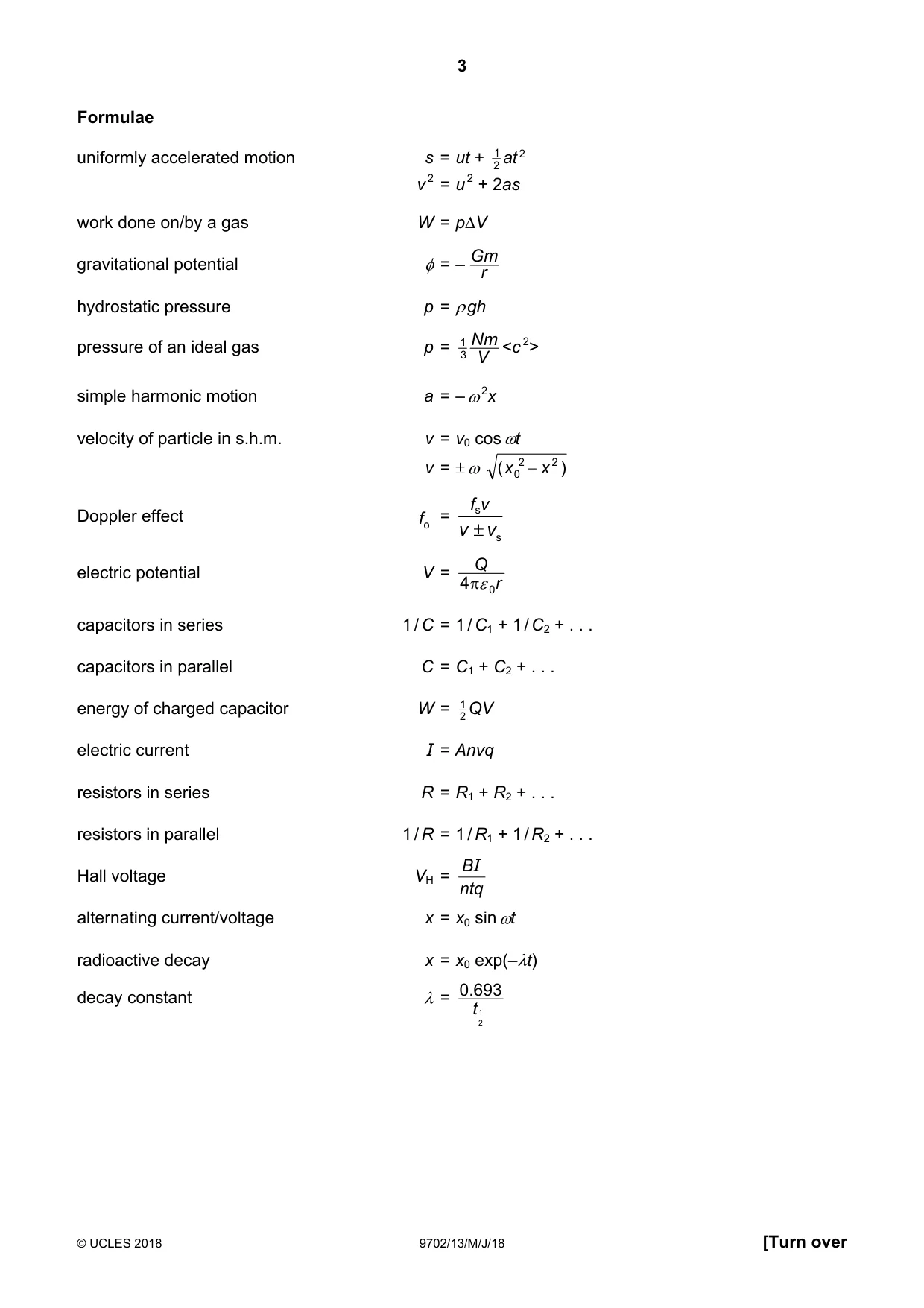
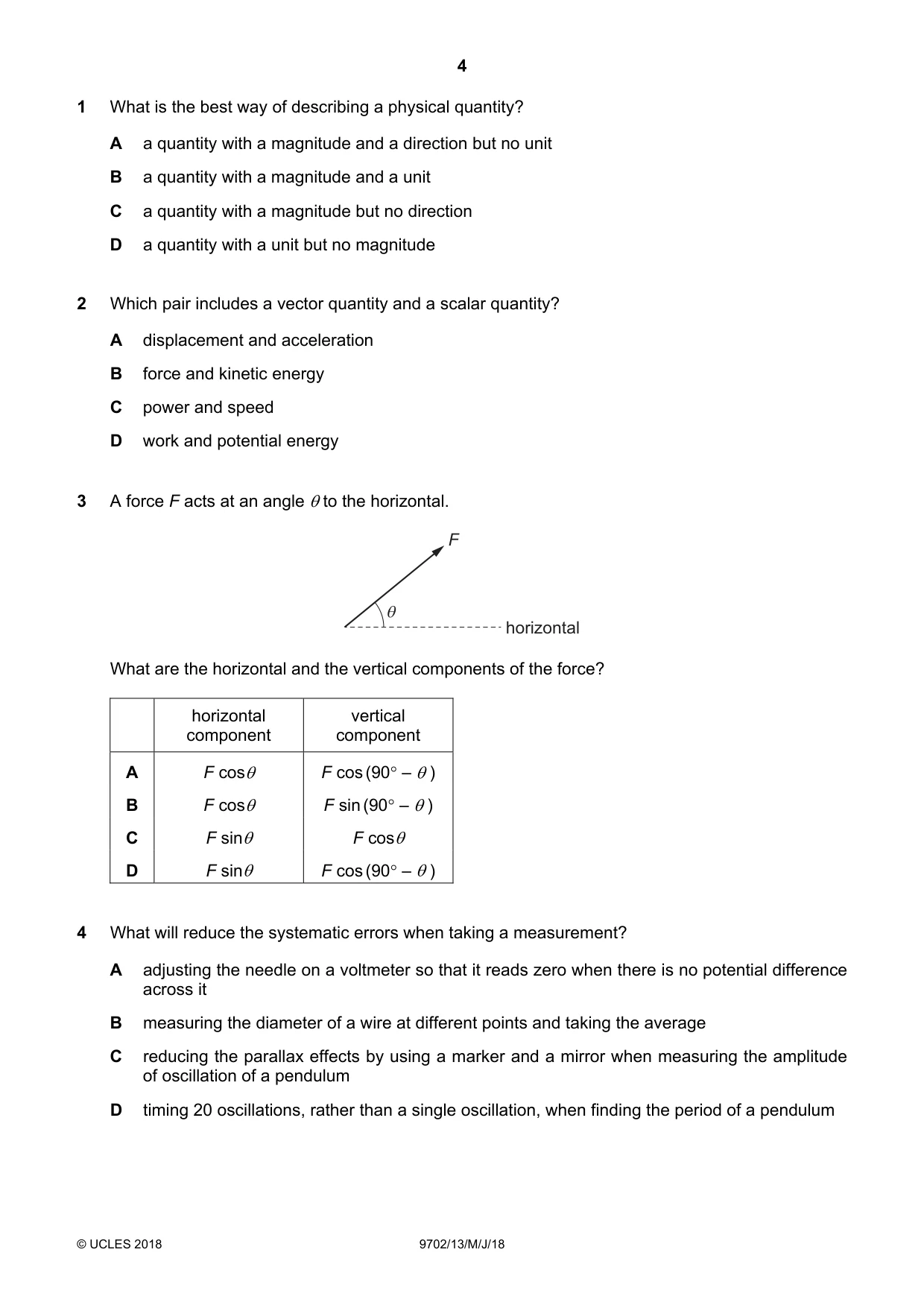
Mark scheme3 pages
Answers below. Sit the paper first if you are practising.
Questions as text
Q1 · What is the best way of describing a physical quantity?
1 What is the best way of describing a physical quantity? A a quantity with a magnitude and a direction but no unit B a quantity with a magnitude and a unit C a quantity with a magnitude but no direction D a quantity with a unit but no magnitude
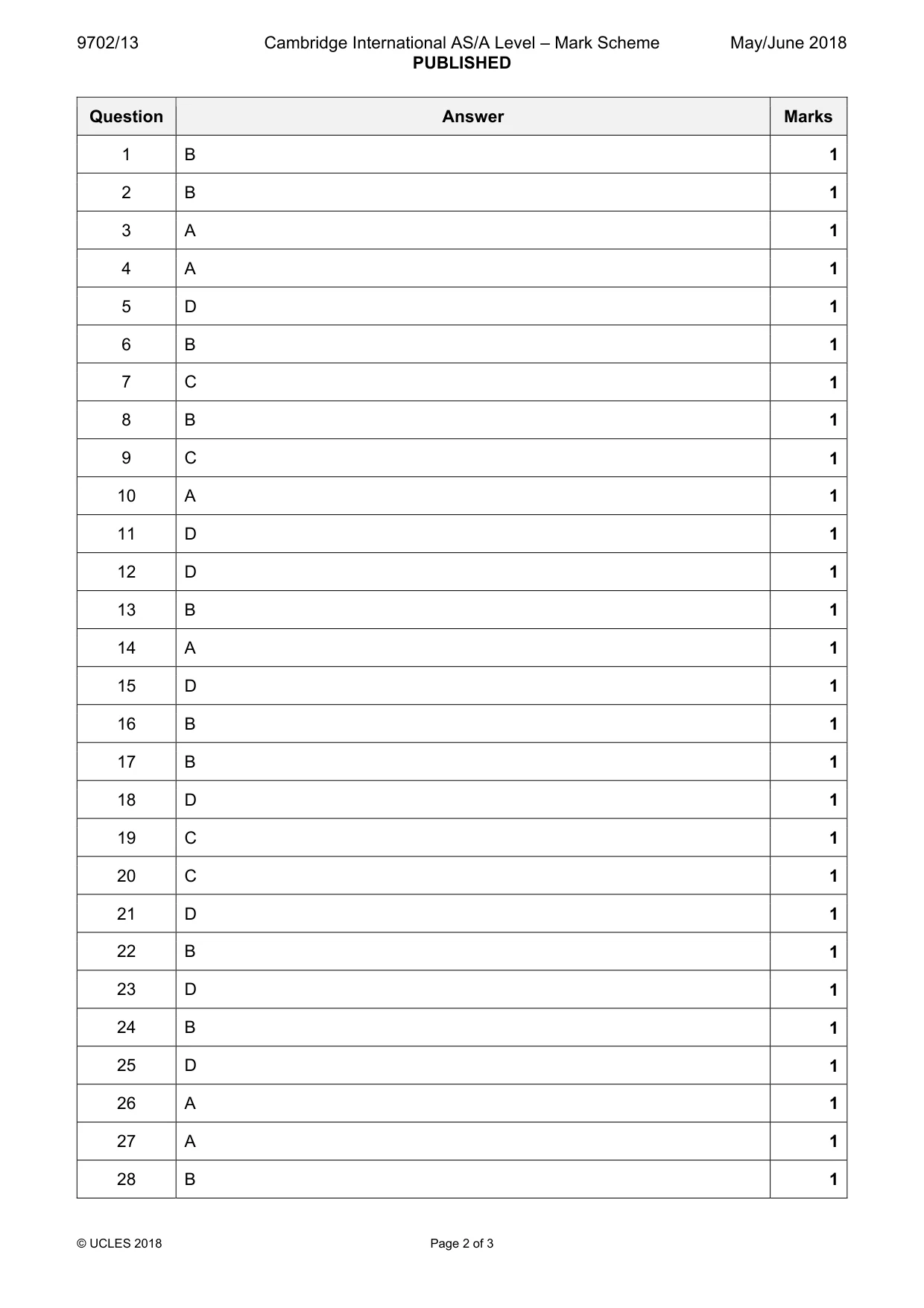
Mark scheme: B
Q2 · Which pair includes a vector quantity and a scalar quantity?
2 Which pair includes a vector quantity and a scalar quantity? A displacement and acceleration B force and kinetic energy C power and speed D work and potential energy
Mark scheme: B
Q3 · A force F acts at an angle θ to the horizontal
3 A force F acts at an angle θ to the horizontal. F θ horizontal What are the horizontal and the vertical components of the force? horizontal vertical component component A F cosθ F cos (90° – θ ) B F cosθ F sin (90° – θ ) C F sinθ F cosθ D F sinθ F cos (90° – θ )
Mark scheme: A
Q4 · What will reduce the systematic errors when taking a measurement?
4 What will reduce the systematic errors when taking a measurement? A adjusting the needle on a voltmeter so that it reads zero when there is no potential difference across it B measuring the diameter of a wire at different points and taking the average C reducing the parallax effects by using a marker and a mirror when measuring the amplitude of oscillation of a pendulum D timing 20 oscillations, rather than a single oscillation, when finding the period of a pendulum
Mark scheme: A
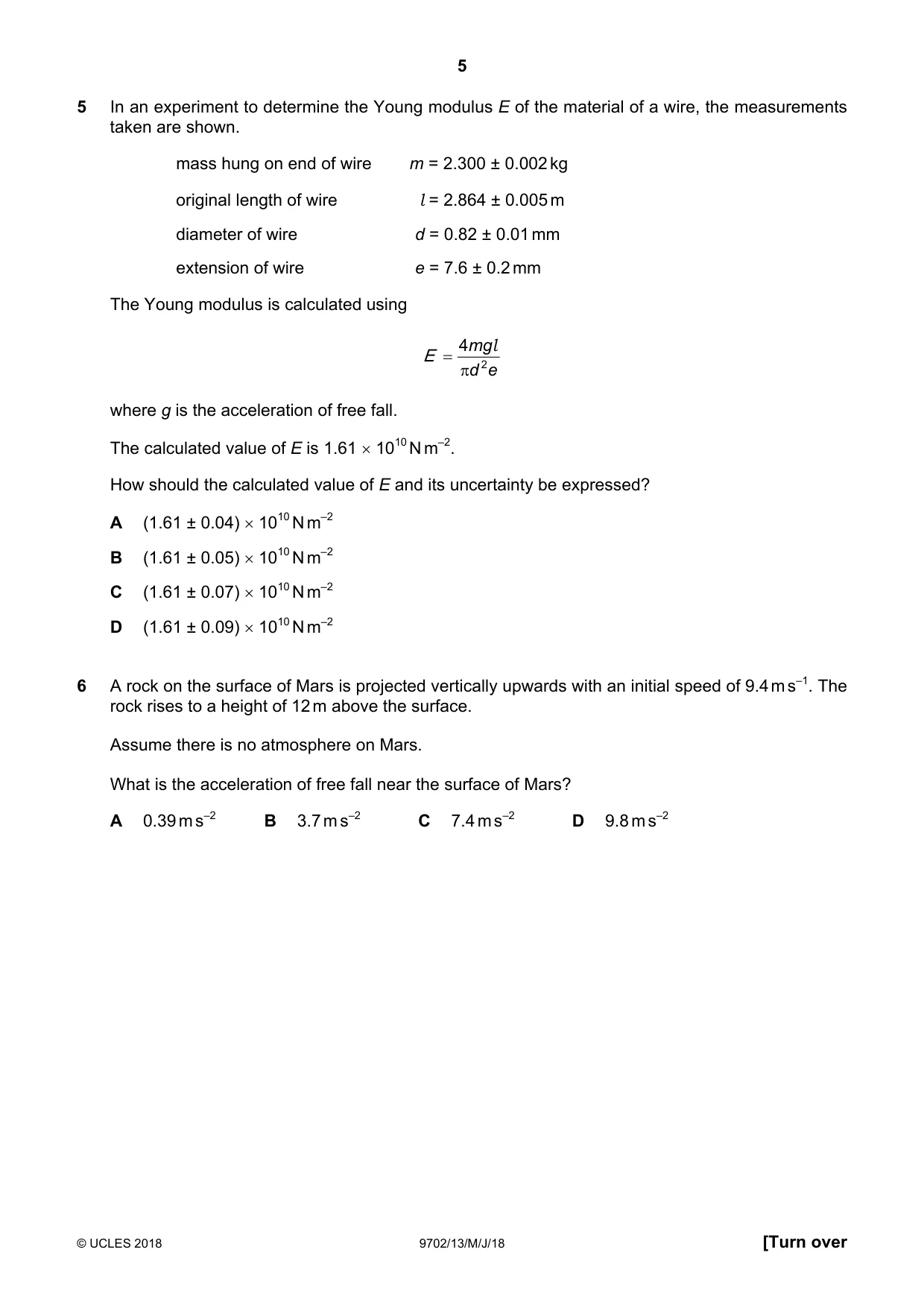
Q5 · In an experiment to determine the Young modulus E of the material of a wire, the…
5 In an experiment to determine the Young modulus E of the material of a wire, the measurements taken are shown. mass hung on end of wire m = 2.300 ± 0.002 kg original length of wire l = 2.864 ± 0.005 m diameter of wire d = 0.82 ± 0.01 mm extension of wire e = 7.6 ± 0.2 mm The Young modulus is calculated using 4 mg l = E π d 2 e where g is the acceleration of free fall. The calculated value of E is 1.61 × 10¹⁰ N m–2. How should the calculated value of E and its uncertainty be expressed? A (1.61 ± 0.04) × 1010 N m–2 B (1.61 ± 0.05) × 1010 N m–2 C (1.61 ± 0.07) × 1010 N m–2 D (1.61 ± 0.09) × 1010 N m–2
Mark scheme: D
Q6 · A rock on the surface of Mars is projected vertically upwards with an initial speed of…
6 A rock on the surface of Mars is projected vertically upwards with an initial speed of 9.4 m s–1. The rock rises to a height of 12 m above the surface. Assume there is no atmosphere on Mars. What is the acceleration of free fall near the surface of Mars? A 0.39 m s–2 B 3.7 m s–2 C 7.4 m s–2 D 9.8 m s–2
Mark scheme: B
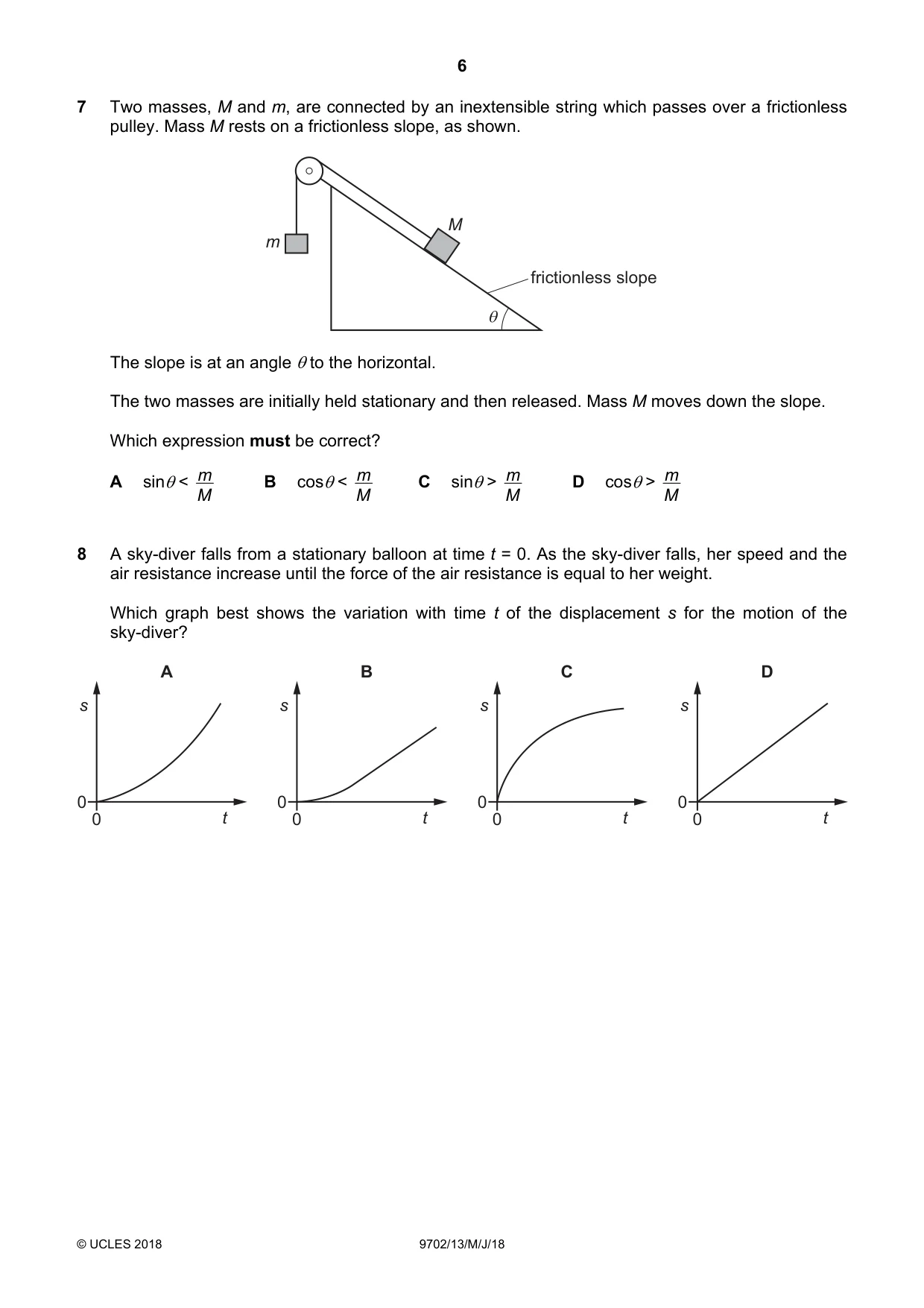
Q7 · Two masses, M and m, are connected by an inextensible string which passes over a…
7 Two masses, M and m, are connected by an inextensible string which passes over a frictionless pulley. Mass M rests on a frictionless slope, as shown. M m frictionless slope θ The slope is at an angle θ to the horizontal. The two masses are initially held stationary and then released. Mass M moves down the slope. Which expression must be correct? A sinθ < M m B cosθ < M m C sinθ > M m D cosθ > M m
Mark scheme: C
Q8 · A sky-diver falls from a stationary balloon at time t = 0
8 A sky-diver falls from a stationary balloon at time t = 0. As the sky-diver falls, her speed and the air resistance increase until the force of the air resistance is equal to her weight. Which graph best shows the variation with time t of the displacement s for the motion of the sky-diver? A B C D s s s s 0 0 0 0 0 t 0 t 0 t 0 t
Mark scheme: B
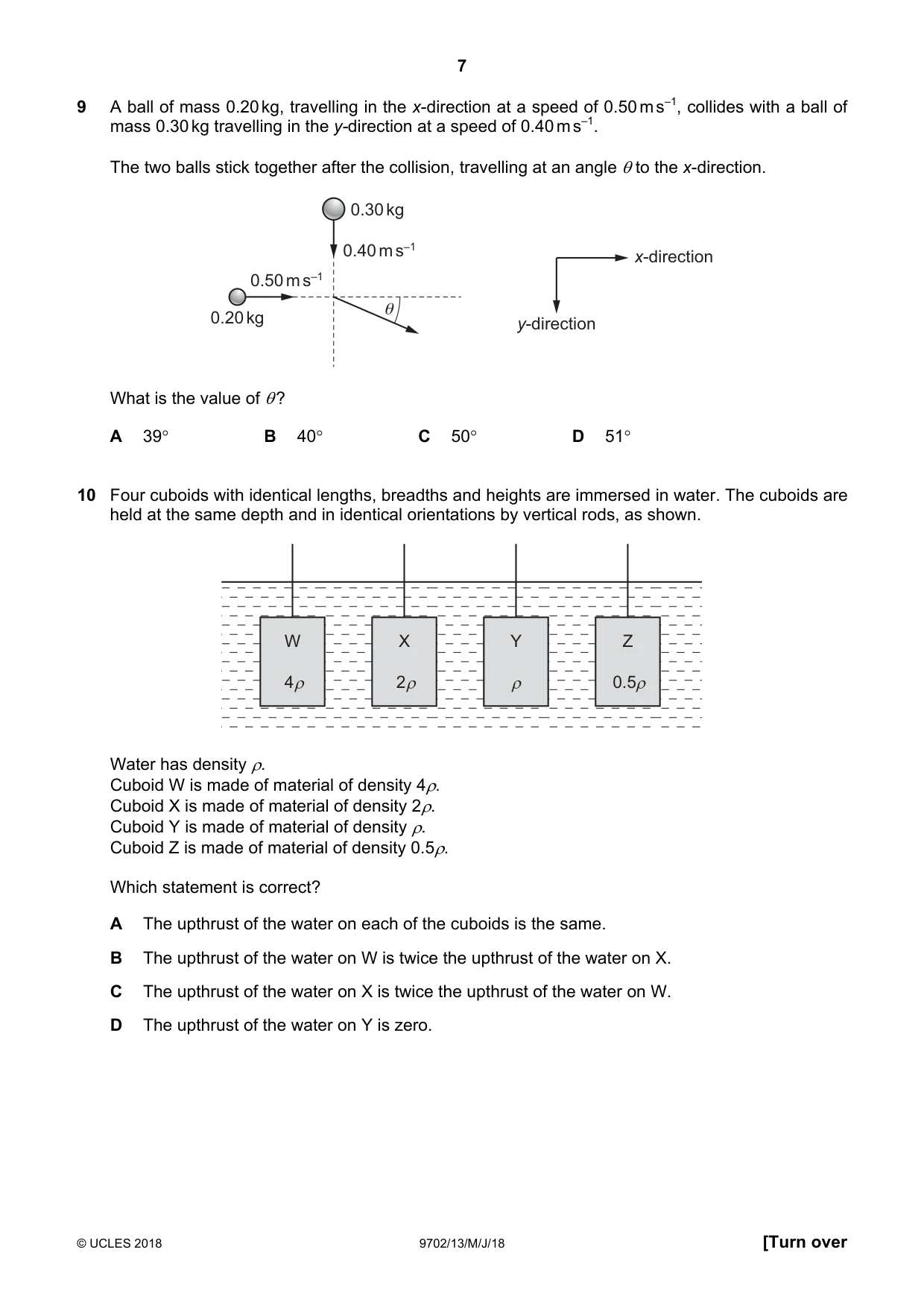
Q9 · A ball of mass 0.20 kg, travelling in the x-direction at a speed of 0.50 m s–1, collides…
9 A ball of mass 0.20 kg, travelling in the x-direction at a speed of 0.50 m s–1, collides with a ball of mass 0.30 kg travelling in the y-direction at a speed of 0.40 m s–1. The two balls stick together after the collision, travelling at an angle θ to the x-direction. 0.30 kg 0.40 m s–1 x-direction 0.50 m s–1 θ 0.20 kg y-direction What is the value of θ ? A 39° B 40° C 50° D 51°
Mark scheme: C
Q10 · Four cuboids with identical lengths, breadths and heights are immersed in water
10 Four cuboids with identical lengths, breadths and heights are immersed in water. The cuboids are held at the same depth and in identical orientations by vertical rods, as shown. W X Y Z 4 ρ 2 ρ ρ 0.5 ρ Water has density ρ. Cuboid W is made of material of density 4ρ. Cuboid X is made of material of density 2ρ. Cuboid Y is made of material of density ρ. Cuboid Z is made of material of density 0.5ρ. Which statement is correct? A The upthrust of the water on each of the cuboids is the same. B The upthrust of the water on W is twice the upthrust of the water on X. C The upthrust of the water on X is twice the upthrust of the water on W. D The upthrust of the water on Y is zero.
Mark scheme: A
Q11 · A rectangular block of lead of density 1.13 × 10⁴ kg m–3 has sides of length 12.0 cm…
11 A rectangular block of lead of density 1.13 × 10⁴ kg m–3 has sides of length 12.0 cm, 15.0 cm and 10.0 cm. What is the maximum pressure the block can exert when resting on a table? A 1.13 kPa B 1.70 kPa C 11.1 kPa D 16.6 kPa
Mark scheme: D
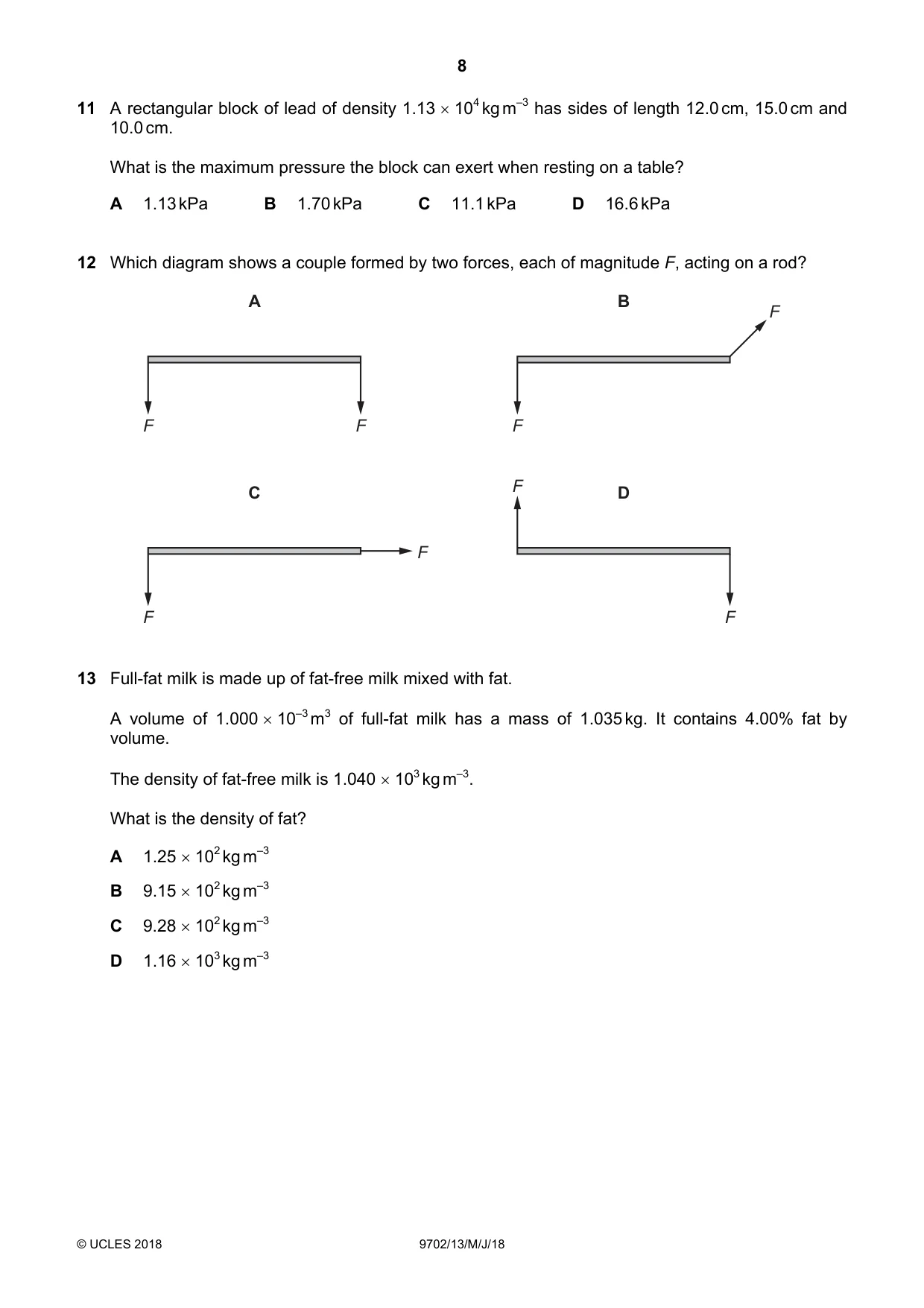
Q12 · Which diagram shows a couple formed by two forces, each of magnitude F, acting on a rod?
12 Which diagram shows a couple formed by two forces, each of magnitude F, acting on a rod? A B F F F F F C D F F F
Mark scheme: D
Q13 · Full-fat milk is made up of fat-free milk mixed with fat
13 Full-fat milk is made up of fat-free milk mixed with fat. A volume of 1.000 × 10⁻³ m3 of full-fat milk has a mass of 1.035 kg. It contains 4.00% fat by volume. The density of fat-free milk is 1.040 × 10³ kg m–3. What is the density of fat? A 1.25 × 10² kg m–3 B 9.15 × 10² kg m–3 C 9.28 × 10² kg m–3 D 1.16 × 10³ kg m–3
Mark scheme: B
Q14 · Gas is trapped inside a cylinder by a piston of cross-sectional area A
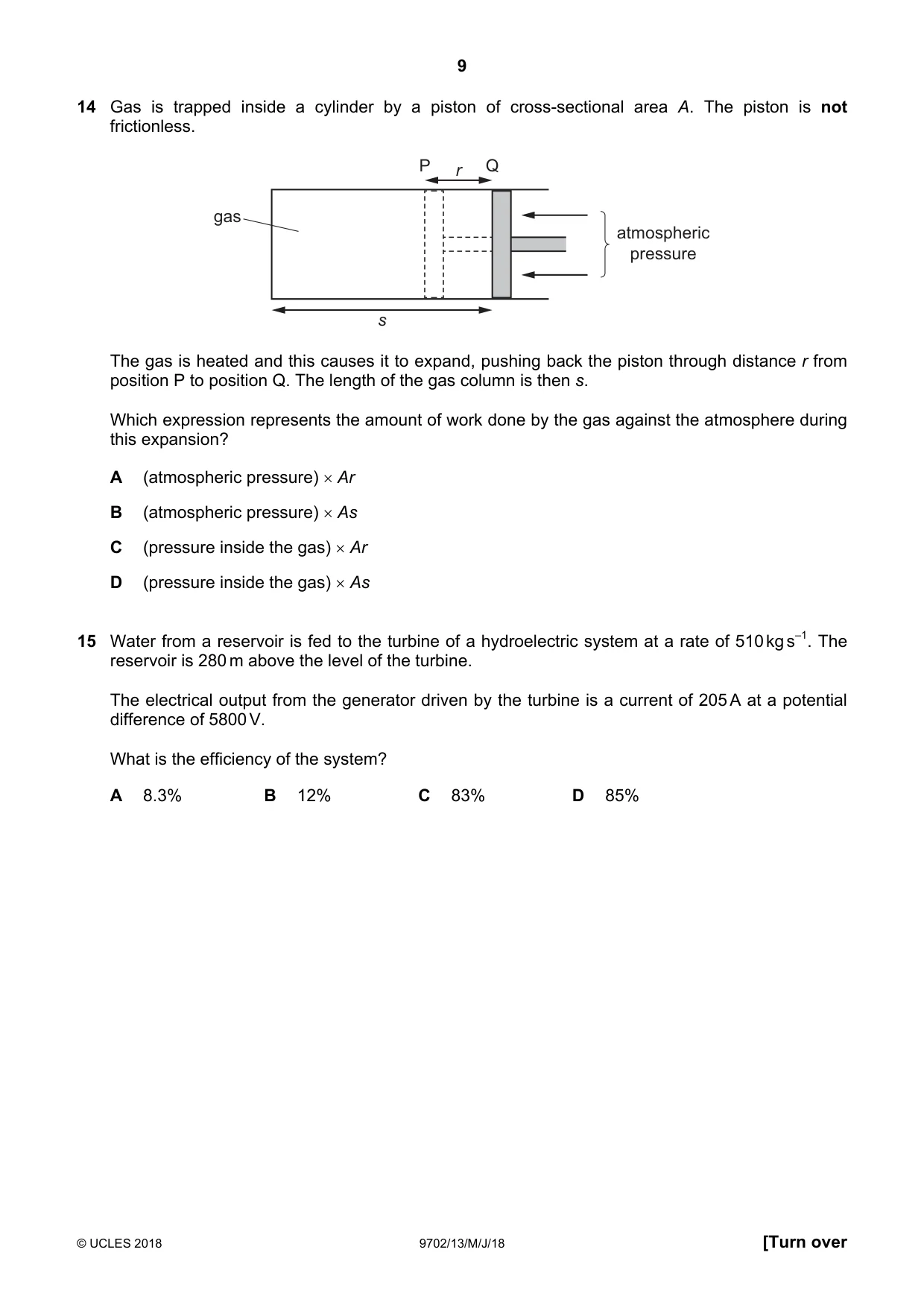
14 Gas is trapped inside a cylinder by a piston of cross-sectional area A. The piston is not frictionless. P r Q gas atmospheric pressure s The gas is heated and this causes it to expand, pushing back the piston through distance r from position P to position Q. The length of the gas column is then s. Which expression represents the amount of work done by the gas against the atmosphere during this expansion? A (atmospheric pressure) × Ar B (atmospheric pressure) × As C (pressure inside the gas) × Ar D (pressure inside the gas) × As
Mark scheme: A
Q15 · Water from a reservoir is fed to the turbine of a hydroelectric system at a rate of 510…
15 Water from a reservoir is fed to the turbine of a hydroelectric system at a rate of 510 kg s–1. The reservoir is 280 m above the level of the turbine. The electrical output from the generator driven by the turbine is a current of 205 A at a potential difference of 5800 V. What is the efficiency of the system? A 8.3% B 12% C 83% D 85%
Mark scheme: D
Q16 · A ball is thrown vertically up into the air
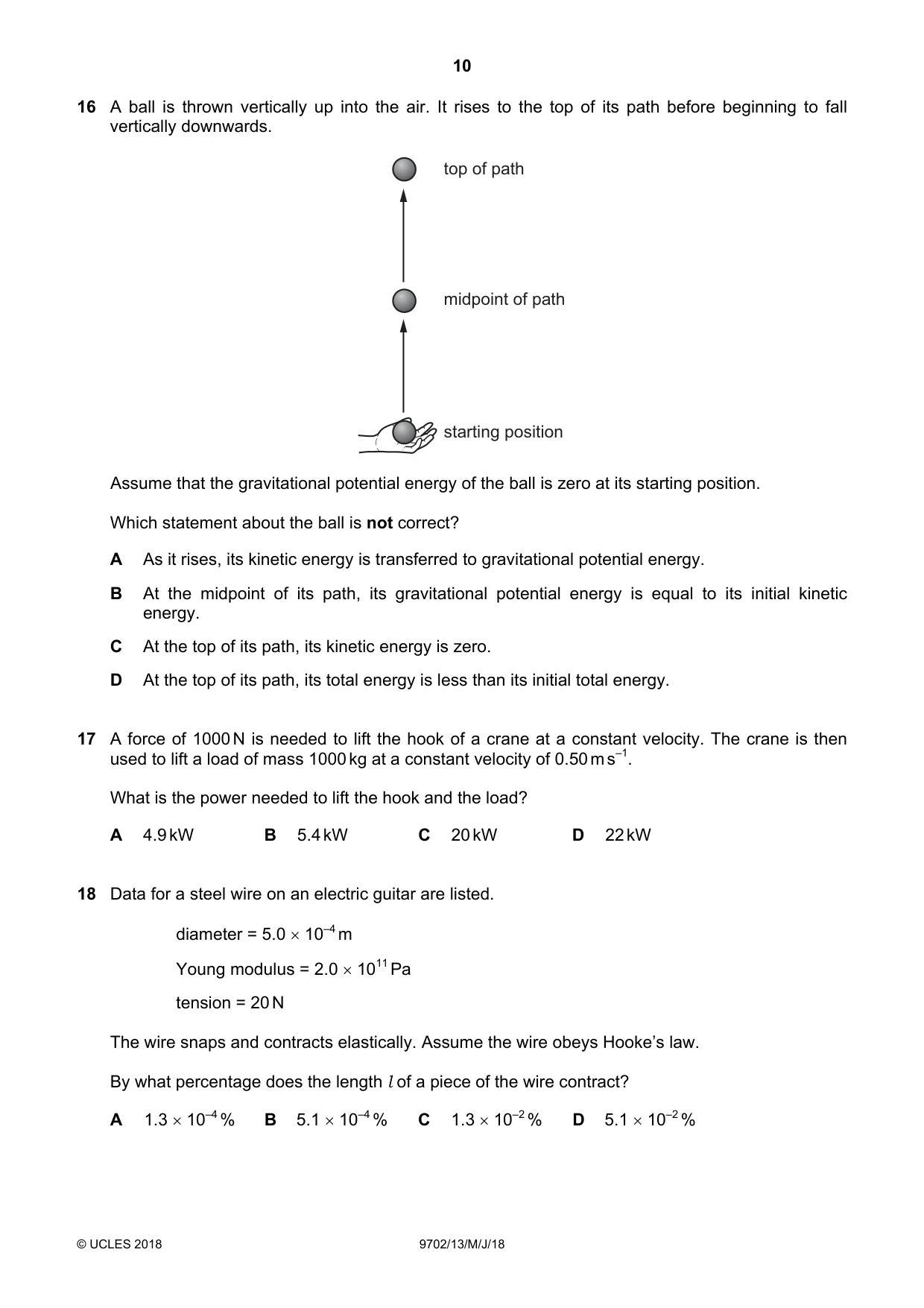
16 A ball is thrown vertically up into the air. It rises to the top of its path before beginning to fall vertically downwards. top of path midpoint of path starting position Assume that the gravitational potential energy of the ball is zero at its starting position. Which statement about the ball is not correct? A As it rises, its kinetic energy is transferred to gravitational potential energy. B At the midpoint of its path, its gravitational potential energy is equal to its initial kinetic energy. C At the top of its path, its kinetic energy is zero. D At the top of its path, its total energy is less than its initial total energy.
Mark scheme: B
More questions on Gravitational potential energy and kinetic energy
Q17 · A force of 1000 N is needed to lift the hook of a crane at a constant velocity
17 A force of 1000 N is needed to lift the hook of a crane at a constant velocity. The crane is then used to lift a load of mass 1000 kg at a constant velocity of 0.50 m s–1. What is the power needed to lift the hook and the load? A 4.9 kW B 5.4 kW C 20 kW D 22 kW
Mark scheme: B
Q18 · Data for a steel wire on an electric guitar are listed
18 Data for a steel wire on an electric guitar are listed. diameter = 5.0 × 10⁻⁴ m Young modulus = 2.0 × 10¹¹ Pa tension = 20 N The wire snaps and contracts elastically. Assume the wire obeys Hooke’s law. By what percentage does the length l of a piece of the wire contract? A 1.3 × 10⁻⁴ % B 5.1 × 10⁻⁴ % C 1.3 × 10⁻² % D 5.1 × 10⁻² %
Mark scheme: D
Q19 · The graph shows how the extension of a spring varies with the force used to stretch it
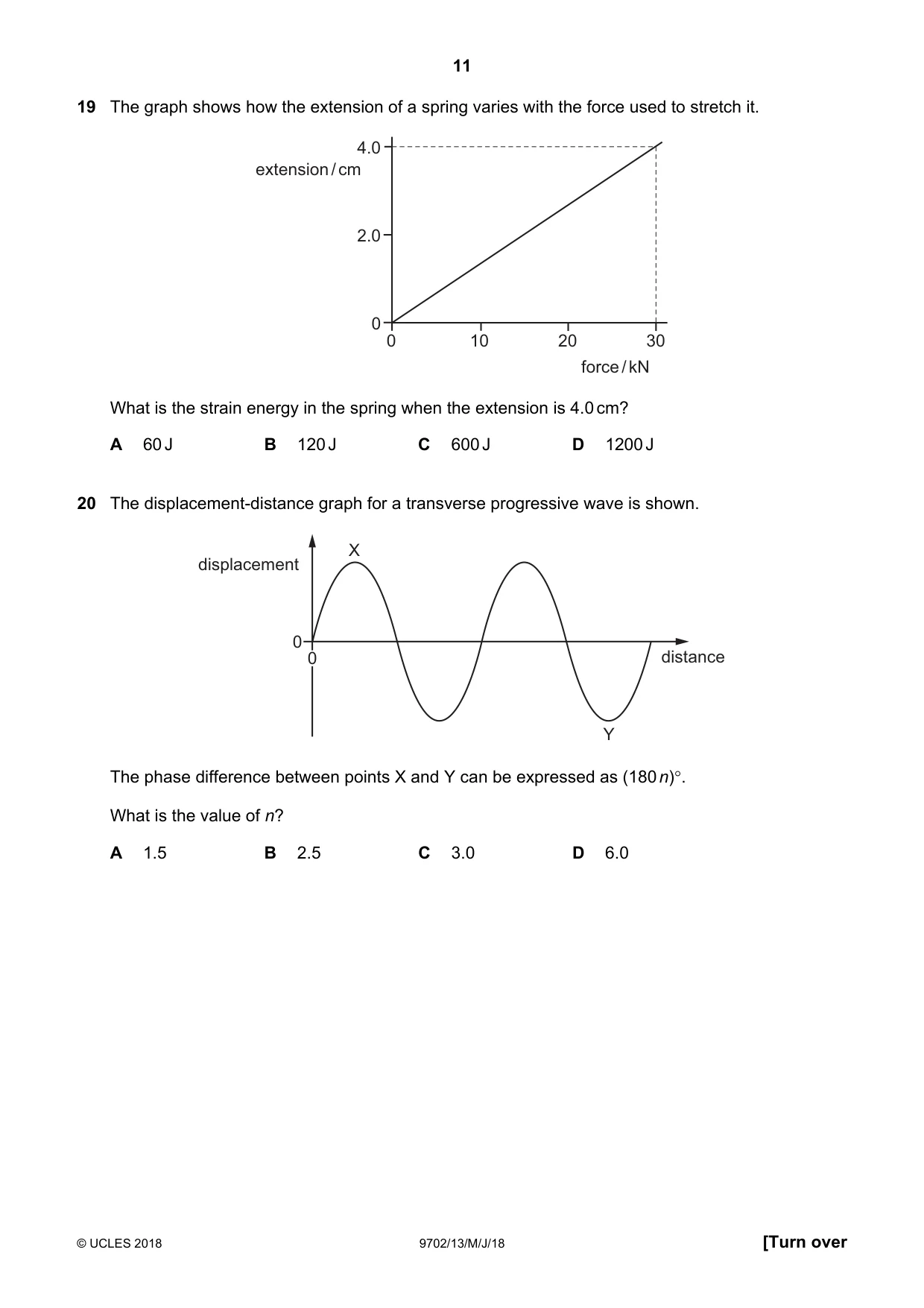
19 The graph shows how the extension of a spring varies with the force used to stretch it. 4.0 extension / cm 2.0 0 0 10 20 30 force / kN What is the strain energy in the spring when the extension is 4.0 cm? A 60 J B 120 J C 600 J D 1200 J
Mark scheme: C
Q20 · The displacement-distance graph for a transverse progressive wave is shown
20 The displacement-distance graph for a transverse progressive wave is shown. X displacement 0 0 distance Y The phase difference between points X and Y can be expressed as (180 n)°. What is the value of n? A 1.5 B 2.5 C 3.0 D 6.0
Mark scheme: C
Q21 · The four graphs represent a progressive wave on a stretched string
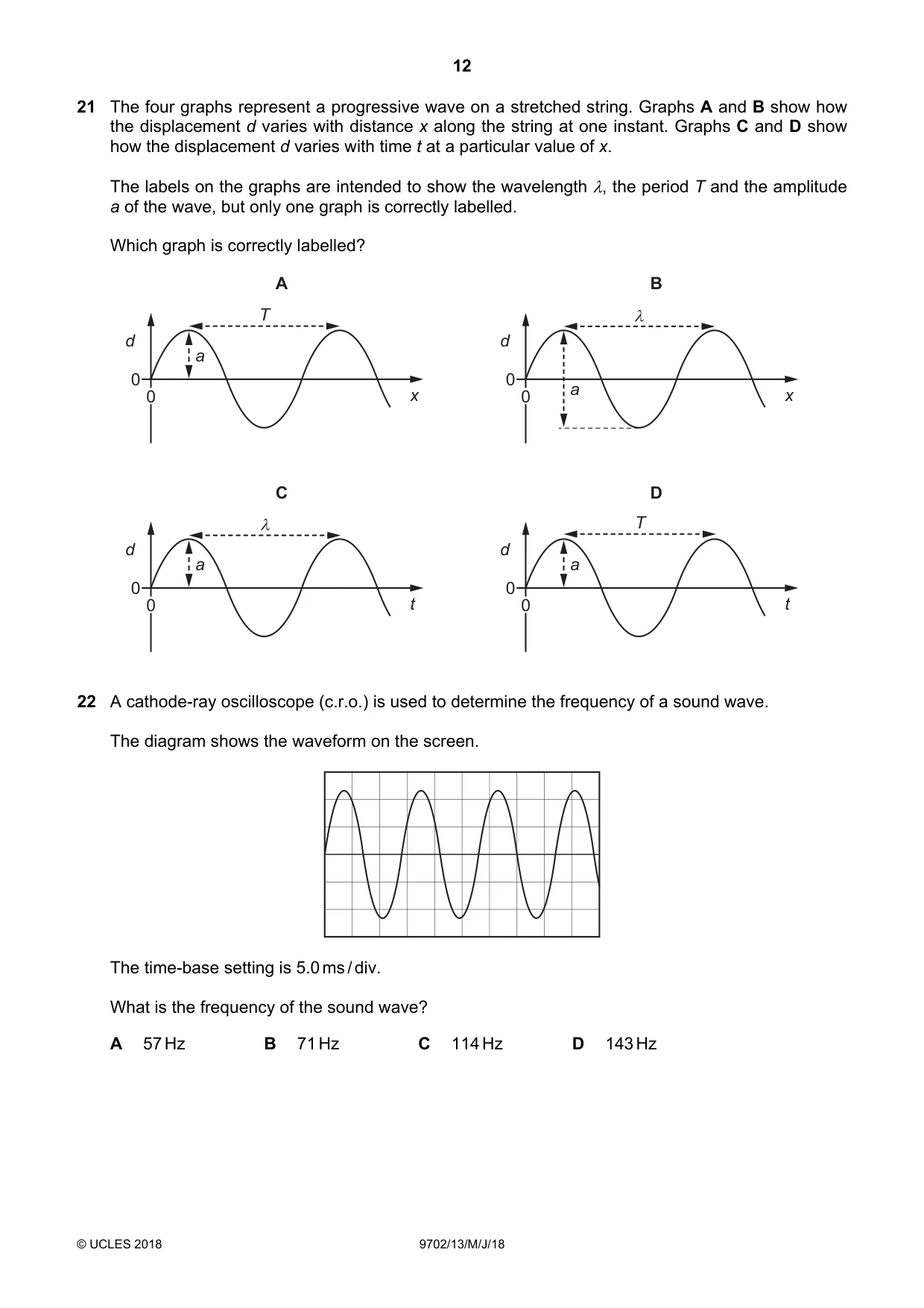
21 The four graphs represent a progressive wave on a stretched string. Graphs A and B show how the displacement d varies with distance x along the string at one instant. Graphs C and D show how the displacement d varies with time t at a particular value of x. The labels on the graphs are intended to show the wavelength λ, the period T and the amplitude a of the wave, but only one graph is correctly labelled. Which graph is correctly labelled? A B T λ d d a 0 0 a 0 x 0 x C D λ T d d a a 0 0 0 t 0 t
Mark scheme: D
Q22 · A cathode-ray oscilloscope (c.r.o.) is used to determine the frequency of a sound wave
22 A cathode-ray oscilloscope (c.r.o.) is used to determine the frequency of a sound wave. The diagram shows the waveform on the screen. The time-base setting is 5.0 ms / div. What is the frequency of the sound wave? A 57 Hz B 71 Hz C 114 Hz D 143 Hz
Mark scheme: B
Q23 · A police car travels at a velocity of 30.0 m s–1 directly towards a stationary observer
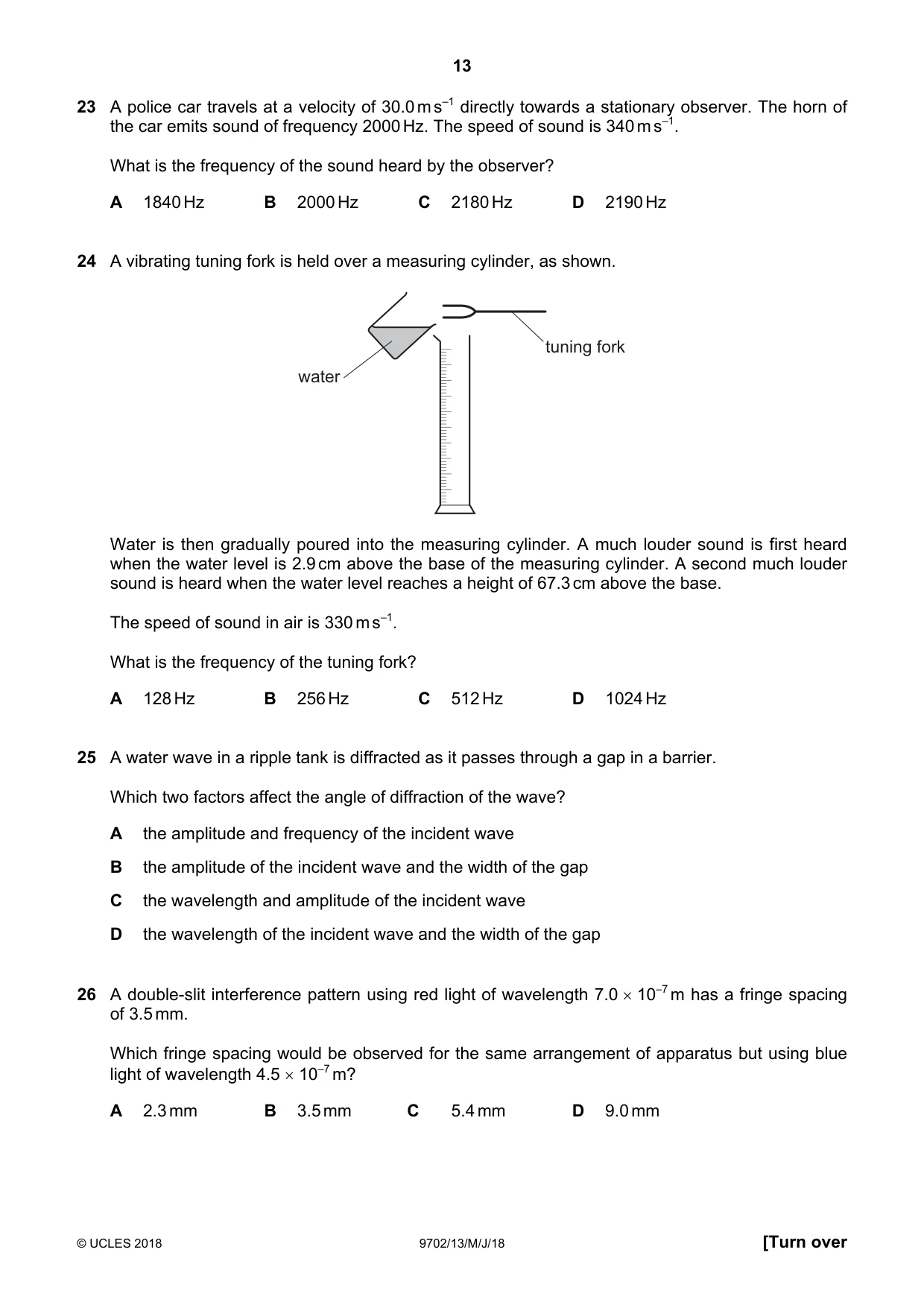
23 A police car travels at a velocity of 30.0 m s–1 directly towards a stationary observer. The horn of the car emits sound of frequency 2000 Hz. The speed of sound is 340 m s–1. What is the frequency of the sound heard by the observer? A 1840 Hz B 2000 Hz C 2180 Hz D 2190 Hz
Mark scheme: D
Q24 · A vibrating tuning fork is held over a measuring cylinder, as shown
24 A vibrating tuning fork is held over a measuring cylinder, as shown. tuning fork water Water is then gradually poured into the measuring cylinder. A much louder sound is first heard when the water level is 2.9 cm above the base of the measuring cylinder. A second much louder sound is heard when the water level reaches a height of 67.3 cm above the base. The speed of sound in air is 330 m s–1. What is the frequency of the tuning fork? A 128 Hz B 256 Hz C 512 Hz D 1024 Hz
Mark scheme: B
Q25 · A water wave in a ripple tank is diffracted as it passes through a gap in a barrier
25 A water wave in a ripple tank is diffracted as it passes through a gap in a barrier. Which two factors affect the angle of diffraction of the wave? A the amplitude and frequency of the incident wave B the amplitude of the incident wave and the width of the gap C the wavelength and amplitude of the incident wave D the wavelength of the incident wave and the width of the gap
Mark scheme: D
Q26 · A double-slit interference pattern using red light of wavelength 7.0 × 10⁻⁷ m has a…
26 A double-slit interference pattern using red light of wavelength 7.0 × 10⁻⁷ m has a fringe spacing of 3.5 mm. Which fringe spacing would be observed for the same arrangement of apparatus but using blue light of wavelength 4.5 × 10⁻⁷ m? A 2.3 mm B 3.5 mm C 5.4 mm D 9.0 mm
Mark scheme: A
Q27 · Two parallel metal plates are situated 20 cm apart in a vacuum
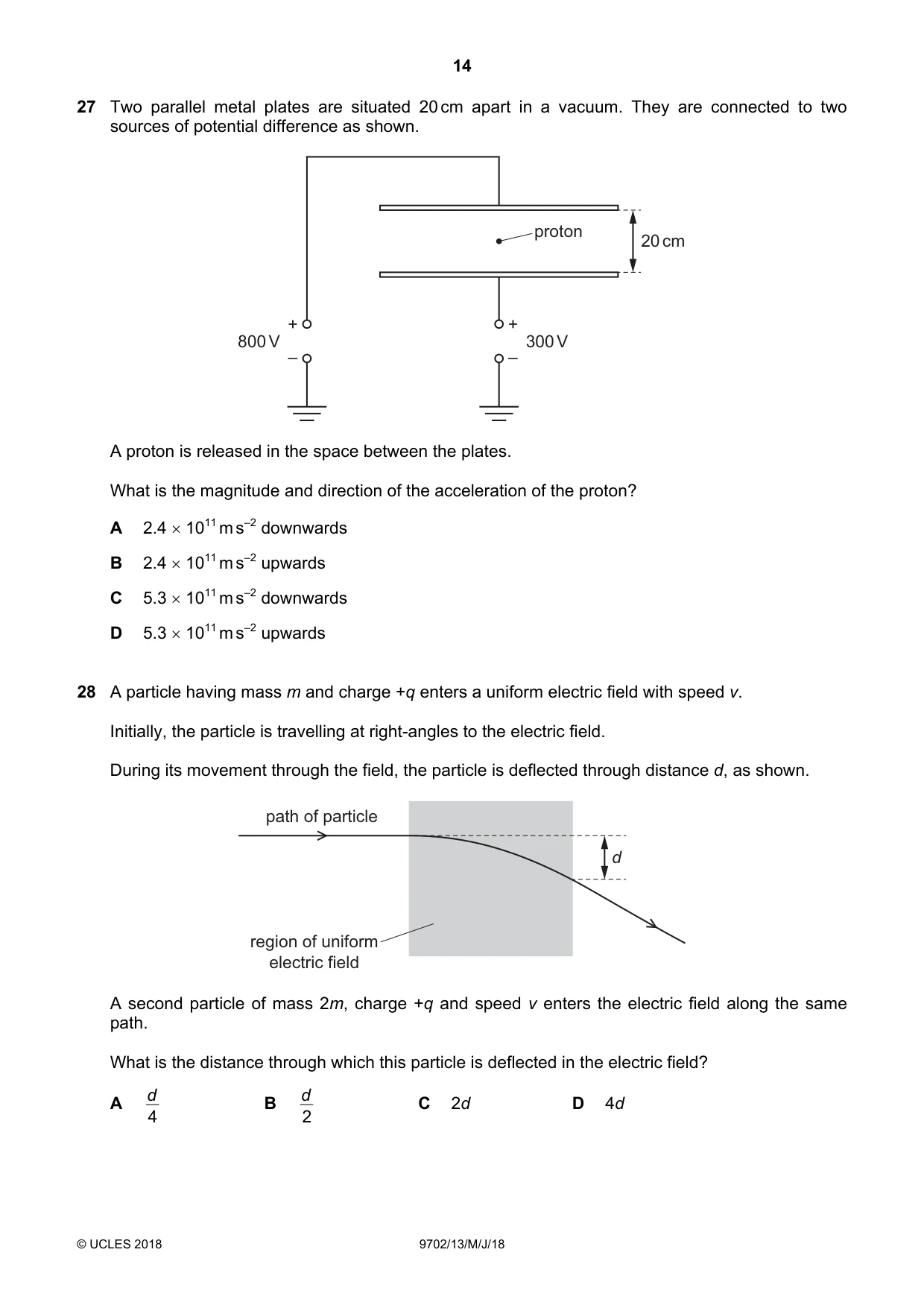
27 Two parallel metal plates are situated 20 cm apart in a vacuum. They are connected to two sources of potential difference as shown. proton 20 cm + + 800 V 300 V – – A proton is released in the space between the plates. What is the magnitude and direction of the acceleration of the proton? A 2.4 × 10¹¹ m s–2 downwards B 2.4 × 10¹¹ m s–2 upwards C 5.3 × 10¹¹ m s–2 downwards D 5.3 × 10¹¹ m s–2 upwards
Mark scheme: A
Q28 · A particle having mass m and charge +q enters a uniform electric field with speed v
28 A particle having mass m and charge +q enters a uniform electric field with speed v. Initially, the particle is travelling at right-angles to the electric field. During its movement through the field, the particle is deflected through distance d, as shown. path of particle d region of uniform electric field A second particle of mass 2m, charge +q and speed v enters the electric field along the same path. What is the distance through which this particle is deflected in the electric field? d d A B C 2d D 4d 4 2
Mark scheme: B
Q29 · What is a possible charge on a particle?
29 What is a possible charge on a particle? A 6.40 × 10⁻²⁰ C B 4.00 × 10⁻¹⁹ C C 1.12 × 10⁻¹⁸ C D 9.11 × 10⁻¹⁸ C
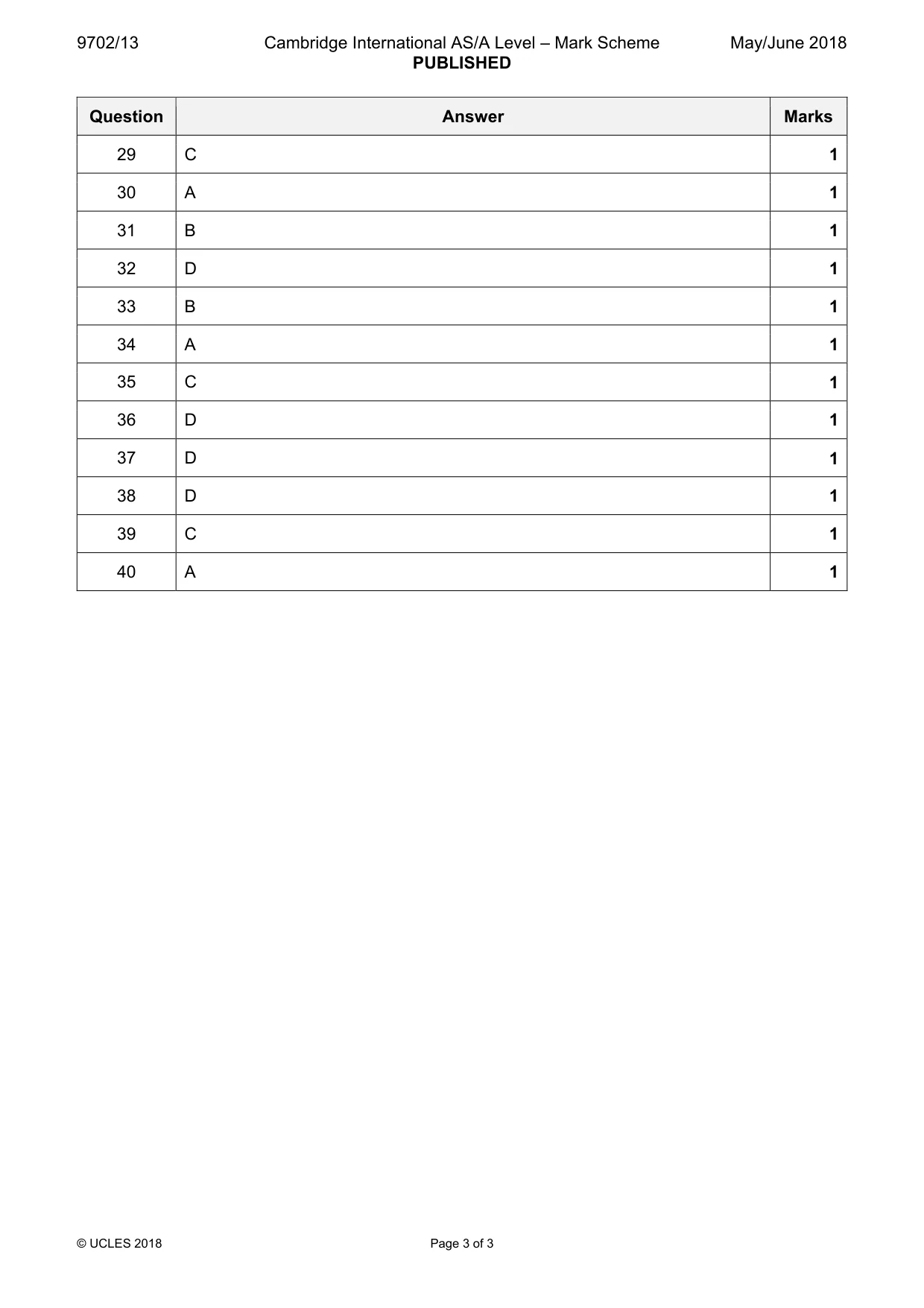
Mark scheme: C
Q30 · A slice of germanium of cross-sectional area 1.0 cm2 carries a current of 56 µA
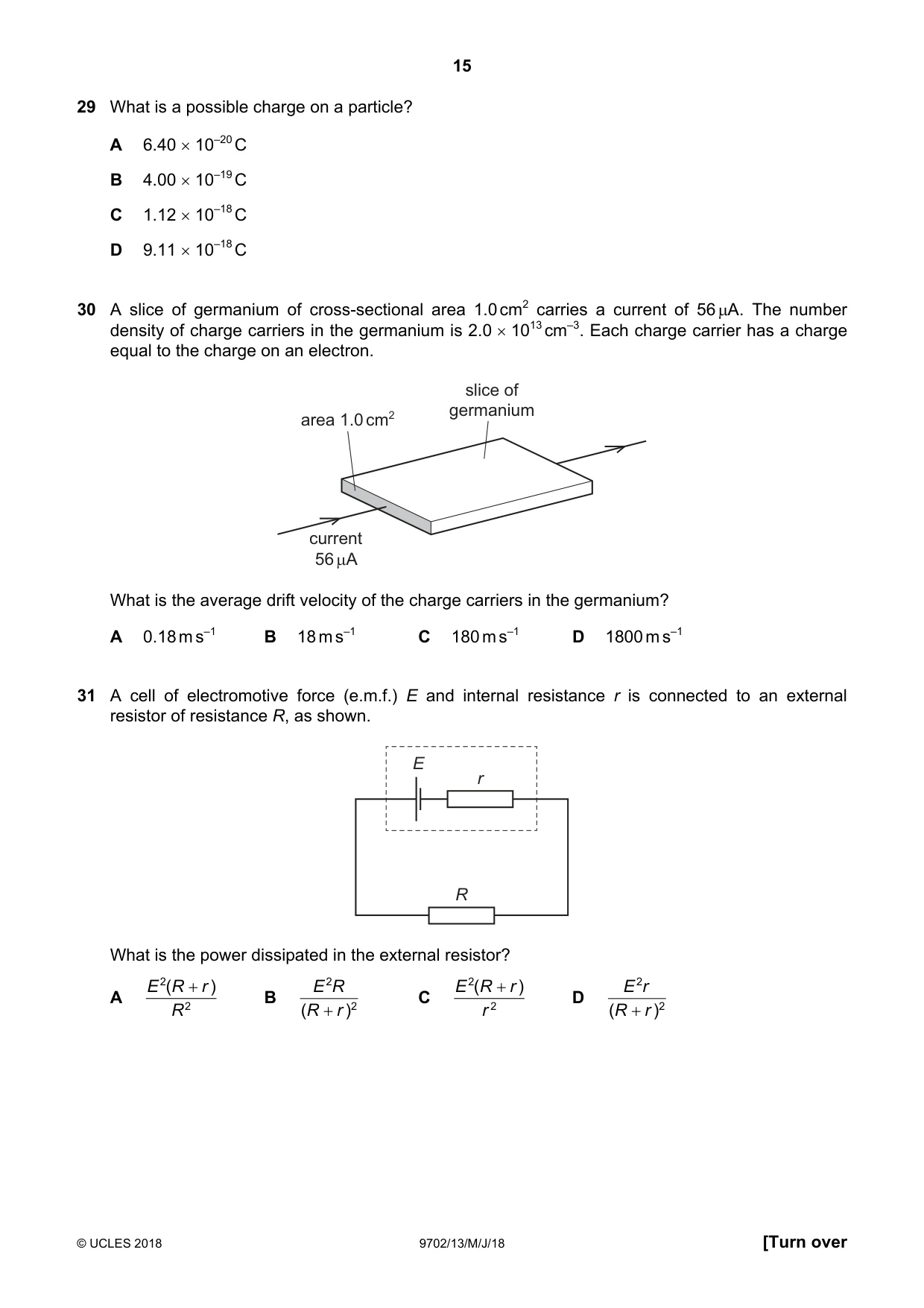
30 A slice of germanium of cross-sectional area 1.0 cm2 carries a current of 56 µA. The number density of charge carriers in the germanium is 2.0 × 1013 cm–3. Each charge carrier has a charge equal to the charge on an electron. slice of germanium area 1.0 cm2 current 56 µA What is the average drift velocity of the charge carriers in the germanium? A 0.18 m s–1 B 18 m s–1 C 180 m s–1 D 1800 m s–1
Mark scheme: A
Q31 · A cell of electromotive force (e.m.f.) E and internal resistance r is connected to an…
31 A cell of electromotive force (e.m.f.) E and internal resistance r is connected to an external resistor of resistance R, as shown. E r R What is the power dissipated in the external resistor? E 2 ( R + r ) E 2 R E 2 ( R + r ) E 2 r A B C D R 2 ( R + r ) 2 r 2 ( R + r ) 2
Mark scheme: B
Q32 · The graph shows the I-V characteristic of an electrical component
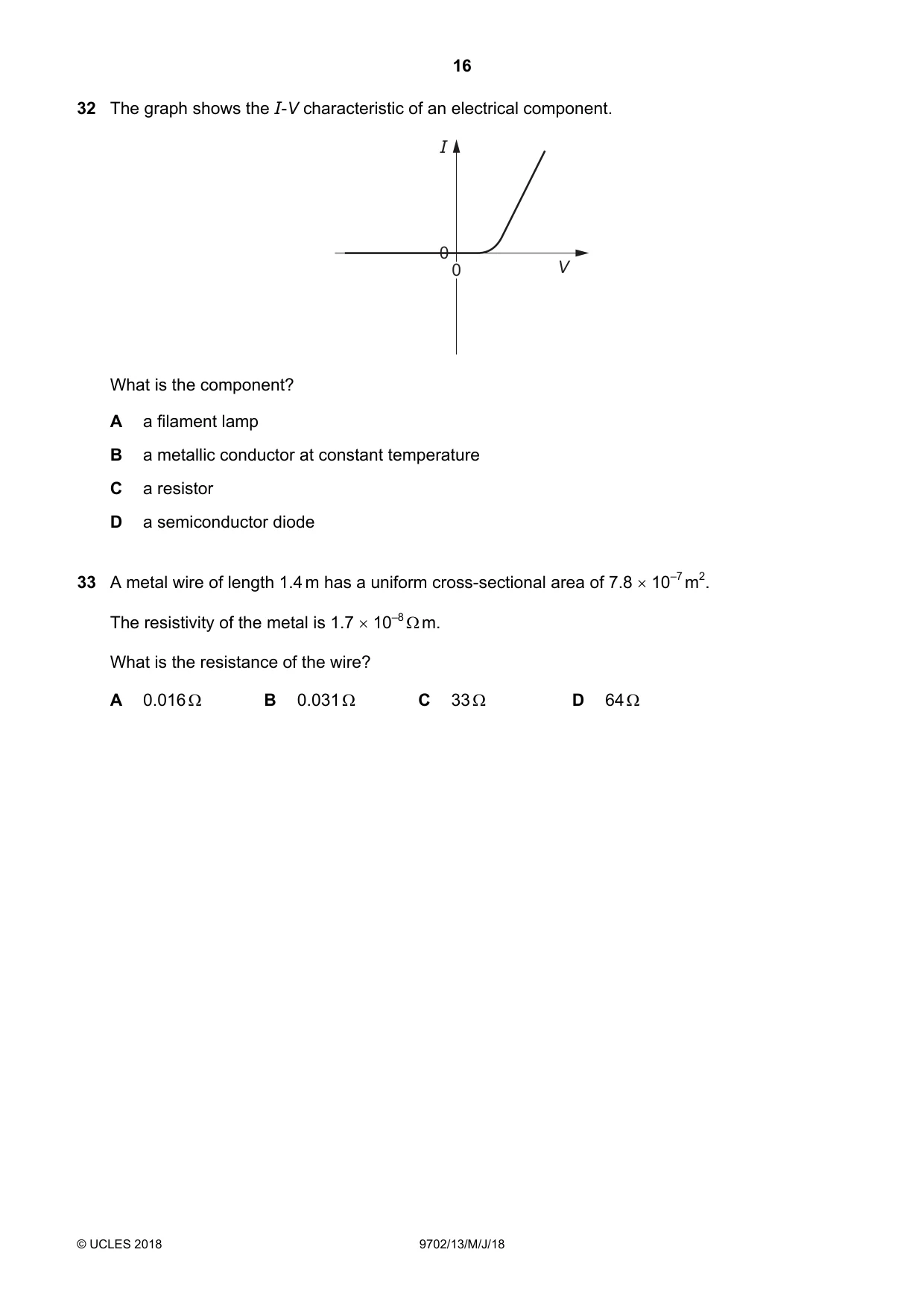
32 The graph shows the I-V characteristic of an electrical component. I 0 0 V What is the component? A a filament lamp B a metallic conductor at constant temperature C a resistor D a semiconductor diode
Mark scheme: D
Q33 · A metal wire of length 1.4 m has a uniform cross-sectional area of 7.8 × 10⁻⁷ m2
33 A metal wire of length 1.4 m has a uniform cross-sectional area of 7.8 × 10⁻⁷ m2. The resistivity of the metal is 1.7 × 10⁻⁸ Ω m. What is the resistance of the wire? A 0.016 Ω B 0.031 Ω C 33 Ω D 64 Ω
Mark scheme: B
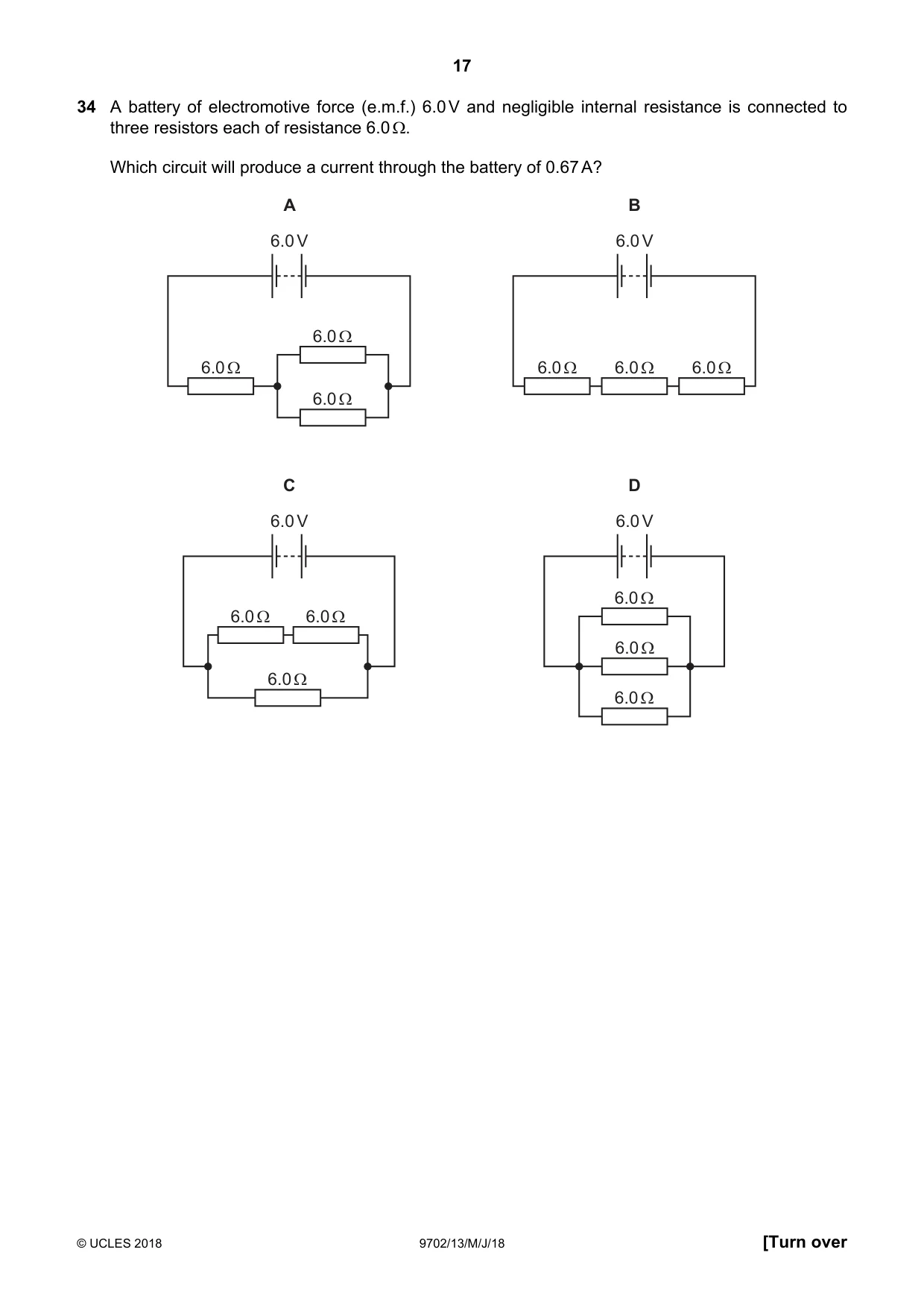
Q34 · A battery of electromotive force (e.m.f.) 6.0 V and negligible internal resistance is…
34 A battery of electromotive force (e.m.f.) 6.0 V and negligible internal resistance is connected to three resistors each of resistance 6.0 Ω. Which circuit will produce a current through the battery of 0.67 A? A B 6.0 V 6.0 V 6.0 Ω 6.0 Ω 6.0 Ω 6.0 Ω 6.0 Ω 6.0 Ω C D 6.0 V 6.0 V 6.0 Ω 6.0 Ω 6.0 Ω 6.0 Ω 6.0 Ω 6.0 Ω
Mark scheme: A
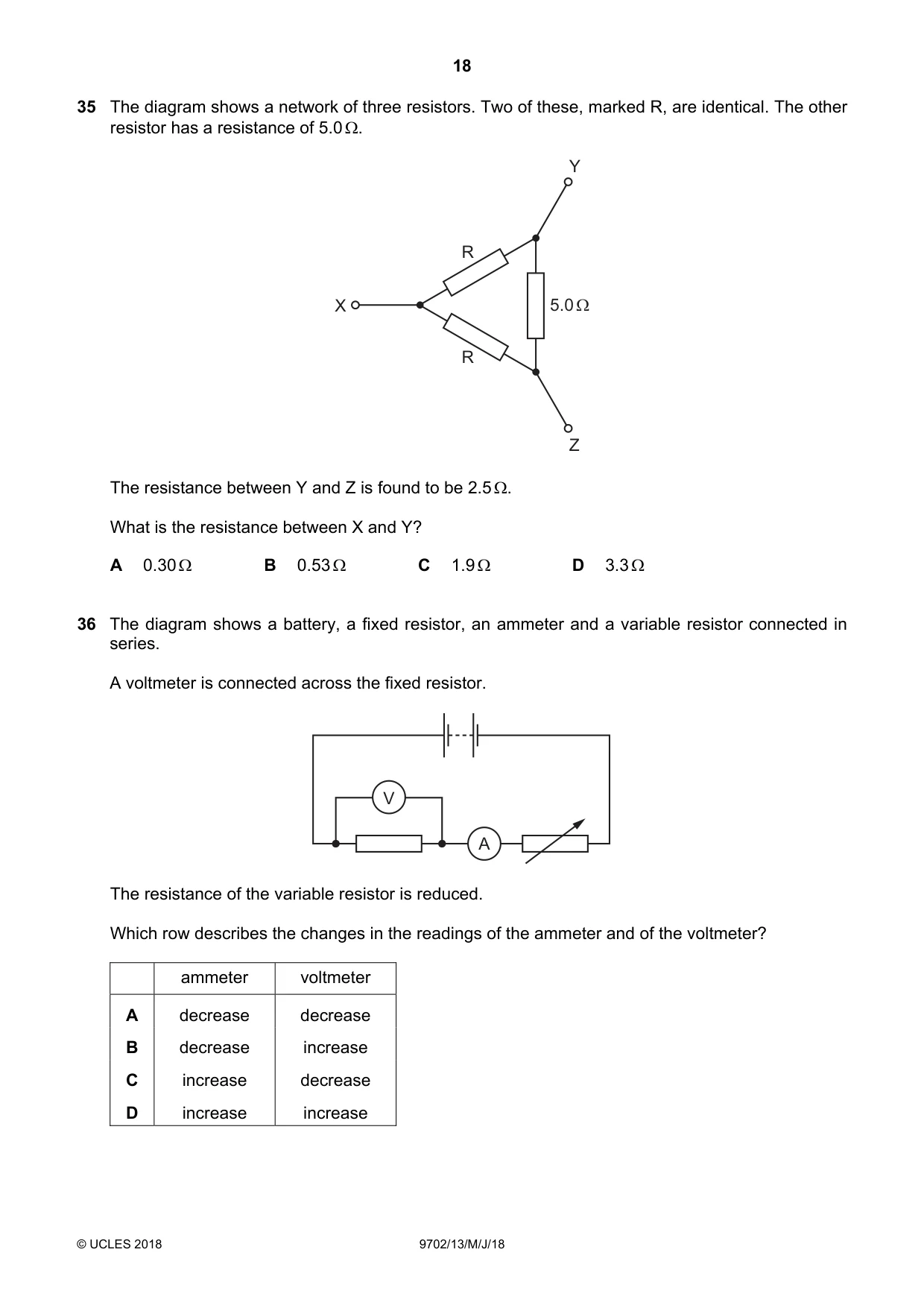
Q35 · The diagram shows a network of three resistors
35 The diagram shows a network of three resistors. Two of these, marked R, are identical. The other resistor has a resistance of 5.0 Ω. Y R X 5.0 Ω R Z The resistance between Y and Z is found to be 2.5 Ω. What is the resistance between X and Y? A 0.30 Ω B 0.53 Ω C 1.9 Ω D 3.3 Ω
Mark scheme: C
Q36 · The diagram shows a battery, a fixed resistor, an ammeter and a variable resistor…
36 The diagram shows a battery, a fixed resistor, an ammeter and a variable resistor connected in series. A voltmeter is connected across the fixed resistor. V A The resistance of the variable resistor is reduced. Which row describes the changes in the readings of the ammeter and of the voltmeter? ammeter voltmeter A decrease decrease B decrease increase C increase decrease D increase increase
Mark scheme: D
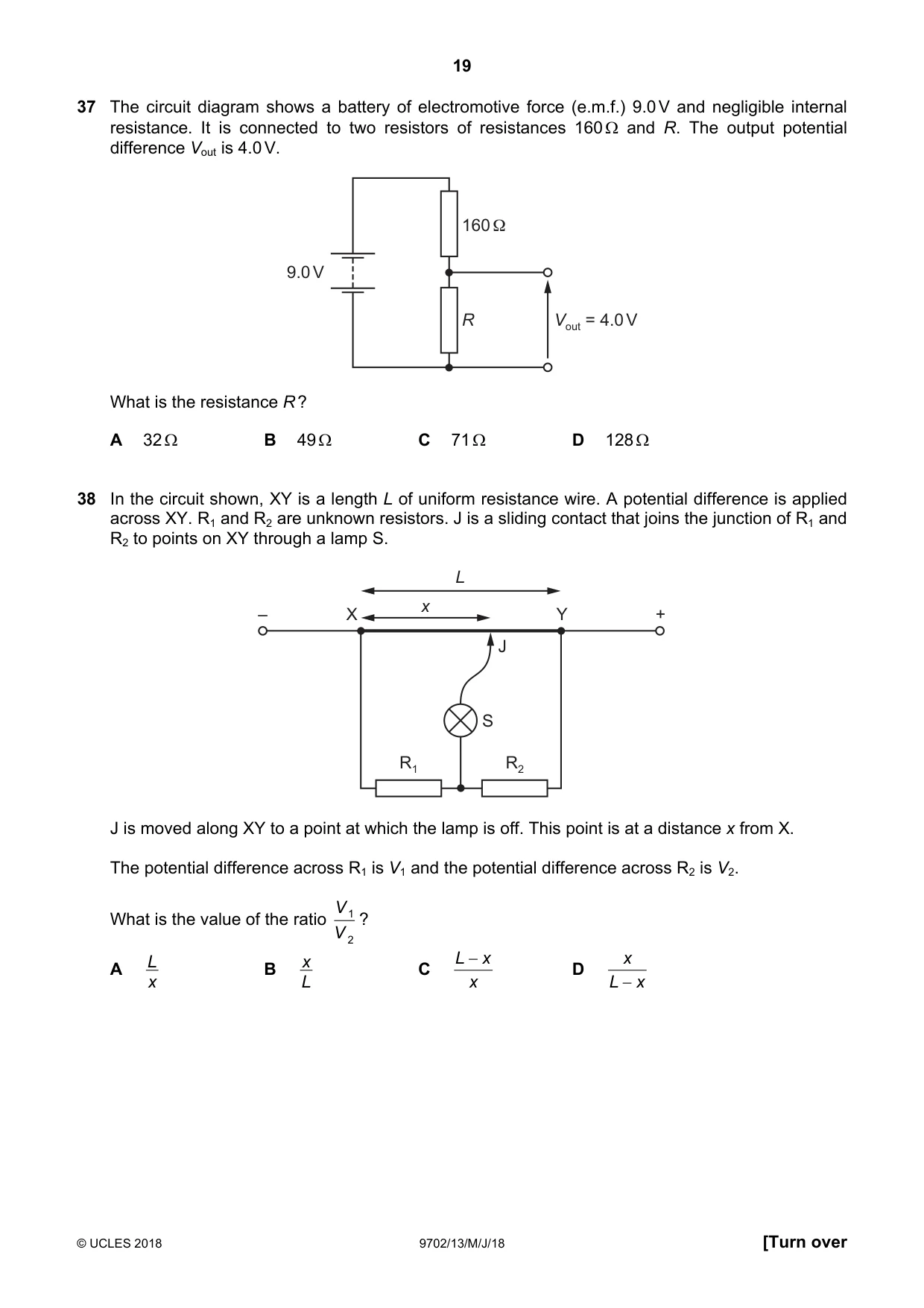
Q37 · The circuit diagram shows a battery of electromotive force (e.m.f.) 9.0 V and negligible…
37 The circuit diagram shows a battery of electromotive force (e.m.f.) 9.0 V and negligible internal resistance. It is connected to two resistors of resistances 160 Ω and R. The output potential difference Vout is 4.0 V. 160 Ω 9.0 V R Vout = 4.0 V What is the resistance R ? A 32 Ω B 49 Ω C 71 Ω D 128 Ω
Mark scheme: D
Q38 · In the circuit shown, XY is a length L of uniform resistance wire
38 In the circuit shown, XY is a length L of uniform resistance wire. A potential difference is applied across XY. R1 and R2 are unknown resistors. J is a sliding contact that joins the junction of R1 and R2 to points on XY through a lamp S. L x – X Y + J S R1 R2 J is moved along XY to a point at which the lamp is off. This point is at a distance x from X. The potential difference across R1 is V1 and the potential difference across R2 is V2. V ? What is the value of the ratio 1 V 2 L x L − x x A B C D x L x L − x
Mark scheme: D
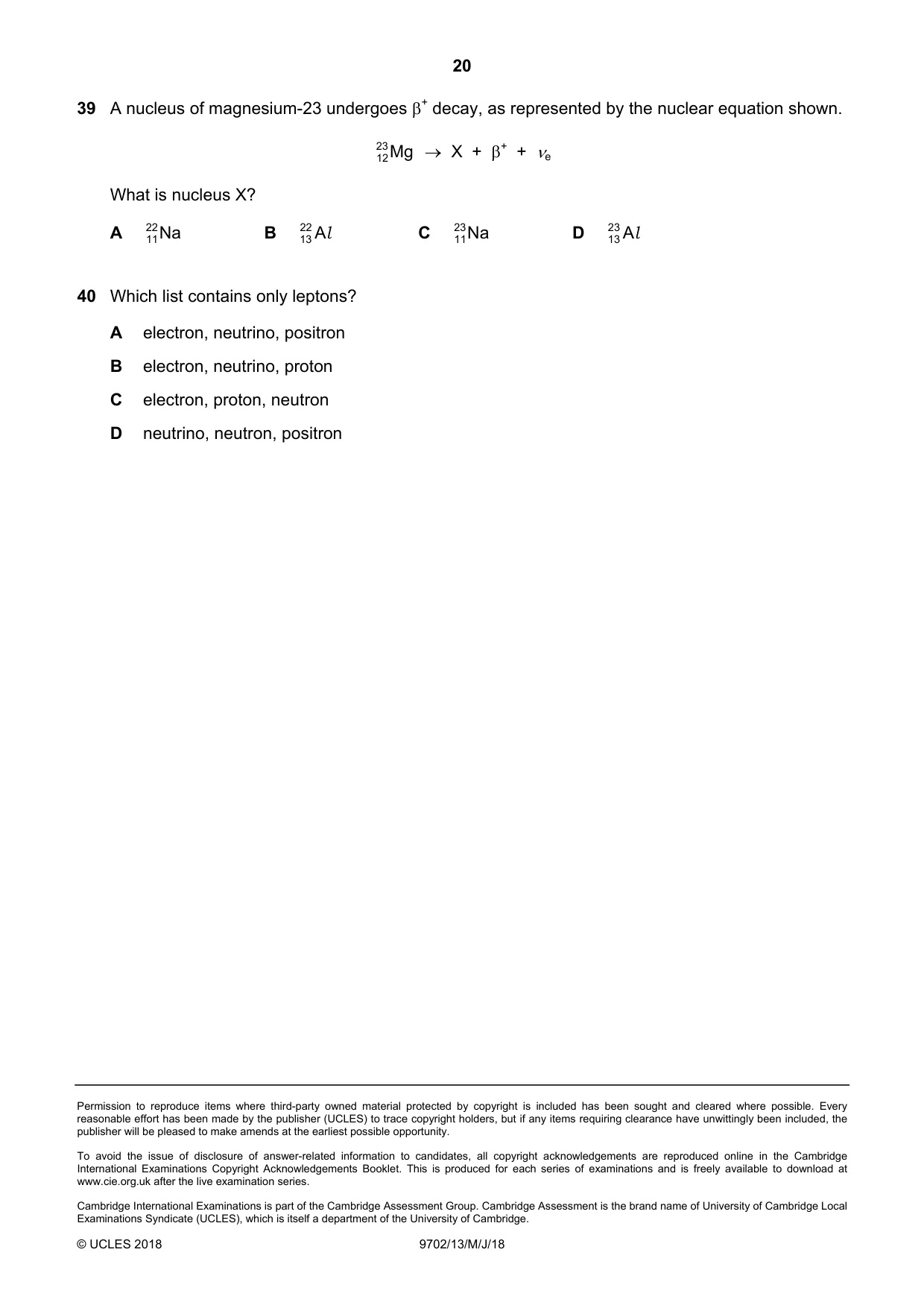
Q39 · A nucleus of magnesium-23 undergoes β+ decay, as represented by the nuclear equation shown
39 A nucleus of magnesium-23 undergoes β+ decay, as represented by the nuclear equation shown. 23 Mg → X + β+ + νe 12 What is nucleus X? A 22 Na B 22 A l C 23 Na D 23 A l 11 13 11 13
Mark scheme: C
Q40 · Which list contains only leptons?
40 Which list contains only leptons? A electron, neutrino, positron B electron, neutrino, proton C electron, proton, neutron D neutrino, neutron, positron
Mark scheme: A
What was in this paper
The subtopics covered by these 40 questions, and how many questions each got. Open one in a new tab to see every Cambridge question on it.
3Energy conservation3Practical circuits3Progressive waves3Electric current2Errors and uncertainties2Potential dividers2Resistance and resistivity2Scalars and vectors2Uniform electric fields2Atoms, nuclei and radiation1Diffraction1Doppler effect for sound waves1Elastic and plastic behaviour1Equations of motion1Fundamental particles1Gravitational potential energy and kinetic energy1Interference1Linear momentum and its conservation1Momentum and Newton’s laws of motion1Non-uniform motion1Physical quantities1Potential difference and power1Stationary waves1Stress and strain1Turning effects of forces1What you needed in this session
Cambridge’s own grade thresholds for 2018 May/June, Paper 1 · Variant 3. A higher threshold means an easier paper — the bar moves with how the cohort did.