Cambridge A Level Physics 9702 — 2019 Oct/Nov Paper 1 · Variant 1
9702/11/O/N/19 · 40 questions · 40 marks · ≈45 min
The question paper and its mark scheme, free to read here and free to download. This is Cambridge’s own paper, exactly as it was sat.
Question paper20 pages
Mark scheme3 pages
Answers below. Sit the paper first if you are practising.
Questions as text
Q1 · For which quantity is the magnitude a reasonable estimate?
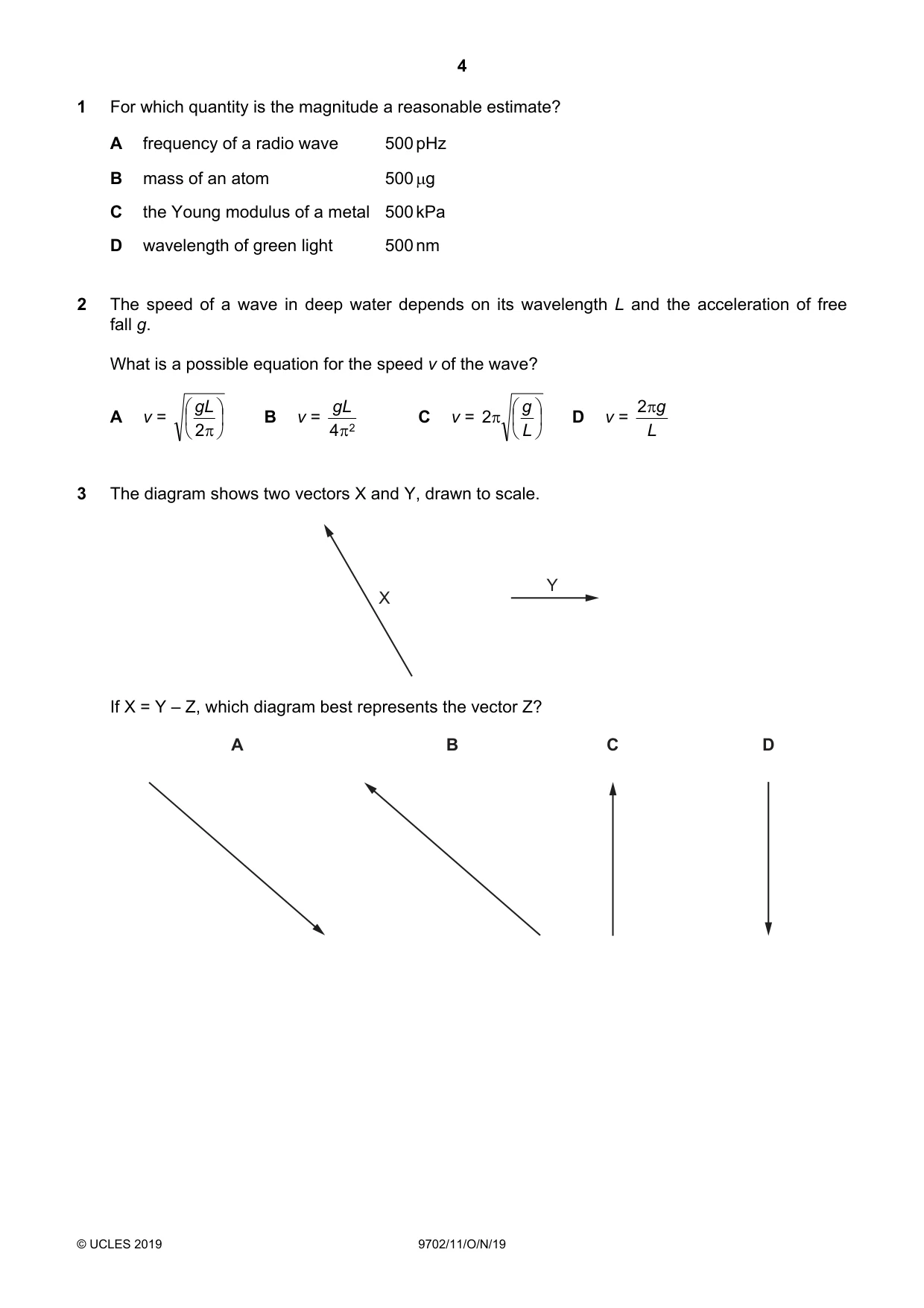
1 For which quantity is the magnitude a reasonable estimate? A frequency of a radio wave 500 pHz B mass of an atom 500 µg C the Young modulus of a metal 500 kPa D wavelength of green light 500 nm
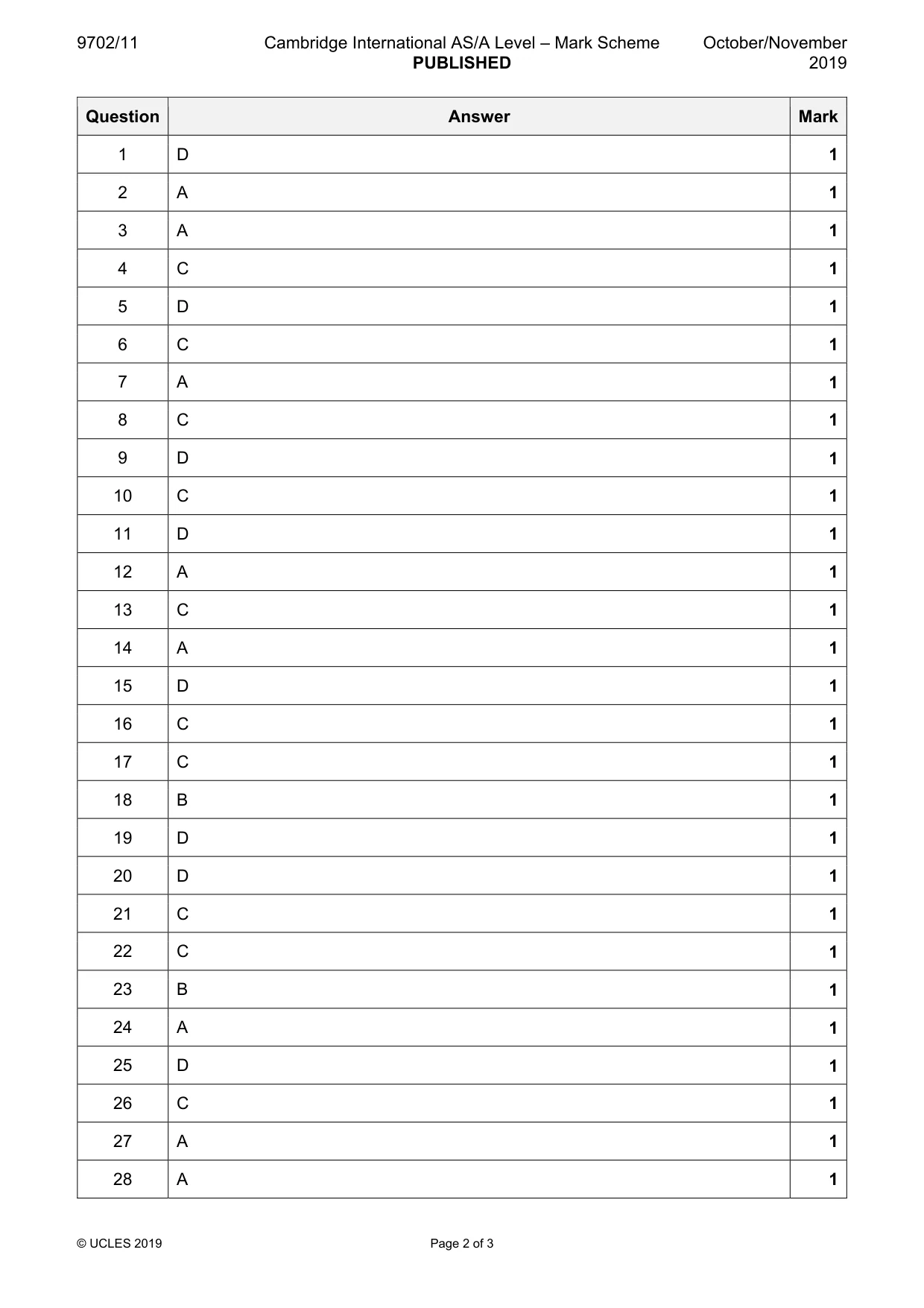
Mark scheme: D
Q2 · The speed of a wave in deep water depends on its wavelength L and the acceleration of…
2 The speed of a wave in deep water depends on its wavelength L and the acceleration of free fall g. What is a possible equation for the speed v of the wave? gL gL g 2 π g A v = B v = C v = 2 π D v = 2 π 4π 2 L L
Mark scheme: A
Q3 · The diagram shows two vectors X and Y, drawn to scale
3 The diagram shows two vectors X and Y, drawn to scale. Y X If X = Y – Z, which diagram best represents the vector Z? A B C D
Mark scheme: A
Q4 · A student intends to measure accurately the diameter of a wire (known to be approximately…
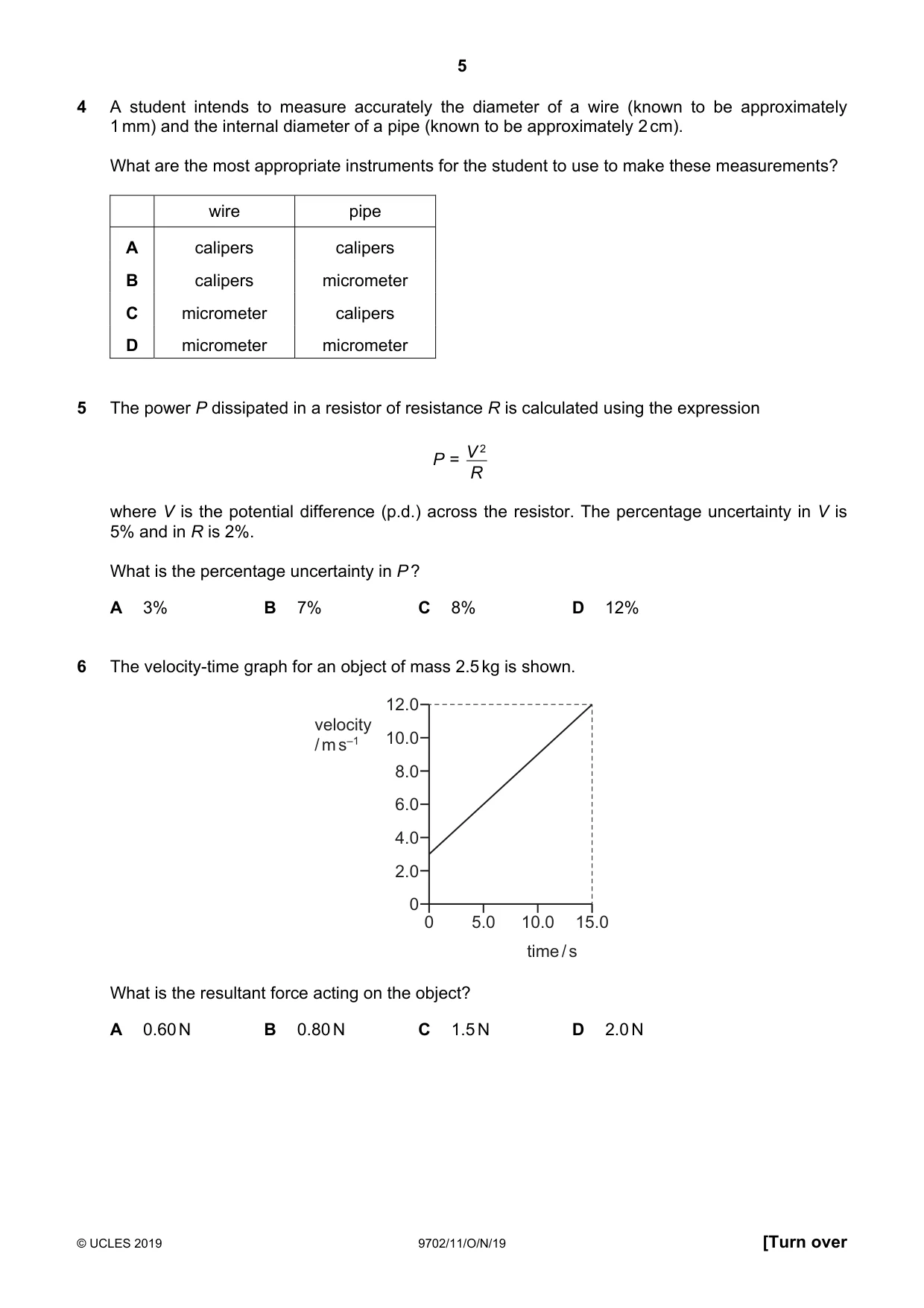
4 A student intends to measure accurately the diameter of a wire (known to be approximately 1 mm) and the internal diameter of a pipe (known to be approximately 2 cm). What are the most appropriate instruments for the student to use to make these measurements? wire pipe A calipers calipers B calipers micrometer C micrometer calipers D micrometer micrometer
Mark scheme: C
Q5 · The power P dissipated in a resistor of resistance R is calculated using the expression V…
5 The power P dissipated in a resistor of resistance R is calculated using the expression V 2 P = R where V is the potential difference (p.d.) across the resistor. The percentage uncertainty in V is 5% and in R is 2%. What is the percentage uncertainty in P ? A 3% B 7% C 8% D 12%
Mark scheme: D
Q6 · The velocity-time graph for an object of mass 2.5 kg is shown
6 The velocity-time graph for an object of mass 2.5 kg is shown. 12.0 velocity / m s–1 10.0 8.0 6.0 4.0 2.0 0 0 5.0 10.0 15.0 time / s What is the resultant force acting on the object? A 0.60 N B 0.80 N C 1.5 N D 2.0 N
Mark scheme: C
Q7 · Which statement follows directly from Newton’s first law?
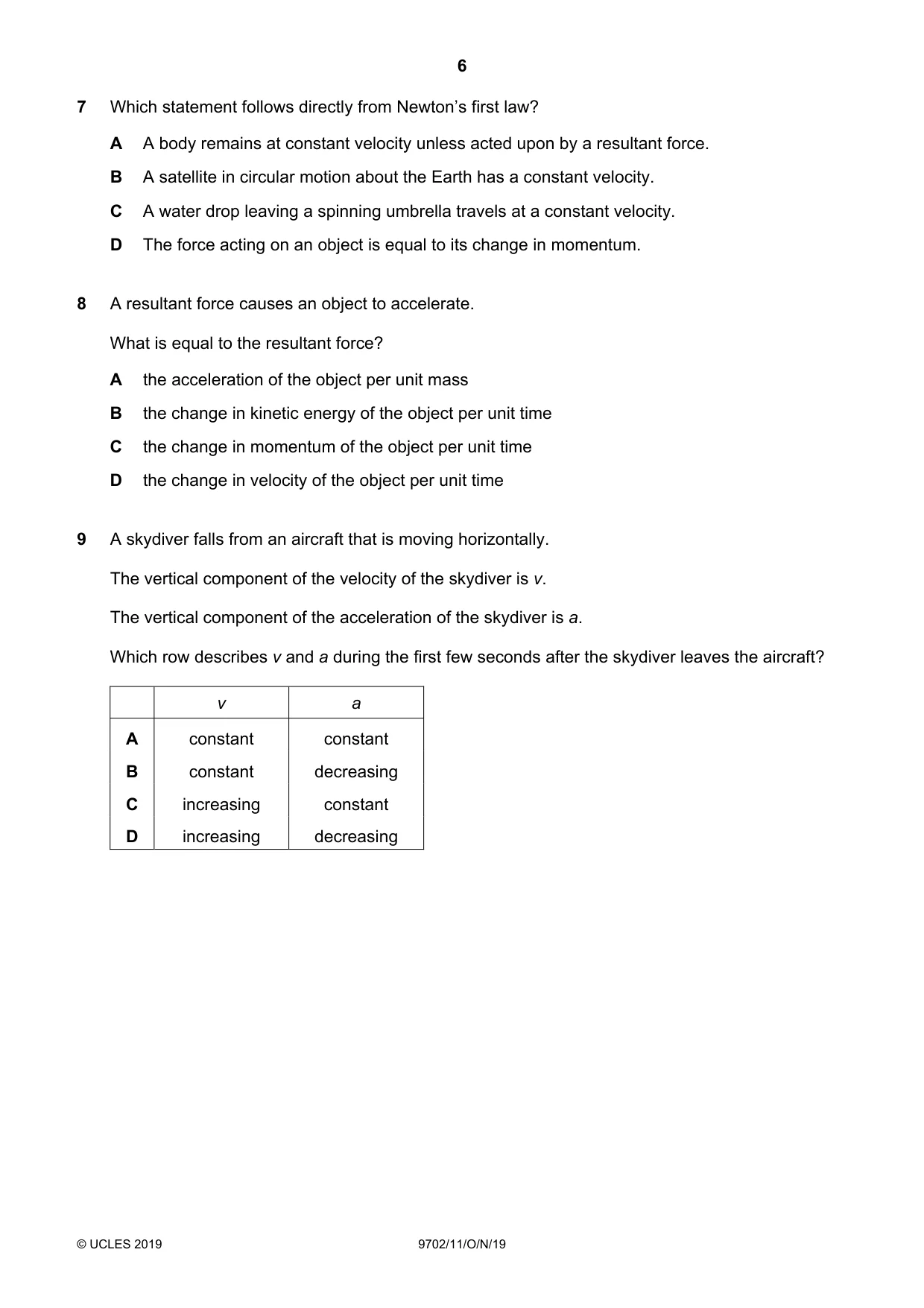
7 Which statement follows directly from Newton’s first law? A A body remains at constant velocity unless acted upon by a resultant force. B A satellite in circular motion about the Earth has a constant velocity. C A water drop leaving a spinning umbrella travels at a constant velocity. D The force acting on an object is equal to its change in momentum.
Mark scheme: A
Q8 · A resultant force causes an object to accelerate
8 A resultant force causes an object to accelerate. What is equal to the resultant force? A the acceleration of the object per unit mass B the change in kinetic energy of the object per unit time C the change in momentum of the object per unit time D the change in velocity of the object per unit time
Mark scheme: C
Q9 · A skydiver falls from an aircraft that is moving horizontally
9 A skydiver falls from an aircraft that is moving horizontally. The vertical component of the velocity of the skydiver is v. The vertical component of the acceleration of the skydiver is a. Which row describes v and a during the first few seconds after the skydiver leaves the aircraft? v a A constant constant B constant decreasing C increasing constant D increasing decreasing
Mark scheme: D
Q10 · Two gliders are travelling towards each other on a horizontal air track
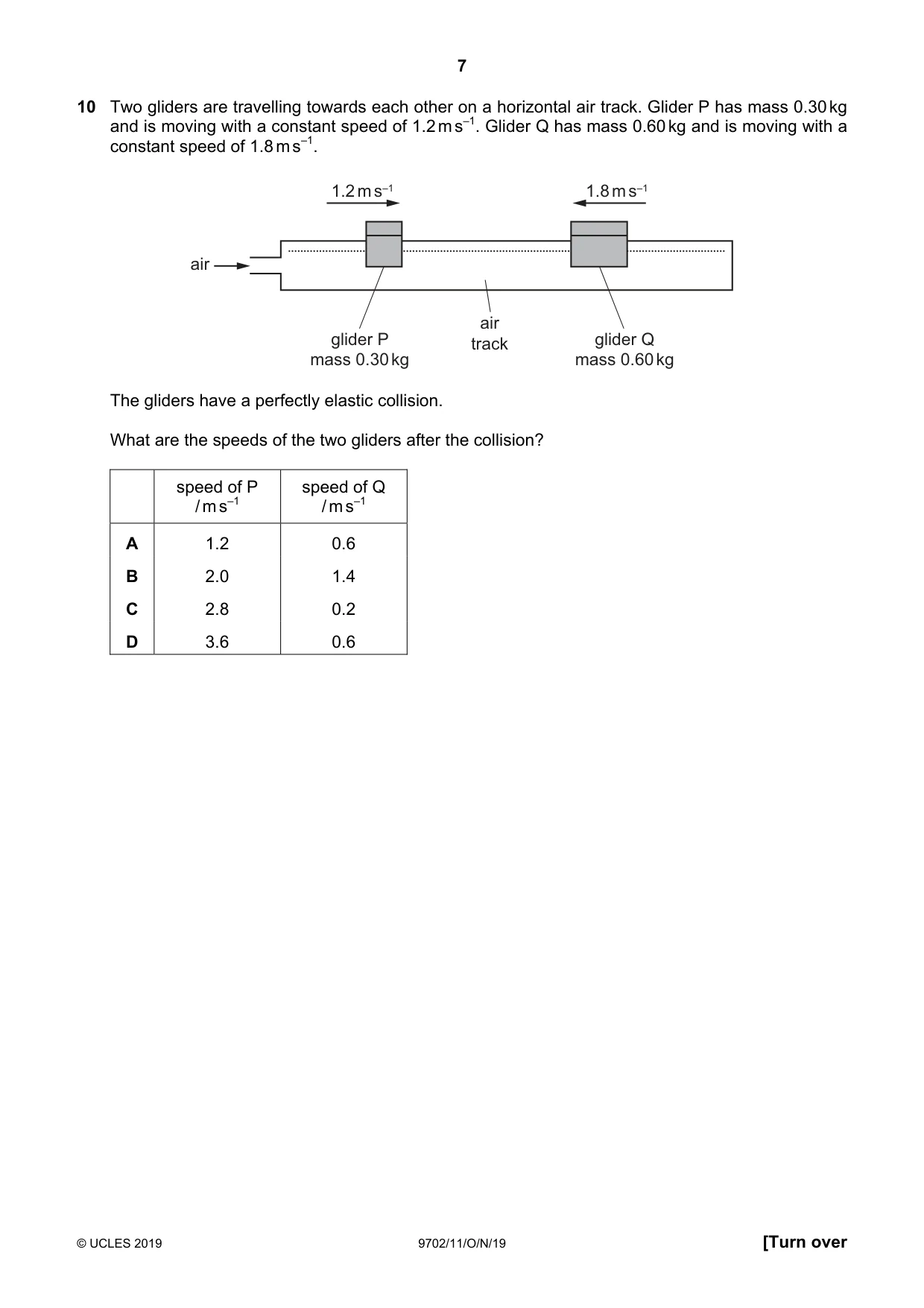
10 Two gliders are travelling towards each other on a horizontal air track. Glider P has mass 0.30 kg and is moving with a constant speed of 1.2 m s–1. Glider Q has mass 0.60 kg and is moving with a constant speed of 1.8 m s–1. 1.2 m s–1 1.8 m s–1 air air glider P track glider Q mass 0.30 kg mass 0.60 kg The gliders have a perfectly elastic collision. What are the speeds of the two gliders after the collision? speed of P speed of Q / m s–1 / m s–1 A 1.2 0.6 B 2.0 1.4 C 2.8 0.2 D 3.6 0.6
Mark scheme: C
Q11 · An object of weight W is suspended from a newton meter
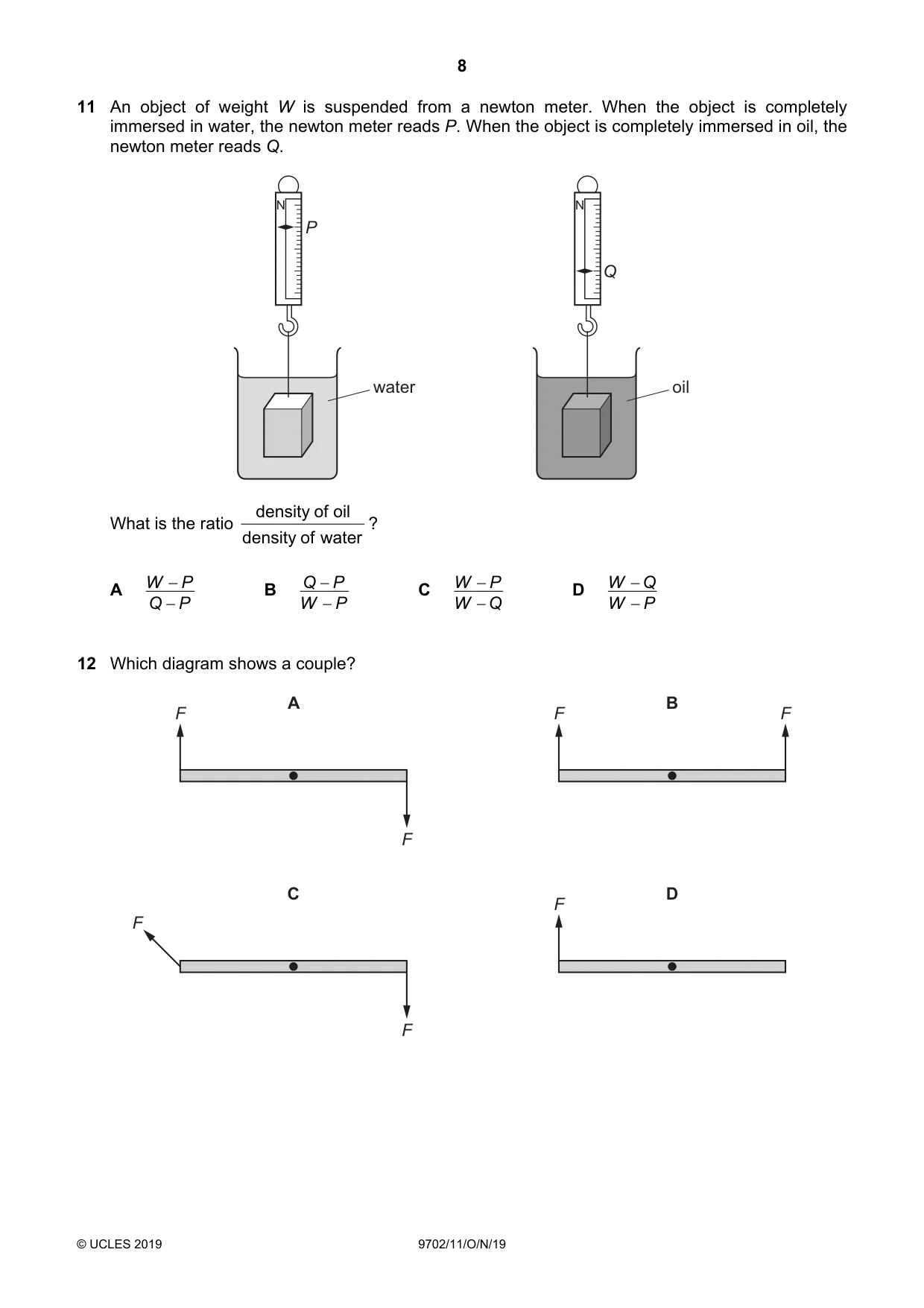
11 An object of weight W is suspended from a newton meter. When the object is completely immersed in water, the newton meter reads P. When the object is completely immersed in oil, the newton meter reads Q. N N P Q water oil density of oil What is the ratio ? density of water W − P Q − P W − P W − Q A B C D Q − P W − P W − Q W − P
Mark scheme: D
Q12 · Which diagram shows a couple?
12 Which diagram shows a couple? F A F B F F C F D F F
Mark scheme: A
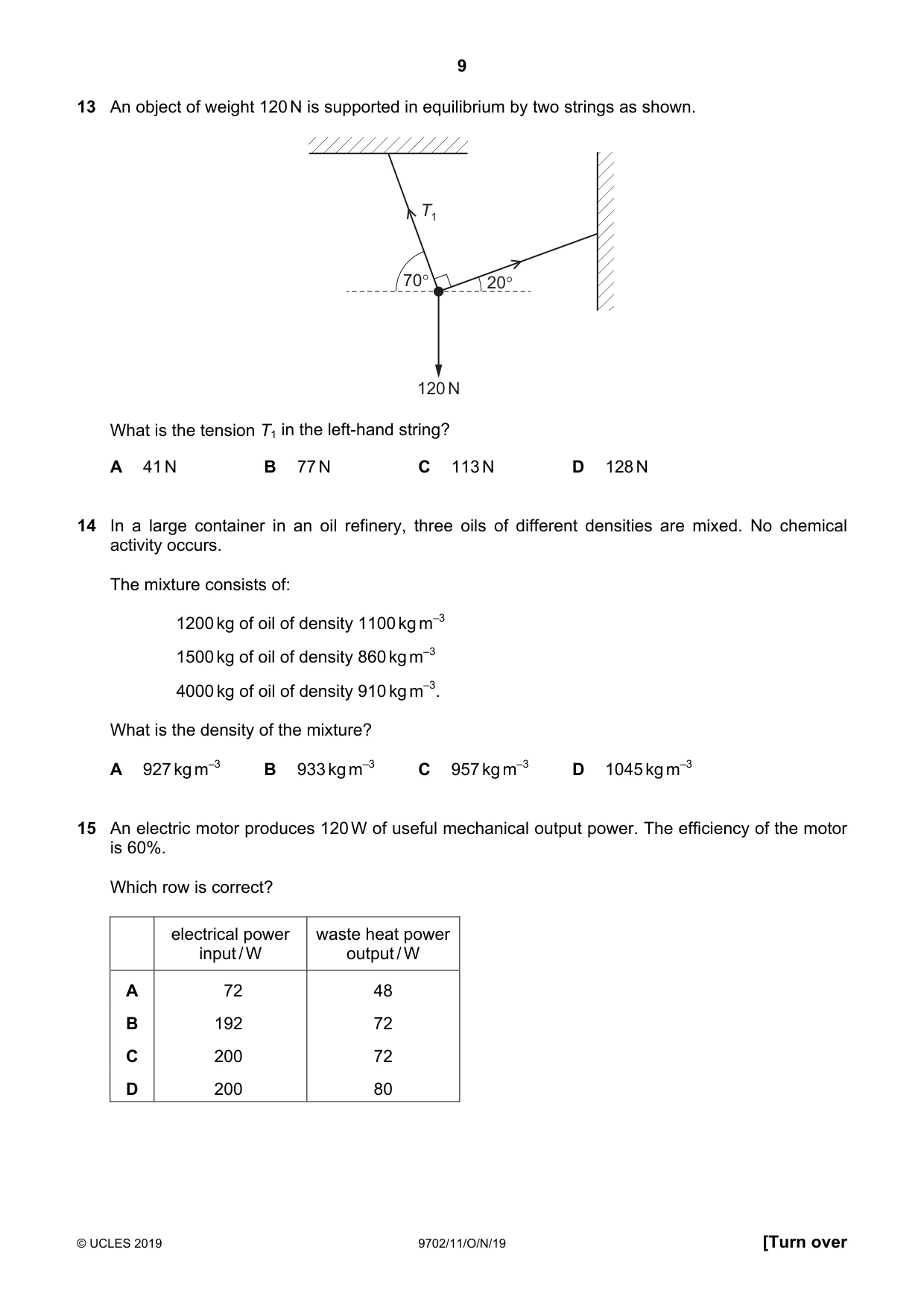
Q13 · An object of weight 120 N is supported in equilibrium by two strings as shown
13 An object of weight 120 N is supported in equilibrium by two strings as shown. T1 70° 20° 120 N What is the tension T1 in the left-hand string? A 41 N B 77 N C 113 N D 128 N
Mark scheme: C
Q14 · In a large container in an oil refinery, three oils of different densities are mixed
14 In a large container in an oil refinery, three oils of different densities are mixed. No chemical activity occurs. The mixture consists of: 1200 kg of oil of density 1100 kg m–3 1500 kg of oil of density 860 kg m–3 4000 kg of oil of density 910 kg m–3. What is the density of the mixture? A 927 kg m–3 B 933 kg m–3 C 957 kg m–3 D 1045 kg m–3
Mark scheme: A
Q15 · An electric motor produces 120 W of useful mechanical output power
15 An electric motor produces 120 W of useful mechanical output power. The efficiency of the motor is 60%. Which row is correct? electrical power waste heat power input / W output / W A 72 48 B 192 72 C 200 72 D 200 80
Mark scheme: D
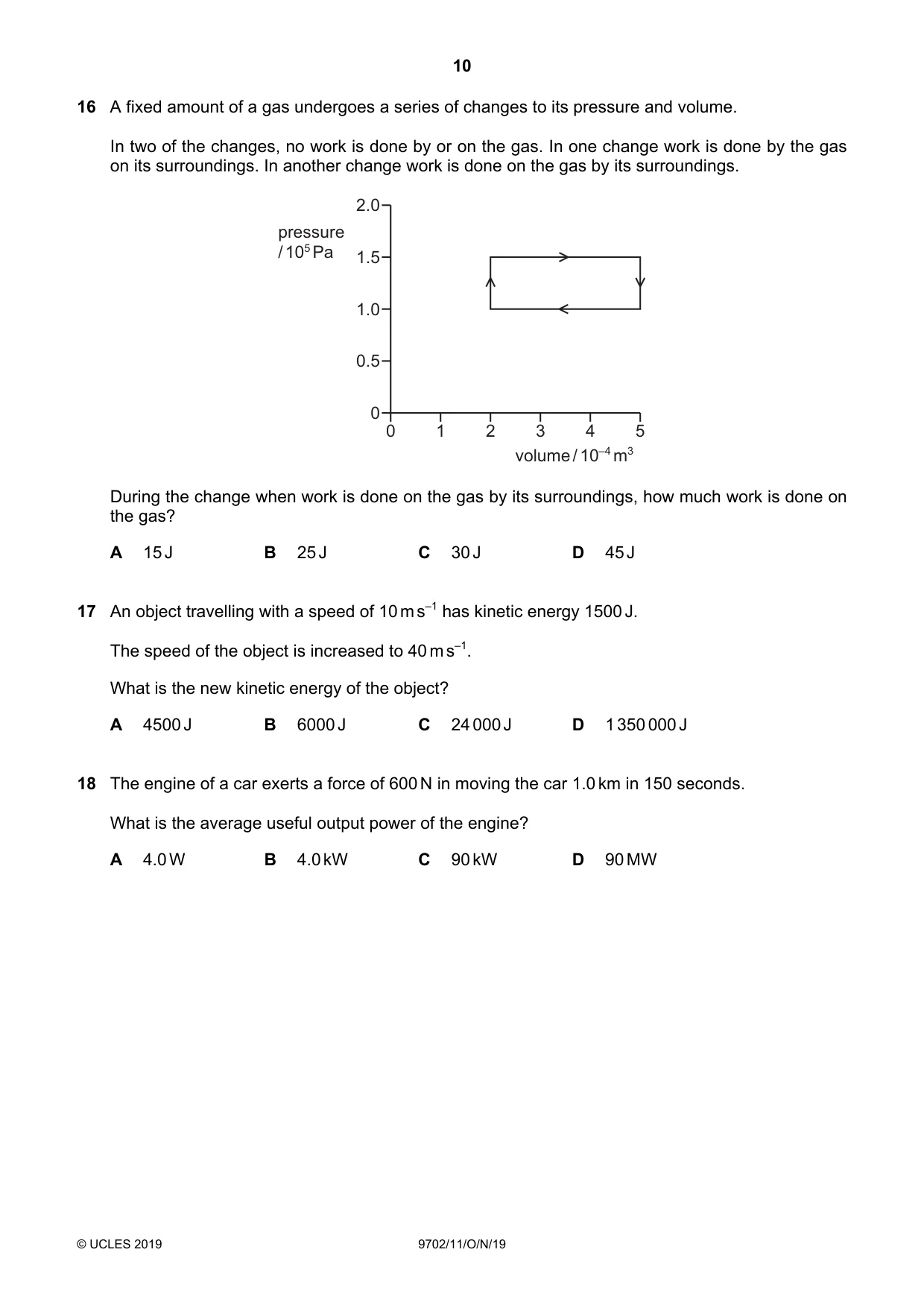
Q16 · A fixed amount of a gas undergoes a series of changes to its pressure and volume
16 A fixed amount of a gas undergoes a series of changes to its pressure and volume. In two of the changes, no work is done by or on the gas. In one change work is done by the gas on its surroundings. In another change work is done on the gas by its surroundings. 2.0 pressure / 105 Pa 1.5 1.0 0.5 0 0 1 2 3 4 5 volume / 10–4 m3 During the change when work is done on the gas by its surroundings, how much work is done on the gas? A 15 J B 25 J C 30 J D 45 J
Mark scheme: C
Q17 · An object travelling with a speed of 10 m s–1 has kinetic energy 1500 J
17 An object travelling with a speed of 10 m s–1 has kinetic energy 1500 J. The speed of the object is increased to 40 m s–1. What is the new kinetic energy of the object? A 4500 J B 6000 J C 24 000 J D 1 350 000 J
Mark scheme: C
More questions on Gravitational potential energy and kinetic energy
Q18 · The engine of a car exerts a force of 600 N in moving the car 1.0 km in 150 seconds
18 The engine of a car exerts a force of 600 N in moving the car 1.0 km in 150 seconds. What is the average useful output power of the engine? A 4.0 W B 4.0 kW C 90 kW D 90 MW
Mark scheme: B
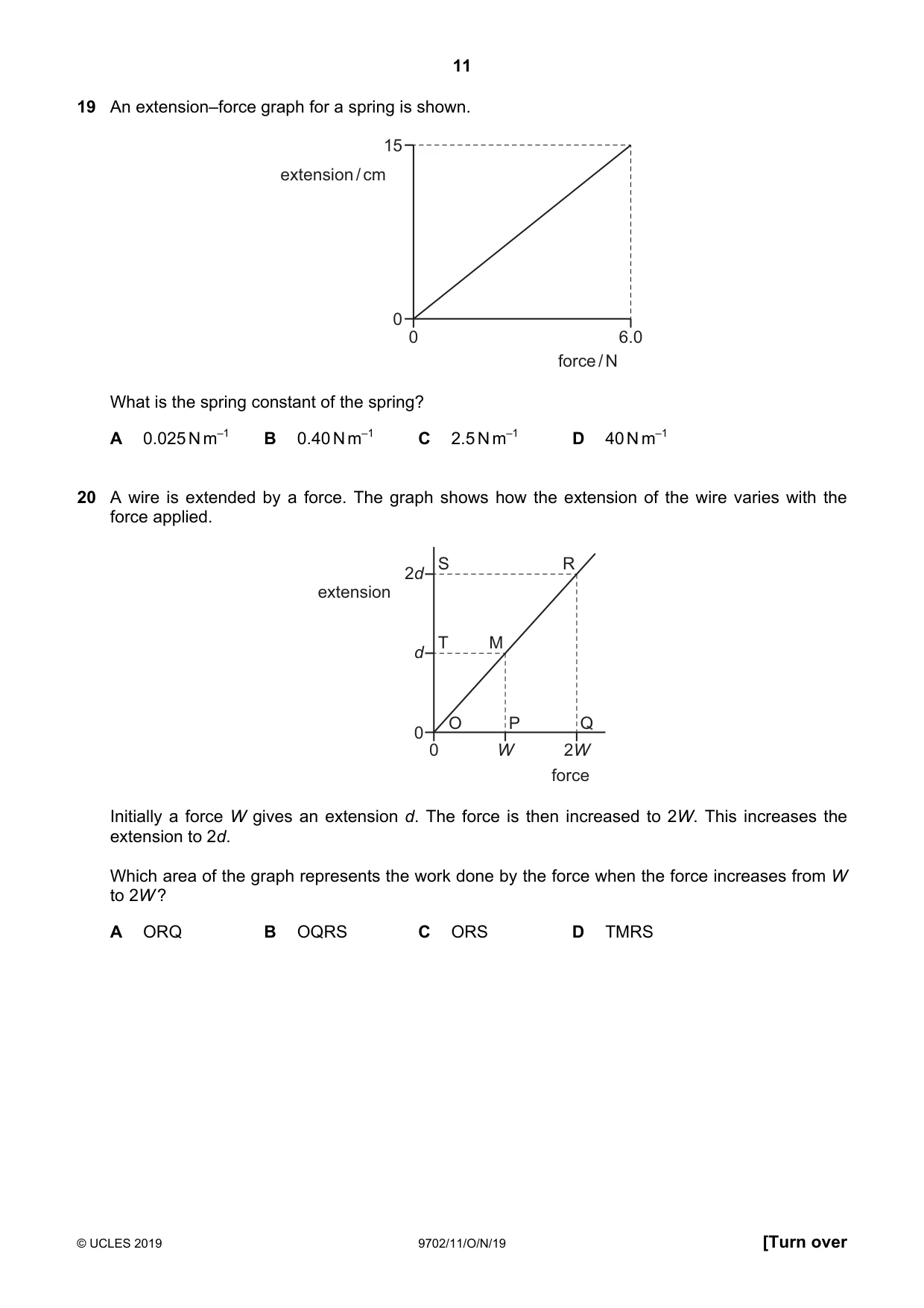
Q19 · An extension–force graph for a spring is shown
19 An extension–force graph for a spring is shown. 15 extension / cm 0 0 6.0 force / N What is the spring constant of the spring? A 0.025 N m–1 B 0.40 N m–1 C 2.5 N m–1 D 40 N m–1
Mark scheme: D
Q20 · A wire is extended by a force
20 A wire is extended by a force. The graph shows how the extension of the wire varies with the force applied. 2d S R extension d T M O P Q 0 0 W 2W force Initially a force W gives an extension d. The force is then increased to 2W. This increases the extension to 2d. Which area of the graph represents the work done by the force when the force increases from W to 2W ? A ORQ B OQRS C ORS D TMRS
Mark scheme: D
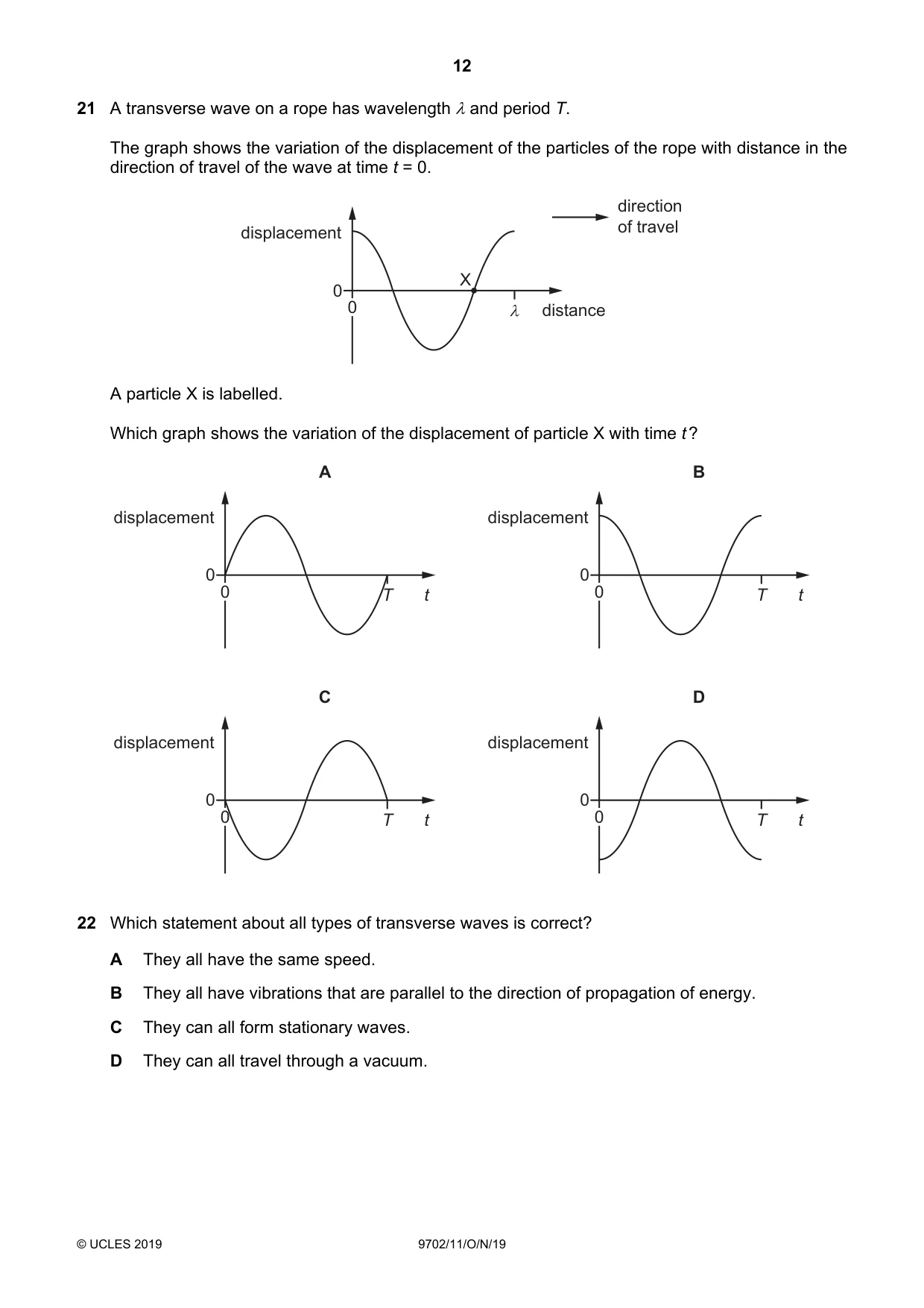
Q21 · A transverse wave on a rope has wavelength λ and period T
21 A transverse wave on a rope has wavelength λ and period T. The graph shows the variation of the displacement of the particles of the rope with distance in the direction of travel of the wave at time t = 0. direction displacement of travel X 0 0 λ distance A particle X is labelled. Which graph shows the variation of the displacement of particle X with time t ? A B displacement displacement 0 0 0 T t 0 T t C D displacement displacement 0 0 0 T t 0 T t
Mark scheme: C
Q22 · Which statement about all types of transverse waves is correct?
22 Which statement about all types of transverse waves is correct? A They all have the same speed. B They all have vibrations that are parallel to the direction of propagation of energy. C They can all form stationary waves. D They can all travel through a vacuum.
Mark scheme: C
Q23 · Source S emits microwaves with a constant amplitude
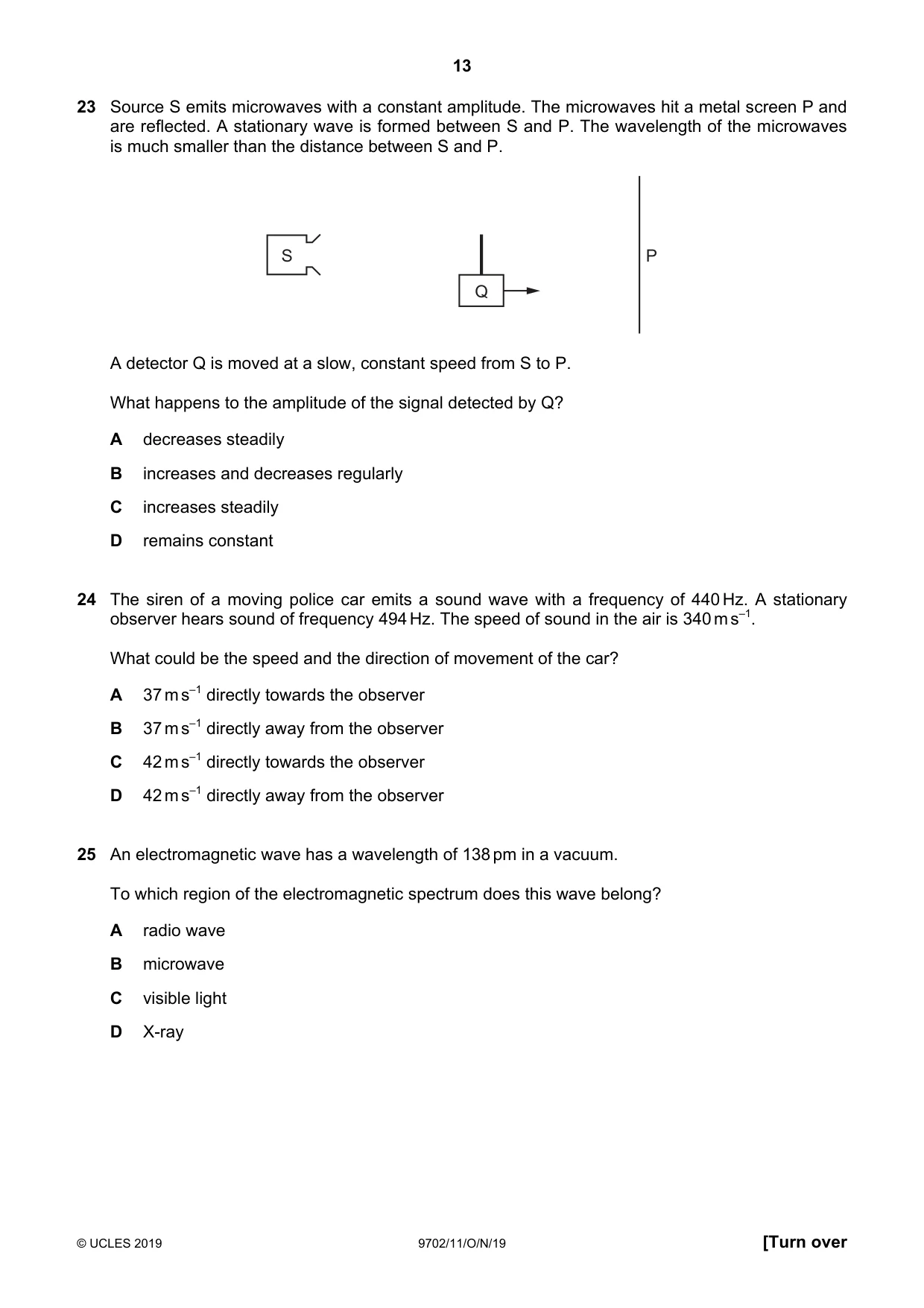
23 Source S emits microwaves with a constant amplitude. The microwaves hit a metal screen P and are reflected. A stationary wave is formed between S and P. The wavelength of the microwaves is much smaller than the distance between S and P. S P Q A detector Q is moved at a slow, constant speed from S to P. What happens to the amplitude of the signal detected by Q? A decreases steadily B increases and decreases regularly C increases steadily D remains constant
Mark scheme: B
Q24 · The siren of a moving police car emits a sound wave with a frequency of 440 Hz
24 The siren of a moving police car emits a sound wave with a frequency of 440 Hz. A stationary observer hears sound of frequency 494 Hz. The speed of sound in the air is 340 m s–1. What could be the speed and the direction of movement of the car? A 37 m s–1 directly towards the observer B 37 m s–1 directly away from the observer C 42 m s–1 directly towards the observer D 42 m s–1 directly away from the observer
Mark scheme: A
Q25 · An electromagnetic wave has a wavelength of 138 pm in a vacuum
25 An electromagnetic wave has a wavelength of 138 pm in a vacuum. To which region of the electromagnetic spectrum does this wave belong? A radio wave B microwave C visible light D X-ray
Mark scheme: D
Q26 · Two wave pulses are travelling towards each other on a long rope
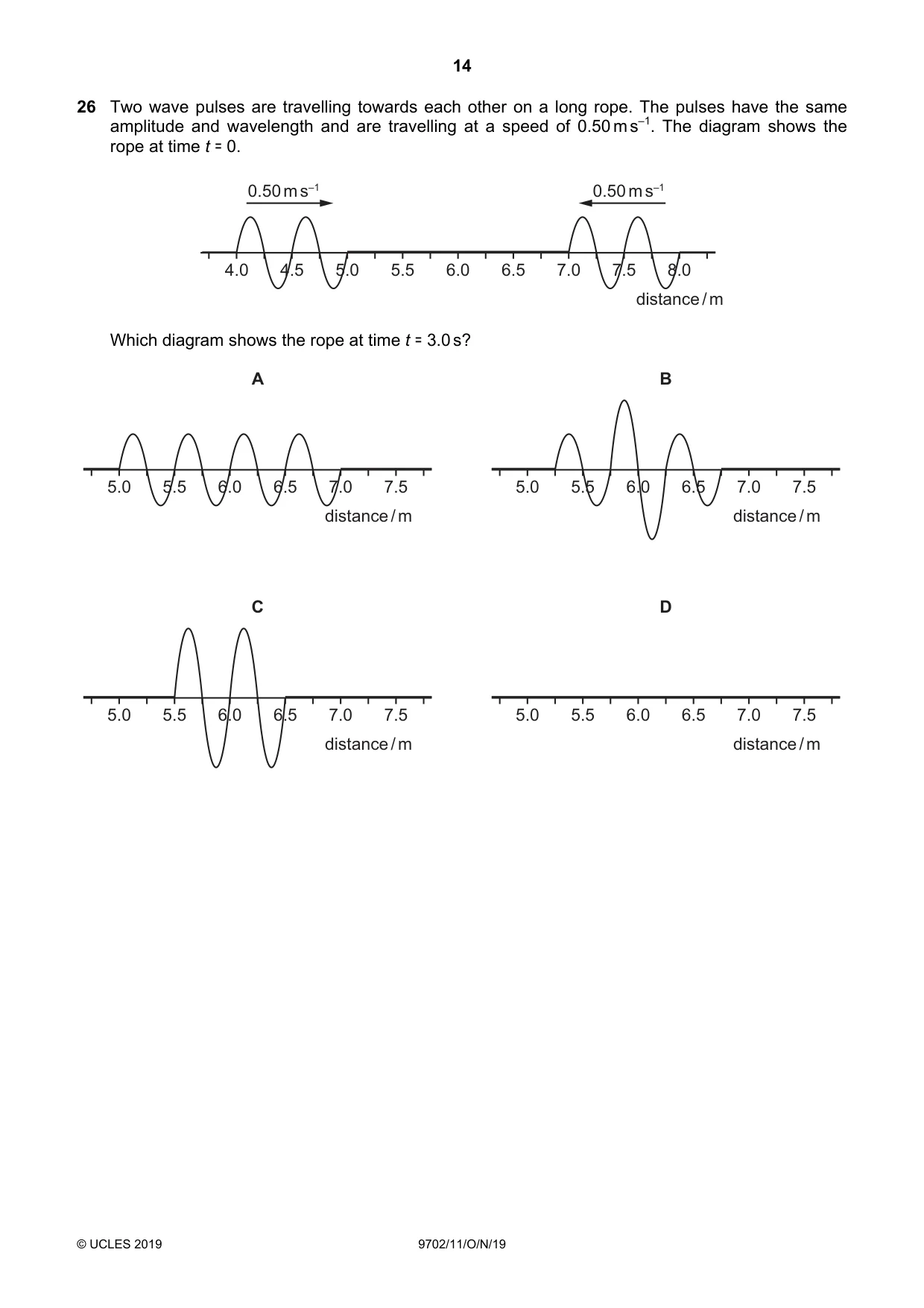
26 Two wave pulses are travelling towards each other on a long rope. The pulses have the same amplitude and wavelength and are travelling at a speed of 0.50 m s–1. The diagram shows the rope at time t ꞊ 0. 0.50 m s–1 0.50 m s–1 4.0 4.5 5.0 5.5 6.0 6.5 7.0 7.5 8.0 distance / m Which diagram shows the rope at time t ꞊ 3.0 s? A B 5.0 5.5 6.0 6.5 7.0 7.5 5.0 5.5 6.0 6.5 7.0 7.5 distance / m distance / m C D 5.0 5.5 6.0 6.5 7.0 7.5 5.0 5.5 6.0 6.5 7.0 7.5 distance / m distance / m
Mark scheme: C
Q27 · Water waves of wavelength λ are incident normally on an obstacle with a narrow gap
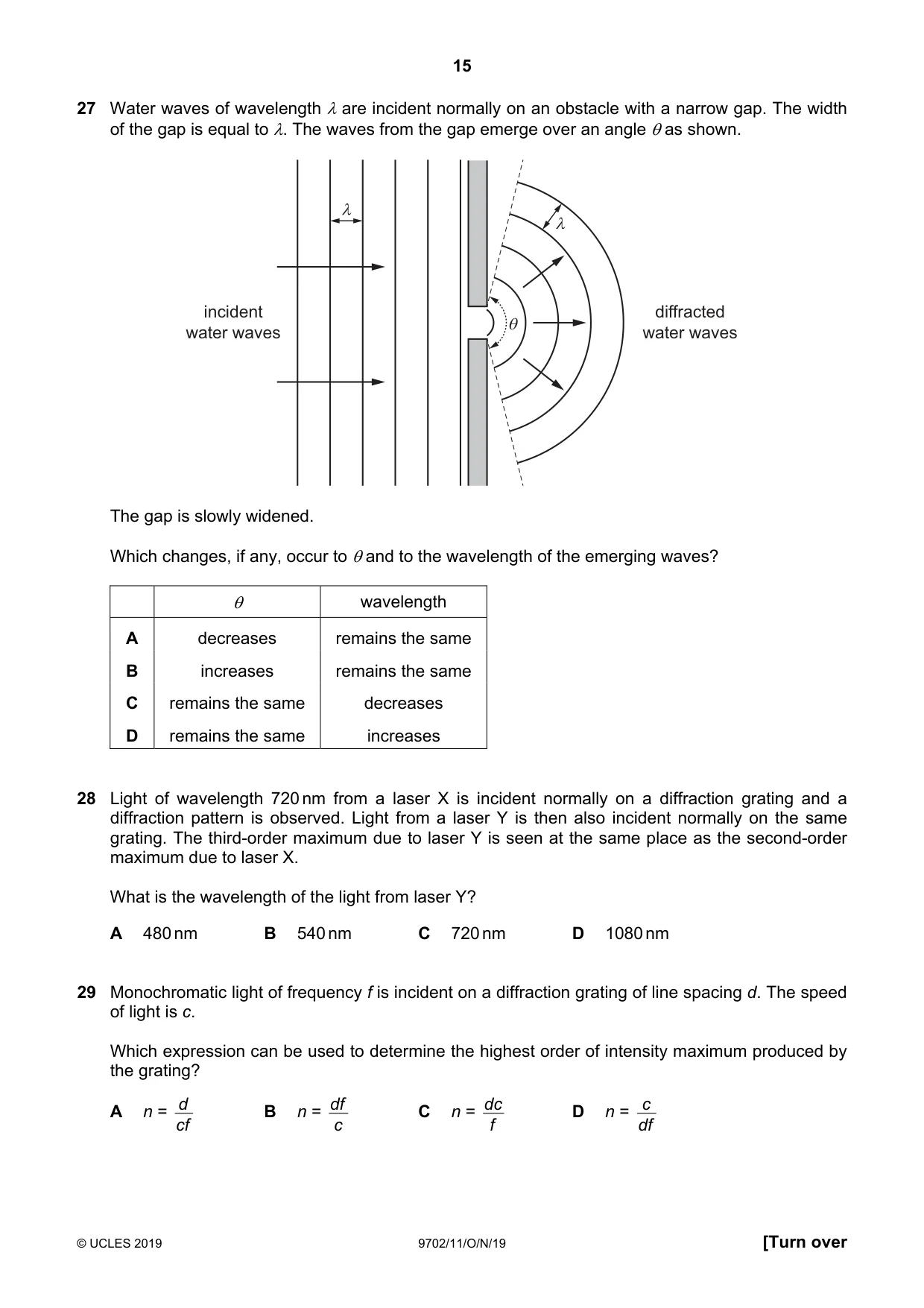
27 Water waves of wavelength λ are incident normally on an obstacle with a narrow gap. The width of the gap is equal to λ. The waves from the gap emerge over an angle θ as shown. λ λ incident diffracted θ water waves water waves The gap is slowly widened. Which changes, if any, occur to θ and to the wavelength of the emerging waves? θ wavelength A decreases remains the same B increases remains the same C remains the same decreases D remains the same increases
Mark scheme: A
Q28 · Light of wavelength 720 nm from a laser X is incident normally on a diffraction grating…
28 Light of wavelength 720 nm from a laser X is incident normally on a diffraction grating and a diffraction pattern is observed. Light from a laser Y is then also incident normally on the same grating. The third-order maximum due to laser Y is seen at the same place as the second-order maximum due to laser X. What is the wavelength of the light from laser Y? A 480 nm B 540 nm C 720 nm D 1080 nm
Mark scheme: A
Q29 · Monochromatic light of frequency f is incident on a diffraction grating of line spacing d
29 Monochromatic light of frequency f is incident on a diffraction grating of line spacing d. The speed of light is c. Which expression can be used to determine the highest order of intensity maximum produced by the grating? d df dc c A n = cf B n = c C n = f D n = df
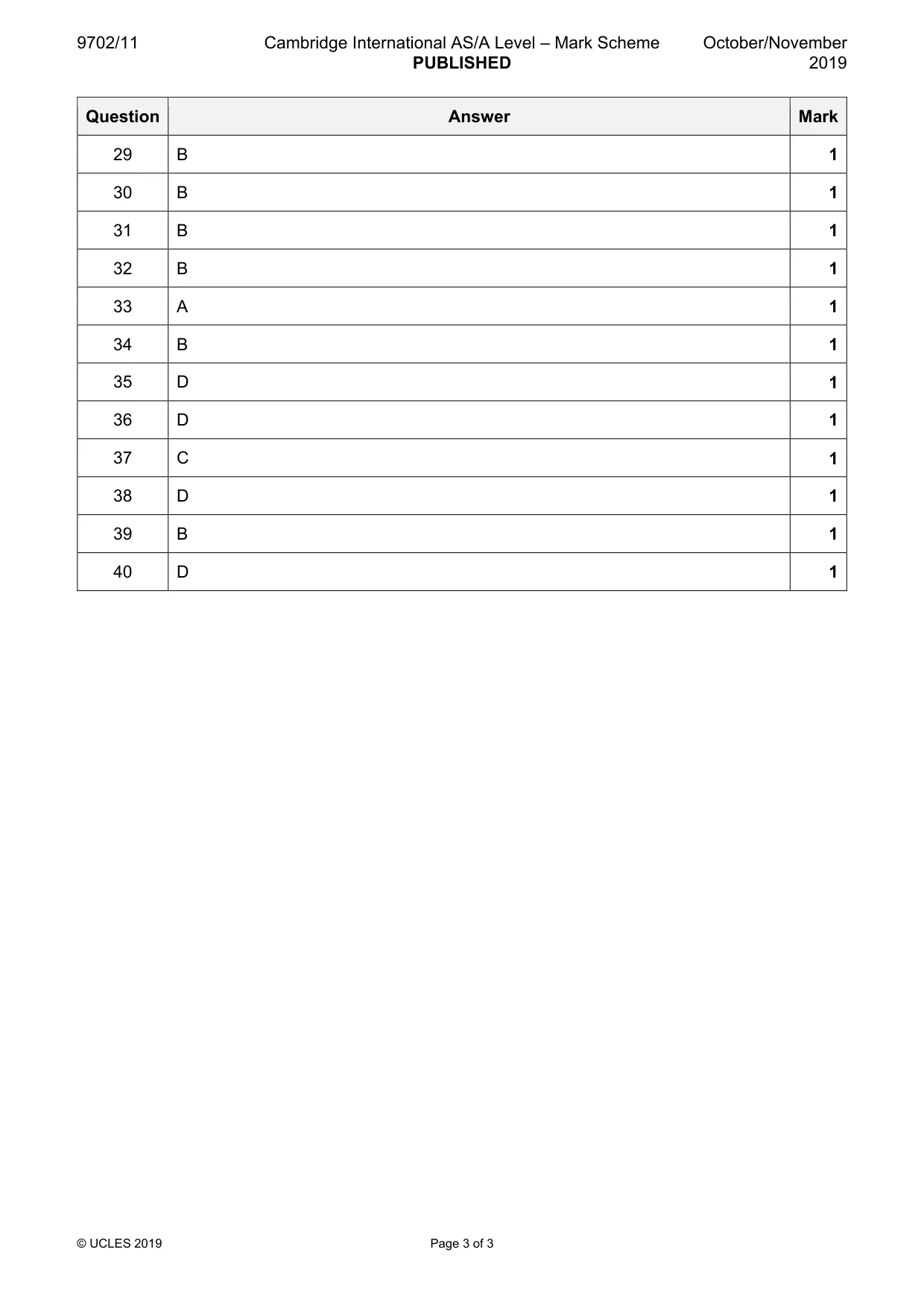
Mark scheme: B
Q30 · A metal plate of uniform thickness is connected to a cell as shown
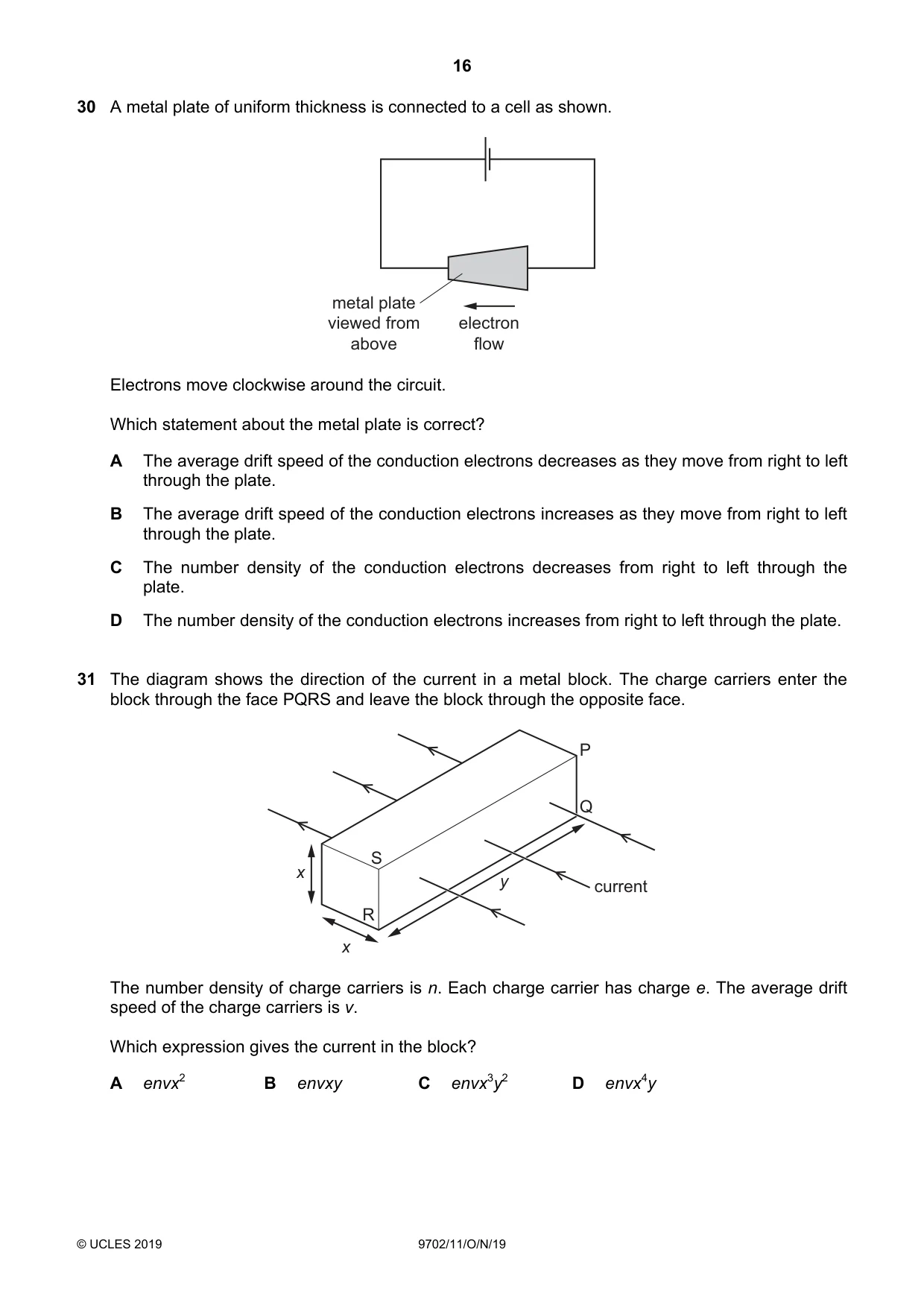
30 A metal plate of uniform thickness is connected to a cell as shown. metal plate viewed from electron above flow Electrons move clockwise around the circuit. Which statement about the metal plate is correct? A The average drift speed of the conduction electrons decreases as they move from right to left through the plate. B The average drift speed of the conduction electrons increases as they move from right to left through the plate. C The number density of the conduction electrons decreases from right to left through the plate. D The number density of the conduction electrons increases from right to left through the plate.
Mark scheme: B
Q31 · The diagram shows the direction of the current in a metal block
31 The diagram shows the direction of the current in a metal block. The charge carriers enter the block through the face PQRS and leave the block through the opposite face. P Q S x y current R x The number density of charge carriers is n. Each charge carrier has charge e. The average drift speed of the charge carriers is v. Which expression gives the current in the block? A envx2 B envxy C envx3y2 D envx4y
Mark scheme: B
Q32 · What could not be used as a unit of potential difference?
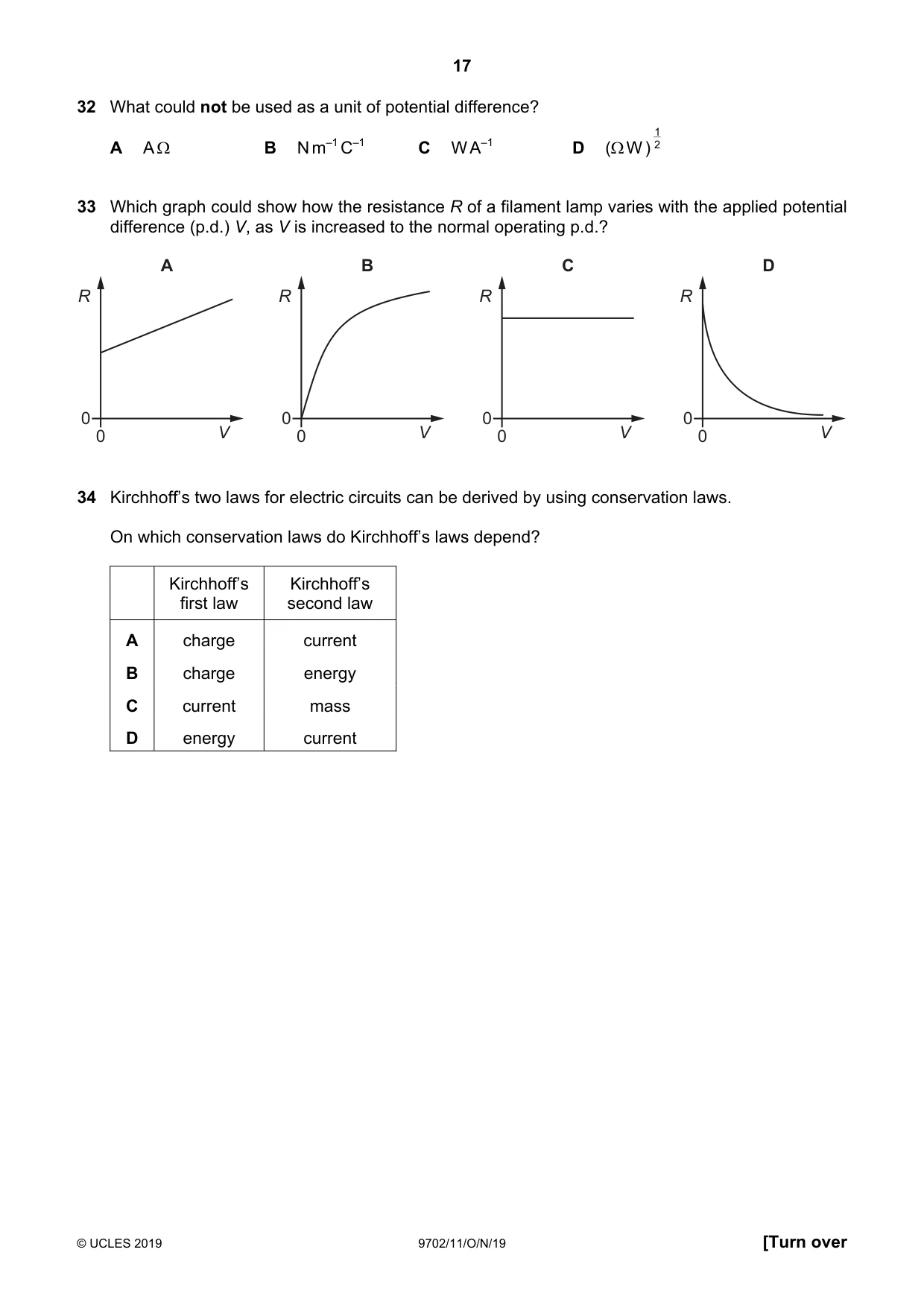
32 What could not be used as a unit of potential difference? 1 A A Ω B N m–1 C–1 C W A–1 D (Ω W ) 2
Mark scheme: B
Q33 · Which graph could show how the resistance R of a filament lamp varies with the applied…
33 Which graph could show how the resistance R of a filament lamp varies with the applied potential difference (p.d.) V, as V is increased to the normal operating p.d.? A B C D R R R R 0 0 0 0 0 V 0 V 0 V 0 V
Mark scheme: A
Q34 · Kirchhoff’s two laws for electric circuits can be derived by using conservation laws
34 Kirchhoff’s two laws for electric circuits can be derived by using conservation laws. On which conservation laws do Kirchhoff’s laws depend? Kirchhoff’s Kirchhoff’s first law second law A charge current B charge energy C current mass D energy current
Mark scheme: B
Q35 · The diagram shows a circuit
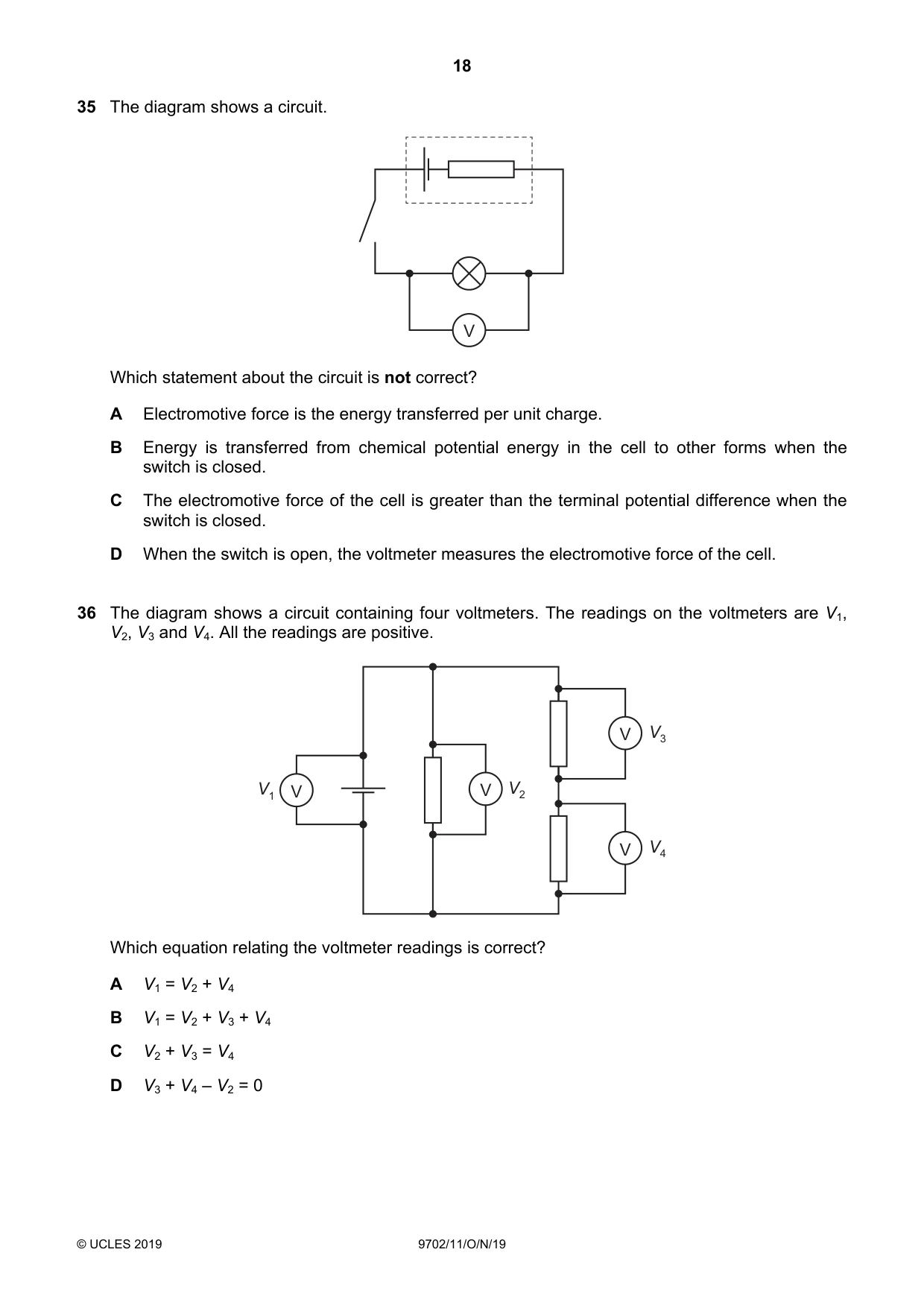
35 The diagram shows a circuit. V Which statement about the circuit is not correct? A Electromotive force is the energy transferred per unit charge. B Energy is transferred from chemical potential energy in the cell to other forms when the switch is closed. C The electromotive force of the cell is greater than the terminal potential difference when the switch is closed. D When the switch is open, the voltmeter measures the electromotive force of the cell.
Mark scheme: D
Q36 · The diagram shows a circuit containing four voltmeters
36 The diagram shows a circuit containing four voltmeters. The readings on the voltmeters are V1, V2, V3 and V4. All the readings are positive. V V3 V1 V V2 V V V4 Which equation relating the voltmeter readings is correct? A V1 = V2 + V4 B V1 = V2 + V3 + V4 C V2 + V3 = V4 D V3 + V4 – V2 = 0
Mark scheme: D
Q37 · A network consists of a 3.0 Ω resistor and two 6.0 Ω resistors, as shown
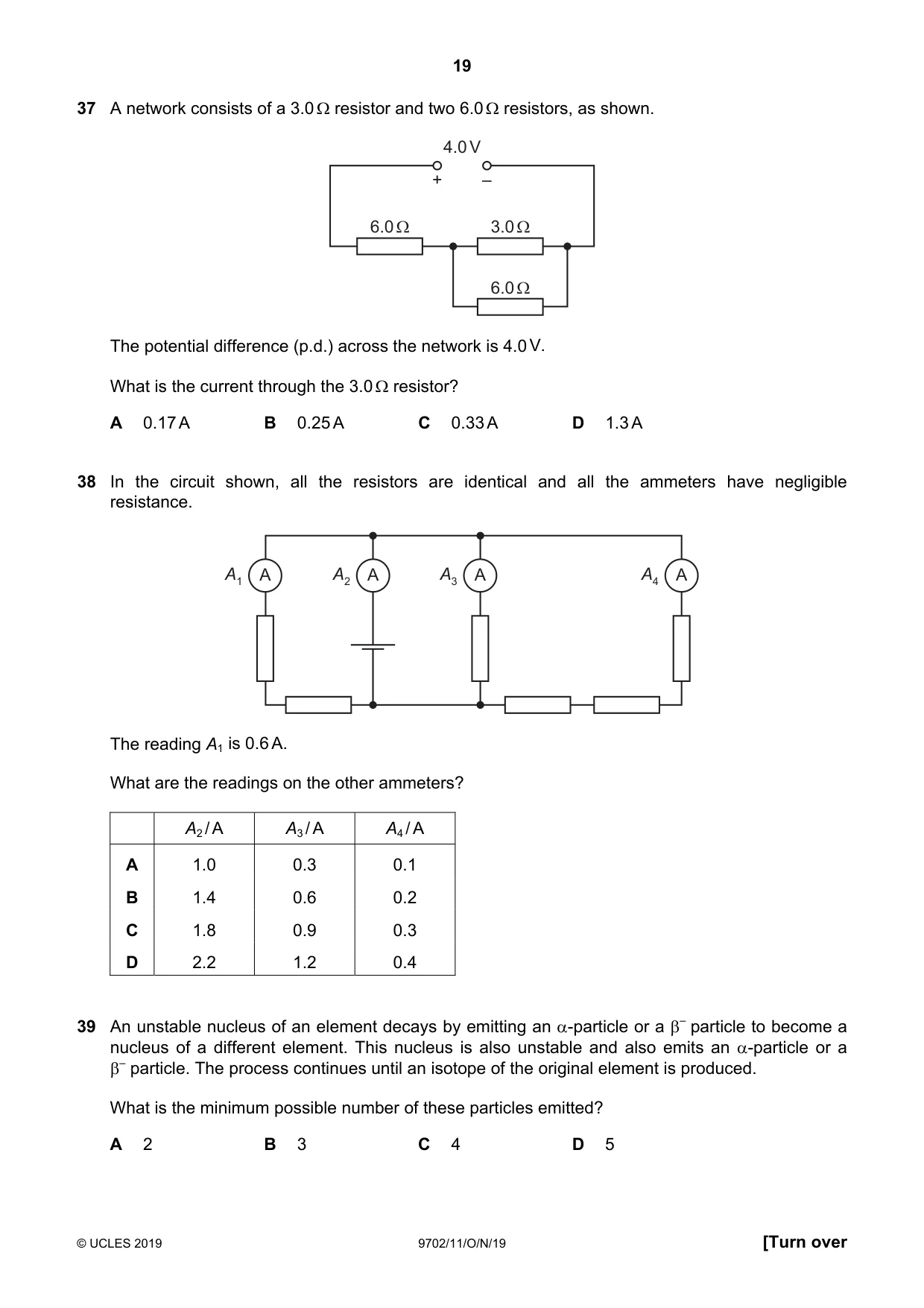
37 A network consists of a 3.0 Ω resistor and two 6.0 Ω resistors, as shown. 4.0 V + – 6.0 Ω 3.0 Ω 6.0 Ω The potential difference (p.d.) across the network is 4.0 V. What is the current through the 3.0 Ω resistor? A 0.17 A B 0.25 A C 0.33 A D 1.3 A
Mark scheme: C
Q38 · In the circuit shown, all the resistors are identical and all the ammeters have…
38 In the circuit shown, all the resistors are identical and all the ammeters have negligible resistance. A1 A A2 A A3 A A4 A The reading A1 is 0.6 A. What are the readings on the other ammeters? A2 / A A3 / A A4 / A A 1.0 0.3 0.1 B 1.4 0.6 0.2 C 1.8 0.9 0.3 D 2.2 1.2 0.4
Mark scheme: D
Q39 · An unstable nucleus of an element decays by emitting an α-particle or a β– particle to…
39 An unstable nucleus of an element decays by emitting an α-particle or a β– particle to become a nucleus of a different element. This nucleus is also unstable and also emits an α-particle or a β– particle. The process continues until an isotope of the original element is produced. What is the minimum possible number of these particles emitted? A 2 B 3 C 4 D 5
Mark scheme: B
Q40 · The diagrams show the quark composition of four different hadrons
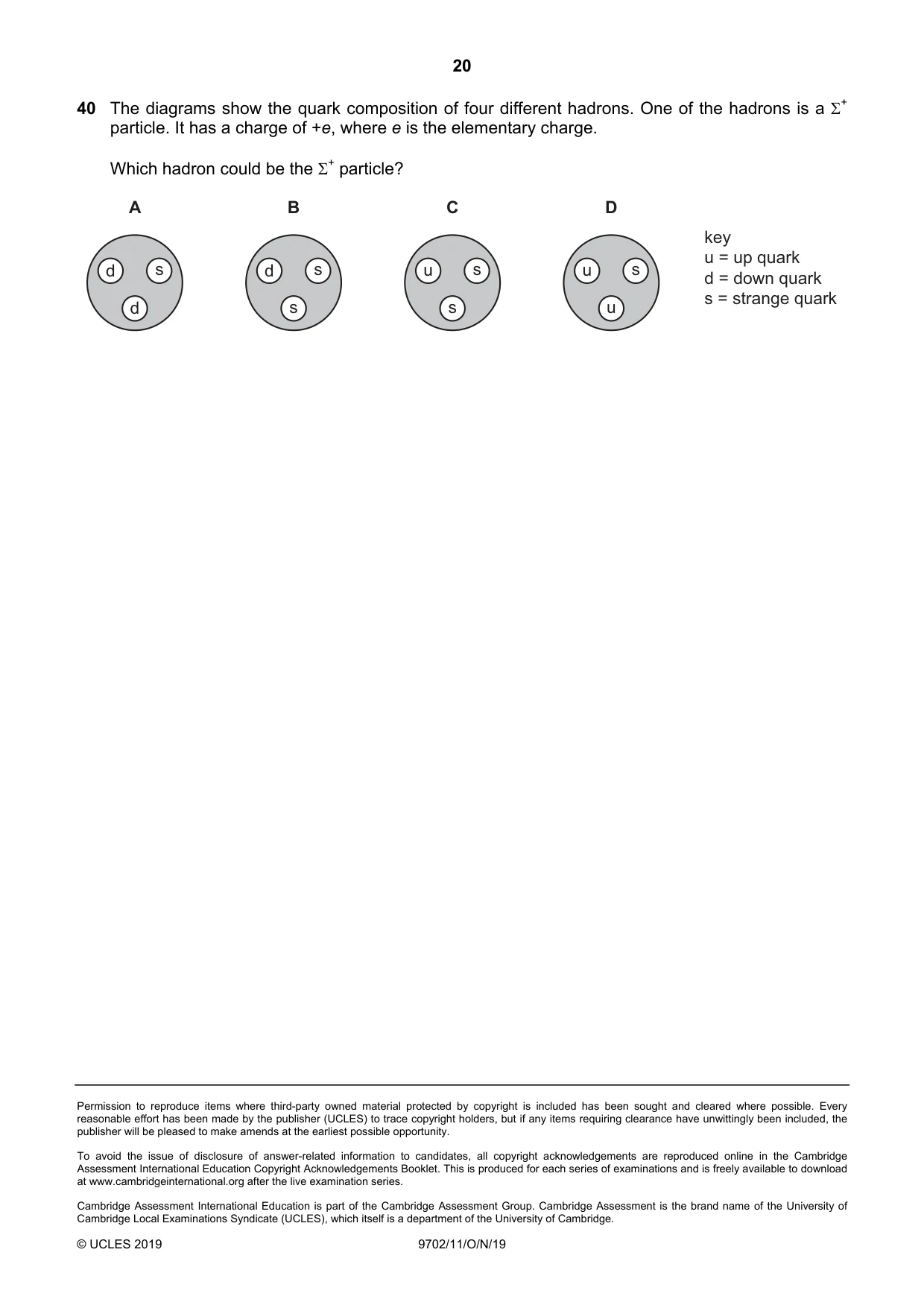
40 The diagrams show the quark composition of four different hadrons. One of the hadrons is a Σ+ particle. It has a charge of +e, where e is the elementary charge. Which hadron could be the Σ+ particle? A B C D key u = up quark d s d s u s u s d = down quark s = strange quark d s s u
Mark scheme: D
What was in this paper
The subtopics covered by these 40 questions, and how many questions each got. Open one in a new tab to see every Cambridge question on it.
3Density and pressure2Electric current2Energy conservation2Errors and uncertainties2Kirchhoff’s laws2Practical circuits2The diffraction grating2Diffraction1Doppler effect for sound waves1Elastic and plastic behaviour1Electromagnetic spectrum1Equations of motion1Equilibrium of forces1Fundamental particles1Gravitational potential energy and kinetic energy1Interference1Linear momentum and its conservation1Physical quantities1Potential difference and power1Potential dividers1Progressive waves1Radioactive decay1Resistance and resistivity1Scalars and vectors1SI units1Stationary waves1Stress and strain1The first law of thermodynamics1Transverse and longitudinal waves1Turning effects of forces1What you needed in this session
Cambridge’s own grade thresholds for 2019 Oct/Nov, Paper 1 · Variant 1. A higher threshold means an easier paper — the bar moves with how the cohort did.