Cambridge A Level Physics 9702 — 2022 Feb/March Paper 1 · Variant 2
9702/12/F/M/22 · 40 questions · 40 marks · ≈45 min
The question paper and its mark scheme, free to read here and free to download. This is Cambridge’s own paper, exactly as it was sat.
Question paper16 pages
Mark scheme3 pages
Answers below. Sit the paper first if you are practising.
Questions as text
Q1 · What could not be a measurement of a physical quantity?
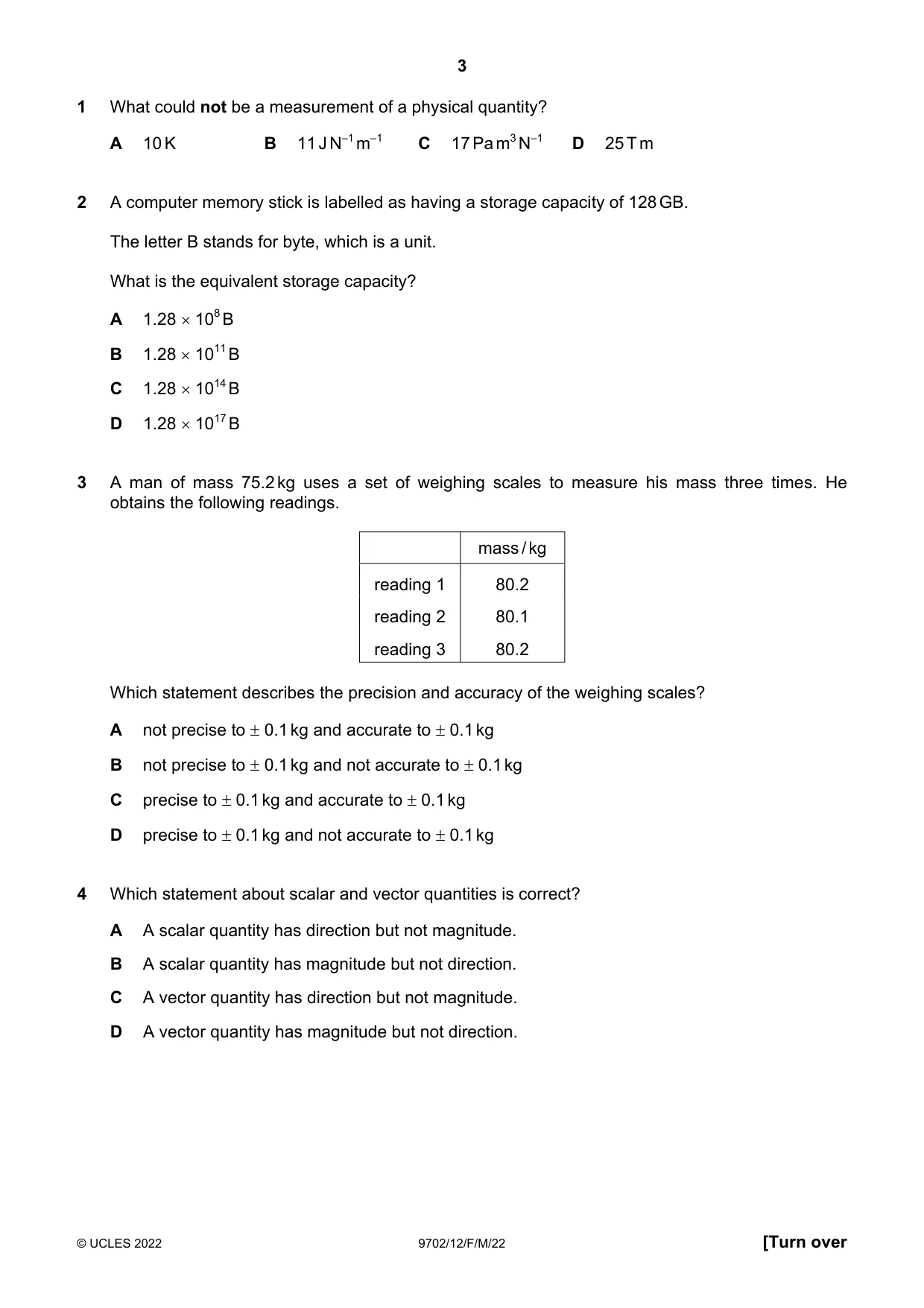
1 What could not be a measurement of a physical quantity? A 10 K B 11 J N–1 m–1 C 17 Pa m3 N–1 D 25 T m
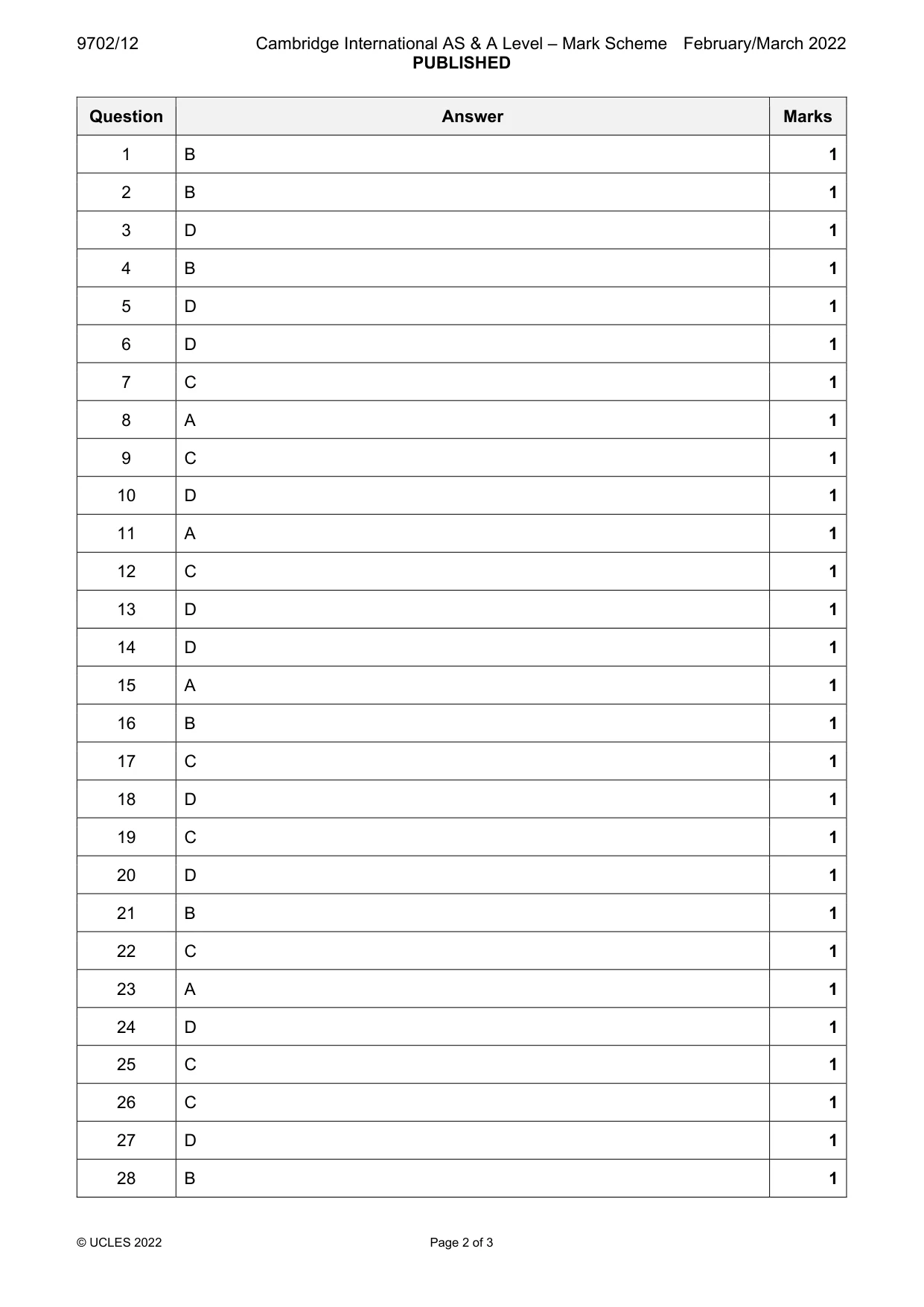
Mark scheme: B
Q2 · A computer memory stick is labelled as having a storage capacity of 128 GB
2 A computer memory stick is labelled as having a storage capacity of 128 GB. The letter B stands for byte, which is a unit. What is the equivalent storage capacity? A 1.28 108 B B 1.28 1011 B C 1.28 1014 B D 1.28 1017 B
Mark scheme: B
Q3 · A man of mass 75.2 kg uses a set of weighing scales to measure his mass three times
3 A man of mass 75.2 kg uses a set of weighing scales to measure his mass three times. He obtains the following readings. mass / kg reading 1 80.2 reading 2 80.1 reading 3 80.2 Which statement describes the precision and accuracy of the weighing scales? A not precise to 0.1 kg and accurate to 0.1 kg B not precise to 0.1 kg and not accurate to 0.1 kg C precise to 0.1 kg and accurate to 0.1 kg D precise to 0.1 kg and not accurate to 0.1 kg
Mark scheme: D
Q4 · Which statement about scalar and vector quantities is correct?
4 Which statement about scalar and vector quantities is correct? A A scalar quantity has direction but not magnitude. B A scalar quantity has magnitude but not direction. C A vector quantity has direction but not magnitude. D A vector quantity has magnitude but not direction.
Mark scheme: B
Q5 · How can the acceleration of an object be determined?
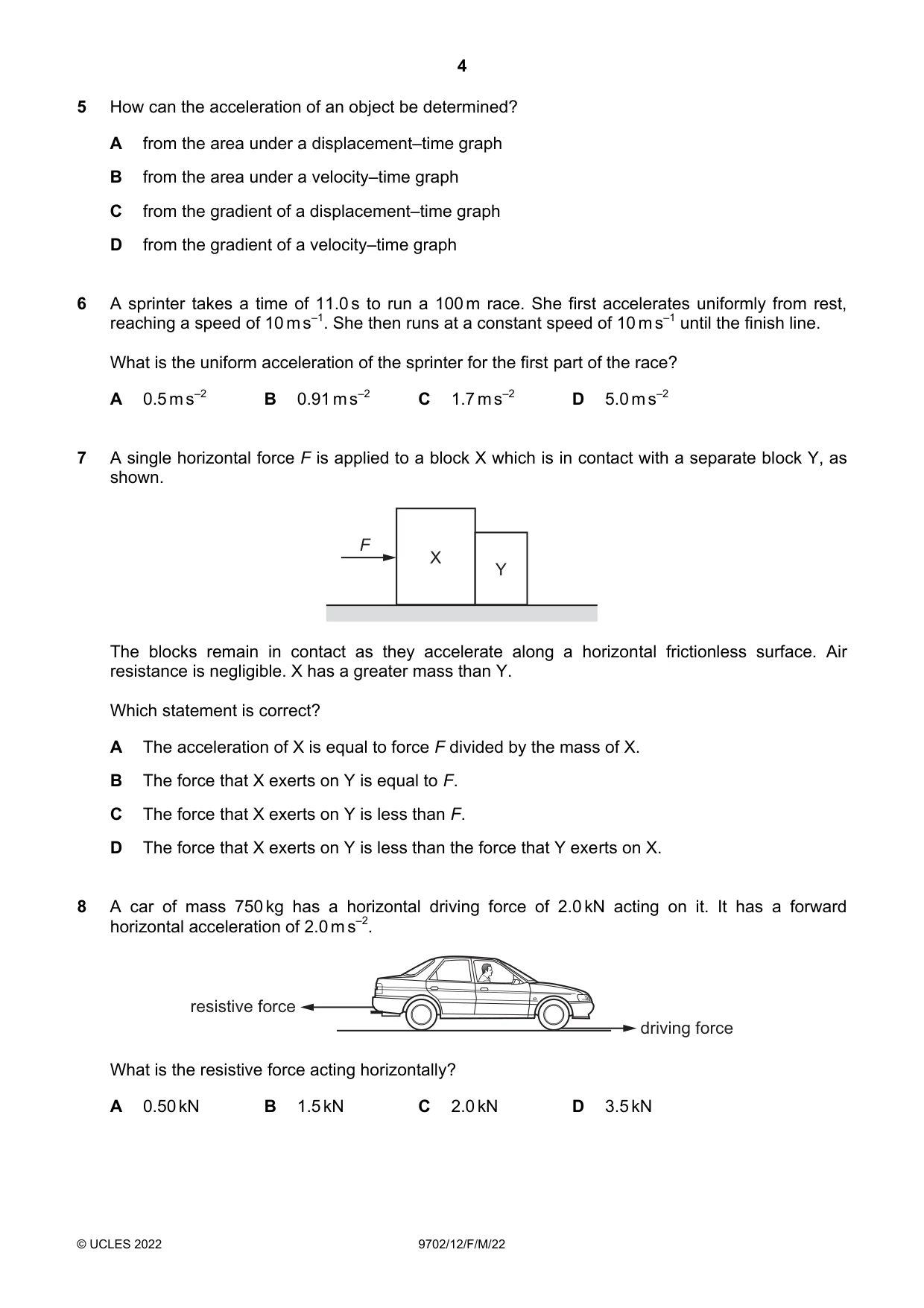
5 How can the acceleration of an object be determined? A from the area under a displacement–time graph B from the area under a velocity–time graph C from the gradient of a displacement–time graph D from the gradient of a velocity–time graph
Mark scheme: D
Q6 · A sprinter takes a time of 11.0 s to run a 100 m race
6 A sprinter takes a time of 11.0 s to run a 100 m race. She first accelerates uniformly from rest, reaching a speed of 10 m s–1. She then runs at a constant speed of 10 m s–1 until the finish line. What is the uniform acceleration of the sprinter for the first part of the race? A 0.5 m s–2 B 0.91 m s–2 C 1.7 m s–2 D 5.0 m s–2
Mark scheme: D
Q7 · A single horizontal force F is applied to a block X which is in contact with a separate…
7 A single horizontal force F is applied to a block X which is in contact with a separate block Y, as shown. F X Y The blocks remain in contact as they accelerate along a horizontal frictionless surface. Air resistance is negligible. X has a greater mass than Y. Which statement is correct? A The acceleration of X is equal to force F divided by the mass of X. B The force that X exerts on Y is equal to F. C The force that X exerts on Y is less than F. D The force that X exerts on Y is less than the force that Y exerts on X.
Mark scheme: C
Q8 · A car of mass 750 kg has a horizontal driving force of 2.0 kN acting on it
8 A car of mass 750 kg has a horizontal driving force of 2.0 kN acting on it. It has a forward horizontal acceleration of 2.0 m s–2. resistive force driving force What is the resistive force acting horizontally? A 0.50 kN B 1.5 kN C 2.0 kN D 3.5 kN
Mark scheme: A
Q9 · An object falls freely from rest in a vacuum
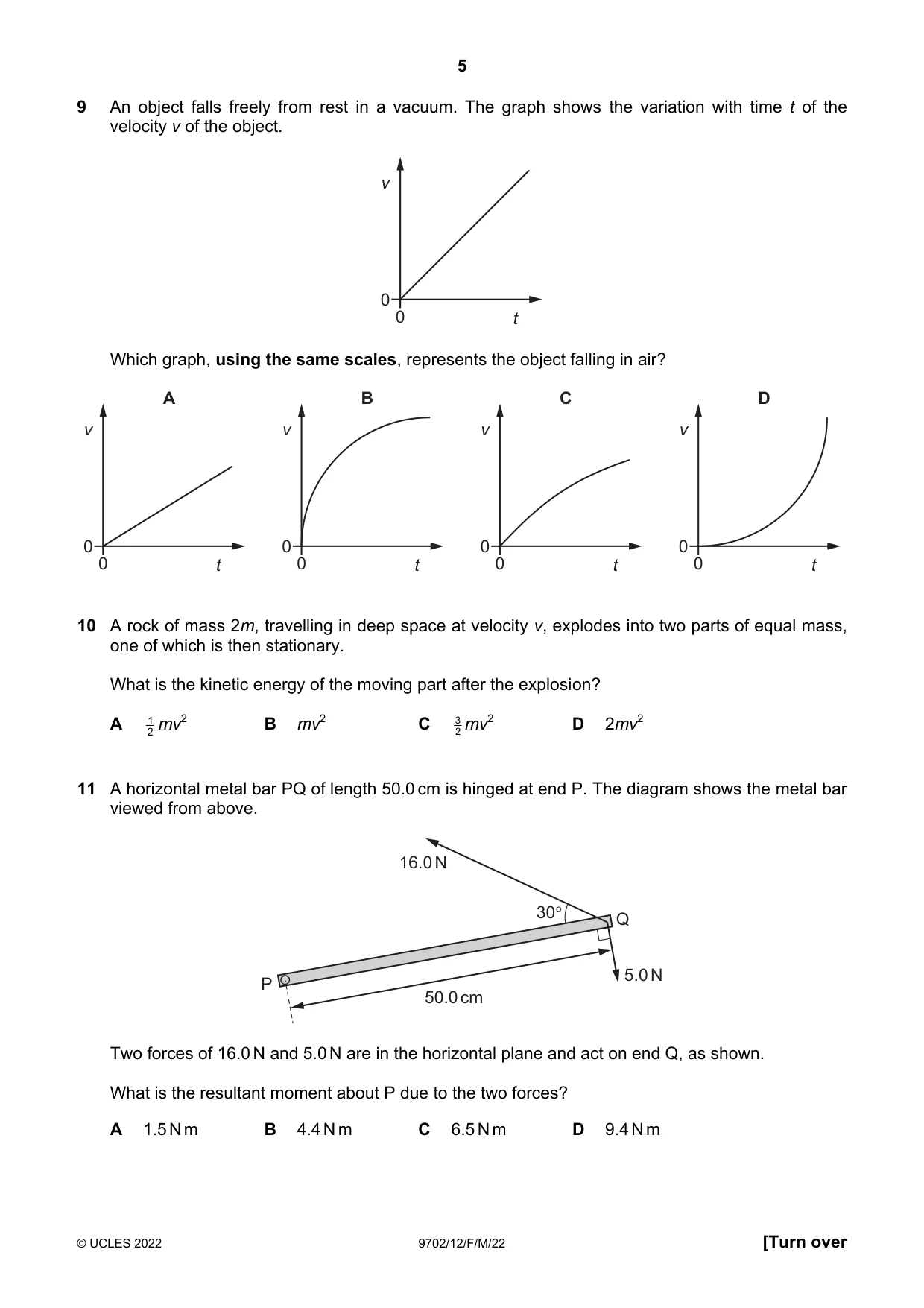
9 An object falls freely from rest in a vacuum. The graph shows the variation with time t of the velocity v of the object. v 0 0 t Which graph, using the same scales, represents the object falling in air? A B C D v v v v 0 0 0 0 0 t 0 t 0 t 0 t
Mark scheme: C
Q10 · A rock of mass 2m, travelling in deep space at velocity v, explodes into two parts of…
10 A rock of mass 2m, travelling in deep space at velocity v, explodes into two parts of equal mass, one of which is then stationary. What is the kinetic energy of the moving part after the explosion? A 1 mv2 B mv2 C 3 2 mv2 D 2mv2 2
Mark scheme: D
Q11 · A horizontal metal bar PQ of length 50.0 cm is hinged at end P
11 A horizontal metal bar PQ of length 50.0 cm is hinged at end P. The diagram shows the metal bar viewed from above. 16.0 N 30° Q 5.0 N P 50.0 cm Two forces of 16.0 N and 5.0 N are in the horizontal plane and act on end Q, as shown. What is the resultant moment about P due to the two forces? A 1.5 N m B 4.4 N m C 6.5 N m D 9.4 N m
Mark scheme: A
Q12 · A cube WXZY has sides of length 2.0 cm and mass 24.0 g
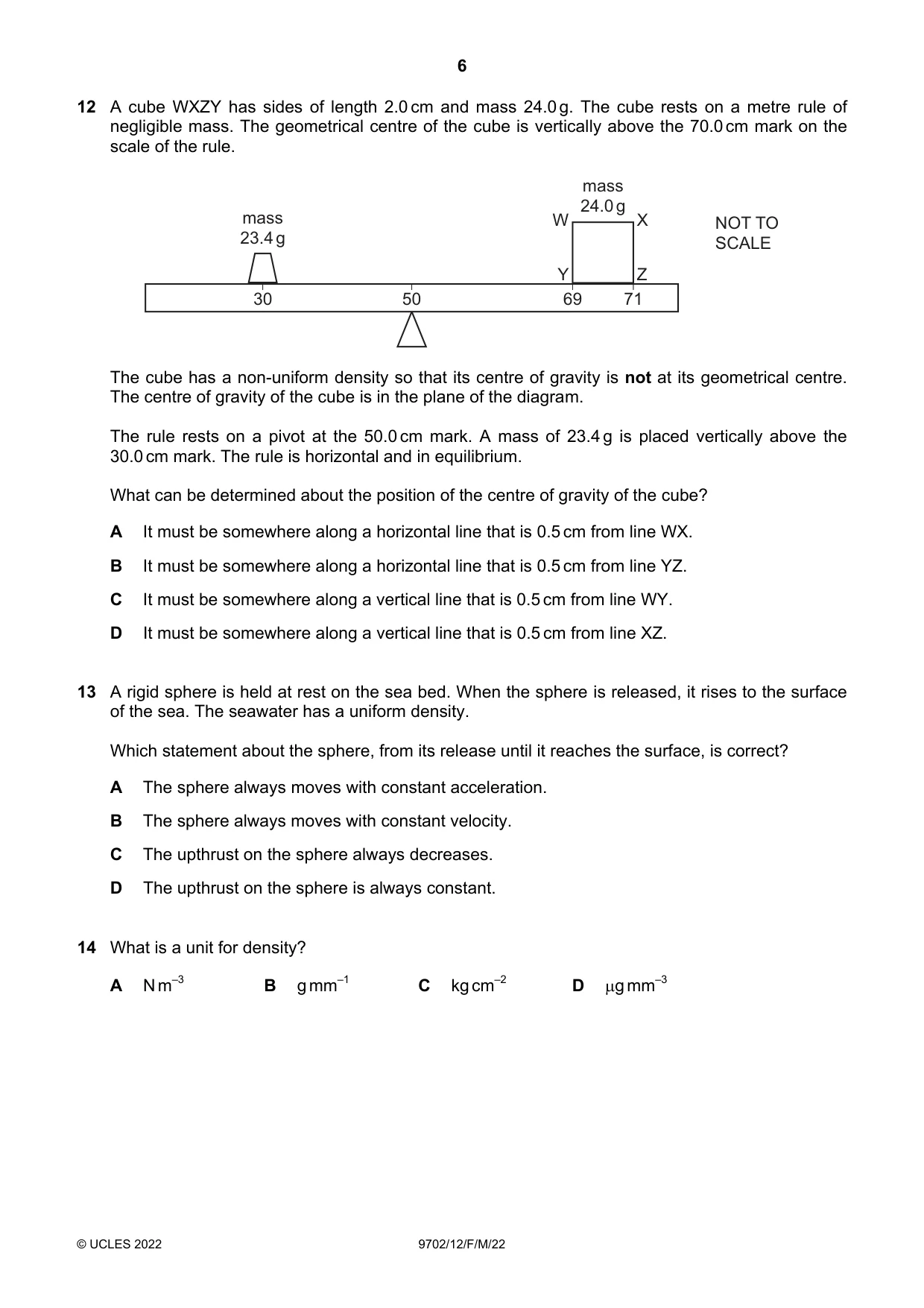
12 A cube WXZY has sides of length 2.0 cm and mass 24.0 g. The cube rests on a metre rule of negligible mass. The geometrical centre of the cube is vertically above the 70.0 cm mark on the scale of the rule. mass 24.0 g mass W X NOT TO 23.4 g SCALE Y Z 30 50 69 71 The cube has a non-uniform density so that its centre of gravity is not at its geometrical centre. The centre of gravity of the cube is in the plane of the diagram. The rule rests on a pivot at the 50.0 cm mark. A mass of 23.4 g is placed vertically above the 30.0 cm mark. The rule is horizontal and in equilibrium. What can be determined about the position of the centre of gravity of the cube? A It must be somewhere along a horizontal line that is 0.5 cm from line WX. B It must be somewhere along a horizontal line that is 0.5 cm from line YZ. C It must be somewhere along a vertical line that is 0.5 cm from line WY. D It must be somewhere along a vertical line that is 0.5 cm from line XZ.
Mark scheme: C
Q13 · A rigid sphere is held at rest on the sea bed
13 A rigid sphere is held at rest on the sea bed. When the sphere is released, it rises to the surface of the sea. The seawater has a uniform density. Which statement about the sphere, from its release until it reaches the surface, is correct? A The sphere always moves with constant acceleration. B The sphere always moves with constant velocity. C The upthrust on the sphere always decreases. D The upthrust on the sphere is always constant.
Mark scheme: D
Q14 · What is a unit for density?
14 What is a unit for density? A N m–3 B g mm–1 C kg cm–2 D g mm–3
Mark scheme: D
Q15 · The total energy input Ein in a process is partly transferred to useful energy output U…
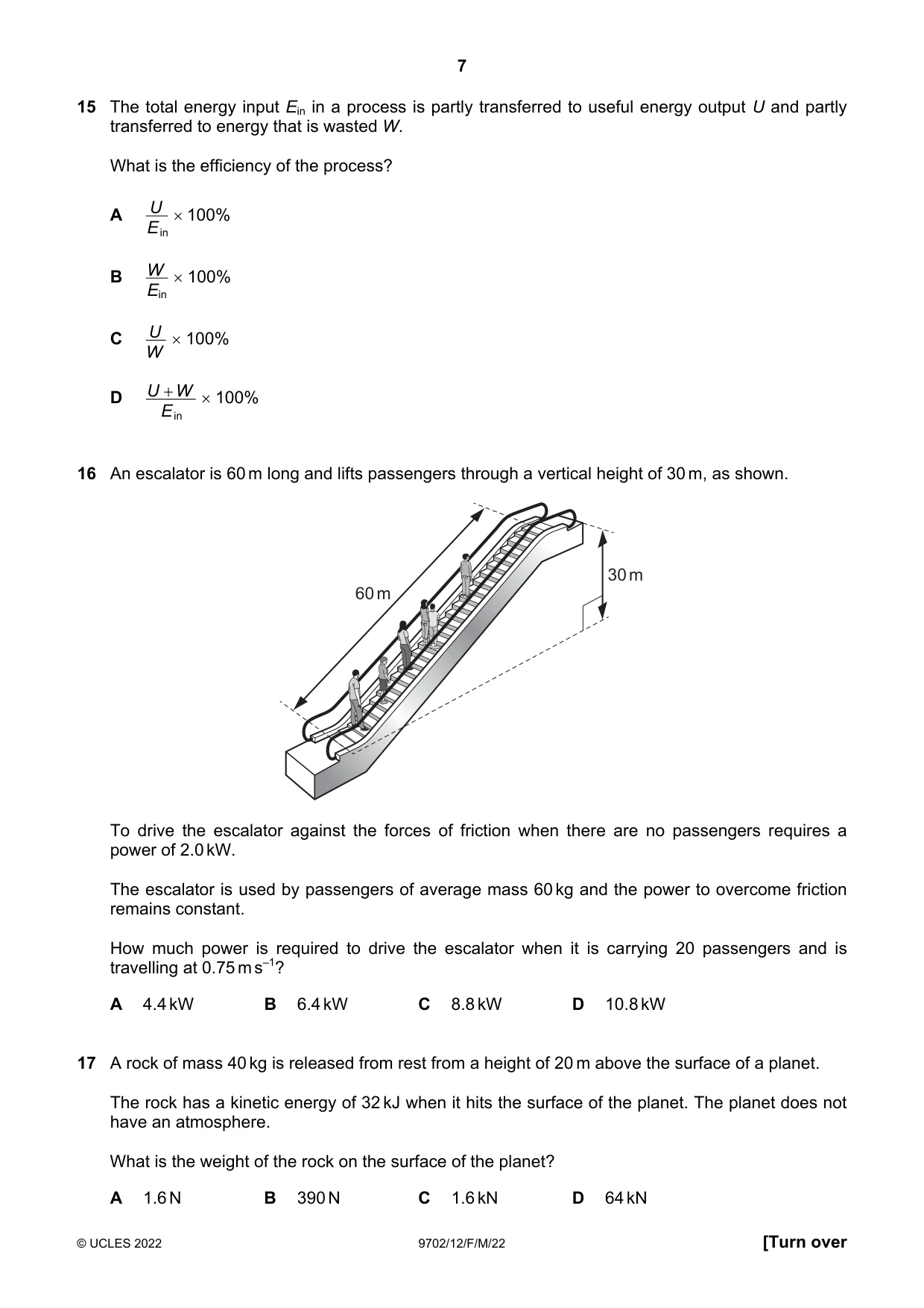
15 The total energy input Ein in a process is partly transferred to useful energy output U and partly transferred to energy that is wasted W. What is the efficiency of the process? A U 100% E in B W 100% E in C U 100% W U W 100% D E in
Mark scheme: A
Q16 · An escalator is 60 m long and lifts passengers through a vertical height of 30 m, as shown
16 An escalator is 60 m long and lifts passengers through a vertical height of 30 m, as shown. 30 m 60 m To drive the escalator against the forces of friction when there are no passengers requires a power of 2.0 kW. The escalator is used by passengers of average mass 60 kg and the power to overcome friction remains constant. How much power is required to drive the escalator when it is carrying 20 passengers and is travelling at 0.75 m s–1? A 4.4 kW B 6.4 kW C 8.8 kW D 10.8 kW
Mark scheme: B
Q17 · A rock of mass 40 kg is released from rest from a height of 20 m above the surface of a…
17 A rock of mass 40 kg is released from rest from a height of 20 m above the surface of a planet. The rock has a kinetic energy of 32 kJ when it hits the surface of the planet. The planet does not have an atmosphere. What is the weight of the rock on the surface of the planet? A 1.6 N B 390 N C 1.6 kN D 64 kN
Mark scheme: C
More questions on Gravitational potential energy and kinetic energy
Q18 · A metal wire is stretched
18 A metal wire is stretched. The wire obeys Hooke’s law. Which quantity has a value that does not change? A extension B strain C stress D Young modulus
Mark scheme: D
Q19 · An object is stretched until it reaches the elastic limit
19 An object is stretched until it reaches the elastic limit. Which statement must describe the stress on the object when it is at the elastic limit? A It is the maximum stress for which the object obeys Hooke’s law. B It is the maximum stress that can be applied to the object before it has elastic deformation. C It is the maximum stress that can be applied to the object before it has plastic deformation. D It is the maximum stress the object can withstand before it breaks.
Mark scheme: C
Q20 · Which statement about progressive waves is correct?
20 Which statement about progressive waves is correct? A They are always transverse waves. B They can exist in solids but not liquids. C They decrease in frequency as their speed increases. D They transfer energy away from their source.
Mark scheme: D
Q21 · A cathode-ray oscilloscope (CRO) is used to determine the frequency of a sound wave
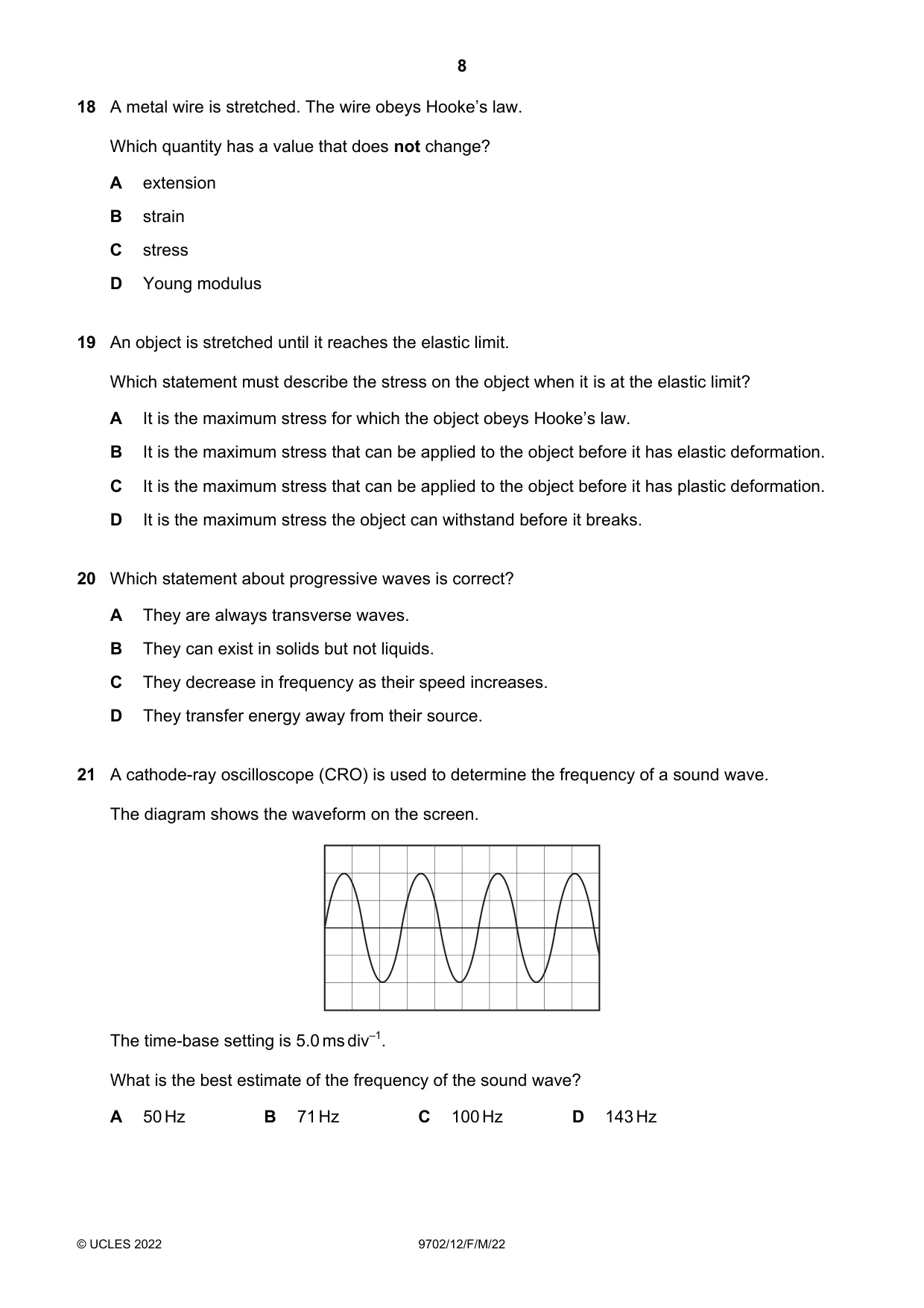
21 A cathode-ray oscilloscope (CRO) is used to determine the frequency of a sound wave. The diagram shows the waveform on the screen. The time-base setting is 5.0 ms div–1. What is the best estimate of the frequency of the sound wave? A 50 Hz B 71 Hz C 100 Hz D 143 Hz
Mark scheme: B
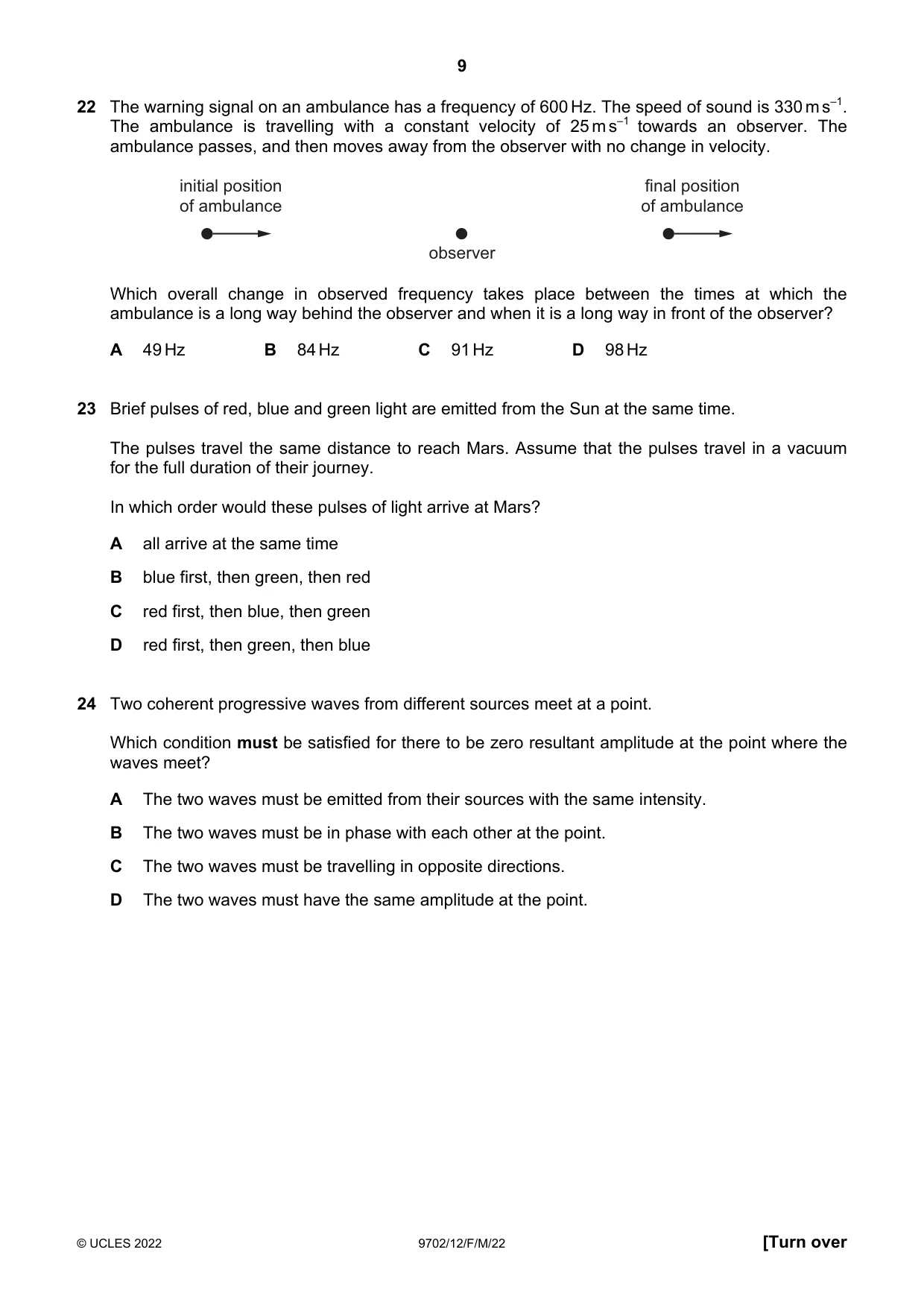
Q22 · The warning signal on an ambulance has a frequency of 600 Hz
22 The warning signal on an ambulance has a frequency of 600 Hz. The speed of sound is 330 m s–1. The ambulance is travelling with a constant velocity of 25 m s–1 towards an observer. The ambulance passes, and then moves away from the observer with no change in velocity. initial position final position of ambulance of ambulance observer Which overall change in observed frequency takes place between the times at which the ambulance is a long way behind the observer and when it is a long way in front of the observer? A 49 Hz B 84 Hz C 91 Hz D 98 Hz
Mark scheme: C
Q23 · Brief pulses of red, blue and green light are emitted from the Sun at the same time
23 Brief pulses of red, blue and green light are emitted from the Sun at the same time. The pulses travel the same distance to reach Mars. Assume that the pulses travel in a vacuum for the full duration of their journey. In which order would these pulses of light arrive at Mars? A all arrive at the same time B blue first, then green, then red C red first, then blue, then green D red first, then green, then blue
Mark scheme: A
Q24 · Two coherent progressive waves from different sources meet at a point
24 Two coherent progressive waves from different sources meet at a point. Which condition must be satisfied for there to be zero resultant amplitude at the point where the waves meet? A The two waves must be emitted from their sources with the same intensity. B The two waves must be in phase with each other at the point. C The two waves must be travelling in opposite directions. D The two waves must have the same amplitude at the point.
Mark scheme: D
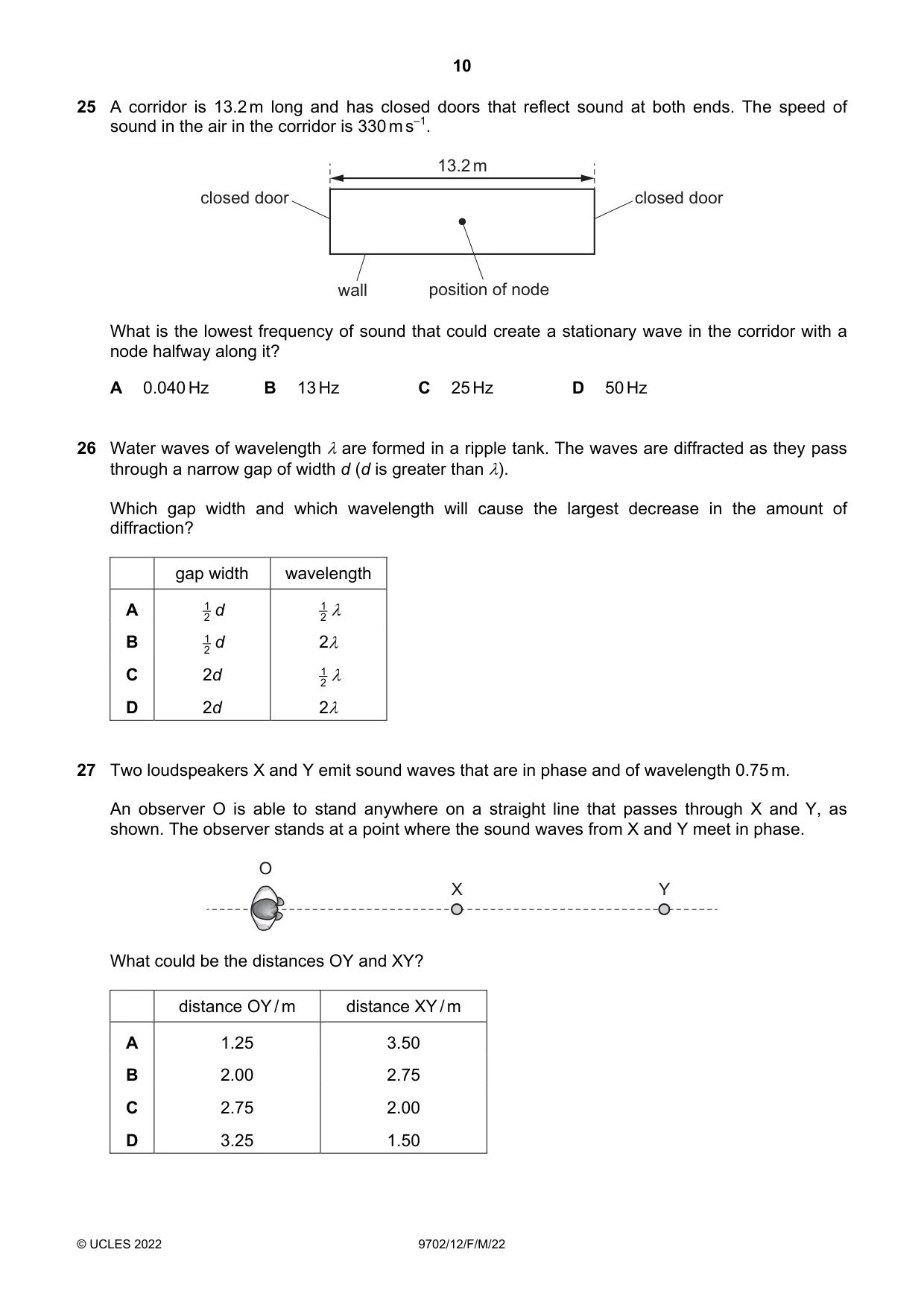
Q25 · A corridor is 13.2 m long and has closed doors that reflect sound at both ends
25 A corridor is 13.2 m long and has closed doors that reflect sound at both ends. The speed of sound in the air in the corridor is 330 m s–1. 13.2 m closed door closed door wall position of node What is the lowest frequency of sound that could create a stationary wave in the corridor with a node halfway along it? A 0.040 Hz B 13 Hz C 25 Hz D 50 Hz
Mark scheme: C
Q26 · Water waves of wavelength are formed in a ripple tank
26 Water waves of wavelength are formed in a ripple tank. The waves are diffracted as they pass through a narrow gap of width d (d is greater than ). Which gap width and which wavelength will cause the largest decrease in the amount of diffraction? gap width wavelength A 1 d 1 2 2 B 1 d 2 2 C 2d 1 2 D 2d 2
Mark scheme: C
Q27 · Two loudspeakers X and Y emit sound waves that are in phase and of wavelength 0.75 m
27 Two loudspeakers X and Y emit sound waves that are in phase and of wavelength 0.75 m. An observer O is able to stand anywhere on a straight line that passes through X and Y, as shown. The observer stands at a point where the sound waves from X and Y meet in phase. O X Y What could be the distances OY and XY? distance OY / m distance XY / m A 1.25 3.50 B 2.00 2.75 C 2.75 2.00 D 3.25 1.50
Mark scheme: D
Q28 · Light of a single wavelength is incident normally on a diffraction grating
28 Light of a single wavelength is incident normally on a diffraction grating. The resulting diffraction pattern is displayed on a screen. Which change makes the first orders of intensity maxima further apart from each other on the screen? A placing the screen closer to the diffraction grating B using a diffraction grating with less separation between adjacent slits C using a diffraction grating with more slits but keeping the same separation between adjacent slits D using light with a shorter wavelength
Mark scheme: B
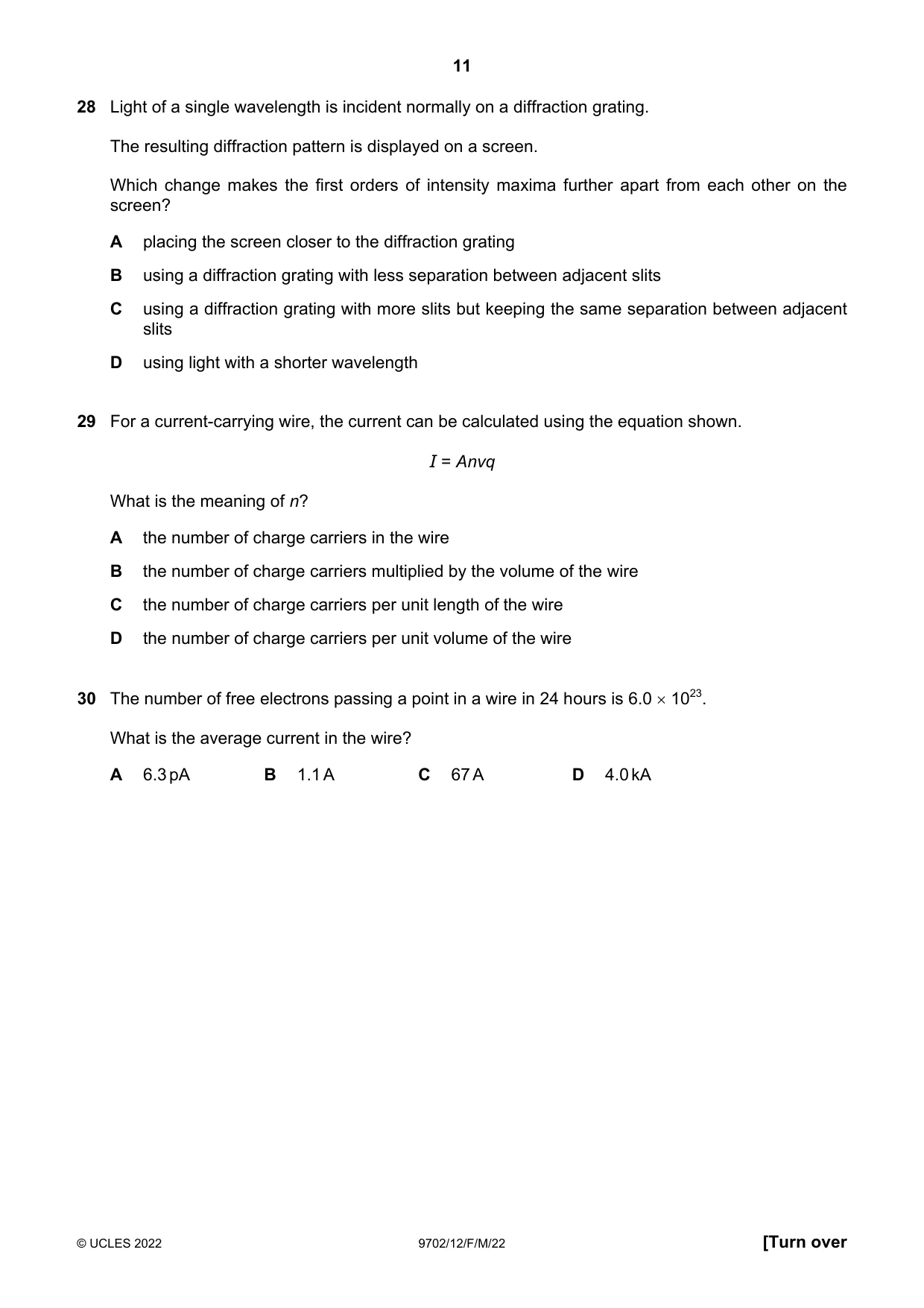
Q29 · For a current-carrying wire, the current can be calculated using the equation shown
29 For a current-carrying wire, the current can be calculated using the equation shown. I = Anvq What is the meaning of n? A the number of charge carriers in the wire B the number of charge carriers multiplied by the volume of the wire C the number of charge carriers per unit length of the wire D the number of charge carriers per unit volume of the wire
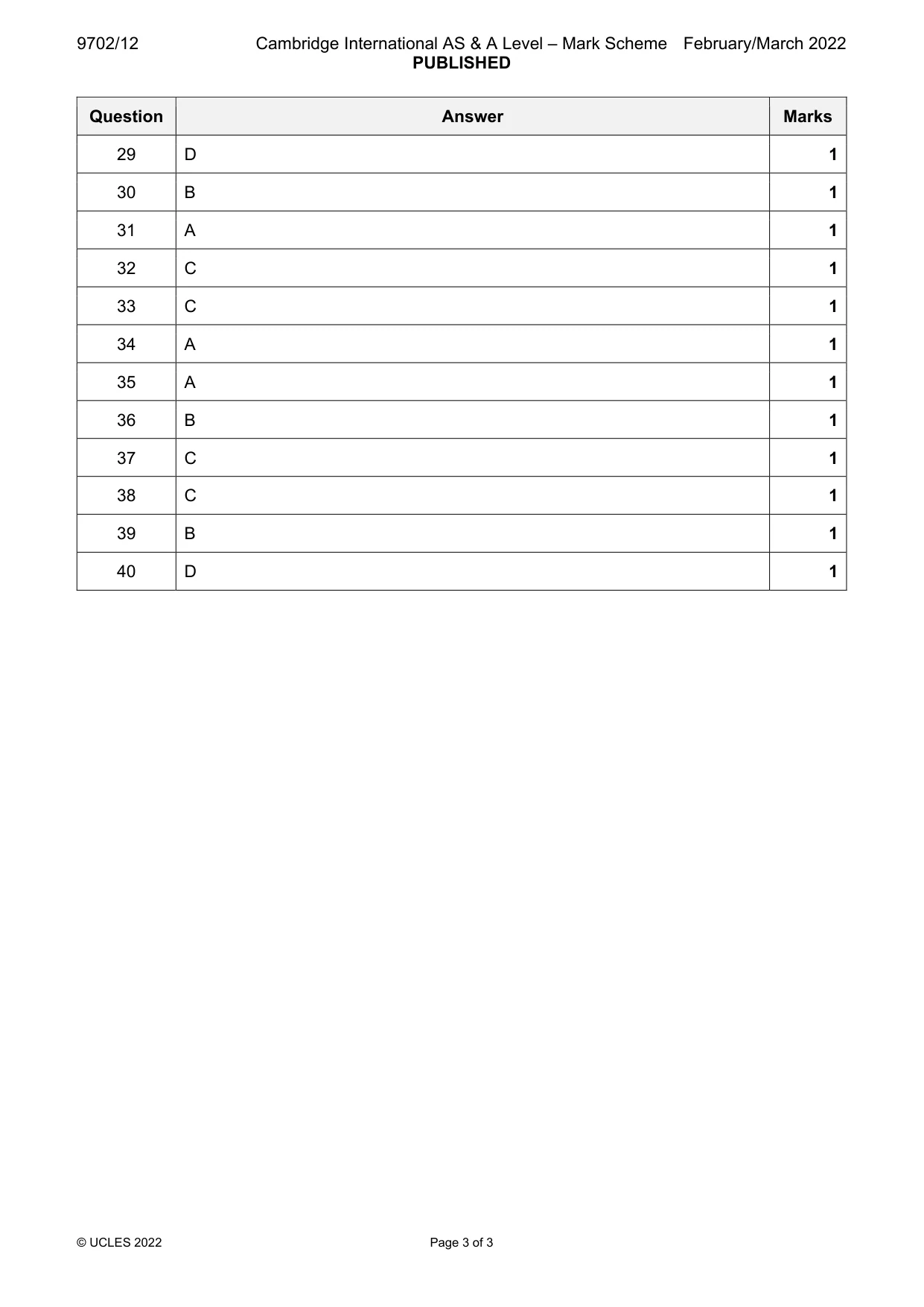
Mark scheme: D
Q30 · The number of free electrons passing a point in a wire in 24 hours is 6.0 1023
30 The number of free electrons passing a point in a wire in 24 hours is 6.0 1023. What is the average current in the wire? A 6.3 pA B 1.1 A C 67 A D 4.0 kA
Mark scheme: B
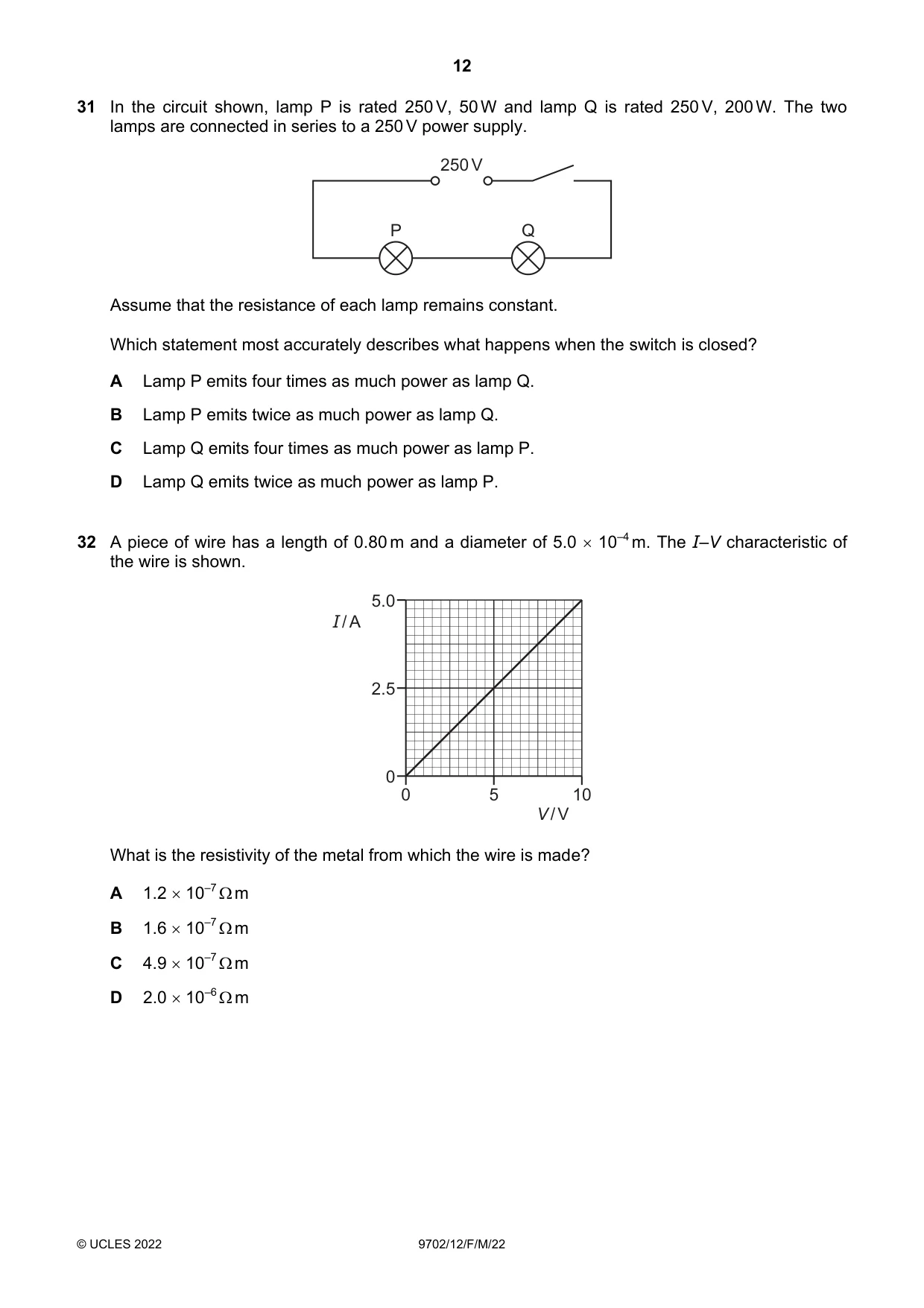
Q31 · In the circuit shown, lamp P is rated 250 V, 50 W and lamp Q is rated 250 V, 200 W
31 In the circuit shown, lamp P is rated 250 V, 50 W and lamp Q is rated 250 V, 200 W. The two lamps are connected in series to a 250 V power supply. 250 V P Q Assume that the resistance of each lamp remains constant. Which statement most accurately describes what happens when the switch is closed? A Lamp P emits four times as much power as lamp Q. B Lamp P emits twice as much power as lamp Q. C Lamp Q emits four times as much power as lamp P. D Lamp Q emits twice as much power as lamp P.
Mark scheme: A
Q32 · A piece of wire has a length of 0.80 m and a diameter of 5.0 10–4 m
32 A piece of wire has a length of 0.80 m and a diameter of 5.0 10–4 m. The I–V characteristic of the wire is shown. 5.0 I / A 2.5 0 0 5 10 V / V What is the resistivity of the metal from which the wire is made? A 1.2 10–7 m B 1.6 10–7 m C 4.9 10–7 m D 2.0 10–6 m
Mark scheme: C
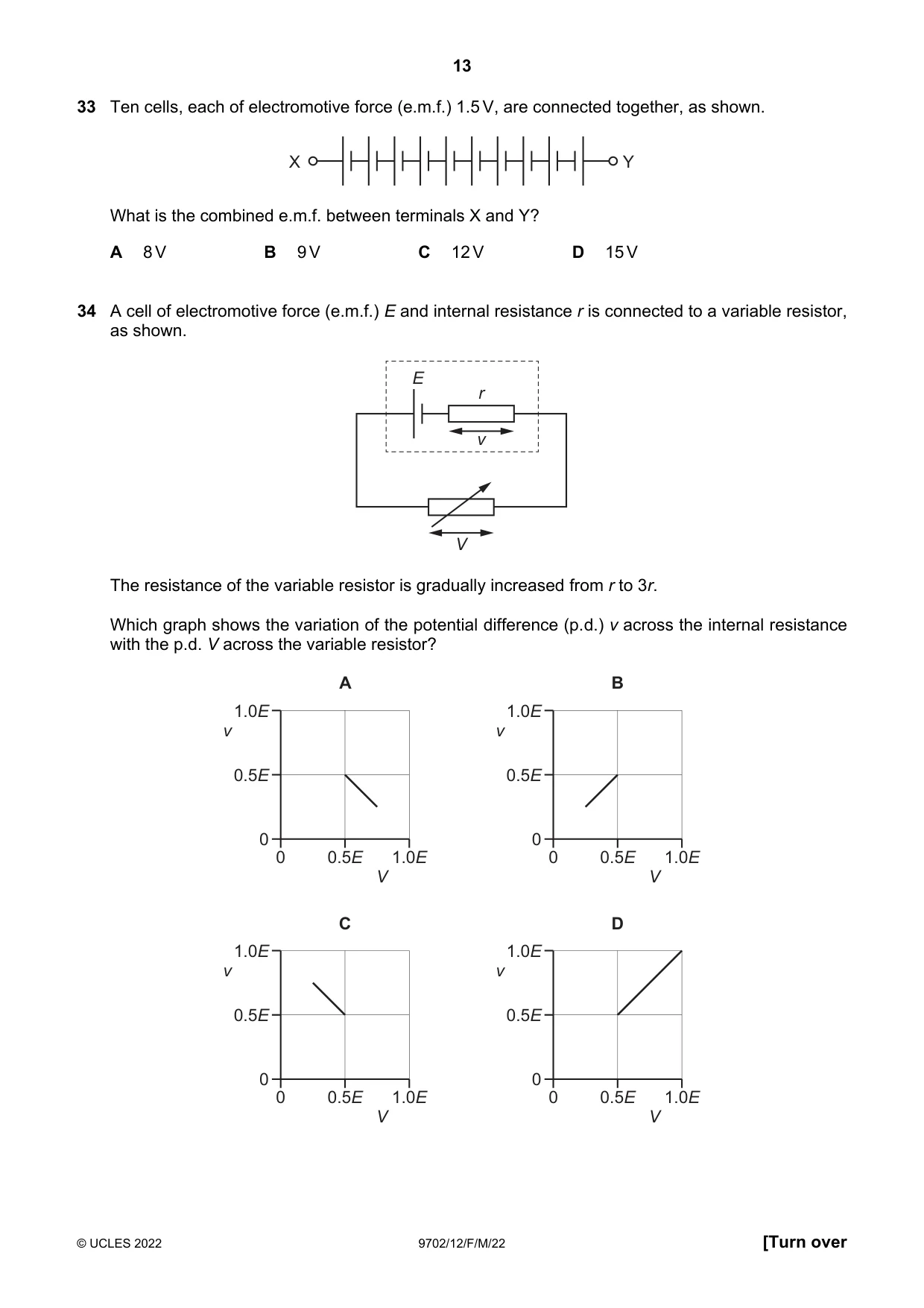
Q33 · Ten cells, each of electromotive force (e.m.f.) 1.5 V, are connected together, as shown
33 Ten cells, each of electromotive force (e.m.f.) 1.5 V, are connected together, as shown. X Y What is the combined e.m.f. between terminals X and Y? A 8 V B 9 V C 12 V D 15 V
Mark scheme: C
Q34 · A cell of electromotive force (e.m.f.) E and internal resistance r is connected to a…
34 A cell of electromotive force (e.m.f.) E and internal resistance r is connected to a variable resistor, as shown. E r v V The resistance of the variable resistor is gradually increased from r to 3r. Which graph shows the variation of the potential difference (p.d.) v across the internal resistance with the p.d. V across the variable resistor? A B 1.0E 1.0E v v 0.5E 0.5E 0 0 0 0.5E 1.0E 0 0.5E 1.0E V V C D 1.0E 1.0E v v 0.5E 0.5E 0 0 0 0.5E 1.0E 0 0.5E 1.0E V V
Mark scheme: A
Q35 · Each of Kirchhoff’s two laws presumes that some quantity is conserved
35 Each of Kirchhoff’s two laws presumes that some quantity is conserved. Which row states Kirchhoff’s first law and names the quantity that is conserved? statement quantity A the algebraic sum of currents charge into a junction is zero B the algebraic sum of currents energy into a junction is zero C the e.m.f. in a loop is equal to the charge algebraic sum of the product of current and resistance round the loop D the e.m.f. in a loop is equal to the energy algebraic sum of the product of current and resistance round the loop
Mark scheme: A
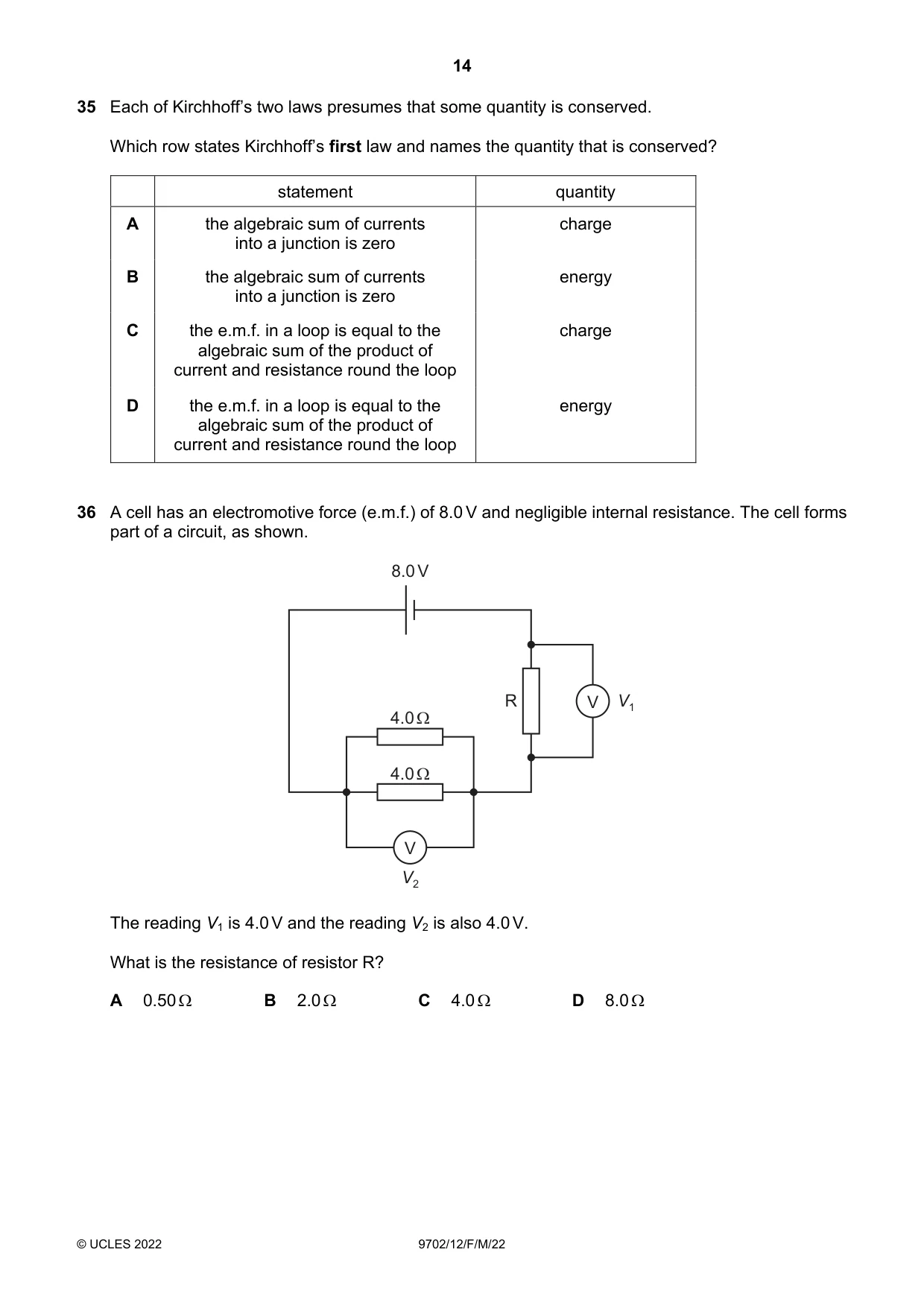
Q36 · Acell has an electromotive force (e.m.f.) of 8.0 V and negligible internal resistance
36 Acell has an electromotive force (e.m.f.) of 8.0 V and negligible internal resistance. The cell forms part of a circuit, as shown. 8.0V The reading V; is 4.0V and the reading V2 is also 4.0V. What is the resistance of resistor R? A 0.509 B 2.0Q C 4.00 D 8.0Q
Mark scheme: B
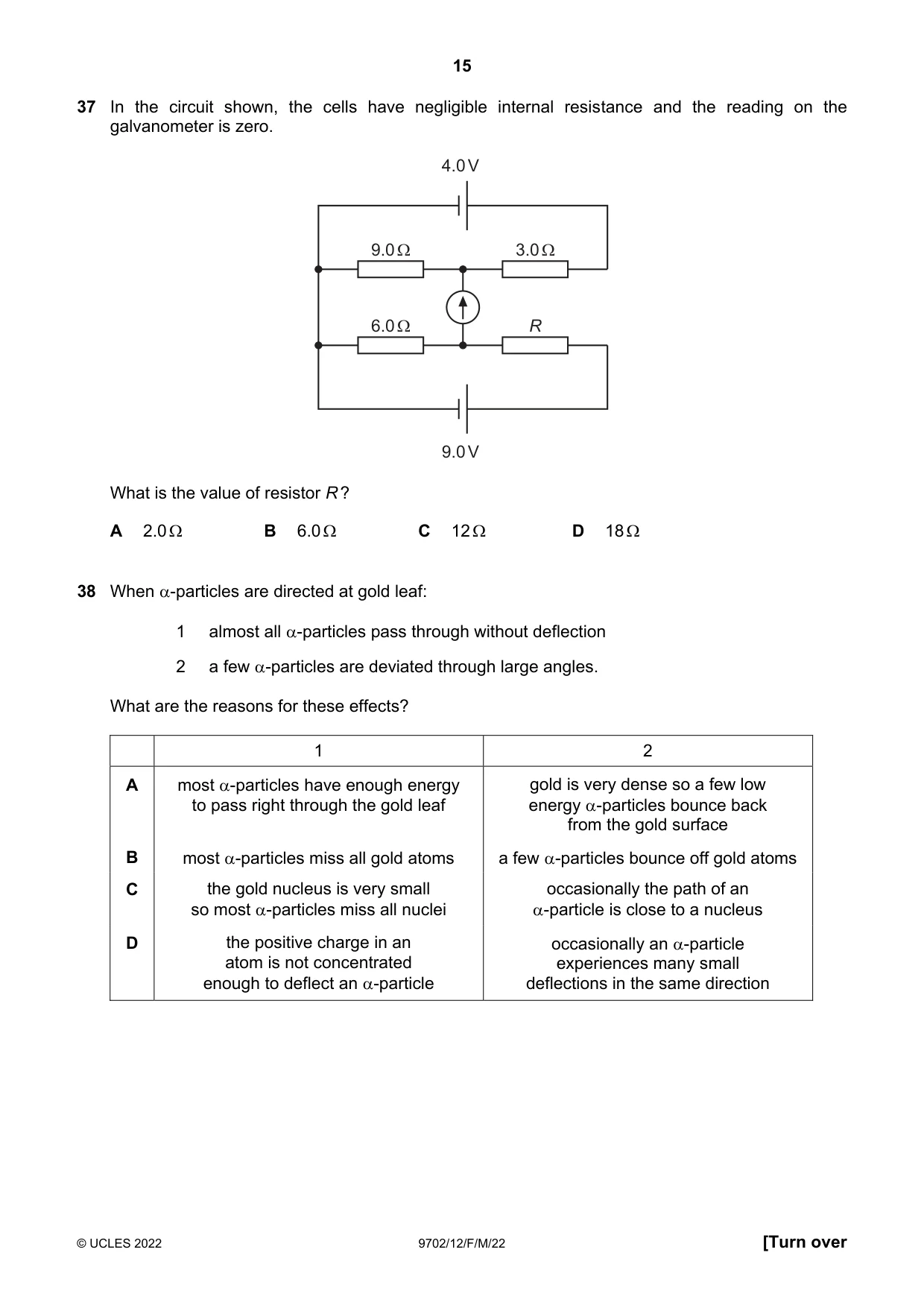
Q37 · In the circuit shown, the cells have negligible internal resistance and the reading on…
37 In the circuit shown, the cells have negligible internal resistance and the reading on the galvanometer is zero. 4.0V 9.0V What is the value of resistor R? A 2.00 B 6.0Q C 120 D 18Q
Mark scheme: C
Q38 · When -particles are directed at gold leaf: 1 almost all -particles pass through without…
38 When -particles are directed at gold leaf: 1 almost all -particles pass through without deflection 2 a few -particles are deviated through large angles. What are the reasons for these effects? 1 2 A most -particles have enough energy gold is very dense so a few low to pass right through the gold leaf energy -particles bounce back from the gold surface B most -particles miss all gold atoms a few -particles bounce off gold atoms C the gold nucleus is very small occasionally the path of an so most -particles miss all nuclei -particle is close to a nucleus D the positive charge in an occasionally an -particle atom is not concentrated experiences many small enough to deflect an -particle deflections in the same direction
Mark scheme: C
Q39 · A nucleus X is radioactive and decays into a nucleus Y
39 A nucleus X is radioactive and decays into a nucleus Y. X and Y are isotopes of the same element. Which combination of particles could have been emitted during the decay process? A 1 -particle and 1 – particle B 1 -particle and 2 – particles C 2 -particles and 1 – particle D 2 -particles and 2 – particles
Mark scheme: B
Q40 · A positively charged meson consists of a quark and an antiquark
40 A positively charged meson consists of a quark and an antiquark. What could be the quark and antiquark? A charm and antiup B down and antitop C strange and antibottom D up and antistrange
Mark scheme: D
What was in this paper
The subtopics covered by these 40 questions, and how many questions each got. Open one in a new tab to see every Cambridge question on it.
3Density and pressure2Electric current2Energy conservation2Equations of motion2Interference2Momentum and Newton’s laws of motion2Progressive waves2SI units2Atoms, nuclei and radiation1Diffraction1Doppler effect for sound waves1Elastic and plastic behaviour1Electromagnetic spectrum1Equilibrium of forces1Errors and uncertainties1Fundamental particles1Gravitational potential energy and kinetic energy1Kirchhoff’s laws1Linear momentum and its conservation1Non-uniform motion1Potential difference and power1Practical circuits1Radioactive decay1Resistance and resistivity1Scalars and vectors1Stationary waves1Stress and strain1The diffraction grating1Turning effects of forces1What you needed in this session
Cambridge’s own grade thresholds for 2022 Feb/March, Paper 1 · Variant 2. A higher threshold means an easier paper — the bar moves with how the cohort did.