Cambridge A Level Physics 9702 — 2025 Oct/Nov Paper 1 · Variant 1
9702/11/O/N/25 · 40 questions · 40 marks · 75 min
The question paper and its mark scheme, free to read here and free to download. This is Cambridge’s own paper, exactly as it was sat.
Question paper20 pages
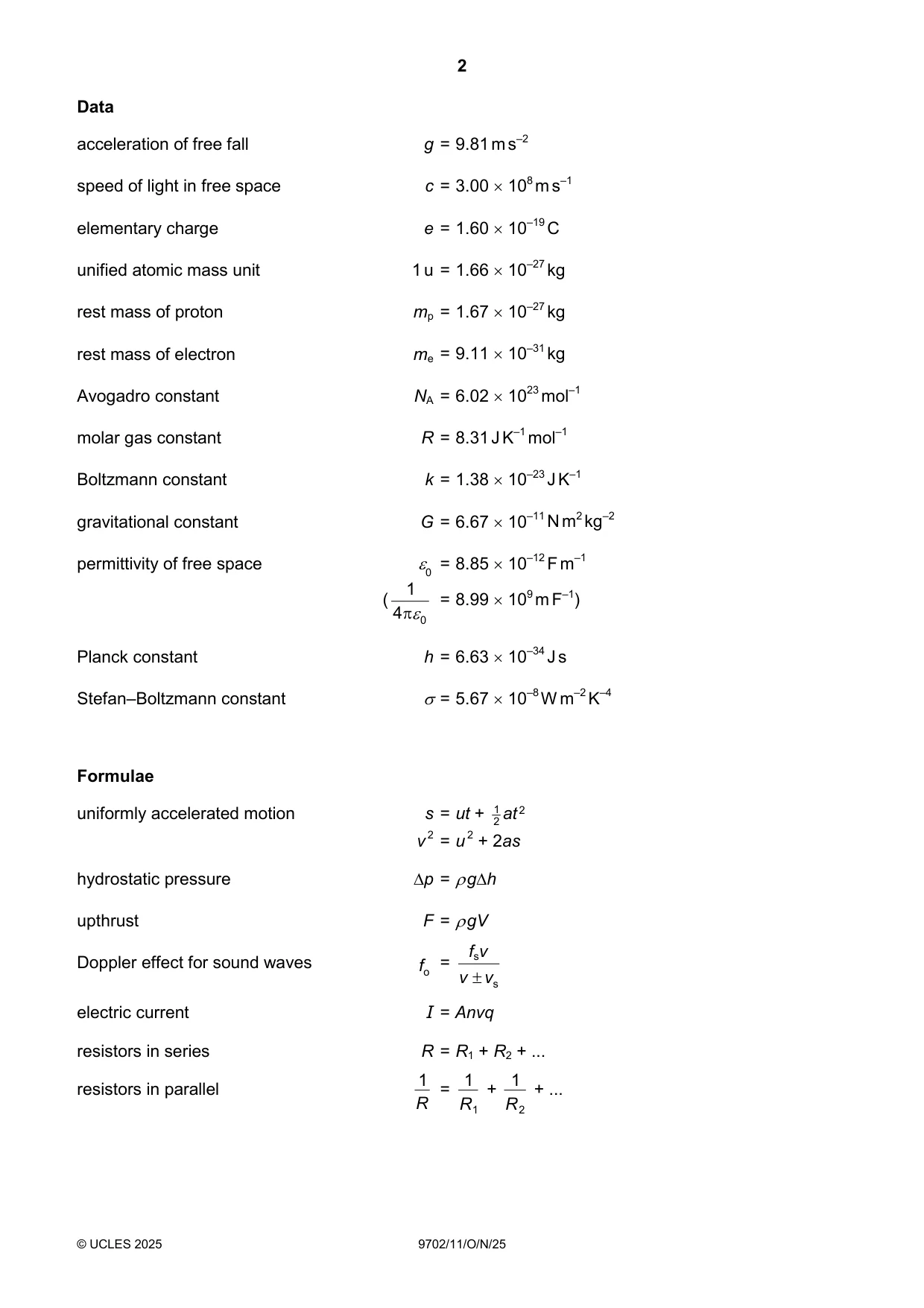



Mark scheme3 pages
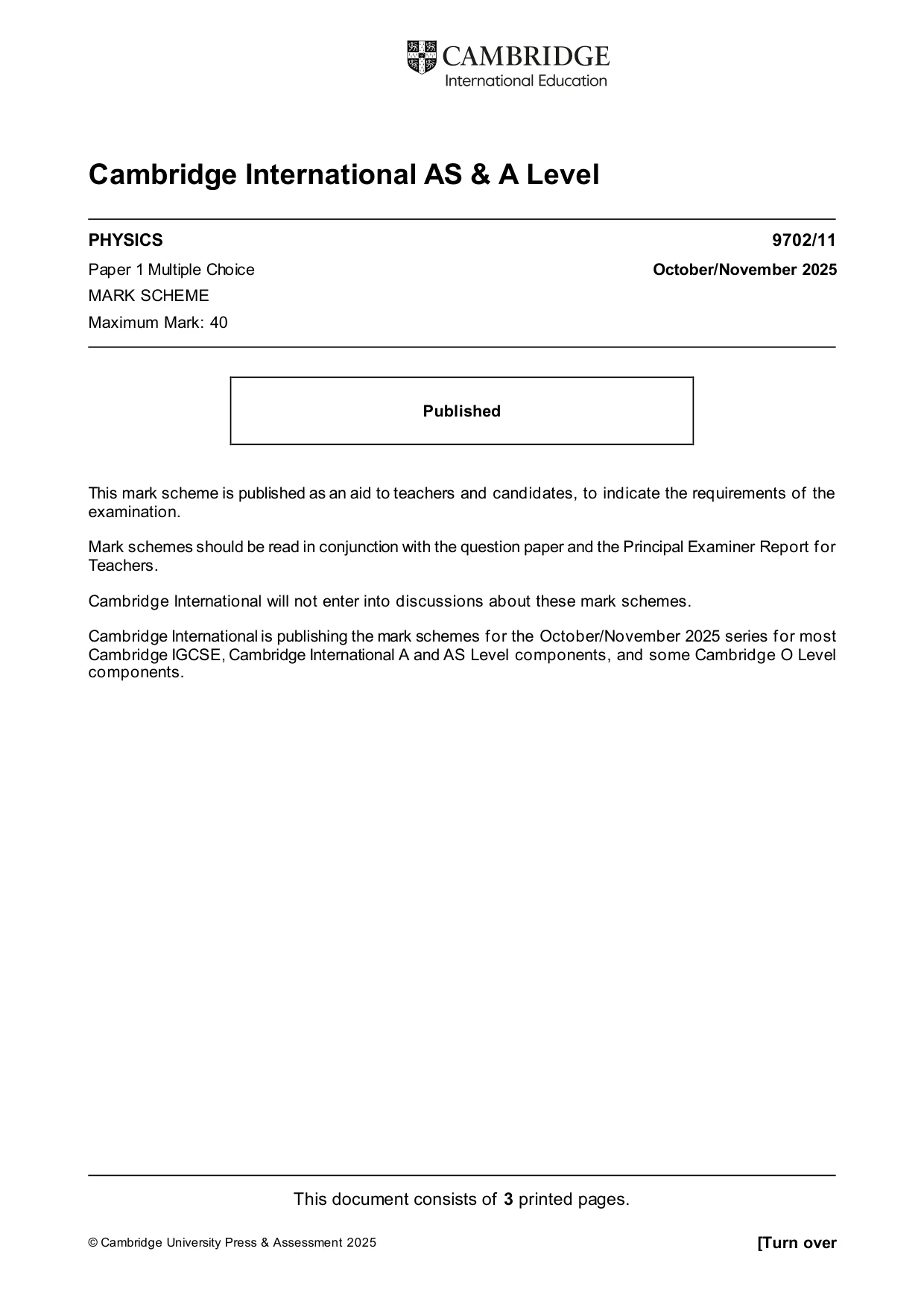
Answers below. Sit the paper first if you are practising.
Questions as text
Q1 · The table shows some physical quantities
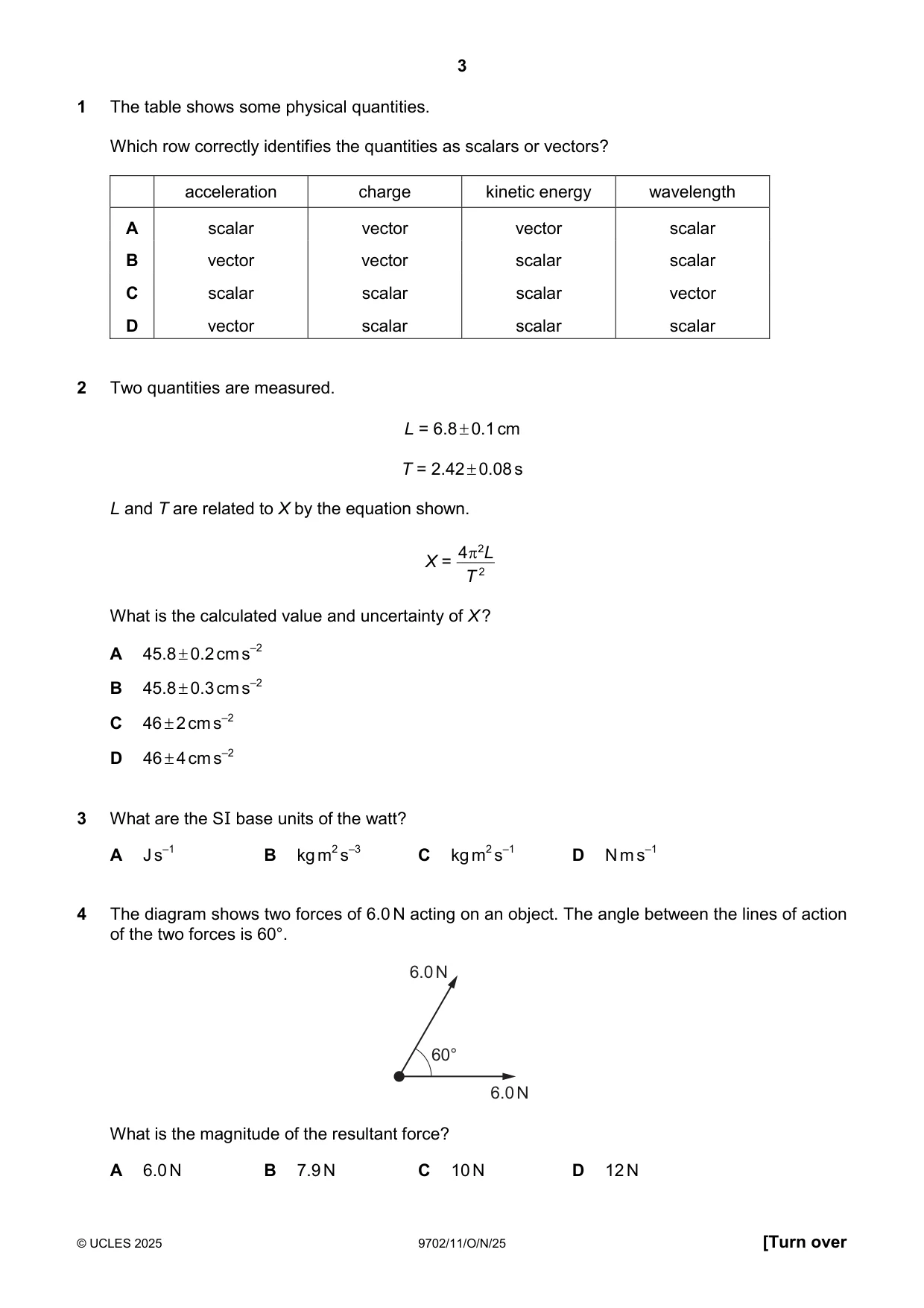
1 The table shows some physical quantities. Which row correctly identifies the quantities as scalars or vectors? acceleration charge kinetic energy wavelength A scalar vector vector scalar B vector vector scalar scalar C scalar scalar scalar vector D vector scalar scalar scalar
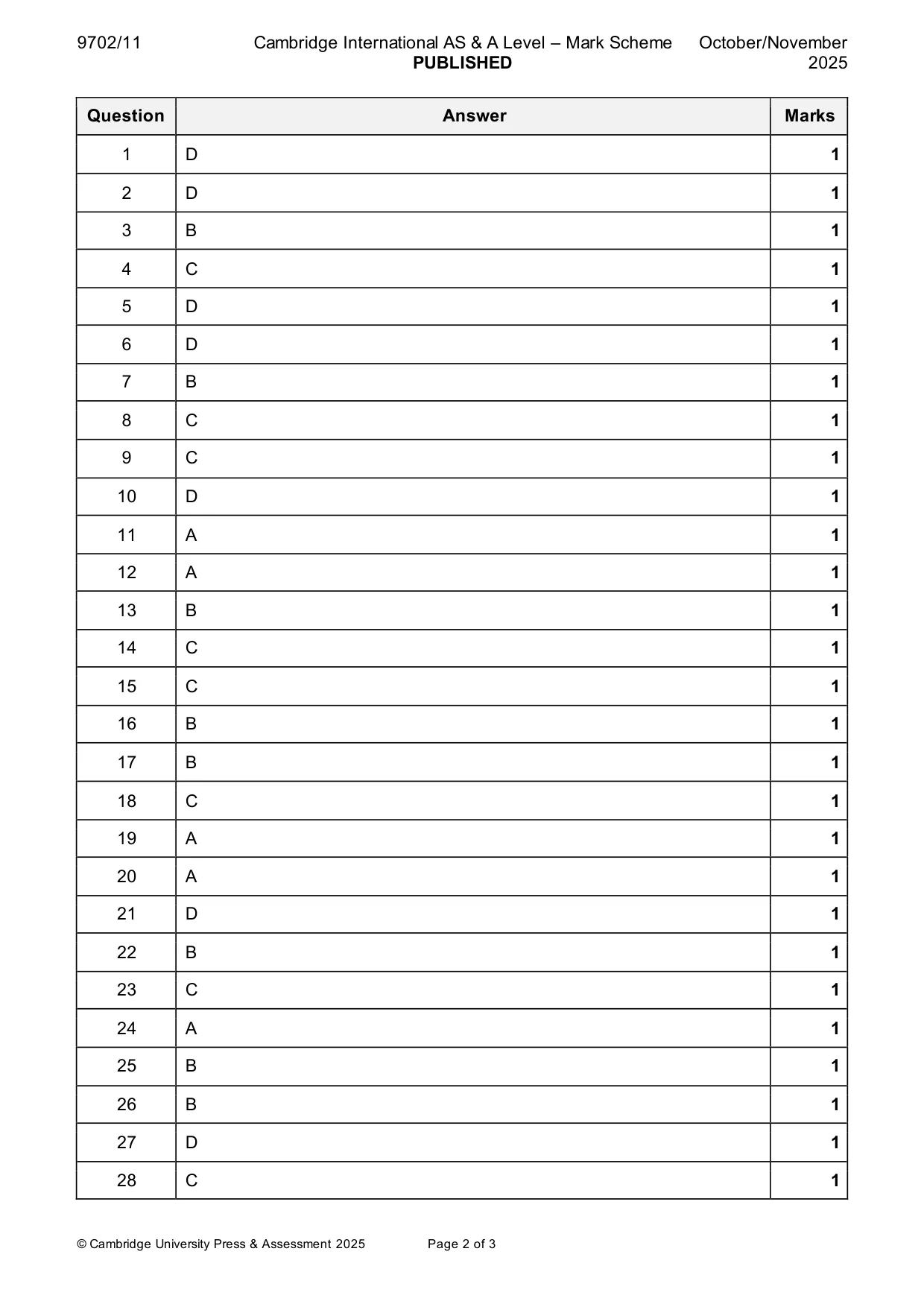
Mark scheme: D
Q2 · Two quantities are measured
2 Two quantities are measured. L = 6.8 0.1 cm T = 2.42 0.08 s L and T are related to X by the equation shown. 4 2 L X = T 2 What is the calculated value and uncertainty of X ? A 45.8 0.2 cm s–2 B 45.8 0.3 cm s–2 C 46 2 cm s–2 D 46 4 cm s–2
Mark scheme: D
Q3 · What are the SI base units of the watt?
3 What are the SI base units of the watt? A J s–1 B kg m2 s–3 C kg m2 s–1 D N m s–1
Mark scheme: B
Q4 · The diagram shows two forces of 6.0 N acting on an object
4 The diagram shows two forces of 6.0 N acting on an object. The angle between the lines of action of the two forces is 60°. 6.0 N 60° 6.0 N What is the magnitude of the resultant force? A 6.0 N B 7.9 N C 10 N D 12 N
Mark scheme: C
Q5 · A goods train passes through a station at a constant speed of 10 m s–1 at time t = 0
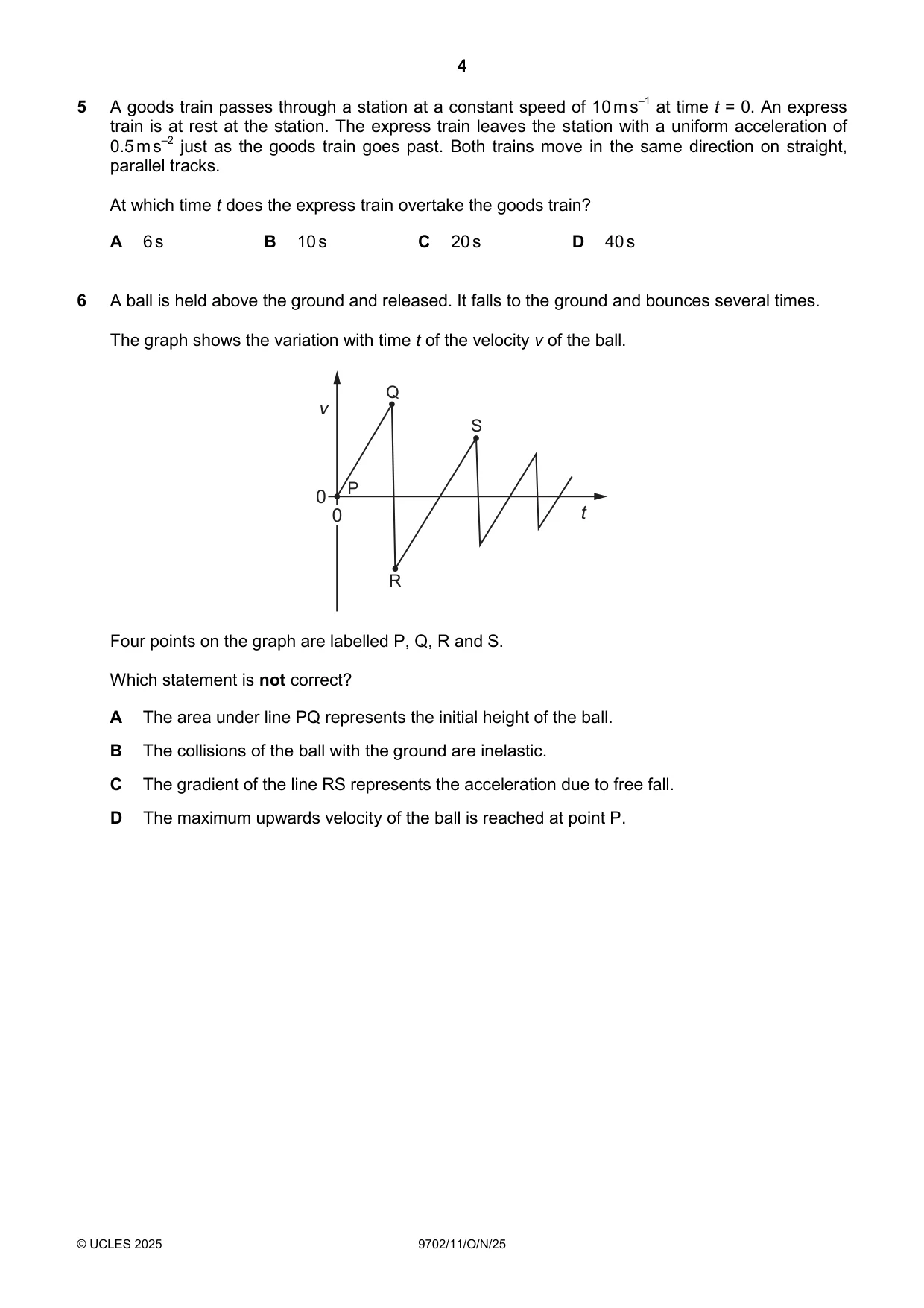
5 A goods train passes through a station at a constant speed of 10 m s–1 at time t = 0. An express train is at rest at the station. The express train leaves the station with a uniform acceleration of 0.5 m s–2 just as the goods train goes past. Both trains move in the same direction on straight, parallel tracks. At which time t does the express train overtake the goods train? A 6 s B 10 s C 20 s D 40 s
Mark scheme: D
Q6 · A ball is held above the ground and released
6 A ball is held above the ground and released. It falls to the ground and bounces several times. The graph shows the variation with time t of the velocity v of the ball. Q v S P 0 0 t R Four points on the graph are labelled P, Q, R and S. Which statement is not correct? A The area under line PQ represents the initial height of the ball. B The collisions of the ball with the ground are inelastic. C The gradient of the line RS represents the acceleration due to free fall. D The maximum upwards velocity of the ball is reached at point P.
Mark scheme: D
Q7 · An object is projected horizontally
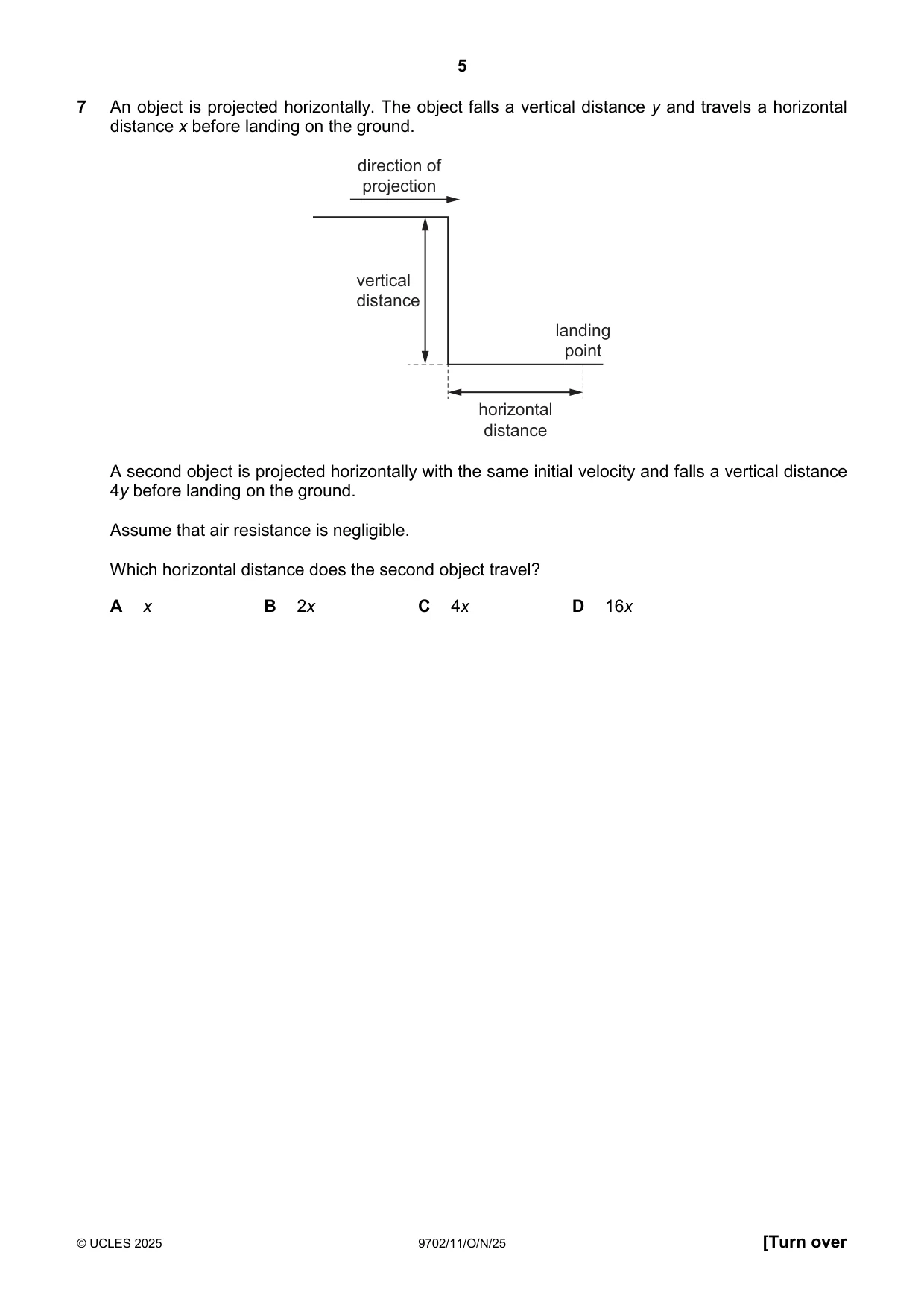
7 An object is projected horizontally. The object falls a vertical distance y and travels a horizontal distance x before landing on the ground. direction of projection vertical distance landing point horizontal distance A second object is projected horizontally with the same initial velocity and falls a vertical distance 4y before landing on the ground. Assume that air resistance is negligible. Which horizontal distance does the second object travel? A x B 2x C 4x D 16x
Mark scheme: B
Q8 · A sphere falls from rest through the air
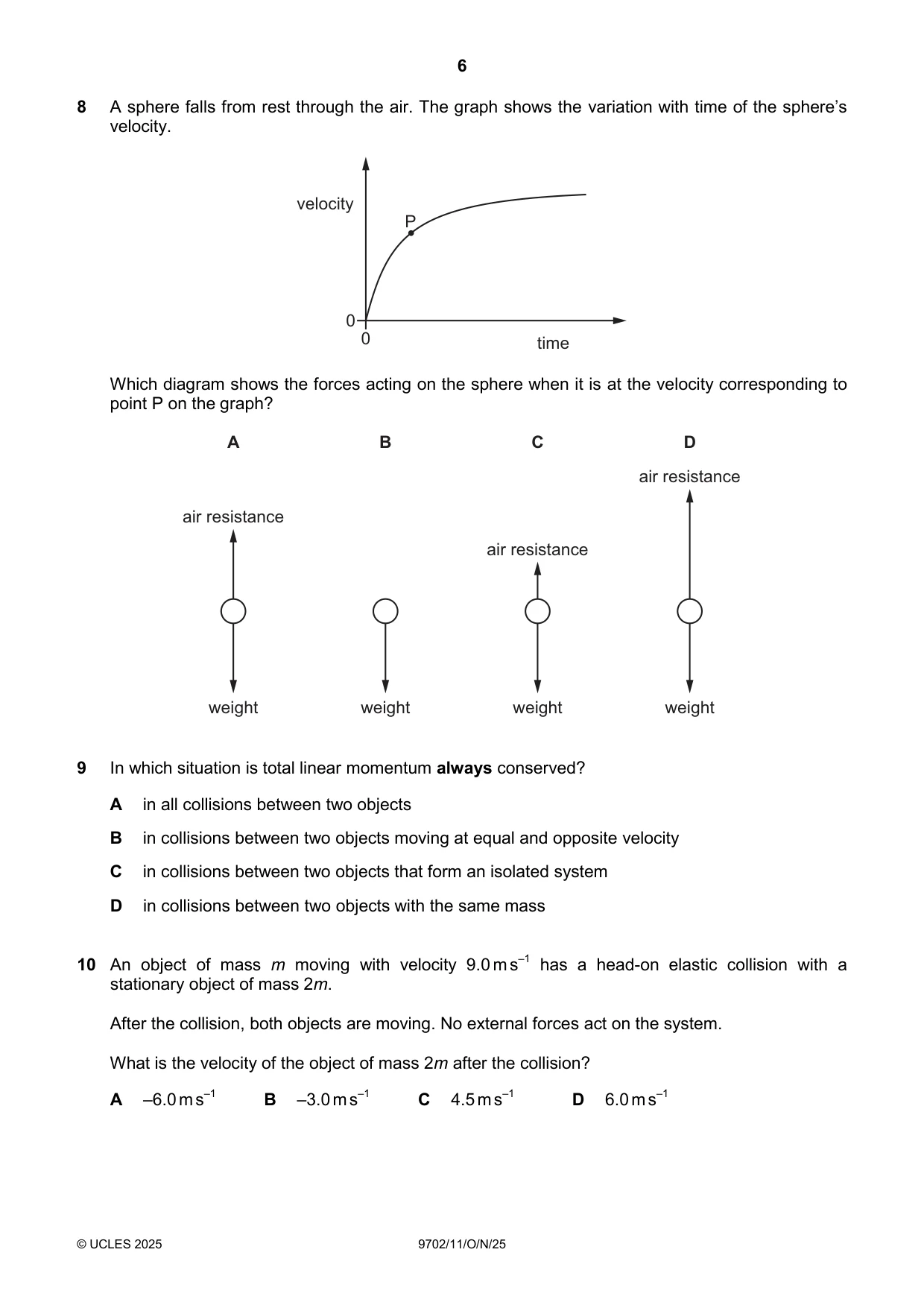
8 A sphere falls from rest through the air. The graph shows the variation with time of the sphere’s velocity. velocity P 0 0 time Which diagram shows the forces acting on the sphere when it is at the velocity corresponding to point P on the graph? A B C D air resistance air resistance air resistance weight weight weight weight
Mark scheme: C
Q9 · In which situation is total linear momentum always conserved?
9 In which situation is total linear momentum always conserved? A in all collisions between two objects B in collisions between two objects moving at equal and opposite velocity C in collisions between two objects that form an isolated system D in collisions between two objects with the same mass
Mark scheme: C
Q10 · An object of mass m moving with velocity 9.0 m s–1 has a head-on elastic collision with a…
10 An object of mass m moving with velocity 9.0 m s–1 has a head-on elastic collision with a stationary object of mass 2m. After the collision, both objects are moving. No external forces act on the system. What is the velocity of the object of mass 2m after the collision? A –6.0 m s–1 B –3.0 m s–1 C 4.5 m s–1 D 6.0 m s–1
Mark scheme: D
Q11 · The graph shows how the momentum of a motorcycle changes with time
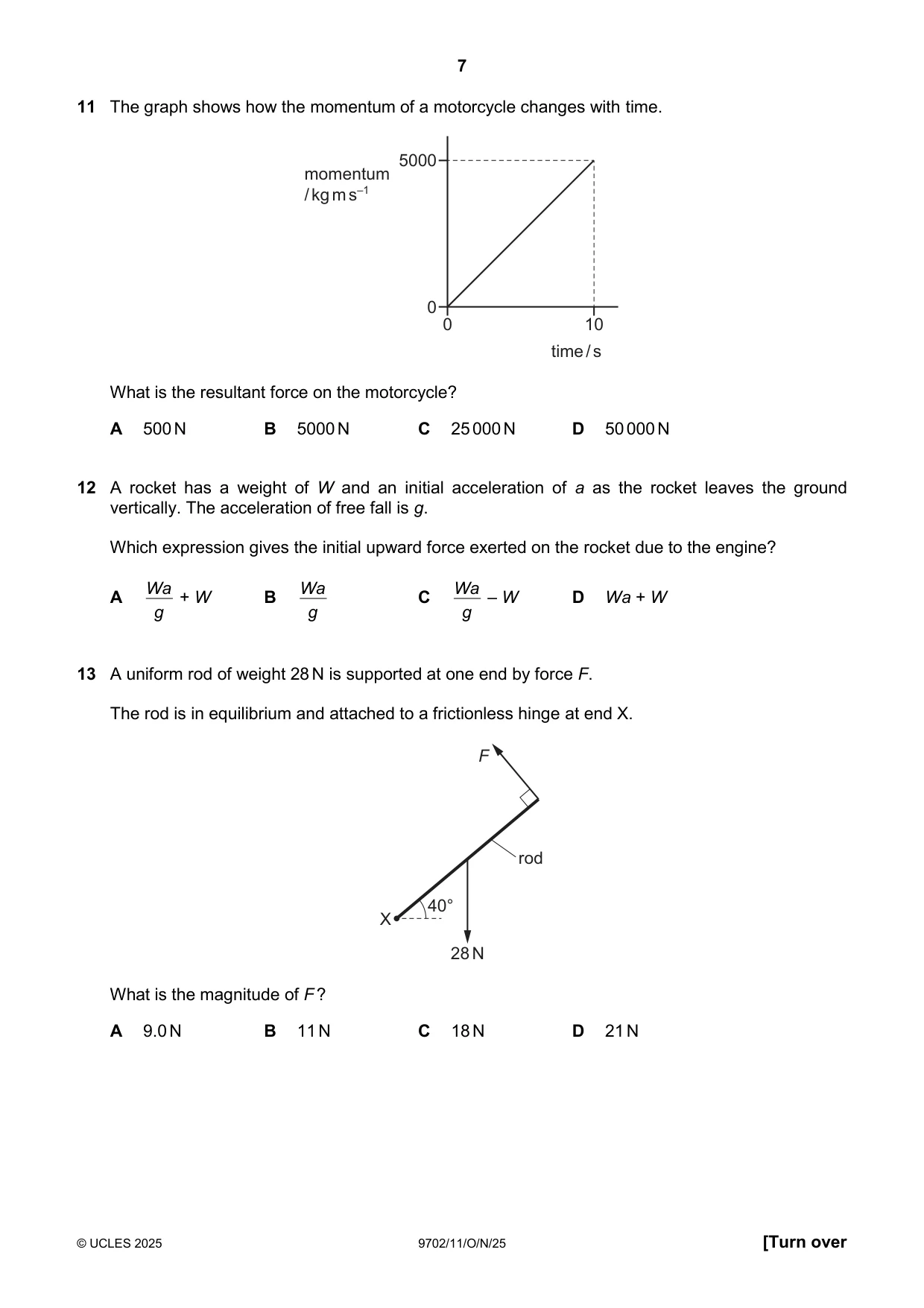
11 The graph shows how the momentum of a motorcycle changes with time. 5000 momentum / kg m s–1 0 0 10 time / s What is the resultant force on the motorcycle? A 500 N B 5000 N C 25 000 N D 50 000 N
Mark scheme: A
Q12 · A rocket has a weight of W and an initial acceleration of a as the rocket leaves the…
12 A rocket has a weight of W and an initial acceleration of a as the rocket leaves the ground vertically. The acceleration of free fall is g. Which expression gives the initial upward force exerted on the rocket due to the engine? Wa Wa Wa A + W B C – W D Wa + W g g g
Mark scheme: A
Q13 · A uniform rod of weight 28 N is supported at one end by force F
13 A uniform rod of weight 28 N is supported at one end by force F. The rod is in equilibrium and attached to a frictionless hinge at end X. F rod 40° X 28 N What is the magnitude of F ? A 9.0 N B 11 N C 18 N D 21 N
Mark scheme: B
Q14 · Two forces, each of magnitude F, act in opposite directions on a rod
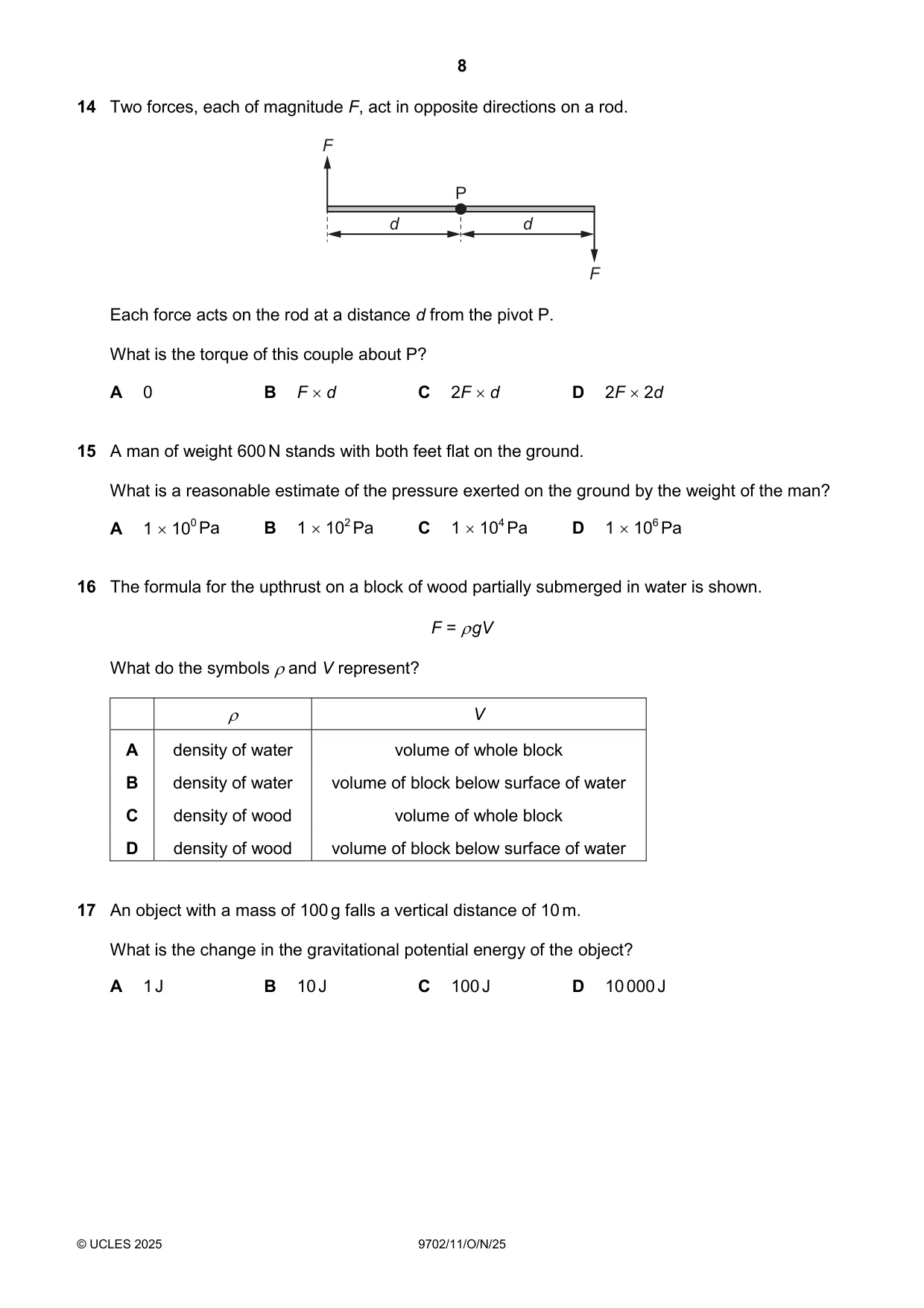
14 Two forces, each of magnitude F, act in opposite directions on a rod. F P d d F Each force acts on the rod at a distance d from the pivot P. What is the torque of this couple about P? A 0 B F d C 2F d D 2F 2d
Mark scheme: C
Q15 · A man of weight 600 N stands with both feet flat on the ground
15 A man of weight 600 N stands with both feet flat on the ground. What is a reasonable estimate of the pressure exerted on the ground by the weight of the man? A 1 100 Pa B 1 102 Pa C 1 104 Pa D 1 106 Pa
Mark scheme: C
Q16 · The formula for the upthrust on a block of wood partially submerged in water is shown
16 The formula for the upthrust on a block of wood partially submerged in water is shown. F = gV What do the symbols and V represent? V A density of water volume of whole block B density of water volume of block below surface of water C density of wood volume of whole block D density of wood volume of block below surface of water
Mark scheme: B
Q17 · An object with a mass of 100 g falls a vertical distance of 10 m
17 An object with a mass of 100 g falls a vertical distance of 10 m. What is the change in the gravitational potential energy of the object? A 1 J B 10 J C 100 J D 10 000 J
Mark scheme: B
More questions on Gravitational potential energy and kinetic energy
Q18 · A bungee jumper jumps from a platform and is decelerated by an elastic bungee cord, as…
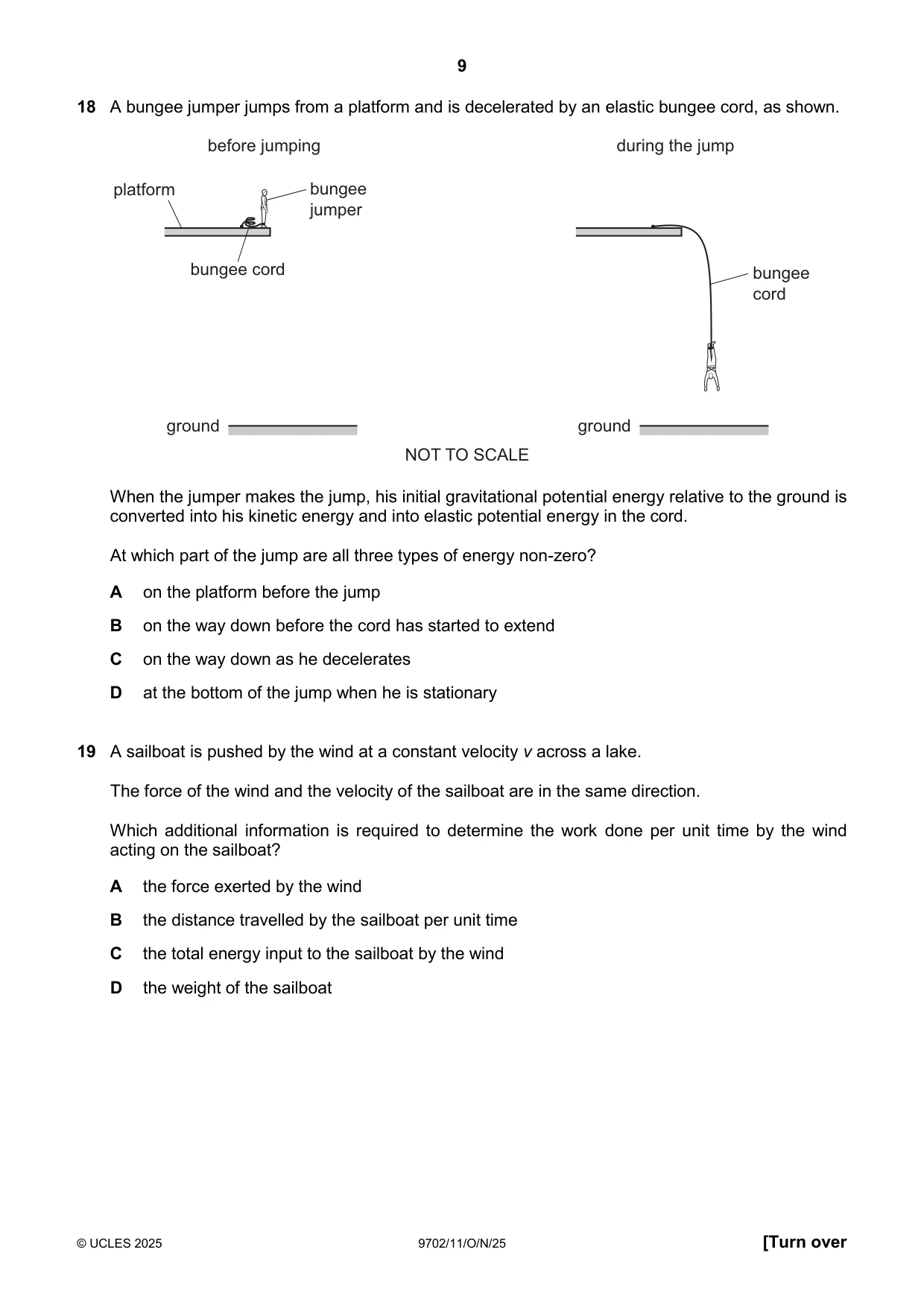
18 A bungee jumper jumps from a platform and is decelerated by an elastic bungee cord, as shown. before jumping during the jump platform bungee jumper bungee cord bungee cord ground ground NOT TO SCALE When the jumper makes the jump, his initial gravitational potential energy relative to the ground is converted into his kinetic energy and into elastic potential energy in the cord. At which part of the jump are all three types of energy non-zero? A on the platform before the jump B on the way down before the cord has started to extend C on the way down as he decelerates D at the bottom of the jump when he is stationary
Mark scheme: C
Q19 · A sailboat is pushed by the wind at a constant velocity v across a lake
19 A sailboat is pushed by the wind at a constant velocity v across a lake. The force of the wind and the velocity of the sailboat are in the same direction. Which additional information is required to determine the work done per unit time by the wind acting on the sailboat? A the force exerted by the wind B the distance travelled by the sailboat per unit time C the total energy input to the sailboat by the wind D the weight of the sailboat
Mark scheme: A
Q20 · A spring is fixed at one end
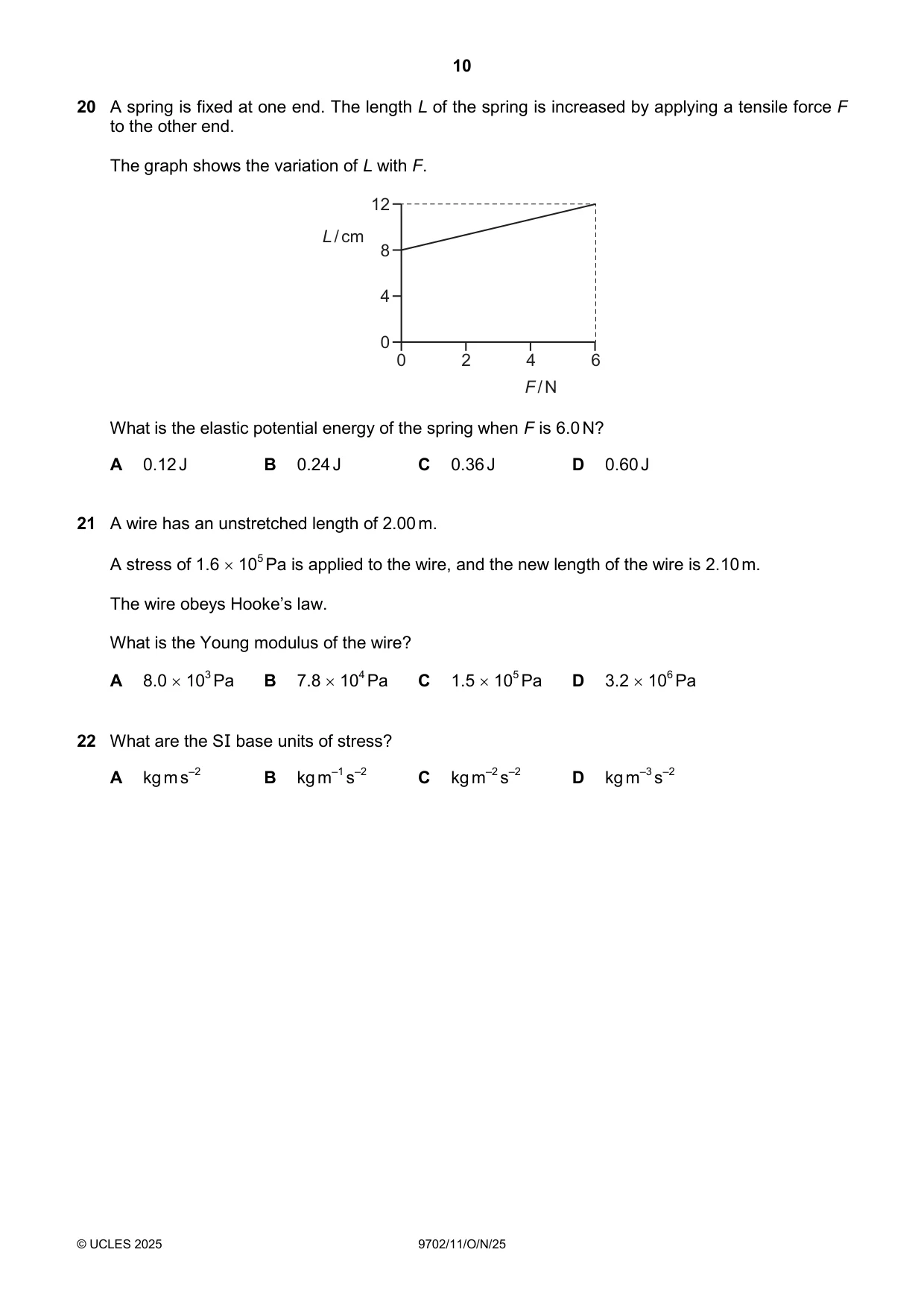
20 A spring is fixed at one end. The length L of the spring is increased by applying a tensile force F to the other end. The graph shows the variation of L with F. 12 L / cm 8 4 0 0 2 4 6 F / N What is the elastic potential energy of the spring when F is 6.0 N? A 0.12 J B 0.24 J C 0.36 J D 0.60 J
Mark scheme: A
Q21 · A wire has an unstretched length of 2.00 m
21 A wire has an unstretched length of 2.00 m. A stress of 1.6 105 Pa is applied to the wire, and the new length of the wire is 2.10 m. The wire obeys Hooke’s law. What is the Young modulus of the wire? A 8.0 103 Pa B 7.8 104 Pa C 1.5 105 Pa D 3.2 106 Pa
Mark scheme: D
Q22 · What are the SI base units of stress?
22 What are the SI base units of stress? A kg m s–2 B kg m–1 s–2 C kg m–2 s–2 D kg m–3 s–2
Mark scheme: B
Q23 · The diagram shows a force–extension graph for a rubber band as the band is extended and…
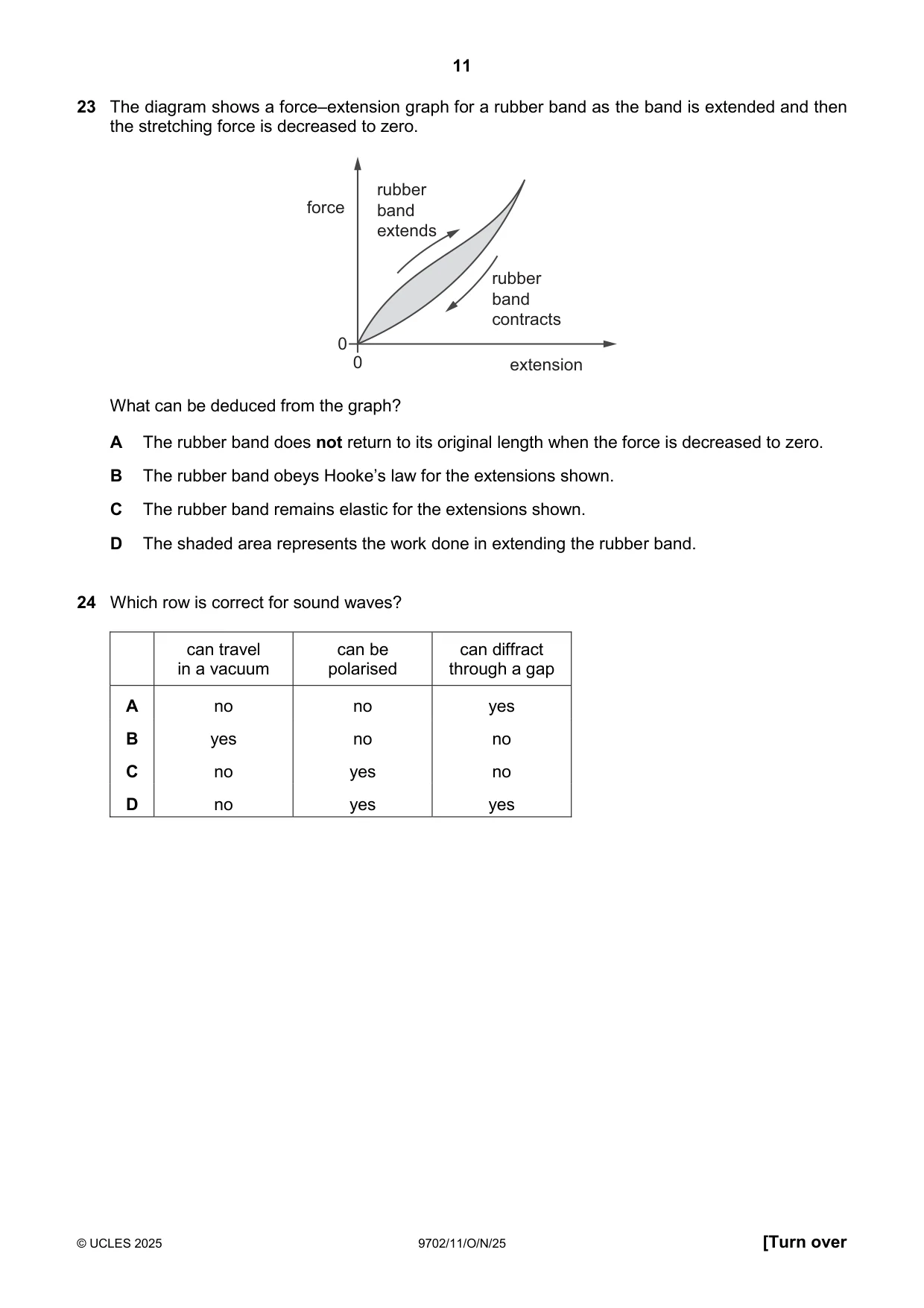
23 The diagram shows a force–extension graph for a rubber band as the band is extended and then the stretching force is decreased to zero. rubber force band extends rubber band contracts 0 0 extension What can be deduced from the graph? A The rubber band does not return to its original length when the force is decreased to zero. B The rubber band obeys Hooke’s law for the extensions shown. C The rubber band remains elastic for the extensions shown. D The shaded area represents the work done in extending the rubber band.
Mark scheme: C
Q24 · Which row is correct for sound waves?
24 Which row is correct for sound waves? can travel can be can diffract in a vacuum polarised through a gap A no no yes B yes no no C no yes no D no yes yes
Mark scheme: A
Q25 · A source emits a progressive sound wave in the horizontal direction
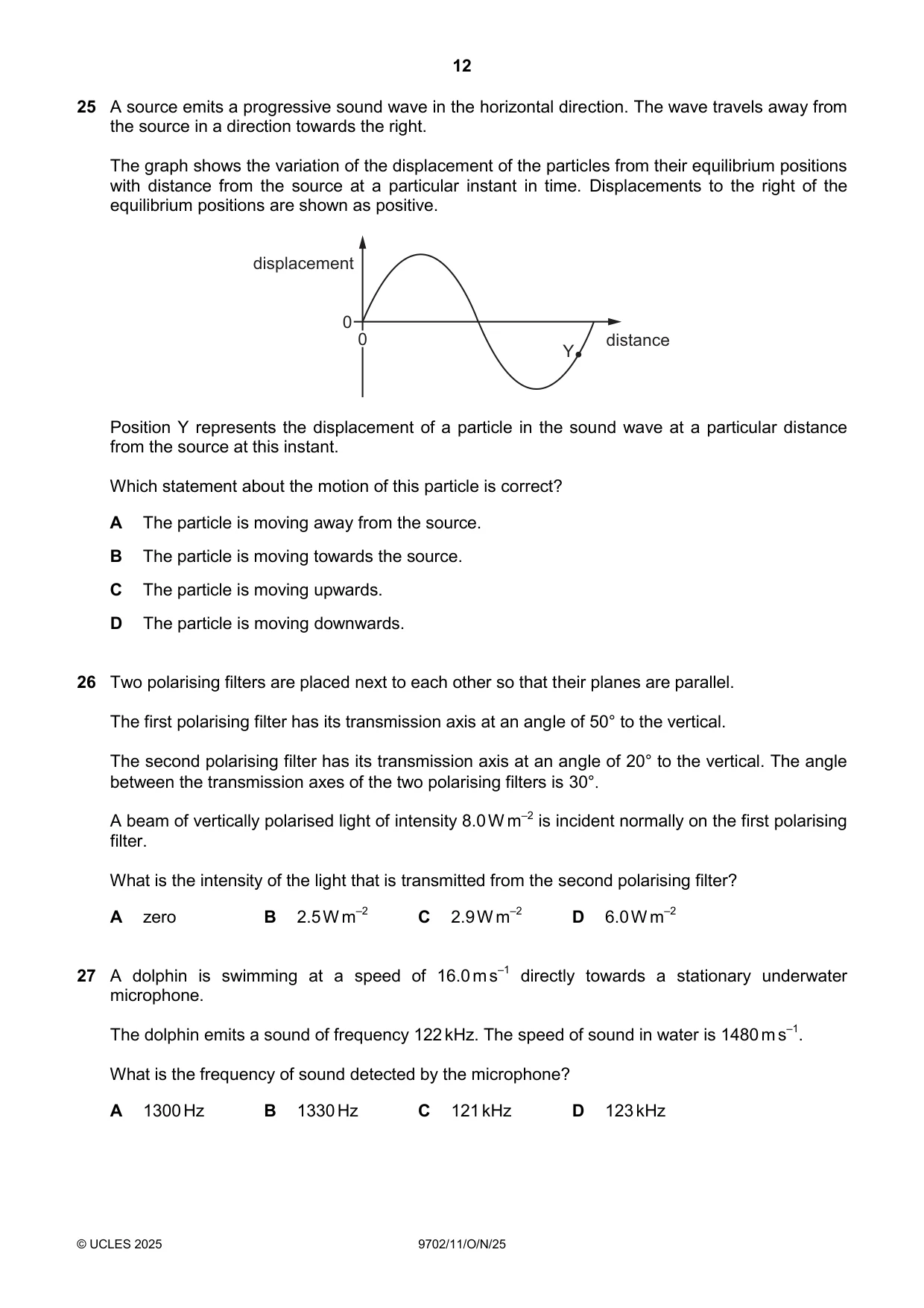
25 A source emits a progressive sound wave in the horizontal direction. The wave travels away from the source in a direction towards the right. The graph shows the variation of the displacement of the particles from their equilibrium positions with distance from the source at a particular instant in time. Displacements to the right of the equilibrium positions are shown as positive. displacement 0 0 distance Y Position Y represents the displacement of a particle in the sound wave at a particular distance from the source at this instant. Which statement about the motion of this particle is correct? A The particle is moving away from the source. B The particle is moving towards the source. C The particle is moving upwards. D The particle is moving downwards.
Mark scheme: B
Q26 · Two polarising filters are placed next to each other so that their planes are parallel
26 Two polarising filters are placed next to each other so that their planes are parallel. The first polarising filter has its transmission axis at an angle of 50° to the vertical. The second polarising filter has its transmission axis at an angle of 20° to the vertical. The angle between the transmission axes of the two polarising filters is 30° A beam of vertically polarised light of intensity 8.0 W m–2 is incident normally on the first polarising filter. What is the intensity of the light that is transmitted from the second polarising filter? A zero B 2.5 W m–2 C 2.9 W m–2 D 6.0 W m–2
Mark scheme: B
Q27 · A dolphin is swimming at a speed of 16.0 m s–1 directly towards a stationary underwater…
27 A dolphin is swimming at a speed of 16.0 m s–1 directly towards a stationary underwater microphone. The dolphin emits a sound of frequency 122 kHz. The speed of sound in water is 1480 m s–1. What is the frequency of sound detected by the microphone? A 1300 Hz B 1330 Hz C 121 kHz D 123 kHz
Mark scheme: D
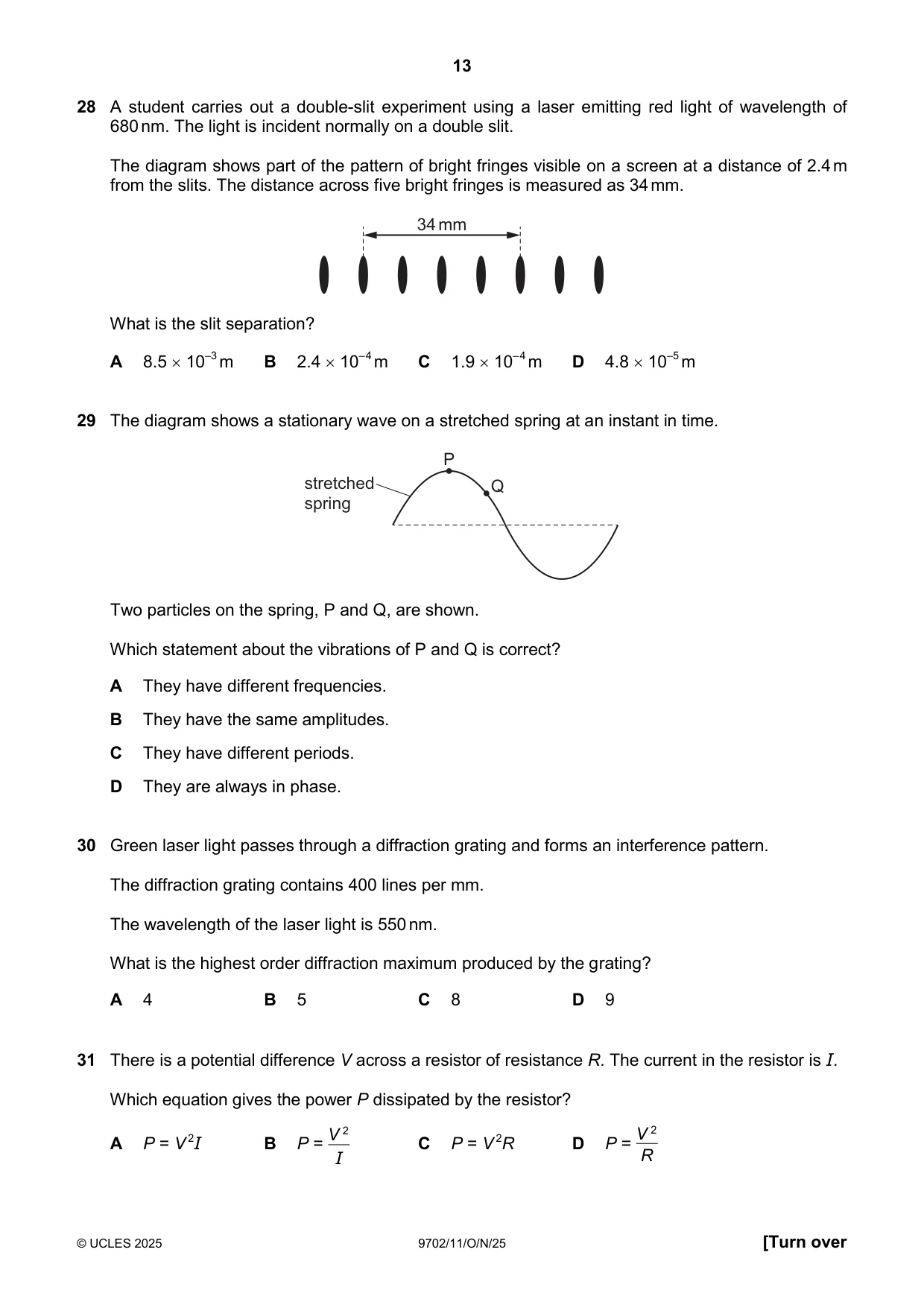
Q28 · A student carries out a double-slit experiment using a laser emitting red light of…
28 A student carries out a double-slit experiment using a laser emitting red light of wavelength of 680 nm. The light is incident normally on a double slit. The diagram shows part of the pattern of bright fringes visible on a screen at a distance of 2.4 m from the slits. The distance across five bright fringes is measured as 34 mm. 34 mm What is the slit separation? A 8.5 10–3 m B 2.4 10– 4 m C 1.9 10– 4 m D 4.8 10–5 m
Mark scheme: C
Q29 · The diagram shows a stationary wave on a stretched spring at an instant in time
29 The diagram shows a stationary wave on a stretched spring at an instant in time. P stretched Q spring Two particles on the spring, P and Q, are shown. Which statement about the vibrations of P and Q is correct? A They have different frequencies. B They have the same amplitudes. C They have different periods. D They are always in phase.
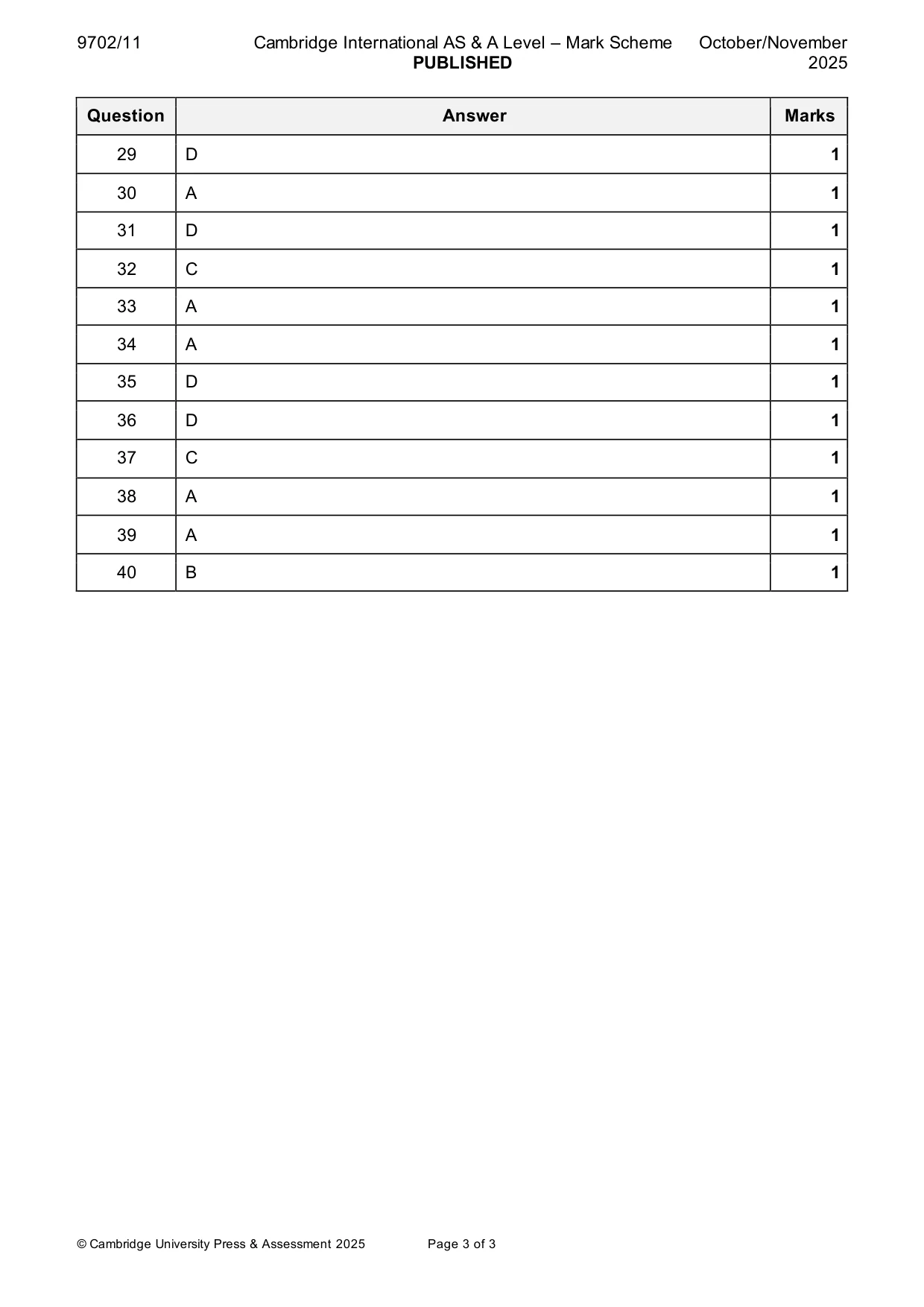
Mark scheme: D
Q30 · Green laser light passes through a diffraction grating and forms an interference pattern
30 Green laser light passes through a diffraction grating and forms an interference pattern. The diffraction grating contains 400 lines per mm. The wavelength of the laser light is 550 nm. What is the highest order diffraction maximum produced by the grating? A 4 B 5 C 8 D 9
Mark scheme: A
Q31 · There is a potential difference V across a resistor of resistance R
31 There is a potential difference V across a resistor of resistance R. The current in the resistor is I. Which equation gives the power P dissipated by the resistor? V 2 V 2 A P = V 2I B P = C P = V 2R D P = R I
Mark scheme: D
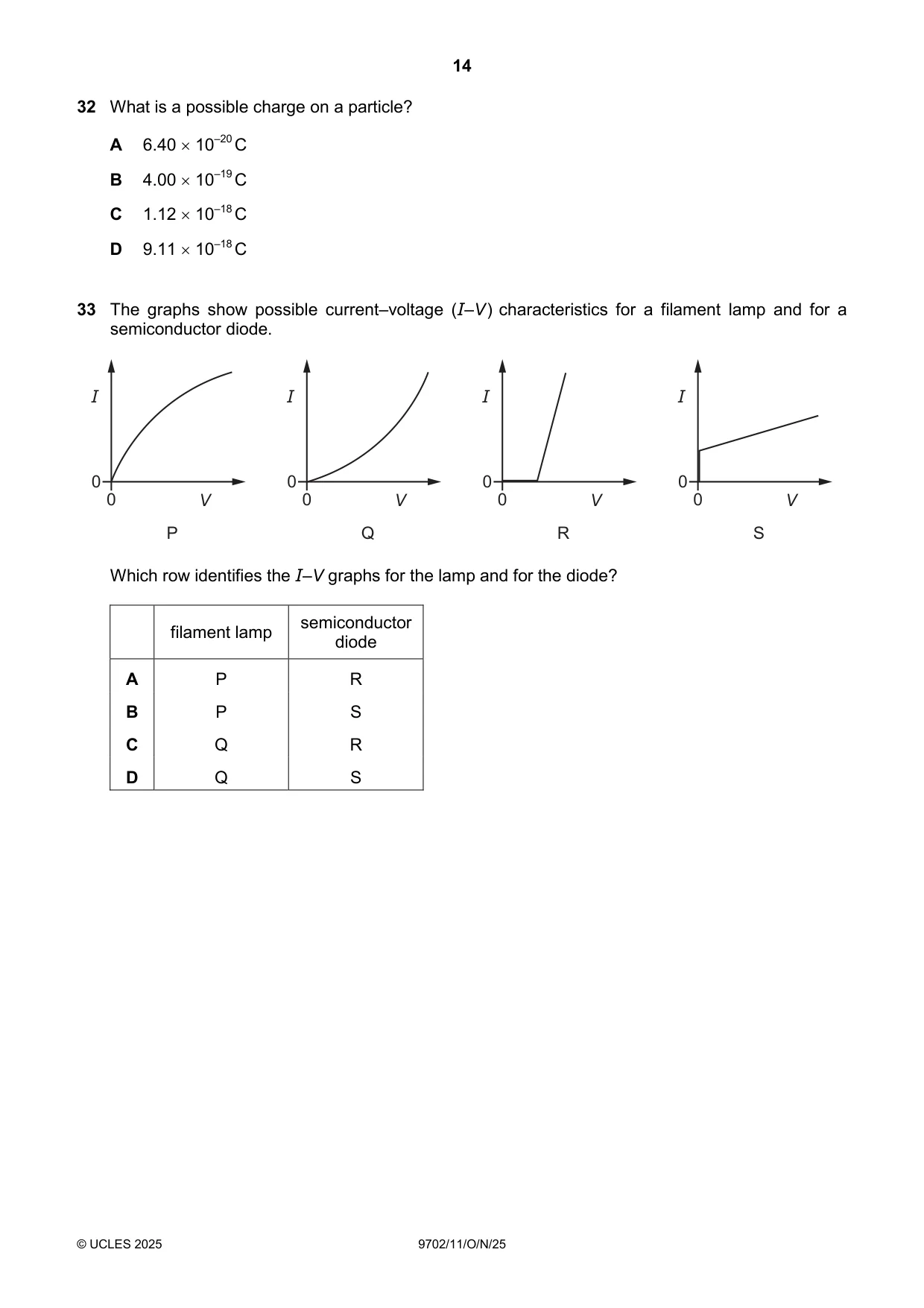
Q32 · What is a possible charge on a particle?
32 What is a possible charge on a particle? A 6.40 10–20 C B 4.00 10–19 C C 1.12 10–18 C D 9.11 10–18 C
Mark scheme: C
Q33 · The graphs show possible current–voltage (I–V ) characteristics for a filament lamp and…
33 The graphs show possible current–voltage (I–V ) characteristics for a filament lamp and for a semiconductor diode. I I I I 0 0 0 0 0 V 0 V 0 V 0 V P Q R S Which row identifies the I–V graphs for the lamp and for the diode? semiconductor filament lamp diode A P R B P S C Q R D Q S
Mark scheme: A
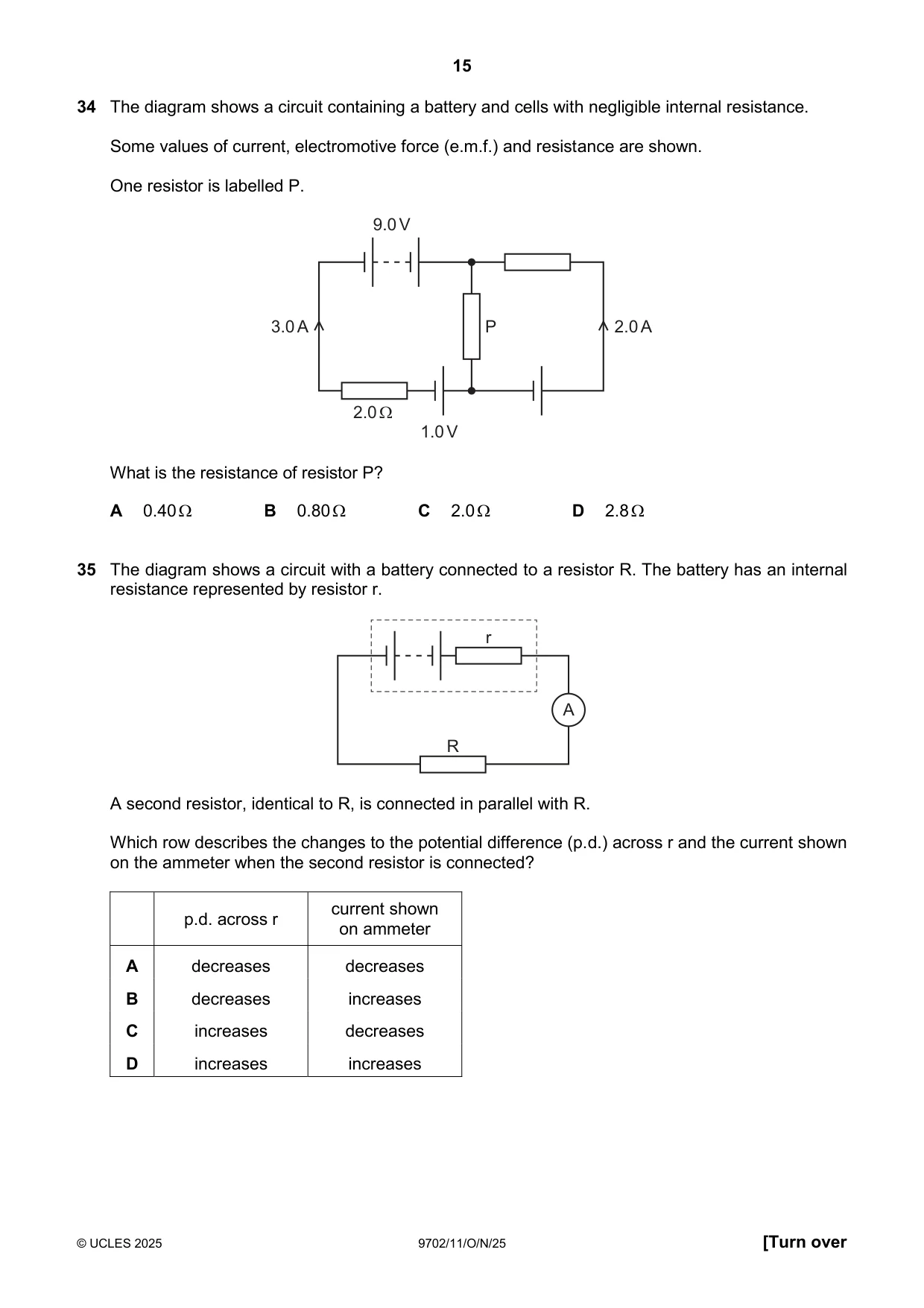
Q34 · The diagram shows a circuit containing a battery and cells with negligible internal…
34 The diagram shows a circuit containing a battery and cells with negligible internal resistance. Some values of current, electromotive force (e.m.f.) and resistance are shown. One resistor is labelled P. 9.0V = 3.0A P 2.0A 2.02 1.0V What is the resistance of resistor P? A 0.409 B 0.800 C 2.09 D 2.8Q
Mark scheme: A
Q35 · The diagram shows a circuit with a battery connected to a resistor R
35 The diagram shows a circuit with a battery connected to a resistor R. The battery has an internal resistance represented by resistor r. r A R A second resistor, identical to R, is connected in parallel with R. Which row describes the changes to the potential difference (p.d.) across r and the current shown on the ammeter when the second resistor is connected? current shown p.d. across r on ammeter A decreases decreases B decreases increases C increases decreases D increases increases
Mark scheme: D
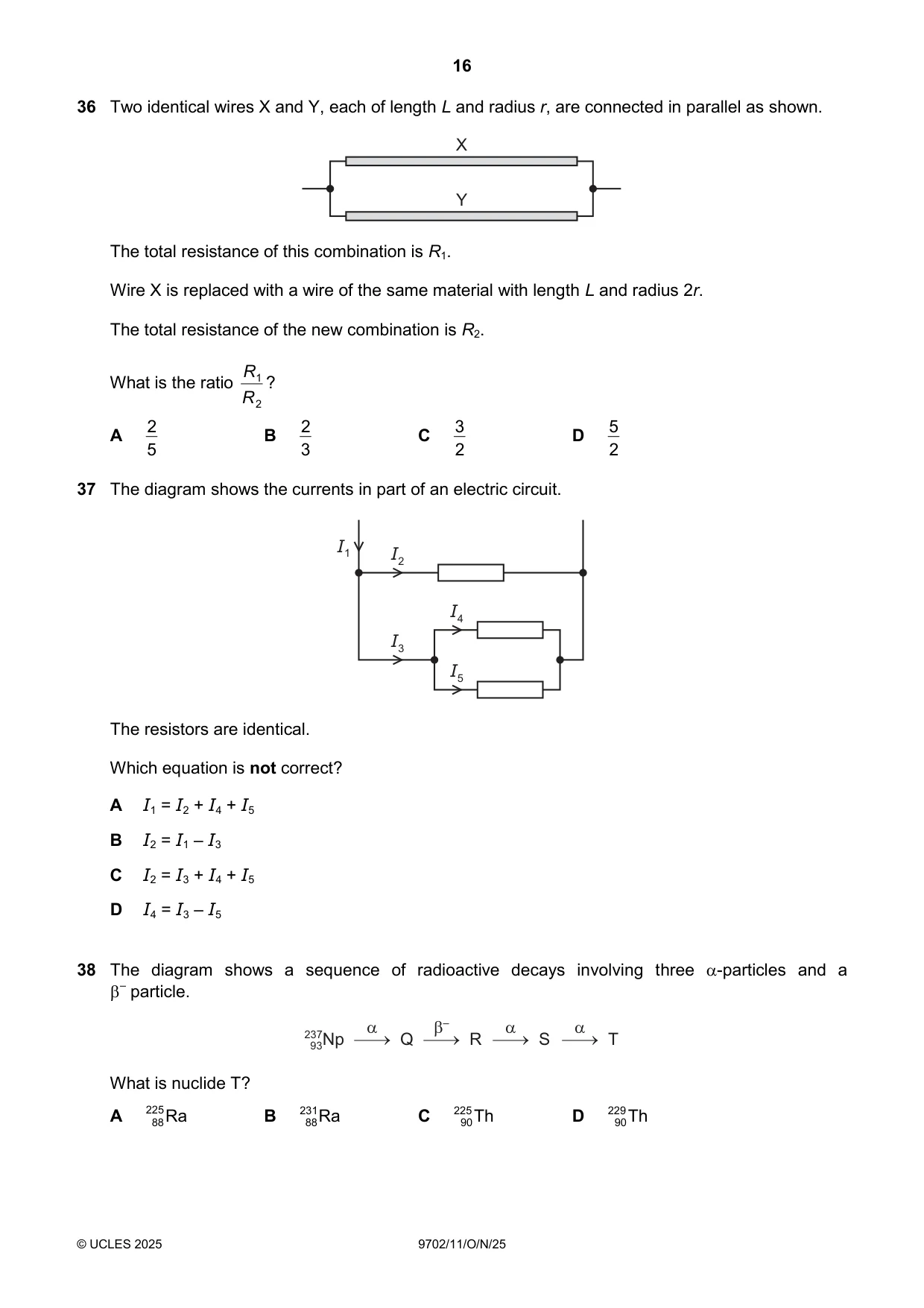
Q36 · Two identical wires X and Y, each of length L and radius r, are connected in parallel as…
36 Two identical wires X and Y, each of length L and radius r, are connected in parallel as shown. X Y The total resistance of this combination is R1. Wire X is replaced with a wire of the same material with length L and radius 2r. The total resistance of the new combination is R2. R ? What is the ratio 1 R 2 2 2 3 5 A B C D 5 3 2 2
Mark scheme: D
Q37 · The diagram shows the currents in part of an electric circuit
37 The diagram shows the currents in part of an electric circuit. I1 I2 I4 I3 I5 The resistors are identical. Which equation is not correct? A I1 = I2 + I4 + I5 B I2 = I1 – I3 C I2 = I3 + I4 + I5 D I4 = I3 – I5
Mark scheme: C
Q38 · The diagram shows a sequence of radioactive decays involving three -particles and a …
38 The diagram shows a sequence of radioactive decays involving three -particles and a – particle. 237Np Q R S T 93 What is nuclide T? A 225 Ra B 231 Ra C 225 Th D 229 Th 88 88 90 90
Mark scheme: A
Q39 · The number of electrons in a neutral atom of an isotope of plutonium, 239 Pu, is changed…
39 The number of electrons in a neutral atom of an isotope of plutonium, 239 Pu, is changed to 94 produce a charged atom (ion) W. W has an overall charge of +1.6 10–19 C. How many protons, neutrons and electrons are in W? protons neutrons electrons A 94 145 93 B 94 145 95 C 238 94 239 D 239 94 238
Mark scheme: A
Q40 · Which particle is a lepton?
40 Which particle is a lepton? A meson B positron C proton D quark
Mark scheme: B
What was in this paper
The subtopics covered by these 40 questions, and how many questions each got. Open one in a new tab to see every Cambridge question on it.
3Atoms, nuclei and radiation2Density and pressure2Elastic and plastic behaviour2Energy conservation2Kirchhoff’s laws2Linear momentum and its conservation2Momentum and Newton’s laws of motion2Resistance and resistivity2Scalars and vectors2Stress and strain2Turning effects of forces2Doppler effect for sound waves1Electric current1Errors and uncertainties1Fundamental particles1Gravitational potential energy and kinetic energy1Interference1Non-uniform motion1Polarisation1Potential difference and power1Practical circuits1Progressive waves1SI units1Stationary waves1The diffraction grating1Transverse and longitudinal waves1What you needed in this session
Cambridge’s own grade thresholds for 2025 Oct/Nov, Paper 1 · Variant 1. A higher threshold means an easier paper — the bar moves with how the cohort did.