Cambridge A Level Physics 9702 — 2025 May/June Paper 1 · Variant 1
9702/11/M/J/25 · 40 questions · 40 marks · 75 min
The question paper and its mark scheme, free to read here and free to download. This is Cambridge’s own paper, exactly as it was sat.
Question paper16 pages
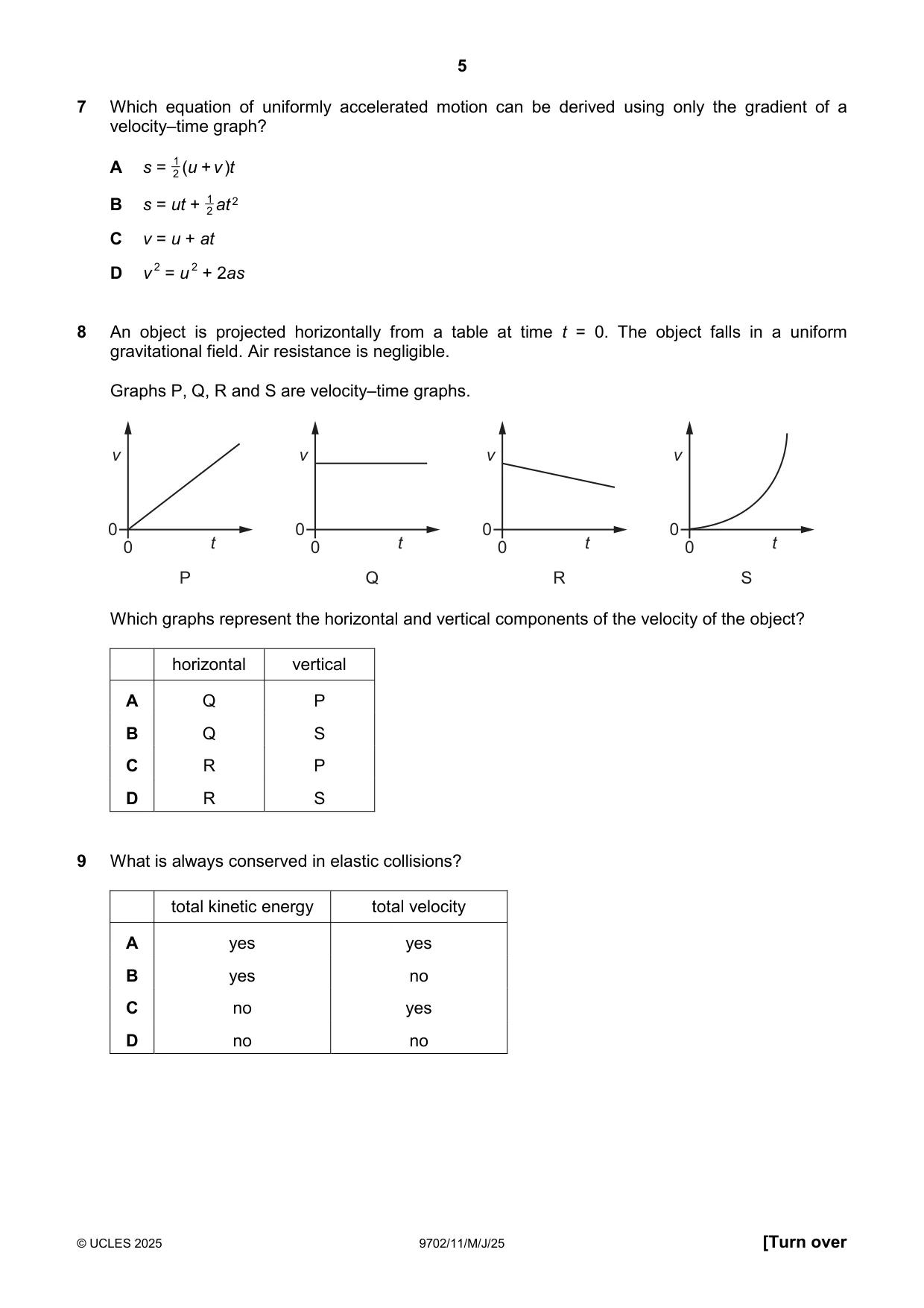
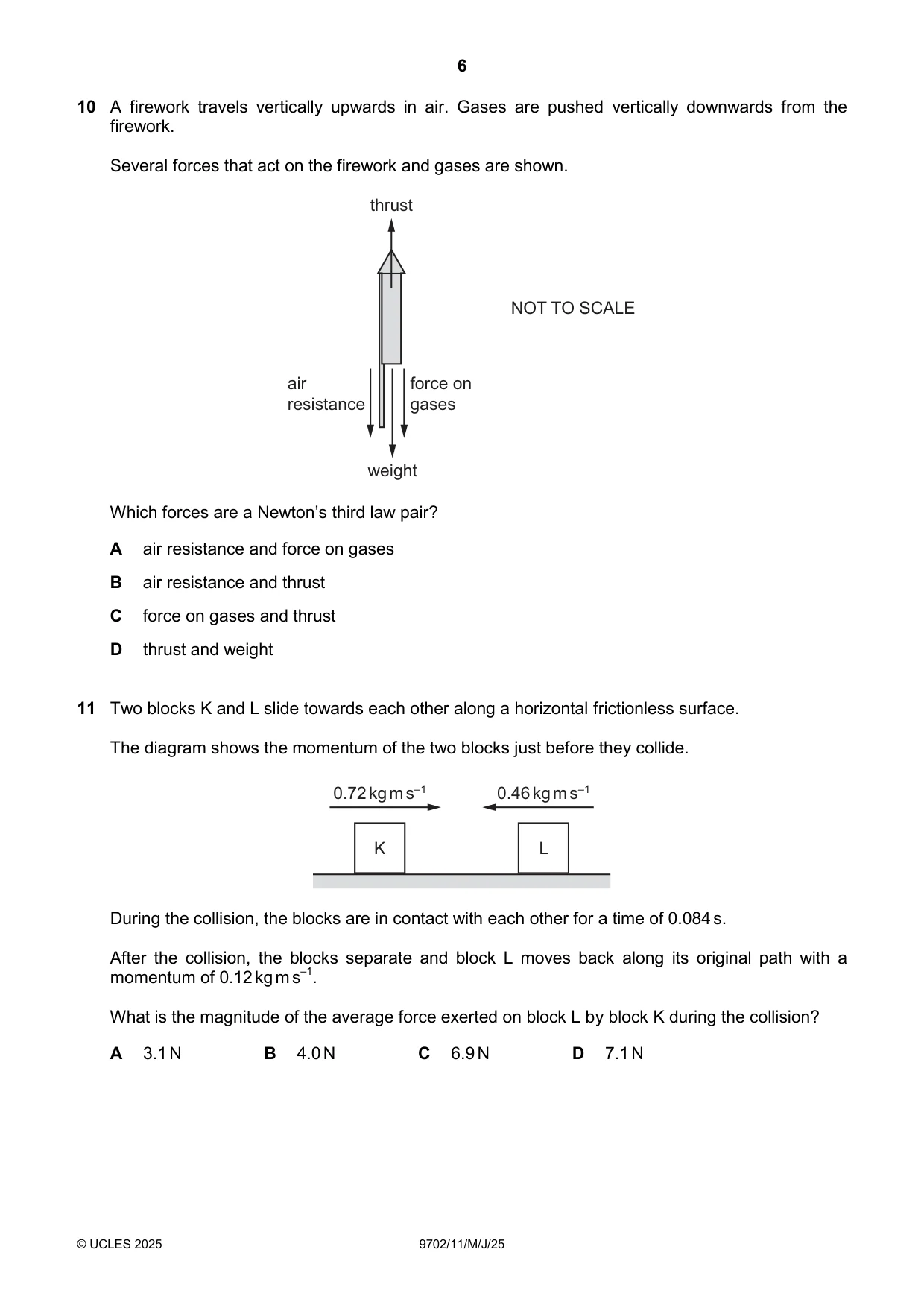
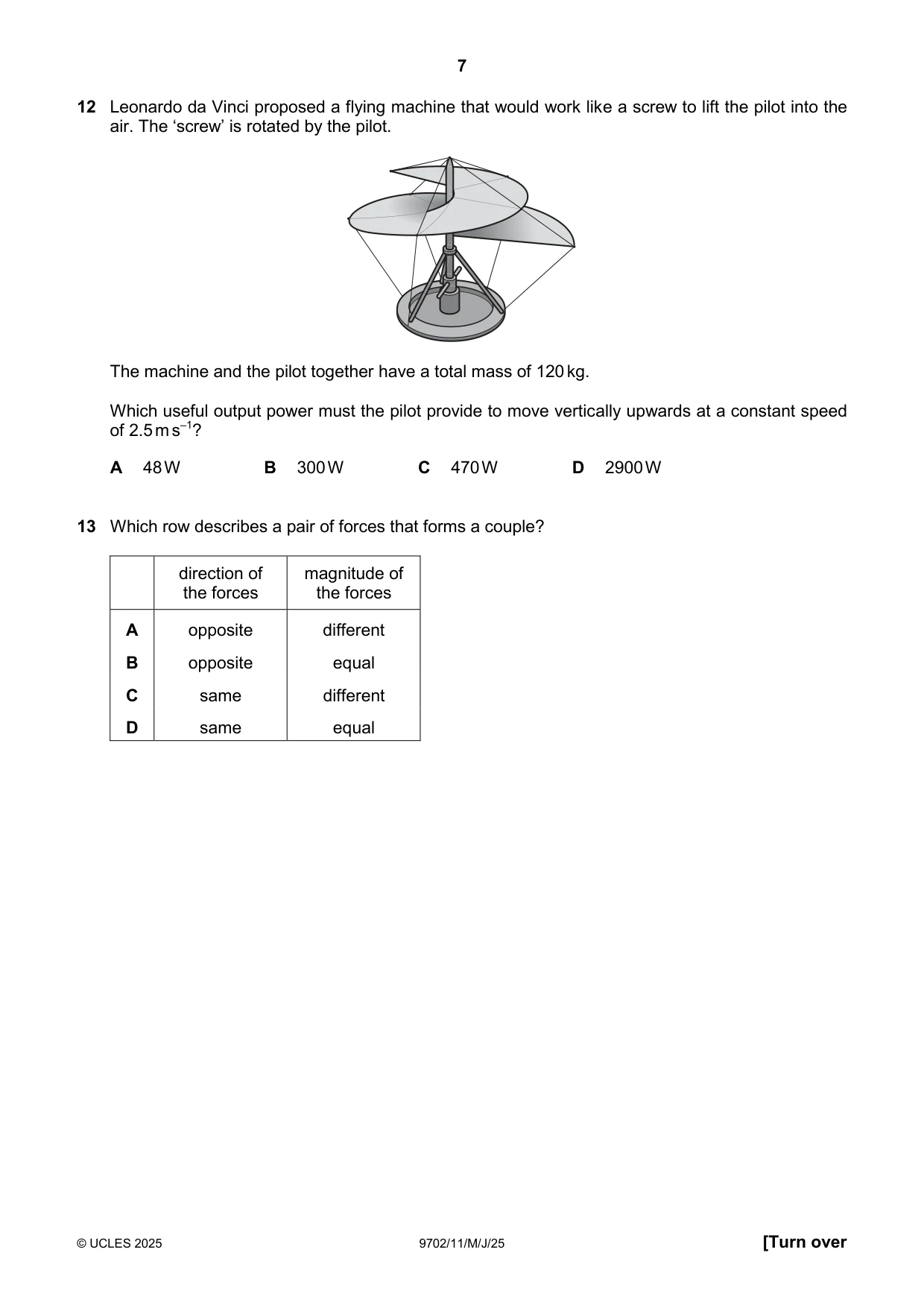
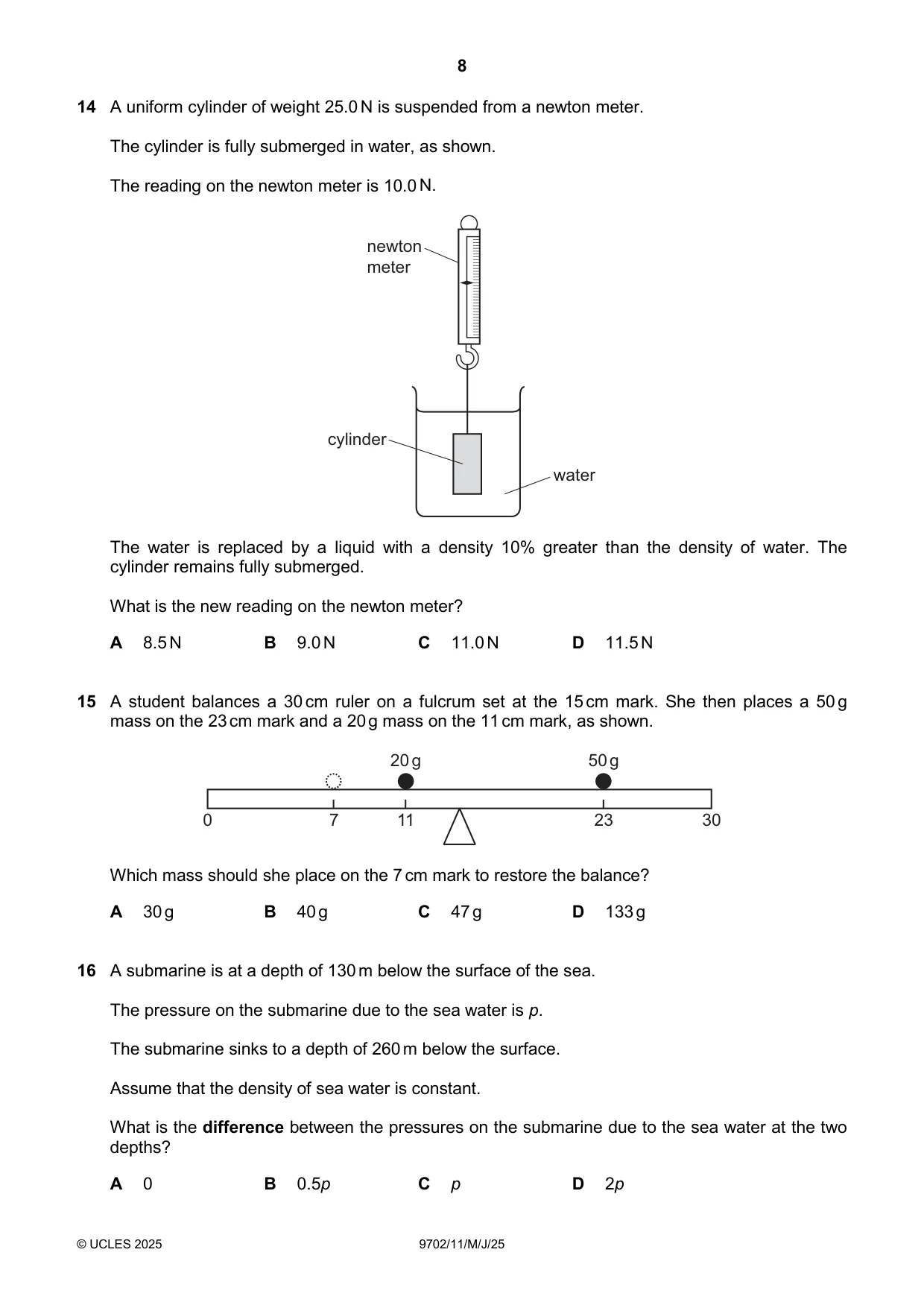
Mark scheme3 pages
Answers below. Sit the paper first if you are practising.
Questions as text
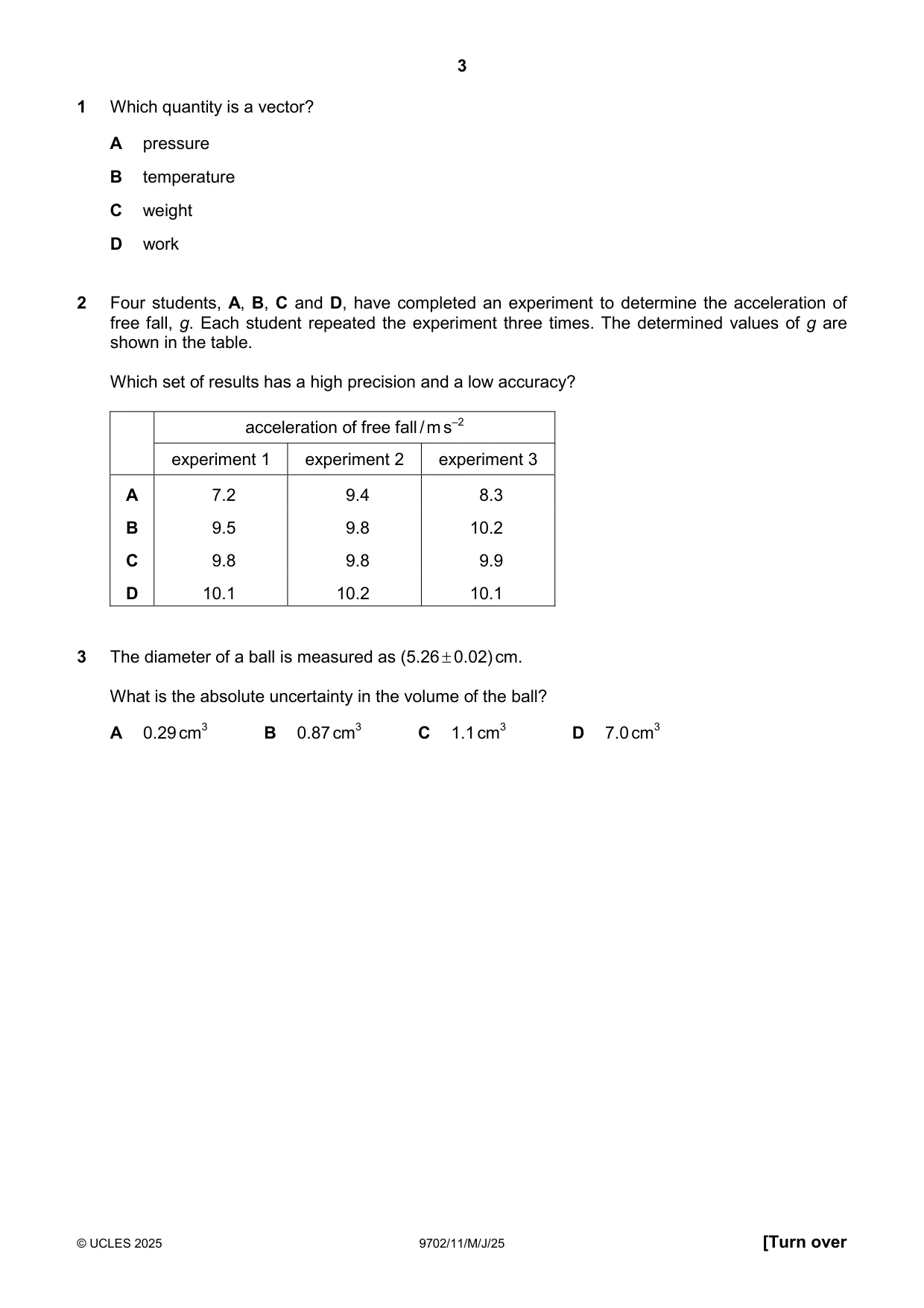
Q1 · Which quantity is a vector?
1 Which quantity is a vector? A pressure B temperature C weight D work
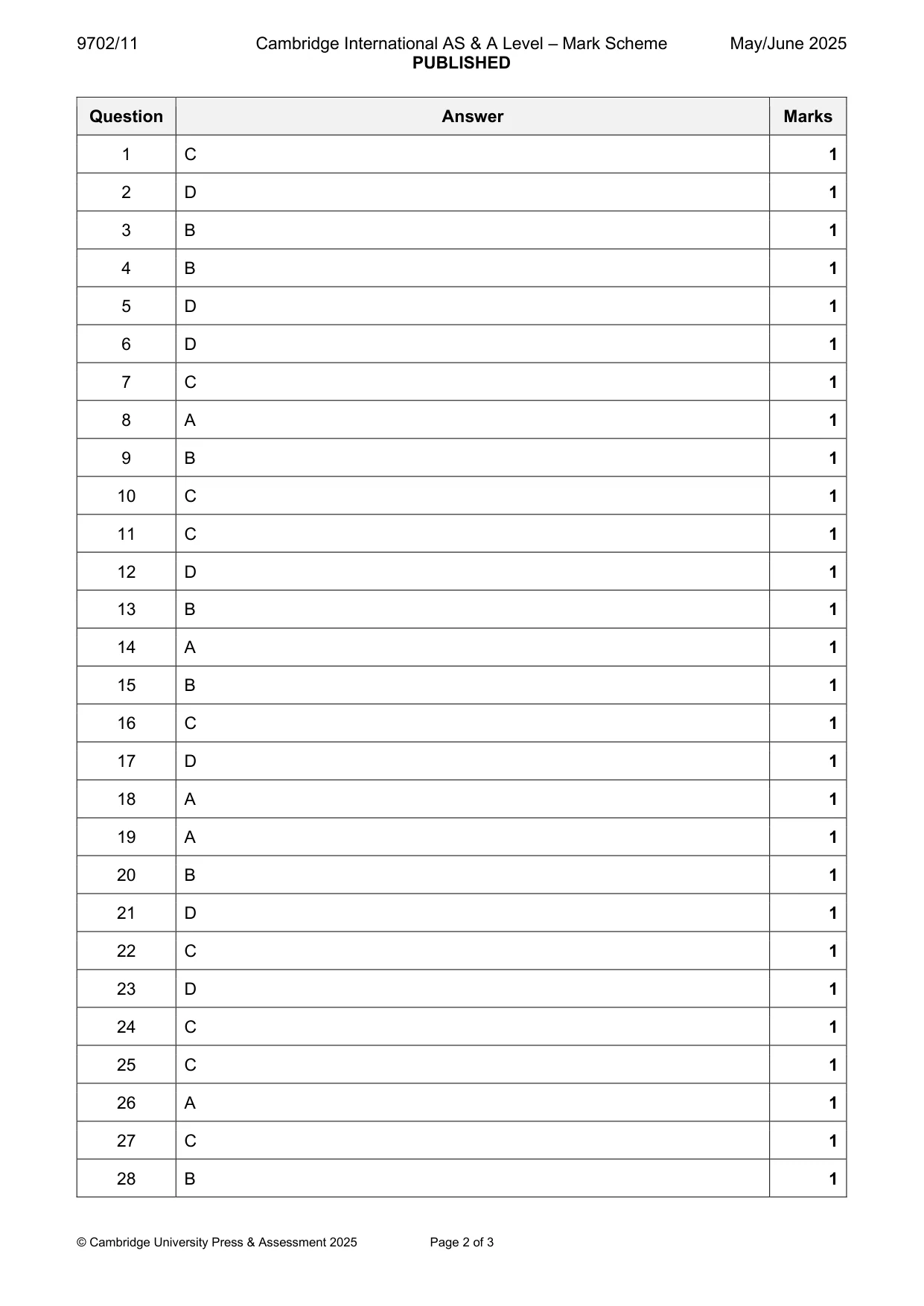
Mark scheme: C
Q2 · Four students, A, B, C and D, have completed an experiment to determine the acceleration…
2 Four students, A, B, C and D, have completed an experiment to determine the acceleration of free fall, g. Each student repeated the experiment three times. The determined values of g are shown in the table. Which set of results has a high precision and a low accuracy? acceleration of free fall / m s–2 experiment 1 experiment 2 experiment 3 A 7.2 9.4 8.3 B 9.5 9.8 10.2 C 9.8 9.8 9.9 D 10.1 10.2 10.1
Mark scheme: D
Q3 · The diameter of a ball is measured as (5.26 0.02) cm
3 The diameter of a ball is measured as (5.26 0.02) cm. What is the absolute uncertainty in the volume of the ball? A 0.29 cm3 B 0.87 cm3 C 1.1 cm3 D 7.0 cm3
Mark scheme: B
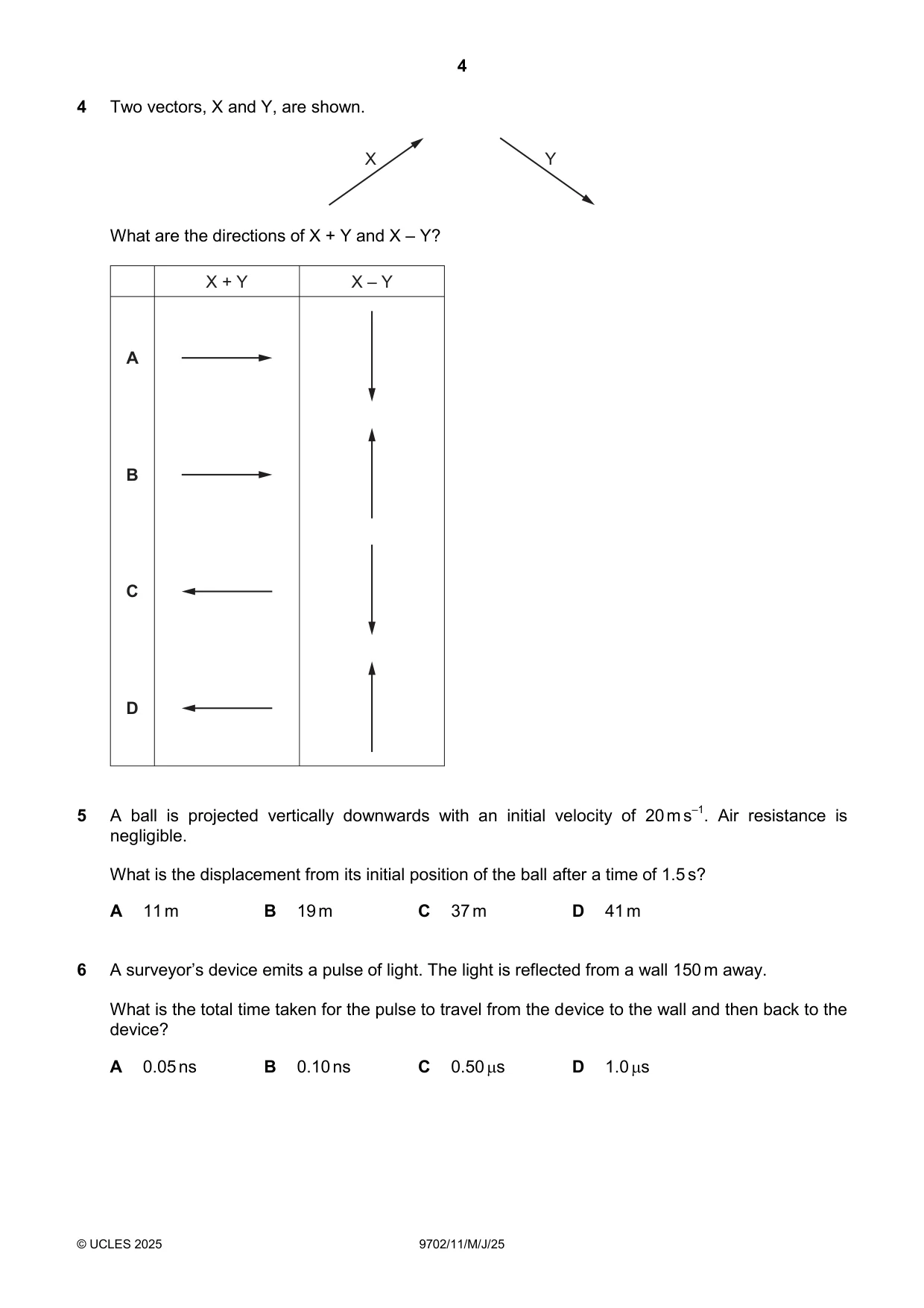
Q4 · Two vectors, X and Y, are shown
4 Two vectors, X and Y, are shown. X Y What are the directions of X + Y and X – Y? X + Y X – Y A B C D
Mark scheme: B
Q5 · A ball is projected vertically downwards with an initial velocity of 20 m s–1
5 A ball is projected vertically downwards with an initial velocity of 20 m s–1. Air resistance is negligible. What is the displacement from its initial position of the ball after a time of 1.5 s? A 11 m B 19 m C 37 m D 41 m
Mark scheme: D
Q6 · A surveyor’s device emits a pulse of light
6 A surveyor’s device emits a pulse of light. The light is reflected from a wall 150 m away. What is the total time taken for the pulse to travel from the device to the wall and then back to the device? A 0.05 ns B 0.10 ns C 0.50 s D 1.0 s
Mark scheme: D
Q7 · Which equation of uniformly accelerated motion can be derived using only the gradient of…
7 Which equation of uniformly accelerated motion can be derived using only the gradient of a velocity–time graph? A s = 1 ( u + v ) t 2 1 at B s = ut + 2 2 C v = u + at D v 2 = u 2 + 2as
Mark scheme: C
Q8 · An object is projected horizontally from a table at time t = 0
8 An object is projected horizontally from a table at time t = 0. The object falls in a uniform gravitational field. Air resistance is negligible. Graphs P, Q, R and S are velocity–time graphs. v v v v 0 0 0 0 0 t 0 t 0 t 0 t P Q R S Which graphs represent the horizontal and vertical components of the velocity of the object? horizontal vertical A Q P B Q S C R P D R S
Mark scheme: A
Q9 · What is always conserved in elastic collisions?
9 What is always conserved in elastic collisions? total kinetic energy total velocity A yes yes B yes no C no yes D no no
Mark scheme: B
Q10 · A firework travels vertically upwards in air
10 A firework travels vertically upwards in air. Gases are pushed vertically downwards from the firework. Several forces that act on the firework and gases are shown. thrust NOT TO SCALE air force on resistance gases weight Which forces are a Newton’s third law pair? A air resistance and force on gases B air resistance and thrust C force on gases and thrust D thrust and weight
Mark scheme: C
Q11 · Two blocks K and L slide towards each other along a horizontal frictionless surface
11 Two blocks K and L slide towards each other along a horizontal frictionless surface. The diagram shows the momentum of the two blocks just before they collide. 0.72 kg m s–1 0.46 kg m s–1 K L During the collision, the blocks are in contact with each other for a time of 0.084 s. After the collision, the blocks separate and block L moves back along its original path with a momentum of 0.12 kg m s–1. What is the magnitude of the average force exerted on block L by block K during the collision? A 3.1 N B 4.0 N C 6.9 N D 7.1 N
Mark scheme: C
Q12 · Leonardo da Vinci proposed a flying machine that would work like a screw to lift the…
12 Leonardo da Vinci proposed a flying machine that would work like a screw to lift the pilot into the air. The ‘screw’ is rotated by the pilot. The machine and the pilot together have a total mass of 120 kg. Which useful output power must the pilot provide to move vertically upwards at a constant speed of 2.5 m s–1? A 48 W B 300 W C 470 W D 2900 W
Mark scheme: D
Q13 · Which row describes a pair of forces that forms a couple?
13 Which row describes a pair of forces that forms a couple? direction of magnitude of the forces the forces A opposite different B opposite equal C same different D same equal
Mark scheme: B
Q14 · A uniform cylinder of weight 25.0 N is suspended from a newton meter
14 A uniform cylinder of weight 25.0 N is suspended from a newton meter. The cylinder is fully submerged in water, as shown. The reading on the newton meter is 10.0 N. newton meter cylinder water The water is replaced by a liquid with a density 10% greater than the density of water. The cylinder remains fully submerged. What is the new reading on the newton meter? A 8.5 N B 9.0 N C 11.0 N D 11.5 N
Mark scheme: A
Q15 · A student balances a 30 cm ruler on a fulcrum set at the 15 cm mark
15 A student balances a 30 cm ruler on a fulcrum set at the 15 cm mark. She then places a 50 g mass on the 23 cm mark and a 20 g mass on the 11 cm mark, as shown. 20 g 50 g 0 7 11 23 30 Which mass should she place on the 7 cm mark to restore the balance? A 30 g B 40 g C 47 g D 133 g
Mark scheme: B
Q16 · A submarine is at a depth of 130 m below the surface of the sea
16 A submarine is at a depth of 130 m below the surface of the sea. The pressure on the submarine due to the sea water is p. The submarine sinks to a depth of 260 m below the surface. Assume that the density of sea water is constant. What is the difference between the pressures on the submarine due to the sea water at the two depths? A 0 B 0.5p C p D 2p
Mark scheme: C
Q17 · An object is falling in a uniform gravitational field
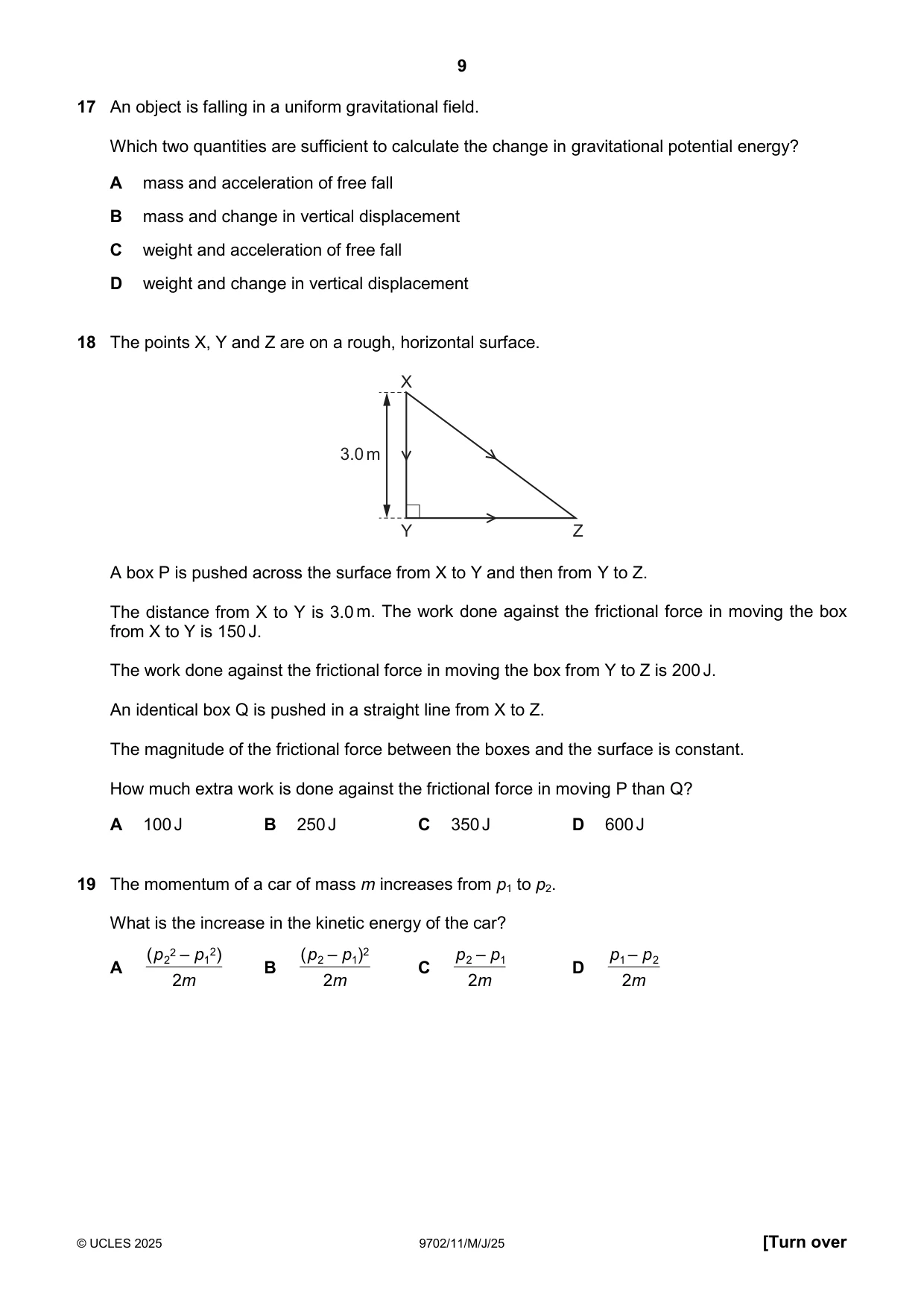
17 An object is falling in a uniform gravitational field. Which two quantities are sufficient to calculate the change in gravitational potential energy? A mass and acceleration of free fall B mass and change in vertical displacement C weight and acceleration of free fall D weight and change in vertical displacement
Mark scheme: D
More questions on Gravitational potential energy and kinetic energy
Q18 · The points X, Y and Z are on a rough, horizontal surface
18 The points X, Y and Z are on a rough, horizontal surface. X 3.0 m Y Z A box P is pushed across the surface from X to Y and then from Y to Z. The distance from X to Y is 3.0 m. The work done against the frictional force in moving the box from X to Y is 150 J. The work done against the frictional force in moving the box from Y to Z is 200 J. An identical box Q is pushed in a straight line from X to Z. The magnitude of the frictional force between the boxes and the surface is constant. How much extra work is done against the frictional force in moving P than Q? A 100 J B 250 J C 350 J D 600 J
Mark scheme: A
Q19 · The momentum of a car of mass m increases from p1 to p2
19 The momentum of a car of mass m increases from p1 to p2. What is the increase in the kinetic energy of the car? ( p 2 – p 2 ) ( p – p ) 2 p – p p – p A 2 1 B 2 1 C 2 1 D 1 2 2 m 2 m 2 m 2 m
Mark scheme: A
More questions on Gravitational potential energy and kinetic energy
Q20 · A parachutist is falling at constant (terminal) velocity
20 A parachutist is falling at constant (terminal) velocity. Which statement is not correct? A Gravitational potential energy is converted into kinetic energy of the air. B Gravitational potential energy is converted into kinetic energy of the parachutist. C Gravitational potential energy is converted into thermal energy of the air. D Gravitational potential energy is converted into thermal energy of the parachutist.
Mark scheme: B
Q21 · A student investigates a spring
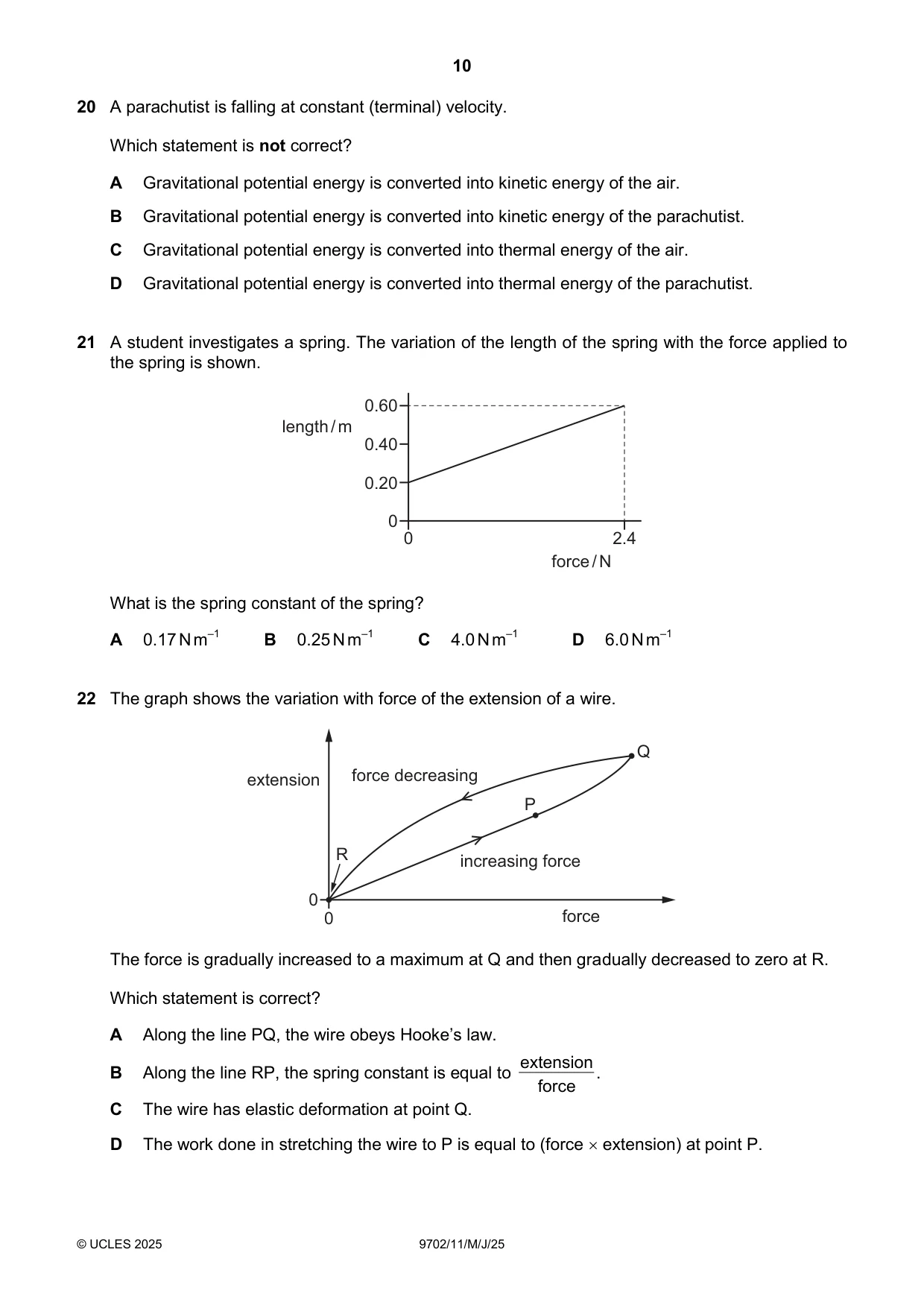
21 A student investigates a spring. The variation of the length of the spring with the force applied to the spring is shown. 0.60 length / m 0.40 0.20 0 0 2.4 force / N What is the spring constant of the spring? A 0.17 N m–1 B 0.25 N m–1 C 4.0 N m–1 D 6.0 N m–1
Mark scheme: D
Q22 · The graph shows the variation with force of the extension of a wire
22 The graph shows the variation with force of the extension of a wire. Q extension force decreasing P R increasing force 0 0 force The force is gradually increased to a maximum at Q and then gradually decreased to zero at R. Which statement is correct? A Along the line PQ, the wire obeys Hooke’s law. extension B Along the line RP, the spring constant is equal to . force C The wire has elastic deformation at point Q. D The work done in stretching the wire to P is equal to (force extension) at point P.
Mark scheme: C
Q23 · A uniform metal wire of length L and diameter d has spring constant k
23 A uniform metal wire of length L and diameter d has spring constant k. What is the Young modulus of the metal? d 2 d 2 kL 4 kL A B C D 4 kL kL d 2 d 2
Mark scheme: D
Q24 · An aircraft produces a sound at a frequency of 30.0 Hz
24 An aircraft produces a sound at a frequency of 30.0 Hz. The speed of sound in air is 330 m s–1. The aircraft is directly in front of the stationary observer and travels in a straight line towards or away from the observer. The observer hears the sound from the aircraft at a frequency of 20.0 Hz. What is the speed and direction of the aircraft? speed / m s–1 direction A 110 away from observer B 110 towards observer C 165 away from observer D 165 towards observer
Mark scheme: C
Q25 · Which statement about longitudinal and transverse wave motion for a progressive wave is…
25 Which statement about longitudinal and transverse wave motion for a progressive wave is correct? A All transverse and longitudinal waves require a medium for propagation. B All transverse waves travel at the same speed, but longitudinal waves can travel at different speeds. C In both transverse waves and longitudinal waves, a particle with zero displacement has a maximum speed. D In a longitudinal wave there is a net movement of particles in the direction of travel of the wave, but there is no net movement of particles in a transverse wave.
Mark scheme: C
Q26 · The diagram shows a progressive transverse wave on a stretched string at one instant in…
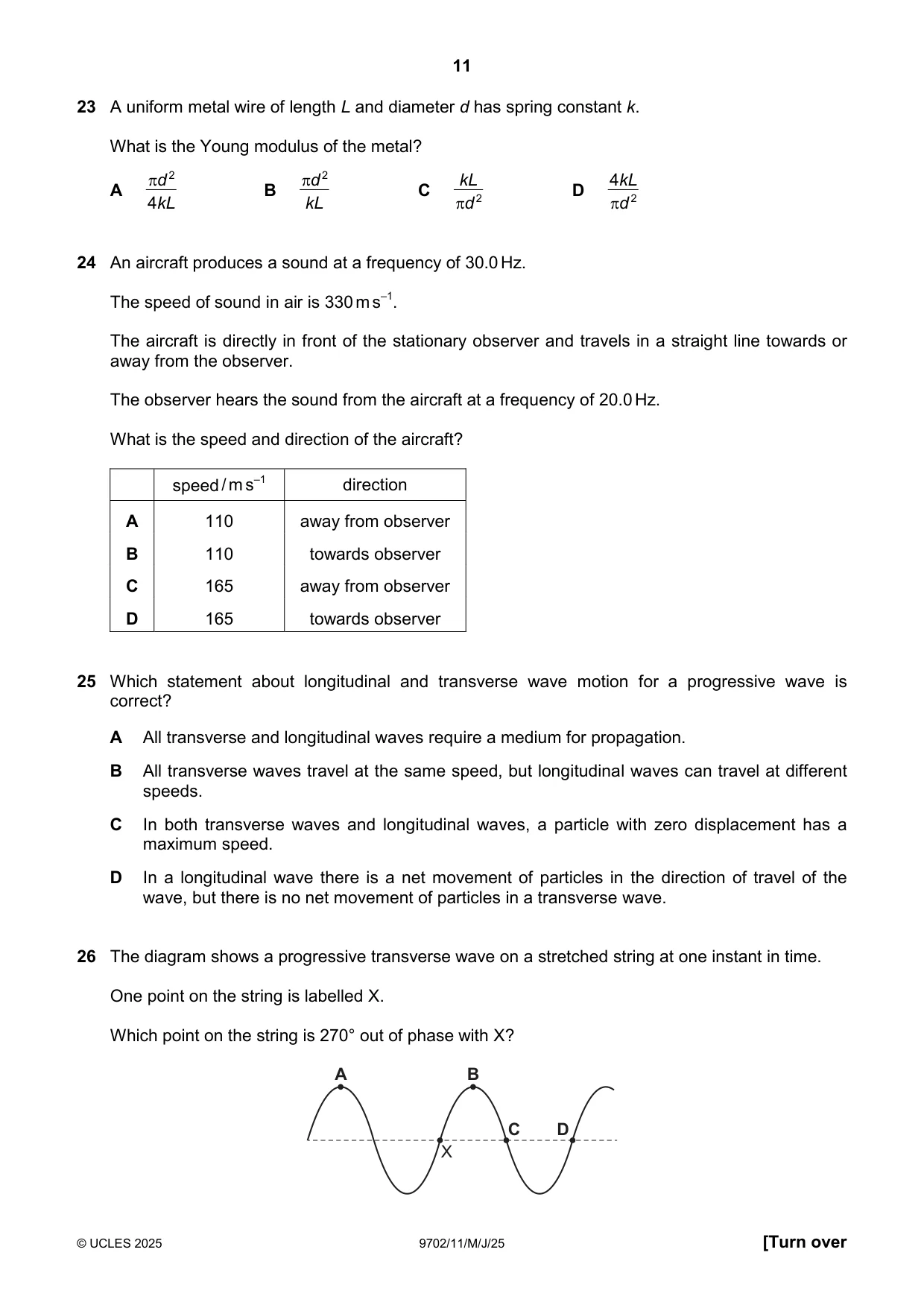
26 The diagram shows a progressive transverse wave on a stretched string at one instant in time. One point on the string is labelled X. Which point on the string is 270° out of phase with X? A B C D X
Mark scheme: A
Q27 · Which wavelength of electromagnetic radiation in free space could be green light?
27 Which wavelength of electromagnetic radiation in free space could be green light? A 4.9 10–9 m B 6.6 10–9 m C 5.5 10–7 m D 8.6 10–7 m
Mark scheme: C
Q28 · Which group contains only waves that can be polarised?
28 Which group contains only waves that can be polarised? A infrared waves, radio waves, sound waves B visible light waves, microwaves, radio waves C visible light waves, radio waves, sound waves D microwaves, visible light waves, sound waves A The waves are
Mark scheme: B
Q29 · One wave has an amplitude of 2A
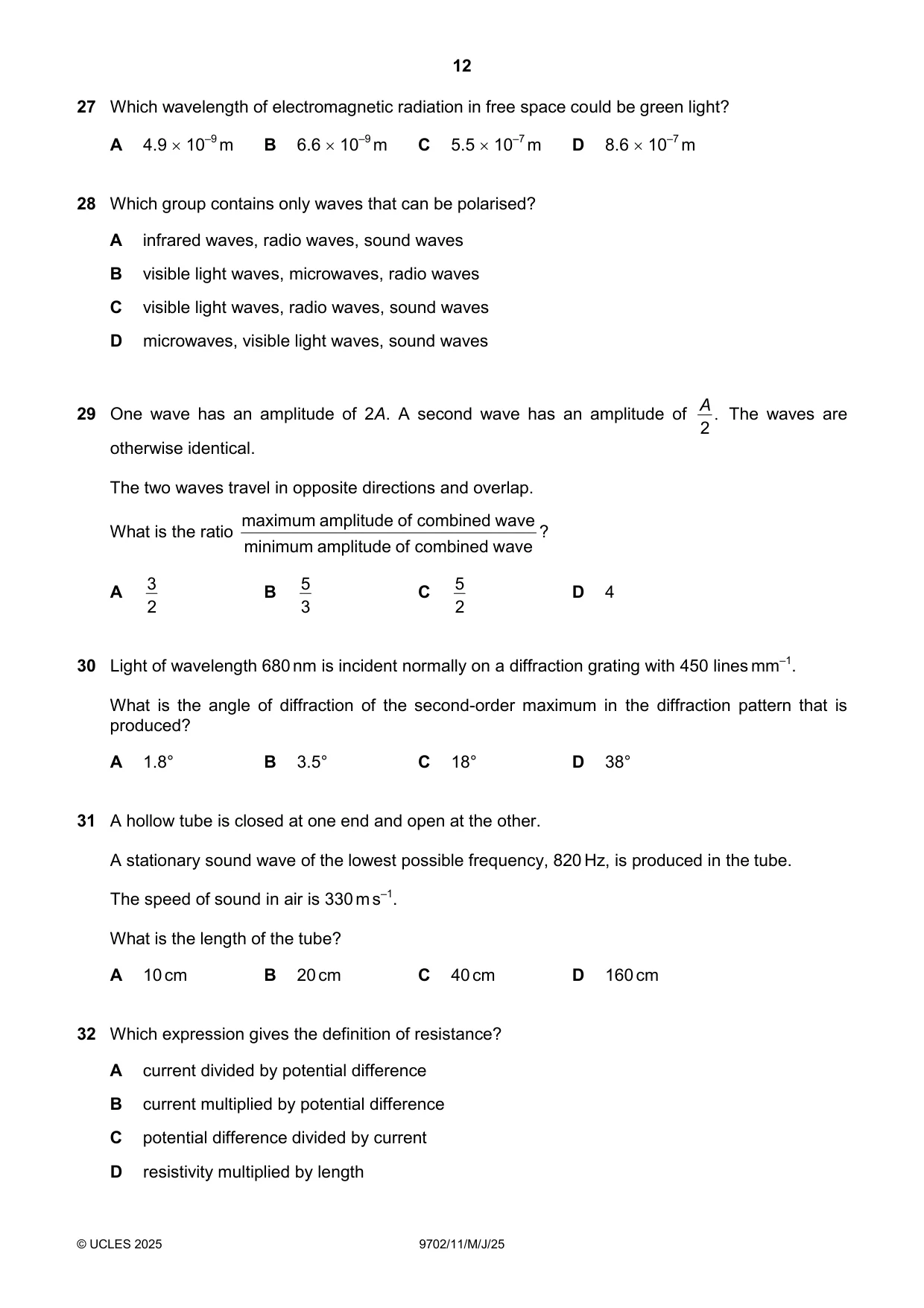
29 One wave has an amplitude of 2A. A second wave has an amplitude of . 2 otherwise identical. The two waves travel in opposite directions and overlap. maximum amplitude of combined wave What is the ratio ? minimum amplitude of combined wave 3 5 5 A B C D 4 2 3 2
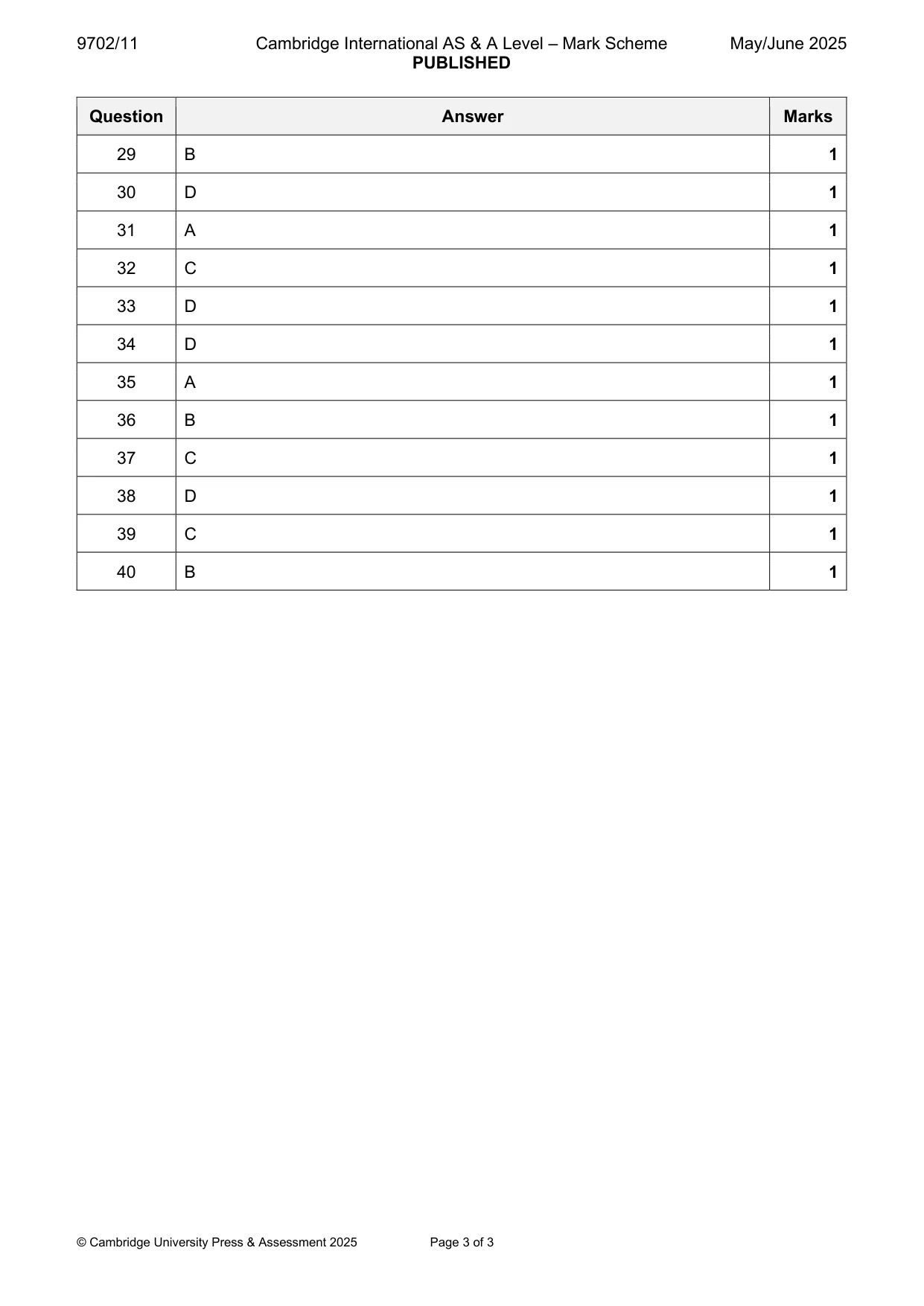
Mark scheme: B
Q30 · Light of wavelength 680 nm is incident normally on a diffraction grating with 450 lines…
30 Light of wavelength 680 nm is incident normally on a diffraction grating with 450 lines mm–1. What is the angle of diffraction of the second-order maximum in the diffraction pattern that is produced? A 1.8° B 3.5° C 18° D 38°
Mark scheme: D
Q31 · A hollow tube is closed at one end and open at the other
31 A hollow tube is closed at one end and open at the other. A stationary sound wave of the lowest possible frequency, 820 Hz, is produced in the tube. The speed of sound in air is 330 m s–1. What is the length of the tube? A 10 cm B 20 cm C 40 cm D 160 cm
Mark scheme: A
Q32 · Which expression gives the definition of resistance?
32 Which expression gives the definition of resistance? A current divided by potential difference B current multiplied by potential difference C potential difference divided by current D resistivity multiplied by length
Mark scheme: C
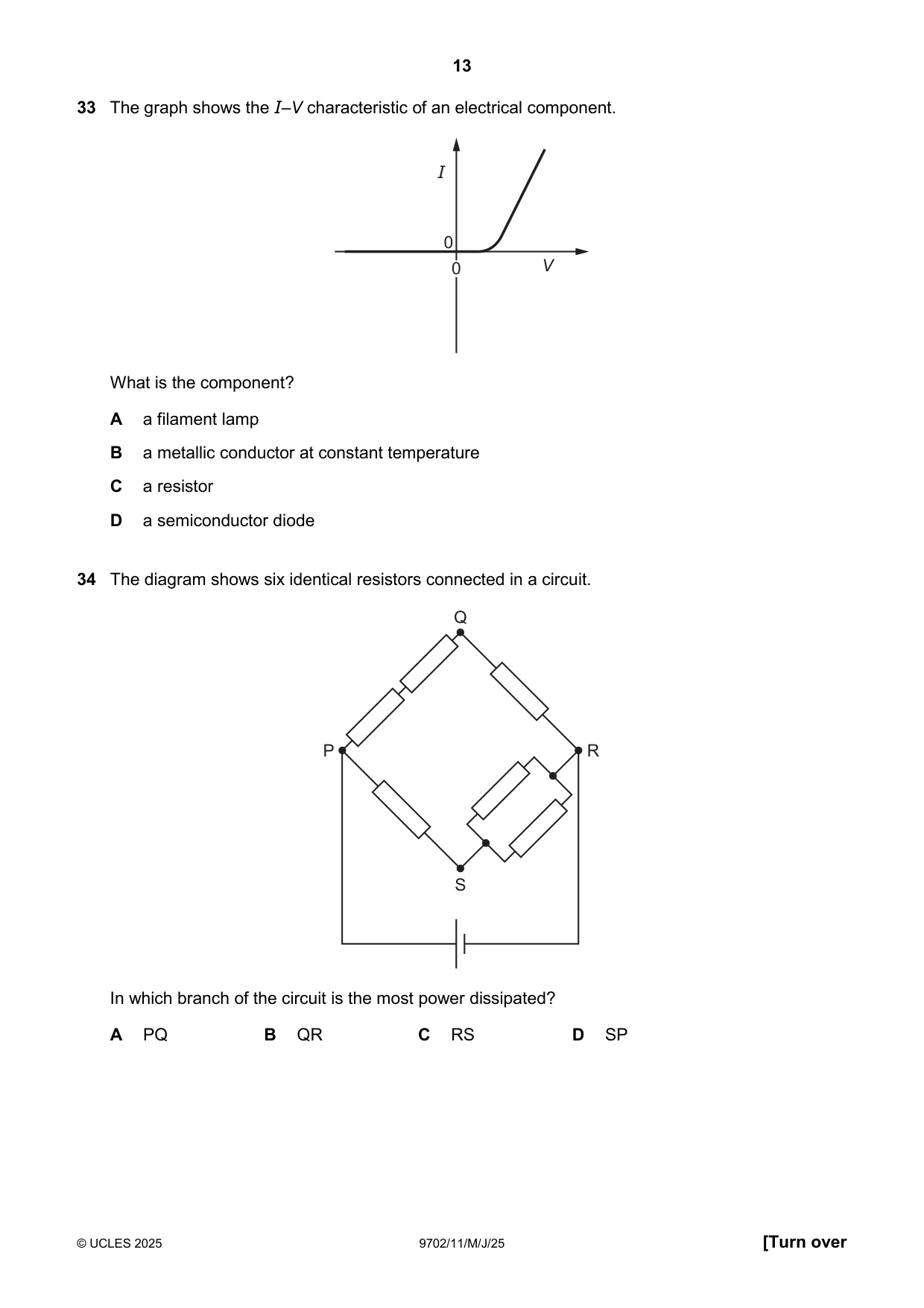
Q33 · The graph shows the I–V characteristic of an electrical component
33 The graph shows the I–V characteristic of an electrical component. I 0 0 V What is the component? A a filament lamp B a metallic conductor at constant temperature C a resistor D a semiconductor diode
Mark scheme: D
Q34 · The diagram shows six identical resistors connected in a circuit
34 The diagram shows six identical resistors connected in a circuit. Q P R S In which branch of the circuit is the most power dissipated? A PQ B QR C RS D SP
Mark scheme: D
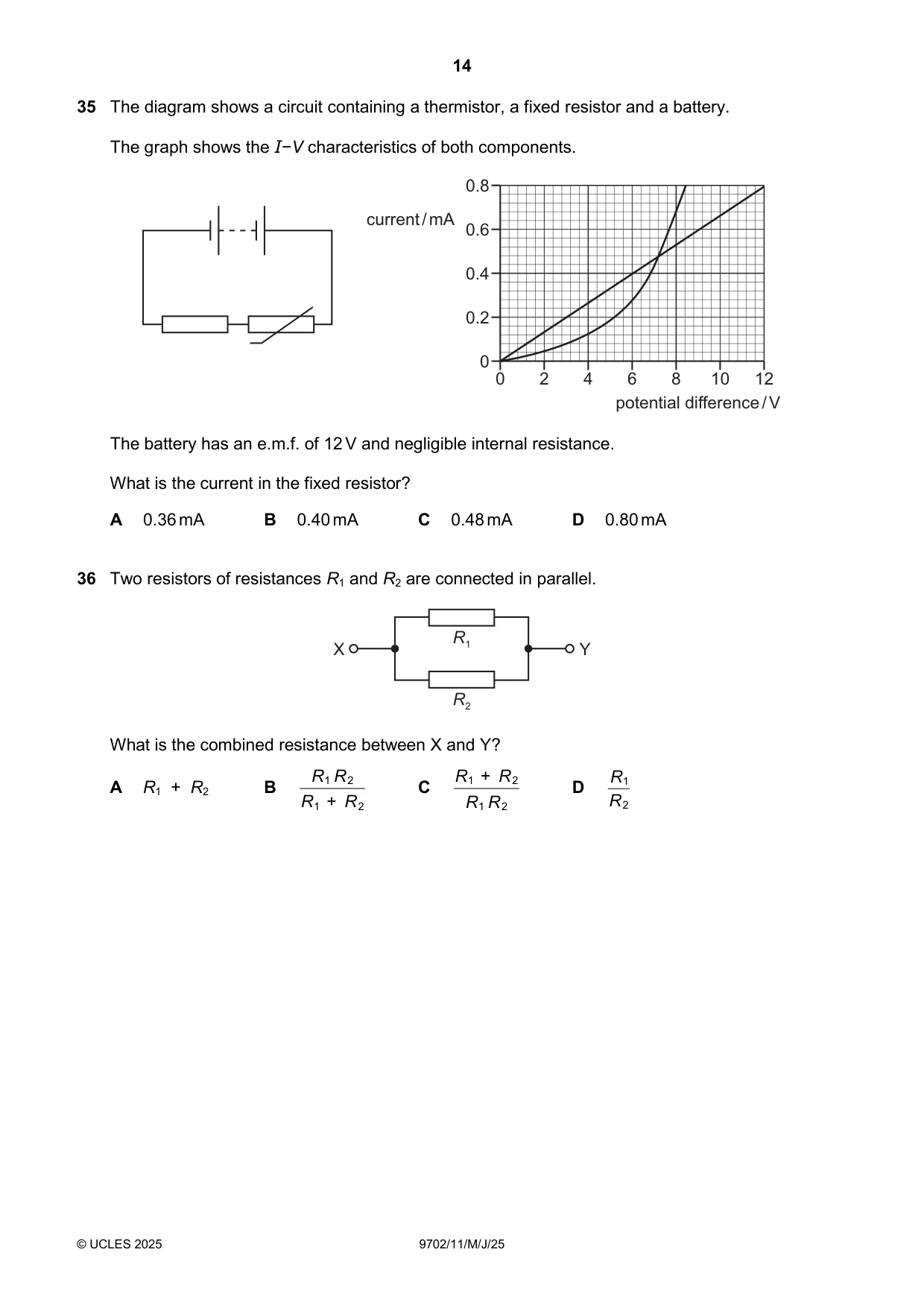
Q35 · The diagram shows a circuit containing a thermistor, a fixed resistor and a battery
35 The diagram shows a circuit containing a thermistor, a fixed resistor and a battery. The graph shows the I−V characteristics of both components. 0.8 current / mA 0.6 0.4 0.2 0 0 2 4 6 8 10 12 potential difference / V The battery has an e.m.f. of 12 V and negligible internal resistance. What is the current in the fixed resistor? A 0.36 mA B 0.40 mA C 0.48 mA D 0.80 mA
Mark scheme: A
Q36 · Two resistors of resistances R1 and R2 are connected in parallel
36 Two resistors of resistances R1 and R2 are connected in parallel. R1 X Y R2 What is the combined resistance between X and Y? R R R + R R A R1 + R2 B 1 2 C 1 2 D 1 R + R R R R 1 2 1 2 2
Mark scheme: B
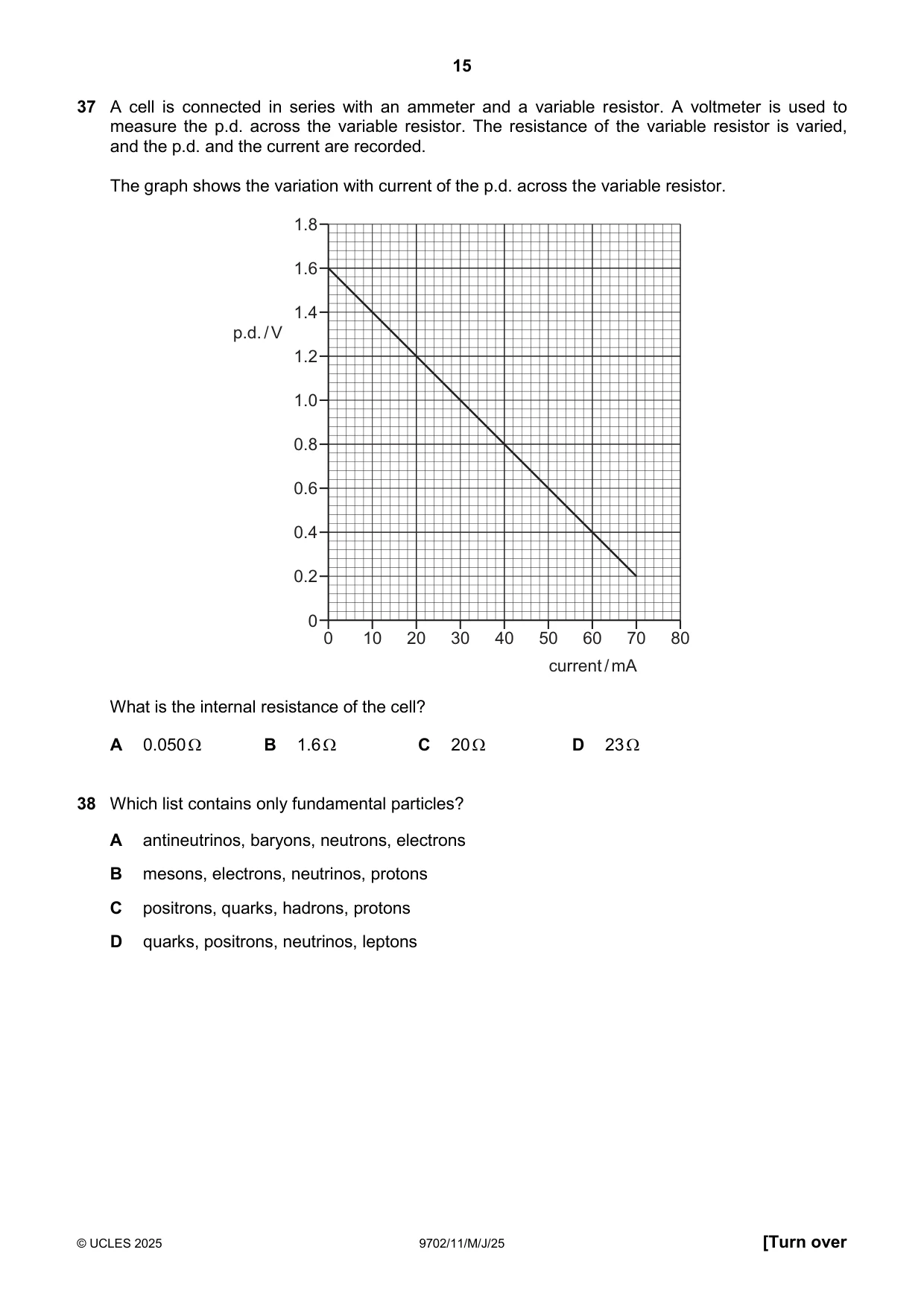
Q37 · A cell is connected in series with an ammeter and a variable resistor
37 A cell is connected in series with an ammeter and a variable resistor. A voltmeter is used to measure the p.d. across the variable resistor. The resistance of the variable resistor is varied, and the p.d. and the current are recorded. The graph shows the variation with current of the p.d. across the variable resistor. 1.8 1.6 1.4 p.d. / V 1.2 1.0 0.8 0.6 0.4 0.2 0 0 10 20 30 40 50 60 70 80 current / mA What is the internal resistance of the cell? A 0.050 B 1.6 C 20 D 23
Mark scheme: C
Q38 · Which list contains only fundamental particles?
38 Which list contains only fundamental particles? A antineutrinos, baryons, neutrons, electrons B mesons, electrons, neutrinos, protons C positrons, quarks, hadrons, protons D quarks, positrons, neutrinos, leptons
Mark scheme: D
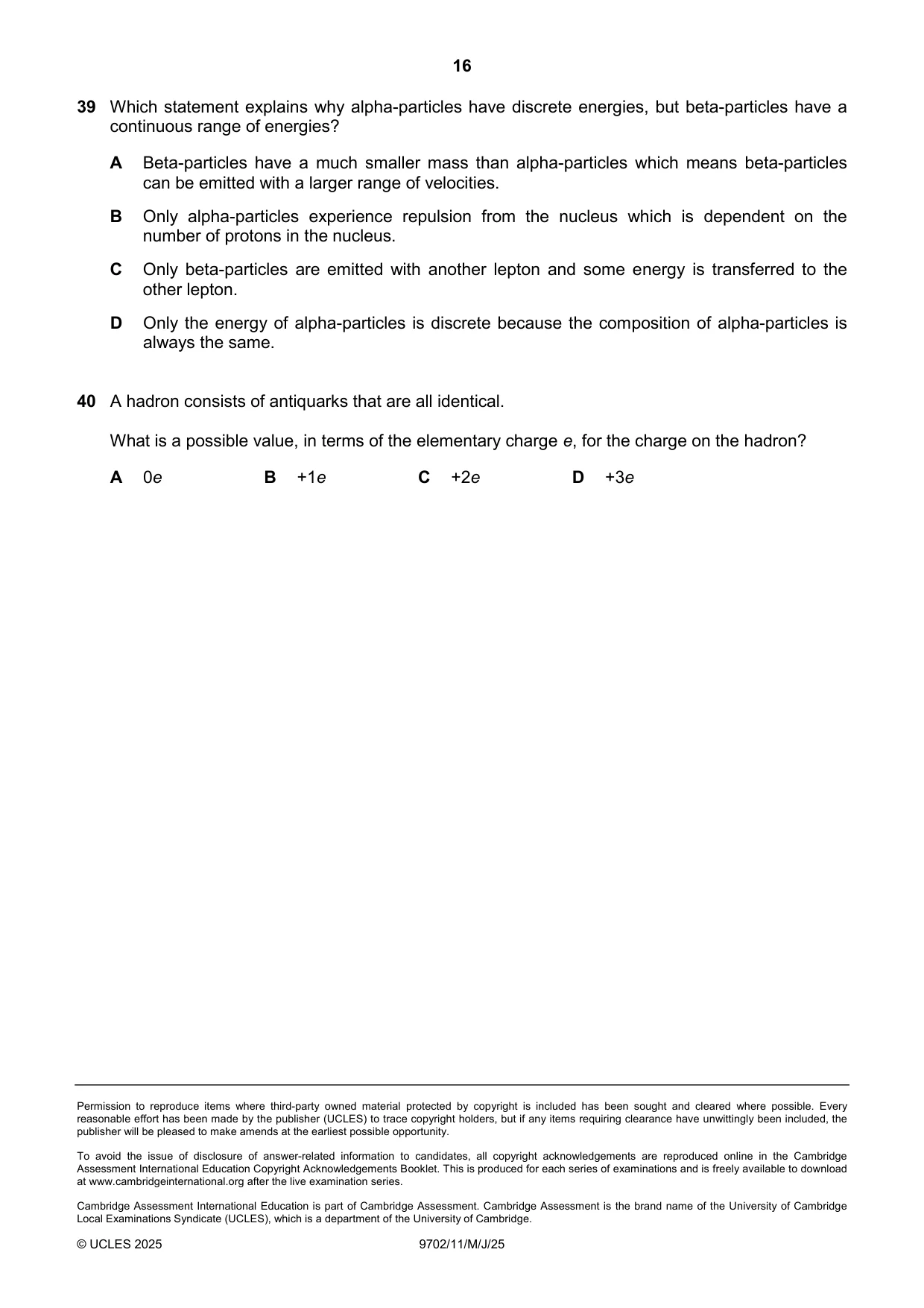
Q39 · Which statement explains why alpha-particles have discrete energies, but beta-particles…
39 Which statement explains why alpha-particles have discrete energies, but beta-particles have a continuous range of energies? A Beta-particles have a much smaller mass than alpha-particles which means beta-particles can be emitted with a larger range of velocities. B Only alpha-particles experience repulsion from the nucleus which is dependent on the number of protons in the nucleus. C Only beta-particles are emitted with another lepton and some energy is transferred to the other lepton. D Only the energy of alpha-particles is discrete because the composition of alpha-particles is always the same.
Mark scheme: C
Q40 · A hadron consists of antiquarks that are all identical
40 A hadron consists of antiquarks that are all identical. What is a possible value, in terms of the elementary charge e, for the charge on the hadron? A 0e B +1e C +2e D +3e
Mark scheme: B
What was in this paper
The subtopics covered by these 40 questions, and how many questions each got. Open one in a new tab to see every Cambridge question on it.
3Equations of motion3Density and pressure2Elastic and plastic behaviour2Errors and uncertainties2Fundamental particles2Gravitational potential energy and kinetic energy2Linear momentum and its conservation2Practical circuits2Resistance and resistivity2Scalars and vectors2Turning effects of forces2Doppler effect for sound waves1Electromagnetic spectrum1Interference1Momentum and Newton’s laws of motion1Polarisation1Potential difference and power1Potential dividers1Progressive waves1Radioactive decay1SI units1Stationary waves1Stress and strain1The diffraction grating1Transverse and longitudinal waves1What you needed in this session
Cambridge’s own grade thresholds for 2025 May/June, Paper 1 · Variant 1. A higher threshold means an easier paper — the bar moves with how the cohort did.