Cambridge A Level Physics 9702 — 2014 Oct/Nov Paper 1 · Variant 1
9702/11/O/N/14 · 40 questions · 40 marks · ≈45 min
The question paper and its mark scheme, free to read here and free to download. This is Cambridge’s own paper, exactly as it was sat.
Question paper28 pages

Mark scheme2 pages
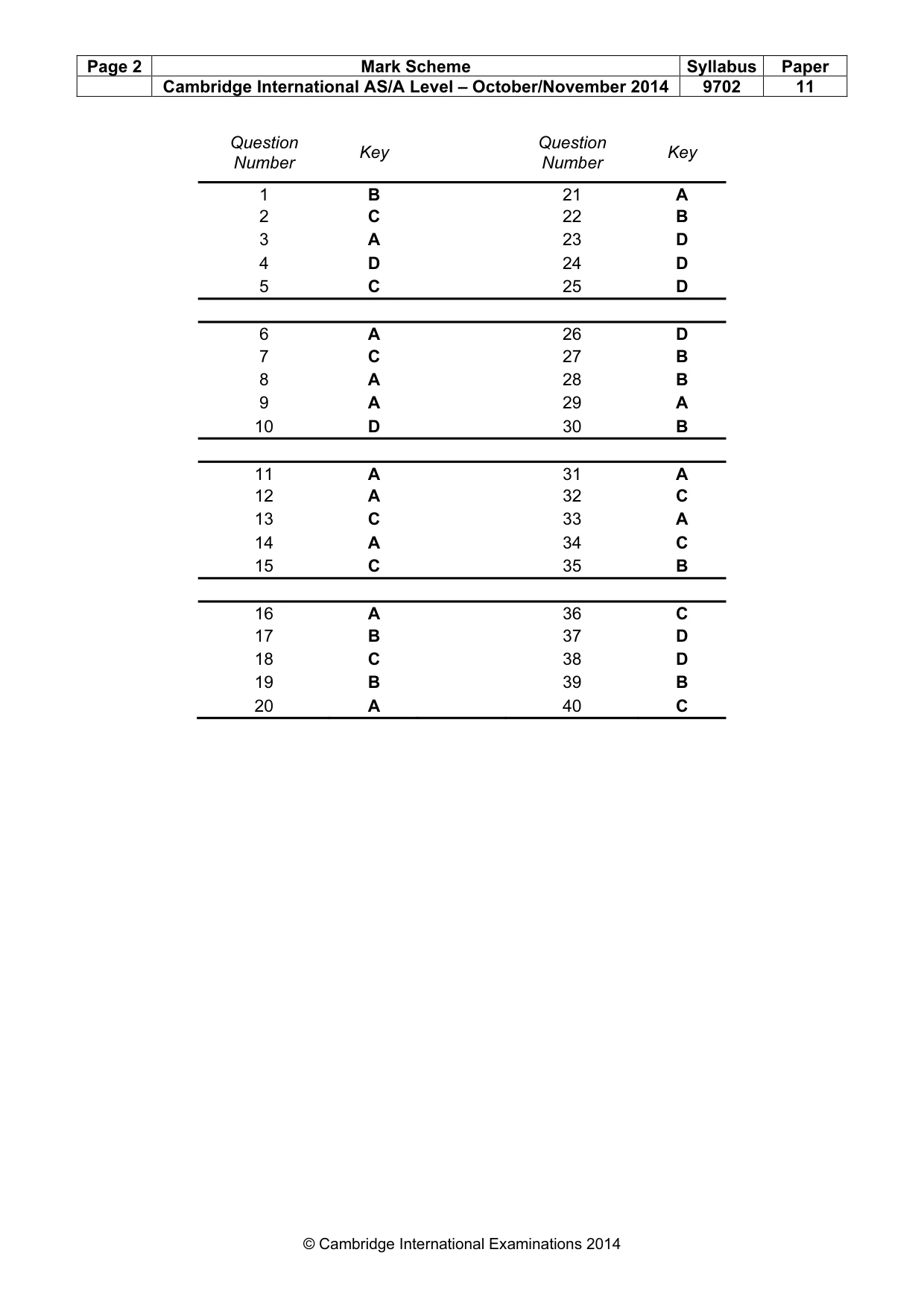
Answers below. Sit the paper first if you are practising.
Questions as text
Q1 · A 0.10 kg mass is taken to Mars and then weighed on a spring balance and on a lever…
1 A 0.10 kg mass is taken to Mars and then weighed on a spring balance and on a lever balance. The acceleration due to gravity on Mars is 38% of its value on Earth. What are the readings on the two balances on Mars? (Assume that on Earth g = 10 m s–2.) spring lever balance / N balance / kg A 0.38 0.038 B 0.38 0.10 C 1.0 0.038 D 1.0 0.10
Mark scheme: B
Q2 · What is equivalent to the unit of electric field strength?
2 What is equivalent to the unit of electric field strength? A J C m–1 B N s A–1 C kg m s–3 A–1 D kg m3 s–3 A–1
Mark scheme: C
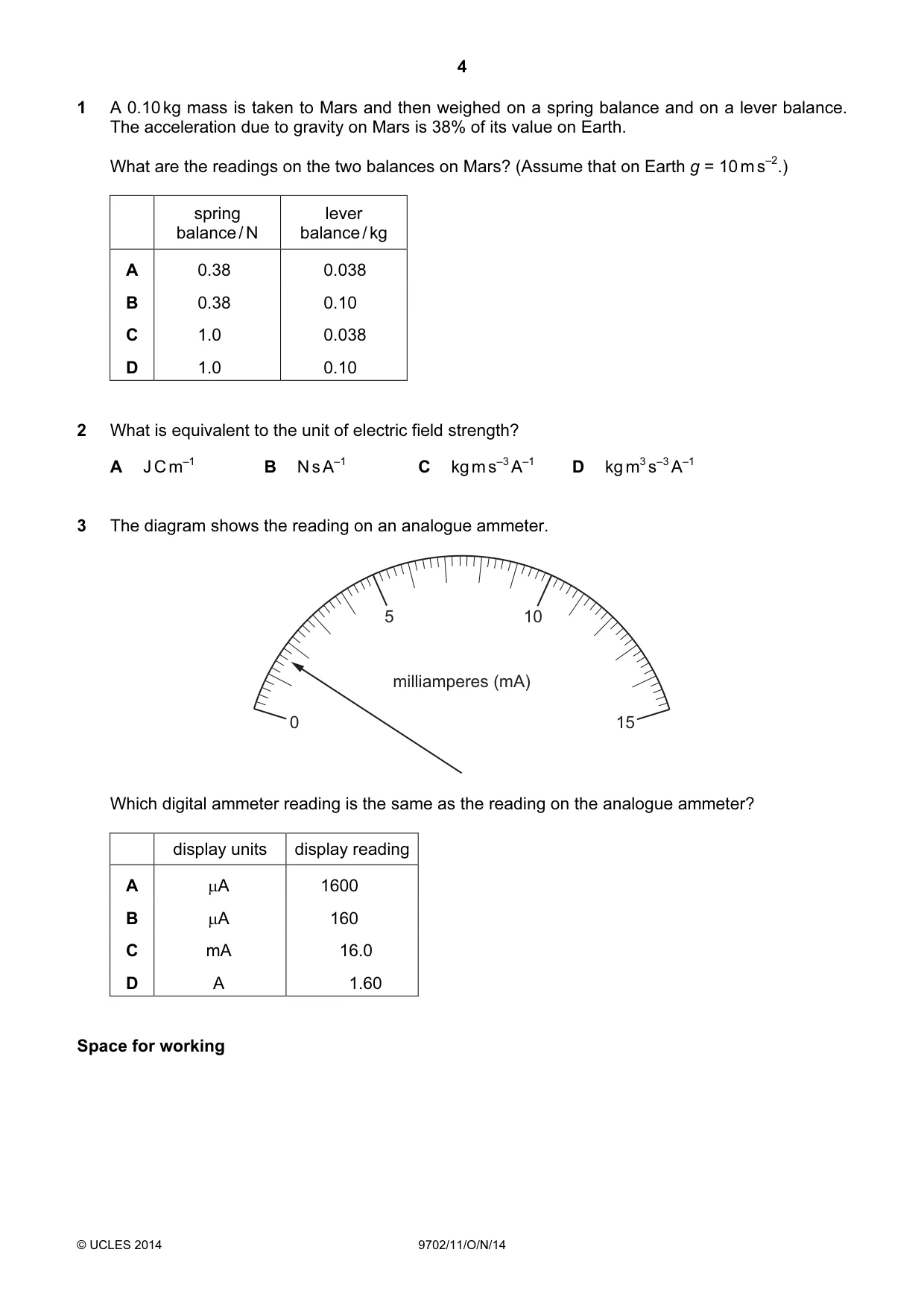
Q3 · The diagram shows the reading on an analogue ammeter
3 The diagram shows the reading on an analogue ammeter. 5 10 milliamperes (mA) 0 15 Which digital ammeter reading is the same as the reading on the analogue ammeter? display units display reading A µA 1600 B µA 160 C mA 16.0 D A 1.60 Space for working
Mark scheme: A
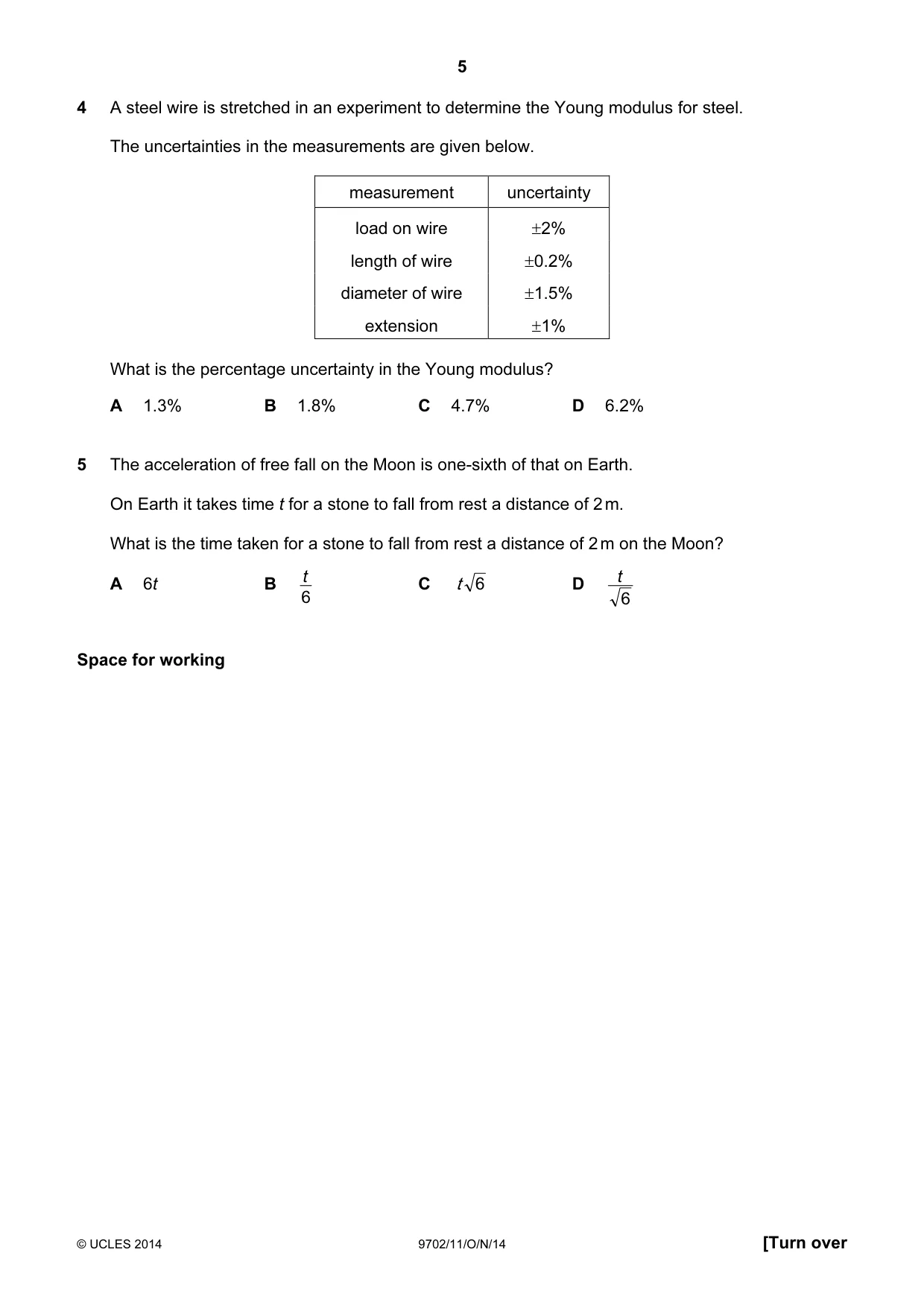
Q4 · A steel wire is stretched in an experiment to determine the Young modulus for steel
4 A steel wire is stretched in an experiment to determine the Young modulus for steel. The uncertainties in the measurements are given below. measurement uncertainty load on wire ±2% length of wire ±0.2% diameter of wire ±1.5% extension ±1% What is the percentage uncertainty in the Young modulus? A 1.3% B 1.8% C 4.7% D 6.2%
Mark scheme: D
Q5 · The acceleration of free fall on the Moon is one-sixth of that on Earth
5 The acceleration of free fall on the Moon is one-sixth of that on Earth. On Earth it takes time t for a stone to fall from rest a distance of 2 m. What is the time taken for a stone to fall from rest a distance of 2 m on the Moon? A 6t B t C t 6 D t 6 6 Space for working
Mark scheme: C
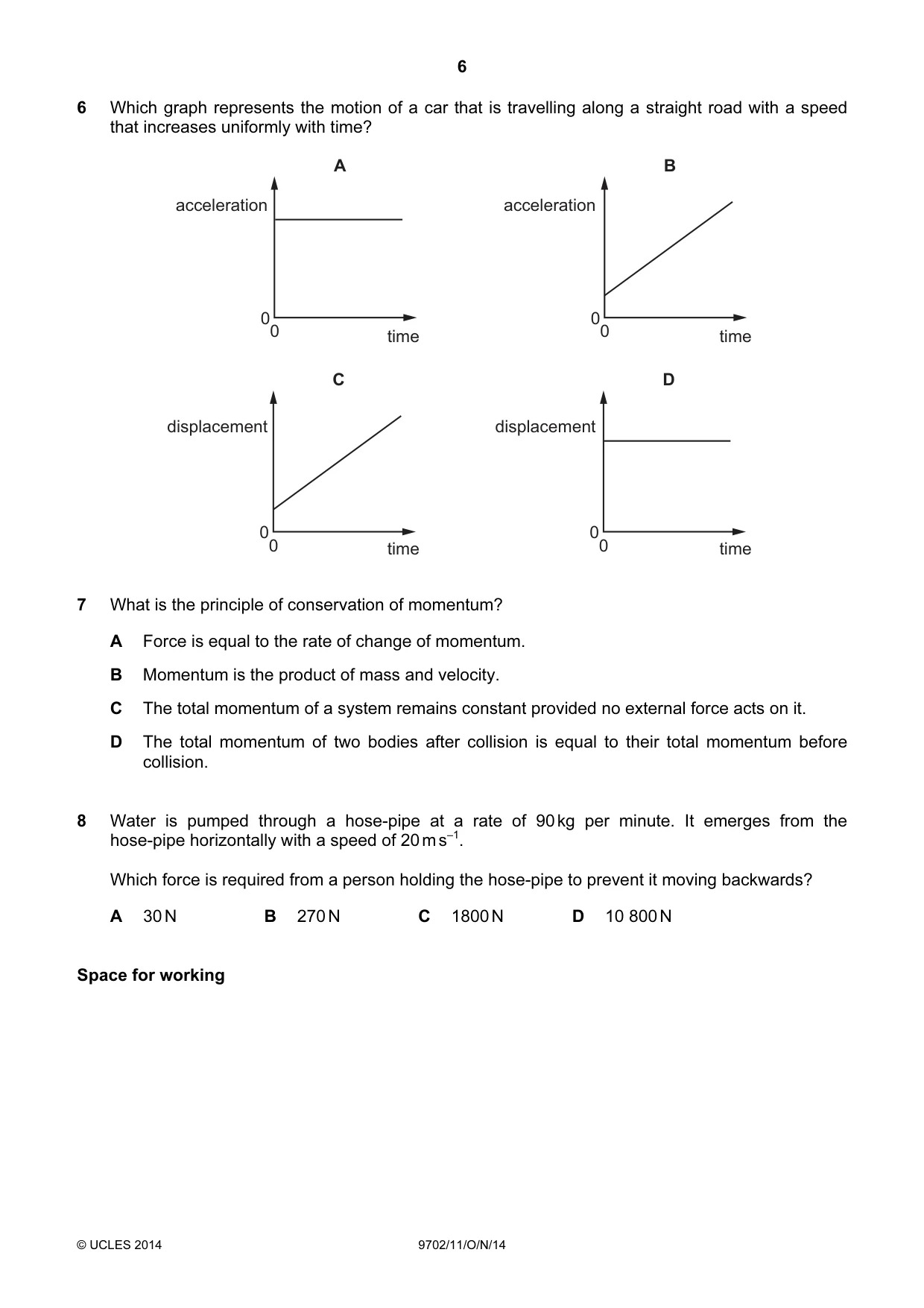
Q6 · Which graph represents the motion of a car that is travelling along a straight road with…
6 Which graph represents the motion of a car that is travelling along a straight road with a speed that increases uniformly with time? A B acceleration acceleration 0 0 0 0 time time C D displacement displacement 0 0 0 0 time time
Mark scheme: A
Q7 · What is the principle of conservation of momentum?
7 What is the principle of conservation of momentum? A Force is equal to the rate of change of momentum. B Momentum is the product of mass and velocity. C The total momentum of a system remains constant provided no external force acts on it. D The total momentum of two bodies after collision is equal to their total momentum before collision.
Mark scheme: C
Q8 · Water is pumped through a hose-pipe at a rate of 90 kg per minute
8 Water is pumped through a hose-pipe at a rate of 90 kg per minute. It emerges from the hose-pipe horizontally with a speed of 20 m s–1. Which force is required from a person holding the hose-pipe to prevent it moving backwards? A 30 N B 270 N C 1800 N D 10 800 N Space for working
Mark scheme: A
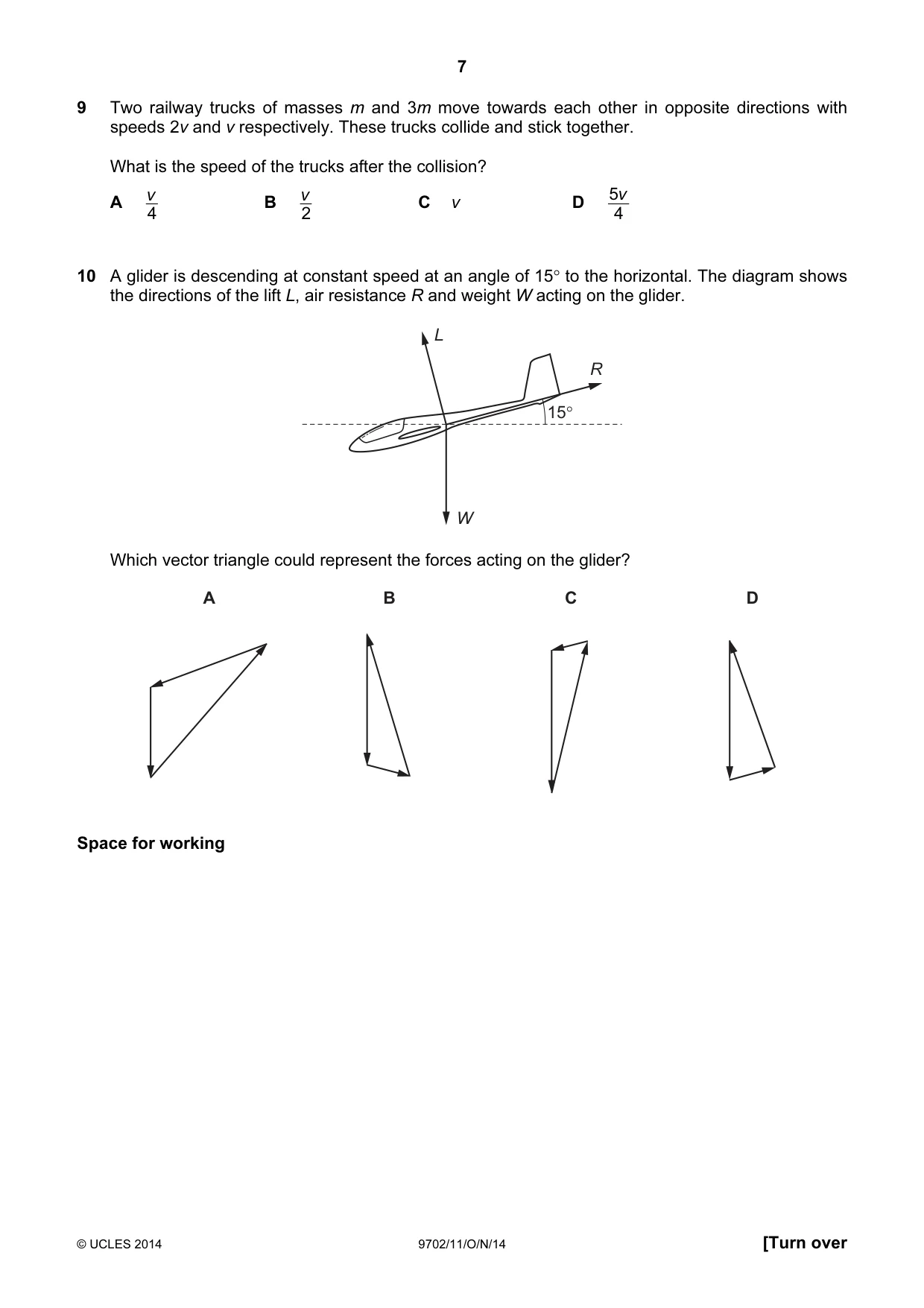
Q9 · Two railway trucks of masses m and 3m move towards each other in opposite directions with…
9 Two railway trucks of masses m and 3m move towards each other in opposite directions with speeds 2v and v respectively. These trucks collide and stick together. What is the speed of the trucks after the collision? v v 5v A B C v D 4 2 4
Mark scheme: A
Q10 · A glider is descending at constant speed at an angle of 15° to the horizontal
10 A glider is descending at constant speed at an angle of 15° to the horizontal. The diagram shows the directions of the lift L, air resistance R and weight W acting on the glider. L R 15° W Which vector triangle could represent the forces acting on the glider? A B C D Space for working
Mark scheme: D
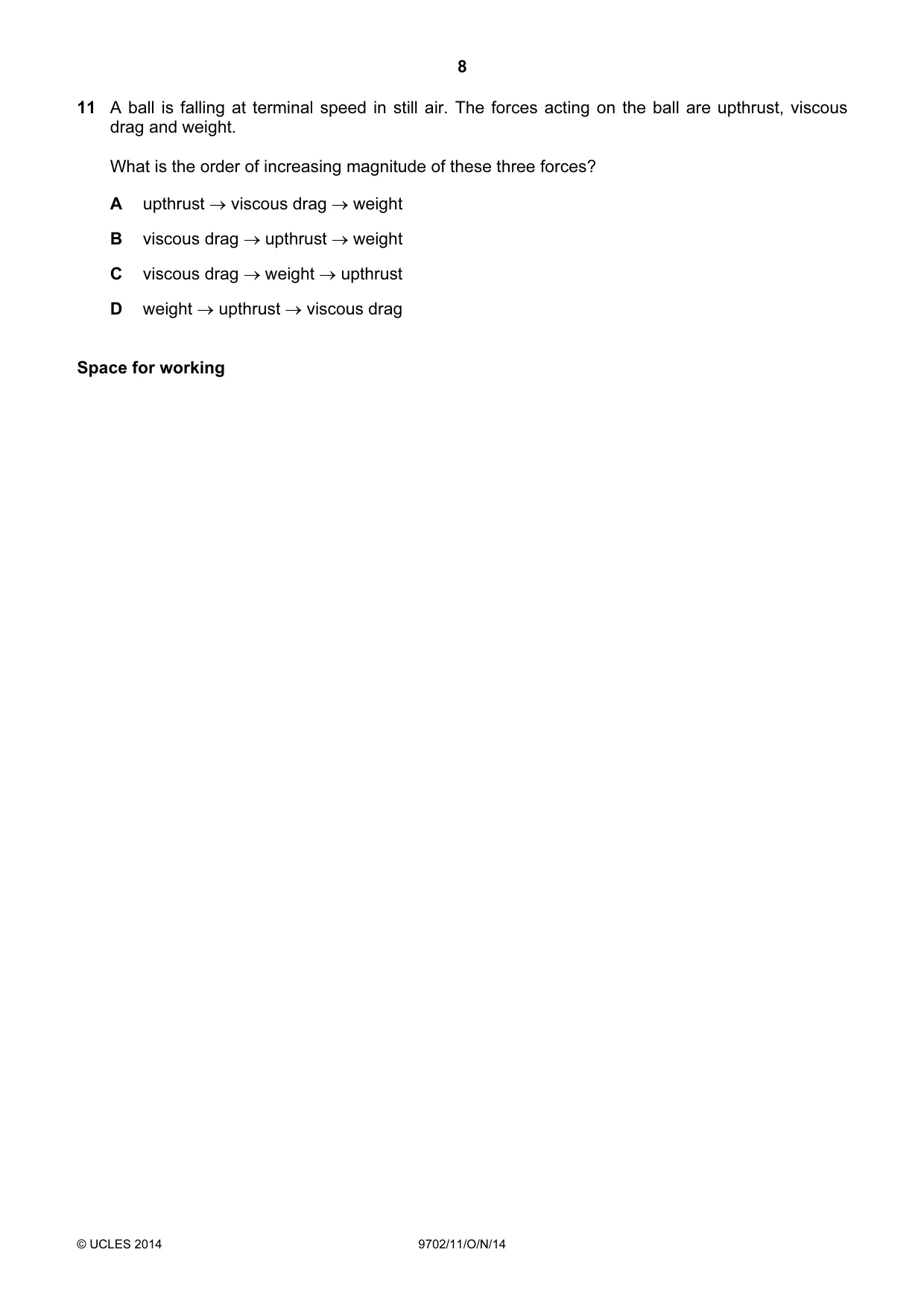
Q11 · A ball is falling at terminal speed in still air
11 A ball is falling at terminal speed in still air. The forces acting on the ball are upthrust, viscous drag and weight. What is the order of increasing magnitude of these three forces? A upthrust → viscous drag → weight B viscous drag → upthrust → weight C viscous drag → weight → upthrust D weight → upthrust → viscous drag Space for working
Mark scheme: A
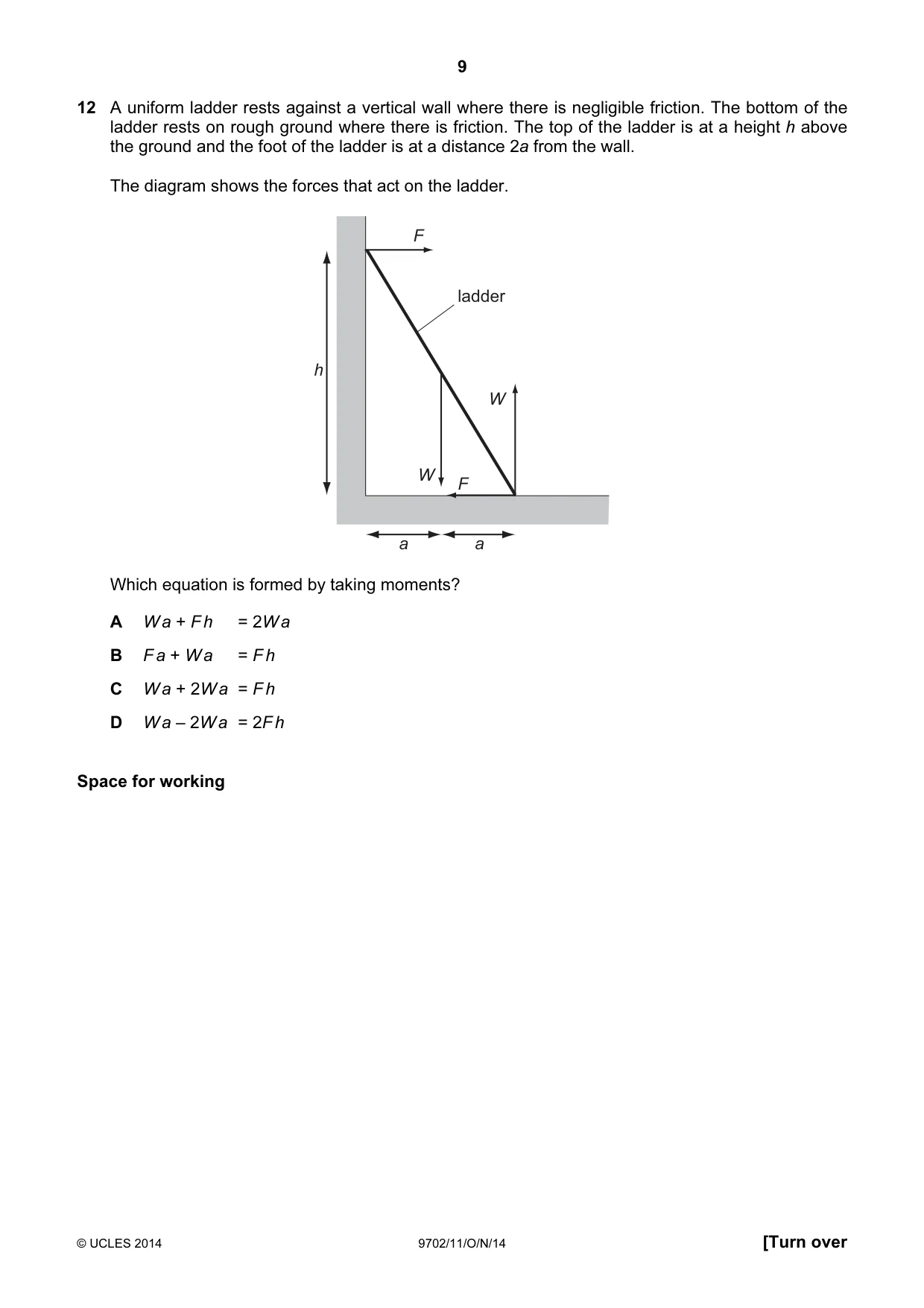
Q12 · A uniform ladder rests against a vertical wall where there is negligible friction
12 A uniform ladder rests against a vertical wall where there is negligible friction. The bottom of the ladder rests on rough ground where there is friction. The top of the ladder is at a height h above the ground and the foot of the ladder is at a distance 2a from the wall. The diagram shows the forces that act on the ladder. F ladder h W W F a a Which equation is formed by taking moments? A W a + F h = 2W a B F a + W a = F h C W a + 2W a = F h D W a – 2W a = 2F h Space for working
Mark scheme: A
Q13 · A mass attached to the lower end of a spring bounces up and down
13 A mass attached to the lower end of a spring bounces up and down. At which points in the path of the mass do the gravitational potential energy of the mass (GPE), the elastic potential energy in the spring (EPE) and the kinetic energy of the mass (KE) have their highest values? GPE EPE KE A bottom middle top B bottom top middle C top bottom middle D top bottom top
Mark scheme: C
More questions on Gravitational potential energy and kinetic energy
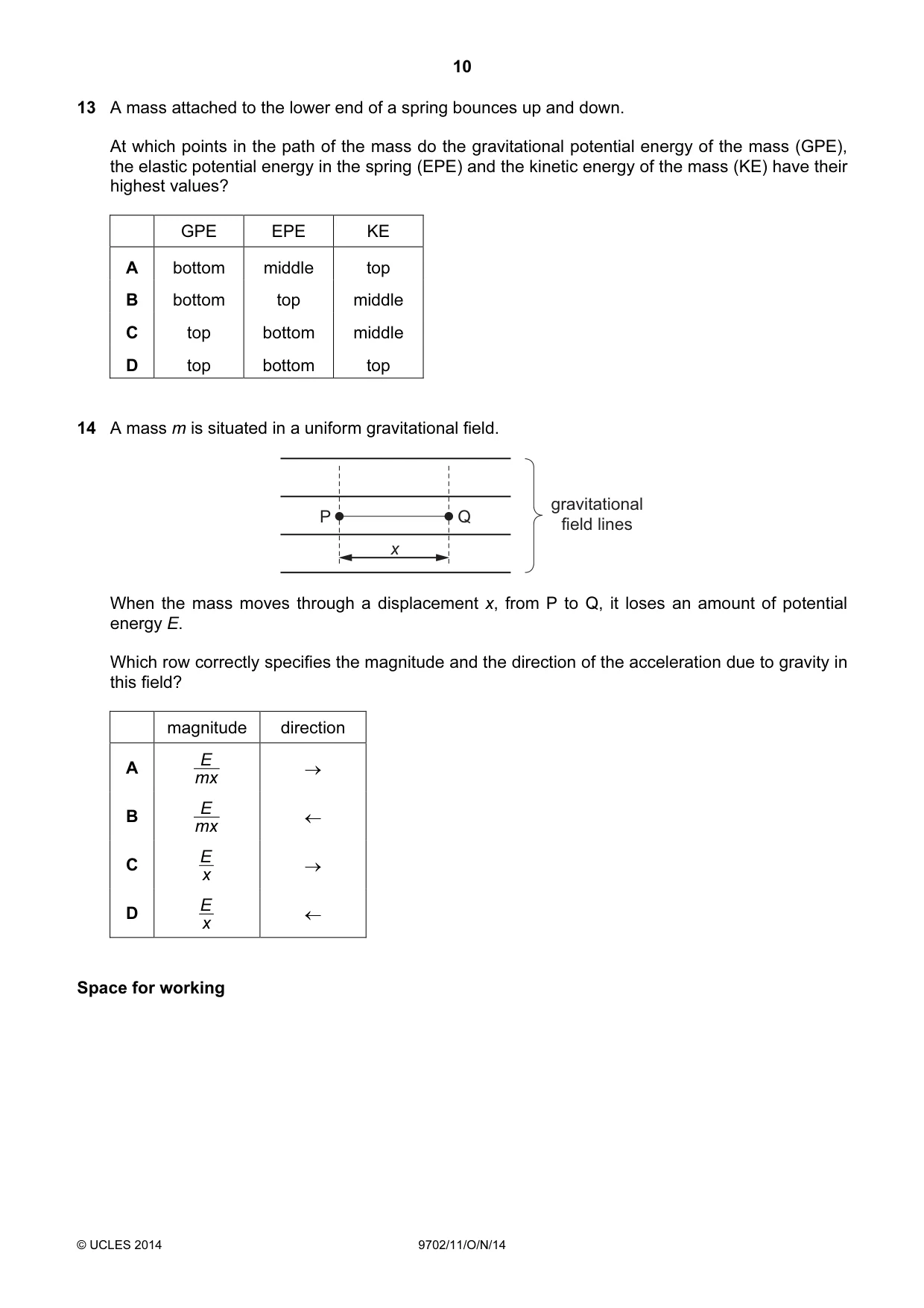
Q14 · A mass m is situated in a uniform gravitational field
14 A mass m is situated in a uniform gravitational field. gravitational P Q field lines x When the mass moves through a displacement x, from P to Q, it loses an amount of potential energy E. Which row correctly specifies the magnitude and the direction of the acceleration due to gravity in this field? magnitude direction E A → mx E B ← mx E C → x E D ← x Space for working
Mark scheme: A
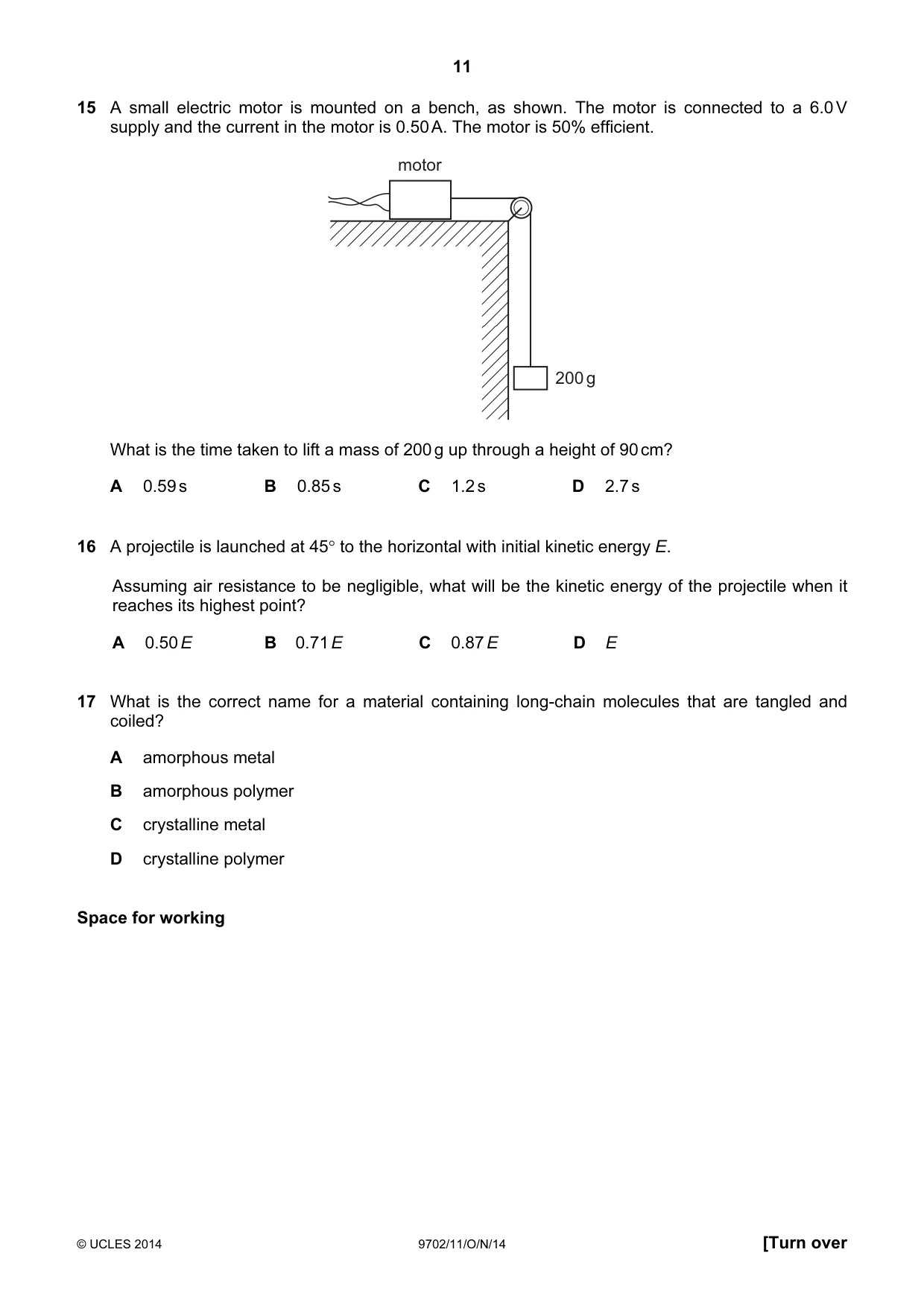
Q15 · A small electric motor is mounted on a bench, as shown
15 A small electric motor is mounted on a bench, as shown. The motor is connected to a 6.0 V supply and the current in the motor is 0.50 A. The motor is 50% efficient. motor 200 g What is the time taken to lift a mass of 200 g up through a height of 90 cm? A 0.59 s B 0.85 s C 1.2 s D 2.7 s
Mark scheme: C
Q16 · A projectile is launched at 45° to the horizontal with initial kinetic energy E
16 A projectile is launched at 45° to the horizontal with initial kinetic energy E. Assuming air resistance to be negligible, what will be the kinetic energy of the projectile when it reaches its highest point? A 0.50 E B 0.71 E C 0.87 E D E
Mark scheme: A
Q17 · What is the correct name for a material containing long-chain molecules that are tangled…
17 What is the correct name for a material containing long-chain molecules that are tangled and coiled? A amorphous metal B amorphous polymer C crystalline metal D crystalline polymer Space for working
Mark scheme: B
Q18 · Which statement about molecules in a gas is correct?
18 Which statement about molecules in a gas is correct? A In Brownian motion experiments, the molecules can be seen moving randomly in all directions. B The pressure exerted by a gas is caused by molecules bouncing against each other and changing kinetic energy. C The pressure exerted by a gas is caused by molecules rebounding from the walls of a container and changing momentum. D When the average speed of the molecules in a closed container increases, the density must also increase.
Mark scheme: C
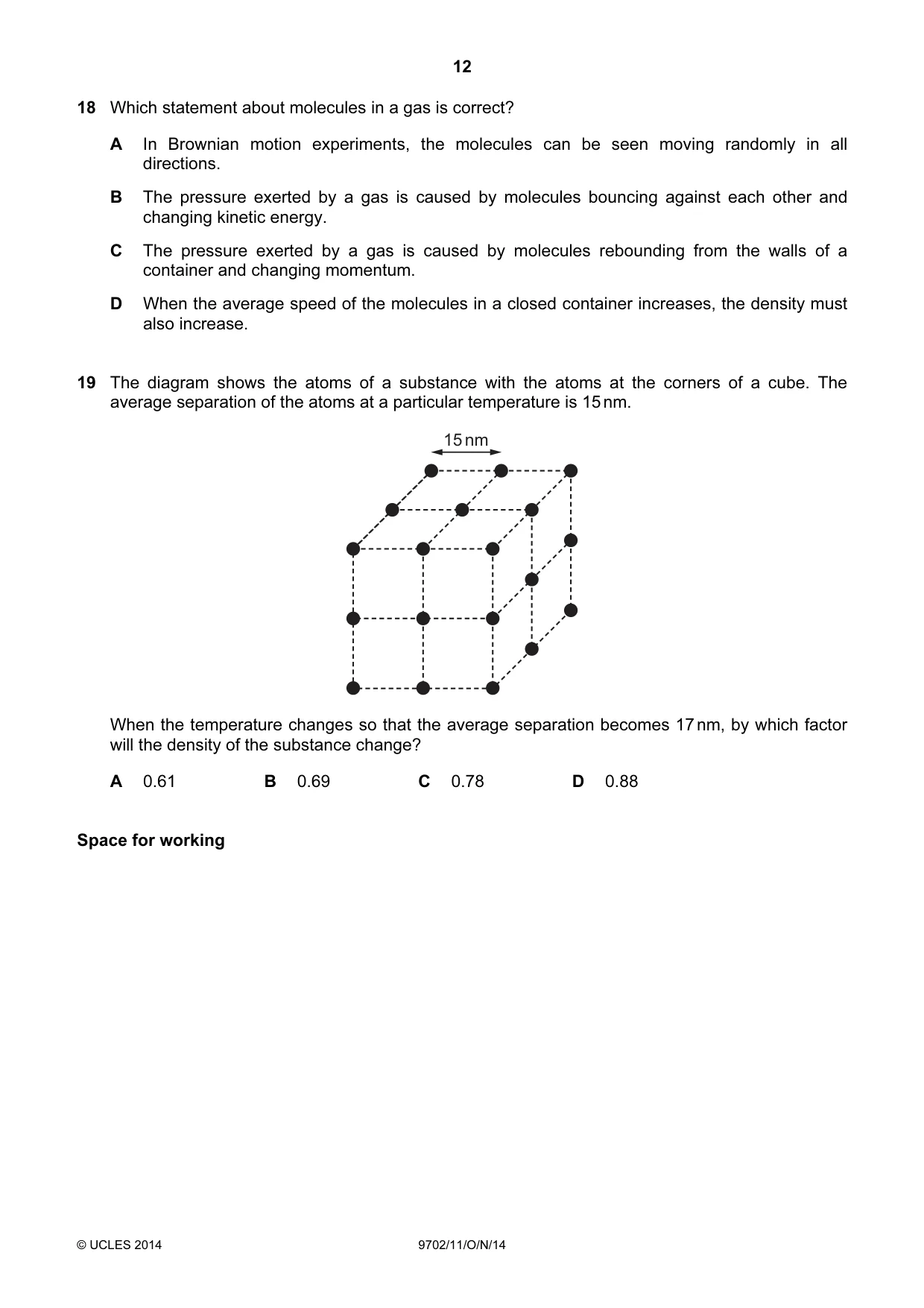
Q19 · The diagram shows the atoms of a substance with the atoms at the corners of a cube
19 The diagram shows the atoms of a substance with the atoms at the corners of a cube. The average separation of the atoms at a particular temperature is 15 nm. 15 nm When the temperature changes so that the average separation becomes 17 nm, by which factor will the density of the substance change? A 0.61 B 0.69 C 0.78 D 0.88 Space for working
Mark scheme: B
Q20 · The stress-strain graph for a glass rod, up to the point at which it breaks, is shown…
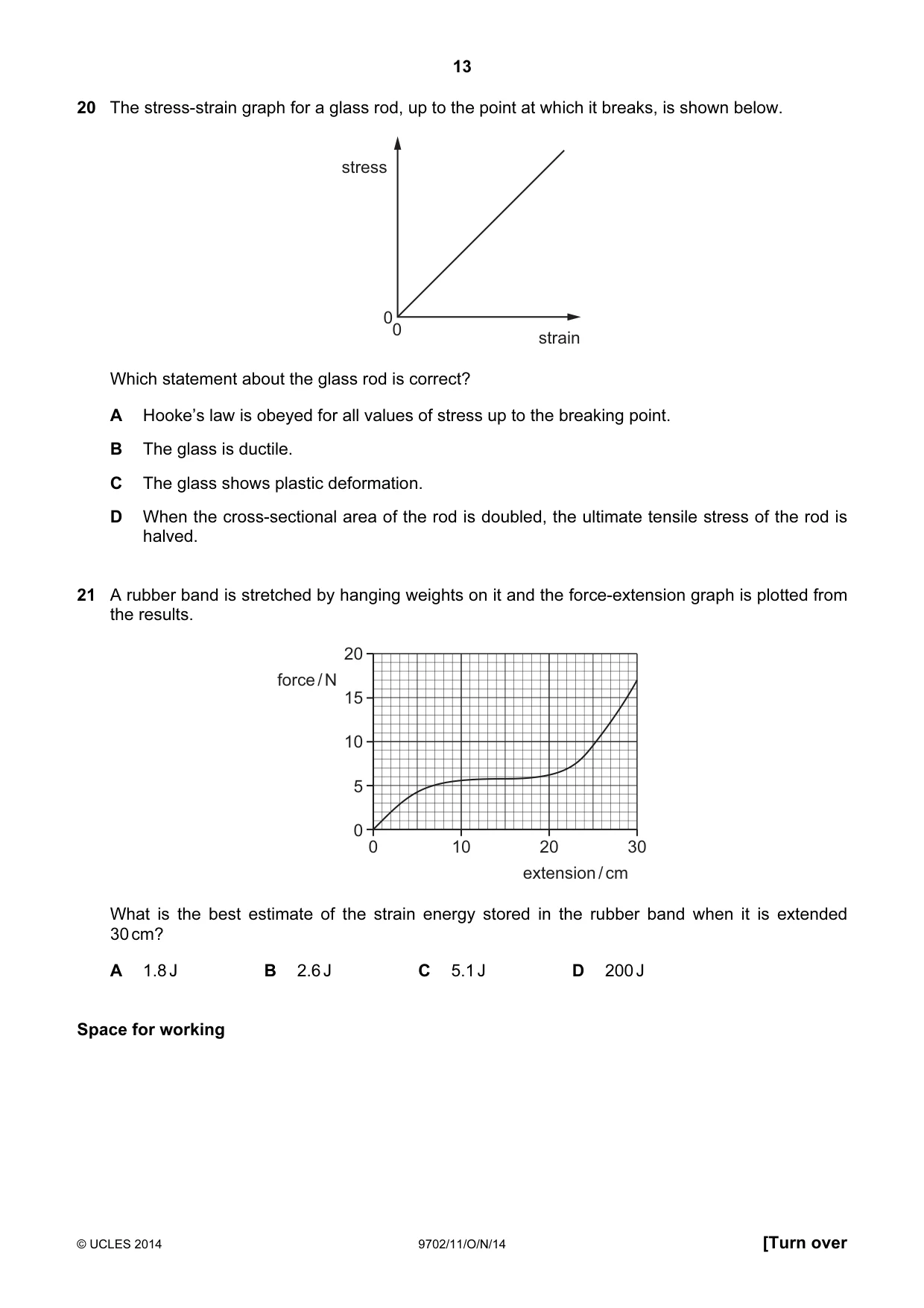
20 The stress-strain graph for a glass rod, up to the point at which it breaks, is shown below. stress 00 strain Which statement about the glass rod is correct? A Hooke’s law is obeyed for all values of stress up to the breaking point. B The glass is ductile. C The glass shows plastic deformation. D When the cross-sectional area of the rod is doubled, the ultimate tensile stress of the rod is halved.
Mark scheme: A
Q21 · A rubber band is stretched by hanging weights on it and the force-extension graph is…
21 A rubber band is stretched by hanging weights on it and the force-extension graph is plotted from the results. 20 force / N 15 10 5 0 0 10 20 30 extension / cm What is the best estimate of the strain energy stored in the rubber band when it is extended 30 cm? A 1.8 J B 2.6 J C 5.1 J D 200 J Space for working
Mark scheme: A
Q22 · Which statement about electromagnetic radiation is correct?
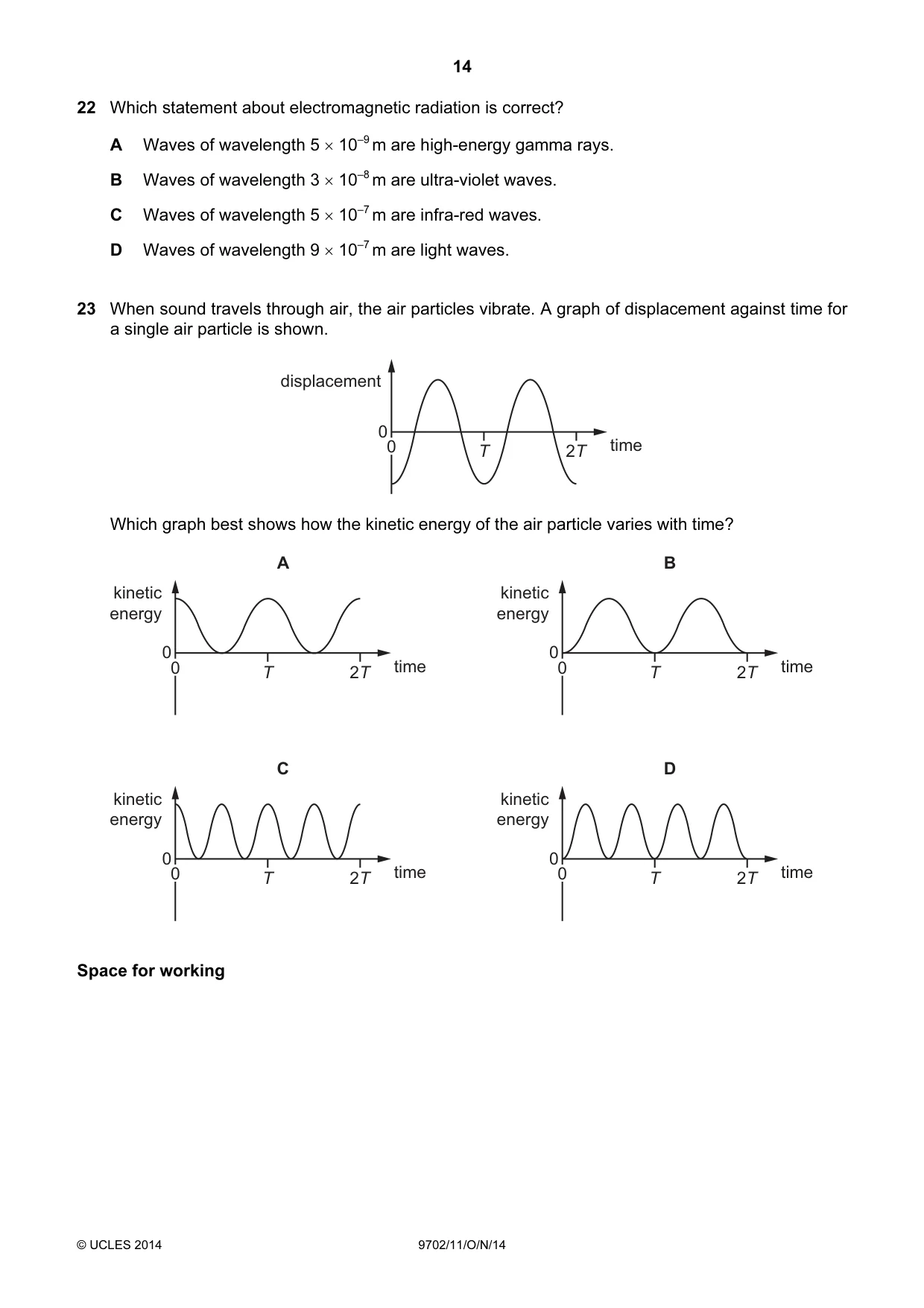
22 Which statement about electromagnetic radiation is correct? A Waves of wavelength 5 × 10⁻⁹ m are high-energy gamma rays. B Waves of wavelength 3 × 10⁻⁸ m are ultra-violet waves. C Waves of wavelength 5 × 10⁻⁷ m are infra-red waves. D Waves of wavelength 9 × 10⁻⁷ m are light waves.
Mark scheme: B
Q23 · When sound travels through air, the air particles vibrate
23 When sound travels through air, the air particles vibrate. A graph of displacement against time for a single air particle is shown. displacement 0 0 T 2T time Which graph best shows how the kinetic energy of the air particle varies with time? A B kinetic kinetic energy energy 0 0 0 T 2T time 0 T 2T time C D kinetic kinetic energy energy 0 0 0 T 2T time 0 T 2T time Space for working
Mark scheme: D
Q24 · Which statement describes a situation when polarisation could not occur?
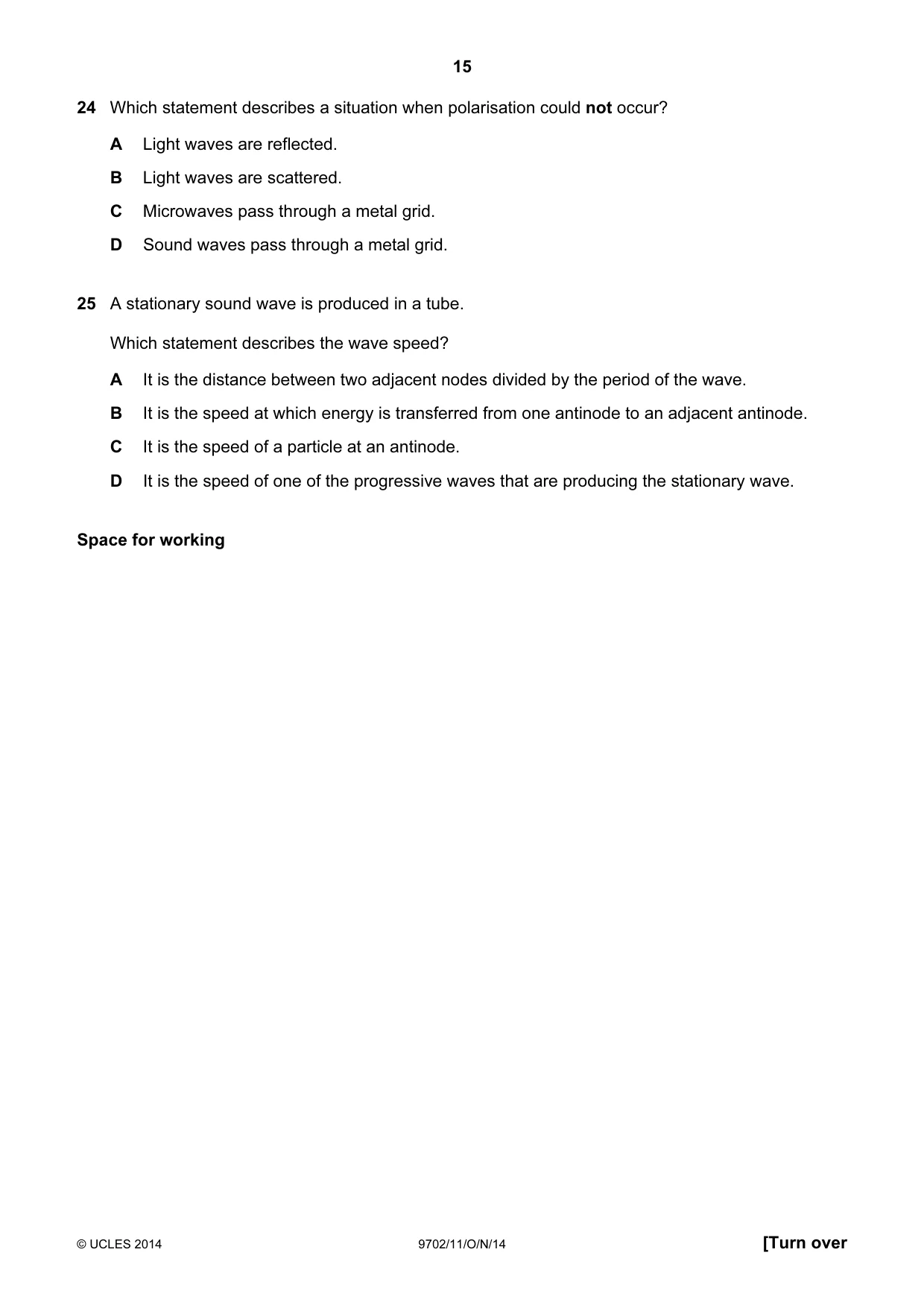
24 Which statement describes a situation when polarisation could not occur? A Light waves are reflected. B Light waves are scattered. C Microwaves pass through a metal grid. D Sound waves pass through a metal grid.
Mark scheme: D
Q25 · A stationary sound wave is produced in a tube
25 A stationary sound wave is produced in a tube. Which statement describes the wave speed? A It is the distance between two adjacent nodes divided by the period of the wave. B It is the speed at which energy is transferred from one antinode to an adjacent antinode. C It is the speed of a particle at an antinode. D It is the speed of one of the progressive waves that are producing the stationary wave. Space for working
Mark scheme: D
Q26 · Two identical loudspeakers are connected in series to an a.c
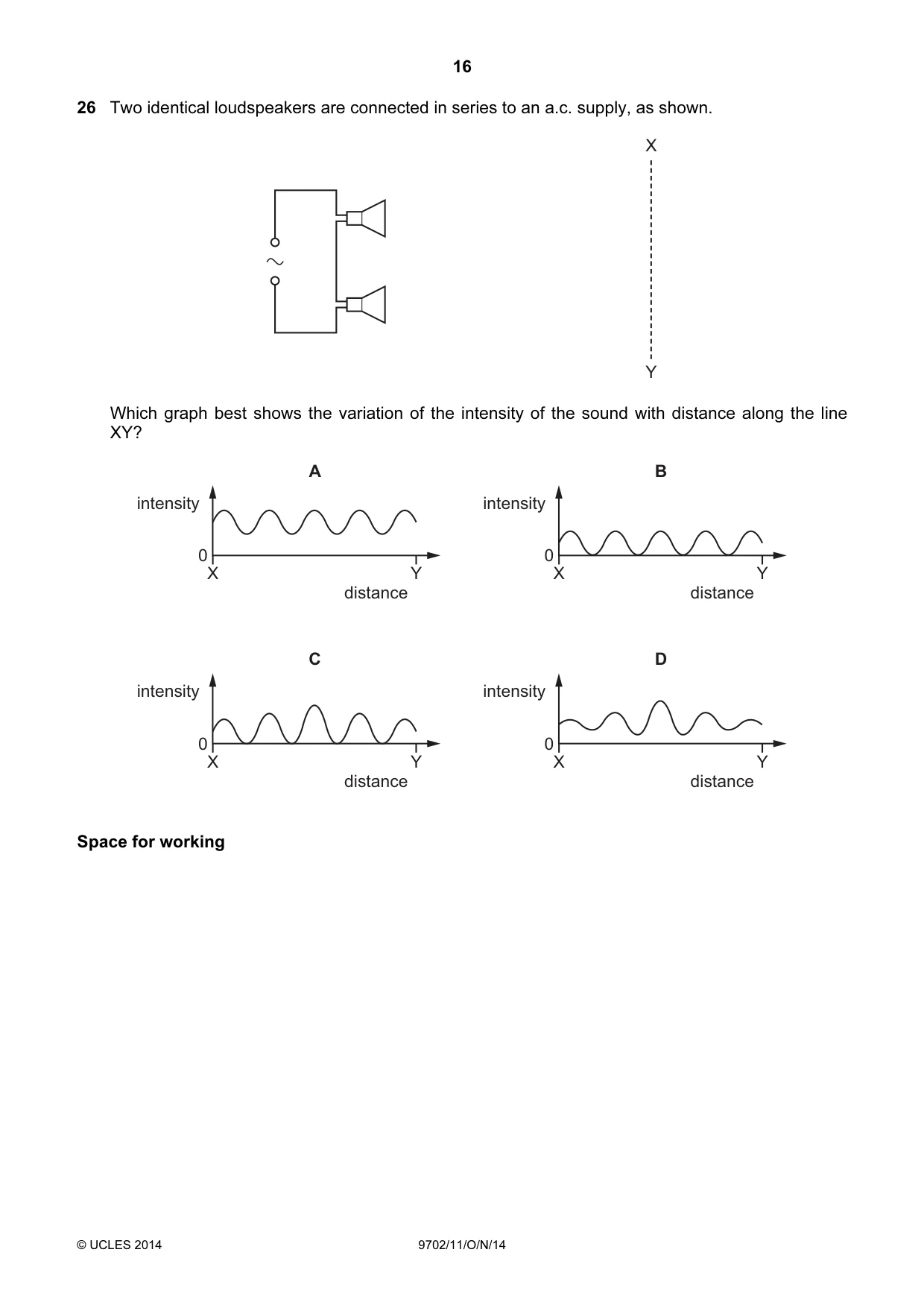
26 Two identical loudspeakers are connected in series to an a.c. supply, as shown. X Y Which graph best shows the variation of the intensity of the sound with distance along the line XY? A B intensity intensity 0 0 X Y X Y distance distance C D intensity intensity 0 0 X Y X Y distance distance Space for working
Mark scheme: D
Q27 · A diffraction grating experiment is set up using yellow light of wavelength 600 nm
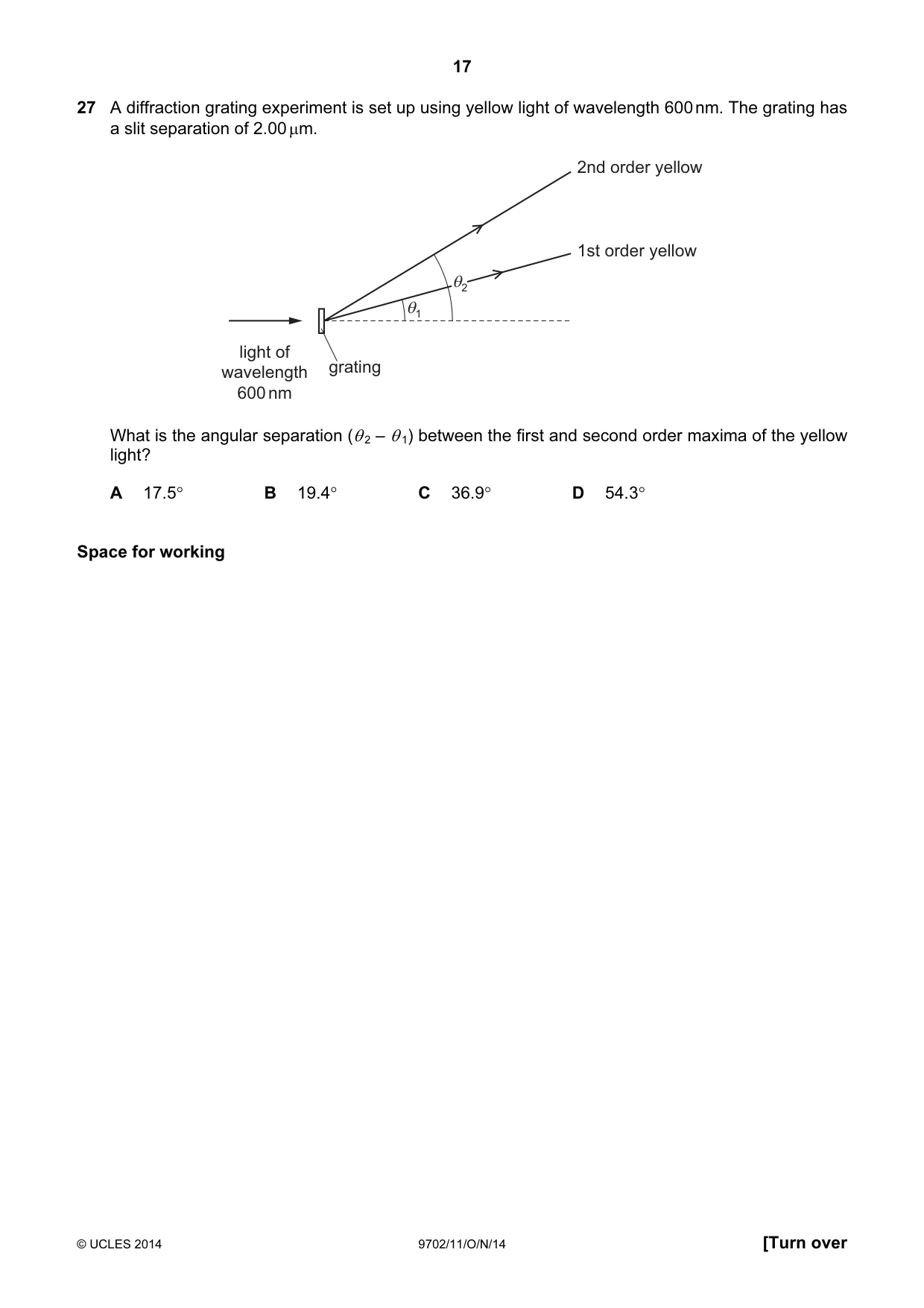
27 A diffraction grating experiment is set up using yellow light of wavelength 600 nm. The grating has a slit separation of 2.00 µm. 2nd order yellow 1st order yellow θ2 θ1 light of wavelength grating 600 nm What is the angular separation (θ 2 – θ 1) between the first and second order maxima of the yellow light? A 17.5° B 19.4° C 36.9° D 54.3° Space for working
Mark scheme: B
Q28 · The diagram shows two parallel horizontal metal plates
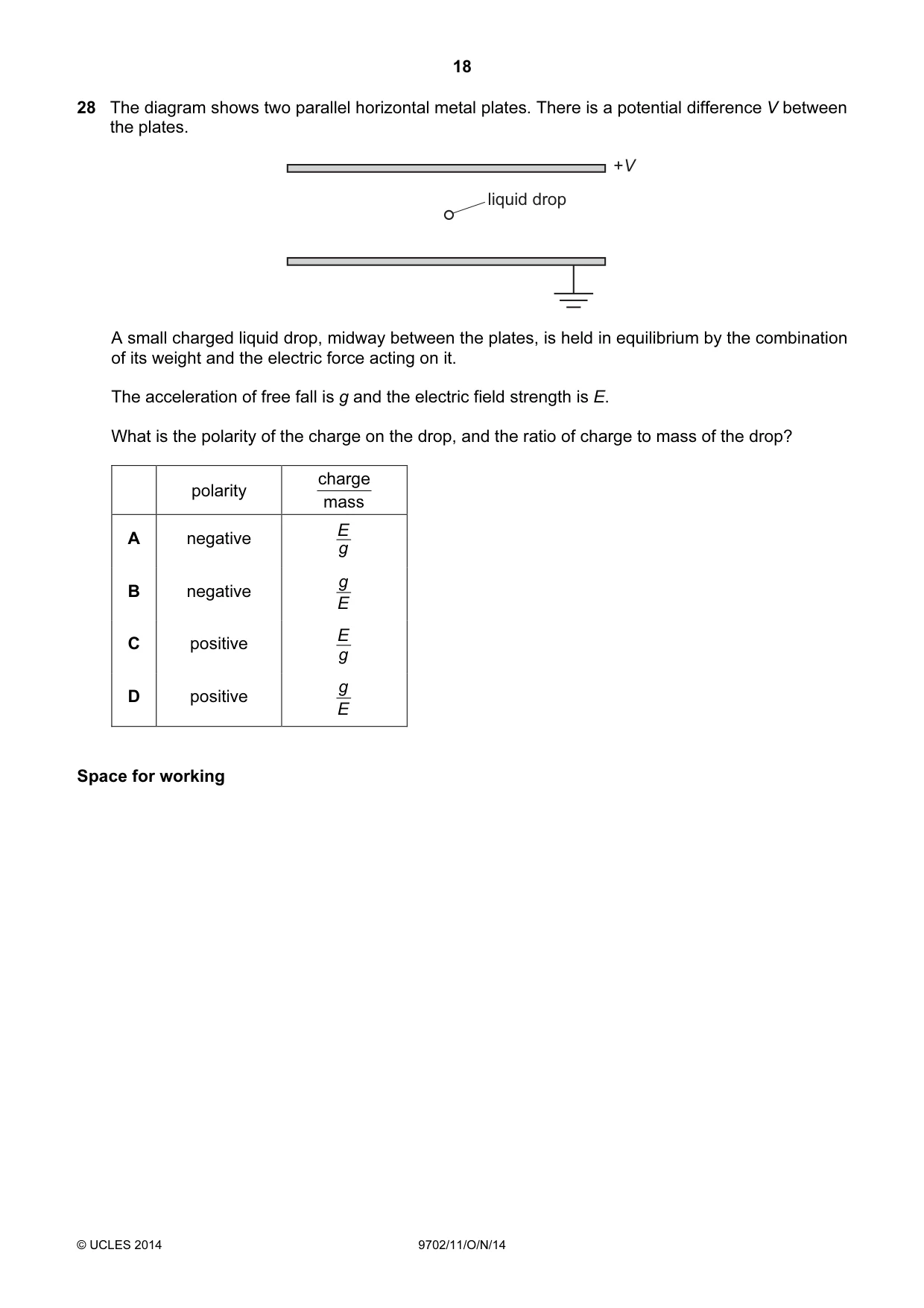
28 The diagram shows two parallel horizontal metal plates. There is a potential difference V between the plates. +V liquid drop A small charged liquid drop, midway between the plates, is held in equilibrium by the combination of its weight and the electric force acting on it. The acceleration of free fall is g and the electric field strength is E. What is the polarity of the charge on the drop, and the ratio of charge to mass of the drop? charge polarity mass E A negative g g B negative E E C positive g g D positive E Space for working
Mark scheme: B
Q29 · The diagram shows two metal plates connected to a constant high voltage
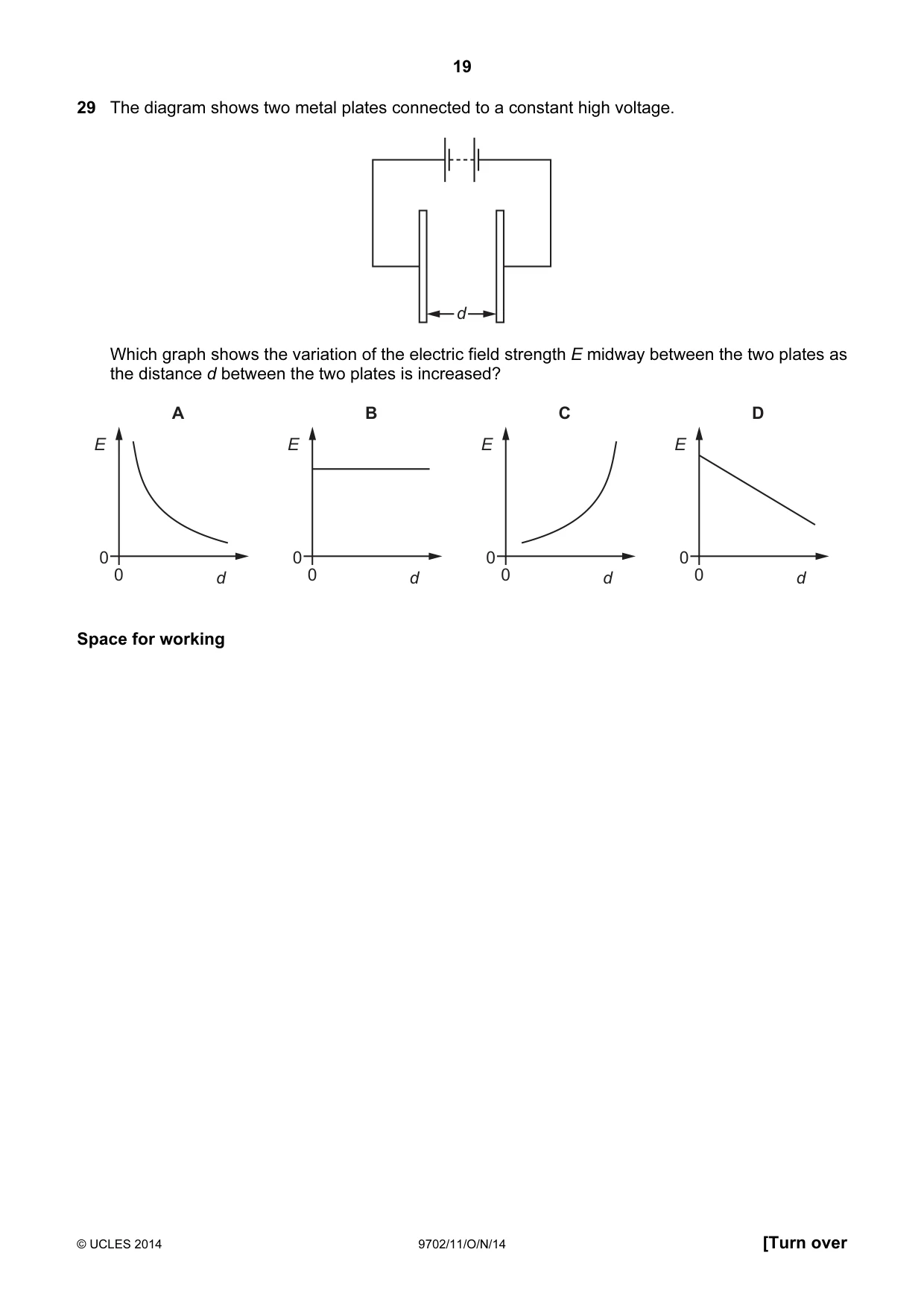
29 The diagram shows two metal plates connected to a constant high voltage. d Which graph shows the variation of the electric field strength E midway between the two plates as the distance d between the two plates is increased? A B C D E E E E 0 0 0 0 0 d 0 d 0 d 0 d Space for working
Mark scheme: A
Q30 · B1, B2 and B3 are three identical lamps
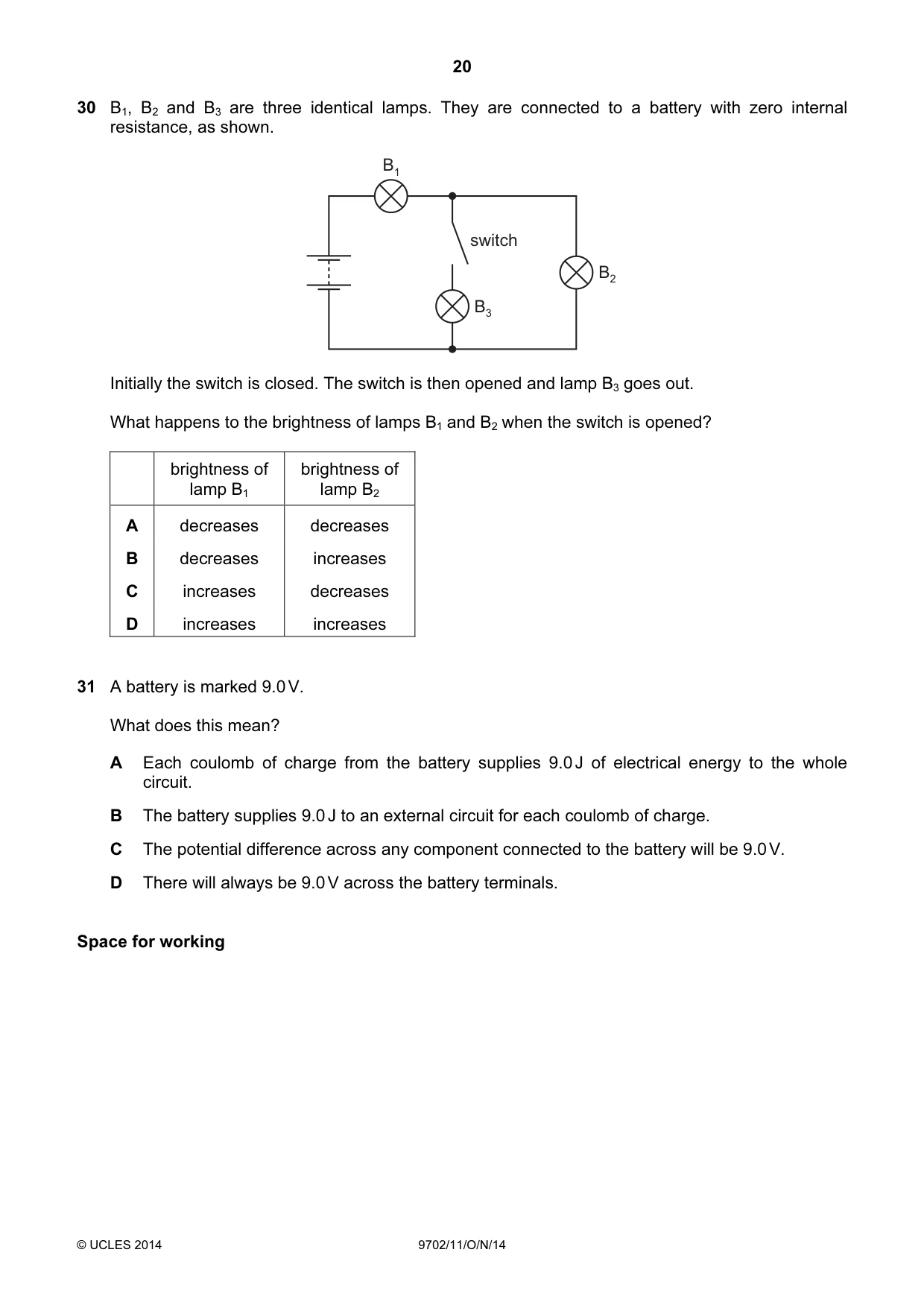
30 B1, B2 and B3 are three identical lamps. They are connected to a battery with zero internal resistance, as shown. B1 switch B2 B3 Initially the switch is closed. The switch is then opened and lamp B3 goes out. What happens to the brightness of lamps B1 and B2 when the switch is opened? brightness of brightness of lamp B1 lamp B2 A decreases decreases B decreases increases C increases decreases D increases increases
Mark scheme: B
Q31 · A battery is marked 9.0 V
31 A battery is marked 9.0 V. What does this mean? A Each coulomb of charge from the battery supplies 9.0 J of electrical energy to the whole circuit. B The battery supplies 9.0 J to an external circuit for each coulomb of charge. C The potential difference across any component connected to the battery will be 9.0 V. D There will always be 9.0 V across the battery terminals. Space for working
Mark scheme: A
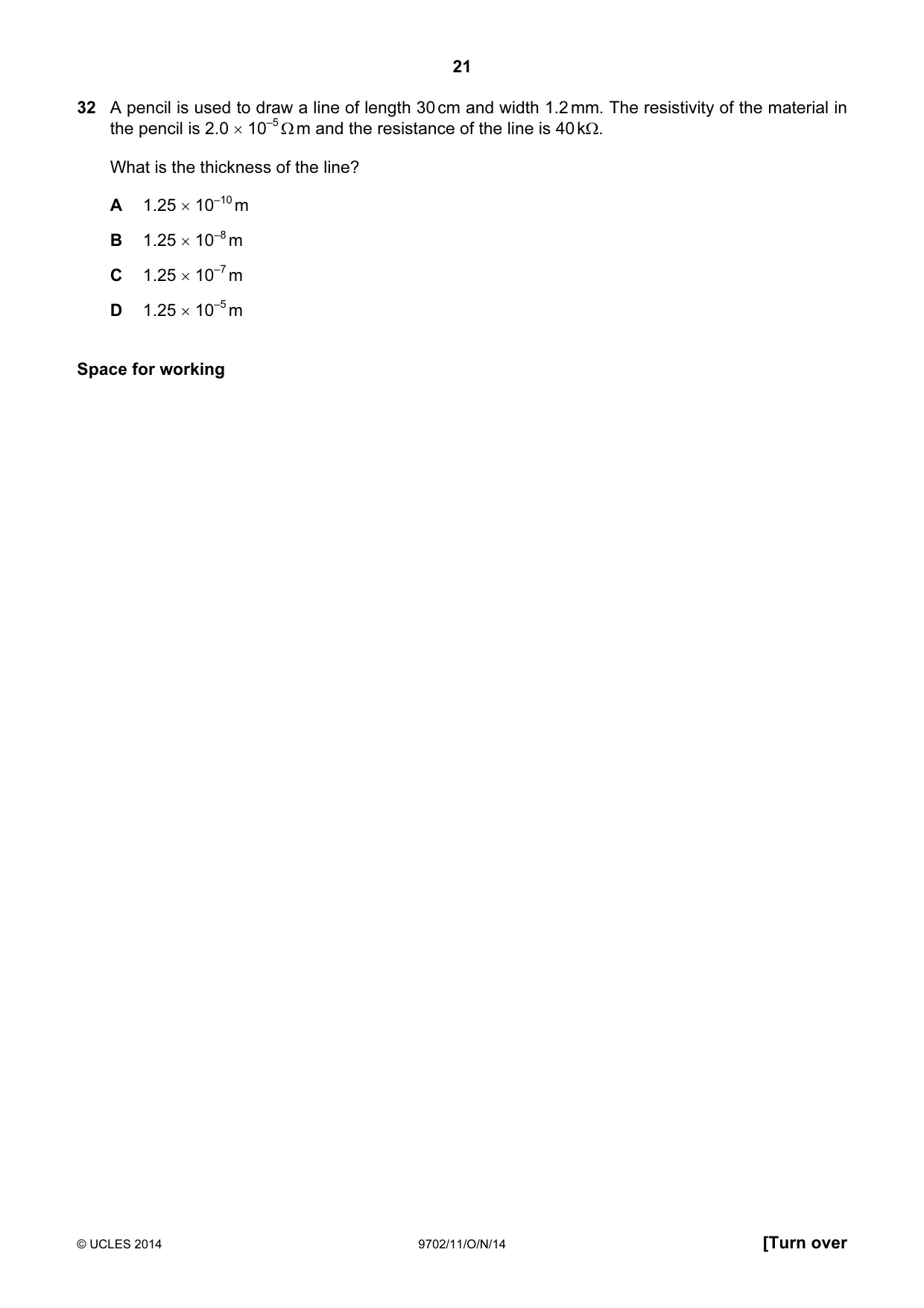
Q32 · A pencil is used to draw a line of length 30 cm and width 1.2 mm
32 A pencil is used to draw a line of length 30 cm and width 1.2 mm. The resistivity of the material in the pencil is 2.0 × 10⁻⁵ Ω m and the resistance of the line is 40 kΩ. What is the thickness of the line? A 1.25 × 10⁻¹⁰ m B 1.25 × 10⁻⁸ m C 1.25 × 10⁻⁷ m D 1.25 × 10⁻⁵ m Space for working
Mark scheme: C
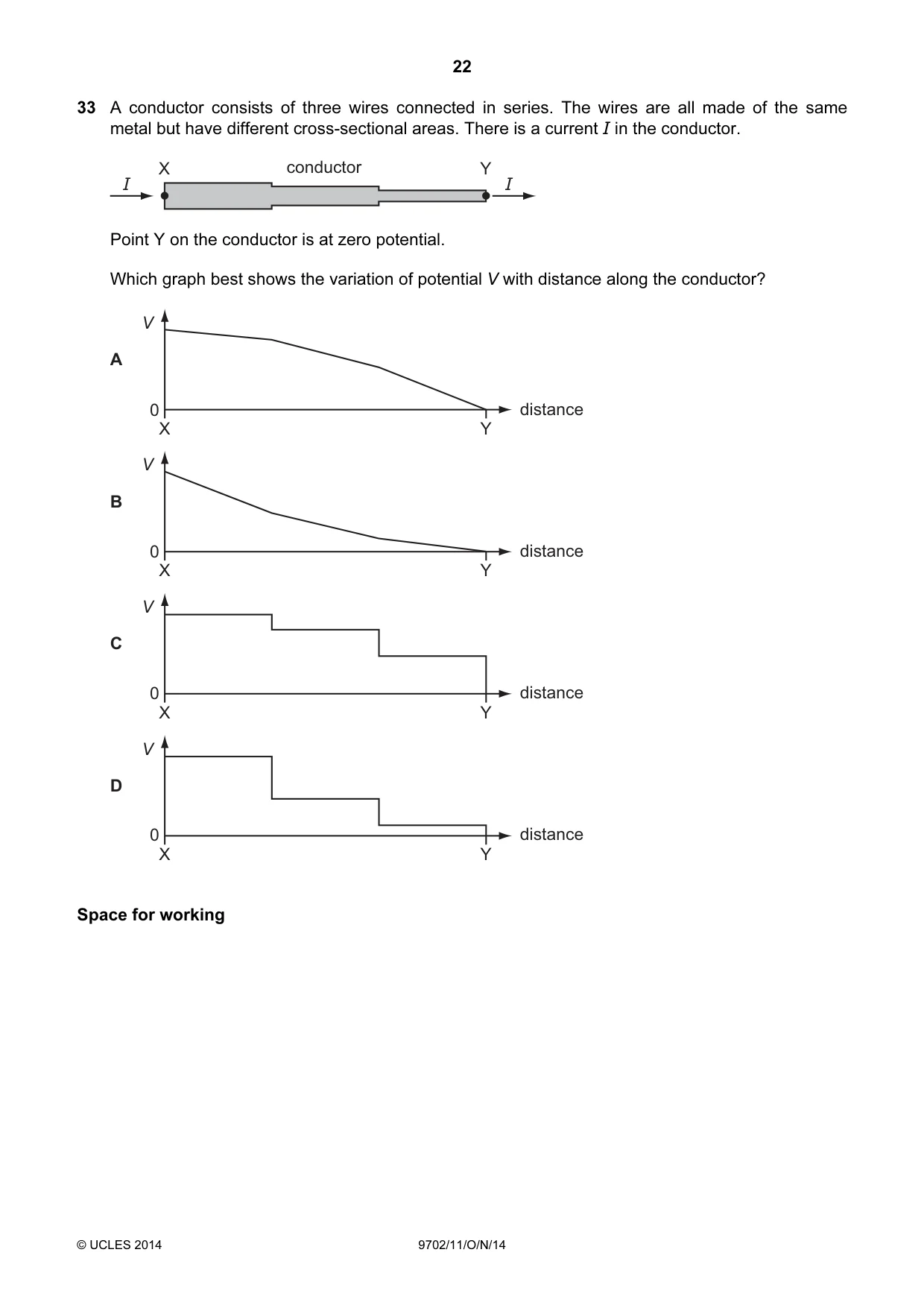
Q33 · A conductor consists of three wires connected in series
33 A conductor consists of three wires connected in series. The wires are all made of the same metal but have different cross-sectional areas. There is a current I in the conductor. X conductor Y I I Point Y on the conductor is at zero potential. Which graph best shows the variation of potential V with distance along the conductor? V A 0 distance X Y V B 0 distance X Y V C 0 distance X Y V D 0 distance X Y Space for working
Mark scheme: A
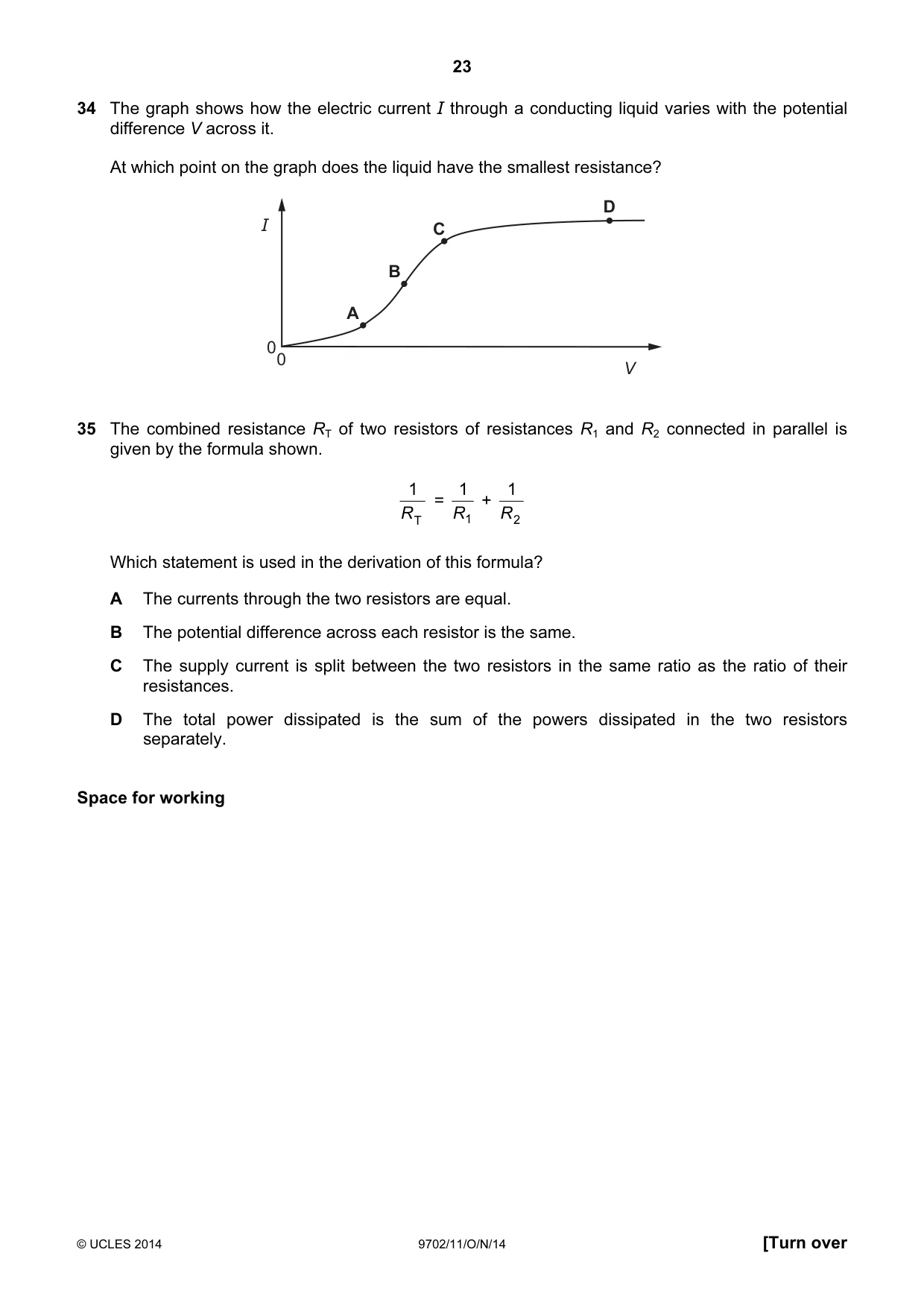
Q34 · The graph shows how the electric current I through a conducting liquid varies with the…
34 The graph shows how the electric current I through a conducting liquid varies with the potential difference V across it. At which point on the graph does the liquid have the smallest resistance? D I C B A 0 0 V
Mark scheme: C
Q35 · The combined resistance RT of two resistors of resistances R1 and R2 connected in…
35 The combined resistance RT of two resistors of resistances R1 and R2 connected in parallel is given by the formula shown. 1 1 1 = R + R R T 1 2 Which statement is used in the derivation of this formula? A The currents through the two resistors are equal. B The potential difference across each resistor is the same. C The supply current is split between the two resistors in the same ratio as the ratio of their resistances. D The total power dissipated is the sum of the powers dissipated in the two resistors separately. Space for working
Mark scheme: B
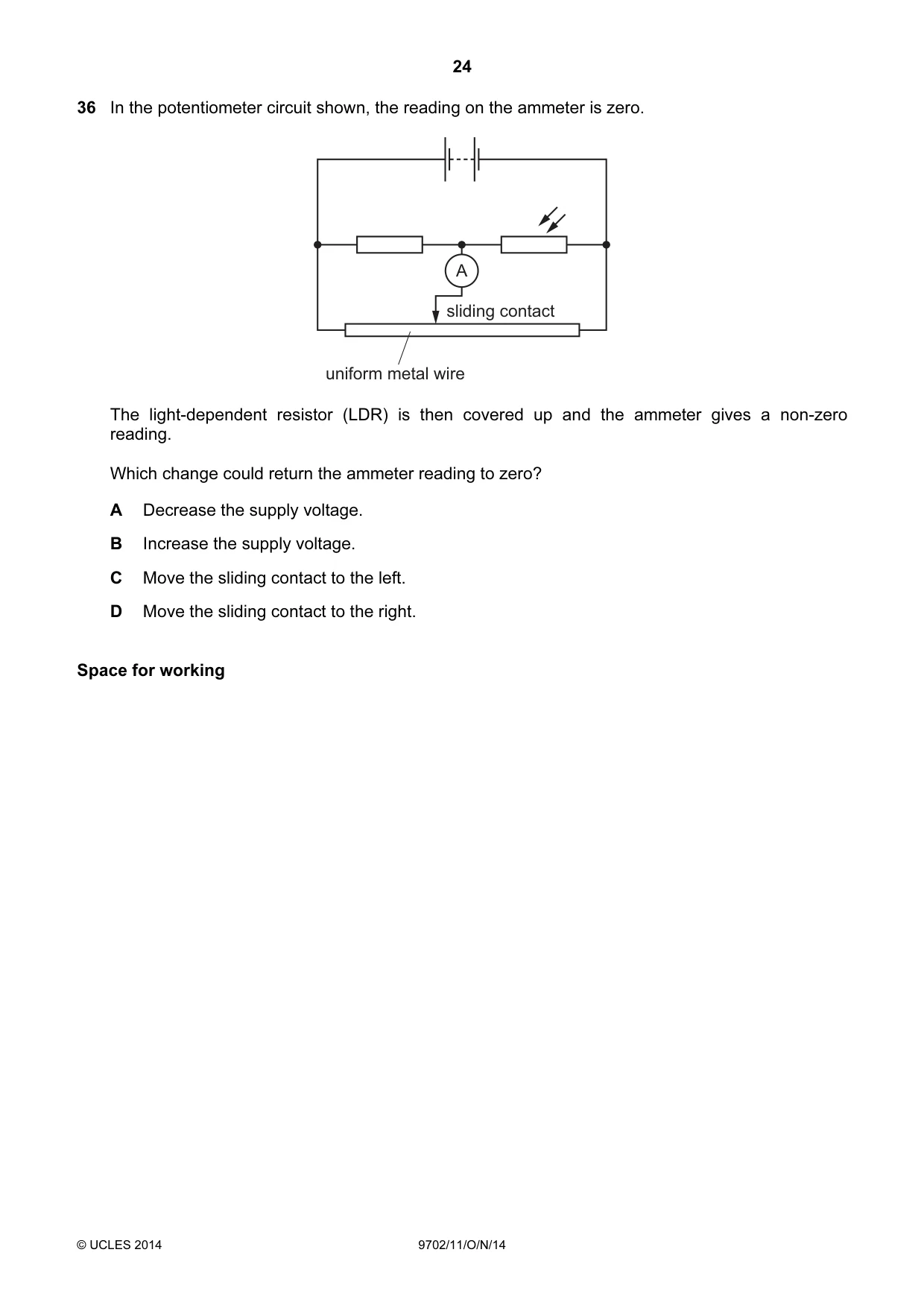
Q36 · In the potentiometer circuit shown, the reading on the ammeter is zero
36 In the potentiometer circuit shown, the reading on the ammeter is zero. A sliding contact uniform metal wire The light-dependent resistor (LDR) is then covered up and the ammeter gives a non-zero reading. Which change could return the ammeter reading to zero? A Decrease the supply voltage. B Increase the supply voltage. C Move the sliding contact to the left. D Move the sliding contact to the right. Space for working
Mark scheme: C
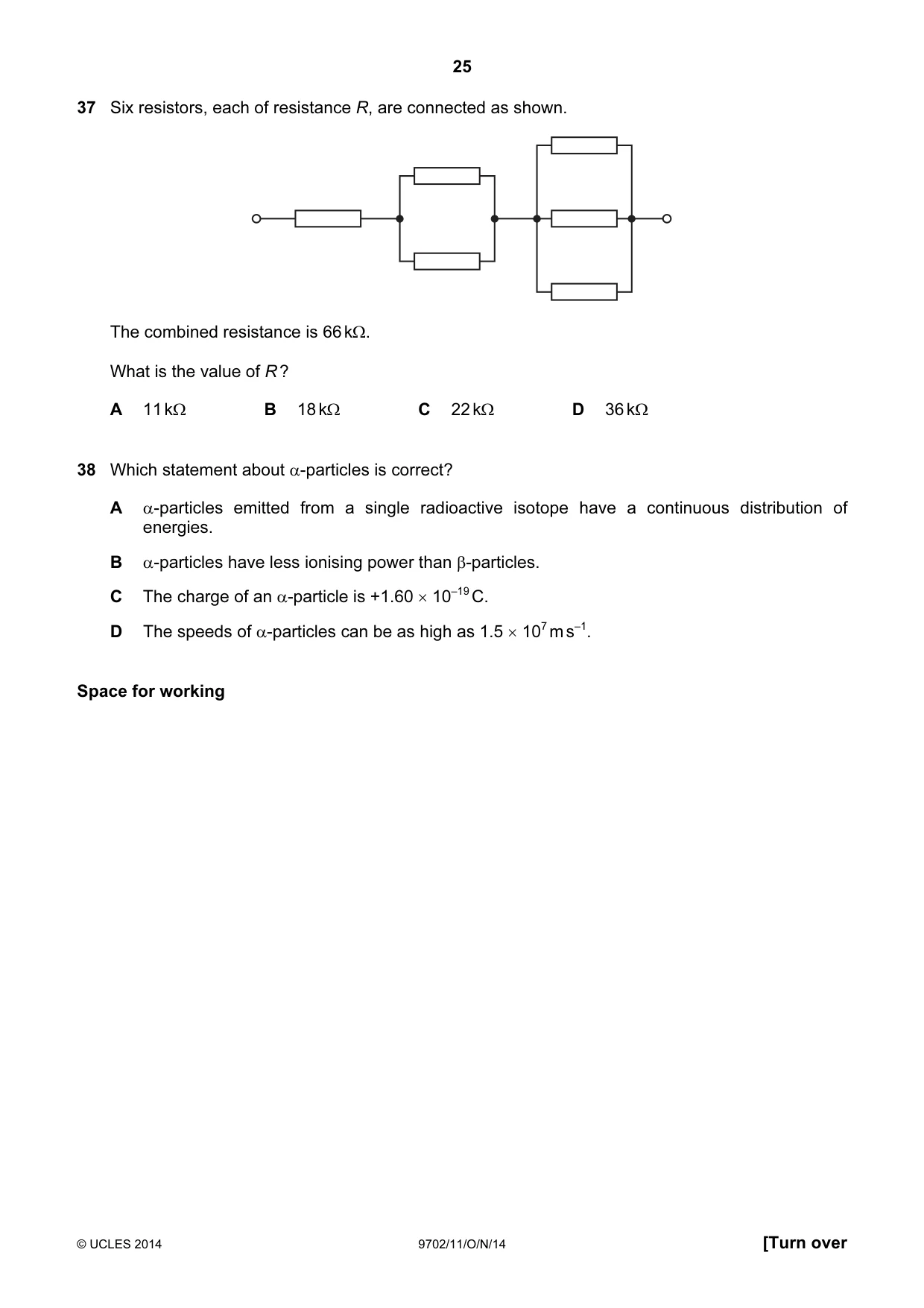
Q37 · Six resistors, each of resistance R, are connected as shown
37 Six resistors, each of resistance R, are connected as shown. The combined resistance is 66 kΩ. What is the value of R ? A 11 kΩ B 18 kΩ C 22 kΩ D 36 kΩ
Mark scheme: D
Q38 · Which statement about α-particles is correct?
38 Which statement about α-particles is correct? A α-particles emitted from a single radioactive isotope have a continuous distribution of energies. B α-particles have less ionising power than β-particles. C The charge of an α-particle is +1.60 × 10⁻¹⁹ C. D The speeds of α-particles can be as high as 1.5 × 10⁷ m s–1. Space for working
Mark scheme: D
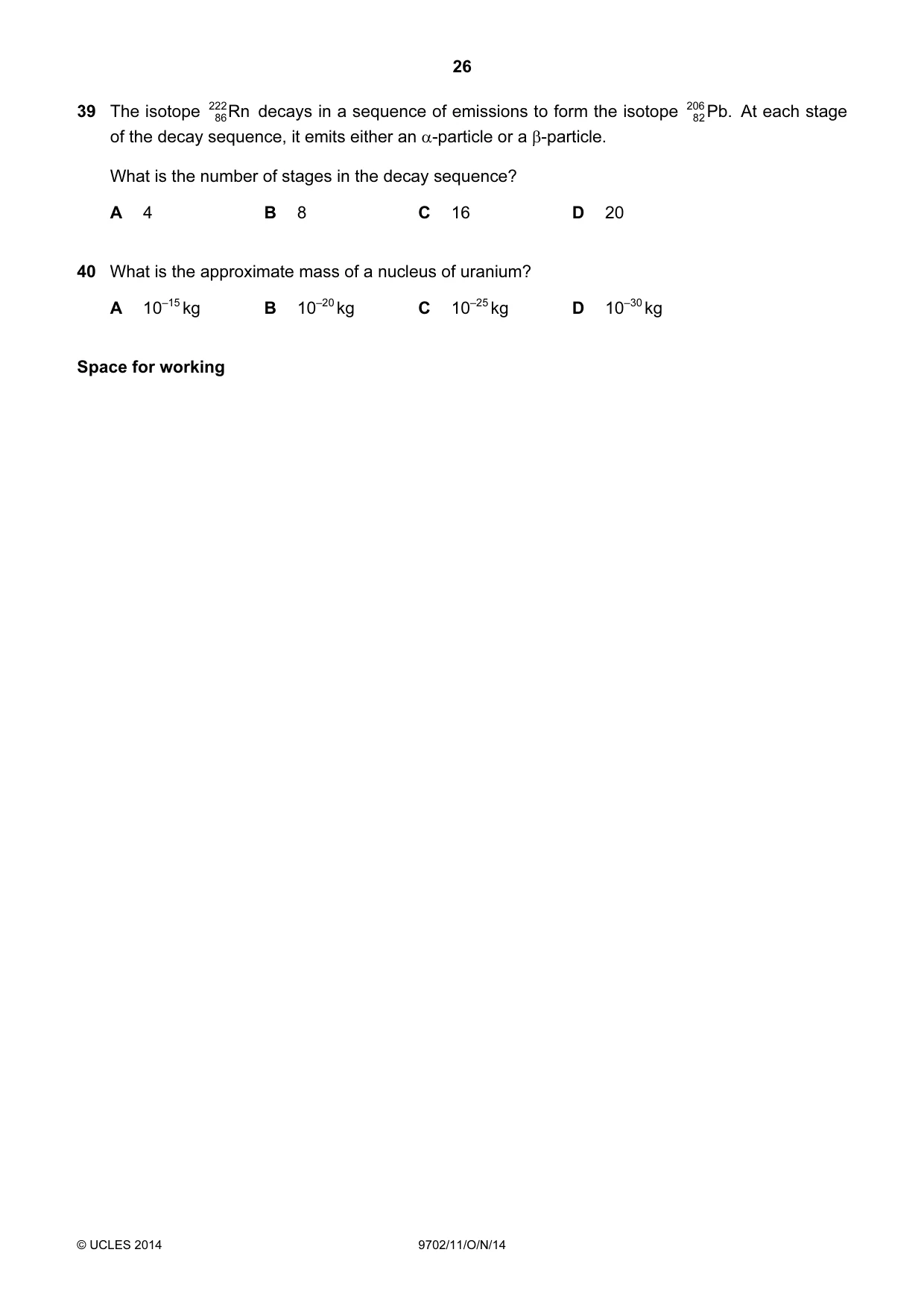
Q39 · The isotope 222 Rn decays in a sequence of emissions to form the isotope 206 Pb
39 The isotope 222 Rn decays in a sequence of emissions to form the isotope 206 Pb. At each stage 86 82 of the decay sequence, it emits either an α-particle or a β-particle. What is the number of stages in the decay sequence? A 4 B 8 C 16 D 20
Mark scheme: B
Q40 · What is the approximate mass of a nucleus of uranium?
40 What is the approximate mass of a nucleus of uranium? A 10–15 kg B 10–20 kg C 10–25 kg D 10–30 kg Space for working
Mark scheme: C
What was in this paper
The subtopics covered by these 40 questions, and how many questions each got. Open one in a new tab to see every Cambridge question on it.
3Practical circuits3Resistance and resistivity3Atoms, nuclei and radiation2Energy conservation2Equations of motion2Equilibrium of forces2Linear momentum and its conservation2SI units2Uniform electric fields2Density and pressure1Electromagnetic spectrum1Energy in simple harmonic motion1Errors and uncertainties1Gravitational field1Gravitational potential energy and kinetic energy1Interference1Kinetic theory of gases1Momentum and Newton’s laws of motion1Physical quantities1Polarisation1Potential difference and power1Potential dividers1Radioactive decay1Stationary waves1The diffraction grating1Turning effects of forces1What you needed in this session
Cambridge’s own grade thresholds for 2014 Oct/Nov, Paper 1 · Variant 1. A higher threshold means an easier paper — the bar moves with how the cohort did.