Cambridge A Level Physics 9702 — 2020 Oct/Nov Paper 1 · Variant 2
9702/12/O/N/20 · 40 questions · 40 marks · ≈45 min
The question paper and its mark scheme, free to read here and free to download. This is Cambridge’s own paper, exactly as it was sat.
Question paper24 pages
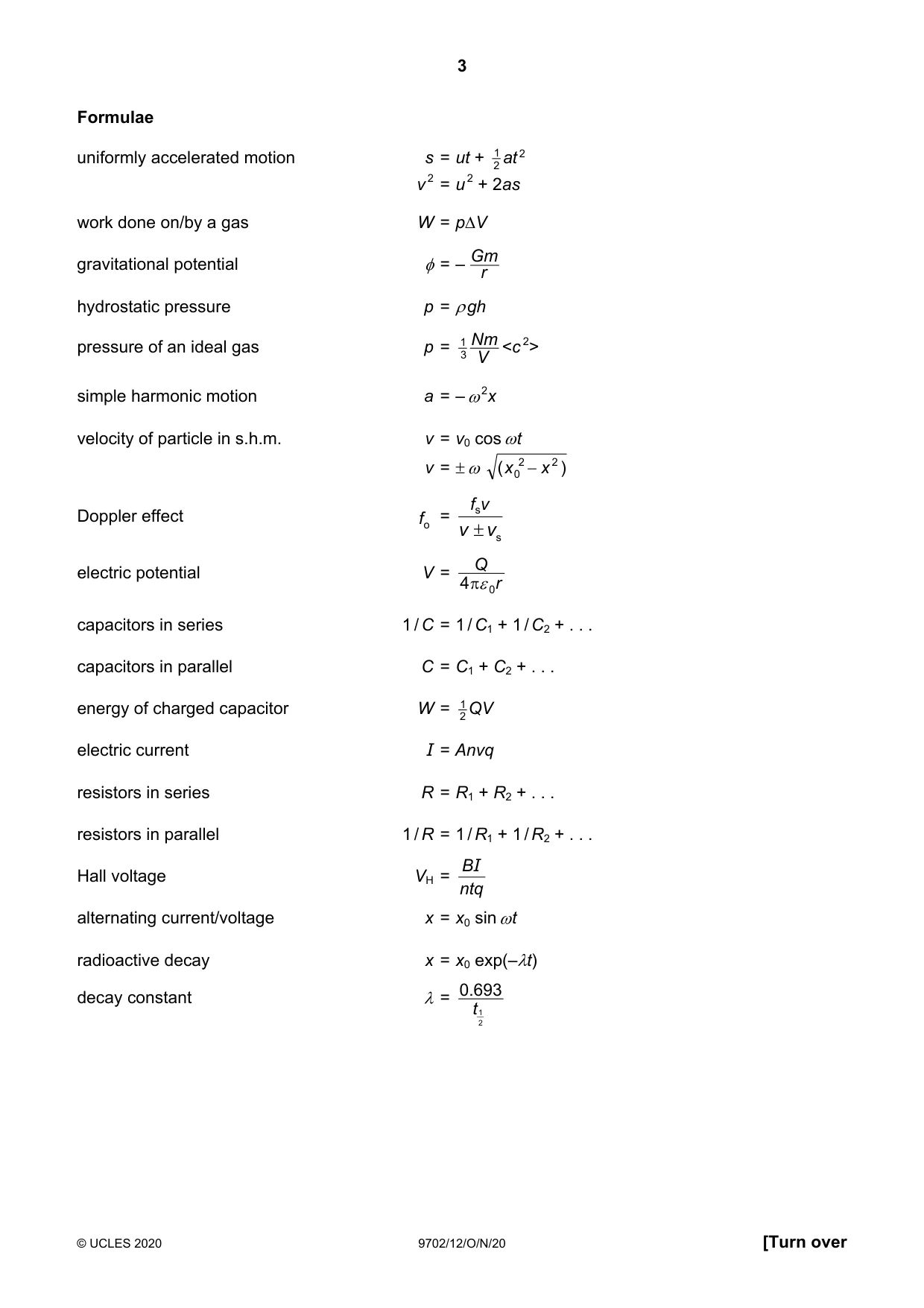

Mark scheme3 pages
Answers below. Sit the paper first if you are practising.
Questions as text
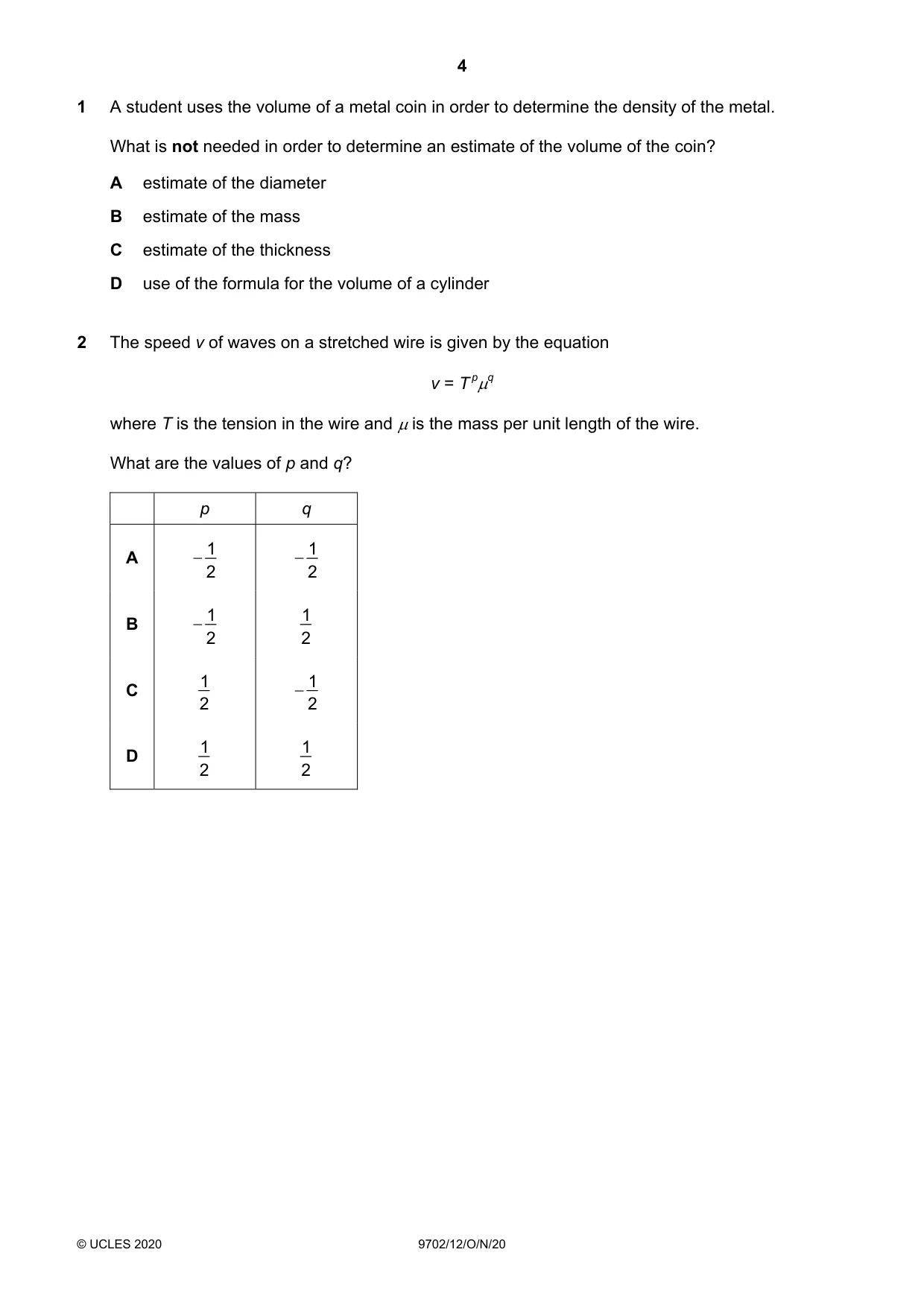
Q1 · A student uses the volume of a metal coin in order to determine the density of the metal
1 A student uses the volume of a metal coin in order to determine the density of the metal. What is not needed in order to determine an estimate of the volume of the coin? A estimate of the diameter B estimate of the mass C estimate of the thickness D use of the formula for the volume of a cylinder
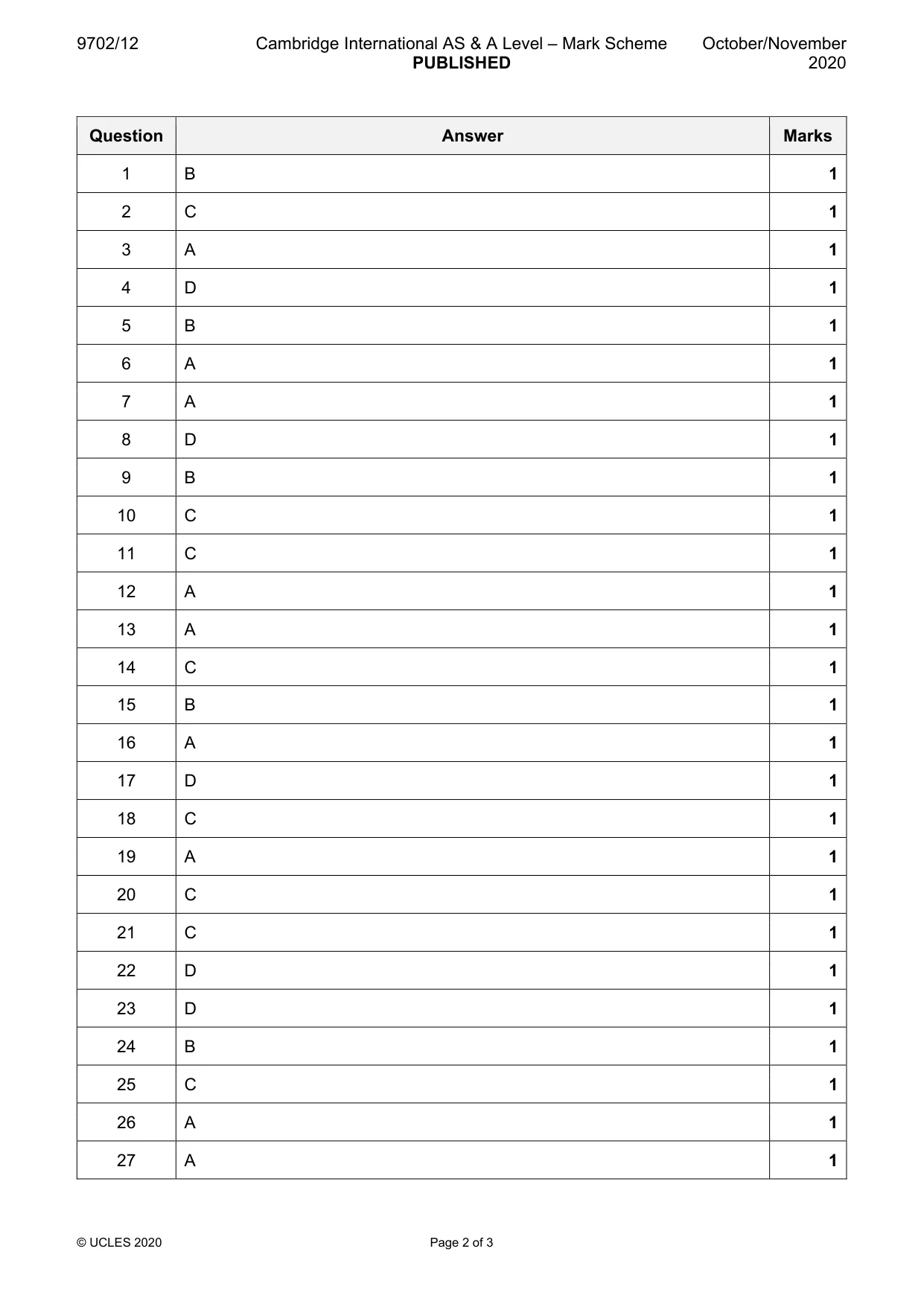
Mark scheme: B
Q2 · The speed v of waves on a stretched wire is given by the equation v = T pq where T is…
2 The speed v of waves on a stretched wire is given by the equation v = T pq where T is the tension in the wire and is the mass per unit length of the wire. What are the values of p and q? p q 1 1 A 2 2 1 1 B 2 2 1 1 C 2 2 1 1 D 2 2
Mark scheme: C
Q3 · The diagram shows a force F
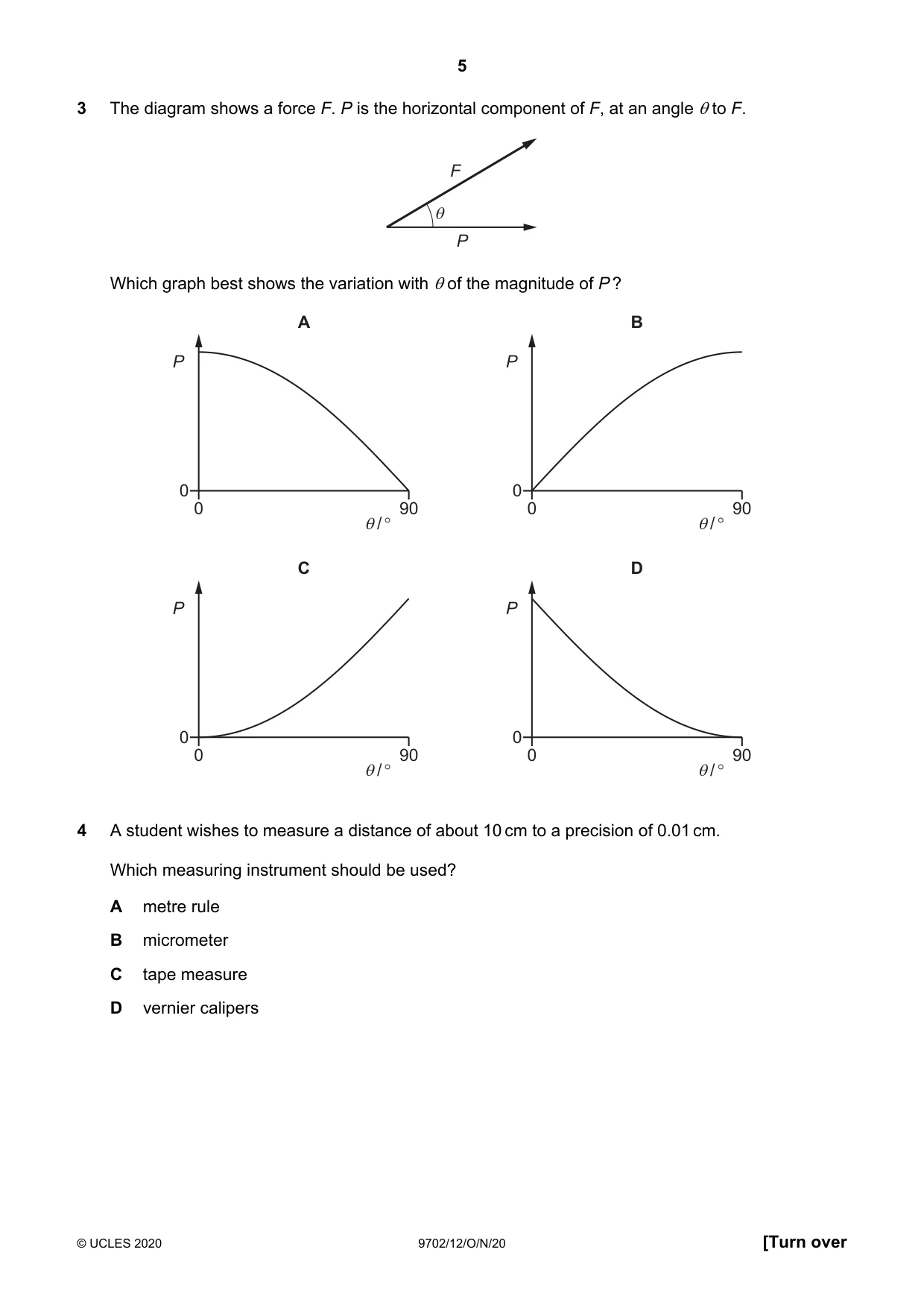
3 The diagram shows a force F. P is the horizontal component of F, at an angle to F. F θ P Which graph best shows the variation with of the magnitude of P ? A B P P 0 0 0 90 0 90 θ / ° θ / ° C D P P 0 0 0 90 0 90 θ / ° θ / °
Mark scheme: A
Q4 · A student wishes to measure a distance of about 10 cm to a precision of 0.01 cm
4 A student wishes to measure a distance of about 10 cm to a precision of 0.01 cm. Which measuring instrument should be used? A metre rule B micrometer C tape measure D vernier calipers
Mark scheme: D
Q5 · A steel ball is dropped and falls through a vertical height h
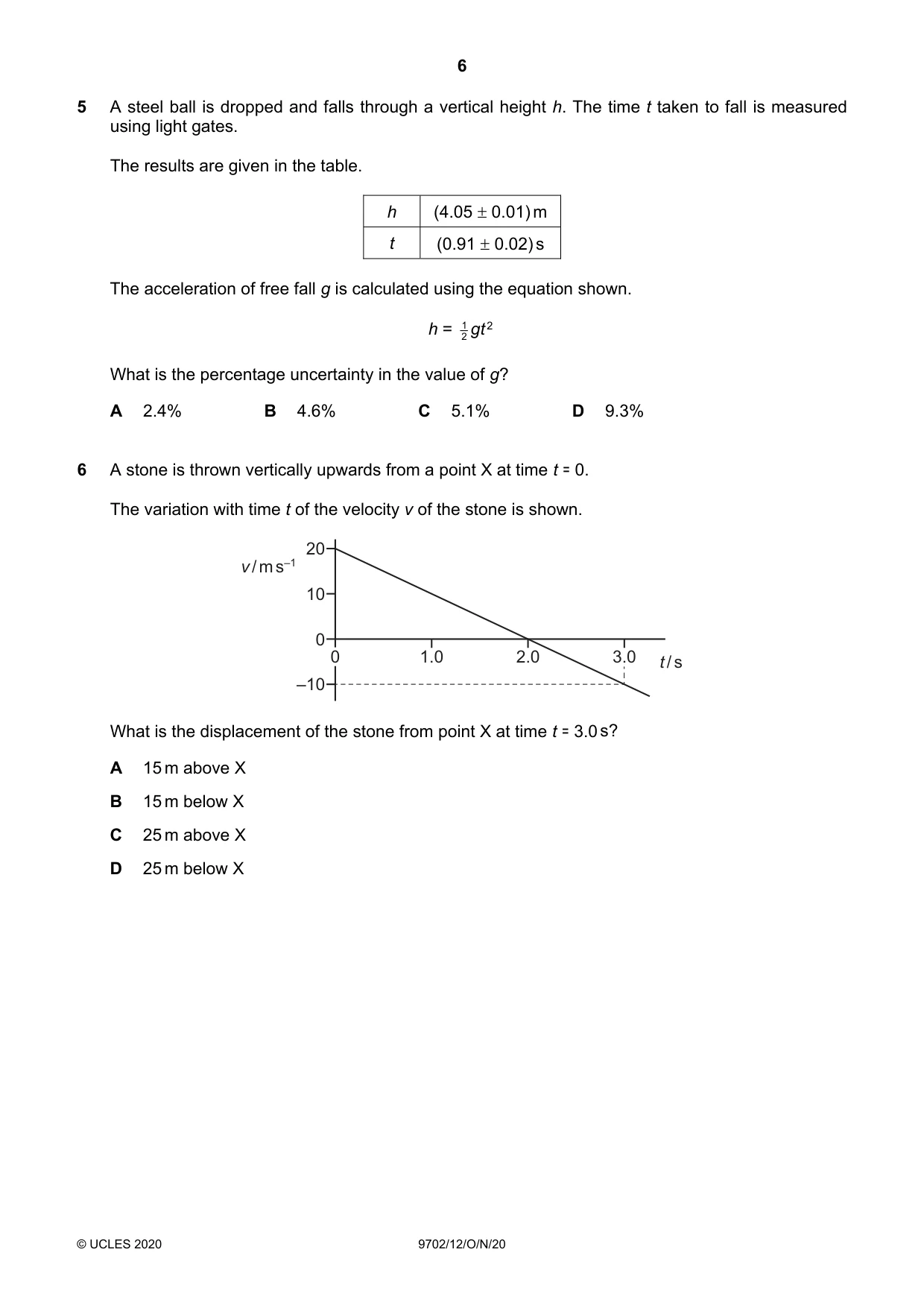
5 A steel ball is dropped and falls through a vertical height h. The time t taken to fall is measured using light gates. The results are given in the table. h (4.05 0.01) m t (0.91 0.02) s The acceleration of free fall g is calculated using the equation shown. h = 1 gt 2 2 What is the percentage uncertainty in the value of g? A 2.4% B 4.6% C 5.1% D 9.3%
Mark scheme: B
Q6 · A stone is thrown vertically upwards from a point X at time t ꞊ 0
6 A stone is thrown vertically upwards from a point X at time t ꞊ 0. The variation with time t of the velocity v of the stone is shown. 20 v / m s–1 10 0 0 1.0 2.0 3.0 t / s –10 What is the displacement of the stone from point X at time t ꞊ 3.0 s? A 15 m above X B 15 m below X C 25 m above X D 25 m below X
Mark scheme: A
Q7 · A mass of 5.0 kg is released from rest on a frictionless surface inclined at 30 to the…
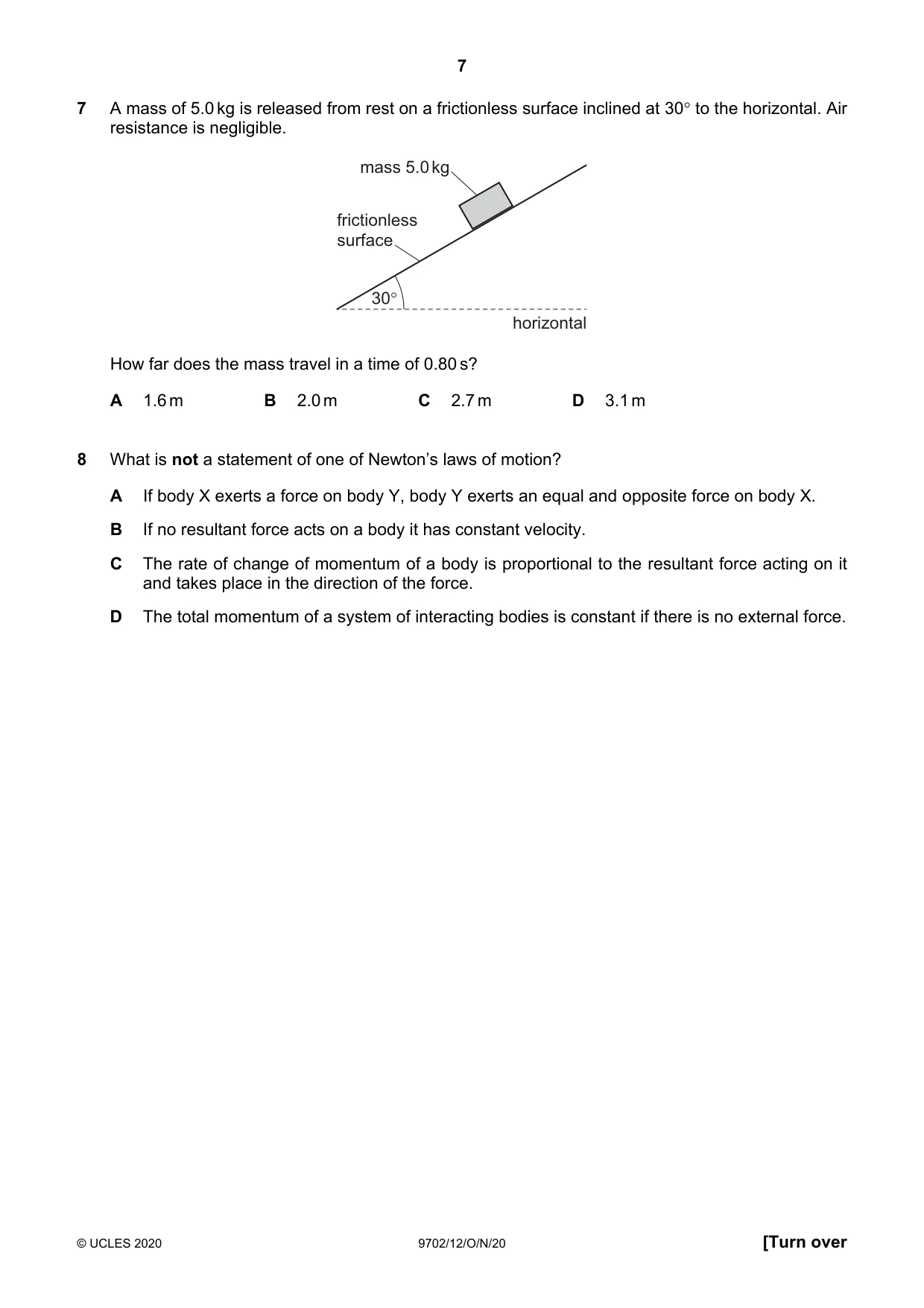
7 A mass of 5.0 kg is released from rest on a frictionless surface inclined at 30 to the horizontal. Air resistance is negligible. mass 5.0 kg frictionless surface 30° horizontal How far does the mass travel in a time of 0.80 s? A 1.6 m B 2.0 m C 2.7 m D 3.1 m
Mark scheme: A
Q8 · What is not a statement of one of Newton’s laws of motion?
8 What is not a statement of one of Newton’s laws of motion? A If body X exerts a force on body Y, body Y exerts an equal and opposite force on body X. B If no resultant force acts on a body it has constant velocity. C The rate of change of momentum of a body is proportional to the resultant force acting on it and takes place in the direction of the force. D The total momentum of a system of interacting bodies is constant if there is no external force.
Mark scheme: D
Q9 · An object falls from a tall building
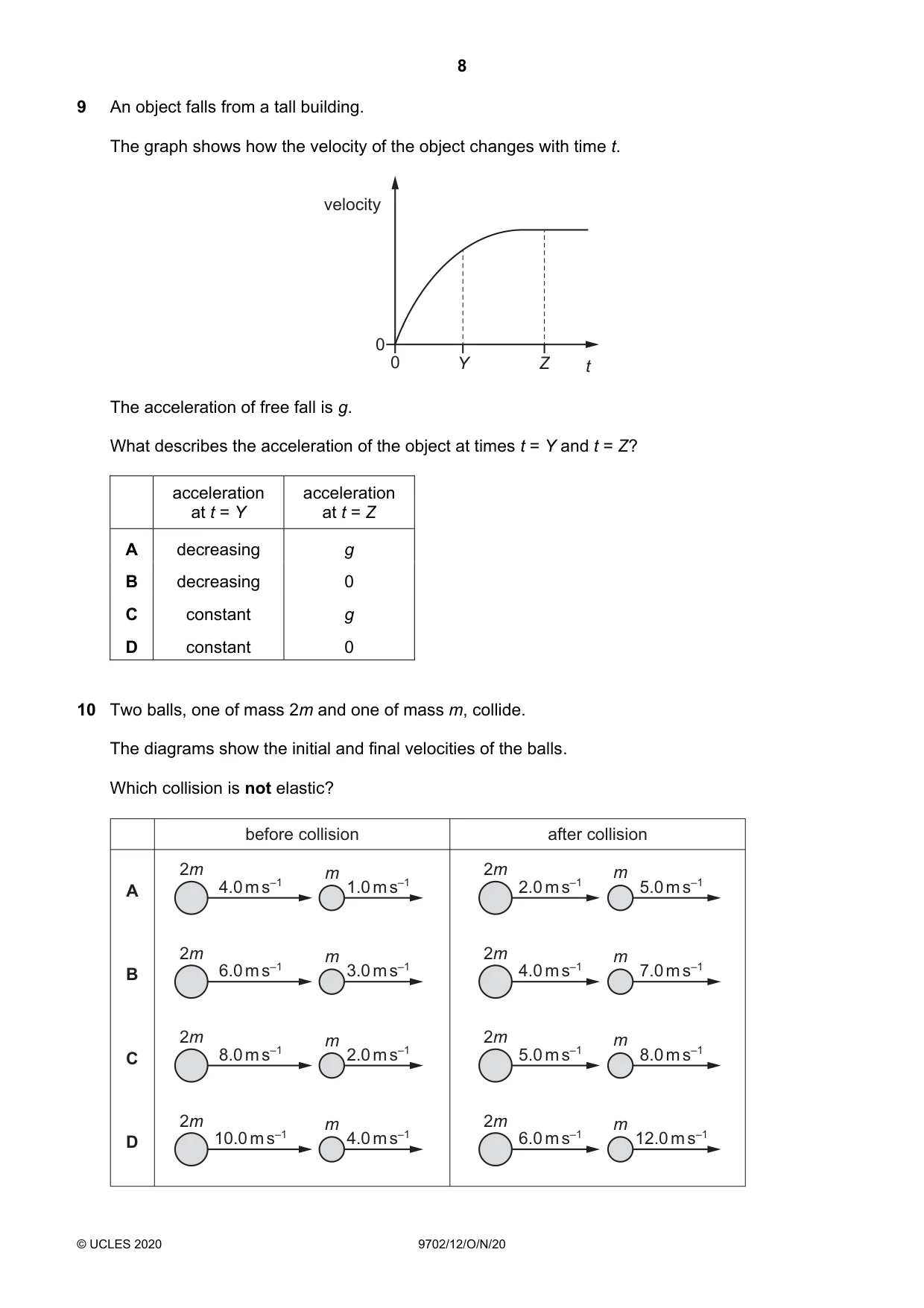
9 An object falls from a tall building. The graph shows how the velocity of the object changes with time t. velocity 0 0 Y Z t The acceleration of free fall is g. What describes the acceleration of the object at times t = Y and t = Z? acceleration acceleration at t = Y at t = Z A decreasing g B decreasing 0 C constant g D constant 0
Mark scheme: B
Q10 · Two balls, one of mass 2m and one of mass m, collide
10 Two balls, one of mass 2m and one of mass m, collide. The diagrams show the initial and final velocities of the balls. Which collision is not elastic? before collision after collision 2m m 2m m A 4.0 m s–1 1.0 m s–1 2.0 m s–1 5.0 m s–1 2m m 2m m B 6.0 m s–1 3.0 m s–1 4.0 m s–1 7.0 m s–1 2m m 2m m C 8.0 m s–1 2.0 m s–1 5.0 m s–1 8.0 m s–1 2m m 2m m D 10.0 m s–1 4.0 m s–1 6.0 m s–1 12.0 m s–1
Mark scheme: C
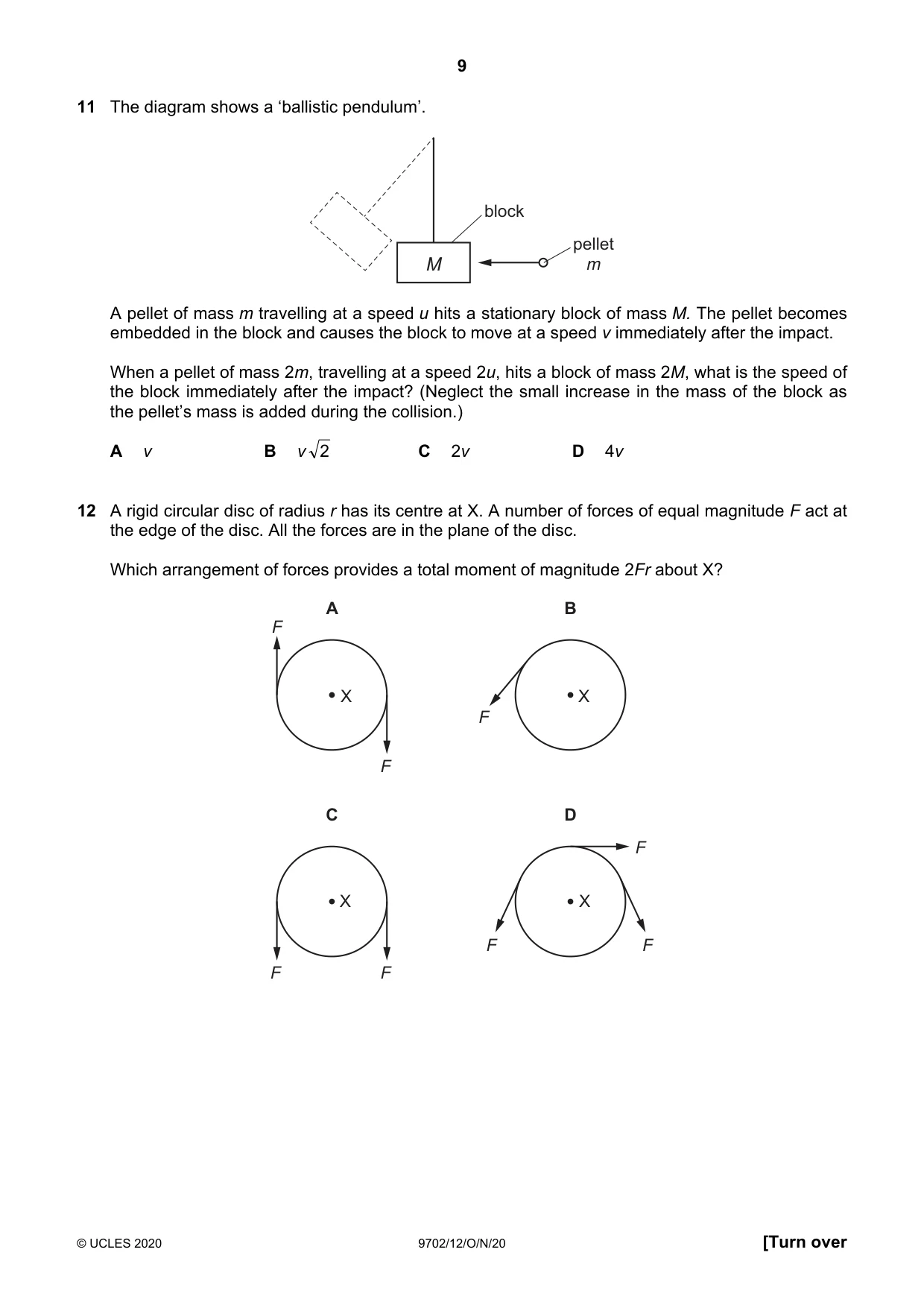
Q11 · The diagram shows a ‘ballistic pendulum’
11 The diagram shows a ‘ballistic pendulum’. block pellet M m A pellet of mass m travelling at a speed u hits a stationary block of mass M. The pellet becomes embedded in the block and causes the block to move at a speed v immediately after the impact. When a pellet of mass 2m, travelling at a speed 2u, hits a block of mass 2M, what is the speed of the block immediately after the impact? (Neglect the small increase in the mass of the block as the pellet’s mass is added during the collision.) A v B v 2 C 2v D 4v
Mark scheme: C
Q12 · A rigid circular disc of radius r has its centre at X
12 A rigid circular disc of radius r has its centre at X. A number of forces of equal magnitude F act at the edge of the disc. All the forces are in the plane of the disc. Which arrangement of forces provides a total moment of magnitude 2Fr about X? A B F X X F F C D F X X F F F F
Mark scheme: A
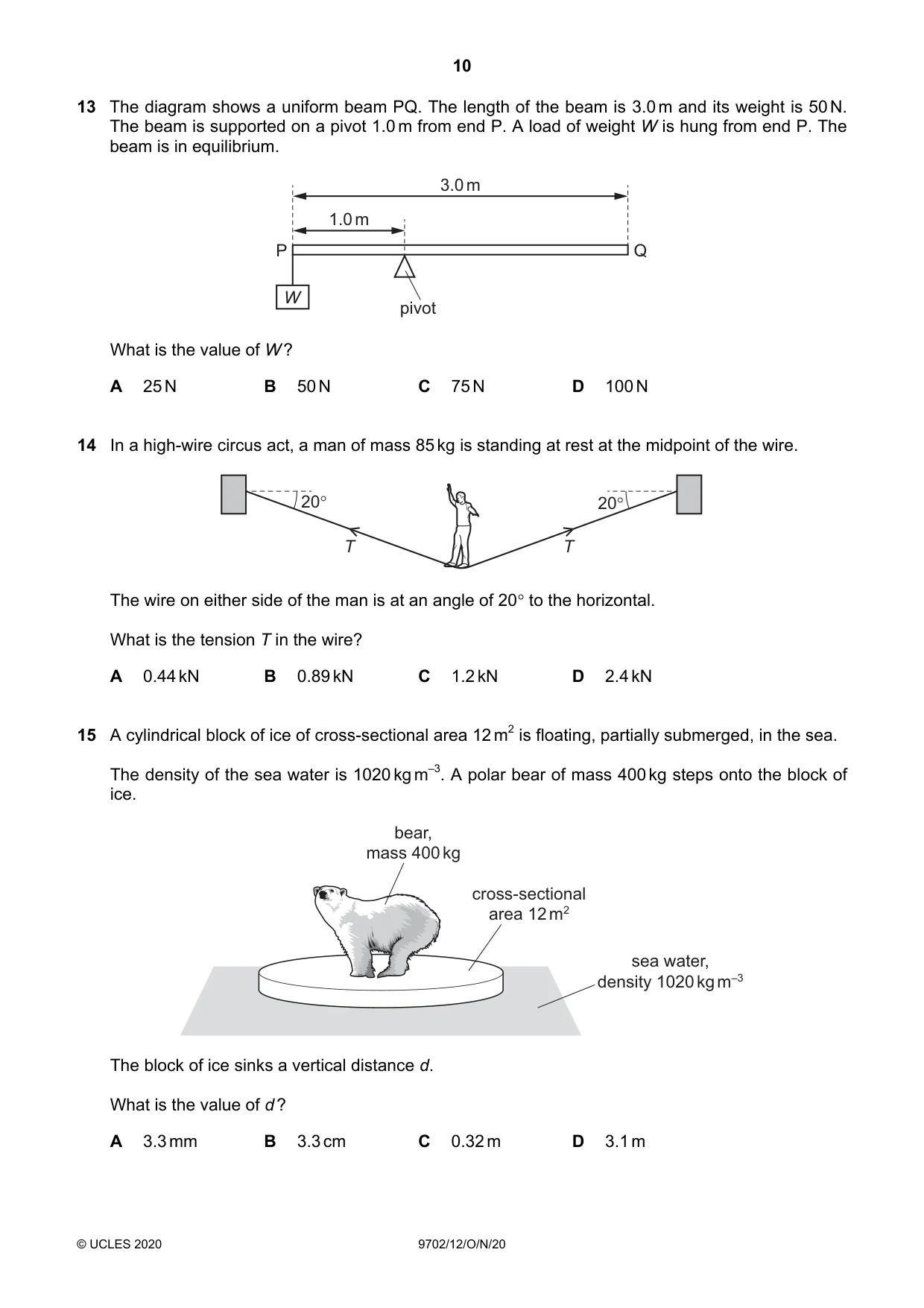
Q13 · The diagram shows a uniform beam PQ
13 The diagram shows a uniform beam PQ. The length of the beam is 3.0 m and its weight is 50 N. The beam is supported on a pivot 1.0 m from end P. A load of weight W is hung from end P. The beam is in equilibrium. 3.0 m 1.0 m P Q W pivot What is the value of W ? A 25 N B 50 N C 75 N D 100 N
Mark scheme: A
Q14 · In a high-wire circus act, a man of mass 85 kg is standing at rest at the midpoint of the…
14 In a high-wire circus act, a man of mass 85 kg is standing at rest at the midpoint of the wire. 20° 20° T T The wire on either side of the man is at an angle of 20 to the horizontal. What is the tension T in the wire? A 0.44 kN B 0.89 kN C 1.2 kN D 2.4 kN
Mark scheme: C
Q15 · A cylindrical block of ice of cross-sectional area 12 m2 is floating, partially…
15 A cylindrical block of ice of cross-sectional area 12 m2 is floating, partially submerged, in the sea. The density of the sea water is 1020 kg m–3. A polar bear of mass 400 kg steps onto the block of ice. bear, mass 400 kg cross-sectional area 12 m2 sea water, density 1020 kg m–3 The block of ice sinks a vertical distance d. What is the value of d ? A 3.3 mm B 3.3 cm C 0.32 m D 3.1 m
Mark scheme: B
Q16 · A ball is thrown vertically upwards
16 A ball is thrown vertically upwards. Air resistance is negligible. Which statement is correct? A By the principle of conservation of energy, the total energy of the ball is constant throughout its motion. B By the principle of conservation of momentum, the momentum of the ball is constant throughout its motion. C The kinetic energy of the ball is greatest at the greatest height attained. D The potential energy of the ball increases at a constant rate during its ascent.
Mark scheme: A
Q17 · A hammer with 10 J of kinetic energy hits a nail and pushes it 5.0 mm into a plank
17 A hammer with 10 J of kinetic energy hits a nail and pushes it 5.0 mm into a plank. Both the hammer and nail come to rest after the collision. What is the approximate average force that acts on the nail while it moves through 5.0 mm? A 0.050 N B 2.0 N C 50 N D 2000 N
Mark scheme: D
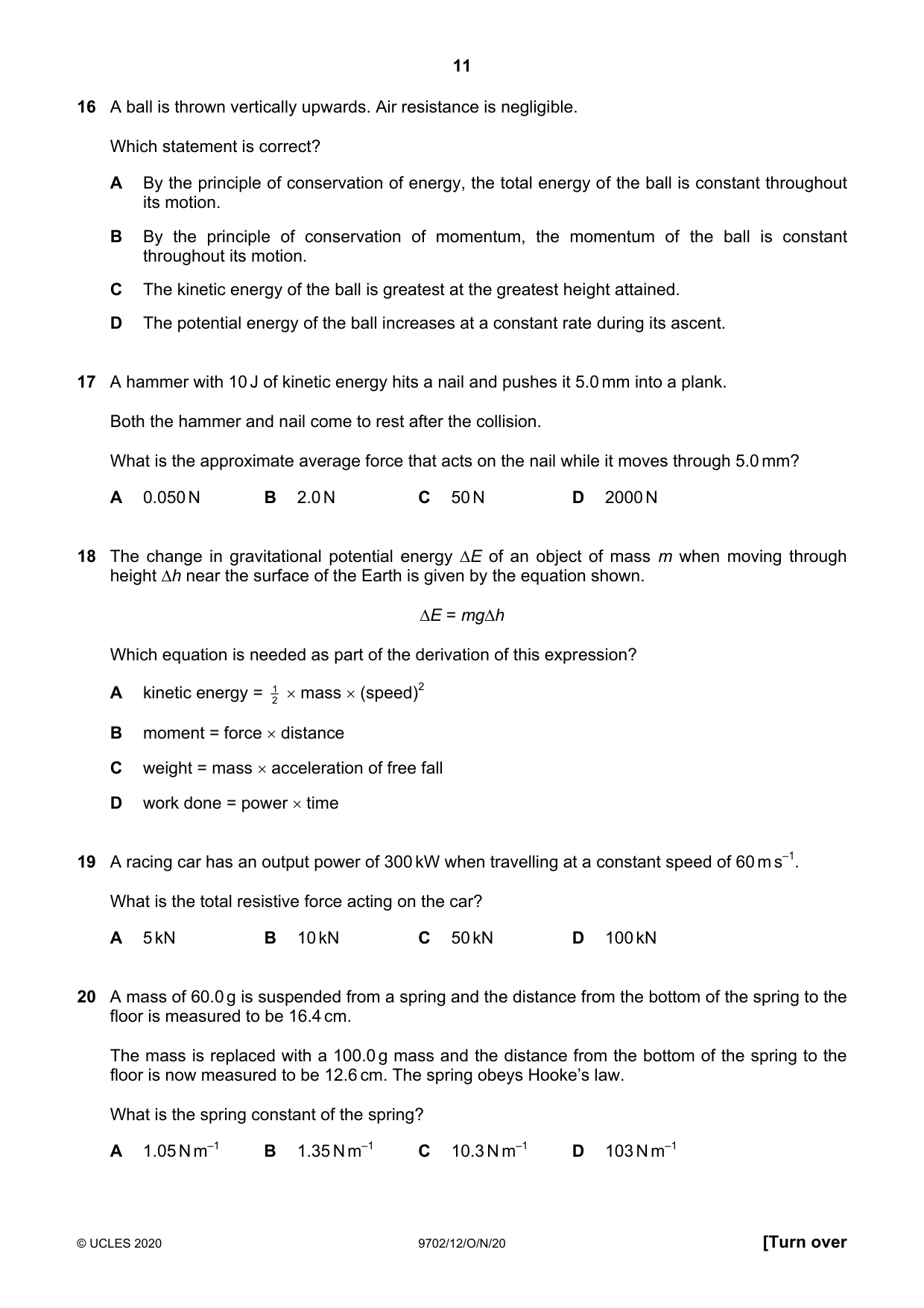
Q18 · The change in gravitational potential energy ∆E of an object of mass m when moving…
18 The change in gravitational potential energy ∆E of an object of mass m when moving through height ∆h near the surface of the Earth is given by the equation shown. ∆E = mg∆h Which equation is needed as part of the derivation of this expression? A kinetic energy = 1 2 mass (speed)2 B moment = force distance C weight = mass acceleration of free fall D work done = power time
Mark scheme: C
More questions on Gravitational potential energy and kinetic energy
Q19 · A racing car has an output power of 300 kW when travelling at a constant speed of 60 m s–1
19 A racing car has an output power of 300 kW when travelling at a constant speed of 60 m s–1. What is the total resistive force acting on the car? A 5 kN B 10 kN C 50 kN D 100 kN
Mark scheme: A
Q20 · A mass of 60.0 g is suspended from a spring and the distance from the bottom of the…
20 A mass of 60.0 g is suspended from a spring and the distance from the bottom of the spring to the floor is measured to be 16.4 cm. The mass is replaced with a 100.0 g mass and the distance from the bottom of the spring to the floor is now measured to be 12.6 cm. The spring obeys Hooke’s law. What is the spring constant of the spring? A 1.05 N m–1 B 1.35 N m–1 C 10.3 N m–1 D 103 N m–1
Mark scheme: C
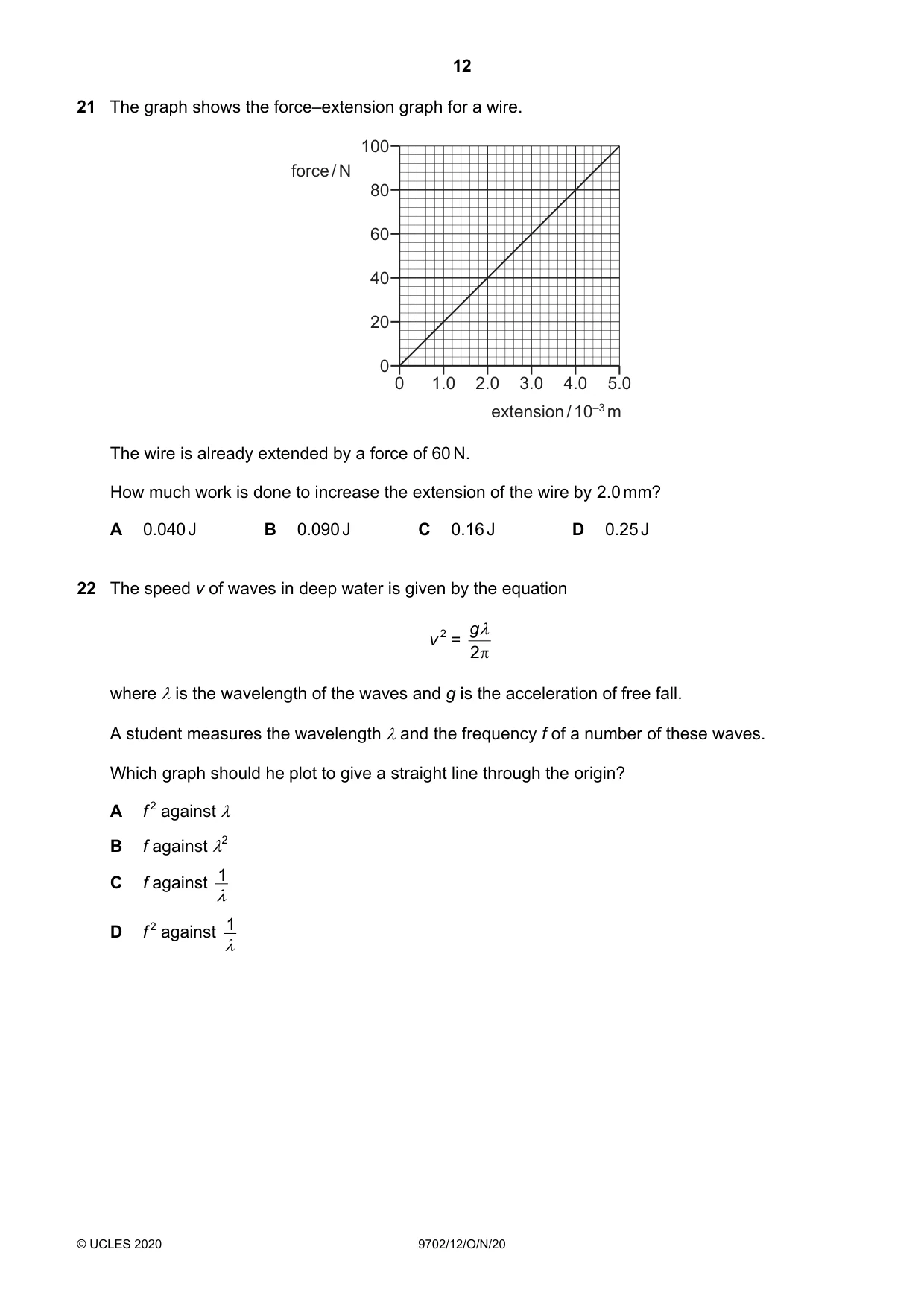
Q21 · The graph shows the force–extension graph for a wire
21 The graph shows the force–extension graph for a wire. 100 force / N 80 60 40 20 0 0 1.0 2.0 3.0 4.0 5.0 extension / 10–3 m The wire is already extended by a force of 60 N. How much work is done to increase the extension of the wire by 2.0 mm? A 0.040 J B 0.090 J C 0.16 J D 0.25 J
Mark scheme: C
Q22 · The speed v of waves in deep water is given by the equation g v 2 = 2 where is the…
22 The speed v of waves in deep water is given by the equation g v 2 = 2 where is the wavelength of the waves and g is the acceleration of free fall. A student measures the wavelength and the frequency f of a number of these waves. Which graph should he plot to give a straight line through the origin? A f 2 against B f against 2 C f against 1 D f 2 against 1
Mark scheme: D
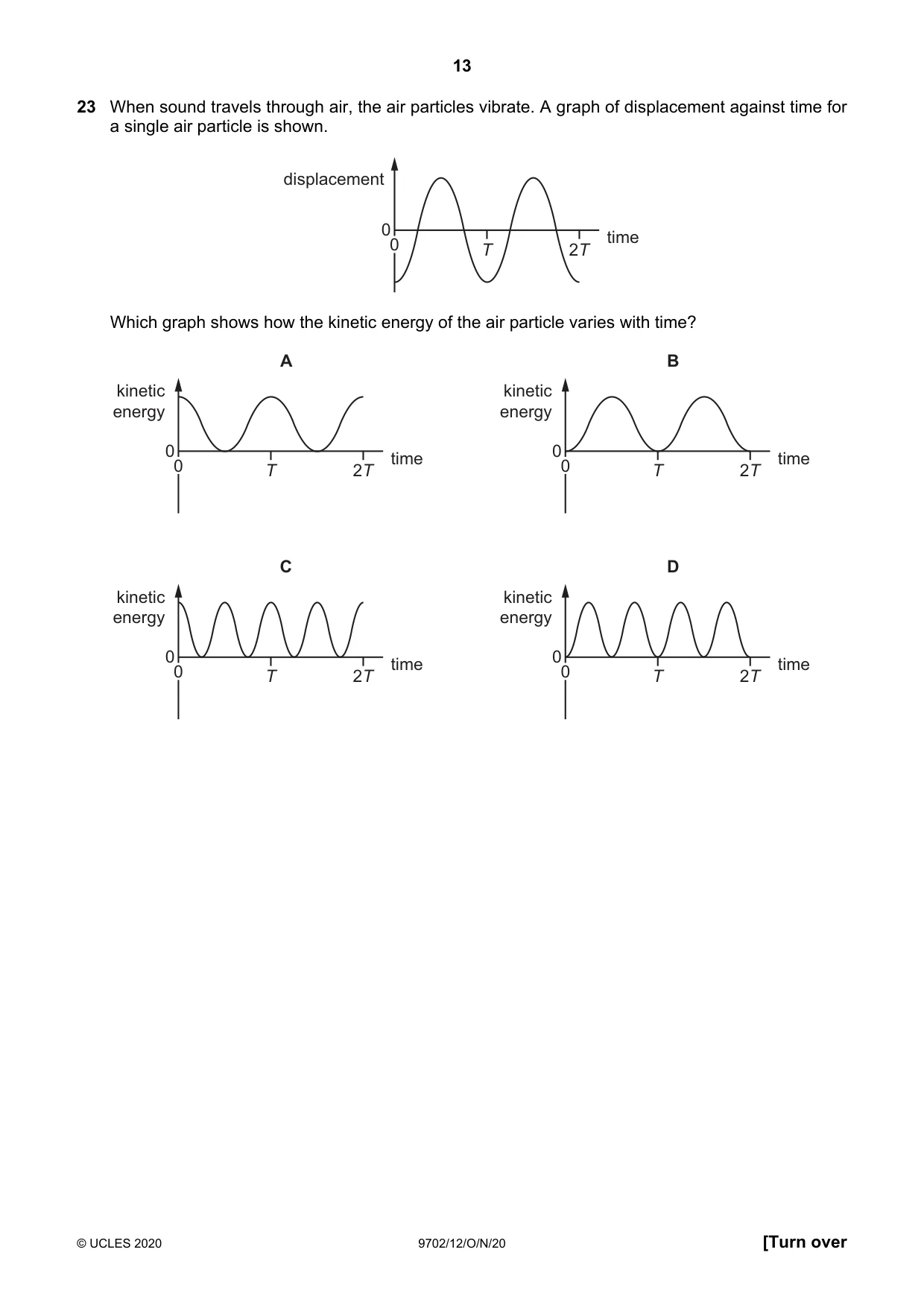
Q23 · When sound travels through air, the air particles vibrate
23 When sound travels through air, the air particles vibrate. A graph of displacement against time for a single air particle is shown. displacement 0 time 0 T 2T Which graph shows how the kinetic energy of the air particle varies with time? A B kinetic kinetic energy energy 0 time 0 time 0 T 2T 0 T 2T C D kinetic kinetic energy energy 0 time 0 time 0 T 2T 0 T 2T
Mark scheme: D
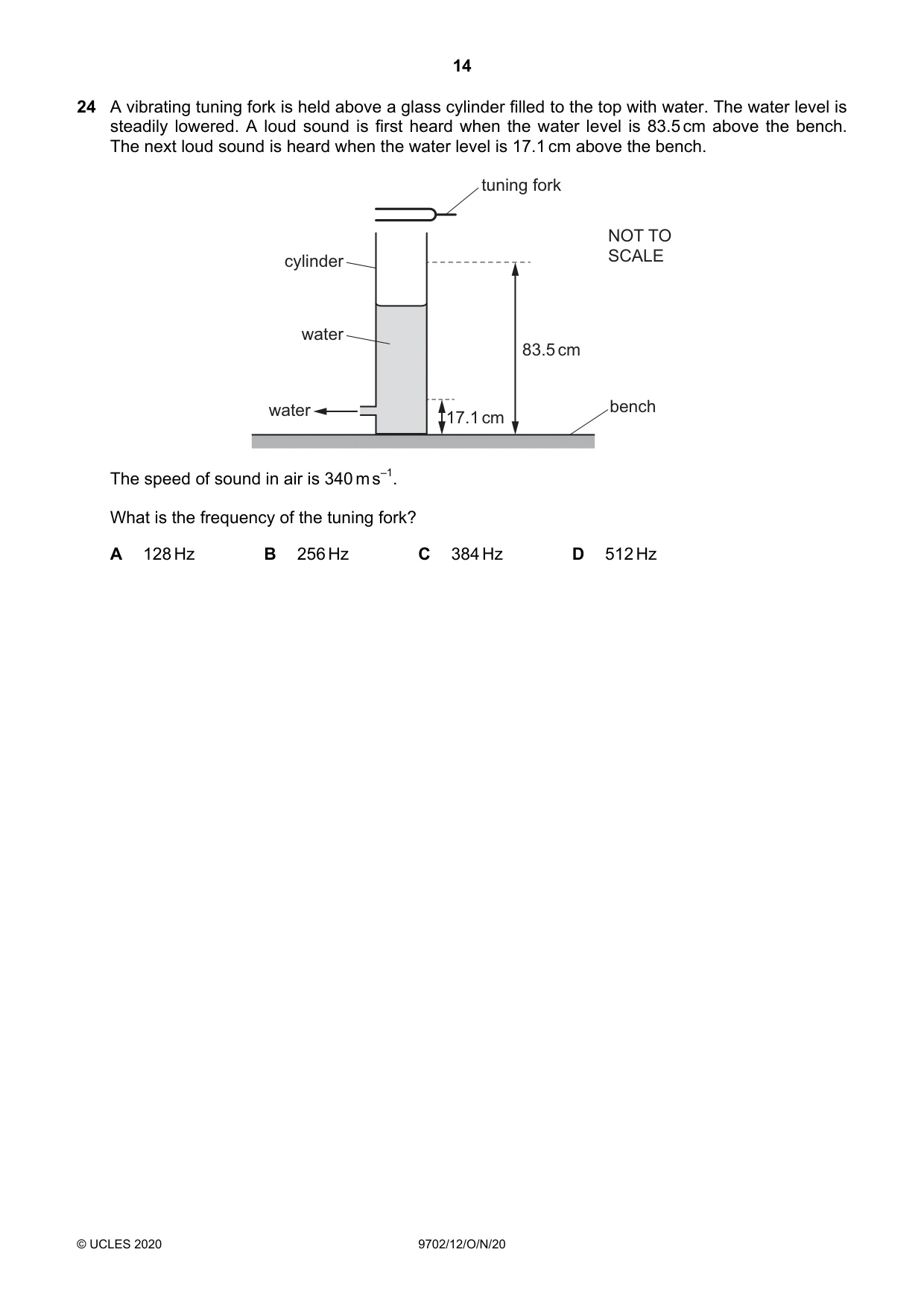
Q24 · A vibrating tuning fork is held above a glass cylinder filled to the top with water
24 A vibrating tuning fork is held above a glass cylinder filled to the top with water. The water level is steadily lowered. A loud sound is first heard when the water level is 83.5 cm above the bench. The next loud sound is heard when the water level is 17.1 cm above the bench. tuning fork NOT TO cylinder SCALE water 83.5 cm water bench 17.1 cm The speed of sound in air is 340 m s–1. What is the frequency of the tuning fork? A 128 Hz B 256 Hz C 384 Hz D 512 Hz
Mark scheme: B
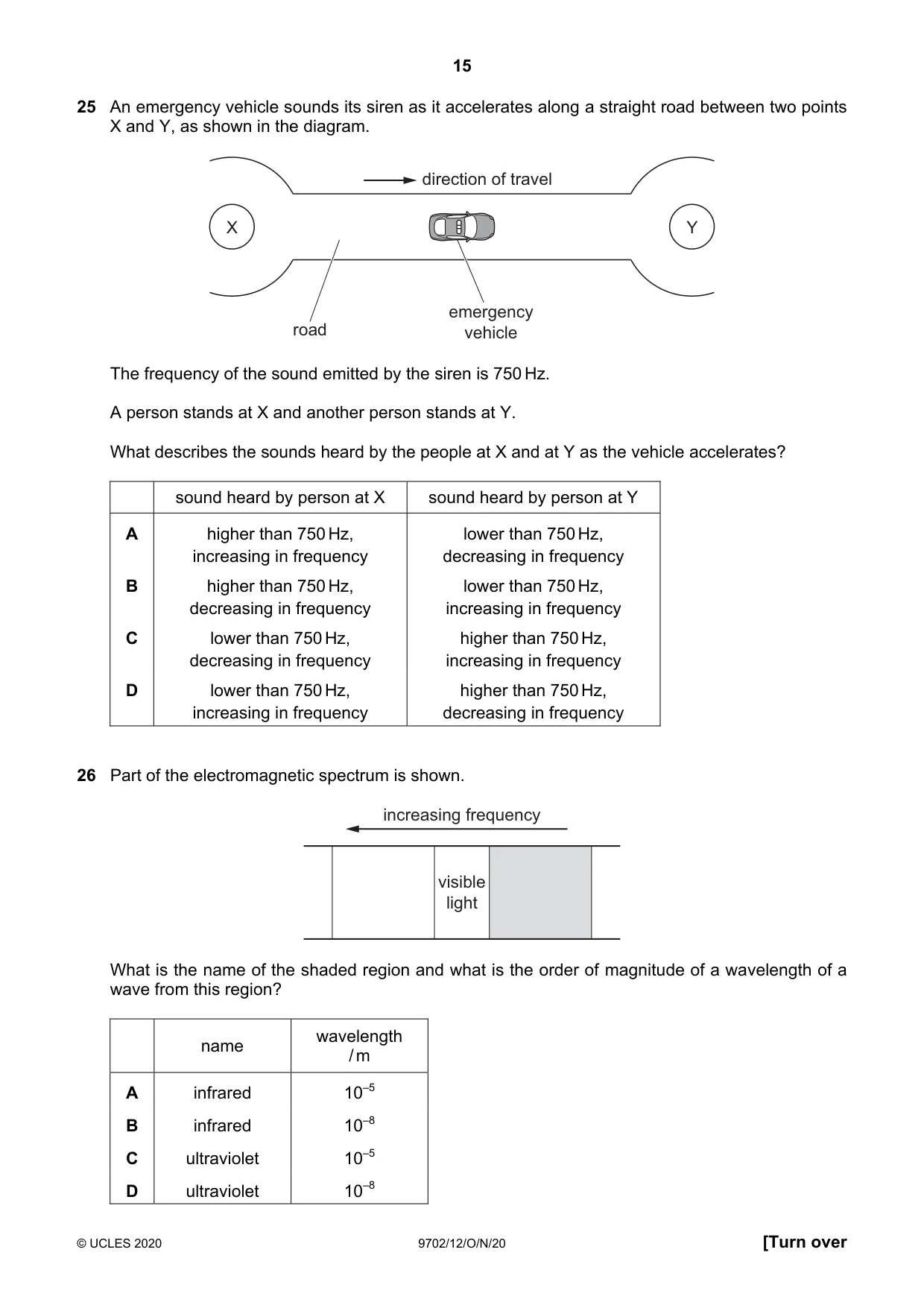
Q25 · An emergency vehicle sounds its siren as it accelerates along a straight road between two…
25 An emergency vehicle sounds its siren as it accelerates along a straight road between two points X and Y, as shown in the diagram. direction of travel X Y emergency road vehicle The frequency of the sound emitted by the siren is 750 Hz. A person stands at X and another person stands at Y. What describes the sounds heard by the people at X and at Y as the vehicle accelerates? sound heard by person at X sound heard by person at Y A higher than 750 Hz, lower than 750 Hz, increasing in frequency decreasing in frequency B higher than 750 Hz, lower than 750 Hz, decreasing in frequency increasing in frequency C lower than 750 Hz, higher than 750 Hz, decreasing in frequency increasing in frequency D lower than 750 Hz, higher than 750 Hz, increasing in frequency decreasing in frequency
Mark scheme: C
Q26 · Part of the electromagnetic spectrum is shown
26 Part of the electromagnetic spectrum is shown. increasing frequency visible light What is the name of the shaded region and what is the order of magnitude of a wavelength of a wave from this region? wavelength name / m A infrared 10–5 B infrared 10–8 C ultraviolet 10–5 D ultraviolet 10–8
Mark scheme: A
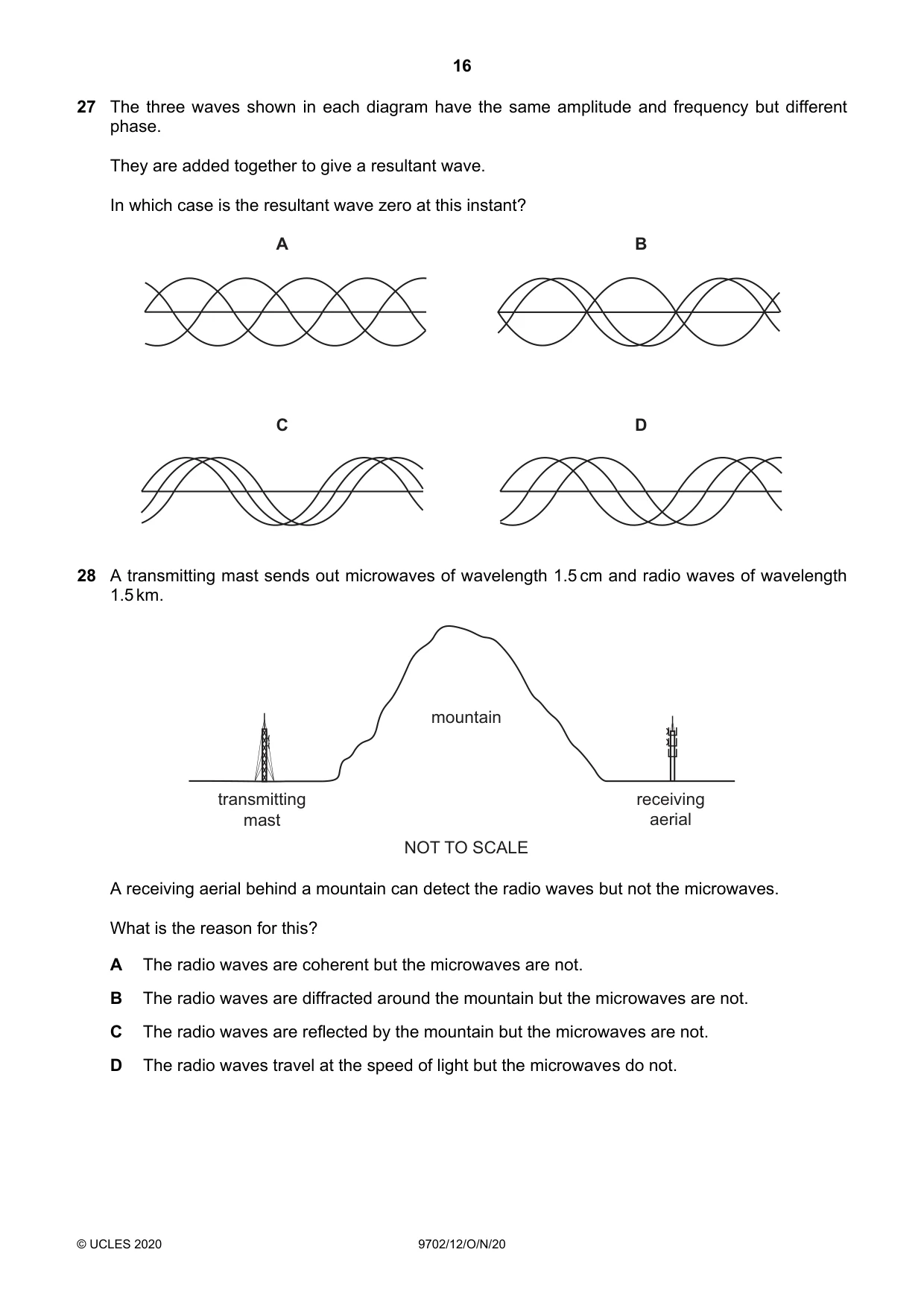
Q27 · The three waves shown in each diagram have the same amplitude and frequency but different…
27 The three waves shown in each diagram have the same amplitude and frequency but different phase. They are added together to give a resultant wave. In which case is the resultant wave zero at this instant? A B C D
Mark scheme: A
Q28 · A transmitting mast sends out microwaves of wavelength 1.5 cm and radio waves of…
28 A transmitting mast sends out microwaves of wavelength 1.5 cm and radio waves of wavelength 1.5 km. mountain transmitting receiving mast aerial NOT TO SCALE A receiving aerial behind a mountain can detect the radio waves but not the microwaves. What is the reason for this? A The radio waves are coherent but the microwaves are not. B The radio waves are diffracted around the mountain but the microwaves are not. C The radio waves are reflected by the mountain but the microwaves are not. D The radio waves travel at the speed of light but the microwaves do not.
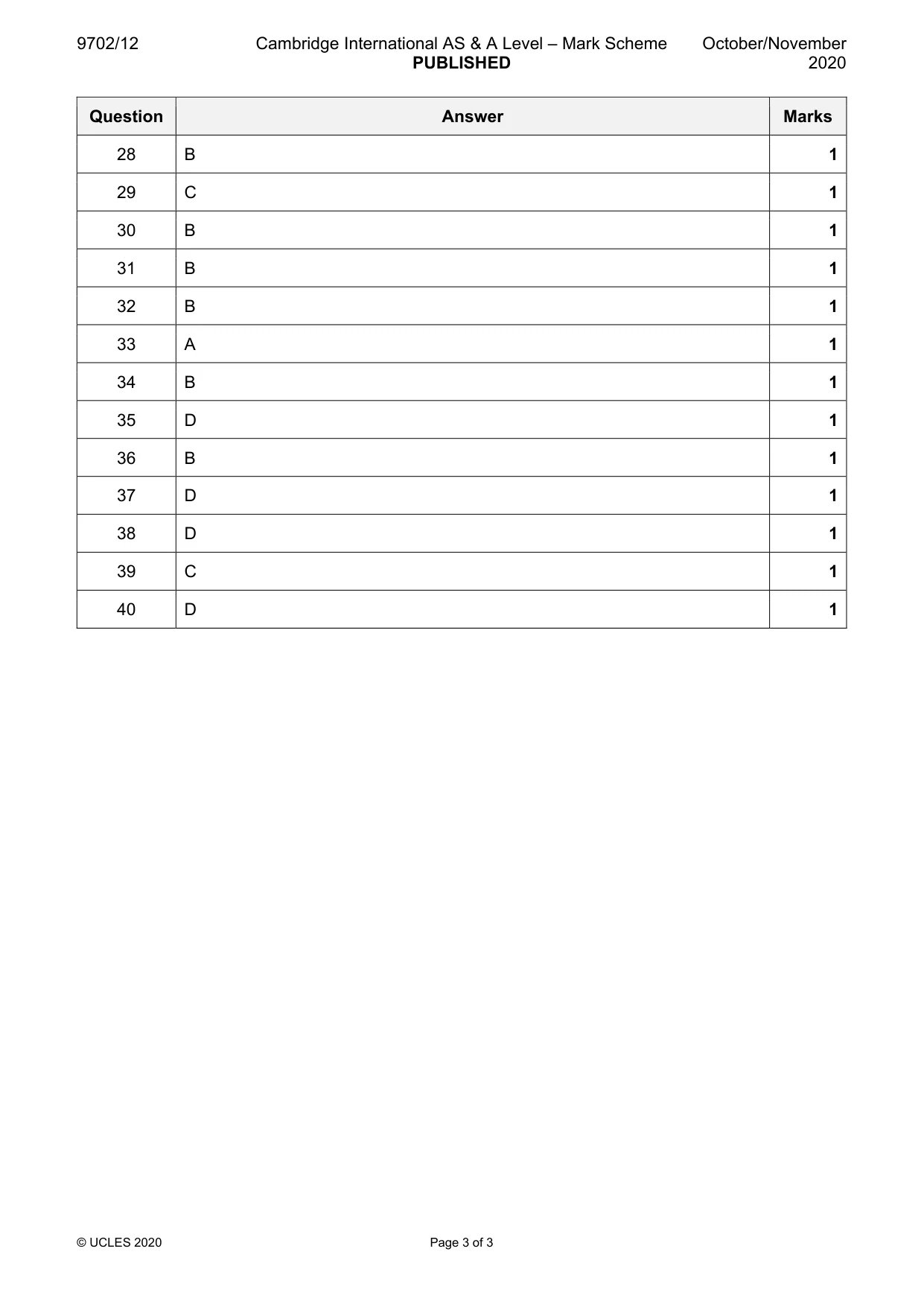
Mark scheme: B
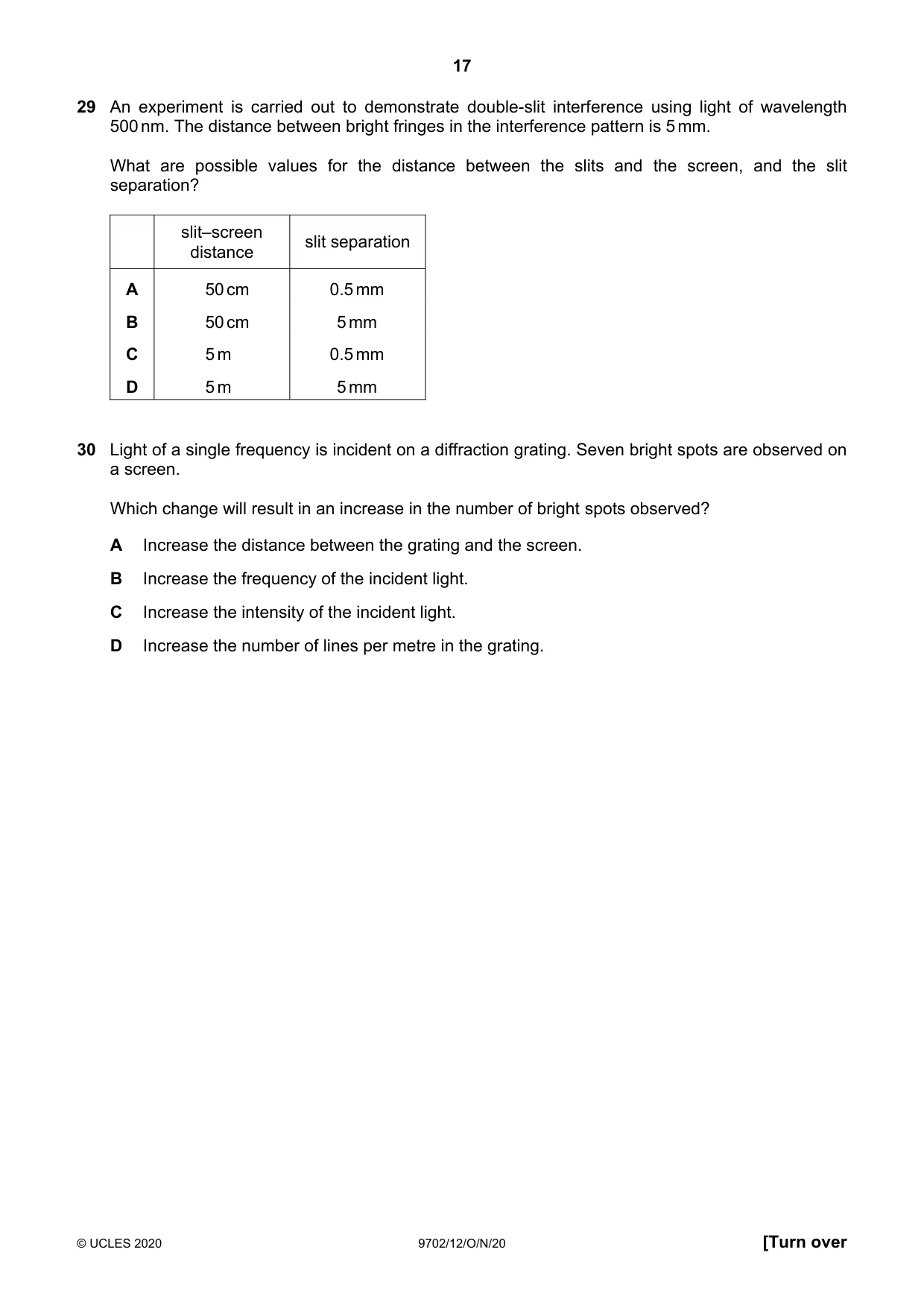
Q29 · An experiment is carried out to demonstrate double-slit interference using light of…
29 An experiment is carried out to demonstrate double-slit interference using light of wavelength 500 nm. The distance between bright fringes in the interference pattern is 5 mm. What are possible values for the distance between the slits and the screen, and the slit separation? slit–screen slit separation distance A 50 cm 0.5 mm B 50 cm 5 mm C 5 m 0.5 mm D 5 m 5 mm
Mark scheme: C
Q30 · Light of a single frequency is incident on a diffraction grating
30 Light of a single frequency is incident on a diffraction grating. Seven bright spots are observed on a screen. Which change will result in an increase in the number of bright spots observed? A Increase the distance between the grating and the screen. B Increase the frequency of the incident light. C Increase the intensity of the incident light. D Increase the number of lines per metre in the grating.
Mark scheme: B
Q31 · A molecule behaves as an electric ‘dipole’ consisting of two equal point charges of…
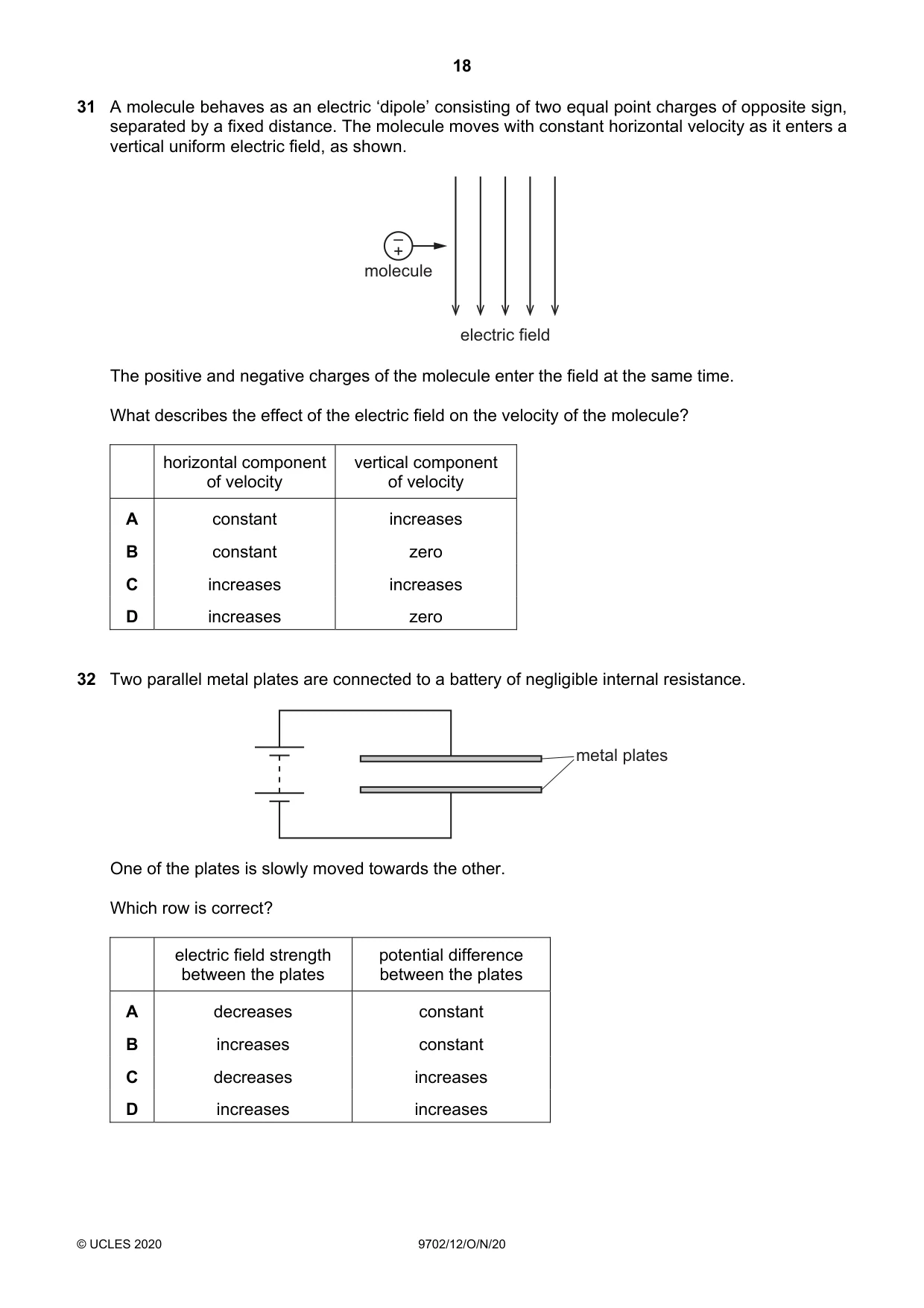
31 A molecule behaves as an electric ‘dipole’ consisting of two equal point charges of opposite sign, separated by a fixed distance. The molecule moves with constant horizontal velocity as it enters a vertical uniform electric field, as shown. +– molecule electric field The positive and negative charges of the molecule enter the field at the same time. What describes the effect of the electric field on the velocity of the molecule? horizontal component vertical component of velocity of velocity A constant increases B constant zero C increases increases D increases zero
Mark scheme: B
Q32 · Two parallel metal plates are connected to a battery of negligible internal resistance
32 Two parallel metal plates are connected to a battery of negligible internal resistance. metal plates One of the plates is slowly moved towards the other. Which row is correct? electric field strength potential difference between the plates between the plates A decreases constant B increases constant C decreases increases D increases increases
Mark scheme: B
Q33 · Four point charges, each of charge Q, are placed on the edge of an insulating disc of…
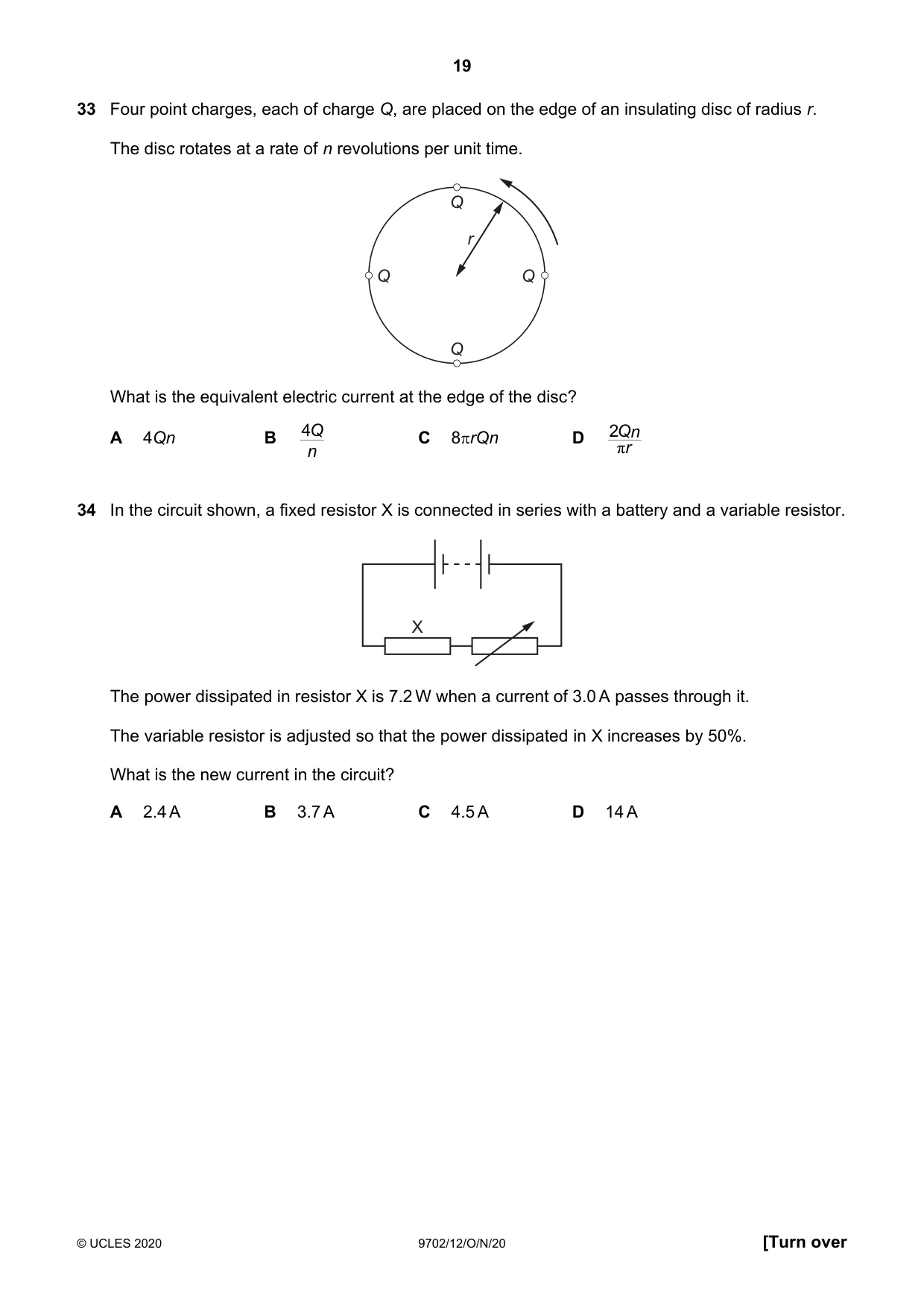
33 Four point charges, each of charge Q, are placed on the edge of an insulating disc of radius r. The disc rotates at a rate of n revolutions per unit time. Q r Q Q Q What is the equivalent electric current at the edge of the disc? A 4Qn B 4Q n C 8rQn D 2Qn π r
Mark scheme: A
Q34 · In the circuit shown, a fixed resistor X is connected in series with a battery and a…
34 In the circuit shown, a fixed resistor X is connected in series with a battery and a variable resistor. X The power dissipated in resistor X is 7.2 W when a current of 3.0 A passes through it. The variable resistor is adjusted so that the power dissipated in X increases by 50%. What is the new current in the circuit? A 2.4 A B 3.7 A C 4.5 A D 14 A
Mark scheme: B
Q35 · A resistor and a filament lamp are connected in series with a power supply
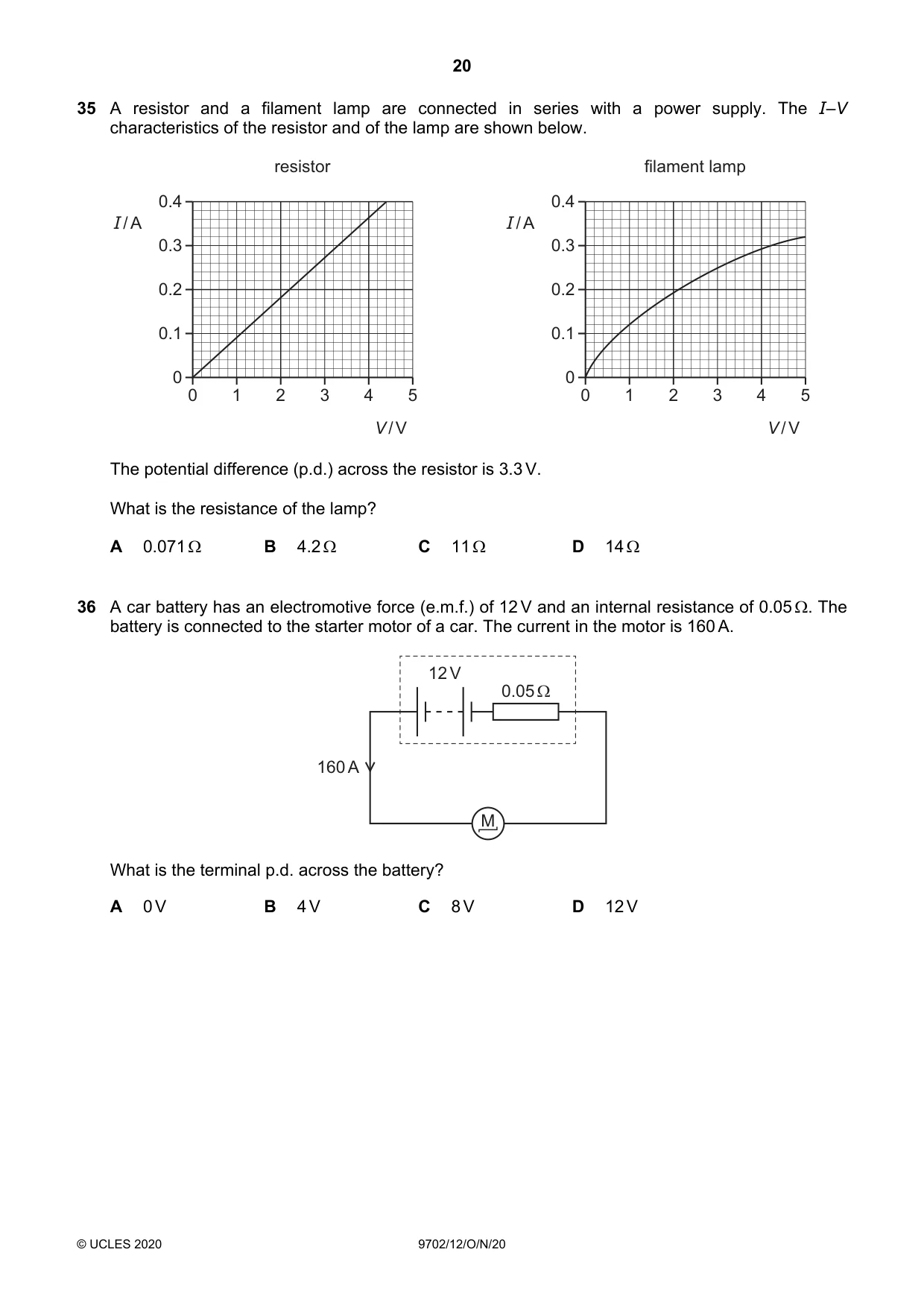
35 A resistor and a filament lamp are connected in series with a power supply. The I–V characteristics of the resistor and of the lamp are shown below. resistor filament lamp 0.4 0.4 I / A I / A 0.3 0.3 0.2 0.2 0.1 0.1 0 0 0 1 2 3 4 5 0 1 2 3 4 5 V / V V / V The potential difference (p.d.) across the resistor is 3.3 V. What is the resistance of the lamp? A 0.071 B 4.2 C 11 D 14
Mark scheme: D
Q36 · A car battery has an electromotive force (e.m.f.) of 12 V and an internal resistance of…
36 A car battery has an electromotive force (e.m.f.) of 12 V and an internal resistance of 0.05 . The battery is connected to the starter motor of a car. The current in the motor is 160 A. 12 V 0.05 Ω 160 A M What is the terminal p.d. across the battery? A 0 V B 4 V C 8 V D 12 V
Mark scheme: B
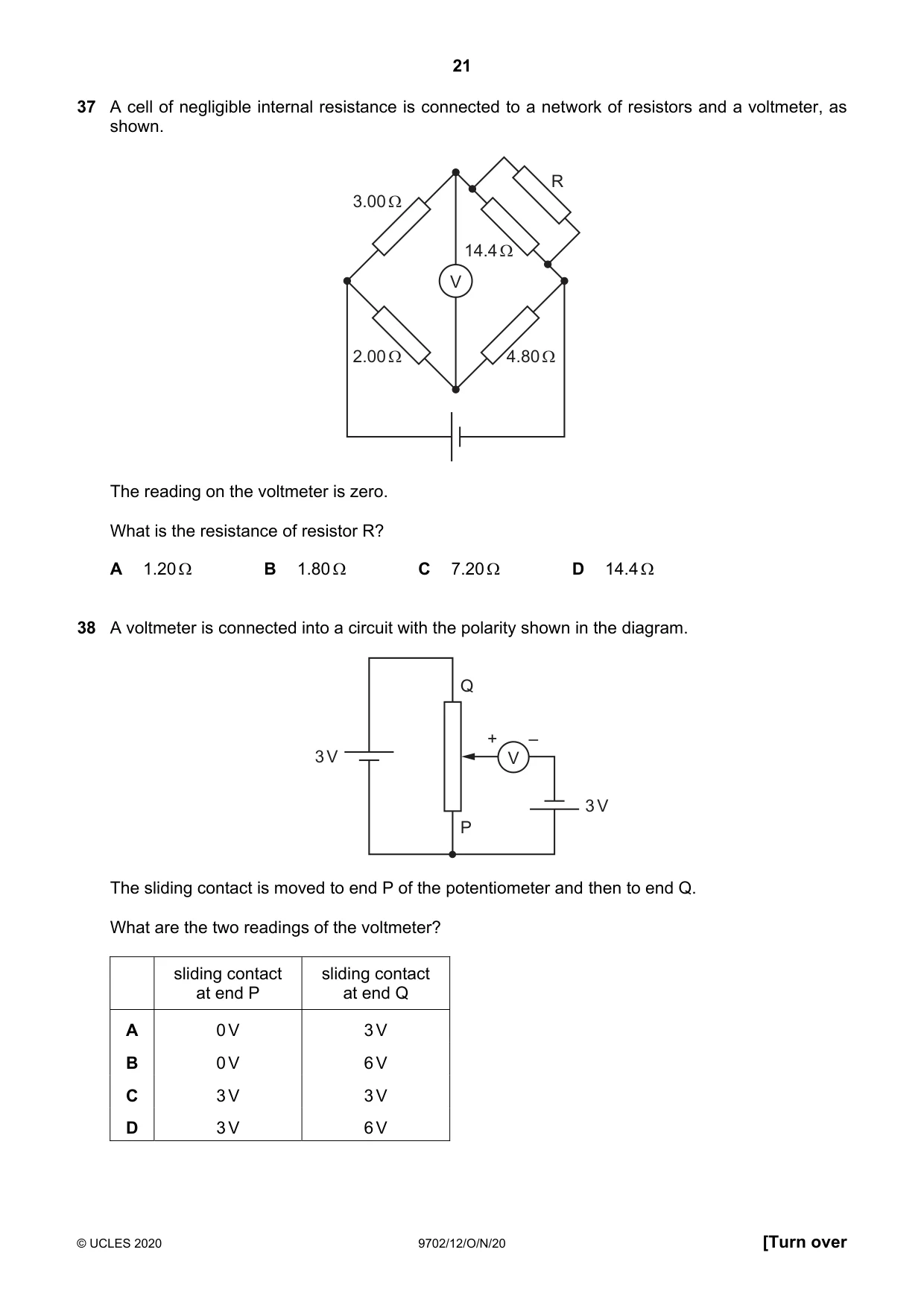
Q37 · A cell of negligible internal resistance is connected to a network of resistors and a…
37 A cell of negligible internal resistance is connected to a network of resistors and a voltmeter, as shown. R 3.00 Ω 14.4 Ω V 2.00 Ω 4.80 Ω The reading on the voltmeter is zero. What is the resistance of resistor R? A 1.20 B 1.80 C 7.20 D 14.4
Mark scheme: D
Q38 · A voltmeter is connected into a circuit with the polarity shown in the diagram
38 A voltmeter is connected into a circuit with the polarity shown in the diagram. Q + – 3 V V 3 V P The sliding contact is moved to end P of the potentiometer and then to end Q. What are the two readings of the voltmeter? sliding contact sliding contact at end P at end Q A 0 V 3 V B 0 V 6 V C 3 V 3 V D 3 V 6 V
Mark scheme: D
Q39 · What is a conclusion from the alpha-particle scattering experiment?
39 What is a conclusion from the alpha-particle scattering experiment? A Protons and electrons have equal but opposite charges. B Protons have a much larger mass than electrons. C The nucleus contains most of the mass of the atom. D The nucleus of an atom contains protons and neutrons.
Mark scheme: C
Q40 · Which particle is a hadron?
40 Which particle is a hadron? A electron B neutrino C positron D proton
Mark scheme: D
What was in this paper
The subtopics covered by these 40 questions, and how many questions each got. Open one in a new tab to see every Cambridge question on it.
3Equations of motion2Equilibrium of forces2Errors and uncertainties2Interference2Linear momentum and its conservation2Potential dividers2Uniform electric fields2Atoms, nuclei and radiation1Density and pressure1Diffraction1Doppler effect for sound waves1Elastic and plastic behaviour1Electric current1Electromagnetic spectrum1Energy in simple harmonic motion1Fundamental particles1Gravitational potential energy and kinetic energy1Momentum and Newton’s laws of motion1Non-uniform motion1Physical quantities1Potential difference and power1Practical circuits1Progressive waves1Resistance and resistivity1Scalars and vectors1SI units1Stationary waves1Stress and strain1The diffraction grating1Turning effects of forces1What you needed in this session
Cambridge’s own grade thresholds for 2020 Oct/Nov, Paper 1 · Variant 2. A higher threshold means an easier paper — the bar moves with how the cohort did.