Cambridge A Level Physics 9702 — 2019 Feb/March Paper 1 · Variant 2
9702/12/F/M/19 · 40 questions · 40 marks · ≈45 min
The question paper and its mark scheme, free to read here and free to download. This is Cambridge’s own paper, exactly as it was sat.
Question paper20 pages
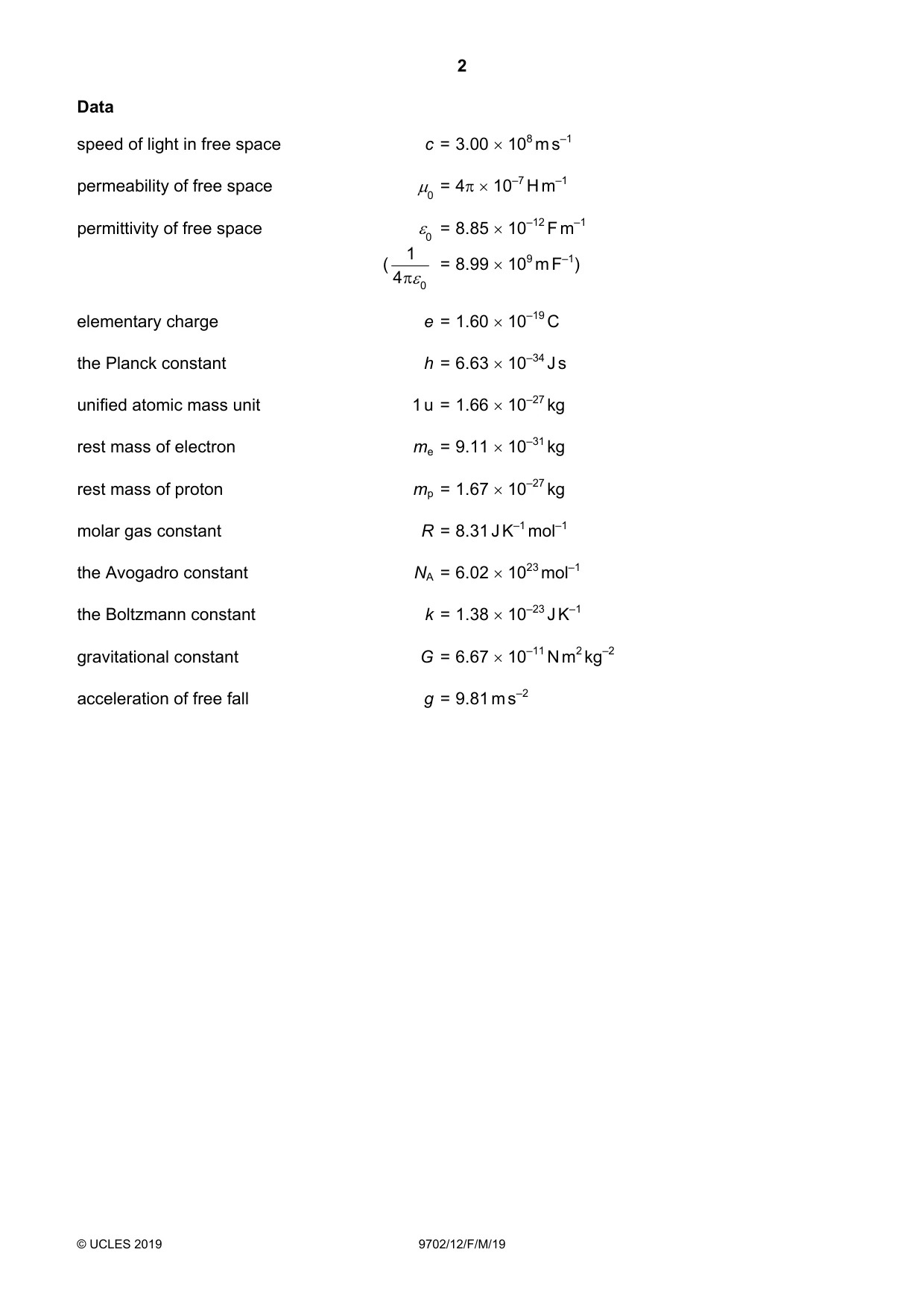
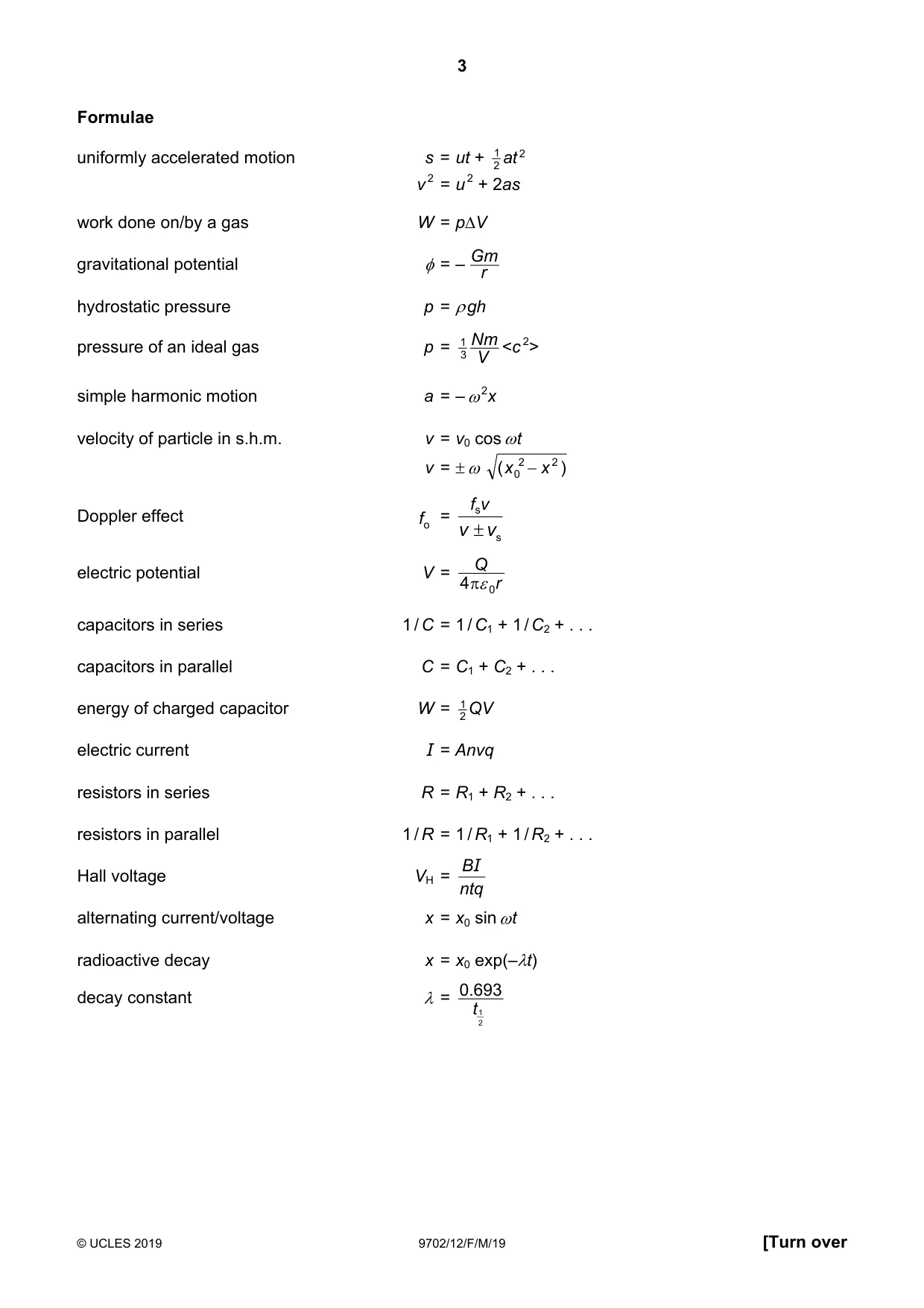
Mark scheme3 pages
Answers below. Sit the paper first if you are practising.
Questions as text
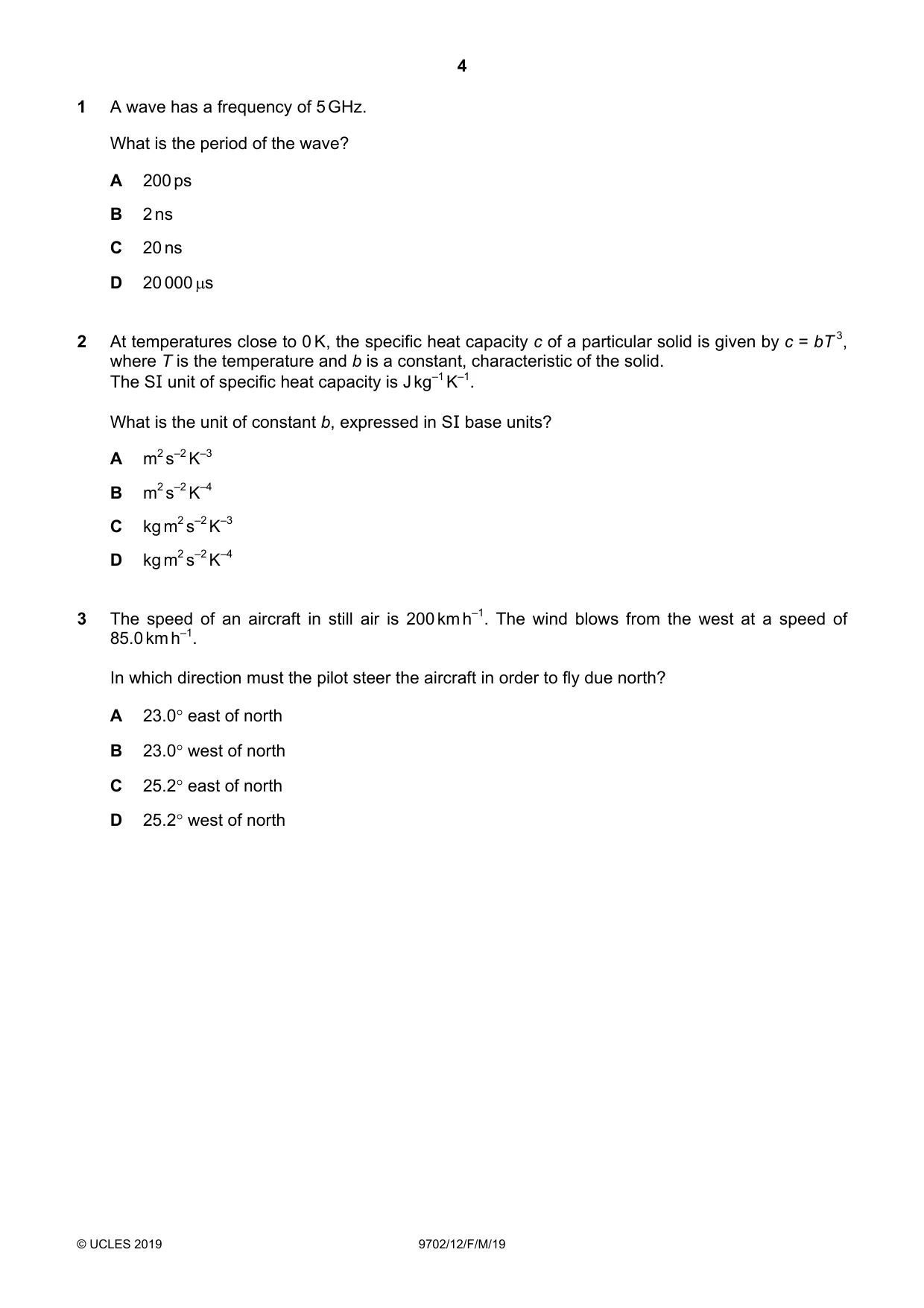
Q1 · A wave has a frequency of 5 GHz
1 A wave has a frequency of 5 GHz. What is the period of the wave? A 200 ps B 2 ns C 20 ns D 20 000 µs
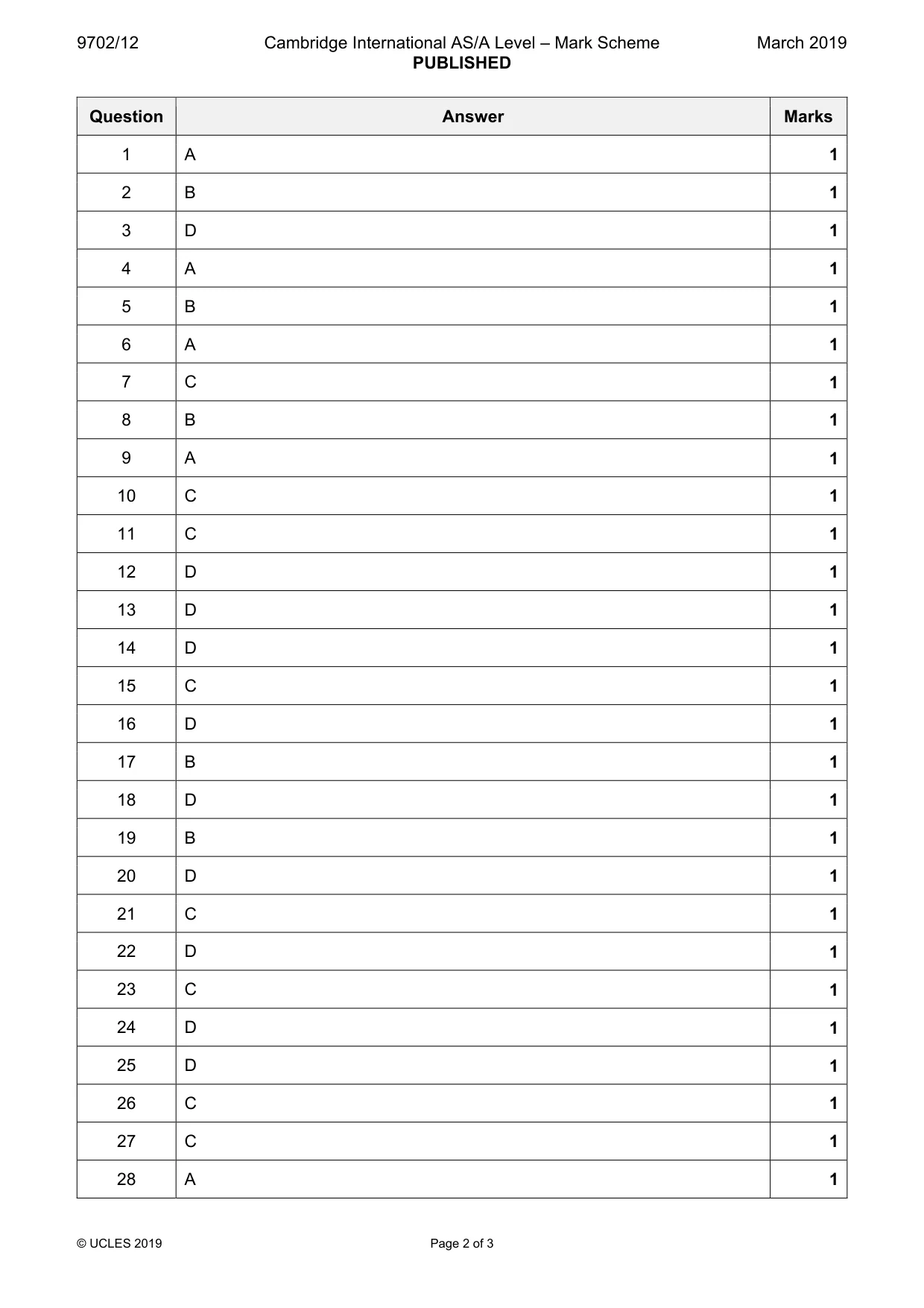
Mark scheme: A
Q2 · At temperatures close to 0 K, the specific heat capacity c of a particular solid is given…
2 At temperatures close to 0 K, the specific heat capacity c of a particular solid is given by c = bT 3, where T is the temperature and b is a constant, characteristic of the solid. The SI unit of specific heat capacity is J kg–1 K–1. What is the unit of constant b, expressed in SI base units? A m2 s–2 K–3 B m2 s–2 K–4 C kg m2 s–2 K–3 D kg m2 s–2 K–4
Mark scheme: B
Q3 · The speed of an aircraft in still air is 200 km h–1
3 The speed of an aircraft in still air is 200 km h–1. The wind blows from the west at a speed of 85.0 km h–1. In which direction must the pilot steer the aircraft in order to fly due north? A 23.0° east of north B 23.0° west of north C 25.2° east of north D 25.2° west of north
Mark scheme: D
Q4 · A digital balance is used to weigh ingredients in a laboratory
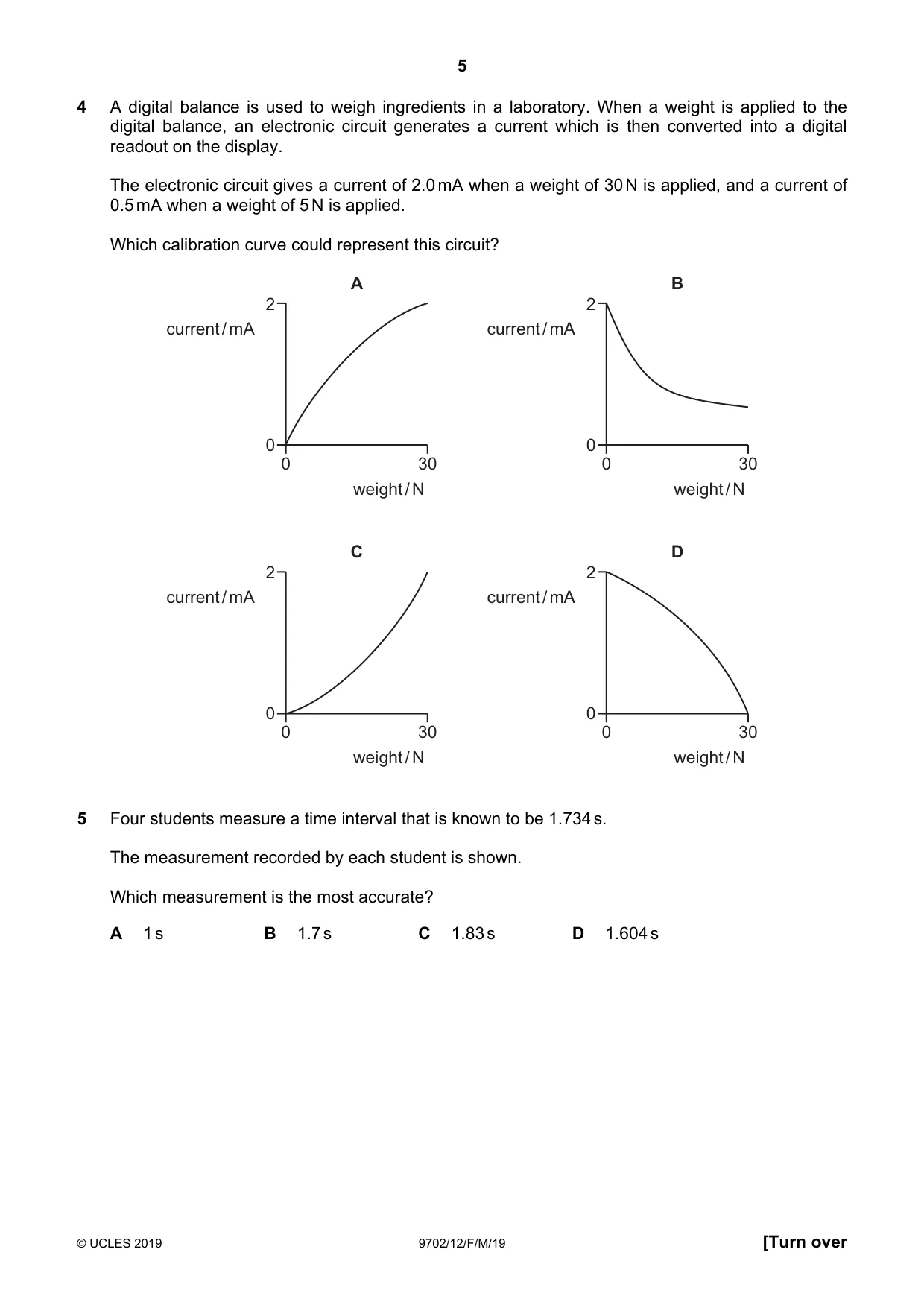
4 A digital balance is used to weigh ingredients in a laboratory. When a weight is applied to the digital balance, an electronic circuit generates a current which is then converted into a digital readout on the display. The electronic circuit gives a current of 2.0 mA when a weight of 30 N is applied, and a current of 0.5 mA when a weight of 5 N is applied. Which calibration curve could represent this circuit? A B 2 2 current / mA current / mA 0 0 0 30 0 30 weight / N weight / N C D 2 2 current / mA current / mA 0 0 0 30 0 30 weight / N weight / N
Mark scheme: A
Q5 · Four students measure a time interval that is known to be 1.734 s
5 Four students measure a time interval that is known to be 1.734 s. The measurement recorded by each student is shown. Which measurement is the most accurate? A 1 s B 1.7 s C 1.83 s D 1.604 s
Mark scheme: B
Q6 · A mass on the end of a spring bounces up and down as shown, after being released at time…
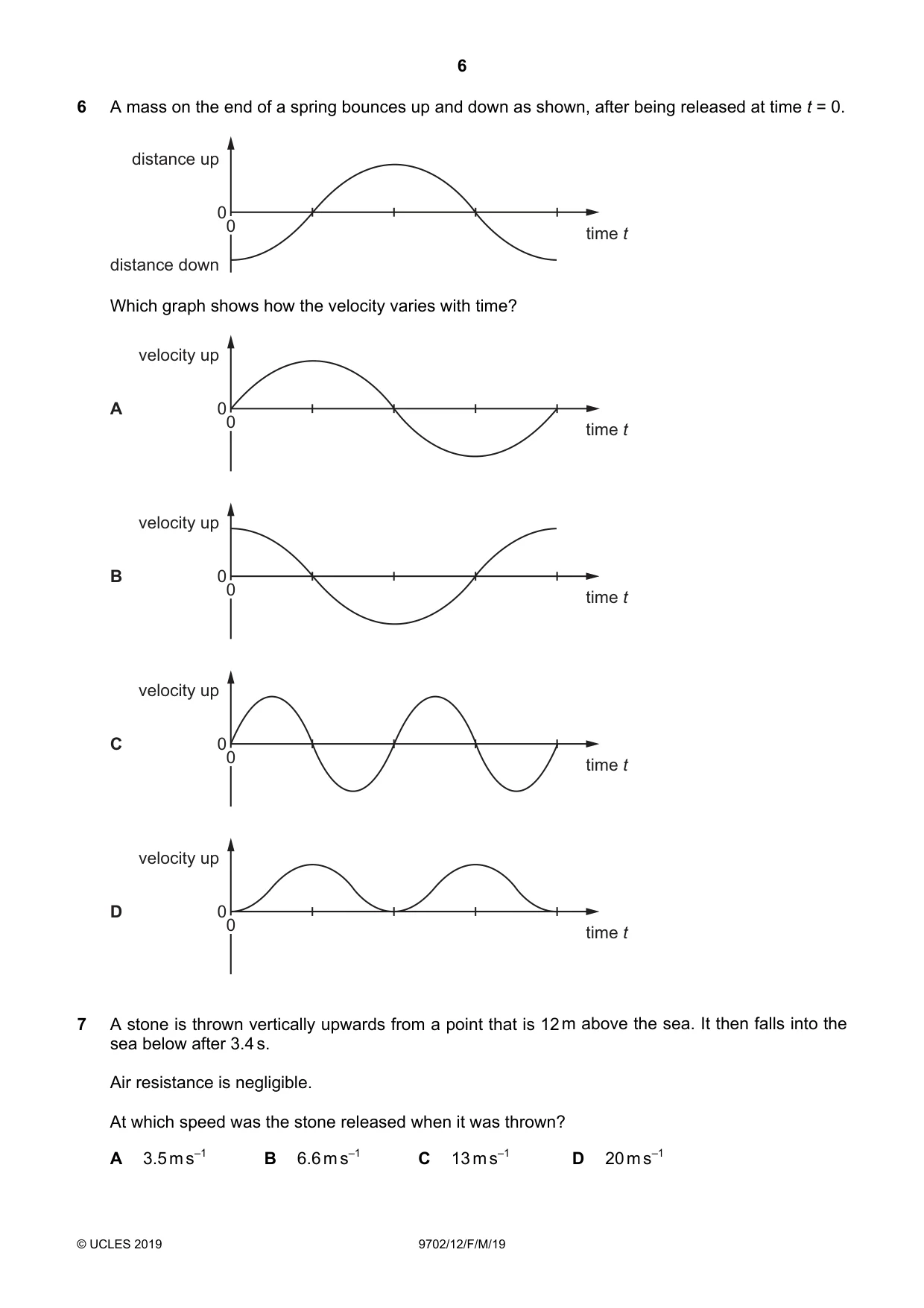
6 A mass on the end of a spring bounces up and down as shown, after being released at time t = 0. distance up 0 0 time t distance down Which graph shows how the velocity varies with time? velocity up A 0 0 time t velocity up B 0 0 time t velocity up C 0 0 time t velocity up D 0 0 time t
Mark scheme: A
Q7 · A stone is thrown vertically upwards from a point that is 12 m above the sea
7 A stone is thrown vertically upwards from a point that is 12 m above the sea. It then falls into the sea below after 3.4 s. Air resistance is negligible. At which speed was the stone released when it was thrown? A 3.5 m s–1 B 6.6 m s–1 C 13 m s–1 D 20 m s–1
Mark scheme: C
Q8 · Two balls X and Y are moving towards each other with speeds of 5 m s–1 and 15 m s–1…
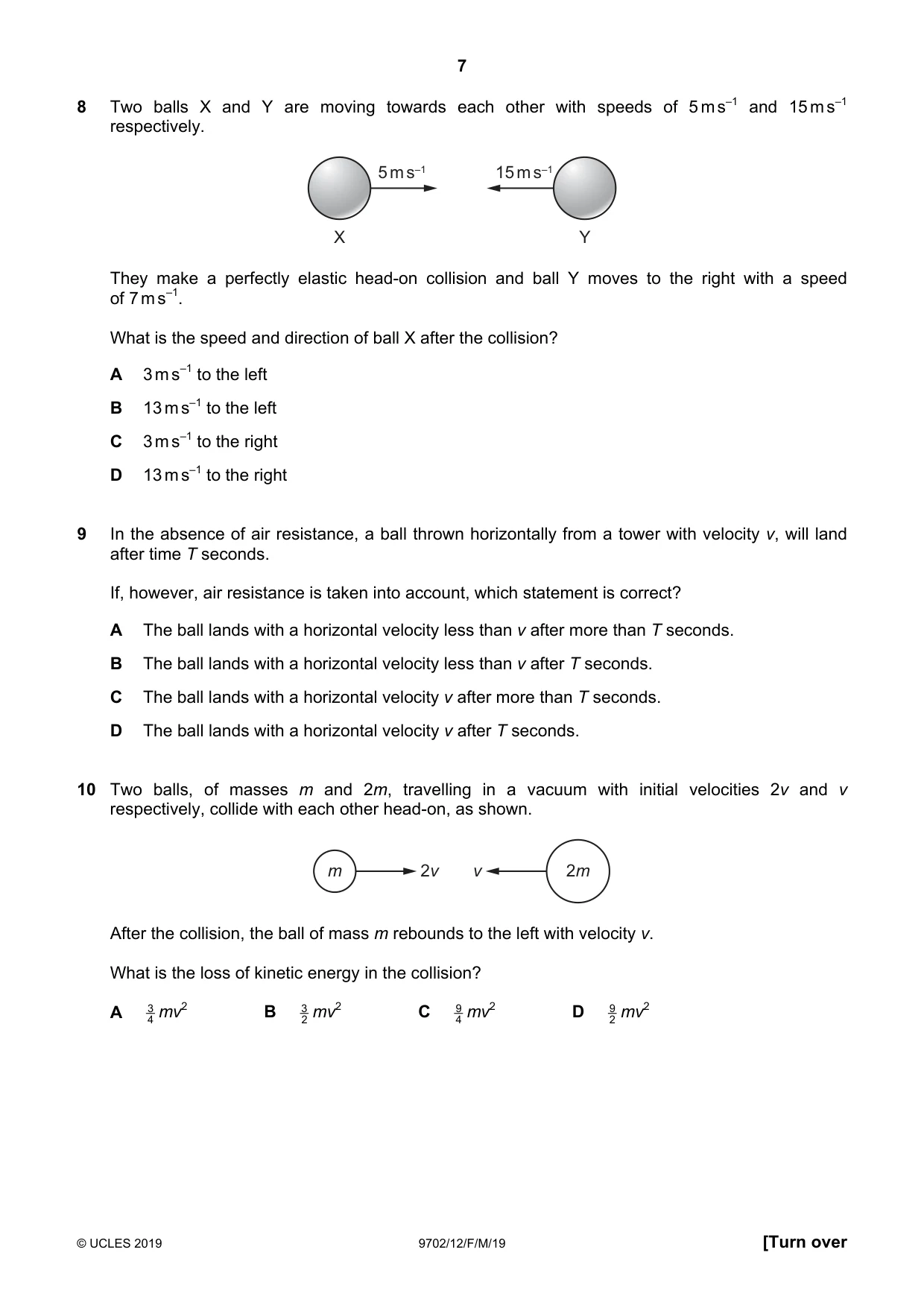
8 Two balls X and Y are moving towards each other with speeds of 5 m s–1 and 15 m s–1 respectively. 5 m s–1 15 m s–1 X Y They make a perfectly elastic head-on collision and ball Y moves to the right with a speed of 7 m s–1. What is the speed and direction of ball X after the collision? A 3 m s–1 to the left B 13 m s–1 to the left C 3 m s–1 to the right D 13 m s–1 to the right
Mark scheme: B
Q9 · In the absence of air resistance, a ball thrown horizontally from a tower with velocity…
9 In the absence of air resistance, a ball thrown horizontally from a tower with velocity v, will land after time T seconds. If, however, air resistance is taken into account, which statement is correct? A The ball lands with a horizontal velocity less than v after more than T seconds. B The ball lands with a horizontal velocity less than v after T seconds. C The ball lands with a horizontal velocity v after more than T seconds. D The ball lands with a horizontal velocity v after T seconds.
Mark scheme: A
Q10 · Two balls, of masses m and 2m, travelling in a vacuum with initial velocities 2v and v…
10 Two balls, of masses m and 2m, travelling in a vacuum with initial velocities 2v and v respectively, collide with each other head-on, as shown. m 2v v 2m After the collision, the ball of mass m rebounds to the left with velocity v. What is the loss of kinetic energy in the collision? A 3 mv2 B 3 mv2 C 9 mv2 D 9 mv2 4 2 4 2
Mark scheme: C
Q11 · A ball falls through a liquid at a constant speed
11 A ball falls through a liquid at a constant speed. It is acted upon by three forces: an upthrust, a drag-force and its weight. Which statement is correct? A The drag-force increases with increasing depth. B The drag-force is equal to the sum of the upthrust and weight. C The upthrust is constant with increasing depth. D The weight is greater than the sum of the drag-force and the upthrust.
Mark scheme: C
Q12 · A fairground ride consists of four carriages connected to a central vertical pole, as…
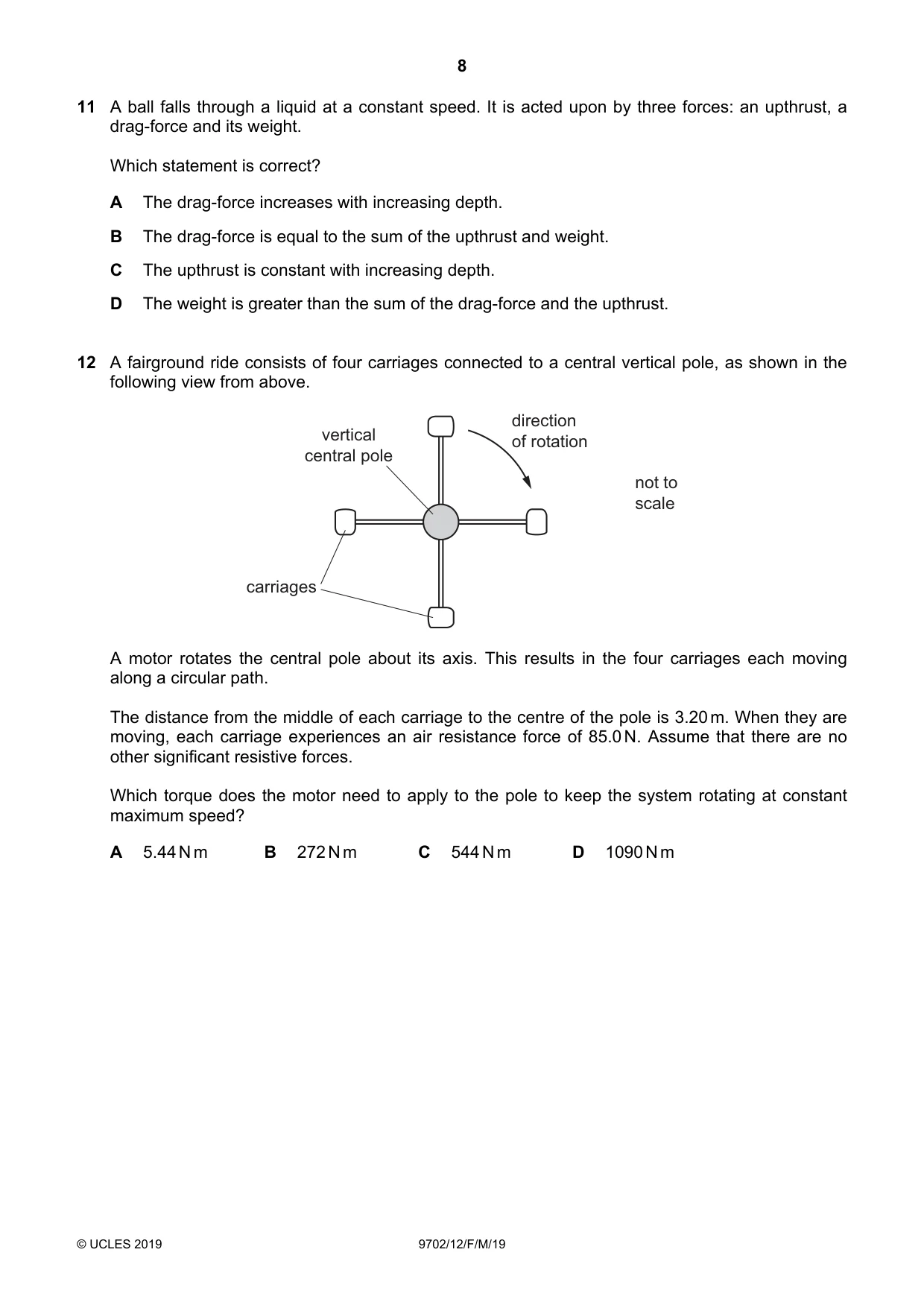
12 A fairground ride consists of four carriages connected to a central vertical pole, as shown in the following view from above. direction vertical of rotation central pole not to scale carriages A motor rotates the central pole about its axis. This results in the four carriages each moving along a circular path. The distance from the middle of each carriage to the centre of the pole is 3.20 m. When they are moving, each carriage experiences an air resistance force of 85.0 N. Assume that there are no other significant resistive forces. Which torque does the motor need to apply to the pole to keep the system rotating at constant maximum speed? A 5.44 N m B 272 N m C 544 N m D 1090 N m
Mark scheme: D
Q13 · A uniform horizontal beam OX, 4.0 m long and weighing 100 N, is hinged at a wall at point…
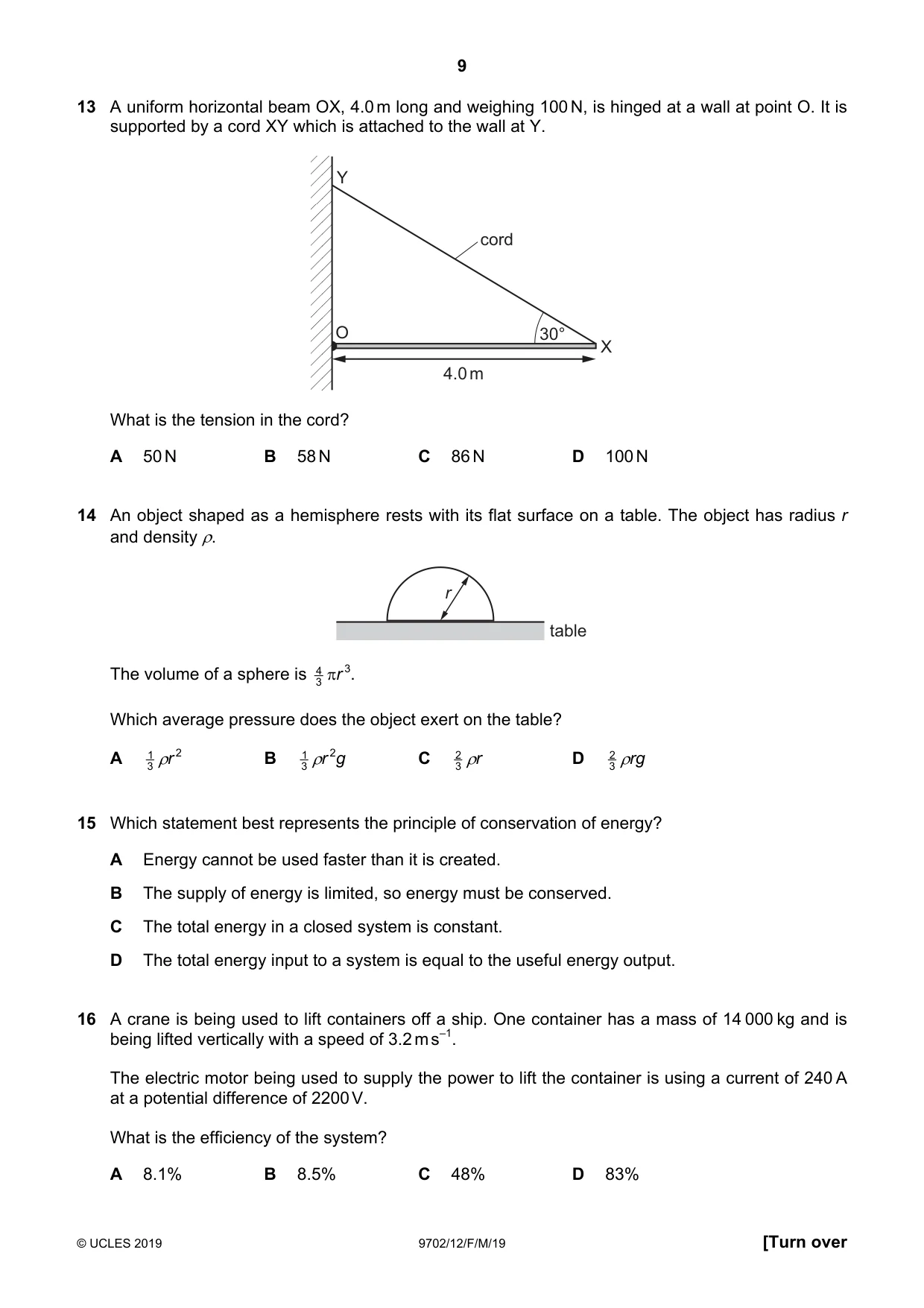
13 A uniform horizontal beam OX, 4.0 m long and weighing 100 N, is hinged at a wall at point O. It is supported by a cord XY which is attached to the wall at Y. Y cord O 30° X 4.0 m What is the tension in the cord? A 50 N B 58 N C 86 N D 100 N
Mark scheme: D
Q14 · An object shaped as a hemisphere rests with its flat surface on a table
14 An object shaped as a hemisphere rests with its flat surface on a table. The object has radius r and density ρ. r table The volume of a sphere is 3 4 πr 3. Which average pressure does the object exert on the table? A 1 ρr 2 B 1 ρr 2g C 2 ρr D 2 ρrg 3 3 3 3
Mark scheme: D
Q15 · Which statement best represents the principle of conservation of energy?
15 Which statement best represents the principle of conservation of energy? A Energy cannot be used faster than it is created. B The supply of energy is limited, so energy must be conserved. C The total energy in a closed system is constant. D The total energy input to a system is equal to the useful energy output.
Mark scheme: C
Q16 · A crane is being used to lift containers off a ship
16 A crane is being used to lift containers off a ship. One container has a mass of 14 000 kg and is being lifted vertically with a speed of 3.2 m s–1. The electric motor being used to supply the power to lift the container is using a current of 240 A at a potential difference of 2200 V. What is the efficiency of the system? A 8.1% B 8.5% C 48% D 83%
Mark scheme: D
Q17 · The data below are taken from a test of a petrol engine for a motor car
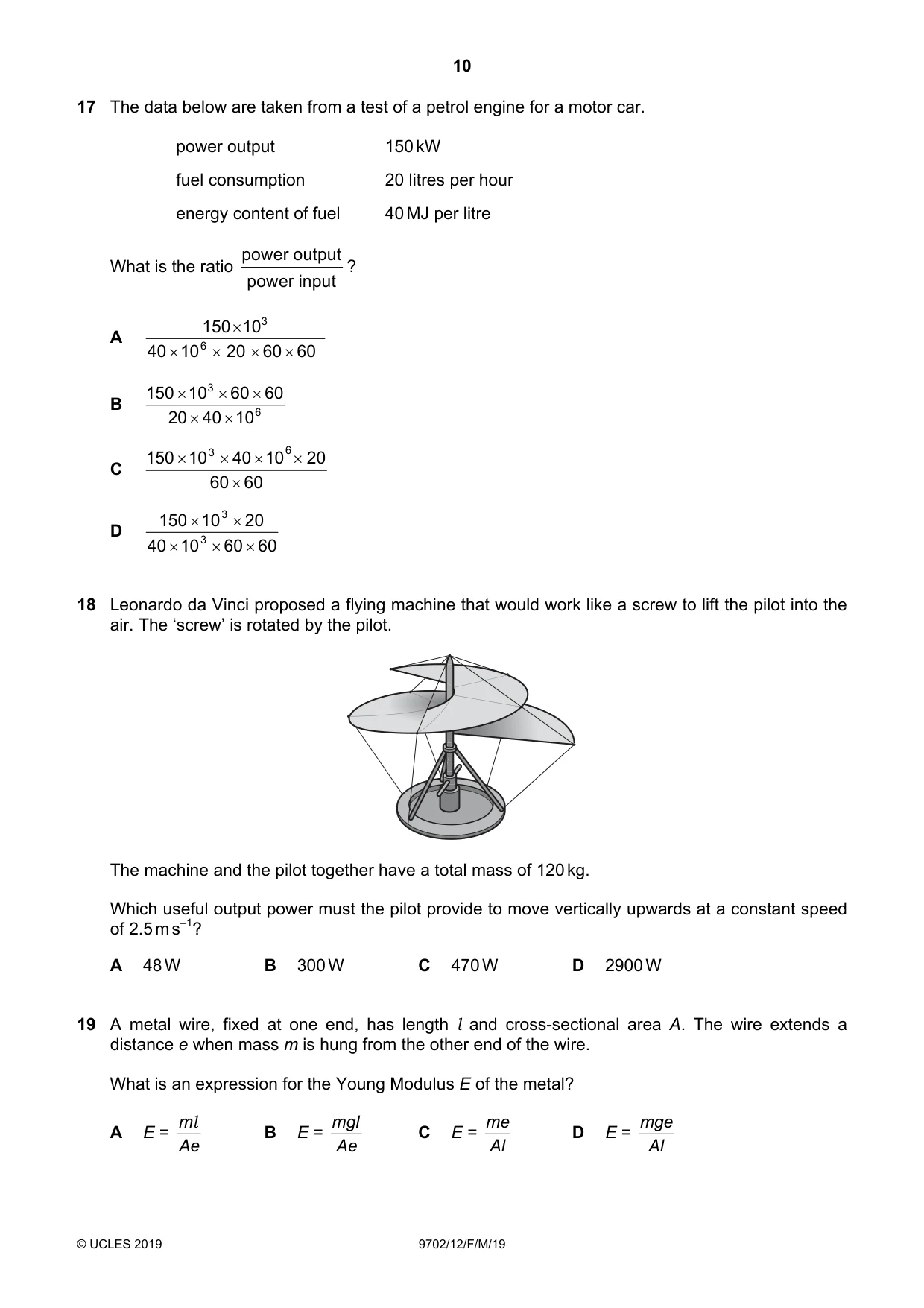
17 The data below are taken from a test of a petrol engine for a motor car. power output 150 kW fuel consumption 20 litres per hour energy content of fuel 40 MJ per litre What is the ratio power output ? power input 150 × 10 3 A 40 × 10 6 × 20 × 60 × 60 150 × 10 3 × 60 × 60 B 20 × 40 × 10 6 150 × 10 3 × 40 × 10 6 × 20 C 60 × 60 150 × 10 3 × 20 D 40 × 10 3 × 60 × 60
Mark scheme: B
Q18 · Leonardo da Vinci proposed a flying machine that would work like a screw to lift the…
18 Leonardo da Vinci proposed a flying machine that would work like a screw to lift the pilot into the air. The ‘screw’ is rotated by the pilot. The machine and the pilot together have a total mass of 120 kg. Which useful output power must the pilot provide to move vertically upwards at a constant speed of 2.5 m s–1? A 48 W B 300 W C 470 W D 2900 W
Mark scheme: D
Q19 · A metal wire, fixed at one end, has length l and cross-sectional area A
19 A metal wire, fixed at one end, has length l and cross-sectional area A. The wire extends a distance e when mass m is hung from the other end of the wire. What is an expression for the Young Modulus E of the metal? ml E = mgl E = me E = mge A E = Ae B Ae C Al D Al
Mark scheme: B
Q20 · A spring has a spring constant of 6.0 N cm –1
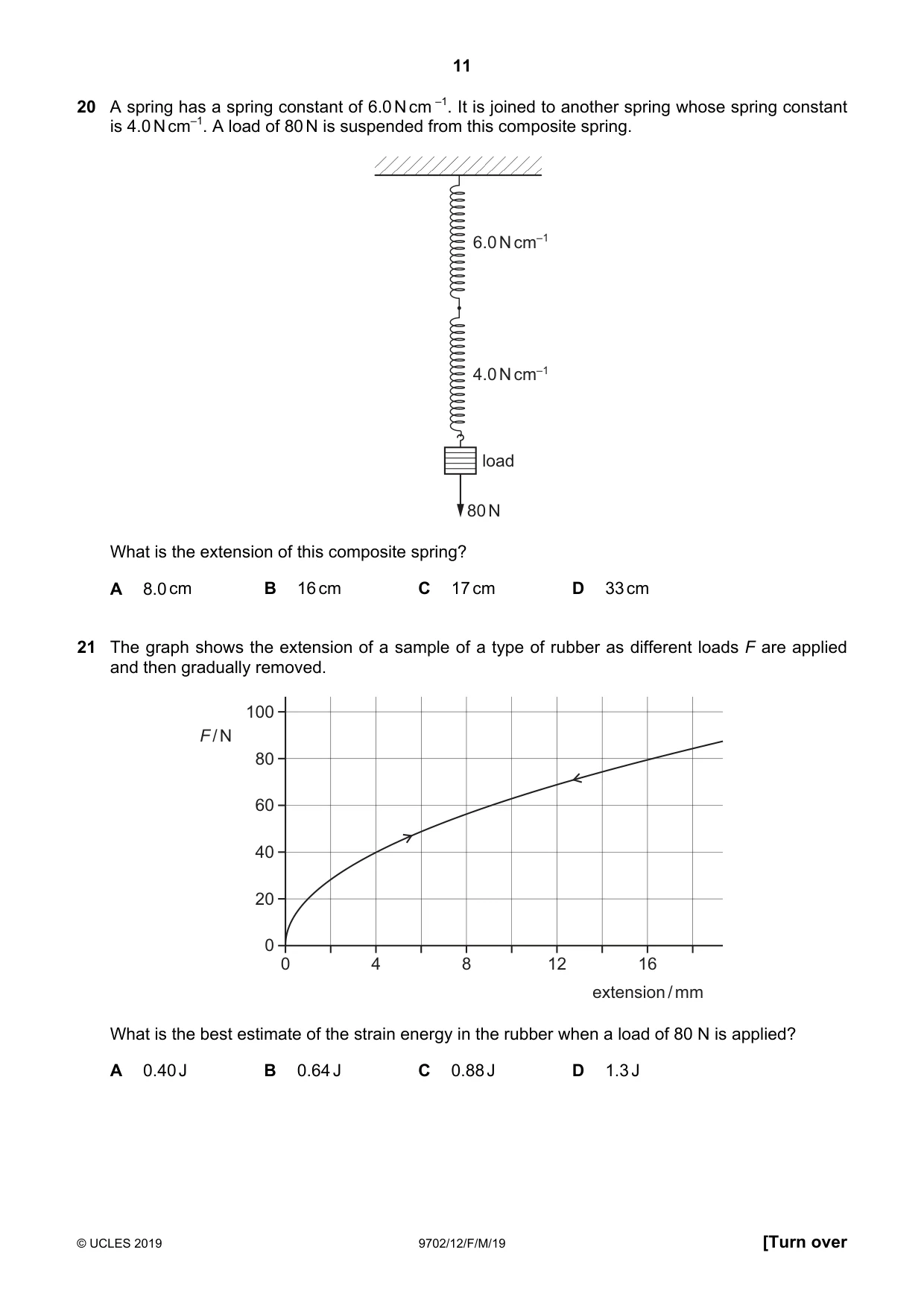
20 A spring has a spring constant of 6.0 N cm –1. It is joined to another spring whose spring constant is 4.0 N cm–1. A load of 80 N is suspended from this composite spring. 6.0 N cm–1 4.0 N cm–1 load 80 N What is the extension of this composite spring? A 8.0 cm B 16 cm C 17 cm D 33 cm
Mark scheme: D
Q21 · The graph shows the extension of a sample of a type of rubber as different loads F are…
21 The graph shows the extension of a sample of a type of rubber as different loads F are applied and then gradually removed. 100 F / N 80 60 40 20 0 0 4 8 12 16 extension / mm What is the best estimate of the strain energy in the rubber when a load of 80 N is applied? A 0.40 J B 0.64 J C 0.88 J D 1.3 J
Mark scheme: C
Q22 · A sound wave passes through air
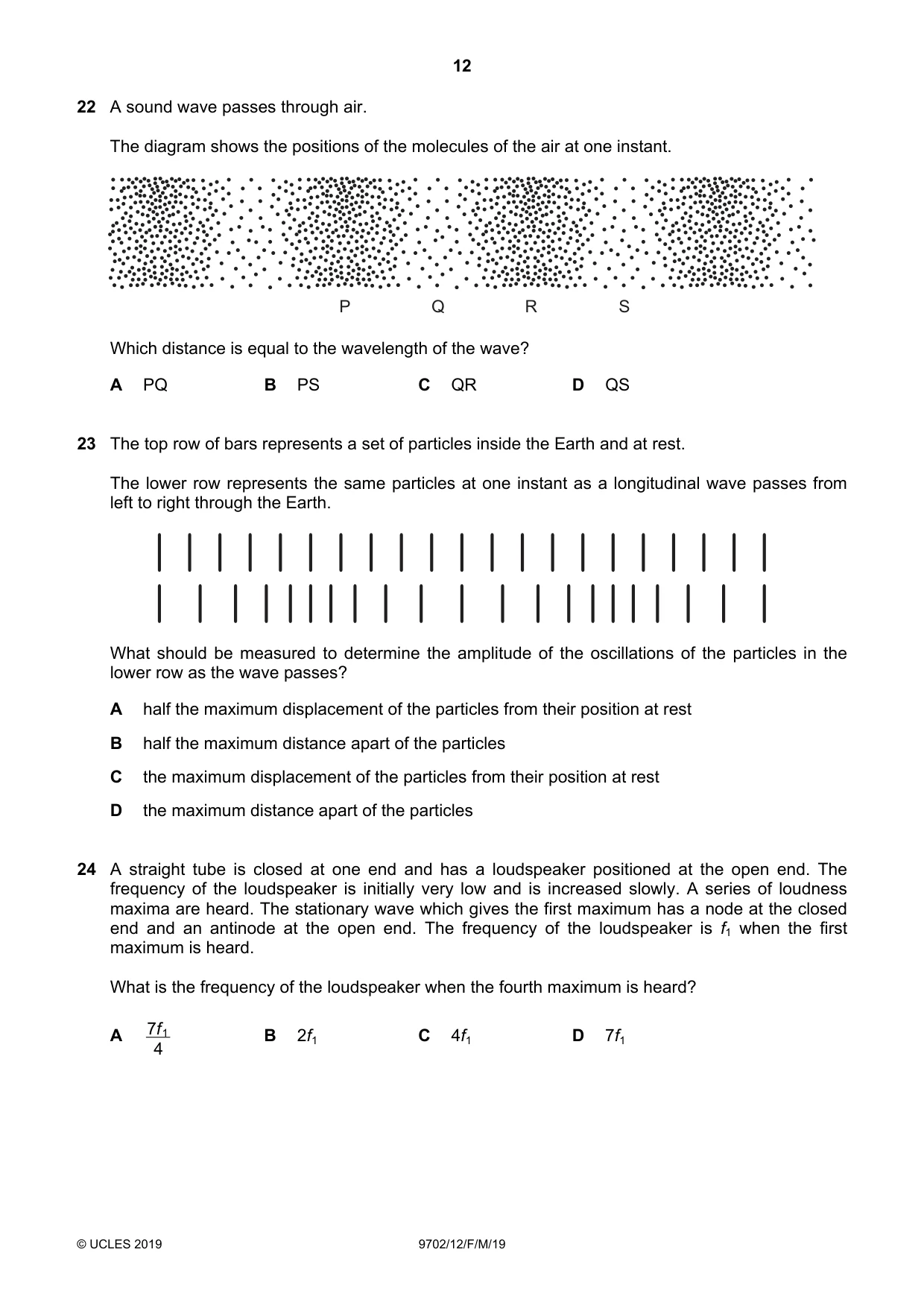
22 A sound wave passes through air. The diagram shows the positions of the molecules of the air at one instant. P Q R S Which distance is equal to the wavelength of the wave? A PQ B PS C QR D QS
Mark scheme: D
Q23 · The top row of bars represents a set of particles inside the Earth and at rest
23 The top row of bars represents a set of particles inside the Earth and at rest. The lower row represents the same particles at one instant as a longitudinal wave passes from left to right through the Earth. What should be measured to determine the amplitude of the oscillations of the particles in the lower row as the wave passes? A half the maximum displacement of the particles from their position at rest B half the maximum distance apart of the particles C the maximum displacement of the particles from their position at rest D the maximum distance apart of the particles
Mark scheme: C
Q24 · A straight tube is closed at one end and has a loudspeaker positioned at the open end
24 A straight tube is closed at one end and has a loudspeaker positioned at the open end. The frequency of the loudspeaker is initially very low and is increased slowly. A series of loudness maxima are heard. The stationary wave which gives the first maximum has a node at the closed end and an antinode at the open end. The frequency of the loudspeaker is f1 when the first maximum is heard. What is the frequency of the loudspeaker when the fourth maximum is heard? A 7 1 f B 2f1 C 4f1 D 7f1 4
Mark scheme: D
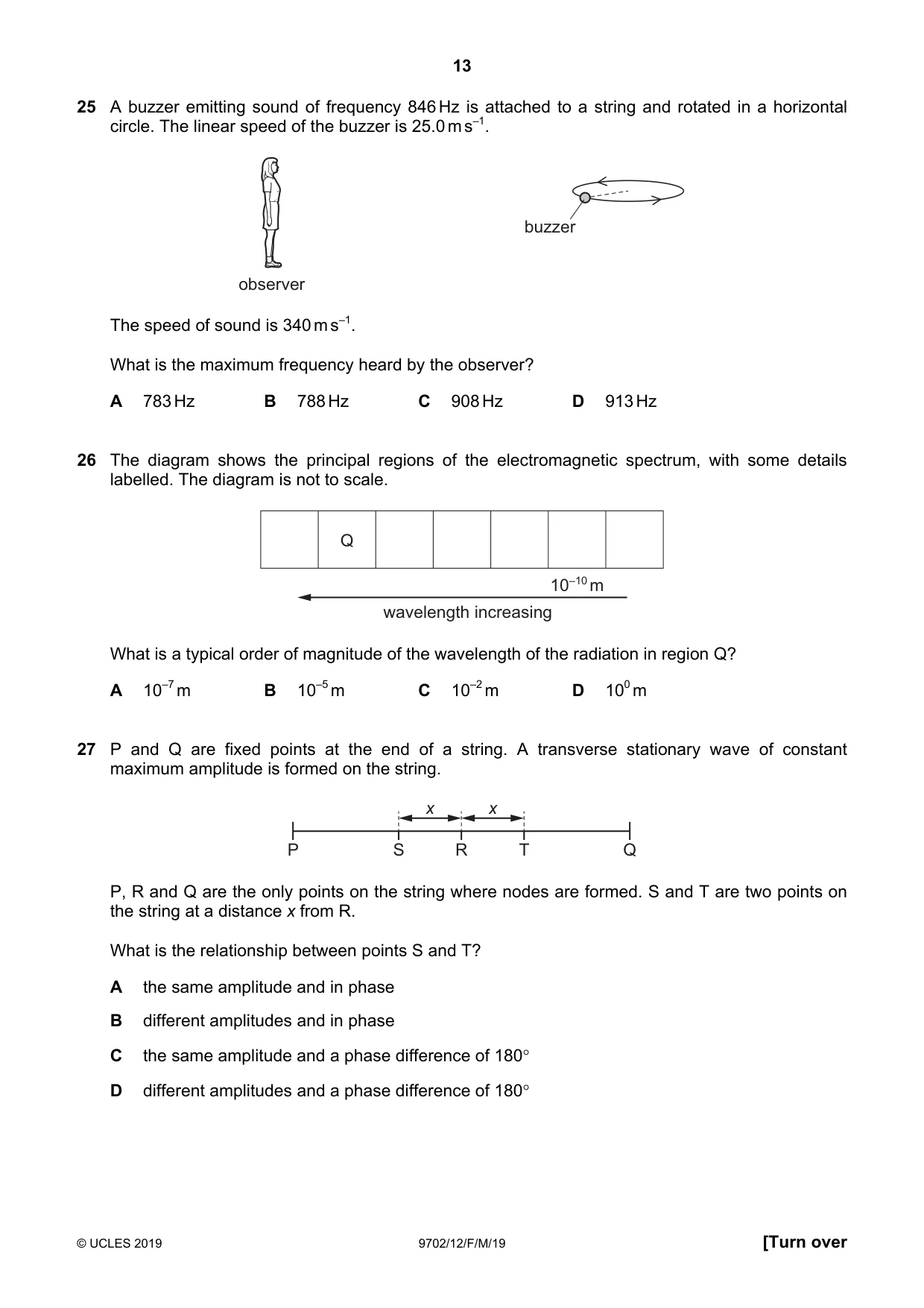
Q25 · A buzzer emitting sound of frequency 846 Hz is attached to a string and rotated in a…
25 A buzzer emitting sound of frequency 846 Hz is attached to a string and rotated in a horizontal circle. The linear speed of the buzzer is 25.0 m s–1. buzzer observer The speed of sound is 340 m s–1. What is the maximum frequency heard by the observer? A 783 Hz B 788 Hz C 908 Hz D 913 Hz
Mark scheme: D
Q26 · The diagram shows the principal regions of the electromagnetic spectrum, with some…
26 The diagram shows the principal regions of the electromagnetic spectrum, with some details labelled. The diagram is not to scale. Q 10–10 m wavelength increasing What is a typical order of magnitude of the wavelength of the radiation in region Q? A 10–7 m B 10–5 m C 10–2 m D 100 m
Mark scheme: C
Q27 · P and Q are fixed points at the end of a string
27 P and Q are fixed points at the end of a string. A transverse stationary wave of constant maximum amplitude is formed on the string. x x P S R T Q P, R and Q are the only points on the string where nodes are formed. S and T are two points on the string at a distance x from R. What is the relationship between points S and T? A the same amplitude and in phase B different amplitudes and in phase C the same amplitude and a phase difference of 180° D different amplitudes and a phase difference of 180°
Mark scheme: C
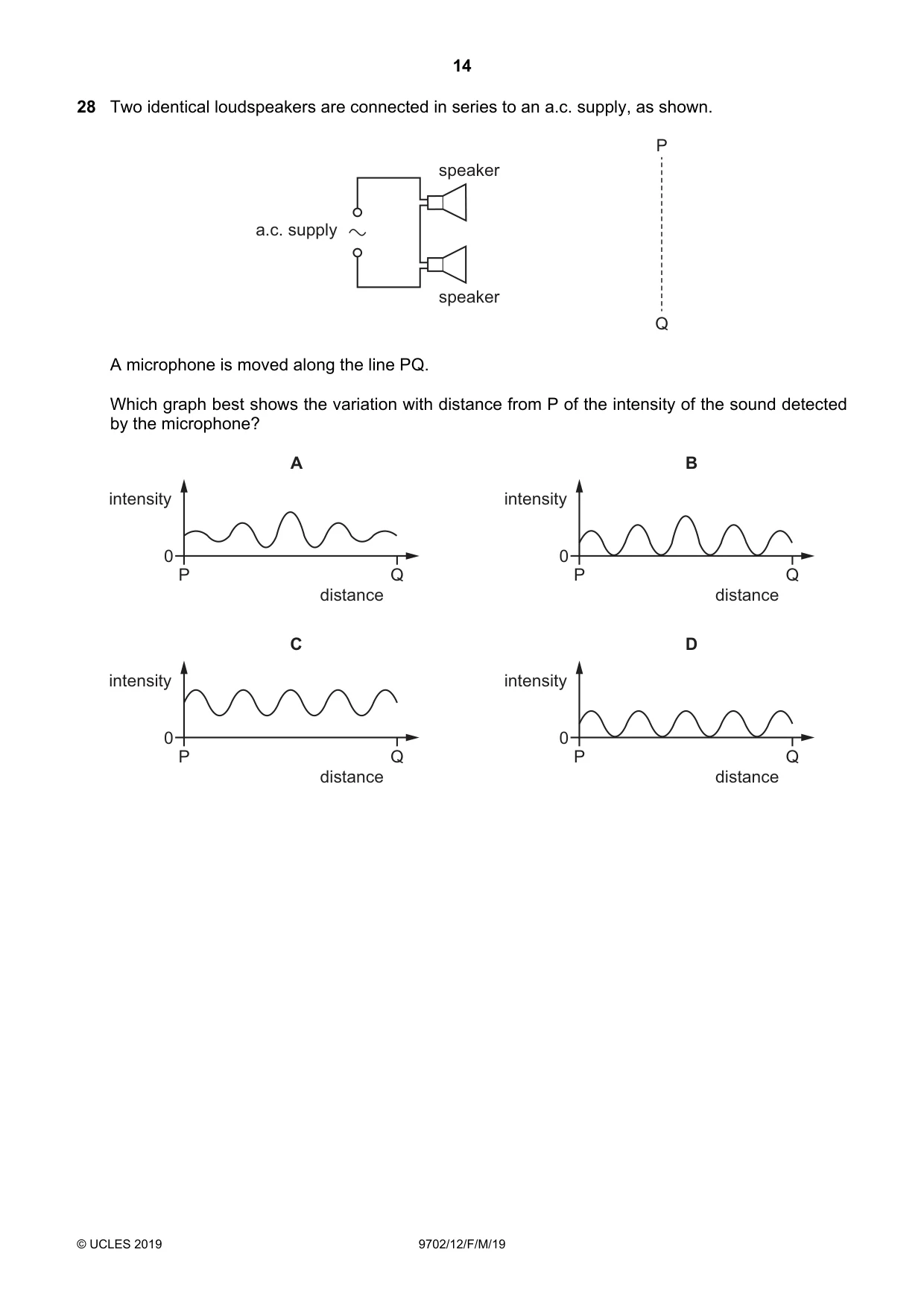
Q28 · Two identical loudspeakers are connected in series to an a.c
28 Two identical loudspeakers are connected in series to an a.c. supply, as shown. P speaker a.c. supply speaker Q A microphone is moved along the line PQ. Which graph best shows the variation with distance from P of the intensity of the sound detected by the microphone? A B intensity intensity 0 0 P Q P Q distance distance C D intensity intensity 0 0 P Q P Q distance distance
Mark scheme: A
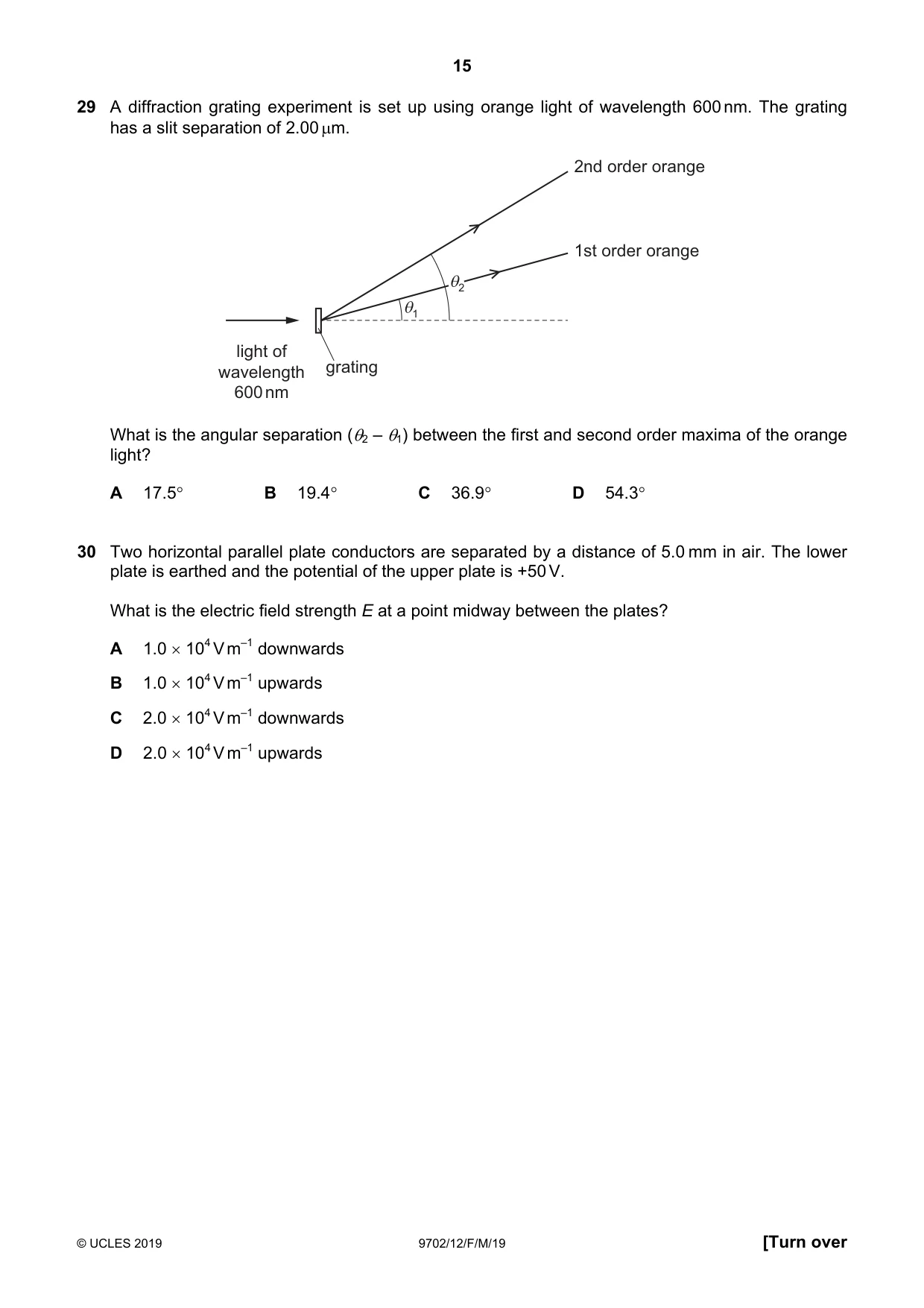
Q29 · A diffraction grating experiment is set up using orange light of wavelength 600 nm
29 A diffraction grating experiment is set up using orange light of wavelength 600 nm. The grating has a slit separation of 2.00 µm. 2nd order orange 1st order orange θ2 θ1 light of wavelength grating 600 nm What is the angular separation (θ2 – θ1) between the first and second order maxima of the orange light? A 17.5° B 19.4° C 36.9° D 54.3°
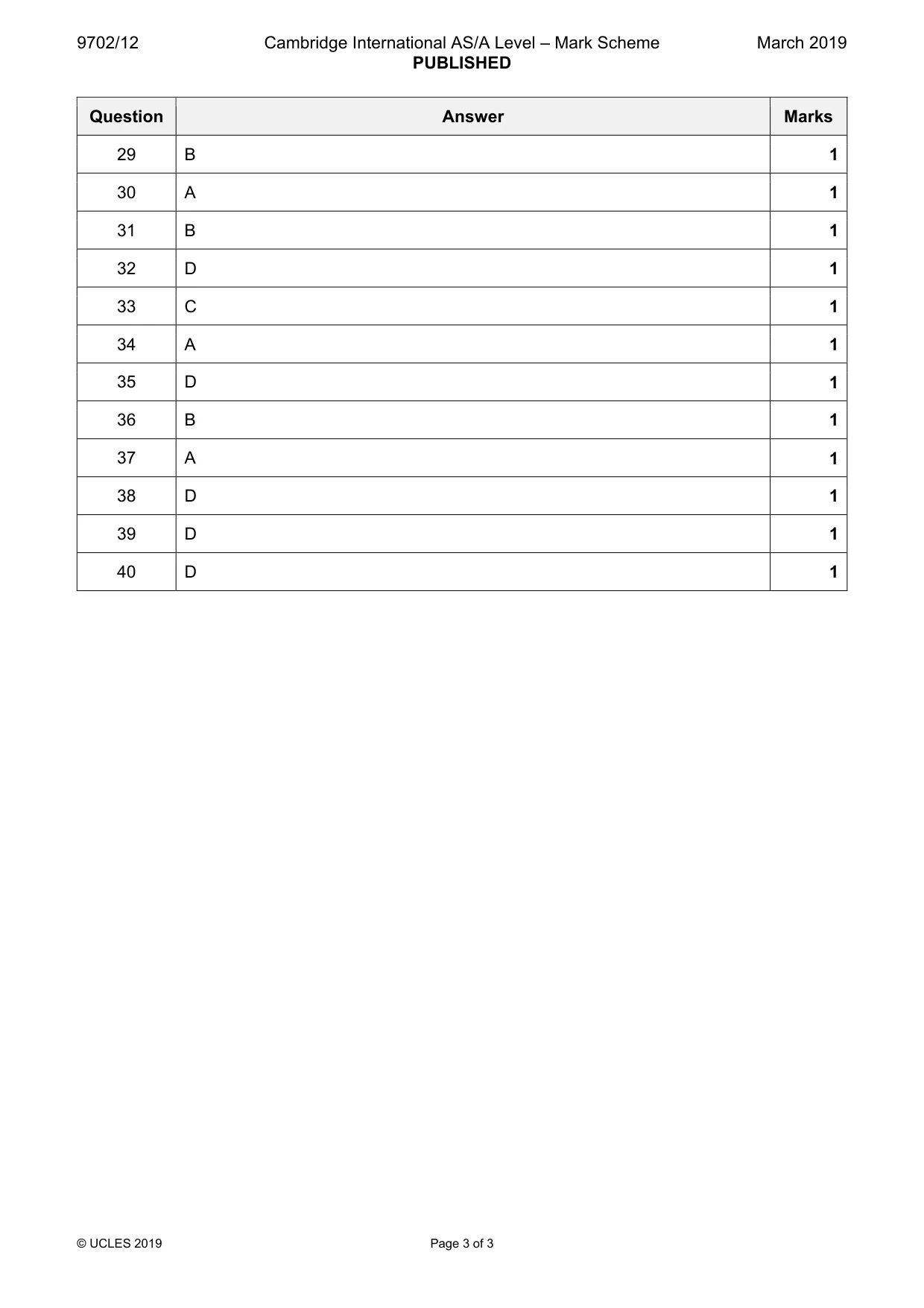
Mark scheme: B
Q30 · Two horizontal parallel plate conductors are separated by a distance of 5.0 mm in air
30 Two horizontal parallel plate conductors are separated by a distance of 5.0 mm in air. The lower plate is earthed and the potential of the upper plate is +50 V. What is the electric field strength E at a point midway between the plates? A 1.0 × 10⁴ V m–1 downwards B 1.0 × 10⁴ V m–1 upwards C 2.0 × 10⁴ V m–1 downwards D 2.0 × 10⁴ V m–1 upwards
Mark scheme: A
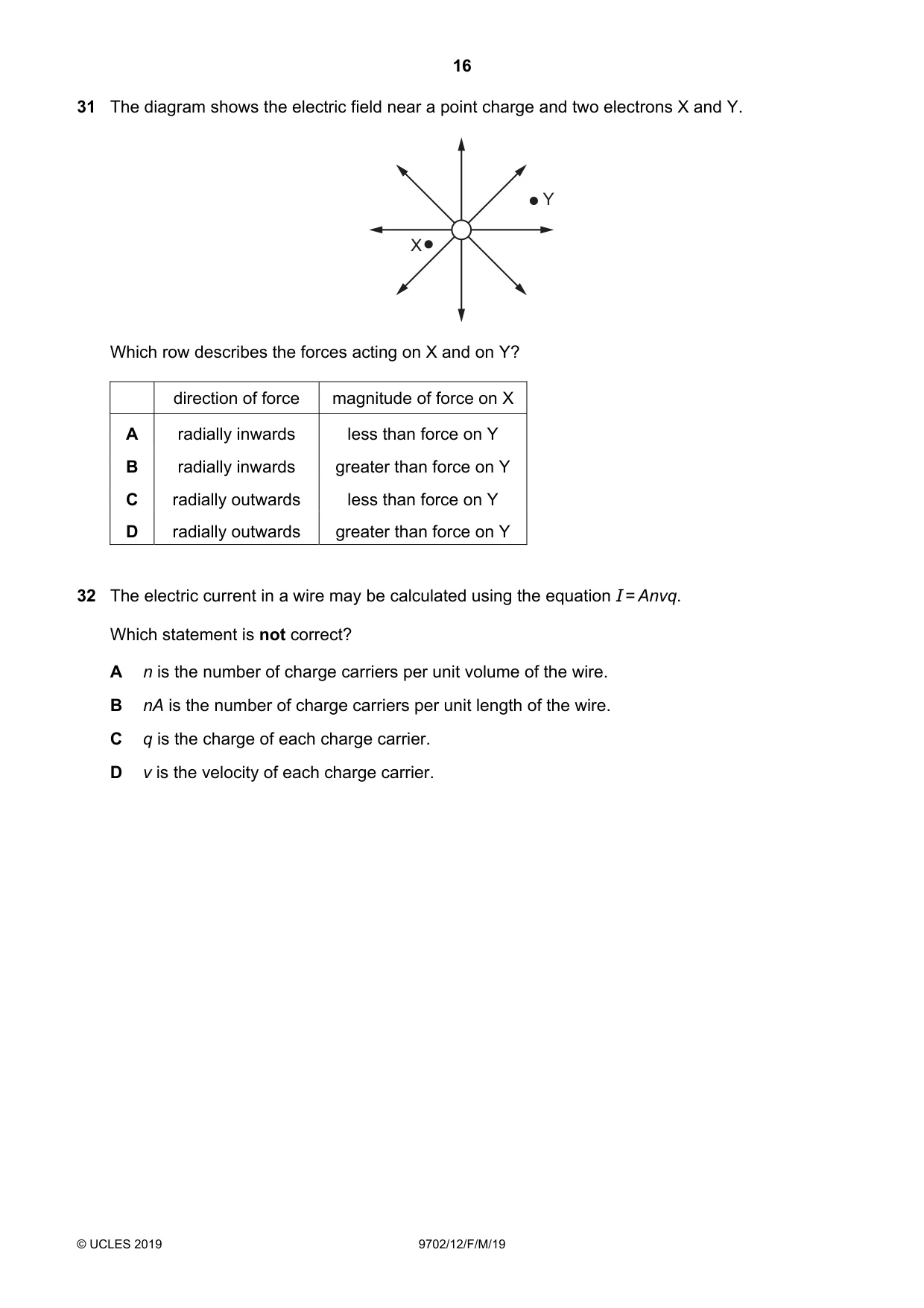
Q31 · The diagram shows the electric field near a point charge and two electrons X and Y
31 The diagram shows the electric field near a point charge and two electrons X and Y. Y X Which row describes the forces acting on X and on Y? direction of force magnitude of force on X A radially inwards less than force on Y B radially inwards greater than force on Y C radially outwards less than force on Y D radially outwards greater than force on Y
Mark scheme: B
Q32 · The electric current in a wire may be calculated using the equation I = Anvq
32 The electric current in a wire may be calculated using the equation I = Anvq. Which statement is not correct? A n is the number of charge carriers per unit volume of the wire. B nA is the number of charge carriers per unit length of the wire. C q is the charge of each charge carrier. D v is the velocity of each charge carrier.
Mark scheme: D
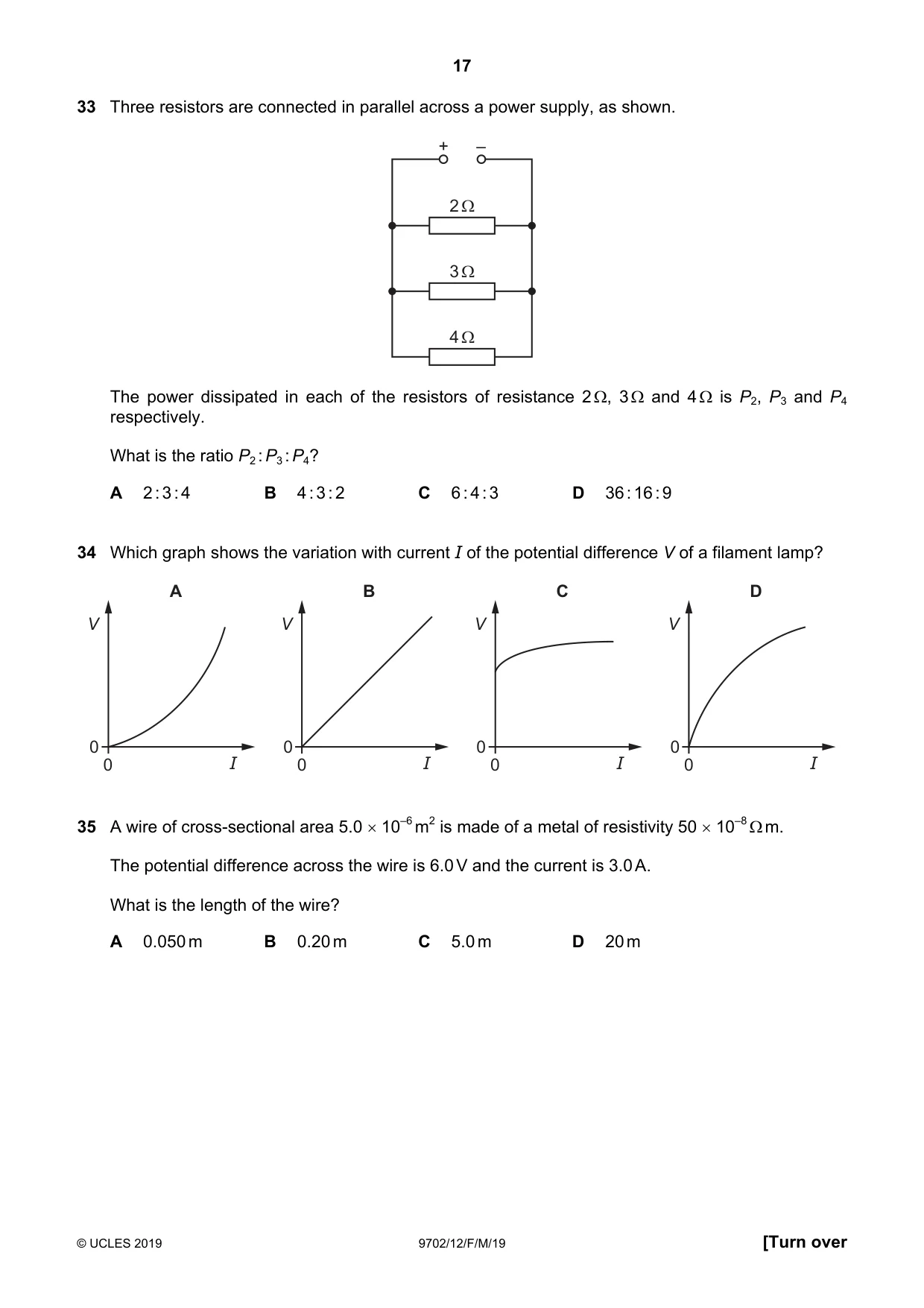
Q33 · Three resistors are connected in parallel across a power supply, as shown
33 Three resistors are connected in parallel across a power supply, as shown. + – 2 Ω 3 Ω 4 Ω The power dissipated in each of the resistors of resistance 2 Ω, 3 Ω and 4 Ω is P2, P3 and P4 respectively. What is the ratio P2 : P3 : P4? A 2 : 3 : 4 B 4 : 3 : 2 C 6 : 4 : 3 D 36 : 16 : 9
Mark scheme: C
Q34 · Which graph shows the variation with current I of the potential difference V of a…
34 Which graph shows the variation with current I of the potential difference V of a filament lamp? A B C D V V V V 0 0 0 0 0 I 0 I 0 I 0 I
Mark scheme: A
Q35 · A wire of cross-sectional area 5.0 × 10⁻⁶ m2 is made of a metal of resistivity 50 × 10–8…
35 A wire of cross-sectional area 5.0 × 10⁻⁶ m2 is made of a metal of resistivity 50 × 10–8 Ω m. The potential difference across the wire is 6.0 V and the current is 3.0 A. What is the length of the wire? A 0.050 m B 0.20 m C 5.0 m D 20 m
Mark scheme: D
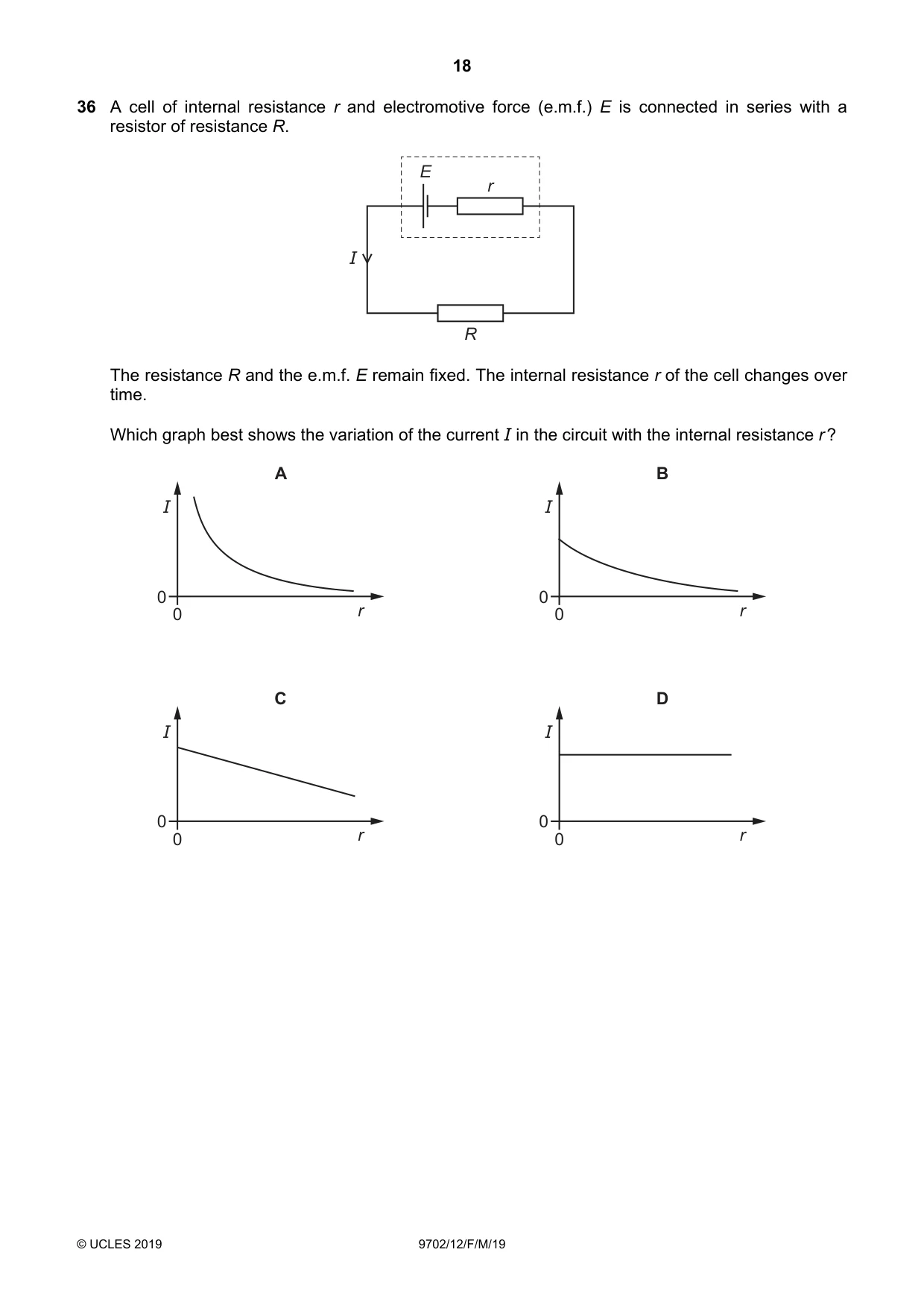
Q36 · A cell of internal resistance r and electromotive force (e.m.f.) E is connected in series…
36 A cell of internal resistance r and electromotive force (e.m.f.) E is connected in series with a resistor of resistance R. E r I R The resistance R and the e.m.f. E remain fixed. The internal resistance r of the cell changes over time. Which graph best shows the variation of the current I in the circuit with the internal resistance r ? A B I I 0 0 0 r 0 r C D I I 0 0 0 r 0 r
Mark scheme: B
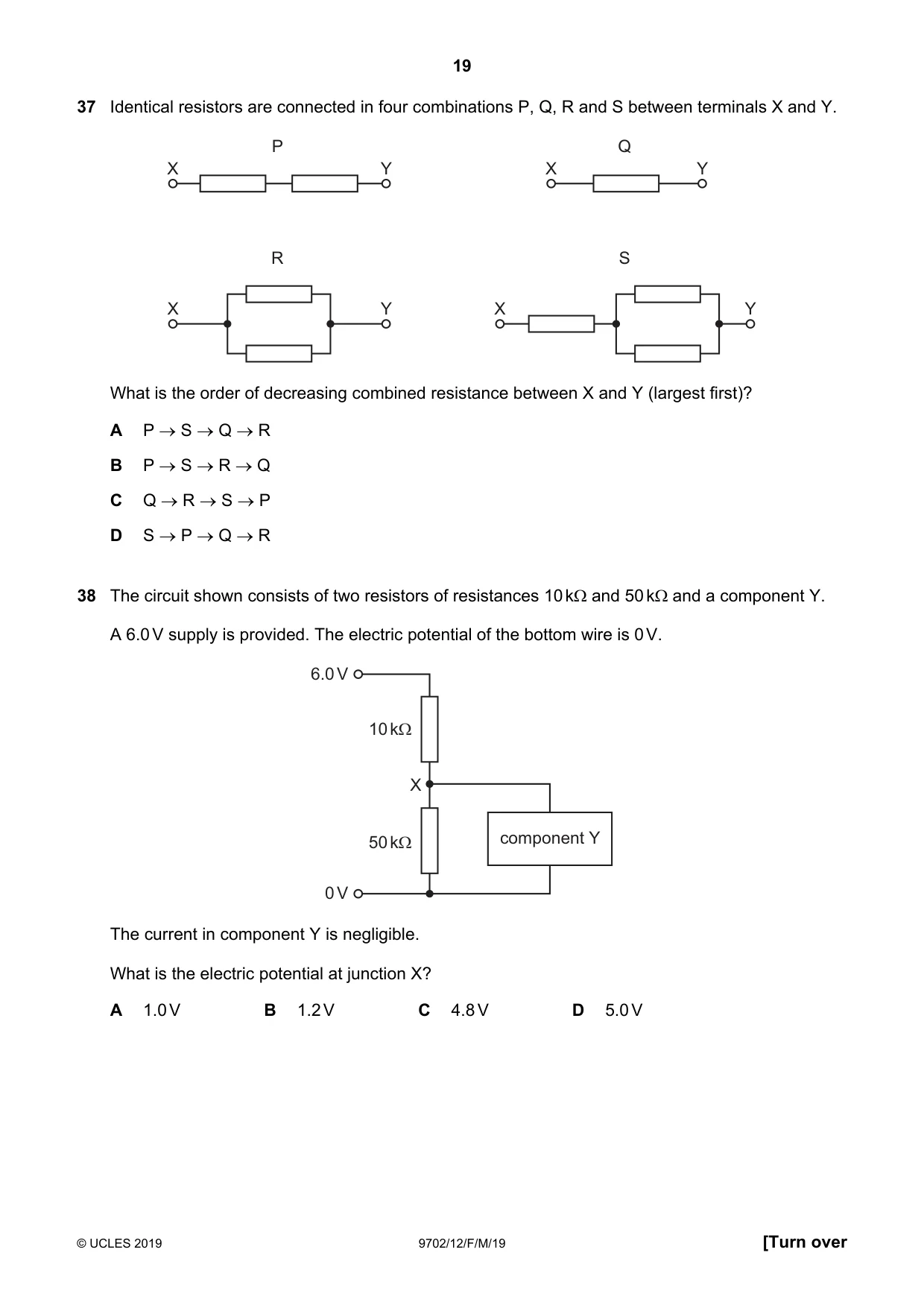
Q37 · Identical resistors are connected in four combinations P, Q, R and S between terminals X…
37 Identical resistors are connected in four combinations P, Q, R and S between terminals X and Y. P Q X Y X Y R S X Y X Y What is the order of decreasing combined resistance between X and Y (largest first)? A P → S → Q → R B P → S → R → Q C Q → R → S → P D S → P → Q → R
Mark scheme: A
Q38 · The circuit shown consists of two resistors of resistances 10 kΩ and 50 kΩ and a…
38 The circuit shown consists of two resistors of resistances 10 kΩ and 50 kΩ and a component Y. A 6.0 V supply is provided. The electric potential of the bottom wire is 0 V. 6.0 V 10 kΩ X 50 kΩ component Y 0 V The current in component Y is negligible. What is the electric potential at junction X? A 1.0 V B 1.2 V C 4.8 V D 5.0 V
Mark scheme: D
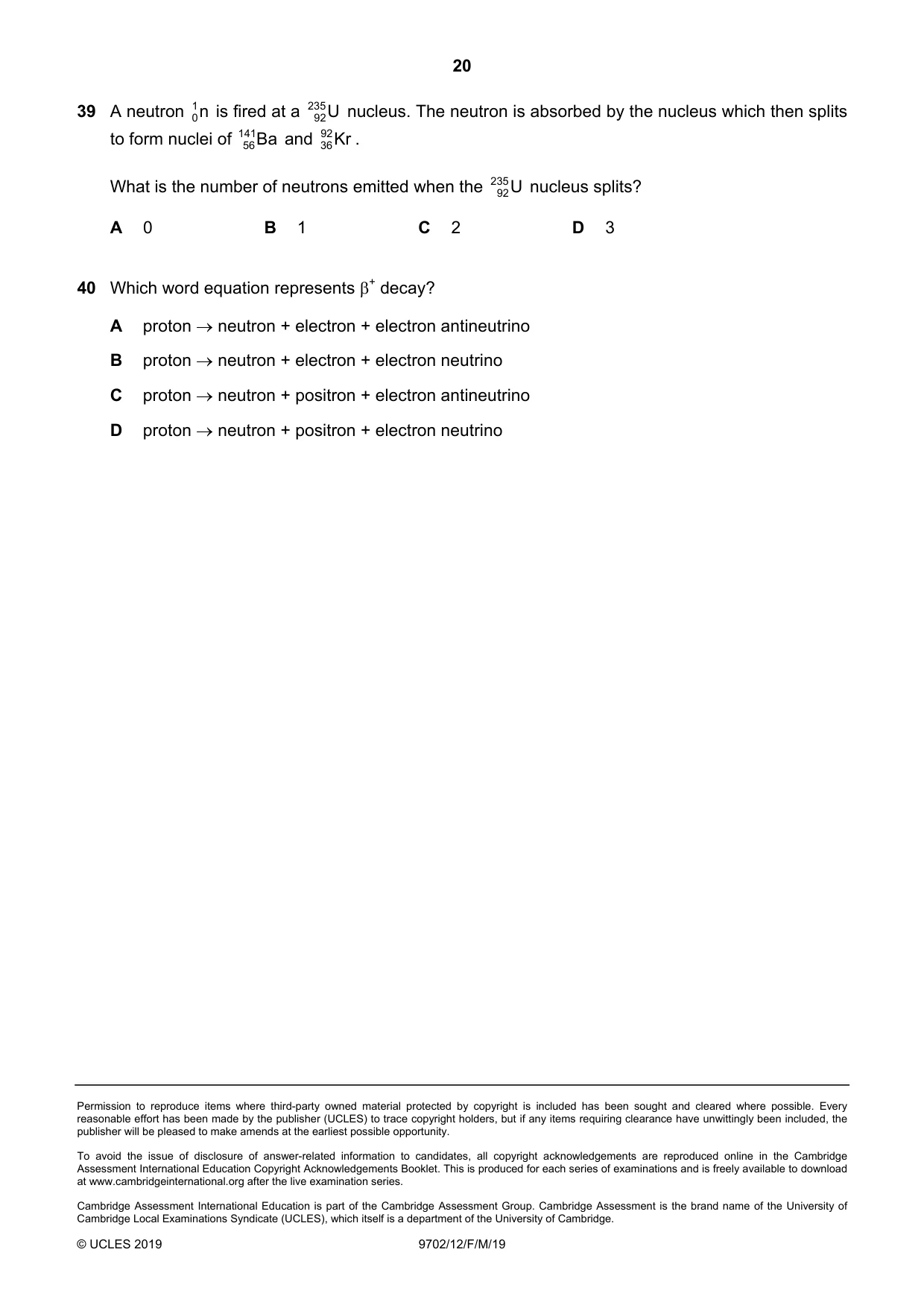
Q39 · A neutron n 1 0 is fired at a 235 U nucleus
39 A neutron n 1 0 is fired at a 235 U nucleus. The neutron is absorbed by the nucleus which then splits 92 to form nuclei of 141 Ba and 92 Kr . 56 36 What is the number of neutrons emitted when the 235 U nucleus splits? 92 A 0 B 1 C 2 D 3
Mark scheme: D
Q40 · Which word equation represents β+ decay?
40 Which word equation represents β+ decay? A proton → neutron + electron + electron antineutrino B proton → neutron + electron + electron neutrino C proton → neutron + positron + electron antineutrino D proton → neutron + positron + electron neutrino
Mark scheme: D
What was in this paper
The subtopics covered by these 40 questions, and how many questions each got. Open one in a new tab to see every Cambridge question on it.
4Elastic and plastic behaviour2Errors and uncertainties2Linear momentum and its conservation2Practical circuits2Progressive waves2Resistance and resistivity2Stationary waves2Turning effects of forces2Density and pressure1Doppler effect for sound waves1Electric current1Electric field of a point charge1Electromagnetic spectrum1Equations of motion1Equilibrium of forces1Fundamental particles1Interference1Mass defect and nuclear binding energy1Momentum and Newton’s laws of motion1Physical quantities1Potential difference and power1Potential dividers1Scalars and vectors1SI units1Simple harmonic oscillations1Stress and strain1The diffraction grating1Uniform electric fields1What you needed in this session
Cambridge’s own grade thresholds for 2019 Feb/March, Paper 1 · Variant 2. A higher threshold means an easier paper — the bar moves with how the cohort did.