Cambridge A Level Physics 9702 — 2023 May/June Paper 1 · Variant 1
9702/11/M/J/23 · 40 questions · 40 marks · ≈45 min
The question paper and its mark scheme, free to read here and free to download. This is Cambridge’s own paper, exactly as it was sat.
Question paper20 pages

Mark scheme3 pages
Answers below. Sit the paper first if you are practising.
Questions as text
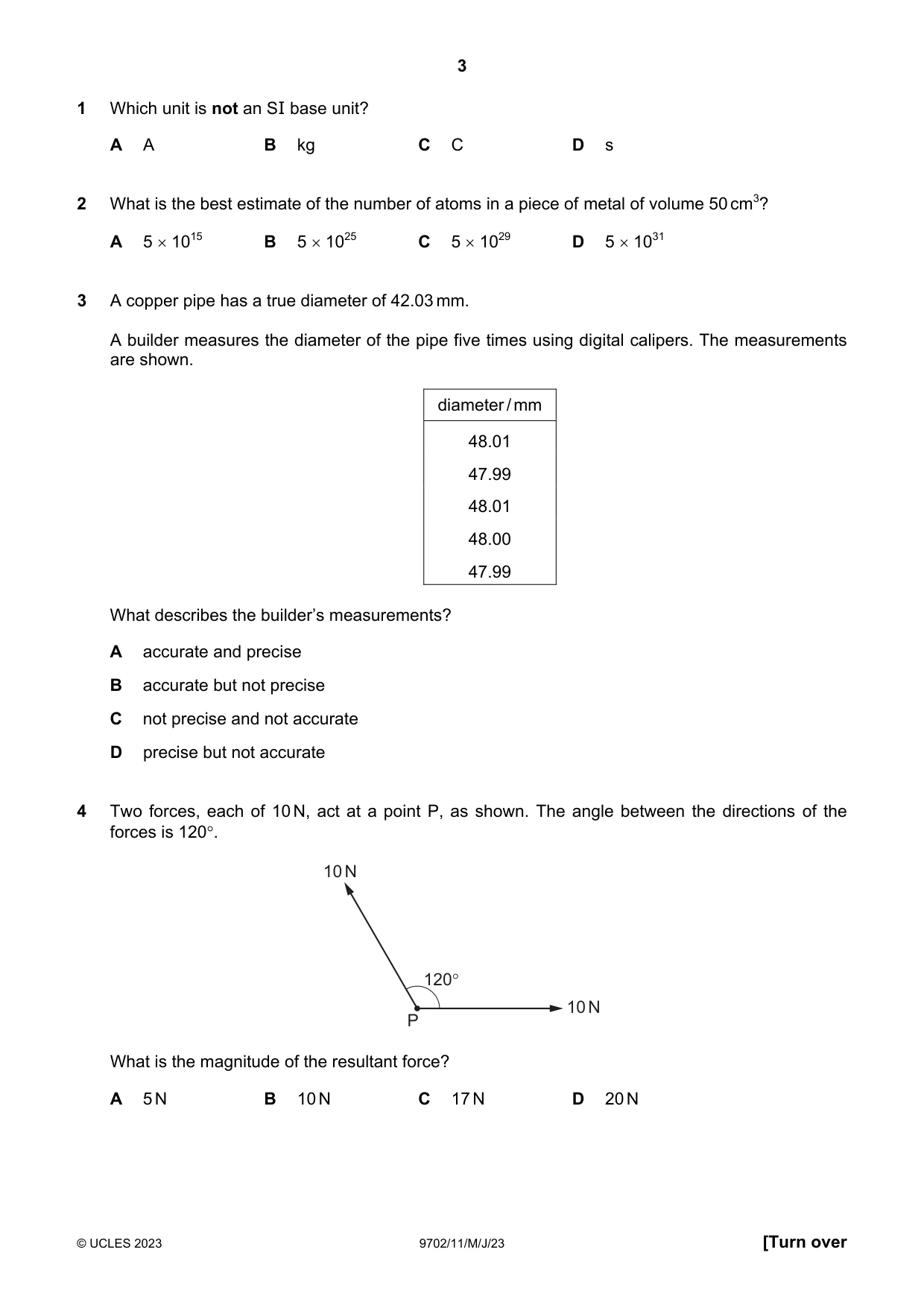
Q1 · Which unit is not an SI base unit?
1 Which unit is not an SI base unit? A A B kg C C D s
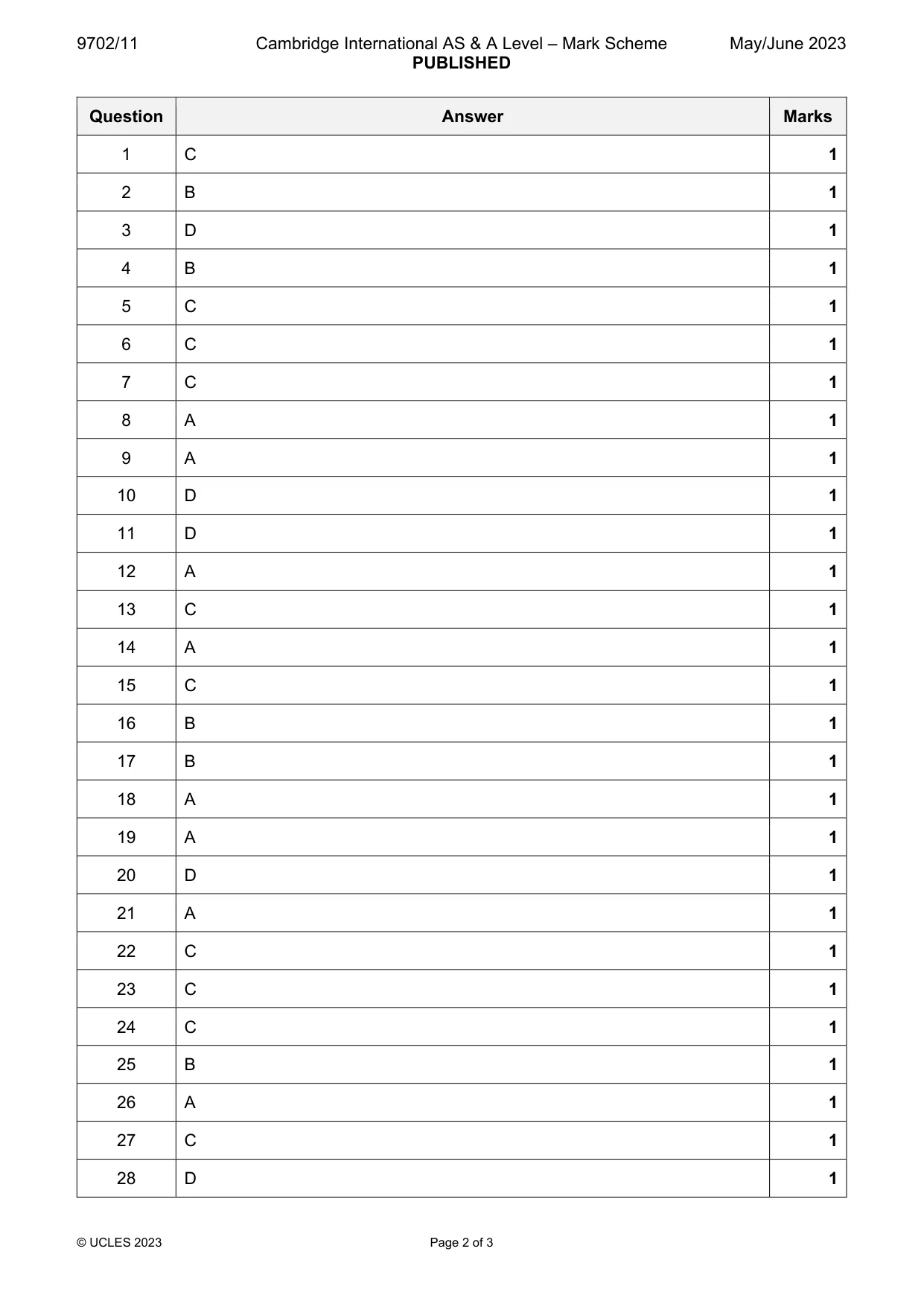
Mark scheme: C
Q2 · What is the best estimate of the number of atoms in a piece of metal of volume 50 cm3?
2 What is the best estimate of the number of atoms in a piece of metal of volume 50 cm3? A 5 1015 B 5 1025 C 5 1029 D 5 1031
Mark scheme: B
Q3 · A copper pipe has a true diameter of 42.03 mm
3 A copper pipe has a true diameter of 42.03 mm. A builder measures the diameter of the pipe five times using digital calipers. The measurements are shown. diameter / mm 48.01 47.99 48.01 48.00 47.99 What describes the builder’s measurements? A accurate and precise B accurate but not precise C not precise and not accurate D precise but not accurate
Mark scheme: D
Q4 · Two forces, each of 10 N, act at a point P, as shown
4 Two forces, each of 10 N, act at a point P, as shown. The angle between the directions of the forces is 120. 10 N 120° 10 N P What is the magnitude of the resultant force? A 5 N B 10 N C 17 N D 20 N
Mark scheme: B
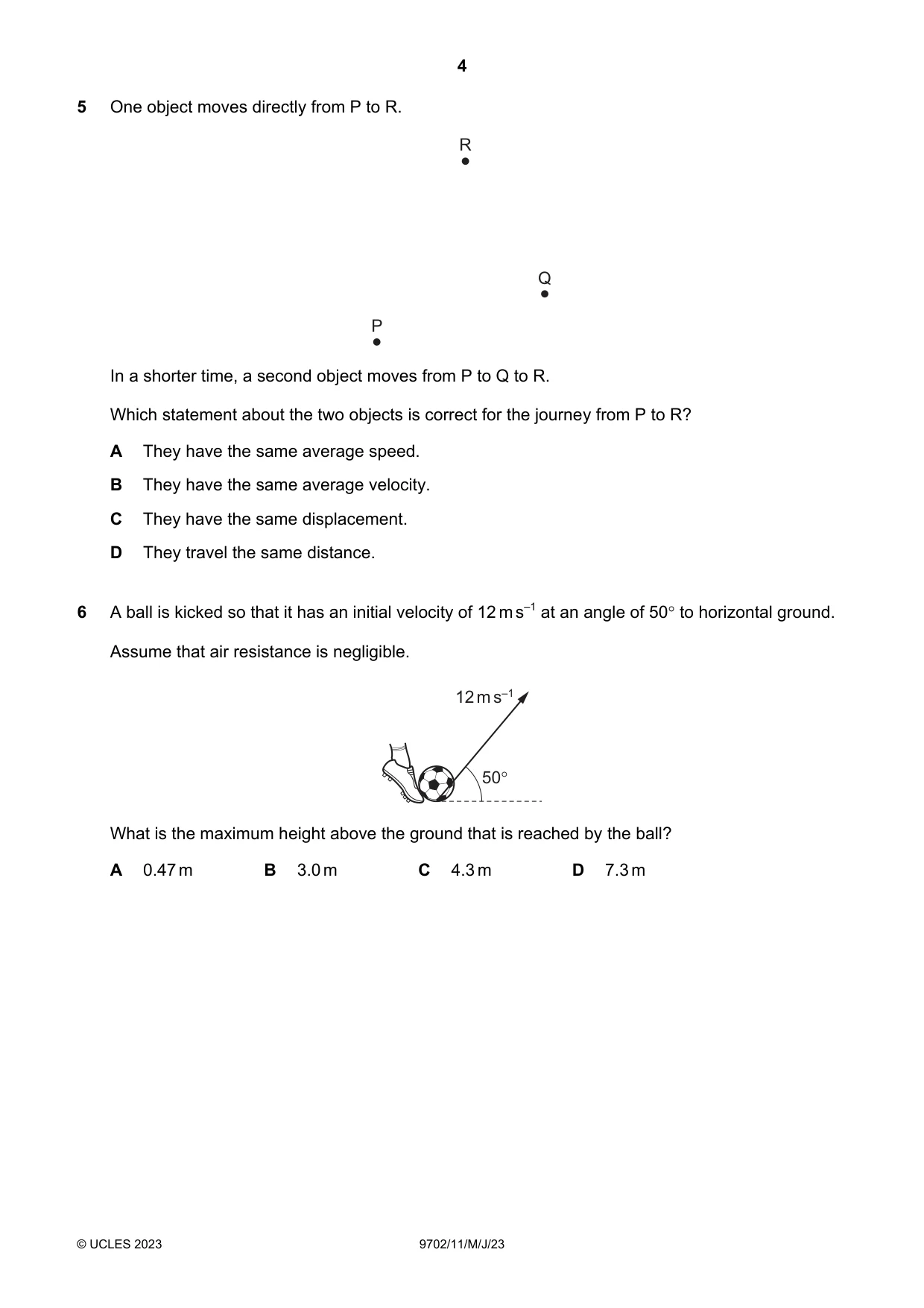
Q5 · One object moves directly from P to R
5 One object moves directly from P to R. R Q P In a shorter time, a second object moves from P to Q to R. Which statement about the two objects is correct for the journey from P to R? A They have the same average speed. B They have the same average velocity. C They have the same displacement. D They travel the same distance.
Mark scheme: C
Q6 · Aball is kicked so that it has an initial velocity of 12ms™ at an angle of 50° to…
6 Aball is kicked so that it has an initial velocity of 12ms™ at an angle of 50° to horizontal ground. Assume that air resistance is negligible. What is the maximum height above the ground that is reached by the ball? A 0.47m B 3.0m C 4.3m D 7.3m
Mark scheme: C
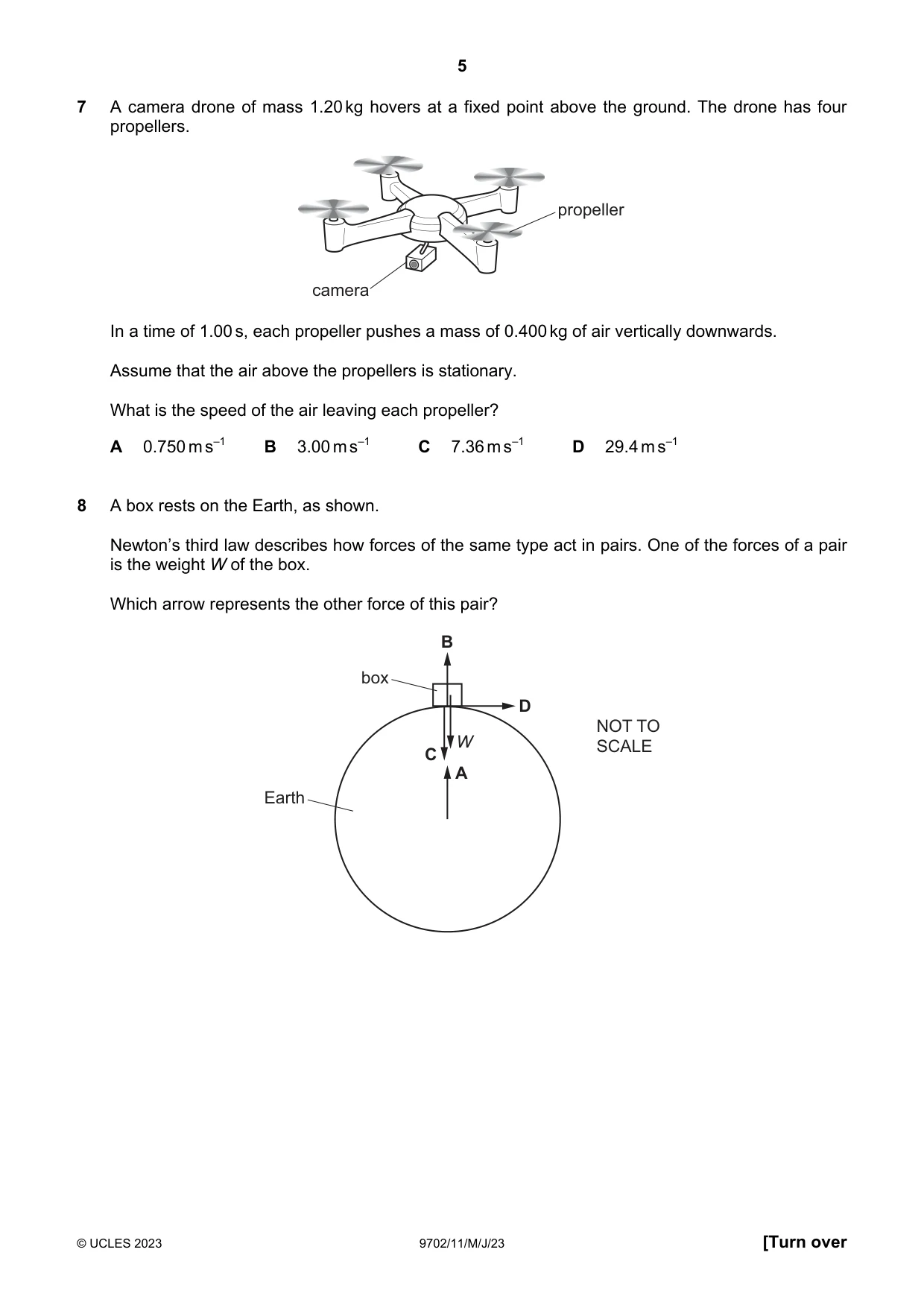
Q7 · A camera drone of mass 1.20 kg hovers at a fixed point above the ground
7 A camera drone of mass 1.20 kg hovers at a fixed point above the ground. The drone has four propellers. propeller camera In a time of 1.00 s, each propeller pushes a mass of 0.400 kg of air vertically downwards. Assume that the air above the propellers is stationary. What is the speed of the air leaving each propeller? A 0.750 m s–1 B 3.00 m s–1 C 7.36 m s–1 D 29.4 m s–1
Mark scheme: C
Q8 · A box rests on the Earth, as shown
8 A box rests on the Earth, as shown. Newton’s third law describes how forces of the same type act in pairs. One of the forces of a pair is the weight W of the box. Which arrow represents the other force of this pair? B box D NOT TO W SCALE C A Earth
Mark scheme: A
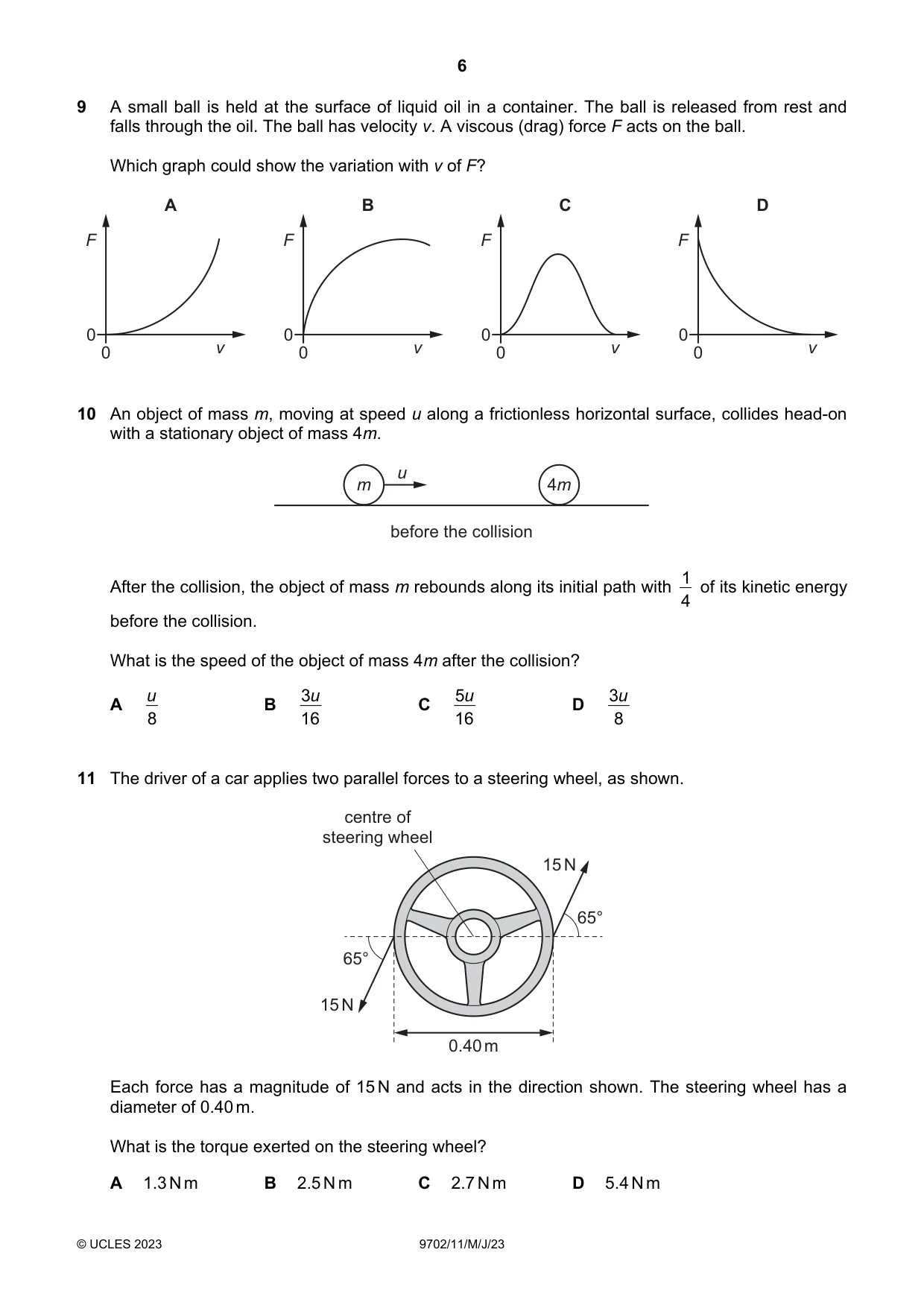
Q9 · A small ball is held at the surface of liquid oil in a container
9 A small ball is held at the surface of liquid oil in a container. The ball is released from rest and falls through the oil. The ball has velocity v. A viscous (drag) force F acts on the ball. Which graph could show the variation with v of F? A B C D F F F F 0 0 0 0 0 v 0 v 0 v 0 v
Mark scheme: A
Q10 · An object of mass m, moving at speed u along a frictionless horizontal surface, collides…
10 An object of mass m, moving at speed u along a frictionless horizontal surface, collides head-on with a stationary object of mass 4m. u m 4m before the collision 1 of its kinetic energy After the collision, the object of mass m rebounds along its initial path with 4 before the collision. What is the speed of the object of mass 4m after the collision? u 3u 5u 3u A B C D 8 16 16 8
Mark scheme: D
Q11 · The driver of a car applies two parallel forces to a steering wheel, as shown
11 The driver of a car applies two parallel forces to a steering wheel, as shown. centre of steering wheel 15 N 65° 65° 15 N 0.40 m Each force has a magnitude of 15 N and acts in the direction shown. The steering wheel has a diameter of 0.40 m. What is the torque exerted on the steering wheel? A 1.3 N m B 2.5 N m C 2.7 N m D 5.4 N m
Mark scheme: D
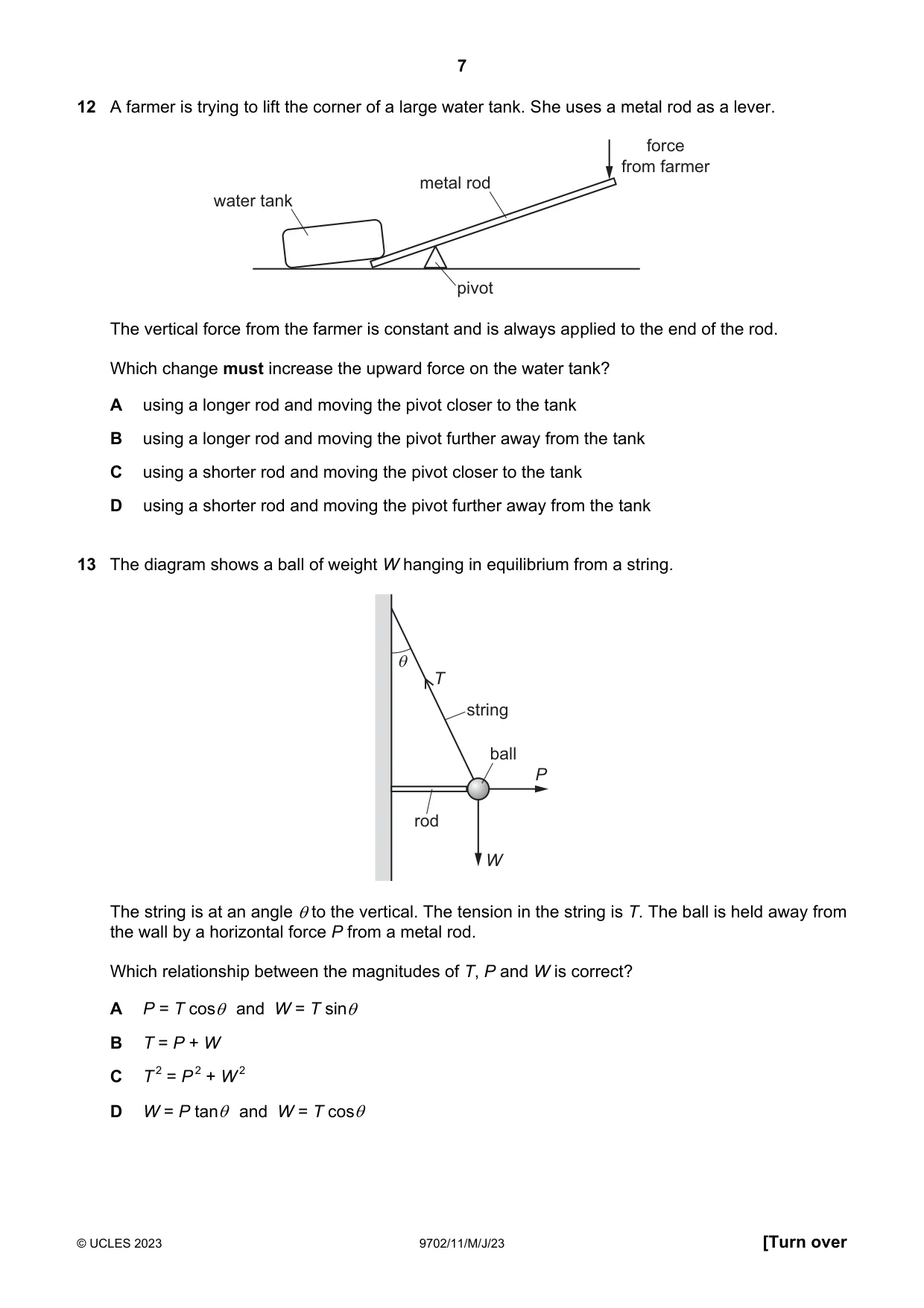
Q12 · A farmer is trying to lift the corner of a large water tank
12 A farmer is trying to lift the corner of a large water tank. She uses a metal rod as a lever. force from farmer metal rod water tank pivot The vertical force from the farmer is constant and is always applied to the end of the rod. Which change must increase the upward force on the water tank? A using a longer rod and moving the pivot closer to the tank B using a longer rod and moving the pivot further away from the tank C using a shorter rod and moving the pivot closer to the tank D using a shorter rod and moving the pivot further away from the tank
Mark scheme: A
Q13 · The diagram shows a ball of weight W hanging in equilibrium from a string
13 The diagram shows a ball of weight W hanging in equilibrium from a string. The string is at an angle @to the vertical. The tension in the string is T. The ball is held away from the wall by a horizontal force P from a metal rod. Which relationship between the magnitudes of 7, P and Wis correct? A P=Tcosé and W=Tsing B T=P+W C T*=P*+W? D W=Ptané and W=Tcosdé
Mark scheme: C
Q14 · Which expression for pressure is correct?
14 Which expression for pressure is correct? A force per unit area B force per unit volume C mass per unit area D mass per unit volume
Mark scheme: A
Q15 · A ball has a mass of 0.50 kg and a volume of 1.3 10–3 m3
15 A ball has a mass of 0.50 kg and a volume of 1.3 10–3 m3. The ball is floating in equilibrium on still water. The two forces that act on the ball are its weight and the upthrust due to the water. The density of the water is 1.0 103 kg m–3. What is the percentage of the volume of the ball above the surface of the water? A 3.9% B 38% C 62% D 96%
Mark scheme: C
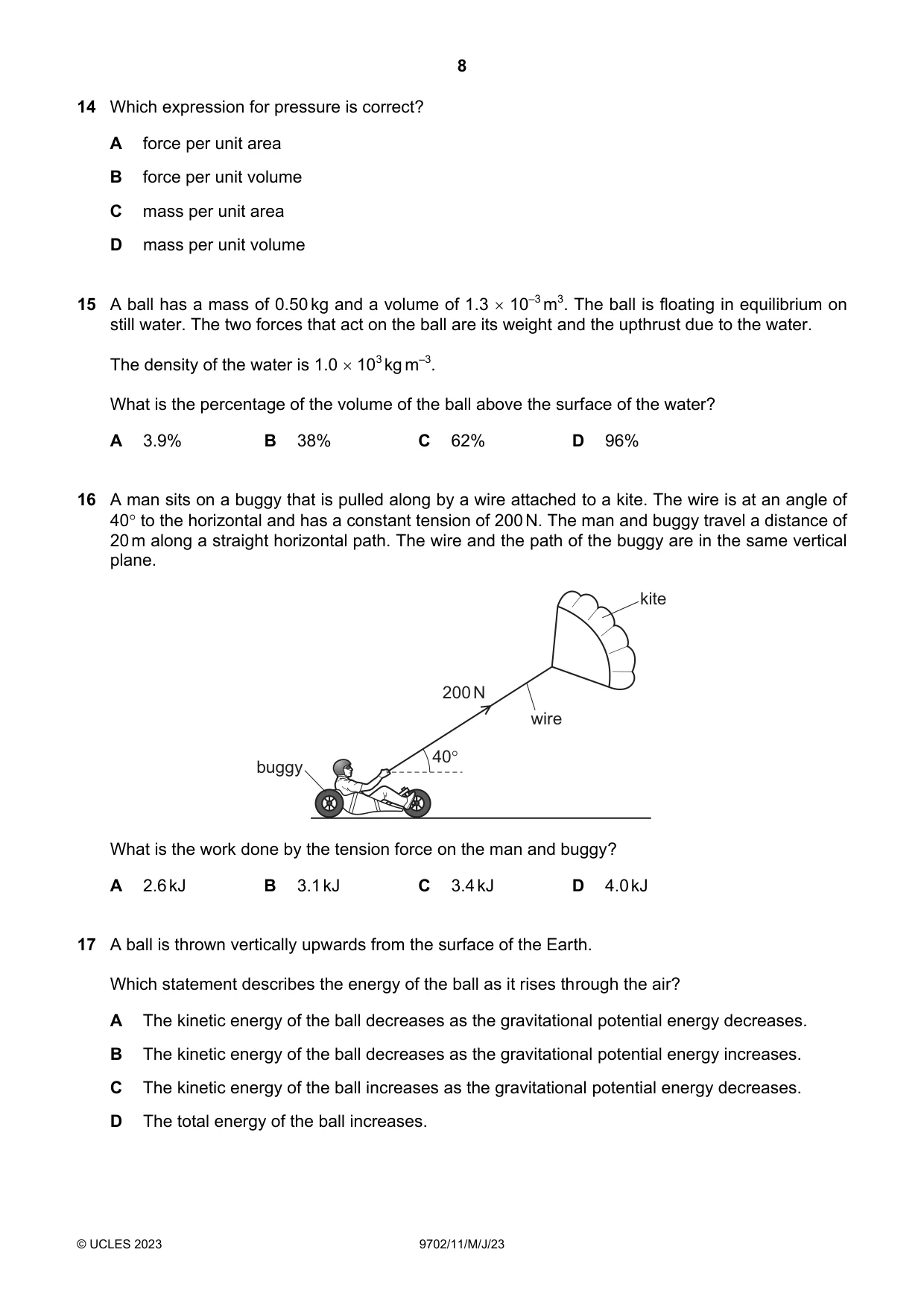
Q16 · Aman sits on a buggy that is pulled along by a wire attached to a kite
16 Aman sits on a buggy that is pulled along by a wire attached to a kite. The wire is at an angle of 40° to the horizontal and has a constant tension of 200N. The man and buggy travel a distance of 20m along a straight horizontal path. The wire and the path of the buggy are in the same vertical plane. What is the work done by the tension force on the man and buggy? A 2.6kJ B 3.1kJ C 34kJ D 4.0kJ
Mark scheme: B
Q17 · A ball is thrown vertically upwards from the surface of the Earth
17 A ball is thrown vertically upwards from the surface of the Earth. Which statement describes the energy of the ball as it rises through the air? A The kinetic energy of the ball decreases as the gravitational potential energy decreases. B The kinetic energy of the ball decreases as the gravitational potential energy increases. C The kinetic energy of the ball increases as the gravitational potential energy decreases. D The total energy of the ball increases.
Mark scheme: B
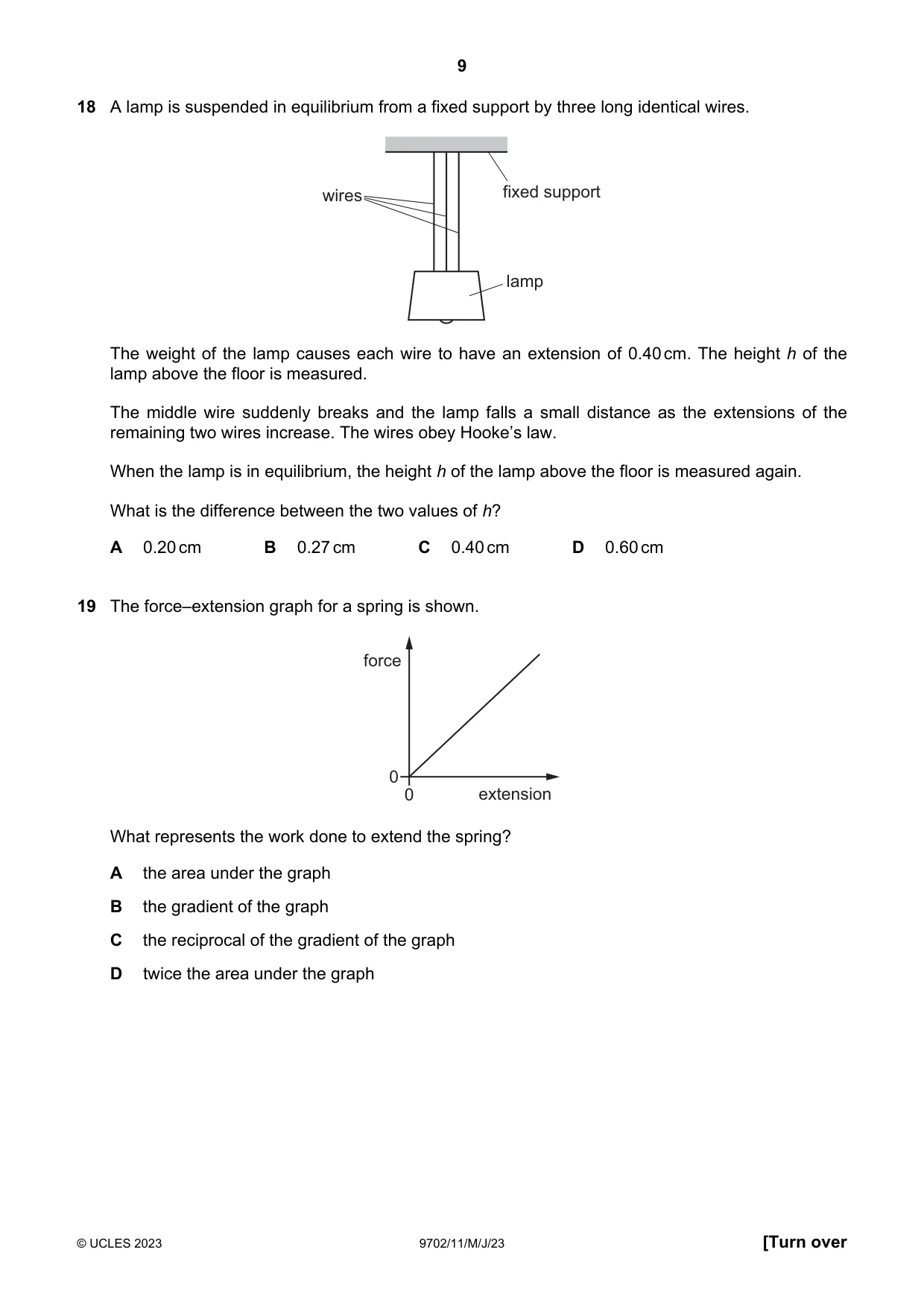
Q18 · A lamp is suspended in equilibrium from a fixed support by three long identical wires
18 A lamp is suspended in equilibrium from a fixed support by three long identical wires. wires fixed support lamp The weight of the lamp causes each wire to have an extension of 0.40 cm. The height h of the lamp above the floor is measured. The middle wire suddenly breaks and the lamp falls a small distance as the extensions of the remaining two wires increase. The wires obey Hooke’s law. When the lamp is in equilibrium, the height h of the lamp above the floor is measured again. What is the difference between the two values of h? A 0.20 cm B 0.27 cm C 0.40 cm D 0.60 cm
Mark scheme: A
Q19 · The force–extension graph for a spring is shown
19 The force–extension graph for a spring is shown. force 0 0 extension What represents the work done to extend the spring? A the area under the graph B the gradient of the graph C the reciprocal of the gradient of the graph D twice the area under the graph
Mark scheme: A
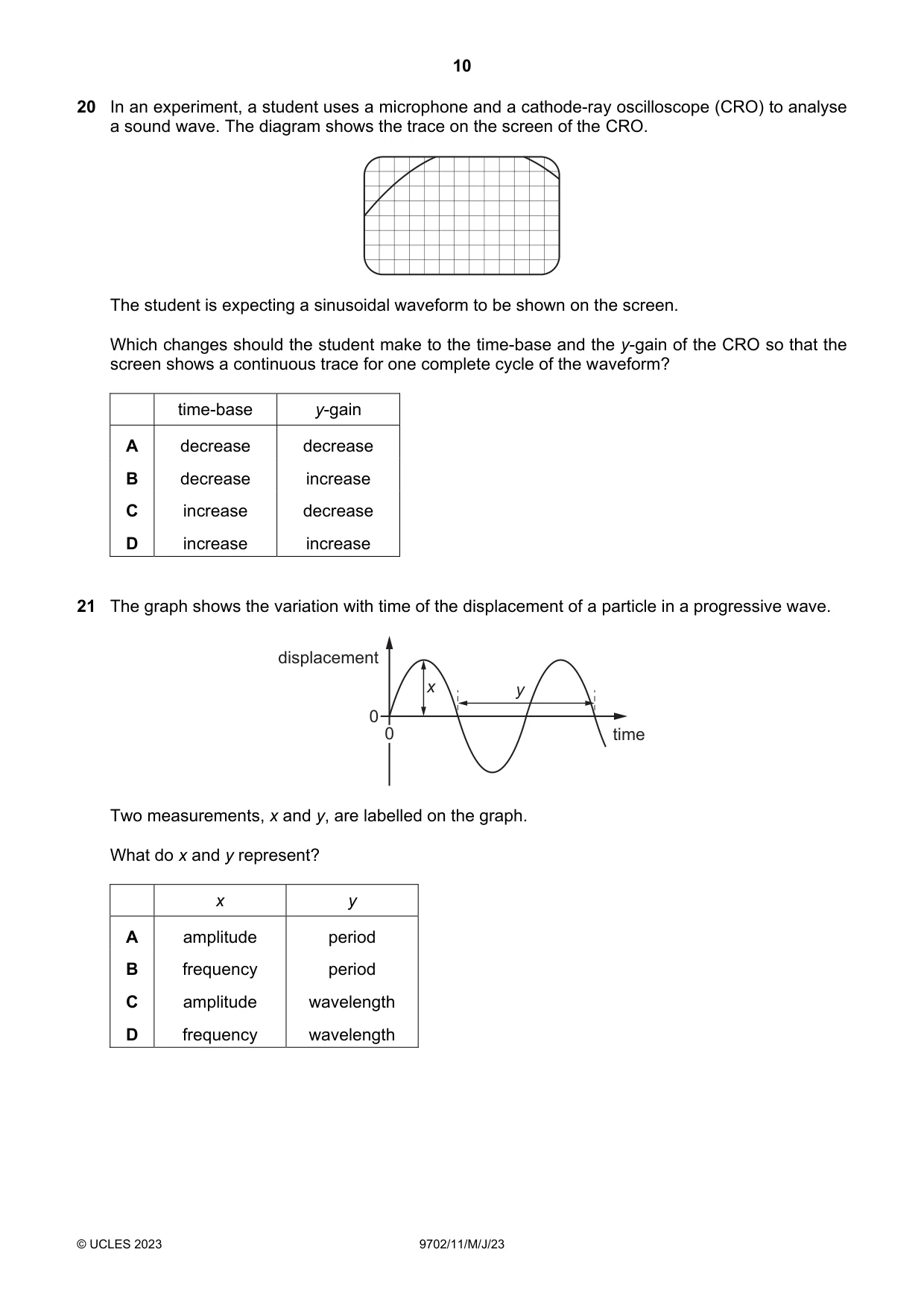
Q20 · In an experiment, a student uses a microphone and a cathode-ray oscilloscope (CRO) to…
20 In an experiment, a student uses a microphone and a cathode-ray oscilloscope (CRO) to analyse a sound wave. The diagram shows the trace on the screen of the CRO. The student is expecting a sinusoidal waveform to be shown on the screen. Which changes should the student make to the time-base and the y-gain of the CRO so that the screen shows a continuous trace for one complete cycle of the waveform? time-base y-gain A decrease decrease B decrease increase C increase decrease D increase increase
Mark scheme: D
Q21 · The graph shows the variation with time of the displacement of a particle in a…
21 The graph shows the variation with time of the displacement of a particle in a progressive wave. displacement x y 0 0 time Two measurements, x and y, are labelled on the graph. What do x and y represent? x y A amplitude period B frequency period C amplitude wavelength D frequency wavelength
Mark scheme: A
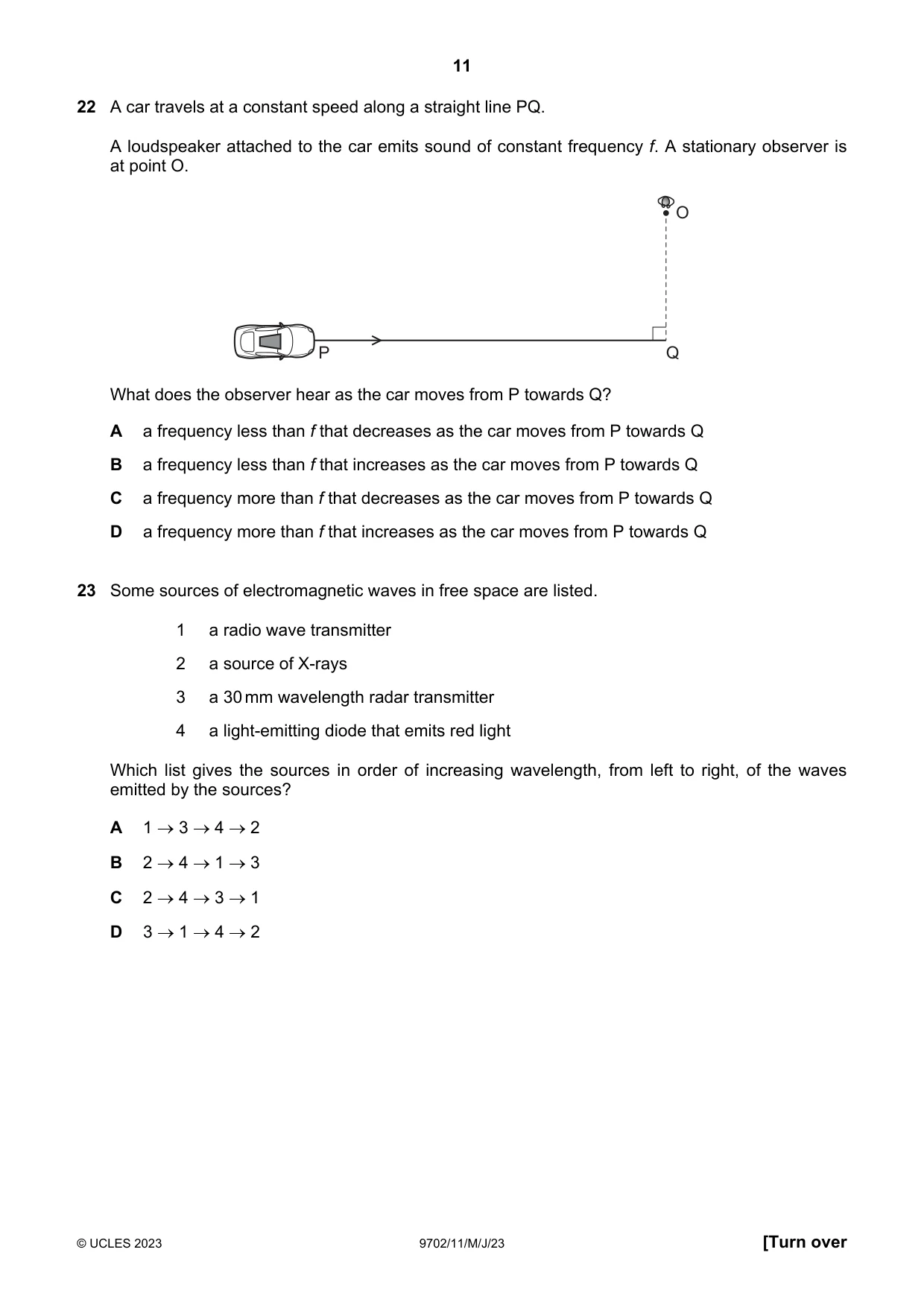
Q22 · A car travels at a constant speed along a straight line PQ
22 A car travels at a constant speed along a straight line PQ. A loudspeaker attached to the car emits sound of constant frequency f. A stationary observer is at point O. O P Q What does the observer hear as the car moves from P towards Q? A a frequency less than f that decreases as the car moves from P towards Q B a frequency less than f that increases as the car moves from P towards Q C a frequency more than f that decreases as the car moves from P towards Q D a frequency more than f that increases as the car moves from P towards Q
Mark scheme: C
Q23 · Some sources of electromagnetic waves in free space are listed
23 Some sources of electromagnetic waves in free space are listed. 1 a radio wave transmitter 2 a source of X-rays 3 a 30 mm wavelength radar transmitter 4 a light-emitting diode that emits red light Which list gives the sources in order of increasing wavelength, from left to right, of the waves emitted by the sources? A 1 3 4 2 B 2 4 1 3 C 2 4 3 1 D 3 1 4 2
Mark scheme: C
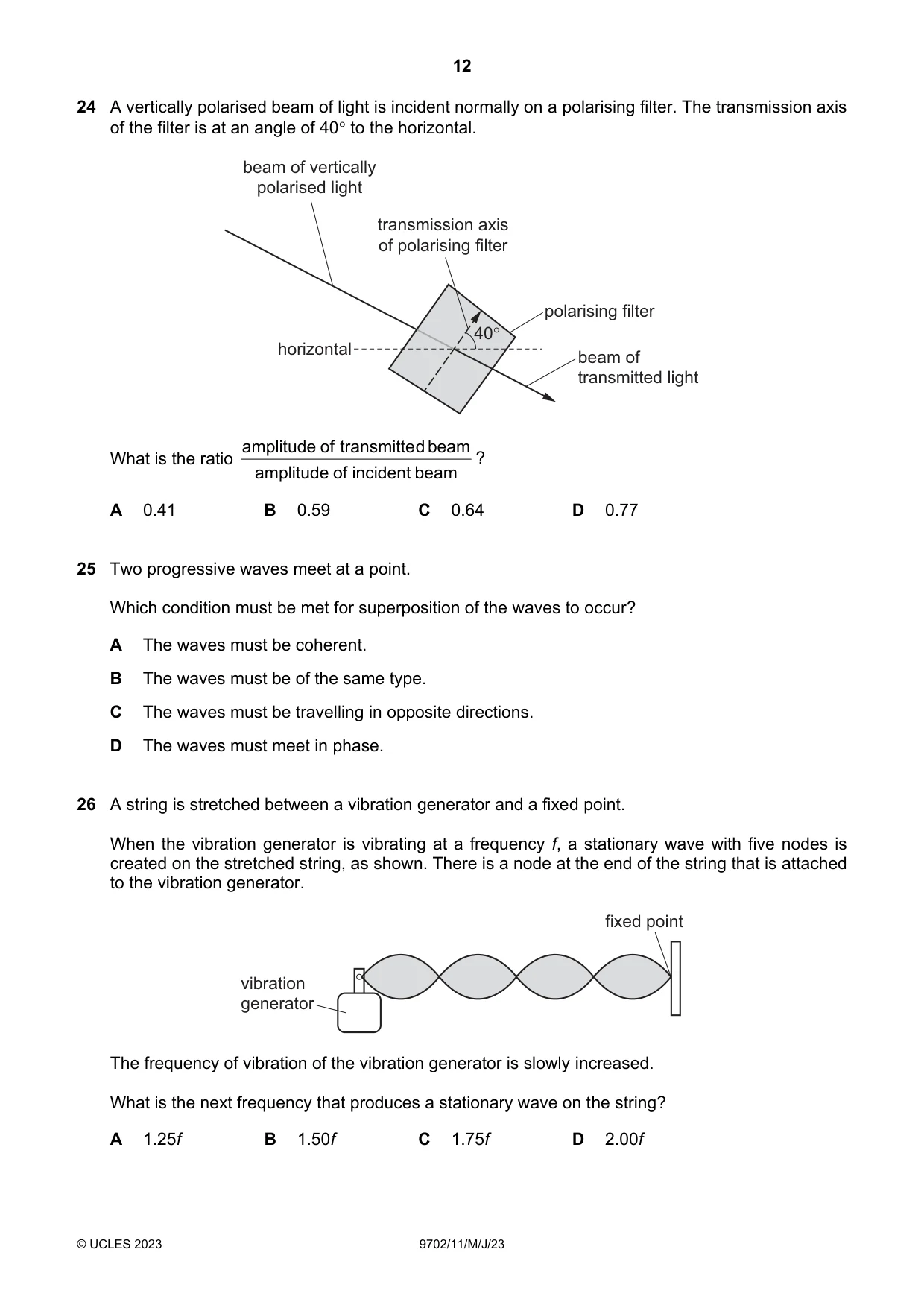
Q24 · Avertically polarised beam of light is incident normally on a polarising filter
24 Avertically polarised beam of light is incident normally on a polarising filter. The transmission axis of the filter is at an angle of 40° to the horizontal. beam of vertically polarised light transmission axis of polarising filter polarising filter horizontal beam of transmitted light What is the ratio amplitude of transmitted beam 5 amplitude of incident beam A 041 B 0.59 C 0.64 D 0.77
Mark scheme: C
Q25 · Two progressive waves meet at a point
25 Two progressive waves meet at a point. Which condition must be met for superposition of the waves to occur? A The waves must be coherent. B The waves must be of the same type. C The waves must be travelling in opposite directions. D The waves must meet in phase.
Mark scheme: B
Q26 · A string is stretched between a vibration generator and a fixed point
26 A string is stretched between a vibration generator and a fixed point. When the vibration generator is vibrating at a frequency f, a stationary wave with five nodes is created on the stretched string, as shown. There is a node at the end of the string that is attached to the vibration generator. fixed point vibration generator The frequency of vibration of the vibration generator is slowly increased. What is the next frequency that produces a stationary wave on the string? A 1.25f B 1.50f C 1.75f D 2.00f
Mark scheme: A
Q27 · A ripple tank and a barrier with a single gap are used to demonstrate the diffraction of…
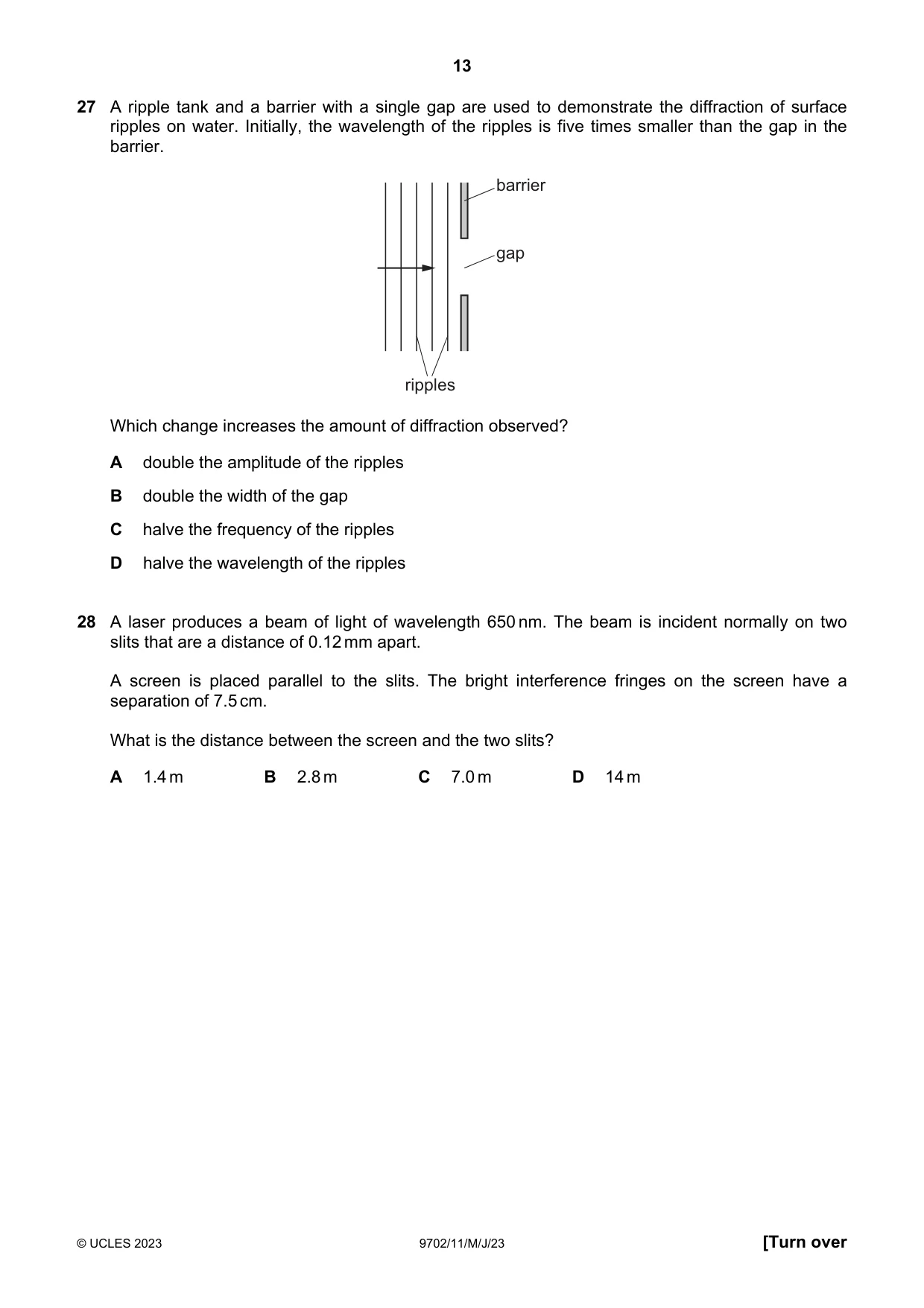
27 A ripple tank and a barrier with a single gap are used to demonstrate the diffraction of surface ripples on water. Initially, the wavelength of the ripples is five times smaller than the gap in the barrier. barrier gap ripples Which change increases the amount of diffraction observed? A double the amplitude of the ripples B double the width of the gap C halve the frequency of the ripples D halve the wavelength of the ripples
Mark scheme: C
Q28 · A laser produces a beam of light of wavelength 650 nm
28 A laser produces a beam of light of wavelength 650 nm. The beam is incident normally on two slits that are a distance of 0.12 mm apart. A screen is placed parallel to the slits. The bright interference fringes on the screen have a separation of 7.5 cm. What is the distance between the screen and the two slits? A 1.4 m B 2.8 m C 7.0 m D 14 m
Mark scheme: D
Q29 · Abeam of light from a laser is incident normally on a diffraction grating
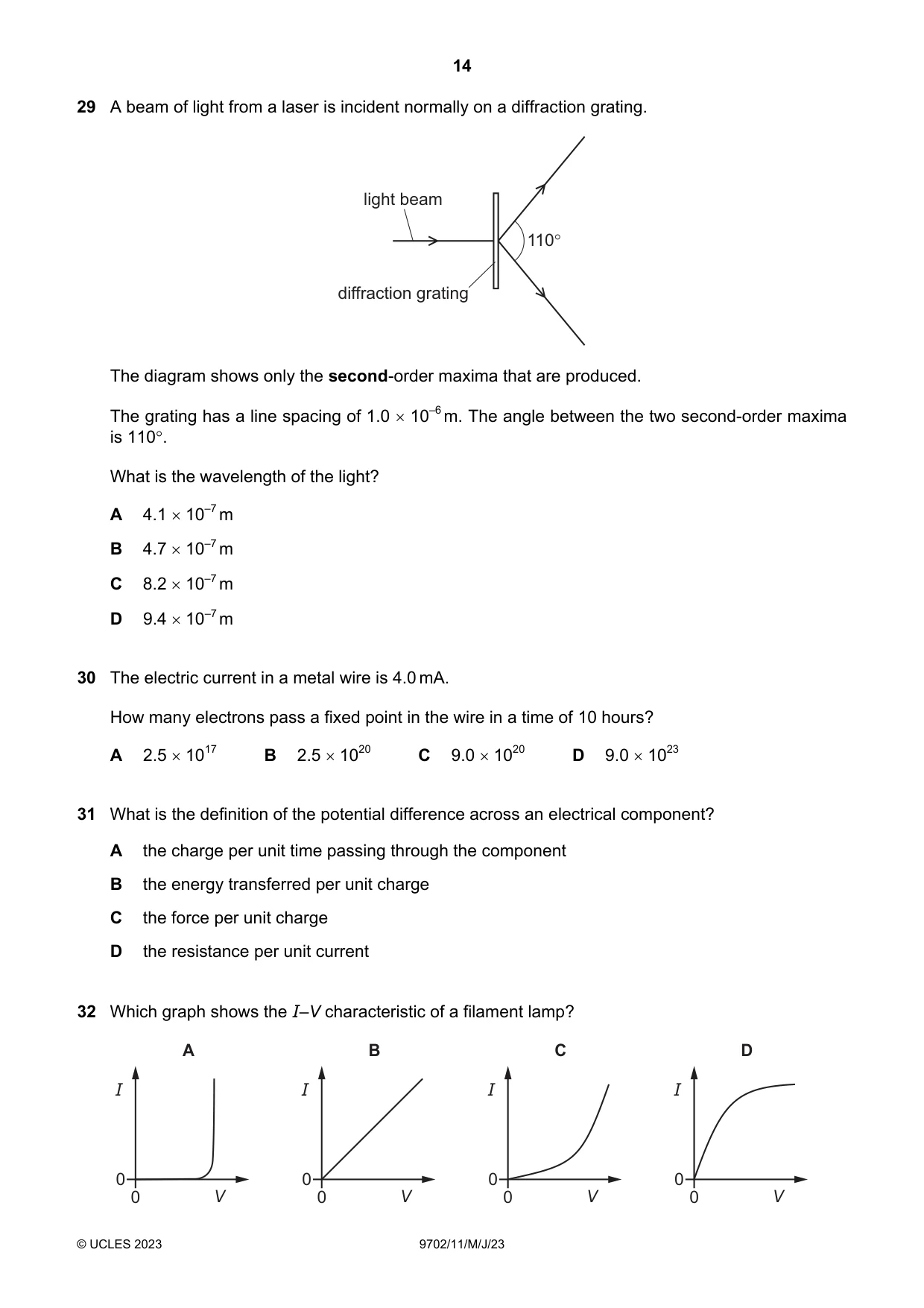
29 Abeam of light from a laser is incident normally on a diffraction grating. light beam diffraction grating The diagram shows only the second-order maxima that are produced. The grating has a line spacing of 1.0 x 10°°m. The angle between the two second-order maxima is 110°. What is the wavelength of the light? A 4.1x10%m B 4.7x10’m C 8.2x10’m D 94x10-’m
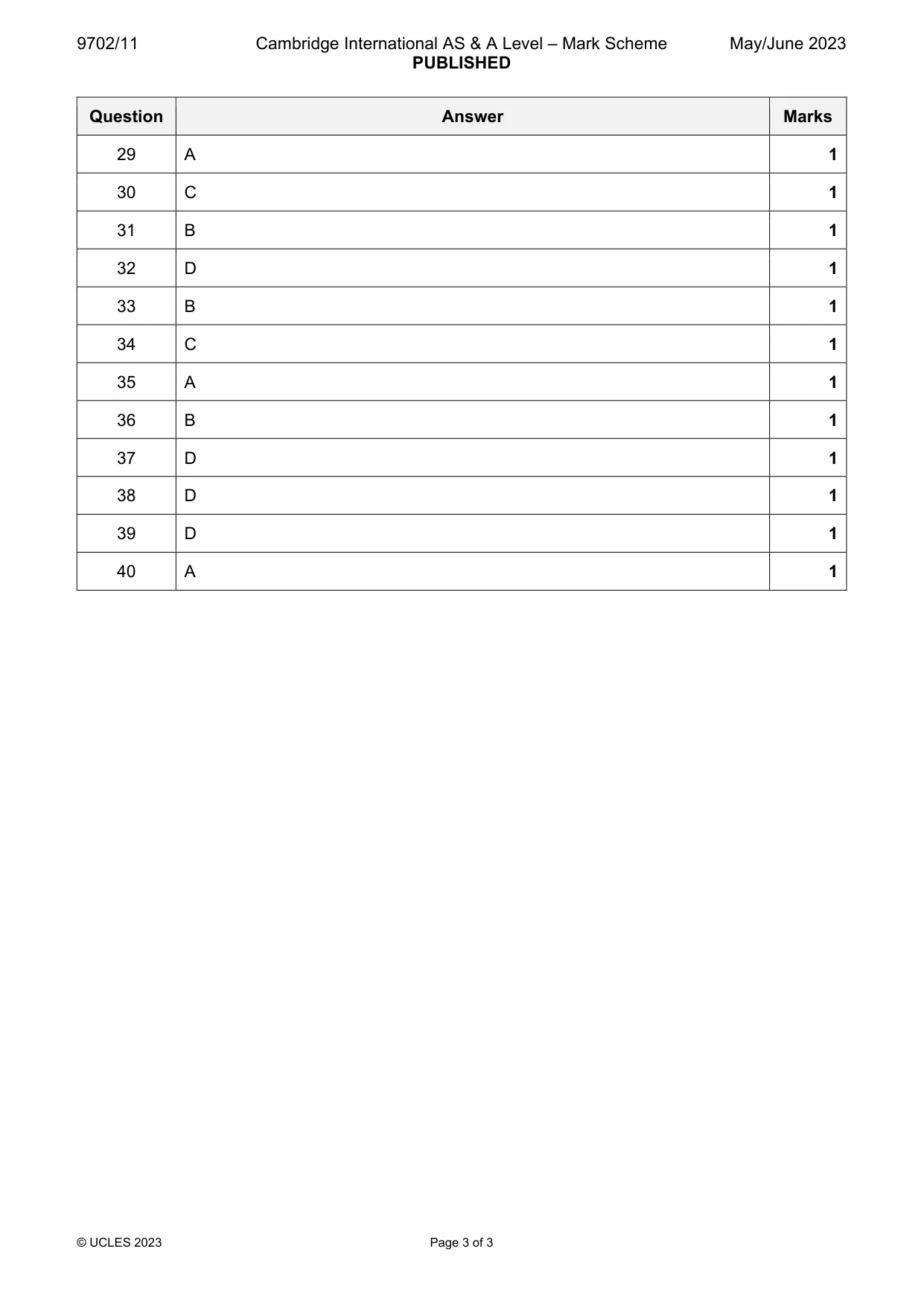
Mark scheme: A
Q30 · The electric current in a metal wire is 4.0 mA
30 The electric current in a metal wire is 4.0 mA. How many electrons pass a fixed point in the wire in a time of 10 hours? A 2.5 1017 B 2.5 1020 C 9.0 1020 D 9.0 1023
Mark scheme: C
Q31 · What is the definition of the potential difference across an electrical component?
31 What is the definition of the potential difference across an electrical component? A the charge per unit time passing through the component B the energy transferred per unit charge C the force per unit charge D the resistance per unit current
Mark scheme: B
Q32 · Which graph shows the I–V characteristic of a filament lamp?
32 Which graph shows the I–V characteristic of a filament lamp? A B C D I I I I 0 0 0 0 0 V 0 V 0 V 0 V
Mark scheme: D
Q33 · A metal wire has a length of 2.50 m and a cross-sectional area of 4.50 10–6 m2
33 A metal wire has a length of 2.50 m and a cross-sectional area of 4.50 10–6 m2. The resistivity of the metal is 3.50 10–7 m. The wire is stretched so that its length increases to 2.65 m. The wire remains cylindrical and the volume of the wire remains constant. What is the change in the resistance of the wire? A 0.012 B 0.024 C 0.19 D 0.22
Mark scheme: B
Q34 · Which circuit symbol represents a microphone?
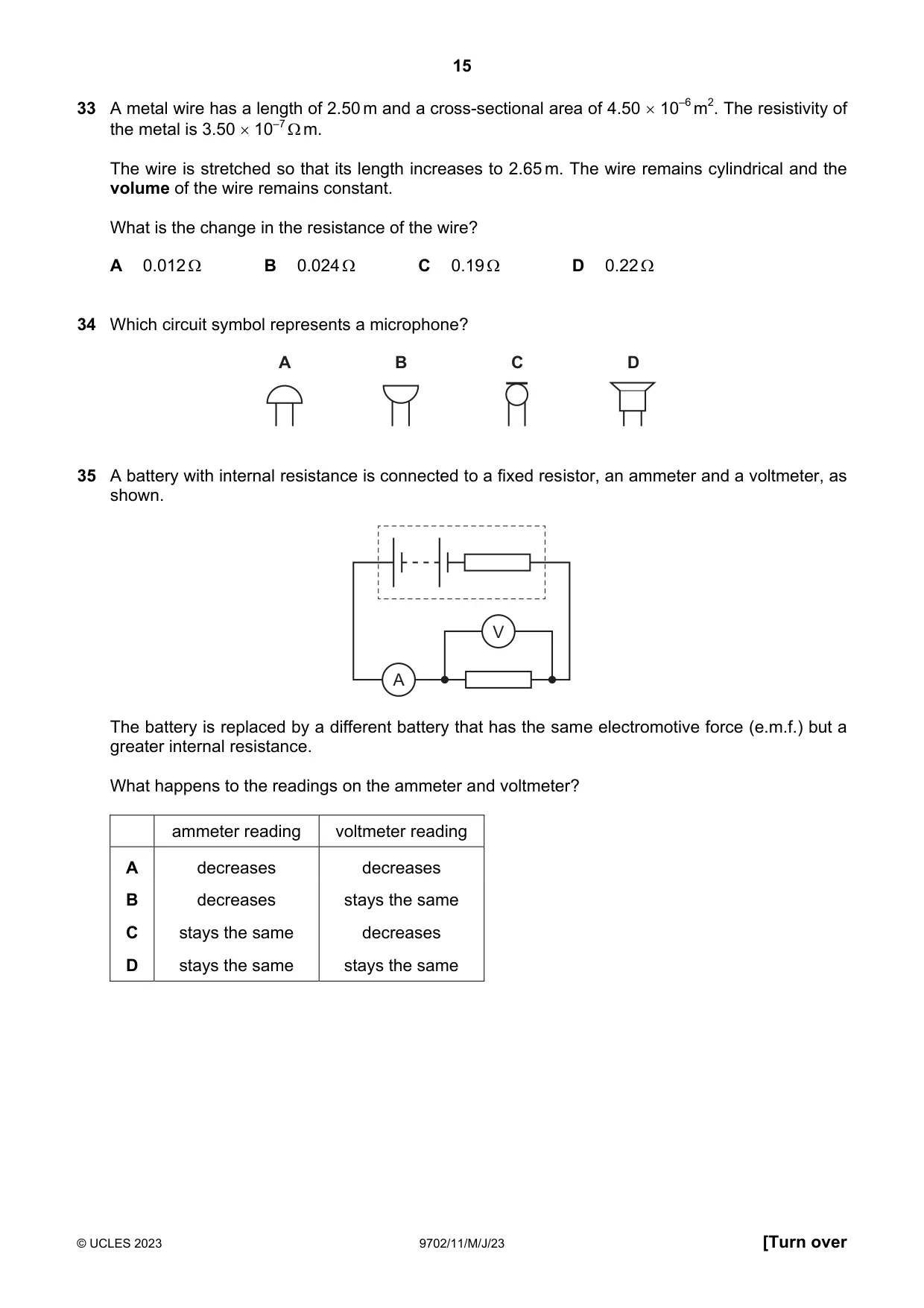
34 Which circuit symbol represents a microphone? A B C D
Mark scheme: C
Q35 · A battery with internal resistance is connected to a fixed resistor, an ammeter and a…
35 A battery with internal resistance is connected to a fixed resistor, an ammeter and a voltmeter, as shown. V A The battery is replaced by a different battery that has the same electromotive force (e.m.f.) but a greater internal resistance. What happens to the readings on the ammeter and voltmeter? ammeter reading voltmeter reading A decreases decreases B decreases stays the same C stays the same decreases D stays the same stays the same
Mark scheme: A
Q36 · Four potential divider circuits each consist of a battery of electromotive force (e.m.f.)…
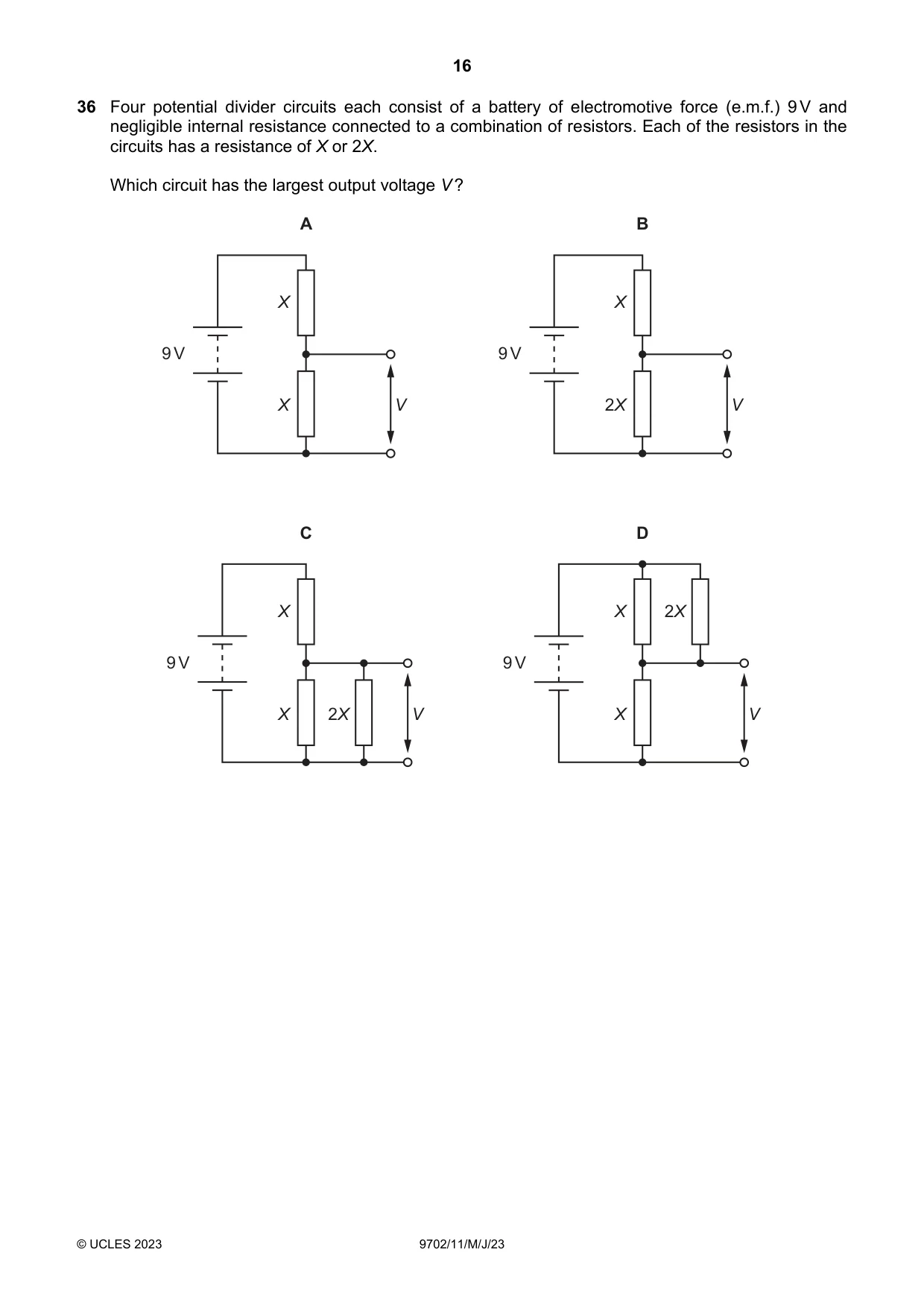
36 Four potential divider circuits each consist of a battery of electromotive force (e.m.f.) 9 V and negligible internal resistance connected to a combination of resistors. Each of the resistors in the circuits has a resistance of X or 2X. Which circuit has the largest output voltage V ? A B X X 9 V 9 V X V 2X V C D X X 2X 9 V 9 V X 2X V X V
Mark scheme: B
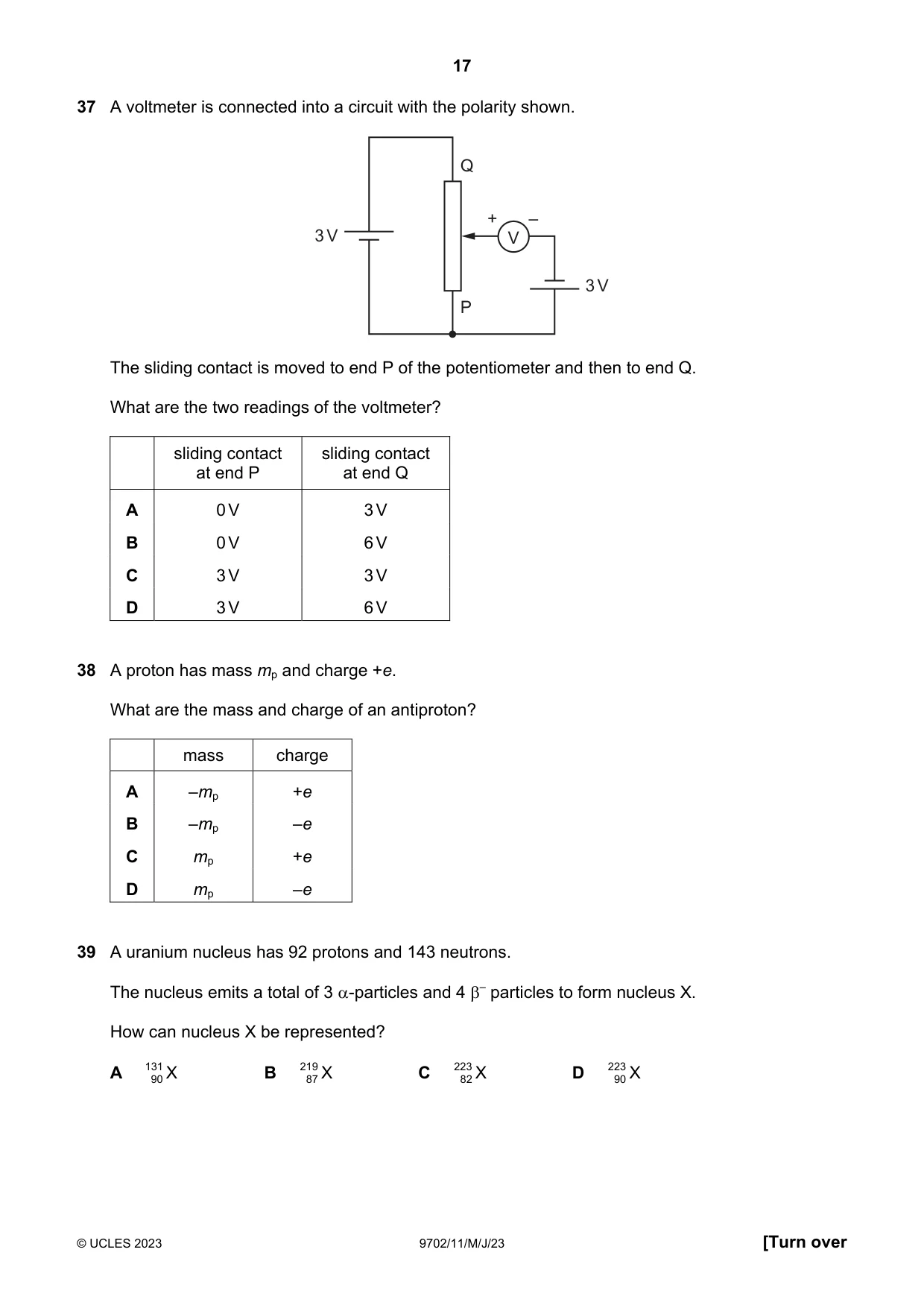
Q37 · A voltmeter is connected into a circuit with the polarity shown
37 A voltmeter is connected into a circuit with the polarity shown. Q + – 3 V V 3 V P The sliding contact is moved to end P of the potentiometer and then to end Q. What are the two readings of the voltmeter? sliding contact sliding contact at end P at end Q A 0 V 3 V B 0 V 6 V C 3 V 3 V D 3 V 6 V
Mark scheme: D
Q38 · A proton has mass mp and charge +e
38 A proton has mass mp and charge +e. What are the mass and charge of an antiproton? mass charge A –mp +e B –mp –e C mp +e D mp –e
Mark scheme: D
Q39 · A uranium nucleus has 92 protons and 143 neutrons
39 A uranium nucleus has 92 protons and 143 neutrons. The nucleus emits a total of 3 -particles and 4 – particles to form nucleus X. How can nucleus X be represented? A 131 X B 219 X C 223 X D 223 X 90 87 82 90
Mark scheme: D
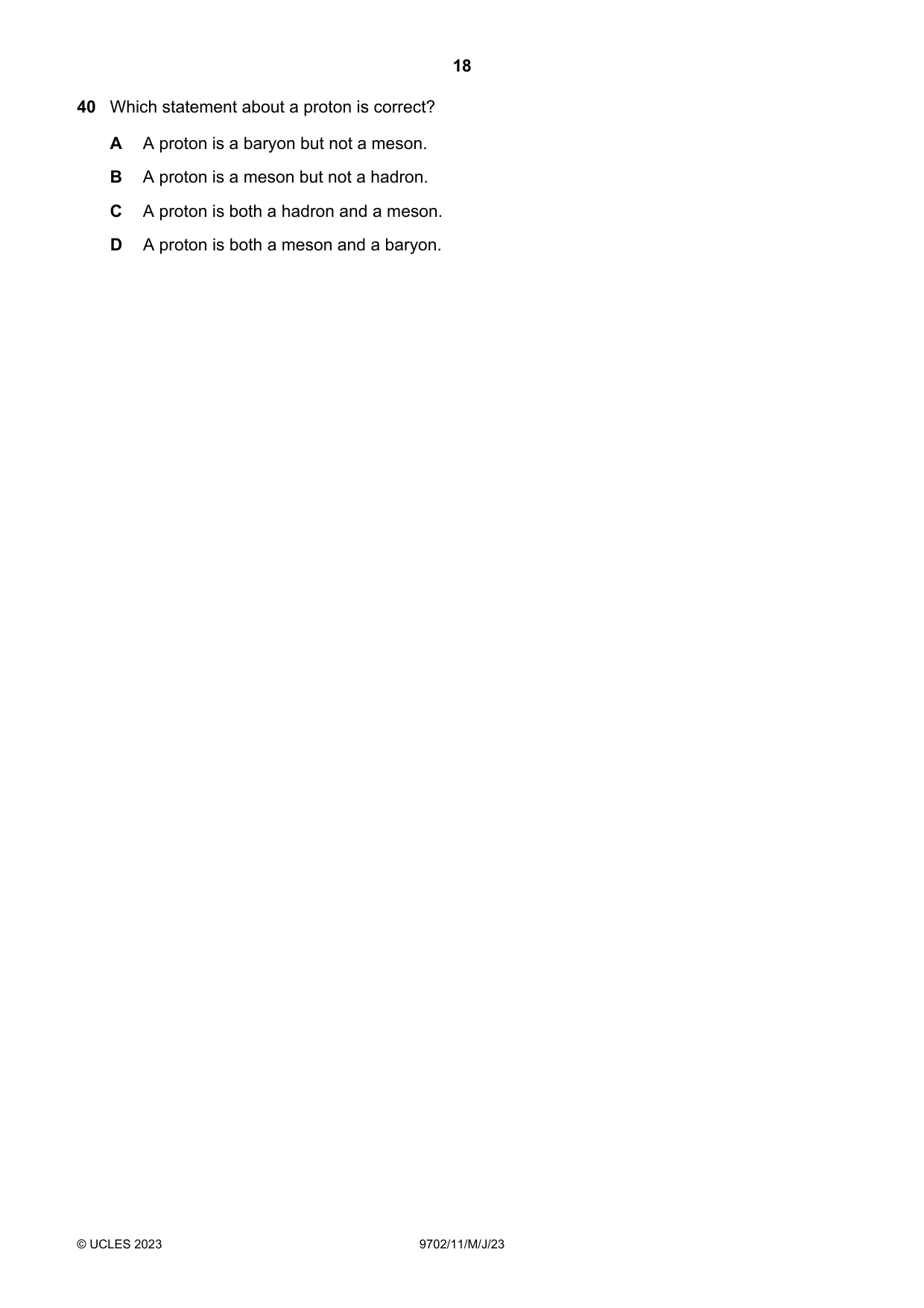
Q40 · Which statement about a proton is correct?
40 Which statement about a proton is correct? A A proton is a baryon but not a meson. B A proton is a meson but not a hadron. C A proton is both a hadron and a meson. D A proton is both a meson and a baryon.
Mark scheme: A
What was in this paper
The subtopics covered by these 40 questions, and how many questions each got. Open one in a new tab to see every Cambridge question on it.
2Elastic and plastic behaviour2Energy conservation2Equations of motion2Fundamental particles2Interference2Linear momentum and its conservation2Potential dividers2Practical circuits2Progressive waves2Resistance and resistivity2Turning effects of forces2Diffraction1Doppler effect for sound waves1Electric current1Electromagnetic spectrum1Equilibrium of forces1Errors and uncertainties1Momentum and Newton’s laws of motion1Non-uniform motion1Polarisation1Potential difference and power1Radioactive decay1Scalars and vectors1SI units1Stationary waves1The diffraction grating1The mole1What you needed in this session
Cambridge’s own grade thresholds for 2023 May/June, Paper 1 · Variant 1. A higher threshold means an easier paper — the bar moves with how the cohort did.