Cambridge A Level Physics 9702 — 2022 Oct/Nov Paper 1 · Variant 1
9702/11/O/N/22 · 40 questions · 40 marks · ≈45 min
The question paper and its mark scheme, free to read here and free to download. This is Cambridge’s own paper, exactly as it was sat.
Question paper20 pages
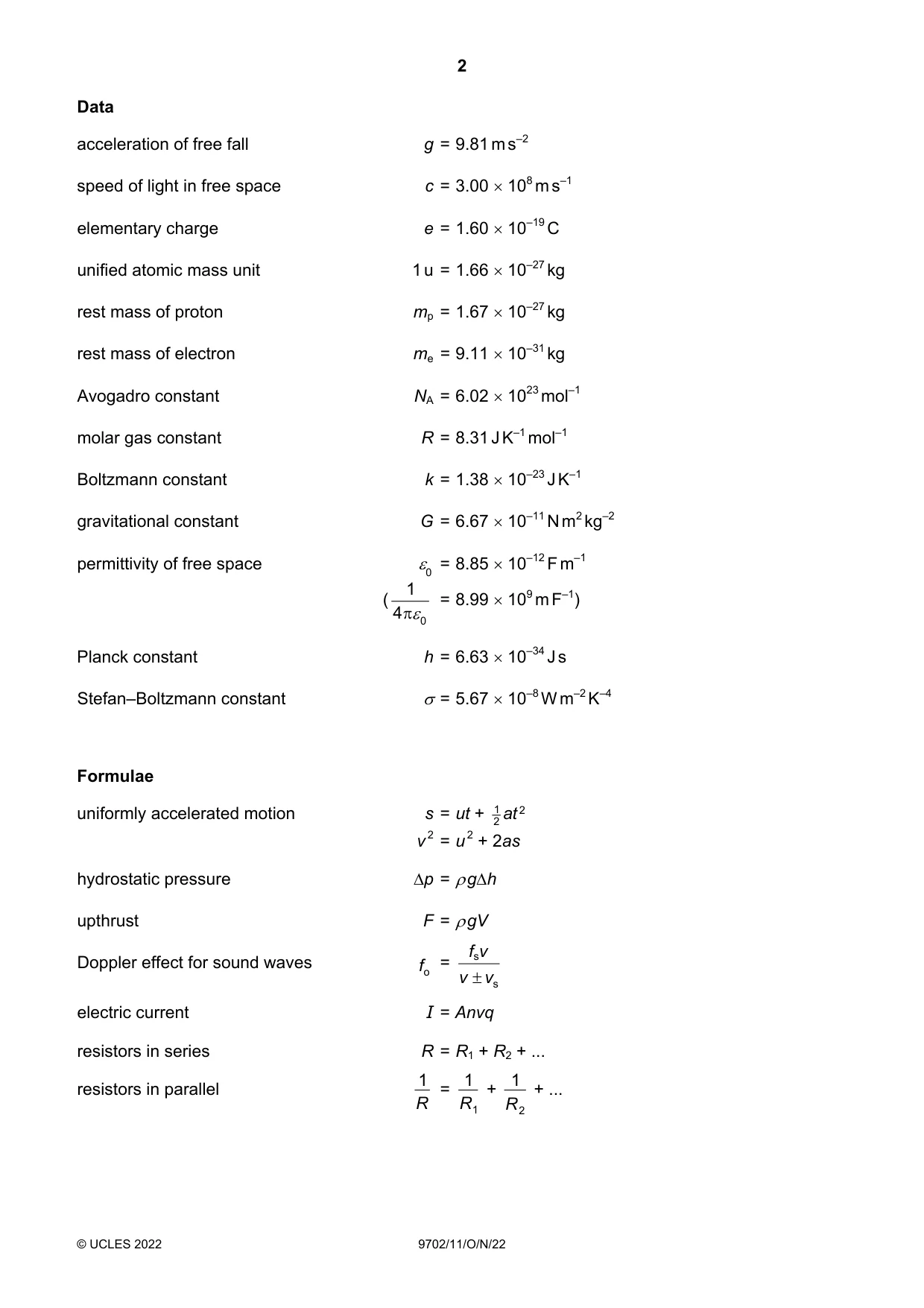



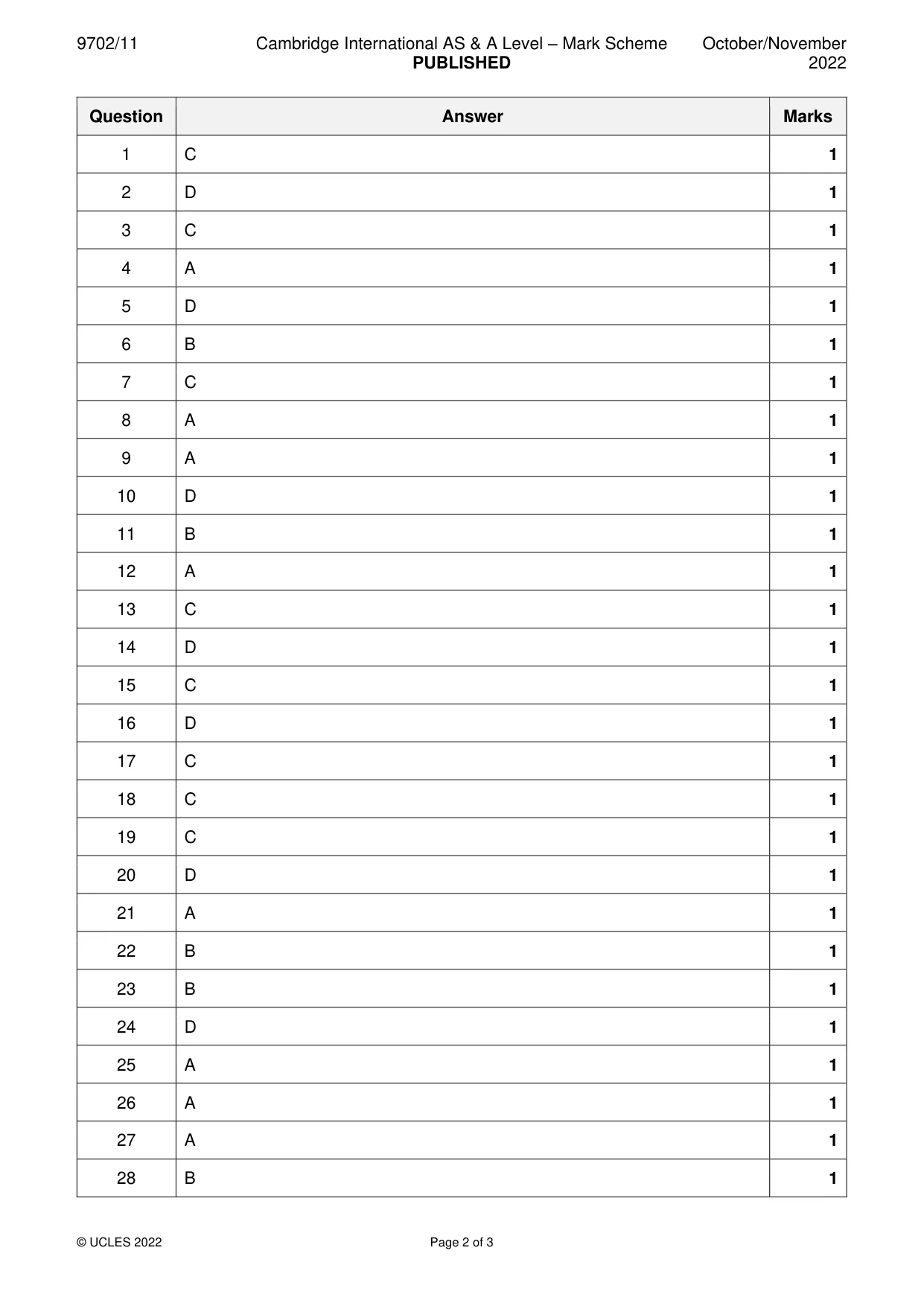
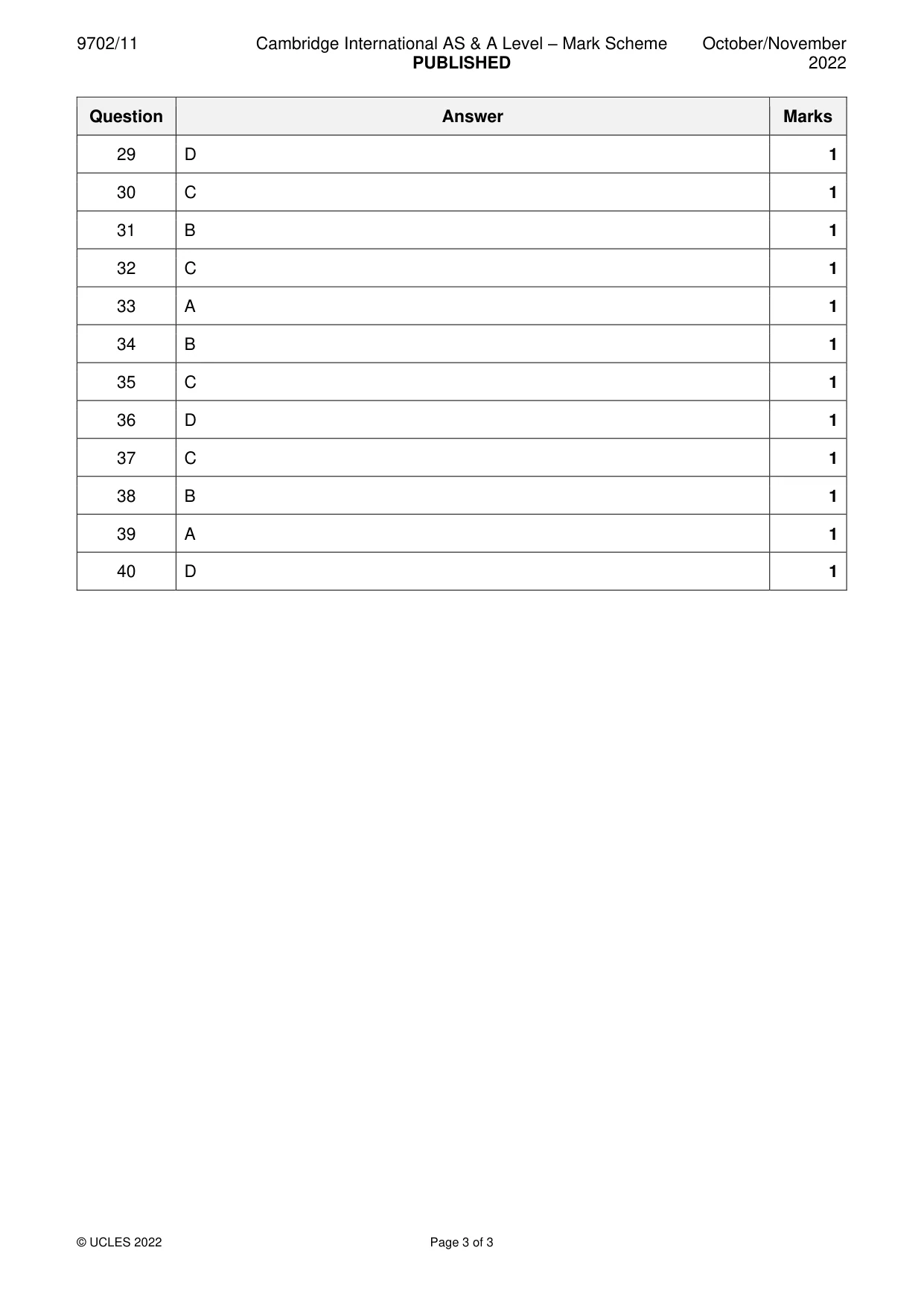
Mark scheme3 pages
Answers below. Sit the paper first if you are practising.
Questions as text
Q1 · What is needed to accurately represent all physical quantities?
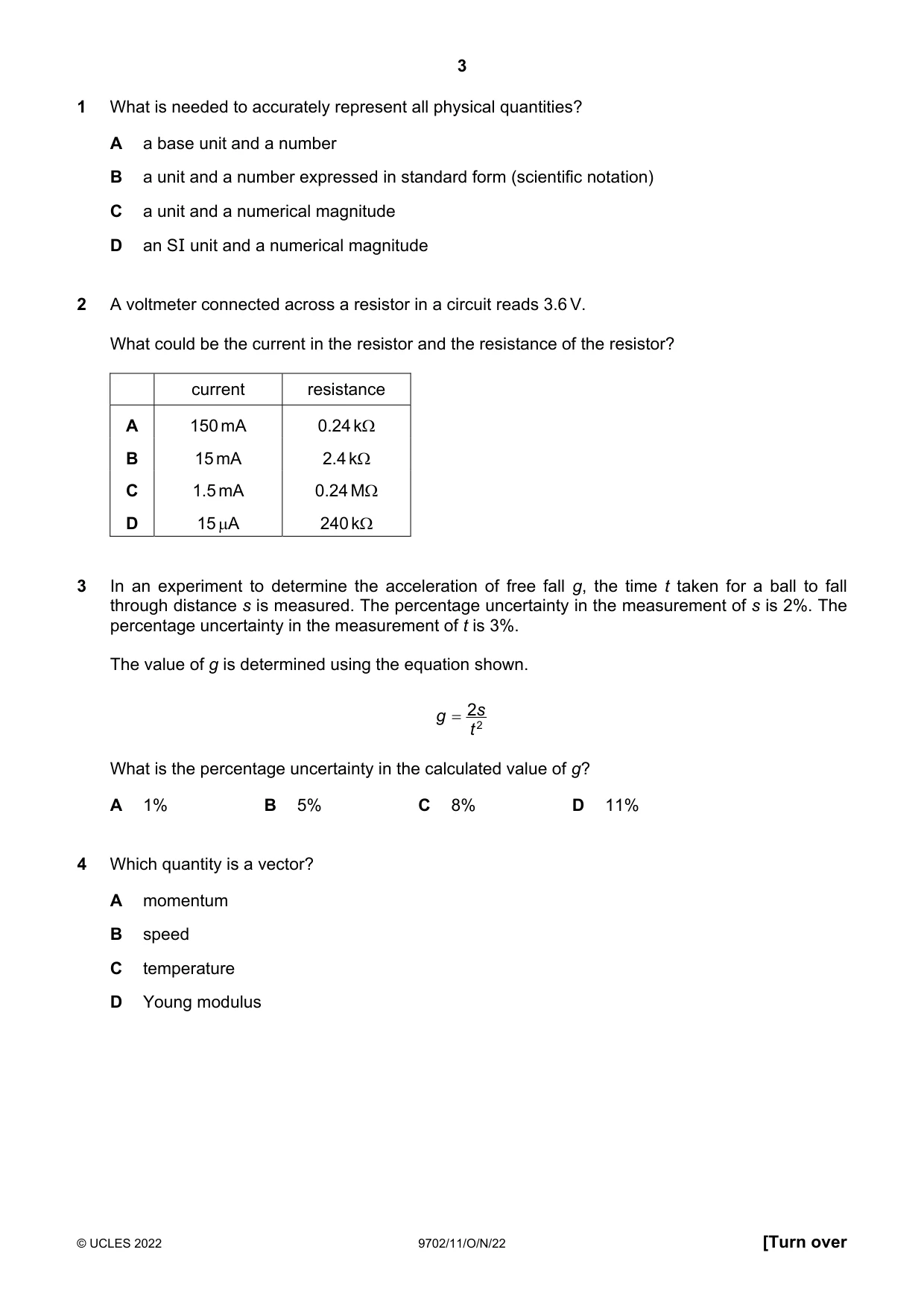
1 What is needed to accurately represent all physical quantities? A a base unit and a number B a unit and a number expressed in standard form (scientific notation) C a unit and a numerical magnitude D an SI unit and a numerical magnitude
Mark scheme: C
Q2 · A voltmeter connected across a resistor in a circuit reads 3.6 V
2 A voltmeter connected across a resistor in a circuit reads 3.6 V. What could be the current in the resistor and the resistance of the resistor? current resistance A 150 mA 0.24 k B 15 mA 2.4 k C 1.5 mA 0.24 M D 15 A 240 k
Mark scheme: D
Q3 · In an experiment to determine the acceleration of free fall g, the time t taken for a…
3 In an experiment to determine the acceleration of free fall g, the time t taken for a ball to fall through distance s is measured. The percentage uncertainty in the measurement of s is 2%. The percentage uncertainty in the measurement of t is 3%. The value of g is determined using the equation shown. g 2 s t 2 What is the percentage uncertainty in the calculated value of g? A 1% B 5% C 8% D 11%
Mark scheme: C
Q4 · Which quantity is a vector?
4 Which quantity is a vector? A momentum B speed C temperature D Young modulus
Mark scheme: A
Q5 · A particle accelerates from rest
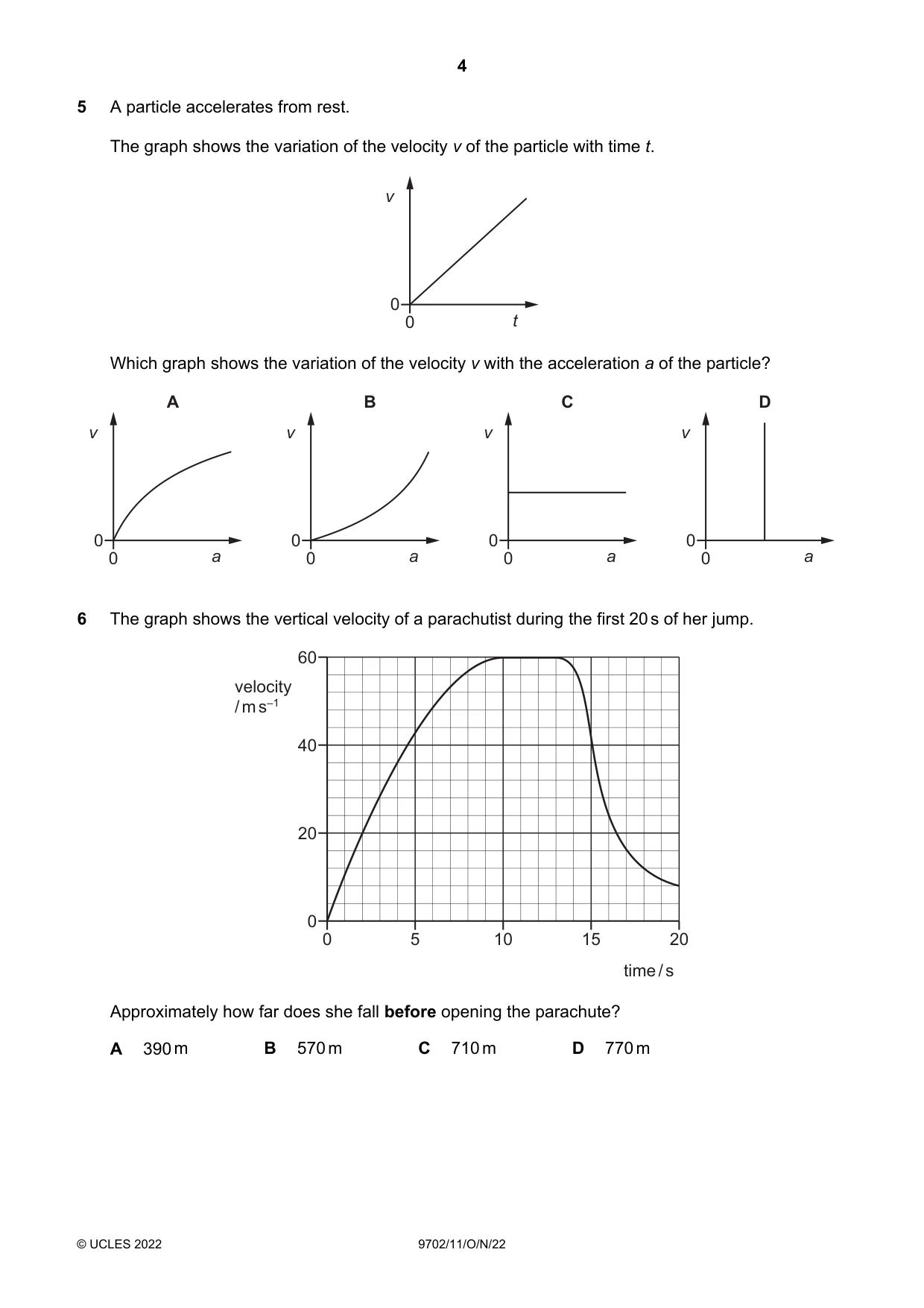
5 A particle accelerates from rest. The graph shows the variation of the velocity v of the particle with time t. v 0 0 t Which graph shows the variation of the velocity v with the acceleration a of the particle? A B C D v v v v 0 0 0 0 0 a 0 a 0 a 0 a
Mark scheme: D
Q6 · The graph shows the vertical velocity of a parachutist during the first 20 s of her jump
6 The graph shows the vertical velocity of a parachutist during the first 20 s of her jump. 60 velocity / m s–1 40 20 0 0 5 10 15 20 time / s Approximately how far does she fall before opening the parachute? A 390 m B 570 m C 710 m D 770 m
Mark scheme: B
Q7 · What is the definition of linear momentum?
7 What is the definition of linear momentum? A force per unit time B product of force and time C product of velocity and mass D velocity per unit mass
Mark scheme: C
Q8 · A mass of 0.20 kg is suspended from the lower end of a light spring
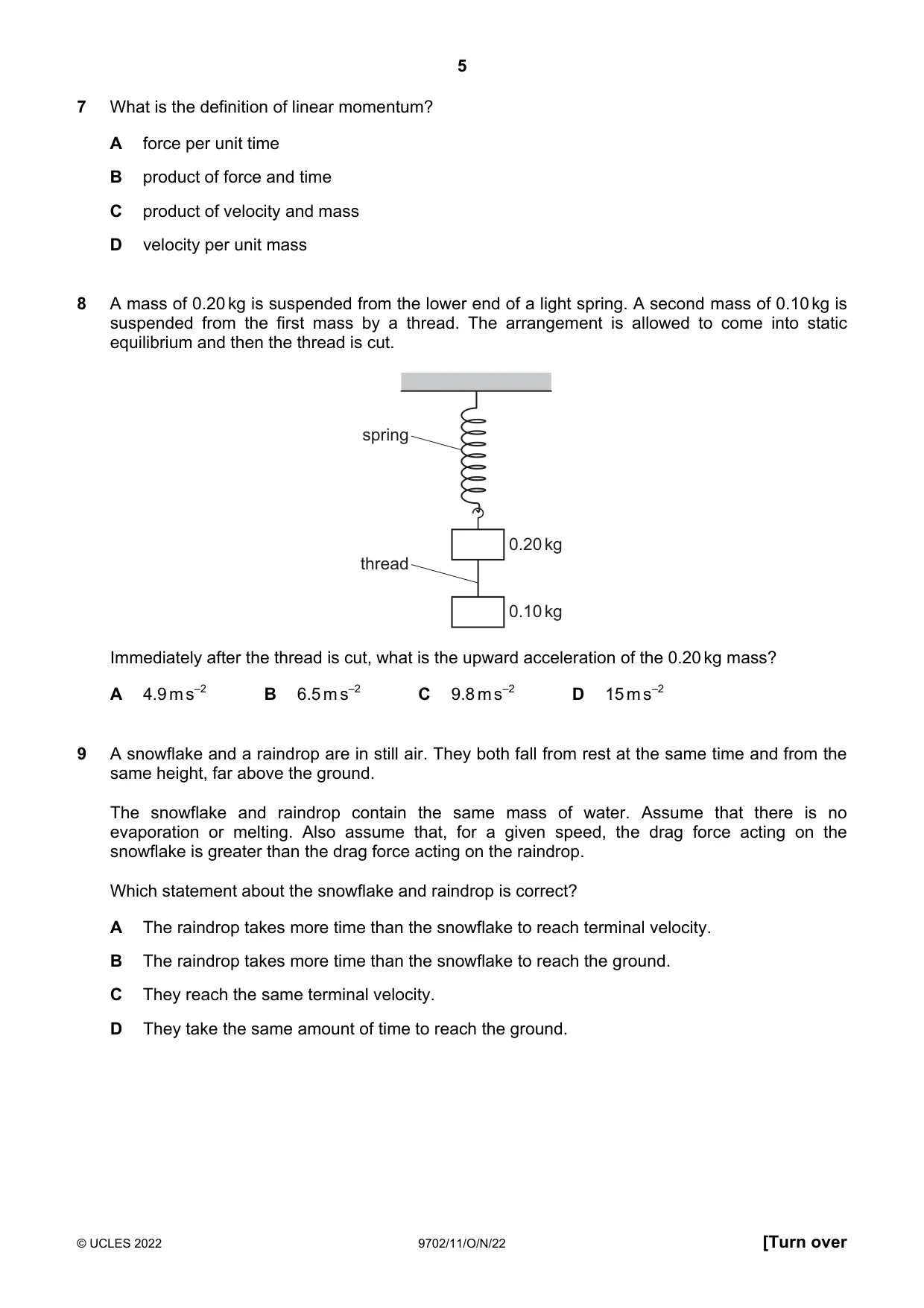
8 A mass of 0.20 kg is suspended from the lower end of a light spring. A second mass of 0.10 kg is suspended from the first mass by a thread. The arrangement is allowed to come into static equilibrium and then the thread is cut. spring 0.20 kg thread 0.10 kg Immediately after the thread is cut, what is the upward acceleration of the 0.20 kg mass? A 4.9 m s–2 B 6.5 m s–2 C 9.8 m s–2 D 15 m s–2
Mark scheme: A
Q9 · A snowflake and a raindrop are in still air
9 A snowflake and a raindrop are in still air. They both fall from rest at the same time and from the same height, far above the ground. The snowflake and raindrop contain the same mass of water. Assume that there is no evaporation or melting. Also assume that, for a given speed, the drag force acting on the snowflake is greater than the drag force acting on the raindrop. Which statement about the snowflake and raindrop is correct? A The raindrop takes more time than the snowflake to reach terminal velocity. B The raindrop takes more time than the snowflake to reach the ground. C They reach the same terminal velocity. D They take the same amount of time to reach the ground.
Mark scheme: A
Q10 · Two trolleys are held together on a horizontal surface with a compressed spring between…
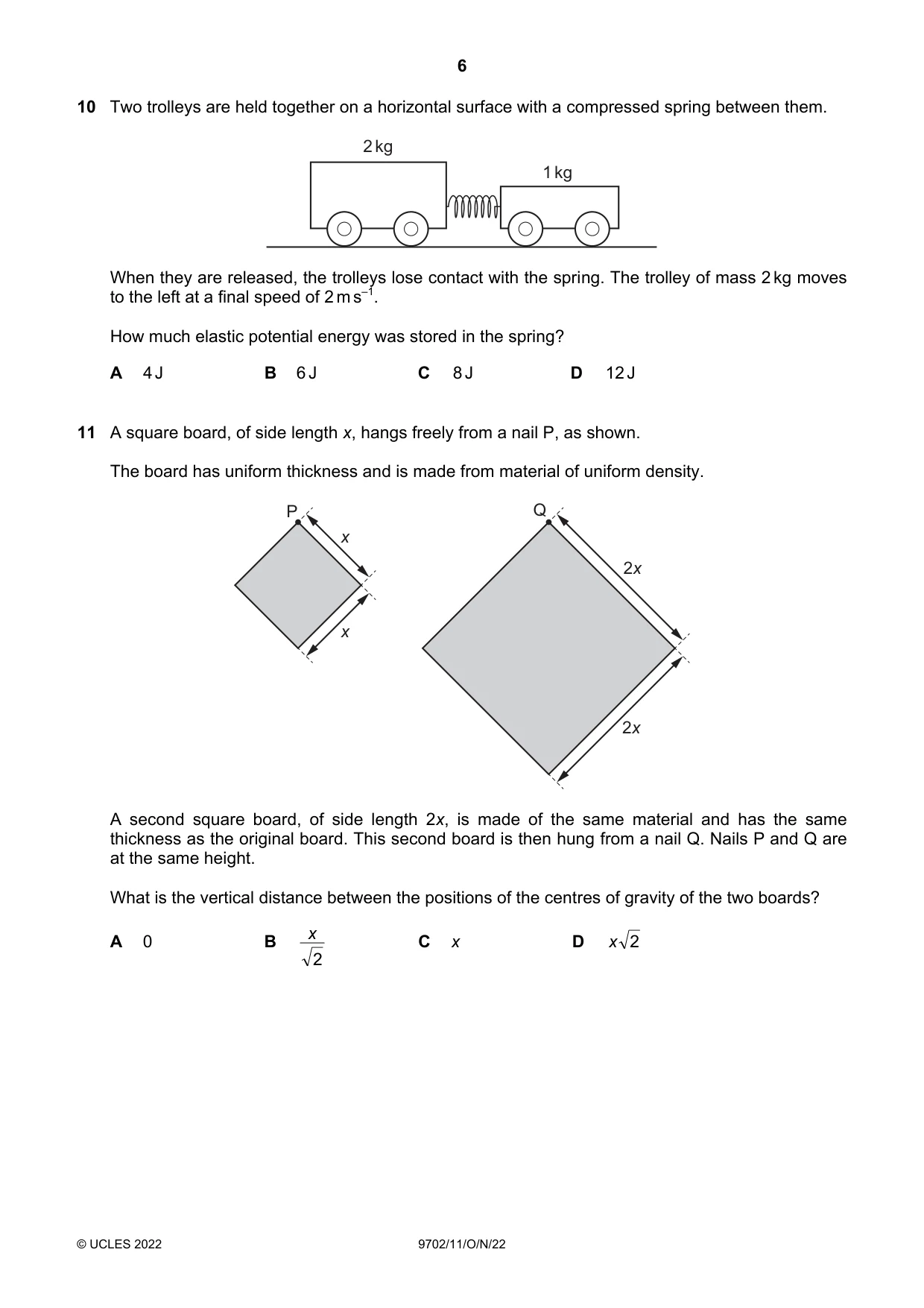
10 Two trolleys are held together on a horizontal surface with a compressed spring between them. 2 kg 1 kg When they are released, the trolleys lose contact with the spring. The trolley of mass 2 kg moves to the left at a final speed of 2 m s–1. How much elastic potential energy was stored in the spring? A 4 J B 6 J C 8 J D 12 J
Mark scheme: D
Q11 · A square board, of side length x, hangs freely from a nail P, as shown
11 A square board, of side length x, hangs freely from a nail P, as shown. The board has uniform thickness and is made from material of uniform density. P Q x 2x x 2x A second square board, of side length 2x, is made of the same material and has the same thickness as the original board. This second board is then hung from a nail Q. Nails P and Q are at the same height. What is the vertical distance between the positions of the centres of gravity of the two boards? x A 0 B C x D x 2 2
Mark scheme: B
Q12 · Forces are applied to a rigid object
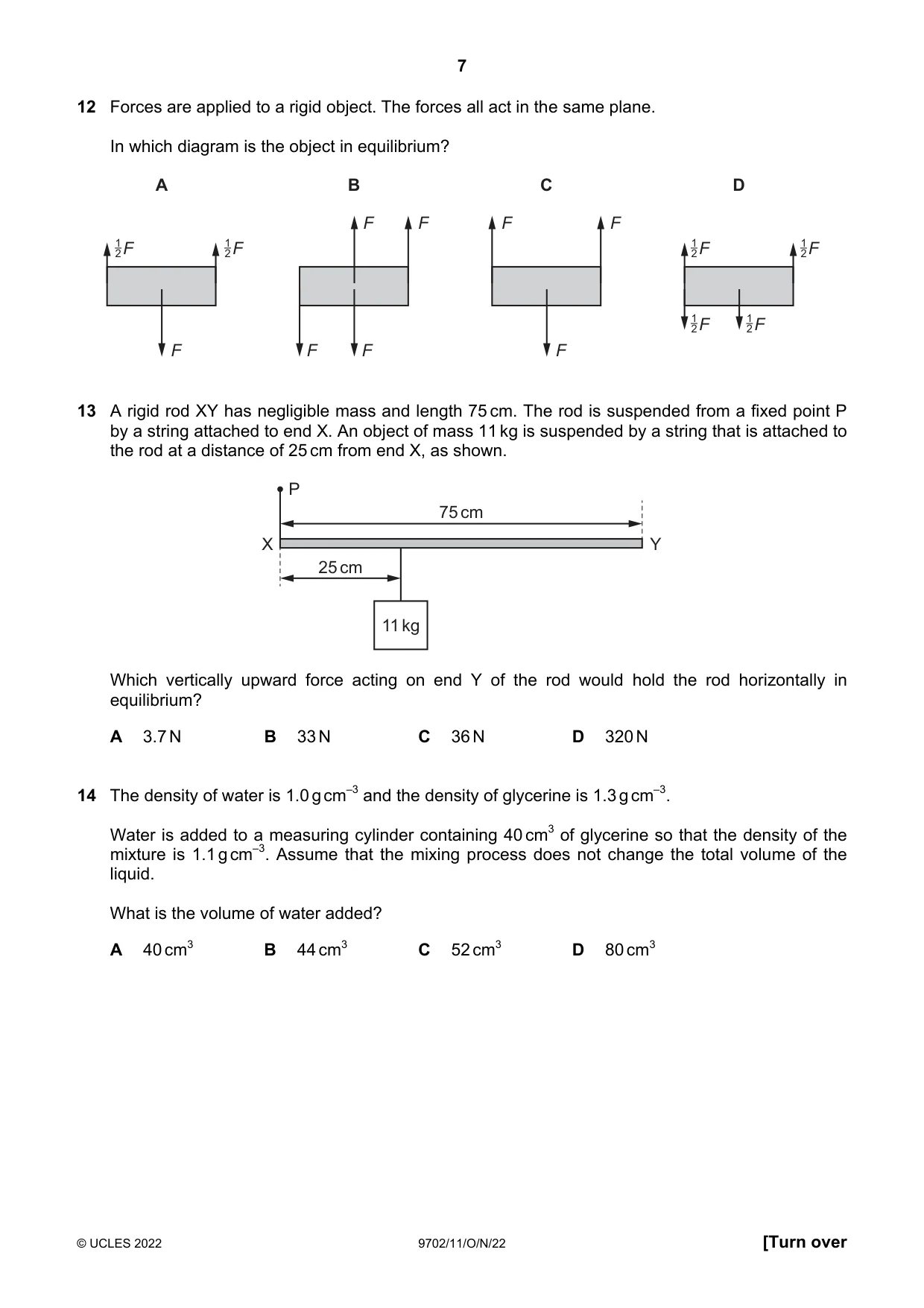
12 Forces are applied to a rigid object. The forces all act in the same plane. In which diagram is the object in equilibrium? A B C D F F F F 1 F 1 F 1 F 1 F 2 2 2 2 1 F 1 F 2 2 F F F F
Mark scheme: A
Q13 · A rigid rod XY has negligible mass and length 75 cm
13 A rigid rod XY has negligible mass and length 75 cm. The rod is suspended from a fixed point P by a string attached to end X. An object of mass 11 kg is suspended by a string that is attached to the rod at a distance of 25 cm from end X, as shown. P 75 cm X Y 25 cm 11 kg Which vertically upward force acting on end Y of the rod would hold the rod horizontally in equilibrium? A 3.7 N B 33 N C 36 N D 320 N
Mark scheme: C
Q14 · The density of water is 1.0 g cm–3 and the density of glycerine is 1.3 g cm–3
14 The density of water is 1.0 g cm–3 and the density of glycerine is 1.3 g cm–3. Water is added to a measuring cylinder containing 40 cm3 of glycerine so that the density of the mixture is 1.1 g cm–3. Assume that the mixing process does not change the total volume of the liquid. What is the volume of water added? A 40 cm3 B 44 cm3 C 52 cm3 D 80 cm3
Mark scheme: D
Q15 · A box, in the shape of a cube, falls from a ship into the sea
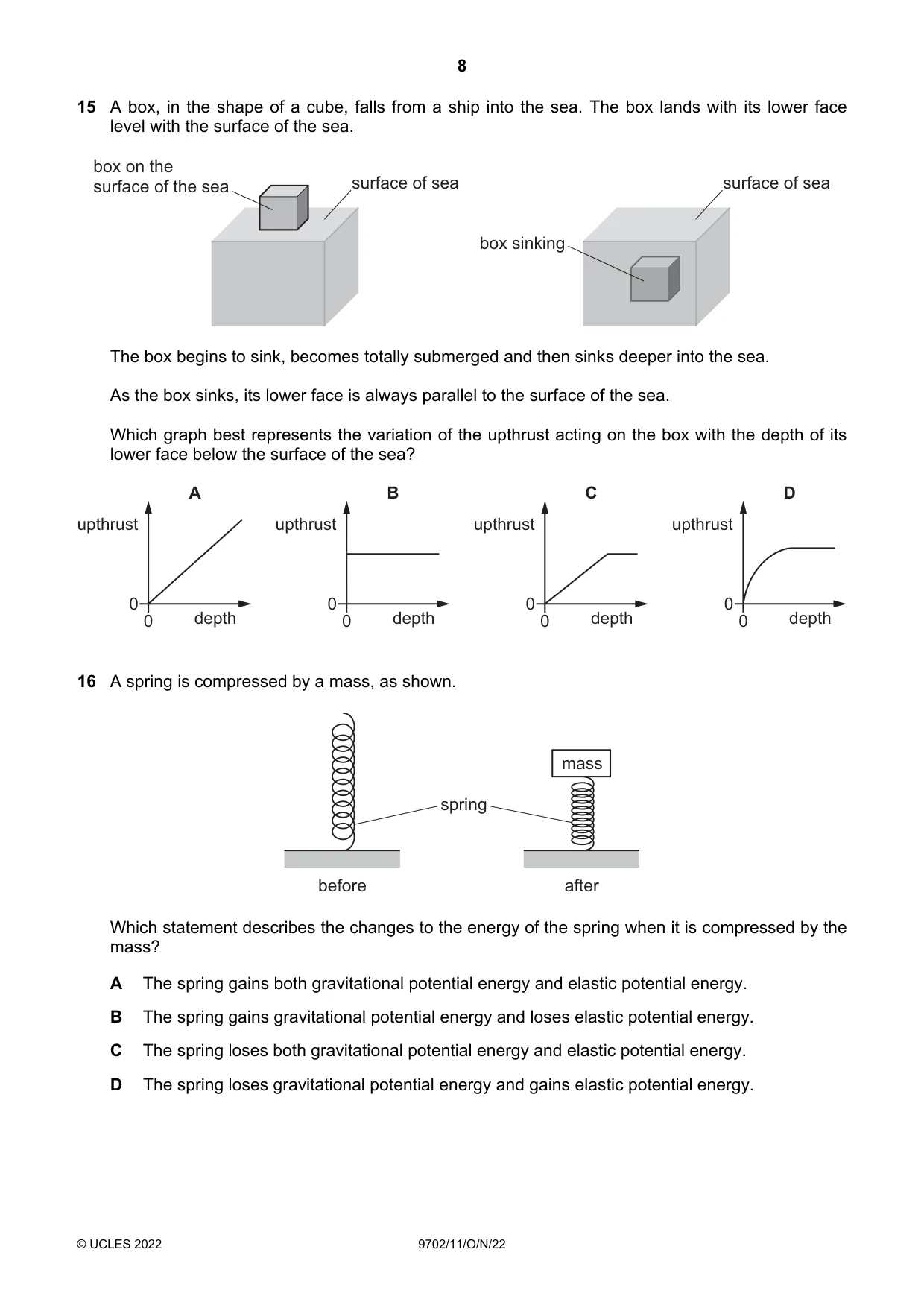
15 A box, in the shape of a cube, falls from a ship into the sea. The box lands with its lower face level with the surface of the sea. box on the surface of the sea surface of sea surface of sea box sinking The box begins to sink, becomes totally submerged and then sinks deeper into the sea. As the box sinks, its lower face is always parallel to the surface of the sea. Which graph best represents the variation of the upthrust acting on the box with the depth of its lower face below the surface of the sea? A B C D upthrust upthrust upthrust upthrust 0 0 0 0 0 depth 0 depth 0 depth 0 depth
Mark scheme: C
Q16 · A spring is compressed by a mass, as shown
16 A spring is compressed by a mass, as shown. mass spring before after Which statement describes the changes to the energy of the spring when it is compressed by the mass? A The spring gains both gravitational potential energy and elastic potential energy. B The spring gains gravitational potential energy and loses elastic potential energy. C The spring loses both gravitational potential energy and elastic potential energy. D The spring loses gravitational potential energy and gains elastic potential energy.
Mark scheme: D
Q17 · A man of mass 75 kg runs up a staircase consisting of 30 steps
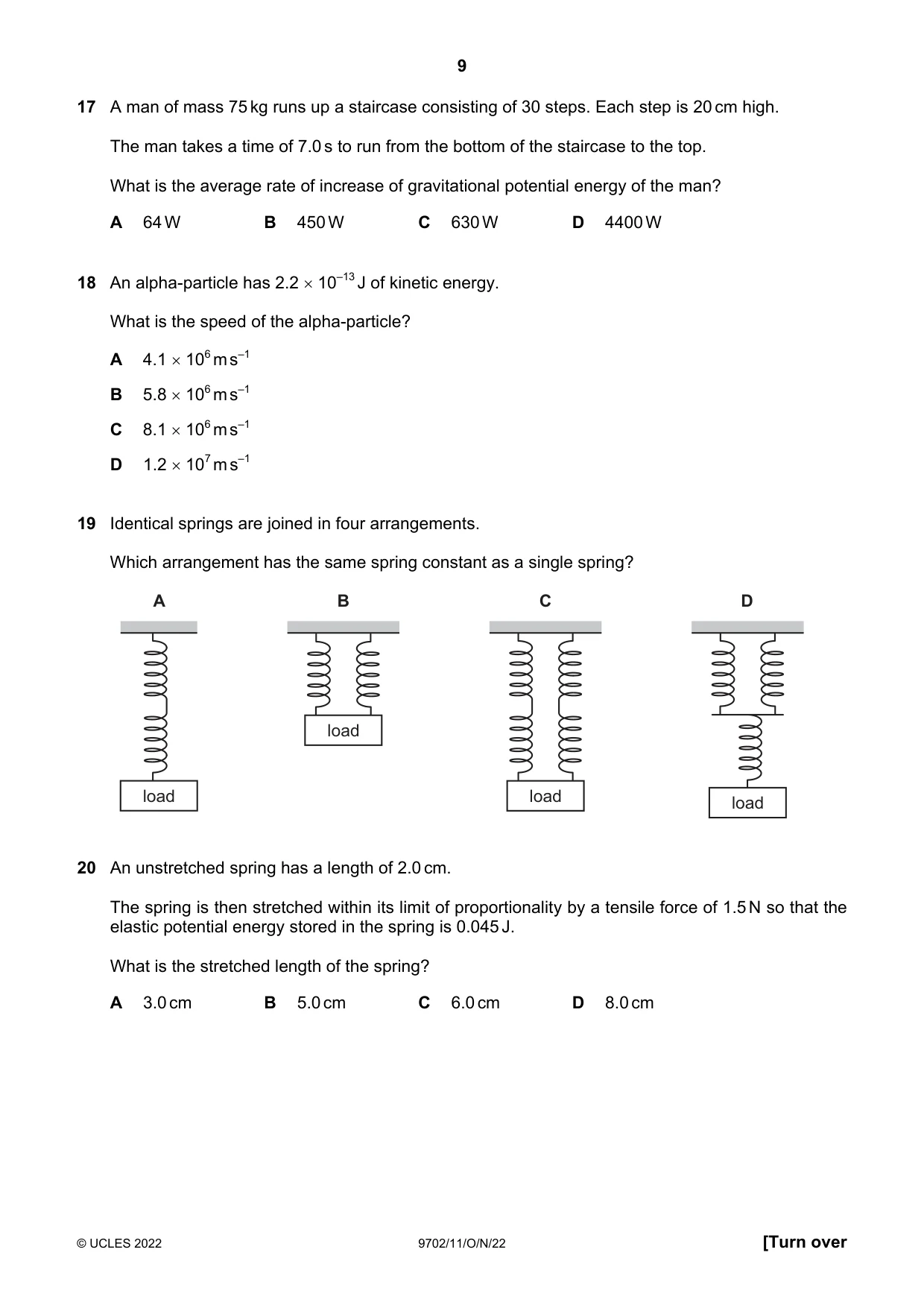
17 A man of mass 75 kg runs up a staircase consisting of 30 steps. Each step is 20 cm high. The man takes a time of 7.0 s to run from the bottom of the staircase to the top. What is the average rate of increase of gravitational potential energy of the man? A 64 W B 450 W C 630 W D 4400 W
Mark scheme: C
Q18 · An alpha-particle has 2.2 10–13 J of kinetic energy
18 An alpha-particle has 2.2 10–13 J of kinetic energy. What is the speed of the alpha-particle? A 4.1 106 m s–1 B 5.8 106 m s–1 C 8.1 106 m s–1 D 1.2 107 m s–1
Mark scheme: C
More questions on Gravitational potential energy and kinetic energy
Q19 · Identical springs are joined in four arrangements
19 Identical springs are joined in four arrangements. Which arrangement has the same spring constant as a single spring? A B C D load load load load
Mark scheme: C
Q20 · An unstretched spring has a length of 2.0 cm
20 An unstretched spring has a length of 2.0 cm. The spring is then stretched within its limit of proportionality by a tensile force of 1.5 N so that the elastic potential energy stored in the spring is 0.045 J. What is the stretched length of the spring? A 3.0 cm B 5.0 cm C 6.0 cm D 8.0 cm
Mark scheme: D
Q21 · A signal generator, amplifier and loudspeaker are used to produce different sound waves…
21 A signal generator, amplifier and loudspeaker are used to produce different sound waves in the air of a room. The relationships between the properties of these waves are investigated. Which relationship is not correct? A Amplitude is proportional to wavelength. B Frequency is inversely proportional to wavelength. C Intensity is proportional to amplitude squared at a given frequency. D Period is equal to the reciprocal of frequency.
Mark scheme: A
Q22 · When a guitar string is plucked, it causes a longitudinal sound wave in the air, as shown
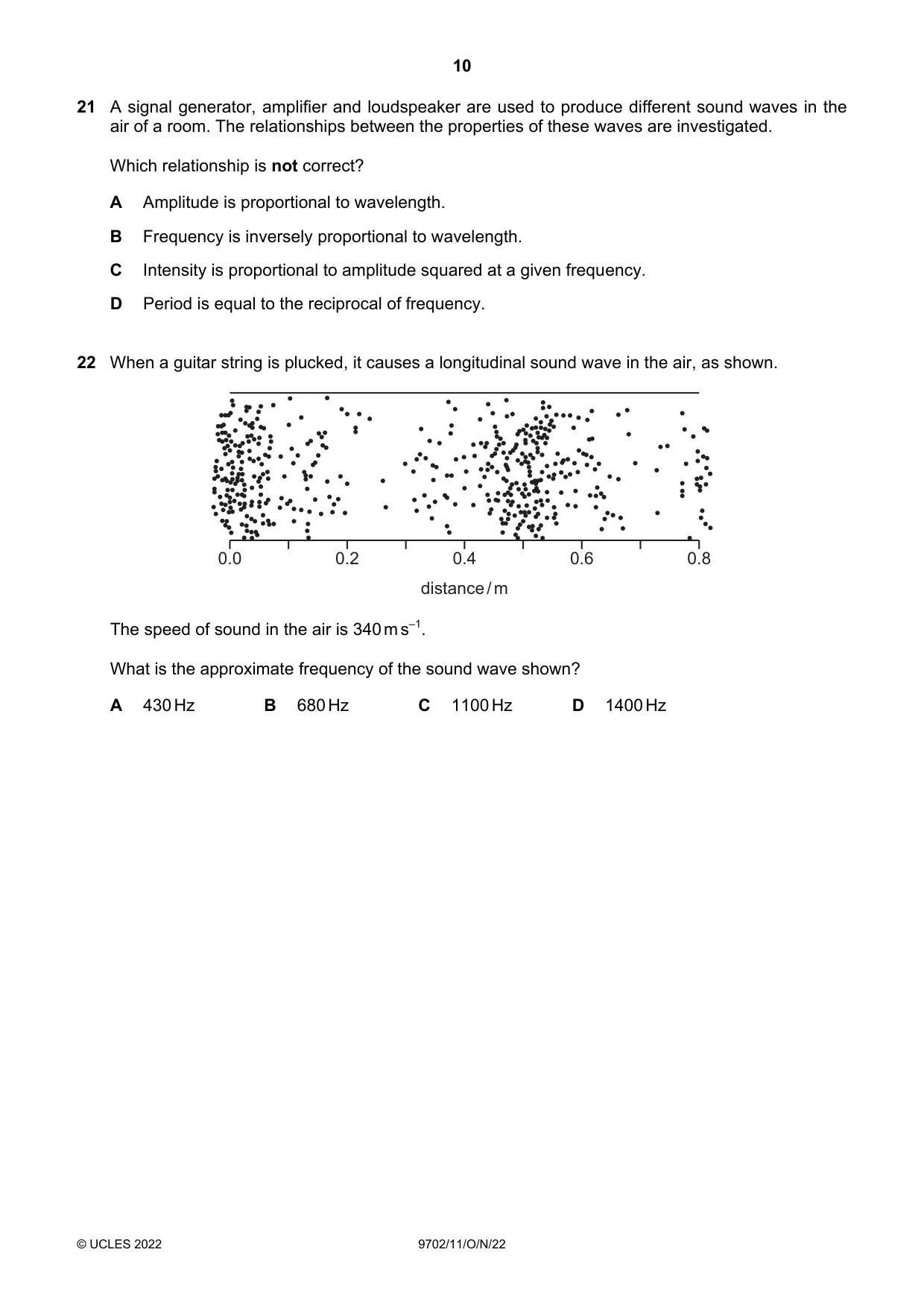
22 When a guitar string is plucked, it causes a longitudinal sound wave in the air, as shown. 0.0 0.2 0.4 0.6 0.8 distance / m The speed of sound in the air is 340 m s–1. What is the approximate frequency of the sound wave shown? A 430 Hz B 680 Hz C 1100 Hz D 1400 Hz
Mark scheme: B
Q23 · A transverse wave travels along a rope
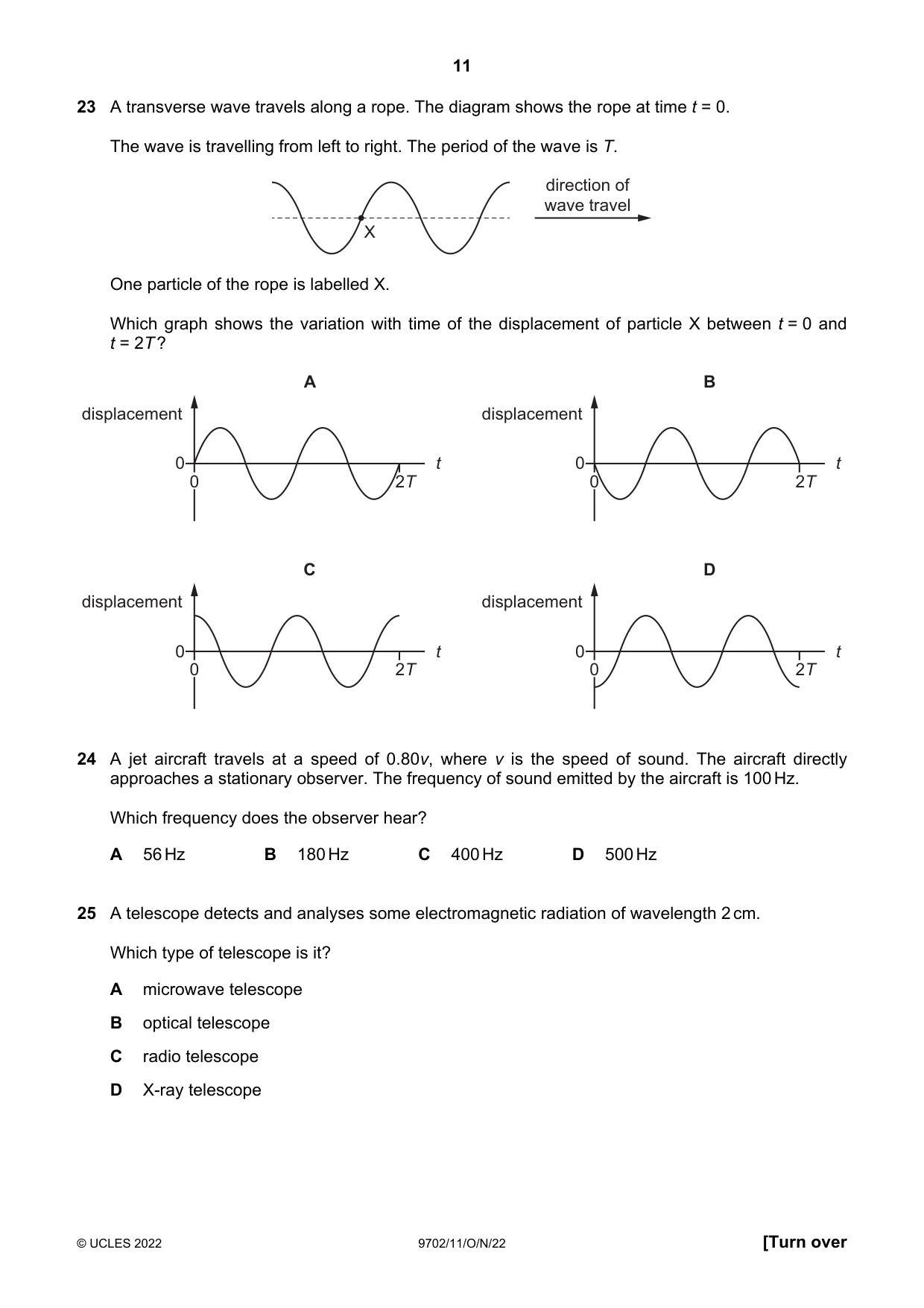
23 A transverse wave travels along a rope. The diagram shows the rope at time t = 0. The wave is travelling from left to right. The period of the wave is T. direction of wave travel X One particle of the rope is labelled X. Which graph shows the variation with time of the displacement of particle X between t = 0 and t = 2T ? A B displacement displacement 0 t 0 t 0 2T 0 2T C D displacement displacement 0 t 0 t 0 2T 0 2T
Mark scheme: B
Q24 · A jet aircraft travels at a speed of 0.80v, where v is the speed of sound
24 A jet aircraft travels at a speed of 0.80v, where v is the speed of sound. The aircraft directly approaches a stationary observer. The frequency of sound emitted by the aircraft is 100 Hz. Which frequency does the observer hear? A 56 Hz B 180 Hz C 400 Hz D 500 Hz
Mark scheme: D
Q25 · A telescope detects and analyses some electromagnetic radiation of wavelength 2 cm
25 A telescope detects and analyses some electromagnetic radiation of wavelength 2 cm. Which type of telescope is it? A microwave telescope B optical telescope C radio telescope D X-ray telescope
Mark scheme: A
Q26 · Two waves of the same type overlap
26 Two waves of the same type overlap. When does the principle of superposition apply? A always B only when the waves have the same amplitude C only when the waves have the same frequency D only when the waves travel in opposite directions
Mark scheme: A
Q27 · A stationary sound wave is formed in a tube of length L that is closed at one end
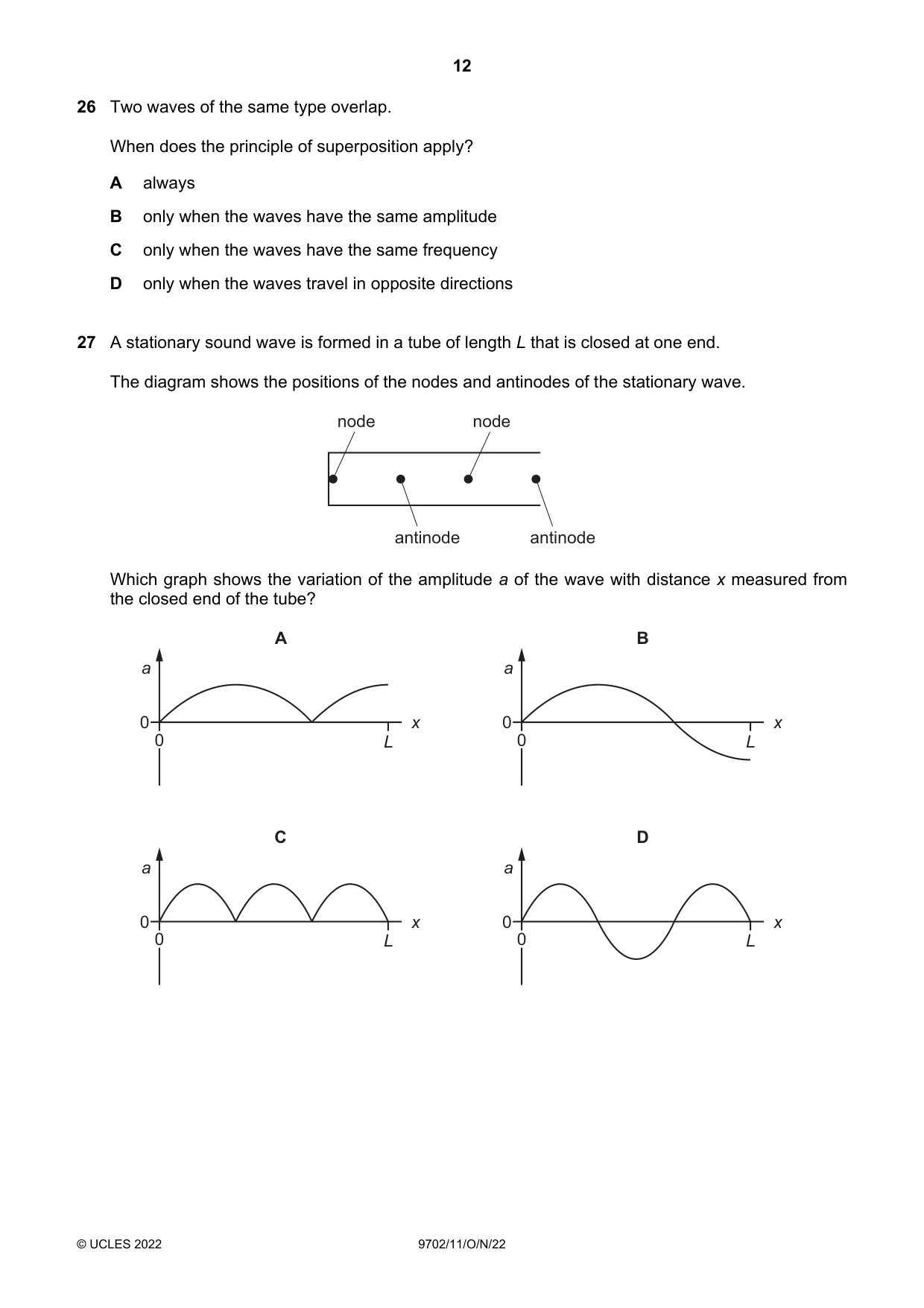
27 A stationary sound wave is formed in a tube of length L that is closed at one end. The diagram shows the positions of the nodes and antinodes of the stationary wave. node node antinode antinode Which graph shows the variation of the amplitude a of the wave with distance x measured from the closed end of the tube? A B a a 0 x 0 x 0 L 0 L C D a a 0 x 0 x 0 L 0 L
Mark scheme: A
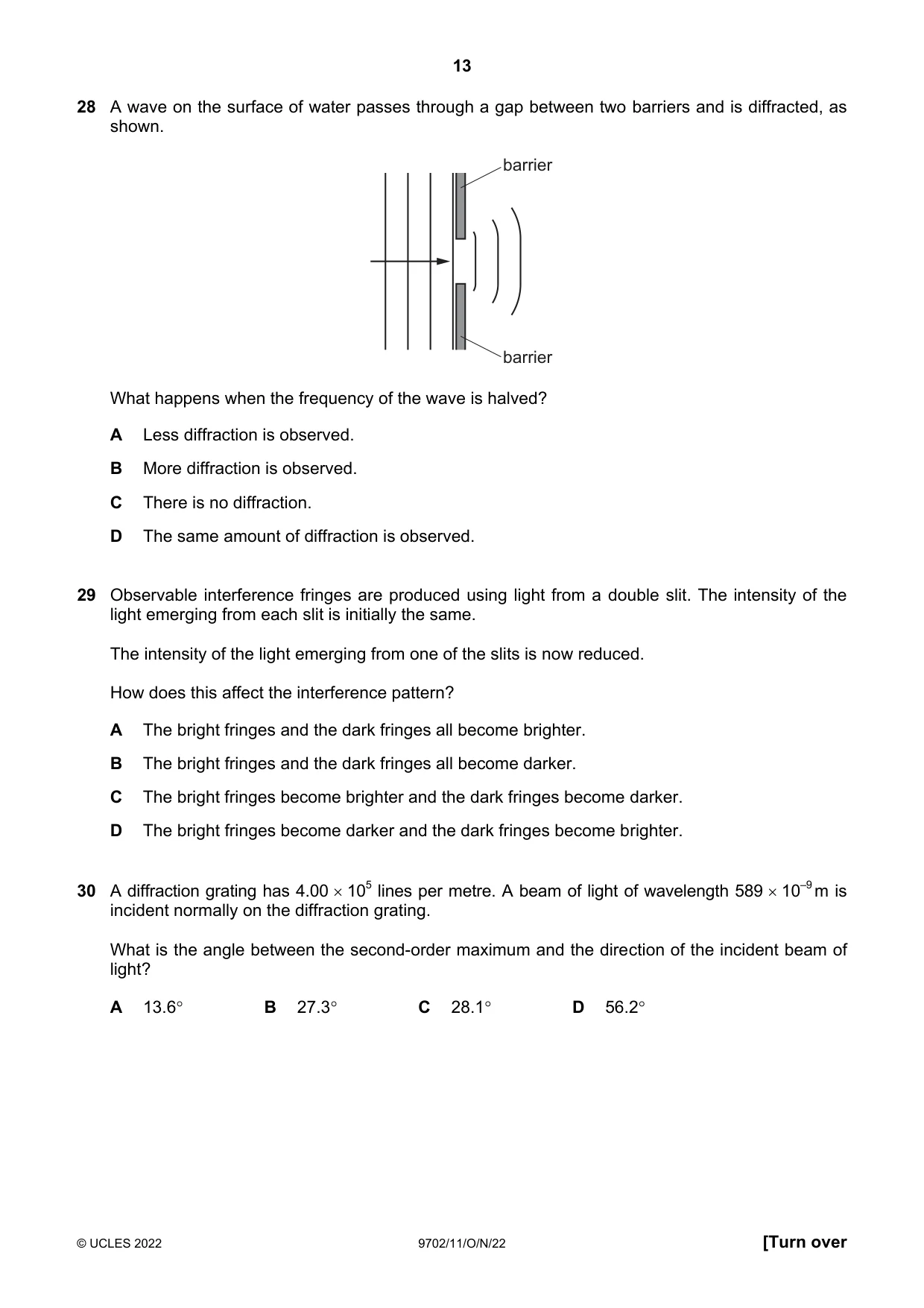
Q28 · A wave on the surface of water passes through a gap between two barriers and is…
28 A wave on the surface of water passes through a gap between two barriers and is diffracted, as shown. barrier barrier What happens when the frequency of the wave is halved? A Less diffraction is observed. B More diffraction is observed. C There is no diffraction. D The same amount of diffraction is observed.
Mark scheme: B
Q29 · Observable interference fringes are produced using light from a double slit
29 Observable interference fringes are produced using light from a double slit. The intensity of the light emerging from each slit is initially the same. The intensity of the light emerging from one of the slits is now reduced. How does this affect the interference pattern? A The bright fringes and the dark fringes all become brighter. B The bright fringes and the dark fringes all become darker. C The bright fringes become brighter and the dark fringes become darker. D The bright fringes become darker and the dark fringes become brighter.
Mark scheme: D
Q30 · A diffraction grating has 4.00 105 lines per metre
30 A diffraction grating has 4.00 105 lines per metre. A beam of light of wavelength 589 10–9 m is incident normally on the diffraction grating. What is the angle between the second-order maximum and the direction of the incident beam of light? A 13.6 B 27.3 C 28.1 D 56.2
Mark scheme: C
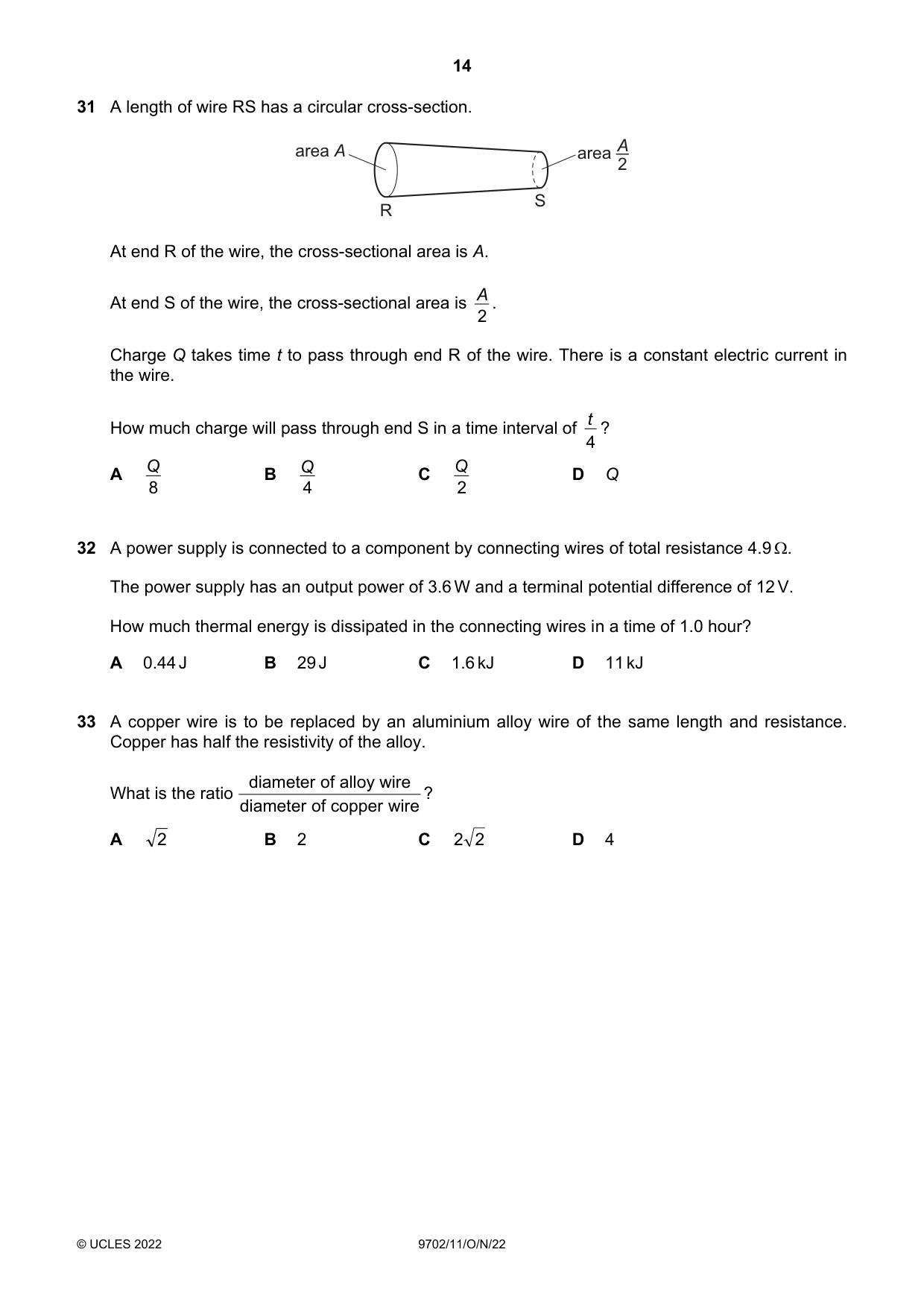
Q31 · A length of wire RS has a circular cross-section
31 A length of wire RS has a circular cross-section. area A area A 2 S R At end R of the wire, the cross-sectional area is A. A . At end S of the wire, the cross-sectional area is 2 Charge Q takes time t to pass through end R of the wire. There is a constant electric current in the wire. t ? How much charge will pass through end S in a time interval of 4 Q Q Q A B C D Q 8 4 2
Mark scheme: B
Q32 · A power supply is connected to a component by connecting wires of total resistance 4.9
32 A power supply is connected to a component by connecting wires of total resistance 4.9 . The power supply has an output power of 3.6 W and a terminal potential difference of 12 V. How much thermal energy is dissipated in the connecting wires in a time of 1.0 hour? A 0.44 J B 29 J C 1.6 kJ D 11 kJ
Mark scheme: C
Q33 · A copper wire is to be replaced by an aluminium alloy wire of the same length and…
33 A copper wire is to be replaced by an aluminium alloy wire of the same length and resistance. Copper has half the resistivity of the alloy. diameter of alloy wire What is the ratio ? diameter of copper wire A 2 B 2 C 2 2 D 4
Mark scheme: A
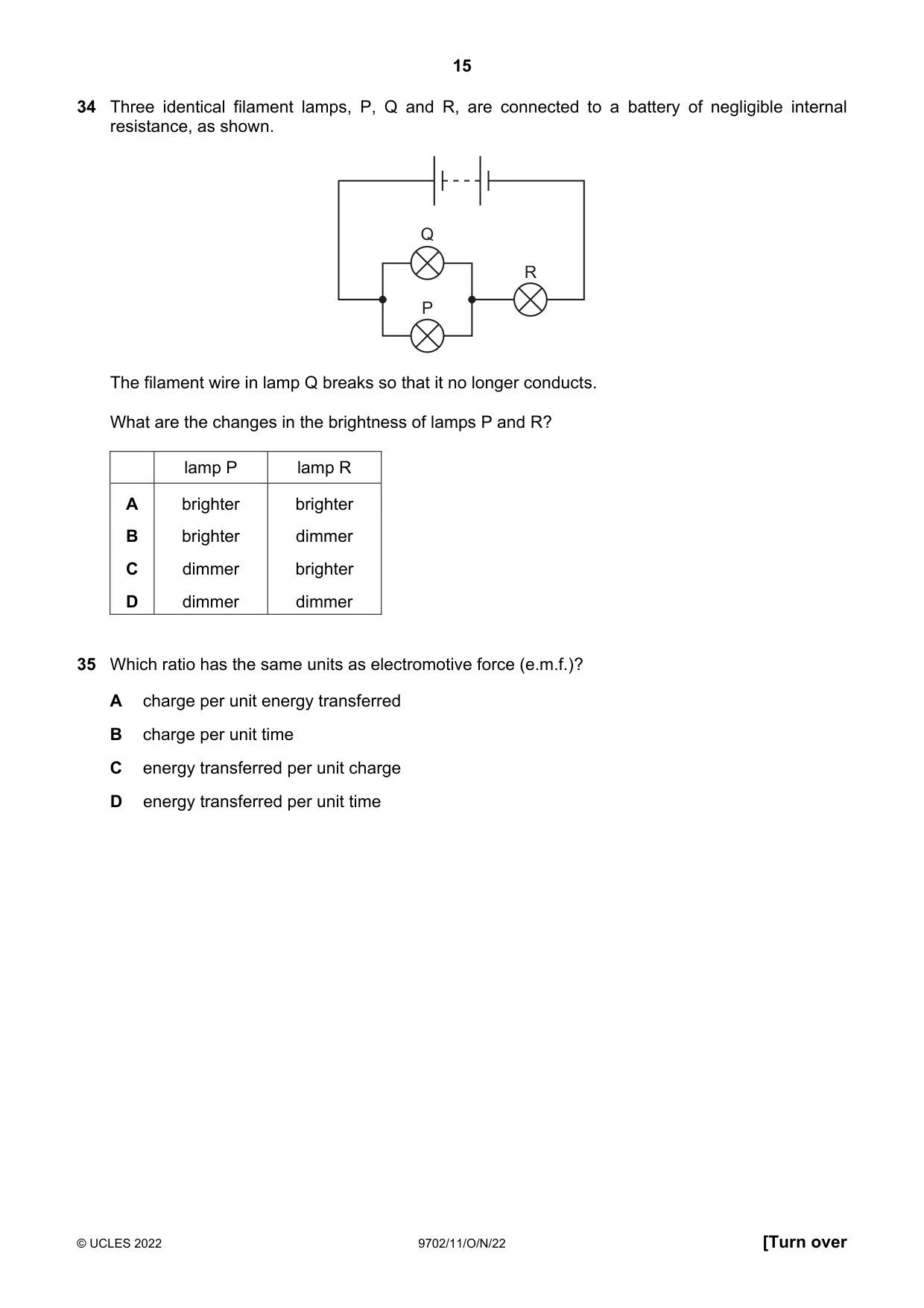
Q34 · Three identical filament lamps, P, Q and R, are connected to a battery of negligible…
34 Three identical filament lamps, P, Q and R, are connected to a battery of negligible internal resistance, as shown. Q R P The filament wire in lamp Q breaks so that it no longer conducts. What are the changes in the brightness of lamps P and R? lamp P lamp R A brighter brighter B brighter dimmer C dimmer brighter D dimmer dimmer
Mark scheme: B
Q35 · Which ratio has the same units as electromotive force (e.m.f.)?
35 Which ratio has the same units as electromotive force (e.m.f.)? A charge per unit energy transferred B charge per unit time C energy transferred per unit charge D energy transferred per unit time
Mark scheme: C
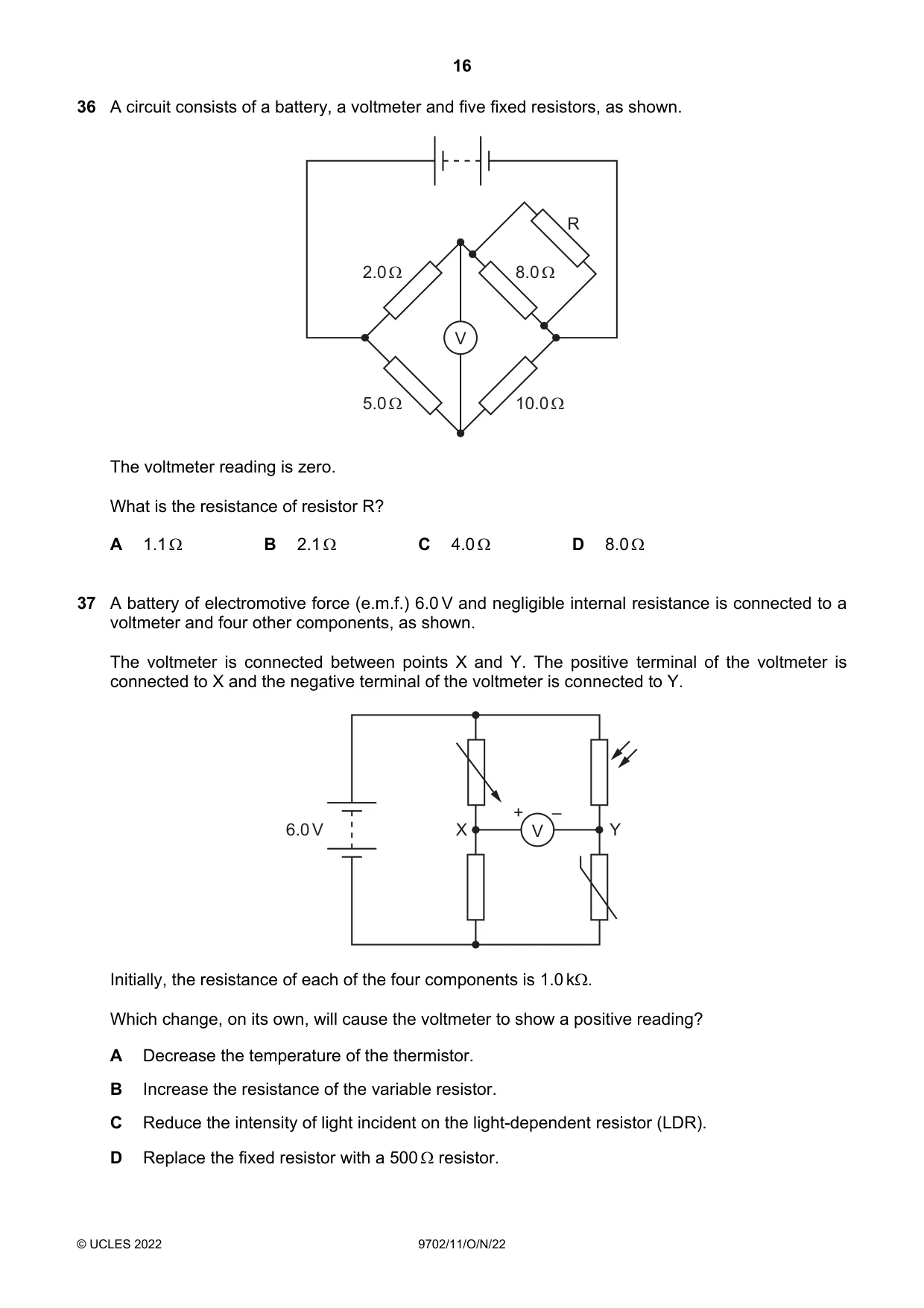
Q36 · A circuit consists of a battery, a voltmeter and five fixed resistors, as shown
36 A circuit consists of a battery, a voltmeter and five fixed resistors, as shown. The voltmeter reading is Zero. What is the resistance of resistor R? A 1.19 Bo 2.1 C 4.00 D 8.0Q
Mark scheme: D
Q37 · A battery of electromotive force (e.m.f.) 6.0 V and negligible internal resistance is…
37 A battery of electromotive force (e.m.f.) 6.0 V and negligible internal resistance is connected to a voltmeter and four other components, as shown. The voltmeter is connected between points X and Y. The positive terminal of the voltmeter is connected to X and the negative terminal of the voltmeter is connected to Y. + – 6.0 V X V Y Initially, the resistance of each of the four components is 1.0 k. Which change, on its own, will cause the voltmeter to show a positive reading? A Decrease the temperature of the thermistor. B Increase the resistance of the variable resistor. C Reduce the intensity of light incident on the light-dependent resistor (LDR). D Replace the fixed resistor with a 500 resistor.
Mark scheme: C
Q38 · An -particle passes close to a gold nucleus and is deflected through an angle greater…
38 An -particle passes close to a gold nucleus and is deflected through an angle greater than 90. Which property of the -particle changes as a result of the deflection? A charge B momentum C nucleon number D proton number
Mark scheme: B
Q39 · A nucleus of 238 U decays in stages by emitting -particles and – particles, eventually…
39 A nucleus of 238 U decays in stages by emitting -particles and – particles, eventually forming a 92 nucleus of 206 Pb. 82 How many -particles and how many – particles are emitted during the decay chain? -particles – particles A 8 6 B 8 10 C 16 6 D 16 22
Mark scheme: A
Q40 · Which list of particles contains only fundamental particles?
40 Which list of particles contains only fundamental particles? A antineutrino, beta, meson B baryon, neutrino, positron C electron, neutrino, alpha D lepton, quark, positron
Mark scheme: D
What was in this paper
The subtopics covered by these 40 questions, and how many questions each got. Open one in a new tab to see every Cambridge question on it.
3Density and pressure2Elastic and plastic behaviour2Energy conservation2Interference2Linear momentum and its conservation2Non-uniform motion2Progressive waves2Turning effects of forces2Atoms, nuclei and radiation1Diffraction1Doppler effect for sound waves1Electric current1Electromagnetic spectrum1Equations of motion1Equilibrium of forces1Errors and uncertainties1Fundamental particles1Gravitational potential energy and kinetic energy1Kirchhoff’s laws1Momentum and Newton’s laws of motion1Physical quantities1Potential dividers1Practical circuits1Radioactive decay1Resistance and resistivity1Scalars and vectors1Stationary waves1The diffraction grating1Transverse and longitudinal waves1What you needed in this session
Cambridge’s own grade thresholds for 2022 Oct/Nov, Paper 1 · Variant 1. A higher threshold means an easier paper — the bar moves with how the cohort did.