Cambridge A Level Physics 9702 — 2015 Oct/Nov Paper 1 · Variant 3
9702/13/O/N/15 · 40 questions · 40 marks · ≈45 min
The question paper and its mark scheme, free to read here and free to download. This is Cambridge’s own paper, exactly as it was sat.
Question paper24 pages
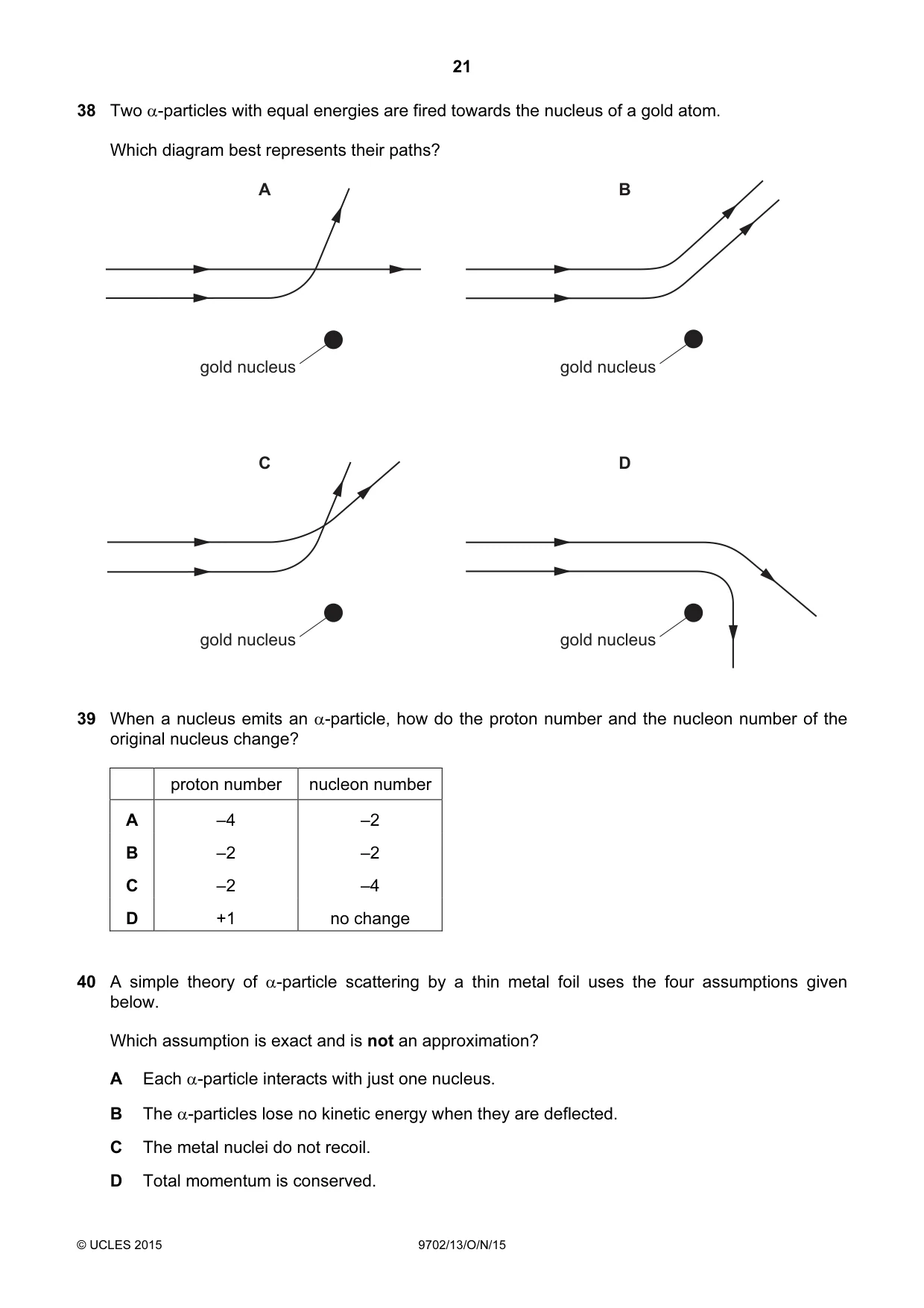


Mark scheme2 pages
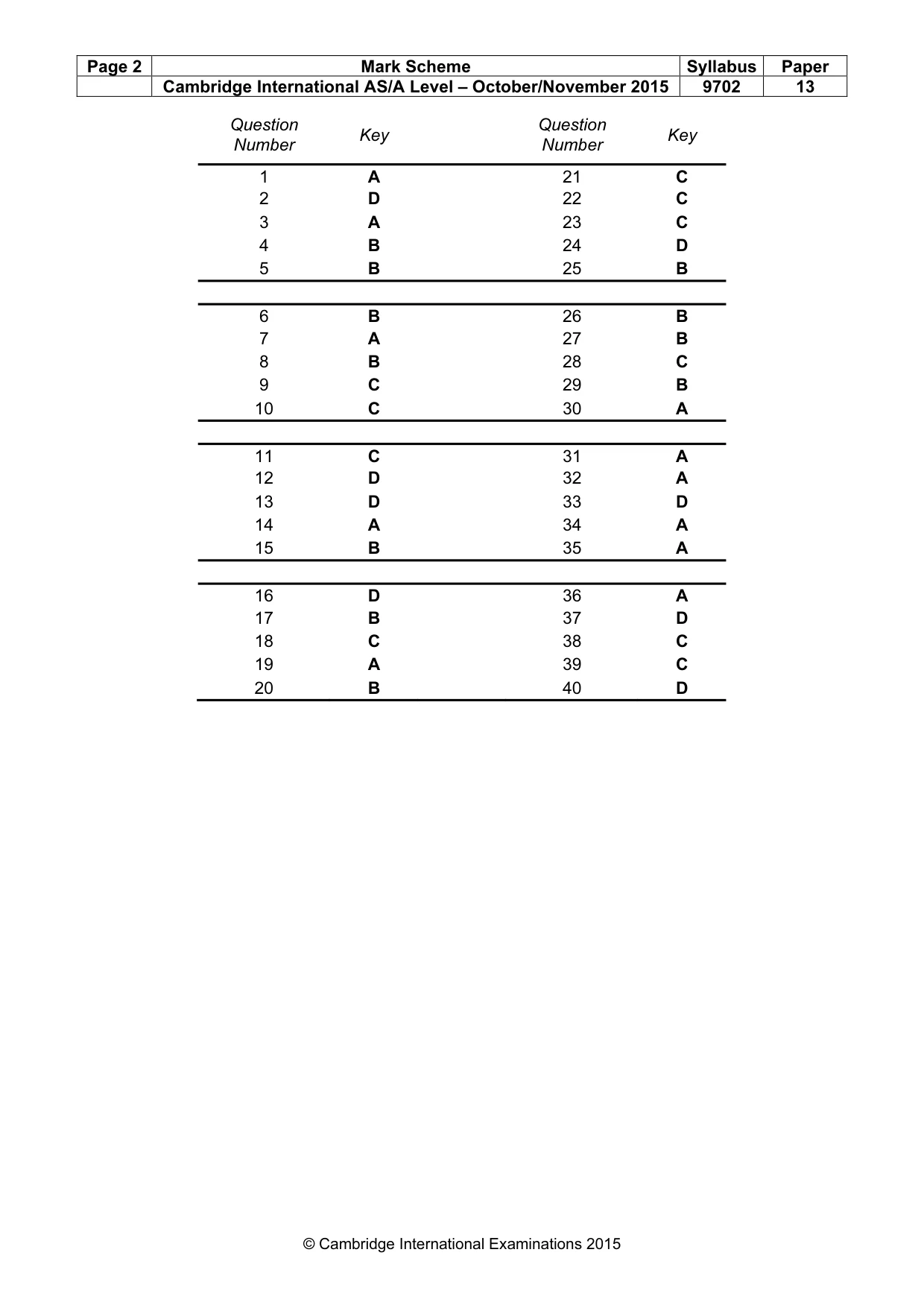
Answers below. Sit the paper first if you are practising.
Questions as text
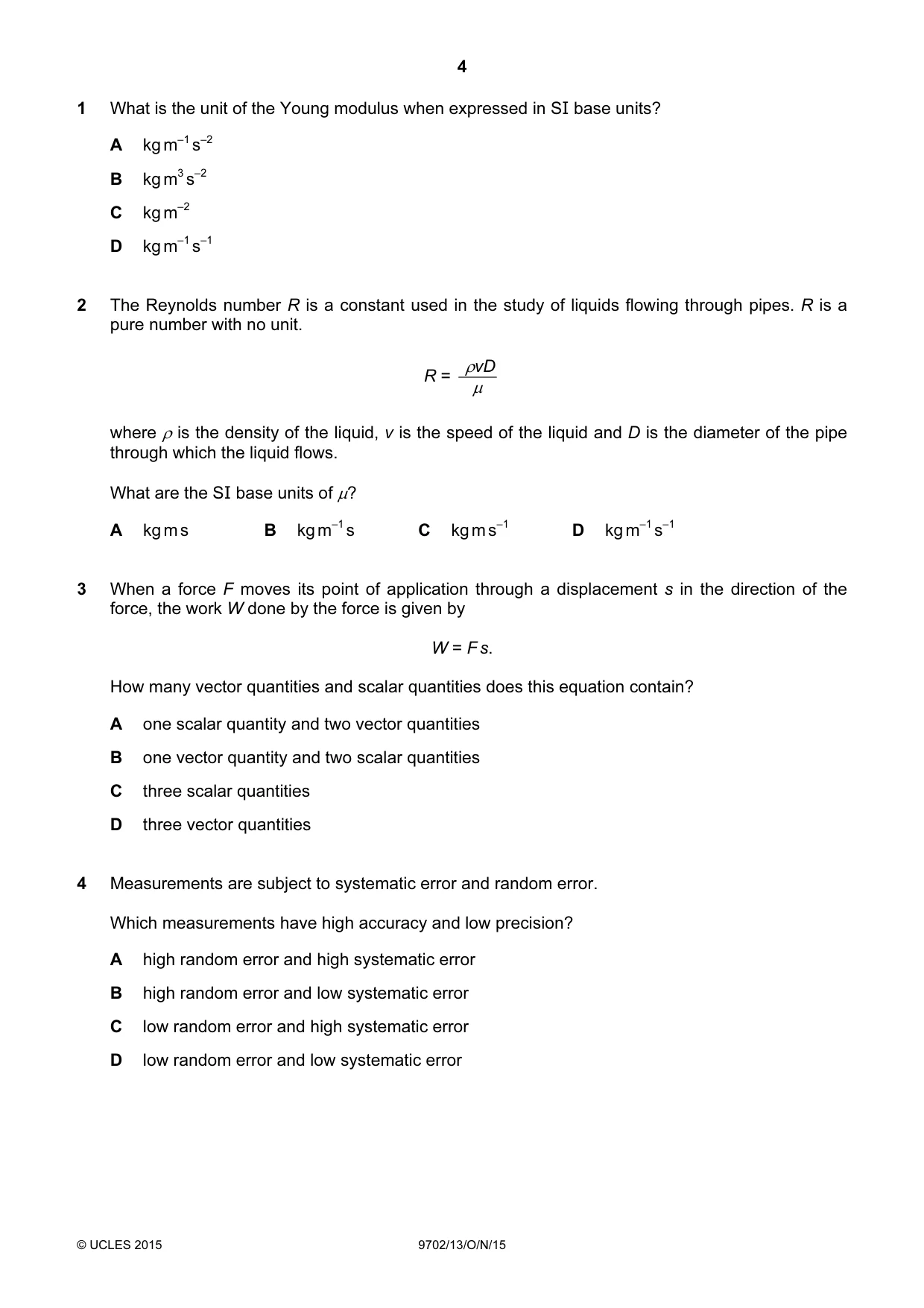
Q1 · What is the unit of the Young modulus when expressed in SI base units?
1 What is the unit of the Young modulus when expressed in SI base units? A kg m–1 s–2 B kg m3 s–2 C kg m–2 D kg m–1 s–1
Mark scheme: A
Q2 · The Reynolds number R is a constant used in the study of liquids flowing through pipes
2 The Reynolds number R is a constant used in the study of liquids flowing through pipes. R is a pure number with no unit. ρvD R = µ where ρ is the density of the liquid, v is the speed of the liquid and D is the diameter of the pipe through which the liquid flows. What are the SI base units of µ? A kg m s B kg m–1 s C kg m s–1 D kg m–1 s–1
Mark scheme: D
Q3 · When a force F moves its point of application through a displacement s in the direction…
3 When a force F moves its point of application through a displacement s in the direction of the force, the work W done by the force is given by W = F s. How many vector quantities and scalar quantities does this equation contain? A one scalar quantity and two vector quantities B one vector quantity and two scalar quantities C three scalar quantities D three vector quantities
Mark scheme: A
Q4 · Measurements are subject to systematic error and random error
4 Measurements are subject to systematic error and random error. Which measurements have high accuracy and low precision? A high random error and high systematic error B high random error and low systematic error C low random error and high systematic error D low random error and low systematic error
Mark scheme: B
Q5 · The density of the material of a coil of thin wire is to be found
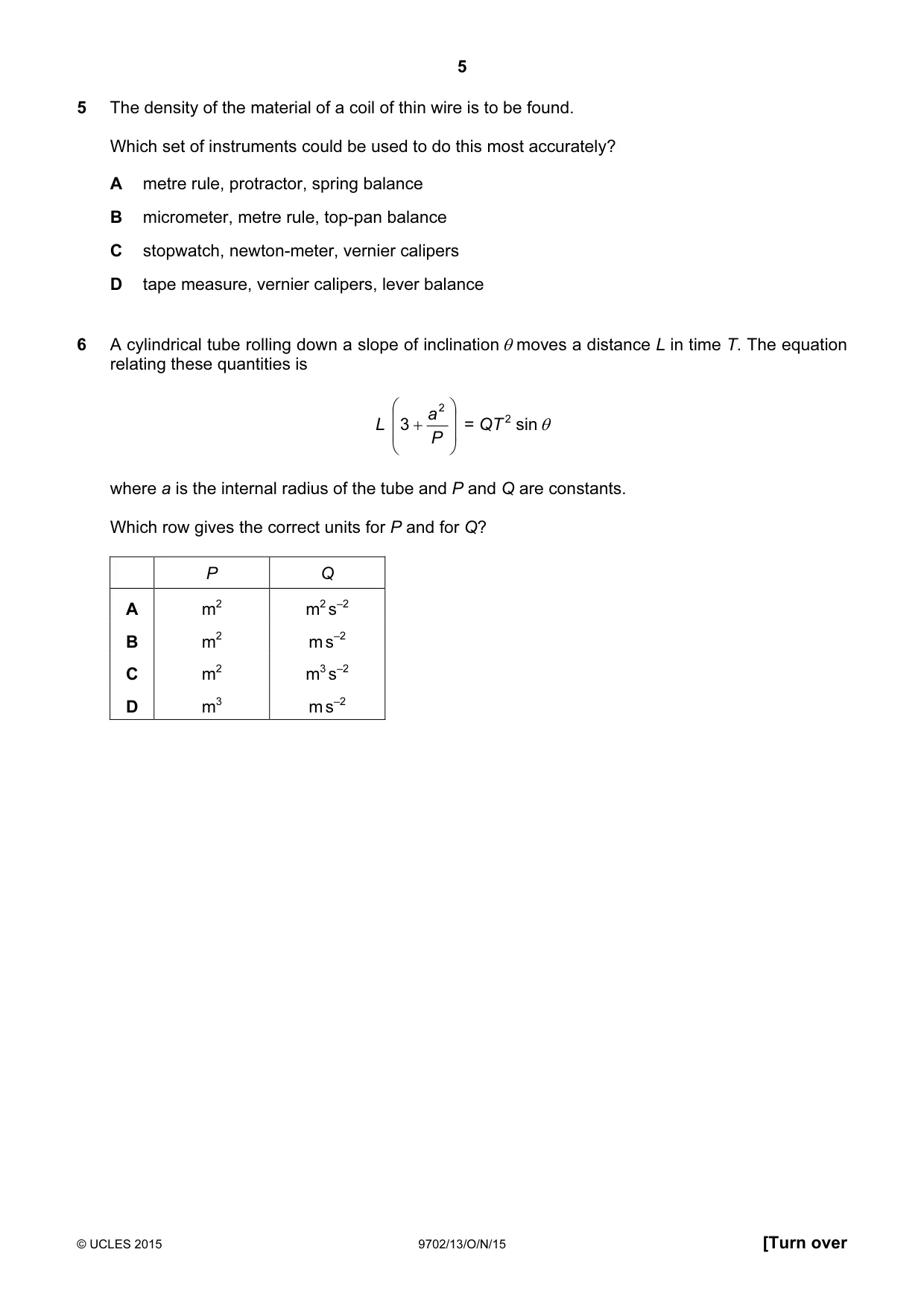
5 The density of the material of a coil of thin wire is to be found. Which set of instruments could be used to do this most accurately? A metre rule, protractor, spring balance B micrometer, metre rule, top-pan balance C stopwatch, newton-meter, vernier calipers D tape measure, vernier calipers, lever balance
Mark scheme: B
Q6 · A cylindrical tube rolling down a slope of inclination θ moves a distance L in time T
6 A cylindrical tube rolling down a slope of inclination θ moves a distance L in time T. The equation relating these quantities is a2 L 3 + P = QT 2 sin θ where a is the internal radius of the tube and P and Q are constants. Which row gives the correct units for P and for Q? P Q A m2 m2 s–2 B m2 m s–2 C m2 m3 s–2 D m3 m s–2
Mark scheme: B
Q7 · Variables x and y are related by the equation y = p – qx where p and q are constants
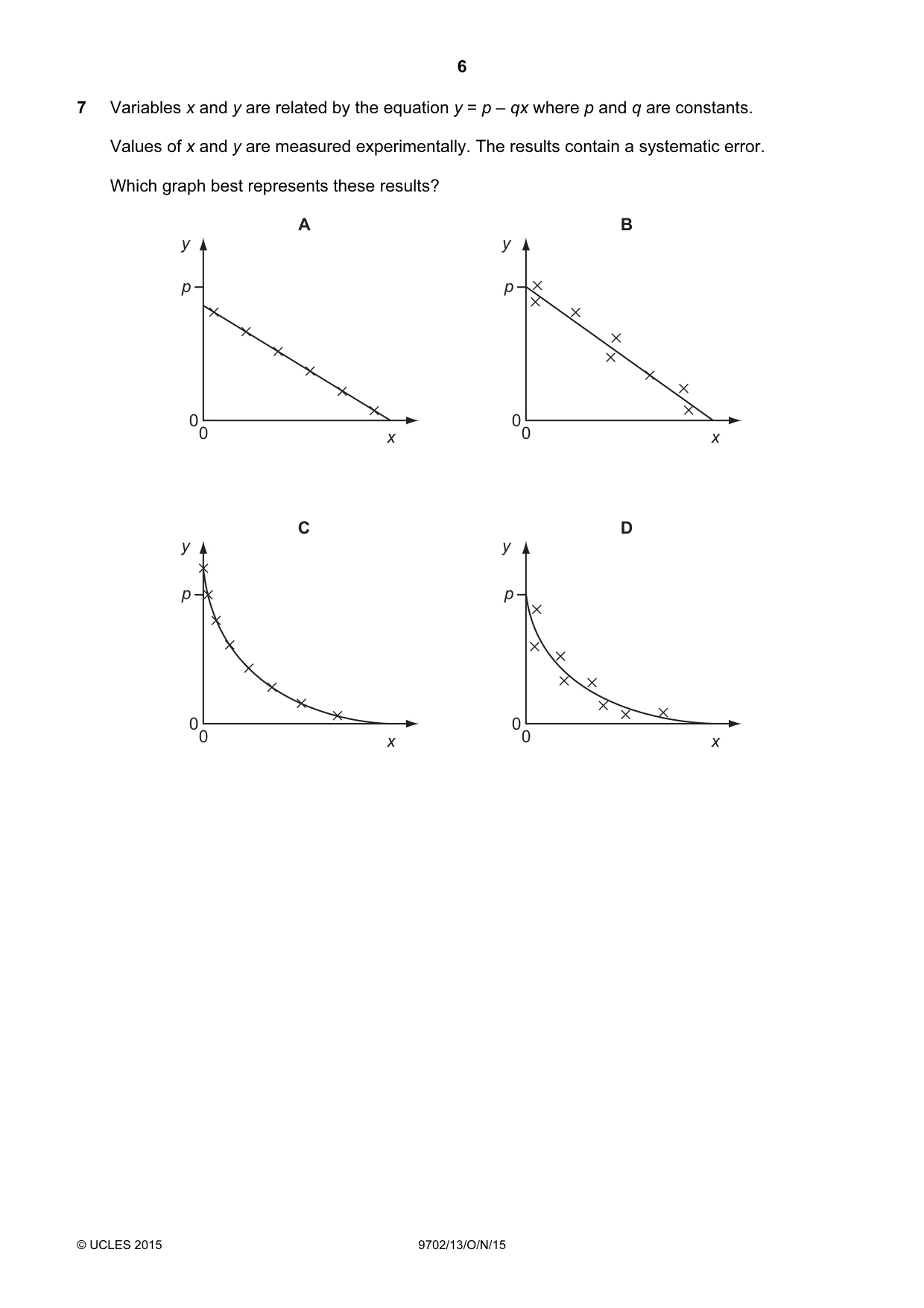
7 Variables x and y are related by the equation y = p – qx where p and q are constants. Values of x and y are measured experimentally. The results contain a systematic error. Which graph best represents these results? A B y y p p 00 00 x x C D y y p p 00 00 x x
Mark scheme: A
Q8 · A cheetah and an antelope are 100 m apart
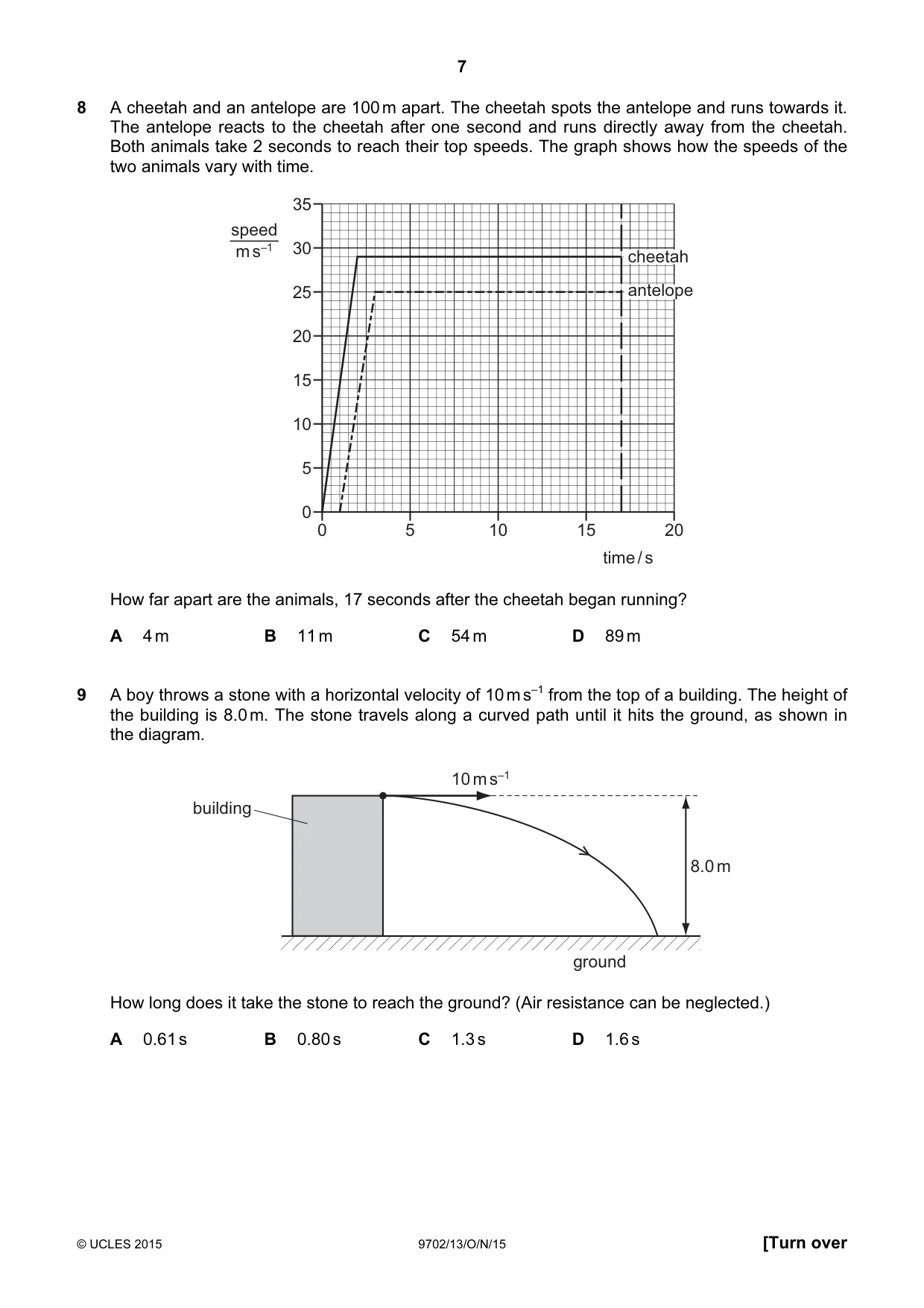
8 A cheetah and an antelope are 100 m apart. The cheetah spots the antelope and runs towards it. The antelope reacts to the cheetah after one second and runs directly away from the cheetah. Both animals take 2 seconds to reach their top speeds. The graph shows how the speeds of the two animals vary with time. 35 speed m s–1 30 cheetah 25 antelope 20 15 10 5 0 0 5 10 15 20 time / s How far apart are the animals, 17 seconds after the cheetah began running? A 4 m B 11 m C 54 m D 89 m
Mark scheme: B
Q9 · A boy throws a stone with a horizontal velocity of 10 m s–1 from the top of a building
9 A boy throws a stone with a horizontal velocity of 10 m s–1 from the top of a building. The height of the building is 8.0 m. The stone travels along a curved path until it hits the ground, as shown in the diagram. 10 m s–1 building 8.0 m ground How long does it take the stone to reach the ground? (Air resistance can be neglected.) A 0.61 s B 0.80 s C 1.3 s D 1.6 s
Mark scheme: C
Q10 · A football is released above a plane, sloping surface and bounces several times
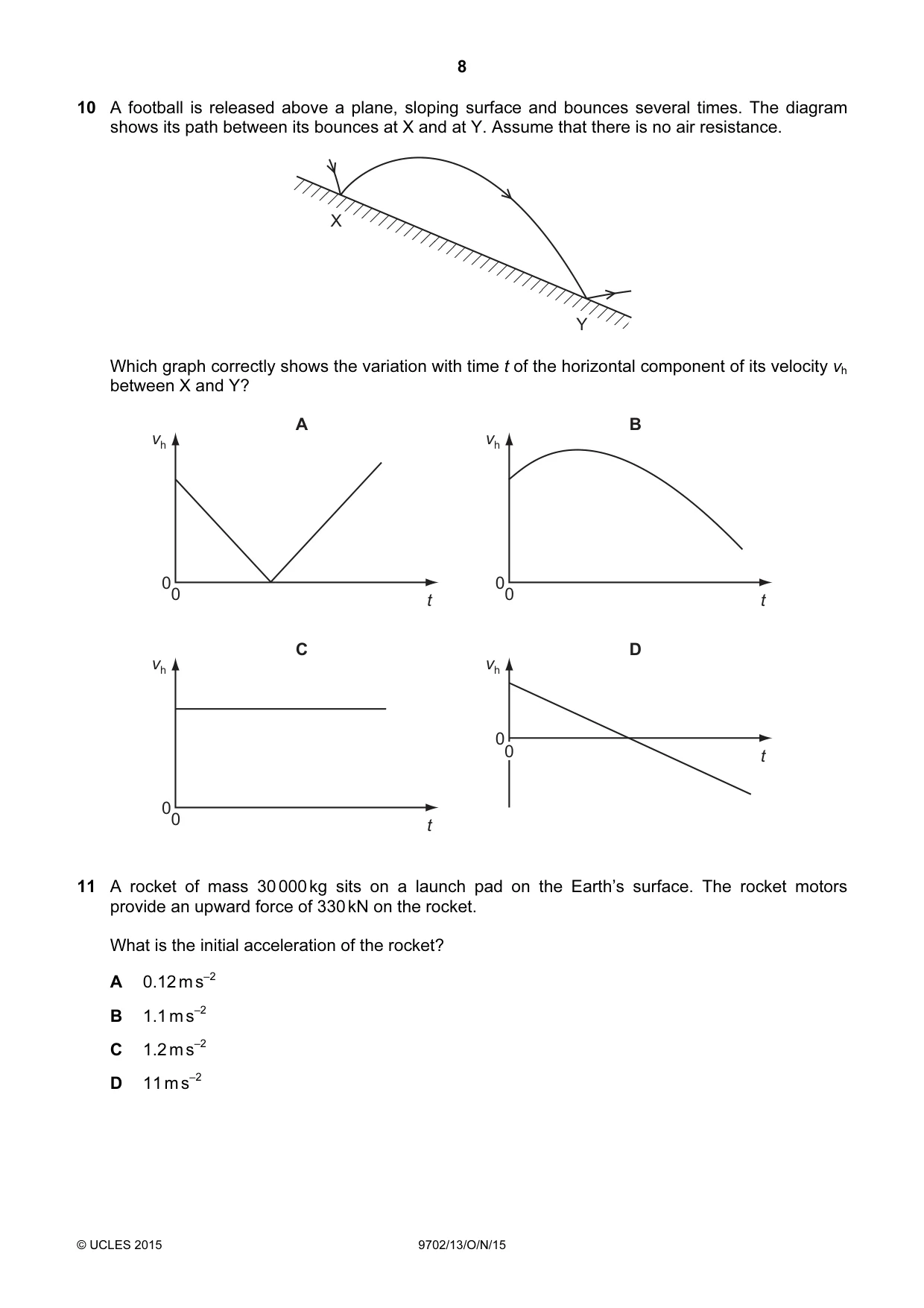
10 A football is released above a plane, sloping surface and bounces several times. The diagram shows its path between its bounces at X and at Y. Assume that there is no air resistance. X Y Which graph correctly shows the variation with time t of the horizontal component of its velocity vh between X and Y? A B vh vh 0 0 0 0 t t C D vh vh 0 0 t 0 0 t
Mark scheme: C
Q11 · A rocket of mass 30 000 kg sits on a launch pad on the Earth’s surface
11 A rocket of mass 30 000 kg sits on a launch pad on the Earth’s surface. The rocket motors provide an upward force of 330 kN on the rocket. What is the initial acceleration of the rocket? A 0.12 m s–2 B 1.1 m s–2 C 1.2 m s–2 D 11 m s–2
Mark scheme: C
Q12 · Two equal masses X and Y are moving towards each other on a frictionless air track as…
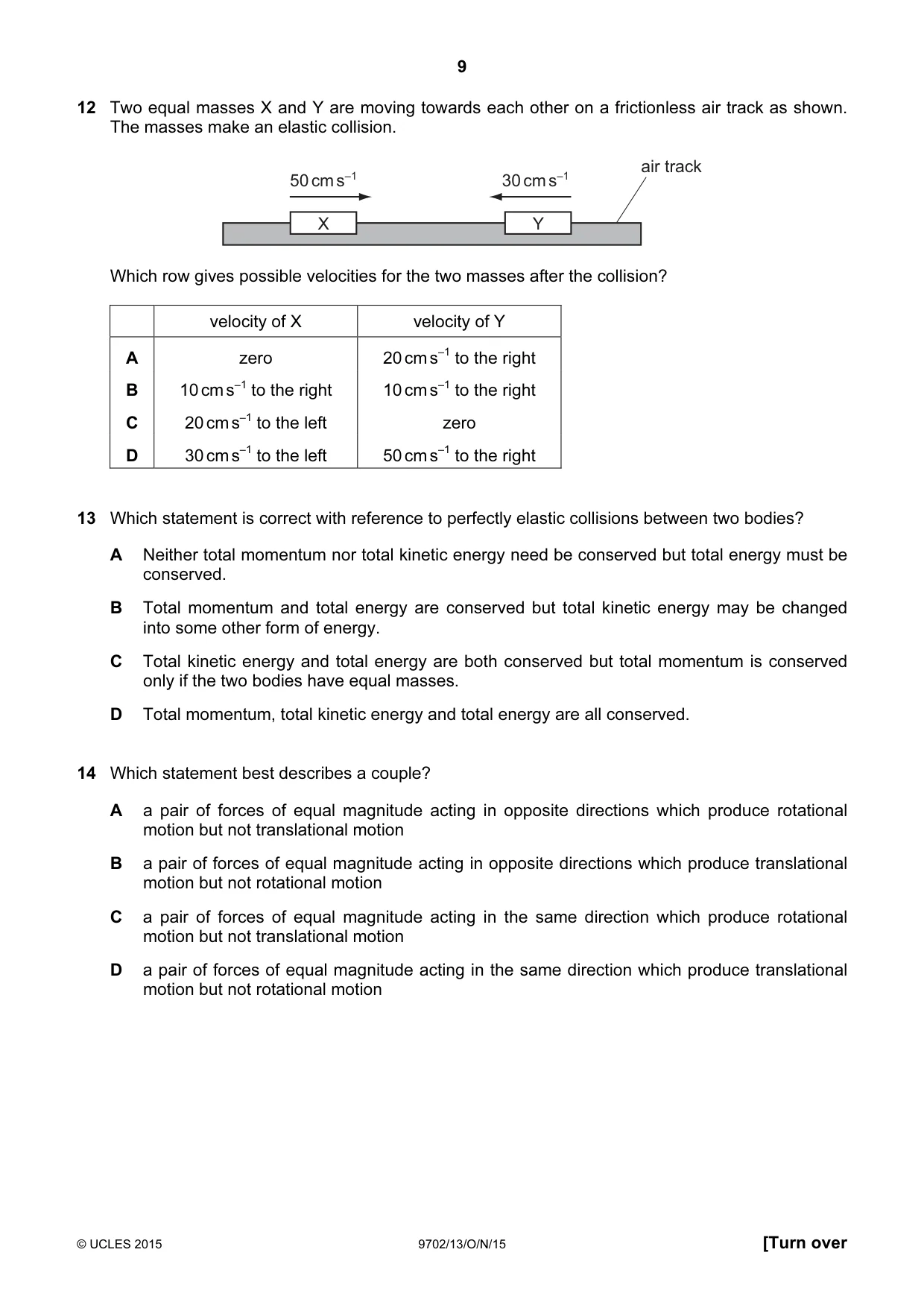
12 Two equal masses X and Y are moving towards each other on a frictionless air track as shown. The masses make an elastic collision. air track 50 cm s–1 30 cm s–1 X Y Which row gives possible velocities for the two masses after the collision? velocity of X velocity of Y A zero 20 cm s–1 to the right B 10 cm s–1 to the right 10 cm s–1 to the right C 20 cm s–1 to the left zero D 30 cm s–1 to the left 50 cm s–1 to the right
Mark scheme: D
Q13 · Which statement is correct with reference to perfectly elastic collisions between two…
13 Which statement is correct with reference to perfectly elastic collisions between two bodies? A Neither total momentum nor total kinetic energy need be conserved but total energy must be conserved. B Total momentum and total energy are conserved but total kinetic energy may be changed into some other form of energy. C Total kinetic energy and total energy are both conserved but total momentum is conserved only if the two bodies have equal masses. D Total momentum, total kinetic energy and total energy are all conserved.
Mark scheme: D
Q14 · Which statement best describes a couple?
14 Which statement best describes a couple? A a pair of forces of equal magnitude acting in opposite directions which produce rotational motion but not translational motion B a pair of forces of equal magnitude acting in opposite directions which produce translational motion but not rotational motion C a pair of forces of equal magnitude acting in the same direction which produce rotational motion but not translational motion D a pair of forces of equal magnitude acting in the same direction which produce translational motion but not rotational motion
Mark scheme: A
Q15 · A cross-shaped structure, freely pivoted at O, has arms of lengths 5.0 m, 4.0 m, 3.0 m…
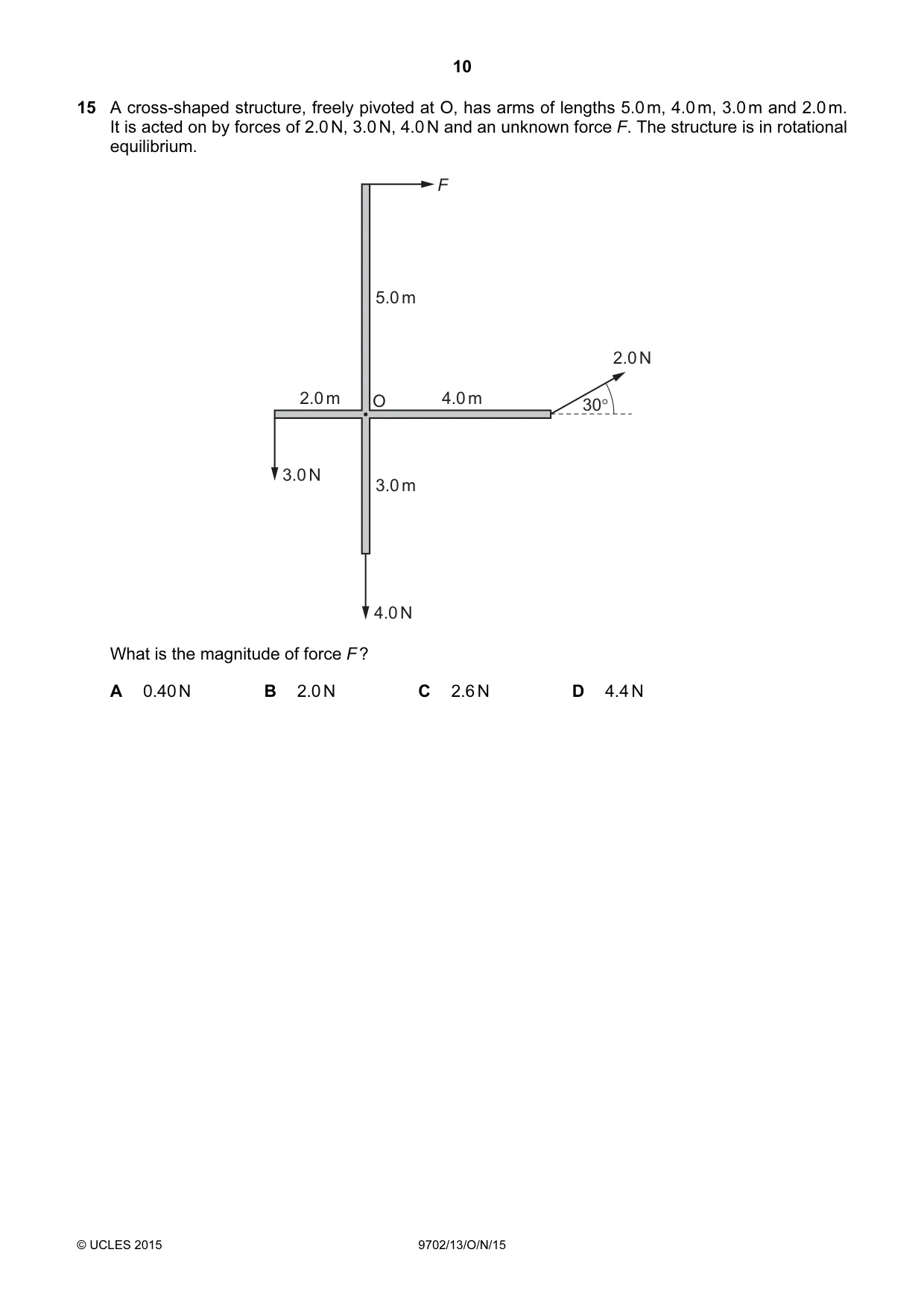
15 A cross-shaped structure, freely pivoted at O, has arms of lengths 5.0 m, 4.0 m, 3.0 m and 2.0 m. It is acted on by forces of 2.0 N, 3.0 N, 4.0 N and an unknown force F. The structure is in rotational equilibrium. F 5.0 m 2.0 N 2.0 m O 4.0 m 30° 3.0 N 3.0 m 4.0 N What is the magnitude of force F ? A 0.40 N B 2.0 N C 2.6 N D 4.4 N
Mark scheme: B
Q16 · A trolley starts from rest at X
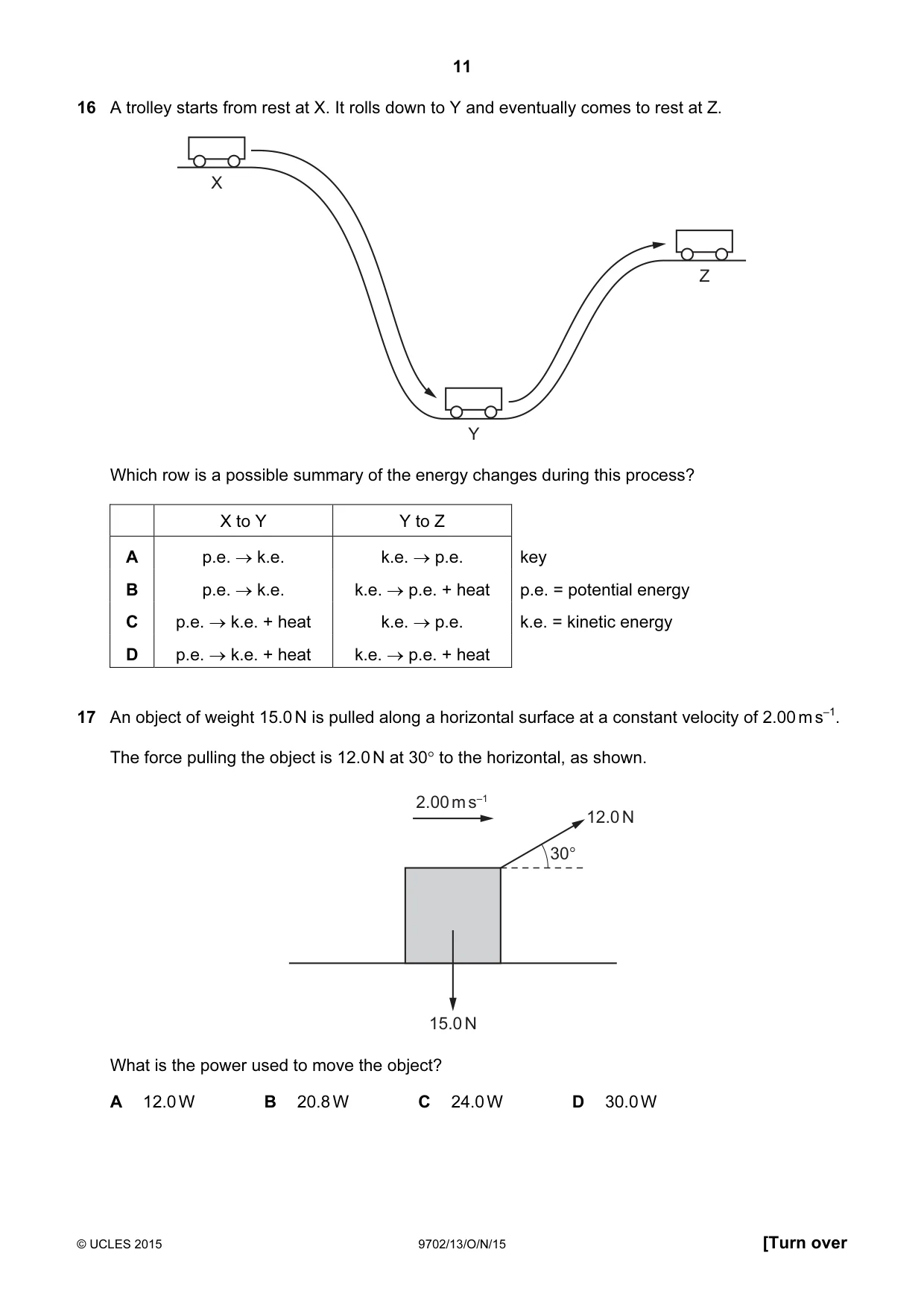
16 A trolley starts from rest at X. It rolls down to Y and eventually comes to rest at Z. X Z Y Which row is a possible summary of the energy changes during this process? X to Y Y to Z A p.e. → k.e. k.e. → p.e. key B p.e. → k.e. k.e. → p.e. + heat p.e. = potential energy C p.e. → k.e. + heat k.e. → p.e. k.e. = kinetic energy D p.e. → k.e. + heat k.e. → p.e. + heat
Mark scheme: D
Q17 · An object of weight 15.0 N is pulled along a horizontal surface at a constant velocity of…
17 An object of weight 15.0 N is pulled along a horizontal surface at a constant velocity of 2.00 m s–1. The force pulling the object is 12.0 N at 30° to the horizontal, as shown. 2.00 m s–1 12.0 N 30° 15.0 N What is the power used to move the object? A 12.0 W B 20.8 W C 24.0 W D 30.0 W
Mark scheme: B
Q18 · Brownian motion can be demonstrated by illuminating smoke particles inside a closed…
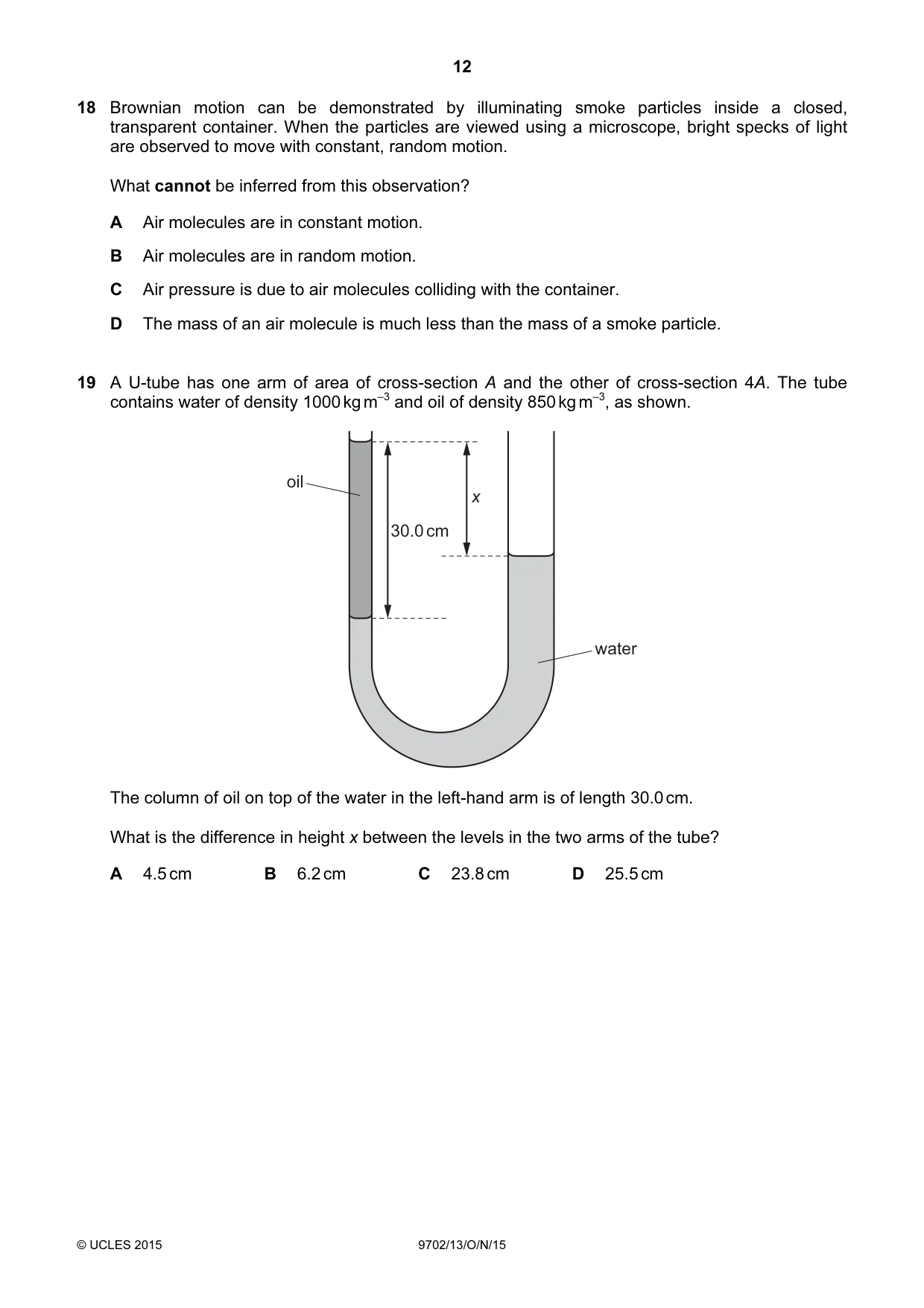
18 Brownian motion can be demonstrated by illuminating smoke particles inside a closed, transparent container. When the particles are viewed using a microscope, bright specks of light are observed to move with constant, random motion. What cannot be inferred from this observation? A Air molecules are in constant motion. B Air molecules are in random motion. C Air pressure is due to air molecules colliding with the container. D The mass of an air molecule is much less than the mass of a smoke particle.
Mark scheme: C
Q19 · A U-tube has one arm of area of cross-section A and the other of cross-section 4A
19 A U-tube has one arm of area of cross-section A and the other of cross-section 4A. The tube contains water of density 1000 kg m–3 and oil of density 850 kg m–3, as shown. oil x 30.0 cm water The column of oil on top of the water in the left-hand arm is of length 30.0 cm. What is the difference in height x between the levels in the two arms of the tube? A 4.5 cm B 6.2 cm C 23.8 cm D 25.5 cm stress when the metal is
Mark scheme: A
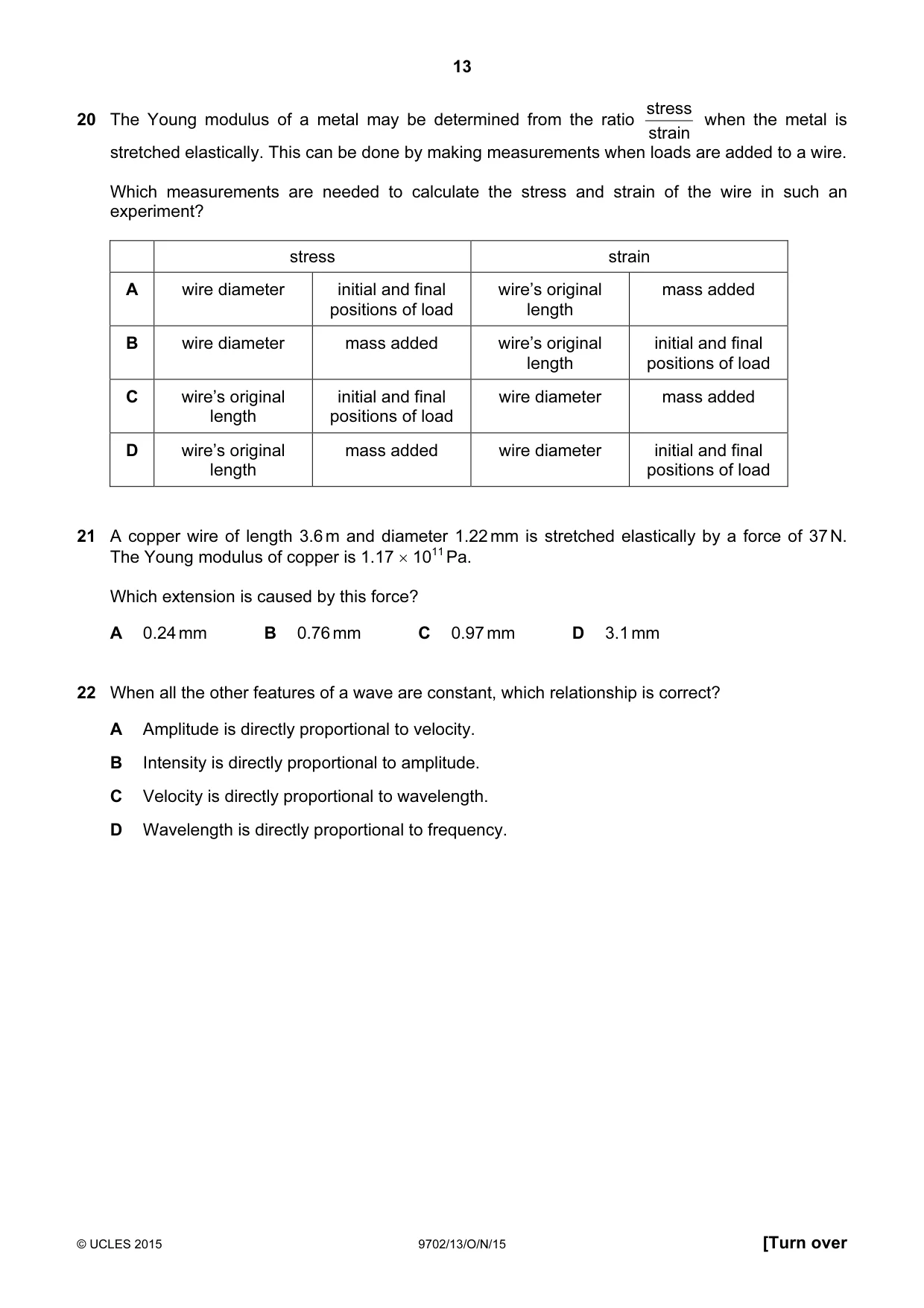
Q20 · The Young modulus of a metal may be determined from the ratio strain stretched elastically
20 The Young modulus of a metal may be determined from the ratio strain stretched elastically. This can be done by making measurements when loads are added to a wire. Which measurements are needed to calculate the stress and strain of the wire in such an experiment? stress strain A wire diameter initial and final wire’s original mass added positions of load length B wire diameter mass added wire’s original initial and final length positions of load C wire’s original initial and final wire diameter mass added length positions of load D wire’s original mass added wire diameter initial and final length positions of load
Mark scheme: B
Q21 · A copper wire of length 3.6 m and diameter 1.22 mm is stretched elastically by a force of…
21 A copper wire of length 3.6 m and diameter 1.22 mm is stretched elastically by a force of 37 N. The Young modulus of copper is 1.17 × 10¹¹ Pa. Which extension is caused by this force? A 0.24 mm B 0.76 mm C 0.97 mm D 3.1 mm
Mark scheme: C
Q22 · When all the other features of a wave are constant, which relationship is correct?
22 When all the other features of a wave are constant, which relationship is correct? A Amplitude is directly proportional to velocity. B Intensity is directly proportional to amplitude. C Velocity is directly proportional to wavelength. D Wavelength is directly proportional to frequency.
Mark scheme: C
Q23 · A vibrating rod makes a water wave in a ripple tank
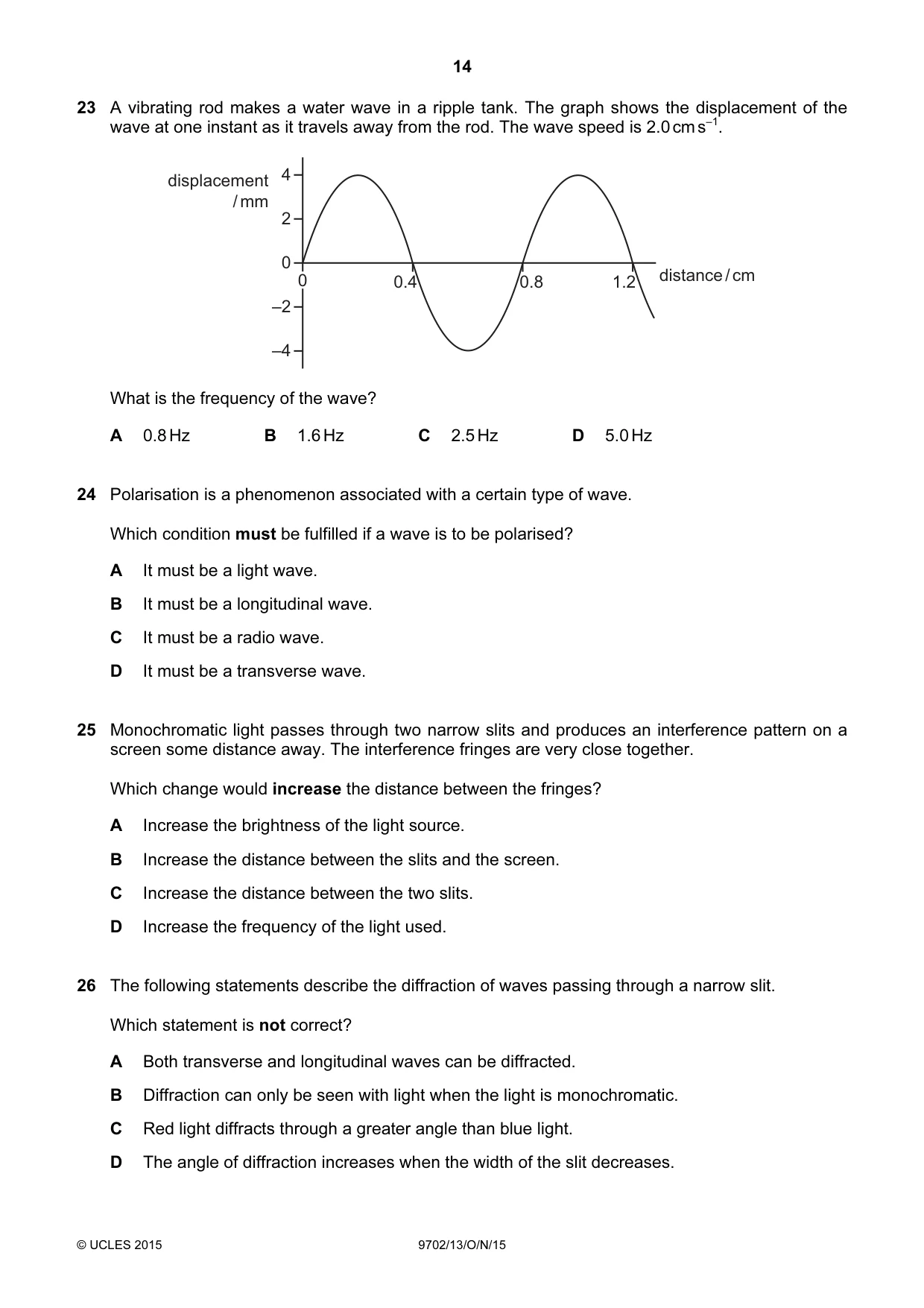
23 A vibrating rod makes a water wave in a ripple tank. The graph shows the displacement of the wave at one instant as it travels away from the rod. The wave speed is 2.0 cm s–1. displacement 4 / mm 2 0 0 0.4 0.8 1.2 distance / cm –2 –4 What is the frequency of the wave? A 0.8 Hz B 1.6 Hz C 2.5 Hz D 5.0 Hz
Mark scheme: C
Q24 · Polarisation is a phenomenon associated with a certain type of wave
24 Polarisation is a phenomenon associated with a certain type of wave. Which condition must be fulfilled if a wave is to be polarised? A It must be a light wave. B It must be a longitudinal wave. C It must be a radio wave. D It must be a transverse wave.
Mark scheme: D
Q25 · Monochromatic light passes through two narrow slits and produces an interference pattern…
25 Monochromatic light passes through two narrow slits and produces an interference pattern on a screen some distance away. The interference fringes are very close together. Which change would increase the distance between the fringes? A Increase the brightness of the light source. B Increase the distance between the slits and the screen. C Increase the distance between the two slits. D Increase the frequency of the light used.
Mark scheme: B
Q26 · The following statements describe the diffraction of waves passing through a narrow slit
26 The following statements describe the diffraction of waves passing through a narrow slit. Which statement is not correct? A Both transverse and longitudinal waves can be diffracted. B Diffraction can only be seen with light when the light is monochromatic. C Red light diffracts through a greater angle than blue light. D The angle of diffraction increases when the width of the slit decreases.
Mark scheme: B
Q27 · Monochromatic light is directed onto a pair of slits
27 Monochromatic light is directed onto a pair of slits. Interference fringes that are 2.0 mm apart are observed on a distant screen. The frequency of the light used is then doubled and the slit separation is halved. How far apart are the new interference fringes? A 0.50 mm B 2.0 mm C 4.0 mm D 8.0 mm
Mark scheme: B
Q28 · A diffraction grating has N lines per unit length and is placed at 90° to monochromatic…
28 A diffraction grating has N lines per unit length and is placed at 90° to monochromatic light of wavelength λ. What is the expression for θ, the angle to the normal to the grating at which the third order diffraction peak is observed? 1 N λ 3 λ A sin θ = B sin θ = 3 C sin θ = 3N λ D sin θ = N 3 N λ
Mark scheme: C
Q29 · Two parallel plates R and S are 2 mm apart in a vacuum
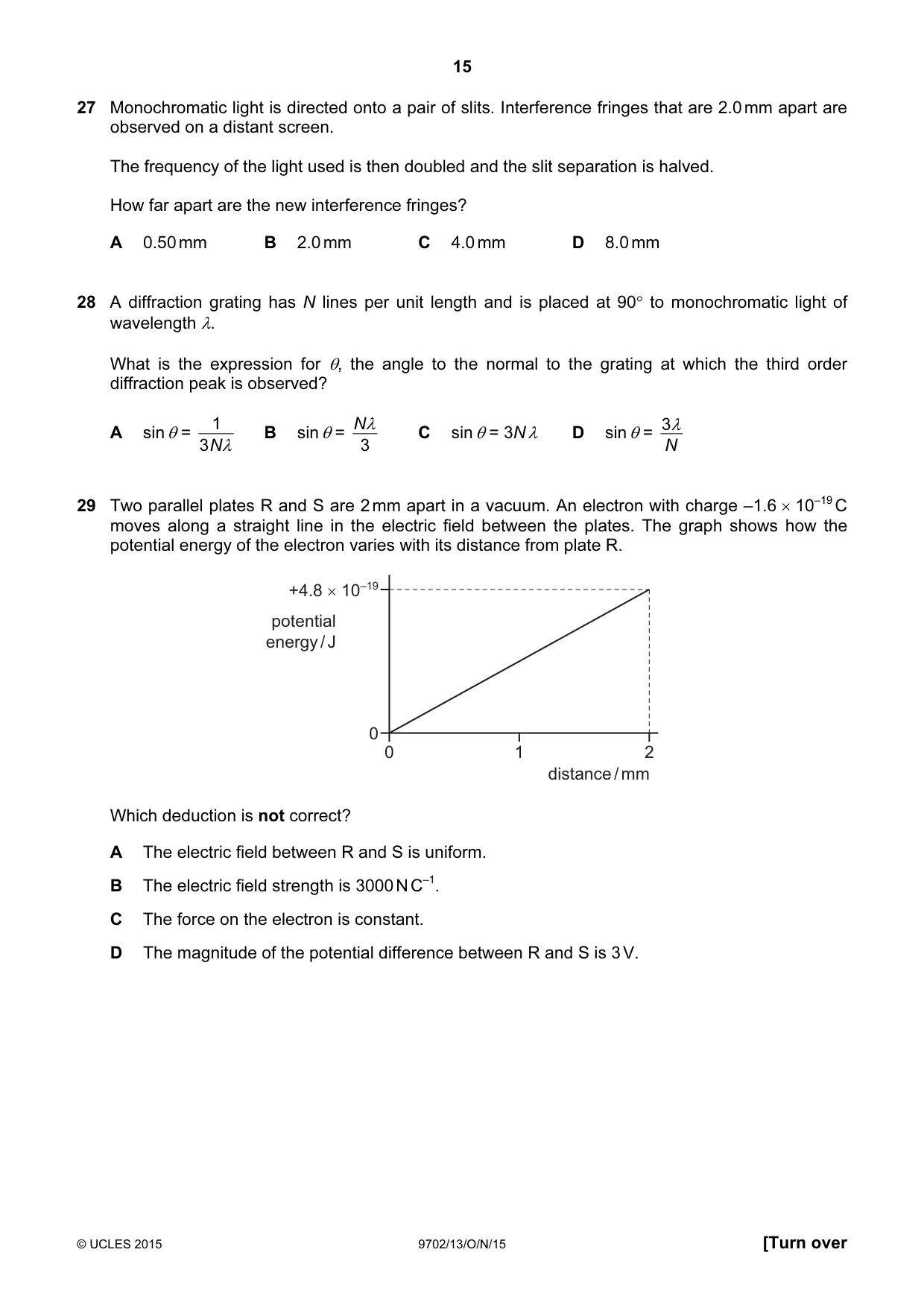
29 Two parallel plates R and S are 2 mm apart in a vacuum. An electron with charge –1.6 × 10⁻¹⁹ C moves along a straight line in the electric field between the plates. The graph shows how the potential energy of the electron varies with its distance from plate R. +4.8 × 10⁻¹⁹ potential energy / J 0 0 1 2 distance / mm Which deduction is not correct? A The electric field between R and S is uniform. B The electric field strength is 3000 N C–1. C The force on the electron is constant. D The magnitude of the potential difference between R and S is 3 V.
Mark scheme: B
Q30 · Two parallel, conducting plates with air between them are placed close to one another
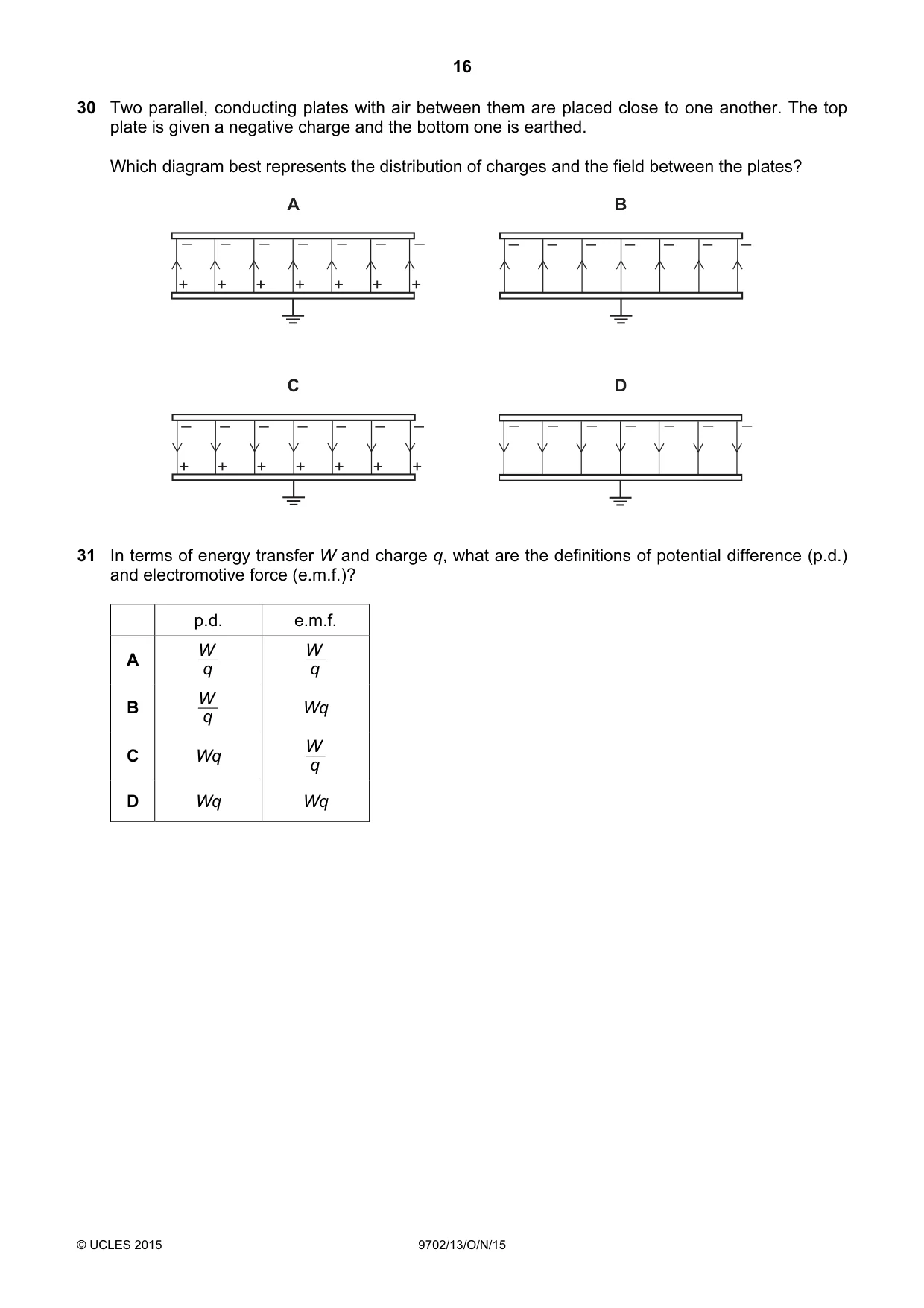
30 Two parallel, conducting plates with air between them are placed close to one another. The top plate is given a negative charge and the bottom one is earthed. Which diagram best represents the distribution of charges and the field between the plates? A B _ _ _ _ _ _ _ _ _ _ _ _ _ _ + + + + + + + C D _ _ _ _ _ _ _ _ _ _ _ _ _ _ + + + + + + +
Mark scheme: A
Q31 · In terms of energy transfer W and charge q, what are the definitions of potential…
31 In terms of energy transfer W and charge q, what are the definitions of potential difference (p.d.) and electromotive force (e.m.f.)? p.d. e.m.f. W W A q q W B Wq q W C Wq q D Wq Wq
Mark scheme: A
Q32 · A cell of electromotive force E and internal resistance r is connected to an external…
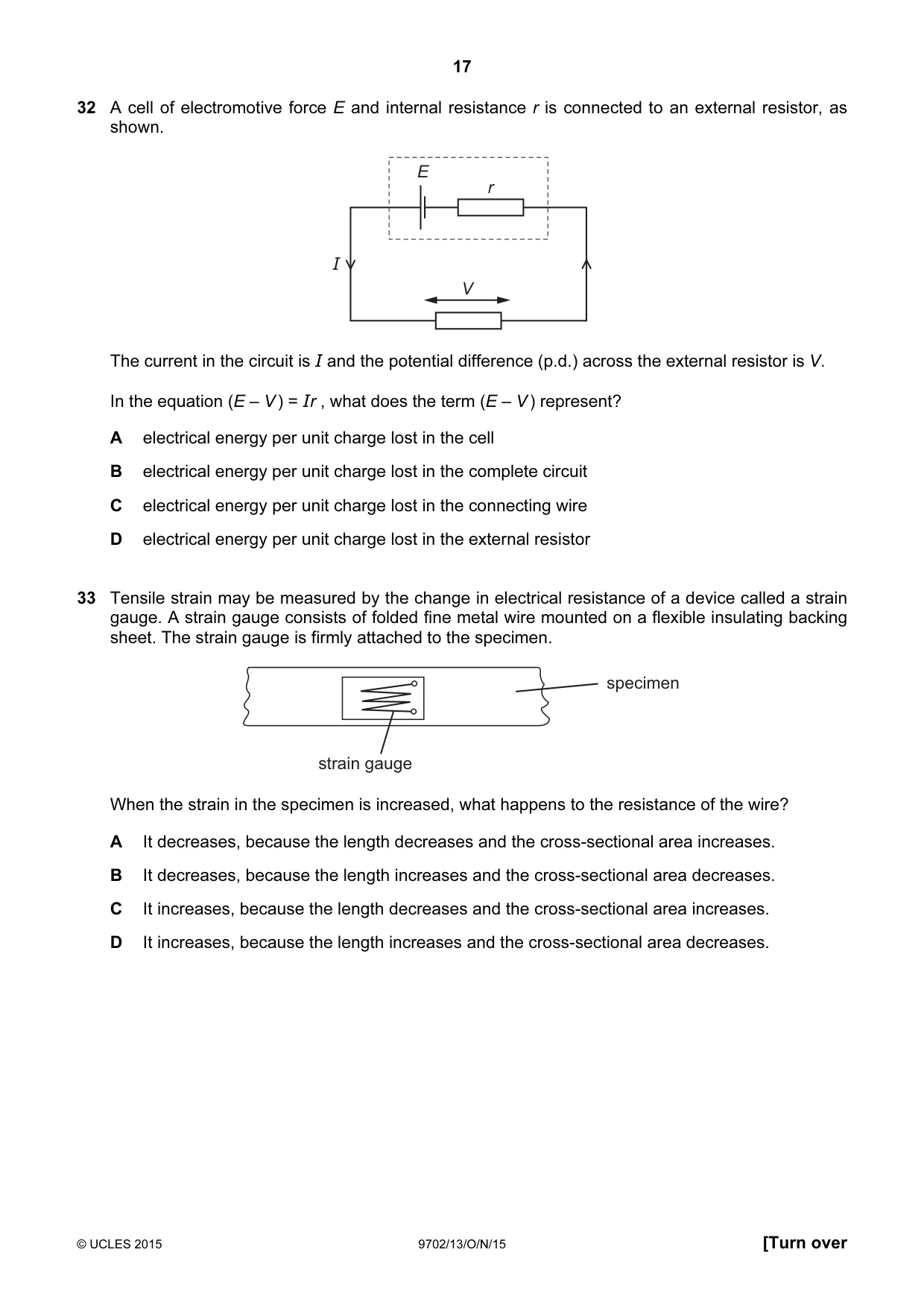
32 A cell of electromotive force E and internal resistance r is connected to an external resistor, as shown. E r I V The current in the circuit is I and the potential difference (p.d.) across the external resistor is V. In the equation (E – V ) = Ir , what does the term (E – V ) represent? A electrical energy per unit charge lost in the cell B electrical energy per unit charge lost in the complete circuit C electrical energy per unit charge lost in the connecting wire D electrical energy per unit charge lost in the external resistor
Mark scheme: A
Q33 · Tensile strain may be measured by the change in electrical resistance of a device called…
33 Tensile strain may be measured by the change in electrical resistance of a device called a strain gauge. A strain gauge consists of folded fine metal wire mounted on a flexible insulating backing sheet. The strain gauge is firmly attached to the specimen. specimen strain gauge When the strain in the specimen is increased, what happens to the resistance of the wire? A It decreases, because the length decreases and the cross-sectional area increases. B It decreases, because the length increases and the cross-sectional area decreases. C It increases, because the length decreases and the cross-sectional area increases. D It increases, because the length increases and the cross-sectional area decreases.
Mark scheme: D
Q34 · In the circuit shown, lamp P is rated 250 V, 50 W and lamp Q is rated 250 V, 200 W
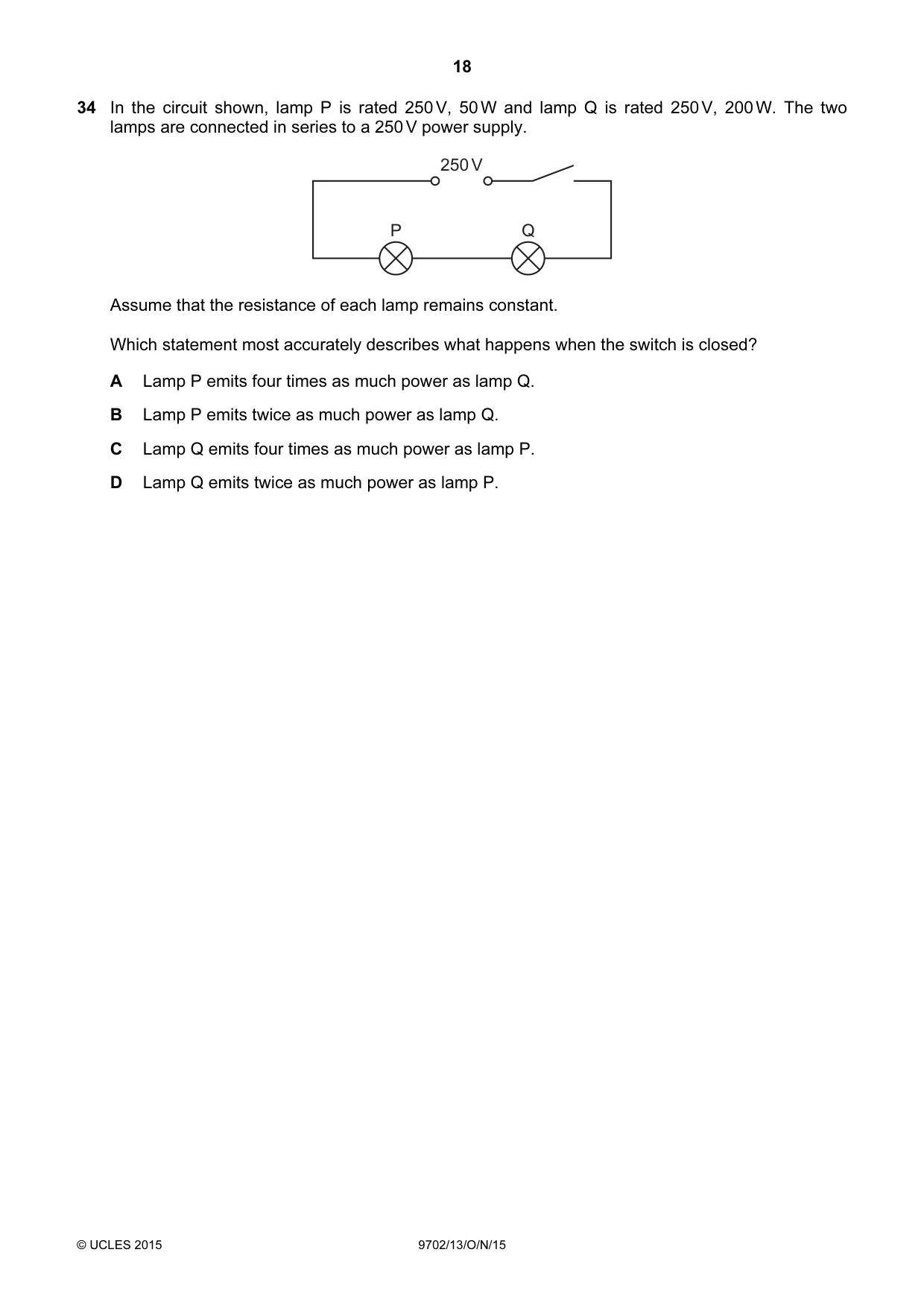
34 In the circuit shown, lamp P is rated 250 V, 50 W and lamp Q is rated 250 V, 200 W. The two lamps are connected in series to a 250 V power supply. 250 V P Q Assume that the resistance of each lamp remains constant. Which statement most accurately describes what happens when the switch is closed? A Lamp P emits four times as much power as lamp Q. B Lamp P emits twice as much power as lamp Q. C Lamp Q emits four times as much power as lamp P. D Lamp Q emits twice as much power as lamp P.
Mark scheme: A
Q35 · The cooling system in many houses is controlled by three electrical switches
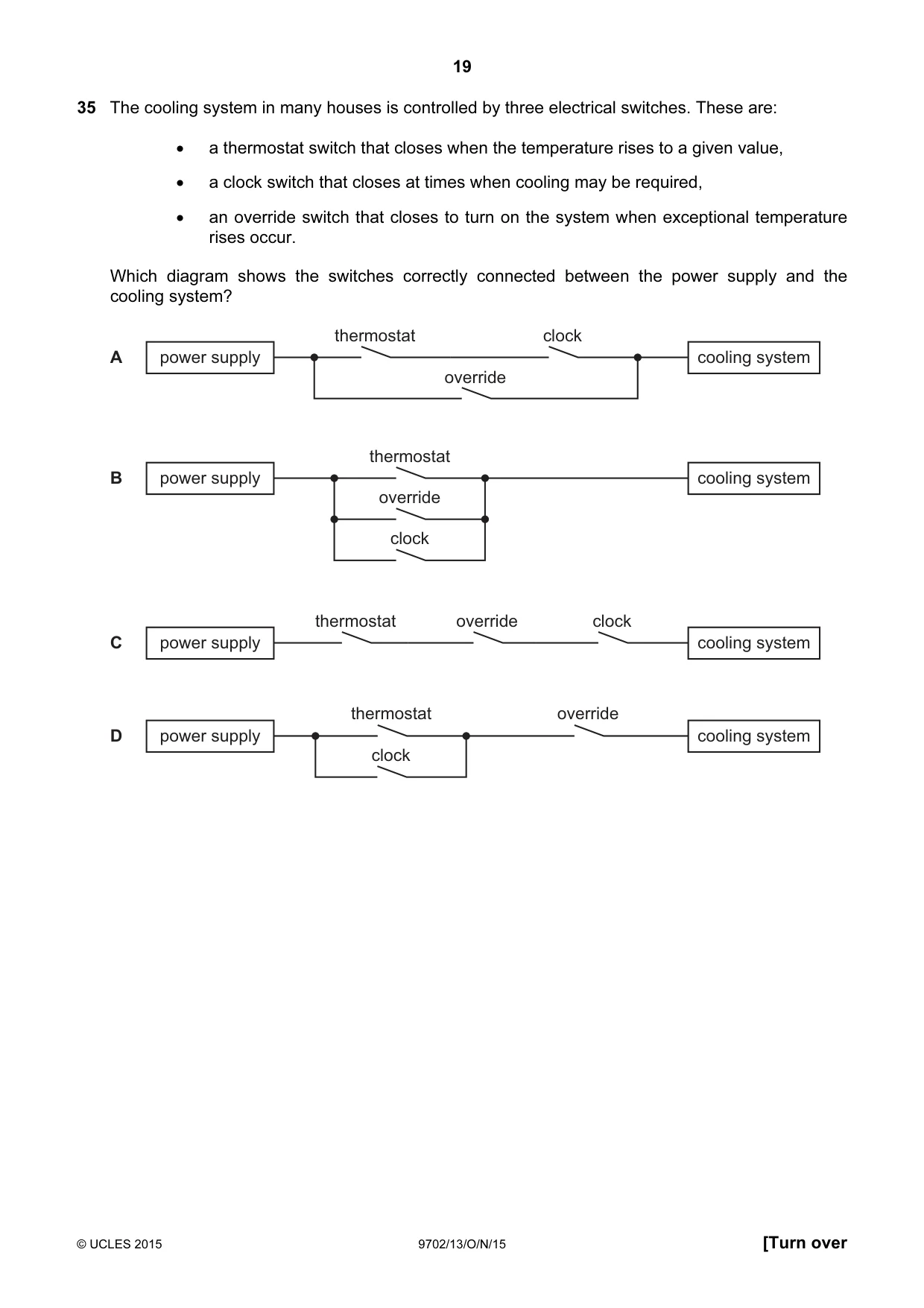
35 The cooling system in many houses is controlled by three electrical switches. These are: • a thermostat switch that closes when the temperature rises to a given value, • a clock switch that closes at times when cooling may be required, • an override switch that closes to turn on the system when exceptional temperature rises occur. Which diagram shows the switches correctly connected between the power supply and the cooling system? thermostat clock A power supply cooling system override thermostat B power supply cooling system override clock thermostat override clock C power supply cooling system thermostat override D power supply cooling system clock
Mark scheme: A
Q36 · A 110 V supply of negligible internal resistance is connected to a heater through a fuse…
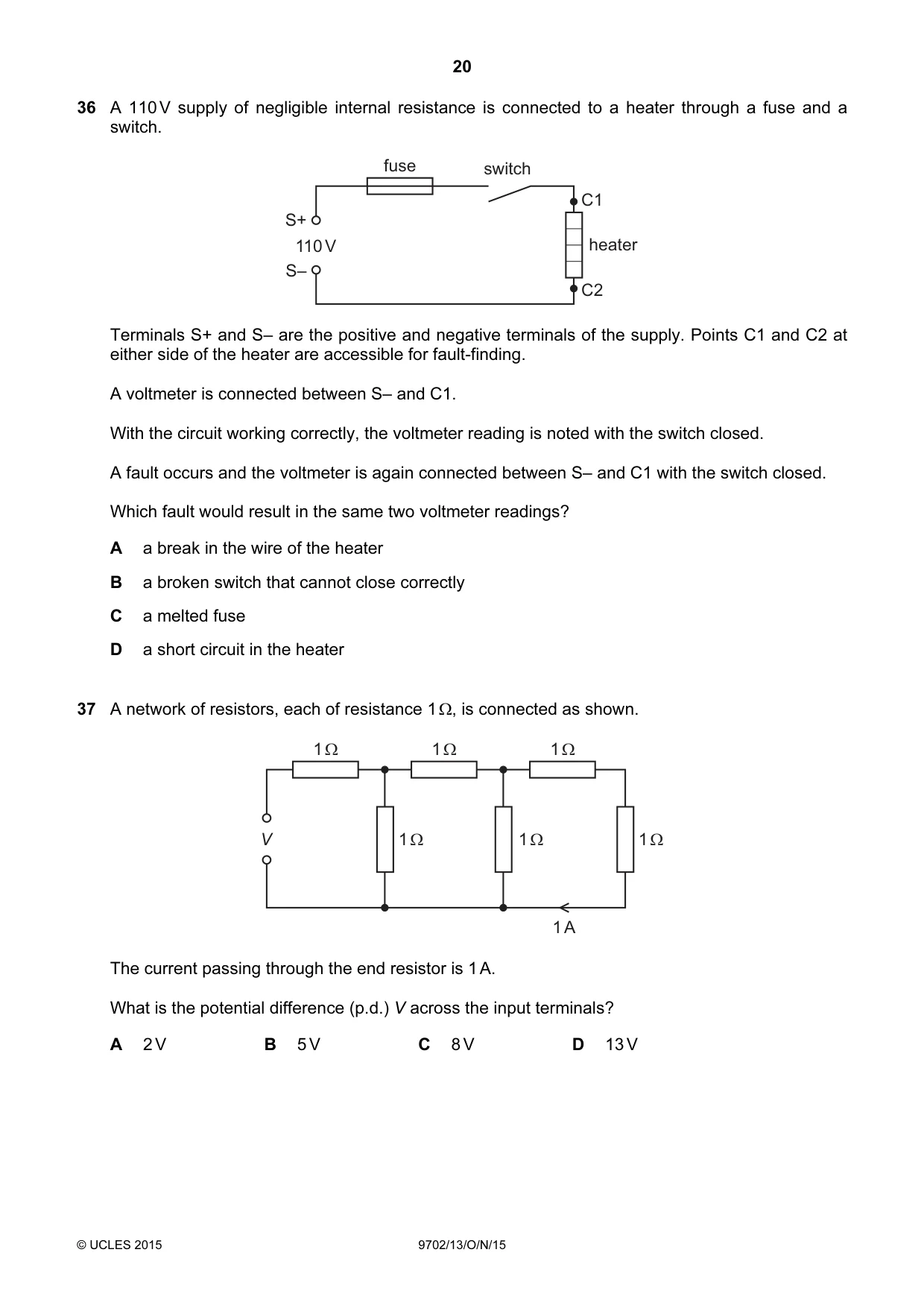
36 A 110 V supply of negligible internal resistance is connected to a heater through a fuse and a switch. fuse switch C1 S+ 110 V heater S– C2 Terminals S+ and S– are the positive and negative terminals of the supply. Points C1 and C2 at either side of the heater are accessible for fault-finding. A voltmeter is connected between S– and C1. With the circuit working correctly, the voltmeter reading is noted with the switch closed. A fault occurs and the voltmeter is again connected between S– and C1 with the switch closed. Which fault would result in the same two voltmeter readings? A a break in the wire of the heater B a broken switch that cannot close correctly C a melted fuse D a short circuit in the heater
Mark scheme: A
Q37 · A network of resistors, each of resistance 1 Ω, is connected as shown
37 A network of resistors, each of resistance 1 Ω, is connected as shown. 1 Ω 1 Ω 1 Ω V 1 Ω 1 Ω 1 Ω 1 A The current passing through the end resistor is 1 A. What is the potential difference (p.d.) V across the input terminals? A 2 V B 5 V C 8 V D 13 V
Mark scheme: D
Q38 · Two α-particles with equal energies are fired towards the nucleus of a gold atom
38 Two α-particles with equal energies are fired towards the nucleus of a gold atom. Which diagram best represents their paths? A B gold nucleus gold nucleus C D gold nucleus gold nucleus
Mark scheme: C
Q39 · When a nucleus emits an α-particle, how do the proton number and the nucleon number of…
39 When a nucleus emits an α-particle, how do the proton number and the nucleon number of the original nucleus change? proton number nucleon number A –4 –2 B –2 –2 C –2 –4 D +1 no change
Mark scheme: C
Q40 · A simple theory of α-particle scattering by a thin metal foil uses the four assumptions…
40 A simple theory of α-particle scattering by a thin metal foil uses the four assumptions given below. Which assumption is exact and is not an approximation? A Each α-particle interacts with just one nucleus. B The α-particles lose no kinetic energy when they are deflected. C The metal nuclei do not recoil. D Total momentum is conserved.
Mark scheme: D
What was in this paper
The subtopics covered by these 40 questions, and how many questions each got. Open one in a new tab to see every Cambridge question on it.
3Errors and uncertainties3Linear momentum and its conservation3Practical circuits3Stress and strain3Energy conservation2Interference2Potential difference and power2Progressive waves2SI units2Turning effects of forces2Uniform electric fields2Atoms, nuclei and radiation1Density and pressure1Diffraction1Electric field of a point charge1Kinetic theory of gases1Kirchhoff’s laws1Momentum and Newton’s laws of motion1Polarisation1Resistance and resistivity1Scalars and vectors1The diffraction grating1What you needed in this session
Cambridge’s own grade thresholds for 2015 Oct/Nov, Paper 1 · Variant 3. A higher threshold means an easier paper — the bar moves with how the cohort did.