Cambridge A Level Physics 9702 — 2018 Oct/Nov Paper 1 · Variant 2
9702/12/O/N/18 · 40 questions · 40 marks · ≈45 min
The question paper and its mark scheme, free to read here and free to download. This is Cambridge’s own paper, exactly as it was sat.
Question paper20 pages
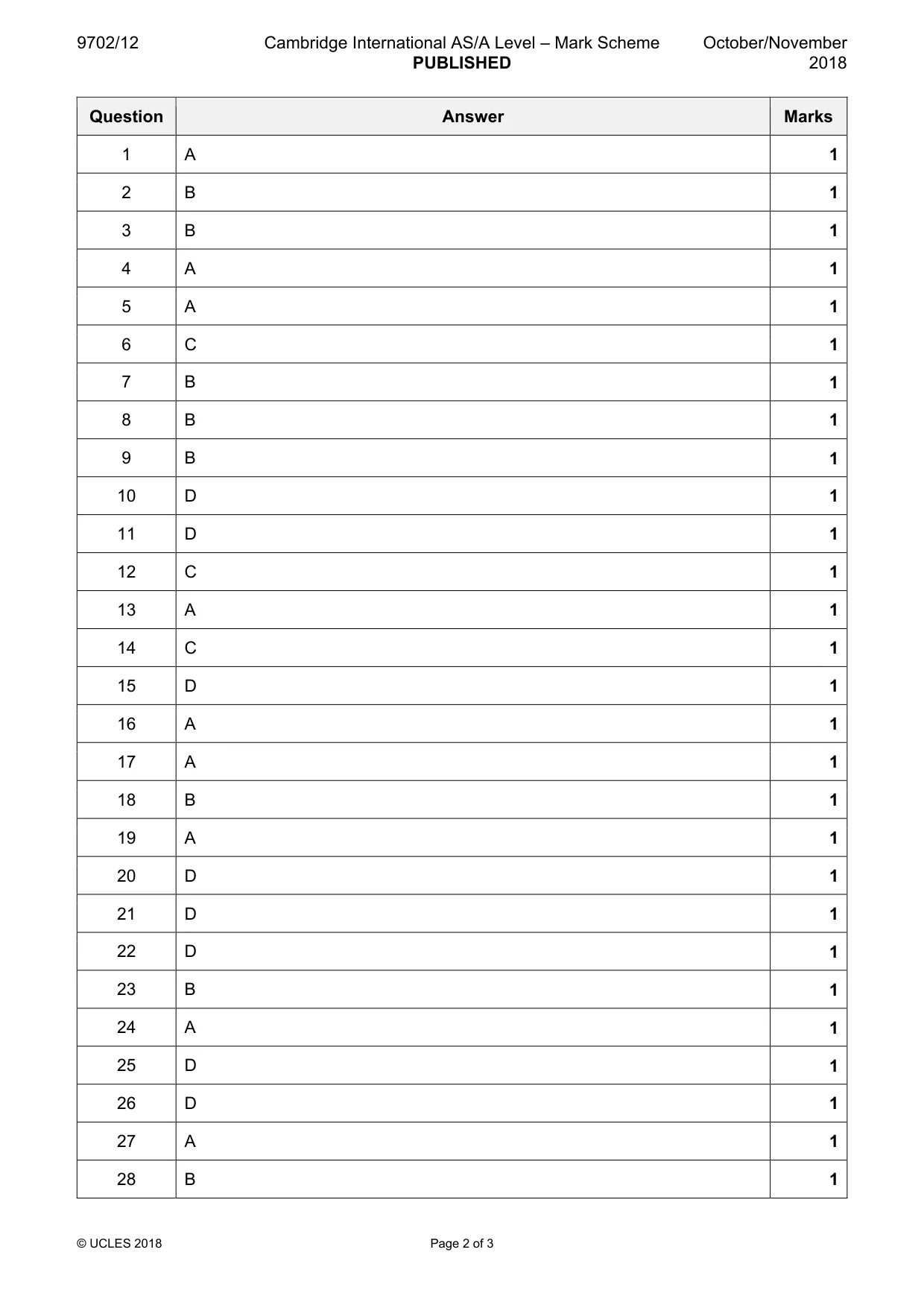
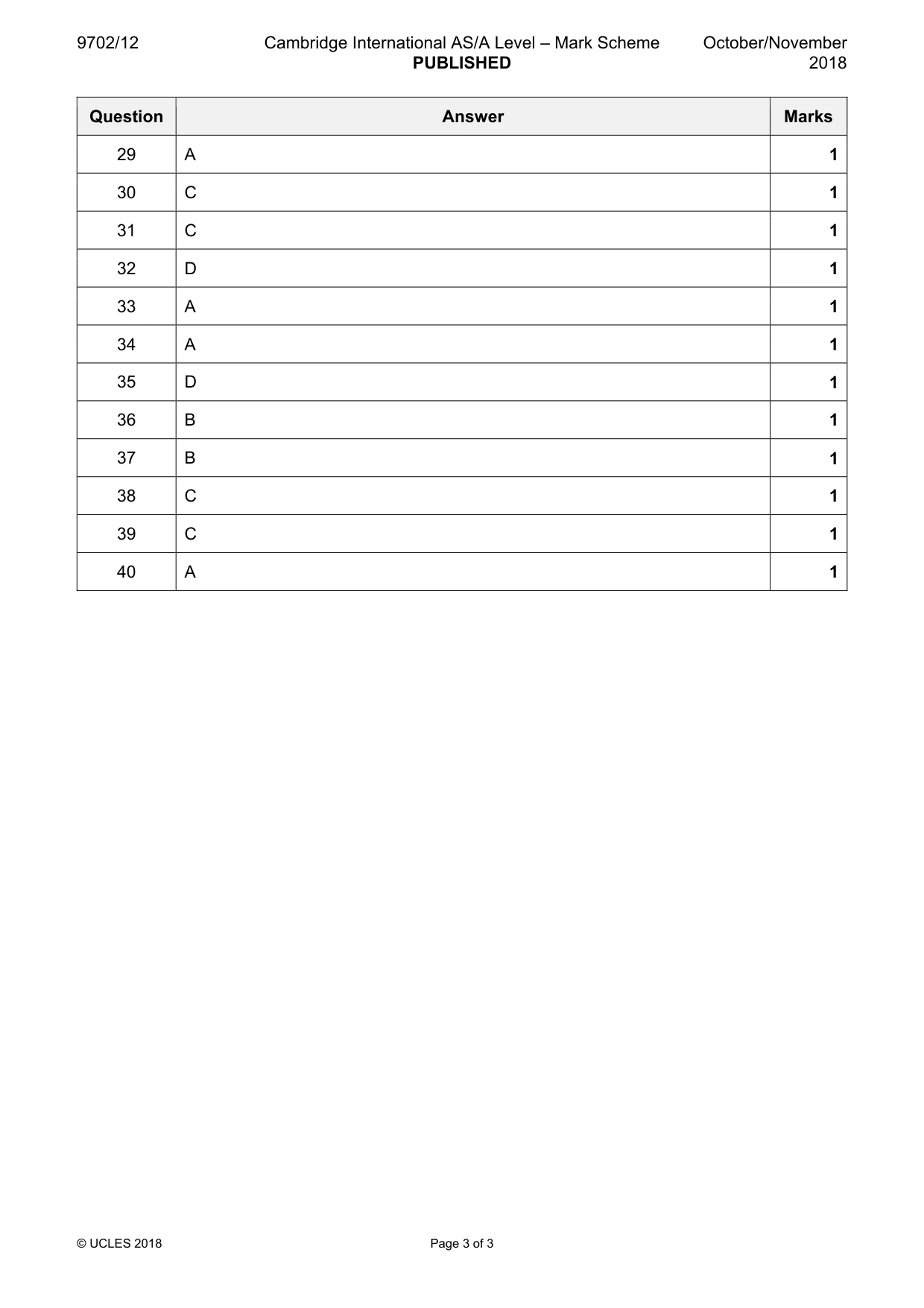
Mark scheme3 pages
Answers below. Sit the paper first if you are practising.
Questions as text
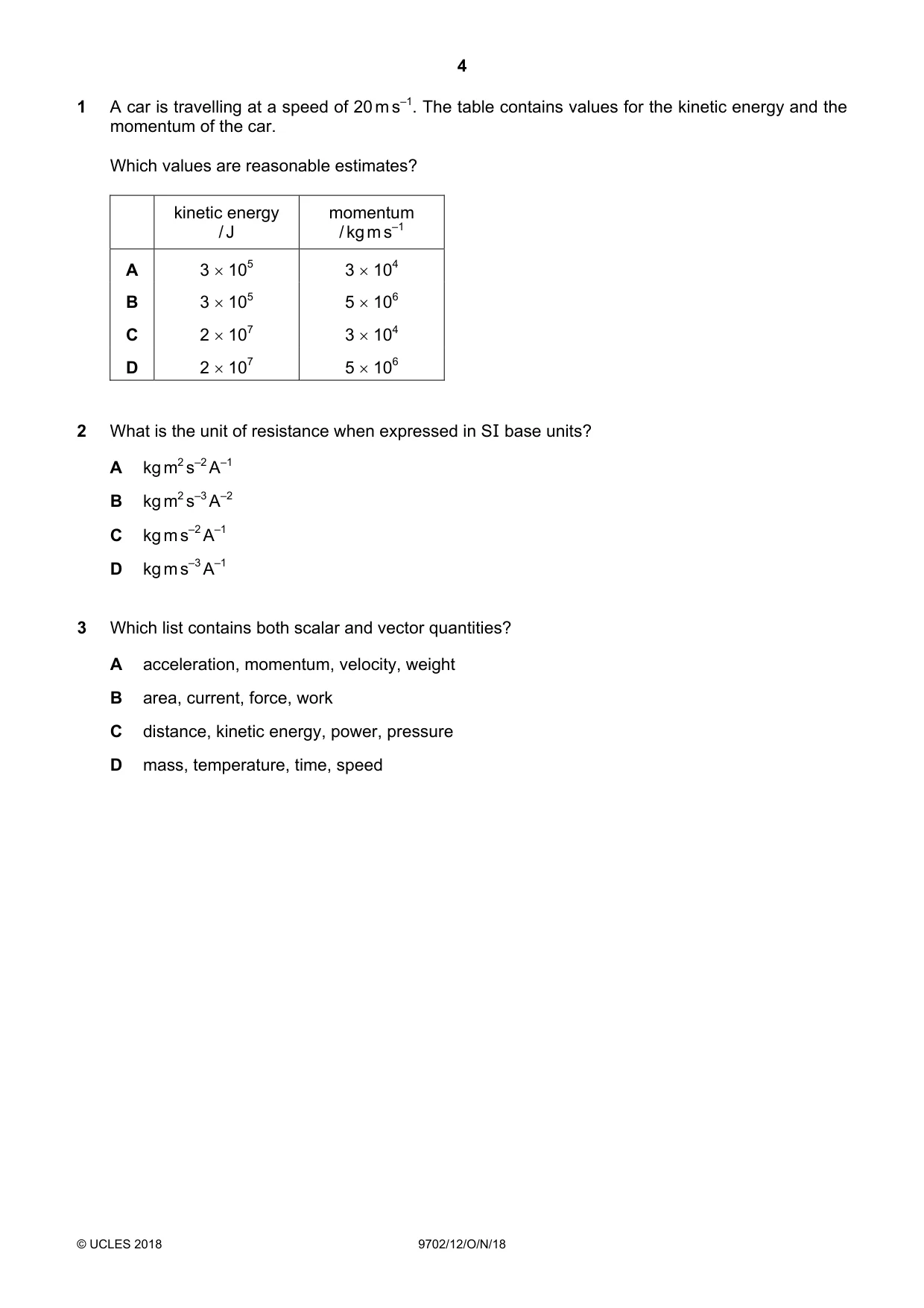
Q1 · A car is travelling at a speed of 20 m s–1
1 A car is travelling at a speed of 20 m s–1. The table contains values for the kinetic energy and the momentum of the car. Which values are reasonable estimates? kinetic energy momentum / J / kg m s–1 A 3 × 10⁵ 3 × 10⁴ B 3 × 10⁵ 5 × 10⁶ C 2 × 10⁷ 3 × 10⁴ D 2 × 10⁷ 5 × 10⁶
Mark scheme: A
Q2 · What is the unit of resistance when expressed in SI base units?
2 What is the unit of resistance when expressed in SI base units? A kg m2 s–2 A–1 B kg m2 s–3 A–2 C kg m s–2 A–1 D kg m s–3 A–1
Mark scheme: B
Q3 · Which list contains both scalar and vector quantities?
3 Which list contains both scalar and vector quantities? A acceleration, momentum, velocity, weight B area, current, force, work C distance, kinetic energy, power, pressure D mass, temperature, time, speed
Mark scheme: B
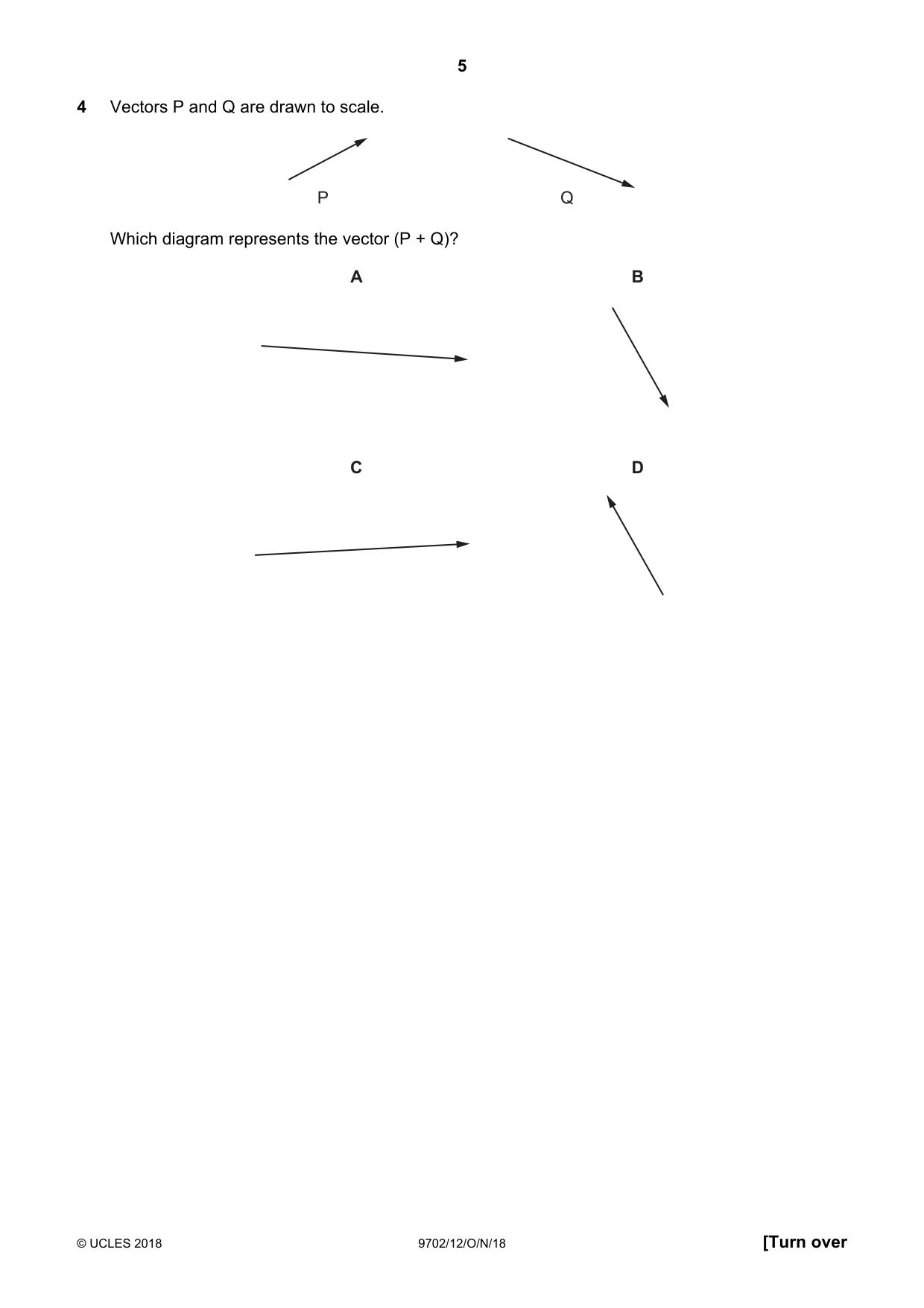
Q4 · Vectors P and Q are drawn to scale
4 Vectors P and Q are drawn to scale. P Q Which diagram represents the vector (P + Q)? A B C D
Mark scheme: A
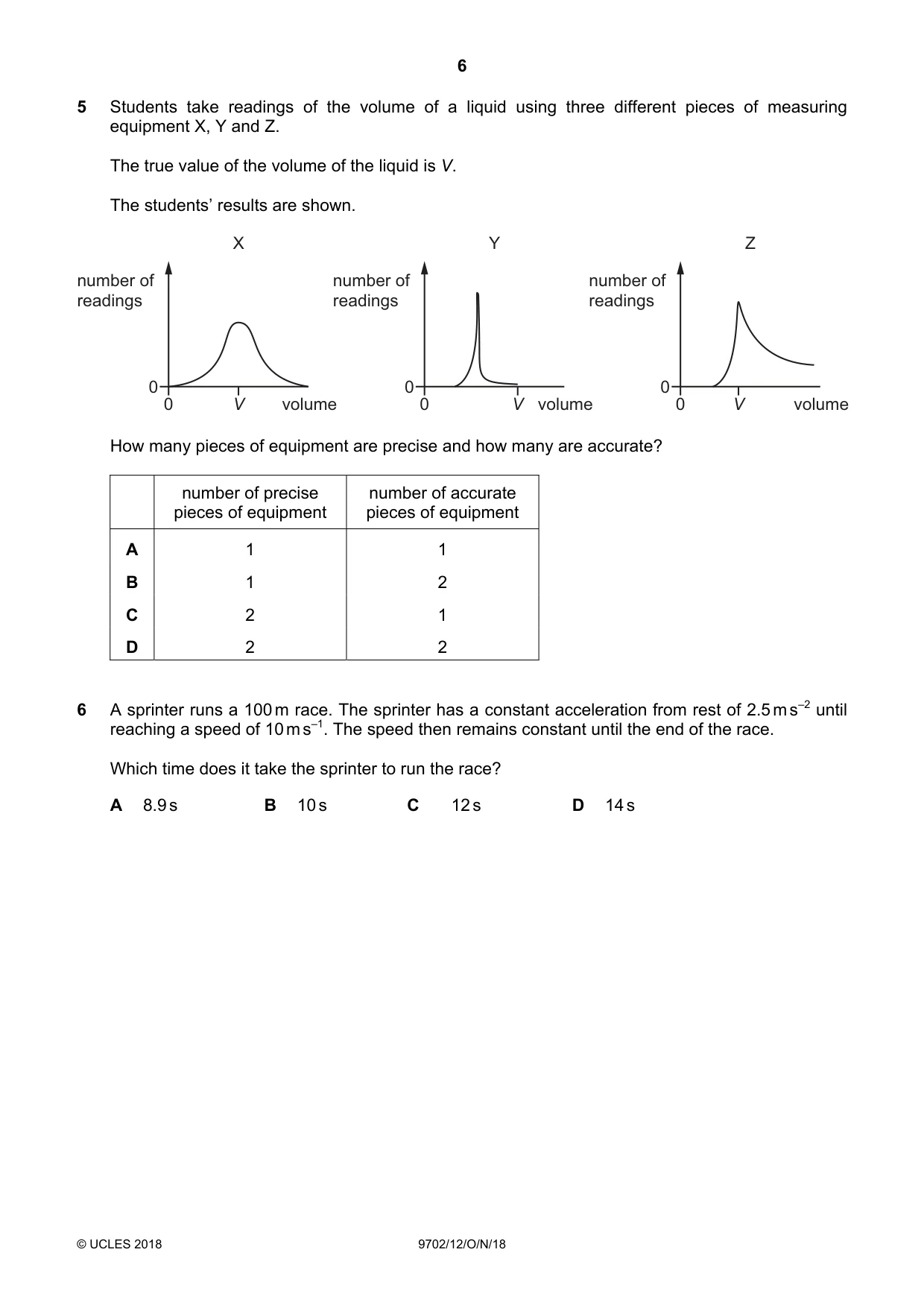
Q5 · Students take readings of the volume of a liquid using three different pieces of…
5 Students take readings of the volume of a liquid using three different pieces of measuring equipment X, Y and Z. The true value of the volume of the liquid is V. The students’ results are shown. X Y Z number of number of number of readings readings readings 0 0 0 0 V volume 0 V volume 0 V volume How many pieces of equipment are precise and how many are accurate? number of precise number of accurate pieces of equipment pieces of equipment A 1 1 B 1 2 C 2 1 D 2 2
Mark scheme: A
Q6 · A sprinter runs a 100 m race
6 A sprinter runs a 100 m race. The sprinter has a constant acceleration from rest of 2.5 m s–2 until reaching a speed of 10 m s–1. The speed then remains constant until the end of the race. Which time does it take the sprinter to run the race? A 8.9 s B 10 s C 12 s D 14 s
Mark scheme: C
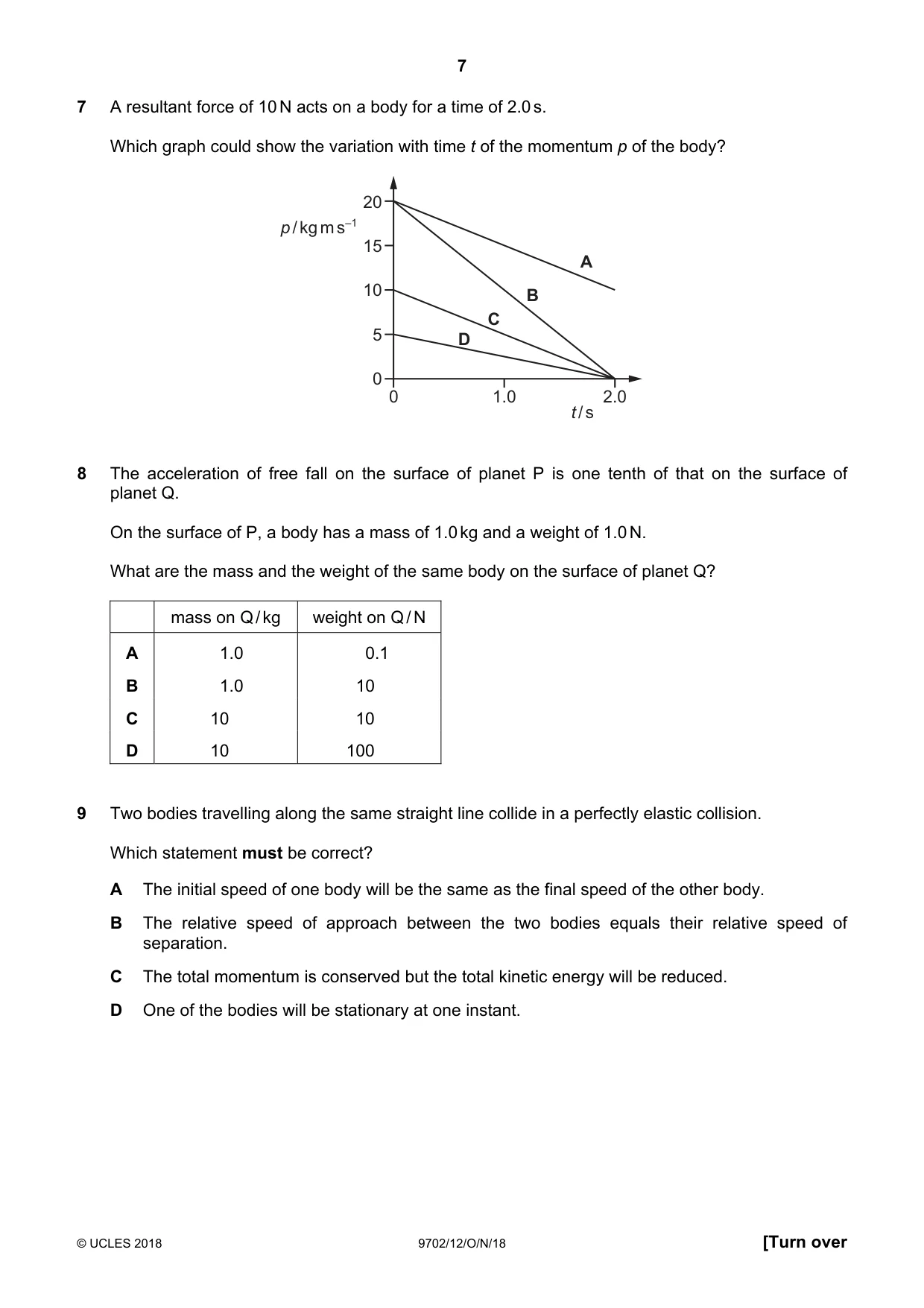
Q7 · A resultant force of 10 N acts on a body for a time of 2.0 s
7 A resultant force of 10 N acts on a body for a time of 2.0 s. Which graph could show the variation with time t of the momentum p of the body? 20 p / kg m s–1 15 A 10 B C 5 D 0 0 1.0 2.0 t / s
Mark scheme: B
Q8 · The acceleration of free fall on the surface of planet P is one tenth of that on the…
8 The acceleration of free fall on the surface of planet P is one tenth of that on the surface of planet Q. On the surface of P, a body has a mass of 1.0 kg and a weight of 1.0 N. What are the mass and the weight of the same body on the surface of planet Q? mass on Q / kg weight on Q / N A 1.0 0.1 B 1.0 10 C 10 10 D 10 100
Mark scheme: B
Q9 · Two bodies travelling along the same straight line collide in a perfectly elastic…
9 Two bodies travelling along the same straight line collide in a perfectly elastic collision. Which statement must be correct? A The initial speed of one body will be the same as the final speed of the other body. B The relative speed of approach between the two bodies equals their relative speed of separation. C The total momentum is conserved but the total kinetic energy will be reduced. D One of the bodies will be stationary at one instant.
Mark scheme: B
Q10 · The diagram shows two identical spheres X and Y
10 The diagram shows two identical spheres X and Y. v X Y Initially, X moves with speed v directly towards Y. Y is stationary. The spheres collide elastically. What happens? X Y 1 v to the right 1 v to the right A moves with speed 2 moves with speed 2 B moves with speed v to the left remains stationary 1 v to the left 1 v to the right C moves with speed 2 moves with speed 2 D stops moves with speed v to the right
Mark scheme: D
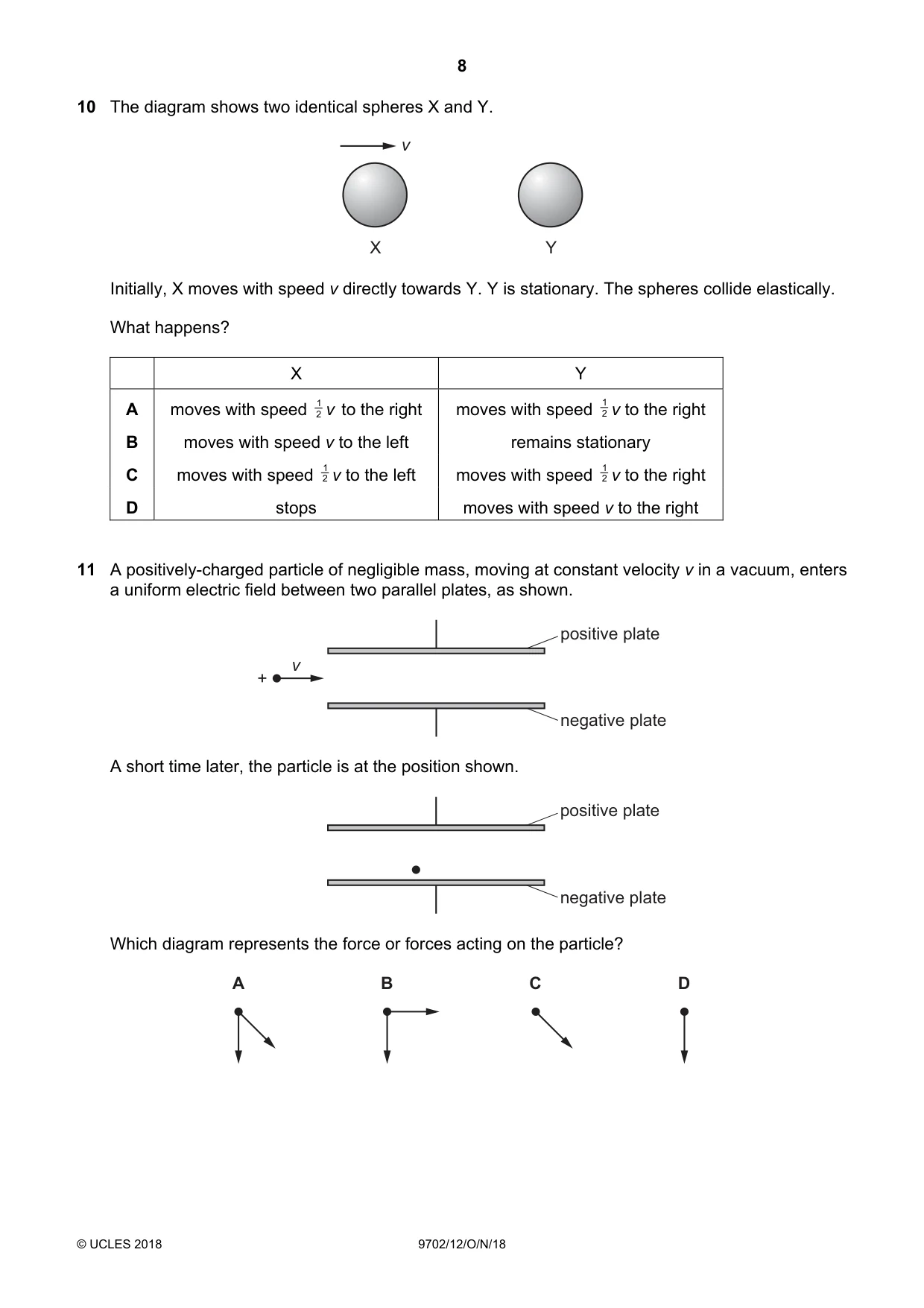
Q11 · A positively-charged particle of negligible mass, moving at constant velocity v in a…
11 A positively-charged particle of negligible mass, moving at constant velocity v in a vacuum, enters a uniform electric field between two parallel plates, as shown. positive plate v + negative plate A short time later, the particle is at the position shown. positive plate negative plate Which diagram represents the force or forces acting on the particle? A B C D
Mark scheme: D
Q12 · A uniform rectangular board is supported by a frictionless pivot at its centre point P
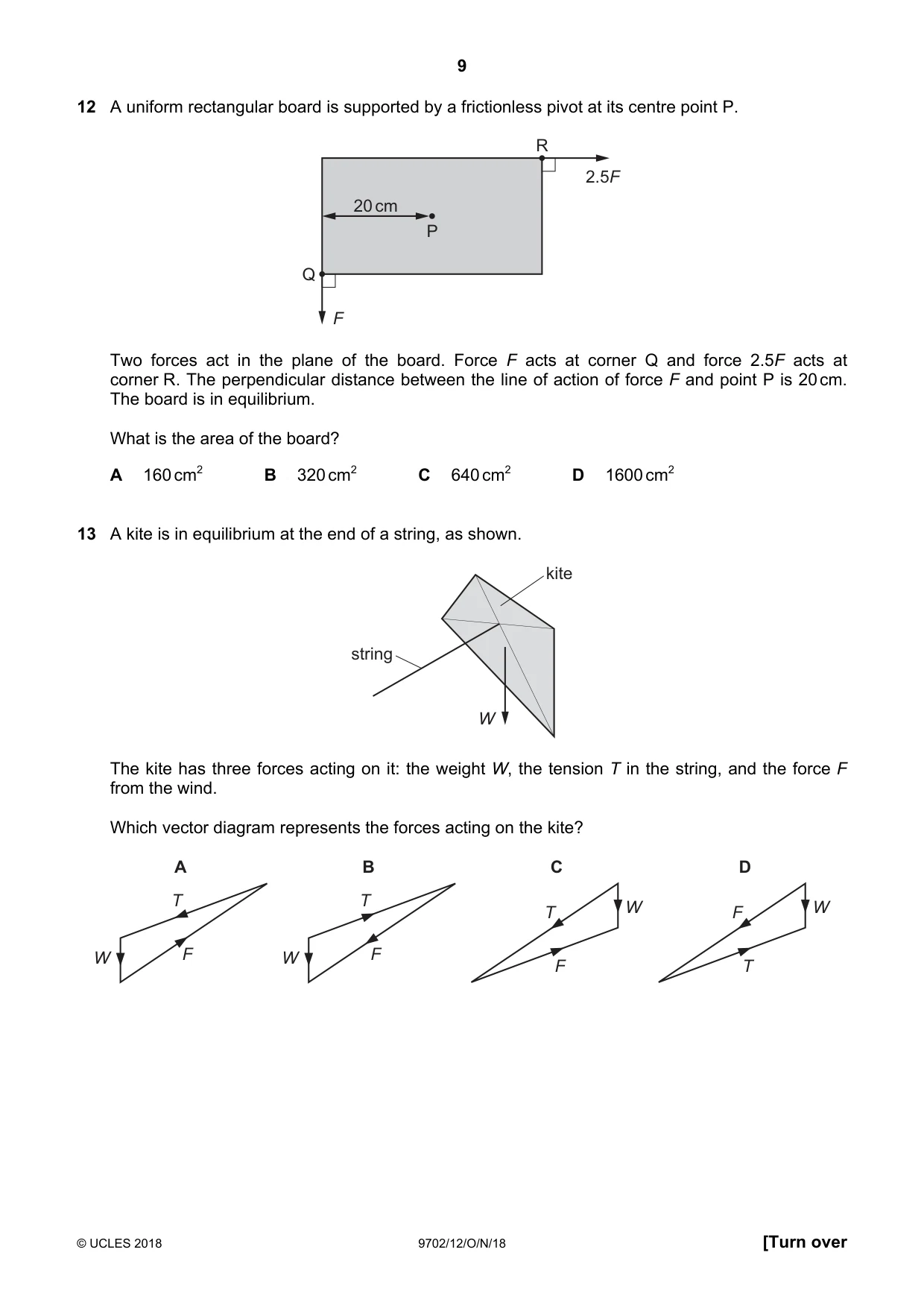
12 A uniform rectangular board is supported by a frictionless pivot at its centre point P. R 2.5F 20 cm P Q F Two forces act in the plane of the board. Force F acts at corner Q and force 2.5F acts at corner R. The perpendicular distance between the line of action of force F and point P is 20 cm. The board is in equilibrium. What is the area of the board? A 160 cm2 B 320 cm2 C 640 cm2 D 1600 cm2
Mark scheme: C
Q13 · A kite is in equilibrium at the end of a string, as shown
13 A kite is in equilibrium at the end of a string, as shown. kite string W The kite has three forces acting on it: the weight W, the tension T in the string, and the force F from the wind. Which vector diagram represents the forces acting on the kite? A B C D T T W W T F W F W F F T
Mark scheme: A
Q14 · The density of the air in the atmosphere decreases as the height h above the surface of…
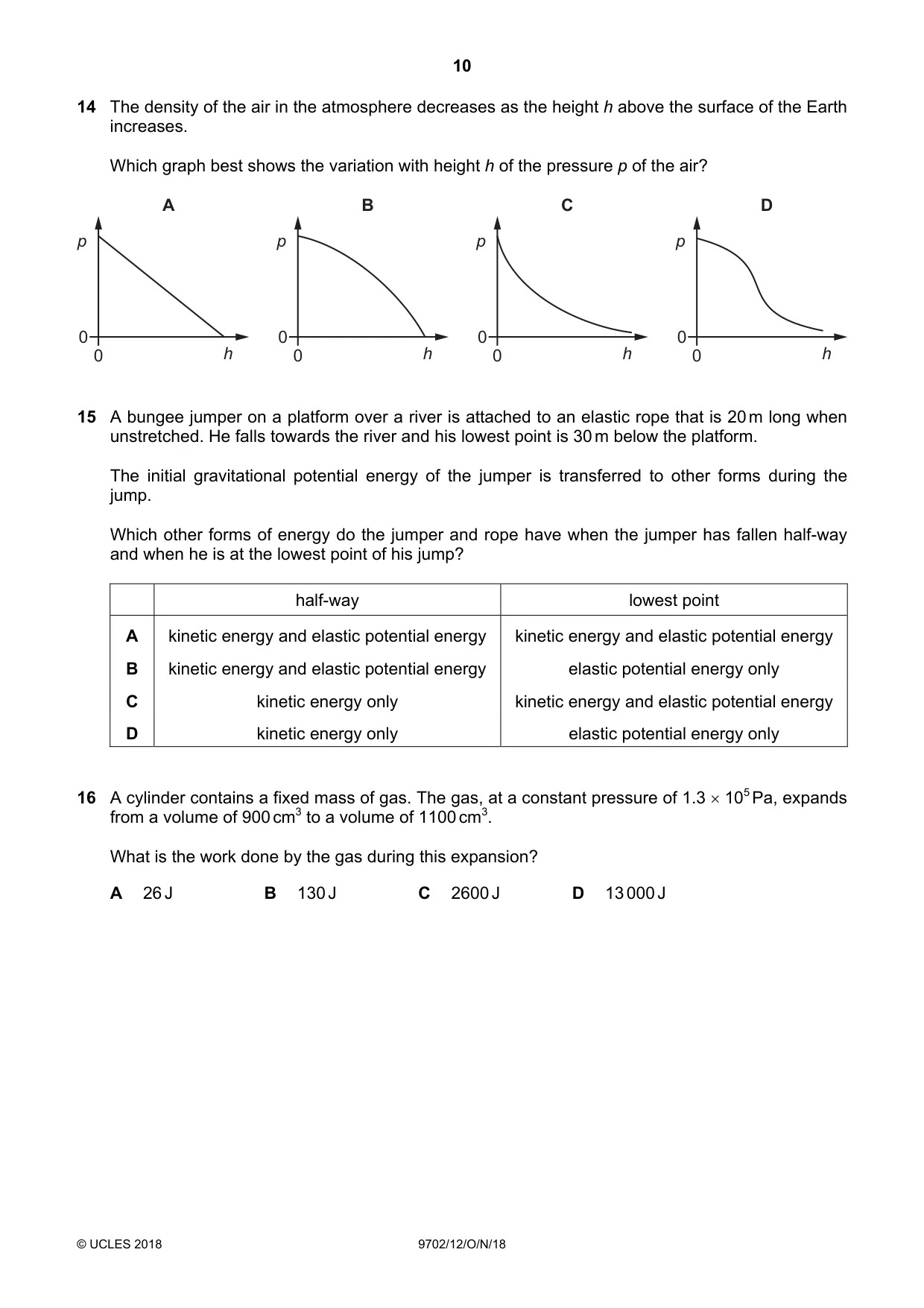
14 The density of the air in the atmosphere decreases as the height h above the surface of the Earth increases. Which graph best shows the variation with height h of the pressure p of the air? A B C D p p p p 0 0 0 0 0 h 0 h 0 h 0 h
Mark scheme: C
Q15 · A bungee jumper on a platform over a river is attached to an elastic rope that is 20 m…
15 A bungee jumper on a platform over a river is attached to an elastic rope that is 20 m long when unstretched. He falls towards the river and his lowest point is 30 m below the platform. The initial gravitational potential energy of the jumper is transferred to other forms during the jump. Which other forms of energy do the jumper and rope have when the jumper has fallen half-way and when he is at the lowest point of his jump? half-way lowest point A kinetic energy and elastic potential energy kinetic energy and elastic potential energy B kinetic energy and elastic potential energy elastic potential energy only C kinetic energy only kinetic energy and elastic potential energy D kinetic energy only elastic potential energy only
Mark scheme: D
Q16 · A cylinder contains a fixed mass of gas
16 A cylinder contains a fixed mass of gas. The gas, at a constant pressure of 1.3 × 10⁵ Pa, expands from a volume of 900 cm3 to a volume of 1100 cm3. What is the work done by the gas during this expansion? A 26 J B 130 J C 2600 J D 13 000 J
Mark scheme: A
Q17 · An object is thrown into the air
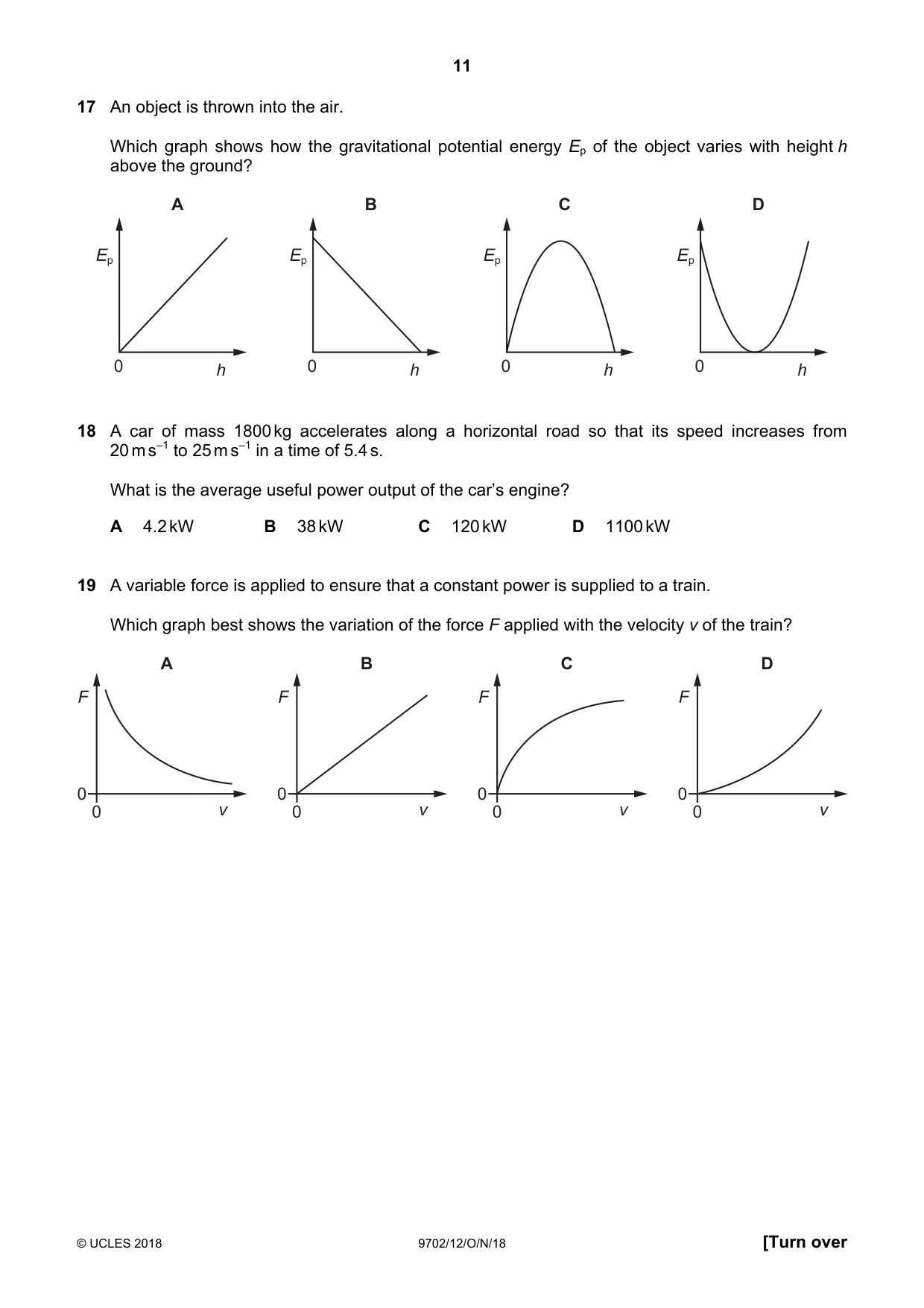
17 An object is thrown into the air. Which graph shows how the gravitational potential energy Ep of the object varies with height h above the ground? A B C D Ep Ep Ep Ep 0 h 0 h 0 h 0 h
Mark scheme: A
More questions on Gravitational potential energy and kinetic energy
Q18 · A car of mass 1800 kg accelerates along a horizontal road so that its speed increases…
18 A car of mass 1800 kg accelerates along a horizontal road so that its speed increases from 20 m s–1 to 25 m s–1 in a time of 5.4 s. What is the average useful power output of the car’s engine? A 4.2 kW B 38 kW C 120 kW D 1100 kW
Mark scheme: B
Q19 · A variable force is applied to ensure that a constant power is supplied to a train
19 A variable force is applied to ensure that a constant power is supplied to a train. Which graph best shows the variation of the force F applied with the velocity v of the train? A B C D F F F F 0 0 0 0 0 v 0 v 0 v 0 v
Mark scheme: A
Q20 · A metal cylinder is able to withstand a compressive force of 4.0 kN without deforming…
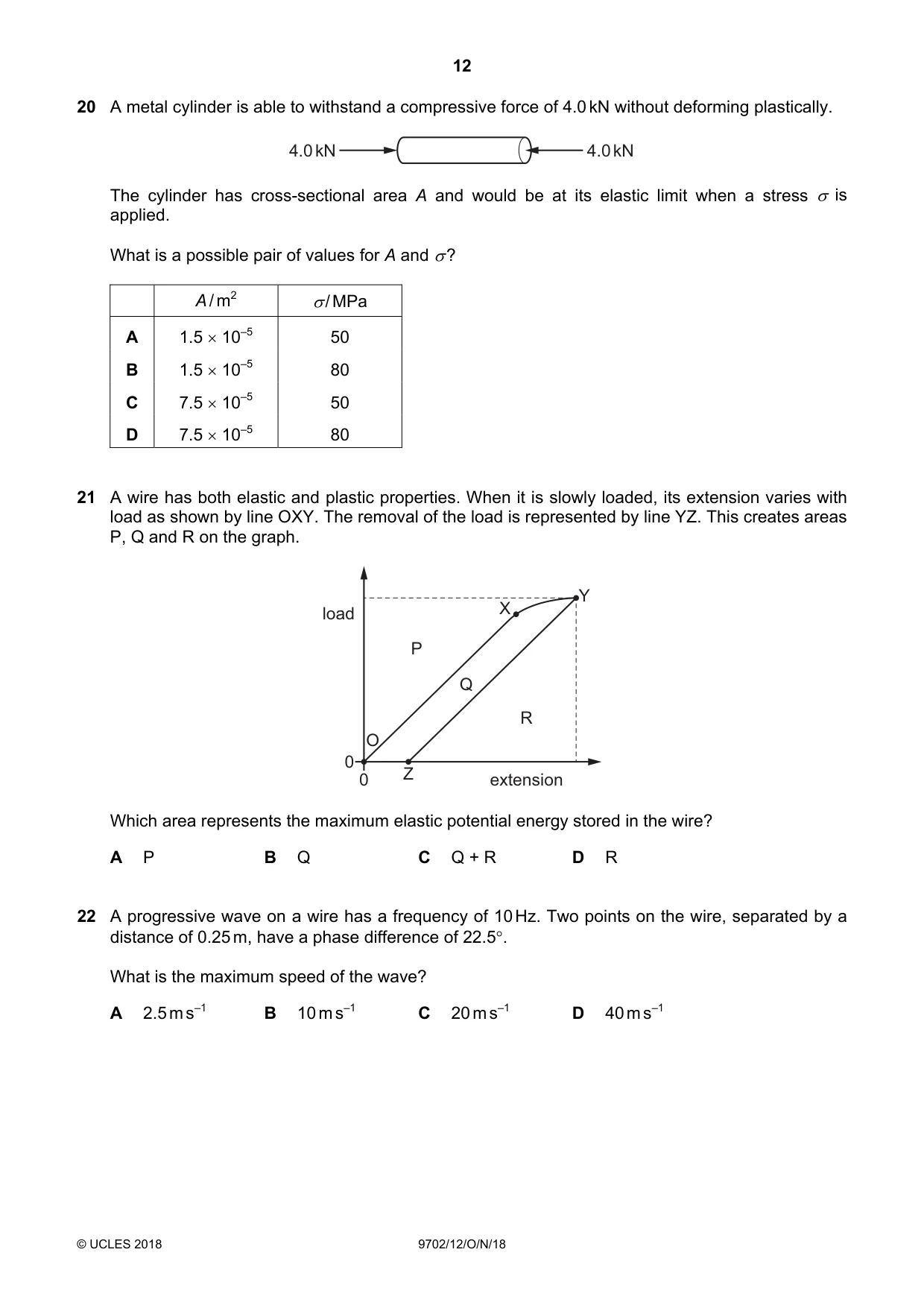
20 A metal cylinder is able to withstand a compressive force of 4.0 kN without deforming plastically. 4.0 kN 4.0 kN The cylinder has cross-sectional area A and would be at its elastic limit when a stress σ is applied. What is a possible pair of values for A and σ ? A / m2 σ / MPa A 1.5 × 10⁻⁵ 50 B 1.5 × 10⁻⁵ 80 C 7.5 × 10⁻⁵ 50 D 7.5 × 10⁻⁵ 80
Mark scheme: D
Q21 · A wire has both elastic and plastic properties
21 A wire has both elastic and plastic properties. When it is slowly loaded, its extension varies with load as shown by line OXY. The removal of the load is represented by line YZ. This creates areas P, Q and R on the graph. Y load X P Q R O 0 0 Z extension Which area represents the maximum elastic potential energy stored in the wire? A P B Q C Q + R D R
Mark scheme: D
Q22 · A progressive wave on a wire has a frequency of 10 Hz
22 A progressive wave on a wire has a frequency of 10 Hz. Two points on the wire, separated by a distance of 0.25 m, have a phase difference of 22.5°. What is the maximum speed of the wave? A 2.5 m s–1 B 10 m s–1 C 20 m s–1 D 40 m s–1
Mark scheme: D
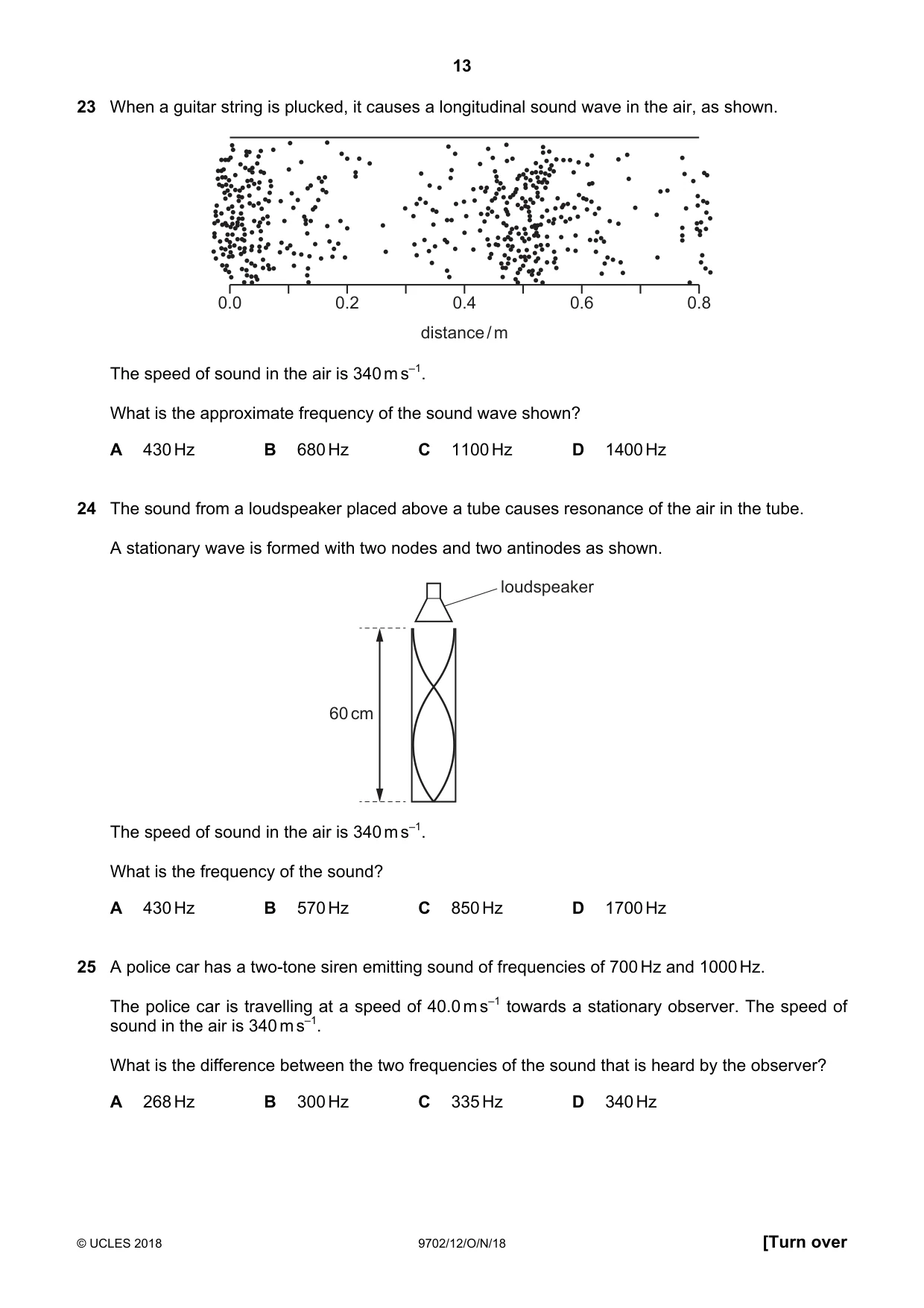
Q23 · When a guitar string is plucked, it causes a longitudinal sound wave in the air, as shown
23 When a guitar string is plucked, it causes a longitudinal sound wave in the air, as shown. 0.0 0.2 0.4 0.6 0.8 distance / m The speed of sound in the air is 340 m s–1. What is the approximate frequency of the sound wave shown? A 430 Hz B 680 Hz C 1100 Hz D 1400 Hz
Mark scheme: B
Q24 · The sound from a loudspeaker placed above a tube causes resonance of the air in the tube
24 The sound from a loudspeaker placed above a tube causes resonance of the air in the tube. A stationary wave is formed with two nodes and two antinodes as shown. loudspeaker 60 cm The speed of sound in the air is 340 m s–1. What is the frequency of the sound? A 430 Hz B 570 Hz C 850 Hz D 1700 Hz
Mark scheme: A
Q25 · A police car has a two-tone siren emitting sound of frequencies of 700 Hz and 1000 Hz
25 A police car has a two-tone siren emitting sound of frequencies of 700 Hz and 1000 Hz. The police car is travelling at a speed of 40.0 m s–1 towards a stationary observer. The speed of sound in the air is 340 m s–1. What is the difference between the two frequencies of the sound that is heard by the observer? A 268 Hz B 300 Hz C 335 Hz D 340 Hz
Mark scheme: D
Q26 · A surveyor’s device emits a pulse of light
26 A surveyor’s device emits a pulse of light. The light is reflected from a wall 150 m away. What is the time taken for the pulse to travel from the device to the wall and then back to the device? A 0.05 ns B 0.10 ns C 0.50 µs D 1.0 µs
Mark scheme: D
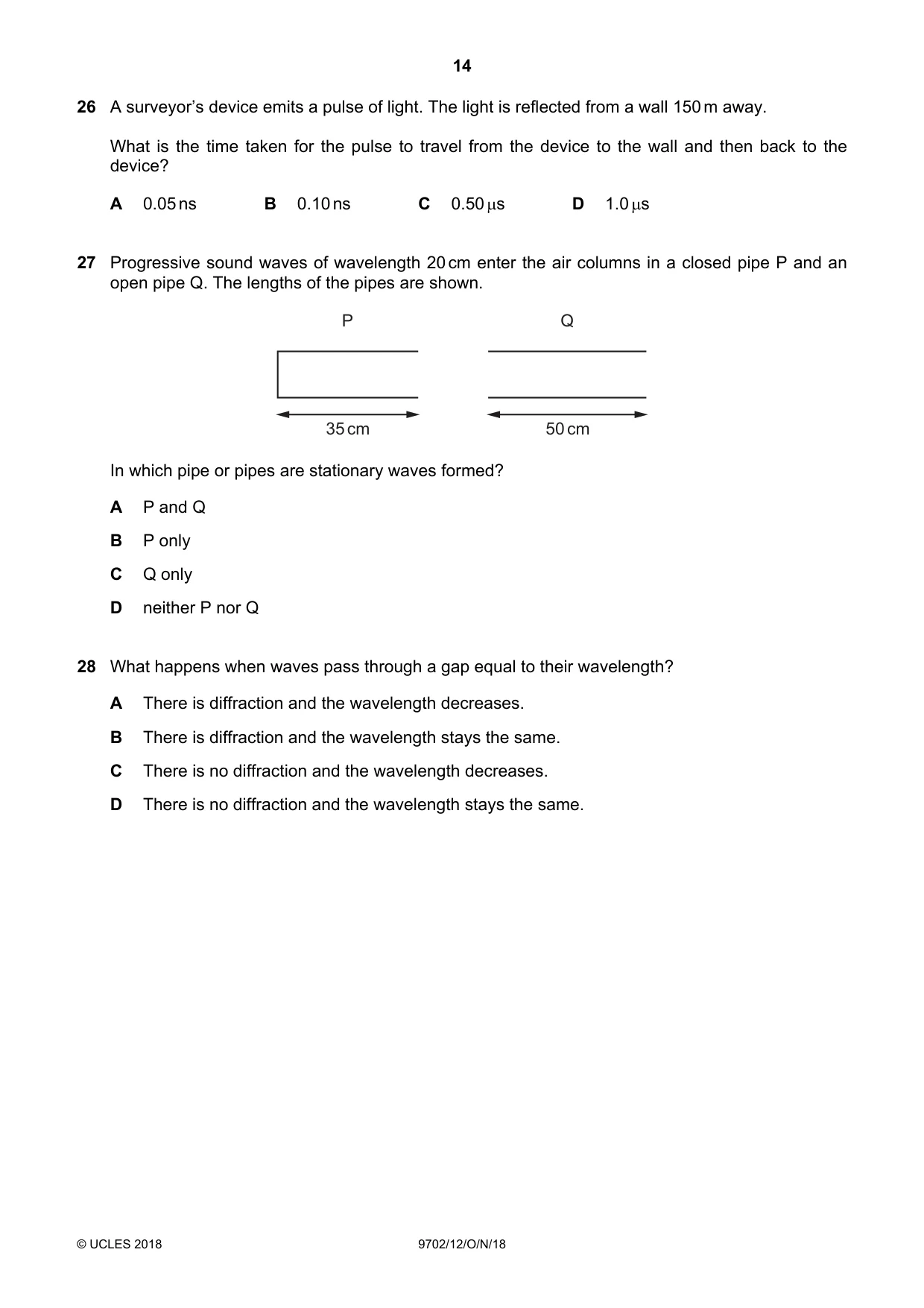
Q27 · Progressive sound waves of wavelength 20 cm enter the air columns in a closed pipe P and…
27 Progressive sound waves of wavelength 20 cm enter the air columns in a closed pipe P and an open pipe Q. The lengths of the pipes are shown. P Q 35 cm 50 cm In which pipe or pipes are stationary waves formed? A P and Q B P only C Q only D neither P nor Q
Mark scheme: A
Q28 · What happens when waves pass through a gap equal to their wavelength?
28 What happens when waves pass through a gap equal to their wavelength? A There is diffraction and the wavelength decreases. B There is diffraction and the wavelength stays the same. C There is no diffraction and the wavelength decreases. D There is no diffraction and the wavelength stays the same.
Mark scheme: B
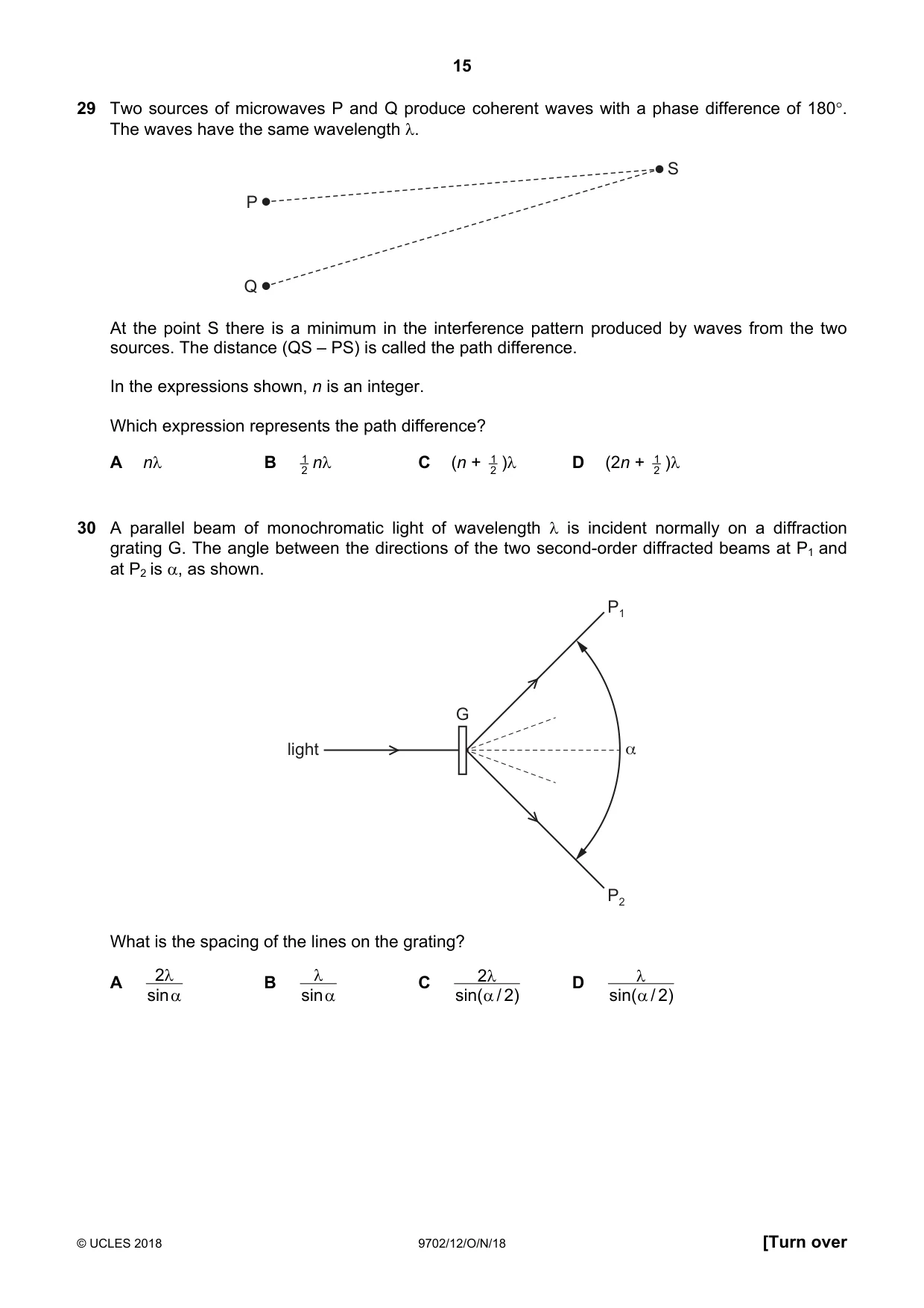
Q29 · Two sources of microwaves P and Q produce coherent waves with a phase difference of 180°
29 Two sources of microwaves P and Q produce coherent waves with a phase difference of 180°. The waves have the same wavelength λ. S P Q At the point S there is a minimum in the interference pattern produced by waves from the two sources. The distance (QS – PS) is called the path difference. In the expressions shown, n is an integer. Which expression represents the path difference? A nλ B 1 nλ C (n + 2 1 )λ D (2n + 2 1 )λ 2
Mark scheme: A
Q30 · A parallel beam of monochromatic light of wavelength λ is incident normally on a…
30 A parallel beam of monochromatic light of wavelength λ is incident normally on a diffraction grating G. The angle between the directions of the two second-order diffracted beams at P1 and at P2 is α, as shown. P1 G light α P2 What is the spacing of the lines on the grating? 2 λ λ 2 λ λ A B C D sin α sin α sin( α / 2 ) sin(α / 2 )
Mark scheme: C
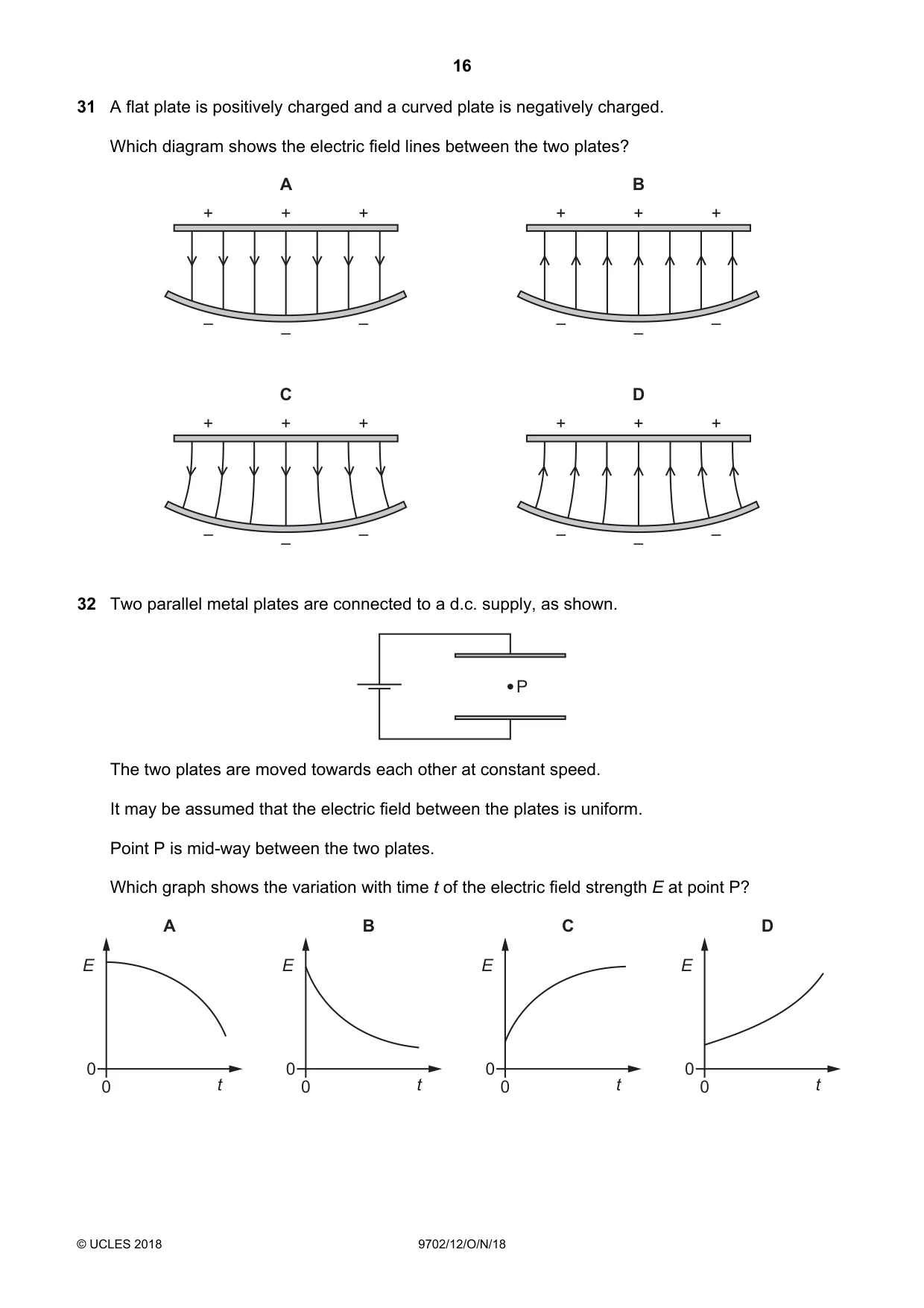
Q31 · A flat plate is positively charged and a curved plate is negatively charged
31 A flat plate is positively charged and a curved plate is negatively charged. Which diagram shows the electric field lines between the two plates? A B + + + + + + – – – – – – C D + + + + + + – – – – – –
Mark scheme: C
Q32 · Two parallel metal plates are connected to a d.c
32 Two parallel metal plates are connected to a d.c. supply, as shown. P The two plates are moved towards each other at constant speed. It may be assumed that the electric field between the plates is uniform. Point P is mid-way between the two plates. Which graph shows the variation with time t of the electric field strength E at point P? A B C D E E E E 0 0 0 0 0 t 0 t 0 t 0 t
Mark scheme: D
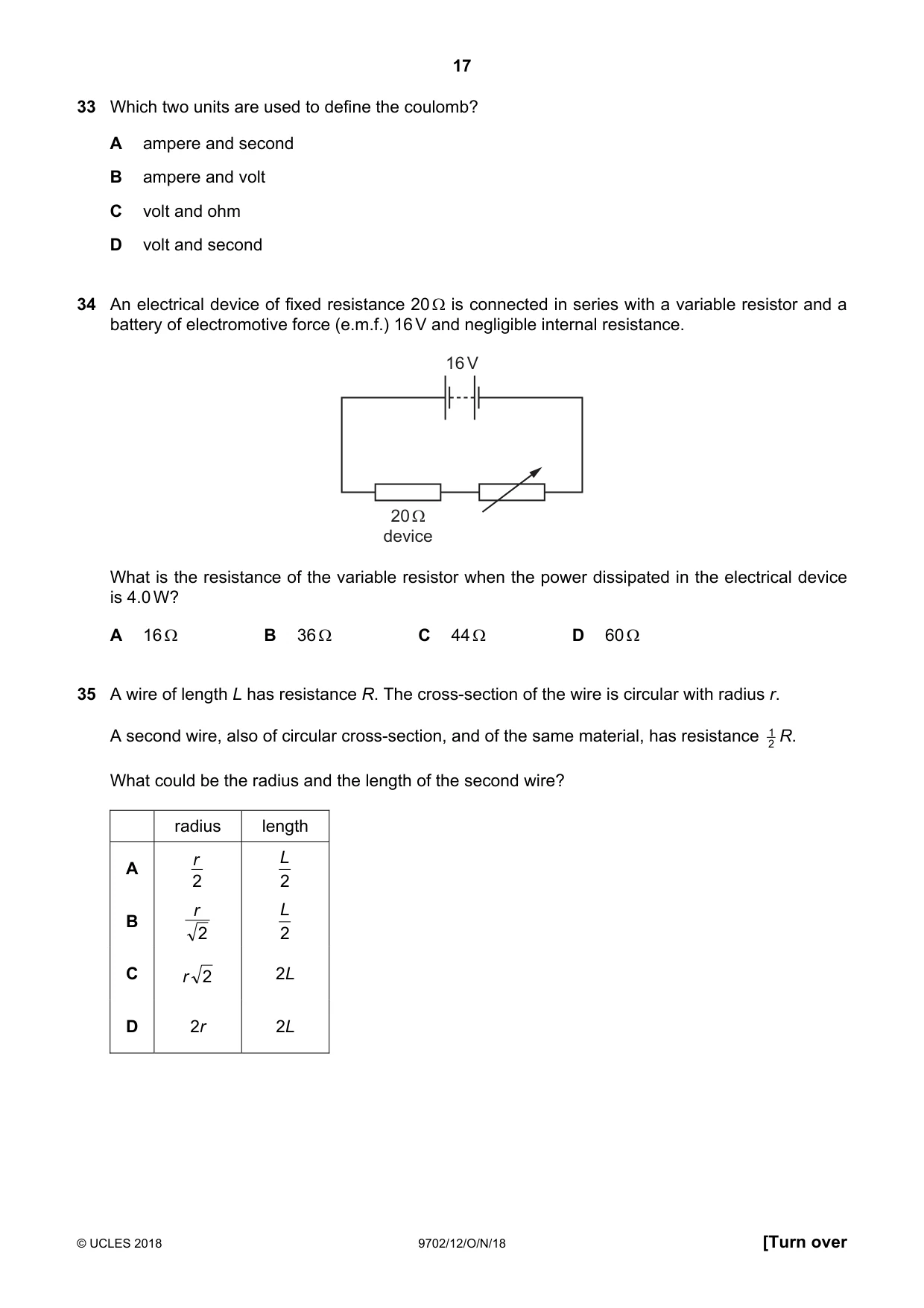
Q33 · Which two units are used to define the coulomb?
33 Which two units are used to define the coulomb? A ampere and second B ampere and volt C volt and ohm D volt and second
Mark scheme: A
Q34 · An electrical device of fixed resistance 20 Ω is connected in series with a variable…
34 An electrical device of fixed resistance 20 Ω is connected in series with a variable resistor and a battery of electromotive force (e.m.f.) 16 V and negligible internal resistance. 16 V 20 Ω device What is the resistance of the variable resistor when the power dissipated in the electrical device is 4.0 W? A 16 Ω B 36 Ω C 44 Ω D 60 Ω
Mark scheme: A
Q35 · A wire of length L has resistance R
35 A wire of length L has resistance R. The cross-section of the wire is circular with radius r. A second wire, also of circular cross-section, and of the same material, has resistance 2 1 R. What could be the radius and the length of the second wire? radius length r L A 2 2 r L B 2 2 C r 2 2L D 2r 2L
Mark scheme: D
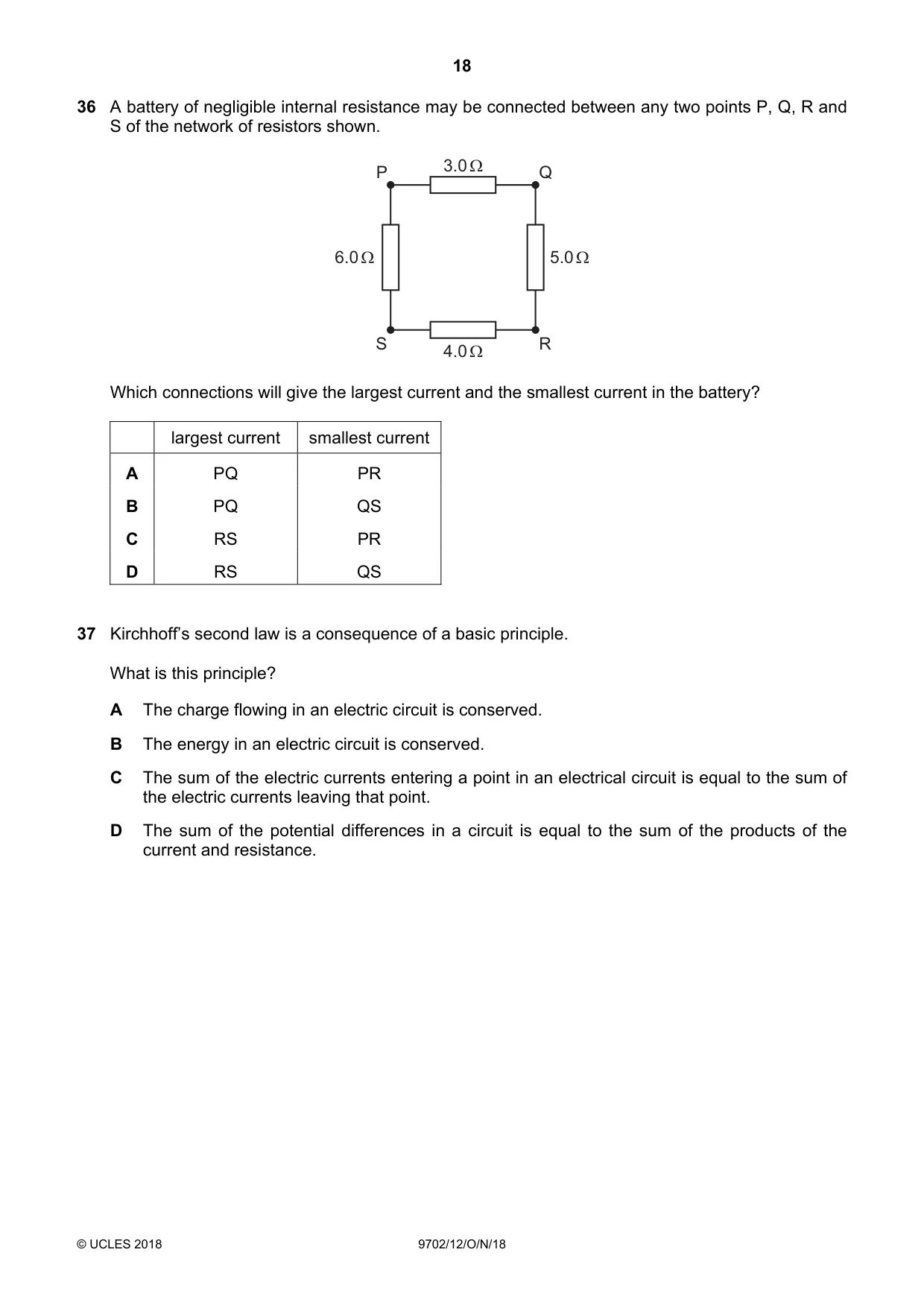
Q36 · A battery of negligible internal resistance may be connected between any two points P, Q…
36 A battery of negligible internal resistance may be connected between any two points P, Q, R and S of the network of resistors shown. P 3.0 Ω Q 6.0 Ω 5.0 Ω S 4.0 Ω R Which connections will give the largest current and the smallest current in the battery? largest current smallest current A PQ PR B PQ QS C RS PR D RS QS
Mark scheme: B
Q37 · Kirchhoff’s second law is a consequence of a basic principle
37 Kirchhoff’s second law is a consequence of a basic principle. What is this principle? A The charge flowing in an electric circuit is conserved. B The energy in an electric circuit is conserved. C The sum of the electric currents entering a point in an electrical circuit is equal to the sum of the electric currents leaving that point. D The sum of the potential differences in a circuit is equal to the sum of the products of the current and resistance.
Mark scheme: B
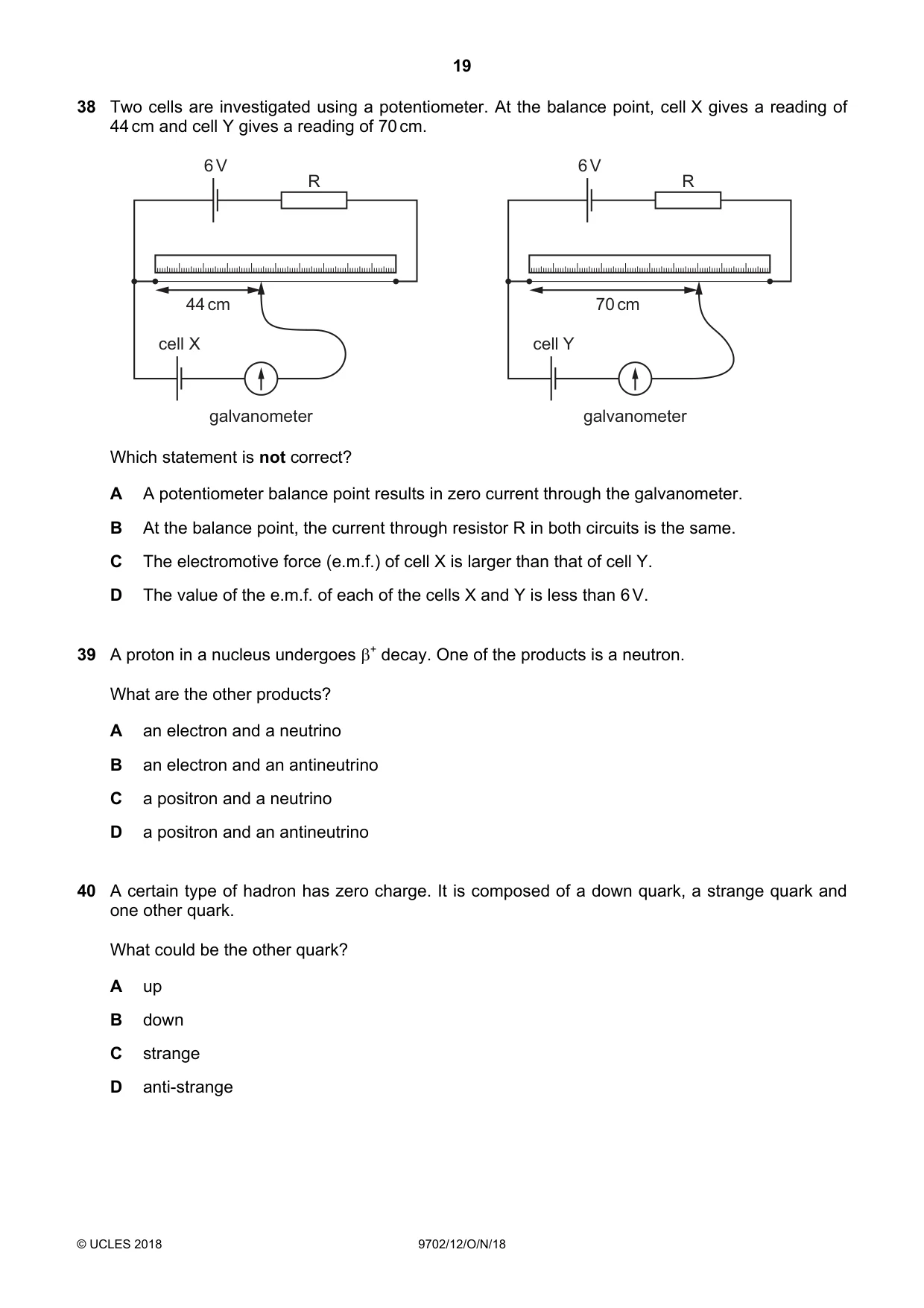
Q38 · Two cells are investigated using a potentiometer
38 Two cells are investigated using a potentiometer. At the balance point, cell X gives a reading of 44 cm and cell Y gives a reading of 70 cm. 6 V 6 V R R 44 cm 70 cm cell X cell Y galvanometer galvanometer Which statement is not correct? A A potentiometer balance point results in zero current through the galvanometer. B At the balance point, the current through resistor R in both circuits is the same. C The electromotive force (e.m.f.) of cell X is larger than that of cell Y. D The value of the e.m.f. of each of the cells X and Y is less than 6 V.
Mark scheme: C
Q39 · A proton in a nucleus undergoes β+ decay
39 A proton in a nucleus undergoes β+ decay. One of the products is a neutron. What are the other products? A an electron and a neutrino B an electron and an antineutrino C a positron and a neutrino D a positron and an antineutrino
Mark scheme: C
Q40 · A certain type of hadron has zero charge
40 A certain type of hadron has zero charge. It is composed of a down quark, a strange quark and one other quark. What could be the other quark? A up B down C strange D anti-strange
Mark scheme: A
What was in this paper
The subtopics covered by these 40 questions, and how many questions each got. Open one in a new tab to see every Cambridge question on it.
3Linear momentum and its conservation3Scalars and vectors2Stationary waves2Uniform electric fields2Atoms, nuclei and radiation1Density and pressure1Diffraction1Doppler effect for sound waves1Elastic and plastic behaviour1Electric current1Electric fields and field lines1Electromagnetic spectrum1Equations of motion1Equilibrium of forces1Errors and uncertainties1Fundamental particles1Gravitational potential energy and kinetic energy1Interference1Kirchhoff’s laws1Momentum and Newton’s laws of motion1Physical quantities1Potential difference and power1Potential dividers1Practical circuits1Progressive waves1Resistance and resistivity1SI units1Stress and strain1The diffraction grating1The first law of thermodynamics1Transverse and longitudinal waves1Turning effects of forces1What you needed in this session
Cambridge’s own grade thresholds for 2018 Oct/Nov, Paper 1 · Variant 2. A higher threshold means an easier paper — the bar moves with how the cohort did.