Cambridge A Level Physics 9702 — 2017 Oct/Nov Paper 1 · Variant 3
9702/13/O/N/17 · 40 questions · 40 marks · ≈45 min
The question paper and its mark scheme, free to read here and free to download. This is Cambridge’s own paper, exactly as it was sat.
Question paper20 pages
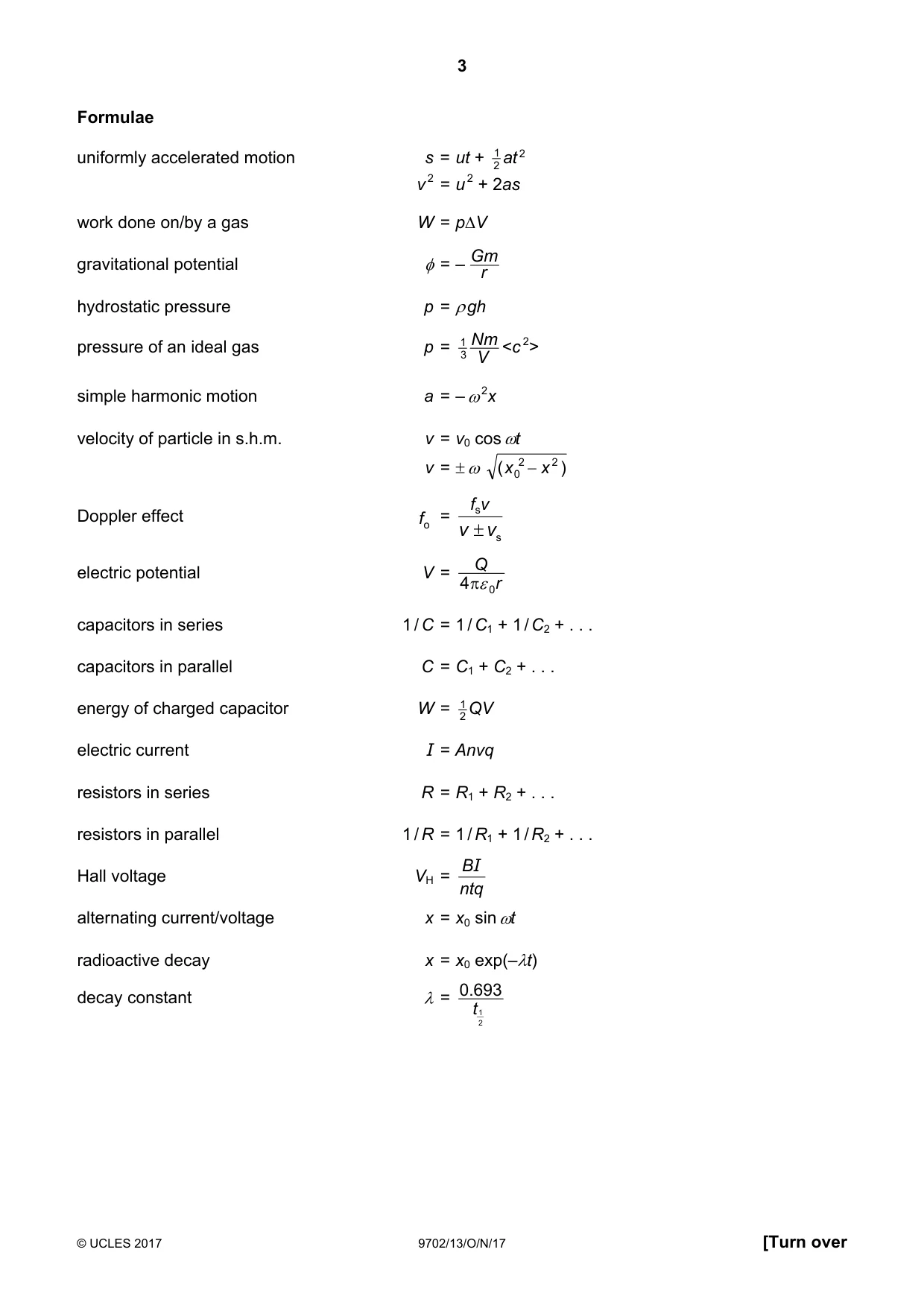
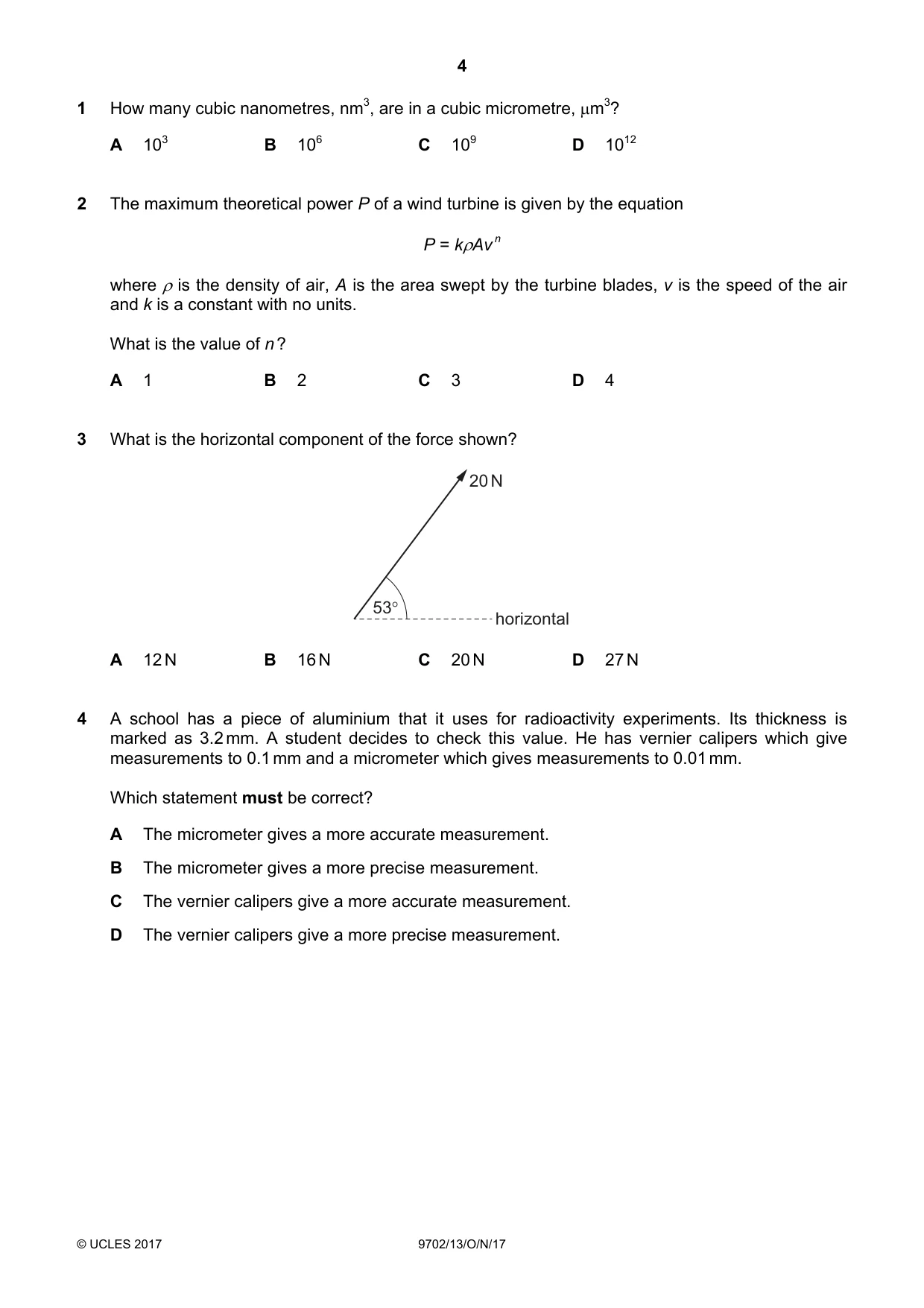
Mark scheme3 pages
Answers below. Sit the paper first if you are practising.
Questions as text
Q1 · How many cubic nanometres, nm3, are in a cubic micrometre, µm3?
1 How many cubic nanometres, nm3, are in a cubic micrometre, µm3? A 103 B 106 C 109 D 1012
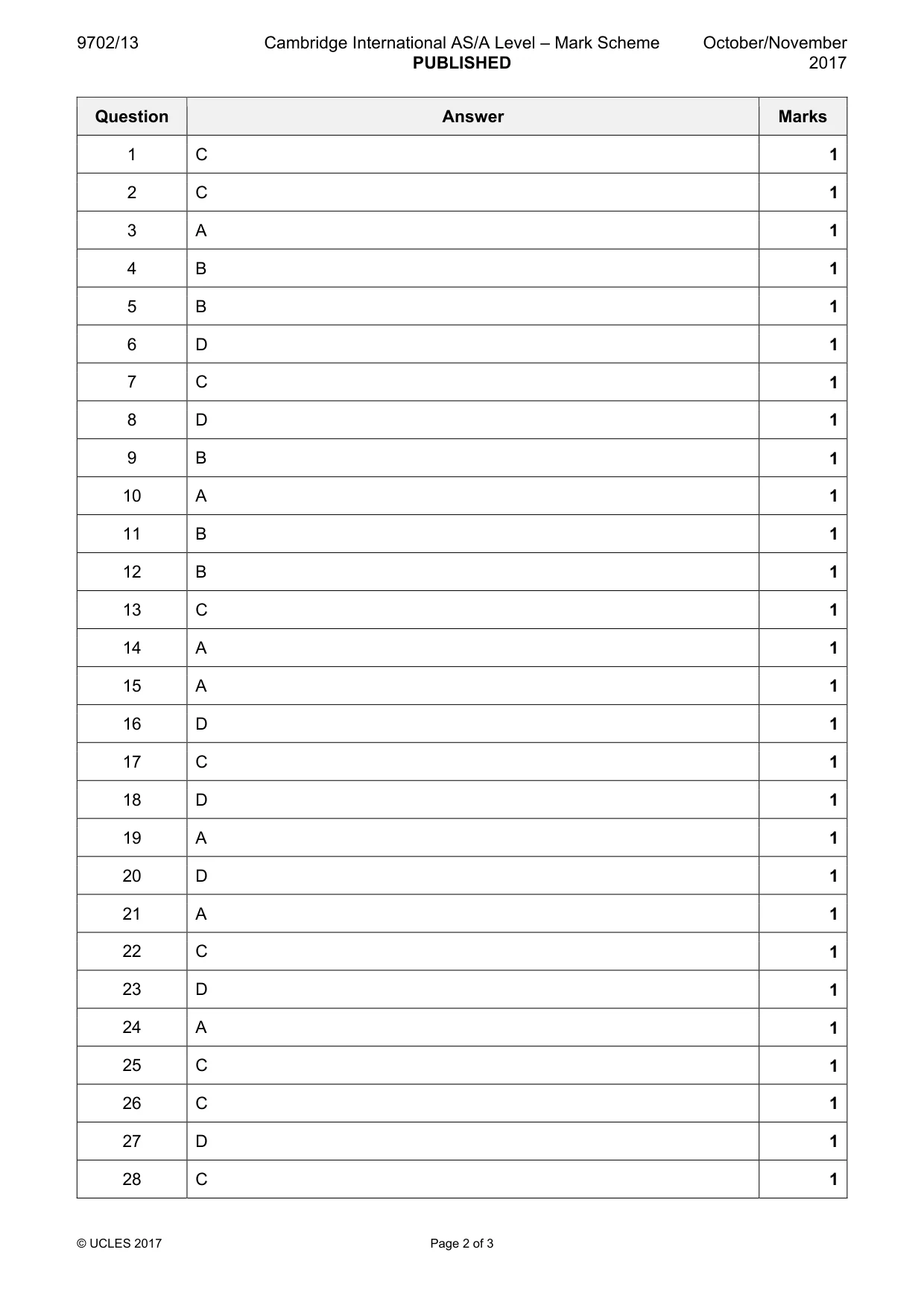
Mark scheme: C
Q2 · The maximum theoretical power P of a wind turbine is given by the equation P = kρAv n…
2 The maximum theoretical power P of a wind turbine is given by the equation P = kρAv n where ρ is the density of air, A is the area swept by the turbine blades, v is the speed of the air and k is a constant with no units. What is the value of n ? A 1 B 2 C 3 D 4
Mark scheme: C
Q3 · What is the horizontal component of the force shown?
3 What is the horizontal component of the force shown? 20 N 53° horizontal A 12 N B 16 N C 20 N D 27 N
Mark scheme: A
Q4 · A school has a piece of aluminium that it uses for radioactivity experiments
4 A school has a piece of aluminium that it uses for radioactivity experiments. Its thickness is marked as 3.2 mm. A student decides to check this value. He has vernier calipers which give measurements to 0.1 mm and a micrometer which gives measurements to 0.01 mm. Which statement must be correct? A The micrometer gives a more accurate measurement. B The micrometer gives a more precise measurement. C The vernier calipers give a more accurate measurement. D The vernier calipers give a more precise measurement.
Mark scheme: B
Q5 · Four possible sources of error in a series of measurements are listed
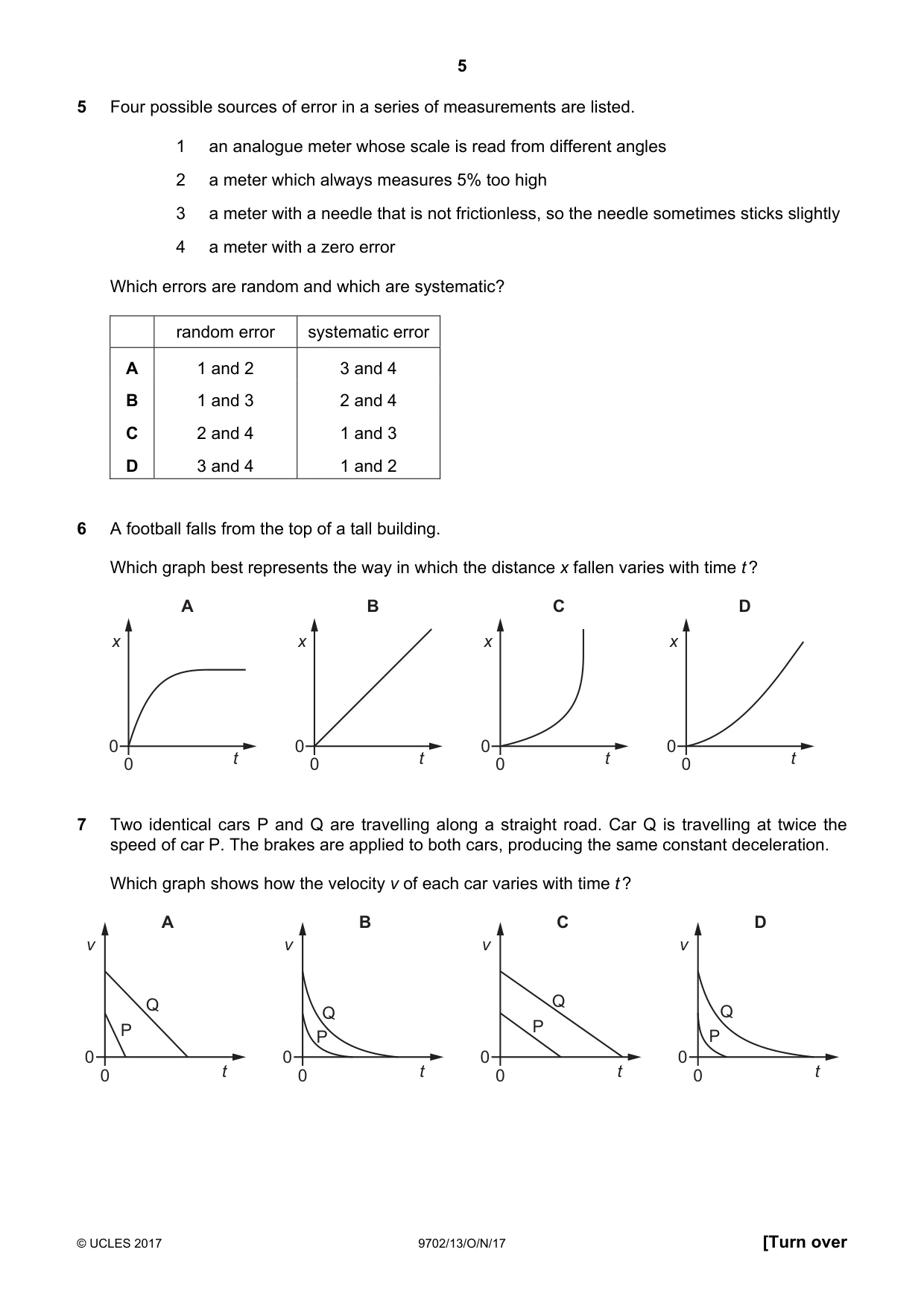
5 Four possible sources of error in a series of measurements are listed. 1 an analogue meter whose scale is read from different angles 2 a meter which always measures 5% too high 3 a meter with a needle that is not frictionless, so the needle sometimes sticks slightly 4 a meter with a zero error Which errors are random and which are systematic? random error systematic error A 1 and 2 3 and 4 B 1 and 3 2 and 4 C 2 and 4 1 and 3 D 3 and 4 1 and 2
Mark scheme: B
Q6 · A football falls from the top of a tall building
6 A football falls from the top of a tall building. Which graph best represents the way in which the distance x fallen varies with time t ? A B C D x x x x 0 0 0 0 0 t 0 t 0 t 0 t
Mark scheme: D
Q7 · Two identical cars P and Q are travelling along a straight road
7 Two identical cars P and Q are travelling along a straight road. Car Q is travelling at twice the speed of car P. The brakes are applied to both cars, producing the same constant deceleration. Which graph shows how the velocity v of each car varies with time t ? A B C D v v v v Q Q Q Q P P P P 0 0 0 0 0 t 0 t 0 t 0 t
Mark scheme: C
Q8 · A man stands in a lift that is accelerating vertically downwards, as shown
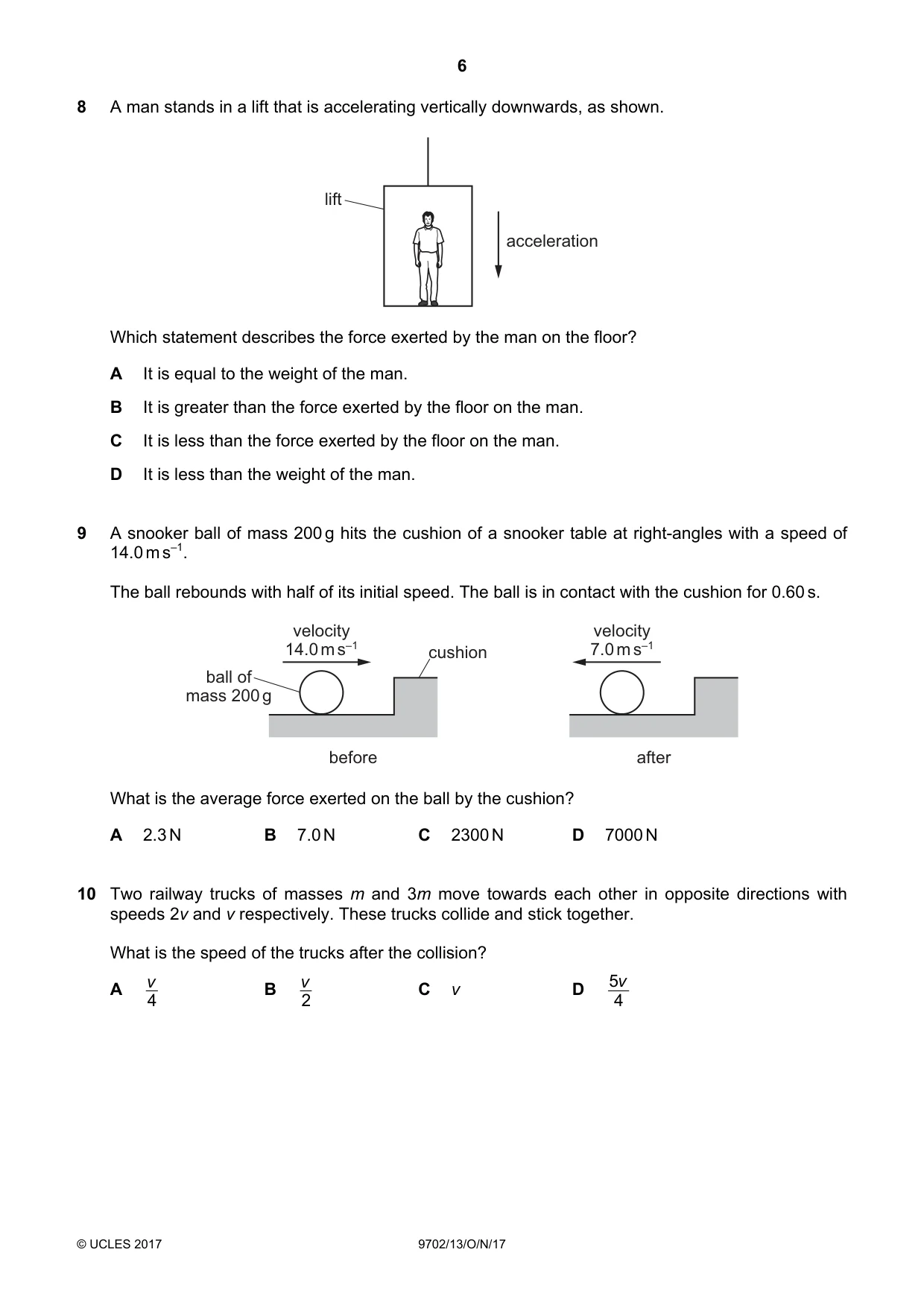
8 A man stands in a lift that is accelerating vertically downwards, as shown. lift acceleration Which statement describes the force exerted by the man on the floor? A It is equal to the weight of the man. B It is greater than the force exerted by the floor on the man. C It is less than the force exerted by the floor on the man. D It is less than the weight of the man.
Mark scheme: D
Q9 · A snooker ball of mass 200 g hits the cushion of a snooker table at right-angles with a…
9 A snooker ball of mass 200 g hits the cushion of a snooker table at right-angles with a speed of 14.0 m s–1. The ball rebounds with half of its initial speed. The ball is in contact with the cushion for 0.60 s. velocity velocity 14.0 m s–1 cushion 7.0 m s–1 ball of mass 200 g before after What is the average force exerted on the ball by the cushion? A 2.3 N B 7.0 N C 2300 N D 7000 N
Mark scheme: B
Q10 · Two railway trucks of masses m and 3m move towards each other in opposite directions with…
10 Two railway trucks of masses m and 3m move towards each other in opposite directions with speeds 2v and v respectively. These trucks collide and stick together. What is the speed of the trucks after the collision? v v 5v A B C v D 4 2 4
Mark scheme: A
Q11 · A stone is projected horizontally in a vacuum and moves along the path shown
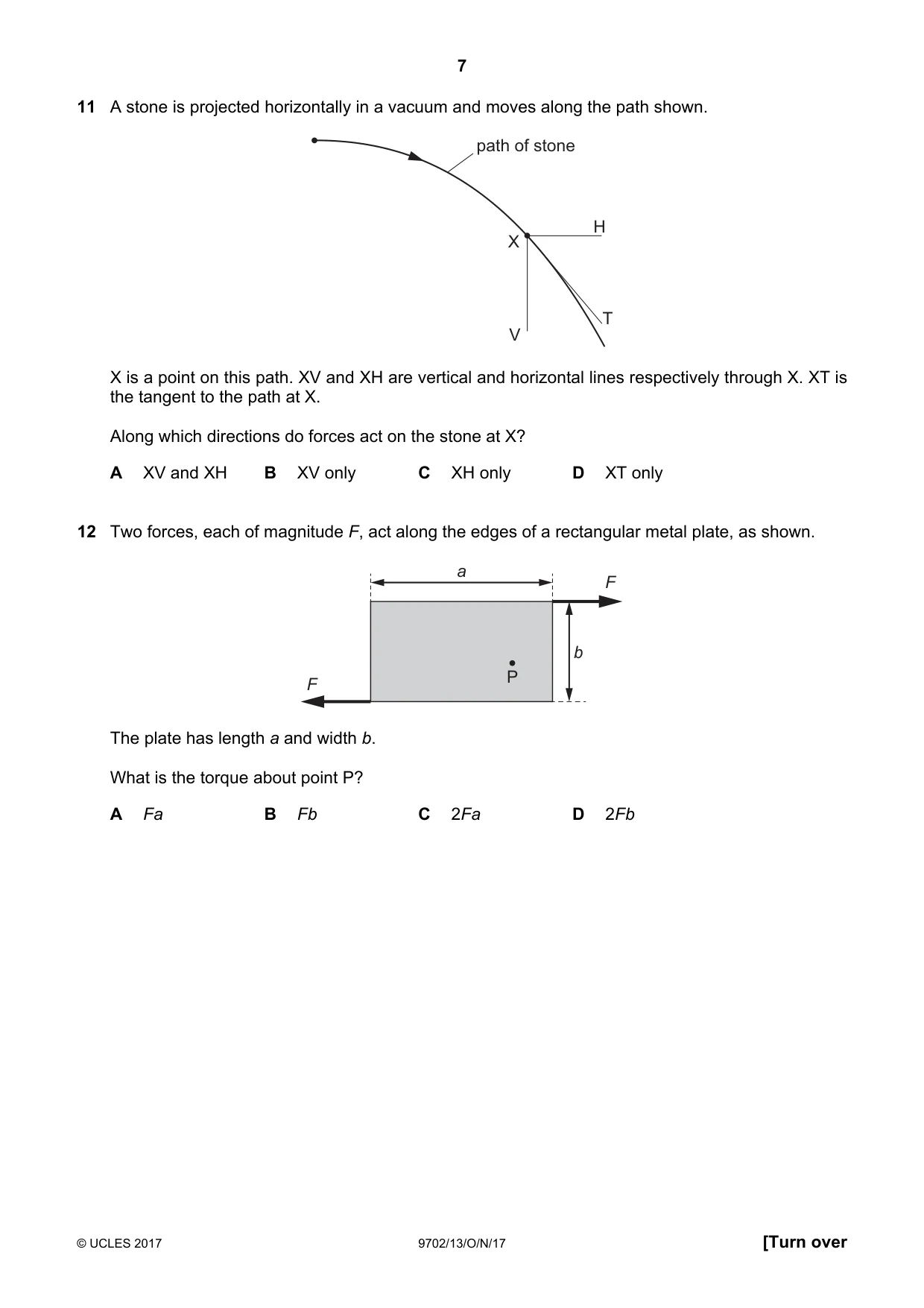
11 A stone is projected horizontally in a vacuum and moves along the path shown. path of stone H X T V X is a point on this path. XV and XH are vertical and horizontal lines respectively through X. XT is the tangent to the path at X. Along which directions do forces act on the stone at X? A XV and XH B XV only C XH only D XT only
Mark scheme: B
Q12 · Two forces, each of magnitude F, act along the edges of a rectangular metal plate, as…
12 Two forces, each of magnitude F, act along the edges of a rectangular metal plate, as shown. a F b F P The plate has length a and width b. What is the torque about point P? A Fa B Fb C 2Fa D 2Fb
Mark scheme: B
Q13 · A solid sphere falls at constant (terminal) velocity in a liquid
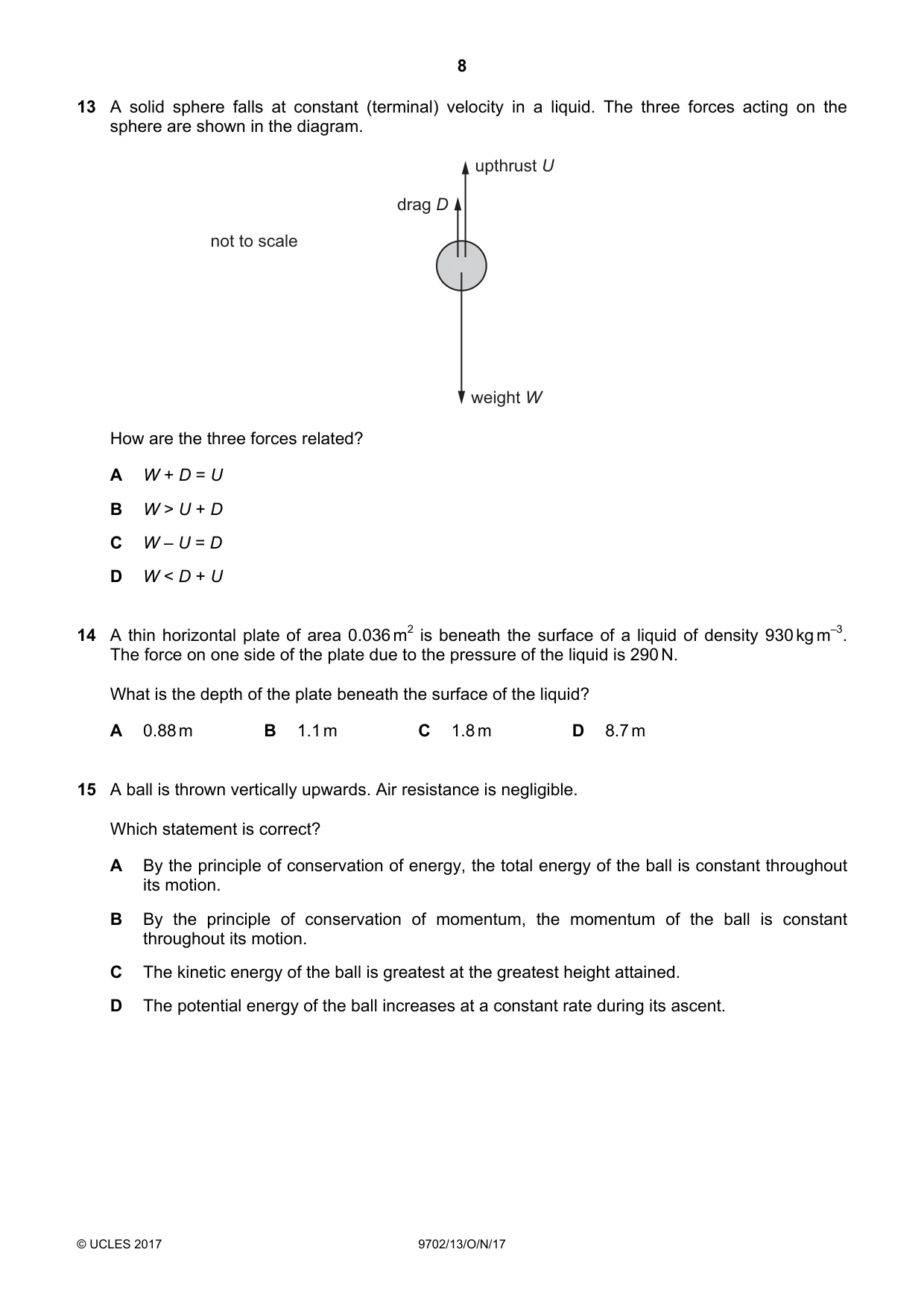
13 A solid sphere falls at constant (terminal) velocity in a liquid. The three forces acting on the sphere are shown in the diagram. upthrust U drag D not to scale weight W How are the three forces related? A W + D = U B W > U + D C W – U = D D W < D + U
Mark scheme: C
Q14 · A thin horizontal plate of area 0.036 m2 is beneath the surface of a liquid of density…
14 A thin horizontal plate of area 0.036 m2 is beneath the surface of a liquid of density 930 kg m–3. The force on one side of the plate due to the pressure of the liquid is 290 N. What is the depth of the plate beneath the surface of the liquid? A 0.88 m B 1.1 m C 1.8 m D 8.7 m
Mark scheme: A
Q15 · A ball is thrown vertically upwards
15 A ball is thrown vertically upwards. Air resistance is negligible. Which statement is correct? A By the principle of conservation of energy, the total energy of the ball is constant throughout its motion. B By the principle of conservation of momentum, the momentum of the ball is constant throughout its motion. C The kinetic energy of the ball is greatest at the greatest height attained. D The potential energy of the ball increases at a constant rate during its ascent.
Mark scheme: A
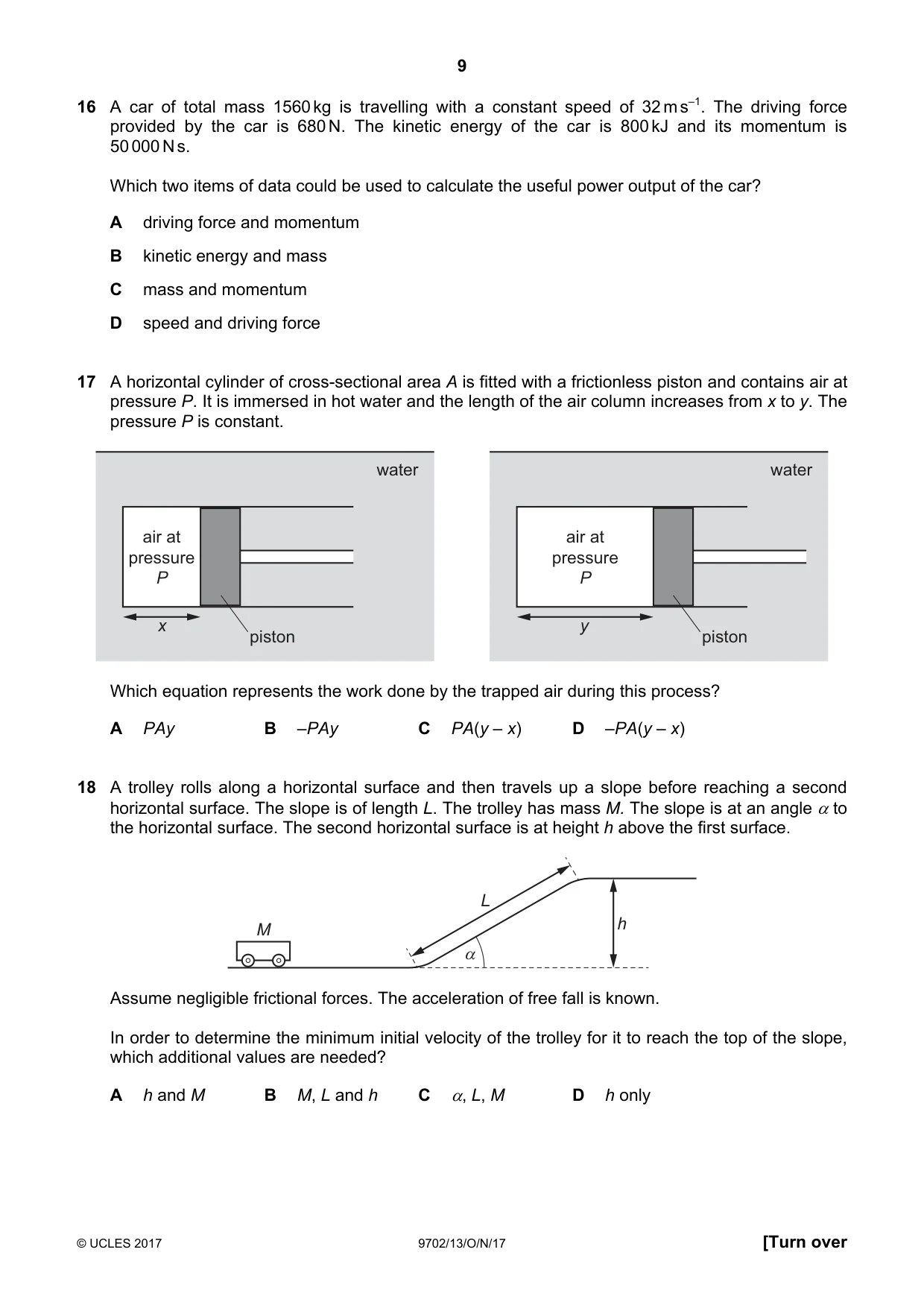
Q16 · A car of total mass 1560 kg is travelling with a constant speed of 32 m s–1
16 A car of total mass 1560 kg is travelling with a constant speed of 32 m s–1. The driving force provided by the car is 680 N. The kinetic energy of the car is 800 kJ and its momentum is 50 000 N s. Which two items of data could be used to calculate the useful power output of the car? A driving force and momentum B kinetic energy and mass C mass and momentum D speed and driving force
Mark scheme: D
Q17 · A horizontal cylinder of cross-sectional area A is fitted with a frictionless piston and…
17 A horizontal cylinder of cross-sectional area A is fitted with a frictionless piston and contains air at pressure P. It is immersed in hot water and the length of the air column increases from x to y. The pressure P is constant. water water air at air at pressure pressure P P x y piston piston Which equation represents the work done by the trapped air during this process? A PAy B –PAy C PA(y – x) D –PA(y – x)
Mark scheme: C
Q18 · A trolley rolls along a horizontal surface and then travels up a slope before reaching a…
18 A trolley rolls along a horizontal surface and then travels up a slope before reaching a second horizontal surface. The slope is of length L. The trolley has mass M. The slope is at an angle α to the horizontal surface. The second horizontal surface is at height h above the first surface. L M h α Assume negligible frictional forces. The acceleration of free fall is known. In order to determine the minimum initial velocity of the trolley for it to reach the top of the slope, which additional values are needed? A h and M B M, L and h C α, L, M D h only
Mark scheme: D
More questions on Gravitational potential energy and kinetic energy
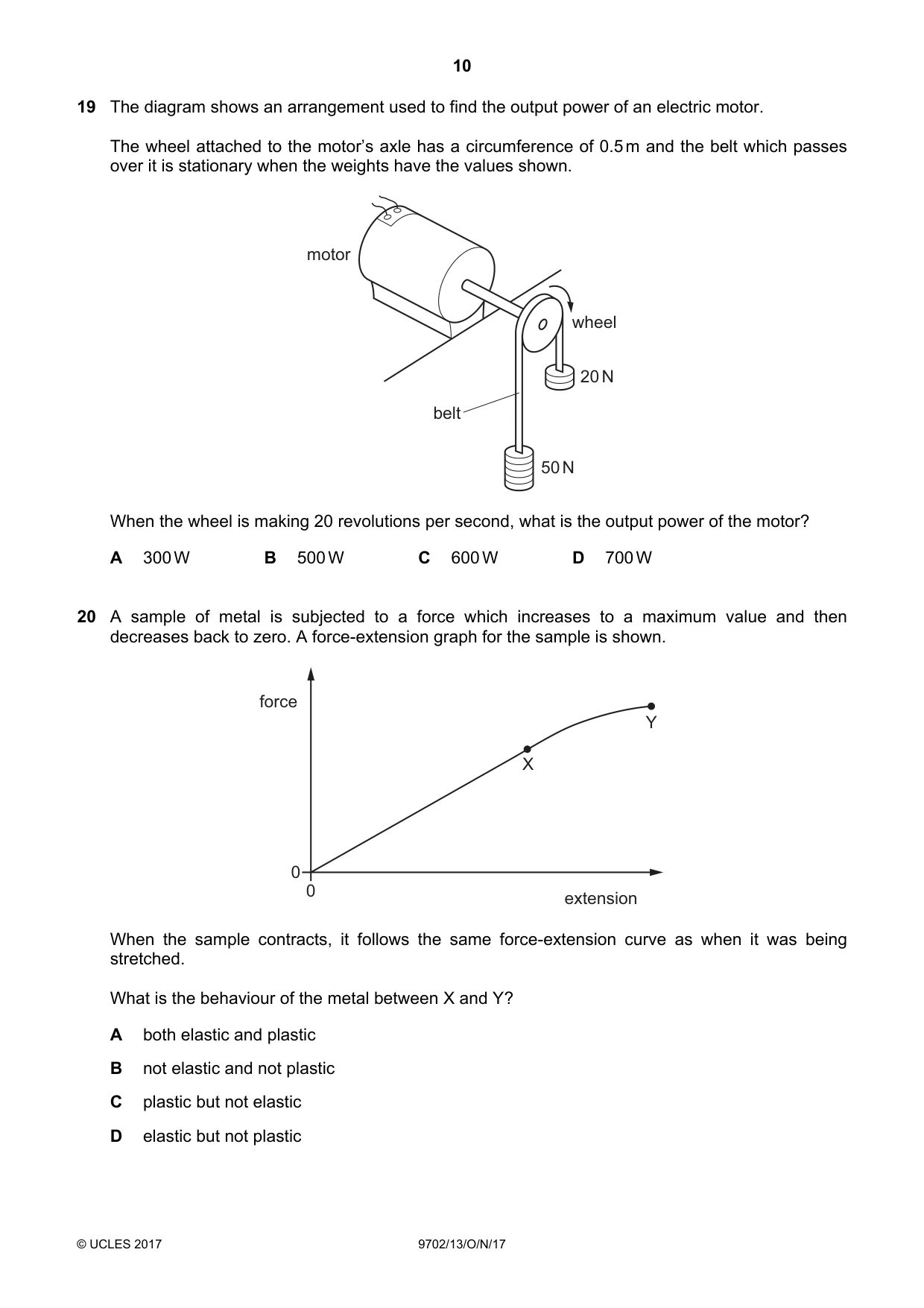
Q19 · The diagram shows an arrangement used to find the output power of an electric motor
19 The diagram shows an arrangement used to find the output power of an electric motor. The wheel attached to the motor’s axle has a circumference of 0.5 m and the belt which passes over it is stationary when the weights have the values shown. motor wheel 20 N belt 50 N When the wheel is making 20 revolutions per second, what is the output power of the motor? A 300 W B 500 W C 600 W D 700 W
Mark scheme: A
Q20 · A sample of metal is subjected to a force which increases to a maximum value and then…
20 A sample of metal is subjected to a force which increases to a maximum value and then decreases back to zero. A force-extension graph for the sample is shown. force Y X 0 0 extension When the sample contracts, it follows the same force-extension curve as when it was being stretched. What is the behaviour of the metal between X and Y? A both elastic and plastic B not elastic and not plastic C plastic but not elastic D elastic but not plastic
Mark scheme: D
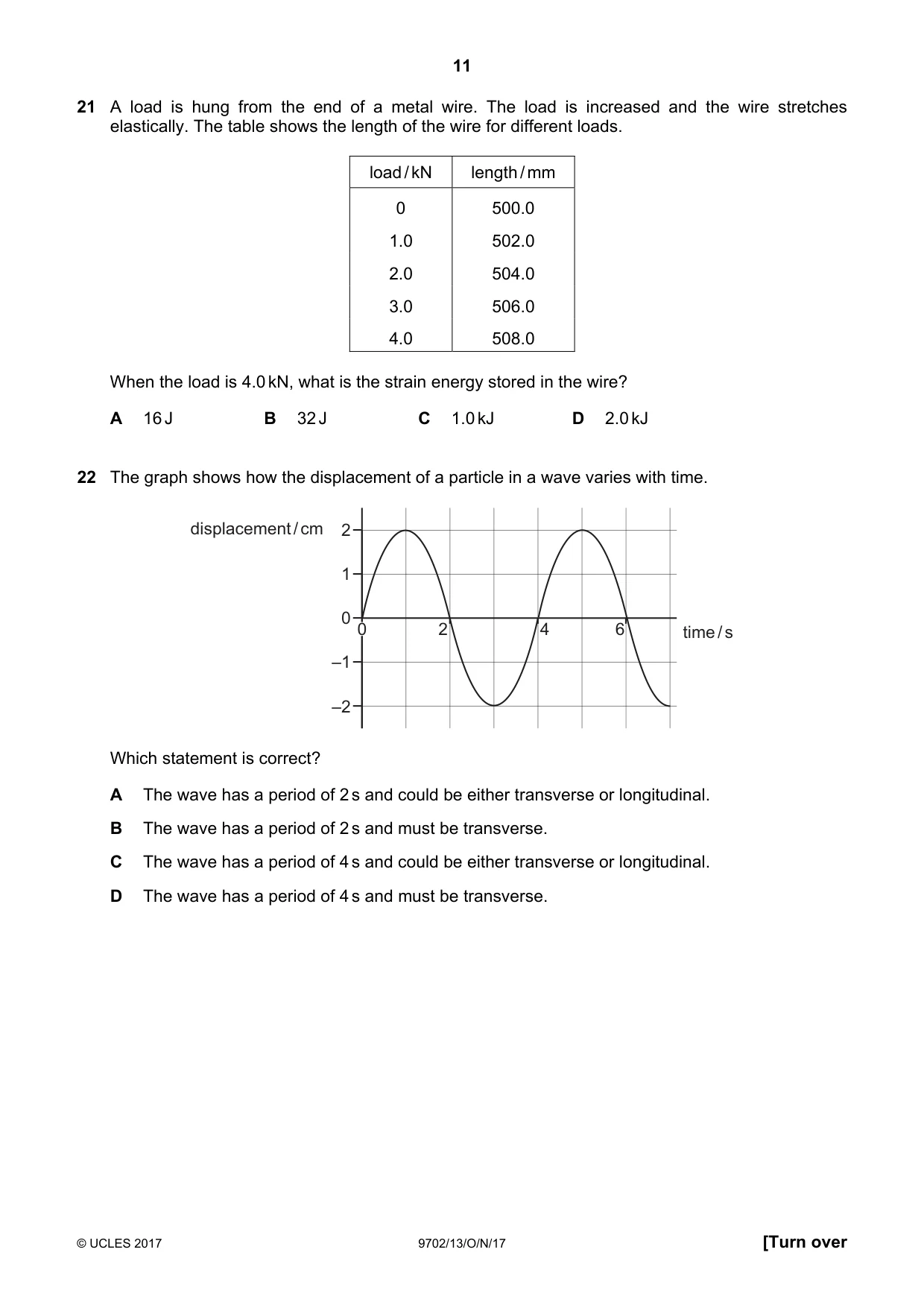
Q21 · A load is hung from the end of a metal wire
21 A load is hung from the end of a metal wire. The load is increased and the wire stretches elastically. The table shows the length of the wire for different loads. load / kN length / mm 0 500.0 1.0 502.0 2.0 504.0 3.0 506.0 4.0 508.0 When the load is 4.0 kN, what is the strain energy stored in the wire? A 16 J B 32 J C 1.0 kJ D 2.0 kJ
Mark scheme: A
Q22 · The graph shows how the displacement of a particle in a wave varies with time
22 The graph shows how the displacement of a particle in a wave varies with time. displacement / cm 2 1 0 0 2 4 6 time / s –1 –2 Which statement is correct? A The wave has a period of 2 s and could be either transverse or longitudinal. B The wave has a period of 2 s and must be transverse. C The wave has a period of 4 s and could be either transverse or longitudinal. D The wave has a period of 4 s and must be transverse.
Mark scheme: C
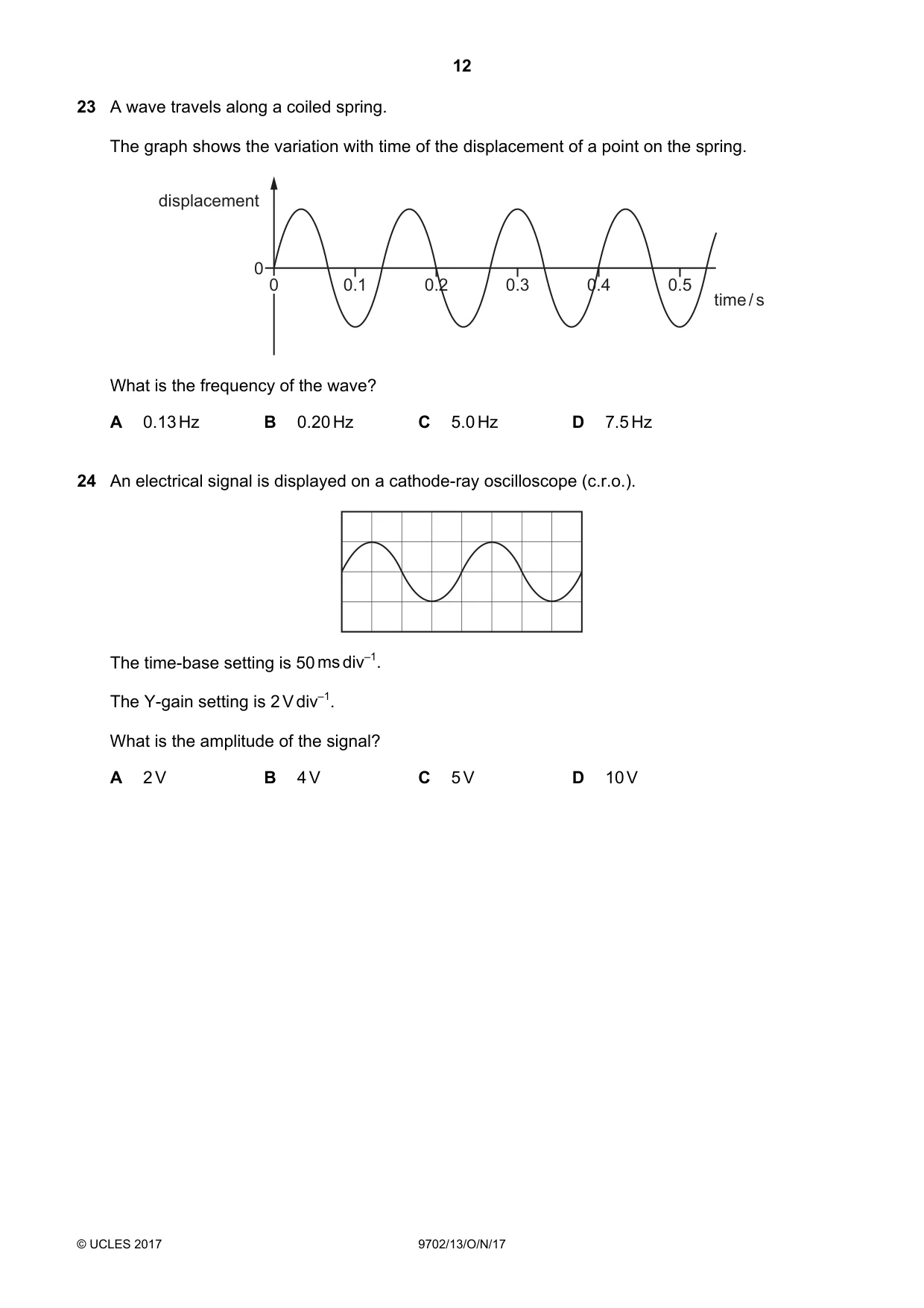
Q23 · A wave travels along a coiled spring
23 A wave travels along a coiled spring. The graph shows the variation with time of the displacement of a point on the spring. displacement 0 0 0.1 0.2 0.3 0.4 0.5 time / s What is the frequency of the wave? A 0.13 Hz B 0.20 Hz C 5.0 Hz D 7.5 Hz
Mark scheme: D
Q24 · An electrical signal is displayed on a cathode-ray oscilloscope (c.r.o.)
24 An electrical signal is displayed on a cathode-ray oscilloscope (c.r.o.). The time-base setting is 50 ms div–1. The Y-gain setting is 2 V div–1. What is the amplitude of the signal? A 2 V B 4 V C 5 V D 10 V
Mark scheme: A
Q25 · A source of sound of frequency F at point Z is moving at a steady speed
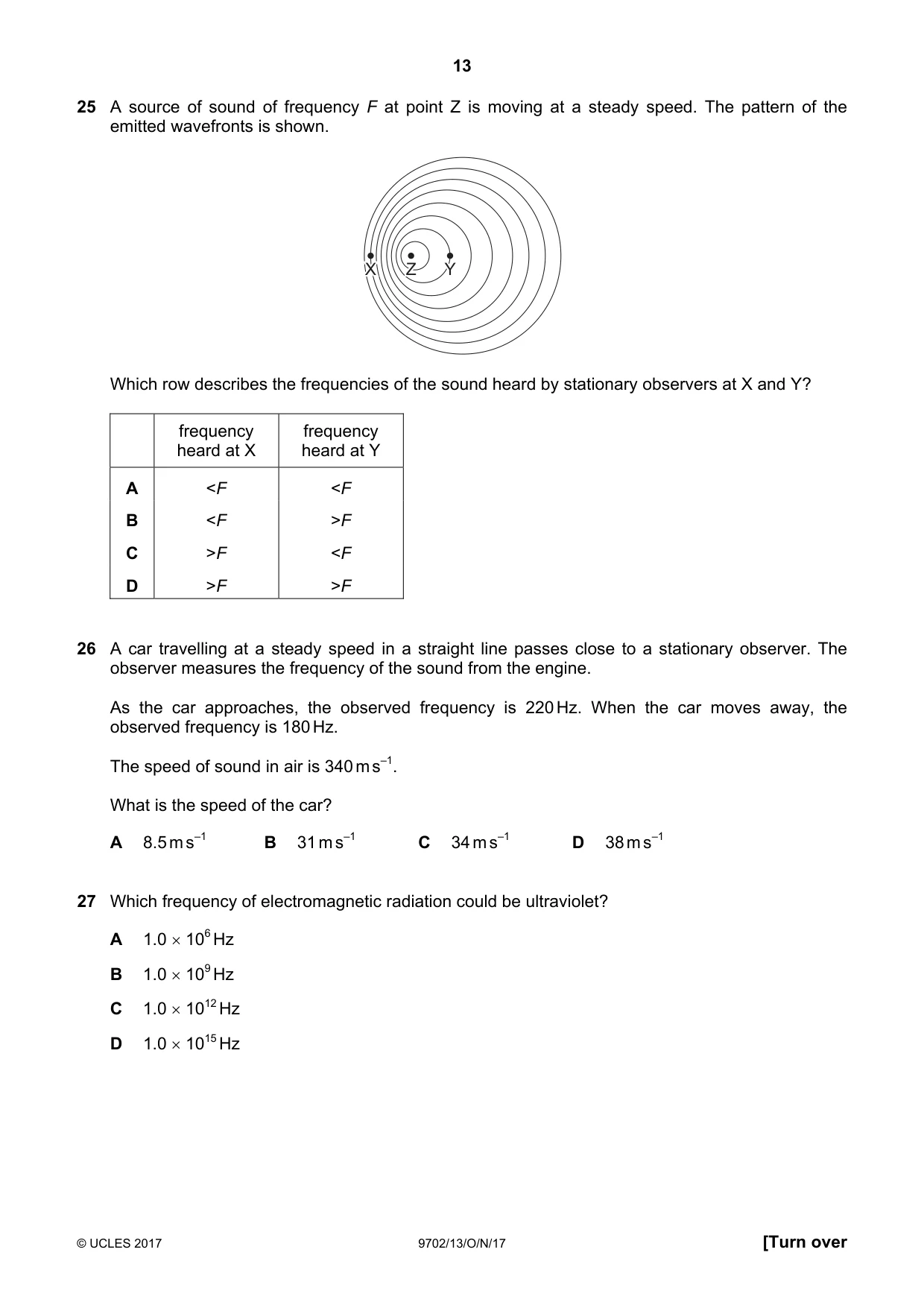
25 A source of sound of frequency F at point Z is moving at a steady speed. The pattern of the emitted wavefronts is shown. X X Z Z Y Y Which row describes the frequencies of the sound heard by stationary observers at X and Y? frequency frequency heard at X heard at Y A <F <F B <F >F C >F <F D >F >F
Mark scheme: C
Q26 · A car travelling at a steady speed in a straight line passes close to a stationary…
26 A car travelling at a steady speed in a straight line passes close to a stationary observer. The observer measures the frequency of the sound from the engine. As the car approaches, the observed frequency is 220 Hz. When the car moves away, the observed frequency is 180 Hz. The speed of sound in air is 340 m s–1. What is the speed of the car? A 8.5 m s–1 B 31 m s–1 C 34 m s–1 D 38 m s–1
Mark scheme: C
Q27 · Which frequency of electromagnetic radiation could be ultraviolet?
27 Which frequency of electromagnetic radiation could be ultraviolet? A 1.0 × 10⁶ Hz B 1.0 × 10⁹ Hz C 1.0 × 10¹² Hz D 1.0 × 10¹⁵ Hz
Mark scheme: D
Q28 · An electromagnetic wave travels in a straight line through a vacuum
28 An electromagnetic wave travels in a straight line through a vacuum. The wave has a frequency of 6.0 THz. What is the number of wavelengths in a distance of 1.0 m along the wave? A 5.0 × 10⁻⁵ B 2.0 × 101 C 2.0 × 10⁴ D 5.0 × 10⁷
Mark scheme: C
Q29 · A beam of laser light is directed towards a narrow slit
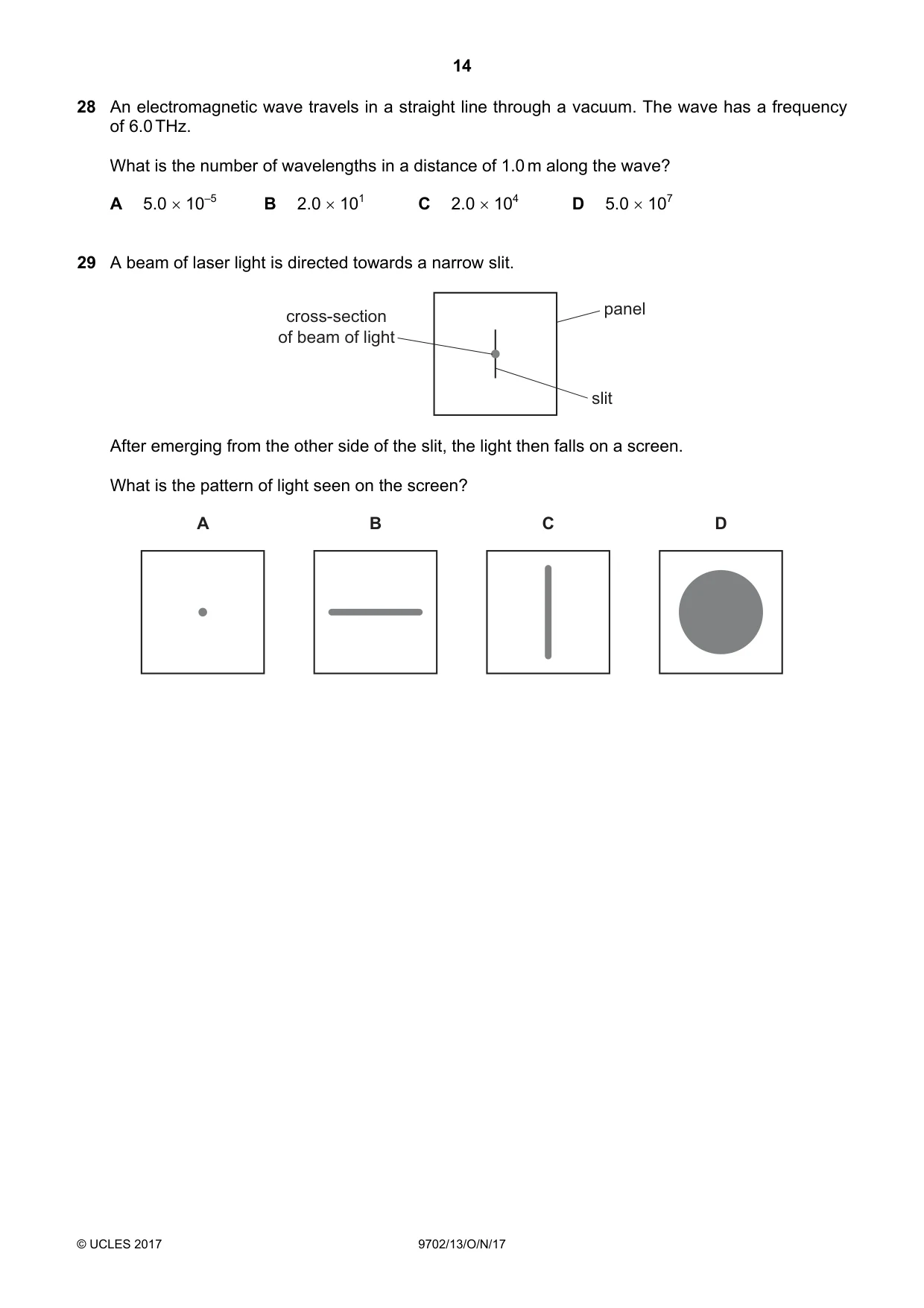
29 A beam of laser light is directed towards a narrow slit. cross-section panel of beam of light slit After emerging from the other side of the slit, the light then falls on a screen. What is the pattern of light seen on the screen? A B C D
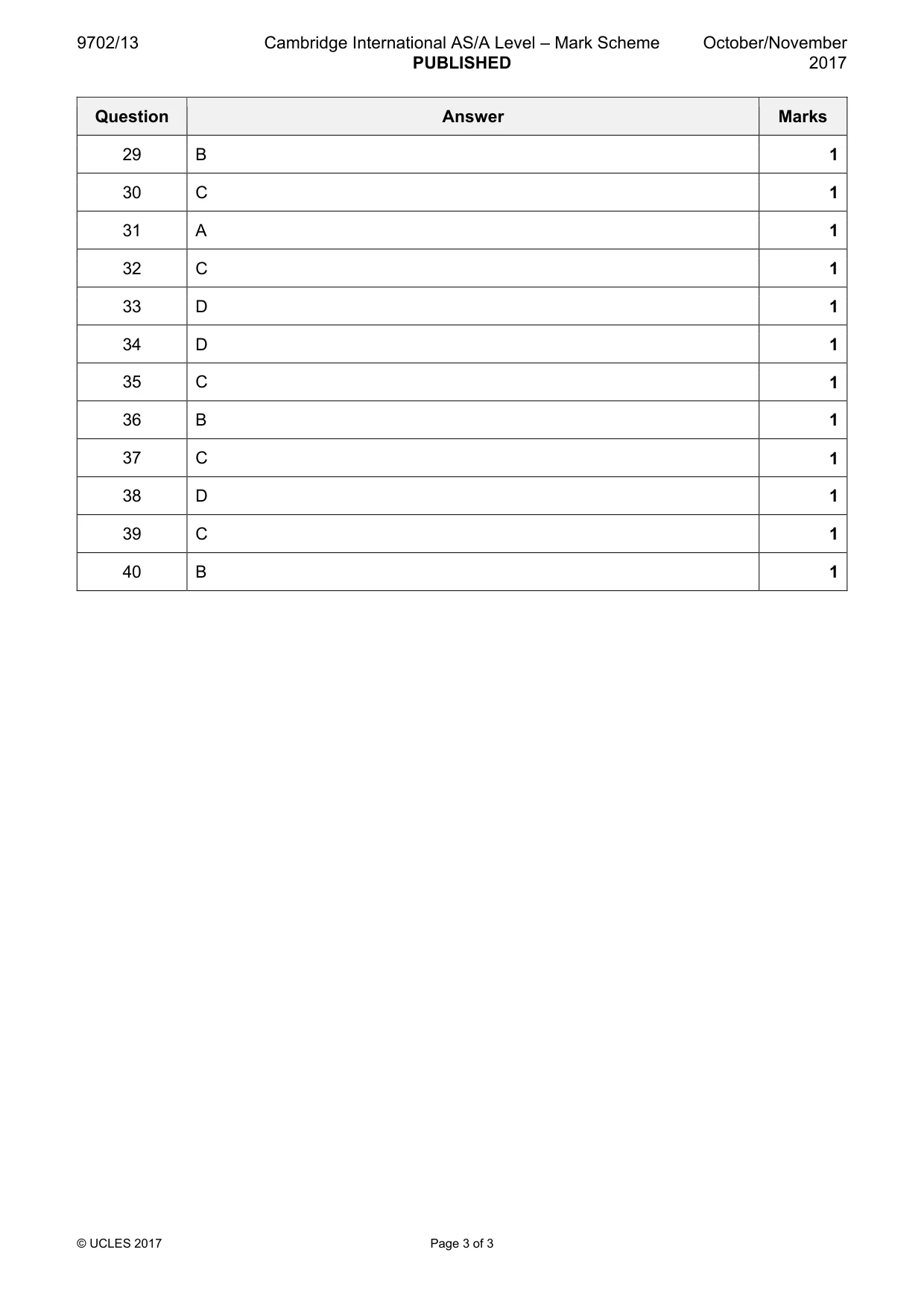
Mark scheme: B
Q30 · The diagrams show four pairs of waves
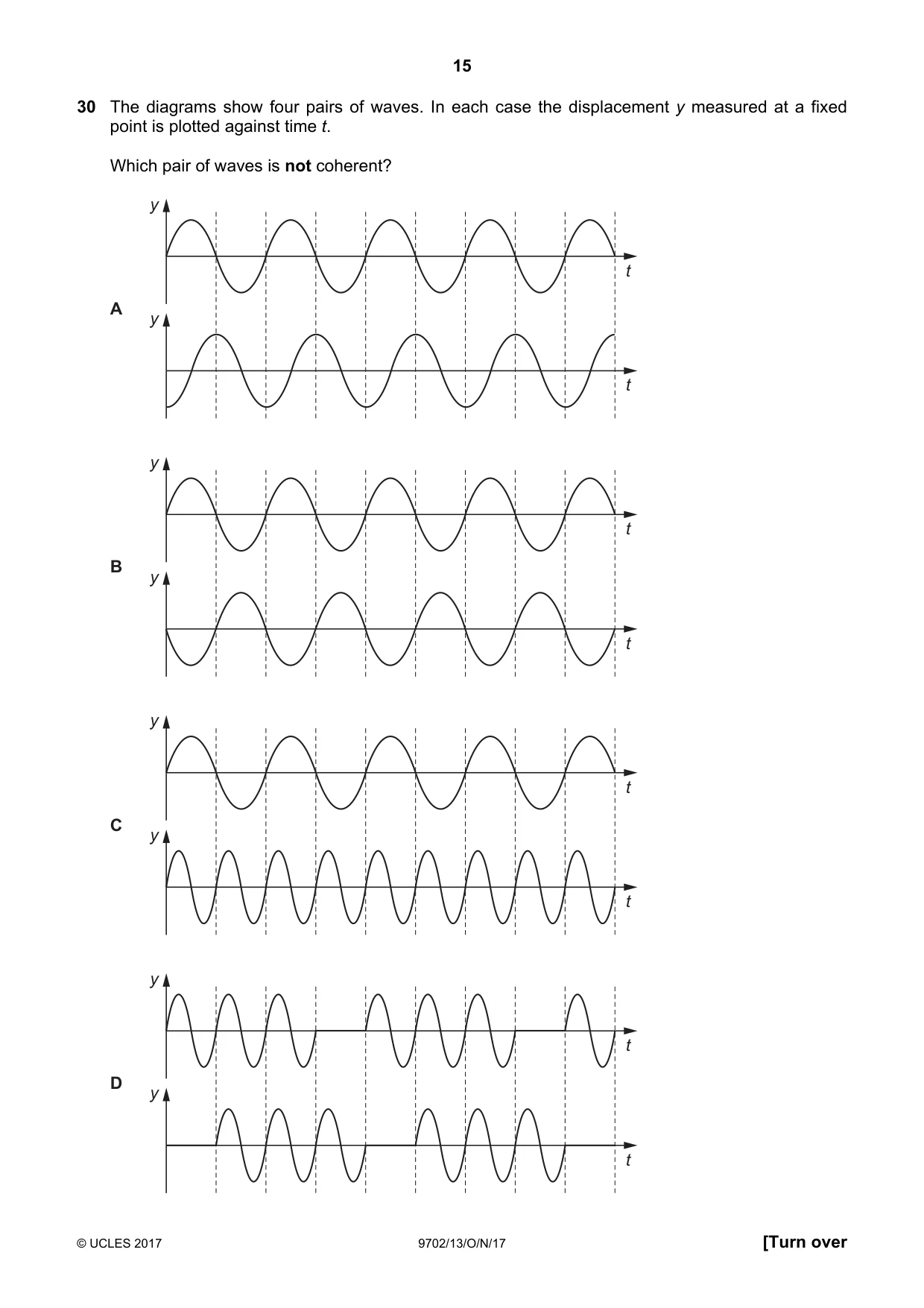
30 The diagrams show four pairs of waves. In each case the displacement y measured at a fixed point is plotted against time t. Which pair of waves is not coherent? y t A y t y t B y t y t C y t y t D y t
Mark scheme: C
Q31 · The diagram shows the electric field near a positively charged sphere and a negatively…
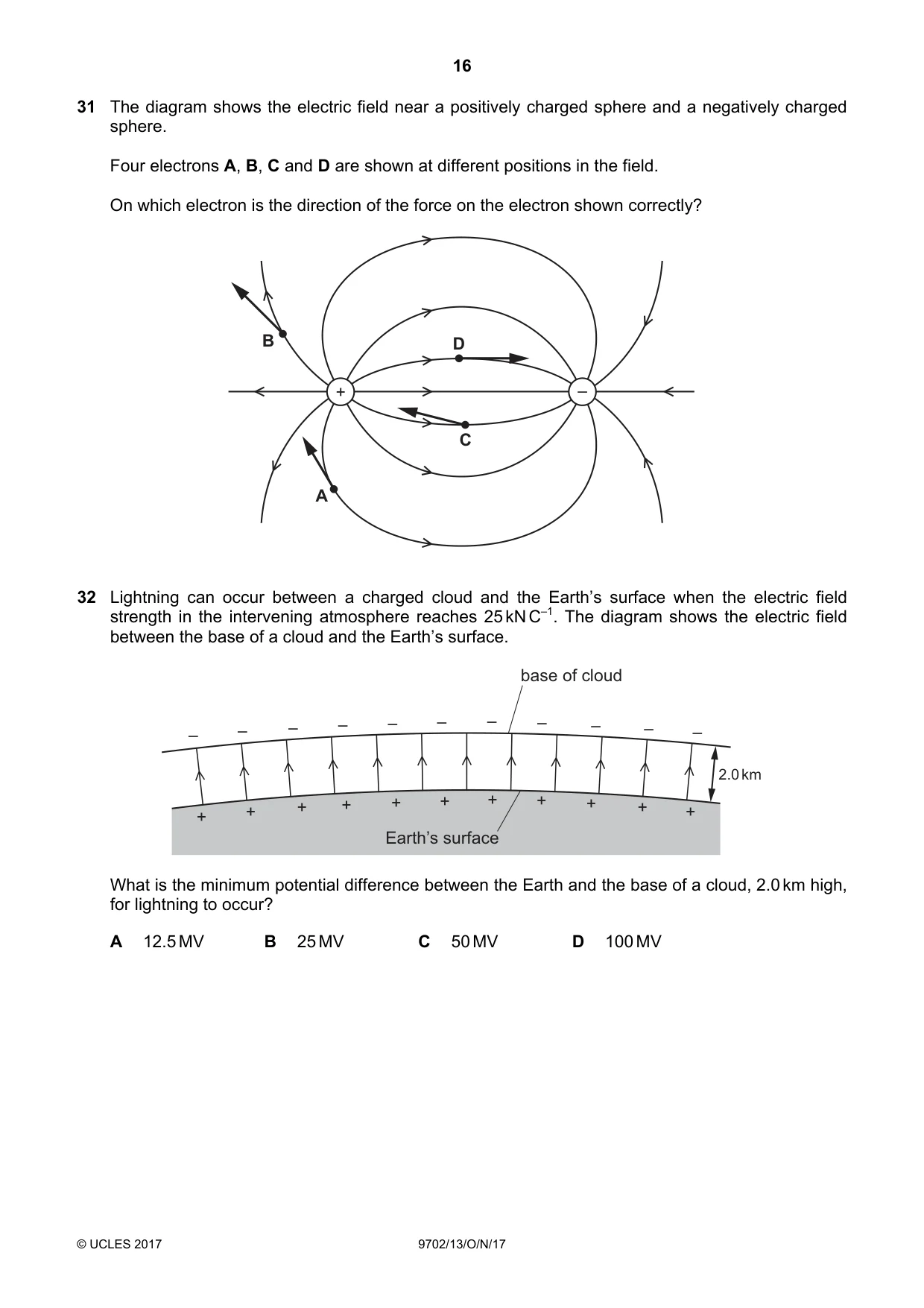
31 The diagram shows the electric field near a positively charged sphere and a negatively charged sphere. Four electrons A, B, C and D are shown at different positions in the field. On which electron is the direction of the force on the electron shown correctly? B D + – C A
Mark scheme: A
Q32 · Lightning can occur between a charged cloud and the Earth’s surface when the electric…
32 Lightning can occur between a charged cloud and the Earth’s surface when the electric field strength in the intervening atmosphere reaches 25 kN C–1. The diagram shows the electric field between the base of a cloud and the Earth’s surface. base of cloud – – – – – – – – – – – 2.0 km + + + + + + + + + + + Earth’s surface What is the minimum potential difference between the Earth and the base of a cloud, 2.0 km high, for lightning to occur? A 12.5 MV B 25 MV C 50 MV D 100 MV
Mark scheme: C
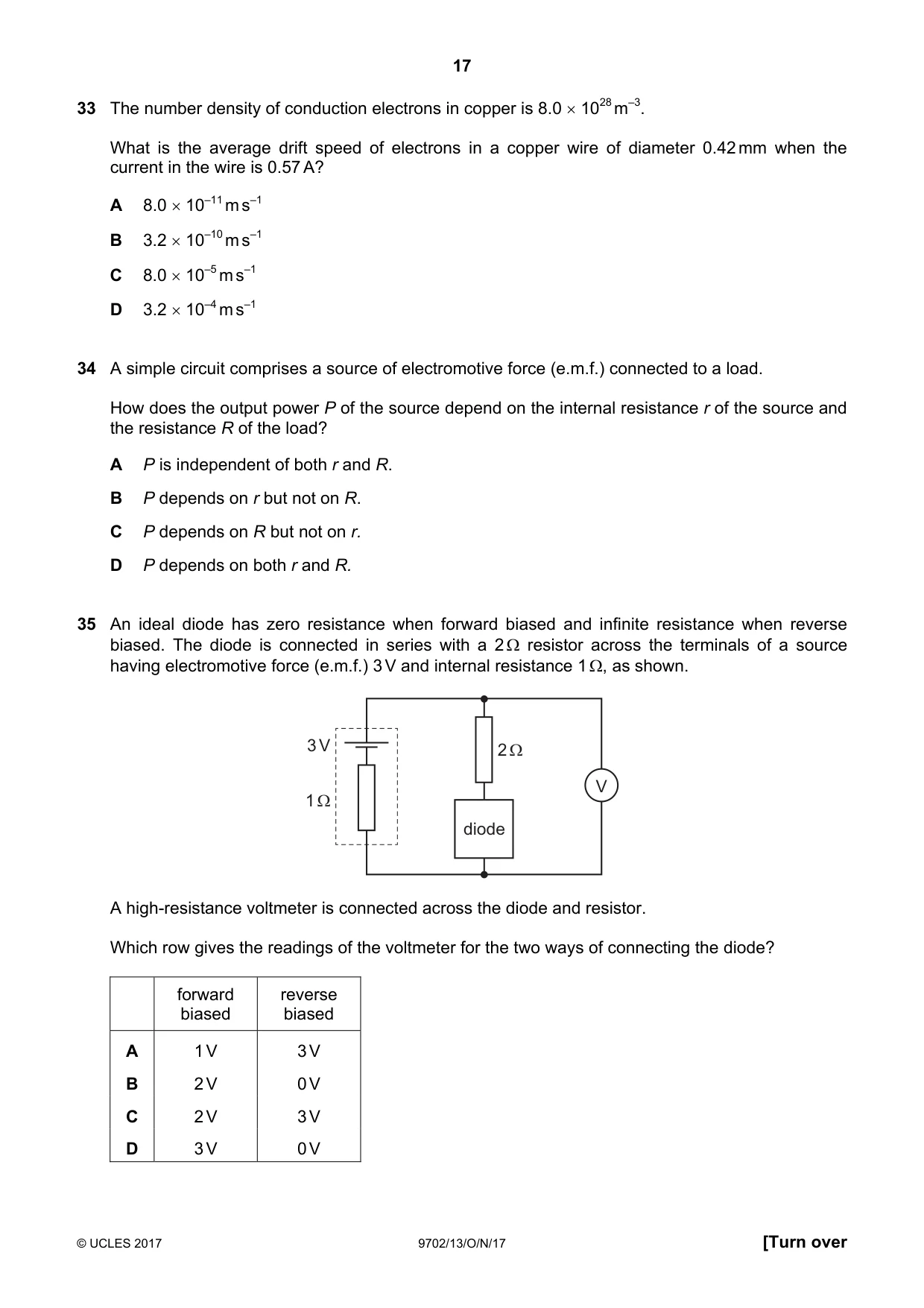
Q33 · The number density of conduction electrons in copper is 8.0 × 1028 m–3
33 The number density of conduction electrons in copper is 8.0 × 1028 m–3. What is the average drift speed of electrons in a copper wire of diameter 0.42 mm when the current in the wire is 0.57 A? A 8.0 × 10⁻¹¹ m s–1 B 3.2 × 10⁻¹⁰ m s–1 C 8.0 × 10⁻⁵ m s–1 D 3.2 × 10⁻⁴ m s–1
Mark scheme: D
Q34 · A simple circuit comprises a source of electromotive force (e.m.f.) connected to a load
34 A simple circuit comprises a source of electromotive force (e.m.f.) connected to a load. How does the output power P of the source depend on the internal resistance r of the source and the resistance R of the load? A P is independent of both r and R. B P depends on r but not on R. C P depends on R but not on r. D P depends on both r and R.
Mark scheme: D
Q35 · An ideal diode has zero resistance when forward biased and infinite resistance when…
35 An ideal diode has zero resistance when forward biased and infinite resistance when reverse biased. The diode is connected in series with a 2 Ω resistor across the terminals of a source having electromotive force (e.m.f.) 3 V and internal resistance 1 Ω, as shown. 3 V 2 Ω V 1 Ω diode A high-resistance voltmeter is connected across the diode and resistor. Which row gives the readings of the voltmeter for the two ways of connecting the diode? forward reverse biased biased A 1 V 3 V B 2 V 0 V C 2 V 3 V D 3 V 0 V
Mark scheme: C
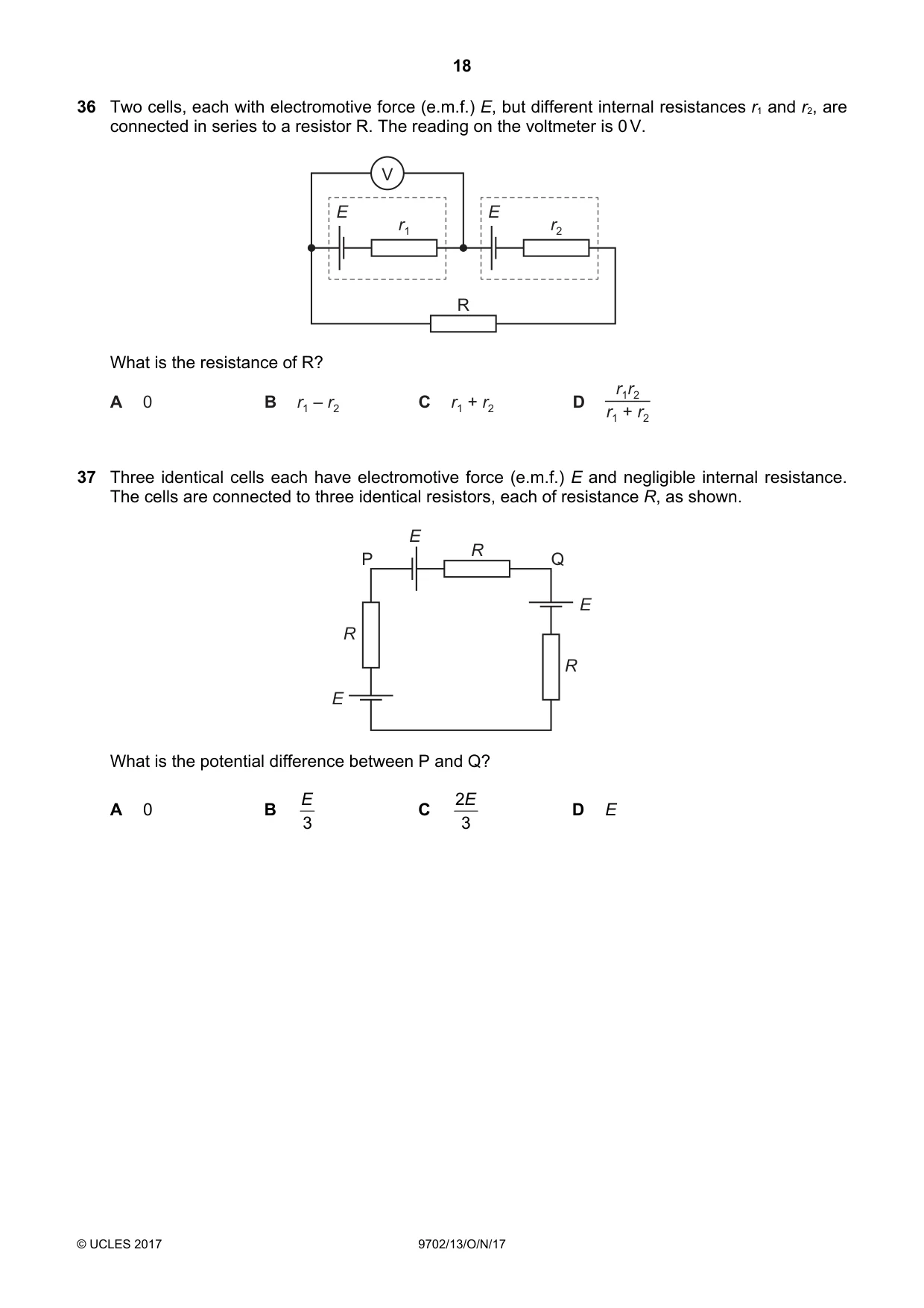
Q36 · Two cells, each with electromotive force (e.m.f.) E, but different internal resistances…
36 Two cells, each with electromotive force (e.m.f.) E, but different internal resistances r1 and r2, are connected in series to a resistor R. The reading on the voltmeter is 0 V. V E E r1 r2 R What is the resistance of R? r1r2 A 0 B r1 – r2 C r1 + r2 D r1 + r2
Mark scheme: B
Q37 · Three identical cells each have electromotive force (e.m.f.) E and negligible internal…
37 Three identical cells each have electromotive force (e.m.f.) E and negligible internal resistance. The cells are connected to three identical resistors, each of resistance R, as shown. E R P Q E R R E What is the potential difference between P and Q? E 2E A 0 B C D E 3 3
Mark scheme: C
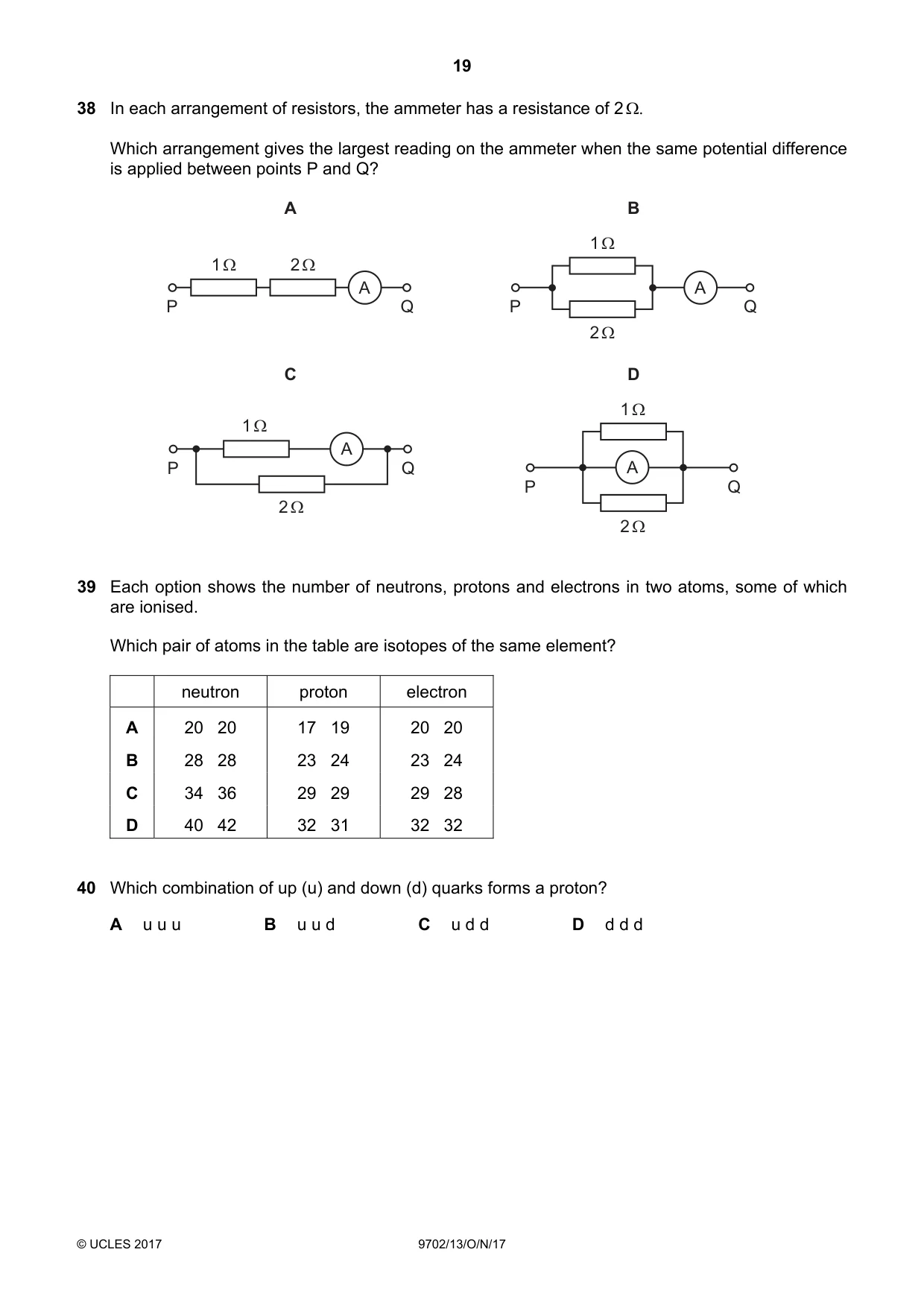
Q38 · In each arrangement of resistors, the ammeter has a resistance of 2 Ω
38 In each arrangement of resistors, the ammeter has a resistance of 2 Ω. Which arrangement gives the largest reading on the ammeter when the same potential difference is applied between points P and Q? A B 1 Ω 1 Ω 2 Ω A A P Q P Q 2 Ω C D 1 Ω 1 Ω A P Q A P Q 2 Ω 2 Ω
Mark scheme: D
Q39 · Each option shows the number of neutrons, protons and electrons in two atoms, some of…
39 Each option shows the number of neutrons, protons and electrons in two atoms, some of which are ionised. Which pair of atoms in the table are isotopes of the same element? neutron proton electron A 20 20 17 19 20 20 B 28 28 23 24 23 24 C 34 36 29 29 29 28 D 40 42 32 31 32 32
Mark scheme: C
Q40 · Which combination of up (u) and down (d) quarks forms a proton?
40 Which combination of up (u) and down (d) quarks forms a proton? A u u u B u u d C u d d D d d d
Mark scheme: B
What was in this paper
The subtopics covered by these 40 questions, and how many questions each got. Open one in a new tab to see every Cambridge question on it.
4Energy conservation3Equations of motion3Doppler effect for sound waves2Errors and uncertainties2Kirchhoff’s laws2Linear momentum and its conservation2Physical quantities2Practical circuits2Atoms, nuclei and radiation1Density and pressure1Diffraction1Elastic and plastic behaviour1Electric current1Electric fields and field lines1Electromagnetic spectrum1Equilibrium of forces1Fundamental particles1Gravitational potential energy and kinetic energy1Interference1Momentum and Newton’s laws of motion1Potential difference and power1Scalars and vectors1Stress and strain1The first law of thermodynamics1Turning effects of forces1Uniform electric fields1What you needed in this session
Cambridge’s own grade thresholds for 2017 Oct/Nov, Paper 1 · Variant 3. A higher threshold means an easier paper — the bar moves with how the cohort did.