Cambridge A Level Physics 9702 — 2020 May/June Paper 1 · Variant 1
9702/11/M/J/20 · 40 questions · 40 marks · ≈45 min
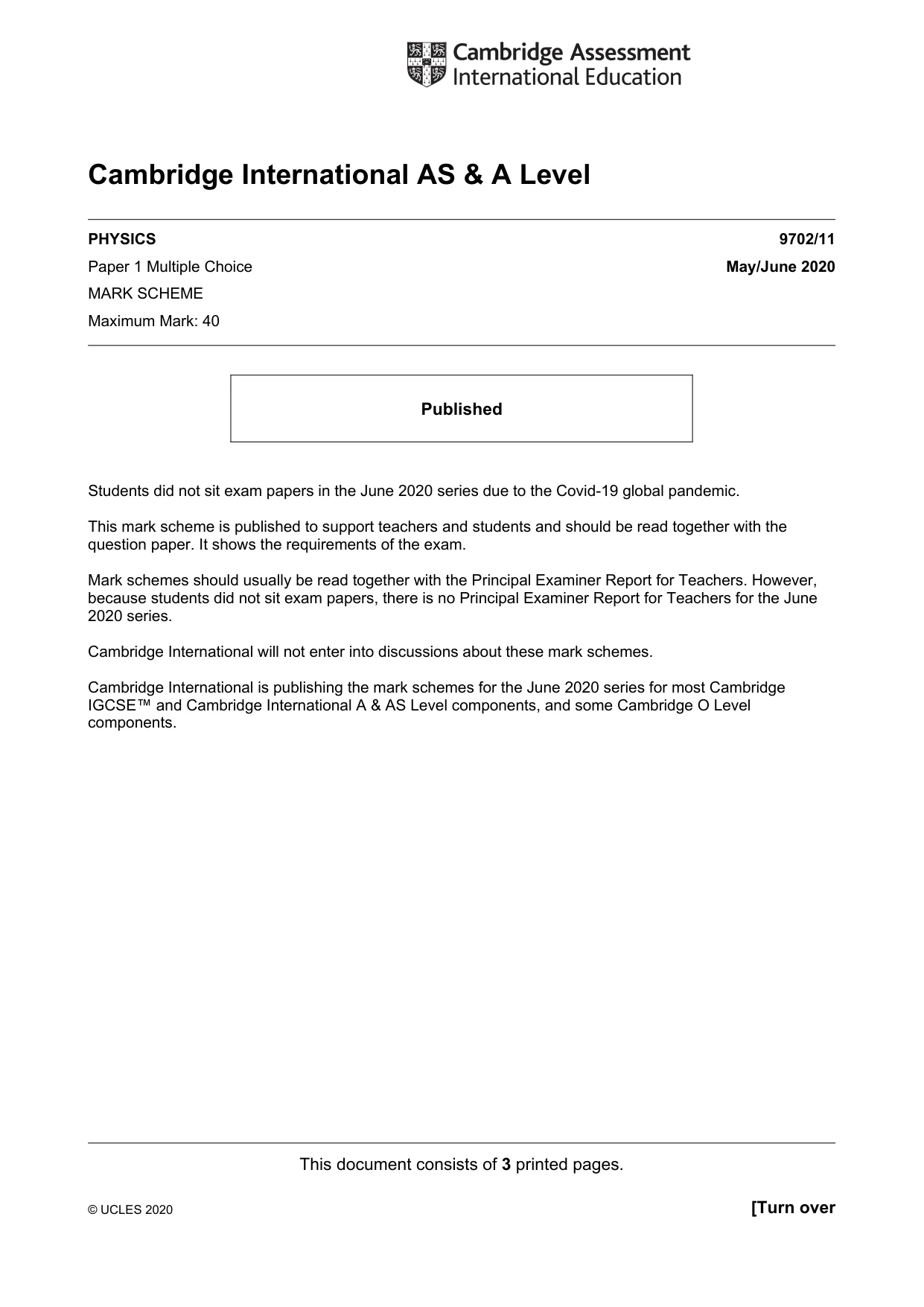
The question paper and its mark scheme, free to read here and free to download. This is Cambridge’s own paper, exactly as it was sat.
Question paper20 pages
Mark scheme3 pages
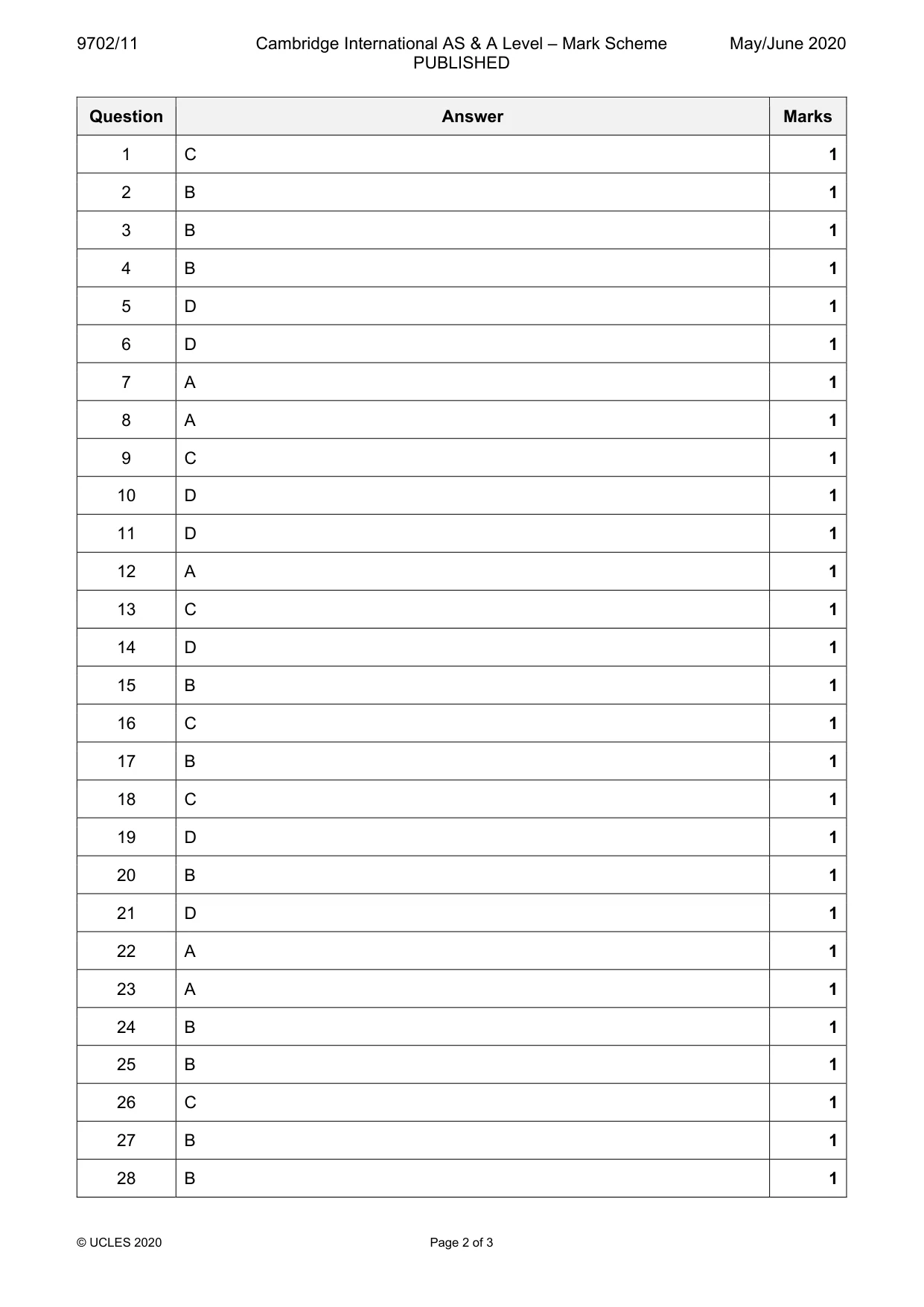
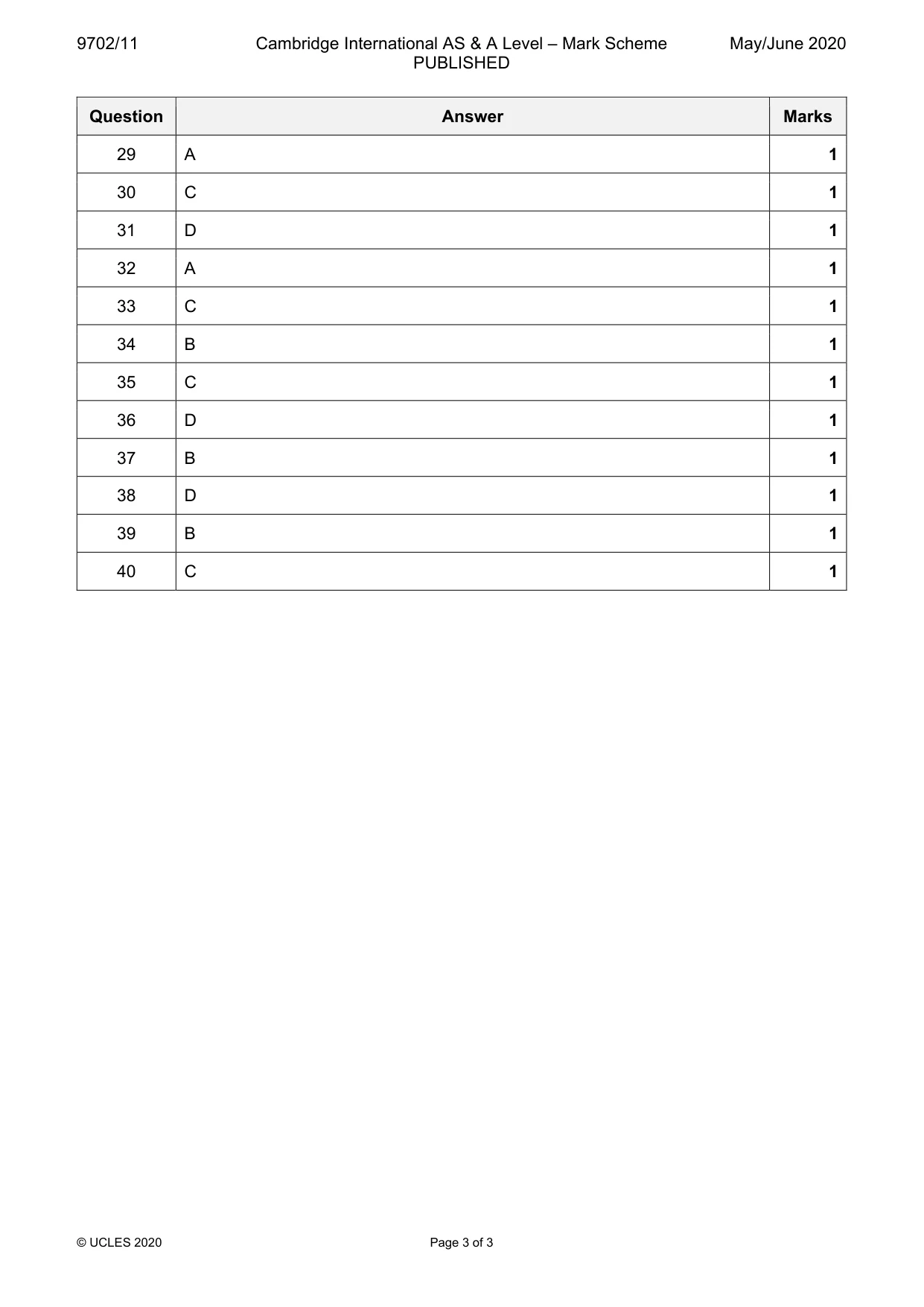
Answers below. Sit the paper first if you are practising.
Questions as text
Q1 · What is a reasonable estimate of the kinetic energy of a car travelling at a speed of 30…
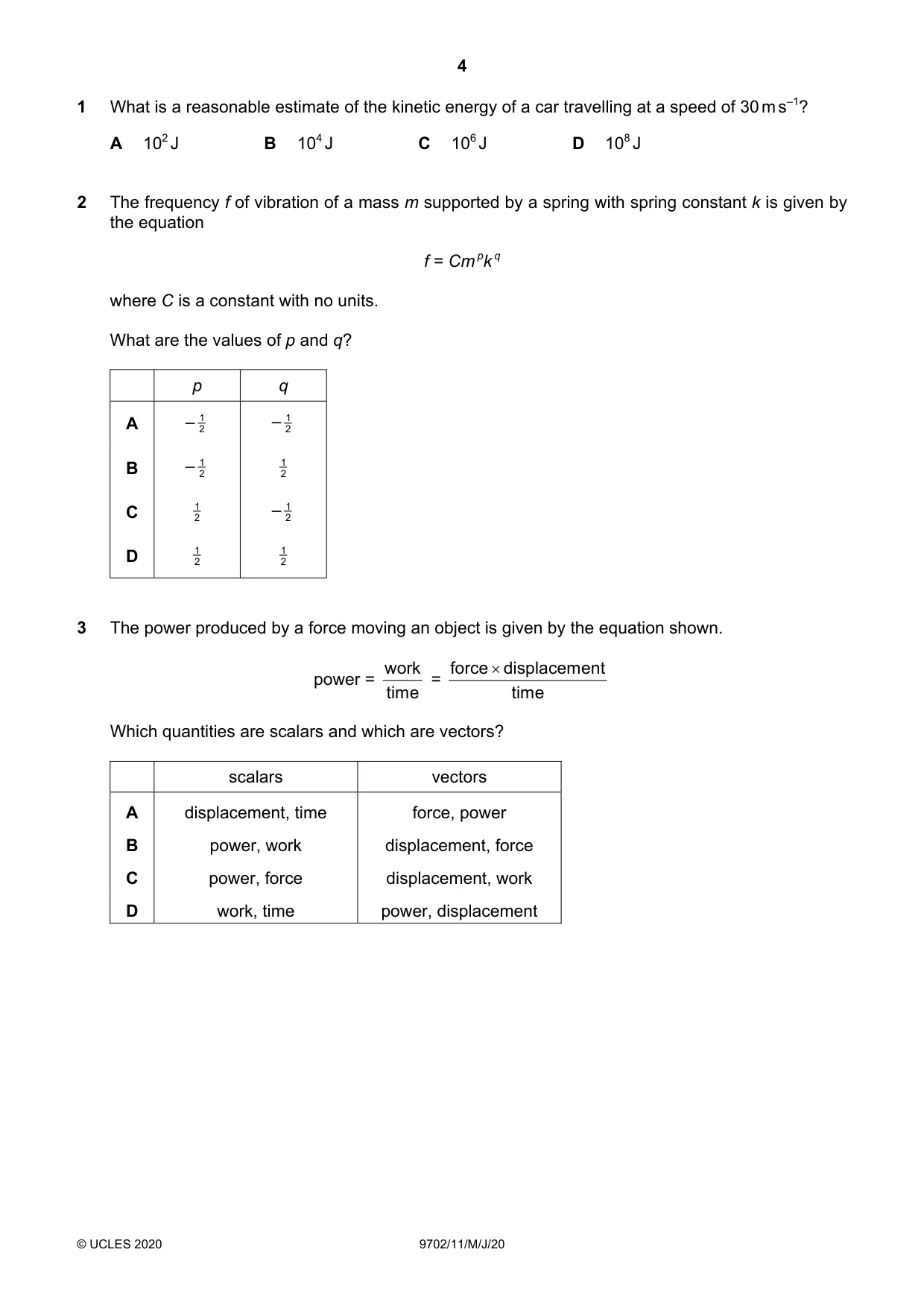
1 What is a reasonable estimate of the kinetic energy of a car travelling at a speed of 30 m s–1? A 102 J B 104 J C 106 J D 108 J
Mark scheme: C
More questions on Gravitational potential energy and kinetic energy
Q2 · The frequency f of vibration of a mass m supported by a spring with spring constant k is…
2 The frequency f of vibration of a mass m supported by a spring with spring constant k is given by the equation f = Cm pk q where C is a constant with no units. What are the values of p and q? p q A – 1 2 – 1 2 B – 1 2 2 1 C 2 1 – 1 2 D 2 1 2 1
Mark scheme: B
Q3 · The power produced by a force moving an object is given by the equation shown
3 The power produced by a force moving an object is given by the equation shown. power = work time = force displacement × time Which quantities are scalars and which are vectors? scalars vectors A displacement, time force, power B power, work displacement, force C power, force displacement, work D work, time power, displacement
Mark scheme: B
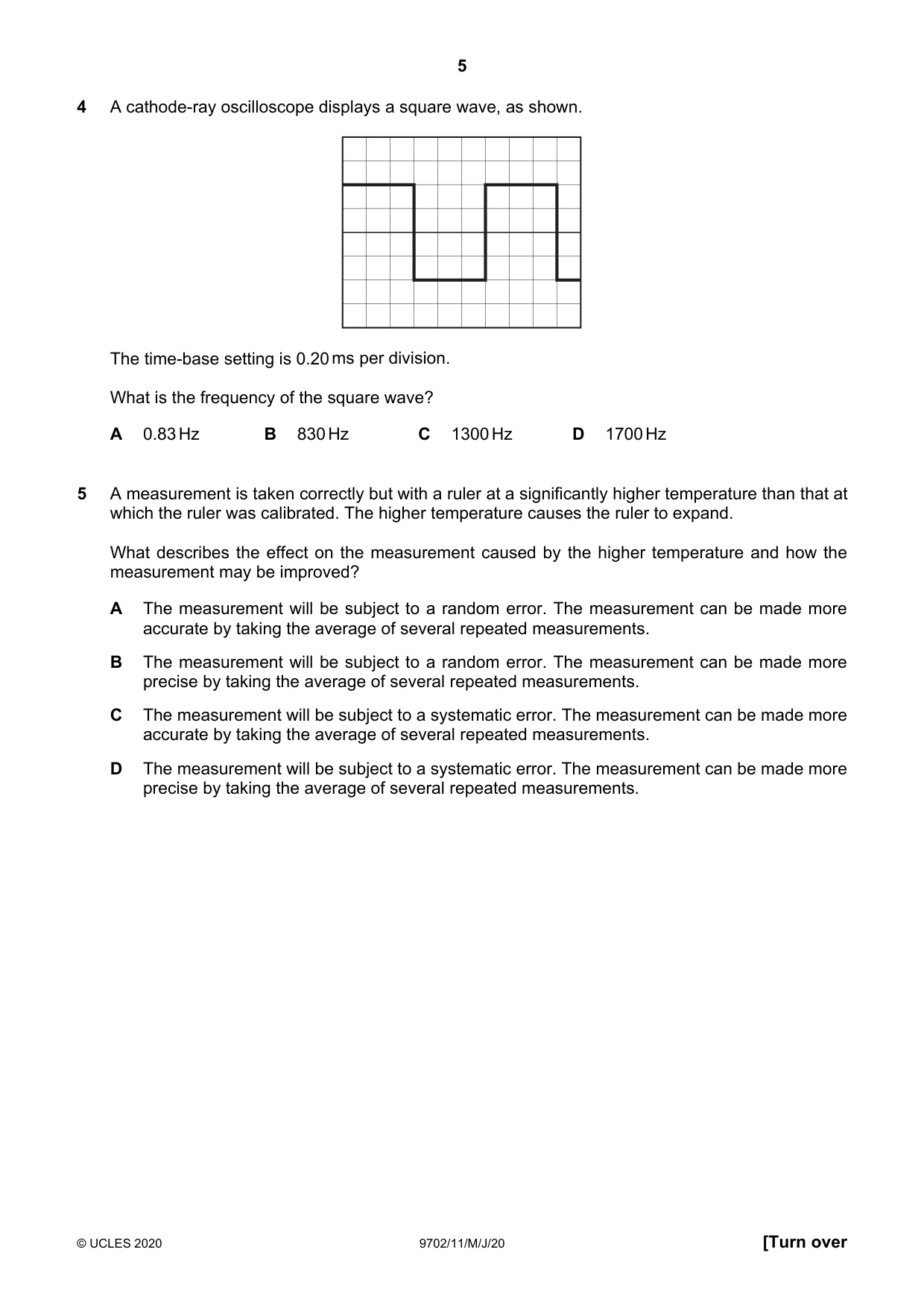
Q4 · A cathode-ray oscilloscope displays a square wave, as shown
4 A cathode-ray oscilloscope displays a square wave, as shown. The time-base setting is 0.20 ms per division. What is the frequency of the square wave? A 0.83 Hz B 830 Hz C 1300 Hz D 1700 Hz
Mark scheme: B
Q5 · A measurement is taken correctly but with a ruler at a significantly higher temperature…
5 A measurement is taken correctly but with a ruler at a significantly higher temperature than that at which the ruler was calibrated. The higher temperature causes the ruler to expand. What describes the effect on the measurement caused by the higher temperature and how the measurement may be improved? A The measurement will be subject to a random error. The measurement can be made more accurate by taking the average of several repeated measurements. B The measurement will be subject to a random error. The measurement can be made more precise by taking the average of several repeated measurements. C The measurement will be subject to a systematic error. The measurement can be made more accurate by taking the average of several repeated measurements. D The measurement will be subject to a systematic error. The measurement can be made more precise by taking the average of several repeated measurements.
Mark scheme: D
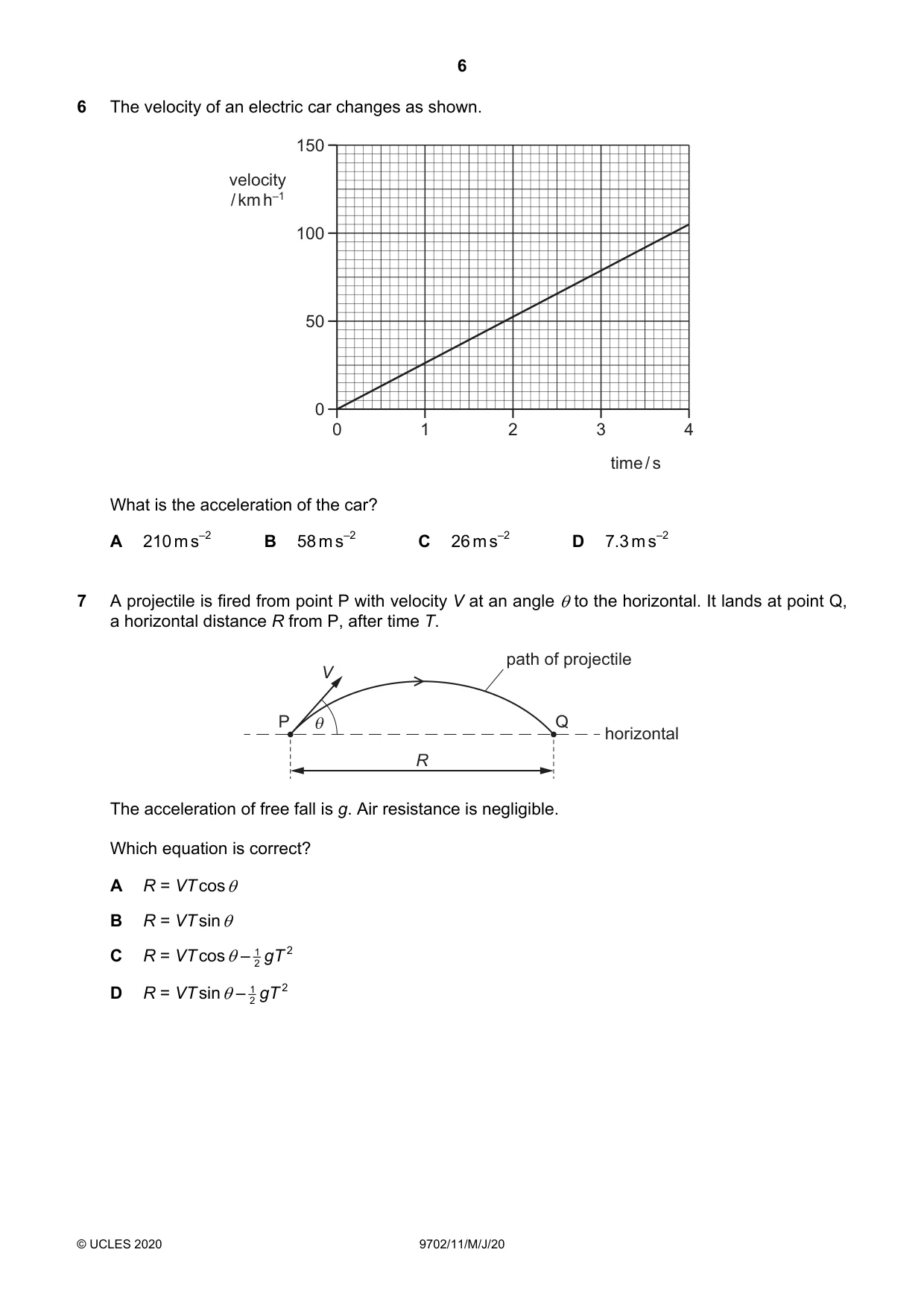
Q6 · The velocity of an electric car changes as shown
6 The velocity of an electric car changes as shown. 150 velocity / km h–1 100 50 0 0 1 2 3 4 time / s What is the acceleration of the car? A 210 m s–2 B 58 m s–2 C 26 m s–2 D 7.3 m s–2
Mark scheme: D
Q7 · A projectile is fired from point P with velocity V at an angle θ to the horizontal
7 A projectile is fired from point P with velocity V at an angle θ to the horizontal. It lands at point Q, a horizontal distance R from P, after time T. path of projectile V P θ Q horizontal R The acceleration of free fall is g. Air resistance is negligible. Which equation is correct? A R = VT cos θ B R = VT sin θ C R = VT cos θ – 1 2 gT 2 D R = VT sin θ – 1 2 gT 2
Mark scheme: A
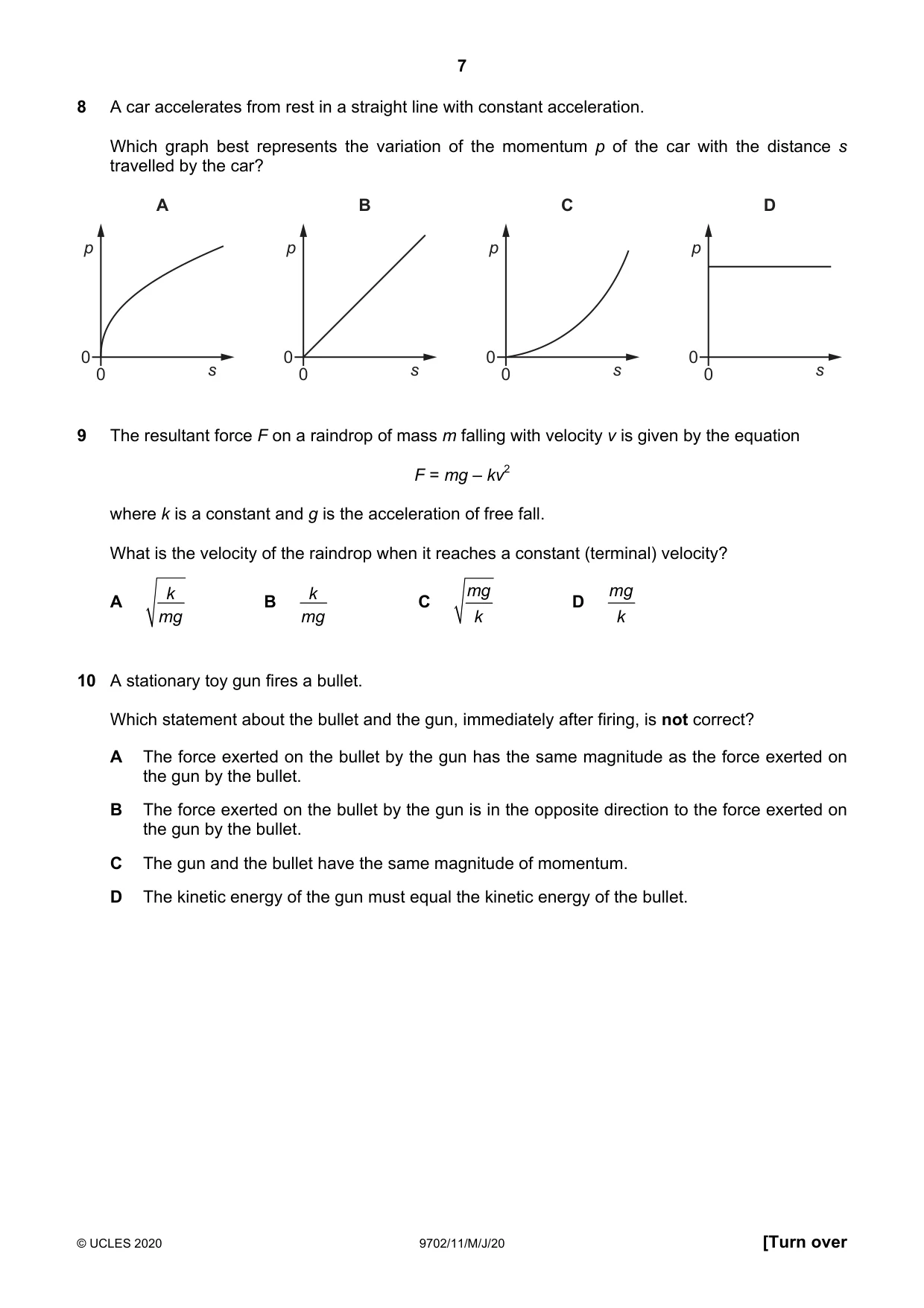
Q8 · A car accelerates from rest in a straight line with constant acceleration
8 A car accelerates from rest in a straight line with constant acceleration. Which graph best represents the variation of the momentum p of the car with the distance s travelled by the car? A B C D p p p p 0 0 0 0 0 s 0 s 0 s 0 s
Mark scheme: A
Q9 · The resultant force F on a raindrop of mass m falling with velocity v is given by the…
9 The resultant force F on a raindrop of mass m falling with velocity v is given by the equation F = mg – kv2 where k is a constant and g is the acceleration of free fall. What is the velocity of the raindrop when it reaches a constant (terminal) velocity? k k mg mg A B C D mg mg k k
Mark scheme: C
Q10 · A stationary toy gun fires a bullet
10 A stationary toy gun fires a bullet. Which statement about the bullet and the gun, immediately after firing, is not correct? A The force exerted on the bullet by the gun has the same magnitude as the force exerted on the gun by the bullet. B The force exerted on the bullet by the gun is in the opposite direction to the force exerted on the gun by the bullet. C The gun and the bullet have the same magnitude of momentum. D The kinetic energy of the gun must equal the kinetic energy of the bullet.
Mark scheme: D
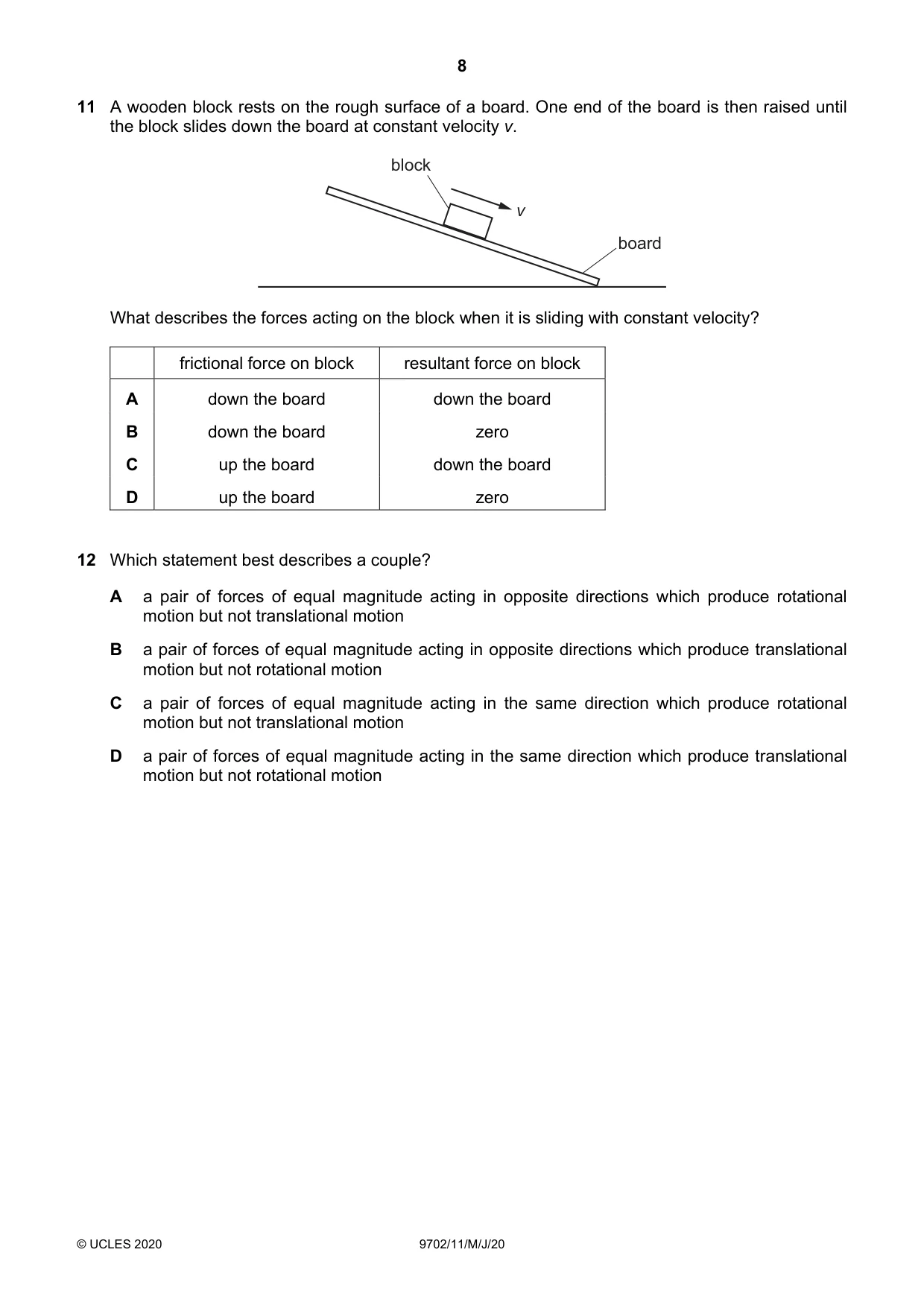
Q11 · A wooden block rests on the rough surface of a board
11 A wooden block rests on the rough surface of a board. One end of the board is then raised until the block slides down the board at constant velocity v. block v board What describes the forces acting on the block when it is sliding with constant velocity? frictional force on block resultant force on block A down the board down the board B down the board zero C up the board down the board D up the board zero
Mark scheme: D
Q12 · Which statement best describes a couple?
12 Which statement best describes a couple? A a pair of forces of equal magnitude acting in opposite directions which produce rotational motion but not translational motion B a pair of forces of equal magnitude acting in opposite directions which produce translational motion but not rotational motion C a pair of forces of equal magnitude acting in the same direction which produce rotational motion but not translational motion D a pair of forces of equal magnitude acting in the same direction which produce translational motion but not rotational motion
Mark scheme: A
Q13 · A uniform rod XY of weight 10.0 N is freely hinged to a wall at X
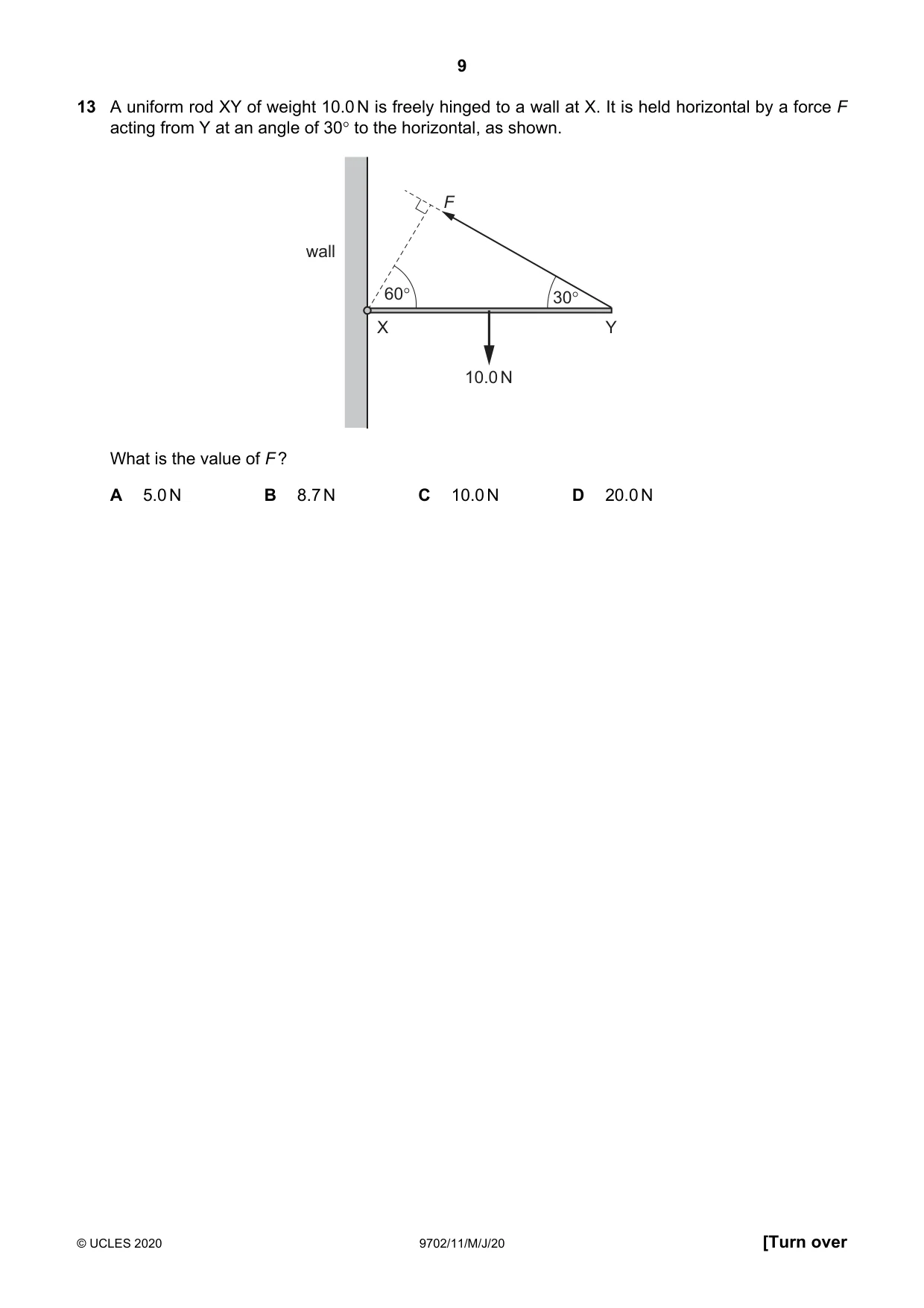
13 A uniform rod XY of weight 10.0 N is freely hinged to a wall at X. It is held horizontal by a force F acting from Y at an angle of 30° to the horizontal, as shown. F wall 60° 30° X Y 10.0 N What is the value of F ? A 5.0 N B 8.7 N C 10.0 N D 20.0 N
Mark scheme: C
Q14 · Four combinations of vectors are shown, each representing all the forces acting on an…
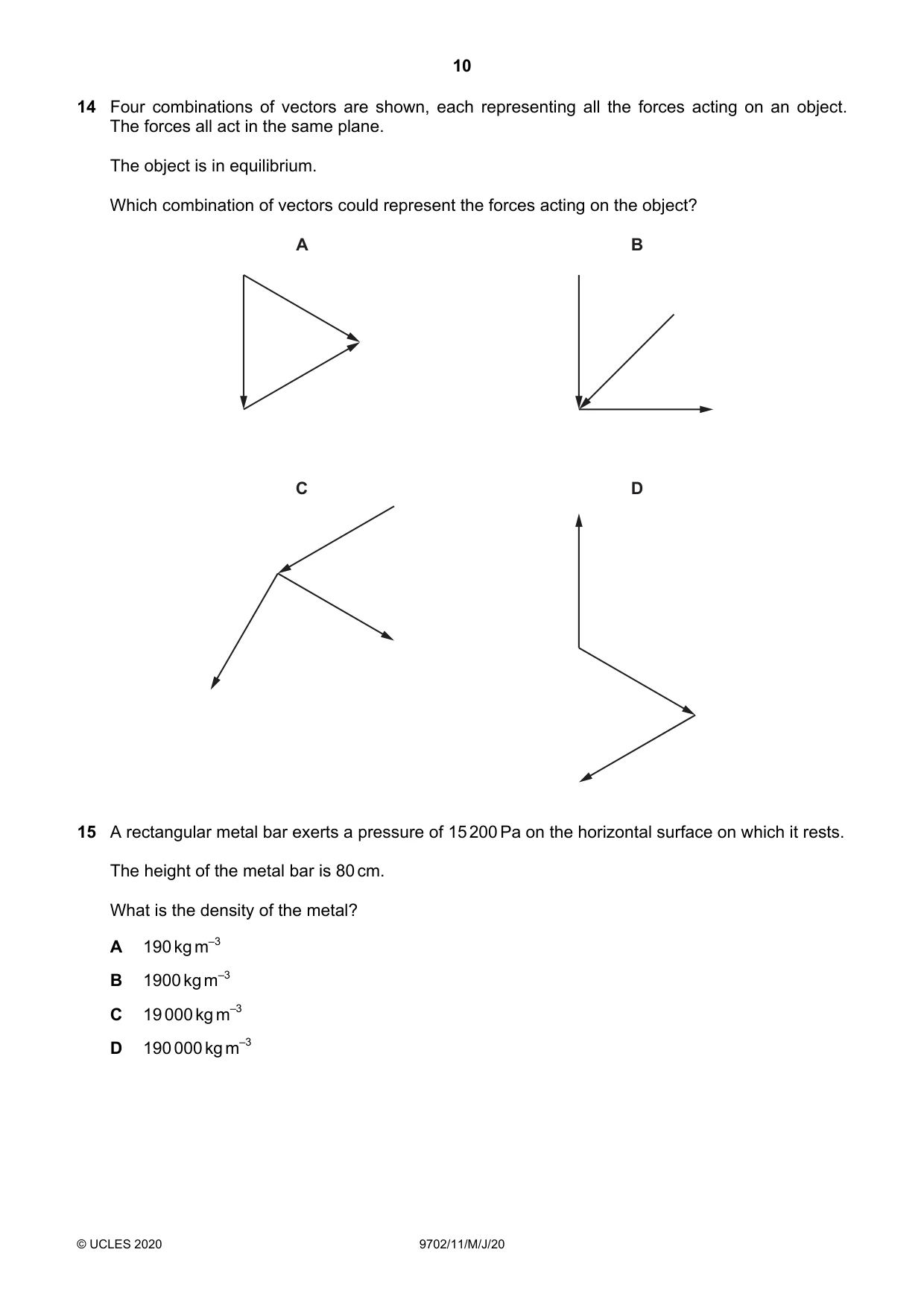
14 Four combinations of vectors are shown, each representing all the forces acting on an object. The forces all act in the same plane. The object is in equilibrium. Which combination of vectors could represent the forces acting on the object? A B C D
Mark scheme: D
Q15 · A rectangular metal bar exerts a pressure of 15 200 Pa on the horizontal surface on which…
15 A rectangular metal bar exerts a pressure of 15 200 Pa on the horizontal surface on which it rests. The height of the metal bar is 80 cm. What is the density of the metal? A 190 kg m–3 B 1900 kg m–3 C 19 000 kg m–3 D 190 000 kg m–3
Mark scheme: B
Q16 · A mass attached to the lower end of a spring bounces up and down
16 A mass attached to the lower end of a spring bounces up and down. At which points in the path of the mass do the gravitational potential energy of the mass (GPE), the elastic potential energy in the spring (EPE) and the kinetic energy of the mass (KE) have their highest values? GPE EPE KE A bottom middle top B bottom top middle C top bottom middle D top bottom top
Mark scheme: C
Q17 · A block of weight 80 N is pushed a distance of 60 cm up a slope inclined at 30° to the…
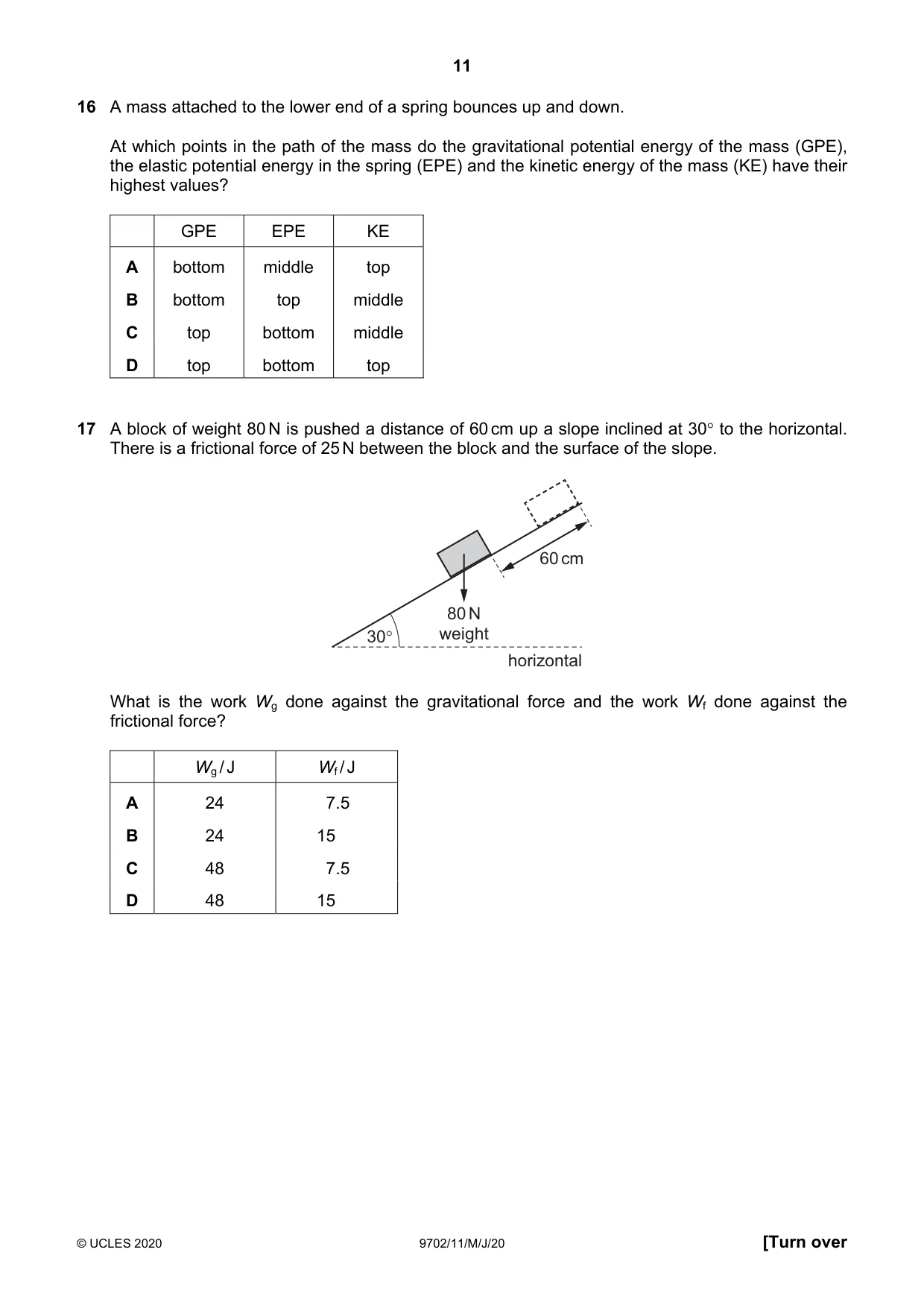
17 A block of weight 80 N is pushed a distance of 60 cm up a slope inclined at 30° to the horizontal. There is a frictional force of 25 N between the block and the surface of the slope. 60 cm 80 N 30° weight horizontal What is the work Wg done against the gravitational force and the work Wf done against the frictional force? Wg / J Wf / J A 24 7.5 B 24 15 C 48 7.5 D 48 15
Mark scheme: B
Q18 · A ball is dropped from rest and falls towards the ground
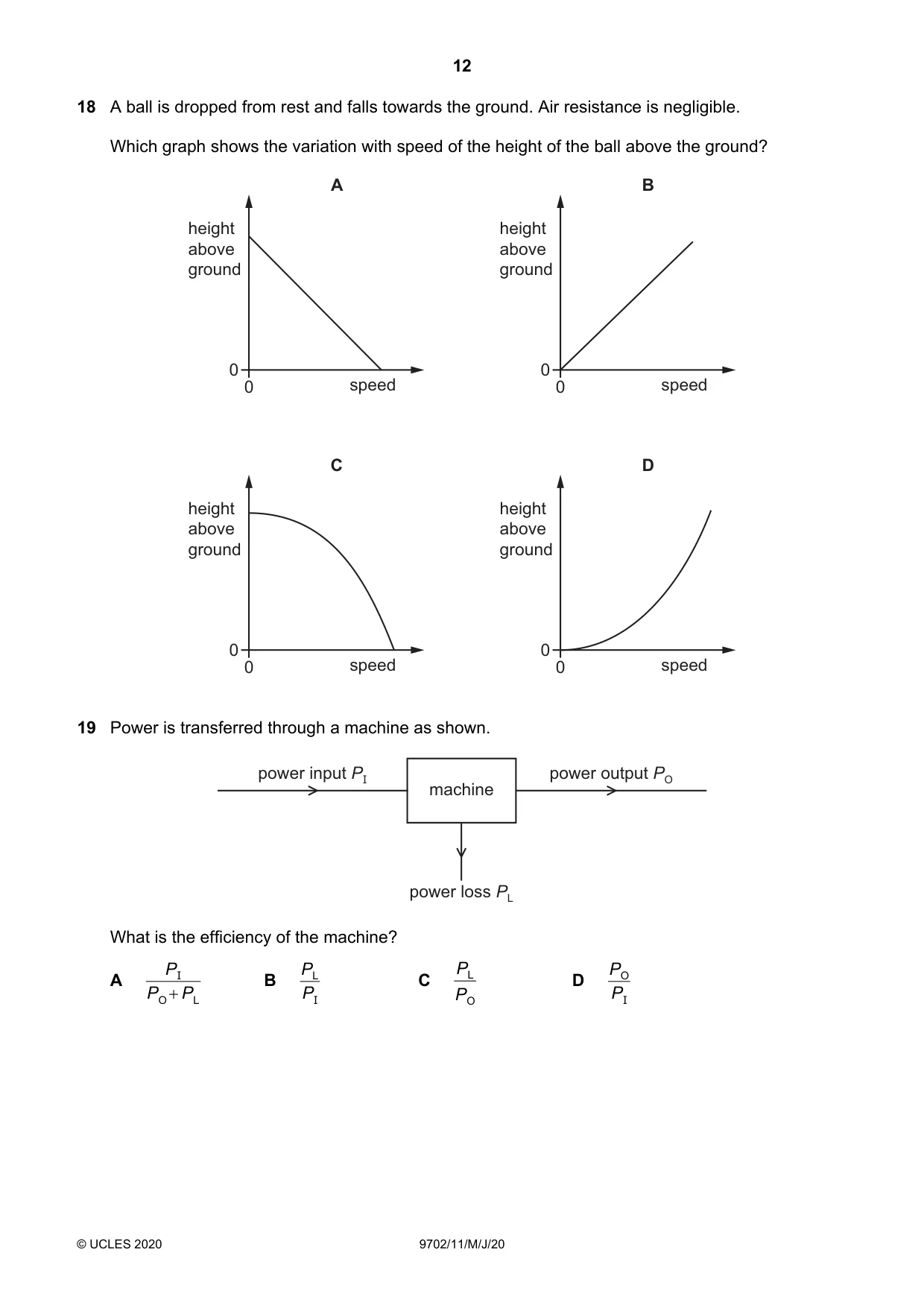
18 A ball is dropped from rest and falls towards the ground. Air resistance is negligible. Which graph shows the variation with speed of the height of the ball above the ground? A B height height above above ground ground 0 0 0 speed 0 speed C D height height above above ground ground 0 0 0 speed 0 speed
Mark scheme: C
More questions on Gravitational potential energy and kinetic energy
Q19 · Power is transferred through a machine as shown
19 Power is transferred through a machine as shown. power input PI power output PO machine power loss PL What is the efficiency of the machine? P PL P PO A I B C L D P + P P P P O L I O I
Mark scheme: D
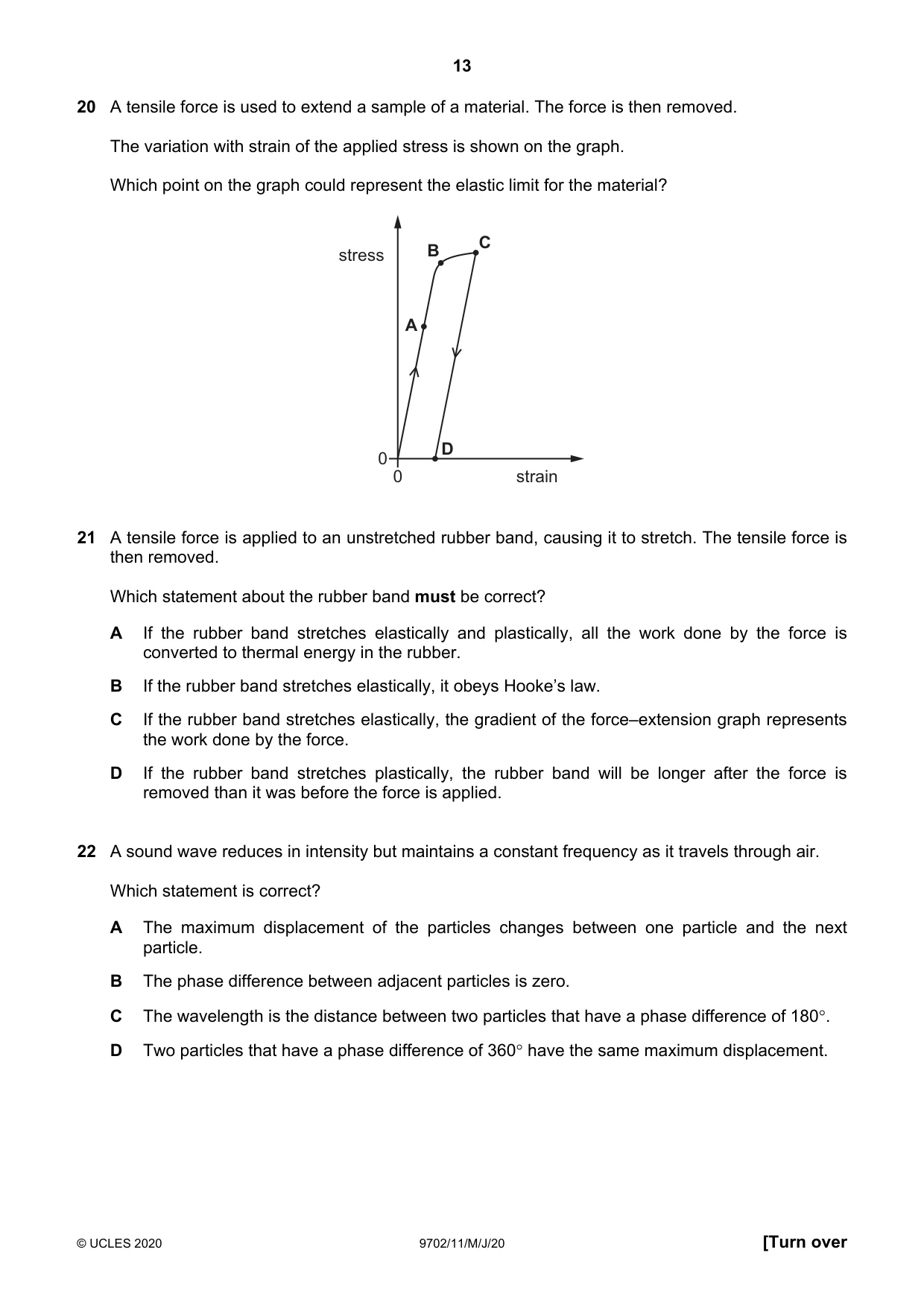
Q20 · A tensile force is used to extend a sample of a material
20 A tensile force is used to extend a sample of a material. The force is then removed. The variation with strain of the applied stress is shown on the graph. Which point on the graph could represent the elastic limit for the material? C stress B A D 0 0 strain
Mark scheme: B
Q21 · A tensile force is applied to an unstretched rubber band, causing it to stretch
21 A tensile force is applied to an unstretched rubber band, causing it to stretch. The tensile force is then removed. Which statement about the rubber band must be correct? A If the rubber band stretches elastically and plastically, all the work done by the force is converted to thermal energy in the rubber. B If the rubber band stretches elastically, it obeys Hooke’s law. C If the rubber band stretches elastically, the gradient of the force–extension graph represents the work done by the force. D If the rubber band stretches plastically, the rubber band will be longer after the force is removed than it was before the force is applied.
Mark scheme: D
Q22 · A sound wave reduces in intensity but maintains a constant frequency as it travels…
22 A sound wave reduces in intensity but maintains a constant frequency as it travels through air. Which statement is correct? A The maximum displacement of the particles changes between one particle and the next particle. B The phase difference between adjacent particles is zero. C The wavelength is the distance between two particles that have a phase difference of 180°. D Two particles that have a phase difference of 360° have the same maximum displacement.
Mark scheme: A
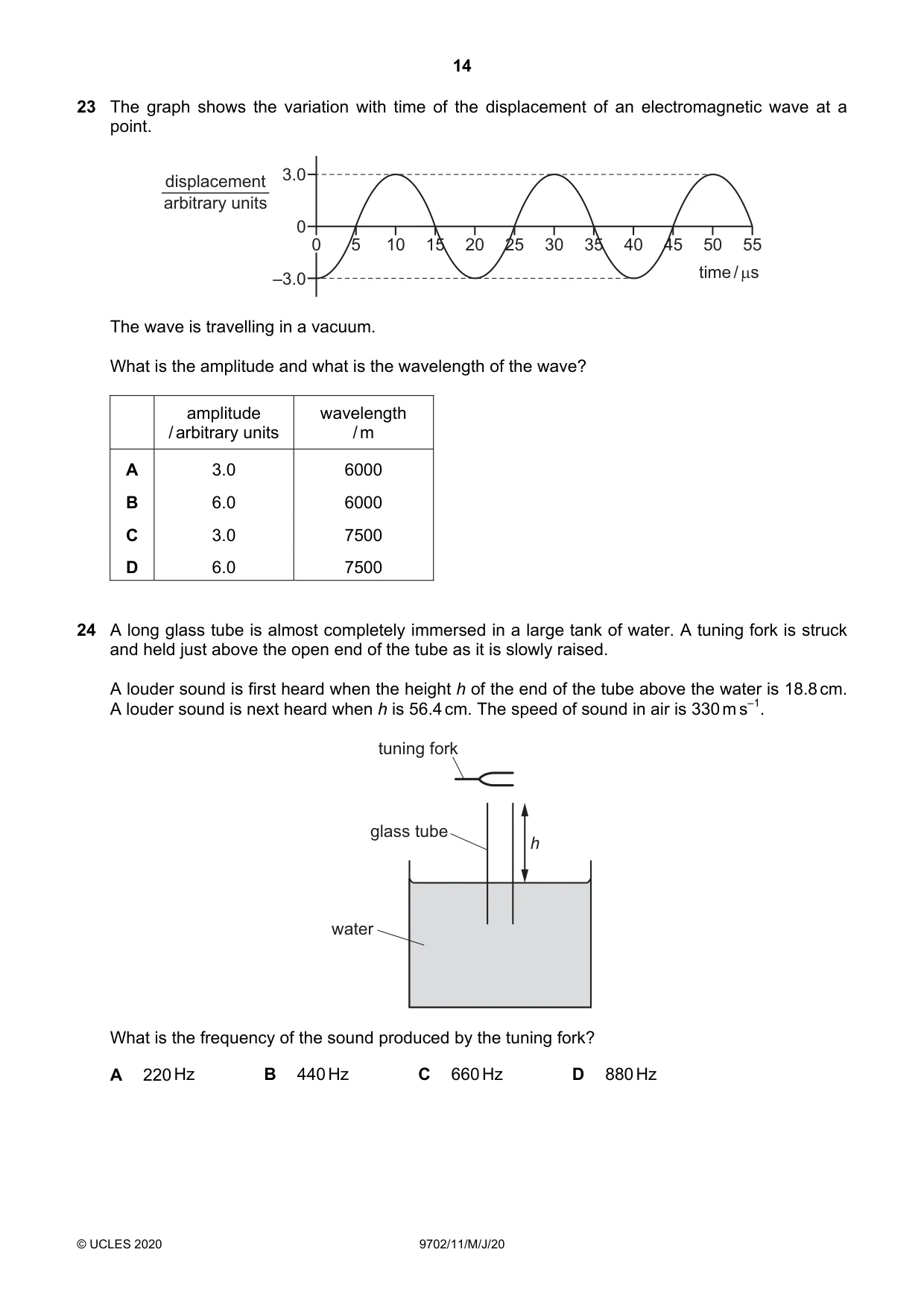
Q23 · The graph shows the variation with time of the displacement of an electromagnetic wave at…
23 The graph shows the variation with time of the displacement of an electromagnetic wave at a point. displacement 3.0 arbitrary units 0 0 5 10 15 20 25 30 35 40 45 50 55 –3.0 time / µs The wave is travelling in a vacuum. What is the amplitude and what is the wavelength of the wave? amplitude wavelength / arbitrary units / m A 3.0 6000 B 6.0 6000 C 3.0 7500 D 6.0 7500
Mark scheme: A
Q24 · A long glass tube is almost completely immersed in a large tank of water
24 A long glass tube is almost completely immersed in a large tank of water. A tuning fork is struck and held just above the open end of the tube as it is slowly raised. A louder sound is first heard when the height h of the end of the tube above the water is 18.8 cm. A louder sound is next heard when h is 56.4 cm. The speed of sound in air is 330 m s–1. tuning fork glass tube h water What is the frequency of the sound produced by the tuning fork? A 220 Hz B 440 Hz C 660 Hz D 880 Hz
Mark scheme: B
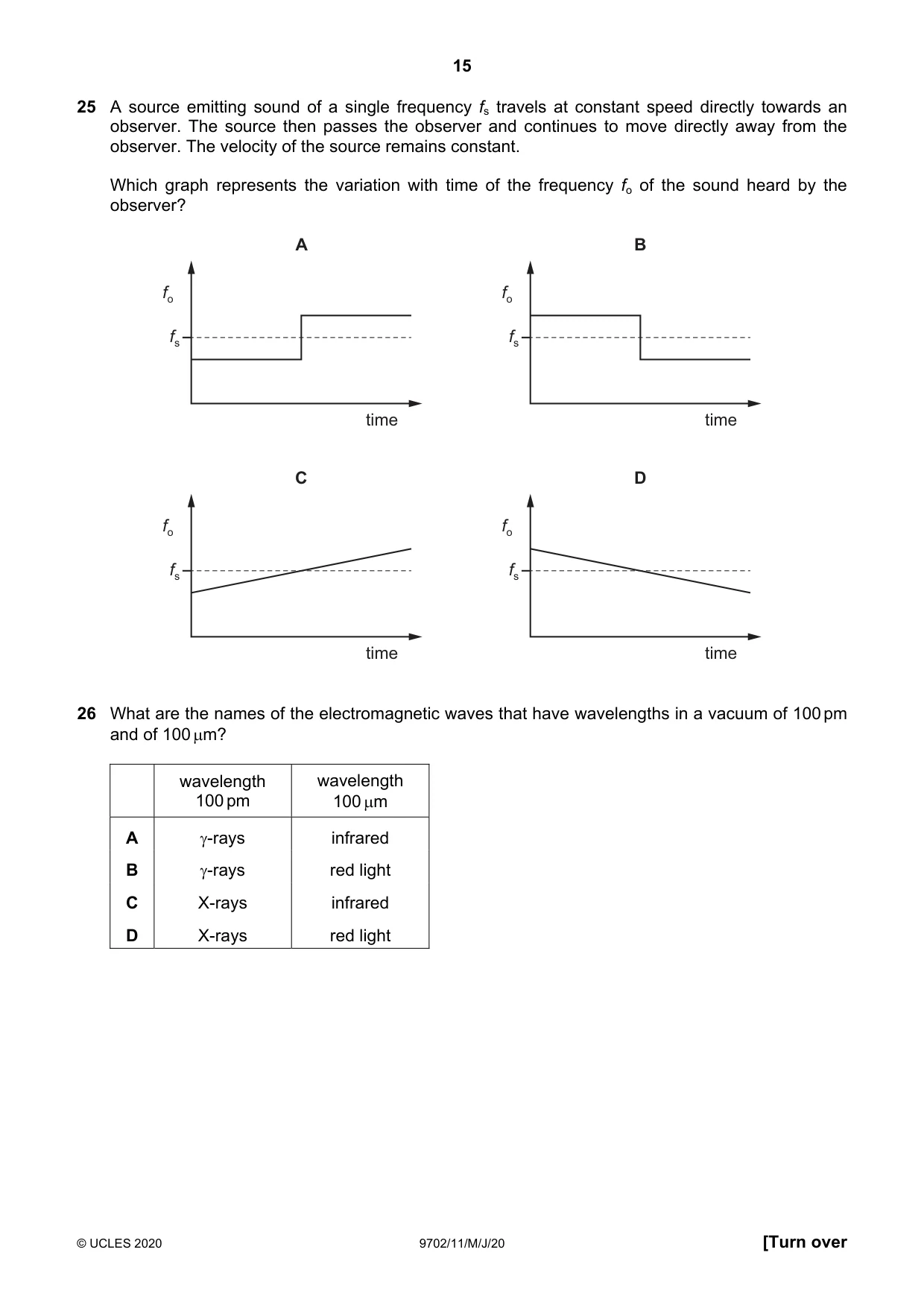
Q25 · A source emitting sound of a single frequency fs travels at constant speed directly…
25 A source emitting sound of a single frequency fs travels at constant speed directly towards an observer. The source then passes the observer and continues to move directly away from the observer. The velocity of the source remains constant. Which graph represents the variation with time of the frequency fo of the sound heard by the observer? A B fo fo fs fs time time C D fo fo fs fs time time
Mark scheme: B
Q26 · What are the names of the electromagnetic waves that have wavelengths in a vacuum of 100…
26 What are the names of the electromagnetic waves that have wavelengths in a vacuum of 100 pm and of 100 µm? wavelength wavelength 100 pm 100 µm A γ-rays infrared B γ-rays red light C X-rays infrared D X-rays red light
Mark scheme: C
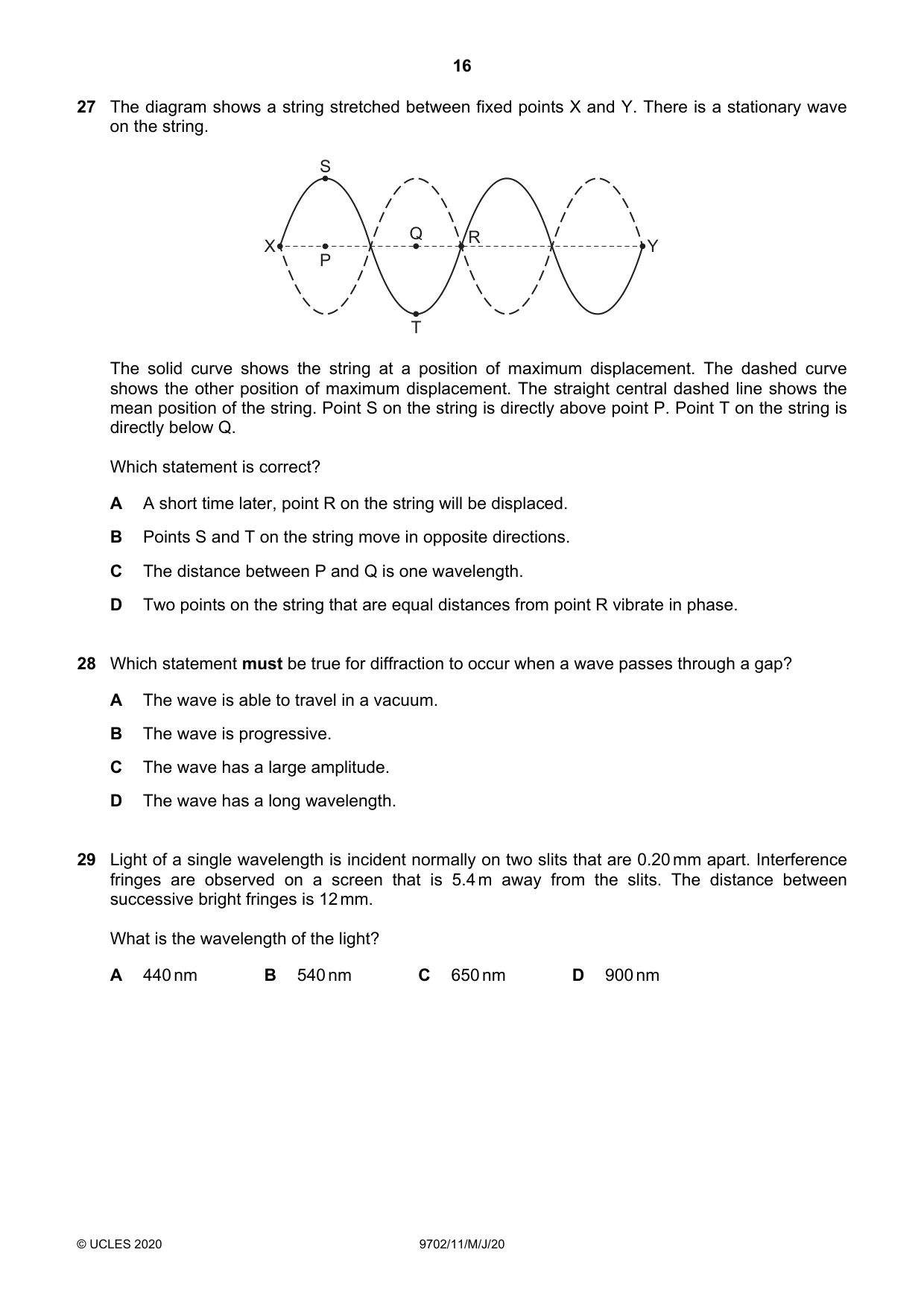
Q27 · The diagram shows a string stretched between fixed points X and Y
27 The diagram shows a string stretched between fixed points X and Y. There is a stationary wave on the string. S Q R X Y P T The solid curve shows the string at a position of maximum displacement. The dashed curve shows the other position of maximum displacement. The straight central dashed line shows the mean position of the string. Point S on the string is directly above point P. Point T on the string is directly below Q. Which statement is correct? A A short time later, point R on the string will be displaced. B Points S and T on the string move in opposite directions. C The distance between P and Q is one wavelength. D Two points on the string that are equal distances from point R vibrate in phase.
Mark scheme: B
Q28 · Which statement must be true for diffraction to occur when a wave passes through a gap?
28 Which statement must be true for diffraction to occur when a wave passes through a gap? A The wave is able to travel in a vacuum. B The wave is progressive. C The wave has a large amplitude. D The wave has a long wavelength.
Mark scheme: B
Q29 · Light of a single wavelength is incident normally on two slits that are 0.20 mm apart
29 Light of a single wavelength is incident normally on two slits that are 0.20 mm apart. Interference fringes are observed on a screen that is 5.4 m away from the slits. The distance between successive bright fringes is 12 mm. What is the wavelength of the light? A 440 nm B 540 nm C 650 nm D 900 nm
Mark scheme: A
Q30 · A diffraction grating and a screen are used to determine the single wavelength λ of the…
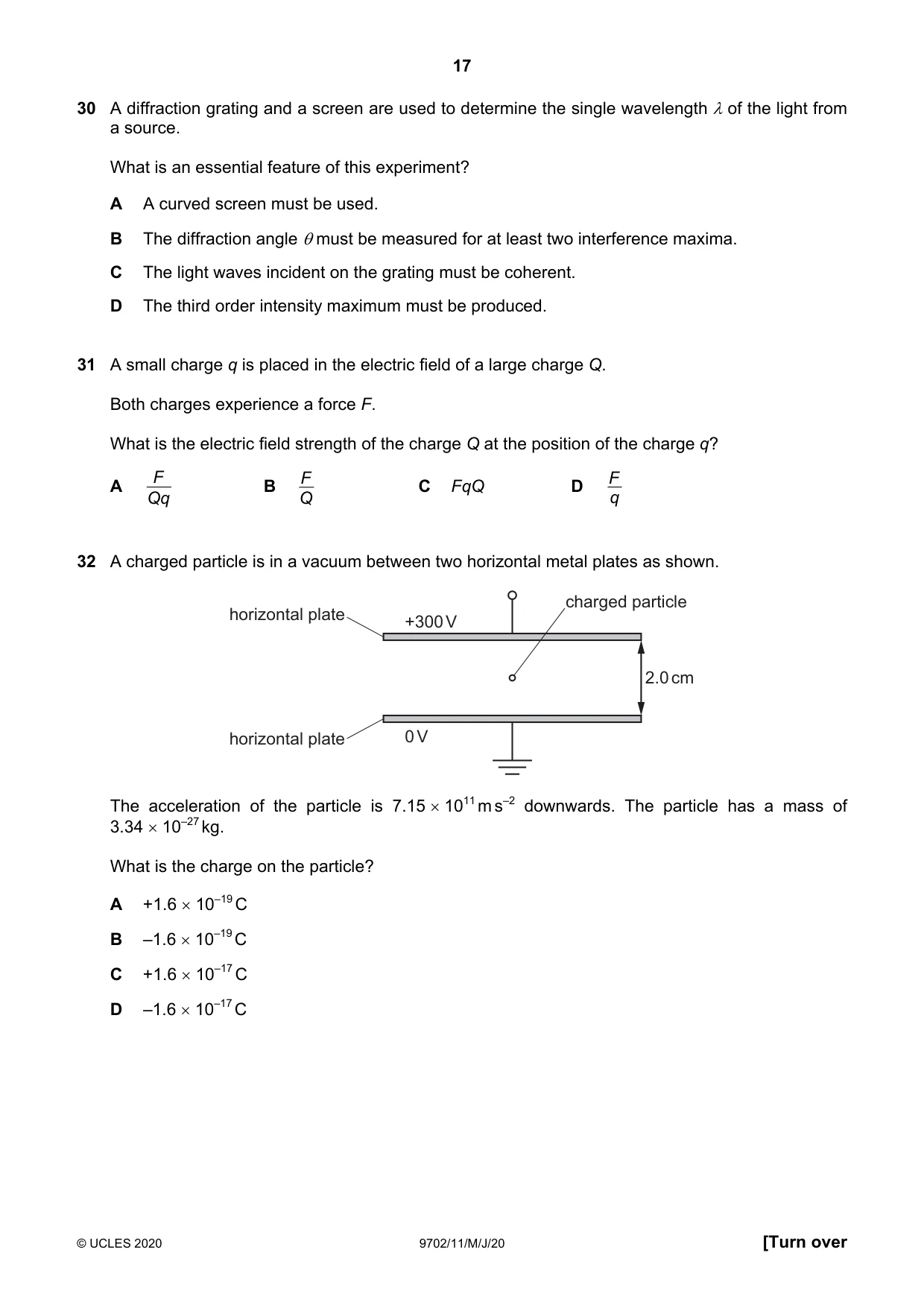
30 A diffraction grating and a screen are used to determine the single wavelength λ of the light from a source. What is an essential feature of this experiment? A A curved screen must be used. B The diffraction angle θ must be measured for at least two interference maxima. C The light waves incident on the grating must be coherent. D The third order intensity maximum must be produced.
Mark scheme: C
Q31 · A small charge q is placed in the electric field of a large charge Q
31 A small charge q is placed in the electric field of a large charge Q. Both charges experience a force F. What is the electric field strength of the charge Q at the position of the charge q? F F F A B C FqQ D Qq Q q
Mark scheme: D
Q32 · A charged particle is in a vacuum between two horizontal metal plates as shown
32 A charged particle is in a vacuum between two horizontal metal plates as shown. charged particle horizontal plate +300 V 2.0 cm horizontal plate 0 V The acceleration of the particle is 7.15 × 10¹¹ m s–2 downwards. The particle has a mass of 3.34 × 10⁻²⁷ kg. What is the charge on the particle? A +1.6 × 10⁻¹⁹ C B –1.6 × 10⁻¹⁹ C C +1.6 × 10⁻¹⁷ C D –1.6 × 10⁻¹⁷ C
Mark scheme: A
Q33 · The current in the circuit shown is 3.2 mA
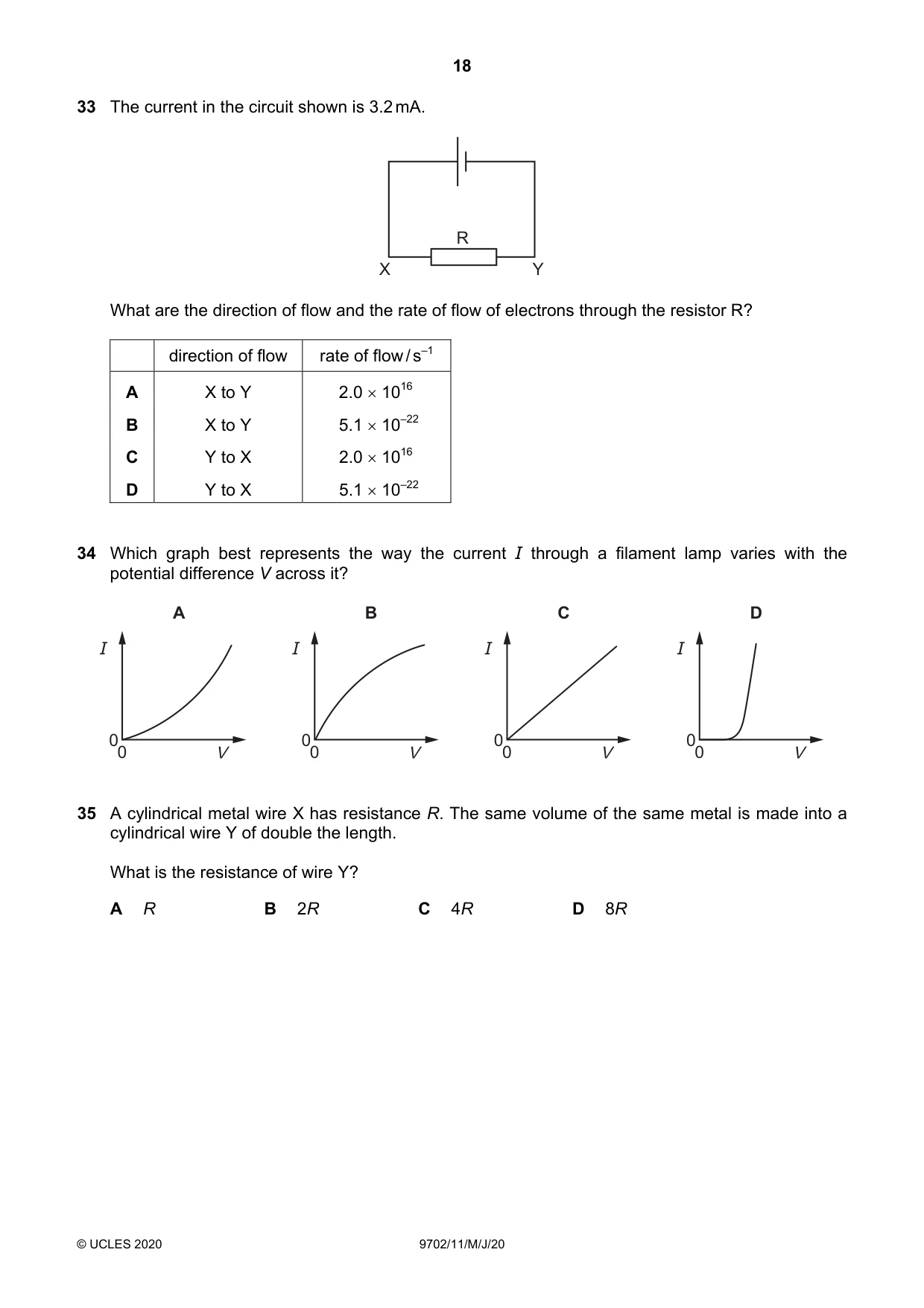
33 The current in the circuit shown is 3.2 mA. R X Y What are the direction of flow and the rate of flow of electrons through the resistor R? direction of flow rate of flow / s–1 A X to Y 2.0 × 10¹⁶ B X to Y 5.1 × 10⁻²² C Y to X 2.0 × 10¹⁶ D Y to X 5.1 × 10⁻²²
Mark scheme: C
Q34 · Which graph best represents the way the current I through a filament lamp varies with the…
34 Which graph best represents the way the current I through a filament lamp varies with the potential difference V across it? A B C D I I I I 0 0 0 0 0 V 0 V 0 V 0 V
Mark scheme: B
Q35 · A cylindrical metal wire X has resistance R
35 A cylindrical metal wire X has resistance R. The same volume of the same metal is made into a cylindrical wire Y of double the length. What is the resistance of wire Y? A R B 2R C 4R D 8R
Mark scheme: C
Q36 · A cell of electromotive force (e.m.f.) E and internal resistance r is connected to a…
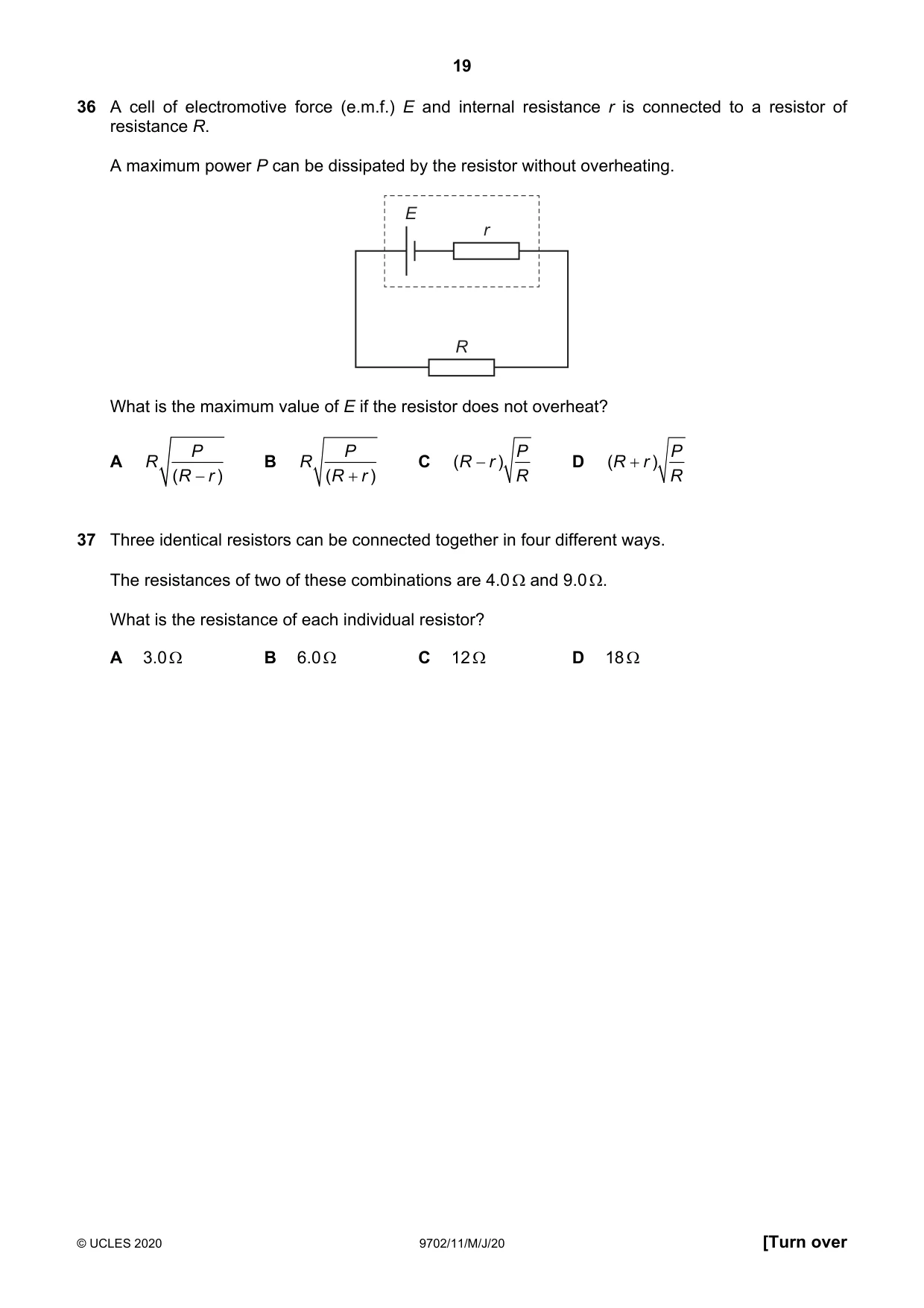
36 A cell of electromotive force (e.m.f.) E and internal resistance r is connected to a resistor of resistance R. A maximum power P can be dissipated by the resistor without overheating. E r R What is the maximum value of E if the resistor does not overheat? P P ) P ) P A R B R C ( R − r D ( R + r ( R − r ) ( R + r ) R R
Mark scheme: D
Q37 · Three identical resistors can be connected together in four different ways
37 Three identical resistors can be connected together in four different ways. The resistances of two of these combinations are 4.0 Ω and 9.0 Ω. What is the resistance of each individual resistor? A 3.0 Ω B 6.0 Ω C 12 Ω D 18 Ω
Mark scheme: B
Q38 · In the circuit shown, a battery of negligible internal resistance is connected in series…
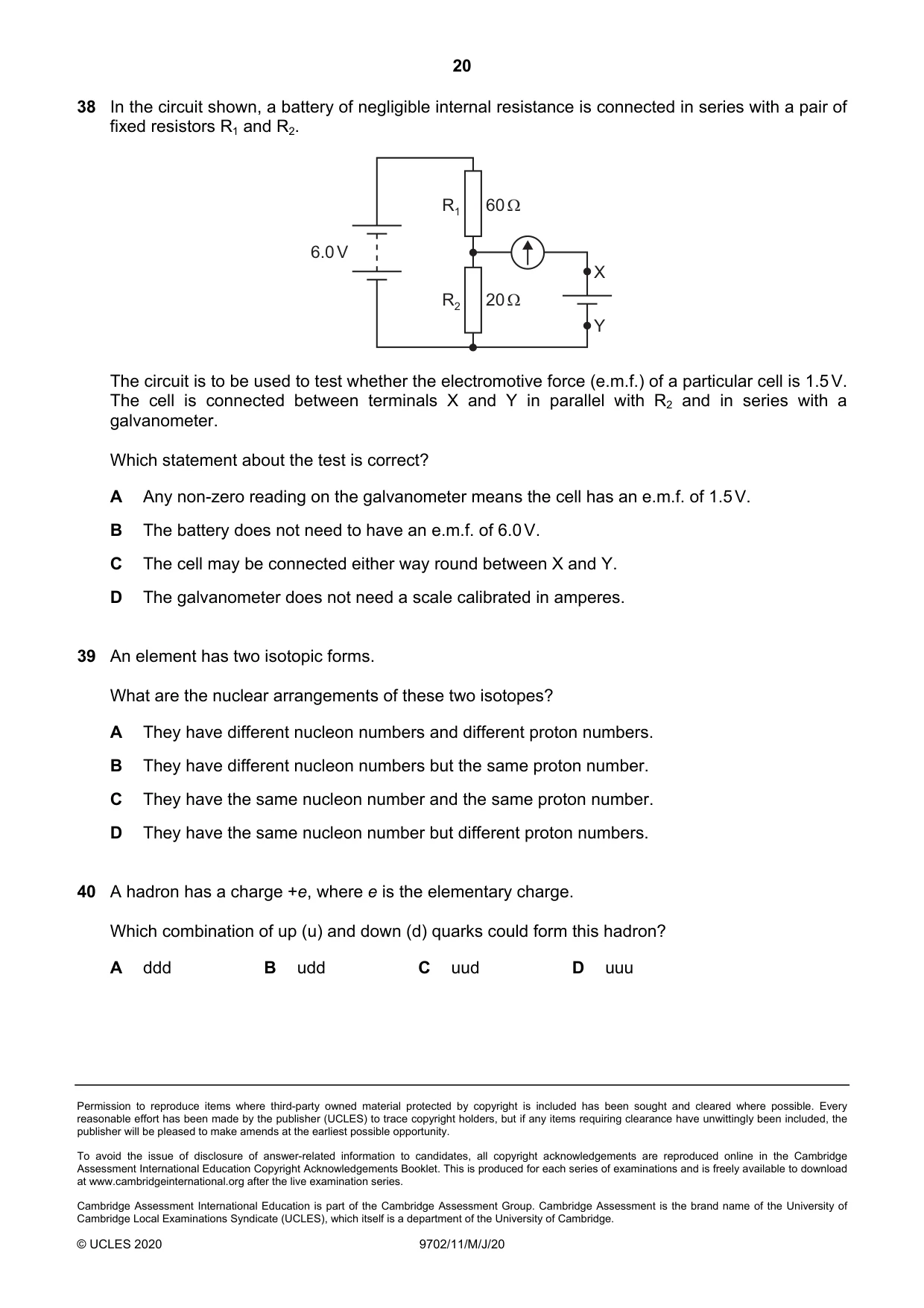
38 In the circuit shown, a battery of negligible internal resistance is connected in series with a pair of fixed resistors R1 and R2. R1 60 Ω 6.0 V X R2 20 Ω Y The circuit is to be used to test whether the electromotive force (e.m.f.) of a particular cell is 1.5 V. The cell is connected between terminals X and Y in parallel with R2 and in series with a galvanometer. Which statement about the test is correct? A Any non-zero reading on the galvanometer means the cell has an e.m.f. of 1.5 V. B The battery does not need to have an e.m.f. of 6.0 V. C The cell may be connected either way round between X and Y. D The galvanometer does not need a scale calibrated in amperes.
Mark scheme: D
Q39 · An element has two isotopic forms
39 An element has two isotopic forms. What are the nuclear arrangements of these two isotopes? A They have different nucleon numbers and different proton numbers. B They have different nucleon numbers but the same proton number. C They have the same nucleon number and the same proton number. D They have the same nucleon number but different proton numbers.
Mark scheme: B
Q40 · A hadron has a charge +e, where e is the elementary charge
40 A hadron has a charge +e, where e is the elementary charge. Which combination of up (u) and down (d) quarks could form this hadron? A ddd B udd C uud D uuu
Mark scheme: C
What was in this paper
The subtopics covered by these 40 questions, and how many questions each got. Open one in a new tab to see every Cambridge question on it.
2Energy conservation2Equations of motion2Equilibrium of forces2Gravitational potential energy and kinetic energy2Linear momentum and its conservation2Practical circuits2Progressive waves2Resistance and resistivity2Stationary waves2Turning effects of forces2Atoms, nuclei and radiation1Characteristics of alternating currents1Density and pressure1Diffraction1Doppler effect for sound waves1Electric current1Electric fields and field lines1Electromagnetic spectrum1Energy in simple harmonic motion1Errors and uncertainties1Fundamental particles1Interference1Momentum and Newton’s laws of motion1Potential dividers1Scalars and vectors1SI units1The diffraction grating1Uniform electric fields1