Cambridge A Level Physics 9702 — 2008 May/June Paper 1 · Variant 1
9702/11/M/J/08 · 40 questions · 40 marks · ≈45 min
The question paper and its mark scheme, free to read here and free to download. This is Cambridge’s own paper, exactly as it was sat.
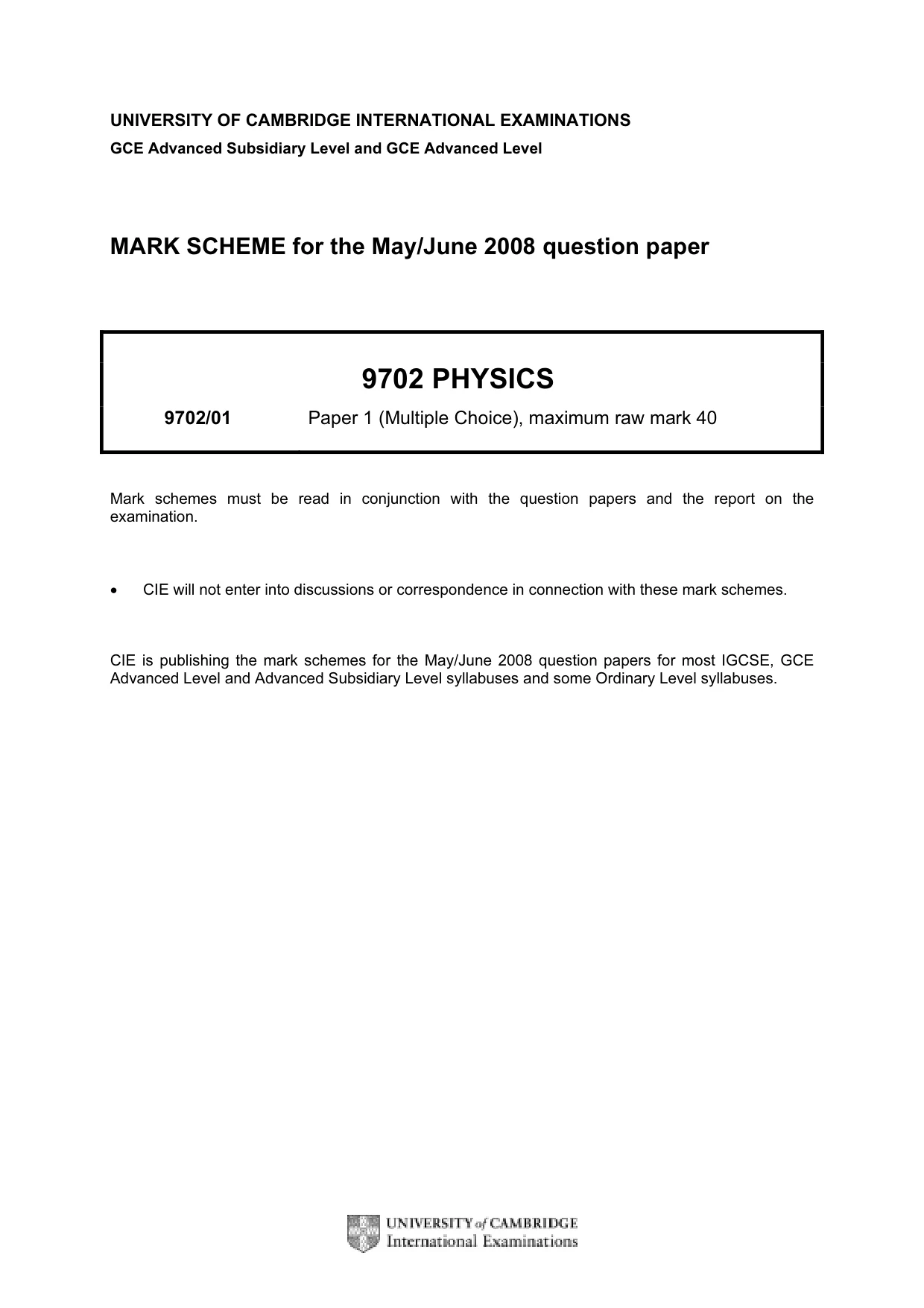
Question paper21 pages
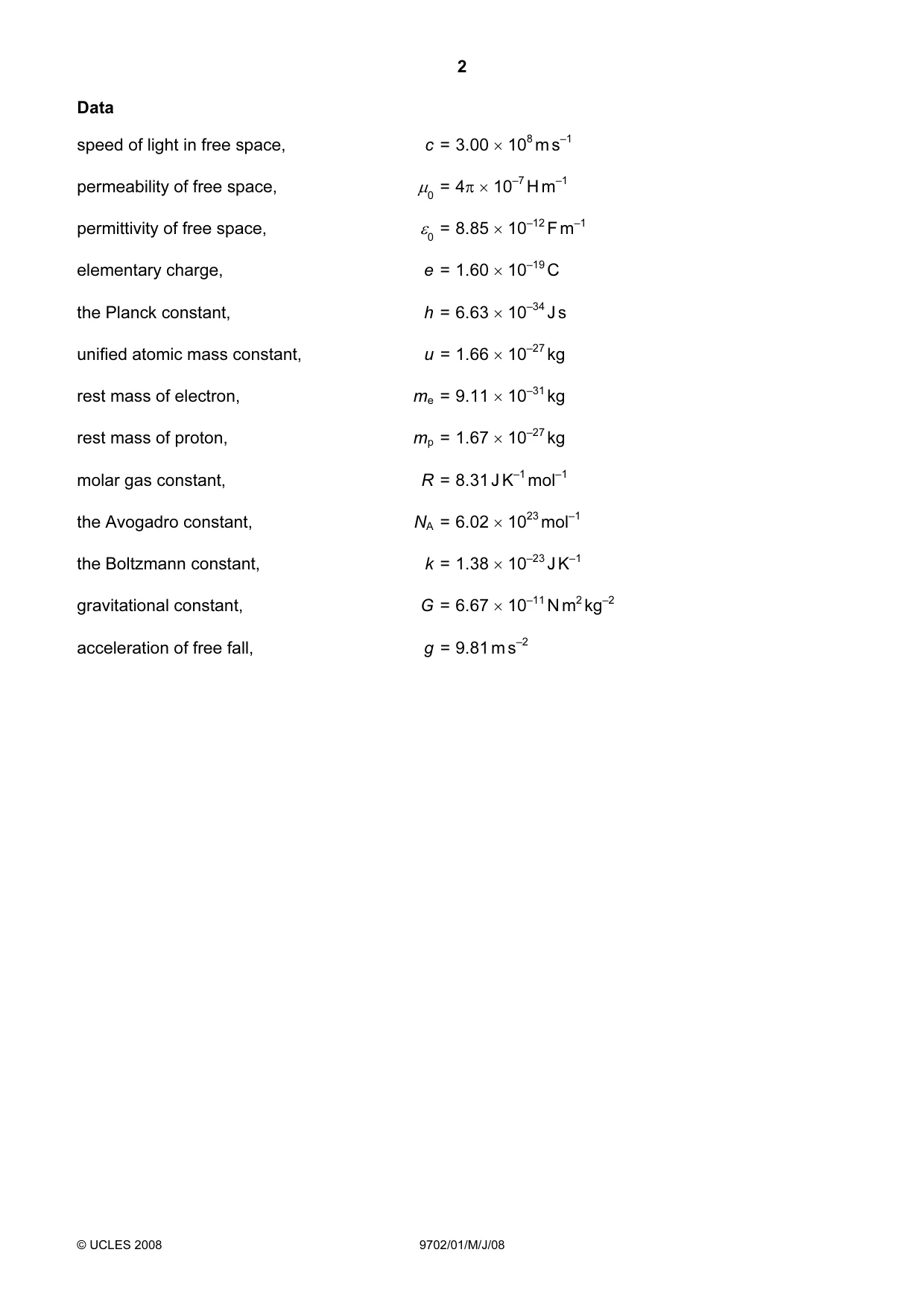
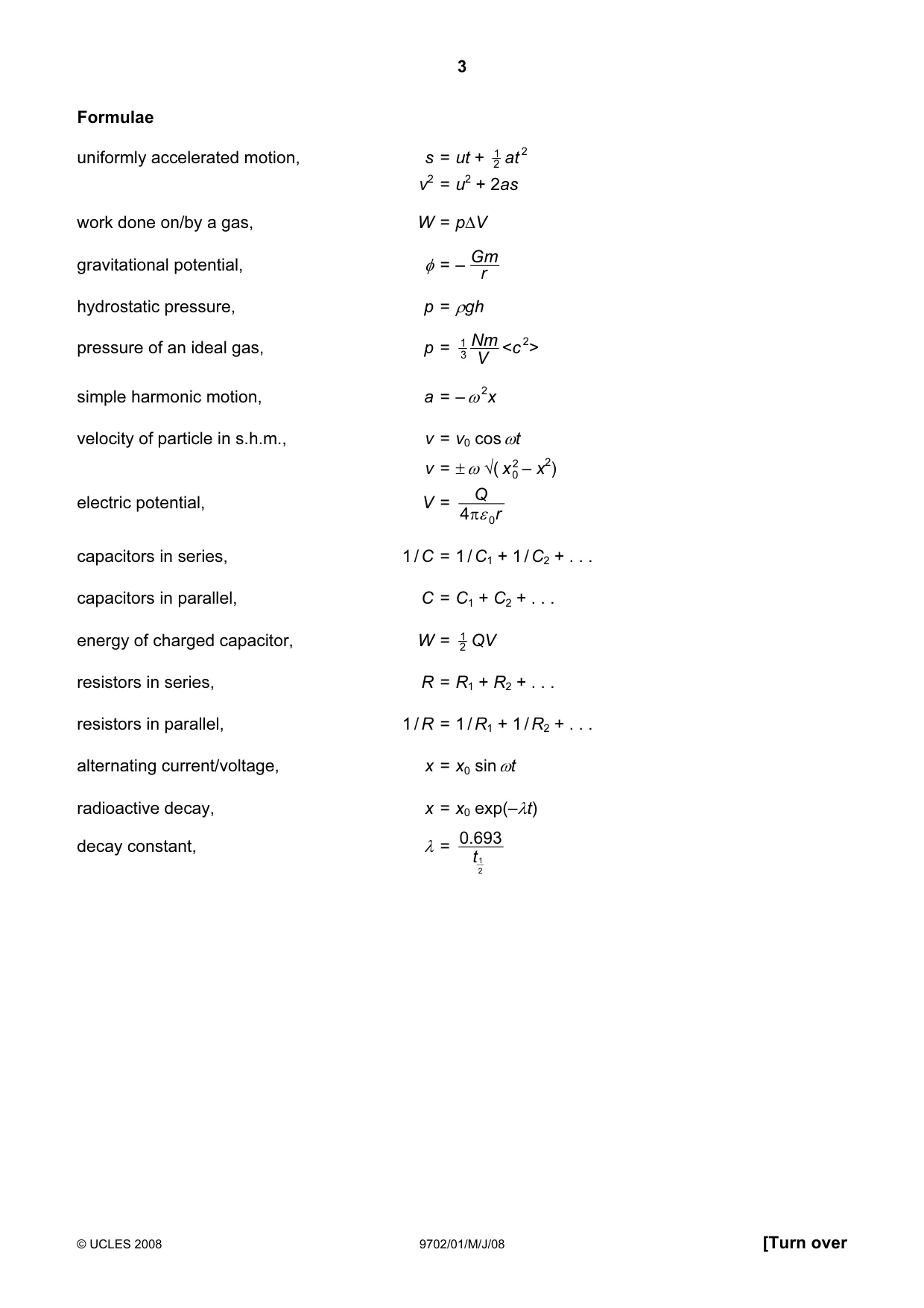
Mark scheme2 pages
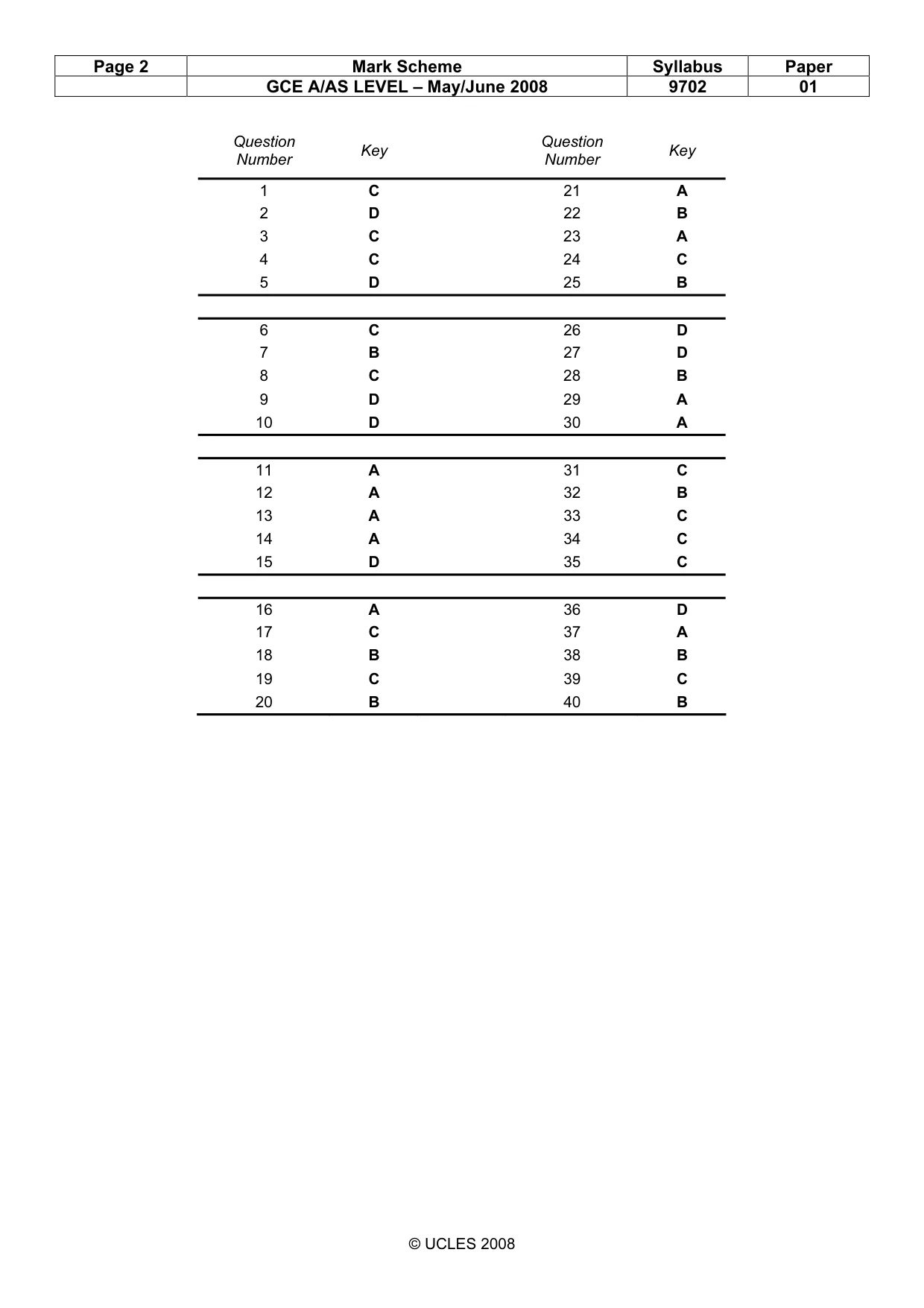
Answers below. Sit the paper first if you are practising.
Questions as text
Q1 · Five energies are listed
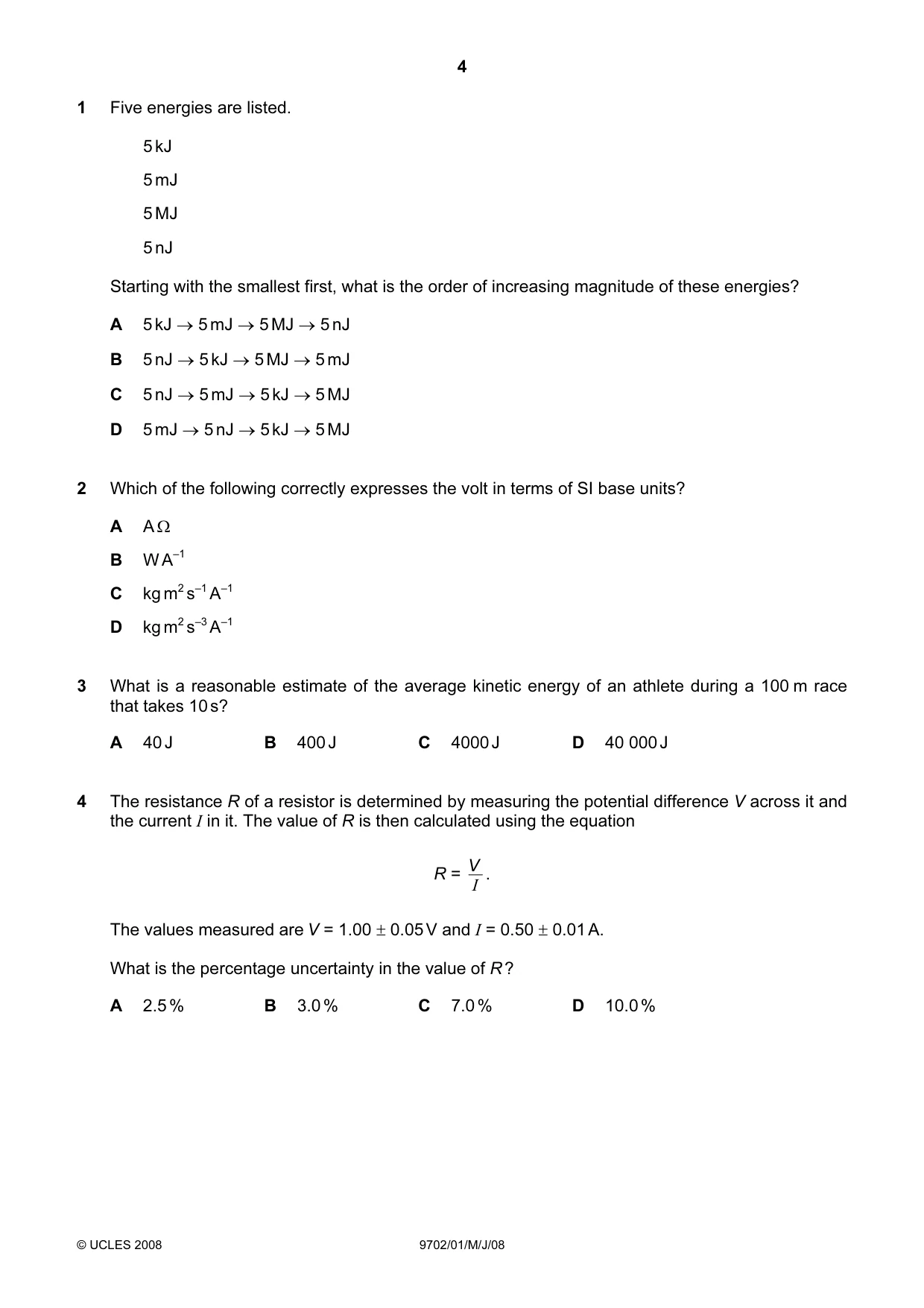
1 Five energies are listed. 5 kJ 5 mJ 5 MJ 5 nJ Starting with the smallest first, what is the order of increasing magnitude of these energies? A 5 kJ → 5 mJ → 5 MJ → 5 nJ B 5 nJ → 5 kJ → 5 MJ → 5 mJ C 5 nJ → 5 mJ → 5 kJ → 5 MJ D 5 mJ → 5 nJ → 5 kJ → 5 MJ
Mark scheme: C
Q2 · Which of the following correctly expresses the volt in terms of SI base units?
2 Which of the following correctly expresses the volt in terms of SI base units? A A Ω B W A–1 C kg m2 s–1 A–1 D kg m2 s–3 A–1
Mark scheme: D
Q3 · What is a reasonable estimate of the average kinetic energy of an athlete during a 100 m…
3 What is a reasonable estimate of the average kinetic energy of an athlete during a 100 m race that takes 10 s? A 40 J B 400 J C 4000 J D 40 000 J
Mark scheme: C
Q4 · The resistance R of a resistor is determined by measuring the potential difference V…
4 The resistance R of a resistor is determined by measuring the potential difference V across it and the current I in it. The value of R is then calculated using the equation V . R = I The values measured are V = 1.00 ± 0.05 V and I = 0.50 ± 0.01 A. What is the percentage uncertainty in the value of R ? A 2.5 % B 3.0 % C 7.0 % D 10.0 %
Mark scheme: C
Q5 · Four students each made a series of measurements of the acceleration of free fall g
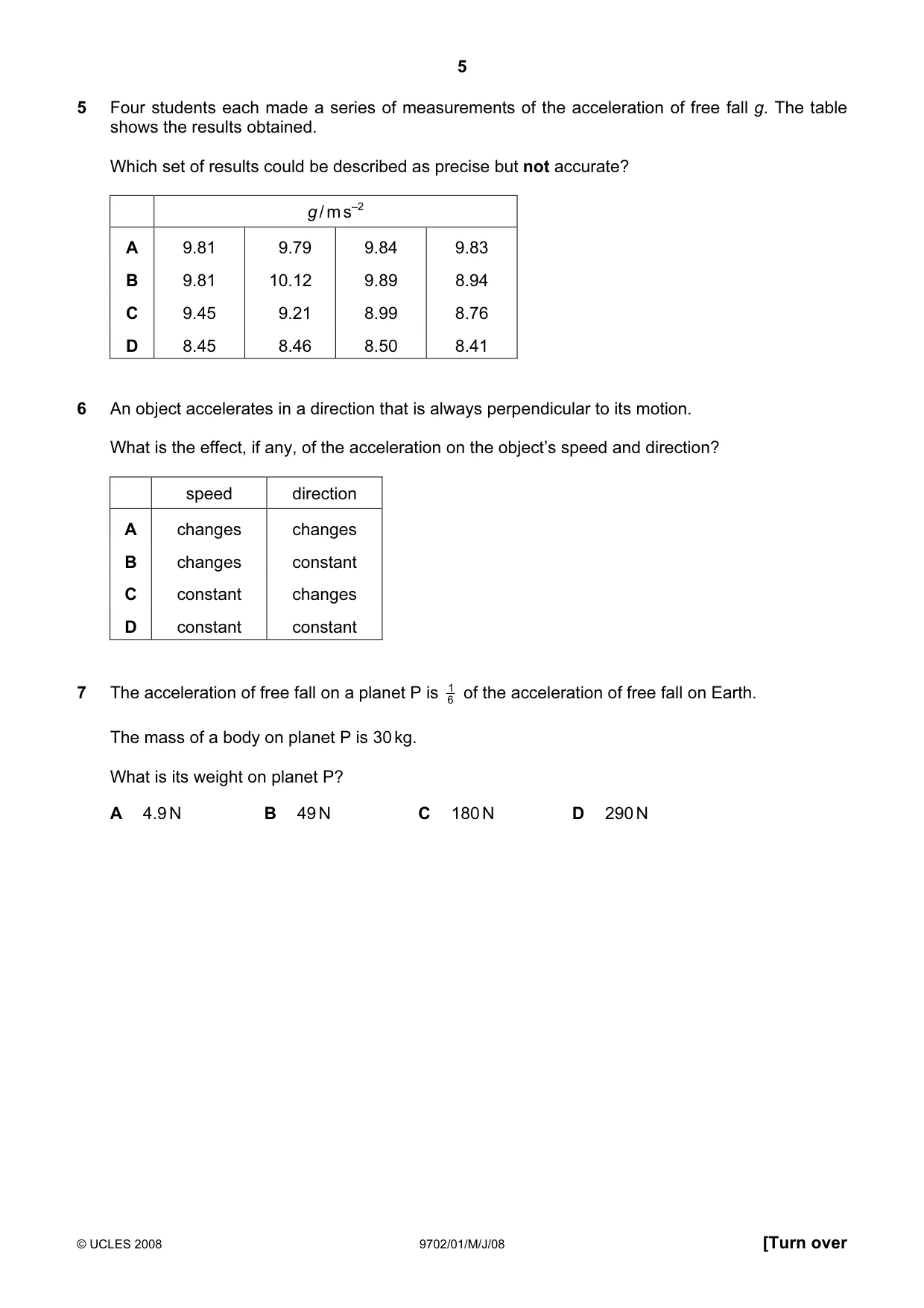
5 Four students each made a series of measurements of the acceleration of free fall g. The table shows the results obtained. Which set of results could be described as precise but not accurate? g / m s–2 A 9.81 9.79 9.84 9.83 B 9.81 10.12 9.89 8.94 C 9.45 9.21 8.99 8.76 D 8.45 8.46 8.50 8.41
Mark scheme: D
Q6 · An object accelerates in a direction that is always perpendicular to its motion
6 An object accelerates in a direction that is always perpendicular to its motion. What is the effect, if any, of the acceleration on the object’s speed and direction? speed direction A changes changes B changes constant C constant changes D constant constant 1 of the acceleration of free fall on Earth.
Mark scheme: C
Q7 · The acceleration of free fall on a planet P is 6 The mass of a body on planet P is 30 kg
7 The acceleration of free fall on a planet P is 6 The mass of a body on planet P is 30 kg. What is its weight on planet P? A 4.9 N B 49 N C 180 N D 290 N
Mark scheme: B
Q8 · A football is dropped from the top of a tall building
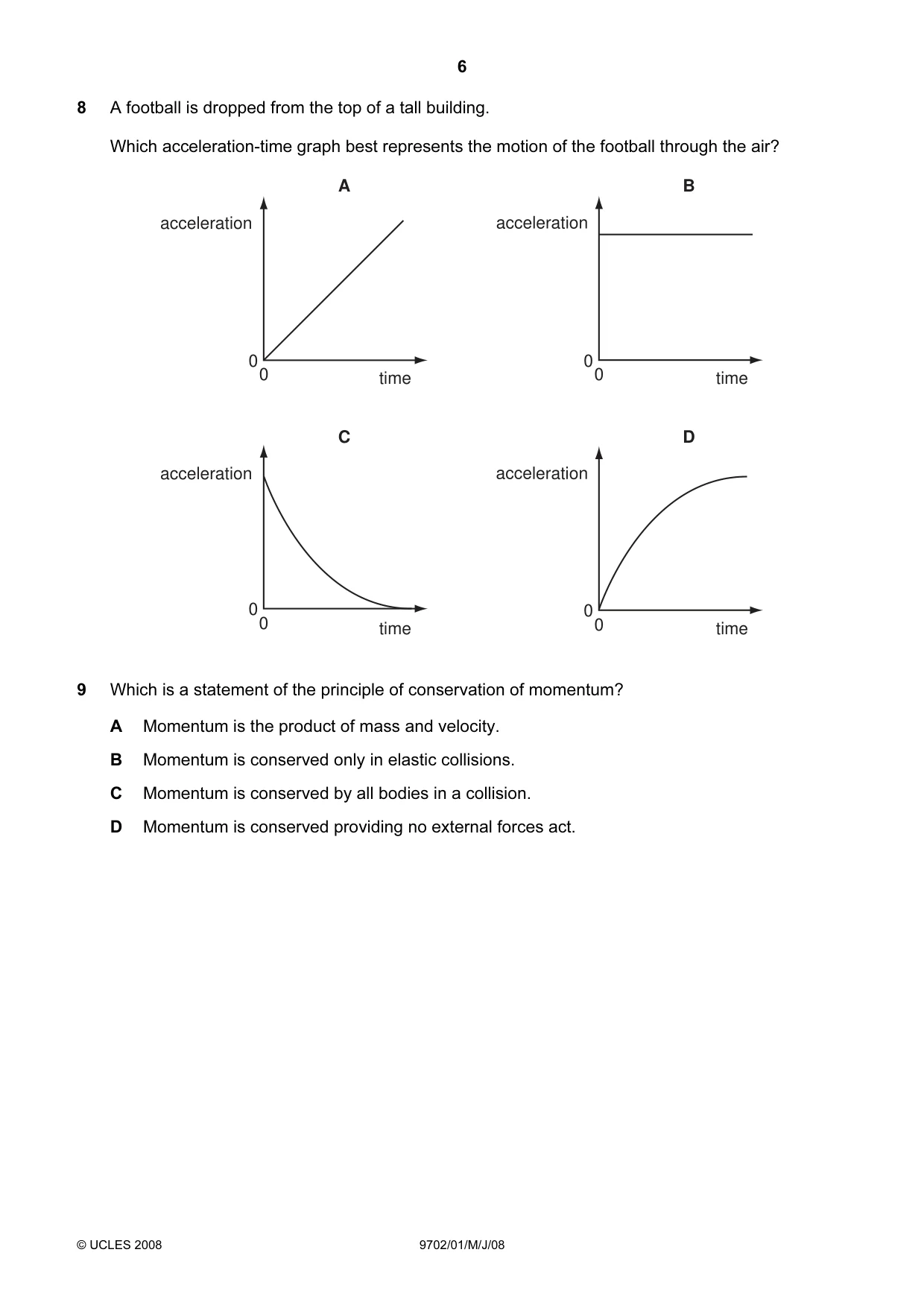
8 A football is dropped from the top of a tall building. Which acceleration-time graph best represents the motion of the football through the air? A B acceleration acceleration 0 0 0 time 0 time C D acceleration acceleration 0 0 0 time 0 time
Mark scheme: C
Q9 · Which is a statement of the principle of conservation of momentum?
9 Which is a statement of the principle of conservation of momentum? A Momentum is the product of mass and velocity. B Momentum is conserved only in elastic collisions. C Momentum is conserved by all bodies in a collision. D Momentum is conserved providing no external forces act.
Mark scheme: D
Q10 · Two equal masses X and Y are moving towards each other on a frictionless air track as…
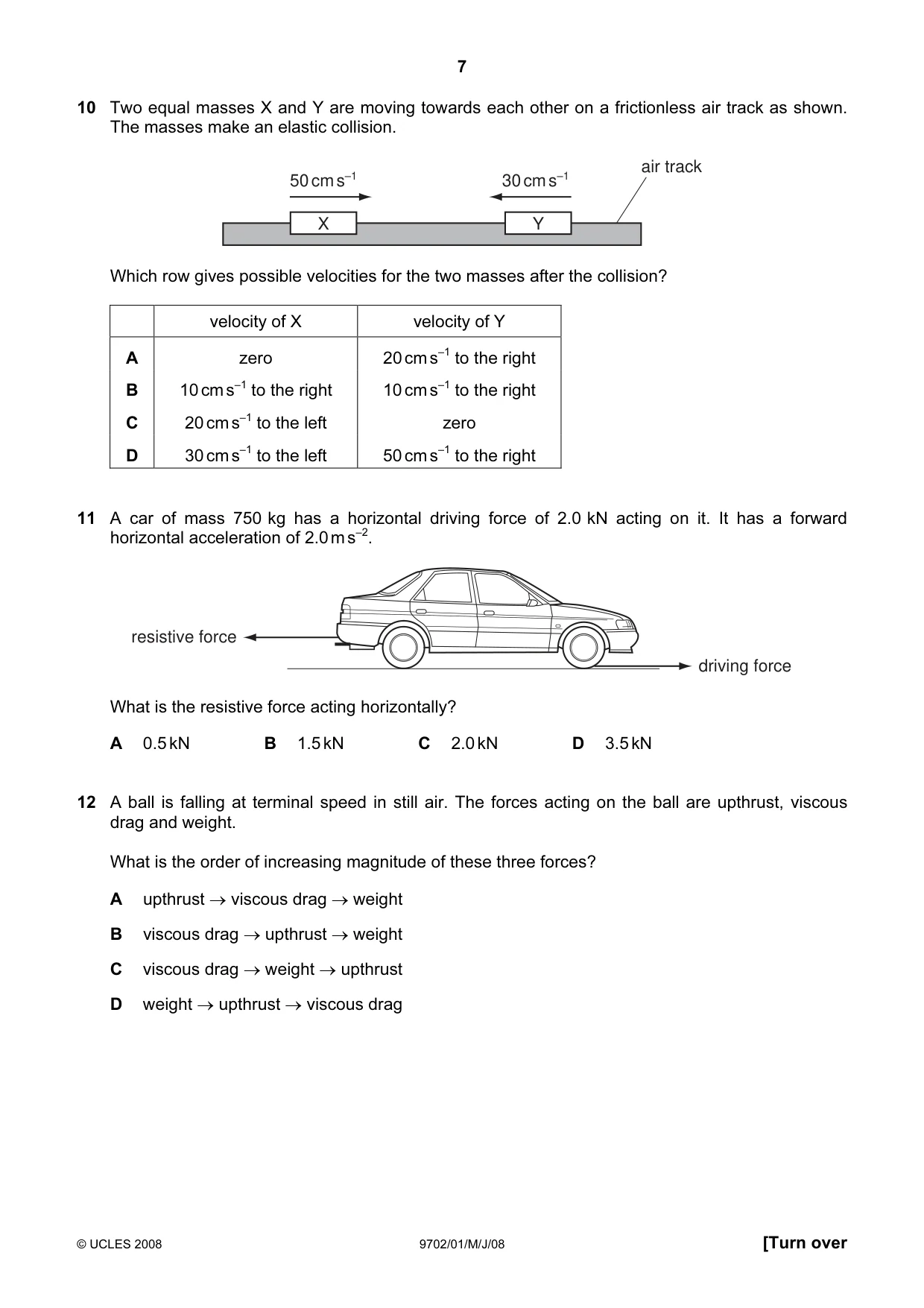
10 Two equal masses X and Y are moving towards each other on a frictionless air track as shown. The masses make an elastic collision. air track 50 cm s–1 30 cm s–1 X Y Which row gives possible velocities for the two masses after the collision? velocity of X velocity of Y A zero 20 cm s–1 to the right B 10 cm s–1 to the right 10 cm s–1 to the right C 20 cm s–1 to the left zero D 30 cm s–1 to the left 50 cm s–1 to the right
Mark scheme: D
Q11 · A car of mass 750 kg has a horizontal driving force of 2.0 kN acting on it
11 A car of mass 750 kg has a horizontal driving force of 2.0 kN acting on it. It has a forward horizontal acceleration of 2.0 m s–2. resistive force driving force What is the resistive force acting horizontally? A 0.5 kN B 1.5 kN C 2.0 kN D 3.5 kN
Mark scheme: A
Q12 · A ball is falling at terminal speed in still air
12 A ball is falling at terminal speed in still air. The forces acting on the ball are upthrust, viscous drag and weight. What is the order of increasing magnitude of these three forces? A upthrust → viscous drag → weight B viscous drag → upthrust → weight C viscous drag → weight → upthrust D weight → upthrust → viscous drag
Mark scheme: A
Q13 · Two rigid rods, XZ and YZ, are fixed to a vertical wall at points X and Y
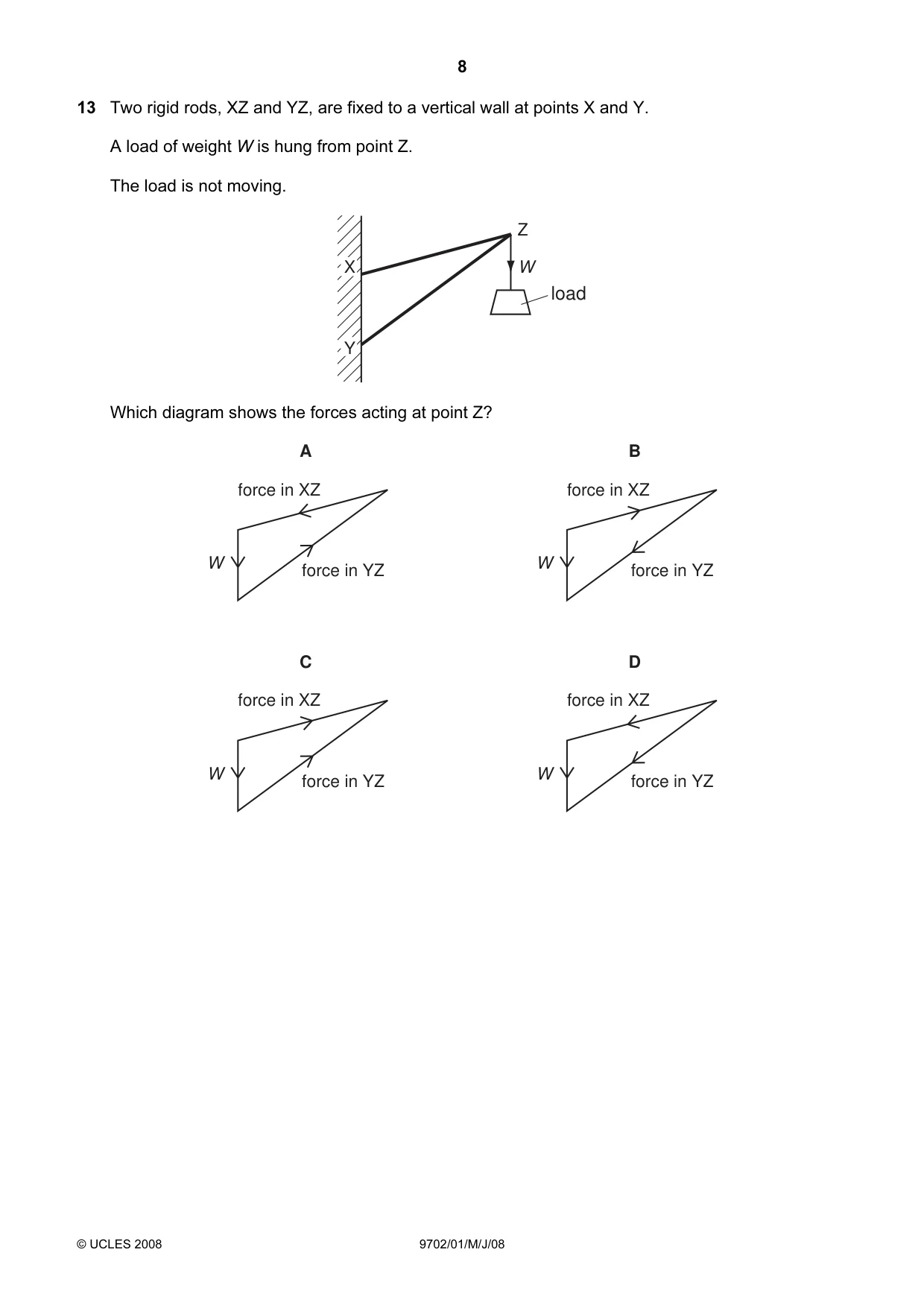
13 Two rigid rods, XZ and YZ, are fixed to a vertical wall at points X and Y. A load of weight W is hung from point Z. The load is not moving. Z X W load Y Which diagram shows the forces acting at point Z? A B force in XZ force in XZ W W force in YZ force in YZ C D force in XZ force in XZ W W force in YZ force in YZ
Mark scheme: A
Q14 · A uniform ladder rests against a vertical wall where there is negligible friction
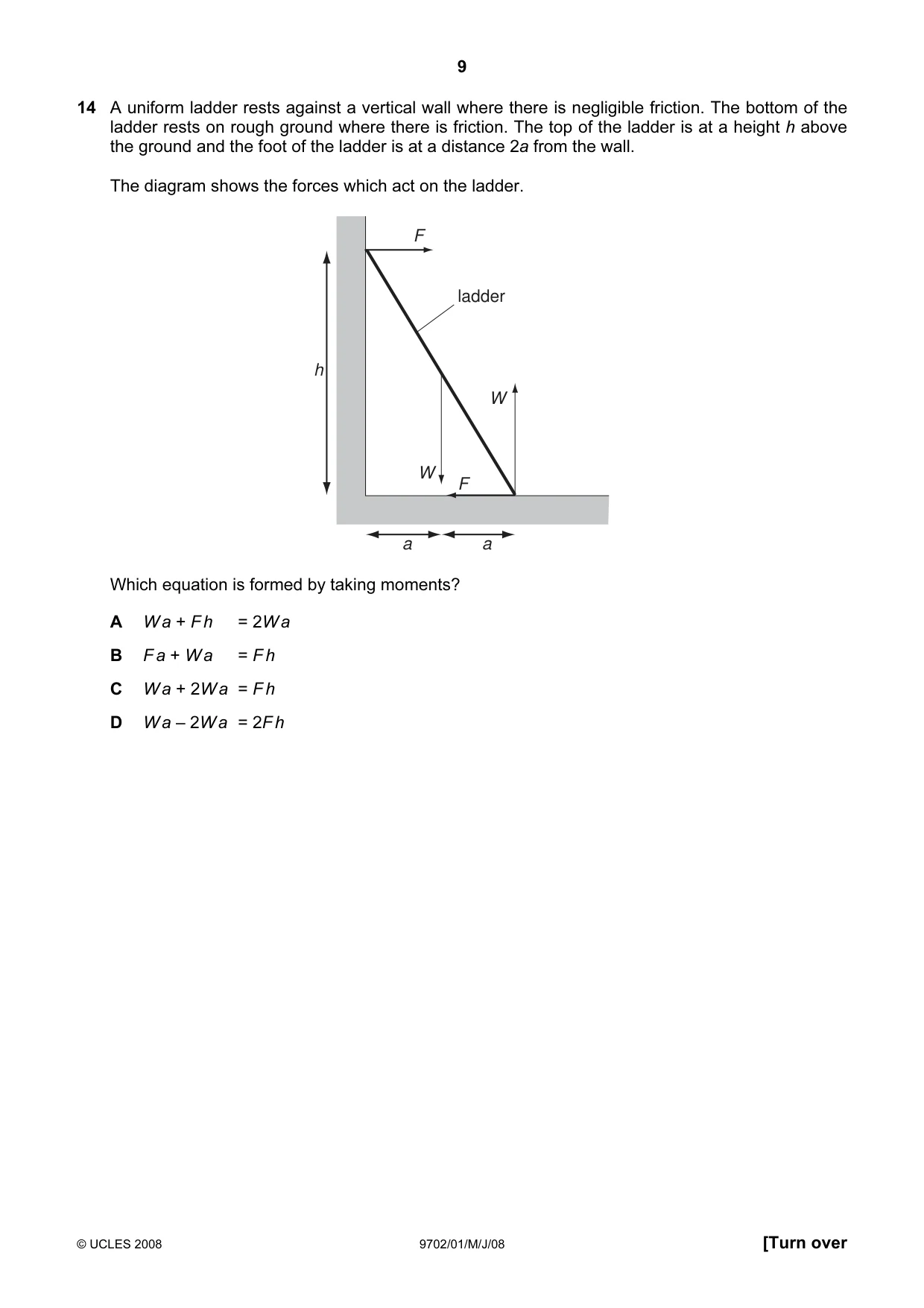
14 A uniform ladder rests against a vertical wall where there is negligible friction. The bottom of the ladder rests on rough ground where there is friction. The top of the ladder is at a height h above the ground and the foot of the ladder is at a distance 2a from the wall. The diagram shows the forces which act on the ladder. F ladder h W W F a a Which equation is formed by taking moments? A W a + F h = 2W a B F a + W a = F h C W a + 2W a = F h D W a – 2W a = 2F h
Mark scheme: A
Q15 · A submarine is in equilibrium in a fully submerged position
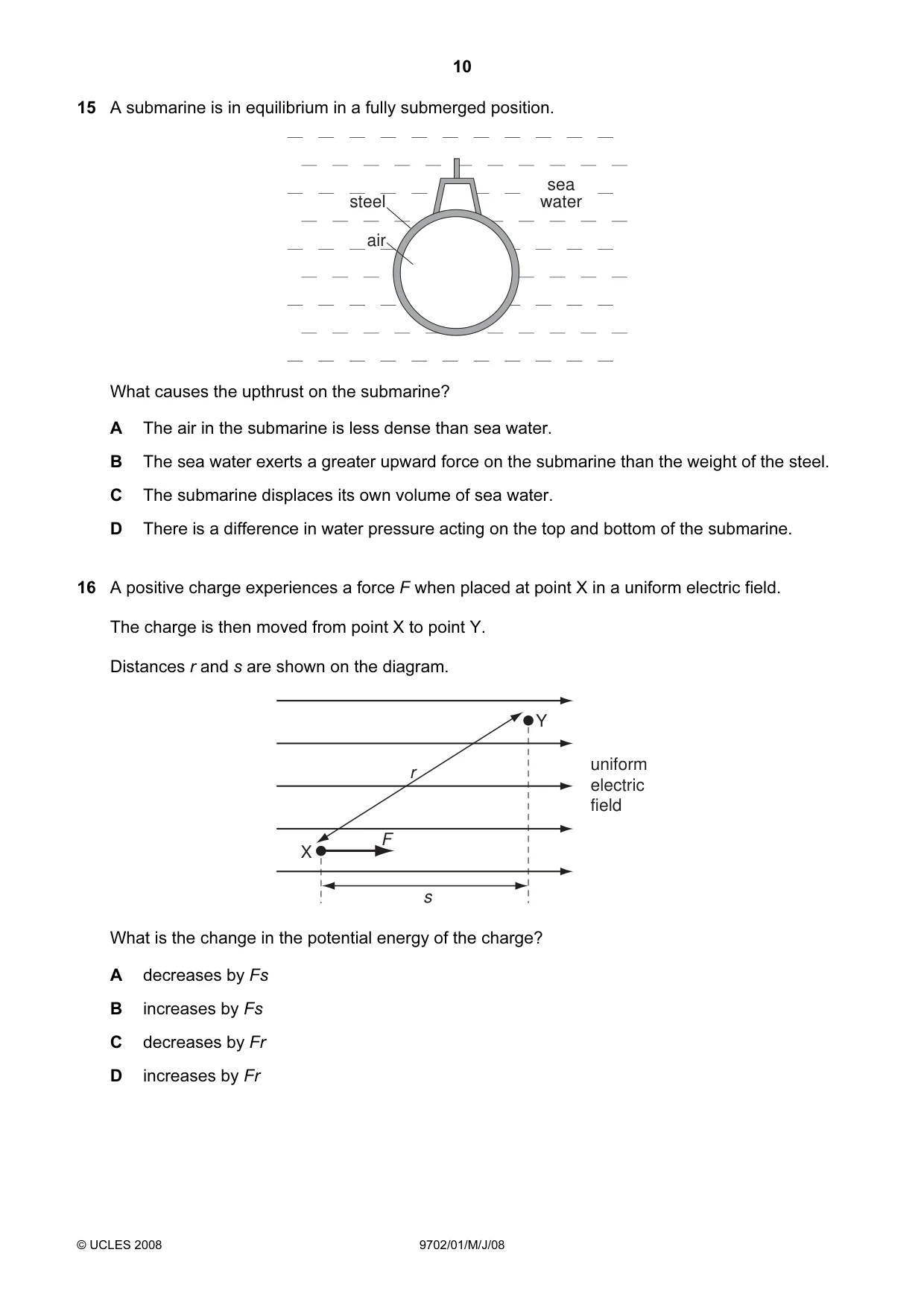
15 A submarine is in equilibrium in a fully submerged position. sea steel water air What causes the upthrust on the submarine? A The air in the submarine is less dense than sea water. B The sea water exerts a greater upward force on the submarine than the weight of the steel. C The submarine displaces its own volume of sea water. D There is a difference in water pressure acting on the top and bottom of the submarine.
Mark scheme: D
Q16 · A positive charge experiences a force F when placed at point X in a uniform electric field
16 A positive charge experiences a force F when placed at point X in a uniform electric field. The charge is then moved from point X to point Y. Distances r and s are shown on the diagram. Y r uniform electric field F X s What is the change in the potential energy of the charge? A decreases by Fs B increases by Fs C decreases by Fr D increases by Fr
Mark scheme: A
Q17 · Which quantities are conserved in an inelastic collision?
17 Which quantities are conserved in an inelastic collision? kinetic energy total energy linear momentum A conserved not conserved conserved B conserved not conserved not conserved C not conserved conserved conserved D not conserved conserved not conserved
Mark scheme: C
Q18 · A steel ball is falling at constant speed in oil
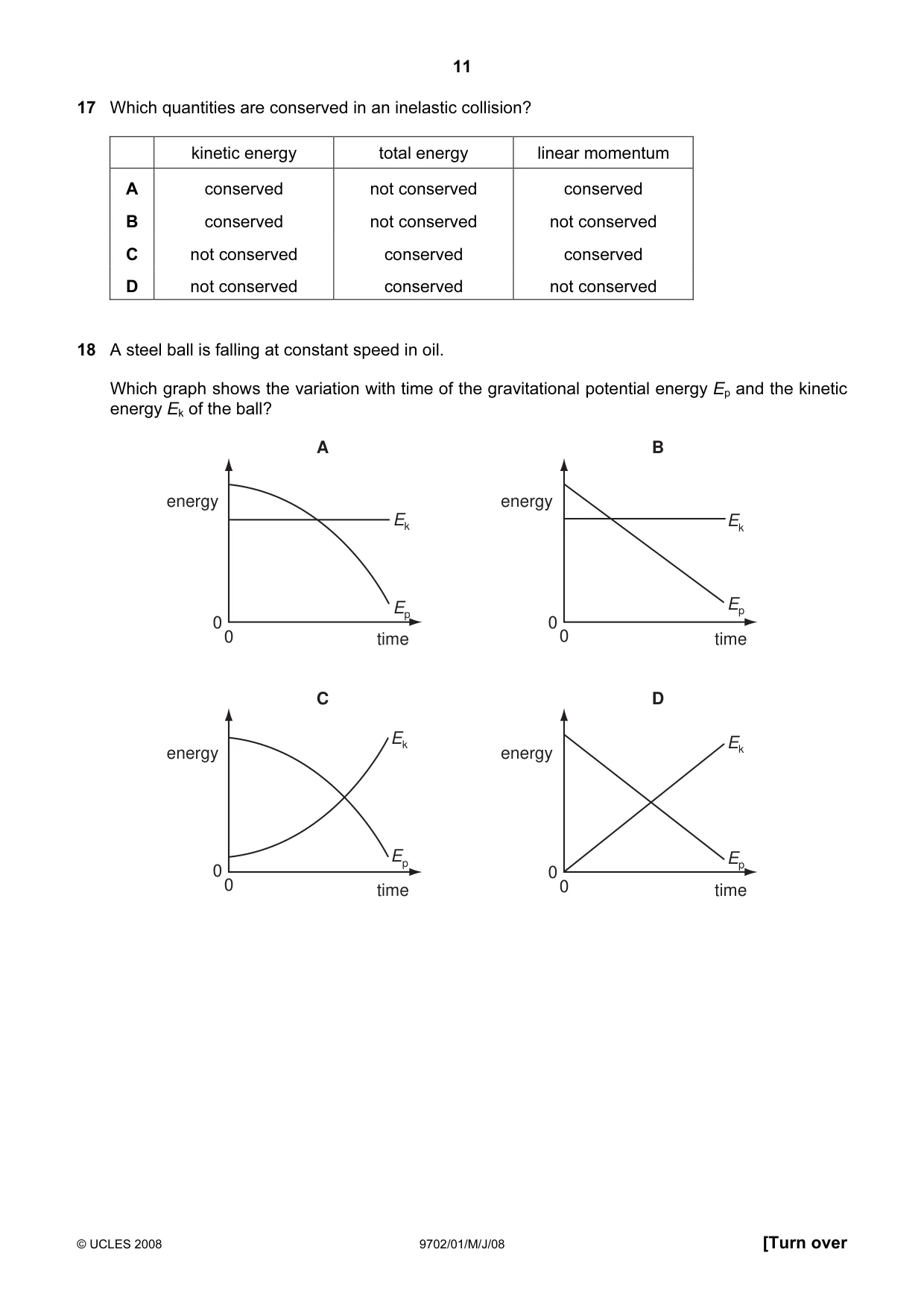
18 A steel ball is falling at constant speed in oil. Which graph shows the variation with time of the gravitational potential energy Ep and the kinetic energy Ek of the ball? A B energy energy Ek Ek Ep Ep 0 0 0 time 0 time C D Ek Ek energy energy Ep Ep 0 0 0 time 0 time
Mark scheme: B
More questions on Gravitational potential energy and kinetic energy
Q19 · The total energy input Ein in a process is partly transferred to useful energy output U…
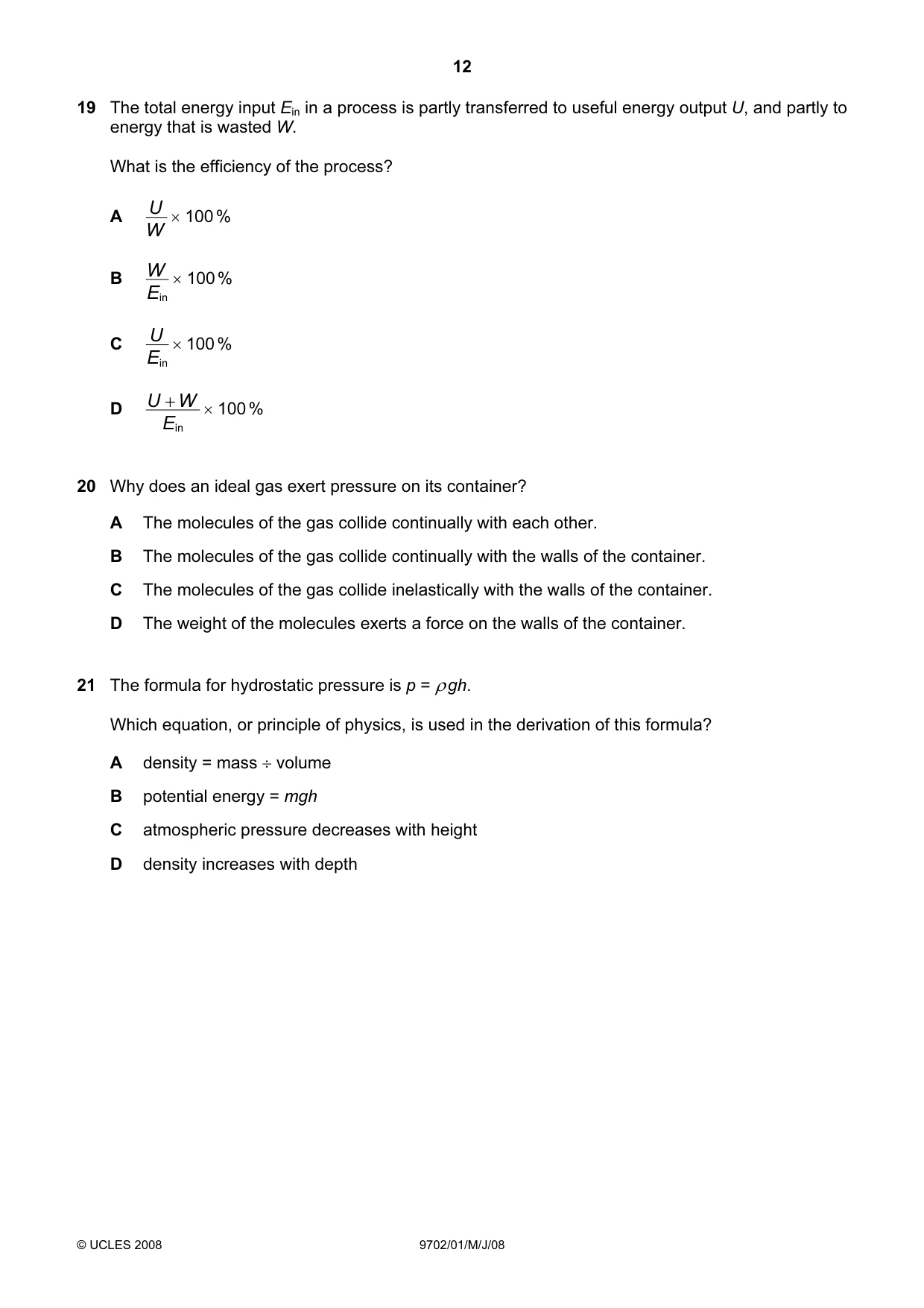
19 The total energy input Ein in a process is partly transferred to useful energy output U, and partly to energy that is wasted W. What is the efficiency of the process? U × 100 % A W W × 100 % B E in U × 100 % C E in U + W D × 100 % E in
Mark scheme: C
Q20 · Why does an ideal gas exert pressure on its container?
20 Why does an ideal gas exert pressure on its container? A The molecules of the gas collide continually with each other. B The molecules of the gas collide continually with the walls of the container. C The molecules of the gas collide inelastically with the walls of the container. D The weight of the molecules exerts a force on the walls of the container.
Mark scheme: B
Q21 · The formula for hydrostatic pressure is p = ρ gh
21 The formula for hydrostatic pressure is p = ρ gh. Which equation, or principle of physics, is used in the derivation of this formula? A density = mass ÷ volume B potential energy = mgh C atmospheric pressure decreases with height D density increases with depth
Mark scheme: A
Q22 · A sample of metal is subjected to a force which increases to a maximum value and then…
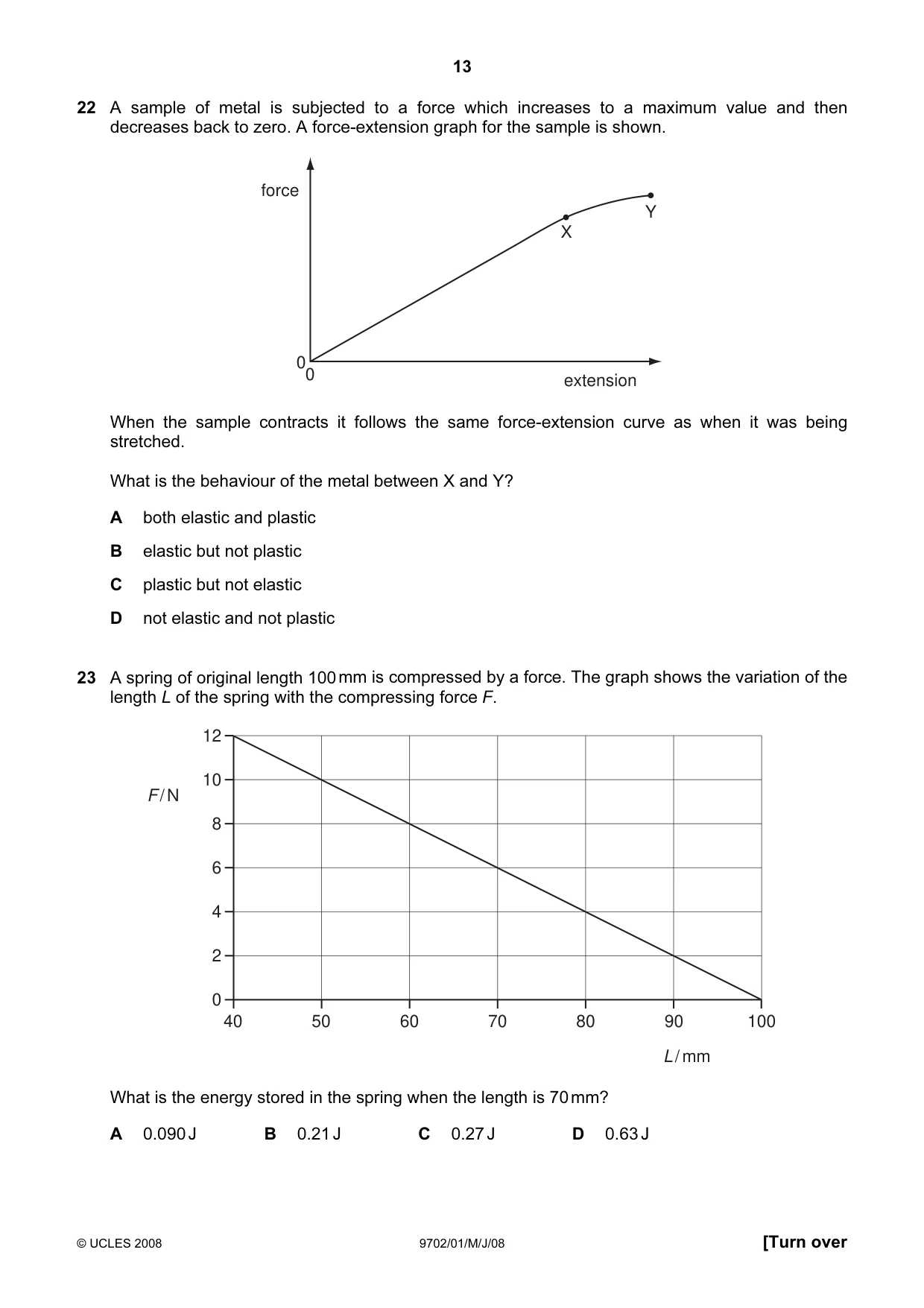
22 A sample of metal is subjected to a force which increases to a maximum value and then decreases back to zero. A force-extension graph for the sample is shown. force Y X 00 extension When the sample contracts it follows the same force-extension curve as when it was being stretched. What is the behaviour of the metal between X and Y? A both elastic and plastic B elastic but not plastic C plastic but not elastic D not elastic and not plastic
Mark scheme: B
Q23 · A spring of original length 100 mm is compressed by a force
23 A spring of original length 100 mm is compressed by a force. The graph shows the variation of the length L of the spring with the compressing force F. 12 10 F / N 8 6 4 2 0 40 50 60 70 80 90 100 L / mm What is the energy stored in the spring when the length is 70 mm? A 0.090 J B 0.21 J C 0.27 J D 0.63 J
Mark scheme: A
Q24 · The Young modulus of steel is determined using a length of steel wire and is found to…
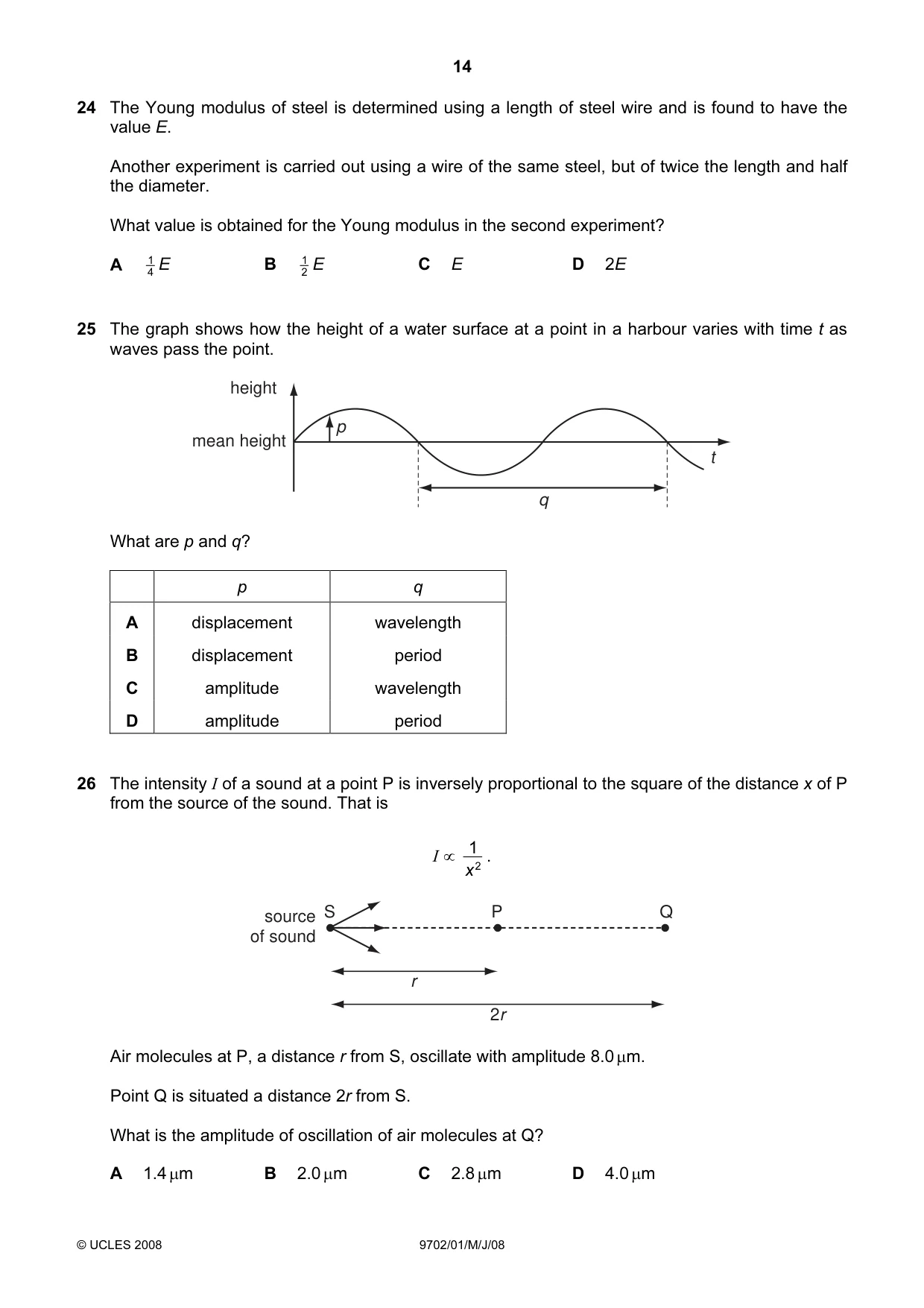
24 The Young modulus of steel is determined using a length of steel wire and is found to have the value E. Another experiment is carried out using a wire of the same steel, but of twice the length and half the diameter. What value is obtained for the Young modulus in the second experiment? A 1 E B 1 E C E D 2E 4 2
Mark scheme: C
Q25 · The graph shows how the height of a water surface at a point in a harbour varies with…
25 The graph shows how the height of a water surface at a point in a harbour varies with time t as waves pass the point. height p mean height t q What are p and q? p q A displacement wavelength B displacement period C amplitude wavelength D amplitude period
Mark scheme: B
Q26 · The intensity I of a sound at a point P is inversely proportional to the square of the…
26 The intensity I of a sound at a point P is inversely proportional to the square of the distance x of P from the source of the sound. That is 1 I ∝ . x 2 source S P Q of sound r 2r Air molecules at P, a distance r from S, oscillate with amplitude 8.0 µm. Point Q is situated a distance 2r from S. What is the amplitude of oscillation of air molecules at Q? A 1.4 µm B 2.0 µm C 2.8 µm D 4.0 µm
Mark scheme: D
Q27 · Sound waves, emitted by a small loudspeaker, are reflected by a wall
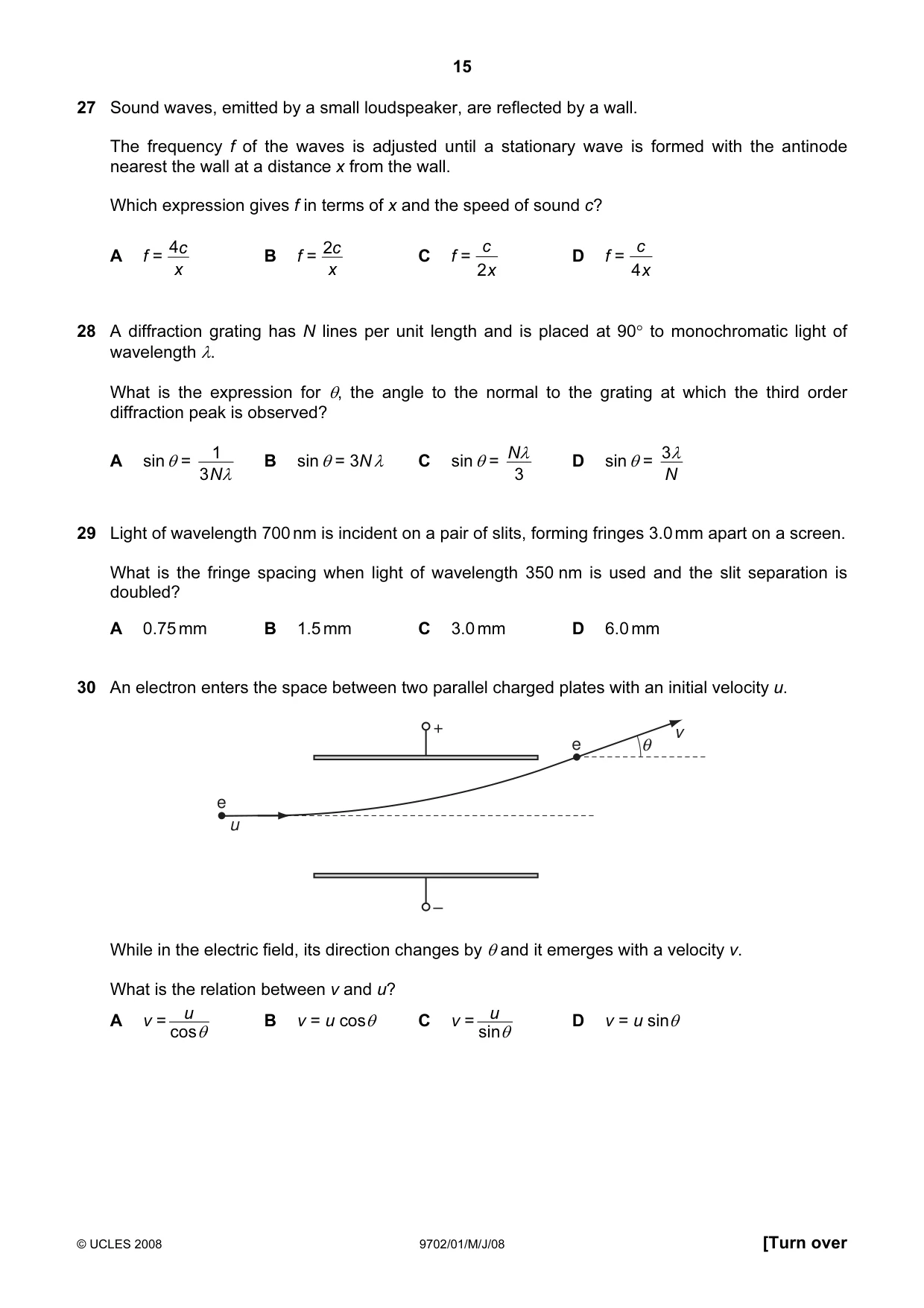
27 Sound waves, emitted by a small loudspeaker, are reflected by a wall. The frequency f of the waves is adjusted until a stationary wave is formed with the antinode nearest the wall at a distance x from the wall. Which expression gives f in terms of x and the speed of sound c? 4 c 2 c c c A f = x B f = x C f = D f = 2 x 4 x
Mark scheme: D
Q28 · A diffraction grating has N lines per unit length and is placed at 90° to monochromatic…
28 A diffraction grating has N lines per unit length and is placed at 90° to monochromatic light of wavelength λ. What is the expression for θ, the angle to the normal to the grating at which the third order diffraction peak is observed? 1 N λ 3 λ A sin θ = B sin θ = 3N λ C sin θ = 3 D sin θ = N 3 N λ
Mark scheme: B
Q29 · Light of wavelength 700 nm is incident on a pair of slits, forming fringes 3.0 mm apart…
29 Light of wavelength 700 nm is incident on a pair of slits, forming fringes 3.0 mm apart on a screen. What is the fringe spacing when light of wavelength 350 nm is used and the slit separation is doubled? A 0.75 mm B 1.5 mm C 3.0 mm D 6.0 mm
Mark scheme: A
Q30 · An electron enters the space between two parallel charged plates with an initial velocity…
30 An electron enters the space between two parallel charged plates with an initial velocity u. + v e θ e u – While in the electric field, its direction changes by θ and it emerges with a velocity v. What is the relation between v and u? A v = u B v = u cosθ C v = u D v = u sinθ cos θ sin θ
Mark scheme: A
Q31 · The diagram shows an oil droplet that has become charged by gaining five electrons
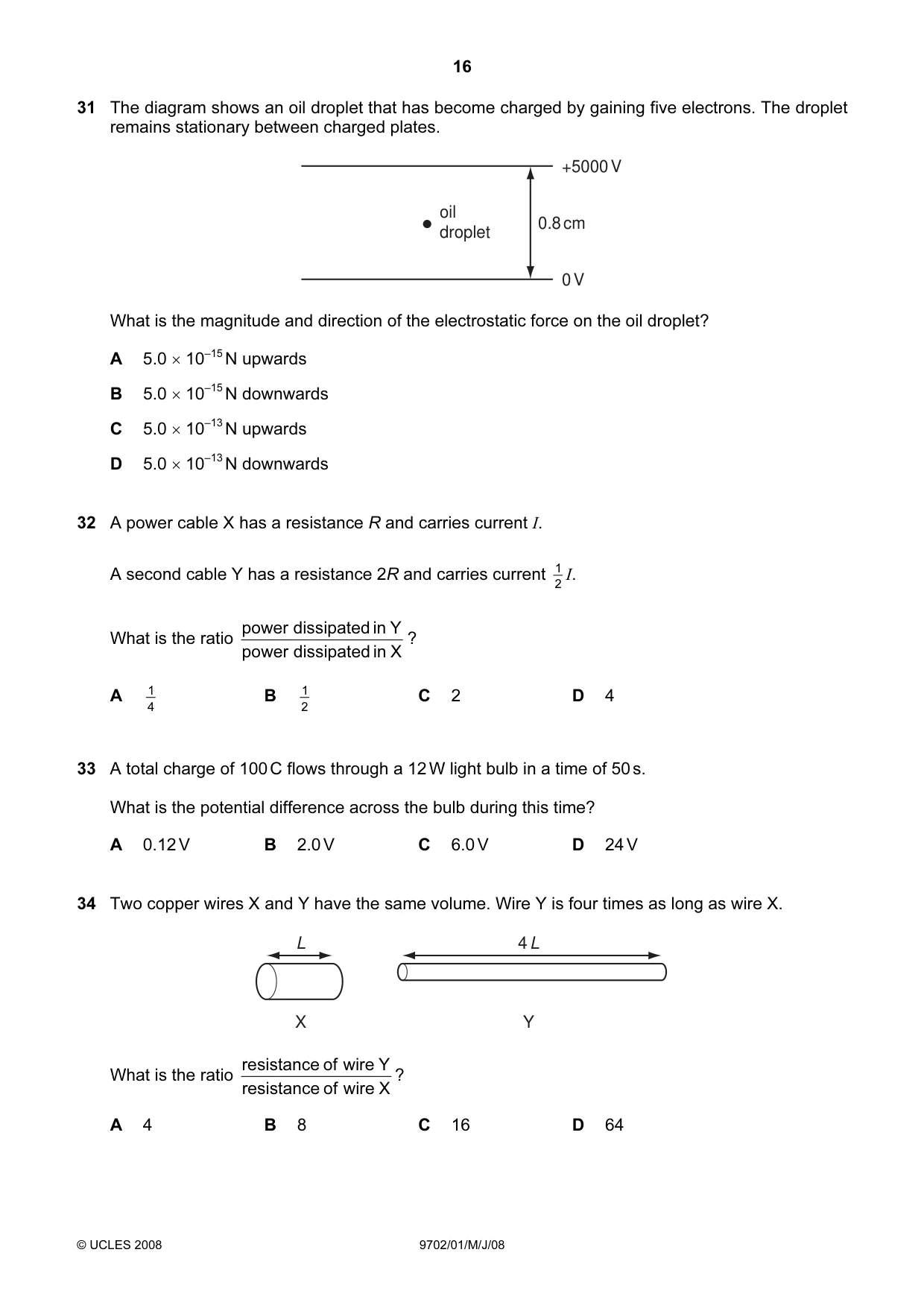
31 The diagram shows an oil droplet that has become charged by gaining five electrons. The droplet remains stationary between charged plates. +5000 V oil 0.8 cm droplet 0 V What is the magnitude and direction of the electrostatic force on the oil droplet? A 5.0 × 10⁻¹⁵ N upwards B 5.0 × 10⁻¹⁵ N downwards C 5.0 × 10⁻¹³ N upwards D 5.0 × 10⁻¹³ N downwards
Mark scheme: C
Q32 · A power cable X has a resistance R and carries current I
32 A power cable X has a resistance R and carries current I. A second cable Y has a resistance 2R and carries current 2 1 I. power dissipated in Y What is the ratio ? power dissipated in X A 1 B 1 C 2 D 4 4 2
Mark scheme: B
Q33 · A total charge of 100 C flows through a 12 W light bulb in a time of 50 s
33 A total charge of 100 C flows through a 12 W light bulb in a time of 50 s. What is the potential difference across the bulb during this time? A 0.12 V B 2.0 V C 6.0 V D 24 V
Mark scheme: C
Q34 · Two copper wires X and Y have the same volume
34 Two copper wires X and Y have the same volume. Wire Y is four times as long as wire X. L 4 L X Y resistance of wire Y What is the ratio ? resistance of wire X A 4 B 8 C 16 D 64
Mark scheme: C
Q35 · The potential difference across a resistor is 12 V
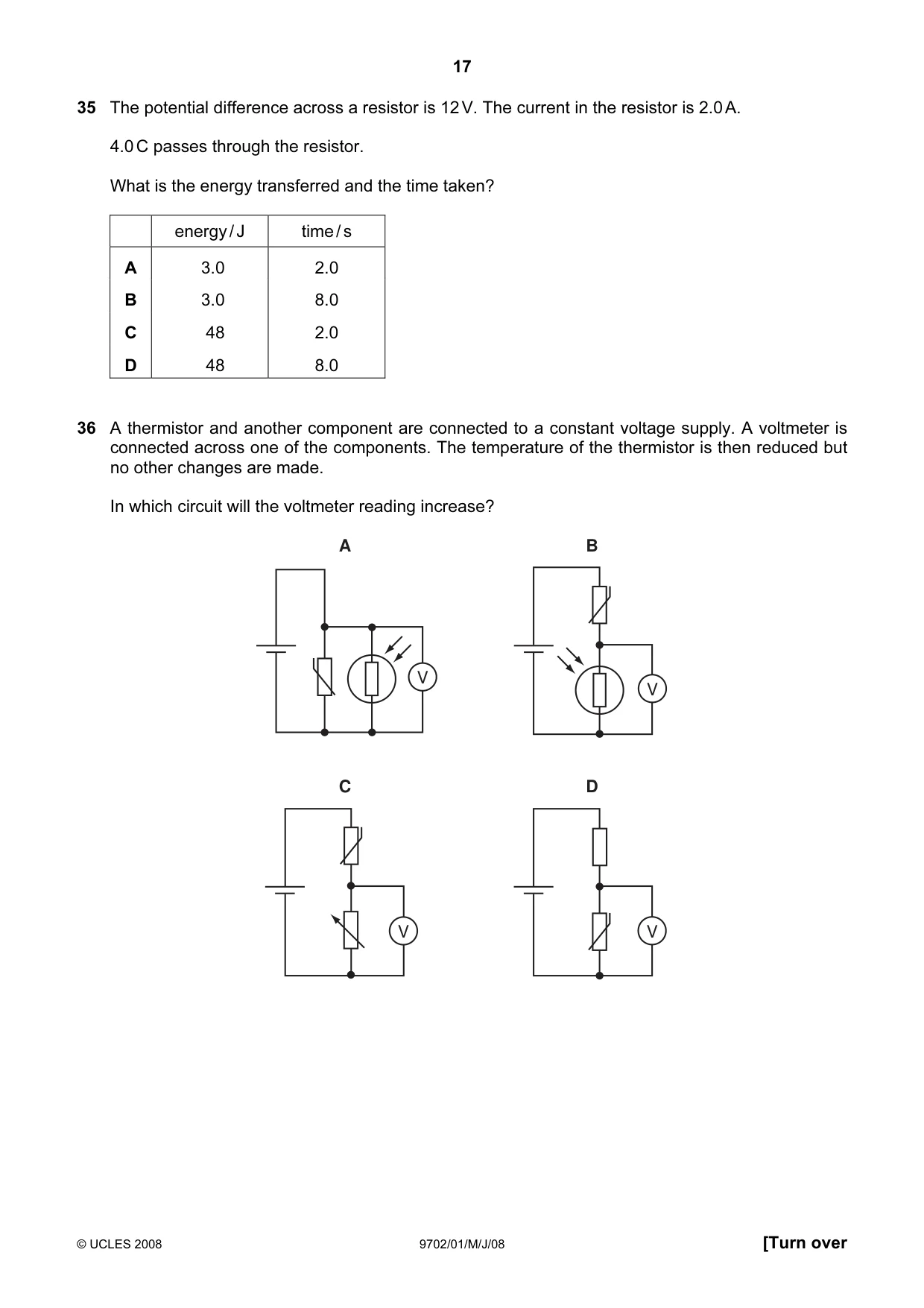
35 The potential difference across a resistor is 12 V. The current in the resistor is 2.0 A. 4.0 C passes through the resistor. What is the energy transferred and the time taken? energy / J time / s A 3.0 2.0 B 3.0 8.0 C 48 2.0 D 48 8.0
Mark scheme: C
Q36 · A thermistor and another component are connected to a constant voltage supply
36 A thermistor and another component are connected to a constant voltage supply. A voltmeter is connected across one of the components. The temperature of the thermistor is then reduced but no other changes are made. In which circuit will the voltmeter reading increase? A B V V C D V V
Mark scheme: D
Q37 · In the circuit shown, the 6.0 V battery has negligible internal resistance
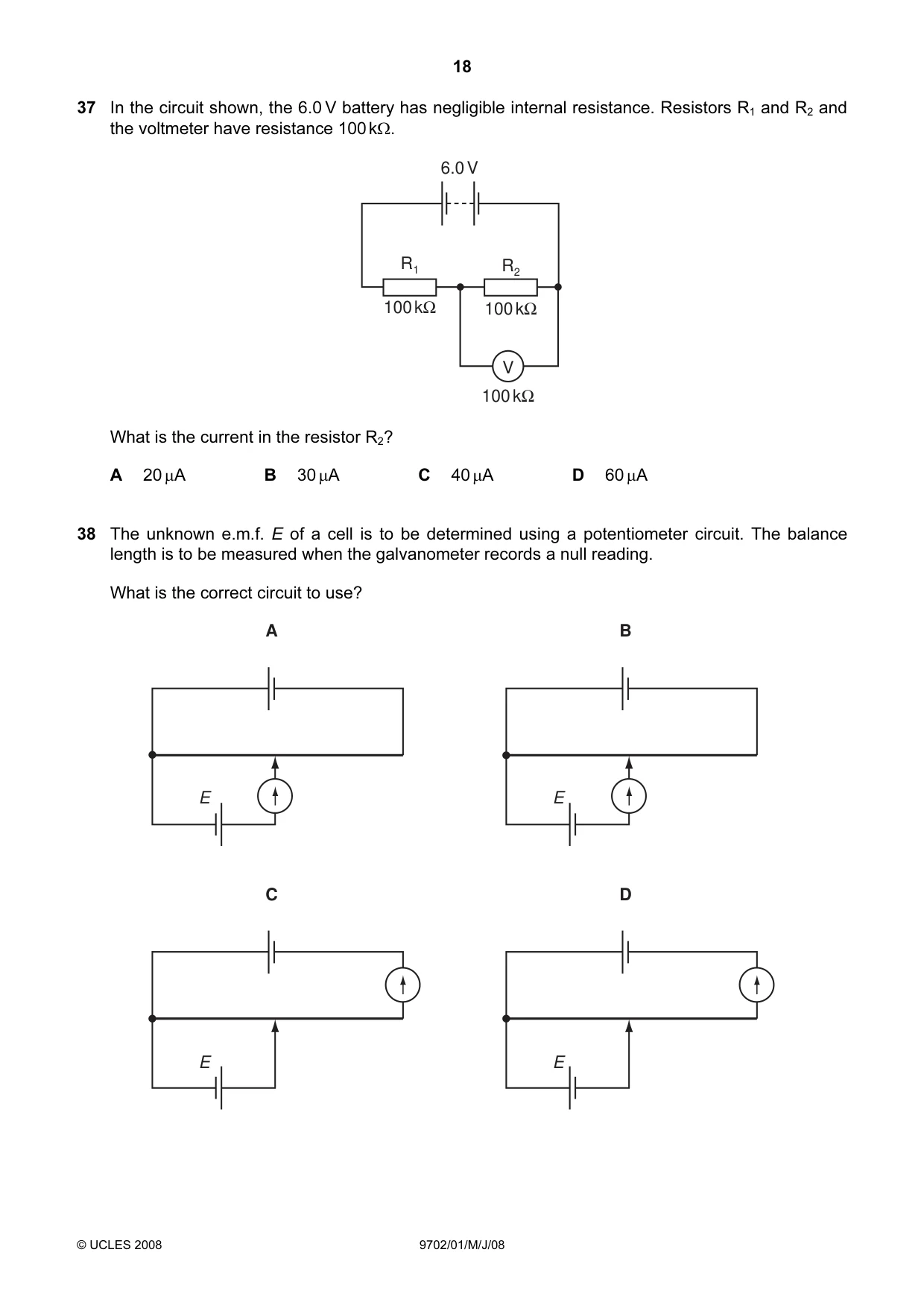
37 In the circuit shown, the 6.0 V battery has negligible internal resistance. Resistors R1 and R2 and the voltmeter have resistance 100 kΩ. 6.0 V R1 R2 100 kΩ 100 kΩ V 100 kΩ What is the current in the resistor R2? A 20 µA B 30 µA C 40 µA D 60 µA
Mark scheme: A
Question 38
38 The unknown e.m.f. E of a cell is to be determined using a potentiometer circuit. The balance length is to be measured when the galvanometer records a null reading. What is the correct circuit to use? A B E E C D E E
Mark scheme: B
Q39 · What is the approximate mass of a nucleus of uranium?
39 What is the approximate mass of a nucleus of uranium? A 10–15 kg B 10–20 kg C 10–25 kg D 10–30 kg
Mark scheme: C
Q40 · A radioactive nucleus is formed by β-decay
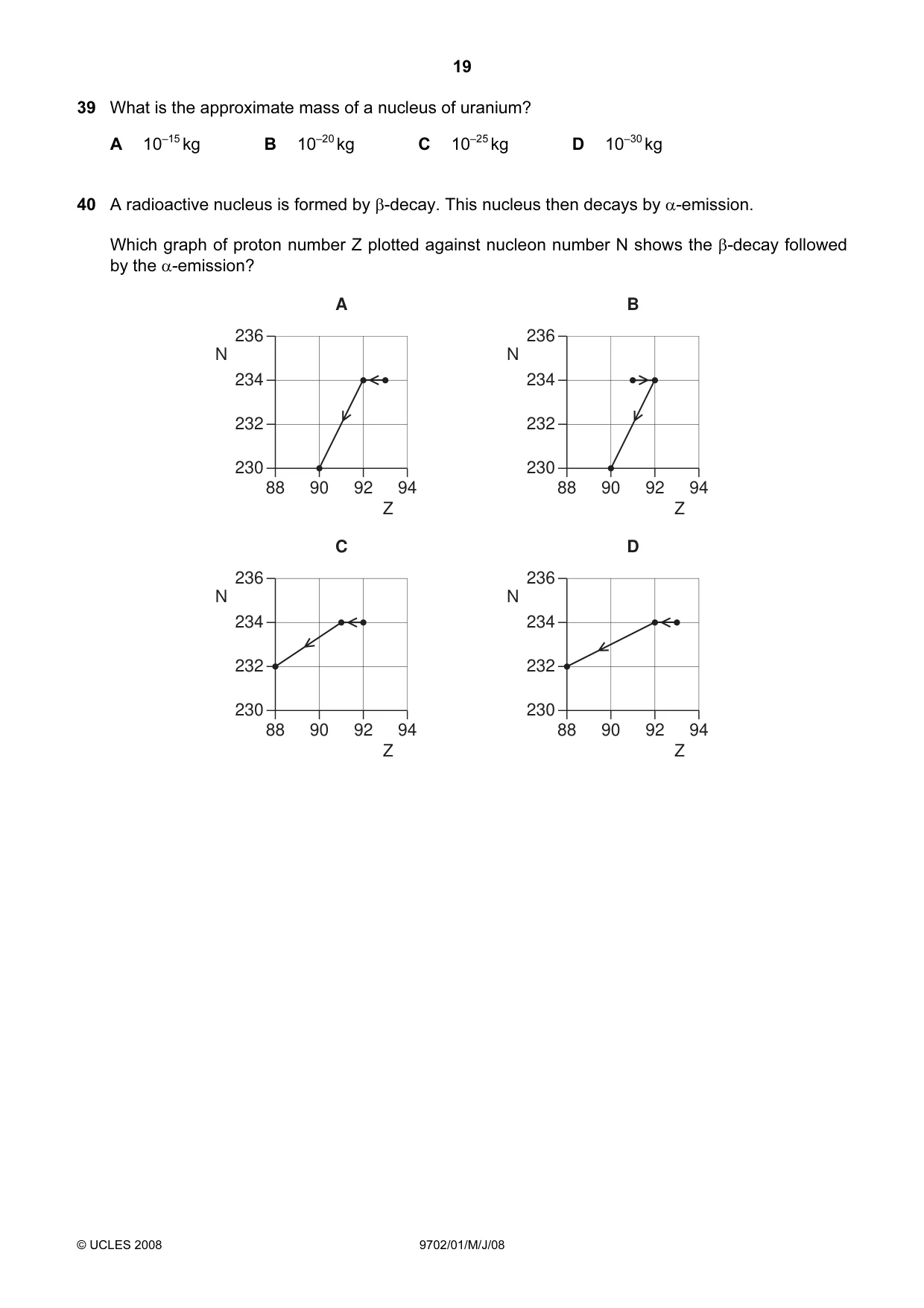
40 A radioactive nucleus is formed by β-decay. This nucleus then decays by α-emission. Which graph of proton number Z plotted against nucleon number N shows the β-decay followed by the α-emission? A B 236 236 N N 234 234 232 232 230 230 88 90 92 94 88 90 92 94 Z Z C D 236 236 N N 234 234 232 232 230 230 88 90 92 94 88 90 92 94 Z Z
Mark scheme: B
What was in this paper
The subtopics covered by these 40 questions, and how many questions each got. Open one in a new tab to see every Cambridge question on it.
3Potential difference and power3Uniform electric fields3Density and pressure2Elastic and plastic behaviour2Equilibrium of forces2Errors and uncertainties2Physical quantities2Potential dividers2Progressive waves2Atoms, nuclei and radiation1Centripetal acceleration1Energy conservation1Gravitational force between point masses1Gravitational potential energy and kinetic energy1Interference1Kinetic theory of gases1Momentum and Newton’s laws of motion1Non-uniform motion1Practical circuits1Radioactive decay1Resistance and resistivity1SI units1Stationary waves1Stress and strain1The diffraction grating1Turning effects of forces1What you needed in this session
Cambridge’s own grade thresholds for 2008 May/June, Paper 1 · Variant 1. A higher threshold means an easier paper — the bar moves with how the cohort did.