Cambridge A Level Physics 9702 — 2021 Oct/Nov Paper 1 · Variant 1
9702/11/O/N/21 · 40 questions · 40 marks · ≈45 min
The question paper and its mark scheme, free to read here and free to download. This is Cambridge’s own paper, exactly as it was sat.
Question paper20 pages

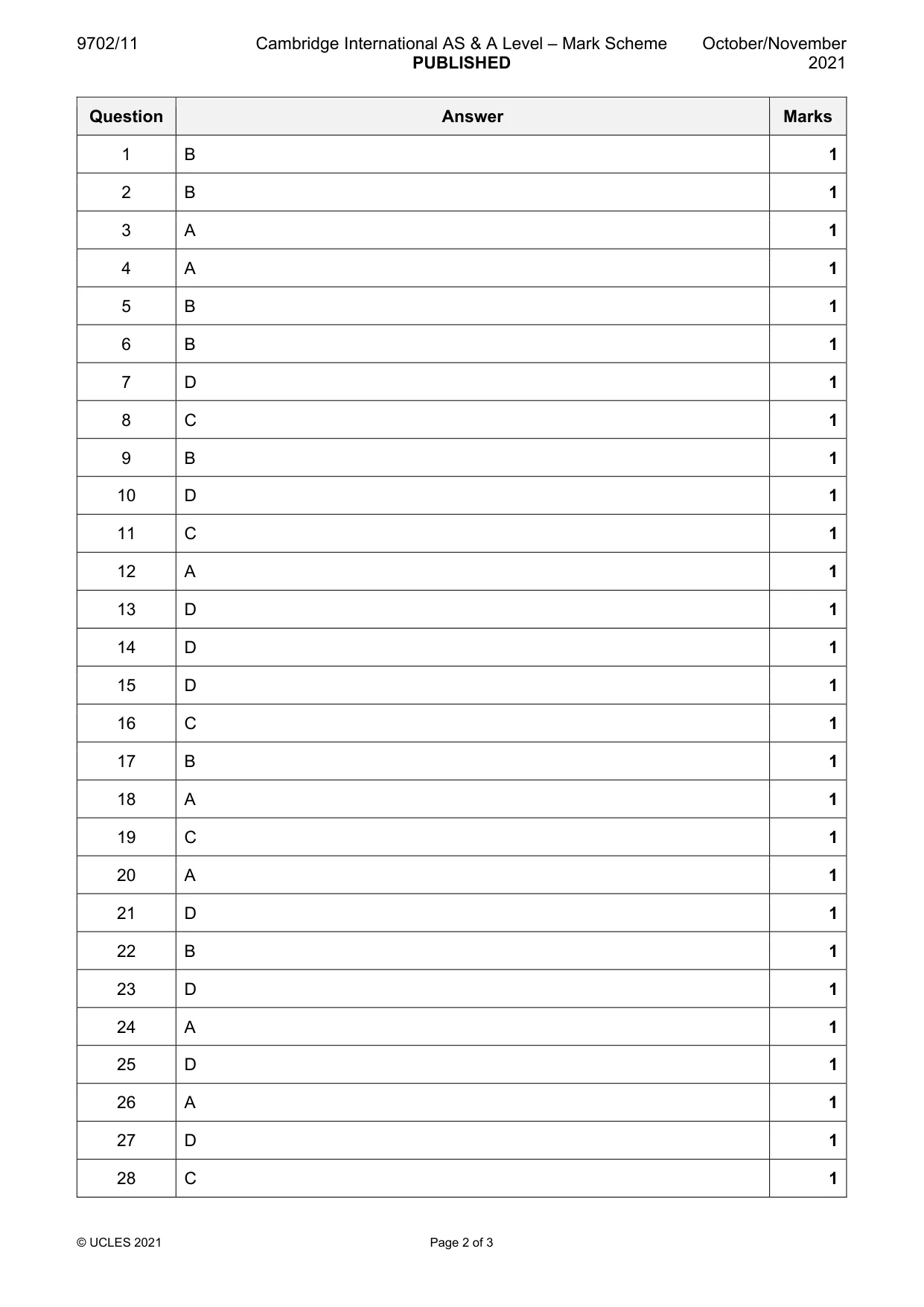
Mark scheme3 pages
Answers below. Sit the paper first if you are practising.
Questions as text
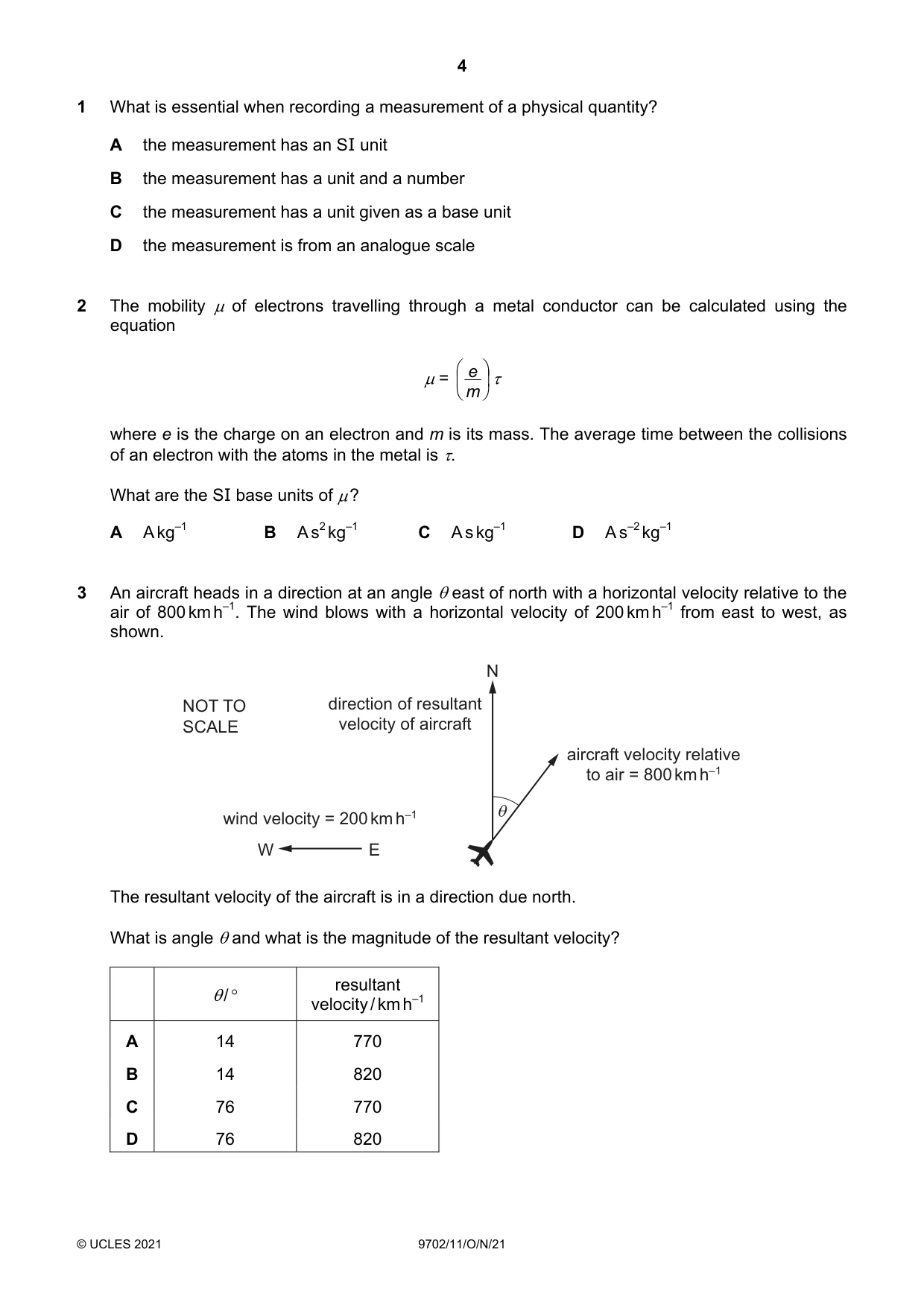
Q1 · What is essential when recording a measurement of a physical quantity?
1 What is essential when recording a measurement of a physical quantity? A the measurement has an SI unit B the measurement has a unit and a number C the measurement has a unit given as a base unit D the measurement is from an analogue scale
Mark scheme: B
Q2 · The mobility of electrons travelling through a metal conductor can be calculated using…
2 The mobility of electrons travelling through a metal conductor can be calculated using the equation e = m where e is the charge on an electron and m is its mass. The average time between the collisions of an electron with the atoms in the metal is . What are the SI base units of ? A A kg–1 B A s2 kg–1 C A s kg–1 D A s–2 kg–1
Mark scheme: B
Q3 · An aircraft heads in a direction at an angle @ east of north with a horizontal velocity…
3. An aircraft heads in a direction at an angle @ east of north with a horizontal velocity relative to the air of 800kmh“‘. The wind blows with a horizontal velocity of 200kmh™ from east to west, as shown. N NOT TO direction of resultant SCALE velocity of aircraft aircraft velocity relative to air = 800kmh" wind velocity = 200 kmh“ iy WwW —+——E The resultant velocity of the aircraft is in a direction due north. What is angle @and what is the magnitude of the resultant velocity? gle resultant | velocity/kmh 14 770 14 820 76 770 76 820
Mark scheme: A
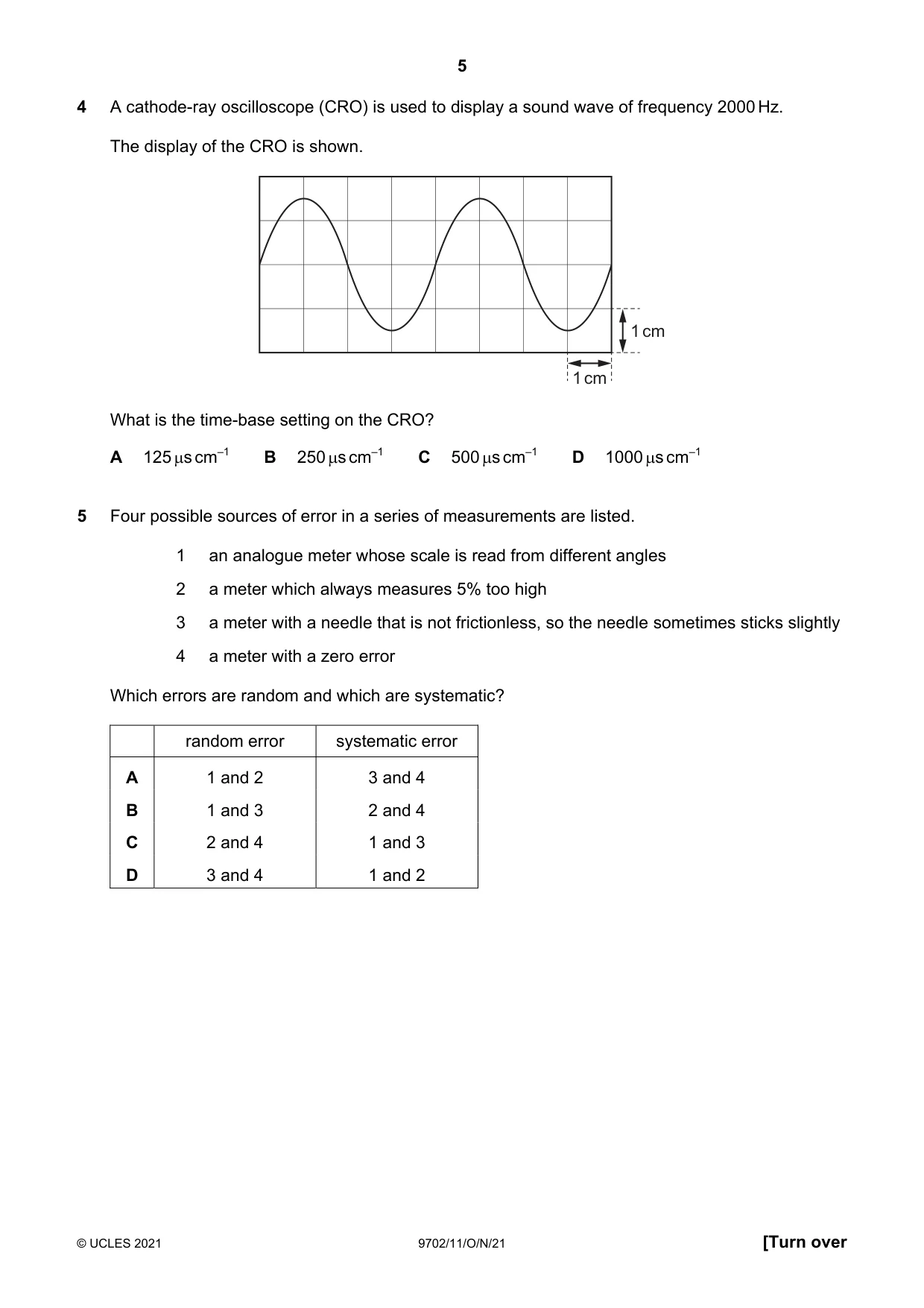
Q4 · A cathode-ray oscilloscope (CRO) is used to display a sound wave of frequency 2000 Hz
4 A cathode-ray oscilloscope (CRO) is used to display a sound wave of frequency 2000 Hz. The display of the CRO is shown. 1 cm 1 cm What is the time-base setting on the CRO? A 125 s cm–1 B 250 s cm–1 C 500 s cm–1 D 1000 s cm–1
Mark scheme: A
Q5 · Four possible sources of error in a series of measurements are listed
5 Four possible sources of error in a series of measurements are listed. 1 an analogue meter whose scale is read from different angles 2 a meter which always measures 5% too high 3 a meter with a needle that is not frictionless, so the needle sometimes sticks slightly 4 a meter with a zero error Which errors are random and which are systematic? random error systematic error A 1 and 2 3 and 4 B 1 and 3 2 and 4 C 2 and 4 1 and 3 D 3 and 4 1 and 2
Mark scheme: B
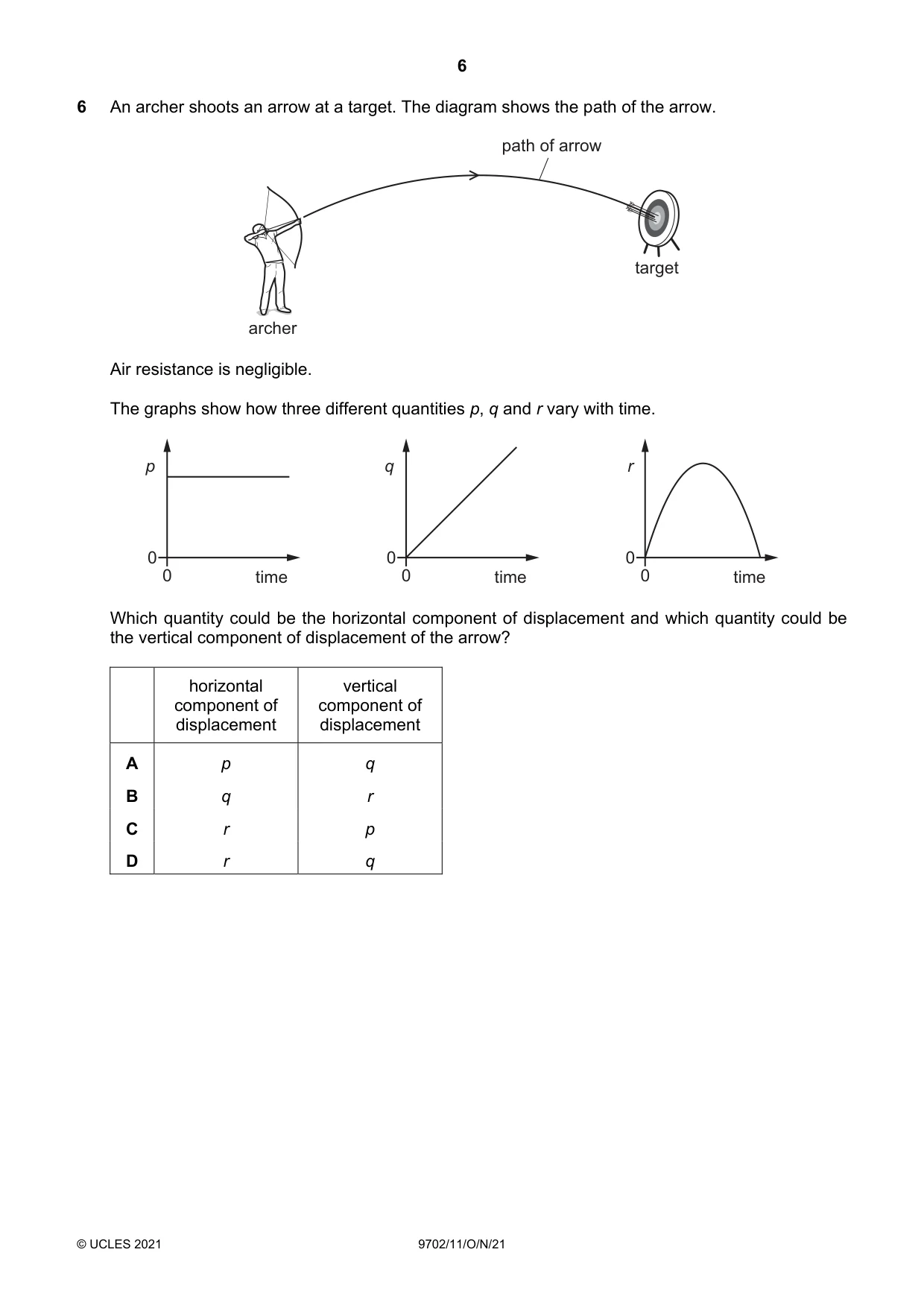
Q6 · An archer shoots an arrow at a target
6 An archer shoots an arrow at a target. The diagram shows the path of the arrow. path of arrow target archer Air resistance is negligible. The graphs show how three different quantities p, q and r vary with time. p q r 0 0 0 0 time 0 time 0 time Which quantity could be the horizontal component of displacement and which quantity could be the vertical component of displacement of the arrow? horizontal vertical component of component of displacement displacement A p q B q r C r p D r q
Mark scheme: B
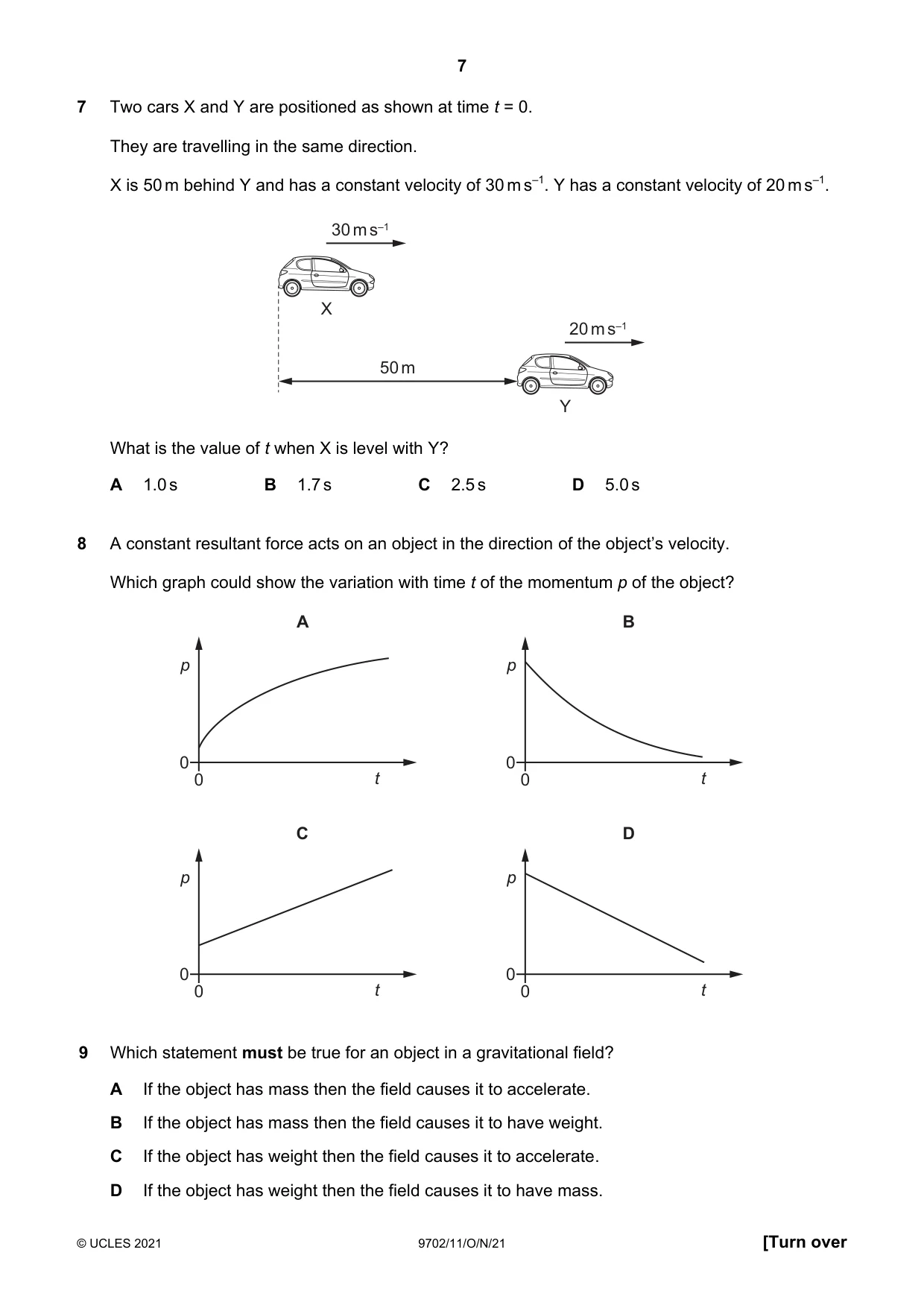
Q7 · Two cars X and Y are positioned as shown at time t = 0
7 Two cars X and Y are positioned as shown at time t = 0. They are travelling in the same direction. X is 50 m behind Y and has a constant velocity of 30 m s–1. Y has a constant velocity of 20 m s–1. 30 m s–1 X 20 m s–1 50 m Y What is the value of t when X is level with Y? A 1.0 s B 1.7 s C 2.5 s D 5.0 s
Mark scheme: D
Q8 · A constant resultant force acts on an object in the direction of the object’s velocity
8 A constant resultant force acts on an object in the direction of the object’s velocity. Which graph could show the variation with time t of the momentum p of the object? A B p p 0 0 0 t 0 t C D p p 0 0 0 t 0 t
Mark scheme: C
Q9 · Which statement must be true for an object in a gravitational field?
9 Which statement must be true for an object in a gravitational field? A If the object has mass then the field causes it to accelerate. B If the object has mass then the field causes it to have weight. C If the object has weight then the field causes it to accelerate. D If the object has weight then the field causes it to have mass.
Mark scheme: B
Q10 · A ball of mass 0.16 kg is travelling horizontally at a speed of 20 m s–1
10 A ball of mass 0.16 kg is travelling horizontally at a speed of 20 m s–1. It collides with a wall and rebounds with a speed of 15 m s–1 along its original path. The ball is in contact with the wall for a time of 1.0 ms. What is the average force exerted by the wall on the ball? A 800 N B 2400 N C 3200 N D 5600 N
Mark scheme: D
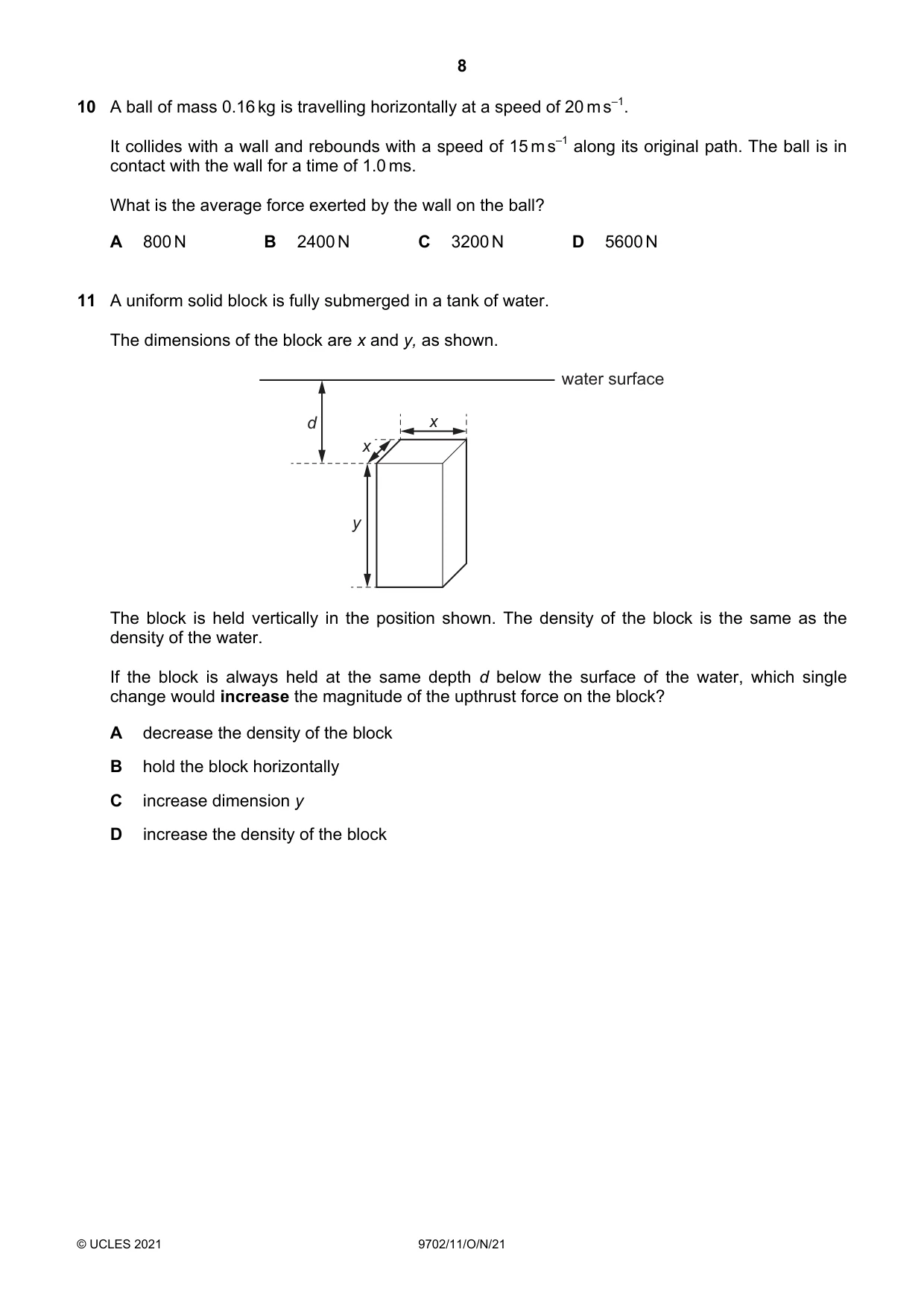
Q11 · A uniform solid block is fully submerged in a tank of water
11 A uniform solid block is fully submerged in a tank of water. The dimensions of the block are x and y, as shown. water surface d x x y The block is held vertically in the position shown. The density of the block is the same as the density of the water. If the block is always held at the same depth d below the surface of the water, which single change would increase the magnitude of the upthrust force on the block? A decrease the density of the block B hold the block horizontally C increase dimension y D increase the density of the block
Mark scheme: C
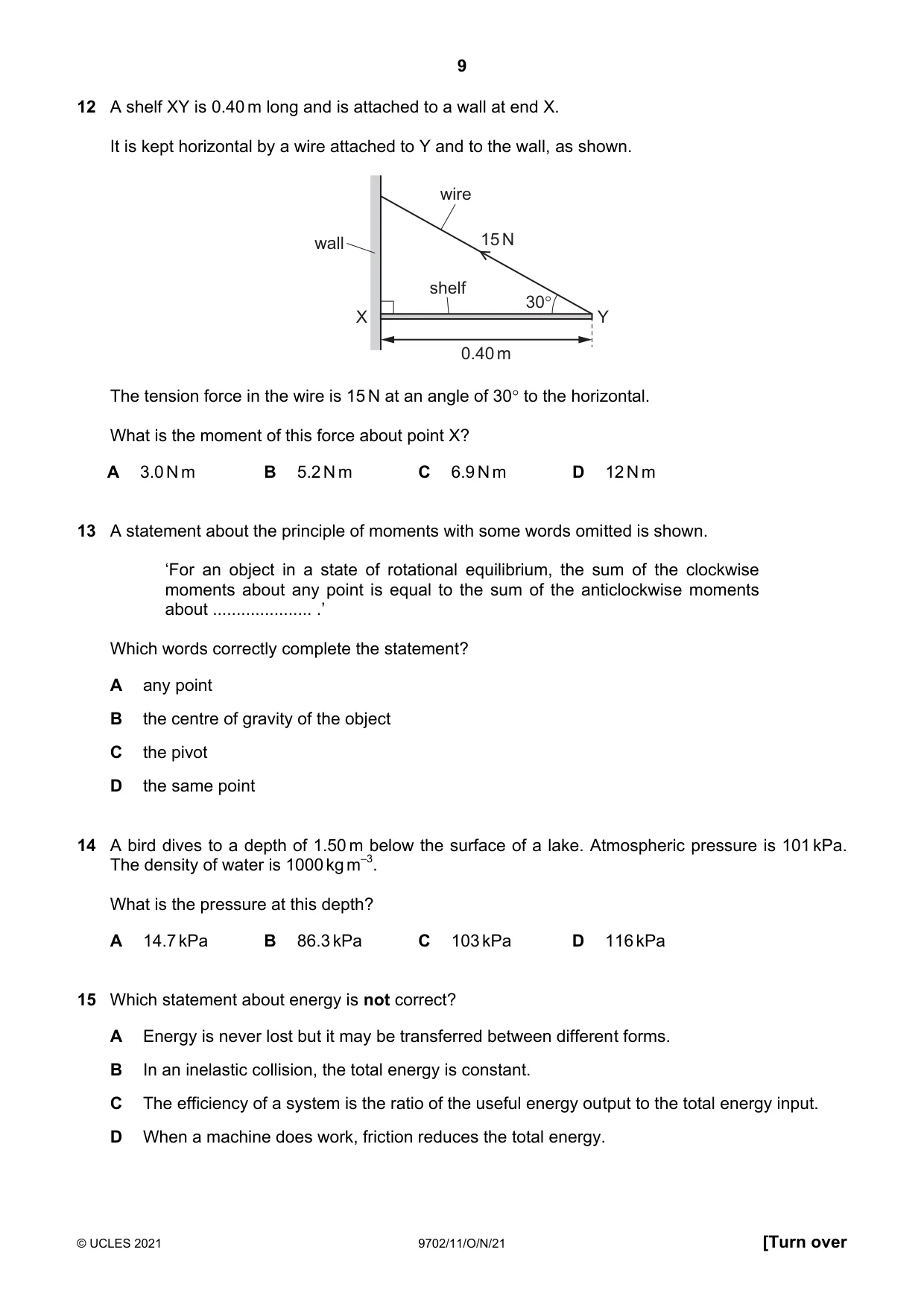
Q12 · Ashelf XY is 0.40 m long and is attached to a wall at end X
12 Ashelf XY is 0.40 m long and is attached to a wall at end X. It is kept horizontal by a wire attached to Y and to the wall, as shown. 0.40m The tension force in the wire is 15N at an angle of 30° to the horizontal. What is the moment of this force about point X? A 3.0Nm B 5.2Nm C 69Nm D 12Nm
Mark scheme: A
Q13 · A statement about the principle of moments with some words omitted is shown
13 A statement about the principle of moments with some words omitted is shown. ‘For an object in a state of rotational equilibrium, the sum of the clockwise moments about any point is equal to the sum of the anticlockwise moments about ..................... .’ Which words correctly complete the statement? A any point B the centre of gravity of the object C the pivot D the same point
Mark scheme: D
Q14 · A bird dives to a depth of 1.50 m below the surface of a lake
14 A bird dives to a depth of 1.50 m below the surface of a lake. Atmospheric pressure is 101 kPa. The density of water is 1000 kg m–3. What is the pressure at this depth? A 14.7 kPa B 86.3 kPa C 103 kPa D 116 kPa
Mark scheme: D
Q15 · Which statement about energy is not correct?
15 Which statement about energy is not correct? A Energy is never lost but it may be transferred between different forms. B In an inelastic collision, the total energy is constant. C The efficiency of a system is the ratio of the useful energy output to the total energy input. D When a machine does work, friction reduces the total energy.
Mark scheme: D
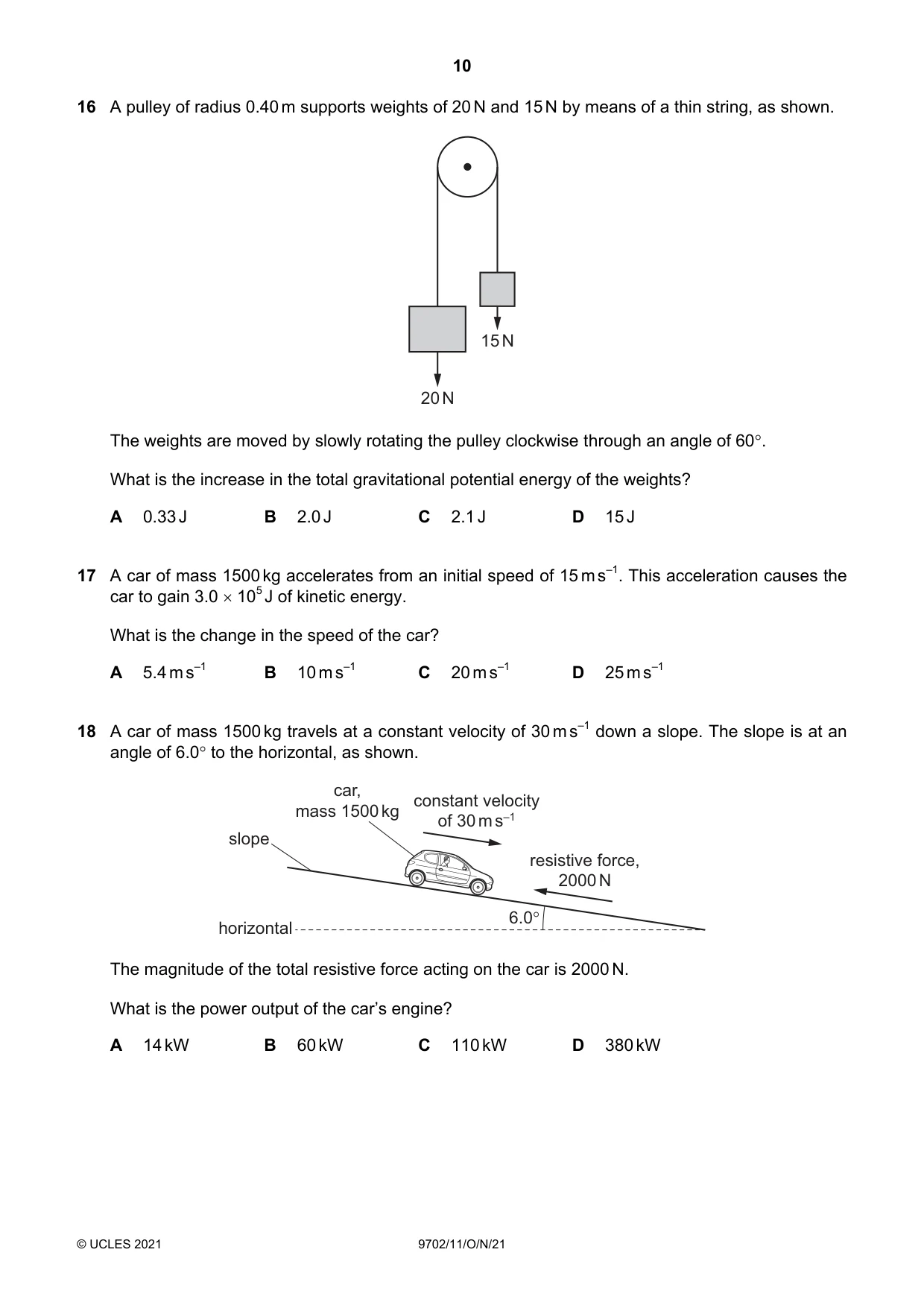
Q16 · A pulley of radius 0.40 m supports weights of 20 N and 15 N by means of a thin string, as…
16 A pulley of radius 0.40 m supports weights of 20 N and 15 N by means of a thin string, as shown. 15 N 20 N The weights are moved by slowly rotating the pulley clockwise through an angle of 60. What is the increase in the total gravitational potential energy of the weights? A 0.33 J B 2.0 J C 2.1 J D 15 J
Mark scheme: C
More questions on Gravitational potential energy and kinetic energy
Q17 · A car of mass 1500 kg accelerates from an initial speed of 15 m s–1
17 A car of mass 1500 kg accelerates from an initial speed of 15 m s–1. This acceleration causes the car to gain 3.0 105 J of kinetic energy. What is the change in the speed of the car? A 5.4 m s–1 B 10 m s–1 C 20 m s–1 D 25 m s–1
Mark scheme: B
More questions on Gravitational potential energy and kinetic energy
Q18 · Acar of mass 1500kg travels at a constant velocity of 30 ms” down a slope
18 Acar of mass 1500kg travels at a constant velocity of 30 ms” down a slope. The slope is at an angle of 6.0° to the horizontal, as shown. Car, mass 1500 kg constant velocity of 30ms" slope resistive force, 2000N horizontal --------------------------------1---------------==== The magnitude of the total resistive force acting on the car is 2000 N. What is the power output of the car’s engine? A 14kW B 60kW C 110kW D 380kW
Mark scheme: A
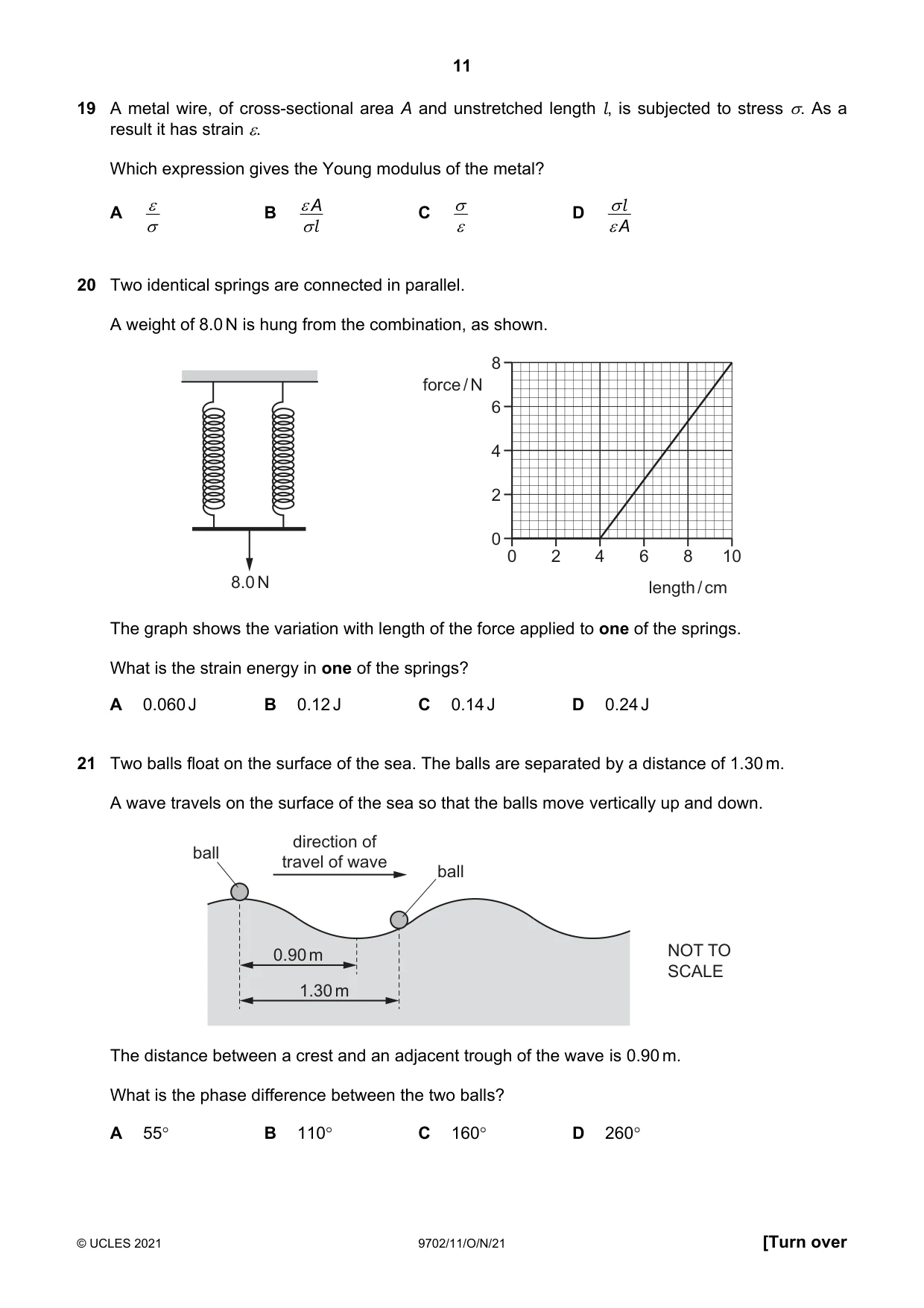
Q19 · A metal wire, of cross-sectional area A and unstretched length l, is subjected to stress
19 A metal wire, of cross-sectional area A and unstretched length l, is subjected to stress . As a result it has strain . Which expression gives the Young modulus of the metal? A l A B l C D A
Mark scheme: C
Q20 · Two identical springs are connected in parallel
20 Two identical springs are connected in parallel. A weight of 8.0 N is hung from the combination, as shown. 8 force / N 6 4 2 0 0 2 4 6 8 10 8.0 N length / cm The graph shows the variation with length of the force applied to one of the springs. What is the strain energy in one of the springs? A 0.060 J B 0.12 J C 0.14 J D 0.24 J
Mark scheme: A
Q21 · Two balls float on the surface of the sea
21 Two balls float on the surface of the sea. The balls are separated by a distance of 1.30 m. A wave travels on the surface of the sea so that the balls move vertically up and down. direction of ball travel of wave ball 0.90 m NOT TO SCALE 1.30 m The distance between a crest and an adjacent trough of the wave is 0.90 m. What is the phase difference between the two balls? A 55 B 110 C 160 D 260
Mark scheme: D
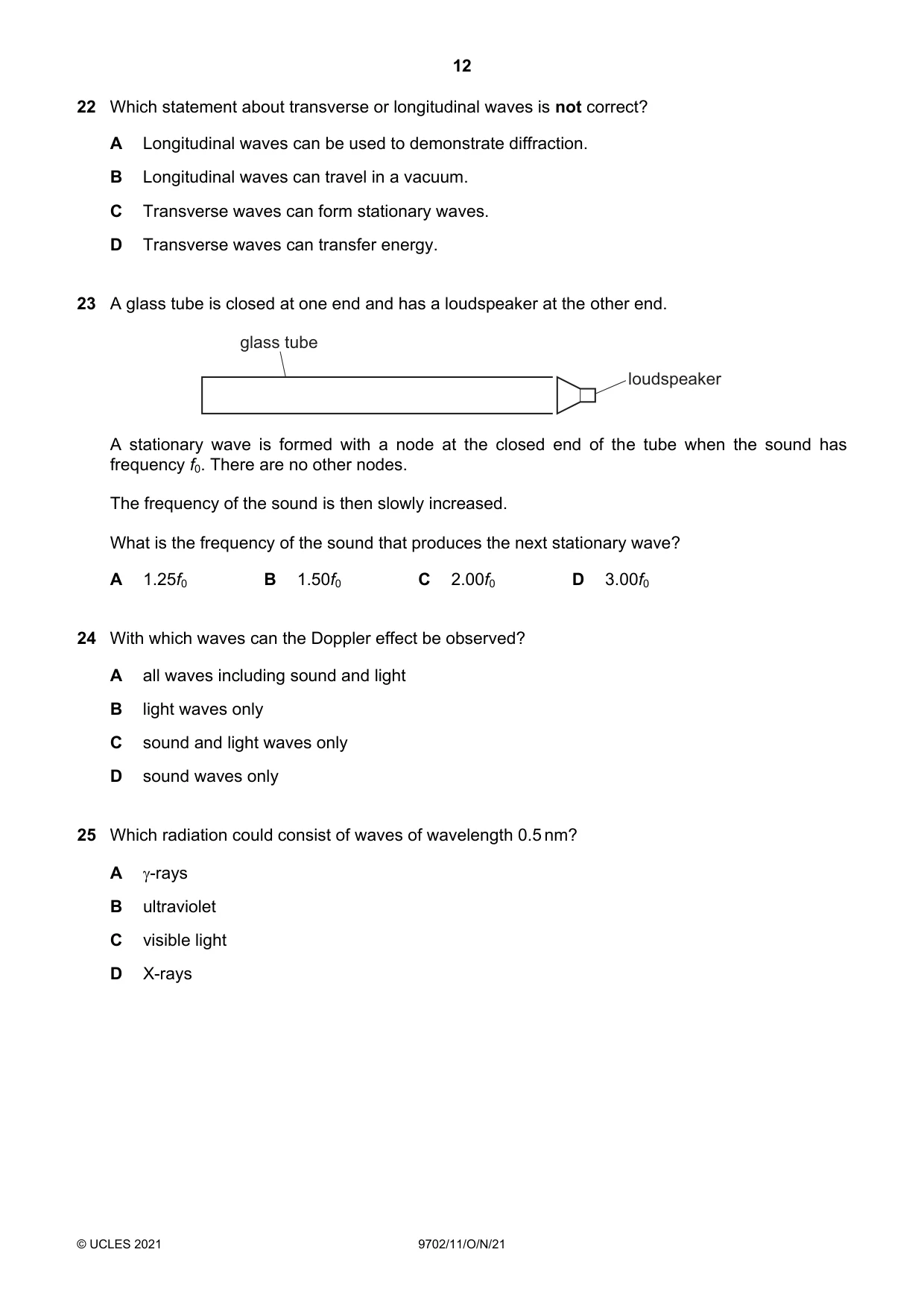
Q22 · Which statement about transverse or longitudinal waves is not correct?
22 Which statement about transverse or longitudinal waves is not correct? A Longitudinal waves can be used to demonstrate diffraction. B Longitudinal waves can travel in a vacuum. C Transverse waves can form stationary waves. D Transverse waves can transfer energy.
Mark scheme: B
Q23 · A glass tube is closed at one end and has a loudspeaker at the other end
23 A glass tube is closed at one end and has a loudspeaker at the other end. glass tube loudspeaker A stationary wave is formed with a node at the closed end of the tube when the sound has frequency f0. There are no other nodes. The frequency of the sound is then slowly increased. What is the frequency of the sound that produces the next stationary wave? A 1.25f0 B 1.50f0 C 2.00f0 D 3.00f0
Mark scheme: D
Q24 · With which waves can the Doppler effect be observed?
24 With which waves can the Doppler effect be observed? A all waves including sound and light B light waves only C sound and light waves only D sound waves only
Mark scheme: A
Q25 · Which radiation could consist of waves of wavelength 0.5 nm?
25 Which radiation could consist of waves of wavelength 0.5 nm? A -rays B ultraviolet C visible light D X-rays
Mark scheme: D
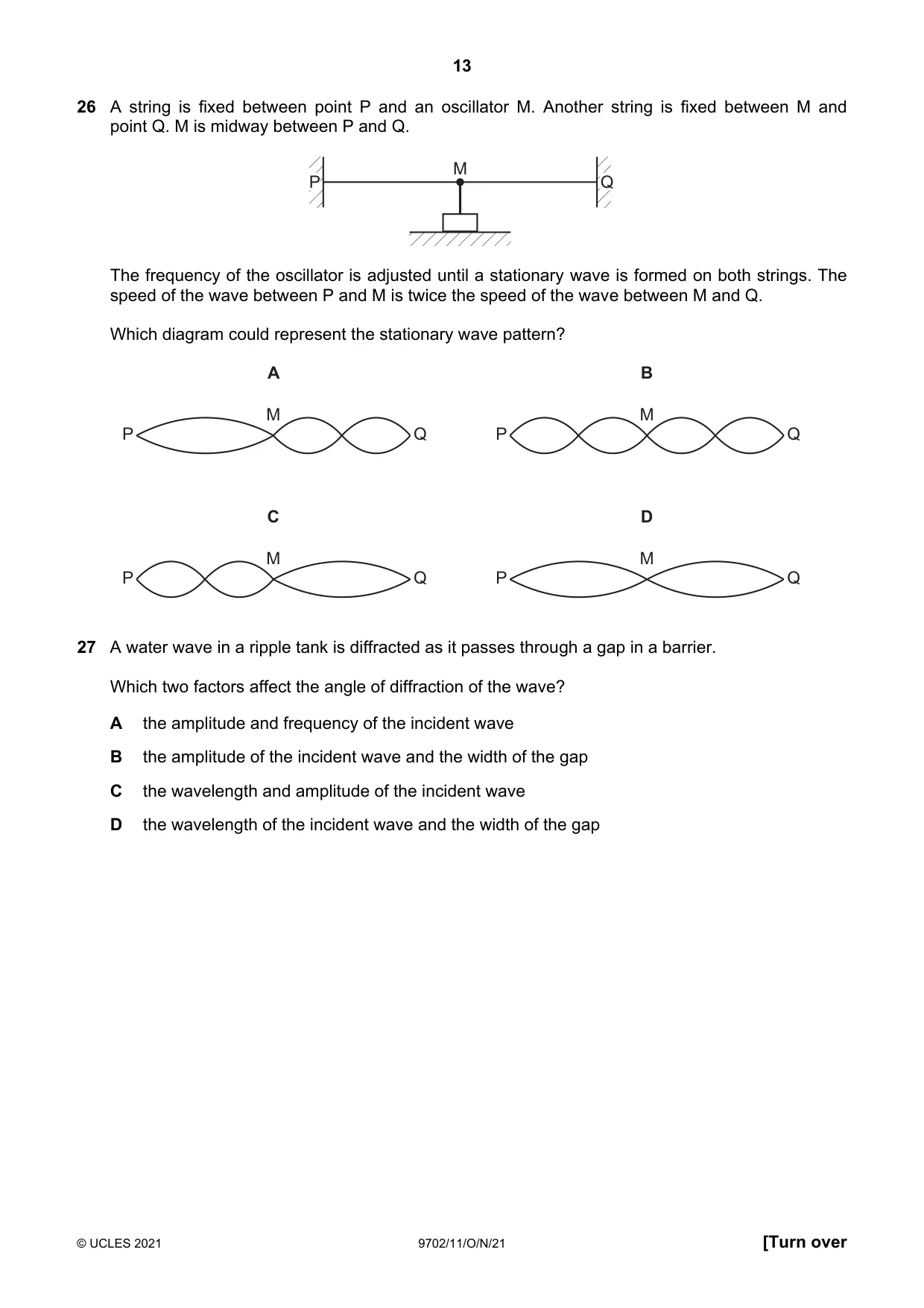
Q26 · A string is fixed between point P and an oscillator M
26 A string is fixed between point P and an oscillator M. Another string is fixed between M and point Q. M is midway between P and Q. M P Q The frequency of the oscillator is adjusted until a stationary wave is formed on both strings. The speed of the wave between P and M is twice the speed of the wave between M and Q. Which diagram could represent the stationary wave pattern? A B M M P Q P Q C D M M P Q P Q
Mark scheme: A
Q27 · A water wave in a ripple tank is diffracted as it passes through a gap in a barrier
27 A water wave in a ripple tank is diffracted as it passes through a gap in a barrier. Which two factors affect the angle of diffraction of the wave? A the amplitude and frequency of the incident wave B the amplitude of the incident wave and the width of the gap C the wavelength and amplitude of the incident wave D the wavelength of the incident wave and the width of the gap
Mark scheme: D
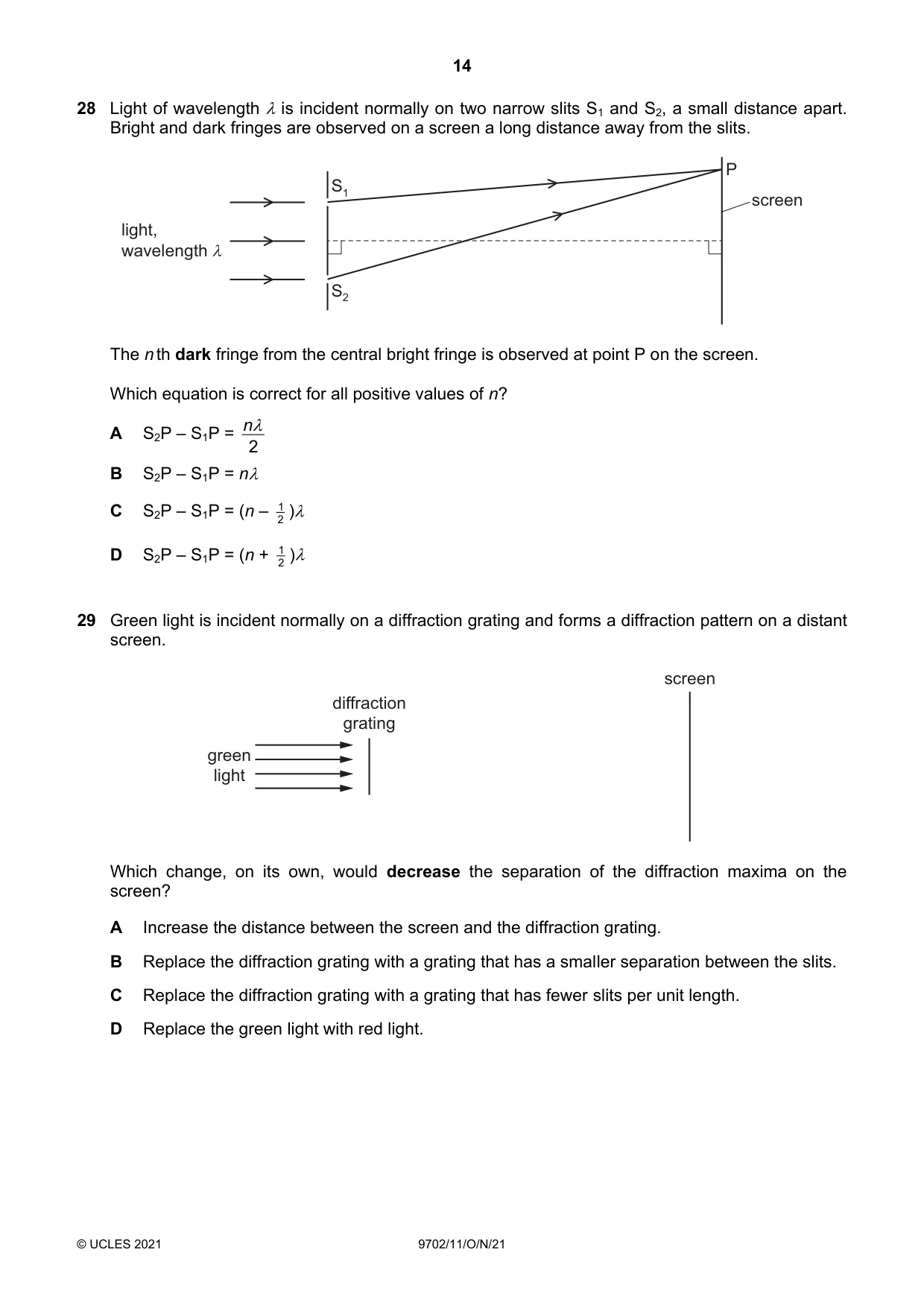
Q28 · Light of wavelength 4 is incident normally on two narrow slits S; and S2, a small…
28 Light of wavelength 4 is incident normally on two narrow slits S; and S2, a small distance apart. Bright and dark fringes are observed on a screen a long distance away from the slits. light, wavelength A The nth dark fringe from the central bright fringe is observed at point P on the screen. Which equation is correct for all positive values of n? A s,p-s,p= 2% 2 B SoP - SP =na C S.P-S,P=(n- 5 )A D SP-S,P=(n+4)4
Mark scheme: C
Q29 · Green light is incident normally on a diffraction grating and forms a diffraction pattern…
29 Green light is incident normally on a diffraction grating and forms a diffraction pattern on a distant screen. screen diffraction grating green light Which change, on its own, would decrease the separation of the diffraction maxima on the screen? A Increase the distance between the screen and the diffraction grating. B Replace the diffraction grating with a grating that has a smaller separation between the slits. C Replace the diffraction grating with a grating that has fewer slits per unit length. D Replace the green light with red light.
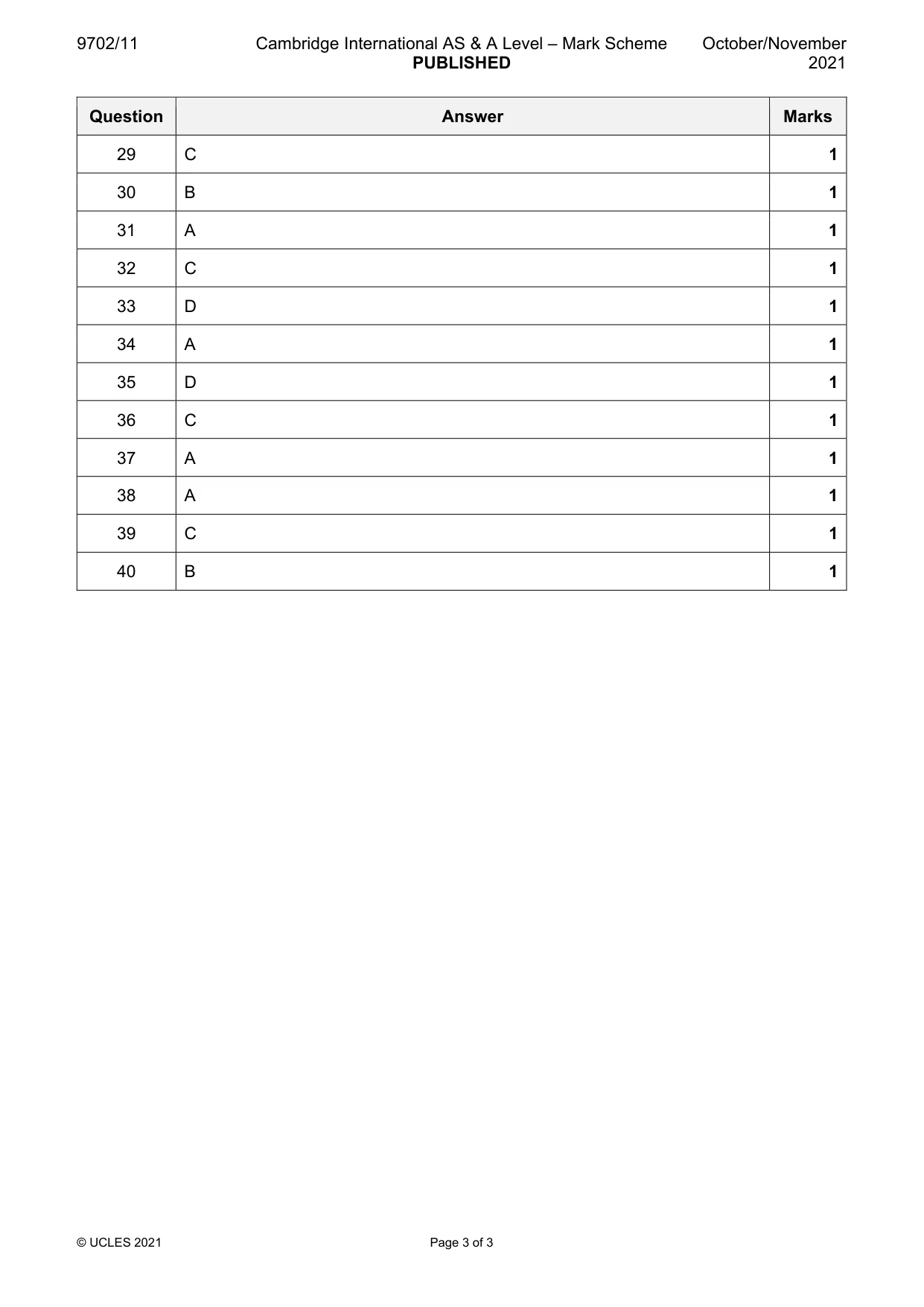
Mark scheme: C
Q30 · What is meant by electric field strength?
30 What is meant by electric field strength? A force per unit charge acting on a small mass B force per unit charge acting on a small positive charge C force per unit mass acting on a small mass D force per unit mass acting on a small positive charge
Mark scheme: B
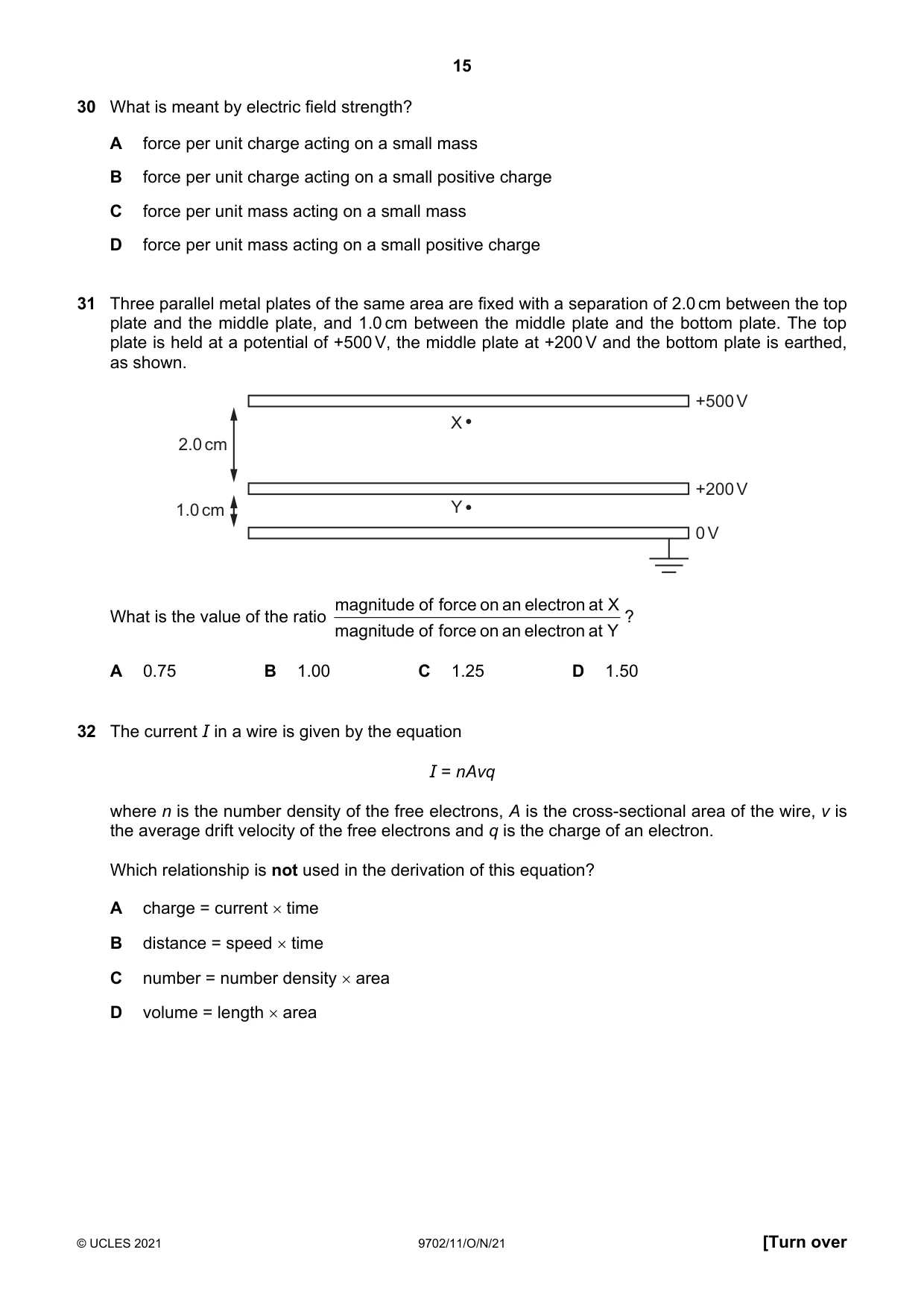
Q31 · Three parallel metal plates of the same area are fixed with a separation of 2.0 cm…
31 Three parallel metal plates of the same area are fixed with a separation of 2.0 cm between the top plate and the middle plate, and 1.0 cm between the middle plate and the bottom plate. The top plate is held at a potential of +500 V, the middle plate at +200 V and the bottom plate is earthed, as shown. +500 V X 2.0 cm +200 V 1.0 cm Y 0 V magnitude of force on an electron at X What is the value of the ratio ? magnitude of force on an electron at Y A 0.75 B 1.00 C 1.25 D 1.50
Mark scheme: A
Q32 · The current I in a wire is given by the equation I = nAvq where n is the number density…
32 The current I in a wire is given by the equation I = nAvq where n is the number density of the free electrons, A is the cross-sectional area of the wire, v is the average drift velocity of the free electrons and q is the charge of an electron. Which relationship is not used in the derivation of this equation? A charge = current time B distance = speed time C number = number density area D volume = length area
Mark scheme: C
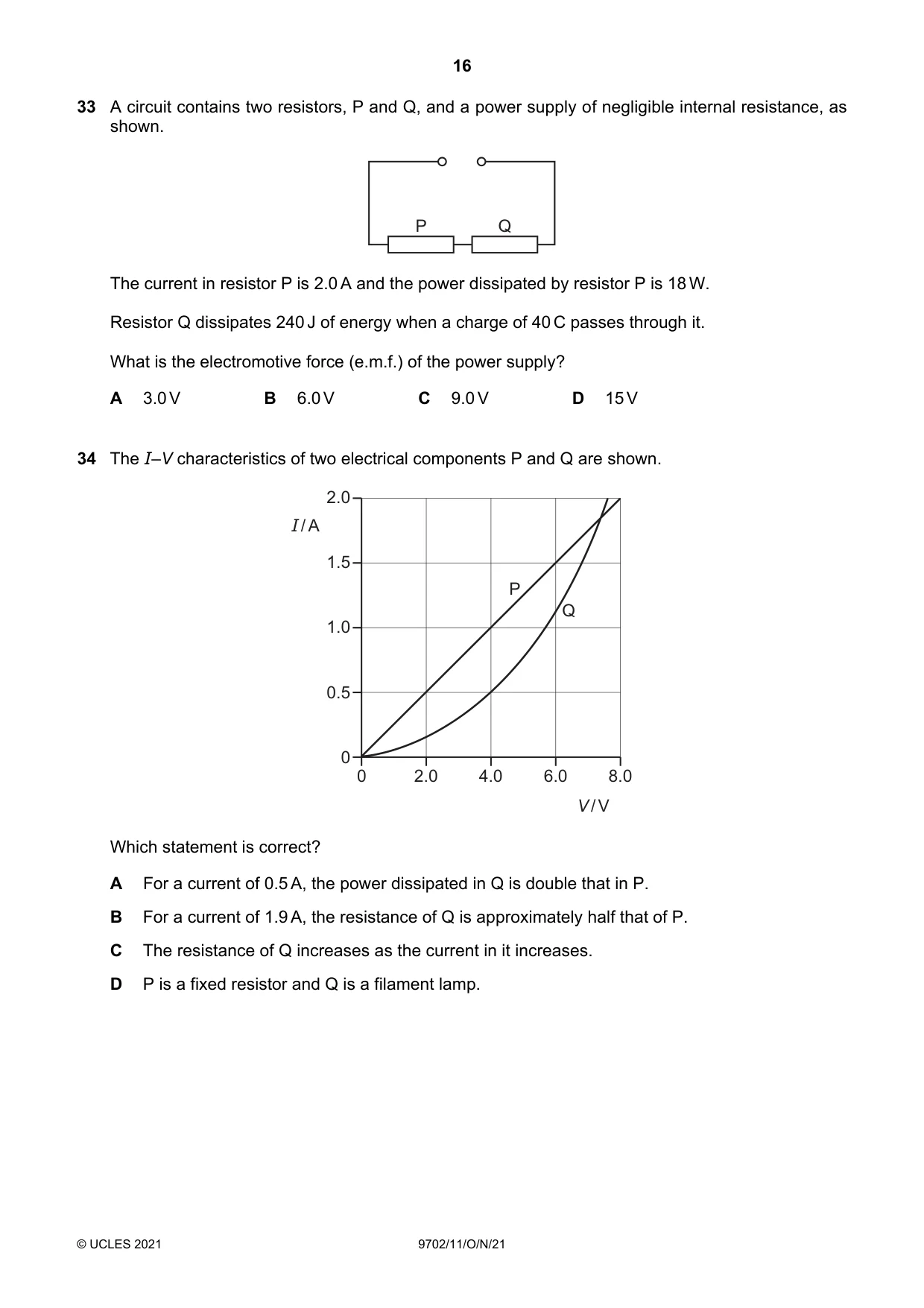
Q33 · A circuit contains two resistors, P and Q, and a power supply of negligible internal…
33 A circuit contains two resistors, P and Q, and a power supply of negligible internal resistance, as shown. P Q The current in resistor P is 2.0 A and the power dissipated by resistor P is 18 W. Resistor Q dissipates 240 J of energy when a charge of 40 C passes through it. What is the electromotive force (e.m.f.) of the power supply? A 3.0 V B 6.0 V C 9.0 V D 15 V
Mark scheme: D
Q34 · The I–V characteristics of two electrical components P and Q are shown
34 The I–V characteristics of two electrical components P and Q are shown. 2.0 I / A 1.5 P Q 1.0 0.5 0 0 2.0 4.0 6.0 8.0 V / V Which statement is correct? A For a current of 0.5 A, the power dissipated in Q is double that in P. B For a current of 1.9 A, the resistance of Q is approximately half that of P. C The resistance of Q increases as the current in it increases. D P is a fixed resistor and Q is a filament lamp.
Mark scheme: A
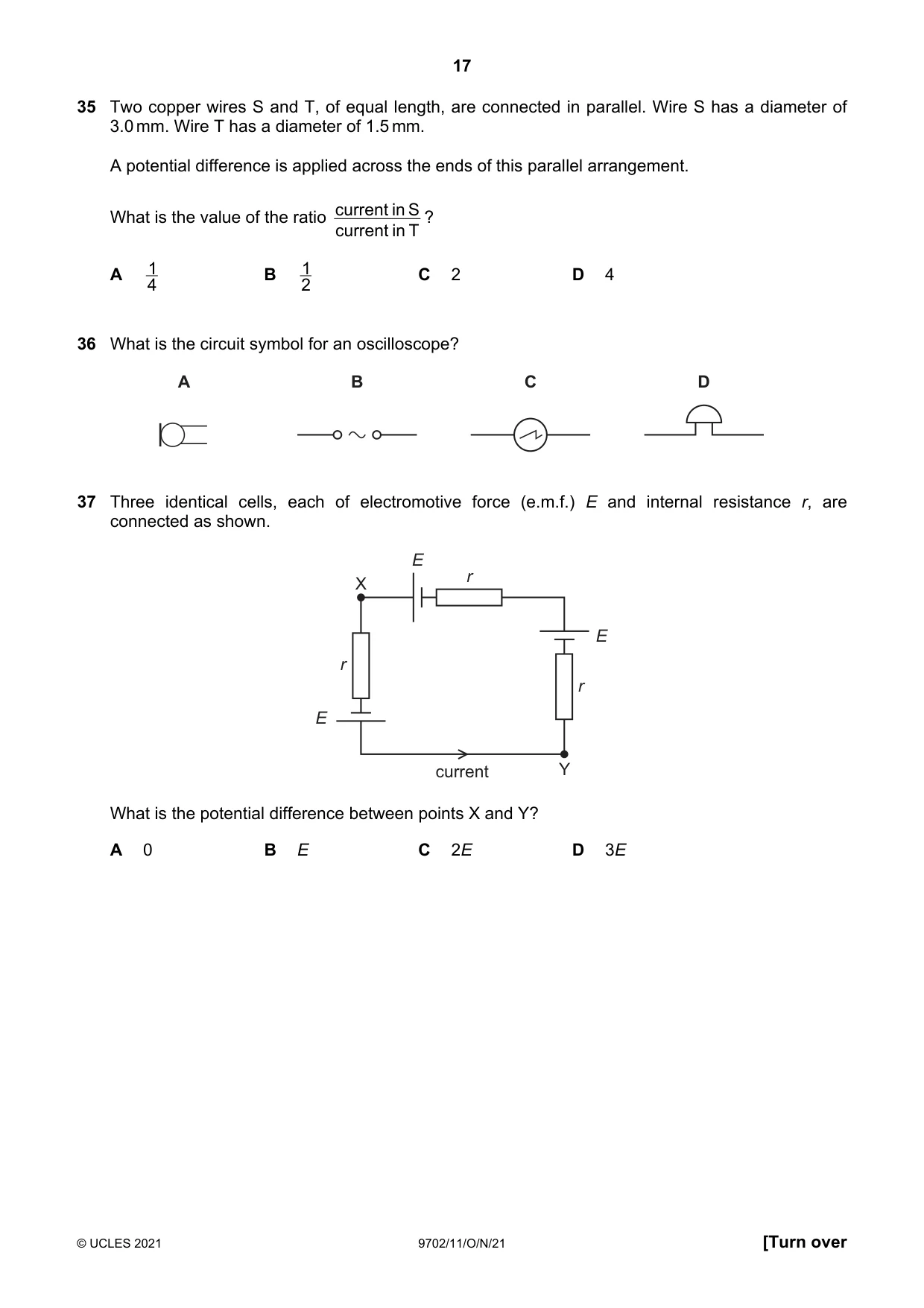
Q35 · Two copper wires S and T, of equal length, are connected in parallel
35 Two copper wires S and T, of equal length, are connected in parallel. Wire S has a diameter of 3.0 mm. Wire T has a diameter of 1.5 mm. A potential difference is applied across the ends of this parallel arrangement. What is the value of the ratio current in S ? current in T A 1 B 1 C 2 D 4 4 2
Mark scheme: D
Q36 · What is the circuit symbol for an oscilloscope?
36 What is the circuit symbol for an oscilloscope? A B C D
Mark scheme: C
Q37 · Three identical cells, each of electromotive force (e.m.f.) E and internal resistance r…
37 Three identical cells, each of electromotive force (e.m.f.) E and internal resistance r, are connected as shown. E r X E r r E current Y What is the potential difference between points X and Y? A 0 B E C 2E D 3E
Mark scheme: A
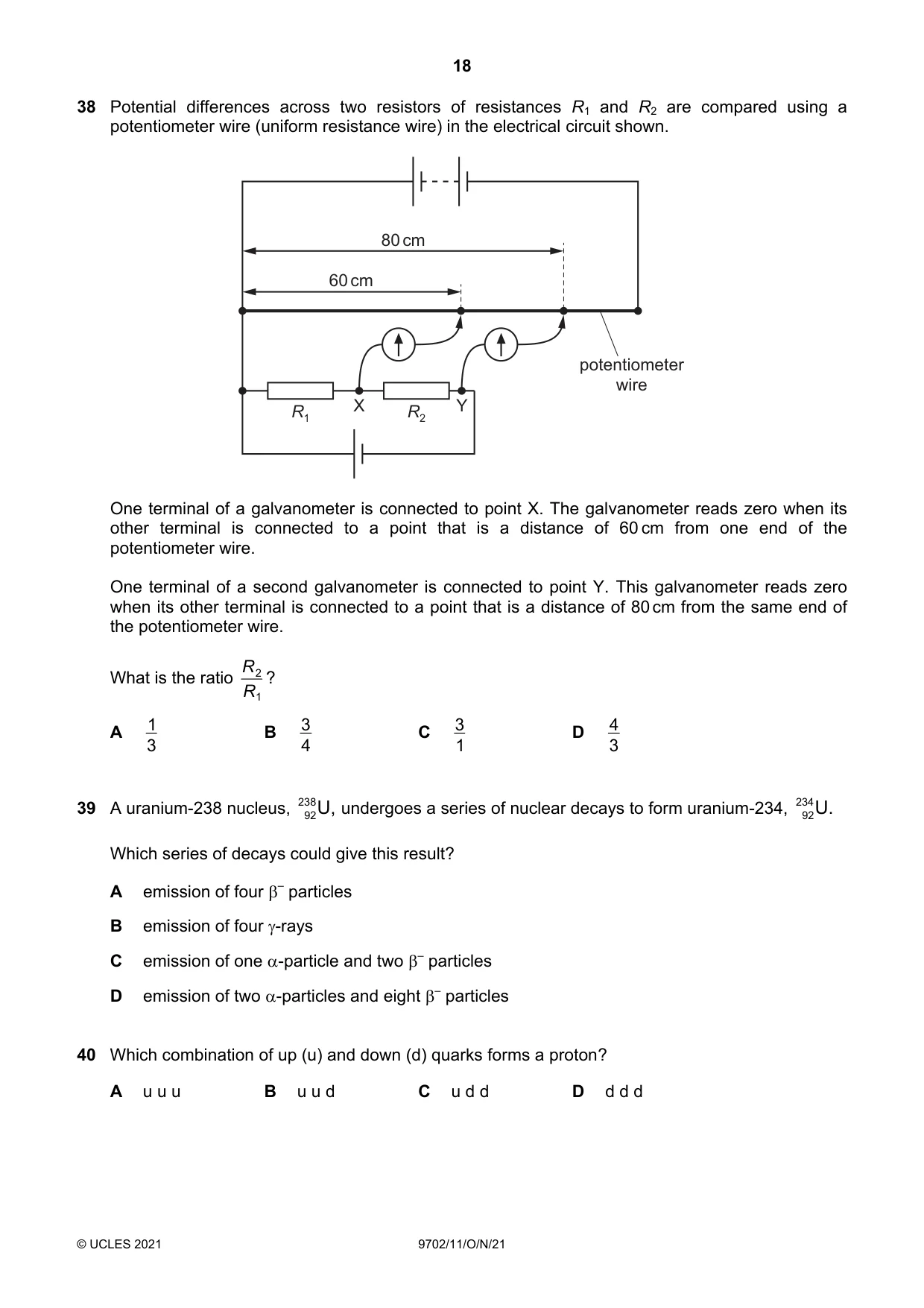
Q38 · Potential differences across two resistors of resistances R1 and R2 are compared using a…
38 Potential differences across two resistors of resistances R1 and R2 are compared using a potentiometer wire (uniform resistance wire) in the electrical circuit shown. 80 cm 60 cm potentiometer wire R1 X R2 Y One terminal of a galvanometer is connected to point X. The galvanometer reads zero when its other terminal is connected to a point that is a distance of 60 cm from one end of the potentiometer wire. One terminal of a second galvanometer is connected to point Y. This galvanometer reads zero when its other terminal is connected to a point that is a distance of 80 cm from the same end of the potentiometer wire. R What is the ratio R ? 2 1 A 3 1 B 3 4 C 3 1 D 3 4
Mark scheme: A
Q39 · A uranium-238 nucleus, 238 U, undergoes a series of nuclear decays to form uranium-234…
39 A uranium-238 nucleus, 238 U, undergoes a series of nuclear decays to form uranium-234, 234 U. 92 92 Which series of decays could give this result? A emission of four – particles B emission of four -rays C emission of one -particle and two – particles D emission of two -particles and eight – particles
Mark scheme: C
Q40 · Which combination of up (u) and down (d) quarks forms a proton?
40 Which combination of up (u) and down (d) quarks forms a proton? A u u u B u u d C u d d D d d d
Mark scheme: B
What was in this paper
The subtopics covered by these 40 questions, and how many questions each got. Open one in a new tab to see every Cambridge question on it.
2Energy conservation2Equations of motion2Gravitational potential energy and kinetic energy2Progressive waves2Resistance and resistivity2Stationary waves2Turning effects of forces2Diffraction1Doppler effect for sound waves1Elastic and plastic behaviour1Electric current1Electric fields and field lines1Electromagnetic spectrum1Errors and uncertainties1Fundamental particles1Gravitational field1Interference1Kirchhoff’s laws1Linear momentum and its conservation1Momentum and Newton’s laws of motion1Physical quantities1Potential difference and power1Potential dividers1Practical circuits1Radioactive decay1Scalars and vectors1SI units1Stress and strain1The diffraction grating1Transverse and longitudinal waves1Uniform electric fields1What you needed in this session
Cambridge’s own grade thresholds for 2021 Oct/Nov, Paper 1 · Variant 1. A higher threshold means an easier paper — the bar moves with how the cohort did.